
Council Minutes - Section B: Reports - 23 October 2012
Contents | Previous Page: Section A - Procedural Matters | Next Page: Section C - Notice of Motion
Contents | Previous Page: Section A - Procedural Matters | Next Page: Section C - Notice of Motion
Reports tabled at the Ordinary Meeting of Council on Tuesday 23 October 2012 held at City Hall, Little Malop Street in Geelong.
Greater Geelong City Council – Community Safety Statement (Draft)
Fisher Street Portarlington - Proposed Footpath Construction - SRC 323 - Declaration of Charge
Portfolio: |
Community Safety – Cr Farrell |
Source: |
Community Services/Community Development |
General Manager: |
Jenny McMahon |
Index Reference: |
Subject: Community Safety |
The purpose of this report is to present for Council’s consideration a Greater Geelong City Council – Community Safety Statement (draft). See Appendix 1.
It is proposed that the draft statement be released for public consultation to enable community and key stakeholder feedback on the proposed framework.
The feedback will further inform the content of the statement and the development of a four year implementation plan.
The Greater Geelong City Council – Community Safety Statement (draft) outlines overarching principles and a framework that clearly explains the activities Council undertakes in the important area of community safety.
Community safety has been an area of work for Council for some years via a range of activities undertaken by a number of departments across Council.
Over time there has been increasing community expectation that local governments will undertake a range of safety related activities. Council has undertaken many initiatives to improve safety, including in recent years:
A strong commitment to improving safety in central Geelong, including: provision of lighting, safe taxis, night rider bus, security cameras and through working closely with licensed venues
Upgrades to public spaces experiencing a high level of safety concerns, eg Whittington Link Upgrade
Increased street lighting to provide safer pedestrian movement at night
Providing safer public transport options, eg Building Bellarine Connections
Action Plan to address violence against women and children
Developed strategies for responsible management of alcohol and other drugs
Targeting the safety of vulnerable groups within the community, eg Geelong Adolescent Sexuality Program (GASP) – Youth Suicide Prevention Project
Providing leisure infrastructure to create safe environments for youth, eg skate parks, and sporting options via facility upgrade and development
Tackling a variety of issues related to public perception of unsafe environments, eg graffiti, dog control.
A further report will be made to Council following the consultation period.
Cr Farrell moved, Cr Fisher seconded –
That Council:
Notes the report
Releases the Greater Geelong City Council – Community Safety Statement (draft) for public consultation via an eight week submission process. Appendix 1.
Receives a further report following the consultation period.
Carried.
The draft statement defines ‘community safety’ as “the right of all people living, working or visiting the City to both feel and be safe”. This is regarded as a goal for the whole community.
Community safety has been an area of work for Council for some years. This has been through the design of public space, maintenance of footpaths, response to natural disasters, safety in central Geelong, graffiti management, responding to alcohol and other drug misuse, and the strategic and integrated responses provided through City Plan and G21.
To date, Council has not had a plan or defined strategic direction to outline its role in the area of community safety. It has become increasingly clear that a clear strategic direction is needed to guide Council’s work in this area.
Over a period of time there has been an increasing expectation that local governments will undertake a range of safety related activities, for example funding and operating closed circuit television in central activity areas, delivering road safety programs and taking a lead in initiatives that address issues such as family violence and misuse of alcohol and drugs.
During 2012, internal consultations were undertaken across Council to develop a draft document that would identify the range of work undertaken by Council in community safety and that would clearly explain what Council does and what guides that work. The resultant document, the Greater Geelong City Council – Community Safety Statement (draft), is the subject of this report.
In 2012 Council undertook to develop a broad statement that describes and clarifies the role of Council in supporting, developing and deploying community safety programs. The statement has been developed for a public audience and as a tool to enhance partnerships with many other statutory and community organisations.
The draft statement includes:
The role of Council in promoting community safety.
Council has a vision to be the best place to live through prosperous and cohesive communities in an exceptional environment.
Council accepts the role of supporting safe community participation and access to places, services and opportunities by:
Developing individual and community responsibility
Connecting people in community life through supporting and delivering programs
Planning, building and maintaining safe community places and environments
Partnering with other community safety organisations and groups
Managing risks and minimising hazards in the community.
Council programs, services and actions that promote community safety.
Council delivers a wide range of programs, services and actions that promote community safety. Some of these are:
Developing individual and community responsibility
Connecting people in community life through supporting and delivering program
Planning, building and maintaining safe community places and environments
Partnering with other community safety organisations and groups
Managing risks and minimising hazards in the community.
Guidance on community safety
Council in its roles gains guidance on community safety from a very wide range of legislation and regulations. Some examples include:
Local Government Act 1989
Greater Geelong City Council – General Local Law 2005
Food Act 1984
Road Management Act 2004
Occupational Health and Safety Act 2004
Emergency Management Act 1986
Public Health and Wellbeing Act 2008
Country Fire Authority Act 1986
Planning and Environment Act 1987
Residential Tenancies Act 1997
Liquor Control Reform Act 1998
Gaming Regulation Act 2003
Child Wellbeing and Safety Act 2005
Safer Design Guidelines for Victoria.
Overarching principles
Council has identified a set of overarching principles based on the ‘Cities for Safe and Healthy Communities’ developed by ICLEI – Local Governments for Sustainability.
This program proposes five domains for Council to focus on:
Land Use Planning
Licensing and Regulation
Facilitation, Advocacy and Leadership
Community Service Delivery, Community Development and Civic Engagement
Workforce Development.
Policies and strategies
Council has also developed detailed policies and strategies that contribute to community safety. Whole-of-organisation documents include:
City Plan
City of Greater Geelong Municipal Strategic Statement
Geelong Health and Wellbeing Plan
Sustainable Communities: Infrastructure Development Guidelines.
In addition, Council has developed a range of policies, strategies and plans in each of the following action areas:
Developing individual and community responsibility
Connecting people in community life through supporting and delivering programs
Planning, building and maintaining safe community places and environments
Partnering with other community safety organisations and groups
Managing risks and minimising hazards in the community.
Relevant committees and groups
Council is an active participant in a wide range of networks and forums relating to community safety:
Geelong Safety Committee: A key network is the Greater Geelong Safety Committee, which is a broadly representative regional body with a vision to improve and promote community safety throughout Greater Geelong. The Greater Geelong Safety Committee promotes a wide range of activities that involve groups such as Victoria Police, Emergency Services, State Departments, business groups and community groups and representatives.
Regional Justice Reference Group: A further significant network is the Regional Justice Reference Group which connects organisations across the G21 area and focuses on identified priorities across state departments, police and local government. The Group reports to the regional Managers Forum.
Municipal Emergency Management Planning Committee: This committee involves emergency services and Council in the process of planning to respond to a wide range of potential emergency situations.
The G21 Health and Wellbeing Pillar Executive: This is a forum to identify and advance services, partnerships and research that enhances the health and wellbeing of the community.
Beyond these networks Council is involved in forums and groups that relate to places within the municipality and / or key community issues. These networks are established for specific projects or long term. Some further illustrations of networks include:
Geelong Drug Action Plan Committee
G21 Freedom From Violence Group
Roadsafe Barwon
Child FIRST Regional Alliance.
Commitment
Council is committed to further develop policies and actions that increase the liveability of the municipality by improving both the perception and reality of community safety.
This ongoing commitment will be delivered by ensuring that Council continues to:
Work in partnership with community, government and statutory agencies on community safety initiatives
Provide programs and services to people who visit, study, live or work in the municipality
Govern effectively by accepting responsibility for the sound regulation of key community safety functions.
It is recommended that Council now invites public input into the Greater Geelong City Council – Community Safety Statement (draft) by releasing the document for a six week consultation process. The feedback received will inform a further report to Council.
The area of community safety is critical to creating an environment conducive to economic and social growth and community wellbeing.
Environment in terms of ‘safer design’ principles in public space design and development has a significant impact on community safety for residents.
There are no immediate financial implications related to this draft statement. Any increase in Council funding towards community safety activities would be subject to future budget processes.
Community safety is identified as an important element in City Plan 2009–2013 (refer Strategic Directions and Annual Action Plan section ‘Community Wellbeing’).
Council has a duty of care as the manager of relevant public spaces and assets to provide that service in a safe manner. It should be conscious of this obligation and to manage and resource accordingly.
No Council officer involved in the preparation of this report has any direct or indirect interest.
Addressing community safety positively contributes to a decrease in risk for Council in terms of safer physical space and increased community confidence.
There will always be risks associated with cities that involve a complex mix of people and activities. The Greater Geelong City Council – Community Safety Statement (draft) would guide a system of planning, identification and actions that involves all stakeholders.
A sense of safety is a basic human need and people’s sense and perception of safety is a key contributor to their confidence to participate in community life. The community has an expectation of safety and needs to see and feel that Geelong and the surrounding municipality is a safe place. By addressing this need many of the City’s higher economic goals will be complemented and more easily achieved.
The Community Development Department will be responsible for communicating this report along with the Greater Geelong City Council – Community Safety Statement (draft) to the community and external stakeholders.
Portfolio: |
Community Development – Cr Fisher |
Source: |
Community Services/Aged & Disability Services |
General Manager: |
Jenny McMahon |
Index Reference: |
Subject: Public Health Plan |
Geelong is surrounded by green spaces and agricultural land and can celebrate food on a regional level.
The region has ready access to a wide variety of high quality foods all year round which are enjoyed in the home and in our cafes, restaurants and other food outlets.
Many people in Geelong, however, are unable to consistently put nutritious food on the table, and as such are “food insecure”.
Limited food choices, combined with poor physical or economic access undermines health and contributes to food insecurity.
Increasingly, the region’s food systems and the health of the natural systems that support them (our land, water and atmosphere) are becoming unsustainable.
Cities around the world and local governments within Victoria are recognising that they can play an important role in leading and catalysing change towards healthy and sustainable, fair and resilient food systems.
City of Greater Geelong has taken the first step by forming a partnership with six other major organisations to become nationally recognised as a city demonstrating sustainable leadership, good economic credentials and an environment that is vibrant and liveable.
Developing and implementing a Food Policy for Geelong, that encompasses all facets of the food system and determinants of health will ensure adequate and safe food now and into the future for Geelong residents.
A Food Policy will provide a basis to look more broadly at addressing the health and sustainability challenges facing our food system.
Cr Fisher moved, Cr Granger seconded –
That Council develops a Food Policy as a major action of the 2013-2017 Municipal Health and Wellbeing Plan.
Carried.
City of Greater Geelong established a Food Security Network in 2009. Stakeholders from 15 different agencies which include five internal Council Departments attend bi-monthly meetings and have been gathering local evidence in relation to food security. The network has broadened to encompass the G21 region and has representation from Colac Otway Shire and Golden Plains Shire.
The objectives of this network are to:
Establish a local evidence base of Food Security in the G21 Region.
Increase awareness about Food Security in the community.
Build capacity across the community to address Food Insecurity.
The methodologies used to gather local evidence were:
Victorian Healthy Food Basket’ Surveying (Market Basket Survey).
Mapping of fast food vs fresh food outlets.
Review of existing initiatives addressing Food Insecurity.
Community Food Relief Agency survey.
Gathering rates of Food insecurity in ‘at risk’ communities.
At any given time a proportion of people will experience a degree of Food Insecurity. Food insecurity exists whenever the availability of nutritionally adequate, safe foods or the ability to acquire personally acceptable foods in a socially acceptable way is limited or uncertain(1).
Local data has shown that in some ‘at risk’ communities the rate of Food Insecurity was 19% (Aged in Northern Bellarine) and 40.9% (Homeless Youth) as compared to the Victorian Public Health Survey(2), 2008 where it was reported that only 3.9% of Geelong respondents had run out of food in the past 12 months and were unable to afford to buy more. (Standard question used to measure food insecurity)
Mapping revealed that where pockets of food insecurity exist there is limited access to fresh, affordable food, in correlation with a glut of high fat takeaway outlets (see attached map).
Community Food Relief Agencies have reported an increase in individuals and families sourcing emergency food and attending community meals program over the last two years due to high cost of food and job retrenchments. This is reflected in the Market Basket survey results showing that some households would have to spend over 30% of their income to eat a healthy diet. This cost is unsustainable when combined with housing and other living expenses. Having adequate food to eat is a basic human right3. Further, a person’s dignity, with regard to food, is having choice over what one would like to eat and being able to access those foods.
(1) |
Campbell C. 1991, Food Insecurity: A nutritional Outcome or a Predictor Variable? Journal of Nutrition, 121 408-415 |
(2) |
Vic Population Health Survey Department of Health, 2008 Victorian Population Health Survey Melbourne |
(3) |
United Nations 1948, Universal Declaration of Human Rights. Article 25, Para 1 |
There is currently sufficient availability of food in the City of Greater Geelong to meet the nutritional requirements of the population. However, at any given time a proportion of people experience some degree of Food Insecurity due to relative cost, and physical access etc.
Poor health and the prevalence of preventable chronic diseases such as Diabetes Type II and heart disease are directly related to the incidence of Food Insecurity in certain communities.
Local initiatives addressing Food Insecurity in disadvantaged areas of Geelong have shown that where fresh food is accessible (within 400 metres to home) and of good quality, residents are increasing their fruit and vegetable intake. (See attached Needs Assessment: Methods and Results)
Challenges to our local community come from the region experiencing a period of rapid growth that could potentially decrease rural and agricultural land and our access to fresh affordable food.
A Food Policy would draw on existing strengths in the food production and distribution process and develop effective and inspiring responses to the challenges of our growing population. The opportunities to change our food system can deliver multiple benefits for the region such as, creating healthier communities, places, jobs and a more sustainable city. Geelong has unique assets that could shape our approach to food, such as close proximity to agricultural land and access to rural living.
Food Security is only one aspect of the food system but an important lever as to why action should be taken to address the food issue in a holistic way.
A Food Policy provides an opportunity to plan and design our city today in a way that can improve Food Security now and for the future. It is a way to plan to support a sustainable food system and to support local food growing industries that will create employment and economic benefits for Geelong.
This Food Policy would:
Outline a vision for a healthy, sustainable, fair and prosperous food system.
Strengthen partnerships with community and business to realise this vision.
Provide a framework for Council that guides coordinated action and decision making to improve the local food system.
Raise awareness that what we eat as individuals has an affect on our health, the welfare of others and the planet itself.
Ensure equity for all in terms of the basic human right, that every person in their lifetime should be able to access fresh, affordable, nutritious, safe foods.
The implications of a Food Policy that looks at the whole food system will have sustainable environmental outcomes.
Creating a Food Policy has the potential to reduce energy use and greenhouse emissions by supporting local food growing and distribution within the local area.
Initiatives that increase production of fresh affordable food would be encouraged to use water efficient technologies and design principles.
Food rescue and redistribution of fresh food to those in need has been operating in Geelong over the past two years through Second Bite. In a given month, average fresh food rescued and redistributed is between 12-15 tonnes to 22 agencies that would have ended up in landfill.
It is not expected that it will have any negative impact on habitat or the natural environment but could enhance and preserve these areas.
No additional measures are proposed.
The adoption of a Food Policy refers to the Human Rights Charter that all persons have a right to access fresh affordable adequate food.
No Officer in the preparation of this report has any direct or indirect interest other than their role as an officer of Council and member of the local community.
There are no notable risks associated with implementing the recommendations contained in this report.
There are no notable risks associated with implementing the recommendations contained in this report.
The recommendations of this report, if implemented, could address Food Insecurity in ‘at risk’ groups and support healthy eating strategies that have been adopted by Council through the Healthy Eating Plan and the engagement of the Prevention Community Model. The recommendation is consistent with Council’s approach to increasing the health and well being of the community and preventing chronic diseases attributable to lifestyle factors. In addition, supporting local food system that would have economic benefits for Geelong.
It is intended that a Food Policy Discussion Paper be drafted for community consultation. The outcomes of this consultation will shape the Food Policy development and implementation.
Portfolio: |
Democracy and Governance – Cr Mitchell |
Source: |
Corporate Services – Corporate Strategy |
General Manager: |
Jeff Wall |
Index Reference: |
Subject/Corporate Management / Annual Report |
| Report to: | Council |
Section 131 of the Local Government Act 1989 requires that the Council submit its Annual Report to the Minister for Local Government within 3 months of the end of the financial year.
The Annual Report for 2011-2012 has been prepared and a copy was provided to the Minister on 26 September 2012.
The Annual Report has been prepared to comply with Section 131 of the Local Government Act 1989 that requires inclusion of the following:
A report on the Council’s operations during the financial year,
Audited Standard Statements for the financial year,
Audited Financial Statements for the financial year,
A copy of the Performance Statement for the year (prepared under Section 132),
A Copy of the report on the Performance Statement for the year (prepared under Section 133), and
Any other matter required by the regulations.
In accordance with the requirements of Section 132 of the Local Government Act 1989 and Clause 12 and 16 of the Local Government (Finance and Reporting) Regulations 2004 the nominated Principal Accounting Officer of Council, 2 Councillors and the Chief Executive Officer have signed the Performance Statement, Standard and Financial statements.
The Performance Statement, Standard and Financial Statements have been finalised and the Auditor General’s Report on the Performance Statement, Standard and Financial Statements has been received.
After the Annual Report has been submitted to the Minister, Council is required [(under Section 131 (10)] to give public notice that the Annual Report has been prepared and can be inspected at Council Offices.
Section 134 of the Local Government Act 1989 also requires the Council to consider the Annual Report at a meeting of Council and that 14 days public notice must be given of this meeting.
On 29 September 2012 a public notice was published in local newspapers advising of the availability of the Annual Report for viewing and the intention to discuss the Annual Report at the Council meeting on the 23 October 2012.
Cr Harwood moved, Cr Richards seconded –
That Council receives the 2011-2012 Annual Report in accordance with Section 131 of the Local Government Act 1989.
Carried.
Council approved “in principle” the Financial Statement of Accounts, Standard Statement and Performance Statements and authorised the signing of the Accounts subject to Auditor General requirements on 28 August 2012.
The Auditor-General has signed the accounts and issued his report stating that the accounts fairly present the financial position of the Council and comply with accounting requirements.
A copy of the Annual Report together with the Audited Performance Standard Statements and Financial Statements was provided to the Minister for Local Government on 26 September 2012.
Under Section 134 of the Local Government Act 1989, the Council must consider the annual report at a meeting of Council as soon as practicable after the Annual Report has been sent to the Minister.
The Annual Report is a comprehensive review of highlights and achievements for 2011-2012 financial year.
Under the Local Government Act the Council is required to give public notice when the Annual Report is available for public inspection and is also required to provide 14 days notice of when it will be considered at a Council Meeting.
On Saturday, 29 September 2012 Council gave public notice that:
Council had prepared the Annual Report for the financial year to 30 June 2012 and that copies containing the following information contained within the Annual Report were available from the Council’s website and Customer Service Centres:
A report on Council’s operations during the year,
The Audited Standard Statements for the financial year,
Audited Financial Statements for the financial year,
A copy of the Performance Statement for the year, and
A copy of the report on the Performance Statement for the year.
The Annual Report, including the Performance and Financial and Standard Statements, is to be considered at the Council meeting to be held on Tuesday 23 October 2012 commencing at 7:00 p.m.
As outlined in the “Social Considerations” section.
The Annual Report includes a copy of the City’s Audited “Standard Statements” and “Financial Statements” that has been the subject of a previous report to Council.
The recommendation and procedures outlined in this report conform to the requirements of the Local Government Act and Regulations.
Council has given public notice that the Annual Report 2011-2012 is available for public inspection and provided 14 days notice of a meeting to consider the report.
There is no conflict of interest to be disclosed.
There are no identified risks arising from this report.
The Annual Report provides a report to the community on the Actions and Initiatives undertaken during the reporting period.
In addition to the Statutory Financial Reporting, the Annual Report provides information to the community on how the resources of the City have been allocated between the Social, Environment and Economic needs of the community.
This information is presented in the City’s adopted Planning Framework of the three strategic directions being:
Community Wellbeing
Growing the Economy
Sustainable Built and Natural Environment
The Council’s Annual Report 2011-2012 is a primary communication document that has been made available for public inspection in draft form.
A printed publication is currently being prepared and will be distributed to leaders within the community.
A copy of the report will also be accessible via the City’s Internet site and at Council’s Customer Service Centres.
Portfolio: |
Climate Change, Environment and Sustainability – Cr Doull |
Source: |
Planning Strategy and Economic Development, Planning and Tourism |
General Manager: |
Peter Bettess |
Index Reference: |
Future Proofing |
Future Proofing Geelong (FPG) was established to promote and support new and existing initiatives which seek to improve environmental outcomes for Geelong. The FPG Sustainability Covenant is a partnership program between the City, EPA Victoria, Barwon Water, Deakin University, Committee for Geelong, Geelong Manufacturing Council and the Geelong Chamber of Commerce.
The first Future Proofing Geelong action was the development of a Low Carbon Growth Plan. The Plan identified opportunities for Geelong to reduce emissions and continue to develop economically. It was established in collaboration with key Geelong industry and industry bodies and outlines a practical way to create a smooth transition to a low carbon future for Geelong without compromising the economy of the region
The City adopted a three pronged approach to achieve the objectives of the Plan; assisting commercial building owners and tenants with measures to reduce carbon emissions; facilitating a Community Reference Group and a Small/Medium Enterprise Reference Group to identify sustainability projects important to the community, and thirdly providing a dedicated officer to identify funding sources and assist companies with preparing grant applications and funding bids for building or machinery improvements which achieve environmental benefits.
Significant progress is being made; with the assistance of Future Proofing staff a number of commercial buildings in Geelong have had energy audits conducted and building owners are planning upgrades to their buildings in response.
The two references groups have defined three themes which they wish to work on; food and food security, education, and clean technology clusters. The reference groups will be reconvened as one action oriented Project Tack Group with a focus on applying for State and Federal Government funding to deliver projects related to food and education, with a third stream of a clean technology cluster also under development.
The program further extends to grant writing assistance for companies to take advantage of funding opportunities to support transition/low carbon initiatives, Many companies have taken up this service.
Under the Federal Government’s Community Energy Efficiency Program (CEEP). The City obtained $550,000 in matched funding. This will used to undertake major refit and equipment updates as Waterworld, Splashdown and the National Wool Museum to significantly reduce energy use, maintenance costs and reduce the carbon footprint of the facilities. The City will undertake a significant community engagement program as part of the implementation of these initiatives.
Cr Doull moved, Cr Richards seconded –
That Council notes the progress of the Future Proofing Geelong project.
Carried.
The original Future Proofing Geelong Sustainability Covenant was a three year commitment by each of the partners to deliver and implement the Low Carbon Growth Plan for Geelong and to create a network for Geelong businesses and communities to collaborate on sustainability issues.
The project is governed at three levels with representation from each of the Covenant signatories; City, EPA Victoria, Barwon Water, Deakin University, Committee for Geelong, Geelong Manufacturing Council and the Geelong Chamber of Commerce. The three levels are the Advisory Board, the Working Group and the Reference Groups.
The Future Proofing Geelong project is in its second year since establishment.
The City focussed its approach to implementation of the Low Carbon Growth Plan in three areas; assisting commercial building owners and tenants with measures to reduce carbon emissions; facilitating a Community Reference Group and a Small/Medium Enterprise Reference Group to identify sustainability projects important to the community, and thirdly providing a dedicated officer to identify funding sources and assist companies/organisations with preparing grant applications and bids for funding.
Assisting commercial building owners and tenants
Future Proofing Geelong staff have targeted building owners to encourage them to look at ways they can reduce carbon emissions through a range of measures such as changes to lighting or upgrades to heating and cooling systems. Three sectors have been targeted office buildings, shopping centres/warehouses and not for profit building owners. The first step in this process is to engage an auditor to conduct an energy assessment on the building and make recommendations on changes to improve energy efficiency.
Further the City provides grant writing assistance to building owners who wish to implement the findings of the assessment. The relationship with the building owner will be maintained throughout this process so that energy reductions and carbon emissions can be recorded at pre and post upgrade levels.
Reference Groups
Future Proofing Geelong staff facilitate and provide support to the Community Reference Group and the Small Medium Enterprise Group. The groups comprise volunteers who are committed to ensuring Geelong transitions to a low carbon community. The groups have selected three themes which they wish to pursue further; food and food security, education and clean technology.
As the process moves towards implementation and project delivery, it was decided to combine the reference groups to enable them to focus on two of their preferred themes; food security and education. The new Project Task Group will focus on the identification of projects related to food and education. The Project Task Group will seek funding applications to deliver projects under these themes.
The clean technology theme is being considered through the proposed establishment of a “Clean Tech Cluster” which is discussed below.
Sourcing funds and writing grants
The State and Federal Governments and related agencies are now regularly releasing funding programs as part of the Clean Energy Future agenda to support businesses to enhance their environmental and business performance. The grant writing support provided under the Future Proofing program is assisting Geelong businesses to take full advantage of these opportunities.
The bid preparation process is complex requiring considerable information exchanges between the bid writer and the companies, often necessitating businesses updating their business plans and producing market development plans. The number of applications being submitted in increasing as the process becomes more established. Currently twenty one projects have been identified as potential candidates for funding bids, these include projects for the City, other agencies and for businesses in Geelong.
Other Future Proofing Projects
Other key areas of work for the Future Proofing Geelong team include:
Working with the Gordon and trades hall to ensure local trades people are trained in installation and maintenance of new energy efficient systems.
Publication of the Smarter Homes, Smarter Living booklet to provide advice to new home builders about designing their home and choosing appliances to reduce energy consumption and reduce running costs. This was mailed to all land owners in Armstrong Creek and is being distributed to owners in the growth areas of Lara, Leopold and the Jetty Road in Drysdale/Clifton Springs.
“Clean Tech Cluster”: the City is working with the Geelong Manufacturing Council, Enterprise Connect, Chamber of Commerce, the Committee for Geelong and Barwon Regional Waste Management Group towards the establishment of a “Clean Tech Cluster”. The cluster will be centred on manufacturing and engineering, services, and green buildings. The City will assist in fostering the development of the cluster and will eventually be industry driven.
MAV Community and Councils in Transition (CACIT): This project is aimed at building capacity in the wider community to enable communities to transition to a low carbon future. The MAV is recruiting councils across Victoria to roll out the program through a series of events in their municipalities. In Geelong the events will involve staff from all areas of the City, with two further events to stimulate community interest and to empower communities going forward.
Community Energy Efficiency Program (CEEP)- The Federal Government is providing matching funds to local governments and non-profit community groups to improve their energy efficiency and to assist in the transition following the introduction of a price on carbon. The City obtained $550,000 to upgrade boilers, heating and cooling systems, lighting and other energy efficiencies at Splashdown, Waterworld and the National Wool Museum.
Iconic Projects: The Advisory Board supported the development of business cases for two flagship projects to showcase the ideals of Future Proofing; a “sustainable house” in the display village at Armstrong Creek and a wind energy demonstration project at the Gateway Sanctuary in Leopold and at commercial sites throughout the City of Greater Geelong. These projects are about to commence.
The Future Proofing Geelong project is delivering positive environmental outcomes through education and assistance to businesses and the wider community to improve energy efficiency and reduce carbon emissions.
This report has no financial implications. The ongoing Future Proofing Geelong project is funded via existing City of Greater Geelong commitments with Barwon Water also a financial contributor to the project.
There are no policy, legal or statutory implications resulting from this report.
No Council officers have a direct or indirect interest in accordance with Section 80I of the Local Government Act in the issue to which this report relates.
There are no risks associated with this report.
The Future Proofing Geelong project is having positive social impacts through community engagement in the reference groups.
The Future Proofing Geelong website is regularly updated to showcase the work the City and the other partners are doing to implement the Low Carbon Growth Plan.
Portfolio: |
Infrastructure – Cr Richards |
Source: |
City Services – Engineering Services |
General Manager: |
Gary Van Driel |
Index Reference: |
Subject: Road Closure, Council Reports 2012 |
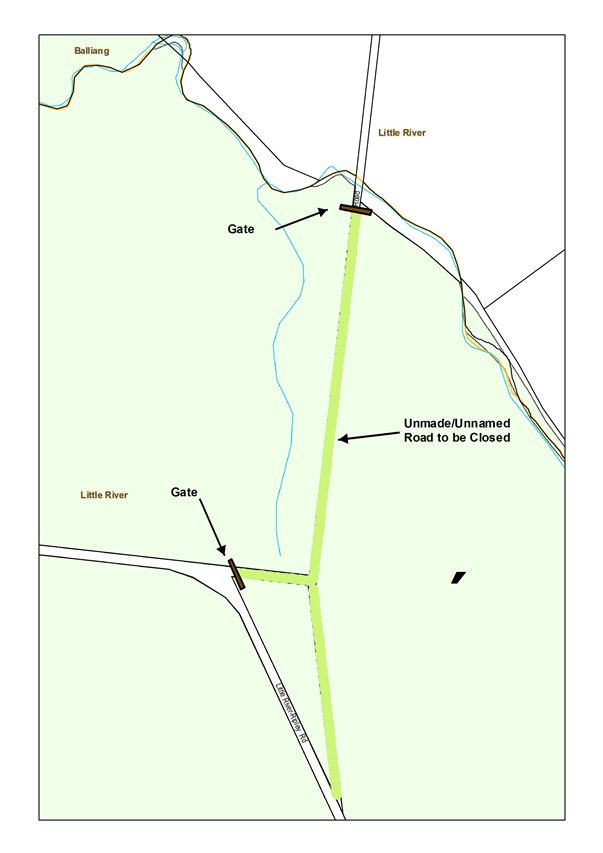
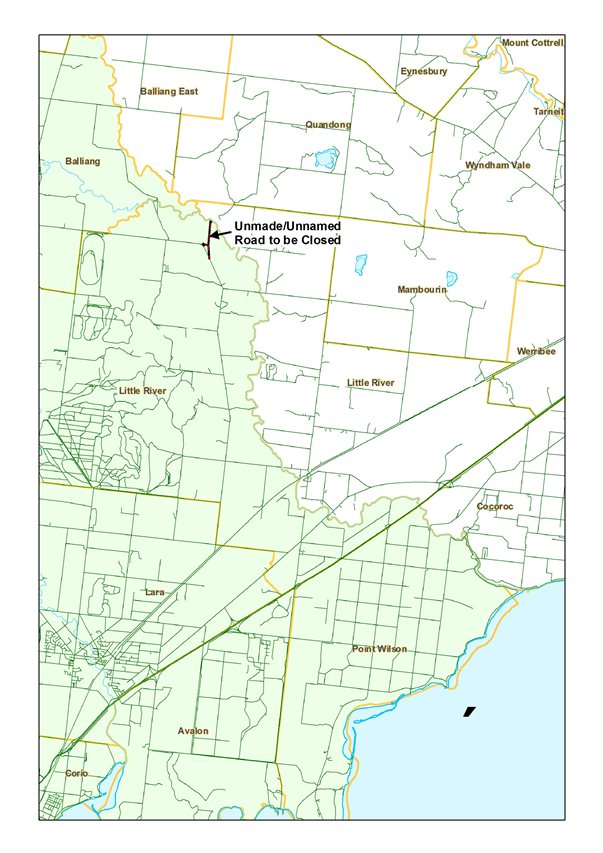
This report relates to the proposed closure of unnamed Government Roads off Little River Ripley Road, Little River – See plan Appendix 5-1.
The closure has been initiated for management purposes and in particular to control illegal rubbish dumping.
The proposal has been advertised and all relevant Authorities advised. There has been no objection to the proposed closure.
This report seeks a resolution by Council to proceed with the closure.
Cr Richards moved, Cr Granger seconded –
That Council having advertised the proposal to close Government Roads in Little River off Little River Ripley Road, in accordance with the plan and provided the opportunity for submissions to be made and heard, resolves that in accordance with Section 207 and Schedule 11 part 9(i) of the Local Government Act 1989, to proceed with the closure.
Carried.
Council received a briefing recently regarding a request to close the unnamed Government Road which runs from the bend in Little River Ripley Road to the river (Little River).
The land referred to is 700-850 Little River Ripley Road and is described as Lot 2 TP15945 and Lots 1, 23, 3 TP 15946. It is land bounded by Little River, which is the municipal boundary, and Little River Ripley Road. A Government Road bisects the land holding heading north into the municipality of Wyndham. See Locality Plan Appendix 5-2.
The Wathaurong Aboriginal Co-op own land on both sides of the road and have made the request for general management purposes and in particular to control illegal dumping of rubbish.
Contact has been made with a number of Authorities and Organisations which include:
Country Fire Authority
Lara Fire Brigade
City of Wyndham
Department of Sustainability and Environment
Barwon Region Water Authority
In addition, in accordance with the Act, VicRoads have also been advised. There are no objections with Council proceeding, excepting that keys will need to be provided for access.
The closure involves gates at Little River Ripley Road and the river.
The proposal was advertised and no submissions received and therefore a Panel Hearing was not necessary.
The road closure has been advertised in accordance with the Act.
Access for the relevant authorities can be provided. Fire access is an important issue. This road closure process does not remove or change the status of the road, such that given a changed set of circumstances, in the long term, for instance, it may be reopened.
Unused, unmade, and out of sight, roads are a haven for rubbish dumping and other errant vehicle behaviour. The closure will largely remove the potential for these behaviours.
This matter has no financial implications for Council.
Council is required to comply with the provisions of the Local Government Act.
No Council Officer involved has a direct or indirect interest in the matter.
There are no risk assessment implications.
There are no particular social considerations.
Council has followed due process in advertising the closure, giving any member of the community the opportunity to have input.
Portfolio: |
Infrastructure – Cr Richards |
Source: |
City Services – Engineering Services |
General Manager: |
Gary Van Driel |
Index Reference: |
Fisher Street, Portarlington, Special Rates and Charges, Council Reports 2012 |
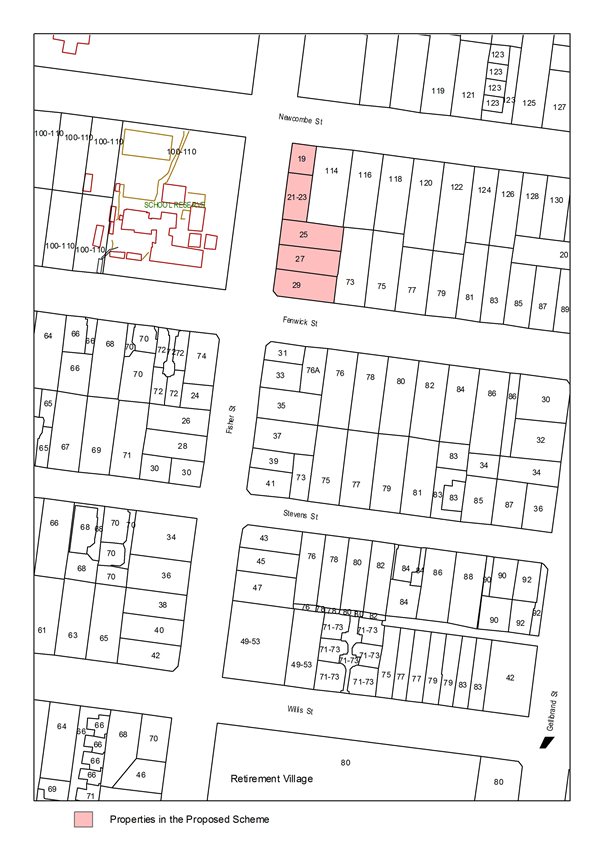
This report relates to a proposed special charge scheme for footpath construction in Fisher Street, Portarlington, between Newcombe Street and Langdon Street.
The scheme as presented included 20 properties with footpath on the west side between Langdon Street and Fenwick Street and east side between Fenwick Street and Newcombe Street.
The scheme was advertised and a number of objections received. A Submissions Panel heard four property owners and agreed to recommend the scheme be amended to provide a continuous link on the east side and include only those properties between Fenwick Street and Newcombe Street, refer Plan - Appendix 6-2.
This results in a scheme involving 5 properties, with total project cost $24,743. Owners costs vary between $1,712 and $3,874.
Property owners receive benefit from the works, by way of improved pedestrian access, improvement to the area fronting the property and possible increase in property values.
The scheme has been prepared in accordance with the Special Rates and Charges provisions of the Local Government Act, along with Council’s Special Rates and Charges Policy.
This report seeks a resolution by Council to “Declare the Charges” for the footpath scheme in Fisher Street, Portarlington in accordance with the Special Charge Scheme process as shown in Process Chart – Attachment 6-1.
Cr Richards moved, Cr Granger seconded –
That
The following declaration of a modified Special Charge be confirmed:
A special charge be declared for the period until the work has been completed and the scheme finalized.
The modified special charge be declared for the purpose of defraying any expenses incurred by Council in relation to the construction of a footpath in Fisher Street Portarlington, east side between Fenwick Street and Newcomb Street, which project:
will provide proper pedestrian access, improved nature strip and enhancement to the general amenity for each of the properties included in the scheme;
Council considers is or will be a special benefit to those persons required to pay the special charge (and who are described in succeeding parts of this Resolution); and
rises out of Council’s function of planning for, and providing infrastructure for property owners.
The:
cost of performing the function described in Part 1 (b) of this Resolution based on estimated cost for the modified scheme, be recorded as $24,743.
total amount of the special charge to be levied, as based on estimated cost for the modified scheme, be recorded as $12,371.50.
It be recorded that, for the purposes of Section 163(2A) of the Local Government Act 1989, the special charge proceeds will not exceed the amount calculated in accordance with the prescribed formula (R x C = S), the:
‘benefit ratio’ I being calculated at 100%, and representing the total benefits of the special charge scheme that will accrue as special benefits to all persons liable to pay the special charge; and
‘community benefit’ I being assessed as 50% in Fisher Street, Portarlington.
The following be specified as the area for which the special charge is so declared:
The area within municipal district of Council highlighted in the plan attached to this Resolution (“the area”).
The following be specified as the land in relation to which the special charge so declared:
All land within the area shown on the plan.
The following be specified as the criteria which form the basis of the special charge so declared:
Ownership of any land described in Part 1(e) of this Resolution.
The following be specified as the manner in which the special charge so declared will be assessed and levied:
The frontage of lots abutting the works shall be used to calculate the individual cost to a lot.
The special charge will be levied by sending a notice to the person who is liable to pay, pursuant to section 163(4) of the Local Government Act 1989.
Having regard to the preceding parts of this Resolution but subject to Section 166(1) of the Local Government Act 1989, it be recorded that, subject to any further Resolution of Council, the special charge will be due and payable on the date(s) fixed under Section 167 of the Local Government Act 1989 as the date or dates on or by which Council’s general rates are due.
There are no incentives declared as incentives to be given by Council for the payment of the special rate before the date(s) specified for its payment under Section 167(3) of the Local Government Act 1989.
Council’s Chief Executive Officer be authorised to levy the Special Charge in accordance with Section 163(4) of the Local Government Act 1989.
An Intention to Declare Charges report was presented to the 24 May 2011 meeting and Council resolved to proceed to advertise the proposed footpath scheme and invite submissions/objections.
During the course of 2011 Council called for a review of Special Rates and Charges and in general this was done including the preparation of a new policy.
The advertising was delayed and therefore only took place in late 2011.
There were 20 owners involved in the scheme and Council received 6 objections and 1 submission. A copy of all correspondence from property owners has previously been sent to Councillors.
A Submissions Panel was convened on 3 April 2012. The Panel considered the extent of the scheme and the necessity for linking path on both sides of Fisher Street. The recommendation of the Panel was to provide a linking path system on the east side of Fisher Street at this stage and the west side could come at a later date as required.
This would mean a modification to the scheme to delete all properties excepting the 5 in the block bounded by Fenwick Street and Newcombe Street (east side of Fisher Street). This therefore results in a modified scheme.
Fisher Street is a main road and considered to be an important pedestrian route both now and in the future. A Primary School is located at the corner of Newcombe Street and Fisher Street and a Nursing Home to the south. It is also a pedestrian route to the Portarlington Shopping Centre.
Property owners receive benefit from footpath by way of improved pedestrian access, improved general amenity of the area and possible increase in property values.
Council policy provides for Council to meet 50% of the cost of footpath projects in recognition of the community benefit of the project, with abutting property owners meeting 50%.
It is proposed that the costs be apportioned to each property on the basis of frontage.
The proposed footpath provides an important link between residential areas, the School, Nursing Home and Shopping Centre.
The estimated cost is as follows:
Estimated Cost |
|
Council half share |
$12,371.50 |
Property owners half share |
$12,371.50 |
Total |
$24,743.00 |
The new costs calculated on the reduced scope of works and estimate is marginally less than those shown at the Intention to Declare.
Footpath projects in general are aimed at providing a safe off road facility for pedestrians and as well to encourage walking in lieu of using a motor vehicle.
During the course of construction and the manufacture and procurement of materials there is expenditure of energy and greenhouse emission. This does cease, however, when construction is complete. Should the footpath project achieve the aim in part, to encourage walking over driving, there will be a positive environmental impact.
The project does not create waste with the exception of some excess spoil. The proposal does not affect any natural habitats.
The project has a one off capital cost as indicated above and there will be minimal ongoing maintenance costs. The scheme could proceed in the next financial year if approved. The owners meet half the cost of the works.
The scheme has been prepared in accordance with the special rate and charge provisions of the Local Government Act along with Council’s Special Rates and Charges Policy.
There are no Council Officers involved in the administration or subsequent construction of the works, who have a direct or indirect interest in the project.
A footpath is a project which encourages walking and could be considered to enhance the social well being of the local community.
Owners have had the opportunity through the Submissions Panel process to address issues and concerns.
The works for the construction of footpath in Fisher Street, Portarlington which consist of excavation, footpath, reinstatement of nature strip, miscellaneous construction works, legal advice and professional services associated with survey, engineering design, drafting, supervision and administration of the project all as included in the cost estimate shown below.
Cost Estimate for Construction of Footpath - Fisher Street, Portarlington
Item |
Description |
Quality |
Unit |
Rate $ |
Amount |
1.00 |
Site establishment, set out and traffic control |
|
item |
|
1,200 |
2.00 |
Excavation, trimming, supply and placement of bedding and formwork |
111 |
m |
5 |
555 |
3.00 |
Supply and place 75mm depth reinforced concrete footpath |
158 |
sqm |
105 |
16,590 |
4.00 |
Supply and place 125mm depth reinforced concrete |
10 |
sqm |
120 |
1,200 |
5.00 |
Make good disturbed nature strips with 100mm depth approved loam and seed |
111 |
lm |
5 |
555 |
Sub Total |
$20,100 |
||||
6.00 |
Contingency 10% |
|
|
|
2,010 |
7.00 |
Design and Administration |
|
|
|
2,633 |
Total |
$24,743 | ||||
Council proportion of cost |
|
|
|
|
12,371.50 |
Owners proportion of cost |
|
|
|
|
12,371.50 |
Fisher Street, Portarlington
Column 1 |
Column 2 |
Column 3 |
Column 4 |
||
Description of Property |
Estimated Cost ($) |
Property Reference |
Property Details |
Lot 1 PS 610304 |
$2,501.43 |
338857 |
19 |
Fisher Street |
Portarlington |
Lot 2 PS 610304 |
$3,874.49 |
338858 |
21 |
Fisher Street |
Portarlington |
Lot 1 LP 200526 |
$1,711.57 |
251393 |
25 |
Fisher Street |
Portarlington |
Lot 2 LP 200526 |
$2,091.92 |
251394 |
27 |
Fisher Street |
Portarlington |
Lot 3 LP 200526 |
$2,192.08 |
251395 |
29 |
Fisher Street |
Portarlington |
Plan
Contents | Previous Page: Section A - Procedural Matters | Next Page: Section C - Notice of Motion

Copyright CoGG 2012
Last Update: 6 August 2013