
Council Minutes - Section B: Reports (8-14) - 26 March 2013
Contents | Previous Page: Section B – Reports 1 - 7 | Next Page: Section C – Notice of Motion
Contents | Previous Page: Section B – Reports 1 - 7 | Next Page: Section C – Notice of Motion
Reports 8-14, tabled at the Ordinary Meeting of Council on Tuesday 26 March 2013 held at City Hall, Little Malop Street in Geelong.
Portfolio: |
Environment and Sustainability - Cr Richards |
Source: |
Planning Strategy and Economic Development |
General Manager: |
Peter Bettess |
Index Reference: |
Future Proofing Geelong |
Future Proofing Geelong (FPG) was established to promote and support initiatives which seek to improve environmental outcomes in Geelong. The FPG Sustainability Covenant is a partnership between the City, EPA Victoria, Barwon Water, Deakin University, Committee for Geelong, Geelong Manufacturing Council and the Geelong Chamber of Commerce. Barwon Regional Waste Management Group and Sustainability Victoria are also participants.
Implementation of the Low Carbon Growth Plan is the key aim of FPG and is progressing well. Since the last progress report to Council in October 2012, FPG provided funds to seven local businesses to assist with the cost of undertaking energy assessments. Using these energy assessments, FPG worked with two businesses to prepare grant applications for the State Government Smarter Resources, Smarter Businesses Program. A decision is pending on these applications. Five further funding applications were submitted with decisions pending. If these bids are successful it would yield approximately $2.1 million for energy efficient upgrades.
FPG worked closely with the Geelong Manufacturing Council (GMC) and Enterprise Connect to successfully gain $50,000 of funding from for the State Government’s Manufacturing Productivity Networks Grants program to develop a clean technology network in Geelong. FPG also successfully assisted Insulpak to obtain $7500 in funding from the Federal Government for research and development into a new air sanitiser product.
Energy efficient upgrades are underway at Splashdown, Waterworld and the National Wool Museum utilising funds obtained through the Community Energy Efficiency Program (CEEP). An application for round two of CEEP funding is being prepared with a view to upgrading facilities at seven Council sites in northern Geelong and Grovedale.
Work is underway to establish a sustainable display home in the Warralily display village at Armstrong Creek. This will showcase to the wider community the cost savings and environmental benefits of building an energy efficient home and choosing energy saving appliances.
FPG is playing a key role in promoting the Sustainable Living Festival. This is the first time the event will be held in regional areas. FPG is assisting in promoting the festival, organising related events and sponsoring a key note speaker. The interest in this event from the FPG subscribers network was significant with over 40 events scheduled in Geelong between 9 and 24 February 2013.
Cr Richards moved, Cr Harwood seconded -
That Council note the progress of the Future Proofing Geelong Project.
Carried.
The Future Proofing Geelong project is in its second year since establishment. One of the first actions was the completion of the Low Carbon Growth Plan.
To deliver on the objectives of the Low Carbon Growth Plan, the City continues to focus on three key areas; assisting commercial building owners and tenants with measures to reduce carbon emissions, facilitating community based groups to identify sustainability projects important to them and assist with delivery and assist companies with the preparation of grant applications and funding bids for building/machinery improvements which achieve environmental benefits.
This three pronged approach is yielding positive results as evident in the increasing number of energy assessments being undertaken, increases in the number of grant applications being prepared and lodged and increased community engagement with FPG as demonstrated by the level of interest in the Sustainable Living Festival.
Sourcing funds and writing grants
Success in obtaining funding through the Manufacturing Productivity Networks Grants program for the Clean Technology Innovations Geelong project program will be a catalyst in positioning Geelong as a forerunner in clean technologies.
The project aims to improve the competitiveness of manufacturing firms by identifying market development opportunities based around clean technologies. The Clean Technology Innovations Geelong project (as a network of members from the Geelong Manufacturing Council) will develop and promote Geelong as a centre of excellence in clean technology to create jobs and attract investment. The network will develop markets within the clean technology sector for businesses in Geelong by understanding more about the supply and demand needs of the market and formulating a Market Development Plan to respond to these needs over time. This will include facilitating an alliance of existing businesses in Geelong to develop a business plan, undertaking market analysis, undertaking a skills audit and making training recommendations to ensure we have the capacity to develop the clean technology network, and identifying specific projects to be delivered through the Market Development Plan. FPG will continue to work with the GMC as a member of the Clean Technology Innovations Geelong advisory group.
The success of Insulpak in obtaining a $7500 research and development grant (in the form a voucher) from the State Government will bring significant benefits to Geelong. Insulpak design, manufacture, supply, install and maintain heating, cooling, refrigeration and ventilation services systems in commercial buildings. This funding will be used to commission the CSIRO to examine the potential use of an American air sanitiser product in their systems throughout the State. This product will augment their product offering.
Assisting commercial building owners and tenants
FPG has provided funding to seven companies since October 2012 to cover fifty percent of the cost of an energy assessment on their buildings. The assessments provide recommendations for energy reduction including lighting, heating and cooling upgrades and are essential to support applications to the Federal and State Governments for funding for building works. Two of these companies (not for profit agencies) have already used their assessments to proceed to apply for funding from Sustainability Victoria to undertake the upgrades. If these applications are successful the energy and carbon emission reductions will be recorded at pre and post upgrade levels and used to measure our progress in implementing the Low Carbon Growth Plan.
With a specific focus on building tenants rather than owners who are often overseas, the City signed up as a member of CitySwitch which is a national energy management program specifically aimed at tenants. Using offices occupied by the City at 100 Brougham Street, CitySwitch undertook a NABERS (National Australian Built Environment Rating System) assessment. Key opportunities for energy and cost reductions for Council were identified as a result. FPG will use the CitySwitch approach with other commercial tenants in Geelong.
Stakeholder Engagement
FPG co-ordinates a community based Project Task Group which has chosen to focus on raising community awareness and education about sustainability and food security. The group was formed in late 2012 and is formulating a program of work for the next year.
The Sustainable Living Festival is held annually in Melbourne and is into it’s fifteenth year. This year is the first time the Festival organisers decided to broaden their approach to include regional areas. FPG, through it’s extensive subscribers network, encouraged existing sustainability groups to host an event as part of the Festival. The response from the community was significant with over 40 events held. These events are raising the profile of FPG and promoting the principles of sustainability in Geelong.
The Future Proofing Geelong project is delivering positive environmental outcomes through education and assistance to businesses and the wider community to improve energy efficiency and reduce carbon emissions.
The Future Proofing Geelong project is fully funded by the City until 30 June 2013. Two budget concepts are currently being considered to support the project for the next financial year. Barwon Water also contributes funding to Future Proofing.
There are no policy, legal or statutory implications resulting from this report.
No Council officers have a direct or indirect interest in accordance with Section 80(c) of the Local Government Act in the issue to which this report relates.
There are no risks associated with this report.
The Future Proofing Geelong project is having positive social impacts through community engagement with the Project Task Groups.
The Future Proofing Geelong website is regularly updated to showcase the work the City and the other partners are doing to implement the Low Carbon Growth Plan.
Portfolio: |
Sport & Recreation – Cr Irvine |
Source: |
Projects, Recreation & Central Geelong |
General Manager: |
Dean Frost |
Index Reference: |
Property # 292291, 9-41 Sparks Rd, Norlane |
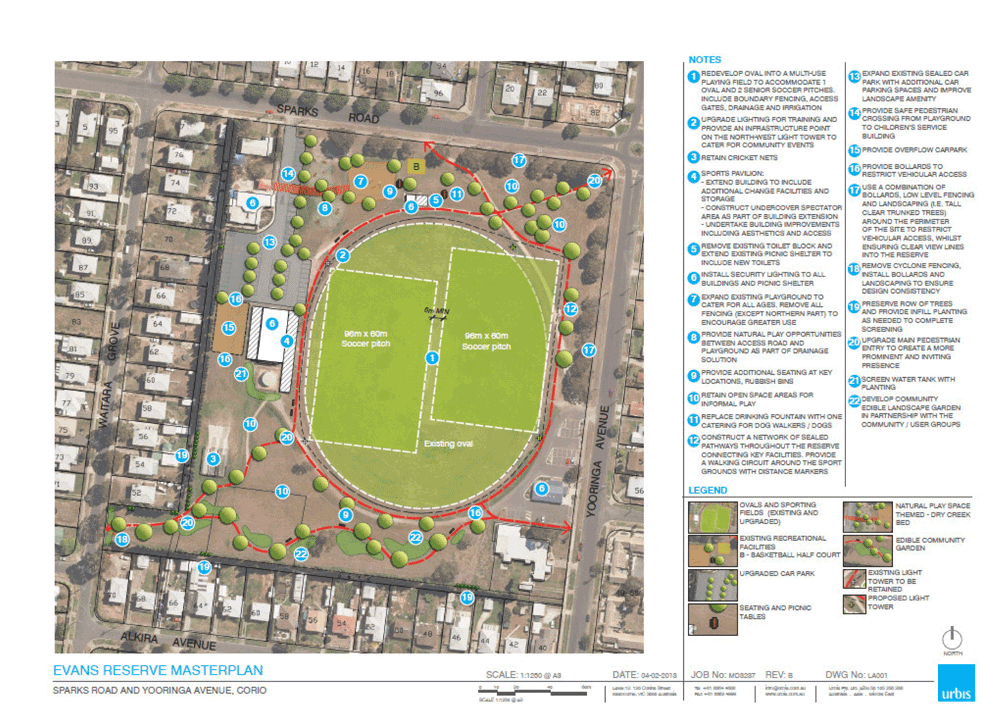
The purpose of this report is for Council to formally endorse the Evans Reserve Master Plan.
The Evans Reserve Master Plan was commissioned by Council to guide the development of the reserve in recognition of changing community expectations.
Key development opportunities identified in the Evans Reserve Master Plan are the modification of the existing sports oval to accommodate two soccer pitches, upgrade of the pavilion, improvement of informal recreation infrastructure and landscaping and improvements to parking and vehicular access throughout the reserve.
An extensive consultative process has been undertaken in the preparation of the Evans Reserve Master Plan to ensure that the plan reflects community expectations.
Cr Richards moved, Cr Fisher seconded -
That Council endorse the Evans Reserve Master Plan.
Carried.
Evans Reserve is an active sporting reserve located at the corner of Sparks Road and Yooringa Avenue, Norlane.
Evans Reserve provides a range of sport and recreation facilities, including an oval/soccer field, pavilion, playground, half basketball court, cricket nets and walking paths. In addition, the Trudy Moritz Child Care Centre, Department of Human Services offices and Seniors Community Centre are located within the Reserve.
The sport and recreation activities based at Evans Reserve are primarily provided by the Corio Bay Cricket & Sports Club (cricket and soccer). Evans Reserve also provides opportunities for informal recreation for wider community and is an important piece of open space for Norlane.
The aim of the Evans Reserve Master Plan (Appendix 1) is to develop a guide for the future development of the reserve, having regard for user and community aspirations, whilst enhancing the natural ambience and character of the reserve.
The aim of the Evans Reserve Master Plan is to develop a guide for the future development of the reserve. Key objectives of the Evans Reserve Master Plan include the:
redevelopment of the oval to provide a multi-use playing field that can incorporate two soccer pitches that meet Football Federation Victoria standards (C Class);
provision of additional change facilities to cater for increased active use of the reserve;
improvement of informal recreation infrastructure, including the expansion of the existing playground, and improvement of path networks and park furniture;
improvement of parking and access for vehicles and pedestrians; and
improvement of landscaping and amenity within the reserve.
To assist in the planning process, a number of consultative groups were established:
Project Control Group (PCG) consisting of the Ward Councillor and key Council officers to provide high level strategic direction on key issues and opportunities.
Project Working Group (PWG) consisting of Council officers from across CoGG departments and relevant agencies to provide technical advice on the project.
Project Reference Group (PRG) consisting of representatives from the reserve tenants and other key stakeholders.
All groups provided input, direction and feedback into the project at key stages. The consultation and research undertaken during the Evans Reserve Master Plan confirmed a number of issues to be addressed at the reserve, including:
existing oval is undersized to provide two soccer pitches;
existing oval does not include irrigation or full ground sports lighting;
suitability of buildings such as the pavilion and public toilets for community use;
interface between community facilities and open space;
underdeveloped and underused areas within the reserve;
limitations of existing car parking and vehicle circulation; and
lack of trees and vegetation within the reserve (majority of existing vegetation on the reserve boundary).
Based on the results of consultation with stakeholders, the key recommendations to address the issues identified at the Evans Reserve include:
the redevelopment of the oval into a multi-use playing area that can accommodate one oval or two senior soccer pitches, including irrigation and sports lighting (two additional towers required);
upgrade of the pavilion to provide additional change facilities, spectator viewing area and access improvements;
upgrade of the playground to a district facility level as identified in the Geelong Play Strategy;
upgrade of the picnic shelter (including a public toilet) and removal of the existing public toilet;
installation of additional park furniture to support informal recreation use;
construction of a network of pathways throughout the reserve and upgrade pedestrian access and crossings;
increase the capacity of car-parking and improve vehicular circulation; and
upgrade landscaping, vegetation and fencing.
Implementation of recommendations will improve the overall amenity and functionality of Evans Reserve, including improved capacity to provide active participation opportunities, increased safety, improved aesthetic values and improved traffic management.
The Evans Reserve Master Plan seeks to support initiatives that facilitate long-term environmental sustainability within the park, including water use, vegetation management and ongoing maintenance.
The Evans Reserve Master Plan recognises that the community values the reserves ability to cater for a wide range of uses. The Evans Reserve Master Plan respects the initiatives of previous Councillors and Council Officers in setting aside this space for public recreation. Future development will seek to enhance the landscape quality of the reserve, promote improvement of facilities, infrastructure and functioning for broad community use, whilst retaining and improving the natural ambience of the precinct.
Community feedback gained during consultation has indicated a strong desire for the improvement of the landscape quality of the reserve, including the planting of trees and other vegetation within the reserve.
The Evans Reserve Master Plan provides a number of recommendations and indicative costings for recommended projects.
Where implementation of specific recommendations requires a new capital allocation from Council, these will be presented and considered as part of the overall annual budget process. Opportunities for contributions from Government, Clubs and other funding sources are listed against specific projects within the Master Plan.
The implementation plan provides a broad estimate of cost specific to each of the recommended actions. These actions are assessed as Mandatory, Critical, High, Medium, Low and Ongoing to guide Council decision making in terms of development.
The Evans Reserve Master Plan outlines the recommended implementation schedule and indicative capital costs for the works identified in the Master Plan.
The total cost of all works is estimated at $1,146,200 and is represented by the following prioritised breakdown:
Mandatory: Nil
Critical: Nil
High: $310,000
Medium: $596,200
Low: $235,000
Ongoing: $5000
Please note that ongoing maintenance of the reserve is not included within the implementation schedule. The “ongoing” items within the implementation schedule highlight items within the reserve for retention.
Should irrigation be installed at Evans Reserve, an additional cost will be incurred by Council for the supply of water. In an average rainfall year, an annual water allocation of four megalitres will be required to irrigate the active playing surface, at a cost of $9,000 per year based on current prices. The cost for maintenance of the active playing surface will also increase due to additional mowing and preparation works required on an ongoing basis.
Whilst the adoption of this report does not have any direct financial implications, the listed actions within the plan will cost in the order of $1,146,200. It is expected that the Master Plan will be implemented over an approximate timeframe of 10 years.
The Equal Opportunity Act (1995) protects Victorians against discrimination based on a wide range of personal characteristics or associations. These include (but are not limited to) age, gender, ethnicity, disability, pregnancy, religion and employment status. The Evans Reserve Master Plan recognises that all community members have equal rights to participate in and enjoy the benefits of sport and physical activity. The development of the reserve will consider design solutions to help facilitate access for all.
No Council staff or persons engaged under contract have a direct or indirect interest in the development of the Evans Reserve Master Plan.
There are no immediate risks associated with this report. Appropriate risk management measures will be put in place when implementing the recommendations of the report.
The Evans Reserve Master Plan will enhance recreational and social experiences within the reserve. Improvements in the design, layout and functionality of the reserve will increase safety for all visitors to the park.
The Evans Reserve Master Plan recognises that participation in sport and physical activity brings about a range of personal, social, health and economic benefits for individuals and communities. Evans Reserve has an established history of active recreational use, including formal sports such at soccer and cricket. Future development of the reserve will support ongoing use of the area for a range of formal and informal sport and recreation activities.
The Evans Reserve Master Plan recognises that supporting formal sporting clubs supports more that just participation in physical activity. Sporting clubs are recognised as providing a range of broader benefits to the community, including contributions to social capital, community cohesiveness, community connection and building local leaders.
The Evans Reserve Master Plan has been overseen by a three-tiered management structure:
Project Control Group (PCG) consisting of the Ward Councillor and key Council officers to provide high level strategic direction on key issues and opportunities;
Project Working Group (PWG) consisting of Council officers from across CoGG departments and relevant agencies to provide technical advice on the project;
Project Reference Group (PRG) consisting of representatives from the reserve tenants and other key stakeholders.
The project has involved extensive consultation with stakeholders, Council staff and the community. The main consultation tasks have included:
on-site meetings to discuss aspects of the reserve in detail;
follow-up site visits, telephone interviews and meetings;
establishment of the PCG, PWG and PRG. These groups have been consulted on a minimum of two occasions each in the lead up to this report;
consultation with tenant clubs and other key stakeholders;
community on-line survey;
resident survey; and
public submissions.
In total, 149 individual surveys were completed. A summary of consultation results and key findings are included in Appendix 1 of the Evans Reserve Master Plan. The consultation results have been used to inform the identification of critical issues and major themes within the Evans Reserve Master Plan.
The draft Evans Reserve Master Plan was released by Council for public comment between 9 November 2012 and 7 December 2012. The following steps were taken to provide opportunities for the community to provide feedback on the report:
Copies of the report were available on Council’s website, and at City Hall and Corio Customer Service Centre.
Copies of the report were provided to all stakeholders and tenants of the reserve in paper and electronic form.
The public comment period of four weeks was advertised on 10 November 2012 and 24 November 2012.
A summary of the comments received by Council regarding the draft Evans Reserve Master Plan is provided below:
|
Name & Organisation |
Comment |
|
Response |
|
Simon Schloss - Resident
|
|
|
ü
|
|
|
Strategic Implementation, City of Greater Geelong |
|
ü |
ü |
|
|
Arts & Culture, City of Greater Geelong
|
|
ü
ü
ü
|
|
|
|
Community Development & Family Services, City of Greater Geelong
|
|
ü
ü
ü
ü
|
ü
ü
ü
|
|
Portfolio: |
Sport & Recreation – Cr Irvine |
Source: |
Projects, Recreation & Central Geelong |
General Manager: |
Dean Frost |
Index Reference: |
Subject: Planning & Strategy - Environmental Management / Sustainability Water Use Plan |
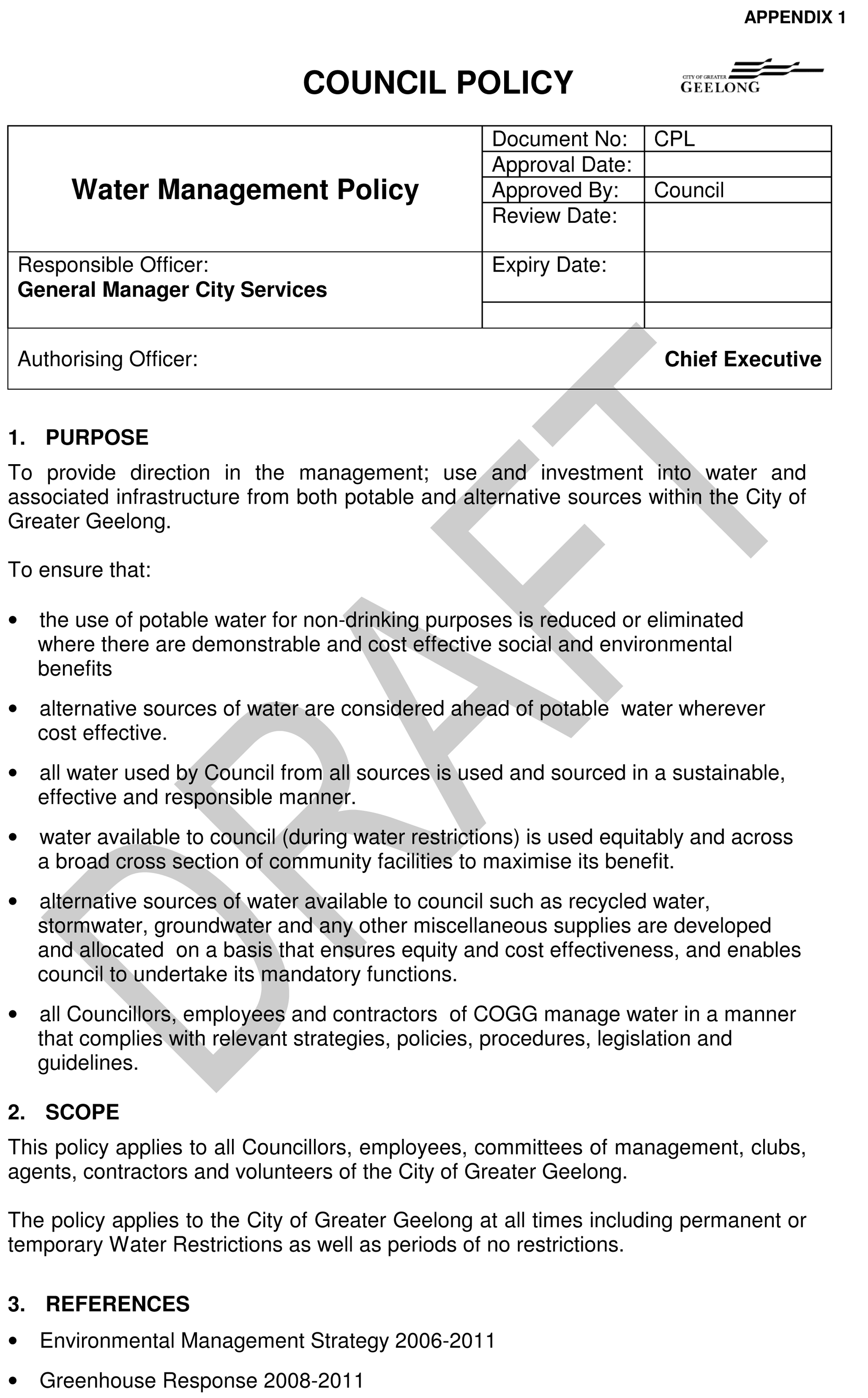
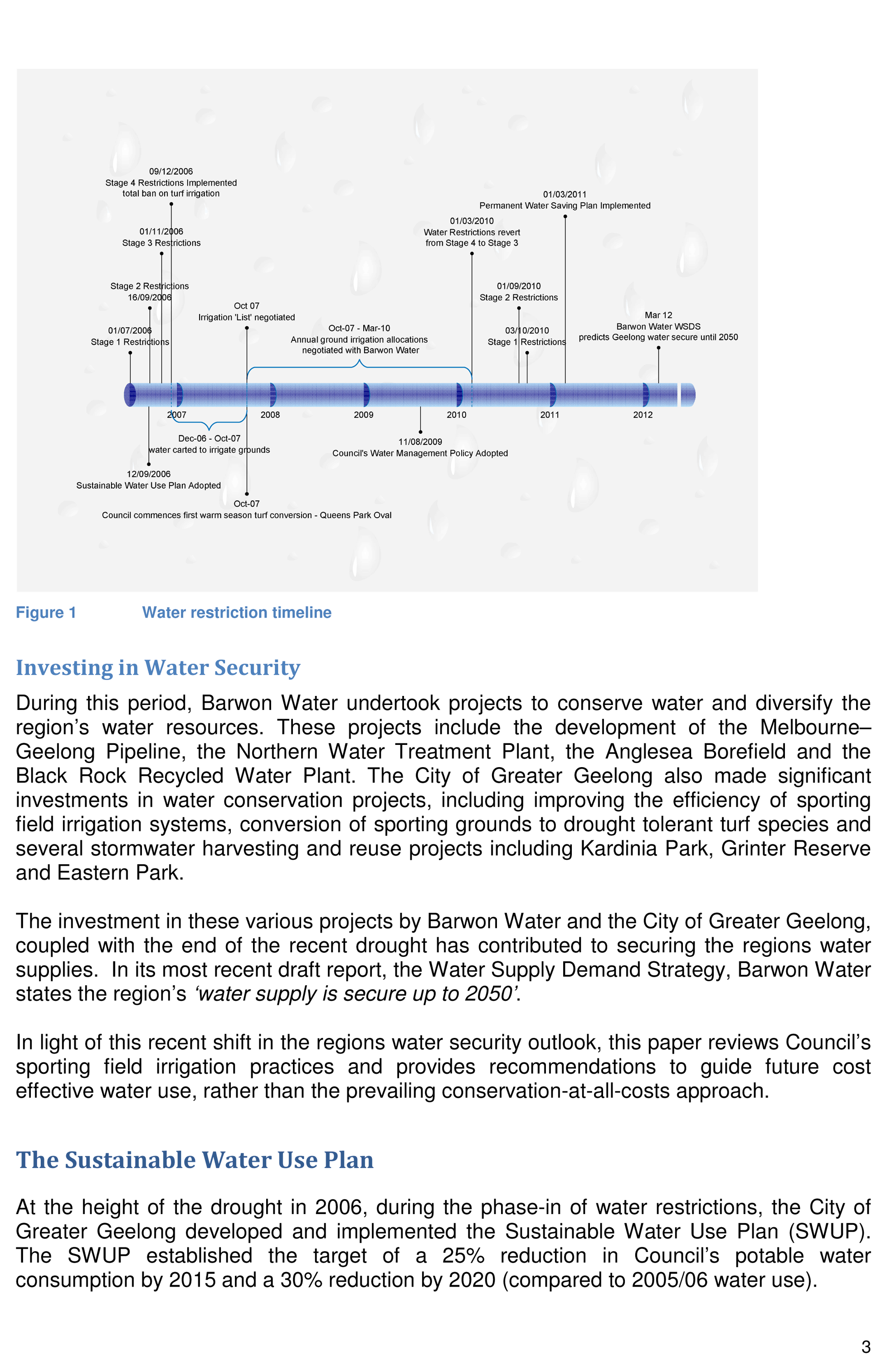
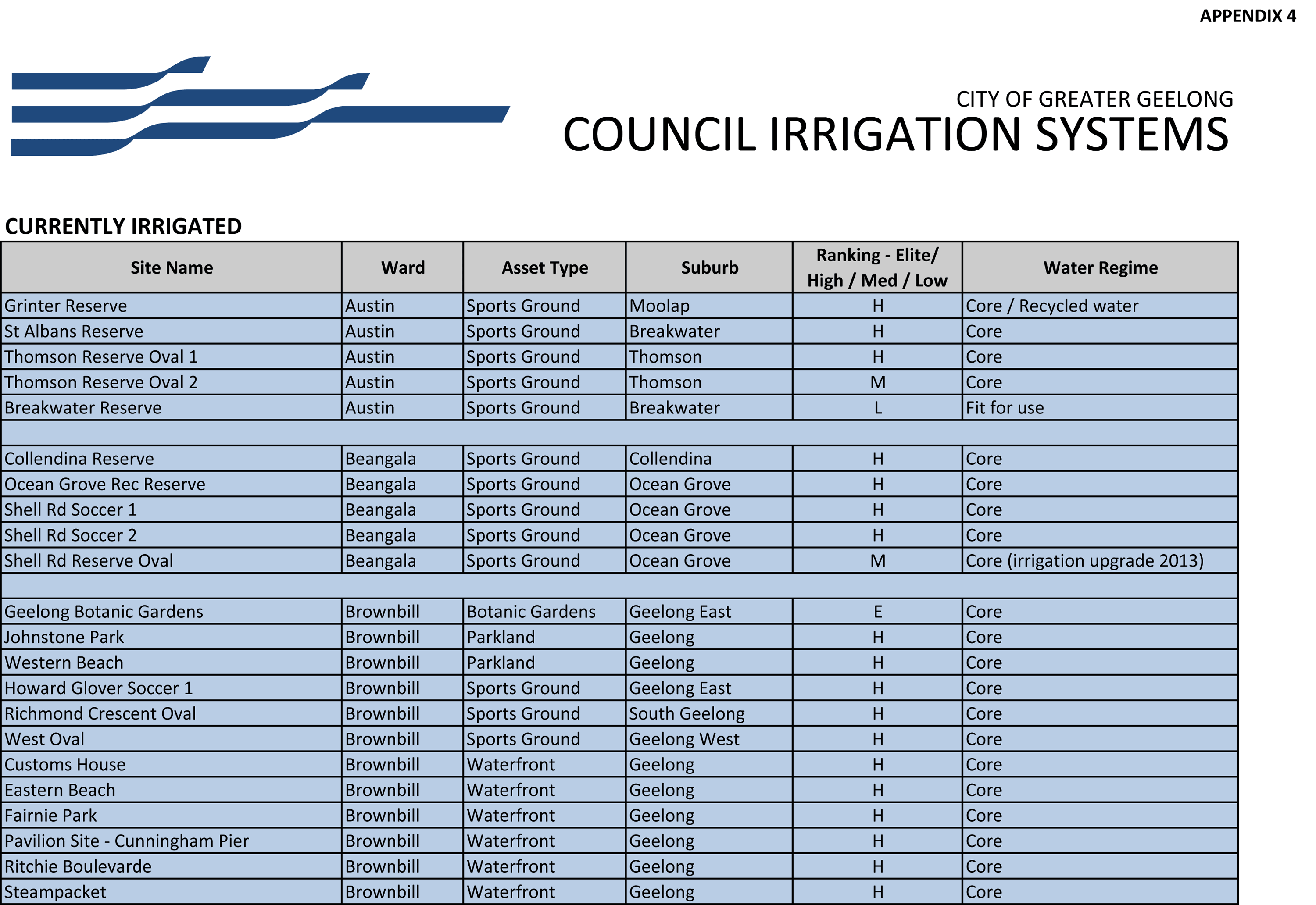
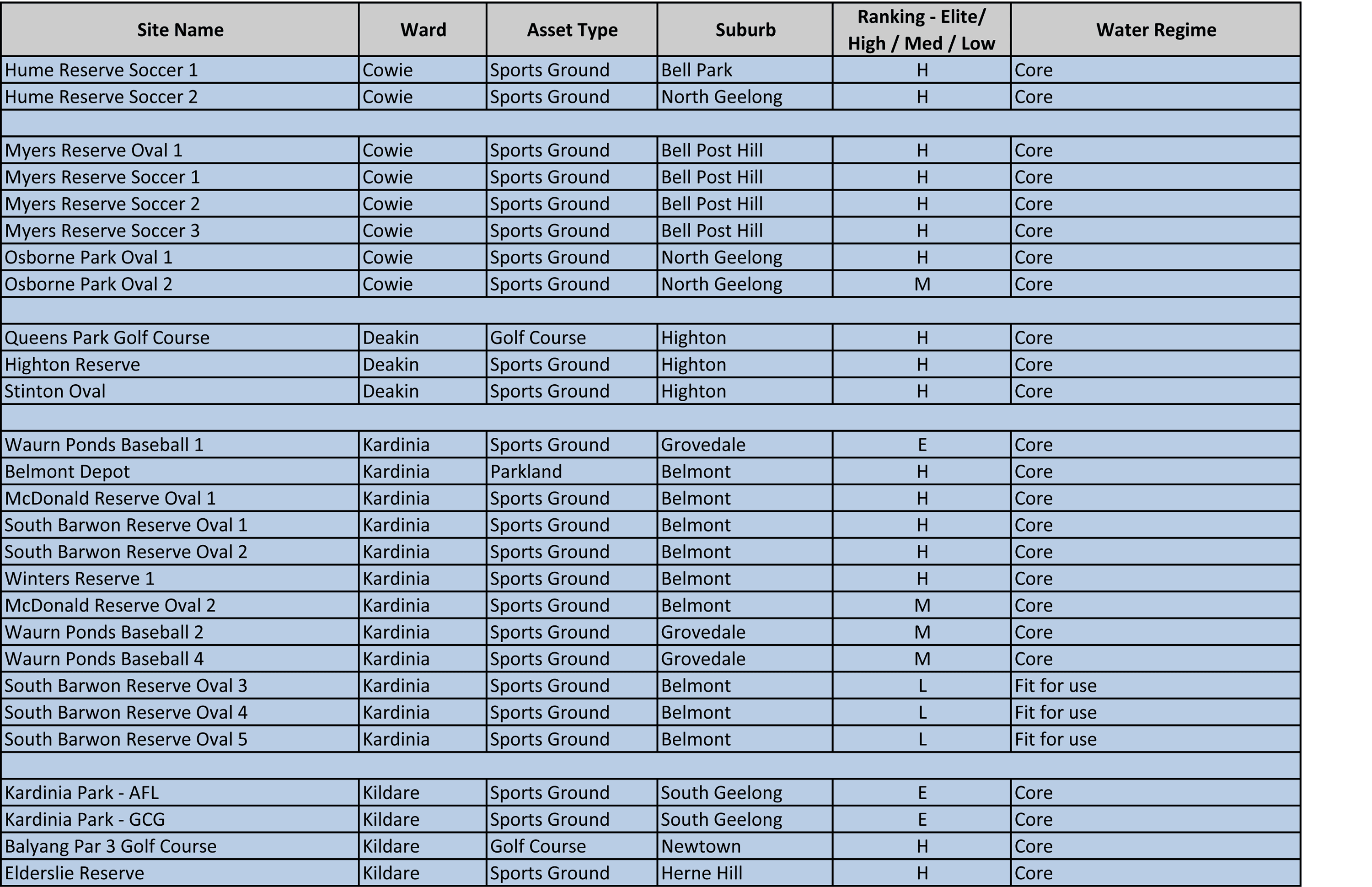
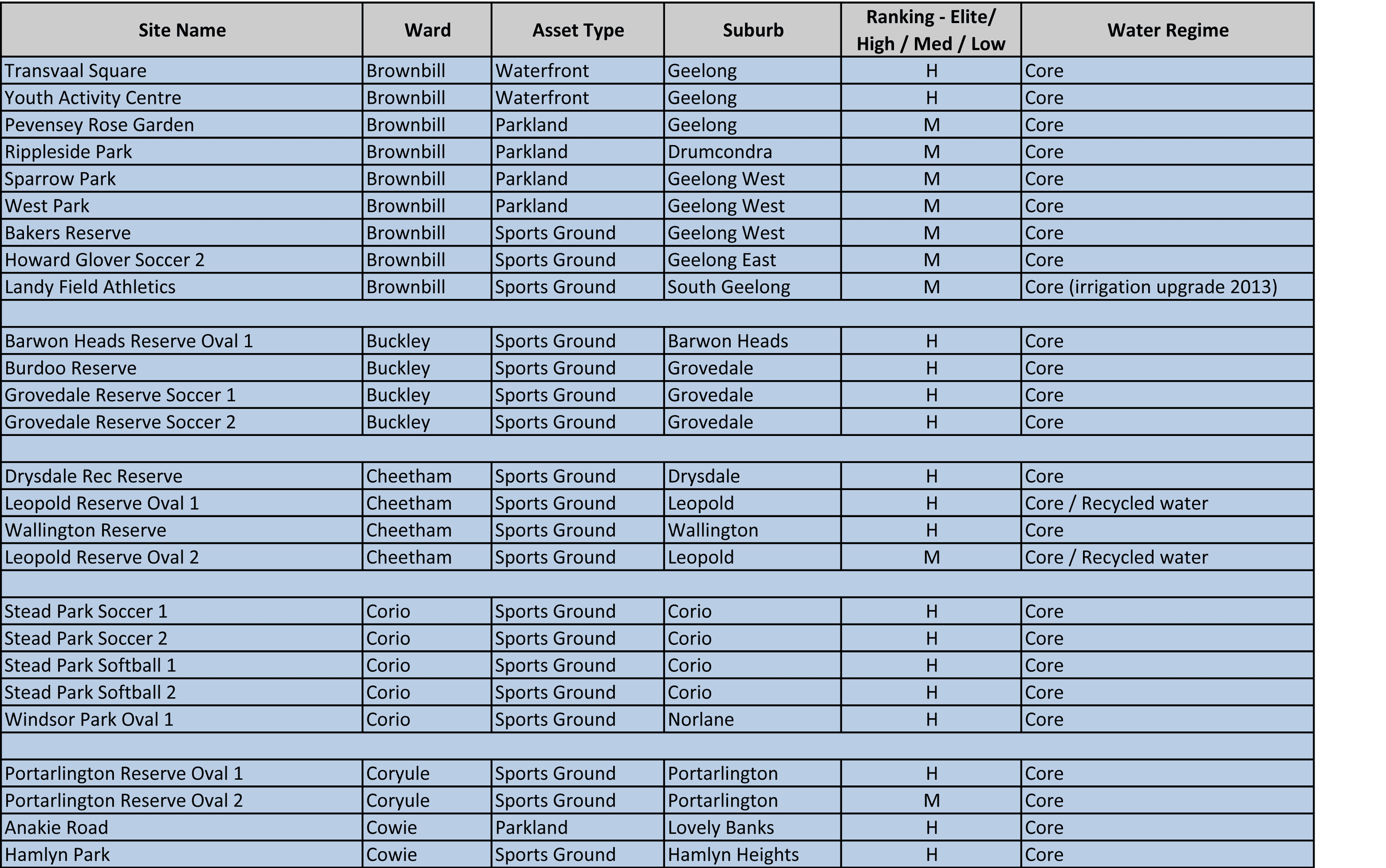
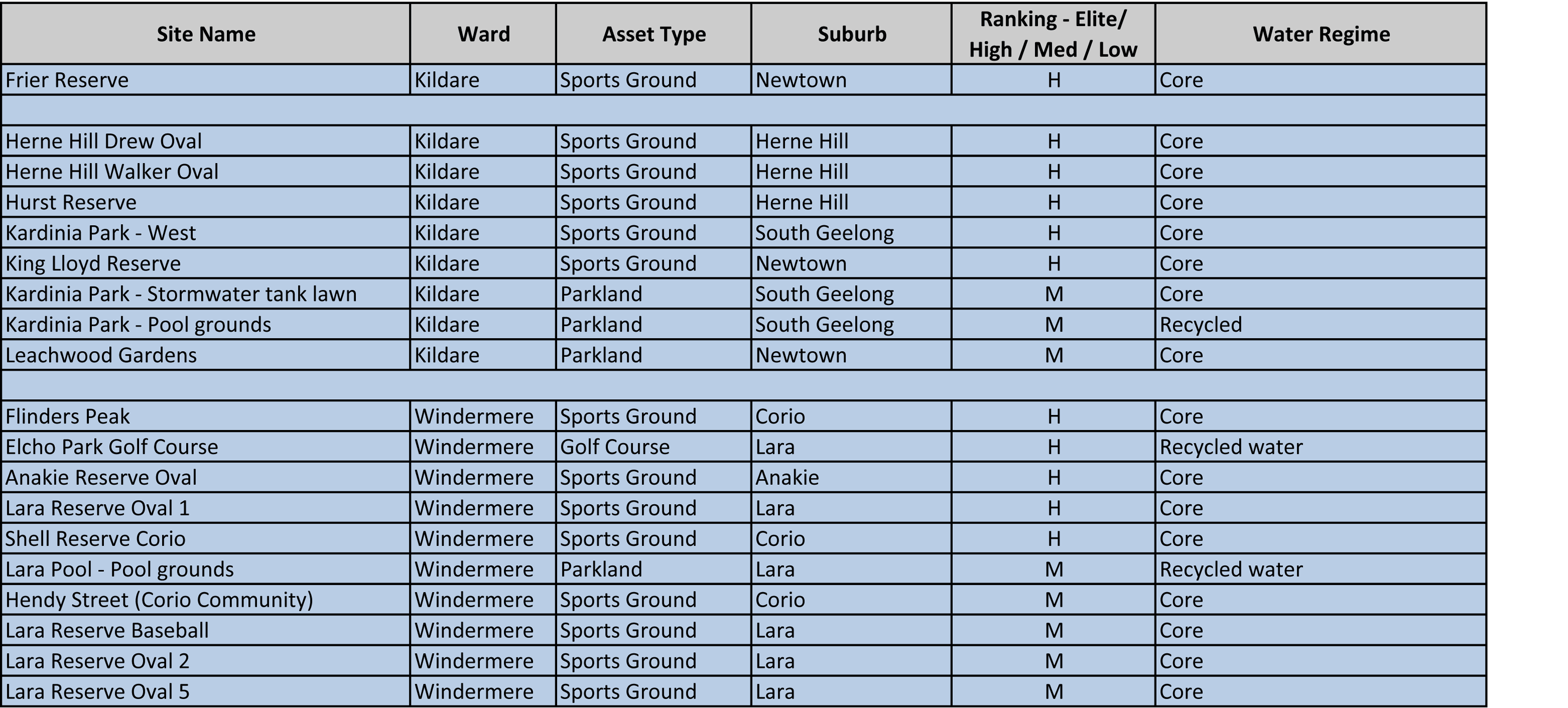
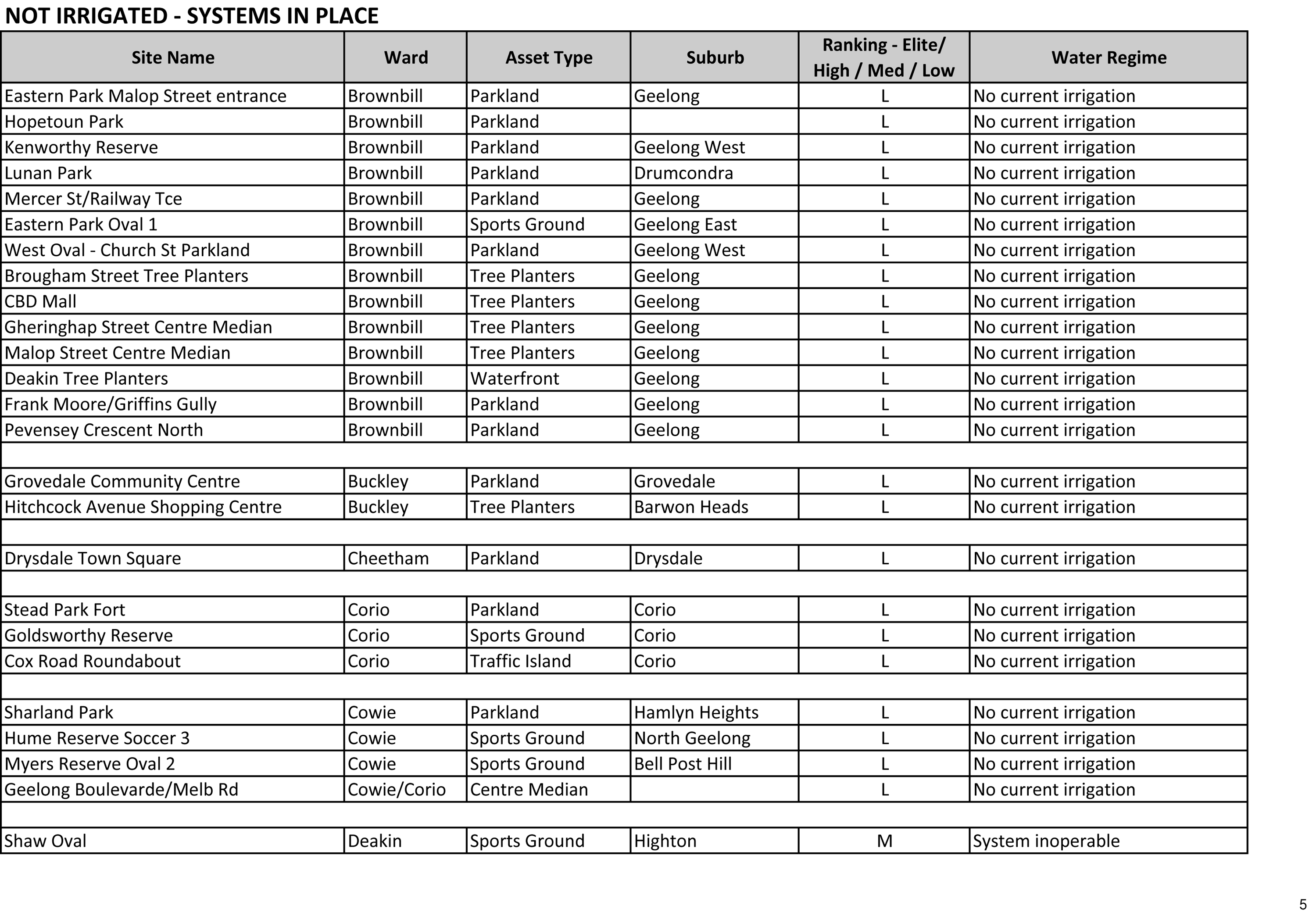
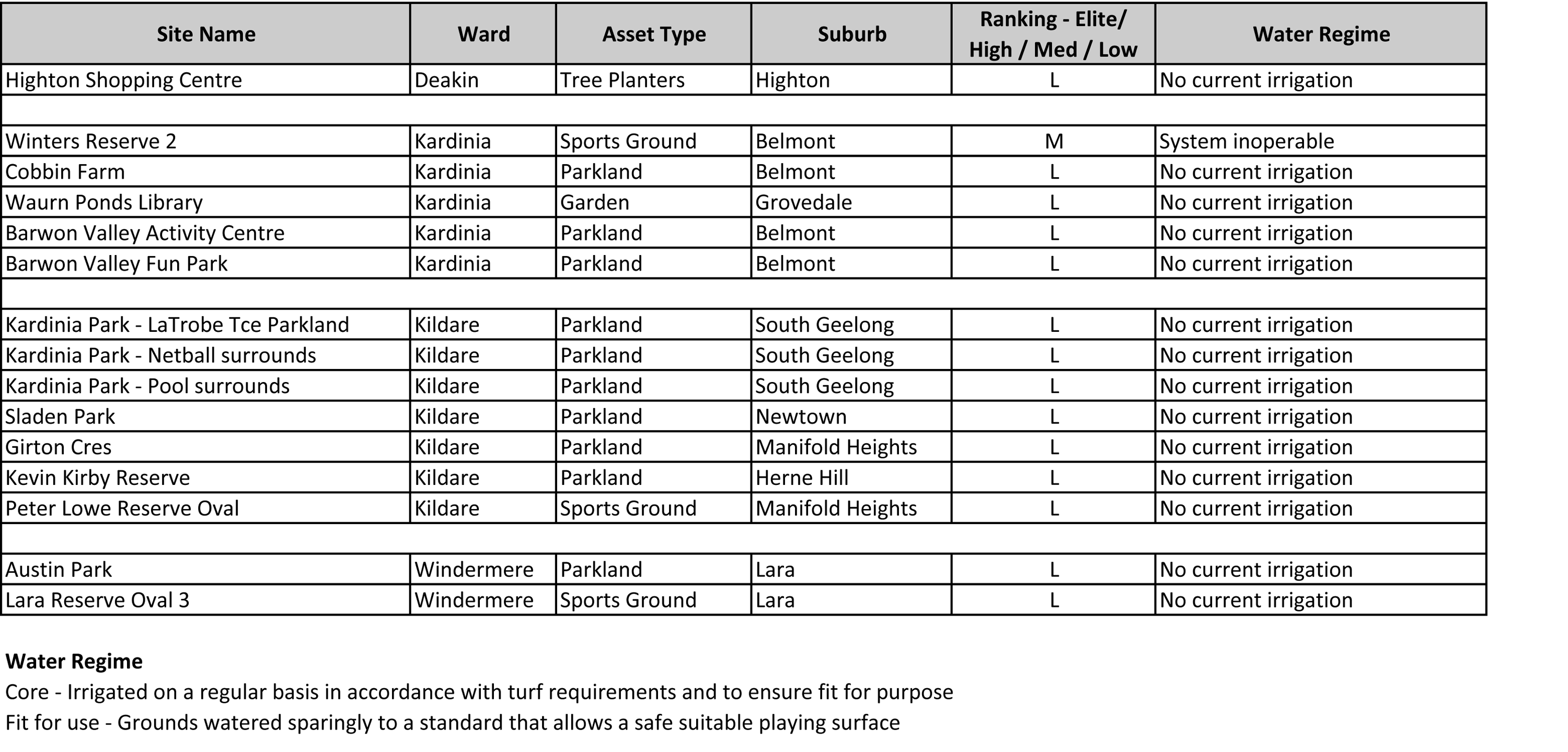
The purpose of this report is to endorse proposed changes to Council’s Water Management Policy (Appendix 1) to promote social, environmental and economically sustainable management of Council’s irrigated assets in a condition that is fit-for-purpose.
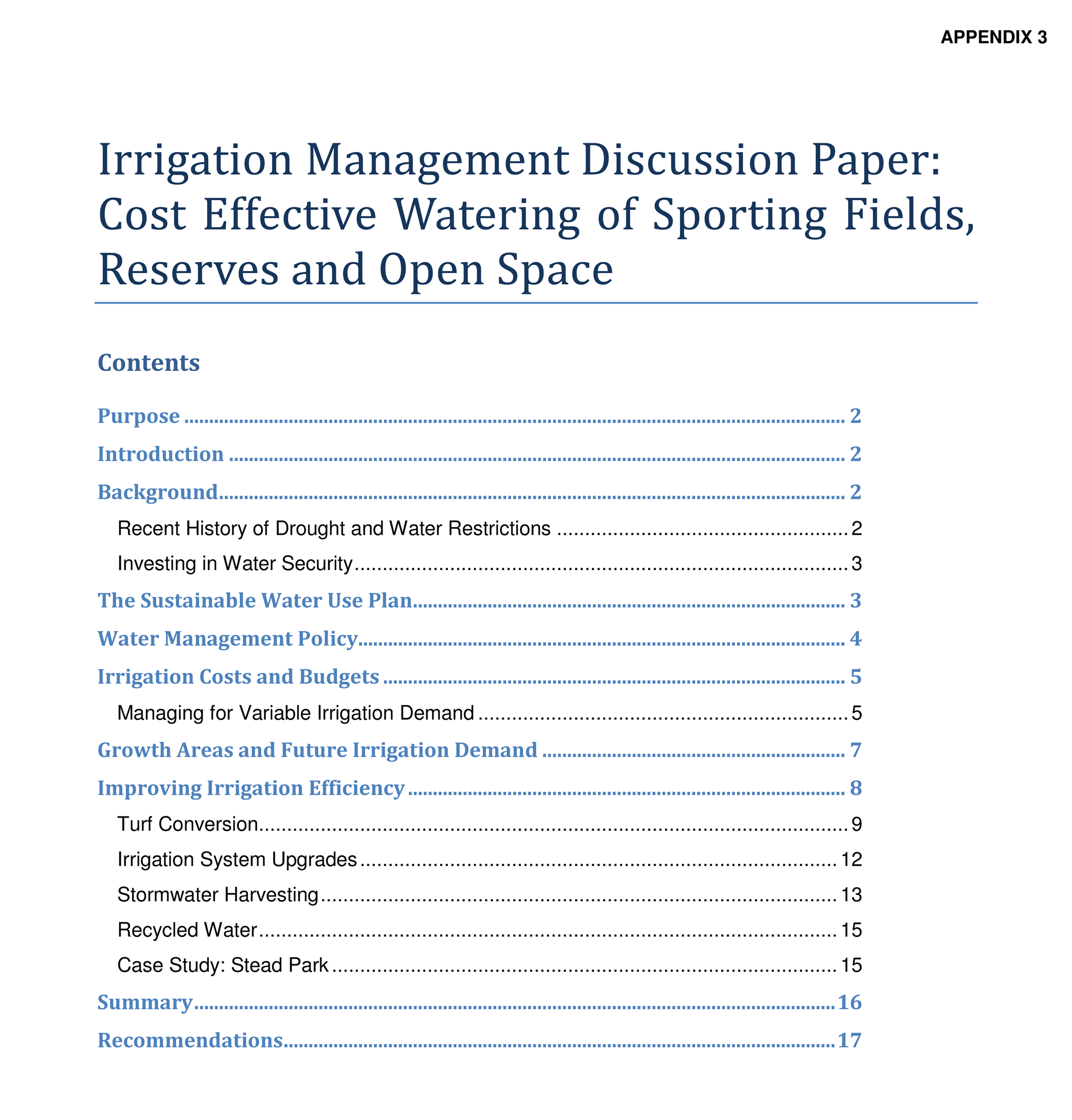
A recent review of Council’s irrigation practices (Appendix 3) has found:
Despite recent drought and severe water restrictions, Geelong is now water secure until at least 2050.
Geelong’s current Water Management Policy was developed in a climate of water security concerns and should now be reviewed in response to changes in the regional water security outlook.
The focus of Council’s irrigation management practices should now shift from maximising the volume of water savings, to maximising cost effectiveness and maintaining assets in a condition ‘fit for purpose’.
Maintaining irrigated assets ‘fit for purpose’, requires flexibility in irrigation expenditure, as annual water consumption will vary in response to prevailing weather conditions. In hotter, drier years, the irrigation budget may be overspent, however in the longer term, this will be offset during wetter years, when irrigation budgets will be under spent. Consequently, irrigation budgets should be developed on a long term (10+ year) basis rather than an annual cycle.
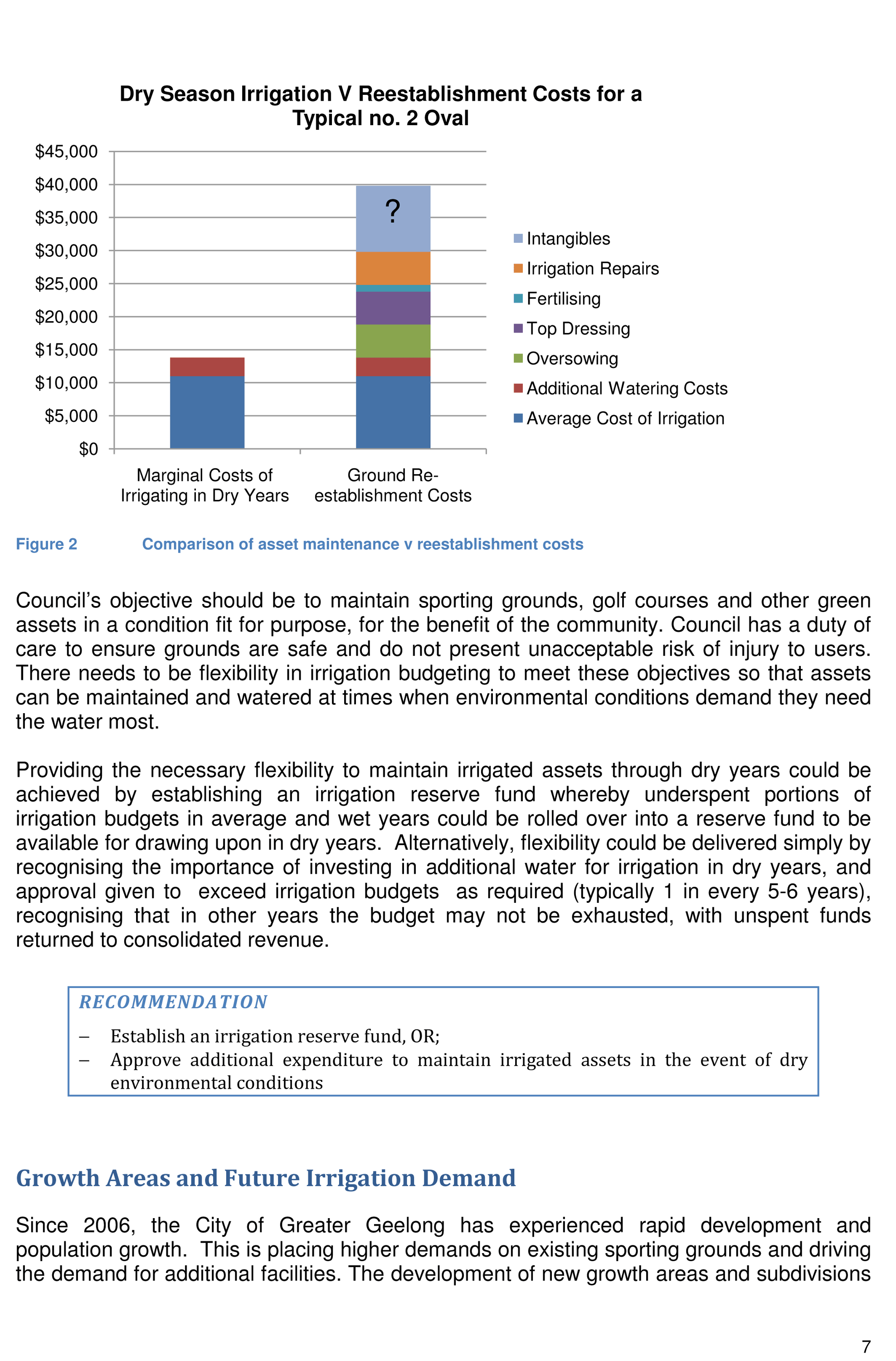
Turning off irrigation systems to save money on water is a false economy as it generates significant capital costs associated with ground renovation and reestablishment as well as significant intangible costs and risks to the community from poorly maintained grounds and the loss of public amenity and opportunities for passive and active recreation.
Expenditure on additional water to maintain irrigated assets in a condition fit for purpose during hot years is more cost effective than reducing irrigation at times when assets need water most and maximises recreation opportunities and reduces risk to Council and the community.
Cr Richards moved, Cr Ellis seconded -
That Council:
endorse the proposed revisions to Council’s Water Management Policy to reflect changes in regional water security and proceed to Council;
support the revision of the Sustainable Water Use Plan to ensure it remains relevant given changes in regional water security;
acknowledge the financial implications of variable annual irrigation demand arising from prevailing weather conditions;
note this report has been reviewed and endorsed by the Water Sustainability Group.
Carried.
Council’s irrigated assets are currently subject to a Water Management Policy and Sustainable Water Use Plan (SWUP), which were developed and introduced in a climate of drought, high level water restrictions and regional water security concerns.
Given the resolution of regional water security concerns, the SWUP and Water Management Policy are in need of review to ensure they remain appropriate tools to guide Council’s water-use, which should now be based on the principle of cost-effective maintenance of assets in a condition that is fit for purpose.
Since the implementation of the existing Water Management Policy and SWUP, Council has made significant investment into water conservation and improving the efficiency of its irrigation water use. Similarly, Barwon Water has invested in diversifying regional water supplies, with the consequence that, in its most recent Water Supply Demand Strategy, Barwon Water states the region’s water supplies are secure until 2050.
In light of these changed conditions, the attached discussion paper (Appendix 3) presents a case that Council’s water use decisions should no longer seek to maximise water conservation, but should seek to promote cost effectiveness and maintain irrigated assets in a condition fit for purpose.
Appendix 1 sets out proposed amendments to Council’s Water Management Policy that promotes the principle of cost effective water management and the maintenance of assets in a condition that is fit for purpose. The amendments are intended to provide greater operational flexibility by minimising operational content and focussing on strategic intent. The revised Policy also shifts the role of the Water Sustainability Group from a primary focus on water conservation, to a broader consideration of water use and asset management issues including economic efficiency, social equity and environmental sustainability. This shift in the Water Sustainability Group’s role does not require any changes to the Group’s existing Terms of Reference (Appendix 2).
Whilst regional growth dictates that overall irrigation water consumption will increase in the future, the proposed approach will foster continuous improvement in water efficient technologies and practices and seeks to promote the cost effective use of potable and non-potable water supplies.
The report notes that annual irrigation expenditure will vary in response to prevailing weather conditions. In hotter, drier years, the irrigation budget may be overspent, however it is anticipated that this expenditure will be offset during wetter years, when irrigation budgets will be under spent.
Investing additional expenditure to maintain irrigated assets during hotter years will prevent serious deterioration of sporting grounds and reserves. This asset management approach will save significant capital costs associated with major ground renovation and/or reestablishment.
Appendix 1 is a revised Water Management Policy which has removed procedural and operational elements of the existing Policy. Following endorsement of the proposed changes to the Policy by Council, a related management procedure will need to be developed by the Water Sustainability Group. Developed during a period of extended drought, Council’s Sustainable Water Use Plan commenced in 2006, with a five year review period. This document is now overdue for formal review, which is necessary to ensure it remains relevant given changes in the regional water security outlook.
No Council officers involved in the preparation of this report have direct or indirect interest in matters for consideration.
Failure to adequately maintain recreation reserves in a condition fit for purpose presents significant risk to the community and to Council, arising from potential injuries to users of sporting reserves. During the drought, 56 sporting fields were closed due to being unfit for use as a result of irrigation restrictions. Given the changed regional water security outlook, it is not an appropriate management response to simply let assets deteriorate to the point where they need to be closed and the community denied the opportunity to access these facilities.
The recommendations contained in this report maximise opportunities for active and passive recreation and the associated preventative health and mental health benefits this brings. The maintenance of assets in a condition fit for purpose prevents the loss of amenity and recreation opportunities that would arise through the forced closure of sporting grounds, golf courses and public open spaces which are not adequately irrigated and left to perish.
There are no communication considerations related to this report.
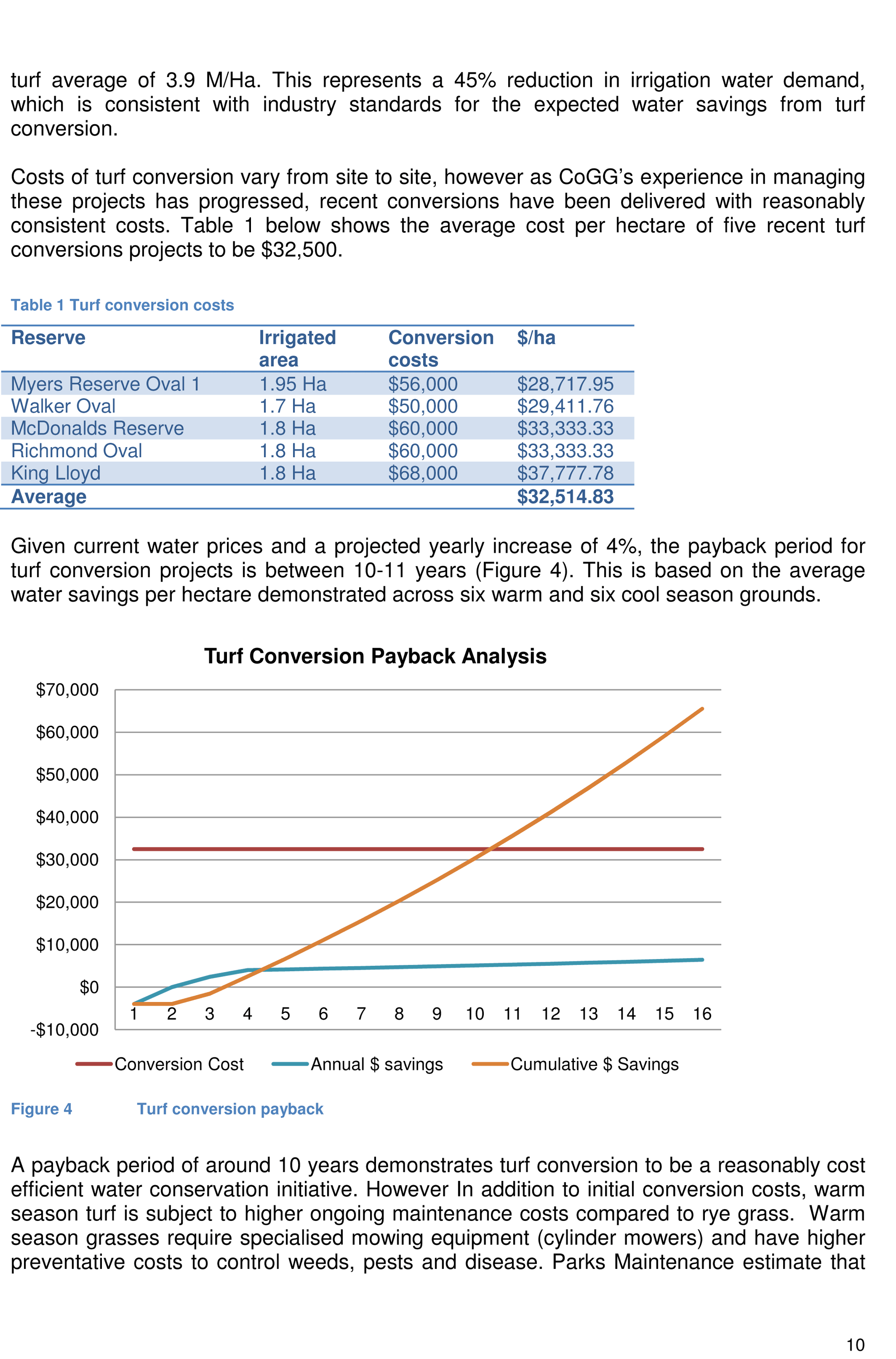
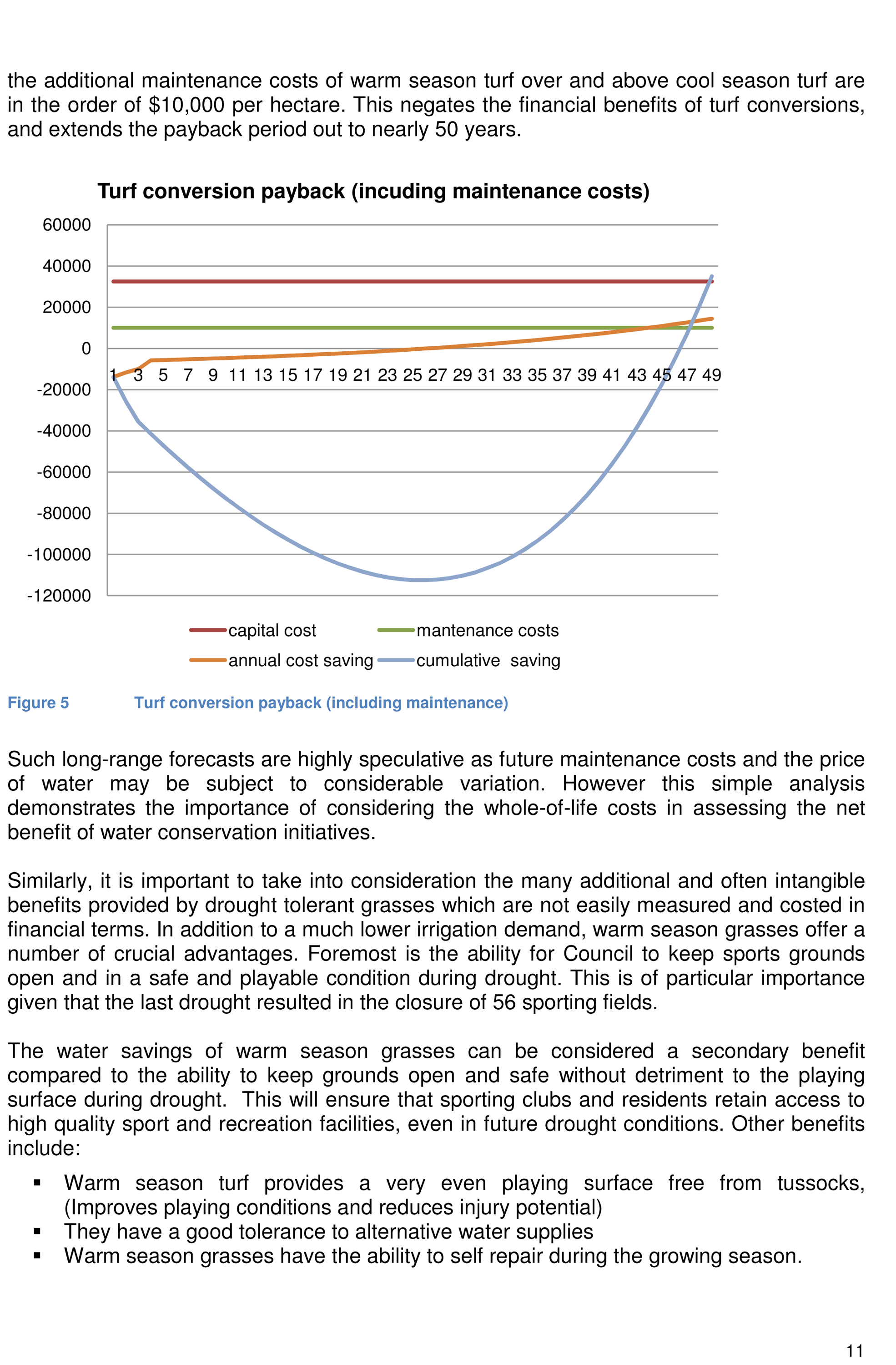
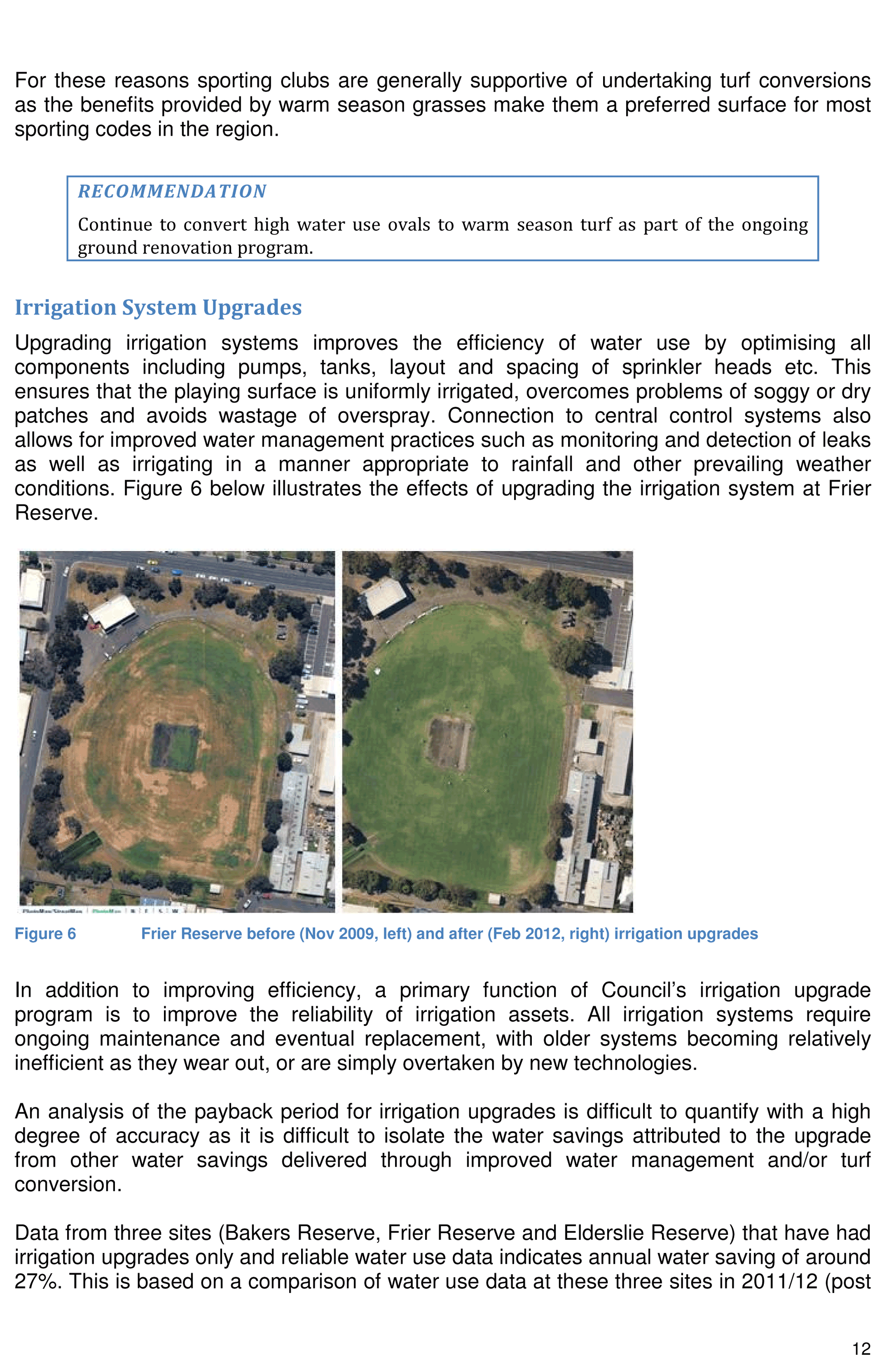
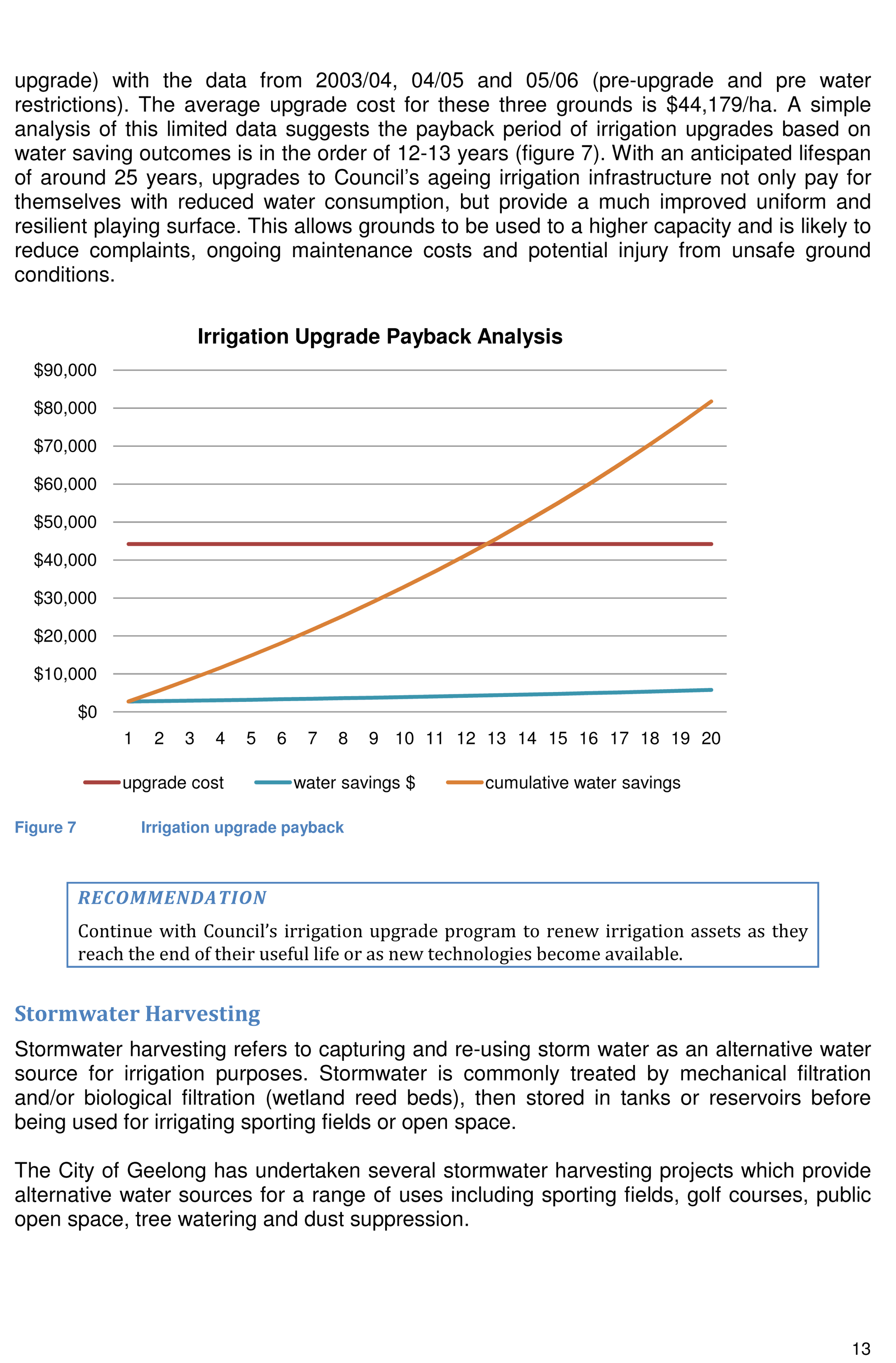
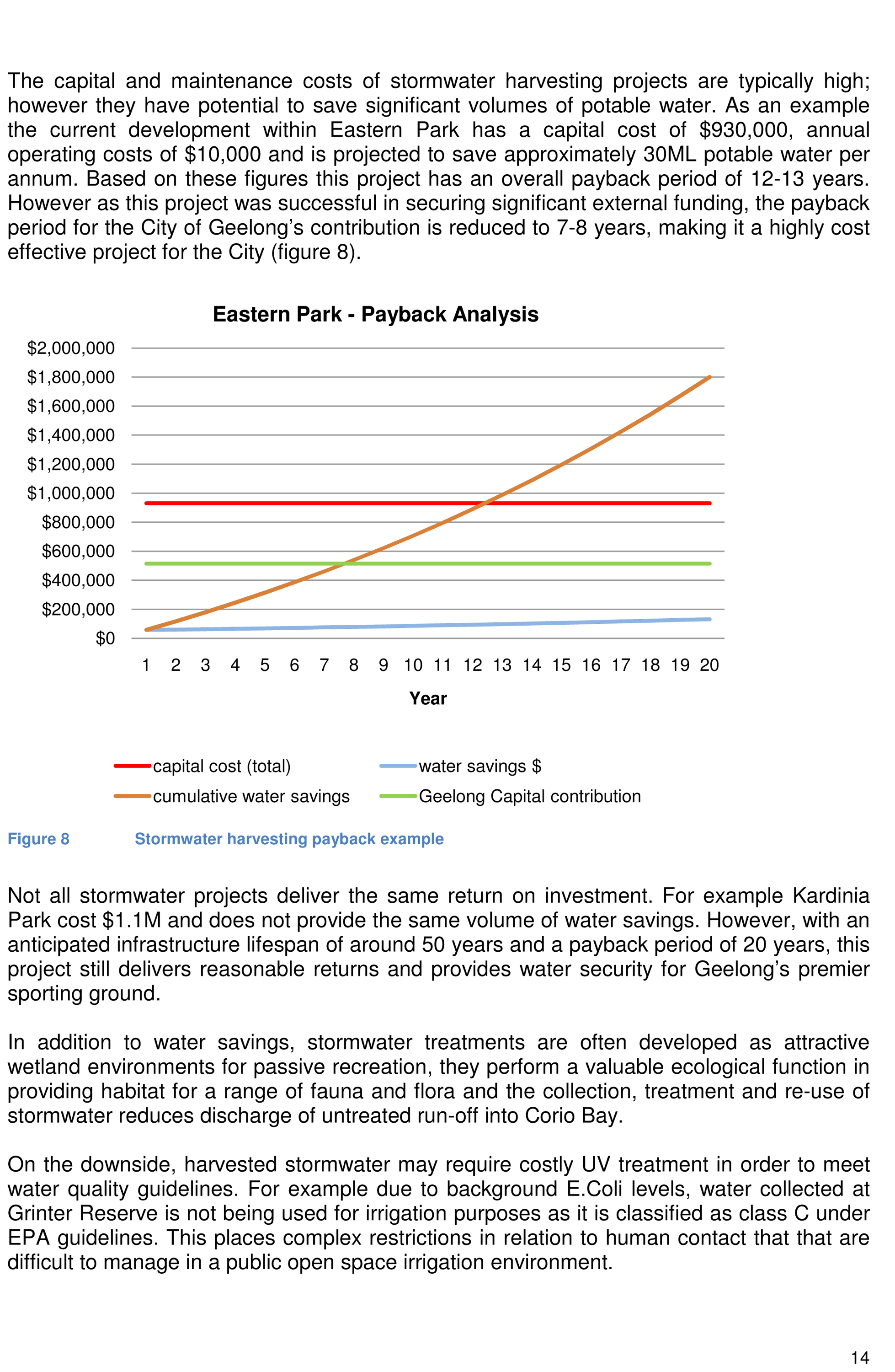
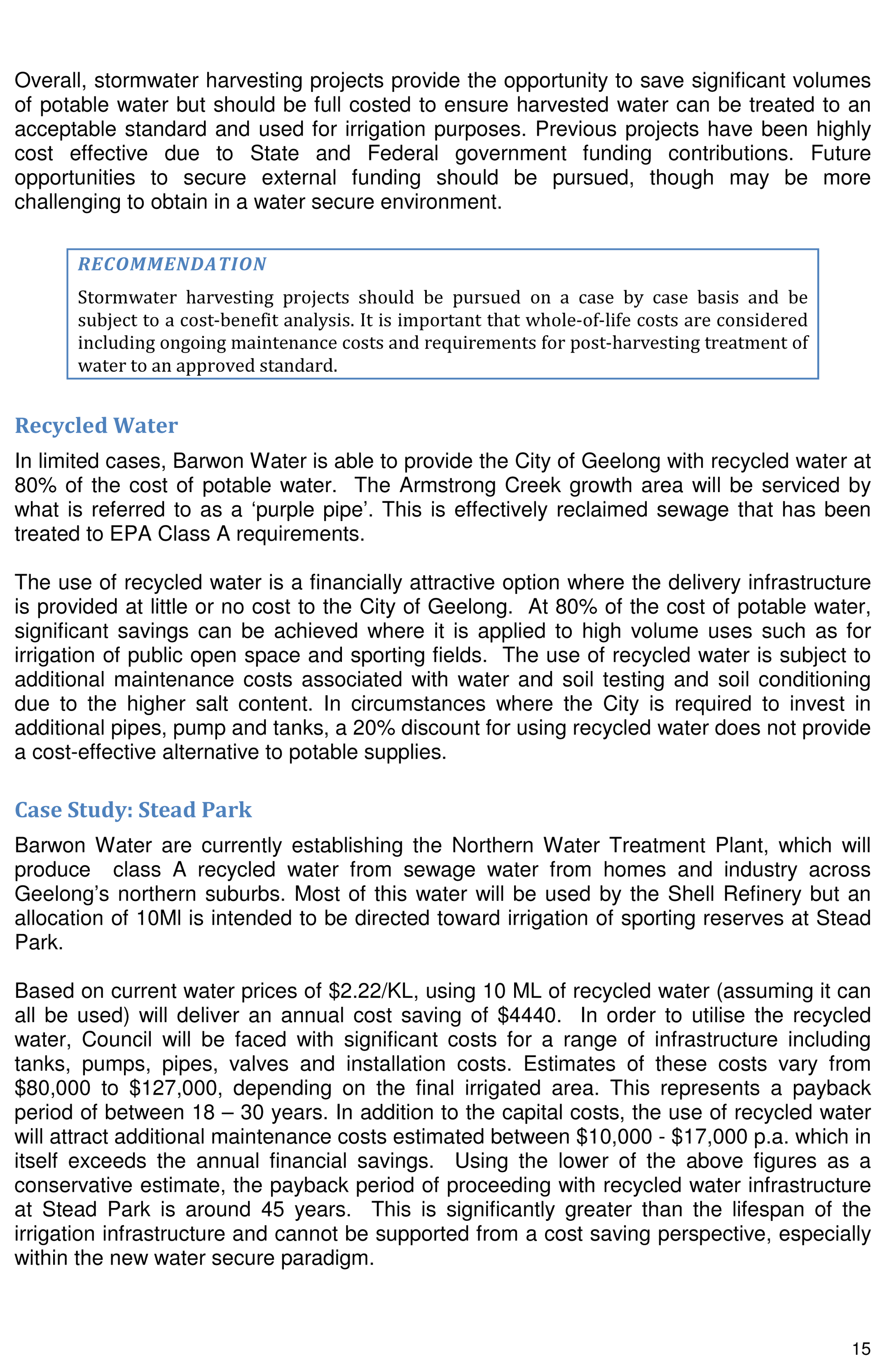
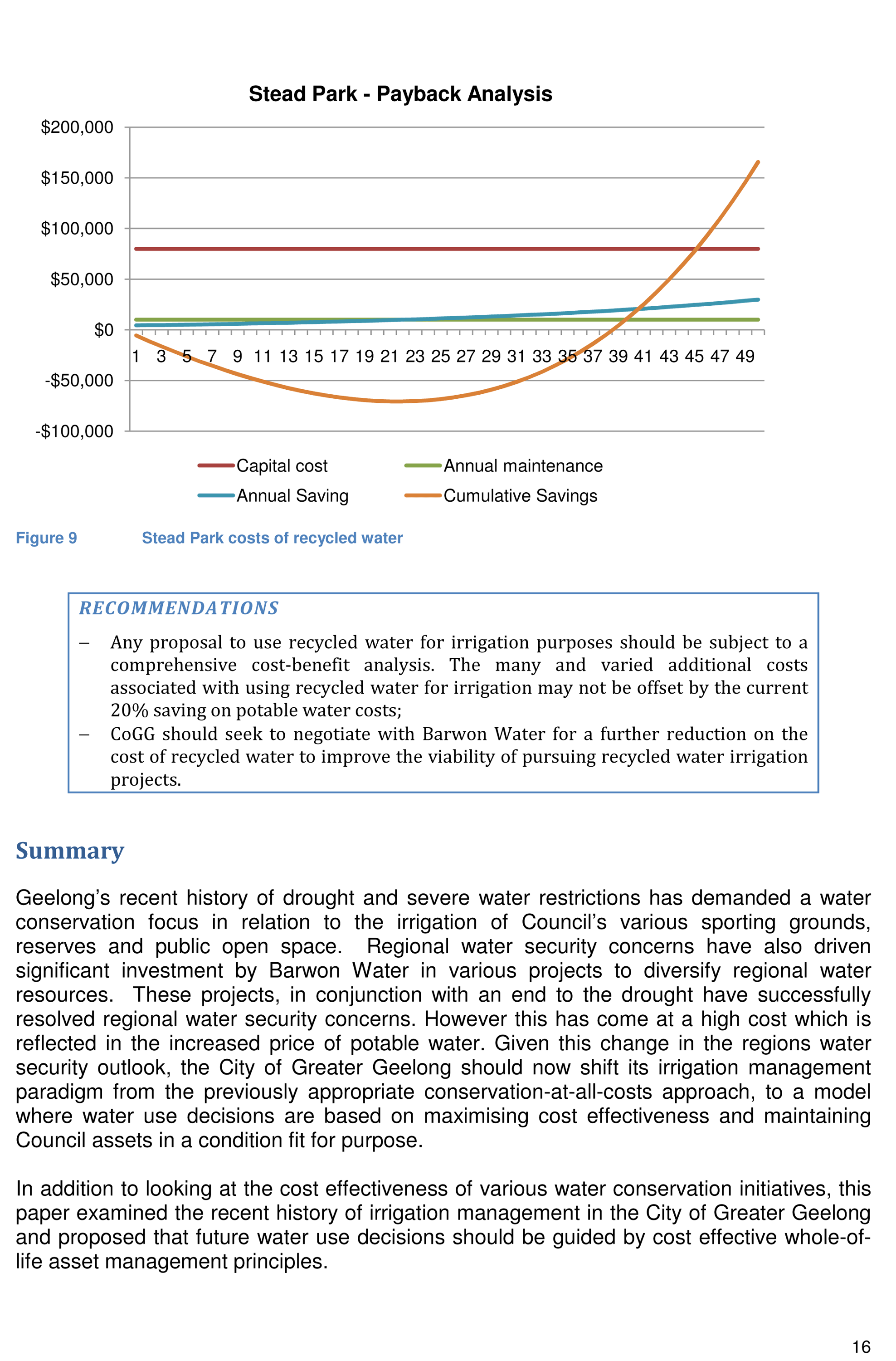
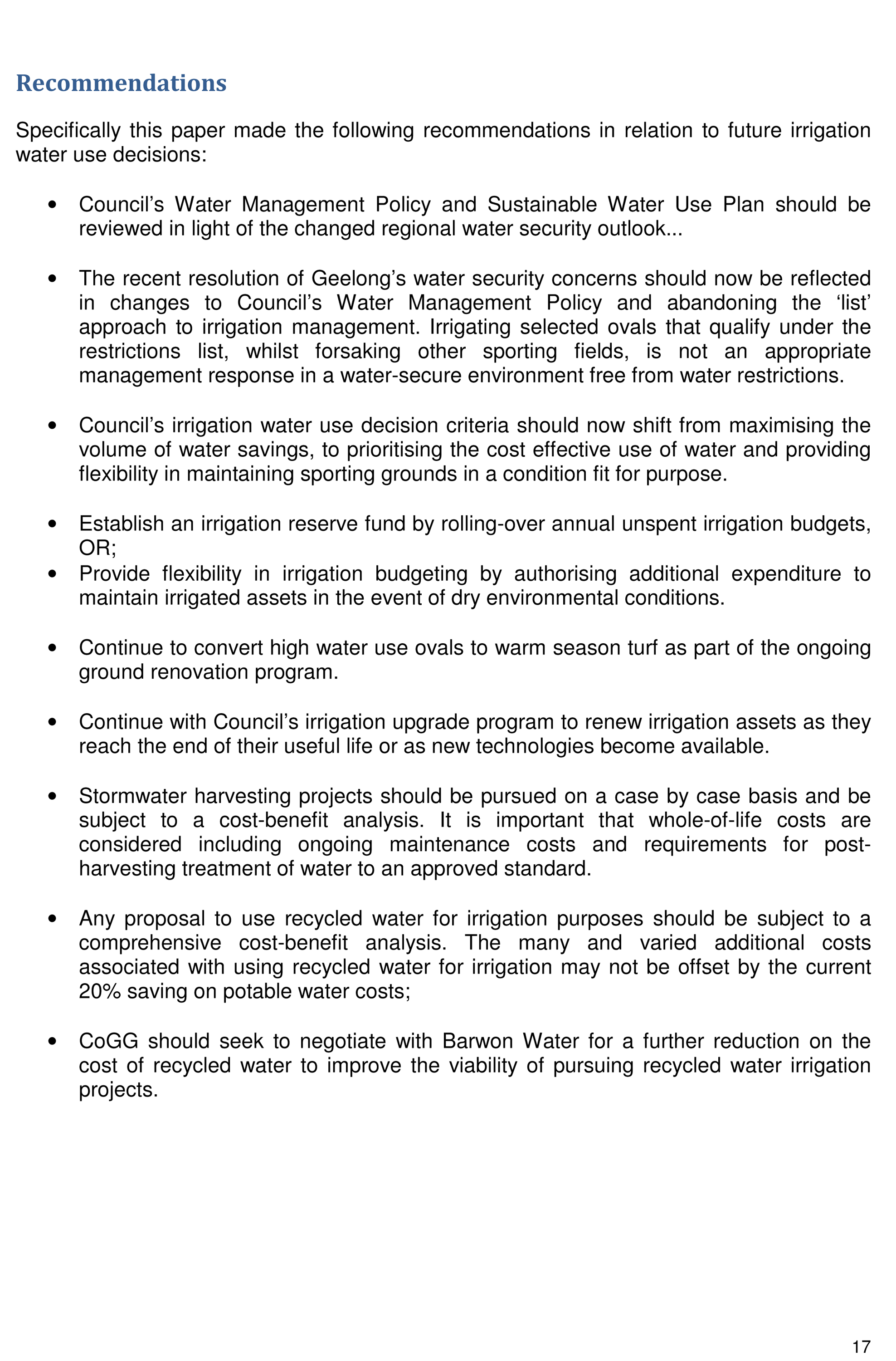
Portfolio: |
Community Safety – Cr Farrell |
Source: |
Community Services / Community Development |
General Manager: |
Jenny McMahon |
Index Reference: |
Subject: Community Safety |
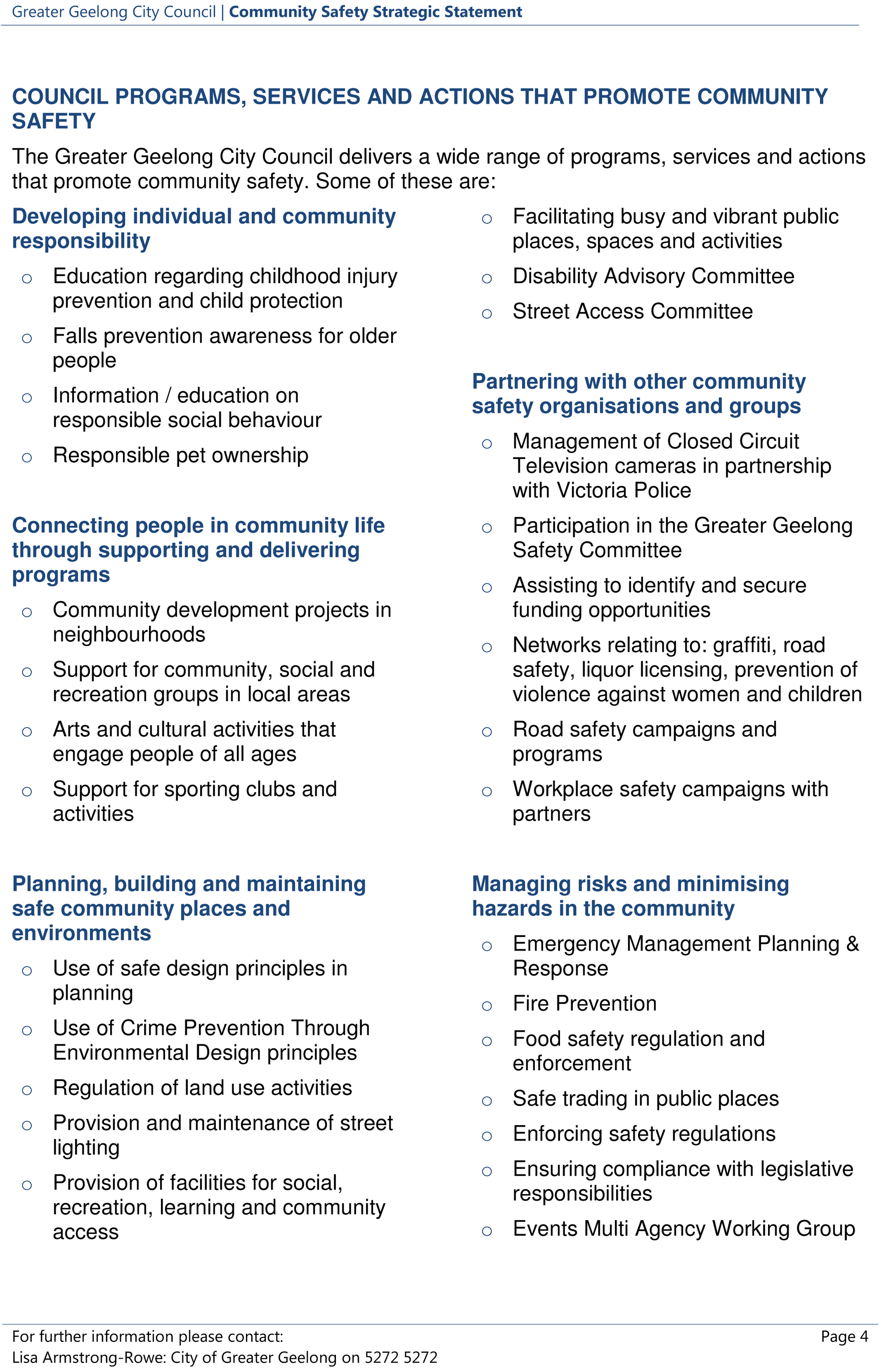
The purpose of this report is to present the Greater Geelong City Council –Community Safety Strategic Statement for Council's consideration and endorsement. Appendix 1.
The draft document was presented to Council on 23 October 2012. At the meeting it was resolved:
That Council:
Notes the report;
Releases the Greater Geelong City Council – Community Safety Statement (draft) for public consultation for an eight week submission process; and
Receives a further report following the consultation period.
Public comment on the draft document was sought in November and December 2012. In order to gather external comments the draft document was placed on Council’s website and was forwarded to a number of committees such as the Greater Geelong Safety Committee and the Geelong Disability Advisory Committee.
The intention of the Greater Geelong City Council – Community Safety Strategic Statement is to provide an overarching strategic statement that demonstrates the range of areas in which Council operates that influence community safety.
The Strategic Statement articulates five key areas where Council can contribute to community safety: Land Use Planning; Licensing and Regulation; Facilitation, Advocacy and Leadership; Community Service Delivery, Community Development and Civic Engagement; and Workforce Development.
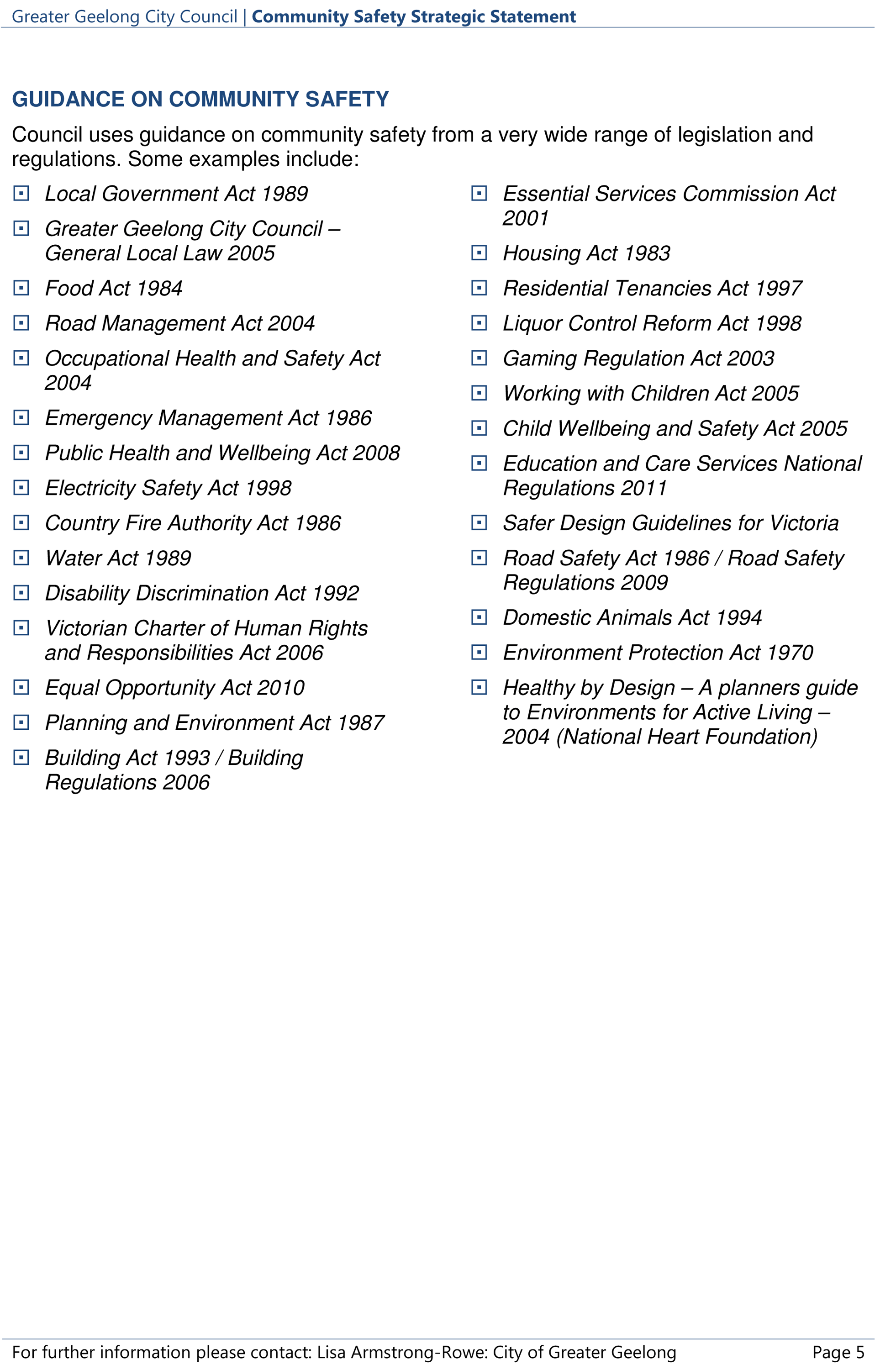
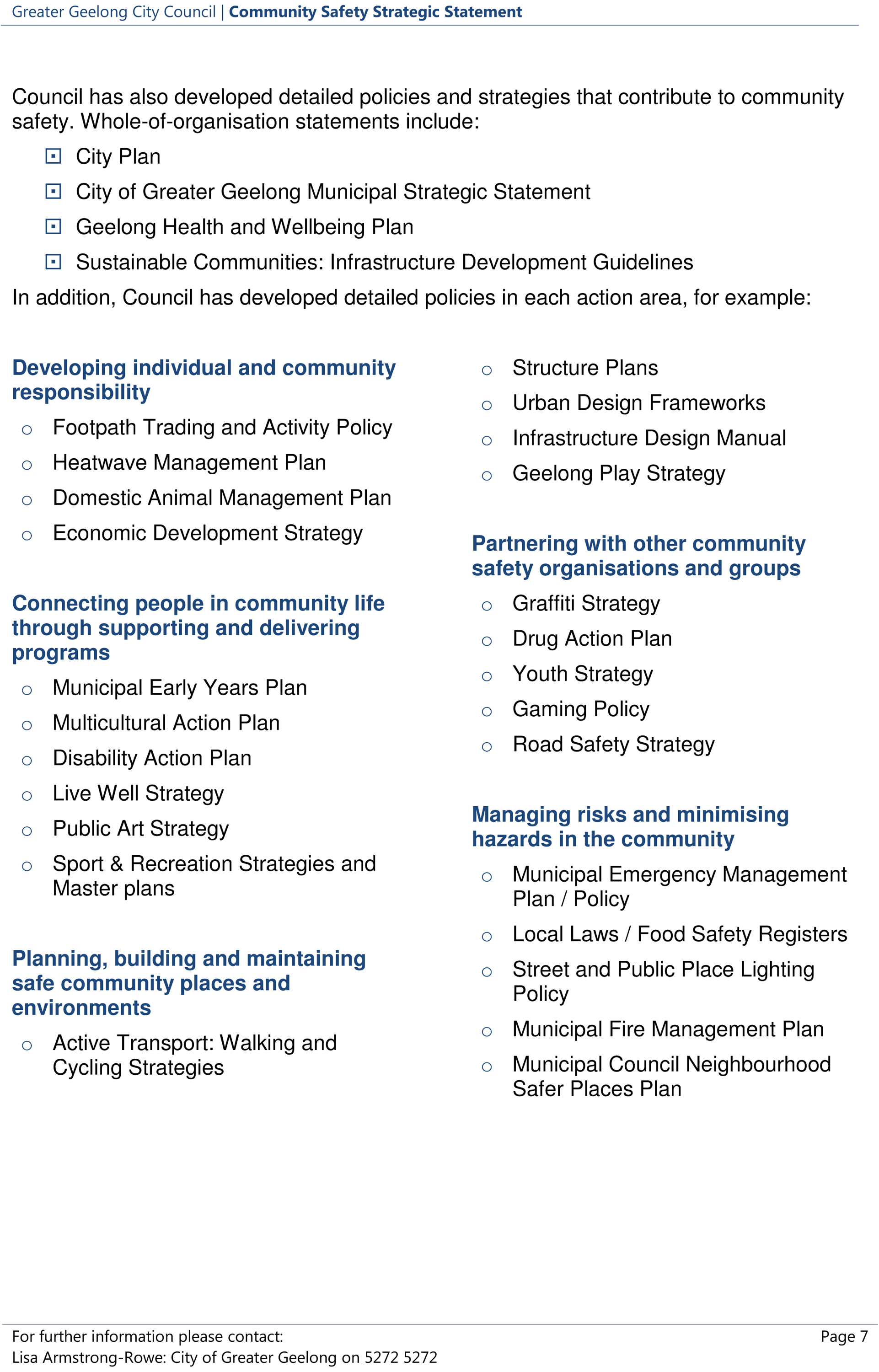
The Strategic Statement highlights existing Council programs, policies, plans and services that promote community safety outcomes. The Strategic Statement outlines legislative and regulatory roles which guide Council and it identifies the current range of networks and forums relating to community safety.
The October 2012 report to Council, and draft document, highlighted the major contribution community safety makes to the liveability of a community or place. Local governments across the world strive to support and maintain ‘liveable’ communities; places that attract people to live or visit and that build a sense of community identity and pride.
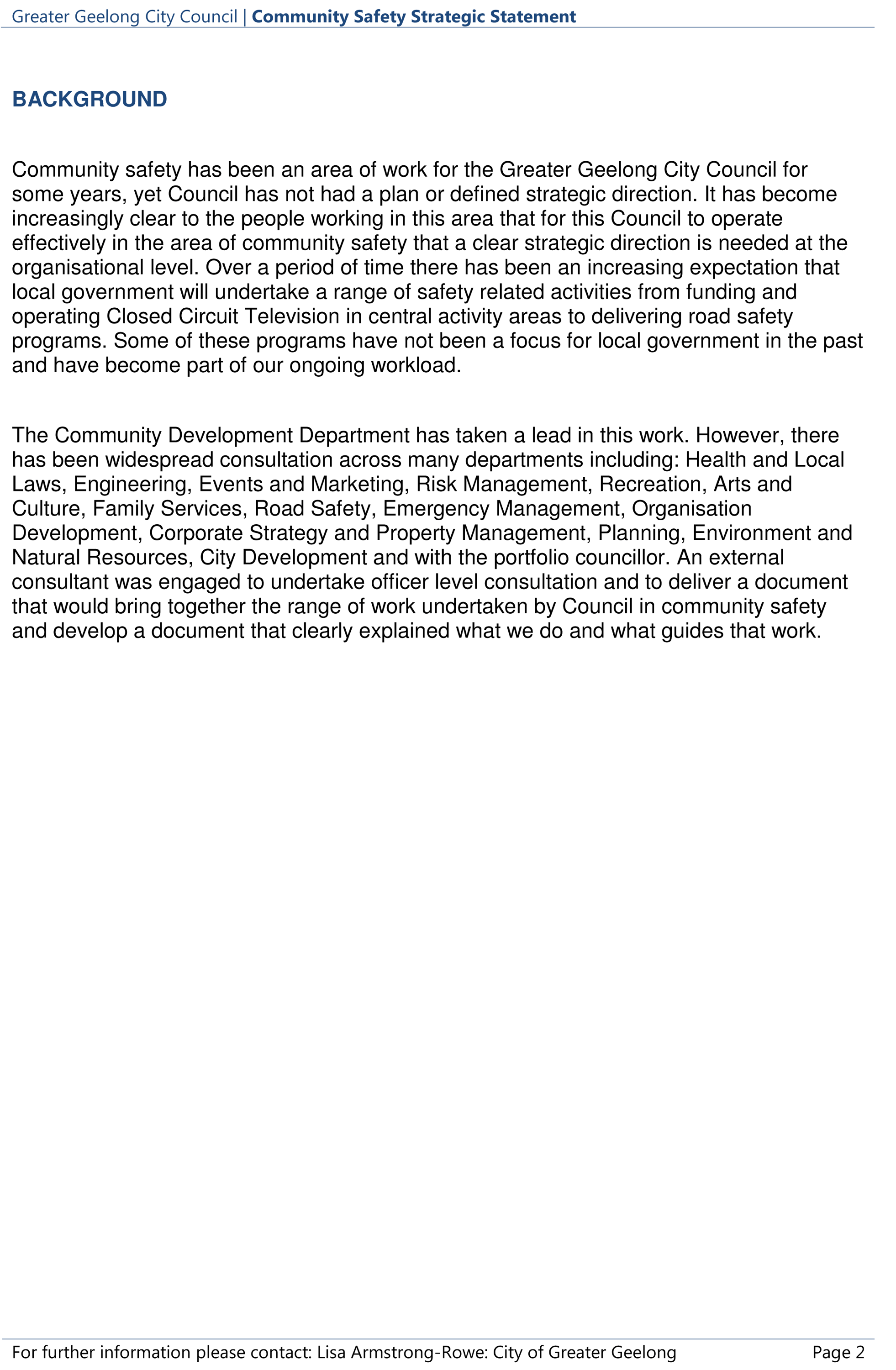
Community safety has been an area of work for the Greater Geelong City Council for some years. The Community Safety Strategic Statement draws together the collective work of Council to maximise outcomes and effectiveness in the area of community safety.
Over a period of time there has been an increasing expectation that local government will undertake a range of safety related activities including: graffiti management; safe design principles in planning; funding and operating closed circuit television in central activity areas; falls prevention for older people; delivering road safety programs; as well as fire prevention and emergency management.
Through the Community Safety Strategic Statement, the Greater Geelong City Council defines ‘community safety’ as the right of all people living, working or visiting the City to both ‘feel’ and ‘be’ safe. Council regards this as a goal for the whole community.
This Community Safety Strategic Statement outlines the role of the Greater Geelong City Council relating to community safety; including as a partner with other organisations, as a provider of many services and as a regulator.
Key priorities of the Community Safety Strategic Statement for the City include:
Developing individual and community responsibility
Connecting people and community through supporting and delivering programs
Planning, building and maintaining safe community places and environments
Partnering with other community safety organisations and groups
Managing risks and minimising hazards in the community.
Cr Farrell moved, Cr Fisher seconded -
That Council:
adopts the Community Safety Strategic Statement (Appendix 1);
notes and thanks the community for its input and feedback.
Carried.
Local governments across the world strive to support and maintain ‘liveable’ communities; places that attract people to live or visit and that build a sense of community identity and pride. There are many ways to reinforce the liveability of a community or place, with community safety being a major contributor.
Communities have increasingly requested Council to take a leadership, or a coordinating role in community safety activities that may not in the past have been seen as local government work.
The Greater Geelong City Council – Community Safety Strategic Statement recognises that Council’s role is broad and diverse.
The intention of the Community Safety Strategic Statement is to provide an overarching strategic statement that demonstrates the range of areas in which Council operates that influence community safety.
The Strategic Statement articulates five key areas where Council can contribute to community safety: Land Use Planning; Licensing and Regulation; Facilitation, Advocacy and Leadership; Community Service Delivery, Community Development and Civic Engagement; and Workforce Development.
The Strategic Statement highlights existing Council programs, policies, plans and services that promote community safety outcomes. The Strategic Statement outlines legislative and regulatory roles which guide Council and it identifies the current range of networks and forums relating to community safety.
The Community Development Department has taken the lead in this work, consulting across the organisation. The departments engaged include Health and Local Laws, Engineering, Events and Marketing, Risk Management, Recreation, Arts and Culture, Family Services, Road Safety, Emergency Management, Organisation Development, Corporate Strategy and Property Management, Planning, Environment and Natural Resources, City Development, and the Community Safety Portfolio councillor.
The Strategic Statement seeks to bring together in one document the variety of activities that Council engages in that are related to community safety and to provide cohesive direction for future integrated planning. The working group which guided the development of the Strategic Statement identified five key roles of Council in promoting community safety. They are:
Developing individual and community responsibility
Connecting people and community through supporting and delivering programs
Planning, building and maintaining safe community places and environments
Partnering with other community safety organisations and groups
Managing risks and minimising hazards in the community.
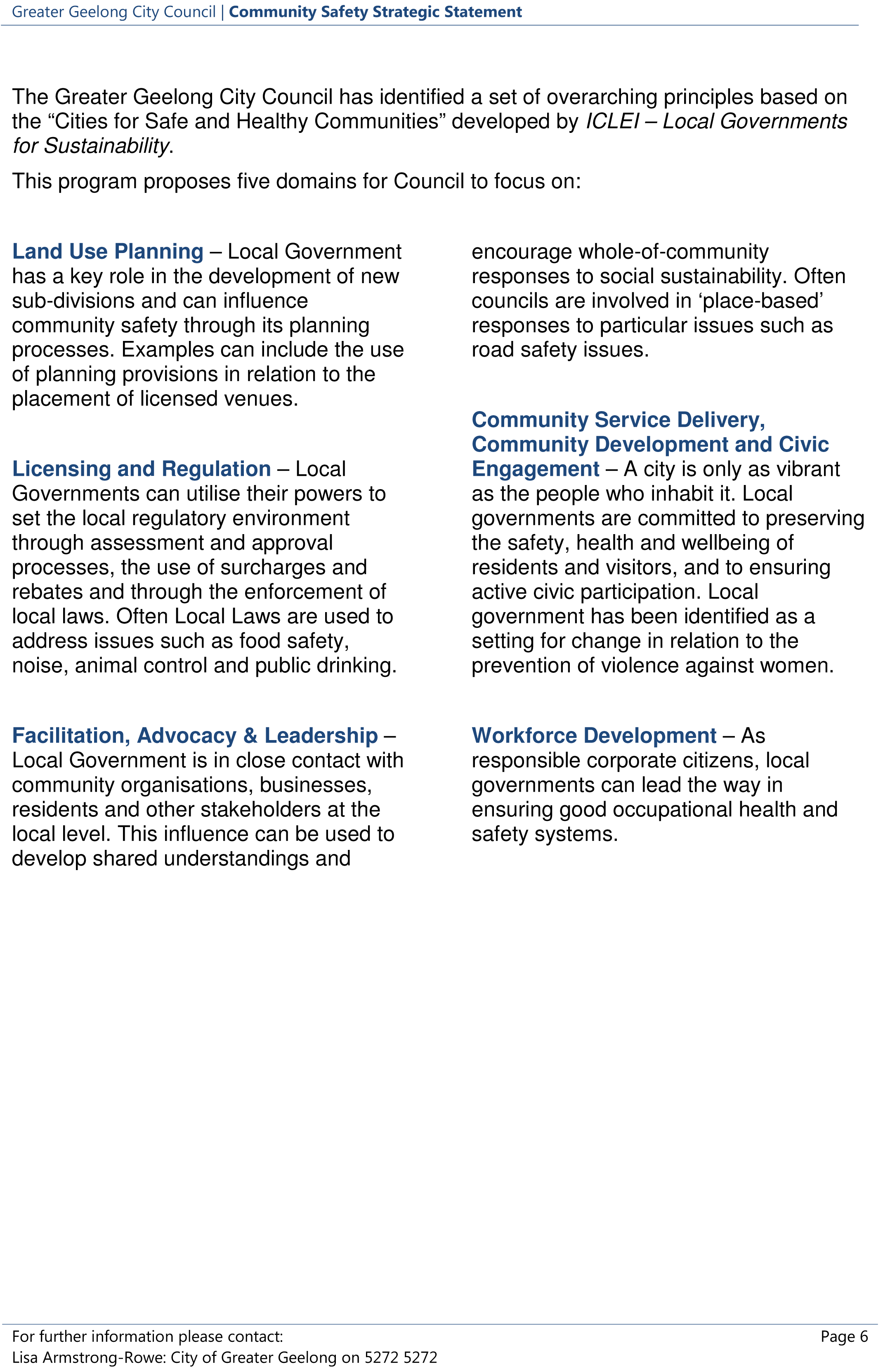
The Strategic Statement has identified a set of overarching principles based on the ‘Cities for Safe and Healthy Communities’ developed by the International Council for Local Environmental Initiatives – ICLEI – Local Governments for Sustainability.
This program proposes five areas for Council to focus on. These are:
Land Use Planning – local government has a key role in the development of new sub-divisions and can influence community safety through its planning processes. Examples can include the use of planning provisions in relation to the placement of licensed venues.
Licensing and Regulation – local government can utilise its powers to set the local regulatory environment through assessment and approval processes, the use of surcharges and rebates and through the enforcement of local laws. Often local laws are used to address issues such as food safety, noise, animal control and public drinking.
Facilitation, Advocacy and Leadership – local government is in close contact with community organisations, businesses, residents and other stakeholders at the local level. This influence can be used to develop shared understandings and encourage whole-of-community responses to social sustainability. Often councils are involved in ‘place-based’ responses to particular issues such as road safety issues.
Community Service Delivery, Community Development and Civic Engagement – a city is only as vibrant as the people who inhabit it. Local government is committed to preserving the safety, health and wellbeing of residents and visitors, and to ensuring active civic participation.
Workforce Development – as responsible corporate citizens, local governments can lead the way in ensuring good occupational health and safety systems.
The draft document was presented to Council in October 2012. Public comment on the plan was sought in November and December 2012. In order to gather external comments the draft document was listed on Council’s website and was forwarded to a number of committees such as the Greater Geelong Safety Committee and the Geelong Disability Advisory Committee.
The draft Community Safety Strategy, which was presented to Council and released for public consultation, was entitled a ‘strategy’. However, it is more accurately a ‘Strategic Statement’ and as such the title of the document (Appendix 1) has been updated to reflect this intent: Greater Geelong City Council – Community Safety Strategic Statement.
The draft Community Safety Strategy was released for public consultation for a six week period during which time it was considered by both the Greater Geelong Safety Committee and the Geelong Disability Advisory Committee. There were only two comments received (via the Geelong Australia website).
The first of the responses was in regard to speeding motorists in suburban streets, the narrowness of the roads and cars parked on either side of the street and the ensuing risk, particularly at school times (Bellaire Primary School was highlighted).
The second comment was requesting help for young people who were disconnected from community through the provision of arts programs in Geelong and North Geelong.
While neither comment directly relates to the framework of the Strategic Statement, both comments are examples of community expectations of Council. They serve to reinforce the importance of an integrated framework to guide and advise achievement of community safety in Geelong. Both comments have been referred to appropriate areas of Council for consideration.
It was recognised in the consultation phase that for Geelong, community safety had an impact across many departments and programs and so a wide interpretation has been adopted. The departments represented in the development of the draft document were Community Development, Health and Local Laws, Engineering, Events and Marketing, Risk Management, Recreation, Arts and Culture, Family Services, Road Safety, Emergency Management, Organisation Development, Corporate Strategy and Property Management, Planning, Environment and Natural Resources, City Development, and the Community Safety Portfolio councillor.
The Greater Geelong City Council – Community Safety Strategic Statement defines community safety as the right of all people to living, working or visiting the City to both ‘feel’ and ‘be’ safe. It was identified by the majority of stakeholders consulted that the definition needed to be simple and achievable.
There are many stakeholders in the area of safety that contribute to community safety outcomes, and it is essential Council work in collaboration with these groups and agencies to achieve community safety outcomes for Geelong.
The Strategic Statement outlines the role of the Greater Geelong City Council relating to community safety, including as a partner with other organisations, as a provider of many services and as a regulator.
Very often community safety concerns have an environmental impact such as concerns about noise, amenity, the regulation and management of licensed venues, growth or planning issues.
In each case these matters need to be assessed on a case by case basis and the environmental issues need to be managed in relation to the other concerns.
The adoption of the Community Safety Strategic Statement does not have any immediate financial implications but will serve to assist the consideration of future projects with community safety outcomes.
Local government is identified in numerous state and federal documents that relate to community safety related issues.
There are no conflicts of interest in adopting this report for any Council officers.
Community safety as a local government issue is intrinsically linked to risk assessment and risk management. By adopting the Community Safety Strategic Statement, Council seeks to further manage the ongoing risk management issues.
Community safety and perceptions of safety are regularly used to measure the liveability of cities and are key factors in the engagement of individuals in community life. Adopting the Community Safety Strategic Statement will help ensure that there is a key strategic direction to guide work across a range of Council’s departments and activities.
The City’s Community Development Department is responsible for communication of the report and issues relating to the Community Safety Strategic Statement.
Portfolio: |
Community Development – Cr Fisher |
Source: |
Community Services/Community Development |
General Manager: |
Jenny McMahon |
Index Reference: |
Community Planning |
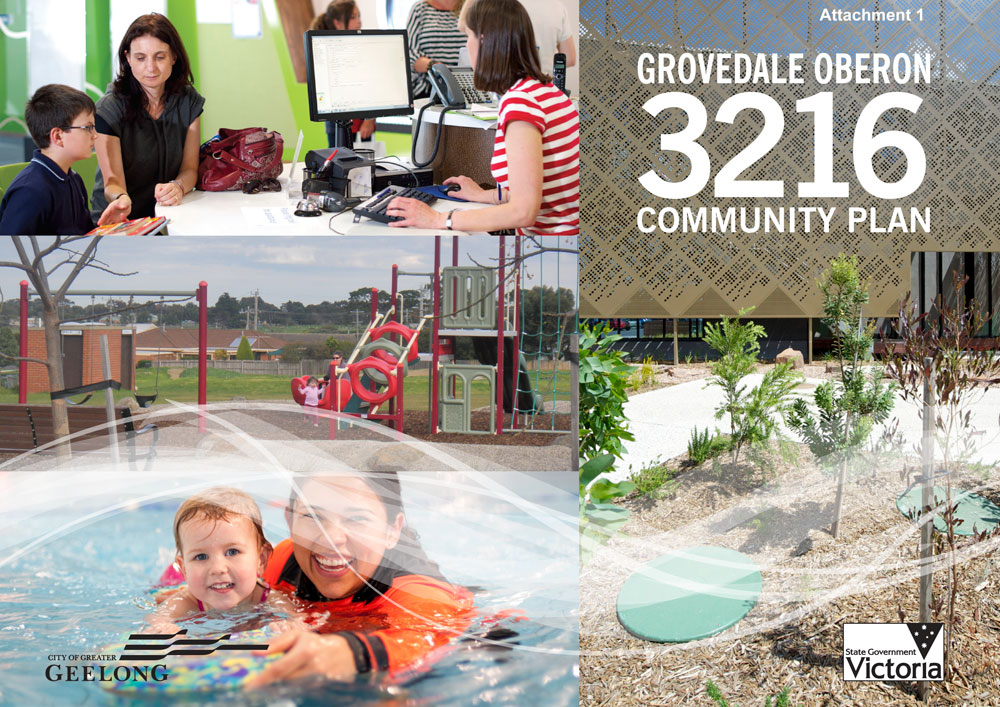
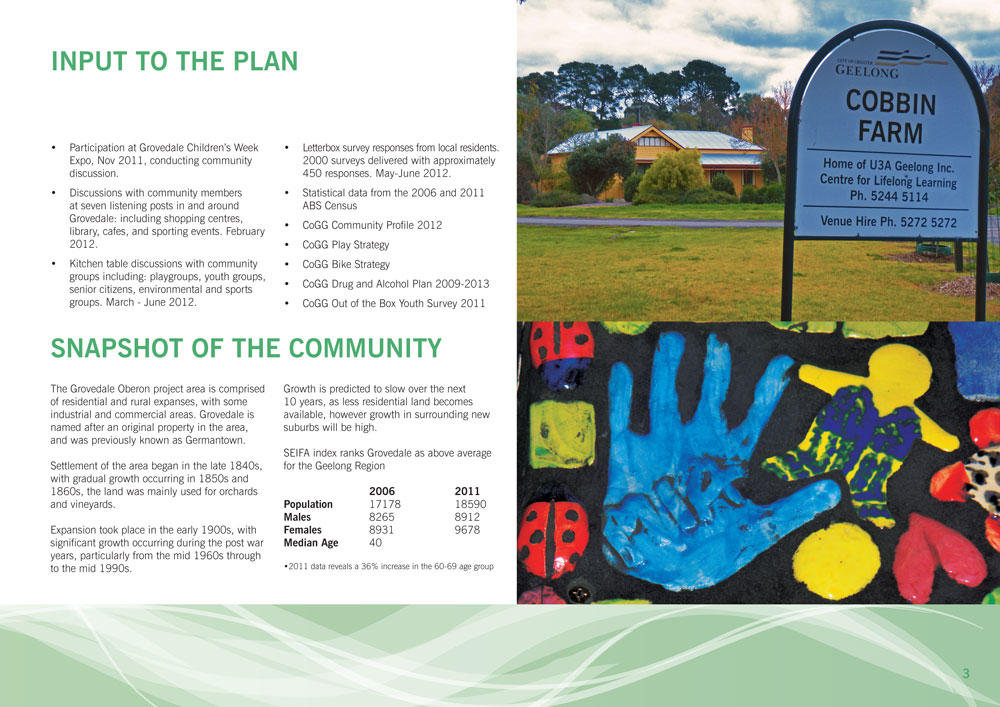
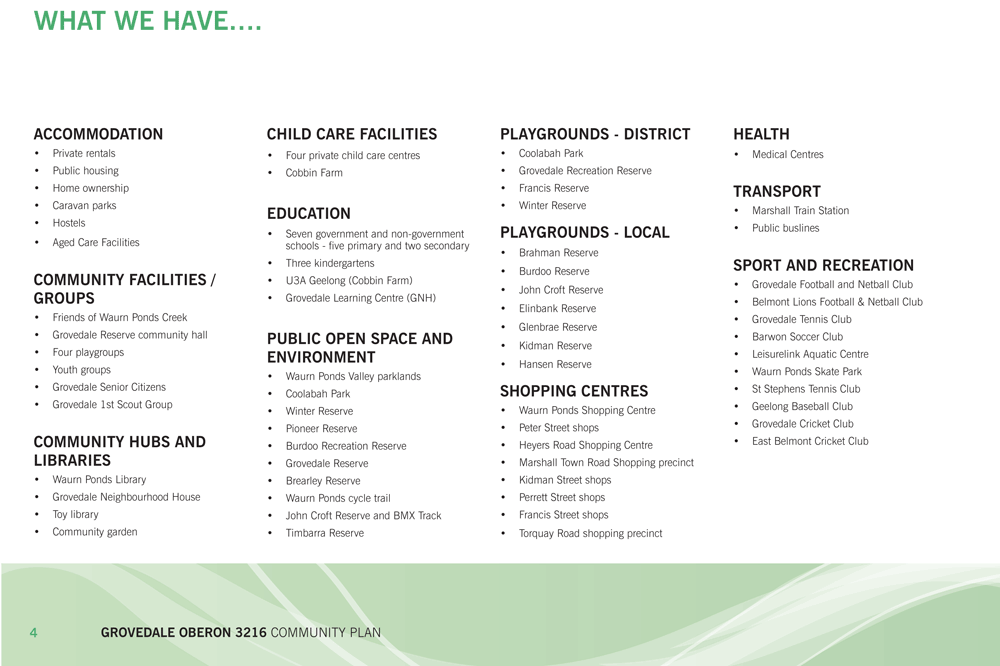
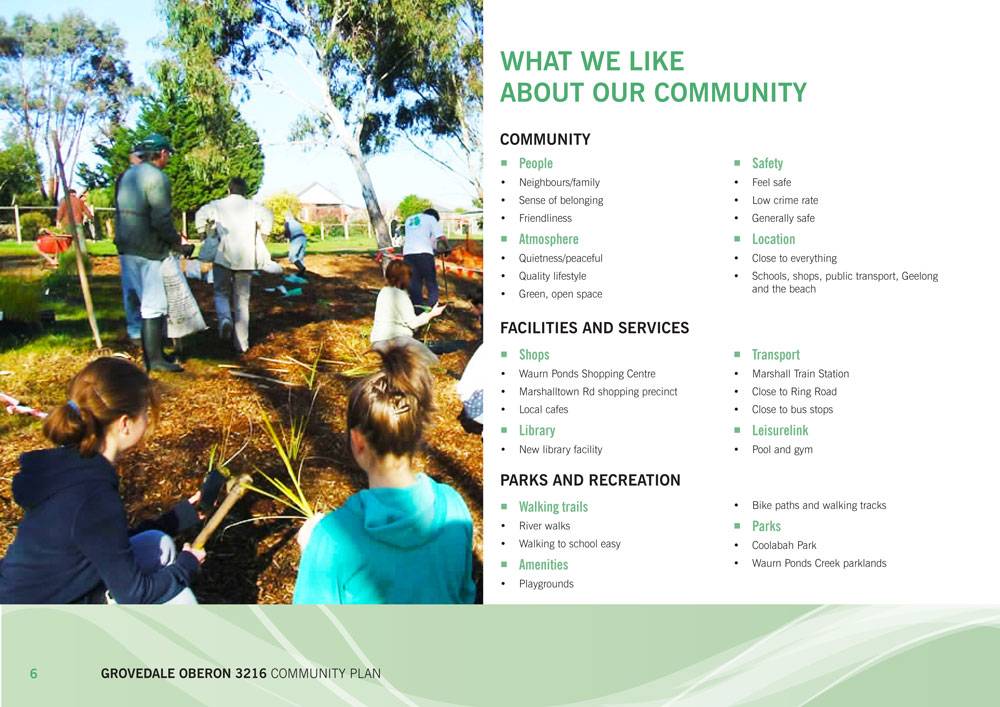
The purpose of this report is to present for Council’s consideration the Grovedale Oberon 3216 Community Plan (Attachment 1).
The Victorian Department of Planning and Community Development (DPCD) funded the Grovedale Oberon 3216 project following recommendations contained in a 2009 Bethany Project Report.
The Grovedale Oberon 3216 project aimed to develop an action plan to address community aspirations and concerns, and to provide direction for future development in the Grovedale Oberon area.
The Grovedale Oberon 3216 Community Plan was developed following extensive community consultation, which occurred from December 2011 through to June 2012 and provides Council with a unique community insight into the area and its future.
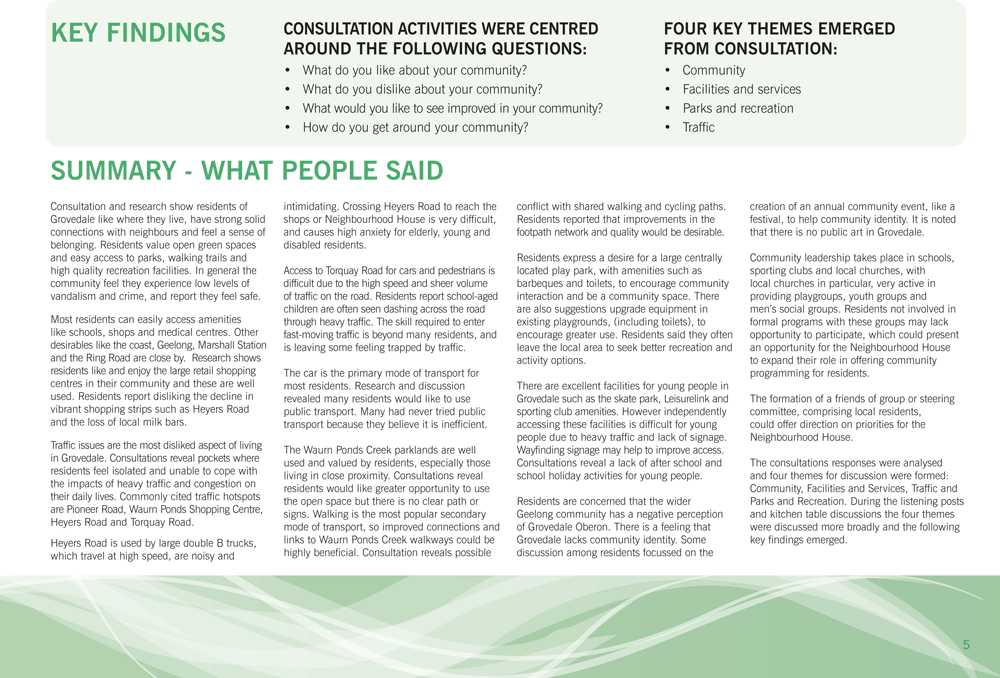
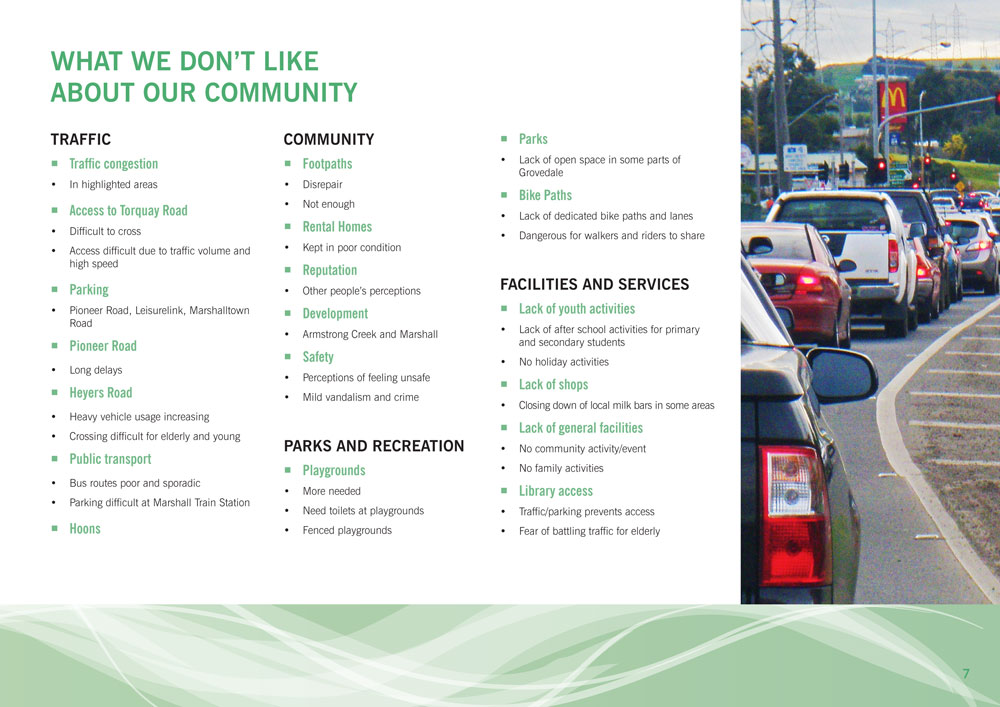
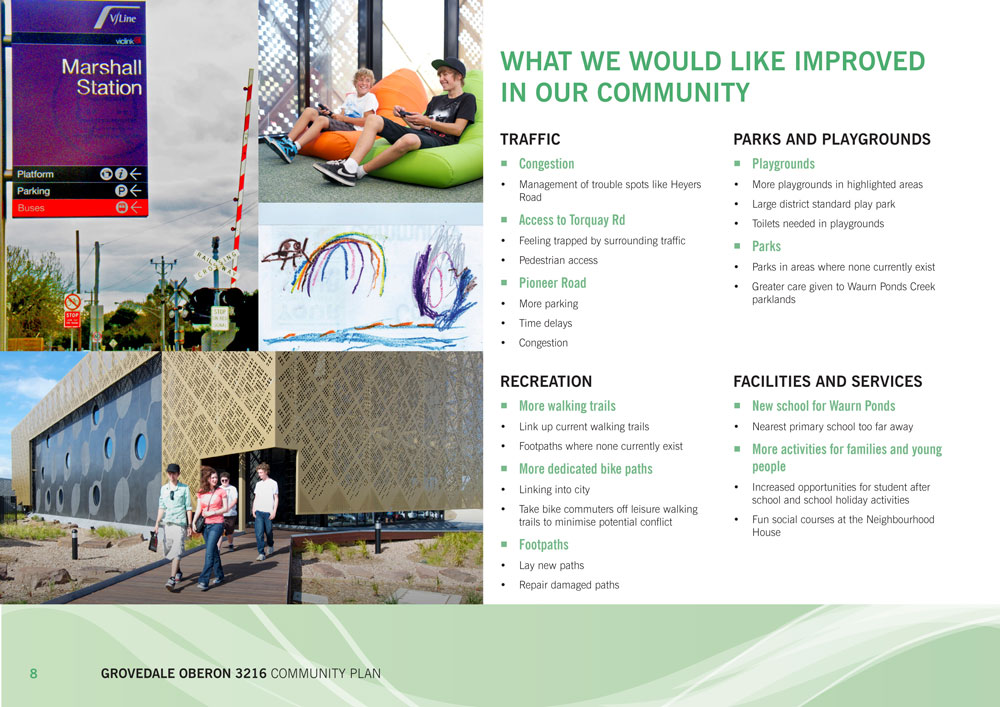
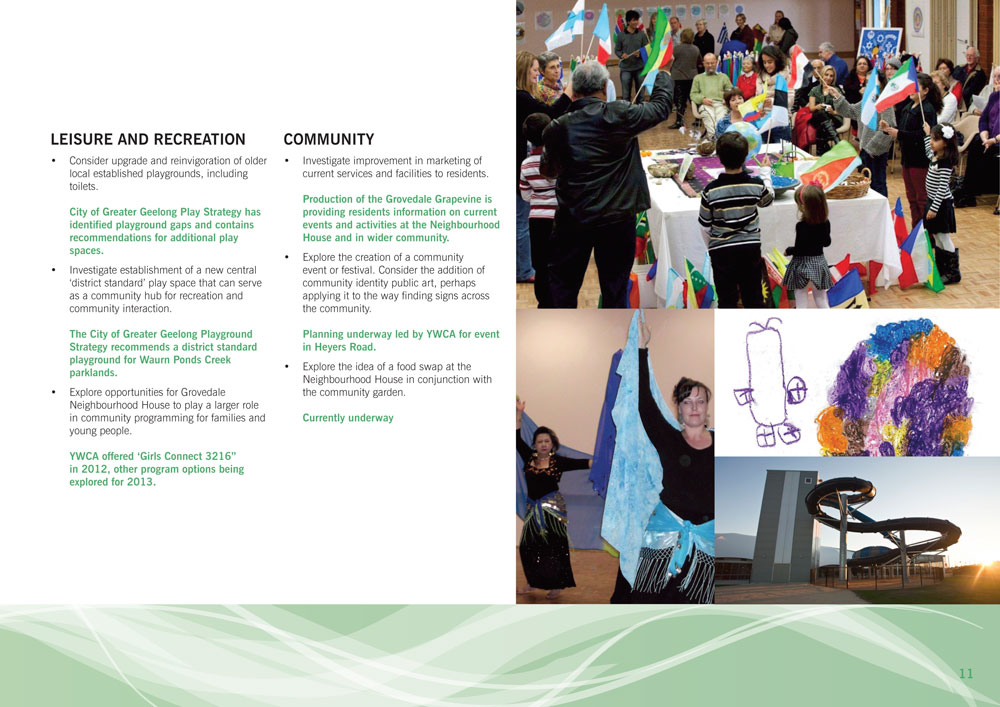
As part of the consultation, residents were asked about what they liked, disliked and wanted improved in their community. From an analysis of responses received, four key themes emerged:
Traffic
Facilities and Services
Leisure and Recreation
Community.
These themes were explored further through broad ranging discussions with community groups and resulted in key findings and identified actions. These are outlined in the attached Community Plan. The key actions and findings build upon a wide range of projects and programs already underway or completed in 3216, including:
Development of the Grovedale Community Centre
Waurn Ponds Library
Upgrade of Pioneer Road
Provision and development of open space and recreation reserves.
Cr Richards moved, Cr Fisher seconded -
That Council:
notes the report;
acknowledges and thanks the community for its contribution and input into the Plan.
Carried.
The impetus for the Grovedale Oberon 3216 project came from the recommendations of a comprehensive Bethany Project Report in 2009, which identified Grovedale as an area of geographical expansion which would benefit from community strengthening initiatives. The Department of Planning and Community Development (DPCD) provided funding in mid 2010 to develop a community action plan for the 3216 area.
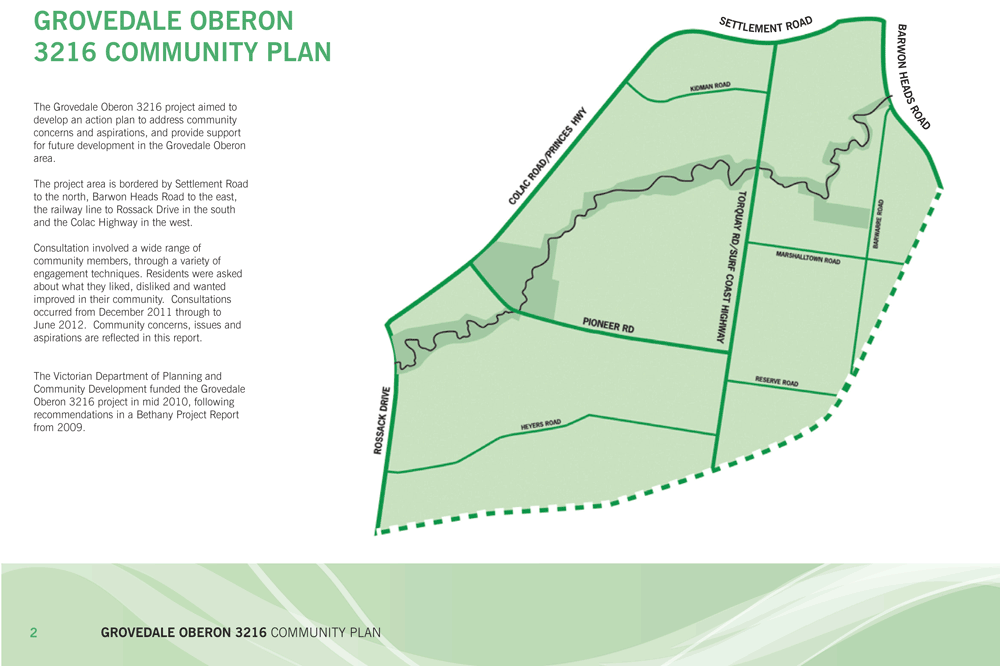
The Grovedale Oberon 3216 project area is comprised of residential and rural expanses, with some industrial and commercial areas. The area is bordered by Settlement Road to the north, Barwon Heads Road to the east, the railway line to Rossack Drive in the south and Colac Road/Princes Highway in the west.
The methodology used throughout this project was designed to examine strengths and concerns within the local community and to develop key actions to meet the overall community vision. The community was asked four key questions:
What do you like about your community?
What don’t you like about your community?
What would you like to see improved in your community?
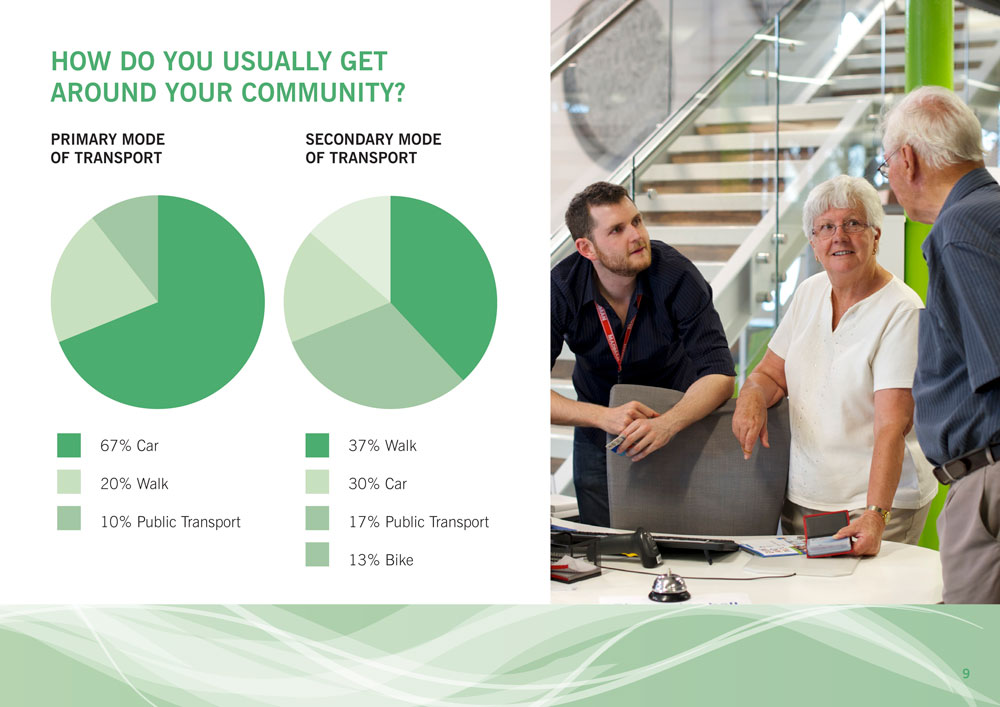
How do get around your community?
A range of community engagement techniques were implemented:
Stall at Grovedale Children’s Expo Dec 2011 (45 residents engaged)
Listening post discussions (seven key destination points)
Kitchen table discussions (eg. Grovedale Playgroup, Grovedale Senior Citizens, St John’s Youth Group and South Barwon Tenants Group)
Letterbox survey (1800 surveys, with over 400 responses)
Intercept surveys (located on cycle and walking paths across the project area)
Local advertising (three advertisements in the Grovedale Grapevine, a local newsletter which is delivered to all Grovedale residents).
The attached Grovedale Oberon 3216 Community Plan provides a detailed overview of the consultation activities undertaken and the responses of a broad spectrum of the community, as well as their proposed recommendations for the future. Four themes were identified over the course of the project:
Traffic
Facilities and Services
Leisure and Recreation
Community.
The Grovedale Oberon Community Plan project provided Council with a unique opportunity to engage with the local community in a broad community planning context and consider a range of questions and issues relevant to the local community and its future. Similar planning projects have been conducted at Thomson, Whittington and Portarlington.
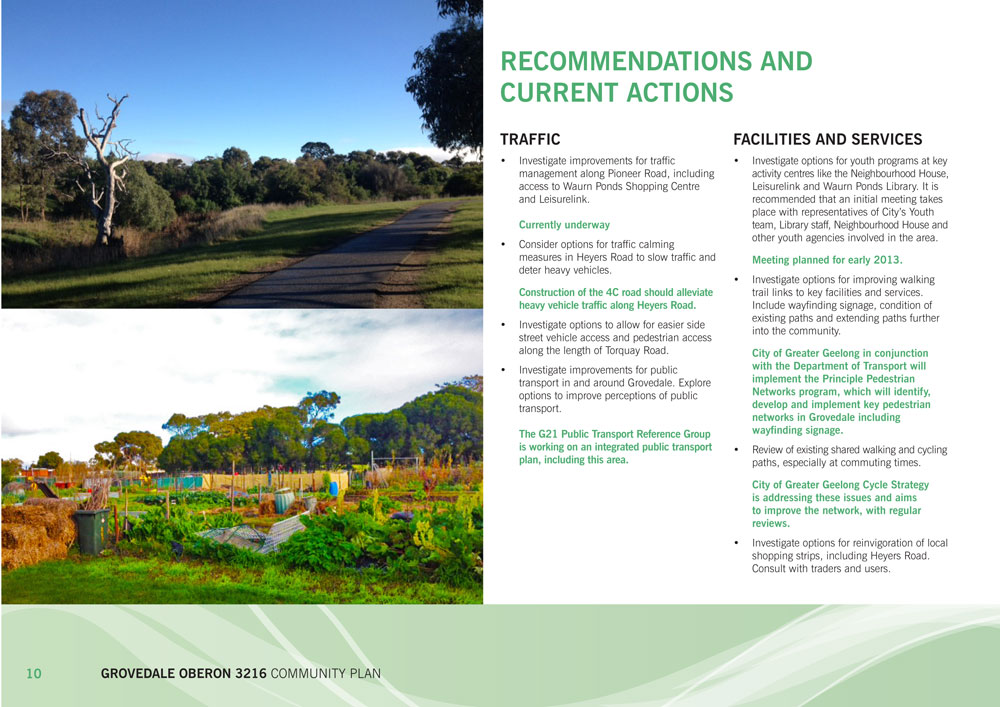
During and after the consultation period responses were analysed and summarised. Clear issues emerged from the analysis and these were ultimately summarised with the following recommendations emerging (current actions addressing these recommendations are noted in parentheses):
1. Traffic
Investigate improving traffic management along Pioneer Road, including access to Waurn Ponds Shopping Centre and Leisurelink Leisure Centre. (Currently underway.)
Consider options for traffic calming measures in Heyers Road to slow traffic and deter heavy vehicles. (Construction of Geelong Ring Road Section 4C should alleviate heavy vehicle traffic along Heyers Road.)
Investigate options to allow for easier side street vehicle access and pedestrian access along the length of Torquay Road.
Investigate improvements for public transport in and around Grovedale. Explore options to improve perceptions of public transport. (The G21 Public Transport Reference Group is working on an integrated public transport plan including this area.)
2. Facilities and Services
Investigate options for youth programs at key activity centres like the neighbourhood house, Leisurelink and Waurn Ponds Library. It is recommended that an initial meeting with representatives of the City’s Youth Services team, library staff, neighbourhood house and other youth agencies involved in the area takes place. A meeting is planned for early 2013.
Investigate options for improving walking trail links to key facilities and services. Include wayfinding signage; review the condition of existing paths, and options for extending paths further into the community. (City of Greater Geelong in conjunction with the Department of Transport is implementing the Principle Pedestrian Networks program, which will identify, develop and implement key pedestrian networks in Grovedale including wayfinding signage)
Review of existing shared walking and cycling path arrangements, especially at commuting times, when there is potential for conflict between the needs of pedestrians and cyclists. (City of Greater Geelong Cycling Strategy is addressing these issues and aims to improve the network, with regular reviews)
Investigate options for reinvigoration of local shopping strips, including Heyers Road. Consult with traders and users.
3. Parks and recreation
Consider upgrade and reinvigoration of older local established playgrounds, including public toilets. (City of Greater Geelong Play Strategy has identified playground gaps and contains recommendations for additional play spaces.)
Investigate establishment of a new central district standard play space that can serve as a community hub for recreation and community interaction. (City of Greater Geelong Play Strategy recommends a district standard playground for Waurn Ponds Creek parklands.)
Explore opportunities for Grovedale Neighbourhood House to play a larger role in community programming for families and young people. The YWCA offered ‘Girls Connect 3216’ in 2012. Other program opportunities are being looked at for 2013.
4. Community
Investigate improvement in marketing of current services and facilities to residents. (Production of the Grovedale Grapevine newsletter is providing residents with information on current events and activities at the neighbourhood house and in the wider community.)
Explore creation of a community event or festival and addition of community identity public art, perhaps applying it to the wayfinding signs across the community. Planning is underway, led by YWCA, for an event in Heyers Road.
Explore the idea of a food swap at the neighbourhood house in conjunction with the community garden. (Currently underway.)
These recommendations contained in the Grovedale Oberon 3216 Community Plan form the basis for the provision of feedback and direction within the relevant City of Greater Geelong departments, for service providers, as well as relevant State and Federal government departments.
The methodology used to develop the plan is based on the community voice of residents in the Grovedale Oberon area and as such the Plan is an important reflection of residents’ priorities. Distribution of the Grovedale Oberon 3216 Community Plan will provide the community with a tangible focus for their efforts.
Public health and health promotion approach recognises that environments contribute to health outcomes. Environment, in terms of best practice principles in public space design and development, also has a significant impact on community wellbeing. Actions identified in the Plan will contribute to improved environment and enhanced wellbeing for residents within the Grovedale Oberon area.
There are no financial implications in the current budget period, as all project costs have been expended and were covered by the initial funding grant.
The implementation of the Grovedale Oberon 3216 Community Plan complements City Plan.
There is no direct or indirect interest noted for this report.
There will be a heightened expectation that the City of Greater Geelong will work in partnerships with relevant agencies to realise the recommendations and actions in the Grovedale Oberon 3216 Community Plan. As many of these recommendations are currently being undertaken, risk is assessed as low.
Actions from the Grovedale Oberon 3216 Community Plan, either completed or underway, have provided positive opportunities to engage people from the local community. This has further promoted wider community education and enabled the implementation of initiatives to address issues of concern.
The City’s Community Development Department is responsible for communication of the report and issues relating to the Grovedale Oberon 3216 Community Plan.
Portfolio: |
Community Development – Cr Fisher |
Source: |
Community Services / Community Development |
General Manager: |
Jenny McMahon |
Index Reference: |
Community Planning |
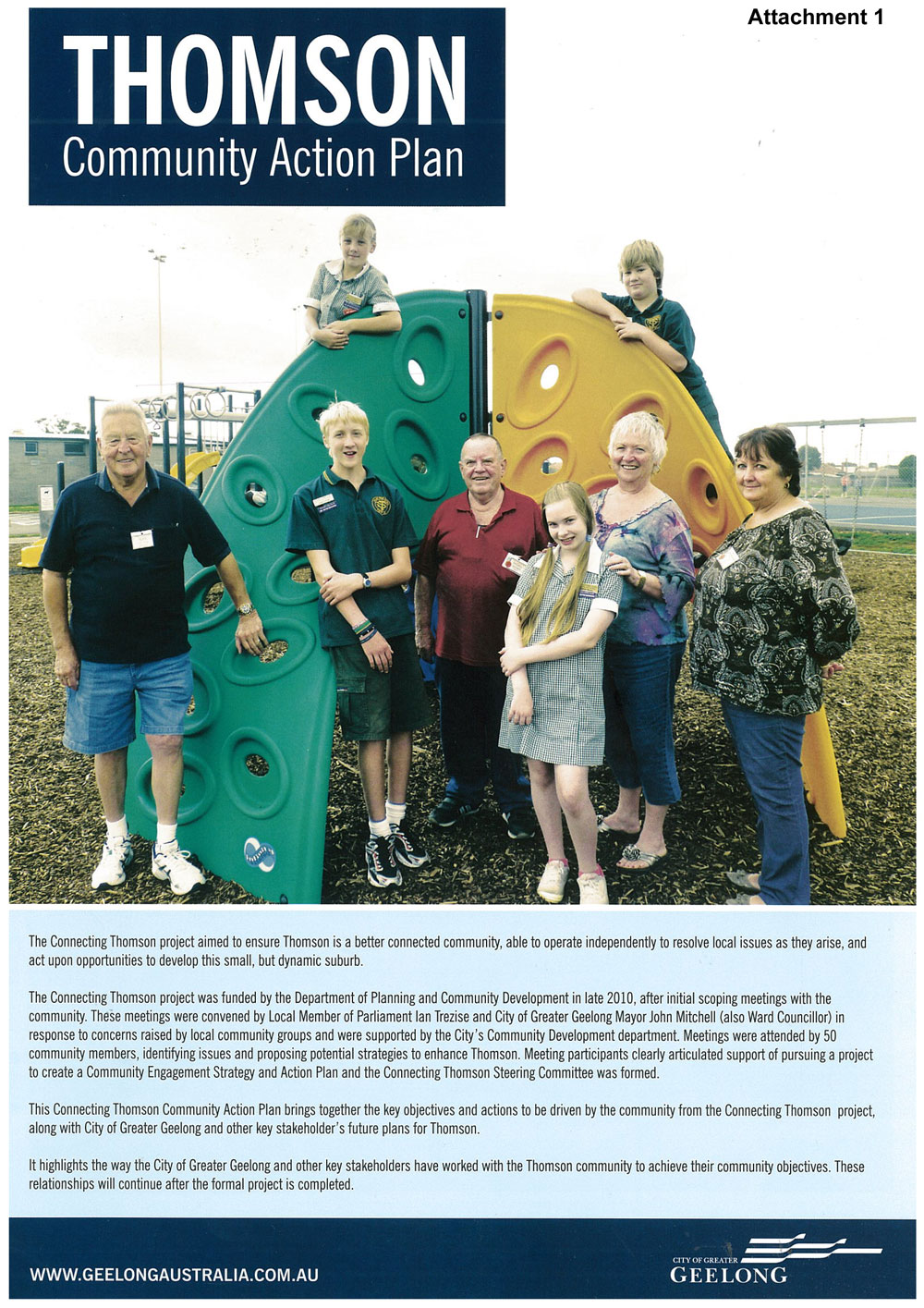
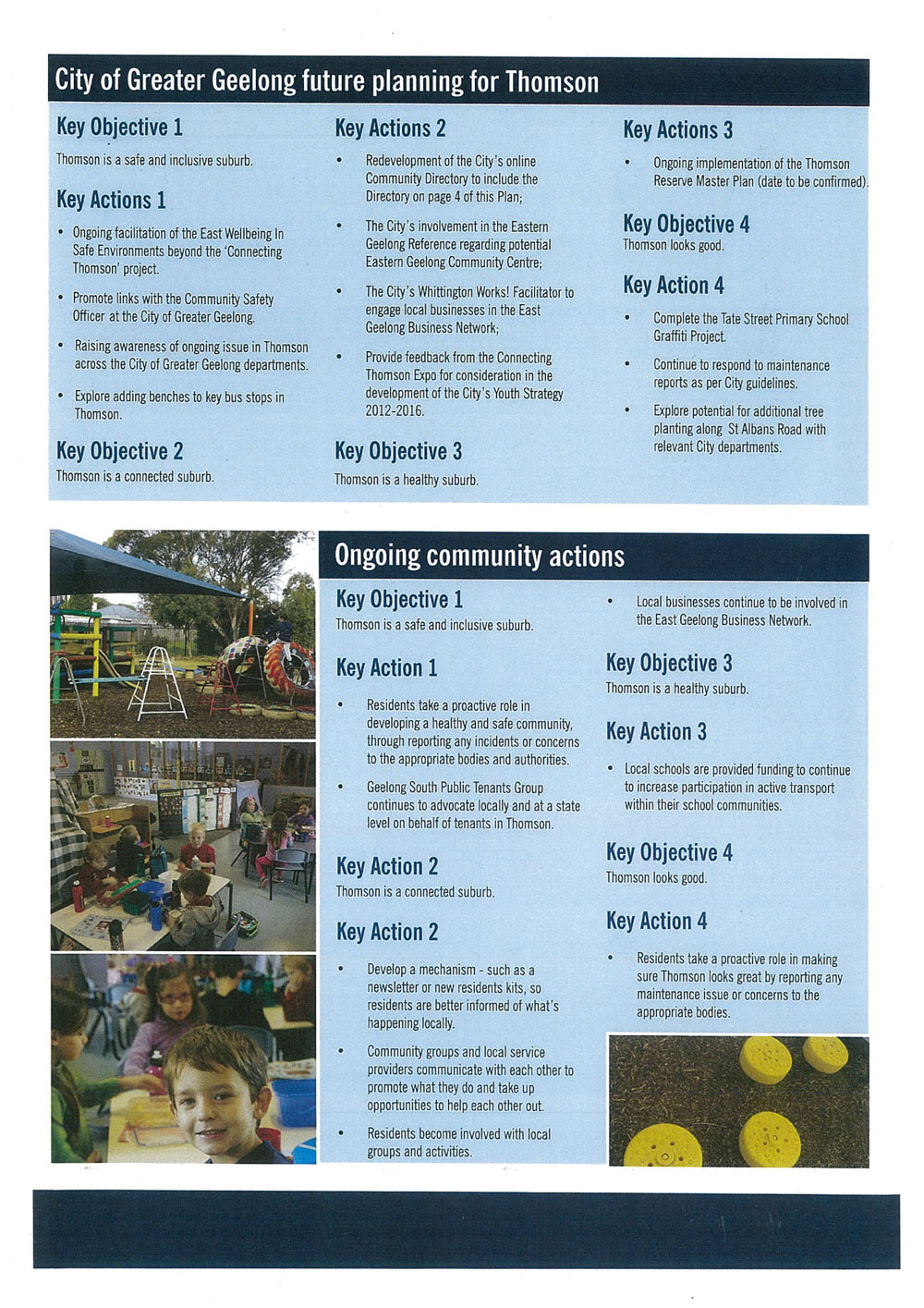
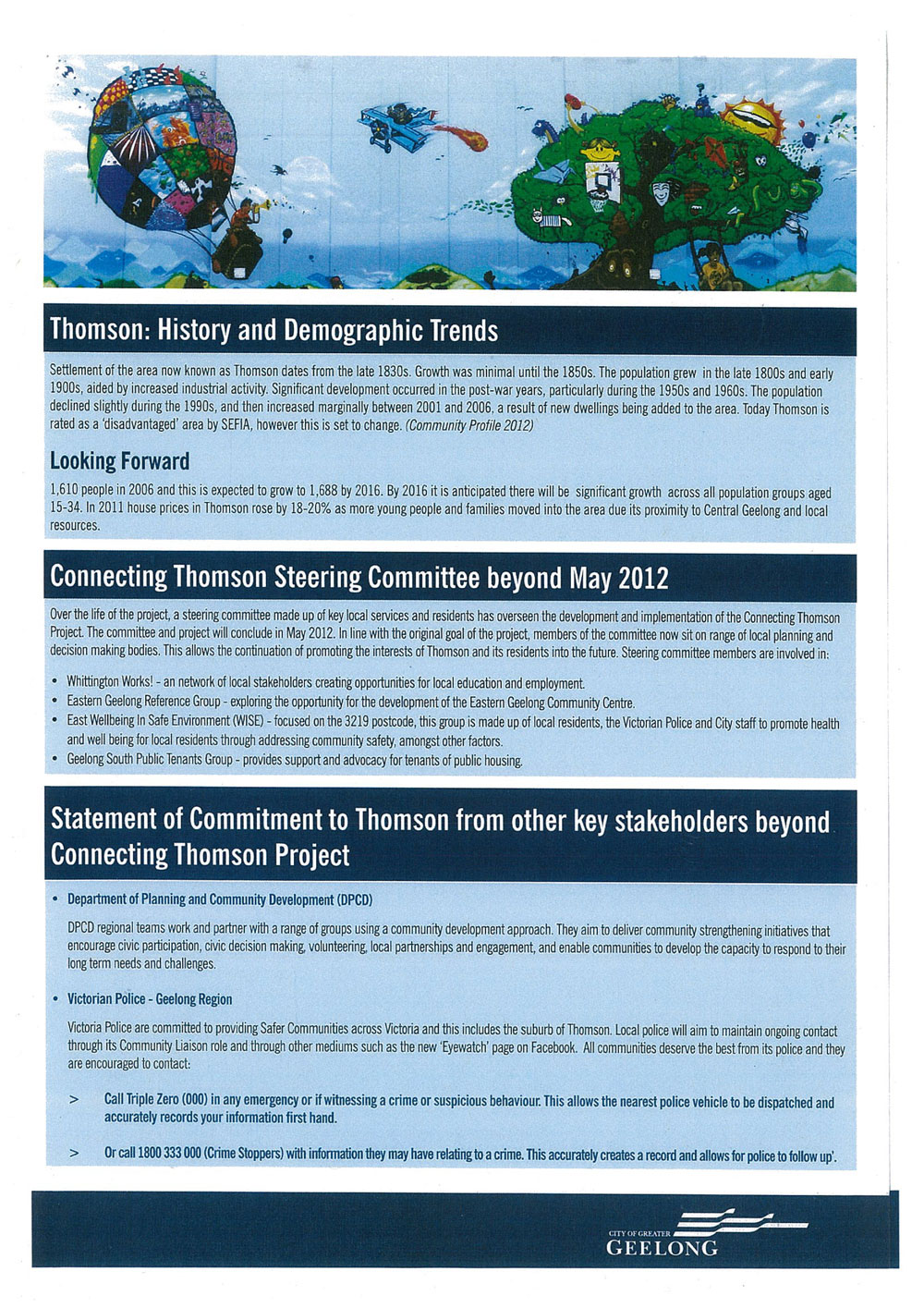
The purpose of this report is to present the Thomson Community Action Plan (Attachment 1) to Council for noting. The Thomson project was funded and developed in partnership with the State Government and local residents.
The Thomson project was initiated in 2010 and has provided residents of the area with an opportunity to express their concerns and develop actions for the future positive development of their local community. The Plan is a result of this community engagement and consultation.
The project area is bordered by Martin Street to the east, north along Lomond Terrace, Godfrey and Ensby Streets to Ormond Road, with Boundary Road to the west. The southern boundary is along Carr St and St Albans Road. It is adjacent to East Geelong, Whittington and Breakwater.
The project and resulting plan provides Council and the community with a unique local insight and direction for Thomson.
Over the final stages of the project, emphasis was placed on celebrating the achievements of the project and of the local community, and ensuring the Thomson Community Action Plan reflected community goals.
Once Council has noted the Plan, the final Thomson Community Action Plan is ready to be distributed publicly throughout Thomson.
The Project Steering Committee has merged into a new community wellbeing and safety working group covering the wider 3219 area - EastWISE (Wellbeing In Safe Environments). Pathways for traders and businesses to continue to work together have been identified and supported.
Cr Richards moved, Cr Fisher seconded -
That Council:
notes the report;
acknowledges and thanks the community and the Connecting Thomson Steering Committee for their involvement and input.
Carried.
In response to community concerns about safety, local amenity and social connection issues, two community scoping meetings were held in Thomson in late July 2010, with key community members as well as local and state government representatives. These meetings, attended by approximately 50 community members, identified a number of key issues which formed the basis of the Connecting Thomson project. An application was submitted to the Department of Planning and Community Development (DPCD) to fund a community planning project.
Adjacent to East Geelong, Whittington and Breakwater, the Thomson project area, is bordered by Martin Street to the east, north along Lomond Terrace, Godfrey and Ensby Streets to Ormond Road, with Boundary Road to the west. The southern boundary is along Carr St and St Albans Road.
The Connecting Thomson Steering Committee commenced in March/April 2011. It comprised representatives of key local services and residents to oversee the development and implementation of the ‘Connecting Thomson’ project. In June 2011, through the Department of Planning and Community Development funding, a project worker was appointed to ‘Connecting Thomson’. The committee had regular representation at meetings from:
Tate St Primary School
Victoria Police
City of Greater Geelong Community Development Unit
Three local residents, representing Geelong South Public Tenants Union and the Eastern Geelong Reference Group, with other residents attending from time to time
Department of Human Services
Department of Planning and Community Development
Former Mayor and Ward Councillor, John Mitchell
Ian Trezise MLP.
Other local stakeholders who were unable to attend meetings were actively involved in the project via other communication methods. These members include:
Thomson Kindergarten
East Geelong Senior Citizens
St Margaret’s Primary
Local business owners.
The committee met regularly and five meetings were conducted specifically with traders in Ormond Village (the local shopping centre). Two initial “meet and greet” sessions allowed the project worker to understand the concerns of local traders, the opportunities they saw for the local area and how they would like to engage in the project.
Subsequently, the Connecting Thomson project worker, and the Victorian Police Community Liaison Officer met with each of the traders in February 2012. A range of materials were provided, giving information on the most effective way to report incidents to the Police, have vandalism addressed and contact the appropriate staff within Council. In March 2012, the chairs of the newly formed Eastern Geelong Business Network and the City’s Convener for Whittington Works were introduced to traders.
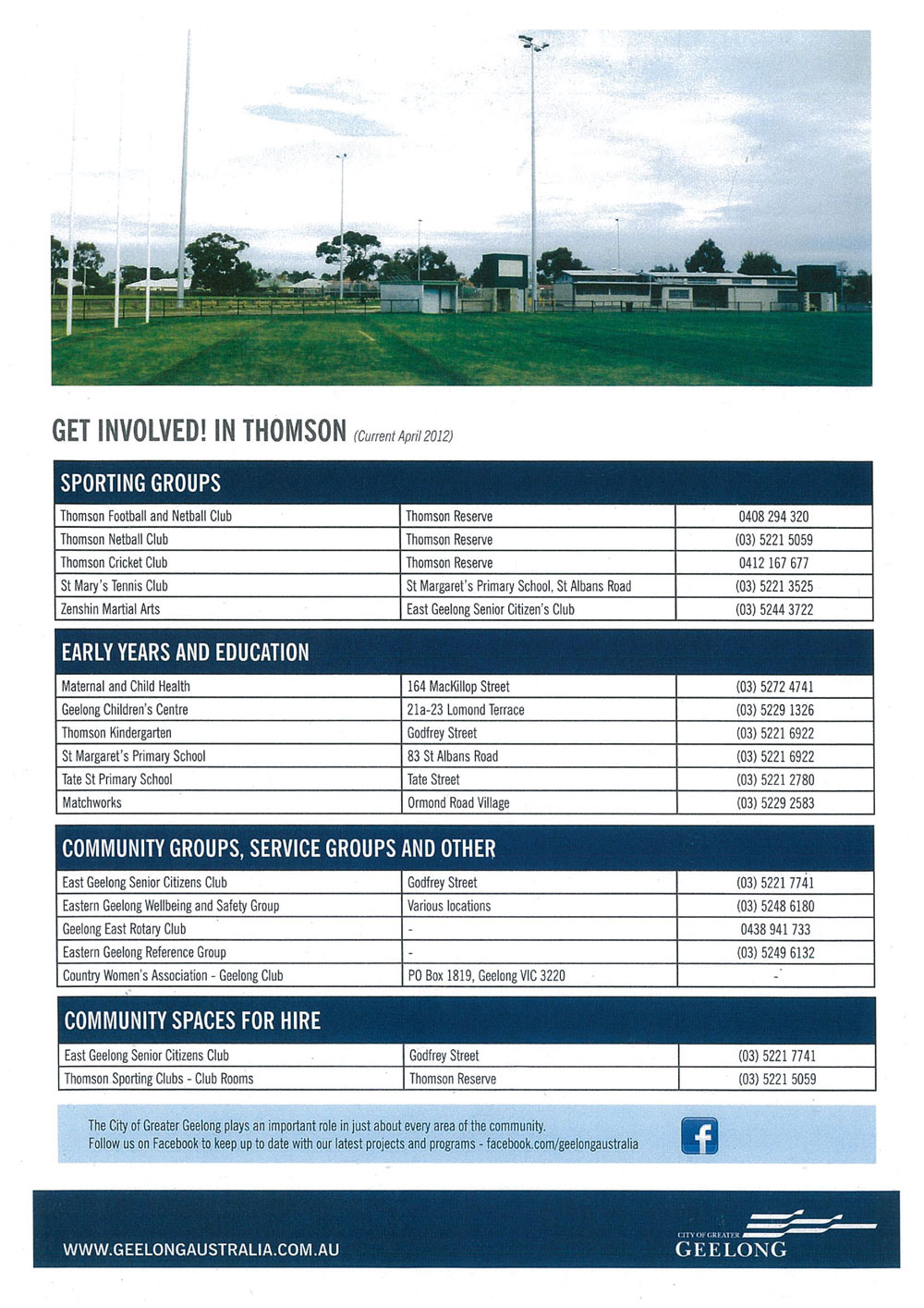
To celebrate the project, promote the diversity of Thomson and highlight the many activities and supports available to residents in the area, the Connecting Thomson Steering Committee held a Community Expo on the 22 February 2012. This featured 18 stalls hosted by sporting groups, clubs, businesses and services located within the suburb of Thomson. The local cricket club provided a BBQ and the Tate St Primary School brass band provided entertainment. A final chance for residents to have input and endorsement of actions in the Community Action Plan was provided through surveys, feedback boards and an ideas wall.
The Expo was followed by a panel discussion to revisit concerns outlined in the initial scoping meetings specifically:
Verbal abuse and intimidation from residents predominately around Office of Housing properties
Drug dealing
Drug and Alcohol use.
The panel consisted of:
Tim Harrop, Department of Human Services
Michael Breen, Manager of the Bellarine Barwon Health Mental Health and Drug and Alcohol teams
Paul Jamieson, Manager, Community Development Department, City of Greater Geelong
Janet Lonzarich, Geelong South Tenants Union
Inspector Mark Thompson, Geelong Region Victoria Police.
The panel provided an opportunity for residents to voice concerns and explore neighbourhood issues. There was a perception that anti-social behaviour had increased, however, this was not necessarily supported by police data. Police records over the project indicated incidents were not often recorded in official statistics, so it was difficult to identify how often these events were occurring. It was understood that services needed to continue to respond to local community concerns.
As a result of the Connecting Thomson Expo:
34 residents were connected to 7 local sporting clubs
18 residents were connected to 4 local community action or service groups
20 residents were connected to 7 local services or educational institutions.
A project plan was finalised in June 2011 and was approved by the Connecting Thomson Steering Committee.
The Thomson Community Action Plan is a result of this community engagement and consultation.
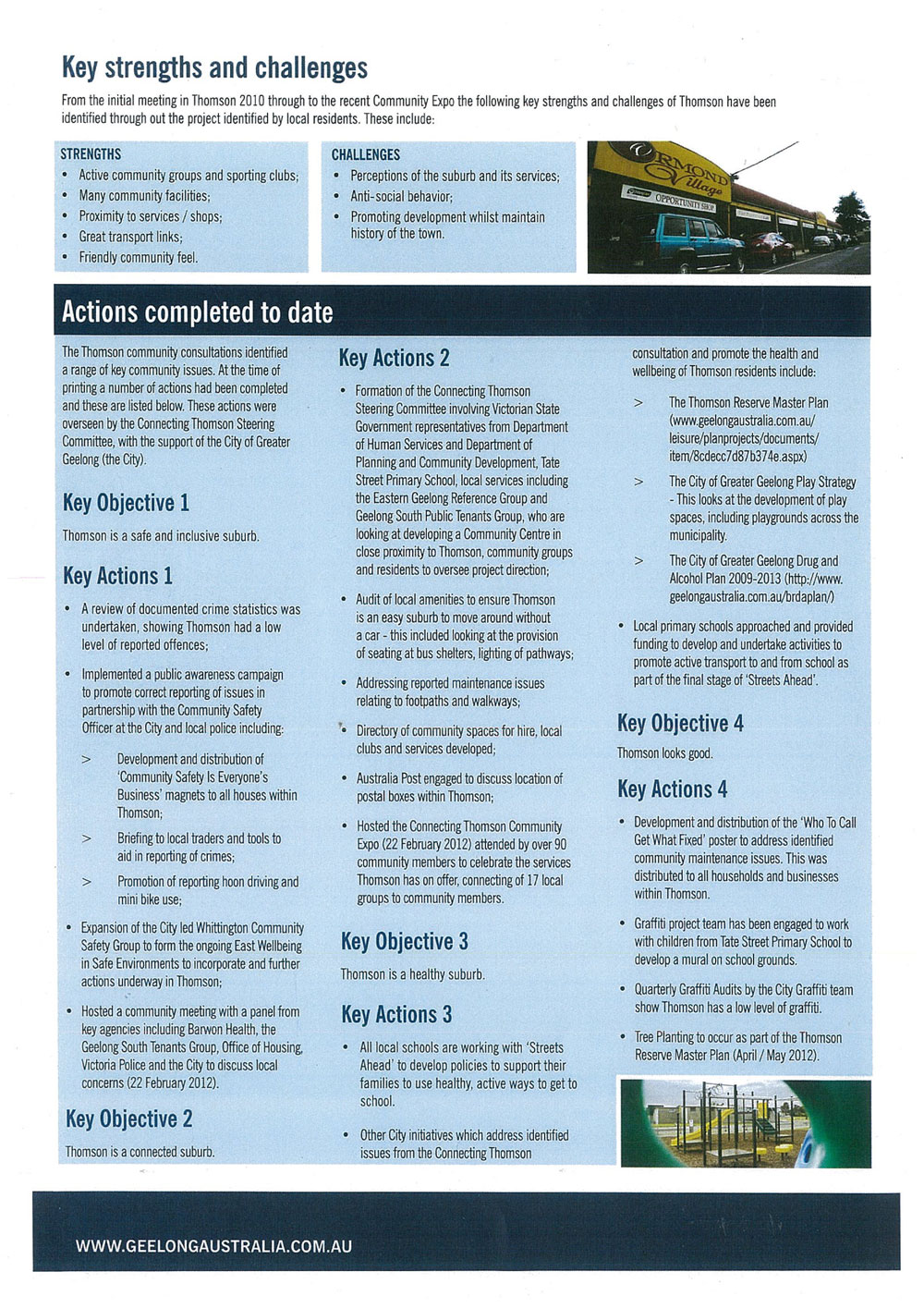
The Thomson Community Action Plan (refer Attachment 1) provides a comprehensive overview of the activities undertaken and the outcomes achieved during the project, as well as future planning for the area. Four key objectives were drawn from the issues and opportunities identified during the initial and subsequent community consultations over the course of the project:
Key Objective 1: Thomson is a safe and inclusive suburb
Key Objective 2: Thomson is a connected suburb
Key Objective 3: Thomson is a healthy suburb
Key Objective 4: Thomson looks good.
The Plan outlines the range of activities undertaken throughout the project including improvements to the physical spaces within Thomson, community safety awareness raising campaigns and the sustainable linkages which have been made through community engagement activities. It also identifies the future actions which the community agreed were needed to realise these key objectives. The Community Action Plan highlights the engagement of Thomson residents in a range of activities, and their ongoing involvement. These include local business networks, active local decision making forums as well as sport and recreation opportunities.
Steering Committee meetings provided an opportunity for members to debate the merit of actions undertaken by the project worker, groups and individuals against those outlined in the initial scoping meetings. It provided a platform to alter actions where needed and respond to new and emerging opportunities and issues for consideration in the development of the Community Action Plan. Where the community endorsed these actions, they were included in the final Community Action Plan.
From March 2012 several Connecting Thomson Steering Committee members have taken active roles in the formation of EastWISE (Wellbeing in Safe Environments) project. This project was developed out of recognition that several place based projects within the 3219 postcode were to end in 2012. The EastWISE project aims to address similar issues of community connectedness and feelings of safety throughout the six suburbs of the 3219 postcode. The EastWISE committee has secretariat support from the Council’s East Place Based worker.
Not applicable.
There are no financial implications within the current budget period, as all project costs have been expended and were covered by the initial funding grant.
The implementation of the Thomson Community Action Plan complements the City of Greater Geelong’s Safety Strategy and City Plan.
There is no direct or indirect interest noted for this report.
There will be a heightened expectation that the City of Greater Geelong will work in partnerships with relevant agencies to resolve community safety issues within the Thomson area.
Sound management of community safety through current policies and plans will contribute to a decrease in safety concerns and an increased level of perceived and real safety within the community.
The overall aim of the Thomson Community Action Plan is to respond to community concern in relation to community safety issues and to improve health and wellbeing of local residents. Actions from the Plan, either completed or underway, have provided positive opportunities to engage people from the Thomson community. This has further promoted wider community education and enabled the implementation of initiatives to address issues of concern.
The City’s Community Development Department is responsible for communication of the report and issues relating to the Thomson Community Action Plan.

Portfolio: |
Infrastructure - Cr Ellis |
Source: |
City Services - Engineering Services |
General Manager: |
Gary Van Driel |
Index Reference: |
Unsealed Road, Devlins Road Ocean Grove |
This report relates to a proposed road deviation of Devlins Road, Ocean Grove.
A large residential development is taking place in this area and Devlins Road, an existing Government Road, bisects the site.
The current alignment of Devlins Road passes through a proposed Recreation Reserve and the proposal is to deviate the road around the reserve (refer Plan – Appendices 1 & 2).
The process is effectively, to close part of the Government Road and open up an alternative road.
Council has been liaising with the Department of Sustainability and Environment who have agreed in principle to the proposed deviation of Devlins Road.
This report seeks a resolution by Council to proceed and should this take place. Ministerial approval will be required and the road deviation can be gazetted.
Cr Ellis moved, Cr Farrell seconded -
That Council:
pursuant to the Local Government Act 1989, Section 207B and Schedule 10, 2(2), Council proceed with the road deviation for Devlins Road, Ocean Grove being located on land shown as Lot 3 on PS061265 Vol 8471, Fol 305, Section 16, Crown Allotment 4, Parish of Bellarine;
seek Ministerial approval and arrange for publication in the Victorian Government Gazette.
Carried.
The report relates to a proposed road deviation over a part of Devlins Road Ocean Grove. The deviated road will be located on Lot 3, PS485595. Devlins Road abuts the east boundary of this lot. Devlins Road is currently an unmade Government Road.
The overall development plan for the large area to the east of Grubb Road, calls for a Recreation Reserve to be created within the approximate centre of the development. Devlins Road as it currently exists bisects the location of this Reserve. A road bisecting a Reserve is not acceptable and a planning condition was put in place to remove the status of the road through the proposed Reserve. The appropriate way to do this is to discontinue the Government Road within the Reserve and create a new road to the west which connects at both ends to the Government Road. This is what the process aims to achieve.
In accordance with process Council advertised the proposal on 3 November 2012 and called for Submissions. No Submissions were received during the specified one month period. Therefore there is no reason to hold a Submissions Panel Hearing. Discussions have taken place with the Department of Sustainability and Environment who are in agreement in principle, with the proposal.
Should Council agree to proceed with the road deviation, it is then necessary to seek Ministerial approval. There is delegated authority to approve the deviation. If this takes place, Council may then publish the road deviation in the Government Gazette which will formalise the process.
There are no environmental implications with Council undertaking the administrative process of a road deviation.
There are no costs involved with the road deviation. The Department of Sustainability and Environment will forgo the value of land, contained in the Government Road component. All costs relating to the closure and creation of the new road will be borne by the developer (Bel Pen Developments).
The road deviation has been prepared in accordance with the provisions of the Local Government Act.
The road deviation has been prepared in accordance with the provisions of the Local Government Act.
No Council Officer involved in the administration process has any direct or indirect interest in the project.
There are no risks associated with Council proceeding to adopt the recommendation.
There are no social considerations which may impact on Council’s decision to proceed with the road deviation.
The proposal has been advertised in accordance with the Local Government Act and no Submissions have been received.
![[image]](130326-minutes-3.jpg "130326-minutes-3.jpg")
![[image]](130326-minutes-4.jpg "130326-minutes-4.jpg")
![[image]](130326-minutes-5.jpg "130326-minutes-5.jpg")
Contents | Previous Page: Section B – Reports 1 - 7 | Next Page: Section C – Notice of Motion
