
Council Minutes - Section B: Reports - 11 June 2013
Contents | Previous Page: Section A - Procedural Matters | Next Page: Section C - Common Seal
Contents | Previous Page: Section A - Procedural Matters | Next Page: Section C - Common Seal
Reports tabled at the Ordinary Meeting of Council on Tuesday date held at City Hall, Little Malop Street in Geelong.
Amendment C155 – 270-312 Plantation Road, Corio – Consideration of Submissions and Adoption
Geelong Major Events – January to March 2013 – Quarterly Report
Central Geelong Marketing Committee – Report to Council 2011-2012
Portfolio: |
Planning - Cr Macdonald |
Source: |
Economic Development, Planning and Tourism – Strategic Implementation |
General Manager: |
Peter Bettess |
Amendment C155 was lodged by TGM Pty Ltd on behalf of on behalf of Flentac Pty Ltd.
The Amendment will:
Re-zone 21.35 hectares of land in Plantation Road Corio, bounded by Sutcliffe Reserve to the east, Plantation Road to the South and the Geelong Outer Ring Road, to the west and north, from the Low Density Residential zone (LDRZ) to Residential 1 zone (R1Z).
Introduce and apply a new schedule 26 to the Development Plan Overlay (DPO14) to part of the land.
Remove Schedule 4 to the Environmental Significance Overlay (ESO4) from the land.
At the time the amendment was lodged Flentac Pty Ltd was the owner of all of the subject land east of the alignment of Matthews Road. Subsequently the western-most portion of this land, from and including the majority of the high voltage power easement, has been sold to the owner of the adjoining land to the west, including the recently closed portion of Matthews Road.
The Amendment was exhibited between 27 September 2012 and 29 October 2012.
Exhibition of the amendment resulted in the receipt of a total of 7 submissions. (See Appendix 3).
These consisted of:
Four (4) submissions from government departments or from public authorities, (Appendices 3A – 3D);
A submission was received from the proponent of the amendment (Appendix 3F); and
Two (2) submissions from third parties, (Appendices 3E & 3G) seeking changes to the amendment.
The proponents of the amendment have subsequently agreed to modify the amendment consistent with submissions of the third party submittors. These submittors have subsequently provided written advice to Council indicating that their concerns have been addressed to their satisfaction and withdrawing their objections.
As the Amendment has been exhibited and the objections raised by submittors have been addressed, Council can adopt the amendment, without the need to request the Minister to appoint a Planning Panel.
It is recommended that the Amendment be adopted as described in this report and forwarded to the Minister.
Cr Fisher moved, Cr Ansett seconded -
That Council:
Adopt Amendment C155 in the form as outlined in Appendix 1 (A) – (D) and Appendix 2 to this report; and
Submit the adopted Amendment together with the prescribed information to the Minister for Planning requesting approval.
Sign and seal an agreement under Section 173 of the Planning and Environment Act, 19878 with the landowners in relation to:
the provision of civil infrastructure;
a contribution of the equivalent of 10% unencumbered land or cash in lieu of land for public open space; and
a contribution of $900 per lot towards community infrastructure in and around Sutcliffe Reserve.
Carried.
Amendment C155 is proposed to facilitate conventional residential development with a potential lot yield in the order of 200 lots.
A map showing the changes to the application of R1Z is provided at Appendix 1(B).
A map showing the changes to the application of DPO26 is provided at Appendix 1(C)
The proposed changes to the planning scheme, will facilitate the appropriate development of the land for conventional residential purposes.
The application of the schedule to the DPO will ensure that the development of the land appropriately addresses the provision of infrastructure and integration with its surrounds.
Authorisation to exhibit the Amendment was sought following resolution by the ordinary meeting of Council held on 9th September 2008. Authorisation was received from the Minister for Planning by letter received on 29 September 2008.
Exhibition of the amendment was then delayed at the request of the proponent, while matters relating to the operation of the rendering plant at the Herd Abattoir were resolved by the EPA.
The Amendment was subsequently exhibited from 27 September 2012 to 29 October 2012. Notice of the amendment was given to owners and occupiers of affected land and to relevant authorities and Ministers in accordance with the requirements of the Planning and Environment Act 1987.
Four (4) submissions were received in response from the following public Authorities:
Barwon Water Appendix 3(A);
The Country Fire Authority (CFA); Appendix 3(B);
The Department of Sustainability and Environment (DSE); Appendix 3C(i) & (C)ii;
The Environment Protection Authority (EPA) Appendix 3(D).
None of the authorities objected to the Amendment. Concerns initially raised by DSE in Appendix 3C(i) were resolved in Appendix 3C(ii).
Two submissions were received from members of the public. Matters raised in Submissions, Appendices 3E and 3G, were subsequently resolved to the satisfaction of those submittors. These changes are contained in the revised plan, Appendix 4, which forms part of the revised Schedule to the DPO.
A submission was also received from the proponent of the Amendment TGM Consultants (Appendix 3F). Matters raised in this submission have been considered by Council officers and addressed in the changes highlighted in red in the Schedule to the DPO, Appendix 2.
As all submissions have been resolved Council is able to adopt the amendment and refer it to the Minister for approval.
The changes to the planning scheme will not have any adverse environmental implications.
The changes to the planning scheme will have no adverse financial implications for Council.
The amendment is considered to be consistent with State and Local planning policies as set out in the Explanatory Report, which forms part of the amendment documentation
No Council officers involved in the preparation of this report have a direct or indirect interest, in accordance with Section 80(c) of the Local Government Act, to the matters to which this amendment relates.
There are no risks to Council associated with the application of the revised planning controls.
The amendment is expected to result in net community benefit, through the provision of additional residential lots in an established residential area.
Amendment C155 and has been through a formal exhibition process, and both objecting submissions have been addressed to the satisfaction of the submittors concerned.
Portfolio: |
Central Geelong - Cr Heagney |
Source: |
Planning – Central Geelong |
General Manager: |
Dean Frost and Peter Bettess |
Index Reference: |
Central Geelong Revitalisation |
Revitalising Central Geelong is a key issue for the people of Geelong and its region.
The revitalisation task requires a concerted and sustained effort by a focused and dedicated team that brings together key skills.
The initial task is to produce a Master Plan as the Council and community’s plan for Central Geelong. This Master Plan will include the ideas from Vision 2 and update the 2007 Central Geelong Structure Plan.
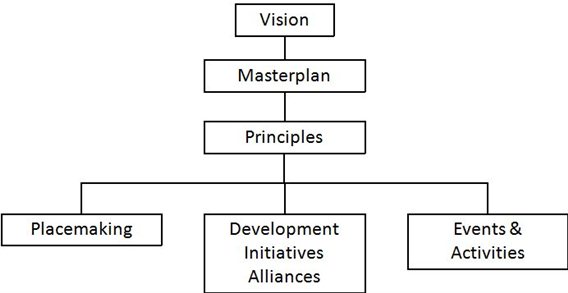
To implement the Master Plan, place making; activities and events; and investment incentives will form the three areas of activity.
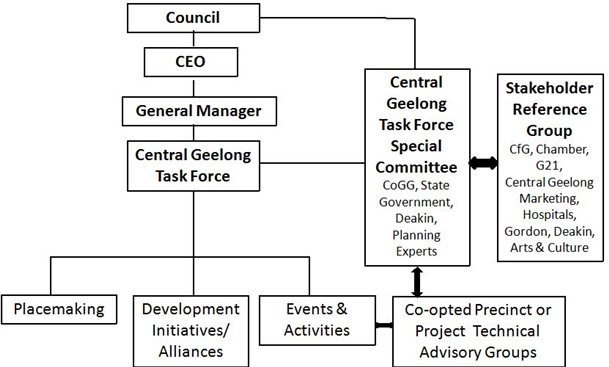
It is proposed that a Central Geelong Task Force will be established as a cross divisional working group bringing together the relevant expertise from across the Council. The Task Force will be supplemented by other specialist expertise as appropriate.
A Central Geelong Task Force Special Committee established under Section 86 of the Local Government Act will advise the Task Force. The initial delegation to the Special Committee will be to produce a master plan, including development initiatives/alliances and activities/events for Council’s consideration.
Cr Heagney moved, Cr Richards seconded -
That Council:
endorses the establishment of the Central Geelong Task Force Special Committee under Section 86 of the Local Government Act with initial delegation to produce the Master Plan as outlined in this report with the addition of a representative of Courthouse Arts to membership of the Stakeholder Reference Group; and
notes that a Central Geelong Task Force will be established as a cross divisional working group bringing together the relevant expertise from across the Council, supplemented by other specialist expertise as appropriate.
Carried.
Geelong is Victoria’s second capital city. A vibrant and exciting city centre benefits all of Geelong and its region, as the cultural, retail, entertainment and business heart of the city and region. Central Geelong has 172,587 square metres of retail floor space of which 41% is in Westfield and Market Square. Central Geelong has 236,600 square
metres of office space. The top five employment categories based on 2011 data are Health Care (5,790 employees); Public Administration and Safety (3,112); Retail Trade (2,765); Education and Training (1,929); and Food and Beverage Services (1,687). The estimated resident population is 4,200 persons.
Re-vitalising and improving Central Geelong is a key issue for most people in Geelong. The people of Geelong want a city heart that all can be proud of. We need to re-create vibrancy and ‘bustle’, with more people shopping, working and living in Central Geelong and Waterfront.
Central Geelong needs to be actively promoted as the regional retail centre and services hub as well as being our key cultural, civic and dining centre. Central Geelong needs to be a friendly place for people of all ages with a strong perception of safety.
We need to make Central Geelong as attractive as possible for many more people to make their home. Projects delivering greater density of housing need to be encouraged and facilitated. Our Central Geelong has huge potential as a great place to live.
While good work is occurring to improve Central Geelong, there is no readily identifiable current overall plan.
The current Central Geelong Structure Plan, Central Geelong – Looking Forward was published in 2007. While many of the strategies and actions remain relevant, a review is required. There needs to be a long term plan for Central Geelong which will give both certainty and encouragement to property owners to invest / upgrade their properties as well as improvements to public infrastructure – some short term, some longer term – but we need a plan that all can work towards achieving.
Vision 2 is an important element of the long term vision for Central Geelong. It includes bold ideas to improve the public realm to stimulate private sector investment in Central Geelong. There are many issues that need to be tackled to support a long term vision. The long term vision needs to be part of an overall Master Plan, which once agreed, requires an implementation plan that is ‘grounded’ so that we can take the best of the ideas and put them into effect where possible, practical and fundable.
The Mayor’s Central Geelong Vision statement for the election:
Central Geelong Task Force
Establish a high level Task Force to develop an overall Central Geelong and Waterfront Master Plan. This will include, but not be limited to:
facilitating apartments, student accommodation, shop–top living and other appropriate residential developments, with the aim of doubling the resident population in the CBD and Waterfront by 2022,
investigating the feasibility of a permanent undercover market, like Victoria Market, and encouraging cultural diversity of the market stalls,
the proposed Conference/Convention Centre, Yarra Street pier project, etc
identifying further opportunities to bring people back to central Geelong.
This Task Force will undertake significant consultation and will bring together the work being done by Vision 2 and other stakeholders to deliver a Master Plan that gives clarity to Council and property owners, and enables appropriate development and improvements to be progressed. This Task Force will work closely with Enterprise Geelong.
This is by no means meant to be a comprehensive list of ideas and the success of measures to improve Central Geelong will require the input, ideas and involvement of many people.
The Mayor’s pre-election statement outlines his ideas for the Task Force. The targets and ideas are indicative only and are not yet endorsed by the Council. The Task Force Special Committee will through consultation and collaboration identify agreed targets, projects and activities for the Task Force.
The role of the Task Force
The Central Geelong Task Force is to develop an overall Master Plan for Central Geelong which is action oriented in intent, collaborative in process and advisory in making Central Geelong the premier mixed use activity hub for Geelong and the region.
In particular, the Central Geelong Task Force will:
develop a Master Plan for Central Geelong which will inform planning and development decisions and encourage future developments and infrastructure improvements.
develop business incentives and programs that could be considered to support Central Geelong development; and
identify events and activities to bring more vitality to Central Geelong.
The key component of the Task Force’s work will be to develop principles derived from the Master Plan against which plans, works and activities can be assessed to ensure consistency with the Plan and the maximum value is achieved from investment. The conceptual framework is shown in the figure below.
Place making will include the outcomes of Vision 2 to create a Central Geelong that has
Character: sense of place and history
Continuity and enclosure: clarity of form
Quality of the public realm: sense of wellbeing and amenity
Ease of movement: connectivity and permeability
Legibility: ease of understanding the place
Adaptability: ease of change
Diversity: choice and mix
Sustainability: environmentally, socially and economically
Soft infrastructure: events, activities and cultural activities
Key facilities: cultural and conference and convention centre.
With Vision 2 completed, more specific action oriented projects need to be identified, prioritised, designed and costed. A specific area within Central Geelong may be the focus with the first round of public investment into place making being within this area to gain community support, business interest and Federal and State Government funding.
The outcome will be a place making program of projects over the next 5+ years to:
Guide the Council’s public works program within Central Geelong
Act as the rationale for increasing Council’s revenue base to invest in Central Geelong
Provide the framework for seeking Federal and State Government funding tied to specific projects
Business and investment incentive programs will be based on an understanding of what the obstacles are to developers, investors and business people in being more active in the Geelong Central Geelong and what the Council can do to address these obstacles.
After defining the objectives a business and investment incentives program for the Geelong Central Geelong will be prepared. This will require expert professional advice to do these tasks with the advisors assisting with ongoing liaison and consultation with developers, investors and property owners.
Research on what projects/initiatives other Australian and international cities have implemented to attract more investment and development will inform the development of the program. For example, under Melbourne City Council’s Postcode 3000 for city living projects the re-use of old buildings, including upper level floor space, was encouraged by providing a free advice service to owners on how to do conversions cheaply but well; approvals were streamlined; rate concessions were offered during the construction period; demonstration projects were completed; and open space fees were waived.
Champions in the Geelong business community and potential alliance partners will be identified who are prepared to joint venture with Council to initiate change – particularly where there are benefits to the community as well as the property owner.
The outcome will be a range of investment projects and initiatives to:
attract more mixed use development within the Geelong Central Geelong including city living housing and office/commercial space
achieve a greater diversity of goods and services to serve the regional catchment
create more jobs
underpin the vitality and economic prosperity of the Geelong Central Geelong
A creative and distinctive events and activities program, building on what is already in place, is a key opportunity for Central Geelong to attract more tourists as well as draw in more residents to the City centre. The calendar of events and activities should seek to interconnect the waterfront with Central Geelong and cater for all tastes and age groups in terms of the performing arts, food and wine, cultural and recreational pursuits etc. The concept of a weekly farmers market should be explored as well as the potential for a “Salamanca style market’ along a key street.
The composition of the Central Geelong Task Force
The Task Force will comprise CoGG officers supplemented with external expertise, such as DTPLI, Places Victoria, DSDBI, experienced central city urban planners and business/property investment experts with specific skills in central city redevelopment. The team will be headed by a senior manager reporting to the General Manager, Projects, Recreation and Central Geelong. The Task Force’s work will be guided by an Special Committee.
The composition of the Central Geelong Task Force Special Committee
Chair: Brownbill Ward Councillor (Cr Michelle Heagney);
One (1) person from CoGG at GM level;
Three (3) senior decision makers from state government with expertise in development planning, transport and regional development;
One (1) person representing Deakin University;
Up to two (2) external urban planners experienced in central city development.
The Task Force Special Committee will comprise 8 specified members and the Mayor and CEO as ex-officio members. The ex-officio members are full members of the Committee by virtue of holding the office of Mayor and CEO. The ex-officio members have the same rights as other Committee members but are not counted in determining a quorum. There may be a need to pay the reasonable expenses of external urban planners. All other members would be voluntary. The person heading the Task Force will be an advisor to the Special Committee.
Precinct, portfolio or project technical advisory groups will be formed to work with the Task Force Special Committee on specific issues such as transport, safety, planning, disability access and youth. The relevant portfolio councillor will be a member of any technical advisory groups.
It is proposed that the Special Committee be established under Section 86 of the Local Government Act with delegation to produce the Master Plan; development initiatives/alliances; and activities/events for Council’s approval. The Council, on approval of the Master Plan; development initiatives/alliances; and activities/events, could extend the delegation to project implementation or other activities. A draft Terms of Reference and delegation is in Attachment 3.
The Task Force Special Committee will develop an engagement plan to engage with Central Geelong property owners and businesses. The Task Force Special Committee would also seek the advice of external experts and agencies from time to time such as Rob Adams from the City of Melbourne, the Property Council of Australia etc.
The Task Force Special Committee would determine its own timetable of meetings but 8 -10 meetings would be envisaged. Teleconferencing could be used where possible on occasions.
The Task Force Special Committee may consider establishing a stakeholder reference group with whom to consult, either individually or as a group.
The Task Force Special Committee should not be constrained but be able to consider any relevant issues for the Master Plan that would assist the successful and sustainable re-vitalisation of Central Geelong.
The Task Force Special Committee would operate for at least 3 years with potential to extend its term of involvement, if required.
The proposed organisational relationship is shown in the following diagram:
Relationship to Central Geelong Marketing
The Special Committee will complement not compete with the work of Central Geelong Marketing. Central Geelong Marketing is considered by the Council and other stakeholders as the peak body representing traders and property owners in the Central Geelong area. It is established to market and promote Central Geelong through the special rate scheme. The Special Committee will generate plans, projects and ideas with the marketing/promotion of events and activities being done by Central Geelong Marketing.
Stakeholder Reference Group
A stakeholder reference group will be established. Membership will comprise:
The Committee for Geelong
Central Geelong Marketing
Geelong Chamber of Commerce
G21
Barwon Health
St John of God
The Gordon
Deakin University
GPAC
Geelong Art Gallery
Geelong Library Corporation
The role of the Stakeholder Reference Group is to discuss and debate matters referred by the Task Force Special Committee. The stakeholder reference group has an informal liaison role rather than a formal advisory or decision-making role.
Responsibilities of reference group members:
Discuss and debate matters referred by the Task Force Special Committee
Nominate other matters for discussion
Suggest alternative approaches
Contribute constructively
Consult, inform and educate others
Respect any confidentiality requirements
Advise when a “company/organisation” position is being expressed
Responsibilities of the Task Force Special Committee:
Refer matters to the group for discussion
Involve the reference group early in policy and strategy development
Listen and provide feedback on suggestions and comments
Provide executive, administrative and technical support
Respect any confidentiality requirements
The stakeholder reference group will meet on an as needs basis, and no less than quarterly. The group will not need to vote on issues as the role of the stakeholder reference group is to debate concepts and new initiatives and then provide advice to the Task Force Special Committee. A general consensus on issues can be recorded in the meeting notes.
Resources to make it happen
The Central Geelong Task Force within the Council could be established from relevant staff already working on Central Geelong issues as a cross divisional working group dedicated to work in Central Geelong. The person heading up this team should have senior management status within the Council and be supported by people with expertise in such areas as:
Urban planning of central business districts
Urban design and ‘place making’ in central business districts
Landscape architecture
Arts and Culture
Business investment and business engagement
Soft infrastructure – events, activities etc
Transport planning (walking, cycling, public transport and cars)
Consultation and engagement with stakeholders
The Central Geelong Task Force would initially prepare the Master Plan for Central Geelong based on the findings and recommendations of Vision 2; past and current studies/projects and analysis of any additional information required prior to the development of the Master Plan. The Central Geelong Task Force would prepare a work program with milestones for key outputs with tight timelines in place so as to get moving on the on-ground demonstration projects. The Central Geelong Task Force could be assembled within existing resources. External expertise would require a specific budget allocation if it was outside existing budgets.
A budget for the revitalisation of the Geelong Central Geelong
If Council is to demonstrate a commitment to revitalising Central Geelong then it will need to make an ongoing financial commitment, in addition to current commitments, to fund public works, activities etc for the Central Geelong Revitalisation Project.
This report assumes that the Task Force can be established within existing resources.
Revitalising a Central Geelong is a long process without a finish line – it is an ongoing, evolving and dynamic process. It will need substantial funding both from Council and external sources.
There are no environmental implications relevant to this report.
The financial implications are discussed in the report.
Section 86 of the Local Government Act requires the Council to appoint members of the Special Committee and to approve the delegation. A further report will be submitted to the Council to appoint the members and approve the delegation once nominees are received for the Special Committee.
No officers associated with the writing of this report have any direct or indirect interest in accordance with Section 80C of the Local Government Act.
There are no significant risks associated with this report. Risks relating to the establishment and operation of the Central Geelong Task Force or Special Committee will be managed as part of the establishment process.
The Central Geelong Task Force will assist in addressing some of the social issues in Central Geelong.
A communication plan will need to be established.
Portfolio: |
Arts & Culture/Central Geelong - Cr Heagney |
Source: |
Community Services - Arts & Culture |
General Manager: |
Jenny McMahon |
Index Reference: |
Subject: Arts and Culture/Libraries/Geelong Regional Libraries |
The purpose of this report is for Council to endorse the Greater Geelong City Council submission (Appendix 1) to the Ministerial Advisory Council (MAC) as part of Stage 2 of its review of the future role and functions of public libraries in Victoria.
With the completion of the first stage of the MAC review in December 2012, the MAC released the Review of Victorian Public Libraries Stage 1 Report and introduced the concept of the Victorian Library which is a proposed model for public libraries in Victoria.
For Stage 2 of the review, the MAC has prepared a new discussion paper (Appendix 2) which is divided into two parts. Part One considers the Victorian Library concept and its components whilst Part Two considers public library funding.
The Victorian Public Libraries discussion paper proposed a series of questions to which comment from local government was sought.
The Municipal Association of Victoria (MAV) held a forum on 8 May 2013 to discuss Stage 2 of the MAC review and formulate a MAV response.
The Geelong Regional Library Corporation (GRLC) submitted a response to the MAC Stage 2 review. Council’s submission supports the GRLC position.
The MAC has advised it will accept an endorsed submission post the Council meeting of 11 June 2013. (The deadline for the submission was originally 16 May 2013.
Cr Richards moved, Cr Heagney seconded -
That Council endorse the Greater Geelong City Council’s submission to the Ministerial Advisory Council Stage 2 of its review of Public Libraries in Victoria (Appendix 1).
Carried.
In February 2012, The Hon. David Morris MP, Parliamentary Secretary for Local Government and Chair of the Ministerial Advisory Council on Public Libraries wrote to the Mayor, Greater Geelong City Council advising that the Ministerial Council on Public Libraries (MAC) would be undertaking a comprehensive review of the future role and functions of public libraries in Victoria, recognising the changing nature of libraries. The MAC was established on bi-partisan lines.
As part of the review, Council was invited to make a submission into the provision of public library services in Victoria by 31 May 2012.
As part of the MAC review, Councillors, COGG Chief Executive Officer and senior management attended the MAC consultation that was held in Geelong on the 19 March 2012. The discussion paper ‘Tomorrow’s Library’ was the basis for the consultation and submission process.
At its meeting of 12 June 2012, Council endorsed a submission to respond to the first stage of the MAC review.
Stage 1 concluded in December 2012 with the release of the Review of Victorian Public Libraries Stage 1 Report. In summary the findings were:
Public libraries provide a range of services that are valued by community however there is a disparity of service provision among libraries.
Libraries operate in a rapidly changing environment particularly in the areas of technology and e-collections.
The future of libraries is set to be exciting and innovative but in order for this future to eventuate they must continue to adapt and evolve while at the same time continue to provide high quality services that meet the needs of their communities.
Major recommendation that public library sector needs to increase collaboration and be unified and strategic in approach in order to effectively adapt and remain relevant in a highly globalised and digital world.
Major recommendation/belief that all Victorians should have high quality public library services wherever they live.
Local Government and others have again been invited to make a submission in response to questions posed in the Stage 2 review.
As part of Stage 2 of the MAC review, Councillor’s, COGG Chief Executive Officer and senior management attended the MAC consultation meeting held in the Waurn Ponds Library on 14 March 2013.
In response to the findings of Stage 1, the MAC has developed a proposed approach for future public library service provision titled The Victorian Library.
The new discussion paper developed by the MAC for Stage 2 is divided into two parts.
Part 1: The Victorian Library
The MAC proposed that the Victorian Library would be a seamless network of public library services that will enable access to information, resources and services to all Victorians, either in person, online and in a variety of formats, regardless of where they live, work, study or relax.
In order to achieve this approach, the MAC envisages that a number of interrelated state wide initiatives would be implemented including:
Enabling systems
Collections and accessibility
Collection management
Victorian Library membership
Procurement
Information and communication
Part 2: Public Library Funding
Public library services are provided by Local Government with a contribution from State Government via:
Public Libraries Recurrent Funding Program
Living Libraries Infrastructure Program
Premiers Reading Challenge Book Fund
Key Public Library Funding considerations include:
The adequacy of funding noting that funding provided by the State Government meets only part of the cost of operating public library services and while the level of State Government funding has increased each year, the overall percentage of funding that is contributed by the Victorian Government has decreased as local governments have invested increasing amounts in public library services.
That there is a number of funding allocation options for distributing the funding pool amongst public library services.
That funding currently provided by the Victorian Government is not tied to a specific purpose or outcome.
That alternate indexation methods for library funding could be introduced that may provide funding level certainty to public library services which is not currently the case.
That a partnership agreement between State and local governments in providing library services could be formalised with an agreement outlining the responsibilities and funding commitment to each sphere of government.
That a number of options exist as to how the Department of Planning and Community Development administers formal funding agreements in relation to delivery of library services.
The discussion paper questions are listed in the attached submission with the City of Greater Geelong’s response following each question. The Geelong Regional Library Corporation (GRLC) submitted a response to Stage 2 of the MAC review. Council’s submission generally supports the GRLC’s position.
There are no specific environmental implications for council in the adoption of this report.
There are no financial implications to the report.
Council’s submission will contribute to shaping the future of Victorian libraries.
There is no direct interest by Council Officers involved in the preparation of this report.
Section 196(7A) of the Local Government Act exempts a member of the governing body of a regional library from having a conflict of interest if their only interest is as a Councillor or member of Council staff, who was appointed to the board by Council.
There are no risks associated with this submission.
The MAC Review of Victorian Public Libraries Stage 1 Report concluded that public libraries:
Provide a wide range of services that are valued by the community.
That the environment in which libraries operate is changing rapidly and it is a challenge for public library services to keep pace with changes in technology.
That all Victorians should be able to access high-quality public library services, regardless of where they live.
The future of public library services is set to be exciting and innovative and that libraries must continue to adapt and evolve .At the same time, public libraries must also continue to deliver high quality services that meet the needs of their communities.
The Arts & Culture department, in consultation with Marketing and Administration, will be responsible for communicating this report.
Portfolio: |
Governance – Cr Fagg (Mayor) |
Source: |
Corporate Services – Administration & Governance |
General Manager: |
Jeff Wall |
Index Reference: |
Procurement |
The Local Government Act 1989 (LGA) requires Council to review each financial year, the current procurement policy and amend as appropriate.
Proposed amendments to the policy take into consideration the Victorian Local Government Best Practice Procurement Guidelines 2013.
The amendments provide further clarity of the accountability and transparency of Council’s procurement activities in particular when Council may consider the appointment of a probity advisor/auditor; non-acceptance of late tender submissions; appointment of third party agents to undertake collaborative procurement tenders; emergency management and ministerial procurement tender exemptions; council’s sustainable procurement objectives and support for local businesses and apprentices. Appendix-1 is a proposed copy of the Procurement Policy.
A copy of the current procurement policy must be available for inspection by the public at the Council office and on Council’s website.
Cr Farrell moved, Cr Macdonald seconded -
That consideration of the report be deferred.
Carried.
The LGA requires Council to review each financial year their current procurement policy and amend as appropriate.
The procurement policy provides a framework for the purchase of goods, works and services that emphasises value for money while conducting business in a fair and equitable manner.
The purpose of the policy is to:
Provide guidance, consistency and control over procurement activities
Demonstrate accountability to rate payers
Provide guidance on ethical behaviour in public sector purchasing
Demonstrate best practice elements in purchasing
Increase probity of obtaining the right outcome when purchasing goods and services.
This year’s review has taken into consideration the recently released Victorian Local Government – Best Practice Procurement Guidelines 2013, and we have proposed some amendments as follows:
Further strengthening the accountability and transparency of the procurement process, including the responsibility of councillors
Further refinement of the expression of interest process
Inclusion of the possible appointment of a probity advisor/auditor
Non acceptance of late tenders unless as a result of Council system failure/interruptions or denial of access to the physical tender box
Management of third party agents for the purposes of collaborative procurement tenders; emergency procurement situations and ministerial exemptions, and
Amendment to our existing clause in respect to Sustainable Procurement and refinement of our support of local businesses and apprentices.
The policy states that sustained value must be demonstrated in Council’s purchasing, including the built and natural environment.
Application of this policy will reaffirm Council’s objective of value for money outcomes.
The review of this policy accords with section 186a of the LGA.
No officer involved in the preparation of this report has either a direct or indirect interest.
The policy requires that risk management is applied at all stages of procurement activities.
The policy encourages the design and use of products and services which have minimal impact on the environment and community wellbeing.
Once endorsed by Council, the policy will be uploaded to the internet as a public policy and a copy of the policy made available at Council.
Portfolio: |
Governance - Cr Fagg (Mayor) |
Source: |
Corporate Services – Administration and Governance |
General Manager: |
Jeff Wall |
Index Reference: |
Subject – Policy Development |
The Prime Minister recently announced that there will be a referendum on constitutional recognition of local government on 14 September.
The Australian Local Government Association (ALGA) Board has identified that a national campaign could cost local government in the order of $10 million, of which the contribution from Victoria is estimated at $2 million.
A 2012 MAV State Council resolution was to issue a voluntary levy on members, with each council determining whether or not to pay the levy. The MAV Board at their March 2013 meeting resolved to levy using population and revenue analysis of councils, to set voluntary contribution amounts.
The MAV is seeking a voluntary contribution of $79,286 from Council towards the proposed campaign.
Council has the capacity to use existing resources to support such a campaign, by promoting it in city news, cityweb and the community update, without having to incur the financial commitment requested from the MAV.
Cr Richards moved, Cr Harwood seconded -
That Council not contribute direct funds to the campaign requested by the MAV but rather use its existing resources and communication channels to support constitutional recognition of local government.
Carried.
Cr E Kontelj left the meeting room at 8:14pm and returned at 8:16pm.
Constitutional recognition of local government has been the subject of public debate over decades and two previous attempts in 1974 and 1988 failed.
In March 2011 Council considered a report on constitutional recognition and adopted the following motion:
That Council
declares its support for recognition of Local Government in the Australian Constitution, particularly having regard to power for the Federal Government to directly fund Local Government,
declares its support for the inclusion of Local Government in any new preamble to the Constitution if one is proposed,
authorises the Mayor to write to the Prime Minister, Leader of the Opposition and Federal Members for Corio and Corangamite requesting their support for a referendum by 2013 to change the Constitution to allow financial recognition of Local Government.
Letters were sent in accordance with this decision.
In October 2011 Council provided a submission to an Expert Panel again supporting the constitutional recognition particularly in relation to inclusion of the power for the Commonwealth to directly fund local government.
On 14 December 2012 Council lodged a submission with the Joint Select Committee for the Constitutional Recognition of Local Government supporting amendment to section 96 of the constitution.
ALGA over the years has sought local government support for their campaign to achieve constitutional recognition of local government and has requested further support from Councils to fund a ‘Yes’ campaign.
The Prime Minister recently announced that there will be a referendum on 14 September to recognise local government in our national Constitution.
In order to fund a national campaign ALGA and the MAV are seeking voluntary contributions from all councils across Australia.
The MAV has applied a mix of population and revenue analysis to determine what each Victorian councils contribution would be. They are seeking a voluntary contribution of $79,286 from the City of Greater Geelong towards this campaign.
Council has the capacity to support such a campaign through its existing resources and given the financial constraints that all local governments are experiencing, it is recommended that council decline the MAV request.
There are no environmental implications arising from this report.
Recognition of local government in the Constitution will ensure the Commonwealth Government can provide funding directly to local councils, without having to pass the funding through the State Government, hence enabling timely receipt of funds and delivery of programs and projects.
Recognition of local government in the Constitution is an issue of national importance, given the vital role local government now plays in the Australian communities as the third tier of government and given the expanded role and crossover activities that local government is involved in, in the delivery of services be they state, federal or a combination of both.
There are no Council Officers involved in preparing this report who have a direct or indirect interest.
Constitutional recognition will address risks associated with the Australian Government’s power to fund local government directly.
Local government is an integral part of the governance of Australia and recognition within the Constitution is a vehicle for local autonomy.
The MAV is seeking council’s response to their request for voluntary funding, to determine the scope of the national campaign.
Council has the capacity to use existing resources to support the campaign by promoting it in City News, CityWeb and Community Update.
Portfolio: |
Finance - Cr S Kontelj |
Source: |
Corporate Services - Financial Services |
General Manager: |
Jeff Wall |
Index Reference: |
Financial Management \ Reporting |
The Quarterly Financial Report for the period ending 31 March 2013 is prepared as a requirement of Section 138 of the Local Government Act 1989.
Council approved amendments to the adopted Budget on 28 August 2012 and variances are reported based on comparing actuals to amended budget.
The recurrent operating surplus to 31st March 2013 is $0.8M, being $13.8M favourable to amended budget and reflects favourable performance and timing issues.
The non-recurrent surplus for the half year is $32.6M, being $2.4M favourable to budget with favourable Developer Contributions $2.3M.
Capital expenditure for the year to date is $38.4M against a year to date projection of $50.5M, which is $12.1M underspent to projection.
The cash and investment balance of $61.7M is ($14.3M) unfavourable to budget, mainly due to unbudgeted payment of $17.0M made towards outstanding balance of Unfunded Superannuation Liability.
Cr Harwood moved, Cr Macdonald seconded -
That Council notes the Quarterly Financial Management Report to 31 March 2013.
Carried.
Cr J Irvine left the meeting room at 8:18pm and returned at 8:21pm.
The report is prepared as a requirement of Section 138 of the Local Government Act 1989 which requires that at least every three months a statement be presented to Council comparing the budget with the actual revenue and expense for the financial year-to-date.
Operating
The March Management reports are provided in the following table to report year-to-date performance and full-year projection performance versus budget.
Financial Results Summary
Summary |
||||||
|
|
YTD |
YTD Am. Bgt |
YTD Var Fav/ (UnFav) |
FY Proj |
FY |
FY Var Fav/ (UnFav) |
|
Recurrent Surplus/(Deficit) |
0.77 |
(13.07) |
13.84 |
(13.87) |
(15.82) |
1.95 |
|
Non-Recurrent Surplus/(Deficit) |
32.64 |
30.28 |
2.36 |
56.36 |
46.28 |
10.08 |
|
Net Surplus/(Deficit) |
33.41 |
17.21 |
16.20 |
42.49 |
30.46 |
12.03 |
|
Capital Expenditure |
38.39 |
50.46 |
12.07 |
90.62 |
108.97 |
18.35 |
|
Closing Net Cash |
61.74 |
76.06 |
(14.32) |
|
50.59 |
|
The Adopted Budget was amended by Council on 28 August 2012 to include Carryover Capital and discretionary projects, plus other Capital and recurrent amendments.
The impact on the Recurrent Expenditure Budget is ($15.99M), consisting of carryover discretionary projects funded in 2011-2012, plus other budget amendments including adjustment for early receipt of first two quarters Grants Commission funding in June 2012.
The impact on Non Recurrent income was $3.10M for carryover of capital income from 2011-2012 projects.
The amended capital expenditure budget included an additional $58.76M to complete 2011-2012 Projects, including Civic Accommodation, Corio Landfill Rehabilitation and Ocean Grove Integrated Children’s Centre.
1. Recurrent Variance Commentary |
||||||
|
|
YTD |
YTD Am. Bgt |
YTD Var Fav/ (UnFav) |
FY Proj |
FY |
FY Var Fav/ (UnFav) |
|
Recurrent Income |
192.67 |
189.38 |
3.29 |
254.02 |
252.56 |
1.46 |
|
Recurrent Expenditure |
191.90 |
202.45 |
10.55 |
267.89 |
268.38 |
0.49 |
|
Recurrent Surplus/(Deficit) |
0.77 |
(13.07) |
13.84 |
(13.87) |
(15.82) |
1.95 |
YTD Variance - $13.84M Favourable |
||||||
The following major variances to budget contributed to this result:
|
|
$M |
General Rates and Charges – Favourable rates generation and supplementary rates YTD, expected to be partially offset by objections in full year. |
1.09 |
Government Grants Main favourable variances consist of:
|
0.86 |
User Charges Main favourable variances consist of:
|
0.05 |
Other Fees & Charges Favourable mainly due to:
|
0.32 |
|
Sundry Income Favourable due mainly to : Reimbursements & Recoveries $539K – mainly unbudgeted receipts for Armstrong Creek Town Centre $327K and Lara Town Centre Expansion $135K (offset by expenditure). Sundry Income $394K (Unbudgeted income for projects in Environment and Planning Strategy – will be offset by expenditure). Offset by: Infringements Withdrawn ($152K) unfavourable. Interest on Investments Pro rata higher than budgeted cash balances. |
0.81
0.16 |
|
Recurrent Income Sub-total |
$3.29M |
|
|
$M |
|
Employee Related Expenditure – Favourable salary costs $3,550K mainly relating to unfilled vacancies and Workcover $190K. Partially offset by unfavourable supplementary labour costs ($1,046K) (see external services). |
3.74 |
|
General Works: Materials $324K favourable with the main variances being Ground Maintenance Materials $225K (ground renovations in progress) and Road Making Materials $200K (invoices yet to be received). |
3.96 |
|
Plant / Equip / Vehicle Costs $201K favourable with the main variances being Repairs & Maintenance $63K and Fuels, Oils & Greases $82K (all phasing only). External Services is $3,431K favourable mainly due to: Contractors $3,989K favourable - Phasing variances in Discretionary projects $2,655K and Recurrent projects $1,334K.
|
|
|
Administration costs $914K favourable mainly due to :
Offset by unfavourable phasing variance in:
|
0.91 |
|
Professional Services costs $244K favourable mainly due to:
|
0.24 |
|
Utility costs are $308K favourable mainly due to Electricity $345K (phasing only). |
0.31 |
|
Depreciation costs $1,870K favourable (partly due to delay in completion of Drysdale Landfill Cell $450K plus phasing). |
1.87 |
|
Gain/(Loss) on Sale of Plant and Equipment ($480K) unfavourable. |
(0.48) |
|
Recurrent Expenditure Sub-total |
$10.55M |
| Full Year Recurrent Projection – $1.95M favourable to Amended Budget | |
|
The main projection changes are favourable / (unfavourable): |
$M |
|
Grants Commission decrease |
(1.15) |
|
Rental Expense – Brougham St & Corio St (Jan to June 2013) Leisure Centres – Net Income / Expenditure Legal Costs increase |
(0.90) (0.43) (0.31) |
|
Insurance Premium Increase Centre Based Long Day Care – Net Income / Expenditure |
(0.27) (0.21) |
|
Library Cleaning Contract (new 4 year contract) |
(0.13) |
|
Transfers from Capital to Recurrent / Recurrent to Capital Salaries / Supplementary Labour (vacant positions) Reduction in Depreciation |
(0.10) 1.38 1.40 |
|
Interest Paid Saving – deferment of loan for Civic Accommodation Commercial Waste Income – net of EPA Levy |
0.92 0.67 |
|
Workcover Premium saving |
0.52 |
|
Interest Savings – deferment of $10.8M budgeted loans |
0.30 |
|
Myers St – Surrender of lease savings |
0.19 |
|
Other |
0.07 |
|
|
$1.95M |
2. Non Recurrent Variance Commentary |
||||||
|
|
YTD |
YTD Am. Bgt* |
YTD Var Fav/ (UnFav) |
FY Proj |
FY |
FY Var Fav/ (UnFav) |
|
Non-Recurrent Surplus/(Deficit) |
32.64 |
30.28 |
2.36 |
56.36 |
46.28 |
10.08 |
YTD Variance – $2.36M favourable
|
|
$M |
|
Capital Grants & Income ($183K) unfavourable. |
(0.18) |
|
Unfunded Superannuation $1,205K favourable – savings on early payment of liability. |
1.21 |
|
Developer Contributions $2,279K favourable – mainly Public Open Space Levies $419K, Drainage Levies $142K and Water Quality Levies $236K favourable, plus unbudgeted Community and Development Infrastructure Levies $1,482K. |
2.28 |
|
Prior year Adjustments ($544K) unfavourable – Capital Work in Progress expensed. |
(0.54) |
Other Phasing Variances |
|
|
Recognition of Infrastructure ($82K) unfavourable. |
(0.08) |
|
Loss on Disposal of Infrastructure $1,814K favourable. |
1.81 |
|
Gain/(Loss) on Sale of Property - ($2,126K) unfavourable. |
(2.13) |
3. Capital Expenditure Variance Commentary |
||||||
|
|
YTD |
YTD Projection |
YTD Var Fav/ (UnFav) |
FY Proj |
FY |
FY Var Fav/ (UnFav) |
|
Capital Expenditure |
38.39 |
50.46 |
12.07 |
90.62 |
108.97 |
18.35 |
YTD Variance – $12.07M favourable
The capital program is $12.07M underspent compared to Projection year to date, with the major project variances as follows:
|
|
$M |
|
Heavy & Dedicated Fleet – major tender now actioned. |
1.55 |
|
Light Fleet Replacement – awaiting delivery. |
0.77 |
|
Clean Energy – Bldg, Plant & Equip – project yet to commence. |
0.73 |
|
Building Renewal Works – behind budget schedule. |
0.56 |
|
Corio – Norlane Regeneration Project - behind budget schedule. |
0.54 |
|
Drysdale Landfill Cell 4A – project delayed due to wet weather. |
0.44 |
|
Griggs Creek Rehabilitation – project delayed. |
0.40 |
|
Lara Sporting Club Development - behind budget schedule. |
0.39 |
|
Corio Landfill Rehabilitation – behind budget schedule. |
0.39 |
|
Splashdown Co-Generation Plant – project exceeded budget. |
(0.15) |
|
Shell Road Reserve Sporting Infrastructure – project ahead of schedule. |
(0.32) |
|
Ocean Grove Integrated Children’s Centre – project ahead of schedule. |
(0.41) |
|
Other |
7.18 |
|
|
$12.07M |
4. Cash and Investments |
||||||
|
|
YTD |
YTD Am. Bgt* |
YTD Var Fav/ (UnFav) |
FY Proj |
FY |
FY Var Fav/ (UnFav) |
|
Closing Net Cash |
61.74 |
76.06 |
(14.32) |
|
50.59 |
|
YTD Variance – ($14.32) unfavourable
The month end cash and investments balance was $61.74M. This was ($14.32M) unfavourable to budget, mainly due to unbudgeted payment of $17.0M made towards outstanding balance of Unfunded Superannuation Liability.
Council has future commitments for $22.9M, which are fully cashed back:
Long Service Leave |
$16.8M |
Statutory Reserves |
$ 0.6M |
Refundable Deposits |
$ 3.8M |
Income in Advance |
$ 1.4M |
Asset Development |
$ 0.3M |
Total |
$22.9M |
The Landfill Provision balance is currently $18.0M.
There are no environmental implications arising from this report.
As detailed in the attached report.
The report is provided in accordance with requirements under the Local Government Act 1989.
Council staff preparing this report have no direct or indirect interest.
There are no risk implications arising from this report.
There are no social implications arising from this report.
The attached report is provided for information and public record and is available from the Council Governance or Financial Reporting units
Portfolio: |
Tourism and Major Events – Cr R Nelson |
Source: |
Projects, Recreation and Central Geelong / Events |
General Manager: |
Dean Frost |
Index Reference: |
Subject - Geelong Major Events General |
Council established the Geelong Major Events (GME) committee in August 1998 pursuant to Section 86 of the Local Government Act.
GME strives to stimulate and encourage major events that offer the best opportunity to provide measurable economic benefits, potential to market Geelong outside the municipality and enhance local community life through participation of resident.
GME support the development and improvement of hallmark, major and developing events whilst focusing its activities on a clearly defined strategic program.
GME has established and maintains strong links with the private sector, government and our communities to achieve high levels of stakeholder investment and activity required to realise the events potential of Geelong.
Major Events have a diverse and varied environmental legacy and the events staged within this period implemented a range of programs to minimise impacts where required and provide positive outcomes where possible. Council works closely with event organisers to ensure best practices in this regard are achieved at major events staged within our region.
This report provides an overview of GME activities for the period January 1 to March 31 2013 which included:
12 major events successfully hosted in the Geelong Region including the Australian International Airshow, Festival of Sails, Geelong Multi-Sport Festival, Victorian Open Golf Championships, Pako Festa and Geelong Highland Gathering.
Those events stimulated economic activity and provided social benefits to our community. Approximately $47.3million of event expenditure was generated in our region from local and non local sources which is the equivalent of 378 full time jobs in the region.
Those events provided additional social benefits for the local community through participation and spectator opportunities with a number of our major events offering free public access and entertainment for all ages. More than 400,000 spectators attended the 12 events staged in the three months ending 31 March 2013.
Cr Harwood moved, Cr Fisher seconded -
That Council notes the report detailing the activities of Geelong Major Events for the January 1 – 31 March 2013 period.
Carried.
Council, in August 1998, established a Section 86 Committee under the provisions of the Local Government Act known as Geelong Major Events (GME) as a means of stimulating and encouraging events within the municipality.
In line with the Geelong Major Events Terms of Reference, an annual report will be presented to Council at the conclusion of the financial year. This report provides an update on the activities supported by GME for the period 1 January to 31 March 2013.
Meetings
GME convened three ordinary meetings in the period between 1 January 2013 and 31 March 2013.
Meetings are currently scheduled for the third Monday of each month commencing at 4.00pm, held at City Hall. GME meetings are open to the public.
Details of major events staged during the period
|
Event Title |
Date
|
Funding amount |
Estimated Economic Benefit |
|
Mitchelton Bay Cycling Classic |
Jan1-3 |
$30,000 |
$2.285million |
|
*Festival of Sails |
Jan 24-26 |
$172,000 |
$10.5million |
|
*Australian Youth Baseball Championships |
Jan 11 - 20 |
$10,000 |
$1.2million |
|
Geelong Multi-Sport Festival |
Feb 8-10 |
$150,000 |
$3.040million |
|
Melbourne Rebels Rugby @ Simonds Stadium |
Feb 9 |
$8,639 |
$402k |
|
*WH Pincott Barwon Regatta |
Jan 26-27 |
$5,000
|
$350k |
|
Victorian Open Golf Championships |
Feb 21-24 |
$90,000 |
$1.994million |
|
Pako Festa |
Feb 23 |
$50,000 |
$4.796million |
|
Geelong Highland Gathering |
Mar 3 |
$30,000 |
$273k |
|
*Head of the Schoolgirls |
Mar 16 - 17 |
$20,000 |
$2million |
|
*Sanitarium Weet-Bix Kids TRYathlon |
Mar 17 |
$5,000 |
$450k |
|
*Australian International Airshow |
Feb 26 – 3 Mar |
$407,507 |
$20million |
* The Final post event evaluation has not been completed for this event, therefore the pre-event estimated economic benefits has been used for this report.
Details of GME funding decisions for the period
|
Event Title |
Date
|
Funding amount |
|
2013 Geelong Revival (Motorsport) event |
Nov/Dec 2013 |
$120,000 |
Geelong Major Events has adopted a methodology for assessing event funding applications and event evaluations. This methodology measures the triple bottom line effect; Economic Impact, Social Impact and Environmental Impact.
Each Geelong Major Events funding application is assessed according to the methodology and a value is attributed to the perceived Environmental benefit relative to the environmental negative impacts associated with the event.
Considerations of positive and negative impact include energy usage, and use of renewable sources, water usage, waste and or recycling generated, traffic congestion, use of non-powered transport options, pollution, destruction or damage to natural environments, event legacies of new or reinvigorated nature and resources.
The environmental impact for each event is assessed and where appropriate actions are identified to protect the environment.
Given the nature of events and the variety of events staged within the Geelong region via Geelong Major Events support, some are environmentally friendly while others manage the environmental impacts as well as possible.
The City plays a leading role in working with external agencies and event organisers to ensure that environmental implications are appropriately managed.
Where practicable, event organisers are encouraged or incentivised to implement a variety of environmentally positive programs such as waste-wise and carbon offsets.
The events staged in this period implemented a range of programs to minimise their environmental impacts and to proactively provide positive legacies from their events. They included shuttle bus services to minimise traffic to and from the event, the use of recycled water for filling of traffic barriers and a carbon neutral tree planting program.
The funding commitments of $120,000 approved during the period were within the allocated GME budget.
The Event Expenditure estimated to be generated by the seven events staged during the period January 1 2013 to March 31 2013 is estimated to be $47.3million. This event expenditure is estimated to support the equivalent of 378* full-time jobs in Greater Geelong.
*EFT calculation is based on GOT accepted methodology and sourced from the Tourism Research & Impact Assessment for the Geelong Otway Region, Feb 2007.
In supporting major events contractual relationships are entered into generally based on a standard contract prepared by the City’s solicitors.
No Council officers involved in the preparation of this report have a direct or indirect interest in matters for consideration.
The management of risks associated with events is an important aspect to protect the community and the City’s assets. Particular attention is undertaken to identify potential risks with each event and ensure that the appropriate risk management treatments are in place.
All high risk major events are required to present event plans to the Events Multi Agency Working Group, coordinated via the City’s Events Services Unit. Feedback and advice is given to event organisers from the represented agencies and stakeholders on the working group.
The expertise within the City’s Risk Management Business Unit is drawn upon to support events as and when required.
Geelong Major Events make a significant contribution to the social, environmental and economic well being of the community. The major events often provide a legacy for future events and community use such as redeveloped or newly constructed infrastructure.
The events staged within this period provided social benefits for the local community through participation and spectator opportunities with eight of these major events offering free public access and entertainment for all ages.
The Pako Festa and Festival of Sails were, in particular, celebrations of Geelong’s culture and were staged strategically in open public spaces to provide free, family entertainment and activity that is accessible for all.
An estimated 400,000 spectators attended the 12 events staged in the three months ending 31 March 2013.
The achievements of Council and GME in supporting events and the associated benefits provided are communicated via a range of mediums.
Portfolio: |
Central Geelong - Cr Heagney |
Source: |
Projects, Recreation & Central Geelong / Central Geelong Marketing |
General Manager: |
Dean Frost |
Index Reference: |
Subject: Central Geelong Marketing Committee |
This report provides an overview of Central Geelong Marketing Committee (CGMC) activities for the period June 2011 to July 2012, being the first year of the third five year term of the special rate. In March 2011, Council resolved to continue the Central Geelong Marketing Committee special rate for a further five year term until 2016.
The objective of Central Geelong Marketing (CGM) is to market and promote Central Geelong in a coordinated and integrated manner aimed at enhancing its economic and social viability and its general amenity, making it an exciting, and vibrant focus for the whole of the Geelong region.
Cr Heagney moved, Cr Ansett seconded -
That Council notes the report.
Carried.
The Special Rate in Central Geelong has been in operation since 2001 via three five year terms. This Committee has delegated authority to administer the proceeds of a five year special rate on non-residential properties for marketing and promoting Central Geelong.
The Special Rate in 2011-2012 raised $602,000 from 1,541 businesses. Additional income from farmers’ market stallholder fees and partnerships took total income for 2011-12 to $609,000. The Committee is responsible for organising activities such as the Central Geelong Farmers Market, the Central Geelong Sidewalk Sales, the Central Geelong School Holiday Program, the Central Geelong Magic Meter Elves, May Magic, Tastes of Central Geelong and the Christmas in Central Geelong promotion. The estimated economic benefit of activities by the Central Geelong Marketing Committee to Central Geelong Business Operators in 2011-2012 has grown substantially and has been measured to be in excess of $5 million in 2011-12 from both directly presented activities and sponsored activities.
In addition, CGM provides a range of business development activities including a professional development and training program for business operators, conducts regular networking opportunities, has developed and maintains a website www.centralgeelong.com.au which provides an online business directory for all businesses within the special rate area.
The committee delivers a consolidated advertising campaign to promote the range of businesses on offer in Central Geelong throughout the Geelong region and surrounding areas. Social media and digital communications are recognised as key areas of future growth with the introduction of Central Geelong Marketing’s Facebook and Twitter pages.
The Central Geelong Marketing Committee special rate is one of the largest operating within Australia and received Mainstreet Australia awards in 2012 for ‘Council that best supports a special rate’ and Best Activity/ Initiative with a special rate above $100,000 for the inaugural Tastes of Central Geelong event.
The Central Geelong Marketing Committee met 11 times in the period between 1 July 2011 and 30 June 2012. All were ordinary meetings. Issues relating to strategic planning, finance and administration were dealt with at full committee level. To ensure objectives were met, specific programs and activities were driven through sub-committees for Marketing and Evaluation and overseen by the full committee.
Strategic Framework 2012-2015
In April of each year, the Committee meets to review the three year rolling Strategic Framework and to establish the next Annual Activities Plan.
The Central Geelong Marketing Committee Strategic Framework focuses on three key questions and addresses the challenges and opportunities within each key focus area.
Where we are going? – Our Vision;
What we are doing? – Our Key Focus Areas;
What are we attempting to achieve – Our Key Outcomes
This was developed into the Central Geelong Marketing Committee Strategic Framework 2011-14. A broad outline of this framework follows.
CGM’s Vision – ‘Central Geelong – a vibrant place of choice’
Key Focus Area 1 – More People – Growing the number of customers, workers, residents, students and visitors experiencing and enjoying Central Geelong through:
Marketing
Promotions
Events
Communications
Key Focus Area 2 – More business – Creating business opportunity through:
Business Presentation
Business Capability
Networking
Business Attraction
Marketing opportunities to business operators
Key Focus Area 3 – More support – Growing CGM’s capability to provide effective leadership through a coordinated approach to robust strategic planning, the delivery of valued programs, effective communication and advocacy through:
Stakeholder communications
Research
Strategic Influence
Strategic Planning
Governance
Increasing financial and in-kind support
Marketing to raise key stakeholders appreciation of CGM activities.
Annual Activities Plan 2011-2012
The annual activities plan for 2011-2012 consisted of 72 specific programs within the key focus areas with more than 300+ delivered activities.
These programs were developed into a program of events and activities which have been delivered according to the agreed Annual Activities Plan.
Key Focus Area 1 - More People: Growing the number of customers, workers, residents and visitors experiencing Central Geelong
Marketing – raise the community’s appreciation of Central Geelong
Consolidated Marketing – development of a consolidated advertising program via print and electronic media to raise the awareness of Central Geelong and the range of businesses on offer. In excess of 142 advertisements throughout 2011-12.
Promotion of www.centralgeelong.com.au – ongoing development of the Central Geelong website, inclusion in all advertising and monitoring usage and relevance of information. Statistics relating to unique users, bounce rates and click thrus tracked to demonstrate
Sponsorship of the Central Geelong Shuttle – changed service due to reduced funding from Department of Transport. Reduced service conducted only for 3 weeks pre-Christmas – 500 users. In addition, CGM funded the provision of the Central Geelong Shuttle for key events including the Sidewalk Sales and Seniors Week.
Central Geelong Parking Initiatives – the continued update, printing and distribution of the Central Geelong Parking Map to assist visitors, workers and business operators. Maps available on-line, distributed to business operators and made available electronically for event organisers. A3 Posters were produced and distributed to all business operators to assist Central Geelong workers locate all-day parking options.
Promotions - Undertake promotions that attract people to Central Geelong and raise the profile of Central Geelong businesses
Central Geelong Sidewalk Sales – this flagship event was developed further in 2011-12 with 150+ participating businesses and expansion of the entertainment component. Pedestrian counts undertaken estimated over 28,000 people attended the Sidewalk Sales in 2011. Estimated economic benefit from this one day activity in 2011-2012 events was $1.5 million.
Central Geelong School Holiday Program - Three programs run in 2011-12 – winter, spring and autumn. The school holiday program has seen an increase in activities being undertaken in Central Geelong Businesses and includes a range of free and paid activities to attract families into Central Geelong each school holidays. Over 3500 families registered with approximately 18,000 participants. The program is highly sought after with activities requiring bookings filling within days of program release. CGM has delivered additional free activities that do not require bookings to meet demand. The estimated economic benefit from the July 2011, September 2011 and March 2012 program was $432,000.
Central Geelong Magic Meter Elves - the Magic Meter Elves continued to grow in popularity in 2011 and provided 53,000 minutes of free parking. The team of 8 elves greeted approximately 20,000 shoppers and traders and gave away more than 600kg of lollies. 85% of Central Geelong businesses surveyed said the elves were effective in promoting Central Geelong in the lead up to Christmas.
Christmas in Central Geelong – Over 3185 participants with over $160,000 estimated economic benefit from attendance at CGM delivered events. 90,000 brochures distributed including 82,000 to all homes in the region. Increased decorations at eye level included parking meter stickers, up-lights and window decals.
Sponsorship of the Park and Ride service – to support through financial and in-kind sponsorship the provision of Park and Ride services to provide Central Geelong workers and visitors alternative parking options. 2011-12 was the first of a new three year commitment to the Central Geelong Park & Ride service by CGM. Central Geelong Marketing has promoted the Park & Ride services extensively to businesses and their employees via its newsletters, website and networking events.
Tastes of Central Geelong – a new 21 day food event for Central Geelong saw 85 activities over 21 days with 5400 participants. 100% of participants wanted the event to return in 2012-13. Estimated economic benefit to Central Geelong businesses was $330,000.
May Magic in Central Geelong – Increased to a month long proof of purchase promotion with a new car as the major prize. Significant sponsorship obtained including print and electronic media, vehicle partner and redemption locations partners. 5100 entries with surveys showing 71% of businesses saying the promotion encouraged people to shop and do business in Central Geelong and 78% encouraging their customers to enter.
Events - Develop, support and/or implement events that grow Central Geelong’s reputation as a leading business and cultural precinct
Central Geelong Farmers Market - The Central Geelong Farmers Market is held on the second Saturday of every month between 8.30am to 12.30pm in Little Malop Central. Face to face surveys and pedestrian counts conducted shows a reduction in the regular number of attendees estimated at an average of 3000+ per market with over 60% of people coming in especially for the Farmers Market. Calculated economic benefit to Central Geelong businesses from people who came into Central Geelong especially for these events and then stayed on to do other things is estimated at $1.3m for the 2011-12 financial year. The average spend on other activities in Central Geelong was up from previous years. The number of Farmers Markets within the Greater Geelong and surrounding regions within a 30 minute drive of Central Geelong has increased significantly over the past two years.
Sponsorship – Central Geelong Marketing supported the QVM Night Markets in Johnstone Park both financially and in-kind. CGM also supported the Streets Are Alive event, The Pier Festival, GPAC Family Magic, Eaten Alive, Made in Geelong, Geelong Food and Wine Festival and the Geelong Wooden Boat Festival and participated in the Poppykettle Festival, Festival of Sails, Gala Day and the Geelong Show.
Central Geelong Promotional Team: Uniformed staff promoted Central Geelong Marketing activities and the range of Central Geelong businesses at CGM delivered events and at sponsored activities.
Key Focus Area 2- More Business: Growing the capability of Central Geelong’s businesses
Business Presentation - Foster improved business presentation and appearance;
Visual Merchandising Toolkits – continued production and distribution of toolkits to assist Central Geelong retail and professional service businesses present their premises more effectively. Distribution at VM workshops and to all participants in the Gordon window theming program.
Business Numbers – a program to make street numbers more visible in Central Geelong was again offered to all business operators. To date, over 265 Central Geelong businesses have requested & received a professional printed and installed sign indicating street name and number.
Business Capability - Support improved business capability through education, training and the dissemination of relevant information
Innovative Training Opportunities – CGM offered a joint training program with Tourism Geelong and Bellarine Tourism to run throughout 2011-12. A varied range of topics were offered to assist Central Geelong business operators including marketing to your database, event leverage, e-business, barista training, developing marketing plans, negotiating your lease with your landlord, building your nest egg and other topics. Over 200 participants in 2011-12. A training program flyer was produced and distributed to all business operators with regular reminders via email and newsletters. Businesses owners were able to attend themselves as well as sending staff.
Networking - Foster effective networking between Central Geelong businesses, business organisations and key agencies
Networking Events - Central Geelong hosted quarterly networking events in 2011-2012 with over 550 Central Geelong business operators attending. These networking events provide an opportunity for business operators to network with other central Geelong businesses and to promote their products and services to Central Geelong workers. These networking events attract a broad range of business operators from all business types including retail, professional services, and hospitality. In-kind sponsorship for these events obtained from venue providers, cinema, and door prize providers.
New Business Welcome Kits – Central Geelong produces and distributes a new business welcome kit when new businesses are identified in Central Geelong. Kits include information on how to benefit from Central Geelong Marketing’s range of programs and activities and information on how to access the dedicated Central Geelong website and update information in the online business directory.
Business Attraction - Attract new business to Central Geelong
Information Kit for potential new businesses - CGM produces information kits for potential new businesses that are available for distribution by real estate agents and prospective new businesses.
Investigate opportunities to influence tenancy mix – CGMC provided cash and in-kind support to Made in Geelong and HeArt in the City.
Key Focus Area 3 - More Support. Growing CGM’s capability to provide effective leadership through robust strategic planning, the delivery of valued programs and effective communication.
Stakeholder Communication – Develop a high level of awareness and understanding amongst key stakeholders through effective communication;
Central Focus Newsletter: 11 monthly newsletters (no January edition) were provided to all Central Geelong business operators informing them of the activities of the committee. Sent to all Business Operators in Central Geelong via a mix of mail and email.
Information Updates – CGM continued to inform business operators of items that may be of interest to their business, such as notification of applications for planning permits, consultation opportunities for businesses, upcoming events etc. Updates are electronic via email.
Website updates – The dedicated CGM website was re-launched with a fresh look and a range of new features. All Central Geelong Business Operators continued to receive a free listing within the business directory that can be linked to their own website. Key features also include a special offers page, events calendar, business development, marketing and training opportunities. Information is updated regularly to ensure all information is current and informative. All advertising includes website address. Window decals for www.centralgeelong.com.au are provided within all new business kits.
Tenancy Database – CGM maintains a database of business operators in Central Geelong to ensure accurate and effective information flow to stakeholders. This is regularly updated to ensure accuracy through tenancy audits. It provides an effective communication tool to the appropriate decision maker at each business within Central Geelong and provides increasingly accurate information within the Central Geelong Business Directory.
Research – Gather and disseminate relevant information about Central Geelong
Evaluation – Evaluation of specific activities undertaken with general public via face to face and electronic survey methods. Feedback sought from participating businesses for specific events. Pedestrian counting undertaken at Farmers Market and Sidewalk Sales. Electronic survey undertaken for stakeholder feedback.
Review of Best Practice within Australia & Overseas – regular review of Mainstreet and activity centre best practice is undertaken through association with other similar bodies. Member of Mainstreet Australia. Seek information from UK and US peer organisations. Opportunities to speak at workshops, forums and conferences undertaken to promote the activities of CGM to peer organisations and ensure Central Geelong is seen as a leader in this field. Winner of Mainstreet Australia awards in 2012 for ‘Council that Best Supports Special Rate Program’ and for Tastes of Central Geelong 2011 as the ‘Best activity/ initiative with a special rate above $150,000’.
Strategic Influence – Influence the agenda for economic development, tourism, events and infrastructure relevant to Central Geelong
Make submissions on policies or strategies relevant to Central Geelong – CGM provided feedback & submissions on relevant policies or strategies in 2011-2012.
Contribution to Councillor Newsletter – CGM has provided consistent feedback to Councillors via the Councillor newsletter regarding activities and events funded from the special rate program.
Strategic Planning – Develop, implement and evaluate an effective strategic plan
Strategic Plan – A rolling strategic framework for the third five year term of the special rate was developed.
Annual Activities Plan – A one year activity plan was established to meet the priorities of the strategic plan.
Marketing Plan – An annual marketing plan was established to meet the priorities of the annual activities plan.
Governance - Ensure the ongoing and effective administration of CGM
Staffing - CGM was supported in 2011-2012 by an Executive Officer (PT), Assistant Executive Officer (FT), Administration Officer (PT) & two Project Officers (PT) with a total EFT of 2.7.
Office administration - General office requirements including access to telephones, photocopiers, fax, PC’s and office items and stationery.
Training & development - Staff training and development included regular attendance at Mainstreet Australia workshops, LG Pro activities and internal COGG training as required.
CGM fully expended its budget within the 2011-12 financial year with some activities associated with the 2012 Tastes of Central Geelong event (July 2012) included within the 2011-12 expenses within the following broad areas.
Marketing & Promotions (including project delivery) |
$473,000 |
Evaluation |
$ 14,000 |
Administration |
$122,000 |
TOTAL |
$609,000 |
There are no environmental considerations associated with the special rate program.
There are no financial implications associated with this report.
Activities from the flagship Central Geelong Marketing activities of Central Geelong Farmers Market, Sidewalk Sales, Christmas in Central Geelong, May Magic, Tastes of Central Geelong and the School Holiday Fun Program bring an estimated economic benefit of over $5 million (*) to Central Geelong business operators which is more than eight times the monies generated from the special rate. (*) Note this figure uses Geelong Major Events established multipliers
Central Geelong Marketing, through its consolidated approach is able to leverage its programs to obtain significant financial and in-kind support and bulk purchasing discounts to greatly increases the benefits obtained with the special rate funds. This is estimated at over $100,000 in 2011-12.
There are no Policy/Legal/Statutory implications associated with this report. All activities undertaken were within the Committee’s terms of reference as specified by Council.
Nil
There are no risk assessment implications associated with this report.
The activities and programs that result from the special rate add significantly to the vibrancy and exciting experience of Central Geelong.
There are no social considerations associated with the on-going special rate.
The ongoing success of Central Geelong as the “heart” of the region is an essential element of broader community benefit.
The Committee regularly communicates with business operators and property owners in the Central Geelong area via newsletters, regular emails, a dedicated website, workshops, networking, surveys and personal visits.
Portfolio: |
Sport & Recreation – Cr Irvine |
Source: |
Projects, Recreation & Central Geelong / Sport & Recreation |
General Manager: |
Dean Frost |
Index Reference: |
Property: 39A Rose Ave, Norlane (ID#291789) |
The Windsor Park Advisory Committee consists of tenants and user groups within Windsor Park and have provided strategic direction for developments within the Reserve.
The committee have been involved in the development of a Master Plan which sets out the strategic plan for the Reserve for the next 10 years.
The Windsor Park Advisory Committee are comfortable that the strategic direction for the Reserve is covered in the Master Plan and have moved to cease operating as a committee of Council.
Cr Irvine moved, Cr Fisher seconded -
That Council:
Note that the Windsor Park Advisory Committee has ceased to operate as a formal Committee of Council, and
Acknowledge the work of past and current committee representatives.
Carried.
Windsor Park is a recreation reserve located at 39 Rose Avenue, Norlane. Windsor Park provides facilities for a number of sporting clubs and user groups (outlined below).
The Windsor Park Advisory Committee (WPAC) has operated for the last decade to provide the opportunity for tenants to provide strategic advice on the development of the reserve. The committee consists of the following representatives:
Ward Councillor
Recreation & Open Space Department nominated representative
North Shore Recreation Club
Northern Bay P-12 College (P-6 Tallis St Campus)
Norlane Community Centre
Norlane RSL
Community representative
The committee generally meets on a quarterly basis. The administration of the committee is undertaken by the Recreation & Open Space department and is chaired by the Ward Councillor.
The WPAC has played an important role in providing direction for development of Windsor Park. This advisory role recently culminated in the review of the Windsor Park Master Plan (endorsed by Council 10 July 2012). The consultation process for the master plan focused on the WPAC as the primary group of active users within the reserve and provided a number of opportunities for input and feedback from the committee.
During the last 12 months, the Windsor Park Master Plan has been endorsed and clear direction for the future development of the reserve established. As a result, the strategic planning function of the WPAC has diminished and discussion has focused on operational issues such as maintenance and events.
As the function of the WPAC had moved from providing strategic advice to discussing operational matters, it was proposed to committee representatives that the committee cease operating as a formal Committee of Council. No objections were received from committee representatives and a decision was made at a WPAC meeting held on 15 March 2013 to cease the operation of the committee.
The WPAC have been advised that the committee can continue to meet without the administrative oversight of Council. All WPAC representatives were supplied with a copy of the Windsor Park Master Plan and a contact list to aid in communication between user groups. The relationships established through the WPAC will ensure that dialogue between groups remains available.
Council will continue to engage with the user groups at Windsor Park for specific projects and issues as they arise. The Windsor Park Master Plan outlines clear priorities for implementation over the next 10 years and a range of stakeholders to be consulted in relation to the development of the reserve.
There are no environmental implications associated with this report.
There are no financial implications associated with this report.
Windsor Park is currently the only local recreation reserve with an associated Committee of Council. While the WPAC has played an important role in the past, this role has diminished somewhat in the last 12-18 months. The user groups have placed no objections to ceasing the operation of the WPAC.
There are no direct or indirect interests to be noted in association with this report.
There are no direct risks associated with the recommendation to cease the operation of the WPAC.
The WPAC has provided an opportunity for direct input by tenants and user groups into strategic planning, and networking between representatives from the various groups included on the WPAC.
The impact of ceasing the operation of the WPAC is minimal considering the strategic direction for the development of the reserve is confirmed within the master plan and communication on operational matters is undertaken between the tenant and Council officers directly.
The value of formal meetings has decreased since the completion of the master planning process. In addition to this, the ease with which all tenants and user groups can communicate with Council and between each other has increased through the use of email, decreasing the need for formal meetings that are administered by Council.
WPAC representatives were notified of the intention to cease the operation of the committee as a formal Committee of Council on 28 February 2013. This communication was repeated on 13 March 2013 when the agenda for the upcoming WPAC meeting was distributed. No objections or questions regarding the intention to cease the WPAC were received.
At the meeting of the WPAC held on 15 March 2013, it was determined that the committee would cease to operate at the completion of the meeting.
On 18 March 2013, an email was sent to all WPAC representatives informing them of the outcome of the meeting and thanking them for their contribution to the committee.
Contents | Previous Page: Section A - Procedural Matters | Next Page: Section C - Common Seal
