
Council Minutes - Section B: Reports - 13 August 2013
Contents | Previous Page: Section A - Procedural Matters | Next Page: Section C - Notice of Motion
Contents | Previous Page: Section A - Procedural Matters | Next Page: Section C - Notice of Motion
Reports tabled at the Ordinary Meeting of Council on Tuesday date held at City Hall, Little Malop Street in Geelong.
Release of Geelong Port and Land Freight Infrastructure Plan
Armstrong Creek East Precinct District Sports Reserve Master Plan
Jerringot Wetland Reserve, Belmont – Approval of Final Masterplan
Portfolio: |
Enterprise Geelong - Cr Harwood |
Source: |
Planning Strategy and Economic Development |
General Manager: |
Peter Bettess |
Index Reference: |
Council Reports 2013 |
This report seeks Council’s endorsement of the findings of the Geelong Port and Land Freight Infrastructure Plan and recommends Council provide the report to State and Federal politicians to highlight the need for investment in port related infrastructure.
The Geelong Port and Land Freight Infrastructure Plan was commissioned to support the continued growth of Geelong Port and Victoria’s premier bulk and break bulk port.
A partnership approach between the City, GeelongPort, Committee for Geelong, Graincorp, Incitec Pivot and Midway was used to develop the Plan, with technical assistance from the Victorian Regional Channels Authority.
The Plan takes a three pronged approach to the port. It identifies prospective new trades that could come to the port, the facilitative infrastructure required to attract them and thirdly it models scenarios of future trade forecasts based on underlying assumptions about the future of the Shell refinery and the addition of new trades.
The facilitative infrastructure is grouped under road, rail and marine improvements. Local road improvements include the need for changes within the port precinct to accommodate High Productivity Vehicles and linkages to the GREP and the Ring Road. Options to link Lascelles Wharf with the rail network and other sites were also explored. Marine improvements include the need for deepening of the channel to 14 metres and improvements to berthing.
The Plan presents an optimistic outlook for the future of Geelong Port and port users. With the challenges to manufacturing in our region, the plan identifies that the Port provides an opportunity to significant increase through-put and related employment opportunities. Further, this plan will assist in positioning Geelong Port as a key import hub into the future. This similarly has potential to generate positive employment benefits for our region.
It is important for Council to endorse the directions within the Plan to demonstrate its support and commitment to the continued growth of Geelong Port and the economic and employment benefits that the ports brings to Geelong.
In order to deliver on the directions of the plan it is necessary for Council and other members of the partnership to advocate for additional resourcing for infrastructure improvements. Council should continue to work with GeelongPort to facilitate local infrastructure improvements including the investigation of road closures in the port precinct to address safety issues and improve the usability of port back up land.
The Plan will be sent to Infrastructure Australia following on from their visit to Geelong in 2012 and will be sent to Federal and State politicians to advocate for increased investment to support the port.
Cr Harwood moved, Cr Fisher seconded -
That Council:
acknowledges the support of the project partners in the development of the Geelong Port and Land Freight Infrastructure Plan.
Supports, in principle, the directions of the Geelong Port and Land Freight Infrastructure Plan.
authorises the Mayor to write to the Prime Minister, the leader of the Federal Liberal Party, the Premier of Victoria, the Chair of Infrastructure Australia, the leader of the Victorian State Labor Party and the Victorian Minister for Transport to highlight the importance of Geelong Port to the local economy and the need for increased investment in transport infrastructure to service the port and secure employment in Geelong.
Carried.
The development of a freight and logistics precinct in the north of the City based around Geelong Port, Avalon Airport, existing road and rail connections and the GREP is one of Councils 12 funding priorities. The expansion of Geelong Port will have positive flow on impacts for the wider region.
The Economic Impact of the Port of Geelong, estimated that in the Barwon region direct employment from port activities is 728 FTE and indirect employment is 528 FTE jobs.
Discussions between Council officers and existing port users identified that infrastructure upgrades were required to ensure the continued growth of trade through Geelong Port. This coincided with a visit by Infrastructure Australia to Geelong and their suggestion that a 50 year vision for Geelong Port should be developed. A Project Steering Committee was formed to oversee the development of the Geelong Port and Land Freight Infrastructure Plan. The Project Steering Committee funded the development of the plan and comprised representatives from the port manager; GeelongPort, Graincorp, Incitec Pivot, Midway, Committee for Geelong and the City, with technical input from the Victorian Regional Channels Authority.
GHD and Juturna were commissioned to deliver the Geelong Port and Land Freight Infrastructure Plan. The Project Steering Committee has approved the plan and is supporting its implementation through advocacy efforts with the State and Federal Governments.
The Geelong Port and Land Freight Infrastructure Plan examines existing operations and infrastructure at the port using information garnered from extensive stakeholder engagement with the port manager, existing and potential port users and freight and logistics businesses in Geelong.
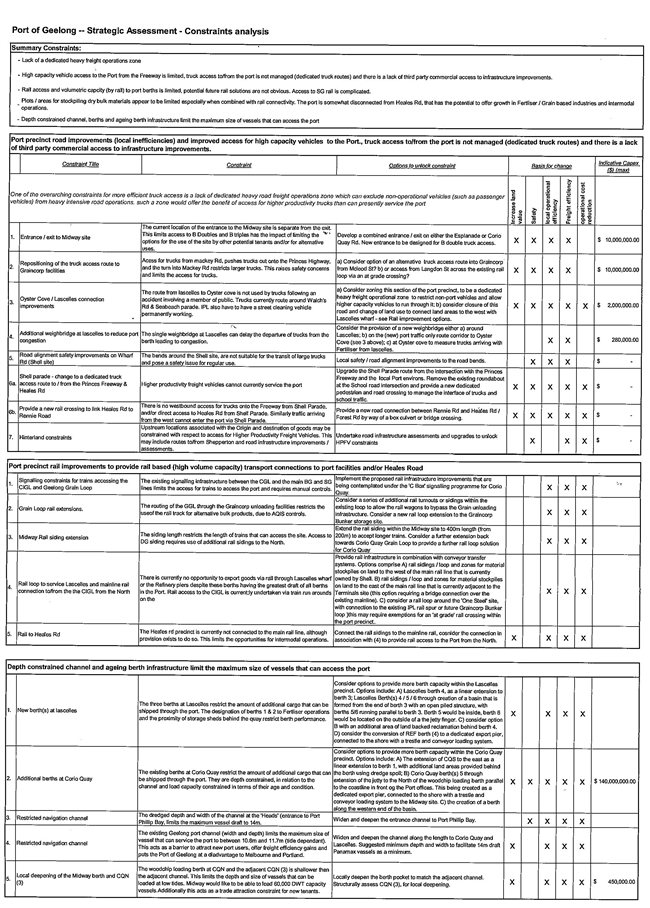
Key infrastructure constraints which are limiting the future expansion of the port and port users were identified as follows;
The lack of a dedicated heavy freight operations zone in the port precinct,
High capacity freight vehicle access is limited and existing truck access is not managed, that is there are no dedicated truck routes to the port
Rail access and capacity to berths is limited, future rail connections are not obvious and the access to the standard gauge rail network is difficult
There are limited sites available for stockpiling dry bulk materials and the port is not appropriately connected to the GREP where there are opportunities for the growth of grain and fertiliser industries and intermodal operations.
The channel and berths are depth constrained and coupled with ageing berth infrastructure, limit the maximum size of berths that can access the port.
Appendix 1-1 is a table which captures the constraints analysis of infrastructure at the port. These can be grouped into three categories; road, rail and marine. The Plan identified potential solutions to overcome these constraints.
Road
A key issue to emerge from consultation with port users was the adequacy of road access to Geelong Port, in particular the absence of a direct access from the Geelong Ring Road to the port. When the Geelong Ring Road was constructed VicRoads determined that the preferred route to the port was via Bacchus Marsh Road. Consultation with port users revealed that trucks accessing the port use different routes including Cox Road, Ballarat Road and LaTrobe Terrace.
There is considerable industry support for the opportunities presented by the use of High Productivity Vehicles (HPV) particularly on key grain routes. The use of larger trucks could offer up to 15% greater efficiency per vehicle movement. A designated HPV route could be developed utilising the state highway network with direct access from the Geelong Ring Road along Heales Road to the port via a new connection to Shell Parade/Princes Highway. In addition to the more efficient movement of freight, it would also offer considerable amenity benefits and safety outcomes for residents along Cox Road and Bacchus Marsh Road, consistent with the objectives of the Corio-Norlane Structure Plan. The road connection to Shell Parade would require infrastructure investment by State or Federal Government. The wider freight network throughout the State would also have to be considered including assessment of bridges.
At a local level the Plan recommends restricting access for non port traffic on The Esplanade in North Shore between Seabreeze Parade and Madden Avenue. The road would become part of the port precinct creating a connection between the industrial land and Lascelles Wharf. Coupled with the addition of weighbridge facilities it would improve unloading operations which are now facing increased berth utilisation for the importation of cement, following the closure of the quarry at Waurn Ponds.
Other local opportunities include changes to intersections along Shell Parade to improve safety and provide access for HPVs.
Rail
Currently only one port user, Graincorp takes advantage of rail access to its facility. Rail access is available to other sites but, due largely to cost, it is unused. Lascelles Wharf does not have a rail connection despite its greater berth depth which would be well suited to accommodate the higher volumes typically transported on rail.
Rail freight planning is complicated, often there is no rail at the origin, there are limited train paths available, and rail struggles to compete with the lower cost and flexibility of road transport. The plan identifies 5 rail projects which would benefit the port
Signalling infrastructure improvements on the Corio Independent Goods Line
Extension of the grain loop, via turnouts or sidings
Extension of the rail siding on the Midway site
Rail loop to service Lascelles Wharf
Rail access to sites in the GREP
Marine
The Victorian Regional Channels Authority is responsible for maintaining the shipping channels into Geelong Port. Currently the channel is maintained to a depth of 12.3 metres and can cater for ships with a maximum draught of 10.8 metres up to 11.7 metres with tidal assistance. This places constraints on existing port users Graincorp and Shell. It also acts as a barrier to attracting new trades to Geelong Port creating inefficiencies as ships can not be fully loaded, and places Geelong at a disadvantage to the ports of Portland and Melbourne.
A further factor which will affect access to Geelong Port is the increasing size of the global shipping fleet. During the global financial crisis, ship owners worldwide responded by scrapping older, smaller ships in record number. This has resulted in an accelerated growth in the size of the worlds shipping fleet. This has implications for trade through Geelong Port, as in the future existing port users may be forced to reconsider their operations if the vessels they charter are unable to enter Geelong fully laden. The Plan recommends improvements to channel depth and width. Channel depth should be increased to match the depth of the access to the Port of Melbourne at 14 metres.
The need for additional berths was also identified in the Plan. These could be located at Lascelles wharf where greater depths are available. Further expansion opportunities at Corio Quay North and South were also identified.
The need for greater depth at the existing berth at Corio Quay North was identified as a constraint by Midway as the depth of the berth is less than the channel.
Preliminary costings for all road, rail and marine projects are identified in the Plan and the project partners have committed to advocating for these infrastructure investments at State and Federal Government levels.
Future Port Scenarios
Having identified infrastructure required to attract new users to the port, the plan details new trades which could be attracted to Geelong Port as detailed below.
|
Export Prospects |
Import Prospects |
|
Mineral sands |
Automotive |
|
Brown coal |
Sugar |
|
Black coal |
Fertiliser |
|
Iron ore |
Cement |
|
Grain either from the Port of Melbourne or southern New South Wales |
Gypsum |
|
Soya bean meal/oil |
Refined products |
|
Logs/woodchips |
Bitumen |
|
Copper concentrate |
LPG |
|
|
Steel |
The Plan quantifies volumes of potential new trades and the growth forecast in existing trades. Using a range of assumptions, for example the replacement of the Shell oil refinery with a fuel import storage terminal, the Plan provides 10 modelled scenarios which demonstrate the potential increase in trade through the port if infrastructure investments are made in road, rail and marine improvements.
Current throughput at Geelong Port is approximately 16 million tonnes. The most ambitious scenario would involve the delivery of all infrastructure improvements and result in up to 60 million tonnes of throughput by 2050.
Land Use
The Plan recognises the need for the City to continue to maintain buffers around industrial activities at the port. The availability of land at the port is constrained with some industrial sites being used for non port related uses. Whilst ample land is available at the GREP, additional costs are incurred with the transfer of goods to and from storage sites that do not have direct berth access. This “double handling” significantly affects freight charge competiveness.
Baywest and the Port of Hastings
The Victorian State Government policy is to relocate the international container trade from the Port of Melbourne to the Port of Hastings. The Geelong Port and Land Freight Infrastructure Plan is consistent with this policy as its focus is limited solely to bulk and break bulk trades.
The Port of Hastings is not well served with road and rail access at this time. Considerable investment in infrastructure would be required to support the development of Hastings and there are existing congestion issues with transportation of goods back through Melbourne. By contrast, any proposal to develop a port in Melbourne’s west would have a comparative advantage due to accessibility to the national road and rail networks including the Outer Metropolitan Ring, availability of a skilled workforce, proximity to established warehousing and national distribution centres in the west, proximity to Avalon Airport and position at the gateway to the west of the State which produces the bulk of containerised agricultural exports.
The development of a Baywest port option for international containerised trade could be undertaken in conjunction with the improvement of channel access at Geelong and would complement the role of Geelong as a bulk and break bulk port.
The State Government is currently preparing the Victorian Freight and Logistics Plan and it is understood that this will provide greater clarity on the government’s plans for the future of commercial ports in Victoria.
Consideration of this report does not result in any environmental impacts. Any future development proposal or infrastructure project will include an assessment of environmental impacts as part of an assessment process.
The consideration of this report will not result in financial implications for Council. Pending further investigation and analysis, future budget processes will be pursued to deliver infrastructure upgrades where relevant.
This report will have no impact on Council income or expenditure. Any infrastructure upgrades to be pursued in the future will be subject to the normal budget processes.
This report has no statutory implications for Council. The Geelong Port and Land Freight Infrastructure Plan details future assessment processes which may be required for channel improvements and other infrastructure upgrades.
This report supports the “Growing Our Economy” strategic direction in City Plan in particular the priority to “facilitate major infrastructure investment to enable economic growth”.
No Council officers have a direct or indirect interest in accordance with Section 80(c) of the Local Government Act in the issue to which this report relates.
Council’s endorsement of the directions of the Geelong Port and Land Freight Infrastructure Plan will not result in any risks to Council. Any future infrastructure upgrades will be subject to assessment processes which will include a risk assessment.
Further development at the Port of Geelong will have positive social impacts through the potential for increased employment. Social impacts will be considered through further assessment processes which will include examination of other issues such as traffic impacts, noise and environmental safety.
This report has no impact on human rights. Delivery of infrastructure identified in this report, such as access road changes will be subject to separate consultation processes with the community to ensure their views are considered.
Preparation of the Geelong Port and Land Freight Infrastructure Plan included consultation with key industry stakeholders. Given the technical nature of the project, consultation with the wider community is not proposed at this stage.
The Plan will now be circulated to State and Federal Governments and other agencies. Project partners have committed to advocating for delivery of the infrastructure identified in the Plan.
Portfolio: |
Infrastructure, Parks & Gardens – Cr Ellis |
Source: |
Projects, Recreation and Central Geelong - Sport and Recreation |
General Manager: |
Dean Frost |
Index Reference: |
Subject: Design/Construction/Maintenance - Parks, Gardens, Reserves and Foreshore/Playing Fields<br> |
The purpose of this report is to outline potential risks and costs to Council of allowing owners corporations to undertake ongoing maintenance of public open space assets, to a higher standard than is generally provided elsewhere in the municipality by the City of Greater Geelong. The report recommends that Council should not allow these arrangements within residential subdivisions.
There have been recent requests by developers in new residential subdivisions to establish Owners Corporations to undertake the provision and maintenance of assets in Council owned reserves, including public open space and road reserves.
In September 2012, Council endorsed a proposal to allow Owners Corporations to maintain specified public assets to an agreed standard, secured by section 173 agreements.
Since the September 2012 Council resolution, benchmarking against neighbouring growth area councils has highlighted the recent failure of Owners Corporation maintenance agreements and identified a number of risks and costs to Council in entering into Owners Corporation agreements for the provision and maintenance of assets. These include:
Risks associated with the lack of control or oversight of maintenance activities occurring on Council land.
Financial and human resource costs in establishing and administering the agreements.
Social equity concerns arising from the provision of higher standard assets and services than is provided elsewhere within the municipality.
Higher level maintenance costs to Council arising when these agreements expire or fail.
Provision of an unsustainable level of service leading to future increased asset renewal costs to Council, or resident dissatisfaction when reverting to standard infrastructure.
In light of these risks and the recent failure of an Owners Corporation agreement within a neighbouring growth area council, this paper proposes that the earlier Council resolution should not be applied within residential subdivisions.
The attached draft policy articulates the preferred Council position in relation to the development and maintenance of public open space in residential estates through Owners Corporation or similar agreements.
The draft policy relates specifically to residential developments. It is acknowledged that in exceptional circumstances, Owners Corporation agreements may be a suitable mechanism to deliver non-standard services. Examples include industrial estate landscaping or the provision of private facilities within waterfront estates.
Cr Ellis moved, Cr Macdonald seconded -
That Council:
endorse the attached Owners Corporation Maintenance of Public Open Space policy;
note that the new policy limits the scope of Council’s resolution of 25 September 2012 in relation to Public Asset Care, by excluding its application to public open space within residential subdivisions.
* Cr S Kontelj entered the meeting room at 7:45pm
Cr Nelson moved, Cr S Kontelj seconded –
That the item be deferred.
Division Requested:
For: Crs Ansett, S Kontelj, Nelson, Farrell, Irvine
Against: Crs Ellis, Fisher, Macdonald, Richards, Harwood
The deferral motion was lost on the casting vote of the Chair.
Debate continued.
The motion was then put and carried.
Carried.
Standards for the provision of Council assets within new developments in the City of Greater Geelong are established in the “Sustainable Communities Infrastructure Development Guidelines”.
This document provides clear guidance for planning and developing sustainable public open space and streetscapes to a standard that can be maintained by Council. To allow developers to depart from these guidelines creates a risk to Council of unbudgeted, unfunded and unsustainable asset maintenance obligations. It also creates a risk of dissatisfaction from Council residents within and external to Owners Corporation estates.
Public open space in new developments within the City of Greater Geelong is generally subject to a two year maintenance period, during which time developers have responsibility for maintaining these Council reserves to a satisfactory standard. At the end of this period, Council assumes the maintenance responsibility for these reserves.
A property developer has proposed an Owners Corporation agreement for a new estate within the Armstrong Creek West Precinct. Such an agreement would allow areas of public open space and some road reserves within the estate to be developed and maintained on an ongoing basis by the Owners Corporation, at a higher standard than that set out in the Sustainable Communities Infrastructure Guidelines and provided by Council across the municipality.
A similar arrangement negotiated between a developer and a growth area Council have recently failed. This has left the growth area Council with significant unbudgeted administrative and operational costs to maintain the higher level standard of this development.
The intention of Owners Corporation maintenance arrangements is that higher standards of infrastructure and maintenance can be provided compared to other estates across the municipality.
The cost of the higher standards are met through the resident’s body corporate fees and in theory do not financially disadvantage the council or ratepayers outside the estate.
However, advice from a neighbouring growth area council with similar agreements is that these arrangements create additional financial and human resource costs resulting from the setting up and negotiation of agreements and inspections, as well as ongoing costs such as excess power and water consumption to maintain assets to a higher standard. They also create resident expectations of standards that cannot be sustained by Council, who are ultimately responsible for all Council owned reserves.
Ratepayers within Owners Corporation maintained estates contribute to the estate maintenance through their body corporate fees. Such arrangements can create the perception that public open space within these estates are exclusively for the members of the Owners Corporation, who may seek to discourage people from outside their estate from utilising the facilities. Conversely, the higher level of development can attract high levels of visitation to reserves, which can exacerbate social tensions between estate residents and other users. Furthermore, the higher levels of visitation can create demands on Council to provide additional infrastructure and services such as public toilets and litter collection, which are often beyond Council’s standard provision for these reserves.
Provision of infrastructure above the standard provided elsewhere in the municipality creates issues of social equity and extends Council’s asset renewal gap compared to the provision of standard infrastructure. A decision by Council to allow a higher level of service provision creates an expectation that this standard will be maintained into the future. This represents a significant future cost to Council, beyond the asset renewal costs associated with standard levels of service. The alternate approach is that Council may choose to replace higher-level assets with standard infrastructure when it comes to future asset renewal. This will likely lead to resident dissatisfaction, as the reduced standard of assets or service provision will be perceived as a lowering of Council standards.
Owners Corporation maintenance agreements cannot remove Council’s risk in relation to the maintenance of Council reserves. This presents a significant risk to Council who would have no direct control over or oversight of Owners Corporation maintenance being carried out on Council-owned land.
A recent example of an Owners Corporation arrangement in a neighbouring growth area is the Alamanda Estate, within the City of Wyndham. This estate was subject to an Owners Corporation agreement to provide a higher standard of infrastructure and maintenance than that generally provided by the council in neighbouring developments. In addition to the above issues of social equity, increased risk and financial costs experienced by the City of Wyndham, the Council now faces significant administrative and operational costs, as the Body Corporate recently provided two weeks notice of their intention to withdraw from the maintenance agreement. The collapse of this arrangement occurred soon after the property developer had completed development of the estate and sold the final lots. This has left the City of Wyndham needing to maintain a higher standard of asset than they would normally provide, without sufficient operational budget. Furthermore the Council also has to issue estate residents with a supplementary rate request in order to cover the services that were to be provided by the Body Corporate. This is a significant administrative task and will likely be very unpopular with affected ratepayers.
Within the City of Greater Geelong, the Geelong Golf Club residential development includes the establishment of a Body Corporate with maintenance responsibilities over land accessible to the public.
However, a significant point of difference in this estate is that the titles of the publicly accessible open space remain vested with the Body Corporate and are not Council land.
This avoids the liability issues associated with an Owners Corporation undertaking maintenance of Council property as proposed under the Alamanda Estate model.
An alternative mechanism to providing a higher level of service in new estates is through a Council imposed special rate or charge. Such an approach may address the risks associated with oversight of maintenance and would provide additional funding to meet maintenance and asset renewal costs. However it would not resolve the issues of social equity associated with the differing levels of service and the perceptions of private ownership of public assets
Allowing a higher level of asset provision may create additional power and water demands associated with their maintenance. An example would be proposals to irrigate road reserves or local parks, which are generally not irrigated as standard by Council.
The Sustainable Communities Infrastructure Development Guidelines have been designed to provide guidance on delivering environmentally as well as socially and financially sustainable developments within the City of Greater Geelong. To deliberately allow a departure from these guidelines creates a risk that future developments may not meet Council’s environmental standards.
There are unbudgeted administrative costs to Council in negotiating and managing the agreements and associated financial arrangements.
Furthermore, in the event that an Owners Corporation can no longer meet their maintenance obligations, there will be significant unbudgeted administrative, operational and asset renewal costs to Council in taking over the maintenance of assets at a higher standard than is normally provided across the municipality.
This policy has been developed to clearly outline Council’s position in relation to requests for Owners Corporation or like agreements for the development and maintenance of Council reserves.
The adoption of this policy aligns with ‘How we do Business’ through responsible and sustainable financial management.
No Council officers involved in the preparation of this report have a direct or indirect interest in matters for consideration.
Allowing Owners Corporations to undertake maintenance of Council assets on an ongoing basis, at a higher standard than that provided by Council creates numerous risks including:
Community: Concerns of social inequity and perceived private ownership of public assets
Financial: Owners Corporation maintenance arrangements create unbudgeted and unfunded demands on Council resources in the negotiation and administration of agreements. They also increase Councils future asset renewal costs.
Operational: Allowing Owners Corporations to undertake ongoing maintenance increases Council’s exposure to risk as Council has no direct control or oversight over the maintenance being carried out.
General: Similar arrangements in Wyndham City Council have recently failed resulting in significant and unplanned operational, financial and reputational impacts on this Council.
In addition to concerns about the perceived private ownership of public assets, Wyndham Council officers have reported that in their experience, these arrangements created conflict between Owners Corporation residents and neighbouring communities who were not provided with the same standards of infrastructure and maintenance.
This has implications within the City of Greater Geelong. The current proposal relates to land within the Armstrong Creek West Precinct. This may create conflict and perceptions of inequity from residents of neighbouring estates within the same precinct, as well as from neighbouring precincts such as the existing Warralily Estate in Armstrong Creek East.
It has been determined that the project will not have an impact on individual’s human rights.
Pending endorsement, the policy will be published on Council’s website and communicated via media release. The policy will also be reflected in changes to Council’s ‘Sustainable Communities Infrastructure Development Guidelines’.
Portfolio: |
Sport & Recreation - Cr Irvine |
Source: |
Projects, Recreation & Central Geelong - Sport & Recreation |
General Manager: |
Dean Frost |
Index Reference: |
Subject : Sport Leisure & Recreation / Reports |
The purpose of this report is to seek Council endorsement of the Armstrong Creek Sports Development Plan that outlines a strategic approach to promote and encourage sport, physical activity and social interaction through the development of sport and facilities.
Armstrong Creek is one of the largest strategic planning projects ever undertaken by the City of Greater Geelong. The Armstrong Creek Sports Development Plan investigates and outlines how sport and associated partners can make a positive contribution towards delivering an active and healthy community ensuring that sporting infrastructure created is embraced and fully utilised by the new community.
The Sports Development Plan takes a strategic approach for the future provision of sport in the Armstrong Creek growth area including recommendations for the establishment and enhancement of sporting opportunities having regard to participation trends, barriers to participation, support structures and consultation with state and local sporting bodies.
Recommendations of the Armstrong Creek Sports Development Plan have been designed to apply to other growth areas across the municipality and to work in with Council’s existing processes and networks. Other key areas include Lara, Fyansford, Highton, Leopold, Clifton Springs, Ocean Grove and Point Lonsdale.
Key recommendations critical in the Plan that were identified include:
The provision of dedicated sports development staffing resources
Securing partnership commitment from state sporting bodies and agencies
Engagement and commitment of local schools in developing sport
The connection of Armstrong Creek to existing sporting systems, structures and programs currently activated for existing sports clubs across the municipality
A focus on developing new sporting clubs to service community sport and recreation demands at Armstrong Creek
The success of the delivery of these actions will ultimately determine the growth, development and sustainability of sport throughout Armstrong Creek. Existing sports clubs within City of Great Geelong will continue to be supported through existing sport development resources.
Failure to implement the Sports Development Plan will lead to the slow engagement and inhibited growth of local sports participation and physical activity, leading to ad-hoc development and a disconnect in the community.
Cr Irvine moved, Cr Richards seconded -
That Council endorse the Draft Armstrong Creek Sports Development Plan.
Cr Macdonald left the meeting room at 8:05pm
Carried.
Armstrong Creek is one of the largest strategic planning projects ever undertaken by the City of Greater Geelong. As part of the planning process for the infrastructure it became evident that to achieve the desired community outcomes and achieve high levels of sporting uptake, Council would need to do more than provide the facilities. Council will be required to support the creation of new clubs and engage with sports to deliver a coordinated sporting offer.
The Sports Development Plan outlines how sport and associated partners can make a positive contribution towards delivering an active and healthy community.
Sport in Geelong is an essential part of its culture and is highly valued by the existing community. Commitment to supporting sport in Geelong is also evidenced through a range of municipal and regional planning studies, development of infrastructure of regional, state, national and international quality, the attraction of large scale events and the establishment of Sports House within Simonds Stadium.
The Armstrong Creek Sports Development Plan seeks to build on this historical commitment and grow the City’s involvement in sport to progress and develop its new communities. The Armstrong Creek Sports Development Plan is not about infrastructure, but with substantial infrastructure planned for the Armstrong Creek development area and significant population growth projected, a Sports Development Plan is required to facilitate the establishment and sustainable delivery of sport for the emerging community.
The recommendations Armstrong Creek Sports Development Plan have been designed to apply to other growth areas across the municipality and to work in with Council’s existing processes and networks. Other key areas include Lara, Fyansford, Highton, Leopold, Clifton Springs, Ocean Grove and Point Lonsdale.
In addition to lost opportunities, failure to act on and successfully implement the Armstrong Creek Sports Development Plan will likely lead to the slow engagement and inhibited growth of local sports participation and physical activity, significantly restrict the consistent delivery of programs and activities (leading to ad-hoc development) and ultimately fail to attract the ongoing connectivity, support and ownership of key stakeholders in an exciting new initiative.
The Armstrong Creek Sports Development Plan identifies the best way(s) to make sport function within the defined infrastructure framework developed.
It focuses on ensuring the delivery of sport from the outset, in order to engage the local community in the establishment of sport and its future growth and development.
Historically, sports development has not rated highly in the establishment of new communities compared to the urgency surrounding the provision of essential infrastructure. However, the rapid growth of new communities drives the need to focus on early planning for the delivery of sport and recreation facilities and to provide appropriate specialised sports development resources to engage with sport and communities early in the planning stages.
A key focus of the Armstrong Creek Sports Development Plan is to set the criteria and a framework for the birthing of new sporting clubs within each key recreation reserve throughout the development area. Armstrong Creek provides new opportunities for growth and engagement and is not viewed as an opportunity to resolve existing local sport development, club congestion and diminishing catchment issues. The focus of the plan relates to the development of social capital for the new residential community.
The plan identifies a number of critical challenges for the future development of sport in Armstrong Creek. The key challenge being that it is much harder, and therefore less appealing, to deliver on sports development objectives than deliver on tangible infrastructure projects. Sports development is also much more difficult to measure and attract funds and resources for, yet the successful delivery of sports development initiatives has the ability to deliver more significant social, economic and participation (sport and community) benefits.
The Armstrong Creek Sports Development Plan can also be applied to the growth areas across the municipality and is designed to work in with Council’s existing processes and networks.
The Sports Development Plan takes a strategic approach for the future provision of sport in the Armstrong Creek growth area including recommendations for the establishment and enhancement of sporting opportunities, having regard to participation trends, barriers to participation, support structures, site analysis and consultation with State and local sporting bodies.
Key recommendations critical in the plan include:
The provision of dedicated sports development staff resources;
Securing partnership commitment from state sporting bodies and agencies;
Engagement and commitment of local schools in developing sport;
The connection of Armstrong Creek to existing sporting systems, structures and programs and
A focus on developing new sporting clubs to service community sport and recreation demands at Armstrong Creek
The Armstrong Creek Sports Development Plan encourages and promotes sport, physical activity, social interaction, health and wellbeing and community participation. In lieu of an existing community, the Sports Development Plan creates a road map for sport provision and delivery and a model that will lead growth area development in sport.
The proposal does not have an impact on the environment.
The implementation plan provides a broad estimate of costs specific to each of the recommended actions. These actions are assessed as Mandatory, Critical, High, Medium and Low to guide Council decision making in terms of development. There are no mandatory works connected with the draft plan.
Total cost of all works is estimated at $454,000 and is represented below in the prioritised breakdown.
Mandatory |
$Nil |
Critical |
$290,000 |
High |
$35,000 |
Medium |
$64,000 |
Low |
$65,000 |
Total |
$454,000 |
Estimated year on year Resources
2014/15 – $41,000
2015/16 - $166,000
2016/17 - $101,000
2017/18 - $146,000
Where implementation of specific recommendations requires a new budget allocation from Council, these will be presented and considered as part of the overall annual budget process. Opportunities for co-contributions from State Sporting Bodies, VicHealth, Leisure Networks, Developers and Sport and Recreation Victoria are listed against specific actions in the Plan.
The strategy refers to actions to be undertaken by a Sports Development Officer. Adoption of this strategy does not commit Council to the employment of this position as it will be subject to usual budget process and as part of this process these functions/activities may be able to be undertaken via a reallocation of existing resources and/or tasks.
The Armstrong Creek Sports Development Plan recognises that all community members have equal rights to participate in and enjoy the benefits of sport and physical activity. The development of sport will consider solutions to help facilitate access for all.
This project aligns with Council’s strategic directions in ‘Community Wellbeing’ by providing improved outcomes for Healthy lifestyles, Healthy environments and Connected, creative and strong communities
No Council staff or persons engaged under contract have a direct or indirect interest in the development of the Armstrong Creek Sports Development Plan.
There are no immediate risks associated with this report. Appropriate risk management measures will be put in place when implementing the recommendations of the report.
The Armstrong Creek Sports Development Plan recognises that supporting formal sporting clubs in not just about participation in physical activity.
Sporting clubs are recognised as providing a range of broader benefits to the community, including contributions to social capital, community cohesiveness, community connection and building local leaders.
It has been determined that the project will not have an impact on individual’s human rights.
The preparation of the Armstrong Creek Sports Development Plan has been managed by a three-tiered management structure:
Project Control Group (PCG) consisting of key representatives from Recreation & Open Space, Urban Growth Team and Sport & Recreation Victoria. The PCG provided high level strategic direction on key issues and opportunities.
Project Steering Group (PSG) consisting of Council officers and senior management from the following organisations:
Sport & Recreation Victoria (SRV)
Department of Planning & Community Development
Department of Education & Early Childhood Development
VicSport
AFL Victoria
Cricket Victoria
Football Federation Victoria
Netball Victoria
Tennis Victoria
Tennis Australia
VicHealth
Steering group engaged the major outdoor sports however included agencies such as VicSport to represent other sports not involved.
Project Reference Group (PRG) consisting of representatives from:
Football & Netball Geelong
Geelong & District Football League
Geelong Football Umpires League
Geelong Football League Netball Association
Bellarine Football League Netball Association
Tennis Geelong
Geelong Lawn Tennis Club
Geelong Cricket Association
Barwon Cricket Association
Geelong Bowls Region
Hockey Geelong
Victorian Country Football League (now AFL Victoria)
In addition, the following government departments, agencies and organisations were consulted in the preparation of the Armstrong Creek Sports Development Plan:
Sport & Recreation Victoria
Department of Transport Planning & Local Infrastructure (formerly Department of Planning & Community Development)
Department of Education & Early Childhood Development (DEECD)
Surf Coast Shire
City of Casey
City of Wyndham
City of Melton
City of Whittlesea
Cardinia Shire
Leisure Networks
Barwon Sports Academy
Armstrong Creek developers
Although not current residents, initial land purchasers of Warralily Estate were also consulted to capture their views.
The planning process involved a comprehensive review of background material and the establishment of the stakeholder reference groups as outlined above to guide the planning process. The project has involved extensive consultation with stakeholders, Council staff and key community groups.
The main consultation tasks have included:
Establishment of the PCG, PSG and PRG. These groups have met on a minimum of three occasions each in the lead up to this report
Meetings with the Growth Area Councils
Meetings with DEECD
An online survey with land purchasers at the Warralily Estate
The Armstrong Creek Sports Development Plan was publically exhibited for a period of 4 week is in the month of May 2013. Three (3) submissions were received from Geelong Basketball Association, Football Federation of Victoria and Cricket Victoria. A summary and response to these submissions is contained in the final report. All avenues of local media were utilised to highlight the public exhibition of the draft Sports Development Plan. This includes a media release, Community Update, notification and promotion to all key stakeholders.
Portfolio: |
Sport & Recreation - Cr Irvine |
Source: |
Projects, Recreation & Central Geelong- Sport & Recreation |
General Manager: |
Dean Frost |
Index Reference: |
Subject : Sport Leisure & Recreation / ReportsProject: Armstrong Creek Project / Communication |
The Armstrong Creek East Precinct District Sports Reserve Master Plan details infrastructure required at this Reserve as the growth area develops.
Armstrong Creek is one of the largest strategic planning projects ever undertaken by the City of Greater Geelong. Throughout the development of Armstrong Creek Sporting Infrastructure has been extensively planned.
The East Precinct District Sports Reserve Master Plan was commissioned by the City of Greater Geelong (CoGG) to provide clear direction for the construction of sporting infrastructure at the first sporting reserve in Armstrong Creek and to ensure that planning meets the needs of the first Armstrong Creek community.
Key sporting infrastructure for the East Precinct District Sports Reserve has been determined through previously completed precinct structure planning. The Master Plan provides greater detail around the infrastructure already planned.
The Armstrong Creek East Precinct District Sports Reserve Master Plan details infrastructure such as a multipurpose sports pavilion, two multi-use natural turf sports fields with lighting, two netball courts (one combined netball / tennis court), informal social space and playground, cricket practice facilities and associated car parking, landscaping and path network.
Building work at the East Precinct District Sports Reserve will be funded through a number of sources including a contribution from Department of Transport Planning and Local Infrastructure (DTPLI) formally the Department of Planning and Community Development (DPCD), but primarily through the Developer through the Developer Contribution Plan. Where implementation of specific recommendations requires a new budget allocation from Council, above what will be funded through Developer Contributions, a business case will be prepared and considered as part of the overall annual budget process.
Cr Irvine moved, Cr Richards seconded -
That Council endorse the Armstrong Creek East Precinct District Sports Reserve Master Plan.
Cr Macdonald re-entered the meeting room at 8:07pm
Carried.
Armstrong Creek is one of the largest strategic planning projects ever undertaken by the City of Greater Geelong.
The East Precinct is the first of seven precincts to be developed across Armstrong Creek, which at full build out will reach a population of over 60,000 residents and accommodate 22,000 dwellings. With homes currently being constructed and more land being released for sale it will be critical for Council to keep pace with the growing population and provide key sporting infrastructure to promote and encourage a healthy and active community.
Key sporting infrastructure for the East Precinct District Sports Reserve has been determined through previously completed precinct structure planning and through the development of Integrated Infrastructure Delivery Plan in 2009. The Armstrong Creek East Precinct District Sports Reserve Master Plan details infrastructure such as a multipurpose sports pavilion, two multi-use natural turf sports fields with lighting, two netball courts (one combined netball / tennis court), informal social space and playground, cricket practice facilities and associated car parking, landscaping and path network.
The East Precinct is the first of seven precincts to be developed across Armstrong Creek, which at full build out will reach a population of over 60,000 residents and accommodate 22,000 dwellings. With homes currently being constructed and more land being released for sale it will be critical for Council to keep pace with the growing population and provide key sporting infrastructure to promote and encourage a healthy and active community.
Key sporting infrastructure for the East Precinct District Sports Reserve has been determined through previously completed precinct structure planning. The Reserve will provide:
multipurpose sports pavilion;
two multi-use natural turf sports fields with lighting;
two netball courts (one combined netball / tennis court);
informal social space;
playground;
cricket practice facilities and
associated car parking, landscaping and path network.
One of the key objectives of the Master Plan is to ensure that sporting programs and infrastructure proposed for the East Precinct District Sports Reserve supports the establishment of vibrant and inclusive sporting clubs rather than the relocation of existing sporting clubs into Armstrong Creek.
The East Precinct District Sports Reserve is located opposite a planned education precinct, containing P-12 and specialist schools that will cater for over 1,000 students. The close proximity of the two sites provides an opportunity for the City of Greater Geelong and the Department of Education and Early Childhood Development (DEECD) to work collaboratively on the provision of shared community infrastructure that meets the needs of the local community.
A set of facility development and design principles has been agreed between CoGG and DEECD that identify opportunities for the future development of both sites in order to offer broad community access, shared use and complimentary infrastructure.
The implementation plan for proposed works is based on CoGG first securing ownership of the site. It is then recommended that Council adopt a staged plan that matches the available budget for development and delivers key reserve infrastructure that is safe, functional and useable.
With the East Precinct District Sports Reserve being the first active sporting reserve to be developed, the standard and timing of facilities will be crucial to the future success of other sports facilities planned across Armstrong Creek. Reserve elements must ensure alignment with the principles of the Sports Development Plan.
The Armstrong Creek East Precinct District Sports Reserve Master Plan seeks to support initiatives that facilitate long-term environmental sustainability within the reserve, including water use (and re-use), vegetation improvement and ongoing maintenance.
The Armstrong Creek East Precinct District Sports Reserve Master Plan recognises that the community values the sporting field and overall amenity of the reserve. Future development will seek to protect the value of the reserve, enhance the landscape quality of the reserve, promote accessibility and improve facilities, infrastructure and functioning for the broader community.
Building work at the East Precinct District Sports Reserve will be funded through a number of key stakeholders, including a contribution from the Department of Transport Planning and Local Infrastructure (DTPLI) formally the Department of Planning and Community Development (DPCD), but primarily from the Developer, through the Developer Contribution Plan.
The current available budget for Reserve infrastructure is $7,014,638, including $3,883,138 from the Developer Contribution Plan (DCP). These funds are to support the development of playing fields including two turf ovals, two netball courts and associated reserve civil works ).
In addition, a further $3,131,5000 will be made available from the Community Infrastructure Levy (CIL) which includes a grant of $500,000 from the Department of Planning and Community Development (DPCD) to help advance the project.
The total cost of proposed works outlined in the above landscape plan and building concept is $10,526,299. This presents a gap between the funding available through the DCP and DPCD, and the overall cost estimate for proposed works of approximately $3,484,661.
The following table provides a summary of the current project funding and infrastructure provision and the likely funding gap to be considered by the City of Greater Geelong and project partners.
The recommended works schedule for the reserve was costed by the landscape architect following an analysis of the site and better understanding of the key site constraints and requirement.
|
Proposed Reserve Infrastructure |
Estimated Development Cost |
Non-allocated / Gap Funding |
|
Playing fields including two turf ovals, two netball courts and associated Reserve civil works |
$3,924,967 |
$41,829 |
|
Community sports pavilion |
$3,392,000** |
$260,500 |
|
Play space |
$150,000 |
$150,000 |
|
Basketball half court |
$43,730 |
$43,730 |
|
Picnic / BBQ area |
$77,500 |
$77,500 |
|
General landscaping |
$2,176,000 |
$2,176,000 |
|
Multipurpose training facility |
$200,000 |
$200,000 |
|
Design, administration, contingency and maintenance |
$562,102 |
$562,102 |
|
Total funding |
$10,526,299 |
$3,484,661 |
*Project funding for the playing fields and civil works includes the indexed DCP figure.
**Community sports pavilion allocated funding includes the Community Infrastructure Levy identified in 2010 (non indexed) and $500,000 from DTPLI. The estimated cost on the Community Sports Pavilion has been confirmed through independent QS.
The Armstrong Creek East Precinct District Sports Reserve Master Plan recognises that all community members have equal rights to participate in and enjoy the benefits of sport and physical activity.
equal rights to participate in and enjoy the benefits of sport and physical activity.
This project aligns with Council’s strategic directions in ‘Community Wellbeing’ by providing improved outcomes for Healthy lifestyles, Healthy environments and Connected, creative and strong communities
No Council staff or persons engaged under contract have a direct or indirect interest in the development of the Armstrong Creek East Precinct District Sports Reserve Master Plan.
There are no immediate risks associated with this report. Appropriate risk management measures will be put in place when implementing the recommendations of the report.
The Armstrong Creek East Precinct District Sports Reserve Master Plan recognises that participation in sport and physical activity brings about a range of personal, social, health and economic benefits for individuals and communities.
It has been determined that the project will not have an impact on individual’s human rights.
The preparation of the the Armstrong Creek East Precinct District Sports Reserve Master Plan has been managed by a three-tiered management structure:
Project Control Group (PCG) consisting of key representatives from Recreation and Open Space, Urban Growth Team and Sport & Recreation Victoria. The PCG provided high level strategic direction on key issues and opportunities.
Project Steering Group (PSG) consisting of Council Officers and senior management from the following organisations - Sport and Recreation Victoria (SRV), Department of Planning and Community Development, Department of Education and Early Childhood Development, Vicsport, AFL Victoria, Cricket Victoria, Football Federation Victoria, Netball Victoria, Tennis Victoria, Tennis Australia and VicHealth
Project Reference Group (PRG) consisting of representatives from Football & Netball Geelong, Geelong & District Football League, Geelong Football Umpires League, Geelong Football League Netball Association, Bellarine Football League Netball Association, Tennis Geelong, Geelong Lawn Tennis Club, Geelong Cricket Association, Barwon Cricket Association, Geelong Bowls Region, Hockey Geelong and Victorian Country Football League (now AFL Victoria)
In addition, the following government departments, agencies and organisations were consulted in the preparation of the Armstrong Creek East Precinct District Sports Reserve Master Plan: Sport and Recreation Victoria, DTPLI (formerly DPCD), Department of Education and Early Childhood Development, Surf Coast Shire, City of Casey, City of Wyndham, City of Melton, City of Whittlesea, Cardinia Shire, Leisure Networks, Barwon Sports Academy and Armstrong Creek Developers.
Although not current residents, initial land purchasers of Warralily Estate were also consulted to capture their views.
The planning process involved a comprehensive review of background material and the establishment of the stakeholder reference groups as outlined above to guide the planning process. The project has involved extensive consultation with stakeholders, Council staff and key community groups.
The main consultation tasks have included:
Establishment of the Project Control Group, Project Steering Group and Project Reference Group. These groups have met on a minimum of three occasions each in the lead up to this report;
Meetings with the Growth Area Councils;
Meetings with DEECD; and
An online survey with land purchasers at the Warralily Estate
The Armstrong Creek East Precinct District Sports Reserve Master Plan was publically exhibited for a period of 4 week is in the month of May 2013. Three (3) submissions were received from Geelong Basketball Association, Football Federation of Victoria and Cricket Victoria. A summary and response to these submissions is contained in the final report. All avenues of local media were utilised to highlight the public exhibition of the East Precinct District Sports Reserve Master Plan. This includes a media release, Community Update, notification and promotion to all key stakeholders.
Portfolio: |
Central Geelong – Cr Heagney |
Source: |
Projects, Recreation & Central Geelong |
General Manager: |
Dean Frost |
Index Reference: |
Subject: Central Geelong Taskforce |
The purpose of this report is to have Council formally make appointments to the Central Geelong Task Force Special Committee.
At its meeting of 11 June 2013, Council resolved to establish the Central Geelong Task Force Special Committee under Section 86 of the Local Government Act.
The Central Geelong Task Force Special Committee will be tasked with the development of a master plan as the Council and community plan for Central Geelong, incorporating ideas from Vision 2 and updating the 2007 Central Geelong Structure Plan.
In addition the Committee will provide advice in relation to development initiatives/alliances and activities/events for Council consideration aimed at revitalising Central Geelong.
The Committee will operate under a Terms of Reference and delegated authority as attached.
Cr Richards moved, Cr Macdonald seconded -
That Council:
In accordance with Section 86 of the Local Government Act, establish the Central Geelong Task Force Special Committee, with delegated authority as outlined in Appendix 1 and Terms of Reference as outlined in Appendix 2.
Appoint the following representatives to the Central Geelong Task Force Special Committee until 29 October 2016:
Cr Michelle Heagney
Professor Roz Hansen
Mr Bernard McNamara
Mr William Tieppo
Ms Fiona de Preu
Mr Peter Anderson
Professor Jane den Hollander
Mr Peter Bettess
Appoints in an ex officio capacity the Mayor and Chief Executive Officer – City of Greater Geelong.
Carried.
Geelong is Victoria’s second capital city. A vibrant and exciting city centre benefits all of Geelong and its region, as the cultural, retail, entertainment and business heart of the city and region.
Central Geelong has 172,587 square metres of retail floor space of which 41% is in Westfield and Market Square. Central Geelong has 236,600 square metres of office space. The top five employment categories based on 2011 data are Health Care (5,790 employees); Public Administration and Safety (3,112); Retail Trade (2,765); Education and Training (1,929); and Food and Beverage Services (1,687). The estimated resident population is 4,200 persons.
Re-vitalising and improving Central Geelong is a key issue for most people in Geelong. The people of Geelong want a city heart that all can be proud of. We need to re-create vibrancy and ‘bustle’, with more people shopping, working and living in Central Geelong and Waterfront.
Central Geelong needs to be actively promoted as the regional retail centre and services hub as well as being our key cultural, civic and dining centre. Central Geelong needs to be a friendly place for people of all ages with a strong perception of safety.
It is important to make Central Geelong as attractive as possible for many more people to make their home. Projects delivering greater density of housing need to be encouraged and facilitated. Our Central Geelong has huge potential as a great place to live.
The Terms of Reference and delegated authority related to the operation of the Special Committee are attached.
In simple terms the Committee will be tasked with overseeing the development of a master plan for Central Geelong, building on the work of Vision 2 and the 2007 Central Geelong Structure Plan.
The Committee will also provide advice to Council in relation to development initiatives/alliances and activities/events for consideration aimed at revitalising Central Geelong.
The Terms of Reference for the Special Committee proposes the following:
Chair – Brownbill Ward Councillor
Proposed Appointment – Cr Michelle Heagney
One (1) Person from City of Greater Geelong at General Manager level
Proposed Appointment – Peter Bettess
Three (3) Decision makers from State Government with expertise in Development Planning, Transport and Regional Development
Proposed Appointments:
Mr William Tieppo, Regional Director South Western Victoria– VicRoads
Ms Fiona de Preu, Project Director Central Activities Area – Planning Building & Heritage
Mr Peter Anderson, Regional Director – Regional Development Victoria
One (1) Person representing Deakin University
Proposed Appointment – Prof Jane den Hollander, Vice-Chancellor
Up to two (2) External Urban Planners experienced in Central City Development
Proposed Appointments:
Prof Roz Hansen, Urban & Regional Planner – Roz Hansen Consulting
Mr Bernard McNamara, Principal – BMDA Development Advisory
The Mayor and Council’s Chief Executive Officer will be appointed as ex officio members, having the same status and rights as other committee members, but are not counted in determining a quorum.
There are no environmental implications relevant to this report.
The Task Force can be established within existing resources.
This proposal is not consistent with Council’s adopted planning policies for the Armstrong Creek Growth Area as set out in this report.
The Armstrong Creek Growth Area has been comprehensively planned and designed from the outset and the proposal to “tack-on” additional land is inconsistent with this approach as reflected in these policies.
If Council supports this application it will be necessary for the Armstrong Creek Growth Plan – Framework map in Clause 21.11 of the M.S.S. to be amended to include the subject land within the designated Urban Growth boundary.
The adoption of the Special Committee aligns with the five priorities under Growing our Economy being:
Support existing businesses and encourage new and emerging growth sectors
Facilitate major infrastructure and investment to enable economic growth
A prosperous and innovative Geelong
A successful and vibrant city centre
Greater Geelong is a leading city for tourism, arts, culture and events
No officers associated with the writing of this report have any direct or indirect interest in accordance with Section 80C of the Local Government Act.
There are no significant risks associated with this report. Risks relating to the establishment and operation of the Central Geelong Task Force or Special Committee will be managed as part of the establishment process.
The Central Geelong Task Force will assist in addressing some of the social issues in Central Geelong.
No Human Rights are affected by the contents of this report.
A Communication Plan will be established in due course.
Portfolio: |
Environment & Sustainability – Cr Richards |
Source: |
City Services - Environment and Waste Services |
General Manager: |
Gary Van Driel |
Index Reference: |
Subject: Environment - Waterways Council Reports 2013 |
Adoption of the final Jerringot Wetland Reserve Masterplan as exhibited.
Jerringot Wetland is an 18 hectare freshwater wetland on the Belmont Common, which provides significant environmental values within urban Geelong. It adjoins the Barwon Valley Golf Course to the east, the City’s Belmont depot to the south, Settlement Road and Barwon Heads Road to the west and Belmont Common to the north.
The Reserve consists of two main wetland areas which are linked to the Barwon River floodplain. The Reserve is Crown Land with the City acting as Committee of Management. The Geelong Field Naturalists Club (GFNC) has been a caretaker of the Reserve since 1972. The Wetland and surrounding reserve provides a home for over 100 resident and migratory bird species, a number of which are rare or threatened, including the internationally significant Latham’s Snipe, which arrives each year in spring on a migratory route from Japan.
The Wetland provides excellent habitat for frogs, including the endangered Growling Grass Frog. Native fish such as Common and Spotted Galaxias and the rare Australian Mudfish also use this wetland complex.
The wetland and surrounding reserve provides a unique natural asset in urban Geelong and receives numerous visitors, including schools which participate in the annual GFNC Snipe festival and other activities throughout the year.
Following a written request from the GFNC, Council began the development of a Masterplan for the Reserve in 2011. The aim of the Masterplan is to provide recommendations to guide Council, the GFNC and other key stakeholders regarding the on-going management of the Reserve as well as advise what infrastructure and works are required to protect and enhance the Reserve.
A Project Working Group (PWG) was established with all the key stakeholders to oversee the development of the Masterplan. Specialist consultants, Thompson Berrill Landscape Design were appointed and a meeting was held in May 2012 to brief key stakeholders and ascertain what issues were of most interest/concern to them. Site inspections were also held with the GFNC and Barwon Valley Golf Club.
Following feedback from the workshop with the PWG, a working draft Masterplan was developed. The working draft was then circulated back to the PWG seeking their comments and feedback. The City received feedback from six external and two internal members of the PWG. The comments received were very positive and there were only minor text changes requested. The draft Masterplan was amended to incorporate these changes.
Council at its meeting on 20 March 2013 recommended the Public Exhibition of the Draft Masterplan.
The Draft Masterplan was placed on public exhibition for a six week period from 10 April to 25 May 2013. Following the exhibition period no submissions were received.
It is recommended that the Jerringot Wetland Reserve Masterplan be adopted by Council.
Cr Richards moved, Cr Macdonald seconded -
That Council:
adopt the Jerringot Wetland Reserve Masterplan;
send letters to members of the Project Working Group thanking them for their assistance and support in the development of the Masterplan;
continue to inform the local community about the implementation of the Masterplan;
work closely with both the Geelong Field Naturalists Club and Barwon Valley Golf Club as part of the implementation of the Masterplan.
Carried.
The Jerringot Wetland Reserve is located on the Belmont Common within the natural floodplain of the Barwon River in urban Geelong. The wetland directly adjoins Settlement Road and Barwon Heads Road to the west, playing fields to the north, the Barwon Valley Golf Club and driving range to the east and the Council’s Belmont Depot to the south.
The wetland may retain aspects of the natural floodplain morphology and old river courses, however the area has been subject to substantial modification associated with previous uses of Belmont Common. These modifications have included:
Potential drainage channel and filling works associated with its use as an airfield (now occupied by the golf course and driving range).
The model railway period with tracks still evident on the site today providing separation between the central and northern wetland cells.
The establishment of Settlement Road which separates areas now occupied by the Criterion Track and Belmont Sunday Market from the larger natural floodplain of Belmont Common.
The Golf Course access road which runs directly through the wetland and separated the southern and central wetland cells.
Installation of the underground trunk sewer along Barwon Heads Road.
The establishment of the Belmont Depot and association bund wall which now defines that southern end of the wetland.
Despite previous historical disturbance and the ad hoc nature of modifications to the form of the natural floodplain, the current Jerringot Wetland provides habitat for a range of birds, amphibians and mammals which historically would have occupied the natural floodplain of the Barwon River. The Wetland also provides an important function in pre-treatment of stormwater to improve water quality prior to discharge to the Barwon River and downstream RAMSAR listed Lake Connewarre System.
For a number of years the Geelong Field Naturalists Club (GFNC) has been undertaking a caretaker role for this wetland reserve in collaboration with the City. The City has undertaken numerous rehabilitation projects in this Reserve including weed removal, exotic tree removal and revegetation works.
The City received a written request from the Geelong Field Naturalists Club for a Masterplan to be prepared for this Crown Land Reserve which will guide its on-going management and enhancement.
The request by the GFNC for the City to prepare a Masterplan was considered timely and one which can address a number of interrelated issues regarding the overall management of this important reserve. There were also outstanding issues to resolve regarding clarification of the operational boundaries and land use activities on the adjoining Barwon Valley Golf Club.
Prior to proceeding further with the request the City sought and obtained consent from DSE to prepare a new Masterplan for this Crown Land Reserve. Following this consent the City engaged landscape architects Thompson Berrill Landscape Design (TBLD) to prepare the new Masterplan. TBLD engaged specialist sub-consultants, Aquatic Systems Management Pty Ltd and Ecology and Heritage Partners to assess the Reserve and prepare detailed technical reports to inform and guide the development of the draft Masterplan.
A key part of developing the new Masterplan was liaising with the key stakeholders. A Project Working Group (PWG) was established comprising Cr Bruce Harwood and representatives from the Geelong Field Naturalists Club, Barwon Valley Golf Club, Parks Victoria, Corangamite Catchment Management Authority, Wathaurung Aboriginal Corporation, Geelong Environment Council, Department of Sustainability and Environment, Vic Roads, and officers from various Council Units.
A workshop was held in May 2012 at the Barwon Valley Club which briefed the PWG about the project, the process of developing the Masterplan and the timelines. The specialist consultants provided an outline of the preliminary site analysis and there was group discussion to identify the key site values and strengths, the key issues and opportunities to be addressed in the Masterplan.
It was agreed that the protection and rehabilitation of Jerringot Wetland was of paramount importance so it could remain a key fauna wetland reserve in urban Geelong. It is also a key statutory requirement of the City being the Committee of Management over this Crown Land.
Jerringot Wetland is surrounded by a diverse range of land uses each of which place significant pressures on the ecological and hydrological function of the wetland. The Masterplan will guide and inform both short and long term actions to assist with its protection, enhancement and rehabilitation.
The key features of the Masterplan are:
Installation of a gross pollutant & hydrocarbon trap within the Belmont depot at the east end of the depot carpark;
Construction of small sediment traps at each of the stormwater outlets entering the wetland;
Installation of gross pollutant traps to collect litter from the commercial areas west of Settlement Road;
Investigate establishing a new weir with removable plate to control water levels upstream of the existing weir and establish a new low levee along the south side of the main outfall drain;
Establishing a new bund and weir next to shared pathway to formalise water level control at the outlet of the southern part of the wetland;
Extending the off road shared pathway along the golf course access road including provision for a designated pedestrian/cyclist crossing point;
Investigating construction of a new bird hide overlooking the central wetland;
Undertaking on-going weed control and revegetation activities; and
Establishing close liaison with the Barwon Valley Golf Club regarding the rationalising of the boundary between the wetland and the golf club operational areas.
A working draft Masterplan was prepared following the PWG workshop incorporating the feedback and suggestions from this meeting. The working draft was then circulated to the PWG for its comments and feedback. Comments were received from the GFNC, Barwon Valley Golf Club, GEC, DSE, Wathaurung Aboriginal Corporation, and two Council Units.
The feedback received overall was positive with support for the various actions proposed and the overall intent of the Masterplan. There were a number of minor suggested text changes which were supported and incorporated into the draft Masterplan. There was however one specific issue raised by DSE and the GEC in respect to Action No. 12 which states – ‘ Liaise with Vic Roads to investigate the opportunity to extend the off road shared path along the east side of Settlement Road from Barwon Heads Road and connect through to Belmont Common’. DSE advised that it generally doesn’t support the establishment of a track in this section of the Reserve as it is important to provide an environment that allows migratory birds to rest and feed without human interaction. Accordingly DSE doesn’t want to see an increase in the disturbance to birds in this part of the Reserve. A similar concern was raised by the GEC regarding the proximity of the pathway to the birds in the wetland. The City had forwarded a copy of the working draft Masterplan to Vic Roads for comment, but none were received. A subsequent telephone discussion was held with Vic Roads regarding the proposed action and it advised that it can see the strategic merit in such a linkage but would need any such pathway to be located well down the Settlement Road embankment so as to not create a safety issue or impede any future road works on this major arterial.
The concerns raised by both DSE and GEC were acknowledged and warranted further detailed consideration. The proposed outcome, agreed to by the respective parties, was to amend the draft Masterplan slightly to better reflect the intent of the action by removing the yellow dashed line along the Settlement Road road reserve and replace this with an arrow just north of where the existing pathway ends. It was agreed that after the public exhibition period Action No.12. can be assessed and discussed in more detail by the Project Working Group, in particular DSE, the GEC and Vic Roads, as part of the development of the final Masterplan.
The draft Masterplan was placed on public exhibition for a period of six weeks which included the following activities:
Providing for comment on the Have Your Say page on geelongaustralia.com;
Sending letters and a copy of the draft Masterplan to the property owners and occupiers opposite the Reserve;
Erecting an information board on-site and at the Belmont Customer Service Centre; and
Sending copies of the draft Masterplan to the Project Working Group.
Following the consultation period no submissions or comments were received. As agreed further consideration was given to the concerns of the PWG regarding Action No.12. Discussions were held with DSE, the GEC, Vic Roads and Councils Recreation and Open Space department and it was agreed to remove this action from the final Masterplan.
The PWG were consulted regarding the removal of Action No.12 and there were no objections to this being undertaken.
A copy of the final Masterplan is attached as Attachment A.
Many of the recommended actions within the Masterplan will result in long term protection and enhancement of the biodiversity values within this Reserve, in particular the protection of rare and threatened fauna species. Through the implementation of the Masterplan the environmental obligations on Council, via its role as Committee of Management will also be appropriately delivered.
The project will involve financial costs associated with the implementation of the Masterplan. There will be costs associated with the installation of the gross pollutant traps and hydrocarbon trap, sediment traps, new weir and bund wall as well as the bird hide. At this stage the anticipated costs associated with the project are approximately $400,000 over seven to ten years. Funding will be sought via Council’s annual budget process. It is unlikely that an external income (grants will be available to assist with the implementation of the Masterplan. A number of the actions will be funded through existing core capital budgets. The on-going maintenance and operational costs will be factored into the City’s waterway and wetlands maintenance budget. There is also likely to be some minor assistance received for certain parts of the project (i.e. revegetation) through local service clubs and environment groups.
A number of the bird and frog species that reside or frequent this waterway are protected under Federal and State legislation. The Council has a statutory obligation to protect these rare and threatened fauna species. Under the terms of the Committee of Management responsibilities the City is also responsible for protecting these birds and other protected fauna. The preparation and implementation of the Masterplan will address this statutory requirement.
The adoption of the Masterplan aligns with the City Plan 2013 – 2017 under the Sustainable Built and Natural Environment:
Protecting and restoring our biodiversity.
Engaging the community in protecting our natural areas.
Limiting the loss of native species and natural areas and continuing indigenous plantings.
Protecting our coast, waterways and wetlands.
Continuing the development and implementation of reserve master plans in order to improve the quality of public open spaces.
Building community and agency partnerships.
There is no officer direct or indirect interests associated with this project.
There is a strong desire from the GFNC and Barwon Valley Golf Club for the Masterplan to be implemented as the increasing pressures from the growth of urban Geelong continues to impact on threatened species at the Reserve. The implementation of the Masterplan will reduce these risks.
The project will involve the on-going close liaison with the key stakeholders, including the GFNC, Barwon Valley Golf Club, registered aboriginal party and Vic Roads. The wider community have had the opportunity to provide input into the final Masterplan through the extensive public consultation process.
The Human Rights Charter has been considered as part of this process and there are no know conflicts with the twenty rights listed.
The project has involved close liaison with all the key stakeholders, including the DSE, CCMA, GFNC, Barwon Valley Golf Club, registered aboriginal party and Vic Roads. There has also been consultation with the landowners opposite the reserve and the wider community through the six week public consultation period.
Portfolio: |
Environment & Sustainability - Cr Richards |
Source: |
City Services |
General Manager: |
Gary Van Driel |
Index Reference: |
Climate Change Adaptation |
The purpose of this Report is to update Council on programs and actions carried out as part Council’s Climate Change Adaptation Strategy.
Council adopted the Climate Change Adaptation Strategy in April 2011. By doing so Council recognised that some human induced climate change is now inevitable and Council needs to consider and respond appropriately to the risks of climate change as well as continue to reduce its contribution to greenhouse gas emissions.
The development of the Climate Change Adaptation Strategy was essential in facilitating an understanding of the risks of climate change within the City of Greater Geelong. Through consultation with representatives from all Divisions, a list of Divisional priority climate change risks were identified.
The Strategy contributes to a greater understanding of climate risks, responsibilities and has a strong focus on building adaptive capacity within Council. In addition, the Strategy provides Council with a Roadmap to integrate adaptation into broader Council management and decision processes. The Strategy Roadmap sets out a range of actions to be implemented over a 5 year period.
The City of Greater Geelong is at the forefront of developing systems to allow for the consideration of climate risk as part of its business-as-usual operations. One of the major accomplishments from the Climate Change Adaptation Strategy was the development of the first comprehensive Climate Change Adaptation Toolkit for local government.
Recently the City of Greater Geelong has been invited by the Australian Centre of Excellence for Local Government to partner with other leading Local Governments in the area of adaptation, to assist in developing a practical guidance manual for Australian local governments: The project is called “Embedding Climate Change Adaptation into local government’s core business”.
Cr Richards moved, Cr Macdonald seconded -
That Council notes:
actions undertaken as part of the Climate Change Adaptation Strategy to embed climate change adaptation into Council’s core business;
its participation in the Australian Centre of Excellence for Local Government project: “Embedding Climate Change Adaptation into Local Government’s core business”.
Carried.
“Climate change will alter global and local climates. In Victoria, this means warmer average temperatures, more frequent and severe heatwaves, more very high fire danger days, reduced average and more variable rainfall, increased incidence and extent of drought, reduced snow cover, and sea level rise.” (Victorian Government’s Report on climate change and greenhouse gas emissions in Victoria, 2012)
These climate change impacts are likely to create many challenges for the City of Greater Geelong
These events are likely to impact directly and indirectly on residents, businesses and visitors to Geelong. They are likely to have consequences for Council’s services including infrastructure, recreation, health, planning and natural resource management. The severity of these impacts will be determined in part by Council and community preparation and response plans.
Despite uncertainties in climate change projections, they provide us with high confidence in the general trends that we can expect to see in the long term. In order to develop effective adaptation responses, the level of uncertainty must be considered alongside an assessment of vulnerability to climate change including exposure, sensitivity and adaptive capacity.
Council adopted the Climate Change Adaptation Strategy in April 2011. By doing so Council recognized that some human induced climate change is now inevitable and Council needs to consider and respond appropriately to the risks of climate change as well as continue to reduce it’s contribution to greenhouse gas emissions.
The development of the Climate Change Adaptation Strategy was essential in facilitating an understanding of the risks of climate change within the City of Greater Geelong. Through consultation with representatives from all Divisions, priority climate change risks were identified.
At the time the Climate Change Adaptation Strategy was developed, very few local governments had carried out an assessment of their climate risks, and further to this did not have the systems in place to assess and treat the uncertainty inherent with future climate risk assessments.
The City of Greater Geelong is at the forefront of developing systems to allow for the consideration of climate risk as part of its business-as-usual operations. The first comprehensive Climate Change Adaptation Toolkit for local government was developed by Council in partnership with RMIT and NetBalance and was launched in 2011.
The City of Greater Geelong has also been recently invited to partner with other leading organizations across Australia by the Australian Centre of Excellence for Local Government, to develop a practical guidance manual for Australian local governments. The project is called: Embedding Climate Change Adaptation into Local Government’s core business.
Council’s involvement will include:
Participation in a Reference Group from July 2013- January 2014
Review of Guidance Manual
Testing the draft Guidance Manual with appropriate council officers to ensure it works as a practical guide and supports council’s decision processes.
Provision of a case study of adaptation work carried out within the City of Greater Geelong.
Update on Council’s Climate Change Adaptation Strategy
Council’s Climate Change Adaptation Strategy contributes to a greater understanding of climate risks, responsibilities and has a strong focus on building adaptive capacity within Council. In addition, the Strategy provides Council with a Roadmap to integrate adaptation into broader Council management and decision processes. The Strategy Roadmap sets out a range of actions from 2011 that are framed by the following priority work areas:
Coastal Planning
Asset Management
Emergency Management
Vulnerable People
Open Space
Biodiversity
Building Community Engagement
The following four key tasks have also been developed to guide future adaptation planning:
Embedding consideration of climate change risks and adaptation into Council business.
Adopt decision processes relating to adaptation that produce robust decisions, and recognise the broader complexities of climate change.
Forming extensive external networks.
Continuous monitoring, review and improvement of climate impact risk procedures.
Work has commenced in several of the above Priority Work and key task areas, which includes:
Coastal Planning
Geelong Queenscliffe Coastal Mapping Project is a joint project between DSE, DCPD, the Borough of Queenscliff, CCMA and the City of Greater Geelong. Council’s Environment and Waste Services Department is project managing the first stage of this project that will provide data sets and spatial mapping of Geelong’s coastline and potential future inundation due to sea level rise, storm surge and coastal erosion.
Adopting decision processes relating to adaptation that produce robust decisions, and recognise the broader complexities of climate change:
The development of the Adaptation Toolkit provides the basis for training and support to staff for the development of appropriate risk controls and treatment. Training Council staff in the use of the online Adaptation Toolkit will refine existing identified climate risks and may identify new climate risks for the organisation. The development of an Adaptation Toolkit aims to support Council to:
integrate adaptation and support effective and efficient risk management
be more responsive to climate change shocks and trends
maintain standards of service delivery in the face of more extreme conditions
make effective and consistent decisions regarding climate change
form linkages across different work areas, internally and externally
incorporate uncertainty into decision making
make adaptation decisions that work across a range of future scenarios
build flexibility into adaptation actions.
Asset Management and Communities at Risk from heatwaves:
The City of Greater Geelong has partnered with Wyndham City Council to explore the characteristics of Urban Heat Island (UHI) effect and communicate key risks. An UHI report has been developed and is informed by data collected using airborne thermal sensing equipment in February 2013.
The UHI effect has a range of potential impacts on health, infrastructure and resource consumption. The report and thermal imagery will include practical mitigation responses that will inform urban, open space and social planners as to where we currently have problems with extreme heat. This data will be useful for the planning and provision of passively cooled green urban landscapes and will also inform planning for vulnerable sectors of the community during heat waves.
Embedding Climate Change Adaptation through Council
Plan making:
Emergency Management: During 2013 a working group from the Municipal Emergency Management Planning Committee will discuss the review the Community Emergency Risk Assessment (CERA) which is carried out on a 2-year cycle. This year climate change risks will be looked at by the Working Group including climate risks already identified by the City of Greater Geelong.
City Plan: Incorporation of the Climate Change Adaptation Strategy as a key strategy for delivering on the Sustainable Built and Natural Environment Strategic direction. Consultation for City Plan 2013-17 has also considered the incorporation of climate change adaptation in the development of new strategic themes.
Municipal Public Health Plan (MPHP): Consultation has occurred regarding the incorporation of the climate change adaptation work carried out to date across the organisation in the new MPHP. This is included in the draft MPHP and includes support for vulnerable persons during heat waves etc.
Environment Management Strategy (EMS): Incorporation of climate change adaptation work carried out to date and incorporation of adaptation considerations in the drafting of the new EMS is currently occurring.
Open Space Strategy (OSS): Initial consultation has occurred to discuss climate change adaptation considerations in the review of the Open Space Strategy. Coastal planning: Council’s management of coastal infrastructure will be guided by the outputs of the Queenscliffe Geelong Coastal Mapping Project. Clifton Springs and Breamlea have been useful case studies in monitoring and managing foreshore erosion, landslide and inundation. Data captured to date at these sites will inform the future management of Geelong’s foreshore reserves and infrastructure.
Sustainable Communities Infrastructure Design Guidelines: A project is underway to review Council’s Sustainable Communities Infrastructure Guidelines in relation to climate change adaptation considerations. The document will be reviewed during 2013/14 and once amended will provide guidance to developers and CoGG in the integration of climate change adaptation considerations.
Engineering Infrastructure Design Manual: Consultation between the Environment and Natural Resources Department and CoGG’s Infrastructure Management Unit has seen the integration of climate change adaptation in the drafting of a new “green civil infrastructure standards”. The new standards will be included in the Infrastructure Design Manual and will be used by local government and developers.
Climate change will present environmental management challenges due to extreme weather events such as flooding, storm surge, increased bushfire intensity and frequency as well as impacts to our biodiversity assets from coastal erosion, sea level rise and drought. Other challenges include shifting of existing biodiversity habitat ranges due to increased temperatures, increased stress loads on ecosystems such as increased rates of soil erosion and subsequent nutrient loading. This may create environments more favourable environment for increased rates of weed invasion.
Increased temperatures will also have an impact on our energy demand in buildings and amount of water needed to irrigate open space and significant trees.
Staff training in the further assessment, treatment and treatment of these risks will further embed climate risks into Council’s everyday business as usual decisions.
As indicated in the British Government’s Stern Report (2006), the cost of doing nothing or delaying action will invariably see a greater cost for adaptation responses. Delaying investment and action will often mean higher proportional costs should Council wish to undertake actions at a later stage.
Staff training and incorporation of climate risks into business as usual, will strengthen council’s position in relation to managing climate risks to assets, essential infrastructure and service delivery. Some treatment of risks may also inform Council’s 10 year financial plan.
Under the Climate Change Act 2010, local government is required to ‘have regard to climate change’ when preparing a Municipal Public Health and Wellbeing Plan (MPHWP). Climate change has been considered in the current draft MPHWP.
Identification and assessment of climate risks should also decrease Council’s future exposure to public liability claims.
This report is in line with City Plan 2013-2017 Sustainable Built and Natural Environment Section. The implementation of the Climate Change Adaptation Strategy is listed as a key strategy that will assist in delivering the Sustainable Built and Natural Environment priorities
No officer involved in the preparation of this report has any direct or indirect interest relative to the advice provided in the report.
Risk methodology used to develop the Strategy will be consistent with the AS 31000 Risk Management Standard which includes an emphasis on assessing uncertainty in relation to the organisations objectives. The aim of the Climate Change Adaptation Strategy is to improve the management of risk, decision making under uncertainty and the capacity of Council to adapt. All three are necessary to build resilience within Council’s divisions, policies and programs.
The World Health Organisation now recognises that climate change is not simply an environmental or developmental issue but it is a significant and emerging threat to human health and wellbeing.
The likely increased occurrence of drought, heat waves in summer and the increased severity and frequency of floods, storms and bushfires are likely to impact directly and indirectly on residents, businesses and visitors in Greater Geelong.
They will likely have consequences for Council’s services including infrastructure, recreation, health and planning. The severity of these impacts will be determined in part by Council and community preparation and whether Council’s systems and response plans are strong when applied to a range of possible future climate risks.
Climate change will affect the whole community. The implementation of the strategy is directed at embedding assessment of risks associated with climate change into the day to day business of council. Implementation of this strategy is consistent with the obligation under the Victorian Charter of Human Rights and Responsibility.
The development of the Climate Change Adaptation Strategy received input from across all Council’s Divisions and the draft strategy invited and received public comment before being adopted by Council in 2011.
An inclusive approach to the development and implementation of the Strategy has aimed to:
Build a shared understanding of Council’s climate risks and the associated uncertainties
Build ownership of and commitment to the implementation of adaptation responses and ongoing management of the impacts of climate change
The Strategy’s implementation has been a collaborative approach with input from a cross Council group and specialist input form many Council departments.
Communication of the Strategies implementation has also been via Council’s quarterly ecoNews newsletter and Geelong Australia website.
Portfolio: |
Governance - Cr Fagg, Mayor |
Source: |
Corporate Services - Administration and Governance |
General Manager: |
Jeff Wall |
Index Reference: |
Subject: Delegations |
To update the delegations from Council to members of Council staff, incorporating changes to legislation as advised by Maddocks lawyers.
Section 98 of the Local Government Act 1989, section 188 of the Planning and Environment Act 1987, section 58A of the Food Act 1984 and other legislation empowers Council to delegate its powers duties and functions to appropriate Council officers
Whilst most delegations to staff are in the form of sub-delegation from the Chief Executive Officer, there are a small number that require specific delegation from Council.
Updated delegations reflect recent legislative amendments that are advised by Maddocks lawyers bi-annually.
Cr Macdonald moved, Cr Richards seconded -
In the exercise of the powers conferred by section 98(1) of the Local Government Act 1989 (the Act) and the other legislation referred to in the attached Instrument of Delegation, Greater Geelong City Council (Council) resolves that –
There be delegated to the members of Council staff holding, acting in or performing the duties of the offices or positions referred to in the attached
Instrument of Delegation to members of Council staff (Appendix 8-1), the powers, duties and function set out in that instrument, subject to the conditions and limitations specified in that instrument.
The instrument comes into force immediately the common seal of Council is affixed to the instrument.
On the coming into force of the instrument all previous delegations to members of Council staff (other than the Chief Executive Officer) are revoked.
The duties and functions set out in the instrument must be performed, and the powers set out in the instruments must be executed, in accordance with any guidelines or policies of council that it may from time to time adopt.
Carried.
These delegations are based on a model developed and maintained by Maddocks Lawyers who are engaged to provide an update service and include legislative changes up to 29 May 2013.
The delegation model is based on:
Delegations from Council to the CEO
Delegations from Council to members of Council staff
Sub-delegation from the CEO to Council staff.
This report addresses delegations from Council to members of staff.
The proposed delegations of Council to members of staff detail sections of Acts and Regulations and nominate officers by position title to undertake specific powers, duties and functions on behalf of Council.
Delegations were last approved by Council in February 2013 as a requirement to review them within 12 months of an Election.
Attachment 1 to the Instrument of Delegation sets out the complete schedule of the relevant powers, duties and functions being delegated.
Attachment 2 lists the changes from the previous delegations approved in February 2013.
The latest review of legislation by Maddocks Lawyers reflect the extensive changes to the Planning and Environment Act 1987, which come into force in 2 stages, stage 1 commencing 22 July 2013 and stage 2 on 28 October 2013. These changes include the abolition of the development assessment committees and reaffirming the role of council as the primary decision maker on planning matters in the municipality. A new planning application committee (PAC) will be set up to work with council’s on complex planning matters. Other amendments include:
more scope for councils to deal with applications for amendments to permits and extension of expired permits;
the Minister must notify council within 10 business days of receiving a planning scheme amendment of the outcome, if no notification is received, council can proceed to prepare the amendment;
planning authorities must give the copies of planning scheme amendments to the Minister 10 days prior to exhibition;
ability to amend or end section 173 agreements by council in certain instances;
recording of section 173 agreements on title;
streamlining of the VCAT process.
These delegations have also been amended to streamline the use of the Common Seal in accordance with the recommendation of the report to Council on July 9, 2013 on Council Meeting Procedures Local Law 2013.
There are no environmental implications relative to this report.
There are no financial implications relative to this report.
The delegation schedule has been prepared in accordance with the Maddocks lawyer’s model.
How we do business.
No officer involved in the preparation of this report has a direct or indirect interest.
A properly prepared system of delegations minimises the likelihood of officers acting outside their powers and exposing Council to unacceptable risk. Regular review of the delegations ensures accountability and responsibility for decisions when the decision makers are identified. Delegations can be subject to legal scrutiny in courts and tribunals.
There are no social considerations relative to this report.
No Human Rights are affected by the contents of this report.
All delegations are published on Council’s internal website, Cityweb.
In exercise of the power conferred by section 98(1) of the Local Government Act 1989, and the other legislation referred to in the Schedule (Attachment 1), Greater Geelong City Council ("Council") by this instrument:
delegates each duty and/or function and/or power described in columns 1 and 2 of the Schedule (and summarised in column 3 of the Schedule) to the member of Council staff holding, acting in or performing the duties of the office or position described opposite each such duty and/or function and/or power in column 4 of the Schedule;
delegates each duty and/or function and/or power described in columns 1 and 2 of the Schedule (and summarised in column 3 of the Schedule) to any member of Council staff to whom a member of Council staff listed in column 4 of the Schedule reports;
declares that a delegate is not authorised by this Instrument of Delegation to:
3.1 determine any planning permit application which any Councillor requests be referred to the Development Hearings Panel, Planning Committee or Council and such request is made before the delegate has made a decision on the permit application; or
3.2 exercise the power conferred by the Planning and Environment Act 1987 to determine upon any application in cases where six or more objections to the grant of the permit have been made.
3.3 refuse a permit under Section 52(1A) of the Planning and Environment Act 1987.
declares that–
4.1 this Instrument of Delegation is authorised by a resolution of Council passed on <insert date> and
4.2 the delegation authorised by a resolution of Council passed on 12 February 2013 is revoked; and
4.3 the delegation:
4.3.1 comes into force immediately the common seal of Council is affixed to this Instrument of Delegation;
4.3.2 remains in force until Council resolves to vary or revoke it;
4.3.3 is to be exercised in accordance with the exceptions, conditions and limitations set out in the Schedule and with the guidelines or policies which Council from time to time adopts.
4.3.4 must be exercised in accordance with any guidelines or policies which Council from time to time adopts; and
4.4 the delegate must not determine the issue, take the action or do the act or thing:
4.4.1 if the issue, action, act or thing is an issue, action or thing which Council has previously designated as an issue, action, act or thing which must be the subject of a Resolution of Council; or
4.4.2 if the determining of the issue, taking of the action or doing of the act or thing would or would be likely to involve a decision which is inconsistent with a
policy; or
strategy
adopted by Council; or
4.4.3 if the determining of the issue, the taking of the action or the doing of the act or thing cannot be the subject of a lawful delegation, whether on account of section 98(1)(a)-(f) (inclusive) of the Act or otherwise; or
4.4.4 the determining of the issue, the taking of the action or the doing of the act or thing is already the subject of an exclusive delegation to another member of Council staff
THE COMMON SEAL of GREATER |
) |
GEELONG CITY COUNCIL was affixed |
) |
hereto in the presence of: |
) |
_________________________________________
Mayor
_________________________________________
Chief Executive Officer
Date: / /
Portfolio: |
Governance – Cr Fagg, Mayor |
Source: |
Community Services – Aged and Disability Services |
General Manager: |
Jenny McMahon |
Index Reference: |
Customer: Regional Kitchen Group |
Cr Fisher moved, Cr Nelson seconded -
That in accordance with Section 89 (2) (d) of the Local Government Act 1989, this contractual matter be considered at the conclusion of all other business at which time the meeting be closed to members of the public.
Carried.
Contents | Previous Page: Section A - Procedural Matters | Next Page: Section C - Notice of Motion
