
Council Minutes - Section B: Reports - 24 September 2013
Contents | Previous Page: Section A - Procedural Matters | Next Page: Section C - Notice of Motion
Contents | Previous Page: Section A - Procedural Matters | Next Page: Section C - Notice of Motion
Reports tabled at the Ordinary Meeting of Council on Tuesday date held at City Hall, Little Malop Street in Geelong.
Victorian Waste and Resource Recovery Policy – Minister’s Advisory Committee Review
Delegation to the Chief Executive Officer – Children’s Services Tenders
Cr Ansett declared an Indirect Interest in relation to C265 Flood Overlays in Portarlington East, Corio, Newcomb and Whittington – Consideration of Panel Report and Adoption in that his parents live within the flood overlay area in Corio, and left the meeting room prior to discussion at 7.37pm.
Portfolio: |
Planning - Cr Macdonald |
Source |
Economic Development, Planning & Tourism |
General Manager: |
Peter Bettess |
Index Reference |
Council Reports 2013 / C265 - Reports Council & Other |
To adopt a planning scheme Amendment to apply the Special Building Overlay to land potentially subject to inundation.
Amendment C265 proposes to extend coverage of the Special Building Overlay (SBO) to reflect the findings of flood studies recently undertaken and adopted by Council.
These studies identify the nature and extent of flooding in the Portarlington, Newcomb-Whittington and Corio areas.
The exhibition of Amendment C265 resulted in the receipt of twenty five (25) submissions; including 2 concerning properties outside of the areas affected by the amendment, and 3 from government departments / statutory authorities, not objecting.
The exhibited Amendment, together with all submissions was referred to an Independent Panel appointed by the Minister for Planning for consideration, as required by the Planning and Environment Act 1987.
The Independent Panel has recommended that the Amendment be adopted as exhibited.
It is recommended that the Amendment be adopted as described in this report.
Cr Nelson moved, Cr Irvine seconded -
That Council -
adopt Amendment C265 in the form as outlined in Appendices 1 and 2 to this report; and
submit the adopted Amendment together with the prescribed information to the Minister for Planning requesting approval.
Cr Farrell moved, Cr E Kontelj seconded –
That the report be deferred.
Carried.
Cr Ansett re-entered the meeting room at 7:41pm.
Portfolio: |
Environment and Sustainability - Cr Richards |
Source: |
City Services - Waste Services |
General Manager: |
Gary van Driel |
Index Reference: |
Subject: Waste Managemet |
To inform Council of the outcomes of the Getting Full Value – Victorian Waste and Resource Recovery Policy Minister’s Advisory Committee review and the process from here.
In April this year the state government released the Getting Full Value – Victorian Waste and Resource Recovery Policy (VWRRP) that included a commitment to a Minister’s Advisory Committee (MAC) review of the institutional and governance arrangements for waste management in the State.
This review was specifically directed at the roles and responsibilities of the State Government institutions, namely the Department of Environment and Primary Industry (DEPI - previously Department of Sustainability and Environment), Sustainability Victoria (SV) and the regional waste management groups (RWMGs).
The State Government has now released the outcomes of the MAC review and its response to that review (ie: the strategic position going forward).
The review outcomes add significantly to the detail for the implementation of the Victorian Waste and Resource Recovery Policy and its key direction to establish a statewide waste planning framework.
Key outcomes of the review are:
Emphasis on the preparation of a State Waste and Resource Recovery Infrastructure Plan (SWRRIP) (including all waste types – municipal, commercial and industrial, construction and demolition).
Support for the preparation of Regional Waste and Resource Recovery Implementation Plans (RWRRIPs) by RWMGs to roll down the SWRRIP direction for delivery of waste services by councils, as determined by local community needs and capacity.
RWRRIPs to be legislated and noted by local councils. Local waste plans to align with the direction in the RWRRIP.
Continued recognition of the role of local government in the delivery of waste services.
Strong encouragement for joint procurement arrangements facilitated by RWMGs with ultimate contract responsibility and liability remaining with the council.
Further commitment by the state government to address planning and regulatory issues and to link waste planning to land use and transport planning.
A reduction in the number of RWMGs from twelve to six with each group including a major regional centre in line with the ‘hub and spoke’ concept (as outlined in the VWRRIP) and to provide economies of scale.
The City will be part of the Barwon South West Waste Group which will consist of 9 Councils including the Queenscliffe Borough, Surf Coast Shire, Colac Otway Shire, Corangamite Shire, Glenelg Shire, Moyne Shire, Southern Grampians Shire and Warnambool City. Legislations will be introduced into the autumn session of Parliament in 2014 to enact these changes with the new boards to operate from 1st July 2014.
The board for each group will comprise of four local government members, elected from a forum of all local councils within the group, and four skills based board members appointed by the state government. The Chair of the board will be elected from the local government board members.
The RWMG’s role will be to develop RWRRIPs, facilitate joint procurement, provide education in accordance with the state’s education approach and to deliver projects as funded by SV, councils and other organisations.
The Minister, through a ‘statement of expectation’, direct SV to focus on the effective implementation of the Policy, including development of a statewide market development strategy in consultation with local government.
Landfill levy reporting be consolidated into the DEPI annual report.
SV to prepare a statewide education strategy that can be tailored to local needs.
Full time community education at each regional level should not be prescriptive but should align to state plans and strategies.
The MAC report outcomes further support this Council’s position around the need to prepare a statewide integrated waste management strategic framework that links to land use and transport planning and addresses regulatory issues.
The key to the development of this strategic framework is the preparation of the State Waste and Resource Recovery Implementation Plan and Regional Waste Resource Recovery Implementation Plan’s through a fully inclusive process to ensure that long term aspects are considered alongside immediate local issues and to ensure ‘buy in’ by a parties.
A transition committee with local government representation will be established to prepare and oversee a transition plan.
Given the acknowledged significance of the major regional centre within each RWMG it is considered that the major regional centre must have representation on the regional board.
Cr Richards moved, Cr E Kontelj seconded -
That Council advise the Minister for Environment and Climate Change that Council:
generally supports the outcomes of the Minister’s Advisory Committee review;
supports the commitment to statewide waste management planning and to continued consultation with local Council;
proposes that one of the local government members on the board of each RWMG be from the major regional centre within that RWMG.
Carried.
In April this year the State Government released the Getting Full Value – Victorian Waste and Resource Recovery Policy (VWRRP) that included a commitment to a Minister’s Advisory Committee (MAC) review of the institutional and governance arrangements for waste management in the State.
This review was specifically directed at the roles and responsibilities of the state government institutions, namely the Department of Environment and Primary Industry (DEPI – previously Department of Sustainability and Environment), Sustainability Victoria (SV) and the regional waste management groups (RWMGs).
The State Government has now released the outcomes of the MAC review and its response to that review (ie: the strategic position going forward).
The review outcomes add significantly to the detail for the implementation of the VWRRP and its key direction to establish a statewide waste planning framework. A copy of the government response is attached, Appendix 1.
Key outcomes of the report are:
Emphasis on the preparation of a State Waste and Resource Recovery Infrastructure Plan (SWRRIP) (including all waste types – municipal, commercial and industrial, construction and demolition). This plan to be legislated and minister’s guidelines developed to assist with implementation.
Support for the preparation of Regional Waste and Resource Recovery Implementation Plans (RWRRIPs) by regional waste management groups to roll down the SWRRIP direction for delivery of waste services by councils, as determined by local community needs and capacity.
RWRRIPs to be legislated and noted by local councils. Local waste plans to align with the direction in the RWRRIP.
Continued recognition of the role of local government in the delivery of waste services.
Strong encouragement for joint procurement arrangements facilitated by RWMGs with ultimate contract responsibility and liability remaining with the council.
Further commitment by the state government to address planning and regulatory issues and to link waste planning to land use and transport planning.
A reduction in the number of RWMGs from twelve to six with each group including a major regional centre in line with the ‘hub and spoke’ concept (as outlined in the VWRRP) and to provide economies of scale.
The City would be part of the Barwon South West Waste Group which will also include the Queenscliffe Borough, Surf Coast Shire, Colac Otway Shire, Corangamite Shire, Glenelg Shire, Moyne Shire, Southern Grampians Shire and Warnambool City.
The board for each group will comprise of four local government members, elected from a forum of all local councils within the group, and four skills based board members appointed by the state government. The Chair of the board will be elected from the local government board members.
The RWMGs role will be to develop RWRRIPs, facilitate joint procurement, provide education in accordance with the state’s education approach and to deliver projects as funded by SV, councils and other organisations.
The Minister through a ‘statement of expectation’ direct SV to focus on the effective implementation of the Policy, including development of a statewide market development strategy in consultation with local government.
Landfill levy reporting be consolidated into the DEPI annual report.
SV to prepare a statewide education strategy that can be tailored to local needs.
Full time community education at each regional level should not be prescriptive but should align to state plans and strategies.
It is proposed that the new regions will be in place by 1st July next year. A transition plan will be prepared by a transition committee established by DEPI and including representation from local government and RWMGs.
The required legislative changes are expected to be considered by the Victorian Parliament in the autumn sitting of 2014.
A summary of the review outcomes is provided as Attachment A. The full MAC report and State Government response may be accessed at: www.depi.vic.gov.au/environment-and-wildlife/sustainability/waste-management-and-resource-recovery.
Upon the release of the Getting Full Value – Victorian Waste and Resource Recovery Policy and the consequent MAC review consultation process this Council formally advised the Minister that it generally supported the direction outlined in the Policy. However, Council believed that the MAC review should be delayed until the SWRRIP was prepared in order that the SWRRIP could inform the MAC review on the alignment of the RWMGs to best deliver on the SWRRIP. Clearly this did not eventuate.
However, the MAC review has instead strongly reinforced the concept of waste management strategic direction across the State following the ‘hub and spoke’ concept with the alignment of communities of common interest and potentially transport infrastructure and also including a major regional centre within each region. While establishing the RWMG boundaries on this basis the review has also encouraged cross regional communication and planning.
The review has also highlighted the benefits of aligning the RWMG boundaries to existing state institution boundaries (eg: DEPI, SV, EPA) to achieve further economies of scale in terms of potential shared offices and corporate overheads.
The MAC review outcomes further support this Council’s position that a statewide waste management strategic framework must be established that links to land use and transport planning and addresses regulatory issues.
With the reduction in the number of RWMGs the MAC review expects that there will be a rationalisation of resources to enable regional planning for all waste types (ie: now to include commercial and industrial waste and construction and demolition waste). It is also proposed that community education by each region will not be a given, but will be prioritised by statewide plans as impacted by local needs.
The key to effective resourcing and operation of the new RWMGs and to meet future waste reduction objectives will be the preparation of a well researched and developed SWRRIP and RWRRIPs through a comprehensive consultation process. If these plans are developed in consideration of immediate local issues with a long term vision and provide sufficient information to support business cases for waste infrastructure that communities can afford within reasonable timeframes, ensuring ‘buy in’ by all councils, then the RWMG resources will be most effectively engaged.
As has been stated in previous reports to Council on this matter, previous State waste strategies set targets with no direction on how to meet these targets. The Policy and now the outcomes of the MAC review have as their core the identification of the issues and how best to deal with these, with what appears to be a strong commitment by the state government to directly address and assist councils in dealing with these issues.
The one issue that does require further attention is the appointment of Local Government representatives to be members of the RWMG boards. There are to be four from local government, nominated from a forum of all councils within the region, plus four skills based board members nominated by the minister. The MAC review does highlight the significance of having a major regional centre within each region and therefore this significance should be acknowledged by the inclusion of the major regional centre’s nominee to the board with the remaining three members being nominated through the council forum. It would appear inconceivable that a region that will rely so heavily on the major regional centre would not have a board member from that major regional centre.
It is therefore considered that Council should propose to the minister that one of the local government members of the RWMGs board be that member nominated by the major regional centre within the region.
This issue aside it is recommended that Council advise the Minister of its general acceptance of the MAC review outcomes and emphasises the importance of comprehensive consultation in the process of developing the SWRRIP and RWRRIPs as the key element to the effective implementation of the Policy and to ensure ‘buy in’ by all councils.
Within the context of best practice waste management contributing to a better environment the MAC review outcomes further clarify and support the direction that this Council believes will most benefit the local and statewide environment by the effective management of waste materials and resources.
There are no immediate financial implications.
The Getting Full Value – Victorian Waste and Resource Recovery Policy and MAC review are intended to provide strategic direction for the development of waste services and infrastructure within a thirty year vision and a ten year plan. Both acknowledge that the development of these services and infrastructure must meet the needs of the local community and be within the capacity of that community.
Therefore, Council will be in a position to consider each potential development within the context of its needs and capabilities at any particular time in the future.
The Policy and the outcome of the MAC review establish the future direction of waste management at state and regional levels and include the decree that the SWRRRIP and the RWRRIPs will become legislated documents and therefore establish the parameters for how councils across the State will management their waste. These plans will be supplemented with ministerial guideline documents to assist in the implementation of the plans.
Council has formally adopted the following position with regards to the next five year period in waste management:
‘the City will focus upon the consolidation of its existing waste services while observing and positioning itself to take advantage of opportunities to process additional waste materials should proven means of processing be identified.
The State Policy and MAC review outcomes provide the framework within which it may consolidate and improve its existing services and more specifically will identify the opportunities for further waste processing within a supported policy and strategic framework.
With this strategic direction Council may now progress the development of its own waste management strategy for inclusion in its Environment Management Strategy direction and to influence the preparation of the next regional waste management plan under the new statewide regional arrangements.
The Policy and review outcomes provide statewide waste management strategic direction that will inform Council on how to progress its essential waste management services to minimise any impact on the environment and potentially add to economic development.
No Council officers have any direct or indirect interest in this matter, in accordance with Section 80C of the Local Government Act.
There are no notable risks associated with the implementation of the recommendation included in this report.
There are no impacts on the community well being as a result of the recommendations in this report.
There are no human rights issues as a result of the recommendations in this report.
The recommendations of this report propose that the Minister for Environment be advised:
of Council’s general support for the outcomes of the MAC review, and that it
welcomes the state government’s commitment to statewide waste management planning and to continued consultation with local councils, and
emphasises the importance of comprehensive consultation in the process of developing the SWRRIP and RWRRIPs as the key element to the effective implementation of the Policy and to ensure ‘buy in’ by councils and proposes that one of the local government representatives on the board of each RWMG be from the major regional centre within that RWMG.
Portfolio: |
Governance – Cr Harwood (Acting Mayor) |
Source: |
Corporate Services – Administration & Governance |
General Manager: |
Jeff Wall |
Index Reference: |
Subject/Local Laws |
The purpose of this report is to adopt Council Meeting Procedures Local Law 2013 following a review of submissions by the Submissions Review Panel on 2 September 2013.
A new Meeting Procedures Local Law 2013 was adopted by Council at its meeting on 9 July 2013, and subsequently publicised in both local media and the Government Gazette, inviting submissions.
A Submissions Review Panel was convened to hear submissions on 2 September 2013.
Cr Nelson moved, Cr Irvine seconded -
That having considered all submissions lodged, together with the Minutes of the Submissions Review Panel (Appendix 1), Council Meeting Procedures Local Law 2013 (Appendix 2) be adopted and sealed, subject to the inclusion of the word disrespectful in 3.12 5(b).
Carried.
The Local Government Act 1989 specifies the roles and functions of Councils. The Act requires that Councils conduct meetings which are open to the public and also requires that Minutes be taken to record the decisions of Council. Rather than prescribe the rules for conducting meetings, the Act requires that Councils adopt a Local Law to govern the process.
Council has recently reviewed its current Local Law, which has been in place since 2009. The current Local Law has adequately catered for the conduct of Council Meetings in a manner which has enabled issues to be freely debated.
This review has involved an amendment to the meeting procedures as a consequence of changes to the City of Greater Geelong Act 1993, and also following feedback received from Councillors, members of staff and members of the public.
In accordance with the Local Government Act 1989, the Submissions Review Panel appointed by Council must consider every submission received. Further, the person lodging the submission may have the opportunity to speak in support of their submission.
A Submissions Review Panel consisting of Crs Harwood, Ellis and Fisher was convened on 2 September 2013 and heard submissions received from Mr and Mrs Colin and Mary Wallace.
The Minutes of the Submissions Review Panel are included in Appendix 1 and includes the Panel’s recommendation to adopt Council Meeting Procedures Local Law 2013 without change.
There are no environmental implications associated with this report.
There are no financial implications associated with this report.
This report is submitted in accordance with the requirements of the Local Government Act 1989.
In accordance with our strategic objective ‘How We Do Business’, we have provided a transparent process for the review of the Council Meeting Procedures Local Law 2013, which has included engagement of the community via the Submissions Review Process.
No officer involved in the preparation of this report has an interest in relation to the information provided.
There are no risks associated with this report.
There are no social considerations likely to arise from this report.
A Human Rights Matrix was created during the initial review and amendment of the previous Meeting Procedures Local Law, and is attached to the associated Council Report.
Further consideration of the Human Rights principles was undertaken as part of the Submissions Review Process, with particular reference to the specific right to take part in public life.
Once Council Procedures Local Law 2013 has been adopted by Council, notice of the adoption will be published in the Government Gazette.
Portfolio: |
Aboriginal Affairs – Cr E Kontelj |
Source |
Community Services – Community Development |
General Manager: |
Jenny McMahon |
Index Reference |
Aboriginal |
The purpose of this report is to seek approval from Council to fly the Aboriginal flag on a permanent basis from the rooftop of Geelong City Hall. The flag will be flown together with the existing Australian National Flag.
The Aboriginal flag, flown from Geelong City Hall alongside the Australian National flag, will be a permanent reminder of the City's commitment to the Aboriginal community.
Flying the flag permanently from City Hall will serve as a symbol of the significant contribution Aboriginal people continue to make to this region, and make a visible statement acknowledging the traditional owners in and around Geelong. Furthermore, this measure will be a strong sign to the Aboriginal community that Council and the community recognise the Aboriginal people as an important part of the municipality, state and nation.
The flying of flags is strictly governed by the Australian Government protocol and the Flags Act 1953. The protocol explains the flying and displaying of flags within Australia. The proposal to fly the Aboriginal flag at City Hall as described in this report accords with the protocol.
By flying the Aboriginal flag, Council shows leadership to the local community and progresses Council’s role in the reconciliation journey.
The proposal will see three flagpoles on the rooftop (the existing one, and two additional poles), thereby providing the opportunity to fly both the Australian National and Aboriginal flags, and one other flag of Council’s choosing.
Structural support and ancillary works are required to be undertaken to enable the additional flag poles to be mounted.
A key action identified by the draft Karreenga Aboriginal Action Plan under the heading of Cultural Recognition and Respect was ‘Develop a policy for flying the Aboriginal flag. Support the flying of Aboriginal flags on Council buildings’.
Cr E Kontelj moved, Cr Richards seconded -
That Council:
agrees to fly the Aboriginal flag from the rooftop of Geelong City Hall on a permanent basis according to national flag flying protocols
undertake the structural changes and ancillary works to enable two flags (Australian and Aboriginal), and up to one other flag (three in total) to fly from the rooftop of City Hall
continue to fly the Aboriginal flag at other local sites for significant events, such as Naidoc Week and Reconciliation Week.
Carried Unanimously.
The Aboriginal flag, flown from Geelong City Hall alongside the Australian National flag, will be a permanent reminder of the City's commitment to the Aboriginal community. It will also serve as a symbol of the significant contribution Aboriginal people continue to make to this region, and make a visible statement acknowledging the traditional owners in and around Geelong. Additionally, it will send a clear message to the Aboriginal community that Council and the community recognise the Aboriginal people as an important part of the municipality, state and nation.
The Aboriginal flag was formally proclaimed as an official Australian flag by the Governor-General in 1995.
Currently, the Australian National flag is flown from the roof top of City Hall fronting Gheringhap Street on a permanent basis. This practice has occurred since at least the 1920s.
The Australian National flag and Aboriginal flag have been flown on a permanent basis on the Geelong waterfront since 30 November 2001.
This report seeks Council’s approval to fly the Aboriginal flag, from the rooftop of Geelong City Hall on a permanent basis.
Flying the Aboriginal flag will be a permanent reminder of the City's commitment to the Aboriginal community and a symbol of the significant contribution Aboriginal people continue to make to this region. It also makes a visible statement acknowledging the traditional owners in and around Geelong.
As part of Council’s commitment to recognising the Aboriginal community, flying the Aboriginal flag means recognition and respect for all Aboriginal people, and shows leadership to our local community.
During Reconciliation Week (May/June) and NAIDOC Week (July) the Aboriginal flag is flown in the Johnstone Park forecourt at City Hall, and also from the Geelong West Town Hall in Pakington Street.
The flags are flown strictly in accordance with the Australian Government Protocols and the Flags Act 1953. In July 1995 the Aboriginal flag was proclaimed a ‘Flag of Australia’ under the Flags Act 1953. National Flags flown on a permanent basis must be illuminated.
Council values its relationships with a broad range of individuals and organisations from the Aboriginal Community. As such, the opinion of Wathaurong Co-operative regarding the proposal contained in this report was sought and the proposal is supported.
Guidelines/protocols for flying flags other than the Australian National Flag
It is recommended that Council establish guidelines/protocol for flying flags other than the Australian National flag. Council currently has civic flag raising events including Reconciliation and NAIDOC Weeks, East Timor Independence Day and International Day Against Homophobia (IDAHO).
It is recommended that three flag poles be erected, which would be used to fly the Australian National flag, the Aboriginal flag and provide an opportunity to fly one other flag of ceremonial or civic importance. This could also include the State or Council flag. From an aesthetic viewpoint, having three poles rather than two will provide better symmetry.
Over time, as flags become worn and need to be replaced, the worn Aboriginal flag would be passed on to the Aboriginal community for ceremonial use.
The proposed addition of two flag poles to the roof of City Hall required an engineering assessment to be conducted. The assessment was recently undertaken and has confirmed that the additional flags can be flown safely, subject to specified works been undertaken. Flag poles are unable to be added to the rooftop without additional structural upgrades.
Not applicable.
The costs associated with this project will be borne through the draft Karreenga Aboriginal Action Plan.
Costs will include purchasing new flags and flagpoles; making structural changes to support the parapet; additional upgrades to support the proposed flag poles and additional lighting.
The total projected cost associated with the rooftop option is approximately $40,000.
There would be some ongoing costs relating to the replacement of worn flags.
There is currently $59,000 allocated to actions of the Karreenga Action Plan for 2013/2014. The completion of this project will leave approximately $19,000 for implementation of remaining actions.
The flags must be flown strictly in accordance with the Australian Government Protocols and the Flags Act 1953.
The Aboriginal flag was proclaimed an official flag under Section (5) of the Flags Act (1953) by the Governor-General on 14 July 1995. This recognises the flag of the Aboriginal peoples of Australia as a flag of significance to the Australian nation generally, and to be known as the Australian Aboriginal Flag.
The draft Karreenga Aboriginal Action Plan is aligned to City Plan as part of Annual City Plan Actions 2013-2014. Under the strategic direction of Community Wellbeing Council has a key partnership with Wathaurong Aboriginal Co-operative.
No officer has a direct or indirect interest in this report.
An engineering assessment has been undertaken, and it has been confirmed that the additional flag can be flown safely, subject to specified works been undertaken. Flag poles are unable to be added to the rooftop without additional structural upgrades.
Flying the Aboriginal flag symbolises Council and its community’s recognition of shared history. It sends a positive message to the Aboriginal people that this Council and its community recognise them as an important part of this municipality, state and nation. Furthermore, it aims to highlight to the Aboriginal and wider community that the City of Greater Geelong provides opportunities, equal access to services, facilities and spaces for all community members as outlined in the draft Aboriginal Action Plan.
The guiding principles of flying the flag articulate the core values and philosophy that guide the work of Council in all areas. It captures the need to explicitly consider issues relating to diversity, equity and community participation and empowerment. The UN declaration on the rights of indigenous people recognises that indigenous peoples are equal to all other peoples, while also recognising the right of all peoples to be different, to consider themselves different, and to be respected as such. Reaffirming also that, indigenous peoples in the exercise of their rights should be free from discrimination of any kind, the Aboriginal flag was proclaimed as an official flag.
The flying of flags is administered by the Governance and Marketing Unit, which was consulted in the preparation of this report. Council has also consulted Wathaurong Aboriginal Co-operative, which is supportive of the proposal to fly the Aboriginal flag as described in this report.
The Community Development Department is responsible for all communications relating to this report.
Portfolio: |
Governance – Cr Harwood (Acting Mayor) |
Source: |
Corporate Services – Administration & Governance |
General Manager: |
Jeff Wall |
Index Reference: |
Council Governance |
The purpose of this report is to address a varied Council Meeting timetable over the Christmas & New Year period.
Council has previously determined that its meetings are to be held on the second and fourth Tuesday of each month.
This report addresses variances due to public holidays over the Christmas holiday period.
Cr Nelson moved, Cr Richards seconded -
That:
for the months of December 2013 and January 2014 the Council Meeting timetable be varied as follows:
The final Ordinary Council Meeting in 2013 be held on Tuesday 10 December;
Ordinary Council Meetings scheduled for Tuesday 24 December 2013 and 14 January 2014 not proceed;
The first Councillor Briefing in 2014 be held on 21 January followed by an Ordinary Council Meeting on Tuesday 28 January;
if deemed necessary, the Chief Executive Officer, in consultation with the Mayor, be authorised to call a Special Meeting of Council during this period.
Carried.
Under the current meeting cycle, Council Meetings are scheduled to be held on 10 and 24 December 2013, and on 14 and 28 January 2014, with Councillor Briefings scheduled on the alternate Tuesdays.
During and prior to the current term of Council, the Meeting schedule has been varied during December and January to recognise the Christmas/New Year holiday period.
The second Meeting in December 2013 falls on Christmas Eve. Due to the demands placed on Council business at this time of year, it is proposed that the final Council Meeting be held on 10 December 2013 to enable the Minutes and relevant decisions to be implemented prior to Christmas.
In accordance with the current Meeting schedule, the first Meetings in 2014 fall on 14 and 28 January. Past experience indicates that January is the quietest month in terms of general Council activities. It is therefore proposed that the first Meeting in the New Year be held on Tuesday 28 January 2014.
Over the past eight years, a similar schedule has been approved and the need to call a Special Meeting has not arisen.
There are no environmental implications associated with this report.
There are no financial implications associated with this report.
The Local Government Act 1989 allows Council to determine Council Meeting dates, as appropriate. Council has authorised the Chief Executive Officer (in consultation with the Mayor) to vary meetings around public holidays.
In accordance with our strategic objective ‘How We Do Business’, we have provided a transparent process for the review and variation of Council’s Meeting schedule during the Christmas and New Year period.
No officer involved in the preparation of this report has an interest in relation to the information provided.
Variations to suit needs can be implemented by the Chief Executive Officer in consultation with the Mayor of the day.
There are no social considerations likely to arise from this report.
We have taken into consideration all Human Rights as part of the drafting process of this report, none of which apply.
The variation in the Meeting schedule will be advertised through City News and on Council’s website. The media will also be informed of the variation.
Portfolio: |
Governance- Cr Harwood (Acting Mayor) |
Source: |
Corporate Internal Auditor and Ombudsman |
General Manager: |
Stephen Griffin |
Index Reference: |
Audit-CG-Internal |
To approve amendments to the Audit Advisory Committee Terms of Reference and Internal Audit Charter documents.
The Audit Advisory Committee (AAC) Terms of Reference and Internal Audit Charter documents have expired on 24 March 2013. A review therefore is required of these documents to ensure that it meets and addresses the requirements of the AAC.
There have been some minor updates and spelling amendments to the documents, however the main change has been to include reference to the requirement for AAC members to lodge primary and ordinary returns. These details are reflected at clause 4.8 within the document, and require members of the Audit Advisory Committee to complete a primary return within 30 days of becoming a member. This inclusion has been due to recent amendments to the Local Government Act 1989 effective 1 July 2013.
The amended documents have been endorsed by the Executive Management Team, and noted by the Audit Advisory Committee.
Amendments to the AAC Terms of Reference document together with the Internal Audit Charter require Council approval.
Cr Farrell moved, Cr S Kontelj seconded -
That Council approve the amendments made to the Audit Advisory Committee Terms of Reference and Internal Audit Charter documents.
Carried.
The Audit Advisory Committee is an independent Advisory Committee of Council. The primary objective of the Audit Advisory Committee is to assist Council in the effective conduct of its responsibilities for financial reporting, management of risk, maintaining a reliable system of internal controls and facilitating the organisation’s ethical development.
An Audit Advisory Committee is a sub-committee of Council and as such it assists members of Council to discharge Council’s responsibilities in the areas of finance, governance, risk management, internal controls and compliance.
The Audit Advisory Committee (AAC) Terms of Reference and Internal Audit Charter documents have expired. A review therefore is required of these documents to ensure that it meets and addresses the requirements of the AAC.
Recent amendments to the Local Government Act 1989 require members of the Audit Advisory Committee to complete primary and ordinary returns. A new member is required to complete a primary return within 30 (thirty) days of being elected to the committee. Amendments to the terms of reference document to reflect this change have been made at clause 4.8.
There are no environmental implications in this report.
There are no additional financial implications in this report.
Amendments made to the AAC Terms of Reference document comply with the requirements of the Local Government Act 1989.
The document addresses aspects of how we do business and the requirement to comply with the Local Government Act 1989.
No officer has a direct or indirect interest in this report.
Audit Advisory members are to be cognisant of the requirement to complete primary and secondary returns upon being elected to the committee. This will ensure a breach of the Local Government Act 1989 is avoided.
A review of the AAC Terms of Reference and Internal Audit Charter documents will be undertaken every three years or when the need arises.
N/A
N/A
The updated documents will be made available on the Cityweb.
Portfolio: |
Community Development - Cr Fisher |
Source |
Recreation, Projects and Central Geelong / Capital Projects |
General Manager: |
Dean Frost |
Index Reference: |
Project: C12827 Barwon Heads Early Learning Centre / Consultation |
The purpose of this report is to seek Council consent to delegate to the Chief Executive Officer the power to accept or reject tenders for each of the Barwon Heads Early Learning Centre, Grovedale Children’s & Community Centre, Leopold Community Hub and Windsor Park Children & Family Centre projects; provided tenders fall within adopted budgets.
The design process for the Barwon Heads Early Learning Centre, Grovedale Children’s & Community Centre, Leopold Community Hub, and Windsor Park Children & Family Centre are nearing completion and Council will soon be inviting tenders for the construction of these facilities.
The Capital Projects and Procurement Services departments are exploring prudent and expeditious mechanisms to complete the tender processes for each of these projects.
Each of these projects are running to very tight and ambitious deadlines and the necessity to award tenders close to the Christmas and New Year period poses a potential risk to project timelines due to the reduced Council meeting cycle during that period.
Cr Richards moved, Cr Irvine seconded -
That Council delegate to the Chief Executive Officer its powers and functions to accept or reject a tender and sign the contract documents for the construction and associated works for each of the following projects provided they are within budget:
C12827 Barwon Heads Early Learning Centre;
C12828 Grovedale Children’s & Community Centre;
C13803 Leopold Community Hub;
C13802 Windsor Park Children & Family Centre.
Carried.
Since receiving funding for each of the major Children’s Centre development projects Council has moved through the project development phases and is now finalising the design of each facility.
As the design for each facility is being finalised Council will enter the procurement phase for these projects.
Each of these projects are being tendered through the State Government Construction Suppliers Register (CSR). The CSR allows local government to enter into contracts for the purchase of building and construction services.
The rules for utilising the panel state that we must seek tenders from a minimum of five (5) pre-qualified contractors registered with on CSR panel. Two of which are to be locally based companies and one of which hasn’t been invited to tender in the last six (6) months.
This process provides council with the shortest possible tendering timeframe, and if they can be awarded under delegation will allow Council the best opportunity to deliver these projects on time.
The Capital Projects and Contracts and Purchasing departments are exploring prudent and expeditious mechanisms to achieve opening deadlines for each of these facilities, noting that the construction contract for each project will be beyond officer delegations.
The current project timelines will see the full documentation and contract specifications for each of these projects finalised between September and November 2013, and ready for awarding between November 2013 and January 2014.
The timing for the appointment of a contractor means that it would be beneficial if the Chief Executive Officer can enter into the contracts under delegation. This is because the Council reporting process generally takes between 4 and 6 weeks to complete.
Further, for those projects which are not ready for a tender award until late December or early January there is limited opportunity to report back to Council on the outcome of the tender process due to the Christmas/New Year holiday period.
If awarding of these contracts are delayed it could have a major impact on project delivery, as it could limit the ability for some of these projects to commence once the tender evaluation process is complete.
Each of these buildings is being designed to Council’s 5 Star equivalency requirements.
As the Grovedale Children’s and Community Centre Project involves an expansion of an existing centre, the new components are being developed to a 5 Star equivalency and the existing components are being improved to a Section J compliance or better.
These projects are funded through a variety of State Government Grants and Council budgetary allocations in both the current and future financial years.
Each of the grant commitments are dependent on Council meeting progress milestones and opening dates. Therefore our ability to move through the tender stage under delegation will help us meet funding conditions.
Against the above timeframes and expected milestones there may be inadequate time for Council to formally determine the outcome of the tenders in its normal capacity. This report provides the policy and legal mechanisms necessary for the CEO to award or reject tenders.
Each of these projects is contained within Council’s budget and they support the strategic directions in our Community Wellbeing, Growing Our Economy, and Sustainable Built & Natural Environment areas.
No council officers involved in this project or report have declared a direct or indirect interest in this matter.
There will be a risk to Councils reputation and grant funding commitments if these projects cannot be completed in time for the 2015 pre-school year.
Council’s commitment to the construction of the four integrated centres is in response to analysis of population statistics and growth within our municipality.
If Council is unable to complete these projects in a timely manner there is likely to be disruption to early childhood services.
It is not evident or likely that this report would negatively impact any of the rights contained in the Charter of Human Rights.
There are no communication issues or requirements with acceptance of the proposed recommendation.
Portfolio: |
Infrastructure - Cr Ellis |
Source |
City Services - Engineering Services |
General Manager: |
Gary Van Driel |
Index Reference |
Bailey Street, Grovedale, Special Rates and Charges, |
The purpose of this report is to finalise the Bailey Street footpath and kerb and channel Special Charge Schemes, Grovedale at Properties 207-211 and 212 Bailey Street in Scheme A and properties 134 Bailey Street and 182-188 Torquay Road in Scheme B as shown at Appendix 8-1 – Plan.
The two Special Charge Schemes were declared by Council at its meetings of 31 January (Scheme B) and 22 May 2012 (Scheme A).
The schemes affect 4 properties as described above and the cost estimate was $56,840 for Scheme A and $42,038 for Scheme B. The works have now been completed and the schemes can be finalised by Council.
The reconstruction of the school crossing abutting the property at 182-188 Torquay Road included considerable construction and traffic management expenses. This was funded separately by Council.
The schemes have been administered in accordance with the Special Rates and Charges provisions of the Local Government Act 1989, along with Council’s Special Rates and Charges Policy.
This report seeks a resolution by Council to confirm the Special Charge Scheme for the footpath and kerb and channel construction in Bailey Street, Grovedale in accordance with the Special Charge Scheme process.
Cr Nelson moved, Cr Richards seconded -
That Council having declared a special charge on 31 January and 22 May 2012 for the purposes of defraying the expenses in relation to the construction of footpaths and kerb and channel in Bailey Street, Grovedale, at the two locations as shown at Appendix 8-1 in accordance with Section 163 of the Local Government Act 1989 (the Act) resolves that:
the special charges as declared be confirmed on the project as required by Section 166 of the Act as shown in Schedule A – Appendix 8-2;
the General Manager of Corporate Services is authorised to levy and recover the special charges by sending notices to the persons who are liable to pay in accordance with Section 166 of the Act and the Regulations;
in accordance with Section 172, the rate of interest which is payable on the special charges which have not been paid by the specified date is set at Council’s overdraft rate, reviewed every three months (provided that it shall not exceed the rate fixed by the Governor in Council by Order for the purposes of Section 172 2A in which case the rate of interest shall be the maximum rate fixed by the Governor in Council by Order for the purposes of the Section). The interest is to be calculated from the date the special charge is due, with a six months interest free period, providing those persons who choose to pay by instalments adhere to their repayment plan.
Carried.
A considerable amount of development has taken place in Bailey Street, Grovedale in recent years and progressively, developers have provided the necessary road pavement, kerb & channel and footpaths to service the subdivisions.
This scheme provides for infill infrastructure in Bailey Street. The footpath provides an important pedestrian link for the nearby school which generates a considerable amount of pedestrian activity. As indicated, these projects were administered as two schemes:
Scheme A – 207-211 & 212 Bailey Street
Scheme B – 134 Bailey Street and 182 – 188 Torquay Road.
Scheme A was objected to from both property owners and an adjustment was made to the apportionment of charges in order for the scheme to proceed under the Act. In summary, the contribution by the property owners was reduced to two thirds of the total scheme cost.
The footpath and kerb and channel works for the two schemes have been completed and costs have been accounted for. The schemes can now be finalised by Council.
Additional work has resulted in additional Council funding towards the projects.
Scheme A incurred additional scheme costs due to actual cost of footpath works and the setup, traffic management and nature strip reinstatement works associated with this. Council costs included the replacement of existing road pavement works and additional footpath works identified as necessary during the construction phase. The kerb and channel work for scheme A came in under budget.
Scheme B incurred additional scheme costs due to actual costs for road pavement works associated with the kerb and channel works. Additional scheme costs were also incurred for the footpath works. Scheme B incurred Council costs due to additional works for footpath and road pavement that was identified at the construction phase. An additional expense to Council was in the reconstruction of the school crossing, which including significant additional traffic management costs. This was also directly funded by Council and was not included in the original cost estimate.
An underestimation of the scope of work required to complete the projects is a reason for the scheme cost increases. A summary of scheme and project costs is shown below.
Scheme A
|
Scheme Items |
Estimated Cost |
Final Cost |
|
Footpath |
$16,768 |
$22,700 |
|
Kerb and Channel and Road Pavement |
$23,251 |
$18,233.70 |
|
Additional works by Council |
|
|
|
Replacement of Existing Pavement |
$16,821 |
$25,118.20 |
|
Additional footpath works |
N/A |
$5,436.34 |
|
TOTAL |
$56,840 |
$71,488.24 |
Scheme B
|
Scheme Items |
Estimated Cost |
Final Cost |
|
Footpath |
$8,912 |
$11,200 |
|
Kerb and Channel and Road Pavement |
$33,126 |
$36,800 |
|
Additional works by Council |
|
|
|
Reconstruction of School Crossing |
N/A |
$35,947.50 |
|
Additional footpath and road pavement works |
N/A |
$21,015.50 |
|
TOTAL |
$42,038 |
$104,963 |
Based on the actual increase in scheme costs associated with these two schemes, Council may by legislation increase the contribution to property owners by up to (but no more than) 10%. This will result in a small recovery of funds of up to $2,109 for Scheme A and $3,758 for Scheme B. It is therefore considered reasonable for Council to absorb these additional scheme costs rather than impose them on the small number of property owners.
The preceding property owner at 212 Bailey Street has previously lodged a Bank Guarantee with Council to the value of $6,943 as part of a subdivision process as described in the declaration report of 22 May 2012. The Bank Guarantee may be used to offset the charge applicable to this property which is $11,912.71- $6,943 = $4,969.71
There are no environmental implications in regards to energy consumption, emissions, water use, storm water quality, waste generation or natural habitats in Councils decision to finalise the scheme.
The financial details of the project are detailed as follows:
Scheme A
|
Scheme Items |
Estimated Cost |
Final Cost |
|
Council half share of footpath |
$ 8,384.00 |
$11,350 |
|
Owners share of footpath |
$ 5,589.33 |
$5,589.33 |
|
Owners share of kerb and channel and road pavement |
$15,500.67 |
$15,500.67 |
|
Additional works by Council |
|
|
|
Replacement of existing pavement |
$16,821.00 |
$25,118.20 |
|
Additional funding by Council (see declaration report 22 May 2012) |
$10,545.00 |
$10,545.00 |
|
Additional footpath and road pavement works |
|
$3,385.04 |
|
|
$56,840.00 |
$71,488.24 |
Scheme B
|
Scheme Items |
Estimated Cost |
Final Cost |
|
Council half share of footpath |
$4,456 |
$5,600.00 |
|
Owners half share of footpath |
$4,456 |
$4,456.00 |
|
Cost to owners for kerb & channel and road pavement |
$33,126 |
$33,126.00 |
|
Additional works by Council |
|
|
|
School Crossing reconstruction |
N/A |
$35,947.50 |
|
Additional footpath and road pavement works |
N/A |
$25,833.5 |
|
Total |
$42,038 |
$104,963.00 |
The Special Charge Scheme has been administered in accordance with the Special Charge Scheme provisions of the Local Government Act 1989 as well as Council’s Special Rates and Charges policy.
This report aligns with the City Plan as follows:
Community Wellbeing:
Healthy Lifestyles – Facilitating and promoting physical activity
Healthy Environments – Cycling and walking paths
Sustainably Built and Natural Environment
Support our Community to live – Encourage increased use of alternatives to car transport
No Council Officer involved with this process has any direct or indirect interest in the properties.
Provision of a footpath has provided safer walking conditions for pedestrians by minimising the risk of personal injuries through trip hazards and conflict with vehicles. The additional kerb and channel has provided a safer and standard road profile for vehicular traffic. There are no identified risks for Council in finalising the scheme.
The provision of footpaths is aligned to Council’s City Plan as described above and provides improved connectivity and safety for pedestrians.
In developing this report to Council, the subject matter has been considered to determine if it raises any human rights issues. In particular, whether the scope of any human right established by the Victorian Charter of Human Rights and Responsibilities is in any way limited, restricted or interfered with by the recommendations contained in this report. It is considered that the subject matter does not raise any human rights issues.
Communication with property owners has taken place during the course of the project and formal Special Charge Scheme process. Owners will be further advised of Council’s decision and the final costs.
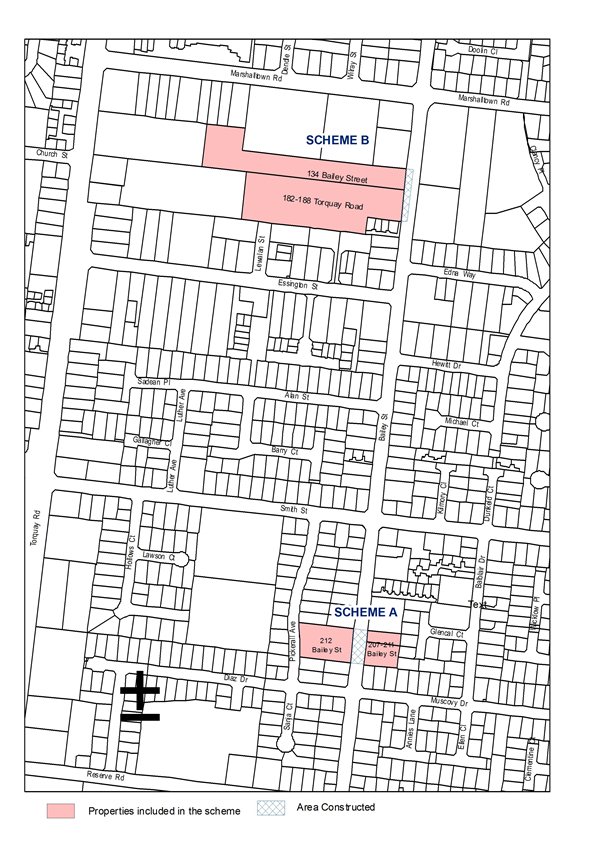
|
PROPERTY DESCRIPTION |
COST TO OWNER |
PROPERTY REFERENCE |
ADDRESS |
|
Pt CA 27 Sec 2 Ppsd Lots 1-3 & Stage 2 PS623391 |
$ 9,177.29 |
220308 |
207-211 Bailey Street, Grovedale, VIC 3216 |
|
Lot 1 PS 426404 |
$11,912.71 |
310327 |
212 Bailey Street, Grovedale, VIC 3216 |
|
PROPERTY DESCRIPTION |
COST TO OWNER |
PROPERTY REFERENCE |
ADDRESS |
|
Lot 2 PS 417819 |
$17,198 |
220390 |
134 Bailey Street, Grovedale VIC 3216 |
|
Lot 1 TP 885482B |
$20,384 |
299624 |
182-188 Torquay Road, Grovedale VIC 3216 |
Portfolio: |
Governance – Cr Harwood (Acting Mayor) |
Source: |
Corporate Internal Auditor and Ombudsman |
General Manager: |
Stephen Griffin |
Index Reference: |
Audit CG - Internal |
Cr Farrell moved, Cr E Kontelj seconded -
That in accordance with Section 89 (2) (h) of the Local Government Act 1989, this report be considered at the conclusion of all other business at which time the meeting be closed to members of the public.
Carried.
Contents | Previous Page: Section A - Procedural Matters | Next Page: Section C - Notice of Motion
