
Council Minutes - Section B: Reports - 12 November 2013
Contents | Previous Page: Section A - Procedural Matters | Next Page: Section C - Notice of Motion
Contents | Previous Page: Section A - Procedural Matters | Next Page: Section C - Notice of Motion
Reports tabled at the Ordinary Meeting of Council on Tuesday date held at City Hall, Little Malop Street in Geelong.
Amendment C285 Manzeene Village, Lara – Consideration of Submissions
Revocation of Flood-Prone Area Designation of new Lots at Armstrong Creek
Emergency Management Activity and Annual Fire Season Preparation Report 2012/2013
Geelong Major Events Committee – Appointment of External Representative
Delegation to the Chief Executive Officer – Stead Park Hockey Precinct Development Tender
Portfolio: |
Planning - Cr Macdonald |
Source: |
Economic Development, Planning and Tourism - Strategic Implementation |
General Manager: |
Peter Bettess |
Index Reference: |
Council Reports 2013 |
This report considers submissions received to Amendment C285 and recommends the submissions be referred to an Independent Planning Panel.
Amendment C285 seeks to rezone 60 hectares of land at Lara, constituting 26 Rural Living zoned lots, to the General Residential Zone.
The rezoning is accompanied by a Development Plan Overlay, Development Contributions Plan and Overlay, and a Native Vegetation Precinct Plan to transition the land for urban use.
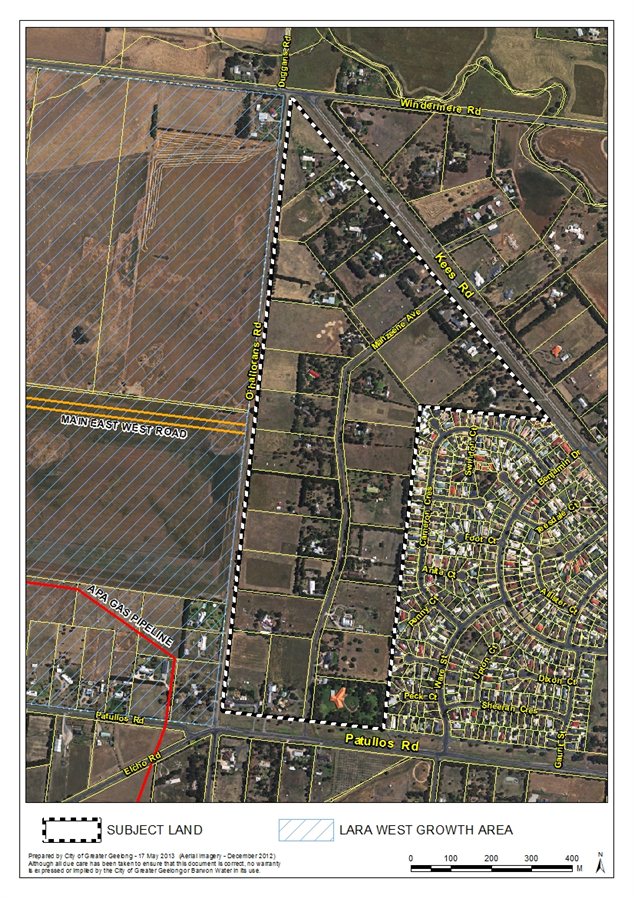
The land affected is bounded by Patullos Road, O’Halloran’s Road, Kees Road and the rear of existing residences to the east, on the western edge of the Lara Township. At full development, the land will provide for approximately 550-600 residential lots and compliment the adjacent Lara West Growth Area.
Public exhibition of the Amendment commenced on 22 August 2013 and closed on 30 September 2013.
As required by Ministerial Direction No. 15, a Planning Panel Hearing has been pre-set for the week commencing 16 December 2013. The panel hearing dates were included in the exhibition notice.
Council received 35 submissions. 16 submissions objected to the Amendment while the remainder supported, offered in-principle support or did not object to the Amendment.
Key issues arising from the submissions included: stormwater drainage management; road and traffic management; the high pressure gas transmission pipeline; land in the south west corner should be zoned for commercial uses and the drafting of the Development Plan Overlay Schedule.
In accordance with the Planning and Environment Act 1987, Council must now either: change the Amendment in the manner requested by the objecting submissions; refer the submissions to an Independent Panel; or abandon the Amendment or part of the Amendment.
Council officers have considered the submissions and do not recommend any major departures from what was exhibited.
This report addresses the issues raised in the submissions and recommends they be referred to an Independent Panel appointed by the Minister for Planning.
Cr Ansett moved, Cr Macdonald seconded -
That Council, having considered all submissions to Amendment C285 to the Greater Geelong Planning Scheme, resolves to:
Request the Minister for Planning to appoint an Independent Panel under Part 8 of the Planning and Environment Act, 1987;
Refer all submissions that have not been resolved to the Panel; and
Submit to the Panel its response to the submissions generally as outlined in this report.
Carried.
A rezoning application was made on 6 December 2012 by Spiire Australia on behalf of Dacland Pty Ltd. The area to which the rezoning applies is bounded by Patullos Road, O’Halloran’s Road, Kees Road and the rear of existing residences to the east, on the western edge of the Lara Township. Further to the west is the proposed Lara West Growth Area (Amendment C246).
The Amendment C285 land is proposed to be rezoned from the Rural Living Zone to the General Residential Zone.
The land is approximately 60 hectares and referred to as ‘Manzeene Village’ by the proponent. Dacland have formed an agreement with 23 of the 26 rural living landowners – a combined landowner entity known as the ‘Manzeene Avenue Development Trust Pty Ltd’. The other three landowners have been notified about the Amendment.
At its meeting on 9 July 2013, Council resolved to support the preparation and exhibition of Amendment C285 to the Greater Geelong Planning Scheme, subject to authorisation by the Minister for Planning. Ministerial Authorisation was received on 12 August 2013.
Public exhibition of Amendment C285 commenced on 22 August 2013 and closed on 30 September 2013.
The exhibited Amendment proposes to:
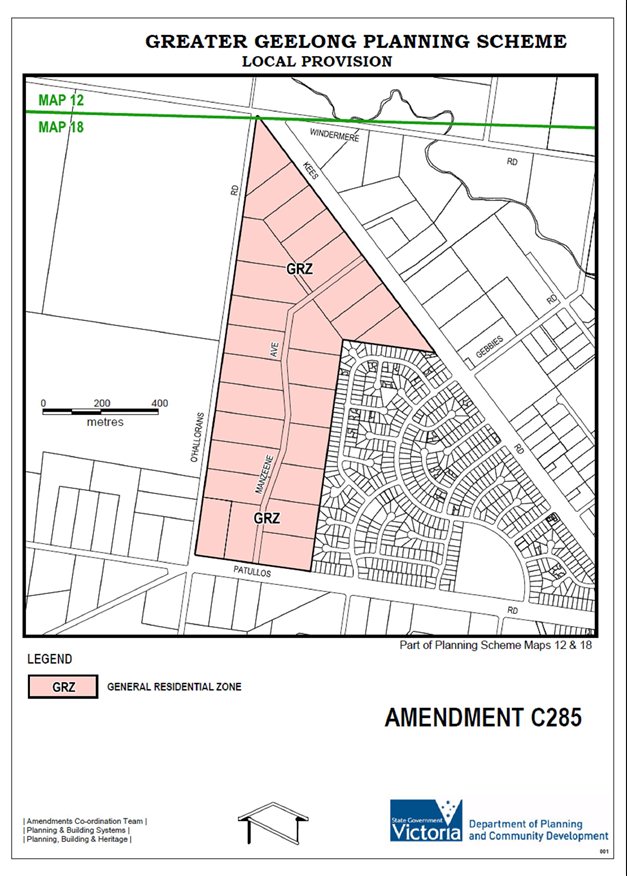
Rezone the land from the Rural Living Zone to the General Residential Zone and insert Clause 32.08 (General Residential Zone);
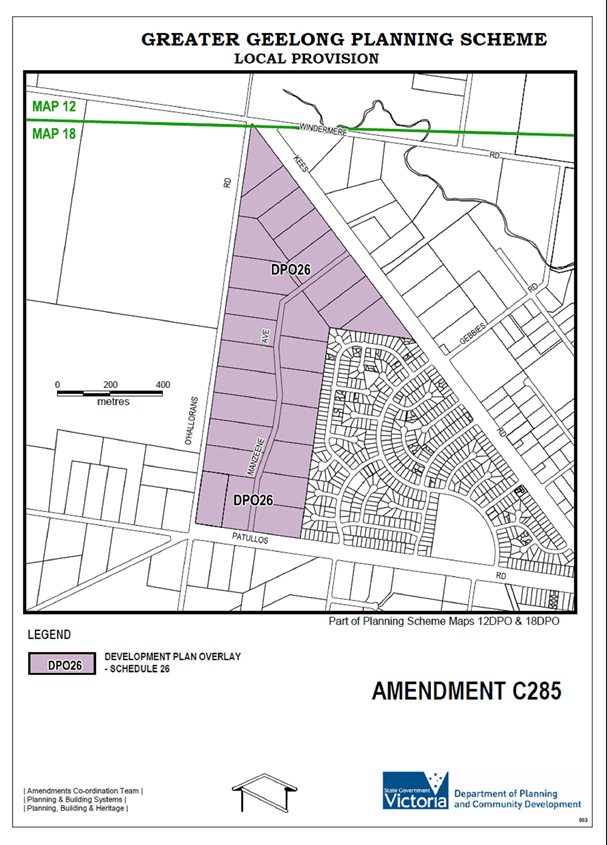
Apply a new Schedule to Clause 43.04 (Development Plan Overlay);
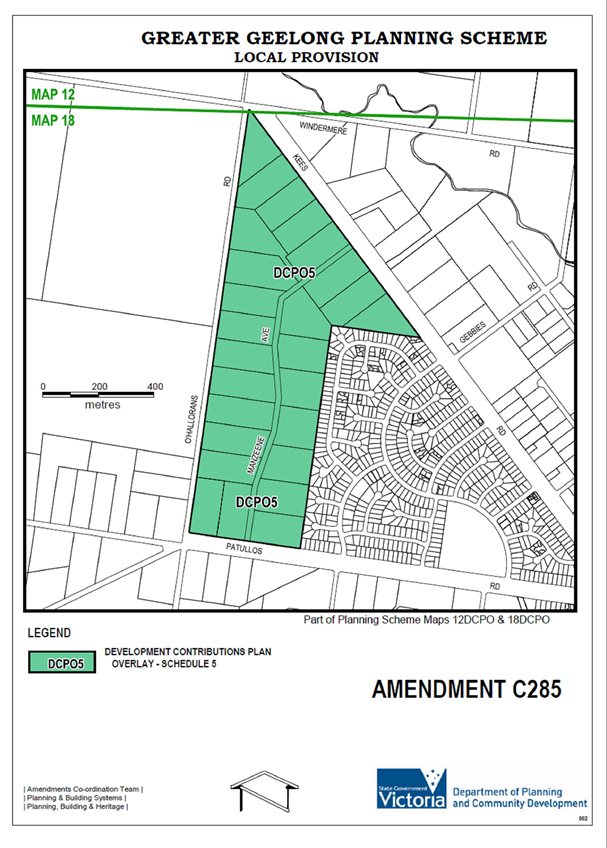
Apply a new Schedule to Clause 45.06 (Development Contributions Plan Overlay);
Replace the Schedule to Clause 52.16 with a new Schedule to include the Manzeene Avenue Development, Lara, Native Vegetation Precinct Plan.
Incorporate the following documents to the Schedule to Clause 81.01:
Lara West Development Contributions Plan, August 2013.
Manzeene Avenue Development, Lara, Native Vegetation Precinct Plan, November 2012.
Letters and notices were sent to relevant Government departments, statutory authorities and all land owners directly affected by any zoning or overlay changes, as well as to surrounding landowners.
A notice of the preparation of the Amendment appeared in the Victorian Government Gazette on 29 August 2013. Notices appeared in the Geelong Independent on 23 August 2013, the Geelong Advertiser on 24 August 2013 and the Lara Happenings on 31 August 2013.
A complete set of the Amendment documents were available on the Geelong Australia and Department of Transport, Planning and Local Infrastructure (DTPLI) websites, as well as hard copies at 100 Brougham Street, Geelong and at the Lara Regional Library.
Appendix 1 shows an aerial map of the land proposed to be rezoned. Appendix 2 shows the proposed Greater Geelong Planning Scheme map changes.
As a consequence of the Amendment C285 exhibition, a total of 35 submissions were received. Appendix 3 contains a schedule which summarises the submissions and Planning Officer response.
For the purposes of this report, a detailed breakdown of submissions shows:
9 in-principle or no objection submissions were received from State Government Departments and Authorities.
10 supporting submissions were received from:
9 from landowners of the Manzeene Avenue Development Trust Pty Ltd.
1 from a landowner in the Amendment C285 area, but not part of the Manzeene Avenue Development Trust.
16 objecting submissions were received from:
7 from landowners of the Lara West Growth Area, including the proponent of Amendment C246: Lara Lakes Pty Ltd.
1 from a landowner part of the Manzeene Avenue Development Trust (currently in discussion with the proponent to resolve their issues).
1 from a landowner in the Amendment C285 area, but not part of the Manzeene Avenue Development Trust.
5 from surrounding landowners.
1 from the proponent, Spiire Australia on behalf of Dacland Pty Ltd (Spiire lodged a supporting submission subject to several changes to the exhibited documentation).
1 from the Urban Development Institute of Australia raising concern over the proposed permit condition within the DPO Schedule to notify future land buyers of the existence of the high-pressure gas pipeline via a section 173 agreement.
Pursuant to the Planning and Environment Act 1987, the Council is required to consider all submissions made to an Amendment and must either: (1) change the Amendment as requested by the submissions; or (2) refer the submissions to an Independent Panel; or (3) abandon the Amendment.
The next section of this report outlines the key issues raised in the submissions and provides an officer response. Submissions which requested changes to the exhibited Development Plan Overlay Schedule have been responded to in a table format in Appendix 4. A track-changes version of the Schedule will be prepared for the Panel Hearing.
In the event the submissions are referred to an Independent Panel, as recommended, the responses in this report will form the basis for Council’s presentation to the Panel.
High pressure gas pipeline
As shown in the Appendix 1 map a natural gas transmission pipeline of strategic importance to the State of Victoria – known as the South West Pipeline (The Iona to Lara Pipeline), traverses land adjacent to the Amendment C285 land. Changes to land use within close proximity to the pipeline need to consider Australian Standard 2885 and Clause 16.03-6 of the Planning Scheme.
This is the same pipeline that was considered as part of Amendment C246 Lara West Growth Area adopted by Council on 12 November 2013. Extensive discussion on this issue can be found in the 12 November 2013 Council Minutes. Outcomes from the Amendment C246 process have assisted in the drafting of the Development Plan Overlay Schedule for this Amendment for referral and notification requirements.
Submissions were received from Energy Safe Victoria (ESV) and APA GasNet Australia (Operations) Pty Ltd. ESV request that the Development Plan Overlay Schedule be altered to seek the views of the ‘appropriate authority for planning matters related to the administration of the Pipelines Act 2005’, instead of ESV. ESV also requested that the wording for the requirement to enter into an agreement be in a form ‘acceptable to’ the ‘Minister administering of the Pipelines Act 2005’.
APA submitted that they own and operate the pipeline. APA supports the submission of ESV and supports the proposed development. The submission provides guidance for any works within the pipeline easement and highlights the public safety needs to be considered in proximity to gas pipelines. The submission notes on 18 June 2013 a Safety Management Study (SMS) was held on the Manzeene Avenue development and the SMS report is in the process of being finalised. The SMS found that certain types of uses should preferably be located 554 metres from the edge of this pipeline’s easement.
Spiire, on behalf of Dacland, does not agree with the Development Plan Overlay Schedule requirement for all landowners within the ‘measurement length’ of the gas pipeline to enter into a Section 173 Agreement. This requirement is intended to act as a mechanism to inform potential landowners of the proximity of the pipeline.
The submission goes on to say:
A s173 agreement is an inappropriate mechanism to communicate with landowners about the gas pipeline, and sets a burdensome precedent on all development in Victoria if implemented. The Manzeene Avenue SMS determined the ‘measurement length’ of the T92 Iona asset as 550m from either side of the 20m pipeline easement. The measurement length corridor extends approximately 1km. The current amendment alone would result in s173 agreements being required for approximately 112ha of land. Considering that high pressure gas assets extend over Victoria for several hundred kilometres, the regulatory burden of applying and enforcing such a mechanism to all affected land would create an unreasonable impost on both government and the community. We submit that separate s173 agreements with all landowners is a costly, onerous, inefficient and impractica mechanism to inform residents of the existence of the pipeline.
We understand that Energy Safe Victoria (ESV), the Department of Environment and Primary Industries (DEPI) and the APA are currently working to establish a notification process that ensures landowners (and relevant planning authorities) are provided appropriate information regarding high pressure gas pipelines. The process being undertaken by the regulatory bodies and licensee expert group should determine what, if any, notification mechanism is appropriate.
Furthermore we consider it imperative to ensure the community is not misinformed about the relationship between development and gas pipeline infrastructure. The Manzeene Avenue SMS has determined that the development being facilitated by the rezoning can proceed as all potential risks posed by the gas pipeline assets have been identified and managed by the APA, under scrutiny from ESV and the DEPI. Gas pipelines are common and long established infrastructure items that when managed correctly can co-exist with urban development with no credible risk to public safety. Introducing an onerous s173 agreement creates the perception that high pressure gas pipelines are a danger or liability to landholders. This is not an outcome that benefits Council, the relevant regulatory authorities or the community, and should be avoided at all cost.
A submission from the Urban Development Institute of Australia (UDIA) raised similar concerns to that of the Spiire/ Dacland submission.
Officer response
The minor word changes to the Development Plan Overlay Schedule suggested by ESV and supported by APA are agreed. References in the APA submission as to work within the pipeline easement, while important, are not relevant as the easement is not located within the Amendment C285 land.
The arguments raised by Spiire and the UDIA are valid and are not dismissed by Council. However, at this point in time it is not considered appropriate to support the submissions and remove the DPO requirement for a Section 173 Agreement. It is noted that neither ESV nor APA in their submissions sought to remove this requirement.
Council has included the same requirement in the planning controls for Amendment C246. This was the result of a recommendation where the C246 Panel Report said “It is in no-one’s interest that prospective land purchasers are ignorant of the presence of the pipeline or the risks associated with it and therefore notice for newcomers buying into the area about the existence of the pipeline is reasonable”. Council sought legal advice from Maddocks on the Panel’s recommendation. Maddocks advised that the use of an Agreement under section 173 of the Planning and Environment Act 1987 is an appropriate mechanism of giving notice.
Council should take a consistent approach on this matter, guided by the advice from the C246 Panel (and future C285 Panel), ESV, APA and the Department of State Development, Business and Innovation.
Hall & Wilcox Lawyers on behalf of APA in a letter to Council dated 3 September 2013, queried the proposed Section 173 Agreement as part of the Amendment C246 planning controls. The letter then states that APA “… intends to take this up as part of a broader submission to DPI and the Minister for Planning in respect of the need for the Victoria Planning Provisions to deal more strategically with the presence of infrastructure such as the pipeline.”
Council, as part of its resolution to Amendment C246, will write to the Planning Minister’s department to investigate the need for a planning control to recognise the gas pipeline and its measurement length. Council officers also understand that a State Government working group has been established to focus on land development around existing gas pipelines.
Proposed Neighbourhood Activity Centre in the south west corner of Manzeene Village
Spiire/Dacland submit that the land at the south west corner of the site be rezoned to the Commercial 1 Zone to allow for a future Neighbourhood Activity Centre (NAC) to be considered. The submission highlights the current chronic undersupply of retail services, particularly grocery shopping opportunities in Lara. Dacland has consistently said that land on the corner of Patullos and O’Hallorans Roads is the most appropriate site for a NAC.
The Spiire submission notes that the C246 Panel said there is planning policy support for the development of a NAC within the Lara West Growth Area. This was supported by Council. Dacland accept the Panel finding however consider the NAC is unlikely to be viable until at least 2027. Dacland maintain that an additional NAC is required and their corner site has strategic merit, with negligible impact to the ability of other activity centres to achieve their full potential.
Submissions received from landowners in the Lara West Growth Area, Lara Lakes Pty Ltd and CTS Property Investments do not support the Dacland proposal for a NAC in Manzeene Village. The submissions support the rezoning of the Amendment land to the General Residential Zone only.
Officer response
The exhibition of Amendment C285 includes rezoning all the land to the General Residential Zone only. There is no support to rezone part of the land to the Commercial 1 Zone. To support the Dacland submission would be a transformation of the Amendment and require the Amendment to be reconsidered at a Council Meeting, re-authorised by the Minister for Planning and then exhibited again.
The proposed General Residential Zone, with land in the south west corner abutting a Road Zone, provides for a number of commercial uses, including but not limited to, hotel, food and drink premises and service station. The Development Plan Overlay Schedule supports this approach.
What Council does not support is the establishment of a supermarket and associated specialty shops at this location. Council has consistently maintained that a NAC in the western part of Lara is best located central to the Lara West Growth Area supported by a range of other land uses and services in an orderly, planned manner.
Officers agree that the Lara West NAC may not be viable until 2027 but this is not considered to adversely impact on the local community. The time lag will allow for full development of the expanded Lara Town Centre, with preliminary works having commenced. This is a long-term project that has required significant investment by Council and other parties. The establishment of both a Coles and Woolworths full-line supermarket in the Town Centre will provide for the convenient shopping needs of western Lara residents, including future residents of Manzeene Village.
Council reiterates that it has never understood its own strategic planning and various panel reports and any other strategies done as ever contemplating two NAC’s in planning for growth in western Lara.
Road and traffic management
A coordinated submission from the Department of Transport, Planning and Local Infrastructure (DTPLI) and Public Transport Victoria (PTV) supports the Amendment. In particular the requirement in the Development Plan Overlay Schedule to prepare a Road Network Plan that provides for the continuation of the main East-West Connector Street from the Lara West Precinct through to Manzeene Avenue. According to PTV, this will enable a planned bus route to run through the central spine of Lara West and continue through Manzeene Village, creating a more direct and reliable route.
The Spiire submission acknowledges the need for efficient public transport in the area and provides in-principle support for a bus route through the Manzeene Village site. Spiire however consider it imperative that any future connection be constructed as an Access Street rather than a Connector Road. According to Spiire, an Access Street Level 2 with a road cross section of 16 metres and additional pavement area of between 7 and 7.5 metres is sufficient to accommodate a bus route if required.
Spiire further consider that continuing the East-West road as a Connector Street would undermine O’Hallorans Road as it results in two north south Connector Streets running parallel. Spiire submit that this upgrade creates a ‘rat-run’ scenario where motorists travelling north to Kees Road would shortcut through to Manzeene Avenue rather than the designated Connector Street network.
The DTPLI submission comments on some of the proposed intersection treatments. Given the close proximity of the Windermere Road / Kees Road and Windermere Road / O’Hallorans Road intersections and the use of Windermere Road as a truck route, the Department recommends that channelized right turn lanes are provided for both of these intersections.
The Department also notes that the SIDRA analysis of the Patullos Road and Manzeene Avenue intersection indicates that there would be significant delays for vehicles turning right from Manzeene Avenue. To alleviate this problem the Department says consideration could be given to modifying the proposed intersection treatment at Patullos/ O’Hallorans/ Elcho Roads to enable the right tuning traffic from Manzeene Village to prop in the medium as per the design for Patullos/ Elcho Road.
A submission from the landowner of 140 Kees Road – a property located on the opposite side of the C285 Amendment land, raises concerns about the current state of Kees Road and it being unsuitable to cater for traffic from the development. The submitter asks who is responsible for the upgrade to Kees Road and will it be upgraded before development begins.
Officer response
The submission from DTPLI/PTV regarding a proposed bus route through the development site is supported. It is noted that the position of PTV is consistent with comments provided to Council Officers and Spiire in February 2013. A well planned, efficient bus service through the growth areas of western Lara is an important part of creating sustainable, connected communities.
Officers do not agree that this bus route would create a ‘rat-run’ scenario. The continuation of the main East-West Connector Street from the Lara West Precinct though to Manzeene Avenue and Kees Road will be a planned Connector Street able to accommodate buses, vehicles, cyclists and pedestrians. Its function will be that of a Connector Street. This is consistent with the Lara West Precinct Structure Plan which shows an ‘arrow’ to indicate the possible extension of the main East-West Connector Street.
The DPO Schedule does not prescribe the cross-section of the Street but it must be compliant with the Department of Transport Public Transport Guidelines for Land Use and Development (2008). The design would be expected to be similar to roads in the Lara West Precinct that include a bus route. An Access Street Level 2 as proposed by Spiire would not meet the Department of Transport guidelines.
Officers support the recommendation to provide channelized right turn lanes for the intersections of Windermere Road / Kees Road and Windermere Road / O’Hallorans Road. This recommendation will be implemented by an additional requirement in the DPO Schedule and changes to the Development Contributions Plan. The cost implications to the Development Contributions Plan are expected to be minimal.
The DTPLI concerns regarding vehicles turning right from Manzeene Avenue into Patullos Road has highlighted a gap in planning for the development – the broader issue of traffic management and access to land in the south west corner. There are opportunities for this area to accommodate non-residential uses such as a hotel, food and drink premises and service station, although there is also the possibility that the land will be used for residential purposes.
The Cardno Traffic Impact Assessment in Section 5 should provide the basis for more detailed analysis once the uses in the south west corner are known. New requirements to the Urban Design Masterplan and the Road Network and Traffic Management Plan of the DPO Schedule are considered appropriate to address vehicle access/ egress, particularly in relation to limiting the use of Manzeene Avenue and management of the Patullos Road interface (both in its current configuration and the new Patullos/ O’Hallorans/ Elcho Road intersection design).
With regard to the concerns of the Kees Road landowner, Kees Road will need to be upgraded by the developer to the satisfaction of Council for its length between Benjamin Drive and Windermere Road. The construction of the road would occur when land fronting Kees Road is subdivided or as specified in the Development Plan.
Stormwater drainage management
A submission was received from the Corangamite Catchment Management Authority. The Authority provides in-principle support of the proposed Amendment subject to the inclusion of additional requirements to the Development Plan Overlay Schedule.
The Authority had previously advised the Council and proponent in February 2013 that no increase in extent, depth or velocity of flooding neighbouring properties is acceptable under proposed development conditions. The Authority notes that the site is subject to flooding during 1% AEP flood events and detailed stormwater assessments form part of the Amendment documentation.
The Authority has concerns that the assessment does not clearly outline the assumptions around filling of the site and how this has been allowed for in the modelling. The potential loss of floodplain storage at this location is of concern to the Authority given the extensive floodplain of Hovells Creek and the proposed confining of this floodplain at the subject site.
The landowners of 6 and 7 Denise Court, Lara, support the development provided it achieves a resolution of the flooding currently experienced on their property. The submitters’ land backs onto the Amendment land and they consider the drain at the rear of their property has inadequate capacity to cater for stormwater runoff. The submission requests that the DPO Schedule include a specific outcome to avoid the current overland flooding problems, not just ‘restricted to pre-development levels or flows’. This would also include removal of the existing ‘Flood Map’ over the submitters’ land. The submission also raises concerns about the impacts of the proposed fill works on visual amenity and requests the DPO Schedule include the option of constructing an underground drain along the site boundary.
A submission was received from CTS Property Investments (Vic) Pty Ltd – its shareholders are the owners of 85 Manzeene Avenue and part of the Manzeene Avenue Development Trust. The submission supports the rezoning but objects to elements of the proposed DPO Schedule and drainage scheme. CTS advises that there have been discussions with Dacland Pty Ltd to try to resolve the issues in dispute and is scheduled to meet with Dacland in mid October.
Spiire on behalf of Dacland in its submission noted that the Development Contributions Plan (DCP) as exhibited does not include any drainage infrastructure. The submission considers it possible that joint infrastructure will be required to cater for flows from the Lara West development. Spiire believe investigations should be undertaken to a point that provides Council and the developers of Manzeene Avenue confidence that no shared infrastructure will be required, or if found to be required, that such infrastructure is included in the DCP.
Officer response
The submission of the Corangamite Catchment Management Authority is currently under review by Council drainage engineers, who will work closely with the Authority and developer on this matter. Changes to the DPO Schedule to include the Authority’s requirements will be finalised prior to the Panel Hearing.
The concerns outlined in the submission by the landowners of 6 and 7 Denise Court, Lara are currently being reviewed by Council drainage engineers. Spiire engineers advise that the flooding affects within Denise Court have been modelled to be reduced as a result of the development. Requested changes to the Development Plan Overlay Schedule will be further addressed at the Panel Hearing.
Council acknowledges that the landowners of 85 Manzeene Avenue are part of the Manzeene Avenue Development Trust and is encouraged that the parties seek to resolve their issues in dispute. Resolution of drainage scheme matters relating to 85 Manzeene Avenue that result in changes to the Amendment documentation will need to be assessed and approved by Council and the Catchment Management Authority.
The Spiire/Dacland submission, while raising concerns about drainage infrastructure being omitted from the DCP, does not identify the location (or locations), infrastructure requirements or costings that should be shared with the Lara West developers. Council officers will meet with the proponent before the Panel Hearing to further clarify this issue.
At the Amendment C246 Panel Hearing, Council submitted that there had been ongoing discussions between Council’s drainage engineers, the proponent and Dacland on the subject of drainage of these precincts; and it had been determined that the drainage design will be a developer-funded item. The Panel found that there is no need to include drainage infrastructure in the DCP.
Council officers have further reviewed the Spiire submission, in particular the planning and delivery of off-site infrastructure to Hovells Creek. The DPO Schedule includes a requirement for the Integrated Water Management Plan to address: ‘Easement creation and/or widening and realignment as necessary to ensure adequate provision for pipe laying and maintenance, both within the development Precinct, and to external affected properties’.
To safeguard Council’s interests, Officers consider there is a need to ensure all costs associated with the facilitation and delivery of down stream drainage works to Hovells Creek, including easement widening and outfall construction, are borne by the developer. This could be implemented by an additional requirement in the DPO Schedule Section 3.0 or the requirement for a section 173 agreement in Section 2.0.
Public open space contribution
The Spiire/ Dacland submission agrees that development of the Manzeene Avenue land must provide high quality areas of public open space that serves the needs of the community. Spiire however, consider the blanket application of a 10% open space contribution does not take into account the constraints, characteristics or infill development context of the site. Spiire say an open space contribution of 5% of developable residential land is appropriate.
The submission goes on to say that the usability and amenity provided by the drainage and environmental requirements of the development informs that a 5% contribution is capable of creating a vibrant, usable, public open space network.
Officer response
The submission is not supported. Clause 52.01 of the Greater Geelong Planning Scheme is about public open space contributions and subdivision. The Schedule to the Clause requires a public open space contribution of 10% for 10 or more lots for land zoned for residential purposes after August 31st 2007.
The proposed Development Plan Overlay Schedule requires: ‘An open space contribution equal to 10% of the developable land or in-lieu cash payment or combination of both. Encumbered open space, including drainage reserves and conservation areas, shall not form part of the open space contribution.’ This 10% requirement is consistent with all recent green field rezonings in the municipality. Examples include Plantation Road, Corio (DPO27); Moss Road, Leopold (DPO25); Princess Street, Drysdale (DPO24); Central Road, Drysdale (DPO23); Ocean Grove Growth Area (DPO22); Jetty Road Growth Area Stage 1 (DPO20); and the St Leonards Golf Club (DPO19).
The argument that the site is an “infill development” was similarly raised in Amendment C246 and is again not supported here. The Manzeene Avenue area is no different to many other areas on the fringe of Melbourne and Geelong that simply integrate with future green field developments. They are un-serviced and undeveloped areas as opposed to infill sites that usually have surrounding infrastructure and facilities already provided and therefore only need to contribute to the increased infrastructure demand of these sites alone.
Council has consistently maintained that land set aside with drainage as its primary function is encumbered land. Land suitable for a public open space contribution has public park and recreation as its primary function and has no constraints (such as flooding within 1:100 ARI, easements or utilities infrastructure, specific native vegetation management requirements under an NVPP, etc.) on what recreation-facilitating landscaping, infrastructure and activities are allowable.
Council does not consider the use of flood-prone land (land within the 1:100 year ARI) or land set aside to retain native grasses as appropriate locations for usable public open space, although it encourages public open space to be located adjacent to such areas.
The new Schedule to the Development plan Overlay and the Lara West Native Vegetation Precinct Plan forms part of the Amendment and will be incorporated into the Greater Geelong Planning Scheme.
These documents are underpinned by extensive technical assessment and review and include a range of objectives and requirements to reduce environmental impacts and support sustainable development.
The Development Contributions Plan (DCP) is the primary mechanism for funding infrastructure to service the new growth area. The growth area requires in the order of $40M of infrastructure of which the DCP will fund approximately $36M. The infrastructure will be delivered over the 20 year life span of the DCP.
Council will be responsible for managing the funds collected through the DCP and either directly delivering the required infrastructure or making arrangements for developers to construct infrastructure as “works in lieu”.
Clause 11.02 ‘Urban Growth’ of the State Planning Policy Framework requires planning authorities to ensure that sufficient land is available to meet forecast demand. Lara is a designated primary growth node in the Greater Geelong Planning Scheme.
The ‘Manzeene Avenue/Kees Road’ area is identified as ‘Conventional residential’ in the Lara Structure Plan and Clause 21.13 of the Planning Scheme. Clause 21.13 supports the rezoning of this area with appropriate Development Plan Overlay and Development Contributions Plan Overlay controls.
The Amendment supports the Growing our Economy and Sustainable Built and Natural Environment strategic directions of City Plan.
The rezoning will maintain an appropriate supply of residential land in northern Geelong, and facilitate significant, long term investment in an area identified in Council’s Municipal Strategic Statement for growth.
The Lara West Precinct Structure Plan and Development Contributions Plan promote development of a sustainable built environment. This will be achieved by delivering community and retail facilities, integrated management of stormwater and open space, and an efficient transport and movement network.
No Council officer involved in the report has any direct or indirect interest, in accordance with Section 80(c) of the local Government Act.
Pursuant to Ministerial Direction No. 15 timeframes have been imposed on all planning authorities amending planning schemes across Victoria. Under section 12(2) of the Planning and Environment Act 1987, a planning authority must have regard to the Minister’s directions.
Failure to comply with the timeframes in the Direction may prompt the Minister to exercise powers under section 185 of the Act. This section allows the Minister to direct a planning authority to take any steps in the amendment process within a specific time. Not implementing the recommendation in this report to refer the submissions to a Panel may result in Council failing to meet its statutory timeframes for the amendment.
There are no other notable risks associated with implementing the recommendation contained in this report.
Councils are required to ensure a sufficient supply of land is available in designated growth areas for residential and other urban uses, including affordable housing close to jobs, transport and services.
The Manzeene Avenue development will be a fully planned community that provides a mix of housing opportunities. The development is a charge area of the Lara West Development Contributions Plan to provide western Lara with services and infrastructure to support these new communities.
The Amendment will not impact on any basic rights, freedoms and responsibilities as set out in the Charter. Planning legislation ensures an open community consultation process occurs, enabling people to freely express their views and if necessary obtain a fair hearing before an Independent Panel.
The Amendment was exhibited in accordance with the provisions of the Planning and Environment Act 1987.
In accordance with Clause 4(2) of Ministerial Direction No. 15 the following panel hearing dates have been set for this Amendment:
Directions hearing: in the week commencing 25 November 2013.
Panel hearing: in the week commencing 16 December 2013.
Planning Panels Victoria will notify all submitters of the Panel dates and invite requests to be heard at the Panel Hearing.
Cr Ansett declared an Indirect Interest by Close Association in Agenda Item 2 – C265 Flood Overlays in Portarlington East, Corio, Newcomb and Whittington – Consideration of Panel Report and Adoption in that he has relations in the flood prone area and left the meeting room at 7:35pm prior to discussion.
Cr Heagney declared an Indirect Interest by Close Association in Agenda Item 2 – C265 Flood Overlays in Portarlington East, Corio, Newcomb and Whittington – Consideration of Panel Report and Adoption in that her parents in-law own a property in the Portarlington area being considered and left the meeting room at 7:35pm prior to discussion.
Portfolio: |
Planning – Cr Macdonald |
Source: |
Economic Development, Planning and Tourism |
General Manager: |
Peter Bettess |
Index Reference: |
Council Reports 2013 / C265 - Reports Council & Other |
To adopt a planning scheme Amendment to apply the Special Building Overlay to land potentially subject to inundation.
Amendment C265 proposes to extend coverage of the Special Building Overlay (SBO) to reflect the findings of flood studies recently undertaken and adopted by Council.
These studies identify the nature and extent of flooding in the Portarlington, Newcomb-Whittington and Corio areas.
The exhibition of Amendment C265 resulted in the receipt of twenty five (25) submissions; including 2 concerning properties outside of the areas affected by the amendment, and 3 from government departments / statutory authorities, not objecting.
The exhibited Amendment, together with all submissions was referred to an Independent Panel appointed by the Minister for Planning for consideration, as required by the Planning and Environment Act 1987.
The Independent Panel has recommended that the Amendment be adopted as exhibited.
It is recommended that the Amendment be adopted as described in this report.
Cr Macdonald moved, Cr Richards seconded -
That the report be deferred.
Carried.
Crs Heagney and Ansett re-entered the meeting room at 7:35pm.
Portfolio: |
Infrastructure – Cr Ellis |
Source |
City Services – Engineering Services |
General Manager: |
Gary Van Driel |
Index Reference: |
Subject: Drainage – Floods |
The purpose of this report is to present a revision to the flood mapping for existing conditions produced within the early stages of the development of the Armstrong Creek Urban Growth Plan (UGP).
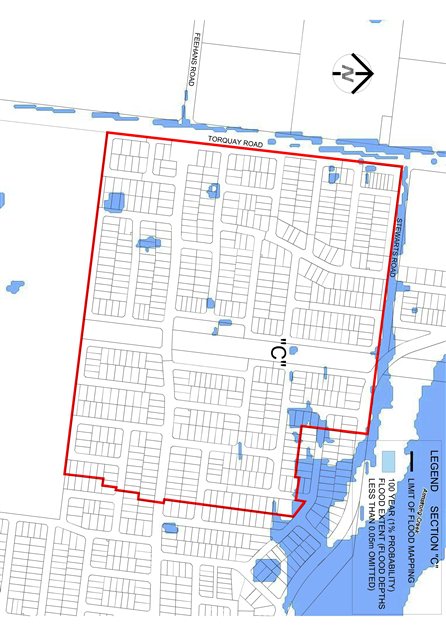
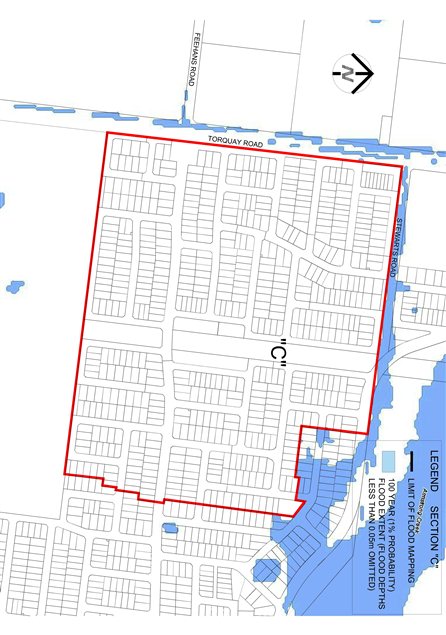
The flood mapping is subject to a revision due to the subdivision and development at 654-684 Torquay Road, 2-4 Stewarts Road, 42-80 Stewarts Road and part 82-110 Stewarts Road, Armstrong Creek. Prior to subdivision the parent lot was considered to be liable to flooding. This development site, which is also known as Warralilly Estate – Section C, achieves flood immunity for newly created lots for flood events up to and including the 100 year Average Recurrence Interval (ARI) event due to approved internal earthworks including the reshaping of Armstrong Creek.
The earthworks undertaken have resulted in the floodwaters from the 100 year ARI event being contained within the boundaries of the Armstrong Creek reserve.
Council has a statutory obligation under the Building Regulations 2006 to designate land as liable to flooding where it reasonably knows it to be prone to flooding. Conversely, there is an obligation to remove the encumbrance of designation from land that is no longer considered to be flood-prone.
It should be noted that designation is separate to the creation of flood overlays within the Planning Scheme, which generally follows designation. In the case of the Armstrong Creek UGP area, the planning scheme amendment to create post-development flood zones or overlays is proposed after the design of the proposed precincts.
The current designated flood mapping (refer to Appendix 3-1) was designated by Council at its meeting of 12 December 2006, under the provisions of the Building Regulations 2006. Designation of land as liable to flooding enables the control of floor levels for acceptable building permit applications, or refusal of consent to building applications where there is likely to be a danger to life, health or safety due to flooding. Designation also enables disclosure of flood status within statutory information certificates.
Cr Richards moved, Cr Macdonald seconded -
That Council revoke the Council designation of 12 December 2006 of flood affected land as highlighted as Section C on Armstrong Creek Urban Growth Plan Flood Map dated 29 November 2006 as liable to flooding pursuant to Regulation 802(2) of the Building Regulations 2006.
Carried.
As part of the development of the Armstrong Creek Urban Growth Plan (UGP) a flood study was undertaken by specialist consulting engineers to identify the extents of the 100 year Average Recurrence Interval flood event for existing conditions. Following a public exhibition phase, the resultant flood mapping (refer to Appendix 3-1) was designated by Council at its meeting of 12 December 2006, under the provisions of the Building Regulations 2006.
On 25 October 2011, section 1 of this project was adopted at Council. This is section 2 of the area designation and further sections will be presented to Council in the coming years.
Designation of land as liable to flooding under Regulation 802 of the Building Regulations 2006 enables the control of floor levels for acceptable building permit applications, or refusal of consent to building applications where there is likely to be a danger to life, health or safety due to flooding. Designation also enables disclosure of flood status within statutory information certificates such as the Land Information Certificate and Building Information Request Form.
The subject of this report is the residential land at Armstrong Creek bounded by Torquay Road and Stewarts Road. At the time of the flood study the subject land comprised of four larger lots. Prior to subdivision the parent lot was used primarily as farmland.
The subdivision at 654-684 Torquay Road, 2-4 Stewarts Road, 42-80 Stewarts Road and part 82-110 Stewarts Road, Armstrong Creek was named Warralilly Estate Section C by the developer. The current designated flood extent affects multiple residential lots within the Warralilly Estate Section C.
Overland flows that may occur within the subdivision during the 100 year ARI flood event are now contained within road and drainage reserves in accordance with accepted best practice for development within flood-prone areas. Best practice requires that any overland flows within residential areas satisfy public safety criteria with respect to velocity and depth of flow.
Council has a statutory obligation under the Building Regulations 2006 to designate land as liable to flooding where it reasonably knows it to be prone to flooding. Conversely, there is an obligation to remove the encumbrance of designation from land that is no longer considered to be flood-prone.
Appendix 3-1 shows the existing flood designation. Appendix 3-2 shows the change in flood mapping at 654-684 Torquay Road, 2-4 Stewarts Road, 42-80 Stewarts Road and part 82-110 Stewarts Road, Armstrong Creek after construction of the subdivision.
The revocation of flood-prone areas designation and designation of revised flood data does not result in any known adverse environmental impacts.
The removal of a minimum floor level requirement for new dwellings may result in a minor reduction in energy and material usage during construction. In addition, concrete slab-on-ground construction, which is normally used for a non-elevated floor, achieves the minimum energy rating more readily than a timber floor on stumps.ditions are suitable for sensitive land uses by introducing a planning control, namely the Environmental Audit Overlay.
The costs of proceeding to revoke the existing designation and to designate the revised flood mapping at 654-684 Torquay Road, 2-4 Stewarts Road, 42-80 Stewarts Road and part 82-110 Stewarts Road, Armstrong Creek, in accordance with the requirements of the Building Regulations 2006, are provided for within the annual recurrent budget.
The City has various statutory responsibilities for drainage management and flood management (prevention, response and recovery) as set out in the Local Government Act 1989, Local Government Regulations 1990, Planning and Environment Act 1987, Building Regulations 2006, Water Act 1989, Subdivision Act 1988 and Emergency Management Act 1986.
Regulation 802(2) of the Building Regulations 2006 provides Council with the powers to ‘designate’ land liable to flooding. Regulation 802(3) provides that consent must be obtained from Council for an application to build on land liable to flooding.
Section 27 of the Interpretation of Legislation Act 1984 provides the power for Councils to ‘repeal or amend a subordinate instrument made in the exercise of that power’.
Section 807 of the Building Regulations 2006 requires Council to update the municipality’s designated special area maps at the Building Control Commission in the event of alterations to a designated special area. Designated special areas include areas designated as being liable to flooding.
Section 229 of the Local Government Act and Regulation 326 of the Building Regulations provide for the issue of information certificates containing prescribed information, including the flood status of properties.
The revised flood data for 654-684 Torquay Road, 2-4 Stewarts Road, 42-80 Stewarts Road and part 82-110 Stewarts Road, Armstrong Creek will assist the City in meeting its statutory obligations with regard to flood data.
The revised flood data will also assist in fulfilling the recommendations of the Municipal Emergency Management Committee adopted by Council in November 1998 (i.e. mapping of 1 in 100 year flood levels).
In revoking the Land Liable to Flooding (LLF) designation ensures that Council provides accurate and reliable information to its community, in line with Council’s City Plan of How We Do Business.
There are no officer direct or indirect interests with respect to this report.
Council has a risk exposure through its statutory obligations under the Building Regulations 2006 to:
Designate land as liable to flooding where it reasonably knows it to be prone to flooding;
Specify minimum floor levels in consultation with the relevant floodplain management authority (CCMA); and
Refuse consent to building applications where there is likely to be a danger to life, health or safety due to flooding.
Council also has some risk exposure with any failure to disclose the flood-prone status of a property in a Land Information Certificate.
The designation of the flood data produced by the flood study Armstrong Creek UGP project is a key step toward minimising Council’s exposure to these risks.
Conversely, there is an obligation to remove the encumbrance of designation from land that is no longer considered to be flood-prone. Designation of land as being liable to flooding can result in extra construction costs and concerns regarding saleability, in some cases.
Council has a responsibility to the community to provide the best possible information on areas that are flood-prone.
We have taken into consideration all Human Rights as part of the drafting process of this report, none of which apply.
The current designation was undertaken following a public exhibition in October 2006 with notification of affected property owners. These owners were sent letters and fact sheets with an invitation for submissions.
A revocation of designation does not warrant public consultation as it constitutes the removal of an encumbrance on land.
The owners of properties affected by the revocation will be notified so they are aware that disclosure of flood status on a Section 32 Vendors Statement is no longer required.
Relevant Council databases and flood maps will be revised and updates sent to the Corangamite Catchment Management Authority and Building Control Commission.
Portfolio: |
Infrastructure, Parks and Gardens - Cr Ellis |
Source: |
City Services - Emergency Management and Fire Prevention |
General Manager: |
Gary Van Driel |
Index Reference: |
Emergency Management |
This report has two purposes:
Informs Council on the various emergency management activities that have been undertaken for the period June 2012 to October 2013; and
Informs Council on the long-range weather forecast for the period October 2013 to February 2014 and outlines Council’s preparedness actions currently being implemented for the 2013/2014 Fire Season;
The Council is the owner of land at 400 Melbourne Road, North Geelong being Deppeler Park (Seagull This report is to provide information to Council regarding Emergency Management activities over the period June 2012 to October 2013 as well what preparation actions are underway for the 2013/2014 Fire Season.
The 50 fire preparedness actions (refer to Attachment 1) are currently being implemented according to the timeframes shown.
As at 3rd October, 2013, the Bureau of Meteorology (BoM) was advising that their own model as well as all of the international climate models surveyed by the BoM indicated that a neutral state, i.e. neither El Nino or La Nina conditions will persist throughout the remainder of the Spring and into Summer.
The ensemble means for the September model run of International Model for area NINO3.4, (i.e. mid Pacific Ocean along the equator) outlooks are:
October : neutral (neither El Nino or La Nina)
December: neutral (neither El Nino or La Nina)
February: neutral, but tending slightly to weak El Nino event
At the time of drafting this report, the Country Fire Authority’s District 7 Office had not advised as to the commencement date of the 2013/2014 Fire Season, ie. Fire Danger Period (FDP). However, given the recent late Autumn and now Spring rain events the municipality and region is experiencing, the greatest fire risk for the 2013/2014 fire season is expected to come from fast moving grass fires rather than bushfires;
Councils fire hazard inspection program commenced on November 4th 2013
Council’s Coordinator Emergency Management and the Municipal Fire Prevention Officer attended the 2013/2014 Fire Ready Communications Briefing on 9 October 2013. This briefing was coordinated by the Municipal Association of Victoria and the Department of Justice and included a Summer Fire Season Overview by the Fire Services Commissioner, Craig Lapsley.
Cr Richards moved, Cr Macdonald seconded -
That Council:
notes the 2012–2013 report on Emergency Management Activity and Annual Fire Season Preparation Report; and
forwards a copy of the 2012–2013 report on Emergency Management Activity and Annual Fire Season Preparation be forwarded to the Western Region (Barwon South West) Emergency Management Inspector.
Carried.
Each year, Council receives a Fire Season Preparation Report along with an Emergency Management Activity Report. This year, both reports have been combined into one.
The Emergency Management Activity and Annual Fire Season Preparation report provides an overview of a number of tasks undertaken by Council officers allocated emergency management responsibilities, along with a list of actions that are undertaken each year in preparing the municipality for the annual Fire Season.
The past 12 months has been relatively free of emergency incidents. This has allowed for officers allocated emergency management responsibilities to action a number of tasks:
Document updates
Work has continued with the development and updating of a number of emergency management related documents including:
The 2012 update of the Municipal Emergency Management Plan was released during January 2013. The 2013 update in now nearing completion and will be distributed during November 2013.
A supervisor’s manual on financial management arrangements associated with an emergency event has been developed. This manual explains the importance of maintaining accurate financial records that will enable Council to maximise the value of reimbursement it receives via the State Governments’ Natural Disaster Financial Arrangements (NDFA).
A three year Emergency Management Strategic Plan has been developed. The Plan, which is subject to a separate Council report, provides direction for emergency management planning for the period commencing at the start of the 2014/15 financial year and finishing at the end of the 2016/17 financial year.
A Draft Fire Season Preparedness Manual has been developed.
This Preparedness Manual collates into one document all the key actions that Council undertakes as part of its Fire Season Preparedness Actions. Once completed and as the fire danger period approaches, this document will be circulated to the relevant EM Council officers, and also to the Police Municipal Emergency Response Coordinator (MERC) and the Police Regional Emergency Response Coordinator (REMC).
Council’s Flood Warning Manual has been re-written during 2013 and expanded as the previous manual required updating and limited in content.
A Flood Management Plan was developed by VICSES for the City during 2012/2013. The VICSES Plan was based on Council’s existing 200+ page Flood Operations Plan that has been developed by Council officers over the last ten plus years.
A new Event Preparation Proforma along with a Field Deployment Checklist was developed in early 2013. The proforma summarises all key actions undertaken for a particular event and is circulated to key Council officers. The Checklist ensures that proper arrangements are in place for all field deployments.
Updating the 2013 version of the MERO Aide Memoire is complete and the update distributed to the three deputy MEROs and Council Municipal Emergency Manager.
Numerous sub-plans have received their annual review.
Field inspections of Council’s Flood Levees and above ground urban retention basins have been completed.
The Municipal Fire Management Plan has been reviewed by the Municipal Fire Prevention Officer and the Municipal Fire Management Planning Committee.
Preparations are currently underway for the Fire Prevention Units annual fire hazard inspection program. This program requires Council’s Fire Inspectors to transit every road within the municipality looking for fire hazards – in particular long grass. This inspection program commenced on November 4th 2013.
Council’s Recovery Management Team have undertaken a range of review and improvement processes relating to their responsibilities in regard to Emergency Management, including targeted work in the areas of:
Vulnerable Persons planning
Standard Operating Procedures
Annual Review of Municipal Emergency Management Plan
Volunteering during emergencies
Training and development of staff in Emergency Management
Relief/Recovery Centre management – exercise attendance – Surf Coast Shire
Investigation of funding opportunities – RDV Resilient Communities Grant Program
2014 MEMPlan Audit – commenced work preparing for audit
Social Media use in relation to Community Recovery in an emergency – development of an approach and procedure.
Council Public Health Emergency Coordinator (PHEC) is currently undertaking an annual review of the Animal Welfare in Emergencies Sub-plan and during October 2013, the annual review of Council’s Heatwave Plan is to be undertaken. In addition the following tasks are, or have been performed:
Attending Building Capability in Communities: A National Approach to Animals in Disasters 24 and 25 September, 2013
Due to review Heatwave Plan in October 2013, the PHEC will look into long hot days that haven’t technically triggered the Department of Health Heat Health Alerts
Pandemic Plan Review underway
Public Health Sub Plan Review underway
Unit now has five EHOs that have completed the Public Health Emergency Management Course at Mt Macedon.
Exercises
Council officers attended the following exercises:
CFA Level 3 Incident Control Centre Exercise – 18 September, 2012
VICSES Earthquake desktop exercise 10 December 2012
Avalon Airport Emergency Committee meeting and exercise 13 December 2012.
Shell Exercise – October 8th 2013.
Financial Claims
The claim for the Rain & Flooding Events that occurred during May & June 2012 was finalised and Council received $125,000 back from the Victorian Government’s Department of Treasury and Finance.
State Municipal Emergency Management Enhancement Group (MEMEG) Meeting & Annual Conference
Councils Coordinator Emergency Management and Fire Prevention attended the State MEMEG meeting that was held on 21 May 2013 at Maribyrong City Council Municipal Offices and the General Manager City Services attended the Annual Conference that was held at Shepparton on 20 September 2013.
Work continues with the formation of a Barwon South West Regional MEMEG Committee. This new forum was suggested by the City of Greater Geelong at the May State MEMEG meeting and is supported by the State MEMEG Committee.
Community Meetings and Education
Work continues with the development of ‘Shelter-in-Place’ community education campaign. This campaign will be focused in the first instance on the northern suburbs as it contains information on chemical fires/incidents.
A working group under the MEMPC has been established. A draft suite of community education documents have been developed, comprising:
A letter to the Resident
Information brochure
Sheet of Frequently Asked Questions
Fridge magnet
The working group is currently reviewing the document proofs. However, given the closeness of the 2013/2014 Fire Season it is unlikely that these documents will be distributed prior to the fire season. There needs to be a clear distinction between the ‘Leave and Leave Early’ message that the Country Fire Authority will shortly promote and the Shelter-in-Place message that ties back to a chemical fire/incident.
Community Meetings
The CFA have conducted a number of community meetings at Anakie and at St Leonards / Indented Head in order to develop Community Risk Management Plans. Council officer attended some of these meetings.
Following the conclusion of the St Leonards / Indented Head meetings, a community survey was conducted. It was clear from the survey results that a community education campaign is needed. To this end, Council officers will make a grant application to the Resilient Community Program that is managed by Regional Development Victoria that targets community education with respect to bushfire risk. Grant applications close early October 2013.
Officer Training
Training of Council’s new Flood Warning Officer and Deputy Municipal Resource Officers continues. This training consists of:
Providing an understanding of the State/Regional and Local emergency management arrangements
Knowledge of key documents including:
MERO Aide Memoire
MERO Operations Plan
Stormwater Pump Operations Manual
Flood Levee & Retention Basin Manual
Flood Warning Manual
MEMPlan and its sub-plans, and
Field inspections
Bushfire Related Training was conducted by the Country Fire Authority at the request of the City of Greater Geelong. This training took place during September 2013 and trained over 70 Council officers from various Council Divisions in basic bushfire behaviour and survival techniques for employees.
Risk Assessments
During February 2013 a Landslide Risk Assessment Workshop was held. This workshop, which was chaired by the City of Greater Geelong, focused of landslide risk particularly on the north coast of the Bellarine Peninsula. Following on from this workshop a Landslide Sub-plan was developed and endorsed by the MEMPC.
Vulnerable People
Work continues by Council’s Home and Community Care Unit in undertaking client assessments to determine their vulnerability to an emergency, ie. ‘all hazards’ assessments. This work complements the work previously undertaken by the Unit in assessing HACC Clients who are vulnerable from a bushfire.
In addition to this work, State and/or Federally funded facilities which deliver in-home services also continue to undertake assessment for vulnerability of their client base. Once an individual is assessed as being vulnerable they are then uploaded onto a state wide software program known as ‘MECC Central’. Access to this software is restricted. The database allows VicPol officers of the rank Senior Sergeant or above to produce a Vulnerable Persons report for the Evacuation Manager appointed to an emergency.
Upgrade to the Hovells Creek Flood Warning System
During 2012, improvements were made to Council’s Hovells Creek Flood Warning System. One major improvement included the installation of a data logger that now allows for key Council officers to send an SMS to the site and the site responds with key flood information included the real-time height of flood waters at the Flinders Avenue, Lara site. This information can be used in deciding if any downstream creek road crossing needs to be closed.
Event Preparation Proforma and Field Deployment Checklist
As mentioned above, a new Event Preparation proforma and Field Deployment checklist was developed. These new documents were used for a number of fire danger days including:
17 and 24 January 2013
6 and 18 February 2013
3 and 12 March 2013
The only field deployments in support of CFA crews were in late 2012 and on January 13, 2013 to a grass fire located to the north of Little River on Ripley Road.
Memorandum Of Understandings
Most recently, Council’s Municipal Recovery Manager has negotiated access to the Geelong Showgrounds where subject to availability; the venue could be used as a potential tent city, mass feeding site and animal storage location.
Preparation Action for 2013/2014 Fire Season
As per previous fire seasons, Council has a broad range of preparation actions that it introduces prior to, and during the Fire Season. The following is a summary of these 50 + actions which are grouped under the key headings of:
Training
Database updates
Community Education
Documentation reviews
Field Operations Actions and
Miscellaneous Actions
Attachment 4-1 lists the various actions for each of the abovementioned key areas.
Weather Forecast
According to the Bureau of Meteorology (BoM), September is usually the time when El Niño events consolidate. However, recent cooling that has occurring is somewhat unusual; hence the risk of an El Niño event (ie. Dryer rather than wetter conditions) remains;
In the September 2013, El Niño Southern Oscillation Statement (ENSO) issued by the Bureau advised that indicators such as the Southern Oscillation Index (SOI) and tropical cloud patterns had remained at neutral levels, i.e. SOI = +4 (as at 22 September 2013).
As at 3rd October, 2013, the Bureau of Meteorology (BoM) was advising that their own model as well as all of the international climate models surveyed by the BoM indicated that a neutral state, i.e. neither El Nino or La Nina conditions will persist throughout the remainder of the Spring and into Summer.
The ensemble means for the September model run of International Model for area NINO3.4, (i.e. mid Pacific Ocean along the equator) outlooks are:
October : neutral (neither El Nino or La Nina)
December: neutral (neither El Nino or La Nina)
February: neutral, but tending slightly to weak El Nino event
It is an important fact that many emergency events do have an impact on the environment. Well planned response and recovery practices will only assist to minimise this impact. This is a further compelling reason for Council’s close attention to its emergency management role.
The attached preparedness actions involve officer time which is fully budgeted.
Budget impact will occur should an event transpire during the Fire Season and Council is called upon in its support role to the emergency services. However, some of these costs can be recovered from the Control Agency and/or the State Government.
No impact to budget is anticipated, but cannot be guaranteed..
Council’s Emergency Management Policy (CPL275.2) tasks Council with ‘…the provision of timely and coordinated response and recovery activities with its resources to assist in community emergencies…’
To this end, the emergency management actions as well as the Fire Season preparedness actions should decrease Council’s exposure to public liability claims.
The contents of this report relate to City Plan 2013–2017 Community Wellbeing strategic direction. The Plan provides a direct link to the Municipal Emergency Management Plan (MEMPlan) which is listed as a master plan to assist in delivering Community Wellbeing priorities.
No Council officers associated with writing this report have any direct or indirect interest, in accordance with Section 80 (C) of the Local Government Act.
Dealing with a bushfire event is high risk for all concerned. To this end, all preparedness actions that have been listed in this report are designed to ensure, as far as is practicable, that the risks to the community from a fire event are mitigated and that the City is prepared and well place to respond and recover from a bushfire/wildfire.
The application of the outlined emergency management actions as well as the fire season preparedness actions will have a positive impact on the c
ommunity by ensuring that the City maintains and enhances the support role it fulfils during an emergency event.
The outlined actions and fire season preparedness actions are key to ensuring that Council and the community is well prepared, as far as is practicable, for the challenges associated with an emergency event.
An emergency, depending upon its size and nature can affect the whole community and, once again, depending upon the type of emergency can have long lasting community impact. The implementation of all actions contained within this report strives to enhance community safety. Implementation of the emergency management actions and fire season preparedness actions is consistent with the obligations under the Victorian Charter of Human Rights and Responsibility.
Each year, Council continues to promote and educate the community about the fire danger that exists, the actions that Council is taking and more importantly, the action that the community needs to undertake. This promotion/education program must be ongoing.
Following on from the 9 October 2013, 2013/2014 MAV Fire Ready Communications Briefing which were held at the City of Whittlesea , Council’s Coordinator Emergency Management and the Municipal Fire Prevention Officer meet with Council’s Communications and Marketing Unit in order to develop article(s) for the Community Update.
All actions are programmed to be undertaken at particular times of the calendar year and are allocated to particular officers. All actions are also incorporated into Council’s Corvu software program so that tracking the status of each action is possible.
|
Task |
Précis |
Action Month |
|
Training |
||
|
Municipal Emergency Coordination Centre (MECC) related Training |
Training of administrative officers who provide administrative support to the MECC. This includes the MECC (Facility) Manager |
October/November |
|
Maintaining Safety at an Incident Scene (Wildfire Survival) Training |
Training / re-training of Council officers on fire behaviour and what actions to take to maintain safety |
Completed Sept – Oct 2013 |
|
Emergency Relief Centre (ERC) Management Training |
Training of ERC Managers and support staff |
October |
|
Database Reviews / Updates |
||
|
Emergency Relief Centre (ERC) contact database |
Check that contact phone numbers of ERC Managers has been updated, keys are available etc |
September |
|
Heavy Plant, equipment and other supplier database |
Update contact details for equipment, heavy plant, hardware suppliers, pumps, water tanker etc |
October - completed |
|
Water Tanker Suppliers |
Update water tanker supplier database |
October - completed |
|
Portable Toilet Suppliers |
Update portable toilet supplier database |
October - completed |
|
Hardware Suppliers |
Update hardware supplier database ie
|
October - completed |
|
Contracted Plant |
Update contracted plant/equipment supplier details contracted to the City |
October |
|
Static Water Tanks – sports grounds |
MERO to liaise with Water Management Officer for current list of static water tanks at sports grounds |
October - completed |
|
Community Education |
||
|
Council’s Emergency Management Web Page |
Undertake quality check of contents and hyperlinks |
October |
|
CFA Publications |
Obtain copies of key CFA publications and distribute to Council’s Customer Service Manager for display at Customer Service Centres |
October |
|
CFA – Community Fireguard meetings |
MFPO to attend CFA Community Fireguard meetings in high risk areas of the municipality |
As per CFA timetable |
|
Community Update |
Discussions have already taken place with Council’s Media Unit to include articles on the following topics:
(dependent upon available space) |
November/December – assuming print space with Update exists |
|
Document Reviews |
||
|
2013 Update Municipal Emergency Management Plan (MEMPlan), |
All Parts of the plan to be reviewed and any changes to be approved by the Municipal Emergency Management Planning Committee |
September - Completed |
|
MEMPlan Contact List |
Update Part 10 of Plan. |
April & October - Completed |
|
Emergency Evacuation Strategy |
Annual review of strategy by MEMPC sub-group and ensure that MEMPC approves any changes |
Underway |
|
Management of Animals During an Emergency Sub-plan |
Sub – plan updated (in consultation with Department of Primary Industries). Now need to meet with Council Animal Control Unit |
Underway |
|
Bushfire Sub-plan |
Sub-plan to be considered by MEMPC |
November MEMPC meeting |
|
Total Fire Ban Management Procedure |
Annual review of City Services Management Procedures of certain actions that are not performed on days declared as a Total Fire Ban and raise at Tool Box meetings |
October |
|
MERO Aide Memoire |
Annual review of Aide Memoire that is used by MERO and Deputies. Document contains over 30 checklists that assists the MERO in the performance of his duties |
September - Completed |
|
MECC Contact Lanyard |
Update of contact lanyard that is distributed to all attendees at Municipal Emergency Coordination Centre |
November |
|
After Hours Contact Database |
Update of outdoor staff contact details following annual staff reviews |
November |
|
Staff Rostering |
EMG Review of Staff Rostering document and development of roster for key emergency management & support staff |
October |
|
Code Red Guidelines |
EMT to review new draft CoGG guidelines that control movement/availability of key CoGG Emergency Management Staff |
October |
|
Essential Water Replacement Policy |
Make necessary alterations following State Govt release/update of Policy |
December |
|
Field Operations |
||
|
Permit to Burn Signs |
MFPO immediately prior to start of Fire Season to liaise with Works Maintenance Officers to have signs erected |
November |
|
Boundary 774 Warning Signs |
Check that signs are in place |
October - underway |
|
Fire Plug Maintenance |
Annual check of fire plugs in high fire risk areas within municipality |
November |
|
Standpipes |
Annual check of Council’s 12 standpipes |
November |
|
Fire Access Tracks |
Annual check to ensure that maintenance works have been completed |
October |
|
Fire Hazard Inspections |
Fire Prevention Unit to commence 1st inspections during October |
Commences November 4th 2013 |
|
Roadside Slashing Operations |
Council’s Parks Maintenance Unit undertake roadside slashing and prioritise works to;
|
Commences November |
|
Static Fire Tanks |
Annual check of Council maintained water tanks positioned at Anakie |
November |
|
Fuel Reduction Operations – Vacant Blocks |
Review of documentation used to employ contractors |
September - completed |
|
Council Water Tankers |
Annual mechanical check |
November |
|
Parks Knap Sacks |
Annual check of equipment allocated to tractors/mowers |
November |
|
Fire Kit bags |
City Services Stores Unit to recall bags that are deployed with staff deployed to assist CFA. Stores to check contents and re-issue |
November |
|
Miscellaneous Actions |
||
|
Major Events |
Contact Council’s major Events Unit and obtain a copy of all events scheduled for Dec – Feb & forward to CFA District 7 Operations Manager |
November |
|
MECC Set-up Rehearsals |
Undertake two surprise rehearsals each year |
April & November |
|
CFA Fire Season Briefing Meetings |
MERO & MFPO to attend CFA Region 7 fire season briefings |
As per CFA Schedule |
|
CoGG/CFA Annual meeting |
Annual meeting with District 7. Meeting used to discuss key issues |
As per CFA Schedule |
|
Emergency Management Group |
Internal staff meeting to discuss fire season preparedness actions and weather forecasts |
October - completed |
|
MECC Activation Arrangements |
Confirm MECC standby/activation arrangements and Agency staffing at Nov MEMPC meeting |
November MEMPC meeting |
|
MECC Agency Boxes & Systems Check |
Annual check |
October |
|
Brief MEMPC on Preparedness Actions |
At last meeting of MEMPC for the year, MERO, MRM & MFPO to brief the committee at its last meeting for the year on Council’s preparedness actions |
November MEMPC meeting |
|
MERO Meeting |
Arrange and coordinate MERO meeting with BoQ, SCS, GPS, WCC & MSC |
Early 2014 (to be co-ordinated by Surfcoast Shire) |
|
MFPO Meeting |
Arrange and coordinate MFPO meeting with BoQ, SCS, GPS, & MSC |
Early 2014 |
Portfolio: |
Infrastructure, Parks & Gardens – Cr Ellis |
Source: |
City Services - Emergency Management & Fire Prevention |
General Manager: |
Gary Van Driel |
Index Reference: |
Emergency Management |
The purpose of this report is to inform Council on a recently developed three year (draft) Emergency Management Strategic Plan.
The draft Plan provides direction for emergency management planning for the period commencing at the start of 2014/15 financial year and finishing at the end of 2016/2017 financial year.
Key strategies and performance indicators have been developed in conjunction with Council’s multi-agency Municipal Emergency Management Planning Committee as well as Council’s internal Emergency Management Group.
The draft Strategic Plan focuses on six key objectives:
Emergency Management Planning
Continuous Improvement
Knowledge Retention and Staff Development
Resource and Service Delivery
Community Education and Stakeholder Relationships
Financial Investment
Each of the six objectives has a number of strategies, performance measures and timeframes for completion.
The Plan contains a 3-year Funding Model that will be subject to Councils normal budgeting process coupled, where possible, with applications to State and Federal grant programs.
The Plan is a key component that supports the Council in meeting its many obligations and will assist in preparing both the organisation and the community in preparing for, responding to and recovering from an emergency.
Circulate a copy o the Emergency Management Strategic Plan to Councillors Working Space and a copy to each Councillor.
Cr Richards moved, Cr Macdonald seconded -
That Council:
endorse the draft Emergency Management Strategic Plan 2014 – 2016;
approve the release of the draft Emergency Management Strategic Plan 2014 – 2016 for public comment for a six-week period; and
receive a final report at the conclusion of the public consultation period for possible adoption of the Emergency Management Strategic Plan 2014 – 2016.
Carried.
This is the first Emergency Management Strategic Plan that has been developed for the City of Greater Geelong. Its development has taken over 12-months and has involved consultation with Council’s multi-agency Municipal Emergency Management Planning Committee as well as Council’s own internal Emergency Management Group. The latter group consists of council officers who have emergency management responsibilities and is chaired by the General Manager City Services.
The Plan provides direction for emergency management planning for the City, but in doing so recognises the numerous Victorian Acts and Regulations that relate directly to emergency management as well as the Victorian Government’s White Paper titled ‘Victorian Emergency Management Reform’ which was released in December 2012. The White Paper sets the agenda for emergency management particularly at the State level, but also has an impact at municipal level.
The draft Emergency Management Three Year Strategic Plan 2014 – 2016 (the Plan) is the product of 12-months work following the ‘creation’ of what is essentially a new Business Unit for council back in late 2011, i.e. the Emergency Management & Fire Prevention Unit
The Plan identifies six Objectives, over 30 Strategies and lists over 60 Performance Measures.
The six Objectives are:
Emergency management planning
Continuous improvement
Knowledge retention & staff development
Resource and service delivery
Community education and stakeholder relationships and
Financial investment
Each objective was selected so as to cover a broad spectrum of tasks that would enhance, in particular, council’s approach in fulfilling its emergency management responsibilities.
The Plan was developed through consultation with council officers allocated emergency management responsibilities and the multi-agency Municipal Emergency Management Planning Committee (MEMPC).<
The development of the Plan is considered essential in establishing a way forward over the next three years as well as ensuring that the City maintains its ‘best practice’ approach to emergency management.
The final draft of the Plan was circulated to the MEMPC prior to its meeting held on 4th May 2013. At this meeting the MEMPC discussed the Plan and endorsed the Plan and recommended that it go before Council.
Council will be kept informed on the implementation of the Plan via an annual report, while day-to-day progress will be managed by Council’s internal Emergency Management Group. The Municipal Emergency Management Planning Committee will also receive updates on the Plans implementation at its quarterly meetings.
There are no environmental implications associated with this report.
Objective Six, Financial Investment of the Plan sets out the three year financial impost on the City.
|
Financial Year |
Capital Funding |
Recurrent Funding |
Discretionary Funding |
Totals |
|
2014/2015 |
$102,000 |
$43,650 |
$30,000 |
$175,560 |
|
2015/2016 |
$102,000 |
$18,800 |
Nil |
$120,800 |
|
2016/2017 |
$72,000 |
$13,800* |
Nil |
$85,800* |
|
Totals |
$276,000 |
$76,250* |
$30,000 |
$352,250* |
Notes:
Other recurrent funding will be used to meet the maintenance cost associated with flood warning remote sensing field equipment as detained within the Strategic Plan.
Future budget proposal
The preceding table and supporting notes summarises the funding model for the 3-year Strategic Plan.
Income levels are difficult to estimate as they are entirely dependant upon State and Federal grant schemes becoming available and applications being successful. Grant applications will be made in order to offset the full financial cost being funded by council, however, council will need to allocate ‘seed money’ to support any grant application. Typically, most grants in the emergency management ‘arena’ are funded on a dollar for dollar basis.
Council’s Emergency Management Policy (CPL275.2) tasks council with ‘…the provision of timely and co-ordinated response and recovery activities with its resources to assist in community emergencies…’
To this end, the Plan identifies a number of strategies that will enable council to deliver timely response operations via the introduction of technological advances in remote flood level monitoring that is also capable of triggering automatic electronic traffic warning signs at a number of creek/river crossings particularly on Hovells Creek, Lara.
These installations along with undertaking an ‘all hazards’ Community Emergency Risk Management Assessment every three years should decrease Council’s future exposure to public liability claims.
The Plan ties into City Plan 2013-2017 Community Wellbeing strategic direction. The Plan provides a direct link to the Municipal Emergency Management Plan (MEMPlan) which is listed as a master plan to assist in delivering Community Wellbeing priorities.
No officer involved in the preparation of this report has any direct or indirect interest relative to the advice provided in this report.
There are no risks associated with the recommendations contained within this report.
The application of the Plan will have a positive impact on the community by ensuring that the City maintains and enhances the support role it fulfils during an emergency event. In addition the Plan has a strong focus on best practice by investing in training and technology.
The Plan is the key to ensuring that Council and the community is well prepared for the challenges of emergency management.
An emergency, depending upon its size and nature can affect the whole community and, once again, depending upon the type of emergency can have long lasting community impact. The implementation of this Strategic Plan and the six Objectives, contained within strives to enhance community safety. Implementation of this Strategic Plan is consistent with the obligation under the Victorian Charter of Human Rights and Responsibility.
During the development of the Emergency Management Strategic Plan, the strategy received input from the multi-agency Municipal Emergency Management Planning Committee as well as Council’s internal Emergency Management Group.
The draft Plan now needs to receive broader input from the community by seeking comments via an article placed in the December 2013 Community Update that outlines the Plan and encouraging residents to view the document on the GeelongAustralia website or visiting a Customer Services Centre.
All comments/suggestions received will be reviewed and summarised in a follow-up council report that will be tabled in early 2014 where Council will be asked to adopt the Plan.
Portfolio: |
Planning - Cr Macdonald |
Source: |
Economic Development, Planning and Tourism |
General Manager: |
Peter Bettess |
Index Reference: |
Project: Avalon Airport |
The purpose of this report is to seek Council’s views on the Minister for Planning being the planning authority for a planning scheme amendment to reserve land for the Avalon Airport Rail Link.
The State Government has committed to planning a rail link to Avalon Airport and is working to secure funding and support from the Commonwealth Government and Avalon Airport.
The rail link to Avalon Airport is part of the Victorian Government’s initiative to plan and secure transport links to meet Victoria’s future travel needs, and support the development of Avalon Airport as Victoria’s second international airport.
The State Government project team from the Department of Transport, Planning and Local Infrastructure (DTPLI) has been investigating possible route alignment options for a rail corridor to Avalon Airport that provide a direct connection with the Melbourne- Geelong rail line.
As part of the Phase One investigations the study area was expanded to look at the area extending from Corio to Werribee to find the best possible area for a rail link to the airport. Phase One findings showed that the study area between Lara and Little River is the preferred area for a future rail link.
In early 2013, Phase 2 consultation was undertaken on 3 preliminary route alignment options all located between Lara and Little River being eastern, central and western routes.
DTPLI has not yet committed to a particular option but have began discussions with Council officers about a planning scheme amendment to recognise a preferred route in the Greater Geelong Planning Scheme.
The planning scheme amendment would include a Public Acquisition Overlay, recognition of the route in the Municipal Strategic Statement and modifications to the Special Use Zone that currently applies to Avalon Airport.
DTPLI is seeking Council’s view on the Planning Minister acting as the planning authority for the amendment to secure the Avalon Airport Rail Link reservation.
Council officers recommend that Council agree to the Minister running the amendment process as it is a State project and the Minister will be responsible for any compensation claims.
Cr Macdonald moved, Cr Ansett seconded -
That Council supports the Minister for Planning being the Planning Authority for a planning scheme amendment to secure the Avalon Airport Rail Link.
Carried.
The rail link to Avalon Airport is part of the Victorian Government’s initiative to plan and secure transport links to meet Victoria’s future travel needs, and support the development of Avalon Airport as Victoria’s second international airport.
Phase one investigations involved desktop studies to understand the various technical, land use and environmental constraints of the area between Corio and Werribee.
Preliminary investigations assessed all possible areas for a rail alignment to find the most appropriate and workable area for a future rail link. The assessment identified the current study area between Lara and Little River as the preferred area for further investigating options for route alignments
DTPLI has not yet committed to a particular option but have began discussions with Council officers about a planning scheme amendment to recognise a preferred route in the Greater Geelong Planning Scheme.
Phase Two of the study focussed on three preliminary route options – eastern, central and western alignments (shown in map below)
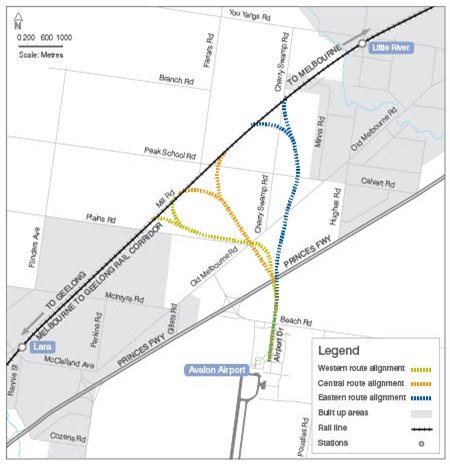
Consultation on the three options included two community workshops at Lara on 13 and 14 March. 82 participants attended.
A numbed of stakeholder organisation were also consulted and Council officers were requested to provide comments. A Council officer letter of 28 March 2013 provided technical feedback and covered the following issues: future freight potential, road connections, the Avalon Airport Masterplan, drainage, native vegetation, impact on community and land fragmentation.
DTPLI has not yet committed to a particular option but have began discussions with Council officers about a planning scheme amendment to recognise a preferred route in the Greater Geelong Planning Scheme.
The planning scheme amendment would include a Public Acquisition Overlay, recognition of the route in the Municipal Strategic Statement and modifications to the Special Use Zone that currently applies to Avalon Airport.
DTPLI is seeking Council’s view on the Planning Minister acting as the planning authority for the amendment to secure the Avalon Airport Rail Link reservation.
Council officers recommend that Council agree to the Minister running the amendment process as it is a State project and the Minister will be responsible for any compensation claims.
The route options for the rail link all traverse areas of environmental significance, particularly native grasslands and associated habitat. The State Government will need to address environmental issues as part of any planning scheme amendment. It will also need to determine if an Environmental Effects Statement is required under State legislation and requirements under Commonwealth environmental legislation.
This is a State Government project and does not pose any particular financial implications for the Council.
A planning scheme amendment would include recognition of the Avalon Airport Rail Link in the Local Planning Policy Framework section of the Greater Geelong Planning Scheme.
The State Government would be the acquiring authority for any compulsory acquisition of land for the rail corridor.
While the Minister for Planning is recommended as the Planning Authority for the planning scheme amendment, Council would retain its ongoing role as responsible authority for the area including the Avalon Airport which is subject to a Special Use Zone.
An Avalon Airport Rail Link supports the Growing our Economy strategic direction of City Plan.
No Council officer involved in the report has any direct or indirect interest, in accordance with section 80(C) of the local Government Act.
There are no notable risks associated with implementing the recommendation contained in this report.
The rail link may have social impacts on Lara and Little River residents – particularly the eastern and western options.
The Planning Authority for the rail link will need to ensure the amendment does not impact on any basic rights, freedoms and responsibilities as set out in the Charter. Planning legislation ensures an open community consultation process occurs, enabling people to freely express their views and if necessary obtain a fair hearing before an Independent Panel
As outlined earlier in this report, the State Government has undertaken consultation as part of the Avalon Airport Rail Link investigations. It would be expected that any planning scheme amendment would go through a full public exhibition process and include the opportunity for people to make submissions and appear before an independent panel or advisory committee.
Portfolio: |
Tourism and Major Events - Cr Nelson |
Source: |
Planning & Tourism |
Chief Executive Officer: |
Peter Bettess |
Index Reference: |
Subject: Recreation Vehicles (RV’s) issues and opportunities |
The purpose of this report is for Council to consider the facilities available for Recreation Vehicles visiting Geelong.
The City of Greater Geelong has been lobbied by the Caravan and Motorhome Club of Australia (CMCA) over the past ten years to provide a low or no cost RV park with associated facilities to support overnight stays within the City of Greater Geelong.
The RV lobby group maintains that the City of Greater Geelong is missing out on the economic contribution RV users make to the economy because at present no RV facilities are provided by the City. Therefore RV’s either do not stay in the City or revert to illegal camping in the suburban streets or public recreation areas.
The facilities required to support the establishment of an RV park in Geelong, and thus be considered and promoted as “RV Friendly” (registered trademark) includes: access to water supply, public toilets, blackwater dump point, links with public transport into City Centre and safe area to park. Based on CMCA criteria Greater Geelong should be regarded as an RV welcoming destination.
The owners of the 26 commercial Caravan Parks (holiday parks) located in the City of Greater Geelong state that there is adequate opportunity and dedicated facilities within the current commercial parks to cater for RV’s (see attached report).
The City of Greater Geelong (as per State Legislation) ensures that commercial caravan parks comply with regulations relating to safety, amenity, environment and registration standards.
The requirement for competitive neutrality has been embraced fully by some States of Australia (Tasmania and Queensland) in relation to Local Government establishing RV parks. Under the National Competition Policy should Local Government establish an overnight camping site for self-contained recreation vehicles, such sites must comply fully with same regulatory requirements provided by commercial caravan parks (fire, safety and environment) and charge the true market value for the provision of such services and amenities. It should be noted that compliance to regulations and full cost recovery principle amounts to many hundreds of thousands of dollars in both the establishment phase and ongoing management stage of developing and maintaining an overnight RV park.
Geelong should improve it’s standing with RV owners by encouraging visitation to the Municipality through the provision of dedicated parking options for RV’s and through specific information packs to better assist and inform RV users of what they can do and where they can stay in Greater Geelong.
At a City of Greater Geelong Council meeting held on 12 March 2013, Council resolved to investigate the issues and opportunities associated with catering for the needs of Recreation Vehicle users in the City of Greater Geelong.
Cr Nelson moved, Cr Fisher seconded -
That Council:
will promote Greater Geelong in partnership with the tourism industry (as per Council Tourism Policy) as a destination that welcomes RV’s to the city and highlights the facilities and experiences that encourages visitation and increased length of stay;
recognise the opportunity to better cater for the needs of RV’s users visiting the City of Greater Geelong by providing dedicated short term parking options and welcome information packs that gives details of overnight and long stay options in the 26 commercial parks located throughout the Municipality;
acknowledges that current commercial parks have the capacity and facilities available to cater for the current needs of RV users wanting to stay overnight in the municipality.
Carried.
At the completion of a quotation process consultants CT Management Group were appointed to undertake a high The Recreation Vehicle (RV) market has grown in members over the last ten years with their peak body, Caravan and Motorhome Club of Australia (CMCA) indicating a membership of over 64,000 individuals.
The RV sector seems to be fragmented into at least three specific sub categories namely ‘Grey Nomads’ (people (often retirees) who spend their days travelling Australia with their RV being their residence for much of the year); International budget youth traveller (Wicked Campers – seeking experiences and wanting to minimise accommodation cost); and Up Market RV owners (seeking ‘free camping’ as a right).
‘Free camping’ for RV’s has been met by 23 townships in Victoria and these townships have been designated as RV Friendly Towns by the CMCA.
The RV sector through its peak club CMCA has lobbied Local Government across the State and Nation to expand the concept of RV friendly towns (registered trade mark) by urging Local councils to establish no cost/low cost overnight RV camp sites.
At the same time that RV sectors have experienced growth so has the demand for and quality of commercial holiday parks increased significantly.
Commercial holiday parks account for 12% of accommodation and are a significant employer of staff within our region.
A recent study by the Caravan, RV & Accommodation Industry of Australia (2012) found that on average each commercial park contributed $1.2m to their local economy per year. Further to this, a recent report (2013) conducted by independent consultants BDO, interviewed 556 visitors staying at both commercial (339 visitors) and free campsites (217 visitors). The report compared the relative expenditure at each destination by both free campers and those staying in commercial parks. The study resolved that those staying in commercial parks spent approximately 4 times more at each destination. Free campers spent on average $213 at each destination whilst commercial campers spent on average $829.
As a result of meeting legislative and regulatory imposts, the cost of running a commercial park is significant with compliance costs for fire services alone exceeding $100,000 per park. Further to this there are also significant costs associated with meeting environmental, health and planning regulations.
The management of running a commercial park that complies with all the requirements mandated by Local and State Government is a major business undertaking and the cost of compliance is reflected in the charge costs to users of the commercial parks.
The philosophy and demands of RV users in seeking free camping is at direct odds with commercial park operators who charge a fee structure that is inclusive of the costs to meet health and safety standards established by Local and State Government.
Local Government manages health and safety compliance in the commercial parks.
Commercial park operators with the support of their peak industry body (Vic Parks) have initiated legal challenges to Local Councils who introduce ‘free or low cost’ camping facilities that do not comply with competitive neutrality and National Competition Principles.
Tourism is critical to the economic wellbeing of the City of Greater Geelong. Each year, tourism generates expenditure of over one billion dollars within the City and this expenditure supports over 3,355 jobs (Economic Impact Analysis – Geelong 2012 Compelling Economics)
Tourism is part of economic development and each initiative to expand tourism should be measured against an economic framework.
The City of Greater Geelong has established a partnership with the tourism industry through Geelong Otway Tourism (Tourism Policy).
Geelong Otway Tourism Business Plan focuses on yield (visitor expenditure, length of stay) not on volume (guest arrivals).
Through this philosophy (yield not volume) not all visitation is viewed as being beneficial to either the destination, the industry or the broader community.
When the issues of cost verses benefit, need verses the current capacity, the principles of competitive neutrality and the request for subsidy, it is difficult to mount a case from a tourism industry/economic development perspective to support the establishment of free/low cost overnight sites.
Geelong and the Bellarine are popular and strong tourism destinations that are well supported by industry, Local Government and the community.
Whilst some destinations have felt the need to be RV friendly branded in an attempt to generate profile, this is not a strategy needed or supported by industry in Geelong.
Considering the current capacity to cater for RV’s in the municipality, Geelong should be promoted and regarded as welcoming the RV sector.
Geelong can further enhance its reputation as being a welcoming city to RV users by providing better RV parking facilities within the city and by providing a welcome pack of information at Visitor Information Centres that details overnight camping options and the experiences and facilities that encourage overnight visitation.
Capacity
There are 26 Commercial Caravan Parks (Holiday Parks) located within the City of Greater Geelong. Three of these parks are located very close to the CAA (located in the Barwon Valley area). These three centrally located parks have 110 sites available (powered and non-powered). These standard sites accommodate vehicles up to 9 metres (30ft). Of these parks 30 sites are designed for the large RVs. Prices are approximately $30 per night. Cheaper for non-powered and chain member discounts. All of these three parks have dump points (grey and black water discharge).
Sites are available all year with the exception of a ‘few days’ per year when the parks are completely booked out. Even then they can recommend other parks that are available in the region (not close to city).
The cost to Council to manage the environment impact from RV users staying overnight will be considerable.
The issues of garbage and waste water disposal (grey and black water) and the provision of toilets (cleaning) will need to be budgeted for on a full cost recovery basis.
It is the dumping of garbage and waste water that has lead to many of the conflicts between RV users and local communities throughout Australia.
The City of Melbourne and Townsville City Council have recently been very active in policing illegal RV camping and have extended the hours of bylaws offices to enforce the law and move illegal campers in to commercial caravan parks.
The establishment cost to provide an overnight RV park that meets the legislative requirements to address environmental, health and safety and registration standards would total many hundreds of thousands of dollars.
The industry benchmark used to establish a compliant site is $10,000 per site. Thus a small site capable of taking up to 20 RV’s is estimated to have an establishment cost of at least $200,000.
Further to this an annual budget would be required to manage and maintain the site. It should also be noted that the economic contribution by individual self-contained RV’s is minimal with their major cost being the purchase of fuel and supermarket supplies. By comparison to other sectors of tourism, RV’s are considered to be low yield particularly when the real cost of service delivery to support the sector is taken into consideration.
Competitive Neutrality Principles (CNP’s)
The CNP’s are designed to prevent unfair competition between government (Local, State, Federal) and privately owned businesses by ensuring that all government bodies involved in the delivery of services within the same competitive market as private operators (in this case the provisions of overnight camping services for self-contained RV’s) do so on fair and equal terms with those private operators.
Council is required to appropriately apply the CNP’s and should adopt what is known as a full cost attribution model in determining the cost of providing that service.
This means that Council must charge a price for the service that reflects the actual cost incurred as well as those costs that the Council would have incurred if it were a private operator.
It should be noted that if Council fails to comply with the above principles the option of a legal challenge from the commercial parks and their peak industry body is highly likely.
Aligns with the “Growing Our Economy” Strategic Direction in the priority area of Greater Geelong as a leading city for tourism.
This report has been prepared in consultation with the Tourism Manager, City of Greater Geelong, who is also the Executive Director of Geelong Otway Tourism.
Geelong Otway Tourism in partnership with the Victorian Tourism Industry Council has been active and vocal as an industry based partnership advocating for commercial parks as the most appropriate location for RV’s to stay overnight in the region.
No other officer involved in preparing the report has a conflict of interest.
The City of Greater Geelong will be at potential risk of legal action initiated by the commercial parks if the City fails to comply with competitive neutrality and national competition principles.
If Geelong doesn’t address parking issues and does not promote itself as a destination that welcomes the RV sector then Geelong will be bypassed by RV users and be known as an RV unfriendly destination. This risk and opportunities are understood by the tourism industry.
Not all RV owners can afford to stay in Commercial parks and will thus continue to stay overnight in residential streets or public open space.
The Human Rights Charter has been considered in the preparation of this report.
Following the consideration and the adoption (or otherwise) of the recommendations in this report, further communication with Geelong Otway Tourism will be required to initiate both a regional (G21) and state wide (VTIC) consideration of the issues raised in this report.
A media release will outline Council resolution and the reasoning being the action taken.
Portfolio: |
Community Development – Cr Fisher |
Source: |
Community Services - Aged and Disability Services |
General Manager: |
Jenny McMahon |
Index Reference: |
Subject: Municipal Public Health Plan |
The purpose of the G21 Regional Health and Wellbeing Plan 2013-17 is to identify a small number of agreed priority issues that are common for each of the five municipalities. This will strengthen the region’s capacity to address complex issues that impact on health and wellbeing. A copy of the plan is attached (see Appendix 1).
The aim of the G21 Region Health and Wellbeing Plan 2013-17 is to improve the health and wellbeing of communities throughout the G21 region.
The plan represents a new collaboration in public health & wellbeing planning across the five municipalities.
The plan seeks to strengthen the ongoing effort to address some of the more complex and entrenched issues underlying public health and wellbeing across the region.
The plan will enhance G21 Councils’ ability to partner with service providers, other sectors and government departments.
Council’s health and wellbeing priorities are identified in the Regional Plan with two of these recognised as regional priorities.
Cr Fisher moved, Cr Farrell seconded -
That Council supports the G21 Regional Health and Wellbeing Plan 2013-17.
Carried.
The Public Health and Wellbeing Act 2008 (the Act) requires that all Councils develop a Municipal Public Health and Wellbeing Plan (MPHWP) to protect and promote public health and wellbeing.
In developing MPHWPs, Councils have been encouraged by State Government to consider how they and their partners can implement or support interventions that respond to the needs of local communities and, in particular, vulnerable population groups.
The State Government is supportive of regional health planning processes. A number of local governments have undertaken regional health planning processes along Primary Care Partnership boundaries. The boundary of the Primary Care Partnership for Geelong aligns with the G21 boundary.
In 2012 the five municipalities in the G21 region agreed to collaborate on the 2013-17 public health and wellbeing planning process.
A common planning framework was developed and used by each Council. Through local and regional consultation processes three common priorities arose across the region. These priorities form the basis of the regional plan. In addition each local Council has a number of priorities relevant to the needs of their Council areas. The Regional Health and Wellbeing Plan supports delivery of local MPHWPs.
In each municipality, Councils reviewed and analysed local:
Population data and projections;
Community feedback on public health issues arising from recent Council Plan consultation session, and specific local consultations;
Outcomes from the previous MPHWP plans; and
Stakeholder feedback regarding current and emerging priorities
These led to the development of Councils MPHWP. Common priorities and themes across the five Councils MPHWPs led to the identification of three regional priorities. The strategic action areas which the G21 Health and Wellbeing Pillar will lead the implementation and evaluation of are:
Physical activity;
Community connectedness / social inclusion;
The evidence base;
The Department of Health supports regional health planning processes. For Council the Regional Health and Wellbeing Plan forms an agreed support strategy for common issues across the region. Actions in the Regional Health and Wellbeing Plan have been developed to support the implementation of Councils MPHWP.
Council is being asked to support the Regional Health and Wellbeing Plan following this process, along with all other local governments in the region. The G21 Board will be presented with the outcomes of Council decision making processes at their October meeting 2013.
No negative impacts are anticipated from the successful delivery of this plan.
There are no financial implications for Council, however any future requirements will be the subject of Council budget deliberations.
No impact to budget.
The Municipal Public Health and Wellbeing Plan 2013-2017 fulfils the requirements of the Public Health and Wellbeing Act 2008 that all Victorian Councils prepare and adopt a Municipal Public Health and Wellbeing Plan within 12 months of Council elections.
The G21 Region Health and Wellbeing Plan 2013-17 is not a statutory requirement but it does form an agreed support strategy for common issues across the region including physical activity, social connectedness and inclusion, and evidence based policy and practice.
The G21 Region Health and Wellbeing Plan 2013-17 is aligned to City Plan 2013-17 and actions contained within the plan for the City of Greater Geelong have been taken from either City Plan 2013-17 or the Municipal Public Health and Wellbeing Plan 2013-20170.
No officer involved in the preparation of this report has any direct or indirect interest relative to the advice provided in the report.
There are no risks associated with implementing the recommendations contained in the report.
The G21 Region Health and Wellbeing Plan 2013-17 reinforces Council’s commitment to addressing the social determinants of health by working at multiple levels across the organisation and beyond to achieve sustainable improvements in health outcomes for the community.
The G21 Region Health and Wellbeing Plan 2013-17 outlines a set of guiding principles that were used to underpin the proposed planning framework. It captures the need to specifically address fundamental inequities.
The G21 Region Health and Wellbeing Plan 2013-2017 has been informed by a series of stakeholder consultations involving more than 500 participants across the region and an online community survey (264 respondents). The consultation sessions and the community survey generated approximately 2,450 individual ideas and comments.
Portfolio: |
Tourism & Major Events – Cr Nelson |
Source: |
Projects, Recreation and Central Geelong / Events, Central Geelong & Waterfront |
General Manager: |
Dean Frost |
Index Reference: |
Subject: Events / Geelong Major Events |
The purpose of this report is to have Council appoint an external representative to Geelong Major Events (GME) Committee.
GME Committee was established as a Council Advisory Committee in 1998, and formalised under Section 86 of the Local Government Act 1989 in October 1999.
GME Committee has overseen significant developments in the growth of existing events and the announcement of international and national events to be staged in Geelong including the Australian International Airshow, Festival of Sails, Pako Festa, Australian Masters Games and the largest event ever staged in Geelong, the 2010 UCI Road Cycling World Championships.
GME Committee supported events stimulate substantial economic activity within the municipality (estimated to be up to $65.9 million for 2012/2013 from local and non-local sources and the equivalent 527 full-time jobs) and provide social links within our community.
There are a maximum of ten positions on the GME Committee. External members comprise four of those positions.
Caroline Moore resigned from the GME Committee resulting in a vacant external member term commencing November 2013 and expiring April 2016.
Following public advertisements, eight (8) applications were received. A selection panel (comprising the Acting Mayor, the GME Chair, the Chief Executive Officer and an incumbent external committee member) reviewed applications and make a recommendation to Council regarding the appointment of an external committee member.
Cr Nelson moved, Cr Fisher seconded -
That Council:
appoint Dean Anglin as an external representative to the Geelong Major Events Committee for the remainder of the four-year term concluding April 2016.
thank the other applicants for their interest in participating on the Geelong Major Events Committee.
Carried.
GME Committee was established as a Council Advisory Committee in 1998 and formalised under Section 86 of the Local Government Act 1989 in October 1999. The GME Committee Terms of Reference provide that the committee has been formed to co-ordinate the attraction, support and funding of events on behalf of the City
GME Committee Terms of Reference also provides for the appointment of four external representatives from the business/media/arts or events community for a term of up to four years. In addition to the external representation, the GME Committee membership also includes:
The Mayor and up to three other councillors appointed by Council
The Chief Executive Officer
The Executive Director of Geelong Otway Tourism
Caroline Moore (external representative) resigned from the GME Committee. This has resulted in a vacancy from November 2013, expiring April 2016.
Following the advertisements communicating the requirement to fill the vacant external representative positions on GME Committee, eight (8) applications were received in total.
External representation on GME Committee is considered to be essential as it enables the committee to draw upon expertise and networks beyond Council. Specifically, experience relevant to the business, arts, events or media communities are seen as important.
All applications were reviewed by the selection panel consisting of the Acting Mayor, Chair of GME Committee, Chief Executive Officer and external member Julie Stefanoff. After careful consideration, the panel determined that Dean Anglin would best bring the required experience and specialist expertise to GME Committee.
Dean has strong media and business experience, existing contacts particularly in the sporting industry and the local business community, as well as sports management skills.
There are no environmental implications arising from this report.
There are no financial implications arising from this report as no remuneration is paid to external representative positions on GME Committee.
There is no policy, legal or statutory implications arising from this report. The appointment process is within the framework of the GME Terms of Reference and the Council Instrument of Delegation to GME.
In the City Plan 2013-2017, Council has identified Growing Our Economy as one of its four key strategic objectives. City Plan tells us that one of the important priorities in this area is to see Greater Geelong as a leading city for tourism, arts, culture and events. The GME Strategy is identified in City Plan as being a key strategy that will assist Council in delivering Growing Our Economy priorities.
In addition, City Plan identifies its key partnerships in this area as including events related groups such as Victorian Major Events Company, Victorian Events Industry Council, along with event owners and operators. These key relationships are maintained and enhanced through the actions of the GME committee.
No officer involved in the preparation of this report has any direct or indirect interest
Staggered appointment durations were established in 2008 to minimise the risk of losing extensive expertise from the Committee at one time. Two incumbent external members have terms expiring in April 2014 and the two newest appointed external members will have terms expiring in April 2016 (which includes this appointment).
External representatives are fully briefed on their role on GME Committee thus ensuring that they each understand their roles and responsibilities. Information is also provided to external representatives regarding their obligations regarding declarations of Direct or Indirect Interest.
The inclusion of external representatives on GME Committee supports and enhances the social benefit that events bring to the community.
There are no human rights implications arising from this report.
The appointment of a new external representative to the GME Committee will be communicated to key stakeholders and the media. The unsuccessful candidates are notified in writing thanking them for their application and interest in the GME committee.
Cr Heagney declared a Direct Interest in Agenda Item 10 – Plaques and Memorial Policy in that she is a member of the Board of the Geelong Cemeteries Trust and left the meeting room at 8:11pm prior to discussion of the item.
Portfolio: |
Governance - Cr Harwood (Acting Mayor) |
Source: |
Corporate Services - Administration and Governance |
General Manager: |
Jeff Wall |
Index Reference: |
Subject - Policy Development |
To update the Plaques and Memorial policy to provide clarity on the application and authorisation process.
Council receives requests from members of the public and organisations for the installation of a plaque or memorial to commemorate an event or structure, recognise an entity (such as a club or service organisation) or in memory of a person significant to the history of the locality.
Plaques may be installed by council to commemorate the opening of a new or refurbished facility or to celebrate an event which may be of historical significance now or in the future.
The existing policy has been reviewed and some procedural information has been removed and developed into an organisational procedure that deals with both external and internal requests for plaques and memorials.
Cr Macdonald moved, Cr Richards seconded -
That Council approves the updated – Plaques and Memorials Policy CPL40.9.
Carried.
The purpose of this policy is to provide a framework for the installation of plaques and memorials by Council or initiated by the community.
The policy does not cover signage or display boards of a temporary nature for promoting forthcoming events.
Plaques or memorials are important in recognising an event, structure, entity (such as a club or service organisation) or in memory of a person significant to the history of the locality.
The policy states Council’s intent to minimise the incidence of plaques and memorials, restrict criteria to events and persons of outstanding significance whilst ensuring that environmental impacts are kept to a minimum
Changes to the Plaques and Memorials Policy include removal of any reference to procedural matters. These matters now form the basis of the Management Procedure – Plaques and Memorials.
A form, with guidelines, has been developed to assist applicants when applying to Council for a plaque or memorial.
All procedural matters are now dealt with in the Management Procedure.
There are no implications relative to the adoption of the policy. It recognises that design and placement should not intrude upon or damage the structure or natural environment. Specific applications made under the policy would be assessed in relation to the nominated site.
The procedure provides for any costs to be borne by applicants or as part of the Council project.
The policy provides a framework for the installation of plaques and memorials by Council or initiated by the community.
How we do business - Lead by advocating and collaborating on issues important to the Greater Geelong community.
No officer involved in the preparation of the policy has a conflict of interest.
The policy recognises that design and placement should not create a public risk and that construction should require little maintenance and should be resistant to vandalism.
While not encouraging a proliferation of plaques and memorials, the policy sets criteria for their placement recognising an event, structure, entity (such as a club or service organisation) or in memory of a person significant to the history of the locality, the procedure details how this will be done.
In developing this report to Council, the subject matter has been considered to determine if it raises any human rights issues. In particular, whether the scope of any human right established by the Victorian Charter of Human Rights and Responsibilities is in any way limited, restricted or interfered with by the recommendations contained in this report. It is considered that the subject matter does not raise any human rights issues.
The policy and application form will be available through Customer Service Centres and on council’s website.
All relevant departments have been involved in the development of the updated policy.
Cr Heagney re-entered the meeting room at 8.13pm.
Portfolio: |
Community Safety, Education & Youth – Cr Farrell |
Source: |
Community Services / Community Development |
General Manager: |
Jenny McMahon |
Index Reference: |
Community & Social Planning / Gambling |
The purpose of this report is to seek Council endorsement for a Councillor to attend the biennial international gambling conference in New Zealand.
The 5th International Gambling Conference will be held in Auckland New Zealand, 18 - 21 February, 2014.
Attending the conference will provide an opportunity for Council to stay abreast of new research on issues relating to problem gambling to better inform Council’s policy and decision making in relation to gambling matters.
More than $108 million was lost on electronic gaming machines in the City of Greater Geelong during the 2012/13 financial year. While this represents an eight percent reduction on the previous year, problem gambling remains a continuing issue for Council in its efforts to reduce harm in the community.
The conference will provide an excellent networking opportunity for attendees and raises the potential for future collaborations. As in previous years, it is expected delegates from around the world will attend.
In accordance with Council Policy, a report of the conference proceedings will be presented to Council.
It is appropriate that Cr Farrell as the Community Safety Portfolio holder and the Chair of the Geelong Gambling Advisory Committee be the Council nominated representative at this conference.
Cr Farrell moved, Cr Irvine seconded -
That Council having regard to the Councillors’ Expenses and Facilities Policy authorise Cr Farrell to attend the International Gambling Conference in Auckland, New Zealand.
Carried.
Division Requested:
For: Crs Ansett, Nelson, Fisher, S Kontelj, Harwood, Macdonald, Richards, Heagney, Farrell, Irvine
Against: Nil.
The 5th International Gambling Conference will be held in New Zealand from 18 to the 21 February 2014.
The conference organisers state that this is the only international gambling conference that does not accept gambling industry funding. In comparison, the Australian organisation, the National Association for Gambling Studies (NAGS), holds its gambling conference in Australia in November or December each year and has strong ties to the gaming industry.
Previous conferences have been very successful with very positive comments from participants. Cr Farrell attended the conference in 2012. A report by Cr Farrell was tabled at Council’s Ordinary Meeting on 27 March 2012.
In addition, as Chair of the City of Greater Geelong Gambling Advisory Committee, Cr Farrell has a leadership role in the promotion of problem gambling issues in the Geelong region. Cr Farrell is also a member of the Victorian Local Government Working Group on gambling (a working group of the Victorian Local Governance Association).
The City of Greater Geelong Gambling Advisory Committee has representation from gambling venues, Gamblers Help, welfare services, as well as G21, and neighbouring municipalities, and provides direction to Council in the area of problem gambling.
The Committee has provided a valuable conduit for neighbouring Councils in gaining information on the latest changes in the electronic gambling environment. Cr Farrell, as the Chair of the Committee is best placed to attend the conference and bring her learnings back to Council and the Committee.
Council’s current Strategic Gaming Policy directs a harm minimisation approach to problem gambling. The Policy identifies activities undertaken by Council towards reducing such negative impacts including taking an advocacy role in relation to government policies; adopting a community development role in terms of engaging and informing the community on issues relating to problem gaming; and, where possible, to facilitate research into the extent and effects of problem gaming in the local community.
$108.2 million was lost by people in Geelong from gambling on Electronic Gaming Machines (EGMs) during the 2012/13 financial year. While this represents a drop of approximately 8% when compared to the previous year, it still raises concerns when one examines the figure in the light of the Commonwealth Productivity Commission Inquiry into problem gambling (2009) finding that approximately 40% of gaming losses are from problem gamblers
This conference provides an opportunity for Council to gain new perspectives from gambling researchers, new policy approaches from overseas and examples of best practice by service providers when dealing with problem gambling
Including the pre-conference workshops, the conference will take place over four full days (18-21 February 2014) and will include the following key note speakers:
Professor John Warren Kindt
John Kindt is an emeritus professor of business at the University of Illinois and a senior editor of the United States International Gaming Report. Prof. Kindt’s specialty research has been focused on the societal, business, and economic impacts of decriminalising gambling activities.
Professor Gerda Reith
Professor Gerda Reith is Professor of Social Science at the University of Glasgow. Prof. Reith’s research centres on problematic forms of consumption, particularly those considered risky or 'addictive'
Judge Mark G. Farrell
Judge Mark G. Farrell is the Senior Justice in the Amherst, New York Criminal and Civil Court, which operates in the largest suburban jurisdiction in New York State. Judge Farrell currently operates the nation's only Gambling Treatment Court. He developed a gambling treatment protocol in the criminal justice system.
Attendees at the previous New Zealand conference numbered around 230 and came from fifteen countries across the globe – New Zealand, Canada, South Africa, United Kingdom, Australia, Japan, Sweden, Germany, Singapore, Finland, Macau, Singapore, China, Switzerland and the USA
This provided the opportunity for increasing Council’s network and engagement with others who are working to minimise the harms caused by problem gambling.
Across the world gambling industries are changing and evolving, expanding into new markets and reaching new demographics. The emergence of sports betting and internet gambling are examples of such changes. Council has continually sought to reduce the harms caused by electronic gaming machines (pokies). It has been in a position to monitor the changes in the gaming environment due to the level of state regulation of the industry. However, much of the internet gambling in Australia is unregulated and there is little knowledge of its growth and associated loss of income to the local economy. Attendance at the conference will enable formal and informal discussions with professionals and lay people from other countries in how this emerging problem is being dealt with.
It is timely therefore for Council to send a representative to the 5th annual conference.
Not applicable.
The cost of the travel and attendance at the conference is estimated at approx $2,000. These costs include early bird conference registration, travel to and from New Zealand, meals and accommodation while at the conference.
The funding for the Councillor attendance is in accordance with the City of Greater Geelong Councillors’ Expenses and Facilities policy.
Overseas and interstate travel by Council representatives is to be undertaken within the context of Council policy which includes endorsement by Council. A report will be presented to both Council and the Gambling Advisory Committee on the conference proceedings as is required by Council policy.
The Conference will raise ideas for minimising harm from problem gambling. This is consistence with Council’s City Plan in increasing community wellbeing.
Council Officer has no direct or indirect interest in the outcome of this report.
Conference attendance will contribute to Council’s body of knowledge regarding problem gambling and similarly better enable Council to respond to gambling permit applications.
The City of Greater of Geelong has leadership role in defending the wellbeing of the municipality. The negative impacts of gambling in the community can have an enormous impact on some families and communities. Attending an international conference will offer an excellent opportunity to increase Council’s knowledge in how to best minimise the harm from problem gambling.
The recommendation of this report is in line with the Human Rights Charter, particularly protection of families and children.
The Community Development Department is responsible for the communication of this report in conjunction with Council’s Media Service Unit.
Portfolio: |
Sport and Recreation - Cr Irvine |
Source: |
Recreation, Projects and Central Geelong / Capital Projects |
Executive Director: |
Dean Frost |
Index Reference: |
Project: C14803 – 2013/14 Stead Park Hockey Precinct Development |
The purpose of this report is to seek Council consent to delegate to the Chief Executive Officer the power to accept or reject tenders for the Stead Park Hockey Precinct Development, provided tenders fall within the adopted budget.
The design process for the Stead Park Hockey Precinct Development is nearing completion and Council will soon be inviting tenders for the construction of a new synthetic grass hockey pitch at the reserve.
The construction of pitches such as these needs to be undertaken during the optimal time of the year (January to March) to ensure the likelihood of favourable weather conditions for the installation of the synthetic playing surface.
The aim is to have a contract in place with a suitably experienced contractor prior to the end of the calendar year so that works may commence as soon as possible in 2014.
Cr Irvine moved, Cr Fisher seconded -
That Council delegate to the Chief Executive Officer its powers and functions to accept or reject a tender and sign the contract documents for the construction and associated works for a new hockey pitch at Stead Park, Corio, provided they are within budget.
Carried.
The G21 Regional Sport and Recreation Infrastructure Plan identified the need for a second hockey pitch within the G21 region based on estimated growth and participation rates. A Master Plan was developed for Stead Park in 2009 that reinforced the site as the best site for a regional hockey venue within the G21 region.
On the back of this planning and investigation, CoGG was able to mount a strong and successful case when applying for the SRV Community Facility Funding Program 2013/14 – Major Facilities Category.
With Council’s confirmed budget allocation of $1,001,000, the projects funding was guaranteed with the State Government contribution via the SRV program.
The Capital Projects and Contracts and Purchasing departments are finalising the necessary documentation in order to put the works out to open tender in early November 2013, with the aim of assessing and awarding the tender prior to the end of year break.
The timing for the appointment of a contractor means that it would be beneficial if the Chief Executive Officer can enter into the contracts under delegation.
If awarding of this contract is delayed it may have a major impact on project delivery, as it would mean that the availability of the limited field of highly qualified surface applicators could result in them not being booked in time for the optimum weather period for this sort of work.
Stead Park Recreation Reserve is intersected with an open stormwater drain, and as such is subject to a flooding overlay which requires approval from the Corangamite Catchment Management Authority (CCMA) to build on the proposed site. Written approval from the CCMA will therefore need to be received as part of the approval process.
Council was successful in its application to the State Government earlier this year as part of the 2013/14 Community Facility Funding Program. As a result, the project budget is $1,876,000 and is funded as per the following breakdown:
2013/14Council budgetary allocation
$1,001,000
State Government Grants
$625,000
Geelong Hockey Association contribution
$250,000
The State Government grant commitment is dependent on Council meeting progress milestones and opening dates. Therefore our ability to move through the tender stage under delegation will help us meet funding conditions.
Against the above timeframes and expected milestones there may be inadequate time for Council to formally determine the outcome of the tenders in its normal capacity. This report provides the policy and legal mechanisms necessary for the CEO to award or reject tenders.
The construction of the 2nd hockey pitch at Stead Park is one of the key facility development upgrades identified in the Stead Park Master Plan, endorsed by Council in January 2010.
No council officers involved in this project or report have declared a direct or indirect interest in this matter.
There will be a risk to Council’s reputation and grant funding commitments if these projects cannot be completed in line with the time requirements stipulated in the Funding Agreement between council and the State Government.
Council’s commitment to the construction of the 2nd hockey pitch at Stead Park is in response to analysis of the current participation levels and future growth statistics of the sport in Geelong.
If Council is unable to complete this project in a timely manner then there is the potential that the opportunities for growth in 2014 could be negatively affected. It will also leave the Geelong Hockey Association in the position of not be able to bid for the opportunity to host regional and state hockey events.
It is not evident or likely that this report would negatively impact any of the rights contained in the Charter of Human Rights.
Public consultation during the formulation of the Stead Park Master Plan 2009 enabled council to sign off on this document, thereby satisfying the requirements for fair and reasonable public consultation to be met. There are no further communication requirements with acceptance of the proposed recommendation.
Portfolio: |
Finance – Cr S Kontelj |
Source: |
Corporate Services – Financial Services |
General Manager: |
Jeff Wall |
Index Reference: |
Financial Management \ Budget 2014-2015 |
To approve a schedule of events, including community consultation and meetings of the Executive and Council to prepare the 2014-2015 Budget in order for Council to meet it’s statutory obligations.
A timetable of activities to complete the 2014-2015 Budget / City Plan 2013-2017 (2014-2015 Update) by 24 June 2014 has been prepared.
The draft Proposed Budget will be reviewed at Council briefing sessions throughout March, April and May 2014.
A new initiative of community engagement will be instigated for the 2014-2015 Budget to assist development of community priorities.
The Council meeting scheduled for 13 May 2014 will give public notice of the Proposed Budget and following consideration of any submissions, the timetable provides for a further meeting of Council to adopt the Budget on 24 June 2014.
The timetable provides for a 28 day period for submissions to be reviewed regarding the Proposed Budget.
The objective of the Budget / City Plan 2013-2017 (2014-2015 Update) Timetable is to have the Council Budget / City Plan adopted by 24 June 2014.
Any delays in achieving the target dates are likely to have the impact of extending the timetable accordingly.
Cr S Kontelj moved, Cr Richards seconded -
That Council endorses the proposed timetable for the development of the 2014-2015 Annual Budget / City Plan 2013-2017 (2014-2015 Update).
Carried.
Although the Local Government Act 1989 does not require Council to adopt a budget until the end of August, there are financial and management implications associated with not completing this exercise by 30 June. These include:
A lack of internal control to monitor and manage the financial position of the City, ie. actual versus budget.
The possibility of having to delay the first rate instalment if the rate notices cannot be issued by early September due to the late adoption of the budget which includes the designated property differential rates.
Implementing any Fees & Charges pricing changes and the associated implications of achieving the budgeted income levels, etc.
A timetable for the preparation of the 2014-2015 Budget / City Plan has been prepared to enable the Budget to be adopted by Council on 24 June 2014.
The summary timetable (refer Appendix 13-1) identifies the main responsibilities, functions and timeframes to complete a review of all matters relating to the 2014-2015 Budget / City Plan 2013-2017 (2014-2015 Update).
A new initiative of community engagement will be instigated for the 2014-2015 Budget to assist development of community concepts.
Appendix 13-2 outlines the process for community engagement.
Appendix 13-3 is a draft Community Concept form, which captures details of the project. This form is to be lodged for evaluation.
A more detailed timetable is prepared for internal purposes. The 2014-2015 Budget / City Plan 2013-2017 (2014-2015 Update) process will commence with work on the preliminary tasks, and therefore commitment to the project plan and timetable is necessary from all stakeholders. Any delays in achieving identified tasks are likely to extend the timetable accordingly.
City Plan 2013-2017 (2014-2015 Update) will be informed by a series of workshops with the Councillors, Executive Management, Joint Managers Team, Joint Coordinators Team and the Community.
The Annual Budget is an important document that supports the strategic directions of Council for the next twelve months and beyond.
Key steps in the process:
Council’s Budget is based on the City Plan which contains Council objectives and strategies.
Community Priorities (Concepts) will be developed according to agreed budget guidelines.
Community engagement process will assist development of Community initiatives commencing from 12 December 2013
Councillors will be briefed at Council Meetings throughout March, April, and May to finalise the Budget.
Council Briefing #3 and #4 will occur prior to Easter holidays. This will allow sufficient time for community engagement as per the new initiative in relation to community priorities.
The Council meeting scheduled for 13 May 2014 will give public notice of the Proposed Budget / City Plan. Following consideration of submissions, the timetable provides for a further meeting of Council to adopt the Budget / City Plan on 24 June 2014.
The scheduled Council Briefing sessions will be incorporated in Councillors diaries once dates are adopted.
There are no environmental considerations associated with the recommendation.
The timetable complies with the requirements for the Local Government Act for preparation of the Budget.
The timetable complies with the requirements for the Local Government Act for preparation of the Budget.
This report ensures the City Plan and Budget are completed according to a timetable and contributes to responsible and sustainable financial management as aligned in Council’s City Plan objective on How We Do Business.
There is no direct or indirect interest by Council Officers involved in the preparation of this report.
Although not required to adopt the Annual Budget until August, there are adverse implications if the process is delayed. These include:
A lack of internal control to monitor the financial position of the City into the new financial year.
Delays in commencing (and therefore completion) of projects identified within the Annual Budget.
Delaying the issuing of the first rate instalment notices (due in early September) and possible breaches of the Local Government Act.
There are no social considerations associated with this recommendation.
There are no known positive or negative effects.
The Budget / City Plan timetable provides for community consultation at the front end of the budget process and also once the draft budget is published. The new initiative of community engagement will commence in December 2013 to assist development of community priorities.
|
Activity |
Management |
Executive Management |
Councillors |
|
Community Engagement Meeting – Geelong West |
|
|
Thur, 12 Dec 2013 |
|
Community Engagement Meeting - Potato Shed, Drysdale |
|
|
Mon, 16 Dec 2013 |
|
Additional Community Engagement Meetings |
|
|
To Be Confirmed |
|
28 Day Community Priority Submission Period Closes |
Friday, 17 Jan 2014 |
|
|
|
CorVu Project Concepts (C, R & D) |
Mon, 2 Dec 2013 |
|
|
|
Councillor Finance Briefing - LTFP |
|
|
Mon, 9 Dec 2013 |
|
EMT Review |
|
Wed, 5 Feb 2014 |
|
|
EMT Review |
|
Wed, 12 Feb 2014 |
|
|
Council Discussion |
|
|
Tue, 18 Feb 2014 |
|
Preliminary 2014 Revaluation Impacts |
|
|
Tue, 25 Feb 2014 |
|
Divisional Briefing Session |
Mon, 3 Mar 2014 |
|
|
|
Council Briefing – Budget Review Session #1
|
|
|
Mon, 3 Mar 2014 |
|
Operating Budget input to be completed by Units |
Mon, 3 Mar 2014 |
|
|
|
Council Briefing – inform Councillors of Outcomes that will make up City Plan 2014-2017 (2014-2015 Update) |
|
|
Tue, 4 Mar 2014 |
|
Public Holiday: Labour Day |
Mon, 10 March 2014 |
||
|
Council Briefing – Budget Review Session #2
|
|
|
Mon, 24 Mar 2014 |
|
EMT Budget Review Session |
|
Wed, 2 Apr 2014 |
|
|
Council Briefing – Budget Review Session #3 |
|
|
Mon, 7 Apr 2014 |
|
Provision for |
|
|
Mon, 14 Apr 2014 |
|
School Holidays |
7 April – 21 April 2014 |
||
|
Public Holidays: Easter Break |
18 April – 21 April 2014 |
||
|
Public Holiday: Anzac Day |
Fri, 25 April 2014 |
||
|
Council Meeting to adopt Proposed 2014-2015 Budget, City Plan and Fees and Charges |
|
|
Council Meeting |
|
Budget / City Plan Submissions Panel |
|
|
Fri, 13 Jun 2014 |
|
Council Briefing – Budget Submissions |
|
|
Tue, 17 Jun 2014 |
|
Council Meeting to formally adopt Final |
|
|
Council Meeting |
The 2014-2015 Budget Timetable provides for the provision of a new initiative of community engagement. It is planned to conduct community engagement meetings, with two meetings confirmed, one at the Geelong West Town Hall (6pm, 12 December 2013 ) and one at the Potato Shed in Drysdale (6pm, 16 December 2013). Provision for an additional two meetings will also be scheduled.
Purpose of Meetings
The Community Engagement meetings will be to outline and assist the development of community priorities.
Community concepts represent projects and initiatives to create a community asset or to fund a Council program.
A presentation will be undertaken by the CEO to outline in detail what community concepts are and explain some of the projects funded. The CEO will also advise the process for making a community priority submission and criteria for considering the submission for each of the 12 wards.
Promotion of the Event
City News, Community Update and the geelongaustralia website will be used to promote the community engagement meetings.
A ‘Community Concept Submission’ form will be developed and made available at customer service centres and on the web for ease of access and completion, including electronic lodgement.
Role of the Ward Councillor
Submissions received relating to 2014-2015 community priorities will be evaluated by the appropriate ward councillor. They will then be forwarded to Financial Services staff for the purpose of distribution to the relevant Council Officer for the scoping and detailed costing of a project concept. Project concepts will then be forwarded in the normal manner to the Executive Management Team.
The potential criteria for evaluation of submissions will include:
Fit with City Plan and existing Council strategies.
Preference for creation of community asset, rather than grant funding or disbursements.
Urgency - Mandatory, Critical & High priority.
Key Drivers – customer service, asset management, business efficiency, statutory requirement.
Council Portfolio initiative.
Process
Submissions will be launched as from the public meetings in December and the submission period will be for a period of 28 days, closing in January, to then be considered by Council as part of the budget process.
Financial Services will receive and sort the submissions by ward and distribute to councillors. The Councillors will evaluate, prioritise and then authorise those submissions to be further considered and costed by Council Officers as project Concepts.
Contents | Previous Page: Section A - Procedural Matters | Next Page: Section C - Notice of Motion
