
Council Minutes - Section B: Reports - 25 March 2014
Contents | Previous Page: Section A - Procedural Matters | Next Page: Section C - Notice of Motion
Contents | Previous Page: Section A - Procedural Matters | Next Page: Section C - Notice of Motion
Reports tabled at the Ordinary Meeting of Council on Tuesday date held at City Hall, Little Malop Street in Geelong.
Portfolio: |
Community Development - Cr Fisher |
Source: |
Community Services - Aged and Disability Services |
General Manager: |
Jenny McMahon |
Index Reference: |
Subject: Disability |
To present the Draft Disability Action Plan 2014-17 and release it for community consultation for a period of four weeks.
The Disability Action Plan (DAP) specifies the actions Council will take to reduce discrimination of people with disabilities in the areas of goods, services and facilities, employment, community participation and attitudes and practices.
Section 38 of the Disability Act 2006 specifies that a public sector body must ensure that a Disability Action Plan is prepared for the purpose of:
Reducing barriers to persons with a disability accessing goods, services and facilities;
Reducing barriers to persons with a disability obtaining and maintaining employment;
Promoting inclusion and participation in the community of persons with a disability;
Achieving tangible changes in attitudes and practices which discriminate against persons with a disability.
Council’s DAP specifies the actions Council will take to reduce discrimination of people with disabilities in these areas.
Cr Fisher moved, Cr Richards seconded -
That Council release the Draft Disability Action Plan 2014-2017 for a period of four weeks.
Carried.
Council has had an effective Disability Action Plan (DAP) since 2002. The DAPs have responded to the requirements of the Disability Discrimination Act 1992 (DDA), the Local Government Act 1989, the Equal Opportunity Act 1995 and the Disability Act 2006, the latter, which came into effect 1 July 2008. The implementation of a DAP also contributes to an organisation's obligations under the Charter of Human Rights and Responsibilities Act 2006, as well as supporting the principles of the United Nations' Convention on the Rights of Persons with Disabilities.
The 2014-17 Disability Action Plan was developed following consultations with Council staff, disability service organisations and Council’s Disability Advisory Committee. Telephone interview results from external Disability Service Organisations, indicated that they utilise Council’s Goods, Services and Facilities in a range of ways, including provision of Home and Community Care (HACC) services, and access and participation in the local community.
Results from the consultation indicate that Council has improved its practice over time and is performing well in the following areas:
Council’s awareness of accessibility and supporting change
Improved accessibility to infrastructure
Working towards accessible communication
Support for event organisers to hold accessible events
Customer service improving communication
Networking with local organisations
Ensuring relevant legislative and statutory requirements are met
Engaging consultants to conduct Access Audits of community facilities.
Some of the areas for continual action were:
Disability inclusion training
Ongoing audits and improvements to infrastructure
Rural Access to continue to liaise with Council staff to provide advocacy and support
Continue to improve accessible communication and customer service sites
Greater awareness and use of the Disability Action Plan for reference.
The following diagram depicts the four priority areas identified in the Victorian Disability Act 2006 and the themes upon which the DAP is based.
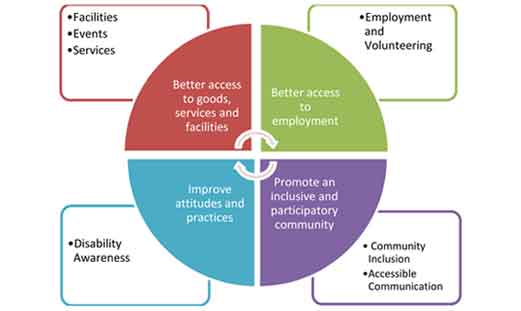
Actions included in the Draft DAP are:-
Undertaking access audits and prioritising works to improve access to Council and community buildings and services; supporting the Street Access and Disability Advisory Committees to advocate on behalf of people with disabilities; identifying training needs of staff to enhance disability awareness; reviewing Council information in all formats to ensure that it remains accessible; ensuring that arts, sports and cultural events are fully accessible and inclusive and that Councils employment processes are encouraging of people with disability to apply .
The actions are all specific and measurable and reportable through Council’s corporate reporting system.
Monitoring of the Disability Action Plan will be by:
Monitoring the Four Outcome Areas on an ongoing basis to ensure ongoing improvement in universal access and inclusion;
Encouraging ongoing policy development and consultation that fosters universal access and inclusion;
Continuing to engage in processes that foster continuous service improvement and staff awareness;
Encouraging community feedback: e.g. complaints, consultation comments and general feedback;
Conducting a survey regarding staff attitudes to disability, analyse results and develop strategies for improvement.
Evaluation will be gathered on a 12 monthly basis, and will inform Council in the annual Disability Action Plan report.
A full review of this Plan will be carried out in 2017, encapsulating recommendations from the 12 month Disability Action Plan evaluations. The conclusions from the evaluations will guide the Action Areas in the new Disability Action Plan.
This report will not have any discernible impact on the environment. Impacts on the environment, including energy use and green house gas emissions will however be lessened when accessible services and facilities are planned from the outset.
Strategies outlined in the Action Areas of the 2014-2017 Disability Action Plan are generally within current Council budgets.
Any additional resources required will be considered as part of the annual budget process.
The Victorian Disability Act 2006 requires that all services and facilities are accessible to people with disabilities and also that planning approvals conform to this Act. The requirements of the Victorian Disability Act 2006 are reflected in the Disability Action Plan 2014-17.
The plan is referenced in the City Plan and is a component of the Health and Wellbeing actions.
No officer involved in the preparation of this report has any direct, indirect or personal interest in the subject of this report beyond the general benefit that will accrue to all residents and visitors to the City of Greater Geelong.
The 2014-17 Disability Action Plan will enable Council to address its statutory requirements and the Disability Action Plan may also be viewed as a mitigating circumstance in any instance of a claim.
It is anticipated that there will be considerable ongoing positive impact on people in the community with disabilities and their families as the DAP is implemented. It is also expected that there will be a flow on to the wider community of understanding and consideration for the inclusion of people with disabilities in all aspects of community life. Implementation of the plan promotes the development of sustainable organisational structures to help minimise access and inclusion issues.
There will be enhanced opportunities for people with disabilities to participate in community life and for the community to be enriched by their inclusion. In addition, providing equal access will greatly benefit the growing proportion of ageing residents in the City of Greater Geelong.
The adoption of the plan will assist Council to meet its obligations under the Charter of Human Rights and Responsibilities Act 2006, as well as supporting the principles of the United Nations' Convention on the Rights of Persons with Disabilities.
Progress reports on the 2014-17 Disability Action Plan will provide an opportunity for Council to showcase its ongoing commitment and leadership to the community, its commitment to consult with people as well as to work towards building equity of access and inclusion in the community.
Portfolio: |
Community Development – Cr Fisher |
Source: |
Community Services – Aged and Disability Services |
General Manager: |
Jenny McMahon |
Index Reference: |
Customer: National Disability Insurance Agency |
This report seeks to update Council on the National Disability Insurance Agency’s (NDIA) Barwon launch site and Council’s Aged and Disability Department’s (A&DS) role as a service provider.
Barwon is the Victorian launch site of the National Disability Insurance Scheme (NDIS), having commenced operations in July 2013.
The launch site has been funded by a combination of new and existing funding from Federal and State disability programs in its first year of operation.
The Victorian State Government allocated funding from City of Greater Geelong’s Home and Community Care (HACC) grant income as an in kind contribution to the Barwon Launch site in the 2013-14 year.
Council’s Aged & Disability Service department was registered as a provider to the NDIA and commenced service delivery and reporting against the in kind draw down from 1 July 2013.
By February 2014 over 130 of Council’s eligible service users had transferred from HACC to the NDIS and $170,000 of service has been provided.
As of July 2014, it is expected that registered providers to the NDIA will be permitted to charge market prices for their services, however at the time of writing this had not been confirmed.
It is proposed that Council will remain a significant, quality and preferred provider of “in home services” in the region.
Cr Fisher moved, Cr Heagney seconded -
That Council:
prices its services to fully cover expenses;
continues to be a quality provider to the NDIA after 30 June 2014.
Carried.
Following receipt of the Productivity Commission report into Disability Services, the National Disability Insurance Scheme (NDIS) was announced by the Federal Government in 2012.
The NDIS represents a positive and transformational change for people with disabilities in Australia.
It is based on actuarial analysis of the lifetime assistance and care requirements of the individual and assumes a no fault, universal entitlement for people who are born with or acquire a significant and permanent disability prior to the age of 65. The NDIS will replace all other disability care funding.
The scheme will provide a package of funding and a tailored approach of personal assistance and the provision of aids to assist the individual to reach their life goals and to live as independently as possible.
The NDIS is being undertaken in stages with launch sites in each State and territory that will enable operational and system matters to be tested and resolved prior to the full national scheme roll out which is proposed from 2015.
The Barwon launch site has been funded by a combination of new and existing funding from Federal and State disability programs in the current year. In the longer term and when the NDIS is rolled out more comprehensively, the funding allocation will come directly from the Federal Government to the National Disability Insurance Agency and is expected to be financed by general revenue or a medicare type levy.
In signing up to be a partner to the NDIS launch site, the Victorian State Government allocated in-kind funding from its existing disability programs and HACC as a contribution to the launch site services. As a consequence, up to $1 million of funds from Council’s Home and Community Care funding (2013-14) was allocated as an in kind contribution to the budget of the Barwon NDIA in its first year of operation. This was calculated from the number of Councils HACC clients who were considered eligible, and likely to transfer to the NDIS in the current financial year.
In accordance with the Government’s intention that there be a seamless transition for participants moving to the NDIA, Council’s A&DS department registered as a provider to the NDIA, commenced service delivery and reporting against the in kind draw down from 1 July 2013.
Council has continued to subsidise services provided to NDIA clients in the current year as has been the case under the HACC program.
In December 2013 the NDIA announced that, NDIA service providers would be free to charge market prices for their services post July 2014.
Council’s A&DS department registered to become a provider to the NDIA in July 2013. This ensured that there would be minimal client disruption in the transition from HACC to the new scheme, and to continue Council’s overarching support for the introduction of the NDIS.
Participation in the NDIA is a strategic move, to secure the existing workload associated with the almost 600 clients who are likely to transfer from Council’s HACC program. Participation will also ensure that Council is positioned to take on the potential increase in demand for disability care services within the local area. This was considered appropriate as Council has the largest workforce of qualified and skilled Community Care Workers in the region.
Council has been able to retain and recruit a workforce to meet the needs of the community and also to provide contracted services to other agencies. It is also considered good practice to achieve economies of scale by combining the operations of Council’s HACC, packaged care and disability services, all of which are similar in their objectives and administration.
Another strategic action has been the training of a group of 19 Community Care Workers as Allied Health Assistants Cert IV, thus providing increased skills within the workforce to meet the challenges of the NDIA and to provide a career path for staff. Further, the A&DS operating software provider Icon Global, has agreed to pilot a client portal within Carelink+ that will enable clients to access and control their funding package. Over recent times, cost efficiencies have also been achieved by streamlining care workers’ rosters to reduce travel and subsequent travel payments.
More work will continue to reduce expenses and increase efficiencies. This will be further enhanced by Council’s service planning process that is about to commence.
These innovations were seen as having positive outcomes for Council and the client population.
Councils Finance and A&DS departments have calculated the full cost of service delivery based on Councils industrial / Enterprise Agreement conditions. The fee structure has been established in a transparent manner detailing all inclusions and cost assumptions, so that the charges can be scrutinised and amended should component costs or corporate decisions alter.
There are no environmental implications of this report.
The NDIS is a fully funded and managed program of the Commonwealth. During the launch phase of the NDIS, the pricing structure for NDIS support services was set at a level that was inadequate to cover the actual costs of service delivery by many community sector and Local Government providers.
The National Disability Services peak body NDS and service providers have successfully lobbied the Commonwealth to review the prescribed NDIA pricing structures, particularly with regard to the service type “Assistance with Self Care”. In response, in December 2013, the NDIA CEO announced at a conference that there would be fewer controls over pricing as of the 2014-15 year, thus enabling providers to charge in accordance with their respective business models. This advice is yet to be confirmed. Based on media released there is a likelihood that the NDIA will still budget their client packages on a generic price range or ‘envelope’ which may or may not cover the full cost of Councils expenses in delivering the service.
Should, over time, there be a reduction in the services purchased from Council by people with disabilities, it may be necessary to facilitate a gradual reduction in the workforce. It is estimated that workforce management will be able to be achieved by natural attrition and selective recruitment, thereby avoiding the need for redundancies.
Council is bound by an enterprise agreement which provides for minimum conditions for employees. Council has also achieved accreditation under the Commonwealth Care Common Standards, ensuring that service delivery is supported by effective management, appropriate access and quality service delivery and that service user rights and responsibilities are respected.
The retention and ongoing employment of Councils current and skilled workforce is consistent with Council’s Economic vision and strategy. The provision of quality care to the community’s most vulnerable citizens is also consistent with the H&WB section of the plan.
No officer involved in preparing this report has any direct or indirect interest in the recommendations other than in their current capacity as an officer of Council.
The risk of service demand changing significantly will need to be monitored. Should the service levels reduce due to clients purchasing services elsewhere then A&DS will necessarily introduce a reduction in the workforce by natural attrition and/or share the workload more equitably amongst the part time workforce.
The National Disability Insurance Scheme is premised on the individual with a disability being allocated resources to assist them to achieve their individual goals. The client rather than the providing agency hold the funds. While this is empowering for the individual it has the impact of disempowering the provider sector that ceases to have security of tenure. This in turn erodes job security and employment conditions for this sector of workers.
The NDIS is premised on enhancing the rights of people with disabilities in Australia to achieve their goals and live with dignity and independence. Thus it supports the Human Rights Charter.
A&DS will be responsible for communications with regard to NDIS service delivery including web based information, printed brochures and other promotions.
Portfolio: |
Arts & Culture - Cr Richards |
Source |
Community Services – Arts & Culture |
General Manager: |
Jenny McMahon |
Index Reference: |
Subject: Geelong Gallery |
The purpose of this report is to seek Council approval for a new Triennial Funding Agreement between the City of Greater Geelong and the Geelong Gallery (Appendix 1).
The Geelong Gallery’s holdings of historical and contemporary art are widely acknowledged as one of the finest and most valuable collections held by a regional gallery in Australia.
The purpose of the Funding Agreement is to establish the minimum performance levels to be provided by the Geelong Gallery, the method of reporting those performance levels, and the level of funding provided by Council for the delivery of those performance levels – key performance indicators (KPI’s).
This is the fifth Triennial Funding Agreement which will cover a period of significant challenge for the Geelong Gallery with major building works for the Geelong Library & Heritage Centre (GLHC) immediately adjacent to and connecting into the Gallery.
Performance indicators have traditionally increased in each Agreement in line with minor budget increases and in recognition of steadily improved performance by the Gallery. With detailed design for the GLHC finalised and understanding of the impact of the physical works on the Gallery’s operation, amendments to the KPI’s for the next two years have been made. For example, due to the major building works the KPI’s for visitor numbers has been maintained not increased as some planned shows have had to be postponed or cancelled and works are likely to interrupt visitors’ experience and lead to occasional temporary exhibition closures.
A major review took place towards the conclusion of the third Triennial Agreement. A further review will occur prior to the development of the sixth Triennial Agreement in the context of the development of the Geelong Gallery Business Case, Council’s new 2015-2025 Cultural Strategy and the opening of the GLHC.
As asset owner Council is required to comply with all its regulatory maintenance obligations. This is included in the Triennial Agreement, subject to Council’s annual budgetary considerations.
A copy of the draft triennial Agreement containing the KPIs and annual funding allocations is attached (Appendix 1.)
Cr Richards moved, Cr Macdonald seconded -
That Council:
approve the fifth Triennial Funding Agreement between the Greater Geelong City Council and Geelong Gallery for the years 2013/14 to 2015/16 (Appendix 1);
refer annual funding allocations in accordance with the Triennial Funding Agreement to future Council budgets.
Carried.
The Triennial Funding Agreement for the years 2013/14 to 2015/16 is the fifth agreement the City of Greater Geelong has negotiated with the Geelong Gallery.
The Geelong Gallery’s holdings of historical and contemporary art are widely acknowledged as one of the finest and most valuable collections held by a regional gallery in Australia. Over the course of the previous Triennial, the Gallery has been visited by many VIP and government visitors including Dr. David Bomford, distinguished Director of the J. Paul Getty Museum in Los Angeles who paid tribute to the presentation of the Gallery and its collection.
The majority of KPI’s, agreed as part of the 2009/10 to 2012/13 Triennial Funding Agreement were either met or exceeded by the Gallery.
Highlights over the previous Triennial include:
2010/2012 - the Geelong Gallery’s extended loan of paintings by Eugene von Gerard to the Queensland Art Gallery and the National Gallery of Australia, for the National Gallery of Victoria’s grand retrospective of Eugene von Guerard – Nature revealed, which further promoted the Gallery’s presence in a landmark touring exhibition.
2011/2012 – the Geelong Gallery in partnership with the National Art Museum of China, mounted Reflections of the soul – contemporary Chinese ink/wash painting, in recognition of 2011 as the Year of Chinese Culture in Australia. This exhibition received widespread acclaim and was supported by the Department of Foreign Affairs and Trade, the Australian Embassy in Beijing and the Chinese Consulate in Melbourne.
Acquisition of a major Heidelberg School painting depicting a classic regional vista Arthur Streeton’s Ocean blue, Lorne (1921), achieved by securing private donations, a public appeal and successful grant applications.
Development and presentation of a major loan exhibition (the most valuable exhibition ever mounted by a regional gallery in Australia) titled In search of the picturesque – the architectural ruin in art (2012), an exhibition including major old and modern master paintings borrowed from national and state collections around Australia.
An 18% increase in visitation to the Gallery over the course of the previous Triennial Agreement period, with visitation in 2012/13 increasing by 5,000 to 67,637.
Triennial funding agreements provides security for the Gallery in its planning for exhibitions, events, programmes and collection management. Exhibitions can take three or more years to plan and deliver, particularly exhibitions of a significant nature. It is primarily for this reason that the triennial funding agreement was introduced and has continued.
The City of Greater Geelong is the core funder of the Gallery and is currently providing approximately 60% of the Gallery’s total income. As such, Council funding is imperative to the Gallery for its ongoing operational costs. The Gallery raises other income through a variety of means including grants, sponsorship, donations, retail, subscriptions and memberships and is aiming to raise a minimum of $600,000 per annum. The Gallery also receives triennial funding of $135,000 from Arts Victoria through its Local Partnerships programme.
The Gallery is seeking increases to its annual grant of 4.7% ($48,000) in 2014-2015 and 4.2% ($45,000) in 2015-2016 for:
Staff Salary Costs. To retain and attract high calibre staff (EBA).
Increased operating costs. Including CPI, increasing costs of insurance and security for the fine art collection. It is expected that insurance policy increases could be as $50,000 over the three year period of the agreement.
Internal Risk Management strategies. These have been necessitated by the redevelopment works for the new Geelong Library and Heritage Centre.
Educational/public programmes and activities. Additional funds are required to enable the Gallery to develop educational and public programmes and activities including increasing costs of marketing and exhibition development.
With a greater understanding of the impact of the building programme for the GLHC over the next two years, KPI’s for the Agreement have been reviewed and, in discussion with the Gallery Director, in some cases amended (refer Appendix 1, changes to the Agreement highlighted in red). This includes a reduction in number of exhibitions from 20 to 16. This is due to the necessary cancellation or postponement of some exhibitions previously planned for this period as other cultural organisations are unable to lend works with the adjacent major building works and associated insurance issues. Expectations for exhibition hours have been reduced from 900 to 800 with visitation to be maintained at 60,000 per annum over the remaining life of the Agreement due to the likely occasional closures of Gallery spaces and the interruption of visitor experiences. However an increase in KPI’s for the delivery of educational and public programmes (from 16 to 25) and for an increase in delivery of on-line initiatives, provides KPI’s for the Gallery to continue to strive for.
Inability to implement enhanced risk management strategies (a priority of the new board) including increases in insurance policies associated with these strategies on top of increases in the Fine Art Policy in consequence of a scheduled re-valuation of the entire collection of works of art in compliance with the Policy.
A major review took place towards the conclusion of the third Triennial. A full review of the Triennial Agreement is proposed to occur prior to the development of the sixth Triennial in the context of the development of the Geelong Gallery Business Case, Council’s new 2015-2025 Cultural Strategy and the opening of the GLHC. It is anticipated KPI’s will be increased at this time, particularly with access to the additional Gallery space in the new GLHC.
The Geelong Gallery is a purpose built century-old gallery designed to make the most of natural light, while keeping within international environment standards for museums.
The addition of two new clauses in the previous Triennial Funding Agreement between Council and the Gallery relating to maintenance of the building enables the Gallery to benefit from contractors already engaged by Council who are encouraged to meet environmentally responsible principles where possible.
The Gallery is investigating a range of more sustainable options for ongoing operation including replacement of current display lighting as funding permits.
In 2012-2013, the final year of the (fourth) triennial agreement, Council’s recurrent contribution to the Geelong Gallery was $997,000. As part of the 2013/14 budget process Council determined $1,022,000 would be allocated for Year One, a 2.2% increase. It is recommended that Council funding for Year Two (2014/15) is $1,070,000, an increase of $48,000 (4.7%), and Year Three (2015/2016) is $1,115,000, an increase of $45,000 (4.2%).
Maintenance of the Geelong Gallery Building forms part of the Triennial Funding Agreement with requests referred to and managed by the Property Department. Additional funding for replacement of major plant and ongoing maintenance are considered separately and form part of Council’s annual budgetary considerations. No major maintenance is anticipated for 2014/15. As a Council asset, the Gallery facility is depreciated through Council’s accounting system.
The Geelong Art Gallery is located on Crown Land with a lease period of 999 years, due to expire on the 16th June 2854. The Building is a Council asset, operated by the Geelong Art Gallery Incorporated, as a body associated for artistic and cultural purposes. The Board is composed of 12 persons, elected each year at the Annual General Meeting.
Council is required to comply with all regulatory maintenance obligations for Essential Safety Measures in the Gallery as set out in the Building code of Australia (BCA).
Although not a document intended to create legal relations between the partners, there is a Memorandum of Understanding under the State Government’s Local Partnerships programme between Arts Victoria, City of Greater Geelong and Geelong Art Gallery Incorporated, to support the annual programmes and operations of the Gallery.
The Geelong Gallery is an important cultural facility, which assists the City of Greater Geelong to deliver the actions outlined in Council’s Culture Strategy Creativity +, as well as the Strategy’s Vision: to develop the City of Greater Geelong as a regional centre of innovation and excellence. The Gallery is one of the key Cultural Precinct facilities identified in the Geelong Future Cities Masterplan.
The Geelong Gallery Triennial aligns with City Plan Strategic Directions and Priorities:
Community Wellbeing
Connected, creative and strong communities.
Growing Our Economy
A successful and vibrant City Centre;
A leading city for tourism, arts, culture and events.
There is no direct or indirect interest by Council Officers involved in the preparation of this report.
As the City’s most significant tourism draw-card, the funding increase will allow the Geelong Gallery to meet anticipated operating costs.
In order to safeguard the Collection on behalf of the Geelong community, the Gallery needs to implement proper security measures and acquire an appropriate level of insurance.
The Gallery has an outstanding reputation as a leading regional gallery to maintain. To do so it must be able to continue to develop its educational/public programmes and activities and retain and attract high calibre staff.
The Agreement and six monthly reporting and evaluation measures against KPI’s ensures the Gallery performance is regularly reviewed and assessed.
The Gallery’s collection of works of art is held in trust for the region’s community at large and is managed and developed in accordance with international standards of museum practice.
Galleries play a significant role in the cultural, social, educational and economic development of the community. The Geelong Gallery plays an important role in the collection, conservation and exhibition of the Region’s material heritage as expressed in works of art. The reputation of the Gallery, as one of the finest regional galleries in Australia, is a source of civic pride. The Gallery’s exhibitions, educational and public programmes as well as curatorial services are highly valued cultural resources.
The opportunities that the Gallery provides for our emerging and established artists are extremely crucial to the region’s cultural development. The Gallery contributes to the amenity and attraction of Central Geelong and, as one of the City’s major cultural attractions in the Cultural Precinct, contributes significantly to cultural tourism. The Geelong Gallery is an extremely important cultural facility, which assists the City of Greater Geelong to deliver the actions outlined in Council’s current Culture Strategy Creativity +, as well as the Strategy’s Vision: to develop the City of Greater Geelong as a regional centre of innovation and excellence.
The Geelong Gallery respects and provides access for all visitors. It presents artists from a diversity of cultural, linguistic, ethnic and religious diversity respecting the right to express all aspects of the human experience.
The Arts & Culture Department in consultation with Communication and Marketing will be responsible for communicating this report.
Portfolio: |
Environment and Sustainability - Cr Richards |
Source: |
City Services |
General Manager: |
Gary Van Driel |
Index Reference: |
Waste Management |
To endorse the appointment of Council’s representative to the Barwon South West Waste and Resource Recovery Region Local Government Waste Forum.
Throughout 2013 the State Government, through the Minister for Environment and Climate Change, has been preparing for reforms to the governance of waste management with the preparation of the Getting Full Value - Victorian Waste and Resource Recovery Policy (VWRR Policy) and its associated documents, the Ministerial Advisory Committee Report (MAC Report) and the State Waste and Resource Recovery Infrastructure Plan (SWRRI Plan).
With the release of drafts of each of these documents this Council has provided input that generally supports the direction proposed.
The MAC Report recommended the reduction of the number of regional waste management groups from thirteen to seven, including the retention of the Metropolitan Waste Management Group. This Council has been included in the Barwon South West Group.
These groups will be referred to as Waste and Resource Recovery Groups (WRR Groups) and each will be managed by a board of directors.
The MAC Report also recommended the establishment of Waste and Resource Recovery Region Local Government Waste Forums (Waste Forums), comprising of a councillor representative from each Council in a group, to provide for local government input to the boards of the WRR Groups.
The MAC Report recommendations have been adopted by the State Government and are currently being enacted in amendments to the Environment Protection Act 1970 through the Environment Protection and Sustainability Victoria Amendment Bill 2014.
The Waste Forum for each region will be required to nominate four of its councillor representatives to the Minister for the recommendation of the Minister to the Governor in Council to become directors of that region’s board.
Following advertisement of positions and selection the Minister will also recommend four independent and appropriately skilled persons for approval of the Governor in Council to also become directors of that region’s board.
Boards are to be established by 1 August 2014.
Advice has been received from the Department of Environment and Primary Industry that it now requires Council’s endorsement of the appointment of a councillor to the Barwon South West Waste and Resource Recovery Region Local Government Waste Forum.
One of the first functions of each Waste Forum will be to nominate the four councillor representatives to the Minister for recommendation to become directors of the region’s board. Each Waste Forum will also be required to develop its own set of operating guidelines.
Cr Andy Richards, Cr Lindsay Ellis and Cr Eddy Kontelj are the current directors on the Barwon Regional Waste Management Group.
The Council may also nominate an officer to the Forum as a non voting Advisory Member. It is considered that the General Manager City Services should be nominated as the Council’s Advisory Member, with the authority to nominate an alternative officer as deemed appropriate from time to time.
Cr Richards moved, Cr Irvine seconded -
That Council:
endorse the appointment of the Environment and Sustainability Portfolio Holder to the Barwon South West Waste and Resource Recovery Region Local Government Waste Forum for 2014/15 as the representative of the Greater Geelong City Council; and
nominate the General Manager City Services as Council’s Advisory Member to the Forum with the authority to nominate an alternative officer.
Amendment
Cr S Kontelj moved, Cr Heagney seconded -
That Council:
endorse the appointment of Cr E Kontelj to the Barwon South West Waste and Resource Recovery Region Local Government Waste Forum for 2014/15 as the representative of the Greater Geelong City Council; and
nominate the General Manager City Services as Council’s Advisory Member to the Forum with the authority to nominate an alternative officer.
Lost.
The motion was then put and carried.
Throughout 2013 the State Government, through the Minister for Environment and Climate Change, has been preparing for reforms to the governance of waste management with the preparation of the Getting Full Value - Victorian Waste and Resource Recovery Policy (VWRR Policy) and its associated documents, the Ministerial Advisory Committee Report (MAC Report) and the State Waste and Resource Recovery Infrastructure Plan (SWRRI Plan).
The MAC Report recommended the reduction of the number of regional waste management groups from thirteen to seven, including the retention of the Metropolitan Waste Management Group. This Council is included in the Barwon South West Group.
The MAC Report recommendations have been adopted by the State Government and are currently being enacted in amendments to the Environment Protection Act 1970 through the Environment Protection and Sustainability Victoria Amendment Bill 2014.
The MAC Report also recommended the establishment of Regional Waste and Resource Recovery Region Local Government Waste Forums (Waste Forums), comprising of a councillor representative from each Council in a group, to provide for local government input to the boards of the WRR Groups.
This Waste Forum would then nominate four council representatives to the Minister for recommendation of the Minister to the Governor in Council to become directors of that region’s board.
Following advertisement of positions and selection the Minister will recommend four independent and appropriately skilled persons for approval of the Governor in Council to also become directors of that region’s board.
Boards are to be established by 1 August 2014. .
This structure is the same as that in existence since 2006 under the Melbourne Metropolitan Waste Management Group.
The functions of the WRR Groups within their region will be to:
plan for the future needs of waste and resource recovery infrastructure consistently with the State Waste and Resource Recovery Infrastructure Plan
facilitate the provision of waste and resource recovery infrastructure and services by councils
facilitate the development of contracts for the joint procurement of waste and resource recovery facilities and services
manage contracts
work with Sustainability Victoria, councils, businesses and communities to ensure that state wide waste and resource recovery education programs are adapted to the needs of their region and to deliver those education programs
advise Sustainability Victoria, councils and businesses on best practice and support the region’s Local Government Waste Forum, and to
undertake waste and resource recovery projects as funded by government, councils and other organisations.
The functions of the Waste Forums will be to:
nominate to the Minister the four persons who are to be the representatives of councils for the purpose of appointment as directors of the WRR Group boards
develop procedures for the nomination of these persons
be a conduit for consultation between the WRR Group and local government and for advice to WRR Group boards on matters and issues affecting the role of local governments in waste management and recovery.
The establishment of the Waste Forums is recognition of the ongoing role of local government in providing waste and resource recovery services.
The proposed process for establishment of the new groups is as follows:
February 2014: Minister for Environment and Climate Change makes a request of Mayors to nominate local council representatives for their relevant region’s Waste Forum
March 2014: Councils consider their nominees to the Waste Forums and initial preparation for the first meeting of the Waste Forums, including preparation of the Waste Forum’s draft operating procedures by a steering committee comprising of current directors to the existing regional boards..
April 2014: Initial Waste Forum meetings held to appoint Chair and Deputy Chair, endorse the Waste Forum’s operating procedures and nominate the four local government board members to the Minister.
August 2014: New WRR Groups commence operation.
Advice has been received from the Department of Environment and Primary Industry (DEPI) that it is now seeking endorsement of the appointment of a councillor to the Barwon South West Waste and Resource Recovery Region Local Government Waste Forum.
Nominees to the Waste Forum are required to complete a national police check application and consent form, provide a diversity information and privacy consent form and a current CV.
With the release of the drafts of each of the VWRR Policy and its associated documents, the MAC Report and the SWRRI Plan documents, this Council has provided input that generally supported the directions proposed.
However, in supporting the recommendations of the MAC Report Council did specifically request that, as the major regional centre within the Barwon South West region, it be granted a position on the Board as one of the four directors appointed from local government. This position was supported by the City of Ballarat and the Greater City of Bendigo and joint representation was made to the Minister on 10 February 2014. Under the current provisions it will be up to the individual Waste Forums to decide how and therefore who it recommends to the Minister. To date no response has been received from the Minister.
In lieu of a response from the Minister it is considered that Council should proceed with its nomination to the Waste Forum.
Cr Andy Richards, Cr Lindsay Ellis and Cr Eddy Kontelj are the current directors on the Barwon Regional Waste Management Group. It is considered appropriate to nominate the Portfolio Councillor for Environment and Sustainability to provide input from Councils perspective regarding Waste issues.
Also, the Waste Forum will be required to adopt its own set of operating guidelines. DEPI has provided a draft set of guidelines that includes the ability for Council to nominate an officer as an Advisory Member to the Waste Forum. According to these draft operating guidelines the Advisory Member is ‘able to participate fully in all Forum proceedings and activities but does not hold a vote’.
For expediency it is considered that Council should nominate this officer now in anticipation of the Barwon South West Waste and Resource Recovery Region Local Government Waste Forum adopting operating guidelines that includes the ability for Council to nominate an Advisory Member to the Waste Forum.
As the General Manager responsible for Council’s waste services it would appear most appropriate for this nominee to be the General Manager City Services, with the ability to nominate an alternative officer as this General Manager deems to be appropriate from time to time.
Advice has been received that the first meeting of the Barwon South West Local Government Forum will be held in Camperdown on 29th April 2014.
Regional waste management groups contribute to a better environment in Victoria by providing co ordination of the planning and development of waste and resource recovery infrastructure and services.
With the changes currently being legislated the continuing role of these groups is dependent upon the nomination of local government representatives to the Waste Forums.
There are no financial implications as a result of the recommendation in this report. Council does support the existing Regional Waste Management Group with project funding support of $96,000 per annum.
The recommendation in this report provides for Council to comply with State Government legislation.
Support our community to live sustainably: Leading the way in waste management practices and continue to reduce the amount of waste to landfill.
Sustainable Built and Natural Environment: Partnering with our community to protect and enhance our natural ecosystems as well as encouraging reduced resource consumption.
No Council staff involved in the preparation of this Report has a direct or indirect interest in the matter to which the report relates.
There are no assessed risks resulting from the recommendation in this report.
There are no social considerations resulting from the recommendation in this report.
There are no human rights charter issues resulting from the recommendation in this report.
There are no consultation and communication outcomes resulting from the recommendation in this report.
Portfolio: |
Governance – Cr Lyons (Mayor) |
Source: |
Office the Mayor |
A/General Manager: |
Michael Kelly |
Index Reference: |
Organisational Development |
The purpose of this report is to seek the formation of a Special Committee of Council for the purposes of recruitment for the Chief Executive Officer position, and to endorse the engagement of suitable recruitment agencies to provide quotations for role profiling, search and selection services.
The Chief Executive Officer, Stephen Griffin, has tendered his resignation with his final day of employment being 24 April 2014.
In accordance with the Local Government Act 1989, recruitment for a new Chief Executive Officer should commence as soon as is reasonably practicable after a vacancy in the position occurs.
Cr Richards moved, Cr Heagney seconded -
That:
Council adopt a Special Committee of Council be formed consisting of Cr Lyons (Mayor), Cr Harwood (Deputy Mayor) and Crs Fisher, Heagney and Irvine to engage directly with the Manager, Organisational Development and the appointed Executive Recruitment Agency on all matters pertaining to the recruitment of the Chief Executive Officer;
the Terms of Reference for the Special Committee be adopted (see Appendix 5-1);
the Manager, Organisation Development source appropriate recruitment agencies for the purposes of providing quotes to render services in relation to the recruitment of the Chief Executive Officer.
Procedural Motion:
Cr S Kontelj moved, Cr Ansett seconded –
That the report be deferred.
Lost.
Division Requested:
For: Crs Ansett, S Kontelj, Nelson
Against: Crs Ellis, Fisher, Farrell, Harwood, Macdonald, Richards, Heagney, Irvine
The motion was carried. Carried.
Following advice from the current Chief Executive Officer not to accept a renewal of his employment contract, Council determined as follows:
That Council authorises the Mayor, in consultation with Councillors, to initiate the recruitment process for a new Chief Executive Officer by selecting a suitable Executive Recruitment agency to assist Council with the process.
Selection Committee
In undertaking the selection of an agency and recruitment of a Chief Executive Officer, Council should establish a clear, transparent and accountable process, while ensuring that the privacy of candidates is protected. To achieve this, two options have been examined for appointment of a Special Committee under section 86 and 87 of the Local Government Act:
Option 1
The Mayor and four Councillors, with a quorum of 3 Councillors
Option 2
The Mayor, two Councillors and one or two external nominations (community representatives). Quorum 3 members.
A committee based on one of the above options can be provided with delegated powers to undertake part or all of the process, however the appointment of a Chief Executive Officer would rest with Council. The Committee of a maximum 5 representatives is recommended based on previous Chief Executive Officer recruitment processes to provide a workable group with flexibility to meet as required.
The Committee would report back to the Council at appropriate intervals during the recruitment process. Terms of Reference for the "Selection Committee - Chief Executive Officer Recruitment" is attached as Appendix 5-2. The role of the Committee includes:
To finalise project brief for Executive Recruitment agencies;
To determine the range of remuneration package to be offered;
To interview and select an Executive Recruitment Agency to assist Council in conducting the process;
In consultation with the appointed agency undertake necessary steps in the process;
To short list and interview applicants;
Making a final recommendation to Council.
No known environmental implications
Anticipated costs for the recruitment process including agency and advertising costs are estimated to be in the order of $70,000 to $80,000. These unbudgeted costs will be reported as projection changes in 2013-2014 Financial management reports.
There are some specific requirements in the Local Government Act relative to the appointment of a Chief Executive Officer.
A Council must appoint a natural person to be its Chief Executive Officer.
The Chief Executive Officer is a member of Council Staff.
A Council may only appoint a person to be its Chief Executive Officer after it has invited applications in newspapers circulated generally throughout Victoria, and has considered all applications received by it that comply with the conditions specified in the notice.
While the appointment is to be made by the Council, a Committee may be appointed in accordance with Sections 86 & 87 of the Local Government Act 1989 with delegated powers to undertake designated steps in the recruitment process.
The Manager Organisation Development, and/or the selected Executive Recruitment Agency would be required to engage the Executive Management Team in order to ensure the recruitment brief reflects the strategic initiatives of the City Plan.
There is no officer direct or indirect conflict of interest.
A professional approach to the recruitment will minimise risk. It is important that attendance at meetings of the Committee be consistent. Unless committee members can attend all interviews they should not participate in interviews at all. To maintain a workable committee it is preferable that membership be limited to four or five, however if greater numbers are involved all participants should consider the time commitment having regard to the Easter holiday period.
No known social considerations.
Human Rights Charter has been considered and there are no known impacts identified.
At the appropriate time the vacancy will be publicly advertised. It is imperative that information regarding candidates remain strictly confidential throughout the process.
Greater Geelong City Council
Instrument of Delegation
Selection Committee - Chief Executive Recruitment
Council delegates to the special committee established by resolution of Council passed on 25 March 2014 and known as the “Selection Committee - Chief Executive Recruitment” ("the Committee"), the powers and functions set out in the Terms of Reference, and declares that:
the delegation:
comes into force immediately the common seal of Council is affixed to this Instrument of Delegation;
remains in force until such time as Council enters a contract for a Chief Executive Officer to replace the incumbent or Council resolves to vary or revoke the delegation; and
is to be exercised in accordance with the guidelines or policies which Council from time to time adopts; and
the purposes of the Committee are those set out in the Terms of Reference.
the Committee comprises the Mayor, as Chairperson, Deputy Mayor and Councillors Fisher, Heagney and Irvine.
the Committee is required to report to Council at the intervals specified in the Terms of Reference.
the quorum for the Committee shall be 3 Councillors.
all members of the Committee have voting rights on the Committee.
| THE COMMON SEAL of GREATER | ) | |
| GEELONG CITY COUNCIL was affixed | ) | |
| hereto in the presence of: | ) | |
| Mayor | ||
| Chief Executive Officer |
Selection Committee - Chief |
Document No: |
CTR5.2 |
|
Approval Date: |
18-03-2014 |
|
|
Approved By: |
Council |
|
|
Review Date: |
|
|
|
Responsible Officer: Manager Organisation Development |
Expiry Date: |
|
|
Version No: |
|
|
|
Authorising Officer: |
||
The Selection Committee - Chief Executive Recruitment has been appointed by Council as a Special Committee pursuant to Section 86 & 87 of the Local Government Act 1989 to oversee the recruitment of a Chief Executive Officer.
To recommend to appointment of a Chief Executive Officer through a process which is clear, transparent, open and accountable.
To establish the authority and responsibility conferred by Instrument of Delegation conferred by Council on the Selection Committee - Chief Executive Recruitment.
"Contract" refers to the Chief Executive Employment contract.
"Instrument of Delegation" refers to the Delegation conferred on the Committee by resolution of Council on 25 March 2014.
4.1 Expected / Definite life of the Committee
- The Committee shall cease to function upon the appointment by Council of a Chief Executive Officer to replace the incumbent whose term concludes in April 2014
4.2 Constituency of the Committee
The Mayor, Deputy Mayor and Councillors Fisher, Heagney and Irvine.
The quorum is 3 Councillors.
4.3 Authority of the Committee
- To finalise project brief for the purpose of seeking registrations of interest from Executive Recruitment agencies.
- To determine the range of remuneration package to be offered.
- To review registrations of interest received from Executive Recruitment agencies, interview and select a firm to assist Council in conducting the process.
- In consultation with the appointed agency:
- establish a timetable for the recruitment process;
- develop a recruitment profile that identifies core competencies for the position;
- arrange advertising of the position;
- interview short listed candidates;
- all communications with the agency to be through the Mayor unless otherwise determined by the Council.
- To report to Council on its actions and making a recommendation for consideration by Council as to the preferred candidate.
- To authorise payment of the agency expenses within the agreed fee structure.
- If necessary, authorise reimbursement of out of pocket travel expenses incurred by applicants selected for interview.
- To appoint any sub-committee deemed necessary to research and provide advice to the Committee.
4.4 Meeting Procedure
- The committee shall be chaired by the Mayor and may determine its meeting procedures.
4.5 Reporting Requirements
- The Committee shall report back to the Council at appropriate intervals during the recruitment process to advise the Council on progress. Reporting may include:
- advice of appointment of a recruitment agency to assist Council;
- details of remuneration package for Chief Executive Officer;
- at close of applications, provide general information on the level of interest;
- upon short listing of applicants by the Committee.
- The Committee shall report to Council at the earliest opportunity after it has conducted interviews, making its recommendation to Council regarding the appointment of a Chief Executive Officer.
4.6 Secretariat
- The agency shall primarily be responsible for secretarial support to the Committee. Where necessary, the Governance Unit may assist.
4.7 Facilities and Resources
- Where necessary the Committee may call upon the services of the Manager Organisation Development or other Council staff.
Quality Records shall be retained for at least the period shown below.
|
Record |
Retention/Disposal Responsibility |
Retention Period |
Location |
|
Instrument of Delegation |
Not Applicable |
Permanent |
Council Minutes |
|
Applications for Position Chief Executive Officer |
|
Permanent |
Corporate Records |
|
File G250-01-05 |
Corporate Records |
Permanent |
Corporate Records |
Nil
Portfolio: |
Governance - Cr Lyons (Mayor) |
Source: |
Corporate Services - Administration and Governance |
A/General Manager: |
Michael Kelly |
Index Reference: |
Subject Policies and Procedures |
To review and update Council Policies on Information Privacy and Health Records and Unmade Roads.
To rescind the Cash Handling and Merchandise Control policy and Sponsorship of Council Assets, Services and Activities.
To seek EMT endorsement for the Information Privacy procedure and Sponsorship of Council Assets, Services and Activities management policy and procedure.
Council policies are developed to provide guidance for the various services and functions of the City of Greater Geelong.
The policies presented in this report were due for review and have been updated where required.
Approved policies are made available to the public through Council’s website.
Cr Macdonald moved, Cr Heagney seconded
That Council endorse the following policies:
Information Privacy & Health Records CPL545.1 and Unmade Roads Development CPL250.5;
Rescind the Cash Handling and Merchandise Control CPL510.3 and Sponsorship of Council Assets, Services and Activities CPL295.9.
Carried.
Council policies are reviewed regularly to ensure that they are current and remain relevant.
The Information Privacy & Health Records Policy that was approved in 2010 has been reviewed and no changes to content have been recommended, only cosmetic changes. This policy meets the requirements set out in the Information Privacy Act 2000 and Health Records Act 2001. It establishes Council’s position in relation to the management and handling of personal and health information.
The Unmade Roads Development Policy was approved by Council in 2010 and the amendment has been made to include dust suppression factors as one of the criteria to take into consideration when assessing the annual works program.
The Cash Handling and Merchandise Control policy and the Sponsorship of Council Assets, Services and Activities policy are to be rescinded as they are now covered off in organisational management policies.
For consideration by the Executive Management Team - these policies and procedures do not need to proceed to Council.
Sponsorship of Council Assets, Services and Activities policy
The Council policy was endorsed in 2002 and there has been limited application.
It is worthwhile noting that the policy did not cover:
Sponsorships provided by the City in accordance with the Grants, Contributions, Donation and Sponsorship policy (CPL295.1)
Sponsorship with various sporting clubs and organisation which are covered by Council policy for Recreation Reserve Advertising signage.
And as a consequence of feedback received an additional exclusion to the policy is now proposed:
sponsorship arranged and paid to entities such as event owners, organisers or contractors who partner with the City to stage events within the municipality.
Given the limited application of the Council policy, the number of exclusions and the need for various internal referrals it is proposed to rescind the Council policy and establish a management policy and procedure. This management policy addresses all key aspects and considerations in potentially accepting a proposed sponsorship.
The policy has been circulated for comment and consultation with relevant departmental stakeholders. The Events Unit requested the above exclusion clause. Feedback from the Community Services Division has been considered and the following changes have been incorporated:
Inclusion of a sponsorship checklist, including Healthy Together considerations, relevance to City Plan etc.
Encouraging sponsorship that aligns with the City’s Healthy Together program.
The Information Privacy and Sponsorship procedures have also been reviewed with only minor changes to outdated references.
The proposal to update these policies has no environmental implications.
Sponsorship can help reduce the cost to the City of current activities or programs or provide funding to develop new ones. In return, sponsors gain the benefit of exposure. The policy provides that the City should not enter into proposals where the value outweighs the benefits and must be subject to agreement by all concerned parties.
There are no financial implications associated with the review of the other policies.
These policies have been developed in accordance with relevant legislation.
The policies align with How we do Business.
No officer involved in the preparation of this report had a direct or indirect interest.
Clearly articulated policies provide Council with a consistent and publicly declared position. This will assist in reducing the risk and negative consequences to Council that may occur through inconsistent decision making, actions or practices.
Social considerations have been taken into account in the development of Council policies.
Human Rights are considered in the updated policies, particularly in relation to people’s right to privacy.
Once approved, the Council policies will be accessible through Council’s internet website. Relevant stakeholders were consulted in the update of the sponsorship proposal and consequent amendments made.
Contents | Previous Page: Section A - Procedural Matters | Next Page: Section C - Notice of Motion

Copyright CoGG 2012
Last Update: 1 April 2014