
Council Minutes - Section B: Reports - 28 October 2014
Contents | Previous Page: Section A - Procedural Matters | Next Page: Section C - Notice of Motion
Contents | Previous Page: Section A - Procedural Matters | Next Page: Section C - Notice of Motion
Reports tabled at the Ordinary Meeting of Council on Tuesday date held at City Hall, Little Malop Street in Geelong.
Amendment C276 – 35 Hams Road and 151-229 Anglesea Road, Waurn Ponds – Consideration of Submissions
Notice of Motion – Traffic and Vehicle Infrastructure in Waurn Ponds
Amendment C312 – St Leonards Structure Plan 2014 – Consideration of Submissions
Amendment C203 – Trethowan Avenue/Ocean Grand Drive, Ocean Grove – Consideration of Submissions
Amendment C308 – Avalon Airport Rail Link – Council Submission
Future Proofing Geelong Transition From EPA Sustainability Covenant to MOU
Cr Nelson declared an Indirect Interest by Close Association in Agenda Item 1 – Amendment C276 – 35 Hams Road and 151-229 Anglesea Road, Waurn Ponds – Consideration of Submissions and left the meeting prior to discussion at 8:50pm
Portfolio: |
Planning - Cr Heagney |
Source: |
Planning and Tourism - City Development |
General Manager: |
Peter Bettess |
Index Reference: |
C276 - Consideration of Submissions |
The purpose of this report is to consider submissions to Amendment C276 to the Greater Geelong Planning Scheme.
Amendment C276 principally affects land at 35 Hams Road and 151-229 Anglesea Road, Waurn Ponds, which it seeks to rezone for residential purposes.
Adjoining land within the VicRoads reserve, the Powercor substation at 25 Hams Road and land within the ownership of Barwon Water is also affected by this amendment in so far as applying the correct zone to reflect current land uses.
The amendment proposes to rezone land at 35 Hams Road and 151-229 Anglesea Road, Waurn Ponds, from Farming Zone to General Residential Zone Schedule 1, apply the Development Plan Overlay and delete the Public Acquisition Overlay 3 (VicRoads) from the affected part of the site. Consequential zoning changes to the other areas of land adjoining the land to be rezoned for residential purposes will be outlined later in this report.
The site boundary is defined by Hams Road to the north, Ghazeepore Road and a Powercor substation to the east, Barwon Water land, the Geelong/Warrnambool railway line and the Baanip Boulevard to the south and the Princes Freeway (Geelong Ring Road) to the west.
Strategic justification for the amendment is primarily confirmed by the Armstrong Creek Urban Growth Plan (Adopted May 2008; Amended May 2010), the G21 Regional Growth Plan and the State and Local Planning Policy Frameworks contained in the Greater Geelong Planning Scheme.
At its meeting on 24 June 2014, Council resolved to request the Minister for Planning to prepare and exhibit the amendment. In accordance with section 8A (7) of the Planning and Environment Act 1987, Council officers prepared the amendment without authorisation after 16 July 2014.
The amendment was exhibited between 7 August 2014 and 8 September 2014. A total of 15 submissions were received.
Six submissions were received from referral authorities. 9 objections were received from local residents in the Grange Park Estate to the north of Hams Road.
A number of referral authorities, including the Corangamite Catchment Management Authority (CCMA) and VicRoads, requested changes to the exhibited Development Plan Overlay schedule.
The Department of State Development, Business and Innovation (DSDBI) provided Council with an informal submission about the potential impact of the Boral limestone quarry south of the subject land and associated separation distances. DSDBI has advised that it will provide Council with formal response by 20 October 2014.
Recurring issues raised in objecting submissions include the increase in traffic through the Grange Park Estate and the associated loss of amenity from traffic noise, road safety, and impact on local road network. Concerns were raised about the level of development or overdevelopment, being medium to high density development, the impact on the neighbourhood character of the Grange Park Estate, on-site environmental significance (flora and fauna, including the protection of the natural waterway), and the potential impact of the Boral quarry.
In accordance with the Planning and Environment Act 1987, Council must now either: change the amendment in the manner requested by the objecting submissions; refer submissions to an Independent Panel appointed by the Minister for Planning; or abandon the amendment or part of the amendment.
This report addresses the issues raised in the submissions and recommends they be referred to and Independent Panel appointed by the Minister for Planning.
Cr Richards moved, Cr Heagney seconded -
That the report be deferred.
Carried.
Cr Nelson re-entered the meeting room at 8:52pm
Cr Richards moved, Cr Heagney seconded –
That the Notice of Motion in relation to Traffic and Vehicle Infrastructure in Waurn Ponds be bought forwarded for discussion.
Carried.
The southern Geelong suburb of Waurn Ponds is experiencing a large increase in vehicle traffic due to a number of recent changes. These changes include:
the new Waurn Ponds Train Station, recently built by the State Government, which does not include car parking, bus drop off, or indeed any access from the southern side;
continued housing growth in Waurn Ponds;
continued housing growth in Armstrong Creek and the Surf Coast Shire.
There will be further changes to traffic patterns in Waurn Ponds with the opening of Baanip Boulevard, which will have an exit onto Ghazeepore Road, and the possible opening of new subdivisions in Waurn Ponds. Residents have recently made several representations to Council in regard to increased traffic.
Further, several roads such as Ghazeepore Road, Rossack Drive and Monterey Drive need upgrading to deal with current and future traffic.
Cr Richards moved, Cr Heagney seconded -
That Council officers present a report to Council by end of February 2015, covering current and future traffic infrastructure needs for Waurn Ponds, including State Government and Council Roads.
Carried.
Portfolio: |
Planning – Cr Heagney |
Source: |
Planning and Tourism - Strategic Implementation |
General Manager: |
Peter Bettess |
Index Reference: |
Council Reports 2014 |
This report considers submissions received to Amendment C312 and recommends the submissions be referred to an Independent Planning Panel.
Amendment C312 seeks to implement the necessary elements of the St Leonards Structure Plan 2014 into the Greater Geelong Planning Scheme.
This follows the review of the 2006 St Leonards Structure Plan and the adoption of the 2014 version at the 25 February 2014 Ordinary Meeting of Council.
Public exhibition of the Amendment commenced on 1 August 2014 and closed on 8 September 2014. This included a Notice and information brochure being sent to over 2,500 property owners in the St Leonards area.
Council received 23 submissions; 13 in support or not objecting and 10 opposing the Amendment or requesting changes.
Key issues arising from the submissions included: no strategic justification to support immediate rezoning of the two identified growth areas; an oversupply of residential lots; detriment to the town’s seaside village feel; support for Growth Areas 1 and 2; and landowners requesting additional areas be included in the settlement boundary or nominated for future growth.
In accordance with the Planning and Environment Act 1987, Council must now either: change the Amendment in the manner requested by the objecting submitters; refer the submissions to an Independent Panel; or abandon the Amendment or part of the Amendment.
Council officers have considered the submissions and do not recommend any major changes from what was exhibited. The main concern from objectors is the designation of the residential growth areas for immediate rezoning. Officers are comfortable with the approach adopted in the 2014 Structure Plan given the settlement boundary does not change.
This report addresses the issues raised in the submissions and recommends they be referred to an Independent Panel appointed by the Minister for Planning.
Cr Heagney moved, Cr Ellis seconded -
That Council having considered all submissions to Amendment C312 to the Greater Geelong Planning Scheme, resolves to:
Request the Minister for Planning to appoint an Independent Panel under Part 8 of the Planning and Environment Act, 1987;
Refer all submissions to the Panel; and
Submit to the Panel its response to the submissions generally as outlined in this report.
Carried.
The review of the 2006 St Leonards Structure Plan culminated in the Council adopting the St Leonards Structure Plan 2014 at its meeting on 25 February 2014. The Structure Plan contains directions relating to the settlement boundary designation, township growth opportunities, commercial floor space needs, recreation and community needs, transport, service infrastructure and planning implementation.
At the 25 February meeting the Council also resolved to prepare and exhibit a Planning Scheme Amendment to implement the necessary elements of the Structure Plan into the Greater Geelong Planning Scheme. Amendment C312 proposes to replace the existing Municipal Strategic Statement for The Bellarine Peninsula at Clause 21.14 with an updated clause.
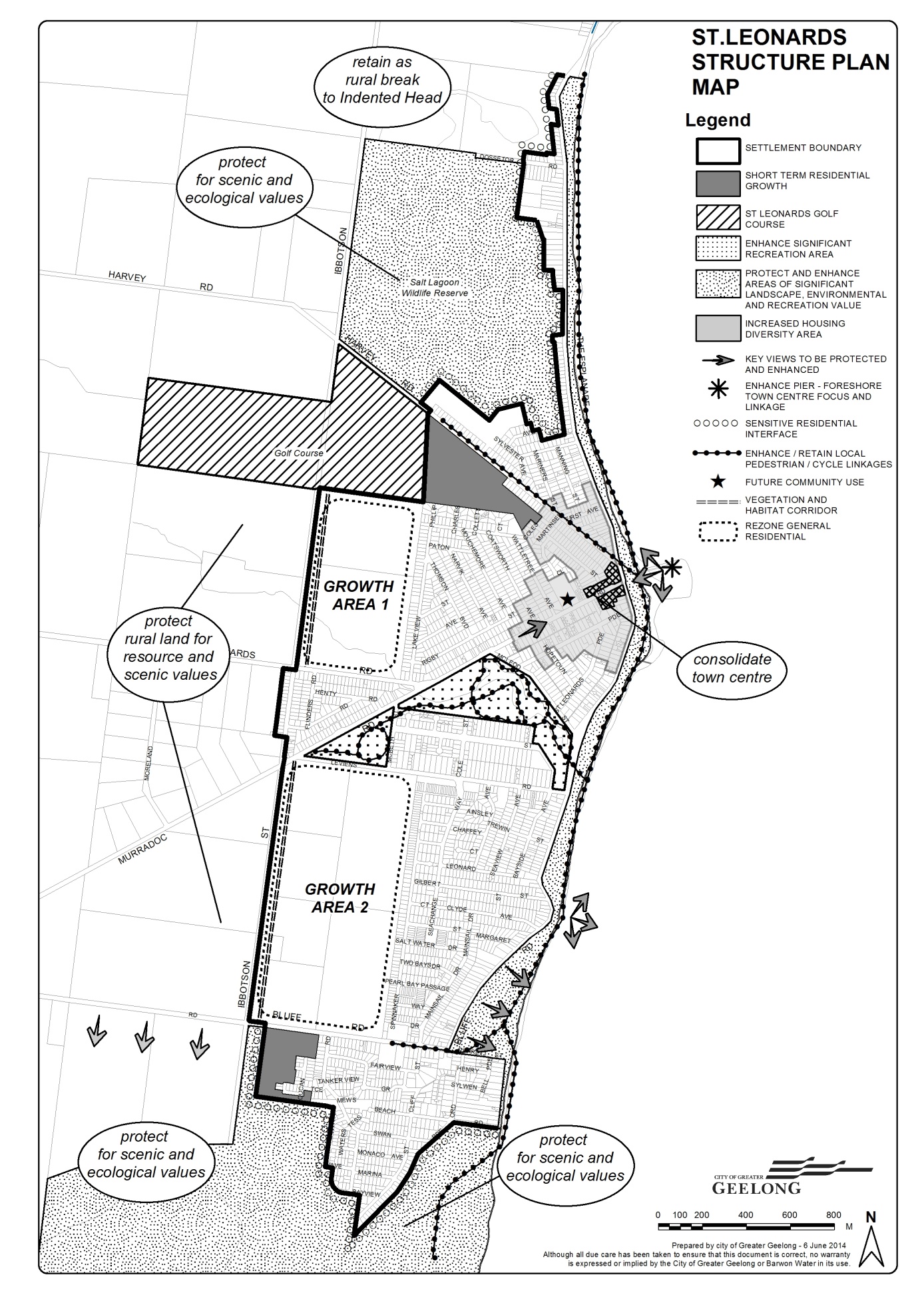
The Amendment was exhibited for a 1 month period closing on 8 September 2014. This included a Notice and information brochure sent to some 2,500 landowners in the St Leonards area. The brochure included the proposed new structure plan map which is shown at Appendix 1.
As a consequence of the Amendment C312 exhibition, a total of 23 submissions were received – 13 in support or not objecting and 10 opposing the Amendment or requesting changes. Appendix 2 contains a table which summarises the submissions and includes an Officer response.
Pursuant to the Planning and Environment Act 1987, the Council is required to consider all submissions made to an Amendment and must either: (1) change the Amendment as requested by the submissions; or (2), refer the submissions to an Independent Panel; or (3) abandon the Amendment.
The next section of this report outlines the key issues raised in the submissions and provides an officer response. In the event the submissions are referred to an Independent Panel, as recommended, the responses in this report will form the basis for Council’s presentation to the Panel.
Excess residential land supply and lack of strategic justification
Five objections were received from property owners in St Leonards, three of whom reside in the recently developed Sea Change Estate directly behind Growth Area 2. The objectors say the plan to rezone the Growth Areas at this time is unnecessary highlighting the substantial existing lot supply available and slow take-up of land. They say the rezonings will create an over-supply of vacant residential land and the sprawl will detract from the seaside village feel of St Leonards. St Leonards will become like other large towns on the Bellarine it is said.
The submitters conclude that there is no strategic justification to warrant the 2014 recommendations to release the potential long term residential Growth Areas for redevelopment.
Officer response
The submissions raise a number of relevant residential land supply considerations for the Township, particularly given that St Leonards is not a designated growth location on the Bellarine. However the fact that only 5 property owners out of over 2,500 object to the policy direction to rezone Growth Areas 1 & 2, clearly indicates that the majority of the St Leonards community accept population growth within the town as outlined in the 2014 Structure Plan.
Officers do not believe the rezonings will detract from the seaside village feel of St Leonards. The Growth Areas are located some distance from the foreshore, open space network and town centre. These are the essential features that give St Leonards its character. Development will occur over a long period of time. During the summer months the town experiences a 5-fold increase in population to over 10,000, however at other times of the year the dwelling vacancy rate is as high as 59%. This trend would be expected to continue.
Support for rezoning the Growth Areas does not suggest St Leonards is headed for similar development to the likes of Drysdale, Leopold and Ocean Grove. These towns are planned to accommodate over 20,000 people supported by a range of commercial and community infrastructure. St Leonards will grow to around 2394 people by 2021 and continue its role as a summer holiday destination mixed with a small permanent community.
It is very important to note that the 2014 review has not changed the location of the town’s settlement boundary. The settlement boundary is the critical planning control that restricts expansion of the urban footprint. The 2014 Structure Plan goes further by saying that no additional land has been identified for future residential growth beyond the settlement boundary and that only a minor review should occur in 10 years to update policy context and assess the retail needs of the town.
This then leads to the question of why support immediate rezoning of Growth Areas 1 & 2 given the existing sufficient residential lot supply. The Structure Plan outlines a strong case for the rezonings on pages 87-103, including the ability to seek contributions from Growth Area developers to fund an Early Years Learning Facility in St Leonards. Allowing both areas to be developed simultaneously provides the best opportunity to realise the facility in the short to medium term.
The objectors rightly note that rezoning both areas will provide between 25 and 33 years supply of residential land in St Leonards. However, simply rezoning land to a residential zone does not automatically translate to full development. Invariably, land is developed over time in stages according to a range of factors such as efficient delivery of infrastructure, financing costs, trends in the market and demand. Ultimately the Growth Areas – whether in a residential zone or identified as “protect for potential long term residential growth” – are located within the settlement boundary where there is an expectation for development.
One of the objectors argues that certainty about the future size of the township already exists with the settlement boundary currently defined in the Planning Scheme, and rezoning the Growth Areas is not necessary to confirm this. While this argument is true, the 2014 Structure Plan position is equally true. Supporting the early planning for these areas also gives the community a much better understanding of the number of houses anticipated, staging and construction times, subdivision and lot layout, location of parks walking trails and wetlands, external road upgrades and vegetation buffers.
For all the above reasons, the submissions are rejected and it is considered reasonable and appropriate to support the rezoning of the Growth Areas for residential development at this time.
Settlement boundary and future growth
1. St Leonards Golf Course
A submission from Fadgyas Planning Assoc on behalf of St Leonards Golf Development Pty Ltd (SLGD) requests that the settlement boundary be shifted to include the golf course land on the eastern side of Ibbotson Street up to Harvey Road. The submission says that a notation should be included on the Structure Plan Map for this land that reads: “Protect for potential long term residential growth”.
The submission highlights that it has always been the long-term strategic goal of SLGD to redevelop the site for residential use whilst concurrently redeveloping the golf course entirely to the west of Ibbotson Street. The submission says it is noteworthy that the first stage of multi-lot subdivision permit 1049/2013 at the end of Blanche Street is now nearing completion.
Officer response
The submission is not supported. One of the key directions from the adopted 2014 St Leonards Structure Plan is to retain the existing settlement boundary. The submission does not layout adequate strategic justification for the boundary to change other than to say that this has always been the goal of the SLGD.
The part of the golf course located on the east side of Ibbotson Street is zoned Special Use Zone 3 and plays an important role as a landscape buffer to the Salt Lagoon Wildlife Reserve. The landscape attributes of this site also contribute to the character of the township, with a considerable amount of vegetation and open space merging with residential areas. With the likely rezoning of Growth Areas 1 and 2, a substantial amount of residential land will be available in St Leonards to accommodate long term population growth.
2. 390A The Esplanade, St Leonards
A submission was received from the Dominion Property Group on behalf of Riverlee Pty Ltd, owner of a 15 hectare lot at the northern edge of the township. The land is zoned part Rural Conservation Zone and part Farming Zone and developed with a single dwelling. The property is located within the St Leonards Structure Plan Study Area.
The property is to retain its rural break role to Indented Head as identified in the 2014 St Leonards Structure Plan. Of primary interest is that the land lies at the edge of the Salt Lagoon Wildlife Reserve.
The submission proposes three things: (1) the inclusion of part of the property within the settlement boundary; (2) support for the rezoning of part of the land to the Farming Zone and Residential 3 Zone; and (3) consequential changes to Clause 21.14. The submitter suggests the opportunity exists to develop the land in the Farming Zone for tourist accommodation but does not give any details of the type of accommodation.
Officer response
Following receiving this submission, Council planning and environment officers met on-site with a representative of the Department of Environment and Primary Industries (DEPI). There was agreement that this is a sensitive, challenging site for development, serverely constrained by its access. Including part of the property within the settlement boundary and rezoning part of the site for residential use is not supported. Some of the land is low lying, subject to coastal erosion and storm surges, climate change impacts and flood prone.
However the higher northern part of the property could support a well-designed, sensitivley constructed and operated tourist facility. Council officers would not support a Camping and caravan park. This may require rezoning land to the Farming Zone, particularly to allow for the existing access. Or alternativley, the land required for the tourist use may be better placed in a site-specific zone. Any future rezoning and development should consider the lower half of the property being gifted to DEPI for inclusion in the Salt Lagoon Wildlife Reserve or registration with a conservation covenant.
Council’s Planning Strategy Unit is about to undertake a review of the Municipal Strategic Statement policies applying to tourism development in rural areas, given the recent changes to the Farming Zone provisions by the Minister for Planning. Current policies require tourist uses in the Farming Zone to be associated with an agricultural activity on the land. Any future proposal for the site will need to consider the outcomes of this work.
Officers will make submissions to the Panel to include a new section in the Structure Plan about the site and its potential for a quality, low-scale tourist accommodation use. There will need to be a strong emphasis on environmental issues including: impacts on biodiversity; protection and enhancement of the salt lake; sustainable land management and capability; as well as consideration of impacts to adjoining residents and the commercial abalone facility.
3. 522-570 Ibbotson Street, St Leonards
This submission is from the landowner of 522-570 Ibbotson Street, a 32 hectare Farming Zone property on the corner of Bluff Rd and Ibbotson St, opposite Growth Area 2. The submission supports the majority of the key objectives listed in Amendment C312.
The submission however raises the following opposing arguments: (1) that a review of the 2014 Structure Plan should be undertaken in 5 years not 10; (2) that the land on the west side of Ibbotson Street be now identified as suitable for future growth; and (3) St Leonards will need further growth and therefore the structure plan review should identify future town boundary extensions.
Officer response
Officers acknowledge the general support for the Amendment but do not agree with the opposing arguments raised in the submission.
The 2014 St Leonards Structure Plan lays out the case that by supporting the release of the Growth Areas for residential development combined with the exisitng supply and historically low take-up of lots, means there will be 25-33 years supply of residential land for the Township. As a result, a major review will not be required for some time and will be dependent on pervailing policy settings. What the 2014 Structure Plan does say however, is that because of the gradual increase in population and seasonal tourist influx, an assessment of the retail needs of the town should be the primary basis for a review in 10 years.
The 2014 St Leonards Structure Plan review makes it clear that the settlement boundary should not change. The submission suggests that land outside the settlement boundary, particularly the land on the west side of Ibbotson Street opposite Growth Area 2, should be identified for future growth on the structure plan map. This is not necessary given the substantial supply available witihin the settlement boundary over the medium to long term.
Similarly, references to ‘future town boundary extensions’ are not required in the 2014 review. Council’s Municipal Strategic Statement does not designate St Leonards as a location for urban growth on the Bellarine, meaning there is no imperitive to nominate additional areas.
St Leonards is surrounded by significant waterways including the Salt Lagoon and Swan Bay. Stormwater from the existing residential areas drain to these receiving waterways. As in the majority of older established areas, there is a need to improve drainage infrastructure and water quality outputs. Future developments identified in the St Leonards Structure Plan will need to consider and manage stormwater runoff.
No impact to budget.
The review of the 2006 St Leonards Structure Plan and ultimate adoption of the 2014 version was undertaken with due regard to current policies and strategies. This included state coastal planning policies and the Municipal Strategic Statement, Clause 21.14 The Bellarine Peninsula.
The Amendment supports the ‘Growing our Economy’ and ‘Sustainable Built and Natural Environment’ strategic directions of City Plan. The Amendment implements the 2014 review of the St Leonards Structure Plan which identifies a clear settlement boundary, nominates areas for new residential growth, and protects the surrounding rural landscape, conservation reserves and coastal setting.
No officers involved in this report have any direct or indirect interest in accordance with Sec 80 (c) of the Local Government Act.
There are no notable risks associated with implementing the recommendation contained in this report.
The 2014 St Leonards Structure Plan review has been prepared following consultation with the local community. The structure plan is a strategic framework for the future development of the Township which is to continue its role as a coastal village. The identified need for an Early Years Learning Centre is a key social outcome of the plan.
The Amendment will not impact on any basic rights, freedoms and responsibilities as set out in the Charter. Planning legislation ensures an open community consultation process occurs, enabling people to freely express their views and if necessary obtain a fair hearing before an Independent Panel.
The Amendment was exhibited in accordance with the provisions of the Planning and Environment Act 1987. This included a Notice sent to 2,500 landowners in the St Leonards area. In accordance with Clause 4(2) of Ministerial Direction No. 15 the following panel hearing dates have been set for this Amendment:
Directions hearing: in the week commencing 17 November 2014.
Panel hearing: in the week commencing 8 December 2014.
Planning Panels Victoria will notify all submitters of the Panel dates and invite requests to be heard at the Panel Hearing.
No
| Name |
Address |
Type |
Summary of Submission |
Officer Response |
|---|---|---|---|---|---|
1 |
ABC Project Management Pty Ltd |
Peter Davey |
Support |
ABC act on behalf of 5 landowners on the western side of Growth Area 2. ABC support the Amendment, noting that it recognises both Growth Area 1 and Growth Area 2 are equally suited for growth and that neither should be identified as having priority over the other.
|
The submission is noted. |
2 |
Barwon Water |
Peter Morgan |
No Objection |
Barwon Water raises no objection to the Amendment. |
Noted. |
3 |
J & K Brock |
28 Park Avenue |
Objection |
Owners of property at 10 Gibson Grove St Leonards who say the Amendment should be abandoned. In summary, the submitters object to the Amendment on the basis of procedural unfairness, that it is premature and that there is no strategic justification to support the recommendations that support the release of Growth Areas 1 and 2 for short term residential development. |
The objectors calls for the Amendment to be abandoned are rejected. The Amendment is the result of a review of the 2006 St Leonards Structure Plan and was adopted by the Council in February 2014. The 2006 Structure Plan Review |
4 |
Prof Ian Copland |
389 The Esplanade
|
Support |
The submitter is a resident of St Leonards and supports the retention of the rural break to Indented Head. Totally opposed to any development of land to the rear of his property. |
Noted. This is consistent with the direction in the Structure Plan. Regarding the land to the rear, refer to the section ‘Settlement Boundary’ under the Discussion section of this report. |
5 |
Corangamite Catchment Management Authority |
Dr G Taylor
|
No Objection |
The Authority raises no concerns. The Authority notes that it will comment on development of the two Growth Areas when they are presented for rezoning. |
Noted. |
6 |
Dept of Environment and Primary Industries |
G Brookes
|
No Objection |
DEPI has considered the Amendment and offers the following comments to assist Council: |
Noted. |
7 |
Dept of Transport, Planning & Local Infrastructure |
Jozef Vass
|
No Objection |
A coordinated response from DTPLI and PTV. No objection to the Amendment. |
Noted. |
8 |
Dominion Property Group for Riverlee Pty Ltd |
Dominion Property Group
|
Objection |
Riverlee, owners of 390A Portarlington St Leonards Rd (The Esplanade), engaged Dominion PG to act on its behalf to prepare this submission. Of primary interest is that the land lies at the edge of the Salt Lagoon Wildlife Reserve and sits partly in the Rural Conservation Zone. |
Following receiving this submission, Council planning and environment officers met on-site with a representative of the Department of Environment and Primary Industries. |
9 |
Dr B J Egan |
44 Pearl Bay Passage
|
Objection |
Submission from the owner whose property backs onto Growth Area 2.
|
Refer to the Discussion section in the body of this report for comments about residential land supply. Other issues are addressed as follows: The support for rezoning the growth areas does not suggest St Leonards is headed for similar development to the likes of Drysdale, Leopold and Ocean Grove. These towns are planned to accommodate over 20,000 people supported by a range of commercial and community infrastructure. St Leonards will grow to around 2394 people by 2021 and continue its role at a summer holiday destination mixed with a small permanent community. While the age demographic is skewed to older groups there is a primary school in St Leonards and Council’s Draft Childrens Services Infrastructure Plan identifies the need for an Early Years Learning Centre. St Leonards is identified as an area of disadvantage according to the SEIFA index. For the submitter to conclude that better learning support for children is not warrented because of the towns age profile is slightly disconcerting. The consideration of individual property prices is not generally a relevant matter in the determination of the appropriateness of a planning scheme amendment; rather it is the strategic planning implications that are considered. Overall the adopted 2014 St Leonards Structure Plan was not rushed and will provide a strong strategic basis for the sustainable development of the town. |
10 |
Fadgyas Planning Assoc for St Leonards Golf Development Pty Ltd (SLGD) |
C L G Fadgyas
|
Objection |
The submission is made on behalf of St Leonards Golf Developments Pty Ltd, David Blanche, Director. The submission highlights that in the 2006 Structure Plan, Map 4 shows the SLGD land as ‘First Priority’ for future residential growth, though a different outcome was translated as part of Amendment C129 and Clause 21.14-4. |
The submission is not supported. One of the key directions from the adopted 2014 St Leonards Structure Plan is to retain the existing settlement boundary. The submission does not layout adequate strategic justification for the boundary to change other than to say that this has always been the goal of the SLGD. |
11 |
C & J Fordyce |
12 Gibson Grove
|
Objection |
Strongly opposed to the further unnecessary development which is at odds with St Leonards seaside village feel. |
Refer to the Discussion section in the body of this report for comments about residential land supply. Development of the growth areas will not detract from the seaside village feel of St Leonards. The growth areas are located well away from the coast and will be developed over a long period of time. During the summer months the town experiences a 5-fold increase in population to over 10,000, however at other times of the year the dwelling vacancy rate is as high as 59%. This trend would be expected to continue. |
12 |
K Foxcroft & D Law |
85 Bluff Road
|
Objection |
The submission highlights two issues: |
The submission overplays the significance of the location of these arrows on the Structure Plan map, however the map will be modified as requested. The purpose of the arrows to recognise ‘key views’ does not change. Regarding references to ‘protection and enhancement of key visatas and viewlines’, the Structure Plan is identifying important environmental features in the study area – of which views are one. This identification would give rise to consideration of views and vistas at certain locations in future land use planning and development application(s) where relevant. Council is not bound by any ‘responsibilities’ in this way. |
13 |
Gee Dee Nominees P/L |
G Petsinis
|
Objection |
The submitter owns 522-570 Ibbotson St St Leonards, a 32 hectare Farming Zone property on the corner of Bluff Rd and Ibbotson St. The submission supports the majority of the key objectives listed in Amendment C312, however does not support the following: |
The opposing arguments raised in the submission are not supported. The 2014 St Leonards Structure Plan lays out the case that by supporting the release of the Growth Areas for residential development combined with the exisitng supply and traditionally low take-up of lots, means there will be 25-33 years suply of residential land for the Township. As a result, a major review will not be required for some time and will be dependent on pervailing policy settings. What the 2014 Structure Plan does say however, is that because of the gradual increase in population and seasonal tourist influx, an assessment of the retail needs of the town should be the primary basis for a review in 10 years. |
14 |
I Maronian |
60 Leviens Road
|
Objection |
The landowner is concerned about the implementation of the Structure Plan, particularly Growth Area 2. Says he has a vested interest in stopping the future development as he lives next door to what will be a 1400 lot subdivision – huge impact on a small town.
|
Refer to the Discussion section in the body of this report for comments about residential land supply. |
15 |
C & K Meurer |
381 The Esplanade
|
Support |
The submitter is a resident of St Leonards and supports the retention of the rural break to Indented Head. |
Noted. This is consistent with the direction in the Structure Plan. |
16 |
M & H Priest |
78 Bayshore Ave |
Objection |
The submission says: |
The 2014 Structure Plan review does not change the existing location of the township settlement boundary. New growth areas will include a range of public open space links and planted vegetation to enhance the village feel of the town. |
17 |
N & C Richards |
93 Bluff Road |
Objection |
The submission notes that the plan shows arrows opposite [our] home indicating and we quote "key views to be protected and enhanced". |
Property values and by association rates are not a relevant planning consideration in the preparation of the Structure Plan. |
18 |
St Leonards Property Holdings P/L |
R Closter
|
Support |
The submission fully supports the Amendment. The submitter owns a 20ha property in Growth Area 2. |
Noted. |
19 |
St Quentin Consulting for B & R Robinson |
C Gray
|
Support |
The Robinson’s own a 19ha property in Growth Area 2 and fully support the Amendment. |
Noted. |
20 |
D & M Smith |
386 The Esplanade |
Support |
The submitter is a resident of St Leonards and supports the retention of the rural break to Indented Head behind their property. Notes a reduction in bird life since the land behind was cleared. |
Noted. The rural break is consistent with the direction in the Structure Plan. A planning permit was issued in 2005 allowing vegetation removal to construct a vehicle crossing. |
21 |
TGM on behalf of Costa Property Nine Pty Ltd C Marshall |
Group Mgr Planning
|
Support |
Costa owns 321-399 Ibbotson St (Growth Area 1) and expresses support for the Amendment, particularly the recommendation to rezone the land to the General Residential Zone. The submission says the Amendment reinforces the strategic direction for the future growth of St Leonards in the 2006 Structure Plan where this land was identified as the ‘First Priority’ for growth. |
Submission noted. The 2014 Structure Plan does not prioritse rezoning one growth area over the other. |
22 |
Vic Roads |
Sam Pirrotta
|
No Objection |
Vic Roads does not object to the Amendment. |
Noted. |
23 |
Wathaurung Aboriginal Corporation |
John Young |
No Objection |
Does not object to the Amendment. The submission provides comments on requirements for a Cultural Heritage Mgt Plan for the two Growth Areas. |
Noted. |
Portfolio: |
Planning Cr Heagney |
Source |
Planning and Tourism - Strategic Implementation |
General Manager: |
Peter Bettess |
Index Reference: |
Subject: Council Reports 2014, Application C203 |
The purpose of this report is to enable Council to consider submissions to Amendment C203 and refer them to an Independent Panel appointed by the Minister for Planning.
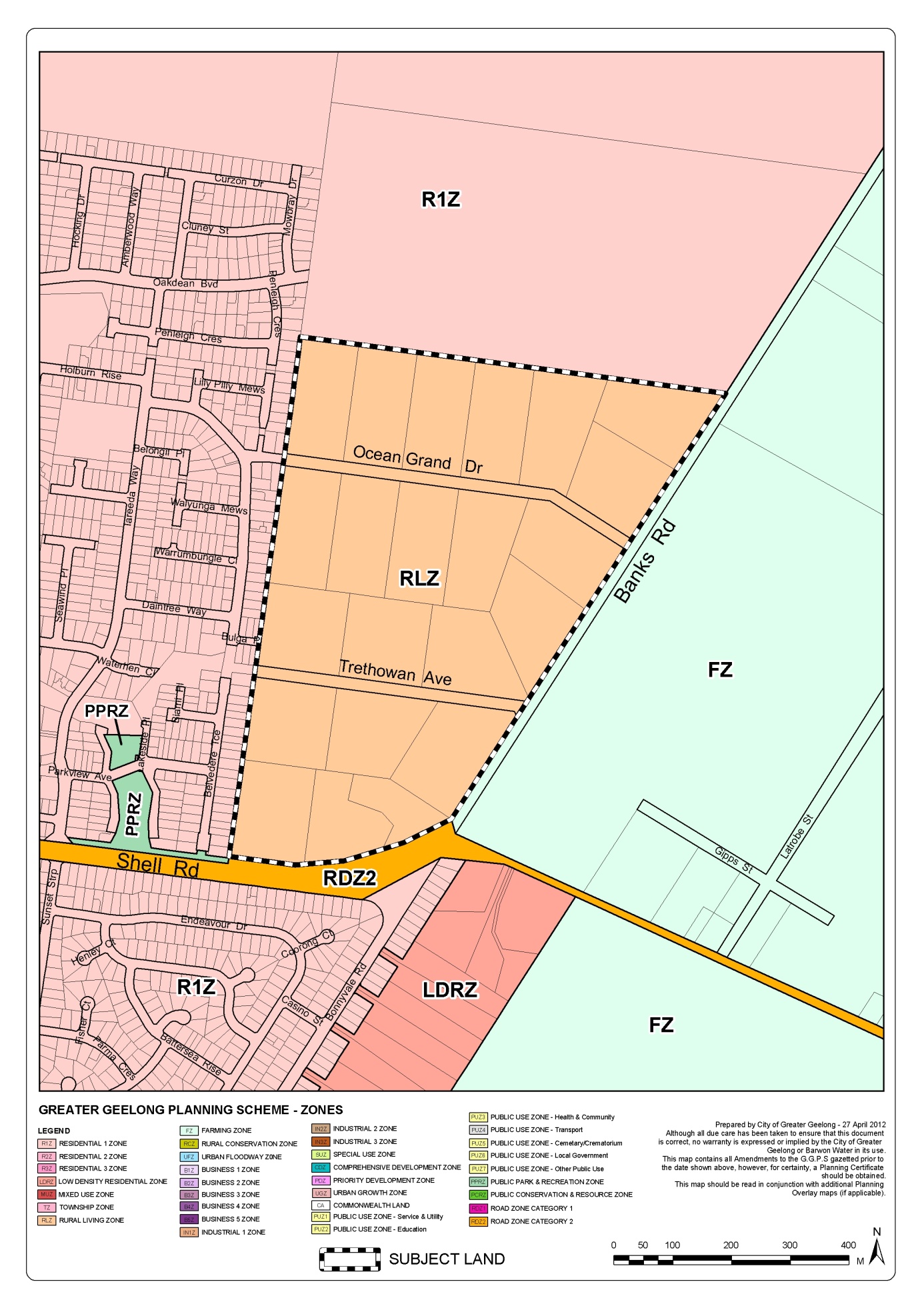
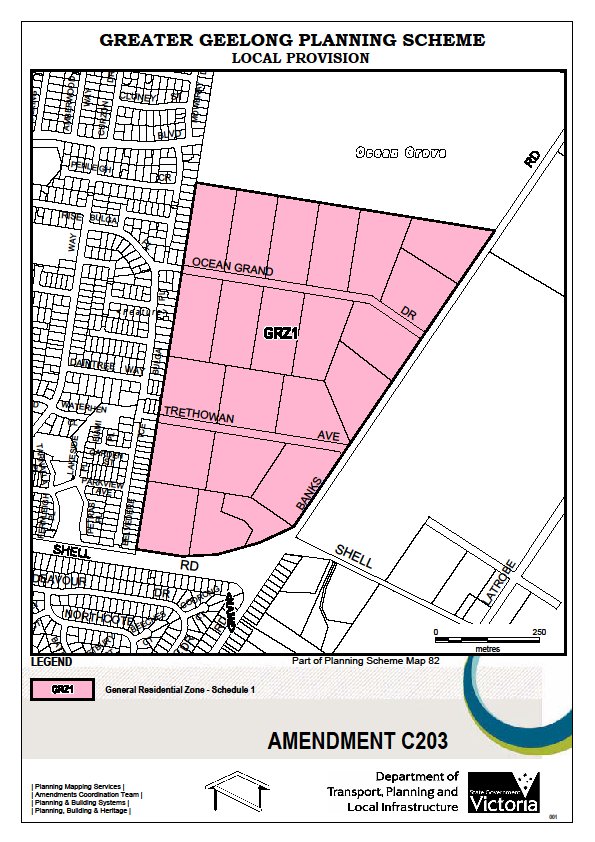
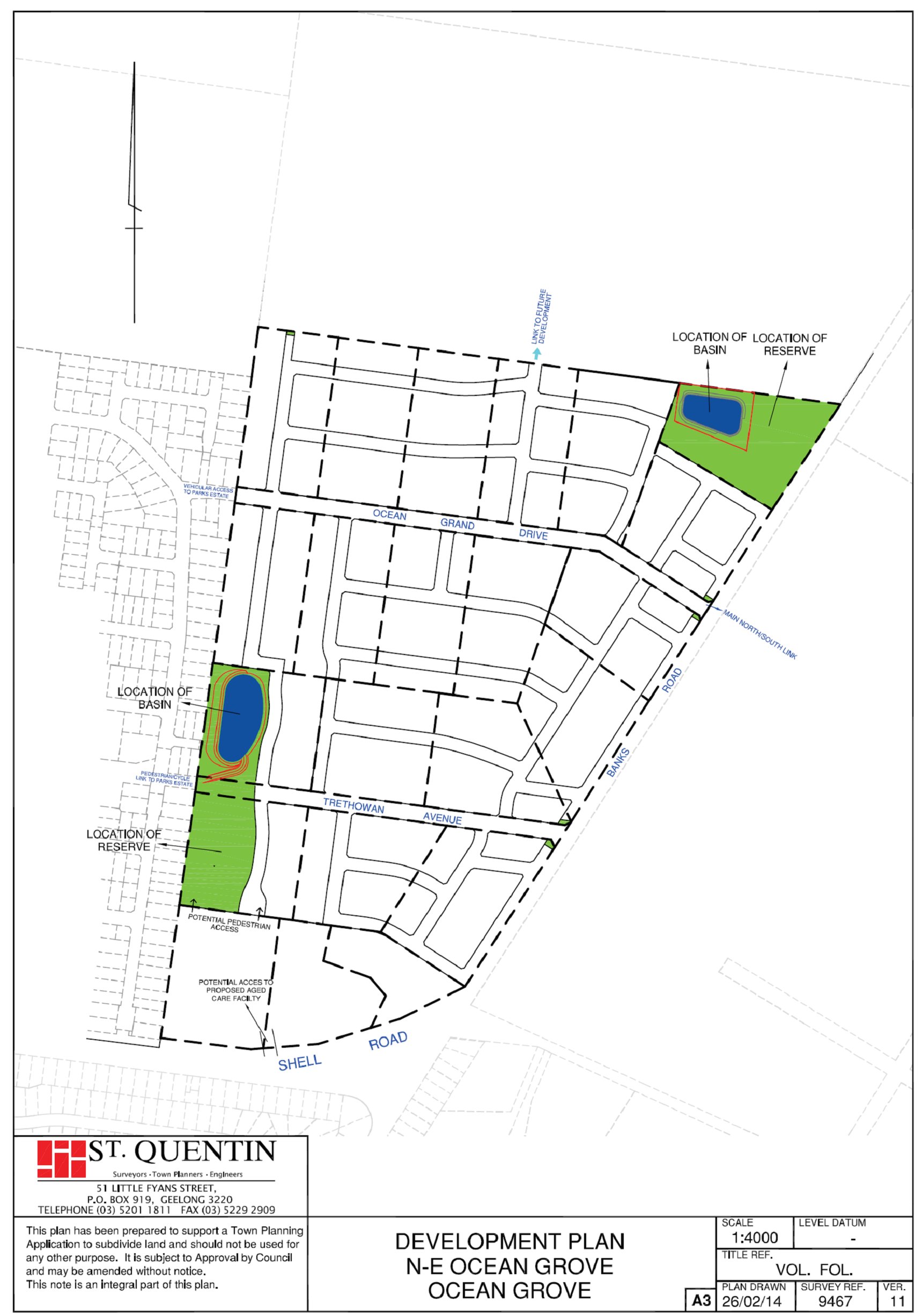
Amendment C203 resulted from an application made by St Quentin Consulting on behalf of the North East Ocean Grove Subdivision Group to rezone 22 properties totalling 45ha from Rural Living to General Residential zone (Schedule 1) together with an accompanying Development Plan Overlay. The subject land is west of Banks Road, north of Shell Road immediately east of the Parks Estate in Ocean Grove.
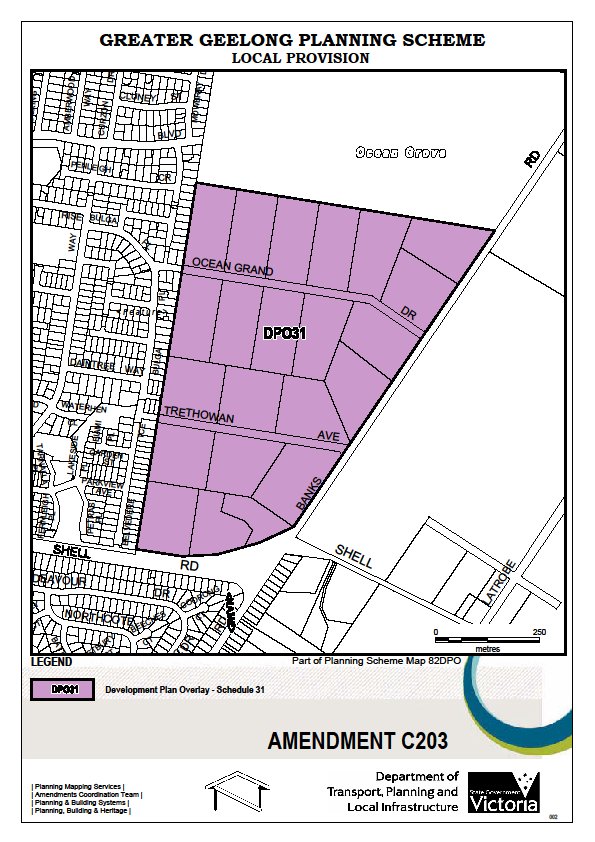
The Development Plan Overlay (DPO) Schedule has been based on an agreed Outline Development Plan which had been previously prepared to guide the future development of the area. The exhibited documentation also included a draft Shared Infrastructure Funding Plan and accompanying model template Section 173 Agreement to formalise equitable developer contribution arrangements among all landowners.
Amendment C203 was placed on public exhibition from 7 August 2014 until 8 September 2014. A total of twelve submissions were received of which six supported or offered no objection, two authorities suggested additional DPO provisions, three residents from the adjoining Parks Estate objected on amenity and environmental grounds and impact on the integrity of Ocean Grove and a petition containing 31 signatures objecting to the rezoning.
The rezoning of this area is consistent with a range of adopted Council planning policies and the Ocean Grove Structure Plan. Its development provides an opportunity to contribute to urban consolidation given its close proximity to a range of community and commercial services and facilities nearby in Shell Road.
As there are objecting submissions which are unable to be resolved it is necessary to refer all submissions to an Independent Panel appointed by the Minister for Planning.
Cr Heagney moved, Cr Farrell seconded -
That Council having considered all submissions to Amendment C203 to the Greater Geelong Planning Scheme, resolves to:
Request the Minister for Planning to appoint an Independent Panel under Part 8 of the Planning and Environment Act 1987;
Refer all submissions to the Panel; and
Submit to the Panel its response to the submissions generally as outlined in this report.
Carried.
Amendment C203 resulted from an application made by St Quentin Consulting on behalf of the North East Ocean Grove Subdivision Group to rezone 22 properties totalling 45ha from Rural Living to General Residential Zone Schedule 1 together with an accompanying Development Plan Overlay. The subject land is west of Banks Road, north of Shell Road, immediately east of the Parks Estate in Ocean Grove.
Appendix 1 shows the land subject of the rezoning application and existing zonings. The vast majority of the lots (each approx 2ha) are individually owned and used for rural residential purposes. They have been substantially cleared of native vegetation apart from scattered remnant trees and some intact indigenous vegetation within the Banks Road roadside reserve. Appendix 2 is an aerial photo of the subject land and surrounding area.
The application was accompanied by specialist planning, vegetation, aboriginal cultural heritage, traffic and engineering reports together with a draft outline development plan of the area.
As part of the processing of this application there were extensive discussions and negotiations with the applicant and their consultants about the outline development plan and delivery by the developer(s) of the necessary community infrastructure in a timely manner. In this area these arrangements have been complicated by the relatively large number of individual property owners and the need to fairly and equally apportion developer contribution costs among the individual landowners.
Identified shared infrastructure requirements include:
Provision of 2 stormwater retarding basins.
Provision of 2 local parks (10% of the overall area)
Upgrade of Banks Road intersections with Trethowan Avenue and Ocean Grove Drive.
$900 per dwelling community infrastructure levy.
A Draft Shared Infrastructure Funding Plan (SIFP), which was prepared by the applicant in consultation with Council, sets out the shared developer contribution arrangements in an equitable manner. The SIFP, along with an accompanying model template Section 173 Agreement to formalise these arrangements, were exhibited as part of the amendment documentation.
It is intended that the Section 173 Agreements with the individual landowners be signed prior to the approval of the amendment.
Appendix 3 is a copy of the exhibited Amendment C203.
Amendment C203 was placed on public exhibition from 7 August 2014 until 8 September 2014. Notices where placed in the Geelong Advertiser, Independent and the Government Gazette and sent to all adjoining and nearby property owners and occupiers and all relevant Ministers and Public Authorities.
As a result of the exhibition of the Amendment the Council received a total of 12 submissions, as follows:
Three submissions from landowners in the area proposed to be rezoned supporting the Amendment.
Three submissions from public authorities (Barwon Water, DTPLI and EPA) raising no objection to the amendment.
Two submissions from Public Authorities (VicRoads and Department of Environment and Primary Industries) each requesting an additional DPO provision.
Three submissions from residents in the adjoining Parks Estate objecting to the Amendment.
A petition containing 31 signatures (half Ocean Grove residents) objecting to the rezoning and advocating Council “say no to another concrete suburb”.
Appendix 4 is a schedule which summarises all submissions received.
The following section of this report outlines the major issues raised in the submissions followed by an officer’s response to them.
Affected landowners – supporting submissions
Three landowners whose properties are proposed to be rezoned have written formal submissions supporting the Amendment on the grounds it will facilitate the town’s residential expansion and better utilise existing facilities and services.
Officer Response
Prior to the formal exhibition of the amendment all affected landowners had been advised about the proposed shared infrastructure funding arrangements and their formalisation in the proposed Section 173 Agreement with issues requiring clarification/ resolution being addressed. No issues of concern have been raised by any of the affected 22 property owners.
Public Authorities – no objection
Barwon Water, the EPA and Department of Transport, Planning and Local Infrastructure (DTPLI) have indicated they have no objection to the amendment. The Barwon Water submission sets out developer responsibilities for the upgrading of water supply and sewerage services to service this area. The DTPLI submission offers no objection provided VicRoads requirements are included in the amendment documentation as per their submission.
Officer Response
The planning for this area has been undertaken on the basis of servicing advice previously provided by Barwon Water. It has always been understood the western catchment of the subject land can be serviced immediately, whereas the northern-eastern catchment will rely on construction of a new sewerage pumping station scheduled for 2017-2018.
Public Authorities requesting additional DPO provisions.
The Department of Environment and Primary Industries (DEPI) notes the existence of indigenous scattered trees and remnant vegetation and requests the DPO provisions be strengthened to:
Require a subdivision layout which shows by distribution of public open space how significant impacts on biodiversity have been avoided and minimised; and
Require preparation of a roadside native vegetation management plan which shows how impacts on remnant native vegetation can be avoided and minimised through location and design of new roads and crossovers.
VicRoads seeks inclusion of a new DPO provision to limit new access to Shell Road which is in the process classified as a declared arterial road. It also considers developers should contribute to the future upgrade of the Shell Road/Banks Road Intersection.
Officer Response
The applicant’s consultants have undertaken a detailed Vegetation Assessment of the area being rezoned. It has identified a limited number (6) of scattered indigenous trees on private property and patches of remnant vegetation both on private property and in roadside reserves which it recommends be retained. Whilst their incorporation into local open space as proposed by DEPI may not be practical in every instance, strengthening the DPO provisions relating to the Open Space Masterplan requirement with the following additional wording is recommended:
A subdivision layout which demonstrates how impacts on biodiversity values identified in the Vegetation Assessment report dated June 2014 can be avoided and minimised.
A roadside native vegetation management plan which shows how impacts on remnant native vegetation on roadsides can be avoided and minimised through location and design of new roads and crossovers.
It is considered the inclusion of the above wording in the DPO Schedule will essentially address the issues raised in the DEPI submission.
VicRoads’ request to prevent the creation of new lot access to Shell Road is supported (other than the VicRoads’ approved new access for the proposed aged care facility and retirement village at 181 – 189 and 191 – 195 Shell Road subject of permit 447/2011). It is proposed a new requirement to this effect be added to the DPO provision relating to the preparation of a Road Network and Traffic Management Plan.
VicRoads’ request that there should be some developer contribution towards the upgrading of the Shell Road/Banks Road intersection cannot be supported. The area being rezoned is calculated to accommodate some 472 lots; by comparison the major Ocean Grove Growth Area to the north between Grubb and Banks Roads can accommodate over 3000 dwellings. The major growth area will have a far greater impact on the major intersections in the area. At the time of considering its rezoning (Amendment C60 approved 26/8/2010) a decision was taken not to seek contributions for major intersection upgrades (other than immediately abutting the site) largely based on the difficulty of fairly apportioning contribution costs.
It is considered it would be inequitable to seek developer contributions towards the Shell Road/Banks Road intersection from Amendment C203 landowners.
Objections to Amendment C203
Three residents in the Parks Estate which adjoins the western boundary of the properties being rezoned object to the Amendment. Their concerns include destruction of native vegetation and loss of wildlife habitat, over-development which does not reflect the town’s coastal identify, loss of amenity and impact on lifestyle. Options suggested include development being more responsive to the environment, retaining existing zoning or applying alternative lower density zones.
A petition containing 31 signatures (approximately half Ocean Grove residents) objects to the rezoning and requests that another concrete suburb not be created.
Officer response
This Rural Living zoned area has been identified in both the 1993 and 2007 adopted Ocean Grove Structure Plans as a future conventional residential area. The 2007 Structure Plan describes this area as follows:
“The Rural Living zoned area incorporating Ocean Grand Drive and Trethowan Avenue provides an opportunity to make a moderate contribution to urban consolidation given proximity to existing and proposed residential areas to the north and west and availability of services.
The fragmented nature of land ownership will however require the development of an Outline Development Plan (ODP) prior to rezoning to residential (with a Development Plan Overlay based on the ODP) to coordinate broad development principles including street networks, protection of scattered vegetation, open space and linkages, a north south road link between Shell Road and the northern growth area, and a low density treatment to Banks Road. This area is not considered a high priority for Council and support for rezoning will be dependent on local residential capacity to coordinate the development of the Outline Development Plan and prepare a rezoning proposal supported by environmental, traffic, cultural and urban design assessments.”
From a strategic planning viewpoint there is a strong State and Council policy justification to support this proposed rezoning.
It is acknowledged that it is inevitable that there will be some loss of existing vegetation resulting from more intensive residential subdivision. The Vegetation Assessment report prepared by the applicant’s consultant has identified both scattered indigenous trees and scattered remnant vegetation which it recommends be retained. The DPO provisions have been further strengthened to ensure that future subdivision layout accommodates the identified vegetation, preferably in pocket parks and/or enlarged road reserves as appropriate. In addition the DPO requires details to be provided of the use of indigenous local plant species within the planned open space areas and within road reserves.
The application of alternative residential zones, in an attempt to ensure vegetation is retained or larger lots are created is not supported and provides little guarantee of a different urban design outcome.
The construction of a conventional residential subdivision, even with the developers’ best intentions of retaining existing vegetation wherever possible, will inevitably result in some of it being removed. Nevertheless, there are many examples of where over time, the creation of a conventional residential subdivision results in far more trees and shrubs being planted than previously existed. A prime example is the adjoining Parks Estate which was converted from a virtually treeless farm over 20 years ago to a residential estate with very high quality vegetated parklands and roadside reserves.
The existing vegetation in the area being rezoned is not of sufficiently high value to warrant protection in a manner of the nearby Yellow Gums, Woodlands or Coolaman Close low density residential areas.
The proposed rezoning and subsequent residential development is not expected to result in any adverse environmental impacts.
The Development Plan Overlay schedule includes requirements relating to protection of remnant vegetation and management of stormwater to prevent downstream pollution.
All necessary new infrastructure or improvements to existing infrastructure will be funded by developers/land owners as set out in the Shared Funding Infrastructure Plan which forms part of the exhibited amendment documentation.
The Amendment is consistent with the State Planning Policy Framework and the Local Planning Policy Framework, as follows:
State Planning Policy Framework. The Amendment implements the objectives and strategies of Clause 11 Settlement, (in particular Urban Growth Clause 11.02, Open Space Clause 11.03, Regional Development Clause 11.05, and Clause 11.07 Geelong (G21) regional growth), Clause 15 Built Environment and Heritage, Clause 16 Housing and Clause 19 Infrastructure.
Local Planning Policy Framework. Clause 21.06 Settlement & Housing identifies Ocean Grove as one of the city’s designated primary urban growth areas. Clause 21.14 The Bellarine Peninsula sets out objectives and strategies for development of the Peninsula and each of the towns as contained in the adopted Structure Plans.
As this report indicates, the proposed rezoning is consistent with the adopted 2007 Ocean Grove Structure Plan and as such is consistent with Clause 21.14 of the LPPF.
The Amendment is also consistent with a range of other environmental, infrastructure, developer contributions and open space policies contained in the M.S.S.
Amendment C203 supports both the Growing our Economy and Sustainable Built and Natural Environment strategic directions of City Plan, particularly as it is facilitating sustainable development in accordance with an adopted township Structure Plan.
No Council Officers have any direct or indirect interest, in accordance with Section 80 (c) of the Local Government Act to which this Amendment relates.
Amendment C203 is not expected to expose Council to any risk or liability beyond that usually associated with facilitating greenfield development.
The Ocean Grove Structure Plan, upon which this Amendment is based, has thoroughly addressed the social implications of identifying areas for future growth.
The subject land is centrally located close to some of the town’s major community, retail and educational facilities.
Amendment C203 does not impact on any basic rights, freedoms and responsibilities as set out in the Charter. Planning legislation ensures an open Community consultation process to enable people to freely express their views and obtain a fair hearing before an Independent Panel.
Full public notification of Amendment C203 has been given in accordance with the provisions of the Planning and Environment Act. All adjoining and nearby property owners received direct notification of the exhibition of the Amendment and will now have an opportunity to present their submission to an Independent Panel appointed by the Minister for Planning.
The planning authority for this amendment is Greater Geelong City Council.
The Greater Geelong Planning Scheme is amended as follows:
The Planning Scheme Maps are amended by a total of two (2) attached map sheets.
Zoning Maps
Amend Planning Scheme Map No 82 in the manner shown on one attached map marked “Greater Geelong Planning Scheme, Amendment C203”.
Overlay Maps
Amend Planning Scheme Map No 82 DPO in the manner shown on one attached map marked “Greater Geelong Planning Scheme, Amendment C203”.
The Planning Scheme Ordinance is amended as follows:
In Overlays – following Clause 43.04, insert a new Schedule 31 in the form of the attached document.
End of document
SCHEDULE 31 TO THE DEVELOPMENT PLAN OVERLAY |
|
|---|---|
24/02/2011 |
Shown on the planning scheme map as DPO31 TRETHOWAN AVENUE/OCEAN GRAND DRIVE OCEAN GROVEThis Schedule applies to the area generally north of Shell Road, west of Banks Road incorporating properties in Trethowan Avenue and Ocean Grand Drive, Ocean Grove. The aim of this Schedule is to ensure that development occurs in accordance with broad development principles as shown in the Trethowan Avenue/Ocean Grand Drive Outline Development Plan 2014 and to ensure delivery of essential community infrastructure as set out in the TrethowanAvenue Final Shared Infrastructure Funding Plan . |
1.0 |
Requirement before a permit is granted |
__/__20 |
A permit may be granted before a development plan has been prepared for the following:
|
2.0 |
Conditions and requirements for permits |
__/__20 |
A permit must contain conditions or requirements which give effect to the provisions and requirements of the approved development plan including the Trethowan Avenue Final Shared Infrastructure Funding Plan. A permit for subdivision must contain a condition which requires the owner to enter into an Agreement with the Responsible Authority pursuant to Section 173 of the Planning and Environment Act 1987 to provide development contributions for:
as outlined in the approved Development Plan and Trethowan Avenue Final Shared Infrastructure Funding Plan. |
3.0 |
Requirements for development plan |
__/__20 |
Separate development plans may be prepared and approved for Catchments 1 & 3 combined and Catchment 2 as shown in the Trethowan Avenue Final Shared Infrastructure Plan. The Development Plan must be generally in accordance with Trethowan Avenue/Ocean Grand Drive Outline Development Plan as shown in Clause 5.0, and include the following: An Urban Design Masterplan that includes:-
A Road Network and Traffic Management Plan complying with any VicRoads requirements that includes:-
An Integrated Water Management Plan that takes an integrated approach to flooding, stormwater and drainage management, is designed with reference to the whole of the catchment and includes:
An Open Space and Landscape Masterplan that includes:
A Final Shared Infrastructure Funding Plan (to be identified as the TrethowanAvenue Final Shared Infrastructure Funding Plan) which updates as necessary the Draft Shared Infrastructure Funding Plan. |
4.0 |
Decision Guidelines |
__/__20 |
In considering whether or not to approve or amend a development plan, the responsible authority must consider:
|
5.0 |
Trethowan Avenue/Ocean Grand Drive Outline Development Plan |
__/__20 |
 |
| No. | Surname |
Name |
Address |
Suburb |
Summary of Submission |
|---|---|---|---|---|---|
| 1 | Bacon |
1 J & A |
42 Daintree Way |
OCEAN GROVE VIC 3226 |
NO OBJECTION to development on the land already cleared. Do OBJECT to clearing trees and vegetation which is important habitat for native birds and animals. Will wipe out ecosystem which supports wildlife. Last mature growth treed area in eastern portion of Ocean Grove. |
| 2 | Barwon Water |
Rhys Bennett |
P O Box 659 |
GEELONG VIC 3220 |
NO OBJECTION Water supply can be provided. Upgrades to the existing network may need to be funded by the developer. Sewerage services can be provided although the north-eastern catchment requires construction of a new pumping station currently scheduled for 2017 – 2018 |
| 3 | Carland |
P |
Carfour Investments Pty Ltd 52 – 60 Ocean Grand Drive |
OCEAN GROVE VIC 3226 |
SUPPORT Owners of 2 ha property in Ocean Grand Drive. |
| 4 | Crespi |
E |
195 Shell Road |
OCEAN GROVE VIC 3226 |
Organiser of petition containing 31 signatures. Objects to creation of another concrete suburb. Advocates retention of existing zoning, saving the wildlife corridor & preventing unsustainable development. |
| 5 | Dept of Environment & Primary Industries |
Geoff Brooks |
PO Box 103 |
GEELONG VIC 3220 |
Considers the DPO Schedule is ambigious in means of protecting existing remnant vegetation identified in the Vegetation Assessment report. Recommends additional provisions in the DPO:
|
| 6 | Dept of Transport, Planning & Local Infrastructure |
Jozef Vass |
PO Box 775 |
OCEAN GROVE VIC 3226 |
NO OBJECTION Provided VicRoads requirements as per their submission are included in amendment documentation. |
| 7 | EPA Victoria |
Roger Simpson |
GPO Box 4395 |
MELBOURNE VIC 3001 |
NO OBJECTION |
| 8 | Mahoney |
G |
4 Belvedere Terrace |
OCEAN GROVE VIC 3226 |
Concerned about the extent of open space, size of lots & proposed zoning which impacts on the integrity of the coastal town. Recent examples of residential estates in coastal areas do not reflect the town’s identity and create just another suburb. Greater emphasis on retention of local indigenous vegetation required. Considers General Residential Zone Schedule 2 or Neighbourhood Residential Zone Schedule 2 would better prevent dense development and respect the environment. |
| 9 | O’Shannessy |
John |
Josco Pty Ltd 49 Bakers Road |
BANNOCKBURN VIC 3331 |
SUPPORTS As landowners, consider the rezoning fits the town’s residential expansion growth – the land has conventional residential development on its northern and western boundaries. |
| 10 | Shanahan |
L |
14 Belvedere Terrace |
OCEAN GROVE VIC 3226 |
OBJECTS Land should be left as it is, as green space. Bought in this area for the peace and quiet. Development would mean noise, dust, vegetation & bird habitat destroyed, detrimental impact on lifestyle with intolerable noise. Hates Oakdene development. Totally opposes any development on this site. |
| 11 | VicRoads |
Christine Delaney |
PO Box 775 |
GEELONG VIC 3220 |
NO OBJECTION Shell Road is in the process of being classified as a declared arterial road for which VicRoads will become the coordinating road authority. Recommends funds be made available from the development to upgrade Banks & Shell Road Intersection. Also recommends additional DPO provision limiting new access to Shell Road. |
| 12 | Wilson |
E B |
Boswil Pty Ltd 42-50 Ocean Grand Drive |
MARCUS HILL VIC 3222 |
SUPPORTS Owners of 2 ha property in Ocean Grand Drive. |
Portfolio: |
Planning - Cr Heagney |
Source: |
Planning and Tourism - Strategic Implementation |
General Manager: |
Peter Bettess |
Index Reference: |
Application: C308 |
The purpose of this report is to seek Council’s endorsement of a submission to the Minister for Planning who is the planning authority for an amendment to reserve land for the Avalon Airport Rail Link.
This amendment has been prepared by the Minister for Planning (the planning authority for the amendment) at the request of the Minister for Public Transport (the proponent).
The amendment applies to land required to reserve a corridor for the future Avalon Airport Rail Link (AARL). Specifically the amendment applies to:
private land on the proposed corridor between the Melbourne-Geelong rail line and the Avalon Airport boundary at Beach Road, Avalon, and
land on the corridor within Avalon Airport owned by the Commonwealth Government and leased by Avalon Airport Australia Pty Ltd.
The amendment documents describe the AARL as a proposed rail link connecting Avalon Airport with Melbourne and Geelong. The AARL will help support Avalon to become Victoria’s second international passenger airport, ensuring that Victoria remains competitive into the future.
Over a period of three years from 2011 to 2014, the State Government project team from the Department of Transport, Planning and Local Infrastructure (DTPLI) has been investigating possible route alignment options.
In early 2013, Phase 2 consultation was undertaken on 3 preliminary route alignment options all located between Lara and Little River being eastern, central and western routes
At its meeting of 12 November 2013, Council resolved to support the Minister for Planning being the Planning Authority for an amendment to secure the rail corridor.
Amendment 308 has now been prepared by the State Government and placed on public exhibition until 27 October 2014. The Amendment implements the government’s preferred alignment being the central route.
The main part of the amendment is a Public Acquisition Overlay across private land and recognition of the route in the Special Use Zone which applies to Avalon Airport. There are also changes to the Municipal Strategic Statement.
This report seeks Council endorsement of a submission to the amendment which Council officers will present to an independent Panel in December 2014.
That Council makes a submission (Appendix 1) to the Minister for Planning supporting Amendment C308 and endorses Council officers presenting the submission to an Independent Panel.
Carried.
Amendment C308 follows a three year investigation of route options by a project team within the Department of Transport and Local Infrastructure (DTPLI). Three preliminary route alignment options were identified being the Eastern, Central and Western options. The investigations included a large number of specialist consultant studies including: Railway and functional issues, Land Use, Flora and Fauna, Surface water, Ground Conditions, Noise, Landscape and Visual amenity, Social impacts, Economics and agriculture, Cultural Heritage and Traffic and Transport DTPLI determined that the Central route best represented the preferred option to be taken forward for further assessment and development of mitigation measures. The Central option was further modified and adjusted to take into account environmental issues, airport layout requirements expressed in the Avalon Airport Draft Master Plan (June 2013) and rail design details and grade separation.
The preferred alignment is shown on the map below and is 5.6km long of which 1.0km is within the Airport boundary. The corridor width averages 85 metres and varies from 34 to 95 metres. The railway would cross three existing roads on bridge structures. The rail link is on embankment for 75% of its length. A total of 33.33 ha of private land is proposed to be reserved for the rail corridor (using a Public Acquisition Overlay).
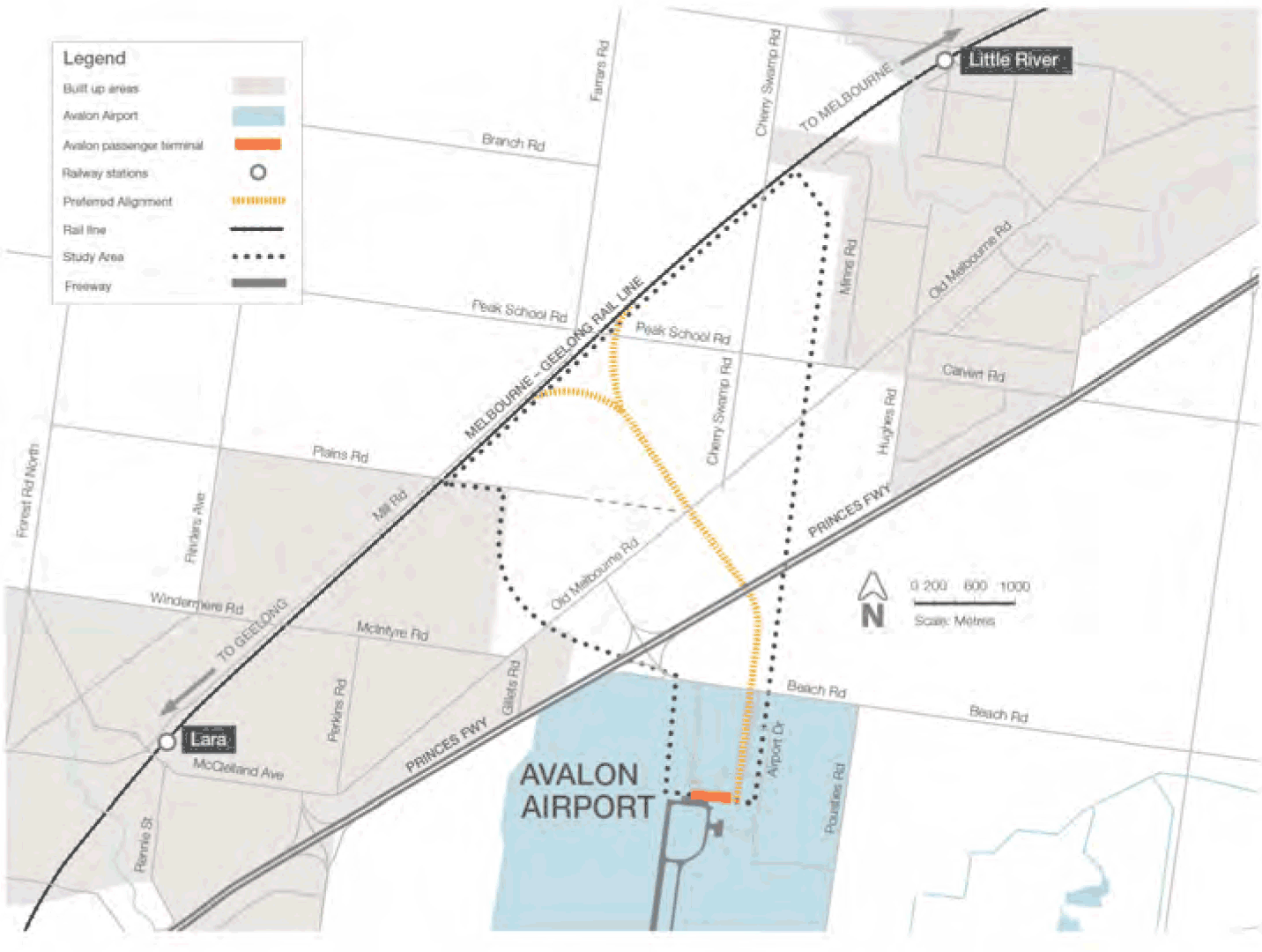
Amendment C308 is based on the preferred alignment (Central option) and recognises land required for the Avalon Airport Rail Link (AARL) within the planning scheme.
Specifically, the amendment proposes to:
amend the Municipal Framework Plan at Clause 21.04 to recognise the AARL.
amend the Municipal Strategic Statement at Clause 21.08 to include recognition of the AARL corridor and require its protection from incompatible use and development.
amend Schedule 11 to the Special Use Zone (Clause 37.01) applying to Avalon Airport to protect the AARL alignment from incompatible use and development.
introduce and apply the Public Acquisition Overlay14 to all private land in the AARL corridor to reserve the land for a public purpose.
make other consequential changes to the planning scheme.
Amendment C308 is on public exhibition with a Panel scheduled to consider submissions at a hearing in December 2014.
Council officers have undertaken a brief, initial assessment of the Amendment and the associated technical reports. A submission has been prepared (see Appendix 1) providing Council’s comments. Due to the timelines involved in getting a report to Council by the closing date for submissions (27 October) only a brief analysis of the large amount of technical material was possible. Council officers will further review the documentation and may expand on the detail of the submission when it is presented to an Independent Panel in December.
The AARL Central alignment as proposed by C308 would require the removal of some areas of native vegetation including potential fauna habitat. See the submission in Appendix 1 for further comments on flora and fauna.
This is a State Government project and does not pose any particular financial implications for the Council.
The Amendment is considered to be broadly consistent with State and regional strategic land use policies. A change is proposed to the Greater Geelong Planning Scheme Municipal Strategic Statement to recognise the rail corridor in local planning policy.
An Avalon Airport Rail Link supports the Growing our Economy strategic direction of City Plan.
No Council officer involved in the report has any direct or indirect interest, in accordance with section 80(C) of the local Government Act.
There are no notable risks associated with implementing the recommendation contained in this report.
The rail link is some distance from residential areas. The submission in Appendix 1 refers to the impact on the owners of farm land whose properties are being divided into segments by the Public Acquisition Overlay for the rail alignment.
The Minister as the Planning Authority for the rail link will need to ensure the amendment does not impact on any basic rights, freedoms and responsibilities as set out in the Charter. Planning legislation ensures an open community consultation process occurs, enabling people to freely express their views and if necessary obtain a fair hearing before an Independent Panel
The State Government has previously undertaken consultation as part of the Avalon Airport Rail Link investigations. Amendment C308 is going through the normal statutory public exhibition process and the DTPLI team are conducting additional mail outs and public information sessions.
[Back to List]Portfolio: |
Environment & Sustainability – Cr Richards |
Source: |
Planning & Tourism and City Services |
General Manager: |
Peter Bettess / Gary Van Driel |
Index Reference: |
Subject: Future Proofing Geelong |
This report provides an overview of the Future Proofing Geelong Memorandum of Understanding and recommends that Council commit to a three year partnership to continue to deliver the objectives of the Low Carbon Growth Plan for Geelong.
Future Proofing Geelong was established to promote initiatives which seek to support the region in working towards a low carbon future. The Low Carbon Growth Plan for Geelong provides a road map to achieve this.
A Sustainability Covenant was signed by the founding partners of Future Proofing Geelong which include the City of Greater Geelong, the Geelong Manufacturing Council, EPA Victoria, Deakin University, the Geelong Chamber of Commerce, Barwon Water, and Committee for Geelong. Additional partners have been included in Future Proofing Geelong activities, including Barwon Health, Geelong and Region Trades and Labour Council, The Gordon and the Barwon South West Resource Recovery and Waste Group.
Future Proofing Geelong is in its fourth year of operation. The Sustainability Covenant expired in May 2014.
All partners have now considered Future Proofing Geelong’s role beyond the expiry of the Covenant and agreed, in principle subject to formal approval through the Future Proofing Geelong Advisory Board, to sign a Memorandum of Understanding to continue working together to future proof Geelong.
The Memorandum of Understanding outlines eight key objectives which underpin the partnership between the signatory organisations. This partnership is about delivering projects that achieve the eight key objectives of the Memorandum of Understanding.
These objectives are:
o Enhance relationships between local government, state government, community and industry to advance the sustainability of the Geelong region;
o Engage local industry and community to help implement actions identified in specific sustainability areas, such as the Low Carbon Growth Plan for Greater Geelong;
o Attract investment and jobs in cleaner technology to the Geelong region;
o Support Geelong to become a leader in integrating sustainability considerations into key organisational operations (including planning, strategy and supply chain);
o Reduce duplication and align integrated sustainability (water, waste, energy) activities in Greater Geelong under one collaborative umbrella;
o Develop Geelong as a showcase of a community transitioning to a low carbon economy;
o Promote “Future Proofing Geelong” as the primary aggregation brand for sustainability initiatives in Geelong;
o The City of Greater Geelong commits to work with partners to gather and report on the impacts of collaborative project that help to future proof Geelong;
A Future Proofing Geelong Advisory Board (which exists) will provide strategic direction for projects delivered under the Future Proofing Geelong banner.
Cr Richards moved, Cr Macdonald -
That Council:
commits to working with partners through the endorsement of the attached Memorandum of Understanding;
authorises the Mayor and Chief Executive Officer to sign the Memorandum of Understanding on behalf of Council.
Carried.
Future Proofing Geelong (FPG) was launched on 12 May 2011 and coincided with the release of the Low Carbon Growth Plan for Geelong and the signing of the Sustainability Covenant amongst program partners.
Partners that signed the Sustainability Covenant included the City of Greater Geelong, the Geelong Manufacturing Council, EPA Victoria, Deakin University, the Geelong Chamber of Commerce, Barwon Water, and Committee for Geelong. Since signing the Sustainability Covenant a number of other organisations have become involved in the project including Barwon Heath, Barwon South West Resource Recovery and Waste Group, Geelong and Region Trades and Labour Council and The Gordon.
The Low Carbon Growth Plan for Geelong highlights where Geelong's carbon emissions are coming from and provides a roadmap of actions to target our efforts to reduce emissions. Three of the key action areas include:
Retrofitting residential and commercial buildings to maximise energy efficiency;
Supporting local small and medium sized businesses to capture energy efficiency savings and abatement potential; and
Localised power generation through cleaner technologies such as cogeneration, solar, waste-to-energy and geothermal.
The FPG vision is that in 2030, Geelong is internationally recognised as one of the world’s most resilient cities through collaboration and innovation in the following three focus areas:
Sustainability – through efficient resource use and the protection and enhancement of environmental assets
Liveability – building healthy communities, which are connected and care for each other
Productivity – through a transition to a low carbon economy; cleaner, leaner and smarter businesses and industries powered by an informed, educated and skilled workforce that thinks and acts for the long term.
The Future Proofing Geelong Advisory Board oversees the work of FPG. The Advisory Board has agreed to continue the work of FPG. There is in principle support among the Advisory Board to work on FPG under an MOU, the MOU is attached in Attachment 1.
Discussions have been had since the expiry of the Sustainability Covenant amongst project Advisory Board members. The City is represented on the Advisory Board by five Councillors (including the Mayor) and Senior Management.
The Future Proofing Geelong Impact Statement, produced in 2013, provided the following overview of the key work undertaken by the Project Team. The Future Proofing Geelong team has focussed its resources around three key areas of commercial buildings, assisting business and industry and improving community engagement and awareness as summarised below.
Commercial Buildings
A key part of this work relates to working with owners and tenants of commercial buildings to provide information and assistance in undertaking energy efficiency upgrades. Over 85 building owners, tenants and real estate agents have received support.
Future Proofing Geelong provides grants to businesses for energy assessments with 21 businesses taking up this offer to date. This work involves gathering baseline data through energy assessments, and helping businesses set the business case for building upgrades and retrofits to become more energy efficient. A total of 20 businesses have taken action on the recommendations in the assessments. This action has improved energy efficiency, reduced costs and generated work for local suppliers.
Providing information and support for businesses to seek government funding for energy efficient upgrades is a key part of this work and establishing baseline data ensures that businesses are well placed to take advantage of State and Federal funding opportunities.
Future Proofing Geelong played a key role in securing and managing the Community Energy Efficiency Program (CEEP) grant to upgrade Council facilities. This is anticipated to result in a 16% reduction in carbon emissions for the National Wool Museum, 22% reduction for Splashdown Leisure Centre and 27% for Waterworld Leisure Centre.
Future Proofing Geelong has also worked with CitySwitch to improve building energy efficiency with tenants in Geelong.
Supporting Business and Industry
Future Proofing Geelong works with business and industry by providing support to source and secure funding for several projects. Up to 50 businesses have been supported, resulting in funding being secured for projects. Since the publication of the Impact Statement this figure has risen to $2.1million.
Future Proofing Geelong also co-funded Cleantech Innovations Geelong with the Geelong Manufacturing Council and the Manufacturing Productivity Network Program. Cleantech Innovations Geelong is an alliance of business and industry looking to develop Geelong as a centre of excellence for clean technology in Australia.
The market research conducted for Cleantech Innovations Geelong outlines that global trends in clean technology show dominant growth areas to be clean cities, renewables, energy efficiency, waste management & recycling, water, green buildings, biomaterials, biofuels and stimulating demand for clean technology goods and services.
It also found the multiplier effect of clean technologies is that for every 1 job created, up to 6 peripheral jobs will be generated.
Cleantech Innovations Geelong has secured funding for a three year program to provide support and funding to projects which development markets for cleantech goods and services produced in Geelong. The program will also stimulate demand for cleantech goods and service produced in Geelong.
Community engagement
Raising awareness and supporting community action has the ability to provide significant benefits in transitioning to a low carbon future.
Through working with the community, achievements to date include, 56 events held, with 6,293 participants, and 6 grants issued to community groups for projects which endeavour to deliver the aims of Future Proofing Geelong.
The Smarter Homes Smarter Living program was developed to engage with new home owners to encourage energy efficient homes. The Armstrong Creek Sustainable House (ACSH) is now open in the Warralily display village. The house provides existing and new residents with sustainability information to assist in improving the energy efficiency of their home.
Future Proofing Geelong is delivering positive environmental outcomes through education and assistance to businesses and the wider community to improve energy efficiency and reduce carbon emissions.
Future Proofing Geelong is funded for the 2014/15 financial year. The project will be subject to a budget proposal in the order of $300,000 for ongoing funding beyond the current financial year. The options for Council for on-going funding of this program, if Council remains committed, include an extension of the discretionary project funding or establishing Future Proofing Geelong as a recurrent funding program. The parties to the MOU acknowledge that the future funding is dependant on Council budget decisions.
Within the draft Environment Management Strategy, Council relies strongly on the Future Proofing Geelong initiative to deliver key strategic outcomes.
The Community Wellbeing strategic direction in City Plan identifies the need to build upon existing capacities in local communities. Future Proofing has provided a mechanism to facilitate collaboration across community groups committed to sustainability and to grow the capacity of these groups, and provide an aggregation of sustainability initiatives in the Geelong region.
Under the Growing Our Economy strategic direction, the priorities of supporting existing business and encouraging new and emerging growth sectors refers to the “support and encouragement of new and emerging low carbon industries and sectors” and “link local businesses with growth opportunities and government funding”. The Future Proofing Geelong program and specifically the Cleantech Innovations Geelong initiative under this program support this priority.
In respect of the second priority, facilitate major infrastructure and investment to enable economic growth – one action is identified as “proactively targeting and attracting new investment to Geelong and promoting our regions benefits”, the Future Proofing Geelong program is explicitly targeted in this respect. Further the priority of a prosperous and innovative Geelong, seeks to “advocate for and support innovative and new technological initiatives”, which is again fundamental to the Future Proofing Geelong initiative.
Under the Sustainable Built and Natural Environment, Future Proofing Geelong/Low Carbon Growth Plan is identified as a key strategy. FPG delivers priorities under this direction to support our community to live sustainability, and advocate for and promote sustainable design and development.
No Council Officers have a direct or indirect interest in accordance with Section 80(c) of the Local Government Act in the issue to which this report relates.
There are no risks associated with this report.
The Future Proofing Geelong project has positive social impacts through community engagement.
This report has no impact on the human rights charter, however it is noted that the aims of Future Proofing Geelong support the human rights charter.
The Future Proofing Geelong website is regularly updated to showcase the work the City of Greater Geelong and other Future Proofing Geelong partners are doing to deliver the vision of the program, and to deliver the recommendations in the Low Carbon Growth Plan.
Portfolio: |
Environment and Sustainability – Cr Richards |
Source: |
City Services - Environment and Waste Services |
General Manager: |
Gary Van Driel |
Index Reference: |
Environment Management Strategy |
To seek Council endorsement of the Environment Management Strategy.
Strategic direction for Councils environment and sustainability programs has been derived from the Environment Management Strategy 2006-2011 (EMS).
A new Environment Management Strategy has been developed.
The development of the Strategy has been overseen by an Advisory Committee consisting of Council, community groups and government departments and agencies.
Input for the Strategy has been sought from Council staff, community and government departments and agencies.
A community survey was undertaken with 175 individuals and community groups responding to questions about the regions environmental future. The respondents provided over 7000 comments to the various questions.
A staff survey was undertaken with 72 staff providing 781 comments to the questions.
A biodiversity and landscape protection workshop was attended by 26 environment groups as well as government departments and agencies, attracting over 50 attendees in total.
A clean technology workshop was attended by representatives from industry, business and educational sectors, including peak bodies such as the Geelong Manufacturing Council.
A series of draft strategies have been provided to key stakeholders, including the Advisory Committee seeking feedback.
The draft Strategy was placed on public exhibition for a six week period in late 2013 and early 2014 enabling the broader community the opportunity to assess the Strategy and provide comments.
Public submissions were sought in relation to onshore gas extraction (fracking) following the public exhibition.
Cr Richards moved, Cr Ansett seconded -
That Council:
notes the community consultation undertaken, including high level of interest from environment and other groups; and
endorse the Environment Management Strategy.
Carried.
Environment Management Strategies are seen as a strategic vehicle by which local governments can plan and prioritise the development and delivery of services and support for environment programs to enhance sustainable environmental, economic and social outcomes. In particular, environmental management strategies facilitate local government’s ability to work in partnership with the community to improve environment and community outcomes by;
increasing support for environment programs
improving access to services, support and opportunities for participation
providing a framework and facilitate integration between various Council and community environment initiatives
increasing the responsiveness of services and efficient use of other resources, by identifying service integration and collaboration opportunities
promoting environment areas and programs as important to local communities
maximising resources and undertaking long-term planning for environment programs including the development and evaluation of services, activities and facilities which enable Council to make more informed and strategic decisions about future needs and priorities
providing a mechanism to respond locally to national, state and regional environmental objectives; and
providing a framework for monitoring and reporting around environmental issues and outcomes.
The City of Greater Geelong has acknowledged the importance of environmental management for many years and this led to Council adopting its first Environmental Management Strategy in 1999. Council re-confirmed its commitment to sustainability and sound environmental management in Geelong by adopting the Environment Management Strategy 2006-2011. This Strategy covered many topics and listed Achievements’, ‘Objectives’, ‘Targets’ and ‘Actions’ for each of the topics. Topics within the EMS included;
Council Policy, Programs & Planning
Education and Partnerships
Biodiversity Management
Sustainable Agriculture
Coastal and Marine
Waterways and Wetlands
Air Quality
Resource Use
Waste, Recycling and Reuse
Urban Settlements
In addition to the two EMS documents (1999 as well as 2006-2011) Council has adopted various additional strategies which were either identified as priority actions within the two EMS documents and/or further assist with setting strategic environment and sustainability directions. These strategies include;
Biodiversity Strategy
Geelong Wetland Strategy
Greenhouse Response
Climate Change Adaptation Strategy
The Environment Management Strategy 2006-2011 identified 223 actions, involving a large number of key participants, with the City taking the lead role in directing and facilitating environmental reform. To-date approximately 75% of the actions within the Strategy have been implemented. Work is ongoing to continue to implement actions within the Strategy including development and implementation of a Sustainable Buildings Policy, Pest Plant and Animal Strategy, reduce corporate greenhouse emissions, enhance relationships with key stakeholders and incorporate sustainability throughout the organisation via the ‘EcoChallenge’ program.
Since the development of Councils Environment Management Strategy 2006-2011 issues have arisen that were not given adequate consideration in this strategy, for instance climate change. In addition Council has undertaken considerable amounts of strategic work in other areas which need to be incorporated into the new Environment Management Strategy. With the expiry of Council’s EMS 2006-2011 work began on the development of Councils next Environment Management Strategy.
Following an Expression of Interest process, Russell Fisher, Managing Director of Sustainability in Mind was selected to assist with the preparation of new Strategy. An Advisory Committee was created to oversee and provide assistance and direction with the development of the new Strategy. The Committee consists of:
Internal
A Councillor, being the Environment Portfolio Councillor, or his or her proxy, should the Portfolio Councillor be absent
General Manager City Services
Manager - Environment and Waste Services
External
One representative from each of the following authorities: Department of Sustainability & Environment (DSE), Department of Primary Industries (DPI), Environment Protection Authority (EPA), Barwon Water, Sustainability Victoria & Corangamite Catchment Management Authority (CCMA)
One representative from the Geelong Environment Council
One representative from the Geelong Field Naturalists Club
One representative from the Geelong Sustainability Group
One representative from the Barwon Regional Waste Management Group
One representative from the Wathaurung Aboriginal Corporation
One of the first tasks was the development of a Discussion Paper. The purpose of the Paper was to gain input from the Advisory Committee (and subsequently staff and broader community) on the following topics and questions raised in the Paper;
Role of Council
State of the Geelong environment
Future trends and issues
Council’s approach to environmental sustainability
Implications for strategic directions
Extensive consultation has occurred in the development of the Strategy. A Council staff survey was undertaken to canvass staff views on how their work is connected to environmental issues, and what information and support is needed by staff to contribute to Council’s overall environmental efforts. Seventy-two staff responded, providing 781 comments/answers to the questions.
A community survey was undertaken which asked respondents to answer a series of questions relating to the regions environment future. The survey sought to identify community concerns, what local environment features the community values, ideas and opportunities as well as what is currently working. One hundred and seventy five individuals and community groups responding to questions about the regions environmental future. The respondents provided over 7000 comments/answers to the questions.
A biodiversity and landscape protection workshop was attended by 26 environment groups as well as government departments and agencies, attracting over 50 attendees in total. The primary objectives of the workshop were to;
Identify key trends & issues affecting land use, land management and biodiversity in the COGG
Assess implications of these and identify the role of Council
Identify ideas for strategic direction for Council and priorities for action and innovation
A clean technology workshop was attended by representatives from industry, environment, business and educational sectors, including peak bodies such as the Geelong Manufacturing Council. The primary objectives of this workshop were to;
Learn about the strategic trends and issues for clean technology innovation
Focus on opportunities for clean technology innovation in CoGG
Develop action plans for network clusters for clean technology industries, services and green buildings
Further consultation has been undertaken via facilitated meetings with key community groups, such as the Barwon Heads Sustainability Group.
The surveys, workshops and meetings have provided a wealth of information upon which the new Environment Management Strategy has been developed. Major topics of concern, interest and/or action identified to-date include;
Reducing pollution and greenhouse gas emissions
Preserving and protecting biodiversity
Sustainable development
Waste disposal and recycling
The need for partnerships across environment groups, agencies etc
Air quality
Food security (growing food locally)
Maintain and expand open space
A series of draft strategies have been provided to the Advisory Committee seeking feedback. A draft Strategy was placed on public exhibition for a six week period in late 2013 and early 2014, providing the broader community the opportunity to assess the Strategy and provide comments. Significant feedback was received with 143 residents and community groups responding. The most significant issue identified during this consultation was onshore gas extraction and specifically the use of hydraulic fracking to obtain natural gas. This issue had not been identified in any previous correspondence or feedback in workshops, meetings or any other engagement. Community concern regarding this issue resulted in Council passing the following Notice of Motion at the 22 July Ordinary Council Meeting which resolved that a 30-day process be commenced to educate Council of the issue of ‘fracking’, and that this process will be followed by Council taking public submissions on the issue of Coal Seam Gas Extraction and in particular, the ‘fracking’ process, for a period of one month commencing 25 August. A total of 449 submissions were received. Of these 447 were opposed to onshore gas extraction and in particular the use of hydraulic fracking. The feedback has been incorporated into the Strategy.
The new Strategy incorporates the environmental and sustainability principles from One Planet Living (www.oneplanetliving.org). These are an internationally recognised set of principles increasingly being adopted by local governments across the world. The ten One Planet principles provide a practical and measurable framework that allows Councils to examine the environmental sustainability challenges we face and to develop action plans that enable us to live and work within a fair share of the earth’s resources. The ten principles are;
 |
Making buildings more energy efficient and delivering all energy with renewable technologies |
 |
Reducing waste, reusing where possible, and ultimately sending zero waste to landfill |
 |
Encouraging low carbon modes of transport to reduce emissions, reducing the need to travel |
 |
Using sustainable healthy products, with low embodied energy, sourced locally, made from renewable or waste resources |
 |
Choosing low impact, local, seasonal and organic diets and reducing food waste |
 |
Using water more efficiently in buildings and in the products we buy; tackling local flooding and watercourse pollution |
 |
Protecting and restoring biodiversity and natural habitats through appropriate land use and integration into the built environment |
 |
Reviving local identity and wisdom; supporting and participating in the arts |
 |
Creating bioregional economies that support fair employment, inclusive communities and international fair trade |
 |
Encouraging active, sociable, meaningful lives to promote good health and well-being |
The One Planet Living program will replace Councils EcoChallenge program as the principle guiding framework and marketing mechanism for environment and sustainability programs. A detailed draft Implementation Plan for the Strategy has been developed.
The implementation of the new EMS will have considerable environment and sustainability benefits for the community as well as natural and built environments. It is envisaged that implementation of the new EMS will assist Council efforts to;
Increase community awareness, confidence and knowledge of energy and water conservation and waste minimisation
Preserve and enhance biodiversity
Reduce sources of carbon and other greenhouse gas emissions
Ensure compliance with relevant policy and legislation
Improve marine and freshwater habitats
Improve urban and rural water quality
Enhance sustainability features of new urban developments
Assist maintenance and development of sustainable agriculture
Improve air quality
Improve environmental reporting
The new EMS has a broad range of actions many of which will be built into normal business operations. Any additional funding for specific actions can be considered by EMT and Council through normal budget processes.
Future budget proposals will be forthcoming.
It is important that the EMS is updated to take into account new State and Federal policy and legislation.
The development and maintenance of the EMS is an important component of meeting Council’s Corporate Plan (City Plan 2013-2017) objectives, in particular ‘Partnering with our community to protect and enhance our natural ecosystems and to encourage sustainable design and reduced resource consumption.’
No Council staff involved in the preparation of this report have a direct or indirect interest in the matter to which the report relates.
There have been no identified risks to Council in the development of the new EMS. The new EMS will aim to minimise Councils risk by developing actions that ensure sound environmental management, and ensure compliance with relevant legislation.
The development of the EMS has been an opportunity for the community to provide input into Council’s environment and sustainability initiatives. Implementation of the EMS will involve working constructively with members of the public and community groups and all levels of government.
The draft Environment Management Strategy has been considered in relation to the Victorian Charter of Human Rights and Responsibilities, and there are no known positive or negative impacts.
Councils Environment Department has been working in conjunction with the Marketing and Communication Department, Corporate Strategy Department as well as the Advisory Committee to provide communication and actions associated with this project. Community consultation has been an important component of the development and implementation of the Strategy. Officers have proactively sought ideas, and feedback through the development of the Strategy by utilising a range of techniques including surveys, Council’s ENGAGE system, workshops, meetings and via traditional media e.g. newspapers and public exhibition.
Portfolio: |
Infrastructure, Parks & Gardens – Cr Ellis |
Source: |
City Services - Emergency Management & Fire Prevention Unit |
Chief Executive Officer: |
Gary Van Driel |
Index Reference: |
Subject: Emergency - Fire; MEMPlan |
This report informs Council on the modelled weather conditions for the period October – November – December, the 2014/2015 Seasonal Bushfire Outlook and Council’s preparedness actions currently being implemented for the 2014/2015 Fire Danger Period.
The Bureau of Meteorology’s (BoM’s) Climate Outlook for October to December 2014 which was released on September 25th advised that ‘…drier than normal October to December is more likely for large parts of eastern Australia and parts of north-western Western Australia…the October forecast is showing a strong chance of dry conditions over much of eastern Australia and north-western Australia…’
The above climate outlook comes on the back of a rainfall records for Melbourne that indicated rainfall is well below normal, with the January to August 2014 total ranking as 15th lowest in 150 years;
The BoM’s El Nino Southern Oscillation (ENSO) tracker currently remains at WATCH status, indicating that at least a 50% chance of an El Nino forming in 2014;
El Nino is often associated with below-average rainfall over large parts of southern and eastern inland areas of Australia and above-average daytime temperatures over southern Australia;
At the time of drafting this report, the Country Fire Authorities District 7 Office had not advised as to the start date for the 2014/15 Fire Danger Period (FDP). However, at the Regional Fire Season briefing held 18th September, the CFA’s District 7 Operations Manager stated that if the current lack of rainfall continues, there is a strong likelihood that the 2014/15 FDP will commence possibly 4-weeks earlier than the 2013/14 FDP, i.e. towards the second half of November;
The Seasonal Bushfire Outlook which was released by the Bushfire Cooperative Research Centre on September 2nd advised that due to rainfall deficits, there is ‘…an above normal season in many areas of central, north and western Victoria’. The City of Greater Geelong is geographically located in the Central District;
In order to prepare for the Fire Danger Period (FDP), the City of Greater Geelong has a total of over 50 actions it implements in order to prepare the municipality for the Fire Danger Period. These actions are allocated to various council officers and have been entered into CorVu. These actions will be worked though on the lead up to and during the Fire Danger Period.
Cr Ellis moved, Cr Macdonald seconded -
That the Council notes the Emergency Management 2014/2015 Fire Danger Period Seasonal Outlook and Preparedness Report.
Carried.
Since 2007, council officers have taken steps to document actions that will ensure that the municipality, as far as is practicable, is prepared for the annual Fire Danger Period (FDP).
The FDP is usually declared by the Country Fire Authority (CFA) for the City of Greater Geelong during November/December and can continue through to the statutory close of May 1st of the following year. The start of the season is heavily influenced by weather conditions and fuel loads.
The FDP preparation actions listed within this report compliment council’s emergency management planning and ensure that council meets legislative responsibilities under the Emergency Management Act, 1986 and the Country Fire Authority Act 1958.
Bureau of Meteorology September 2014 Climate Outlook for October to December:
Rainfall
The October forecast is showing a strong chance of dry conditions over much of eastern Australia and in the Kimberley and Pilbara coastal regions of WA. Climate influences include warmer than normal [sea surface and subsea] temperatures in the tropical Pacific Ocean and a neutral Indian Ocean Dipole*.
* The IOD is defined by the difference in sea surface temperature between two areas – a western pole in the Arabian Sea (western Indian Ocean) and an eastern pole in the eastern Indian Ocean south of Indonesia. The IOD affects the climate of Australia and other countries that surround the Indian Ocean Basin, and is a significant contributor to rainfall variability in this region.
A drier than normal build up period is likely in the tropics. Outlook accuracy for the season is moderate to high over most of Australia, although patchy around southeastern Queensland and parts of southern Australia.
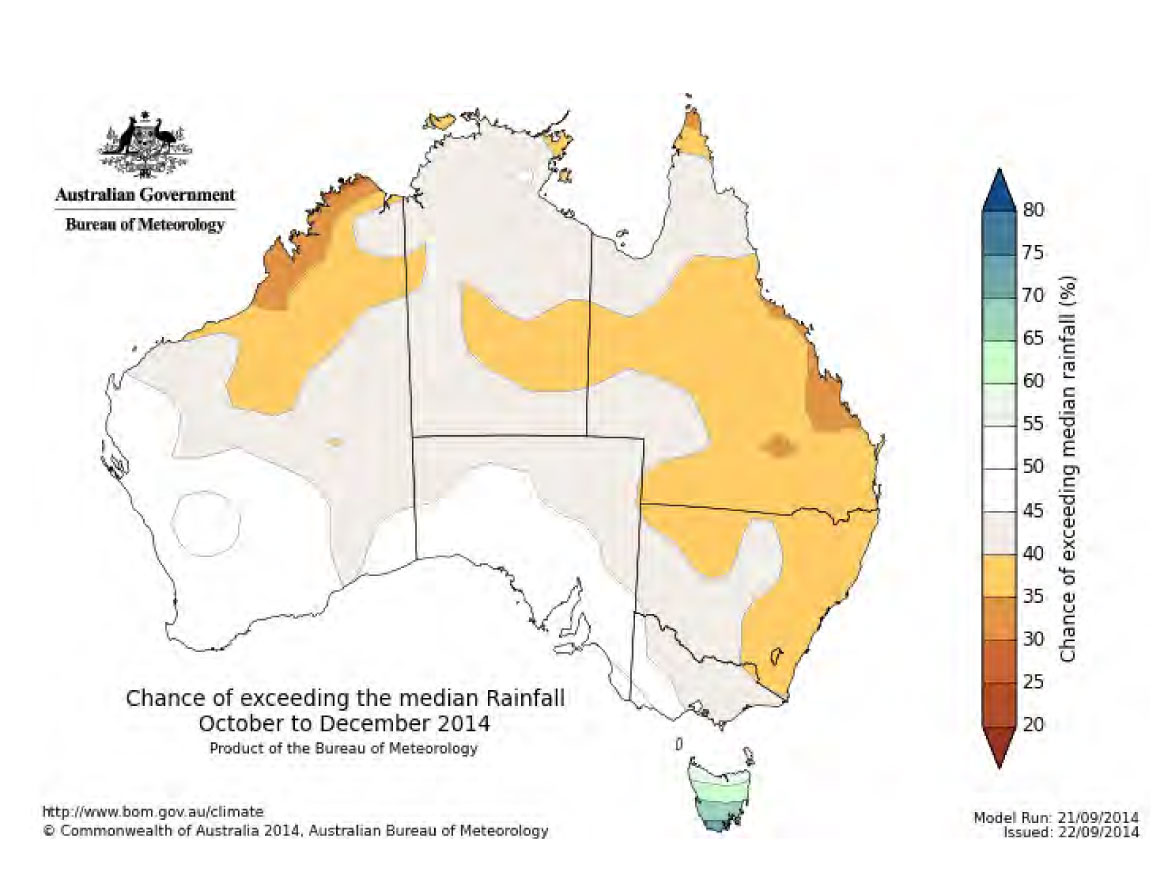
Note: the term ‘median’ means the 50th percentile.
Temperatures
Warmer than normal October to December days are more likely for eastern, central Australia and parts of WA, with the strongest odds in the eastern parts of the country early in the season. Warmer than normal nights are also likely for most of the country.
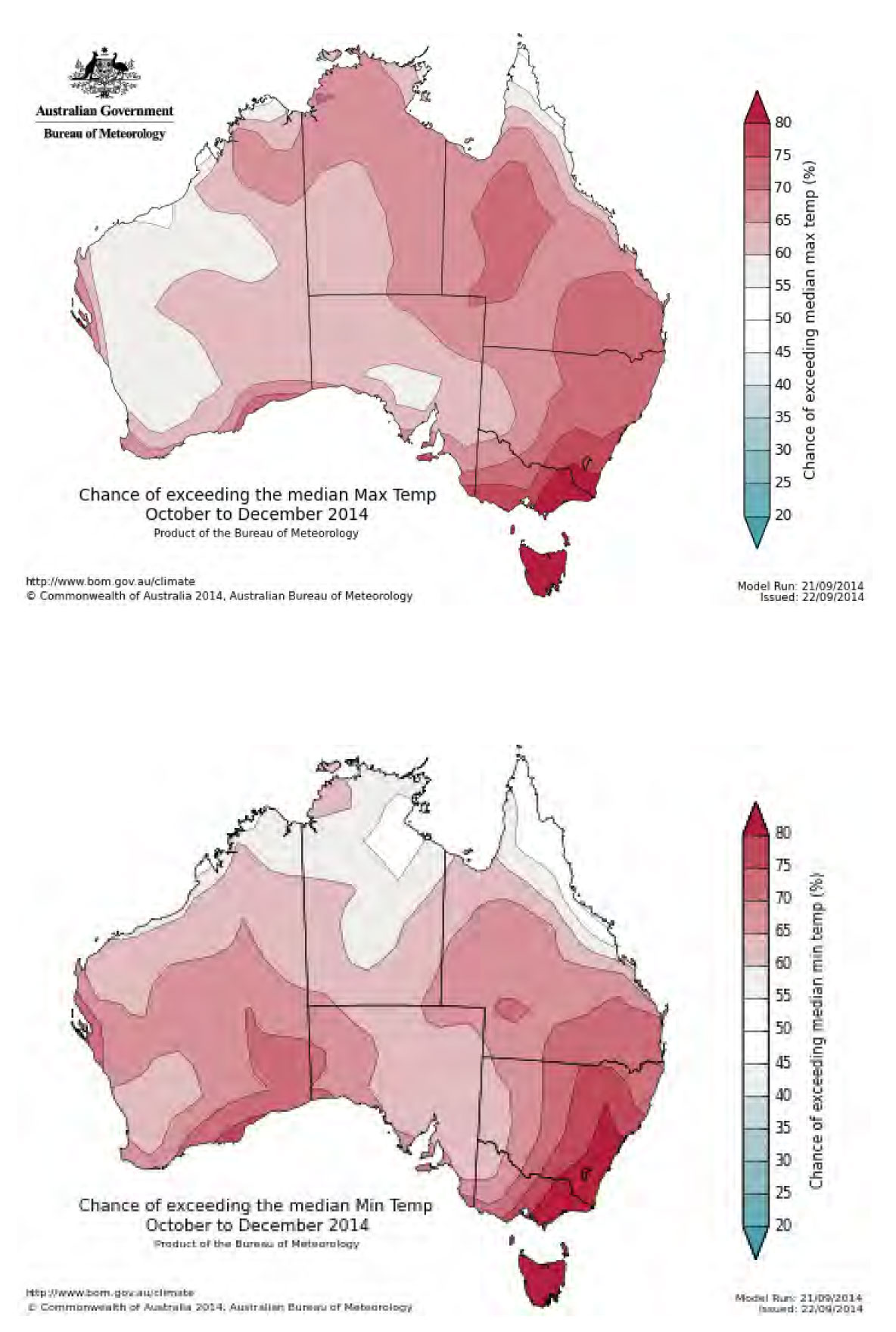
The above Min Temp map, i.e. overnight temperatures, illustrates that there will be little, if any, relief from warm overnight temperatures which also means that there will be little recovery in relative humidity resulting in a warm dry air mass.
Climate influences
Despite being warmer than average, tropical Pacific Ocean temperatures currently remain within neutral levels. Predictive Ocean Atmospheric Model for Australia (POAMA), the Bureau’ seasonal outlook model, expects the Pacific to warm slightly, but remain within the neutral range for the remainder of the year. Six of eight international climate models suggest a late season El Nino, or near El Nino. The October to December rainfall outlook for Australia reflects this forecast, with a weak dry signal across much on the eastern and northern parts of Australia.
Fire Danger
At the Regional Fire Season briefing held on 18th September 2014, attendees were advised that the 2014/15 Fire Danger Period (FDP) is most likely to commence 4-weeks earlier than the 2013/14 FDP which was declared for the City of Greater Geelong on 23rd December 2013.
This early start for the 2014/15 FDP is dependant on little or no heavy rain events over the October to mid November period.
In addition, the CFA advised that a large number of farm dams are low in storage volumes and others such as dams in the Anakie area are down to 50% capacity and Balliang dams are empty.
The Country Fire Authority (CFA) holds the view that the 2014/15 FDP will be ‘…one level above the 2013/14 FDP.’
On September 28th, the municipality was given an early insight into the upcoming FDP with a number of bushfires/grassfires fires across the state including:
Anakie / Stieglitz Fire, Golden Plains: Watch and Act issued at 1.28pm for the area of Selway Lane and O'Neils Lane in between De Mott's Rd, Lynch Rd, Ballan Rd and Steiglitz. Advice issued for the township of Maude at 1.06pm, All Clear issued at 9.37am, Monday 29th September.
On Monday 29th September and Tuesday 30th September, there were another eleven bushfires reported across the state.
Anecdotal reports to council officers indicated that the Anakie / Stieglitz grass fire which had a Point of Origin (PoO) approx 1.5km west of the City of Greater Geelong’s western boundary started crowing, i.e. burning within the tree canopy, within 50m of the PoO and when the grass fire reached the first roadway, the crown fire was 500m in front of the ground fire.
The above demonstrates how dry the tree canopy’s are and how strong the winds were at the time.
The Southern Australia Seasonal Bushfire Outlook 2014 – 2015
Prior to the Seasonal Briefing, the Bushfire Cooperative Research Centre released the Seasonal Bushfire Outlook on the 2nd September. The salient points of the Outlook are as follows:
A preliminary investigation of factors affecting the fire season outlook for 2014-15 point to an above normal season in many areas of central, north and western Victoria. Key factors are an overall rainfall deficit coupled with the potential for an earlier start to the season.
Areas with long-term rainfall deficits run from the west of Melbourne to the central Wimmera and also north through central Victoria into the Mallee. Another band exists extending from the north east of Melbourne to the northern slopes of the Great Dividing Range.
Predictive Ocean Atmosphere Model for Australia (POAMA)
Shorter term deficits are emerging in a broad band across much of the state’s north, extending south to the northern rises of the Great Dividing Range. Similar deficits are emerging in coastal and southern Victoria, though the exact pattern in these areas is not yet clear.
Climatic signals indicate a likely return to warm conditions in spring. There is no strong signal on rainfall. Widespread above average rainfall conditions are not likely, but even in the event they occur, Victoria may still expect, given the antecedent conditions, a fire season slightly more active than 2013-14.
Source for above image & text: : Hazard Note Southern Australia Seasonal Bushfire Outlook 2014 - 15, Sept 2014, Bushfire Cooperative Research Centre
Council Preparation Actions
The 50 + Fire Danger Period preparedness actions have been sub-divided into six main categories viz:
Database reviews and updates;
Information Sessions/Community Education;
Equipment Checks;
Field Operations;
Miscellaneous; and
Actions to be undertaken During the Fire Danger Period.
All actions are programmed to be undertaken at particular times during the lead-up to the Fire Danger Period as well as during the FDP.
These tasks are allocated to particular officers. All actions are also incorporated into council’s Corvu software program so that tracking the status of each action by the Coordinator Emergency Management and Fire Prevention is possible.
Refer to Appendix A for the listing of Preparation Actions.
A bushfire can have a significant impact on the natural and built environments. The impact on the natural environment is dependant upon the fire’s intensity, as well as the vegetation type. Thus a bushfire can have a positive or negative impact on the natural environment.
The preparedness actions listed within this report involve officer time, dedicated plant/equipment hire and in some instances, contractor costs, all of which have been fully budgeted for within recurrent budgets of various council departments.
All Victorian Councils have statutory responsibilities under the Emergency Management Act 1986, and the Country Fire Authority Act 1958. These responsibilities are essentially to resource, plan and respond to emergency situations. Councils are also required to have a Municipal Emergency Management Plan and appoint officers to particular positions under the Emergency Management Act 1986 and the Country Fire Authority Act 1958. The City of Greater Geelong is meeting these responsibilities.
The preparedness actions tie into the City Plan Community Wellbeing strategic direction. The preparedness actions provide a direct link to the Municipal Emergency Management Plan (MEMPlan) which is listed as a master plan to assist in delivering Community Wellbeing priorities.
No Council officers associated with writing this report have any direct or indirect interest, in accordance with Section 80 (C) of the Local Government Act.
Dealing with a bushfire event is high risk activity for all concerned. To this end, all preparedness actions that have been listed in this report are designed to ensure, as far as is practicable, that the fire risk to the municipality and its community are mitigated and that the City is prepared and well place to respond and recover from a bushfire.
Bushfires can run very fast, up to 12kph for bushfires and grass fires nearly double this, depending upon topography, fuel loads and prevailing weather conditions. To this end, it must be recognised that the task of getting in front of a rapidly moving grassfire is difficult and as such townships within the municipality that are located in close proximity to grasslands face the greatest risk. These townships include:
Lara
Lt River
Moorabool
Balliang & Balliang East
Anakie East
Ceres
Mount Duneed and
The eastern and southern side of the Bellarine Peninsula
A bushfire has the potential to have a significant impact on the community. To this end, council needs to ensure that all FDP preparedness actions are completed and that officers allocated with emergency management responsibilities are continuingly reassessing these actions.
An emergency, depending upon its size and nature can affect the whole community and, once again, depending upon the type of emergency can have long lasting impact on the community. The implementation of the preparedness actions strives to enhance community safety. Implementation of the preparedness actions is consistent with the obligation under the Victorian Charter of Human Rights and Responsibility.
Council continues to promote and educate the community on the fire danger that exist, the actions that the municipality is taking and more importantly the action that the community needs to undertake. Council’s Coordinator Emergency Management & Fire Prevention and the Municipal Fire Prevention Officer annually meet with Council’s Marketing Department, the purpose of with is to promote recommended Country Fire Authority seasonal messaging.
In addition to the above, all property owners of vacant land as well as individuals who received Fire Prevention Notices during the 2013/14 Fire Danger Period recently received courtesy letters reminding them of their responsibilities in managing their property and minimising fire danger.
| Task | Précis | Status |
|---|---|---|
Documentation Updates |
||
Municipal Emergency Management Plan - Update |
Full review of the MEMPlan following the 3-year audit |
Completed |
Bi-annual check of contacts listed in Part 10 on MEMPlan |
Full review and update of contacts listed in the MEMPlan to ensure currency |
To be reviewed during October |
Review of Heatwave Sub-Plan |
Preliminary update completed. |
Working Group to assess during November |
Annual Review of MECC (Facility) Managers Kit |
Full review and update |
To be reviewed during October |
MERO Aide Memoire |
Full review and update |
Review completed and about to be printed and circulated |
Sub-plan and Ops-plan reviews |
Full review and update of documents to ensure currency |
Lt River Visitor Information Centre Evacuation Plan – completed Fire Management Ops Plan – 95% completed Flood Ops Plan – 95% completed Bushfire Readiness Arrangements Manual – completed |
Funded facility and other database |
Bi-annual review of spreadsheet |
To be reviewed during November |
Major Events |
Obtain events schedule for Dec – Feb and forward to CFA D7 Manager Operations |
To be supplied during November |
Vulnerable Persons Register |
Records individuals receiving services while residing at home |
On-going (by agency delivering the service) |
City Services Total Fire ban Management Procedure |
Annual review |
To be reviewed during October |
Code Red Management Procedure |
Annual review |
To be reviewed during November |
24hr contact details for local suppliers |
Annual review to ensure currency |
To be reviewed during October |
Neighbourhood Safer Places/Places of Last Resort Annual update. |
CFA to be advised of same |
Completed (CoGG has no designated NSPs/PLR) |
Staff Rostering MECC & ERC |
Rosters developed taking into account annual leave arrangements |
To be developed during November |
Review MECC matrix |
Annual review of matrix by MEMPC |
To be discussed at November MEMPC meeting |
Information Sessions/Community Education |
||
2014/2015 Fire Season Briefing |
Briefing held by CFA on 18th September |
Completed. CoGG Officers attended |
Information Brochures |
MFPO to contact CFA and obtain current suite of documents for council’s customer service centres |
To be obtained during October |
Community Fireguard Meetings |
Meeting to be attended by MFPO in extreme and very high fire risk townships |
During the fire danger period |
Annual meeting with council’s Marketing Department |
Discuss 2014/15 CFA promotional material and prepare press releases |
November/December |
Courtesy Letters |
Mail out of courtesy letters to vacant landowners and owners who received Prevention Notices last FDP |
Completed (last season where this action will be performed) |
Equipment Checks |
||
Water Tanker & Plant Operator contact database |
Full review and update of supplier contact database to ensure currency |
To be reviewed during October |
Annual check of knap sacks |
Parks Unit to check knap sacks fitted to tractors |
To be undertaken during November |
Council water tankers |
Annual mechanical check |
To be undertaken during October |
Field Operations |
||
Council standpipes |
Annual inspection and MFPO advised of outcome |
To be reviewed during November |
Inspection of Fire Plugs |
Pre-season inspection of fire plugs located at specific locations within the municipality |
To be undertaken during November |
ABC Warning Signs |
Annual Inspection |
To be undertaken during October |
Fire Hazard Inspections |
1st round and 2nd of inspections |
To commence early November and end November (respectively) |
Fire Kit bags |
Annual inspection of kit bags issued to Supervisor and plant operators when deployed to assist CFA |
Completed |
Strategic Fire Management Roads & Fire Access Roads |
Annual inspection |
To be undertaken during October |
Static Water Supply Tanks |
Annual inspection |
To be undertaken during November |
Breamlea Township roadside vegetation inspections |
Annual inspection |
To be undertaken during October |
Permit to Burn signs |
To be installed once FDP has been declared |
To be undertaken November/December |
Vacant Property Slashing Specification |
Annual review |
Completed |
Slashing of council local road network |
Annual slashing program by Parks Unit |
To commence during November |
Miscellaneous |
||
MECC |
Rehearsal Bi-annual set-up rehearsal |
To be conducted during November |
Crisisworks Training |
Annual refresher training of MECC (facility) Managers and MECC Admin Support Staff |
To be conducted during November |
Note: the following Actions are taken from council’s Bushfire Readiness Arrangements Manual for the 2014/15 Fire Danger Period.
Daily Weather and Event MonitoringACTION: On the day prior where the Fire Danger Rating (FDR) is forecast to be Severe or above, the Co-ordinator Emergency Management/MERO will prepare an Event Preparation Sheet as well as complete the City Services Fire Preparation and/or Deployment Checklist and distribute same internally. |
MECC Readiness ArrangementsACTION: For days allocated a FDR of Severe, Extreme or Code Red, the Coordinator Emergency Management/ MERO is to advise the Manager Information Services of same re possible activation of the MECC |
Notification of TFB day – Central DistrictACTION: The Co-ordinator Emergency Management/MERO and Municipal Fire Prevention Officer will monitor information issued from the State Control Centre, BoM and CFA website about the declaration of a Total Fire Ban (TFB) day for the Central Forecast District. ACTION: The Co-ordinator Emergency Management/MERO or the Municipal Fire Prevention Officer will notify via email key officers that a TFB has been declared for the Central Forecast District ACTION: The Inventory & Purchasing Supervisor shall ensure that the TFB signs located at the council Operations Centres are on display |
Fire Danger Days – Conference CallsACTION: Co-ordinator Emergency Management/MERO to ensure that any important information obtained from the conference call shall be passed onto key emergency management officers. |
Internal Notification of an Active BushfireACTION: Co-ordinator Emergency Management/MERO to notify Risk Management Unit of a bushfire within the municipal footprint or one located near CoGG’s boundary that is likely to impact on CoGG. ACTION: The Risk Management Unit shall undertake the global internal email notification |
Service Delivery – Code Red DaysACTION: The Co-ordinator Emergency Management /MERO will notify Council’s Risk Management Unit when the abovementioned FDR forecast includes a Code Red Day. The Risk Management Unit will then advise all Managers and Coordinators of same noting that this rating can change. Twenty-four hours out from the Code Red forecast day the rating is to be confirmed and Risk Management advised accordingly. ACTION: In the absence of the Coordinator Emergency Management/MERO, the Municipal Fire Prevention Officer is to undertake the action identified above |
Request to Supply ResourcesACTION: If Co-ordinator Emergency Management/MERO contacted directly by CFA to supply resources, MERO to notify Police MERC ACTION: Co-ordinator Emergency Management/MERO to advise MEM at earliest opportunity of any request. ACTION: Request for supply of Community Buses – Co-ordinator Emergency Management/ MERO to contact the Coordinator Community Facilities ACTION: Co-ordinator Emergency Management/MERO to ensure that accompanying Supervisor and Plant Operators are issued Fire Kit bags |
Monitoring Grassland Curing PercentagesACTION: Co-ordinator Emergency Management/ MERO to monitor BoM on a weekly basis (Nov – April) and record changes in grassland curing percentages |
Cr Nelson declared an Indirect Interest by a Conflicting Duty in Agenda Item 8 – Education Priorities for Geelong Urban Growth Areas in that as a State Election candidate his political party has made an announcement of funding for Clifton Springs Primary School and left the meeting room prior to discussion at 9:16pm.
[Back to List]Portfolio: |
Planning – Cr Heagney |
Source: |
Planning & Tourism - Urban Growth Planning |
General Manager: |
Peter Bettess |
Index Reference: |
Project: Armstrong Creek Project - Infrastructure |
The purpose of this report is to recommend to Council the key priorities to advocate for the delivery of new state government education facilities for the next 12 months.
Collectively Geelong’s growth areas of Armstrong Creek, Jetty Road and Lara West will provide for 7 new state primary schools, 4 new state secondary schools, 1 new special needs school and expansion of 1 existing primary school.
The advocacy priorities for delivery are based on the “on the ground” development providing a real time analysis of the growth occurring across multiple growth fronts. This negates the need to rely heavily upon demographic forecasting and reporting that lags behind active development fronts.
Given the competing demands of new urban growth areas across the municipality Council Officers recognised the need to determine an advocacy priority list to address multiple development fronts.
Council Officers have worked with the Department of Education and Early Childhood Development (DEECD) to provide a real time analysis of development occurring on the ground across the multiple urban growth areas in order to accurately inform state infrastructure provision.
Council Officers continue to engage with DEECD to assist with their site specific planning and forward infrastructure delivery.
Cr Heagney moved, Cr Richards, seconded -
That Council write to the Minister for Education and the Shadow Minister for Education:
supporting the announcement to deliver a Primary School and Special Needs School as part of a Public Private Partnership in the Armstrong Creek East Precinct;
supporting the announcement to masterplan and expand the Clifton Springs Primary School;
requesting integrated master planning for a Secondary School as part of Stage 2 of the Public Private Partnership in the Armstrong Creek East Precinct;
requesting the purchase of land in the Armstrong Creek West precinct to deliver a primary school.
Carried.
The City has undertaken planning for three urban growth areas; Armstrong Creek, Jetty Road and Lara West.
Extensive planning for social infrastructure has been undertaken as part of the Precinct Structure Planning (PSP) for the Armstrong Creek Growth area. To date PSP’s have been prepared and approved for the Armstrong Creek East & West Precincts together with the North East Industrial Precinct. A draft PSP for the Armstrong Creek Horseshoe Bend PSP has been exhibited and debated at a Panel hearing in mid 2014, it is anticipated this PSP will be approved prior to the end of 2014. PSP’s identify and set aside the land for the development of both government and non government schools as part of integrated planning of these new communities.
The above process has been applied to the Jetty Road Growth Area. Adopted by Council the Jetty Road Urban Growth Plan provides for the future expansion for Clifton Springs.
Similarly the Precinct Structure Planning approach has been applied to the Lara West growth area. The adopted Lara West Structure Plan provides for significant urban growth in Geelong’s north.
This report identifies the competing demands for new and refurbished education facilities to service Geelong’s multiple urban growth areas. This report will provide a clear and consolidated position for the City of Greater Geelong to advocate to the Victorian State Government during the 2014 state election campaign.
Councils education priorities are based on the “on the ground” development providing a real time analysis of the growth occurring across multiple growth areas.
The Department of Education and Early Childhood Development (DEECD) has recently undertaken a reassessment of it’s “schools delivery pipeline”. Previously the model for provision of new schools has been based primarily on the provision of one primary school per 3000 dwellings and one secondary school per 9000 dwellings. The “schools delivery pipeline” has been reviewed to address five inter-related initiatives to ensure communities have appropriate access to their local schooling needs together with the above provisions. The five initiatives include:
Ensure robust data and forecasting underpins advice;
Undertake more regular and structured consultation with stakeholders, including local government and State Government agencies;
Develop a transparent new schools and land acquisition pipeline to support improved planning and service provision in the growth corridors;
Develop innovative solutions to responding to enrolment pressures in established areas;
Improve provision options for students with disabilities.
On the basis of the review of the “Schools Delivery Pipeline” the City of Greater Geelong has recognised the need to provide DEECD with accurate population projections based upon “on the ground” development occurring across multiple growth areas throughout the municipality.
This report identifies the competing demand for new state education facilities across Geelong’s multiple growth areas. This report provides a clear and consolidated response for the City of Greater Geelong to advocate to the Victorian State Government, a methodical approach for the delivery of the new education facilities that is directly responding to development as it occurs on the ground across Geelong’s urban growth areas.
The current resident population of the Armstrong Creek East precinct known as “Warralily” is approximately 2000 residents occupying approximately 665 homes. Current data provided by the developer indicates there are:
30 new families moving in to the estate each month.
44% of households have children.
50% requiring either primary school or pre-school access.
This requirement for access to either primary school or pre-school services will increase as more residents move into the growth area. Due to the lack of state education facilities within the Armstrong Creek growth area residents are reliant on private vehicle access to travel to schools in the southern suburbs of Grovedale and Belmont.
Development has recently commenced in the Armstrong Creek West precinct with the estate known as “Armstrong”. Purchaser surveys undertaken by the lead developer Villawood Properties indicate that 39% of purchasers have a requirement for primary school education provision. The first residents have not yet moved into Armstrong.
The Jetty Road growth area is one of the major growth area on the Bellarine Peninsula. The 310ha growth area is located immediately to the west of Clifton Springs, approximately 17km east of the Geelong CBD. The Jetty Road growth area is bound to the east by Jetty Road and Griggs Creek, McDermott Road to the west, Port Phillip Bay to the north, the Curlewis Golf Club to the south west and the Geelong-Portarlington Road to the south.
It is intended that the Jetty Road growth area will accommodate a large proportion of the growth forecast for the Bellarine Peninsula. The growth area is expected to accommodate 3,300 dwellings when fully developed, with a population in excess of 8,000.
The existing Clifton Springs Primary School located on the eastern boundary of the Jetty Road growth area has approximately 2.66ha of undeveloped land on the southern boundary of the school site. Future expansion and master planning for the Clifton Springs Primary School will provide for additional buildings which will accommodate a significant increase in enrolment numbers negating the need for the state to purchase an additional primary school site. Given the rate of growth in the Jetty Road area this master planning and construction of additional school facilities is an advocacy priority for the City.
The Lara West growth area is located approximately 3 kilometres west of the Lara town centre and 17 kilometres from Geelong. The Lara West growth area covers a gross land area of 389.4 hectares and is defined generally but the bounding roads of Patullos Road, O’Hallorans Road, Windemere Road and Bacchus Marsh Road.
Lara has two state primary schools and one state secondary school together with a catholic primary school. The Lara West Precinct Structure Plan provides for 3,500-4,000 lots with a projected population of 10,150 to 11,600. Future state education facilities planned for within the Lara West Precinct Structure Plan include 1 state primary school and 1 state secondary school (Year 10-12). Residential development has not commenced in the Lara West Growth Area.
Collectively Geelong’s growth areas of Armstrong Creek, Jetty Road and Lara West will provide for:
30,300 residential lots
84,600 population
7 x New State Primary Schools
1 x Expansion of existing Primary School
4 x New State Secondary Schools
1 x New State Special Needs School
In summarising all of the data provided in this report it is considered Councils advocacy priorities for new state education facilities to service Geelong’s growth areas are:
Council Priority |
School Site | Infrastructure Provision |
|---|---|---|
| 1 | Armstrong Creek, East Precinct, Burvilles Road |
Masterplan & Construction |
| 2 | Armstrong Creek, East Precinct, Burvilles Road |
Masterplan & Construction |
| 3 | Armstrong Creek, East Precinct, Burvilles Road |
Masterplan & Construction |
| 4 | Clifton Springs Primary School, |
Masterplan & Construction |
| 5 | Mount Duneed, Armstrong Creek West Precinct |
Land Acquisition |
Appendix 1 provides a locality map for each of the above facilities.
A detailed advocacy strategy for new education facilities to service Geelong’s growth areas is being prepared to respond to development forecasting. This advocacy strategy will provide the sequencing of delivery of new state education facilities based upon active development occurring across Council’s urban growth areas.
There are no environmental implications of this report. However, the City does encourage and support the Department of Education and Early Childhood Development to design and deliver environmentally sustainable buildings implementing industry best practice.
No impact to budget.
The planning role of Local Government in relation to the provision of services for the community is legislated in the Victorian Local Government Act (1989), Planning and Environment Act (1987) and the Health Act (1958).
These education advocacy priorities support the Community Wellbeing, Growing our Economy and Sustainable Built and Natural Environment strategic directions of City Plan.
There is no direct or indirect officer conflict.
There are no known risks to Council associated with advocating our new state education priorities to the Victorian State Government.
Children who travel to reach schools outside of their community of residence are less likely to form and sustain relationships within their local neighbourhood. This makes it more difficult to build a sense of belonging or a sense of community particularly in greenfield development sites. Furthermore when a local school is eventually opened, parents may be reluctant to change schools because of the disruption to their children’s education. This in turn creates a pattern of multiple children from one family then being educated at schools outside their resident community, with the end result being an entire generation attending primary education outside the resident locality.
This in turn has an impact on the establishment and growth of new sporting clubs with children more likely to participate in sport and extra curricular activities with their existing social network that is established within the locality of their school.
The United Nations Convention on the Rights of the Child (CRC) requires governments to take all appropriate measures to “render appropriate assistance to parents and legal guardians in the performance of their child-rearing responsibilities”.
The United Nations CRC, in conjunction with the Human Rights Charter, upholds the rights of children to receive appropriate support and assistance, which protects their welfare, health, and well-being.
Human rights have been considered in the development of this report, particularly in relation to the ‘right to protection of families and children’ and the ‘right to take part in public life’.
The City has engaged with all of the active developers across the urban growth areas within the municipality in order to establish a real time analysis of the growth occurring across multiple fronts. These developers have shared their purchaser profiling data with the City to inform this report and the delivery of both state and local government infrastructure.
Council Officers have shared the data provided by developers with the Department of Education and Early Childhood Development (DEECD) in order to inform their infrastructure provision and planning. Council Officers continue to engage with DEECD to assist with their site specific planning and forward infrastructure delivery.
Cr Nelson re-entered the meeting room at 9:22pm
Portfolio: |
Sport and Recreation – Cr Irvine |
Source: |
Projects, Recreation & Central Geelong |
Act/General Manager: |
Paul Jane |
Index Reference: |
Subject : Leisure and Recreation Facilities – Non Specific |
To determine Council’s position on providing assistance to privately owned and/or managed sport and recreation facilities that will guide the development of a policy in this area.
Council regularly receives requests from owners/operators of privately owned/managed sport and recreation facilities to enquire about opportunities for maintenance and capital renewal support.
The City of Greater Geelong has a mix of publicly and privately owned/managed sport and recreation facilities throughout the municipality.
Sport and recreation facilities vary greatly in their commercial opportunities and services which they provide beyond the provision of sport. Aligned with this commerciality, some facilities have the capacity to operate without Council support.
Council does not currently provide ongoing financial support for the capital renewal and/or maintenance of privately owned/managed sport and recreation facilities.
This report considers sport and recreation facility categories that Council traditionally supports via subsidised users fees. It excludes facilities such as indoor stadiums, golf courses and aquatic facilities that require significant resources to operate and exist in commercially competitive environments.
Implementing a policy framework which supports private facilities at a comparable level to Council owned/managed facilities will have a significant financial impact on Council.
Cr E Kontelj moved, Cr S Kontelj seconded -
That Council:
continue to invest in the capital renewal and prioritise the maintenance of Council owned and/or managed sport and recreation facilities;
consider requests from privately owned/managed not for profit sport and recreation clubs and organisations for contribution to capital works that demonstrate community benefit;
adopts a co-contribution policy that sets out Council’s criteria for contributing funds for capital projects on properties and facilities privately owned/managed by not for profit sport and recreation clubs and organisations whereby Council may contribute an amount up to, or equal to funds contributed by the organisation and/or State and Federal Government.
Amendment
Cr Heagney moved, Cr Farrell seconded -
That Council:
continue to invest in the capital renewal and prioritise the maintenance of Council owned and/or managed sport and recreation facilities;
consider requests from privately owned/managed not for profit sport and recreation clubs and organisations for contribution to capital works that demonstrate community benefit;
directs officers to develop a co-contribution policy that sets out Council’s criteria for contributing funds for capital projects on properties and facilities privately owned/managed by not for profit sport and recreation clubs and organisations whereby Council may contribute an amount up to, or equal to funds contributed by the organisation and/or State and Federal Government;
private clubs that are the recipient of Council funds agree to appropriate organisational wind up clauses or contractual arrangements to protect Council’s investment.
present a policy for adoption by February 2015.
The amendment was put and carried.
The amendment became the motion
The motion was put and carried.
The City of Greater Geelong provides a vast array of facilities for community sport and recreation. Many of these facilities play a dual purpose in providing sport and recreation opportunities for surrounding communities and providing open space which the community is free to use outside of formal sports bookings. Council subsidises fees paid for facilities by sporting clubs to ensure that community sport is accessible and to encourage active, healthy communities through the provision of sport and passive open space. Council does not generally provide subsidies for the renewal and maintenance of privately owned and/or managed sport and recreation facilities due to the significant financial cost that would be incurred and limitations of ongoing community access.
Sport and recreation facilities established on private or non-Council managed land are generally the result of a local sporting club/group having a desire to establish a facility for their specific purpose. The sporting club/group has then subsequently bought or have been gifted a parcel of land to establish a facility. Land ownership has generally (but not exclusively) been in non-residential areas (rural, industrial).
This report examines the capital renewal and maintenance responsibilities of Council:
Capital renewal - the replacement of facilities at the end of life-cycle based on like-for-like replacement. Capital renewal of publicly owned sport and recreation facilities is generally undertaken through Council’s capital works program. Sporting clubs that use Council owned facilities may fund works on an ad-hoc basis to achieve a higher level of facility than Council offers, but Council is ultimately responsible for the capital renewal of its facilities.
Maintenance - ongoing works undertaken to maintain facilities at a determined level of service.
Historically, soccer, lawn bowls and tennis facilities consist of a blend of public and private ownership and management models. There are also individual facilities on non-Council owned/managed land across a number of sports including AFL, netball, rugby and baseball.
Alternative models of ownership and management exist, particularly where other authorities have land and asset management responsibilities.
For the purposes of this report the term ‘private facilities’ refers to sport and recreation facilities that are:
maintained and/or managed by the user group
not located on Council owned or managed land
not managed or maintained by Council
not based on a commercial business model.
It should be noted that there are a range of community facilities and services operating from facilities provided by both Council, and by other entities. This is for both sport and recreation as well as community services functions.
This report does not address all of the services and functions, and simply focuses on 4 sports.
Accordingly it is important for Council to consider precedent and principles when considering this report, and to be mindful of the implications that could result from any change to our current custom and practice which is to prioritise funding of Council owned assets.
Sport and recreation facilities within the City of Greater Geelong provide a wide range of participation opportunities for residents and visitors to the municipality. While the majority of sport and recreation facilities are owned and/or managed by Council, a small number of facilities are privately owned and/or managed by sporting clubs or other management authorities. Council has traditionally provided no recurrent maintenance support to privately facilities. From time to time, funding for minor capital works and community grants has been made available to clubs operating within private facilities, but no ongoing financial commitments to capital renewal are provided by Council.
The discussion within this report examines the opportunities and limitations for Council providing resources for capital renewal and/or maintenance to privately facilities.
Facility Categories and Land Ownership/Management
While the majority of sport and recreation facilities within the municipality are located on Council owned and/or managed land, there are facilities located on land under a range of ownership and management models:
Model |
Management Responsibilities |
Asset Base |
|---|---|---|
Council owned/ managed |
Council is responsible for capital renewal and maintenance as per tenancy agreement |
Majority of facilities within the municipality |
Privately owned |
Land owner is responsible for all capital renewal and maintenance |
7 x turf soccer pitches |
Crown land (direct lease) |
Management responsibilities transferred to club via tenancy agreement |
4 x tennis courts |
Crown Land (Coastal Committee of Management) |
Basic maintenance activities undertaken by Committee of Management. Club responsible for maintenance to meet sport requirements eg water, fertiliser, power, additional maintenance works. |
1 x oval |
Church owned land |
Church responsible for maintenance activities. May be transferred to club via tenancy agreement where the club is a separate incorporated organisation. |
12 x tennis courts |
Dept of Education & Early Childhood Development (Joint Use Agreement) |
Joint use agreement between Council and DEECD. Council generally provides maintenance and school pays water costs for irrigation. Joint Use Agreements negotiated where there is a specific gap in provision for sport within the community. |
6 x ovals |
Dept of Education & Early Childhood Development (direct tenancy to club) |
Direct tenancy agreement between the school/DEECD and the club. |
2 x tennis courts |
Tertiary institutions |
Tertiary Institution (Deakin) is responsible for maintenance. Tenancy agreements with sporting clubs for community use outside of times required for education purposes. |
3 x ovals |
From the asset base listed above, the following are being considered within this report for Council support:
Privately owned – Sporting club owns and manages the sport and recreation facilities on their own land. Community access to facilities could be provided if required.
Crown land (direct lease) – Sporting club has the same responsibility as a privately owned club, but does not own the land.
Crown land (Coastal Committee of Management) – Maintenance shared between Committee of Management (eg Barwon Coast) and sporting club. Club responsible for sport specific maintenance requirements.
The following are not being considered in this report for support:
Lawn bowls clubs under any ownership/management arrangement – due to specialised maintenance and facility requirements, broad community access to facilities cannot be granted outside of times of use by the club. Lawn bowls facilities on Council land are leased to clubs, with no maintenance undertaken by Council.
Church owned land – Tennis clubs established on church land are generally small facilities with limited opportunities for public access.
Department of Education & Early Childhood Development (joint use) – Already receive a specified level of support from Council via the joint use agreement where a gap in public provision exists.
Department of Education & Early Childhood Development (direct tenancy to club) – Facilities primarily for school use. Tenancy arrangements managed by the school directly. Maintenance responsibility remains with the school/DEECD.
Tertiary institutions (Deakin) – Facilities hired directly to sporting clubs. Asset maintenance is the responsibility of the land owner.
As previously stated, facilities based on a commercial business model are not considered within this report. Commercial facilities include indoor stadiums, golf courses, aquatic facilities and private businesses such as equestrian schools.
Based on the information above, the asset base of private facilities within the municipality that are being considered for maintenance and/or capital renewal support are:
| Sport | Facility Type | Amount | Description |
|---|---|---|---|
Soccer |
Pitches |
7 |
7 x turf |
Pavilions |
4 |
3 x large, 1 x medium |
|
Tennis |
Courts |
31 |
13 x lawn, 12 x en-tout-cas (clay), 6 x hard-court, 1 x synthetic grass |
Pavilions |
2 |
1 x large, 1 x medium |
|
AFL |
Ovals |
1 |
1 x turf |
Pavilions |
1 |
1 x medium |
|
Netball |
Courts |
2 |
2 x hard courts |
Benchmarking of Local Government Authorities
Benchmarking of current practices regarding local government support of private facilities was undertaken with Cardinia Shire, Melton City Council, City of Casey, Wyndham City Council, Brimbank City Council, Colac-Otway Shire, Warrnambool City Council and Wodonga City Council. The outcomes of the benchmarking exercise produced a clear position across all municipalities:
All Councils indicated that they have private sport and recreation facilities within their municipalities.
All Councils indicated that they do not provide recurrent support in the way of maintenance or financial contributions.
Sporting clubs at private sport and recreation facilities are generally eligible to apply for grants as they become available.
Considerations for Support of Privately Owned Sport and Recreation Facilities
The following table outlines the implications for Council should it support the capital renewal and/or maintenance of private facilities.
| No | Issue | Pros | Cons |
|---|---|---|---|
1 |
Contribution to the open space network |
Increased open space available to the community. |
Location of facilities provides limited value to the overall open space network, given low residential catchments. |
2 |
Tenancy and Public Access |
Access agreements could be established between Council and facility owners. |
Limited ability for Council to provide ongoing tenancy rights to clubs other than the facility owner. |
Access to private facilities is ultimately at the discretion of the owner/operator. |
|||
Long term access to facilities cannot be guaranteed to the community. |
|||
3 |
Facility Ownership |
Council’s asset base is not increased. |
Private facilities may be sold by the owner at any time. |
4 |
Cost to Council |
Initial investment made by facility owners. |
Maintenance and renewal facilities would be a significant cost to Council. |
Initial investment may be required for facilities to comply with Council standards. |
|||
Risk of investment in capital renewal and/or maintenance being lost should facilities be sold or access arrangements revoked by the facility owner. |
|||
5 |
Risk Management |
Nil |
Risk management concerns with Council maintenance staff working within private facilities. |
Liability concerns with allowing community access to private facilities managed by Council. |
The following information outlines the rationale for the considerations listed above:
Contribution to the Open Space Network
Should Council assume maintenance responsibilities for private facilities, the assumption is made that these facilities would be available for community access outside of scheduled training and competition. This would have a positive impact on the provision of open space and access to reserves for the wider community. While the addition of private facilities as accessible open space will increase overall provision, the value of the open space compared to the maintenance and renewal cost is generally seen as prohibitive.
The spatial distribution of private sporting facilities is generally based on historic land ownership, having little connection to the strategic planning for recreation needs within the municipality Privately owned sporting facilities are generally (but not exclusively) located in areas with limited residential catchment (rural/industrial).
Owners of private sport and recreation facilities could propose to gift their land and facilities to Council. An assessment of the contribution to the open space network for each facility would be required, and where the value of this contribution is limited, Council would generally not accept the offer or may deem the lands surplus and offer them for sale. Should land be gifted to Council, the expectation is that the facilities would be licensed back to the sporting club and Council assume responsibility for all capital renewal and maintenance. This option provides limited value to Council on a cost/benefit basis.
Tenancy and Public Access
The City of Greater Geelong provides facilities for sport and recreation for use by sporting clubs and the wider community. Sporting clubs are required to enter into tenancy agreements with Council for the seasonal use of facilities, outlining the responsibilities of Council as the landlord and the club as the tenant. Tenancy agreements between Council and sporting clubs are either:
Leases – exclusive use of a facility; or
Licences – scheduled use outlined within the agreement (preferred by Council).
Tenant sporting clubs are required to make seasonal and/or casual bookings for the use of facilities. Outside of times booked by sporting clubs, Council owned outdoor sporting facilities are available for use by the public informally free of charge.
Tenant sporting clubs pay fees for the use of sport and recreation facilities, which are subsidised by Council. The current fee structured is as follows:
Facility Component |
Fee Structure |
|---|---|
Outdoor sporting fields (oval, pitches) |
Per ground, per season. Grounds graded A-D. Fees equate to approximately 7-10% of maintenance cost. |
Tennis courts |
Per court, per season |
Netball |
Per court, per season |
Pavilions |
Flat fee for all pavilions regardless of standard |
Fees and Charges for sport and recreation facilities are currently being reviewed as part of the Sustainable Sports Strategy.
The capital renewal and maintenance cost of public sport and recreation facilities is significantly more than the amount of income generated by fees paid by sporting clubs and community groups.
The subsidy of fees for sporting facilities within Council managed reserves is based on:
Organised sporting activities within Council managed reserves being accessible to the wider community.
Council managed reserves being accessible to the wider community for informal recreation outside of times allocated for organised sport.
Council’s commitment to community well-being and health through sport and recreation.
Access to privately owned sport and recreation facilities is at the discretion of the owner/operator. While access to a private facility may be agreed to at a point in time, ongoing access is impossible to guarantee.
Private facilities may be sold by the owner/s at any time, with Council having limited control over the sale of a privately owned/managed site. The risk of contributing significant resources to a private facility that could be sold by its owner at any time is generally seen as prohibitive to contributing ongoing maintenance and capital renewal resources.
Community access to private facilities also raises issues related to public liability and Council’s inability to ultimately control facilities which are being provided by the owner/operator.
Cost to Council - Capital Renewal and Maintenance Costs
The financial cost of capital renewal and maintenance is generally seen as the most significant obstacle to Council committing to ongoing support for privately owned/managed facilities. The following estimated capital renewal and maintenance costs relate to the various categories of private facilities that have the potential to be maintained by Council:
| Sport | Facility | Components | Capital Renewal | Maintenance (per annum) | Life Span |
|---|---|---|---|---|---|
Soccer |
Turf field |
One hectare turf, sportlights, irrigation, goals, player shelters and fencing (410 metres). |
$450,000 -$550,000 |
$26,000 |
15-25 years |
Tennis |
Court enclosure |
Two-court enclosure with sportslights, acrylic hard-court surface, nets, posts, fencing and one shelter |
$117,000 - $143,000 |
$1,800 |
15-25 years |
AFL |
Oval |
1.5 hectare turf, sportslights, irrigation, goals, player shelters and fencing |
$512,000 - $625,000 |
$37,500 |
15-25 years |
Netball |
Court |
Two-court enclosure with sportlights, acrylic hard-court surface, goals, fencing and one shelter |
$124,000 - $151,000 |
$1,800 |
15-25 years |
All |
Pavilion (Small) |
250 square metres |
$750,000 |
$7,500 - $15,000 |
35-50 years |
Pavilion (Medium) |
500 square metres |
$1,500,000 |
$15,000 - $30,000 |
35-50 years |
|
Pavilion (Large) |
1000 square metres |
$3,000,000 |
$30,000 - $60,000 |
35-50 years |
|
Miscellaneous |
2000 square metres of car park, one water tank, one storage shed |
$126,000 - $154,000 |
$1,400 |
25-35 years |
The cost of capital renewal and maintenance of privately owned sport and recreation facilities is based on the following assumptions:
Turf field provision based on a “B” ground rating, with sportslighting to meet the relevant competition standard.
Tennis court provision based on acrylic hard-court surface, with sportslighting to meet the relevant competition standard (Council would not maintain lawn, en- tout-cas (clay) or synthetic grass courts).
Netball court provision based on acrylic hard-court surface, with sports lighting to meet the relevant competition standard.
Capital replacement of the pavilions is estimated at $3,000 per square metre.
Maintenance of pavilions is estimated at 1-2% of the capital replacement value.
A lifespan of 10 years is assumed for all facilities, based on the assumption that existing private facilities are partially through their life-cycle and maintenance activities undertaken may not be to standards required for a public facility.
Should Council agree to take on capital renewal and maintenance responsibilities for private facilities within the municipality, the potential financial impact on Council is significant.
The estimated annual cost to Council for the capital renewal and maintenance of private facilities would conservatively be:
Capital renewal: $2 million – 2.2 million ($23,835,500 - $25,498,500 over the next 10 years)
Maintenance: $433,800 - $598,800
Should Council provide maintenance support to private facilities, it is assumed that Council would charge clubs for the use of the facilities as they would effectively be under the care and control of Council. The annual income derived by Council from potential fees for privately owned facilities would be approximately $23,000.00 based on existing rates.
The fees charged for facilities are likely to change in the near future as a result of the development of the Sustainable Sports Strategy. At this stage, proposed future rates for facility use have not been determined, but will be aligned to a percentage of the cost of maintenance.
Council could elect to provide a separate schedule of fees and charges for private facilities maintained by Council. A fee for service model that would recoup the full cost of maintenance could be offered to sporting clubs that own and/or manage their facilities, provided that maintenance equipment and appropriately skilled personnel are available within relevant Council departments.
Should Council agree to the management and maintenance of private facilities, it is generally accepted that this opportunity would need to be extended to all sporting clubs that own and/or manage private sport and recreation facilities.
Renewal Gap
Sport and recreation assets deliver a specified level of service for community use.
Regular maintenance of these assets will ensure that the asset achieves its expected life, which can vary from 3 to 50 years depending on the asset category. When an asset deteriorates to a standard that is deemed below acceptable, capital renewal is required to restore the asset to meet the determined level of service.
When insufficient capital funds are applied to asset renewal, a funding deficit is created which is commonly referred to as a renewal gap. The existence of a renewal gap indicates that an asset has deteriorated beyond an acceptable level. The current annual renewal gap in 2014/15 is $1.5 million for sport and recreation assets and $770,000 for sports pavilions.
While a specific maintenance gap is difficult to quantify, the level of service would need to decrease should Council be required to maintain additional sport and recreation assets under the current maintenance budget.
The two courses of action to available to Council to address the renewal and maintenance gaps are to:
Reduce the level of service, or
Increase capital renewal funds to eliminate the deficit.
There are no environmental implications relating to this report.
The estimated annual cost to Council for the capital renewal and maintenance of private facilities would conservatively be:
Capital renewal: $2 million – $2.2 million
Maintenance: $433,800 - $598,800
Should Council provide maintenance support to private facilities, it is assumed that Council would charge clubs for the use of the facilities as they would effectively be under the care and control of Council.
The annual income derived by Council from potential fees for privately owned facilities would be approximately $23,000, based on existing fees and charges.
The following Council policies have implications for the recommendations of this report:
Fees and Charges for Outdoor Sporting Facilities – Council’s policy on fees charged for the use of outdoor sporting facilities is based on the level of facility provision. This policy does not refer to private sporting facilities, as Council does not currently maintain or manage facilities in private ownership or management.
Council’s policy on fees and charges for outdoor sporting facilities is currently being reviewed as part of the Sustainable Sports Strategy.
Grants, Donations and Sponsorships – refers to non-financial contributions as “the provision of a Council service, product, or facility, free of charge or at a subsidised rate”. Maintenance of a privately owned sporting facility would be seen as providing a Council service at a subsidised rate. Non-financial contributions may be subject to eligibility criteria and are required to meet the City of Greater Geelong’s strategic goals and objectives.
Open Space Policy – refers to Council’s role in developing the open space network based on strategic planning and community needs. While private sporting facilities contribute to the open space network, their location is not based on strategic planning or broader community needs.
Council’s Open Space Strategy is currently being reviewed, with gaps in open space provision to be determined as part of the planning process. A preliminary review suggests that private facilities provide limited value in the provision of publicly accessible open space.
This report is aligned to the community well-being objective of City Plan. The provision of sport and recreation facilities promotes healthy lifestyle through physical activity. Council prioritises the development and maintenance of sport and recreation facilities within Council owned and managed reserves to provide community well-being outcomes, including physical activity, social connectedness, mental health, inclusion and accessibility.
No Council staff or persons engaged in the writing of this report have a direct or indirect interest in the matters considered within the report.
Should Council agree to accept the management responsibility for private sport and recreation facilities within the municipality, a number of risks would require consideration:
Financial – there are significant cost implications for Council to maintain and renew facilities in accordance with relevant facility standards.
Liability – Council is likely to be required to accept liability for private facilities that it maintains, as failure to meet relevant facility standards would implicate Council in any litigation arising from injury or loss connected with maintenance operations.
Occupational health and safety – Providing maintenance services on private property raises OH&S issues for Council staff. As facilities would remain in private ownership, compliance with relevant OH&S policies and procedures may be difficult to ensure.
Access – privately owned facilities could be sold by the owner at any time, subject to public access agreements that could be established between Council and the owner. Should a private facility be sold, the investment in the facility made by Council would be lost.
Sport and recreation plays a key role in the health of our community. While the physical health of the community is the most apparent benefit, sport and recreation promotes increased mental health, social connection and community leadership. Sporting clubs at private sport and recreation facilities provide similar community benefits as those on Council-owned land, but Council has a limited ability to influence club activities through tenancy agreements and licensing.
This report has no impact on compliance with the Human Rights Charter.
No formal consultation process has been undertaken relating to this report. From time to time, owners/operators of privately-owned sport and recreation facilities contact Council to enquire about opportunities for maintenance support.
The current position of Council is that Council does not provide maintenance support for privately owned or managed sport and recreation facilities.
Portfolio: |
Community Development - Cr Fisher |
Source: |
Community Services - Family Services |
General Manager: |
Linda Quinn |
Index Reference: |
Subject: Community Services - Kindergarten |
The purpose of this report is to inform Council of the closure of the Thomson Kindergarten in 2015, as advised by the Geelong Kindergarten Association, and present options to retain access to a funded kindergarten program for families at the kindergarten.
Thomson Kindergarten is a Council owned building situated at 2B Godfrey Street, Thomson, and operates under a volunteer parent committee of management. The funded kindergarten program and staff employment is currently managed through the Geelong Kindergarten Association.
The kindergarten is situated in an area of high vulnerability amongst young children, and is one of six kindergartens located within the 3219 postcode area of Geelong’s eastern suburbs.
On 24 July 2014 an article appeared in the Geelong Advertiser announcing the Geelong Kindergarten Association had decided to close the Thomson Kindergarten from the commencement of 2015 due to low enrolments. The pattern of enrolments at the kindergarten have historically been finalised later in the year due to slow registration of children.
In response to this article, Council Officers in conjunction with the Ward Councillor, Cr Irvine, immediately sought a meeting with representatives from the Geelong Kindergarten Association and Thomson Kindergarten to clarify the situation and explore any alternative options in order to secure retention of the kindergarten for local families.
Subsequent discussions with the Department of Education and Early Childhood Development would suggest that there were 14 families enrolled at Thomson Kindergarten for next year.
The Geelong Kindergarten Association have confirmed, that despite the number of enrolments registered they will not operate the kindergarten next year. They have also indicated that families enrolled at the kindergarten have been offered places at alternative kindergartens.
Consequently, families currently enrolled at the Thomson Kindergarten will either have to a) accept the offer by GKA to enrol at an alternative kindergarten service, or b) another cluster manager (that is CoGG) will be required to operate the kindergarten program.
Cr Irvine moved, Cr Richards seconded -
That Council agree to apply for a license to operate Thomson Kindergarten in 2015 and work with the Kindergarten Committee of Management to consider options for the longer term future.
Carried.
The Geelong Kindergarten Association decided in June this year that they would not operate a funded kindergarten program at Thomson Kindergarten from the commencement of 2015. This decision was reported in the local media on 24 July 2014.
The current Thomson Kindergarten building is situated at 2B Godfrey Street, Thomson and is owned by Council. The centre is situated within an area of high developmental vulnerability amongst young children.
The kindergarten is licensed for 30 children and is leased to an independent incorporated body of volunteer parents. The funded kindergarten program and employment of staff is managed by the Geelong Kindergarten Association who have a service agreement with the local parent association.
The kindergarten has this year operated with a full enrolment of 30 children including both four and three-year-old children.
A number of options have been considered to retain the operation of the kindergarten next year. These options have included:
securing an alternative kindergarten cluster manager;
the kindergarten to operate independently under a parent committee; and
the licence being transferred to Council to operate the kindergarten under its current cluster management arrangements.
The latter option has been identified as the most viable given the lack of alternative kindergarten cluster managers available within the municipality capable at this stage to absorb the kindergarten, and the lack of capacity within the parent committee to manage the kindergarten independently.
Council has approached the Geelong Kindergarten Association to review their decision to close the kindergarten program at Thomson Kindergarten for the 2015 year. Despite sufficient enrolments being identified by the parent committee at Thomson for 2015, the Geelong Kindergarten Association has indicated they are not prepared to review their position on this matter.
The Committee of Management of the Thomson Kindergarten is committed to retaining the kindergarten and has canvassed local families who have indicated a strong preference to have their child attend Thomson Kindergarten next year rather than alternative options.
The Thomson Kindergarten Committee of Management does not have sufficient capacity to operate the kindergarten independently and has approached Council for assistance to secure the operation of the kindergarten in response to the decision by the Geelong Kindergarten Association.
Council is a registered kindergarten cluster management agency and has successfully delivered early childhood services and programs over a long period, with strong community confidence and support.
Council has an intimate knowledge and understanding of local needs and priorities, along with the capacity to focus both knowledge and resources to address identified local needs, as demonstrated by the successfull management of kindergartens in Whittington, Rosewall (Corio) and through Council’s integrated and long day child care centres.
Consequently, Council represents the only alternative option presently available to assume responsibility for the management of the Thomson Kindergarten in order to deliver a kindergarten program in 2015 for local children and families.
The long-term future of kindergarten provision at Thomson Kindergarten would however remain subject to further review at the end of 12 months, including consideration of future enrolments, local demand for kindergarten places, and alternative kindergarten cluster management options.
Increasing evidence identifies a wide range of environmental factors that directly impact on children’s early development, health and well-being. These factors can have both immediate and cumulative affects on children, with increasing evidence that links children’s health conditions to adverse environmental factors.
Consideration of various environmental factors and implications will feature as important considerations within the program planning and implementation of recommendations contained within this report.
Any potential expansion of Council’s role and responsibility in Kindergarten Cluster Management and provision of additional kindergarten programs is likely to have financial implications for Council and require additional funding and resources.
Provisions for staffing and management of the Thomson Kindergarten have not been included in Council’s 2015-2016 budget or forward projections.
Draft budget estimates that have been developed for the kindergarten suggest potential income of approximately $104,747 (over full calendar period) which includes parent fees and DEECD per capita funding, based on expected enrolments of approximately 25 children.
Expenditure estimates reflect the likely cost of operating the kindergarten of $115,827 including management costs, recruitment of new staff and anticipated utilities costs etc.
Based on projected budget estimates for the service, the kindergarten could potentially break even or operate with a small loss of $11,000 over a full year.
Council would be eligible for Kindergarten Cluster Management of up to $9,269, per capita funding of $3,168 per child. The Department are currently considering additional assistance to Council if enrolments are less than 20 children. The Kindergarten Committee of Management have also indicated that they would be happy to contribute from the Kindergarten reserves of $30,000 if there is a shortfall in required funding.
Budget estimates do not include costs already incurred by Council for managing kindergarten enrolments, facilities maintenance and management, or the additional staffing costs that may result from any future changes to staffing ratios.
Projected budget estimates are also likely to be affected by future enrolment rates. Low enrolment levels will result in higher costs to Council to operate the kindergarten. The following budget is based on full enrolment of one group of 25 children. Lower enrolment will result in changes to budget projections.
Requires amendment to budget.
Income: $104,747
Expenditure and operational costs: $115,827
Total Project Cost: A loss of $11,000 to Council subject to budget estimates and factors as referred above.
Council’s role in supporting provision of local kindergarten services is consistent with obligations under Section 3E (a); (b); (c); and (d) of the Victorian Local Government Act 1989.
The provision of kindergarten and early childhood services is regulated by a range of legislated requirements and service standards including the following:
Education and Care Services National Regulations (2011);
Children Youth and Family Act (2005);
Education and Care Services National Law (2010);
Information Privacy Act (2000);
Health Records Act (2001);
Public Health and Wellbeing Regulations (2009);
Victorian Early Years Learning and Development Framework (2010);
Disability Discrimination Act (1992);
Occupational Health and Safety Act (2004).
The planning and regulatory role of Local Government in relation to the provision of services for the community is also legislated in the Victorian Planning and Environment Act (1987) and the Health Act (1958) and acknowledged within the MAV/DEECD Partnership Agreement.
Provision of high quality kindergarten services and addressing disadvantage aligns with a range of existing Council strategies, policies and plans that inform Council’s role in the provision of children’s services and facilities. These include:
City Plan (2013-2017). An objective in the plan’s priority ‘Connected, Creative and Strong Communities’ is “promoting and providing opportunities for education and lifelong learning”, whilst the ‘Healthy Lifestyle’ priority includes an objective in relation to “investing in prevention and improved health across all communities in Greater Geelong”;
Municipal Public Health and Well-being Plan (2013-2017) states that “We will provide safe and vibrant physical environments and infrastructure to support healthy living and connected communities”.
Municipal Early Years Plan (2013-2017); “The provision of quality and accessible services and infrastructure is crucial to enabling the City of Greater Geelong to fulfil its vision for the municipality and achieve it goals to improve outcomes for young children. Families, communities and businesses need to be confident that they will have access to the services and infrastructure that is responsive to and adequately supports their needs and requirements. This includes access to child care, kindergartens, health services, education facilities, etc”.
Pursuant to Section 80(c) of the Local Government Act 1989, no Council staff involved in the preparation of this report have a direct or indirect interest in the matter to which this report relates.
There are a number of inherent risks with a project of this nature. These risks are being mitigated through various control measures, and include financial, operational, and potential implications for Council’s reputation.
Failure to maintain appropriate, robust governance and management arrangements within local kindergarten services is likely to severely threaten the future viability of some programs and the implementation of government reforms. This may also have a prejudicial impact on the potential access for children to local kindergarten programs, and therefore poses a significant risk to Council in relation to the continuity and provision of local kindergarten services.
Unsuccessful delivery of a program at Thomson Kindergarten by Council arising from insufficient enrolments or inability to recruit staff will inevitably reflect upon Council’s reputation and public perceptions.
In this event Council will be required to carry responsibility to close the kindergarten and advise families accordingly.
Thomson Kindergarten is situated in an acknowledged area of high need and developmental vulnerability amongst young children.
There is extensive Australian literature that demonstrates the benefits of high quality early learning services for children, especially those from more economically and socially disadvantaged families and communities:
attendance at pre-school programs is associated with improved educational and social outcomes for children, with the greatest benefit attributed to children from disadvantaged backgrounds;
attendance at pre-school programs is associated with higher Year 3 NAPLAN scores.
Evidence that family characteristics (e.g. level of income, emotional support provided by parents) can be stronger determinants of childhood development outcomes than the quality of education programs clearly indicates that the provision of early intervention and support to families (that reduces the negative impact of these characteristics) can make a positive difference to children’s development.
Supporting children in the years before school also greatly increases their chances of a successful transition to school and better learning outcomes whilst at school.
Alternative kindergartens in the Thomson area are not located within easy access and/or a walkable catchment for local families. The distance to the nearest alternative kindergartens to the site of Thomson Kindergarten are located between 1.2 and 3.8 kilometers. Access to any of the surrounding kindergartens is subject to enrolments being able to be accommodated on top of the normal population of children enrolled at the alternative centres and available places.
The additional travel and cost involved for parents and children to attend alternative centres represents a significant impediment and disincentive for children to participate in kindergarten.
The United Nations Convention on the Rights of the Child (CRC) requires governments to take all appropriate measures to “render appropriate assistance to parents and legal guardians in the performance of their child-rearing responsibilities”.
The United Nations CRC, in conjunction with the Human Rights Charter, upholds the rights of children to receive appropriate support and assistance, which protects their welfare, health and well-being.
Human rights have been considered in the development of this report, particularly in relation to the ‘right to protection of families and children’ and the ‘right to take part in public life’.
Council has actively engaged the Committee of Management, Geelong Kindergarten Association and the Department Education and Early Childhood Development and will continue to communicate with the various stakeholders involved and local community on the future of the Thomson Kindergarten.
[Back to List]Portfolio: |
Finance - Cr Lyons (Mayor), Cr S Kontelj, Cr E Kontelj |
Source: |
Corporate Services - Financial Services |
A/General Manager: |
Michael Kelly |
Index Reference: |
Financial Management \ Budget 2015-2016 |
To approve a schedule of events, including community consultation and meetings of the Executive and Council to prepare the 2015-2016 Budget/ City Plan update in order for Council to meet its statutory obligations.
A timetable of activities to complete the 2015-2016 Budget / City Plan 2013-2017 (2015-2016 Update) by 23 June 2015 has been prepared.
The draft Proposed Budget will be discussed at Council briefing sessions throughout March, April and May 2015.
A refined Community Concepts process will be continued for the 2015-2016 Budget, recognising community expectations.
The Council meeting scheduled for 12 May 2015 will give public notice of the Proposed Budget and following consideration of any submissions, the timetable provides for a further meeting of Council to adopt the Budget on 23 June 2015.
The timetable provides for a 28 day period for submissions to be reviewed regarding the Proposed Budget.
The objective of the Budget / City Plan 2013-2017 (2015-2016 Update) Timetable is to the Council Budget / City Plan adopted by 23 June 2015.
Any delays in the target dates are likely to have the impact of extending beyond the statutory compliance date of 30 June 2015.
Cr E Kontelj moved, Cr S Kontelj seconded -
That Council:
endorses the proposed timetable for the development of the 2015-2016 Annual Budget / City Plan (2015-2016 Update) as detailed in Appendix 1;
amends Appendix 2 to read, “in exceptional circumstances funding applications may be considered for capital projects on properties and facilities privately owned/managed by not for profit sports and recreation clubs and organisations whereby the organisation and/or State and Federal Government have committed to contribute a significant sum to the project. This should be in line with Council’s adopted policy for privately Owned/Managed Sport and Recreation Facilities”.
Carried.
The Local Government Act 1989 has been amended and requires Council to adopt a budget by 30 June each year commencing 2015-2016 Budget.
In addition to the statutory compliance date there are financial and management implications associated with not completing this exercise by 30 June. These include:
A lack of internal control to monitor and manage the financial position of the City, i.e. actual versus budget.
The possibility of having to delay the first rate instalment if the rate notices cannot be issued by early September due to the late adoption of the budget which includes the designated property differential rates.
Implementing any Fees & Charges pricing changes and the associated implications of achieving the budgeted income levels, etc.
A community engagement process was introduced at the front end of the 2014-2015 budget, with community concepts available for Individuals or organisations to complete and lodge online for councils consideration during the budget process. It is proposed to continue this initiative as part of the 2015-2016 budget development with some refinements. The standardised format and on line lodgement will be retained as part of the process. Appendix 2 outlines the community concept process.
A timetable for the 2015-2016 Budget / City Plan has been prepared to enable the Budget to be adopted by Council on 23 June 2015.
The summary timetable (Appendix 1) identifies the main responsibilities, functions and timeframes to complete a review of all matters relating to the 2015-2016 Budget / City Plan 2013-2017 (2015-2016 Update).
The timetable provides for earlier commencement of Project concept development and more time for development of detailed project proposals.
Councillors are invited to engage with council officers during the Project concept time period.
A refined Community Concepts process will be continued for the 2015-2016 Budget process recognising community expectations. Appendix 2 outlines the process for Community Engagement.
Appendix 3 is a draft Community Concept form, which captures details of the project. This form will be lodged for evaluation.
A more detailed timetable is prepared for internal purposes. The 2015-2016 Budget / City Plan 2013-2017 (2015-2016 Update) process will commence with work on the preliminary tasks, and therefore commitment to the project plan and timetable is necessary from all stakeholders. Any delays in achieving identified tasks will impact on delivery of the Draft budget and final adoption by 30 June 2015.
City Plan 2013-2017 (2015-2016 Update) will be informed by inclusions as per 2015-2016 budget and changes to key performance indicators.
The Annual Budget is an important document that supports the strategic directions of Council for the next twelve months and beyond.
Key steps in the process:
Council’s Budget is based on the City Plan which contains Council objectives and strategies.
Community Concepts will be invited according to refined guidelines and lodged via a Community Concept Form. Council will consider community concepts within an overall affordability framework as part of the budget discussions.
Councillors will be briefed at Council Meetings throughout March, April and May to finalise the Budget.
The Council meeting scheduled for 12 May 2015 will give public notice of the Proposed Budget / City Plan. Following consideration of submissions, the timetable provides for a further meeting of Council to adopt the Budget / City Plan on 23 June 2015.
The scheduled Council Briefing sessions will be incorporated in Councillors diaries once dates are adopted.
There are no environmental considerations associated with this recommendation.
There are possible financial implications to the City if the Annual Budget is not adopted by June 30 2015. These include:
A lack of internal control to monitor and manage the financial position of the City, i.e. actual versus budget.
The possibility of having to delay the first rate instalment if the rate notices cannot be issued by early September due to the late adoption of the Budget which includes the designated property differential rates.
The timetable complies with the requirements of the Local Government Act 1989 for the budget to be adopted by 30 June each year.
This report ensures the City Plan and Budget are completed according to a timetable and contributes to responsible and sustainable financial management as aligned in Council’s City Plan objective on How we Do Business.
There is no direct or indirect interest by Council Officers involved in the preparation of this report.
The Annual Budget is required to be adopted by 30 June, there are adverse implications if the process is delayed. These include:
Non compliance with the Local Government Act 1989
A lack of internal control to monitor the financial position of the City into the new financial year.
Delays in commencing (and therefore completion) of projects identified within the Annual Budget.
Delaying the issuing of the first rate instalment notices (due in early September).
There are no social considerations associated with this recommendation.
There are no known positive or negative effects
The Budget / City Plan timetable provides for community consultation at the front end of the budget process via Community concepts and also once the draft budget is published in inviting budget submissions.
It is not intended to hold public briefing sessions in relation to Community Concepts but this process will be advertised though various media outlets.
| Activity | Management | Executive Management | Councillors |
|---|---|---|---|
Project Concepts (C, R & D) (guidelines & parameters) |
Wed, 29 Oct 2014 to Wed, 26 Nov 2014 |
||
Community Concept Submission Period Open 29 Oct - Closes 26 Nov |
Wed, 26 Nov 2014 |
||
Review of Project concepts & Community concepts, for progression to Project Proposal stage |
Thur, 27 Nov 2014 to Fri, 12 Dec 2014 |
||
Councillor Finance Briefing |
Tues, 2 Dec 2014 |
||
Review Process for Project Proposals |
Mon, 15 Dec 2014 to Fri, 16 Jan 2015 |
||
EMT to be provided first draft Capital & Non Capital in Agenda Package |
Thur, 29 Jan 2015 |
||
EMT Review (preliminary capital, non-capital & recurrent program) |
Wed, 4 Feb 2015 |
||
EMT Review (finalise draft budget inclusions and Budget Guidelines) |
Wed, 11 Feb 2015 |
||
Council Discussion – Long Term Plan assumptions |
Tue, 17 Feb 2015 |
||
Divisional Briefing Session (assumptions, guidelines and budget model) |
Mon, 2 Mar 2015 |
||
Council Briefing – Budget Review Session #1
|
Mon, 2 Mar 2015 |
||
Operating Budget input to be completed by Units Mon, 2 Mar 2015 To Fri, 20 Mar 2015 |
|||
Public Holiday: Labour Day |
Mon, 9 March 2015 |
||
|
Mon, 23 Mar 2015 |
||
School Holidays |
30 March – 10 April 2015 |
||
Public Holidays: Easter Break |
3 April – 6 April 2015 |
||
EMT Budget Review Session (review completion of budget input) |
Wed, 1 Apr 2015 |
||
Council Briefing – Budget Review Session #3 |
Mon, 30 Mar 2015 |
||
Provision for Council Briefing – Budget Review Session #4 |
Mon, 13Apr 2015 |
||
Council Meeting to adopt Proposed 2015 2016 Budget, City Plan and Fees and Charges (28 day period) |
Council Meeting Tue, 12 May 2015 |
||
Budget Submissions Panel |
Fri, 12 Jun 2015 |
||
Council Briefing – Budget Submissions |
Tue, 16 Jun 2015 |
||
Council Meeting to formally adopt Final 2015 2016 Budget / City Plan Council Meeting |
Tue, 23 Jun 2015 |
||
Budget Submitted to the Minister |
Tue, 30 Jun 2015 |
||
The 2015-2016 Budget Timetable provides a 28 day period for the electronic lodgement Community Concepts from Individuals or organisations. The timetable provides for the process to commence from 29 October 2014 and conclude before Christmas, to provide better integration into councils budget timetable. It is not planned to conduct community engagement meetings, instead the process will be advised via various media options.
City News and the geelongaustralia website will be used to promote the community concept process.
A ‘Community Concept Submission’ form will be made available at customer service centres and on the web for ease of access and completion, including electronic lodgement. The electronic lodgement of Community concepts is preferred.
Community concepts received will be evaluated including review of scope and detailed costing. Any concepts which are recommended to progress to proposal stage will then be forwarded in the normal manner to management and then to council.
The criteria for evaluation of submissions will include:
Fit with City Plan and existing Council strategies.
Capital project
Council Asset.
Funding contributions from organisation (applicant), State or Federal Government commitments
Contributions in Kind from organisation (applicant)
Urgency - Mandatory, Critical & High priority.
Key Drivers – customer service, asset management, business efficiency, statutory requirement.
Council Portfolio initiative.
In exceptional circumstances funding applications may be considered for capital projects on properties and facilities privately owned / managed by not for profit sports and recreation clubs and organisations whereby the organisation and / or State and Federal Government have committed to contribute a significant sum to the project. This should be in line with Councils adopted policy for Privately Owned / Managed Sport and Recreation Facilities.
Submissions will be launched from Wed, 29 Oct 2014 and the submission period will be for a period of 28 days, closing Wed 26 Nov 2014. All submissions will then be considered to determine if the concept will progress to proposal stage and be considered as part of the budget process.
Portfolio: |
Sport & Recreation - Cr Irvine |
Source: |
Projects Recreation & Central Geelong |
General Manager: |
Paul Jane (Acting) |
Index Reference: |
Project: C13847 – Lara Recreation Reserve – Infrastructure Upgrades |
The purpose of this report is to seek direction from Council on project C13847 - Lara Recreation Reserve – Infrastructure Upgrade.
At its meeting of 13 August 2013 Council amended the project description and budget for Project C13847 changing it from Lara Sporting Club Development to Lara Recreation Reserve – Infrastructure Upgrades.
Some expenditure has occurred against the project which has been related to the improvement of some facilities and design costs for a new soccer pavilion.
A project for the construction of a soccer pavilion has been developed and tendered, however a budget shortfall of approximately $180,000 has meant that this project cannot proceed at this point in time.
Cr Ansett moved, Cr Irvine seconded -
That the report be deferred.
Carried.
Portfolio: |
Governance - Cr Lyons (Mayor) |
Source: |
Corporate Services - Administration and Governance |
A/General Manager: |
Michael Kelly |
Index Reference: |
Subject: Electoral Representation Review |
To provide feedback on the 55 recommendations made by the independent Local Government Electoral Review Panel on the review of Victoria's local government electoral system.
The Department of Transport, Planning and Local Infrastructure (DTPLI) established an independent panel to review existing electoral processes.
The review has been undertaken in two stages. Stage 1 sought submissions and public hearings on the initial discussion paper that addressed the electoral process, participation and integrity. A number of City of Greater Geelong councillors attended the public hearing held in Geelong.
In August 2014 a report on Stage 2 addressing electoral representation was presented to the Minister for Local Government with 55 recommendations.
Submissions can be made on recommendations by completing and submitting the Local Government Electoral Review Recommendation Feedback Form by November 3, 2014.
Appendix 1 incorporates the view of officers generally by exception where it may vary from the panel recommendations.
Cr Ansett moved, Cr Irvine seconded –
That Council supports:
the Petro Georgiou report that Council increase its Councillors and keep the ward system;
seeks an amendment to the City of Greater Geelong Act to support an increase to 15 Councillors.
Cr S Kontelj moved, Cr E Kontelj seconded -
That Council:
provides a response as per the attached Appendix 1 – Local Government Electoral Review Recommendations Feedback Form.
remove from the submission reference to single ward Councillors are expensive.
The Mayor vacated the Chair at 10:36pm
Cr S Kontelj assumed the Chair at 10:36pm
The Mayor resumed the Chair at 10:41pm
Carried.
Stage 1 of the Electoral review sourced views in relation to:
Voters
Candidates
Caretaker Period
Elections, and
After the Elections.
Stage 2 focused on Electoral Representation.
Feedback is now sought on the 55 recommendations made by the Independent Panel.
Council did not submit a formal submission on the Stage 1 discussion paper presented by the independent panel. However, a number of councillors expressed their individual opinions and responses at the public hearing session held in Geelong in October 2013.
The schedule (Appendix -1) provides potential responses to the 55 recommendations contained in the Stage 2 report. Council may form a collective view in relation to the recommendations. This does not preclude Councillors lodging their own feedback on the recommendations.
By exception, officer’s views in respect to certain panel recommendations are:
Recommendation 17 – requirement for Councils to complete police checks and ASIC rulings for elected councillors. This would delay the swearing in of councillors and may disrupt Council business. Candidates should complete a false declaration statement at the time of nomination.
Recommendation 22 – Candidates should be required to respond to all standard questions to avoid situations whereby voters have no idea who the candidate is, as occurred for the recent Directly Elected Mayor elections.
Recommendation 23 – campaign donation limited to $1000. If a value was to be applied it should align with existing conflict of interest provisions (that is $500) per Local Government Act 1989.
Recommendation 43 - This recommendation conflicts with the City of Greater Geelong Act 1993, section 8 which limits councillor representation to a maximum of 11 plus the Directly Elected Mayor.
VEC Electoral Representation Review scheduled for the City of Greater Geelong will be reviewing councillor representation and the merits of single ward versus multi-member wards. There is merit for the various models, however, single wards are costly for the ratepayer and Council, when a councillor resigns and a by-election is required.
Recommendation 45 – Adoption of recommendations needs to bear in mind any specific legislation impact.
Recommendation 51 - Support recommendations as long as what is implemented mitigates dummy candidates.
Recommendation 54 – If a multi-member ward councillor resigns, currently the votes are redistributed until a replacement candidate, who accepts the vacancy, is determined.
This could result in a candidate with few votes becoming the elected member. We support the proposed by-election where the replacement candidate declines or is ineligible or the vacancy is the second or subsequent since the previous election.
There are no environmental implications associated with this report.
There may be savings in administration costs if the proposed reforms are implemented, particularly in relation to transferring some roles and responsibilities to the Victorian Electoral Commission. Should the recommendation proceed in relation to 15 councillors and assuming the City of Greater Geelong Act 1993 is amended accordingly, this will have a cost impact on Council.
Both in increased election costs and allowances for the additional 3 councillors. Currently the councillor allowance approximately $30,000 per annum. In addition, single member wards are costly, if a Councillor resigns, as a by-election is required.
The Victorian electoral system is governed by a range of Acts and Regulations, including
Community Wellbeing and How We Do Business.
No officer in the preparation of this report has a direct or indirect interest.
There is a reputational risk if the community’s confidence in the integrity of the local democratic governance process is compromised.
The way the community exercises its choice over who will represent them and make decisions on key civic functions is important from a social perspective.
Participation in the democratic process and submission into how this process is run is fundamentally aligned with the Human Rights Charter.
The independent panel seeks feedback from council and the community. Extensive consultation has already been undertaken in the form of submissions and public hearings.
[Back to List]| Portfolio: | Community Development - Cr Fisher |
| Source: | Community Services - Family Services |
| Act/General Manager: | Linda Quinn |
| Index Reference: | Subject: Kindergartens |
Cr Ellis moved, Cr Ansett seconded -
That in accordance with Section 89 (2) (h) of the Local Government Act 1989, this matter be considered at the conclusion of all other business at which time the meeting be closed to members of the public.
Carried.
Contents | Previous Page: Section A - Procedural Matters | Next Page: Section C - Notice of Motion
