
Council Minutes - Section B: Reports - 25 November 2014
Contents | Previous Page: Section A - Procedural Matters | Next Page: Section C - Notice of Motion
Contents | Previous Page: Section A - Procedural Matters | Next Page: Section C - Notice of Motion
Reports tabled at the Ordinary Meeting of Council on Tuesday date held at City Hall, Little Malop Street in Geelong.
Amendment C305 – Connections Park and (Former) Rosewall Primary School Site, Corio - Adoption
Western Alliance for Greenhouse Action – Low Carbon West Strategy
Customer Service Review Face to Face Facilities (Confidential)
Portfolio: |
Planning - Cr Heagney |
Source: |
Planning and Tourism - Strategic Implementation |
General Manager: |
Peter Bettess |
Index Reference: |
Council Reports 2014 |
This report acknowledges submissions to Amendment C305 and recommends that the amendment be adopted.
This is a Council-initiated amendment supported by the Department of Education and Early Childhood Development.
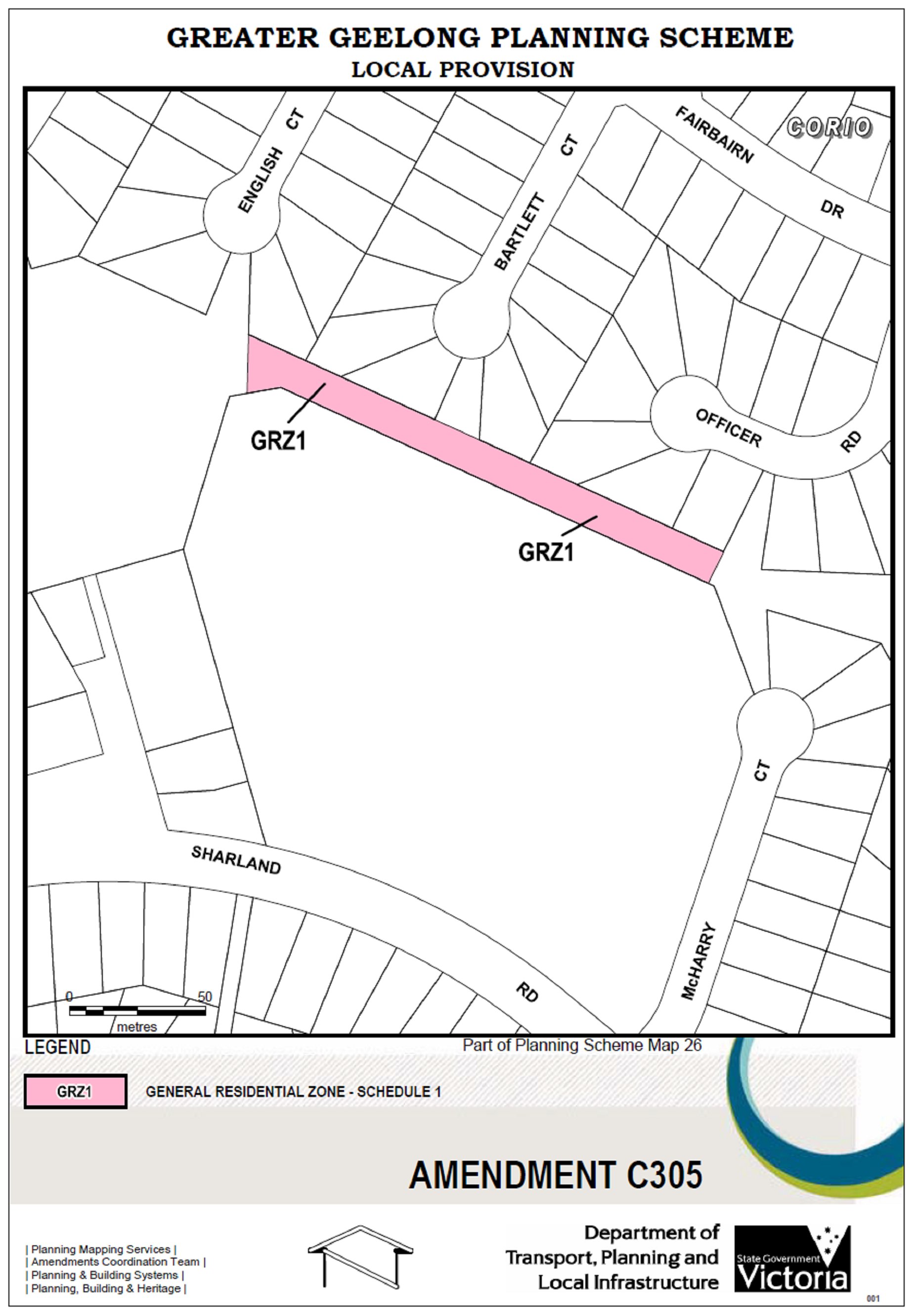
It is proposed to rezone part of Connections Park Corio from the Public Park and Recreation Zone to the General Residential Zone.
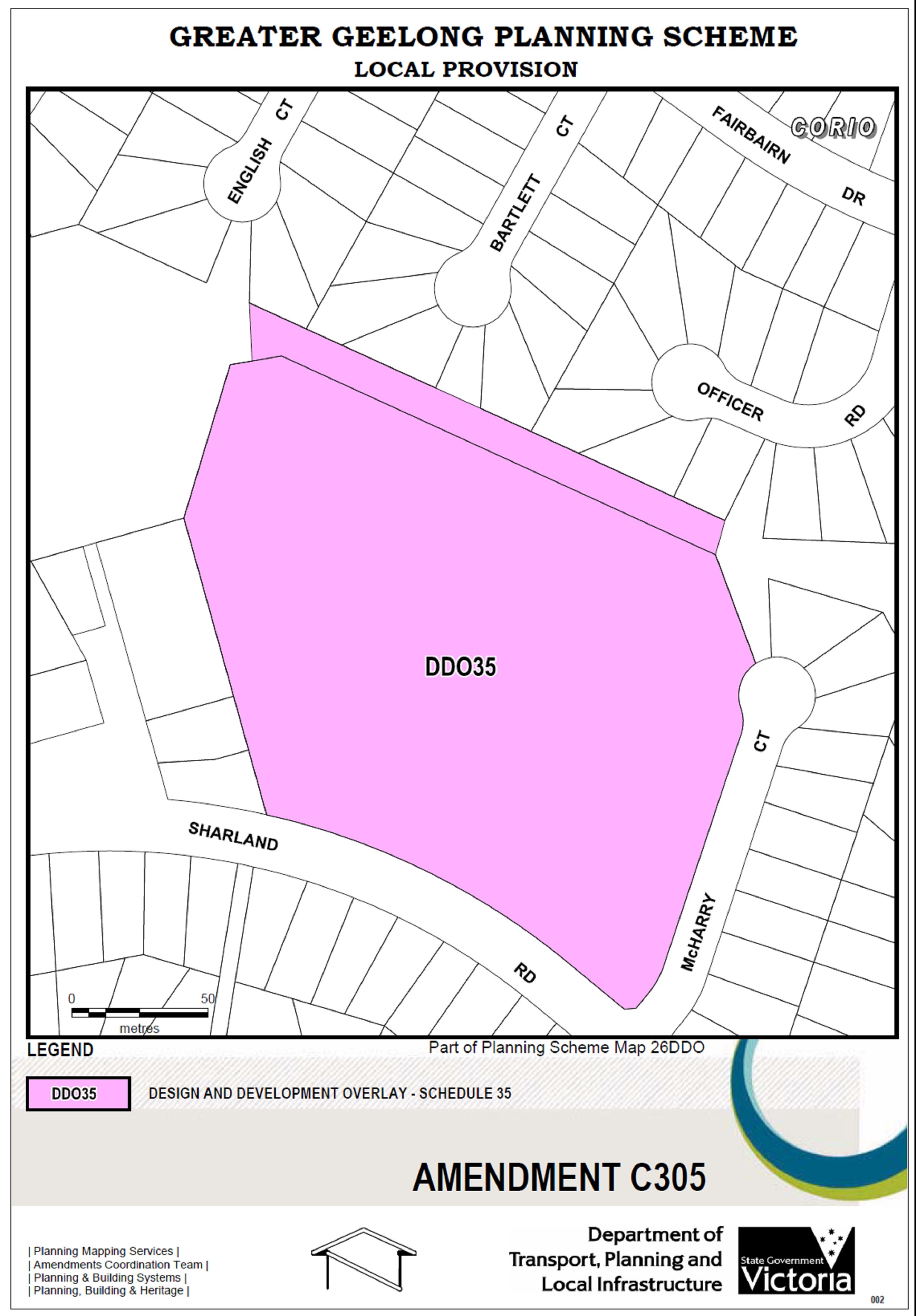
The amendment will also apply a Design and Development Overlay to the former Rosewall Primary School site and to the land being rezoned.
Public exhibition of Amendment C305 commenced on 18 September 2014 and closed on 20 October 2014.
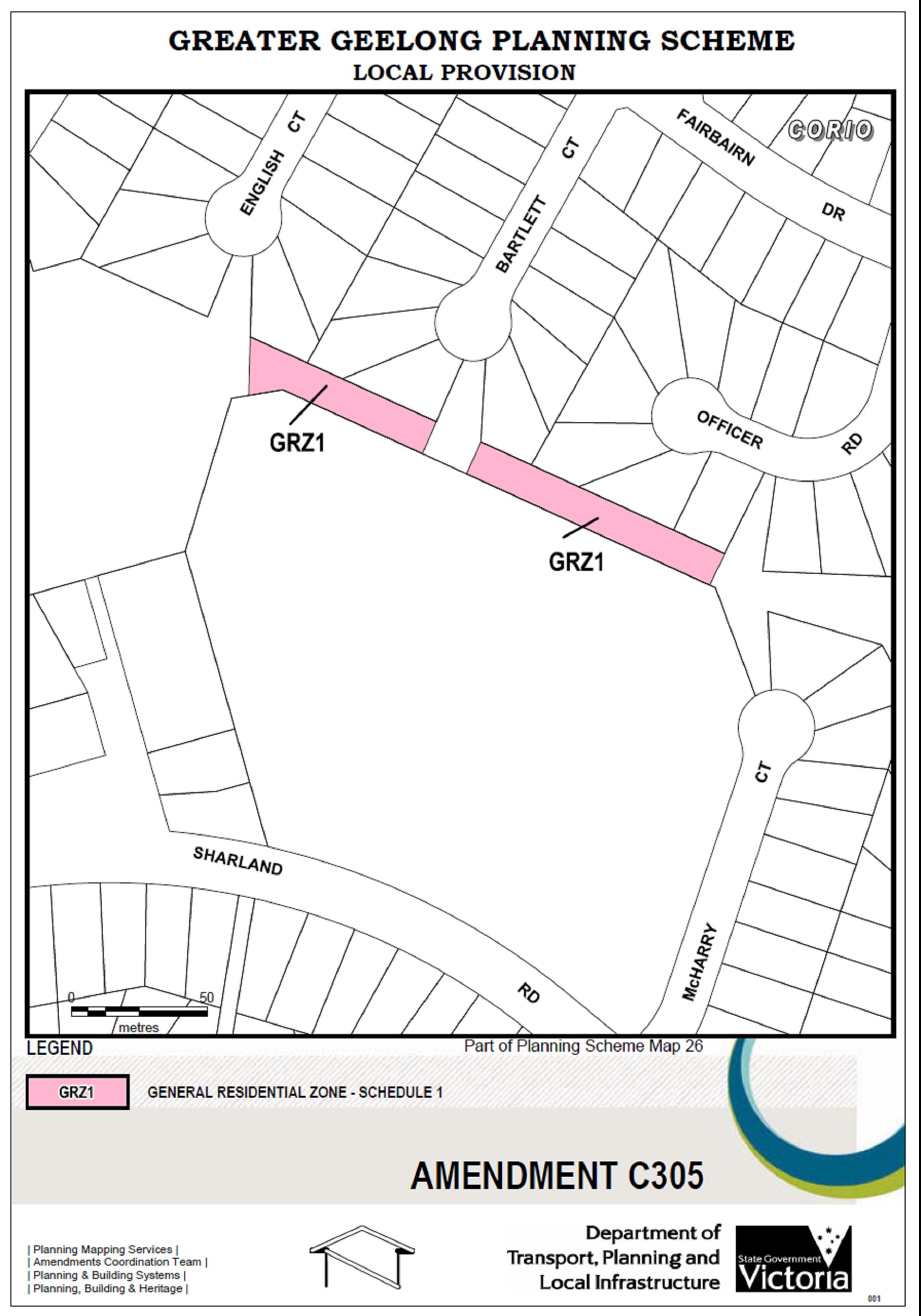
Supporting submissions were received from the Rosewall Neighbourhood Centre Committee of Management and Barwon Water. The Department of Education and Early Childhood Development submitted a request to include additional Public Park and Recreation Zoned land in the General Residential Zone, which is supported. The Zoning Map has been changed as shown in Appendix 1.
The amendment is a direct outcome of the Corio Norlane Structure Plan 2012 which includes the implementation of the Former Rosewall Primary School Concept Plan.
The amendment is consistent with the Corio North Community Infrastructure Plan, noted at the 11 February 2014 Council Meeting to guide the delivery of community service infrastructure in Corio North.
The rezoning facilitates the future reallocation of land between Council and the Department of Education. A future council-initiated planning permit will allow for the subdivision and consolidation of the various titles. The permit and sale of land process would be aligned.
The amendment is an important step in the redevelopment of the former school site and planned improvements to the Rosewall Neighbourhood Centre.
The amendment can now be adopted with no need to refer the amendment to an Independent Planning Panel.
Cr Heagney moved, Cr Ansett seconded -
That Council:
resolves to adopt Amendment C305 in the form as outlined in Appendix 1 of this report; and
resolves to submit the adopted Amendment with the prescribed information to the Minister for Planning requesting approval.
Officers prepare a report on the sale and rezoning of Connections Park East (BMX site).
Carried.
The former Rosewall Primary School site at 26-34 Sharland Road, Corio, ceased operating in 2009. The land is owned by the Department of Education and Early Childhood Development (DEECD) and is earmarked for sale to the private market. The land is located in the General Residential Zone and sits within an established residential area adjoining Connections Park (Zoned Public Park and Recreation Zone - PPRZ).
As part of the preparation of the 2012 Corio Norlane Structure Plan, Council officers in collaboration with other agencies, including the DEECD, worked on a preferred reconfiguration of both the school site and Connections Park. A key direction of the Structure Plan is to: “Support the redevelopment of the Rosewall Primary School site for future residential use integrated into a safe and accessible street and open space network (see Rosewall Concept Plan).”
The Former Rosewall Primary School Concept Plan is shown at Appendix 2.
In order to implement the Rosewall Concept Plan Council has initiated this amendment. The amendment will rezone a strip of Council-owned PPRZ land wedged between the former primary school land and private properties to the General Residential Zone.
To ensure that the future development of the DEECD land incorporates fundamental design principles, the former school land and PPRZ land to be rezoned will be covered by a Design and Development Overlay. The overlay will include design objectives to maximise surveillance of open space and community facilities and maintain public open space connections.
Council resolved on 12 August 2014 to place the amendment on exhibition.
Exhibition of amendment C305 occurred over a 4 week period closing on 18 September 2014. Notice of the Amendment was sent to relevant Ministers and Agencies, appeared in the Government Gazette and local newspapers and was placed on display at the Rosewall Neighbourhood House.
All landowners and occupiers near the part of Connections Park proposed to be rezoned were directly notified.
Supporting submissions were received from Barwon Water and the Rosewall Neighbourhood Centre Committee of Management (CoM). The CoM strongly supports the amendment highlighting a range of future benefits including: assist with the transfer of land so that the building is wholly located on Council land; allows for the construction of a new Centre thereby offering improved community programs; facilitates new housing and residents in the area; and improves passive surveillance of both Connections Park and the Centre.
The DEECD support the amendment (and the land exchange process) subject to the addition of a small square of PPRZ land also being rezoned to the General Residential Zone. The exhibited rezoning map is shown at Appendix 3 which can be compared to the Appendix 1 proposed map for adoption. The DEECD consider this change will make the parcel available for sale more regular and attractive to the open market.
Council officers support the change suggested by the DEECD. The additional land to be rezoned to the General Residential Zone will not affect the core objective of maintaining public open space connections. The proposed Design and Development Overlay includes requirements to retain access to Bartlett Court.
Because there are no outstanding objecting submissions, the Amendment does not need to be heard by an Independent Planning Panel. Council is now able to adopt the Amendment and forward it to the Minister for Planning seeking approval.
The rezoning facilitates the future reallocation of land between Council and the Department of Education. A future council-initiated planning permit will allow for the subdivision and consolidation of the various land parcels. The permit will also remove the ‘reserve’ status from the land sold. The permit and sale of land process would be aligned.
There are no environmental impacts as a result of this amendment.
There is no impact to the budget as part of this amendment. Ongoing land exchange negotiations may result in costs to Council to purchase the balance Department of Education land. For this, $150,000 has been allocated in the 2014-15 Budget.
The amendment is directly supported by Clause 22.18 Corio Norlane of the Greater Geelong Planning Scheme. This clause lists as further work: “Support the redevelopment of the former Rosewall Primary School in accordance with the Rosewall Concept Plan including reconfiguration of adjacent public open space”.
The amendment will implement the ‘Former Rosewall Primary School Concept Plan’ contained in the Corio Norlane Structure Plan, July 2012.
The amendment is consistent with the Corio North Community Services Infrastructure Plan prepared by the City of Greater Geelong. The Plan provides a practical vision for Council to plan, design and deliver community services infrastructure at Sharland Road, Rosewall. The Plan identifies additional land required – land currently owned by the DEECD – to achieve this vision.
The Amendment supports the ‘Community Wellbeing’ and ‘Sustainable Built and Natural Environment’ strategic directions of City Plan. The rezoning and built form controls will facilitate the development of the former school land and adjacent open space and community facilitie.
No Council officer involved in the report has any direct or indirect interest, in accordance with Section 80(c) of the Local Government Act.
There are no notable risks associated with implementing the recommendation contained in this report.
The amendment is an important step in the long term redevelopment of the former Rosewall Primary School site and planned improvements to the Rosewall Neighbourhood House. These changes will have significant positive benefits for the local community.
The amendment will not impact on any basic rights, freedoms and responsibilities as set out in the Charter. Planning legislation ensures an open community consultation process occurs, enabling people to freely express their views and if necessary obtain a fair hearing before an Independent Panel.
The amendment was exhibited in accordance with the Planning and Environment Act 1987, including direct notification to nearby landowners and occupiers.
The planning authority for this amendment is the Greater Geelong City Council.
The Greater Geelong Planning Scheme is amended as follows:
The Planning Scheme Maps are amended by a total of 2 attached map sheets.
Zoning Maps
Overlay Maps
The Planning Scheme Ordinance is amended as follows:
End of document
SCHEDULE 35 TO THE DESIGN AND DEVELOPMENT OVERLAY |
|
|
Shown on the planning scheme map as DDO35 |
1.0 |
Design objectives |
DD/MM/YYYY |
To implement the Former Rosewall Primary School Concept Plan. To maximise surveillance of public open space and integration with community facilities. To maintain public open space connections. |
2.0 |
Buildings and works |
DD/MM/YYYY |
Requirements The development design must provide public access through the site to connect Connections Park East, Connections Park West and Bartlett Court. |
3.0 |
Subdivision |
DD/MM/YYYY |
Requirements Subdivision of land must provide a public link between Connections Park East and Connections Park West and maintain access from Bartlett Court to Connections Park. Subdivision design must maximise surveillance of the public realm. A north-south road should be provided along the western boundary of the site as an interface with the adjoining community facilities and Connections Park East. Exemption from notice and review An application to subdivide land is exempt from the notice requirements of Section 52(1)(a), (b) and (d), the decision requirements of Section 64(1), (2) and (3) and the review rights of section 82(1) of the Act. |
4.0 |
Decision guidelines |
DD/MM/YYYY |
Before deciding on an application the Responsible Authority must consider:
Reference Document Corio Norlane Structure Plan, City of Greater Geelong & Department of Planning and Community Development, July 2012. |

Portfolio: |
Planning – Cr Heagney |
Source: |
Planning and Tourism |
General Manager: |
Peter Bettess |
Index Reference: |
Subject – Council Reports 2014 |
The purpose of this report is to seek Council’s adoption of a land use Master Plan prepared for 13-35 Mackey Street, North Geelong as a policy for considering Planning Permit applications.
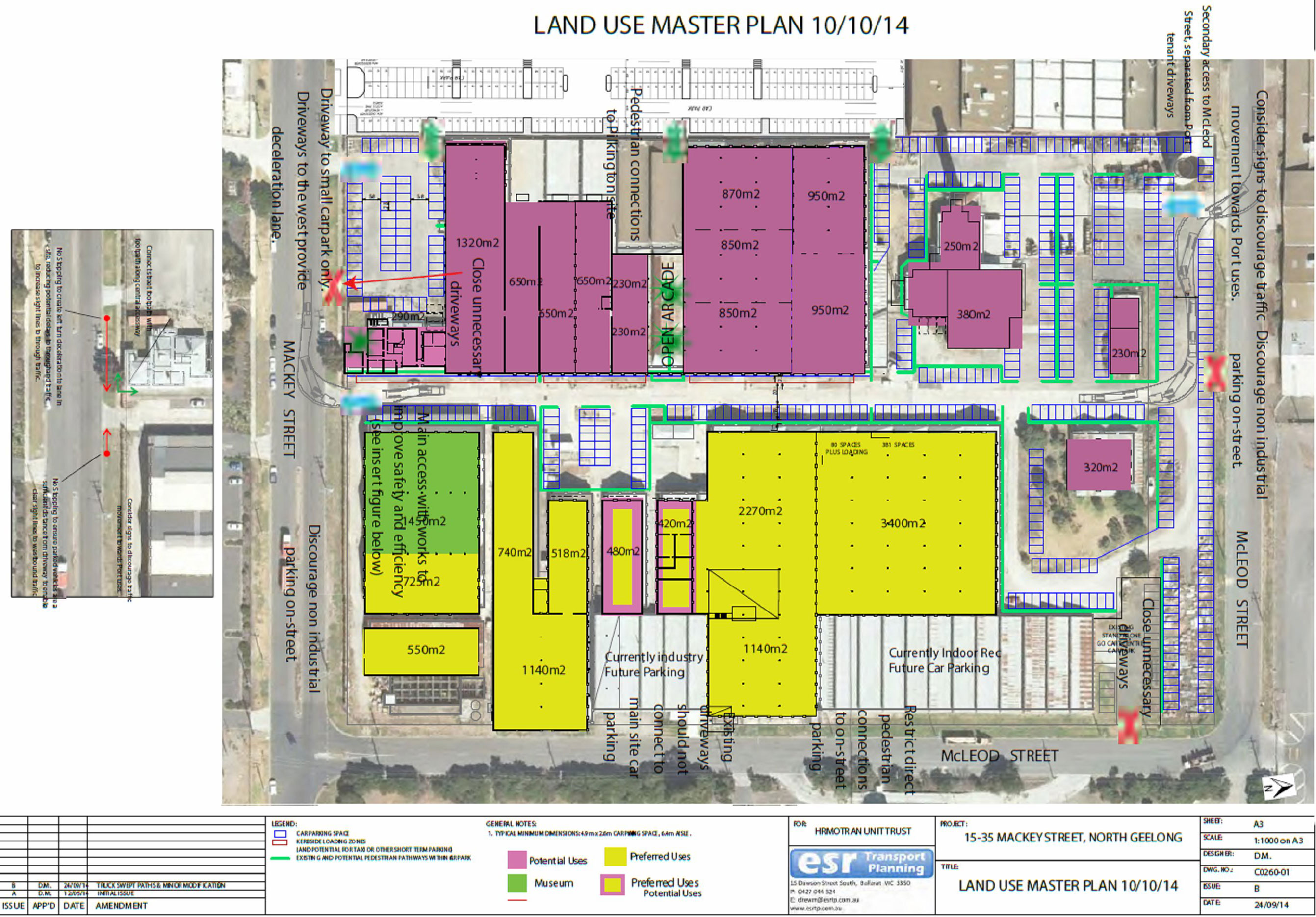
The Master Plan sets outs a list of preferred uses, potential uses and non-preferred uses which could be established at the site subject to planning approval. The Master Plan would be a non-statutory document which would be used to inform the assessment of Planning Permit applications, in addition to the provisions of the Greater Geelong Planning Scheme.
In August 2013 the owner of 13-35 Mackey Street, North Geelong, also known as the former Federal Woollen Mills site, presented a proposal to Council’s Business Facilitation Group (BFG) for the potential re-use of the site. The presentation involved an outline of the site’s history, the difficulties with using the site for industrial purposes, particularly due to the heritage controls and layout of the buildings, and the opportunity to introduce various types of non-industrial uses.
Since the BFG in August 2013, Council Officers have facilitated a consultation process which has involved various stakeholders from the Port, State Government and Council. The process has involved the preparation of a Master Plan and Transport Master Plan.
The key issues identified through the consultation process included the need to protect the Port and to ensure that any new land use does not compromise Port related activities. In particular there have been strong concerns raised in relation to the introduction of non-industrial related traffic to the area and despite development of traffic management strategies, these concerns remain outstanding by some stakeholders.
The Master Plan has evolved over time and has involved the owner agreeing to significantly scaling back the extent of non-industrial uses. The location of non-industrial uses has also been shifted further away from the eastern side of the site, being closest to Barrett Burton and GrainCorp, the two main industries and Port users. A list of ‘preferred uses’, ‘potential uses’ and ‘non-preferred uses’ has now been established with guidelines or application considerations prepared to inform the Planning Permit process.
Traffic and car parking management arrangements have also been well considered and the final draft of the Master Plan ensures that traffic impacts are minimised and the car parking is located entirely within the site. Other matters, including amenity and interface issues have also been considered in the Master Plan.
Despite not receiving the full support by all stakeholders, it is considered that the Master Plan process has allowed the issues to be considered and addressed in a holistic manner. It is considered benefits of allowing a limited number of non-industrial uses far outweigh any negatives and it is anticipated that any issues can be appropriately considered through the Planning Permit application process. The proposal represents an opportunity to facilitate the adaptive re-use of a significant heritage place and to support the growth of new business and employment.
The Master Plan will be a platform to enable to consideration of Planning Permit application to ensure a fair and orderly planning outcome for the site, without prejudicing the operation of the Port.
Cr Heagney moved, Cr E Kontelj seconded -
That Council adopts the Land Use Master Plan prepared for 13-35 Mackey Street, North Geelong as a policy to inform the assessment of Planning Permit applications, under the Greater Geelong Planning Scheme.
Carried.
Following the owners presentation at Council’s Business Facilitation Group (BFG), Council officers commenced staged process which involved consultation meetings with various stakeholders including from the Port and the State Government.
Early in the process, some of the stakeholders recommended that the process should involve a formal amendment to the Planning Scheme. However Council officers decided that a formal amendment was not necessary because the Planning Scheme already provides discretion to consider all types of Planning Permit application proposals.
The Master Plan is a non-statutory tool which can be used to inform the assessment of Planning Permit applications, in addition to the provisions of the Greater Geelong Planning Scheme.
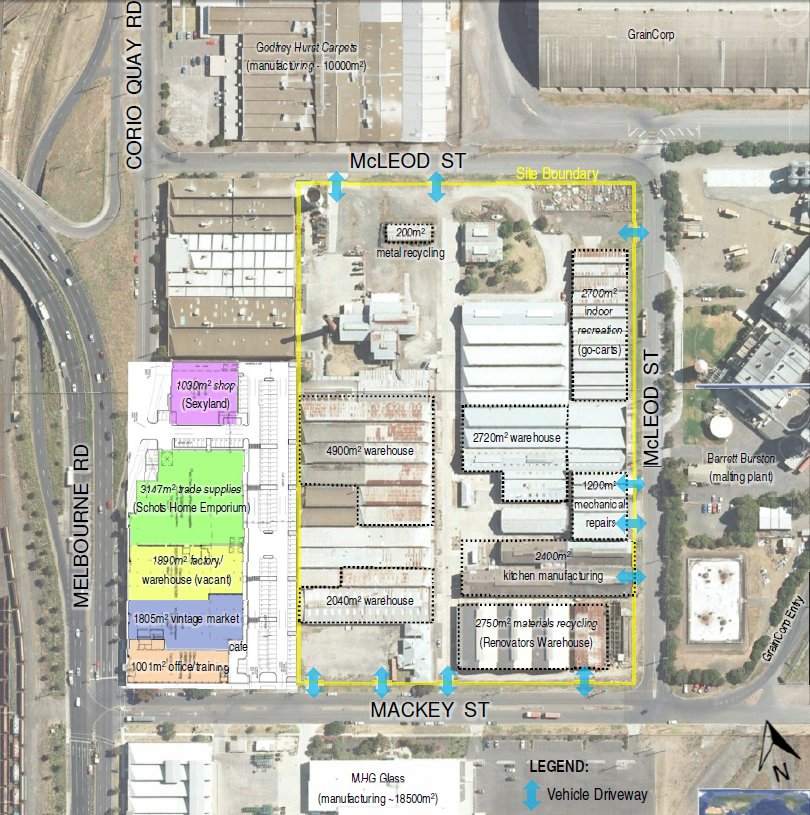
An aerial photo and context plan is shown in Appendix 1
Photos are provided in Appendix 2
A Master Plan is shown in Appendix 3
A draft Land Use Planning Guide (LUPG) is shown at Appendix 4
The Site and Surrounds
As shown in Appendix 1, the site is located at 13-35 Mackey Street, North Geelong and has three road abuttals, namely Mackey Street to the Mcleod Street to the east and north.
The site and surrounding land is located within an Industrial 2 Zone and has a Design and Development Overlay (Schedule 20). The site itself also has a site specific Heritage Overlay (Schedule 1648).
The site has an area of approximately 54,000m2 which and existing floor space of 28,000m2. Of this, approximately 19,000m2 is currently used for warehousing, materials recycling, mechanical repairs and indoor go-carts. The remaining floor space effectively remains vacant due to the inability to attract conventional industrial uses.
Vehicular access to the site is provided from various driveways to Mackey and McLeod Streets. Mackey Street is classified as a 30 metre wide local road and a default 50kph speed limit. McLeod Street is also classified as a local road and is 20 metres wide. Photos are provided in Appendix 2
The site is within the Geelong Port Precinct and to the east of the site is Barrett Burston (grain malting plant) while to the north is Graincorp (grain export terminal). Other surrounding land uses include the former Pilkington Glass site to the west which is currently used by a range of land uses and MHG glass manufacturing to the south. Non-industrial uses to the west include a second hand goods market, Schots furniture and home wares retail and an adult sex book shop.
Site History
The Federal Woollen Mills were built from 1905-1915 to make uniforms for the soldiers of WW1. The site remained a mill until it closed in 2001. The complex has however been used in recent years for various ad-hoc activities including warehousing, materials recycling and go carting.
Stakeholder Engagement
Who was involved?
Department of Transport, Planning and Local Infrastructure
Victorian Regional Channels Authority
Environment Protection Authority
GrainCorp Limited
Barrett Burston Malting.
Department of State Development, Business and Innovation
Summary of Issues/Feedback
The majority of the issues raised or feedback have centred around the potential impact caused by an increase in traffic and car parking along with impacts to Port related activities through the introduction of non-industrial uses. The issues are summarised below, noting that this is not an exhaustive list:
General Issues
General agreement that the site needs to be looked at in a holistic manner so that there is some certainty into the future for landowners and affected stakeholders.
The purpose of the zone for industrial uses in the Geelong Planning Scheme and this should be starting point for considering land uses on the site.
Protection of commercial trading ports is important and highlighted in the state planning policy framework.
The proposed uses are seen to potentially deprive GrainCorp and other Port users of the protection afforded by the Industrial 2 Zone.
Traffic, Car parking
Traffic - The conflict between industrial and non-industrial traffic should be avoided.
Port activities require frequent movements of heavy industrial vehicles on a 24 hour basis. Safety for contractors, employees and visitors is vital.
Non-industrial parking demand and traffic congestion from the proposed land use would be unacceptable.
VicRoads is currently working closely with the Victorian Regional Channels Authority (VRCA) and the Port of Geelong regarding the potential to allow High Productivity Freight Vehicle access on key routes into the Port. At this stage there has been no determination as to which routes will be made available or where they will access the Port.
Amenity and Land Use Conflict
The Port precinct includes GrainCorp and Barrett Burston whose operations are vulnerable to sensitive uses including noise, dust and odour emissions together with extended hours operations.
Reverse Amenity – No sensitive uses should not be allowed. This should be extended to include hospitals and medical centres.
Port and industry activities are subject to separation distances and it is vital that encroachment of inappropriate uses not occur. Industrial/port activities can occur 24/7, and ongoing curfew free operations must be protected.
Any land uses involving the presence of people for extended periods should also be discouraged unless it can be demonstrated that the higher purpose of the zone and Port related activities are not compromised.
It is accepted that Council is able to consider the merits of alternative land uses, however any departure from the zone provisions based on heritage grounds needs to be weighed against strategic land use considerations.
What is the Master Plan?
The Master Plan is made of three (3) parts, namely the 1. Master Plan and 2. the Land Use Planning Guide and 3. The Transport Master Plan Report.
The Master Plan would be a non-statutory tool which can be used to inform the assessment of Planning Permit applications, in addition to the provisions of the Greater Geelong Planning Scheme.
It is important to note that the provisions of the Greater Geelong Planning Scheme and the Planning & Environment Act will always take precedence over any Master Plan, even if adopted by Council.
A copy of the Master Plan is shown in Appendix 3 and the Land Use Planning Guide (LUPG) is shown at Appendix 4.
How will it be implemented?
The Master Plan will essentially be a platform for the consideration of Planning Permit application to ensure a fair and orderly planning outcome for the site, without prejudicing the operation of the Port.
The Master Plan includes a series of decision guidelines, land use tables, a list of potential conditions and is read in conjunction with a plan which outlines the layout of the site.
‘Preferred Uses’, ‘Potential Uses’ and ‘Non-Preferred Uses’
A feature of the Master Plan is that it sets out a list of ‘Preferred Uses’, ‘Potential Uses’ and ‘Non-Preferred Uses’. These uses are based on Planning Scheme definitions and were selected in consultation with stakeholders.
The ‘preferred uses’ are those use which are actively encouraged in the Industrial Zone (eg. industry and warehouse).
The ‘potential uses’ are those uses which may be supported subject to certain considerations (eg. office, retail and museum).
The ‘non-preferred uses’ are uses which attract high visitation numbers (eg. large retail uses) or sensitive land uses (eg. accommodation, education uses). The Master Plan makes it clear that these uses should not be supported.
How does the Master Plan respond to the issues?
As discussed above, the majority of the issues raised primarily relate to the potential impact caused by an increase in traffic and car parking through the introduction of non-industrial uses. The Master Plan has evolved over time and has involved the owner agreeing to significantly scale back retail type uses and to move non-industrial or warehousing away from the main Port area.
Traffic and car parking management arrangements have also been well considered and the final draft of the Master Plan ensures that impacts to traffic are minimised and the car parking is located entirely within the site.
While the need to support the growth of the Port is acknowledged and fully supported by all levels of government, it is considered that a balanced approached is required in order to also support the sustainable use and development of the site. The Planning Scheme already provides scope to consider non-industrial land uses, including uses which are prohibited, and this Master Plan can be used as a guide to inform Council’s discretion in decision making.
Key issues such as traffic and car parking and amenity impacts can be reasonably managed through Planning Permit conditions.
Key Planning Considerations
Greater Geelong Planning Scheme
Clause 33.02 – Industrial 2 Zones
The purpose of Clause 33.02 of the Industrial 2 Zone is to:
implement the State Planning Policy Framework and the Local Planning Policy Framework, including the Municipal Strategic Statement and local planning policies.
provide for manufacturing industry, the storage and distribution of goods and associated facilities in a manner which does not affect the safety and amenity of local communities.
promote manufacturing industries and storage facilities that require a substantial threshold distance within the core of the zone.
keep the core of the Zone free of uses which are suitable for location elsewhere so as to be available for manufacturing industries and storage facilities that require a substantial threshold distance as the need for these arises.
It is acknowledged that the subject site and surrounding land is situated within the Industrial 2 Zone which provides for manufacturing and storage industries that require substantial threshold distances from sensitive land uses. Many non-industrial used would typically be prohibited except for the provisions of the Heritage Overlay. The re-use of former industrial buildings for alternate uses non-industrial uses have the ability to co-exist without adversely impacting on surrounding properties. An example of this can already be observed with the retails uses fronting Melbourne Road. Little Creatures in South Geelong is another successful example where such uses do not cause a conflict and where there is a benefit of allowing alternate uses to establish through the retention and re-use of heritage buildings which are not suited to current industrial land uses. The provisions of the Industrial 2 Zone will need to be considered as party of any future Planning Permit application.
Heritage Overlay
The subject site is listed as HO1648 on the Victorian Heritage Registrar. Pursuant to Clause 43.01-5, a permit may be granted to use a heritage place (including a heritage place which is included on the Victorian Heritage Register) for a use which would otherwise be prohibited if all of the following apply:
The schedule to this overlay identifies the heritage place as one where prohibited uses may be permitted.
The use will not adversely affect the significance of the heritage place.
The benefits obtained from the use can be demonstrably applied towards the conservation of the heritage place.
The schedule to this overlay identifies this site as one where prohibited uses may be permitted. In other words, the owner can currently apply for non-industrial and prohibited uses at this site.
Clause 43.02 – Design and Development Overlay
The purpose of Clause 43.02 of the Design & Development Overlay is to:
implement the State Planning Policy Framework and the Local Planning Policy Framework, including the Municipal Strategic Statement and local planning policies.
identify areas which are affected by specific requirements relating to the design and built form of new development.
The design objectives of Schedule 20 of this overlay are to:
improve the visual appearance and image of industrial areas through well designed site responsive developments.
facilitate economic development through efficient and functional industrial development.
provide a high level of amenity for workers and visitors to industrial areas.
minimise the potential for negative off-site effects to occur.
promote best practise storm water quality and reuse measures.
These matters will need to be considered as part of any future Planning Permit application.
Policy Framework
There are a number of policies which are applicable to the use and development of this site. At a state level policies include:
Clause 11 – Settlement
Clause 13 – Environmental Risk
Clause 15 – Built Environment and Heritage
Clause 17 - Economic Development
Clause 18 – Transport
Clause 21.07 – Economic Development and Employment
Clause 21.12 – Geelong Port
Clause 22.09 – Cultural Heritage
Of particular relevance:
Clause 18.03 - Ports
Planning for Ports:
To recognise the transport and logistics role of Victoria’s commercial trading Ports at Melbourne, Geelong, Hastings and Portland in supporting the State’s economy and to facilitate their ongoing sustainable operation and development.
Support the effective and competitive operation of Victoria’s commercial trading ports at local, national and international levels.
Planning for Port environs:
To plan for and manage land in the environs of commercial trading ports so that development and use are compatible with port operations and provide reasonable amenity expectations.
Clause 21.12 – Geelong Port
To provide for the continued growth and development of Geelong Port as a key economic resource to the Victorian community.
To maintain and enhance the efficiency of the Port.
To safeguard the Port as a focal point for infrastructure development and economic prosperity within south-west Victoria.
To ensure that development in the Port area is environmentally sustainable.
To give appropriate weight to the needs of a working Port having regard to the amenity of the land uses at the Port interface.
City of Greater Geelong Port Structure Plan Adopted by Council in 2007
The site is located in Precinct 4 (Grain Piers) which includes a number of industrial and non-industrial uses. In particular GrainCorp and Barrett Burston are located in this precinct and the Port Structure Plan (2007) (PSP) confirms that the retention and protection of these facilities as economic assets of the community of Geelong is critical to the ongoing viability of the Port as a key economic role of Geelong. Both these operations are vulnerable to sensitive uses given dust, odour and noise emissions and extended hours operations.
Map No. 7 of the PSP identifies the site as being ‘industrial interface’ and not within the area identified as either ‘core industry either opportunities for Port related uses or existing core Port related industry. Activities in the ‘industrial interface’ include areas within the Industrial 2 Zoned land accommodate some non-Port related activities in Mackey Street and these areas still form part of an important buffer to Port industry. The Master Plan acknowledges that site plays an important role in this ‘buffer’ area through limiting and preventing inappropriate uses.
Part 3.4 of the PSP refers to non-industrial uses in the Port and confirms that non-Port uses in the core Port area or Port related industrial area should not conflict with the operation of Port facilities. The PSP refers to the need to consider the use of Section 173 agreements or similar for new uses to highlight the potential impacts from odour, dust and noise. Given the Master Plan seeks to provide ‘in principle’ support for non-industrial uses, a number of mechanisms have been included to mitigate the impacts such as a Section 173 Agreement, traffic and car parking management, discouraging inappropriate uses or sensitive uses and building design.
Geelong Port – City 2050 Geelong Port and Land Infrastructure Plan (adopted by Council in 2013)
This planning documents provides data and highlight key infrastructure investment and planning issues that should be considered as part of any future business cases and environment and public amenity considerations associated with further development of the Geelong Port. It appropriately highlights the importance of the Port to Geelong and Victoria and on review, it is considered that the Master Plan will not undermine the policy direction of this plan.
Ministerial Direction No.14 (Ports Environs)
This direction seeks to ensure that an Amendment to the Planning Scheme does not introduce a sensitive land use or intensify an existing sensitive land uses in the area if it will prejudice the operation of the Port. Sensitive land uses are specifically discouraged and are not supported in the Master Plan.
Summary of Planning Permits
There has been a long planning history at this site,
Planning Permit |
Proposal |
Decision |
|---|---|---|
1589/2002 |
Arts, Entertainment and Market |
Withdrawn |
630/2003 |
Market and Trade Supplies |
Refused by Minister |
672/2004 |
Retail Premises/Market |
Refused by Minister |
1349/2004 |
Retail Premises/Market |
Refused by Minister |
582/2006 |
Indoor Rec Facility (Paintball) |
Permit issued 12/9/2006 |
1082/2006 |
Materials Recycling |
Permit issued 1/8/2007 |
282/2007 |
Office and Warehouse |
Permit issued 30/3/2007 |
983/2007 |
Warehouse, Industry and Office |
Permit Issued 6/11/2007 |
1470/2007 |
Indoor Rec Facility (Go Karts) |
Permit issued 14/3/2008 |
469/2009 |
Warehouse, Employment Training |
Permit Issued 4/9/2009 |
854/2009 |
Adult Sex Bookshop |
Permit Issued 854/2009 |
842/2011 |
Market |
Permit Issued 26/10/2011 |
843/2011 |
Trade Supplies |
Permit Issued 2/11/2011 |
470/2013 |
Market |
Pending - No Decision |
| 62/2014 |
Car Museum |
Permit Issued 28/6/14 |
917/2014 |
Office/Warehouse |
Pending - No Decision |
The recommendations of this report have no environmental implications.
All the costs associated with the development and the provision of additional services to the area will be met by the developer.
The implementation of the Master Plan is considered to be consistent with a range of State and Council planning policies in the Planning Scheme.
The implementation of the Master Plan will assist in Growing our Economy and Sustainable Built and Natural Environment strategic directions of City Plan.
No Council officers have any direct or indirect interest, in accordance with Section 80 (c) of the Local Government Act.
No risks have been identified as part of this process.
There are no social considerations associated with the recommendation in this report.
The Master Plan does not impact on any basic rights, freedoms and responsibilities as set out in the Charter.
The extent of communication has been discussed earlier in this report.
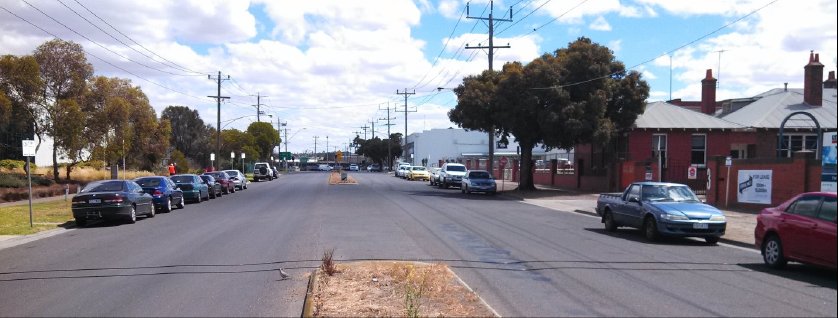 |
| Mackey Street (Looking West – site on right) Source: ESR Transport Planning |
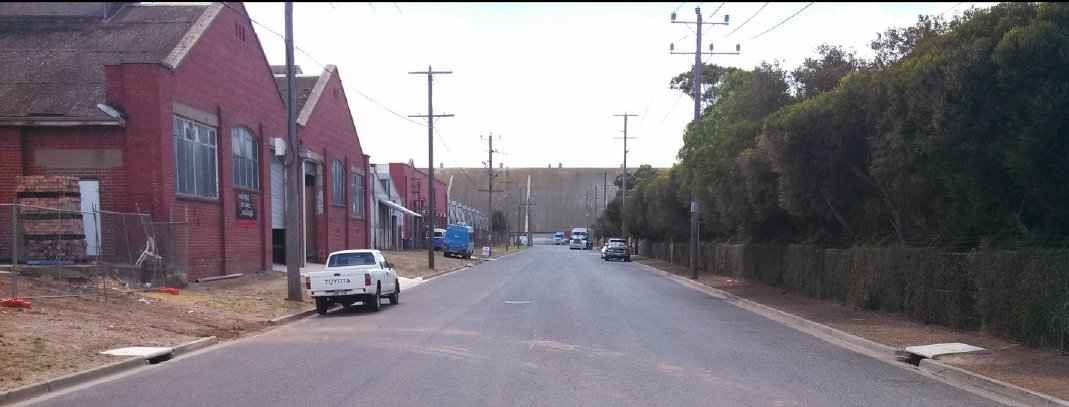 |
| McLeod Street (Looking North – site on left) Source: ESR Transport Planning |
|
McLeod Street (Looking East – site on right) Source: ESR Transport Planning |
Portfolio: |
Community Development - Cr Fisher |
Source |
Community Services - Family Services |
General Manager: |
Jenny McMahon |
Index Reference: |
Subject: Family Day Care |
To inform Council about the introduction of changes to the funding and administration of Family Day Care, and potential implications these changes are likely to have for the future of the existing Council service.
Family Day Care (FDC) is an early childhood education and care service that provides care for children aged 0-12 years of age within the homes of independent contractors (educators).
Council is the licensee of FDC and the ‘approved service operator’ for the purpose of administering Child Care Benefit (CCB) on behalf of the Department of Education. As licensee Council is also responsible for ensuring the service meets the requirements of the Education and Care Services National Regulations and Family Assistance Law.
Council has been operating FDC since the mid 1970’s and currently has 46 registered educators contracted to deliver the FDC service across the municipality. Council employs 5 staff in the FDC service (3.8 FTE) to oversee, monitor, and resource the program; support educators and families; and to ensure compliance with legislative requirements.
The FDC service provides early childhood education and care for approximately 384 children and associated support for 341 families per week. Amongst these families, over 94 per cent participate in employment, education and training, and 11 per cent are single parent families.
Over 17 per cent of families that use Council’s FDC live in suburbs where there is no alternative long day child care provision. Currently the FDC service has 150 families on the waiting list to access care.
Council receives funding from a number of sources to operate FDC. The 2014/2015 operational budget has total revenue of $504,797 which includes funding of $166,140 from the Federal Government Community Support Program (CSP); $213,514 in service levy’s charged to educators and parent fees; $600 sundry income and a Council contribution of $124,541.
The current agreement with the Federal Government will cease on 30 June 2015 and Council has been advised that all FDC services wishing to apply for funding after 30 June 2015 will be assessed under new criterion.
The new criteria requires that FDC Schemes demonstrate unmet demand for child care in the area being served; be the sole FDC service provider in the area; and meet the location eligibility criteria which is based on a range of complex demographic and geographic factors.
Based on a preliminary assessment conducted by Council officers, it is anticipated that Council will not meet the new eligibility criteria for CSP funding beyond 30 June 2015, resulting in a $166,140 reduction in recurrent income per annum.
Additional changes to the operational requirements of FDC are also required as a result of amendments to the interpretation of the Family Assistance Law. These changes are also required to be implemented by July 2015.
Council engaged Harwood Andrews in April 2014 to provide advice and guidance on the above changes and the implications for current administrative processes.
Cr Fisher moved, Cr Farrell seconded -
That Council:
note the changes to the administration process and future funding requirements for Family Day Care;
endorse proposed changes to the staffing structure and business model of the FDC service (option 2) to offset loss of income; and
write to the Federal Government to express concern about the impact on the future of local Family Day Care provision as a result of changes to funding arrangements.
Carried.
Family Day Care is an early childhood education and care service that provides care for children aged 0-12 years of age from the homes of independent contractors (educators).
According to the Municipal Association of Victoria, just over three-quarters of Victorian Local Governments (76 per cent) provide some level of support for Family Day Care (FDC).
Council has been operating FDC since the mid 1970’s. FDC provides a flexible service delivery model that matches the needs of children and their parents with individual educators. FDC’s flexible service options also caters for the needs of families who require care for their children outside normal business hours, including overnight and weekend care. Council has 46 independent educators registered and contracted to provide the FDC service to families from across the municipality.
Council employs 5 staff, (3.8 FTE) within the Family Day Care Coordination Unit. The unit is responsible for monitoring service quality and compliance.
Council is licensed through the Australian Children’s Education and Care Quality Authority (ACECQA) to deliver the FDC service. As the licensee of FDC and the ‘approved service operator’ for the purpose of administering Child Care Benefit (CCB) and Child Care Rebate (CCR) on behalf of the Department of Education, Council is responsible for ensuring the service maintains compliance with the Education and Care Services National Regulations and Family Assistance Law.
In the 2014-15 budget the Federal Government announced funding arrangements for FDC provided through the Community Support Program (CSP), are to be changed with restrictions on the eligibility of services. Currently all FDC services are eligible for funding through the CSP. In future however the changes being introduced will result in most FDC services losing CSP funding from 30 June 2015.
In addition to changes to the funding of FDC, Council has been advised that amendments to the interpretation of the Family Assistance Law will result in required changes to the administration of FDC services from July 2015 onwards.
In response to the changes required under the Family Assistance Law, Council engaged Harwood Andrews to provide independent advice and guidance on the potential impact of the changes to the FDC business model, and clarification on Councils relationship with the independent contractors (FDC Educators).
In order to meet compliance with the amendments to the Family Assistance Law, the FDC service has reviewed its business model and has developed a new streamlined administrative structure and process for the charging and collection of fees. This includes standardisation of hourly fee payments for parents and educators. The standardisation of fees will result in 83 per cent of families paying on average $1.58 per hour more in hourly fee payments. Remaining families will pay less than they are already paying.
Removal of the Federal Government funding for FDC through the Community Support Program will result in a shortfall of approximately $166,140 p.a. In order to address this shortfall the options available to Council are:
Increase the annual net cost to Council. This means that Council’s total annual contribution to sustain the current operation of the FDC service is likely to increase to approximately $290,681 p.a. from the current level of contribution of $124,541 p.a.
Reduce the level of staffing within the FDC coordination unit by 0.8 (FTE), resulting in a reduction to costs of approximately $65,000 p.a. and introduce a standardised parent hourly fee of $11.50 and standardised educator payments of $9.50 per hour, reducing the cost further by $89,804 This would effectively result in an overall annual net contribution to Council of $135,877, an increase of $11,336 on previous contribution level.
Council withdraw its agreement with the Federal Government’s Department of Education. Further exploration will be required to determine implications for staff and service provision.
Following advice received from the Department of Education a review of administrative processes and the current business model was conducted in light of the amended interpretation of the Family Assistance Law.
Council engaged Harwood Andrews in April 2014 to provide independent advice on the required amendments to the Family Assistance Law. In particular, provide guidance on the potential impact of the changes to the FDC business model, and clarification on Councils relationship with the independent contractors (FDC Educators).
The review confirmed that Council is currently operating in accordance with the majority of requirements, but will need to implement administrative changes to service agreements and setting and collection of fees.
Under changes proposed to the existing FDC business model, Council would be responsible for setting parents fees, generating invoices, receipting and debt management. To date, this has been the responsibility of individual educator/contractors. An allocation of approximately $5,000 would need to be included in future budgets for potential lost revenue due to debtors. Previously educators have been responsible for unpaid fees resulting in debtors.
After July 2015 all income including fees paid by parents will be paid directly to Council as the approved service operator, potentially increasing the payable WorkCover premium from $9,250 to $22,795, an increase of $13,545. Clarification will be sought relating to the above calculation for WorkCover premiums.
The key changes to the business model require the establishment of a standardised hourly rate, payable to independent contractors and introduction of a standardised hourly fee payable by all parents. The standardised fee will include the levies’ currently charged to parents and independent contractors, simplifying and reducing the administration.
Families currently pay a total hourly fee ranging between $8.25 and $ 12.70. This rate includes the standard fee set by the independent contractor and the levy payable by educators and parents to Council.
Harwood Andrews advised that the new business model would require the current service agreement between Council and the independent contractors to be revised, to explicitly articulate the relationship of Council with independent contractors.
There are no environmental implications associated with this report.
Changes to the existing Federal Government’s funding arrangements for FDC, will result in a net loss of $166,140 in annual income. This will result in potentially increasing Council’s annual contribution from $124,541 to approximately $290,681 p.a.
Savings are proposed to be made through the implementation of the new business model and reduction in the overall operating costs of the service. Reducing the existing staff employed in the program by 0.8 FTE and streamlining the operation of the program would also result in a further annual saving of $65,000 p.a. Standardising both the educator hourly payment and parent hourly fee would result in a net contribution to Council of $135,877, an increase of $11,336 on previous contribution level.
Applying a $0.50 increase per year to the standardised parent fee and a CPI increase to the standardised educator payments, it is estimated that Council’s contribution would reduce to $77,781 in 2017/2018.
2015/2016 |
2016/2017 |
2017/2018 |
|
|---|---|---|---|
Income |
$2,190,060 |
$2,285,280 |
$2,380,500 |
Expenditure |
$2,325,937 |
$2,391,193 |
$2,458,281 |
Net cost to Council |
-$135,877 |
-$105,913 |
-$77,781 |
The financial impact on families at an hourly fee of $11.50 in 2015/16 is estimated to be:
20 families or 5.87% will pay on average $2.92 more an hour
36 families or 10.56% will pay on average $2.26 more an hour
26 families or 7.62% will pay on average $1.78 more an hour
106 families or 31.09% will pay on average $1.35 more an hour
42 families or 12.32% will pay on average $.76 more an hour
52 families or 15.25% will pay on average $.38 more an hour
59 families or 17.30% will have a reduction in fee by at least $.44
Families that are participating in employment, training or education (94 per cent) will be eligible to receive 50 per cent Child Care Rebate (CCR) on the increased out of pocket expense, assuming they have not exceeded the annual threshold of $7,500 per child. CCR is not income-tested, so eligible families using approved child care can receive this assistance regardless of their income.
A recent independent economic analysis conducted by ACIL Allen Consulting identifies Council’s provision of child care makes a significant contribution to the Geelong economy, and also plays an important role in supporting the early development of young children, especially those who are most vulnerable and at risk.
The broad economic benefits to the Australian economy and productivity associated with centre-based child care has been further supported and validated by extensive international research evidence, including a recently published report by Price WaterhouseCoopers ‘Putting a value on Early Childhood Education and Care in Australia’; and current investigations by the Australian Productivity Commission into Australian Childcare and Early Childhood Learning.
Council is responsible for ensuring that all aspects of the FDC service, including the services provided by individual contractors/educators, is compliant with all legal obligations set out in the A New Tax System (Family Assistance) Act 1999 and the A New Tax System (Family Assistance) (Administration) Act 1999. Council must achieve compliance by July 2015.
Other legislative requirements that Family Day Care is subject to include:
Education and Care Services National Law (2010);
Education and Care Services National Regulations (2011);
Child Wellbeing and Safety Act (2005);
Children Youth and Family Act (2005);
Working With Children Act (2005);
Disability Discrimination Act (1992);
Occupational Health and Safety Act (2004);
Information Privacy Act (2000);
United Nations Convention on the Rights of the Child (1989).
The planning and regulatory role of Local Government in relation to the provision of services for the community is also legislated in the Victorian Local Government Act (1989); the Planning and Environment Act (1987) and the Health Act (1958) and acknowledged within the MAV/DEECD Partnership Agreement.
Alignment to City Plan
The delivery of FDC aligns with existing Council strategies, policies and plans that inform Council’s role in the provision of early childhood education and care services. These include:
City Plan (2013-2017) – Family Day Care is included in City Plan as a service that contributes to community wellbeing. An objective in the plan’s priority ‘Connected, Creative and Strong Communities’ is “promoting and providing opportunities for education and lifelong learning”, whilst the ‘Healthy Lifestyle’ priority includes an objective in relation to “investing in prevention and improved health across all communities in Greater Geelong”;
Municipal Public Health and Well-being Plan (2013-2017) states that “We will provide safe and vibrant physical environments and infrastructure to support healthy living and connected communities.”
Municipal Early Years Plan (2013-2017); “The provision of quality and accessible services and infrastructure is crucial to enabling the City of Greater Geelong to fulfil its vision for the municipality and achieve it goals to improve outcomes for young children.”
Children’s Services Policy; “Council supports the provision of a mixed economy of children’s services including those directly managed by Council alongside those provided by other levels of government, community, and commercially based organisations.
Pursuant to Section 80(c) of the Local Government Act 1989, no Council staff involved in the preparation of this report has a direct or indirect interest in the matter to which this report relates.
As the approved service operator, Council is responsible for ensuring compliance with all legal obligations set out in A New Tax System (Family Assistance) Act 1999 and the A New Tax System (Family Assistance) (Administration) Act 199. The Federal Department of Education are authorised to conduct random spot check visits and where necessary impose sanctions and penalties for services that are found to be in breach of compliance requirements.
The requirement for Council to take responsibility for fee collection means council will be liable for any debts incurred by families. This is estimated at $5,000 per year. In past, individual educators have been responsible for debt management.
Changing the FDC business model will result in reduced income for some educators and an increase for others. It is therefore possible that educators who will lose income may choose to leave the service. It is expected that the reduction in educators would be temporary. A marketing campaign would be developed to engage new educators.
The introduction of the standardised parent hourly fee of $11.50 could result in families leaving the service, which could impact further on service delivery and future structure of the service.
Families and FDC educators need to be confident that they will have access to the services and supports that are required in relation to the provision of local FDC services. Provision of child care and access for parents has direct implications for local workforce participation and the local economy.
Potential risks to Council and its public reputation in relation to the matters contained in this report will be mitigated through appropriate consultation and planning with relevant stakeholders and the community.
Provision of quality early childhood education and care has direct implications for the economic and social development of the municipality. There is also strong evidence that supports the importance of a ‘mixed-economy’ of child care options for families and children and the specific benefits derived from the provision of home-based care through FDC services:
The provision of the FDC service contributes to ‘Social Capital’ which has been identified as important in supporting community wellbeing;
Family Day Care businesses contribute to economic sustainability through reinvestment of income in local communities and the development of micro-business enterprise;
FDC often fills the gap where provision of other forms of child care is not economically viable especially within smaller communities;
FDC is an affordable and flexible education and care option, particularly for families who work non-standard hours;
FDC has the unique capacity to match individual needs of families with an educator and provide home-based care.
Current research confirms the importance of strong relationships with significant adults to a child’s early learning. FDC’s small group environment facilitates strong bonds and promotes effective early learning and social development. FDC is highly flexible and can offer care during standard hours, evenings, before/after school, during school holidays and in some cases overnight and weekends.
Provision of high quality services that support and encourage positive participation and access by children and families have been identified as being critical to improving children’s early development outcomes, addressing disadvantage, reducing family isolation and contributing to the creation of more vibrant, cohesive and prosperous communities.
The United Nations Convention on the Rights of the Child (CRC) requires governments to take all appropriate measures to: render appropriate assistance to parents and legal guardians in the performance of their child-rearing responsibilities.
The United Nations CRC in conjunction with the Human Rights Charter upholds the rights of children’s rights to receive appropriate support and assistance, which protects their welfare, health, and well-being.
Council’s Family Services Department will be responsible for the communication and implementation of decisions arising from this report.
Further consultation will be required with key stakeholders subject to any decisions undertaken by Council in response to the recommendations contained within this report.
Portfolio: |
Infrastructure, Parks & Gardens – Cr Ellis |
Source: |
City Services – Engineering Services |
General Manager: |
Gary Van Driel |
Index Reference: |
Subject: Drainage - Floods |
The purpose of this report is to present a revision to the flood mapping for existing conditions produced within the early stages of the development of the Armstrong Creek Urban Growth Plan (UGP).
The flood mapping is subject to a revision due to the subdivision and development at 50A Whites Road, Armstrong - Mount Duneed. Prior to subdivision the parent lot was considered to be liable to flooding. This development site, which is also known as Villawood Stages 10 and 11, achieves flood immunity for newly created lots for flood events up to and including the 100 year Average Recurrence Interval (ARI) event due to approved internal earthworks including the reshaping of Armstrong Creek.
The earthworks undertaken have resulted in the floodwaters from the 100 year ARI event being contained within the boundaries of the Armstrong Creek reserve.
Council has a statutory obligation under the Building Regulations 2006 to designate land as liable to flooding where it reasonably knows it to be prone to flooding. Conversely, there is an obligation to remove the encumbrance of designation from land that is no longer considered to be flood-prone.
It should be noted that designation is separate to the creation of flood overlays within the Planning Scheme, which generally follows designation. In the case of the Armstrong Creek UGP area, the planning scheme amendment to create post-development flood zones or overlays is proposed after the design of the proposed precincts.
The current designated flood mapping (refer to Attachment 1) was designated by Council at its meeting of 12 December 2006, under the provisions of the Building Regulations 2006. Designation of land as liable to flooding enables the control of floor levels for acceptable building permit applications, or refusal of consent to building applications where there is likely to be a danger to life, health or safety due to flooding. Designation also enables disclosure of flood status within statutory information certificates.
Cr Ellis moved, Cr Harwood seconded -
That Council revoke the Council designation of 12 December 2006 of flood affected land as highlighted as Armstrong – Mount Duneed Stages 10 and 11 on Armstrong Creek Urban Growth Plan Flood Map dated 29 November 2006 as liable to flooding pursuant to Regulation 802(2) of the Building Regulations 2006.
Carried.
As part of the development of the Armstrong Creek Urban Growth Plan (UGP) a flood study was undertaken by specialist consulting engineers to identify the extents of the 100 year Average Recurrence Interval flood event for existing conditions. Following a public exhibition phase, the resultant flood mapping (refer to Attachment 1) was designated by Council at its meeting of 12 December 2006, under the provisions of the Building Regulations 2006.
Designation of land as liable to flooding under Regulation 802 of the Building Regulations 2006 enables the control of floor levels for acceptable building permit applications, or refusal of consent to building applications where there is likely to be a danger to life, health or safety due to flooding. Designation also enables disclosure of flood status within statutory information certificates such as the Land Information Certificate and Building Information Request Form.
The subject of this report is the residential land at Armstrong - Mount Duneed bounded by Whites Road, Surf Coast Highway and Boundary Road. Prior to subdivision the parent lot was used primarily as farmland.
The subdivision at 50A Whites Road, Armstrong - Mount Duneed was named Armstrong by the developer. The current designated flood extent affects multiple residential lots within the Estate Stages 10 and 11.
Overland flows that may occur within the subdivision during the 100 year ARI flood event are now contained within road and drainage reserves in accordance with accepted best practice for development within flood-prone areas. Best practice requires that any overland flows within residential areas satisfy public safety criteria with respect to velocity and depth of flow.
Council has a statutory obligation under the Building Regulations 2006 to designate land as liable to flooding where it reasonably knows it to be prone to flooding. Conversely, there is an obligation to remove the encumbrance of designation from land that is no longer considered to be flood-prone.
Attachment 1 shows the existing flood designation. Attachment 2 shows the change in flood mapping at 50A Whites Road, Armstrong - Mount Duneed, after construction of the subdivision.
The revocation of flood-prone areas designation and designation of revised flood data does not result in any known adverse environmental impacts.
The removal of a minimum floor level requirement for new dwellings may result in a minor reduction in energy and material usage during construction. In addition, concrete slab-on-ground construction, which is normally used for a non-elevated floor, achieves the minimum energy rating more readily than a timber floor on stumps.
The costs of proceeding to revoke the existing designation and to designate the revised flood mapping at 50A Whites Road, Armstrong – Mount Duneed, in accordance with the requirements of the Building Regulations 2006, are provided for within the annual recurrent budget.
The City has various statutory responsibilities for drainage management and flood management (prevention, response and recovery) as set out in the Local Government Act 1989, Local Government Regulations 1990, Planning and Environment Act 1987, Building Regulations 2006, Water Act 1989, Subdivision Act 1988 and Emergency Management Act 1986.
Regulation 802(2) of the Building Regulations 2006 provides Council with the powers to ‘designate’ land liable to flooding. Regulation 802(3) provides that consent must be obtained from Council for an application to build on land liable to flooding.
Section 27 of the Interpretation of Legislation Act 1984 provides the power for Councils to ‘repeal or amend a subordinate instrument made in the exercise of that power’.
Section 807 of the Building Regulations 2006 requires Council to update the municipality’s designated special area maps at the Building Control Commission in the event of alterations to a designated special area. Designated special areas include areas designated as being liable to flooding.
Section 229 of the Local Government Act and Regulation 326 of the Building Regulations provide for the issue of information certificates containing prescribed information, including the flood status of properties.
The revised flood data for 50A Whites Road, Armstrong- Mount Duneed will assist the City in meeting its statutory obligations with regard to flood data.
The revised flood data will also assist in fulfilling the recommendations of the Municipal Emergency Management Committee adopted by Council in November 1998 (i.e. mapping of 1 in 100 year flood levels).
The recommendations of this report are consistent with City Plan, in relation to Growing our Economy and promoting a sustainable built environment, sustainable land use and development.
There are no officer direct or indirect interests with respect to this report.
Council has a risk exposure through its statutory obligations under the Building Regulations 2006 to:
designate land as liable to flooding where it reasonably knows it to be prone to flooding;
specify minimum floor levels in consultation with the relevant floodplain management authority (CCMA); and
refuse consent to building applications where there is likely to be a danger to life, health or safety due to flooding.
Council also has some risk exposure with any failure to disclose the flood-prone status of a property in a Land Information Certificate.
The designation of the flood data produced by the flood study Armstrong Creek UGP project is a key step toward minimising Council’s exposure to these risks.
Conversely, there is an obligation to remove the encumbrance of designation from land that is no longer considered to be flood-prone. Designation of land as being liable to flooding can result in extra construction costs and concerns regarding saleability, in some cases.
Council has a responsibility to the community to provide the best possible information on areas that are flood-prone.
We have taken into consideration the human rights relative to the subject matter of this report, which improves protection of private property.
The current designation was undertaken following a public exhibition in October 2006 with notification of affected property owners. These owners were sent letters and fact sheets with an invitation for submissions.
A revocation of designation does not warrant public consultation as it constitutes the removal of an encumbrance on land.
The owners of properties affected by the revocation will be notified so they are aware that disclosure of flood status on a Section 32 Vendors Statement is no longer required.
Relevant Council databases and flood maps will be revised and updates sent to the Corangamite Catchment Management Authority and Building Control Commission.
Portfolio: |
Environment and Sustainability – Cr Richards |
Source: |
City Services – Waste Services |
General Manager: |
Gary Van Driel |
Index Reference: |
Subject: Waste Management |
To update Council on developments in waste and resource recovery strategic direction, including:
strategic direction under the State Government Getting Full Value – Victorian Waste and Resource Recovery Policy and the establishment of the Barwon South West Waste and Resource Recovery Group,
preparation of strategic documents under this Policy, including the Victorian Organics Resource Recovery Strategy, and to seek Council’s endorsement of Council officers comment to this draft strategy, and to
advise on the proposed development of Council’s waste and resource recovery strategy.
In April last year the Victorian State Government released the Getting Full Value – Victorian Waste and Resource Recovery Policy (VWRR Policy) that included a commitment to ‘provide the right conditions for strong markets, ensure markets can grow without undue burden from red tape, provide certainty in relation to regulatory settings and where appropriate reinvest back into the sector’.
As a result:
regional waste management groups have been reformed (twelve groups into six) with the City of Greater Geelong now part of the Barwon South West Waste and Resource Recovery Group (BSWWRRG). The BSWWRRG commenced operation on 1 August.
a draft Waste and Resource Recovery Infrastructure Plan (SWRR Infrastructure Plan) and draft Victorian Organics Resource Recovery Strategy (VORR Strategy) have been prepared, and
the preparation of further strategies around Investment Facilitation, Collaborative Procurement, Market Development and Community and Business Waste Education has commenced.
The SWRR Infrastructure Plan will be released in March 2015. Regional waste and resource recovery groups will then have a further twelve months to prepare their regional waste and resource recovery plans (ie: by March 2016).
The draft VORR Strategy was released on 29 September for online comment by 31 October. Council officers have consulted internally and with officers of the other Barwon South West region councils and, given the limited time to respond, have provided comment to Sustainability Victoria, as outlined in Appendix A. This report seeks formal endorsement of these comments.
The draft VORR Strategy sets the forward direction as one that relies upon establishing an end product market demand ‘pull’. To achieve this the draft Strategy identifies a thirty year vision with a ten year strategic outlook and a five year action plan that will provide ‘economic prosperity’ while also providing ‘an integrated waste and resource recovery system that promotes public health and well being and protects the environment’.
As with previous responses to Getting Full Value policy documents Council’s officers comments have supported the direction proposed but have also highlighted the need for a strategic framework that will provide sufficient direction for Council to invest in future waste management services and infrastructure.
While not providing an answer to this issue it has been acknowledged under the heading of ‘Identifying Future Needs’ by proposing a five year action to “provide a framework to enable full analysis of alternative options for organic processing systems that consider the challenges of metropolitan, regional and rural Victoria and includes consideration of location, feedstock composition, collection, processing options, products, markets and regulations’.
A copy of the Strategy may be accessed at www.sustainability.vic.gov.au/organicsstrategy.
This longer term approach of the draft VORR Strategy reinforces the appropriateness of this Council’s current strategic position to ‘focus upon the consolidation of its existing waste services while observing and positioning itself to take advantage of opportunities to process additional waste materials should proven means of processing be identified’.
With regards to the preparation of Council’s Waste and Resource Recovery Strategy (WRR Strategy), it is considered that this should be held over until the release of the SWRRI Plan, at which time the other state supporting strategies should also be completed. These documents will set the direction that local government will be expected to pursue and provide further detail on the state government commitments to assist, as will be translated into the regional plans.
Also, Council is currently preparing a Resource Recovery Centre and Transfer Station strategy that will identify the preferred logistics around how Council handles the waste it collects from residential kerbside (ie: direct haul to landfill or bulk haul through a transfer facility) and may lead to how future landfills are provided. It is planned for this strategy to feed into the Council’s WRR Strategy.
Cr E Kontelj moved, Cr Harwood seconded -
That Council:
note the progress as a result of the Getting Full Value – Victorian Waste and Resource Recovery Policy;
endorse Council’s officers comment to the draft Victorian Organics Resource Recovery Strategy, as outlined in Appendix A; and
note the proposal to prepare Council’s Waste and Resource Recovery Strategy following the release of the Victorian Waste and Resource Recovery Infrastructure Plan in March 2015.
Carried.
In April last year the Victorian State government released the Getting Full Value – Victorian Waste and Resource Recovery Policy (VWRR Policy) that included a commitment to ‘provide the right conditions for strong markets, ensure markets can grow without undue burden from red tape, provide certainty in relation to regulatory settings and where appropriate reinvest back into the sector’
As a result:
regional waste management groups have been reformed (twelve groups into six) with the City of Greater Geelong now part of the Barwon South West Waste and Resource Recovery Group (BSWWRR Group),
a draft Waste and Resource Recovery Infrastructure Plan (SWRR Infrastructure Plan) and draft Victorian Organics Resource Recovery Strategy (VORR Strategy) have been prepared, and
the preparation of further strategies around Investment Facilitation, Collaborative Procurement, Market Development and Community and Business Waste Education has commenced.
The BSWWRR Group commenced operation on 1 August. Its Board comprises of four directors from the nine local government organisations and four skills based directors. The Board is advised on local government issues by a forum comprising a councillor representative from each of the nine local government organisations in the region and technical advice to this Forum is provided by an Advisory Reference Group, comprising of officers from each of the member councils.
The SWRR Infrastructure Plan is currently being finalised by Sustainability Victoria following a call for comment on the draft in September last year, to which this Council provided input. Latest information is that the final SWRR Infrastructure Plan will be released in March 2015.
Regional waste and resource recovery groups will then have a further twelve months to prepare their regional waste and resource recovery plans (ie: by March 2016)
The draft Victorian Organics Resource Recovery Strategy (draft VORR Strategy) was released on 29 September for online comment by 31 October. Council officers have consulted internally and with officers from other councils within the Barwon South West region and, given the limited time to provide feedback, have provided comment to Sustainability Victoria (refer Appendix A). This report seeks Council’s endorsement of these comments.
A copy of the Strategy may be accessed at www.sustainability.vic.gov.au/organicsstrategy.
The draft VORR Strategy sets the forward direction as one that relies upon establishing an end product market demand ‘pull’, rather than a ‘push’ market scenario that is driven primarily by environmental concerns. For this to be achieved the draft Strategy identifies a thirty year vision with a ten year strategic outlook and a five year action plan that will provide ‘economic prosperity’ while also providing ‘an integrated waste and resource recovery system that promotes public health and well being and protects the environment’.
This is a distinctively different approach to the previous Towards Zero Waste Strategy that was based on environmental protection and set waste reduction targets.
The Getting Full Value policy and now its further strategic documents place a focus on developing a strong market place for organics collection, processing and for the marketing of the end product and the strategies are intended to establish the framework for this to occur over a thirty year period.
In providing feedback to the previous VWRRR Policy and SWRR Infrastructure Plan, Council has supported the direction proposed but has highlighted the need for a strategic framework that will provide sufficient direction for Council to invest in future waste management services and infrastructure.
While not providing an immediate answer to this issue the VORR Strategy has acknowledged this under the heading of ‘Identifying Future Needs’ by proposing a five year action to “provide a framework to enable full analysis of alternative options for organic processing systems that considers the challenges of metropolitan, regional and rural Victoria and includes consideration of location, feedstock composition, collection, processing options, products, markets and regulations’.
The officer’s comments has raised the concern for those councils that have introduced green organics collections and that are seeking immediate direction on how to deal with these materials in the short term. The officers have request that Sustainability Victoria provide a timetable for when the strategic actions will be implemented.
Within this context the draft VORR Strategy reinforces the appropriateness of this Council’s current strategic position to ‘focus upon the consolidation of its existing waste services while observing and positioning itself to take advantage of opportunities to process additional waste materials should proven means of processing be identified’. For the immediate future this position appears to dovetail into the direction that the State is following. One example of how this position is appropriate is with the planned establishment of a windrow composting facility by Council to provide short term (five years) surety on the processing of the garden organics material currently collected at residential kerbside (green lid bin).
At this stage a number of sites have been short listed for detailed investigation prior to a site being selected for obtaining an EPA license and planning permit to operate. It is programmed to have this facility in operation by mid 2015. Sustainability Victoria funding is available to establish this facility.
With regards to the preparation of Council’s Waste and Resource Recovery strategy, it is considered that this should be held over until the release of the SWRRI Plan, at which time the other State supporting strategies should also be completed. These documents will set the direction that local government will be expected to pursue, provide further detail on the state government commitments to assist and hopefully provide further strategic direction. These outcomes will also be translated into the regional plans that councils will be expected to follow.
Also, Council is currently preparing a Resource Recovery Centre and Transfer Station strategy that will identify the preferred logistics around how Council handles the waste it collects from residential kerbside (ie: direct haul to landfill or bulk haul through a transfer facility) and may lead to how future landfills are provided. It is planned for this strategy to feed into the Council’s WRR Strategy.
Within the context of best practice waste management support for the objectives of the VWRR Policy and its supporting strategic documents will contribute to a better environment.
There are no immediate financial implications.
The VWRR Policy and its supporting strategic documents establish the future direction of waste management at state and regional levels and will become legislated documents and therefore establish the parameters for how councils across the state will management their waste.
Council has formally adopted the following position with regards to the next five year period in waste management:
'the City will focus upon the consolidation of its existing waste services while observing and positioning itself to take advantage of opportunities to process additional waste materials should proven means of processing be identified.’
The VWRR Policy and supporting documents form part of the strategic framework within which it may consolidate and improve its existing services and more specifically will identify the opportunities for further waste processing within a supported policy and strategic framework.
The longer term strategic direction provided by the VWRR policy and now further supported by the VORR Strategy fit with Council’s formal position.
No Council officers have any direct or indirect interest in this matter, in accordance with Section 80C of the Local Government Act.
There are no notable risks associated with the implementation of the recommendation included in this report.
There are no impacts on the community well being as a result of the recommendations in this report.
There are no human rights issues as a result of the recommendations in this report.
Part of the recommendation of this report seeks endorsement of Council officer’s comments to Sustainability Victoria on the draft Victorian Organics Resource Recovery Strategy. These comments were provided to Sustainability Victoria via an online survey prior to the closing of that survey on 31 October 2014.
The draft Victorian Organics Resource Recovery Strategy has seven headings. Officer comment to the online survey has been provided as a general comment and specific comments under each heading as follows:
General
In the first instance Council would like to express a concern with regards to the limited time available for feedback. One month is not sufficient for a Council to formally provide feedback on what is an extremely important document for this essential local government service.
Unfortunately, this has been a common occurrence throughout the Getting Full Value policy development process and again Council officers are providing these comments and are currently seeking formal endorsement from Council.
What is of further concern is that this feedback period also does not allow for the newly formed regional waste and resource recovery groups to formally respond to a document that will be fundamental to their strategic operation.
With regards to the draft VORR Strategy officers are supportive of the direction within the context of developing an organics market 'pull' scenario as its first priority and accepting that this may take some thirty years to achieve. This strategic approach does however raise concerns for those councils that have already committed to a green organics collection and are seeking immediate direction on processing policy and options. The City of Greater Geelong is one of these councils and is in the process of establishing its own low technology processing facility in the absence of a state wide supported strategic direction. Given that many councils (metropolitan councils committed to long term organics processing contracts) are in a similar position it would appear that a strategy that is focussed on treating organics should provide support to those that have made this commitment. That is, the Strategy should provide a commitment to the current processing and market options for green organics with further development required for food and other organics.
Best Practice Environmental Management
The Strategy sets a responsible direction in developing a sound organics recovery industry that in time will provide environmental benefits. This approach is acceptable, however, the critical issue for those Councils that have already embarked on the green organics recovery journey, and for the environment, is how quickly the strategy actions can be implemented. In this regard Council is seeking timelines for carrying out each of the action items.
Sustainable Markets
Agree with the strategic actions. A further action may be to work with the market to determine actually what they require and therefore what is most likely to be in demand.
With reference to the location of processing close to the markets (eg: the broad acre agricultural sector) consideration should be given to locating processing facilities in rural areas, particularly now that the Victorian Planning Provisions allow composting in Farm Zones. Composting should be seen as an industry that fits well within the agricultural industry definition.
Within the total cost context of organics processing haulage cost are not necessarily a prohibitive factor. Modelling of these opportunities should be carried out.
Leverage Existing Assets
Within the context of maximising existing assets where ever possible co-location would be of benefit. However, the opportunity to development lower technology processing in rural areas (Farm Zones) should also be thoroughly investigated. A further benefit would lie in regional and rural development and employment opportunities.
Identify Future Needs
Agree with these strategic actions and emphasize the urgency.
In particular action a.’ to provide a framework to enable a full analysis of alternative options for organics processing systems that consider the challenges of metropolitan, regional and rural Victoria and include consideration of location, feedstock composition, collection, processing options, product markets and regulation’ is supported as an action that is required urgently and that should establish the framework to provide direction and investment confidence to those delivering the organics services to the community.
Education to Facilitate Change
Agree with strategic actions. It is envisaged that a state lead education strategy and program that provides state wide consistency of key messages will have greater credibility with the community than numerous individual council programs.
However, it will be critical to ensure that the services and systems are well established prior to the implementation of any education strategy.
Building Collective Knowledge
Support the actions proposed.
Streamline Governance and Strong Leadership
Support the actions proposed.
Portfolio: |
Environment and Sustainability – Cr Richards |
Source: |
City Services - Environment and Waste Services |
General Manager: |
Gary Van Driel |
Index Reference: |
Council Reports 2014 |
The purpose of this report is to inform Council about a partnership project between Western Alliance for Greenhouse Action (WAGA), LeadWest and Western Melbourne Regional Development Australia (WMRDA) and the development of a strategy to reduce greenhouse gas emissions in the region, “Low Carbon West”, refer to Attachment 1 (previously circulated with briefing papers).
Low Carbon West is a transitional strategy for the Western Alliance for Greenhouse Action (WAGA) region, to support the growth of this vibrant and diverse region, while limiting the increase in greenhouse gas emissions (GHG) emissions.
Council previously adopted the Low Carbon Growth Plan for Greater Geelong in 2011.
The Western Alliance for Greenhouse Action (WAGA) is a partnership between the Cities of Brimbank, Greater Geelong, Hobsons Bay, Maribyrnong, Melton, Moonee Valley and Wyndham, and the Shire of Moorabool.
All councils are under increasing pressure to assist their communities make the transition to a low carbon future and reduce greenhouse gas emissions. The region is the fastest growing area in Australia and is in a great position to demonstrate national leadership in responding to the threat of climate change.
Major contributors to the WAGA region’s 2012 emissions are Greater Geelong (25%), Wyndham (20%), Brimbank (17%) and Hobsons Bay (14%).
The emissions profile for the WAGA region highlights that non-residential buildings contribute the largest proportion of emissions (46% of the region’s 2012 emissions). This is followed by residential buildings (18%) and residential transport (17%).
The sectors that are predicted to experience the highest growth in emissions by 2020 are municipal waste (21%), residential transport (20%) and residential buildings (20%). Emissions from industrial processes are anticipated to decrease by 4%.
Cr Harwood moved, Cr Macdonald seconded -
That Council endorses the Low Carbon West Strategy in-principle as a guide for further prioritisation and support for specific actions.
Carried.
The Western Alliance for Greenhouse Action (WAGA) is a partnership between the Cities of Brimbank, Greater Geelong, Hobsons Bay, Maribyrnong, Melton, Moonee Valley and Wyndham, and the Shire of Moorabool (see the map in Figure 1 below). The partnership is governed by a Memorandum of Understanding between the councils.
Figure 1: Map of the WAGA region
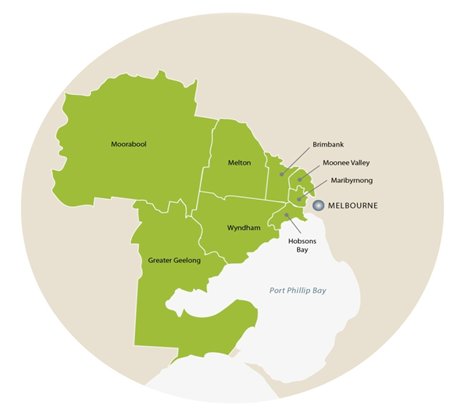
WAGA develops regional strategy, policy and projects to facilitate reduction of greenhouse gas emissions and climate change adaptation in the region. The regional work complements WAGA councils’ municipal-level climate change action. Collaboration with community, business and government stakeholders in the region is vital to WAGA.
WAGA, LeadWest and Western Melbourne Regional Development Australia (WMRDA) are currently collaborating to develop a strategy to reduce greenhouse gas emissions in the region. The project partners consider it important to point to opportunities for businesses in Melbourne’s west as the region transitions to a low carbon economy.
The project partners have contributed a total of $90,000 ($30,000 from each partner) to develop the strategy.
The purposes of the strategy are:
Leadership and collaboration to develop capacity, strategic programs and innovation to reduce greenhouse gas emissions in the west;
Development of a sustainable low carbon economy in the region and identification of opportunities for businesses in Melbourne’s west as the region transitions to a low carbon economy; and
Improved liveability, health, wellbeing and resilience to climate change in the region’s communities.
The recommended actions include projects and programs, engagement and advocacy, policy and regulation, and pricing and market mechanisms. They were shortlisted on the basis of how far and quickly they can contribute to reducing emissions, ease of implementation and support from regional stakeholders. Each action includes a consistent process for gaining sign-off, resourcing, key criteria for success, and monitoring and evaluation.
The Low Carbon West Strategy is similar in format to the Low Carbon Growth Plan for Greater Geelong which was adopted by Council in 2011.
Council has supported the renewal of the MOU with partners in Geelong through the Future Proofing Geelong program. Supporting the Local Carbon West Strategy enhances the collaborative efforts of all Councils in supporting initiatives to reduce our carbon footprint.
The Low Carbon West Strategy provides additional information for the City of Greater Geelong Greenhouse Strategy review and the regional context including the regional emissions profile and actions.
Low Carbon West Strategy should assist in reducing energy use and carbon pollution associated with residential and non-residential buildings, industry, and commuter and freight transport. It also includes actions to enhance and support initiatives to reduce waste and increase recycling.
A priority project for the Low Carbon West Strategy in 2015 will be initiated with existing WAGA funding of $30,000 for Low Carbon West Strategy. A plan for further resourcing of Low Carbon West will be developed in 2015, in conjunction with a review by WAGA of its Strategic Plan 2011-2015 and its current governance arrangements.
There is no impact to Council’s budget.
The Strategy complies with all relevant legislation and supports state and federal government programs to reduce CO2 emissions.
The Greenhouse Strategy is listed as a key strategy within the 2013-17 City Plan, Sustainable Built and Natural Environment strategic direction. Other relevant objectives, priorities and challenges include:
Objective:
Partnering with our community to protect and enhance our natural ecosystems and to encourage sustainable design and reduced resource consumption.
Priorities Include:
Support our community to live sustainably;
Advocate for and promote sustainable design and development; and
Minimise our environmental footprint.
Challenges Include:
Implementing affordable and sustainable building practices resulting in reduced demand on natural resources and a decrease in greenhouse gas emissions.
Australia faces real risks from climate change. The future of south-eastern Australia is on one of increased severe weather events, bushfires and sea level rise. The aim of the Low Carbon West Strategy is to reduce emissions locally and reduce the contribution to global greenhouse gas emissions.
Two primary purposes of the strategy are to identify opportunities for businesses in the region and contribute to the region’s economic development, and directly contribute to improving the liveability, health, wellbeing and resilience to climate change of the region’s residential communities.
The strategy will also enhance current initiatives by all levels of government and the private sector to reduce the cost of energy for both businesses and households, by promoting energy efficiency.
There are no human rights charter issues resulting from the recommendation in this report.
Consultation on the strategy has been conducted through an initial stakeholder workshop to test endorsement for the development of a regional greenhouse strategy in November 2012.
A written survey was sent to stakeholders in August/September 2014. Ongoing invitation was provided to all stakeholders to provide input and comments through the Low Carbon West blog in 2014. A stakeholder workshop was carried out to conduct a SWOT analysis on a shortlist of actions in June 2014. Stakeholders consulted so far include: Victorian Government departments: Environment and Primary Industries, State Development, Business and Innovation Transport, Planning and Local Infrastructure, Human Services, Health. Regional water utilities include City West Water, Barwon Water, Western Water. Other stakeholders through LeadWest and WMRDA: Qenos, Jemena, Deakin University, Victoria University, Tweddle Child & Family Health Services, Toyota Australia.
Portfolio: |
Governance – Cr Lyons (Mayor) |
Source: |
Corporate Services - Customer Service |
Chief Executive Officer: |
Michael Kelly |
Index Reference: |
Council Reports |
Cr Macdonald moved, Cr Harwood seconded -
That in accordance with Section 89 (2)(a) of the Local Government Act 1989, this matter be considered at the conclusion of all other business at which time the meeting be closed to members of the public.
Carried.
Contents | Previous Page: Section A - Procedural Matters | Next Page: Section C - Notice of Motion
