
Council Minutes - Section B: Reports - 9 June 2015
Contents | Previous Page: Section A - Procedural Matters | Next Page: Section C - Urgent Business
Contents | Previous Page: Section A - Procedural Matters | Next Page: Section C - Urgent Business
Reports tabled at the Ordinary Meeting of Council on Tuesday date held at City Hall, Little Malop Street in Geelong.
Re-appointment of External Representative on the Audit Advisory Committee
Road Renaming – Kristy Place to Hopper Place, Wandana Heights
Cr Heagney declared an Indirect Interest by Close Association in Amendment C265 Flood Overlays in Portarlington East Corio, Newcomb and Whittington – Consideration of Panel Report and Adoption in that her parents-in-law own property adjacent to the flood overlay area and left the meeting room at 7:10pm prior to discussion.
Portfolio: |
Planning – Cr Heagney |
Source: |
Planning and Tourism |
General Manager: |
Peter Bettess |
Index Reference: |
Amendment C265 |
To adopt a Planning Scheme Amendment to apply the Special Building Overlay to land potentially subject to inundation.
Amendment C265 proposes to extend coverage of the Special Building Overlay (SBO) to reflect the findings of flood studies recently undertaken and adopted by Council.
These studies identify the nature and extent of flooding in the Portarlington, Newcomb-Whittington and Corio areas.
The exhibition of Amendment C265 resulted in the receipt of twenty five (25) submissions; including 2 concerning properties outside of the areas affected by the amendment, and 3 from government departments/statutory authorities, not objecting.
The exhibited Amendment, together with all submissions was referred to an Independent Panel appointed by the Minister for Planning for consideration, as required by the Planning and Environment Act 1987.
The Independent Panel has recommended that the Amendment be adopted as exhibited.
The Council deferred a decision on this Amendment at the Council meetings on 9 July 2013 and 12 November 2013 to address concerns raised by a submitter in Portarlington. Council officers have responded to the submitters’ concerns and there is no reason to vary the amendment. It is recommended that the Amendment be adopted as described in this report.
Cr Ellis moved, Cr Harwood seconded -
That Council:
adopt Amendment C265 in the form as outlined in Appendices 1 and 2 to this report; and
submit the adopted Amendment together with the prescribed information to the Minister for Planning requesting approval.
Carried
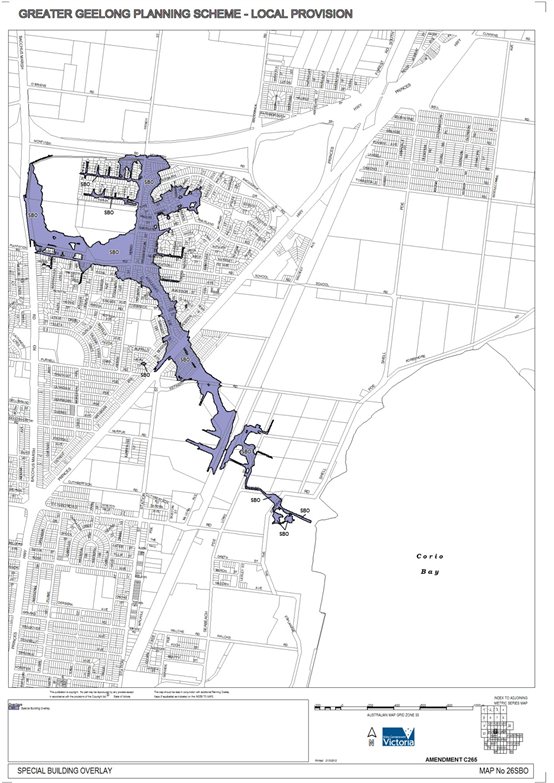
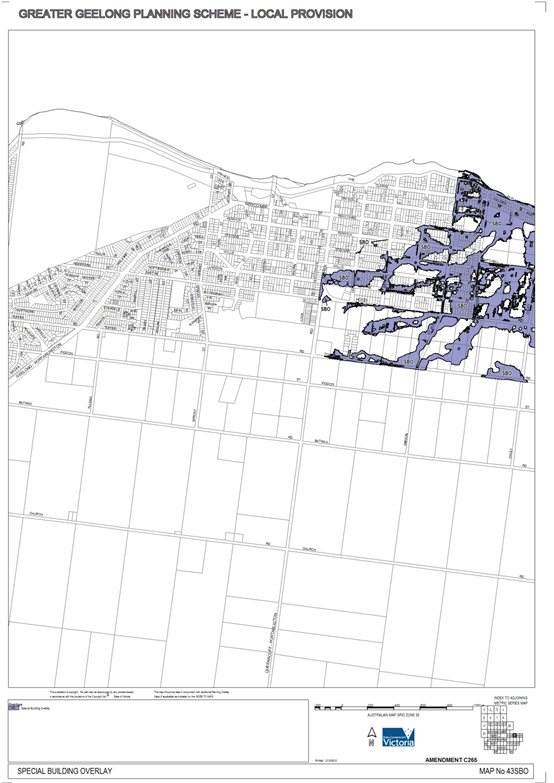
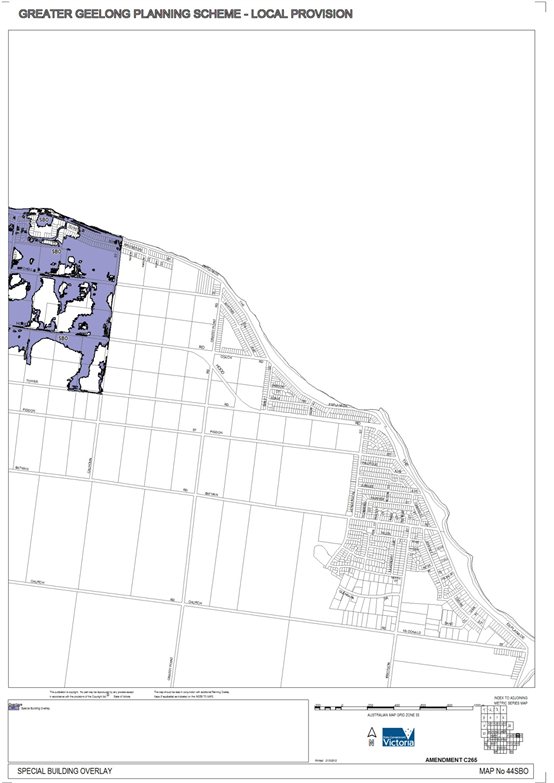
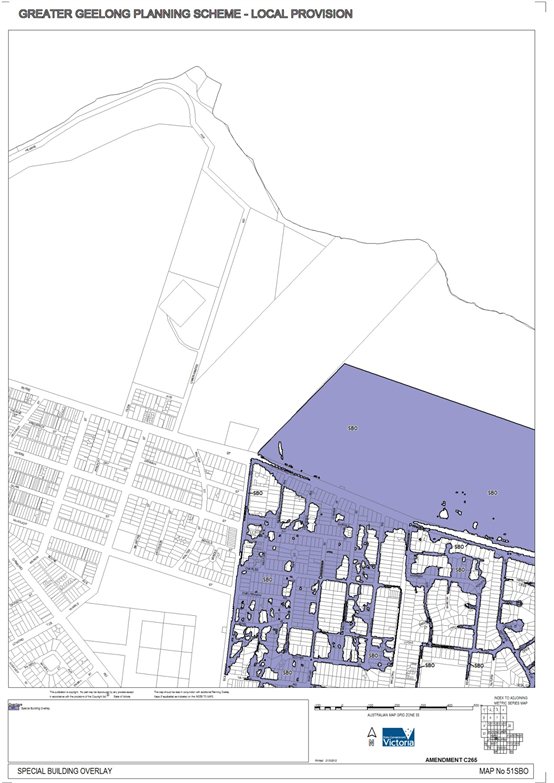
Amendment C265 seeks to apply the Special Building Overlay (SBO) to land subject to overland flow in three separate catchments within the City. The areas affected by the Amendment are the Portarlington East drainage area, the Newcomb – Whittington drainage area and the Kosciusko Avenue drainage area.
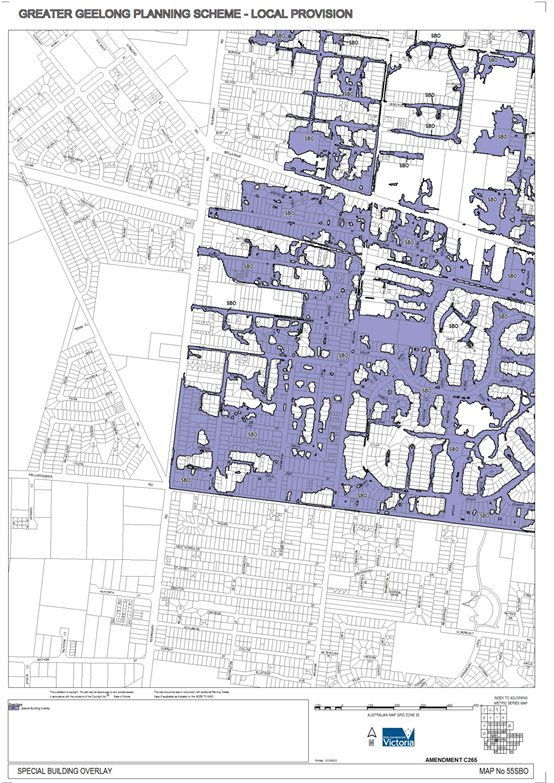
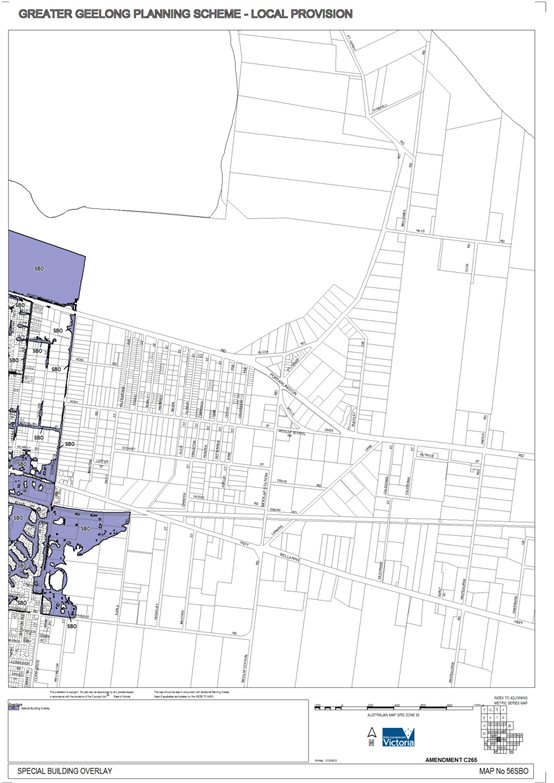
Maps showing each of the localities are included as Appendix 2 to this report.
The Amendment was exhibited for a one month period between 7 June 2012 and 9 July 2012. Twenty five (25) submissions were received in response, which included 3 from government departments/statutory authorities, which supported or did not object to the Amendment.
Council considered the submissions under delegation and resolved to refer the exhibited Amendment and all submissions to an Independent Planning Panel appointed by the Minister for Planning.
A two-person Panel consisting of Alison Glynn, Chair, and Catherine Wilson, Member, conducted a public hearing of the submissions in Geelong on 17 April, 2013. Council provided a detailed presentation to the Panel and 3 submitters made verbal presentations. Expert evidence from Dr Mark Jempson, an engineer from BMT WBM, was called by Council in support of its submission.
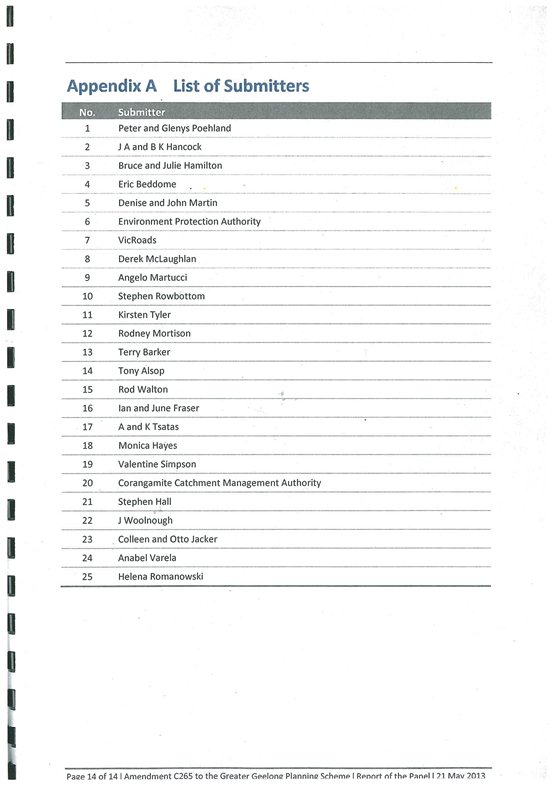
A list of submitters is included as Appendix 3 to this report.
The Panel report for Council’s consideration was received on 22 May 2013, a full copy of which is available on the City website.
The Panel has assessed the Amendment in considerable detail, including the planning policy context, the strategic and technical basis for the Amendment, site specific issues and the points of submission put to it during the Hearing and as contained in the submissions.
Panel Conclusions and Recommendations
Having considered the State and Local Planning Policy Frameworks, the purpose of the SBO, the decision guidelines of the relevant Clauses of the Scheme and the submissions of the parties, the Panel has recommended that the Amendment be supported for the reasons set out in its report.
Based on the reasons set out in its Report, the Panel recommends:
Amendment C265 to the Greater Geelong Planning Scheme should be adopted as exhibited.
Further consideration of the issues raised in Question Time by Mr Poehland
Questions by and on behalf of Mr Poehland at the Council meetings on 9 July 2013 and 12 November 2013 resulted in further specific investigations being undertaken in relation to his property. Following the Council’s deferral of a decision on this Amendment, the Ward Councillor, Cr Ellis and the General Manager, Planning and Tourism, Peter Bettess have met with Mr and Mrs Poehland and inspected their property. The Council has surveyed the property, re-run the flood model with the specific survey data for the property and assessed the house, as constructed, against the designated flood level. A letter has been sent to Mr and Mrs Poehland confirming that the floor level of their house is above the flood level and that if it was being constructed today the floor level would meet the requirements for a building permit to be issued. The Special Building Overlay proposed in Amendment C265 still needs to apply to the property to advise future owners of the requirement for any new dwelling or alterations to have a floor level above the flood level.
The application of the SBO will have no adverse environmental implications.
As the application of this overlay will facilitate the regulation of development on the affected land, it will provide a mechanism to ensure that such development does not generate adverse off–site environmental impacts as a result of changing the direction or extent of passage of water during flood events.
The application of the SBO will have no adverse financial implications for Council. While the Amendment will generate additional planning permit applications, these will be at least partially off-set by a corresponding decrease in applications under the Building Act for the specification of minimum floor heights.
The likely increase in the number of permit applications is not likely to be of a significant magnitude, relative to the total resources of Council’s Statutory Planning unit.
The Amendment is considered to be consistent with State and Local planning policies as set out in the Explanatory Report which forms part of the Amendment documentation.
The application of flood mapping consistent with the adopted flood and drainage studies will limit the potential for affected property owners to seek redress against Council, in the event that their property is adversely affected by flooding or inundation.
This Amendment supports the Sustainable Built and Natural Environment strategic direction of City Plan by recognising the environmental constraints on future built form. Drainage and flood management strategies are specifically referred to in City Plan as assisting in delivering Sustainable and Natural Environment priorities.
No Council Officers have any direct or indirect interest, in accordance with section 80(c) of the Local Government Act, to which this report relates.
There are no risks to Council associated with the application of the SBO, as proposed.
Until such time as the extent of the mapped flood areas are identified in the Planning Scheme there is a risk that prospective purchasers of land may not be aware of the potential flood issues. The application of the SBO to affected land will significantly reduce this risk.
The Amendment is expected to result in net community benefit, in that extension of the accurate identification of land affected by flooding through the application of the SBO will reduce community exposure to damage and loss of property due to flooding.
The Amendment does not impact on any basic human rights, freedoms and responsibilities as set out in the Charter. The process of exhibition of the Amendment provided for submissions by the public and the consideration of those submissions by an independent planning panel appointed by the Minister for Planning, in accordance with planning legislation. This report recommends that the Amendment be adopted in a manner consistent with the recommendations of the Planning Panel.
Amendment C265 has been through a formal exhibition process with consideration of submissions by Council and review by an Independent Panel.
All submitters have been advised of the timing of Council’s consideration of this report and will be advised of the final decision of the Minister.
The planning authority for this amendment is the City of Greater Geelong.
The Greater Geelong Planning Scheme is amended as follows:
The Planning Scheme Maps are amended by a total of 6 attached maps:
Overlay Maps
Planning Scheme Maps Nos. 26SBO, 55SBO and 56SBO are amended in the manner shown on the attached three (3) maps marked “Greater Geelong Planning Scheme, Amendment C265”.
Following Planning Scheme Map No 43SLO insert a new Planning Scheme Map No 43SBO, in the manner shown on the attached map marked “Greater Geelong Planning Scheme, Amendment C265”.
Following Planning Scheme Map No 44DDO insert a new Planning Scheme Map No 44SBO, in the manner shown on the attached map marked “Greater Geelong Planning Scheme, Amendment C265”.
Following Planning Scheme Map No 51DDO14 insert a new Planning Scheme Map No 51SBO, in the manner shown on the attached map marked “Greater Geelong Planning Scheme, Amendment C265”.
The Planning Scheme Ordinance is amended as follows:
In General Provisions – Clause 61.03, replace the schedule with a new schedule in the form of the attached document.
End of document
Cr Heagney re-entered the meeting room at 7:12pm
Portfolio: |
Sport and Recreation - Cr Irvine |
Source: |
Projects, Recreation and Central Geelong - Leisure Services |
Acting General Manager: |
Jenny McMahon |
Index Reference: |
Project: Northern ARC (Gateway) Project |
The purpose of this report is to present the Northern ARC (Arts, Recreation and Community) Health and Wellbeing Hub Master Plan (Northern ARC Master Plan) for Council endorsement, and to inform Council of current long-term land lease negotiations with the Department of Health for a medical facility to be developed within the Northern ARC Health and Wellbeing Hub.
The Northern ARC site is located on the corner of Melbourne Road and Cox Road and is a highly visible location in Norlane. This site was identified as a key development opportunity in the Corio-Norlane Structure Plan (2012) and currently provides the services of Waterworld Leisure Centre, Centenary Hall and Corio Library within the precinct.
The final Northern ARC Master Plan is a visionary plan to guide renewal of the precinct facilities over the next 5 – 15 years.
The vision is to create a vibrant community hub that promotes strong connectivity, integration and is an iconic destination for leisure, recreation, cultural and community wellbeing activities.
The State Government has announced a medical facility will be built in the northern suburbs of Geelong. This $33 million medical facility will be funded as a State Government project with construction planned for early 2016.
The Department of Health has formally declared their interest for the medical facility to be located within the Northern ARC site. This facility has been incorporated into the Northern ARC design and could be built as Stage 1 of the Master Plan delivery.
Negotiations for a long term land-lease of 50 years are currently under way for the proposed medical facility site (Proposed Lease) and this Report seeks the endorsement of Council to commence the statutory advertising process for the Proposed Lease with Barwon Health.
Cr Fisher moved, Cr Irvine seconded -
That Council:
endorse the Northern ARC Master Plan; and
note the commencement of detailed Feasibility Assessment and Business Case; and
commence the statutory procedures under section 190 of the Local Government Act 1989 (Act) for the Proposed Lease and that public notice of and the right of a person under section 223 of the Act to make a submission in relation to the Proposed Lease be given in the Geelong Advertiser and The Independent; and
the Submissions Hearing Panel be appointed to hear and report to Council on any submissions in relation to the Proposed Lease; and
if no submissions are received, Council will enter into the Proposed Lease and the Chief Executive Officer be authorised to execute the Proposed Lease.
Carried.
The Northern ARC site is located on the corner of Melbourne Road and Cox Road and is a highly visible location in Norlane. This site was identified as a key development opportunity in the Corio-Norlane Structure Plan (2012) and currently provides the services of Waterworld Leisure Centre, Centenary Hall and Corio Library within the precinct.
These facilities will require substantial asset renewal/replacement funding over the next 15 years to remain fit for purpose. The Master Plan reviews the development of these current services and has also considered the inclusion of health, arts and culture infrastructure.
The Northern ARC Master Plan is an initiative jointly funded by State Government and the City of Greater Geelong.
The final Northern ARC Master Plan is a visionary plan to guide renewal of the precinct facilities over the next 5 – 15 years to create a vibrant community hub that promotes strong connectivity, integration and is an iconic destination for leisure, recreation, cultural and community wellbeing activities.
The facilities on the Northern ARC site have played an important role for the northern Geelong community over the past 40 – 50 years. It is a highly utilised destination that currently services over 500,000 visits each year. With renewal and regeneration of the facilities visitations are expected to double, reaching in excess of 1,000,000 visits annually once the site is fully developed.
In the development of the Northern ARC Master Plan there has been significant community and stakeholder consultation. Findings from the consultation activities support full redevelopment of the site in a staged approach and has also indentified the size and location of facilities. Current and future community needs have been considered to ensure the development considers a long term view.
Industry information from other similar developments has been used to assist in design and a number of design principles have been developed by the project consultants.
A medical facility has been included within the Master Plan. Facility location, site integration, building footprint and car parking capacity have all been tested and confirmed that the full mix of facilities can work to deliver a vibrant, connected and innovative Health and Wellbeing Hub.
In the development of the Northern ARC Master Plan the following key design principles and drivers were adopted:
Key Design Principles
Create a hub of activity for locals and visitors that will engage with, and reach out to the surrounding local community and the wider region. It will reinforce the site as a local landmark destination and a ‘beacon’ for civic pride and use.
Co-locate and integrate activities and uses within the site across the areas of arts, culture, recreation, community and health, with opportunities for interaction between all of the users.
Incorporate the key public plaza space at the centre of the ‘hub’, accessible and visible from Melbourne Road and Cox Road and with direct access to the reception of the main facilities. Provide flexible and adaptive internal and external public spaces that are multi-purpose and provide for events or activities of varying scales.
A precinct which is a natural meeting and gathering place. It encourages formal and casual public engagement and association and provides a well-used and well-loved destination for all ages. Equitable and universal access for all ages and backgrounds.
Easy, safe and enjoyable ways to get around the precinct on foot, drawing people into and through the precinct. Creating a permeable, safe, inviting and easily accessible hub for all people at all hours.
Engaging community buildings, public realm open space and landscape to exhibit best-practice, high quality design, which is flexible, adaptive and represents a ‘sense of place’ for the community.
A sustainable plan for the future, in environmental, cultural, economic and social terms. A hub of activity which is staged, funded and delivered in a manageable, sustainable and considered way over time.
Access to and from the site, ensuring the site is safe, efficient and inviting. Linking of public transport, connecting with walking and cycling paths providing assessable and universal access to all facilities and services. Car parking provision to meet the increased demands and support business viability and future growth
Using these design principles, the main components of the Master Plan and relationships for Northern ARC were identified as follows:
Key Components and Relationships
Development of a new, integrated aquatic and leisure centre, to replace the old Waterworld facility.
Creation of a new multipurpose community venue/hall to replace the existing hall, located to integrate with the other facilities to improve governance and usage.
A new Corio Library with expanded internal areas and improved integration; co-located with other facilities and services in the precinct.
Inclusion of a new Barwon Health North medical facility on the site, which supplements the current healthcare offering in the local area, and integrates the healthcare and wellness facilities into the leisure, arts and cultural facilities on site.
The creation of central plaza spaces to serve as the “heart” of the Northern ARC site.
Inclusion of a centrally located commercial café within the new leisure facility, opening onto the plaza and services all staff and visitors the precinct.
Newly developed open space and public realm areas to allow a diversity of outdoor uses, activities and events within the site.
Pedestrian paths and trails linking the new facilities into the surrounding neighbourhood, street network and better links to Stead Park
Bicycle and vehicle access into, through and from the site into the surrounding road network that services the new facilities and ensure adequate car parking.
Delivery and Staging
The Northern ARC Master Plan has been created to directly respond to the detailed delivery constraints and parameters of all the separate (but interlinked) components of the site. The staging and delivery has been directly incorporated into the final Master Plan design, to ensure that the considerations of financing, demolition, partial site development, temporary works, car park staging and full site development staging are included.
As a result, the Northern ARC Master Plan can be implemented in discrete steps or stages, to enable the project to be agile and flexible depending on available funding commitments from the three levels of government. The staging and delivery also importantly allows individual facilities and services to continue to operate for the local community across the lifetime of the Master Plan.
Stage 1 - Barwon Health North
The State Government recently announced a medical facility would be built in the northern suburbs of Geelong. This $33 million medical facility will be funded as a State Government project with construction planned for early 2016.
The Department of Health has formally declared their interest for the medical facility to be located within the Northern ARC site. The Master Plan process has tested various scenarios/logistical issues and confirmed the medical facility can be co-located and a staged construction approach is achievable.
However, this first stage of the Barwon Health North medical facility construction will have an impact on the operation of some of the current services on the site and will force early closure and/or relocation of Create, Waterworld’s waterslides and part of the outdoor area.
Negotiations for a long term land-lease of 50 years are currently under way for the proposed medical facility site (Proposed Lease) and this Report recommends that Council commence the statutory advertising process for the Proposed Lease with Barwon Health.
The Department of Health are still finalising the scope of the Barwon Health North medical facility but have indicated it will provide following services:
Urgent care services operated between 8am – 10pm
Pathology
Pharmacy
Dialysis
GP services
The Northern ARC Master Plan has a long term vision of integration of the medical facility with the leisure centre once it has been redeveloped, providing a connected and holistic health and wellbeing hub for residents in the northern suburbs.
Next Stage - Detailed Feasibility Assessment and Business Case
The next stage of precinct planning has been partly funded for 2015/16 with $250,000 allocated to the project which will encompass detailed feasibility assessment of each facility and development of a robust business case to attract the significant funding required for the project, from both State and Federal Governments.
The Northern ARC Master Plan has a key design principle of delivering “a sustainable plan for the future, in environmental, cultural, economic and social terms. A hub of activity that can be staged, funded and delivered in a manageable, sustainable and considered way over time.”
The high level costing includes an Ecologically Sustainable Development (ESD) allowance of 2.5% of total construction costs. Sustainable design elements and budget modelling will be further considered during the future planning and design stages.
The proposed funding model for this bold and highly significant project for the northern suburbs is a three way funding partnership between the City of Greater Geelong Council and State and Federal Government. Based on the high level cost estimates, up to $25-30 million is needed from each partner over the next 5 - 15 years to deliver all elements of the Master Plan.
The next stage of planning will commence with the development of an Investment Logic Map (ILM) to clearly define the logic that underpins the investment. The ILM will represent the ‘agreed investment story’ which will inform the business case for the project.
The Northern ARC project is currently unfunded within Councils 10 year capital expenditure and affordability plan. There is an allocation of $2.75 million over the next 3 years to upgrade the gymnasium and fitness program rooms at Waterworld.
Funds could be leveraged through the Barwon Health Proposed Lease. Negotiations with the Department of Health have included a significant upfront capital contribution could be negotiated to secure the site. It is important that any up front payments are allocated as income for the ongoing Northern ARC planning and design stages as outlined in this Report.
A high level cost estimate for the Northern ARC facilities, is as follows:
|
Facility Building Costs |
Cost estimate |
Funding position |
|
New Waterworld |
$39M |
$2.75M committed |
|
New Library |
$6M |
|
|
New Community Hall |
$4.2M |
|
|
External works |
$14.6M |
|
|
Nett Construction costs |
$63.8M |
|
|
ESD provision/design and construct contingency |
$8.9M |
|
|
Detailed design/Consultants/FFE |
$8M |
|
|
Total project costs – Current rates |
$80.7M |
|
Note: Costs are high level estimates only, based on the Master Plan design response.
These assumptions will be challenged and tested in more depth during the next stage of planning and design. Based on current construction and project consulting rates.
It is important to note the loss of activities, including the waterslides and outdoor toddlers pool on the Waterworld site, due to the construction of the medical facility in 2016. The projection on waterslide revenue is $20,000 per annum, however this would be offset by the cost savings through reduced staff wages and operating costs/maintenance.
Council endorsement of this Report will enable the statutory advertising process for the Proposed Lease to commence. A submissions review panel will need to be appointed in the event of any public submissions received.
The land will need to be re-zoned for medical facility use from the current recreational use.
The development of the Northern ARC Master Plan is in line with the City Plan strategies of Healthy Environments and Connected, Creative and Strong Communities.
The medical facility in the northern suburbs has support from G21 and the Barwon Health Service Plan.
No Council officers involved in the preparation of this report are known to have a direct or indirect interest in matters to which this report relates.
Risk of information received by media before decisions are finalised.
Impact on existing services during construction phase will be significant without strong governance principles established for the precinct.
A medical facility in the northern suburbs of Geelong has significant social and health benefits as detailed in the Barwon Health Service Plan.
The Barwon Health North medical facility would also impact on the Waterworld outdoor area including removal of the existing waterslides until the Waterworld centre is redeveloped.
The development of Barwon Health North medical facility in the northern suburbs of Geelong recognises the Human Rights Charter with the inherent value of each person regardless of where they live, background or what they think or believe.
The Northern ARC Master Plan has included considerable community engagement opportunities. This includes development of a Northern ARC website, Waterworld user survey, community survey, Corio Village Listening Post, stakeholder scenario workshops and individual stakeholder meetings.
Stage 1
Local community survey (Website, Listening Post at Corio Village)
Site users and tenants
Waterworld users (523 surveys over 4 weeks)
Internal stakeholders
Stage 2
Stakeholder Vision and Workshop 1
Stakeholder Vision and Workshop 2
The medical facility in the northern suburbs has been widely communicated to the community via local media, Barwon Health and the State Government.
Portfolio: |
Sport and Recreation - Cr Irvine |
Source: |
Projects, Recreation and Central Geelong - Sport and Recreation |
Acting General Manager: |
Jenny McMahon |
Index Reference: |
Project: G21 and AFL Barwon Regional Strategy |
The purpose of this report is to present the G21 and AFL Barwon Regional Strategy for Council endorsement. (Strategy document previously supplied with Briefing papers).
The G21 and Australian Football League (AFL) Barwon Regional Strategy provides the framework to support the future development, governance and growth of football and club based netball throughout the G21 region for the next 10 years. The strategy also considers netball as it relates to Country Football/Netball administered under AFL Barwon.
The strategy is a collaborative planning project between local government authorities in the G21 region, AFL Barwon, AFL Victoria, Netball Victoria and other key stakeholders.
The strategy vision is: To work together to grow and prosper community football and netball.
Aligned with the vision, six strategic priorities were identified:
Priority 1: Support the capacity building of clubs and their people.
Priority 2: Increase the quality, functionality and maximise the carrying capacity of existing facilities.
Priority 3: Plan and develop new facilities in key growth areas across the region.
Priority 4: Capitalise on opportunities to create a Regional Administration Centre.
Priority 5: Ensure programs and facilities cater for the diversity of participants who are attracted to our game/s.
Priority 6: Continue to enhance the relationship between football, netball, government and community partners in planning and the provision of facilities.
Cr Irvine moved, Cr Harwood seconded -
That Council endorse the G21 and AFL Barwon Regional Strategy.
Cr Fisher left the meeting room at 7:30pm for the evening.
Carried.
The G21 Region has a strong history of participation in football and netball, currently boasting 4 senior leagues including:
Geelong Football League;
Bellarine Football League;
Geelong and District Football League;
Colac and District Football League; and
Three (3) junior football leagues.
All up there are 50 clubs, 380+ football teams, 340+ netball teams totalling 18,000+ registered participants across the region. The region also provides participation opportunities for 2,500 Auskick participants and 5 youth girls’ football teams.
The AFL Barwon Commission was established to guide the ongoing growth and development of football and netball within the region. The commission is one of 13 regional commissions established by AFL Victoria, which are ultimately responsible for the promotion, growth and sustainability of community football within regional Victoria.
To provide a clear plan for the development of football and netball participation, a partnership between the five local government authorities in the G21 Region, AFL Barwon, AFL Victoria, Netball Victoria and other key stakeholders was established.
The G21 and AFL Barwon Regional Strategy was initiated in late 2013. The regional approach to guide the future planning and development of football and netball is the first of its kind in the state and is strongly supported by all project partners.
The strategy builds on the AFL Barwon Strategic Plan 2014-2018, AFL Victoria Growing the Heartland Football Facilities Development Strategy 2014-2020, Netball Victoria Strategic Plan 2014-2018 and other strategic documents relevant to AFL football and netball.
AFL Victoria’s Heartland Strategy (2014-2020) estimates the economic impact of football and netball participation is $2.4 billion per annum across Victoria. In comparison, in research collated by Ernst and Young and the Victorian Major Events Company in 2020 suggests that, major events deliver a combined economic impact to the State of approximately only $1.4 billion per annum. This Indicates the significant impact sport (in particular football) has on local communities and the economy.
The G21 and AFL Barwon Regional Strategy provides the strategic framework to support the future development, governance and growth of football and club based netball throughout the G21 Region for the next 10 years. The strategy represents the alignment of objectives across all stakeholders and ensures recommendations are driven by sport and government in partnership. The strategy provides regional directions and recommendations, as well as prioritising actions to be delivered by AFL Barwon, AFL Victoria, Netball Victoria and each municipality.
An Issues and Opportunities Paper was developed to collate all information relevant to the development of the G21 and AFL Barwon Regional Strategy. The Issues and Opportunities Paper was built on a comprehensive consultation program, including surveys of football/netball clubs and schools, facility audits, workshops and targeted discussions with all project partners.
The Issues and Opportunities Paper identified three key themes:
Sport Development: Supporting player participation in all forms of football and netball is central to the success of this regional strategy. Support structures, such as clubs and facilities, will need to adapt to meet changes in and capitalise on sports development initiatives beyond traditional participation and talent pathways.
Club Development: AFL Barwon supports 50 clubs and over 700 teams between netball and football across the region. There is significant diversity in club structure, governance processes and programs. Increased support and improved strategic planning will enable clubs to continue to grow, maximise sports development opportunities and invest in facility upgrades and renewal which is fit for purpose.
Infrastructure Improvement: Investment in facilities across the region to ensure current facilities meet AFL Victoria and Netball Victoria minimum requirements and adequately accommodate anticipated participation growth and diversity of participants is essential. Providing appropriate facilities is a key action in driving increased participation in football and netball.
The development of the Issues and Opportunities Paper provided the foundation for the development of the G21 and AFL Barwon Regional Strategy.
The Regional Strategy recommends a vision and a strategic framework for the development of football and club based netball over the next 10 years.
The proposed vision is:
“To work together to grow and prosper community football and netball”
The vision highlights the need for all stakeholders to work in partnership to develop football and netball in the G21 region.
The strategic framework is divided into six priorities:
Priority 1: Support the capacity building of clubs and their people.
The development of community football and netball clubs, and the volunteers that manage them, is a key priority of the strategy. Volunteers are responsible for the governance of clubs and are expected to maintain professional business standards. While volunteers bring a wide range of skills to their roles within community sporting clubs, it is the responsibility of all stakeholders to ensure that local clubs possess the necessary skills and knowledge for effective management.
Strategic directions include – Support club development and policy development; review competition structures; continued implementation of Club Health Check and investigate the feasibility of paid administration structures.
Priority 2: Increase the quality and functionality and maximise the carrying capacity of existing facilities.
The provision of functional, quality facilities is fundamental to participation and growth in football and netball. Prioritisation of projects that maximise community use of facilities will provide more opportunities to play football and netball within the community. As local government authorities are experiencing a gap between the funding available and the cost for facility renewal and maintenance, the requirement to prioritise infrastructure development projects and seek contributions from funding partners has become increasingly important.
Strategic directions include – Deliver recommended facility upgrades; prioritise regional facility projects; undertake facility assessments and support clubs to address volunteer capacity gaps; actively lobby state government for the continuation of Country Football Netball Funding Program.
Priority 3: Plan and develop new facilities in key growth areas across the region.
The G21 region is experiencing population growth in a number of areas, bringing with it the requirement for new facilities. Planning for new facilities in growth areas at Armstrong Creek, Drysdale/Clifton Springs, Ocean Grove, Lara, Torquay and Bannockburn will ensure that new communities have access to football and netball participation opportunities.
Strategic directions include – Investigate options for a synthetic oval within the region; implement new facilities as identified in growth area planning.
Priority 4: Capitalise on opportunities to create a Regional Administration Centre.
AFL Barwon currently operates from Highton Reserve, with a planned facility extension approved to accommodate growth in staff numbers over the coming five years. In the long term, the aim is for the Regional Administration Centre to become a hub for community football administration and game development activities. The long term development of a Regional Administration Centre at Armstrong Creek will provide options for a multiple oval complex with improved administration facilities.
Strategic directions include – Progress expansion of Highton Reserve; investigate long term options to develop a new Regional Administration Centre.
Priority 5: Ensure programs and facilities cater for the diversity of participants that are attracted to our game/s.
The AFL Barwon Strategic Plan commits to encouraging clubs to actively engage with non-traditional participants in football such as females and culturally and linguistically diverse communities. The development of programs which meet the needs of these participant groups is vital in attracting the wider community to football and netball.
Strategic directions include – Actively support female participation; support policy development and engagement with diverse communities; expand promotion of junior development to include diverse communities; support growth of Auskick and NetSetGo.
Priority 6: Continue to enhance the relationship between football/netball, government and community partners in planning and provision of facilities.
The majority of football facilities are provided on land owned and/or managed by local government. Local government’s capacity to invest in new infrastructure is limited, with ongoing reliance on additional funding provision through government and peak sports bodies. A collaborative planned approach between sport and government to implement facility upgrades and renewal is essential to build facility capacity.
The majority of local government authorities are bearing the annual maintenance cost at each of their facilities averaging approximately $58,080 per venue. AFL Victoria is currently addressing player remuneration concerns with outcomes of the strategic initiative expected by 2015. Potential solutions extend to salary caps or introduction of a state-wide player points system.
Strategic directions include – Establishment of a regional reference group; support local forums; undertake “State of Play” reports and implement recommendations from the AFL Victoria panel investigating player remuneration.
The strategy identifies five critical actions that need to be delivered in order to commence the change process and set the foundation for the future for both football and netball in the region to 2025.
Critical Action #1
Local government authorities, AFL Victoria, Netball Victoria and AFL Barwon to partner to actively lobby state government for continuation of the Country Football Netball Funding Program.
Critical Action #2
Local government authorities, AFL Victoria, Netball Victoria and AFL Barwon work collaboratively to plan and prioritise lighting upgrades on a regional basis.
Critical Action #3
Deliver planned facility upgrades to a regional level as a first priority. Use the framework provided in the strategy to determine priority for existing club facility upgrades.
Critical Action #4
AFL Barwon to complete a strategic review of current club structures and to work with key stakeholders to assist club sustainability and competition equalisation.
Critical Action #5
Support clubs to create five year strategic plans to improve operational performance and guide business objectives around facility and asset management, financial planning and club participation and growth.
The implementation of the G21 and Barwon Regional Strategy is reliant on a partnership approach between all stakeholders. The commitment to implementing the recommendations of the plan by sport and government is vital in ensuring the long term sustainability of football and netball in the G21 region.
There are no direct environmental implications arising from this report.
There are no immediate financial implications arising from the report. Funding for the implementation of the G21 and AFL Barwon Regional Strategy will be sought through a range of funding opportunities and Council’s existing budgetary process.
There are no immediate financial implications arising from the report. Funding for the implementation of the G21 and AFL Barwon Regional Strategy will be sought through a range of funding opportunities and Council’s existing budgetary process.
The report is aligned to the Community Well-Being objective of City Plan. The provision of sport and recreation facilities promotes healthy lifestyle through physical activity.
No Council officers involved in the preparation of this report are known to have a direct or indirect interest in matters to which this report relates.
There are no notable risks associated with this report.
Football provides many benefits including bringing communities together, reducing social isolation, increasing community pride, developing social capital and improving physical and mental health. This strategy provides clear direction for all stakeholders to ensure football and netball continue to grow across the region.
This report has no impact on compliance with the Human Rights Charter.
The development of the strategy has been a collaborative effort of a number of partner organisations including AFL Victoria, AFL Barwon, Netball Victoria and five G21 local government authorities.
Two project reference groups (sport and government) were developed to provide technical advice and input from a local perspective. Project stakeholders including clubs, schools and regional contacts were consulted in the analysis and scoping stage of developing the Issues and Opportunities paper.
Consultation activities including workshops with the project reference groups, targeted discussions with local government authorities, surveys of clubs and schools, and facility audits were undertaken in the development of the Regional Strategy.
The draft strategy was publically exhibited across the five participating LGA’s for a period of six weeks. A further two week exhibition was afforded to all clubs with AFL Barwon following the public exhibition period. Sixteen submissions were received during this period with only minor changes made to the draft strategy as a result of the feedback received.
Cr Heagney declared an Indirect Financial Interest in the Geelong Saleyards Feasibility Study in that her family sells sheep at the Geelong Saleyards and left the meeting room at 7:40pm prior to discussion.
Portfolio: |
Rural Communities - Cr Ansett |
|
Source |
City Services - Engineering Services |
General Manager: |
William Tieppo |
|
Index Reference |
Service Infrastructure Management - Saleyards |
The purpose of this report is to note the recommendations within the 2014 Geelong Saleyards Feasibility Study.
Livestock throughput at the Geelong Saleyards has declined over the past 10 years and has a direct impact on income.
The saleyards industry in Victoria is declining overall as alternative selling methods replace part of the traditional auction market.
In October 2014, Council commissioned a study into the North Geelong Saleyards requesting an independent assessment of it’s economic, social, risk and environmental factors with key stakeholder input in order to provide a recommendation of the highest and best use of the site.
Operational costs have remained consistent over time but with reduced income has lead to declining financial performance of the site.
Although the site has strong heritage value and social significance, these benefits extend to a relatively small portion of the municipal population.
A heritage overlay requires any development of the site to consider heritage significance of the saleyards.
Loss of the main office building due to fire has diminished the heritage and social value of the site. The temporary replacement facilities do not provide the same level of service to staff and users.
Current facilities require continuous maintenance, repair and replacement work to ensure overall safety and quality of buildings and pens.
The current location is not suited to a saleyards facility.
There are opportunities to use the site for ancillary purposes.
Eight options for the saleyards facilities were identified with the recommended option being a transition to a regional facility.
Cr Farrell moved, Cr Irvine seconded -
That the report be deferred.
Lost.
Cr S Kontelj moved, Cr E Kontelj seconded -
That Council:
seek opportunities for savings in operation of the saleyards;
actively identify potential uses of existing land and facilities outside normal saleyards operations;
work with neighbouring Councils to identify and develop a suitable regional solution with the view to initiating a future staged withdrawal from saleyards operation.
Carried.
The saleyards located in Weddell Road North Geelong have been in operation in some form since 1869. Since that time the area surrounding the saleyards has become significantly more urbanized by both residential and industrial developments.
A number of studies of the Saleyards have been conducted over the past 20 years including:
Geelong Saleyards Feasibility (1998)
Saleyards Operations Audit (2002)
Conservation Management Plan (2007)
Saleyards Operations Audit (2012)
Geelong Saleyards Feasibility (2014)
A number of common themes have emerged when considering all of the above reports which include:
The Saleyards have heritage, social and political significance, due to their continued operation since 1869.
Council has been subsidising the operation of this facility since the mid 2000s and Council has been concerned about the ongoing viability of the Saleyards for some time.
The current site is not ideally located from a logistics perspective and a larger, custom built site with better access would be required to increase volume and efficiency.
Significant health and safety risks have been identified and significant investment is required to improve the current facilities.
A rolling program of improvements have been undertaken, however, a fire destroyed the recently renovated main office building at the saleyards in 2013.
As part of the Financial Sustainability Review conducted in 2013/14, the Geelong Saleyards was identified as one of the services that required further investigation.
It was decided a final report looking at the “highest and best use” be commissioned. This report was also to include an extensive consultation strategy allowing Council to consider the key relevant and appropriate options for the future.
Analysis of the operational and financial performance of the Geelong Saleyards has resulted in the following key findings:
Both cattle and sheep throughput have declined at a rate of about -10% per annum recently (p17 and p28 of report);
There has also been a decline of the same order across all of Victoria on average (p17 and p28 of report) ;
The operating costs of the Geelong Saleyards have remained relatively consistent over time. With the decreased throughput, income has decreased leading overall to an increasing loss for the site;
Vendor and agents fees are similar to the Victorian average. An opportunity to increase fees to breakeven would require the fees and charges to at least double;
Since 2007/08 Council has invested $1.7 million to both subsidise the Saleyards operations as well as provide for capital improvements;
The scale of throughput in Geelong is significantly lower than competing saleyards in Ballarat and Colac, and other western region saleyards at Hamilton and Camperdown (p18-19 of report).
Despite significant investment in the Saleyards site, operational losses have continued to occur. Investment has generally centred around ensuring OH&S compliance and restoring the heritage fabric of the buildings and the pens.
Overall Victorian trends suggest that it is unlikely that the Saleyards would be able to improve its financial performance under current conditions (s4.6, p28-29 of report).
The Saleyards industry is declining overall, as alternative selling methods replace part of the traditional auction market.
As part of the analysis and review, a detailed consultation program was undertaken to ensure maximum feedback from the local industry. It confirmed that the industry was in decline and that only more regionalised saleyards, where economies of scale could have an impact, could cover the costs of regulation compliance and compete with alternative methods of selling. It was noted that the Saleyards perform an important social function, however, the number of users has been in decline. The loss of the Main Office Building has reduced the opportunities for social interaction at the site. It was often stated that the Saleyards were nearing the end of their economic life.
Based on consultation, research findings and previous reports, the following options were identified (s6.4, p41-44 of report):
Business as usual – No change to current operational model.
Revise cost structure – Includes review lease arrangements, minor fee increase and possible staff reductions.
Reinvestment – Upgrade the current facilities would cost in the order of $2-3 million with no guarantee of increased throughput.
Relocation – Seeking an alternative site and continue to operate the facility to improve accessibility and reduce impacts on adjacent land. Costs would be prohibitive and heritage value would be lost.
Reduce scale or adapt to focus on niche stock – Allows reuse or sale of portion of saleyard land however loss of core income would likely result in an unsustainable operation.
Divest operations – Council retain ownership of land but operation managed by private business. Consultation suggests that very little interest from private sector due to financial risks and would require Council reinvestment.
Facilitate a transition to a regional saleyards – A realistic timeframe of 3-5 years is expected should a regional facility be developed. Council would need to monitor and engage with proposals for the development of a regional saleyards. This would allow a transition period for all stakeholders to adjust to alternate arrangements.
Closure – Would impact heritage value of site and would require land capability assessment to be conducted.
The recommended approach by the feasibility study in regard to the future of the Saleyards is to transition to a regional saleyards facility. Once the transition process is underway, a revised cost structure should be adopted to provide a moderate cost saving to Council. It is envisaged that the transition period would be in the order of about five years. The recommended approach is favoured based on the following:
Current operational cost structure will result in an on-going loss to Council;
Regionalisation of saleyards is occurring at a rapid rate across Victoria;
The Geelong Saleyards are nearing the end of their economic life and direct investment is unlikely to improve the throughput of the facility.
It should be noted that even though there has been significant discussion about the establishment of a regional saleyards facility, this has been going on for at least ten years and there is no surety that it will eventuate. Further consideration could be given to possible funding contribution by Council to help facilitate such an outcome. The G21 Region Growth Plan identifies Colac as a potential location for a regional site.
If no regional option is available, Council should still consider a staged closure of the facility, but at the same time engage with producers and end users to facilitate an improved direct selling process.
Consideration would also be required to decide what should happen to the land. The northern portion is zoned Industrial 1 (IN1Z) and the southern portion zoned for Public Park and Recreation (PPRZ). The site is also subject to a Heritage Overlay (HO), a design and development overlay (DDO20) and a small portion of the land is subject to a Special Building Overlay (SBO). Further investigation would be required to determine if Council wants to sell the land, develop the land or use for an alternative purpose. A Land Capability Assessment should be undertaken to determine the best use of the land.
Council currently has a trade waste agreement with Barwon Water to discharge liquid waste into the sewerage system. This is not the preferred method of livestock effluent management. Significant investment, in the order of $1 Million, would be required to bring this system to a standard supported by Barwon Water.
A stormwater harvesting facility has been recently installed on the Saleyards land. This facility currently supports saleyards operation by providing reused water from upstream catchments. This facility provides water for other Council functions external to the site.
EPA has previously recommended that the Saleyards and residences should not co-exist within 500 metres of each other. At present, this distance is 50 metres.
Should the facility be decommissioned, the land would need to be tested for contaminants prior to establishing other uses.
In the 2012/13 financial year the saleyards site generated a net financial loss of $183k.
In the 2013/14 financial year the saleyards site generated a net financial loss of $194k.
Adopting a recommendation to transition to a regional facility or a stage closure of the saleyards site would ultimately save the above costs to Council.
Council has also been paid out by its insurer in relation to the main office building fire. The cost to re-establish the main office building is in the order of $500k.
The option to reinvest in the site would cost approximately $2-3 million.
The option to relocate would require securing a new site and replacing infrastructure and plant and would be cost prohibitive.
Council currently has two lease agreements in place that would need to be addressed should the site significantly change from it’s current situation. The site provides some land to Target to allow parking for some of their staff under a lease arrangement. Additionally, a lease exists with a private agricultural business and preliminary discussions with the business owner indicate a preference by the business to extend and even expand the lease arrangements.
The southern portion of the saleyards site is Crown Land zoned Public Park and Recreation Zone (PPRZ).
This report aligns to City Plan through the strategic direction of ‘How We Do Business’. The Geelong Saleyards Feasibility Study reviews how the service meets the requirements of a growing population through responsible and sustainable financial management. As part of the Financial Sustainability Review, the service provision of the Geelong saleyards was highlighted as a service that required this review.
No council officer involved in this report has a direct or indirect conflict of interest.
Significant capital expenditure has been allocated to the site to reduce the risk of safety issues for the staff, users and public. With the ageing infrastructure, it is expected continuous funding will be required to mitigate such risks.
Location of the site in an urban setting presents some level of risk to the general public. Although considered low risk, recent events involving an escaped cow have highlighted the preferred location for such a facility should be in a rural setting.
While Council continues to manage the Geelong Saleyards facility, it exposes itself to a reputation related risk based on animal welfare concerns. History has shown that animals under the control of their owners or agents that have welfare concerns can lead to Council’s reputation being eroded.
The saleyards act partly as a social club, providing a valued meeting place and opportunity to socialise and discuss regional and personal issues. The loss of the market office building has resulted in the loss of a community meeting place that was becoming more frequently used in recent years. Users of the site have a sense of ownership of the site due to the longevity of use, informal nature of the sales and the ‘public’ nature of the site.
It should be noted with the loss of the market office building along with the reduced throughput, the social nature of the site has recently been in decline.
There are no human rights charter issues resulting from the recommendation in this report.
The groups consulted with during the development of this report are:
Internal staff associated with the saleyards
City of Greater Geelong Councillors
Stock Agents
Livestock Association of Victoria
Scan Clear
Department of Environment and Primary Industries
Producers Groups
Transport Operators
Buyers / Sellers
Poultry Sales Coordinators
National Trust of Australia (Geelong Branch)
MC Herds Meat Wholesaler
Cr Heagney re-entered the meeting room at 7:55pm
Portfolio: |
Finance - Cr Lyons (Mayor), Cr Farrell, Cr E Kontelj |
Source: |
Strategy and Performance - Financial Services |
General Manager: |
Dean Frost |
Index Reference: |
Financial Management \ Financial Reporting 2014-2015 |
The Quarterly Financial Report for the period ending 31 March 2015 is prepared as a requirement of Section 138 of the Local Government Act 1989.
Council approved amendments to the adopted Budget on 26 August 2014 and variances are reported based on comparing actuals to amended budget.
The recurrent operating surplus for the nine months is $9.2M, being $14.8M favourable to amended budget and reflects favourable performance and timing issues.
The non-recurrent surplus for the nine months is $44.6M, being $0.8M favourable to budget with favourable Capital Income $0.8M, Recognition of Infrastructure $0.6M, Loss on Disposal of Infrastructure $0.8M and Developer Contributions $0.4M, offset by unfavourable Gain/Loss on Sale of Property ($1.8M).
Capital expenditure for the year to date is $75.7M against a year to date projection of $95.4M, which is $19.7M underspent to projection.
The cash and investment balance of $106.1M is $23.8M favourable to budget.
Cr Farrell moved, Cr Kontelj seconded -
That the Quarterly Financial Management Report to 31 March be noted by Council.
Carried.
The report is prepared as a requirement of Section 138 of the Local Government Act 1989 which requires that at least every three months a statement be presented to Council comparing the budget with the actual revenue and expense for the financial year-to-date.
Operating
The March Management reports are provided in the following table to report year-to-date performance and full-year projection performance versus budget.
Summary |
||||||
|
|
YTD |
YTD Am. Bgt |
YTD Var |
FY Proj |
FY |
FY Var |
|
Recurrent Surplus/(Deficit) |
9.16 |
(5.66) |
14.82 |
(6.41) |
(6.87) |
0.46 |
|
Non-Recurrent Surplus/(Deficit) |
44.64 |
43.84 |
0.80 |
71.42 |
74.15 |
(2.73) |
|
Net Surplus/(Deficit) |
53.80 |
38.18 |
15.62 |
65.01 |
67.28 |
(2.27) |
|
Capital Expenditure |
75.65 |
95.36 |
19.71 |
147.40 |
146.26 |
(1.14) |
|
Closing Net Cash Positive/(Neg) |
106.10 |
82.27 |
23.83 |
|
58.86 |
|
The Adopted Budget was amended by Council on 26 August 2014 to include Carryover Capital and discretionary projects, plus other Capital and recurrent amendments.
The impact on the Recurrent Expenditure Budget is ($7.06M), consisting of carryover discretionary projects funded in 2013-2014, plus other budget amendments.
The impact on Non Recurrent income was $0.73M for carryover of capital income from 2013-2014 projects, plus other budget amendments.
The amended capital expenditure budget included an additional $42.85M to complete 2013-2014 Projects, including Corio Landfill Rehabilitation, Geelong Library and Heritage Centre, Grovedale Integrated Children’s Centre, Leopold Community Hub and Barwon Heads Early Learning Centre.
Other budget amendments (increase in Vic Roads Black Spot funding) increased total budget by $1.06M.
1. Recurrent Variance Commentary |
||||||
|
|
YTD |
YTD Am. Bgt |
YTD Var |
FY Proj |
FY |
FY Var |
|
Recurrent Income |
220.69 |
219.11 |
1.58 |
292.70 |
292.32 |
0.38 |
|
Recurrent Expenditure |
211.53 |
224.77 |
13.24 |
299.11 |
299.19 |
0.08 |
|
Recurrent Surplus/(Deficit) |
9.16 |
(5.66) |
14.82 |
(6.41) |
(6.87) |
0.46 |
YTD Variance - $14.82M Favourable |
||||||
The following major variances to budget contributed to this result:
Recurrent Income
|
|
$M |
|
General Rates and Charges – Favourable rates generation and supplementary rates YTD, partly offset by objections in full year. |
0.14 |
|
Government Grants Main favourable variances consist of:
|
1.63 |
|
User Charges Main unfavourable variances consist of:
|
(2.61) |
|
Other Fees and Charges Favourable mainly due to :
|
0.08 |
|
Sundry Income Favourable due to unbudgeted receipt of:
|
1.71 |
|
Interest on Investments Higher than budgeted cash balances. |
0.63 |
|
Recurrent Income Sub-total |
$1.58M |
Recurrent Expenditure
|
|
$M |
|
Employee Related Expenditure – Favourable salary costs $2,833K mainly relating to unfilled vacancies and favourable workcare costs $159K. Partially offset by unfavourable supplementary labour costs ($1,748K) (see external services). |
2.99 |
|
General Works: Materials $191K favourable with the main variances being Ground Maintenance Materials $101K (phasing only) and Consumable Materials $89k (Mosquito Control) Plant / Equip / Vehicle Costs $543K favourable with the main variances being Fuels, Oils and Greases $244K (lower fuel price) and phasing variances in External Plant and Equipment Hire $187K and Repairs and Maintenance $83K. External Services is $5,476K favourable mainly due to:
|
6.21 |
|
Administration costs $808K favourable mainly due to:
|
0.81 |
|
Professional Services costs $1,150K favourable mainly due to:
|
1.15 |
|
Utility costs are $1,191K favourable mainly due to Electricity $924K (removal of Carbon Tax approximately $375K and balance is phasing), plus Gas $103K, Water $106K and Communications costs $64K (all phasing only). |
1.19 |
|
Depreciation costs $1,085K favourable. |
1.09 |
|
Gain/(Loss) on Sale of Plant and Equipment ($196K) unfavourable. |
(0.20) |
|
Recurrent Expenditure Sub-total |
$13.24M |
Full Year Recurrent Projection – $0.46M favourable to Amended Budget |
|
|
The main projection changes are favourable / (unfavourable) |
$M |
|
User Charges Income – Leisure Services Aquatic Centres |
(1.50) |
|
Transfer from Capital – IT/AV Equipment for GLHC |
(0.75) |
|
Parking Infringements Income Waste Disposal Income Building Maintenance Diversion Waste to Wyndham – add’l cost Doubtful Debts |
(0.50) (0.46) (0.46) (0.35) (0.33) |
|
Grants Commission decrease Computer Software Costs – Microsoft costs trf’d from Capital Depreciation |
(0.23) (0.22) 1.09 |
|
Interest Payment Savings – deferment of loans Interest Income Electricity savings – Carbon Tax removal Compensation from Developers Building and Planning Permit Income Salaries / Supp Labour |
0.97 0.85 0.50 0.44 0.35 0.35 |
|
Insurance Premium Savings |
0.34 |
|
Workcover Premium savings Fuel Savings Other |
0.30 0.29 (0.22) |
|
Total Favourable Variances |
$0.46 |
2. Non Recurrent Variance Commentary |
||||||
|
|
YTD |
YTD Am. Bgt* |
YTD Var |
FY Proj |
FY |
FY Var |
|
Non-Recurrent Surplus/(Deficit) |
44.64 |
43.84 |
0.80 |
71.42 |
74.15 |
(2.73) |
|
YTD Variance – $0.80M favourable |
||||||
|
|
$ |
|
Capital Grants and Income ($786K) unfavourable. |
0.79 |
|
Recognition of Infrastructure $624K favourable. |
0.62 |
|
Developer Contributions $354K favourable. |
0.35 |
|
Gain/(Loss) on Sale of Property ($1,766K) unfavourable – budgeted sales not proceeding or deferred. Projected to be ($2,570K) unfavourable full year. |
(1.77) |
|
Loss on Disposal of Infrastructure $1,042K favourable. |
1.04 |
|
Prior Year Adjustments ($235K) unfavourable. |
(0.23) |
|
3. Capital Expenditure Variance Commentary |
||||||
|
|
YTD |
YTD Projection |
YTD Var |
FY Proj |
FY |
FY Var |
|
Capital Expenditure |
75.65 |
95.36 |
19.71 |
147.40 |
146.26 |
(1.14) |
YTD Variance – $19.71M favourable |
||||||
The capital program is $19.71M underspent compared to Projection year to date, with project behind budget schedule as follows:
|
|
|
$M |
• |
Geelong Library and Heritage Centre |
1.66 |
• |
Central Road Drainage |
1.63 |
• |
Light Fleet Replacement |
1.13 |
• |
Heavy and Dedicated Fleet |
1.01 |
• |
Myers St Unifying Streetscape Works |
0.92 |
• |
Armstrong Creek West Precinct – Baanip Blvd/ NS Connector |
0.85 |
• |
Central Geelong Advancement Fund |
0.75 |
• |
Drysdale Landfill Cell 6 |
0.59 |
• |
PABX/Telephony System Replacement |
0.50 |
• |
Lees Bridge Replacement |
0.50 |
• |
Light and Decorate – Catenary Lighting |
0.43 |
• |
Other |
9.74 |
|
|
|
$19.71 |
4. Cash and Investments |
||||||
|
|
YTD |
YTD Am. Bgt* |
YTD Var |
FY Proj |
FY |
FY Var |
|
Closing Net Cash Positive/(Neg) |
106.10 |
82.27 |
23.83 |
|
58.86 |
|
YTD Variance – $23.83 favourable |
||||||
The month end cash and investments balance was $106.10M. This was $23.83M favourable to budget, mainly due to favourable recurrent variance $14.8M and underspend on Capital $19.7M, offset by deferred loans ($14.9M).
Council has future commitments for $24.6M, which are fully cashed back:
Long Service Leave |
$18.7M |
Statutory Reserves |
$ 1.4M |
Refundable Deposits |
$ 2.1M |
Income in Advance |
$ 1.4M |
Asset Development |
$ 1.0M |
Total |
$24.6M |
The Landfill Provision balance is currently $18.9M.
The full year projected cash result will be influenced by the higher than Budgeted Capital Projects and Discretionary Projects carryover, the favourable recurrent result, the deferring of loans and principle repayments, offset by the unfavourable Non Recurrent result impacted by lower than expected Property sales.
There are no environmental implications arising from this report.
As detailed in the attached report.
The report is provided in accordance with requirements under the Local Government Act 1989.
This report contributes to responsible and sustainable financial management as aligned in Council’s City Plan objective on How We Do Business.
Council staff preparing this report have no direct or indirect interest.
There are no risk implications arising from this report.
There are no social implications arising from this report.
There are no known positive or negative effects.
The attached report is provided for information and public record and is available from the Council Governance or Financial Reporting units.
Portfolio: |
Governance- Cr Lyons (Mayor) |
Source: |
Internal Audit and Ombudsman’s Office |
Chief Executive Officer: |
Gillian Miles |
Index Reference: |
Audit- CG - Internal |
To re-appoint Ms Linda MacRae to the Audit Advisory Committee for a further one year.
The Council has an Audit Advisory Committee (AAC) which operates under the Terms of Reference (Charter) which were reviewed and approved by Council in September 2013. Membership of the Committee consists of up to six members, being three Councillors and three external independent persons.
Ms Linda MacRae was first elected to the AAC in May 2006, it is proposed to re-appointment for a one year term.
It is recommended that Council approve the re-appointment of Ms Linda MacRae, current chairperson and Committee member for a further one year as from 1 July 2015.
External membership appointments have been staggered to provide some continuity of members in future years. Mr Ross Fraser is appointed until 30 June 2017, whilst Mr Peter Bollen is appointed until 30 June 2016.
Cr Farrell moved, Cr Heagney seconded -
That Council approve the re-appointment of Ms Linda MacRae to the Audit Advisory Committee for a further one year term as from 1 July 2015.
Carried.
The Council has an Audit Advisory Committee (AAC) which operates under the Terms of Reference (Charter) which were reviewed and approved by Council in September 2013. Membership of the Committee consists of up to six members, being three Councillors and three external independent persons.
Ms Linda MacRae was first elected to the AAC in May 2006, due to a resignation from a committee member. Ms MacRae was appointed to the chair of the Audit Advisory Committee in February 2011 due to the retirement and resignation of the long serving chairman in Michael Dowling on the 22 November 2010.
It is recommended that Council approves the re-appointment of Ms Linda MacRae, current chairperson and Committee member for a further one year term as from 1 July 2015.
Ms MacRae has been a well respected member and chairperson of the Audit Advisory Committee, however she has indicated that it is appropriate that she step aside given that her tenure will have reached ten years.
However, given the resignation of the Chief Executive Officer, it is considered prudent to maintain the status quo with regards to the Audit Advisory Committee to provide stability in this important function.
This re-appointment recommendation provides that external membership have been staggered to provide some continuity of members in future years.
There are no environmental implications related to this recommended resolution.
External members receive $1,562.50 per meeting (ex GST).
Current approved budget.
The Local Government Act (1989) requires that Council establishes an Audit Committee.
How we do business
No officer involved in the preparation of this report has declared a direct or indirect interest.
Ms MacRae will have served on the committee since 2006, and has completed three consecutive terms on the Audit Advisory Committee.
There are no social implications related to the recommended resolution.
There is no direct or indirect impact to Human Rights as a part of this report
The audit committee will be advised of the Council resolution.
Portfolio: |
Governance - Cr Lyons (Mayor) |
Source: |
Strategy and Performance - Administration and Governance |
Act/General Manager: |
Dean Frost |
Index Reference: |
Council Reports 2015 |
To update the Information Privacy Policy and also the Information Privacy Management Procedure. An independent Health Records Policy has also been created, rather than include reference to Council’s Health Records obligations within the Information Privacy Policy.
The Information Privacy Act 2000 has been repealed by the Privacy and Data Protection Act 2014. Accordingly, MPR545.1.1 Information Privacy and CPL545.1 Information Privacy Policy have been updated.
As part of the update, an independent Health Records Policy has been created. Previously, reference to Council’s obligations under the Health Records Act 2001 were included within the Information Privacy Policy.
Cr Heagney moved, Cr E Kontelj seconded -
That Council endorses the updated Information Privacy Policy, along with the updated Information Privacy Management Procedure and the new Health Records Policy
Carried.
This report updates Council’s Information Privacy Policy and Procedure to ensure compliance with the Privacy and Data Protection Act 2014. The report also includes a new Health Records Policy.
The Privacy and Data Protection Act 2014 makes no change to the Information Privacy Principles. However, three flexibility mechanisms are included, which permit departures from the Information Privacy Principles where there is a substantial countervailing public interest. These mechanisms are unlikely to be used by Council.
The Privacy and Data Protection Commissioner has the power to carry out compliance investigations and issue compliance notices. The Commissioner may also audit records of personal information that are maintained by an organisation in order to ensure the records are maintained in accordance with the Information Privacy Principles.
A review of Council’s use, collection and storage of personal information is currently underway, with the aim of ensuring compliance and also a consistent approach across the organisation.
There are no environmental implications associated with the contents of this report.
There are no specific financial implications associated with updating the Privacy Policy and the Privacy Management Procedure. Nor are there any financial implications associated with the introduction of a new Health Records Policy.
The Privacy Policy and Procedure have been updated to ensure compliance with the new Privacy and Data Protection Act 2014.
In accordance with our strategic objective ‘How We Do Business’, Council has in place a Privacy Policy and also a Privacy Procedure, which require updating due to a change in legislation.
No officer involved in the preparation of this report has a direct or indirect interest in the information provided.
Updating the current Privacy Policy and Procedure ensures compliance with new legislation and therefore minimises any associated risks.
There are no social considerations associated with the information contained in this report.
The right to privacy is the subject of this report, which is adequately addressed in the updated Policies and Procedure.
The updated Privacy Policy and new Health Records Policy will be available on Council’s website, or upon request. The updated Privacy Management Procedure will be available to staff via Cityweb.
Portfolio: |
Governance - Cr Lyons (Mayor) |
Source: |
Strategy and Performance- Financial Services |
General Manager: |
Dean Frost |
Index Reference: |
Subject/Financial Management - Reporting |
To seek approval to name an unnamed walkway in Portarlington to Graham Walk, Portarlington.
A request has been received to name an unnamed walkway in Portarlington as Graham Walk, Portarlington.
The walkway is situated between properties 60 and 62 Newcomb Street, Portarlington (refer Attachment A).
The name, “Graham Walk” will honour pioneers who settled in the Bellarine district in the 1850’s.
The proposed naming was advertised in the Independent newspaper on 6 March 2015 and the Geelong Advertiser newspaper on 7 March 2015.
Eleven submissions in favour of the naming have been received.
Cr Ellis moved, Cr Harwood seconded -
That Council approve the naming of the unnamed walkway situated between 60 and 62 Newcomb Street, Portarlington to “Graham Walk”, Portarlington.
Carried.
Council is the responsible authority for naming and renaming roadways / walkways under the Local Government Act 1989.
A request has been received from Mrs Freeman requesting to name an unnamed walkway near the newsagency, in honour of her late grandfather, Mr Graham. The Graham family are pioneers who settled in the Bellarine district in the 1850’s and there is currently no recognition of this family in Portarlington.
Letters have been sent to all adjoining property owners and residents advising them of Council’s proposal to name the unnamed walkway to “Graham Walk”, Portarlington.
It is proposed to name the unnamed walkway situated between 60 and 62 Newcomb Street, Portarlington as “Graham Walk”, Portarlington.
Mr Graham was a descendant of the pioneers who settled in the Bellarine district in the 1850’s. Mr Graham was the local newsagent for Portarlington from 1902–1957 with the newsagency still operating in close proximity to this unnamed walkway.
He also made significant contributions to the sporting areas of Portarlington and was a foundation member of the Portarlington Bowls Club. He was elected to the Bellarine Shire Council in 1927 and represented the Paywit Riding for 23 years.
The proposed naming was advertised in the Independent newspaper on 6 March 2015 and the Geelong Advertiser newspaper on 7 March 2015. Eleven submissions in favour of this proposal have been received.
There are no environmental issues arising from this report.
The approximate cost to Council is $650. This includes advertising, notification to authorities and street signage.
The Local Government Act 1989, the Geographic Place Names Act 1998 and the Guidelines for Geographic Names 2010 have been followed and met.
This proposal aligns to City Plan with the encouragement of Community Wellbeing.
There is no Council Officer direct or indirect interest involved in this report.
If an emergency situation occurred, Councils proposal to name this walkway could minimise the risk of failure in being able to located the situation in a timely manner.
The naming of this walkway will allow for easy identification for the public and emergency services.
It is the right of every person to be able to identify their location in order to reduce confusion or delay of emergency services.
Correspondence has been sent to all adjoining property owners and residents advising the proposed naming and inviting submissions.
The proposal was advertised in the Independent newspaper on 6 March 2015 and the Geelong Advertiser newspaper on 7 March 2015.
The proposal was published on Council’s Geelong Australia website for 30 days as per the Guidelines for Geographic Names 2010.
Eleven submissions were received. All submissions were in favour of this naming.
Subject to Council and the Registrar of Geographic Names approval, the relevant authorities and abutting owners will be notified of the official registration of this naming.
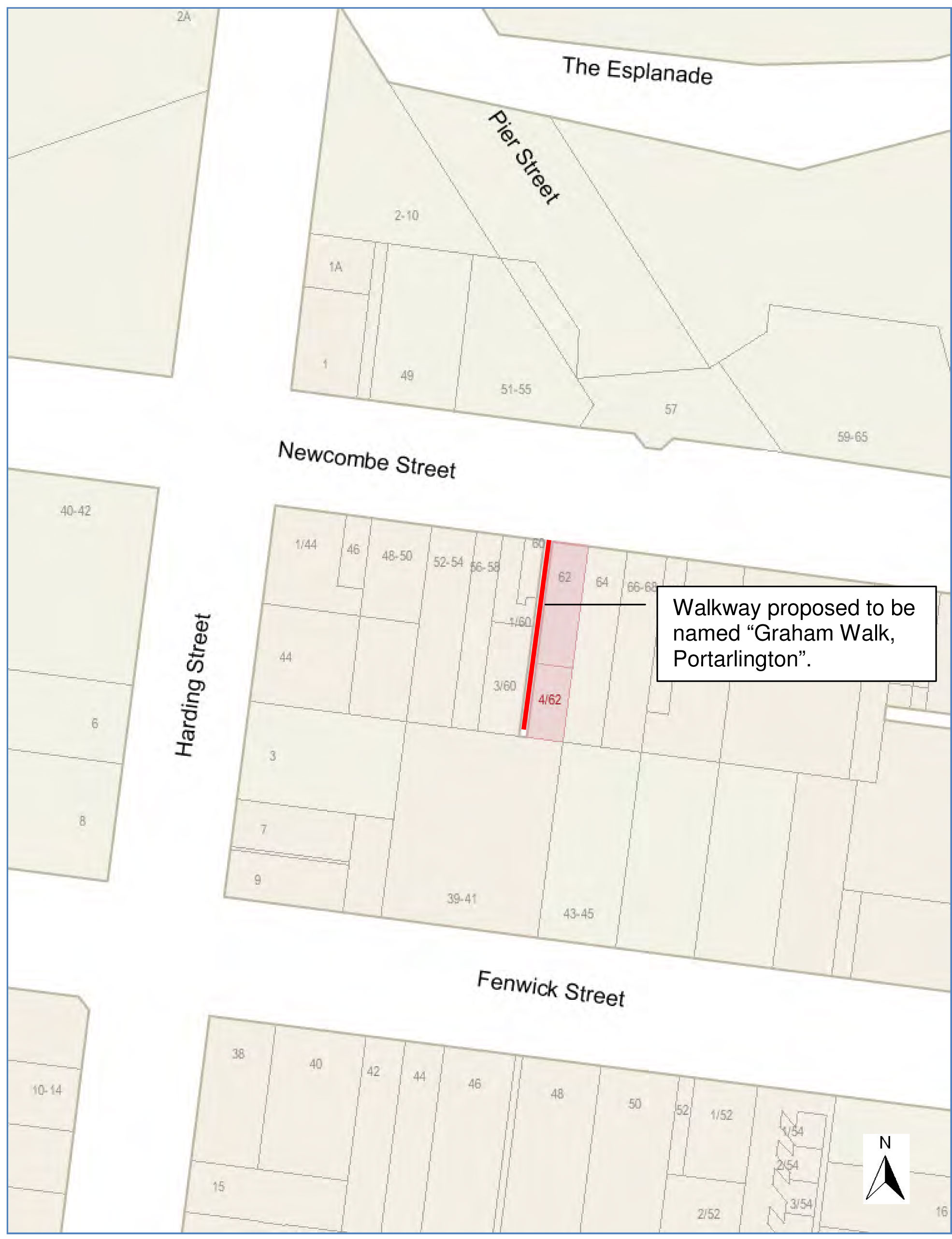
Portfolio: |
Governance - Cr Lyons (Mayor) |
Source: |
Strategy and Performance- Financial Services |
General Manager: |
Dean Frost |
Index Reference: |
Subject/Financial Management - Reporting |
To seek approval to name an unnamed laneway in Geelong to Stony Pier Lane, Geelong.
A request was received to name an unnamed laneway in Geelong that is located beside the Royal Geelong Yacht Club (refer Attachment A).
Stony Pier Lane has been chosen as the name as the laneway leads to the Stony Pier.
The proposed naming was advertised in the Independent newspaper on 13 March 2015 and the Geelong Advertiser newspaper on 14 March 2015.
Two submissions in favour of the naming have been received.
Cr Ellis moved, Cr Harwood seconded -
That Council approve the naming of the unnamed laneway in Geelong to “Stony Pier Lane”, Geelong.
Carried.
Council is the responsible authority for naming and renaming roadways under the Local Government Act 1989.
A request has been received from Council’s Local Laws Department to name the unnamed laneway located beside the Royal Geelong Yacht Club. The laneway to be named is the access point to the Stony Pier.
Letters have been sent to the adjoining property owner advising them of Council’s proposal to name the unnamed laneway to “Stony Pier Lane”, Geelong.
It is proposed to name the unnamed laneway situated beside the Royal Geelong Yacht Club as “Stony Pier Lane”, Geelong.
This laneway leads to the Stony Pier which is a Council asset.
The proposed naming was advertised in the Independent newspaper on 13 March 2015 and the Geelong Advertiser newspaper on 14 March 2015. Two submissions in favour of this proposal have been received.
There are no environmental issues arising from this report.
The approximate cost to Council is $400. This includes advertising, notification to authorities and street signage.
The Local Government Act 1989, the Geographic Place Names Act 1998 and the Guidelines for Geographic Names 2010 have been followed and met.
This proposal aligns to City Plan with the encouragement of Community Wellbeing.
There is no Council Officer direct or indirect interest involved in this report.
If an emergency situation occurred, Councils proposal to name this laneway could minimise the risk of failure in being able to located the situation in a timely manner.
The naming of this laneway will allow for easy identification for the public and emergency services.
It is the right of every person to be able to identify their location in order to reduce confusion or delay of emergency services.
Correspondence has been sent to the adjoining property owner advising the proposed naming and inviting submissions.
The proposal was advertised in the Independent newspaper on 13 March 2015 and the Geelong Advertiser newspaper on 14 March 2015.
The proposal was published on Council’s Geelong Australia website for 30 days as per the Guidelines for Geographic Names 2010.
Two submissions were received. Both submissions were in favour of this naming.
Subject to Council and the Registrar of Geographic Names approval, the relevant authorities and abutting owners will be notified of the official registration of this naming.
Road naming - unnamed laneway, Geelong
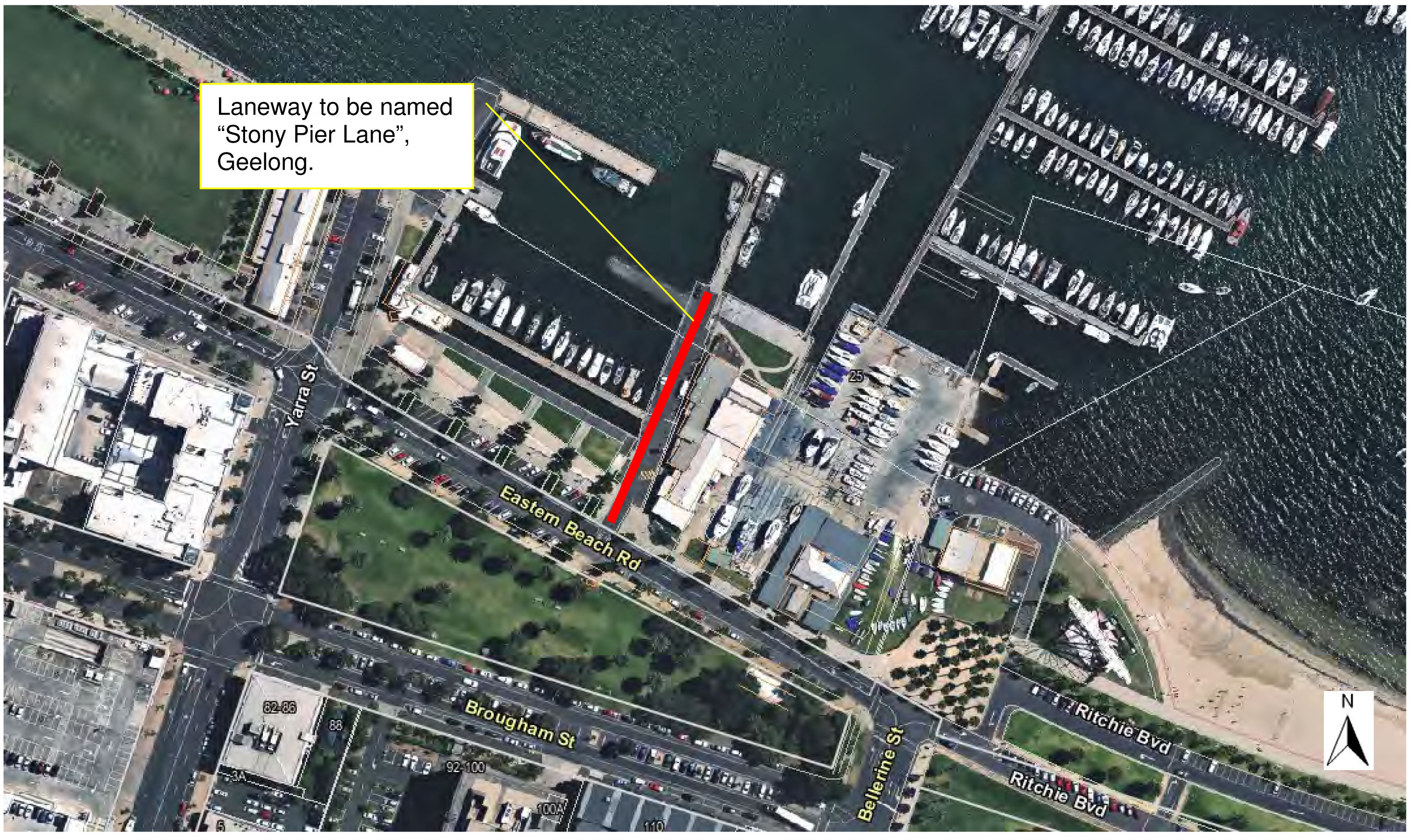
Portfolio: |
Governance - Cr Lyons (Mayor) |
Source: |
Strategy and Performance- Financial Services |
General Manager: |
Dean Frost |
Index Reference: |
Subject/Financial Management - Reporting |
To seek approval to rename Kristy Place, Wandana Heights to Hopper Place, Wandana Heights.
Correspondence has been received received advising confusion with Kristy Place and Christie Court, Wandana Heights (Refer Attachment A).
Kristy Place has been chosen for renaming as this will cause the least impact and was created after Christie Court.
Hopper Place has been chosen as the new name.
Ian Hopper was a past Councillor and Mayor of City of South Barwon.
The proposed naming was advertised in the Independent newspaper on 13 March 2015 and the Geelong Advertiser newspaper on 14 March 2015.
Eight submissions in favour and one submission against have been received.
Cr Ellis moved, Cr Harwood seconded -
That Council approve the renaming of Kristy Place, Wandana Heights to “Hopper Place”, Wandana Heights.
Council is the responsible authority for naming and renaming roadways under the Local Government Act 1989.
Correspondence has been received from a resident in Christie Court, Wandana Heights. The resident has advised of confusion due to two names sounding the same within Wandana Heights - Christie Court and Kristy Place.
Kristy Place has been selected to be renamed for the following reasons:
Kristy Place was created after Christie Court.
Kristy Place has less affected property owners.
Hopper Place has been chosen as the new name in honour of Mr Ian Hopper.
Letters have been sent to all adjoining property owners and residents (5 owners and 1 resident) advising them of Council’s proposal to rename Kristy Place to “Hopper Place”, Wandana Heights.
It is proposed to rename Kristy Place, Wandana Heights to “Hopper Place”, Wandana Heights.
Mr Hopper served as a Councillor and Mayor with The City of South Barwon. He was involved in a number of community engagements with a particular focus on Local Government and tourism in the Geelong region. Mr Hopper was also a member and President of the Rotary Club of Highton and was awarded a Paul Harris Fellow for his community activities. Mr Hopper passed away in 2009 aged 72.
The proposed naming was advertised in the Independent newspaper on 13 March 2015 and the Geelong Advertiser newspaper on 14 March 2015. Eight submissions in favour and one submission against this proposal have been received.
There are no environmental issues arising from this report.
The approximate cost to Council is $400. This includes advertising, notification to authorities and street signage.
The Local Government Act 1989, the Geographic Place Names Act 1998 and the Guidelines for Geographic Names 2010 have been followed and met.
This proposal aligns to City Plan with the encouragement of Community Wellbeing.
There is no Council Officer direct or indirect interest involved in this report.
If an emergency situation occurred, Councils proposal to rename this roadway would minimise the risk of failure in being able to locate the situation in a timely manner.
The renaming of this roadway will allow for easy identification for the public and emergency services.
It is the right of every resident and property owner for their property to have a unique address in order to receive services and reduce confusion or delay of emergency services.
Correspondence has been sent to all adjoining property owners and residents advising the proposed renaming and inviting submissions.
The proposal was advertised in the Independent newspaper on 13 March 2015 and the Geelong Advertiser newspaper on 14 March 2015.
The proposal was published on Council’s Geelong Australia website for 30 days as per the Guidelines for Geographic Names 2010.
Eight submissions in favour and one submission against were received. The submission against this proposal was based on the name “Hopper” and has been responded to.
Subject to Council and the Registrar of Geographic Names approval, the relevant authorities and abutting owners will be notified of the official registration of this naming.
Road Renaming – Kristy Place to Hopper Place, Wandana Heights
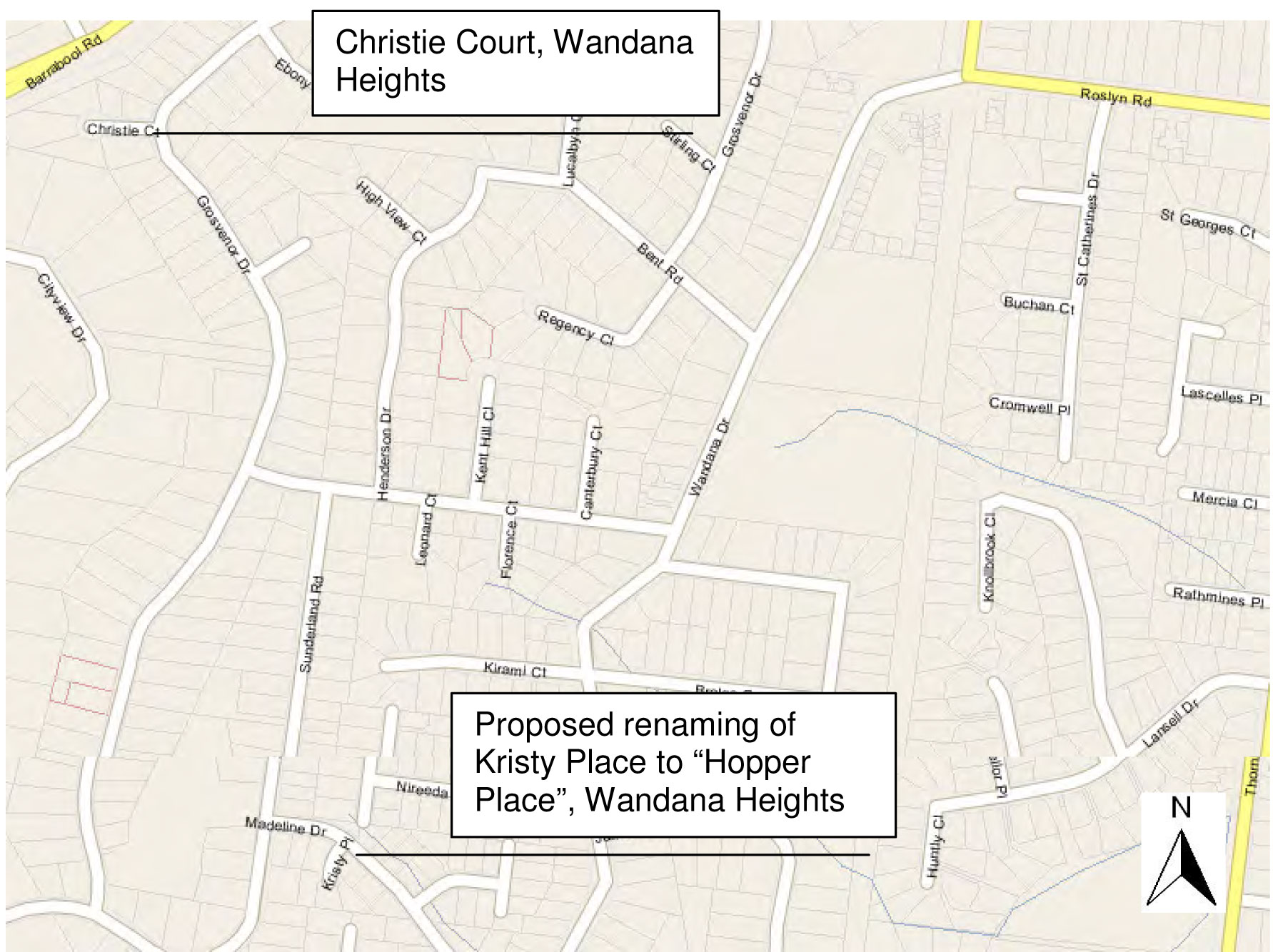
Portfolio: |
Governance, Cr Lyons (Mayor) |
Source: |
Strategy and Performance - Organisation Development |
General Manager: |
Dean Frost |
Index Reference: |
Subject: Committee CEO Recruitment |
The purpose of this report is to seek the formation of a Special Committee of Council for the purposes of recruitment for the Chief Executive Officer position.
For Council to endorse the engagement of a suitable recruitment consultant to provide quotations for role profiling, search and selection services.
The Chief Executive Officer, Dr Gillian Miles, has tendered her resignation with her final day being 22 June 2015.
In accordance with the Local Government Act 1989, recruitment for a new Chief Executive Officer should commence as soon as is reasonably practicable after a vacancy in the position occurs.
Council has appointed Mr Kelvin Spiller to the position of Interim CEO until the recruitment process for the permanent position has been finalised.
Cr Heagney moved, Cr Harwood seconded -
That in exercise of the powers conferred by sections 86 and 87 of the Local Government Act 1989 ("the Act"), Council resolves that:
a special committee entitled “Selection Committee - Chief Executive Officer Recruitment” be established.
that Cr Lyons (Mayor), Cr Heagney (Deputy Mayor), Cr Fisher, Cr Richards and Cr E Kontelj, be appointed to the selection committee recruitment.
that Mr Justin Giddings be appointed as the independent chair of the Selection Committee – CEO Recruitment.
that Mr Mike Hirst be appointed as the independent representative.
the purposes of the Committee are those set out in the Terms of Reference (Appendix 1).
the Committee be delegated the powers, duties and functions set out in the attached Instrument of Delegation (Appendix 2)
that the Manager, Organisation Development source appropriate recruitment consultancy firms for the purposes of providing quotes to render services in relation to the recruitment of the Chief Executive Officer.
Carried.
A recruitment process for a new Chief Executive Officer must be initiated following the resignation of the current incumbent, Dr Gillian Miles.
This report addresses the establishment of a committee to manage the recruitment and recommendation of an Executive Recruitment Consultant to assist Council.
It is proposed that a Special Committee, the Selection Committee - Chief Executive Officer Recruitment, be established pursuant to section 86 of the Local Government Act 1989 to oversee the recruitment process to fill the vacancy.
The Committee will be provided with delegated powers (refer Appendix 2) to undertake the initial process and provide a short list of candidates for Council to consider. The appointment and the relevant terms and conditions of the CEO’s contract shall be made by Council.
Having regard to the previous CEO recruitment process, it is recommended that the Committee comprise of an Independent Chair, the Mayor and Deputy, 3 other Councillors and an Independent representative.
The Committee will operate in accordance with the Terms of Reference for the Selection Committee - Chief Executive Recruitment as attached in Appendix 1. The Committee will report back to the Council at appropriate intervals during the recruitment process to advise the Council on progress. The role of the Committee is:
To finalise project brief for Executive Recruitment consultants.
To determine the range of remuneration package to be offered.
To shortlist consultants to assist Council in conducting the process.
In consultation with the appointed consultant undertake necessary steps in the process.
To short list and interview applicants.
Make a recommendation on the short listed candidates for appointment.
There are no environmental implications associated with this report.
Anticipated costs for the recruitment process including consultancy, advertising and other costs are estimated to be in the order of $40,000 to $60,000. These costs will be reported as projection changes in 2015-2016 financial management reports.
There are some specific requirements in the Local Government Act relative to the appointment of a Chief Executive Officer.
A Council must appoint a natural person to be its Chief Executive Officer.
The Chief Executive Officer is a member of Council Staff.
A Council may only appoint a person to be its Chief Executive Officer after it has invited applications for the position in a notice in a newspaper circulating generally throughout Victoria and has considered all applications received by it that comply with the conditions specified in the notice.
While the appointment is to be made by the Council, a Committee may be appointed in accordance with section 86 and 87 of the Local Government Act 1989 with delegated powers to undertake designated steps in the recruitment process.
The Manager Organisation Development, and the selected Recruitment Consultant, will ensure the recruitment brief reflects the strategic initiatives of the City Plan.
There is no officer direct or indirect conflict of interest.
A professional approach to the recruitment will minimise risk. It is important that attendance at meetings of the Committee be consistent. Unless committee members can attend all interviews they should not participate in interviews at all.
There are no known social considerations.
Human Rights Charter has been considered and no impacts have been identified.
At the appropriate time the vacancy will be publicly advertised. It is imperative that information regarding candidates remain strictly confidential throughout the process.
Contents | Previous Page: Section A - Procedural Matters | Next Page: Section C - Urgent Business
