
Council Minutes - Section B: Reports - 14 July 2015
Contents | Previous Page: Section A - Procedural Matters | Next Page: Section C - Assembly of Councillors
Contents | Previous Page: Section A - Procedural Matters | Next Page: Section C - Assembly of Councillors
Reports tabled at the Ordinary Meeting of Council on Tuesday date held at City Hall, Little Malop Street in Geelong.
Portfolio: |
Transport – Cr Richards |
Source: |
City Services – Engineering Services |
General Manager: |
William Tieppo |
Index Reference: |
Transport |
This report presents the final findings of the panel hearing and the submissions received from residents during the survey period in regard to local infrastructure at Geelong train stations.
At the Council meeting on 12 November 2013, Council resolved to conduct a public submissions process in regard to local infrastructure at Geelong train stations. It determined that the survey report be exhibited to the Public, inviting formal written submissions, advising they can be heard by a submissions review panel; and that the City would work with Public Transport Victoria (PTV) to address issues under its responsibility. The survey sought information regarding gaps in infrastructure associated with local traffic, parking, public transport links, pedestrian and cycling access, accessibility, safety and security.
The City carried out two surveys, one Geelong wide ‘electronic survey’ and a second survey of residents who live within a radius of approximately 500 metres from the new Waurn Ponds Train Station. These surveys were conducted between 20 June and 18 August 2014. The findings of the surveys were compiled into a survey report (dated Sept 2014) and were made available for the public to review. A further 29 submissions were received between 27 November and 31 December 2014. Three residents presented at the panel hearing, which was held on 12 May 2015.
Council will use the findings of the panel hearing and written submissions received to inform Council’s infrastructure priorities surrounding the train stations, and also to work with Public Transport Victoria (PTV) to prioritise train station improvements.
Cr Richards moved, Cr Harwood seconded -
That Council:
note the report;
use the information to inform infrastructure priorities in the vicinity of train stations; and
develop an advocacy strategy and work with Public Transport Victoria (PTV) to prioritise train station improvements.
Carried.
More people are catching the train than ever before. The Regional Rail Link (RRL) Project, opened on 21 June 2015, is the largest public transport infrastructure project undertaken in Victoria. The RRL project provides dedicated rail tracks to Geelong from Melbourne and will improve the capacity and reliability of train services to and from Geelong. A new train station in Waurn Ponds was constructed in 2014.
At the Council meeting on 12 November 2013, a resolution was passed by Council to carry out a survey to ascertain gaps in local infrastructure around Geelong train stations and to identify key works and responsibilities for implementation.
Council also sought specific feedback from local residents to help identify opportunities for any improvements to local infrastructure around the new station at Waurn Ponds.
A Geelong wide ‘electronic survey’ was carried out on the 20 June 2014. This survey was closed on the 18 August 2014.
In addition to the above, a letter drop to residents close to the new Waurn Ponds train station was carried out on the 20 June 2014. Six hundred letters were delivered to residents who live within a radius of approximately 500m from this station.
The findings of the survey were compiled into a survey report (dated Sept 2014) and were made available for the public from the 27 November 2014 to 31 December 2014.
Council invited residents to review the survey report and submit formal submissions between the 27 November and 31 December 2014 that could be heard by a panel hearing.
29 submissions were received from 20 residents.
Three residents presented at the panel hearing on the 12 May 2015.
Geelong train stations local infrastructure survey specifically identifies issues that impact on accessibility and connectivity to train stations in Geelong. Identification of these issues, including gaps in infrastructure provides impetus for the development of a range of actions to address current issues, and to pursue new initiatives. Importantly, these survey findings provide direction for the City to manage its transport accessibility needs into the future.
Some of the train station related issues raised included; cycling access and storage, pedestrian access and connectivity, public bus service improvements and related infrastructure, coordination between bus and train services and safety within the train stations and at the station car parks. These are consistent with the findings of the Access audits that Council undertook between 2009-12. These audits focussed on both the infrastructure within and abutting the stations.
Key Challenges that have been identified through the community engagement are:
Traffic & Parking – Increase existing car parking spaces at train stations to provide ‘park and ride’ facilities, minimising the impact on the road network.
Cycling – Provide cycling infrastructure, e.g. paths and storage.
Public Transport Victoria (PTV) Links – Improve existing train and bus time coordination to facilitate better connectivity between these two modes of transport. This will encourage the community to reduce car use by using the bus and train to carry out trips in relation to work, school and shopping and be more physically active.
Pedestrian Accessibility – Improve local accessibility and connectivity into train stations from key local activity centres by providing pedestrian and cycle access ways.
Safety & Security - Promote Safety and security at all of these train stations. More police and PSO presence at the station, in the train and within the car park at all station operating times will improve the use of these facilities.
Station Facilities – Improving key infrastructure within train stations, such as availability of MYKI machines, covered shelters, increased seating, toilets, well lit car parks and station platforms.
Accessibility for the Blind and Vision Impaired – Provide obstacle free paths to station platforms, taxi ranks and to bus interchange.
Attachment 1 summarises to all written submissions that were received, including those from the panel hearing held on 12 May 2015.
Recent initiatives that have taken place since the original survey in June 2014 include:
The installation of the DDA compliant bridge and lift structure at Geelong Train Station;
DDA compliant internal building works to improve station amenities (toilets, ticketing areas) at Geelong Train Station;
The installation of additional shelters, bus bays and carpark enhancements at North Shore station;
Construction and opening of the new Waurn Ponds Station;
Amendments to bus routes in the Waurn Ponds/Grovedale area to connect to the new Waurn Ponds station;
The opening of the Regional Rail link on the 21 June 2015 along with the new Geelong bus network will improve access and connectivity across the region for public transport users;
Construction of new footpaths in Grovedale linking the Marshall station to residential areas
Ongoing upgrade and installation of new bus stops across the municipality.
To enhance the use of the new network, the City supports upgrades to infrastructure that improves access for users and will continue to implement the actions as outlined in the G21 Region Public Transport Strategy.
The G21 Region Public Transport Strategy has four strategic objectives:
Access for all
A well connected region
Urban public transport for an urban centre
Improving information, planning and partnerships
The actions that particularly benefit Greater Geelong and which are identified in the strategy support the issues raised by the submitters.
These include:
Support simplification of the bus network, beginning in Grovedale.
Support an increase in urban bus frequencies to 20 minute services where not already operating at this level or better.
Seek a simpler regular interval rail and bus timetable and encourage this as a goal of the Regional Rail link timetable.
This report will lead to the understanding of public transport related Infrastructure. Provision of an efficient public transport network supported by a sustainable transport connection, such as cycling and pedestrian access ways, will minimise delays and associated greenhouse gas emissions.
This report will assist Council to secure State funding for installation of infrastructure needs in Waurn Ponds. Council will work with PTV to address the issues identified in this report. The bulk of the funding to implement these works is expected to be provided by PTV. The other improvements to implement the Plan will be considered for inclusion in Council’s future programs through the normal project evaluation process.
This report to identify train station related infrastructure will provide direction for the ongoing improvement of public transport within the Municipality. It will also demonstrate that the City is taking a responsible position on public transport and sustainable transport activities and management issues.
Review and investigation of train station related infrastructure supports the strategic direction of City Plan, and this Council report is aligned with City Plan strategic directions of Community Well Being with objectives to improve the sustainable built and natural environment. Having an integrated approach to sustainable transport planning is a way forward to influence more public transport use and improve sustainable transport systems. Transport directly affects the community, economy and the environment and to have an efficient transport system is important for the prosperity of local economies and to improve quality of life within the region.
No Council officer involved in the preparation of this report has a direct or indirect conflict of interest.
The Development of a train station infrastructure improvement Plan will support Council’s position in terms of the level of understanding of Transport network improvement needs and accessibility issues.
Appropriate public transport and sustainable transport planning means that social impacts are properly considered during the development and implementation of the transport and accessibility infrastructures. The Geelong Train Stations Local Infrastructure (GTSLI) survey aims to enhance accessibility, connectivity and mobility of walking, cycling and public transport.
Appropriate planning of road accessibility and connectivity to train stations within the City will contribute significantly to improving the health and wellbeing of local residents. Improved safety for ‘active’ travel modes such as walking and cycling and provision of more equitable access for people of all ages and abilities has many documented social benefits, increasing opportunities for social interaction and participation.
The action plan does not impact negatively on any basic rights, freedoms and responsibilities as set out in the Charter.
The GTSLI was open for public comments from the 20 June 2014 to the 18 August 2014 (for eight weeks to collect submissions). A total of 116 ‘electronic’ submissions and 66 hard copy submissions were received during this survey period. 600 letters were dropped to residents who live within a radius of approximately 500 meters from the new Waurn Ponds train station. During the public and hard copy letter drop out period, the opportunity to provide feedback on the survey was advertised through local newspapers in Geelong, online at Council’s “Have Your Say” page and through local networks.
The second round of submissions was received between the 27 November 2014 and 31 December 2014. 29 submissions were received from 20 residents.
Letters were posted to all 20 residents inviting them to the Panel Hearing. Three residents accepted the invitation and the hearing was conducted on 12 May 2015. Cr. L. Ellis and Cr. A. Richards were in attendance.
|
Submission |
Response |
|
The need to install electric vehicle charging infrastructure at train stations |
The City supports upgrades to infrastructure that improve access for users. |
|
Train and Bus timetable coordination |
New Bus Routes and Timetables commence 21 June 2015 |
|
Links to Ballarat lines |
The G21 Region Public Transport Strategy supports links to regional destinations. |
|
Only a single track currently exists out to Waurn Ponds, this disallows a frequent 20 minute service as trains cannot come and go at the same time. A duplication of lines is needed |
The City supports upgrades to infrastructure that improve access for users. Duplication of the line from south Geelong is identified in the G21 Region Public Transport Strategy. |
|
Need extra services provided for night time or weekends |
New Bus Routes and Timetables commence 21 June 2015 |
|
Only 4 out of 11 trains originate from Waurn Ponds, meaning minimal services depart or pick up those passengers |
New Bus Routes and Timetables commence 21 June 2015 with increased services departing and terminating at Waurn Ponds. |
|
A second platform is needed at Marshall Station |
The City supports upgrades to infrastructure that improve access for users. |
|
Access to train stations – should be provided by public transport |
New Bus Routes and Timetables commence 21 June 2015 with improved linkages between bus and train timetables. |
|
Second platform at South Geelong Station would be ideal |
The City supports upgrades to infrastructure that improve access for users. |
|
North Shore Station inadequate facilities, bus shelters have been taken out and replaced with a roof with no walls, only a 40 minute service will be provided from here, there are currently no toilets available |
New Bus Routes and Timetables commence 21 June 2015. This location will become a hub and with increased usage the City supports the installation of improved facilities for users. |
|
Corio Station is in a remote location, with the following issues:
|
New Bus Routes and Timetables commence 21 June 2015. This location will have reduced usage with the main hub for this area transferred to North Shore Station and Corio Shopping Centre. |
Portfolio: |
Governance - Cr Lyons (Mayor) |
Source: |
Strategy & Performance - Corporate Strategy |
General Manager: |
Dean Frost |
Index Reference: |
Corporate Strategy |
To report on the key findings of the 2015 Local Government Community Satisfaction Survey.
Council has participated in the annual Local Government Community Satisfaction Survey, a telephone interview of Geelong residents to measure the perceived importance of Council services and Council’s performance across the past 12 months. A copy of the independent research report has been attached as part of this summary report.
Results are able to be compared to those of previous years as well as the state-wide average and the Regional Centres councils (inclusive of Ballarat, Greater Bendigo, Greater Geelong, Greater Shepparton, Latrobe, Mildura and Warrnambool)
Scores for the core measures of Overall performance, Advocacy/Lobbying, Community consultation and engagement and Overall Council direction have either remained steady or improved and are at parity or significantly higher than Regional Centres and state-wide averages. Overall Performance is now at its highest score since 2012.
Customer Service has dropped significantly in the past 12 months. While it remains one of the higher rating measures for Geelong, it is now scoring slightly, although not significantly, below the Regional Centres and state-wide averages. The city’s customer service mix is comprehensive and is constantly changing. In order the help drive things forward we are focusing on the following key areas:
The development of a new Customer Service Strategy for the organisation to aspire, share and deliver;
The continual strategic assessment of future options for service delivery and/or current effectiveness of services delivery to ensure councils services are relevant, appropriate and responsive for current and future generations;
Investing in new technologies which help manage growing demand, reach out and promote independence and convenience for those who want it;
Implementing a structured officer development program that focuses on staff developing a more sophisticated understanding, and commitment around customer service, of customer need and diversity in order to respond to different customer types.
The introduction of the Common Measurement Tool (CMT) designed to collect feedback from customers relating to service for any part of the organisation across all channels of service delivery (telephone, in person, web, mail, email) as well as for individual departments.
Service areas rated by residents as highest for importance were Waste management and Elderly support services while Arts and libraries and Community and cultural activities were rated lowest.
In terms of performance, there was significant improvement in the performance of the following service areas: Parking facilities, Business and community development and tourism, Slashing and weed control and Planning and building permits.
The following services experienced a noticeable decline in performance in 2015; Elderly support services, Family support services and Disadvantaged support services.
Arts and libraries and Waste Management were the highest performing services provided by Council.
Parking facilities, Community consultation and engagement and Town Planning policy were ranked lowest for performance. These services were also identified among other priority improvement areas (where performance rated below importance by 10 points or more).
It is important to note that particular demographic groups tend to rate Councils’ service delivery differently. In general, Council’s performance on most measures is viewed most favourably by younger adults (18-34 years) and women and least so by those aged 35-49, over 65 years and men.
Cr Harwood moved, Cr Fisher seconded -
Council notes the results of the Local Government Community Satisfaction Survey 2015;
the results of this survey are communicated to the community with a copy of the results is made available on Council’s website and at City of Greater Geelong Customer Service Centres.
Carried.
The Local Government Community Satisfaction Survey is a project co-ordinated by the Department of Transport, Planning and Local Infrastructure (DTPLI) on behalf of Victorian Councils. The survey is conducted by an independent research group (JWS Research) with participation in the survey optional. Council has participated since the inception of the survey (1998).
Community satisfaction ratings form part of the newly legislated Local Government Performance Reporting Framework indicators, required to be reported by councils in their annual reports and to be published annually by Local Government Victoria.
Methodology
A minimum of 400 telephone interviews were conducted with residents over 18 years of age within the municipality. Minimum quotas of gender within age groups were applied during the fieldwork phase. Post survey weighting is then applied to ensure accurate representation of the age and gender profile for City of Greater Geelong (CoGG).
Survey fieldwork was conducted from 1 February to 30 March 2015. Respondents are asked to rate the performance of their local government on a five-point scale in the following core areas:
Overall Performance (over past 12 months)
Advocacy
Community consultation and engagement*
Customer Service
Making community decisions
Overall Council direction
Sealed local roads
The following service areas were also rated on both importance and performance:
Arts centres and libraries |
Parking facilities |
Business and community development and tourism Community and cultural activities |
Planning and building permits* |
Council’s general town planning policy |
Recreational facilities |
Disadvantaged support services* |
Roadside slashing and weed control |
Elderly support services* |
The appearance of public areas |
Enforcement of local laws |
The condition of local streets and footpaths |
Environmental Sustainability |
Traffic management |
Family support services* |
Waste management |
Informing the community |
(*) denotes service where respondents were asked to indicate whether they or anyone in the household had used or experienced the service in the past 12 months.
Other questions asked were:
If respondents would prefer to see a rate rise to retain a particular service or cut the service and retain rates at the current level?
Best way for Council to communicate to you about Council news and information and upcoming events?
Core performance areas
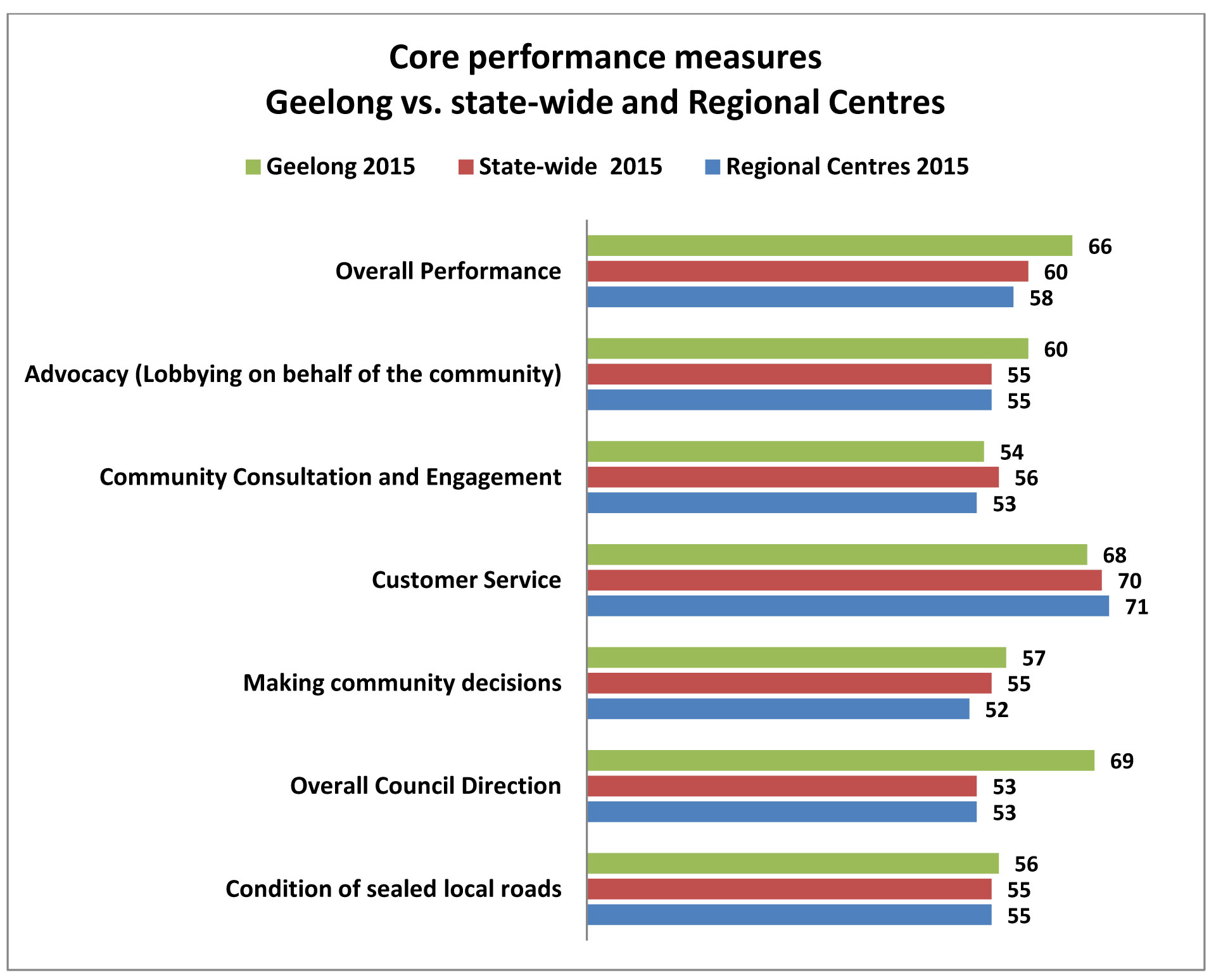
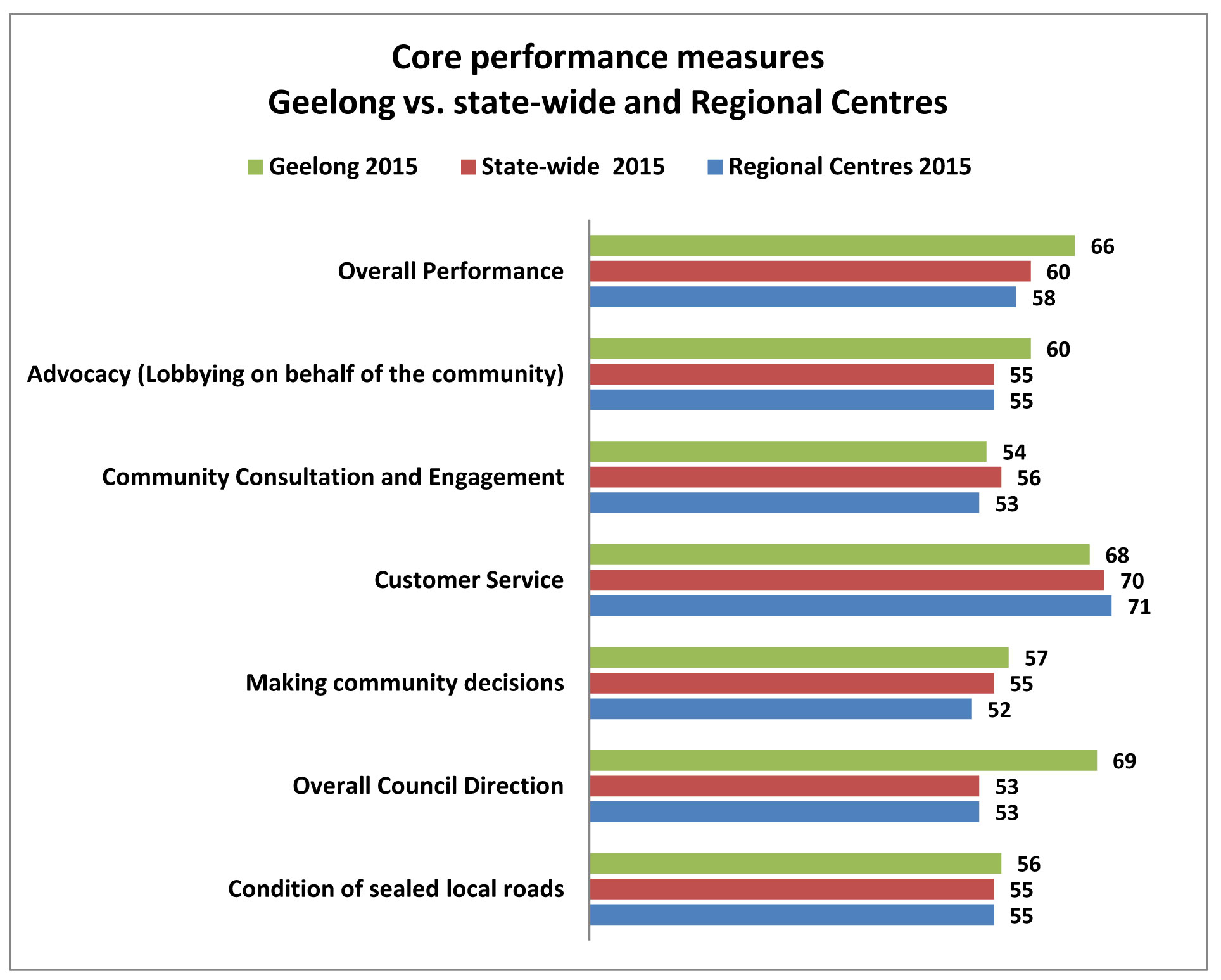
The Overall Performance rating has improved significantly over the last 12 months (by four points) to outperform both the Regional Centres average (by eight points) state-wide average (by six points). The index score is now at the highest point since 2012.
Residents are perceiving council to be heading in the right direction with the Overall Council Direction score continuing to improve (up by one point to 69 in 2015). Geelong’s score significantly exceeds both the Regional Centres and State-wide averages (by 16 points).
Since the election of the current Mayor there has been a significant increase in the social media presence of the City. As of June 2015, the Geelong Mayor Twitter account has 106,825 followers while Geelong Mayor Facebook has 49,635 likes.
Additionally, Geelong Australia Twitter has 6,109 followers and the Geelong Australia Facebook page has 6,622 likes.
In conjunction with unprecedented national and international media attention, the profile and the reach of the Mayor remains high. This may be reflected in the Advocacy/Lobbying score which increasing slightly in 2015 (up two points to 60) is significantly higher than both the state-wide and Regional Centres averages (55 respectively). The 18-35 year old residents rated performance in this area significantly higher.
The performance rating for Community consultation and engagement remains relatively unchanged from 2014 and is comparable to both the state-wide and Regional Centres averages. Those aged 18-34 years are less critical, rating performance significantly higher. Importance (74) rated 20 points higher than perceived performance (54) makes this a priority area for improvement. Work is currently underway to enhance the way CoGG engages by offering a wider range of online engagement techniques to increase opportunities for community participation.
The rating for Condition of sealed local roads increased slightly from 2014 (up two points to 56) and is comparable to state-wide and regional Centres (55 points respectively). Importance (77), however, is rated 21 points higher than perceived performance.
Customer Service has dropped significantly in the past 12 months (down 7 points to 68). The state- wide average also decreased significantly in 2015 (down 2 points to 70). While it remains one of the higher rating measures for Geelong, Customer Service is now scoring slightly, although not significantly, below the Regional Centres (71) and state-wide averages (70). Performance ratings declined across all residents under 65 years. The most significant decline was from the 35-49 years old residents, the group that has had the most contact with Council over the past 12 months.
There is a range of ways in which customers can access services from the City of Greater Geelong. In any given year the City of Greater Geelong receives approximately 932,000 incoming phone calls, 130,000 visitors at designated customer service centres, 75,000 requests for service 18,000 contact us emails, and 1.5 million visits to the geelongaustralia webpage to name a few. The emergence and increasing popularity of new channels such as the web has enabled an increased mix of contact and service delivery options whilst enhancing flexibility and value to customers. However, different contact options produce different experiences and levels of customer satisfaction. In order to help drive improved customer service performance across the organisation the city is now focussing on the following key activities:
The development of a new Customer Service Strategy for the organisation to aspire, share and deliver;
Strategic Reviews- continue assessment of future options for service delivery and/or current effectiveness of services delivery to ensure councils services are relevant, appropriate and responsive for current and future generations;
Investment in new technologies such as a unified telecommunications system and “Mygeelong” which help manage growing demand, promote efficiency, reach out and promote independence and convenience for those who want it;
Implementing a structured officer development program that focuses on staff developing a more sophisticated understanding, and commitment around customer service, of customer need and diversity in order to respond to different customer types;
The introduction of the Common Measurement Tool (CMT) designed to collect feedback from customers relating to service for any part of the organisation across all channels of service delivery (telephone, in person, web, mail, email ) as well as for individual departments.
Service areas
Arts and libraries and Waste Management were the highest performing services provided by Council. Arts and libraries performed significantly better than the state-wide average while Waste Management performed significantly better than the Regional Centres average.
There were some significant improvements in the performance of some service areas in 2015:
Business and community development and tourism, Slashing and weed control (up seven points respectively). Scores significantly exceed both the state-wide and Regional Centres average.
Planning and building permits (up five points). Process improvements implemented in 2014, including an upgrade in software which resulted in a record number of Planning Permit applications issued within the statutory 60 day period, may have contributed to a significant increase in the performance for Planning and building permits.
Parking facilities (up seven points to 54). Changes to parking conditions in Central Geelong saw parking limits and grace periods extended and free Saturday parking introduced in early 2015. While the impact of these changes were not evident in last years results, 2015 saw a significant increase in the performance of this area.
The following services experienced a noticeable decline in performance in 2015; Elderly support services (down six points), Family support services and Disadvantaged support services (down four points respectively). All three services have now recorded their lowest score since 2012 while ratings for both Elderly support and Family support services are now below the state-wide averages. Male residents appear to be far more critical of the performance of these three support services (rating them significantly lower) than in previous years.
Priority service areas for improvement, where performance rated below importance by 10 points or more) remain relatively unchanged from previous years:
Parking facilities: Despite a significant increase the community’s perception of performance still remains relatively low (54). Scores are comparable to the Regional Centres average (53) but significantly below the state-wide average (57). A difference of 21 points from perceived importance (75) indicates that it is a priority area for review.
Making community decisions: score remains relatively unchanged from 2014. Those aged 18-34 years are less critical, rating performance significantly higher.
Informing the community: Performance remains relatively unchanged from 2014 (down one point to 60) and is comparable to state-wide (61) and regional Centres (58). Residents aged 65+ years were significantly less satisfied with Councils performance in this area than in previous years. A net difference of 18 points separates importance from performance.
The condition of local streets and footpaths: an area scoring consistently low since 2012 with a net difference of 19 points from perceived importance. This area is consistently identified as a priority improvement area.
Council continues to increase expenditure with $21.2M allocated in the 2015/16 budget for road and footpath renewal in recognition of the need to address Council’s ageing infrastructure.
Other services which have a higher derived importance to the community but are not rating as well are Traffic management, Disadvantaged support services, Planning and building permits, Councils town planning policy and Elderly Support Services.
Service areas highlighted for improvement will be referred to relevant Managers to consider and identify potential improvement opportunities and/or any further investigation required.
Other questions:
While a newsletter sent by mail is still the preferred method of contact for residents (29%), there has been an increase in the proportion of residents interested in receiving a community newsletter email (27%).
Although mail has declined in favour among residents over 50 years (down from 42% in 2014 to 28% in 2015), it is still preferred ahead of e-mail (22%).
In the lead up to the possible introduction of rate capping for the 2016-17 council budgets, it is interesting to note that there is a higher number of residents who would prefer to see services cut if rates stay at their present level (46%) than those who would prefer to pay more for rates if services improved (40%).
It is important to note that particular demographic groups tend to rate Councils’ service delivery differently. In general, Council’s performance on most measures is viewed most favourably by younger adults (18-34 years) and women and least so by those aged 35-49 and over 65 years as well as men.
A summary table of results is provided in Appendix 1.
A copy of the independent research report is provided as Appendix 2. The report includes comparisons with state-wide averages and other Councils in the Regional Centres group.
Actions taken as a result of the findings of this survey will need to consider the environmental implications in their development.
Major changes to survey content and methodology post the 2012 survey has resulted in an increased cost to participate. Participation in the annual survey for 2015 cost $15,740, this being $10,240 greater than is currently budgeted.
Council’s participation in this Community Satisfaction survey supports the requirements of the Best Value legislation and Council’s own policies by contributing to the development of a program of regular consultation with the community in relation to the services we provide; and taking into account community expectations and values when establishing quality and cost standards.
The Local Government Act 1999 Section 208B ensures that Councils continuously look to improve services to the community. In particular, section 208B (e) states that “a Council must develop a program of regular consultation with its community in relation to the services it provides”.
Further to this, 208B (f) states that Councils must also report regularly to the community on its services, achievements, improvement opportunities and consultation activities.
Community satisfaction ratings form part of the newly legislated Local Government Performance Reporting Framework indicators, required to be reported by councils in their annual reports and to be published annually by Local Government Victoria.
Participation in the Local Government Community Satisfaction Survey directly supports the City Plan Priority ‘Efficient and customer focused organisation’ under the Strategic Direction ‘How We Do Business’.
There is no direct or indirect officer interest to which this report relates.
Actions taken as a result of the findings of this survey will need to be balanced against an assessment of the risks involved.
Actions taken as a result of the findings of this survey will need to consider the social implications in their development.
The process of engaging with the community and listening to those who are directly affected by the decisions Council supports specific rights within the Human Rights Charter including:
‘every person in Victoria has the right, and is to have the opportunity, without discrimination, to participate in the conduct of public affairs’ (section 18)
that ‘every person has the right to freedom of expression which includes the freedom to seek, receive and impart information and ideas of all kinds, whether within or outside Victoria’ (section 15).
It is a recommendation that the results of this survey are communicated to the community via a media release and a copy of the results is made available on Council’s website and at City of Greater Geelong Customer Service Centres.
Core Performance measures
Geelong 2015 vs. 2014
Significantly higher than Geelong 2014 index score
Significantly lower than Geelong 2014 index score
|
Core Performance measures |
Geelong 2012 |
Geelong 2013 |
Geelong 2014 |
Geelong 2015 |
|
Overall Performance |
63 |
65 |
62 |
66 |
|
Community Consultation and Engagement |
54 |
58 |
54 |
54 |
|
Advocacy (Lobbying on behalf of the community) |
57 |
57 |
58 |
60 |
|
Making community decisions |
n/a |
n/a |
58 |
57 |
|
Condition of sealed local roads |
n/a |
n/a |
54 |
56 |
|
Customer Service |
74 |
77 |
75 |
68 |
|
Overall Council Direction |
55 |
63 |
68 |
69 |
Geelong 2015 vs. state-wide and Regional Centres average
Significantly higher than state-wide and/or Regional Centres average
Significantly lower than state-wide and/or Regional Centres average
|
Core Performance measures |
Geelong 2015 |
State-wide 2015 |
Regional Centres 2015 |
|
Overall Performance |
66 |
60 |
58 |
|
Community Consultation and Engagement |
54 |
56 |
53 |
|
Advocacy (Lobbying on behalf of the community) |
60 |
55 |
55 |
|
Making community decisions |
57 |
55 |
52 |
|
Condition of sealed local roads |
56 |
55 |
55 |
|
Customer Service |
68 |
70 |
71 |
|
Overall Council Direction |
69 |
53 |
53 |
Note: Regional Centres include Ballarat, Greater Bendigo, Greater Geelong, Greater Shepparton, Latrobe, Mildura and Warrnambool.
Service areas – Four year trend
Significantly higher than Geelong 2014 index score
Significantly lower than Geelong 2014 index score
|
Performance measures |
Geelong 2015 |
Geelong 2014 |
Geelong 2013 |
Geelong 2012 |
|
Art centres and libraries |
77 |
75 |
75 |
75 |
|
Waste management |
74 |
75 |
69 |
74 |
|
Recreational facilities |
70 |
73 |
73 |
72 |
|
Elderly support services* |
63 |
69 |
67 |
66 |
|
Community and cultural activities |
70 |
68 |
70 |
69 |
|
The appearance of public areas |
70 |
68 |
69 |
70 |
|
Family support services* |
63 |
67 |
68 |
65 |
|
Enforcement of local laws |
64 |
64 |
70 |
68 |
|
Disadvantaged support services* |
60 |
64 |
62 |
62 |
|
Business and community development and tourism |
70 |
63 |
67 |
64 |
|
Environmental Sustainability |
63 |
62 |
n/a |
n/a |
|
Informing the community |
60 |
61 |
61 |
60 |
|
The condition of local streets and footpaths |
58 |
59 |
59 |
58 |
|
Traffic management |
61 |
58 |
59 |
59 |
|
Roadside slashing and weed control |
62 |
55 |
61 |
64 |
|
Council’s general town planning policy |
55 |
53 |
55 |
52 |
|
Planning and building permits* |
56 |
51 |
58 |
55 |
|
Parking facilities |
54 |
47 |
47 |
49 |
(*) denotes service where respondents were asked to indicate whether they or anyone in the household had used or experienced the service in the past 12 months.
Geelong 2015 vs. State-wide 2015 average and Regional Centres 2015 average
Significantly higher than state-wide and/or Regional Centres average
Significantly lower than state-wide and/or Regional Centres average
Performance measures |
Geelong 2015 |
State-wide 2015 |
Regional Centres 2015 |
|
Art centres and libraries |
77 |
73 |
75 |
|
Waste management |
74 |
72 |
71 |
|
Recreational facilities |
70 |
70 |
69 |
|
Elderly support services* |
63 |
69 |
66 |
|
Community and cultural activities |
70 |
69 |
69 |
|
The appearance of public areas |
70 |
72 |
72 |
|
Family support services* |
63 |
67 |
66 |
|
Enforcement of local laws |
64 |
66 |
67 |
|
Disadvantaged support services* |
60 |
62 |
61 |
|
Business and community development and tourism |
70 |
61 |
63 |
|
Environmental Sustainability |
63 |
64 |
63 |
|
Informing the community |
60 |
61 |
58 |
|
The condition of local streets and footpaths |
58 |
58 |
58 |
|
Traffic management |
61 |
60 |
62 |
|
Roadside slashing and weed control |
62 |
55 |
58 |
|
Council’s general town planning policy |
55 |
54 |
55 |
|
Planning and building permits* |
56 |
54 |
57 |
|
Parking facilities |
54 |
57 |
53 |
Note: Regional Centres include Ballarat, Greater Bendigo, Greater Geelong, Greater Shepparton, Latrobe, Mildura and Warrnambool.
(*) denotes service where respondents were asked to indicate whether they or anyone in the household had used or experienced the service in the past 12 months.
Portfolio: |
Sport & Recreation – Cr Irvine |
Source: |
Projects, Recreation & Central Geelong / Sport & Recreation |
Acting General Manager: |
Jenny McMahon |
Index Reference: |
Subject: Tennis |
The purpose of this report is to seek Council endorsement of the G21 Regional Tennis Strategy.
The G21 Regional Tennis Strategy provides a framework for the development of tennis participation, governance and facilities throughout the G21 Region over the next 10 years.
The Strategy is a collaborative planning project between Tennis Australia, Tennis Victoria, Sport & Recreation Victoria and the local government authorities in the G21 Region.
The vision of the Strategy is: By 2025 the G21 Region will be Victoria’s fastest growing and most accessible region for tennis.
The five strategic priorities identified within the Strategy are:
Priority 1: Structure of tennis - Develop an aligned and collaborative structure to manage tennis.
Priority 2: Participation - Grow tennis, its range of activities and its year round appeal.
Priority 3: Facility provision and renewal - Reposition the tennis facility mix to align with future needs and demand.
Priority 4: Club support & development - Support clubs and venues to grow their capacity and improve management and operations.
Priority 5: Servicing and delivery - Promote tennis and provide resources (human and financial) to support change.
Cr Irvine moved, Cr Ansett seconded -
That Council:
endorse the strategic directions of the G21 Regional Tennis Strategy (Appendix 1);
note that the implementation of recommendations within the G21 Regional Tennis Strategy will be subject to Council’s annual budget process; and
amend the hierarchy description within the municipal action plan for the Centre Court Indoor Tennis Centre from local to district.
Carried.
Tennis is a highly popular sport which engages people across all age groups, genders and locations; however the way in which the sport is accessed is continually changing.
The “golden age” of tennis during the 1960-70’s saw an increase in the number of participants and facilities across the region, with membership at a local tennis club and weekend competition being the primary way to access the sport.
The majority of facilities throughout the region were established during this period and reflect how communities have historically played tennis. While traditional formats for participating in tennis are still prevalent, community expectations are changing the way participants want to engage with the sport.
Research undertaken by Tennis Australia as part of the Tennis 2020 report indicates trends in how our communities are accessing tennis and are shifting away from the traditional club competition model. Of current participants, 66% would prefer a pay-for-play model as opposed to a club membership, with only 10% of people have participated in tennis in the past 12 months being members of a club. The major drivers of tennis participation are social interaction (41% of participants) and fitness (28%).
Research also identified significant latent demand for tennis, with high numbers of people currently not playing tennis being interested in engaging. The way our communities want to play tennis are changing, but tennis competitions, facilities and governance continues to provide traditional methods for accessing the sport.
Participation in tennis in the G21 Region is predominantly accessed through association/club competitions and programs. There are currently four (4) active tennis associations within the region:
Tennis Geelong – provides competition within the City of Greater Geelong, Golden Plains and Surf Coast Shires.
Bellarine Peninsula Tennis Association – provides competition throughout the Bellarine Peninsula, central and southern areas of the City of Greater Geelong and across the Surf Coast Shire.
Polworth & District Tennis Association – predominately serves the Colac Otway Shire with senior and junior tennis competitions
Buninyong & District Tennis Association – serves the townships in the northern area of the Golden Plains Shire.
A limited number of clubs also provides “pay for play” activities including the Geelong Lawn Tennis Club, Colac Lawn Tennis Club, Centre Court Indoor and Colac Indoor Sports Centre. Participation opportunities within the region are generally traditional in nature, with weekend competition formats being the primary form of organised competitive activity.
As at 2012/13, 55% of tennis clubs operating within the G21 Region were affiliated with Tennis Victoria. Registered members in tennis across the G21 Region declined by 982 (or 22%) between 2010/11 and 2012/13, with only six Tennis Victoria affiliated clubs reporting more than 100 members in 2012/13.
On 1 July 2014, Tennis Victoria in conjunction with Tennis Australia introduced a new affiliation model for all Victorian tennis clubs based on the number of courts rather than per member. Since inception, registered memberships in the G21 Region (as at August 2014) grew by 166 to 2986 registered members. Club affiliations are expected to continue increasing throughout the region via the new affiliation model.
The G21 Region provides a high number of facilities and courts – 105 operational venues and 402 courts. The G21 Region’s court to population ratio of 1 to 730 substantially exceeds the industry benchmark of one court to 1500 head-of-population. While the number of courts in the region is high, the mix of facilities is deficient in large community venues and over-serviced with local and public access venues.
There are currently two regional scale venues (16+ court facilities) in the region - the Geelong Lawn Tennis Club (the existing Tennis Australia designated Regional Tennis Centre for the region) and the Colac Lawn Tennis Club. This provides a deficiency in large community venues (12+ courts) compared with other prominent tennis regions across Victoria.
Only eight venues across the G21 Region have eight or more courts – six of which are located in the City of Greater Geelong, one in Colac and one in Anglesea.
Public access (generally 3 courts or under) and local (generally 4-7 courts) tennis venues account for 92% of the 104 tennis venues through the G21 Region. These venues have traditionally been developed to meet local needs and township settlement patterns. Small tennis venues provide for organised competition, although generally lack the critical mass to provide broader programs and non-traditional formats of tennis participation such as Hot Shots and Cardio Tennis.
Governance of tennis in the G21 Region is currently disjointed, with limited alignment between the activities of the Barwon Region Tennis Network, tennis associations, clubs and coaches. The overarching governance structure throughout Regional Victoria is currently being reviewed by Tennis Victoria.
The G21 Regional Tennis Strategy was prepared to guide the development of tennis within the G21 Region. Key sport, government and community stakeholders were engaged to identify issues and opportunities influencing planning, provision and growth of tennis in the G21 Region.
Planning for sport across the G21 region recognises that sporting leagues and associations are not bound by municipal boundaries, it allows sporting associations and leagues to respond in a meaningful manner and apply scarce resources. The G21 Regional Tennis Strategy accordingly has been crated to ensure that it maximises the value for sport whilst recognising the diverse ways that municipalities service their constituents.
An Issues and Opportunities Paper was developed as the first stage of the project to provide strategic context for the recommendations within the Strategy. Information was collated under the following seven key themes:
Policy and planning – Policy and planning inconsistencies across the region impact on the access to appropriate facilities and opportunities to participate in tennis.
Regional structure – Participation/competition pathways and governance at a regional level have limited alignment.
Tennis participation – Traditional competition formats provide for existing participants, however additional opportunities for competition, coaching, social and fitness options will increase participation, particularly among people who are not currently engaged with the sport.
Coaching – Offering coach education opportunities locally and connecting coaches to clubs throughout the region will encourage increased participation and development of the coaching industry.
Club development – A range of club development initiatives are currently available to clubs, except an ad hoc coordination and promotion has limited take-up across the region.
Facility provision and asset management – The G21 Region has a high court to population ratio and facilities are generally in satisfactory condition. Gaps in the provision of facility types (large community and district level facilities) and facility components (sportslighting) present limitations in facility provision and the ongoing sustainability of tennis clubs.
Servicing and delivery – Coordination between government, agencies and the sport needs improvement to ensure clubs and associations are serviced effectively and efficiently.
Following the completion of the Issues and Opportunities Paper, the G21 Regional Tennis Strategy was developed under the following strategic framework:
Vision
Strategic priorities and objectives
Key strategies – actions within each strategic priority
Municipal action plans
The G21 Regional Tennis Strategy creates a strategic framework for the development of tennis throughout the region over the next 10 years. The vision of the G21 Regional Tennis Strategy is: By 2025 the G21 Region will be Victoria’s fastest growing and most accessible region for tennis.
The strategic priorities and associated objectives are:
PRIORITY 1 – STRUCTURE OF TENNIS
Objective: Develop an aligned and collaborative structure to manage tennis.
The Strategy recommends a restructure of tennis governance for the G21 Region. The development of a collaborative structure which includes competition development, administration, pathway development, event support, coach development, schools coordination and club development initiatives is vital to growing tennis participation.
Tennis Victoria is currently undertaking a comprehensive review of country tennis governance structures which will influence the structure of governance in the G21 Region.
PRIORITY 2 – PARTICIPATION
Objective: Grow tennis, its range of activities and its year round appeal.
Participation throughout the G21 Region is currently inconsistent, with many activities and opportunities to play is driven by a small number of clubs, coaches and private operators. Change in participation opportunities is critical to the engagement of new participants into the sport. A greater focus on providing the right mix of activities to meet community trends and demands is required.
Participation trends indicate a decrease in registered members and competition participants, although increased engagement in other forms of tennis such as Hot Shots (junior program), Cardio Tennis and social participation formats.
PRIORITY 3 – FACILITY PROVISION AND RENEWAL
Objective: Reposition the tennis facility mix to align with future needs and demand.
The project team visited every tennis facility in the G21 Region to develop a detailed inventory of all assets based on condition and suitability against current standards.
The general provision of courts across the G21 Region exceeds standard industry benchmarks and ratios. Court numbers meet minimum recommended numbers to the projected population, but location, quality, condition and type of venue provision no longer meet the requirements of clubs, participants and programs.
Clear gaps exist in the regional facility hierarchy, with low numbers of large community (12-15 courts) and district level (8-11 courts) facilities, and high numbers of local (4-7 courts) and public access (1-3 courts) facilities. This facility mix impacts the capacity of the region to build sustainable clubs and integrated competitions, as well as deliver tournaments and events.
The Strategy recommends few new courts (predominantly at Armstrong Creek), rather prioritising upgrades to infrastructure at existing facilities. A select number of existing venues with limited organised activity or residential catchment are also recommended to be decommissioned.
The provision of additional sportslighting at tennis facilities is prioritised within the Strategy to meet current and future demands for night competitions and social tennis.
PRIORITY 4 – CLUB SUPPORT & DEVELOPMENT
Objective: Support clubs and venues to grow their capacity and improve management and operations.
Tennis clubs in the G21 Region have access to a range of state, regional and local club support resources, though collectively they have not taken up these opportunities to full capacity. However, the G21 Region has historically low levels of affiliation to Tennis Victoria (55% prior to July 2014), but recent reforms to the affiliation model are encouraging more clubs within the region to align with the peak body for tennis.
Connecting clubs to the support offered by Tennis Victoria through affiliation is vital to ensuring the future sustainability of the sport within the region.
PRIORITY 5 – SERVICING AND DELIVERY
Objective: Promote tennis and provide resources (human and financial) to support change.
The servicing of tennis across the G21 Region is performed by a range of local, regional and state level stakeholders. Local and regional operations are currently supported by Tennis Victoria via their Community Tennis Officer program, the local tennis coach network, tennis associations and the Barwon Regional Tennis Network.
Tennis Victoria has recently employed an additional Country Community Tennis Officer to service the Barwon, Glenelg and Central Highlands areas.
Critical Actions
Each priority area includes a range of key strategies to achieve the listed objectives. Four key strategies are identified as critical for immediate action to position tennis to grow in a sustainable manner over the next 10 years. The four (4) critical strategies are:
Restructure tennis governance in the G21 Region – The region requires a collaborative governance structure which includes competition development, administration, pathway development, event support, coach development, schools coordination and club development initiatives.
Strategically invest in tennis court lighting to grow participation – While the region has a relatively high number of courts, increasing the number of courts with lighting will provide new opportunities to participate in wider range of activities and increase the hours of operation at tennis venues.
Support the sustainability of tennis via the new national affiliation model - The new National Affiliation Model shifts affiliation from a per member basis to a set annual club affiliation fee based on the club’s number of courts. This will see clubs pay less for affiliation, thus incentivising clubs to affiliate to the peak body and increasing their levels of support.
Adopt the Strategy into organisational work plans and budgets - Current levels of servicing require improvement and future investment by government and peak sporting bodies in order to deliver on the many actions identified within this Strategy. Increased numbers of affiliated clubs via the new national affiliation model will also increase service level expectations across the region.
Municipal Action Plans
A key component of the G21 Regional Tennis Strategy is the Municipal Action Plan for each of the five (5) municipalities within the region.
Municipal Action Plans have been developed in conjunction with Council officers and considered existing local sports development plans, strategies, Council policies and preferred future directions for each individual Council. The action plans are designed to align and integrate with existing Council policies and capital programs, identify key priorities and recommendations for tennis infrastructure.
Each Municipal Action Plan provides:
Municipal overview
Tennis development priorities
Infrastructure recommendations – 10 year program
An estimated $2,475,200 is required to implement the facility development recommendations from the Municipal Action Plan for City of Greater Geelong. Council’s annual hard surface renewal program (tennis and netball) of $247,000 pa is sufficient for court renewal recommendations within the Strategy. The implementation of capital upgrade recommendations within the Strategy will be subject to Council’s annual budgetary process.
There are no direct environmental implications arising from this report.
There are no immediate financial implications arising from this report. Funding for the implementation of the Strategy will be sought through a range of funding opportunities and Council’s existing budgetary process.
The Strategy recommends the existing hard court renewal budget be kept at the current levels to ensure that the cyclical renewal of tennis courts can be maintained.
An estimated $2,475,200 is required to implement facility development recommendations from the Municipal Action Plan for City of Greater Geelong. Council’s annual hard surface renewal program (tennis and netball) of $247,000 pa is sufficient for court renewal recommendations within the Strategy. The implementation of capital upgrades recommendations within the Strategy will be subject to Council’s annual budgetary process.
There are no policy, legal or statutory implications arising from this report.
This report is aligned to the Community Well-Being objective of the City Plan. The provision of sport and recreation facilities promotes healthy lifestyle through physical activity.
No Council officers involved in the preparation of this report are known to have a direct or indirect interest in matters to which this report relates.
There are no notable risks associated with this report.
Tennis provides many benefits including bringing communities together, reducing social isolation, increasing community pride, developing social capital and improving physical and mental health. This Strategy provides clear direction for all stakeholders to ensure that tennis will grow across the region.
Public access courts are provided in many of the region’s smaller townships, promoting healthy physical activity and social connection in more isolated areas. The Regional Strategy identifies opportunities to provide an improved level of service across the region.
This report has no impact on compliance with the Human Rights Charter.
The development of the Strategy has been a collaborative effort of a number of partner organisations including Tennis Australia, Tennis Victoria, Sport & Recreation Victoria, G21 and the five G21 local government authorities.
A Project Steering Group (PCG) was developed to provide technical advice and input from a local perspective. Project stakeholders including associations, clubs, coaches, and schools were consulted in the analysis and scoping stage of developing the Issues and Opportunities Paper.
Consultation activities including workshops with the project reference groups, targeted discussions with local government authorities, surveys of clubs, coaches and schools, and facility audits were undertaken in the development of the Strategy.
The draft Strategy was publically exhibited across the 5 participating LGAS for a period of six weeks. Twenty-four (24) submissions were received during this period with only minor changes made to the draft Strategy.
Portfolio: |
Governance - Cr Lyons (Mayor) |
|
Source |
Strategy & Performance - Administration & Governance |
General Manager: |
Dean Frost |
|
Index Reference |
Council Reports 2015 |
To update the Gifts and Hospitality Council Policy.
The previous version of the Gifts and Hospitality Policy was due for review by Council this year. As part of the review process, several minor changes to the Policy have been made. These changes do not impact the fundamental elements of the policy, but look to improve readability or provide clear direction.
Cr Ansett moved, Cr E Kontelj seconded -
That Council endorses the updated Gifts and Hospitality Policy.
Carried.
This report updates Council’s Gifts and Hospitality Policy and ensures compliance with the Local Government Act 1989.
Council’s Gifts and Hospitality Policy was due for review by Council, and accordingly, some minor changes are proposed as part of the review process. These changes do not impact the fundamental elements of the policy, but look to improve readability or provide clear direction.
There are no environmental implications associated with the contents of this report.
There are no specific financial implications associated with updating the Gifts and Hospitality Policy.
The Gifts and Hospitality Policy has been updated and remains compliant with the Local Government Act 1989.
In accordance with our strategic objective ‘How We Do Business’, Council has in place a Gifts and Hospitality Policy.
No officer involved in the preparation of this report has a direct or indirect interest in the information provided.
Updating the current Gifts and Hospitality ensures compliance with the Local Government Act 1989 and minimises any associated risks.
There are no social considerations associated with the information contained in this report.
We have taken into consideration all Human Rights as part of the drafting process of this report, none of which apply.
The updated Gifts and Hospitality Policy will be available on Council’s website and will also be available to staff via Cityweb.
Portfolio: |
Governance – Cr Lyons (Mayor) |
Source: |
Strategy & Performance – Administration & Governance |
General Manager: |
Dean Frost |
Index Reference: |
Council Meetings – General Issues |
This report proposes an alternate Council meeting schedule, which would enable Council to utilise time more efficiently and effectively in its strategic engagement with the community, key stakeholders and the organisation.
Council has retained the same meeting cycle for the past 18 years.
During 2013 and 2014, there were 493 reports tabled at the Ordinary Meetings of Council. These reports comprised a mixture of statutory, strategic and operational matters.
The proposed strategic meetings will provide Councillors with an opportunity to receive and discuss information regarding major policy and strategic issues prior to reports being prepared and presented to formal meetings of Council. Councillors may hear presentations from the community and outside groups as part of these strategic meetings. While Council will not make formal decisions during these meetings, the forum allows for in-depth discussion, and greater understanding of issues.
It is proposed that the current four weekly meeting cycle be altered as follows:
Week 1 – Briefing – Council Business
Week 2 – Briefing – strategic matters and/or presentation
Week 3 – Ordinary Meeting of Council
Week 4 – Briefing – strategic matters and/or presentation
If there is an urgent need for Council to meet prior to a scheduled Ordinary Meeting, a Special Meeting of Council may be convened pursuant to sections 83(b) and 89(4) of the Local Government Act 1989.
Cr Harwood moved, Cr Irvine seconded -
That Council:
endorse the proposed change to its Ordinary Council Meeting schedule, effective from September 2015;
informs interested parties of the change via publication of Council’s revised meeting schedule for the remainder of 2015;
review the revised meeting schedule in six months and determine whether any further refinement is required, or whether to continue with the revised schedule indefinitely.
Carried.
Council has retained the same meeting cycle for the past 18 years. During 2013 and 2014, 493 reports were considered by Council. These reports comprised a mix of statutory, strategic and operational matters. There were 206 statutory reports which required Council endorsement, 162 strategic reports and 125 operational reports.
The City of Greater Geelong is a significant entity, with in excess of 2600 employees, and annual expenditure (Recurrent and Capital) in excess of $400,000,000.
Accordingly, Councillors play a duel role as representatives of the Community as well as custodian of the organisation.
Noting the current challenges not only facing the City of Greater Geelong but the Local Government sector it is appropriate to consider ways in which Councillors can dedicate time to discuss and consider strategic matters, or to better engage with the community and stake holders.
Considering the importance of Councillors having sufficient time to consider strategic matters, a change to Council’s monthly meeting cycle is proposed. (Refer
Attachment 1).
In order for Councillors to keep up to date with the challenges facing Council and to ensure they have sufficient time to focus their attention on providing input into key issues, a change to Council’s meeting cycle is proposed.
It is proposed that the current four weekly meeting cycle be altered as follows:
Week 1 – Briefing – Council Business
Week 2 – Briefing strategic matters and/or presentation
Week 3 – Ordinary Meeting of Council
Week 4 – Briefing strategic matters and/or presentation
If there is an urgent need for Council to meet prior to a scheduled Ordinary Meeting, a Special Meeting of Council may be convened pursuant to sections 83(b) and 89(4) of the Local Government Act 1989.
The second and third week of each month would be set aside for strategic meetings, during which Councillors could consider major policy and strategic issues. Councillor deliberations during these meetings could be considered when formulating recommendations to Council, and could help shape future City Plan objectives. These meetings would also afford Councillors a greater opportunity to meet with community groups and to hear relevant industry presentations.
Strategic meetings could also include a more detailed discussion of:
current or proposed service provision;
financial management issues;
planning and other issues that affect future economic development in the region, and accordingly, employment opportunities;
strategies for representation at State and Federal level;
proactively assessing and preparing for rate capping;
policy development etc.
As part of the review of Council’s current meeting schedule, a sample of 36 Councils was examined. Of the sample, 15 Councils held fortnightly Ordinary Meetings (including Geelong) and 21 held monthly Ordinary Meetings, including some larger Councils. Refer Attachment 2.
It is acknowledged that City Plan is a key strategic document which drives the future direction of the Council. In the past, Council has consulted with the community under the banner “Your City Your Say” in developing City Plan. While this process occurs every 4 years, and staff and Councillors also meet with community groups on an intermittent basis, the proposed change to the meeting cycle provides further opportunity for staff, community groups and other key stakeholders to meet with Council.
An analysis of the reports tabled at Council over a two year period supports refining the current process. There were a significant number of reports which could have been addressed during a strategic meeting or Briefing. Operational reports, in particular, can be managed through other communication mediums in order to keep the community informed.
Given the changing landscape of Local Government and the challenges confronting all Councils, it is imperative that Council debate the merits of the recommendation.
Not applicable
A change in the meeting cycle will save time, resources and would reduce overall operating costs.
A change to the meeting cycle should not impact any statutory requirements.
An increased emphasis on strategic matters will directly contribute to the future development and review of City Plan.
No officers involved in the preparation of this report have either a direct or indirect interest.
If the revised four weekly cycles is endorsed, staff would need to ensure regulatory timeframes are met.
No significant social issues exist as the community still has the opportunity to comment on reports that would come before Council.
Council reports would continue to consider human rights, as appropriate.
If the meeting cycle is altered, Council will advise the community through the local papers and via the web etc. Staff will also be informed to ensure that reports are prepared to meet regulatory or other requirements.
Contents | Previous Page: Section A - Procedural Matters | Next Page: Section C - Assembly of Councillors
