
Contents | Previous Page: Section A - Procedural Matters | Next Page: Section C - Assembly of Councillors
Reports tabled at the Ordinary Meeting of Council on Tuesday date held at the Council Conference and Reception Centre in City Hall, Little Malop Street, Geelong.
Sport and Recreation Infrastructure – Confirmation of Election Commitments
Local Government Rates Capping and Variation Framework Review July 2015
Portfolio: |
Planning – Cr Michelle Heagney |
Source: |
Planning and Tourism – Strategic Implementation |
General Manager: |
Peter Bettess |
Index Reference: |
Amendment C315 |
The purpose of this report is to consider the submission received in relation to Amendment C315 and to adopt the Amendment.
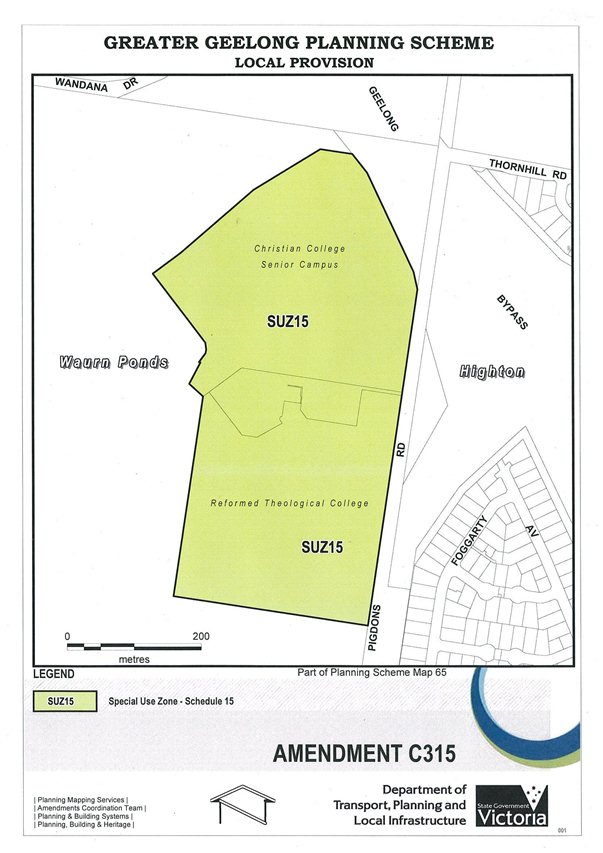
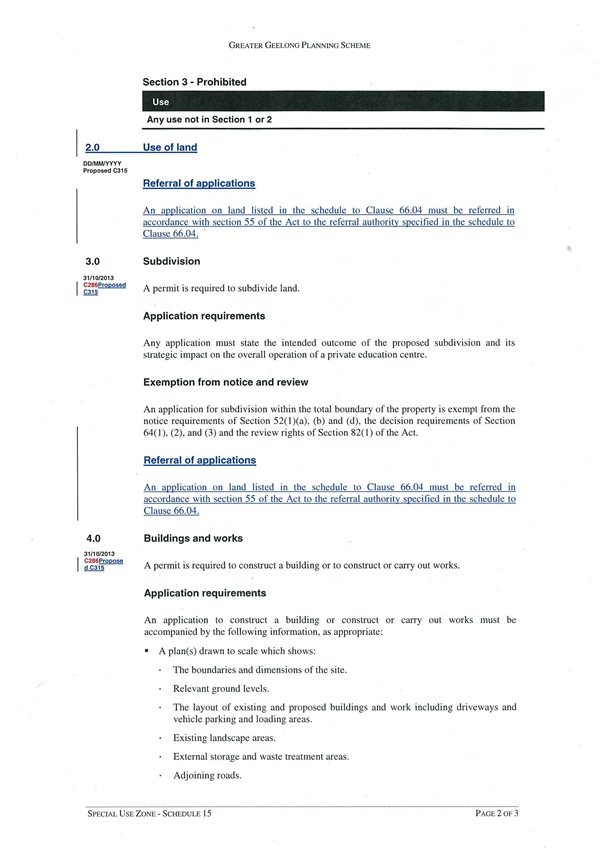
Amendment C315 proposes to rezone land at 125 - 135 from the Farming Zone to the Special Use Zone (15) for Private Education Centre.
The Amendment has been initiated by Fadgyas Planning Associates Pty Ltd on behalf of the Reformed Theological College and Christian College.
The Amendment has been undertaken to align the existing long-standing use of the land with the appropriate Schedule to the Special Use Zone of the Greater Geelong Planning Scheme.
Council was advised by letter dated 26th November 2014 that this Amendment was exempted pursuant to section 20(2) of the Planning and Environment Act 1987, from notice requirements, of Section 19 of the Act, other than the requirements of section 19(1)(c).
Limited exhibition of the Amendment to the Ministers prescribed in section 19(1)(c), resulted in one submission, from the Minister administering the Pipelines Act 2005, suggesting changes to the amendment. Changes consistent with the intent of the submission have been incorporated as part of this report and recommendation.
The Amendment is consistent with Council planning policy and is considered to be an appropriate response to the education needs of the region.
As there are no unresolved submissions the Amendment can be adopted with no need to refer to an independent panel.
Cr Heagney moved, Cr Nelson seconded -
That Council solves to:
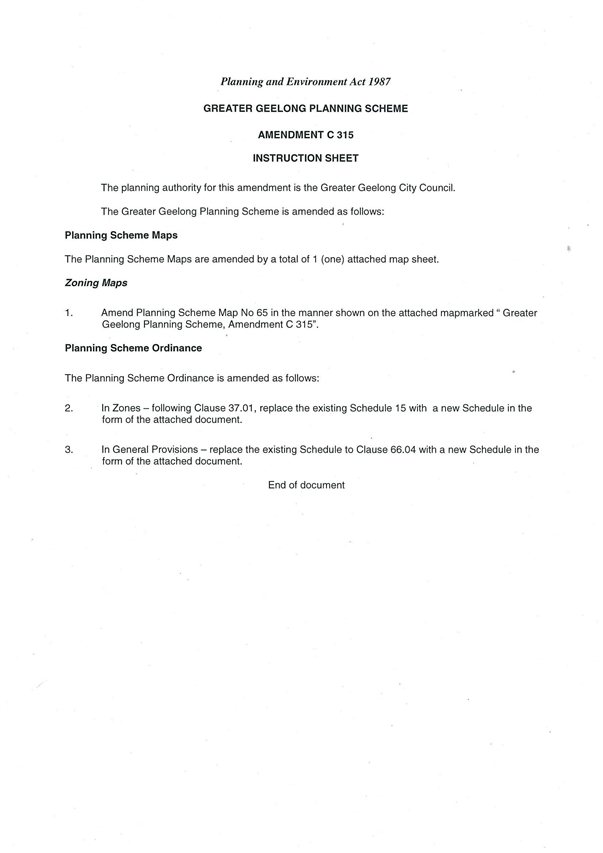
adopt Amendment C315 in the form as outlined in Appendix 2 of this report; and
submit the adopted Amendment with the prescribed information to the Minister for Planning requesting approval.
Carried.
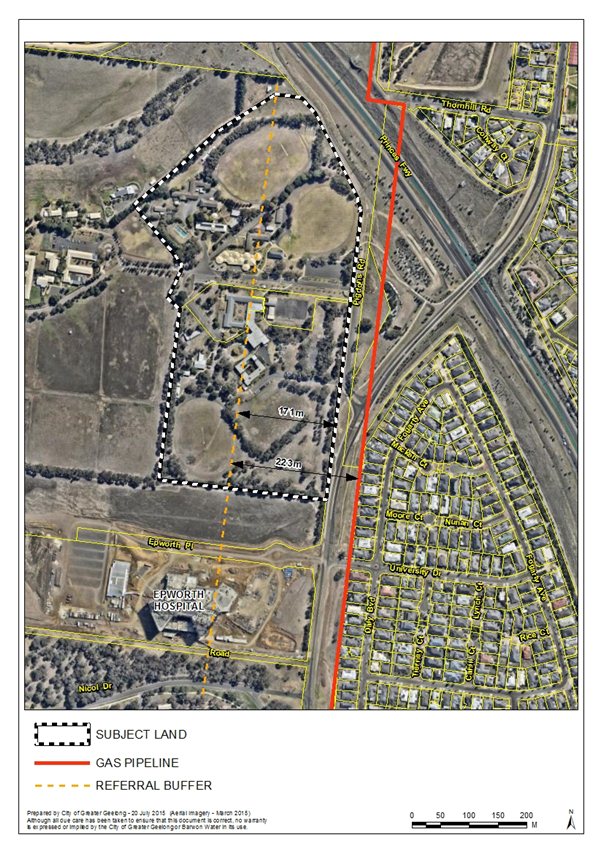
Amendment C315 has been requested by the Reformed Theological College and Christian College. Appendix 1 shows the subject land.
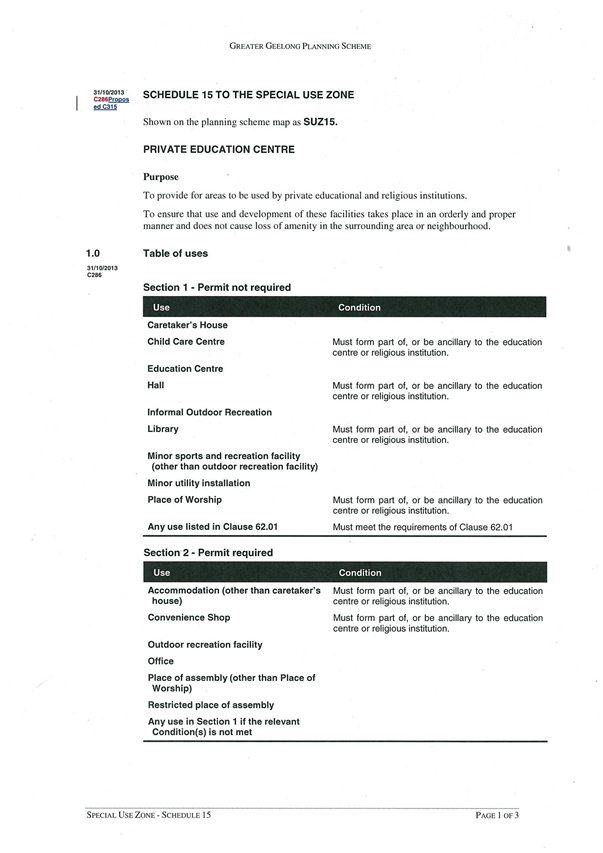
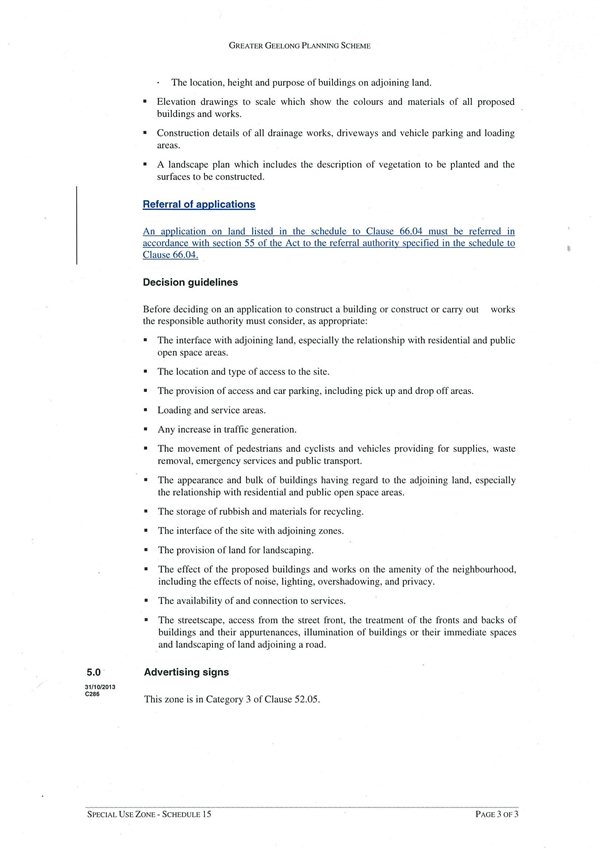
The amendment proposes to apply Schedule 15 to the Special Use Zone, which provides for private education centres, to the land, with changes to address the matters raised by the Minister administering the Pipelines Act 2005.
Schedule 15 to the Special Use Zone provides a range of use and development options that are appropriate for a Private Education Centre.
The amendment will:
Ensure that the long standing existing use and development of both the Reformed Theological College and Christian College is appropriately recognised and safeguarded by inclusion in a specific schedule for private education uses, and
Ensure that the provisions/controls in the Schedule reflect the use of the site for educational and ancillary/compatible activities.
The land to be re-zoned is located on the western side of Pigdons Road, immediately south of the Geelong Ring Road. To the south of the Reformed Theological college is the new Epworth Private Hospital, which is presently under construction, and is located in Schedule 14 to the Special Use Zone.
To the south of the Epworth Hospital is the Waurn Ponds campus of Deakin University, which is located in the Schedule 2 to the Public Use Zone, (PUZ2).
Both the Reformed Theological College and Christian College are long standing existing uses on the land, which pre-date the re-zoning of the land to Rural Zone – now Farming Zone – with the introduction of the Victoria Planning Provisions (VPP) based planning scheme. Prior to the introduction of the VPP based planning scheme the land was zoned for Special Use, generally equivalent to the schedule to the Special Use Zone which is now proposed to be applied to the land.
While both Colleges enjoy existing use rights under Clause 63 of the Scheme, the Farming Zone is limited in the discretionary uses available and education facilities (both use and development) are prohibited. Hence it is seen as appropriate to apply to both Colleges the schedule to the Special Use Zone which is designed to cater for private education institutions.
In accordance with the directions of the Regional Manager, Planning and Development Barwon South West Region, Regional Development Victoria, limited notice of Amendment C315 was given to the following prescribed Ministers:
the Minister administering the Conservation, Forests and Lands Act 1987;
the Minister administering the Catchment and Land Protection Act 1984;
the Minister administering the Sustainable Forests (Timber) Act 2004;
the Minister administering the Mineral Resources (Sustainable Development) Act 1990; and
the Minister administering the Pipelines Act 2005.
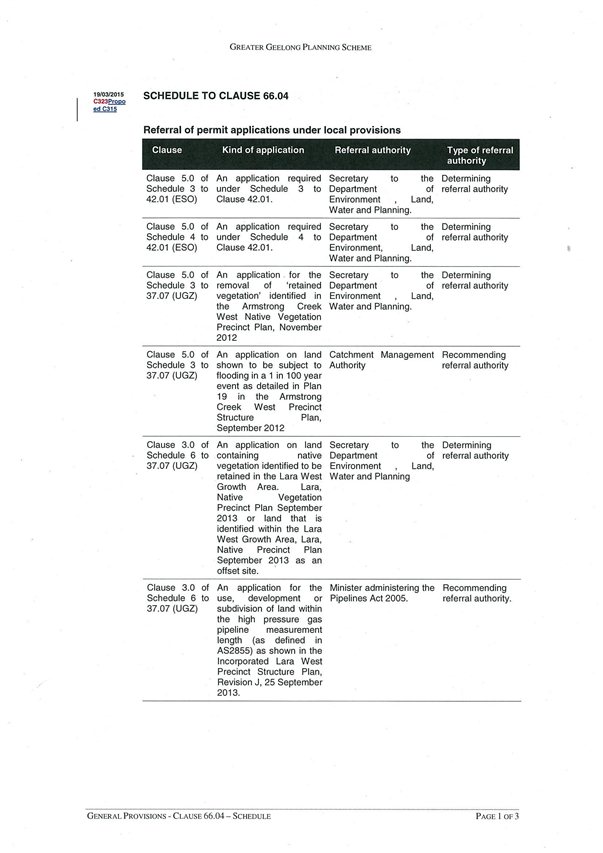
Following Exhibition a submission was received on behalf of the Minister administering the Pipelines Act 2005, indicating that the amendment was not supported in the exhibited form, due to the presence of a gas transmission pipeline on the eastern side of Pigdon’s Road, opposite the land to be re-zoned.
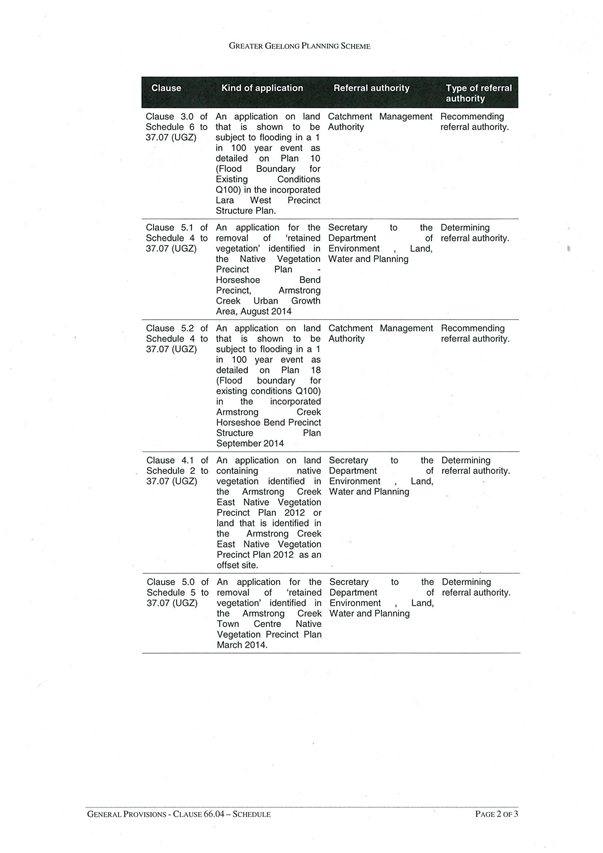
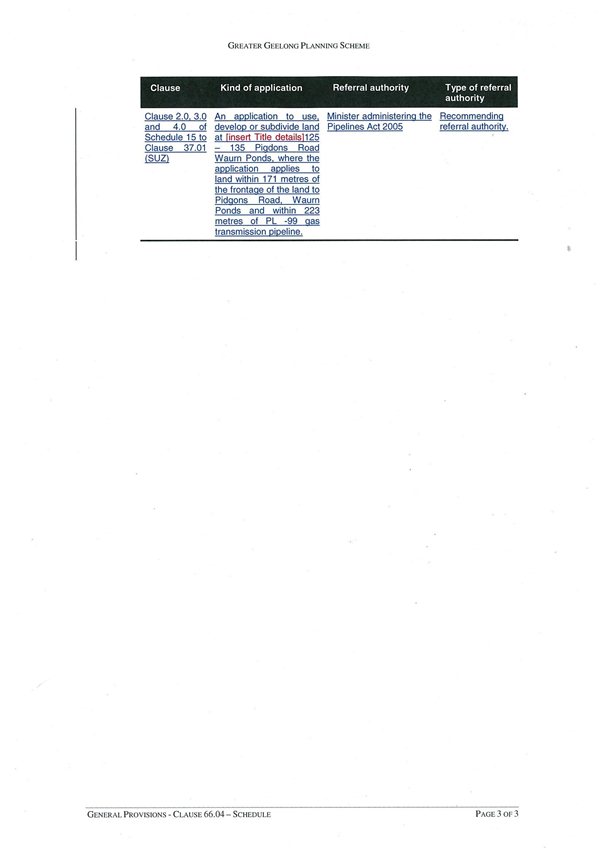
Following discussions with the officers of the Earth Resources Regulation unit of the Department of Economic Development, Jobs Transport and Resources (DETJTandR) and employees of Ausnet Services, which operates the pipeline, the Amendment was supported, subject to changes to both Schedule 15 to the Special Use Zone and Clause 66.04, which specifies the circumstances in which permit applications are required to be referred to referral authorities. The amendment to be adopted, see Appendix 2, contains the changes agreed to with DETJTandR.
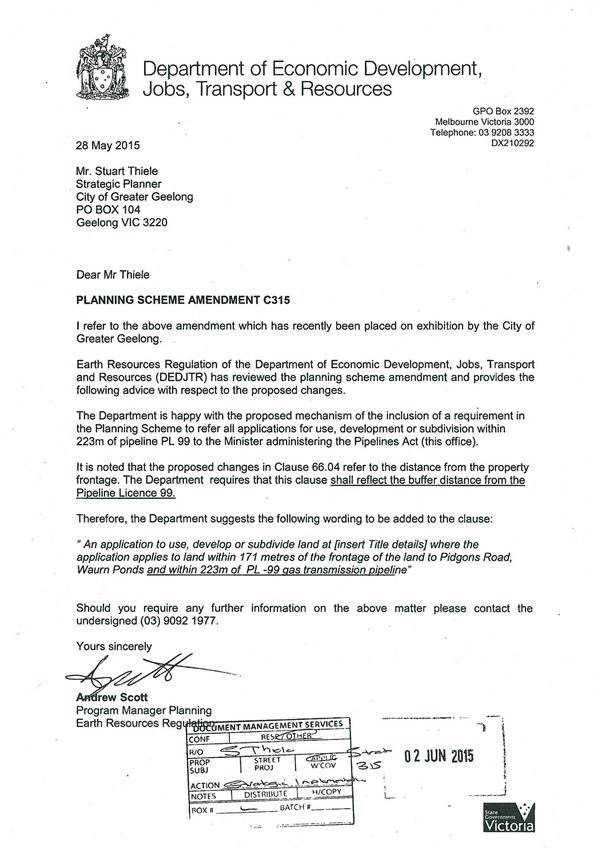
Correspondence was received from DETJTandR confirming that the alterations to the amendment, as now proposed to be adopted addressed the concerns initially expressed on behalf of the Minister administering the Pipelines Act 2005, see Appendix 3.
As the only submission which was received has been resolved Council is now able to adopt the amendment and forward it to the Minister for Planning seeking approval.
No adverse environmental consequences have been identified as arising from this proposal.
It is not expected that the proposal will result in any financial implications for Council.
The proposal supports the planning policy framework and will allow for the expansion of educational services for which there is a growth in demand in Geelong.
The Amendment supports the ‘Community wellbeing’ and ‘Sustainable built and natural environment’ strategic directions of City Plan.
No Council Officers involved in the preparation of this Report have any direct or indirect interest, in accordance with Section 80 (c) of the Local Government Act to which this amendment relates.
No significant risks have been identified as being associated with implementing the recommendation contained in this report.
The amendment is seen as being positive in terms of social effects. Both the Reformed Theological College and Christian College already exist on the land. The amendment will provide the framework that acknowledges the use on the site, and provides for increased certainty for the longer-term development of both institutions.
The amendment will not impact on basic human rights, freedoms and responsibilities as set out in the Charter. Planning legislation provides for the exemptions to the usual consultation process for amendments, which the Minister for Planning duly granted.
Limited exhibition of the Amendment, to Ministers specified in Section 19(1)(c) of the Planning and Environment Act, 1987, was undertaken in accordance with the direction under delegation from the Minister for Planning, as set out in correspondence from the Regional Manager, Planning and Development Barwon South West Region, Regional Development Victoria, dated 26 November, 2014.
Portfolio: |
Planning - Cr Heagney |
Source: |
Planning Strategy and Urban Growth |
General Manager: |
Peter Bettess |
Index Reference: |
Project: North of Portarlington Road, Leopold |
The purpose of this report is to present the findings of the Leopold Land Capability and Bay Access report, prepared by Spiire consultants, in response to a direction in the Leopold Structure Plan 2013.
The Leopold Structure Plan includes a direction to investigate public access to the Bay.
Council resolved at its meeting of 13 December 2013 to undertake a broad land capability analysis of rural land around Leopold to investigate where urban development could be directed in any future structure plan review and to assist in providing direction in relation to realising public access to the bay. The project scope was subsequently refined in June 2014 to focus on land north and west of Leopold.
Spiire consultants were appointed to undertake the land capability analysis and Bay access project. The final report was received in July 2015 (See Appendix 1 – previously distributed with briefing papers).
The technical report has found that public access to the foreshore within the Study Area is difficult to achieve without some form of enabling development.
Physical access (e.g. a boat ramp or beach foreshore access) is not appropriate due to significant environmental constraints, coastal processes, multiple private landownership up to the high water mark, construction and maintenance cost and no identified need for physical infrastructure.
Passive access (e.g. an area of public open space or linear trail network) set back from the future coastline, is considered the most appropriate form of Bay access. This would be best delivered through some form of development in the Study Area.
The technical report has identified that within the Study Area there are two ‘potentially developable areas’, which includes land north and south of Portarlington Road. Land north of Portarlington Road comprises approximately 96 hectares and land south of Portarlington Road approximately 42 hectares (See Appendix 2 –previously distributed with briefing papers).
The two ‘potentially developable areas’ are affected by a number of constraints including significant drainage and flooding issues, future coastal sea level rise, environmental, traffic and access constraints.
Any future development in the Study Area would require a holistic approach to addressing known constraints. Development is likely to need significant funding for key infrastructure and would need to provide access to the Bay.
Council’s current policy prohibits urban development north and west of Portarlington Road.
The Land Capability Analysis will be used to inform the next review of the Leopold Structure Plan, which is due to be undertaken in 2017/2018, and to provide direction to the development industry about the opportunities in Leopold.
For Council to support urban development within the Study Area, a significant shift in planning policy would be required.
Cr Heagney moved, Cr Macdonald seconded -
That the report be deferred.
Carried.
Portfolio: |
Environment and Sustainability - Cr Richards |
Source: |
Planning Strategy and Urban Growth |
General Manager: |
Peter Bettess |
Index Reference: |
Subject: Future Proofing Geelong |
This report provides an overview of the Low Carbon Growth Plan for Geelong 2015 Update and the Future Proofing Geelong Impact Statement 2011-2014 and current work of Cleantech Innovations Geelong. The report recommends that Council note the findings in both documents and Future Proofing Geelong’s work on actions that facilitate: energy efficiency retrofitting in commercial buildings, developing the market for clean technologies, and sustainable living in the residential sector.
Future Proofing Geelong is a grouping of business, government and community leaders working together towards a more sustainable, liveable and productive Geelong.
The Low Carbon Growth Plan for Geelong was published in 2011. It identified key opportunities to transition Geelong’s economy towards a low carbon future while achieving positive economic and social benefits.
Future Proofing Geelong has focussed on the three key directions recommended by the Low Carbon Growth Plan by; engaging with commercial building owners and tenants to encourage them to undertake energy efficiency measures, engaging with the community to promote awareness and to provide advice about energy efficient housing, and to engage with business and industry to transition the local economy to a low carbon future.
The Update to the Low Carbon Growth Plan for Geelong has identified actions to achieve a potential carbon emissions reduction of 22 per cent by 2020.
The Update notes that the closure of some local industries has resulted in a reduction of 41 per cent to the forecast 2020 emissions predicted in the Low Carbon Growth Plan in 2011.
The Update notes that further reductions, by nearly 25%, are achievable, with energy efficiency measures presenting the lowest cost option and opportunities in commercial and residential buildings representing the greatest share, with one third of the total emissions reductions identified. It recommends that consideration of long term emission reduction goals need to be incorporated into Geelong’s strategic planning.
Cr Richards moved, Cr Harwood seconded -
That Council note the findings of the Low Carbon Growth Plan for Geelong 2015 Update; the Future Proofing Geelong Impact Statement 2011-2014; and Future Proofing Geelong’s work on actions that facilitate energy efficiency retrofitting in commercial buildings, developing the market for clean technologies, and sustainable living in the residential sector.
Carried.
The Low Carbon Growth Plan for Geelong was published in 2011 is included in Appendix 1. It identified key opportunities to transition Geelong’s economy towards a low carbon future while achieving positive economic and social benefits. These key opportunities included:
Localised power generation through cleaner technologies such as cogeneration, solar, waste to energy and geothermal;
Retrofitting residential and commercial buildings to maximise energy efficiency; and
Supporting local small and medium sized businesses to capture energy efficiency savings and abatement potential.
The focus of Future Proofing Geelong has been to promote and support new and existing initiatives from business, industry, the community and government that seek to improve environmental, social and economic outcomes for Geelong. Initiatives that lead to jobs, skills development and business development, will further enhance the prosperity of Geelong for future generations.
Following the expiry of the Sustainability Covenant, which united the partners of Future Proofing Geelong from 2011-2014, a Memorandum of Understanding (MOU) was signed in late 2014 to further cement a three-year partnership to deliver the objectives of Future Proofing Geelong. The partners (signatories) to this MOU include: the City of Greater Geelong, the Geelong Manufacturing Council, Deakin University, the Geelong Chamber of Commerce, Barwon Water, the Committee for Geelong, Barwon Health, Geelong and Region Trades and Labour Council, The Gordon and the Barwon South West Waste and Resource Recovery Group. The parties are represented as an Advisory Board chaired by Cr Richards and which involves the Mayor and Councillors Macdonald, Harwood and Ellis.
An Impact Statement for Future Proofing Geelong was prepared in 2014 to record outcomes between 2011 and 2014, against the original Low Carbon Growth Plan. It identified emission reduction outcomes and significant opportunities.
We have moved from broad awareness raising and engagement across all sectors to focus on deeper engagement to catalyse action in three key areas: commercial buildings, community and industry;
60% of the carbon emissions reduction opportunities identified were from buildings, and progressing these opportunities was a major focus, alongside clean technology and community engagement;
We have secured over $2 million worth of funding for projects which create sustainable jobs, expand businesses, and improve energy and waste efficiency;
Engagement with commercial building owners/tenants has resulted in nearly $500,000 of energy efficiency upgrades implemented (or in progress) reducing carbon emissions by almost 800 tonnes (equivalent to nearly 3,000 one way flights between Melbourne and Perth); and
Working with the community has delivered 137 events with nearly 26,000 participants.
The Future Proofing Geelong Impact Statement 2011-2014 is in Appendix 2.
The results in the Impact Statement 2011-2014 point to significant progress been made in establishing Geelong as a more liveable, productive and sustainable city. This work continues to bring benefits to the Geelong community; creating sustainable jobs, building skills and expanding businesses.
The success of Future Proofing Geelong and the early benefits identified in the Impact Statement 2011-2014, highlight the significant role of the MOU partners and their willingness to champion such a significant initiative. This partnership has harnessed a ground swell of community, business and industry support to deliver the commitments of the Low Carbon Growth Plan for Geelong. The Future Proofing Geelong team has played a significant role in the implementation of the Low Carbon Growth Plan for Geelong recommendations, highlighting the importance of Local Government’s role in this initiative and the long-term gains that can be made in the Geelong community over the coming decades.
The Low Carbon Growth Plan for Geelong 2015 Update identified future opportunities to be explored in Geelong including a more collaborative approach by partnering with other Councils possibly on the procurement of energy, continued approaches to State and Federal Government to secure assistance for businesses and industries which can diversify the economy to a low carbon future and continued work with Cleantech Innovations Geelong.
Cleantech Innovations Geelong is an alliance of business, industry, academia and non-government organisations looking to develop markets for clean technologies. The aim is to establish Geelong as a Centre of Excellence for cleantech in Australia, by attracting investment, creating jobs and building skills. Clean Technology includes economically viable products, services and processes that harness renewable materials and energy sources, dramatically reduce the use of natural resources and cut or eliminate emissions and wastes.
Since its launch in 2013, Cleantech Innovations Geelong has provided a focus for businesses in Geelong looking to establish their next generation of innovation. A market analysis has shown that the growth areas in cleantech include clean cities, renewables, energy efficiency, waste management and recycling, water, green buildings, biomaterials and bio fuels. The multiplier effect of cleantech jobs is that for every job created, anywhere between 2 to 6 peripheral jobs will be generated.
Cleantech Innovations Geelong facilitates a robust level of support to stimulate demand for cleantech goods and services, and develops the Geelong market to respond to this increased demand. Cleantech Innovations Geelong will improve the productivity and competitiveness of participating businesses and industry, by facilitating the delivery of strategically planned projects which secure market development opportunities. Projects have already been identified to support manufacturing and engineering, green buildings and environmental product and service providers.
The program is a partnership between the Geelong Manufacturing Council, the City of Greater Geelong and the Manufacturing Productivity Network Program (state government).
The work of Cleantech Innovations Geelong is overseen by an Advisory Board co chaired by CoGG and Geelong Manufacturing Council.
Future Proofing Geelong is delivering positive environmental outcomes through education and assistance to businesses and the wider community to improve energy, water and waste efficiency, and reduce carbon emissions.
Future Proofing Geelong is funded for $350,000 in the 2015/16 financial year to continue implementation of the MOU (dated 2014-2017) and therefore the recommendations of the Low Carbon Growth Plan for Geelong.
Future Proofing Geelong is a key program in delivering the outcomes of the recently adopted Environmental Management Strategy (EMS) for the City of Greater Geelong. Future Proofing Geelong is directly responsible for the implementation of seven actions in the EMS.
The Community Wellbeing strategic direction in City Plan identifies the need to build upon existing capacities in local communities. Future Proofing Geelong has provided a mechanism to facilitate collaboration across community groups committed to sustainability and to grow the capacity of these groups, and provide an aggregation of sustainability initiatives in the Geelong region.
Under the Growing Our Economy strategic direction, the priorities of supporting existing business and encouraging new and emerging growth sectors refers to the “support and encouragement of new and emerging low carbon industries and sectors” and “link local businesses with growth opportunities and government funding”. The Future Proofing Geelong program and specifically the Cleantech Innovations Geelong initiative under this program support this priority.
The Future Proofing program is directly involved in “proactively targeting and attracting new investment to Geelong and promoting our regions benefits” and being an “advocate for and support innovative and new technological initiatives”.
Under the Sustainable Built and Natural Environment, Future Proofing Geelong/Low Carbon Growth Plan is identified as a key strategy. Future Proofing Geelong delivers priorities under this direction to support our community to live sustainability, and advocate for and promote sustainable design and development.
No Council Officers have a direct or indirect interest in accordance with Section 80(c) of the Local Government Act in the issue to which this report relates.
There are no risks associated with this report.
The Future Proofing Geelong project has positive social impacts through community engagement, job creation and skills development.
This report has no impact on the human rights charter, however it is noted that the aims of Future Proofing Geelong support the human rights charter.
The Future Proofing Geelong website is regularly updated to showcase the work the City of Greater Geelong and other Future Proofing Geelong partners are doing to deliver the vision of the program, and to deliver the recommendations in the Low Carbon Growth Plan.
A communications plan exists for key deliverables within Future Proofing Geelong including the Sustainable Living Festival, the work with commercial building owners/tenants and Cleantech Innovations Geelong.
Geelong Cats footballer, Tom Lonergan, has agreed to be the Future Proofing Geelong Ambassador in May 2015. His first public appearance in this role was to launch the Low Carbon Growth Plan for Geelong 2015 Update.
Portfolio: |
Finance - Cr Lyons (Mayor), Cr E Kontelj and Cr Farrell |
Source: |
Planning and Tourism |
General Manager: |
Peter Bettess |
Index Reference: |
Development Contribution Plans - Governance |
As part of Council’s Development Contribution Governance Framework an annual report is to be presented to Council and the Audit Advisory Committee reporting on the income, expenditure and general performance of Development Contribution Plans over the past 12 months.
Council currently has seven (7) active Development Contribution Plans (DCPs) that facilitate the collection of development contributions and partly fund the delivery of essential projects within Council major growth area
A robust governance framework has been set up for the management and administration of these Development Contribution Plans with a particular emphasis on consistency, accountability, transparency and strategic focus.
Council’s DCPs require the delivery of approximately $482M in essential projects to service urban growth, with the current performance of these DCPs reflecting a remaining liability of approximately $437M and remaining income of approximately $415M expected over the next 15 - 20 years. This represents a current funding gap of approximately $22.5M.
The performance of Council DCPs during the 2014-15 financial year has seen $2.05M in income received (cash) and $19.80M in expenditure ($18.66M in developer works-in-kind projects and $1.14M in Council initiated projects).
The current delivery status of Council’s DCPs (whole of life) shows approximately 7% of projects have been completed for all active DCPs.
Development within Council’s major growth area, Armstrong Creek, has shown very strong development activity with dwelling activity currently at 57% above original forecasts. This highlights the importance of continued investment in key DCP projects to meet the needs of this growing community.
Cr Farrell moved, Cr E Kontelj seconded -
That Council notes the 12 month report on Development Contribution Plans and the current funding gap of approximately $22.5M over the next 15-20 years.
Carried.
Geelong is experiencing significant urban growth across the municipality and with this growth comes the need for delivering key infrastructure to service these new communities.
One of the key funding avenues to deliver this infrastructure is the use of development contributions, or more formally, the use of a Development Contribution Plan (DCP).
A DCP is an incorporated document within the planning scheme that allows Council to levy a charge upon a specific area / precinct of development in order to facilitate the delivery of future projects specifically required to service this area / precinct (e.g.: traffic lights, recreation reserves, community centres, etc).
Council’s DCPs require the delivery of approximately $482M in essential projects to service urban growth, with the current performance of these DCPs reflecting a remaining liability of approximately $437M and remaining income of approximately $415M expected over the next 15 - 20 years. This represents a current funding gap of approximately $22.5M.
Over the past five years the City of Greater Geelong has been implementing a detailed governance framework for the administration of DCPs. The framework is aimed at ensuring all DCPs are managed and administered in a strategic, consistent, accountable and transparent manner (Refer Appendix 1 – CoGG DCP Governance Framework).
A recognised component of the governance framework was the need to provide an annual report to Council detailing the performance of Council’s DCPs over the past financial year.
The report is aimed at summarising the following key features:
Income received
Works in Kind projects delivered by developers
Council expenditure on DCP projects
Land provided to Council (funded by a DCP)
Current funding gaps for DCPs
General DCPs and Growth Area activities
These themes are also consistent with the recommendations made by the Standard Development Contribution Advisory Committee responsible for recommending reforms within the State Government’s new development contributions system. This new system is planned for implementation in 2016.
Council has previously undertaken an external audit of its total DCP Governance Framework (Crowe Horwath, CoGG Management of Development Contributions, Nov 2013). The report provided positive feedback on the management of DCPs within the City of Greater Geelong.
During 2014-15 Council officers identified continuous improvement opportunities for the system and areas that would benefit from a formal internal audit on an ongoing basis.
The key improvement areas identified by officers include the communication of key DCP principles and financial obligations to Councillors and the community; the development of key performance indicators to assist with communication, reporting and decision making; and continued utilisation of a risk management approach to DCP administration.
In relation to the indexation performance of Council’s DCP Levies Appendix 4 – Development Contribution Plan Levies – Indexation Trends (4 years) shows the average annual increase of between 1.3% and 1.7% per annum for Council’s DCP Levies. A key factor in this variation is based on DCP levies being indexed via three separate indices for land, civil works and building projects.
DCP INCOME RECEIVED
Council currently has three DCPs generating income from either the Development Infrastructure Levy (DIL) or the Community Infrastructure Levy (CIL, $900 / dwelling), or both (refer Appendix 2 – DCP Summary Report).
The total income received across these three DCPs (Armstrong Creek East and West and Jetty Road) was $2.046M ($1.39M for DIL and $0.65M for CIL).
The total income received for all three DCPs since their approval is $4.96M.
DCP WORKS IN KIND PROJECTS
Works in kind projects are those projects delivered by developers in exchange for a credit against their developments DCP liability.
A total of six (6) works in kind projects were delivered either in full or in part during 2014-15; two being within the Armstrong Creek East Precinct (drainage / creek works) and four being within the Armstrong Creek West Precinct (intersection, shared paths and drainage works).
The credited value of these DCP projects was $18.30M. For a detailed breakdown refer Appendix 2 – DCP Summary Report.
DCP PROJECTS DELIVERED BY COUNCIL
Council has completed works associated with four (4) DCP projects during 2014-15, one of these being a land project detailed under the next section of this report (DCP Funded Land).
The remaining three projects include an intersection within the Armstrong Creek West Precinct (delivered in partnership with VicRoads as part of the construction of Baanip Boulevard), a set of pedestrian lights on Jetty Road (delivered in partnership with other Bellarine rail trail surfacing works) and the waterway improvement works along Griggs Creek.
Across these three projects, savings of $733,578 have been achieved as a direct result of strong strategic and proactive procurement processes. These savings can be reinvested back into the DCP to cover the cost to the Council of future over expenditure of other higher risk projects (e.g.: land acquisition projects).
The value of these DCP projects totalled $1.13M. For a detailed breakdown refer Appendix 2 – DCP Summary Report.
DCP FUNDED LAND
During 2014-15 only three land projects were undertaken within Council’s DCP growth areas (refer Appendix 2 – DCP Summary Report).
Two of these projects were land for drainage projects within the Armstrong Creek West Precinct (totally 1.219 hectares of unencumbered land, credited at $0.36M), while the third project only involved preliminary legal costs associated with compulsory acquisition of the Jetty Road North South Connector Road (Part A).
DCP FUNDING GAPS
A critical component of managing Council’s DCPs is a clear understanding of the funding gap associated with delivering Council’s legal obligations under the DCPs.
Council DCPs require the delivery of approximately $482M in essential projects to service urban growth. The current performance of these DCPs reflects a remaining liability of approximately $437M with remaining income of approximately $415M expected over the next 15 - 20 years.
Council’s total funding gap across all active DCPs is $23.7M, however due to project savings and the delivery of projects that require Council matching funds, this funding gap has now been reduced to $22.5M (as at 30 June 2015).
For a detailed breakdown of Council’s current liabilities and gap funding refer Appendix 3 - Development Contribution Plans - Whole of Life Remaining Liability, Income and Funding Gap.
DCP GROWTH AREAS – DEVELOPMENT ACTIVITY
Another important aspect of DCP management is understanding the development activity that supports the generation of income for the DCPs and also triggers the need for DCP projects that service these new communities.
The Federal Government’s 2011 census information is used as the basis to undertake long-term development and population forecasting for the City of Greater Geelong. This forecasting assists with the forward planning of DCP projects, particularly those requiring Council delivery.
Appendix 5 – Armstrong Creek Annual Dwelling Activity by Suburb (Compared to forecast) illustrates the development activity within the City’s major growth area, Armstrong Creek. The table highlights the need for strong financial planning and early infrastructure investment to ensure Council delivers DCP projects are required under the DCP (e.g.: facilities like community and recreation facilities, land projects to facilitate other projects and in some case drainage projects required to unlock / service fragmented development fronts).
The table in Appendix 5 shows the Armstrong Creek growth area (ie: the two active suburbs of Armstrong Creek and Mt Duneed) are delivering dwellings at 57% above that forecast for the 2012/13 to 2014/15 period (i.e.: projected dwellings of 1,019 versus actual dwellings 1,603). This is 146 additional dwellings per annum above the dwelling forecast for the same period.
The Jetty Road growth area has seen dwelling activity relatively consistent with the forecast for the area.
GENERAL DCP PROGRESS REPORT
Jetty Road Urban Growth Area Stage 1
The Jetty Road development (a.k.a. Curlewis Growth Area) is significantly advanced with the Curlewis Parks estate nearing completion. Another four developments are also well underway.
Council has constructed the Bellarine rail trail pedestrian lights at Jetty Road and partial works for the Griggs Creek Rehabilitation and Revegetation.
Council has received Community Infrastructure Levies for 97 lots during 2014/15 (with 126 being received in 2013-14).
Armstrong Creek East Precinct
The Armstrong Creek East Precinct’s main developer, Warralily, is progressing development on multiple fronts on Barwon Heads Road and Surf Coast Hwy.
Warralily is continuing to provide the Armstrong Creek drainage and waterway improvement works between Barwon Heads Road and Surf Coast Highway to offset its DCP liabilities. An additional two estates, Horizon Cover and Armstrong Waters, are also progressing development to the west of Barwon Heads Road.
Council has received Community Infrastructure Levies for 406 lots during 2014/15 (with 449 being received in 2013-14)
Armstrong Creek North East Industrial Precinct
The Armstrong Creek North East Industrial Precinct Development Contribution Plan was approved in 2010. Development is yet to commence in this precinct.
Armstrong Creek West Precinct
The Armstrong Creek West Precinct’s main development Armstrong Mt Duneed estate has continued development west of Surf Coast Highway. As part of offsetting its DCP liabilities it has constructed the intersection at Surf Coast Highway and Burvilles Road and a shared path along Sovereign Drive. The developer is also continuing to provide the Armstrong Creek waterway improvement and drainage works between Surf Coast Highway and Sovereign Drive.
As part of the Armstrong Creek West DCP, Council has completed construction of the intersection at Baanip Boulevard and Sovereign Drive.
Council has received Community Infrastructure Levies for 224 lots during 2014/15 (with 71 being received in 2013-14).
Lara West Growth Area
Amendment C285 - Lara West Growth Area DCP was approved by the Minister for Planning on 17 July 2014. The first development, Manzeene Village, will commence development during 2015/16.
Armstrong Creek Town Centre Precinct
Amendment C267 Armstrong Creek Town Centre Development Contributions Plan was approved by the Minister for Planning on 23 October 2014. The DCP includes eight intersections, shared paths, drainage works and contribution towards the construction of a Regional Library. Development is expected to commence in 2016-17 financial year.
Horseshoe Bend Precinct
Amendment C259 Armstrong Creek Horseshoe Bend Development Contribution Plan was approved by the Minister for Planning on 27 November 2014. The Horseshoe Bend DCP includes active open space, intersections, drainage works and community centres. Development is expected to commence in 2015-16 financial year.
There are no significant environmental impacts as a result of the management and administration of Council DCP system.
One of the main features of the development contributions system is to ensure that new development funds essential infrastructure required to service these new communities.
The system is also setup to ensure these new development doesn’t create an unfair burden on the existing community. Therefore it is important to recognise the $22.5M funding gap in DCP projects and ensure these funds are included in Council long-term financial plan and various funding strategies are put in place to secure these funds when required with minimal impact to the existing community.
The report has been prepared to reflect Council’s obligations under the Victorian Local Government Act (1989) and Planning and Environment Act (1987).
The report supports the How We Do Business strategic direction of City Plan, in particular the priority of ‘responsible and sustainable financial management.
There is no direct or indirect officer conflict.
As part of the Governance Framework a detailed risk assessment has been undertaken to capture the management of development contribution within Council. Key risks have been recorded on Council corporate risk register, while lesser risks have been included as part of the DCP administration process / procedures.
Some of these risks include failure to delivery infrastructure projects; over expenditure on DCP projects; and early claims for property purchase / compensation.
There are no significant social impacts as a result of the management and administration of Council DCP system.
Council officers have taken into consideration the Human Rights Charter relative to the subject matter of this report.
A summary of the report has been included in the draft City of Greater Geelong 2014-15 Annual Report.
Portfolio: |
Sport and Recreation - Cr Irvine |
Source: |
Projects, Recreation and Central Geelong - Sport and Recreation |
I/General Manager: |
Jenny McMahon |
Index Reference: |
Subject: Sport and Recreation Grants and Funding -Incoming |
The purpose of this report is to inform Council of sport and recreation infrastructure projects funded (or part funded) by the State Government following commitments made prior to the last state election.
To seek Council endorsement of these projects and to confirm Council’s financial contribution as documented in Council’s four year Strategic Resource Plan.
The State Government of Victoria has confirmed seven (7) pre-election commitments to various sporting infrastructure projects within the City of Greater Geelong.
The State Government commitments provide an additional income to Council totalling $5,635,000.00 towards community sporting infrastructure.
Two (2) of the seven (7) commitments have a Council allocation in the current financial year (2015/16), they are:
Geelong Soccer Club – Soccer Pavilion Upgrade
Leopold Memorial Recreation Reserve – Pavilion Upgrade
Five (5) of the seven (7) commitments require no further financial contribution from Council, they are:
Barwon Heads Football Netball Club Facility Upgrade
South Barwon Football Club – Oval and Sports Lighting
Barwon Heads Village Park – Spectator Viewing Area
Geelong Soccer Club – Soccer Pavilion Upgrade
Shell Road Reserve Improvement
Two (2) of the seven (7) commitments are contingent on a forward commitment of funding by Council, including:
The Drysdale Sports Precinct – Stage 1 Development - $3,226,000.00
Leopold Memorial Recreation Reserve – Pavilion Upgrade - $500,00.00
Cr Macdonald moved, Cr Ellis seconded –
That Council:
Note the State Government’s financial commitment to:
The Drysdale Sports Precinct – Stage 1 Development
Leopold Memorial Recreation Reserve – Pavilion Upgrade
Barwon Heads Football Netball Club - Facility Upgrade
South Barwon Football Club – Oval and Sports Lighting
Barwon Heads Village Park – Spectator Viewing Area
Geelong Soccer Club – Soccer Pavilion Upgrade
Shell Road Reserve - Improvements
Enter into funding agreements with the State Government of Victoria for these projects.
Confirm Council’s forward financial commitment for the Leopold Memorial Recreation Reserve project in accordance with the four year Strategic Resource Plan as published in the adopted 2015/16 Budget.
Confirm and bring forward Council’s financial commitment to the Drysdale Sporting Precinct project from 2017/2018 to 2016/2017 to allow this project to be delivered as soon as possible.
Request from the State Government that the election commitment funding for the Drysdale Sporting Precinct be released as early as possible to expedite the commencement of the project.
Carried.
The State Government of Victoria has confirmed funding for seven (7) sporting infrastructure projects following commitments made prior to the last state election.
These projects include:
The Drysdale Sports Precinct – Stage 1 Development
Leopold Memorial Recreation Reserve – Pavilion Upgrade
Barwon Heads Football Netball Club - Facility Upgrade
South Barwon Football Club – Oval and Sports Lighting
Barwon Heads Village Park – Spectator Viewing Area
Geelong Soccer Club – Soccer Pavilion Upgrade
Shell Road Reserve - Improvements
The State Government has requested further information from Council to confirm these projects are ready to proceed prior to entering into agreements.
A further financial contribution from Council is required for two of the listed projects. Funding from the State Government for these two projects is contingent upon the Council funds being confirmed.
The projects along with the required Council contribution, if applicable, are listed below:
Project: Drysdale Sports Precinct – Stage 1 Redevelopment
Project description: Construction of sporting field(s) and supporting infrastructure including car parking, sports lighting and pavilion facilities at the Drysdale Sports Precinct Site.
Total project cost: $6,726,000
State Government commitment: $3,500,000
Council 2015/16 budget: Nil
Council contribution required in 2017/2018: $3,226,000 - in accordance with the four year Strategic Resource Plan as published in the adopted 2015/16 Budget.
Project: Leopold Memorial Recreation Reserve Pavilion Upgrade
Project description: Construction of new netball change rooms, two netball courts with sports lighting to training standards and upgrade to the existing pavilion.
Total project cost: $2,545,000
State Government commitment: $1,500,000
Council 2015/16 budget: $445,000 (carry over 2014/15)
State Government Sport and Recreation Victoria (SRV) Country Football Netball Grant for 2015/16: $100,000
Council contribution required in 2016/2017: $500,000 - in accordance with the four year Strategic Resource Plan as published in the adopted 2015/16 Budget.
Project: Geelong Soccer Club Pavilion Upgrade
Project description: Redevelopment of the pavilion and change facilities at the Stead Park soccer facilities. The project scope is dependent on a proposed sponsorship to be negotiated by the club.
Total project cost: $750,000
State Government commitment: $100,000
Council budget allocation 2015/16: $250,000
Proposed club sponsorship amount: $400,000 (unconfirmed)
Council contribution required: Nil
Project: Barwon Heads Football Netball Club Facility Upgrade
Project description: The Barwon Coast Foreshore Committee has committed to managing this project. Council will act as an auspice for the funding agreement only.
Total project cost: $225,000
State Government commitment: $225,000
Council contribution required: Nil
Project: South Barwon Football Netball Club Oval and Lighting Upgrade
Project description: This project involves new sports lighting to Australian Standards, a new electronic scoreboard and landscaping to provide improved spectator viewing including a terraced area, new coach’s boxes and improved accessibility to the sporting ground.
Total project cost: $180,000
State Government commitment: $150,000
State Government Sport and Recreation Victoria (SRV) Local Facilities for Local Clubs program: $30,000 (confirmed)
Council contribution required: Nil
Project: Barwon Heads Village Park (Cricket) Improved Spectator Viewing Area
Project description: Improved spectator shade at Barwon Heads Cricket Club (Barwon Heads Village Park). Specific project details are unknown, further scoping is required.
Total project cost: $100,000
State Government commitment: $100,000
Council contribution required: Nil
Project: Shell Road Reserve Improvements
Project description: Council received a State Government grant of $100,000 towards an electronic scoreboard for Shell Road Reserve prior to the 2014 election. A further commitment of $60,000 was made to this project by the State Government, with funds to be made available in the 2016/17 financial year.
The Ocean Grove Football Netball Club (OGFNC) has indicated that the scoreboard must be delivered by the start of the 2016 football season using the existing $100,000 grant. The remaining $60,000 is proposed to be used for construction/installation of sport and recreation infrastructure relating to the use of Shell Road Reserve. The project scope will be determined in consultation with the OGFNC.
Total project cost: $60,000
State Government commitment: $60,000
Council contribution required: Nil
The above projects are summarised in table format see Attachment 1.
There are no foreseeable environmental implications associated with this report; all projects developed will include environmentally sustainable design initiatives.
The State Government commitments provide an additional income to Council totalling $5,635,000.00.
Two (2) of the seven (7) commitments have a Council allocation in the current financial year (2015/16), they are:
Geelong Soccer Club – Soccer Pavilion Upgrade
Leopold Memorial Recreation Reserve – Pavilion Upgrade
Five (5) of the seven (7) commitments require no further financial contribution from Council, they are:
Barwon Heads Football Netball Club Facility Upgrade
South Barwon Football Club – Oval and Sports Lighting
Barwon Heads Village Park – Spectator Viewing Area
Geelong Soccer Club – Soccer Pavilion Upgrade
Shell Road Reserve Improvement
Two (2) of the seven (7) commitments are contingent on a forward commitment of funding by Council, including:
The Drysdale Sports Precinct – Stage 1 Development - $3,226,000.00
Leopold Memorial Recreation Reserve – Pavilion Upgrade - $500,00.00
The Council contributions requested are in accordance with the four year Strategic Resource Plan as published in the adopted 2015/16 Budget.
To secure funding connected with the State Government commitments, Council will need to enter into agreements which require contributions for the Drysdale Sports Precinct and Leopold Memorial Recreation Reserve Projects.
There are no other legislative or legal ramifications associated with the adoption of this report.
The State Government commitment projects align to the City Plan’s priority of Community Wellbeing, encouraging healthy lifestyles and connected communities through active recreation and participation in sport.
There are no officer conflicts of interest relating to the project being proposed for submission or this report.
There are no immediate risks associated with this report. A component of the project will entail relevant risk management and OHandS.
The expected population growth within the municipality necessitates the increased and improved provision of community sport facilities which provide a social outlet for the local community.
Participation in sport and recreational activities has long been recognised as an important contributor to community health and well being. Benefits of physical activity are well documented and include improved health, development of social skills, increased community connectedness and enhanced self-esteem.
This report has no impact on human rights.
Council officers will communicate and consult directly with sporting clubs to ensure the efficient delivery of State Government commitments that aligns with funding availability.
Portfolio: |
Sport and Recreation – Cr Irvine |
Source: |
Projects, Recreation and Central Geelong / Sport and Recreation |
I/General Manager: |
Jenny McMahon |
Index Reference: |
Property #214458 Simonds Stadium |
The purpose of this report is to seek Council’s approval for the capital development of Simonds Stadium (Stage 4) as land manager for the site.
To resolve Council’s consideration of a financial contribution to the capital development of the Simonds Stadium (Stage 4).
To consider the request from the Kardinia Park Trust for an annual contribution of $1.5M to support ongoing operations at the site.
Council as the current land manager of Kardina Park is required to provide consent for the Simonds Stadium (Stage 4) development to proceed. The Department of Environment, Land, Water and Planning (DELWP) is the land owner.
The Geelong Football Club has sought a $6M contribution from Council for the development of Simonds Stadium (Stage 4). The Stage 4 development will see the replacement of the Jennings and Brownlow stands and increase the stadium’s capacity by 2,500-3,000 patrons.
The $6M contribution has not been accounted for in Council’s Strategic Resource Plan. Should Council resolve to fund the project, it could be achieved via one or a combination of the following means:
Borrowings – this would exceed Council’s self-regulated borrowings limit.
Rate Increase – this would require a variation under a rate capping regime with the result unknown.
Review Capital Works Prioritisation – the deletion or deferral of community projects from the Strategic Resource Plan.
Project Future Savings – the exit of Council’s operations from Kardinia Park will create savings of an unknown amount.
The Kardinia Park Trust Working Group chaired by Steve Bracks has sought from Council an ongoing $1.5M annual operational contribution to support the Trust’s operations.
The formation of the Kardinia Park Trust and the extent of its responsibilities will not be know until the enacting legislation is put through parliament later this year.
Cr E Kontelj moved, Cr Irvine seconded -
That Council:
As land manager, approve the development of Simonds Stadium (Stage 4) subject to :
the State Government of Victoria agreeing to take ownership of the new stand, including asset and maintenance obligations;
the State Government of Victoria accepting financial liability for any works triggered as a consequence of the development within the broader parklands and internal road network;
the reinstatement of Legends Plaza to the satisfaction of Council; and
all additional costs associated with delivering events in the venue over the construction period, being borne by the project.
Agrees in principle to commit up to $6M to the Stage 4 Simonds Stadium development and authorises the CEO to sign funding agreements with the Geelong Football Club for up to $6M, conditional on the following, that:
the payment is not due until the conclusion of the 2017/2018 financial year;
the State Government enters into an agreement with Council agreeing that the State Government will:
assume management and operations of Simonds Stadium and Kardinia Park;
absolve and indemnify Council of any ongoing financial contributions to the operation and management of Simonds Stadium and Kardinia Park;
Council, the Geelong Football Club and State Government enter into a sponsorship agreement that recognises Councils contribution to the Project.
Supports the staged implementation of the Kardinia Park Trust Working Group and authorises the CEO to:
enter into negotiations with the Victorian State Government and Kardinia Park Trust to transition operations;
decline the request for continued operational funding for the Trust; and
report back to Council on negotiations prior to the conclusion of the calendar year.
Carried Unanimously.
Council is currently the Committee of Management for Kardinia Park under the Geelong (Kardinia Park) Land Act 1950. As Committee of Management, Council must approve any developments on site prior to seeking consent from the Crown or the Department of Environment, Land, Water and Planning (DELWP). This Committee of Management role also places a set of obligations upon Council for the management, improvement and maintenance of the reserve.
Simonds Stadium via the Geelong Football Club (GFC) was successful in the last Victorian State Election in securing a $75M commitment to replace the Jennings and Brownlow stands.
The replacement of these stands continues the redevelopment of Simonds Stadium, which commenced in 2003. The City of Greater Geelong’s total capital contribution over these three stages was $10.5M. This capital contribution is in addition to the annual net cost of approximately $1.5M to operate the stadium.
The table below notes the stages and Council’s contributions since 2003.
|
Year |
Stage |
Council commitment |
Period |
Funding source |
|
2003 |
Stage 1 – Hickey Stand |
$6M |
2003-04 $2M |
Capital Works Programme |
|
2008 |
Stage 2 – Premiership Stand |
$1.5M |
2009-10 $1.5M |
Capital Works Programme |
|
2011 |
Stage 3 – Players Stand |
$3M |
2013-14 |
Capital Works Programme |
The replacement of the Jennings and Brownlow Stands also coincides with the formation of a Kardinia Park Trust Working Group that will establish a Trust similar to that of the Melbourne Cricket Ground and the Melbourne and Olympic Park Trusts.
The Geelong Football Club has sought a contribution from the City of Greater Geelong of $6M towards the proposed $90M development.
The funding mix initially proposed by Geelong Football Club for the development is outlined below.
|
Funding Source |
GFC Requested Contribution |
Committed Contribution to Date |
|
State Government |
$75M |
$75M |
|
Geelong Football Club |
Up to $ 4M |
Up to $4M |
|
The Australian Football League |
$5M |
$4M |
|
City of Greater Geelong |
$6M |
$0 |
An economic impact analysis of the Simonds Stadium (Stage 4) development was commissioned by the Geelong Football Club and sought to understand the impact of the development on the local economy.
In this analysis, the Stage 4 development was considered as the first two stages in a six (6) stage development. The report did not consider the first two stages, as currently proposed, in isolation. The staging in the analysis is as follows:
4a) Brownlow Stand
4b) Jennings Stand
4c) Ford Stand
4d) Ablett Terrace
4e) Hickey Stand
4f) Super Screen Seating Area
Should the total development be completed as proposed in the analysis, it would increase viewing capacity to 37,423 and deliver an increased annual spend in the local economy of $15M. The replacement of the Jennings and Brownlow Stands as now proposed will increase capacity by approximately 3,000 taking the ground’s capacity to 34,379.
Architects have been appointed and the project is underway. Confirmation of the total funding available is required prior to the end of August 2015. This will ensure the project can commence in time to allow for demolition and installation of temporary facilities to support major events, including the A-League game, over the summer period.
Aligned with the stadium development will be the implementation of the Victorian Labor Government’s commitment to establish a Trust for Kardinia Park. A Kardinia Park Trust Working Group has now been established and it is understood that the enabling legislation to create the trust will be introduced into parliament later this year.
The exact scope of the Trust’s responsibility at this stage is unknown, with a variety of models being considered by the working group. The scope options range from complete management responsibility for the Kardinia Park precinct, to management of the Simonds Stadium as a separate entity.
Early discussions with the State Government and the Trust Working Group’s chair, the Honourable Steve Bracks AC, indicate that the Trust will seek to manage the entire precinct, excluding the aquatic facility. It is expected that Trust’s formation will extinguish Council’s role as Committee of Management and in doing so, will transfer the obligations for management, improvement and maintenance of the reserve to the Trust.
The Chair of the Kardinia Park Trust Working Group and has written to Mayor Cr Darryn Lyons seeking that Council continues its role in the Kardinia Park Precinct until such time as the Kardinia Park Trust is developed, which will require approximately 12 months from the enacting of the legislation.
The Geelong Football Club’s request for funding support for the Simonds Stadium (Stage 4) development, in advance of the establishment of the Kardinia Park Trust, is a difficult proposition due to numerous unknown and/or unresolved issues regarding the future management of the precinct.
Council’s contribution to and involvement in Stage 3 of the stadium development was made on the basis that Council is the asset owner and bears responsibility for the ongoing maintenance and potential replacement of the assets and infrastructure within the stadium. It is expected that the Committee of Management and the aforementioned obligations will be extinguished with the implementation of the Trust, releasing Council from its obligation for asset management.
The Geelong Football Club has sought a response from Council by the conclusion of August 2015, to allow the project to commence in September 2015 subject to Open Space and Land Managers approval. This construction timeline will have the least impact to AFL seasons and allow for temporary broadcast and media facilities to be in place for the 8 January 2016 A-League fixture.
The resolution of the Kardinia Park Trust, the proposed management model and scope of responsibilities is projected to come before parliament prior the end of this calendar year. The consequence of this timing being that Council at this time does not fully understand its future role at Simonds Stadium while considering its position on financial support for Stage 4.
The following points note the range of considerations for Council in making its decision. Given the complexity and relationships between the issues, the funding support for the Stage 4 development should not be considered in isolation. The following sections consider these points.
Stage 4 Development Land Managers Consent
The Stage 4 development will see an approximate increase of 2,500 to 3,000 seats and will replace the Jennings and Brownlow Stands. This stage of the development is the most complex of all stages to date, as it includes the area that houses all the stadium’s broadcast facilities, most of the Geelong Football Cub’s football department and Club Cats. Many of the services in this area are critical for stadium operations and need to be established on a temporary basis during the construction phase to ensure the stadium remains operational.
As the current Committee of Management for Kardinia Park, Council is required to consent to any development on the site should it be deemed appropriate. Under normal circumstances, this consent to development would trigger a number of conditions to mitigate Council’s future obligations on the site and address any broader implications with respect to the change of business that would impact park infrastructure or operations.
Discussions with the Victorian Government have confirmed that it will accept liability for the new stand asset and also any obligations that the stand’s development will trigger, such as the requirement for additional parking. This agreement is reflected as a condition of land managers approval.
Stage 4 Development $6M Contribution
The current confirmed budget for the Simonds Stadium (Stage 4) development inclusive of the requested Council contribution is $89M. Council’s contribution would enable the project to be completed in its current proposed form and minimise the impact on the AFL 2016 home and away season with a scheduled completion early in the 2017 season.
The immediate time critical factor in the development is the demolition of the current stands and the erection of temporary facilities ready for the A-League fixture in January 2016.
Should Council elect not to financially support the project, it is assumed that a process of value management would need to be undertaken to re-scope the project to fit with the revised budget. This process has the potential to delay the critical timeline of demolition and erection of the temporary facilities.
Kardinia Park Trust
The Honourable Steve Bracks AC has sought that Council continue its operational role at Kardinia Park Precinct until the Trust has had an opportunity to become fully operational. At this stage the exact scope of the Trusts role is not known and could range from the operations of Simonds Stadium to full management of the Kardinia Park precinct, this will only be confirmed once the necessary legislation has been enacted.
The Honourable Steve Bracks AC has sought from Council that it continues its normal operations in the reserve until the Trust is operational; he has also sought from the Council an ongoing annual financial commitment of $1.5M.
Given that the scope of Trust is not yet known and Councils role within it, it is difficult to quantify any potential savings and or cost associated with this request, however it has been recognised that due to the complex nature of the site a staged handover would be prudent.
There are no environmental implications as a result of this report.
Council has not budgeted to support the Simonds Stadium (Stage 4) redevelopment in the 2015-16 budget or in Council’s Strategic Resource Plan.
Similarly, Council has not budgeted for an ongoing annual financial commitment of $1.5M to support the operations of the stadium once the Kardina Park Trust is in place, however the savings that would come with the cessation of Council’s operational role have not been factored in.
The following options have been identified as possible means of funding the $6M request for Stage 4 of the Simonds Stadium development
Borrowings
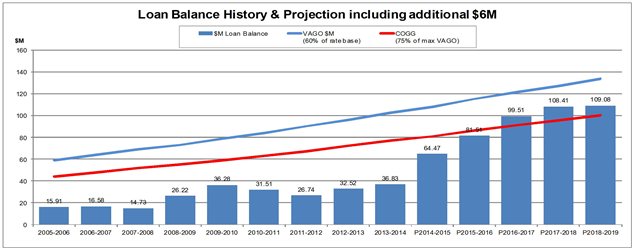
Debt levels greater that 60% of the rate revenue represents potential for longer term concern over ability to repay debt according to the Victorian Auditor Generals Office (VAGO). If Council was to borrow $6M in 2016-2017 it would cost Council $7.3M over 10 years to repay the loan and would increase debt levels well over the self imposed 75% threshold of the recommended 60% level recommend by VAGO.
Rate increase
If Council was to consider funding the Simonds Stadium (stage 4) development via a rate increase, it would need to consider that a 1% rate increase equated to $1.4M. To achieve $6M funded over a 3 year period would require a single rate increase of 1.5% in the first year. The Essential Services Commission in its draft Blue Print for Change (July 2015) recommends a process whereby a variation to rate capping may be sought and notes five matters that the variation should address in seeking the variation. The Blue Print also recommends that variations can only be approved for a single year in the 2016/2017 year.
Whilst an opportunity exists for Council to apply for a variation the outcome would not be known until May 2016. This timing of advice would pose a significant financial risk to Council.
Revise Capital Works Priority
Council could review its long term plan capital works and make a contribution to the Geelong Football Club of an amount equal to or less than $6M from the future capital works programme subject to the programme being amended with future projects being deferred.
Savings
The transition of the stadium and potentially park operations to the Kardinia Park Trust represents a significant savings opportunity for Council that, if realised, has the capacity to fund the $6M request. The subsequent request for $1.5M to support the Trusts operations significantly affects that capacity to realise savings from the transition. Currently operational funding for the Stadium is in the order $1.5M and $700k for the parkland, the capacity to realise these savings will be dependant on an understanding of Council’s future financial obligations to the Trust.
Council is currently the Committee of Management for the reserve under the Geelong (Kardinia Park) Land Act 1950. Council is obligated to meet requirements set out by the Department of Environment, Land, Water and Planning in it’s duties as the Land Manager.
It is anticipated that legislation will be placed before parliament before the end of this calendar year that will transfer this obligation to the Kardinia Park Trust.
The Geelong Football Club at this stage has not fulfilled all its obligations under the conditions of Council’s contribution to Stage 3. The delivery of a Kardinia Park Master Plan remains outstanding. Discussions with the Kardinia Park Trust chair have indicated that it would be willing to fulfil this obligation.
Kardinia Park contributes to Council achieving objectives outlined in the City Plan 2013-17:
Community wellbeing – Sport, recreation and social activities within the reserve contribute to the health and wellbeing of the community.
Growing our economy – Activities and events held at Kardinia Park, and in particular Simonds Stadium, have a significant positive impact on Geelong’s economy.
Sustainable built and natural environment – the parkland provides an area of natural environment within one of the most highly developed areas of Geelong. A number of projects focused on sustainability have been delivered, including stormwater reuse.
No Council officers involved in the preparation of this report are known to have a direct or indirect interest in matters to which this report relates.
In providing consent for the development, Council exposes itself to a significant operational funding increase to maintain the $90M stand (based on the industry norm calculation of maintenance costs at 1% to 2% capital cost).This cost could amount to an obligation of up to $2M annually. This risk has been mitigated with the inclusion of the recommendation seeking that the Victorian Government accepting the Stand asset.
Kardinia Park provides a range of social and health benefits through the provision of sport and recreation opportunities to the wider community. Kardinia Park and in particular Simonds Stadium, is a place of great value to the community due to its status as Geelong’s premier sporting precinct.
This report has no impact on compliance with the Human Rights Charter.
The Victorian State Government through Sports and Recreation Victoria, The Kardinia Park Trust and the Geelong Football Club have been consulted with in the formation of this report.
Portfolio: |
Governance - Cr Lyons (Mayor) |
Source: |
Strategy and Performance – Corporate Strategy |
General Manager: |
Dean Frost |
Index Reference: |
Corporate Strategy Planning |
Council at its meeting on 24 June 2014 adopted the 2014-2015 Update of City Plan 2013-2017, which outlines the Strategic Directions and Priorities planned by the Council over the four-year period, and the Annual Business Plan Actions planned for the coming 12 months.
This report is the progress report to Council of the organisations achievements against these actions.
Attachment A details the status and provides commentary against the Annual Business Plan actions. The key to the status of actions is:
On Schedule: |
Green |
69 |
Completed: |
Black |
123 |
Major Issue: |
Red |
5 |
Minor Issue: |
Yellow |
22 |
Not Started: |
White |
13 |
Total Actions |
|
232 |
Cr Farrell moved, Cr E Kontelj seconded -
That Council receives and notes the City Plan Progress Report to 30 June, 2015.
Carried.
Council at its meeting on 24 June 2014 adopted the 2014-2015 Update of City Plan 2013-2017 which outlines the Strategic Directions and Priorities planned by the Council over the four-year period, and the Annual Business Plan Actions planned for the coming 12 months.
Community Wellbeing
Healthy Together Geelong: to enhance health, wellbeing and quality of life of Greater Geelong Communities.
Growing Our Economy
Securing Geelong’s economic future.
A Sustainable Built and Natural Environment
Partnering with our community to protect and enhance our natural ecosystems and to encourage sustainable design and reduced resource consumption.
How We Do Business
We will focus on developing and maintaining effective working relationships to deliver Council’s strategic directions and cost effective services that meet the changing needs of the community.
This report and attachment indicates the status of the actions in City Plan 2013-2017 for the 2014-2015 financial year as at 30 June, 2015.
The attachment provides status and comments for each of the 232 actions within the four strategic directions.
There has been significant progress in the June quarter towards achieving the actions in 2014-2015 including:
Community Wellbeing
Status Summary:
On Schedule: |
30 |
Completed: |
61 |
Major Issue: |
3 |
||
Minor Issue: |
10 |
Not Started: |
6 |
|
|
National Youth Week was held in April celebrating and recognising the contributions young people make within the Greater Geelong community. This years theme was “It Starts With Us” promoting the idea of young people as active participants in their communities, working for positive change. The week was full of events such as the STREETFACE project which featured the portraits of 15 young people onto buildings around Geelong with positive stories of young people who ‘live, work or play’ in Geelong, Waurn Ponds Skate competition, Journalism Writing workshops and Whittington Dance Party.
The ‘Through Your Eyes’ project was also undertaken in April and May, 2015. The project was aimed at unearthing stories about Anzacs and the impact of WW1 on Geelong and stories behind Geelong’s memorials. The stories were recorded by young people and uploaded to a Smartphone application and linked to 30 new interpretive plaques installed across Geelong. The project complimented the ANZAC projections that were displayed onto City Hall. The project received funding of $30,000, and was a result of discussions that identified the need to engage young people in a project that creates a deeper understanding of World War 1.
A number of youth programs and events ran successfully throughout the year including the SKAART Festival, GASP and the Courthouse Youth Arts Program.
Five new community centres were completed and are in operation this financial year with two of the centres being officially opened during this quarter.
Grovedale Community Hub was officially opened on 23 May, 2015. The brand new $6.7 million facility offers a wide range of services for the community including an integrated children’s centre, the Grovedale Senior Citizen’s Club, the Grovedale Neighbourhood House, aged care and youth services.
Norlane Child and Family Centre officially opened its doors on the 21 May, 2015. This brand new $4.1 million facility offers a kinder program, maternal and child health service, school holiday program, playgroups, counselling, a family support and parenting programs and community meeting spaces.
A number of recreation and community projects were also completed this quarter:
The Coolabah Park playground, Grovedale opened in April. The upgrade was completed under the City of Greater Geelong’s Play Strategy and is one of the region’s largest playgrounds.
A new one-of-a kind playground opened on 4 May, 2015 at Queens Park. It has been custom built and specially designed to attach play equipment to existing trees. It gives children the opportunity to climb and play on ropes amongst and attached to the surrounding trees. The rope climbing nets provide children with a truly unique experience similar to climbing through a tree canopy.
The new Stead Park BMX Track officially opened on 8 May, 2015. This is the only BMX track in the Geelong’s northern suburbs and has been well utilised with 30 to 50 kids using the track per day since its completion. The popularity of the BMX track has also resulted in an increase in the number of young people attending the nearby fOrt Youth Centre.
The Linking the Link project which connects the Bellarine Rail Trail with surrounding residential areas to improve access is now complete. All new paths, tree mulching, fencing of laneways and new bench installations have all been completed.
Council endorsed the Northern Arc Master Plan at Council Meeting of 9 June, 2015. The plan will guide development of a vibrant community health and wellbeing precinct in Norlane over the next 15 years. Council is continuing negotiations with Barwon Health around a new $33 million State Government funded medical facility at the site. The proposed development will see a new integrated aquatic and leisure centre, multipurpose community hall, new Corio library, Barwon Health-North medical centre, café, outdoor spaces and improved pedestrian paths and trails linking the facilities to surrounding streets and neighbourhoods.
The City’s Learn to Swim programs achieved outstanding results across the four terms in 2014-2015. A total of 23,809 enrolments were achieved for the four indoor leisure centres (Leisurelink, Waterworld, Splashdown and Bellarine Aquatic and Sports Centre) for the 2014-2015 year. This was an increase of 250 enrolments compared to 2013-2014 figures.
Council’s Women in Community Life Advisory Committee (WiCLAC) welcomed four new members. The new members are local women committed to WiCLAC’s objectives – to promote equality, inclusion and respect for women throughout our region. The committee provides advice to Council on barriers to women’s participation, emerging women’s issues, aspirations and initiatives to help ensure gender equality in the Geelong community.
Growing Our Economy
Status Summary:
On Schedule: |
24 |
Completed: |
23 |
Major Issue: |
2 |
||
Minor Issue: |
1 |
Not Started: |
4 |
|
|
2014-2015 saw another successful major events calendar, ranging from flagship international events to local community celebrations. Just some of the events included the 2015 Australian International Airshow, 2015 Men’s and Women’s Victorian Open Golf Championship, A Day on the Green, Toast to the Coast, Cadel Evans Great Ocean Road Race, Food Truck Friday, M~M 24 Hour Extreme Arts Walk, National Celtic Festival, Pako Festa, and Festival of Sails.
Events that occurred during this last quarter:
Scarf Festival returned to the National Wool Museum and hosting a record breaking 449 scarves from across Australia and abroad.
The Geelong After Dark event was held on 8 May, 2015 with more than 10,000 people in attendance. The program is an annual event showcasing musicians, artists, quirky performances and lighting projections. The event consisted of 247 artists of which 230 were local. 92 per cent of people surveyed on the night indicated that their primary reason for visiting Geelong was the event and of that figure 13 per cent advised that they were visitors to the region.
The Central Geelong Task Force released details of its plan for a City in a Park this quarter. The report and the proposed streetscape enhancement projects set out a plan to make improvements through relatively simple, cost effective and meaningful interventions. It builds upon the Malop Street green spine concept, which will link Johnstone Park to Eastern Park, but importantly expands the network of green spaces across the central city area to create ‘A City in a Park’. This is expected to create more efficient traffic flows around the CBD, safer streets for pedestrians, cyclist and motorists, and more shade in summer throughout the city’s streets.
Catenary lighting has been installed over the Malop Street – Moorabool Street intersection and is aimed at enhancing the visual appearance of the city. The catenary has been designed to support decorative catenary lighting and also allow for support of temporary seasonal decorations or banners. The launch took place on Friday 10 July.
The City paid tribute to the Bellarine Community Health Ladies Auxiliary Portarlington branch for their 40 years of service at the iconic Portarlington Rotunda. The auxiliary had raised several hundred thousand dollars for the local community through their work at the opportunity shop at the rotunda. The Auxiliary finished up at the Opportunity Shop earlier this year and the Portarlington Community Association who are a strong and active part of the town will take over the lease and continue the community focus at this venue.
A commencement plan for the Rotunda has been developed to fit out the space and develop operating procedures. The purpose of the booth is to focus on relevant community and business information and will be managed by a volunteer group linked to the Portarlington Community Association and Portarlington Business Development Association.
Council received 1290 responses from the public in relation to the significance of the Geelong Gallery redevelopment. Overwhelmingly respondents believe that a redeveloped Geelong Gallery is one of our major cultural attractions and absolutely vital to Geelong’s culture wellbeing.
Geelong has been placed high on the Australian business tourism radar after Business Events Geelong won the National award for best Regional Destination Marketing Organisation at the Meetings and Events Australia (MEA) National Industry Awards. The City of Greater Geelong is a proud supporter of Business Events Geelong.
The Jobs4Geelong Fair was held on 19-20 June offering a great opportunity for local businesses looking to expand, start up and for industry groups to find potential employees. The fair is an Australian Government initiative delivered by Enterprise Geelong and supported by Geelong Advertiser, Bay FM and KRock.
The Geelong Library and Heritage Centre construction is progressing well with final gutter installation underway, glass installation is near completion and the internal fit out and finishing trades are all on track. The Geelong Library and Heritage Centre is scheduled to open towards the end of 2015.
The Central Geelong Heritage Fund round one applications closed in May. 22 applications were received with four submissions being successful. The Fund is a Grants Program for one off capital improvements projects supporting the restoration of heritage building facades within the Central Geelong Action Plan boundary.
Sustainable Built and Natural Environment
Status Summary:
On Schedule: |
9 |
Completed: |
14 |
Major Issue: |
0 |
||
Minor Issue: |
8 |
Not Started: |
2 |
|
|
The ‘Rethink Your Rubbish’ program continues to be a success.
The recycle your mattress drive was held in May where residents could drop off their mattresses for $10 (normally $21.50). Each year approximately 4,000 mattresses are dropped off at the Drysdale and Geelong Resource Recovery centres.
The Drysdale and Geelong Resource Recovery centres have noted a significant increase in the use of recycling services for items such as televisions, computer equipment and white goods and subsequently a notable decline in the number of these items being dumped wayside.
The results of a survey in to the public’s awareness of recycling services has been published with over 300 responses being received during the six week survey held in March and April. The survey indicated that general awareness of recycling and disposal by the public is good; however, Council will continue to use a variety of communication channels to increase this level of knowledge of these services.
The City has joined forces with the Bellarine Catchment Network and the Corangamite Catchment Management Authority to undertake the first in a series of programs known as Caring For Our Bays. Caring For Our Bays is about identifying where litter that flows into our bays, comes from and developing strategies to prevent it happening in the future.
The City of Greater Geelong launched an updated Low Carbon Growth Plan as part of its World Environment Day celebrations. The plan is a great platform for Future Proofing Geelong to continue to help the community, business and industry become more energy efficient. The updated Low Carbon Growth Plan takes into account changes to industry in Geelong. Emissions in 2020 are now estimated to be 41 per cent lower than forecast in the initial 2011 plan. This is due to closures in manufacturing sites in Geelong.
The City is also working to reduce Geelong’s ecological footprint by establishing a green belt along the Geelong Ring Road, committing to planting a minimum of 20,000 plants a year.
The City of Greater Geelong was recognised for its outstanding work in protecting and enhancing the environment at the Keep Australia Beautiful Victoria Sustainable Cities Awards.
The City was a finalist in four award categories for the following: Community action Leadership – Kevin Hoffman Walk, Community Government Partnerships – Friends of the Bellarine Rail Trail, Cultural Heritage – Curlewis Avenue of Honour and Environment Sustainability Awards – Eastern Park Stormwater Harvesting Dam.
Beach erosion is not uncommon along the coast of the Port Phillip Bay, in particular the northern shore of the Bellarine Peninsula. Ramblers Road Portarlington is an excellent example of this. The foreshore has been gradually receding for a number of years; with a storm in 2014 having a dramatic effect on the already vulnerable beach and foreshore.
Remediation works in the form of sand fencing, dune nourishment and re-construction and a revegetation program were undertaken in 2014-2015. These measures will provide a protective feature that will reduce the risk of damage to the environment, drainage/road infrastructure and private property.
How We Do Business
Status Summary:
On Schedule: |
6 |
Completed: |
25 |
Major Issue: |
0 |
||
Minor Issue: |
3 |
Not Started: |
1 |
|
|
Council’s eService’s department have developed a number of online projects during the quarter to improve services and information to residents. This includes; finalising planning applications online, where customers are able to view the status of planning application through the use of myGeelong; development of new online forms for customer use such as direct debt request, rates deferral application form and a valuation objection form; developing online enrolments for Family Day Care, and development of an online form for the Green Achiever Award.
A Management Policy for web accessibility has been approved by Executive Leadership Team. The policy provides clear direction on the minimum standards of web accessibility that must be adhered to across the City of Greater Geelong web presence, to ensure that web content can be accessed by everyone.
Social media continues to be a key communication channel for Council to inform and engage with the community. The City of Greater Geelong and Geelong Mayor’s Facebook and Twitter accounts are monitored seven days a week. Between the two pages, City of Greater Geelong Facebook currently has 6,217 likes and the Mayor’s Facebook has 49,521; City of Greater Geelong Twitter account has 6,217 followers and the Mayor’s Twitter has 106,650 followers.
The City of Greater Geelong’s 2015-2016 Budget was adopted in June; it invests heavily in the financing of key new infrastructure projects including the new Geelong Library and Heritage Centre, the Hendy Street Children’s Hub in Corio and the Leopold Community Hub library construction along with a focus on Central Geelong. The Budget delivers on major priorities while maintaining service levels in all key areas of Council’s operations. The rate rise was at a lower-than-predicted 4.45 per cent, and overall the budget delivered a recurrent surplus of approximately $0.7 million.
Council has introduced quick and easy two minute parking pick up and drop off zones around Central Geelong, known as ‘kiss’n’go” zones. The zones have been implemented in key locations to encourage more people into the city by being able to be picked up or dropped off in a safe and convenient manner.
The Digital Geelong strategy was adopted by Council to ensure it maximises emerging digital technology. The strategy aims to provide community-wide access to digital technologies and to capitalise on improved efficient in communications and online services as technology evolves. The strategy will guide opportunities to improve services and save money in the future.
Tender evaluation for a new Document Management system was undertaken this quarter, with Kapish Services Pty Ltd (HP Trim software) being awarded as the successful applicant/software package. The project will commence in August, 2015 replacing the current document management software system.
There are several actions under the Sustainable Built and Natural Environment Strategic Direction within City Plan that aim to enhance and protect natural areas and ecosystem health, support our community to live sustainably, advocate for and promote sustainable design and development, and minimise our environmental footprint.
Council’s Annual Budget provides the Resource Plan to support the initiatives identified within the adopted Annual Business Plan.
Council’s external auditors will undertake a Performance Audit of the planned Key Strategic Activities and prepare a report as part of the ‘sign off’ of the Annual Accounts.
This report is the quarterly progress report of the organisation’s achievements against the adopted City Plan 2013-2017, 2014-2015 actions.
There is no conflict of interest to be disclosed.
The risks arising from the actions are managed within the framework of the Council’s adopted Policies, Procedures and Risk Management strategies.
Several of the actions identified within City Plan are aimed at improving the quality of life for the residents in the City of Greater Geelong. This is particularly the case for actions within the Community Wellbeing Strategic Direction.
This report provides an update on the implementation of City Plan 2013-2017 and will be made available on Council’s website and on request at Council’s Customer Service Centres as part of the Council meeting minutes. There are no known positive or negative effects.
A comprehensive report on the 2014-2015 City Plan actions will be published in the City of Greater Geelong Annual Report by September 30, 2015, which will be submitted to the Minister for Local Government and available to the public in hard copy and on the Council’s website (www.geelongaustralia.com.au).
Portfolio: |
Finance - Cr Lyons (Mayor) Cr E Kontelj and Cr Farrell |
Source: |
Strategy and Performance - Financial Services |
General Manager: |
Dean Frost |
Index Reference: |
Financial Management - Reporting |
To authorise two Councillors to certify the 2015 Financial Statements and Performance Statement.
The 2014-2015 Financial Statement of Accounts and Performance Statement have been prepared and reviewed by the Victorian Auditor Generals Office (VAGO).
These Statements have been prepared in accordance with Australian equivalents to International Financial Reporting Standards.
The 2015 Revaluation of Footpath, Kerb and Channel Assets and adjusting entries are included in these statements.
The draft closing audit report has been received from VAGO and there were no major issues of high risk to Council.
Under Sections 131 and 132 of the Local Government Act 1989, Council is required to pass a resolution giving “In Principle” approval to the Statements and authorise two Councillors to certify the Statements in their final form.
Following consideration by Council the “Financial Statement of Accounts” and the “Performance Statement”, together with a copy of the Council Resolution that nominates two Councillors and accepts the Statements “In Principle”, will be provided to the Auditor General.
Under Section 134 of the Local Government Act 1989, as soon as practicable after the Annual Report has been sent to the Minister, the Council must hold a meeting to discuss the Annual Report, including the Annual Financial Statements and the Auditors Report.
Cr E Kontelj moved, Cr Farrell seconded -
That Council:
gives approval in principle to the “Financial Statement of Accounts” (as per Appendix 1) and the “Performance Statement” (as per Appendix 2); and
authorise two Councillors being the Mayor, Cr D Lyons and Cr E. Kontelj to certify the Statements subject to any changes recommended and agreed with the Auditor General.
Carried.
Under Section 131 of the Local Government Act 1989 (LGA), a Council must in respect of each financial year, prepare an Annual Report that includes audited Financial Statements and a Performance Statement for the financial year. These statements must be prepared in the prescribed manner and form and be certified by Council’s auditors. Council’s current auditors are Victorian Auditor Generals Office (VAGO).
Under section 131(4) of the Local Government Act, the Performance Statement must contain the prescribed indicators and measures of service performance outcome, financial performance and sustainable capacity.
In addition to the performance statement, council’s are also required to disclose:
The prescribed indicators and measures of service performance, results achieved and any material variation explanation.
A governance and management checklist.
Along with the Performance Statement indicators, these will also be required to be reported on the State Government ‘Know Your Council’ website.
The draft Financial Statements and Performance Statement have been reviewed by VAGO and there were no major issues of high risk indentified in the draft closing audit report. VAGO representatives attended the Audit Advisory meeting on 24 August 2015 to present and discuss the 2014-2015 Audit Management letter.
Under Section 132 of the LGA, Council is required to approve “in principle” the Statements prior to receiving final certification from the Auditor General. Council’s approval requires nominating two Councillors to certify those Statements together with Chief Executive Officer and Principal Accounting Officer.
The Final Statements may then be subject to any changes recommended and agreed with VAGO. A final audit certification is then issued.
The Financial Statements and the Performance Statement form part of Council’s Annual Report that must be submitted to the Minister within three months of the end of the financial year. Further, Council must also review the Annual Report in a meeting open to the public as soon as possible after the report is sent to the Minister.
The Financial Statement of Accounts 2014-2015 record a satisfactory period of operation with a favourable operating surplus, high closing cash balances and significant asset growth.
COMPREHENSIVE INCOME STATEMENT
The surplus result for 2014-2015 of $76.3M is |
$M’s |
|
• |
Early receipt of 2015-2016 Grants Commission entitlement |
9.7 |
• |
Non capital projects unspent amount |
7.9 |
• |
Net Income/expenses |
(1.6) |
| Recurrent Surplus | 16.0 |
|
• |
Capital Grants Income/ Dev. Cap 26.9 |
|
• |
Recognition of Infrastructure less Disposals 33.4 |
|
| Non Recurrent Surplus | 60.3 |
|
SURPLUS/(DEFICIT) FOR THE YEAR |
76.3 |
|
Net Asset revaluation decrement |
(2.6) |
|
TOTAL COMPREHENSIVE RESULT |
73.7 |
|
This surplus result was $2.7M favourable to adopted Budget and included the following favourable and unfavourable Income and expenditure items (refer Note 2A Appendix 1)
Income of $369.1M was $3.1M favourable to budget mainly due to:
Early receipt in June of 50% of 2015-2016 Grants Commission income ($9.7M favourable);
HACC Funding for care services and ancillaries ($1.4M favourable);
Unbudgeted discretionary Grants ($0.7M favourable):
Additional recognition of subdivision assets from Developers ($5M favourable).
Offset by the following items:
Grants not received for Armstrong Creek projects ($7.3M unfavourable);
Budgeted Land sales not being recognised ($5.6M unfavourable)
Expenditure of $292.8M was $0.4M unfavourable to budget due to:
Waste costs for utilisation of Wyndham landfill ($.5M unfavourable);
Marketing Costs increase of ($0.5M unfavourable);
Contributions to unbudgeted projects ($0.8M unfavourable)
Offset by the following items:
Reduced interest expense due to deferral of $14.9m loans to 2015-2016 and lower than budgeted loan interest rates ($0.9m favourable)
BALANCE SHEET
The Balance Sheet shows that Council has a very strong asset position with over $2.1 billion worth of assets that are used to provide services to the community.
Current Assets are $104M which is predominately due to an increase in cash balances due to loans being drawn down and lower than budget capital spend.
Current liabilities have remained at $61M but non current liabilities have increases to $73.9M due to the drawing down of $37.6M in loans during 2014-2015 (total loan balance has increased to $64.5M).
STATEMENT OF CASH FLOWS
Council’s cash position at the end of the year is $91.9M, an increase of $16.6M from the prior year. This is due to:
lower than expected Capital and Non Capital project expenditure;
the early Grants Commission receipt of $9.7M in June 2015; and
a loan for $16.5M was drawn down in September 2014 and a second loan for $21.1M was drawn down in February 2015. The remaining loan amount of $14.9M was deferred until 2015-2016.
The cash balance will provide funds to complete Capital and Non Capital projects carried over from 2014-2015 and working capital to ensure service provision continues at the same levels in 2015-2016.
STATEMENT OF CAPITAL WORKS
Council has an extensive capital works program to renew, upgrade and provide new assets to ensure the continuation and improvement of services provided to the community. Council spent $106.7M on capital works in 2014-2015 and included the following highlights:
|
$M |
|
• |
Geelong Library and Heritage Centre |
24.1 |
• |
Road replacement and construction |
18.2 |
• |
Leopold Community Hub |
5.9 |
• |
Grovedale Integrated Children’s Centre |
4.6 |
• |
Plant and Vehicles |
3.7 |
• |
Drysdale Landfill Cell 6 |
3.6 |
• |
Windsor Park Children and Family Hub |
3.5 |
• |
Barwon Heads Kindergarten |
2.8 |
• |
Footpath replacement and construction |
2.7 |
• |
Drainage replacement and construction |
2.7 |
• |
Corio Landfill Rehabilitation |
2.5 |
• |
Shell Road Reserve Masterplan |
2.2 |
• |
Kerb and Channel replacement and construction |
1.6 |
• |
Drysdale Landfill Cell 4a |
1.5 |
• |
Ocean Grove Neighbourhood House Upgrade |
1.4 |
• |
Austin Park Redevelopment |
1.1 |
• |
Parking Machines Upgrade |
0.9 |
• |
Building Renewal Works |
0.9 |
• |
IT Asset Replacements |
0.6 |
• |
Purchase of Gym Equipment |
0.6 |
• |
Windsor Park Land Purchase |
0.6 |
• |
Bellarine Rail Trail Pathway Improvements |
0.6 |
• |
Playground Development Program |
0.5 |
AUDIT
The external audit, conducted by the Victorian Auditor Generals Office (VAGO), was completed on Friday 7 August as per the audit plan. There were no major issues affecting the Financial Statements. A closing report summarising the Audit findings has been reviewed by the Audit Advisory Committee.
Incomes and Expenditures on Council’s environmental preservation and enhancement programs are included in the Financial Statements.
As detailed within accompanying financial statements – refer Appendix 1.
Under Section 131 of the Local Government Act the Council must in respect of each year prepare an Annual Report, which includes audited financial statements for the financial year.
Under Section 131 a Council must not submit the Financial Statements to its auditors or the Minister unless it has passed a resolution giving approval “in Principle” to the statements.
Under Section 131 a Council must authorise two Councillors to certify the Statements in their final form after any changes recommended, or agreed to with the auditor.
The actions outlined in this report are aimed at complying with the requirements of the Act.
The Financial statements and the Performance Statement highlight that 2014-2015 Council operations have been managed in a responsible manner. The results contribute to responsible and sustainable financial management as aligned in Council’s City Plan objective on the How We Do Business.
Council staff preparing this report have no direct or indirect interest.
The Statements are released as a draft and are still subject to being signed off by the Auditor General.
The attached report represents a full and open disclosure of the financial position for the benefit of the community.
There are no known positive or negative effects.
The Financial Statement of Accounts and the Performance Statement will be available to the public as part of the published Annual report and accessible via www.geelongaustralia.com.au.
The prescribed indicators and measures of service performance outcome, financial performance and sustainable capacity as per section 131(3) and 131(4) of the Local Government Act 1989 will also be available on the State Government ‘Know Your Council’ website from November 2015.
Portfolio: |
Finance - Cr Lyons (Mayor) Cr E Kontelj and Cr Farrell |
Source: |
Strategy and Performance - Financial Services |
General Manager: |
Dean Frost |
Index Reference: |
Financial Management / Reporting |
Amend the 2015-2016 Budget that was adopted on 23 June 2015.
Preliminary financial results for 2014-2015 highlight a recurrent surplus of $16.0M or $22.8M favourable to amended budget and Capital expenditure of $106.7M or $33.0M lower than authorised Capital Program. These results reflect a number of programs (Capital and Non Capital) that are incomplete and are required to carryover into 2015-2016.
In order to avoid unnecessary variance reporting and commentary during 2015-2016 it is recommended that the 2015-2016 Budget be amended to recognise the prior year funding for Capital and Non Capital projects.
The incomplete programs, together with favourable operating performance and early receipt of half 2015-2016 Grants Commission funding increased Council’s year end cash balance to a total of $91.9M or $33.0M higher than projected.
A review of the Capital program at 30 June 2015 indicates that $52.27M expenditure and $4.86M income is required to be carried over for completion in 2015-2016. Together with other budget amendments the 2015-2016 Capital budget will increase to $120.02M expenditure and $27.14M income or a net of $92.88M. This program is fully funded and will have no impact on the closing cash position as outlined in the adopted 2015-2016 Budget.
A review of the Non-Capital program at 30 June 2015 indicates that funding of $7.90M is required to be carried forward for completion in 2015-2016.
Together with other budget amendments, the amended recurrent operating expenditure will increase to $316.34M and recurrent income will increase to $299.33M or a net recurrent deficit of ($17.01M). The Non Capital program is fully funded and these amendments will have no impact on the closing cash position as forecast in the adopted 2015-2016 Budget.
Recognition of Land Sales budgeted for 2014-2015 projected to occur in 2015-2016 will increase Non-Recurrent Income by the net Gain/(Loss) on Sales of $4.73M. Along with Capital Income carryover of $4.86M the Non-Recurrent Surplus will be $65.03M.
Cr E Kontelj moved, Cr Farrell seconded
That Council amends the adopted 2015-2016 Budget to include the following:
Capital Programs carryover as per Appendix 1, other budget amendments affecting Capital Projects Budget as per Table 1;
Non Capital Programs carryover as per Appendix 2, other budget amendments affecting the recurrent Budget as per Table 2;
Deferred 2014-2015 Land Sales affecting the non-recurrent Surplus as per Table 3.
Carried.
At 30 June each year Council reviews the preliminary financial results to determine funded Capital and Non Capital programs that are incomplete and are required to be carried over into the subsequent financial year. These carryover requirements are recommended to be incorporated as amendments to the adopted budget. This practice avoids unnecessary variance reporting, given there is no impact on the budgeted closing cash position.
The review has been undertaken in the following key areas:
Carryover requirements to complete 2014-2015 Capital projects in 2015-2016.
Carryover requirements to complete 2014-2015 Non Capital projects in 2015-2016.
Other budget amendments requested or influenced by year end accounting matters.
2014-2015 Preliminary Financial Results Summary
|
|
Full Year Actual |
Full Year Amended Budget |
Variance Fav / (Unfav) |
|
Recurrent Surplus/(Deficit) |
15.97 |
(6.87) |
22.84 |
|
Non-Recurrent Surplus/(Deficit) |
60.36 |
74.15 |
(13.79) |
|
Net Surplus/(Deficit) |
76.33 |
67.28 |
9.15 |
|
Capital Expenditure |
106.73 |
139.71 |
32.98 |
|
Closing Net Cash Positive/(Negative) |
91.92 |
58.86 |
33.06 |
Capital Projects Budget Amendments
Carryover requirements
Of the 268 projects listed in 2014-2015, project managers have advised that 112 projects have been fully completed, with 156 projects identified as requiring some carryover funds in 2015-2016 to complete works.
During the 2015-2016 Budget development the Capital carryover was projected to be $28M. At the end of the 2014-2015 financial year a review was carried out to determine the actual Capital Program carryover requirements. The review indicates a net carryover of $47.41M (refer to Appendix 1 for details) comprising of $52.27M expenditure and $4.86M income is required to complete the projects planned for 2014-2015, The net variance between actual Net ($47.41M) and estimate included in 2015-2016 Budget ($28.00M) is $19.41M.
Main increases are: – Higher carryover than estimated on Corio Landfill Rehabilitation $1.27M, Geelong Library and Heritage Centre Car Park $0.51M, Central Geelong Advancement Fund $0.50M and Home for Cycling Pavilion $0.39M. Other incomplete projects – Drainage Construction $1.88M, Central Road Drainage $1.63M, Geelong Library and Heritage Centre $1.53M, Street Construction SRC $1.21M, Austin Park Redevelopment $1.20M, Heavy and Dedicated Plant Replacement $1.19M,
Myers St Unifying Streetscape Works $0.92M, Shell Rd Reserve Masterplan $0.70M, PABX Replacement $0.54M and Clifton Springs Boat Harbour $0.52M.
Other Capital Program amendments:
Vic Roads Funded Works – Included in budget at $0.50M income and expenditure. Advice from Vic Roads is that Black Spot funding will be $1.243M.
Budget Submission Inclusions:
Osborne House Building Alterations $30,000
Increased funding for Geelong Cycling Strategy $100,000
Table 1 – Amended 2015-2016 Capital Program
Council adopted the 2015-2016 Budget on 23 June 2015 that included a gross Capital Projects Program of $84.87M with Capital Income of $21.53M – Net $63.34M.
The net 2015-2016 Capital Program is recommended for amendment to $92.88M to reflect the additional $47.41M carried over from 2014-2015 plus other Budget amendments as indicated in Table 1 below.
|
|
Expenditure |
Income |
Net Expenditure |
|
Council adopted 2015-2016 Budget - New Capital Funding (excluding Carryover) |
84,873,105 |
21,533,027 |
63,340,078 |
|
2014-2015 Capital Carryover Requests |
52,268,914 |
4,863,209 |
47,405,705 |
|
Other Budget Amendments: |
|
|
|
|
Budget Submission – Osborne House |
30,000 |
0 |
30,000 |
|
Budget Submission – Geelong Cycling Strategy |
100,000 |
0 |
100,000 |
|
Vic Roads Funded Works |
743,000 |
743,000 |
- |
|
Adjusted 2015-2015 Capital Program |
138,015,019 |
27,139,236 |
110,875,783 |
|
Planned Carryover into 2016-2017 (June 2016) |
(18,000,000) |
- |
(18,000,000) |
|
Amended 2015-2016 Capital Program |
120,015,019 |
27,139,236 |
92,875,783 |
Operating Budget Amendments
Non Capital Projects Carryover requirements
In addition to the Capital Program, Project Managers have undertaken a review of the Non Capital Projects budgeted for in 2014-2015 that have been requested to be carried over into the 2015-2016 financial year.
The 2014-2015 Recurrent Operating result was favourably impacted by $7.90M of incomplete Non Capital programs as per Appendix 2.
Requested Discretionary Program Carryover:
|
|
$ |
|
Expenditure |
8,196,199 |
|
Income |
298,337 |
|
Net Expenditure |
7,897,862 |
Other Operating Budget amendments:
Budget Submission Inclusion – Increase in contribution to Barwon Sports Academy ($5,000).
Grants Commission – early receipt in 2014-2015 of 50% of 2015-2016 funding ($9,685,025).
Grants Commission – Indicative advice indicates that funding for 2015-2016 will be less than budgeted by ($143,341).
Increased Fire Services Levy on community & leased buildings ($20,000).
Allocation to Geelong Waterfront Safe Harbour Precinct ($15,000) – as per notice of motion approved at Council Meeting 9th June 2015, plus grants of $65,000.
Increase in Library Contribution ($91,000) – budget correction.
Increase in Vic Roads School Crossing Supervisors subsidy by $78,548
Increase in EPA Levy of $1.60 per tonne higher than budgeted – increased cost of $142,908, offset by increased pricing to industrial customers $58,002 – net cost ($84,906).
Wyndham landfill confirmed gate fee is $8.50 per tonne lower than budgeted – savings of $79,364
Sales Proceeds on Plant & Equipment – Estimated sales proceeds on Light, Heavy & Dedicated Plant sales relating to carried over purchases - $462,500 (estimated written down value $441,168).
The impact of the requested Discretionary Program Carryover, along with the other Budget amendments that affect the recurrent position, is on the 2015-2016 recurrent surplus / (deficit) (Refer Table 2 below).
Table 2 – Amended 2015-2016 Recurrent Surplus / (Deficit)
|
|
Expenditure $ |
Income $ |
Surplus / (Deficit) $ |
|
Council adopted 2015-2016 Budget - Recurrent Surplus / (Deficit) |
307,912,756 |
308,661,167 |
748,411 |
|
2014-2015 Discretionary Carryover Requests |
8,196,199 |
298,337 |
(7,897,862) |
|
Other Budget Amendments |
238,212 |
(9,626,816) |
(9,865,028 |
|
Amended 2015-2016 Recurrent Surplus / (Deficit) |
316,347,167 |
299,332,688 |
(17,014,479) |
Non-Recurrent Budget Amendments
A number of Land Sales budgeted in 2014-2015 did not eventuate in the past financial year, but are projected to occur in 2015-2016, therefore it is recommended that the 2015-2016 budget be amended to include these sales.
Properties are as follows:
400 Melbourne Rd, North Geelong
1-39 Rollins Rd, Bell Post Hill
18 Wilkins Close, Corio
128-130 Asbury St, Ocean Grove
GREP – Lot 1 Production Way
GREP – Lot 5 Success Court
GREP – Lot 7 Success Court
GREP –South O’Briens Rd Stage 1
Total expected Sales value is $8,217,600 with Written Down Value of $3,484,000 giving net Gain/(Loss) on sale of $4,733,600.
The impact of the requested Land Sales amendments is on the 2015-2016 Non- recurrent surplus / (deficit) (Refer Table 3 below).
Table 3 – Amended 2015-2016 Non-Recurrent Surplus / (Deficit)
|
|
Expenditure $ |
Income $ |
Surplus / (Deficit) $ |
|
Council adopted 2015-2016 Budget - Non-Recurrent Surplus / (Deficit) |
5,290,000 |
60,721,894 |
55,431,894 |
|
Land Sales Amendments – Gain/(Loss) |
0 |
4,733,600 |
4,733,600 |
|
Capital Income Carryover |
0 |
4,863,209 |
4,863,209 |
|
Amended 2015-2016 Non-Recurrent Surplus / (Deficit) |
5,290,000 |
70,318,703 |
65,028,703 |
The adoption of the 2014-2015 carryover program provides the required funding to complete the environmental programs previously approved as part of the 2014-2015 Budget.
There are no funding implications associated with this report, with higher than projected cash balances as at 30 June 2015 funding additional budgeted expenditure in 2015-2016.
The program variances and carryover requests are detailed within the accompanying financial reports (refer Appendices 1 and 2).
Section 144A part 1 of the Local Government Act states “A Council must prepare a revised budget if circumstances arise which cause a material change in the budget and which affect the financial operations and position of Council.”
In the context of the total budget the recommended variation to the budget is not considered material.
This amended budget report contributes to responsible and sustainable financial management as aligned in Council’s City Plan objective on How We Do Business.
Council staff preparing this report have no direct or indirect interest.
Capital projects by their nature are susceptible to delays for a large variety of reasons including weather, delays in approvals (i.e. Special Rates and Charges programs) contractor availability, performance, etc.
The carryover Capital Program (refer to Appendix 1) if approved, will result in a gross capital program for 2015-2016 of $120.02M.
The adoption of the 2014-2015 carryover program provides the required funding to complete the social programs previously approved as part of the 2014-2015 Budget.
No Human Rights are affected by this report.
Project Managers have submitted requests for carryover and will be advised of the outcome pending consideration of this report by Council.
Portfolio: |
Finance - Cr Lyons (Mayor), Cr E Kontelj and Cr Farrell |
Source: |
Strategy and Performance - Financial Services |
General Manager: |
Dean Frost |
Index Reference: |
Financial Management / Reporting |
To provide Councillors with an overview of the proposed rates capping and variation framework in order for Council to submit a written submission by 28 August 2015.
In May 2014 the State Government announced a commitment to cap annual rate increases.
In January 2015 the Essential Services Commission (ESC) received terms of reference from the Minister of Finance (in consultation with the Minister for Local Government) to conduct a review and report on a local government rates capping and variation framework for implementation from the 2016-17 financial year.
A consultation paper was released in April 2015. That document outlined eight principles to be considered in developing the Rate capping framework.
A draft report – Volume 1 and 2 ‘A blueprint for change’ was released on 31 July 2015. Volume 2 includes supporting material and analysis.
The draft report includes eleven recommendations based around three key elements being: Setting the Rate Cap, the Variation Process and the Monitoring and Reporting on compliance.
Interested parties have until 28 August 2015 to provide a written submission. Council officers will draft a submission, including Councillors contributions to be presented to Council on 25th August 2015.
A final framework report along with draft guidance material will be provided to the Minister by the end of September 2015. This date has been brought forward from 31 October 2015.
Cr Farrell moved, Cr E Kontelj seconded -
That Council, in response to the release of the draft report – Local Government Rates Capping and Variation framework review July 2015, supports making a submission to the Essential Services Commission regarding each recommendation contained in the framework, along the lines of this report.
Cr Nelson left the meeting room at 9:02pm
Carried.
In January 2015 terms of reference were received by the Essential Services Commission (ESC) from the Minister of Finance and Local Government to conduct a review and report on local government rate capping. The Commission was asked to design a ‘framework’ to meet the Government’s commitment to cap annual rate increases as well as to develop a workable process to assess proposals from councils for above cap increases (‘variation process’).
In April 2015 a consultation paper was released identifying a set of eight (8) principles which received widespread support and these principles were used as the basis for the development of the proposed ‘framework’.
A draft report outlining the proposed ‘framework’ (Volume I and 2) was released on 31 July 2015 with Council having until 28 August 2015 to respond to the proposed ‘framework’.
The proposed ‘framework’ is designed to provide confidence to ratepayers and the broader community in regard to the decision-making process used to determine council rates. The proposed ‘framework’ has three elements:
Rate cap – the maximum annual rate increase that councils can apply;
Variation process – the mechanism for councils to seek and have considered increases in rate revenue above the rate cap; and
Monitoring and reporting - the means of verifying and reporting on compliance as well as identifying and addressing unusual or unexplained outcomes.
The report outlines eleven draft recommendations designed to assist in implementing each element of the framework.
The draft recommendations are broken into three categories, The Cap, Variation and Monitoring. Commentary has been provided on each recommendation along with identified issues which should be covered in Council’s submission.
Element 1: The Cap
Recommendation 1:
The Commission recommends that there should be one rate cap that applies equally to all councils in Victoria
This recommendation is supported as a fair approach with the one rate cap to apply equally to all Victorian councils. Having different caps for either Country, Regional or Metropolitan councils could be seen as inequitable.
Recommendation 2:
The Commission recommends that:
Revenue from general rates and municipal charges should be subject to the cap
Revenue from special rates and charges, ‘revenue in lieu of rates’ and the fire services levy should not be included in the cap and
Service rates and charges should not be included in the rate cap, but be monitored and benchmarked.
This recommendation is supported with the rightful exclusion of Service charges, Special rates and the State Government Fire Services Levy.
Recommendation 3:
The Commission recommends that the cap should be applied to rates and charges paid by the average ratepayer. This is calculated by dividing a council’s total revenue required from rates in a given year by the number of rateable properties in that council area at the start of the rate year.
This recommendation is supported. Currently rate increases are reported in terms of the average increase on residential properties.
For 2015-2016 this was 4.45% and using total average rates for all differentials as proposed the average increase would be 3.82%. The difference is due to the decreases in the petroleum, automobile and aluminium capital improved values.
Recommendation 4:
The Commission recommends that the annual rate cap should be calculated as:
Annual Rate Cap |
= (0.6 x increase in Consumer Price Index) |
|
+ (0.4 x increase in Wage Price Index) |
|
- Efficiency factor |
With CPI = Department of Treasury and Finance (DTF)forecast published in December each year
WPI = DTF’s forecast published in December each year
The efficiency factor will initially be set at zero in 2016-17 but increasing by 0.05 percentage points each year from 2017-18. The Commission will undertake a detailed productivity analysis of the sector to assess the appropriate long-term rate for the efficiency factor.
This recommendation to include CPI and WPI is supported as it takes into account the high proportion of employee costs in Councils operating cost base. Other cost factors have not been included in the cap, for example the costs of materials of construction or the broader range of costs indentified in the MAV Local Government cost index.
The inclusion of an efficiency factor is not supported. The criteria for assessing variation requests includes efficiency factors such as good value-for-money. The variation request would demonstrate council has considered the budgeting need, service priorities and funding options. Applying a further efficiency factor as proposed is an arbitrary approach to apply a task on councils that is not realistic.
Indicative forecast for the cap is 3.05% to apply from 2016-2017:
|
|
2016-17 |
2017-18 |
2018-19 |
|
Underlying CPI forecast (60 per cent weighting) |
2.75 |
2.50 |
2.50 |
|
PLUS |
|
|
|
|
WPI forecast (40 per cent weighting) |
3.50 |
3.50 |
3.50 |
|
LESS |
|
|
|
|
Efficiency factor |
|
0.05 |
0.10 |
|
FORECAST ANNUAL RATE CAP |
3.05 |
2.85 |
2.80 |
This indicative forecast highlights a funding gap in Councils Strategic Resource Plan assumption of 3.5% for rates and 3% for municipal charge. This is equivalent to ($0.7m) 2016-2017, ($1.8m) 2017-2018, and ($3.1m) 2018-2019. Therefore, Council is likely to lodge a variation request for 2016-2017 and also the following year for the two years 2017 to 2019 based on forward commitments.
Recommendation 5:
The Commission recommends that the 2015-16 rates (general rates and municipal charges) levied on an average property should be adopted as the starting base for 2016-17
This recommendation is supported to define the base year for setting the cap as actual rates levied.
Element 2: Variation
Recommendation 6:
The Commission recommends that the framework should not specify individual events that would qualify for a variation. The discretion to apply for a variation should remain with councils.
This recommendation is supported as it enables council to apply for a variation without having to prequalify based on any prescriptive criteria.
Recommendation 7:
The Commission recommends that the following five matters be addressed in each application for a variation –
The reason a variation from the cap is required
The application takes account of ratepayers’ and communities’ views
The variation represents good value-for-money and is an efficient response to the budgeting need
Service priorities and funding options have been considered
The proposal is Integrated into the council’s long-term strategy
This recommendation is supported however the process requires more detail and the following points would be included in the submission.
There is no difference in process when applying for a minor variation to the rate cap (up to 0.5%) compared to a major variation to the rate cap increase. A tiered approach to recognise minor and major variations above the cap, which then determines the application requirements would be more appropriate.
There is no appeal process if a rate cap variation is not approved, nor can approval be given for a lower increase. It is proposed that the ESC is not given the power to substitute an alternative rate increase to the one proposed. An appeal process based on certain grounds is considered necessary.
It is considered that a scoring or weighting system needs to apply to the five criteria to provide transparency in the assessment process. A simple acceptance or rejection of the application is not considered sufficient given the implications on Councils communication with ratepayers as part of the budget process.
It is unclear when councils will receive advice re. approval or refusal of a variation application. The proposed timeline does not adequately take into account Councils budget process and rate notice process and changes are necessary.
Recommendation 8:
The Commission recommends that in 2016-17, variations for only one year be permitted. Thereafter, councils should be permitted to submit and the Commission approve, variations of the length set out below.
|
First Year of Variation |
Length of Permissible Variation |
|
2016-17 |
one year (ie 2016-17 only) |
|
2017-18 |
up to two years (ie 2017-18 only or 2017-18 and 2018-19) |
|
2018-19 |
up to three years (ie up to 30 June 2021) |
|
2019-20 and beyond |
up to four years (ie up to 30 June 2023) |
This recommendation for 2016-2017 is supported, however variation requests from 2017-2018 should be up to four years.
The 2017-2018 year will be the first year of the Council Plan where a four year Strategic Resource plan will be developed. Therefore the 2017-2018 year should provide for a variation request up to four years in order to deliver on the Council Plan commitments.
The existing assumptions included in the 2015-2016 Strategic Resource Plan should be considered relevant and be accepted as prima facie grounds for lodging a variation request for 2016-2017. The 2015-2016 budget and Strategic Resource plan recognised the commencement of rate capping in 2016-2017 with future planned rate increases reduced to a necessary 3.5%. This plan should be recognised by ESC as justification when there are minor variations to the rate cap.
The draft report mentions a detailed productivity analysis of the sector to assess the appropriate long-term rate for the efficiency factor. There is no mention of when this may occur. (Vol 2, page 52).
Recommendation 9:
The Commission recommends that it should be the decision-maker under the framework, but only be empowered to accept or reject (and not to vary) an application for variation.
This recommendation does not provide for any basis for appeal and does not require ESC to outline the reasons for acceptance or rejection of the variation request.
A right of appeal through the Local Government Minister should be incorporated in the framework outlining specific grounds for appeal. Whilst an appeal process may create timing implications for the budget process it is appropriate in a Local Government context.
When considering an application for a variation, the ESC, will like any decision maker, be constrained by Administrative law principals. A failure to give real and proper consideration to a councils application will risk any decision being legally vulnerable. Providing an appeal process through the Minister could minimise this risk.
A tiered variation process with increasing levels of scrutiny was suggested by many submitters in May 2015. (Vol 2, page 177). It is considered that a scoring or weighting system needs to apply to the five criteria to provide transparency in the assessment process. The communication of a score by the ESC on each criteria would allow councils to know where improvements need to be made for future variation applications.
Element 3: Monitoring
Recommendation 10:
The Commission recommends that it monitor and publish an annual report on council’s adherence to the cap and any approved variation conditions.
This recommendation is supported as it may provide an insight into what types of variations are approved and rejected. The ESC will publish reports detailing the outcome of each application for a variation above the rate cap (approval or refusal) (Vol 1, page 34). However each councils variation application needs to be published as part of the Commissions report to enable all councils to compare applications to outcomes.
Clarification is required as to when the report will be published but this should be May each year.
Recommendation 11:
The Commission recommends that it monitor and publish an annual monitoring report on the overall outcomes for ratepayers and communities.
This recommendation is supported as indicative of a transparent process.
2016-2017 Implementation timetable of Rate Capping
The proposed timeline is considered inappropriate and fails to take into account Councils budget process and rate setting timetable.
|
ESC Timeline |
2015-16 |
|
ESC announces cap |
December 2015 |
|
All Councils submit baseline data (budget) |
January 2016 |
|
Councils notify ESC intention to seek variation |
January 2016 |
|
Council applies for variation, submits baseline data (budget |
March 2016 |
|
ESC assesses council variation applications |
March-May 2016 |
|
ESC notifies councils of decisions |
May 2016 |
|
Councils consult on draft budget |
May 2016 |
|
Councils formally adopt budget |
June 2016 |
The following amended timetable takes into account the budget process.
Councils to notify ESC and submit variation requests by 31 January. ESC assesses council variation requests and advises outcome by 1 April to enable the budget process to be completed by the end of June each year.
|
Greater Geelong City Council Suggested Timeline |
2015-16 |
|
ESC announces cap |
December 2015 |
|
All Councils submit baseline data (budget) |
January 2016 |
|
Councils notify ESC intention to seek variation and Council applies for variation |
31 January 2016 |
|
ESC assesses council variation applications |
1February- 31 March 2016 |
|
ESC notifies councils of decisions |
1 April 2016 |
|
Councils consult on draft budget |
May 2016 |
|
Councils formally adopt budget |
June 2016 |
Delaying the adoption of the budget will impact on the issuing on the annual rate notice in July/August each year.
Other comments
ESC should expect that in the first year most councils will lodge a variation request in response to assumptions made in the Strategic Resource plan.
Both Volumes say ‘we do not expect a large number of applications each year’ (Vol 2, page 78)
The report discusses the costs of administering the framework. It mentions an application fee for considering variation applications, but this has not been substantiated at this time. The fee is aimed to recover ESC costs and could be a fixed, variable or a combination of both (Vol 1, page 39). Further guidance must be provided as to what fee Councils can expect when lodging a variation.
The majority of submissions lodged in May 2015 were of the view that the State Government should bear the costs of administering the framework (Vol , page 202).
Council will incur costs in preparing variation applications such as additional staff resources, external expertise (if required) and additional community consultation if our current engagement program is considered lacking. Therefore it is reasonable that either party should bear their own costs.
The ESC propose to consider submissions from the public on variation applications (Vol 2 page 79). There are already processes in place for interested parties to comment on the annual budget process to councils directly.
The above comments will be contained in councils submission. Other comments may need to be made within the submission as further details arise. A copy of the submission will be distributed to each Councillor.
There are no environmental implications associated with this report.
The indicative cap included in the draft framework highlights a funding gap between Councils Strategic Resource Plan assumption and the cap rate increase. This imposes reduced revenue target in developing the budgets for 2016-2017 of ($0.7m), 2017-2018 of ($1.8m) and 2018-2019 of ($3.1m). The combined shortfall of ($5.6m) over 3 years will require redistribution of resources through the 2016-2017 budget or preparation for variation requests through ESC.
The report mentions an application fee for considering variation applications, but this has not been substantiated at this time. The fee is aimed to recover ESC costs and could be a fixed, variable or a combination of both.
There will be additional staff resources required to prepare detailed variation requests to provide best possible opportunity of gaining approval.
Section 185b of the Local Government Act 1989 provides the Minister for Local Government the ability to cap council general income. The Government has announced a commitment to cap annual rate increases.
This report contributes to responsible and sustainable financial management as aligned in Council’s City Plan objective on How We Do Business.
No Council officers involved in the preparation of this report have a direct or indirect interest in any matter to which this report relates.
Council has a statutory obligation to adopt the annual budget by 30 June each year. The rate capping framework must minimise risks for councils of creating uncertainty in development of the annual budget and strategic resource plan.
The rate capping framework is designed to create a Fairer Rating system to honour a Labour party Election commitment. There may be an impact on provision of council services to ratepayers as a consequence of resource redistribution.
There are no known positive or negative effects.
The ESC has released ‘A Blueprint for Change, Local Government Rates Capping and Variation Framework Review – Draft Report Volume 1 and 2, July 2015’ on 31 July 2015.
Interested parties have been invited to comment on the above paper by providing a written submission by 28 August 2015. Council intends to provide a submission by the due date.
All submissions will be publicly available on www.esc.vic.gov.au
Public information sessions are being held in Melbourne and regional Victoria from 10 August 2015 to 26 August 2015.
The final report from the ESC to the Minister for Local Government and the Minister for Finance is due at the end of September – following this; the report will be released publicly.
Portfolio: |
Knowledge Economy - Cr Macdonald |
Source: |
Strategy and Performance – Information Services |
General Manager: |
Dean Frost |
Index Reference: |
Subject – Information Services Strategies |
To seek Council endorsement for the Digital Geelong Strategy Implementation Plan.
At the Council meeting of the 26 May 2015, Council endorsed the Digital Geelong strategy.
Council also requested a further report within two months including an Implementation Plan detailing the actions, timelines and required resources to successfully deliver the strategy.
The strategy itself contains 30 recommendations that have been broken down into the following 3 areas -
Internal Focus – those actions that largely rest within the City of Greater Geelong and focus on internal actions;
Community Focus – those actions that are externally community orientated and seek to address the digital divide;
Business Focus – those actions that seeking to work with external businesses to strategically enhance their presence in the digital space.
The implementation plan has 63 actions which have been tied back to one or more of the 30 recommendations.
Given the rapid pace of change in this area, it is recommended the implementation plan be reviewed annually.
Cr Macdonald moved, Cr Richards seconded -
That Council:
note the Digital Geelong Strategy Implementation Plan (Appendix 1);
acknowledge the plan will be reviewed annually.
Cr Nelson re-entered the meeting room at 9:08pm.
Carried.
Digital Geelong was commissioned to ensure that the City of Greater Geelong is at the forefront in engaging with and serving its community and businesses, in whatever medium they wish to use
A key aim is to maximise the efficiencies and benefits available from digital technologies, at a time of pressure on public finances, to deliver even more value for money and impact to Geelong by placing the city as a nationally recognised leader within the digital economy
Driven by internet-enabled convergence, the strategy and this subsequent implementation plan, deals with:
digital transformation in business
the internet of things and use of sensors for smart infrastructure
empowered community services and
digital inclusion for all the community
The Digital Geelong strategy implementation plan has identified 63 projects or actions across the 30 recommendations.
As Digital Geelong covers both a broad cross section of Council business and also emerging concepts, there is crossover in projects delivered in other Council strategies. Some of these are existing or being revisited currently.
An example of this is the myGeelong projects to digitally enable and transform Council’s own service delivery. This project is also part of the Customer Service strategy.
Consequently a number of these projects are already underway, or in fact will be projects that run over multiple years of the plan. Projects can have an impact on multiple recommendations. There 38 identified projects that impact the Internal CoGG Focus recommendations of the strategy; 18 that impact the Community Focus recommendations; and 17 that impact the Business Focus recommendations.
The plan identifies the wide range of partners required to be engaged and involved in the delivery of the implementation plan. These include:
Deakin University
Victorian Government
Geelong Chamber of Commerce
Regional Development Australia - Barwon South
Geelong Regional Library Corporation
The Gordon Institute of TAFE
Industry leading companies.
NBN Co
Telstra
Optus
iiNet
Vodafone
ICT Geelong
G21 Geelong Region Alliance
Committee for Geelong
Community Groups
A cross functional team lead by Councils Information Services, has been established to oversee the implementation plan.
What also needs to be acknowledged is the rapid pace of change digital disruption is causing to all industries and communities. Consequently this action plan will require annual review.
The projects in the Digital Geelong strategy implementation plan are considered to have impacts in respect to some of the environmental challenges facing the region, through reductions in consumption of various resources that are offset through the adoption of digital initiatives in the local and global context.
Digital Geelong is a significant undertaking for the Council and it is important that funding is identified to carry out the implementation plan. However, recognising existing or future projects that will be delivered from current resources is fundamental, so as to understand the future return on investment of the strategy.
All costs shown in the plan are estimated and also identifies existing or in-kind resources.
Even though funds are identified it does not assume ratification of Council and Projects/Initiatives will be required to go through the normal budget process.
Projects delivered through the Geelong Regional Library Corporation (GRLC), as a significant partner in the Community Focus area, are represented in the plan. The GRLC has an existing digital strategy with separate costs not included in the financial component of the implementation plan.
|
15/16 - Existing - In Kind Funds / New Funds |
$ 612,500 |
$ 325,000 |
|
16/17 - Existing - In Kind Funds / New Funds |
$ 190,000 |
$ 455,000 |
|
17/18 - Existing - In Kind Funds / New Funds |
$ 110,000 |
$ 315,000 |
|
|
|
|
|
TOTAL EXISTING |
$ 912,500 |
|
|
TOTAL NEW |
$ 1,095,000 |
|
|
TOTAL COST |
$ 2,007,500 |
|
There are no known direct policy, legal or statutory implications, however each project will review these components as part of the delivery requirements.
This report aligns to ‘The Growing the Economy’ and ‘How we do business’ planning framework of our City Plan.
No officer involved in the preparation of this report has declared a direct or indirect conflict of interest in this report.
There are no notable risks associated with accepting the recommendation in this report. Each project will review the risk elements as part of the delivery requirements.
There is a growing body of evidence that shows the importance of and direct correlation between digital inclusion and better social and civic engagement, improved quality of life and higher educational achievement.
Digital inclusion also enhances the ability to participate in the workforce and benefit from economic development opportunities. Such digital inclusion is not just a matter of equity or democratic renewal. The really transformational impact for Geelong’s public services – for cost reduction and service efficiency – will come when the largest proportion possible in a local government area is able to engage and transact online.
This report has no direct impact on the human rights of the residents of the City of Greater Geelong.
Significant consultation was conducted throughout the development of the Digital Geelong strategy and the development of the implementation plan.
This was achieved through a series of workshops and individual meetings with delivery stakeholders identified with responsibility in the body of the plan.
Portfolio: |
Governance, Cr Lyons (Mayor) |
Source: |
Strategy and Performance - Organisation Development |
General Manager: |
Dean Frost |
Index Reference: |
Subject: Organisation Development |
The purpose of this report is for Council to appoint the Executive Recruitment Agency to conduct the recruitment of a new Chief Executive Officer.
The Chief Executive Officer, Dr Gillian Miles, tendered her resignation and left the organisation on 22 June 2015.
In accordance with the Local Government Act 1989, recruitment for a new Chief Executive Officer should commence as soon as is reasonably practicable after a vacancy in the position occurs.
Council appointed Mr Kelvin Spiller to the position of Interim CEO until the recruitment process for the permanent position has been finalised.
Council endorsed the Selection Committee – Chief Executive Recruitment to shortlist two suitable executive recruitment agencies for presentation to Council.
The two shortlisted agencies presented to Council on 18 August 2015
Cr Harwood moved, Cr Richards seconded -
That in exercise of the powers conferred by sections 86 and 87 of the Local Government Act 1989 ("the Act"), Council resolves that McArthur be appointed to conduct the Chief Executive Officer recruitment for the City of Greater Geelong.
Carried.
A recruitment process for a new Chief Executive Officer was initiated following the resignation of the former CEO, Dr Gillian Miles.
This report addresses the appointment of an Executive Recruitment Agency to assist Council.
It is proposed that an Executive Recruitment Agency be appointed to conduct the advertising, search, assessment, shortlist, and interview process on behalf of Council.
The appointed agency will work with the selection committee in accordance with the Terms of Reference for the Selection Committee - Chief Executive. The Committee will report back to the Council at appropriate intervals during the recruitment process to advise the Council on progress.
There are no environmental implications associated with this report.
Anticipated costs for the recruitment process including consultancy, advertising and other costs are estimated to be in the order of $40,000 to $60,000. These costs will be reported as projection changes in 2015-2016 financial management reports.
There are some specific requirements in the Local Government Act relative to the appointment of a Chief Executive.
A Council must appoint a natural person to be its Chief Executive Officer.
The Chief Executive Officer is a member of Council Staff.
A Council may only appoint a person to be its Chief Executive Officer after it has invited applications for the position in a notice in a newspaper circulating generally throughout Victoria and has considered all applications received by it that comply with the conditions specified in the notice.
While the appointment is to be made by the Council, a Committee may be appointed in accordance with section 86 and 87 of the Local Government Act 1989 with delegated powers to undertake designated steps in the recruitment process.
The Manager Organisation Development, and the selected Recruitment Consultant, will ensure the recruitment brief reflects the strategic initiatives of the City Plan.
There is no officer direct or indirect conflict of interest.
A professional approach to the recruitment will minimise risk. It is important that attendance at meetings of the Committee be consistent. Unless committee members can attend all interviews they should not participate in interviews at all.
There are no known social considerations.
Human Rights Charter has been considered and no impacts have been identified.
At the appropriate time the vacancy will be publicly advertised. It is imperative that information regarding candidates remain strictly confidential throughout the process.
Contents | Previous Page: Section A - Procedural Matters | Next Page: Section C - Assembly of Councillors
