
Contents | Previous Page: Section A - Procedural Matters | Next Page: Section C - Notice of Motion
Reports tabled at the Ordinary Meeting of Council on Tuesday date held at Portarlington Cricket and Football Club, 4-46 Province Boulevard in Highton.
Adoption of Amendment C333 - Implementation of Municipal Strategic Statement Review
Managing Development in Rural Areas - Planning Policy Review
Residential and Industrial Land Supply Monitoring Project Update 2015
Establishment of the Karreenga Aboriginal Advisory Committee
Review of Agreement to Continue Geelong Regional Library Corporation
Mineral Spa and Wellness Centre - Completion of Feasibility Study - Update
2015-2017 Budget and 2013-2017 City Plan (2016-2017 Update) Timetable
Consideration of Tender Submissions for Tender T1500004 - Electrical Services
Consideration of Tender Submissions for Tender T1500005 - Plumbing Services
Portfolio: |
Governance - Cr Lyons (Mayor) |
Source: |
Chief Executive Office |
General Manager: |
Interim Chief Executive Officer - Kelvin Spiller |
Index Reference: |
Subject: Organisational Development |
To report back to Council the actions taken by the CEO to review the culture of the workplace.
In response to concerns with the workplace culture and conduct of Councillors raised earlier this year, the former CEO Dr Gillian Miles opened up the organisation for review.
The review was to determine the extent of problems and how such problems may be addressed.
The CEO appointed independent consultants EY Sweeney to conduct an organisational ‘health check’ and former Commissioner with the Australian Human Rights Commission Susan Halliday to conduct and oversee the review.
WorkSafe has reviewed policies related to workplace behaviours.
Susan Halliday has reviewed policies and process and will be recommending a range of improvements for a contemporary focus.
260 supervisors, coordinators and managers have completed online bullying and harassment training.
A workplace survey was developed by EY Sweeney (and overseen by Susan Halliday).
Susan Halliday conducted community sessions to independently inform herself about negative interactions people claimed that they had with Council staff, Council as an entity or Councillors. Ms Halliday also received written submissions, spoke with the Executive Leadership Team, a majority of Councillors, the union and a number of former and current employees.
The full results of the EY Sweeney workplace survey and Susan Halliday’s review are attached to this report.
The next steps will be the development of three action plans – ‘organisation’, ‘council’ and ‘community/business’.
Cr Richards moved, Cr Heagney seconded -
That Council:
note the findings of the EY Sweeney Culture Review Quantitative Report and the Susan Halliday Culture Review 2015-2016.
endorse the CEO to develop and implement action plans in conjunction with Susan Halliday to address areas of concern.
Carried.
On 24 February 2015 Council endorsed then CEO Dr Gillian Miles to review the culture of the workplace and to provide avenues for officers and the general public to raise their concerns.
The aim of the review is to ensure robust processes, contemporary management practices, clarity about expected workplace behaviour and that the organisation and Councillors are operating according to the highest standards.
EY Sweeney Culture Review Quantitative Report
The ‘workplace cultural health check’ is an employee survey conducted by independent research firm EY Sweeney.
The survey was mailed out to 2,670 employees. A total of 668 employees completed and returned the survey to EY Sweeney (a response rate of 25%).
The survey measured satisfaction, advocacy and retention, workplace attitudes, engagement, inappropriate workplace behaviour and suggestions for improvement.
Susan Halliday Culture Review 2015-2016 Report
Susan Halliday’s report comprises a collection of personal views and first-hand experiences that people wanted heard. The information spans a number of years and is categorised by themes including:
Unwilling to raise a concern due to a fear of unfair treatment/reprisal
Some Councillors engage unprofessionally, inappropriately and bully people
Some supervisors and managers won’t risk speaking up to support employees
Councillor Code of Conduct
Next steps
Three action plans are being developed in conjunction with Susan Halliday themed ‘organisation’, ‘council’ and ‘community/business’. Each will have targeted strategies that focus on priority areas of need and contemporary legislative obligations.
As part of the ‘council’ action plan there will be a review of the Councillor Code of Conduct to address areas of concern identified in the Culture Review. This will align with the State Government timeframe for the Local Government Amendment (Improved Governance) Bill 2015.
A feature of the ‘organisation’ action plan will be Susan Halliday working with the organisation to introduce the concept of ‘positive duty’ – highlighting the responsibilities of every individual in a contemporary workforce.
There are no known environmental implications.
Provision was made in 2014-2015 for $200,000 for independent reviews and assessments and $6,000 for the confidential employee access line operated by Work Logic. $148,800 has been carried over to the 2015-2016 Budget.
There will be some improvements to policies to ensure they are in alignment with best practice and contemporary legislative requirements.
The actions outlined in this report are aligned with Council’s commitment to providing a safe environment for staff and good governance practice.
There are no known conflicts of interest.
The actions outlined in this report will minimise the risk to Council.
The actions outlined in this report will ensure that safety and wellbeing concerns are being addressed.
The actions outlined in this report will ensure whose who work with and interact with Council are abiding by the Human Rights Charter.
The actions outlined in this report take into account good consultation practice as well as transparent and appropriate communication.
Portfolio: |
Planning – Cr Heagney |
Source: |
City Development |
General Manager: |
Peter Bettess |
Index Reference: |
Application: C333 |
The purpose of this report is to adopt Planning Scheme Amendment C333 to the Greater Geelong Planning Scheme.
Section 12B of the Planning and Environment Act 1987 obliges a Planning Authority which is a Municipal Council to regularly review its Planning Scheme. The objective of such a review is to enhance the effectiveness and efficiency of the Scheme in meeting both the broader objectives of planning in Victoria and the objectives of the framework established by the Act.
The Planning and Environment Act, 1987 requires the Planning Scheme to be reviewed after the adoption of City Plan and this report represents that review.
Council considered the outcome of the MSS Review at its meeting of 23 June 2015.
Subsequently Amendment C333 was prepared to remove redundant provisions from the Municipal Strategic Statement and the Development Plan Overlay in the Planning Scheme.
The Amendment applies to numerous locations across the municipality.
The changes proposed by the Amendment do not change the intent of any part of the Planning Scheme and is consistent with Council and State policy as it is policy neutral in nature.
The Amendment was allowed to proceed after 20 July 2015 without Ministerial Authorisation.
The Minister for Planning has given the Amendment exemption from the notification requirements of Section 19 of the Planning and Environment Act 1987, with the exception of the requirement to notify three prescribed Ministers.
The three prescribed Ministers from whom exemption from notice cannot be granted have been notified and no submissions have been received.
It is recommended that the Amendment be adopted and forwarded to the Minister for approval.
Cr Heagney moved, Cr E Kontelj seconded -
That Council:
adopt Amendment C333 to the Greater Geelong Planning Scheme as contained in Appendix 1 of this report; and
submit the adopted Amendment together with the prescribed information to the Minister for Planning requesting approval.
Carried.
The Amendment is required to implement the findings of the MSS Review and to update the Greater Geelong Planning Scheme accordingly. The Amendment is policy neutral and has been prepared to remove redundant provisions from the Municipal Strategic Statement and the Development Plan Overlay in the Planning Scheme.
It is incumbent on Council to review the MSS periodically and to amend the Scheme to implement the outcomes of the Review and ensure that the Scheme is relevant, up-to-date, of a high quality and standard, and meets the Department of Environment, Land, Water and Planning (DELWP) requirements. This Amendment will address these matters.
Amendment C333 affects land across the municipality.
On 30 June 2015 Council sought authorisation from the Minister for Planning for this amendment as per its resolution at Council meeting on 23 June 2015. DELWP subsequently advised that Council may proceed to prepare the amendment without authorisation after 20 July 2015.
As the changes to the Scheme are administrative in nature to delete redundant provisions, Council subsequently sought an exemption from the Minister from the giving of notice pursuant to Section 20(2) of the Act. This was granted by the Minister on 28 July 2015. Council was still required to give notice to prescribed Ministers pursuant to section 19(1)(c ) of the Act and Regulation 8 of the Planning and Environment Regulations 2005, and has been required to allow a minimum of two weeks between the giving of notice and adoption of the amendment to enable the relevant Ministers to respond.
The three Ministers (Minsters for Environment, Climate Change & Water, Agriculture and Energy & Resources) from which exemption of notice cannot be granted under the Planning and Environment Act 1987, have been notified for a two week period between 11 and 31 August 2015. No submissions have been received from them.
Amendment C333 proposed for adoption makes the following changes to the Planning Scheme maps and clauses:
Municipal Strategic Statement
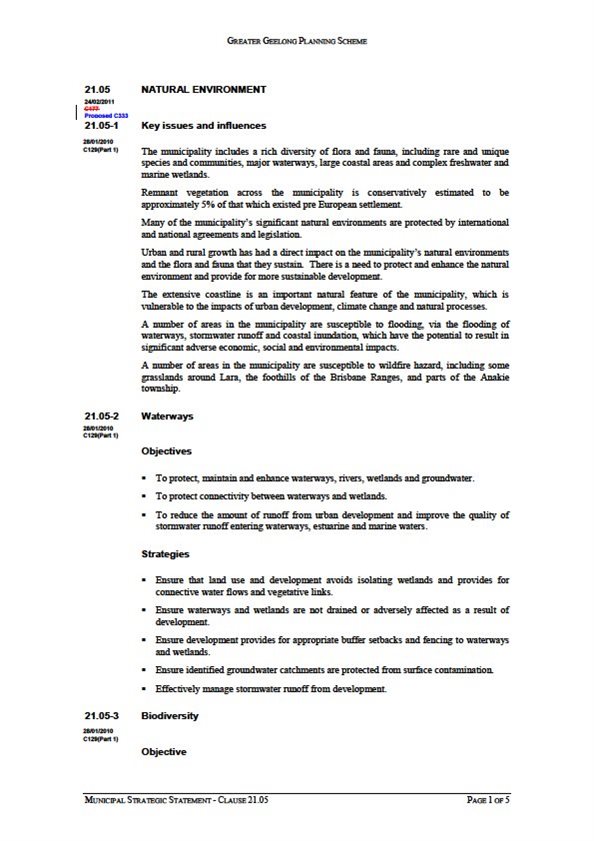
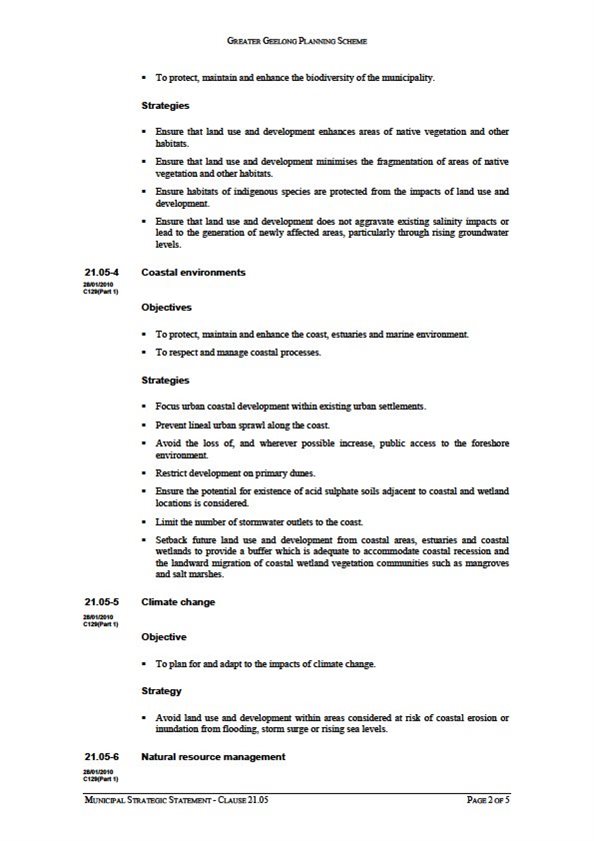
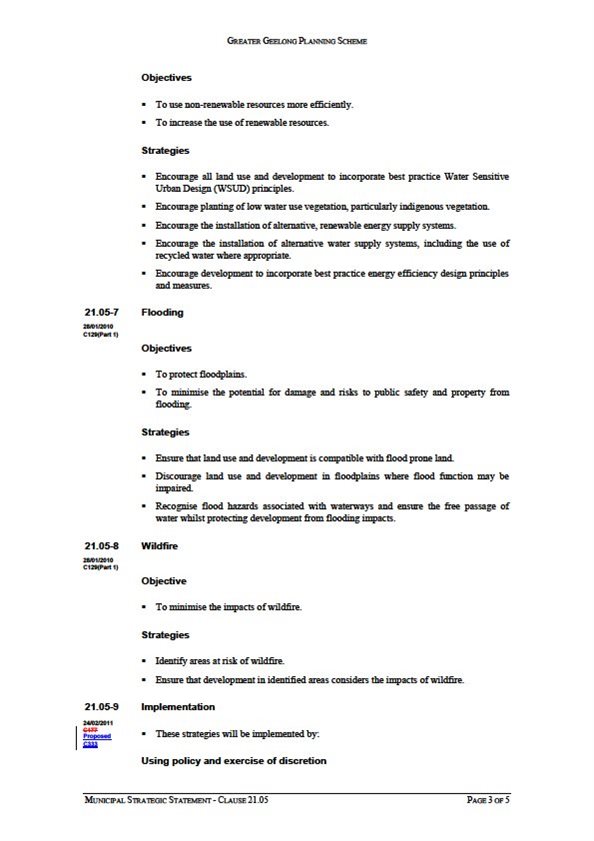
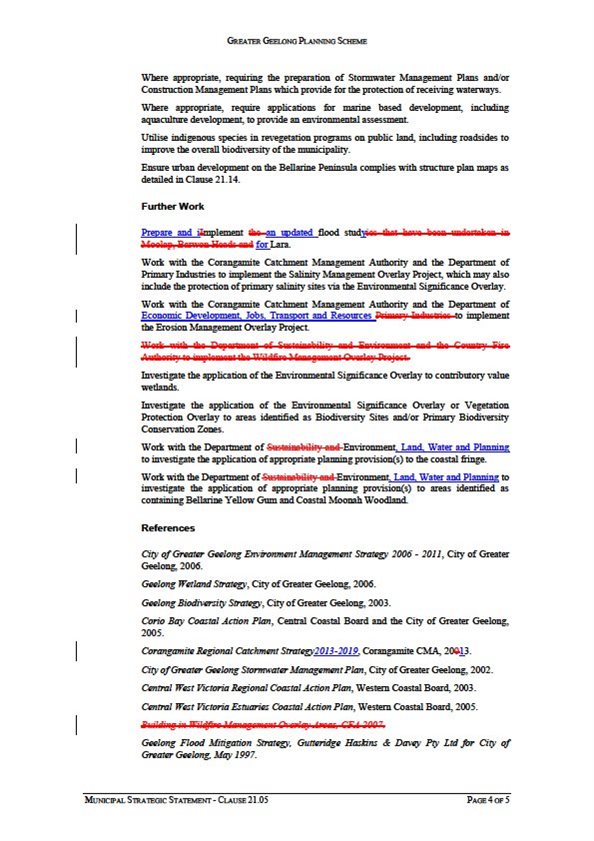
Amend Clause 21.05 (Natural Environment) to update ‘Further work’ statements
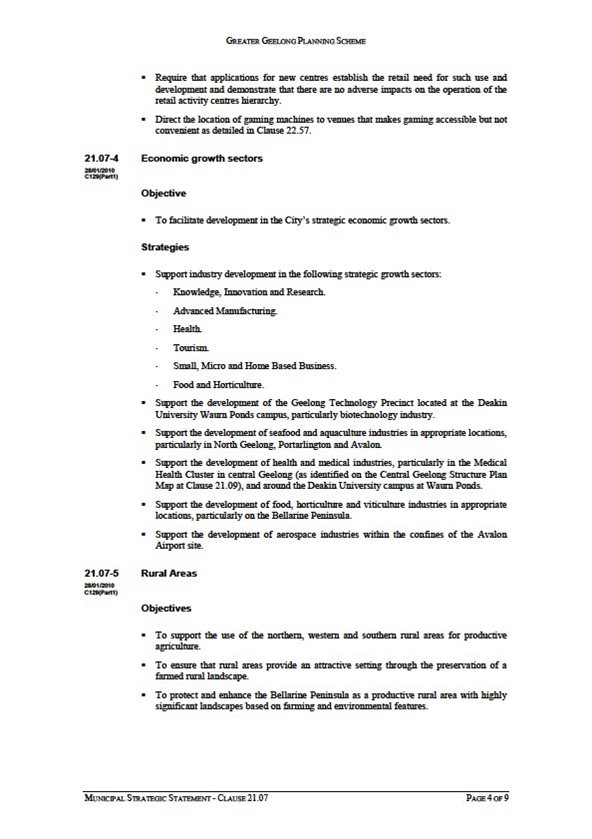
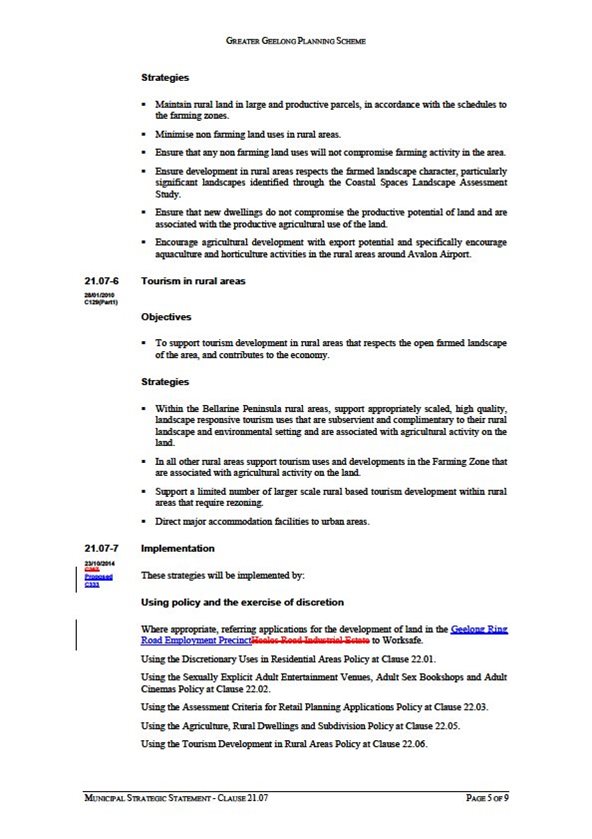
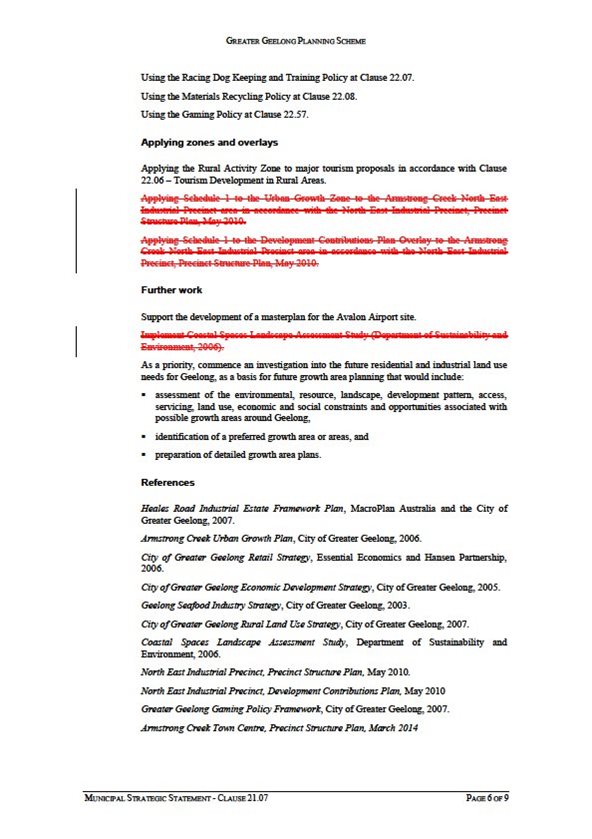
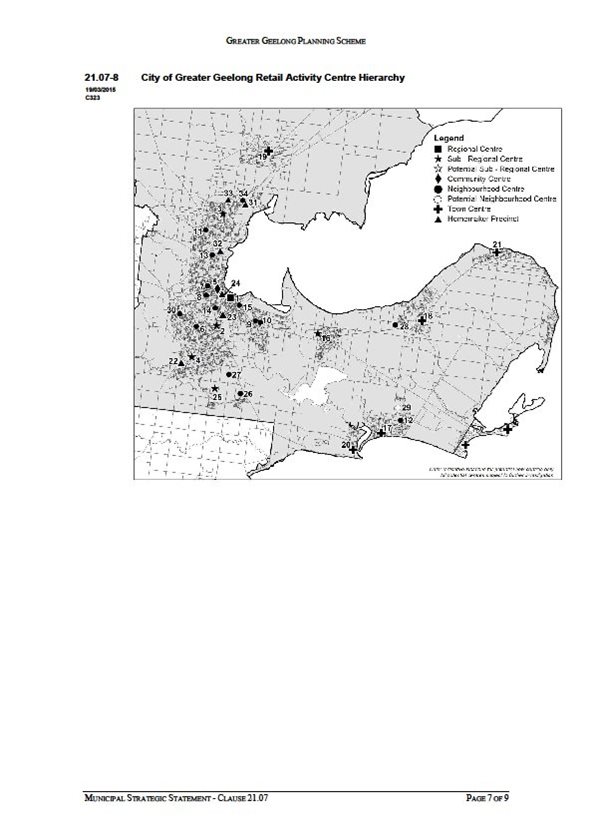
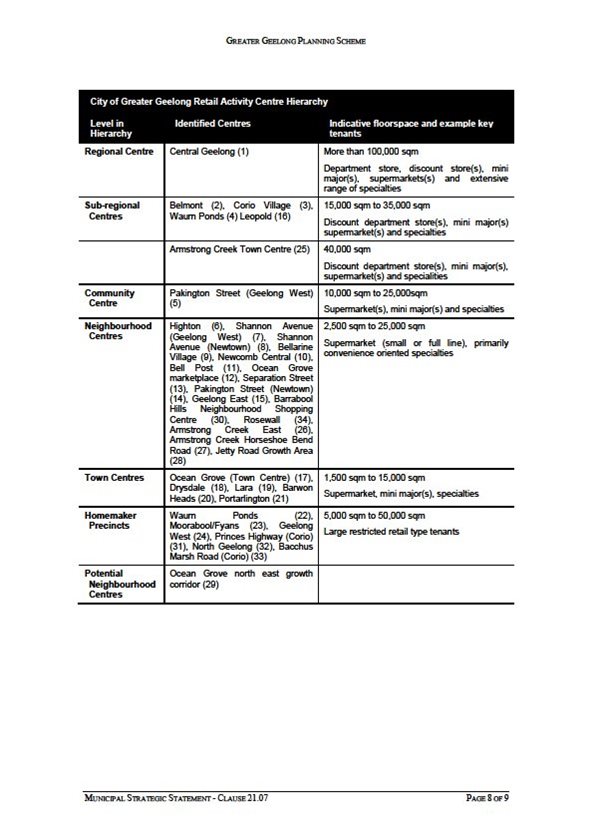
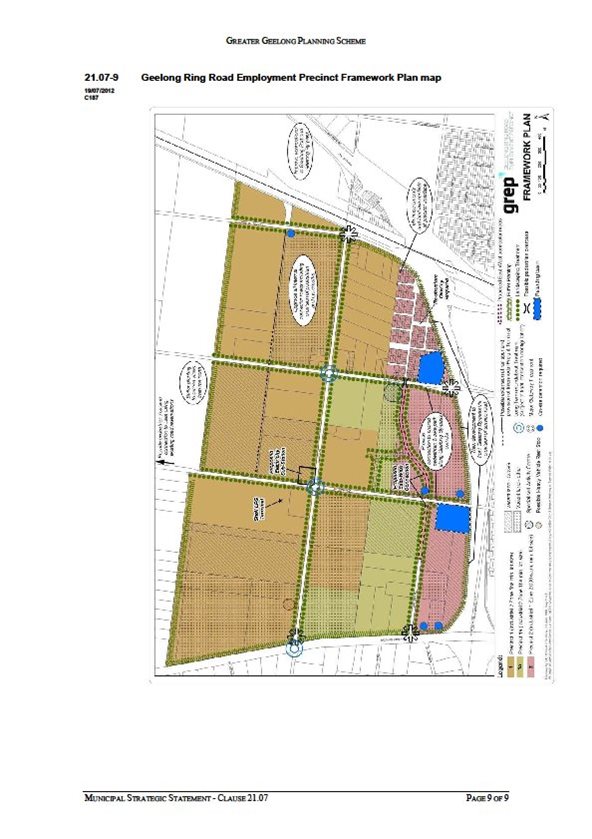
Amend Clause 21.07 (Economic Development and Employment) to update ‘Further work’ statements
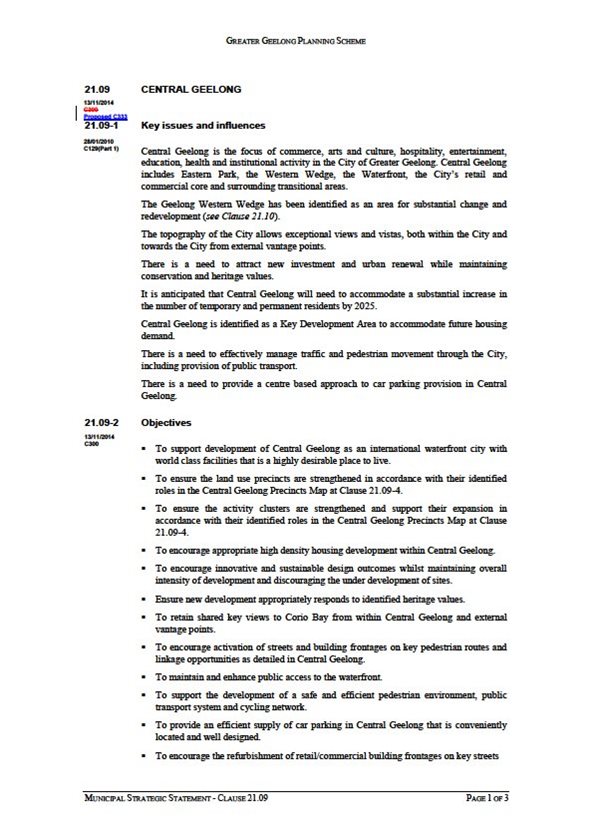
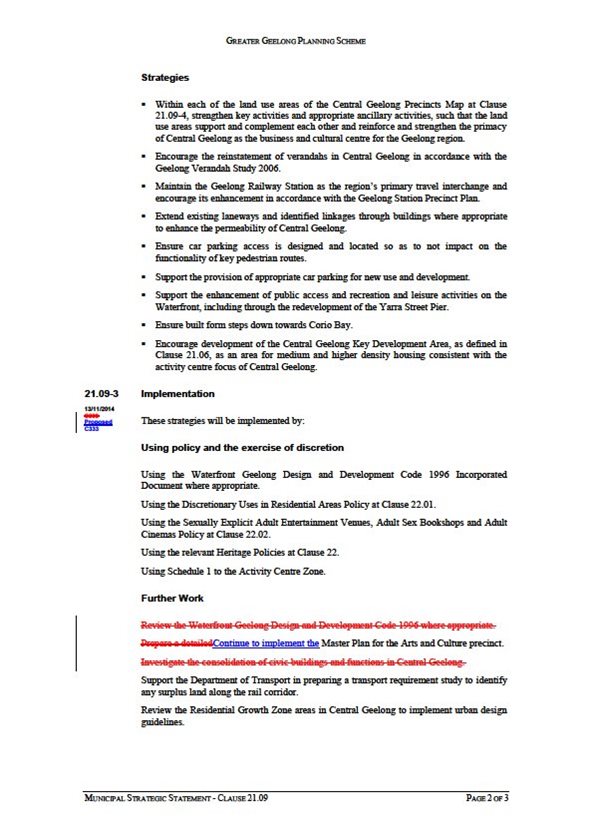
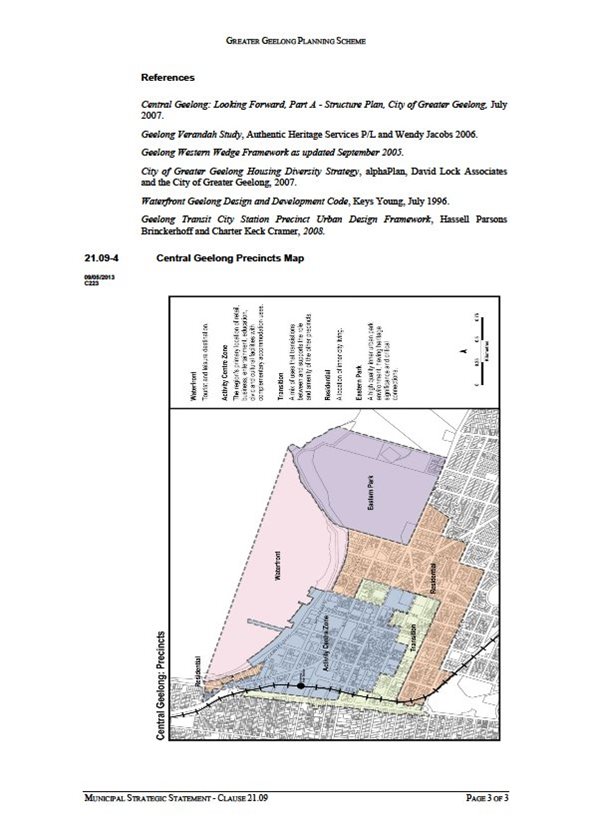
Amend Clause 21.09 (Central Geelong) to update ‘Further work’ statements
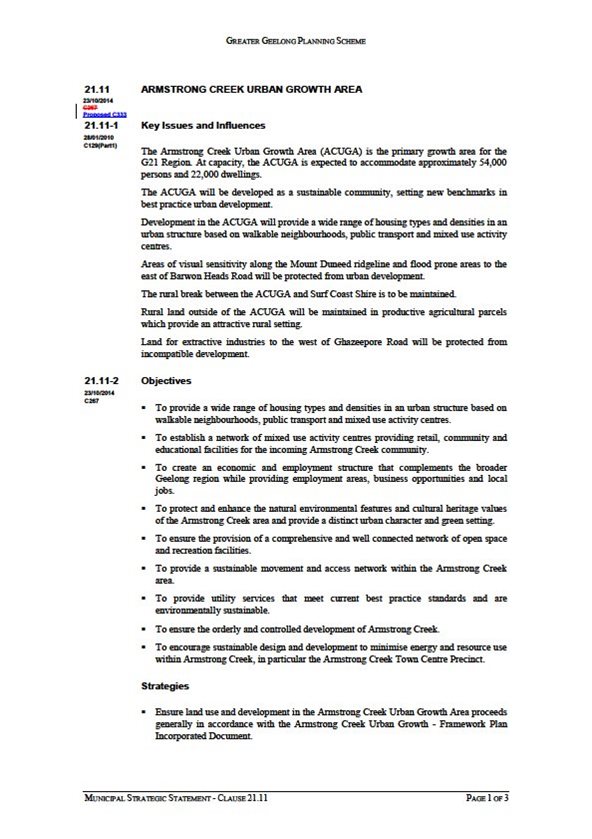
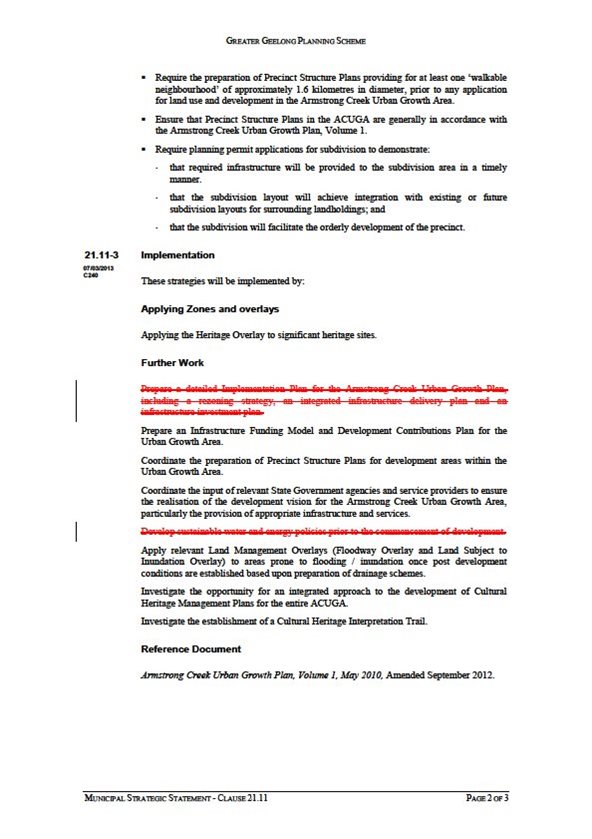
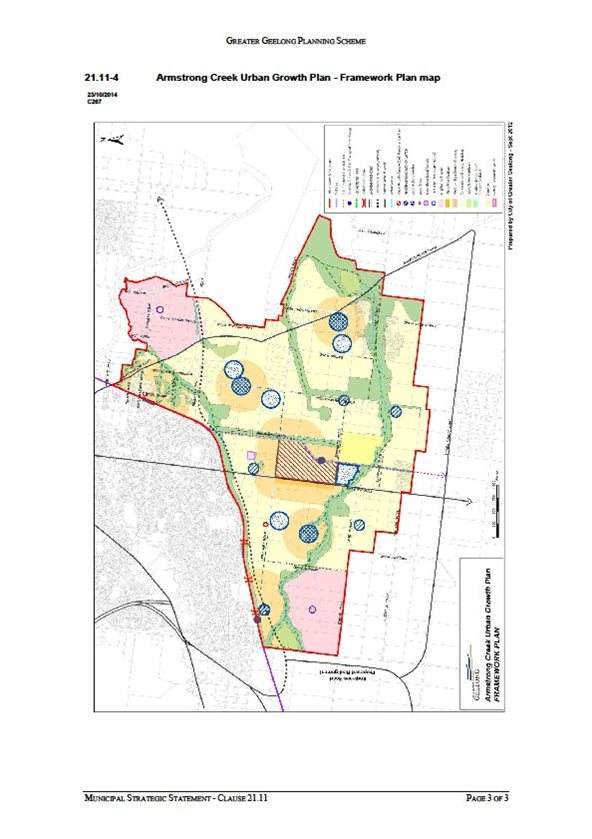
Amend Clause 21.11 (Armstrong Creek Urban Growth Area) to update ‘Further work’ statements
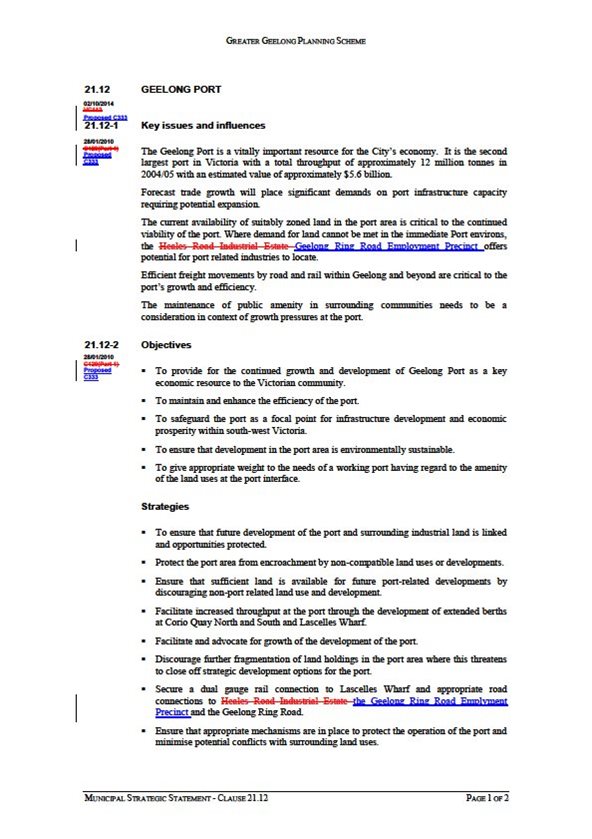
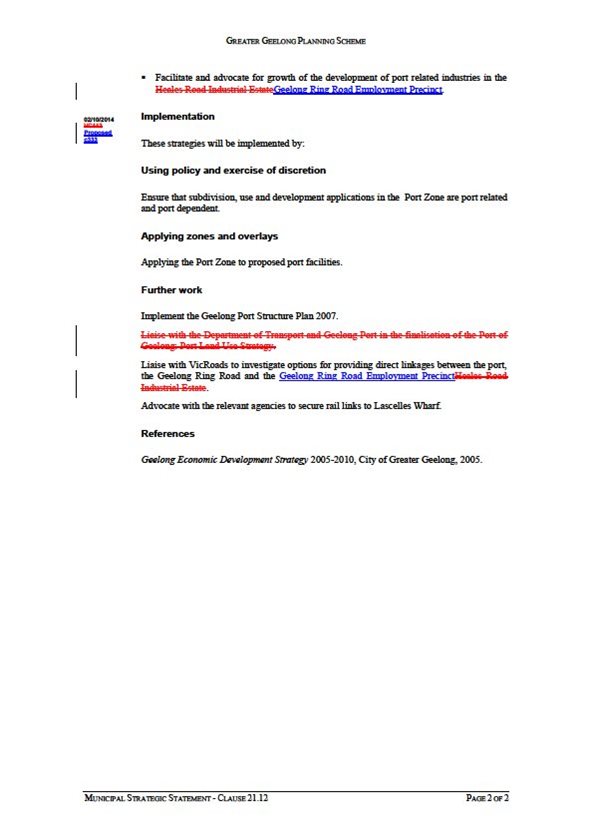
Amend Clause 21.12 (Geelong Port) to update ‘Further work’ statements
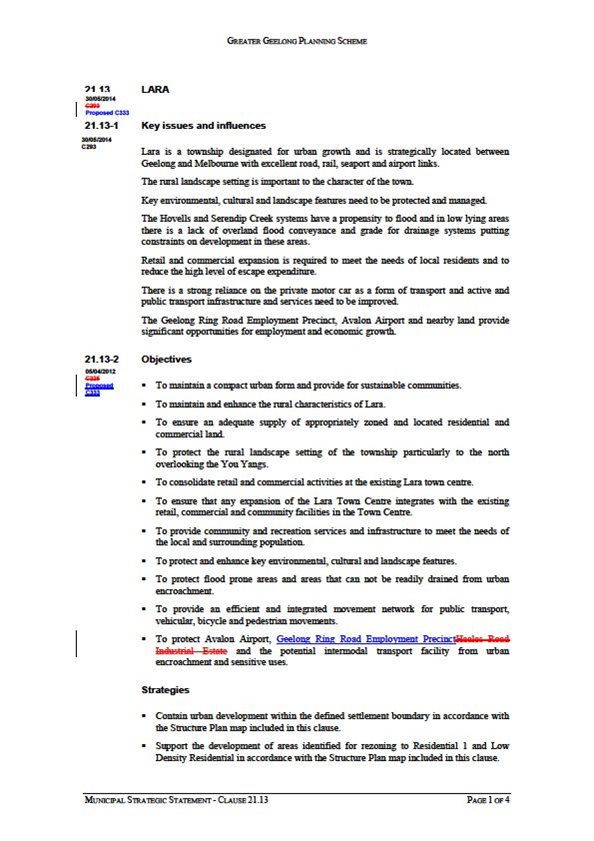
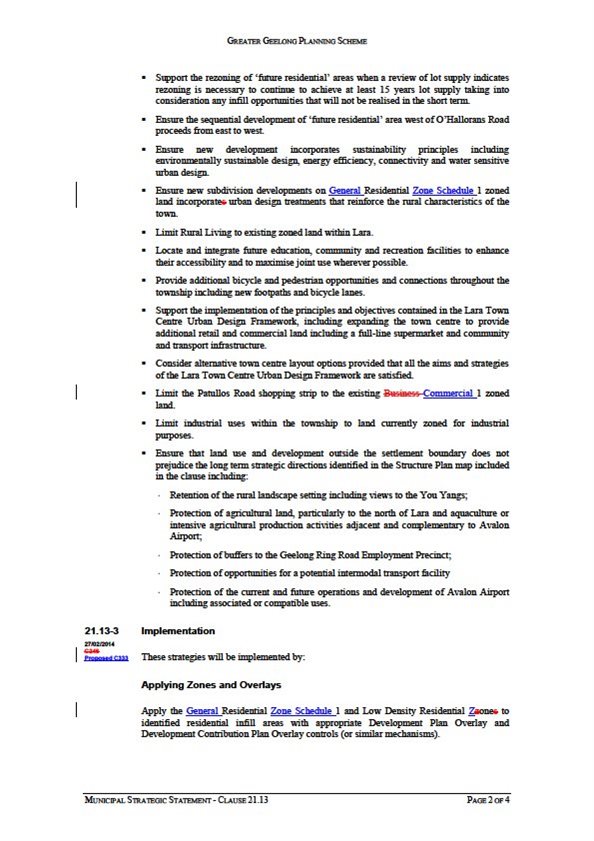
Amend Clause 21.13 (Lara) to update ‘Further work’ statements
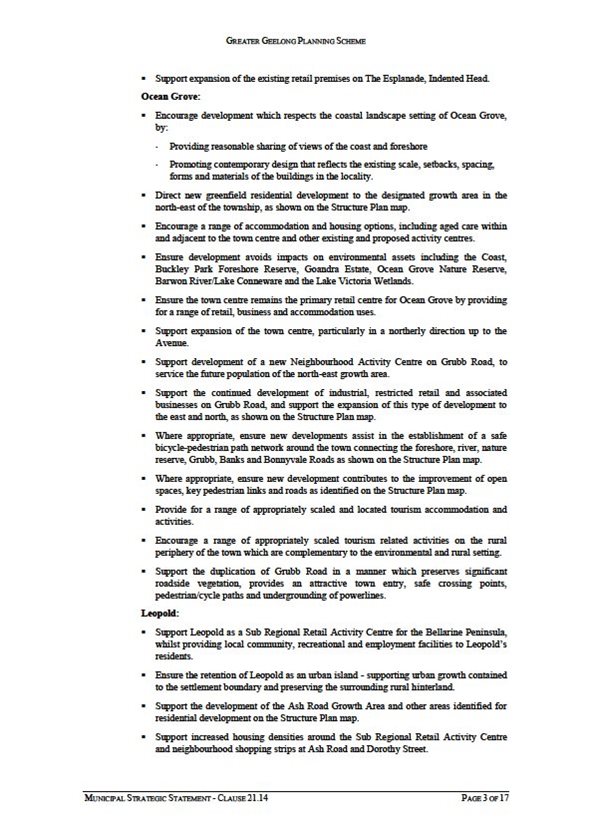
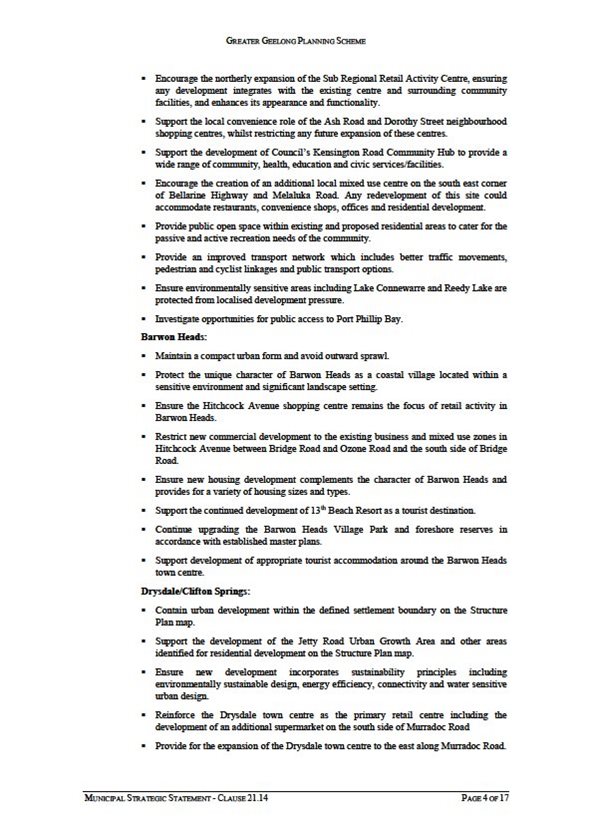
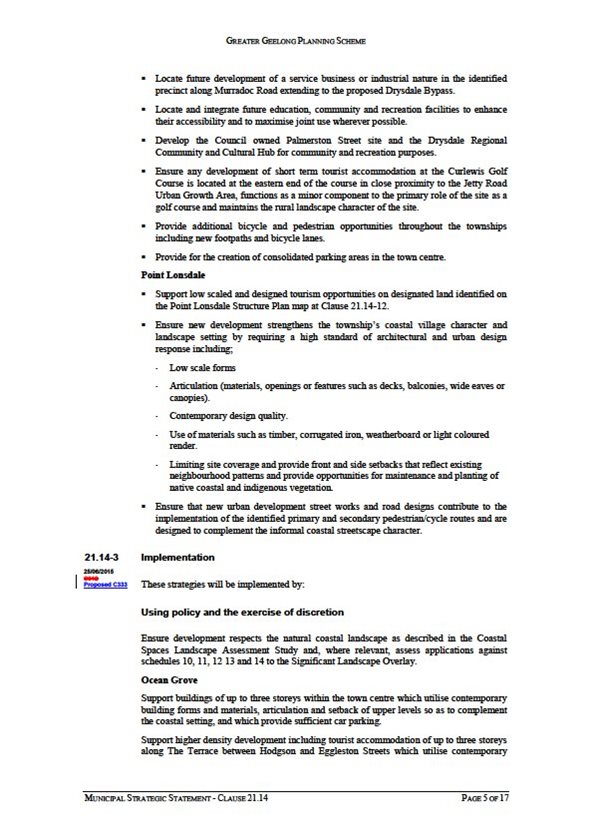
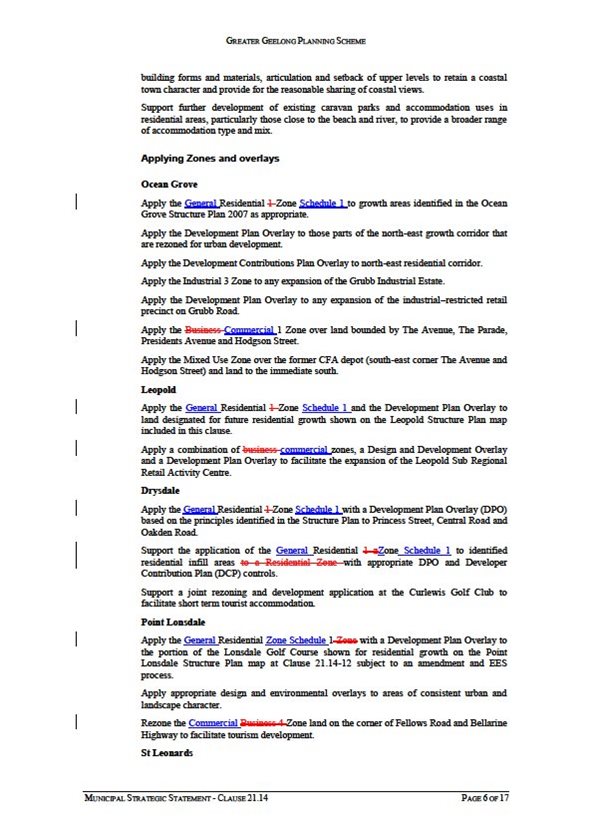
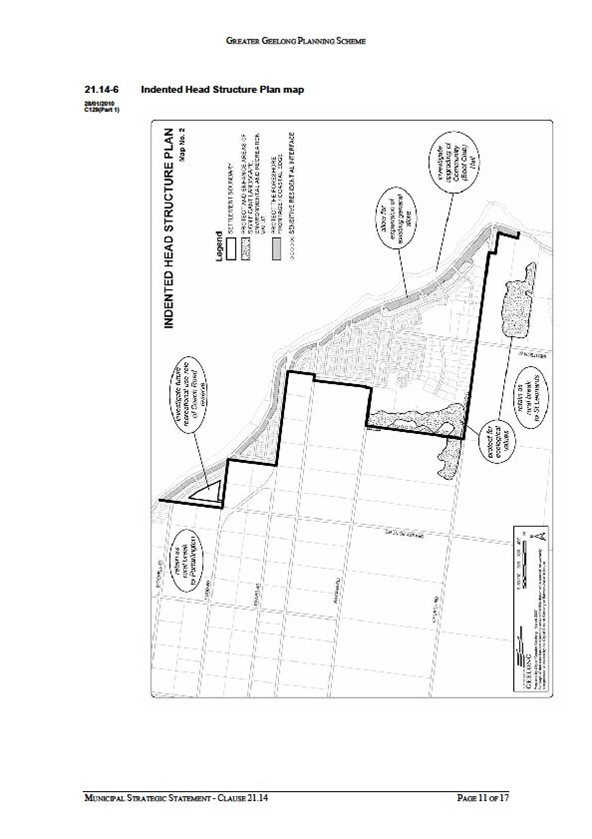
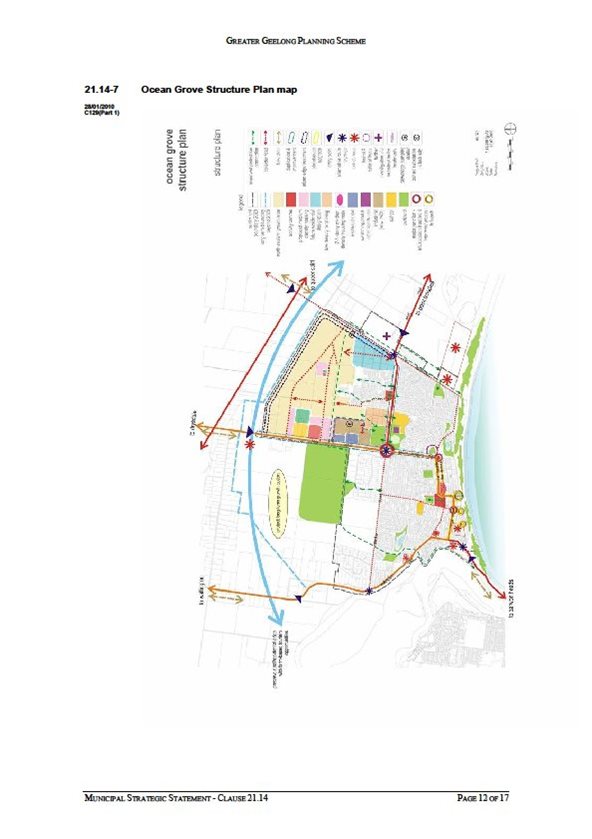
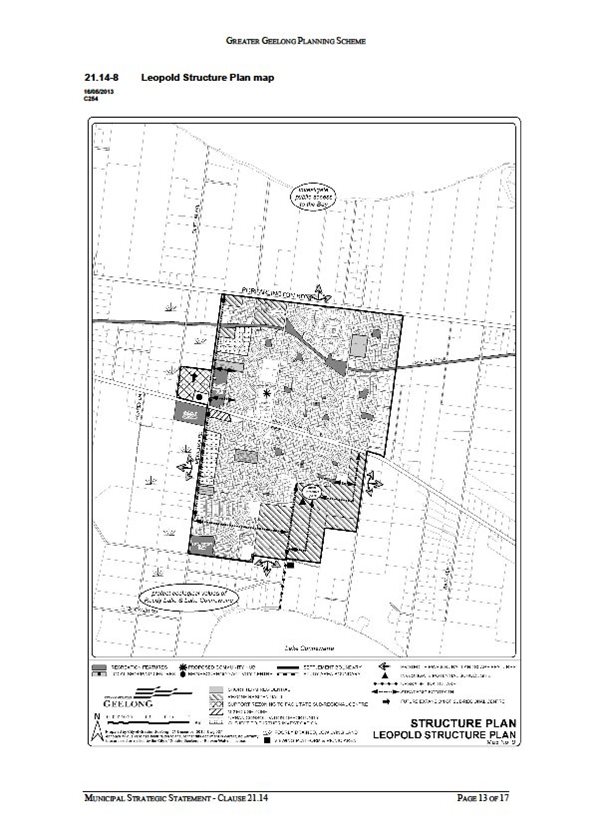
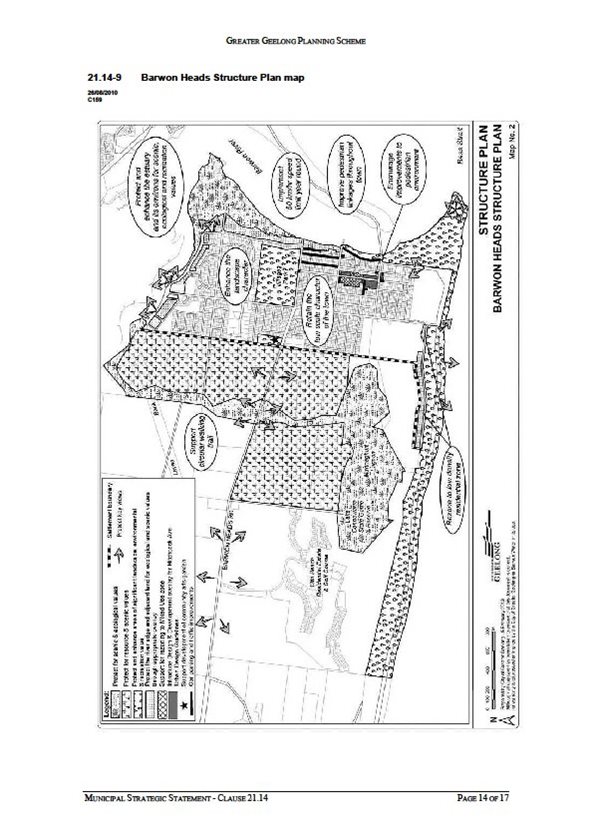
Amend Clause 21.14 (The Bellarine Peninsula) to update ‘Further work’ statements
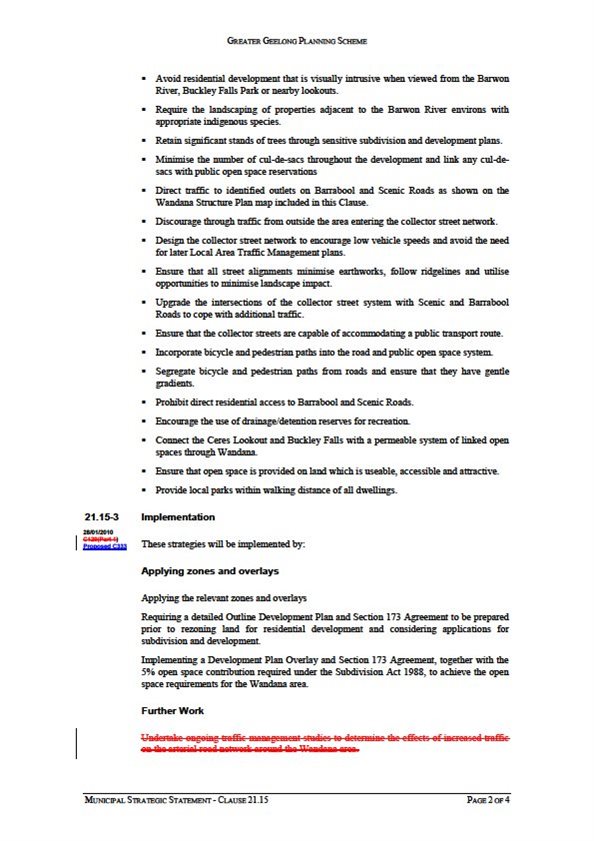
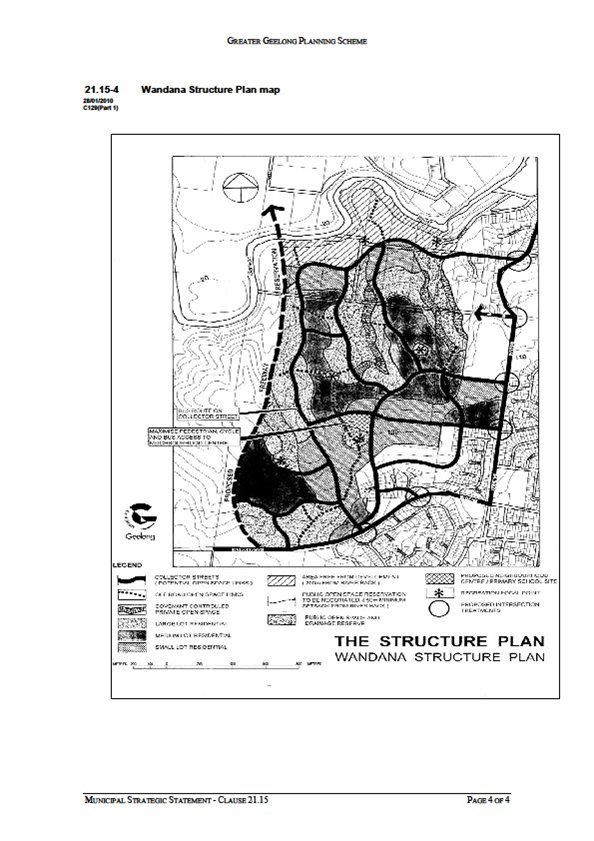
Amend Clause 21.15 (Wandana) to update ‘Further work’ statements
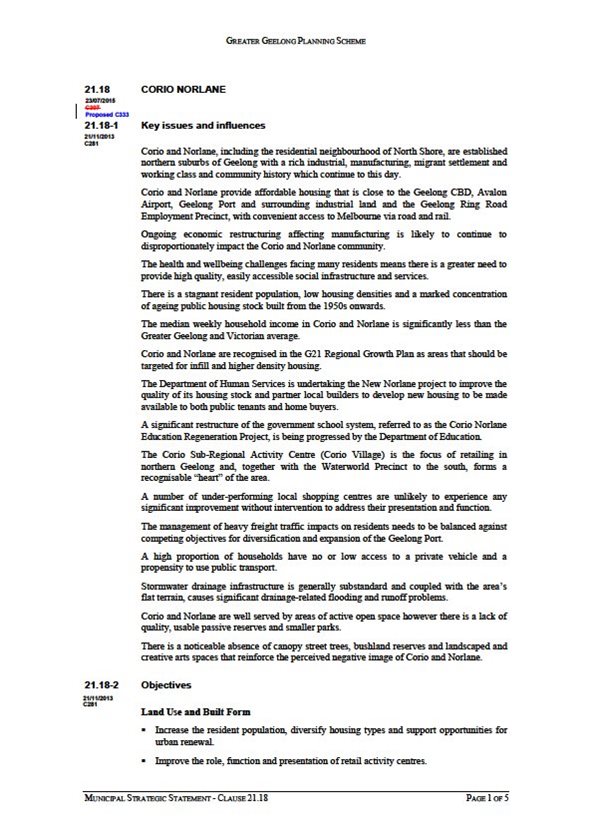
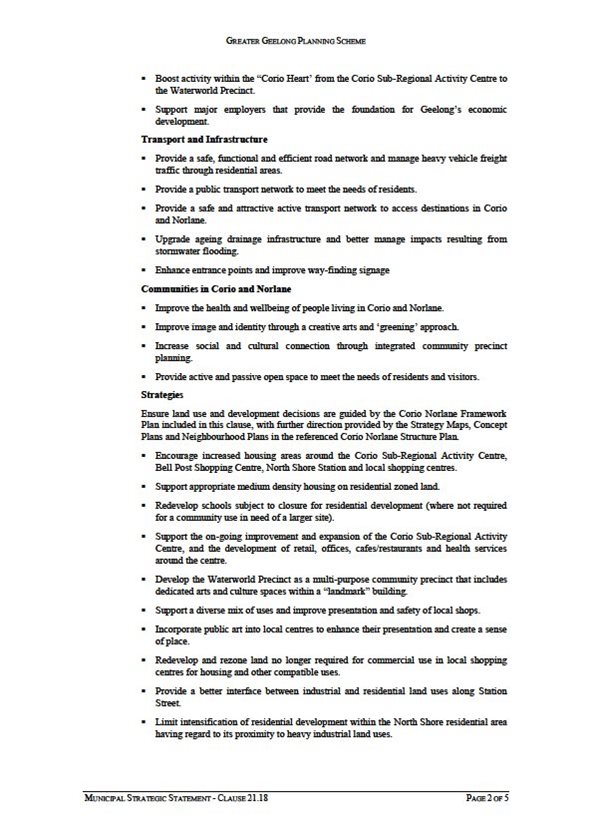
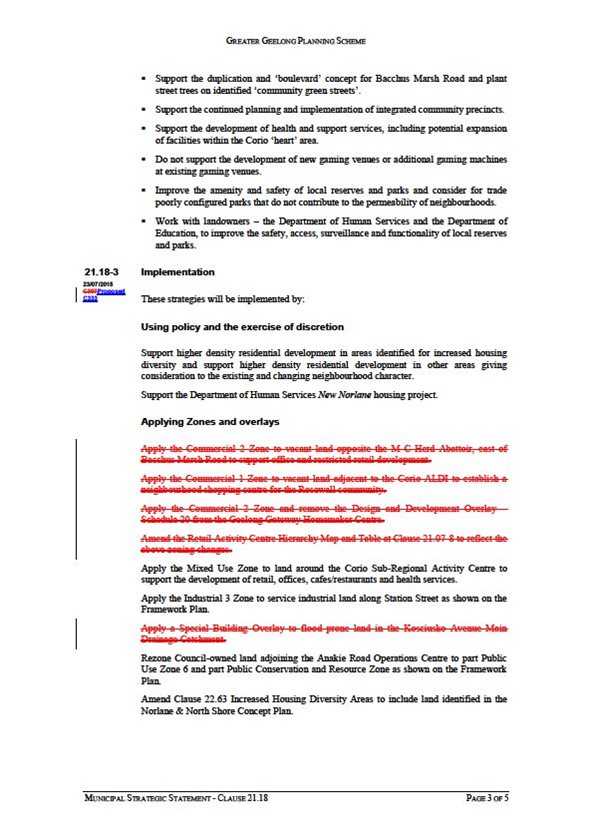
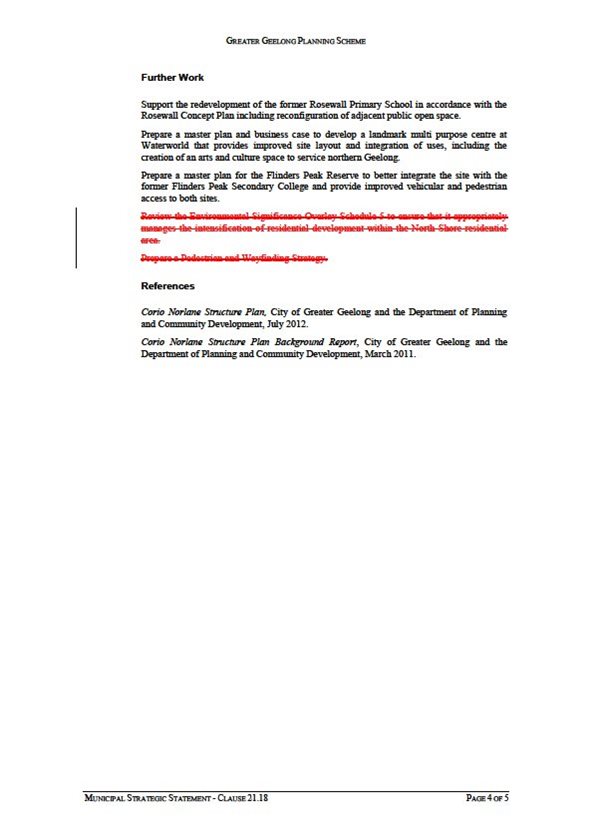
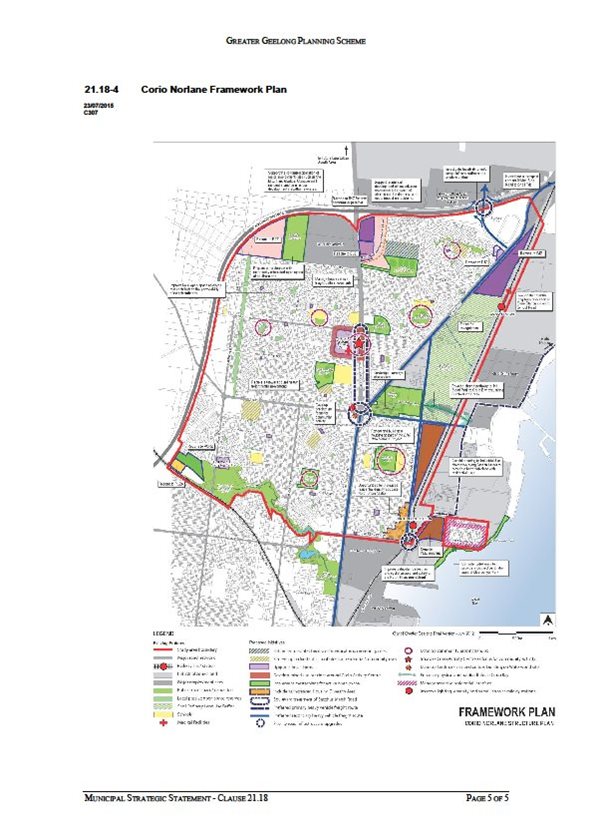
Amend Clause 21.18 (Corio Norlane) to update ‘Further work’ statements
Overlays
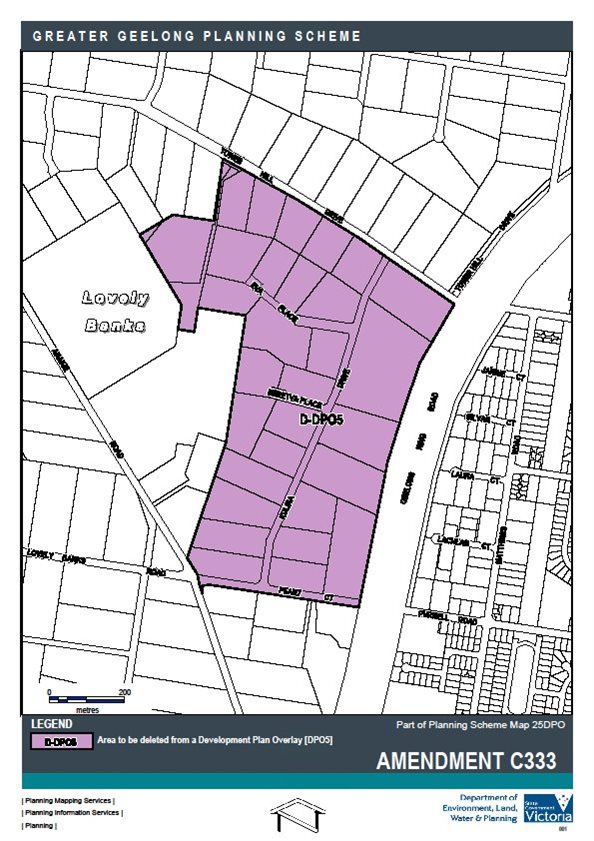
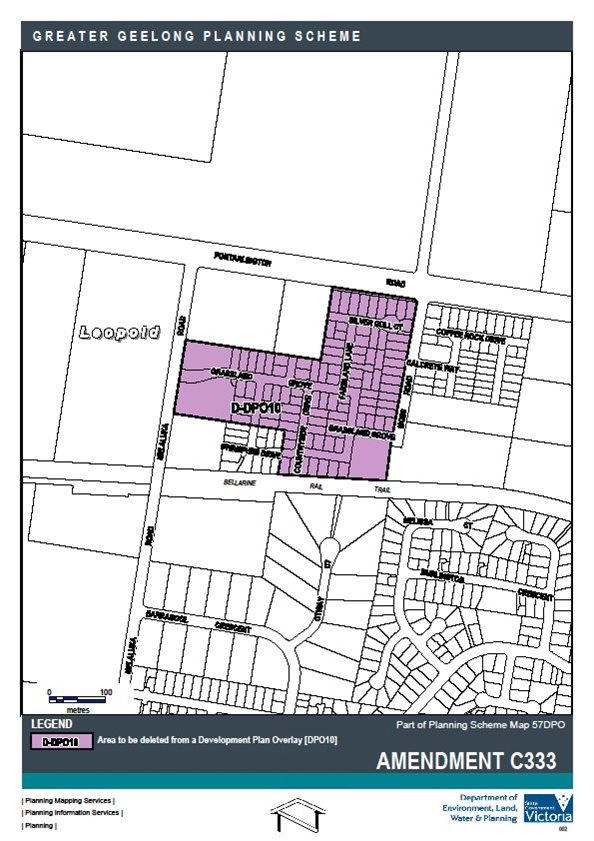
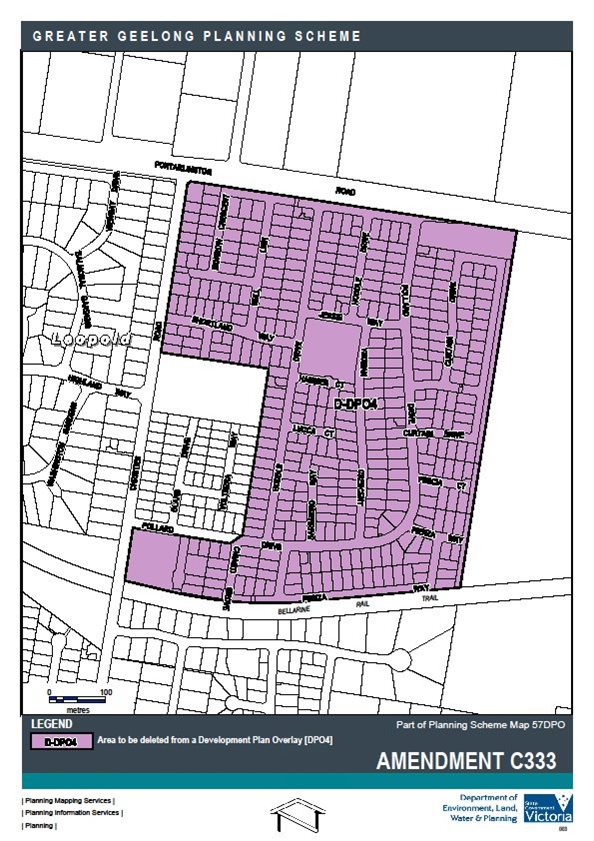
Delete Schedules 2, 4, 5 & 10 to Clause 43.04 (Development Plan Overlay).
General Provisions
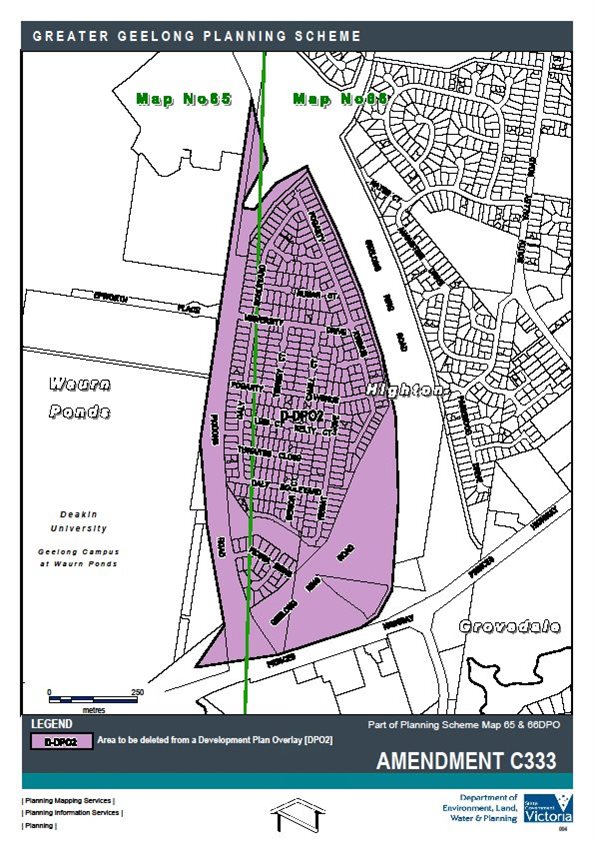
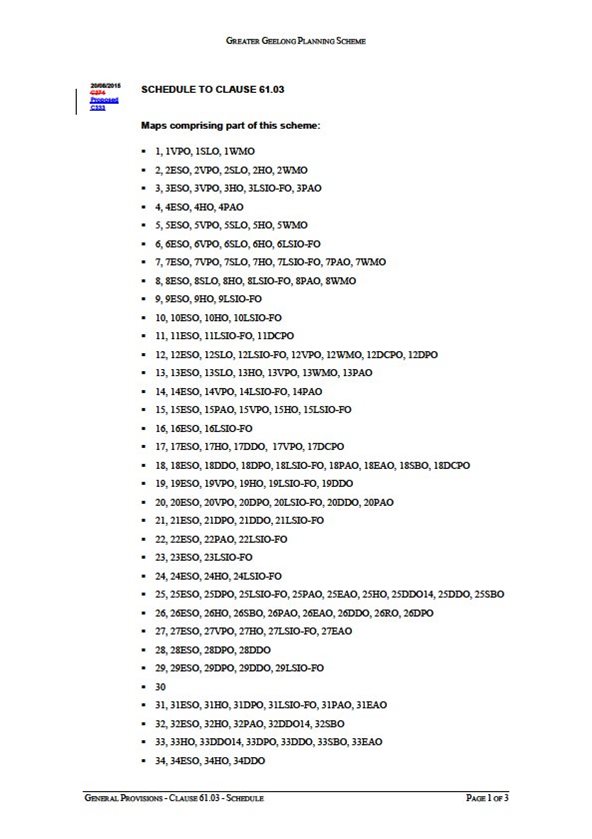
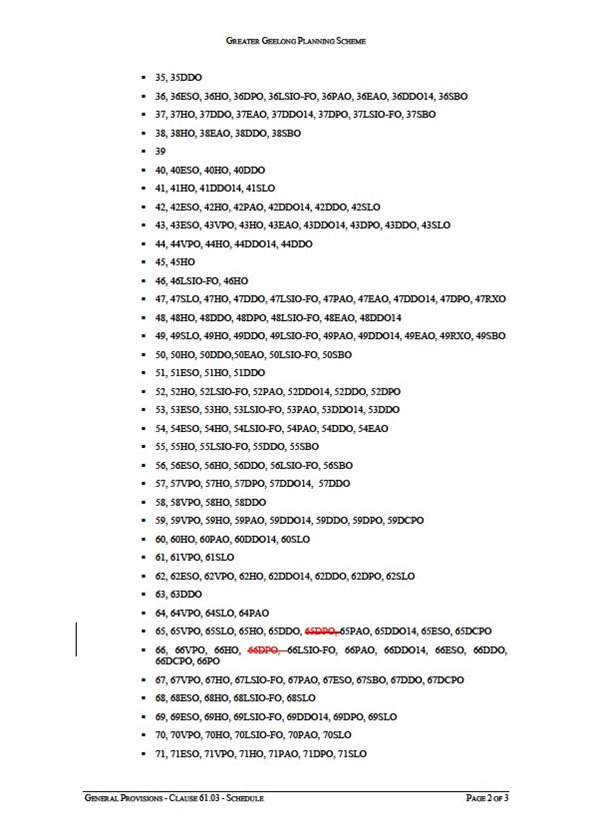
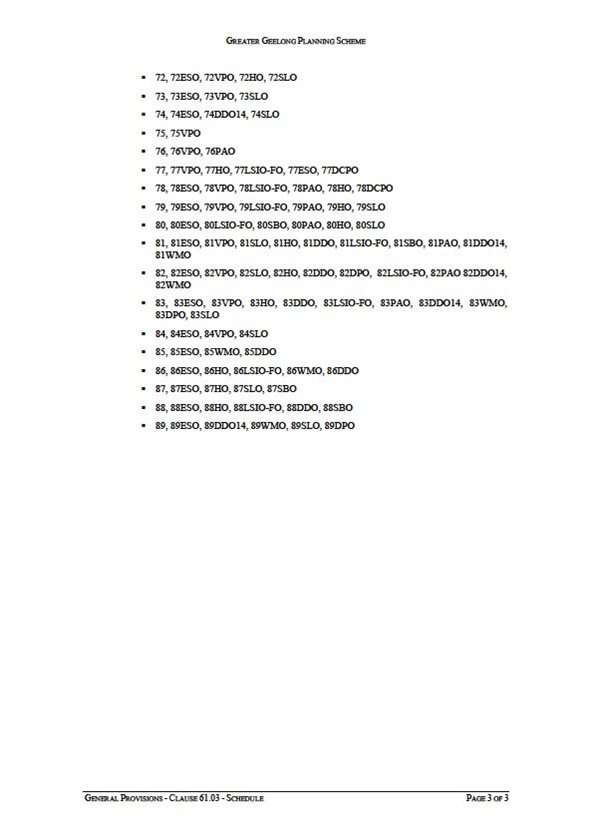
Amend the Schedule to Clause 61.03 to delete Planning Scheme Map No’s. 65DPO and 66DPO from the Greater Geelong Planning Scheme.
Maps (Overlays)
Amend Planning Scheme Map No’s. 25DPO and 57DPO
Delete Planning Scheme Map No’s. 65DPO and 66DPO
In consultation with the Department of Environment, Land, Water and Planning, a small number of changes were made to the proposed amendment prior to the limited notification process. The proposed changes may pre-empt the outcome of current and future strategic work and are best pursued as part of future amendments:
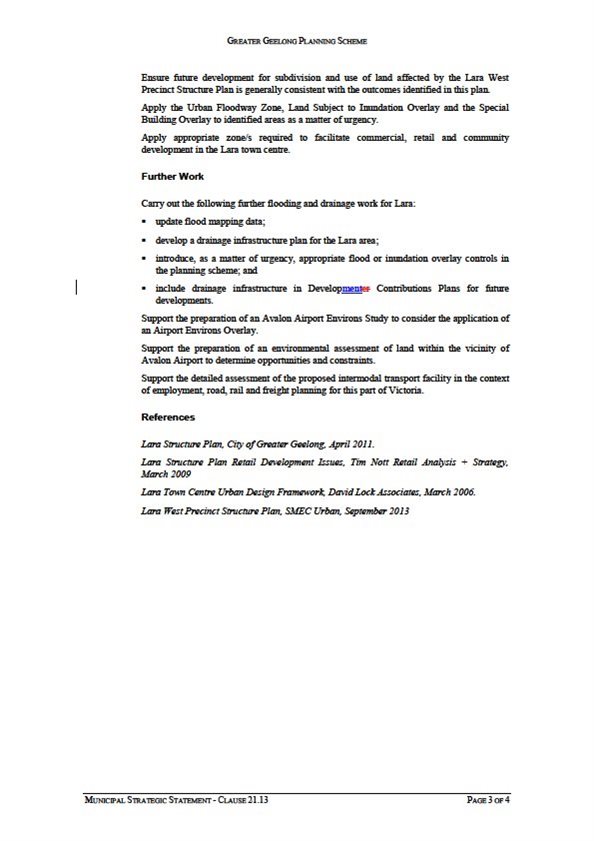
Clause 21.13 Lara proposed to delete the Further Work action of “Support the detailed assessment of the proposed intermodal transport facility in the context of employment, road, rail and freight planning for this part of Victoria.” This is to be retained until the Geelong Werribee Corridor Strategy (as funded in Council’s 2015-2016 Budget) is completed.
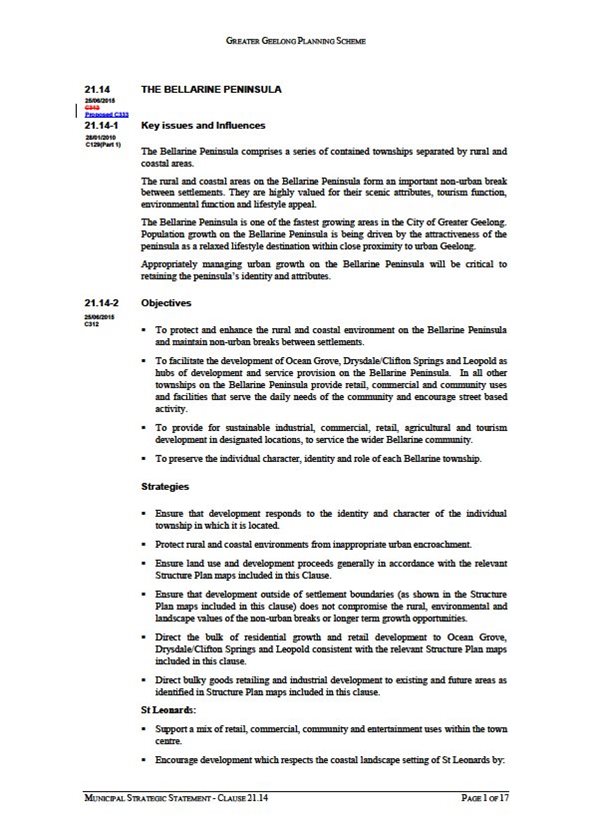
Clause 21.14 Bellarine Peninsula (Ocean Grove) proposed to delete the Further work action of “Review the application of Significant Landscape Overlay 7”. This is to be investigated as part of the current review of the Ocean Grove Structure Plan and is to be retained until the Structure Plan is complete and a separate amendment is prepared to implement it.
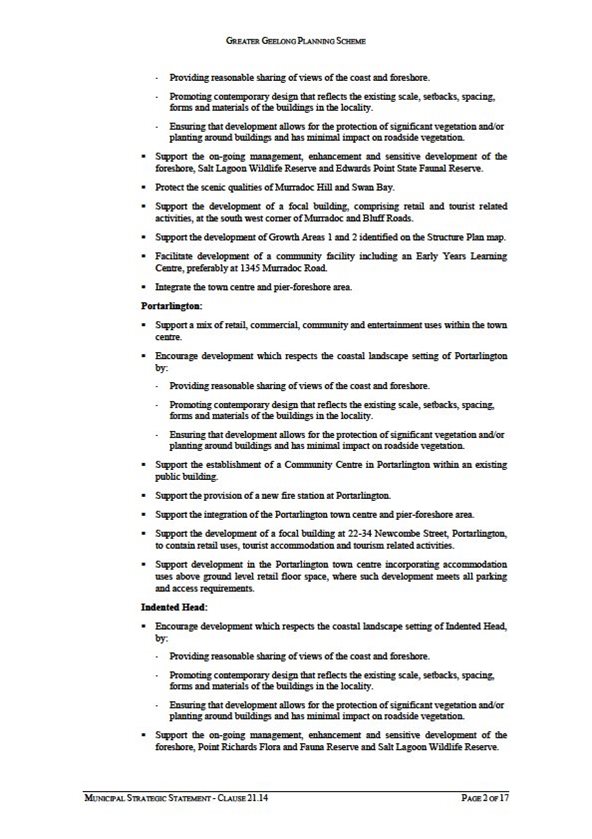
Clause 21.14 Bellarine Peninsula proposed to delete the Further Work action of “Review the planning framework for land identified in the coastal Spaces Landscape Assessment Study as regionally significant in the south west of the Bellarine Peninsula to ensure the protection of landscape value is adequately addressed.” This action will be retained pending Council investigation on whether this work actually needs to be done. It will be removed if necessary when the investigation concludes, and possibly through the Ocean Grove Structure Plan amendment.
All clauses that were being changed have also been amended to include the correct new residential and commercial zone names.
No adverse environmental implications are expected as a result of this Amendment. This is a policy neutral revision of the existing MSS and it continues to give effect to the strategic intent of objectives, policies and implementation tools that are contained within it.
There are no financial implications for Council. There are no income or expenditure receipts.
There will be no budgetary implications as a consequence.
The Amendment is consistent with the format for planning schemes and with the Ministerial Direction on the Form and Content of Planning Schemes. The Amendment is consistent with the State and Local Planning Policy Framework (SPPF and LPPF). As the changes proposed are minor and essentially administrative in nature, there are no implications for the LPPF. Some minor corrections to the LPPF are proposed by this Amendment and will improve its interpretation and relevance.
The key driver for the review of the Planning Scheme is the Planning and Environment Act 1987, which requires that planning schemes be reviewed after adopting City Plan.
This review has determined that the MSS encapsulates the four pillars which underpin City Plan 2013-2017, namely:
Community Wellbeing
Growing Our Economy
Sustainable Built and Natural Environment
How We Do Business
No Council officers have any direct or indirect interest, in accordance with Section 80 (C ) of the Local Government Act, to which this amendment relates.
Council’s statutory obligations as Planning Authority under Section 12B(4) of the Act have required the preparation of the MSS Review and its subsequent implementation. If the Amendment is not adopted Council will not be fulfilling its duty as a Planning Authority.
There are not expected to be any impacts for community health and wellbeing as a consequence of the review and/or Amendment.
The amendment will not impact on basic human rights, freedoms and responsibilities as set out in the Charter. Planning legislation provides for the exemptions to the usual consultation process for amendments, which the Minister for Planning duly granted.
The Amendment was exempt from the giving of notice with the exception of notification to prescribed Ministers under Section 19(1)(c ) of the Planning and Environment Act 1987, which has been undertaken.
The planning authority for this amendment is the Greater Geelong City Council.
The Greater Geelong Planning Scheme is amended as follows:
Planning Scheme Maps
The Planning Scheme Maps are amended by a total of 4 attached map sheets.
Overlay Maps
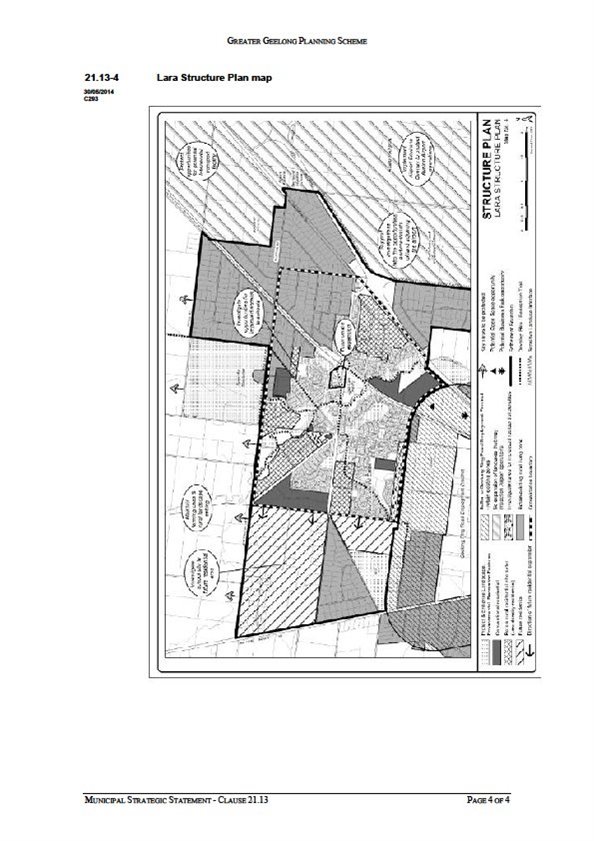
Amend Planning Scheme Map Nos. 25DPO, 57DPO in the manner shown on the 2 attached maps marked “Greater Geelong Planning Scheme, Amendment C333”.
Delete Planning Scheme Map Nos.65DPO, 66DPO in the manner shown on the 2 attached maps marked “Greater Geelong Planning Scheme, Amendment C333”.
Planning Scheme Ordinance
The Planning Scheme Ordinance is amended as follows:
In Local Planning Policy Framework – replace Clause 21.05 with a new Clause 21.05 in the form of the attached document.
In Local Planning Policy Framework – replace Clause 21.07 with a new Clause 21.07 in the form of the attached document.
In Local Planning Policy Framework – replace Clause 21.09 with a new Clause 21.09 in the form of the attached document.
In Local Planning Policy Framework – replace Clause 21.11 with a new Clause 21.11 in the form of the attached document.
In Local Planning Policy Framework – replace Clause 21.12 with a new Clause 21.12 in the form of the attached document.
In Local Planning Policy Framework – replace Clause 21.13 with a new Clause 21.13 in the form of the attached document.
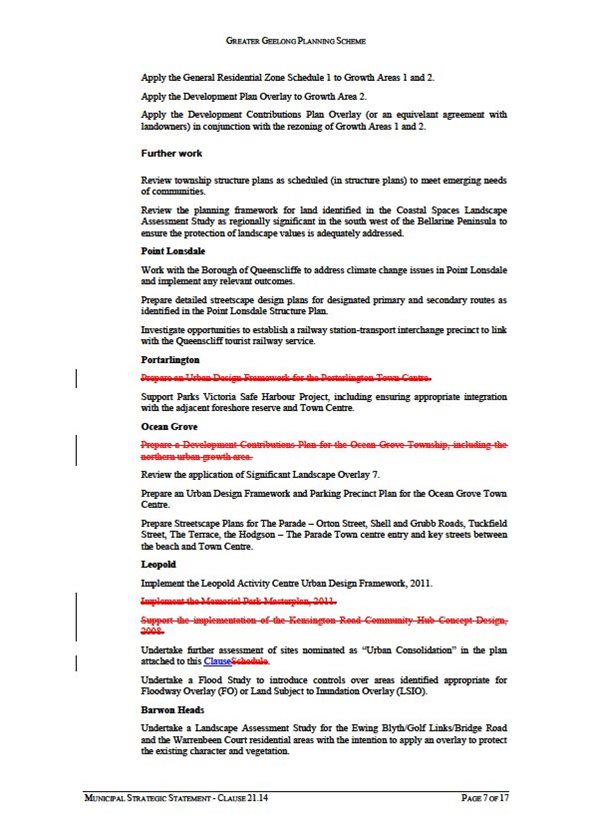
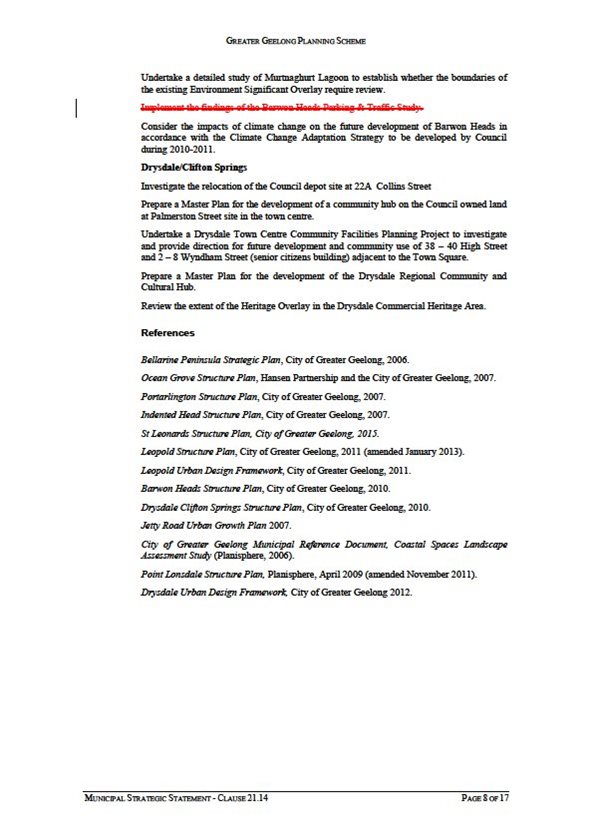
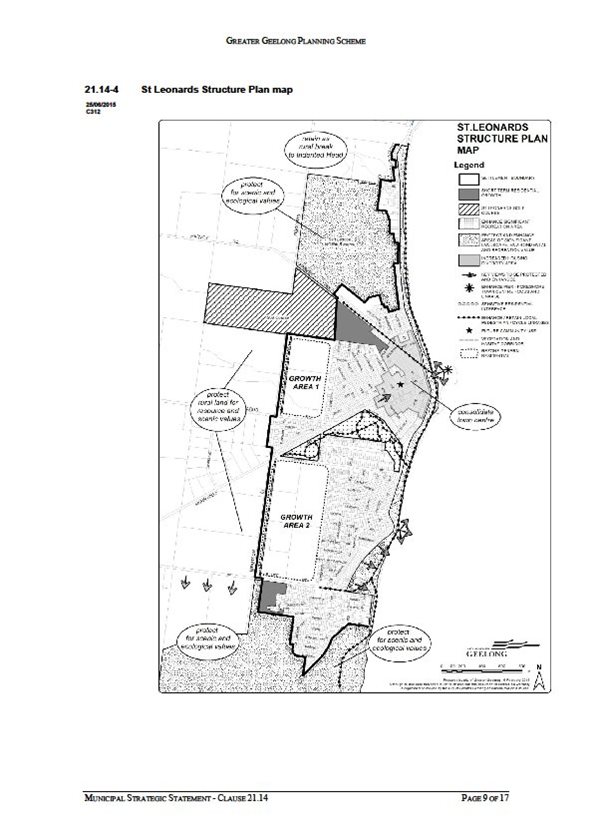
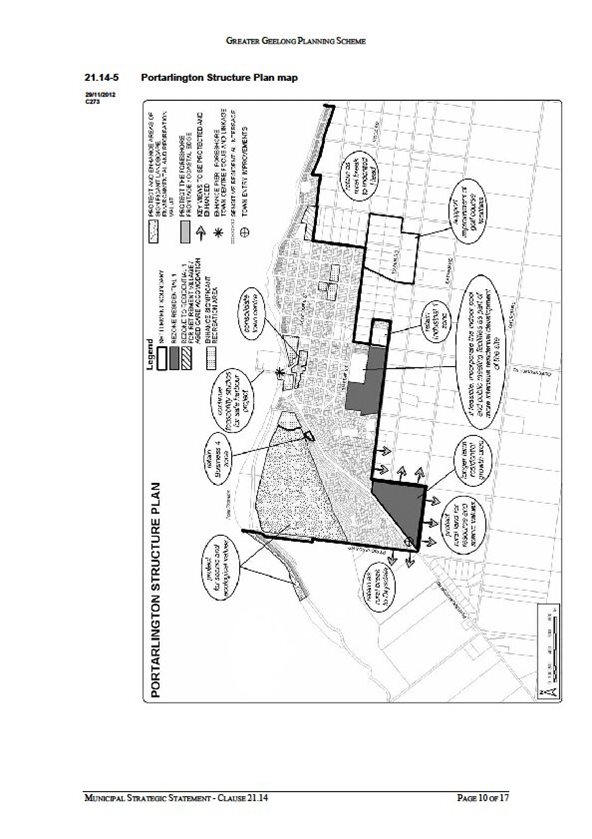
In Local Planning Policy Framework – replace Clause 21.14 with a new Clause 21.14 in the form of the attached document.
In Local Planning Policy Framework – replace Clause 21.15 with a new Clause 21.15 in the form of the attached document.
In Local Planning Policy Framework – replace Clause 21.18 with a new Clause 21.18 in the form of the attached document.
In Overlays – Clause 43.04, delete Schedules 2, 4, 5 & 10.
In General Provisions – Clause 61.03, replace the schedule with a new Schedule in the form of the attached document.
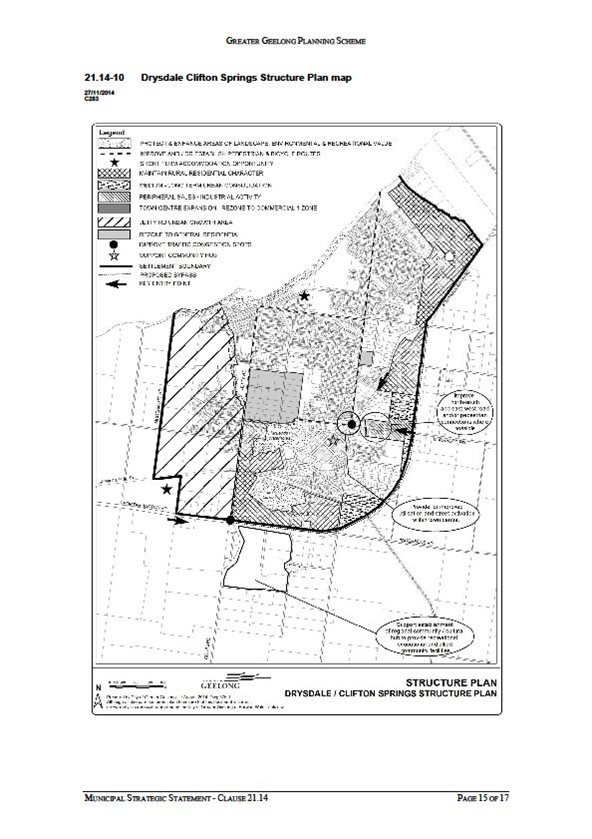
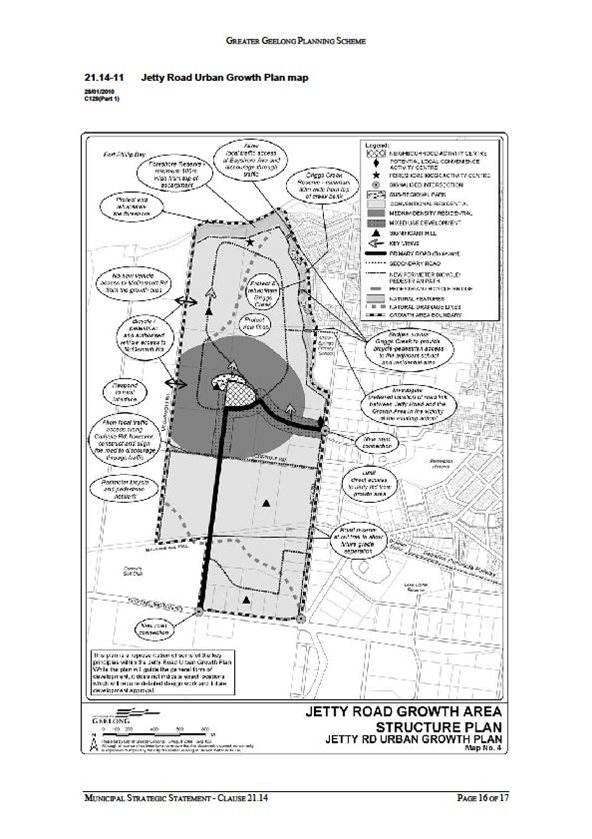
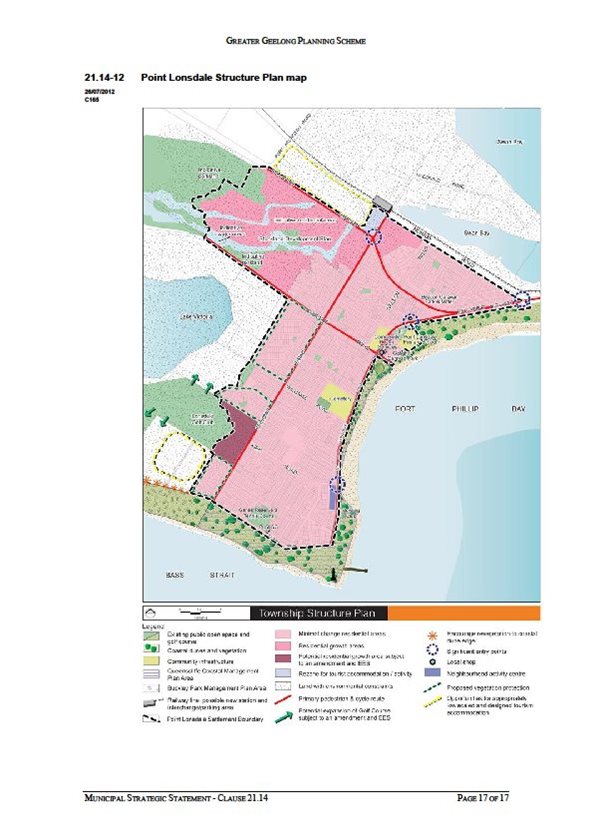
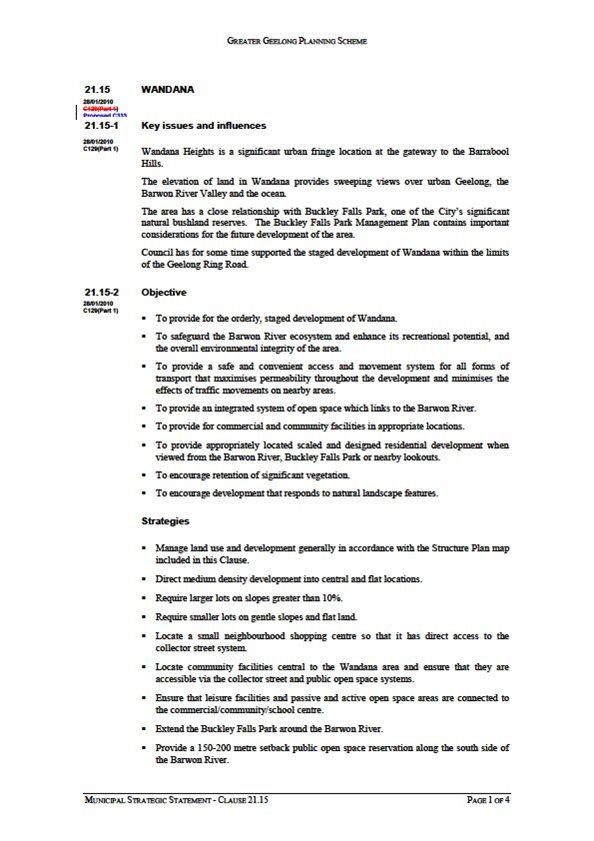
Portfolio: |
Planning – Cr Heagney |
Source: |
Planning and Tourism - Planning Strategy |
General Manager: |
Peter Bettess |
Index Reference: |
Project - Non rural uses in rural areas policy review |
This report seeks approval from Council to adopt the findings and recommendations of the Managing Development in Rural Areas Planning Policy Review (previously distributed with Briefing Papers) and to give them statutory effect by including them in the Greater Geelong Planning Scheme.
In 2013 the State Government changed the rules on the types of development that can occur in rural areas.
The reformed rural zones have generally relaxed the number of uses that can be considered in the Farming and Rural Conservation zones. Changes relate to some accommodation, retail, industry, schools and community uses. Prior to the zone changes many of these uses were prohibited.
Council needs to respond to changes made by the State Government as there is a policy gap and Statutory Planning require guidance to assess planning permit applications.
It is recommended to amend the Greater Geelong Planning Scheme Clause 22.06: Tourism and Function Centre Development in Rural Areas. Much of the existing Clause 22.06 is proposed to be retained, including the overall objectives to protect productive agricultural land. It is considered important, however, to continue to recognise that there are opportunities to enhance the tourism industry in rural areas where compatible with agricultural activity and rural landscape character.
Tourism development forecasts prepared by Urban Enterprises for both the Greater Geelong and the Bellarine Tourism Development Strategy and Non Rural Uses in Rural Areas Policy Review show projected growth in the Geelong rural tourism sector to 2030. This includes demand of between 330 to 550 accommodation rooms or caravan sites in rural Geelong.
The requirement in Clause 22.06 that uses “will be ancillary to and associated with an existing farming activity on the property” should be retained. The Victorian Competition and Efficiency Commission’s enquiry into Victoria’s tourism industry supported the unlocking of tourism development, particularly in rural areas of Victoria where limited tourism and population growth is occurring. This is not the case in Geelong where the tourism sector continues to grow and significant demand is projected to 2030. Removing the requirement would risk allowing uncontrolled development, resulting in over development that impacts on rural landscape character and the role of non urban settlement breaks. The recommended approach promotes the adopted Council policy in the Rural Land Use Strategy (2007) and the Bellarine Peninsula Localised Planning Statement (2014).
Some flexibility is recommended for Clause 22.06 to allow a consideration test for when some uses may be considered by Council outside of the ‘associated with’ test. This recognises that there may be some locations that would support additional tourist development, or the impacts on the rural area are diminished.
Design controls are recommended to manage camping and caravan parks to ensure they cater for the tourism market only. Camping and caravan parks that result in long term or permanent housing accommodation risk resulting in quasi urban extension or urban extensions by stealth. Council should write to the State Government to outline its concerns on the definition of camping and caravan parks in the Victorian Planning Provisions.
It is recommended that a new Local Planning Policy be prepared for the Greater Geelong Planning Scheme for Discretionary Uses in Rural Areas, which discourages the encroachment of non-agricultural uses into rural areas, other than tourism or accommodation land uses. These uses should be directed to urban areas where there is an appropriate level of municipal infrastructure services and better transport connectivity, as supported by State and local policy.
Community engagement was held from 10 July until 7 August 2015 and feedback was sought on the issues around managing growth in rural areas. The response rate was low, but overall the responses were generally supportive of the Council position. Victorian Farmers Federation expressed a strong concern for allowing even more flexibility in rural areas.
It is noted that the Minister for Planning and Minister for Regional Development have set up an Animal Industry Advisory Committee to examine how the planning system can better support Victorian farmers. This process will focus on the definition of intense animal husbandry. The Department of Environment, Land, Water and Planning has advised that Council should continue with this local policy review.
Cr E Kontelj moved, Cr Ellis seconded -
That the report be deferred.
Carried.
Portfolio: |
Planning - Cr Heagney |
Source: |
Planning and Tourism - Planning Strategy and Urban Growth |
General Manager: |
Peter Bettess |
Index Reference: |
Residential and Industrial Land Supply Monitoring Project – Reports 2015 |
The purpose of this report is to inform Council on the findings of the Residential and Industrial Land Supply Monitoring Project 2015 (previously distributed with Briefing Papers).
The G21 Regional Growth Plan identified the need to develop a land supply monitoring process to form the basis for growth and land-release strategies within the G21 Region
A series of Land Supply Monitoring Reports were developed in 2013 as input into the G21 Regional Growth Plan. A web based tool was also developed to enable the wider community to easily and visually access the land supply information.
The G21 Planning and Services Pillar has funded an update to the 2013 land supply monitoring project reports and web based tool for the key growth areas including the City of Greater Geelong, Torquay/Jan Juc (Surf Coast Shire) and Bannockburn (Golden Plains).
The updated reports, prepared by Spatial Economics have identified that Geelong has at least 25 years supply of both residential and industrial land.
Both the updated reports and web based tool are available for public viewing on the G21 web site.
Cr Heagney moved, Cr Richards seconded -
That Council notes the findings of the Residential and Industrial Land Supply Monitoring Project 2015.
Cr Nelson left the meeting room at 8:22pm
Cr Nelson re-entered the meeting room at 8:24pm
Carried.
The G21 Regional Growth Plan identifies a number of key objectives and outcomes for future housing provision in the region. One of these objectives is ensuring adequate supply of residential land and employment land in the right locations to meet future growth needs.
The G21 Regional Growth Plan identified the need to develop a land supply monitoring process to form the basis for growth and land-release strategies within the G21 region. Spatial Economics were engaged to assist in the development of land supply reports to inform the implementation of the Growth Plan.
Through the information contained in the 2012 land supply reports, it was identified that growth area planning across the region, along with infill housing capacity, was sufficient to meet the needs of a population of close to 500,000.
A web based land supply reporting tool to enable land supply monitoring within the G21 region was also developed. The tool enables users to navigate a map to illustrate where the land supply is located and enables users to develop reports documenting the residential and industrial land supply data.
A recommendation of the G21 Regional Growth Plan Implementation Plan was that the G21 Planning and Services Pillar co-ordinate the ongoing management of the online reporting tool and preparation of annual and biennial, as appropriate, land supply analysis for key centres in parallel with the State’s land supply monitoring process known as the Urban Development Program, subject to funding.
The City of Greater Geelong on behalf of the G21 Planning and Services Pillar engaged Spatial Economics to review and update the Residential and Industrial Land Supply Monitoring Reports in the key growth locations across the region including the City of Greater Geelong, Torquay/Jan Juc (Surf Coast Shire) and Bannockburn (Golden Plains Shire).
The project used a methodology consistent with that used in the 2013 reports and the Urban Development Program (UDP). These reports were prepared following a range of interviews with stakeholders in the land planning and property industry to test assumptions, data accuracy and methodology.
The updated reports indicate that across the region there is at least 25 years supply of residential and industrial land consisting of both zoned and unzoned land. This updated data will assist developers, planning authorities, infrastructure and service providers and the public in planning for future growth.
It is worth noting that Clause 11 of the State Planning policy Framework requires Councils to ensure that sufficient land is available to meet forecast growth and directs that planning for growth be undertaken for a 15 year time horizon.
Residential Supply
The updated report for the City of Greater Geelong reveals that as of March 2015, in total there is a residential lot supply of approximately 63,261. This is comprised of:
38,223 zoned broad hectare/major infill lots (60% of supply);
4,381 vacant urban residential lots (7% of supply);
20,410 designated future residential lots (32% of supply);
7,560 Potential residential lots (unzoned) - (12% of supply);
12,850 UGZ (PSP Required) lots - (20% of supply); and
247 vacant rural residential lots (0.4% of supply).
Since the previous residential land supply assessment was undertaken in 2013, the overall quantum of broadhectare lot stock has increased by 10,573. This was primarily driven by the inclusion of land in Lovely Banks. The classification for land at Lovely Banks is currently zoned Urban Growth Zone (PSP required), it has an estimated lot potential of 12,000.
In addition, since the last assessment, the stock of zoned broadhectare land in 2013 has increased from 26,138 lots to 36,561 lots.
The following table is a summary of the lot supply potential based on different lot types across the three updated municipalities.
Residential Lot Potential by Supply Type, March 2015
|
Region/Urban Centre/LGA |
Broadhectare/Major Infill |
Vacant Urban Lots |
Potential Residential (unzoned) |
UGZ (PSP Required) |
Rural Residential |
Total Lots |
|
Bellarine Peninsula |
7706 |
2408 |
5645 |
|
113 |
15872 |
|
Geelong Urban |
30517 |
1973 |
1915 |
12850 |
134 |
47389 |
|
Geelong LGA |
38223 |
4381 |
7560 |
12850 |
247 |
63261 |
|
Bannockburn |
319 |
97 |
2276 |
|
98 |
2790 |
|
Golden Plains South East SLA (inc Bannockburn) |
483 |
131 |
2276 |
316 |
|
3206 |
|
Torquay/Jan Juc |
3284 |
605 |
1834 |
2000 |
49 |
7772 |
|
Surf Coast LGA (inc Toquay/Jan Juc) |
3606 |
1022 |
2024 |
2000 |
79 |
8731 |
The following table is a summary of the projected land supply in years based on three demand scenarios;
The Department of Environment, Land, Water and Planning (DELWP) Population and Household Projections – VIF 2014
I.d Consulting 2015 population and household projections, undertaken on behalf of the individual Councils and
Historic lot construction activity for each Council. In Geelong this scenario is considered to significantly under estimate demand due to previous broadhectare land supply constraints.
Total Years Supply Using VIF, I.d Consulting and Historic Trend Projections
|
Region/Urban Centre/LGA |
Year Supply VIF 2014 |
Years Supply I.d Consulting |
Historic Trend Based |
|
Geelong Urban (including Northern FIA) |
24-25+ |
24-25+ |
25+ |
|
Bellarine Peninsula |
24 |
24 |
25 |
|
Bannockburn |
25+ |
25+ |
25+ |
|
Torquay/Jan Juc |
22 |
25+ |
25+ |
|
Winchelsea |
25+ |
25+ |
25+ |
The City of Greater Geelong has in excess of 25 years supply of residential land across both Urban Geelong and the Bellarine Peninsula. The report acknowledges that there is no need for additional zoned broadhectare residential land stocks across the municipal area of Geelong, from a land supply and demand basis and based on the 15 years supply scenario contained in the State Planning Policy Framework.
Industrial Supply
Spatial Economics were also engaged to update the Industrial Land Supply Monitoring Project Reports across the same three municipalities. The reports identify that there is no shortfall in available industrial land with in excess of 25 years supply across each municipality.
The following table shows the year’s supply of industrial land stock across the three municipalities based on historic industrial land consumption rates.
Years Supply of Industrial Land Stocks 2015
|
Zone Type/LGA |
IN1Z |
IN2Z |
IN3Z |
Future (unzoned) |
UGZ PSP Approved |
UGZ PSP Required |
Total Zoned |
Total |
|
Geelong LGA |
16 |
25+ |
25+ |
|
11 |
11 |
25+ |
25+ |
|
Golden Plains |
3 |
|
|
25+ |
|
|
|
25+ |
|
Surf Coast LGA |
25+ |
|
25+ |
25+ |
|
|
|
25+ |
Web Tool
In 2013 the Geelong Regional Alliance also released an innovative online land supply mapping and reporting tool for the G21 region based on the land supply reports. Spatial Economics were also engaged to update this web tool. The tool provides up to date information about the residential and industrial land supply situation across the region by visually showing the location of existing and future growth areas. The online G21 Land Supply Monitoring Tool is built on a Google Maps base, incorporating the functionality of Google Maps such as the familiar base map and satellite imagery, ‘Streetview’, a unique locator, and embedded web links.
Both the Land Supply Reports and the Web Tool can be accessed via the G21 web site. Links to the website will also be included on the Geelong Australia website.
Having a reliable, accurate and regularly-updated picture of industrial and residential land supply is critical for future urban planning. There is no funding currently available to continue to update the land supply reports into the future. Future budget bids will need to address this issue at either a G21 or individual Council level.
A copy of the Geelong Residential and Industrial Land Supply Monitoring Project Reports 2015 are at Attachment 1.
There are no significant environmental impacts as a result of the updated Residential and Industrial Land Supply Monitoring Project Reports 2015.
There are no financial implications as a result of the Residential and Industrial Land Supply Monitoring Project Reports 2015. Future budget bids will need to be made to continue the program of updating the land supply reports across the G21 region.
The G21 Regional Growth Plan made a commitment to monitor the land supply situation across the region by updating the Residential and Industrial Land Supply Monitoring Project Reports from 2012. The current updated reports meet this commitment.
The Residential and Industrial Land Supply Monitoring Project Reports 2015 supports both the Growing Our Economy and Sustainable Built and Natural Environment Strategic directions of City Plan. The reports inform Council on the current land supply situation across Geelong and the G21 Region.
No Council Officers have any direct or indirect interest, in accordance with Section 80(c) of the Local Government Act in the matter to which these reports relate.
The Residential and Industrial Land Supply Monitoring Project Reports 2015 are not expected to expose Council to any risk or liability.
There are no significant social impacts as a result of reporting on the land supply situation across the G21 Region.
The Residential and Industrial Land Supply Monitoring Project Reports 2015 have no impact on human rights. The reports review existing land supply information for each municipality.
Consultation with Council officers and key industry stakeholders was undertaken in the development of the Residential and Industrial Land Supply Monitoring Project Reports 2015. The information gathered has been included in the report where relevant.
Portfolio: |
Community Development – Cr Fisher |
Source: |
Community Services / Community Development |
Acting General Manager: |
Linda Quinn |
Index Reference: |
Community Planning |
The purpose of this report is to present the Social Infrastructure Plan (SIP) 2014–2031 for Council’s endorsement. A copy of the Social Infrastructure Plan 2014-2031 Executive Summary is presented as Appendix 2 to this report.
The Social Infrastructure Plan 2014–2031 (SIP), provides a framework for planning and delivery of social infrastructure – the formal and informal places and spaces providing physical resources that are used substantially for community activities and services.
The SIP consolidates existing strategic infrastructure planning documents in one place and provides a blueprint for investment to 2031.
The social infrastructure plan has been completed at ‘a moment in time’ and recognises the need to be flexible and adapt to changing needs.
Changes in Government Policy and direction have been considered and reflected.
In developing the SIP, over 80 Council plans and strategies were considered as part of the literature review.
The SIP is a collaborative planning tool that provides one agreed strategic, integrated and transparent plan for infrastructure investment based on a strong, evidence based approach.
Council has 487 community buildings with an estimated capital replacement cost of $386m.
Council has made significant contributions to investment in community infrastructure over the past 10 years with projects such as such as Ocean Grove Community Hub, Grovedale Community Hub, Waurn Ponds Library, Boorai Child and Family Centre, Lara Library, Norlane Child and Family Hub, and Leopold Hub.
City Plan 2013–2017 identified $44.8m in the 2014/15 Capital program to be spent on community buildings and $13.52m on Leisure Infrastructure, with a further $30.3m identified in 2015/16 Capital program. These investments support Council’s commitment to the provision of infrastructure to meet the needs of the community.
Council’s maintenance budget for community infrastructure is $300,000 per annum (or $1,587 per building per annum).
The SIP will provide the foundation of future planning needs to meet a continually changing environment.
To be able to understand the planning needs at a local and regional level, the SIP breaks down the municipality into 15 planning areas and considers each area within its own right and also within the broader regional context. Demographic data, existing provision, facility condition, fit for purpose needs, growth forecast, benchmarking and community expectations are all areas that have been considered to enable the development of the recommendations.
Priority project examples in the SIP include:
Short term (1–5 years) – investigation of a multi-purpose community and cultural hub in the Belmont, Highton, Wandana Heights planning area; a multi-purpose community hub in Portarlington; and the upgrade of the Rosewall Neighbourhood House.
Medium term (5–10 years) – integrated children’s centre in Corio West and planning for the future of the Belmont Civic Centre.
Long term (10 years plus) – delivery of infrastructure in Armstrong Creek in line with growth; and a multi-purpose stadium in Grovedale/Waurn Ponds.
Across the municipality the SIP identifies key gaps/needs in the provision of spaces and facilities that offer:
Youth activities and services
Arts and Cultural spaces and services
Multi-purpose meeting and social spaces
Respite/day activity.
The need for a convention centre at a regional level is also well supported.
The SIP identifies the importance of service planning within Council to assist the outcomes of the SIP.
The SIP was funded in partnership with State Government Regional Development Victoria.
Cr Fisher moved, Cr Farrell seconded -
That Council:
endorses the strategic direction of the Social Infrastructure Plan 2014-2031;
provides a copy of the Social Infrastructure Plan 2014-2031 to Regional Development Victoria (as joint funding partner).
Cr Heagney left the meeting room at 8:30pm
Cr Heagney re-entered the meeting room at 8:32pm
Carried.
Geelong, like many other Australian cities, is experiencing growth, changes in demographic make-up, employment choices, diversity, ageing infrastructure, community expectation and policy changes. The need to be strategic yet responsive in a rapidly changing and diverse environment is crucial to the overall outcomes and wellbeing of our communities.
Social infrastructure plays an important role in supporting strong, vibrant communities through the provision of community meeting spaces, civic halls and multi-purpose activity spaces. Social Infrastructure includes community centres, multi-use facilities, citizen’s halls, libraries, neighbourhood houses etc. Council plays a significant role in the planning, development, funding and delivery of social infrastructure to the community.
Council has 487 community facilities with an estimated capital replacement value of $386m. Being able to plan for, respond to and provide infrastructure in a continually changing environment that is reflective of community needs is crucial to how Council continues to do business and support its vision and objectives.
The need for a Social Infrastructure Plan (SIP) was identified in 2013 in response to the Auditor General’s Report, as well as Council’s financial sustainability review and service planning needs. The size of the municipality and the pressures of growth have created many critical needs and opportunities, which need to be analysed and prioritised. Subsequently recommendations need to be identified and implemented.
The SIP brings together over 80 strategic plans under one agreed and transparent overarching plan and provides a framework or tool to assist and guide planning, investment and delivery into the future.
The plan uses Bradshaw’s (1972) ‘taxonomy of social need’ as the framework for assessing community needs and enables Council to understand the ‘needs’ of the community from multiple perspectives. A strong evidence base supports the recommendations within the SIP and is a major step in developing a more coordinated, efficient, sustainable and innovative approach to social infrastructure provision in Geelong.
The SIP project was managed via a Council Project Control Group and Project Working Group, and had a high level of engagement across the organisation and also from a range of key external stakeholders.
A range of models for delivery of infrastructure and services was considered as part of the study. As a result, the recommendations have taken into consideration leading practice models of delivery, in particular community hubs and multi-purpose spaces, which are often district level infrastructure. The hierarchy of infrastructure provision has been considered under the basic model of community facility/space provision which includes:
Local area level (as a guide usually between 5–10,000 people)
District level (generally between 20–30,000 people)
Local Government Area wide (in some cases sub regional or regional level). The SIP refers to this as regional level.
Given Geelong’s role as a Regional Centre in the G21 region, as well as the location of existing regional level facilities, it is expected that future provision of regional facilities/spaces will be located in this area. Such infrastructure is generally planned and funded at state or commonwealth level, usually with local government participation. As such, regional social infrastructure has an important role in resourcing and supporting facilities/spaces and services at district and local level.
The SIP is the first plan of its kind produced by Council, and has been designed to provide a collaborative, integrated, evidence based guide to inform decisions around planning and delivery of Council owned social infrastructure to 2031.
The structure of the SIP has been organised into the following parts:
Social Infrastructure Plan – summarises Volume 1 and 2
Volume 1 – Social Infrastructure Planning Framework
Volume 2 – Social Infrastructure Needs Assessment
Appendices Volume 1 & 2 (scope, definitions, case studies, demographic data, survey and consultation information).
The SIP provides a tool for Council to lobby, plan, budget and advocate for funding and to guide planning decisions and needs.
Geelong, like many other cities world wide, is in the process of transformation as it adapts to globalisation and the new world economy. Most major cities have experienced a growth in service sector and knowledge industry activity, bringing more people (high and low income) to work in the central city areas. Over the past decade, Australian cities have also become increasingly multicultural, attracting students, workers and migrants from all corners of the world. As a community, we are still coming to terms with what these global trends mean for Geelong, and with direct relevance to this study, how to plan most effectively for emerging community needs in a diverse and rapidly changing environment.
Investment in social infrastructure is considered essential for the economic prosperity of a community, and in turn supports healthy, connected, creative and strong communities. Literature suggests that communities that offer opportunities for human development have strong social capital, and act as magnets for investment, growth and economic development. Ensuring Geelong has adequate provision of social infrastructure now and into the future supports the vision and objectives of Council.
‘Social infrastructure is generally understood to mean infrastructure of a communal, human or social nature that is required progressively as a community grows. Social infrastructure provides for both formal and informal places and spaces providing physical resources that are used substantially for community activities and services. Social infrastructure is the sum of both community facilities plus public open space… social infrastructure includes support services and facilities.’ (Armstrong Creek, Social Infrastructure Delivery plan, Social Interagency Infrastructure Delivery Plan – SIIDP p8).
Social infrastructure can also be defined as the structures and facilities that help communities and neighbourhoods to function effectively. Although the definition encompasses both facilities and services, this study is concerned explicitly with facilities being the physical infrastructure needed to be provided. However, understanding the service needs of a community is fundamental to determining the extent of facilities and specific designs required to support the (often diverse) range of services and activities people wish to see provided. The study highlights and recommends further investigations be completed to improve strategic service planning.
Social Infrastructure needs are expressed in different ways. The approach taken for this study is based on Bradshaws (1972) ‘taxonomy of social need’. Bradshaw describes four types of needs:
Felt need (consultation)
Expressed need (audit)
Normative need (demographics)
Comparative need (benchmarks).
While the SIP has considered the range of ‘needs’, the overall recommended infrastructure provision might include these ‘needs’ being provided in one or a select number of facilities.
The method used to guide the development of the SIP can be summarised into the following stages:
Situation analysis (normative and expressed needs)
Benchmark analysis (establishment of Desired Standards of Service), (comparative need)
Vision and guiding principles
Targeted consultation with stakeholders, facility managers and service providers (felt need)
Undertake needs assessment
Recommended social infrastructure provision
Verification of needs recommended infrastructure provision
Preparation of the social infrastructure plan.
The process of urban development has seen substantial greenfield residential growth take place within the City of Greater Geelong (CoGG), with the creation of new neighbourhoods on the Bellarine Peninsula, Armstrong Creek and Lara. Some infill development has and is still occurring within conventional residential suburbs and the upgrading of existing housing stock continues to occur. CoGG is experiencing consistent and sustained dwelling and population growth. The anticipated growth in the region over the next 15 years will place additional demands on social infrastructure in terms of the need for community facilities/spaces and the social services, activities and programs that operate from those facilities.
The ageing of the population will require suitable support services, health care and a range of community and cultural facilities, particularly places to meet and facilities/spaces that offer cultural, leisure and recreational programs to support healthy ageing. Many of the towns in the CoGG area are popular retirement destinations and the challenge with an ageing population, particularly in regional communities, is the adequacy of services such as planned activity and respite in these locations.
A key consideration for CoGG is planning for young people (ages 5 to 17). It is acknowledged that extensive work has already been undertaken in this space over the past few years through the Geeyoung Project and Geelong Better Youth Services Project. It will be important for CoGG to continue advocating for youth and ensuring appropriate facilities/spaces are provided to meet the needs of this target group.
Geelong is a priority area for humanitarian settlement. It is anticipated that over the next five years, the number of migrants moving to Geelong will double. It will be important for CoGG to continue advocating for cultural awareness and ensure social infrastructure is planned with the Culturally and Linguistically Diverse (CALD) community.
In addition to the initial capital expenditure required to construct new or expand existing community facilities/spaces, there are additional and often significant costs associated with management of community facility/space assets and the recurring operational costs relating to resourcing, staffing and service delivery. It is often the case that planning for new community facilities/spaces fails to take into account the ongoing, recurrent costs associated with providing a facility, space or service, which can have a substantial impact on its long term financial sustainability. The report identifies the need to strengthen service forecasting in line with budget processes.
Given the large geographical area and size of the population of the City of Greater Geelong, the SIP has been based around the development of 15 specific geographic ‘planning areas’. These areas are reflective of those used in the Municipal Children’s Services Infrastructure Plan. The planning areas provide the basis for provision of requirements within a local level and also inform the needs at a sub regional and regional level.
Implementation Considerations
Each planning area contains a summary table that highlights the additional social infrastructure provision requirements for the next 15 years. The tables highlight recommendations that consist of upgrade, replacement or new facilities/services of projects above $150,000 required to service the planning area (for Council infrastructure only).
The tables summarise the facilities, what’s required, site and funding opportunities, partnership considerations and preferred timing. The suggested timing for the recommended infrastructure provision is based on population triggers, (ie benchmarks applied to population growth) and builds in flexibility for earlier provision if opportunities arise. The social infrastructure plan has been completed at ‘a moment in time’ and considers changes in State Government policy and potential providers to the market.
In the context of the plan, Council is seen as either lead organisation or facilitator/active partner.
The SIP includes a clear focus on the importance of sound environmental design considerations to be incorporated into the development of social infrastructure facilities into the future. Consideration has been given to Council’s Asset Management Policy, Sustainable Building Policy, and other relevant documents.
There are no immediate financial implications arising from this report. A number of projects identified in the short term have already been identified within existing plans documents and budgets. Funding for the implementation of the plan will be sought through a range of funding opportunities and Council’s existing budgetary process.
The development of Council’s Social Infrastructure Plan 2014–2031 has been a jointly funded project between Council and Regional Development Victoria at a total of $188,000. Regional Development Victoria has provided funding of $87,500 and Council $100,500. The SIP project has been delivered on budget.
The cost of implementation of the recommendations contained within the SIP will be referred for consideration as part of future Council budgets and specific business case proposals. Any projects or service level impacts that may arise from the recommendations in the SIP, if not already funded or identified, will be referred to the budget process and can be used to inform service planning needs.
External sources of funding and alternative financing and procurement measures will also be pursued as and where approved by Council.
The development of the SIP enables key priorities for future funding and expenditure in relation to social infrastructure to be more clearly identified, and to provide support for applications for external funding, based on clear evidence and planning.
Land acquisition budgets for community infrastructure in established areas has been highlighted as an area requiring further investigation.
The SIP is intended to inform and integrate with Council’s strategic and capital planning processes and responsibilities.
The development and endorsement of the SIP strengthens Council’s position to attract additional funding and resources for the future, along with establishing a cohesive planning and policy framework for further development and planning of social infrastructure.
The SIP clearly aligns with the objectives in City Plan as follows:
Community Wellbeing – connected, creative and strong communities
Growing Our Economy – facilitate major infrastructure and investment to enable economic growth; a prosperous and innovative Geelong
Sustainable Built and Natural Environment – support our community to live sustainably; advocate for and promote sustainable design and development
How We Do Business – lead by advocating and collaborating on issues important to the Greater Geelong Community; informed and engaged community.
No Council officers involved in the preparation of this report are known to have a direct or indirect interest in matters to which this report relates.
There are no notable risks associated with this report.
Social Infrastructure provides many benefits including the bringing together of communities, reducing social isolation, increasing community pride, developing social capital, supporting groups with special needs such as families, people with disabilities and indigenous and culturally diverse people, and improving overall community wellbeing,
Investment in social infrastructure is essential for the economic prosperity of a community. Literature suggests that communities that offer opportunities for human development have strong social capital and act as magnets for investment, growth and economic development. The NHS (National Health Service) London Healthy Urban Development Unit (2008) suggests that ‘People want to live in areas that are served by good schools, good health services, high quality open spaces and recreational activities, all in accessible and convenient locations’. One Melbourne or Two? (2013), a report that looks at economic benefits of infrastructure and resources, also found that the provision of infrastructure such as (hospitals, schools, kindergartens) will considerably improve liveability, making these locations more attractive for investment propositions and improve diversity of employment.
The SIP indentifies opportunities to provide an improved level of infrastructure and services across the municipality.
Human rights have been considered in the development of this report particularly in relation to cultural rights, the right to take part in public life, recognition and equality before the law and the right to protection of families and children.
The development of the SIP has been a collaborative effort of a number of major stakeholders and has been delivered in partnership with Regional Development Victoria.
The project has been well supported by Council’s Integrated Infrastructure Planning Group and was delivered using the following project governance structure:
Project Control Group
Project Working Group
Project Resource Group
Project Reference Group
The project considered a range of existing community consultations to inform the background information.
Additional and targeted consultation activities with key stakeholders was undertaken as part of the needs assessment and included one-on-one discussions, workshops, surveys of clubs, facility audits and a verification workshop.
It is anticipated that further targeted consultation will take place with communities when projects have been confirmed and relevant budgets approved.
Council’s Community Development Department and Media Department will be responsible for communicating the outcome of this report.
Given the comprehensive nature of the SIP and the continuing need to review and update the content, subject to changing community needs and asset requirements, it is not proposed to release a full copy of the SIP publically. An Executive Summary document (previously distributed with Briefing papers) has been produced for public release.
Portfolio: |
Aboriginal Affairs - Cr E Kontelj |
Source: |
Community Services - Community Development |
Acting General Manager: |
Linda Quinn |
Index Reference: |
Subject: Australian Aboriginal & Indigenous Matters |
The purpose of the Report is to seek Councils support for the establishment of the Karreenga Aboriginal Advisory Committee and adopt the Terms of Reference.
Council adopted the Karreenga Aboriginal Action Plan 2014–2017 at its meeting on 27 May 2014.
Establishment of the Committee is one of the key actions identified in the Karreenga Aboriginal Action Plan.
The Karreenga Aboriginal Advisory Committee will provide opportunities to increase organisational and community cultural awareness.
The purpose of the Committee is to provide a structure for on-going conversation and consultation between the Aboriginal community and the City of Greater Geelong across a broad range of areas such as health, housing, legal, sport, recreation, employment, culture, heritage, environment, training and childcare.
The committee will assist Council to identify its on going role in regards to aspirations of and issues affecting local Aboriginal Australians.
The Committee will have a Chairperson and Co-Chairperson and will comprise of 11 voting members including:
Portfolio Councillor (Chair)
General Manager Community Services
Representatives from Wathaurong and Wathaurung (as per the Statement of Intent partners and also as Co-chair rotated on an annual basis)
Aboriginal residents residing in Geelong
Non Aboriginal resident or a member from diverse community
Members from organisations across Geelong
Cr E Kontelj moved, Cr Harwood seconded -
That Council endorse the establishment of the Karreenga Aboriginal Advisory Committee and approve the Terms of Reference.
Carried.
In 2014 Council adopted the Karreenga Aboriginal Action Plan 2014-2017. Council received a further report in May 2015 detailing outcomes achieved during the first 12 months of implementation of the plan.
A key action of the plan is the establishment of the Karreenga Aboriginal Advisory Committee, which sits under Action 1, Cultural Recognition and Respect.
One of the key actions identified in the Karreenga Aboriginal Action Plan is the establishment of the Karreenga Aboriginal Advisory Committee (Advisory Committee). Discussions have been held with Aboriginal organisations, individuals and community groups to agree the composition of the Advisory Committee and to develop the draft Terms of Reference, (see Appendix 1).
The establishment of the Advisory Committee will provide Council with information and advice regarding issues pertinent to the Wadawurrung people and issues pertaining to social justice for Aboriginal Australians.
To achieve this, the Advisory Committee members commit to effective communication, consultation, information sharing and two-way feedback. Actions and deliberations of the Advisory Committee with be shared with their relevant organisations and priorities will be brought to the attention of the Advisory Committee. The Advisory Committee will meet twice a year.
The City of Greater Geelong is required to ensure that all land use development complies with requirements of the Aboriginal Heritage Act 2006.
Council has committed $12,000 in the 2015/2016 annual budget to support implementation of the Karreenga Action Plan.
The Aboriginal Heritage Act 2006 is the Victorian Government's legislation for protecting Aboriginal cultural heritage.
Council has an obligation to comply with the Act including consulting with Wathaurung Aboriginal Corporation as the Registered Aboriginal Party for the Geelong region on Aboriginal cultural heritage matters.
At the State level the objectives of Council under the Local Government Act 1989 are to improve the overall quality of life of people, including provisions with respect to equal employment opportunity.
The Aboriginal Action Plan is also aligned in the local context to the Geelong Public Health and Wellbeing Plan 2013-2017.
A key Goal of the Local Government Reform Agenda 2015 is to “Implement an Aboriginal Local Government Action Plan”. The Karreenga Aboriginal Action Plan demonstrates best practice in engagement with the Aboriginal community and supports the State’s reform agenda.
The Karreenga Aboriginal Action Plan aligns with Council’s City Plan 2013/2017 (2015/16 Update) under Strategic Directions, Community Wellbeing, a key Priority: is Lead by Advocating and Collaborating on Issues Important to the Greater Geelong Community.
No Council staff involved in the preparation of this report have a direct or indirect interest in the matter to which the report relates.
The Karreenga Aboriginal Action Plan 2014–2017 outlines shared directions and priorities for the future. Any future opportunities will be subject to Council reports following consideration and research of funding and partnership opportunities.
The City is committed to delivering the Karreenga Aboriginal Action Plan and working with Aboriginal communities and other stakeholders towards working together in partnerships to achieve great things for Aboriginal communities.
This report accords with the UN declaration on the rights of Indigenous people, that Indigenous peoples are equal to all other peoples, while recognising the right of all peoples to be different, to consider themselves different, and to be respected as such. This report also accords with indigenous peoples, in the exercise of their rights, should be free from discrimination of any kind.
Council’s Community Development Department will provide the administrative and general support for the operation of the Committee.
Portfolio: |
Arts and Culture - Cr Richards |
Source: |
Projects Recreation & Central Geelong / Capital Projects |
Acting General Manager: |
Linda Quinn |
Index Reference: |
Subject: Arts Venues-Other – Geelong Gallery |
The purpose of this report is to identify an appropriate governance structure to support the delivery of the Geelong Gallery Project.
Council and the Geelong Gallery have jointly funded the concept development, Functional Technical Brief and pre-planning stages of the Gallery Redevelopment Project.
As the Geelong Gallery Redevelopment Project is ready to commence, appropriate governance structures need to be put in place to support the delivery of the project.
Cr Richards moved, Cr Heagney seconded -
That Council endorse the governance structures and Terms of Reference documents for the Project Steering, Project Control, Project Working and Project Reference Groups outlined in this report for the Geelong Gallery Redevelopment Project.
The Mayor vacated the Chair at 8:53pm
Cr Heagney assumed the Chair at 8.53pm
Carried.
As part of Council’s 2015-2016 capital works program, Council has allocated $100,000 towards the Geelong Gallery Redevelopment Project to assist with the Concept Design, Functional Technical Brief and pre-planning phases of the project.
Council’s commitment is supported by a funding allocation of up to $200,000 from the Geelong Regional Gallery.
As all funding commitments have been confirmed for the initial stages of the project, appropriate governance structures need to be developed and implemented to support the delivery of these components of the project
Given the complexity, scale and significance of this project it is proposed that a four level governance hierarchy be adopted.
The proposed four level governance structure would consist of the following tiers and include the following core membership:
Project Steering Group
Chair – Geelong Gallery Board
Treasurer – Geelong Gallery Board
Director – Geelong Gallery
Ward Councillor – CoGG
Portfolio Councillor – CoGG
GM – Responsible for Arts & Culture
GM – Responsible for Capital Projects
Manager - Arts & Culture
Manager – Capital Projects
Project Control Group
Director – Geelong Gallery
Development and Business Manager – Geelong Gallery
GM – Community Services
GM – Projects, Recreation & Central Geelong
Manager – Capital Projects
Manager - Arts & Culture
Project Manager – Capital Projects
State Government Representative – RDV
Federal Government Representative
Consultants (Advisory Capacity)
Project Working Group
Project Manager - Capital Projects
Project Support – Capital Projects
Geelong Gallery Representatives (2)
Arts & Culture Representative(s)
Project Consultancy Team Members
Manager Capital Projects (as required)
Manager Arts & Culture (as required)
Director Geelong Gallery (as required)
Manager Strategic Projects (as required)
Other members as required
Project Reference Groups
Project Reference Group(s) will be formed through an invitation process with representatives included based on relevant skills and background.
Communication
Project Working Group
Manager Marketing & Communication - CoGG
Coordinator Communication - CoGG
Coordinator Marketing – CoGG
Interest Groups
Meetings held as required with internal departments, external agencies and groups.
Environmentally Sustainable Design (ESD) will be incorporated into this project with the building developed with a 5 star ‘design and built’ rating in accordance with council policy.
The initial stages of the project are jointly funded by Council and the Geelong Gallery.
The full design package and construction works would require future budget provision and grant funding allocations.
All policy, legal and statutory implications associated with this project will be managed by the project manager with support from the Project Control and Working Groups.
The Geelong Gallery Redevelopment Project aligns with the Community Wellbeing, Growing Our Economy, and How We Do Business strategic directions of City Plan.
No officers involved in the preparation of this report have a direct or indirect interest in matters to which this report relates.
A comprehensive risk matrix has been developed for this project and will be continually reviewed and updated as the project progresses.
The Geelong Gallery Redevelopment is an integral part of the implementation of the Geelong Cultural Precinct Masterplan in Little Malop Street.
There are not anticipated to be any Human Rights impacts associated with this report.
A detailed communication strategy will be developed for this project.
Portfolio: |
Arts & Culture - Cr Richards |
Source |
Community Services |
Acting General Manager: |
Linda Quinn |
Index Reference |
Subject: Arts & Culture - Libraries |
The purpose of this report is to provide Council with information about the recently completed review of the Current Agreement to form Geelong Regional Library Corporation (2009).
The Geelong Regional Library Corporation (GRLC) provides library services to the residents of the City of Greater Geelong (COGG), Surf Coast Shire (SCS), Borough of Queenscliffe (BOQ) and Golden Plains Shire (GPS).
The GRLC operated a total of 16 branches in the region, 13 in COGG, 2 mobile libraries, 1 of which operates in COGG, library website providing remote access to the catalogue and e-collections, as well as a Community Library Service meeting the needs of homebound members.
The Agreement to form the GRLC was first executed as an agreement on 4th March 1997.
Clause 15 of the Agreement requires that “The parties shall, together with the Board, review the operation of this agreement at least once every five years.”
In March 2009, following an extensive review, the Current Agreement to Continue the GRLC (replacing the Original Agreement) was entered into by COGG Council, SCS Council, BOQ and GPS Council.
A review of the Current Agreement (Appendix 1) has been undertaken by the GRLC Board in conjunction with officers of COGG, SCS Council, BOQ and GPS Council.
A Supplement Agreement (Appendix 2) to the Current Agreement was drafted by Maddocks Lawyers (Appendix 2) which includes amendments to address a previous inconsistency relating to responsibility for maintenance of particular assets and specifically buildings. Amendments to recognise the transition of the Geelong Heritage Centre (GHC) operation from COGG to GRLC, the transfer of the GHC collection, the origins of the ownership of the GHC collection and the process to be applied for the disposal of any part of the GHC collection in the event of a member Council withdrawing from the Agreement, have also been included.
The draft Supplement Agreement was endorsed by the Board of the GRLC at its meeting held Monday 10th August 2015.
Cr Richards moved, Cr Ellis seconded -
That Council:
endorse the “Supplement Agreement: (Appendix 2) to the 2009 Agreement to Continue the Geelong Regional Library Corporation” (Appendix 1);
give public notice of its intention to enter into the “Agreement to Continue Geelong Regional Library Corporation” and that submissions be invited in accordance with the Local Government Act 1989;
affix the Common seal to the final form of the “Agreement to Continue the Geelong Regional Library Corporation if no submissions are received in response to the public notice”.
Carried.
COGG in partnership with the SCS, GPS and BOQ established the Geelong Regional Library Corporation (GRLC) to operate library services in the region.
The Agreement between the COGG Council, GPS, SCS Council and the BOQ to form GRLC was executed as an agreement on 4th March 1997. It was constructed using the template developed for all Regional Library Corporations post local government amalgamations in 1996.
Clause 15 of the Agreement requires that “The parties shall, together with the Board, review the operation of this agreement at least once every five years.” The Agreement was first reviewed in August 2001. At this time the Board resolved to make no changes. The Board reviewed the Agreement considering voting, chairmanship, community representation, and duration of appointment in early 2002. At this time Clause 4.5 was amended altering the term of a member or deputy’s office from “no more than 5 years” to “a Board member shall hold office until the appointment expires”. The amendment was approved by the Minister for Local Government and the approval appeared in the Government Gazette of 15th May 2003.
The Agreement was again due for renewal in 2008 as per Clause 16. The GRLC Board resolved to conduct a comprehensive review in 2007/2008. Practico Consulting was contracted to conduct the review of all parts of the agreement in consultation with member Councils, the GRLC Board and Officers from Local Government Victoria, Department of Planning and Community Development.
An Agreement to Continue the GRLC was prepared by Maddocks Lawyers which incorporated recommendations from the review. The new Agreement was endorsed by COGG Council in September 2009.
A review of the Current Agreement to Continue the GRLC (2009) has been undertaken by GRLC Board members together with relevant Senior Officers of COGG, SCS Council, BOQ, GPS Council and GRLC Executive Management.
Maddocks Lawyers were engaged as part of the review process and they noted that the Library Agreement seemed to be in a form which is typical of many agreements establishing or continuing regional library corporations and recommended that the review focus on clarifying any inconsistencies or queries. A Supplement Agreement to continue the GRLC was prepared by Maddocks Lawyers which incorporated recommendations arising from the review process.
The Supplement Agreement was endorsed by the GRLC Board at its meeting of 10th August 2015 and the document is intended to amend the Current Agreement (2009) endorsed in full by COGG Council at its meeting held 9th September 2009.
Improvements in the Supplement Agreement include:
The Regional Library must, unless otherwise agreed by the member Councils, be responsible for the maintenance, repair, replacement and operating costs of the assets:
Transferred to the Regional Library; or
Made available for the use of the Regional Library.
Provided that if the asset is in the nature of a building or other structure or plant or equipment (including but not limited to a vehicle) nothing in this clause 7 relieves a member Council of its obligation to contribute to the funding of such maintenance repair or replacement or for funding the operating cost of the asset.
In clause 5 headed Proceedings inserting text establishing a Heritage Centre Advisory Committee to advise the Board on the heritage collection (to be Clause 5.9).
Insert new Clause 13A dealing specifically with the Heritage Collection being transferred to the GRLC that includes text acknowledging the integration of all operations of the Geelong Heritage Centre (GHC) into the operations of the Geelong Regional Library Corporation, a little history of the establishment of the GHC, a description of the heritage collection and origins of ownership, annual budget allocation information, disposal information should any member Council cease to be a member of GRLC and a section referring to an inventory attached of the GHC collection transferred to the Regional Library.
Clause 13A was inserted at the request of CoGG following advice by Maddocks Lawyers to ensure individual Council ownership of Heritage Centre items was protected in the event of a change in GRLC Membership.
The new Agreement has no additional financial implications. It provides greater clarity about member Councils responsibilities regarding operating costs. It also provides clarity regarding the transfer of the Geelong Heritage Centre operation and physical transfer of the GHC collection with a focus of the transfer of this asset and equity for Member Councils.
As part of the approval process GRLC must advertise a notice of proposed amendment. GRLC advertised this notice on 29th August 2015 in the Geelong Advertiser and in the Victorian Government Gazette with a closing date of Friday 2nd October. In order for the Agreement to be executed all Member Councils must endorse the Supplement Agreement, advertise the intention to enter into the Agreement to Continue Geelong Regional Library Corporation and invite submissions in accordance with the Local Government Act.
The common Seal of each Member Council must then be affixed to the final document. The new Agreement is then to be sent to the Minister for Local Government with a covering letter indicating the changes that have been made. The Agreement will be examined by the Local Government Victoria legal team and then gazetted.
The provision of library services and the programs offered by GRLC in COGG aligns directly to City Plan’s Strategic Directions ‘Community Wellbeing’ (Priority Areas: Connected, Creative and Strong communities) and ‘Growing our Economy’ (Priority Areas: A prosperous and innovative Geelong, a successful vibrant city centre, and Greater Geelong is a leading city of tourism, arts culture and events).
There is no direct or indirect interest by Council Officers involved in the preparation of this report.
Section 196(7A) of the Local Government Act exempts a member of the governing body of a regional library from having a conflict of interest if their only interest is as a Councillor or member of Council staff, who was appointed to the board by Council.
The Agreement to continue GRLC has been comprehensively reviewed by Maddocks Lawyers. The GRLC Board has carefully considered all aspects of the Supplement Agreement. Council is represented on the GRLC Board by four Councillors, namely Cr Andy Richards (Chair), Cr Lindsay Ellis, Cr John Irvine and Cr Rod Macdonald. Maddocks Lawyers, who are recognised Local Government specialists, have provided advice and prepared the Supplement Agreement. Regional Library Agreements are carefully examined by Local Government Victoria’s legal team prior to being gazetted.
Public Libraries contribute significantly to community and the Agreement to:
Continue Geelong Regional Library Corporation brings significant benefit to the Geelong Region.
The Library services and programs offered by GRLC have a number of positive impacts upon human rights.
Arts and Culture in consultation with Marketing and Administration will be responsible for communicating this report.
Portfolio: |
Community Development – Cr Fisher |
Source: |
Community Services - Aged and Disability Services |
Acting General Manager: |
Linda Quinn |
Index Reference |
Subject: General Health Promotion |
To note comments received about the draft City of Greater Geelong Food Policy during the public exhibition period and endorse the policy.
To adopt the City of Greater Geelong Food Policy.
At Council’s direction the draft Food Policy was placed on public exhibition for a period of 28 days. No request for change were received therefore the Food Policy presented to Council tonight remains unchanged.
The purpose of the City of Greater Geelong Food Policy is to set out a long-term vision and guide action that will strengthen the region’s food system to ensure it is resilient into the future.
The development of a food policy is a major action of the Geelong Public Health and Wellbeing Plan 2013-2017.
The City of Greater Geelong’s Food Policy identifies five distinct themes that need to be addressed to foster a food system that is healthy, sustainable, prosperous and fair. Council will to work towards the following:
Strengthen our regional food economy;
Improve health and wellbeing;
Foster a fair food system;
Celebrate our diverse food culture;
Build a secure and resilient food system.
Cr Fisher moved, Cr Harwood seconded -
That Council endorse the City of Greater Geelong Food Policy.
Carried.
In October 2012 Council resolved to develop a food policy as an action of the Geelong Public Health and Wellbeing Plan 2013-2017. The development of the draft Food Policy is listed as Action 2.3 in Action Guide 2: Accessible and Nutritious Food.
In August 2014 Council was briefed on the process for developing the policy. This included the distribution of a discussion paper, followed by broad and targeted consultation with the community from September 2014.
At the Council meeting in mid August, the draft Food Policy was approved for public exhibition and comment for a period of four weeks.
The draft Food Policy was placed on public exhibition for a period of 28 days. No request for change were received therefore the Food Policy presented to Council tonight remains unchanged. A letter of support was received from the Food Systems Alliance.
The purpose of the City of Greater Geelong Food Policy is to set out a long-term vision and guide that will strengthen the region’s food system to ensure it is resilient into the future.
Cities around the world are beginning to develop broad food policies that link together relevant policy areas across councils (such as health, economic development and environmental sustainability) into one ‘integrated’ food policy. Broad food policies enable local governments to more effectively address emerging food system challenges and grasp opportunities to strengthen their local food economies.
During the public exhibition phase, Council received one submission from the Regional Food System Alliance.
Feedback from the Alliance included the following:
“…we commend council for having a strong and clear vision for our food system. The development of this Food Policy is both progressive and necessary to address the global and local challenges our food system is facing.”
The Alliance also expressed its commitment to supporting Council in the next phase of implementation.
There were no changes to the Food Policy requested as a result of this submission.
This food policy has no immediate impacts on the environment beyond setting in place a long-term vision for our food system that acknowledges the growing environmental challenges facing food production, such as climate change.
The food policy has no immediate financial implications.
No impact to budget.
There are no legal or statutory implications for the approval of the Food Policy. Development of a Food Policy is a major action of the Geelong Public Health and Wellbeing Plan 2013-2017.
The City of Greater Geelong Food Policy aligns across the three strategic directions of ‘Community Wellbeing’, ‘Growing the Economy’, ‘Sustainable Built and Natural Environment’.
No officer involved in the preparation of this food policy and report has any direct or indirect interest other than their role as an officer of Council and member of the local community.
There are no notable risks associated with implementing the recommendations contained in this report.
Food plays an important role in the way that we interact and express ourselves within families and communities. Communities and regions can develop their own distinct ‘food cultures’.
This has been considered in the development of the food policy.
The recommendation in this report has no impact on human rights.
The draft Food Policy was placed on public exhibition for a period of 28 days. No changes were requested therefore the Food Policy presented to Council tonight remains unchanged. A letter of support was received from the Food Systems Alliance.
The engagement process to develop the food policy involved online and face to face components. Over 100 community members attended one of seven community food workshops.
The online component occurred through the City of Greater Geelong’s website, Facebook and Twitter pages. The online component included a survey for those who wanted to comment on all or specific themes – 25 surveys were completed online.
The face to face component comprised of seven food workshops:
Two public workshops covered the themes, including food and health, safety, environment and culture.
Two stakeholder workshops covered the theme of food and the local economy, one with tourism stakeholders and the other with G21 Agribusiness stakeholders.
Two stakeholder workshops covered the theme food security - one with the Geelong Food Relief Network and the second with the Food System Alliance.
One stakeholder workshop with Diversitat covered the theme food and culture.
Cr E Kontelj declared an Indirect Interest by Close Association in Agenda Item 10 – 2016-17 Community Sports Infrastructure Fund Submissions in that the President of Geelong Soccer Club is assisting him with a development. Geelong Soccer Club is being considered in the report and left the meeting room prior to discussion at 9:12pm
Portfolio: |
Sport and Recreation - Cr Irvine |
Source: |
Projects, Recreation and Central Geelong – Sport and Recreation |
Acting General Manager: |
Paul Jane |
Index Reference: |
Subject: Sport and Recreation Grants & Fundin |
To seek Council endorsement to submit projects to Sport Recreation Victoria’s Community Sports Infrastructure Fund (CSIF).
Sport and Recreation Victoria’s (SRV) funding program provides an important opportunity for Council to secure funding for sport and recreation projects in the municipality.
SRV recently opened their Community Sports Infrastructure Fund (CSIF) for submissions. This report relates to the Minor Facilities, Female Friendly Facilities, Cricket Facilities and Planning funding categories (excluding Major Facilities and Better Pool Categories, which were documented in a previous report)
Council ran an expression of interest process, calling for applications from active sport and recreation clubs across the municipality. This process was open for submissions over a four week period.
This report outlines the projects recommended for submission to the CSIF within the Minor Facilities (one project), Female Friendly Facilities (two projects) and Planning (two projects) funding categories.
Full applications are due to SRV on 29 October 2015.
Cr Irvine moved, Cr Ansett seconded -
That Council:
endorse the development of submissions for Sport and Recreation Victoria’s Community Sports Infrastructure Fund (CSIF) as follows:
Gateway Sanctuary Playground – Minor Facilities category
North Geelong Football Netball Club – Female Friendly Facilities category
Geelong Soccer Club – Female Friendly Facilities category
Northern ARC Feasibility and Business Case – Planning category (facility feasibility)
G21 Regional Netball Strategy – Planning category (regional planning)
pending the outcome of each application, refer the projected Council contribution for any successful projects to the 2016-17 Budget as a mandatory project.
Carried.
Each year, the Victorian Government make funds available for planning, building new, and improving existing facilities where communities conduct, organise and participate in sport and recreation.
Increased sport and recreation participation for all Victorians
Increased female and junior participation
Increased access to sport and recreation opportunities
Better planning of sport and recreation facilities
Innovative sport and recreation facilities
Environmentally sustainable facilities
Universally designed facilities
The Community Sports Infrastructure Fund (CSIF) provides grants for planning, building new, and improving existing facilities where communities conduct, organise and participate in sport and recreation.
The full 2016-17 Community Sports Infrastructure Fund Application Guidelines can be found at Attachment 1.
Funding is available under the categories described below.
|
CSIF category |
Who can apply |
No. of applications per Council |
Max. amount per Grant |
Max. total project cost (excl. GST) |
Funding ratio* |
|
|
Minor Facilities category |
Council OR Sporting clubs and community groups via Council EOI process |
Up to two (2) – seeking a maximum total of $100,000 per grant |
$100,000 |
$1,000,000 |
$1.5 State : $1 Local |
|
|
Female Friendly Facilities category |
Council OR Sporting clubs and community groups via Council EOI process |
Up to two (2) – seeking a maximum total of $100,000 per grant |
$100,000 |
No limit |
$1.5 State : $1 Local |
|
|
Cricket Facilities category |
Council OR Sporting clubs and community groups via Council EOI process |
Up to two (2) – seeking a maximum total of $100,000 per grant |
$100,000 |
No limit |
$1.5 State : $1 Local |
|
|
Planning category (recreation planning or facility feasibility) |
Council |
One (1) |
Up to $30,000 |
No limit |
$1.5 State: $1 Local |
|
|
Planning category (regional planning) |
Council |
One (1) |
Up to $50,000 |
No limit |
$2 State : $1 Local |
|
* Funding ratio is specific regional cities such as the City of Greater Geelong.
Councils may apply for the maximum grant amount for up to three (3) projects from the Minor Facilities, Cricket Facilities and Female Friendly Facilities categories with a maximum of two (2) applications from any single category.
In addition, Councils may apply for one (1) planning project (recreation planning or facility feasibility) under the planning category. A second planning project may be submitted under Regional Planning where the scope and funding contributions extend beyond one municipality.
|
Note: Council may apply for the maximum grant amount for up to three (3) projects from the below categories, with a maximum of two (2) for any single category. |
|
|
Minor Facilities |
Maximum two (2) applications per single category |
|
Cricket Facilities |
Maximum two (2) applications per single category |
|
Female Friendly |
Maximum two (2) applications per single category |
|
In addition: |
|
|
Planning Category |
Councils may apply for one (1) planning project (recreation planning or facility feasibility) |
|
Regional Planning |
A secondary application where the scope and funding contributions extend beyond one municipality. |
Community organisations can access funds from the Minor Facilities, Cricket Facilities and Female Friendly Facilities categories by submitting an Expression of Interest Form for Community Organisations directly to their local Council.
Sporting clubs and community groups in Greater Geelong were invited to submit projects via an expression of interest process through the Geelong Australia website from 24 July to 21 August 2015. A total of 31 expressions of interest were received across the Minor Facilities, Cricket Facilities and Female Friendly Facilities categories.
Full applications for the above CSIF categories must be developed and submitted to SRV by 29 October 2015. Funding announcements and notification of outcomes is expected from March 2016 onwards. Successful applications will be eligible for funding in the 2016-17 financial year.
In assessing the 31 expressions of interest submitted by sporting clubs and community groups through Geelong Australia between 24 July and 21 August 2015, Council officers have used the assessment criteria for each category in the application guidelines (Attachment 1) and discussions with a local SRV representative.
Applications for the planning categories have been selected by Council officers based on local and regional (G21) planning priorities and alignment to the SRV grant assessment criteria.
This report outlines not only Council’s recommended projects for submission to SRV, but other highly-rated projects considered during the evaluation. The high calibre of many applications made for a extremely competitive assessment process.
The guidelines state that Councils may apply for the maximum grant amount for up to three (3) projects from the Minor Facilities, Cricket Facilities and Female Friendly Facilities categories, with a maximum of two (2) applications from any single category.
Council officers have recommended two (2) club-initiated applications from the Female Friendly Facilities category and one (1) Council-initiated application from the Minor Facilities category for submission.
In evaluating the expressions of interest, consideration was given to projects that provide the greatest benefit to the community and met the assessment criteria for the funding program. Availability of funding contributions from local sources was also taken into consideration.
Council staff held discussions with the SRV regional office to gain feedback on the proposed projects. In total, 31 projects in the CSIF over the different categories were received.
After this assessment the highest-rated projects under each category are as below. Projects recommended for submission are highlighted.
Community Sports Infrastructure Fund – Minor, Female Friendly, Cricket Facilities and Planning Categories
The Minor, Female Friendly and Cricket Facilities Categories provide funding opportunities for locally significant projects that increase participation in sport and recreation, increase access and opportunity for female participants and improve cricket facilities. The Planning category allows Councils to apply for funding for regional plans and/or facility feasibility projects.
The projects that were assessed as the highest priority in these categories were:
|
INFRASTRUCTURE APPLICATIONS (3 max) |
PROJECT ASSESSMENT |
|||||
|
Project |
Total project cost: |
Category: |
Grant amount requested: |
Council contribution required in 2016-17: |
Local Funding Sources: |
Recommended for Submission |
|
Gateway Sanctuary Playground |
$250,000 |
Minor |
$100,000 |
$150,000 |
- |
Yes |
|
St Albans Football and Netball Club Courts |
$328,400 |
Minor |
$100,000 |
$173,665 |
$54,735(Club in-kind contribution) |
No |
|
North Shore Recreation Club Floodlights |
$240,000 |
Minor |
$100,000 |
$140,000 |
$0 |
No |
|
North Geelong Football Netball Club Change and Social Rooms Upgrade |
$486,000 |
Female Friendly |
$100,000 |
$0 |
$20,000(Club in-kind contribution) |
Yes |
|
Geelong Soccer Club Female Change Rooms |
$750,000 |
Female Friendly |
$100,000 |
$0 |
$50,000(Club in-kind contribution) $250,000 (Club in-kind contribution) $100,000 (Existing Election Commitment) |
Yes |
|
Grovedale Sporting Club Visitor Change Rooms |
$350,000 |
Female Friendly |
$100,000 |
$200,000 |
$50,000 (Club capital contribution) |
No |
|
Bell Park Sports Club Female Change Rooms
|
$550,000 |
Female Friendly |
$100,000 |
$350,000
|
$50,000 (Club capital contribution) $50,000 (Club in-kind contribution) |
No |
|
Expressions of Interest for the Cricket Facilities category was not as closely aligned to the selection criteria as other applications. Therefore no application has been selected for submission |
- |
Cricket Facilities |
- |
- |
- |
No |
|
PLANNING APPLICATIONS |
|
|
|
|
|
|
|
Northern ARC Feasibility and Business Case
|
$280,000 |
Facility Feasibility Planning |
$30,000 |
$0 |
- |
Yes |
|
G21 Regional Netball Strategy
|
$65,000 |
Regional Planning |
$30,000 |
$15,106
|
Netball Victoria: $15,000 Other G21 LGA’s: $4,894 |
Yes |
Preferred applications
A summary of the recommended projects is provided below:
|
PREFERRED APPLICATIONS |
|||
|
Project |
Total project cost: |
Category: |
Comments: |
|
Gateway Sanctuary Playground |
$250,000 |
Minor |
Upgrade to Gateway Sanctuary Playground - this project is strategically supported by Council’s Play Strategy |
|
North Geelong Football Netball Club Change and Social Room Upgrade |
$486,000 |
Female |
Upgrade to female change facilities and social rooms, allowing club to accommodate for existing and future female players. Project has existing Council contribution and does not require any further financial commitment. Supported strategically by the G21 AFL Barwon Football Strategy. |
|
Geelong Soccer Club Female Change Rooms |
$750,000 |
Female |
Construction of female change rooms that will provide an environment that is inclusive, safe and comfortable for current and future female participants. Project has existing Council contribution and Election Commitment. No further financial commitment required from Council. |
|
Northern ARC Feasibility and Business Case |
$280,000 |
Facility Feasibility Planning |
The project will explore in more detail the bold Master Plan vision for the site, assess the investment logic and clearly define the community benefit outcomes. This includes a feasibility assessment of each facility’s capital replacement costs and ongoing operation models. |
|
G21 Regional Netball Strategy |
$65,000 |
Regional Planning |
A regional strategy to guide the development of Netball within the G21 region. The plan will address infrastructure and sports development requirements. |
There are no foreseeable environmental implications associated with this report. Should the application be successful, Council will develop project designs that include environmentally sustainable design initiatives.
There are no immediate financial implications associated with adopting the recommendations of this report.
If funding applications to SRV are successful for the proposed projects, these will be referred to the 2016/17 budgetary process. The amounts for consideration will be as follows:
|
PROJECT |
2016/17 BUDGET CONTRIBUTION |
2015/16 EXISTING BUDGET CONTRIBUTION |
|
North Geelong Football Netball Club |
$0 |
$366,000 |
|
Geelong Soccer Club |
$0 |
$250,000 |
|
Northern ARC Feasibility and Business Case |
$0 |
$250,000 |
|
Gateway Sanctuary Sub-Regional Playground |
$150,000 |
$0 |
|
G21 Regional Netball Strategy |
$15,106 |
$0 |
|
|
||
|
Total amount for consideration within 2016/2017 Budget: |
$165,106 |
|
North Geelong Football Netball Club, Geelong Soccer Club and the Northern ARC Feasibility projects all have existing budgetary contributions from Council that require no further financial commitment in 2016/17.
Projects that will be referred to Council’s budgetary process should the applications be successful are the Gateway Sanctuary Sub-Regional Playground and the G21 Regional Netball Strategy.
Any ongoing operational costs for these projects will be as per Council’s recurrent maintenance budget.
There are no legislative or legal ramifications associated with the adoption of this report.
The recommended project will align to the City Plan’s priority of Community Wellbeing, encouraging healthy lifestyles and connected communities through active recreation and participation in sport.
There are no officer conflicts of interest relating to the project being proposed for submission or this report.
There are no immediate risks associated with this report.
The expected population growth within the municipality necessitates the increased and improved provision of community sport facilities that provide a social outlet for the local community.
Participation in sport and recreational activities has long been recognised as an important contributor to community health and well being. Benefits of physical activity are well documented and include improved health, development of social skills, increased community connectedness and enhanced self-esteem. The SEIFA index indicates that Norlane, Corio and Bell Park have a low to relatively low rating. These northern suburbs will benefit from increased access to sporting facilities such as the North Geelong Football Netball Club and Geelong Soccer Club projects
This report has no impact on human rights.
The expression of interest process for the Minor, Female Friendly and Cricket Facilities categories was run by Council over a four week period. Applications were invited by all active sport and recreation clubs across the municipality. The advertisement for applications appeared via Council’s Facebook and website, as well as City News and the Sport and Recreation department’s e-newsletters and email database.
Cr E Kontelj re-entered the meeting room at 9:23pm
Portfolio: |
Major Projects - Cr Macdonald |
Source: |
Projects, Recreation & Central Geelong : Strategic Projects / Urban Design |
Acting General Manager: |
Paul Jane |
Index Reference: |
Mineral Springs Eastern Beach |
The purpose of this report is to provide Council with the outcome of the Mineral Spa and Wellness Centre Feasibility Study Update. It recommends that Council notes the report and directs officers to continue to prepare the project for an Expression of Interest process to find an appropriate developer and operator of the facility.
In May 2014, the Strategic Projects / Urban Design Department undertook a select quotation process to appoint a consultant to review, validate and consolidate the findings from previous investigations and reports on the proposed Mineral Spa & Wellness Centre (MSWC) on Corio Bay. In July 2014 consultants were appointed to prepare the Feasibility Study Update 2014.
The consultant was required to update the project feasibility including detailed financial modelling, identify funding strategies, determine return on investment (ROI) and undertake demand analysis and market sounding. The report also identified project risks and mitigation strategies, stakeholders and their roles, and recommended a statutory planning approach to progress the project to the private development market.
In the first anticipated year of operation, 2019, the business is predicted to create 84 new FTE jobs and contribute $13.0m in Gross State Product. By 2037 these figures will have increased to 99 and $24.1m respectively.
The total end cost based on the feasibility report is $17,878,000 ex. gst and enabling works. Enabling works include car parking at $1,226,000 and public walkways at $953,000 making the total project cost $20,057,000.
The feasibility report recommends that the financed procurement option, Build, Own, Operate, and Transfer (BOOT), is explored through market engagement. This procurement approach could provide to Council effective commercial risk management, optimised life-cycle cost and would reduce the demand on internal resources.
A statutory planning consultant is currently preparing a planning scheme amendment to the Greater Geelong Planning Scheme (GGPS). The amendment will include an incorporated plan that will enable the development and operation of a MSWC and associated infrastructure. The subject site is currently zoned Public Park and Recreation (PPRZ) in the GGPS.
Council engaged a leading financial analysis firm to carry out a peer review of the Feasibility Study Update 2014. They made two minor recommendations relating to undertaking additional sensitivity analysis on demand and cost of funding. This work has been completed.
Cr Harwood moved, Cr Richards seconded -
That Council:
note the Feasibility Study Update 2014;
directs officers to continue preparing the project for an Expression of Interest process to select a preferred private developer for a mineral spa and wellness centre;
directs officers to enter into negotiations with the Department of Environment, Land, Water and Planning to determine lease conditions and gain full approval to lease the required land on Hearne Parade Geelong.
direct officers to engage with the Geelong Authority, the State Minister for Planning and the Minister for Environment and Water to streamline and expedite the process.
Carried.
The Mayor resumed the Chair at 9:22pm.
The global spa and wellness industry is estimated to be worth $3.4 trillion, making it one of the world’s largest and fastest growing industries.
Council previously commissioned a report in 2006, generally known as the ‘Cox Report’ which scoped a mineral spa facility, proposed a location and presented a business case for its implementation. This report was authored by a consortium covering the disciplines of architecture, tourism, business development, finance, town planning, spa operations and quantity surveying. At the time considerable government investment was required to ensure feasibility so the project was placed on hold. Since that time the market has matured and the case for private investment is more attractive.
This project was included in the Eastern Park Masterplan of 2010 and also listed in the Central Geelong Waterfront Masterplan of 2011. It is supported by Victoria’s Spa and Wellbeing Tourism Action Plan, state and regional tourism strategies and the Victorian Mineral Water Committee Strategic Masterplan (Draft 2015). Until 2013 the Mineral Spa and Wellness Centre was a priority project of Council and was removed from the list at that time due to the overwhelming proportion of private investment and comparatively small Government financial support needed.
In 2014, Council joined with Regional Development Victoria (RDV) and Tourism Victoria to appoint a consultant to update to the Cox Report. The purpose of the engagement was to prepare a Feasibility Study that consolidated, reviewed and validated findings from not only the Cox Report, but all previous investigations.
The consultant would also be required to update/refresh the project feasibility and return on investment, identify any gaps, and recommend the process required to implement the project. The consultant was also required to undertake market sounding to determine private sector interest, determine appropriate project stakeholders and their roles, delivery and funding strategies as well as collate the business investment review and due diligence information.
The final feasibility report shows a well-researched business case that demonstrates a viable business opportunity for private investment.
A peer review process was also undertaken to ensure the accuracy of the report.
It recommended extra sensitivity analysis to be undertaken on the estimated demand for the proposed business and also on the cost of obtaining finance to build the facility. This work has been completed and the feasibility report updated.
The construction period has been forecasted over three years (2015-2018), with a predicted expenditure of $19.4m. 90 per cent of the capital investment for the facility is expected to occur in the Geelong LGA and the remaining 10 per cent elsewhere in Victoria. The combined direct and flow-on economic impact on the State under Preferred Option during its operational phase will:
Create 84 new FTE jobs in 2019, increasing to 99 in 2037;
Contribute $13.0m in Gross State Product in 2019, increasing to $24.1m in 2037.
The feasibility study spent considerable effort determining the product offering and business mix for the facility. It concluded a mix of private and public offerings, with a strong community focus. The positioning statement is:
“The Geelong Mineral Spa and Wellness Centre will be a purpose built leisure facility designed to assist in the re-positioning of the Council to a dedicated tourism destination.
The state-of-the-art facility will boast an impressive 2,000m2 of bathing, spa and wellness services.
An innovative and engaging design will take advantage of its prime position on the stunning north-facing shore of Corio Bay, providing 180 degree water views.
Guests will enjoy a superb vista whilst enjoying therapeutic bathing experiences, delightful culinary specialties, and an extensive array of relaxing spa and massage experiences, combined with serious results-driven skincare.
At the Geelong Mineral Spa and Wellness Centre, guests will have the freedom to explore, the luxury to relax, the atmosphere to socialise and all of the therapeutic benefits to reinvigorate mind, body and soul.”
This statement takes into account current market trends, aspects of profitability and the clientele demographic.
Cultural heritage due diligence has just been completed. A Cultural Heritage Management Plan will not be required for the site due to previous significant ground disturbance. The Wathaurong Co-operative and the Wathaurung Corporation were involved in this process and supportive of the project. Native title has been extinguished on the site.
The project will address some key challenges and opportunities facing the Geelong region, identified as follows.
Current lack of ‘high-quality destination’ offerings in Geelong limiting tourism development generally;
Low tourism activity restricts the potential of local businesses to generate new and flexible employment opportunities;
Neglected sections of the waterfront restrict its use by the community;
Provides additional waterfront offering ; for visitors and the local community;
Supports the enhancement of a currently neglected and degraded area of the waterfront;
Contributes to Tourism Victoria’s strategy to support and increase spa facilities throughout the state;
Aligned to the Victorian Mineral Water Committee’s draft Strategic Masterplan 2015;
Provides an impetus for enhanced public waterfront paths and linkages to Limeburners Point and the Eastern Gardens.
Complementary to other strategic projects including the Yarra Street Pier and Convention Centre.
Whilst Geelong receives a significant number of visitors, there is currently a gap in the high-quality tourism offering. This is particularly important in the context of recent downturn in the regional manufacturing sector and Geelong’s efforts to re-focus and diversity its economic base by tapping into growing industry sectors. The global spa and wellness industry alone is estimated to be worth $3.4 trillion, making it one of the world’s largest and fastest growing industries. Domestic growth in this market is in line with global patterns.
Current and Future Steps
In conjunction with Regional Development Victoria and Tourism Victoria, we plan to prepare the Project for an Expression of Interest (EOI) process aimed at private investors/developers/operators.
A Historical Heritage Assessment has also recently been being completed removing uncertainties from the proposal and preparing for the planning processes.
Council officers have been undertaking due diligence in preparation for the EOI to provide a degree of certainty to the market, mitigate development risk and improve the attractiveness of the project. As part of this process, it is important that a robust planning framework is developed to encourage private sector investment. This is currently being undertaken by the preparation of a planning scheme amendment and incorporated plan to the GGPS.
Council officers have appointed consultants for preparation of the planning scheme amendment and incorporated plan. It is anticipated the planning scheme amendment will take 12-18 months. Substantial consultation will take place with various stakeholders, including state and local government. Completion of the amendment will remove a perceived complexity.
Running concurrent to the amendment process, officers will continue discussions with the Department of Environment, Land, Water and Planning to negotiate lease conditions and prepare the application for use of Crown Land.
The requirements for an Environmental Effects Study are currently being assessed. Previous studies which will be used as a basis for environmental considerations throughout the project are;
Assessments of impacts of a proposed mineral spa development on the intertidal zone near Eastern Beach, Geelong, Marine Ecology Solutions October 2011
Eastern Beach Geelong Mineral Water Bore Assessment of Mineral Water Aquifer Capacity, Sinclair Knight Mertz July 2005
Coastal Hazard Vulnerability Assessment, Cardino November 2010
Geotechnical investigations, P.J.Yttrup & Associates April 2010
Eastern Beach Flora and Flora Assessment, Brett Lane & Associates November 2010
Any development in this location will require high environmental performance characteristics. This will be mandated through the EOI process. It is also recognised that this industry sees environmental responsibility as an essential element of their business model.
An allocation has been included in the 2015/16 and 2016/17 budget process to progress the project to the next stage. This money allows for the project to be put to the market and all the necessary legal and other fees that are necessary to negotiate the final development conditions.
The feasibility report recommends an allocation from Council and the State Government through RDV of $2m to carry out enabling works including a public walkway and car parking. These works would be carried out in conjunction with the construction of the facility. An allocation for this money is included in the 4 year financial plan.
A rental of the site will give a financial return to Council over time and the rental amount will be negotiated as part of the market testing process.
A Planning Scheme Amendment to the GGPS; consent under the Coastal Management Act 1995; Planning Permit under the Planning & Environment Act 1987; heritage permit under the Heritage Act 1995 (Vic) and a lease agreement with DEPI under the Crown Land (Reserves) Act 1978.
The Mineral Spa and Wellness Centre is a strategic project included in City Plan.
There are no direct or indirect conflicts for officers in compiling this report.
A thorough risk assessment was carried out as part of Mineral Spa and Wellness Centre Feasibility Report, listed in Appendix H of the report. This risk assessment will be incorporated into all work undertaken.
In relation to the Feasibility Study Update Report, this has been peer reviewed to ensure integrity of assumptions and accuracy of content.
It is imperative that there are social outcomes from this project, in line with government policies for the use of Crown Land for commercial purposes.
These social benefits will arise in the continuation of the Baywalk from Eastern Beach to Limeburners Point and the requirement of the developer to incorporate a lower-cost public bathing area in the facility for broader community use. Mineral water will continue to be available for free collection by the public.
This report has no impact on compliance with the Human Rights Charter.
This report was produced in conjunction with the State Government and Council.
A public engagement strategy will be produced in conjunction with the Planning Scheme Amendment application. This will provide opportunities for stakeholders and interested parties to contribute to the project outcome.
Portfolio: |
Finance - Cr Lyons (Mayor), Cr Farrell, Cr E Kontelj |
Source: |
Strategy & Performance - Strategy & Program Delivery |
General Manager: |
Dean Frost |
Index Reference: |
Corporate Strategy Annual Report |
The Annual Report 2014-2015 was submitted to the Minister for Local Government as per the requirement of the Local Government Act 1989, Section 131.
As per the Local Government Act 1989, the purpose of this report is for the Council to receive the Annual Report 2014-2015 (previously provided with Briefing papers).
Section 133(1) of the Local Government Act 1989 requires that the Council submit its Annual Report to the Minister for Local Government within three months of the end of the financial year.
The Annual Report for 2014-2015 has been prepared and a copy was provided to the Minister on 24 September 2015.
The Annual Report has been prepared to comply with Section 131 of the Local Government Act 1989 that requires it to contain the following, in respect of the financial year reported on:
a report of operations of the Council;
an audited performance statement;
audited Financial Statements;
a copy of the auditor’s report on the performance statement, prepared under section 132;
a copy of the auditor’s report on the financial statements under Part 3 of the Audit Act 1994; and
any other matter required by the regulations.
In accordance with the requirements of Section 132 of the Local Government Act 1989 the nominated Principal Accounting Officer of Council, two Councillors and the Chief Executive Officer have signed the Performance Statement, Financial and Standard statements.
The Performance Statement and Financial Statements have been finalised and the Auditor General’s Report on these has been received.
After the Annual Report has been submitted to the Minister, Council is required [(under Section 133(2)] to give public notice that the Annual Report has been prepared and can be inspected at Council Offices.
Section 134 of the Local Government Act 1989 also requires the Council to consider the Annual Report at a meeting of Council and that 14 days public notice must be given of this meeting.
On 26 September 2015 a public notice was published in local newspapers advising of the availability of the Annual Report for viewing and the intention to discuss the Annual Report at the Council meeting on 20 October 2015.
Cr E Kontelj moved, Cr Farrell seconded -
That Council receives the 2014-2015 Annual Report in accordance with Section 134 of the Local Government Act 1989.
Cr Nelson left the meeting room at 9.24pm
Carried.
Council approved “in principle” the Financial Statement of Accounts, Standard Statements and Performance Statement and authorised the signing of the Accounts subject to Auditor General requirements on 25 August 2015.
The Auditor-General has signed the accounts and issued his report stating that the accounts fairly present the financial position of the Council and comply with accounting requirements and the Local Government Act 1989.
A copy of the Annual Report together with the Report of Operations, Audited Performance Statement and Financial Statements was provided to the Minister for Local Government on 24 September 2015.
Under Section 134 of the Local Government Act 1989, the Council must consider the annual report at a meeting of Council as soon as practicable after the Annual Report has been sent to the Minister.
The Annual Report is a comprehensive review of highlights and achievements for 2014-2015 financial year.
Under the Local Government Act the Council is required to give public notice when the Annual Report is available for public inspection and is also required to provide 14 days notice of when it will be considered at a Council Meeting.
On Saturday, 26 September 2015 Council gave public notice that:
Council had prepared the Annual Report for the financial year to 30 June 2015 and that copies containing the following information contained within the Annual Report were available from the Council’s website and Customer Service Centres:
A report on Council’s operations during the year;
Audited Financial Statements for the financial year; and
Audited Performance Statement for the year.
The Annual Report, including the Performance and the Financial Statements, is to be received at the Council meeting to be held on Tuesday, 20 October 2015 commencing at 7.00 p.m.
It is important to note that recent changes to the Local Government Act 1989 (18 April 2014) in regard to the introduction of the Local Government Performance Reporting Framework indicators (sections 131(3) and 131(4)) have been complied with in the 2014-2015 Annual Report.
The Annual Report addresses the City’s achievements in the Sustainable Built and Natural Environment strategic direction and reports on actions undertaken in 2014-2015 and progress indicators.
The Annual Report includes a copy of the City’s Audited “Financial Statements” that have been the subject of a previous report to Council.
The recommendation and procedures outlined in this report conform to the requirements of the Local Government Act and Regulations.
Council has given public notice that the Annual Report 2014-2015 is available for public inspection and provided 14 days notice of a meeting to consider the report.
Alignment to City Plan
City Plan 2013-2017 is the guiding document for the 2014-2015 Annual Report. The Annual Report provides and update on the achievements under the Community Wellbeing, Growing Our Economy, Sustainable Built and Natural Environment and How We Do Business strategic directions.
There are no direct or indirect interests.
There are no identified risks arising from this report.
Social Considerations
The Annual Report provides a report to the community on the Actions and Initiatives undertaken during the reporting period.
In addition to the Statutory Financial Reporting, the Annual Report provides information to the community on how the resources of the City have been allocated between the Social, Environmental and Economic needs of the community.
This information is presented in the City’s adopted Planning Framework of the four strategic directions being:
Community Wellbeing
Growing Our Economy
Sustainable Built and Natural Environment
How We Do Business
The 2014-2015 Annual Report will be made available to the community in a number of formats satisfying accessibility requirements:
Hard copies will be available for viewing at all Customer Service Centres
Electronic versions in MS Word, MS Excel, PDF and eText (for the visually impaired) will be available on Council’s website (www.geelongaustralia.com.au)
Hard copies can be requested and mailed out on request
All images in the final design version that feature staff or members of the community have had photo releases signed.
The Council’s Annual Report 2014-2015 is a primary communication document that has been made available for public inspection in draft form.
A printed publication is currently being prepared and will be distributed to leaders within the community.
A copy of the report will also be accessible via the City’s internet site and at Council’s Customer Service Centres.
[Back to List]
Portfolio: |
Finance - Cr Lyons (Mayor), Cr E Kontelj & Cr J Farrell |
Source: |
Strategy & Performance - Financial Services |
General Manager: |
Dean Frost |
Index Reference: |
Financial Management / Reporting |
To advise Council of the impact of the Federal Government’s decision to freeze indexation of the Local Government Financial Assistance Grants and seek approval from Council to support the Australian Local Government Association’s campaign to reverse this decision, by writing letters to Minister’s of Parliament.
The Federal Budget released on 13 May 2014, announced that Financial Assistance Grants (FAG) will not be increased in line with CPI or population increases until 2017-2018.
FAG are an important source of income for Council, including a general purpose grant of $16.1M, Natural Disaster Assistance of $35K and local roads funding of $3.1M, totalling $19.2M.
Council has recently received its allocation and payment schedule for 2015-16, the second year of the indexation freeze.
The cumulative cost to the City of Greater Geelong will be $3.1M relative to Strategic Resource Plan assumptions for the three years 2014-15 to 2016-17.
The freeze on indexation along with Rate Capping from 2016-17 adds an additional burden on Council’s ability to maintain services.
The Australian Local Government Association (ALGA) is pursuing the matter directly with Federal Government Ministers, but have also written to all councils across Australia seeking support for their campaign to have the indexation restored.
Cr Farrell moved, Cr E Kontelj seconded -
That Council:
note the impact of the Government’s decision to freeze the indexation of the Local Government Financial Assistance Grants for three years until 2017-2018, estimated to cost the City of Greater Geelong $3.1M.
support the Australian Local Government Association’s campaign requesting the Government reverse its decision to freeze the indexation of the Local Government Financial Assistance Grants, by writing to Federal Members of Parliament:
Hon Scott Morrison MP, Treasurer.
The Hon Paul Fletcher MP, Minister for Territories, Local Government and Major Projects, and
Senator the Hon Mathias Corman, Minister for Finance advising of the impact of the proposed freeze.
Carried.
The Federal Budget was released on 13 May 2014, announcing that Financial Assistance Grants (FAG) will not be increased in line with CPI or population increases for the next three years until 2017-2018.
The FAG are a vital part of the revenue base of all councils. Smaller rural and remote councils will be hit the hardest by the reduction in grants since the majority of their revenue is sourced from grants. FAG allow local communities across Australia to provide a reasonable level of service and infrastructure to local residents. These grants are used to maintain a range of infrastructure including local roads, bridges, parks, swimming pools libraries and community halls as well as services to the young, the elderly and community groups of all kinds.
The decision announced in the Budget on 13 May 2014, will cost councils an estimated $925M in FAG by 2017-2018. The impact will continue beyond that date because the base level of FAG will be permanently reduced by over 12%. In 2017-2018 the estimated reduction in FAG will be $321M. Even if indexation is restored in 2017-2018 (at an estimated 4.2%, which reflects CPI and population movements), the gap will continue to widen and FAG will be about $334M less in 2018-2019 and almost $350M less in 2019-2020.
Delegates of the National General Assembly for Local Government resolved on 16 June 2014 to call on the Commonwealth Government to restore indexation of FAG in line with CPI and population growth immediately. The Australian Local Government Association (ALGA) will pursue this matter directly with Federal Government Ministers.
The ALGA has been fighting to have the value of the FAG restored to a level equivalent to 1% of tax revenue, the level they were when John Howard came to power in 1996. In recent years they slipped to 0.7%, but will now decline to just 0.53% by 2017-2018.
Council has recently received its Grants Commission allocation and payment schedule for 2015-16. As this is the second of three year indexation freeze it is prudent to review the impact on Council.
The table below shows the impact on the Long Term Plan based on the budgeted 2.5% which would have been in line with CPI for the three years 2014-2015, 2015-2016 and 2016-2017:
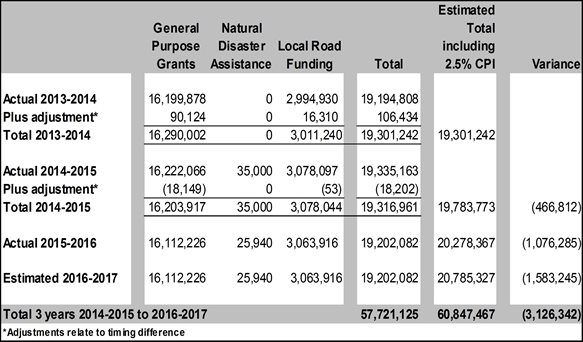
Council will be approximately $3.1M unfavourable in grant income over the three years of the strategic plan.
The cumulative impact of the decision the Federal Government along with Rate Capping by the State Government from 2016-17 may force Council to consider cutting services in order to maintain services. Local residents have already paid taxes to the Federal Government and expect an adequate level of that revenue to be returned to councils to provide local services and infrastructure.
It is recommended that Council writes to local Federal Members of Parliament highlighting the impact this decision will have and request they restore indexation of FAG in line with CPI and population growth immediately.
There are no environmental implications for Council in this report.
The 2015-2016 Grants Commission allocation is $19.2M without an adjust for CPI the real value is approximately $1M less to be spend on services within the municipality.
The impact of Federal and State Budgets are be included in Council’s budget process.
This report contributes to responsible and sustainable financial management as aligned in Council’s City Plan objective on How We Do Business.
There is no Council Officer direct or indirect interest involved with this report.
There are no notable risks identified with this report.
There is considerable social implication associated with the Federal’s Government’s decision to freeze indexation of the Local Government FAG, which are outside the scope of this report.
There are no known positive or negative effects.
If the recommendation of this report is adopted by Council, letters will be sent to Federal Members of Parliament advising of the impact of the proposed freeze and seeking a reversal of the Government’s decision.
Portfolio: |
Governance – Cr Lyons (Mayor) |
Source: |
Strategy & Performance, Communications & Marketing |
General Manager: |
Dean Frost |
Index Reference: |
Subject: Policies & Procedures Development |
The purpose of this report is to have Councillors adopt the Mayor and Councillors’ Media Engagement policy.
The Mayor and Councillors Media Engagement policy will provide practical framework to better guide officers in their management of all media, event and spokesperson opportunities.
Provide guidance on correct issuing of media responses and media statements, involving the Mayor, Deputy Mayor, and all Portfolio and Ward Councillors.
Cr Heagney moved, Cr Richards seconded -
That Council adopt the Mayor and Councillors’ Media Engagement Council Policy.
Cr Nelson re-entered the meeting room at 9:32pm.
Carried.
Council officers involved in the management of media, event and spokesperson activities for the Mayor and Councillors are currently guided by two Council produced documents:
Protocol supporting roles and responsibilities of Mayor and Councillors, 2012;
Councillor Induction Manual, November 2013
Council officers, the Mayor and Councillors rely on local ‘custom and practice’, which extends to before the term of the current Council and its predecessor.
Council has not formally endorsed either of the above documents. Further, the wording in both documents regarding the management of media, event and spokesperson activities is generally scant, vague and open to differing interpretation.
The ‘custom and practice’ information is also, by its nature, un-documented, not universally understood (particularly by new officers, and possibly some early-term Councillors), and not formally endorsed by Council.
Given the importance to Council of sound, coordinated media engagement, it is crucial that all Council officers, and all Councillors, have a clear and consistent understanding of the protocols that should guide these activities.
To achieve this, Council must first agree on the contents and wording of a suitable policy, then formally adopt it for practical, day-to-day use and reference.
This policy has no environmental implications.
This policy has no financial implications.
Once formally adopted by Council, a Mayor and Councillors’ Media Engagement policy could have legal and statutory implications, governing the policy correct use and proper observance by Councillors and Council officers.
Once formally adopted by Council, a Mayor and Councillors’ Media Engagement policy would contribute to the How We Do Business pillar of City Plan, by helping Councillors and Council officers adopt and follow the agreed policy that guides an essential and crucial area of organisational activity: Council’s engagement with the public via the media.
Council Officer’s involved in the preparation of the Mayor and Councillors’ Media Engagement policy (September 2015) do not have a direct or indirect interest in this project.
There is no foreseeable risk in eventually adopting a new Mayor and Councillors’ Media Engagement policy; conversely, there remains a high risk of reputational damage (through the media) to Councillors, Council officers and Council generally if the organisation does not agree on a policy to guide media engagement.
This report does not have any external social implications.
A formally adopted Mayor and Councillors’ Media Engagement policy would further enhance the human rights of the Mayor and Councillors, and those they represent, by strengthening local democracy through assured freedom of speech and representation.
In drafting the Mayor and Councillors’ Media Engagement policy, the authoring officer has consulted relevant protocols and/or media officers from the City of Melbourne, Sydney City Council, the City of Brisbane, Cardinia Shire Council, City of Whitehouse, and the two Acts governing the City of Greater Geelong.
Portfolio: |
Governance – Cr Lyons (Mayor) |
Source: |
Strategy & Performance - Customer Service and Council Business |
General Manager: |
Dean Frost |
Index Reference: |
Council Governance |
The purpose of this report is to address a varied Council Meeting timetable over the Christmas & New Year period.
Council has previously determined that it will hold Strategic Workshops on the second and fourth Tuesday of each month, with Councillor Briefings held on the first Tuesday and Council Meetings held on the third Tuesday of each month.
This report addresses variances due to public holidays over the Christmas period.
Cr Heagney moved, Cr Farrell seconded -
That Council resolves for the months of December 2015 and January 2016 the Council Meeting timetable be varied as follows:
the final Ordinary Council Meeting in 2015 be held on Tuesday 8 December;
the first Councillor Briefing in 2016 be held on Tuesday 19 January followed by an Ordinary Council Meeting on Wednesday 27 January (due to the fact that Australia Day falls on Tuesday 26 January 2016);
no Strategic Workshops be conducted during December 2015 and January 2016.
Carried.
In accordance with the current meeting cycle, Council Meetings are scheduled to be held on 15 December 2015 and 19 January 2016, with Councillor Briefings scheduled on 1 December 2015 and 5 January 2016. Strategic Workshops are scheduled for the remaining Tuesdays.
During and prior to the current term of Council, the Meeting schedule has been varied during December and January to recognise the Christmas/New Year holiday period.
Due to the demands placed on Council business at this time of year, it is proposed that the final Council Meeting for 2015 be held on 8 December to enable the Minutes and relevant decisions to be implemented prior to Christmas.
Past experience indicates that January is the quietest month in terms of general Council activities. It is therefore proposed that the first Meeting in the New Year be held on Wednesday 27 January 2016.
If necessary to deal with urgent business there is the provision under the Local Government Act to a call a Special Meeting of Council.
Over the past ten years, a similar schedule has been approved and the need to call a Special Meeting has not arisen.
There are no environmental implications associated with this report.
There are no financial implications associated with this report.
The Local Government Act 1989 allows Council to determine Council Meeting dates, as appropriate. Council has authorised the Chief Executive Officer (in consultation with the Mayor) to vary meetings around public holidays.
In accordance with our strategic objective ‘How We Do Business’, we have provided a transparent process for the review and variation of Council’s Meeting schedule during the Christmas and New Year period.
No officer involved in the preparation of this report has an interest in relation to the information provided.
Variations to suit needs can be implemented by the Chief Executive Officer in consultation with the Mayor of the day.
There are no social considerations likely to arise from this report.
We have taken into consideration all Human Rights as part of the drafting process of this report, none of which apply.
The variation in the Meeting schedule will be advertised through City News and on Council’s website. The media will also be informed of the variation.
Portfolio: |
Finance - Cr Lyons (Mayor), Cr E Kontelj, Cr J Farrell |
Source: |
Strategy and Performance - Financial Services |
General Manager: |
Dean Frost |
Index Reference: |
Financial Management \ Budget 2016-2017 |
To confirm an Annual Budget and City Plan timetable which provides for stakeholder input whilst ensuring compliance with statutory obligations.
A timetable of activities to complete the 2016-2017 Budget / City Plan 2013-2017 (2016-2017 Update) by 28 June 2015 has been prepared.
The timetable includes two Strategic Briefings with Council and provision of four separate budget briefing sessions through February, March and April 2016.
The Council meeting, scheduled for 19 April 2016, will give public notice of the Proposed Budget.
The timetable provides for a 28 day period for submissions followed by a submissions panel hearing on 20 May 2016.
Council will consider the Budget Submissions panel report on 24 May 2016 and final adoption of the 2016-2017 Budget / City Plan 2013-2017 (2016-2017 Update) is scheduled for 21 June 2016.
Any delays in the target dates are likely to have the impact of extending beyond the statutory compliance date of 30 June 2016.
Cr Farrell moved, Cr E Kontelj seconded -
That Council endorses the proposed timetable for the development of the 2016-2017 Annual Budget and City Plan (2016-2017 Update) as detailed in Appendix 1.
Carried.
The Local Government Act 1989 requires Council to adopt a budget by 30 June each year.
Council is guided by the priorities and strategies included as part of the Council plan (City Plan – 4 Year Corporate Plan of Council objectives, strategies and actions – short and long term) together with revenue assumptions when considering the annual budget. The 2016-2017 Budget represents the final year of 2013-2017 City Plan.
The 2015-2016 Budget included a four year Strategic Resource Plan which includes assumptions for 2016-2017 extending through to 2018-2019. The Strategic Resource Plan provides a basis to commence 2016-2017 budget discussions with a focus on Capital Works, Operational cost changes, Rating Strategy (including the impact of Rate Capping) and Fees and Charges.
A budget timetable is prepared each year as part of a detailed project plan to ensure statutory compliance with the Local Government Act.
The timetable provides for completion of the budget development, detailed briefings with Councillors, completion of the Section 223 public submission process, with final adoption by Council prior to 30 June.
Failure to achieve this statutory compliance creates other financial implications including:
A lack of internal control to monitor and manage the financial position of the Council, i.e. actual versus budget.
The possibility of having to delay the first rate instalment if the rate notices cannot be issued by early September due to late adoption of the budget which includes the designated property differential rates.
Implementing any Fees & Charges pricing changes and the associated implications of achieving the budgeted income levels.
A budget timetable is prepared each year as part of a detailed project plan to ensure statutory compliance with the Local Government Act.
The timetable includes a number of key features:
Two strategic briefing sessions have been scheduled commencing on Tuesday, 24 November 2015 and a further briefing on Tuesday, 9 February 2016. These strategic briefings will review the impact of Rate Capping and set Strategic Resource Plan assumptions as part of the Long Term Financial plan.
Provision has been made for earlier commencement of Project Concept Development to allow time for review and development of detailed project proposals. This has been provided with the aim of allowing for engagement with all stakeholders.
Councillor Briefing sessions have been scheduled to review specific components of the draft budget commencing on Tuesday, 23 February 2016. Further briefings follow on 7 & 21 March, and provision for a final briefing session on 11 April 2016. These briefing dates have been brought forward to provide additional time for review.
The Council meeting, scheduled for 19 April 2016, will give public notice of the Proposed Budget and a public submission process will be advertised. The timetable provides for a 28 day period for submissions followed by a submissions panel hearing on 20 May 2016.
Council will consider the Budget Submissions panel report on 24 May 2016 and an extra time has been provided prior to final adoption of the 2016-2017 Budget / City Plan 2013-2017 (2016-2017 Update) on 21 June 2016.
The summary timetable (Appendix 1) identifies the main responsibilities, functions and timeframes to complete a review of all matters relating to the 2016-2017 Budget / City Plan 2013-2017 (2016-2017 Update). A more detailed timetable is prepared for internal purposes as part of the overall project plan.
The Annual Budget is an important document that supports the strategic directions of Council for the next twelve months and beyond.
The scheduled Council Briefing sessions will be incorporated in Councillors diaries once dates are adopted.
There are no environmental considerations associated with this report.
There are possible financial implications if the Annual Budget is not adopted by 30 June 2016. These include:
A lack of internal control to monitor and manage the financial position of the Council, i.e. actual versus budget.
The possibility of having to delay the first rate instalment notice if the rate notices cannot be issued by early September due to the late adoption of the Budget which includes the designated property differential rates.
Implementing any Fees & Charges pricing changes and the associated implications of achieving the budgeted income levels
The timetable complies with the requirements of the Local Government Act 1989 for the budget to be adopted by 30 June each year.
This report ensures the City Plan and Budget are completed according to a timetable and contributes to responsible and sustainable financial management as aligned in Council’s City Plan objective on How We Do Business.
There is no direct or indirect interest by Council Officers involved in the preparation of this report.
The Annual Budget is required to be adopted by 30 June, there are adverse implications if the process if delayed. These include Non compliance with the Local Government Act 1989 and financial risks to revenue and management of costs according to adopted budget levels.
There are no social considerations associated with this recommendation.
There are no known positive or negative effects.
The Budget / City Plan timetable provides for community consultation once the draft budget is published inviting budget submissions.
|
Activity |
Management |
Executive Management |
Councillors |
|
Budget Timetable Report |
|
Wed, 7 Oct 2015 |
Tue, 20 Oct 2015 |
|
Project Concepts (C, R & D) |
Wed, 28 Oct 2015 to Friday 20 Nov 2015 |
|
|
|
Councillor Nominated funding requests |
|
|
Tue, 10 Nov 2015 |
|
Financial Results to 30 Sept 2015 |
|
|
Tue, 17 Nov 2015 |
|
Councillor Finance Briefing |
|
|
Tue, 24 Nov 2015 |
|
Review of Project concepts for progression to Project Proposal stage |
Thur, 26 Nov 2015 |
|
|
|
Development of Project Proposals |
Mon, 14 Dec 2015 |
|
|
|
ELT to be provided first draft Capital & Non Capital Recurrent & Disbursements in Agenda Package |
|
Thur, 28 Jan 2016 |
|
|
ELT Review |
|
Wed, 3 Feb 2016 |
|
|
Council Strategic Briefing long term Plan Assumptions |
|
|
Tue, 9 Feb 2016 |
|
ELT Review |
|
Wed, 10 Feb 2016 |
|
|
Divisional Briefing Session |
Mon, 22 Feb 2016 |
|
|
|
Council Discussion Budget Briefing #1
|
|
|
Tue, 23 Feb 2016 |
|
Council Briefing – Budget Review Session #2
|
|
|
Mon, 7 Mar 2016 |
|
Operating Budget input to be completed by Units |
Mon, 22 Feb 2016 to |
|
|
|
Public Holiday: Labour Day |
Mon, 14 March 2016 |
||
|
Review of Draft Budget |
|
Wed, 16 March 2016 |
|
|
Council Briefing – Budget Review Session #3
|
|
|
Mon, 21 Mar 2016 |
|
School Holidays |
25 March – 8 April 2016 |
||
|
Public Holidays: Easter Break |
25 Mar – 28 Mar 2016 |
||
|
ELT Budget Review Session (review completion of budget input) |
|
Wed, 30 Mar 2016 |
|
|
Council Briefing – Budget Review Session #4 |
|
|
Mon, 11 Apr 2016 |
|
Council Meeting to adopt Proposed 2016-2017 Budget, City Plan and Fees and Charges (28 day period) |
|
|
Council Meeting |
|
Budget / City Plan Submissions Panel |
|
|
Fri, 20 May 2016 |
|
Council Briefing – Budget Submissions |
|
|
Tue, 24 May 2016 |
|
Council Meeting to formally adopt Final 2016-2017 Budget / City Plan |
|
|
Council Meeting |
|
Budget Submitted to the Minister |
|
|
Thur, 30 Jun 2016 |
Portfolio: |
Central Geelong - Cr Heagney |
Source: |
Projects, Central Geelong & Waterfront - Events, Central Geelong & Waterfront |
Acting General Manager: |
Paul Jane |
Index Reference: |
Central Geelong General, Special Rates and Charges |
This report seeks a resolution by Council to consider an intention to declare a Special Rate Scheme for Central Geelong Marketing effective from 1 July 2016.
The purpose is to begin the process of a new five (5) year term of the Central Geelong Marketing Special Rate effective from 1 July 2016 to enable the continuation of the current marketing program for business promotion.
A fourth round of the Special Rate Scheme is proposed along with a Committee constituted under Section 86 of the Local Government Act. It proposes to enable the Central Geelong Marketing (CGM) Committee to continue to operate with the funds contributing to the major beneficiaries, the Central Geelong business community. The CGM Committee, made up of 13 business and stakeholder representatives, fully supports the continuation of the rate and the additional programs to be delivered in addition to the core program and recommends the continuation of the Special rate program in Central Geelong to Council.
Funds are applied to marketing and promotional activities, business development, training, evaluation, administration and miscellaneous activities delivering significant benefits to Central Geelong commercial property owners and businesses.
Between 2011 and 2015, the CGMC program delivered 2046 activities to over 328,000 people.
When analysed with REMPLAN (the agreed economic modelling tool of G21 and COGG), flagship activities between 2011-15 delivered $53.45M of Total Economic Output (TEO) within the Geelong region, an average of $13.36M per annum. The projected TEO for 2011-2016 is $65M and demonstrates a $1:$19 return on investment.
The rate will lapse if not re-initiated by Council and all the programs, benefits and activities will cease.
The proposed Special Rate would raise $845,122 in 2016/17 for delivery of base program) with the four additional projects to encourage increased spend from outside the Greater Geelong region delivered with an additional $200,000 investment. These amounts would be increased by the Consumer Price Index each year over the life of the Special Rate.
The delivery of the four additional activities to be in Year 1 would continue throughout the lifespan of the special rate. These include a Professional Service Campaign (Metropolitan Melbourne West); TV campaign (Metropolitan Melbourne West); Signage - Banners, Bus, Train, Tram advertising (Metropolitan Melbourne); and a Central Geelong Workers Engagement Program.
These activities will promote and market Central Geelong to Metropolitan Melbourne and regional Victoria with a particular focus on encouraging increased visitation from the Melbourne Metropolitan West area residents resulting in increased business activity in Central Geelong.
The area to be rated is bounded by McKillop Street, Bellerine Street, the Waterfront, Cavendish Street and Fenwick Street. This is unchanged from the previous special rate programs.
There are 1492 properties in the area proposed to be rated and the rate proposed for year one (1) (2016/2017) of the five (5) year scheme is 0.0006640 cents of the Capital Improved Value for the delivery of the base program. Non rateable properties and properties used exclusively for residential purposes have been excluded from the rate. An additional amount of $200,000 is proposed to deliver four additional projects in year one (1) (2016/2017) of the five (5) year scheme is 0.0001571 cents of the Capital Improved Value.
This report seeks a resolution by Council of its “Intention to Declare” a special rate for the establishment and administration of Central Geelong Marketing Committee and its associated activities.
Cr Heagney moved, Cr E Kontelj seconded -
That Council:
Resolves to declare the Special Rate as follows:
A special rate be declared for the period commencing on 1 July 2016 and concluding on 30 June 2021.
The special rate be declared for the purpose of defraying any expenses incurred by Council in relation to developing and promoting businesses within the Central Activities Area, Geelong, which project:
will help finance the operation and administration of the Central Geelong City Marketing office, marketing, promotion and advertising initiatives, the provision of business information, business training and networking, the provision of Events and Activities and the associated encouragement and development of commerce and trade within the Geelong Central Business Precinct;
Council considers is or will be a special benefit to those persons required to pay the special rate (and who are described in succeeding Parts of this Resolution); and
arises out of Council’s function of planning for and providing services and facilities for the local community.
The:
total cost of performing the function described in Part 1(b) of this Resolution between 1 July 2016 and 30 June 2017 be recorded as $845,122 for core activities and $200,000 for four new projects (listed in Appendix 2);
total cost of performing the function described in Part 1(b) of this Resolution in each successive 12 month period after 30 June 2017 be recorded as the total cost in the immediately preceding 12 month period plus an amount representing any increase in the Consumer Price Index (Capital Cities Weighted Average – All Groups) during the preceding 12 month period (Appendix 1);
It be recorded that, for purposes of Section 163(2A) of the Act, the special rate proceeds will not exceed the amount calculated in accordance with the prescribed formula (R x C = S), the:
‘benefit ratio’ (R ) being calculated at 100%, and representing the special benefits to all persons liable to pay the special rate; and
‘total cost’ (C) of performing the function described in part 1(b) of this resolution be recorded as per part 1(c) of this resolution.
‘maximum levy’ (S) be recorded as per part 1(c) of this resolution
The following be specified as the area for which the special rate is so declared:
The area within the municipal district of Council highlighted in the plan (Appendix 3) attached to this Resolution (“the area”).
The following be specified as the land in relation to which the special rate so declared:
All land within the area other than land used exclusively for residential purposes.
The following be specified as the criteria which form the basis of the special rate so declared:
Ownership of any land described in Part e of this Resolution.
The following be specified as the manner in which the special rate so declared will be assessed and levied:
an amount calculated by applying 0.0008211 cents in the dollar of the Capital Improved Value to each parcel of rateable land together with such further amount as represents any increase in the Consumer Price Index (Capital Cities Weighted Average – All Groups) during the immediately preceding 12 month period, in respect of each 12 month period from 1 July 2017 onwards
For the purposes of Part 1(h) of the Resolution, the Capital Improved Value of each parcel of land is the Capital Improved Value of that parcel of land at the time of levying the special rate (so that the Capital Improved Value may alter during the period in which the special rate is in force, reflecting any revaluations and supplementary valuations which take place).
Having regard to the preceding parts of this Resolution but subject to section 166(1) of the Act, it be recorded that, subject to any further Resolution of Council, the special rate will be due and payable on the date(s) fixed under section 167 of the Act as the date or dates on or by which Council's general rates are due.
Consider any submissions made under section 223 of the Act and the proposed declaration via a Submissions Review Panel, and then at a subsequent meeting, at which time Council will consider whether to make a declaration in the form proposed.
Authorise the Chief Executive Officer to give public notice of the proposed declaration in accordance with sections 163(1A) and (1B) of the Act and send a copy of the public notice to each person who is liable to pay the special rate in accordance with section 163(1C) of the Act.
Carried.
In 2001 Council declared a Special Rate which collected funds from all commercial properties in a defined area of Central Geelong on a yearly basis over five (5) years to fund a consolidated marketing program for the benefit of Central Geelong property owners and business operators.
A second round of the Special Rate was declared for a further five (5) year period from 1 July 2006 to 30 June 2011 with Council at this time committed to maintaining Central Geelong as the commercial centre for the Geelong Region.
A third round of the Special Rate was established for the period 1 July 2011 to 30 June 2016 and additional projects delivered extended promotion into regional and metropolitan areas.
Council established the Central Geelong Marketing Committee (CGMC) in 2001 as the key city centre marketing body charged with developing and implementing programs within Central Geelong with the special rate funds. The CGMC plays a major role in achieving a collaborative partnership for businesses and helps shape and promote the business environment.
CGM has been recognised for excellence in city/ place marketing with multiple national awards.
The life of the current rate was set at five (5) years and is due to expire at the end of the 2015/2016 financial year. The rate will lapse if not re-initiated by Council and all the programs, benefits and activities will cease.
The Central Geelong Marketing Committee (CGMC) has overseen this project and expenditure of funds over the previous three rounds of the Special Rate. The CGMC is made up of 13 business and stakeholder representatives including the Geelong Chamber of Commerce, VECCI, REIV, Tourism Greater Geelong and the Bellarine, Market Square Shopping Centre, Westfield Geelong, one elected arts sector representative and four elected strip retail/ business representatives.
The Committee supports the continuation of the Rate and considers it to be an important component in maintaining the viability of Central Geelong. It is proposed the Committee continue in its current form as a minimum and introduces 4 additional projects to generate greater benefits to property and business owners.
The Committee delivers core activities including marketing, promotions, events, and communications; business presentation and capability programs, networking and new business support activities. Attachment 4 provides an overview of core activities delivered to date in the 2011-2016 special rate period with over 2046 activities delivered with 328,025 participants bringing an estimated $58.45M of Total Economic Output.
The Committee has identified a series of additional projects to be delivered in addition to the core projects - Attachment 2. These new initiatives – targeted to bring additional spend and visitation to Central Geelong - will be implemented via a specified increase in the rate amount in year one providing additional special benefits to businesses and property owners throughout the life of the special rate.
Should Council subsequently declare the rate, a resolution to re-constitute the Committee, in its current form, will also be presented for consideration.
Special Benefit
In proposing any Special Rate or Charge, Council must be satisfied that special benefit applies to each property and owner being requested to pay the Rate or Charge.
In relation to this proposed rate, special benefit can be established in the following manner;
Expenditure of funds is designed to increase business activity in the Central Geelong Area. This has potential for higher level of turnover and business growth. A copy of the CGMC Strategic Framework and 2015-16 Annual Activities Plan is in Attachment 5.
The Committee has delivered 2046 activities between 2011-2015 with over 328,000 participants.
The CGMC regularly reviews and evaluates activities delivered to ensure benefits delivered to property and business operators. This includes participant surveys, participating business surveys and stakeholder feedback. Stakeholder surveys conducted throughout the life of the special rate consistently show 79% of stakeholders believe there is benefit in having a collective/ group approach to marketing and promoting Central Geelong and 68% think businesses working within a defined precinct can achieve more by working together than as individuals.
The use of REMPLAN to determine Total Economic Output for events and activities has been accepted by the City of Greater Geelong and G21. Using REMPLAN provides the ability to compare economic output with other activities of Council including Tourism and Events. Survey data from CGM’s five flagship activities, when analysed using REMPLAN shows a total economic output of $15.874M for the 2014-15 financial year with 101 jobs created.
The Total Economic Output for CGMC flagships activities 2011-2015 is calculated at $53.45M. an average of $13.36M per annum. The projected TEO for 2011-2016 is $65M and demonstrates a $1:$19 return on investment.
2011-2015 evaluation figures:
|
Year |
Special Rate Income |
Base Economic Value of Key Flagship Activities (no multipliers) |
REMPLAN Total Economic Output |
Number of Attendees of Key Flagship Activities |
Long Term Employment (jobs) |
Return on Investment |
|
2011-12 |
$602,000 |
$3.691M |
$13.517M |
84,451 |
70 |
|
|
2012-13 |
$671,000 |
$4.019M |
$13.461M |
87,986 |
70 |
|
|
2013-14 |
$736,000 |
$3.203M |
$10.606M |
57,761 |
68 |
|
|
2014-15 |
$802,400 |
$5.582M |
$15.874M |
97,830 |
101 |
|
|
TOTAL |
$2.811M |
$16.495M |
$53.458M |
328,025 |
|
$1= $19.01 |
Flagship activities are: School Holiday Fun Program, Sidewalk Sales, Christmas in Central Geelong, May Magic, Farmers Market (2011-2013 only), and Tastes of Central Geelong.
Sponsorship and support of key events and exhibitions in Central Geelong including Night Markets at Johnstone Park (QVM & NightJar); Open House Geelong, Geelong Revival, Run Geelong and more. Economic Benefit from sponsorship activities is not included in the above calculations to ensure no double up with the reporting activities of COGG Tourism or Events units.
Business development activities include quarterly networking events, training and development, quarterly newsletters and regular information updates provide stakeholders with key information about programs, activities and opportunities.
The social media, internet and digital opportunities that CGM provides to businesses are extensive. The products developed include: www.centralgeelong.com.au, Central Geelong Smart Phone app, Love Central Geelong Facebook, Twitter, Instagram and YouTube.
Promotion of on street and off street parking options through the Central Geelong Parking Map, financial sponsorship of the Park & Ride services, the smart phone app and the Magic Meter Elves.
Possible increase in property value and rental return and occupancy brought about by maintaining and increasing business activity that would not have been the case without the activities of the Committee.
Cost to property/ business owners
The average property/ business pays $10.73 per week for the current Special Rate in 2015-16. The proposed average amount per property/ business for the core activities within the proposed rate period would be $10.89 per week.
The additional investment to deliver the four additional projects would equate to approximately $2.57 cents per week per property/ business. The current return on investment to Central Geelong businesses from the five flagship activities is $19 for every dollar raised. The estimated Total Economic Output of the extra four initiatives is $3.8 million per annum.
The proposed average cost per property/ business of both core and additional new projects in 2016-17 would be $13.46 per property/ business equating to $699.92 per year.
This proposed average amount to be contributed towards the special rate is less than the purchase of one Mx3 (284x262mm) weekday colour advertisement in the Geelong Advertiser once a year priced at $711.00 as at 28/7/15.
The apportionment of the rate amongst property owners in the Central Geelong Area has been based on the Capital Improved Value of each property. This approach is relatively common practice for marketing and promotion schemes of this type in Victoria and provides a fair distribution of the cost between property owners with the owners of large properties and complexes paying a higher a rate, as they have the potential to benefit to a greater degree. There were over 70 special rate schemes for marketing and promotion within Victoria in 2014-15.
It is necessary to ensure the funds collected each year over the five (5) year period keeps pace with inflation. It is proposed to increase the rate, hence budget in accordance with the Consumer Price Index in order to accommodate any adjustments of costs. For the purposes of the calculation, the Consumer Price Index (CPI) will be considered as the Consumer Price Index for Australia (weighted average of 8 capital cities – all groups’ percentage change from previous financial year).
The Special Rate Scheme proposes the annual budgets be fixed (subject to CPI & proposed increases in years 1) over the five (5) year period, therefore the rate in the dollar will need to be adjusted when a re-valuation takes place.
The relative capital improved values between properties may also be varied at this time.
Exemption from Special Rate
There are two classes of properties in the Central Geelong Area which are proposed to be exempted from the Special Rate. These include:
Non rateable properties – schools, churches, hospitals, parklands, Crown Land etc.
Properties used strictly for residential purposes. In this case the zoning will not be Residential but Business as there are no residential zones in the City.
Non – rateable property owners may be approached to contribute to specific projects and activities of the Centre Management body via sponsorship and partnership arrangements or other schemes of mutual benefit to the parties involved.
The Special Rate process is familiar to Councillors and provides for a Submissions Review Panel process prior to Council determining its position on the Scheme. Should Council proceed with the Scheme, a further right of review is available on application to VCAT.
Focus on ensuring the programs and activities of the CGMC have the least impact on the environment as possible.
Should Council proceed with the special rate for Central Geelong, the process will be self funding. The cost of administration of the scheme and any preparation and presentation at VCAT is able to be accommodated in this year’s budget. Costs are being met by CoGG - Projects, Recreation & Central Geelong for this.
The CGMC activities and programs and the CGM unit is fully funded through the Special rate.
The recommendation in this report is consistent with the priorities of City Plan, the adopted Central Geelong Action Plan, the Central Geelong Structure Plan, the Central Geelong Place Management Plan, the City of Greater Geelong Retail Strategy and the Comprehensive Infrastructure Funding Policy and procedures adopted for the introduction of special rate schemes.
It has demonstrated consistent significant and measurable benefit to Central Geelong Stakeholders.
The Special Rate Scheme has been prepared in accordance with the Special Rate and Charges provision of the Local Government Act 1989 and Council’s Special Rates and Charges Policy.
The Central Geelong Marketing program is a key deliverable in Growing the Economy. Despite retail challenges from suburban shopping centres, regional and metropolitan centres, Central Geelong rateable property numbers have grown 20% since the commencement of the Special Rate Program in 2001.
The Central Geelong Action Plan December 2013 (Page 30) states options to be considered include: ‘increasing the special rate program to generate greater benefits to property and business owners.’
CGM staff are funded via the Special Rate however there are no other officers involved in preparing this report who have a direct or indirect interest.
If the Special Rate Scheme is discontinued, then all programs, activities delivered by the Committee would cease, resulting in a measurable negative impact on the Central Geelong economy.
The activities and programs that result from this levy add significantly to the vibrancy and exciting experience of Central Geelong. They provide a collaborative approach to marketing and promoting Central Geelong from the disparate business and property owners.
The ongoing success of Central Geelong as the “heart” of the region is an essential element of broader community benefit. The activities particularly support the four main objectives of the Central Geelong Structure Plan and the Central Geelong Action Plan: more workers; more students; more residents; more visitors.
This report has no impact on human rights.
The Central Geelong Marketing Committee, made up of 13 business and stakeholder representatives, have evaluated the activities delivered with the proceeds from the Special Rate via participant and business surveys and feedback and reported to Council on a yearly basis and the Committee has voted to request Council consider a further round of the Special Rate for Central Geelong from 1 July 2016 to 30 June 2021.
The Geelong Central Marketing Committee communicates regularly with business operators/ owners in the Central Geelong Area. This is done by means of newsletters, a dedicated website, digital communications and social media. In the lead up to Council advertising the scheme, information has been sent out particularly relating to the proposed continuation of the special rate and the activities delivered to date.
The intention to declare the special rate will be advertised in the local media.
All the goods and services necessary to fund the Central Geelong Marketing office and its programs , including salaries, office costs, advertising, printing, costs associated with staging events, consultants, advertising fees and charges, miscellaneous administration associated with the initiation and administration of the special rate scheme.
|
Year 1 |
$845,122 |
|
Year 2 |
Year 1 + CPI |
|
Year 3 |
Year 2 + CPI |
|
Year 4 |
Year 3 + CPI |
|
Year 5 |
Year 4 + CPI |
|
Year 1 |
$1,045,122 (includes delivery of four additional projects in addition to core activities) |
|
Year 2 |
Year 1 + CPI |
|
Year 3 |
Year 2 + CPI |
|
Year 4 |
Year 3 + CPI |
|
Year 5 |
Year 4 + CPI |
|
ITEM |
Description of Core Activities – Option 1 |
Projected $ |
|
|
1 |
Marketing – including consolidated advertising and digital delivery |
290,000 |
|
|
2 |
Promotions & Events - Delivery of activities and events including project delivery and sponsorship |
335,000 |
|
|
3 |
Stakeholder development including business presentation, capability, information, training and networking and new business support |
70,000 |
|
|
4 |
Administration - including salaries and on-costs. |
130,122 |
|
|
5 |
Special rate process - administration |
20,000 |
|
|
|
|
$845,122 |
|
|
|
Note year 1 includes 2015-16 rate amount plus CPI plus costs of special rate process administration |
||
|
|
Description of Additional Activities – Option 2 |
|
|
|
A Year 1 |
Metropolitan Melbourne Television Campaign Includes schedule of advertisements in metropolitan Melbourne (approximately $43,000) plus project management and evaluation activities. Note that CGM would seek opportunities to work in partnership with other Geelong organisations (such as Regional Tourism Association) to further expand the reach and breadth of this campaign. This will complement the regional campaign delivered 2012-2016 which included regional TV and cinemas in Geelong and Werribee which will continue as core activities within option 1 |
|
$50,000 |
|
B Year 1 |
Signage – Banners, Bus, Transit Advertising Expand the signage program commenced in 2015-16 with additional resources to allow for increased signage on transit within regional and metropolitan west areas. |
|
$50,000 |
|
|
Description of Additional Activities – Option 2 |
|
|
|
C Year 1 |
Worker Engagement Campaign Targeted campaign to engage the 21,000 people who work in Central Geelong to actively engage with Central Geelong businesses on a more regular basis. Will include the development of a worker database to communicate directly with people working in Central Geelong, will include content development, engagement and communication. Will include focus on B2B elements. |
|
$50,000 |
|
D Year 1 |
Professional Service Campaign – Metropolitan Melbourne Deliver a targeted campaign into Metropolitan Melbourne market to promote Central Geelong Professional services offering. Particular focus on ease of options for travel between Metro West and Geelong and range of businesses and experiences as alternative to Metropolitan Melbourne |
|
$50,000 |
|
Total core projects and additional projects – Option 1 & 2 |
$1,045,122 |
||
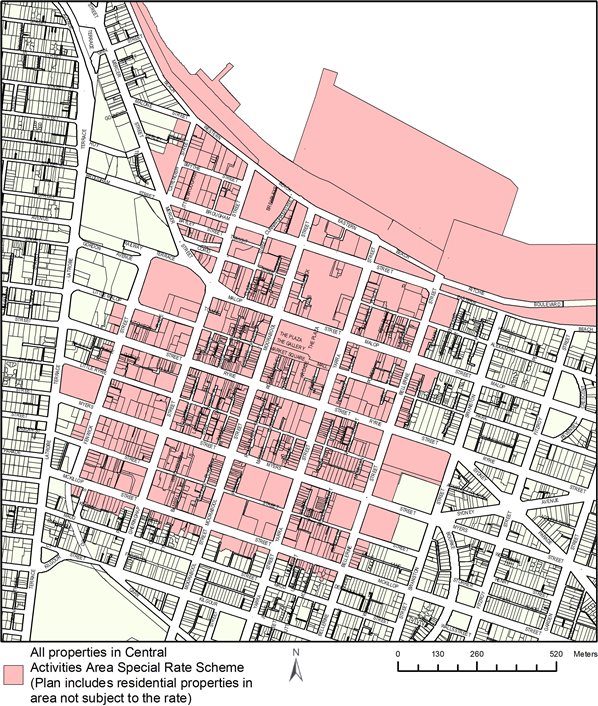
Cr E Kontelj declared an Indirect Interest due to a Conflicting Duty in Agenda Item 18 – Consideration of Tender Submissions for Tender T1400001 – Corio Landfill Rehabilitation Stage Two Works in that the tender applicants are significant customers of the company
Cr Kontelj is employed by and left the meeting prior to discussion at 9:41pm.
Portfolio: |
Environment and Sustainability – Cr Richards |
Source: |
Projects, Recreation & Central Geelong/ Capital Projects |
General Manager: |
William Tieppo |
Index Reference: |
Project: C13857 – 2015/16 Corio Landfill Rehabilitation Stage Two Construction |
To provide Council with the requisite information to facilitate the approval of the Evaluation Panel’s recommendation in relation to the Corio Landfill Rehabilitation Stage Two works.
The Corio Landfill is owned and operated by the City of Greater Geelong Council and is regulated by Environment Protection Authority (EPA) Victoria through the City of Greater Geelong Council Corporate Licence No. 74222. It is located off Biddlecombe Avenue in Corio.
The landfill has been used for the disposal of waste from November 1978 to its time of closure in December 2011.
To satisfy licence conditions, Council must rehabilitate the landfill in accordance with EPA Victoria Publication 788.1 Best Practice Environmental Management Siting, Design, Operation and Rehabilitation of Landfills.
The rehabilitation works are split into two stages. Stage one capping works are close to completion and stage two capping works have been tendered. The stage two rehabilitation works involve the construction of a cap over approximately 24 hectares of the site. The purpose of the cap is to contain the waste, limit the seepage of leachate into the local waterways and limit landfill gas emissions.
The EPA Victoria has issued Council with an Environment Protection Act Section 31A Pollution Abatement Notice stipulating Council complete the rehabilitation of the site in accordance with the EPA approved rehabilitation plan. Contravention of the Notice may result in penalties.
Council has sought public tenders from experienced Civil Works Contractors for the construction of stage two capping works which is funded from Council allocations of $14,500,000 in the 2015/16 and 2016/17 financial years.
Tenders resulted in a total of six companies providing tender submissions for the provision of the specified works.
Extensive tender submission and task analysis due diligence was undertaken to ensure tendered bids satisfied our specification and project outputs. Panel members undertook a rigorous exercise of due diligence by assessing the various tenderer submissions, interviewing two (2) shortlisted tenderers, undertaking reference checks and analysing further written clarifications on aspects of tendered bids.
Following a detailed evaluation of each of the submissions by the Evaluation Panel it is considered that the tender submission of Hoare Bros Pty Ltd is preferred.
Cr Richards moved, Cr Ellis seconded -
That Council:
accept the tender submission from Hoare Bros Pty Ltd for Tender No. T1400001 – Corio Landfill Rehabilitation Stage Two Works for the lump sum of $12,781,156.00 exclusive of GST, subject to the final form of Contract to the satisfaction of the General Manager City Services; and
sign and seal the contract documents.
Carried.
Tenders for the Corio Landfill Rehabilitation Stage 2 Works were invited via public advertisement in the Geelong Advertiser and Tenderlink on Saturday 28 February 2015.
At the close of tenders on 17 April 2015 the following tender submissions were received:
|
Tenderer |
|
Max Bright & Sons Pty Ltd |
|
Hoare Bros Pty Ltd |
|
Envirocon Construction & Environmental Services Pty Ltd |
|
Thompson Bros Earthmoving Pty Ltd |
|
Ertech Pty Ltd |
|
Goldsmith Civil & Environmental Pty Ltd |
All tenders have been submitted exclusive of GST. Some construction materials need to be purchased from overseas and will therefore be subject to changes to units of foreign currency against the Australian dollar. Prices are based on an exchange rate of USD $0.68 = AUD $1.
The tender submissions associated with this project were evaluated by a panel consisting of:
|
William Tieppo |
General Manager City Services (voting member) |
|
Scott Cavanagh |
Manager Capital Projects (voting member) |
|
Anthony Boseley |
Senior Capital Projects Officer (voting member) |
|
Shane Middleton |
Co-ordinator Waste Management (voting member) |
|
Peter Walker |
Senior Contracts Officer – Property & Procurement (non voting) |
|
Justin Zumpe |
Zinc Cost Management (Quantity Surveyor) – (non voting) |
|
Richard Wheeler |
Independent Advisor – (non voting) |
Stage One – Mandatory Criteria
Mandatory requirements apply to this Tender.
Each of the submissions responded to the mandatory requirements set down in the Tender documents. The mandatory requirements included attendance at a site inspection and the requirement of tenderers to demonstrate significant previous experience within the past four (4) years in landfill construction projects, designed and constructed in excess of $2.5M in accordance with the Landfill BPEM and the Landfill Licensing Guidelines, and requiring construction phase environmental auditing.
Tenderers were also to have their own OH&S system certified as meeting the requirements of AS/NZS4801, Safety MAP, NSCA – 5 star, ISO 18001, or the CCF Civil Construction Management Code; audits own quality system certified as meeting the requirements of ISO9001 or certified as meeting the mandatory requirements of the CCF Civil Construction Management Code.
Council were satisfied that all tenderers should progress to the evaluation of comparative criteria.
Stage Two –Comparative Criteria
Tender submissions were assessed based on the respondent’s performance or tender response in the following areas:
|
Criteria |
Weighting |
|
Price – total acquisition cost |
50% |
|
Capability & past performance |
10% |
|
Methodology & plan for performing contract |
10% |
|
Experience in Landfill Construction, proposed staffing & resources |
15% |
|
Economic Contribution to the Geelong Region |
10% |
|
Quality Management |
5% |
|
|
100% |
The Evaluation Panel determined that a key part of the evaluation process was to ensure that tenderers had the capability to meet the specification.
Due to the complexity of this tender a number of clarifications were sought from the tenderers.
During this phase Thompson Brothers Earthmoving informed Council of its decision to discontinue with its tender. As a result Thompson Brothers Earthmoving was not considered for further assessment.
The highest ranking tender at this stage had proposed the use of Melbourne Water Western Treatment Plant biosolids instead of using natural (EPA Category A) soils for the subsoil and topsoil layers of the cap.
The Evaluation Panel undertook an assessment to ascertain if the proposal was suitable for the site. In particular, officers required additional information on the potential impact on public safety, the local environment and site after use management. Further, officers required the proposal to be approved by the EPA.
As a result of further investigations, it was determined that the EPA could not support the use of biosolids as a capping material at this time. Without the support of the EPA, the Max Bright & Sons Pty Ltd tender was considered non- conforming and was therefore not considered further.
At the conclusion of the evaluation the tenderers were ranked in the following order in accordance with the above criteria:
|
Tenderer |
Rank |
|
Hoare Bros Pty Ltd |
1 |
|
Envirocon Construction & Environmental Services Pty Ltd |
2 |
|
Ertech Pty Ltd |
3 |
|
Goldsmith Civil & Environmental Pty Ltd |
4 |
The Evaluation Panel then further investigated the top two ranked tenderers, Hoare Bros Pty Ltd and Envirocon Construction & Environmental Services Pty Ltd, to determine if these tenderers could meet the specified requirements of this tender.
The Evaluation Panel was satisfied of the tenderers ability to meet the specification and will reduce the risks associated with this project through the contract conditions.
The Evaluation Panel interviewed the two shortlisted tenderers Hoare Bros Pty Ltd and Envirocon Construction & Environmental Services Pty Ltd.
Following the interviews and reference checks the Evaluation Panel concluded that Hoare Bros Pty Ltd was the preferred shortlisted tenderer. Extensive due diligence was undertaken to ensure that Hoare Bros Pty Ltd fully understood the specification, methodology and project outputs, including Audit reporting requirements. The shortlisted tenderer provided further written clarifications to ensure the panel were satisfied that the specification would be delivered.
The Evaluation Panel assessed that Hoare Bros Pty Ltd presented well at interview, displayed a thorough understanding of the requirements of the specification and provided satisfactory responses to questions tabled by the Evaluation Panel.
Hoare Bros Pty Ltd is therefore recommended by the Evaluation Panel to undertake the tendered works subject to agreement to the final form of Contract to the satisfaction of the General Manager City Services.
The Evaluation Panel determined that when both price and non price criteria were considered that Envirocon Construction & Environmental Services Pty Ltd did not represent best value to Council and therefore the Evaluation Panel ranked them below the recommended tenderer.
Capping of the closed Corio landfill will contain waste, limit the seepage of leachate into the local waterways and limit landfill gas emissions.
The stage two cap must be constructed according to the EPA endorsed Drawings, Technical Specification and Construction Quality Assurance Plan. A Construction Phase Audit report shall be prepared and submitted to the EPA through the Environmental Auditor process, in accordance with the EPA Publication ‘1323.2 Landfill Licensing Guidelines’.
The appointed Contractor is required to prepare and implement a Construction Environmental Management Plan (CEMP) and Erosion Sediment Control Plan (ESCP).
The funding for this stage 2 cap will be drawn from C13857 budget allocations of $14,500,000 in the 2015/16 and 2016/17 financial years.
The works must comply with performance requirements as prescribed in the City of Greater Geelong Council Corporate License No. 72444.
Against the above background and timeframe to assess tender submissions and appoint a contractor, there will no opportunity to report to Council in the normal manner and meet construction critical dates.
The requirements of Section 186 of the Local Government Act have been complied with for this tender.
The provision of this service has a positive impact on all key City Plan objectives.
No officers or contractors involved in the preparation of this report have a direct or indirect interest in matters to which this report relates
The major work related risk is the construction of compliant works. It is considered that these risks can be managed through established construction processes, adequate supervision and standard testing
here are no social implications that will arise from the acceptance of this tender
It is not evident or likely that this report would negatively impact any of the rights contained in the Charter of Human Rights
The recommended tenderer will be required to liaise closely with various stakeholders in conjunction with the Project Manager and any other Council appointed nominees, during the project.
A contract progress meeting shall be held fortnightly on site to facilitate project communication between the parties to the contract and the internal and external stakeholders.
The Corio Landfill, located off Biddlecombe Avenue in Corio, has been used for the disposal of putrescible, solid inert, asbestos, shredded tyres, prescribed industrial waste, animal residues, tannery and wool scouring wasted and contaminated soils (Category C) wastes from November 1978 to the time of its closure in December 2011.
Further to the information detailed in the summary above, the capping works are split into two stages as depicted in Figure 1. Stage one and stage two are delineated by Bell Road, traversing the site approximately east to west.
Stage one covers an area of approximately 10 hectares. The construction of this stage is close to complete.
The stage two capping works involve the construction of a cap over approximately 24 hectares of the site.
The stage two works to be undertaken comprise, but are not limited to:
Construction of erosion and sediment controls
Stripping of temporary cap in areas where cut is required
Separating suitable daily cover/earthen cover material from unsuitable material and stockpiling
Site re-grading including site bound waste relocation and compaction
Construction of compacted earthen cover
Construction of new gas collection infrastructure
Construction of a compacted clay liner or alternatively a geosynthetic clay liner
Installation of linear low density polyethylene (LLDPE) liner
Installation of a drainage geocomposite
Key in of layers to existing exposed gas extraction infrastructure
Construction of anchor trenches
Construction of subsoil layer
Construction of topsoil layer
Seeding and fertilizing of topsoil
Realignment of perimeter stormwater swale drains.
Realignment of perimeter stormwater swale drains.
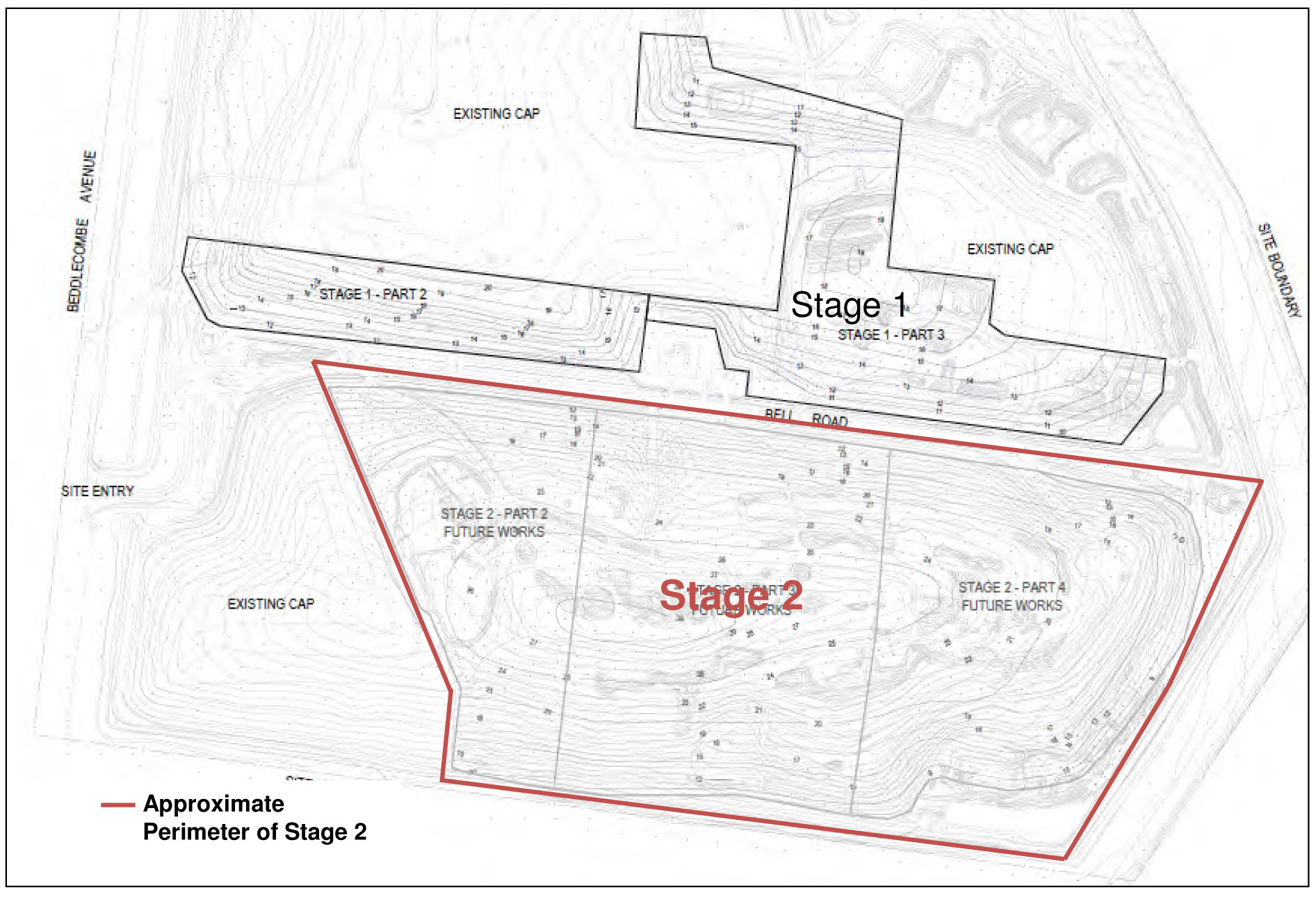
Figure 1: Corio Landfill Site Plan
The construction of the stage two cap is to be monitored, verified, tested and reported by an independent third party consultant in accordance with EPA guidelines.
The EPA has issued Council with a Environment Protection Act Section 31A Pollution Abatement Notice stipulating Council complete the rehabilitation of the site in accordance with the EPA approved rehabilitation plan.
Prior to commencing stage two capping works, EPA approval of the design documentation is required. This process involves an audit by an Environmental Auditor of the design documentation as issued by Council’s designer and when satisfied that the design documentation is satisfactory, the Auditor issues a report endorsing the design to the EPA for their approval. The Auditor has issued such a report to the EPA for stage two works and it is expected that the EPA will grant its approval by the end of September 2015.
Cr E Kontelj re entered the meeting room at 9:43pm
Cr Heagney declared a Direct Interest in Agenda Item 19 – Consideration of Tender Submissions for Tender T1500004 – Electrical Services in that she is a shareholder of QA Electrical who tendered for the work, and left the meeting room prior to discussion at 9:43pm.
Portfolio: |
Governance – Cr Lyons (Mayor) |
Source: |
Strategy & Performance - Property & Procurement |
General Manager: |
Dean Frost |
Index Reference: |
T1500004 |
To provide Council with the requisite information to facilitate approval of the tender Evaluation Panel’s recommendation in relation to the Provision of Electrical Services
Council has sought tenders for the provision of Electrical Services associated with the maintenance of all existing facilities for Facilities Maintenance and also Leisure Centre’s throughout the City of Greater Geelong.
The successful tenderers will be appointed as preferred suppliers to a panel of providers for the provision of this service for a period of three years commencing 1 November 2015 and concluding 31 October 2018 with the option for a further two (2) one year extensions at the sole discretion of Council
The estimated annual value of these services associated with this contract is $2.3m annually.
A total of twelve companies have provided tender submissions for the provision of these services.
Following a detailed evaluation of each of the submissions it is considered that the tender submission/’s of LGE Electrical Services Pty Ltd, Geelong Electrical Improvements Pty Ltd t/a Lifestyle Electrical Geelong, Gordon McKay Pty Ltd, Hi-Tech Electrical Services (Vic) Pty Ltd and QA Electrical Pty Ltd are preferred.
Cr Ellis moved, Cr Richards seconded -
That Council:
accept the tender submission/’s from LGE Electrical Services Pty Ltd, Geelong Electrical Improvements Pty Ltd t/a Lifestyle Electrical Geelong, Gordon McKay Pty Ltd, Hi-Tech Electrical Services (Vic) Pty Ltd and QA Electrical Pty Ltd for Tender No T1500004 Provision of Electrical Services for the associated schedule of rates exclusive of GST
sign and seal the contract documents
Carried.
Tenders for the provision of Electrical Services were invited via public advertisement in the Geelong Advertiser on Saturday 6 June 2015.
At the close of tenders on Wednesday 1 July 2015 the following tender submissions were received:
|
Tenderer |
|
Appliance Tagging Services Pty Ltd |
|
Collins Electrics P/L, trading as Laser Electrical, North Geelong |
|
Gordon McKay Pty Ltd |
|
The Trustee for the Robert & Leanne Nichols Family Trust |
|
Hi-Tech Electrical Services (Vic) Pty Ltd |
|
LGE Electrical Services Pty Ltd |
|
Geelong Electrical Improvements Pty Ltd [t/a] Lifestyle Electrical Geelong |
|
Albert Corn and Son Electrical Pty Ltd MA Corn family trust |
|
QA Electrical Pty Ltd |
|
The Trustee for CKA Holdings Trust TA Stack Electrical Data |
|
Total Maintenance Solutions Pty Ltd |
|
Werribee Electrical Contracting Service Pty Ltd |
All tenders have been submitted exclusive of GST.
The tender submissions associated with this service were evaluated by a panel consisting of:
|
Lindsay Allan |
Manager Property & Procurement |
|
Phil Pavey |
Technical Officer Works |
|
Tim Sheringham |
Technical Officer Works |
|
Graeme Kemp |
Contract Officer Property & Procurement |
Stage One – Mandatory Criteria
Mandatory requirements apply to this Tender.
Each of the submissions did respond to the mandatory requirements set down in the Tender documents.
Stage Two –Comparative Criteria
Tender submissions were assessed based on the respondent’s performance or tender response in the following areas:
|
Criteria |
Weighting |
|
Economic Contribution to the Geelong Region |
10% |
|
Capability and experience, Past performance over last 3 years |
30% |
|
Proposed staffing levels, Proposed plant and equipment levels, |
30% |
|
Flexibility and Responsiveness |
10% |
|
Quality Management |
10% |
|
Customer Service |
10% |
|
|
100% |
Tenderers with an overall score of (insert percentage) or above were deemed to have the necessary skills, experience and resources to undertake the service.
The tenderers who achieved this score were then assessed on a best value basis and were ranked in the following order:
|
Tenderer |
Ranking |
|
LGE Electrical Services Pty Ltd |
1 |
|
Gordon McKay Pty Ltd |
2 |
|
QA Electrical Pty Ltd |
3 |
|
Geelong Electrical Improvements Pty Ltd [t/a] Lifestyle Electrical Geelong |
4 |
|
Hi-Tech Electrical Services (Vic) Pty Ltd |
5 |
|
Collins Electrics P/L, trading as Laser Electrical, North Geelong |
6 |
|
Total Maintenance Solutions Pty Ltd |
7 |
|
The Trustee for CKA Holdings Trust TA Stack Electrical Data |
8 |
|
The Trustee for the Robert & Leanne Nichols Family Trust |
9 |
|
Albert Corn and Son Electrical Pty Ltd atf MA Corn family trust |
10 |
|
Werribee Electrical Contracting Service Pty Ltd |
11 |
|
Appliance Tagging Services Pty Ltd |
12 |
The evaluation panel agreed that five (5) contractors is a satisfactory number of contractors to appoint to this panel taking into account the services required on an annual basis.
Appliance Tagging Services Pty Ltd tender submission related to the provision of appliance tagging and testing services only. The provision of this service will be subject to a separate quotation process and therefore was not considered part of this tender therefore the tender submission from Appliance Tagging Services Pty Ltd was considered non-conforming.
LGE Electrical Services Pty Ltd, Gordon McKay Pty Ltd, Geelong Electrical Improvements Pty Ltd [t/a] Lifestyle Electrical Geelong are all Geelong based companies, are the incumbent providers and of Electrical Services to Council and scored highly in terms of meeting the requirements of the tender specification.
Stowe Electrical, previously on the Panel, did not tender a submission. The Panel considered it appropriate to appoint five (5) electrical services companies to enable the services to be provided to Council in an efficient, effect and timely manner over the initial three your tem of the contract.
QA Electrical Pty Ltd and Hi-Tech Electrical Services (Vic) Pty Ltd scored highly in terms of the non price evaluation criteria and offered competitive rates. The Panel interviewed representatives for both companies and under took reference checks on behalf of Council. Both companies received positive feedback for their existing clients. QA Electrical Pty Ltd and Hi-Tech Electrical Services (Vic) Pty Ltd are Geelong based companies with sound experience in providing electrical services on a large scale. Both companies have experienced staff with appropriate skills and resources to participate on the Electrical Services panel. The top ranked five (5) contractors were deemed to appropriate to appoint by the evaluation panel and their schedule of rates were assessed and considered market appropriate. The five (5) recommended contractors adhere to the OH&S requirements set out in the tender.
Any environmental implications associated with this contract will arise from the execution of these works. It is considered that these are the responsibility of the Contractor and will be managed through the contract documentation.
This is a schedule of rates tender and will rely upon the amount of funds allocated in the Budget Code 004736 in the 2015/2016 financial year budget. The budget allocation for this service is approximately $2,400,000 pa.
The requirements of Section 186 of the Local Government Act have been complied with for this tender. There are no other policy, legal or statutory implications associated with this tender process.
The provision of this service has a positive impact on all key City Plan objectives.
No officers or contractors involved in the preparation of this report have a direct or indirect interest in matters to which this report relates.
There are not considered to be any risks associated with the acceptance of this tender that cannot be managed through the contract conditions.
There are no social implications that will arise from the acceptance of this tender.
There are no Human Rights Charter implications that will arise from the acceptance of this tender.
There are no communication issues associated with the acceptance of this tender. Councils representative will liaise with affected community groups.
Portfolio: |
Governance – Cr Lyons (Mayor) |
Source: |
Strategy & Performance - Property & Procurement |
General Manager: |
Dean Frost |
Index Reference: |
Tender Submission T1500005 |
To provide Council with the requisite information to facilitate approval of the tender Evaluation Panel’s recommendation in relation to the Provision of Plumbing Services
Council has sought tenders for the provision of Plumbing Services associated with the maintenance of all existing facilities for Facilities Maintenance and also Leisure Centre’s throughout the City of Greater Geelong.
The successful tenderer’s will be appointed as preferred suppliers to a panel of providers for the provision of this service for a period of three years commencing 1 December 2015 and concluding 30 November 2018 with the option for a further two (2) one year extensions at the sole discretion of Council
The estimated annual value of these services associated with this contract is $1.2m annually.
It is Council’s preference to appoint 2 panels, one for General Plumbing Services and the other specifically to Leisure Centres due to the specialist nature of these facilities.
A total of nine (9) companies have provided tender submissions for the provision of these services.
Following a detailed evaluation of each of the submissions it is considered that the tender submission/’s of Chiara Pty Ltd, Nott & Drew Pty Ltd, Justin Drew Plumbing Services Pty Ltd and EDG Management Services Pty Ltd are preferred for the General Plumbing Panel and Roejen Service Pty Ltd and Mechanical Plumbing Services Pty Ltd are preferred for the Leisure Centre’s.
Cr Ellis moved, Cr Richards seconded -
That Council:
accept the tender submission/’s from Chiara Pty Ltd, Nott & Drew Pty Ltd, Justin Drew Plumbing Services Pty Ltd and EDG Management Services Pty Ltd for Tender No T150005 Provision of Plumbing Services for the associated schedule of rates exclusive of GST for the General Plumbing Panel;
accept the tender submission/’s from Roejen Service Pty Ltd and Mechanical Plumbing Services Pty Ltd for Tender No T150005 Provision of Plumbing Services for the associated schedule of rates exclusive of GST for the Leisure Centre Plumbing Services Panel;
sign and seal the contract documents.
Carried.
Tenders for the provision of Plumbing Services were invited via public advertisement in the Geelong Advertiser on Saturday 13 June 2015.
At the close of tenders on Wednesday, 8 July 2015 the following tender submissions were received:
|
Tenderer |
|
Chiara Pty Ltd |
|
Nott & Drew Pty Ltd |
|
Justin Drew Plumbing Services Pty Ltd |
|
EDG Management Services Pty Ltd |
|
Roejen Service Pty Ltd |
|
Mechanical Plumbing Services Pty Ltd |
|
Steve Toohey Plumbing Pty Ltd |
|
Fortisky Roofing Plumbing Pty Ltd |
|
Brian Gregson Management services Pty Ltd |
All tenders have been submitted exclusive of GST.
The tender submissions associated with this (project/service) were evaluated by a panel consisting of:
|
Lindsay Allan |
Manager Property & Procurement |
|
Phil Pavey |
Technical Officer Works |
|
David Wilmott |
Technical Officer Works |
|
Brian Happ |
Facilities Maintenance Co-ordinator |
|
Jeff McArthur |
Contract Officer Property & Procurement |
Stage One – Mandatory Criteria
Mandatory requirements apply to this Tender.
Each of the submissions did respond to the mandatory requirements set down in the Tender documents.
Stage Two –Comparative Criteria
Tender submissions were assessed based on the respondent’s performance or tender response in the following areas:
|
Criteria |
Weighting |
|
Economic Contribution to the Geelong Region |
10% |
|
Customer Service |
10% |
|
Capability and experience, Past performance over last 3 years |
50% |
|
Proposed staffing levels, Proposed plant and equipment levels, |
30% |
|
|
100% |
Tenderers were assessed against the comparative Criteria and were ranked in the following order:
|
Tenderer |
Ranking |
|
Nott & Drew Pty Ltd |
1 |
|
Justin Drew Plumbing Services Pty Ltd |
2 |
|
Mechanical Plumbing Services Pty Ltd |
3 |
|
Roejen Service Pty Ltd |
4 |
|
Chiara Pty Ltd |
5 |
|
EDG Management Services Pty Ltd |
6 |
|
Steve Toohey Plumbing Pty Ltd |
7 |
|
Fortisky Roofing Plumbing Pty Ltd |
8 |
|
Brian Gregson Management services Pty Ltd |
9 |
The evaluation panel agreed that 4 contractors is a satisfactory number of contractors to appoint to the General Plumbing Services panel and 2 contractors is a satisfactory number of contractors to appoint to the Leisure Centre Plumbing Services panel taking into account the services required on an annual basis.
One tenderer who ranked 6th overall (EDG Management Services Pty Ltd) was unknown to the evaluation panel and were interviewed by members of the panel. The panels assessment of EDG Management Services Pty Ltd at interview of their past experience, staffing levels, sub contractors, plant and equipment and their capability demonstrated their ability to successfully deliver the services as required by Council. Reference checks were undertaken on EDG Management Services Pty Ltd and were satisfactory.
EDG Management Services Pty Ltd were deemed appropriate to appoint to the General Plumbing Services Panel. Therefore the top ranked 6 contractors were deemed appropriate to appoint by the evaluation panel and their schedule of rates were assessed and deemed to be market appropriate.
Any environmental implications associated with this contract will arise from the execution of this service. It is considered that these are the responsibility of the Contractor and will be managed through the contract documentation.
This is a schedule of rates tender and will rely upon the amount of recurrent funds allocated in the Budget Code 004736 in the 2015/2016 financial year budget. The budget allocation for this service is approximately $1.2million per annum.
The requirements of Section 186 of the Local Government Act have been complied with for this tender. There are no other policy, legal or statutory implications associated with this tender process.)
The provision of this service has a positive impact on all key City Plan objectives.
No officers or contractors involved in the preparation of this report have a direct or indirect interest in matters to which this report relates.
There are not considered to be any risks associated with the acceptance of this tender that cannot be managed through the contract conditions.
There are no social implications that will arise from the acceptance of this tender.
There are no Human Rights Charter implications that will arise from the acceptance of this tender.
There is no communication issues associated with the acceptance of this tender. Council’s representative will liaise with affected community groups.
Cr Heagney re-entered the meeting room at 9:45pm
Contents | Previous Page: Section A - Procedural Matters | Next Page: Section C - Notice of Motion
