
Council Minutes - Section B: Reports - 16 February 2016
Contents | Previous Page: Section A - Procedural Matters | Next Page: Section C - Notice of Motion
Contents | Previous Page: Section A - Procedural Matters | Next Page: Section C - Notice of Motion
Reports tabled at the Ordinary Meeting of Council on Tuesday date held at City Hall, Little Malop Street in Geelong.
Submission in Response to the Preliminary Report 2015-2016 Electoral Representation Review
Lease to Ocean Grove Golf Club – 9 Guthridge Street, Ocean Grove
Cr Heagney declared an Indirect Interest in Agenda Item 1 – Amendment C262 – Public Acquisition Overlay to 28 Malop Street, Geelong – Consideration of Submissions in that she received a campaign donation from a person who lives/owns property abutting the laneway and left the meeting room prior to discussion at 7:42pm
Portfolio: |
Planning – Cr Heagney |
Source: |
Planning and Development - Strategic Implementation |
General Manager: |
Peter Bettess |
Index Reference: |
Application: Planning Scheme Amendment C262 |
This report considers submissions received to Amendment C262.
Planning Scheme Amendment C262 seeks to apply the Public Acquisition Overlay 2 (Proposed Public Open Space) to the land at 28 Malop Street Geelong.
The property is developed with a commercial building and tenanted by Guf Games Geelong. The building is attached to similar commercial buildings on both sides, all fronting Malop Street with rear access to Dennys Place.
Acquisition is required to enable the delivery of a laneway connection in Central Geelong, and has current budget funding by agreement between Council and Regional Development Victoria.
The proposed laneway has policy support in the Greater Geelong Planning Scheme and the Central Geelong Action Plan 2013, and is referenced in Vision 2 – the State Government policy platform for Central Geelong.
Council resolved on 15 September 2015 to prepare and exhibit the Amendment and a request was then initiated by the City’s Central Geelong Action Plan Department.
Public exhibition of the Amendment commenced on 9 October 2015 and closed on 16 November 2015. Exhibition generated considerable interest in the local media.
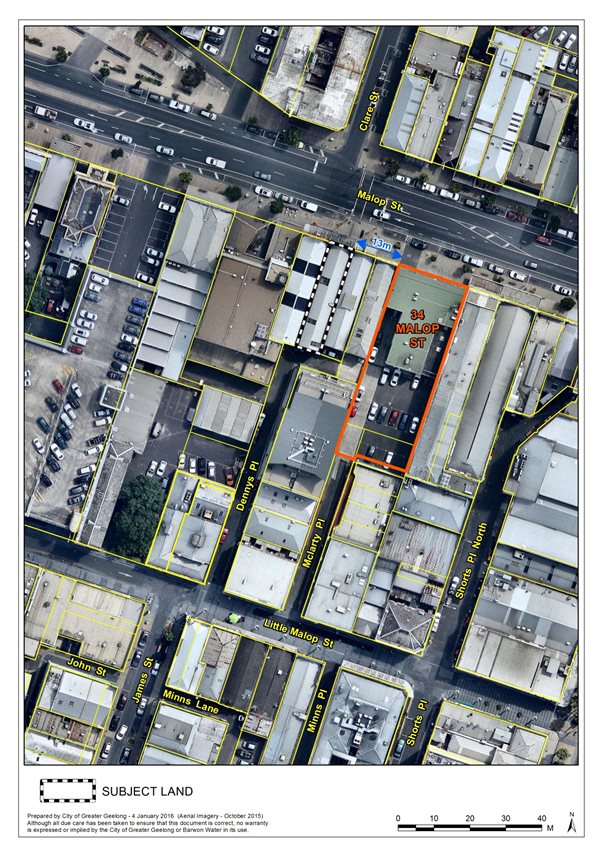
A total of 27 opposing submissions were received, including an on-line petition containing 2,820 signatures. Overwhelmingly submitters questioned why the land at 34 Malop Street (13 metres away) was not proposed to be acquired instead of 28 Malop Street. No. 34 historically provided an access point through to McLarty Place/Little Malop Street but is no longer available to the public.
A significant majority of submissions also voiced their support for the tenant of 28 Malop Street; being Guf Games Geelong; and the business’s important social and economic role in the Geelong community.
No submission was received from the landowner despite meeting with Council officers during the exhibition period.
Two supporting submissions were received; one from Tract on behalf of the Central Geelong Taskforce, the other from the landowner of 26 Malop Street.
In considering the submissions, Council officers sought further information from the applicant about its position on providing access through 34 Malop Street. The applicant replied on 15 December 2015: "Council is in discussion with the owners of 34 Malop Street. It is anticipated that Council will further consider the matter of this site and make public its intentions early in the new year’.
The application of the Public Acquisition Overlay is perhaps the most serious planning power Council has at its disposal. Because of this there needs to be a high level of strategic justification to support the compulsory acquisition. In this case there is strong justification.
Many submissions point to 34 Malop Street as an alternative with a lesser social cost. This alternative cannot be dismissed even though its consideration is outside the scope of Amendment C262. Submissions suggesting 34 Malop Street is a simple and cheap alternative fail to appreciate that the land is five times the area of 28 Malop Street and privately owned.
What is clear is that a public breakthrough using either or both 28 and 34 Malop Street is integral to the implementation of the Central Geelong Action Plan. There is potential for a laneway connection to be achieved at 34 Malop Street through redevelopment of the site.
It is therefore recommended that Amendment C262 and submissions be referred to an Independent Planning Panel. It is also noted that Council officers are currently in discussion with the owners of 34 Malop Street that includes creating a laneway connection from Malop Street to McLarty Place.
Cr Macdonald moved, Cr Richards seconded -
That Council:
Having considered all submissions to Amendment C262 to the Greater Geelong Planning Scheme resolves to:
requests the Minister for Planning to appoint an Independent Panel under Part 8 of the Planning and Environment Act, 1987;
refers all submissions to the Panel; and
submits to the Panel its response to the submissions generally as outlined in this report.
Lost.
On 16 June 2015 a request was received from the City’s Central Geelong Action Plan Department seeking amendment to the Greater Geelong Planning Scheme to apply the Public Acquisition Overlay (PAO) 2 (Proposed Public Open Space) to 26 Malop Street, Geelong.
This followed over eighteen months of negotiation between Council (through its agent) and the landowners. Unfortunately there was little interest in selling the property, with multiple owners posing a challenge to reaching sale by agreement.
The application was considered to have sufficient strategic planning merit to advance to a Council Meeting for resolution to exhibit the Amendment.
Before going to a Council Meeting, the Central Geelong Taskforce considered the most appropriate location for a laneway breakthrough at its meeting on 20 August 2015. It resolved to:
“Endorse the proposed Public Acquisition Overlay to create a breakthrough to Dennys Place; and
Recommend that the Public Acquisition Overlay be applied to 28 Malop Street”.
Amendment C262 was considered in confidence at the 15 September 2015 Ordinary Meeting of Council. By resolution of Council it was determined that the decision made ‘In Committee’ be made public. It was resolved that Council exhibit a Planning Scheme Amendment to apply a PAO to 28 Malop Street, Geelong.
Officers provided the following comments in support of the amendment:
“The subject land has rear access to Denny’s Place, in addition to its Malop Street frontage. Its dual frontage, in combination with a location directly opposite Clare Street and the existing pedestrian crossing over Malop Street, make the subject land the ideal location for a laneway breakthrough. The delivery of this breakthrough will improve pedestrian permeability through to Little Malop Street, James Street and the laneways that branch off them.
The Geelong Advancement Fund: Malop Street and Laneways project will enable the delivery of the first stage of the Greening Geelong – public realm upgrade (Central Geelong Action Plan, Page 18). The funding agreement in place between Council and Regional Development Victoria requires the breakthrough to be delivered as part of the project. Securing the land is a high priority. Council has budget in 2014/15 and 2015/16 to purchase the property.
While either 26 Malop Street and 28 Malop Street would achieve the same functional outcome in creating this laneway connection, it should be noted that 26 Malop Street adds greater architectural interest to the streetscape [and] makes a more important contribution to the quality of the built environment due to its detailed façade and parapet. On this basis, the acquisition of 28 Malop Street is proposed as its plain, rectilinear façade adds less value to the overall character of the streetscape.
The impact of the acquisition and the subsequent conversion of the space into a laneway connection will directly affect the landowner and the existing tenant. Council will work with the affected business to facilitate its relocation within the CBD".
Under delegation from the Minister for Planning, Amendment C262 was authorised by the Department of Environment, Land, Water and Planning on 25 September 2015.
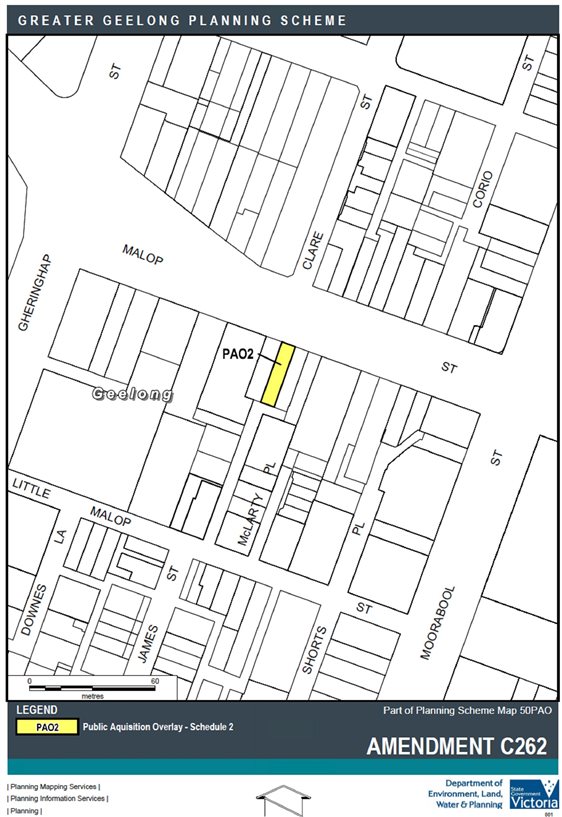
The Amendment was exhibited for a 1 month period closing on 16 November 2015. This included notices in the local newspapers and letters sent to landowners and occupiers in the immediate area. The proposed new planning scheme map is shown in Appendix 1.
During the exhibition period Council Planning and Central Geelong Action Plan officers met with the landowner and the landowner’s legal representative. The landowner left the meeting with a clear understanding of the planning scheme amendment process, rights under the Land Acquisition and Compensation Act 1986 (LACA) and Council’s strong preference to negotiate purchase independently. No contact or submission has been received from the landowner since the meeting.
Officers also met with the directors of Guf Games, the tenant of 28 Malop Street. Subsequent to the meeting, the Central Geelong Action Plan Department – separate to Council’s role as the Planning Authority – wrote to Guf Games outlining statutory obligations under LACA and a willingness to work proactively to relocate the business.
As a consequence of the Amendment C262 exhibition, a total of 29 submissions were received – 27 objecting and 2 supporting the Amendment. One objecting submission was an on-line petition containing 2,820 signatures. Appendix 2 contains a table which summarises all the submissions.
Pursuant to the Planning and Environment Act 1987, the Council is required to consider all submissions made to an Amendment and must either: (1) change the Amendment as requested by the submissions; or (2), refer the submissions to an Independent Panel; or (3) abandon the Amendment.
The next section of this report outlines the key issues raised in the submissions and provides an officer response. In the event the submissions are referred to an Independent Panel, the responses in this report will form the basis for Council’s presentation to the Panel.
The Merits of a Dennys Place Connection Between Malop and Little Malop Street
A number of submissions say Dennys Place is an inappropriate location for a pedestrian walkway connecting Malop and Little Malop Streets. Reasons include: no documented case that supports the proposal or selection of the building subject to compulsory acquisition; Dennys Place is not an inviting walkway being ‘back of house’ to residential apartments and commercial businesses, and is used for car parking and storage of rubbish bins and beer kegs; and Denny Place does not activate any businesses. Submitters believe this will create an unsafe environment.
The neighbouring property owner at 26 Malop Street is supportive of the proposal and submits that open access rather than dead-end streets is always a safer and more encouraging of pedestrian movement. The submission includes a preliminary concept in response to the planned acquisition showing modifications to the building allowing frontage and interaction with any future laneway.
The Central Geelong Taskforce submission outlines the strong strategic support for the Amendment. The submission considers connection of Dennys Place to Malop Street will deliver an important mid-block link for pedestrians, generate increased foot-traffic in the laneway precinct, and is the best location for a north-south pedestrian link from Ryrie Street to the Geelong Waterfront.
Officer Response
The selection of Dennys Place as a strategic pedestrian connection in the retail core of Central Geelong is strongly supported by the planning policy framework. Dennys Place is identified in the Greater Geelong Planning Scheme as ‘Improved Linkage Opportunities’ under the Schedule provisions to the Activity Centre Zone. Dennys Place is also identified in a number of strategic planning documents that preceded implementation of the Activity Centre Zone into the Scheme in 2013, including the Central Geelong Urban Design Guidelines (2008).
Past strategic planning work openly identified Denny Place as the location for a breakthrough connection and was subject to public consultation, scrutiny and deliberation.
The location was further reinforced in the Central Geelong Action Plan 2013.
What is not identified in the policy framework is the selection of an individual property to achieve the breakthrough. In reality either no. 26 or 28 Malop Street will serve this role and Amendment C262 has sought to apply the PAO to 28 Malop Street.
Notwithstanding the overwhelming strategic support, the functionality of Dennys Place in its current form has limitations as an attractive, safe pedestrian walkway. The Central Geelong Taskforce submission states that following demolition, Council will implement a streetscape master plan to enhance the laneway. Further information on this matter was sought from the applicant and responded:
“In relation to the improvement of Dennys Place, we intend to resurface and embellish the space as part of the Malop to Myers Revitalisation project, potentially including and not limited to laying of pavers, planting of trees and other greenery, installation of public art, seating and lighting. Those parts of the lane in which vehicles will continue to traverse will have more limited improvements to reflect the need to maintain a path for through vehicles, resulting in more vertical and overhead elements being installed”.
It would be expected that concerns about rubbish bins, beer kegs and car parking would be resolved as part of the master planning process.
There is no doubt that the laneway has traditionally been used as a ‘back of house’ function with limited street frontage or activity. However this will change as is demonstrated by the plans for 26 Malop Street. There are already large ‘Chrissy Amphlett’ and ‘King Billy’ murals, Beavs Bar smoker’s open-air space and rear interface with the commercial premises at 14 McLarty Place in the laneway. The old rear stables building at 71 Little Malop Street (partially fronting Dennys Place), is currently being renovated for office use and will further activate the laneway. While the residential complex has its rear vehicle access and car park on Dennys Place, the upper levels contain balconies and windows that overlook Dennys Place. Dennys Place also provides a clear and direct link to Clare Street and James Street.
For all these reasons it is considered that Dennys Place will become a safe, attractive and interesting pedestrian walkway between Malop and Little Malop Street.
The Merits of Using McLarty Place as an Alternative Connection Between Malop and Little Malop Street
The overwhelming majority of submissions questioned why the land at 34 Malop Street was not proposed to be acquired instead of 28 Malop Street. Submitters note that number 34 was historically a well-known access point through to McLarty Place/Little Malop Street – but is now barricaded with a high fence on Malop Street. Submitters say this alternative will result in minimal disruption at a much lower cost to ratepayers.
Submissions highlighted the current function of McLarty Place with entrances to the residential apartments and service businesses. Submissions point out that McLarty Place has an appropriate laneway mix while Dennys Place has no business, retail or café fronts.
One submission raises the option of opening up the McLarty Place car park (at the rear of 34 Malop Street) by removing the paling fence at the end of the Dennys Place right turn extension.
Officer Response
Responding to this issue is difficult to reconcile as the consideration of an alternative location for a PAO is beyond the scope of Amendment C262.
It is considered that the arguments raised in the submissions have merit and, on the face of it, acquiring all or part of 34 Malop Street (or creating a carriageway easement) would still deliver a key strategic mid-block pedestrian link. McLarty and Dennys Place are closely spaced meaning there is little difference for users, as shown in Appendix 3. This would also benefit the existing traders fronting McLarty Place.
Submissions suggesting 34 Malop Street is a simple and cheap alternative fail to appreciate that the land is five times the area of 28 Malop Street and privately owned. An extended McLarty Place laneway would similarly require master planning and improvements. Hence the real cost of opening up McLarty Place for access may actually be greater depending on negotiations with the landowner.
The Central Geelong Action Plan Department has advised that Council officers are continuing discussions with the owners of 34 Malop Street with a view to creating an additional laneway at this location.
It is considered unlikely that Council would fund compulsory acquisition of both 28 and 34 Malop Street. As an alternative, securing the rear portion of 32 Malop Street, which accesses Dennys Place, would achieve the desired connections (were McLarty Place to connect to Malop Street). There are also opportunities to negotiate an additional laneway connection in any future redevelopment of 34 Malop Street.
Ultimately, irrespective of the alternative benefits of McLarty Place, the strategic planning merits of Dennys Place and application of a PAO to 28 Malop Street are considered to be sound.
The Selection of 28 Malop Street Instead of 26 Malop Street
Some submissions queried the selection of the tenanted 28 Malop Street property over the untenanted 26 Malop Street on the basis of building façade and tenancy.
The Central Geelong Taskforce submission says that the 26 Malop Street building was Geelong’s first Chinese restaurant and a cultural institution for many years. The submission considers the building at 28 Malop Street has comparatively less architectural value and consequently, makes a limited contribution to the visual interest and amenity of the streetscape.
Officer Response
Amendment C262 seeks to apply a PAO to 28 Malop Street. The PAO designates the land for proposed public open space and the existing building is intended to be demolished. There are no planning controls that would restrict the removal of the building.
Similar to consideration of McLarty Place above, the merits or otherwise of the façade of the building at 26 Malop Street compared to any other building are beyond the scope of this Amendment. The submission from the owner of 26 Malop Street suggests that future improvements to the building will significantly improve the function and appeal of the building for prospective tenants. It is agreed that the façade and history of 26 Malop Street contribute to the interest and amenity of Malop Street.
Impacts on the Tenant of 28 Malop Street; Guf Games Geelong
A comprehensive submission was received from K. White on behalf of the directors of Guf Geelong. The submission addresses matters relating to telecommunications infrastructure, disruption to operations, lack of suitable CBD lease options, the Digital Geelong Strategy and alternative PAO options. The submission is copied in full at Appendix 2.
Virtually all the submissions including the on-line petition highlight the important social and economic role of Guf Games in the Geelong community. Many of the submitters are regular customers and emphasise the central location near the Geelong Station, takeaway shops and car parking. Submitters say the business supports young people and special needs groups, and the numerous competitions attract large numbers to Central Geelong.
Officer Response
In responding to the impacts on the tenant, there needs to be a distinction between Council in its role as the Planning Authority and Council in its role as delivering on the Central Geelong Action Plan.
Council as the Planning Authority is responsible for expediting Planning Scheme Amendment C262 to apply a PAO to 28 Malop Street. Through this process the Planning Authority must demonstrate the strategic merits and public benefit of the Amendment.
The PAO is considered to be the appropriate planning tool to: (a) identify the land proposed to be acquired; and (b) reserve the land for a public purpose. Funding has been set aside in budgets to deliver the project. This report recommends that Amendment C262 is strategically sound, however notes ongoing discussions with the owners of 34 Malop Street.
Should the Amendment be successful the LACA sets out the process for the compulsory acquisition of land by Council, including what is fair and reasonable compensation payable to owners and tenants. Council, in its role as the Central Geelong Action Plan and future landlord, has clearly indicated to Guf Games a desire to work collaboratively and actively support relocation. In other words, Councils’ intent is to arrive at a negotiated outcome in preference to resorting to the LACA.
The same approach applies to the landowner.
There are no environmental implications as a result of the amendment.
Amendment C262 will incur the normal costs associated with a planning scheme amendment process. Council has funding in the 2015/16 budget to purchase the property either by agreement or by compulsory acquisition.
There are a number of policies and strategies that directly support the Amendment.
Central Geelong Action Plan
The Central Geelong Action Plan (December 2013) is a fifteen year blueprint for focused action in Central Geelong and a reference document in the Greater Geelong Planning Scheme. Securing the subject property is integral to implementation of the Action Plan by delivering on:
The ‘moving around’ theme by creating “more mid block links and improve pedestrian safety and comfort and the amenity of links generally” (page 9); and
The ‘connecting people and places’ priority action by creating “an integrated, attractive and well-designed pedestrian and cycling network which supports healthy living and public safety” and making “the city more walkable and promotes more engaging activity on the streets” (page 12).
Activity Centre Zone
The Activity Centre Zone Schedule 1 (ACZ1) is the primary statutory planning provision applied to Central Geelong, which includes 28 Malop Street. The ACZ1 contains a number of land use and development objectives including “to create new pedestrian routes within the activity centre through improved linkage opportunities”.
The ACZ1 Precinct 1: Core Retail map identifies Dennys Place and 26/28 Malop Street as an existing key pedestrian route and further designates the route for “Improved Linkage Opportunities”. Therefore identifying and reserving the property via a PAO for a future open space link is specifically supported in the Greater Geelong Planning Scheme.
Clause 21.09 Central Geelong
The Municipal Strategic Statement contains a local policy for Central Geelong. Relevant to this amendment is the direction to encourage pedestrian linkage opportunities by extending existing laneways and identified linkages through buildings where appropriate to enhance permeability.
The Amendment closely aligns with ‘Growing the Economy’ and ‘Sustainable and Built Environment’ by supporting the revitalisation of Central Geelong.
No officers involved in this report have any direct or indirect interest in accordance with Section 80(c) of the Local Government Act.
Processing of this Amendment needs to consider funding agreements with Regional Development Victoria. Council should also be mindful of the potential impacts to its reputation in addressing the needs of the tenant.
The Amendment facilitates future improved pedestrian permeability in Central Geelong, delivering a range of social benefits including revitalisation and support for local businesses, healthy living, walkability and public safety.
Land ownership and compulsory acquisition are matters addressed in Victoria as part of the human rights legislation. Section 20 of the Human Rights and Responsibilities Act 2006 requires that ‘a person must not be deprived of his or her property other than in accordance with the law’. Planning legislation ensures an open community consultation process occurs, enabling people to freely express their views and if necessary obtain a fair hearing before an Independent Panel.
The amendment was exhibited in accordance with the provisions of the Planning and Environment Act, including direct notification and meeting with both the landowner and tenant.
Should the application of the PAO2 into the Planning Scheme ultimately be successful, the Land Acquisition and Compensation Act places strict obligations on Council in relation to the process for acquisition and tenancy.
Cr Heagney re-entered the meeting room at 7:58pm
Portfolio: |
Planning - Cr Heagney |
Source: |
Planning & Tourism - Strategic Implementation |
General Manager: |
Peter Bettess |
Index Reference: |
Application: Planning Scheme Amendment C330 |
This report recommends Council adopt Planning Scheme Amendment C330 to rezone part of Connections Park to the General Residential Zone.
Amendment C330 is a Council initiated amendment proposing to rezone Connections Park East (former BMX site), Corio from the Public Park and Recreation Zone to the General Residential Zone Schedule 1. The rezoning itself will not change the way the park is currently used.
The Amendment originated from a 25 November 2014 Council resolution to prepare a report on the sale and rezoning of the site.
This resulted in a report to the 11 August 2015 Council Meeting where it was resolved to exhibit Amendment C330. The report noted that the sale of Council owned land would be considered separately.
The reserve is poorly situated and suffers from a lack of passive surveillance and safety concerns. In late 2015 Council removed the concrete skate facility and gravel mounds used for BMX use. The perimeter concrete footpath network has been retained.
Rezoning of the site to a residential zone will improve Council’s ability to attract investment in a challenging urban renewal precinct that will also see the redevelopment of the adjacent former Rosewall Primary School land.
The former school land is covered by Design and Development Overlay Schedule 37 which requires future development to maintain a public connection between the east and west parts of Connections Park. As a consequence of this Amendment, that requirement should be reviewed.
Amendment C330 was exhibited between 12 November 2015 and 14 December 2015 and resulted in the receipt of no submissions.
As no submissions have been received, the Amendment can now be adopted and sent to the Minister for Planning for approval.
Cr Heagney moved, Cr Ansett seconded -
That Council:
adopt Amendment C330 as contained in Appendix 2 in this report;
submit the adopted Amendment with the prescribed information to the Minister for Planning requesting approval; and
review Schedule 37 to the Design and Development Overlay as a consequence of adopting Amendment C330.
Carried.
The Amendment was initiated by Council as the time it adopted an earlier Amendment C305; when it also resolved that ‘Officers prepare a report on the sale and rezoning of Connections Park East (BMX site)’.
The earlier Amendment C305 rezoned a strip of Connections Park directly north of the former Rosewall Primary School land from the Public Park and Recreation Zone (PPRZ) to the General Residential Zone. Council is currently negotiating with the Department of Education to exchange land to improve the development potential of the former school site and support the planned new Rosewall Neighbourhood Centre. Amendment C305 was gazetted on 23 April 2015.
Any redevelopment of the former school land will need to consider Design and Development Overlay Schedule 37 (DDO37). The DDO37 includes requirements for development to provide a public link between Connections Park East and Connections Park West
Council at its Ordinary Meeting on 11 August 2015 resolved to exhibit Amendment C330 to rezone Connections Park East (former BMX site), Corio from the Public Park and Recreation Zone to the General Residential Zone Schedule 1.
The Amendment land has a total area of 1.3 hectares and is owned by Council. The reserve is poorly situated and suffers from a lack of passive surveillance and safety concerns. In late 2015 Council removed the concrete skate facility and gravel mounds used for BMX use. The perimeter concrete footpath network has been retained.
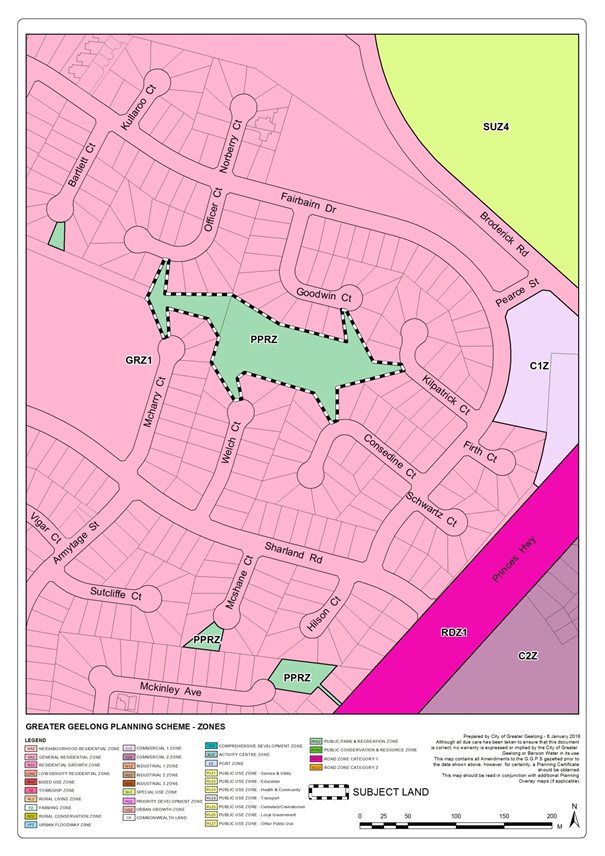
Appendix 1 shows the existing zoning of the subject land and surrounding area.
Exhibition of Amendment C330 occurred over a 4 week period closing on 14 December 2015. Notice of the Amendment was sent to relevant Ministers and Agencies, appeared in the Government Gazette and local newspapers and was placed on display at the Rosewall Neighbourhood House.
All landowners and occupiers near the part of Connections Park proposed to be rezoned were directly notified.
The long-term strategy to redevelop Connections Park East for residential use complements other renewal projects that will bring significant benefits for the local community. These include redevelopment of the former primary school land, sporting improvements to Flinders Peak Reserve, development of the Hendy Street Family Hub and the redevelopment of the Rosewall Neighbourhood House.
The retention of the western part of Connections Park at over 1.3 hectares, with established playground equipment and neighbouring the Rosewall Neighbourhood House, will adequately serve local open space needs. The loss of the site as designated open space in the Planning Scheme will not adversely impact on the community.
There were no submissions or objections to the Amendment and therefore the Amendment does not need to be heard by an Independent Planning Panel. Council is now able to adopt Amendment C330 and forward it to the Minister for Planning seeking approval.
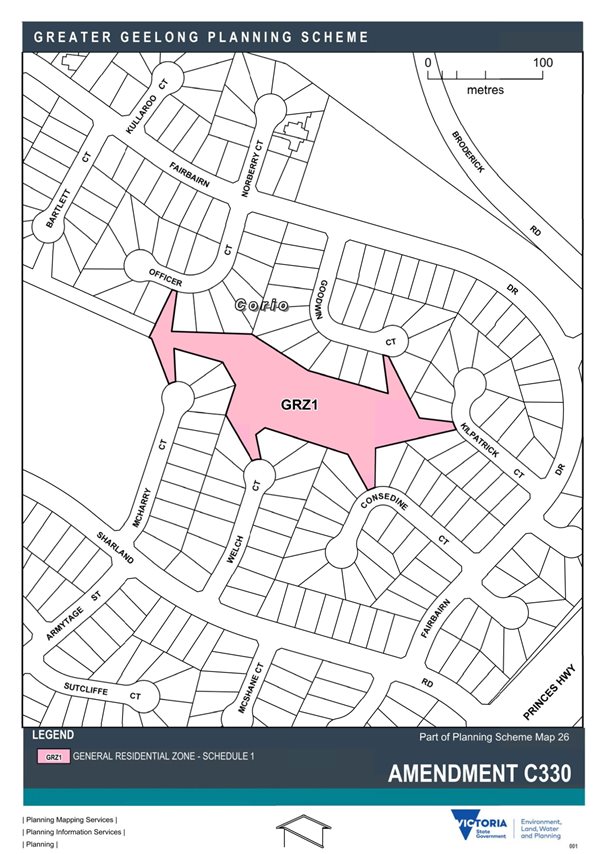
Appendix 2 is the exhibited Amendment map which it is now being recommended for adoption.
As a consequence of adopting the Amendment, the requirements of the DDO37 need to be reviewed, particularly the provision of a public link between Connections Park East and Connections Park West. With the intention that the Amendment land will ultimately be developed for residential use, there is no need to retain a connection on the former school site where the street network will serve this purpose. This review would support the Department of Education in its ability to attract sale and redevelopment, as well as land exchange negotiations with Council.
There are no environmental impacts as a result of the Amendment.
No impact to budget.
The State Planning Policy Framework Clauses 11 (Settlement), 16 (Housing) and 19 (Infrastructure) support the redevelopment of underutilised urban land consistent with the purpose of this Amendment.
The Municipal Strategic Statement includes local policy Clause 21.18 Corio Norlane. The policy outlines key issues facing Corio and Norlane including a stagnant residential population, low housing densities, ageing housing stock and a lack of quality, usable public reserves.
Relevant objectives at Clause 21.18-2 are to:
Increase the resident population, diversify housing types and support opportunities for urban renewal.
Increase social and cultural connection through integrated community precinct planning.
Provide active and passive open space to meet the needs of residents and visitors.
It is considered that Amendment C330 is consistent with the objectives of Clause 21.18. This includes the Corio Norlane Structure Plan 2012 which is a reference document in the Greater Geelong Planning Scheme.
The Amendment supports the ‘Community Wellbeing’ and ‘Sustainable Built and Natural Environment’ strategic directions of City Plan. The rezoning supports opportunities for urban renewal.
No Council officer involved in the report has any direct or indirect interest, in accordance with Section 80(c) of the Local Government Act
There are no notable risks associated with implementing the recommendation contained in this report.
The Amendment is an important step in the long term redevelopment of Connections Park, the former Rosewall Primary School site and the Rosewall Neighbourhood House.
The Amendment will not impact on any basic rights, freedoms and responsibilities as set out in the Charter. Planning legislation ensures an open community consultation process occurs, enabling people to freely express their views and if necessary obtain a fair hearing before an Independent Panel.
Amendment C330 was exhibited in accordance with the requirements of the Planning and Environment Act 1987, including direct notification to all surrounding owners and occupiers.
The Department of Health and Human Services and the Department of Education and Training, as major adjoining landowners, have been consulted about the project and were formally notified at the exhibition stage.
The planning authority for this amendment is the Greater Geelong City Council.
The Greater Geelong Planning Scheme is amended as follows:
Planning Scheme Maps
The Planning Scheme Maps are amended by a total of 1 attached map sheet.
Zoning Maps
Amend Planning Scheme Map No. 26 in the manner shown on the attached map marked “Greater Geelong Planning Scheme, Amendment C330”.
End of document
Portfolio: |
Central Geelong - Cr Heagney |
Source: |
Investment and Attraction / Events, Central Geelong & Waterfront |
General Manager: |
Brett Luxford |
Index Reference: |
Special Rates and Charges – Central Geelong & Waterfront |
This report seeks a resolution by Council to declare a Special Rate Scheme for Central Geelong Marketing effective from 1 July 2016.
The purpose is to commence the implementation of a new five (5) year term of the Central Geelong Marketing Special Rate to enable the continuation of the current marketing program for business promotion.
A fourth round of the Special Rate Scheme is proposed along with a Committee constituted under Section 86 of the Local Government Act. The Central Geelong Marketing Committee (CGMC), made up of 13 business and stakeholder representatives, fully supports the new programs to be delivered in addition to the core program and recommends the continuation of the Special Rate Scheme in Central Geelong.
Funds are applied to marketing and promotional activities, business development, training, evaluation, administration and miscellaneous activities delivering significant benefits to Central Geelong commercial property owners and businesses.
Between 2011 and 2015, the CGMC program delivered 2046 activities to over 328,000 people.
When analysed with REMPLAN (the agreed economic modelling tool of G21 and COGG), flagship activities between 2011-2015 delivered $53.45M of Total Economic Output (TEO) within the Geelong region, an average of $13.36M per annum. The projected TEO for 2011-2016 is $65M and demonstrates a $1:$19 return on investment.
The rate will lapse if not re-initiated by Council and all the programs, benefits and activities will cease.
The proposed Special Rate would raise $1,045,122 in 2016/2017 for delivery of base program with the four new activities to encourage increased spend from outside the Greater Geelong region. These amounts would be increased by the Consumer Price Index (CPI) each year over the life of the Special Rate.
The new program will deliver the four new activities from Year 1 continuing throughout the lifespan of the Special Rate. These include:
Professional Service Campaign (Metropolitan Melbourne West);
TV campaign (Metropolitan Melbourne West);
Signage - Banners, Bus, Train, Tram advertising (Metropolitan Melbourne); and
Central Geelong Workers Engagement Program.
These activities will promote and market Central Geelong to Metropolitan Melbourne and regional Victoria with a particular focus on encouraging increased visitation from the Melbourne Metropolitan West area residents resulting in increased business activity and benefit in Central Geelong.
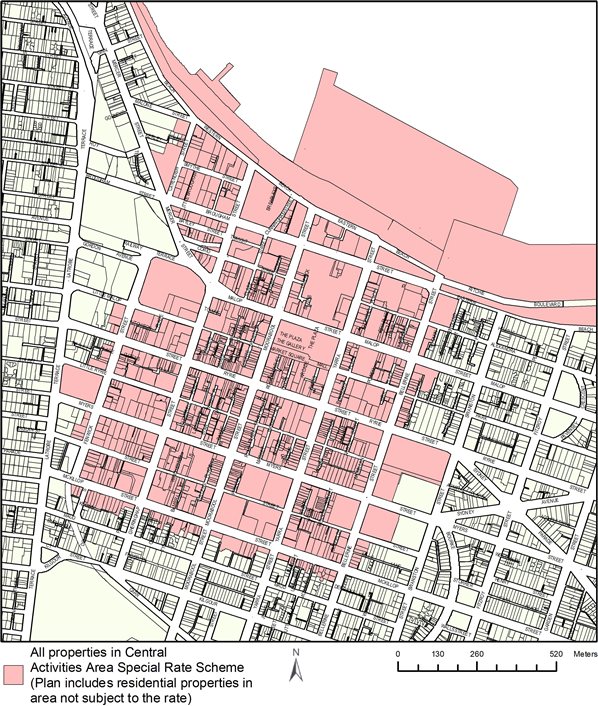
The area to be rated is bound by McKillop Street, Bellerine Street, the Waterfront, Cavendish Street and Fenwick Street. This is unchanged from the previous Special Rate Schemes.
There are 1492 properties in the area proposed to be rated and the rate proposed for year one (1) (2016/2017) of the five (5) year scheme is 0.0008211 cents of the Capital Improved Value (CIV). Non rateable properties and properties used exclusively for residential purposes have been excluded from the rate.
This report seeks a resolution by Council to declare a Special Rate for the establishment and administration of CGMC and its associated activities.
Cr Heagney moved, Cr Irvine seconded -
That Council:
Resolves to declare the Special Rate as follows:
A Special Rate to be declared for the period commencing on 1 July 2016 and concluding on 30 June 2021.
The Special Rate be declared for the purpose of defraying any expenses incurred by Council in relation to developing and promoting businesses within the Central Activities area, Geelong, which:
Will help finance the operation and administration of the Central Geelong Marketing office, marketing, promotion and advertising initiatives, the provision of business information, business training and networking, the provision of events and activities and the associated encouragement and development of commerce and trade within the Geelong Central Business Precinct;
Council considers is or will be a special benefit to those persons required to pay the Special Rate (and who are described in succeeding parts of this resolution); and
Arises out of Council’s function of planning for and providing services and facilities for the local community.
The:
Total cost of performing the function described in Part 1(b) of this resolution between 1 July 2016 and 30 June 2017 be recorded as $845,122 for core activities and $200,000 for four new activities (listed in Appendix 1);
Total cost of performing the function described in Part 1(b) of this resolution in each successive 12 month period after 30 June 2017 be recorded as the total cost in the immediately preceding 12 month period plus an amount representing any increase in the Consumer Price Index (Capital Cities Weighted Average – All Groups) during the preceding 12 month period (Appendix 1);
It be recorded that, for purposes of Section 163(2A) of the Act, the Special Rate proceeds will not exceed the amount calculated in accordance with the prescribed formula (R x C = S), the:
‘Benefit ratio’ (R) being calculated at 100%, and representing the special benefits to all persons liable to pay the Special Rate; and
‘Total cost’ (C) of performing the function described in Part 1(b) of this resolution be recorded as per Part 1(c) of this resolution.
‘Maximum levy’ (S) be recorded as per Part 1(c) of this resolution
The following be specified as the area for which the Special Rate is so declared:
The area within the municipal district of Council highlighted in the plan (Appendix 2) attached to this resolution (“the area”).
The following be specified as the land in relation to which the Special Rate so declared:
All land within the area other than land used exclusively for residential purposes.
The following be specified as the criteria which form the basis of the special rate so declared:
Ownership of any land described in Part (e) of this resolution.
The following be specified as the manner in which the special rate so declared will be assessed and levied:
An amount calculated by applying 0.0008211 cents in the dollar of the Capital Improved Value to each parcel of rateable land together with such further amount as represents any increase in the Consumer Price Index (Capital Cities Weighted Average – All Groups) during the immediately preceding 12 month period, in respect of each 12 month period from 1 July 2017 onwards
For the purposes of Part 1(h) of the resolution, the Capital Improved Value of each parcel of land is the Capital Improved Value of that parcel of land at the time of levying the special rate (so that the Capital Improved Value may alter during the period in which the special rate is in force, reflecting any revaluations and supplementary valuations which take place).
Having regard to the preceding parts of this resolution but subject to section 166(1) of the Act, it be recorded that, subject to any further Resolution of Council, the special rate will be due and payable on the date(s) fixed under section 167 of the Act as the date or dates on or by which Council's general rates are due.
Authorise the Chief Executive Officer to levy the Special Rate in accordance with Section 163 (4) of the Act.
Carried.
In 2001 Council declared a Special Rate which collected funds from all commercial properties in a defined area of Central Geelong on a yearly basis over five (5) years to fund a consolidated marketing program for the benefit of Central Geelong property owners and business operators.
A second round of the Special Rate was declared for a further five (5) year period from 1 July 2006 to 30 June 2011 with Council at this time committed to maintaining Central Geelong as the commercial centre for the Geelong Region.
A third round of the Special Rate was established for the period 1 July 2011 to 30 June 2016 and additional activities delivered extended promotion into regional and metropolitan areas.
The life of the current rate was set at five (5) years and is due to expire at the end of the 2015/2016 financial year. The rate will lapse if not re-initiated by Council and all the programs, benefits and activities will cease.
At the 20 November 2015 meeting, Council resolved its intention to declare charges for the fourth round of the Special Rate. The scheme was advertised and submissions invited. A total of 51 submissions were received of which 29 were in favour; 3 supported the scheme with suggestions for alternate funding sources; 16 were objections and 2 were outside the scope of the Special Rate scheme. Comments made by objectors fell within 4 broad categories:
Geographic boundary of Special Rate Scheme and location of individual business;
Business Type – retail, tourism, professional services and specialists and perceived benefit for different business types;
Concerns over parking, waste issues not related to the Special Rate;
Challenge the benefits of activities undertaken by the Committee and the reporting of activities.
Comments made by supporters fell within three broad categories:
Activities undertaken encourage increased visitation and move customers around Central Geelong as well as bringing economic benefit;
Provides a voice for Central Geelong business operators in times of increased competition;
Working collaboratively provides a fair funding base and is cost effective for business operators in comparison to working independently.
The Submissions Review Hearing Panel met to consider submissions on 15 December 2015. The panel heard submissions from both objectors and supporters of the Special Rate Scheme. The panel recommended Council proceed with the Special Rate Scheme outcomes without modification.
The Central Geelong Marketing Committee has overseen this project and expenditure of funds over the previous three rounds of the Special Rate. As identified in the CGMC Terms of Reference / Instrument of Delegation, (Attachment 1 & 2) the Committee is made up of 13 business and stakeholder representatives including the Geelong Chamber of Commerce, VECCI, REIV, Tourism Greater Geelong and the Bellarine, Market Square Shopping Centre, Westfield Geelong, one elected arts sector representative and four elected strip retail / business representatives.
The Committee supports the continuation of the Rate and considers it to be an important component in maintaining the viability of Central Geelong. It is proposed the Committee continue in its current form and introduce four new activities to generate greater benefits to property and business owners.
The Committee delivers core activities including marketing, promotions, events, and communications; business presentation and capability programs, networking and new business support activities. CGM’s ‘The Story Continues...’ document (Attachment 3) provides an overview of core activities delivered to date in the 2011-2015 Special Rate period with 2,046 activities delivered to 328,025 participants bringing an estimated $58.45M of total economic output.
The Committee has identified four new activities to be delivered as identified in Appendix 1. These new initiatives – targeted to bring additional spend and visitation to Central Geelong - will be implemented via a specified increase in the rate amount providing additional special benefits to businesses and property owners throughout the life of the Special Rate.
Special Benefit
In proposing any Special Rate or Charge, Council must be satisfied that special benefit applies to each property and owner being requested to pay the rate or charge.
In relation to this proposed rate, special benefit can be established in the following manner;
Expenditure of funds is designed to increase business activity in the Central Geelong area. This has potential for higher level of turnover and business growth. A full list of activities are identified in the CGM Strategic Framework 2014-2016 and Annual Activities Plan 2015-2015 document (Attachment 4).
The Committee has delivered 2046 activities between 2011-2015, with over 328,000 participants.
The CGMC regularly reviews and evaluates activities delivered to ensure benefits delivered to property and business operators. This includes participant surveys, participating business surveys and stakeholder feedback. Stakeholder surveys conducted throughout the life of the Special Rate consistently show 79% of stakeholders believe there is benefit in having a collective / group approach to marketing and promoting Central Geelong and 68% think businesses working within a defined precinct can achieve more by working together than as individuals.
The use of REMPLAN to determine Total Economic Output (TEO) for events and activities has been accepted by the City of Greater Geelong and G21. Using REMPLAN provides the ability to compare economic output with other activities of Council including tourism and events. Survey data from CGMC’s five flagship activities, when analysed using REMPLAN shows a TEO of $15.874M for the 2014-2015 financial years with 101 jobs created.
The TEO for CGMC flagships activities 2011-2015 is calculated at $53.45M. An average of $13.36M per annum. The projected TEO for 2011-2016 is $65M and demonstrates a $1:$19 return on investment.
2011-2015 evaluation figures:
|
Year |
Special Rate Income |
Base Economic Value of Key Flagship Activities (no multipliers) |
REMPLAN Total Economic Output |
Number of Attendees of Key Flagship Activities |
Long Term Employment (jobs) |
Return on Investment |
|
2011-12 |
$602,000 |
$3.691M |
$13.517M |
84,451 |
70 |
|
|
2012-13 |
$671,000 |
$4.019M |
$13.461M |
87,986 |
70 |
|
|
2013-14 |
$736,000 |
$3.203M |
$10.606M |
57,761 |
68 |
|
|
2014-15 |
$802,400 |
$5.582M |
$15.874M |
97,830 |
101 |
|
|
TOTAL |
$2.811M |
$16.495M |
$53.458M |
328,025 |
|
$1= $19.01 |
Flagship activities are: School Holiday Fun Program, Sidewalk Sales, Christmas in Central Geelong, May Magic, Farmers Market (2011-2013 only), and Tastes of Central Geelong.
Sponsorship and support of key events and exhibitions in Central Geelong including Night Markets at Johnstone Park (QVM & NightJar); Open House Geelong, Geelong Revival, Run Geelong and more. Economic Benefit from sponsorship activities is not included in the above calculations to ensure no double up with the reporting activities of COGG Tourism or Events units.
Business development activities include quarterly networking events, training and development, quarterly newsletters and regular information updates provide stakeholders with key information about programs, activities and opportunities.
The social media, internet and digital opportunities that CGMC provides to businesses are extensive. The products developed include: www.centralgeelong.com.au, Central Geelong Smart Phone app, Love Central Geelong Facebook, Twitter, Instagram and YouTube.
Promotion of on street and off street parking options through the Central Geelong Parking Map, financial sponsorship of the Park & Ride services, the smart phone app and the Magic Meter Elves.
Possible increase in property value and rental return and occupancy brought about by maintaining and increasing business activity that would not have been the case without the activities of the Committee.
Cost to property / business owners
The average property / business pay $10.73 per week for the current Special Rate in 2015-2016. The proposed average amount per property / business for the core activities within the proposed rate period would be $10.89 per week.
The proposed average cost per property / business inclusive of new activities in 2016-2017 would be $13.46 per property / business equating to $699.92 per year. The new marketing campaigns are aimed at western metro Melbourne are expected to bring in $3.8 million per annum to Central Geelong
The apportionment of the rate amongst property owners in the Central Geelong area has been based on the CIV of each property. This approach is relatively common practice for marketing and promotion schemes of this type in Victoria and provides a fair distribution of the cost between property owners with the owners of large properties and complexes paying a higher a rate, as they have the potential to benefit to a greater degree. There were over 70 Special Rate schemes for marketing and promotion within Victoria in 2014-2015.
It is necessary to ensure the funds collected each year over the five (5) year period keeps pace with inflation. It is proposed to increase the rate, hence budget in accordance with the CPI in order to accommodate any adjustments of costs. For the purposes of the calculation, the CPI will be considered as the CPI for Australia (weighted average of 8 capital cities – all groups’ percentage change from previous financial year).
The Special Rate scheme proposes the annual budgets be fixed (subject to CPI) over the five (5) year period, therefore the rate in the dollar will need to be adjusted when a re-valuation takes place.
The relative CIV between properties may also be varied at this time.
Exemption from Special Rate
There are two classes of properties in the Central Geelong area which are proposed to be exempted from the Special Rate. These include:
Non rateable properties – schools, churches, hospitals, parklands, Crown Land etc.
Properties used strictly for residential purposes. In this case the zoning will not be Residential but Business as there are no residential zones in the City.
Non – rateable property owners may be approached to contribute to specific projects and activities of the CGMC via sponsorship and partnership arrangements or other schemes of mutual benefit to the parties involved.
The Special Rate process is familiar to Councillors and provides for a Submissions Review Panel process prior to Council determining its position on the Scheme. Should Council proceed with the Scheme, a further right of review is available on application to VCAT.
Focus on ensuring the programs and activities of the CGMC have the least impact on the environment as possible.
Should Council proceed with the Special Rate for Central Geelong, the process will be self funding. The cost of administration of the scheme and any preparation and presentation at VCAT is able to be accommodated in this year’s budget. Costs are being met by CoGG - Investment and Attraction for this.
The CGMC activities and programs and the CGM unit is fully funded through the Special Rate.
The recommendation in this report is consistent with the priorities of City Plan, the adopted Central Geelong Action Plan, the Central Geelong Structure Plan, the Central Geelong Place Management Plan, the City of Greater Geelong Retail Strategy and the Special Rates and Charges Policy and procedures adopted for the introduction of Special Rate schemes.
It has demonstrated consistent significant and measurable benefit to Central Geelong Stakeholders.
The Special Rate scheme has been prepared in accordance with the Special Rate and Charges provision of the Local Government Act 1989 and Council’s Special Rates and Charges Policy.
The CGMC program is a key deliverable in Growing the Economy. Despite retail challenges from suburban shopping centres, regional and metropolitan centres, Central Geelong rateable property numbers have grown 20% since the commencement of the Special Rate Program in 2001.
The Central Geelong Action Plan December 2013 (Page 30) states options to be considered include: ‘increasing the Special Rate program to generate greater benefits to property and business owners.’
CGM staff are funded via the Special Rate however there are no other officers involved in preparing this report who have a direct or indirect interest.
If the Special Rate Scheme is discontinued, then all programs, activities delivered by the Committee would cease, resulting in a measurable negative impact on the Central Geelong economy.
The activities and programs that result from this levy add significantly to the vibrancy and exciting experience of Central Geelong. They provide a collaborative approach to marketing and promoting Central Geelong from the disparate business and property owners.
The ongoing success of Central Geelong as the “heart” of the region is an essential element of broader community benefit. The activities particularly support the four main objectives of the Central Geelong Structure Plan and the Central Geelong Action Plan: more workers; more students; more residents; more visitors.
This report has no impact on human rights.
The CGMC, made up of 13 business and stakeholder representatives, has evaluated the activities delivered with the proceeds from the Special Rate via participant and business surveys and feedback. it has reported to Council on a yearly basis and the Committee has voted to request Council consider a further round of the Special Rate for Central Geelong from 1 July 2016 to 30 June 2021.
The CGMC communicates regularly with business operators/ owners in the Central Geelong area. This is done by means of newsletters, a dedicated website, digital communications and social media. In the lead up to Council advertising the scheme, information has been sent out particularly relating to the proposed continuation of the Special Rate and the activities delivered to date.
The intention to declare the Special Rate was advertised in the local media with letters sent to property owners and business operators within the Special Rate boundary advising them of the intention to declare a special rate and opportunities for submissions. All submitters were invited to address the Submissions Review Hearing Panel.
Should Council resolve to declare the Special Rate, further correspondence shall be sent to all affected property owners.
|
ITEM |
Description of Core Activities |
Projected Budget Year 1 |
|
|
1 |
Marketing – including consolidated advertising and digital delivery |
290,000 |
|
|
2 |
Promotions & Events - Delivery of activities and events including project delivery and sponsorship |
335,000 |
|
|
3 |
Stakeholder development including business presentation, capability, information, training and networking and new business support |
70,000 |
|
|
4 |
Administration - including salaries and on-costs. |
130,122 |
|
|
5 |
Special Rate process - administration |
20,000 |
|
|
|
|
$845,122 |
|
|
|
Note year 1 includes 2015-2016 rate amount plus CPI plus costs of Special Rate process administration |
||
|
|
Description of New Activities |
|
|
|
A Year 1 |
Metropolitan Melbourne Television Campaign Includes schedule of advertisements in metropolitan Melbourne (approximately $43,000) plus project management and evaluation activities. Note that CGM would seek opportunities to work in partnership with other Geelong organisations (such as Regional Tourism Association) to further expand the reach and breadth of this campaign. This will complement the regional campaign delivered 2012-2016 which included regional TV and cinemas in Geelong and Werribee which will continue as core activities within option 1 |
|
$50,000 |
|
B Year 1 |
Signage – Banners, Bus, Transit Advertising Expand the signage program commenced in 2015-2016 with additional resources to allow for increased signage on transit within regional and metropolitan west areas. |
|
$50,000 |
|
|
Description of New Activities |
|
|
|
C Year 1 |
Worker Engagement Campaign Targeted campaign to engage the 21,000 people who work in Central Geelong to actively engage with Central Geelong businesses on a more regular basis. Will include the development of a worker database to communicate directly with people working in Central Geelong, will include content development, engagement and communication. Will include focus on B2B elements. |
|
$50,000 |
|
D Year 1 |
Professional Service Campaign – Metropolitan Melbourne Deliver a targeted campaign into Metropolitan Melbourne market to promote Central Geelong Professional services offering. Particular focus on ease of options for travel between Metro West and Geelong and range of businesses and experiences as alternative to Metropolitan Melbourne |
|
$50,000 |
|
Total core activities and new activities |
$1,045,122 |
||
Cr E Kontelj declared an Indirect Financial Interest in Agenda Item 4 – Transfer (Sale) of Land by Expressions of Interest – Draper Street, Ocean Grove in that Karingal has recently become a significant tenant of a building he has a major ownership interest in and left the meeting room prior to discussion at 8:16pm.
Portfolio: |
Community Development - Cr Fisher |
|
Source |
Strategy & Performance – Property & Procurement |
General Manager: |
Dean Frost |
|
Index Reference |
Sale of Land |
The purpose of this report is for Council to consider the recommendation of the Panel established to report on the transfer of land at 77-79 Draper Street, Ocean Grove to a provider of supported accommodation for people with disabilities. The Panel recommends that the land be transferred to Karingal Incorporated.
At its meeting on 10 March 2015, Council resolved to offer the land at 77-79 Draper Street, Ocean Grove (“the land”) to a not for profit organisation for nil consideration for the purpose of providing supported accommodation for people with disabilities.
A Panel consisting of Council officers and one independent representative was appointed to consider proposals received under the sale by EOI process, and to recommend a preferred purchaser to Council.
The EOI including supporting documents was released on Tenderlink on 22 August 2015 with proposals due by 30 September 2015. The EOI was advertised on City Web, in the print media and mailed to all proponents expressing interest prior to release.
Four proposals were received and assessed by the Panel under Part 1 of the EOI process using the published criteria. Two proposals were selected to proceed to Part 2 which included provision of plans, programs and financial information. The selected proponents made presentations to the Panel.
Proposals were assessed using weighted criteria and scores out of 10 for both Parts 1 and 2, providing a final score out of 20.
The Panel recommends that the Council transfer the land to Karingal.
Cr Farrell moved, Cr Fisher seconded -
That Council:
approves the transfer of the land at 77-79 Draper Street, Ocean Grove, to Karingal Incorporated (“the successful proponent”) on the following terms:
nil consideration;
that a s173 Agreement be registered in the titles to the land including the following conditions:
the land is to be used for the purpose of providing accommodation as indicated on the building plans;
if the successful proponent fails or ceases to use the land for the intended purpose, Council may take re-transfer of the land on specified conditions, or allow the land to be sold with the successful proponent paying to the Council the market value of the land;
other appropriate terms and conditions; and
notes that the contract of sale will be signed by the General Manager – Strategy and Performance.
Carried Unanimously.
Division Requested:
For: Crs Ansett, Murrihy, Nelson, E Kontelj, Ellis, Fisher, Harwood, Macdonald, Richards, Heagney, Farrell, Irvine
Against: Nil.
Cr Farrell left the meeting room at 8:39pm
At its meeting on 10 March 2015, Council resolved to offer the land at 77-79 Draper Street, Ocean Grove (“the land”) to a not for profit organization for nil consideration for the purpose of providing supported accommodation for people with disabilities.
Notice of intention to sell the land was given and 8 submissions were received, all of which supported the sale of the land for the intended purpose.
The land consists of two residential allotments which, along with the two adjacent allotments fronting Asbury Street, formed the old netball courts which were relocated to the Shell Road Reserve. The Asbury Street allotments where sold by auction in February 2015.
The marketing of the Draper Street lots was by expression of interest (EOI).
An EOI document incorporating the contract of sale and vendor’s statement was made available through Tenderlink on 22 August 2015 with EOI’s due by 30 September 2015. The EOI was advertised in City News, the Age and on Council’s website and copies were mailed to all proponents expressing prior interest in the land. Council’s decision to transfer the land received coverage in the media.
During the advertising period 29 copies of the documents were down loaded and at the close of EOI’s, four proposals had been received.
A Panel was formed to assess proposals and to recommend to Council a preferred proponent or owner. The Panel consisted of the following people:
Dean Frost General Manager – Strategy and Performance
Linda Quinn General Manager – Community Life
Paul Jamieson Manager – Community Development
Adam Carozza Director Mindworks Australia
A probity consultant was also engaged to oversee the EOI process.
The Panel met on 3 occasions to establish the assessment process, assess proposals and select a short list, interview the short listed proponents and recommend a preferred proponent.
The EOI was carried out in two parts: Part 1 assessed all 4 proposals from which a shortlist of 2 proposals was selected. The following sets out the evaluation criteria established by Council under the Panel’s terms of reference which, along with the weightings, were applied in the Part 1 selection process.
Mandatory criteria - the proponent:
Is legally constituted and operates as a Not for Profit Organisation.
Has the ability to deliver within a time frame and budget.
Has a statement of purpose and philosophy that is consistent with the principles of self determination and inclusion of residents.
Has the financial capacity to deliver and operate the project for the intended purpose.
Qualitative criteria – the proponent:
Has the experience, capability and past performance in the management of supported residential accommodation facilities.
Weighting 30%
Has the experience and capability in successfully developing, constructing, owning and operating similar facilities.
Weighting 30%
Has knowledge of demand and a process for selection of residents.
Weighting 20%
Is able to demonstrate community benefit.
Weighting 20%
Assessment of Proposals Part 1
At the close of the EOI on 30 September 2015 the following four proposals had been received.
Karingal (owner operator) – Active (asset manager)
Housing Choices Australia (“HCAL”) (owner asset manager) – Gateways (operator)
Mind Australia
Baptcare
The Baptcare proposal did not provide the information requested by the EOI and was considered non-conforming.
The remaining proposals were assessed by the Panel. All conforming proposals met the mandatory criteria and were assessed under the weighted qualitative criteria resulting in the following point scores out of 10:
Karingal Active 8.6
HCAL Gateways 8.3
Mind Australia 6.1
Karingal Active and HCAL Gateways were selected to proceed to Part 2 of the EOI process. In selecting the short list the Panel concluded or took into account:
Whilst being a significant provider of supported housing Mind Australia is primarily focused on mental health rather than the broader cohort of disabled persons being the focus of this project.
The likelihood of success in Part 2 considering the cost for proponents in providing the information required.
Assessment of Proposals Part 2
In response to Part 2 the selected proponents were requested to provide the following additional information which was assessed using the weightings indicated using a score out of 10.
Site plan
Weighting 10%
Building design and best practice
Weighting 60%
Staging plan
Weighting 15%
Financial information and budgets
Weighting 15%
The selected proponents were required to provide the relevant plans and information by 22 December 2015. The Panel received presentations from the selected proponents and an opportunity was provided for the Panel to ask questions of the proponents.
Applying the weighted assessment criteria to the proposals in Part 2 of the assessment process the Panel scored the submissions as follows out of 10.
Karingal – Active 8.8
HCAL – Gateways 7.1
Overall Assessment
The overall assessment was the addition of the scores from Parts 1 and 2 providing the following outcome being a total score out of 20:
Karingal – Active 17.4
HCAL – Gateways 15.4
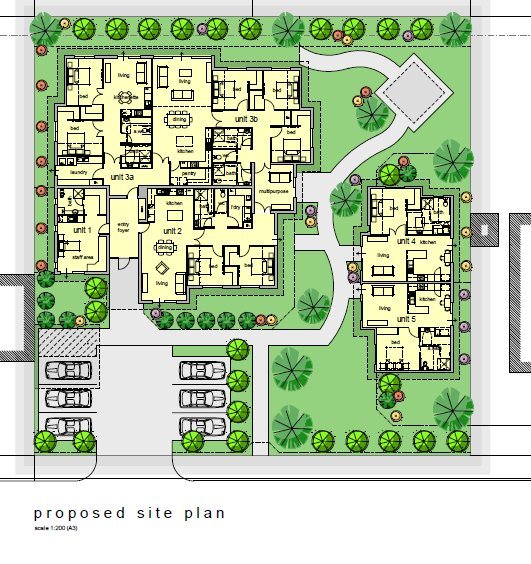
The Karingal site plan is shown in Attachment 1 and consists of 7 shared supported accommodation beds and 2 independent living units.
Due to the former use of the land for a Council depot, an environmental site assessment (ESA) has been completed. No visual or olfactory evidence of contamination of soil was observed during the investigation, and the analytical data showed contamination concentrations below the criteria adopted for protection of human health for residential use.
As property assets are disposed of the written down value is adjusted on the asset register.
All the statutory requirements of s189 of the Local Government Act have been completed.
As part of the contract of sale (transfer) the preferred proponent will be required to register s 173 Agreement on the titles immediately following transfer which will include the following conditions:
The purchaser must commence the construction of the buildings within 12 months of transfer, and begin operating the facility for the intended purpose within 2.5 years of transfer. (Note this timeline differs from information provided in previous Council reports as it has been established that the development does not need a planning permit. The preferred proponent indicates an 18 month design and construction period).
The purchaser may only use the land for the intended purpose.
If the purchaser fails to complete the building within the defined period, or ceases use for the intended purpose, it must notify Council. If the owner fails to notify Council of any of these events Council may give notice.
Either event triggers the right for Council to purchase, the consideration being an amount equivalent to the value of the owner’s improvements.
If Council does not exercise the right to purchase, the owner may sell the land and improvements and pay Council the market value of the land.
The transfer of the land to a provider of supported accommodation for people with disabilities is consistent with the connected, creative and strong communities priority under the Community Wellbeing strategic priority.
No officers or contractors involved in the preparation of this report have a direct or indirect interest in matters to which this report relates.
The risks associated with the transfer of this land are able to be managed following normal management procedures and processes.
There is a shortage of community based accommodation, particularly for young people with disabilities. Young people whose disabilities limit their ability to live with their family, those who are ready to leave home and adults up to the age of 65 who require supported accommodation have few housing options. There are also many young people whose only supported accommodation option is in residential aged care. Residential aged care has been found to be inappropriate for most young people with disabilities, resulting in inferior life experience and limited lifestyle and choice.
Council’s decision to transfer ownership of the Draper Street land for supported accommodation will ensure that more housing opportunities for people with disabilities will be realised on the Bellarine Peninsula.
The subject of this report enhances the rights of people with disabilities in the local community through the provision of disability specific housing.
The selected proponent will implement a consultation program though the establishment of a project group which includes future residents. The proponent will also conduct consultation with surrounding residents.
Cr E Kontelj re-entered the meeting room at 8:39pm
Cr Heagney declared an Indirect Interest in Agenda Item 5 – McLarty Place: Investigation into Laneway Extension in that she received a campaign donation from a person owning property abutting the laneway and left the meeting prior to discussion at 8:39pm.
Portfolio: |
Central Geelong & Planning - Cr Heagney |
Source: |
Investment & Attraction - Central Geelong Action Plan |
General Manager: |
Brett Luxford |
Index Reference: |
Central Geelong Action Plan |
To update Council on the progress of investigations into the extension of McLarty Place to Malop Street.
At its meeting on 15 September 2015, Council resolved to investigate the extension of McLarty Place to Malop Street.
Council officers and a representative of the landowner of 34 Malop Street have been in discussions about the prospect of a laneway connection through the site in the form of an easement which maintained the landowners ‘air rights’ to future development.
The price expectations of the landowner substantially exceed Council’s valuation. On this basis, the landowner acknowledges it is difficult for discussions to progress.
Securing the extension of McLarty Place to Malop Street as part of the future development of the site is the most appropriate mechanism to deliver this connection.
Cr Richards moved, Cr Macdonald seconded -
That Council:
note the progress of discussions with the owner of 34 Malop Street;
prepare a plan for the future development of 34 Malop Street that includes provision for the extension of McLarty Place to Malop Street;
investigate concessions for the future development of the site to deliver the laneway; and
reports back to a Council Meeting on the above.
Cr Farrell re-entered the meeting room at 8:43pm.
Carried.
At its meeting on 15 September 2015, in the confidential section of the meeting, Council resolved to:
“investigate the creation of a public accessway through 34 Malop Street to extend McLarty Place to Malop Street, including engaging with the landowner and report back to Council on the outcome and options for delivering this connection”.
Following the Council resolution in September 2015, Council officers engaged with a representative of the owners of 34 Malop Street with a view to establishing an accessway from McLarty Place to Malop Street.
A proposal was put by the owner’s representative that the funds budgeted by Council for the acquisition of 28 Malop Street and relocation of the tenant be substantively utilised for the provision of the laneway through the site. Further, it was proposed that Council provide car parks lost as a result of the laneway being created in the civic car park.
A valuer’s advice was sought on the cost of providing an accessway through the property that maintains the future development potential of the land. The owner's expectations of property value substantially exceed the valuation.
As a significant landholding, adjoining the Malop Street ‘green spine’ there is strong redevelopment potential for the site as a multi-storey mixed use development with ground floor retail to both Malop Street and an extended McLarty Place.
In terms of options for the delivery of the McLarty Place extension, Council has three options:
purchase by negotiation;
provision as a requirement of future development; or
compulsory acquisition.
The process to date indicates purchase by negotiation is unlikely to yield a result. To proceed with either Option 2 or 3, the preparation of a plan for the redevelopment of the site is required, followed by the preparation and approval of a planning scheme amendment to provide the strategic justification for:
imposition of planning permit conditions if implementing Option 2; or
a Public Acquisition Overlay under Option 3.
There are no environmental impacts arising from this report.
There are no funds allocated to the purchase of land to extend McLarty Place in the current budget.
In order to establish the necessary strategic justification for the delivery of a McLarty Place extension in the future, it is recommended a plan be prepared for the redevelopment of the site and appropriate statutory implementation tools be put in place in the Greater Geelong Planning Scheme.
The proposal closely aligns with ‘Growing the Economy’ and ‘Sustainable and Built Environment’ by supporting the revitalisation of Central Geelong.
No officers involved in this report have any direct or indirect interest in accordance with Section 80(c) of the Local Government Act.
The laneway connection to Dennys Place has been included in the Activity Centre Zone since its establishment in May 2013, having been developed based on a significant amount of historical strategic work and plans referenced in the Greater Geelong Planning Scheme. It is also consistent with Vision 2.
The Malop to Myers revitalisation project ($3m) funding agreement was entered into with the State Government on the basis of that policy framework and requires delivery of a connection to Dennys Place.
Establishing the mechanisms to deliver the McLarty Place extension concurrently to considering Amendment C262 is low risk. However if a connection to Dennys Place such as that entertained by Amendment C262 does not proceed, there is a high risk that Council would lose the funding for the project.
The proposal would facilitate improved pedestrian permeability in Central Geelong, delivering a range of social benefits including revitalisation and support for local businesses, healthy living, walkability and public safety.
The redevelopment of the site could provide an active laneway environment and a significant number of dwellings or office floorspace in the heart of the arts and culture precinct.
The outcomes described in this report will not impact on any basic rights, freedoms and responsibilities as set out in the Charter.
As part of Options 2 and 3, planning legislation ensures an open community consultation process occurs, enabling people to freely express their views and if necessary obtain a fair hearing before an Independent Panel.
In the event Option 3 eventuates, the Land Acquisition and Compensation Act (1986) provisions enable an owner to claim compensation and engage in an independent review process.
Attempts by Council officers to negotiate the provision of an accessway through 34 Malop Street have been unsuccessful as outlined in this report.
Crs Heagney and E Kontelj re-entered the meeting room at 8:47pm
Portfolio: |
Tourism - Cr Fisher |
Source: |
Investment & Attraction / Tourism Greater Geelong and The Bellarine |
General Manager: |
Brett Luxford |
Index Reference: |
Tourism |
To update Council on the progress and performance of the Regional Tourism Board – Tourism Greater Geelong and The Bellarine Inc.
Council resolved in September 2013 to support the establishment of a new Regional Tourism Board called Tourism Greater Geelong and The Bellarine. The new board would continue to be a partnership with the tourism industry and the neighbouring Local Government Authorities of the Borough of Queenscliffe and Golden Plains Shire.
Since the resolution, Council has supported the lobbying of State Government for the Regional Tourism Board to be recognised and funded as an official Regional Tourism Board.
In July 2015, State Tourism Minister John Eren MP announced that Tourism Greater Geelong and The Bellarine Inc. was to be funded and recognised as the States 11th Regional Tourism Board.
In December 2015, advice had been received from Tourism Victoria confirming base funding ($275k per annum) and Regional Tourism Board status until the end of 2018-2019.
Since the establishment of Tourism Greater Geelong and The Bellarine Inc. the new board has overseen the industry funded Business Plan implementation that has resulted in strong growth in visitation, expenditure and employment in the sector. Based on independent data from Tourism Research Australia, Greater Geelong and The Bellarine has out performed State and National visitation and economic performance benchmarks.
Cr Fisher moved, Cr E Kontelj seconded -
That Council notes the progress of Tourism Greater Geelong and The Bellarine Inc. including the regions strong performance and the recent formalisation of the status and funding by State Government as a Regional Tourism Board, as required in the Tourism Greater Geelong and The Bellarine Inc. Memorandum of Understanding.
Carried.
The City of Greater Geelong has long recognised the importance of the visitor economy in strengthening and diversifying the economic base of the municipality. Council has supported the tourism sector through a formal partnership with the industry via a Memorandum of Understanding (MOU).
Over the twenty years of partnership, the visitor economy has continued to grow and now visitor expenditure exceeds $780 million that supports in excess of 4,700 jobs in Greater Geelong and The Bellarine.
The visitor economy is expected to continue to grow strongly over the next 15 years with an additional 1.2 to 1.7 million visitors forecast to be attracted to the region by 2030.
The visitor economy is recognised as a key growth sector and a genuine competitive advantage and as such remains a key platform in the Economic Development Strategy for the City of Greater Geelong.
The Council was a foundation partner of Geelong Otway Tourism for close to twenty years and in more recent times initiated and supported the establishment of the new Regional Tourism Structure – Tourism Greater Geelong and The Bellarine.
The new structure provides greater focus on Greater Geelong and The Bellarine as a destination in its own right, particularly for the critical Melbourne market whilst it still recognises the need to enter into partnership marketing and development initiatives with our neighbouring regions of the Great Ocean Road, Melbourne, Mornington Peninsula and Ballarat Goldfields regions.
Tourism is a dynamic growth industry that is labour intensive with a very broad range of entry levels. As a sector, tourism will continue to play an increasingly important role in the Greater Geelong economy. This is particularly true as the Geelong economy transitions from its traditional manufacturing base to a greater reliance on service sector industries like tourism.
Council’s partnership support of the tourism sector through the Regional Tourism Board has understandably been focused on economic return as demonstrated in employment and dollars contributed to the local economy.
Tourism Greater Geelong and The Bellarine commissions independent research to quantify the scope, scale and performance of the sector. Further to this the Commonwealth Government collects, analysis and distributes visitor data through Tourism Research Australia (Australian Bureau of Statistics) which is broken down to the regional level (Greater Geelong and The Bellarine) on a quarterly basis.
Tourism Performance
The latest tourism data collected by Tourism Research Australia (Australian Bureau of Statistics – Commonwealth Government) for travel to Geelong and The Bellarine was for the year ending September 2015. The data collected was from two primary surveys, the National Visitor Survey (domestic overnight and day trips) and the International Visitor Survey (international overnight visitation).
Results for Greater Geelong and The Bellarine, year ending September 2015 are noted below.
Domestic Overnight Travel
Visitors – 1.2 million domestic overnight visitors – up 10% on YE Sept 2014
Visitor Nights – 3.3 million nights in region – up 9% of YE Sept 2014
Day trips – 3.3 million day trips – up 14.4% on YE Sept 2014
Greater Geelong and The Bellarine received 8.8% market share of visitors to Regional Victoria – up 0.5% points and 8.3% of nights – up 0.8%.
Top 5 Activities
Eat at Restaurants – 44%
Visit Friends and Relatives – 40.8%
Go to Beach – 20.9%
Shopping for pleasure – 17%
General sight seeing – 15%
(Note – participants could make multiple selections)
International Overnight Travel
Visitors – 49,800 overnight visitors – up 22% on YE Sept 2014
Visitor nights – 850,600 nights in the region – up 30% on YE Sept 2014
Greater Geelong and The Bellarine experienced the highest growth rate year on year for all of Victoria.
The region received 12% of visitors and 12.6% of nights in regional Victoria. Year on year visitation was up by 1.3% pts and share of nights was up by 2.1% pts.
It should be noted that for the first time Mainland China was the number one ranked origin market with 14% share of visitation to the region.
Top 5 Origins of International Visitors
Mainland China – 14%
New Zealand – 13.7%
United Kingdom – 12.7%
USA – 11.8%
Germany – 9.1%
Expenditure – All Markets
Day trips - $282 million
Overnight Domestic - $424 million
International - $74 million
Total Expenditure - $780 million
Greater Geelong and The Bellarine continues to perform strongly in both attracting visitors to the region, increasing length of stay and maximising visitor expenditure.
The above broad regional data is also reflected in the performance of Visitor Information Centres and the Business Events Unit of Tourism Greater Geelong and The Bellarine.
Business Events Geelong
The Business Events Unit acts as the convention bureau for the region and consists of three staff who work within the tourism industry and community to facilitate business events growth across the region. Actively bidding to host meetings, incentives, conferences and events the business events sector is the highest yielding (expenditure and length of stay) and one of the most measurable in terms of bids won or lost, length of stay and delegate numbers.
Significantly challenged due to the lack of a dedicated Convention and Exhibition Centre in Geelong, the unit still remains the leading regional convention bureau in Australia successfully winning both the State and National Awards 2015 for ‘Regional Destination Marketing Organisation’ as awarded by Meetings Events Australia.
In order to remain at the forefront of event organisers, the unit undertakes a highly strategic activities program which includes:
a tactical marketing campaign
a dedicated Geelong & The Bellarine Regional Planners Guide
a Business Events Geelong Degustation Luncheon
a dedicated Planners Guide Launch
dedicated website showcasing the region
highly active social media channels
Furthermore, the unit coordinated regional stands interstate and within Victoria at several key industry tradeshows ensuring key relationships maintain active. Business Events Geelong exhibited at the following shows during 2014-15.
AIME, Melbourne
Executive Assistant Network, Sydney
Business Events Victoria Regional Showcase, Melbourne
Associations Forum, Adelaide
Business Events Victoria Regional Showcase, Sydney
Executive Assistant Network, Melbourne
The unit proactively sought out opportunities to facilitate direct leads into the region. This resulted in the development of a formal bid document template to showcase the region’s venues, services and experiences and is customised to meet the clients brief.
This approach resulted in over 40 leads provided to industry members which resulted in the securing of 19 during 2014-15, combining to an estimated 4,371 delegate days and 1,826 room nights. Below are two significant wins for the region.
Pivot Digital Summit, October 2015, 500 delegates for 1 day
Rotary District 9500 South Australia, March 2017, 400 delegates for 4 days
To support the lead activities the unit has continued a close alliance with Business Events Victoria (BEV) to assist in the delivery of conference marketing activities and business leads distributed by BEV to supporting members within the region. This resulted in 52 leads provided to industry members with a combined total of 14,472 delegates and a potential 8,493 accommodation room nights. Business Events Geelong have been successful in securing 9 of these conference leads with a combined total of 3,040 delegate days and 2,449 room nights.
Due to the nature of business events having a long lead time the business events unit is working on securing the following large scale conferences for the region.
Rotary District 9800 Melbourne, March 2018, 700 delegates for 3 days
Lions Australia 2019 National Conference, 1600 delegates for 2 days
Visitor Information Centres (VIC)
The following data is collected from three accredited information centres (Little River Service Centre, Flying Brick Cider House and National Wool Museum) and four non-accredited information centres (Market Square, Waterfront Booth, Avalon Airport and Barwon Heads Caravan). The visitor information centres are staffed by 122 volunteers and are managed by two permanent staff.
For year ending June 2015, the VIC’s recorded:
151,153 walk-in visitors – 8% increase on year ending June 2014
75% of walk-in visitors are domestic travellers
25% of walk-in visitors are international visitors
Visitor Information Centres are a trusted source of information and advice for visitors, which has been proven to change visitor’s behaviour and enhances the overall visitor experience (increased length of stay and visitor expenditure).
The volunteers and staff of the Visitor Information Centres also provide the Geelong Welcome Service for Cruise Ship passengers and those attending major events.
REMPLAN Economic Modelling – Tourism Performance
REMPLAN is system of economic modelling based on area specific data derived from years ending 2013 and 2015.
REMPLAN is used by the City of Greater Geelong (and all G21 Councils) and includes
a specific tourism analysis module.
The tourism module details the tourism sectors contribution to local jobs, outputs, wages and salaries. It can also present the value of tourism relative to other industries
in the local and regional economy.
The table below compares the performance of the tourism sector in Greater Geelong between 2013 and 2015.
REMPLAN Tourism Data 2013 vs 2015
|
|
2013 |
2015 |
Change |
% Change |
|
Tourism Output |
$640 million |
$780 million |
+ $140 million |
+ 22% |
|
Tourism Employment |
4,000 |
4,700 |
+ 700 jobs |
+ 17.5% |
|
Domestic Day Trip Spend |
$86 |
$85 |
- $1 |
- 1% |
|
Domestic Overnight Trip Spend |
$356 |
$361 |
+ $5 |
+ 1.4% |
|
International Trip Spend |
$805 |
$1479 |
+ $674 |
+ 8.4% |
It should be noted that for the same period (2013-2015)
Manufacturing output declined by 15.3%, jobs by less than 1%
Professional, Scientific and Technology output declined by 3.4%
Retail output grew by 15%, jobs by less than 1%
Education output grew by 9% and jobs by less than 1%
In association with the development of the Victorian Regional Tourism Strategy 2013-
2020 Tourism Victoria published a report comparing the contribution of tourism to all regions of Victoria as developed by Deloitte Access Economics.
Based on this report by Deloitte Access Economics employment for Greater Geelong is
significantly higher (4,308 compared to 3,355) in the tourism sector. The report also highlights the fact that Greater Geelong and The Bellarine is 40% more reliant on tourism than is Melbourne.
Whilst around 55% of direct jobs based on tourist expenditure are part time, these jobs are often crucial first jobs for young people and the jobs that keep young people in the region. It should also be noted that there are higher income jobs in tourism managerial roles and the owners of the small business that directly rely on tourist spending.
The National Tourism Satellite Accounts (Federal Government Treasury) demonstrates
that the Tourism Sector has a higher number of workers in the middle to senior management level than most other service sector industries in Australia.
In tourism towns on the Bellarine and in Central Geelong a significant number of businesses only exist at their current level of staffing based on the goods and services provided (financial, legal, retail) to support businesses that are directly dependant on visitor expenditure.
Tourism Forecast
Through the two scenarios explored in the 2016 Tourism Development Plan for Greater Geelong and The Bellarine that focus on a) historical data and b) the Forecast Visitation to Victoria 2014 by Tourism Victoria, visitation to the region is estimated to reach between 6.6 to 7 million visitors in 2030, a 28% increase on 2015 figures. Growth in daytrip visitation is expected to account for 70% of this growth.
Following Tourism Victoria forecast growth figures, both Domestic Day Trip and Overnight visitors are predicted to grow by 1.3% per annum while International Overnight Visitors will grow at a much higher rate of 4. 9%.
This projected growth will require continued investment in accommodation, infrastructure and experiences to meet visitor demand. The region will need to attract a further 1400 and 2500 guest rooms to support projected growth over the next 15 years.
It should be noted that as a result of Greater Geelong’s close proximity to Melbourne if is projected that the forecast tourism performance for Greater Geelong will be significantly higher than that of Regional Victoria.
Tourism in Greater Geelong will continue to play an increasingly significant role in the economic and social wellbeing of the municipality. In accordance with Council’s Tourism Policy, the Council will work in partnership with the Tourism Industry through the established Regional Tourism Board – Tourism Greater Geelong and The Bellarine Inc.
Tourism Greater Geelong and The Bellarine Inc. continues to implement and support the Earth Check accreditation program. Earth Check is a program aimed at reducing the impact of tourism related activities on the environment and includes training and incentives for those who participate and meet the prescribed benchmarks and standards.
Tourism Greater Geelong and The Bellarine Inc. was accredited and benchmarked by Earth Check and was awarded Bronze status in 2014 and has maintained this level of recognition in 2015.
There is no budget impact or implications from this update report. As per the Memorandum of Understanding between Council and Tourism Greater Geelong and The Bellarine Inc. (2014–2017) Council funds the staffing and administration costs with further specific budget lines for Business Events and Visitor Services (Visitor Information Centres) functions.
Council’s current total budget allocation to Tourism for 2015-2016 is $1.864 million.
The following is a breakdown of the 2015-2016 budget:
Tourism administration - $1,089,000
Visitor Information Centres - $375,000
Business Events Geelong - $400,000
The total tourism budget (Council, State Government, industry) is just over $3 million with non-Council revenue of $1.15 million to support the Annual Action Plan.
State Government funding ($275,000) to Tourism Greater Geelong and The Bellarine Inc. is subject to a formal contract and is specifically directed towards the implementation of the Annual Action Plan. Other non-Council funds come via membership, sponsorship and industry buy-in to marketing and development programs.
Membership now exceeds 400 businesses with a target of 450 members by 30 June 2016.
There are no policy, legal or statutory implications resulting from this report.
The partnership arrangement between Council and the tourism industry via Tourism Greater Geelong and The Bellarine Inc. is consistent with Council’s Tourism Policy and Economic Development Strategy. As an Incorporated Association the Regional Tourism Board complies with the legislation and management principles that governs Incorporated Associations in Victoria namely the Associations Incorporation Reform Act 2012.
Tourism is recognised in the City Plan 2013-2017 as a priority sector in growing the Geelong economy. Council’s support of the tourism industry is base on the understanding of the need for a robust and diverse economic base for the City.
Council recognised through City Plan and through Council’s Tourism Policy that tourism can generate increased economic growth and can be further developed, enhanced and expanded through effective leadership and partnership models.
The proposed new structure for tourism demonstrates Council’s leadership through collaboration with industry on issues of importance to the economic and social well being of Geelong. The visitor economy is a major platform in the Economic Development Strategy currently being developed for the City of Greater Geelong.
This report has been prepared by the Tourism Manager, City of Greater Geelong, who is also the Executive Director of Tourism Greater Geelong and The Bellarine Inc.
Tourism Greater Geelong and The Bellarine plays a pivotal role in advocating on tourism related issues in a variety of settings and at different levels of Government. The organisation provides leadership to the regions tourism industry in dealing with both demand and supply issues, as well as opportunities to collaborate on a range of campaigns and initiatives. This leadership role will continue under Tourism Greater Geelong and The Bellarine Inc.
Without an organised and united approach, the industry would most likely suffer or remain stagnant. The new structure would allow for long term planning to be adopted in cooperation with neighbouring Regional Tourism Board’s (RTB).
All staff are employed under the City of Greater Geelong Enterprise Agreement (No.7)
2011 as the tourism unit of the City of Greater Geelong. Staffing levels have been maintained under the new structure with a greater focus on Greater Geelong and the Bellarine, as well as the establishment of partnerships with neighbouring RTB’s.
The social impacts of tourism have been the subject of recent research by Sustainable
Tourism Cooperative Research Centre. A set of indicators have been developed to measure these impacts, with further work proposed now that finalisation of the relationship with State Government (Tourism Victoria) has been achieved.
The recommendations considered in this report are in accordance with the Victorian Charter of Human Rights and Responsibilities. Following a review of the twenty basic rights that promote and protect the values of freedom, respect, equality and dignity, the most relevant right relating to the report is the right of freedom of movement. This report and recommendations recognise the right of people to move freely throughout Victoria and Australia.
Whilst the proposed recommended structure focuses on Geelong and The Bellarine, the report and recommendations consider and allow for the establishment of strategic beneficial partnerships with other destinations and tourism bodies in recognition of the seamless non boundary nature of the tourism experience.
Tourism Greater Geelong and The Bellarine has invested significantly in the development and implementation of an enhanced digital footprint that engages with both industry and visitors to our region. A dedicated industry engagement program has been initiated that includes weekly newsletters to industry and face-to-face meetings with new Industry Engagement Officers.
Facebook ambassadors now exceeds 17,000 with a 33% average reach and 8% engagement rate (well above industry standards of 8% average reach and 0.29% engagement rate).
A new consumer website www.visitgeelongbellarine.com.au is regarded nationally as best practice with over 6,000 monthly unique sessions with close to four minute time spent on the consumer sight by each user.
A formal agreement has been entered into with neighbouring tourism regions that details partnership marketing, research and emergency response programs. With the recent fires along the Great Ocean Road these protocols have been initiated and tested to provide a common and consistent message/advice to industry and visitors to our region.
Now that Tourism Greater Geelong and The Bellarine is a recognised Regional Tourism Board invitations from Visit Victoria (Tourism Victoria) have been extended to participate in State wide regional forums (research and marketing initiatives).
Tourism Greater Geelong and The Bellarine works closely with Council’s media and communications department but also has a high media profile in its own right.
Within a Council context the Tourism Unit is now part of the new Investment and Attraction Division. It is anticipated that this new structural alignment will create significant new opportunities for partnership arrangements with other Council units.
Portfolio: |
Central Geelong - Cr Heagney |
Source: |
Investment & Attraction / Events, Central Geelong & Waterfront |
General Manager: |
Brett Luxford |
Index Reference: |
Central Geelong Marketing / Christmas in Central Geelong |
To update Council on the outcome of the 2015 Christmas in Geelong Program, and seek direction on the 2016 installation of the Iconic Floating Christmas Tree.
The 2015 Christmas in Geelong program generated 213,500 visits with a Total Economic Output of $15.6 M.
The key attraction was the Iconic Floating Christmas Tree with 123,000 visits. Central Geelong Marketing organised and sponsored activities that attracted 44,900 visits. The City Hall Projections attracted 31,000 visits.
Council sponsored Christmas events for 2015 included Denis Walter Carols by the Bay, Gala Parade and Geelong Carols by Candlelight. These events attracted an additional 30,000 visitors to Central Geelong and the Waterfront during the Christmas period.
The Geelong Advertiser reported on 6 January 2016 that Central Geelong traders had reported having a ‘bumper’ Christmas trading period. The 749 surveys and pedestrian counting data undertaken as part of delivering the range of Christmas activities, indicate that the range of Council and Central Geelong Marketing activities, events and marketing have played a significant part in this success.
Social Media accounted for 63% as a source of information about activities such as the Christmas in Geelong program. Others were radio, family and friends, newspapers and signage,
37% of responses said that the Christmas in Geelong program activities were good for creating a sense of community and good for families. 41% of responses said that the activities were good for Geelong’s economy and City promotion opportunities.
An independent media analysis was undertaken that showed a total Christmas program (including the Iconic floating Christmas Tree) Public relations value of $9.33 million. The Iconic Floating Christmas Tree on its own delivered a $5.3 million Public Relations value.
With Council’s current commitment to the ongoing installation of the Iconic Floating Christmas Tree ending in 2015 consideration now needs to be given to its installation for future years.
Council needs to commit to the Iconic Floating Christmas Tree early in 2016 to allow marketing specialists to work with potential sponsors to identify and enter into potential sponsorship arrangements for the Iconic Floating Christmas Tree.
The annual cost of installation for the Iconic Floating Christmas Tree is likely to rise to $500,000 from 2016.
Cr Murrihy moved, Cr Nelson seconded -
That consideration of the report be deferred.
Carried.
Portfolio: |
Governance - Cr Lyons (Mayor) |
Source: |
Strategy & Performance - Strategy & Program Delivery |
General Manager: |
Dean Frost |
Index Reference: |
Council Reports |
The purpose of this report is to advise of minor changes to the proposed new G21 Regional Alliance funding agreement and to seek Council support for continuation of this important regional initiative for a further 4 years.
Council’s current Memorandum of Understanding with the G21 Geelong Region Alliance (G21) expires on the 30 June 2016.
G21 continues to operate successfully with strong involvement by member Councils through their Mayors and Chief Executive Officers. There is also key participation via Pillar leadership by Councillors and Officers
G21 has furnished Council with a new Memorandum of Understanding for a further four year period from 1 July 2016 to the 30 June 2020.
Cr Richards moved, Cr Heagney seconded -
That Council:
sign and seal the G21 Memorandum of Understanding for the period 1 July 2016 to 30 June 2020 (refer Appendix 1);
consider an allocation of $463,390 to G21 as part of the 2016 - 2017 Annual Budget process.
Cr Nelson left the meeting room at 9:09pm
Cr Nelson re-entered the meeting room at 9:11pm
Carried.
G21 was created in late 2002 after the City of Greater Geelong invited neighbouring municipalities to join in an alliance to provide the leadership to develop a long term plan that considered all the ‘things’ that make a great region.
In May 2004 Council agreed to join with other participating regional Councils in the formation of a Company - The G21 Geelong Region Alliance.
A successful, joint submission was made to the State Treasurer and Minister for Local Government to form the Company and the current Memorandum of Understanding with G21 was entered into for a period of 4 years, with an expiry date of 30 June 2008.
The Victorian Government has provided significant direct and financial support to G21 since inception and embraced the development of the G21 Strategic Plan.
The G21 Board meets monthly and comprises:
The five Council CEOs as Directors
The five Council nominated Directors
Five elected Directors
For 2016 the G21 Board Directors are:
COGG – Cr Darryn Lyons and Kelvin Spiller
SCS – Cr Margot Smith and Keith Baillie
GPS – Cr Des Phelan and Rod Nicholls
BOQ – Cr Bob Merriman and Lenny Jenner
COS – Cr Frank Buchanan and Sue Wilkinson
Elected Directors – Jason Trethowan, Barbara Abley, Henry Bongers, Bernadette Uzelac and Bill Mithen
Since inception, The G21 Region Alliance has gained wide recognition as a successful working example of whole of government approach to regional planning and development, particularly at State and Federal Government level.
G21 has worked hard to support the five Councils of the G21 region and has advocated for funding commitments to both regional and local projects
Examples of this include at the last State election:
Addressing Disadvantage - COGG
Armstrong Creek Urban Growth Area - COGG
Geelong Future Cities - COGG
Geelong Ring Road Connections - COGG
Land 400 - COGG
Portarlington Safe Harbour - COGG
Regional Rail Connections - COGG and other LGAs
Transport Links to Melbourne - COGG and other LGAs
The 2016 Priority Projects are:
Addressing Disadvantage - COGG
Apollo Bay Harbour - Colac Otway Shire
Armstrong Creek Urban Growth Area - COGG
Avalon Airport - COGG
Central Geelong Revitalisation - COGG
Convention and Exhibition Centre - COGG
Cruise Ship Destination - Yarra St Pier - COGG
Geelong Future Cities - COGG
G21 Adventure Trails - COGG and other LGAs
G21 Motocross Facility - COGG and SCS
Geelong Ring Road Connections - COGG
Geelong Ring Road Employment Precinct - COGG
Geelong Secondary Schools and Community Digital Hub - COGG and other LGAs
Land 400 - COGG
Portarlington Safe Harbour - COGG
Regional Rail Connections - COGG and other LGAs
Transport Links to Melbourne - COGG and other LGAs
Approximately 300 people across the region donate their professional time to G21 Pillars and working groups.
The OECD (Organisation for Economic Co-operation and Development) in 2016 regarding regional collaboration and cited it as one of the only 10 examples of excellence in the world.
G21 is seeking ongoing support from its Member Councils and has provided Council with a new Memorandum of Understanding for the four-year period from 1 July 2016 to 30 June 2020.
Key modification points of the new Memorandum of Understanding are:
G21 proposes that the terms of the draft 2016- 2020 G21 MOU remain unchanged with the exception of item 5.6.2:
“G21 shall convene a working group to include each Member Council, which will coordinate any joint communications and marketing.”
G21 has endeavoured to fulfil this requirement over the life of the MOU convening such a group but it has had poor support from our member councils and other key organisations across the region.
We have however focused our efforts on coordinating the annual Our Place magazine which gives each municipality the opportunity to be showcased. Our Place has a print run of over 40,000 copies and is distributed throughout the region and used by our member councils for investment attraction.
The draft G21 2016- 2020 MOU therefore changes item 5.6.2 to read:
“G21 shall coordinate opportunities as they arise for joint communications and marketing across the region.”
The principles, values and operation of G21 directly support a triple bottom line approach to regional direction planning and project implementation. This includes environmental considerations.
Environmental considerations are key to establishing priority projects for G21. The first G21 Plan and the subsequent (current G21 Region Plan – A Sustainable Growth Strategy is supported by projects with positive implications for the environment of the Region.
The population based funding contribution model has been updated with the latest Census data.
The latest ABS population data re the G21 Region is below:
|
Council |
Population |
Percentage of G21 Region |
|
Colac Otway |
20,501 |
6.9% |
|
Geelong |
224,926 |
75.6% |
|
Golden Plains |
20,544 |
6.9% |
|
Surf Coast |
28,481 |
9.57% |
|
Queenscliffe |
3,027 |
1.03% |
|
TOTAL |
297,479 |
100% |
*ABS Regional Population Growth, Australia (catalogue 3218.0)
An annual 4% increase has traditionally been factored into the model across the four years under the MOU.
With the introduction of rate capping, it would be unrealistic to expect Councils to maintain the annual 4% increase and under the draft 2016- 2020 MOU, an annual increase of 2.5% is proposed.
The following funding schedule has therefore factored in an annual 2.5% increase to G21’s funding:
|
|
CONTRIBUTION |
|||||
|
CONTRIBUTOR |
POPULATION |
% REGION |
2016/17 |
2017/18 |
2018/19 |
2019/20 |
|
Colac Otway |
20,501 |
6.9 |
$42,294 |
$43,351 |
$44,435 |
$45,546 |
|
Geelong |
224,926 |
75.6 |
$463,390 |
$474,975 |
$486,848 |
$499,020 |
|
Golden Plains |
20,544 |
6.9 |
$42,294 |
$43,351 |
$44,435 |
$45,546 |
|
Surf Coast |
28,481 |
9.57 |
$58,659 |
$60,126 |
$61,629 |
$63,170 |
|
Queenscliffe |
3,027 |
1.03 |
$6,313 |
$6,471 |
$6,633 |
$6,798 |
|
TOTAL |
297,479 |
100% |
$612,950 |
$628,274 |
$643,980 |
$660,080 |
All legal and statutory implications were managed as part of the initial agreement and creation of the G21 Geelong Region Alliance Company.
G21 has undertaken much strategic planning on behalf of the region, including COGG, in the last four years:
G21 Regional Growth Plan - first in the state
G21 Regional Growth Plan Implementation Plan - only one in the state
G21 Regional Economic Development Strategy
G21 Public Transport Strategy
G21 Health and Wellbeing Strategy
G21 Soccer Strategy
G21 AFL Strategy
G21 State of Play
G21 Regional Profile
No officer involved in the preparation of this report has a direct or indirect interest.
The main risks associated with G21 are financial associated with member contributions and any failure to secure agreement from all member Councils for the new MOU
G21 is committed to a policy of strong community consultation, communication, and participation in the spirit of capacity building. There is a strong reliance on the involvement of the community.
G21 aims to sustain lifestyle and the social aspects are paramount.
We have taken into consideration all Human Rights as part of the drafting process of this report, none of which apply.
The Memorandum of Understanding states that G21 is to convene a working group to include each Member Council which will coordinate joint communications and marketing.
Portfolio: |
Sport & Recreation – Cr Irvine |
Source: |
Strategy & Performance – Capital Projects |
General Manager: |
Dean Frost |
Index Reference: |
C16835 – Portarlington Tennis Club Lighting |
The purpose of this report is to seek direction from Council in relation to project C16835 – Portarlington Tennis Club Lighting.
As part of the 2015/16 budget Council allocated $40,000 to Project C16835 Portarlington Tennis Club Lighting.
Planning for the project has commenced, however a budget shortfall of approximately $35,000 has meant that the project cannot proceed at this time.
Cr Irvine moved, Cr Ellis seconded -
That Council place project C16835 on hold pending an application for additional funds as part of the 2016/2017 budget process.
Carried.
Background
As part of the 2015/16 budget Council allocated $35,000 towards project C16835 Portarlington Tennis Club Lighting. Council’s funding commitment was supported by a club cash contribution of $5,000.
The budget allocation for installation of competition lighting was based on a quote received from a local registered electrical contractor (REC), as part of a community concept submission by the Portarlington Tennis Club.
The Portarlington Tennis Club were unaware at the time of there submission, that the power supply to the reserve, including the co-located Portarlington Football / Netball Club, had been load restricted by the supply authority due to capacity of the pole mount transformer and consumer mains.
Council’s Capital Projects department have obtained a quotation for the supply upgrade need to support this project, and have received an estimate from the electrical provider for $35,000.
Upgrade of the power supply will involve:
Remove the existing 100KVA pole type substation and associated hardware located adjacent to the football pavilion.
Install new 3 phase 200KVA pole type substation and associated hardware.
Cultural heritage due diligence.
Installation of new consumer mains from the pole to the main switchboard.
If the project was to proceed without the necessary upgrade, the tennis lighting would cause an electricity supply shortage to the reserve during peak use times.
LED lighting has been considered in lieu of standard Metal Halide luminaires.
In addition to environmental benefits, LED fittings reduce operational and maintenance costs, providing a superior whole of life project benefit.
The estimate from the club affiliated REC and electricity distributors are valid for 30 days, renegotiation may be subject to cost escalation and market pressures and therefore some additional project contingency would be required.
There are no policy, legal or statutory implications associated with acceptance of this report.
This project supports strategic directions in our Community Wellbeing, and Sustainable Built & Natural Environment areas.
No council officers involved in this project or report have declared a direct or indirect interest in this matter.
A detailed project risk profile has been developed and is being maintained by the project manager.
Sport and recreation plays a key role in the health of our community. While the physical health of the community is the most apparent benefit, sport and recreation promotes increased mental health, social connection and community leadership.
The provision of lighting for the Portarlington Tennis Club would ensure access to participation opportunities to the local community.
It is not evident or likely that this report would negatively impact any of the rights contained in the Charter of Human Rights.
The resident tennis club will receive a project update following the decision by Council.
Portfolio: |
Community Development – Cr Fisher |
Source: |
Community Life – Community Development |
General Manager: |
Linda Quinn |
Index Reference: |
Property: 87 Newcombe Street, Portarlington |
The purpose of this report is to provide direction to Council regarding a proposal to assume management responsibilities for the Portarlington Parks Hall to establish a community hub precinct and enable an operating base for the Portarlington Neighbourhood House Program.
The Portarlington Neighbourhood House Inc (PNH) was established in 2007 and moved into the Portarlington Masonic Hall in 2009. The Masonic Hall was identified after an evaluation of all available facilities in 2008.
The current lease expires in July 2016 and the Masonic Hall authorities have indicated that they will not renew the lease, but have agreed to allow PNH time to identify an alternative location.
With a membership of 550 the PNH is a dynamic and active community based program. A review of the statistics over the four months July–October 2015 identified that 365 people per week visited and participated in programs; this equates to 10% of the township population. There is one paid staff member working 25 hours per week. The office, programs, activities and management are all undertaken by the 70 local community volunteers.
Council has been working with the PNH to identify an appropriate alternative venue. Initially the opportunity to co-locate with the Portarlington Senior Citizens Program was identified. Further investigation revealed the facility is too small to accommodate both programs and the Capital expenditure of $200,000 (C15846) which was allocated in the 2014/2015 budget is inadequate to modify or expand the building to meet the needs of the two programs.
A review of alternative venues considered a range of factors including, location, availability, accessibility and suitability for purpose. The Portarlington Parks Hall (the Hall) was identified as the suitable location for the Portarlington Community Hub and Neighbourhood House Program. In addition to providing secure tenure for the PNH, increased community access will be achieved in a facility identified as underutilised.
Discussions have been held with the local Minister for Environment, Climate Change and Water, Member for Bellarine; Regional Director, Department of Environment Water, Land and Planning; Ward Councillor; PNH Committee; Bellarine Bayside Foreshore Committee of Management; and Council officers to investigate the transfer of management responsibility for the Hall and service operations to the City of Greater Geelong (CoGG).
There are 14 Neighbourhood House Programs operating in the City of Greater Geelong. Council provides facilities at peppercorn rent to 12 of these and an annual grant to 13.
The Social Infrastructure Plan recommends the development of a multipurpose community hub for Portarlington.
Cr Ellis moved, Cr Fisher seconded -
That Council enters into a lease agreement with the Victorian State Government for the management of the Portarlington Parks Hall.
Carried.
Through the Portarlington Community Building Initiative (2006–2011, a community opportunity workshop in March 2007 identified the establishment of a Neighbourhood House Program as one of five key community priorities.
A local community working group was established to set up the Portarlington Neighbourhood House (PNH) and by the end of 2007 a range of programs were available to the community. The Portarlington Masonic Hall was identified and operational by February 2009. State Government funding through the Neighbourhood House Coordination Program was granted in 2009 with the first program coordinator appointed in February 2010.
The Department of Health and Human Services (DHHS) Neighbourhood House Coordination Program identifies the aims of Neighbourhood House programs as:
Support to the provision of community development programs and activities that lead to community-strengthening outcomes by supporting diversity and promoting community participation and inclusion
Facilitating community development and capacity building in support of individuals and groups within communities
Supporting lifelong learning opportunities for people to improve their training and employment pathways and community participation
Supporting community development processes to address locally identified priorities and needs through: community consultation, development of agreed community responses to identified priorities and needs, identification of partners and funding sources, and facilitating and evaluating responses to identified needs and priorities.
Council assisted the PNH Program to enter into a lease agreement with the Masonic Hall, which expires in July 2016. The Masonic Hall authorities have indicated that they will not renew the lease, but have agreed to allow the PNH Program time to identify an alternative location.
In response to the insecure tenure at the Masonic Hall a working group was established to investigate suitable alternatives. This group comprised the Ward Councillor, representative of the PNH Committee, members of the Senior Citizen Club and Council officers.
In line with current Council practice it was proposed a co–location or Community Hub model be sought to enable the PNH Program to secure a long term base.
The working group focused its review on opportunities to co-locate within the existing Senior Citizen Centre. Capital expenditure of $200,000 (C15846) was allocated in the 2014/2015 budget to assist with some minor adaptations in order to accommodate the PNH Program. Further exploration identified that without significant expansion to the Senior Citizens centre, the building could not accommodate the PNH Program.
The working group focussed on other opportunities, and after carefully considering aspects such as location, availability, design and accessibility, Parks Hall was identified as the most suitable facility. Discussions were held in August 2015 – between Minister for Environment, Climate Change and Water, Member for Bellarine; Ward Councillor; Regional Director, Department of Environment Water, Land and Planning; Portarlington Neighbourhood House President, Coordinator and six committee members and Council staff – to progress dialogue regarding access to the Portarlington Parks Hall to establish a Portarlington Community Hub.
Council provides facilities to 12 neighbourhood houses in the municipality and an annual grant to 13 neighbourhood houses. There are 13 established neighbourhood house programs and one new program established in Leopold.
The PNH has a membership of 550 and provides a range of community based programs to approximately 365 people per week, this equates to 10% of the township population. Programs and activities are aimed at all age groups, abilities and backgrounds. Some example programs include music and movement for preschoolers, dog training, safe driving for seniors, computer courses, book club, photography, art classes, history, walking group, cards, yoga, writing, gardening and cooking.
The PNH is a locally based community program which:
Works to reduce social isolation in the local community and promote a sense of belonging and community spirit
Serves as a vital community resource through the provision of a range of programs and services using a community development model
Fosters family support, community advancement and adult learning opportunities
Is administered by a not-for-profit organisation with programs and activities run by volunteers
Provides an integrated range of services to meet the diverse needs of individuals and families in and around Portarlington.
To secure tenure for the PNH Program and enable the establishment of the Portarlington Community Hub, the recommendation proposes transfer of management of Parks Hall (only) from Bellarine Bayside Foreshore Committee of Management (BBFCOM) to Council. A process including community consultation will be developed to enable a smooth transfer that would ensure that:
Current users of the Hall would be supported and not disadvantaged by any new management model
The Hall would provide a multi purpose community facility function for the township, while providing an operational base for the Portarlington Neighbourhood House Program
A community engagement process will be undertaken with the local community and State Government regarding usage and management model for the Hall.
Portarlington Parks Hall is located on foreshore Crown Land managed by BBFCOM. The Hall is located in close proximity to the local primary school, the town shopping precinct and a number of Council managed community facilities including the Portarlington Kindergarten, the Senior Citizens Centre, and a rotunda providing visitor information. The Hall is surrounded by recreation reserve and open space including a skate park.
The building is deemed by BBFCOM and Council Facilities Maintenance Unit to be in very good condition.
Council’s Facilities Maintenance Unit has undertaken a Building Condition Summary Report which confirms that the vast majority of building components are considered to be in ‘very good’ condition. The report estimates the maintenance costs, including driveway, to average $15,698 annually over a 20 year period.
It is anticipated the increased usage would equate to increased income for the facility. During the 2014/2015 financial year, BBFCOM generated income of $11,208 from leases, licences, permits and booking fees. The establishment of a community hub incorporating the PNH Program will provide the opportunity for sustained economic viability for the Hall. It is intended the model of management would be cost neutral for Council.
If Council was to deliver these programs, rather than local community organisations, there would be a much higher cost impost on the annual budget.
No environmental implications have been identified as a result of Council assuming management responsibility for Parks Hall.
The future governance model will ensure that day to day operations and program costs of the building will be borne by the organisation governing the facility. Their agreement with Council would be in line with other community facilities which pay an annual peppercorn rent as part of a licence/lease agreement.
That said, should Council choose to assume building management responsibility, the recurrent costs would be in the order of $15,698 annual building maintenance, including driveway, based on the Building Condition Report.
The insured value of the building is based on a replacement value of $2.6 million. The building would have an annual depreciation of $65,000 per annum, assuming a depreciation rate of 2.5%; this cost would be met by the State Government who is the asset owner.
Capital expenditure of $200,000 was allocated in the 2014/2015 budget for a Portarlington community facility (C15846). These funds would contribute to the minor works required to remodel the Hall to accommodate the PNH Program.
Should Council assume management responsibility for the asset, statutory obligations outlined in the Local Government Act 1989 would apply.
The City of Greater Geelong City Plan objective, Community Wellbeing identified key priorities of connected, creative and strong communities. Neighbourhood house programs and community hubs are fundamental in achieving this, providing community connections, lifelong learning opportunities as well as empowering residents to enhance their health, social, educational and economic wellbeing. They support local people to become more active, confident and resilient.
Provision of community facilities commensurate with need aligns with Council’s strategic directions through facilitating the delivery of community services, life long learning, skills development, community activities and providing opportunities for socialisation for all people in our community, thereby fostering a resilient, connected, creative and strong community.
There is no direct or indirect officer interest in this report.
There is a level of community expectation that Council will actively seek to support the PNH Program to find alternative accommodation. If Council does not assume responsibility of the asset, access to adequate space for the PNH Program may adversely affect program delivery and access to spaces for the local community. At worst this would result in loss of the PHN Program to the community. Any loss of program or services would have a detrimental effect on the community’s resilience, connection, health and wellbeing, which in turn, will impact on the local sense of place.
The Bellarine Peninsula Strategic Plan 2006–2016, Community Visioning identified Portarlington’s key strengths as numerous community groups, heritage, arts and cultural interests, willingness to develop skills and knowledge, developing economies, and a beautiful coastal environment. Key challenges identified were the aging community, social isolation, no community hub or education facilities for adults, relative disadvantage identified through SEIFA, limited employment and diminishing services. The neighbourhood house was established to address a number of these challenges.
The establishment of the PNH Program realised a community aspiration and contributed to addressing these community issues.
The PNH Program is a vibrant well utilised and supported organisation run primarily by volunteers and servicing around 10% of the Portarlington population per week. The work of the PNH Program contributes to overall community connection, health and wellbeing of residents, regardless of age, gender, cultural or socio economic backgrounds.
The Hall has some regular community use but is considered underutilised. There are no other community spaces within the township suitable for the neighbourhood house operations.
It has been determined that the decision will have no detrimental impacts on human rights.
Communication with stakeholders regarding the outcome of this report will be facilitated by the Community Development Department.
Portfolio: |
Governance, Cr Lyons (Mayor) |
Source: |
Strategy & Performance - Customer Service & Council Business |
General Manager: |
Dean Frost |
Propose the meeting schedule for Council meetings for 2016.
A new meeting schedule was endorsed by Council on 14 July 2015.
The new schedule consisted of four weekly rotational meetings:
Week 1 – Briefing – Council Business
Week 2 – Briefing/Workshop – strategic matters and/or presentation
Week 3 – Ordinary Meeting of Council
Week 4 – Briefing/Workshop – strategic matters and/or presentation
Council recommended that the revised meeting schedule be reviewed within six months.
Cr Farrell moved, Cr Macdonald seconded -
That Council:
endorse the continuation of this new meeting schedule on an ongoing basis; and
endorse the proposed schedule of meetings for 2016 as per Appendix 1.
Carried.
A new meeting schedule was endorsed by Council on 14 July 2015. The new schedule was to be reviewed within 6 months of implementation.
A key role of councillors is presiding over and participating in council meetings, ensuring that the agenda is achievable in the allotted time, and that the decisions made are managed in an effective and efficient manner.
The council recognises the huge scale of the challenges it faces over the coming 3-5 year period and to meet these challenges and to ensure they have sufficient time to focus their attention on providing input into key issues, a change to Council’s meeting cycle was endorsed on 14 July 2015.
The four weekly meeting cycle endorsed was:
Week 1 – Briefing – Council Business
Week 2 – Briefing strategic matters and/or presentation
Week 3 – Ordinary Meeting of Council
Week 4 – Briefing strategic matters and/or presentation
If there was an urgent need for Council to meet prior to a scheduled Ordinary Meeting, a Special Meeting of Council may be convened pursuant to sections 83(b) and 89(4) of the Local Government Act 1989. This occurred twice during the trial period, with little disruption to Council operations.
The second and third week of each month was set aside for strategic meetings, during which Councillors considered major policy and strategic issues. These meetings afforded Councillors a greater opportunity to meet with community groups, stake holders and staff, and to hear relevant industry presentations. As a direct result of the introduction of strategic workshops an additional nine external stakeholders were given the opportunity to present to Council.
It is acknowledged that City Plan is a key strategic document which drives the future direction of the Council. In the past, Council has consulted with the community under the banner “Your City Your Say” in developing City Plan. While this process occurs every 4 years and staff and Councillors also meet with community groups on an intermittent basis, the change to the meeting cycle provided further opportunity for staff, community groups and other key stakeholders to meet with Council. In the three months of Strategic Meetings conducted, 15 strategic items were presented to Council.
The number of items considered at ordinary meetings of Council during the trial period averaged 15 agenda items. The previous average for the two years 2013 and 2014 was 11 items considered per meeting.
During the trial, two Special Meetings were required to consider urgent statutory matters, including the appointment of the Chief Executive Officer.
There is further scope to analyse the reports that go to Ordinary Council meetings and the Executive Leadership Team will further refine and improve processes.
Not applicable
The proposed meeting cycle saves time, resources and overall reduces operating costs.
If there is an urgent need for Council to meet prior to a scheduled Ordinary Meeting, a Special Meeting of Council may be convened pursuant to sections 83(b) and 89(4) of the Local Government Act 1989.
An increased emphasis on strategic matters will directly contribute to the future development and review of City Plan.
No officers involved in the preparation of this report have either a direct or indirect interest.
Staff need to ensure regulatory timeframes are met.
No significant social issues exist as the community still has the opportunity to comment on reports that would come before Council.
Council reports continue to consider human rights, as appropriate.
If the meeting cycle is endorsed, Council will advise the community through the local papers and via the web etc. Staff will also be informed to ensure that reports are prepared to meet regulatory or other requirements
|
5th Tuesday |
Strategic Workshop |
Councillor Briefing |
Ordinary Council Meeting |
|
|
|
19 January |
27 January |
|
|
|
2 February |
|
|
|
9 February |
|
16 February |
|
|
23 February Budget Briefing #1 |
1 March |
|
|
|
7 March (Monday) |
|
15 March |
|
29 March |
21 March (Monday) |
5 April |
|
|
|
11 April (Monday) |
|
19 April |
|
|
26 April |
3 May |
|
|
|
10 May |
|
17 May |
|
31 May |
24 May |
7 June |
|
|
|
14 Jun |
|
21 June |
|
|
28 Jun |
5 July |
|
|
|
12 July |
|
19 July |
|
|
26 July |
2 August |
|
|
|
9 August |
|
16 August |
|
30 August |
23 August |
6 Sep |
|
|
|
13 September |
|
20 September |
|
|
27 September |
4 October |
|
|
|
11 October |
|
18 October |
|
|
25 October |
1 November |
|
|
|
8 November |
|
15 November |
|
|
22 November |
|
|
|
29 November |
|
6 December |
|
|
|
|
|
13 December |
Portfolio: |
Governance - Cr Lyons (Mayor) |
Source: |
Strategy & Performance - Governance Services |
General Manager: |
Dean Frost |
Index Reference: |
Subject - Kildare Ward By-election |
To report on the results of the Kildare Ward By-election 2015.
A By-election was held in the Kildare Ward following the resignation of Cr Stretch Kontelj.
The election was held by postal ballot conducted by the Victorian Electoral Commission (VEC) with Peter Murrihy being declared elected 19 October 2015.
The VEC report (Appendix 1) provides an overview of the electoral process, voter and candidate participation.
Cr Farrell moved, Cr Richards seconded -
That Council notes the report from the VEC (Appendix 1).
Carried.
Following the resignation of Cr Stretch Kontelj a By-election for the Kildare Ward was held in October 2015. Peter Murrihy being declared elected 19 October 2015.
The VEC has submitted its report on the conduct of the By-election (Appendix 1) which provides an overview of the electoral process, voter and candidate participation, together with statistical information and results.
The level of interest in standing for Council was high, with a total of 11 candidates lodging nominations.
There were 13,010 voters on the roll with a participation rate of 67.56% which was lower than previous election results. The VEC has indicated that By-elections turnout is often significantly lower than for general elections.
The informal voting rate was 4.46% which was up on the 2012 General Election rate of 2.35%. This can be attributed to the large number of candidates and therefore greater likelihood of error. The election was determined by computer count using the preferential counting method.
The election was well managed with very few complaints received. Candidates were invited to attend an information session which outlined their requirements in nominating and participating in the election.
There were no environmental implications associated with this report.
The election was conducted under contract for a cost of $85,300. This By-election was not anticipated and therefore not provided for in the original 2015/16 budget.
The By-election was conducted in accordance with the Local Government Act 1989(The Act). This report has been prepared in accordance with Part 5 Miscellaneous Provisions s. 14(3) of the Act.
Aligns with City Plan, How We Do Business.
No officers involved in the preparation of this report have either a direct or indirect interest.
The appointment of the VEC ensured the election was conducted in accordance with regulatory requirements.
Participation in voting and the democratic process ensures that community has representation at a local level.
The electoral process addresses key elements of the Charter.
The VEC returning officer communicated to the community via publishing of public notices, VEC website, media liaison, telephone enquiry, candidate information sessions and posting of ballot material.
Cr Heagney declared an Indirect Interest in Agenda Item 13 – Submission in Response to the Preliminary Report 2015-2016 – Electoral Representation Review in that she made an initial personal submission and left the meeting room prior to discussion at 9:37pm.
Cr Farrell declared an Indirect Interest in Agenda Item 13 - Submission in Response to the Preliminary Report 2015-2016 – Electoral Representation Review in that she made an initial personal submission to the electoral review, not supporting Options A, B, C or D and left the meeting room prior to discussion at 9:37pm.
Cr Macdonald declared an Indirect Interest in Agenda Item 13 – Submission in Response to the Preliminary Report 2015-2016 – Electoral Representation Review in that he has previously submitted a response to the submission and left the meeting room prior to discussion at 9:37pm.
Cr Ansett declared an Indirect Interest in Agenda Item 13 – Submission in Response to the Preliminary Report 2015-2016 – Electoral Representation Review in that he made an initial personal submission and left the meeting room prior to discussion at 9:37pm.
Portfolio: |
Governance - Cr Lyons (Mayor) |
Source: |
Strategy & Performance - Governance |
General Manager: |
Dean Frost |
Index Reference: |
Electoral Representation Review |
To respond to the preliminary report on the 2015-16 Greater Geelong City Council Electoral Representation Review.
Legislation requires the VEC to conduct electoral representation reviews before every third council election. Unscheduled reviews can also occur which is the reason for the current review of the City of Greater Geelong.
The City of Greater Geelong Act 1993 (the Act) was amended in 2012 to provide council with a directly elected Mayor. The 2012 general election allowed for the election of 12 councillors, in addition to the directly elected Mayor. However, in accordance with the requirements of the Act and for the purposes of the 2016 general election, there can be no more than 12 councillors as a whole, including the Mayor. Accordingly an electoral representation review before the 2016 general election is required.
This review does not include a review of the directly elected Mayor model, this is being considered in conjunction with the review of the Local Government Act 1989.
The VEC has released their preliminary report on the 2015-16 Greater Geelong City Council Electoral Representation Review and submissions on this report must be lodged by 17 February 2016.
Councillors can lodge their own submission on the VEC website at www.vec.vic.gov.au.
Cr Richards moved, Cr Irvine seconded -
That Council lodge a submission supporting Option A - Greater Geelong City Council consist of 11 councillors elected from three 3 councillor wards and one 2 councillor ward.
Lost
Cr Fisher moved, Cr Nelson seconded-
That:
Council lodge a submission supporting Option D - Greater Geelong City Council consist of 11 councillors elected from single councillor wards, and
Kardinia Ward be changed to Buckley Ward and Kildare Ward be changed to Kardinia Ward.
Carried.
Legislation requires the VEC to conduct electoral representation reviews before every third general council election. Unscheduled reviews can occur, as is the case for the current review of the City of Greater Geelong, which is required by the 2012 amendment to the Act.
The current electoral representation review for Greater Geelong City Council commenced on Wednesday 11 November 2015 with the preliminary report being released on 20 January 2016.
The Local Government Act specifies that the purpose of a representation review is to recommend the number of councillors and the electoral structure that provides ‘fair and equitable representation for the persons who are entitled to vote at a general election of the Council.’
The VEC considered the number of councillors in a municipality and whether a municipality should be unsubdivided or subdivided.
If a municipality should be subdivided, the VEC must ensure that the number of voters represented by each councillor is within 10 per cent of the average number of voters per councillor for that municipality. On this basis, the review considered the number of wards, boundaries and names and the number of councillors that should be elected for each ward.
The preliminary report was released with the following options:
Option A (preferred option) - Greater Geelong City Council consist of 11 councillors elected from three 3 councillor wards and one 2 councillor ward.
Option B (alternative option) - Greater Geelong City Council consist of 11 councillors elected from four 2 councillor wards and one 3 councillor ward.
Option C (alternative option) - Greater Geelong City Council consist of 11 councillors elected from two 4 councillor wards and one 3 councillor ward.
Option D (alternative option) - Greater Geelong City Council consist of 11 councillors elected from single councillor wards.
Councillors must now decide whether they wish to support one of the above options or present an individual submission to the VEC by 17 February 2016.
A public hearing is scheduled for 24 February 2016 with the final report due to be released 16 March 2016.
There are no environmental implications.
The cost of the review is estimated at $45,000 which has been budgeted for.
The review is conducted at arms length from the council by the VEC. Council may participate in the same way as any individual or group by making a submission to the review, however it has no decision making role in the outcome of the review. The final report of the review is presented to the Minister for consideration and implementation.
How We Do Business
No officer involved in this report has either a direct or indirect interest.
Changes to the representation and ward structure are outside the control of Council. Should changes be implemented there will be resultant operational actions to be addressed at the time and may be impacted on the outcomes of the Commission of Inquiry into the City of Greater Geelong.
The purpose of this review is to ensure ‘one vote one value’.
The principles of the Human Rights Charter are an integral element of this review.
Public consultation is an important part of the review process with public submissions being invited prior to and after the release of the preliminary report. A public hearing is scheduled for 24 February 2016 enabling those making submissions to speak in support of their submission.
Crs Heagney, Farrell, Macdonald and Ansett re-entered the meeting room at 10:26pm
Portfolio: |
Finance – Cr Lyons (Mayor), Cr Farrell & Cr Kontelj |
Source: |
Strategy & Performance – Property & Procurement |
General Manager: |
Dean Frost |
Index Reference: |
Lease of Land |
The purpose of this report is to recommend that Council enters into a Lease with the Ocean Grove Golf Club for a term of 50 years.
Summary
On Saturday, 3 October, 2015 Council advertised a notice under s190 of the Local Government Act 1989 (Vic) (“Act”) of its intention to enter into a lease with the Ocean Grove Golf Club (“Club”) for a period of 50 years at a commencing rent of $973.44 (“Lease”).
One submission was received from Mr Dale Park requesting to be heard pursuant to s223 of the Act.
On Tuesday, 17 November, 2015 a Submissions Hearing Panel under s223 of the Act was convened and Mr Park addressed the Panel.
Mr Park’s oral submission centred on the safety of the 18th hole, the lack of a capital improvement plan by the Club as to its proposed capital improvements and the perceivably low rental proposed to be charged to the Club.
Cr Farrell moved, Cr Ansett seconded -
That Council:
enter into a Lease with the Ocean Grove Golf Club for a term of 50 years at a commencing rental of $973.44 subject to:
Council officers making appropriate enquiries as to the safety of the location of the 18th hole; and
the Club, prior to entering into the Lease, provide Council with a capital improvement plan for the works it proposes to carry out at the Premises.
notifies Mr Park of Council’s decision and the reasons for that decision.
Cr Fisher left the meeting room at 10:26pm
Carried.
On Saturday, 3 October, 2015 Council advertised a statutory notice under s190 of the Act advising of its intention to grant the Lease to the Club for the premises situated at 9 Guthridge Street, Ocean Grove (Premises). The commencing rental for the Lease would be $973.44.
The Club has occupied the Premises for many years. A synopsis of their occupation and leasing history is as follows:
1 March 1993 – Lease for 25 years at $100.00 per annum (clubrooms only)
5 May 1999 – Deed of Variation of Lease entered into for an extension of the clubrooms area.
1 July 1999 – Ground Lease entered into for 9 years (2 further options of 5 years) – golf course area
12 November 2008 - Deed of Renewal and Variation of Lease fully executed (1 July 2008 to 30 June 2013 – 1 further option of 5 years)
6 July 2009 – Club puts request in to purchase land which was subsequently denied
5 July 2010 – Consent to works granted for shed extension.
11 April 2012 – Consent given to put solar panels on maintenance shed.
11 September 2012 – Club writes seeking a 21 year lease clubrooms lease which expires in 2018.
31 Jan/Feb 2013 – Service Manager requests combining of lease for Clubrooms and grounds.
9 February 2013 –New combined Lease advertised on 9 February 2013 - no submissions received
30 June 2013 – Surrender of existing lease and new combined lease signed. (1 July 2013 to 30 June 2034 for 21 years no further options)
28 February 2014 –Lease documents and Surrender of Lease docs sent to Club for signing.
26 March 2014 – Lease and Surrender Documents finalised and copy sent to Club for their records.
2014/2015 – Club requests to purchase grounds and clubrooms from Council in order to use the freehold title as security for obtaining financial accommodation for the refurbishment of the clubrooms
Purchase request is denied and a 50 year lease is offered as an alternative, which would surrender the existing lease arrangement and provide the Club with a new 50 year tenure which could be used as security for financial accommodation.
The Club’s current tenure, which Council is bound to, sees them occupying the Premises under the current lease arrangement until 30 June, 2034.
Mr Park’s an oral submission before the Panel focused on three main points:
that the current location of the 18th hole is not safe and that he is aware of two particular occasions of golf-ball strike on members of the public;
the Lease should be supported by a capital improvement plan by the Club which details the works that are to be carried out by the Club to improve the Premises so as to warrant the grant of a long-term lease;
The rent should be increased to $30,000.00 plus GST after the first year of the term and increased thereafter by 4%.
Mr Park’s written submission was more expansive than his oral submission to the Panel and included discussion on the following points (in addition to the three referred above):
The ecological diversity of the Premises and the surrounding area;
The Club’s financial disclosures in its end of your financial reporting and their lack of perceived external income;
The lack of market rental being charged to the Club for its tenure;
Justification for a long-term lease (other than from a capital improvement perspective);
The perceived non-adherence or inconsistency of the Club’s tenure with the Bellarine Peninsula Strategic Plan 2006-2016.
Discussions have been had internally with Council’s Leisure Services Unit to request that they carry out appropriate investigations to determine the safety aspects of the 18th hole, particularly, its location and vicinity to the boundary fence of the Premises, the ability of that fence to retain errant golf balls within the Premises and away from the abutting car park. Members of the community use that car park on a daily basis and Mr Park alluded to two personal instances where members of his family have been victims of golf-ball strike.
Mr Park was also concerned at the lack of information perceivably provided by the Club to warrant its request for a long-term lease of 50 years. He would like to see a capital improvement plan provided by the Club which articulates the level of proposed expenditure, the scope of the proposed works and the proposed time line for carrying out those works. To date, it does not appear that information has been provided to Council in any great detail. Discussions have previously been focused on a proposed sale of the Premises to the Club so that the Club could use the freehold title to the Premises as security for financial accommodation from a lender. The sale of the Premises was not supported and a long-term lease of 50 years was seen as a positive compromise, which would give the Club the ability to mortgage the proposed new Lease and to amortise its costs over a longer period.
Regarding the rental, Council currently has 5 other leases with golf clubs in the municipality. Three of those have annual rentals of less than $1,000.00 per annum. The other two both have rental over $30,000.00 per annum however, one of those has commercial sub leases in place where it derives commercial income and the second has gaming and entertainment licenses to derive income from. Therefore, the proposed commencing rental for the new Lease to the Club of $973.44 is inline with leases to other golf clubs within the municipality which have the same operational limits in terms of income derivation. The rent for the new Lease would be increased by 4% annually inline with other similar tenures.
The recommendations of this Report have no environmental implications.
There are no financial implications with the proposed Lease. The proposed Lease income has been account for in the current budget process.
No impact to budget.
Council has complied with its obligations under ss190 and 223 of the Local Government Act 1989 regarding the proposed Lease.
The recommendation supports the action priority relating to Responsible and Sustainable Financial management.
No officers involved in the preparation of this report have a director interest in the matters to which this report relates.
There are no risk associated with entering into the proposed Lease.
The effects on the Club and the Ocean Grove community have been taken into account in writing this report.
The recommendations in this Report has no implications relating to the Human Rights Charter.
The Club and Mr Park have been kept informed as to the status of this matter.
Portfolio: |
Governance - Cr Lyons (Mayor) |
Source: |
Strategy & Performance - Financial Services |
General Manager: |
Dean Frost |
Index Reference: |
Subject/Financial Management - Reporting |
To realign a section of the locality boundary in Ocean Grove and Wallington due to expansion of the residential property development within the Oakdene Estate.
Council approved to commence a process of investigation into the realignment of the locality boundary at its meeting held on 17 November 2015.
Principle 3(A) of the Guidelines for Geographic Names 2010 stipulates that locality boundaries should align with the cadastral fabric, road centre lines or easily distinguishable topographical features.
The current locality alignment is dissecting properties into two separate localities.
Letters have been sent to all affected and adjoining property owners advising the need for a locality realignment and a proposal was suggested.
Advertisements were placed in the Independent newspaper on 27 November 2015, the Geelong Advertiser newspaper on 28 November 2015 and the December 2015 issue of Ocean Grove’s local publication The Voice.
Council received one submission on the proposal, which was in favour of the change.
Appendix 1 shows the current and the proposed alignment.
Cr Farrell moved, Cr Macdonald seconded -
That Council approves the locality realignment for Ocean Grove / Wallington as per the Proposal in Appendix 1.
Carried.
Council approved at its meeting held on 17 November 2015, to begin a process of investigation into the realignment of the locality boundary of Ocean Grove and Wallington.
The current subdivision development of Oakdene Estate is creating new properties which are being dissected into two separate localities (i.e. a single property is located in Ocean Grove and the other half in Wallington).
Realigning the current locality boundary will enable newly created properties to be located within the single locality of Ocean Grove.
It is considered necessary to realign the locality boundary of Ocean Grove / Wallington in order to comply with Principle 3(A) of the Guidelines for Geographic Names 2010. The Guidelines stipulate that the locality boundary should align with the cadastral fabric, road centre lines or easily distinguishable topographical features. At present, this boundary is dissecting properties into two separate localities.
It is proposed to extend the current Ocean Grove boundary north (Refer Attachment A) to align with the Urban Growth settlement boundary as identified in the 2015 Ocean Grove Structure Plan.
In more definitive terms the proposal is to:
Move the northern boundary along the Grubb Road centre line North approximately 239 metres to the property boundary between 242-250 Grubb Road (Lot 1 on LP 95200) and 252-260 Grubb Road (Lot 1 on LP 86704).
The boundary will then run East for approximately 439 metres between the two property boundaries to the South East corner of 252-260 Grubb Road (Lot 1 on LP 86704).
The boundary will continue East for approximately 190 metres to the South West corner of the property known as 1612-1632 Bellarine Highway, Wallington (Lot 1 on TP 825026).
The boundary will then follow the southern property boundary of 1612-1632 Bellarine Highway, Wallington (Lot 1 on TP 825026) until it intersects in approximately 209 metres with the current locality, and Structure plan settlement, boundary near the South East corner of the property at the centreline of Devlins Road.
The proposal boundary conforms to the Guidelines in following the cadastral fabric and road centrelines.
The Ocean Grove Structure Plan has recently undergone a review process with a new Structure Plan being adopted by Council on 8 December 2015.
Notification has been sent to all adjoining and affected property owners advising of Council’s intention to investigate and realign the Ocean Grove locality boundary.
The proposed realignment has been advertised in the Independent newspaper on 27 November 2015, the Geelong Advertiser newspaper on 28 November 2015 and the December issue of Ocean Grove’s local publication of The Voice.
One submission was received regarding this proposal. The submission was in favour of the proposal but also requested additional properties to be included in the Ocean Grove locality by moving the boundary further to include additional land to the north of the proposed alignment and additional land to the West of Grubb Road.
The two additional areas are considered outside of the settlement boundary as determined by the 2015 Ocean Grove Structure plan and thus not deemed part of this proposal.
There are no environmental issues arising from this report.
The approximate cost to Council is $800. This includes advertising, notification to authorities and notification to owners and residents.
The Local Government Act 1989, the Geographical Place Names Act 1998, the Guidelines for Geographic Names 2010 have been followed.
This proposal aligns to City Plan with the encouragement of Community Wellbeing.
There is no council Officer direct or indirect interest involved in this report.
The realignment of these localities will allow for easy identification to the public and utility services in case of an emergency.
The realignment of this section of boundary will minimise confusion to residents and visitors to the area.
It is the right of every resident and property owners for their property to have a unique address in order to receive services and reduce confusion or delay of emergency services.
Correspondence has been sent to all adjoining and affected property owners and residents advising the proposed realignment of the locality.
A Council media response was issued on 23 November 2015 regarding the investigation.
The proposal was also advertised in the Independent newspaper on 27 November 2015 and the Geelong Advertiser newspaper on 28 November 2015.
Additionally, the proposal was placed in the December issue of Ocean Grove’s local publication The Voice.
The proposal was published on Council’s Geelong Australia website for 38 days, exceeding the 30 day requirement in the Guidelines of Geographic Names 2010, to allow for the holiday period.
One submission has been received regarding this proposal. The submitter will be advised of Council’s decision including the need to align the proposal with the 2015 Ocean Grove structure plan.
Subject to Council and the Registrar of Geographic Names approval, the relevant authorities, affected and abutting owners will be notified of the official registration of this locality realignment.
Portfolio: |
Finance - Cr Lyons (Mayor), Cr Farrell & Cr Kontelj |
Source: |
Strategy & Performance – Property & Procurement |
General Manager: |
Dean Frost |
Index Reference: |
Property: Road Discontinuance |
To recommend that Council discontinue Joseph’s Lane, Newtown, and sell 935m2 of land to Trustees Edmund Rice Education Australia (St Joseph’s College) for $315,000 including GST.
St Joseph’s College has approached the Council to discontinue Joseph’s Lane and purchase the land (refer to Appendix 1).
Joseph’s Lane is a road on title but serves as a private driveway to the College, and does not provide access to any other land owner.
The purchaser, Trustees Edmund Rice Education Australia, has agreed to purchase the land at the Council’s valuation of $315,000 including GST.
All service authorities will be consulted in the discontinuance process and may have requirements in relation to services.
The road discontinuance is required to be advertised under the Local Government Act and any submissions are required to be heard. If submissions are received they will be heard by the Submissions Review Panel and a further report will be put to Council. If no submissions are received the road will be discontinued and the land sold.
Cr E Kontelj moved, Cr Ansett seconded -
That Council in respect of St Josephs Lane, Newtown (“the road”), being of the opinion that the road is no longer required for public use, proposes to discontinue the road and directs that:
Notice be given of the proposed discontinuance in the Geelong Independent and the Geelong Advertiser as required under Sections 207a and 223 of the Local Government Act 1989 (‘The Act”) allowing anyone to make a submission in relation to the proposed discontinuance;
The Submissions Review Panel be appointed to hear and report to Council on any submissions in relation to the proposed discontinuance;
In the event that no submissions are received a notice pursuant to the provisions of clause 3(a) of Schedule 10 of the Act be published in the Victoria Government Gazette to discontinue the road and sell the land to the adjoining land owner;
Once discontinued the land comprising the discontinued road be sold to Trustees Edmund Rice Education Australia for $315,000 including GST.
Cr Fisher re-entered the meeting room at 10:30pm
Carried.
St Joseph’s College has approached Council to discontinue Joseph’s Lane, Newtown and purchase the land.
St Joseph’s Lane is General Law land held in the name of John Moore and appears to have been created by subdivision in 1937. The road has an area of 935m2.
The road is not included on Council’s road register.
Joseph’s Lane, while designated a road on title and is constructed with a footpath, serves as a private driveway to the College. No land owners other than the College gain access from the road, allowing Council to form the opinion that the road is not required for public use.
There are sewer and minor drainage services located in the road, however these services do not serve any properties other than those owned by the College. Under the discontinuance process all service authorities will be notified and are able to specify their requirements in relation to the future of any services including their inclusion within easements.
There are no environmental implications associated with the discontinuance of the road.
Council’s valuer has valued the 935m2 of land at $315,000 including GST, and the College has agreed to the purchase price being the valuation. In addition the purchaser will meet all Council’s reasonable costs.
The road discontinuance is required to be advertised under the Local Government Act and any submissions are required to be heard. If submissions are received they will be heard by the Submissions Review Panel and a further report will be put to Council. If no submissions are received the road will be discontinued and the land sold.
Once discontinued the land will be sold to Trustees Edmund Rice Education Australia and consolidated with one or more of the adjoining titles.
The recommendation supports the action priority relating to Responsible and Sustainable Financial Management where the sale of assets no longer required will support the identified progress indicators.
No officers or contractors involved in the preparation of this report have a direct or indirect interest in matters to which this report relates.
The risks associated with the discontinuance of the road are able to be managed following normal management procedures and processes.
There are no social considerations relating to the recommendations of this report.
No human rights will be affected by the recommendation of this report.
Any person will have an opportunity to make a submission on the proposed sale of the land when notice of intention to discontinue the road is published.
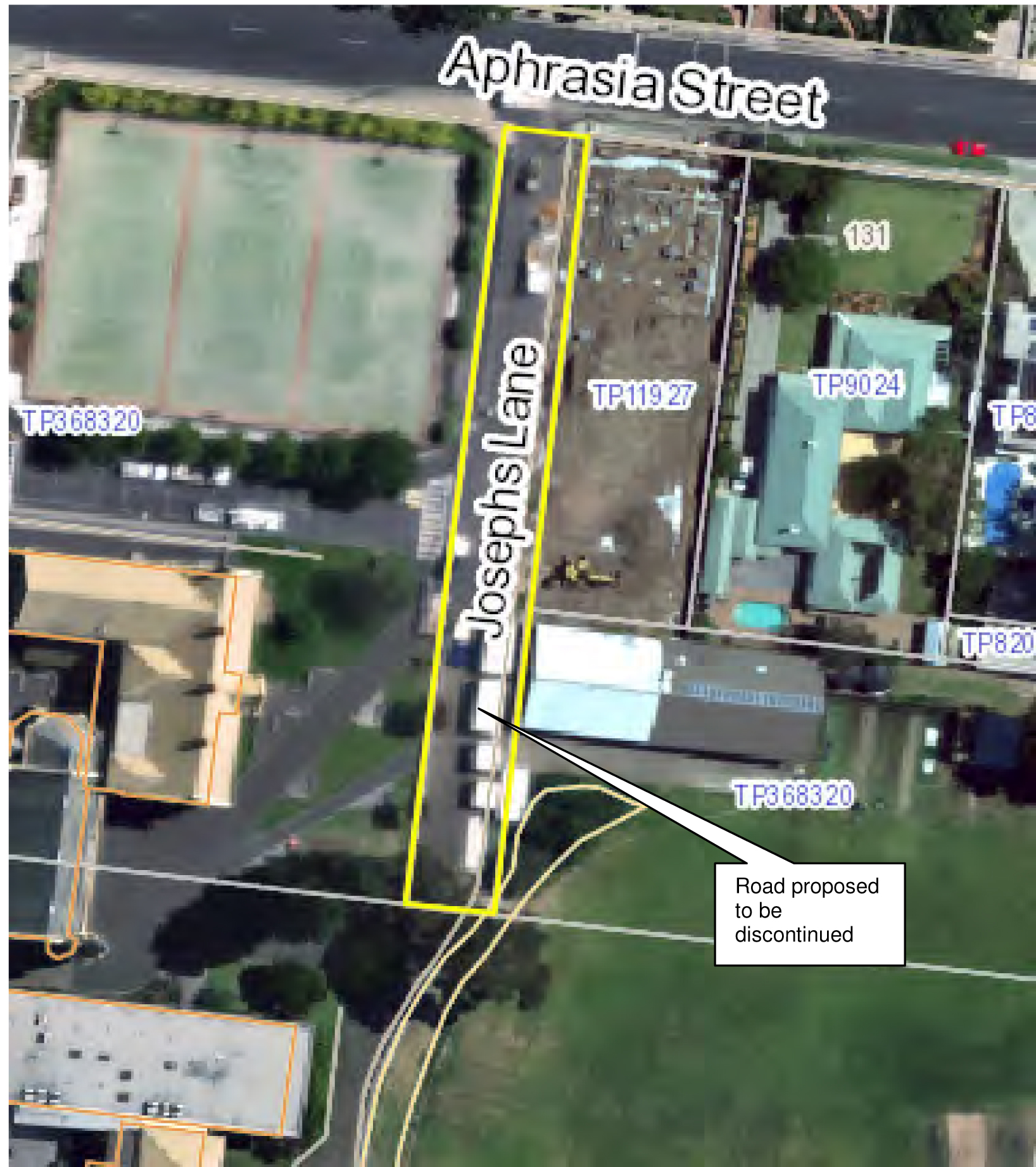
Portfolio: |
Governance - Cr Lyons (Mayor) |
Source: |
Strategy & Performance - Financial Services |
General Manager: |
Dean Frost |
Index Reference: |
Subject/Financial Management - Reporting |
To seek approval to name an unnamed laneway in the municipality to Baldock Lane, Geelong.
A proposal was received from adjoining property owners to name an unnamed laneway abutting their properties.
The name chosen is after an historical land owner.
The unnamed laneway is situated to the rear of properties 332-344 Moorabool Street, Geelong (Appendix 1).
The proposed naming was advertised in the Independent newspaper on 13 November 2015 and the Geelong Advertiser newspaper on 14 November 2015.
Council received one submission on the proposal, which was in favour of the name.
Cr Macdonald moved, Cr Ansett seconded -
That Council approve the naming of the unnamed laneway to “Baldock Lane, Geelong”.
Carried.
Council is the responsible authority for naming and renaming roadways under the Local Government Act 1989. To administer this, Council is required to utilise the Guidelines for Geographic Names 2010 (the Guidelines).
Council received a proposal from property owners abutting an unnamed laneway in Geelong. The unnamed laneway is situated to the rear of properties at 332-344 Moorabool Street, Geelong.
The proposal asked that we name the unnamed laneway after an historic owner of one of the adjoining properties.
Letters have been sent to adjoining property owners advising them of the proposal and the intention to name the unnamed laneway to “Baldock Lane, Geelong”.
It is proposed to name the unnamed laneway to the rear of properties 332-344 Moorabool Street, Geelong as “Baldock Lane, Geelong”. This name has been chosen from an historical land owner of a property within this section. The name has been accepted by the adjoining land owners who initiated the naming proposal.
The name Baldock is in accordance with the Guidelines for Geographic Names 2010.
Historic records indicate that Mr T W Baldock was the owner of the property at 344 Moorabool Street, Geelong in 1881. Mr Baldock was an ironmonger and also an Assessor for Geelong’s Kardinia Ward.
The proposed naming was advertised in the Independent newspaper on 13 November 2015 and the Geelong Advertiser newspaper on 14 November 2015. Council received one submission on the proposal, which was in favour of the name.
There are no environmental issues arising from this report.
The approximate cost to Council is $700. This includes advertising, notification to authorities and street signage.
The Local Government Act 1989, the Geographical Place Names Act 1998 and the Guidelines for Geographic Names 2010 have been followed.
This proposal aligns to City Plan with the encouragement of Community Wellbeing.
There is no Council Officer direct or indirect interest involved in this report.
If an emergency situation occurred, Council’s proposal to name this unnamed laneway could minimise the risk of failure to be able to access a situation in a timely manner.
The naming of this unnamed laneway will allow for easier identification for the general public and emergency services.
It is the right of every resident and property owner for their property to have a unique address in order to receive services and reduce confusion or delay of emergency services.
Correspondence has been sent to all adjoining property owners advising them of the proposed naming and inviting submissions.
The proposal was advertised in the Independent newspaper on 13 November 2015 and the Geelong Advertiser newspaper on 14 November 2015.
The proposal was published on Council’s Geelong Australia website for 30 days as per the Guidelines for Geographic Names 2010.
Following the initial proposal from the adjoining owners only one other submission was received. That submission was in favour of the name.
All submitters will be notified of Council’s decision.
Subject to Council and The Registrar of Geographic Names approval, the relevant authorities and abutting owners and residents will be notified of the official registration of this road naming.
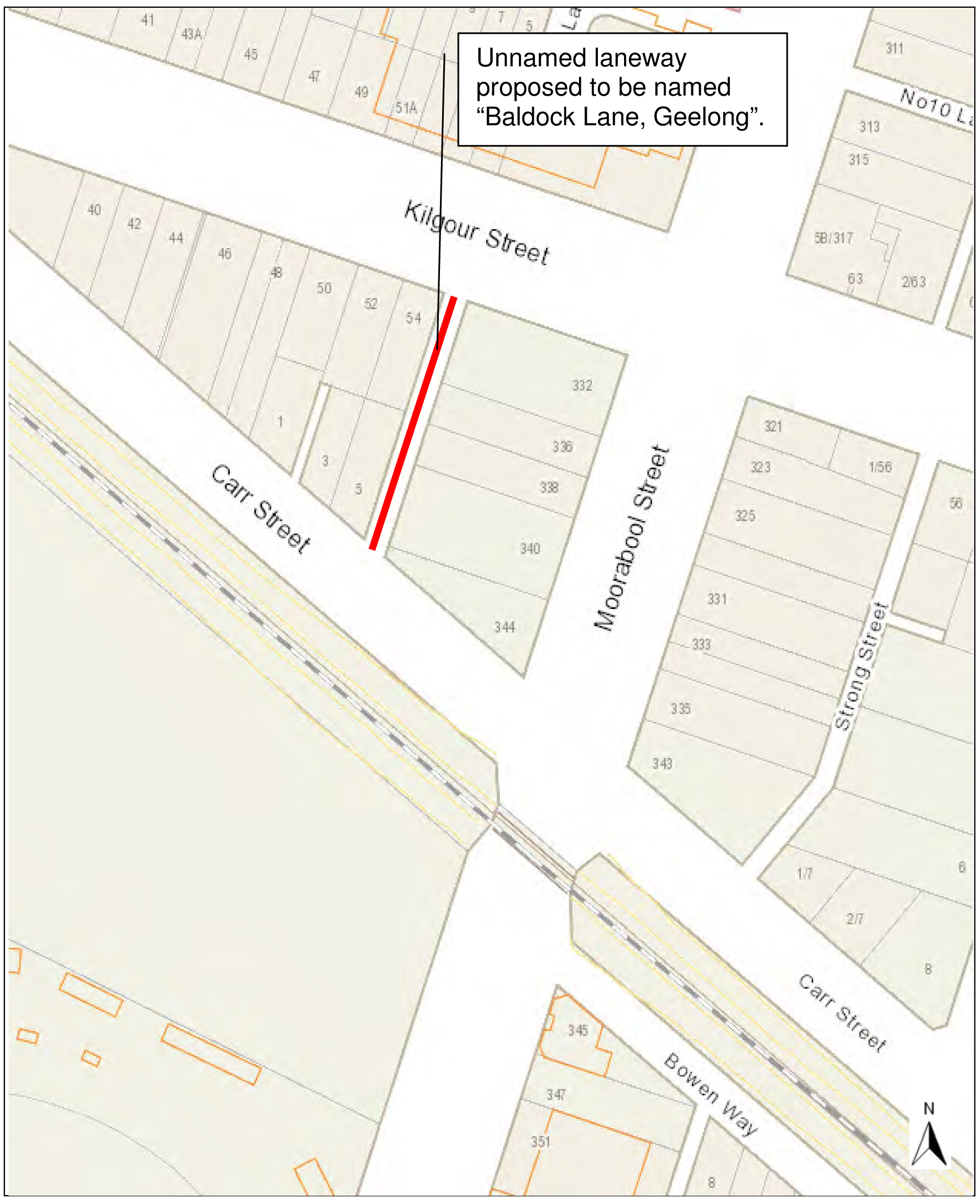
Portfolio: |
Sport and Recreation – Cr Irvine |
Source: |
Community Life – Sport and Recreation |
General Manager: |
Linda Quinn |
Index Reference: |
Property: # 298744 |
Cr Irvine moved, Cr Macdonald seconded -
That in accordance with Section 89 (2) (d) of the Local Government Act 1989, this contractual matter be considered at the conclusion of all other business at which time the meeting be closed to members of the public.
Carried.
Portfolio: |
Governance - Cr Lyons- (Mayor) |
Source: |
Corporate Internal Auditor |
Chief Executive Officer: |
Kelvin Spiller |
Index Reference: |
Audit - CG - Internal |
Cr Macdonald moved, Cr Heagney seconded -
That in accordance with Section 89 (2) (h) of the Local Government Act 1989, this matter, which the Council considers would prejudice the Council or any person, be considered at the conclusion of all other business at which time the meeting be closed to members of the public.
Carried.
Contents | Previous Page: Section A - Procedural Matters | Next Page: Section C - Notice of Motion
