
Council Minutes - Section B: Reports - 23 May 2017
Contents | Previous Page: Section A - Procedural Matters | Next Page: Section C - Assembly of Councillors
Contents | Previous Page: Section A - Procedural Matters | Next Page: Section C - Assembly of Councillors
Reports tabled at the Ordinary Meeting of Council on Tuesday date held at the Council Conference and Reception Centre in City Hall, 30 Gheringhap Street, Geelong.
Amendment C354 – Heritage Overlay – 9 Bridge Road, Barwon Heads - Adoption
Proposed Heritage Overlays – Combined Heritage Amendment C359
Proposed Sale of Land – Peninsula Drive, Drysdale – Hearing of Submissions
Sport & Recreation Victoria – 2018/19 Community Sport Infrastructure Fund
Greater Geelong Visitor Economy, Strategy, Performance and Memorandum of Understanding
Tender T1700001 Building Works - Construction of a Regional Pavilion - Home for Cycling
Source: |
Planning and Development – Strategic Implementation |
Director: |
Peter Bettess |
Index Reference: |
Application C-354 |
To consider the independent Panel report and adopt Planning Scheme Amendment C354.
Amendment C354 proposes a permanent Heritage Overlay over 9 Bridge Road Barwon Heads. On 26 July 2016, Council considered a report on the site and resolved to recognise its cultural and heritage significance and request the Minister for Planning’s assistance with interim and permanent heritage overlays. An interim overlay (Amendment C271) was requested and approved by the Minister’s delegate and expires 22 Dec 2017. Amendment C354, to apply the permanent control, was exhibited from 25 August to 26 September 2016. A total of 76 submissions were received - one objecting submission and 75 submissions in support or not objecting. A Panel hearing was held on 3 March 2017 and the Panel has supported the amendment.
The house at 9 Bridge Road, Barwon Heads is a late Victorian cottage built c.1890, and has been found to be of local significance by four heritage experts. It is historically significant as a result of its early date of construction and its association with the initial development of the township of Barwon Heads.
The Barwon Heads community strongly supports permanent heritage protection and several community members presented to the Panel. The owner of the site objects to the overlay and has plans to demolish the house and develop the site for dwellings and shops under a separate planning permit application.
The Panel considered whether a Heritage Overlay with tree controls is justified and whether the Heritage Overlay will undermine the planning policy and strategic outcome for the site given the site’s Residential Growth zoning and proximity to Barwon Heads activity centre.
The Panel concludes the land, house and cypress tree at 9 Bridge Road, Barwon Heads is of aesthetic and historic significance and warrants inclusion within the Heritage Overlay. It is recommended the amendment be adopted and forwarded to the Minister for approval.
P Dorling moved, L Gardner seconded -
That Council:
adopts Amendment C354 in the form outlined in Attachment 5 of this report;
submits the adopted Amendment together with the prescribed information to the Minister for Planning requesting approval.
Carried.
9 Bridge Road Barwon Heads is located on the south west corner of Bridge Road and Hitchcock Avenue immediately south of the main shopping strip of Barwon Heads. The house is located in a prominent, elevated location and overlooks one of the main intersections in the town and is on the main road to Ocean Grove. An aerial photo and street level photo of the site is in Attachment 2. The site is zoned Residential Growth Zone Schedule 3 (RGZ3) with existing zoning shown in the map in Attachment 3.
Amendment C354 seeks to apply a permanent Heritage Overlay to 9 Bridge Road, Barwon Heads to protect the house and cypress tree on a permanent basis.
A planning permit application was lodged in 2015 seeking to demolish the existing dwelling and construct a 3 storey building. This proposal triggered interest in the heritage of the house which was not subject to a heritage overlay.
The Barwon Heads Association (BHA) engaged RBA Architects and Conservation Consultants to review the site. RBA found the house is likely to have been built circa 1890 during the first major wave of development in Barwon Heads and is amongst the earliest surviving houses in the town.
The BHA and a local resident requested that Council take action to protect the heritage values of the house and tree.
On 26 July 2016, Council considered a report on the site and resolved to recognise its cultural and heritage significance and request the Minister for Planning’s assistance with interim and permanent heritage overlays.
An interim overlay (via Amendment C271) was requested, was approved by the Minister’s delegate, came in to effect on 6 Oct 2016 and expires 22 Dec 2017.
Amendment C354, to apply the permanent control, was authorised by the Minister’s delegate and exhibited from 25 August to 26 September 2016.
A total of 76 submissions were received - one objecting submission (from the owner), three submissions providing comment and 72 submissions in support.
The consistent themes in the supporting submissions include: the importance of maintaining a coastal/seaside village character; sense of place/cultural identity; heritage, historical and architectural significance; the iconic cypress tree; strategic planning support; and concern at the rate of development of the town and loss of heritage.
The objection from the owner of 9 Bridge Rd is on the basis that: the building’s integrity is compromised by additions since the 1930s; is not representative of the 19th century architecture; does not have any special association with the life or work a person important in the history of Barwon Heads; the Cypress tree is a poor specimen and a health and safety risk; and the amendment is being proposed for an ulterior motive.
Council (under delegation) considered a report on the submissions and resolved on 20 October 2016 to request the Minister for Planning to appoint an Independent Panel under Part 5 of the Planning and Environment Act 1987 to consider submissions relating to the amendment and refer all submissions to the Panel.
A single person Panel was appointed and held a hearing in Geelong on 3 March 2017.
A Panel was necessary because of the single objecting submission from the owner. The Panel Hearing was originally scheduled for December 2016 but at the Directions Hearing the owner’s lawyer requested it be adjourned until March 2017 and the Panel agreed to this request.
Council, the owner and an objector all engaged heritage experts to present evidence at the Hearing.
However, a week prior to the hearing Kings Lawyers, acting for the owner, advised the Panel they would not be attending the Hearing and sought leave to circulate a further written submission on 28 February 2017. The Panel agreed to this request and advised parties to the Hearing who subsequently received the written submission. Expert witness reports of an arborist and Lovell Chen (Heritage) were also circulated. These witnesses were not called by Mr King to appear at the Hearing. The Lovell Chen statement supported the application of a heritage overlay over the property.
At the Panel Hearing Council presented detailed background on Barwon Heads’ current and future planning and the heritage of the town and called Louise Honman of Context Pty Ltd to provide expert heritage evidence. Dr Leo Martin a heritage expert provided evidence on behalf of an objector. The Barwon Heads Association and local residents also presented to the Panel.
In its Executive Summary (Attachment 4) the Panel states:
"The key issues raised in the Amendment include:
whether a Heritage Overlay is justified for 9 Bridge Road, Barwon Heads
whether tree controls are justified for the cypress tree in the front yard of the site, given its condition
whether the application of the Heritage Overlay will undermine the planning policy and strategic outcome for the site given the site’s zoning and proximity to Barwon Heads activity centre.
The Panel considered all submissions as well as four heritage assessments prepared by separate heritage consultants. All of the heritage assessments found 9 Bridge Road, Barwon Heads is of historic and aesthetic significance at a local level, albeit with some diverging views on the use of particular heritage criteria and correction of some historical information.
The Panel also considered the policy context of the Amendment and has found that there is strong policy support in the planning scheme to apply the Heritage Overlay where it is justified and an expectation in local planning policy that increased residential density and diversity must take into account unique site characteristics such as heritage.
The Panel concludes:
the land, house and cypress tree at 9 Bridge Road, Barwon Heads is of aesthetic and historic significance and warrants inclusion within the Heritage Overlay.
the condition of the cypress tree does not comprise its landmark contribution or significance to the site. The tree should be included in the Heritage Overlay under ‘tree controls.’
the application of the Heritage Overlay on 9 Bridge Road does not compromise the overall strategic policies for the Barwon Heads township.
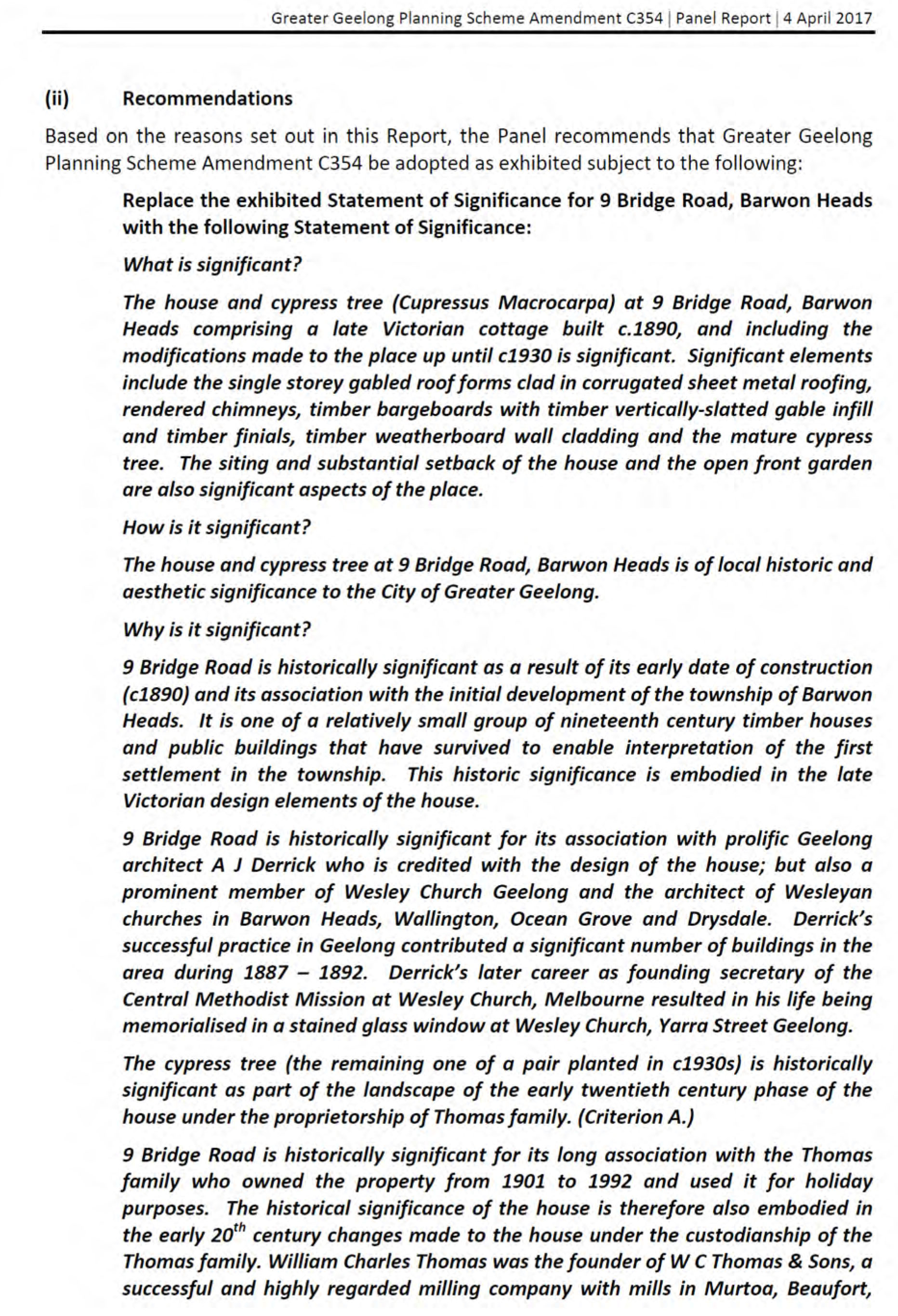
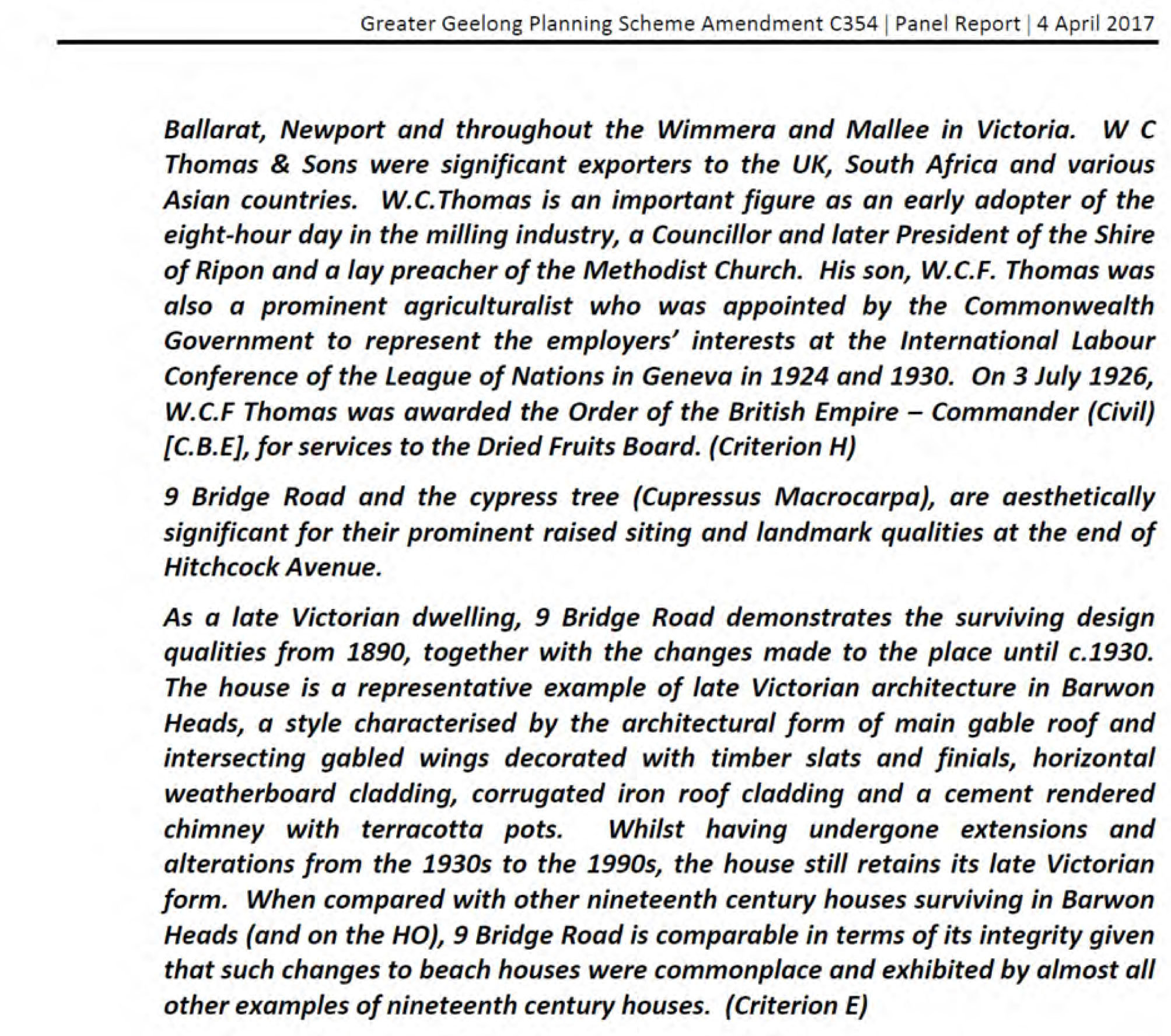
the exhibited statement of significance should be amended to:
remove reference to early photographs and Criterion C
remove reference to aesthetic significance as part of the work of Geelong based architect AJ Derrick (Criterion A)
amend the contribution of AJ Derrick’s architecture practice to the period 1887-1892
delete reference to architectural significance given changes made to the building
include additional historical information pertaining to the Thomas family.”
Council officers support the Panel recommendations and it’s recommended changes to the Statement of Significance as per the document in Attachment 4.
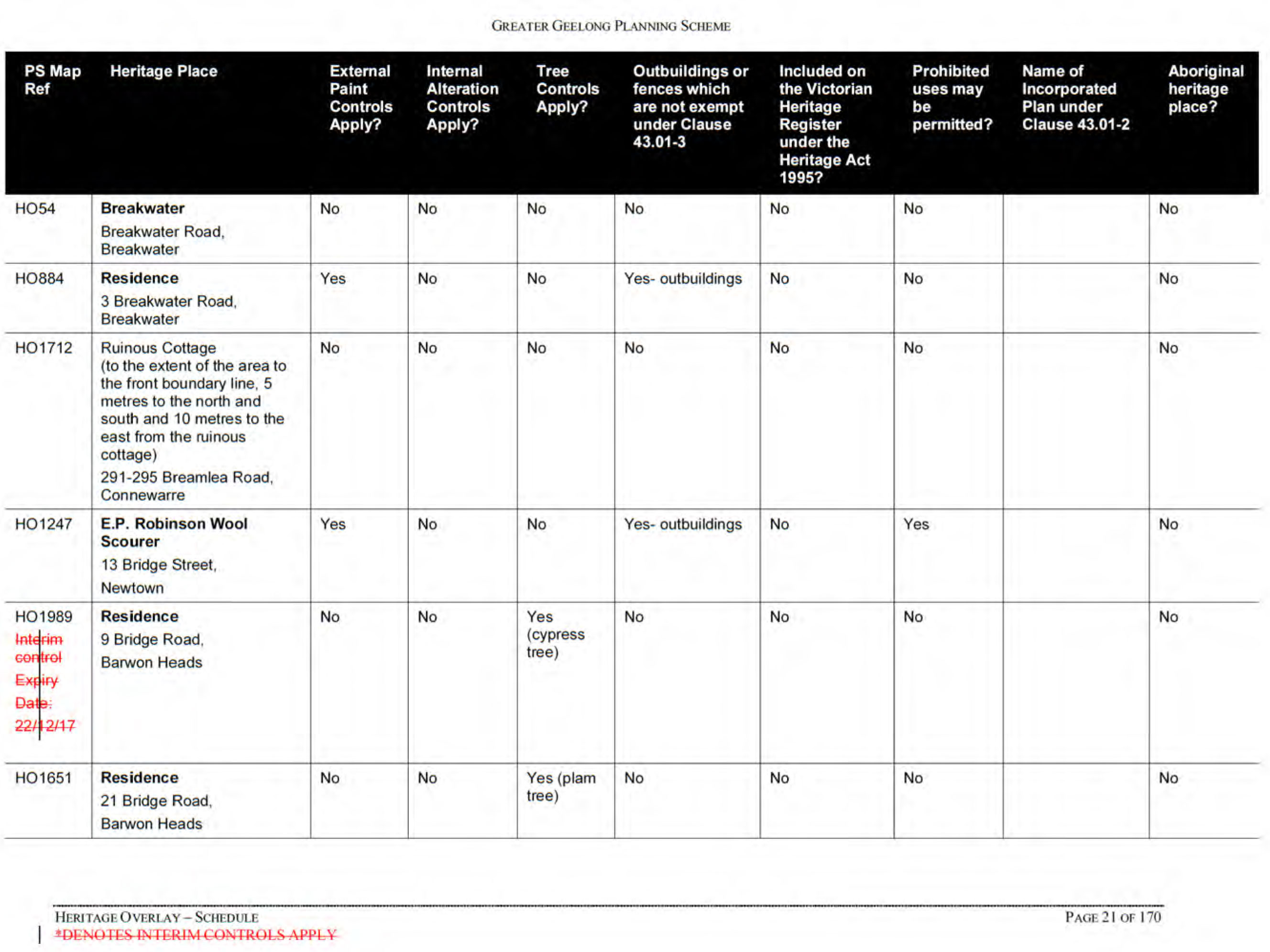
As the Heritage Overlay is already in place in the planning scheme maps, the only change required by Amendment C354 is to remove the notation from the Schedule to the Heritage Overlay at Clause 43.01 which says ”Interim Control Expiry Date 22/12/17”.
The revised amendment documents recommended for adoption and submission to the Minister for approval are in Attachment 5.
There are no financial implications to Council beyond the cost already incurred on the planning scheme amendment and Panel hearing.
Amendment C354 was exhibited in accordance with the provisions of the Planning and Environment Act and all persons who lodged submissions had an opportunity to be heard before an Independent Panel appointed by the Minister for Planning.
State Planning Policies relevant to the amendment include:
Clause 11.14-1 Localised Planning Statements has an objective “To protect and enhance the valued attributes of the distinctive areas of the Bellarine Peninsula, Macedon Ranges, Mornington Peninsula and the Yarra Valley and Dandenong Ranges”. The policy guideline states that planning must consider where relevant the Bellarine Peninsula Localised Planning Statement (Victorian Government, 2015). Policy Objective 4 from the LPS is particularly relevant to the proposed heritage protection of 9 Bridge Road: “To protect, preserve and enhance built heritage, cultural and urban character values and preserve the individual identity and role of townships”
Clause 15.01-5 Cultural identity and neighbourhood character has an objective “to recognise and protect cultural identity, neighbourhood character and a sense of place.”
Clause 15.03-1 Heritage conservation – has an objective “to ensure the conservation of places of heritage significance”
Clause 21.06-4 Neighbourhood character includes objectives to: manage the impact of urban change on existing neighbourhoods; ensure that new development responds to the existing neighbourhood character; protect areas with a significant garden character; protect areas with views to significant landscape features.
Local Planning Policies relevant to the amendment include:
Clause 21.06-5 Heritage and Identity includes an objective “to conserve and enhance individual places and areas of pre and post contact cultural heritage significance”.
Clause 22.09 Cultural Heritage is a local policy that applies to all properties affected by a Heritage Overlay and hence would guide decision making on 9 Bridge Rd if it was included in the Heritage Overlay. This amendment will help achieve the Council cultural heritage objectives and implement the strategies identified in Clause 22.09.
Clause 22.63 Increased Housing Diversity Areas applies to all residential land located in Increased Housing Diversity Areas (IHDAs) which is relevant as the subject land is in the Barwon Heads IHDA.
The proposed amendment is consistent with the “Built and Natural Environment and Community Wellbeing” elements of City Plan.
No Council officers involved in the preparation of this report have any direct or indirect interest, in accordance with Section 80C of the Local Government Act.
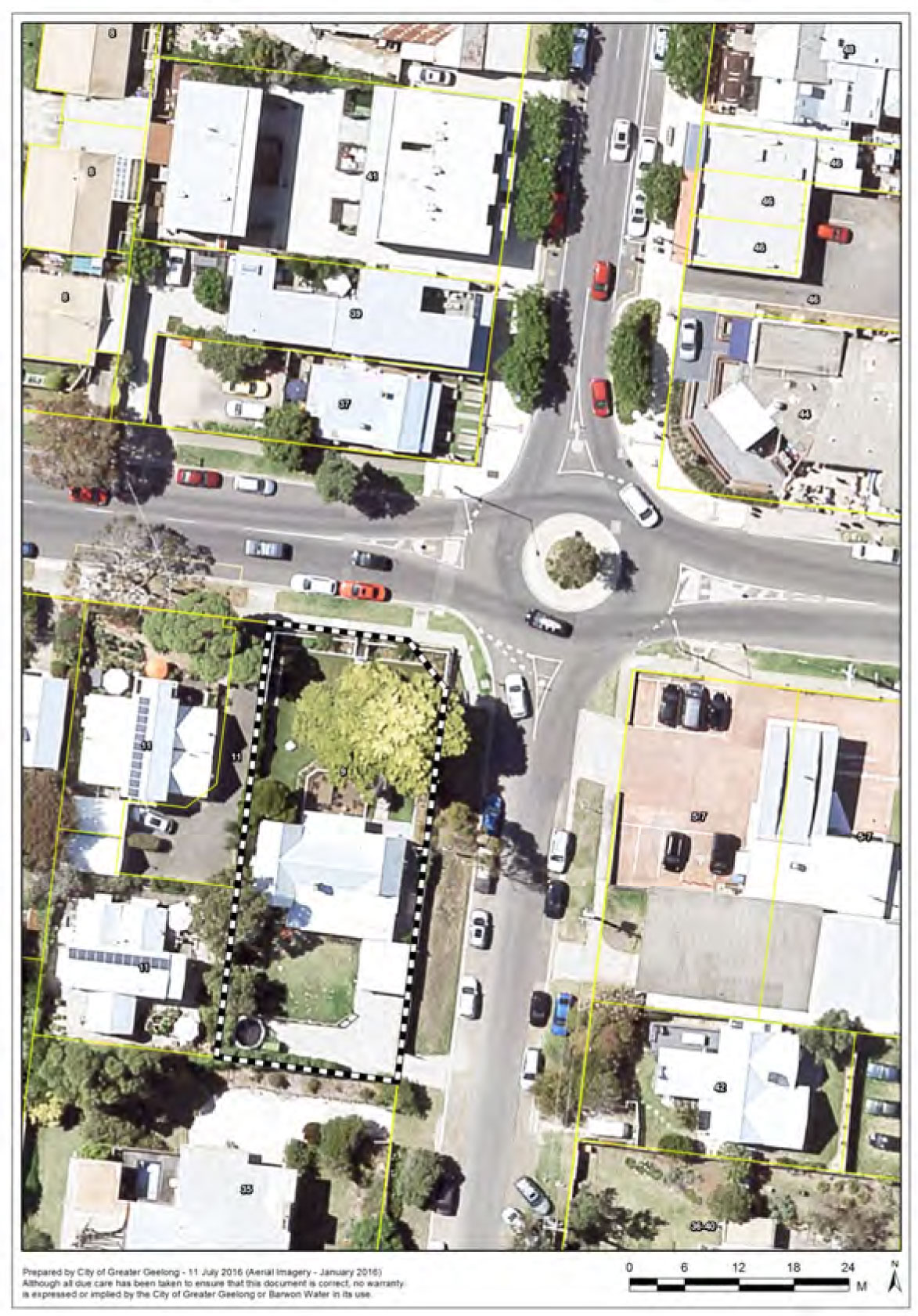
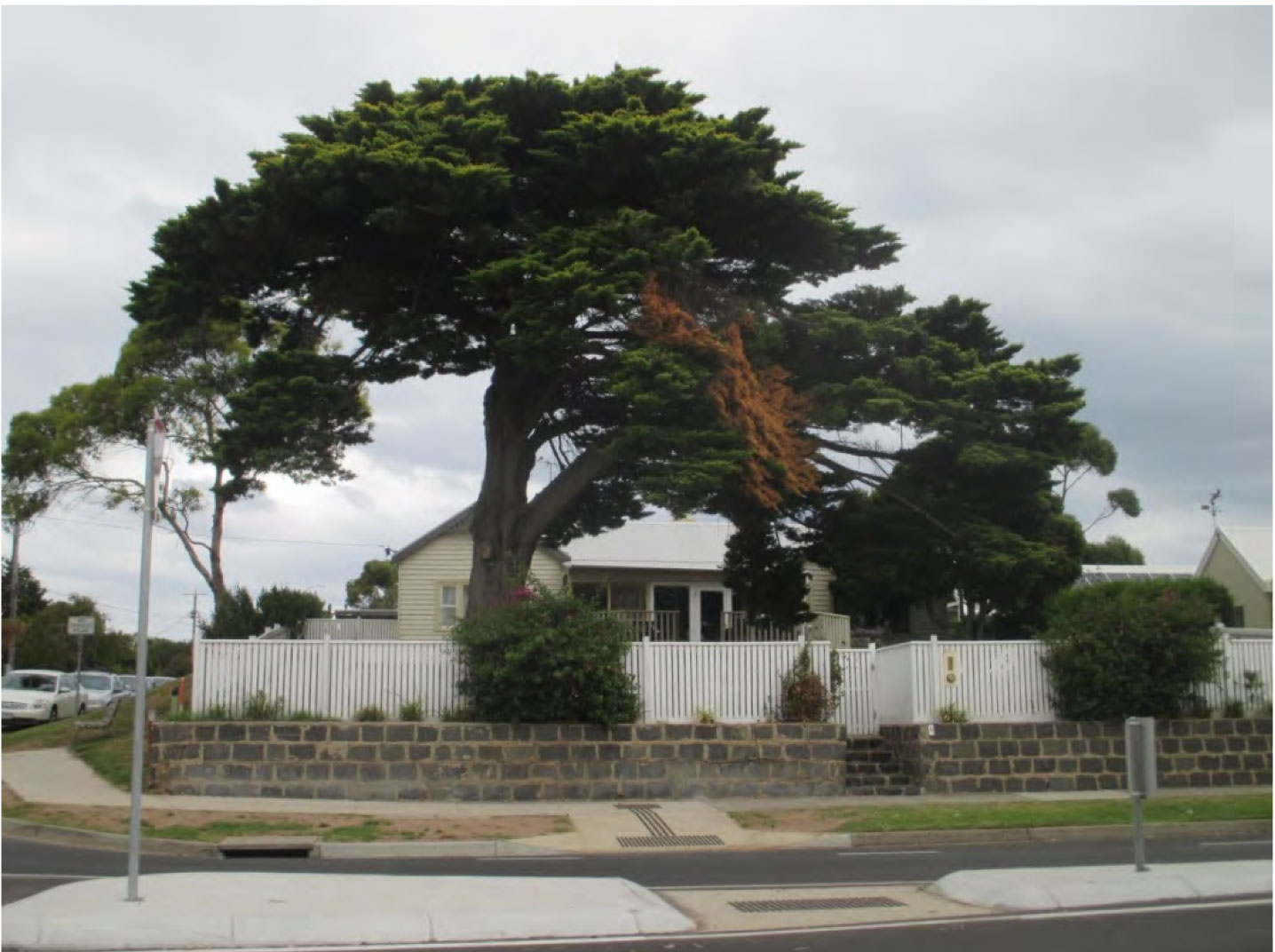
Source: Context Pty Ltd
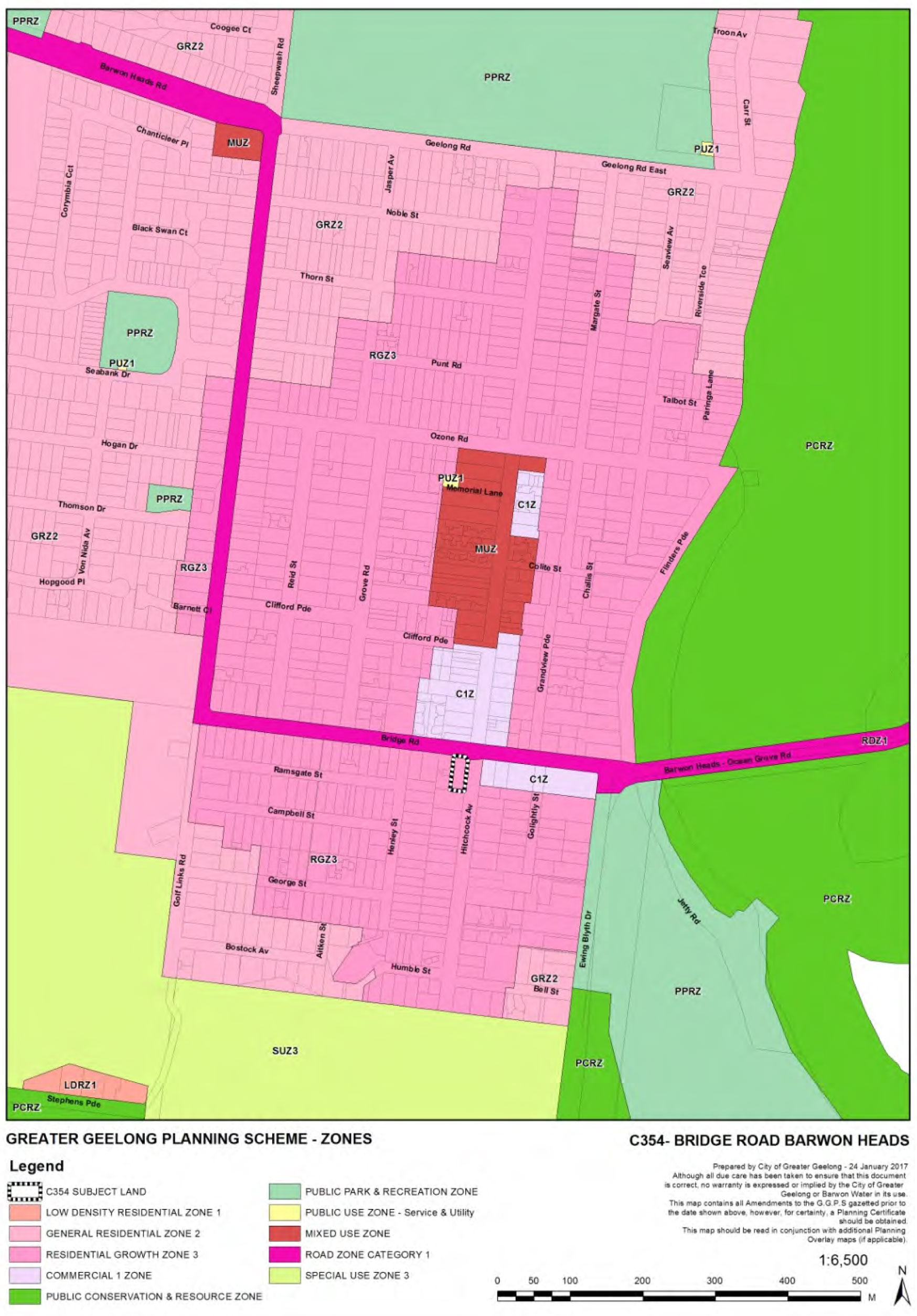
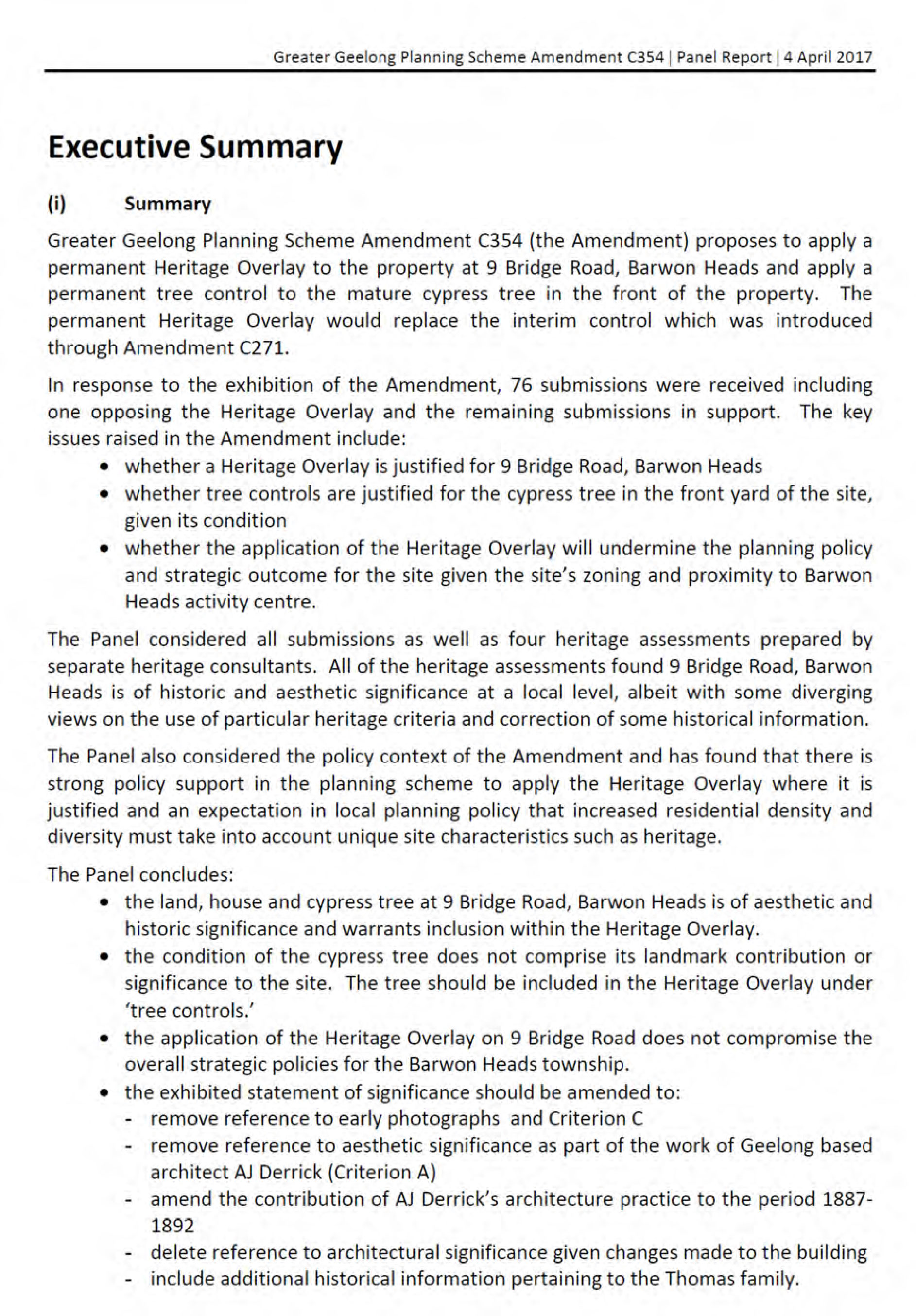
The planning authority for this amendment is the City of Greater Geelong
The Greater Geelong Planning Scheme is amended as follows:
The Planning Scheme Ordinance is amended as follows:
In Overlays – Clause 43.01 replace the Schedule with a new Schedule in the form of the attached document.
End of document
Source: |
Planning and Development – Strategic Implementation |
Director: |
Peter Bettess |
Index Reference: |
Amendment C359 |
This report seeks support from Council to prepare and exhibit a planning scheme amendment to include various properties in Ceres and Geelong within the Heritage Overlay, amend the application of the City Fringe Heritage Area and to correct minor existing heritage overlay anomalies.
Council has responded to the National Trust’s request to review the heritage status of the former Denny Lascelles Wool Store at 20 Brougham Street Geelong and to report the outcomes in May 2017.
Council committed to prepare an amendment to apply the heritage overlay to several properties in Ceres that were identified as historically significant in the Outer Areas Heritage Study, 1998-2000.
The City Fringe Heritage Area (HO1639) has been reviewed in light of deficiencies in the local planning policy, changes around the fringe of Central Geelong and VCAT decisions allowing for demolition of heritage buildings.
The application of a Heritage Overlay requires a planning permit be obtained for all buildings and works (unless specifically exempted).
Proposed application of the heritage overlay to sites for the first time may concern landowners.
The former Denny Lascelles wool store at 20 Brougham Street, Geelong is currently for sale.
The former Trans Otway building at 36-44 Ryrie Street has been identified as an individually significance heritage place. It is zoned Activity Centre Zone 1 and has a permit for a multi-storey commercial building.
The former Wesley Sunday School Hall site at 17 McCann Street Ceres is subject of a current planning permit application for demolition and residential redevelopment.
The extension of the heritage precinct southwards along Western Beach Road to include post war buildings up to the 1960s.
P Dorling moved, L Gardner seconded -
That Council:
supports the preparation and exhibition of Amendment C359 to the Greater Geelong Planning Scheme to apply the heritage overlay and local planning policies as outlined in Attachment 3 of this report; with the exception of the property at 36-44 Ryrie Street, which is to be removed from the Amendment;
requests the Minister for Planning to authorise the preparation and exhibition of Amendment C359 to the Greater Geelong Planning Scheme.
Carried.
This Amendment will combine a number of pieces of heritage work. Below is an outline of each piece of work.
Ceres Properties
Council undertook the Outer Areas Heritage Study between 1998 and 2000. The Study comprises of 16 volumes and was prepared by Authentic Heritage Services Pty Ltd.
The ‘Greater Geelong Outer Areas Heritage Study Stage 2’ identified sites of historical significance in the township of Ceres and its surrounds. To date these sites have not been included in a heritage overlay in the planning scheme.
Due to the lapse of time and changes in the planning framework, it has been necessary to update the citation sheets for these properties. This research has also been scaled back to those properties that warrant listing under the heritage overlay in the planning scheme. Council engaged Authentic Heritage Services Pty Ltd to undertake the preparation of the new citation sheets and these were submitted in March 2017.
The affected properties are:
605 Barrabool Road: Ceres Primary School
20 Cochranes Road: Barrabool Recreation Reserve
240 Gully Road: ‘Barwonside’
285 Gully Road: ‘Erinvale’
17 McCann Street: Former Wesleyan Church & Sunday School
100 McCann Street: ‘Hurley House’
All are of local heritage significance and are recommended to be included in individual heritage overlays in the Schedule to the Heritage Overlay.
See Attachment 2 for the location of these properties.
Denny Lascelles Wool Store – 20 Brougham Street
In February this year, the National Trust requested Council review the status of the Wool stores precinct area and apply an interim heritage overlay to 20 Brougham Street Geelong. Council engaged Authentic Heritage Services Pty Ltd to undertake a review of the site and prepare a citation sheet. Council received the Review report and citation sheet in February 2017. The Review concluded that the site is historically and aesthetically significant at a local level and recommended that it be included in the heritage overlay in the Planning Scheme. The site has historical significance for its associations with the agricultural and especially the wool storage and broking industry near the Geelong waterfront from 1919 until after the 1950s. The former wool store also has aesthetic significance as a representative example of a 20th century brick industrial building in the urban waterfront area.
See Attachment 2 for the location of this property.
City Fringe Heritage Area Review
After 16 years operation of the new format planning scheme, and with the dynamic nature of the three distinct areas within the City Fringe Heritage Area (HO1639), concerns have arisen about the ongoing implementation of the City Fringe Heritage Area and its local planning policy basis in their current form. Decisions from VCAT have commented upon the age and terminology used in the original heritage study underpinning the local policy, the lack of reference to interwar bungalows and the extent and diversity of the areas included in this Overlay (eastern, northern and western section).
There are some excellent parts of the area, such as the Pevensey Crescent and Garden Street environs; parts such as Corio Street which has the earliest surviving inner City dwellings in Geelong; and other parts where it is has become increasingly difficult to manage as a heritage precinct. Simply, the three separated areas within the same heritage overlay is difficult to manage.
Council engaged RBA Architects and Conservation Consultants Pty Ltd to review the City Fringe Heritage Area and to recommend updates to both its extent and local policy provisions. RBA’s report has recommended several changes to the existing HO1639.
In summary, the recommendations and outcomes of the RBA Review in relation to the eastern section are as follows:
A smaller precinct renamed City East Heritage Precinct (HO1639).
Expanding and updating the existing statement of significance so that it makes note of each relevant phase (not just Victorian and Federation).
Excising and creating an Austin Park and Environs Heritage Precinct (Cogens Place, Corio Street, England Street, Fyfe Place South, McCann Place, Veitch Place).
Addition of a few properties on Sydney Parade (no’s 56-60, 65A, 69-75).
Remove several non-contributory houses at the edges:
Admiral Place (no’s 3-7, 8),
Bellarine Street (no’s 6-8),
Brougham Street (no’s 110-120),
Corio Street (no’s 109-113, 118-126, 153-165),
Fyfe Place Nth (no’s 1-7),
Malop Street (no. 238),
Myers Street (no. 221),
Swanston Street (no’s 14-24),
Sydney Avenue (no’s 3, 2-6B),
Sydney Parade (no’s 86-88)
Add Hays Place to HO1637.
In summary, the recommendations and outcomes of the Review in relation to the northern section are as follows:
Remove this section from HO1639
Create a new residential precinct, Western Beach Road Heritage Precinct, including existing properties (no’s 1-28) and extending the precinct southwards to no. 58 Western Beach Road.
Remove the commercial properties to Mercer Street.
Create a new HO for 11 Mercer Street – shop
Retain existing individual HOs to Mercer Street: HO110, HO238, HO1041
In summary, the recommendations and outcomes of the Review in relation to the western section are as follows:
Remove this section from HO1639
Create a Myers Street Residential Heritage Precinct (south side, no’s 12-44)
Add commercial premises to Ryrie, Wesley and Little Ryrie Streets to the Geelong Commercial Heritage Area (HO1637)
Add houses to Fenwick, Gheringhap, Little Myers, and McKillop Streets to the City South Heritage Area (HO1641) but not including some properties at the south-west corner of this section.
Two contributory properties to lose heritage protection (40 Fenwick Street, 253 La Trobe Terrace).
Create new HO for:
3 Little Ryrie Street – dwelling
36-44 Ryrie Street – former bus depot (see below for more detail)
Remove HO121: building demolished
Retain existing HOs (external to proposed precinct): HO135, HO139, HO144, HO183, HO187, HO195, HO223, HO251, HO916, HO917, HO918, HO919, HO920, HO921, HO922, HO923, HO924, HO963, HO973, HO1108
Retain existing HOs (part of proposed Myers Street Precinct): HO1076, HO1077, HO1078, HO1079
Retain existing HOs (part of HO1637): HO188, HO1109, HO1110, HO1111
Whilst located just outside the existing City Fringe Heritage area, the Review has identified that the former Trans Otway Limited building at 36-44 Ryrie Street is of local significance and should be included in the Heritage Overlay. It is a distinctive light industrial building. This site has a planning permit for a multi-storey office tower and is included in the Activity Centre Zone.
Attachment 2 shows the preliminary outline of the changes to the existing HO1639 and the extent of the proposed new precincts.
Heritage Anomalies
Each year mapping and ordinance anomalies within the planning scheme are corrected to ensure that the Scheme is up-to-date and relevant. During the past year, it has been noted that there are several sites subject to the Heritage Overlay that have experienced some changes either through planning permit decisions or incorrect mapping that need to be corrected.
These properties are:
299 Moorabool Street Geelong (HO1068) –a dwelling of local significance on this site has been demolished and there is no longer any basis for retention of the heritage overlay. This needs to be deleted from the planning scheme maps and schedule to Clause 43.01.
100 Yarra Street Geelong (HO252) – the mapping does not reflect the extent of the historic church building and surrounding curtlidge. This needs to be corrected on the planning scheme map.
12 Candover Street Geelong West (HO644) – The Schedule to Clause 43.01 incorrectly identifies that this site is subject to HO644 rather than HO1962. The Schedule to Clause 43.01 needs to be amended.
5-55 Fyansford-Gheringhap Road, Fyansford (HO1736) – the extent of mapped heritage overlay includes larger areas of the rural property than the historical ruin in the south east corner of the site. The planning scheme map needs to be amended.
25 Glenleith Avenue Drumcondra (HO696) – The Schedule to Clause 43.01 incorrectly includes a ‘Yes’ in the ‘Tree Controls Apply?’ column. There are no trees of significance on site, and no basis for this in the citation sheet. The Schedule needs to be amended.
3 & 5 Urana Street Newtown (HO1624) and 1/7/& 2/7 Urana Street Newtown (HO1301) – HO1624 relates to the Latrobe Terrace Shops Heritage Area – 3 and 5 Urana Street are properties located to the west, orientated to Urana Street. The lots were subdivided from the land at 396 Latrobe Terrace in the 1990’s and have since been developed with new dwellings. Similarly, 1/7 & 2/7 Urana Street have been subdivided from the land at 398 Latrobe Terrace, and have continued to be covered by HO1301 which is for the heritage dwelling fronting Latrobe Terrace. As these properties in Urana Street have no relationship to Latrobe Terrace anymore HO1624 and HO1301 should be removed from them on the planning scheme maps.
82-92 Gheringhap Street (HO251) – the mapping des not reflect the extent of the regionally significant “Wellwood Terrace”. The statement of significance identifies six two storey terrace houses but this is not reflected on the map with the current extent of the overlay covering only about 3-4 of the terraces. This needs to be corrected on the planning scheme maps.
These corrections are considered to be house-keeping in nature.
The proposed form of the amendment is listed in Attachment 3. This is an extensive amendment covering a variety of locations across the municipality. The detailed changes proposed by this amendment are not included in the Attachment.
The costs of conducting the amendment process will be met within the City Development budget.
Landowners of properties proposed to be included in the heritage overlay for the first time in Ceres and Brougham Street have already been provided with the citation sheets as a precursor to the amendment exhibition. New properties to be included in the City Fringe Heritage Area will also be provided with the relevant citation sheets prior to the formal exhibition process.
Council will exhibit the amendment in accordance with the Planning and Environment Act 1987.
The amendment has considered the relevant State and local planning provisions. One of the objectives of planning in Victoria that planning authorities must implement is:
S4(1)(d) Objectives of planning in Victoria
to conserve…buildings, areas or other places which are of scientific, aesthetic, architectural or historical interest…
This report aligns with the direction of the Sustainable and Built Environments theme in City Plan.
No Council officers have any direct or indirect interest, in accordance with Section 80C of the Local Government Act, to which this Amendment relates.
There is considered to be low risk in implementing the recommendations of this report. The proposed amendment will result in a heritage overlay being applied to places that have been identified as having heritage significance.
There are no environmental implications resulting from this report.
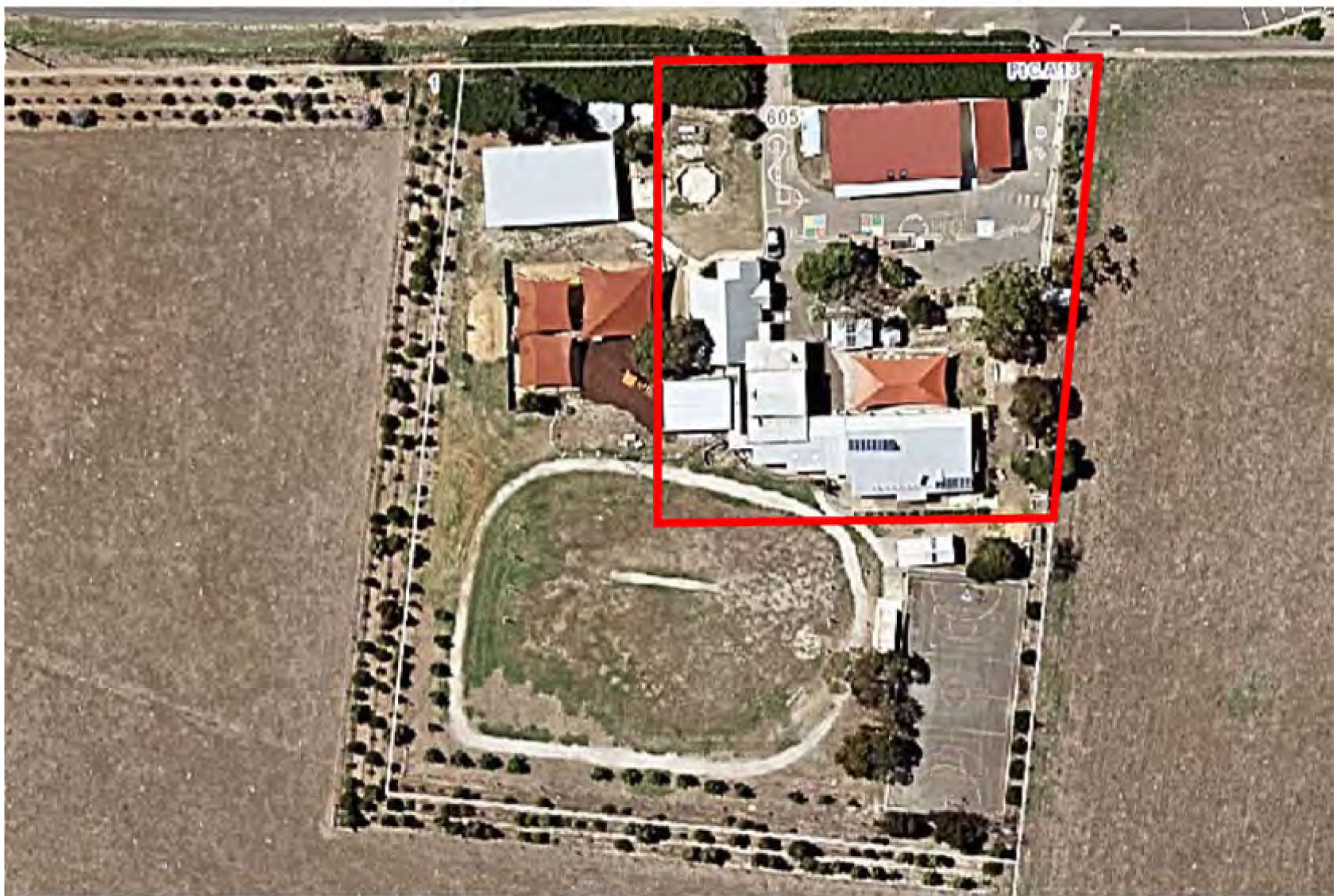
605 Barrabool Road, Ceres
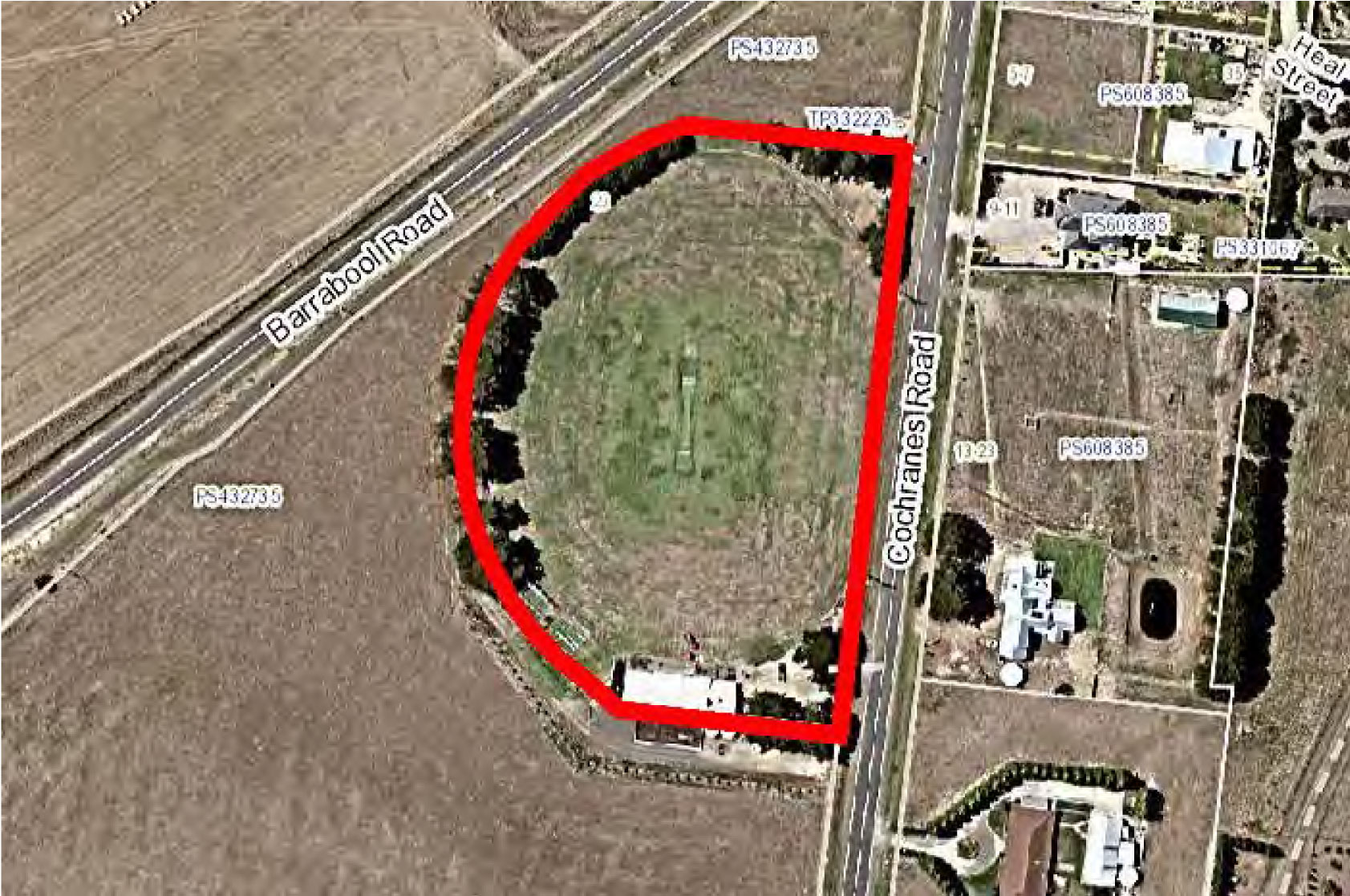
20 Cochranes Road, Ceres
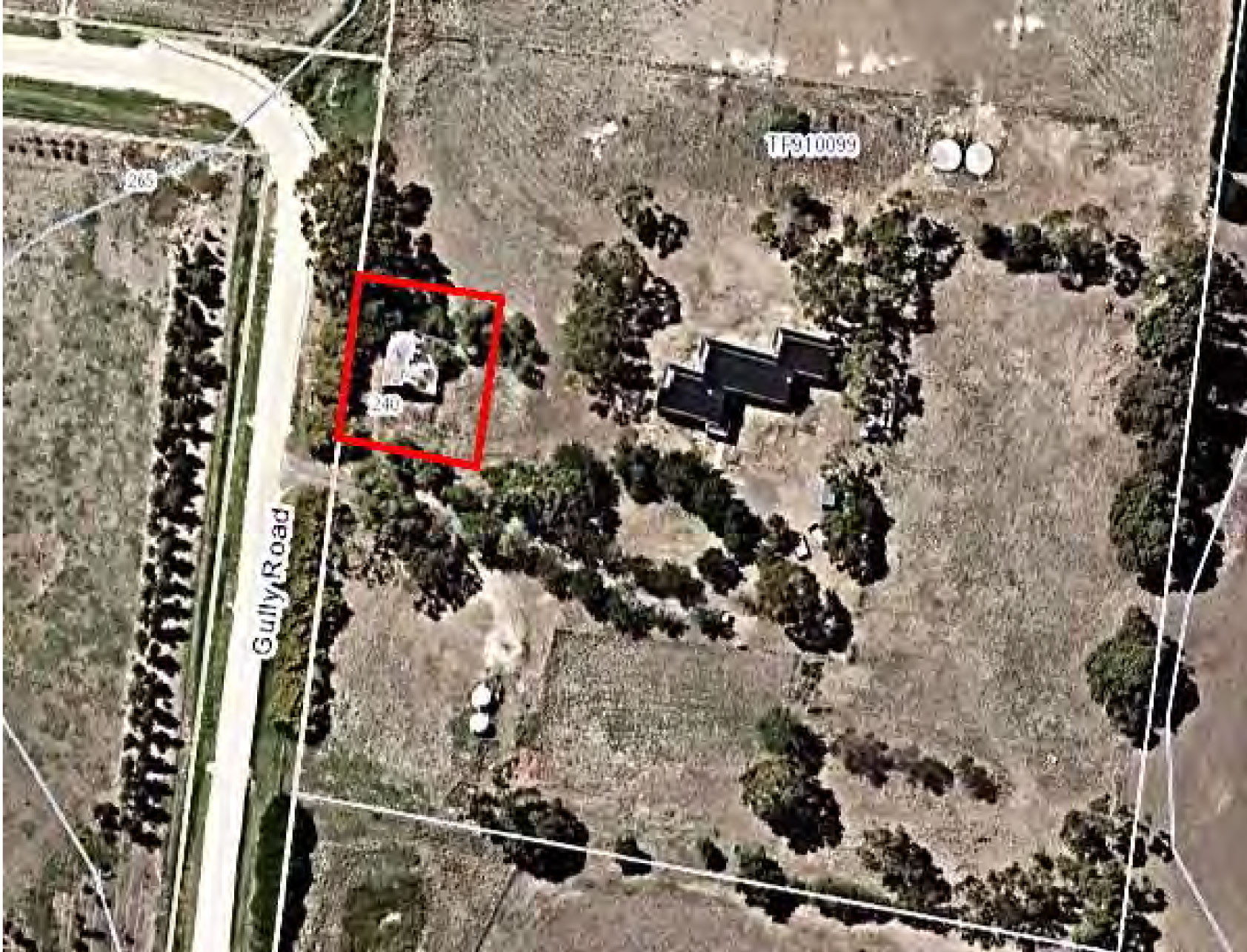
240 Gully Road, Ceres
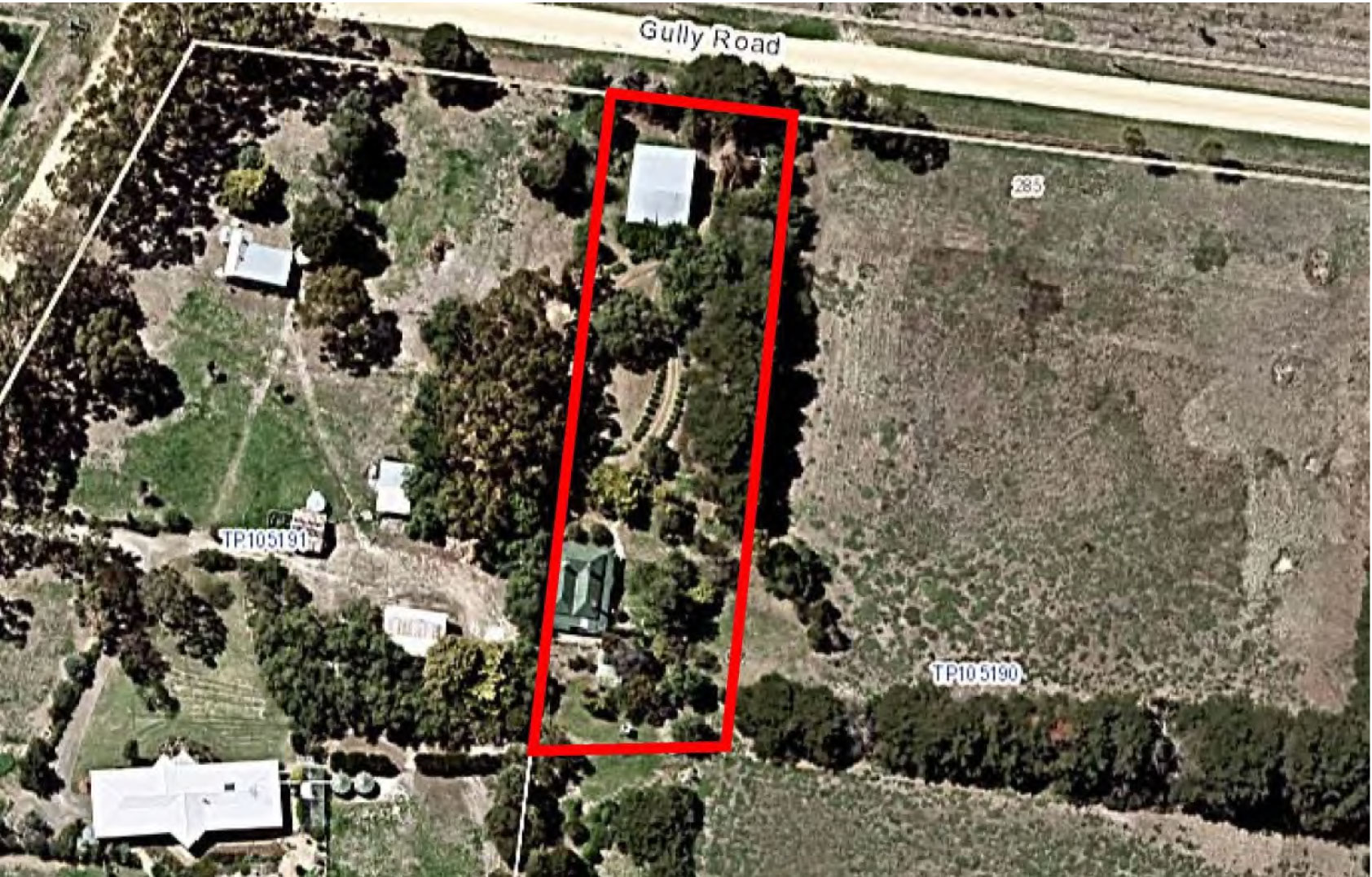
285 Gully Road, Ceres
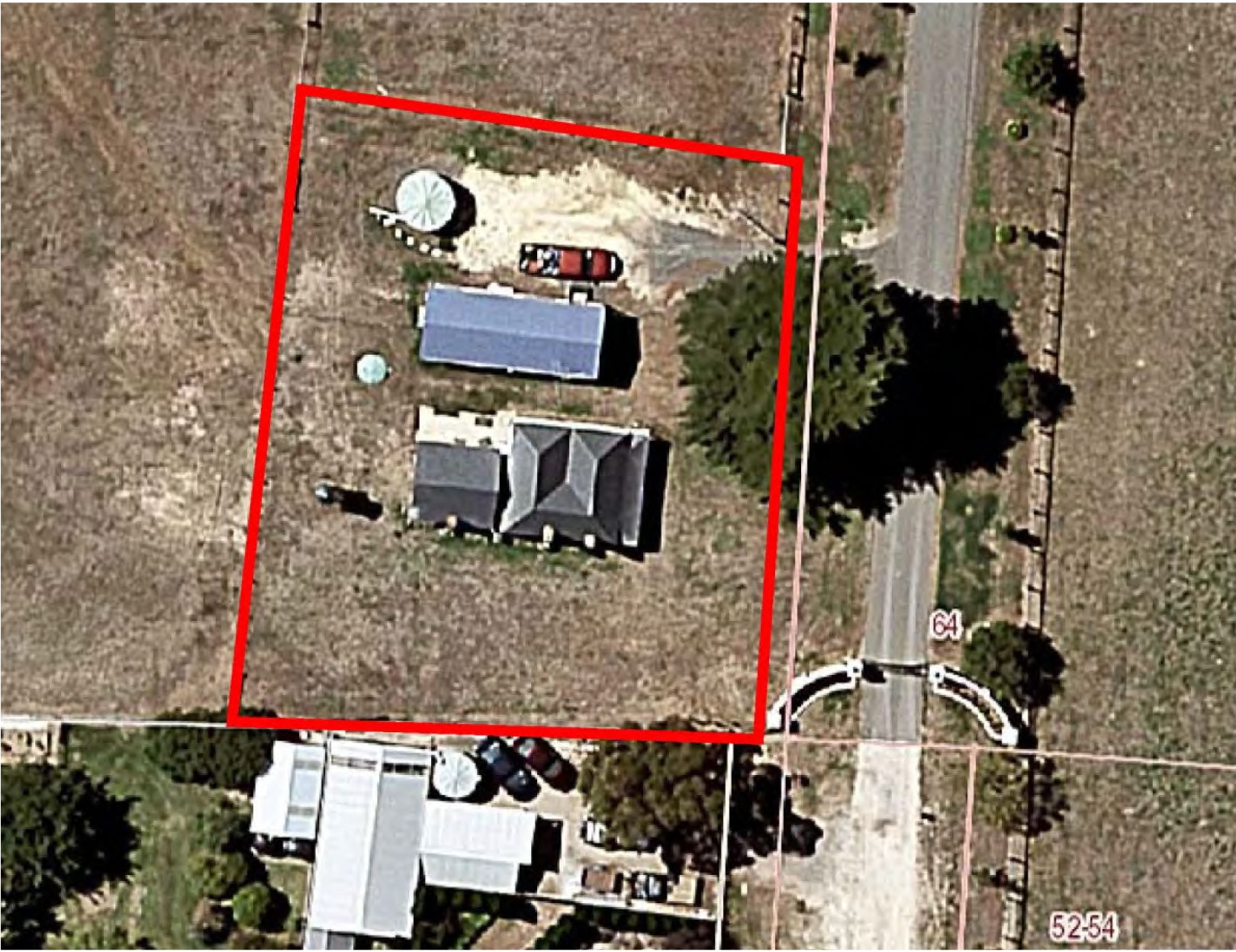
100 McCann Street, Ceres
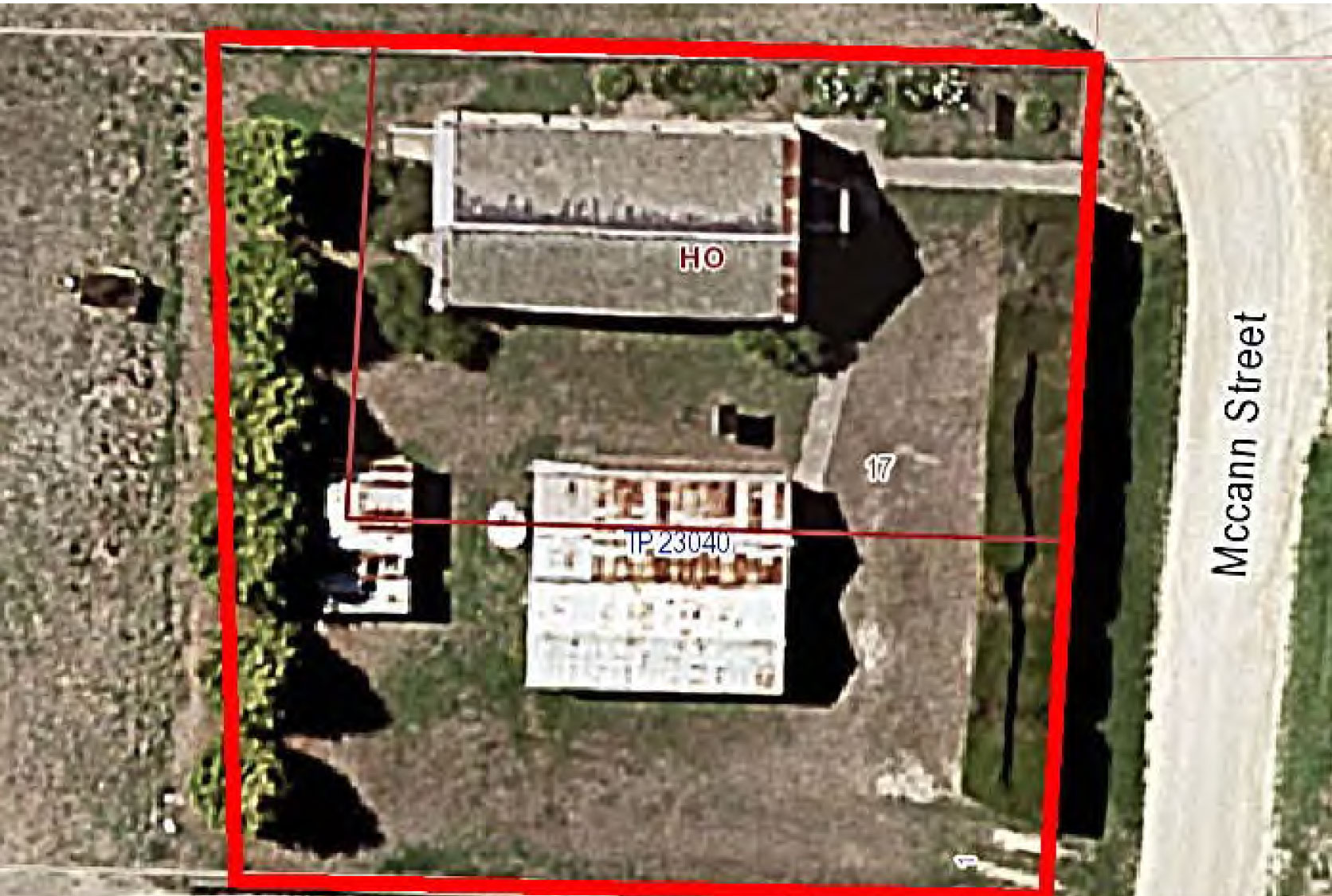
17 McCann Street, Ceres
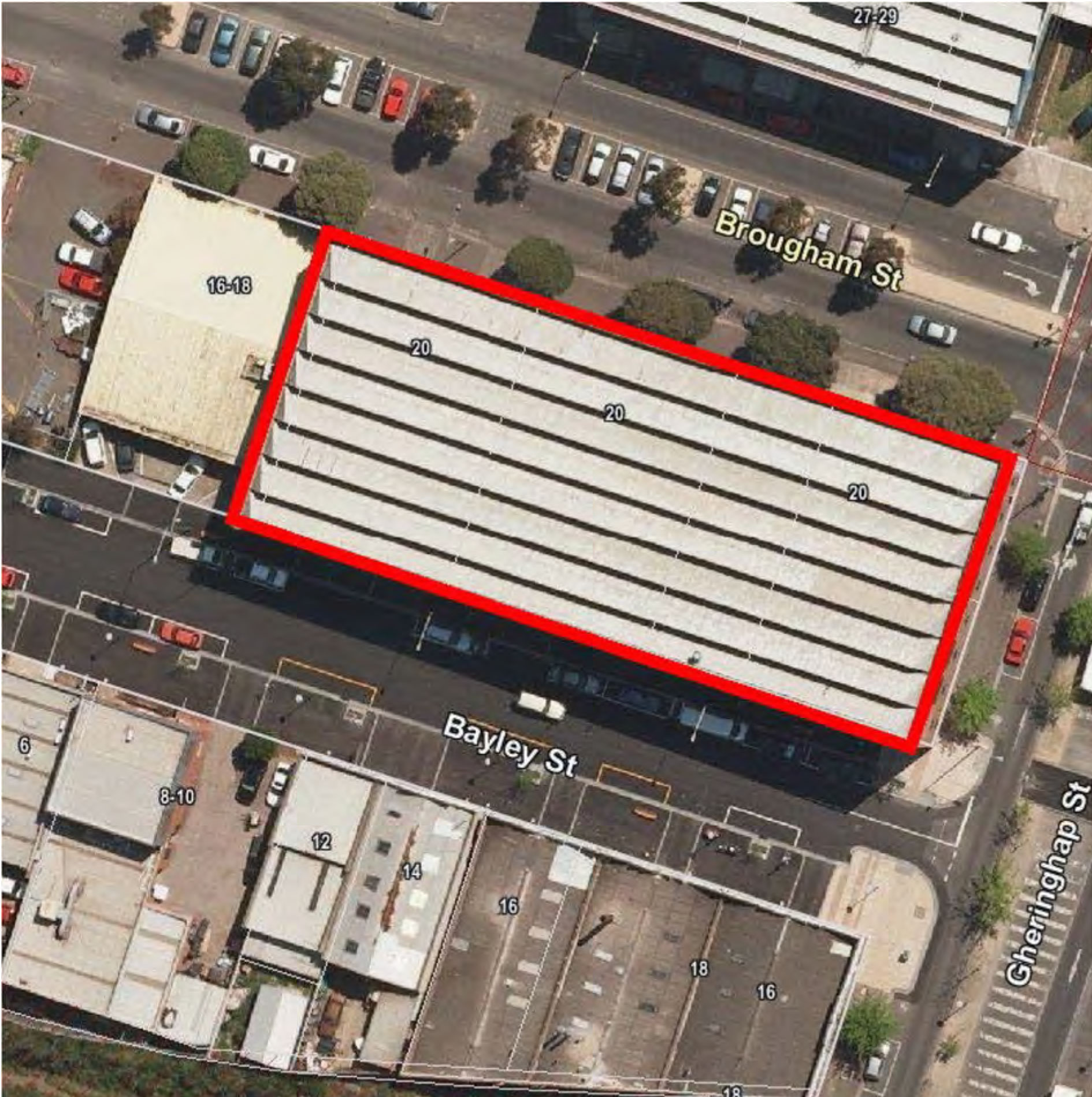
20 Brougham Street, Geelong
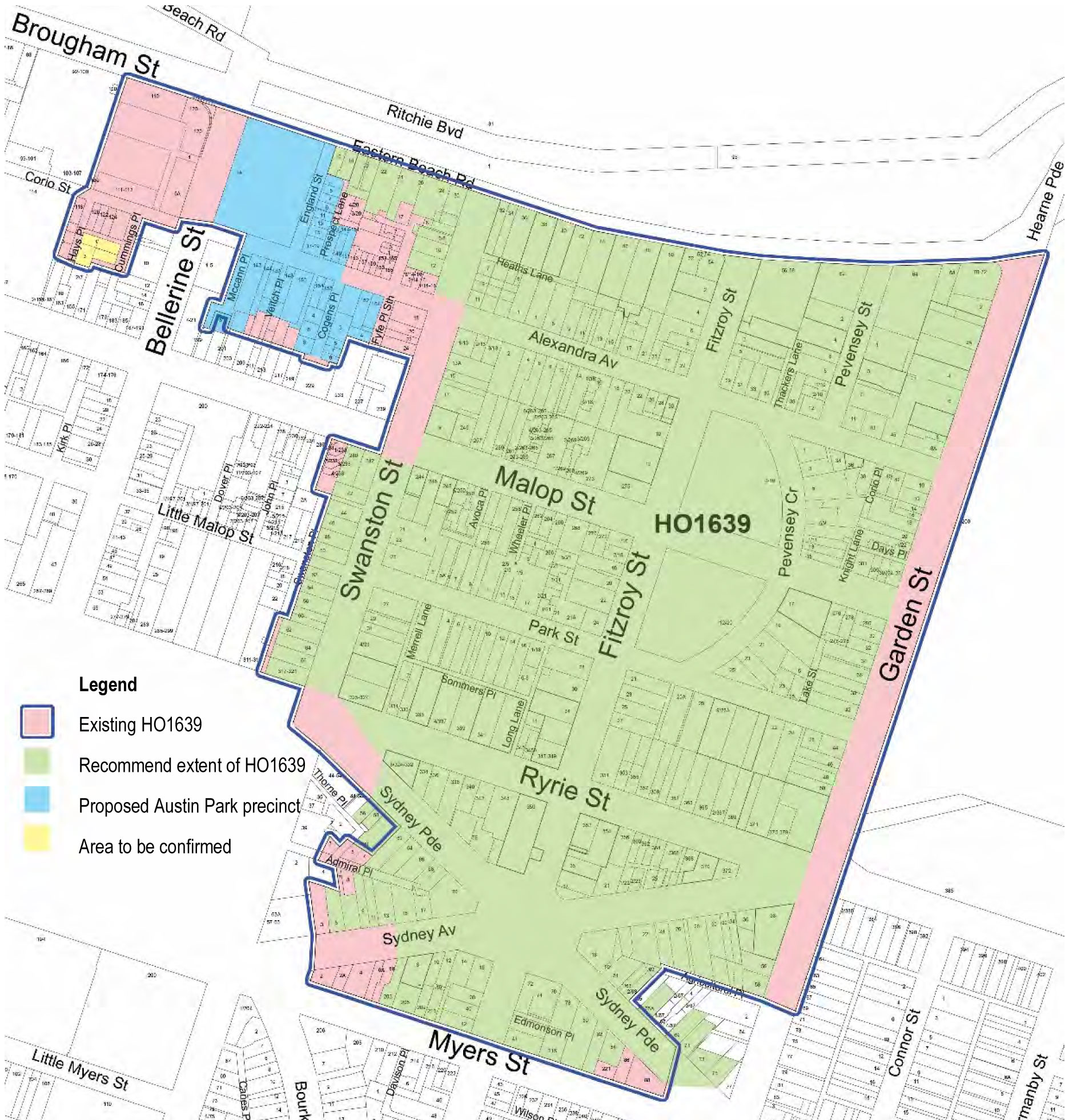
Map showing parts of precinct to be removed (pink)
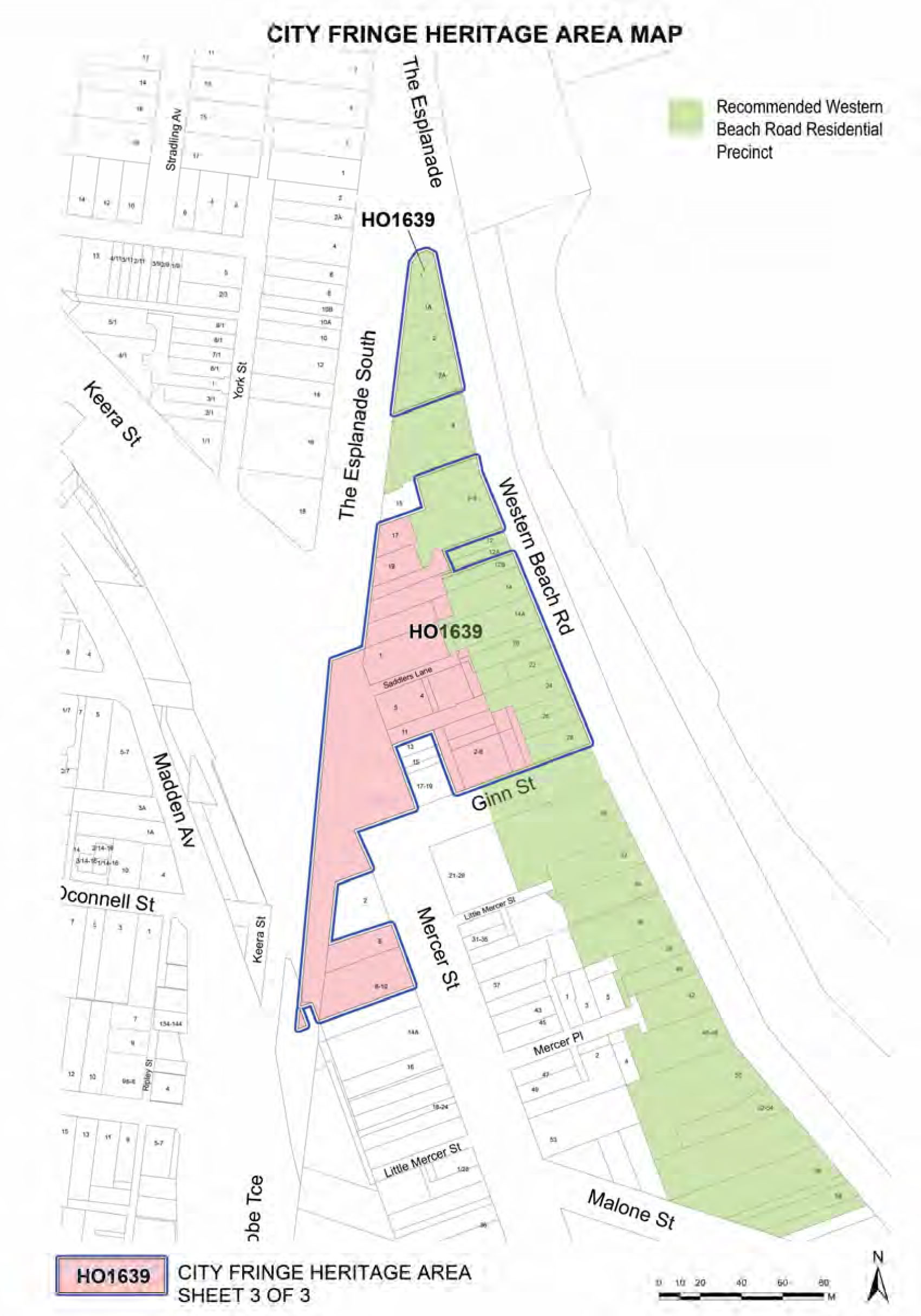
Map showing recommended Western Beach Road residential precinct (green), existing northern part of HO1639 (blue outline) and section of precinct overlay recommended for removal (pink)
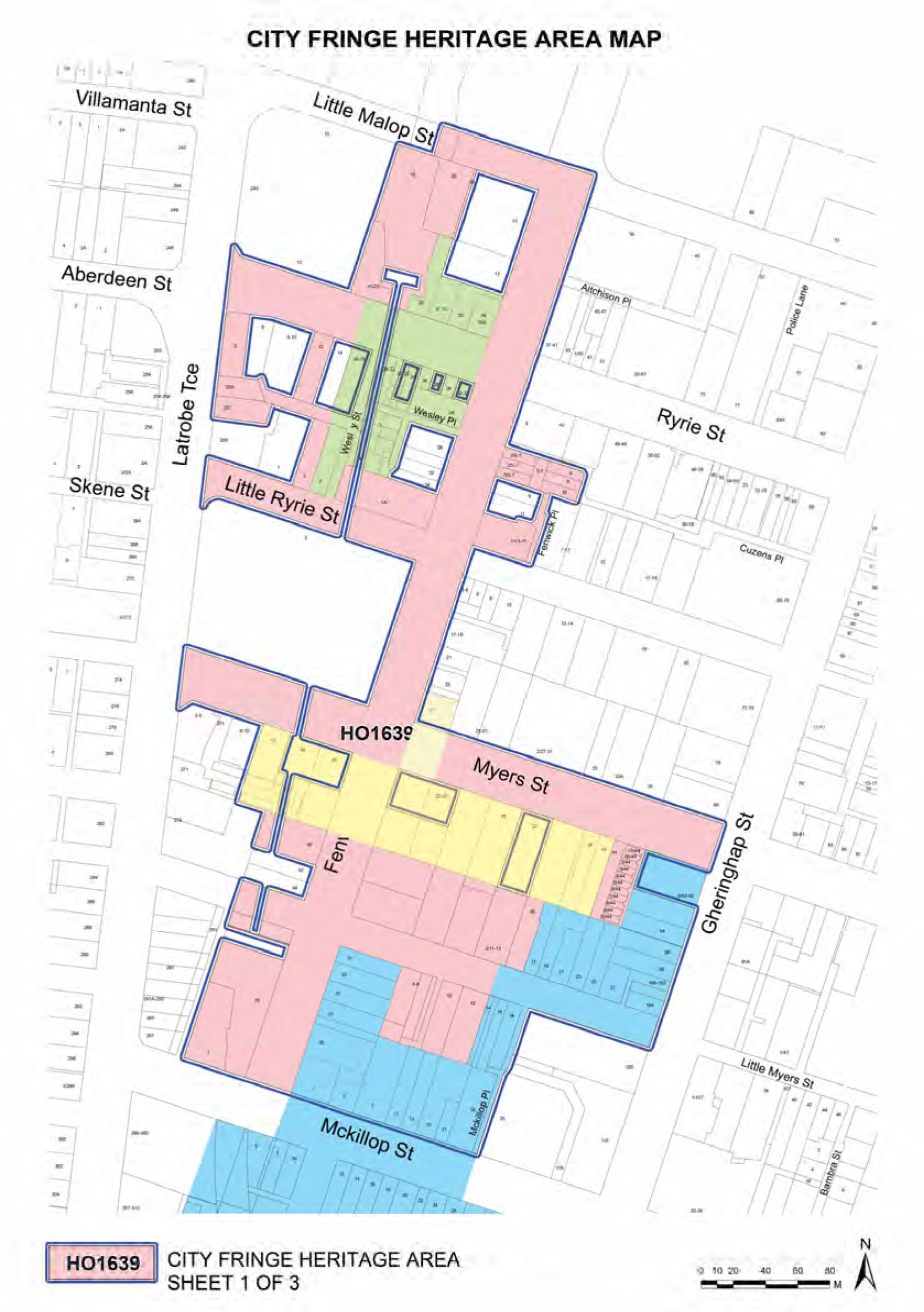
Map showing recommend extension to City South Heritage Area HO1641 (blue), recommended Myers Street residential precinct (bright yellow), recommended Ryrie Street commercial precinct (green), boundary of existing HO1639 (blue outline) and section of precinct recommend for removal (pink)
Ceres
Include the following properties in the Heritage Overlay on the planning scheme maps and in the Schedule to Clause 43.01:
605 Barrabool Road: Ceres Primary School
20 Cochranes Road: Barrabool Recreation Reserve
240 Gully Road: ‘Barwonside’
285 Gully Road: ‘Erinvale’
17 McCann Street: Former Wesleyan Church & Sunday School
100 McCann Street: ‘Hurley House’
Denny Lascelles Wool Store – 20 Brougham Street, Geelong
Include 20 Brougham Street Geelong in the Heritage Overlay on the planning scheme maps and in the Schedule to Clause 43.01
City Fringe Heritage Area HO1639
In the eastern section:
Include the properties at 56-60, 65A, 69-75 Sydney Parade in HO1639 on the planning scheme map.
Delete HO1639 from the following properties on the planning scheme maps:
Admiral Place (no’s 3-7, 8),
Bellarine Street (no’s 6-8),
Brougham Street (no’s 110-120),
Corio Street (no’s 109-113, 118-126, 153-165),
Fyfe Place Nth (no’s 1-7),
Malop Street (no. 238),
Myers Street (no. 221),
Swanston Street (no’s 14-24),
Sydney Avenue (no’s 3, 2-6B),
Sydney Parade (no’s 86-88)
McCann Place (no’s 4-6)
Cogens Place (no’s 3, 4, 5, 6, 7, 8, 9)
Eastern Beach Road (no 14A)
Bellerine Street (no 1A)
Corio Street (no’s 142, 144, 146, 148, 150, 154, 156, 158-160, 162, 162
Veitch Place (no 1)
England Street (no’s 1, 5, 7, 9, 11, 13, 15, 17-19)
Fyfe Place South (no 4)
Admiral Place (no 3)
Corio Street (no’s 147, 149, 151)
Malop Street (201, 203)
Add Hays Place to HO1637.
Rename and amend Clause 22.30 of the Planning Scheme Ordinance.
Amend the entry for HO1639 in the Schedule to Clause 43.01 – changes will also address the northern and western sections.
Apply a new Heritage Overlay to the Austin Park and Environs Heritage Precinct, to the following properties on the planning scheme maps:
McCann Place (no’s 4-6)
Cogens Place (no’s 3, 4, 5, 6, 7, 8, 9)
Eastern Beach Road (no 14A)
Bellerine Street (no 1A)
Corio Street (no’s 142, 144, 146, 148, 150, 154, 156, 158-160, 162
Veitch Place (no 1)
England Street (no’s 1, 5, 7, 9, 11, 13, 15, 17-19)
Fyfe Place South (no 4)
Admiral Place (no 3)
Corio Street (no’s 147 , 149, 151)
Add a new clause 22.68 to the Planning Scheme Ordinance as the new local policy for the Austin Park and Environs Heritage Precinct.
Add a new entry in the Schedule to Clause 43.01 for the Austin Park and Environs Heritage Precinct.
In the northern section:
Delete the northern section of HO1639 from the planning scheme maps.
Apply a new Heritage Overlay on the planning scheme maps to the Western Beach Road Heritage Precinct, including existing properties at 1-28 Western Beach Road and extending the precinct southwards to no. 58 Western Beach Road:
Ginn Street (no 7)
Western Beach Road (nos 1, 1A, 2, 2A, 4, 6-8, 12, 12A, 12B, 14, 14A, 20, 22, 24, 26, 28, 30, 32, 34, 36, 38, 40, 42, 44, 46-48, 50, 52-54, 56, 58)
Add a new Clause 22.69 to the Planning Scheme Ordinance as the new local policy for the Western Beach Road Heritage Precinct.
Add a new entry in the Schedule to Clause 43.01 for the Western Beach Road Heritage Precinct.
Delete HO1639 from the commercial properties fronting Mercer Street.
Include 11 Mercer Street in a new heritage overlay on the planning scheme maps
Add a new entry in the Schedule to Clause 43.01 for 11 Mercer Street.
In the western section:
Delete the western section of HO1639 from the planning scheme maps.
Apply a new Heritage Overlay on the planning scheme maps to the Myers Street Residential Precinct (south side Myers Street, no’s 12-44)
Myers Street (no’s 12, 18, 22-26, 34, 38 and 40)
Latrobe Terrace ( part of no 271)
Add a new Clause 22.70 to the Planning Scheme Ordinance as the new local policy for the Myers Street Residential Precinct.
Add a new entry in the Schedule to Clause 43.01 for the Myers Street Residential Precinct.
On the planning scheme maps, delete HO1639 from the commercial premises to Wesley Place, Ryrie, Wesley and Little Ryrie Streets and include them in HO1637 (Geelong Commercial Heritage Area):
Wesley Place (2, 4)
Wesley Street (no 13)
Ryrie Street (no’s 16-18, 20-22, 25, 26, 26A, 30, 30A, 31-33, 35, 35A)
Little Ryrie Street (no 5)
Fenwick Street (no’s 16, 24)
On the planning scheme maps, delete HO1639 from most of the houses to Fenwick, Gheringhap, Little Myers, and McKillop Streets and include them in HO1641 (City South Heritage Area):
Gheringhap Street (no’s 94, 96, 98, 100-102, 104)
McKillop Street (no’s 3, 5, 7, 11, 13, 15, 17, 19)
Fenwick Street (no’s 31, 33, 35, 37, 39)
Little Myers Street (no’s 14, 16, 17, 18, 19, 21, 23, 25, 27)
Delete HO1639 from 40 Fenwick Street and 253 La Trobe Terrace on the planning scheme maps.
Apply a new HO on the planning scheme maps to 3 Little Ryrie Street.
Add a new entry in the Schedule to Clause 43.01 for 3 Little Ryrie Street
Apply a new HO on the planning scheme maps to 36-44 Ryrie Street.
Add a new entry in the Schedule to Clause 43.01 and 36-44 Ryrie Street
Delete HO121 from part of 279 La Trobe Terrace from the planning scheme map and the Schedule to Clause 43.01.
Heritage Anomalies
Delete HO1068 (299 Moorabool Street Geelong) from the planning scheme map and the schedule to Clause 43.01.
Amend the extent of the mapping of HO252 (100 Yarra Street Geelong) on the planning scheme map.
Delete HO644 (12 Candover Street Geelong West) from the Schedule to Clause 43.01.
Amend (reduce) the extent of the mapping of HO1736 (5-55 Fyansford-Gheringhap Road, Fyansford) on the planning scheme map.
Amend the Schedule to Clause 43.01 to delete the ‘Yes’ in the ‘Tree Controls Apply?’ column for HO696 at 25 Glenleith Avenue Drumcondra.
Delete HO1624 from the properties at 3 & 5 Urana Street Newtown and HO1301 from 1/7 and 2/7 Urana Street Newtown on the planning scheme map.
Amend (increase) the extent of the mapping of HO251 at 82-92 Gheringhap Street Geelong on the planning scheme maps to include the whole of the “Wellwood Terrace”.
Source: |
City Services - Engineering Services |
Director: |
William Tieppo |
Index Reference: |
Geelong Saleyards |
For Council to note the completion of the Livestock Market Analysis report.
In December 2016 Council resolved to defer all works on the cattle section of the Geelong Saleyards until completion of:
A livestock market analysis;
An agribusiness strategy; and
A full costing of necessary works to bring the cattle yards up to acceptable occupational health and safety (OH&S) standards.
The City commissioned an independent specialist agricultural strategy and marketing advisory business to undertake an analysis of, and to provide data on, the Geelong and the G21 region’s current livestock market and predicted future livestock trends.
The Consultants key findings were:
Livestock numbers in Victoria have declined, and across Victoria they are stagnant at best. Livestock numbers are impacted by broad acre farming, as well as continued urbanisation in the G21 region.
Rationalisation of saleyards in Victoria is ongoing and other selling options are rapidly emerging, such as new regional saleyards and on-line sales. These options are attracting sellers away from small saleyards.
Profitability in saleyards is directly correlated with throughput; achieving profitability under the existing saleyards model in small local saleyards is extremely difficult. Ongoing competition for numbers will make the probability of any increase in throughput unlikely.
The size of farm businesses in the Geelong region has reduced and the livestock sales facilities needed to support smaller scale, or peri-urban farming, is very different from the traditional model. There is an expectation from peri-urban farmers in the G21 region that the City of Greater Geelong provide a livestock exchange suitable for their needs. This expectation is specific to the G21 region. The existing Geelong Saleyards facility is not the most suitable facility to meet the needs of the peri-urban farmers. Whilst it is possible to modify the Geelong Saleyards to suit all future requirements, including the needs of peri-urban farmers, further investigation is needed to identify the most suitable livestock exchange facility for the future.
The saleyards model that has existed in Geelong for over 150 years is not the solution to provide a suitable livestock exchange for the G21 demographic existing now and into the future.
L Gardner moved, P Dorling seconded -
That Council note the Geelong Saleyards Market Analysis Report (Attachment 2).
Carried.
Key stakeholders, including agents, members of the Geelong Saleyards Users Group, livestock producers and buyers, were consulted as part of the analysis and their input and insights into the local market are a valuable addition to the report.
The consultants have presented their draft report to the Administrators and senior City officials. They have also presented at a G21 meeting and to the Geelong Saleyards Advisory Committee.
The City will continue to consult with relevant stakeholders to complete a regional agribusiness strategy and a full costing of OH&S works for the site’s cattle yards before making a final decision on the future of the Saleyards in the coming months.
Source: |
Finance & Strategy - Property & Procurement |
Director: |
Joanne Moloney |
Index Reference: |
Land Sales |
To consider submissions received for the proposed sale of land at 29-39 Peninsula Drive, Drysdale and recommend that Council sell the land to the Roman Catholic Trust Corporation (“RCTC”).
Council resolved (28 February 2017) to give notice of its intention to sell 2.67ha of land to the RCTC for the expansion of St Ignatius College. Pursuant to s189 of the Local Government Act 1989, a public notice was published in the Geelong Advertiser and Geelong Independent (10 and 11 March 2017).
A total of 47 submissions were received, with 30 submissions opposed and 17 submissions supporting the proposed sale of land.
The Submissions Hearing Panel convened on 3 May 2017 where 3 submitters were heard (refer Attachment 2 and Attachment 3).
In making the recommendation to proceed with the sale of the land the following have been considered:
Land is zoned Special Uses 13 which specifically allows for a range of civic, community, education and recreation activities only.
Council has consulted widely on the future use of land in the precinct including advertising its intention to sell the land under s189 of the Local Government Act and in the preparation of the Potato Shed and Drysdale Sporting Precinct Masterplans.
Sufficient land around the Potato Shed will remain in Council’s ownership to allow for planned expansion of the facility.
The development by St Ignatius College of a year nine campus and a multi- purpose centre on the land will provide significant community benefit through improved education, creation of jobs and access to the wider community.
Council requests a proposal for traffic and access improvements to Peninsula Drive and adjoining schools to be submitted for consideration in the 2018/19 budget.
P Dorling moved, L Gardner seconded -
That Council:
sells the Land to the Roman Catholic Trust Corporation on the following conditions:
the price being not less than the Council certified valuation to be obtained;
the purchaser doing all things required to subdivide the land, and paying all Council’s reasonable costs;
other conditions as appropriate.
requests that designs for traffic and access improvements in Peninsula Drive be finalised and a project proposal be prepared for consideration as part of the 2018/19 budget process;
notifies submitters in writing of the Council’s decision and the reasons for that decision;
authorises the CEO to sign all documents relevant to the sale of the Land.
Carried.
Submissions received have been summarised and responses provided as follows:
Submissions Objecting to the Sale of Land
1.1 Procedural issues relating to the rescission motion of 28 February 2017.
Response
The Council resolution of 28 February 2017 relating to the sale of land is valid. The rescission of that resolution is not required as the resolution of Council of 28 July 2017 has been acted upon.
1.2 Lack of consultation with the Potato Shed Committee and other stakeholders.
Response
S189 of the Local Government Act 1989 makes provision for any person to make a submission to the sale of any Council land and 47 submissions were received. Provision is also made for submitters to be heard and 3 submitters took that opportunity.
Plans prepared for the use of the Sporting Precinct and Potato Shed similarly allowed interest groups to have input into the use of Council land in this area.
The 2017 review of the Potato Shed Masterplan did not include direct consultation with the Potato Shed Committee of Management due to conflicts of interest within that group. The review validated the 2009 Masterplan and confirmed capacity of remaining land to accommodate any reasonably foreseeable growth for the facility. The Potato Shed Masterplan project remains unfunded.
1.3 Traffic and parking issues in Peninsula Drive.
Response
In conjunction with VicRoads plans for the Drysdale by-pass road, Council is preparing designs for the realignment and extension of Peninsula Drive through to Belchers Road which will improve traffic flows within the precinct.
Stage 1 of the Drysdale Sports Precinct is under construction at the southern or Belchers Road end of Precinct. Future stages of the Sports Masterplan provide for further sports facilities opposite the Potato Shed including increased parking which, when constructed, will provide increased parking opportunities.
The road improvements along with continued implementation of the Sports Masterplan will enable improvements for vehicular access to the various schools.
It is recommended that a project proposal for Peninsula Drive be prepared for consideration as part of the 2018/19 budget process.
1.4 Disagreement with sale price and process.
Response
When selling land, s189 of the Local Government Act 1989 requires Council to obtain a certified valuation which is made not more than 6 months prior to the sale. Should Council decide to sell the land a new valuation will be obtained which will be the sale price. When preparing valuations, regard is had for recent sales of similar land in the locality.
It is noted that the land was rezoned in 2011 from Mixed Use which permitted general urban development to the current and more restrictive Special Use Zone 13.
Some submissions stated that the land should be sold on the market. When selling land, Council is guided by the Local Government Best Practice Guideline published by the State Government which states that land should be sold through a public process unless circumstances justify otherwise. In this case, the situation of the land represents the best option for expansion of St Ignatius College and the zoning recognises that the land will be used for education and other purposes. The other adjoining owner, Bellarine Secondary College, has not expressed interest in purchasing the land.
Council frequently sells (and purchases) land directly from other departments, authorities and schools.
1.5 Administrators should not be permitted to make a decision on the sale of land.
Response
Administrators were appointed in May 2016 to perform the powers, functions and duties of the Council until a new Council is elected. In addition to addressing the recommendations of the Commission of Inquiry into the Council, the Administrators are required to continue the normal business of Council in an effective and efficient manner including the sale of land as seen fit.
It is noted that in April 2015 Council did resolve to advertise its intention to sell this land to the RCTC, however, due to the inability of the purchaser to satisfy conditions imposed on the sale, Council abandoned the sale in July 2015.
1.6 Issues relating to land use and plans including the Potato Shed Master Plan.
Response
Council’s intentions for the use of up to 50ha of mainly vacant land in this precinct have in recent years been expressed in 2 strategic plans.
In 2011 the Council adopted the Drysdale Clifton Springs Sports master plan which establishes a concept plan for the use of the vacant Council land to the west of Peninsula Drive for a series of sports grounds and Council uses.
The Potato Shed has a master plan that shows future expansion of the facility including additional theatre space, music labs, recording space, exhibition space and general purpose areas. This plan was reviewed in February 2017.
The eastern portion of the Council’s Reserve containing the Potato Shed, being the land proposed to be sold, has not been designated for any purpose under either of the above master plans, including the review of the Potato Shed Master Plan. Sufficient land is being retained in Council’s ownership for future expansion of this facility.
The land upon which the campus of Bellarine Secondary College, St Thomas Primary School and St Ignatius College are currently located was originally owned by Council and substantial vacant land to the south of Bellarine Secondary College is leased to the College by Council.
1.7 Land should be retained for the benefit of the whole community.
Response
Given the lack of identified use for the land to be sold and the retention by Council of considerable vacant land around the Potato Shed and within the Sport Precinct, it is considered that substantial community benefit will be derived from the sale of the land to the RTCT. The sale will release land likely to remain vacant and unused for a considerable time and will provide much need education facilities for the growing population of both the Peninsula and wider Region. The proposed multi use facility on the land will also be accessible to and provide benefit to the broader community.
1.8 Council should not be supporting expansion of private schools.
Response
It is not the role of Council to determine the mix of education services to the community. Any perceived detriment to one education sector through the development of another sector needs to be addressed through means other than withholding land or access to land.
1.9 Effect on the environmental and cultural values of the adjacent Basin Reserve.
Response
The Basin is an important 3ha parcel of Crown land managed by Council with the support of local residents. The land contains remnant bush land and is protected by a vermin proof fence. The southern part of the land proposed to be sold shares a common boundary with the Basin.
The Basin is also identified in the Planning Scheme as having two areas of Aboriginal Heritage, the overlays for which extend onto the land to be sold, as well as land occupied by Bellarine Secondary College and other private land.
Any development by St Ignatius on the land to be purchased will require a planning permit providing the ability for the planning authority to have consideration for any environmental or cultural values in the location.
1.10 Loss of rural character.
Response
The land proposed to be sold is currently vacant land located between the Bellarine Secondary College, St Ignatius College and the Potato Shed. The land to the east is zoned and developed as rural living.
The sale of the land will see buildings erected and some of its former rural character lost.
1.11 The land should not be sold but retained for future use due to projected growth on Bellarine Peninsula.
Response
While it is acknowledged that growth is occurring across the Peninsula, there is an immediate and recognised need for St Ignatius College to expand to respond to that growth. Council retains significant land in the precinct to cater for future known and unanticipated demands.
1.12 St Thomas Primary School could be moved to the western side of Peninsula Drive to alleviate traffic concerns.
Response
It is likely that the potential cost of relocating the primary school will not justify the possible improvements in safety in Peninsula Drive. As noted above, those improvements will be considered with the redesign of Peninsula Drive and southern connections to Grubb Road.
Submissions Supporting the Sale of Land
2.1 The sale of land will allow construction of a year 9 campus and multi-purpose centre.
2.2 St Ignatius College has a region wide catchment and requires improvements to its campus to meet needs of students.
2.3 Provision of a multi-purpose hall will be accessible to and benefit the wider community.
2.4 Development of the land provides $9 million investment for jobs, education and community benefit for which government funding is provided.
2.5 St Ignatius College plans to remain a user and financial contributor to the Potato Shed.
2.6 Benefits and attraction of affordable non-government schools to growing communities.
2.7 Council has zoned the Peninsula Drive precinct for education and recreation purposes.
2.8 Sufficient space exists in the precinct for a range of other users.
2.9 The sale of land does not effect the growth options for the Potato Shed.
2.10 An expanded St Ignatius College will compliment strong growth at St Josephs Geelong.
2.11 Links between the St Ignatius College and wider community.
Response
All supporting submissions are noted.
A valuation dated June 2016 valued the land at $740,000 plus GST. An updated certified valuation of the land will be obtained which will be the sale price.
Advice has been received from Council’s engineering consultant that costs of approximately $55,000 will be incurred in subdividing the land. Those costs, in addition to any survey and Council valuation costs, will be met by the purchaser.
Consultation has occurred through the giving of notice to intention to sell land and the hearing of submissions. Consultation has also occurred in the preparation of both the Potato Shed Masterplan and the Drysdale Sports Precinct Masterplan.
The Local Government Best Practice Guideline for the Sale and Exchange of Land recommends that where ever possible land be sold by a public process such as auction or listing. In this case a direct sale to the Roman Catholic Trust is recommended as there are no other adjoining interested purchasers and it is appropriate that the land be used for education purposes.
The provisions of Section 189 of the Local Government Act (“LG Act”) which require giving of notice and obtaining a certified valuation have or will be complied with prior to transfer of the land.
The recommendation supports the action priority relating to Responsible and Sustainable Financial Management where the sale of assets no longer required will support the identified progress indicators. The sale of the land will provide the best option for the expansion of St Ignatius College to meet its projected demands for education.
No officers or contractors involved in the preparation of this report have a direct or indirect interest in matters to which this report relates.
The risks associated with the subdivision and sale of this land are able to be managed following normal management procedures and processes.
Upon sale of the land and subsequent development, any implications for the environmental and cultural aspects of the Basin can be addressed by the planning authority as part of the planning permit process.
6pm | City Hall Council Chamber
ATTENDEES
Panel Members: Kathy Alexander, Laurinda Gardner, Peter Dorling
Management: Joanne Moloney, Travis Kirwood, Alan Grant
APOLOGIES
Nil
NO. ITEM
Welcome
Kathy Alexander welcomed those attending.
Conflicts of Interest
Nil
Background
28 February 2017 Council resolved to give notice of intention to sell 2.67ha of land to the Roman Catholic Trust Corporation for expansion of St Ignatius College.
Notice under s189 of the Local Government Act 1989 was published 10 and 11 March 2017 Independent and Geelong Advertiser.
Submissions period closed 11 April 2017.
Total submissions received 47. 30 objecting and 17 in support.
Process from here is that following the Panel hearings, Council receives and report from the Panel and a recommendation from management before making a final decision.
Hearing of Submission from Bellarine Secondary College
Presented by Jacqui Pierce, College Council President and Alison Murphy, Principal
Summary of objecting submission:
Council has failed to consult with community groups, organisations, Potato Shed Committee of Management on the proposed sale of land and review of the Potato Shed Masterplan.
The land should be retained to cater for future population growth on the Bellarine Peninsula and the Potato Shed.
Increased risk associated with increased generation of traffic on Peninsula Drive.
The sale process has not been open and transparent.
No identified net gain to the broader Bellarine Community.
Hearing of Submission from St Ignatius College
Presented by Tony Frizza, College Council President and Michael Exton, Principal
Summary of supporting submission:
The proposed sale of land supports Council’s vision for the Precinct.
The sale of land will enable construction of two much needed facilities – a year nine centre and multi purpose centre, projects backed by Government funding.
The proposed facilities are required to meet demand from growing enrolments.
Growth will have negligible impact on traffic as more than 90% of students travel to the College by bus.
All education providers are planning new facilities and modest development at St Ignatius College should not affect enrolments at government schools.
Notes supporting submissions relating to the College’s community contribution.
Notes that plans for expansion of the Potato Shed can be comfortably accommodated on land to the retained.
Hearing of Submission from Tom O’Connor.
Summary of objecting submission:
Raised concerns about traffic hazards in Peninsula Drive.
Suggested relocation of St Thomas’ Primary School to Council land west of Peninsula Drive.
Hearings concluded at 6.30pm.
The Panel convened to consider all submissions, a summary of which was provided.
The meeting of the Panel concluded at 6.50pm.
Note: Blue highlight represents supporting submissions
Submission Summary |
|
1. |
|
2. |
|
3. |
|
4. |
|
5. |
|
6. |
|
7. |
|
8. |
|
9. |
|
10. |
|
11. |
|
12. |
|
13. |
|
14. |
|
15. |
|
16. |
|
17. |
|
18. |
|
| 19. |
|
| 20. |
|
| 21. |
|
| 22. |
|
| 23. |
|
| 24. |
|
| 25. |
|
| 26. |
|
| 27. |
|
| 28. |
|
29. |
|
30. |
|
31. |
|
32. |
|
33. |
|
34. |
|
35. |
|
36. |
|
37. |
|
38. |
|
39. |
|
40. |
|
41. |
|
42. |
|
43. |
|
44. |
|
45. |
|
46. |
|
47. |
|
Source: |
Finance & Strategy - Strategy & Program Delivery |
Director: |
Joanne Moloney |
Index Reference: |
Corporate Strategy |
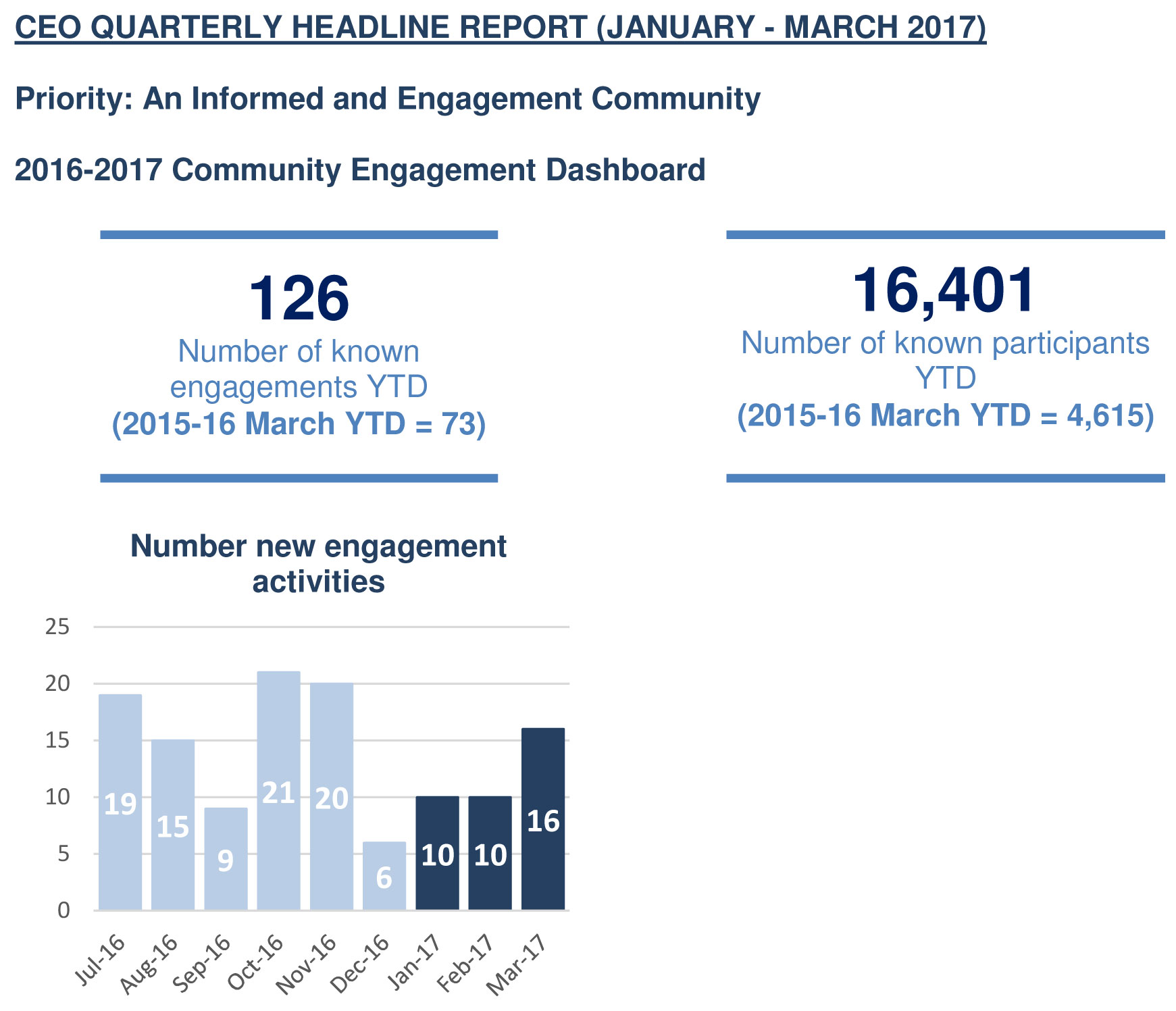
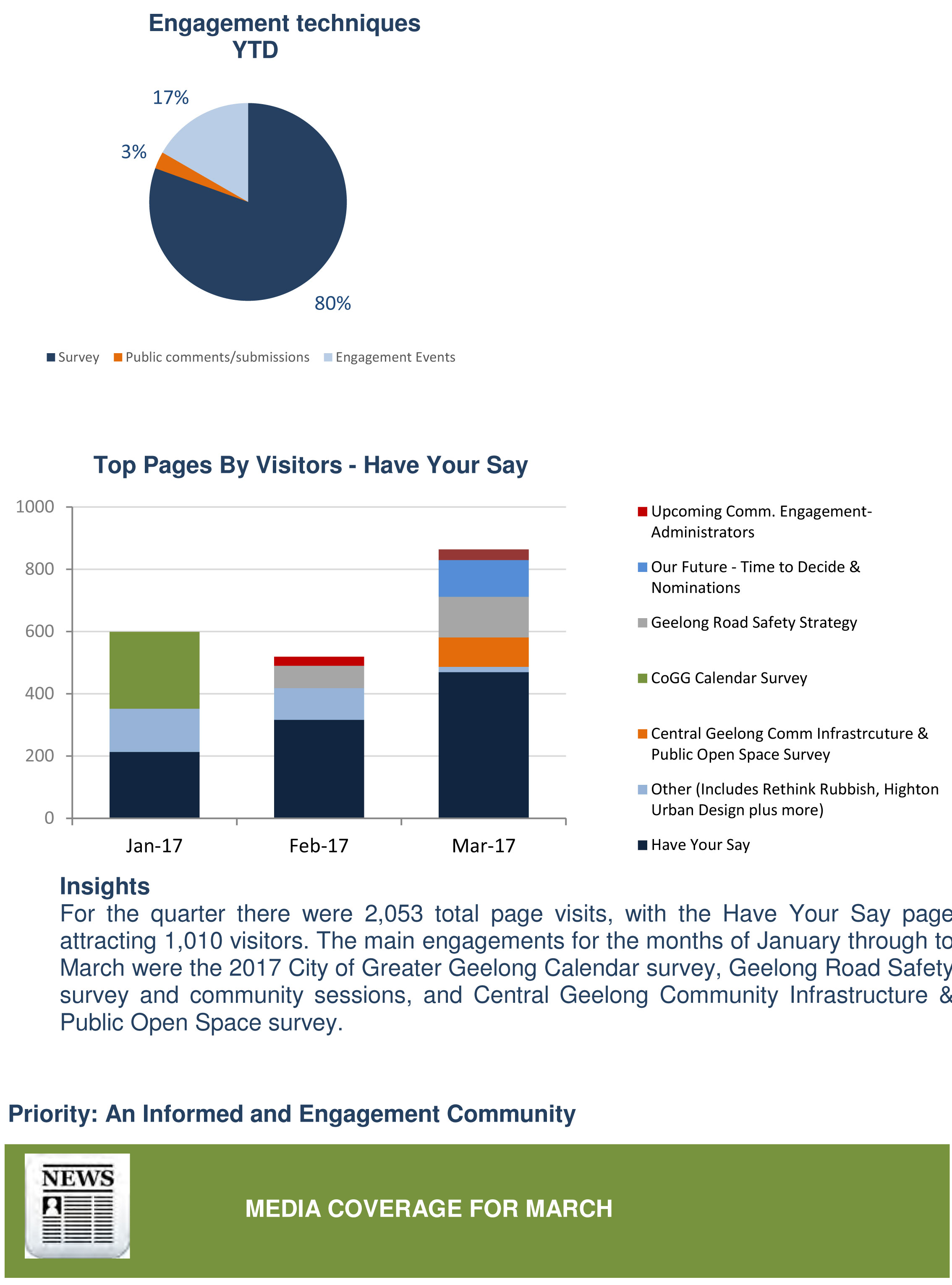
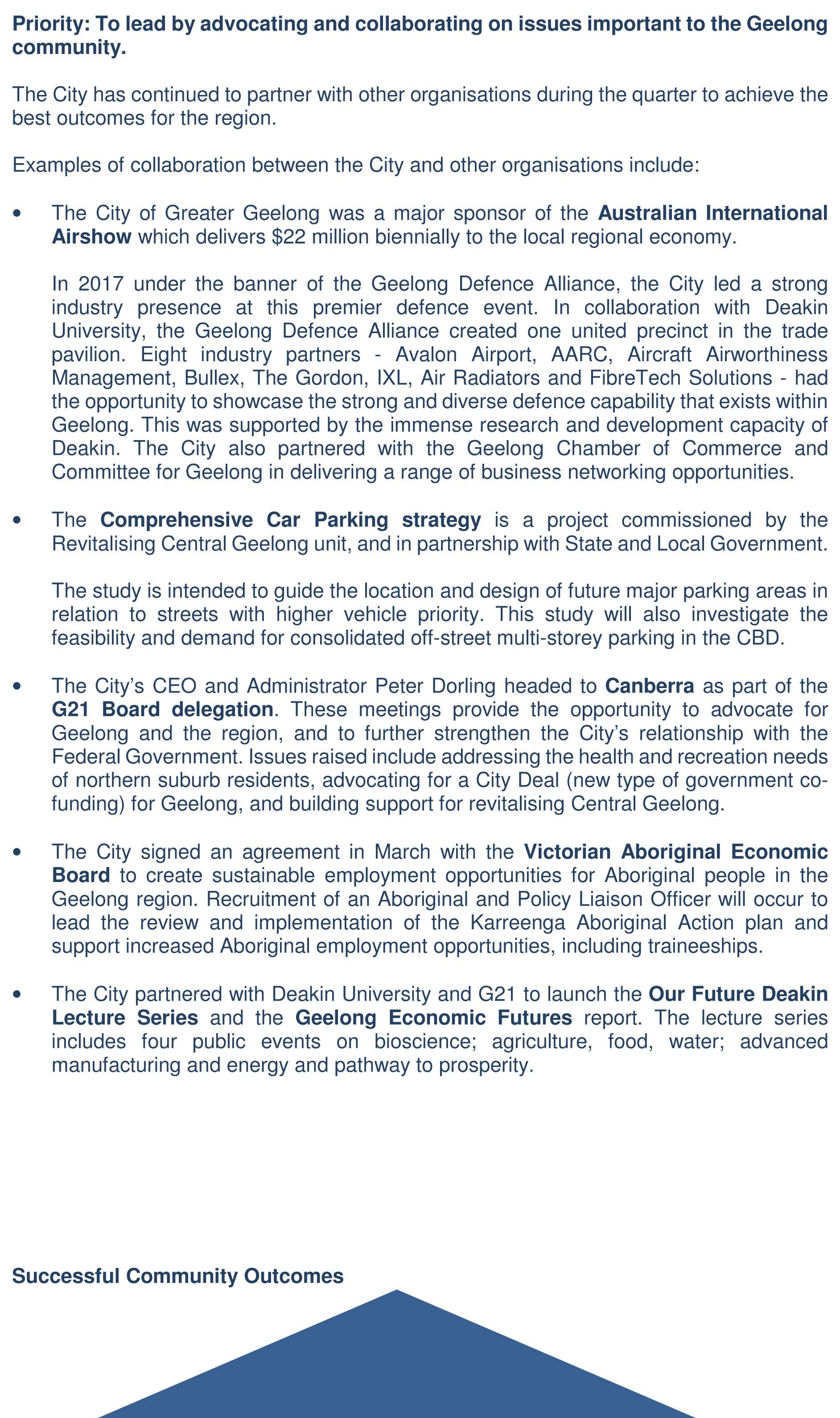
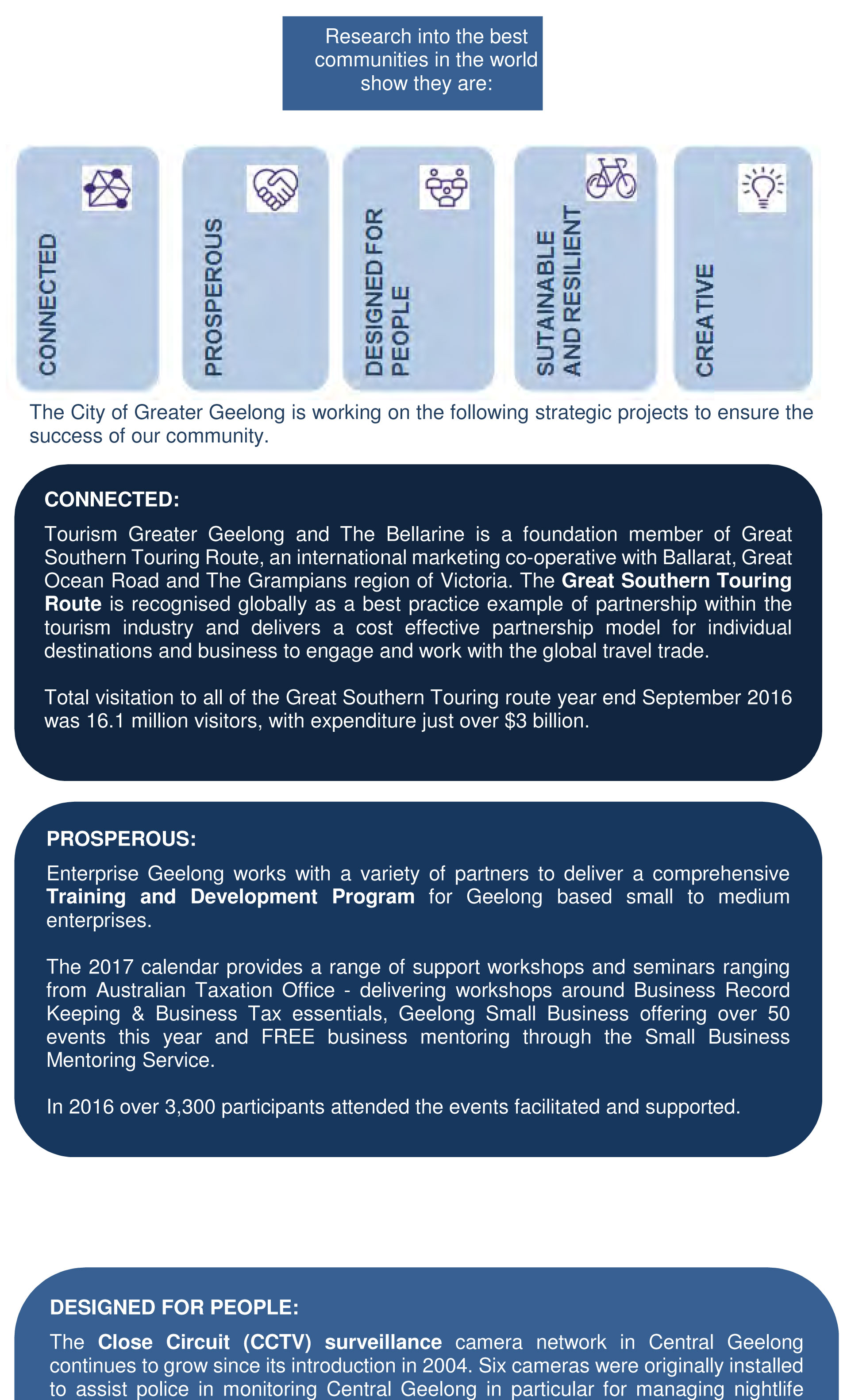
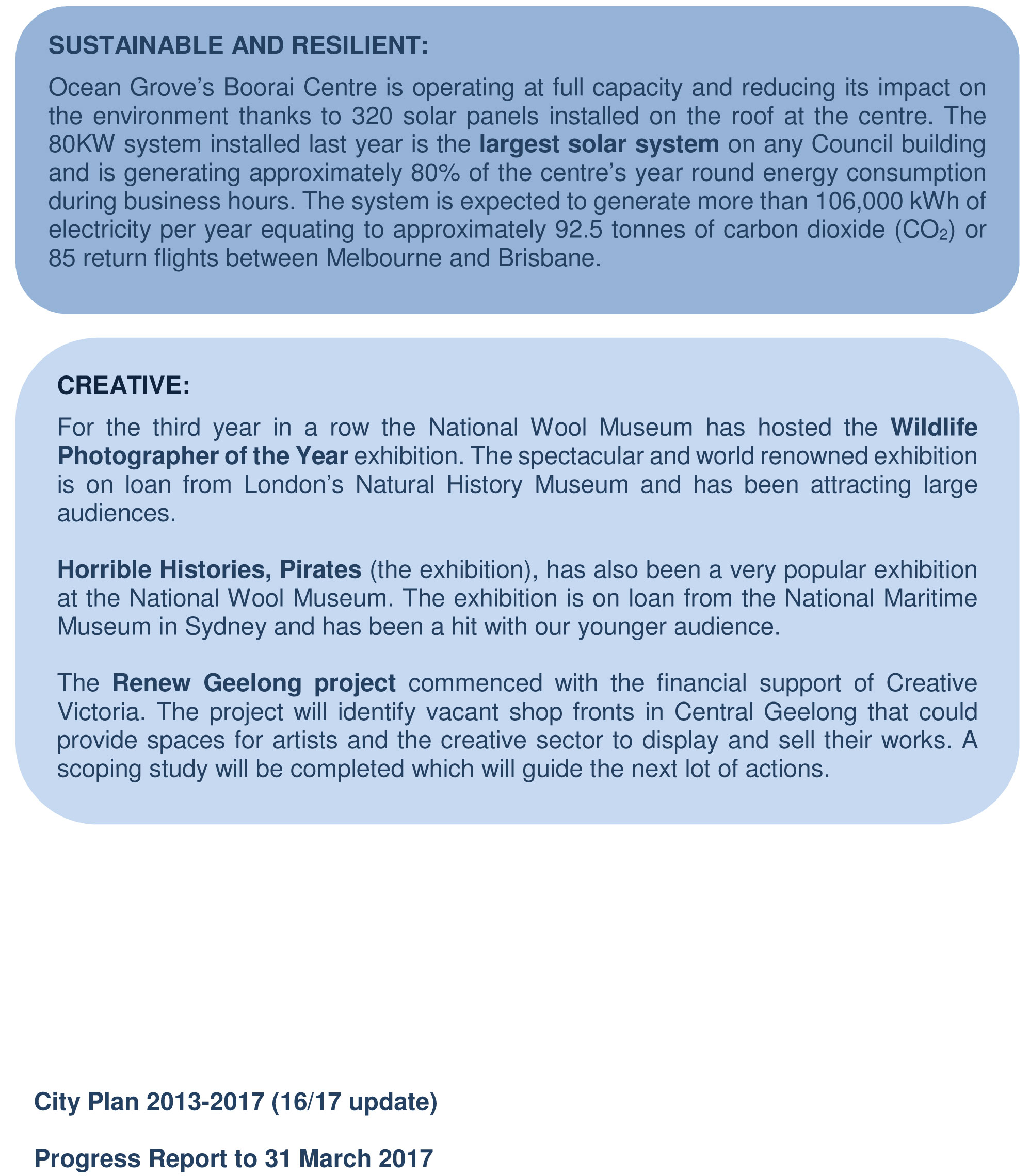
To provide the community with an update of Council’s performance and progression on key projects for the past quarter.
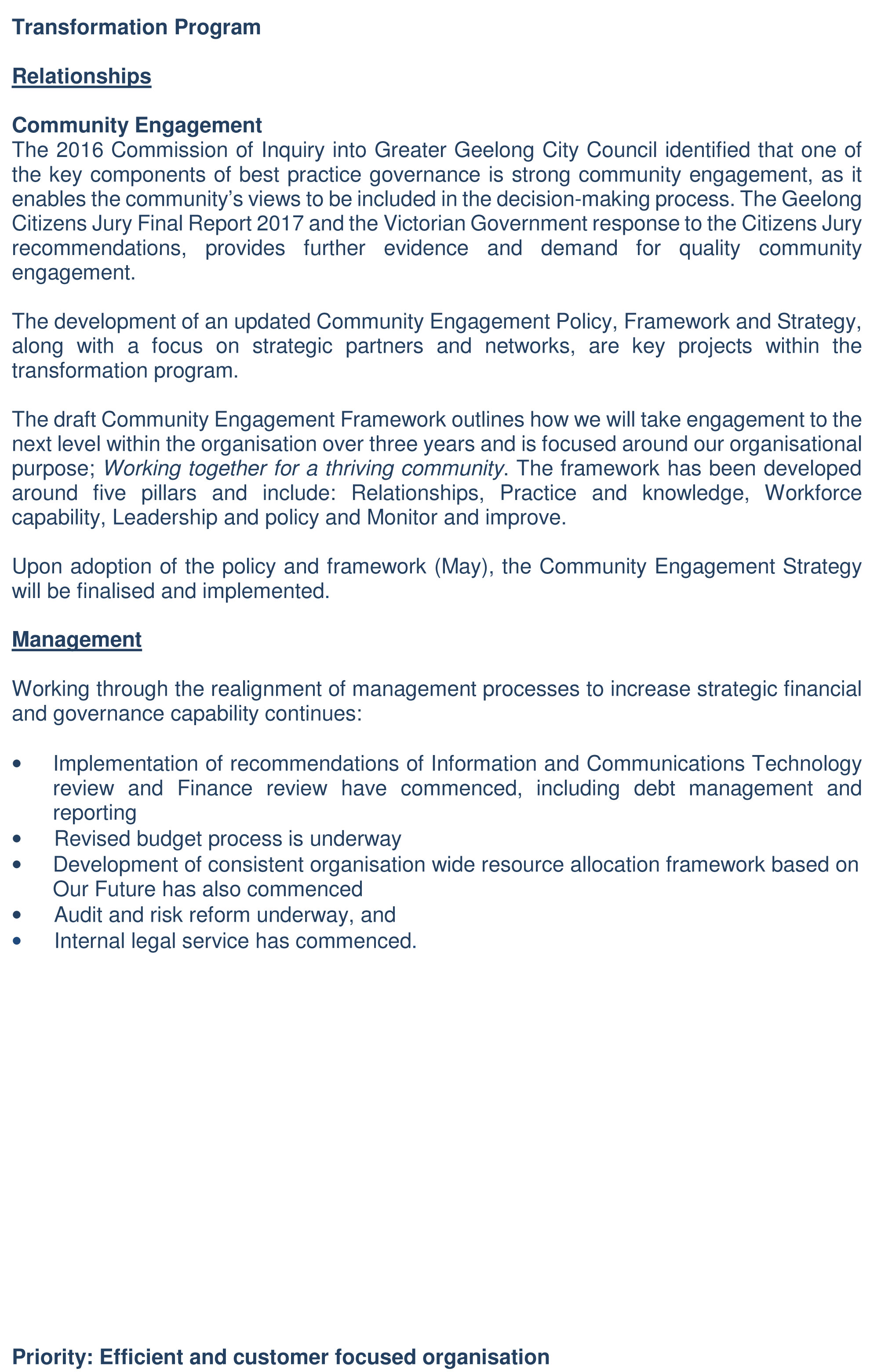
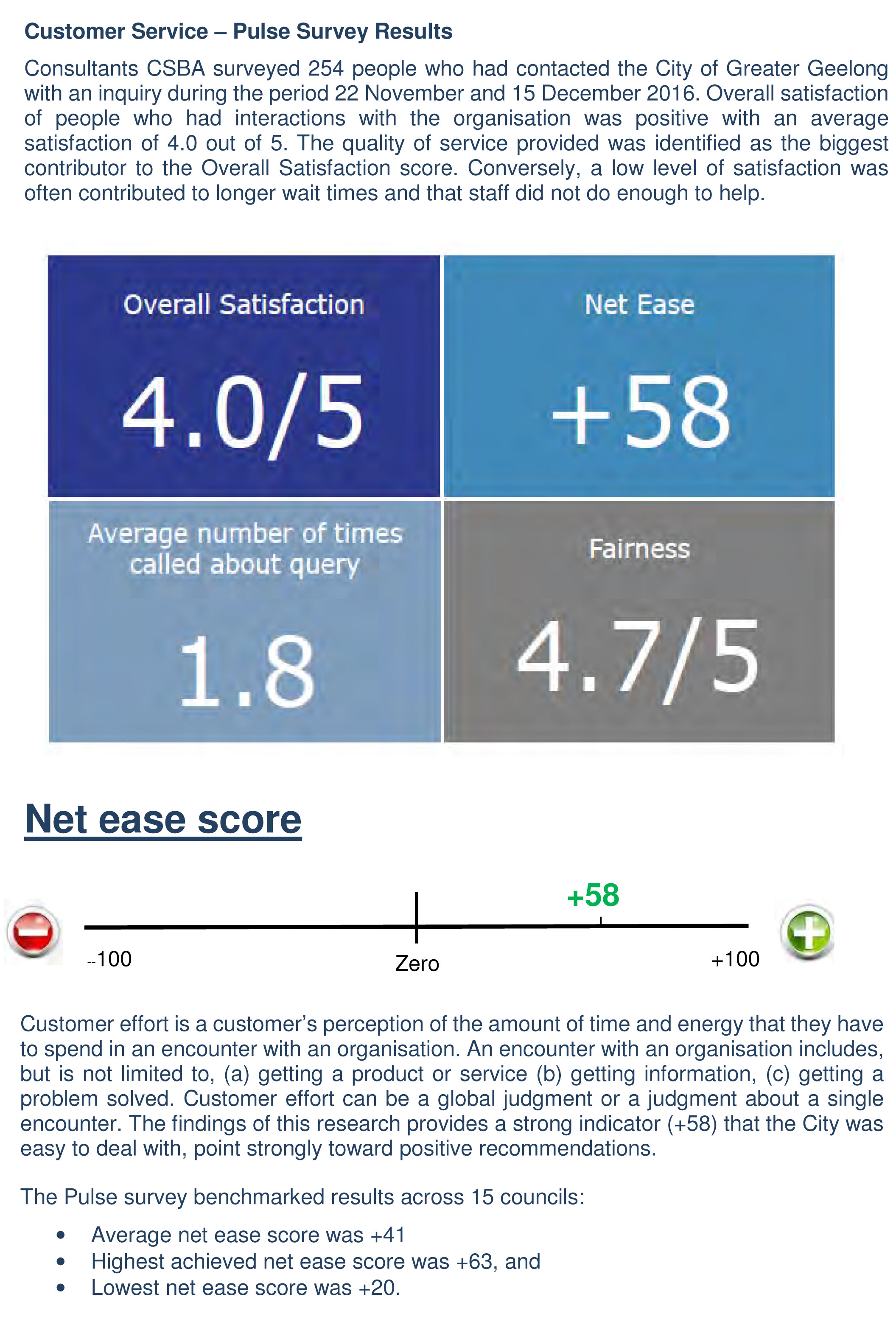
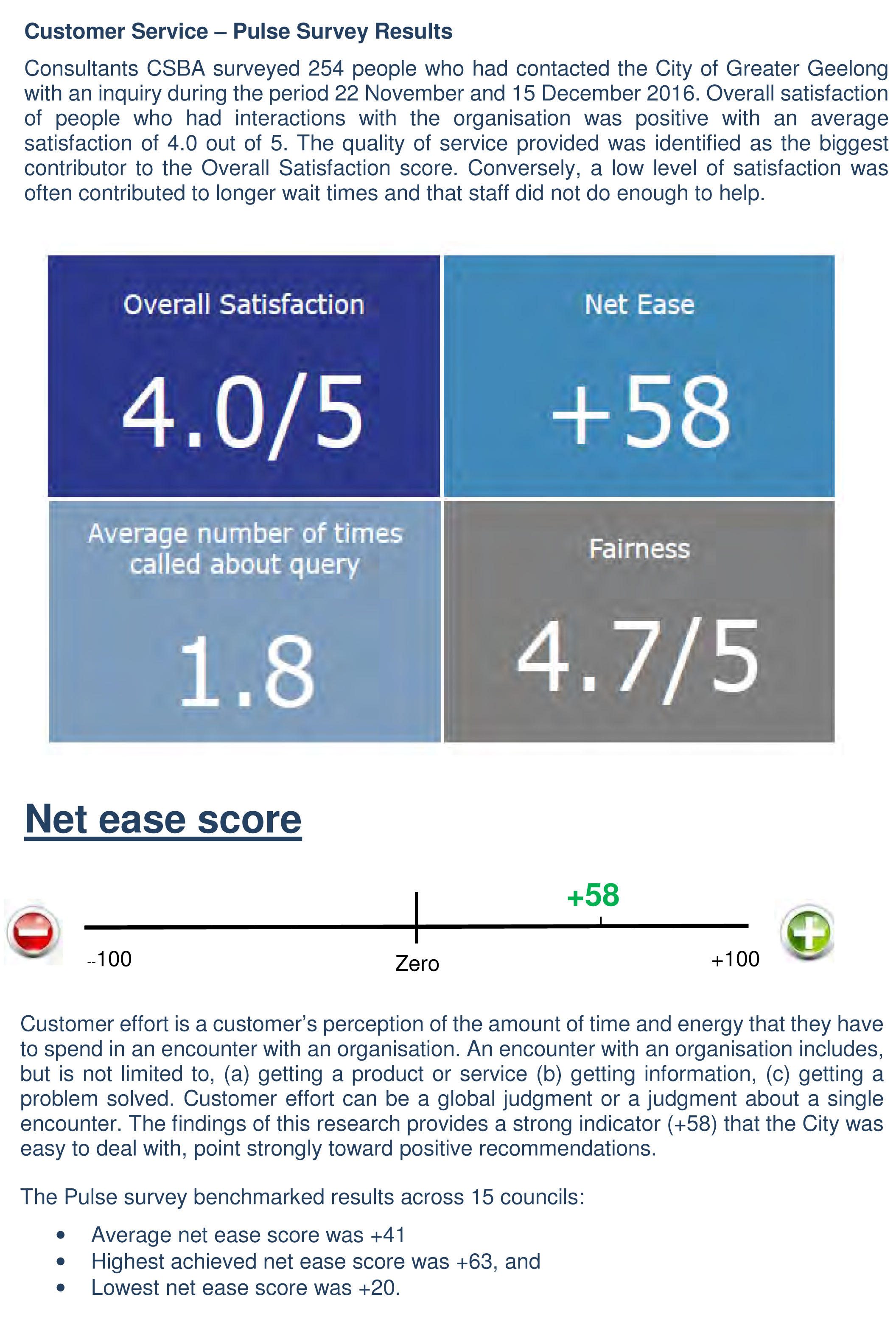
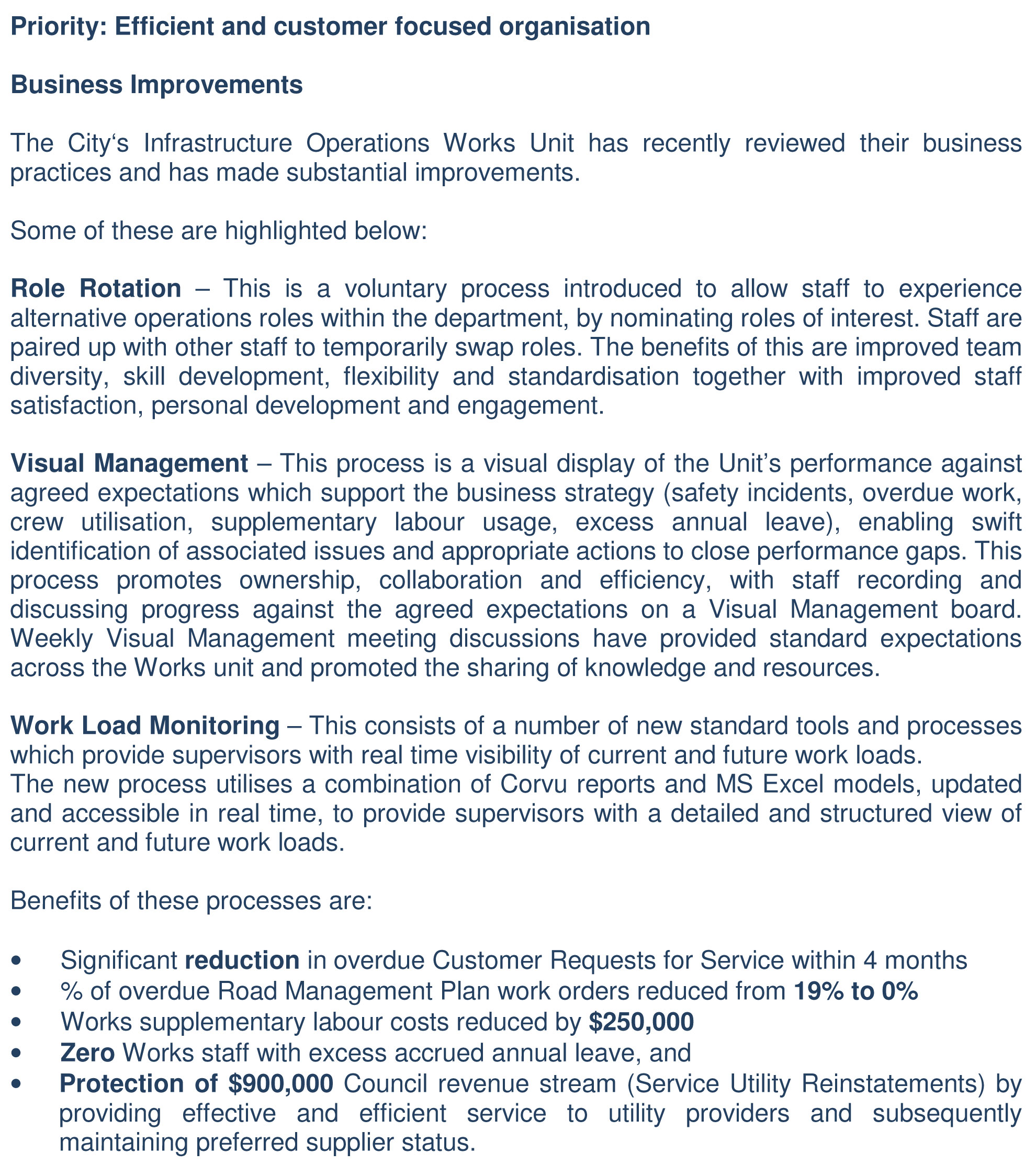
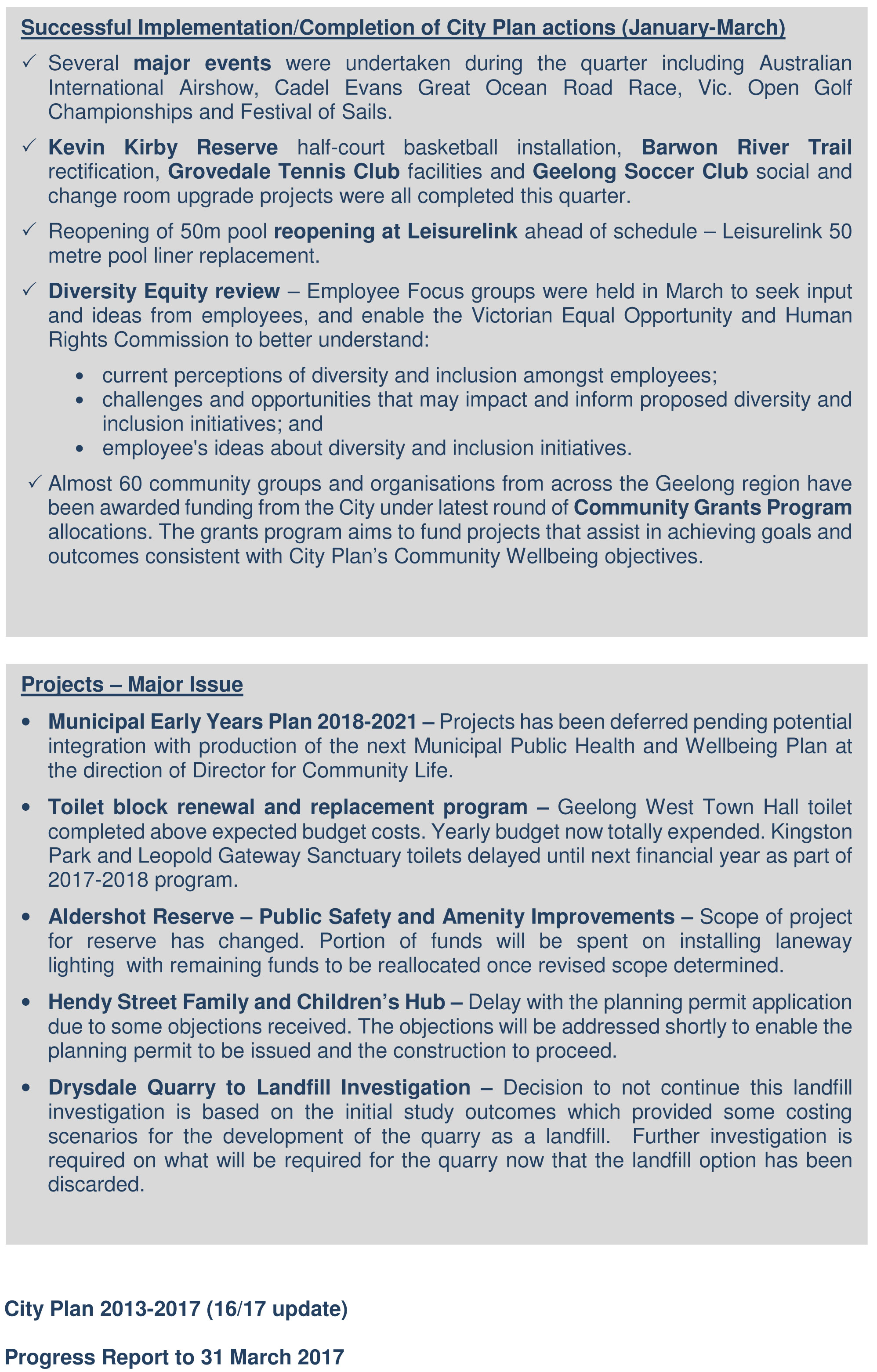
The CEO Quarterly Headline Report has been developed to meet our commitment to be transparent in performance reporting, including progress updates on 2016-2017 City Plan actions for the quarter.
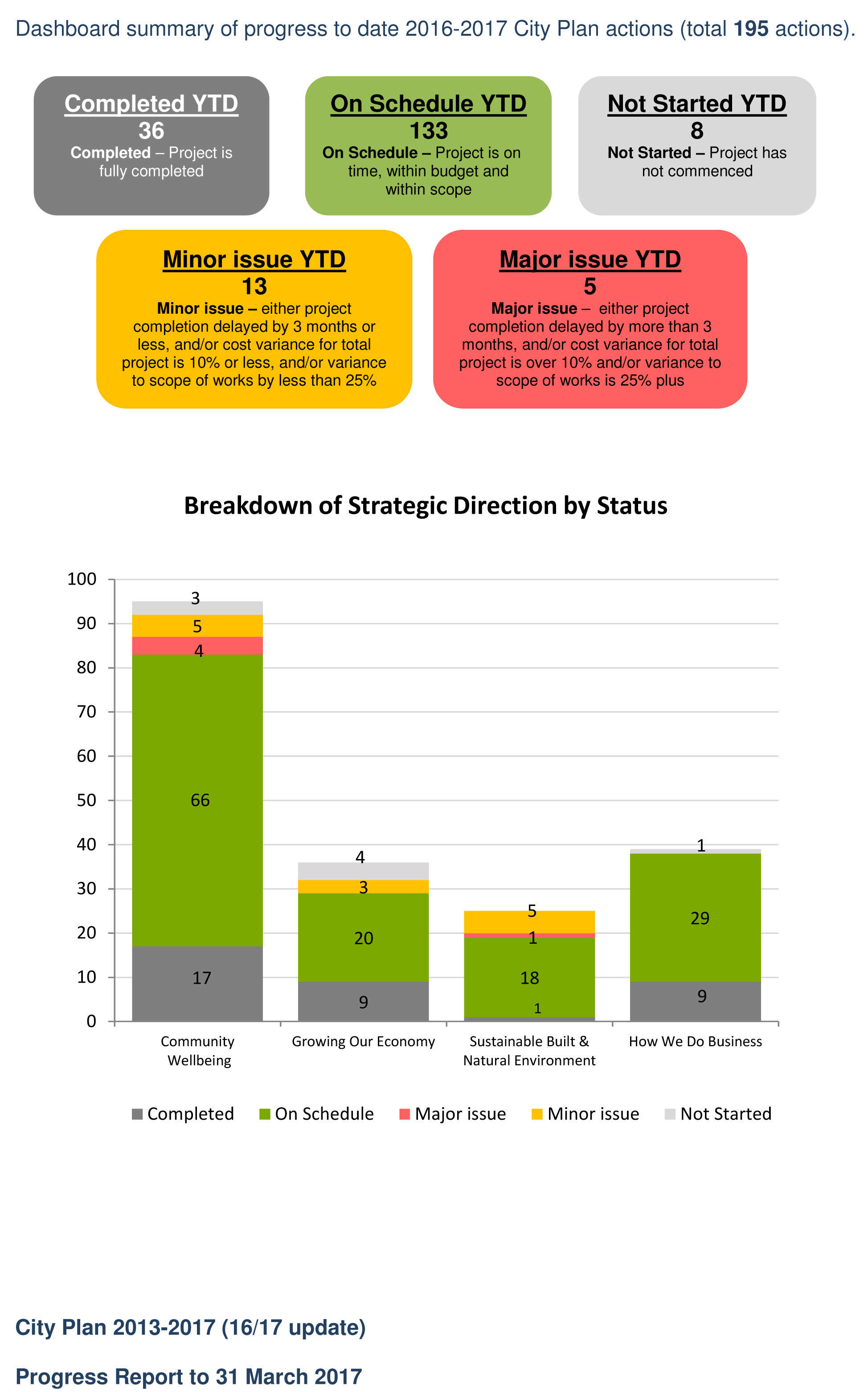
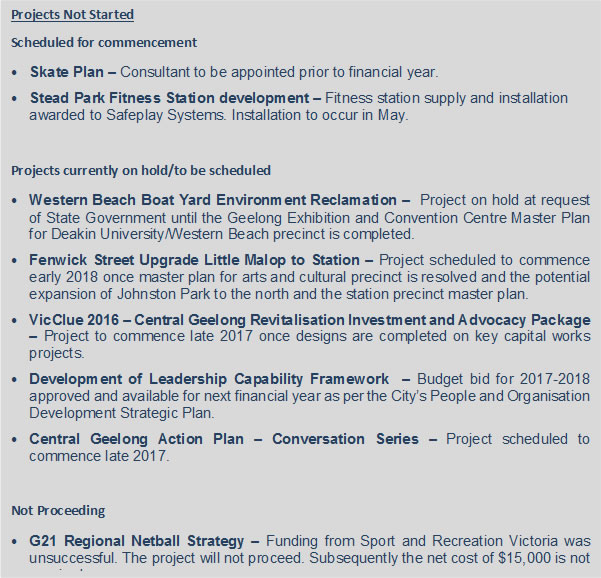
There are 195 actions Council has committed to in the 2016-2017 City Plan, there are five of these actions with ‘‘Major’ issues and eight have ‘Not Started’ for various reasons (refer to Attachment 1, Pages 14 and 15).
A comprehensive report on the status of all actions is attached (refer City Plan 2013 -2017 Progress Report - Attachment 2).
L Gardner moved, P Dorling seconded -
That Council receives the CEO Quarterly Headline Report noting the results and commentary.
Carried.
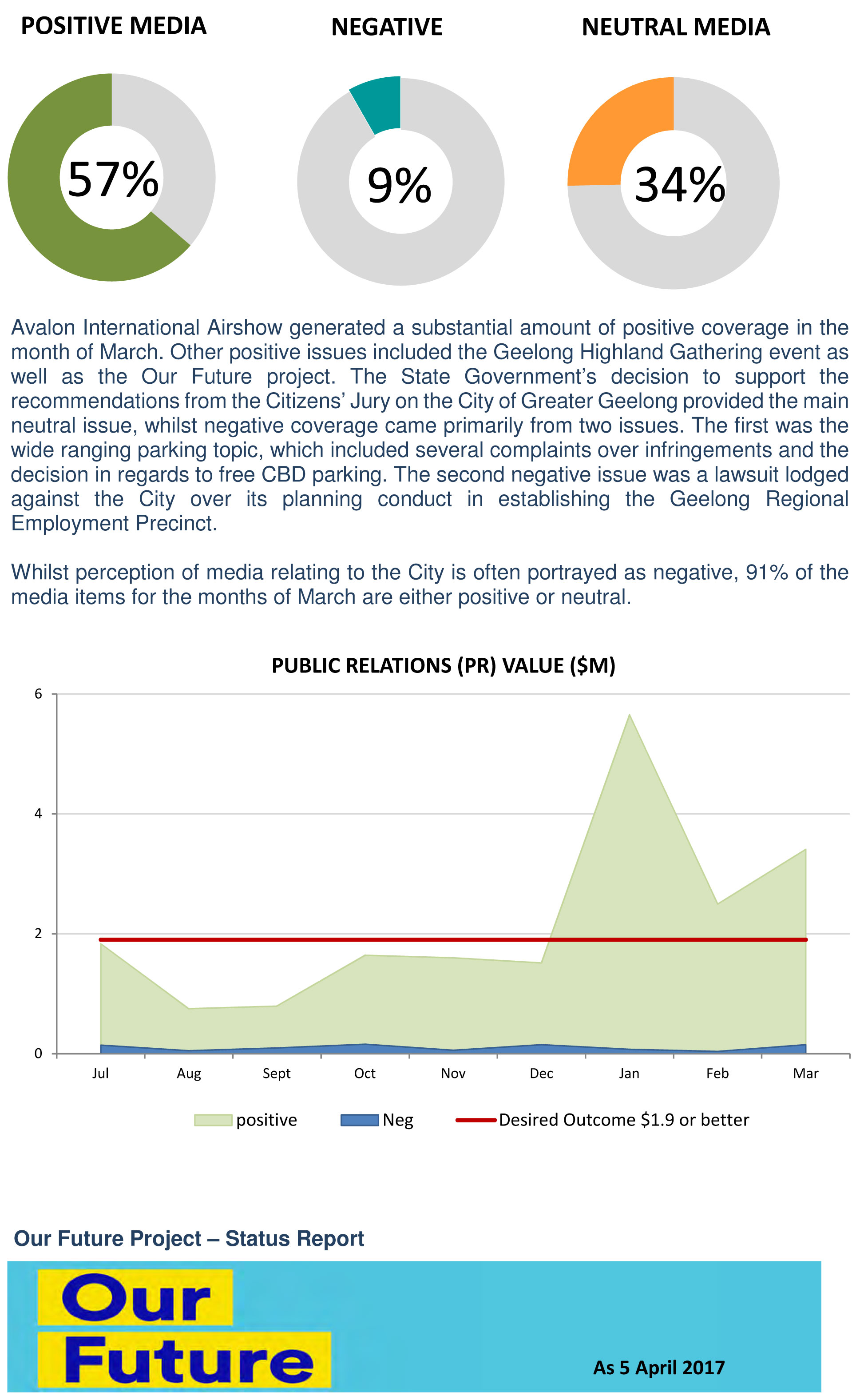
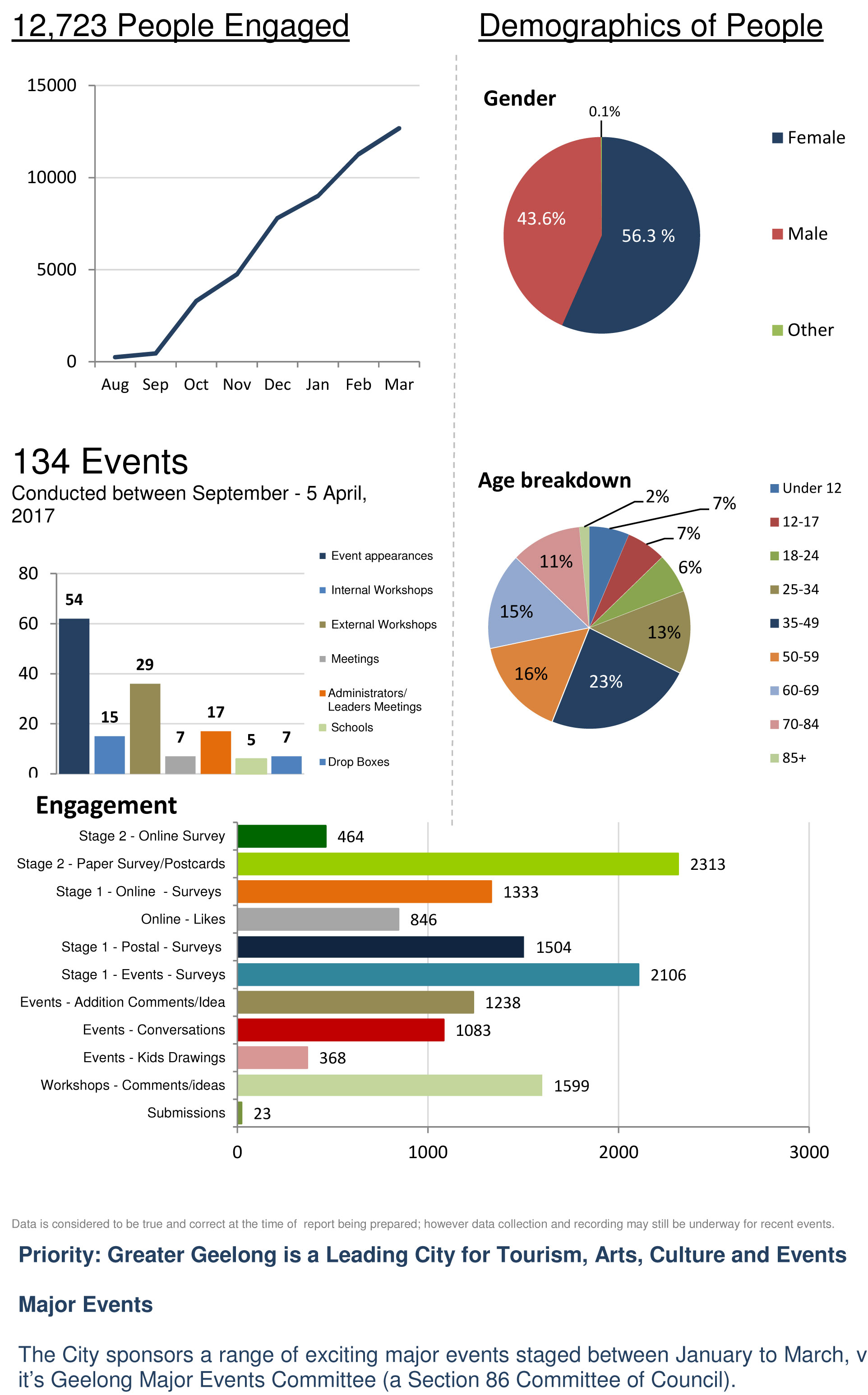
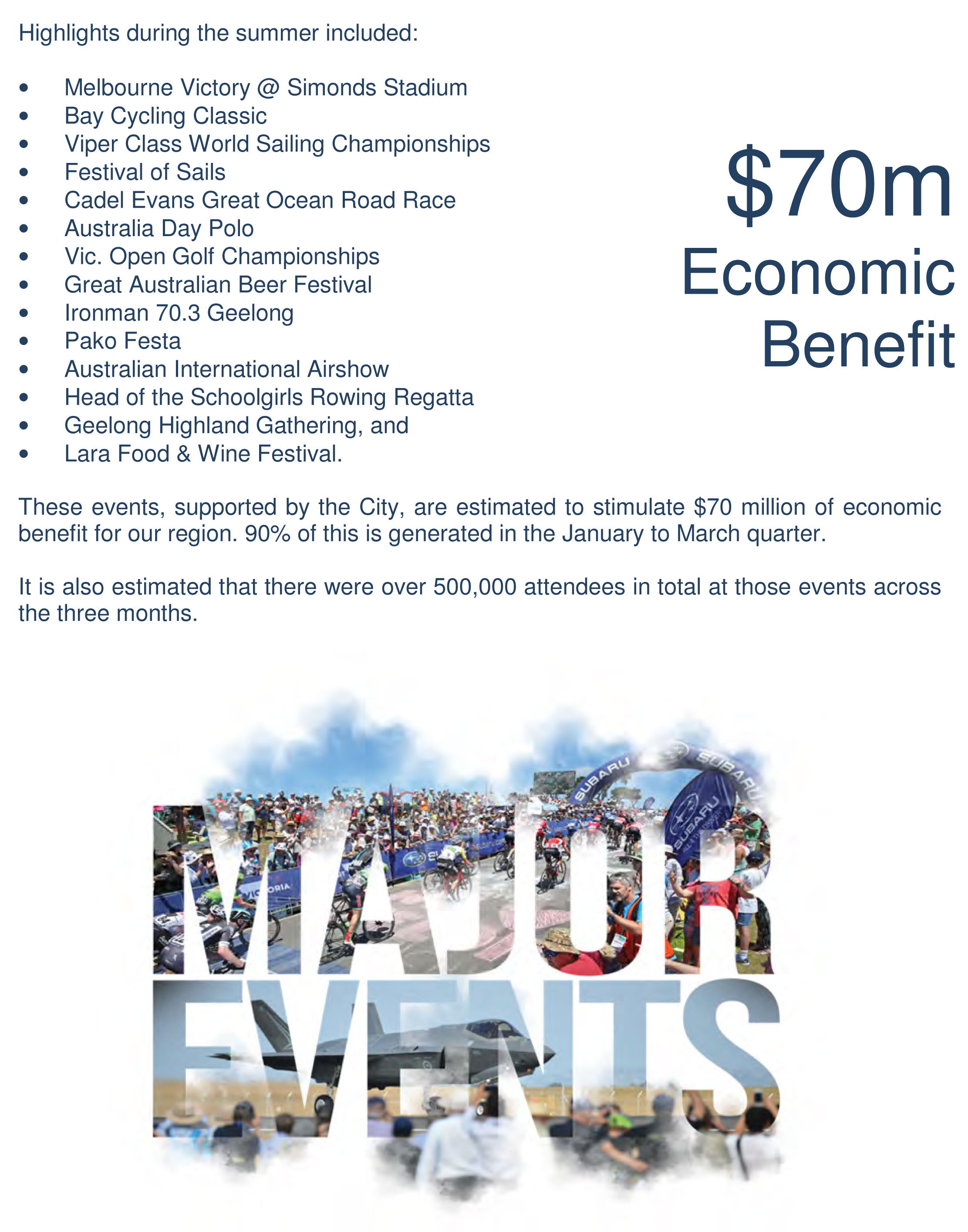
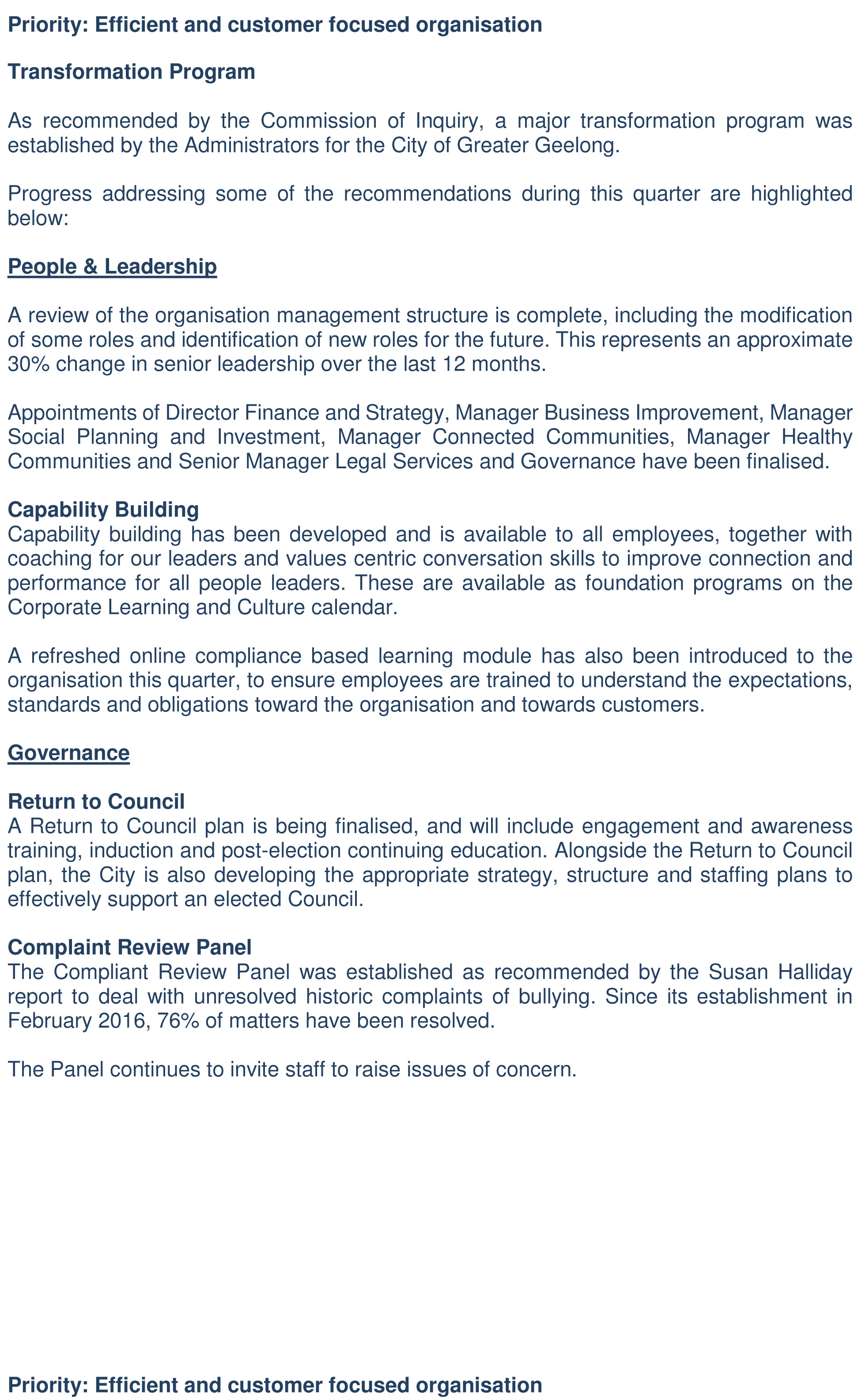
Source: |
Strategy & Performance - Financial Services |
Director: |
Joanne Moloney |
Index Reference: |
Financial Management / Financial Reporting 2016-17 |
The purpose of this report is to present the financial performance of Council for end of quarter 31 March 2017.
This is a quarterly financial statement for the period January–March 2017, which compares the amended budget with the actual revenue and expense for both the period and financial year-to-date.
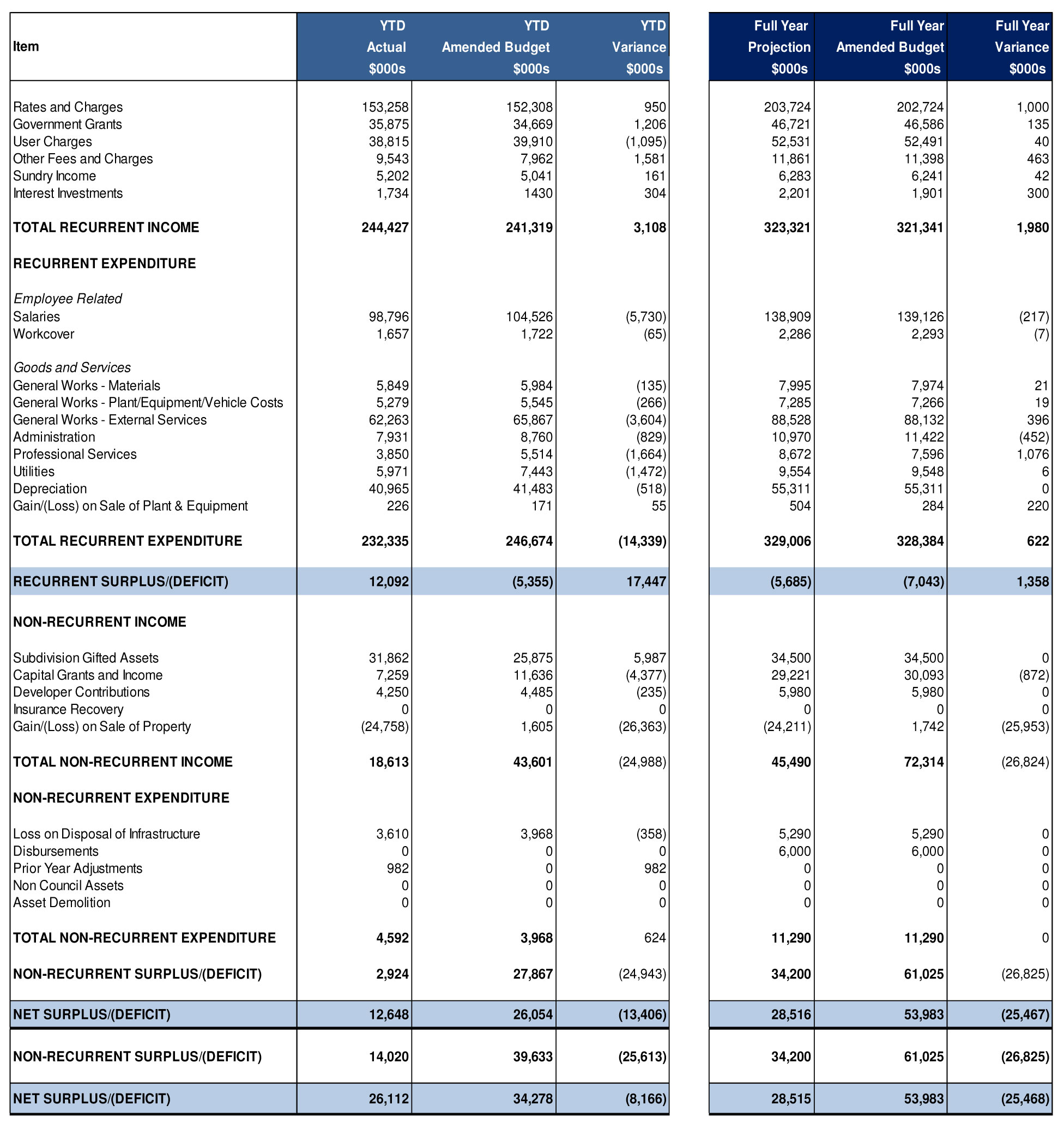
The year-to-date (YTD) underlying surplus of $26.1 million is $8.2 million unfavourable to budget. The negative variance has been driven by the transfer of assets to the Kardinia Park Stadium Trust ($28.8 million). This is a one-off adjustment which does not impact on operational profitability of Council.
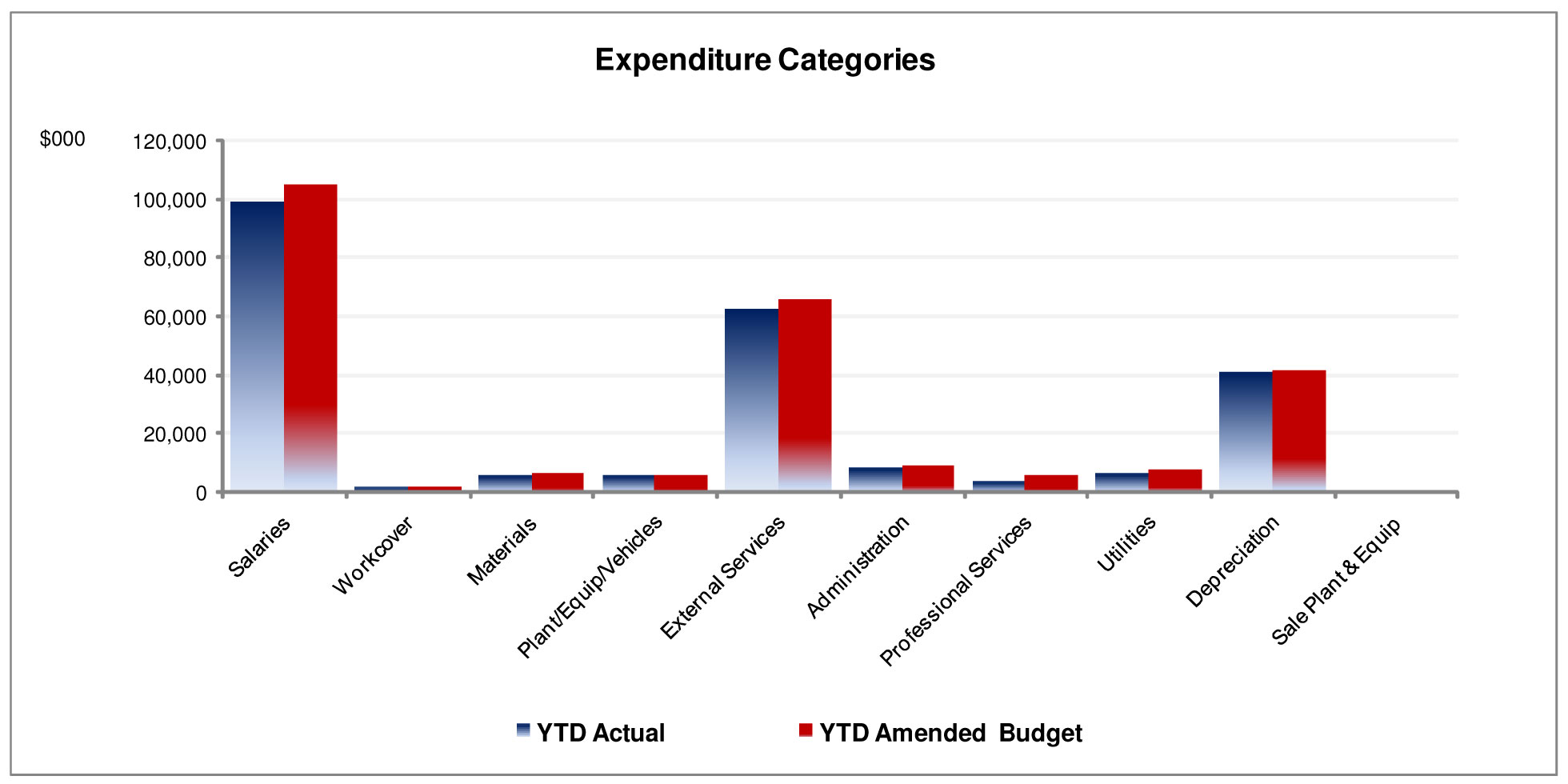
Excluding the asset transfer to the Trust, the YTD operational surplus of $20.6 million is favourable to budget mainly due to below budget spend on discretionary projects of $12.3 million and salaries of $5.7 million.
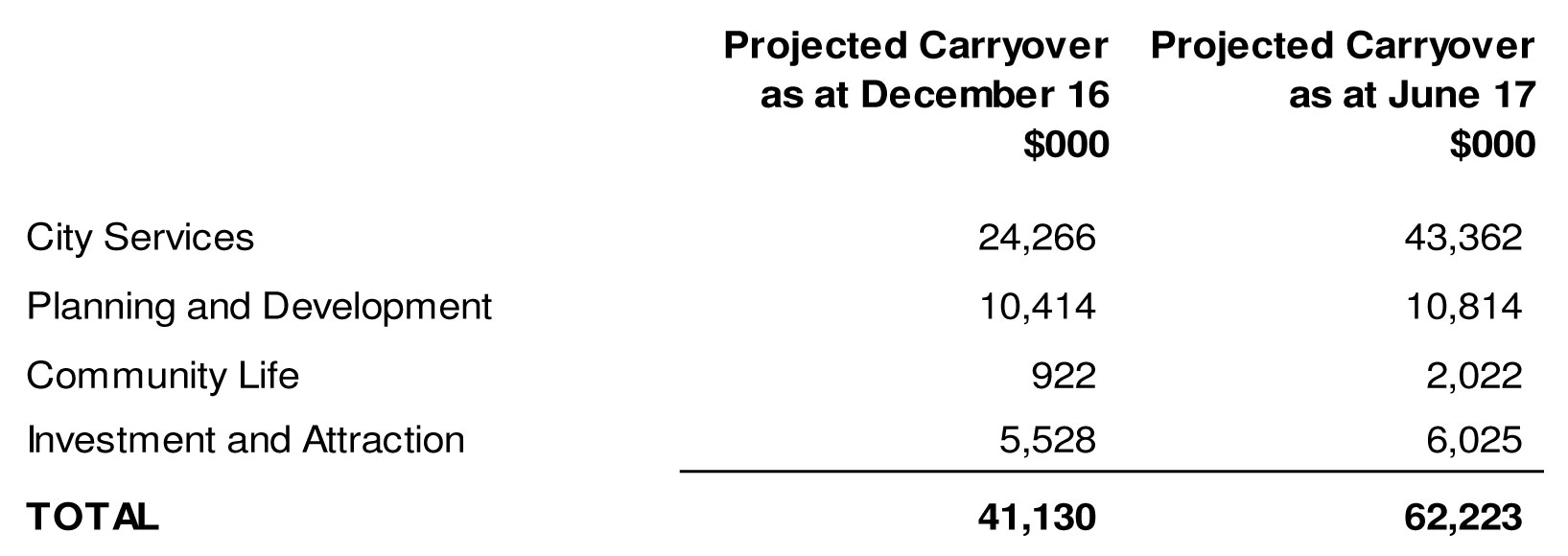
YTD Actual spend on capital projects is $25.7 million lower than the projected expenditure of $46.3 million, the impact being that anticipated project spend carryover into 2017-18 will increase from $41 million to $62 million.
The positive net cash position of $114.1 million is a direct result of the lower than anticipated spend on capital works combined with savings achieved in operating expenditure.
The closing loan balance of $47.9 million (which is $2.3 million down from the previous quarter) aligns with reduced capital expenditure.
L Gardner moved, P Dorling seconded -
That Council endorse the Quarterly Financial Report to 31 March 2017 (refer Attachment 2).
Carried.
Full year budget and projection
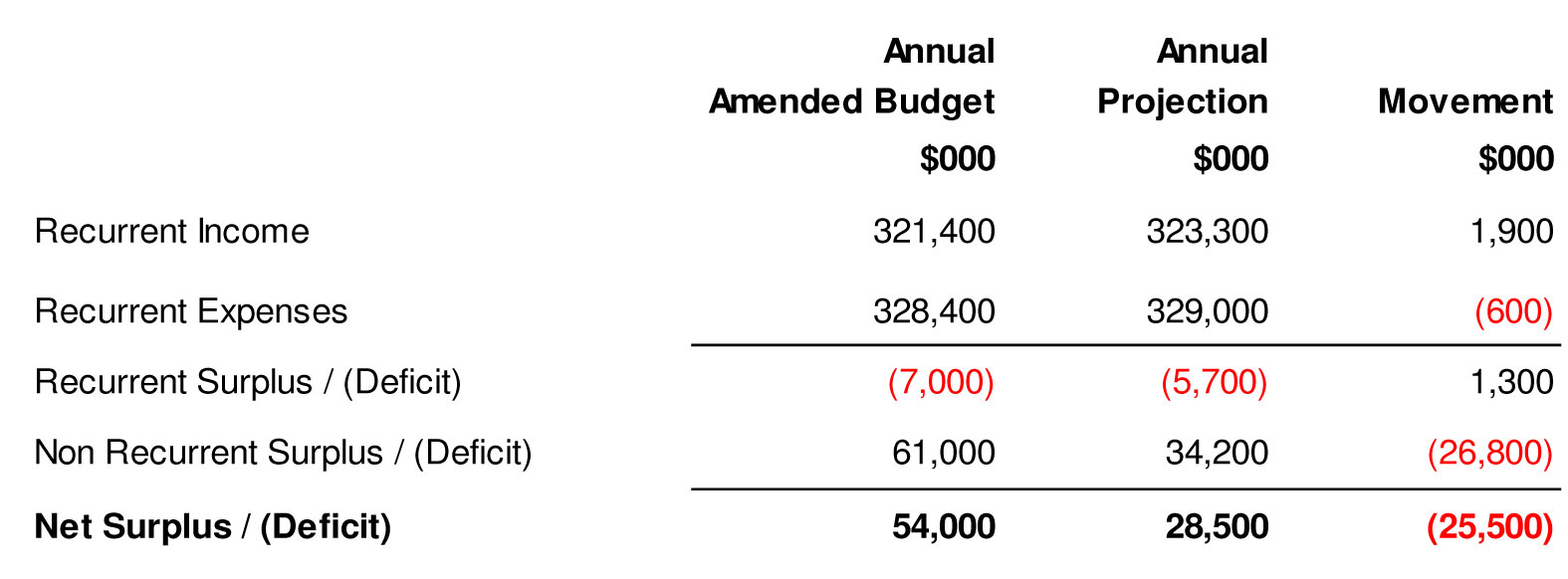
Since the quarter ended December 2016, the full year projection for the 2016-17 recurrent surplus has increased $1.3 million driven mainly by:
Supplementary rates issued have provided additional revenue of $500k.
Interest received has exceeded December projections by $300k due to higher investment balances.
The deferral of borrowings has resulted in $400k of projected savings in interest payments.
However, the full year projection for the underlying surplus of $28.5 million remains $25.5 million negative to the amended budget due to the transfer of assets to the Kardina Park Trust of $28.8 million.
Capital Program
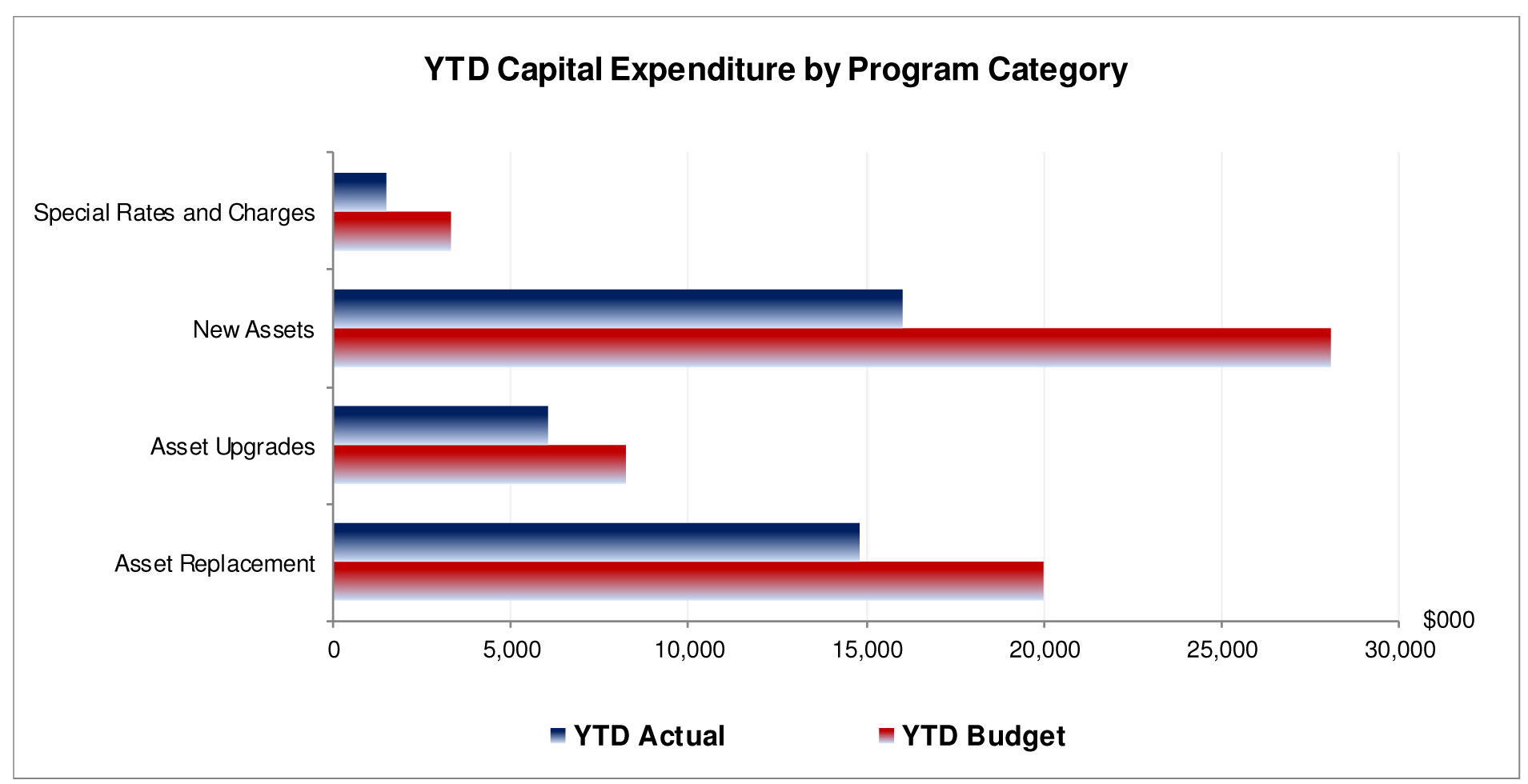
YTD spend on capital projects as at 31 March is $46.3 million against a full year projection of $72.0 million. The underspend of $25.7 million is inclusive of:
$15.1 million for new assets.
$5.3 million for asset renewals.
$3.2 million for asset upgrades.
$2.8 million for special rates and charges.
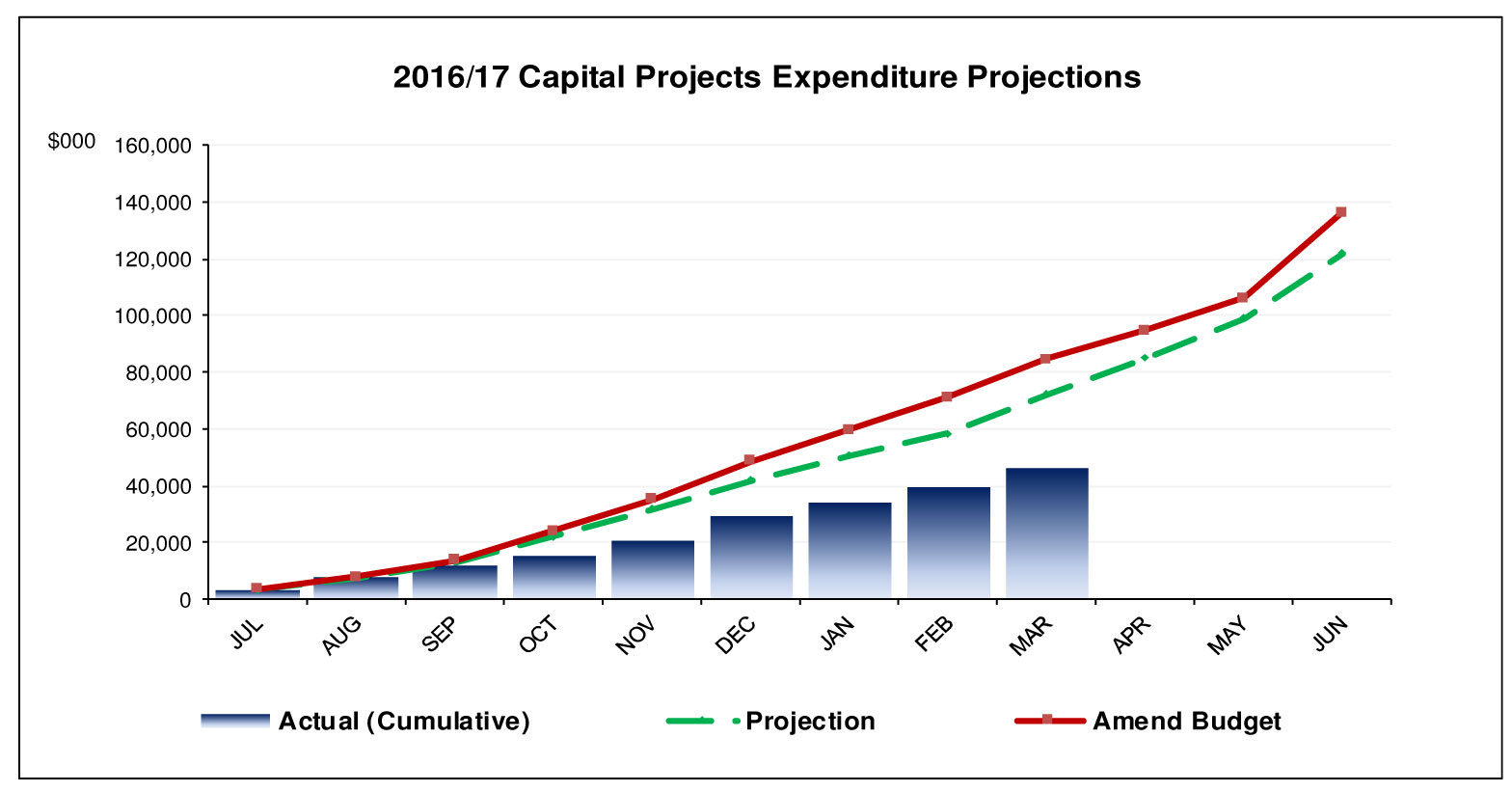
Carry-over expenditure on incomplete projects is projected to increase from the $41 million reported as at quarter ending December 16 to $62 million as at 30 June 2017 due to delays in either commencement or completion of projects.
Major projects which are behind schedule are inclusive of :
| • | Corio Landfill Rehabilitation | $7.6 million - Design issues |
| • | Hendy Street Family & Children’s Centre |
$5.0 million - Delay in issue of planning permit |
| • | Leopold Community Hub Stage 2 |
$9.3 million - Construction tender being evaluated |
| • | Drysdale Landfill Cell 5 |
$2.9 million - Delay in EPA approval |
| • | Drysdale/Clifton Springs Sports Precinct |
$5.6 million - Retiming of earthworks contract |
| • | Highton Enhanced Children’s Centre |
$2.9 million - Designs for Community consultation |
| • | Central Geelong Action Plan |
$5.5 million - Main works to tender |
| • | ACEP – NAC Community Complex |
$9.0 million - Construction to commence late 2017 |
| • | Greenwaste Site Establishment $2.2 million - Delay in issue of planning permit |
Discretionary Expenditure
The full year projection for discretionary expenditure is $21.9 million with income of $3.1 million.
YTD actual income of $3.14 million as at 31 March already exceeds the full year projection. The positive to projection income position will carry through to year end.
The projected full year spend of $21.9 million will not be achieved. A more realistic projection is full year spend of $15 million. This is based on only 43% of the projected spend having been undertaken in the three quarters to 31 March 17.
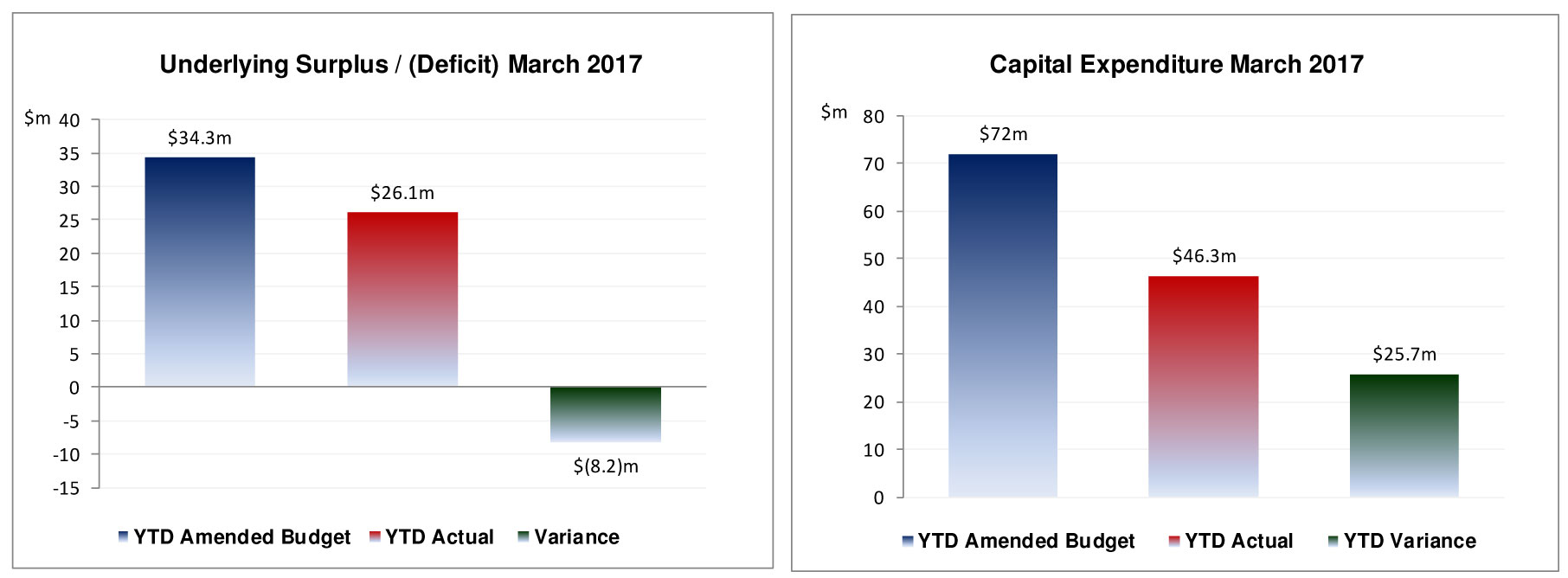
The YTD underlying surplus of $26.1 million is $8.2 million unfavourable to the amended budget mainly due to transfer of assets to Kardinia Park Stadium Trust ($28.8 million).
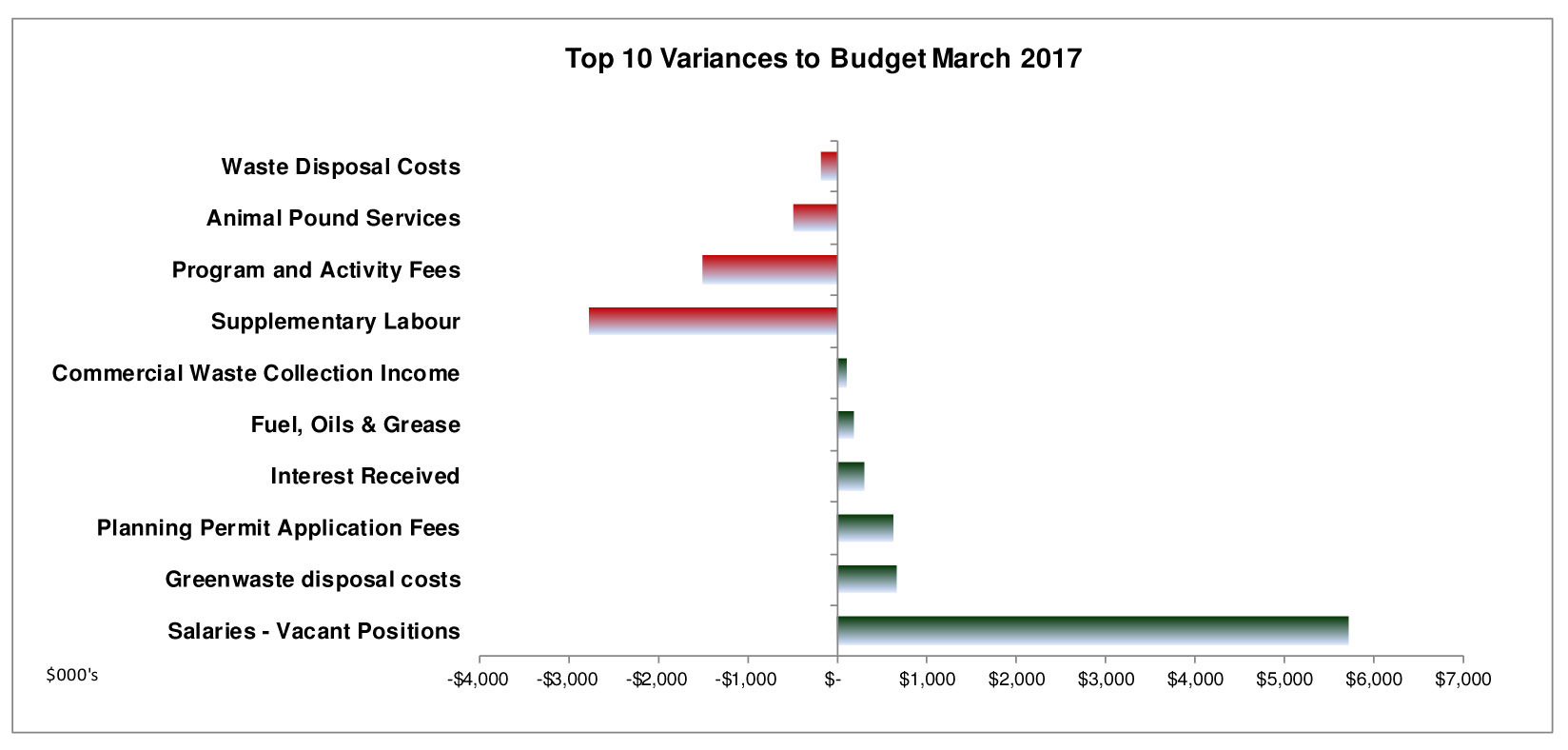
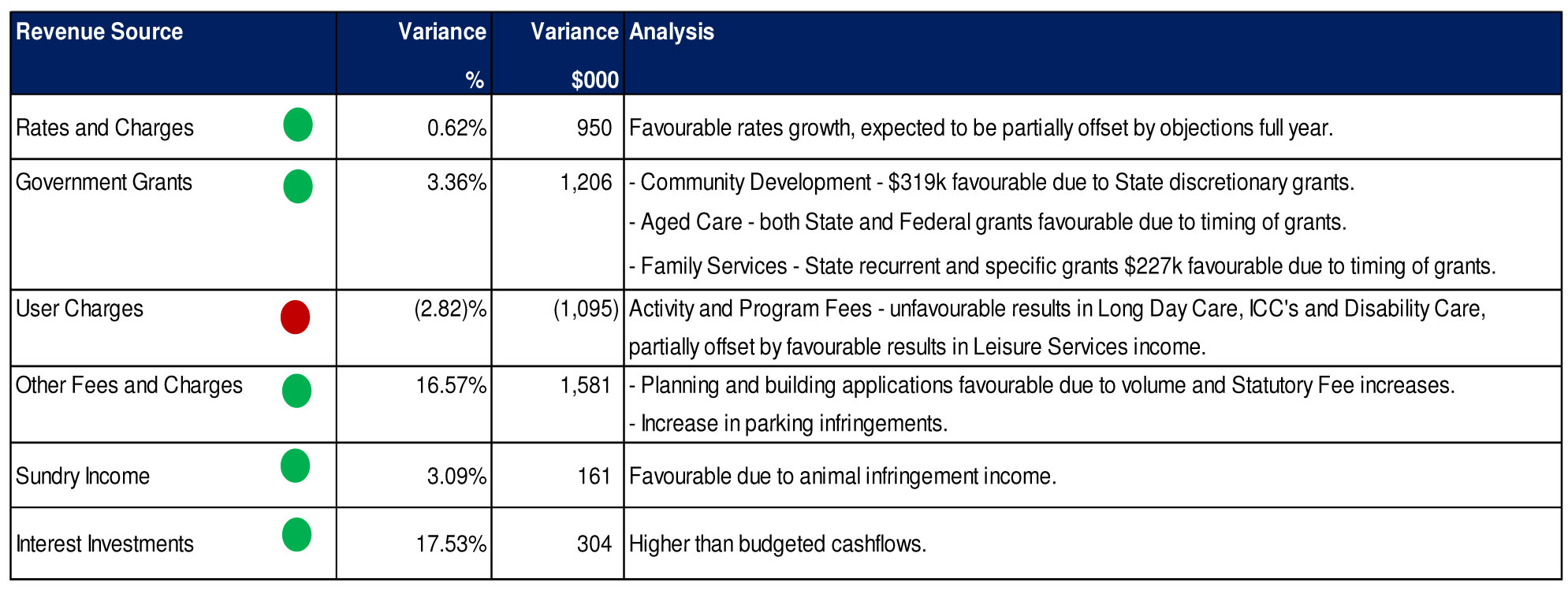
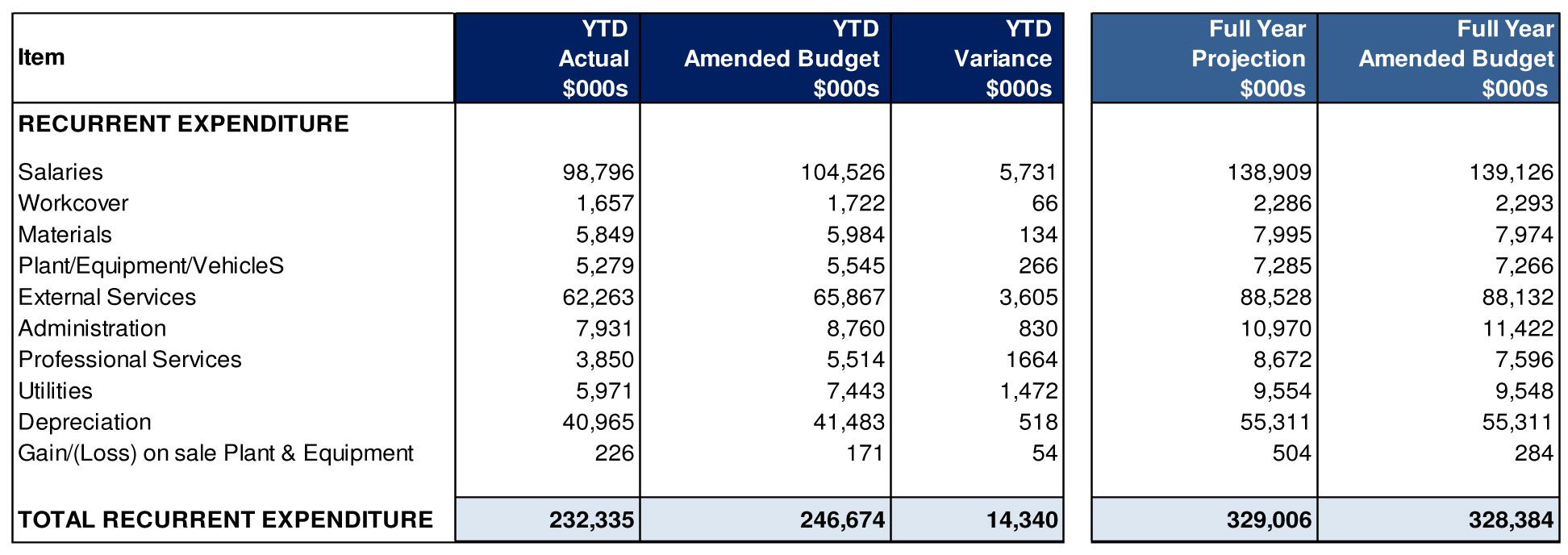
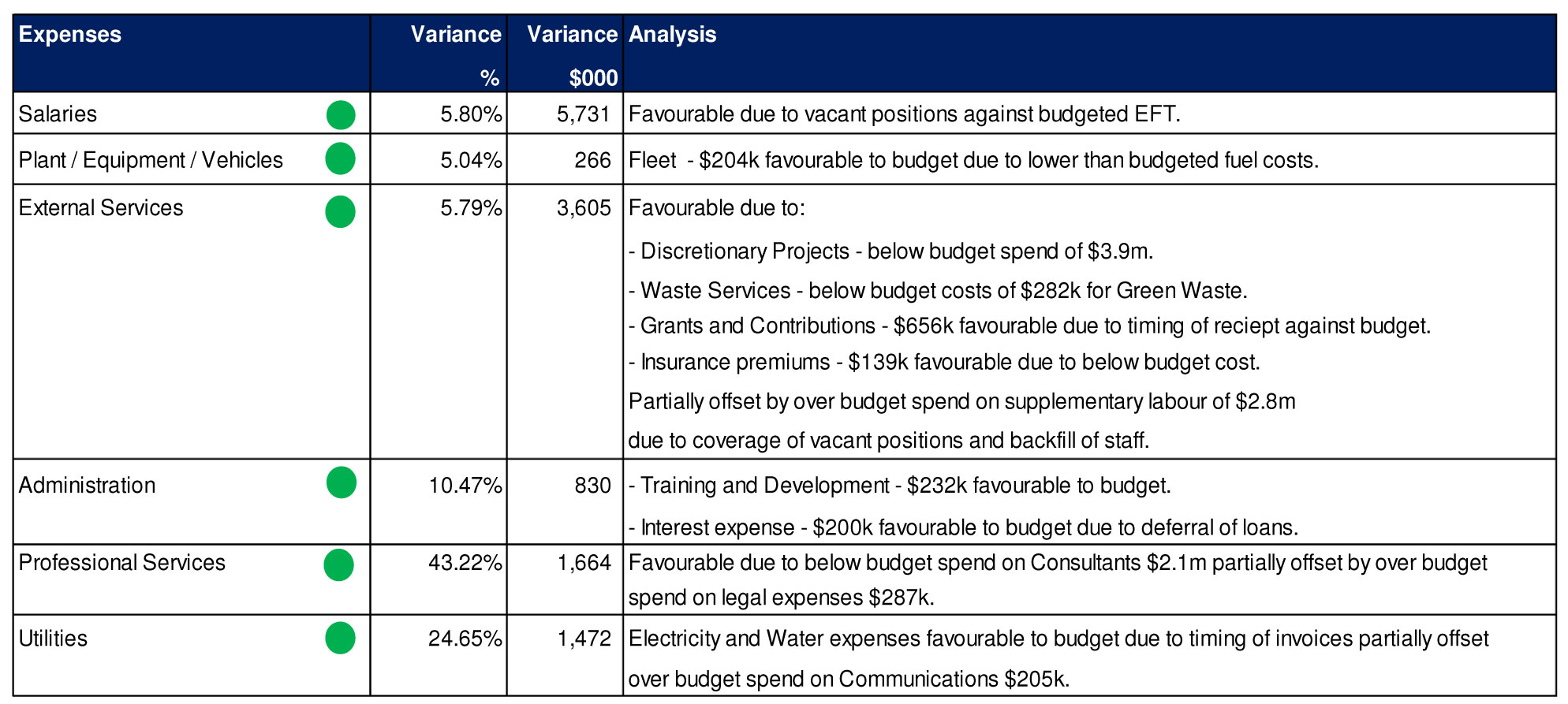
Salaries – YTD $5.73 million favourable driven by vacant positions, partially offset by unfavourable Supplementary Labour spend of $2.77 million.
Green Waste Disposal Costs – YTD $659k favourable mainly due to lower than budgeted tonnages.
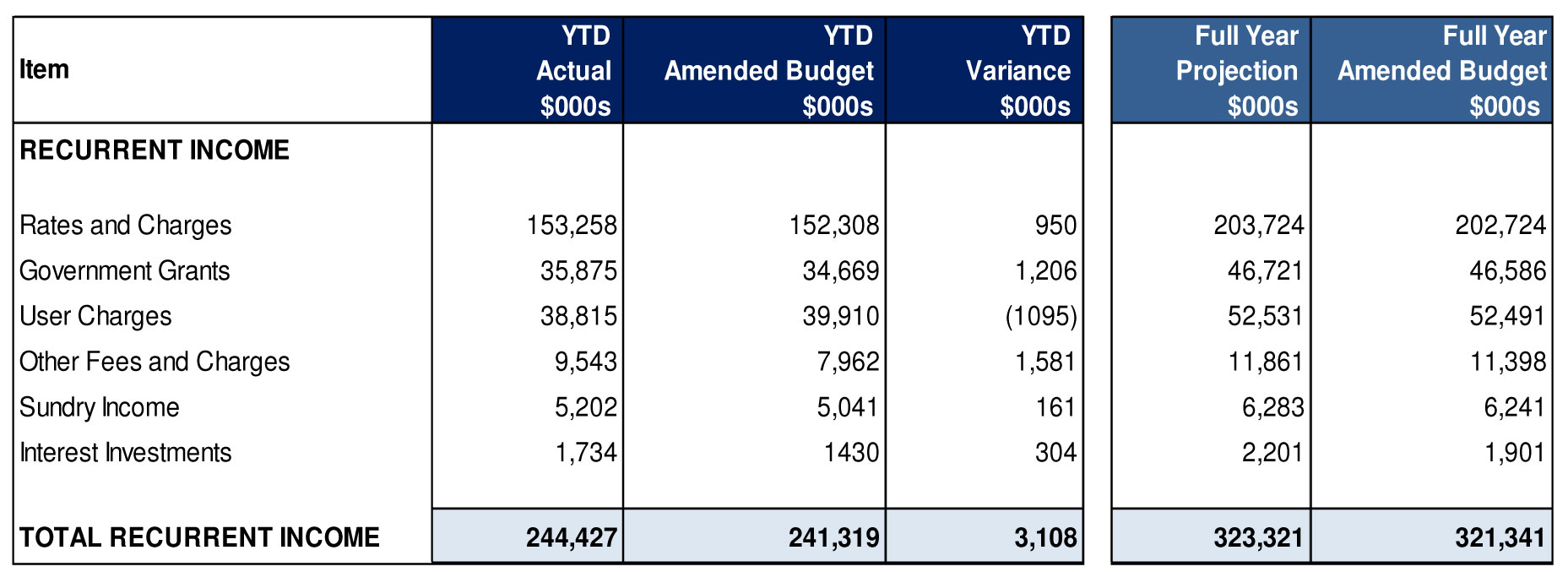
Planning Permit Application Fees – YTD $625k favourable due to both volume and statutory fee increases – projected to be $483k favourable full year.
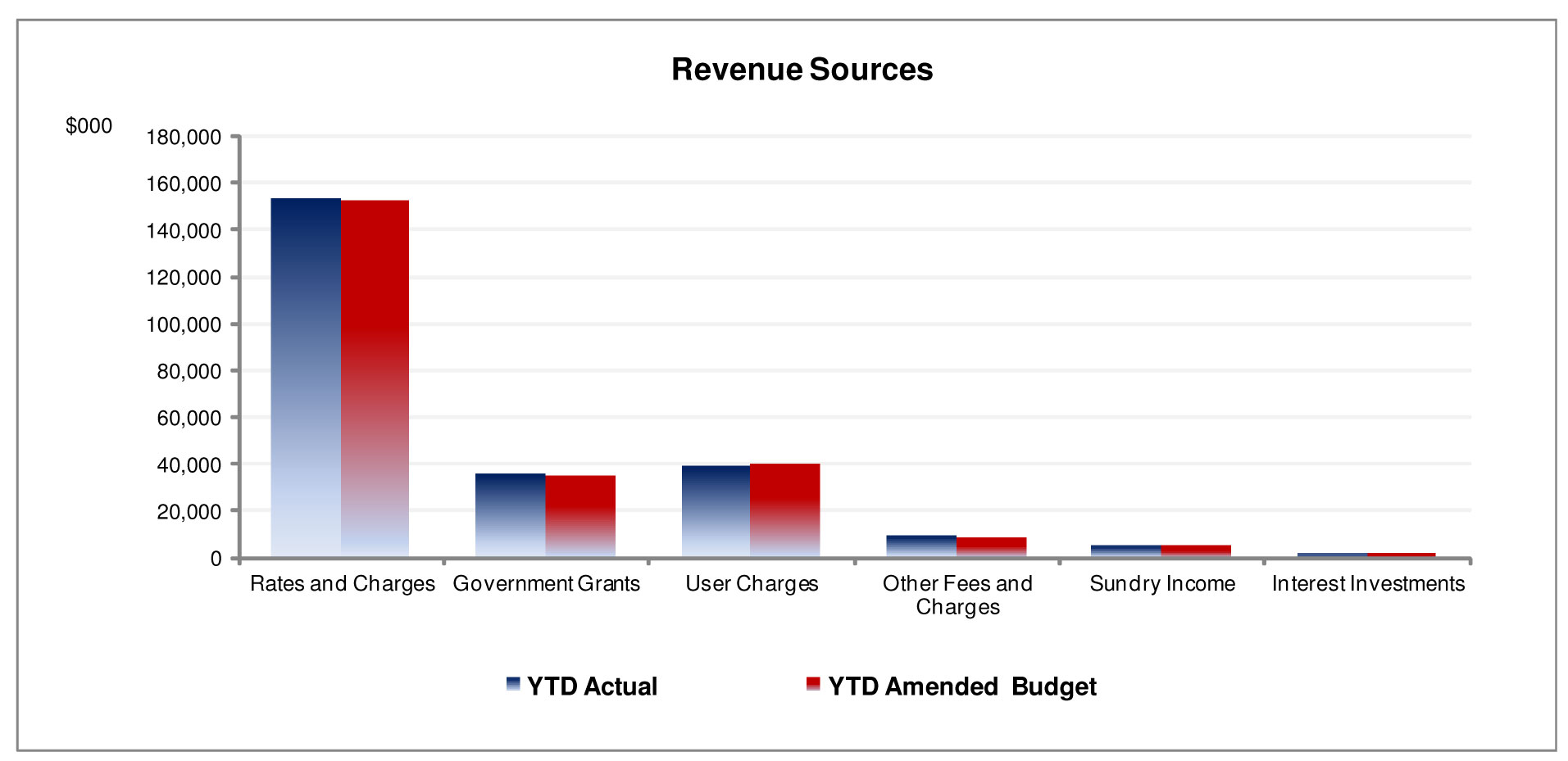
Interest Received – YTD $304k favourable due to higher investment balances.
Fuels, Oils and Greases – YTD $180k favourable due to lower than budgeted fuel prices.
Commercial Waste Collection Income – YTD $114k favourable driven by increased usage.
Program and Activity Fees - YTD $1.5 million unfavourable due to below budget fees received for Aged & Disability Services $1.4 million and Family Services $814k. This has been partially offset by Leisure Services and Sport and Recreation fees being $432k favourable to budget.
Animal Pound Services – YTD $492k unfavourable due to additional costs incurred for asset contribution and interim fees while awarding the Pound services contract.
Waste Disposal Costs – YTD $175 unfavourable due to costs associated with diversion of waste to Wyndham (required due to issues relating to the landfill audit and surcharge protection layer not forecast).
Detailed Operating Statement
Report as at 31 March 2017
Statement of Financial Posiiton
Report as at 31 March 2017
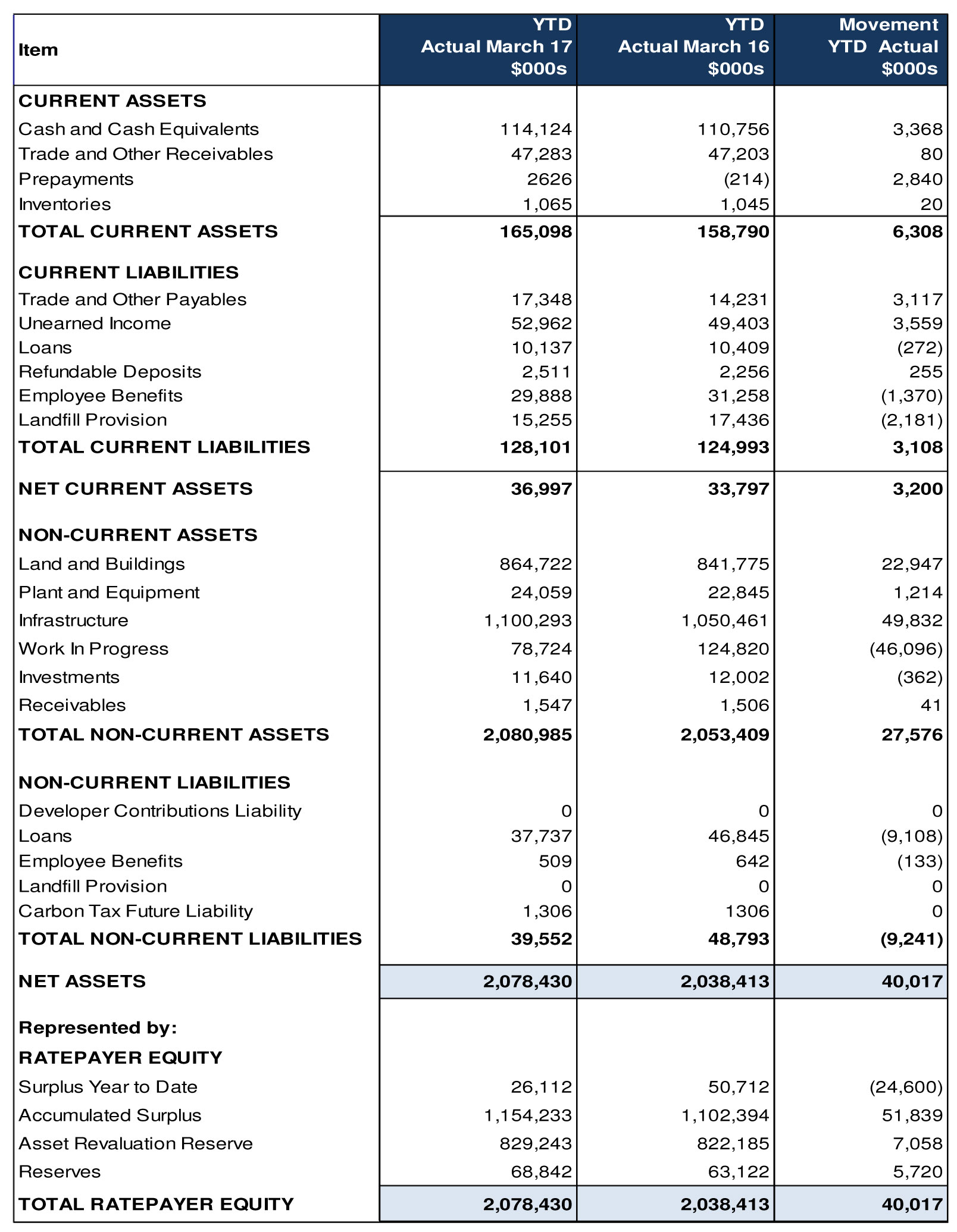
The YTD reporting of net assets shows a favourable position of $40 million from FY16 to FY17 due to an improved position in cash and receivables together with growth in non-current assets.
Statement of Cashflows
Report as at 31 March 2017
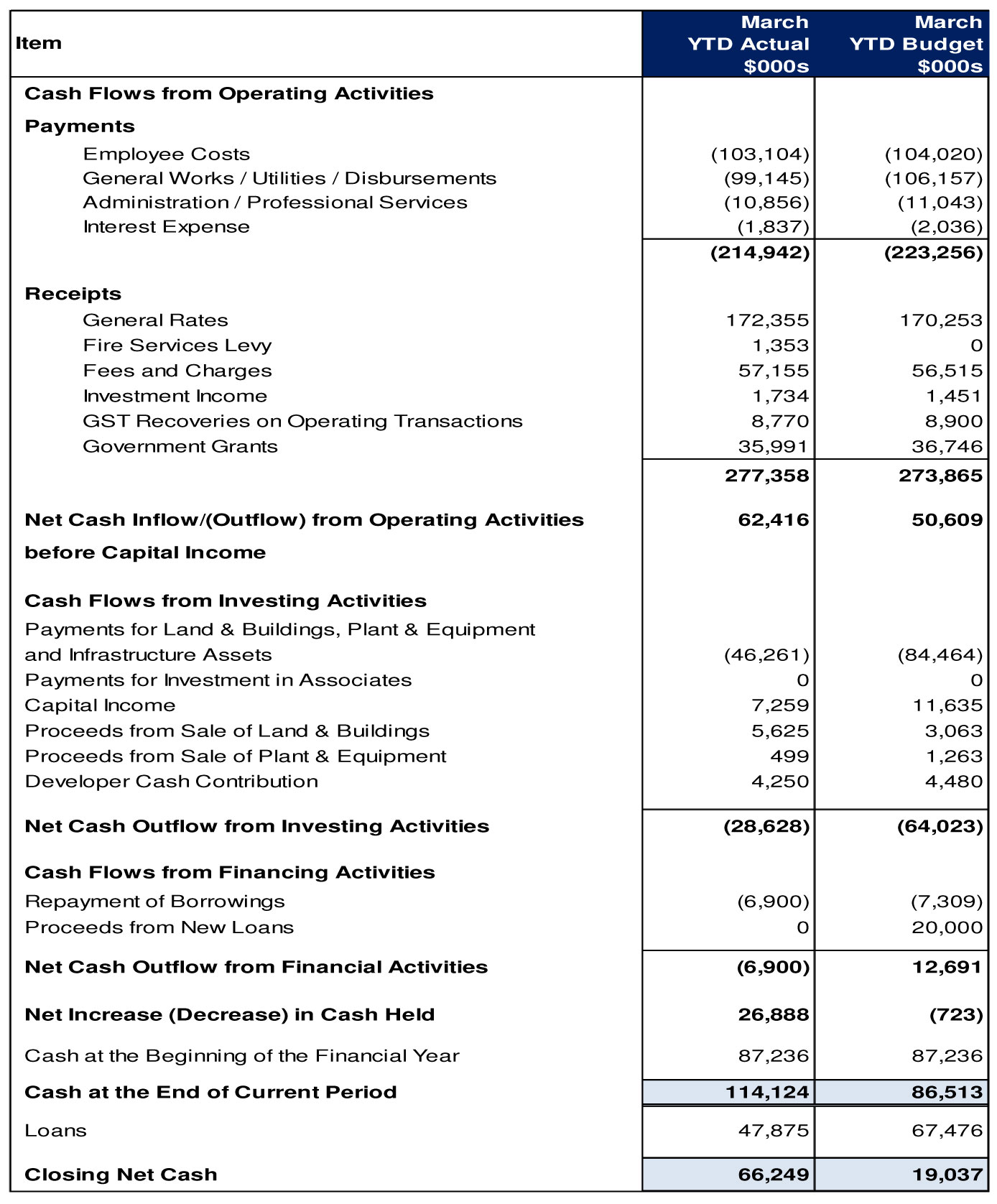
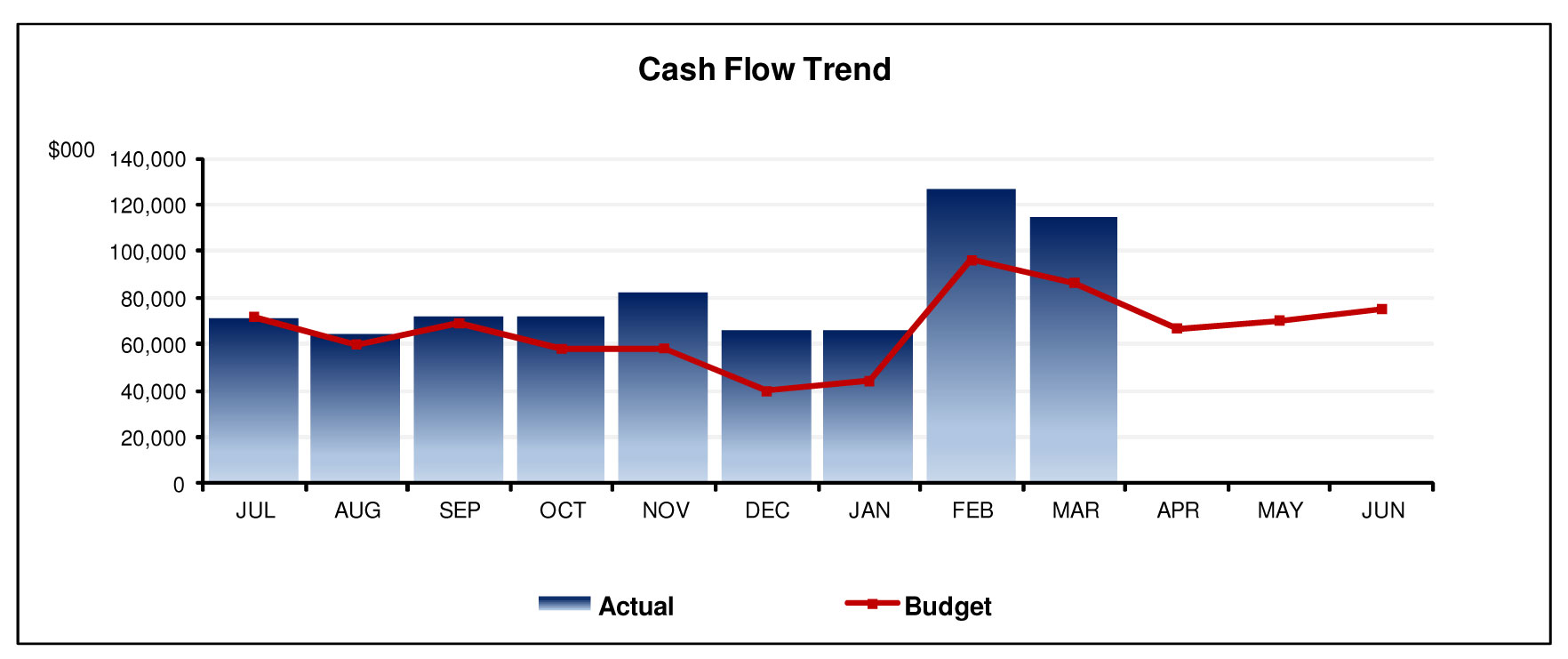
The closing positive cash position of $114.1 million is being driven by lower than expected capital works expenditure in conjunction with favourable operating performance variances against budget.
The reduction in the loan balance to $47.9 million is due to no new loans being completed in 2016-17.
Revenue Summary
As at 31 March 2017
Expenditure Summary
As at 31 March 2017
Capital Projects Analysis
As at 31 March 2017
The table below summarises the YTD variance between actual and projected gross expenditure, income and net expenditure for capital projects.
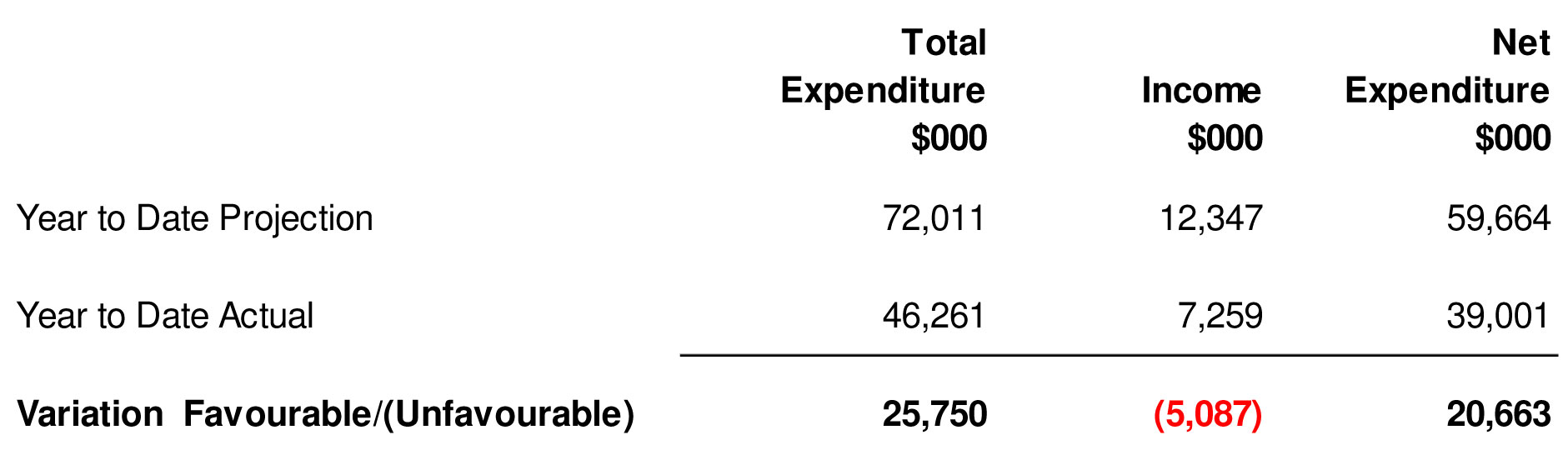
Actual expenditure to 31 March was $46.3 million compared to a projected YTD expenditure of $72.0 million. The $25.7 million underspend is inclusive of:
$15.1 million for new assets.
$5.3 million for asset renewals.
$3.2 million for asset upgrades.
$2.8 million for special rates and charges.
YTD income is $5.1 million unfavourable against the projection of $12.4m. The unfavourable variance is due to grants for Central Geelong Advancement Fund ($1.7 million), Melaluka Rd Clubroom upgrade ($910k) and Leopold Community Hub ($300k) not yet received and special rates and charges income for street construction of $85k behind schedule.
Full Year Projection
The full year projection for capital expenditure is $121.9 million with income of $29.2 million.
The projected full year carryover to 2017-18 for incomplete capital projects is $62 million.
Department with projects expected to carryover are detailed below.
Discretionary Project Analysis
As at 31 March 2017
The table below summarises the YTD variance between actual and projected gross expenditure, income and net expenditure for discretionary projects.
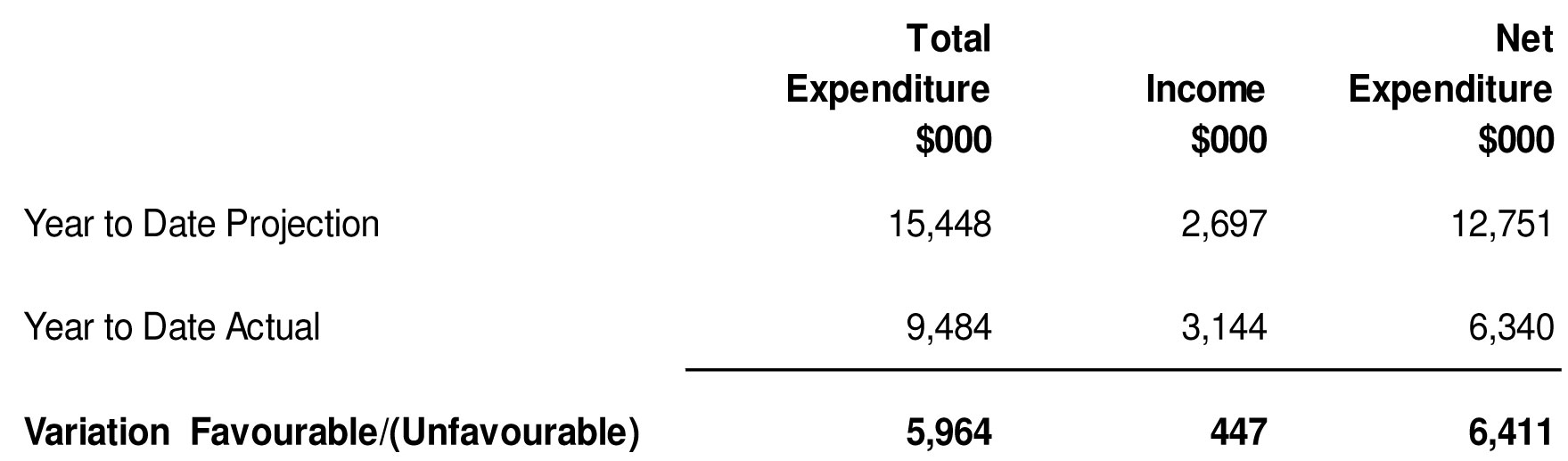
YTD income is $447k positive against the projection of $2.7 million driven by additional grants being received.
Actual expenditure to 31 March is $9.5 million compared to a projected YTD expenditure of $15.5 million. The $5.9 million underspend by department is summarised below.
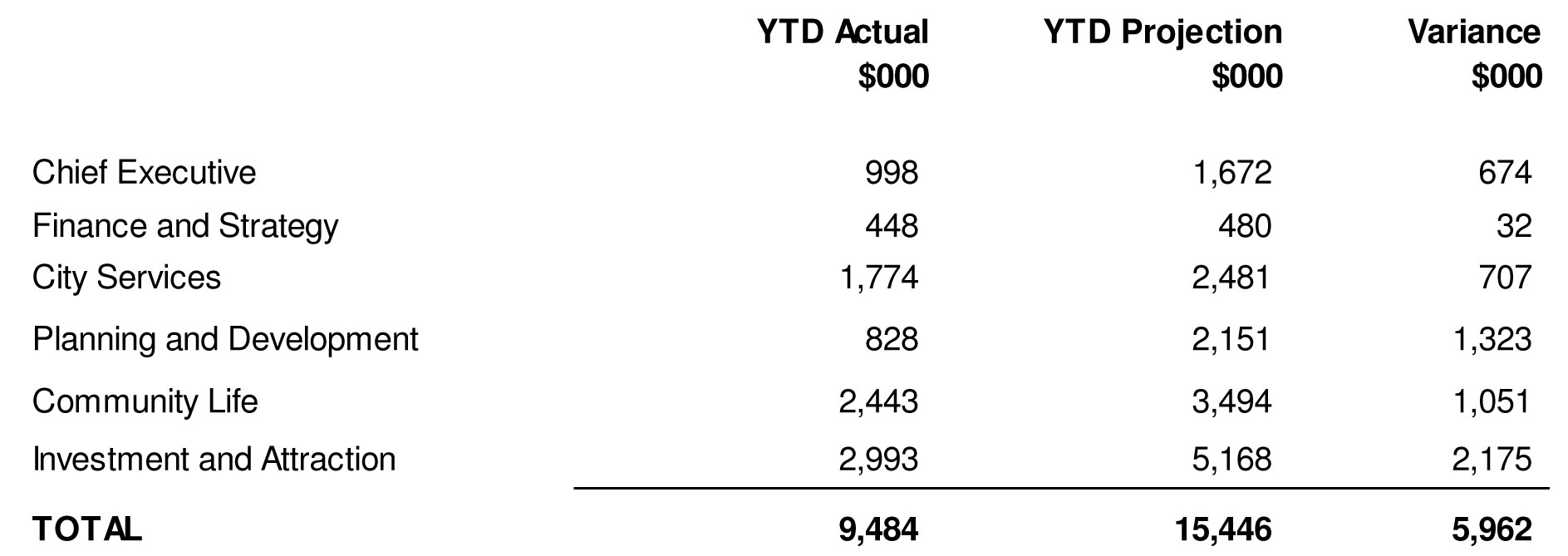
Full Year Projection
The full year projection for discretionary expenditure is $21.9 million with income of $3.1 million.
YTD actual income of $3.14 million as at 31 March already exceeds the full year projection. The positive to projection income position will carry through to year end.
The projected full year spend of $21.9 million will not be achieved. A more realistic projection is full year spend of $15 million. This is based on only 43% of the projected spend having been undertaken in the three quarters to 31 March 17.
Investment Performance
As at 31 March 2017
Council seeks to invest public funds in a manner that will provide the highest investment return with maximum security whilst meeting daily cash flow demands of the City of Greater Geelong.
A cash balance of $120 million with interest income of $1.73 million was achieved as at 31 March 2017. This is a positive variance of $300k against the interest income budget of $1.43 million.
A YTD actual interest rate of return of 2.7% has been achieved. This is a strong return, the benchmark being the annualised USB Australian Index rate of 1.83%.
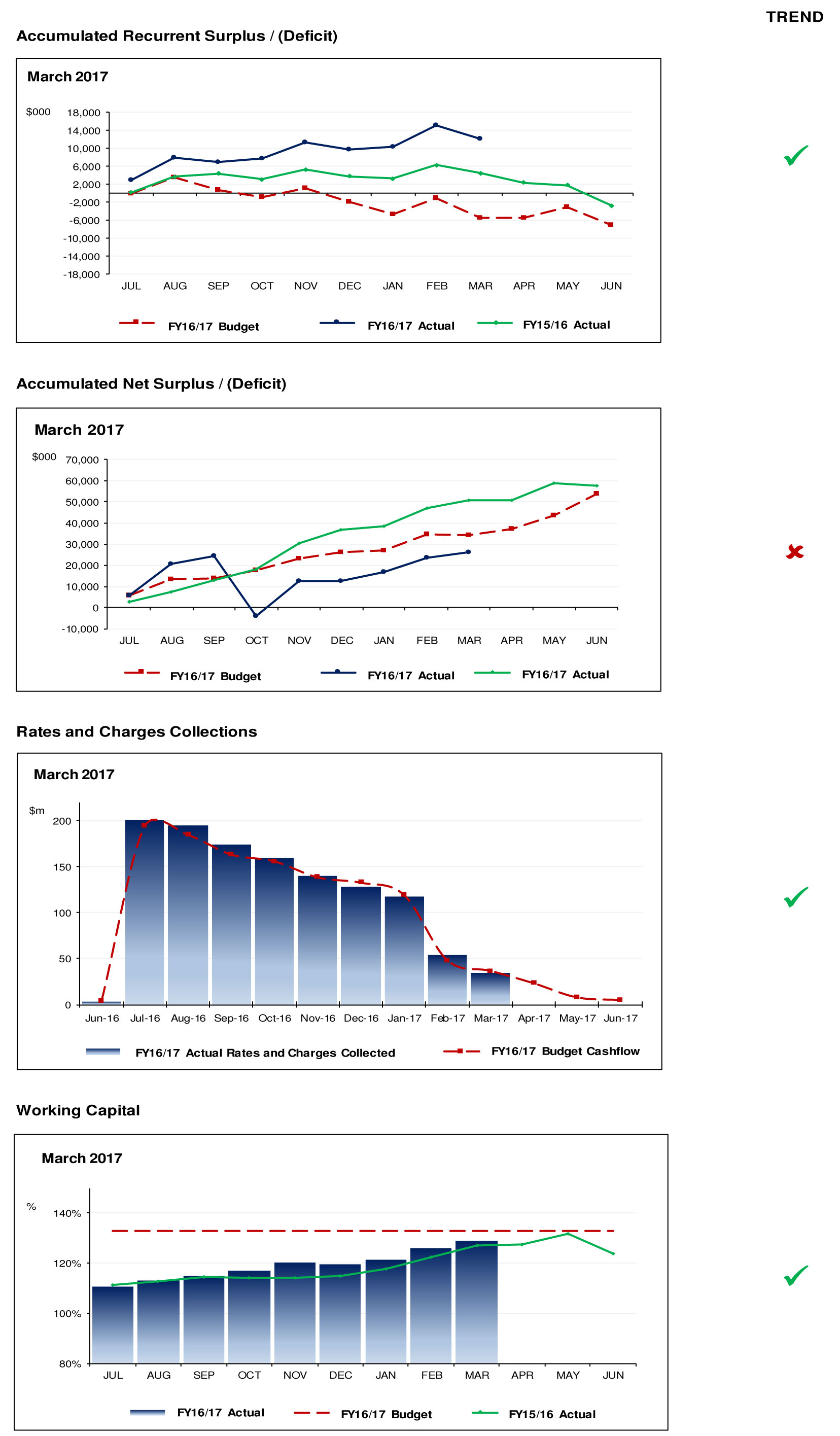
Investment returns are trending as per 2015-16 actuals and are favourable to budget.
Financial Performance Indicators
As at 31 March 2017
Source: |
Legal Services and Governance |
CEO: |
Kelvin Spiller |
Index Reference: |
Subject: Council Election 2017 |
To give an overview of the Return of Council Plan - a program of coordinated activities to ensure the right environment for the return of elected representatives.
The City of Greater Geelong (COGG) will go to an election on 28 October 2017. This will be the first election since Councillors were dismissed in April 2016.
The framework has been developed to ensure that Council is well positioned to ensure good governance arrangements are firmly embedded prior to and following on from the return of Council.
The plan encompasses 4 phases:
The planning and design phase;
The communication and awareness raising to attract suitably qualified candidates;
The legislated phase of nomination and caretaker periods for the General Election; and
The induction and ongoing councillor professional development.
The plan takes into account the outcomes and recommendations of the Commission of Inquiry report. It is flexible enough to accommodate the current legislative requirements for the return of Council as well as any major legislative decisions made by the State government. Currently, there is no certainty as to what the model of Council may look like, and ward boundaries have not been formalised.
P Dorling moved, L Gardner seconded -
That Council endorse the Return of Council Plan and Framework (Attachment 2).
Carried.
The Return of Council is a major component of the Transformation Program. The plan supports the successful transition to an elected Council in October 2017. Key components include:
Councillor Code of Conduct
Civic leadership program that will be run by our stakeholders
Candidate training and information sessions
Comprehensive induction program
Councillor portal
Ongoing training and development
Governance policy and procedure review, including protocols
Development of a communications plan (Geelong Decides) developed in collaboration with local government peak bodies and our stakeholders
Statutory requirements associated with the Victorian Electoral Commission (VEC) conducting the Election on our behalf.
Provision for the Return of Council has been made in the 2016-2017 and 2017-2018 Budget.
A key component of the plan is extensive communications prior to the return of councillors, aimed at attracting diverse and suitably qualified candidates, promoting civic engagement and leadership and ensuring that the community actively participates in the democratic process.
The Return of Council Framework includes review of governance policies and procedures to ensure legislative requirements are adhered to.
Source: |
People & Organisation Development - Customer Service |
Executive Manager: |
Andrew Keen |
Index Reference: |
Corporate Management |
The purpose of this report is to seek Council’s endorsement of the 2017-2020 Customer Focus Strategy.
An officer working party has finalised a Draft Customer Focus Strategy for the Council’s consideration and endorsement.
The Customer Service Strategy focuses on aspects of customer service that will help to provide the overall conditions which the Council City Plan’s objectives 2013-2017 strategic outcomes are achieved.
For the City to demonstrate that it is an efficient and customer focused organisation as published in City Plan 2013-2017, this Customer Focus Strategy will pursue the following strategic goals:
To provide choice for our customers.
To increase customer satisfaction.
To deliver our services in the most cost effective way.
To assist with these priorities a number of strategic improvement actions have been identified that will involve implementation over the period 2017-2020. The strategic improvement actions have been designed to provide a structured approach for the organisation to improve service delivery and quality.
The strategy document has been revised to incorporate recent customer feedback, the newly developed organisational values and findings from a review of face-to-face customer service centres reported to Council via a confidential report in November 2014.
P Dorling moved, L Gardner seconded -
That Council endorse the 2017-2020 Customer Focus Strategy (Attachment 2).
Carried.
Items detailed in the strategic improvement actions section of the Strategy will be subject to budget approvals. Most of these actions are identified as being undertaken within existing operational budgets.
The Customer Focus Strategy has been prepared by reviewing a range of documents and information and gathering views of a range of council staff and customers to compliment Council’s ‘community participation and engagement with local communities’ theme
Council has a responsibility to ensure that services provided to the community are equitable, accessible and that resources are used efficiently to meet the needs of the community.
The strategy aligns with City Plan outcomes and there is a particular emphasis regarding the following two outcomes:
Customer Focused Organisation
Efficient Service Delivery
No officers involved in the preparation of this report have any direct or indirect interests in the content of this report.
The strategy supports the minimisation of risk to ensure that Council delivers the objectives of City Plan and effective risk management activities are established in relation to service delivery.
Environmental implications are considered as an integral part of the Customer Focus Strategy.
Source: |
Community Life |
Director: |
Linda Quinn |
Index Reference: |
Grants and Funding – Sport and Recreation Grants |
To seek Council endorsement to submit projects to Sport & Recreation Victoria’s Community Sport Infrastructure Fund (CSIF) for consideration.
Sport & Recreation Victoria (SRV) has released the 2018/19 CSIF which provides an important opportunity for Council to secure funding for sport and recreation projects across the municipality. The funding round opened on 30 March 2017 and this report relates to the recommended submissions under this program.
Council conducted an Expression of Interest (EOI) process, calling for applications from sport and recreation clubs across the municipality which are eligible under the Minor, Female Friendly and Cricket Facilities categories.
The project proposed for submission under the Planning Category has been identified by Council staff.
Project proposals are due to SRV by 7 June 2017.
Project proposals supported by SRV will be invited to submit full applications, due by 11 September 2017.
Funding announcements are expected from November 2017 onwards.
Any financial commitment required from Council towards projects will be forwarded to the 2018/19 budget along with all other Council priorities for consideration.
P Dorling moved, L Gardner seconded -
That Council:
Endorse the development of submissions for SRV’s Community Sport Infrastructure Fund as follows:
Kingston Park Sub-Regional Playground – Minor Facilities category
Armstrong Creek West Regional Soccer, Hockey and Tennis Master Plan and Feasibility Study – Regional Planning category
Lara Soccer Club Stage 2 Female Change Facility – Female Facilities category
Bell Park Sports Club Female Change Facility – Female Facilities category
Pending the outcome of each application, refer the projected Council contribution for any successful projects to the 2018/19 budget for consideration.
Carried.
Each year, the Victorian Government make funds available for planning, building new and improving existing facilities where communities conduct, organise and participate in sport and recreation. This funding aims to support projects which:
Increase sport and recreation participation for all Victorians;
Increase female and junior participation;
Increase access to sport and recreation opportunities;
Better planning of sport and recreation facilities; and
Encourage innovative, environmentally sustainable and universally designed facilities.
The full 2018/19 CSIF Application Guidelines can be found in Attachment 2.
Funding is available under the categories described below:
CSIF category |
Max amount per grant |
Funding ratio |
Minor Facilities |
$100,000 |
$1.5 State : $1 Local |
Cricket Facilities |
$100,000 |
$1.5 State : $1 Local |
Female Friendly Facilities |
$100,000 |
$1.5 Sate : $ Local |
Planning - Regional |
$50,000 |
$2 State : $1 Local |
Planning – Local |
$30,000 |
$2 State : $1 Local |
Better Pools |
$3,000,000 |
$1 State : $2 Local |
Major Facilities |
$650,000 |
$1 State : $2 Local |
Small Aquatic Projects |
$200,000 |
$2 State : $1 Local |
Recreation and sporting clubs in the municipality were invited to submit projects for consideration under the Minor, Female Friendly and Cricket Facilities categories. Submissions were via an Expression of Interest (EOI) process through the Geelong Australia website from Friday 7 April 2017 to Friday 21 April 2017. This EOI process was restricted due to timeframes for Council reporting and submission dates to SRV.
A total of 15 submissions were received via the EOI. Council is eligible to submit a total of three (3) applications to SRV under the Minor, Female Friendly and Cricket Facilities categories.
Applications for the Planning category are traditionally selected by Council Officers based on local and regional planning priorities and alignment to the SRV grant assessment criteria. The project recommended within the Planning category has been identified by Officers as the next major strategic priority for recreation within Council.
At present, no projects have been identified as ready for submission under the Major Facilities, Better Pools, Small Aquatic Projects or Cricket Facilities categories.
Future projects currently being developed which may be suitable for subsequent funding rounds include Northern Arc, Geelong West Oval and Brearley Reserve Indoor Recreation Facility. It should be noted however that these project will likely significantly require more investment than this funding program offers.
Recommended Projects:
Minor Facilities category
Kingston Park Sub-Regional Playground - this project is strategically supported by Council’s Play Strategy. This project involves creating a universally accessible play facility that complement the natural landscape.
Grant amount requested: |
Council contribution required in 2018-19: |
Total project cost |
$100,000 |
$200,000 |
$300,000 |
Planning category
Armstrong Creek West Regional Soccer, Hockey and Tennis Master Plan and Feasibility Study – this study will plan for the future provision of the regional sporting precinct and is supported by infrastructure planning for Armstrong Creek and G21 strategic planning for tennis and soccer.
Grant amount requested: |
Council contribution required in 2018-19: |
Total project cost |
$50,000 |
$100,000 |
$150,000 |
Female Friendly Facilities category
Lara Soccer Club Stage 2 Female Friendly Facilities – this project will deliver an extra set of female/unisex change rooms and supporting amenities to bring the facility up to standard that is adequate for their existing and future female membership base. This project is supported by the G21 Regional Football (Soccer) Strategy.
Grant amount requested: |
Council contribution required in 2018-19: |
Total project cost |
$100,000 |
$650,000 |
$750,000 |
Female Friendly Facilities category
Bell Park Sports (Soccer) Club Female Friendly Facilities – this project will deliver female change facilities and additional amenities to support existing and future participation. The club at present does not have change rooms for females. This project is supported by the G21 Regional Football (Soccer) Strategy.
Grant amount requested: |
Council contribution required in 2018-19: |
Total project cost* |
In Kind and Club Contribution** |
$100,000 |
$245,000 |
$745,000 |
$300,000 in kind $100,000 cash |
*Noting that this is a private sporting club, Bell Park Sports Club must demonstrate that broader community use of the facility will be established as a result of the project. This demonstration must be to the satisfaction of Council before the application can be submitted to Sport & Recreation Victoria. In addition, Bell Park Sports Club must enter into a formal project funding agreement with Council that outlines commitments of all parties to the project and agree to sale of asset, organisational wind up clauses or contractual arrangements to protect Council’s investment for the term of the asset life.
**Noting that there is a 40% in kind component, all in kind works provided by Bell Park Sports Club to be quantified and secured prior to submission to Sport & Recreation Victoria.
There are no financial implications associated with adopting the recommendations of this report.
If funding applications to SRV are successful for the proposed projects, these will need to be referred to the 2018/19 budgetary process along with all other Council priorities. Business cases for any contributions required by Council will be developed for consideration. Should these budget referrals not be adopted, any funding received within the CSIF program will be returned to the State Government.
The Expression of Interest process for the Minor, Female Friendly and Cricket Facilities categories was advertised via Council’s Facebook and website, as well as City News and the Sport and Recreation department’s e-newsletters and email database.
The EOI’s which were awarded the highest priority were ones that:
Aligned closely to SRV’s funding guidelines;
Included concept plans;
Included detailed cost estimates;
Were strategically supported by local or regional plans;
Consulted with stakeholders;
Demonstrated participation increases as a result of the project, particularly in juniors and females;
Aligned to Council’s budget drivers; and
Aligned to the Our Future successful communities indicators.
Submissions which did not provide this information were awarded a lower priority than other projects. Projects which require further development will be supported by Council Officers to strengthen their proposals for subsequent funding rounds.
Council Officers met with local Sport & Recreation Victoria (SRV) staff to discuss EOI’s.
Attachment 3 details the list of projects received from sport and recreation clubs via the EOI process including ranking and assessment criteria.
There are no legislative or legal ramifications associated with the adoption of this report.
The recommended projects align to the City Plan’s priority of Community Wellbeing, encouraging healthy lifestyles and connected communities through active recreation and participation in sport.
There are no Officer conflicts of interest relating to the project being proposed for submission or this report.
There are no immediate risks associated with this report.
There are no foreseeable environmental implications associated with this report. Should the application be successful, Council will develop project designs that include environmentally sustainable design initiatives.
Source: |
Investment and Attraction - Tourism |
Director: |
Brett Luxford |
Index Reference: |
SUB-16-376 - TGB Business Planning |
To seek Council’s commitment to the partnership with Tourism Greater Geelong and The Bellarine Inc. (TGGB) and neighbouring councils (Borough of Queenscliffe and Golden Plains Shire) for the promotion and development of tourism by entering into a four (4) year Memorandum of Understanding.
Currently the Greater Geelong and the Bellarine visitor economy is estimated to contribute 4,794 jobs annually with a regional output of $796m. This output is based on current visitation of 5 million visitors per year.
It is estimated in the Tourism Development Plan (January 2016), that visitation to the region will grow to 7 million visitors by 2030 and expenditure will total $1.145 Billion.
Council’s policy on tourism (CPL210.1) recognises that tourism (Visitor Economy) is one of the growth sectors that can be further developed, enhanced and expanded through effective leadership and working partnership with the tourism industry.
The Partnership with Tourism Greater Geelong and The Bellarine and the City of Greater Geelong is detailed in a Memorandum of Understanding (MOU) which expires 30 June 2017.
A new Memorandum of Understanding that details the relationship between the Regional Tourism Board and the City of Greater Geelong has been drafted until 30 June 2021 (Attachment 2).
Key documents that detail the industry funded and directed Visitor Economy Strategy 2017-2021 (Attachment 3), and a detailed Annual Action Plan 2017- 2018 (Attachment 4) have been developed and approved in principle by the TGGB Board.
The Strategy and Action Plan detail key performance achievements and targets for the future. The Action Plan further details projected income and expenditure for next financial year 2017-2018.
L Gardner moved, P Dorling seconded -
That Council, in accordance with Council’s Tourism Policy, enters into a four (4) year Memorandum of Understanding (Attachment 2) with Tourism Greater Geelong and The Bellarine Inc. and Golden Plains Shire and the Borough of Queenscliffe to continue the partnership with the Tourism Industry via the Regional Tourism Board.
Carried.
The City of Greater Geelong has long recognised the importance of the tourism industry to the economic and social well being of Greater Geelong.
The Council was a foundation partner of Geelong Otway Tourism for close to twenty years and in more recent times initiated and supported the establishment of the new Regional Tourism Structure – Tourism Greater Geelong and The Bellarine (TGGB).
The new structure provides greater focus on Greater Geelong and The Bellarine as a destination in its own right, particularly for the critical Melbourne market whilst it still recognises the need to enter into partnership marketing and development initiatives with our neighbouring regions of the Great Ocean Road, Melbourne, Mornington Peninsula and Ballarat Goldfields regions.
Tourism Greater Geelong and The Bellarine Inc. was recognised and funded by State Government (now Visit Victoria) as the eleventh (11th) Regional Tourism Board in Victoria in July 2015. The recognition followed several years of lobbying to ensure that the region was fully integrated and considered in state-wide marketing, research and industry development initiatives.
Tourism is a dynamic growth industry that is labour intensive with a very broad range of entry levels. A growing visitor economy will continue to play an increasingly important role in the Greater Geelong economy. This is particularly true as the Geelong economy transitions from its traditional manufacturing base to a greater reliance on service sector industries like tourism.
Council’s partnership support of the tourism sector through the Regional Tourism Board, has understandably been focused on economic return as demonstrated in employment and dollars contributed to the local economy.
Tourism Greater Geelong and The Bellarine commissions independent research to quantify the scope, scale and performance of the sector. Further to this the Commonwealth Government collects, analyses and distributes visitor data through Tourism Research Australia (Australian Bureau of Statistics) which is broken down to the regional level (Greater Geelong and The Bellarine) on a quarterly basis.
Tourism Performance
The data tabled below was collected by Tourism Research Australia (Australian Bureau of Statistics – Commonwealth Government) for travel to Geelong and The Bellarine for the three (3) year period covering the life of the last Strategic Plan and Memorandum of Understanding 2014-2016.
Table 1. Tourism Performance 2014-2016
|
Geelong and The Bellarine |
Regional Victorian Average |
DOMESTIC |
1.3 million visitors staying 3.4 million nights |
|
Visitors |
↑ 15.34% |
↑ 5.25% |
Visitor nights |
↑ 9.34% |
↓ 0.85% |
INTERNATIONAL |
58,000 visitors staying 912,000 nights |
|
Visitors |
↑ 46.34% |
↑ 34.12% |
Visitor nights |
↑ 7.49% |
↑ 7.46% |
DAY TRIPS |
3.3 million day trips |
|
Visitors |
↑ 9.9% |
↑ 9.9% |
Business Events Geelong
Average event size is 50 delegates.
Total 6,505 business events in 2016 – an increase of 207% vs 2014
Total 326,638 delegates in 2016 - an increase of 140% vs 2014
Visitor Information Centres
In 2016, the Visitor Information Centres assisted 200,454 visitors with their travel plans enticing 85% of travellers to do more than they had originally planned. 48% spent more money, 52% stayed an extra day and 93% plan to return to the region after talking to a local.
The top 5 activities from surveys of visitors to Geelong are:
eating out (59%),
visiting friends and relatives (57%),
going to the beach (41%),
sightseeing (22%) and
shopping for pleasure (17%).
Remplan – Economic Modelling
Remplan is a system of economic modelling based on area specific data derived from census year. Remplan is used by Council (and all G21 Councils) and includes a specific tourism analysis module.
The tourism module details the tourism sectors contribution to local jobs, outputs, wages and salaries. It also presents the value (economic output) of tourism relative to other industries in the local and regional economy.
The table below compares the performance of the tourism sector in Greater Geelong between the census years covered by the previous Tourism Strategy 2013-2016.
Table 2. REMPLAN Data
|
2013 |
2016 |
Change |
% Change |
Tourism Output |
$640 million |
$782 million |
+$142 million |
22% |
Tourism Employment |
4,000 |
4,473 |
+473 jobs |
11% |
Domestic Day Trip Spend |
$102 million |
$263 million |
+$161 million |
157% |
Domestic Overnight Spend |
$362 million |
$507 million |
+$145 million |
40% |
International Overnight Spend |
$43 million |
$65 million |
+$22 million |
51% |
It should also be noted that output in other sectors is outlined below as a comparison to Tourism.
|
2011 to 2013 |
2014 to 2016 |
Tourism |
+16% |
+ 22% |
Manufacturing |
- 5.6% |
+ 12.19% |
Wholesale |
- 18% |
- 13.7% |
Arts and Recreation |
- 3% |
- 5.7% |
Transport |
- 7% |
- 2.09% |
Health Care and Social Assistance |
+ 37% |
- 6.28% |
Education and Training |
+ 24% |
- 8.87% |
As part of the primary research undertaken by State Government for the Regional Tourism Strategy 2013-2020 Deloitte Access Economics published a report comparing the contribution of the tourism sector in each of the regions of Victoria. The report data demonstrated that Greater Geelong is more reliant on the tourism sector for employment than the State average and 40% more reliant on tourism than Melbourne.
Whilst around 55% of direct jobs based on tourist expenditure are part time, these jobs are often crucial first jobs for young people and the jobs that keep young people in the region. It should also be noted that there are higher income jobs in tourism managerial roles and the owners of the small business that directly rely on tourist spending.
The National Tourism Satellite Accounts (Federal Government Treasury) demonstrates that the Tourism Sector has a higher number of workers in the middle to senior management level than most other service sector industries in Australia.
In tourism towns on the Bellarine and in Central Geelong a significant number of businesses only exist at their current level of staffing based on the goods and services provided (financial, legal, retail) to support businesses that are directly dependant on visitor expenditure.
Tourism Forecasts
Tourism Research Australia (Federal Government Official Tourism Forecaster) in its latest report (Tourism Forecasts 2016) paints a bright picture for Australia’s tourism industry against a backdrop of considerable global economic and political uncertainty.
Buoyed by improving economic growth, lower interest rates, lower fuel prices and the lower Australian dollar, Visitor nights are expected to increase 4.5 per cent and to average 3.1 per cent over the ten years to 2024-25. Strong growth will occur in holiday travel, with many Australians choosing to holiday at home rather than travel abroad. Growth in domestic day trips is expected to be stronger again. With the increasing trips comes increasing expenditure, with a forecast 5.0 per cent increase in domestic tourism expenditure and ten-year average growth rate of 2.9 percent per annum.
While domestic tourism is the largest component of Australia’s tourism industry, the inbound tourism market is forecast to continue leading growth average 5.6 per cent over the ten years to 2024-25. This growth will be supported by lower fuel prices, a lower Australian dollar, increased aviation capacity and the improvement of economic conditions in overseas markets. This will see the inbound share of total tourism spend increasing from 31 per cent to 41 per cent in 2024-25, firmly cementing tourism as one of Australia’s largest export earners.
Asian markets are expected to continue driving growth in the next few years led by China (up 18.5 per cent in 2016-17 and 13.3 per cent in 2017-18) and India (up 9.4 per cent and 9.7 per cent, respectively). Despite a slowing of the transitioning Chinese economy, the strong visitor growth coming out of China is expected to see China become our largest inbound source market earlier than previously forecast (overtaking New Zealand in 2017-18). Indonesia, Malaysia, Hong Kong, Japan and South Korea are also expected to experience solid growth, as are our traditional markets of New Zealand and the USA.
Forecasts for Greater Geelong and The Bellarine
Based on Greater Geelong and The Bellarine Tourism Development Plan prepared by Urban Enterprise (2016) three growth scenarios were used to forecast visitor growth to Greater Geelong and The Bellarine Region:
Historical visitation growth model
State Tourism Agency forecast model
Population growth rate model
The three growth scenarios are summarised in the table below. It is estimated visitation to Greater Geelong and The Bellarine Region will grow by an additional 1.2-1.7 million visitors between 2015-2030.
Table 3. Forecast Visitor Growth to 2030
|
Scenario 1 |
Scenario 2 |
Scenario 3 |
Domestic Overnight |
+455,515 |
+451,383 |
+670,523 |
Domestic Daytrip |
+1,072,321 |
+718,875 |
+1,022,483 |
International Overnight |
+22,868 |
+46,484 |
+46,484 |
Total |
+1,550,704 |
+1,216,742 |
+1,693,006 |
It is estimated that visitation will grow to close to 7 million visitors by 2030 and visitor expenditure is projected to total $1.145 Billion. This projected growth will require continued investment in accommodation, infrastructure and experiences to meet visitor demand.
There is minimal change to Council’s current recurrent contribution levels allocated to tourism. The changes over each financial year are attributed to agreed increases (staffing, utilities etc) as per the overall Council budget process. The allocations since 2014/15 are outlined below which break the recurrent contributions down to three distinct Unit’s.
Table 4. CoGG Budget Tourism
Unit |
2014/15 Actual |
2015/16 Actual |
2016/17 Budget |
2017/18 Budget |
Tourism Administration |
$1,039,440 |
$1,112,339 |
$1,148,157 |
$1,174,251 |
Visitor Information Centres |
$421,220 |
$387,763 |
$387,465 |
$394,071 |
Conference Marketing and Delegate Boosting |
$375,773 |
$399,490 |
$429,424 |
$461,335 |
Total |
$1,836,433 |
$1,899,592 |
$1,940,046 |
$2,029,657 |
In addition to the above recurrent budget outline, specific projects are also funded depending on each annual project approval cycle. An example of this is the contribution to the Buckley’s Way Touring Route in 2016/17 at $30,000 and the Study Geelong project which is budgeted at $25,000 for 2017/18. These projects are subject to the annual budget bid process through the Council budget structure.
During the development of the Visitor Economy Strategy 2017-2021, workshops were conducted with industry, Board and staff with draft documents seeking comment and input being circulated to key partners including relevant units within Council (Arts, Culture, Enterprise Geelong), State Government (Parks Victoria, Regional Development Victoria, Visit Victoria) and relevant industry peak bodies (Victorian Tourism Industry Council). The Board of Tourism Greater Geelong and The Bellarine Inc. is an industry driven Board who contributed to the development of the Strategy and Action Plans and approved both documents prior to being presented to Council for consideration of the Memorandum of Understanding.
The Strategy will be presented to industry members and the media at a forum in late June 2017. Further to this, the Strategy will be presented to industry and traders groups in Lara, Portarlington, Ocean Grove as part of a broader engagement and membership program.
Tourism Greater Geelong and The Bellarine has an extensive industry, membership and community data base as the platform for weekly digital communication.
A media strategy will be initiated that will promote the launch of The Visitor Economy Strategy and Council’s continued partnership with the signing of the Memorandum of Understanding.
The Visitor Economy Strategy has been fed into council’s ‘Our Future’ initiative and program.
Being a signatory to the Memorandum of Understanding to 30 June 2021 is consistent with the industry partnership approach as detailed in Council’s Tourism Policy.
The Memorandum of Understanding commits Council to maintain a financial contribution supporting staffing, accommodation and other administration costs of Tourism Greater Geelong and The Bellarine Inc. for the life of the MOU.
There are no statutory implications resulting from this Memorandum of Understanding.
Council in partnership with the other signatories to the Memorandum of Understanding will explore the opportunity to transition from an MOU to a Service Agreement that will better reflect the relationship between all parties in the partnership.
The visitor economy directly relates to the ‘Growing our Economy’ section of City Plan. Tourism is mentioned as one of the five priority areas identified within the current City Plan (2013-2017). The City Plan states ‘whether for business or leisure our region will be a preferred destination for local, national and international visitors.’
City Plan details specific targets for tourism based around exceeding average annual growth targets for overnight visitation for both domestic (National Visitor Survey) and international (International Visitor Survey) visitation as detailed in table one of this report.
City plan also recognises the need to not only support existing businesses but to encourage new and emerging growth sectors such as the visitor economy.
Tourism Greater Geelong and The Bellarine has been specifically mentioned in City Plan including the need to review tourism structures and the impact of the new regional tourism structure on the local economy. It should be noted that since City Plan was written in 2013 Tourism Greater Geelong and The Bellarine Inc. has been able to secure both State funding and State recognition as a Regional Tourism Board. The tourism sector and Tourism Greater Geelong and The Bellarine is included as a ‘key partnership’ within City Plan.
City Plan states that ‘We are emerging as a leader in several dynamic industries such as knowledge, health, advanced manufacturing and tourism and events.” The future plans and proposed industry partnership with the Regional Tourism Board are consistent with the spirit, intent and detail of City Plan 2013-2017.
This report has been prepared by the Tourism Manager, City of Greater Geelong, who is also the Executive Director of Tourism Greater Geelong and The Bellarine Inc.
Without the proposed partnership between industry and the City of Greater Geelong the sector would most likely fragment and fail to deliver the projected growth and economic impact targets.
Tourism Greater Geelong and The Bellarine Inc. plays a pivotal role in advocating on tourism related issues in a variety of settings and at different levels of government.
The organisation provides leadership to the region’s tourism industry in dealing with both demand and supply issues, as well as opportunities to collaborate on a range of campaigns and initiatives.
The partnership between industry and Council as detailed in the Memorandum of Understanding is regarded nationally and internationally as a ‘best practice’ model and is often used as a benchmark for others to aspire to.
Tourism Greater Geelong and The Bellarine Inc. has successfully completed the documentation, assessment and procedures required to satisfy the Australian Tourism Accreditation Standards for a Tourism Business. This includes being benchmarked for recycling, waste management, water and energy consumption.
Further to this Tourism Greater Geelong and The Bellarine is an active participant in ‘City Switch’ and working with ‘Future Proofing Geelong’ to address sustainability, climate change and innovation.
Source: |
Community Life |
Director: |
Linda Quinn |
Index Reference: |
Grants and Funding - Reports |
The purpose of this report is to recommend a strategic transparent model for the allocation of community grants across major functions of Council. The model is based on findings of a review of Council’s management and delivery of grants.
Council grants are available to not-for-profit community organisations and businesses for activities and events that benefit the Geelong community. Currently the delivery and management of these varies across Council business units.
A review of the current grant making activities of Council was commissioned in December 2016 to identify improvement opportunities to the Council’s internal grants administration and external delivery of grants.
The review of the current management and delivery of grants identified improvement opportunities relating to policy, governance, grant management allocation models, system support and community interface with grant programs.
This proposal addresses requirements to improve Council’s governance and accountability frameworks reinforcing probity, fairness and transparency. It reflects current Australian National Audit Office best practice standards.
The approach intends to make the grants process more understandable and accessible to the community. This includes improving:
consistency around guidelines, criteria, forms and templates
clarity and transparency around application and assessment processes
website engagement; a common source of grants advice and one portal for submitting grant applications and reports.
The integrated program, titled the ‘Community Investment and Support Fund’ (refer Attachment 2) provides one central entry point for the community to access grant funding aligned with improving outcomes for the Geelong community.
The 2017/18 budget for the fund will be approximately $5.6 million bringing together funds from existing programs and an increase of $1 million with the new Community Facility Infrastructure Fund to support capital works projects in sporting and community facilities. Budget allocations for strategic partnerships in the draft 2017/18 budget will be honoured.
Applications to the grant programs will be assessed according to agreed and transparent criteria with assessment panels comprising at least one independent expert member.
Evaluation processes will ensure the program is appropriately monitored and audited to meet community needs in line with Council’s strategic goals and objectives.
L Gardner moved, P Dorling seconded -
That Council endorses the proposed integrated community grants framework and funding model to commence implementation in 2017/18.
Carried.
The Community Investment and Support Fund will bring together over 18 programs and other grant funding based allocations into one collective investment model, with allocations based on funding themes aligned with City Plan and indicators of successful communities identified in the Our Future project.
Internally using a centralised generalist/specialist administration model will assist cohesive program planning, design and assessment which can be strongly linked to City Plan objectives and Our Future indicators for cohesive community outcomes.
The centralised program model would also allow Council to demonstrate robust governance and accountability frameworks and transparency through increased consistency in policy, processes, documentation and messaging to the community.
Implementation of the Community Investment and Support Fund is planned to commence in the 2017/18 financial year.
The proposed budget allocation for the 2017/18 Community Investment and Support Fund will be approximately $5.6 million. This is made up of various existing funding programs and includes an additional $1 million with the development of the new Community Facility Infrastructure Fund. This fund will support capital works projects in Council owned sporting and community facilities. Funding commitments in the 2017/18 draft budget for strategic partnerships will be honoured
Over 30 executive and Council staff were consulted during the review and development of the integrated grants program.
An implementation and communication plan is being developed to inform the community about the introduction of the integrated grants program.
The provision of an integrated grants program aligns with the Our Future pillars for building a successful community. Grant policies and procedures will specify the parameters for managing and delivering the Community Investment and Support Fund.
The integrated community grants program model embeds the key elements of successful communities into its structure ensuring alignment with City Plan and Our Future’s model of fundamental success indicators.
The provision of grants is carried out in accordance with the Local Government Act 1989 Officer Direct or Indirect Interest.
Grants will be governed in accordance with Council’s monitoring, reporting and accountability framework.
Source: |
Community Life |
Director: |
Linda Quinn |
Index Reference: |
Gambling |
To present the Electronic Gaming Policy which replaces the existing Strategic Gaming Policy 2006–2009.
Council adopted its first Strategic Gaming Policy in 2006. This policy divided the municipality into 10 gaming areas. Each area was ranked by relative advantage and disadvantage, based on average Social and Economic Indices for Areas of Advantage and Disadvantage (SEIFA) scores for all census collection districts.
For more than ten years, Greater Geelong has been among the top five municipalities recording Electronic Gaming Machine (EGM) losses in Victoria. Losses from EGMs in Greater Geelong can vary from $9 million to $10 million per month.
The updated policy will provide direction for Council to continue to work with a harm minimisation approach, on the impacts of gambling, and continue the development of a Gaming Action Plan for Council. At this point it is not proposed to undertake wide ranging consultation on the policy.
Gambling is a legal recreation activity.
Council has a significant role in reducing the harm from problem gambling by:
Influencing the distribution of EGMs within the municipality;
Promoting alternative recreational pursuits to gambling;
Ensuring residents are aware of elevated risks associated with EGMs; and
Supporting State-wide efforts to reduce harm of EGMs.
All applicants to Council will be required to present a Social and Economic Impact Assessment (SEIA).
P Dorling moved, L Gardner seconded -
That Council adopts the Electronic Gaming Policy.
Carried.
Policy, planning and regulation
Gambling is considered by the State Government to be part of Australia’s popular culture and a contributor to the economy. The inherent social and health risks associated with both gambling and liquor have seen the necessary development of the Victorian Commission for Gambling and Liquor Regulation (VCGLR). Its role is to oversee the development of responsible gambling and liquor industries, to minimise harm from gambling and respond to diverse community expectations.
Council has a mandated responsibility to protect and enhance the health and wellbeing of the community. A social policy on gambling works in tandem with Clause 52.28- Gaming, of the City of Greater Geelong Local Planning Scheme. This clause relates to planning permits to use or install Electronic Gaming Machines (EGMs) or to use land for the purpose of gaming.
A planning permit is required for any proposed new gaming venue, and for the location of all EGMs, including any new or relocated machines. The application for the venue and/or for EGMs also require approval by the VCGLR.
Due to concerns regarding problem gambling in the community the Federal Government requested that the Australian Productivity Commission carry out a public inquiry into gambling. The final report was published in 2010. Using Productivity Commission’s estimates it can be calculated that within Greater Geelong, at any given time, there are 7,263 adults who play EGMs on a weekly basis (4% of the adult population). Of these, 15% or 1,090 who would be classified as problem gamblers with a further 1,090 (15%) experiencing moderate risk. This equates to a total of 2,180 individuals.
The Federal Government’s problem gambling website, (www.problemgambling.gov.au) estimates the actions of one problem gambler negatively impacts the lives of between five and ten others. Therefore 10,000–20,000 people may be adversely affected by problem gambling in Greater Geelong at the present time. The knock-on effect to the broader community includes family disruption and breakdown, families unable to pay schooling and other costs, family violence, work colleagues bearing the brunt of another colleague’s gambling problem and the economic impact to employers and local economies are all impacts not currently quantified for local governments.
The Australian Productivity Commission (2010) has estimated that an average of 40% of total EGM expenditure could be allocated to problem gambling. In applying this percentage to the total amount lost in the 2015/16 financial year ($113,204,988) within Greater Geelong, it can be estimated that $45,281,995 was lost as a result of problem gambling on EGMs.
Council’s current Strategic Gaming Policy 2006-2009 is focused on the social impacts of gaming and complements the Local Planning Policy Framework for Gaming. It has been developed within the legislative frameworks and policy contexts for the State of Victoria, which requires Council to facilitate the implementation of ongoing licensing and management of gaming as a legal activity, as well as promoting health and wellbeing within the municipality.
The Policy was established, to manage distribution of gaming machines within the municipality and the density of EGMs in communities least able to deal with problem gambling. The new policy has been developed in consideration of changes to the gaming landscape; most notably the end of the ‘duopoly’ period in Victoria where all EGM entitlements were owned by either Tabcorp or Tattersalls. The duopoly formally ended on 16 August 2012, with individual venues able to own their EGM entitlements.
The new policy incorporates a number of changes:
When applicants present a Social and Economic Impact Assessment (SEIA) to Council, applicants will be required to carry out a survey of the affected community in order to assess the impact on health and wellbeing.
Council will discourage an increase in the number of EGMs in the catchment areas where disadvantage, indicated by SEIFA data, and EGM/adult density is higher than the state average. It will discourage location of EGMs within 400 metres of any ABS collection district in the bottom 20% of the most disadvantaged collection districts in Victoria.
Council may be required to defend its policy to the VCGLR or the Victorian Civil and Administrative Tribunal in relation to applications and this may have a financial impact for legal and other costs.
Communication of this report is the responsibility of Council’s Community Life Division. The Electronic Gaming Policy has been subject to review by Council’s former Gambling Advisory Committee.
The policy review complements Council’s Greater Geelong Planning Scheme, particularly clauses 21.07, 22.57, 52.28.
The reviewed policy will accord with Council’s City Plan and Municipal Public Health and Wellbeing Plan 2013–2017, eg improving healthy lifestyle choices by working collaboratively with agencies aimed at improving wellbeing and lifestyle choices.
No conflict of interest is identified.
The review and update of the policy will enable Council to better deal with amenity issues in planning applications for EGMs.
Source: |
Community Life |
Director: |
Linda Quinn |
Index Reference: |
SUB-16-2838 Playing Fields |
To seek approval to name an unnamed oval within Eastern Park, East Geelong, after the Geelong Football Club’s first Captain and Coach, Dave Hickinbotham.
Council received correspondence from the Hon Richard Marles MP requesting that an unnamed oval in Eastern Park be named Dave Hickinbotham Oval. Dave Hickinbotham was Geelong Football Club’s first Captain and Coach in the 1880s. The proposal is supported by relatives of Dave Hickinbotham and by the primary tenant of the oval, the Geelong City Cricket Club.
The oval in question is on Holt Road in Eastern Park.
The proposed naming was advertised in the Geelong Advertiser on Saturday 7 January 2017 and the consultation was open from then until 8 February 2017. A letter drop to all neighbouring residents was also undertaken.
Council received one submission from a resident suggesting that the oval be named after a female sporting figure (without a specific suggestion as to whom). Council officers discussed this submission with the resident and will consider the alternative suggestion in the future naming of another unnamed oval within the City.
Request to name the unnamed oval on Holt Road in Eastern Park to Dave Hickinbotham Oval has been mentioned twice in Parliament by the Hon Richard Marles MP.
The proposal to name unnamed oval to Dave Hickinbotham Oval has received media coverage in the Geelong Advertiser.
P Dorling moved, L Gardner seconded -
That Council approve the naming of the unnamed oval on Holt Road in Eastern Park to Dave Hickinbotham Oval.
Carried.
Source: |
Capital Projects |
Director: |
William Tieppo |
Index Reference: |
T1700001 |
To seek Council endorsement for the award of a contract to Bowden Corporation Pty Ltd to construct the Regional Pavilion – Home of Cycling.
There has been a need for the construction of a pavilion at the Geelong Criterium Circuit in Belmont (Circuit). The Circuit currently has no pavilion or amenity facilities. This project will provide much needed amenity, administrative and social facilities for cycling events, club competition and training, and programmed activities at the Circuit through the construction of a Regional Pavilion. The project is part of a successful funding submission for a major facility grant through Sport & Recreation Victoria.
Each submission was assessed against pre determined criteria, including price and non-price criteria:
Price was assessed based on a tendered Lump Sum and a Schedule of Rates.
Non-price assessment considered economic contribution to the Geelong region; Technical Capability through experience, past performance, company capability and capacity, and resources; and quality management systems.
After a detailed evaluation process, including clarifying responses with tenderers, the tender evaluation panel determined that Bowden Corporation Pty Ltd delivered the best value for money outcome for Council.
P Dorling moved, L Gardner seconded -
That Council:
award the Contract C1700001 for the Provision of Construction Services of the Regional Pavilion – Home for Cycling to Bowden Corporation Pty Ltd for the Lump Sum price of $1,232,623.00, plus Schedule of Rates (ex-GST);
delegates authority to the Chief Executive Officer to sign the contract documents for and on behalf of the City of Greater Geelong.
Carried.
The evaluation panel undertook a full and comprehensive evaluation of the four tender submissions received, paying particular attention to the Lump Sum price and each tenderer’s ability and capacity to perform the construction services.
Each tenderer was requested to identify any potential cost savings or alternative solutions to assist Council in meeting project budget, with Council seeking:
information regarding their methodology in delivering the construction services, including the provision of a Gantt chart; and
minor clarification relevant to each tenderer’s response.
This project is being jointly funded by Council and Sport and Recreation Victoria (SRV), with SRV contributing $466,000 through grants, with the balance paid by Council. Based on the recommended tender price, there are sufficient funds in Council’s budget to fund the project.
The tender process has been carried out in accordance with the requirements of Council’s Procurement Policy and the requirements of section 186 of the Local Government Act 1989.
The tender evaluation process involved the assessment of Work, Health and Safety policies, procedures and risk assessment documents.
The recommended tenderer is not accredited to ISO9001 and AS/NZS4801, but it does have a written policy which is regularly reviewed in the light of changes to the workplace and changes in legislation.
Companies were asked to provide details of any environment sustainability policies.
The recommended tenderer is not accredited to AS14001, but does have a written policy based on the ISO 14001 ‘Environmental Management System’ standard.
The officers responsible for this report have no direct or indirect interests requiring disclosure.
Contents | Previous Page: Section A - Procedural Matters | Next Page: Section C - Assembly of Councillors
