
Reports tabled at the Special Meeting of Council on Wednesday date held at the Council Conference and Reception at City Hall, 30 Gheringhap Street, Geelong.
Source: |
Investment and Attraction – Enterprise Geelong |
Director: |
Brett Luxford |
Index Reference: |
SUB-16-1606 Economic Development - Industry - Agribusiness |
To recommend the endorsement of the Sustainable Agribusiness Strategy (2017 – 2022) for the G21 Region.
Agribusiness is a major industry in the G21 region and has the potential to drive further investment and employment. The Sustainable Agribusiness Strategy for the G21 Region has been developed to identify the opportunities to support and grow the agribusiness industry. The development of the strategy has been led by the City of Greater Geelong with significant input through both a Project Control Group and key stakeholders.
The G21 region has a proud history in agribusiness. The diversity of the industry, and the breadth and depth of its sectors is one of its strengths. A rapidly growing population and a large visitor economy means that our regional landscape is changing and thus, so is the industry.
The strategy is designed to facilitate growth in the sector to add vitality and employment opportunities in the region.
The strategy seeks to provide a framework that will guide both government and private sector investment decisions on how best to assist the ongoing growth and development of the agribusiness industry.
The draft strategy has been informed by significant stakeholder consultation with peak agribusiness bodies, business both large and small, industry experts and government agencies.
A draft strategy was released to the public for comment and twenty four submissions were received
Four themes have been identified with clear objectives and action plans to support the industry:
Grow our markets
Develop our people and their businesses
Encourage innovation and collaboration
Build enabling infrastructure.
L Gardner moved, P Dorling seconded -
That Council:
endorses the Sustainable Agribusiness Strategy (2017-2022) for the G21 Region (Attachment 2); and
proceeds immediately with strategies 19 and 20 and the related actions.
Carried.
The Sustainable Agribusiness Strategy for the G21 Region has been prepared recognising agribusiness is an important driver of the G21 economy, and also in the recognition that there are a number local government strategies in place, a state government food and fibre plan, and current agribusiness initiatives underway.
The strategy has identified that the G21 region has the opportunity to build on the current agribusiness industry strengths to grow its profile and support growth in the value of, and employment in, the industry.
The Sustainable Agribusiness Strategy for the G21 Region is intended to compliment other strategies, plans and current activities in the agribusiness sector in the G21 region.
Some key considerations for agribusiness in the G21 region are highlighted below:
The sector produces $1.091 billion of value-add (value of output less expenditure) and employs 8,600 people across the supply chain.
$753 million of this value-add and 5,800 of the jobs are generated beyond the farm-gate. Thus, agribusiness in the G21 region is dominated by businesses (approximately 70%) who provide inputs, process or wholesale farm production from both within the region and from right across south-eastern Australia.
Agribusiness is diverse industry with jobs spread across a wide diversity of sectors. Processing, for example: bakery products, smallgoods, red meat (sheep and beef) and dairy account for the majority of jobs (approximately 60%) and value add.
The mix of employment between the primary production and processing functions varies by sector, with employment in the sheep and beef sector being mostly primary production, and employment within the forestry, chicken meat and wine sectors being mostly in the processing sector.
The grains industry has a significant number of jobs in wholesaling (approximately 34%), reflecting a strong transport, storage and logistics function.
The industry is witnessing continual growth in the divergence of farm size, which is driven by an increasing number of lifestyle farms at one end, and the growth of the intensive animal industries at the other end.
While, livestock and grain farms occupy 80% of the agricultural land in the region, there has been a reduction in the area devoted to livestock and dairy over a ten year period to 2011, and an increase in the area devoted to cropping and intensive livestock industries.
The G21 region has a number of competitive advantages it can build on; including established businesses, access to markets, land availability, good climate, quality produce, innovative businesses, and a skilled workforce.
The G21 region also has a number of challenges to overcome including limited collaboration across the industry, cost of compliance in the intensive animal industry operations, under developed reputation as a significant wine and food region relative to other regions, cost of access to the Melbourne container port, and land use conflict.
While the industry is experiencing a growth in small businesses (less than $50k annual turnover), these businesses currently contribute only 5% of the employment and value add.
At the other end of the scale the larger business (Greater than $1m annual turnover) represent 5% of the businesses contributing approximately 45% of the value add and employment.
Agribusiness is a key plank in the region’s offer to the visitor economy through the combination of food, wine and related experiences it provides. This is achieved via local cafes, wineries, providores, and farm-gate experiences as well as the agricultural landscapes.
The strategies and actions developed in the Sustainable Agribusiness Strategy for the G21 Region reflect the changing nature of the industry. They look to take advantage of the growth of small producers and agritourism by providing a focus on industry collaboration, support for access to markets, building capacity, and the promotion of local produce and the industry.
The strategy recognises the importance of ensuring the right infrastructure (access to port, water and roads) planning policies, and collaborative networks are in place to support the large producers, processors, wholesalers, small producers and agritourism businesses.
$65,000 has been allocated in 2017/18 budget to support actions arising from the G21 Sustainable Agribusiness Draft Strategy.
The total budget to undertake the Sustainable Agribusiness Strategy for the G21 Region was $130,000. These costs have been shared across the following agencies:
City of Greater Geelong $75,000
G21 $30,000
Regional Development Australia $25,000
Extensive consultation, including a series of workshops, was undertaken to inform, develop and test the Sustainable Agribusiness Strategy for the G21 Region with business, peak bodies, key stakeholders and government agencies.
A Project Control Group (PCG) was also formed to oversee the development of the strategy. A list of those consulted and the PCG members is detailed in Appendix 1.
Targeted workshops were completed to test and seek feedback to the Sustainable Agribusiness Strategy for the G21 Region. These workshops include:
Geelong processors – Geelong Manufacturing Council
Colac processors – Colac Otway Shire
Otway Harvest Trail – Colac Otway Shire
G21: Council Strategic Planning Officers – City of Greater Geelong
Small businesses - G21 Agribusiness Forum
Small businesses – Surf Coast Shire
Intensive sector – Golden Plains Shire
Project Control Group - City of Greater Geelong
Farmers - City of Greater Geelong and Victorian Farmers Federation
(Note: organisations in italics are the hosts/organisers of the targeted workshops).
Twenty four submissions were received to the draft strategy following the public consultation period and updates to the strategy have been incorporated into the strategy as agreed by the PCG. The consolidated feedback and the responses can be found at Appendix 2.
There are no Policy, Legal or Statutory implications.
The report supports the Growing the Economy and How We Do Business strategic directions of the City Plan.
The nature of the industry is changing and the use of technology is becoming a key element of developing and maintaining a sustainable business in the sector. The G21 Agribusiness Forum are developing projects through their Agribusiness Innovation Roadmap which are supported through this strategy. This links closely with the ‘Our Future’ vision for a ‘Clever and Creative’ future.
There is no direct or indirect interest by Council Officers involved in the preparation of this report or strategy.
There are no inherent risks associated with Sustainable Agribusiness Strategy for the G21 Region.
There are no environmental considerations with releasing the Sustainable Agribusiness Strategy for the G21 Region.
Sustainable Agribusiness Strategy for the G21 Region 2017 - 2022
Consultation:
Project Control Group
Russell Coad – Chair G21 Agribusiness Forum, Victorian Farmers Federation, Saleyards Advisory Committee member
Mark Kelly – Secretary G21 Agribusiness Forum
Wayne Street – Geelong Food Cluster
Nicole Newman – Food Purveyor
Jim Riordan – Riordan Grains
Scott Austin – Geelong Wines
Kevin Foard – Geelong Manufacturing Council / ENG
Jett Mutsaers – Regional Development Victoria
Elaine Carbines – G21
Mike Barrow – Golden Plains Shire
Matt Taylor – Surf Coast Shire
Gareth Smith – Colac Otway Shire
Tim Ellis – City of Greater Geelong
Fiona Conroy – Saleyards Advisory Committee member, local peri-urban farmer
A Project Reference Group (PRG) was formed to workshop the G21 Sustainable Agribusiness Issues Paper. This group comprised of members of the project control group and:
Cr Carol McGregor – Surf Coast Shire
Peter Morgan – Barwon Water
List of Stakeholders
Adelia Fine Foods
Advanced Mussel Supply
Agriculture Victoria
AKD Softwoods
Austin & Co Wines
Australian Lamb Company
Baie Wines
Barwon Foods
Barwon Water
Bellarine Rural & Garden Centre
Bellarine Smoked Fish Co
Bellarine Victorian Farmers Federation
Borough of Queenscliffe
Bulla Foods
City of Greater Geelong
Clyde Park Wines
Colac Otway Shire Council
Dinny Goonan Wines
Drysdale Cheese
Farm Foods
Farmers Harvest
Food Purveyor
Freckleberry
G21 Agribusiness Forum
G21
Geelong Citrus Packers
Geelong Food Cluster
Geelong Manufacturing Council
Geelong Regional Local learning and Employment Network
Geelong Saleyards Advisory Committee
Golden Plains Shire Council
GrainCorp
Incitec Pivot
Jack Rabbit / Leura Park / Flying Brick Cider House
Kossie Free Range
La Madre Bakery
Lighthouse Olive Oil
Lonsdale Tomato Farm
Malteurop
Mantzaris Seafood
Marcus Oldham College
Meredith Goats Cheese
Nuchev
Otway Harvest Trail
Organic Dairy Farmers
Pennyroyal Farm & Otway Preserves
Regional Development Victoria
Riordan Grains Services
Routleys Bakery
Sage Beef
Scotchman’s Hill
Southern Bay Brewing
Surf Coast Shire Council
Tall Tree Poultry
Tuckerberry Hill Blueberries
Turi Foods
Victorian Farmers Federation
Wes Eggs
Westside Meats
WestVic Dairy
White Fisheries
Wildings Pantry Essentials
Consolidated feedback with responses from consultant RMCG
The draft strategy was released for public comment and submissions on 14th July 2017 and closed on 27th July 2017.
Source: |
City Services – Engineering Services |
Acting Director: |
Peter Godfrey |
Index Reference: |
Saleyards |
For Council to make a decision in relation to the future of the Geelong Saleyards.
In August 2016 a decision was made to close the saleyards due to OH&S concerns in both the sheep and cattle pens.
Following the 13 December 2016 Council meeting resolutions (refer Attachment 2) the sale of sheep resumed at the Geelong Saleyards in February 2017, an independent local stock market analysis was noted by Council on 23 May 2017 and an independent assessment of the cost to repair the cattle yards has been completed.
Temporary cattle holding pens have been installed and are available for use to provide interim support to cattle producers.
A Sustainable Agribusiness strategy for the G21 Region has also been prepared.
The Geelong Saleyards Advisory Committee Terms of reference were adopted in January 2017 (refer Attachment 3) and the first meeting of the committee was held in March 2017. The committee has been valuable in identifying stakeholder concerns.
Reports on the operation and potential closure of the Geelong Saleyards have been brought before Council since 1998 with a number of recommendations being made to close the Geelong Saleyards. Refer Attachment 2.
Stakeholder consultation has been extensive including a survey of over 1400 users in July 2016, a workshop of 118 attendees in August 2016 and the establishment of the Geelong Saleyards Advisory Committee (GSAC) in March 2017. Full consultation outcomes are detailed in Attachment 4.
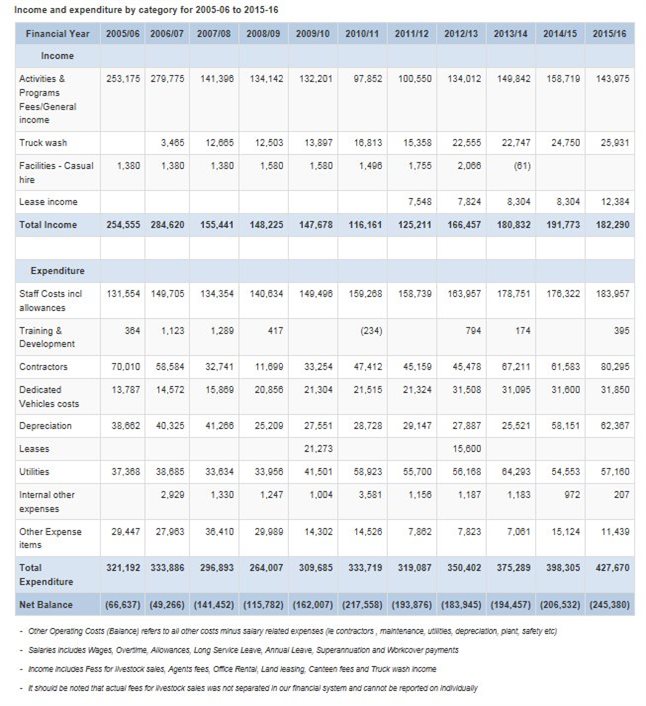
The financial performance of the Geelong Saleyards over the past 10 years has declined with the last two years resulting in losses of over $200,000 per annum. Refer Attachment 5. This has been confirmed by an independent auditor.
A structural engineering assessment was completed followed by an OH&S assessment of the cattle pens at the Geelong Saleyards. The independent OH&S report concluded that “in its present condition the cattle yards would not meet Victorian Occupational Health and Safety Legislative requirements for the provision of a safe work place”. These reports are available online by visiting the Geelong Saleyards website.
The issues identified in the OH&S report are listed in Attachment 6.
The cost to repair the cattle pens to acceptable operations (note without a roof) is estimated at $2,895,000. A review of the estimate by the GSAC to a minimum standard is estimated at $1,838,118. A breakdown of costs are detailed in Attachment 7.
Support for small cattle producers, with new cattle holding pens, has been available for use by local producers to use as an interim measure however to date these facilities have not been utilised once.
The Mecardo market analysis report noted a number of alternative Saleyards options available to be considered; including Colac as the regional livestock facility; a Peri-Urban exchange with associated services; and a co-operative model.
The report also noted that the Saleyards model that has existed in Geelong for nearly 150 years is not the solution to the challenge of providing a livestock exchange for the demographic existing now and into the future.
The Geelong Saleyards Advisory Committee’s preferred options were the Peri-urban service and a revised Co-operative model referred to as the ‘Ouyen Saleyards model’. Feedback from the committee was that Colac is not its preferred option due to transport distance particularly from the Bellarine Peninsula.
The G21 Regional Growth Plan identifies Colac as the preferred regional livestock facility.
At its April 28 2017 meeting the G21 Board reaffirmed their position. Refer to Attachment 8.
At the request of the G21 Board, City of Greater Geelong and Colac Otway Shire engaged Mecardo to report on the Colac Regional Saleyards as an option should the Geelong Saleyards close. The report is available on the Geelong Australia website and notes that a transition of livestock sales to Colac could be accommodated by an additional sale day on Monday once a fortnight, some minor modification to the sheep yards and sheep loading ramps, construction of an enclosed access ramp to allow for small vehicle delivery, and Colac Otway Shire and G21 establishing an Advisory Committee to assess the additional services model.
The following four themes have been identified in the Sustainable Agribusiness Strategy for the G21 Region (the Agribusiness Strategy) with clear objectives and action plans to support the industry. These are to grow our markets, develop our people and their businesses; encourage innovation and collaboration, and build enabling infrastructure.
The infrastructure theme considers the Geelong Saleyards and refers to the Mercado report and the need to pursue the options as presented. The Agribusiness Strategy also indicates livestock has a 25% share of the Agribusiness sector and in reference to livestock for Geelong, indicates that this is 23% of that share and is declining.
Two selling agents who have been active at the Geelong Saleyards have both advised in writing that, due to the cost to their businesses, they would not provide a service for the sale of cattle at the Geelong Saleyards.
L Gardner moved, P Dorling seconded -
That Council:
close the Geelong Saleyards to the sale of sheep and cattle by 31 August 2017;
inform neighbouring Councils and stakeholders of the decision to close the Saleyards;
engage with the poultry sales operator, who currently operates at the Geelong Saleyards, to consider and determine the future of poultry sales at Geelong Saleyards site;
engage with representatives of the livestock transport industry to consider and determine the future usage of the truck wash facility at the Geelong Saleyards;
engage with the community to develop a strategy to recognise the history of the Geelong Saleyards;
identify Heritage elements to be retained at the Geelong Saleyards, and to make safe the site by demolishing unsafe infrastructure;
develop a Precinct Plan for the Weddell Road site incorporating the provision of public open space; and
thank the members of the Geelong Saleyards Advisory Committee for their advice and input to the operations of the Geelong Saleyards since March 2017.
Carried.
Reports on the operation and potential closure of the Geelong Saleyards have been brought before Council since 1998 with a number of recommendations to close. Refer to schedule of resolutions and actions to date. Since 1998 there have been 10 reports to Council. Even in the early reports it was noted that the current location was not a viable long term option for the operation of the Geelong Saleyards.
Refer to Attachment 2 for a full list of all the reports that have gone to Council since 1998.
Independent Market Analysis
At its 13 December 2016 meeting, Council resolved to defer repair works on the cattle pens until an independent expert local stock market analysis was completed and a full costing estimate was prepared based on the recently completed OH&S audit inspection.
An independent market analysis was completed by Mecardo and presented at the Council’s May 2017 meeting. It has also been presented to the Geelong Saleyards Advisory Committee, the G21 Board and Surfcoast Shire Council by Mecardo.
Key findings from the Independent Market Analysis – throughput and income
Income for saleyards is directly related to yarding and agency fees which are based on throughput. So as the number of head of cattle has decreased, so has the income.
The diagram below shows that in 2000 Geelong was yarding 28,818 head of cattle. By 2011 the yarding numbers had dropped to 5,151. During the drought years starting in 2014, numbers did increase as farmers were forced to destock due to a lack of water and feed.

Looking across the trends from 2000 to 2016, to return the Geelong Saleyards to cattle numbers experienced between 2000, current numbers would have to triple. Ballarat and Warrnambool are the only two sale yards with increasing yarding’s, ranging between 10-15% over the period 2000 to 2016. Colac, Hamilton and Camperdown experienced a moderate decline in throughput of between 15-25%, while Geelong has seen a significant decrease over the same time frame, just short of a 70% decline.
The diagram below shows the combined sheep and lamb throughput figures for the Ballarat, Geelong, Hamilton, Bendigo and Horsham saleyards along with the total for Victoria. As presented with the cattle data, Auctions Plus sheep and lamb sales are included in the table for the last four financial years along with the size of the Victorian flock as measured by the ABS.
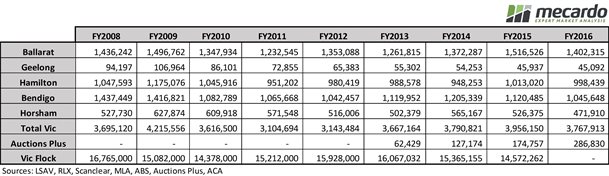
The saleyard income has, however, started to rebound since it’s lows in 2010/11, and a large percentage of this rise can be attributed to an increase in income sources other than stock throughput, such as revenue from the truckwash facility.
Key findings from the Independent Market Analysis – alternate options
The Mecardo report provided a number of alternatives to be considered as options to cater for the needs of peri-urban farmers that use the Geelong Saleyards. The Geelong Saleyards Advisory Committee (GSAC) selected three of these options for further exploration. These included:
Co-operative Operated Saleyards
In this option a co-operative could be formed by current saleyard users to manage the Geelong saleyards. A co-operative model could involve the Council either providing a commercial lease, or an outright sale of the facility to a co-operative group.
While this co-operative model addresses a number of issues, the planning and execution of a co-operative model may be difficult. Currently there is a group of peri-urban producers who have indicated strong support for the continued operation of the Geelong Saleyards, but they are not in any formal co-operative group. The GSAC strongly disagreed with the establishment of a co-operative model citing the experiences with the Murray Goulburn Dairy Co-operative, which was not successful.
The GSAC do however support the concept of a similar model, such as the Ouyen Saleyards model. At Ouyen there is an independent board that runs the Council-owned saleyards. The Ouyen saleyards are in good condition with little requirement for renovation. Any income raised at the Ouyen sale yards is used for maintenance only. In the case of the Geelong Saleyards, over $2million would need to be spent on the Geelong Saleyards to build a safe and modern facility before it could hand over management to another entity.
With the stock numbers trending down across the region, as highlighted in the market analysis report, there is no suggestion that by building a new facility that this would increase stock numbers to the level necessary for the saleyards to return a profit. In this model, the OH&S responsibility and asset maintenance costs would still remain with Council.
Peri-urban Exchange
The market analysis suggests that a livestock exchange that is easily accessible could provide additional services by private investment, or Council, to assist the peri-urban farmer.
While there has been no identified development in Australia of this proposed model, it does exist in other countries where farms are small. The UK and United States have a network of sale yards designed to accommodate small mobs. These yards are owner-operated with the yard operator providing all services including an auctioneer, settling processes and sale reports.
A peri-urban exchange could be established at the Colac Saleyards if there is demand for extra services for the novice or small scale farmers.
There are already small operators in the Geelong region who offer services for peri-urban producers such as mobile shearing, animal husbandry and transport. Novice farmers now tend to seek advice at their local rural supply store that can either provide the equipment or the contacts for them to manage their stock.
This peri-urban exchange service is preferred by the GSAC as a long term solution to facilitate the needs of peri-urban farmers, either at the current Geelong Saleyards site or a new green field site within the G21 region.
Existing Colac Saleyards
The Colac Regional saleyards is predominately a cattle-selling centre operating on a weekly basis. The yards have 138 cattle pens under cover with soft flooring installed, as well as 80 holding yards. Colac also has sheep & goat selling pens in good order with capacity for approximately 3,000 head. The Colac Regional Saleyards has the capacity to provide both sheep and cattle selling services to current users of the Geelong saleyard.
The distance between Colac and Geelong Saleyards of 87.7 km is considered an inconvenience by peri-urban farmers in Geelong. However they only account for 25% of those who use the saleyards, with the majority of users being closer. With the trend for peri-urban farming moving west in the region, the average distance for farmers will reduce over time.
The GSAC identified that there is no sale day on a Monday which allows for peri-urban producers to deliver stock on a Sunday prior to the sale day. The location is also seen as a deterrent in terms of transport costs and travel time from the Bellarine.
At its April 28 2017 meeting the G21 Board reaffirmed the designation of the Colac livestock Selling Centre redevelopment as the key Regional Agricultural project as referenced in the G21 Regional Growth Plan Implementation Plan. Refer attachment 8.
The G21 Board had requested that the City of Greater Geelong and Colac Otway Shire work together to further explore what would need to happen at the Colac Regional Saleyards to make it more accessible to peri-urban farmers in the Geelong region, if the Geelong Saleyards were to close. Mecardo were engaged to assess the possible use of the Colac Regional Saleyards for Geelong-based peri-urban farmers, and the key recommendations from their assessment were:
Minimal improvements are required to the Colac cattle yards although ongoing maintenance will need constant review;
The Colac sheep yards require upgrades principally in the area of loading ramps and natural lighting in the shed;
The launch of some additional services at Colac targeted to the peri-urban farmer would provide a launching pad for promoting the Colac Otway Shire sheep sale;
Minimal investment in the Colac Saleyards is required in the short term to support sales from Geelong;
Other livestock sales should be included in the promotion of the re-vamped Colac Otway Shire saleyards;
Engagement by the livestock agents is vital to future success of sheep & lamb sales volume at Colac Otway Shire’s saleyards;
Should the City of Greater Geelong Sheep sale cease, then Colac Otway Shire should take up the Monday sale;
Any promotion of the Colac Otway Shire Sheep sale initiative should only commence with the announcement of the City of Greater Geelong sheep sale ceasing;
Care should be taken to ensure that any capital improvements or modifications reflects future demand; and
The bespoke peri-urban market should evolve rather than an undergo immediate implementation.
In Mecardo’ s report on the Colac Otway Regional Saleyards it was concluded that for the future viability of the Colac Otway Shire’s saleyards, and to attract additional support, a new saleyard model needs to be developed to service the G21 region. This must effectively address the needs of the peri-urban farmer with the larger scale producer comfortably catered for via other offerings.
To progress, it was recommended that Colac Otway Shire and G21 should form an advisory committee to explore the wide range of options that could be considered as value-add inclusions to be offered by the Colac Regional Saleyards, and to consider any capital investments that will contribute to increased throughput.
It was also concluded that the Colac Otway Regional Saleyards should also take on a rolling improvement model, adding services progressively in response to demand, or at least to the identification of new demands.
Future Threats to the viability of the Geelong Saleyards
It needs to be noted that the Mortlake facility build has commenced and they anticipate they will be operating in early 2018. The new Ballarat facility has also commenced in its new location. The Mecardo report states that “… the larger markets are recognised as having increased competition, better prices and are therefore attracting greater numbers from sellers. It is expected that this trend will not only continue but will likely increase with the proposed construction of large regional yards at Mortlake and Ballarat. Not only is this a threat to Geelong saleyards, but other council based yards in Victoria, namely the Ballarat and Mortlake catchment areas, will be under pressure”.
Costing Estimate – Cattle Pens
The City has acknowledged that over time there has been a lack of investment in the maintenance and renewal of the Geelong Saleyards which has contributed to the OH&S concerns, causing the closure of the facility in August 2016. A structural engineering assessment was completed followed by an OH&S assessment of the cattle pens at the Geelong Saleyards. The OH&S report highlighted the extent of the safety concerns, particularly with the cattle pens. The independent OH&S report concluded that “..it should be noted that in its present condition the cattle yards would not meet Victorian Occupational Health and Safety Legislative requirements for the provision of a safe work place”. Due to the extensive OH&S concerns raised about the current state of the nearly 150 year old timber pens, the GSAC agreed with Council officers that demolition of the cattle pens would be the most practical and economical way to rebuild safe and compliant cattle yards.
Costing for acceptable operating yards
A concept design layout, allowing for approximately 80 pens, was developed, based on the current yard usage and feedback from the GSAC members. A quantity surveyor was engaged to provide a cost estimate for the rebuilding of the cattle pens. With the cattle holding pens available as a short-term measure, the longer-term options for the cattle pens has been reviewed by the GSAC.
The estimated cost of works to enable operation of the cattle yards is $2,895,000.
This estimated cost does not include a roof. The construction of the new cattle pens incorporates a concrete floor, so there is an expectation that, in order to meet animal welfare best practice, soft flooring should be installed in the cattle pens to reduce the risk of cattle being foot sore from standing on concrete. Without a roof over the cattle pens, there would be an ongoing additional cost to maintain the soft flooring which, if exposed to the elements, would wash away in rain events. This in turn poses risks to the drainage system at the Geelong Saleyards. There is also the concern about the increased need to have contaminated material removed from the Saleyards site.
Costing for an interim/short term cattle pens
The Geelong Saleyards Advisory Committee requested some amendments to the Quantity Surveyor’s cost estimate for the renovation of the cattle pens. The adjustments to the quote reduced the works to a level that could only be considered a short-term option. The cost for this interim solution for the cattle pens was estimated at $1,838,118.
Sustainable Agribusiness Strategy for the G21 Region
The consultants working on the Agribusiness Strategy have presented to the GSAC. Members of the GSAC form part of the Agribusiness Strategy consultative group. The draft Agribusiness Strategy was open for public consultation in July and is now finalised.
The Agribusiness Strategy has been developed to identify the opportunities to support and grow the agribusiness industry. Agribusiness is one of the major industries in the G21 region and therefore an Agribusiness Strategy has been prepared to support the industry opportunities.
The Agribusiness Strategy indicates livestock has a 25% share of the Agribusiness sector and in reference to livestock for Geelong indicate that this is 23% of that share and is declining. The infrastructure theme of the strategy considers the Geelong Saleyards and refers to the Mercado report and the need to pursue the options as presented.
The G21 region has a proud history in agribusiness. The diversity of the industry, and the breadth and depth of its sectors is one of its strengths. A rapidly growing population and a large visitor economy means that our regional landscape is changing and thus, so is the industry. The purpose of the Agribusiness Strategy is to provide a framework that will guide both government and private sector investment decisions on how best to assist the ongoing growth and development of the agribusiness industry. The Agribusiness Strategy has been informed by consultation carried out with peak agribusiness bodies, business both large and small, industry experts and government agencies and the wider community.
Four themes have been identified with clear objectives and action plans to support the industry; grow our markets, develop our people and their businesses, encourage innovation and collaboration, and build enabling infrastructure.
The G21 region has a number of competitive advantages it can build on; including established businesses, access to markets, land availability, good climate, quality produce, innovative businesses, and a skilled workforce. The G21 region also has a number of challenges to overcome including lack of collaboration across the industry, cost of compliance in the intensive animal industry operations, lack of reputation as a significant wine and food region relative to other regions, cost of access to the Melbourne container port, and land use conflict.
Historical Recognition
The Geelong Sale Yards, Weddell Road, North Geelong has significance as the most intact functioning 19th century municipal stock yards known in Victoria. The second municipal sale yards to be built in Geelong, these sale yards were established in 1869 by the Town of Geelong to a layout and design by the Town Surveyor, Robert Balding.
Surviving early fabric of the Geelong Saleyards includes the layout of cattle and sheep yards divided by a central thoroughfare, timber post and rail cattle and sheep pen fencing and gates, elevated and narrow covered cattle yard walkways, bluestone pen paving, stands of mature Ash trees shading the western sheep pens, former Caretaker’s Cottage and the bluestone spoon drains.
Should Council decide to close the Geelong Saleyards it is important to recognise the cultural and historic significance of the Geelong Saleyards and their place in Geelong’s early development as a city and region, as well as contribution to the livelihood of many to this day. There are diverse ways in which this history can be preserved and celebrated including personal narratives told through film, digital and on-line platforms, utilisation of site materials and fabric for interpretation and public art works, and interpretive and cultural signage. The City of Greater Geelong will develop a research and engagement plan to determine the best way to recognise the significance of the Geelong Saleyards with the communities who have been part of its history.
Financial Implications
Income - Council has made losses on the Geelong Saleyards for the last 10 years of an average of $171,000 per annum with the last two years experiencing losses of over $200,000. Refer Attachment 5. This has been confirmed by the independent auditor.
$690,000 is budgeted for the repairs to the Geelong Saleyards. The current expenditure for repairs to the sheep yards and the temporary cattle pens is $268,000, leaving $422,000 for potential future repair works on the site.
The cost of the renovation work is estimated at between $1.8M and $2.8M which has not been included 2017/18 budget. Refer attachment 7.
With the use of soft flooring in the cattle pens there will be significant ongoing operational costs as the flooring will need to be replaced more frequently without a roof over the entire cattle selling pens.
Extensive Consultation in regard to the operations and future of the Geelong Saleyards has been completed with relevant stakeholders and is not limited to the list below:
Stock Agents
Buyers
G21 group of Councils
G21 Agribusiness forum
Geelong Saleyards Advisory Committee (GSAC)
Workshop attended by 118 stakeholders on 11 November 2016
Survey to over 1400 stakeholders in July 2016 with 463 responders
Consultation by Robert Hermann as part of the Mecardo report
Saleyards webpage developed on the Geelong Australia Website
Refer Attachment 4 for full details of the Consultation and Engagement activities and the GSAC activities and actions.
Stock Agents: Recently directors from both of the Stock Agencies, HF Richardson and Charles Stewart, have written to Council advising that due to the high costs to their businesses they regretfully no longer support the sale of cattle at the Geelong Saleyards.
This report aligns to City Plan through the strategic direction of ‘How We Do Business’. All of the studies and reports about the Geelong Saleyards have reviewed how the service meets the requirements of a growing population through responsible and sustainable financial management as well as ensuring safety to City of Greater Geelong staff and members of the public.
Early in August 2016 safety concerns were raised regarding the condition of the Saleyards facility. An engineer’s report was received on the overhead and pedestrian walkways and other components including loading ramps which identified risks to users. This prompted immediate temporary closure of the Geelong Saleyards to sheep and cattle sales on 22 August 2016.
Further inspections of both the sheep yards and cattle yards were completed in November 2016 identifying a number of interventions required to enable yards to reopen. An OH&S audit of the cattle yards identified 17 recommendations. Risk ratings identified 8 very high and 7 high hazards that will require action prior to reopening of the cattle yards. Refer attachment 6.
The sheep pens were reopened in February 2017 for the sale of sheep with new metal selling pens, replaced hardwood rails, secure overhead walkways, improvements to the loading ramps and caps placed on all the metal upright posts.
The most cost effective way to address the significant OH&S concerns in the cattle pens is to demolish the timber pens and replace them with new metal panels that comply with current OH&S and animal welfare requirements.
Council Meeting |
Date of Meeting |
Report |
Division |
Confidential |
Section B |
Notice of Motion |
Resolutions |
Status |
Comment |
August 1998 |
26/08/1998 |
Saleyards |
Development and Strategy - Economic Development |
Public |
Yes |
No |
|
|
|
August 1998 |
26/08/1998 |
Saleyards |
Development and Strategy - Economic Development |
Public |
Yes |
No |
|
|
|
December 1999 |
22/12/1999 |
Saleyards |
Environment and Recreation Services |
Public |
Yes |
No |
|
|
|
December 1999 |
22/12/1999 |
Saleyards |
Environment and Recreation Services |
Public |
Yes |
No |
|
|
|
March 2000 |
08/03/2000 |
Saleyards |
Environment and Recreation Services |
Public |
Yes |
No |
That Council supports the establishment of a company to manage and operate the new saleyard development on the following basis.
|
|
|
August 2000 |
09/08/2000 |
Saleyards |
Environment and Recreation Services |
No |
Yes |
No |
That subject to the ownership status of the new saleyards development remaining with the Saleyards Advisory Group (SAG), the following contributions be applied to the project:
|
|
|
August 2000 |
09/08/2000 |
Saleyards |
Environment and Recreation Services |
No |
Yes |
No |
|
|
|
August 2000 |
09/08/2000 |
Saleyards |
Environment and Recreation Services |
No |
Yes |
No |
|
|
|
August 2000 |
09/08/2000 |
Saleyards |
Environment and Recreation Services |
No |
Yes |
No |
|
|
|
October 2003 |
28/10/2003 |
Saleyards |
Community and Recreation |
no |
Yes |
No |
|
|
|
October 2003 |
28/10/2003 |
Saleyards |
Community and Recreation |
no |
Yes |
No |
|
|
|
October 2003 |
28/10/2003 |
Saleyards |
Community and Recreation |
no |
Yes |
No |
|
|
|
October 2003 |
28/10/2003 |
Saleyards |
Community and Recreation |
no |
Yes |
No |
|
|
|
October 2003 |
28/10/2003 |
Saleyards |
Community and Recreation |
no |
Yes |
No |
|
|
|
June 2015 |
09/06/2015 |
Saleyards |
City Services |
Public |
Yes |
No |
|
Completed |
|
June 2015 |
09/06/2015 |
Saleyards |
City Services |
Public |
Yes |
No |
|
Completed |
|
June 2015 |
09/06/2015 |
Saleyards |
City Services |
Public |
Yes |
No |
|
In Progress |
|
September 2016 |
27/09/2016 |
Saleyards |
City Services |
Public |
Yes |
No |
|
Completed |
|
September 2016 |
27/09/2016 |
Saleyards |
City Services |
Public |
Yes |
No |
|
Completed |
|
September 2016 |
27/09/2016 |
Saleyards |
City Services |
Public |
Yes |
No |
|
Completed |
|
September 2016 |
27/09/2016 |
Saleyards |
City Services |
Public |
Yes |
No |
|
Completed |
|
December 2016 |
13/12/2016 |
GEELONG SALEYARDS |
City Services |
Public |
Yes |
No |
That Council:
|
Completed |
actions being scoped and costed for cattle yards |
December 2016 |
13/12/2016 |
GEELONG SALEYARDS |
City Services |
Public |
Yes |
No |
|
Completed |
repair works complete |
December 2016 |
13/12/2016 |
GEELONG SALEYARDS |
City Services |
Public |
Yes |
No |
|
Completed |
audit scope of works prepared and estimated |
December 2016 |
13/12/2016 |
GEELONG SALEYARDS |
City Services |
Public |
Yes |
No |
|
Completed |
audit scope of works prepared and estimate completed |
December 2016 |
13/12/2016 |
GEELONG SALEYARDS |
City Services |
Public |
Yes |
No |
|
Completed |
initial meeting held in December with small group of stakeholders to determine options for interim cattle sales. Cattle hub installed. |
December 2016 |
13/12/2016 |
GEELONG SALEYARDS |
City Services |
Public |
Yes |
No |
|
In Progress |
Market analysis complete and noted by Council 23/5/2017 |
December 2016 |
13/12/2016 |
GEELONG SALEYARDS |
City Services |
Public |
Yes |
No |
|
Completed |
EOI closed 17 February 2017 and committee appointed. |
January 2017 |
24/01/2017 |
Geelong Saleyards Advisory Committee - Terms of Reference CTR245.5 |
City Services |
Public |
Yes |
No |
That Council:
|
Completed |
Completed - Changes as per resolution has been made to the ToR. |
January 2017 |
24/01/2017 |
Geelong Saleyards Advisory Committee - Terms of Reference |
City Services |
Public |
Yes |
No |
|
Completed |
The General Manager City Services commenced the EOI process and submissions closed on 17 February 2017. 8 submissions were received and assessed and committee appointed |
May-17 |
23/05/2017 |
GEELONG SALEYARDS MARKET ANALYSIS REPORT |
City Services |
Public |
Yes |
No |
That Council note the Geelong Saleyards Market Analysis Report. |
Completed |
report noted |
Geelong Saleyards Advisory Committee Terms of Reference |
Document No: |
CTR245.5 |
Approval Date: |
24 January 2017 |
|
Approved By: |
Council |
|
Review Date: |
1 June 2017 |
|
Responsible Officer: City Services General Manager |
Version No: |
01 |
Authorising Officer: |
Chief Executive Officer |
|
At the City of Greater Geelong Council meeting on 13 December 2016, Council resolved to “establish a Geelong Saleyards Advisory Committee, with a Terms of Reference consistent with the Australian Code of Practise for the Selling of Livestock and work with the proposed Committee to advise Council on user issues at the Saleyards”
The purpose of the Geelong Saleyards Advisory Committee (“Committee”) is to advise the City of Greater Geelong on a range of technical and community issues which may impact on the management of the Geelong Saleyards.
The Committee will advise Council on options to address issues, and assist with the identification of preferred solutions for Council decisions on operational issues and in relation to strategic decisions it may make in relation to ongoing service.
The purpose of the Committee is to advise Council. It is not a Committee of Council with the authority to make decisions on behalf of Council.
Being an advisory committee, the Committee does not have the authority to direct staff on the management of the Saleyards or the delegation to expend the allocated budget.
The Committee will provide suggestions and advice however it is Council’s decision about which, if any, suggestions are adopted, based on budget and other Council priorities, including legislative compliance.
To provide information on the perspectives of the range of stakeholders.
To advise Council on ways to inform and consult with stakeholders more broadly than the Committee, when appropriate.
To advise Council on communication required and support options for users during temporary closure or transition to permanent closure if this decision remains in place.
To respond and advise on a range of matters impacting on the Saleyards, as requested by Council.
The Committee will comprise of members with technical and community expertise, to respond effectively to the complexity and diversity of issues impacting on the Saleyards.
Membership of the Committee consists of:
one (1) Stock Agent;
two (2) Livestock Producer Representatives;
one (1) Livestock Carrier representative;
one (1) Buyer representative;
one (1) Public representative;
one (1) Regional Agribusiness market expert;
one (1) Academic expert.
Note: Up to three (3) Council Officers will attend the committee meetings but do not have voting rights.
Nominations of membership of the Committee shall be called by public notice in local newspapers, and other appropriate communication methods.
All nominees are to have demonstrated extensive current links to the community and membership of networks. Experience on boards or advisory committees is preferred.
Appointments will be made following a formal selection process by a selection panel, which will include Council Officers and an independent expert.
If a vacancy occurs for any reason it will be filled at the discretion of Council.
A position will be deemed to be vacant if a member fails to attend three (3) consecutive meetings without reasonable grounds.
Chair: Chief Executive Officer – City of Greater Geelong or delegated officer.
to be fully prepared for meetings;
to agree to participate in a collaborative meeting format;
constructively represent the Committee externally.
to bring local knowledge and broad community & industry experience to the table;
to consider and raise issues, proposals and ideas;
to provide informed advice and guidance;
to listen and to attempt to reach consensus on advice to be provided on issues to be decided by council.
Meetings of the Committee shall be held bi-monthly at Council offices; unless the Committee resolves otherwise.
Meetings will be conducted by the Chair to an established agenda.
All agenda items are to be submitted to the Secretary, five (5) days before the meeting. Members submitting items must ensure that the content is given in such detail to assist all members in understanding the issue raised.
If a Committee member wishes to raise ‘An Urgent Item”, that is not on the agenda it is the Chairperson’s discretion to determine an appropriate course of action.
Minutes of the meeting will be recorded and distributed to Committee Members.
The quorum will be 50% plus one of voting members (noting that Council Officers are not voting members).
Any conflict of interest must be declared at the commencement of meetings.
The Committee members have no delegated authority to make comments to the media.
Member of the Committee should appreciate that the Committee may, from time to time, deal with sensitive matters of a confidential nature. The confidentiality of such information should be respected by all members.
Council Officers will report progress on the Saleyards Advisory Committee through the corporate reporting procedures.
Administrative support will be provided by Council.
Quality Records shall be retained for at least the period shown below.
Record |
Retention/Disposal Responsibility |
Retention Period |
Location |
Minutes of Meetings |
City Services |
As per PROV |
EDRMS |
|
Geelong Saleyards Consultation list |
CoGG |
Mecardo |
Agri Business |
Purpose |
Key Themes / Outcomes |
Prior to closing |
|
|
|
|
|
Transport Operators |
YES |
YES |
YES |
To discuss the transition to closure and any subsidy programs that could provide assistance |
Subsidy to difficult to administer and determine eligibility. |
Stock Agents |
YES |
YES |
YES |
To discuss the current stock numbers and options as we moved towards transition to closure |
Understand the lack of available Stock Numbers. |
Saleyards users |
YES |
YES |
YES |
Discussion at saleyards and one on one meeting to discuss impacts on farmers as we transition to closure and to discuss any assistance that Council could offer |
Improvements required at the Geelong saleyards |
City of Greater Geelong Saleyards staff |
YES |
N/A |
N/A |
Discuss the history of pending closure and how that has impacted on the saleyards and on them. |
History of nearly closing the saleyards which impacted on budgets |
2014 Saleyards Feasibility study. |
YES |
N/A |
N/A |
An independent study was conducted to determine the feasibility of the Geelong Saleyards |
Independent report that highlighted the lack of stock throughput and the works required at the saleyards |
Geelong Saleyards Survey |
YES |
N/A |
N/A |
over 1400 surveys were sent out with 463 responses |
Surveys sent to determine current usage of the yards and any other options that could assist farmers |
Since Closure |
|
|
|
|
|
Stock Agents |
YES |
YES |
YES |
Discussions around sheep pens, cattle pen requirements and the viability of the saleyards |
Sheep pen requirements. Ongoing future of the saleyards. |
Transport operators |
YES |
YES |
YES |
Advice sought in relation to the sheep loading ramps and what options would work as interim solutions for cattle |
How to provide assistance to the Peri-Urban producer. |
Geelong Saleyards Users Group - various onsite meetings |
YES |
YES |
N/A |
Input sought on numerous occasions in relation to the sheep pen renovation, the interim cattle pen option and responses to the questions and concerns have been addressed via the Geelong Saleyards Advisory Committee |
Sheep pen renovation. Temporary Cattle pens requirements. New cattle pen design |
G21 Agribusiness forum |
YES |
YES |
YES |
Members of the G21 Agribusiness forum have presented to Council about agribusiness and how the saleyards relate. A member is also represented on the Geelong Saleyards Advisory Committee. |
Broader picture of Agribusiness in Geelong and the region. |
G21 Board |
YES |
YES |
YES |
The G21 Board have had presentations in relation to the saleyards and Mecardo presented the Market Analysis report. |
Confirmed Colac is the preferred regional solution. |
Surfcoast Shire – CEO, Mayor and Senior Officers |
YES |
YES |
N/A |
Members of City of Greater Geelong Executive have met with Senior officials from Surfcoast Shire on a number of occasions. |
Discussion about current arrangements at the Geelong saleyards and its long term future. |
Golden Plains Shire – CEO, Mayor and Senior Officers |
YES |
N/A |
N/A |
Members of City of Greater Geelong Executive have met with Senior officials from Golden Plains Shire on a number of occasions. |
Discussion about current arrangements at the Geelong saleyards and its long term future. |
Colac Otway Shire – CEO, Mayor and Senior Officers |
YES |
YES |
N/A |
Members of City of Greater Geelong Executive have met with Senior officials from Colac Otway Shire on a number of occasions. |
Discussion about current arrangements at the Geelong saleyards and its long term future. |
Geelong Saleyards Advisory Committee |
YES |
YES |
YES |
The Geelong Saleyards Advisory Committee will have met 7 times at the time of the July Council meeting. |
Input on the sheep pens once the sales had commenced. Discussion about the temporary cattle pens. Mecardo report and agribusiness strategy input. New cattle pen design. |
OH&S Consultant |
YES |
N/A |
N/A |
Safetyzone was engaged to conduct a full OH&S safety inspection of the cattle pens and the surrounding facilities. |
Independent report on the safety of the saleyards. |
Traffic Management Consultant |
YES |
N/A |
N/A |
A traffic management consultant produced a full traffic management plan for the Saleyards, including line marking, signage and pedestrian separation areas |
Independent report on the traffic management requirement at the saleyards |
Geelong West Town Hall Community meeting |
YES |
N/A |
N/A |
In November 2016 the City of Greater Geelong held a forum that was independently facilitated by Kismet Forward. The forum was attended by 118 local producers and operators. |
Common feedback from local producers was to continue operations at the Geelong Saleyards |
Ag Concepts (Mecardo) Consultants |
YES |
YES |
YES |
Mecardo was engaged to produce the Livestock Market Analysis report that was noted at the May Council meeting. |
Independent report on the livestock market locally and regionally. Conclusion that the current Geelong Saleyards is not the future of livestock selling. Provided options to be considered for the local Peri-Urban farmers. |
City of Greater Geelong staff |
YES |
YES |
YES |
Many employees of the City of Greater Geelong have provided feedback in relation to the future of the Geelong Saleyards. |
City of Greater Geelong staff have provided their thoughts on the future of the saleyards |
Poultry Licence Holder |
YES |
N/A |
N/A |
The Poultry Licence Holder has a lease that is renewed yearly. |
Discussion about their current lease |
Local Residents |
YES |
N/A |
N/A |
Residents who live near the Geelong Saleyards have been in contact with their views on the future of the saleyards as well as over concerns about the operating hours and noise concerns. |
Complaints have been received in relation to noise and late night operation. Local residents have been advised that the report about the future of the saleyards will be available on line and how they can provide comment. |
Buyers – Ramon Clarke, Bob Hackett and Steve Cooper |
YES |
YES |
N/A |
Ramon Clarke has been the buyer representative on the Geelong Saleyards Advisory Committee. The buyers were also consulted with as part of the Mecardo report and have been involved in the walk throughs at the Saleyards. |
Members of the Advisory Committee as well discussion on sale days from the perspective of local buyers. |
Hon Lisa Neville – Member for Bellarine |
YES |
N/A |
N/A |
Lisa Neville’s office has been advised regularly about the Geelong Saleyards |
Advised about the current situation at the saleyards |
Hon Jaala Pulford – Minister of Agriculture |
YES |
N/A |
N/A |
Jaala Pulford’s office has been advised regularly about the Geelong Saleyards |
Advised about the current situation at the saleyards |
Hon John Eren – Member for Lara |
YES |
N/A |
N/A |
John Eren’s office has been advised regularly about the Geelong Saleyards |
Advised about the current situation at the saleyards |
Hon Christine Couzens – Member for Geelong |
YES |
N/A |
N/A |
Christine Couzen’s office has been advised regularly about the Geelong Saleyards |
Advised about the current situation at the saleyards |
Australian Livestock Saleyards Association – Stuart McLean |
YES |
N/A |
N/A |
Stuart is a member of the Geelong Saleyards Advisory Committee and is the President of the Australian Livestock Saleyards Association. He has provided advice to Council on a number of occasions. |
Member of the Advisory group. Discussions about the long term options at the saleyards. |
Livestock Saleyards Association Victoria – Mark McDonald |
YES |
N/A |
N/A |
City of Greater Geelong Saleyards Officers have meet with Mark on a number of occasions. |
Member of the Advisory group. Discussions about the long term options at the saleyards. |
Scanclear |
YES |
N/A |
N/A |
Scanclear provide all the scanning and regulatory reporting work at the Geelong Saleyards. They have been able to provide information about other saleyards. |
Discussions about the long term options at the saleyards and about electronic ear tagging |
Metalcorp |
YES |
N/A |
N/A |
Metalcorp was engaged to provide the new sheep pens and the pens for the cattle holding pens. |
Metal sheep pens and metal cattle pens, design and supply |
Proway |
YES |
N/A |
N/A |
Proway was consulted by the Quantity surveyor in relation to the costing for the new cattle pens. |
Quote for new cattle pen design |
Geelong Saleyards staff |
YES |
YES |
N/A |
Our permanent staff at the saleyards have been able to provide information about the history of the saleyards and have worked very closely with all consultants to complete the updated works. |
Discussion about how the repeated near closure of the saleyards has impacted on the operation of the yards and on them. |
Dr David Rowe – City of Greater Geelong Heritage Officer |
YES |
N/A |
N/A |
Dr Rowe completed the Conservation Management Policy in 2007 that recorded the history of the saleyards and has provided advice about the need to preserve any infrastructure at the Geelong Saleyards. |
Heritage advice provided when renovating the sheep pens and on what needs to be retained in the cattle pens |
Gordon Nash – Department of Economic Development, Jobs, Transport and Resources (DEDJTR) |
YES |
N/A |
N/A |
Officers have consulted with Gordon Nash in relation to the renovation of the sheep pens and have had discussion about the future of the Geelong Saleyards. |
Provided advice on biosecurity and welfare issues. |
Worksafe |
YES |
N/A |
N/A |
Officers from the City of Greater Geelong Risk Management team have consulted with Worksafe about the renovation works at the Geelong Saleyards. |
Provided advise on Worksafe regulations |
EPA |
YES |
N/A |
N/A |
Officers from the City of Greater Geelong Risk Management team have consulted with the EPA about the Geelong Saleyards. |
Provided advise on EPA regulations |
VicHealth |
YES |
N/A |
N/A |
Officers from the City of Greater Geelong Risk Management team have consulted with VicHealth about the Geelong Saleyards. |
Provided advise on VicHealth guidelines |
Barwon Water |
YES |
N/A |
N/A |
Officers from the City of Greater Geelong Risk Management team have consulted with Barwon Water regularly about treatment of water at the Geelong Saleyards. |
Regular discussion in relation to water testing. |
Geelong Agribusiness Strategy Consultant |
YES |
YES |
YES |
Present and discuss inputs to the Agribusiness Strategy |
Attended a Geelong Saleyards Advisory Committee meeting and 2 members are on the panel |
Victorian Farmer’s Federation - VFF |
YES |
YES |
YES |
City of Greater Geelong Senior Management and Officer have meet with several representatives of the VFF. Fiona Conroy is the VFF representative on the Geelong Saleyards Advisory Group |
Several VFF members have provided advice about the VFF concerns about the future of the Geelong Saleyards. |
VFF – Biosecurity |
YES |
N/A |
N/A |
City of Greater Geelong Officers have spoken to the VFF Biosecurity officers on a number of occasions. |
Provided advice on biosecurity issues to be considered. |
Meat and Livestock Victoria - MLA |
YES |
YES |
N/A |
City of Greater Geelong Officers have spoken to MLA and Mecardo also consulted with them as part of the Livestock Market Analysis. |
Provided Figures and statistics about sales and trends. |
Saleyards Webpage developed on the Geelong Australia Website |
YES |
N/A |
N/A |
The Website is updated regularly with information about the Geelong Saleyards Advisory Group, Council reports and information about stock numbers at the sales. It is also where any changes to the sale date by the agents is advised. |
Updated regularly – FAQs. Reports. Council resolutions. Sale dates and data. |
Notices positioned at the saleyards |
YES |
N/A |
N/A |
Signs have been updated and added to as required to provide advice to the users of the Saleyards. |
Site rules, parking signs, closing times advice, and truck wash signs. |
Notices in the Geelong Advertiser |
YES |
N/A |
N/A |
Notices regarding the Geelong Saleyards have been put in the Community news pages in the Geelong Advertiser. |
Information about sale dates |
Well over 50 letters sent in response to questions |
YES |
N/A |
N/A |
The City of Greater Geelong has received over 50 letters either as direct letters or as questions at Council meetings. These have been responded to. |
Various correspondence has been responded to. |
|
|
|
|
|
|
Other Saleyards |
|
|
|
|
|
Colac Otway |
YES |
YES |
N/A |
Several site visits and phone conversation by Officers and Mecardo staff. |
Information provided about the operation of their saleyards. |
Ballarat |
YES |
N/A |
N/A |
Office visit by RLX |
Information provided about the operation of their saleyards |
Warrnambool |
YES |
YES |
N/A |
Phone conversations by Officers and site visit by Mecardo |
Information provided about the operation of their saleyards |
Camperdown |
YES |
YES |
N/A |
Phone conversations by Officers and Mecardo |
Information provided about the operation of their saleyards |
Ouyen |
YES |
YES |
N/A |
Phone conversations by Officers and Mecardo |
Information provided about the operation of their saleyards |
Kyneton |
YES |
YES |
N/A |
Site visit and phone conversations by Officers and Mecardo |
Information provided about the operation of their saleyards |
Pakenham |
YES |
YES |
N/A |
Phone conversations by Officers and Mecardo |
Information provided about the operation of their saleyards |
Hamilton |
YES |
YES |
N/A |
Phone conversations by Officers and Mecardo |
Information provided about the operation of their saleyards |
Mansfield Council transfer hub |
YES |
N/A |
N/A |
Phone conversations by Officers |
Information provided about the operation of their saleyards |
Wangaratta Council |
YES |
YES |
N/A |
Phone conversations by Officers and Mecardo |
Information provided about the operation of their saleyards |
Forbes Central West Livestock Exchange |
YES |
N/A |
N/A |
Phone conversations by Officers |
Information provided about the operation of their saleyards |
Casterton Council |
YES |
YES |
N/A |
Phone conversations by Officers and Mecardo |
Information provided about the operation of their saleyards |
|
|
|
|
|
|
Geelong Saleyards Advisory Committee Advice |
|
|
|
Actioned by Council |
|
Number of cattle pens required |
YES |
N/A |
N/A |
Committee member advised that there would need to be 80 selling pens incorporated in the design of new cattle pens for quoting. |
Advice on the number of pens required. This number of pens was quoted on. |
Footprint of the cattle pens |
YES |
N/A |
N/A |
A new plan was quoted on for the new cattle pens at the request of the committee |
Requested a change to the footprint of the new cattle pens. This formed the short term option pricing. |
Drinking water signs at the truck wash |
YES |
N/A |
N/A |
Questions had come through a committee member about the truck wash water. Signs have now been installed advising users not to drink the truck wash water. |
Member asked for clarification about drinking the truck wash water. Signs have now been installed. |
Renovating the sheep loading ramps |
YES |
N/A |
N/A |
A third ramp was renovated rather than a new adjustable ramp purchased at the recommendation by Committee members |
Renovations completed |
Adding more gates in the sheep selling pens |
YES |
N/A |
N/A |
More gates were requested by the committee to |
More gates added to make smaller selling pens |
Number of temporary cattle pens required |
YES |
N/A |
N/A |
It was suggested that there only needed to be 6-8 pens for the cattle holding pens. This was actioned |
7 holding pens put in as suggested |
Changes to the Geelong Saleyards Advisory Committee Terms of Reference |
YES |
N/A |
N/A |
The members of the committee provided input into the Terms of Reference when they were being developed. |
Terms of Reference were modified |
Adding additional holding/delivery pens in the sheep yards |
YES |
N/A |
N/A |
Requests had come via committee member about the need for more holding/delivery pens. More were renovated prior the next sale |
Additional holding/delivery pens were requested and delivered. |
Input into additional information into the Mecardo Livestock Analysis report |
YES |
YES |
N/A |
Members of the committee provided feedback about the draft of the Livestock Market Analysis and their requests for additional information were incorporated into the final report. |
A draft Livestock Market Analysis was provided for comment. Additional information was provided in the report as requested |
Request for consultation on the Agribusiness strategy – 2 members are on the panel |
YES |
N/A |
YES |
2 members of the Geelong Saleyards Advisory Committee are part of the Agribusiness Strategy panel. |
Feedback was requested and 2 members invited to participate in the consultation panel. |
Supply media notes to the Advisory Committee |
YES |
N/A |
N/A |
Media releases are sent out to the Advisory Committee |
Provided |
Preferred options from the Livestock Market Analysis |
YES |
YES |
N/A |
The Committee provided advice that their preferred options for the Geelong Saleyards was for the adoption of a model like Ouyen and the Peri-Urban exchange. Their advice that they did not support the Colac option was forwarded to the Administrators as per the committee’s request. |
Advice provided about the preferred options about the future of the saleyards. |
No. |
Item |
Risk |
Hazard Identification |
Recommendation |
Update – July 2017 |
1 |
Occupational Health & Safety Management System |
H |
No Occupational Health and Safety Management system in place. |
A safety management plan specific to the safe operation of the sale yards should be developed. The safety management plan will identify how the sale yards will ensure compliance to its legislative requirements. |
A full OH&S Management plan has been developed and adopted at the Geelong Saleyards. An emergency management plan has been developed and relevant training conducted with staff. |
2 |
Site Security |
VH |
Gates are not locked out of hours. |
Site security requires review and upgrade. |
Site has new front gates installed. Gates are locked on a Sunday night prior to a sale and on a Monday night after a sale. A full traffic management plan has been developed and advisory signage is in place. |
3 |
Site Fire Safety |
VH |
No emergency management plan in place. |
An emergency management plan should be developed that incorporates the potential emergencies likely to occur at a cattle yard. |
An emergency management plan has been developed and relevant training has been conducted with staff. A full fire plan will be developed including fire fighting equipment. Works would also be undertaken to bring in the required water for an additional fire hydrant. - pending decision to renovate the cattle pens and return to cattle sales. |
4 |
Ramp Docking Facilities |
VH |
Ramps lack modern ramp docking requirements for the prevention of cattle escape during unloading activities. |
Ramp docking facilities require assessment and upgrade to meet best practice standards for the receival and safe unloading of cattle. |
3 ramps at the sheep pens have been renovated with new retaining walls, OH&S Compliant metal fencing and stairwells. New ramp flaps are in place to ensure animals don't escape out the side or hurt themselves between the truck and ramp. |
5 |
Cattle Crush |
H |
Cattle crush presents with numerous potential strike and crush hazards. |
The cattle crush requires a risk assessment be undertaken to ensure it is fit for purpose and safe operation within the environment is set within. |
Cattle crush area will be improved to ensure it meets OH&S requirements - pending decision to renovate the cattle pens and return to cattle sales. |
6 |
Cattle Weigh Bridge |
VH |
Weighbridge gates represent a strike hazard. |
The cattle crush requires a risk assessment be undertaken to ensure it is fit for purpose and safe operation within the environment is set within. |
The cattle weighbridge area will be improved to ensure it meets OH&S requirements - pending decision to renovate the cattle pens and return to cattle sales. |
7 |
Cattle Yard Gates |
H |
Protruding gate latches represent a catch point to people and animals. |
Gate latches require upgrade to latch and spring type - removal of protrusions. |
The cattle yard gates will be improved to ensure they meets OH&S requirements - pending decision to renovate the cattle pens and return to cattle sales. |
8 |
Drafting Races |
H |
Potholed and cracked and uneven flooring presents a risk of sprains and strains. |
Repair and upgrade flooring to remove all potential trip and sprain hazards. |
The cattle area will be improved to ensure it meets OH&S requirements - pending decision to renovate the cattle pens and return to cattle sales. |
9 |
Metal Fence Posts |
M |
Jagged, sharp and rusted parts of posts represent a hazard to both people and animals. |
Jagged edges should be levelled and capped, sharp edges should be removed. |
All metal posts in the renovated sections of the sheep pens have capping. Areas not renovated are secured to ensure they cannot be accessed. The metal fence posts in the cattle pens will be improved to ensure they meet OH&S requirements - pending decision to renovate the cattle pens and return to cattle sales. |
10 |
Timber Fence Posts |
VH |
Degraded fence posts represent a strike and crush hazard to people and animals. |
Degraded fence posts should be identified and replaced. |
All degraded timber posts in the renovated sections of the sheep pens have been removed and replaced with metal posts. Areas not renovated are secured to ensure they cannot be accessed. The timber fence posts in the cattle pens will be removed and replaced with metal posts to ensure they meet OH&S requirements - pending decision to renovate the cattle pens and return to cattle sales. |
11 |
Timber Fence Railings |
VH |
Degraded fence posts represent a strike and crush hazard to people and animals. |
Degraded fence posts should be identified and replaced. |
All degraded timber rails in the renovated sections of the sheep pens have either been replaced with new hardwood rails or replaced with metal panels. Areas not renovated are secured to ensure they cannot be accessed. The degraded timber rails in the cattle pens will be improved to ensure they meet OH&S requirements - pending decision to renovate the cattle pens and return to cattle sales. |
12 |
Water Troughs |
M |
Water troughs filled with dirty and murky waters. |
Degraded water troughs should be replaced. |
All troughs are cleaned regularly in the sheep pens. The troughs in the cattle pens have been emptied and not refilled. |
13 |
Yards and Pens |
H |
Potholed and cracked and uneven flooring presents a risk of sprains and strains. |
Repair and upgrade flooring to remove all potential trip and sprain hazards. |
All of the selling pens in the sheep yards have been resurfaced with a new concrete pad under the new metal fencing panels. All gate latches in the sheep pens have been improved. All metal posts in the renovated sections of the sheep pens have capping. Areas not renovated are secured to ensure they cannot be accessed. The footing in the cattle pens will be improved to ensure it meets OH&S requirements - pending decision to renovate the cattle pens and return to cattle sales. All protrusions will be removed and all gate catches will be quick shut latches. |
14 |
Site Drainage |
M |
Limit water drainage points. |
Review drainage requirements at site to ensure they meet the relevant codes of practice for: |
|
15 |
Site Amenities |
L |
Toilets aged and exposed to elements. |
Review and upgrade amenities to ensure they meet the requirements of the relevant building code. |
An additional portable toilet is in place near the poultry sales. Any decision to improve the existing toilets will be deferred - pending a decision about the future of the saleyards. |
16 |
Workshop |
VH |
Poor housekeeping presents a risk. |
Review and update housekeeping requirements. |
Workshop has had a full refit and clean out of old tools. New shelving has been installed. Gas bottles have been secured with a chain. |
17 |
Site Lighting and Electrical Management |
VH |
Aged and damaged electrical wiring in cattle yard lights. |
All electrical wiring requires review. |
All electrical wiring in the offices and workshops have been tested and reviewed. Lights in the sheep pens will need to be assesed and replaced as necessary. An asbestos audit has been conducted and a copy of the assessment is held at the saleyards office. |
Works |
Full cattle yard cost ($) |
Interim cattle yard cost ($) |
External works and services
|
$1,709,000 |
$1,397,600 |
Sub-Total (Excl.GST) |
$1,709,000 |
$1,397,600 |
Contingencies and Cost Escalation |
$324,000 |
$251,568 |
Non-Construction Costs |
$122,000 |
$98,950 |
TOTAL END COST (excl. GST) – excl additional items |
$2,155,000 |
$1,748,118 |
Additional Items |
$740,000 |
$90,000 |
TOTAL END COST (excl.GST) – incl additional items |
$2,895,000 |
$1,838,118 |
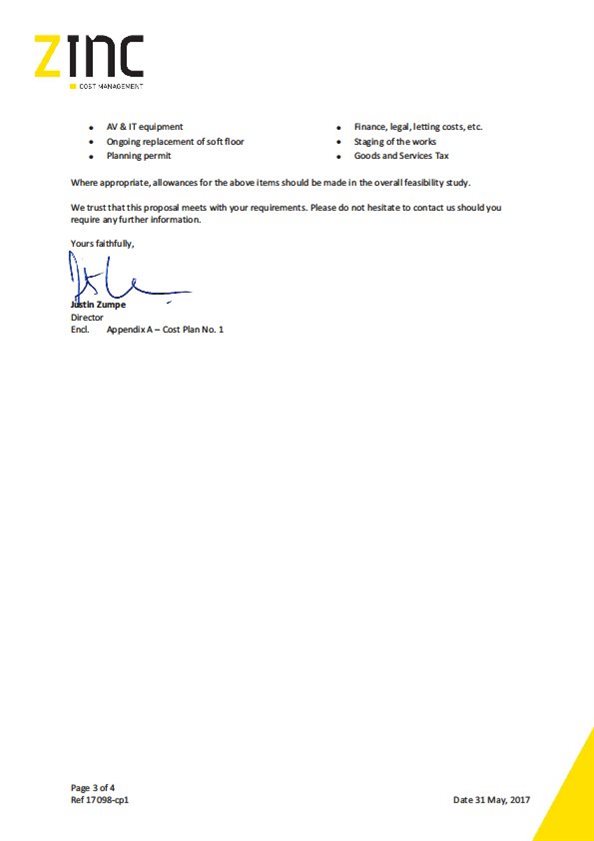

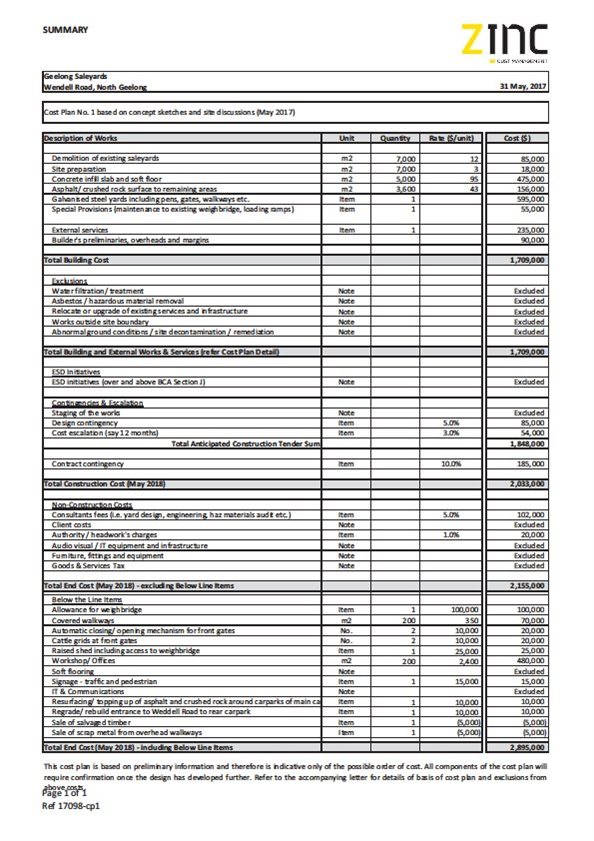
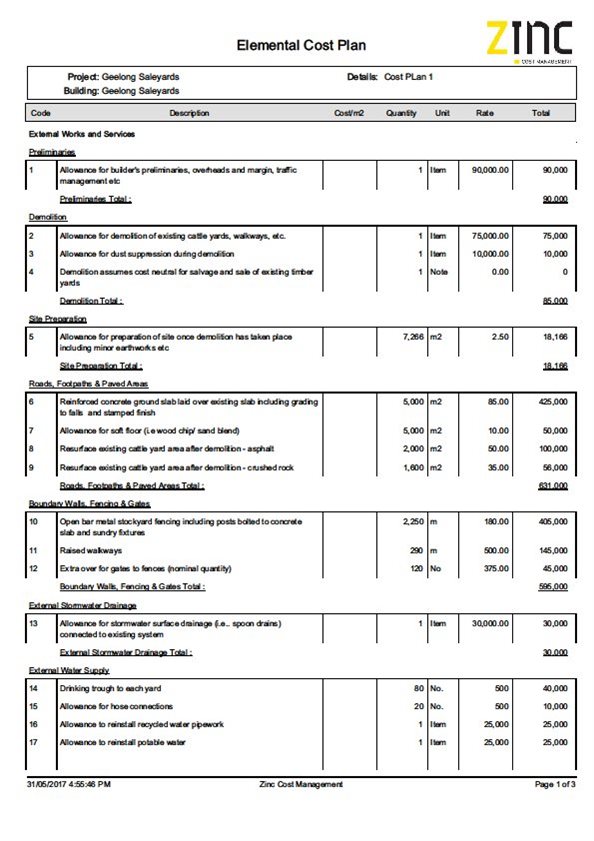
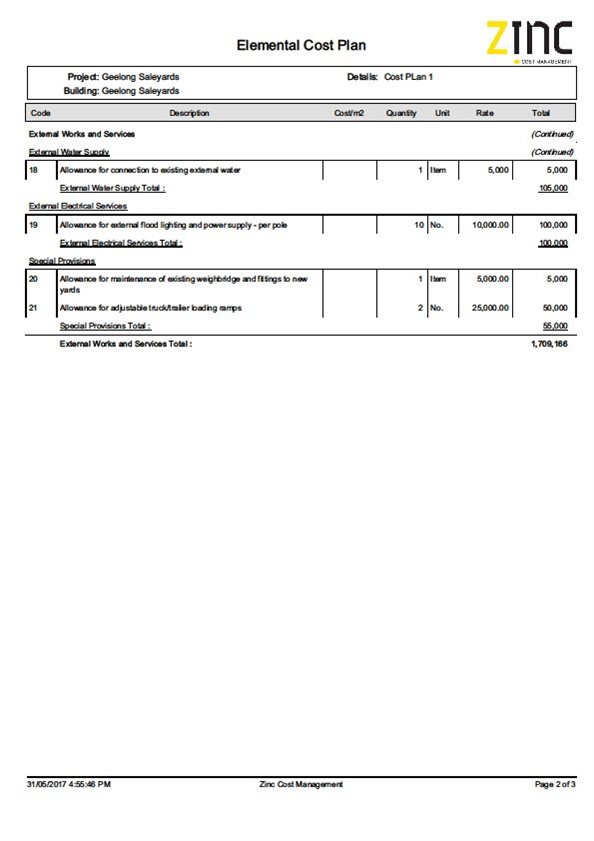
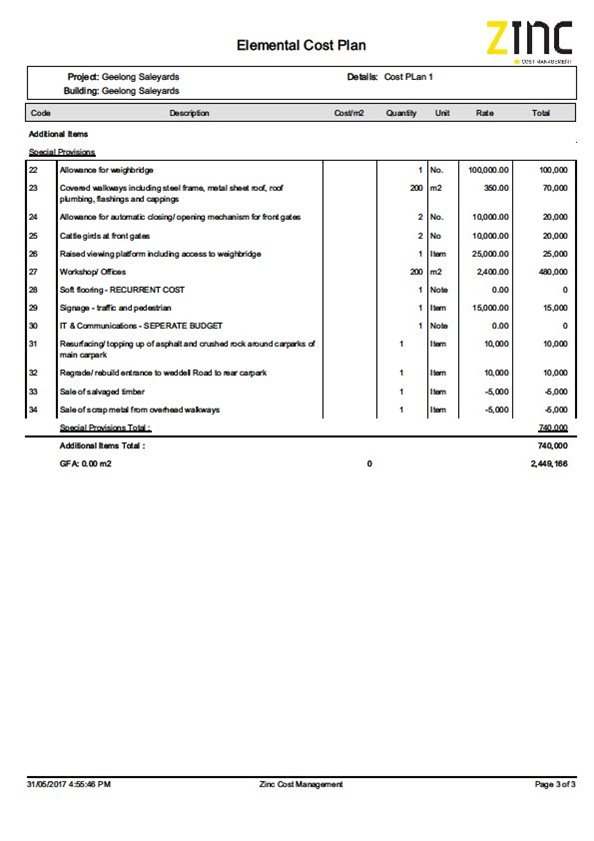
G21 Board Minutes – 28 April 2017
The G21 Board resolves to:
Notes the Livestock Market Analysis
Reaffirms the designation of the Colac livestock Selling Centre redevelopment as the key Regional Agricultural project as referenced in the G21 Regional Growth Plan Implementation Plan
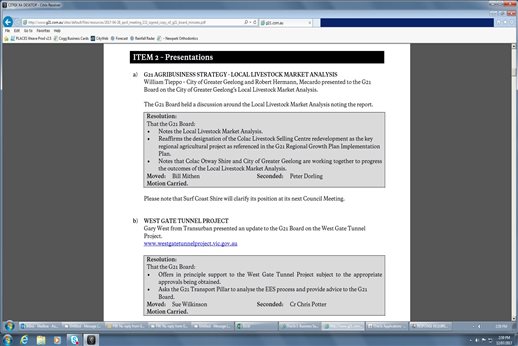
Notes that Colac Otway Shire and City of Greater Geelong are working together to progress the outcomes of the Local Livestock Market Analysis.
|
Source: |
Community Life - Family Services |
|
Director: |
Linda Quinn |
|
Index Reference: |
City Learning and Care - Trudy Moritz - Reports (Sub-16-610) |
To seek approval for the closure of the Trudy Moritz City Learning and Care Centre (Trudy Moritz), Sparks Road, Norlane and the relocation of children to Corio City Learning and Care (Corio CLAC).
Trudy Moritz currently provides long day care for children 0-6 years and has been in operation for approximately 30 years. Trudy Moritz has the capacity to provide education and care for up to 39 children (33 families). The children and families utilising this centre come from very diverse backgrounds. A number of families attending the Centre experience significant vulnerability and complex social issues.
Over the last five years utilisation at Trudy Moritz has been decreasing from 88% in 2012 (an average of 30 children per day) to 55% in 2017 (average of 17 children per day).
In order to reduce the cost to council some staff have been redeployed to other City Learning and Care centres. The current cost to council for the operation of the Centre is $250,506 for the 2016-17 financial year.
All families attending the Centre have participated in one on one consultation meetings in order for staff to understand their ongoing childcare needs post 2017.
All children currently attending the Centre can be accommodated at the Corio CLAC in 2018. Corio CLAC is approximately three kilometres from Trudy Moritz.
Corio CLAC is also experiencing low utilisation, however due to its size it has a greater capacity to accommodate the families from Trudy Moritz.
Staff have been consulted about the proposal to close the Centre and the Australian Services Union (ASU) have been informed. It is expected all staff will be redeployed to other centres.
At an ordinary meeting of Council on 28 March 2017 Council approved the detail design and construction of a new integrated children’s centre in Purnell Road Corio. Corio CLAC will transition into this new centre in 2020.
L Gardner moved, P Dorling seconded -
That Council approves the closure of the Trudy Moritz City Learning and Care Centre on 22 December 2017 and supports families to transition to Corio City Learning and Care Centre.
Carried.
Council is committed to providing high quality integrated services for families and children. The Trudy Moritz CLAC Centre no longer meets these requirements, (Trudy Moritz) has experienced a significant reduction in attendance over a number of years (88% in 2012 to 55% in 2017).
Significant marketing has been undertaken to increase participation however this has not been successful.
The low utilisation at the Centre can be attributed to a number of factors. The 2016 Census data shows a reduction of 201 children in the 0-4 year old age group since 2011. This is coupled with the closure of Ford Motor Company five years ago which has changed the demographic of families residing in the area. Low utilisation also impacts on the opportunity for parents and children to build broad support networks.
The Australian Bureau of Statistics Socio Economic Index For Areas (SEIFA) rates Norlane very high in vulnerability. Norlane has a score of 737, compared to the average score for Greater Geelong of 993. The lower the score the higher the vulnerability.
The Australian Early Development Census (AEDC) indicates that the average rate of vulnerability for children in Norlane is over double the average rate for the City of Greater Geelong.
Corio CLAC staff team are very experienced and well equipped to meet the educational and care needs of the families from Trudy Moritz.
If the closure of Trudy Moritz is approved the operating budget would transfer to Corio CLAC to cover the additional operating costs.
Staff currently working at Trudy Moritz CLAC are aware of the low utilisation and the proposed centre closure. A comprehensive communication plan was developed and involved consultation with staff, parents, carers and agencies.
Six staff permanently employed at the Centre have attended two staff meetings to discuss the proposed centre closure and their relocation to other centres.
One-on-one meetings with families and agencies was undertaken to assess the future child care needs of families and the possible relocation of children to Corio CLAC. Staff members have provided advice and insight into the services offered at Corio CLAC, travel to Centre and what alternative long day care services may be available to them if they choose not to take up the offer of transitioning to Corio CLAC. An individual tailored transition plan will be developed to support each family.
A total of 33 parents have been consulted in relation to the proposed closure. 11 children will transition to school or sessional kindergarten in 2018. 12 families have indicated they will transition to other Council operated early learning services including Corio CLAC. The remaining 10 families are unable to commit for personal and complex reasons and we will continue to support and work with them in transitioning to a service that meets their needs post 2017.
The timing for the proposed closure in December 2017 relates to the end of the kindergarten year and provides children with a smooth transition to school.
Meetings have taken place with the external agencies who are providing support to families.
Corio CLAC is approximately three kilometres (5 minute drive, 12 minute walk) from Trudy Moritz CLAC however our aim is to ensure no family is disadvantaged due to travel or other access issues.
Council’s role in supporting provision of local child care is consistent with obligations under Section 3E (a), (b), (c) and (d) of the Victorian Local Government Act 1989 and Best Value requirements.
The planning and regulatory role of Local Government in relation to the provision of services for the community is also legislated in the Victorian Planning and Environment Act (1987) and the Health Act (1958) and acknowledged within the MAV/DET Partnership Agreement.
The proposed project is consistent with Federal, State and Local Government policy in relation to the development of integrated children’s services.
The proposed project is consistent with recommendations contained within the Municipal Children’s Services Infrastructure Plan.
This report is in alignment with How We Do Business - Responsible and Sustainable Financial Management. Responsibly manage ratepayers’ funds in the delivery of services and programs.
No Council Officer involved in this report has a direct or indirect conflict of interest.
There is a risk families may choose not to pursue child care after the closure of the Trudy Moritz CLAC. We will however work with external agencies to provide ongoing support.
No environmental impact.
|
Source: |
Finance & Strategy – Property & Procurement |
Director: |
Joanne Moloney |
Index Reference: |
Land & Buildings |
To provide a progress report on the closure of Osborne House.
On 13 April 2017, a report was received from an independent industrial hygienist which showed readings of mould at levels that posed a significant health risk to the occupants of the Osborne House precinct. Due to this, the site was immediately closed and has remained closed while undergoing further testing and assessment.
A second independent industrial hygienist report was commissioned on 28 June 2017. Results from this report confirm the findings of the first report and, further, identified mould spores from the potentially deadly Stachybotrys strain also known as “black mould”.
Both reports attribute the abnormal weather events during recent years as being a contributing factor of mould forming and spreading so rapidly throughout the Osborne House precinct.
As part of the ongoing assessment process, quotes totalling approximately $1.5m have been received for cleaning the building and undertaking both minor and structural repairs. These quotes do not include the cost of cleaning, storage of artefacts or the like-for-like replacement of damaged building materials as required by Heritage Victoria.
The artefacts contained within the building have an estimated value of $1.5m – $2m. The majority of the artefacts are owned by the Commonwealth with Council acting as the management authority. Cleaning of these artefacts is required to be undertaken by a specialist and this work will need to be tendered. The cost for removal, cleaning and secure storage of the artefacts for a 12 month period is estimated at being in the range of $500k - $1m.
Heritage Victoria has been consulted and have outlined the management process for Council moving forward. This includes permits and other requirements for approving replacement of materials and the like.
The building remains in complete lock down.
There is no allocation of funds within the 2017/18 budget to accommodate the cost of cleaning, repairs and rectification works to the building and surrounding grounds nor the removal, cleaning and storage of the artefacts.
The full cost of repair and rectification work is still unknown and will remain unknown until works commence. Based on the quotes received to date, $2.5m - $3m is the ‘best’ estimate able to be obtained for cleaning of the building, repairs to the building (on known issues) and to remove, clean and store artefacts.
Tenants have either been relocated or assisted to find alternate accommodation however their artefacts, equipment and belongings remain in lock-down pending cleaning.
Once the above works are complete, Osborne House and the surrounding precinct grounds would be clear of mould and relatively safe but still not fit for purpose for any of its current uses.
This is due to the building design and lay-out not being configured to meet the requirements of operations such as museums which require minimum OH&S requirements for access by the public.
L Gardner moved, P Dorling seconded -
That Council:
acknowledge the requirement to maintain closure of the Osborne House precinct until further assessments and costings are undertaken and options for the future of the precinct are developed;
endorses the commencement of a procurement process to engage a suitable experienced contractor to commence the cleaning of artefacts;
endorses the commencement of a procurement process to secure a lease on a suitable storage facility for the artefacts both during and post cleaning;
approves the allocation of funds of up to $1m to meet the relocation, cleaning and ongoing storage of artefacts.
Carried.
It is estimated that there are approximately 20,000 artefacts in the Osborne House precinct both large and small. The cleaning process, as it is currently understood, consists of removing each object to a ‘freezing room’. They will then be moved to a room dedicated to cleaning and, finally, into a temperature controlled room to ensure no further damage.
Heritage Victoria has advised that, from August 2018, any permits for works on heritage listed buildings will be increased significantly following recent action on some heritage listed properties in Victoria. As an example, estimates of $50k per permit to dismantle non-heritage listed components of Osborne House have been received.
A quote has been provided to Council in relation to cleaning of the artefacts. The quote of approximately $215k (ex GST) is inclusive of the cleaning and storage of artefacts utilising shipping containers.
Dehumidifiers have been identified as key in the cleaning process to allow air to flow throughout the buildings. Quotes received for this aspect alone are for 80 humidifier units at a cost of $77.3k (ex GST) for the naval museum and $126.3k (ex GST) for Osborne House itself, totalling $203.6k (ex GST) to clean the air within the building over a 6 month period. This process would remove the mould from the air while surface would still need to be treated.
Note, storage and refrigeration costs have not yet sourced but are being estimated at approximately $300k-$400k.
The current overall estimate for cleaning and repair of the site (inclusive of artefacts) is $2.5m - $3m. This estimate is inclusive of cleaning and replacement of damage that can be seen. This does not include the rectification of building damage that can only be identified once works commence. Some material will need to be matched with like-for-like replacement should it be damaged and be heritage listed. Cheap replicas will not be accepted by Heritage Victoria.
To date, Council has spent approximately $70k on investigating the mould issue, commissioning an engineering report and completing some minor remedial works.
Council currently generates less than $1k of revenue annually from tenants of the Osborne House precinct.
Tenants have been kept informed of the progress to date via two engagement meetings held on 13 April and 10 May. Tenants were advised at the meeting on 10 May that the precinct was to remain closed indefinitely and further meetings were to be scheduled when new information of significance was available.
The second hygienist report, received 24 July, has highlighted a previously unreported mould, Stachybotrys, which has extreme health risks associated. Based on these findings, a third meeting is scheduled with the tenants on 31 July.
All tenants are continuing with their agreed short term moves. The Brass Band has been provided with a hall which accommodates both their rehearsals and provides secure storage of their equipment.. The Vietnam Veterans were offered but initially rejected a move to the North Geelong Football Club, however they have now informed Council that they prepared to work towards this outcome as an interim solution.
Rotary have been offered access to storage options on GREP land to help meet their interim needs, however they have refused this offer numerous times. Council do not have any alternate sites outside the GREP that meet the Rotary Clubs needs.
All tenant groups have been granted limited supervised access to the building and surrounding grounds to enable them to remove some items that were deemed urgent or critical to their ongoing functionality. These site visits have been supervised by the relevant facilities maintenance officer and a hygienist, with protective masks and cleaning process followed for the removal of any item.
Heritage Victoria will be consulted regularly throughout this process.
Nil to declare.
The growth of mould is an ongoing issue. While work is being undertaken, all personnel and contractors entering the building will wear protective clothing as outlined in the hygienist report.
Significant OH&S risk to the public entering the buildings on the site without protective gear.
|
Source: |
Governance and Legal Services |
|
Executive Manager: |
Rebecca Leonard |
|
Index Reference: |
Governance |
For Council to endorse a new Council Meeting Procedures Local Law 2017 and submit the new Local Law for public consultation.
In response to the Commission of Inquiry, the City has established a new Governance and Legal Services Department which is now reviewing governance practices across Council. As part of that review, a new Council Meeting Procedure Local Law (Local Law) and related policies have been drafted.
The new Local Law regulates the orderly conduct of meetings of Council, including ordinary meetings, special Council meetings, and meetings of Special Committees, the use of the common seal, the election of Mayor and Deputy Mayor and provides for new arrangements for the conduct of public question and submission time.
As part of the governance review, and in line with Item 3.1, Appendix 4 of the Commission of Inquiry assessment of the Council against the framework for good governance, there is a need to improve the use of Special Committees by Council to facilitate decision making and oversight. A change in the Council’s Special Committee structure will be implemented by Council to enable greater community engagement and improve opportunities for Council to consider community views on issues which will be decided upon by Council.
The Greater Geelong City Council Meeting Procedure Local Law 2013 was made by Council resolution and came into effect on 26 September 2013. A review of the Local Law is required to:
implement the changes required to align the Local Law with the City of Greater Geelong Amendment Act 2017 which altered the way the Mayor and Deputy May are elected; and
align the Local Law with best practice across the Victorian Local Government sector.
The new Council Meeting Procedure Local Law includes provisions designed to ensure:
the procedures at all meetings of Council, including ordinary meetings, Special Council meetings and Special Committee meetings are clear to facilitate effective decision making; and
that the Council has adequate opportunity to hear from the community on important issues relating to Council, or issues on which the Council will decide. The current arrangement whereby questions and submission are received at the Council meeting does not provide sufficient time for Council to fully explore issues raised by the public before making the decision.
It is proposed that Council implement a new meeting framework whereby Council will conduct an additional public meeting each month at which public questions and submissions are made. Council meetings will then become a decision-making forum only. The benefits of this additional public meeting are:
the public are provided with an opportunity to ask questions and submit information to Council two weeks before a decision is made;
Council is able to fully deliberate on information and issues raised two weeks before making a decision.
It is proposed that the procedures for public questions and submission time be mandated by the Local Law but regulated by Council policy to provide Council with the opportunity to consider and revise the process for public question time from time to time.
Other provisions of the proposed new Local Law improve clarity of processes, in particular Minutes, Motions and Amendments, Notices of Motion, Notices of Rescission, Procedural Motions, Urgent Business and Disagreement With Chairperson’s Ruling.
Management have reviewed the Local Law and note that the Local Law complies with the Victorian Charter of Human Rights (refer attachment 3), the National Competition Policy (refer attachment 4) and is supported with a Community Impact Statement (refer attachment 5).
Council will invite submissions in accordance with section 223 of the Local Government Act 1989 in relation to the proposed new Local Law for a period of 28 days. A Submissions Committee will then be convened to consider any submissions made in respect of the Local Law.
L Gardner moved, P Dorling seconded -
That Council, in accordance with Sections 111, 119, 223 and Schedule 8 of the Local Government Act 1989:
gives public notice of its intention to make the Council Meeting Procedures Local Law 2017 (Refer Attachment 2) and invites submissions for a period of 28 days;
note that any person who makes a written submission and has requested to be heard in support of the written submission is entitled to appear in person, or by a person acting on his or her behalf, before a meeting of the Council’s Submissions (Section 223) Committee;
receives a further report outlining any submissions received in respect of the proposed new Council Meeting Procedures Local Law 2017, including a report on the submissions, the Submissions Committee’s proceedings and summary of any hearing. A recommendation will then be presented to Council for consideration on or about 20 September 2017.
Carried.
The process for election of a Mayor and Deputy Mayor reflects the provisions of the City of Greater Geelong Amendment Act 2017.
Provisions relating to assessing and responding to an inability to reach or maintain a Quorum at any Meeting have been included.
A more clearly defined process has been incorporated into the Local Law to ensure that the Minutes of each meeting are properly considered and a process is in place to ensure that any proposed amendments to the Minutes are dealt with in a clear, transparent and consistent manner.
The proposed new Local Law states that no one, other than an authorised member of Council Staff, is allowed to video or audio record any Meeting.
Public questions and submissions are to be asked and responded to or submitted in accordance with the Council’s Public Question and Submission Time Policy, to be considered concurrently with this proposed new Local Law.
A detailed step-by-step procedure for moving Motions and Amendments has now been included in line with best practice across the sector.
A table has been included outlining the processes to be followed in respect of Procedural Motions.
The proposed Local Law requires a Meeting Member to submit a Notice of Motion form at least one day before the Agenda is provided to the Members. This will enable the Chief Executive Officer time to consider the proposed Notice of Motion and consider the application of the Local Law in respect of any proposed Notice of Motion.
A clear, transparent and consistent process for moving and considering Motions that a previous Council decision be revoked, rescinded or altered is set out in the proposed new Local Law. Notice of rescission can be given by either a Member of a Meeting or a Member of Council Staff. Provisions are also included to clarify what happens when a Motion seeking rescission of a previous Resolution is lost, and when such a notice of rescission is not required.
A clear, transparent and consistent process for bringing urgent business before a Meeting has been included in the proposed new Local Law.
For instance, urgent business will now be considered if it relates to a matter that has arisen since distribution of the Agenda, cannot be deferred until the next Meeting without having a negative impact on Council and cannot be addressed through operational service requests. For an item of urgent business to be considered it must be lodged with the Chief Executive Officer by no later than 4.00 pm on the Meeting night.
The updating of this section improves clarity of the process to be followed in the event this occurs.
Members of the public must address the Meeting in accordance with the Local Law, not interject, and must take direction from the Chairperson.
Council will invite submissions in accordance with section 223 of the Local Government Act 1989. This aligns with the ‘consult position’ of the IAP2 community participation spectrum supported by Councils’ Community Engagement Policy adopted on 25 July 2017.
The draft new Council Meeting Procedure Local Law 2017 has been prepared in accordance with the relevant provisions of the Local Government Act 1989; the Victorian Charter of Human Rights and National Competition Policy.
How We Do Business.
No officer involved in the preparation of this report has a direct or indirect interest.
Consideration Matrix – Council Meeting Procedures Local Law 2017
Council is required to act in accordance with the Victorian Human Rights Charter, and to consider human rights when making a decision.
The Charter provides standards and a framework to assist Council to consider the rights of all interested parties, and to be better able to strike a balance between an individual’s rights and those of competing public interests. The rights in the Charter may be subject to reasonable limitation in order to achieve this balance. As with all discerning decision making, if limitations are applied, this must be documented.
There are 20 rights listed in the Charter that promote the principles of freedom, respect, equality and dignity.
Specifically, the draft Local Law proposes to:
implement changes to the City of Greater Geelong Act (Vic) 1993 (as amended);
regulate and control the use of the Common Seal of Council;
regulate proceedings for the election of the Mayor and Deputy Mayor;
facilitate the orderly conduct of, and regulate proceedings at meetings of Council and Special Committees at the Greater Geelong City Council;
facilitate the good government of the Greater Geelong City Council and ensure that the Council’s decisions are made in the best interests of the community;
promote and encourage community participation in the good government of the City; and
repeal the Greater Geelong City Council Meeting Procedure Local Law 2013.
Issues & Purpose |
Rights Impacted (e.g.: s.15 refers to Sections of the Charter of Human Rights and Responsibilities Act 2006) |
Justification / Alternatives |
|
Positive Impact |
Negative Impact |
||
Part 1 Preliminary |
Nil |
Nil |
No impact as it sets out Title, Objectives, Legislative requirements and definitions. |
Part 2 Election of Mayor & Deputy Mayor |
s.15 Freedom of expression
s.16 Peaceful assembly and freedom of association
s.18 Taking part in public life
|
Nil |
Council members are elected in accordance with the Local Government Act 1989. Consequently, this part relates only to Council members, and by virtue of the Act, does not apply to other persons. |
Part 3 Procedure at Council meetings |
s.15 Freedom of expression
s.13 Privacy and Reputation
s.16 Peaceful assembly and freedom of association
s.18 Taking part in public life
|
s.15 Freedom of expression
s.16 Peaceful assembly and freedom of association
s.18 Taking part in public life
|
The Local Government Act 1989 sets out requirements for Council and Special Committee Meetings, and further, requires Councils to adopt a Local Law to establish meeting procedures. Consequently, this Local Law focuses on the rules for achieving orderly meetings, while recognising that meetings are open to the public. Public rights are contained within the Act itself, which is subject to the Human Rights Charter. The Act and any subsequent amendments are assessed against the Charter by State Parliament, and therefore, not further addressed at the local level. Assistance is available to members of the public who are unable to draft their own written questions prior to Council Meetings. |
Part 4 Common Seal |
Nil |
Nil |
No impact as it does not affect any person |
Part 5 Offences |
s.16 Peaceful assembly and freedom of association
|
s.16 Peaceful assembly and freedom of association
|
|
Part 6 Committees |
Applies similar guidelines for Special Committees as defined in the Local Government Act 1989. As per Part 3 |
|
|
The draft Council Meeting Procedures Local Law 2017 is considered to be compatible with the Victorian Charter of Human Rights.
Council Meeting Procedures Local Law 2017
Introduction
A Local Law must not restrict competition unless it can be demonstrated that:
the benefits of the restriction to the community as a whole outweigh the costs; and
the objectives of the Local Law can only be achieved by restricting competition,
(Clause 2(j) of Schedule 8 to the Local Government Act 1989).
This report applies this 'competition test' to the proposed Council Meeting Procedures Local Law 2017.
Part 1 – Preliminary
Part 1 sets out the objectives of the Local Law, when the Local Law commences and ends and definitions of words used in the Local Law.
It does not contain any restrictions on competition.
Part 2 – Election of the Mayor & Deputy Mayor
Part 2 regulates the timing and proceedings for the election of the Mayor & Deputy Mayor.
It does not contain any restrictions on competition.
Part 3 – Procedure at Council Meetings
Part 3 sets out the role of the Chairperson, Quorum, Minutes and general procedural rules applicable to the conduct of meetings. It has no external focus and is aimed at ensuring good governance practices.
It does not contain any restrictions on competition.
Part 4 – Use of Common Seal
Part 4 contains provisions that regulate the use of the Common Seal and to prohibit the use of the Common Seal or any device resembling the Common Seal, as required by Section 5 of the Act.
It does not contain any restrictions on competition.
Part 5 – Offences
In Part 5 establishes offences in relation to behaviour at meetings and again it does not contain any restrictions on competition.
Part 6 – Special Committees
Part 6 applies similar rules to committees established under the Local Government Act 1989.
It does not contain any restrictions on competition.
Conclusion
The Council Meeting Procedures Local Law 2017 is considered to be compatible with the National Competition Policy because it has no impact on competition as the regulates governance issues associated with the Election of the Mayor & Deputy Mayor, procedures for the operation of Meetings, use of the Common Seal, Offences for breach of the Local Law and Special Committees of Council.
Amended Local Law 2017
PART A – GENERAL COMMENTS
The Council Meeting Procedure Local Law 2013 came into effect on 26 September 2013. Since that time, Council has successfully relied upon the Local Law to govern the conduct of meetings of Council and Special Committees and enforce breaches of the Local Law where necessary.
The proposed new Council Meeting Procedure Local Law 2017 will supersede the current Local Law 2013.
This community impact statement is intended to provide information to the community about the proposed Local Law and to assist any member of the public who may wish to make a submission to the Council during the public consultation process required by der the Local Government Act 1989 (the Act).
Background
Section 91(1) of the Act requires Council to make local laws governing the conduct of meetings of the Council and Special Committees. The Council is also required to regulate the election of the Mayor and use of its common seal by way of local law.
Overview of the proposed new Local Law
The new Local Law has been designed to clarify language and processes generally, but more specifically in relation to Minutes, Motions and Amendments, Notices of Motion, Notices of Rescission, Procedural Motions, Urgent Business, Disagreement With Chairperson’s Ruling and Public Addressing the Meeting. In addition, public question and submission time will be mandated by the Local Law but regulated by Council policy to empower the Council to effectively transact the business of Council and maintain public accessibility of, and input into Council decision making. The new Local Law also addresses changes in local government legislation and reflects governance practices at the City of Greater Geelong.
Objectives of the proposed new Local Law
The objectives of the proposed Local Law are to:
implement changes to the City of Greater Geelong Act (Vic) 1993 (as amended);
regulate and control the use of the Common Seal of Council;
regulate proceedings for the election of the Mayor and Deputy Mayor;
facilitate the orderly conduct of, and regulate proceedings at meetings of Council and Special Committees at the Greater Geelong City Council;
facilitate the good government of the Greater Geelong City Council and ensure that the Council’s decisions are made in the best interests of the community;
promote and encourage community participation in the good government of the City;
repeal the Greater Geelong City Council Meeting Procedure Local Law 2013.
PART B – EVALUATION OF PROPOSED NEW LOCAL LAW
ISSUE |
EVALUATION |
Measuring success |
Council will measure the success of the new Local Law by -
|
Existing legislation that might be used instead |
Existing legislation cannot be used to achieve the objective of the new Local law on the basis that:
|
State legislation is more appropriate |
There is no Victorian legislation that can achieve the objectives of the new Local Law. |
Overlap of existing legislation |
Council does not consider that any provision of the new Local Law overlaps with existing State legislation. Where the new Local Law refers to the Act it is not inconsistent. |
Overlap of Planning Scheme |
Council does not consider any provision of the proposed Local Law overlaps, duplicates or creates an inconsistency with Council’s Planning Scheme. |
Risk assessment |
There are no significant risks associated with the advertising and considering adoption of the new Local Law. |
Legislative approach adopted |
The new Local Law prescribes the regulatory procedures for the election of the Mayor and Deputy Mayor; procedures for conducting meetings; use of common seal; offences and special committees. |
Restriction of competition |
Council has conducted a review of the proposed Local Law in accordance with National Competition Principles and there is no impact on competition. |
Penalties |
Part 5 of the proposed Local Law set-out the penalties for various offences. The maximum penalty for any offence under the Local Law is 5 penalty units. |
Permits and fees |
There is no provision within this Local Law for permit and fees. |
Performance standards or prescription |
Where appropriate, Council has adopted prescriptive standards to the extent that it sets out procedures to be followed in the conduct of Mayoral elections, and Council and Special Committee meetings. The prescriptive nature of the new Local Law provides for certainty, fairness and equity for Councillors and members of any Special Committee in the conduct of meetings. |
Comparison with neighbouring Councils |
In drafting the new Local Law, Council undertaken an informal comparison of equivalent local laws of neighbouring municipalities. The examination of other council’s local laws indicates that the nee Local Law is generally consistent with neighbouring and like Councils. |
Consultation meetings |
The new Local Law has been developed in consultation with the Councillors (Administrators), the Executive Leadership Team, Council staff and legal advisors. |
Charter of Human Rights & Responsibilities |
Council has assessed the proposed local law for compatibility with the Charter of Human Rights. The key points of engagement between the Charter and new Local Law relate to the freedom of expression and the right to participate in public affairs, directly or through freely chosen representatives. The new Local Law is considered to be fully compatible with the Charter. |
Submissions |
Submissions on the new Local Law will be invited through a submission process to be conducted in accordance with section 223 of the Act. Submissions will be invited for a period of 28 days, following which a Submissions Committee will be convened to hear from submitters wishing to be heard. |
Topical provisions |
Council does not believe that the proposed Local Law contains any substantially new provisions or removes any provisions that would cause concern or controversy within the local community. |
Source: |
Governance and Legal Services |
Executive Manager: |
Rebecca Leonard |
Index Reference: |
Public Question and Submission Time Policy |
To propose that Council endorse the Public Question and Submission Time Policy 2017 subject to the adoption of the proposed Council Meeting Procedures Local Law 2017.
In response to the Commission of Inquiry, the City has established a new Governance and Legal Services Department which is now reviewing governance practices across Council. As part of that review, a new Council Meeting Procedure Local Law (Local Law) and related policies have been drafted.
Question and submission time at meetings of Council provides an opportunity for the public to ask questions and make submissions about Council actions and decisions and to obtain timely responses and information. Currently, public questions and submissions are forward to Council immediately prior to, or raised at, the Council meeting at which the decision is made.
Question time has been included in the Council Meeting Procedures Local Law (Local Law). A review of the Local Law has been undertaken to ascertain if the procedures and guidelines for question and submission time can be enhanced to better assist the public to have input into, and Council to deliberate on, the issues raised before the Council prior to making a decision.
It is proposed that Council implement a new meeting framework. The framework includes a Special Committee meeting two weeks prior to a Council meeting at which the community can attend and submit information or raise questions about issues on the agenda, or raise general issues or questions related to the Council. Council meetings will then become a decision-making forum only.
Public question time processes were reviewed across the Victorian Local Government sector. As a result, it is proposed that public question and submission time be mandated by the Local Law but governed by a specific Council policy (Attachment 1) so that Council can conduct a periodic review of, and continuously improve, the effectiveness of the processes.
The draft Public Question and Submission Time Policy has been prepared in accordance with the draft Council Meeting Procedure Local Law 2017 and with the relevant provisions of the Local Government Act 1989; the Victorian Charter of Human Rights and National Competition Policy.
The process proposed in the policy will:
Provide the public with an opportunity to ask questions and submit information to Council two weeks before a decision is made; and
Enable Council to fully deliberate on information and issues raised two weeks before making a decision.
L Gardner moved, P Dorling seconded -
That Council endorse the proposed Public Question and Submission Time Policy.
Carried.
|
Source: |
Governance & Legal Services |
|
Executive Manager: |
Rebecca Leonard |
|
Index Reference: |
Governance: Council Election |
To adopt the Election Period Policy in anticipation of the 2017 Council Election.
In April 2016 the Local Government Investigation and Compliance Inspectorate (LGICI)
undertook a review of the election period policies of all Victorian councils and made a number of recommendations to improve governance during election periods. Those recommendations are set out in Attachment 1.
The next council election for the Greater Geelong City Council is on 28 October 2017 and the election period commences on 26 September 2017.
The Election Period Policy has been developed in accordance with the legislative requirements of sections 55D and 93B of the Local Government Act 1989 (the Act) and the LGIGI recommendations. It supersedes the Caretaker Policy Council Elections CPL 45.5.
The purpose of the Election Period Policy is to put in place measures to ensure transparency and impartiality of the City’s conduct in relation to the council election processes, and to limit decision making by the Council during the election period.
The policy sets out a range of controls for the election period that:
limit Council decision making;
limit public consultation and the scheduling of Council events;
prevent certain information from being published by the City;
require information held by the City to be made equally available to all candidates;
convey to the community in an effective and accessible manner how the City will conduct business during the election period; and
prevent inappropriate decision making and misuse of resources.
L Gardner moved, P Dorling seconded -
That Council adopts the Election Period Policy CPL45.5 (Attachment 2).
Carried.
Local Government Investigations and Compliance Inspectorate, April 2016
Recommendations:
Election period policies must be displayed on Council websites with clear advice to website visitors that these policies are also available for public access through Council offices or Service Centres.
Councils should include provisions in their policies which prohibit the use of any council resource to be utilised for the purposes of electioneering, by either Councillors or Council staff. These include telephones, office equipment, council email addresses and social media handles.
While Councillors are permitted to attend public events where necessary, policies must provide clear instructions stating that Councillors are not to use appearances at public events for the purposes of electioneering and were not to speak at these events unless expressly authorised by the CEO. Any speeches must be written for them by Council staff under the direction of the CEO.
A public register of information requests should be maintained by Councils and accessible on Council websites so that each request for Council information is recorded and the information is available to all candidates in the election.
Council policies must state that no electoral material would be placed on council websites or social media during the election period. Councils are advised to place an election period statement on their website and social media accounts advising they will not be updating or adding new information to those channels, other than necessary operational information.
Councils are advised to follow the example set by several Councils to include their election policy as part of the candidate information packs they will hand out during information sessions for the upcoming election.
Election Period Policy |
Document No: |
CPL 45.5 |
Approval Date: |
2 August 2017 |
|
Approved By: |
Council |
|
Review Date: |
01 June 2020 |
|
Responsible Officer: Chief Executive Officer |
Version No: |
01 |
Authorising Officer: |
Chief Executive Officer |
|
This Election Period Policy has been developed in accordance with the legislative requirements of sections 55D and 93B of the Local Government Act 1989.
The purpose of the policy is to ensure that, during the election period:
Procedures are in place to prevent the Council and the City of Greater Geelong (the City) from making inappropriate decisions or using resources improperly that may influence the election;
Public consultation and the scheduling of Council and City events is limited and controlled;
Information held by the City is made equally available to all candidates;
The community is informed about how the City will conduct business during the election period;
The community’s trust is upheld by the transparency of the council election process.
This policy applies to Councillors, candidates, Special Committee members and City staff throughout the election period.
Act means the Local Government Act (Vic) 1989.
Certified means attesting in writing that:
no electoral matter is contained in; and/or
approval of
material for publication by the Chief Executive Officer during the Election Period.
City means the Greater Geelong City Council.
Consultation means any process that involves an invitation to individuals, groups, organisations or the community in general to comment on an issue, proposed action or proposed policy.
Electioneering means any action, statement and or publication that contains material directly related to, or likely to influence, a Councillor’s re-election or a candidate’s election.
Election Period means the 32 day statutory time period prior commencing on the last day that nominations for the election can be received and concluding at 6pm on election day.
Exceptional Circumstances means where a decision:
is urgent;
cannot reasonably be deferred without major consequence to the City of Greater Geelong; and/or
relates to the completion of projects or initiatives that have already been endorsed by the Council, including but not limited to projects or initiatives made pursuant to the Budget, City Plan or Business Plan.
Inappropriate Decision means a decision that:
would affect voting in an election; and/or
could reasonably be made after the election as defined in section 93B(5) of the Act.
Major Policy Decision means any decision:
relating to the employment or remuneration of a Chief Executive Officer (CEO) under section 94 of the Act, other than a decision to appoint an acting CEO;
to terminate the appointment of a CEO under section 94 of the Act;
to enter into a contract the total value of which exceeds whichever is the greater of:
$100,000 or such higher amount as may be fixed by the Order In Council under section 186(1) of the Act; or
1% of the council’s revenue from rates and charges levied under section 158 of the Act in the preceding financial year;
to exercise any power under section 193 of the Act if the sum assessed under section 193(5A) of the Act in respect of the proposal exceeds whichever is the greater of $100,000 or 1% of the City’s revenue from rates and charges levied under section 158 of the Act in the preceding financial year, as defined in section 93A(6) of the Act.
Publish means publish by any means, whether in hard copy or electronically, including publication on the internet.
Special Committee means a committee of Council established under section 86 of the Act.
The Election Period for 2017 commences on Tuesday 26 September 2017 and concludes at 6pm on Saturday 28 October 2017.
During the Election Period, Councillors:
will continue to fulfil their duties (unless they are granted leave of absence);
will continue to engage, and communicate with, the community in their Councillor role;
must comply with the Act and the Councillor Code of Conduct; and
must not use their position to influence Council officers, or access Council resources or information, in support of any election campaign or candidacy.
Council will not consider or make any decisions during the Election Period that would, or could be perceived to, affect voting in an election, or unfairly commit the incoming Council to a major course of action, or could reasonably be made after the election.
The following specifically applies:
During the Election Period, the Council will not make any Major Policy Decisions.
Where a Major Policy Decision is required to be considered and decided upon by Council during the Election Period, Council will determine whether there are Exceptional Circumstances for a Major Policy decision to be made. Where there are Exceptional Circumstances requiring a Council to make a Major Policy Decision during the Election Period, Council may make an application to the Minister in accordance with section 93A(2) of the Act seeking an exemption from the application of section 93A of the Act. Only if the Minister grants an exemption under section 93A(3) of the Act can the Council make the Major Policy Decision.
The CEO will ensure that Major Policy Decisions are agreed and scheduled for Council consideration prior to the start of the Election Period, or alternatively, scheduled for consideration by the new incoming Council, unless the Minister grants an exemption under section 93(A) of the Act.
During the Election Period, Council will take all reasonable steps to prevent Inappropriate Decisions being made.
During the Election Period, matters which may be considered at Council or Special Committee meetings include:
Annual Report;
Procedural items to complete the Council’s term of office, such as assemblies of Council.
Public question time at Council and Special Committee meeting will be suspended during the Election Period.
The CEO will ensure that an “Election Period Statement” is incorporated in any report submitted to Council or to a Special Committee during the Election Period. The “Election Period Statement” will appear at the start of the report in the form of one of the following statements (as applicable):
“The recommended decision is not a major policy decision or inappropriate decision, as defined in section 93A and 93B of the Local Government Act, 1989.”
or
“The recommended decision is to seek an exemption from the Minister because the matter requires a major policy decision as defined in section 93A of the Local Government Act, 1989.”
or
“The recommended decision is a major policy decision, as defined in section 93A of the Local Government Act, 1989 and an extraordinary circumstances exemption was granted by the Minister for Local Government on (insert date).”
Council resources are not to be used in connection with Electioneering.
In particular, during the Election Period:
Councillors will have access to the resources necessary to fulfil their roles, in accordance with existing Council policy and the Code of Conduct.
City resources, including offices, administrative staff, meeting facilities, hospitality, electronic equipment, Council email addresses an social media handles, photocopying and stationery will be used exclusively for normal City operational business during the Election Period and are not to be utilised for or connected to any election activities.
Expenses that could be perceived as supporting, or being connected with, a Councillor’s election campaign will not be considered for reimbursement.
City logos, letterheads, photographs and images or associated City insignias/designs are not to be used, or linked in any way to a candidate's election campaign.
City staff, including the CEO, will not perform any tasks connected directly or indirectly with Electioneering.
Council will not undertake any Consultations or events during the Election Period.
Where Consultation has already commenced, that Consultation will be suspended during the Election Period unless there is a legal obligation to continue the Consultation or the Chief Executive Officer determines that Extraordinary Circumstances exist which warrant the Consultation continuing.
Council will not conduct or promote events during the Election Period. This includes promotion of upcoming events held after the Election Period.
Councillors may attend public events during the Election Period, but they are not to use their appearance at a public event during the Election Period for Electioneering.
Councillors are not authorised to speak at a public event unless authorised to do so by the Chief Executive Officer. Any speeches prepared for Councillors attending a public event during the Election Period must be written by City staff and approved by the Chief Executive Officer.
During the Election Period, existing City programs and operational services for the community will continue as business as usual, but new promotional activity is not permitted during the Election Period.
City communications and marketing promote the City’s activities and services through media releases, publications and social media channels.
At the start of the Election Period a message will be posted on the City’s social media channels and website stating that these channels will have no new content added until after the Election Period unless it relates to existing City services.
No electoral material may be placed on the City’s website or social media during the Election Period.
During the Election Period:
The City must not print, Publish or distribute or cause, permit or authorise to be printed, Published or distributed, any advertisement, handbill, pamphlet or notice unless the advertisement, handbill, pamphlet or notice has been Certified in writing on or affixed to the copy of the publication and retained in a register maintained by the Chief Executive Officer.
The Chief Executive Officer must not intentionally or recklessly Certify an electoral advertisement, handbill, pamphlet or notice unless it only contains information about the election process.
Councillors or City staff not make or Publish any public statement that could be interpreted as influencing the election.
Communication and marketing campaigns, other than for the sole purpose of conducting the election process, will be prevented wherever possible. Where a communications and marketing campaign is considered essential for a City service or function, it must be Certified before publication. Where a City communications or marketing campaign is Certified, that campaign must be limited to promoting normal City operational activities.
No media advice or assistance will be provided by the City in relation to Electioneering or election campaigns matters.
Any City media releases will be Certified and issued in the name of the Chief Executive Officer.
Council meeting agendas and minutes will continue to be ublished on Council’s website.
The Chief Executive Officer will be the primary spokesperson for the Council during the Election Period.
All requests for information to the City by candidates during the Election Period are to be directed to the Chief Executive Officer in writing. The City will ensure all candidates have equal access to information.
During the Election Period, an Information Request Register will be maintained by the Chief Executive Officer which will record:
All requests for information by candidates received by the City; and
The information provided by the City to the candidates in response to any request.
The Information Request Register will be a public document, and will be published on the City’s website for the duration of the Election Period. The Information Request Register will record a summary of the requests for information and the responses and/or link to any requested public document.
Information and briefing material supplied at the request of any candidate during the Election Period will relate only to factual matters or to current City services which is accessible by the public. The information supplied will not relate to policy development, new projects or matters that are the subject of public or election debate or that might be perceived to be connected to a candidate’s election campaign.
Requests for information by candidates that require significant City resources to be devoted to a response may be refused at the sole discretion of the Chief Executive Officer. If a request for information is refused, the Chief Executive Officer must record the reason for such refusal in the Information Request Register.
All enquiries from candidates about the election process are to be made directly to the Returning Officer or, where the matter is outside the responsibilities of the Returning Officer, to the Chief Executive Officer.
The Governance Unit is responsible for the administration of this policy. Any issues or items requiring clarification will be referred to the Chief Executive Officer, who will make a determination with respect to matters of policy interpretation or implementation.
Quality Records shall be retained for at least the period shown below.
Record |
Retention/Disposal Responsibility |
Retention Period |
Location |
Certified copies of records |
EDRMS |
As per PROV |
DMS |
Nil
As there was no further business the meeting closed at 7:05pm. Wednesday, 2 August 2017.
Signed: _________________________________________
Dr Kathy Alexander - Chair
Date of Confirmation: _____________________________
Contents | Previous Page: Section A - Procedural Matters
