
Council Minutes - Section B: Reports - 20 September 2017
Contents | Previous Page: Section A - Procedural Matters | Next Page: Section C - Assembly of Councillors
Contents | Previous Page: Section A - Procedural Matters | Next Page: Section C - Assembly of Councillors
Reports tabled at the Ordinary Meeting of Council on Tuesday date held at the Council Conference and Reception Centre in City Hall, 57 Little Malop Street, Geelong.
1. |
|
2. |
|
3. |
|
4. |
|
5. |
|
6. |
|
7. |
|
8. |
|
9. |
|
10. |
|
11. |
|
12. |
|
13. |
|
13a. |
|
14. |
|
15. |
|
16. |
|
17. |
Road Renaming – South Western Section Thornhill Road, Highton |
18. |
|
19. |
|
20. |
|
21. |
Amendment C327 – Rezoning Olive Grove, Portarlington – Consideration of Panel Report and Adoption |
22. |
Amendment C351 – Part 1 – 732-770 Banks Road, Ocean Grove – Adoption |
23. |
|
24. |
|
25. |
Amendment C367 and Planning Permit 1463/2016 – 2-120 Mollers Lane, Leopold – Resolution to Exhibit |
26. |
|
27. |
|
28. |
|
29. |
|
30. |
Contractual Matter (Confidential) |
31. |
Proposed Development (Confidential) |
32. |
Tender T1700019 – Supply and Installation of Gymnasium Equipment for Leisure Centres |
Source: |
Property and Procurement - Strategy and Performance |
Acting Director: |
Peter Anderson |
Index Reference: |
Accommodation |
The purpose of this report is to establish a preferred site and strategy for delivery of a central administration and civic building for Council.
Council’s administrative and civic functions are located over 9 separate locations in and around the Central Area. Recognising that this fragmentation reduces productivity and creates cultural differences between work locations Council, as early as 1998, identified the need to investigate its long term accommodation needs.
A series of reports and strategies have been considered over the years since 1998. In 2007-8 Council purchased a site of 4,655m2 at 137 Mercer Street in order to establish a purpose built office accommodation building. No further action has been taken however to consolidate operations at this location. Since acquiring the site the solution to accommodation demands has been to lease further commercial office space.
The Commission of Inquiry into the Greater Geelong City Council April 2016 recommended thatAction be initiated to consolidate Council departments in one central location to unify the organisation, deliver increased efficiency and productivity and release surplus assets for more economic uses”.
Since November 2016 Council staff, working with consultants, have:
Tested the earlier work by evaluating available central city sites for establishment of a single civic precinct which could include new office accommodation and associated community facilities. This evaluation has had regard to the revitalisation program currently underway in Central Geelong.
Broadly evaluated various methods of financing the establishment of the project including possible reuses and/or disposal of vacated Council property and other property assets. Further work is required on this issue once a location is determined.
Council’s administrative functions currently occupy 12,480m2 of floorspace over 9 locations. Using contemporary office space standards, projected population growth and service demand and future requirements for civic activities (Council Chamber, Councillor offices, meeting rooms, reception space, etc.) Council will need 15,000m2 of office space in 2033.
Ideally a new accommodation complex would also provide an opportunity for additional community facilities to service the anticipated residential population growth in central Geelong and the increasing visitor population. This would amount to a further 2200m2. A new civic precinct should also include additional visitor parking.
The current annual net rent paid by Council for commercial premises is $2.05m and this is anticipated to increase to $2.78m in July 2018. In addition to the net rental costs, there are many other costs associated with the inefficiencies of operating over multiple locations.
The following table shows the current distribution of Council’s central administration and civic functions by location, floorspace, workstations and ownership.
Location |
Occupied Space m2 |
Total Workstations |
Occupancy Status |
|
City Hall Civic* |
755 |
6 |
Owned |
City Hall Administration |
1,844 |
93 |
Owned |
Corio Street |
1,884 |
191 |
Leased |
Brougham Street |
3,644 |
241 |
Leased |
Busport |
1,898 |
151 |
Owned |
Post Office |
380 |
19 |
Owned |
Customs House |
442 |
22 |
Owned |
National Wool Museum |
348 |
23 |
Crown land - CoM |
Ariston |
385 |
37 |
Leased |
155 Mercer Street |
900 |
75 |
Leased (from July 2017) |
Total |
12,480 |
858 |
|
Civic space includes Council Chamber, Councillor’s offices, function and servicing areas.
Council has an option to lease a further 2,068m2 at Brougham Street from July 2018 with the floorspace becoming available in early 2019 when DHS takes up space in the new NDIA complex.
Operating over 9 locations has, over the years, not only proven administratively difficult it has proven to be an inefficient and costly option. Operating various functions which are interrelated causes problems in provision of services to the community and hampers staff productivity. Specifically there is;
Limited communication across separate offices.
Poor cultural integration and knowledge sharing leading to silos.
Inefficient layout and space limitations impacting on costs and communication (e.g. requirement for duplication of reception areas, staff areas etc.)
Net rent (offices and parking) costs for all Council leased accommodation is currently $2.05m per year estimated to rise to $2.78m in July 2018 with the take up of the lease option at Brougham Street (excluding the child care portion of the Ariston lease).
Loss of time associated with moving between buildings and increased communications and IT costs.
Lack of circulation, break out and shared spaces does not meet contemporary standards.
Lack of capacity and flexibility to provide for growth.
Poor condition and presentation of some locations.
Significant projected expenditure required in improved fit out for some of the older office locations currently in Council ownership if they are to be continued to be fit for purpose.
Should Council fail to address the consolidation to one central location and therefore continue to incur current costs such as rent, periodic refits, etc. on existing buildings it has been estimated by Currie and Brown (2016 report) that over a 20 year period the net present value of cost to Council would be $72m. The methodology used to arrive at this figure has been confirmed by Ernst and Young (2017 review).
In addition to the 2016 Commission of Inquiry finding the establishment of a single Council administration and civic building in central Geelong at this time would:
Increase the focus and attention on the revitalisation of Central Geelong adding to the investor confidence being demonstrated with the establishment of large new office and residential buildings.
As a partner with the State Government in the revitalisation project place Council in a leadership position to directly stimulate economic activity and the creation of jobs by better utilisation of existing assets held in the central Geelong area.
Reinforce the economic importance of Geelong as a rapidly emerging clever and creative City, vibrant and successful with its own strong seat of Governance.
A review of several potential council and privately owned sites in Geelong Central Area was carried out.
Previous Council investigations were considered as part of the review. Each site had to be capable of providing 15,000m2 of gross office and civic accommodation space, provision for community facilities such as a child care centre and associated parking to meet projected staff and civic needs over at least a 20 year period.
Each site was assessed using criteria relating to customer service, workplace amenity, financial outcomes, economic benefit and growth potential. The two stand out sites were both Council owned being land at 137 Mercer Street and the Civic Centre car park site in Gheringhap Street (refer to plan in Attachment 2).
137 Mercer Street emerged from the investigation as the best option both in terms of cost and because it provides an opportunity to create a stronger link between the business district and the railway station.
Establishment of the consolidated Council accommodation and associated community facilities at 137 Mercer Street would create a new dimension to the development of the western edge of the City Centre by creating a new Civic Precinct to the central business district.
The new Precinct would attempt to link WorkSafe, TAC and NDIA along the route to and from the Station and could become a vital addition to City revitalisation. With the Arts and Cultural Precinct Masterplan nearing completion and master planning of the Station precinct underway by the Geelong Authority a Council decision on 137 Mercer Street is timely, (refer to Attachment 3).
With improved traffic and pedestrian planning, 137 Mercer Street, being within 150m of rail and bus transport, also offers an opportunity to improve public access to the existing civic centre, Johnstone Park and the cultural and arts precinct.
The site is also within an area which has flexible and supportive planning policies in relation to its development.
The broad options for procurement of an administration building and associated community facilities range from Council funding and building all or a stage of its own building and/or entering into an arrangement with a developer to lease all or part of a suitable building on the Council owned site.
Based on (at this stage confidential) architectural concepts for the preferred site a high level financial analysis of the procurement options indicates that Council constructing and owning the building on a Council owned site is the lowest cost option. This finding is based on the most conservative approach and is yet to be tested against Council’s capacity to fund this project, having regard to a dedicated program of productivity improvements in business processes, prudential borrowing parameters, conversion of existing land and building assets, availability of external funding and other anticipated capital projects in the Strategic Resource Plan.
There are many factors that influence a final project cost when considering a project of the size anticipated. In general terms however it has been estimated by Currie and Brown (2016) that to build a modern office complex in the order of 15000m2 in central Geelong on Council owned property could mean an investment of up to $100m.
The $100m project cost would be reduced over time with rental income from tenant partners and assuming Council disposal of some of the existing property now used as office space.
Currie and Brown (2016) have estimated a ‘new build’ project cost at the Mercer Street site having regard to all costs and revenues over a 20 year period and assuming a large part of the project was funded from borrowings would have a net present value (NPV) of $76m. When Currie and Brown factor in estimated efficiency and productivity gains with the single “new build” option the NPV over a 20 year period reduces to $56m.
Other considerations for a project of this size include exploring the capacity of existing support infrastructure (power, drainage) staging (if applicable), lease and carparking costs, enhancing the City in a Park project (revitalisation project) and the future use of City Hall. However, given that the costs are based on the most conservative of assumptions, Council is well placed to confirm the site as suitable as a basis for further investigation.
K Alexander moved, L Gardner seconded -
That Council:
note that the information in the Business Case to date is positive, but conservative;
reaffirms the site at 137 Mercer Street as its preferred future accommodation site.
authorises further more detailed analysis be undertaken to:
analyse and redesign key business processes to improve productivity both in terms of service delivery and spatial requirements to inform the size and design of any new facility;
fully explore funding options consistent with the findings of the Commission of Inquiry and explore possible partnerships to achieve the most cost effective method of delivering Civic Accommodation that will realise the consolidation of Council administration at the one location in a single stage within a new Civic Precinct ;
In association with the Geelong Authority and in the context of current master planning of the station precinct, investigate all urban design features and pedestrian and traffic management implications to ensure a new civic precinct works most effectively to link the Station, Johnstone Park, the Cultural and Arts Precinct to the central business district and to Deakin University.
receive a report on funding of the new Civic Accommodation project during the first quarter of 2018 and, if approved, refer the project to the 2018/19 budget for consideration and possible inclusion in the Strategic Resource Plan.
Carried.
Projected Accommodation Requirements
Council currently occupies 12,480m2 of office and civic floorspace across nine locations. There are two broad parameters used when projecting future floorspace requirements being the space required per workstation and the application of a growth factor across the forecast period.
Using Council’s space allocation standards and projected population growth, the forecast is for 14,000m2 of office floorspace and a further 1,000m2 of civic and community space. In addition preliminary designs indicate that there is sufficient roof top space to provide for a child care facility of a further 2,200m2.
A comparison of the gross floor areas per person over 21 other Victorian Councils shows Geelong’s projections of 14.8m2 per person are the second lowest space allocation of all Councils surveyed. The Ernst and Young 2017 review supports the floorspace projection methodology and confirms the space allocations are appropriate and in line with government guidelines.
There is further scope for fine tuning space projections including giving consideration to activity based workstations which have been applied in some commercial businesses and as yet only has limited application in local government. In addition the effect of on line services, improved back of house systems, emerging methods of services provision and fleet reduction provide an opportunity consider smart use of space.
The space projections used in this report are relatively conservative and assist in proving the suitability of the preferred site for Council’s accommodation and community requirements.
Strategic Site Assessment
A strategic assessment of 11 potential sites, both Council and non Council owned, was carried out using the following 5 broad selection criteria:
Improved customer service and accessibility.
Enhanced accommodation and workplace amenity that will meet our projected conservative estimates.
Financial outcomes.
Contribution to economic development and revitalisation of the Central Area.
Site potential.
Within each of these broad criteria were 27 sub criteria which were individually scored using a 10 point scoring system.
The assessed sites included 137 Mercer Street, the Civic Centre Car Park in Gheringhap Street, Busport site in Brougham Street, City Hall and Johnstone Park Plaza, and other private and Government owned sites in and around the Central Area. One site remote from the Central area was considered.
The analysis ranked sites and the two stand out sites were the Council owned land at 137 Mercer Street and the site of the Civic Centre Car Park in Gheringhap Street opposite City Hall. These sites are indicated on the diagram in Attachment 2.
Building Provision
The options for Council to provide accommodation space are as follows:
Option 1 |
Continue “as is” (do nothing and remain in fragmented owned and leased in spaces) |
Option 2 |
Council funds, develops and owns a building |
Option 3 |
Developer provided building (either on a Council or developer owned site) |
Using high level concept drawings for costs the preferred sites were financially assessed using the accommodation options 1-3 above generating the following outcomes ranked from the least cost (Option 1) to the highest cost (Option 3).
Option 1* |
Do nothing |
Least cost |
Option 2a |
Own and build 137 Mercer St |
|
Option 2b |
Own and build Civic Centre car park |
|
Option 3 |
Developer lead leaseback |
Highest cost |
*Option 1 being the least costly fails to achieve the objective of consolidating Council’s accommodation.
Option 2a:
Council owned and built option.
The least cost option which achieves the consolidation objective.
This site provides a link between the central business district and the station precinct.
Is close to the existing civic centre and the cultural and arts precinct.
Is within an area that has flexible and supportive planning policies.
Is well positioned for easy access for the general public.
Is within 150m of the Railway Station.
Option 2b:
While providing a convenient site is significantly more costly than Option 2a mainly due to site preparation costs and the loss of future parking revenue.
Current income from parking at the Civic Centre car park is $819,000pa.
A separate assessment of Options 2a and 2b was undertaken which concluded that Option 2b had marginally improved integration with and potential to generate induced spending in the Central Area.
Option 3:
Lease back of a privately owned building.
Is significantly more costly than the preferred own and build model due to developer’s profits pushing economic rents higher than market rents.
There are possible variations to the lease back option including a partial lease back or private investment participation in the project in different forms.
A detailed examination of the funding options will assist in providing a cost effective method of achieving the project.
The conclusions of the 2016 accommodation review support an assessment of sites and delivery methods carried out in 2006 which resulted in the purchase of the land at 137 Mercer Street.
Short Term Accommodation Options
In order to address the objective of consolidating staff into one location on a short term basis through the leasing of existing properties, a survey of the rental market was conducted.
No suitable existing accommodation could be found in the Central Area that would accommodate anything approaching Council’s requirements. Some discussions were held with property owners who indicated a willingness to extend existing premises, however such options are more long term arrangements which were assessed in the overall strategy.
Creation of a Civic Precinct
The position and dimensions of the site at 137 Mercer Street present an opportunity to create a new Civic Precinct centred upon a new Council administration and civic building.
The preferred site offers the opportunity to strengthen the links between the Central Area through the provision of a vibrant public space linking new office developments with the transport hub centred on the Railway Station.
Current master planning work being carried out by the Geelong Authority in the precinct is timely and can take advantage of the development possibilities on the preferred site.
In addition to the incorporation of a child care facility into the building, once requirements are defined, there are further opportunities to incorporate community uses into both the proposed project and to give consideration to reutilisation of existing spaces which may become vacant as a result of the project, including City Hall and Busport.
Other Considerations
Council’s major lease costs are incurred at Brougham and Corio Streets. Total lease costs are expected to rise to $2.78m per year by the end of the lease in July 2022 or 4.8 years away.
There is a 3 year design and construct period for a new accommodation and civic building. It will be necessary to continue to advance the business case and funding considerations for this project so Council can be in a position to avoid the impending lease renewals.
Advancing the business case for the project will include testing Council’s capacity to fund the project having regard to productivity improvements of key business processes, borrowing parameters, conversion of existing land and building assets, availability of external funding and positioning the project within the Strategic Resource Plan.
Earlier consultancy reports suggest that a single new building accommodating all Council staff would result in a productivity and efficiency gain. Currie and Brown (2016) suggest Council would save $20m in NPV terms over a 20 year period.
The site at 137 Mercer Street is relatively extensive and provides an opportunity to stage development to meet affordability objectives if necessary. If staging is proposed a minimum office space of 7,000m2 is required to ensure replacement accommodation for the functions at Brougham and Corio Streets.
The “City in a Park” concept currently being implemented as the Malop Street green spine, indicates possible alternative uses for the land at 137 Mercer Street for the future western end stages of this project. The current master planning being carried out for the Railway Station precinct by the Geelong Authority will assist in defining how the area will develop in the future.
Ideally financial planning for the project will commence with the 2018-19 budget development and the Strategic Resource plan for the years 2019-20, 2020-21 and 2021- 22.
Upon establishing a business case for the project, consultation will be carried out with the with a range of interest groups with an interest in the project. Should the project proceed Council staff will be involved at the detailed design phase.
As the project planning proceeds it will be essential to involve the wider community in order to encourage input into the precinct plans and the community aspects of the building itself.
There are no legal or statutory implications for the project at the strategic assessment and business case phases.
The accommodation project supports the City Plan Strategic Direction relating to “How We Do Business” both in terms of supporting both a customer focused organisation and motivating staff in a safe working environment.
Developing Council’s central accommodation building on a key strategic site within the central Area supports the City Plan priority of “A Successful and Vibrant City Centre”.
No officers or contractors involved in the preparation of this report have a direct or indirect interest in matters to which this report relates.
The risks associated with the project are able to be managed following normal management procedures and processes.
The cost plans for the new buildings have been prepared assuming a 5.5 star Green Star Rating. Council’s current policy for large new buildings require a Green Star rating of 5.
Some contaminated soil has been identified and isolated on site at 137 Mercer Street and the cost of remediation has been captured in the building costs.
Source: |
Investment & Attraction |
Director: |
Brett Luxford |
Index Reference: |
PRJ-16-1281 – Central Geelong Action Plan |
To seek endorsement of the Central Geelong Public Realm Framework.
The Central Geelong Public Realm Framework (‘the Framework’ – Attachment 2) is an updated version of a similar document endorsed by the Central Geelong Taskforce Special Committee in December 2015 as part of the Central Geelong Action Plan. It is a design guide to provide a consistent and distinctive identity for materials and furniture in the streets and public areas of central Geelong and to ensure accessibility for people of all ages and abilities.
The updates include reduced variation in paving designs and furniture types, allowance for new technology and the introduction of recommendations from a 2017 accessibility report commissioned by the Revitalising Central Geelong Partnership.
The Framework is consistent with the aspirations of Greater Geelong: A Clever and Creative Future. High-quality urban spaces provide opportunities to incorporate creative vision into every-day functionality and in turn attract creative and culturally aware individuals who want to explore and add to the fabric of the city. This creates and active and diverse street culture and vibrant public spaces.
Consistency in materials and furniture used in public spaces over time is important, to ensure overall quality and a cost-effective outcome. Council approval of the Framework will ensure this.
The content of the Framework is not new. It continues the quality theme of the waterfront and has already been applied to several recent streetscape projects within central Geelong including Myers St streetscape works, Little Malop St Bridge& Streetscape, Malop St Green Spine and the Laneways Project.
Implementation of the Framework will incur additional expenditure in select locations compared to capital works elsewhere in the municipality because of the use of durable materials such as bluestone and bespoke stainless steel furniture designs. Bluestone paving is recommended for high priority streets (approximately 27% of street length) and 45% of intersection corners. Other footpaths will be finished in asphalt. Bluestone kerb and channel will be used throughout. This provides continuity with previous revitalisation work and the area’s heritage.
Implementation of the Framework will depend upon annual budget considerations and will occur over time through major projects or when routine replacement of multiple assets is justified.
Detailed design manuals and a communications plan will be developed by management to assist with the implementation of the Framework.
L Gardner moved, P Dorling seconded -
That Council endorses the Central Geelong Public Realm Framework (Attachment 2).
Carried.
Financial implications are discussed in the body of the report. The most expensive requirement of the Framework is the proposed use of bluestone paving to selected high priority streets and intersections. The City of Melbourne, which has long experience with both bluestone and asphalt footpath treatments, has advised that bluestone paving is readily available, the life of a bluestone footpath is four to eight times that of an asphalt footpath (depending on levels of wear and pedestrian density) and that the initial cost of a bluestone footpath is six times that of an asphalt footpath.
Implementation of the Framework will depend upon annual budget considerations and occur over time through major projects or when routine replacement of multiple assets is justified.
The Framework has been subject to internal but not general public consultation. It is based upon a document that received public exposure through the Central Geelong Task Force Special Committee in 2015 and is consistent with public work already underway. It also includes additional work undertaken since 2015 by the Central Geelong Partnership.
The Framework is a design guide as to how the City will discharge its public works and asset management responsibilities under the Local Government Act in relation to the public realm of central Geelong. It includes guidance to make the public realm accessible to people of all ages and abilities.
Implementation of the Central Geelong Action Plan is a priority for growing our economy within City Plan 2013-17.
No officer associated with this report has disclosed a conflict of interest.
The Framework removes the risk of inconsistent and ad hoc design in the Central Geelong public realm. Long-term cost risk is mitigated by the specification of a limited number of designs and readily available durable materials and by nominating more expensive responses only in areas of high priority for the Revitalisation program.
The risk of wasteful replacement is reduced by the Framework’s commitment to only replace assets as part of agreed major projects or when routine asset replacement is required. The risk of not providing an accessible public environment is addressed through the inclusion of specific recommendations. Risk of bespoke design failure has been mitigated through detailed design and prototyping.
The Framework proposes consistent use of durable materials, reducing waste in the long-term and allows for the inclusion of water saving and “smart” technology into detailed design.
Source: |
Investment & Attraction - Central Geelong & Waterfront |
Director: |
Brett Luxford |
Index Reference: |
SUB-16-187 : Waterfront Management |
To consider the new funding request from the Royal Geelong Yacht Club (RGYC) for the Geelong Waterfront Safe Harbour Precinct.
The Geelong Waterfront Safe Harbour Project is a $40m major redevelopment of the key boating precinct of the Waterfront.
On 13 December 2016, Council agreed to provide $3m funding towards the $19m Stage 1 of the project. Stage 1 generally incorporates the redevelopment of RGYC buildings and marina berths, Victorian Sailing School, wave attenuator and surrounding public areas.
Council’s funding commitment was contingent upon a successful application by the RGYC to the then current round of the Australian Government’s Building Better Regions Fund. The RGYC has been informed that it was unsuccessful in its application.
The RGYC have asked Council to renew its funding offer to support a staged development costing $13.5m. This updated Stage 1 works, is to include the Victorian Sailing School, wave attenuator, public realm improvements and RGYC marina berths.
The project meets community aspirations for ‘A Clever and Creative Vision’ for Geelong to be a destination that attracts local and international visitors and sustainable development that supports population growth and protects the natural environment.
To stage the Geelong Waterfront Safe Harbour Project, it is vital that an overall precinct Masterplan is undertaken to ensure that the key community benefits of the project are delivered in all of the stages of the project.
RGYC have made an application to the Department of Education and Training to fund the $3.5m Victorian Sailing School redevelopment through the Shared Facilities Fund. No Council funding is needed and this component of the project can proceed independently subject to an approved precinct Masterplan and modification of RGYC lease boundaries.
Given the uncertainty around funding for future stages, it is important to ensure that public open space enhancements are achieved in Stage 1 of the project.
Along with the precinct Masterplan, a Project Control Group (PCG) is necessary to provide guidance and inform decisions on key aspects of the project contained in this report.
P Dorling moved, L Gardner seconded -
That Council:
Provides $3m funding to the Royal Geelong Yacht Club (RGYC) towards the Geelong Waterfront – Safe Harbour Precinct project to allow the RGYC to undertake Stage 1 of the project – subject to the following conditions:
the project proceeds in the manner as generally outlined in the Geelong Waterfront Safe Harbour Precinct Business Case (Attachment 2);
the elements of the wave attenuator and public realm improvements are key aspects that cannot be removed from the project scope;
a precinct Masterplan that provides suitable public realm outcomes, funded by the Royal Geelong Yacht Club/State Government, is completed and presented to Council for endorsement;
a Project Control Group (PCG) which includes Council Officers is established to guide the development of the Masterplan and implementation of the project;
the Royal Geelong Yacht Club commits at least $3m cash towards the Geelong Waterfront – Safe Harbour Precinct Project, Stage 1;
in addition to the Royal Geelong Yacht Club’s allocation, that additional funding of at least $7.5m is secured by the Royal Geelong Yacht Club from a variety of sources including the Victorian State Government;
The RGYC provides written proof that the required funding, to complete the identified elements, is in place prior to the project commencing.
Extend the offer of funding to the Royal Geelong Yacht Club until December 2018.
Carried.
The Geelong Waterfront Safe Harbour Precinct is based on a Business Case and Concept Plan that advocates for the redevelopment of the key boating and marina precinct of the Waterfront. The key benefits of the project are to:
Increase use of the Waterfront for public recreation and community programming;
Stimulate economic growth by an ability to attract new events and tourists;
Create a safe harbour to improved destination attractiveness for boats users.
The complete Geelong Waterfront Safe Harbour Precinct plan is a $40m project which the RGYC are actively seeking full funding for through the Victorian and Australian Governments.
The following table outlines the changes to Stage 1 of the project
NAME |
ORIGINAL BUSINESS CASE STAGE 1 |
NEW PROPOSED STAGE 1 |
|
Wave Attenuator |
$7.09m |
$7.09m |
|
RGYC, Public Pier / Visitor Berths |
$1.21m |
$1.21m |
|
RGYC OTB / Sailing School Facility |
$3.52m |
$3.52m |
|
RGYC Members Clubhouse |
$5.73m |
Not included |
|
Improved Public Realm |
$1.43m |
$1.43m |
|
Design and Documentation |
- |
$0.23m |
Total |
$18.99m |
$13.5m |
In order to ensure the overall development meets the needs of the community and Council this report recommends the development of a precinct Masterplan. The development of this plan must be consistent with State Coastal Planning Policies and will provide guidance to Council on significant decisions that need to be made including:
Full budget scoping of project and strategic approach to best maximise spending on key assets like the wave attenuator and public realm;
Siting of buildings to enhance accessibility along the waterfront, improve visual links in and beyond the site and limit conflict points between pedestrians and vehicles
Location of new Sailing School building to open the key view corridor down Bellerine Street;
Removal of public parking areas;
New vehicle access driveway to RGYC and dedicated parking area;
Demolition of public jetties;
Impact on any existing activities in the vicinity;
Increasing RGYC land and seabed lease areas;
Commercial boating needs of Fisherman’s Basin for use by larger vessels like commercial ferry berthing;
Realignment and exchange of public open space and RGYC land boundaries including use of former Sailing School site as open public space or boat storage area for RGYC
RGYC are exploring options to amend their liquor licence to improve public access into the club. This is an interim arrangement until significant community access to the club is gained by the subsequent stages of the project.
A Project Control Group (PCG) consisting of key stakeholders needs to be established to ensure that the development and implementation of the Masterplan meets the community views and aspirations of a ‘Clever and Creative Geelong’.
Stakeholders who are instrumental in influencing the project would include the Royal Geelong Yacht Club (RGYC), Regional Development Victoria (RDV) Department of Environment, Land, Water and Planning (DELWP), Parks Victoria and the City of Greater Geelong.
At its meeting of 13 December 2016, Council resolved to fund $3m towards Stage 1 of the project and account for it in the Strategic Resource Plan for 2019/20.
Should Council resolve to extend the $3m funding towards the $13.5m Stage 1 works, funding would be required to be phased:
$1.5m in 2018/19 budget
$1.5m in 2019/20 budget
The other funding partners for the $13.5m stage are:
RGYC $3m (Committed)
Victorian Government $4m (Subject to confirmation)
Shared Facilities Fund $3.5m (Pending)
RGYC have committed to funding all ongoing maintenance and operational costs of the wave attenuator and building assets.
There is no further call on Council funding for future stages of the project.
It is important that Council’s contribution is contingent on its endorsement of the precinct Masterplan, to ensure that public realm improvements and connectivity is achieved in the Stage 1 works.
In the course of completing the Business Case and Concept Plan, a wide range of key stakeholders were consulted including State Government Departments and Boating Industry organisations.
Community engagement must be undertaken as part of the precinct Masterplan development as the proposal involves the changing of public open space boundaries. A thorough consultation process will achieve an open and transparent forum for exchange of information and perspective relating to the operation and management of Fisherman’s Basin and the future use of the precinct as a community asset.
Current Committee of Management boundaries and leasing arrangements (including the requirement to comply with s190 of the Local Government Act) for the land and sea bed will need to be addressed as part of the project.
The project requires Planning Permits and Coastal Management Act Consent.
The Geelong Waterfront precinct is a primary focus for the local community. The project aligns with:
City Plan 2013 - 2017 (Update 2015/2016)
Central Geelong Action Plan and Vision2
Geelong Central Waterfront Masterplan Update (2011)
The establishment of the Project Working Group with representation from key government agencies will manage risks associated with the development through the planning and permit application processes.
Any environmental issues associated with the development will be dealt with through the planning permit process.
Source: |
Investment & Attraction |
Director: |
Brett Luxford |
Index Reference: |
PRJ-16-2744 : Geelong Future Cities Project - Arts & Cultural Precinct |
To seek endorsement for the Central Geelong Arts and Cultural Precinct Masterplan referred by the Geelong Authority / Revitalising Central Geelong Partnership.
The Revitalising Central Geelong Action Plan’s Smart City initiative proposes a stronger integration and greater diversity of health, education and cultural land uses. To deliver this outcome, a Masterplan has been developed for the Arts and Cultural Precinct to achieve an integrated design for facilities within the precinct.
Public comments on the Masterplan were invited over a two week period from 7 -21 August 2017. Seven written submissions were received during this period. The key issues raised and the responses are included in Attachment 3.
The Masterplan is consistent with the desires of Greater Geelong: A Clever and Creative Future. High-quality urban design and streetscape treatments enhance the public realm and attract people who want to engage and relax in the space, rather than just move through it.
Being a high-order arts and cultural precinct, the opportunities the new streetscape will provide for creative pursuits are unlimited. Public Art will feature heavily in the precinct and creative spaces will be added to entice visitors who are interested in events, festivals, literature, performing arts and street activities.
The Masterplan and consequent streetscape implementation, includes:
A ‘shared zone’ in Lt Malop Street between Fenwick Street and Gheringhap Street with capacity to be closed to vehicles for events;
A new streetscape with trees, furniture, paving treatments and art works utilising water-sensitive urban design principles;
A redesigned garden on the southern side of City Hall to enable the space to be visually incorporated into the public realm;
Threshold treatment at vehicle entries to signify high-level pedestrian space;
Prioritised traffic signals to provide better links to adjacent precincts including Ryrie Street;
The potential closure of the north-south section of Aitchison Place to allow GPAC Stage 3 expansion, subject to funding and statutory processes;
Redevelopment of Police Lane as a pedestrian priority space to compliment future development.
The next phase of this project, detailed design and implementation costings, will be funded by the Department of Environment, Land, Water and Planning (DELWP).
L Gardner moved, P Dorling seconded -
That Council endorses the Arts & Cultural Precinct Masterplan (March 2017) (Attachment 2) and supports the Revitalising Central Geelong Partnership to progress the Masterplan to detailed design and costings.
Carried.
In conjunction with external consultants, the Revitalising Central Geelong Partnership has developed a Masterplan for the Arts and Culture Precinct.
The Masterplan is a high-level aspirational document which responds to key issues and opportunities for the precinct, identified through consultation with stakeholders.
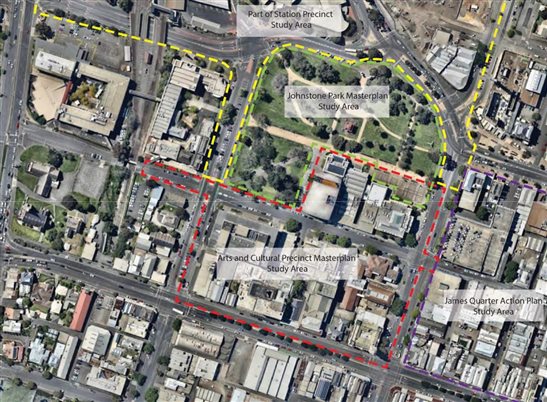
Arts & Cultural Precinct Masterplan Study Area & Adjacent Precincts
The Masterplan responds to key issues and opportunities for the precinct including:
Building a distinctive precinct character which is reinforced through public art and urban furniture;
Green the precinct through additional soft landscape;
Integrate art into the public realm and built form through projections and installations;
Protecting and enhancing the heritage significance of buildings within the precinct;
Expansion of the program of street-based arts and cultural activities and events;
Implement wayfinding to connect the precinct with adjacent precincts.
The Masterplan delivers a reimagined Lt Malop Street that will become a focus for arts and cultural activity in Central Geelong.
The Lt Malop Street design enables the temporary closure of the street, focused around a central events space. This space is imagined with a special pavement treatment incorporating in-situ art, reinforcing cultural and historical heritage and demonstrating the importance of the space to the arts and cultural life of the city.
The Masterplan prioritises Lt Malop Street for pedestrians, providing for slow vehicle and bicycle movements in a shared space. Short-stay on-street parking is provided and bus bays. Greening of the precinct is achieved through new street trees and plantings, which help to delineate shared spaces.
New pedestrian prioritised linkages are provided through Police Lane and a realigned Aitchison Place. A new pedestrian signalised crossing at Ryrie Street improves north- south connections to the precinct.
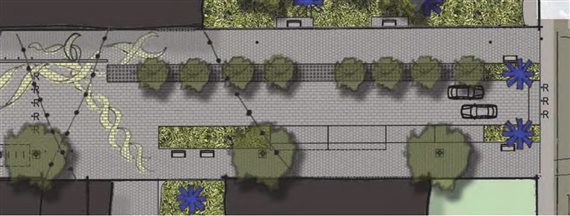
Typical street treatment
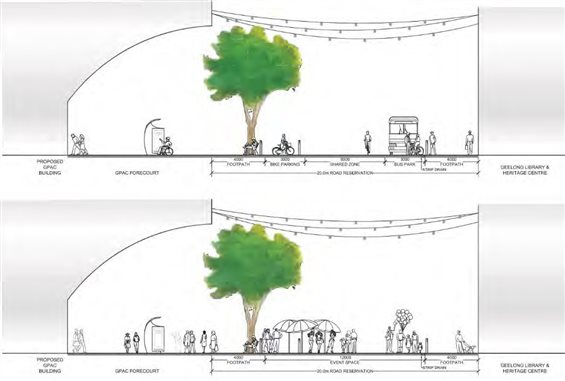
Typical section
Car parking supply in the precinct should be considered in conjunction with the Central Geelong Car Parking Strategy. There is a nett loss of car parking within the precinct but this should be considered in relation to the proximity of the Civic Centre Car Park.
The Masterplan proposes that Lt Malop Street provide the following rates of vehicle parking.
|
Standard car parking bays |
Disabled car parking bays |
Loading bays |
Bus drop-off bays |
Existing |
30 |
5 |
2 |
1 |
Proposed |
9 |
6 |
2 |
4 |
|
21 loss |
1 gain |
No change |
3 gain |
The next stage of the process is the preparation of detailed design and costings for the streetscape redevelopment of Lt Malop Street and Police Lane which will be funded by DELWP. This work will form the basis of the Business Case for a future funding submission to the State Government.
The Masterplan has been informed by stakeholder consultation including precinct landowners and tenants, Geelong Gallery, Geelong Library & Heritage Centre, Barwon Water, State Government agencies and City of Greater Geelong officers.
The Masterplan and the incorporated streetscape works are consistent with the Central Geelong Action Plan, the State Action Plan and State and Council planning policies.
New hard and soft landscaping will reference urban design guidelines, support sustainable development and respond to community needs.
Future Masterplans for the adjacent precincts including Johnstone Park, the Station Precinct and the Green Spine will integrate with the Arts & Cultural Precinct Masterplan.
All works will reference Australian Standards for access and mobility.
This project is directly aligned to the City Plan ‘Growing the Economy’ strategic priority which articulates a continuing focus on improvement of the CBD via the implementation of the Central Geelong Action Plan.
No risks have been identified in noting the Arts & Cultural Precinct Masterplan.
Lt Malop Street is an overland flow path for storm water and is encumbered by a Special Building Overlay. The detailed streetscape design will need to account for storm water management and drainage, and should consider opportunities to incorporate Water Sensitive Urban Design (WSUD) treatments to manage water in the precinct.
Provide better pedestrian connections between the Geelong Station, Arts and Cultural Precinct and other precincts.
Improve accessibility to Geelong Galley by providing northern entrance.
Masterplan response
The Geelong Station Precinct Masterplan and Johnstone Park Masterplan (both in preparation) will provide direction on improving connections between the station precinct and key destinations in central Geelong, including the Arts and Cultural precinct.
The opportunity to improve accessibility to the Geelong Gallery by creating a northern entrance is recognised in the Masterplan. This will be further examined during the detailed design phase.
Increased activity will need to be supported by more car parking and bus parking.
Heaving vehicles need to be managed on Ryrie Street.
Sustainable transport options should take priority over car parking in the core city area.
Masterplan response
The Masterplan prioritises short-stay on-street parking and temporary bus parking within the core of the Arts and Cultural Precinct along Little Malop Street. An overall reduction in the road area dedicated to car parking will provide better opportunities to create a unique space that can be prioritised for people, activities and events.
The Central Geelong Traffic and Movement Network Operating Plan (in preparation) will consider future priority routes for vehicles and public transport.
Ensure appropriate tree selection.
Catenary lighting design must be of high quality.
Ensure public art is of high quality.
Masterplan response
The Masterplan provides guidelines that will inform the detailed design of streetscape improvements. To achieve consistency of treatments across the city, the Masterplan requires that new streetscape elements are consistent with the Central Geelong Public Realm Framework.
The Masterplan should take account of the Draft Greater Geelong Municipal Heritage Strategy.
The Masterplan does not contain sufficient direct reference to heritage.
No support for Masterplan initiative to re-purpose significant heritage buildings.
Masterplan should recognise indigenous/cultural heritage.
Variety of architecture within the precinct could see it become an architectural heritage destination.
Relocating the Belcher Fountain to a site in the precinct should be a priority before consideration is given to commissioning any sculptures or art works.
Masterplan response
The Masterplan is clear that the Arts and Cultural Precinct contains many sites with significant heritage value and that future development must consider the heritage importance of individual buildings and/or precincts, as required by the Greater Geelong Planning Scheme and/or Heritage Act 1995.
The Masterplan identifies the opportunity to redevelop the former Geelong Telephone Exchange in order to provide a direct pedestrian link to Police Lane (pg4). As an individually significant heritage building, it is appropriate that this comment be rephrased as:
‘Opportunity to provide pedestrian link to Police Lane through future redevelopment that is complementary to the heritage building.’
The Masterplan contains a number of precinct wide issues and opportunities (pg 4). It is proposed that the list be extended to include:
‘Protect heritage buildings’ and ‘Acknowledge indigenous history of precinct’.
The Masterplan identifies opportunities for new public art, significant to the importance of the precinct as an Arts and Culture hub.
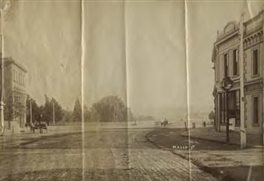
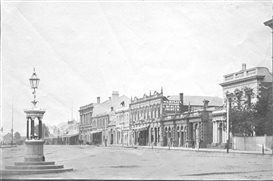
The Belcher Fountain was not considered through the Masterplan process. Photographic evidence (below) shows the location of the Belcher fountain at the intersection of Gheringhap St and Malop St, c.1870/80. The fountain was relocated to the north-east side of the intersection in 2007, as close as possible to its original location, when the intersection was rebuilt and signalised.
Source: |
Investment & Attraction - Arts & Culture |
Director: |
Brett Luxford |
Index Reference: |
SUB-16-38 Arts & Culture |
To seek endorsement of the Central Geelong Live Music Action Plan (LiveMAP).
The Central Geelong Live Music Action Plan (LiveMAP) aims to align community, commercial and government efforts to nurture a superlative live music scene of a national standard, optimising Little Malop Street and other areas for night trade, while providing an employment base and sector development nexus for local and visiting musicians.
Changes in legislation (for example noise attenuation) and the identification of live music as a major contributor to the economy, led live music peak industry bodies to engage with local government to assist in meeting new challenges.
Following a round table forum held by Music Victoria, a grassroots momentum was built by local music stakeholders and the private sector to work in partnership with the City of Greater Geelong. This has led to the creation of a dedicated LiveMAP to guide development of the live music culture in Central Geelong.
LiveMAP research found that vibrant live music is an important aspect of arts and culture’s powerful and positive contribution to the economy and community.
LiveMAP cited recent research indicating that live music spending in Australia results in at least a 3:1 benefit-to-cost ratio. The economic value of live music to Geelong’s community has been estimated to be at least $150m annually.
These findings support the community-led 30 year vision for Greater Geelong to be recognised regionally, nationally and internationally as a clever and creative city- region.
LiveMAP was developed over the period November 2016 to June 2017, guided by a Steering Group of Council with local, state and national music industry stakeholders.
It found that Central Geelong has good fundamentals for an excellent live music scene. Little Malop St in particular is emerging as a vibrant cluster for contemporary music and other entertainment for music fans, casual attendees and tourists, and a good example of Geelong as a smart, vibrant, thriving and liveable city that is ‘open for business’.
LiveMAP interviews with local music industry leaders identified 20 key issues and opportunities effecting the live music culture in Central Geelong.
Constraints include sufficient audience scale and consistency to sustain a good variety of live music experiences, both civic and commercial. However with more people from Geelong and our region discovering (or re-discovering) live music, and experiencing it in Central Geelong more often, we can maximise the potential of the area.
LiveMAP highlights that a strong live music scene is likely to exist where:
venues/promoters are empowered and do not face unreasonable barriers in setting up and operating their enterprises or activities;
local audiences are able to access quality, affordable and enjoyable music experiences across a range of genres;
musicians have pathways to develop their practice, perform to audiences and become sustainable;
the community as a whole appreciates and values the contribution of live music.
The Actions are aligned to impact each of these elements and is organised by theme:
Broadening live music’s presence within Central Geelong.
Developing places and spaces for live music in Central Geelong.
Reducing barriers to audience awareness and growth.
Backing sustainable music enterprises
Each Action includes an estimate of resources required. A number of Actions can be achieved within existing staff roles however two high priority Actions: a site specific live music festival around Little Malop Street - which already has significant momentum within the music community - and youth music activities, require a minimum of $60,000 contribution plus project management. These Actions will be presented for consideration under the 2018/2019 budget process. It should be noted any contribution made by Council would be supplemented by key stakeholders.
Another high priority recommendation is to ensure current and future Central Geelong revitalisation projects have active consultation with live music stakeholders to maximise opportunities and avoid unintended consequences for live music.
The report notes that further scoping and assessment is required for some Actions. It is therefore recommended a progress report on the implementation of the Action Plan be presented to Council in 2018.
Investment by Council in the early stages of the plan’s delivery will be critical to establishing momentum, credibility and music industry engagement as well as assisting to secure external funding. This support is likely to decrease as the sector strengthens.
K Alexander moved, L Gardner seconded -
That Council:
endorse the findings and recommendations of the Central Geelong Live Music Action Plan (Attachment 2);
receive a Progress Report on the implementation of the Live Music Action Plan in 2018.
Carried.
Each recommended Action includes an estimate of resources required. Of the 21 recommended Actions, a number are listed as being able to be completed using existing resources and assumes capacity by a Council officer (or officers).
Prioritising and timing of actions will allow for a measure of flexibility given existing commitments, however some key actions require budgetary allocations.
One of the high priority LiveMAP Actions is a site-specific live contemporary music festival with local audience and industry development focus, to be undertaken in partnership with Little Malop Street music venues. Beav’s Bar, Piano Bar, Pistol Pete’s, The Worker’s Club and Geelong Cellar Door have already indicated strong interest in partnering in such an event. Additional funds and contributions would be sought from the private sector and would underpin the $50,000 (minimum estimated) business case which will be developed for consideration as part of the 2018/2019 budget process. An additional high priority Action focusses on piloting a safe and positive live music programme for under 18s which is estimated to be in the order of $10,000.
LiveMAP was facilitated by Sapere Research Group working collaboratively with the Arts & Culture Department and highly respected local music sector professionals.
A Steering Group was formed to oversee the development and implementation of LiveMAP. The Steering Group included Council staff from relevant departments (including Arts & Culture, Events, Central Geelong and Waterfront, Enterprise Geelong, Central Geelong Taskforce, Environmental Health & Local Laws and Youth Unit) and a diverse selection of music industry leaders including state and national music industry peak bodies, local venue owners, artist managers, promoters and musicians.
Consultation commenced with a series of one-on-one interviews with Steering Group members and selected local sector leaders (November to December 2016) to identify key issues impacting the local live music scene. This was followed by a broadly promoted public engagement workshop (23 January 2017) exploring the themes and information that emerged from the interview process.
The workshop was promoted through the Geelong Region Arts Atlas and the invitations to this workshop along with the Key Issues Report was direct emailed to over 250 local music sector representatives and other relevant Council staff.
The draft Central Geelong LiveMAP was profiled at the National Contemporary Music Policy of Development Conference in Sydney on 1-3 August 2017, a forum focused on fostering engagement in live music across Australia.
The Steering Group will be reconvened in late 2017 to ensure an ongoing consultative approach underpins the delivery of LiveMAP.
A public launch of LiveMAP is planned for November 2017, in conjunction with a music- related public artwork in Little Malop Street, a mural of local rock icon Chrissie Amphlett with an augmented reality overlay, celebrating Geelong’s contemporary live music heritage.
A Clever and Creative Future
Creativity Drives Culture: The Greater Geelong Community values involvement with local art, music, heritage, contemporary culture and Waddawurrung culture. Success will be achieved by:
Investment in a diverse range of local community festivals and events
Development of creative industries and a culture of thinking outside the square
Attracting creatively oriented and artistic industries to the region.
Community Wellbeing
Connected, creative and strong communities - supporting an inclusive local community culture, investing in community regeneration, building upon existing capacities in local communities, bringing the community together through sports, recreation, arts, culture and heritage.
Healthy lifestyles – facilitating and promoting physical activity, investing in prevention and improved health.
Growing our Economy
Support existing businesses and encourage new and emerging growth sectors – support existing businesses and explore strategic opportunities, link local businesses with growth opportunities.
A successful and vibrant city centre – develop and foster a vibrant 24-hour cultural city that is welcoming, friendly and safe, and that attracts and generates a robust cultural life for all ages, support existing Central Geelong businesses
Greater Geelong is a leading city for tourism, arts, culture and events – promote the unique strengths our region has to offer, build on the opportunities that being Victoria’s second largest city offers and our proximity to Victoria’s capital, support creative endeavour and investigate the potential for unique arts and cultural opportunities, support local festivals and events and provide opportunities for participation in the arts for all ages, advocate on behalf of the community for major event, tourism and cultural opportunities.
How We Do Business
Lead by advocating and collaborating on issues important to the Greater Geelong community – develop and foster partnerships that offer wellbeing opportunities for our municipality, work with other governments and organisations for the benefit of the local community, city and region.
Efficient and customer focused organisation - providing efficient and value for money services and programs, ensuring programs and services meet the current and future needs of the community.
There are no specific risks related to the endorsement of LiveMAP. Risks associated with events conducted as per the recommendations will undergo thorough planning processes which include risk management.
Source: |
Community Life – Social Planning and Investment |
Director: |
Linda Quinn |
Index Reference: |
Sport Recreation Leisure Strategies |
To seek Council endorsement of the Fair Play Strategy and the associated Fees and Charges Policy for Community Level Outdoor Recreation Facilities.
The City of Greater Geelong released the Draft Fair Play Strategy for consultation in July 2017 for a period of 6 weeks.
Council officers sought feedback from sporting clubs about the draft Fair Play Strategy, specifically the overall level of subsidy proposed, suggested timeline for implementation, the level of service allocation and the level of support to be provided.
The draft Fair Play Strategy was made available online for submission and comment. The engagement process also included 780 direct contacts with clubs via email, five presentations to sporting clubs and associations and two community drop in sessions. A total of 48 submissions and enquiries were received.
The community engagement report (Attachment 2) provides a summary of findings from the consultation process.
In summary, there is strong support for the Fair Play Strategy. The key issue identified during the community consultation was the process for implementing new fees. The concern of clubs was that the transition from the current fees to a the new fee would occur too quickly. This may impact the short term cash flow and sustainability of some clubs, and may also result in a steep and sudden escalation of fees to individual community / club members.
In response to the community feedback the final Fair Play Strategy (attachment 3) has been amended to allow more time to implement the new standardised fees. This was originally proposed to occur over one year and will now occur over a period of up to three years. Support will be provided for clubs throughout the transition process.
The community feedback also indicated a need for the City of Greater Geelong to provide support for the provision of non-standard infrastructure through the community grants program and to introduce a system that will ensure greater transparency in regard to fees being paid by each club.
The development of the Fair Play Strategy is consistent with the Clever and Creative Future and Council’s Social Equity Principles, which include an aim of delivering greater equity in the provision of community infrastructure across the City.
P Dorling moved, L Gardner seconded -
That Council:
endorses the Fair Play Strategy (Attachment 3);
revises the Council’s Fees and Charges Policy, specifically to replace the reference to the ‘Fees and Charges for Outdoor Sporting Facilities Policy’ and replace with the ‘Fair Play Strategy 2017’.
Carried.
City of Greater Geelong Fair Play Strategy and Policy – Overview
The Fair Play Strategy incorporates Standard Provisions (the standard level of facility provision for community sport and recreation as defined by Council), Levels of Service (the inputs required to maintain a facility to a specified standard as defined by Council) and the associated Level of Subsidy (fees and charges) for local community level outdoor sport and recreation.
State of Play
The City is the largest supporter of sport and recreation in Greater Geelong and we want to ensure sport and our clubs continue to thrive.
Council manages $85M worth of sport and recreation facilities, provides for over 300 community sports clubs and spends an average of $5.5M to maintain existing facilities each year.
Council currently subsidises the use of facilities by an average of 94%. While the current system recoups an average 6% of maintenance costs (approximately $350,000 per annum).
Council’s existing subsidy (fees and charges) model for outdoor sport and recreation facilities was last reviewed in 1996. The current provision and subsidy model has remained unchanged for over 20 years, while the cost of building, upgrading and maintaining facilities has grown considerably in that time.
Population growth has increased demand for sport, recreation and leisure infrastructure while existing facilities also need to be maintained and upgraded. The current funding model is not sustainable in providing fit for purpose facilities.
There is a great disparity between the fees charged for the use of facilities across the network in addition to inconsistent and unfair conditions that exist between different clubs. There is a need to bring balance back to Council’s network of facilities and fairness for the clubs that use them.
Strategic Response
A review of standard provisions, levels of service and associated subsidy (fees and charges) for outdoor sport and recreation facilities has been undertaken and an updated framework is proposed.
Fair Play – A framework for equity and fairness
The framework is based on the industry standard of recouping a percentage of Councils cost of service (maintenance inputs directly related to Council) for community level outdoor sport and recreation facilities.
The Fair Play Strategy outlines the key responsibilities of users and Council in its guidelines titled Standard Provisions and Levels of Service – Guidelines for the development of sporting pavilions and associated infrastructure. The guidelines are designed to apply to community and district level facilities and do not apply to facilities that are not on Council owned and/or managed land or facilities of a regional, state or national standard (these are all treated on a case-by-case basis).
At full policy implementation, the Fair Play Strategy will recover 25% of the cost of service with the opportunity for a further subsidy to reach 15% recovery (reflecting the industry minimum standard for cost recovery).
The realignment of facility classifications and subsidy rate of 75% (with the opportunity for further subsidy of 10% for community outcomes) is anticipated to provide up to a maximum of $500K additional revenue per year to reinvest back into community infrastructure (at full policy implementation, pending level of occupancy and rate of subsidy applied).
The new system will maximise the efficiency of our public facilities by encouraging and rewarding shared use by multiple groups, clubs and the community. The system will also have a focus on supporting sporting clubs that offer healthy sporting environments and promote healthy community initiatives.
The new system is transparent, equitable and more financially sustainable.
A transition plan has been designed and tested by the community to manage the impact that any reclassification of facilities and increase in fees may have on sporting clubs and community groups.
Fair Play Principles
The following principles underpin the Fair Play framework:
Equity and Transparency
Clear rationale for fees and charges for facilities.
Equity in cost for tenants and community access.
Level of Service
Fees linked to the level of service provided.
Alignment with industry standard percentage of maintenance cost.
Shared Use
Encourages shared use of facilities.
Higher fees, incurred for exclusive use.
Asset Management
Effective asset management with clearly defined obligations for Council and club / community owned assets.
Partnerships
Promotion of healthy lifestyles through the provision of sport and recreation facilities.
Recognition of the significant contribution of volunteers and clubs to sport and recreation across the City.
Ensure Council is fair and transparent with each club as a key partner in supporting and subsidising the provision and maintenance of sport and recreation facilities.
Efficiency
Efficient processes for administration by Council officers.
Ease of use for club / community group volunteers and casual users.
Accountability and Continuous Improvement
Provide a framework that ensures accountability from clubs, users and Council alike.
Focus on continuous improvement and making people the centre of our business.
Healthy Communities
Support for clubs and groups that provide healthy sporting environment initiatives.
Development of community clubs and groups skills, knowledge and capacity.
At present the renewal gap for existing outdoor sport and recreation assets is $13M and is projected to reach $45M in 5 years and $197M in 20 years. These figures represent unfunded capital renewal works that are expected to be required for the renewal of Council’s existing asset base.
The proposed framework is based on the industry standard of recouping a percentage of Councils cost of maintenance for community level outdoor sport and recreation facilities.
At full policy, the realignment and subsidy rate of between 75% - 85% is anticipated to provide up to a maximum of $500K additional revenue per year (pending level of occupancy and level of subsidy applied) to support Council’s continued reinvestment into community infrastructure.
The new system would result in Council recouping an average of 15% of the total cost of service associated with community level outdoor sport and recreation facilities by year 4 (2021) of policy implementation.
The following provides a summary of the average rate of recovery by implementation year:
2018 Stage 1 – Equity. Reclassification and charge 6% rate of recovery. Further Subsidy does not apply in year 1.
2019 Stage 2 – Policy. Charge at 15% rate of recovery. Introduce a Further Subsidy incentive of 6% for clubs supporting healthy communities and healthy sporting environment initiatives.
2020 Stage 2 – Policy. Charge at 20% rate of recovery. Introduce a Further Subsidy incentive of 8% for clubs supporting healthy communities and healthy sporting environment initiatives.
2021 Stage 2 – Policy. Charge at 25% rate of recovery. Introduce a Further Subsidy incentive of 10% for clubs supporting healthy communities and healthy sporting environment initiatives.
In addition to the community and local sporting organisations engaged in the draft of the Fair Play Strategy, the following external stakeholders were consulted:
AFL Victoria and AFL Barwon
Netball Victoria
Cricket Victoria and Geelong Cricket Association
Football Federation Victoria
Tennis Victoria
This report is aligned to the new Fees and Charges Policy adopted by Council in August 2017.
This report is aligned to the Community Well-being objective of City Plan. The provision of community level sport and recreation facilities promotes healthy lifestyles through physical activity.
The progress and implementation of the Fair Play Strategy will be reported back to Council through the Annual Reporting processes.
No officer involved in the final recommendation of this report has any direct or indirect interest.
The current system is unsustainable and if not addressed there is a risk that the inequity across the network will remain and service levels will be impacted, meaning Council may no longer be able to afford to maintain facilities to the current standard.
No environmental implications are directly related to this report, however the introduction of environmental initiatives will be considered through the implementation of the Fair Play Strategy.
Source: |
Community Life |
Directorr: |
Linda Quinn |
Index Reference: |
General Health Promotion |
To seek endorsement for the staged withdrawal of sugar-sweetened beverages from all Council and community operated facilities between 2017 - 2019.
The Healthy Choices - Sugar Sweetened Beverage Strategy responds to the Geelong Public Health and Wellbeing Plan’s commitment to increase access to healthy food choices.
Reducing sugary drink consumption is also a priority of the Victorian Government’s Public Health and Wellbeing Plan for Victoria.
Consultation with peak sporting bodies for the Geelong region, and members of the Geelong community, has shown strong support for an increase in availability of healthy choices at Council facilities and a reduction in sugary drinks (see Attachment 1 and 3).
The Victorian Population Health Survey ranked Greater Geelong as the 6th highest consumer of soft drinks in Victoria. In Geelong 49% of the population are presently overweight or obese and 12% of the Geelong community and over 40% of adolescents consume sugary drinks every day.
Sugar sweetened beverages (SSB’s) contain excessive kilojoules and no nutritive value and are a key driver of increasing levels of obesity, tooth decay and chronic disease.
A staged withdrawal of sugar-sweetened beverages is an important next step for the work that has occurred so far. Where there are leased cafes operating in community facilities, the withdrawal will occur through a staged transition in line with future lease renewal/options or via negotiation.
This initiative means that Greater Geelong will be one of the first Victorian Councils to implement a reduction of SSB provision along with the Cities of Corangamite, Wyndham and Melbourne
Action will commence in October 2017 with a phased in reduction of sugar sweetened beverages over a two year period with education programs and resources provided to support implementation of the strategy (see Attachment 2).
K Alexander moved, L Gardner seconded -
That Council:
commit to a staged withdrawal of sugar-sweetened beverages from all Council operated community facilities by July 2018;
actively work with and support community operated facilities to reduce the sale of sugar-sweetened beverages by the end of 2019; and
develop and implement training and educational resources for staff, community groups and visitors to support implementation.
Carried.
Evidence indicates that the consumption of sugar-sweetened beverages is linked to poor population health outcomes and the following Council management documents:
The Geelong Public Health and Wellbeing Plan 2013-2017;
City of Greater Geelong Food Policy; and
The sale and procurement of healthy food by Council management procedure.
Council’s Lara Pool, Splashdown, Leisuretime and the Arena have previously made changes to their menu’s to increase the range of healthy choices available.
Whilst water remains the best choice from a health perspective, many flavoured milk and 99% fruit juice products will still be eligible to be sold under this proposal.
Artificially sweetened drinks with no added sugar may be eligible, however, in facilities that cater to a high proportion of children, promotion of these products would ideally be restricted.
This strategy will give managers within Council-operated facilities, and community operated facilities, clear direction on how Council can support the community to have healthier outcomes.
Some clubs participating in the “Healthy Sporting Environments” program through Leisure Networks have expressed a desire for Council to play this role. Some clubs, such as Lara Football and Netball clubs, have already expressed an interest in a withdrawal of sugar-sweetened beverages and are engaged in the Vic Health Nudge research project.
Procurement Compliance Guidelines
Procurement compliance guidelines will be developed including auditing principles and targets. These targets will be developed based on the Victorian Government Healthy Choice guidelines.
The Geelong strategy will phase in a reduction in SSBs over a two year period.
This will be achieved in 2018 by engaging with food supply procurement across all Council owned and run food outlets to meet the Healthy Choice Guidelines requirement of reducing visibility of SSBs to less than 20% of the menu and display including vending machines.
In 2019 SSBs will be removed and healthier beverage alternatives, particularly water, will be promoted.
The Healthy Choice Guidelines outline SSBs as drinks that are categorised in the RED category. This includes all drinks with added sugar except milk based drinks.
There are many drink choices which fit into the green and amber category of the Healthy Choice guidelines including water - plain and sparkling, plain and flavoured milk drinks, 100% fruit juice and drinks flavoured with fruit juice and no added sugar.
Council’s Lara Pool has demonstrated, over the last three seasons, that withdrawing sugar-sweetened beverages has not led to a reduction in number of items purchased and has been very well accepted by customers to the pool.
However, this may vary depending on the venue and current sales. Maintaining similar financial returns is dependant on visitation and a number of factors which will be incorporated into the planning for the project. Monitoring will be part of an evaluation process of the proposal.
Results from Vic Health research with recreation and sport centres trialling a reduction in sugar sweetened beverages have shown no financial loss with a reduction in promotion of SSBs.
Consultation occurred with the sporting peak bodies in Geelong in August 2017 and the proposal to increase healthy choices through the reduction of sugar sweetened beverages was supported.
Consultation with the broader Geelong community has been embedded in the Healthy Communities Unit work plan and the results across many settings indicate support for the promotion of healthy food and drink options.
A detailed communication and consultation process will continue to occur with all identified key stakeholders and the broader community to increase awareness of the need to reduce sugar sweetened beverage intake.
A key component of this consultation will be communicating the evidence that now exists from other organisations including YMCA and Alfred Health that have already undertaken this work.
This proposal fulfils commitments made by Council in the Geelong Public Health and Wellbeing Plan 2013-2017, the City of Greater Geelong Food Policy, and the sale of procurement of healthy food by Council management procedure.
This proposal seeks to address two of the three strategic priorities under City Plan’s Community Wellbeing theme: Healthy Lifestyles and Healthy Environments. Health and wellbeing is a necessary precursor to achieving a Clever and Creative future.
No officer involved in the preparation of this report has any direct or indirect interest relative to the advice provided in the report.
A risk assessment has identified potential negative community and media responses to the staged withdrawal of sugar-sweetened beverages as a risk.
The engagement of key stakeholders and the communication of the project at all stages will be crucial to ensure the community are well informed of the benefits of this project to the community.
A staged approached to the withdrawal of sugar-sweetened beverages will also minimise any negative implications.
There are no environmental implications from this report, although it is recognised that tap water in a reusable bottle is the best option from both a health and environmental perspective.
To manage the staged withdrawal of SSBs from Council owned facilities, an education and awareness raising strategy for staff involved and the community will be implemented.
The education strategy proposed for each different area is listed below. The implementation process will be adjusted based on stakeholder needs.
Staff will be informed of the changes to occur to the contents of vending machines and an awareness raising.
Vending machines will be modified to contain less than 20% of the contents consisting of SSB’s. Placement of the SSB’s will also be defined by the strategy to reduce visibility and promotion of SSB’s. Healthier choices will be increased to occupy 80% or more of the vending machine contents.
Communication will be required with the contractors of the vending machines and staff will be consulted regarding preferences within the guidelines. A planogram will be developed to enable ease of modification of contents of vending machines for staff.
Education sessions regarding the SSB guidelines will be provided to COGG owned and operated recreation and sport centres, with an invitation and encouragement to contracted food outlets in Council owned centres, to discuss the guidelines for SSB availability and sales.
Education to staff will increase skills with managing the changes within the centre and also to educate consumers.
Education and support will include collaboration with suppliers to determine extra healthier choice options and the provision of a simple plan for fridges to meet the guidelines.
An education and awareness raising campaign will be developed to encourage sporting clubs to promote water as the drink of choice and reduce the sales of SSB’s.
Sporting clubs will be encouraged to choose a strategy to promote water and healthier choice drink sales over SSB sales by either reducing the visibility of SSB’s for sale, remove SSB’s or increase price of SSBs.
EVENT/ ACTIVITY |
KEY OUTCOMES |
Children settings |
|
Big Play Day survey with parents |
100% believe sugary drinks are not good for children.71% of respondents said they would like to see council facilities free of sugary drinks. |
Lara Pool Canteen Survey |
79% of respondents thought changes made to menu were good / very good and they were happy changes were made. Healthy choice menu includes no SSB’s. |
Healthy eating workshops for ELC’s, schools and workplaces |
Education and training to meet government policy guidelines to provide healthy choices, reduce / avoid SSB’s. Over 50 settings participated. |
Schools and Early Learning services |
153 registered for the Achievement Program required to meet National Quality Standards (ELC’s) and School Food Services Policy (primary and secondary schools) – both policies include no SSB’s and potential reach 38,000 students. |
Sugar Film Kit - loan to schools. |
Education regarding health issues with sugar and sugary drinks provided to all schools and ELC’s. |
COGG Recreation centres in disadvantaged areas |
|
Leisuretime Healthy Choices Survey |
61% of responses stated that it was extremely important that Leisuretime centre promote healthy food and drink options. |
Splashdown Healthy Choices survey |
92% would like to see healthy choices available at reception. |
The Arena Healthy Choices Survey |
92% would like to see more healthy options offered on the menu in the Café. |
Stakeholder engagement |
|
SSB systems mapping workshop |
Forum run by COGG and Deakin University attended by 30 key stakeholders from Geelong community. |
Member of the panel for the Sugar Hit Forum (CCV) |
COGG presented as one of 4 leading Victorian Local Government Organisations working on reducing SSB’s to over 150 members of local government organisations across Victoria |
That Sugar Film screening. |
400 community members from schools, workplaces and community organisations attended film and following discussion. Strong interest in reducing sugar intake. |
G21 - Big Ideas forum for health and wellbeing. |
COGG participated in the G21 Big Ideas forum with over 100 key local stakeholders. Key agreement generated at forum 'If every children’s setting sold only healthy food and drinks we could improve nutrition for all". |
Healthy Canteens Expo. |
114 attendees from schools, workplaces, recreation and sport organisations. Healthy drinks displayed showed strong interest and uptake. COGG run Expo that linked up food supply chain for healthy drink options. |
Peak Sporting Bodies |
Meeting held with Peak sporting bodies to discuss Fair Play and possible SSB strategy. Attended by Cricket Aust., FFV, AFL – good support for SSB reduction strategy. |
Source: |
Community Life – Leisure and Recreation Services |
Director: |
Linda Quinn |
Index Reference: |
Grants and Funding – Sport and Recreation Grants |
To seek Council endorsement for (a.) the Northern ARC Health and Wellbeing Hub Business Case and (b.) the public release of the document.
To outline the funding approach.
The Northern ARC site has been an iconic destination for over 50 years for northern suburbs’ residents. Existing facilities include Waterworld Leisure Centre, Centenary Hall and Corio Library. The Northern ARC Health and Wellbeing Hub Master Plan, adopted in 2015, outlines the development of contemporary facilities and integrated health and wellbeing services to address significant disadvantage in the north.
Norlane Corio and North Shore has the lowest median weekly income of any of the City’s planning areas at $751, compared to $1,949 for Geelong LGA and $945 for regional Victoria. It is a culturally diverse community, with 22% of the population born overseas, compared to 16% across Greater Geelong.
There is also a high proportion of older people (under 75 years) requiring assistance – 6.1% compared to the 3.5% average across Geelong and 3.8% for regional Victoria. These statistics demonstrate the clear need for preventative health measures.
More than 20% of Norlane, Corio and North Shore residents are obese (Victorian Population Health Survey 2008), putting those suburbs in the higher than above average category - the highest possible category - compared to the State average.
The vision for Northern ARC is to create a vibrant community hub for leisure, recreation, cultural and health services to support positive health and wellbeing outcomes for communities in the northern suburbs. Council completed the Northern ARC Health and Wellbeing Hub Business Case in June 2017.
It will be difficult to achieve any of the aspirations in Greater Geelong: A Clever and Creative Future without addressing social equity and disadvantage.
Three options for the Northern ARC site were investigated in a business plan by Deloitte; Business as Usual, Option 1 and Option 2. On a number of variables, Option 1 (Stage 1) is the preferred and recommended option (see attachment 2).
The Northern ARC Health and Wellbeing Hub option 1 will be delivered in two stages at a cost of $61.6 million for Stage 1. This project will deliver improved health outcomes for the northern suburbs and provide opportunities for better social connections, higher participation rates and stronger partnerships with health service providers.
Council’s proposed contribution of $20.6 million for Option 1 Stage 1 will be referred to a future Council budget process. Council has begun discussions with State and Federal Governments on a partnership approach to funding.
The first key milestone in renewal of the precinct is construction of a new health facility.
This $33 million project is fully funded by the State Government and will be operated by Barwon Health. Co-location of the Barwon Health and Northern ARC facilities will provide greater opportunity for an integrated approach to health and wellbeing.
Council has made a commitment to the Department of Health through an MOU that we will redevelop the site over the next 10-15 years into a Health and Wellbeing precinct. The land sale and licence agreement for car parking are now completed.
P Dorling moved, L Gardener seconded -
That Council:
endorses the Northern ARC Business Case (option 1);
acknowledges a contribution of $20.6 million is included in the long term financial plan; and
continue discussions with the State and Federal Governments regarding co-funding to deliver the project.
Carried.
In 2015 the Northern ARC Health and Wellbeing Hub Master Plan was adopted by the City of Greater Geelong. The Master Plan builds on the Corio-Norlane Structure Plan and community feedback. Northern ARC will see delivery of a range of community facilities including hydrotherapy, maternal child health, rehabilitation and wellbeing activities for all age cohorts. The precinct will also be a destination for engagement and participation through programs such water therapy, strength training and social connections though the activation of flexible community spaces.
The Business Case demonstrates the need for redevelopment of the precinct with contemporary, well integrated community facilities. Norlane, Corio and North Shore are areas of significant disadvantage, with low median household income, low educational attainment levels, a high proportion of older people requiring assistance, high unemployment rates and low labour force participation rates. A number of specific health and wellbeing issues have been identified for the area, including:
the growing prevalence of lifestyle risk factors across northern Geelong place many residents at risk of chronic health conditions;
vulnerable people experience isolation and exclusion limiting their ability to make lasting supportive social connections; and
the increasing cost of maintaining assets and providing aquatic services in northern Geelong places a growing financial burden on residents.
An Investment Logic Map process identified a number of high-level strategic options and assessed their feasibility and capacity to deliver the benefits sought from the Northern ARC Health and Wellbeing Hub. The community hub focus emerged as the best strategic option.
Three project scenarios were assessed throughout the Business Case, as follows:
Base Case – Business as usual
Involves increasing operational and maintenance costs to undertake unavoidable maintenance and upgrades to continue operation of the current Waterworld facility, Corio Library and Centenary Hall. This would include replacement of the Waterworld dome roof and aquatic area renewal within the next five years due to asset failure risks.
Option 1
Stage 1 – construction of a new Health and Wellbeing Hub in the north east corner of the Northern ARC site at a cost of $61.5 million. The existing community hall would be demolished with a multi-purpose community space integrated into the new aquatic and leisure centre and minor improvements made to the Library. Consulting suites have been added to the design to provide opportunities for satellite services such as Maternal Child Health. The existing aquatic and leisure centre would be demolished and replaced with expanded car parking. Stage 2 redevelopment of the library could be delivered at a later date.
Option 2
Delivery of the Master Plan vision which involves a new Health and Wellbeing Hub and new library at a cost of $105 million.
Benefits of this major redevelopment, delivered over 10 years in net present value terms, are:
$111 million of preventative health benefits to the community*;
$23 million total revenue benefits
600,000 annual visitations, which doubles current participation levels; and
(* Source – Sport and Recreation Victoria and SGS Economics and Planning, 2010 – Travel Cost Method)
The proposed Northern ARC facility will be located to the north of the site and the existing Waterworld Leisure Centre and Centenary Hall will be demolished as part of this re- development.
Council’s next planning phase of concept and schematic design is due to commence in October 2017.
Council has already invested $50,000 for the Masterplan, $250,000 for the development of the Business Case and Feasibility in 2016/17 and has committed a further $1 million for the detailed design phase during 2017/18 (total $1.3 million).
A contribution of $20.6 million is included in Council’s long-term financial plan in anticipation funding will be secured from other levels of government. Discussions with State and Federal Governments regarding co-funding to deliver the project have commenced.
The procurement process for design and construction will follow the social procurement GROW model.
Council undertook an extensive community engagement program to develop the Northern ARC Masterplan, the key principles and findings of that process informed the development of the project options. A series of workshops were undertaken by the Northern ARC project team to test the project options against the guiding principles of the Northern ARC Masterplan to ensure that the identified community needs and benefits would be delivered.
The project has been presented to the Federal Government during two Fed Cats delegation briefings in Canberra. There has been briefings with the Department of Treasury and Finance, Regional Development Victoria, Sport and Recreation Victoria and Barwon Region Partnerships. The Victorian Minister for Sport has been briefed on the Master Plan and Business Case. Both the Federal Members for Corio and Corangamite have been briefed.
Community engagement during the scoping of the detailed design phase will be undertaken including information sessions and some stakeholder and community forums to ensure we consider the broader community feedback on the design.
There are no legislative or legal ramifications associated with the adoption of this report.
The Northern ARC aligns to the City Plan’s priority of Community Wellbeing, encouraging healthy lifestyles and connected communities through active recreation and participation in sport.
It also supports Greater Geelong: A Clever and Creative Future by addressing the community vision of Geelong having a strong sense of community and uplifting its vulnerable community members.
No Council Officers engaged in the creation of this report have a direct or indirect interest in the matter to which this report relates.
A detailed risk assessment is included in the Business Case. A total of 41 risks were identified across the following strategic risk groupings:
Site and planning
Design, construction and commissioning
Contractor / sponsor / financial
Operating / performance
Market / demand
Network / interface
Industrial relations / workforce
Of the 41 risks, a shortlist of 19 key risks are included in the report.
There are no foreseeable environmental implications associated with this report. Environmentally sustainable design initiatives are incorporated into the design.
Options Analysis
|
Business as Usual |
Option 1, Stage 1* (Recommended) |
Option 2 |
Deliverables |
Maintenance and upgrades to continue operation of Waterworld including:
|
New health and wellbeing hub including:
|
Delivery of the full Master Plan including;
|
Operating costs (over 10 years) |
$30.3m |
$34.8m |
$34.6m |
Present value of benefits (over 10 years) |
$53.7m |
$134.5m |
$134.2m |
Net present value ROI over 10 years) |
$15.6m |
$59.2m |
$31.7m |
Benefit cost ratio |
1.41 |
1.79 |
1.31 |
Total cost |
$11.8m |
$61.6m |
$105m |
Note: Figures are high level quantity surveyor estimates and include capital costs, contingency, project costs and escalation.
*Stage 2, which adds the new library, could be considered as a future project
Source: |
People and Organisational Development |
Executive Manager: |
Andrew Keen |
Index Reference: |
Policies and procedures |
To adopt the CEO Employment Matters Policy that ensures best practice approach to CEO recruitment, employment, and performance matters.
The Council is responsible for the appointment of the CEO, determining the CEO’s Performance Plan, assessing the CEO’s performance against that plan and determining the remuneration of the CEO as set out in the Local Government Act 1989.
The CEO Employment Matters Policy has been developed in order to establish the conditions that assist Council in delivering its legislative responsibilities.
Council shall establish a Section 86 Committee to oversee periodic reviews of the Chief Executive Officer’s performance against pre-determined assessment criteria set by Council and make recommendations to Council regarding performance, employment and contractual matters.
The Committee has no delegated authority to make decisions as if it were the Council, but rather formulates recommendations to Council regarding CEO employment and performance review matters.
The CEO Employment Matters Policy sets out the conditions which assist Council in carrying out those functions.
This process is documented to ensure a consistent and accountable approach is adopted and which attaches importance to good governance.
L Gardner moved, P Dorling seconded -
That Council adopts the CEO Employment Matters Policy CPL5.2 (Attachment 1).
Carried.
 COUNCIL POLICY
Chief Executive Officer Employment Matters Policy |
Document No: |
CPL5.2 |
Approval Date: |
Draft |
|
Approved By: |
Council |
|
Review Date: |
|
|
Responsible Officer: Executive Manager People and Organisational Development |
Version No |
00 |
Authorising Officer: | Chief Executive Officer |
|
The Council is responsible for the appointment of the CEO, determining the CEO’s Performance Plan, assessing the CEO’s performance against that plan and determining the remuneration of the CEO.
This policy has been developed to support the requirements of the Local Government Act 1989 to assist Council in fulfilling its responsibilities relating to CEO employment and performance matters.
Council will carry out its functions relating to the appointment, remuneration and performance appraisal of the Chief Executive Officer in accordance with a number of leading practice principles:
decision-making processes that are fair, accessible and applied consistently in comparable circumstances;
decision-making criteria that are relevant, objective and available to the people subject to the decision;
decisions and actions that are conducive to ongoing good governance;
documentation that is sufficiently clear and comprehensive to render decisions transparent and capable of effective review;
employment decisions that are based on the proper assessment of individual’s work related qualities, abilities and potential against the genuine requirements of the role; and
decisions to appoint new employees that are based on competitive selection, open processes and objective criteria
The responsibility for assisting Council with its obligations regarding CEO employment and performance matters shall be delivered through the establishment of the CEO Employment Matters section 86 Committee.
Local Government Act (1989)
Victorian Public Sector Commission
Victorian State Services Authority
“The Act” means the Local Government Act 1989
“CEO” means Chief Executive Officer
“The Committee” means a Special Committee pursuant to Section 86 of the Local Government Act 1989
“Contract” means the Chief Executive Officer Employment Contract
“Council” means City of Greater Geelong
“Councillor” means the Mayor or Councillor as defined by the Act
“Independent Chairperson” means a suitably qualified person who is not a Councillor of Officer of Council and is a voting member of the Committee
“Recruitment Consultant” means a Nationally recognised consultant with specialist expertise in sourcing and evaluating candidates for senior executive roles
“Remuneration” means salary
4.1 ESTABLISMENT OF CEO EMPLOYMENT MATTERS COMMITTEE
4.1.1 |
Council shall establish a Section 86 Committee to be known as the CEO Employment Matters Committee (the Committee) for the purpose of recruitment of the CEO, determining the CEO’s Performance Plan, assessing the CEO’s performance against that plan and determining the remuneration of the CEO. |
4.1.2 |
Membership of the Committee shall consist of the following:
|
4.1.3 |
The Committee will make a recommendation to Council on the appointment of an appropriate independent chairperson. |
4.1.4 |
The CEO Employment Matters Committee will meet at least four times a year, with authority to convene additional meetings as circumstances require. |
4.1.5 |
A quorum of the independent chairperson and at least two other members will be necessary to transact business of the committee. |
4.1.6 |
The Committee’s role is to assist and advise the Council on matters including:
|
4.1.7 |
Administrative responsibility and support for the Employment Matters Committee will be allocated to the Executive Manager People and Organisational Development (POD), or officer designated by that role. The Executive Manager (POD) or their delegate has responsibility to provide:
|
4.1.8 |
The Terms of Reference contained within this Policy set out Council’s process for carrying out those functions. |
5.1 |
Council’s role is to appoint the CEO, on the advice of the Committee. |
|
5.2 |
The Committee’s role is to identify and recommend a suitable person and refer the appointment of that person to Council. The Committee shall: |
|
5.3 |
Engage a Recruitment Consultant (Consultant) |
|
|
5.3.1 |
In accordance with Council’s Procurement Policy and with the assistance of the Executive Manager People and Organisational Development, seek and appoint a nationally recognised Recruitment Consultant to manage and conduct the process of selection of a suitable candidate for the position of CEO. Selection Criteria should be based on the key result areas for a CEO described in the Template Attachment. |
5.4 |
Undertake Preparation Work: |
|
|
5.4.1 |
In conjunction with the Consultant, develop and agree upon:
|
5.5 |
Seek Council approval of preparatory work. |
|
5.6 |
In conjunction with the Consultant, identify the candidate pool:
|
|
6.1 |
The Council is responsible for determining the CEO’s Performance Plan with the CEO, assessing the CEO’s performance against that plan and determining the remuneration of the CEO. and to seek advice from the Recruitment Consultant on nationally recognised benchmark data. |
6.2 |
The Committee’s role is to prepare a draft performance plan for Council’s consideration, seek expert advice on facilitation and criteria for performance plan and review, seek expert advice on remuneration benchmarks from a nationally recognised recruitment consultant, conduct a performance review of the CEO and make recommendations to Council on matters including whether:
|
The Committee shall:
6.3 |
Appoint a facilitator to assist the Committee to discharge its obligations in relation to the preparation of the draft performance plan and review. |
6.4 |
Ensure that the CEO is consulted and advised of the process. |
6.5 |
In consultation with the CEO, identify and agree the performance plan goals and activities that the CEO should work towards achieving over a 12 month period using the CEO Performance Plan Template Attachment. |
6.6 |
Ensure that the CEO submits a Performance Plan Template report and is given the opportunity to present his/her self-assessment to the Council. |
6.7 |
Ensure all Councillors are invited to provide comments of appraisal of the CEO’s performance to the Committee using the Performance Plan Template. |
6.8 |
Attend to the collection and collation of council feedback in relation to the CEO’s performance as measured against the performance plan approved by Council. |
6.9 |
Review the CEO’s remuneration package as a component of the annual review |
6.10 |
Provide feedback to the CEO about their performance and proposed outcome of the remuneration review. |
6.11 |
Report to Council Meeting seeking decision on outcomes of the review process in relation to:
|
Quality Records shall be retained for at least the period shown below.
Record |
Retention/Disposal Responsibility |
Retention Period |
Location |
Instrument of Delegation |
Co-ordinator Governance |
Permanent |
Council Minutes |
Employment Contract |
Executive Manager People and Organisational Development |
Permanent |
Rex |
|
|
|
|
Chief Executive Officer Performance Plan and Assessment Template
Instrument of Delegation
Council delegates to the special committee established by resolution of Council passed on 20 September 2017 and known as the "CEO Employment Matters Committee" (the Committee), the powers and functions set out in the Chief Executive Officer Employment Matters Policy, and declares that:
the delegation:
1.1 |
comes into force immediately the common seal of Council is affixed to this Instrument of Delegation; |
1.2 |
remains in force until Council resolves to vary or revoke it; and |
1.3 |
is to be exercised in accordance with the guidelines or policies which Council from time to time adopts; and |
the purposes of the Committee are those set out in the Council Chief Executive Officer Employment Matters Policy and Terms of Reference.
2.1 |
the Committee is appointed under Section 86 of the Local Government Act and is responsible for advice to Council on Chief Executive Officer employment matters and has delegated authority to act in accordance with the Policy. |
THE COMMON SEAL of GREATER |
) |
|
GEELONG CITY COUNCIL was affixed |
) |
|
hereto in the presence of: |
) |
|
|
|
|
|
|
|
Chief Administrator |
|
|
|
|
|
|
|
|
Chief Executive Officer |
|
|
Source: |
Governance and Legal Services |
Executive Manager: |
Rebecca Leonard |
Index Reference: |
Governance |
To adopt an amended Councillor Code of Conduct.
The Local Government Act (Vic) 1989 (the Act) requires the Council to adopt a Councillor Code of Conduct which may be amended from time to time.
The current Councillor Code of Conduct was last adopted by Council in 2016. Since then, there have been significant changes in the operations of the Council, including the development and commitment to the community’ Clever and Creative long-term vision, and the adoption of new organisational values.
In 2016 the Local Government Investigations and Compliance Inspectorate (LGICI) compiled examples of Councillor Code of Conduct policies that were compliant with the legislative reforms relating to Councillor codes of conduct introduced by the Local Government (Improved Governance) Act 2015. The amended Councillor Code of Conduct (amended Code) (Attachment 2) has been prepared taking into account the best-practice elements of the codes of conduct adopted by other Councils and identified by the LGICI.
The adoption of the amended Code will contribute to an improved governance framework at the Council, by addressing the legislative requirements of Councillors’ conduct, and by providing clarity for Councillors in how they undertake their role and civic duties. For instance, the amended Code now addresses:
The roles of Council, Councillors, the Mayor, the Deputy Mayor and the Chief Executive Officer;
The relationships Councillors have with council officers and the community;
Use of Council resources, access to information, and confidentiality and privacy; and
Decision making in the interest of the whole community.
The substantive amendments to the amended Code are highlighted.
The amended Councillor Code of Conduct has also been updated to include references to key changes to the governance framework for the Council, including reference to:
multi-ward membership;
the communities’ Clever and Creative Vision; and
the organisation’s Values.
In preparing the amended Code, how the Code is used in practice has been a key focus, resulting in the Code being categorised to assist Councillors to easily identify and understand the requirements of the Code.
L Gardner moved, P Dorling seconded -
That Council adopts the amended Councillor Code of Conduct in Attachment 2.
Carried.
The implementation of an amended Councillor Code of Conduct has no direct financial implications, but it is an important element of the governance framework that contributes to the effective and efficient governance of Council’s resources.
There is no requirement to consult in relation to the adopting the amended Councillor Code of Conduct.
The Local Government Act (Vic)1989 requires the Council to adopt and a Code of Conduct which can be amended from time to time.
The adoption of an amended Councillor Code of Conduct will facilitate the efficient and effective governance of Council business in line with the City Plan.
No officer involved in the preparation of this report had a direct or indirect interest.
In adopting the amended Councillor Code of Conduct, the Council will have a Code which mitigates the risk of being governed at a lesser standard or without recognising the value of continuously improving in line with the Council’s Values.
There are no significant risks arising from the adoption of the amended Councillor Code of Conduct.
There are no direct environmental implications in adopting the amended Councillor Code of Conduct.
The implementation of an amended Councillor Code of Conduct sets out the relationship of Councillors with their community, and their responsibilities a community representatives and civic leaders. It is an important element of the governance framework that contributes to the effective and efficient governance of Council’s resources.
COUNCIL POLICY |
Attachment 2 |
Councillor Code of Conduct |
Document No: |
CPL40.7 |
Approval Date: |
|
|
Approved By: |
Council |
|
Review Date: |
28 February 2018 |
|
Responsible Officer: Chief Executive Officer |
Expiry Date: |
N/A |
Version No: |
07 |
|
Authorising Officer: |
Chief Executive Officer
|
|
INTRODUCTION
COMMITMENT, PRINCIPLES AND VALUES
2.1 Commitment
2.2 Councillor Conduct Principles
2.3 Values
Community Expectations
ROLES AND RELATIONSHIPS
3.1 Role of the Council
3.2 Role of a Councillor
3.3 Role of the Mayor
3.4 The role of the Deputy Mayor
3.5 Chief Executive Officer
3.6 Relationship between Councillors and Council Officers
3.7 Role of Delegate or Council Representative on Committees
3.8 The Community
CIVIC REPRESENTATION
4.1 Multimember Ward Representation
4.2 Media Relations
4.3 Mayoral Robe and Chain Protocol
4.4 The Council Crest
CONDUCT
5.1 Appropriate Use of Council Resources
5.2 Access to Information
5.3 Requests for Service/Complaints
5.4 Conduct at Council Meetings
5.5 Decision Making in the Community Interest
5.6 Formal Community Forums
5.7 Misuse of Position
5.8 Improper Direction
5.9 Breach of Confidentiality
5.10 Conflict of Interest
5.11 Register of Interests
5.12 Gifts and Hospitality
5.13 Unlawful Conduct
5.14Councillor Eligibility 33
Internal Resolution Procedure
6.1 Sanctions for Contravention of Code
6.2 Application to a Councillor Conduct Panel
6.3 Standing down of Councillor
6.4 Suspension of all Councillors 38
This Code of Conduct (Code) is a public declaration that Councillors of the Greater Geelong City Council (Council) are committed to provide good governance to the whole of the municipality and its administration (the City).
Within three months of being declared elected as a Councillor, each Councillor must make a written declaration witnessed by the Chief Executive Officer stating they will abide by this Code.
Within four months of on a municipal general election, this Code must be reviewed and adopted by the Council at a Special Meeting.
If the Code is amended and approved by Council, each Councillor must make a written declaration witnessed by the Chief Executive Officer stating that they will abide by the amended Code.
This Code does not apply to Council officers, who are instead bound by the City’s Staff Code of Conduct.
This Code:
is a statement of how Councillors will behave and work with the Greater Geelong community, with each other and with Council officers; and
represents the Councillors commitment to governing the municipality and the City effectively, and observe the principles of good governance and integrity that the Greater Geelong community expects and deserves.
All Councillors are committed to working together constructively as a team to achieve the long-term Clever and Creative vision for the whole of the Greater Geelong community.
Councillors acting together constitute the Council. As individuals, Councillors cannot bind the Council to any actions or decisions. All Councillors will act to ensure that decision making responsibilities are only exercised in Council meetings.
The Councillor conduct principles are set out in sections 76B and 76BA of the Local Government Act 1989 (Act) (the Principles) and set standards of conduct of Councillors that the community has a right to expect of all Councillors. The Principles consist of:
The primary principle of Councillor conduct; and
The seven general Councillor conduct principles (the General Principles).
These principles must be observed by every Councillor.
2.2.1 Primary principle
In accordance with section 76B of the Act, in performing the role of a Councillor, each Councillor will:
act with integrity;
impartially exercise their responsibilities in the interests of the local community; and
not improperly seek to confer an advantage or disadvantage on any person.
2.2.2 General principles
In accordance with section 76BA of the Act, in performing the role of a Councillor, a Councillor must:
avoid conflicts between their public duties as a Councillor and their personal interests and obligations;
act honestly and avoid statements (whether oral or in writing) or actions that will or are likely to mislead or deceive a person;
treat all persons with respect and have due regard to the opinions, beliefs, rights and responsibilities of other Councillors, Council officers and other persons;
exercise reasonable care and diligence and submit themselves to the lawful scrutiny that is appropriate to their office;
endeavour to ensure that public resources are used prudently and solely in the public interest;
act lawfully and in accordance with the trust placed in them as an elected representative; and
support and promote these principles by leadership and example and act in a way that secures and preserves public confidence in the office of Councillor.
The four Values of the City are to:
Respect and encourage each other;
Embrace new ideas and better ways to work;
Create a healthy and safe environment for all;
Make people the centre of our business.
The four Values prioritise people and provide a clear framework for how Councillors and Council officers engage with each other and with other people, including Council officers.
Councillors are required to actively model and foster the Values. Values-based leadership is required of all Councillors, cognisant that the standards set by Councillors inform and guide all of those people who work for the organisation and the greater Geelong community.
Core to the delivery of effective and efficient community outcomes, the Values reinforce that Councillor behaviour must always be appropriate, positive and productive when Councillors are, or are reasonably assumed to be, acting in connection with the Council.
Councillors recognise the community’s high expectations of Councillors as their representatives, who they have elected into a position of public trust.
Councillors will regularly report back to the community on legislative obligations and the obligations in this code through the reporting commitments outlined herein.
Councillors are expected to observe the principles of good governance and integrity. Central to both of these are transparency and accountability:
Transparency achieved through following proper process that are open to public scrutiny; and
Accountability achieved through being accessible and responsive to the needs of the whole Greater Geelong community.
The Council is responsible for setting the vision and strategic direction for the Greater Geelong region, determining strategic policy and appointing the Chief Executive Officer of the City.
Councillors are able to exercise authority as members of Council after they are formally sworn in and when they meet formally as Council.
Councillors:
Participate in decision-making of Council;
Represent the local community in that decision making; and
Contribute to the strategic direction of the Council through the development and review of key strategic documents of the Council, including the Council Plan.
In performing their role as Councillor, a Councillor must:
Consider the diversity of interests and needs of the local community;
Observe principles of good governance and act with integrity;
Provide civic leadership in relation to the exercise of the various functions and responsibilities of the Council under the Act and other Acts;
Participate in the responsible allocation of Council resources through the annual budget; and
Facilitate effective communication without bias or discrimination between Council and the community.
In addition, Councillors will behave in a transparent, collaborative and professional matter in undertaking their civic responsibilities, and will:
ensure transparency and accountability in decision making;
abide by the confidentiality requirements of the Act;
avoid conflicts of interest;
ensure that they do not misuse their position:
to gain or attempt to gain, directly or indirectly, an advantage for themselves or for another person; or
to cause, or attempt to cause, detriment to the Council or another person;
strive to achieve the best outcomes by working with colleagues and Council officers in a manner that demonstrates mutual respect and worthiness;
be respectful to each other, and will listen and communicate in a way which is inclusive and collaborative;
be honest and open with other Councillors and adopt a ‘no surprises’
recognise and respect the individual strengths of fellow Councillors, and where possible, offer encouragement and support as needed;
ensure punctual attendance at meetings;
read all appropriate documentation prior to engaging in debate and decision making;
debate contentious issues respectfully and be open minded, and value perspectives of their Councillor colleagues, Council officers and the community;
seek to expand their knowledge and understanding of issues before making decisions;
refrain from personal attacks or conduct that demeans, bullies or vilifies other Councillors, Council officers or members of the public, ensuring a focus on the issue at hand; and
participate in any internal resolution procedure specified in the Code, in good faith.
The role of a Councillor excludes the performance of any functions that are specified as functions of the Chief Executive Officer as set out in section 94A of the Act and referred to in this Code.
3.2.1 Relationships
Developing and maintaining positive and productive working relationships between Councillors is integral to achieving the best outcomes for the community. It is incumbent upon each Councillor to recognise and value diversity and ensure deferential regard is shown to Councillor colleagues.
It is the responsibility of Councillors to recognise and embrace the importance of appropriate and productive relationships. As part of their role, Councillors will demonstrate a commitment to professional engagement that supports the relationships that they have with each other, Council officers and the community as they work cooperatively to achieve Council's strategic vision in a way that ensures the organisation is not brought into disrepute.
3.2.2 Positive Duty
It is the responsibility of Councillors to adopt the principles of positive duty as relevant to the mode of operation of the Council at large. Introduced as a requirement of Council under the Victorian Equal Opportunity Act 2010, positive duty places an onus on the Council to ensure that reasonable and proportionate measures to identify and eliminate inappropriate and unlawful workplace and work-related behaviour across all levels, are undertaken in an informed and timely way.
This positive duty places an obligation on the Council and in turn those who represent the mind and will of the Council, to be proactive and pre- emptive. It requires action that educates about, and prevents, unlawful discrimination, harassment, victimisation, vilification and bullying. There is an obligation that potential problems are identified and dealt with thoroughly and swiftly by persons in leadership roles, including Councillors.
Employing the concept of positive duty is both a group and an individual responsibility that places people first. Councillors have a positive duty to act in order that any risk of unfair treatment or harm to others is mitigated.
3.2.3 Political Affiliations
Councillors will maintain a clear and primary duty to the Greater Geelong community, rather than a political body or other jurisdiction. Councillors will avoid conflicts of interest, or the appearance of conflicts of interest, that affiliation with a political party may create.
Councillors will remain mindful of the importance of real and perceived impartiality of their position, and will not act in a way to compromise this. Councillors will not use Council resources to promote a political body or related organisation.
The Mayor takes precedence
The Mayor takes precedence within the Council as follows:
The Mayor take precedence at all municipal proceedings within the municipal district;
The Mayor must take the chair at all meetings of the Council at which he or she is present; and
If there is a vacancy in the office of the Mayor or the Mayor is absent, incapable of acting or refusing to act, the Council may be resolution appoint the Deputy Mayor to be the acting Mayor until the Mayor is capable of acting, or is willing to act, as Mayor again.
An acting Mayor may perform any function or exercise any power conferred on the Mayor.
Where the Mayor is not present but his or her attendance is required to carry out the Mayoral functions or duties, the Deputy Mayor will carry out the functions and duties of the Mayor that require the Mayor to be present.
3.3.2 Functions of Mayor
The functions of the Mayor include:
providing guidance to Councillors about what is expected of a Councillor including the obligations and responsibilities of a Councillor; and
acting as the principal spokesperson for Council; and
supporting good working relations between Councillors; and
carrying out the civic and ceremonial duties of the office of Mayor.
Mayor’s responsibilities
The principle responsibilities of the Mayor are to:
provide leadership and represent, support and promote the businesses and people of the municipality;
facilitate the setting of the strategic direction and goals for the municipality;
establish and maintain inter-governmental relationships at Regional, State and Federal levels;
maintain an effective working relationship with the Chief Executive Officer;
lead and provide guidance to Councillors in their role, conduct and working relationships, with this Code as the basis for those interactions;
generate community cohesion and inclusiveness and advocate on behalf of community programs, needs and wellbeing;
promote high standards of democratic and internal governance;
preside efficiently, firmly and fairly over Council meetings; and
represent Council at key civic ceremonial and social occasions.
The role of the Deputy Mayor is to represent the Mayor in all capacities in the event of the Mayor’s inability to carry out his or her functions. In practice, the Deputy Mayor, being elected by all Councillors, provides a critical role in supporting the Mayor’s leadership of Council. Given the demands and complexity of the role of the Mayor, the Deputy Mayor, with the agreement of the Mayor, will provide support in areas such as:
assistance with communication between Councillors and between Councillors and the Mayor;
providing leadership support to Councillors to ensure adherence with Council values and behaviours;
taking the lead on strategic Council initiatives on behalf of the Mayor;
liaising with Council’s administration on behalf of Councillors to ensure organisation support meets their role requirement; and
advising the Mayor on a broad range of Council and Councillor matters.
If the Deputy Mayor is required to be acting Mayor for a period exceeding one month, the Council must elect another Councillor to be acting Deputy mayor for the relevant period.
Where the Mayor is not present but his or her attendance is required to carry out the Mayoral functions or duties, the Deputy Mayor will carry out the functions and duties of the Mayor that require the Mayor to be present.
The City’s administration is accountable to Council through the Chief Executive Officer, who is responsible for the management and administration of the organisation. The organisation is responsible for implementing Council policy and decisions, operational policy and procedures, service delivery and providing professional advice to Council.
The Chief Executive Officer will provide professional, relevant and timely information to the Council, and maintain a close working relationship that supports the Mayor.
The Chief Executive Officer is responsible for:
establishing and maintaining an appropriate organisational structure for the Council;
ensuring that the decisions of the Council are implemented without undue delay;
the day to day management of the Council’s operations in accordance with the Council Plan;
developing, adopting and disseminating a code of conduct for Council officers;
providing timely advice to the Council;
ensuring that the Council receives timely and reliable advice about its legal obligations under the Act and any other Act;
carrying out the Council’s responsibilities as a deemed employer with respect to Councillors, as deemed workers, which arise under or with respect to the Accident Compensation Act 1985 or the Workplace Injury Rehabilitation and Compensation Act 2013; and
performing any other function or duty of the Chief Executive Officer specified in the Act or any other Act.
The Chief Executive Officer:
may appoint as many Council officers as are required to enable the functions of the Council under the Act or any other Act to be carried out and to enable the Chief Executive Officer to carry out their functions;
is responsible for appointing, directing, managing and dismissing Council officers and for all other issues that relate to Council officers; and
managing interactions between Council officers and Councillors including by ensuring that appropriate policies, practices and protocols are in place defining appropriate arrangements for interactions between Council officers and Councillors.
The relationship between Councillors and Council officers must be one of mutual co-operation and support with a clear understanding of each other’s roles and responsibilities.
Subject to section 76E(2) of the Act and clause 5.9 of this Code, Councillors will:
work cooperatively with the Chief Executive Officer and Council officers;
treat Council officers with respect and dignity at all times, ensuring written and verbal communication is professional, courteous, fair, constructive, honest, equitable and ethical;
avoid engaging in any form of inappropriate or intimidating behaviour, including discrimination, harassment, bullying, victimisation or vilification;
demonstrate a commitment to working co-operatively and constructively with Council officers to achieve the Council’s common goals;
refer their requests for service through the relevant Executive Manager or Director, or where they are seeking direct support from the Mayor & Councillor Support Unit in accordance with the Working with Councillors Protocol;
understand and respect the distinction in roles of Councillors and Council officers, acknowledging that the Chief Executive Officer is responsible for the operations of Council and the management of Council officers. Councillors will not involve themselves, directly or indirectly, in any personnel matter relating to a Council officer;
recognise the role of Council officers to provide professional, ‘best’ advice to Council;
acknowledge that Councillors must not in any way direct, reward, instruct or inculcate members of staff in the performance of their duties;
acknowledge that support from staff in the Mayor & Councillors Support Unit shall be available in accordance with approved protocols;
refrain from using the Councillor position to improperly influence Council officers in their duties or functions, or to seek preferential treatment or gain an advantage for themselves or others;
advise the Chief Executive Officer in a timely way of any concerns relating to a Council officer who has acted in a manner contrary to a formal Council policy or decision, or the Council officers’ Code of Conduct. Any discussions pertaining to the performance of a Council officer must be held privately with the Chief Executive Officer or appropriate Director or Executive Manager in a constructive and objective manner; and
refrain from publicly criticising or vilifying Council officers in a way that casts aspersions on their professional competence or credibility.
The participation on a range of local specific issues committees established by Council, peak body/sector associations, and local and regional forums, is an essential part of Council’s representative role. The Mayor and/or the Council nominates or appoints representatives and delegates to these committees annually, or as needed, in accordance with the Council Committee Representation Policy.
A Councillor appointed as a delegate or representative to a committee will represent the position of Council, and report back to Council at an Ordinary Council Meeting on the issues or progress of the committee, and any recommendations made by the committee for Council to consider.
Councillors are elected to govern the municipality as Council. On behalf of the community, Councillors are committed to representing constituents and the broader community, working together to achieve the Council’s strategic vision, common goals and associated outcomes that are in the best interests of the municipality.
Consultation, representation, fair and equitable treatment, ethical engagement, openness and accountability are the key features of the relationships that are to be established and maintained between Council and the community. Councillors will:
treat members of the community with respect and dignity at all times ensuring written and verbal communication is professional, courteous, fair, constructive, honest, equitable and ethical;
strive to understand and acknowledge diversity, including the emergence of different points of view within the community;
be available to interact, listen actively and respond to community concerns, mindful of the need to avoid promising outcomes which cannot, or may not, be delivered;
make decisions in the best interest of the whole community after considering all relevant interests and points of view;
be cognisant of the principles of procedural fairness prior to making statements on issues where public submissions have been invited;
encourage partnerships with the community so that mutual strengths can be utilised to achieve common goals; and
encourage understanding, tolerance and harmony across the community, ensuring to act to discourage divisiveness among citizens of the municipality.
Councillors will share information and work collaboratively with their fellow ward Councillors on ward based issues and initiatives. In relation to sharing information, a Councillor will inform their fellow ward Councillors, the Mayor, the Deputy Mayor and the Chief Executive Officer, and then the remaining Councillors if appropriate.
Councillors will comply with the Council’s Media and Engagement Policy.
The Mayor will decide whether to wear or not to wear the current Mayoral robe and /or chain during their term of office, subject to the conditions set out below.
The Mayoral robe and chain can only be worn by the Mayor:
at official swearing in of the Mayor ceremony;
at Citizenship ceremonies held in the municipality;
at Australia Day Civic ceremonies and presentation of Order of Australia awards;
Remembrance Day memorial services;
as a representative of the Council at graduation and dedication ceremonies held by universities and education institutions;
for the purposes of official portraits to be placed at City Hall and advertising materials which signify official capacity;
on occasions when the Mayor represents or is asked to officially represent the Council as the Mayor at events, functions and delegations where the objective is to showcase the City’s profile, only with the approval of the CEO; and
as otherwise agreed from time to time with the Chief Executive Officer to the benefit, official promotion and credit of the Council.
The Mayoral robe and chain are not to be worn by other elected Councillors, Council officers or citizens, with the exception of the Deputy Mayor if standing in for the Mayor.
The Mayoral robe and chain will be stored in a secure Council location at the direction of, and as determined solely by, the Chief Executive Officer.
The Chief Executive Officer will be responsible for ensuring the maintenance of the Mayoral robe and chain, and for arranging the necessary delivery to, and collection from the Mayor promptly after use.
The Mayoral robe and chain must not be left unattended when not stored in a secure Council location.
The heritage themed Council Crest adopted in 2014 is the most prestigious branding device available to the Council and, as such, has restrictions on its use and reproduction.
It can only be used for:
for Council sanctioned functions and civic events where the Council has an official role; and/or
on official correspondence originating from the Mayor and Councillors’ Office.
If the Crest is accompanied by words, they shall appear below the Crest, and read City of Greater Geelong only.
The Council Crest does not replace the City’s official logo, adopted in the City’s (visual) Style Guide 2017.
The use of the Council Crest must not:
appear more than once in a publication;
appear at the bottom of a page;
be positioned next to branding or any other logos, but it can appear on the same document or publication (i.e. the Crest can be on the top left of the page and other logos can be printed at the bottom of that same page);
be presented as a stylised version or other artistic interpretation - only the authorised image is permitted; and/or
be used for commercial purposes, including gifts, souvenirs or collector’s items, or on any sporting apparel or uniform.
The Council Crest artwork remains the property of Council and shall not be altered or used by any other person or organisation, and unauthorised use may result in legal proceedings to enforce Council’s ownership rights in the Crest.
Councillors are responsible for ensuring the resources of Council are allocated efficiently and effectively to meet the needs of the community. In doing so, Councillors are expected to balance the competing needs of different sections of the community in deciding resource allocations within budget constraints. This requires an understanding of community needs alongside a commitment to sound financial management. It also encompasses ensuring the Council remains in a sustainable financial position into the future.’
Councillors are able to access reasonable resources and facilities to support them in fulfilling their Council role. Councillors will only use Council resources for their Council duties, and in accordance with the Council’s Facilities and Expenses Policy.
Councillors will be provided with relevant information from the organisation to help them make informed decisions and fulfil their duties. This information may be publicly available, or in some instances, restricted or confidential. Councillors will act in accordance with the Access to Information Protocol, including when requesting a briefing from Council officers or requesting information on Council matters.
A Councillor request for service is a request made by a Councillor on their own behalf, or on behalf of a community member.
In accordance with the Victorian Ombudsman’s good practice guide, to ensure transparency and fairness, complaints received by Councillors should be treated the same way as ones made to Council officers. A Councillor must not seek to direct or influence the complaint handling process.
Councillors are aware the same service standards apply to a Councillor request, as a request for service from a community member. All requests will be entered into Council’s customer service system, and sent to the appropriate Director for actioning. A Councillor may contact the relevant Director about the progress of the complaint, but will not attempt to direct or influence the process. Council officer investigations and actions will be recorded and monitored in Council’s customer request system, and status reports will be provided regularly to Councillors.
Council’s Meeting Procedures Local Law governs the conduct of Council Meetings and Special Committee meetings. The Chair plays a crucial role in facilitating an orderly, respectful, transparent and constructive meeting by ensuring all Councillors have the opportunity to be heard, matters are adequately discussed, meeting procedures are followed and statutory requirements are met.
Councillors will comply with the Council Meeting Procedures Local Law and this Code of Conduct when participating in Council Meetings and Special Committee meetings. Councillors will act respectfully towards the Chair, their fellow Councillors, Council officers, guests and any community members or media attending the meeting.
Councillors will make decisions in the best interests of the whole Greater Geelong community. Councillors will act fairly and without bias when making decisions that affect the rights and interests of others, and in accordance with ‘natural justice’.
Councillors will listen to each other as matters are discussed in Council Meetings, and not pre-determine any decisions proposed to be made prior to consideration at a Council Meeting. As part of this consideration, Councillors will take into account the outcomes of consultation or feedback from the community on a matter.
Forums or committees are convened from time to time to enable community members to express their views in relation to a specific matter. Councillors invited or appointed to hear from the community may ask questions to clarify issues raised. However, Councillors will not behave or comment in a way that may be perceived as pre-determining their own, or Council’s, position in relation to a matter, or direct Council officer responses.
Formal community forums include:
Planning forums – coordinated by the City Planning Department. The purpose of the Planning forum is for applicants and objectors to speak about their support/concerns regarding a planning application.
Section 223/Major Policy Consultation Committee (Hearing of Submissions) meetings – convened in accordance with Section 223 of the Act to hear from people in support of written submissions in relation to matters such as proposals to adopt a Budget, Council Plan or Local Law, or in relation to selling Council property;
Single issue consultation forums – coordinated by the department responsible for a proposal or response to a community issue, single issue forums will be arranged as required.
Councillors will not use their position, or knowledge gained in their role as a Councillor, to disadvantage Council or someone else, or advantage themselves or someone else.
Section 76D of the Act states that a person who is or has been a Councillor or a member of a special committee must not misuse their position:
to gain or attempt to gain, directly or indirectly, an advantage for themselves or for any other person; or
to cause, or attempt to cause, detriment to the Council or another person.
Misuse of position includes:
making improper use of information acquired as a result of the position they hold/held;
disclosing information that is confidential;
directing or improperly influence a Council officer (or seeking to do so);
exercising or performing, or purporting to, a power, duty or function that they are not authorised to perform;
using public funds or resources in a manner that is improper or unauthorised; and/or
failing to disclose a conflict of interest.
Under the Act, the penalty for a Councillor misusing his or her position can be up to 600 penalty units or imprisonment for 5 years or both.
Councillors will not use their position to direct or influence Council officers in any of the Council officers’ powers, duties or functions.
Under Section 76E of the Act, a Councillor must not direct, or seek to, Council officers:
in the exercise of a delegated power, duty or function;
in the exercise of a power, duty or function as an authorised officer;
in the exercise of a power, duty or function the officers exercises under the Act or any other Act;
in relation to advice provided to the Council or a special committee, including advice in a report to Council or a special committee.
Under the Act, the penalty for a Councillor who breaches section 76E can be 120 penalty units.
Councillors will observe the confidentiality of the information they receive in the course of performing their Councillor duties and responsibilities, and will not convey (electronically, verbally, or in writing) information they know, or should reasonably know, is confidential.
Section 77 of the Act states a person who is, or has been, a Councillor must not disclose information that the person knows, or should reasonably know, is confidential information. The penalty for breach of section 77 of the Act is 120 penalty units and may amount to Serious Misconduct.
Information is confidential for the purpose of section 77 of the Act if:
the information was provided to the Council or a special committee in relation to a matter considered by the Council or special committee at a meeting closed to members of the public and the Council or special committee has not passed a resolution that the information is not confidential; or
the information has been designated as confidential information by a resolution of the Council or a special committee which specifies the relevant ground or grounds applying under section 89(2) and the Council or special committee has not passed a resolution that the information is not confidential; or
the information has been designated in writing as confidential information by the Chief Executive Officer specifying the relevant ground or grounds applying under section 89(2) and the Council has not passed a resolution that the information is not confidential. Confidential information designated by the Chief Executive Officer (2)(c) ceases to be confidential at the expiry of the period of 50 days after the designation is made, unless subsection (2)(a) or (2)(b) applies to the information.
Additionally, all briefing material provided to Councillors shall be considered to be confidential, unless that information is otherwise publicly available.
Section 89 (2) of the Act sets out grounds for designating information as confidential:
personnel matters;
the personal hardship of any resident or ratepayer;
industrial matters;
contractual matters;
proposed developments;
legal advice;
matters affecting the security of Council property;
any other matter which the Council or special committee considers would prejudice the Council or any person;
a resolution to close the meeting to members of the public.
Councillors will treat Council information appropriately by:
not using information gained by virtue of being a representative for any purpose other than to exercise their role as a Councillor;
adhering to Council’s policy in relation to public comments and communication with the media;
not releasing information deemed ‘Confidential Information’;
recognising the requirements of the Privacy and Data Protection Act 2014 regarding the access, use and release of personal information; and
adhering to this Code of Conduct when seeking to access Council information (refer to Attachment 4).
Councillors may only disclose confidential information in accordance with the provisions of section 77(1A) of the Act.
Councillors will appropriately store and dispose of both hard copy and electronic confidential information. Hard copy confidential information will be either shredded or returned to the Mayor and Councillor Support Unit.
A conflict of interest occurs when a Councillor has a direct or indirect interest, or a personal interest that is in conflict with their duty as a Councillor and has been accepted by Council. A conflict will prevent the Councillor in question from debating and voting on the related matter.
Councillors are required to proactively assess their individual circumstances and are personally responsible for determining if they have a conflict of interest in an honest, timely and transparent manner. Where necessary, additional information and advice to enable a Councillor to determine whether a conflict of interest exists can be provided by persons authorised by the Chief Executive Officer.
5.10.1 Direct Conflict of Interest
If a Councillor’s financial benefits, obligations or circumstances would directly change for better or worse due to a matter being decided in a particular way at Council, then the Councillor has a direct conflict of interest. This includes where the Councillor or members of the Councillor’s family have a controlling interest in an entity with a direct interest in the matter before Council.
5.10.2 Indirect Conflict of Interest
Indirect conflicts of interest occur when a matter comes before Council and:
a close association exists when a Councillor’s family member has a direct or indirect interest in a matter, or a relative or household member has a direct interest in a matter;
Councillor has an indirect financial interest and is likely to gain or lose financially as a result of a financial gain or loss to someone else with a direct or indirect interest in a matter;
a Councillor has conflicting duties if a Councillor is a:
manager or member of a governing body of a company (including an incorporated association which most clubs are) or body that has a direct interest in a matter;
partner, consultant, contractor, agent or employee of a person, company or body with a direct interest in a matter; and/or
trustee for someone with a direct interest in a matter;
a Councillor receives an applicable gift or gifts worth $500 or more during the last five years from people who have a direct interest in a matter(reasonable hospitality at an event or function attended in an official capacity, isn’t considered an applicable gift);
the Councillor is an interested party, who has initiated or is a party to, civil proceedings related to a matter that comes before Council; and/or
there is a reasonable likelihood that the residential amenity in a Councillor’s neighbourhood will be altered as a result of a matter.
5.10.3 Certain Situations where a Councillor is taken to not have a Conflict of Interest
A Councillor is taken to not have a conflict of interest if the matter only relates to:
the nomination or appointment by Council of the Councillor to a position for which the Councillor will not be remunerated;
the appointment of an acting Mayor;
a decision in relation to the payment of allowances to the Mayor or Councillors;
the adoption of a policy in relation to the reimbursement of expenses;
the adoption of a Councillor Code of Conduct;
an application to a Councillor Conduct Panel or VCAT;
an application for Ministerial exemption;
the appointment of members and Chairpersons of special committees;
a resolution that has the effect of making the Councillors eligible or ineligible for the superannuation guarantee under taxation legislation;
the conduct of a Councillor with respect to:
an internal dispute that involves the Councillor;
an allegation of misconduct or serious misconduct by the Councillor;
a submission provided to an electoral representation review; and
a submission provided for the purposes of a subdivision review.
If a budget or revised budget to be approved by Council includes funding for a matter in respect of which a Councillor has a conflict of interest, the Councillor is taken to not have a conflict of interest for the purposes of approving the budget or revised budget if:
Council previously approved the matter and the proposed funding for the matter for inclusion in the budget or revised budget; and
the Councillor disclosed the nature of the conflict of interest when the decision in respect of the matter and the proposed funding for the matter was previously considered and made.
If a Council Plan to be approved by Council includes a matter in respect of which a Councillor has a conflict of interest, the Councillor is taken to not have a conflict of interest for the purposes of approving the Council Plan if:
Council previously approved the matter for inclusion in the Council Plan; and
the Councillor disclosed the nature of the conflict of interest when the decision in respect of the matter was previously considered and made.
If a Councillor with a conflict of interest notifies the Mayor prior to the consideration of the budget, revised budget or Council Plan of the conflict of interest, the Mayor must allow a prior motion to be put that the matter or funding be considered for inclusion in the budget, revised budget or Council Plan.
5.10.4 Exemptions
A Councillor does not have a conflict of interest in a matter if:
the interest is so remote or insignificant that it could not reasonably be regarded as capable of influencing the Councillor in relation to the matter;
the interest is held:
as a resident, ratepayer or voter and does not exceed the interests generally held by other residents, ratepayers or voters; or
in common with a large class of persons and does not exceed the interests generally held by the group of persons;
the circumstances of the interest are unknown to the Councillor and who would not reasonably be expected to know about the interest.
5.10.5 Conflicting Personal Interest
A Councillor can have a conflicting personal interest (a personal interest that is in conflict with their public duty) that is neither direct nor indirect.
Where a Councillor considers that he or she has a personal interest in relation to a matter that is in conflict with his or her public duty in relation to the matter, the Councillor or member may, immediately before the matter is considered, apply to the Council or special committee to be exempt from voting on the matter.
The Councillor must detail the reasons why they are conflicted in support of their application to be exempt from voting.
A council or special committee may consent to a Councillor’s application to be exempt from voting, and that consent cannot be unreasonably withheld.
If consent is given, the personal interest is treated in the same way as a conflict of interest specified in the Act, and the Councillor must leave the room when the matter is considered
5.10.6 Perceived and Potential Conflicts of Interest
While there are some exceptions to conflicts of interest under the Act, in the interests of good governance and sound community relationships, it is essential that Councillors understand and are responsive to perceived conflicts of interest and potential conflicts of interest.
A potential conflict of interest is one that may arise between the Councillor’s public duties and their private interests.
A perceived conflict of interest is where a third party (such as a community member or business owner) could reasonably form the view that a conflict exists and that the Councillor’s private interests could improperly influence their actions in the immediate or longer term.
5.10.7 Conflict of Role
It is required of Councillors that they are cognisant of, and in turn respond appropriately to, situations where there is a conflict of role. This occurs when a Councillor has two or more roles, related to or under the auspice of the Council, and there is a conflict between their duties when they act in each role.
5.10.8 Conflict of Interest when Attending a Council Meeting
If a Councillor with a conflict of interest attends a Council meeting, the Councillor must disclose and describe the interest, including whether it is a direct, indirect or personal type.
Alternatively, the Councillor can describe the conflict, providing detail about the type of conflict, to the Chief Executive Officer in writing before the meeting. The Councillor then only needs to disclose the type of interest in the Council meeting immediately before the matter is considered. The Councillor must leave the Council chamber before the discussion that leads to the vote on the matter. The Councillor cannot be present for the vote, post the discussion.
All conflicts of interest must be recorded in the council meeting minutes, including the type and description of the conflict. This information can be provided verbally by the Councillor at the meeting or in writing to the Chief Executive Officer prior to the meeting, and in this circumstance the Chief Executive Officer is to read the correspondence out at the meeting.
When a conflict is disclosed to the Chief Executive Officer in writing, it is to be kept by the Chief Executive Officer in a secure place for three years after the Councillor stops holding office. The disclosure must then be destroyed.
5.10.9 Conflict of Interest Accountability
Councillors play a key role in ensuring the reputation of the Council and are required to diligently manage their duties and personal circumstances so as maintain professional credibility. Early identification, appropriate disclosure and timely action in relation to conflict of interest, including potential and perceived conflict of interest, is incumbent upon each individual Councillor.
If not managed appropriately, conflict of interest can bring the Council into disrepute and undermine confidence in the Council and local government at large. While managing conflicts of interest is an important part of Council business, it is the conduct of individual Councillors that will ensure operational success and in turn protect the public interest.
Assembly of Councillors
Section 3 of the Act includes the definition of an Assembly of Councillors. An Assembly of Councillors is a planned or scheduled meeting comprising at least half of the Councillors and one Council officer, or an advisory committee with at least one Councillor present, that discusses or considers matters that are likely to be:
The subject of a Council decision; or
Subject to the exercise of a power or duty under delegation by a person (including Council officers) or committee.
Section 80A of the Act requires a Councillor attending an Assembly of Councillors to:
Disclose the conflict of interest and leave the assembly while the matter is being discussed and considered;
Disclose the conflict of interest either before the matter is considered, or when a Councillor becomes aware they has a conflict of interest.
It is incumbent upon a Councillor to provide the Chief Executive Officer with accurate details of all registrable interests. This must be done within thirty days of the election or within seven days of making the oath of office of a Councillor, whichever date is later. In addition, each year after being elected, Councillors must update and submit an ordinary return by 9 February and 9 August. Councillors are required to provide notice of any changes to their registerable interests to the Chief Executive Officer within 14 days of any change, or before the next Council or Committee meeting, whichever is earlier. New items must also be recorded on the next ordinary return.
5.12.1 Acceptance and Declaration of Gifts and Hospitality
A Councillor may be offered gifts or hospitality from members of the public or other organisations. While these offers are usually genuine in nature, they can give rise to perceived inappropriate relationships and potential conflicts of interest (and possible breaches of the Act).
Councillors will not accept a gift or hospitality if it could be perceived as intended to, or likely to, influence them in the fair, impartial and efficient discharge of their duties. Councillors will not solicit gifts or hospitality, and will not accept any offers of money.
If a Councillor receives a gift for Council, for example, an artwork, from an external organisation, delegation or person, the Councillor will present it to the Chair at the next Ordinary Council Meeting, for retention by Council. Councillors will not purchase, donate or bid on items (on behalf of Council) at any auction, community fundraising event or similar, without the authority of Council.
Councillors will comply with the Council’s Gifts and Hospitality Policy, including by disclosing receipt of any gifts and hospitality, including any offers of gifts or hospitality declined, on the gift declaration form, for recording in Council’s gift register.
5.12.2 Giving Civic Gifts
A civic gift is a gift given on behalf of the Council. Types and financial thresholds for civic gifts are set out in the Councillor Gifts Protocol (Attachment 7). The purchase or giving of civic gifts other than as provided by the Protocol, will be determined by the Chief Executive Officer.
5.12.3 Reporting Inappropriate Offers
A Councillor will notify the Chief Executive Officer of any inappropriate offer of a gift or hospitality. The Chief Executive Officer will determine an appropriate course of action, including possible investigation and/or referral to a relevant authority.
It is incumbent upon Councillors to ensure that they do not allow, permit, aid, foster, encourage, reward, incite or instruct any form of unlawful conduct, nor in engage in a manner that condones unlawful conduct. Councillors have individual legal obligations and can be held accountable as individuals by external courts and tribunals, for conduct that compromises the rights of other Councillors, Council officers and members of the community.
Under the Victorian Equal Opportunity Act 2010 it is against the law for local governments to treat, or propose to treat, someone unfavourably because of a personal characteristic protected by law. It is also against the law to sexually harass. For example a Councillor must not discriminate against, harass or sexually harass another Councillor, Council committee member, Council officer or community member.
Council also has responsibilities in other areas of public life covered by the Equal Opportunity Act 2010 including employment and provision of goods and services.
5.13.1 Discrimination and Harassment
Direct discrimination is unfavourable treatment due to a personal characteristic protected by law. Indirect discrimination occurs when an unreasonable requirement, condition or practice is imposed resulting in disadvantage for a person or group because of a personal characteristic protected by law.
Systemic discrimination relates to behaviour and action that affects a person or group with personal characteristics protected by law, and the outcomes of the behaviour and action have become entrenched or part of the culture, and are reinforced by policies or procedures.
Harassment is a form of discrimination. It is unwelcome conduct that offends, humiliates or intimidates on the basis of a personal characteristic protected by law. Intent or motive is irrelevant – it is the nature and the impact of the behaviour that is assessed. A single incident can amount to harassment.
Sexual harassment is unwelcome behaviour of a sexual nature that offends, intimidates or humiliates. It can be physical, verbal, written or online conduct. Sexual harassment is unlawful and can also be criminal. Intent or motive is irrelevant – it is the nature and impact of the behaviour that is assessed. A single incident can amount to sexual harassment.
5.13.2 Personal Characteristics Protected by law in Victoria
The personal characteristics protected by law in Victoria are:
age;
breastfeeding;
carer and parental status;
disability (physical, sensory, intellectual disability, work-related injury, medical conditions, and mental, psychological and learning disabilities);
employment activity;
expunged homosexual conviction;
gender identity;
industrial activity;
lawful sexual activity;
marital status;
physical features;
political belief or activity;
pregnancy (including potential pregnancy);
race (including colour, nationality, ethnicity and ethnic origin);
religious belief or activity;
sex;
sexual orientation; and
association with someone who has one of the personal characteristics.
The Australian Human Rights Commission Act 1986 provides guidance in relation to the inappropriate nature of discrimination on the basis of irrelevant criminal record, irrelevant medical record and social origin. These characteristics are adopted by the Council and are deemed protected personal characteristics under this Code, and shall be adhered to in the same manner as all other protected personal characteristics identified under the Victorian Equal Opportunity Act 2010. It is noted that under this Code ‘social origin’ is used by Council to refer to place of origin, place of residency and presumed social status.
5.13.3 Victimisation
Victimisation is subjecting, or threatening to subject, someone to reprisal or detriment because they have asserted their rights under equal opportunity law, made a complaint, helped someone else to make a complaint, or refused to do something because it would be discrimination, sexual harassment or victimisation.
5.13.4 Vilification
Vilification is behaviour that incites physical harm or hatred, serious contempt, revulsion or severe ridicule of a person or group because of their race or religion. It is unlawful conduct.
5.13.5 Bullying
Bullying is unlawful. It is repeated, unreasonable behaviour, directed towards an individual or a group of people, that creates a risk to health and safety. It includes both physical and mental risks and abuse. ‘Repeated behaviour’ refers to the persistent or systematic nature of the behaviour or pattern of behaviours, over a period of time. ‘Unreasonable behaviour’ means behaviour that a reasonable person, having regard to all the circumstances, would expect to intimidate, humiliate, undermine, frighten or threaten.
Stalking can constitute bullying. It is willful, repeated behaviour (or obsessive attention) that arouses apprehension and fear placing physical or mental health and safety at risk. Stalking involves intent and is often calculated behaviour, be it in person, or via other intrusive means such as surveillance, interfering with property, or the repeated delivery of messages, items or gifts. Stalking is unlawful conduct.
Cyber-bullying utilises technology and operates via social media sites, text messages, chat, and websites. It is willful, repeated behaviour (or obsessive attention) that humiliates, intimidates and causes anxiety and fear, placing physical or mental health and safety at risk. Abusive text messages, malicious rumours or inappropriate images posted on- line and establishing false internet profiles are examples of cyber- bullying.
5.13.6 Violence
Violence refers to any incident where a person is physically attacked, threatened, or subjected to significant aggression. It can be a single incident where a person is abused, or assaulted. It covers abusive and aggressive behaviours that place physical or mental health and safety at risk, including verbal threats to harm, maim or kill, physical assault, the dangerous application of force to the body or clothing of a person, holding a person against their will or attacking a person with a weapon or makeshift weapon.
5.13.7 Accountability in relation to Unlawful Conduct
It is incumbent upon Councillors to ensure that they do not allow, permit, aid, foster, encourage, reward, incite or instruct any form of unlawful conduct, no engage in a matter that condones unlawful conduct. Councillors have individual legal obligations and can be held accountable as individuals by external courts and tribunals for conduct that compromises the rights of other Councillors, Council officers and members of the community.
Division 3 of the Act describes the qualifications for eligibility to hold the office of a Councillor. It also describes the circumstances in which a Councillor may become ineligible or disqualified from holding office.
A Councillor will notify the Chief Executive Officer in writing as soon as practicable of any change in circumstance that affects their right or eligibility to hold office as a Councillor.
At times there will be complaints alleging that a Councillor has contravened this Code. The complaint may require resolution outside the Council Chamber. At other times a Council officer or a community member may allege that a Councillor has contravened the Code.
Before commencing the formal complaint resolution procedure specified below, the Councillor(s), Council officer or community member who are parties to a complaint about an alleged contravention of this Code will endeavour to resolve the matter informally in a courteous and respectful manner, recognising that the Councillor against whom the complaint has been made was elected to represent the best interests of the community. The parties may seek assistance of any third party in resolving the complaint.
The following internal resolution procedure is available to a complainant who is either:
any Councillor; and/or
the Council officer(s) or the community member(s) who has/have made the complaint about an alleged contravention of this Code against a Councillor, provided that the allegation is not frivolous, vexatious, misconceived or lacking in substance as determined by the Chief Executive Officer.
The Principal Conduct Officer, appointed by the Chief Executive Officer in accordance with section 81Y of the Act, will maintain a complaints register, regarding complaints made against Councillors, irrespective of the complainant (e.g. community member, staff member or Councillor).
A written report (complaint) will be furnished by the Principal Conduct Officer to the Mayor summarising an alleged contravention(s) of the Code, and specifying the relevant provisions of the Code.
Within five working days of receipt of the complaint, the Mayor will:
provide written acknowledgment of receipt of the complaint to the complainant;
provide a copy of the complaint to the Councillor concerned; and
attempt to facilitate a resolution.
The Mayor may call upon the Chief Executive Officer for advice and guidance at this point in the process. The Mayor may appoint an independent expert to express an opinion in relation to the complaint.
If the complaint is not able to be satisfactorily resolved, the Mayor shall appoint an independent arbiter nominated by the President of the Law Institute of Victoria who is suitably qualified and able to carry out the role of the arbiter fairly.
The role of the arbiter is to:
consider the complaint;
ensure that the parties to the complaint are given an opportunity to be heard by the arbiter;
explore if the complaint can be resolved between the parties without making any findings; and
make any findings in relation to the alleged contravention of the code which the arbiter must give, together with written reasons for any findings, to Council and to each party to the complaint.
If an arbiter is appointed, all parties to the complaint shall provide reasonable assistance to the arbiter, as requested.
If the Mayor is involved in the complaint, the Deputy Mayor shall assume the role of the Mayor for the purposes of this part of the Code unless the Deputy Mayor is also involved in the complaint, in which case another Councillor determined by Council shall assume the role of the Mayor for the purposes of this part of the Code.
Throughout any internal resolution procedure, all parties maintain confidentiality of the complaint and must refrain from speaking to the media and must not disclose the nature of the dispute to any third parties.
A Councillor who is a party to a complaint must participate in good faith in the internal resolution procedure specified in this Code.
If, after an internal resolution procedure has been conducted, it is found that a Councillor has contravened this Code, Council may give any or all of the following written directions to the Councillor:
direct the Councillor to make an apology in a form or manner specified by Council;
direct the Councillor to not attend up to, but not exceeding, 2 meetings of Council; and/or
direct that, for a period of up to, but not exceeding, 2 months commencing on a date specified by Council, the Councillor:
be removed from any position where the Councillor represents Council; and/or
not chair or attend any advisory committee or special committee meeting or an assembly of Councillors or any other meeting specified in the direction.
Council, a Councillor or a group of Councillors may make an application for a Councillor Conduct Panel (Panel) to determine an application alleging misconduct or serious misconduct against a Councillor.
The Principal Councillor Conduct Registrar is appointed by the Secretary of the Department of Environment, Land, Water and Planning under section 81S of the Act.
A Panel consists of 2 people selected by the Principal Councillor Conduct Registrar in accordance with section 81T of the Act.
6.2.1 Misconduct
Misconduct by a Councillor means
failure by a Councillor to comply with the internal resolution procedure specified in this Code;
failure by a Councillor to comply with a written direction given by Council after a finding that the Councillor has contravened this Code; and/or
repeated contravention of any of the General Principles.
6.2.2 Serious misconduct
Serious misconduct by a Councillor means:
failure to attend a Councillor Conduct Panel hearing formed to make a finding in respect of that Councillor;
failure to give a Councillor Conduct Panel any information the Councillor Conduct Panel has requested the Councillor to give;
failure to comply with a direction of a Councillor Conduct Panel;
continued or repeated misconduct after a finding of misconduct has already been made in respect of the Councillor by a Councillor Conduct Panel;
bullying being repeated unreasonable behaviour that creates a risk to the health and safety of another Councillor or member of Council officers;
improper direction of a member of Council officers; and/or
release of confidential information.
6.2.3 Chief Municipal Inspector
The Chief Municipal Inspector may make an application:
for a Councillor Conduct Panel to make a finding of serious misconduct against a Councillor; and/or
to VCAT to make a finding of gross misconduct against a Councillor.
6.2.4 Gross misconduct
Gross misconduct by a Councillor means behaviour that demonstrates that a Councillor is not of good character or is otherwise not a fit and proper person to hold the office of Councillor.
If VCAT makes a finding that a Councillor has engaged in conduct that constitutes gross misconduct, it may order that the Councillor is disqualified for up to 8 years and the office of the Councillor is vacated.
6.2.5 Panel findings
After a Councillor Conduct Panel has conducted a hearing, the Panel may make a finding:
of misconduct or serious misconduct against a Councillor; and
that remedial action is required, whether or not a finding of misconduct; or
serious misconduct has been made.
If a Panel makes a finding of misconduct against a Councillor, it may:
reprimand the Councillor;
direct the Councillor to make an apology in a form or manner determined by the Panel;
direct the Councillor to take leave of absence for up to 2 months; and
direct that the Councillor is ineligible to hold the office of Mayor for up to the remainder of the Council’s term.
If a Panel makes a finding of serious misconduct against a Councillor, the Councillor becomes ineligible to hold the office of Mayor for the remainder of the Council's term unless the Panel directs otherwise and the Panel may:
reprimand the Councillor;
direct the Councillor to make an apology in a form or manner determined by the Panel;
direct the Councillor to take leave of absence for up to 2 months;
suspend that Councillor from office for up to 6 months; and
direct that the Councillor is ineligible to chair a special committee of the Council for up to the remainder of the Council's term.
If a Panel makes a finding that remedial action is required, it may direct the offending Councillor to attend mediation, training and/or counselling.
If it appears to a Panel that a Councillor has committed an offence under the Act, it must promptly notify the Chief Municipal Inspector who may commence an investigation.
If, during a Panel proceeding for serious misconduct or a VCAT proceeding for gross misconduct, a complaint is made to the Minister alleging that the Councillor:
is creating a serious risk to the health and safety of Councillors or Council officers; or
is preventing the Council from performing its functions; or
is behaving in a manner that does not accord with the role of a Councillor,
the Councillor may be temporarily stood down following an investigation and the making of an Order in Council.
The Minister may recommend to the Governor in Council that all the Councillors of a Council be suspended, if the Minister is satisfied on reasonable grounds:
that there has been a serious failure to provide good government after considering what steps the Council has taken to address and remedy the difficulties underlying the failure; or
that the Council has acted unlawfully in a serious respect; or
that the Council has repeatedly and substantially failed to comply with a general Order and any special Order.
Source: |
Governance and Legal Services |
Executive Manager: |
Rebecca Leonard |
Index Reference: |
Council Policies |
To adopt the Councillor, Expenses, Facilities and Support Policy in anticipation of the 2017 Council Election.
In March 2016 the Commission of Inquiry into the Greater Geelong City Council (COI) made a number of recommendations in regards to the improvement of governance and compliance standards including the requirement to undertake a comprehensive review of all Council policies, systems, processes and operations to ensure they meet contemporary governance standards.
As part of the review, and in preparing for the return of elected Councillors in November 2017, a comprehensive review of the Councillor Expenses, Facilities and Support Policy has been undertaken to ensure that Councillors are provided with adequate support and facilities to enable them to carry out their civic duties.
The new Councillor Expenses, Facilities and Support Policy CPL 45.2 (Appendix 1) provides a succinct point of reference for incoming councillors on the nature of expenses that are provided and reimbursed and the facilities and support arranged to assist new councillors in their roles.
The policy additionally supports the new Councillor Code of Conduct 2017 to enable and facilitate Councillors to conduct their official duties, ensuring that Council resources are only used for this purpose.
The policy provides for greater transparency of Councillor expenditure, with quarterly publishing of Councillor expenditure reports on the City’s website.
L Gardner moved, P Dorling seconded -
That Council adopts the new Councillor Expenses, Facilities and Support Policy in Appendix 1.
Carried.
The implementation of a new Councillor Facilities and Expenses Policy provides for the provision of equipment, training and support required by a Councillor to carry out their civic duties in line with the current 2017/2018 budget.
There is no requirement to consult in relation to the adopting the new Councillor Facilities and Expenses Policy.
The Local Government Act (Vic)1989 requires the Council to adopt a policy regarding reimbursement of Councillor expenses reimburse Councillors .
The adoption of a new Councillor Facilities and Expenses Policy will facilitate the efficient and effective governance of Council business in line with the City Plan.
No officer involved in the preparation of this report had a direct or indirect interest.
In adopting the Councillor Facilities and Expenses Policy, the Council will have a policy framework which mitigates the risk of the misuse of Council resources.
There are no significant risks arising from the adoption of the amended Councillor Code of Conduct.
There are no direct environmental implications in adopting the Councillor Facilities and Expenses Policy.
The implementation of Councillor Facilities and Expenses Policy has no direct social implications, but it is an important element of the governance framework that contributes to the effective and efficient governance of Council’s resources.
Councillor Expenses, Facilities and Support |
Document No: |
CPL |
Approval Date: |
Draft |
|
Approved By: |
Administrators |
|
Review Date: |
|
|
Responsible Officer: Chief Executive Officer |
Version No |
|
Authorising Officer: |
Chief Executive |
|
PURPOSE 3
SCOPE 3
REFERENCES 4
DEFINITIONS 4
PROFESSIONAL DEVELOPMENT AND TRAINING
1.1 Professional Development and Training
1.2 Additional appropriate professional development
ATTENDANCE AT CONFERENCES, FUNCTIONS AND SEMINARS ON OFFICIAL COUNCIL DUTIES
2.1 Councillors
2.2 The Mayor
2.3 Spouse/Partner Accompanying Person
REIMBURSEMENT
3.1 Reimbursement of expenses
3.2 Travel, parking and accommodation
3.3 Vehicle Use, Tolls Fees and Permits
3.4 Travel expenses not reimbursed
3.5 Study Support
3.6 Family and Child Care
3.7 Councillor’s obligation to ensure expenses claimed relate to Official Council Duties
3.8 Process for reimbursement to Councillors
3.9 Reimbursement to Council
3.10 Reporting and Monitoring
PUBLICATION OF EXPENSES PAID OR REIMBURSED
HOSPITALITY, GIFT AND BENEFITS 11
ADMINISTRIVE SUPPORT FOR THE MAYOR AND COUNCILLORS
6.1 Office of the Mayor
6.2 Support for Councillors and the Mayor
6.3 Councillor Portal
6.4 Correspondence
6.5 Invitations and Calendars
FACILITIES & EQUIPMENT
7.1 Council Executive Suite (Lounge) and Meeting Rooms
7.2 Refreshments
7.3 Meeting Rooms
7.4 Equipment - Electronic Office
7.5 Equipment - Mobile Communications Equipment
7.6 Data and telephone network access
7.7 Insufficient mobile connectivity
7.8 Data and telephone network access charges
7.9 Data and telephone network access while overseas
7.10 Stationery
7.11 Council Vehicles
7.12 Public transport travel within Victoria
COUNCILLOR WELFARE AND SUPPORT
8.1 Councillor Welfare
8.2. Disability Support
INSURANCE & LEGAL COSTS
9.1 Insurance and WorkCover
9.2. Legal costs
QUALITY RECORDS
ATTACHMENTS
The Mayor and Councillors of the Greater Geelong City Council (Council) will incur expenses in the effective performance of their Official Council Duties.
In accordance with section 75B of the Local Government Act 1989 (the Act), the purpose of this policy is to outline:
the facilities, resources and support to be provided to the Mayor and Councillors relative to the function and Official Council Duties as provided for in the Act;
the payment by Council of reasonable expenses to enable Councillors to perform their duties;
the reimbursement by Council of reasonable bona fide expenses incurred while performing their Official Council Duties; and
the methods and standards for reporting and accountability.
In addition, this policy provides:
a clear guide about the nature of expenses that are provided for by the Council or reimbursed and the facilities and support available to them; and
for transparency and accountability in the use of Council resources to support Councillors to undertake their civic duties.
This policy applies to:
Councillors; and
Members of Special Committees where required.
Sections 73A to 74C of the Act provide the framework for payment of annual allowances to Mayors and Councillors.
The allowance framework provides a three level structure for allowances based on Council population and total revenue. The allowances are reviewed and adjusted annually by the Minister for Local Government.
In addition to the allowance, an amount equivalent to the superannuation guarantee contribution is payable. The current amount is 9.5% from 1 July 2014.
Councillor Allowances are taxable income and are paid monthly in arrears.
Section 75C of the Act provides that a Council must make available for the Mayor and the Councillors the minimum resources and facilities prescribed.
Section 75 of the Act provides that a Council must reimburse a Councillor for expenses if the Councillor applies in writing and establishes in the application that the expenses were reasonable bona fide Councillor out of pocket expenses incurred while performing duties as a Councillor.
Section 75A of the Act provides that a Council may reimburse members of Council Committees for necessary out of pocket expenses incurred while performing duties as a Committee member.
Section 75 of the Act provides for the reimbursement of necessary out of pocket expenses incurred whilst performing duties as a Councillor (including the Mayor).
Section 75 (2) of the Act states that duties as a Councillor means duties performed by a Councillor that are necessary or appropriate for the purpose of achieving the objectives of a Council having regard to any relevant Act, regulations, Ministerial guidelines or Council policies.
Councillor duties include Official Council Duties as set out in this policy.
Councillor Code of Conduct
Council Gifts and Hospitality Policy
Local Government Act 1989
Victorian Government Good Governance Guide
Act means the Local Government Act (Vic) 1989
City means the administration of the Greater Geelong City Council, led by the Chief Executive Officer (CEO).
Council means the Greater Geelong City Council.
Councillor means a person who holds the office of member of Council.
Council Officer means a person employed by the CEO.
Incidental Costs means the reasonable cost of:
travel;
parking;
accommodation;
meals, if staying overnight, to be paid to a Councillor at $75.00 per day.
Official Council Duties include a Councillor attending:
Ordinary and Special Council Meetings or Committees of Council;
Formal briefing sessions and planning forums;
Civic or ceremonial functions convened by the Council or presided over by the Mayor;
Meetings scheduled by the Council or Mayor;
A meeting, function or other official role as a representative of the Council or Mayor;
Attendance at site inspections in relation to a Council approval process or Council project;
Meetings of community groups, organisations and statutory authorities to which the Councillor has been appointed Council delegate / representative; and
Conferences, study tours, official visits (domestic and overseas), seminars and training sessions as a Councillor where attendance has been approved by Council or in accordance with this policy. This includes travel to and from air, rail or bus ports when embarking on interstate or international Council business.
Professional development and training of Councillors contributes towards a positive presentation of Council for the betterment of the organisation and community. The City and the Council is committed to helping Councillors fulfil their roles to the expectation of the community.
Councillors wishing to undertake professional development and training shall have the expenses for any course enrolment or registration fees and Incidental Costs relating to their attendance paid for by Council as follows:
The annual expenditure limit for any individual Councillor for the enrolment or attendance cost of a professional development training opportunity is $3,000.00, not including Incidental Costs. All requests for professional development must be submitted to the Mayor and Councillor Support Unit and approved by the CEO.
If a Councillor will exceed their annual expenditure limit by incurring the cost of enrolling in or registering for a professional development or training opportunity, approval must be sought from Council at a Council meeting.
Councillors wishing to attend professional development and training opportunities interstate and overseas must seek approval of Council for the cost of attending, including Incidental Costs, at a Council meeting. Applications for approval for interstate or overseas professional development or training opportunities must be accompanied by a business case, prepared by the Councillor seeking the approval. The business case must detail:
the estimated cost, including Incidental Costs of attending;
the benefits to the Council and the community of his or her attendance at,
the professional development or training. This information will be publicly available.
Within two months of attending any interstate or overseas professional development or training opportunity, the Councillor/s who attended must table a report at a Council meeting detailing the learnings from the professional development or training opportunity, including a summary of all of the costs of attendance including Incidental Costs, and benefits of the learnings to the Greater Geelong community.
The Council and the City recognise the benefits of and the need for a collaborative and well governed Council.
In addition to the $3,000.00 annual expenditure limit for professional development and training opportunities for each Councillor, the CEO may from time to time provide Councillors with the opportunity to attend additional appropriate training courses. The nature and extent of the additional appropriate training course will be at the discretion of the CEO, and availability of this additional training will be dependent on the cost being within the Council budget.
The annual expenditure limit for any individual Councillor, excluding the Mayor, to attend a conference, function or seminar to represent their community, or the Council, is $3,000.00, not including Incidental Costs.
The primary purpose of attendance by a Councillor at a conference, function, or seminar must to be to:
represent Council; and/or
advance the Council’s vision and strategy.
The primary purpose of the conference, function or seminar must be directly related to the Councillor’s Official Council Duties or be relevant to the Council’s vision or strategy.
The Council will not pay for a Councillor’s attendance at a conference, function or seminar if hospitality is the primary purpose of the conference, function or seminar to be attended by a Councillor, rather than simply incidental to or included as part of the conference, function or seminar.
This annual expenditure limit does not apply:
to any activities that are specific to the role of Mayor, or any Councillor attending on behalf of the Mayor. The annual expenditure limit for the activities of the Mayor will be determined in accordance with any budget allocation for the functions of the office of the Mayor; or
when attendance is required by a Councillor at a Council function or event within the municipality.
This includes attendance at Government and peak body conferences, functions and meetings and incorporates state, federal and local government authorities and local government peak bodies. The conference or seminar attended by any Councillor must be directly related to his or her civic office.
Council will not provide reimbursement for attendance at political party fundraising events for which payment is required or travel or accommodation expenses are incurred. The cost is to be borne by individual Councillors.
Councillors attending a conference, function or seminar shall have all reasonable Incidental Costs relating to their attendance at the conference, function or seminar reimbursed.
Original tax invoices for all expenses a Councillor proposes to claim for reimbursement must be submitted on a completed Councillor Expenses Reimbursement Form to the Mayor and Councillor Support Unit.
Council recognises that the role of Mayor carries the expectation that the incumbent will represent Council at events. Therefore, the $3000 limit set out above does not apply to attendances at any activities specific to the role of the Mayor, or any Councillor attending on behalf of the Mayor.
The following circumstances apply:
Charity Events – The City of Greater Geelong will meet the cost of the Mayor or representative to attend a charity fundraising event, if other Councillors wish to attend to support the charity they will be required to pay for the cost of their own attendance.
Council representation at events and functions – In circumstances when the Mayor has been invited to an event or function and is not able to attend the Deputy Mayor will be given the first option to represent the Mayor.
Invitation in addition to the Mayor – If another Councillor is requested to attend in addition to the Mayor, these attendance costs will also be met by the Council.
Council will meet reasonable costs incurred by the attendance of a spouse or partner for attendance at official Council functions, when accompanying a Councillor:
within the municipality;
outside the municipality, but within the State of Victoria when carrying out official duties.
The payment of expenses for spouses, partners or accompanying persons for attendance at appropriate functions (within allocated budget) shall be limited specifically to the ticket and meal. Peripheral expenses such as grooming, special clothing and transport are not reimbursable.
In accordance with section 75 of the Act, Council will reimburse Councillors for reasonable bona fide out-of-pocket expenses incurred while performing their Official Council Duties.
In accordance with section 75A of the Act, Council will reimburse members of Council committees for necessary out-of-pocket expenses incurred while performing duties as a Council committee member in accordance with this section of this policy.
Councillors will be reimbursed for the cost of:
the reasonable cost of car parking;
using public transport;
using a taxi;
using a ride-share (Uber);
mileage at the rate specified by the Commissioner of Taxation from time to time, where a Councillor uses their private vehicle to carry out their Official Council Duties.;
travel by air when travelling interstate or overseas, noting that air travel will be in economy unless otherwise determined as necessary or appropriate in the circumstances by Council;
accommodation not exceeding the cost of 4-star equivalent, where the cost was incurred in undertaking their Official Council Duties.
Councillors who have incurred a Citylink road toll whist undertaking their Official Council Duties can request reimbursement for the cost of that road toll.
The cost of any road, traffic, parking or public transport infringements or penalties incurred by Councillors, whether or not in the course of undertaking their civic duties, will not be reimbursed by Council.
Councillors will be eligible for reimbursement of 50% of their study fees, up to $2,000.00 per annum, for enrolment in a course approved by the CEO which is specifically relevant to their role as a Councillor (Study Support). A request for study support must be approved by the CEO.
Reimbursement of Councillor study fees will be approved by the CEO upon successful completion of units enrolled. Application for reimbursement of study support must be made by completing the forms provided by the Mayor and Councillor Support Unit.
Councillors may request reimbursement of family care expenses for the cost of care of a dependent when a Councillor engaged in Official Council Duties.
Family care includes the care of children, specific home care and any other support provided for a dependent.
Family care expenses will be reimbursed where it is provided by a recognised care provider.
Family care expenses will not be reimbursed where the person providing family care:
has a familial or like relationship with the Councillor; or
resides either permanently or temporarily with the Councillor; or
has a relationship with the Councillor or with her or his partner such that it would be deemed in appropriate for Council to reimburse monies remunerated to the care provider.
Carer expenses may consist of:
Child care centre fees;
Hourly fees;
Agency booking fees (if claimed); and
Reasonable travelling expenses at rates no greater than those prescribed in the Victorian Local Authorities Award 2001 (if claimed by the carer).
Fees are payable per hour (or part of an hour) subject to any minimum period which is part of the provider’s usual terms, to a maximum hourly rate approved by the CEO.
Travelling expenses includes the transport costs of the carer to and from the Councillor’s residence, or of the person to be cared for to and from the place of care.
Claims for reimbursement of family care costs must be accompanied by a receipt from the care provider showing the date and time care was provided and details of the reason care was need on each occasion.
It is the sole responsibility of a Councillor claiming reimbursement for an expense to declare that they have incurred that expense as a result of undertaking their Official Council Duties.
Council officers will not be responsible for assessing whether or not an expense is related to a Councillor’s Official Council Duties as part of processing a request for reimbursement.
In order to claim reimbursement for an incurred expense, Councillors will complete a Councillor Reimbursement Request form and provide it to the Mayor and Councillor Support Unit.
In every instance that a claim for reimbursement is to be made, a Councillor must complete a Councillor Reimbursement Form and provide tax invoices for each claimed expense.
Once a Councillor has completed a Councillor Request for Reimbursement form, and has provided copies of all relevant tax invoices to the Mayor and Councillor Support Unit, the request for reimbursement will be processed within the delegation to the City’s officers.
Once a Councillor expenditure has been approved for reimbursement, reimbursement will be made to the Councillor’s nominated bank account by electronic funds transfer.
If a Councillor exceeds the expenditure limit set out in this policy without the necessary approval, but the Council has paid the Councillor, or someone on behalf of the Councillor, for an amount exceeding the expenditure limit (Excess Spend), the Councillor must reimburse the Council for the Excess Spend.
Where it is identified that a Councillor has an Excess Spend, the Mayor and Councillor Support Unit will notify the Councillor and the Mayor in writing, outlining:
The amount of the Excess Spend;
The annual expenditure limit which has been exceeded; and
A request for reimbursement by the Councillor of the Excess Spend.
The Councillor will be required to reimburse the Council for the Excess Spend within thirty (30) days of receiving written notice from the Mayor and Councillor Support Unit of the Excess Spend.
All reimbursements will be recorded in Council’s Councillor Reimbursement Register. This will be kept in the Mayor & Councillor Support Unit. Councillors will be provided with a monthly summary of their individual expenditure, and a quarterly summary for all Councillor expenditure will be provided to the Council at a Council briefing.
Councillor expenditure will be monitored by the Mayor and Councillor Support Unit to assist Councillors to manage their expenses and to identify when an individual Councillor may be likely to exceed their annual expenditure limit/s.
The Councillor Reimbursement Register is publicly accessible under the Freedom of Information Act (Vic) 1983.
In the interests of transparency and accountability, the following Councillor expenses paid by Council or reimbursed to Councillors will be reported on Council’s website at the end of March, June, September and December.
The expenses categories that will be reported to the community for each Councillor include the expenditure for:
Councillor allowances;
Professional development and training costs;
Incidental Costs;
Travel (includes Mayoral vehicle allowance; use of private vehicle; taxi / cab charge/Uber; air or rail);
Communication (includes mobile telephone / Internet); and
Child / family care.
Councillors must comply with the Council’s Councillors Code of Conduct and the Gift and Hospitality Policy. This policy provides a guide for what a Councillor must do when offered a gift and hospitality in their capacity as a Councillor.
The Mayor has additional responsibilities and functions over and above other Councillors as he or she leads the Council and in undertaking of civic and ceremonial functions.
The Council will pay all expenses and outlined in this policy to the Mayor, along with the additional expenditure incurred in discharging the Mayoral responsibilities and functions. Expense entitlements are not subject to the annual expenditure limits in this policy, however, they are limited by the annual budget of the office of the Mayor, as approved by Council.
The Council will provide administrative support to assist the Mayor with his or her day to day administrative requirements. Any Council Officers directly involved in providing administrative support to the Mayor do not report to the Mayor, but rather, they report to the CEO.
The Council will provide administrative support to assist the Mayor and Councillors with:
Managing and responding to correspondence;
Distributing invitations to attend events and functions;
Processing reimbursements that are in line with this policy;
Using the Councillor portal, which will provide the Mayor and Councillors with electronic, mobile access to the information necessary to carry out their Official Council Duties;
Responding to requests for information or service from the Mayor or Councillors in accordance with the relevant protocols;
Diary management for Official Council Duties;
Travel and accommodation bookings that are in line with policy; and
Training and development bookings or registrations that are in line with this policy.
Access to Councillor information and administrative support will be streamlined by the provision of a dedicated Councillor portal. Online access to information will be provided by mobile devices, for use by Councillors.
The Councillor portal will include a number of support services that will assist Councillors in performing their Official Council Duties.
Councillors will be required to access information and support services through the Councillor portal, including for the provisions outlined in this policy. All Councillor request for service of information must be made through the Councillor portal.
The Mayor and Councillor Support Unit will be responsible for the day-to-day management of the Councillor portal, and will inform and educate Councillors of the functionality of the portal, including when it can be used to submit and obtain information.
The Councillor portal aligns the Council with the communities’ long term Clever and Creative Vision, as well as contemporary governance standards with the use of integrated digital technology platforms. In line with Council’s commitment to environmental sustainability, no hard copy documents will be provided in the first instance to Councillors.
The City will provide administrative support to the Mayor and Councillors to facilitate their use of the Councillor portal, including:
IT coaching and support;
Printing on request only.
All email /mail received by Council is designated as Council business and is opened by Central Records staff and subsequently forwarded to the relevant City department for an official reply.
A copy of correspondence addressed to Councillors will be made available to that Councillor, and a copy of the response will also be provided for the Councillor’s review.
Councillors will be provided with timely information about invitations to events. The Mayor and Councillor Support Unit will facilitate the attendance of Councillors in accordance with the following:
Invitations addressed to the Mayor will be sent to the Mayor for acceptance or delegation at his or her discretion to the Deputy Mayor, and if the Deputy Mayor is not available, to another Councillor. Where the Mayor wishes to delegate an invitation, the Mayor and Councillor Support Unit will confirm if the person, group or organisation issuing the invitation will accept a suitable delegate in the Mayor’s place.
Invitations sent to a Councillor will be sent to that Councillor. Where that Councillor cannot attend, the Mayor and Councillor Support Unit will confirm if the person, group or organisation issuing the invitation will accept a suitable delegate in the Councillor’s place, in which case the invitation will be first offered to Councillors from the same ward, and if no ward Councillor can attend, to the other Councillors, for acceptance on the basis of the first Councillor to respond.
A Councillor’s Executive Suite will be available in City Hall. The Councillor’s Executive Suite includes a work area, where office furniture, telephone facilities and computer access is provided. Reasonable printing and photocopying facilities including consumables will also be provided.
Councillors will be provided with refreshments, excluding alcohol, for the use of Councillors and their official guests in the Councillor Lounge.
Councillors will be provided with a meal, excluding alcohol, prior to any Council meetings and Council briefings that are expected to take place between 12:00pm-2:00pm and/or 5:00pm to 7:00pm.
All Council facilities are ‘alcohol-free’ unless authorised by the CEO for official civic functions.
Meetings rooms are available at City Hall for use by Councillors (subject to availability) for meetings which are a part of a Councillor’s Official Council Duties.
The City’s Information Technology Department is responsible for management of the City’ information technology system (IT System) that uses antivirus software, scanning software and other security resources to protect the City’s information and infrastructure.
Councillors using City Issued equipment and networks are required to comply with the City’s Email, Internet and Social Media Policy to ensure that equipment and facilities align with legitimate activities associated with the duties of being a Councillor. This policy also addresses monitoring of electronic communications and the use of social networking sites.
Personal mobile and telecommunications equipment is unable to be supported by the City’s IT System, so expenses relating to the purchase of personal mobile and telecommunications equipment cannot be reimbursed to Councillors.
Councillors will be provided with standard mobile and telecommunications equipment. Consumables for these devices will be supplied to Councillors as set out in this policy. All electronic office equipment supplied to Councillors will be compatible and consistent with that which already exists within the City. Use of software by Councillors must be in accordance with any software licence agreements between the City and any service provider, and Councillors will be informed of any conditions of use of the City’s software.
All Council supplied telecommunications services such as data allowances or mobile phones must reside on the City’s main consolidated telephone and internet account.
Council will supply the following standard Council supported equipment:
Mobile telephone – smart phone with mobile data access including blue-tooth device for vehicle if required; and
portable computer.
All equipment remains the property of the Council and must be returned immediately when a Councillor’s term ceases.
Councillors will be provided with mobile data and telephone network access with the City’s current contracted provider.
Where Council’s standard mobile or telephone network has insufficient connectivity to be effectively used at a Councillor’s home, the Council will fund the installation and ongoing service charges of the necessary telephone line and associated equipment including, where necessary, power supply, at the Councillor’s home. Installed equipment will remain at all times at the residence of the Councillor, or such other agreed designated location, during the term of office.
The Council will cease to pay any ongoing service charges for any installed equipment at the end of a Councillor’s term. The cost of removing any equipment installed at a Councillors home will be borne by Council, unless otherwise agreed.
Details of charges for telephone and internet broadband services will be provided monthly for each Councillor’s review.
Within 28 days of receiving the details of telephone and internet charges, Councillors must:
identify any costs incurred which do not relate to a Councillor’s Official Council Duties; and
reimburse the costs of non-Council use of telephone landlines, mobile phone charges and internet services within a further 28 days.
All operational costs together with the cost of accessories will be treated as an expense attributable to the individual Councillor and published on Council’s website as provided for in this policy.
If a Councillor is travelling overseas, the Councillor will be provided with appropriate data and mobile telephone network access, where possible. If it is not possible to provide a Councillor with appropriate data and mobile telephone network access, use of the mobile telephone, tablet computer or laptop computer by a Councillor while travelling overseas must be approved in writing by the CEO.
Upon request, Councillors will be provided with standard stationery required to enable a Councillor to carry out his or her civic duties. The stationery will be obtained through Council’s contracted providers, and may include ordinary home office supplies such as:
pens and markers;
plain A4 paper;
diary or planner;
writing pad / books;
envelopes; and
standard computer consumables and the like.
Councillors will be provided with standard business cards issued in the current corporate branding of the City.
Councillors will be provided with a name badge issued in the current corporate branding of the City for use while undertaking Official Council Duties.
Council pool vehicles are available for use by Councillors for Official Council Duties by prior arrangement;
where a private vehicle is not available; and/or
where public transport is not a viable travel option.
Bookings of Council vehicles are to be made through the Mayor and Councillor Support Unit and the following minimum notice is requested:
24 hours for day use;
48 hours’ notice for overnight use; and
5 working days for periods of more than two days.
The City will use its best endeavours to ensure a vehicle is available where a Councillor provides the minimum notice requested.
Where the minimum notice requested is not provided by a Councillor, the City cannot guarantee that a vehicle will be available.
A Councillor may be provided with a Myki to be used by Councillors in undertaking their Official Council Duties. A request for a Myki can be made to the Mayor and Councillor Support Unit.
Councillors may approach the CEO with regard to any particular guidance, counseling or coaching that may be required to enhance their performance as a Councillor.
Councillor’s experiencing difficulties with performing their role as a Councillor, or personal difficulties that may impact on their performance as a Councillor are able to seek counseling on a confidential basis through the Council’s Employee Assistance Program.
Any Councillor with a disability will be provided with the reasonable additional facilities, equipment and support required as a result of that disability to enable the Councillor to undertake their civic duties as a Councillor.
Councillors are covered by the following Council Insurance Policies, while discharging the duties of civic office, on a 24 hour basis, including attendance at meetings of external bodies as Council’s representative:
Personal Accident Insurance;
Public Liability Insurance;
Professional Indemnity Insurance;
Councillors and Officers Liability Insurance;
Travel Insurance; and
WorkCover (as a deemed employee).
Council will pay the insurance policy excess in respect of any claim made against a Councillor arising from Council business where any claim is accepted by Council’s Insurers, whether defended or not.
Other than by specific Council resolution or in accordance with a Council policy, any legal expenses incurred by a Councillor shall be the responsibility of that Councillor.
Quality Records shall be retained for at least the period shown below.
Record |
Retention/Disposal Responsibility |
Retention Period |
Location |
|
|
|
|
|
|
|
|
|
|
|
|
|
|
|
|
|
|
|
|
|
|
|
|
Email, Internet and Social Media Policy
Councillor and Staff Interaction Protocol
Source: |
Governance and Legal Services |
Executive Manager: |
Rebecca Leonard |
Index Reference: |
Governance |
To create a new special Committee of Council, to be known as the Community Focus Committee.
The Local Government Act (Vic) 1989 (the Act) empowers councils to establish special committees of the Council and delegate certain powers, duties and functions to the special committee.
There is need for the Council to hear feedback from the community on issues it is asked to consider before it makes a decision, to enable the Council to consider and deliberate on that feedback in making a decision.
To support better governance practice, it is proposed that Council implement a new meeting framework to include a special Committee of Council, known as the Community Focus Committee, which meets each month, save for January, two weeks prior to a Council meeting. The first committee meeting is proposed to take place in February 2018.
At the Community Focus Committee meeting, Council will consider matters within the Community Focus Committee Terms of Reference (see Attachment 2), and the community can attend and submit information or raise questions about issues on the agenda, or raise general issues or questions related to the Council.
The Community Focus Committee will be empowered to make decisions on Council business in line with the Terms of Reference in Attachment 2. Where the Committee requires additional time to consider information provided to it in relation to Council business on the agenda, particularly if matters not previously identified are raised by the public in question and submission time, it may defer the decision on an item of Council business to the next ordinary Council meeting.
The proposed meeting process is intended to:
Provide the public with an opportunity to ask questions and submit information to Council before a decision is made;
Provide the opportunity for Council to make a decision at the Committee meeting, but also to defer a decision to a future Council or Committee meeting in order to ensure that it has all of the relevant information before making a decision.
To support the participation of the community in the Council decision making process, a new Public Question and Submission Time policy was adopted by Council on 2 August 2017. The policy provides for question and submission time at Council Committee meetings where the public can ask questions and make submissions about Council actions and decisions and to obtain timely responses and information. Through the adoption of the new policy, the procedures and guidelines for question and submission time have been enhanced to better assist the public to have input into, and Council to deliberate on, the issues raised before the Council prior to making a decision. This policy forms part of the proposed new Meeting Procedures Local Law 2017.
K Alexander moved, P Dorling seconded -
That Council:
creates the new special Committee of Council, known as the Community Focus Committee;
adopt the Terms of Reference for the Community Focus Committee as detailed in Appendix 1;
signs and seals the Instrument of Delegation for the Community Focus Committee set out in Appendix 2;
approves the proposed meeting schedule for the Community Focus Committee for 2018 set out in Appendix 3.
Carried.
The implementation of appropriate Council committees ensures that Council’s resources are governed efficiently and effectively.
The Community Focus Committee will create a further opportunity for the Council to hear from the community on matters that come before it for decision which are of significant to all or part of the community.
There is no requirement to consult in relation to the establishment of the Community Focus Committee.
Where there is a legislative requirement to establish a committee, these have been maintained. Special Committees of Council continue to operate in accordance with their delegations and requirements of the Local Government Act 1989. The Community Focus Committee meetings will be governed by the Meeting Procedures Local Law.
The Community Focus Committee will facilitate Council business in line with the City Plan.
No officer involved in the preparation of this report had a direct or indirect interest.
There are no significant risks in implementing the new Committee, but rather the Community Focus Committee will contribute to improving the governance of the municipality by creating opportunity for further community engagement.
There are no direct environmental implications of the creation or operation of the Community Focus Committee.
The Community Focus Committee will create a further opportunity for the Council to hear from the community on matters that come before it for decision which are of significant to all or part of the community.
Community Focus Committee TERMS OF REFERENCE |
Document No: |
|
Approval Date: |
|
|
Approved By: |
Council |
|
Review Date: |
|
|
Responsible Officer: Rebecca Leonard Executive Manager, Governance and Legal Services |
Version No: |
|
Authorising Officer: |
Chief Executive Officer |
|
This Committee is formed pursuant to section 86(3) of the Local Government Act (Vic) 1989.
The purpose of the Committee is to enable Council to consider Council business and to hear from the community in relation to matters which come before it for decision.
Act means the Local Government Act (Vic) 1989. Committee means the Community Focus Committee. Council means the Greater Geelong City Council.
Council Business Day means a day on which the Council is open for business, excluding public holidays and weekends.
Councillor means a person who holds the office of member of Council.
Mayor means any person elected as Mayor or acting in the capacity of Mayor.
The Committee will continue unless otherwise resolved by Council.
The Committee shall be constituted by the incumbent Mayor and all Councillors of the Greater Geelong City Council.
The quorum of the Committee shall be a majority of its members.
4.4.1 |
Subject to clause 4.5 herein, the Committee may make a decision on Council business on the agenda for consideration, but in the event that Council requires further information, or if it hears submissions from the community which it wishes to consider in more detail, it may defer the decision on an item of Council business on the agenda to the next ordinary meeting of Council. |
4.4.2 |
Subject to clause 4.5 herein, the Committee is authorised to make decisions on business before it, excluding decisions regarding:
|
A decision made by the Committee in the exercise of a delegated power, duty or function does not take effect and must be referred to the next ordinary meeting of Council where that decision:
is made on the casting of a second vote by the Chair; or
is made on an affirmative vote of less than six members of the Committee.
The powers of the Committee are to be exercised in accordance with the guidelines or policies which Council from time to time adopts, including the Meeting Procedures Local Law.
The Committee will meet on the second Tuesday of every month, excluding January.
Minutes will be published in accordance with the Meeting Procedures Local Law 2013 or otherwise adopted by the Council from time to time.
The Committee shall meet at City Hall, 30 Gheringhap Street, Geelong unless otherwise agreed. If the Committee meeting is to be held at an alternate venue, at least seven (7) days notice must be given by publishing the alternate meeting venue on the www.geelongaustralia.com.au website.
Quality Records shall be retained for at least the period shown below.
Record |
Retention/Disposal Responsibility |
Retention Period |
Location |
Minutes from meetings |
DMS |
Permanent |
EDRMS |
Committee & Working Party minutes |
DMS |
Permanent |
EDRMS |
Nil
Pursuant to section 86(3) of the Local Government Act 1989 (the Act), Greater Geelong City Council (the Council) delegates to the special committee established by resolution of Council and known as the COMMUNITY FOCUS Committee (the Committee), the functions, duties and powers of the Council pursuant to the Act and any other Act and declares that:
This Instrument of Delegation is authorised by a resolution of Council passed on 20 September 2017.
This delegation:
2.1. comes into force immediately the common seal of Council is affixed to this Instrument of Delegation;
2.2 remains in force until Council resolves to revoke it; and
2.3 is to be exercised in accordance with the guidelines or policies which Council from time to time adopts.
The authority of the Committee is set out in the Terms of Reference.
Dated the |
|
day of |
|
2017 The COMMON SEAL of the |
|
|
|
|
|
GREATER GEELONG |
) |
|
|
|
CITY COUNCIL was affixed hereto |
) |
|
|
|
in accordance with the |
) |
|
|
|
Meetings Procedure Local Law 2013 |
) |
|
|
|
|
|
|
|
|
|
|
|
|
|
Mayor |
|
|
|
|
|
|
|
|
|
|
|
|
|
|
Chief Executive Officer |
|
|
|
|
|
Date |
Time |
13 February 2018 |
6:30pm |
13 March 2018 |
6:30pm |
10 April 2018 |
6:30pm |
7 May 2018 |
6:30pm |
12 June 2018 |
6:30pm |
10 July 2018 |
6:30pm |
14 August 2018 |
6:30pm |
11 September 2018 |
6:30pm |
9 October 2018 |
6:30pm |
13 November 2018 |
6:30pm |
Source: |
Governance and Legal Services |
Executive Manager: |
Rebecca Leonard |
Index Reference: |
Governance |
To review and rationalise Council committees and to establish a framework for determining membership of those committees.
At the Ordinary Council meeting of 15 March 2016, Council resolved to “...review the committee structure prior to the 2016 General Elections”.
Council values the opportunity to have representation on external organisations where there is a significant strategic value and is committed to regular and open communication with the broader community.
Councillor representation on committees has continued to grow since amalgamation, in 2016 Councillors were appointed to 60 Committees, being 24 internal advisory groups, 29 external organisations and bodies as well as seven Special Committees of Council.
To align with best practice governance principles, representation on Council committees must align with the municipality’s strategic objectives and reflect the appropriate allocation of Council resources. In addition, committee members must be cognisant of any potential or actual conflict of interest arising from their participation in a committee, particularly for Councillors hearing matters referred to Council from various committees.
Council currently has Committees and memberships on external committees or boards as identified in Appendix 1.
Community groups often seek Councillor membership on their boards or committees, however, when a matter related to or referred from that committee comes before Council for a decision, the Councillor who is a committee or board member may be disqualified from participating in deliberations and decisions on those matters because of their membership of the committee or board.
In conjunction with the committee review, a framework has been created to assist with determining membership of Council Committees. The framework strengthens the governance of the Council through a focus on achieving diversity and inclusion amongst the committee’s membership, and a skills-based membership. The framework is described in the Council Committee Representation Policy in Appendix 2.
Concurrently with this report, Council is being asked to consider a recommendation to establish a CEO Employment Matters Committee.
L Gardner moved, P Dorling seconded -
That Council
notes the Committee representation as set out in Appendix 1;
adopts the Committee Representation Policy in Appendix 2;
acknowledges and thanks the various committee members for their achievements and ongoing contribution to the community.
Carried.
The rationalisation of committees ensures that Council’s resources are managed efficiently and effectively.
Council representatives, Managers and the Executive have been consulted in the preparation of this report. Outcomes from this report will be communicated to all committees by the relevant Division.
Where there is a legislative requirement to establish a committee, these have been maintained. Special Committees of Council continue to operate in accordance with their delegations and requirements of the Local Government Act 1989.
Committee appointments should be made to best support the implementation of City Plan.
No officer involved in the preparation of this report had a direct or indirect interest.
Councillors and officers are required to consider the risks and regulatory requirements of any appointment to a Council Committee, particularly in respect to:
Directors and Officers Liability Insurance;
Conflicts of Interest;
Confidentiality of Information; and
Adherence to the required governance proceedings.
Nominations to a number of organisations provide a link to the community to enhance the management of the region’s environment.
Committee representation provides an opportunity to identify and respond to the social needs of the community.
|
Name |
Type |
Responsibility |
|
Audit and Risk |
Council Advisory Committee |
Governance and Legal Services |
|
Bellarine Multi Arts Facility (Potato Shed) |
Special Committee (S86) |
Investment and Attraction |
|
Central Geelong Marketing Committee |
Special Committee (S86) |
Investment and Attraction |
|
Development Hearing Panel |
Special Committee (S86) |
Planning and Local Laws |
|
Future Proofing Geelong |
Council Advisory Committee |
Planning and Local Laws |
|
Geelong Major Events |
Special Committee (S86) |
Investment and Attraction |
|
Municipal Emergency Management Planning Committee |
Statutory Committee (Legal requirement) |
City Services |
|
Municipal Fire Management Planning Committee |
Statutory Committee (Legal requirement) |
City Services |
|
Planning Committee |
Special Committee (S86) |
Planning and Local Laws |
|
Submissions Review Panel (as required) |
Statutory Committee (S223) |
Governance and Legal Services |
|
The Karreenga Aboriginal Advisory |
Council Advisory Committee |
Group currently being established |
|
CEO Employment Matters* |
Special Committee (s86) |
People and Organisational Development |
|
Community Focus Community* |
Special Committee (S86) |
Governance and Legal Services |
|
Name |
Type |
Responsibility |
|
Committee for Geelong |
Incorporated company limited by Guarantee |
Chief Executive Office |
|
Courthouse Youth Arts Centre Inc |
Incorporated Association |
Investment and Attraction |
|
G21 Geelong Regional Alliance |
Incorporated company limited by Guarantee |
Chief Executive Office |
|
Geelong Art Gallery |
Incorporated Association |
Investment and Attraction |
|
Tourism Greater Geelong & the Bellarine Inc |
Incorporated Association |
Investment and Attraction |
|
Geelong Regional Library Corporation |
Statutory Authority |
Investment and Attraction |
|
Municipal Association of Victoria |
Incorporated Association |
Chief Executive Office |
|
Regional Capitals Australia |
Advisory |
Chief Executive Office |
|
Regional Cities Victoria |
Advisory |
Chief Executive Office |
|
Regional Kitchen Pty Ltd |
Incorporated Association |
Finance and Strategy |
|
Victorian Local Governance Association |
Incorporated Association |
Chief Executive Office |
* proposed committees
COMMITTEE REPRESENTATION |
Document No: |
CPL |
Approval Date: |
Draft |
|
Approved By: |
Council |
|
Review Date: |
|
|
Responsible Officer: Chief Executive Officer |
Version No |
|
Authorising Officer: |
Chief Executive |
|
To establish a framework for determining membership of Council committees.
To provide a framework for determining membership of Council’s committees, including:
Special Committees;
Advisory Committees;
Operational Committees;
External Committees;
Statutory Committees; and
Working Groups, (Council Committees).
Local Government Act 1989 (the Act)
City of Greater Geelong Act 1993;
City of Greater Geelong Amendment Act 2017;
Councillor Code of Conduct;
Staff Code of Conduct.
Act means the Local Government Act (Vic) 1989.
Advisory Committee means any committee established by Council other than a special committee that provides advice to:
the Council; or
a Special Committee; or
a Council Officer who has been delegated a power, duty or function of the Council under section 98 of the Act.
Chairperson means the Chairperson of a Council Committee and includes acting, temporary, or substitute Chairperson.
City means the administration of the Greater Geelong City Council, lead by the Chief Executive Officer.
Council means the Greater Geelong City Council.
Councillor means a person who holds the office of member of Council
Council Officer means a person employed by the Chief Executive Officer.
External Committee means a body on which a Council representative is entitled to be appointed to a non-remunerated position, whether that is a committee or a board of an organisation.
External Representatives means representatives from community, business, special interests groups and key stakeholders.
Mayor means any person elected as Mayor or acting in the capacity of Mayor.
Operational Committee means a committee which supports the operational performance of the City, including liaising with community representatives, to provide advice to:
a. |
the Council; or |
|
b. |
a Special Committee; or |
|
c. |
a Council Officer who has been delegated a power, duty or Council under section 98 of the Act. |
function of the |
Statutory Committee means any committee that is required to be convened under any legislation, including subordinate legislation.
Special Committee means a committee established by Council pursuant to section 86 of the Act that exercises a power or performs a duty or function of the Council that has been delegated to that committee under any Act.
Working Group means a collection of individuals with particular expertise to come together to achieve a stated objective.
In determining how the Council is best represented through its Council Committee membership, the following need to be considered:
5.1.1 Good governance through Council Committee membership
The membership of any Council Committee not solely comprised of Councillors shall be determined by appointing members with the appropriate skills and experience to carry out the functions of their role as a Council Committee representative, and to achieve a diversity and inclusion amongst the Council Committee membership, including:
a balance of skills and experience across the membership;
a range of personal attributes across the membership; and
equity and accessibility, with a focus on creating opportunities for members from minorities.
5.1.2 Councillors
Councillors should only be appointed to the following committees:
Special Committees;
Advisory Committees;
External Committees, where it is appropriate for a Councillor to represent the Council on that committee; and/or
Statutory Committees where it is required by law that a Councillor be appointed.
Councillors shall not be members of any Operational Committees or Working Groups.
5.1.3 Council Officers
Council Officers may be appointed to:
Special Committees;
Advisory Committees;
Statutory Committees;
External Committees; or
Working Groups.
Council Officer’s shall be appointed to a Council Committee taking into consideration:
a Council Officer’s role and responsibilities at the City;
a Council Officer’s level of expertise and skills in the area;
the level of responsibility within their own organisation of other representatives on External Committees;
the level of policy development and decision making involved in the External Committee and the potential impact and influence in relation to Council’s strategic direction or priorities; and
the opportunity to influence Council’s profile and reputation.
The Council may appoint Councillors to the Committees listed in clause 5.1.2 herein.
The Mayor may, at his or her discretion:
appoint a Councillor of the Council to a non-remunerated position to be the Council’s representative(s) on a body in respect of which the Council is entitled to representation; or
appoint a Councillor of the Council to be the Chairperson of a Special Committee of which at least one member of the committee is a Councillor.
The Councillor appointed by the Mayor to be Chairperson of the Special Committee, if was not already a member of that committee, becomes a member of that committee on that appointment.
Refer to section 11E of the City of Greater Geelong Act (Vic) 1993
The Chief Executive Officer must appoint:
independent members to any Council Committees; and
Council Officers to any committees listed in clause 5.1.3 herein.
Subject to clause 7.1 herein, the terms of reference of a Special Committee will nominate the constituency of the Special Committee which may consist of:
only Councillors;
a combination of Councillors, Council Officers and/or External Representatives; or
only Council Officers.
The terms of reference of an Advisory Committee will nominate the constituency of the committee which may consist of only Councillors; or a combination of Councillors, Council Officers and/or External Representatives.
The terms of reference of an Operational Committee will nominate the constituency of the committee which may consist of Council Officers and External Representatives.
The constitution, articles of association or terms of reference or other governing principles will nominate the constituency of the board/committee, including Councillor and/or Council Officer representation.
Legislation from time to time may require the appointment of:
only Councillors;
a combination of Councillors, Council Officers and/or External Representatives; or
only Council Officers.
Working Groups will be convened to manage a project or stated objective and may involve Council Officers and External Representatives.
The Act describes when Councillors, Council Officers or External Representatives are required to disclose any conflicts of interest when sitting on Council Committees.
Pursuant to Division 1A of the Act, and the Councillor Code of Conduct, Councillors have obligations to disclose any conflict of interest. This applies equally to conflicts of interest Councillors may have as:
a member of a Council Committee; and
a member of Council hearing matters referred from a Council Committee of which a Councillor is a member, in which case a Councillor may have conflicting interests which must be declared and which may preclude a Councillor participating in a decision of Council about a matter referred from a Council Committee of which they are a member.
Councillors are required to proactively assess their individual circumstances and are personally responsible for determining if they have a conflict of interest in an honest, timely and transparent manner. Where necessary additional information and advice can be provided by persons authorised by the Chief Executive Officer as well as referral to the Councillor Code of Conduct Policy for details in regards to direct and indirect interest types.
Members of a Council Committee must disclose any conflict of interest. When making the disclosure, the Council Committee member must state the class of interest as well as describing the detailed nature of the interest. This interest either being a direct interest or one of the following six indirect interests:
close association
indirect financial interest
conflicting duty
applicable gift
party to a matter
residential amenity
For more detailed information in respect to conflict of interest types, please refer to www.goodgovernance.org.au/good-conduct/conduct-issues/conflict-of-interest/ guide.
Council Officers are also required to disclose any conflicts of interest pursuant to the Act and in accordance with the terms of the Staff Code of Conduct.
Quality Records shall be retained for at least the period shown below.
Record |
Retention/Disposal Responsibility |
Retention Period |
Location |
Policy |
EDRMS |
As per PROV |
DMS |
|
|
|
|
|
|
|
|
|
|
|
|
|
|
|
|
|
|
|
|
Source: |
Governance and Legal Services |
Executive Manager: |
Rebecca Leonard |
Index Reference: |
Subject: Local Law |
The purpose of this report is to adopt Council Meeting Procedures Local Law 2017 following a review of submissions by the Submission Review Panel on Friday 15 September and Wednesday 20 September 2017.
At the Special Council Meeting of 2 August 2017 Council endorsed the new Meeting Procedure Local Law and invited submissions to be heard in accordance with section 223 of the Local Government Act, 1989 (the ‘Act’).
Submissions closed September 8, 2017 and two submissions were received and considered by the Submission Review Panel.
The Act requires Council to adopt a Local Law to govern the orderly conduct of meetings.
The Council Meeting Procedure Local Law (Appendix 1) has been reviewed to reflect changes to the City of Greater Geelong Amendment Act 2017, including the election of the Mayor and Deputy Mayor and provide greater clarity of processes in relation to Minutes, Motions and Amendments, Notices of Motion, Notices of Rescission, Procedural Motions, Urgent Business and Disagreement With Chairperson’s Ruling.
The new Meeting Procedure Local Law aligns with best practice across the Victorian Local Government Sector and includes changes to maximise opportunities for the community to be heard on important Council issues, supported by the Council Public Question and Submission Time Policy (Appendix – 2) endorsed on August 2, 2017..
The procedures for public questions and submission time be mandated by the Local Law and regulated by Council policy to provide Council with the opportunity to consider and revise the process for public question time from time to time.
A summary of submission and the minutes of the Submission Review Panel are included in Attachment 1.
L Gardner moved, P Dorling seconded -
That Council:
having considered the submissions lodged, together with the Minutes of the Submissions Review Panel (Attachment 1) adopt the Council Meeting Procedures Local Law (Appendix - 1);
place a notice to this effect in the Victorian Government Gazette; and
adopt the Public Question Time and Submission Policy, previously endorsed by Council (Appendix 2).
Carried.
The process for election of a Mayor and Deputy Mayor reflects the provisions of the City of Greater Geelong Amendment Act 2017.
Provisions relating to assessing and responding to an inability to reach or maintain a Quorum at any Meeting have been included.
A more clearly defined process has been incorporated into the Local Law to ensure that the Minutes of each meeting are properly considered and a process is in place to ensure that any proposed amendments to the Minutes are dealt with in a clear, transparent and consistent manner.
The proposed new Local Law states that no one, other than an authorised member of Council Staff, is allowed to video or audio record any Meeting.
Public questions and submissions are to be asked and responded to or submitted in accordance with the Council’s Public Question and Submission Time Policy, to be considered concurrently with this proposed new Local Law.
A detailed step-by-step procedure for moving Motions and Amendments has now been included in line with best practice across the sector.
A table has been included outlining the processes to be followed in respect of Procedural Motions.
The proposed Local Law requires a Meeting Member to submit a Notice of Motion form at least one day before the Agenda is provided to the Members. This will enable the Chief Executive Officer time to consider the proposed Notice of Motion and consider the application of the Local Law in respect of any proposed Notice of Motion.
A clear, transparent and consistent process for moving and considering Motions that a previous Council decision be revoked, rescinded or altered is set out in the proposed new Local Law. Notice of rescission can be given by either a Member of a Meeting or a Member of Council Staff. Provisions are also included to clarify what happens when a Motion seeking rescission of a previous Resolution is lost, and when such a notice of rescission is not required.
A clear, transparent and consistent process for bringing urgent business before a Meeting has been included in the proposed new Local Law.
For instance, urgent business will now be considered if it relates to a matter that has arisen since distribution of the Agenda, cannot be deferred until the next Meeting without having a negative impact on Council and cannot be addressed through operational service requests. For an item of urgent business to be considered it must be lodged with the Chief Executive Officer by no later than 4.00 pm on the Meeting night.
The updating of this section improves clarity of the process to be followed in the event this occurs.
Members of the public must address the Meeting in accordance with the Local Law, not interject, and must take direction from the Chairperson.
Council will invite submissions in accordance with section 223 of the Local Government Act 1989. This aligns with the ‘consult position’ of the IAP2 community participation spectrum supported by Councils’ Community Engagement Policy adopted on 25 July 2017.
The draft new Council Meeting Procedure Local Law 2017 has been prepared in accordance with the relevant provisions of the Local Government Act 1989; the Victorian Charter of Human Rights and National Competition Policy.
How We Do Business.
No officer involved in the preparation of this report has a direct or indirect interest.
Source: |
Chief Executive Office - Legal Services & Governance |
Chief Executive Officer: |
Kelvin Spiller |
Index Reference: |
Council Governance |
To consider Live Streaming (webcasting) and publication of recordings of Council meetings.
The recent Ombudsman’s report “Investigation into the transparency of local government decision making” and recommendations from the Greater Geelong’s Citizen’s Jury have highlighted the importance of broadcasting council meetings, to support transparent decision making accessible by the community.
State, Federal and peak bodies such as The Municipal Association of Victoria (MAV) encourage Council’s to be open and share information with the public.
A recent benchmarking exercise conducted by Maroondah City Council reported 12 Victorian Council’s were now live streaming their Council meetings. Whilst the numbers watching live-streaming were not significant, a far greater audience were accessing archived minutes.
A policy governing how Council meetings may be live streamed and recorded and published has been developed (Appendix 1).
The benefits of recording and publishing Council meetings, include:
Improved accessibility of meetings for residents and the public at large;
Greater participation and interaction with Council;
Improved community engagement for residents regarding new projects and plans;
Improved transparency in the decision making process;
A more detailed historical record of Council meetings, complementing formal written minutes.
It is proposed that live streaming and recording of Council meetings for publication would commence with the swearing in of the incoming Council.
There is no qualified privilege for Council meetings (unlike State and Federal parliament) so those people attending Council meetings, including Councillors, Council officers and the public, must be conscious of what they say in order to ensure that they are not exposed to legal action for defamation. For this reason, it is important that notice is given to those attending a streamed or recorded Council meeting outlining the potential liability.
The proposed Council Meeting Procedures Local Law 2017 provides for recording of Council meetings at the discretion of the Chief Executive Officer. The Meeting Procedures Local Law 2017 is being considered concurrently with this report. This policy would sit together with the Local Law to enable live streaming or publication of recordings of Council meetings.
L Gardner moved, P Dorling seconded -
That Council adopts the Live Streaming and Publication of Council Meetings Policy in Appendix 1.
Carried.
An allocation for the installation of appropriate recording equipment and IT support for streaming, together with ongoing operating costs, has been made in the 2017/18 Council budget.
The ongoing costs of maintaining live streaming and recording are not anticipated to be significant, and can be facilitated by existing Council officers.
Adherence has been observed with the relevant sections of the Local Government Act 1989 in regards to Ordinary Meetings and Special Meetings of Council. Privacy Breaches and the use or disclosure of personal information has been observed in accordance with the Privacy and Data Protection Act (Vic) 2014. Development of detailed policies and procedures to diminish the probability of risk and also legal implications will be integrated into the guidelines on the use and management of webcasting / audio recordings.
Appropriate notice will be given to all community members attending a Council meeting that the meeting will be live streamed or recorded for publication. In addition, the Council will undertake an awareness campaign to highlight the availability of live streaming and recordings.
The adoption of this policy will facilitate the efficient and effective governance of Council business in line with the City Plan.
No officer involved in the preparation of this report had a direct or indirect interest.
There are risks to both individuals and Council from live streaming and broadcasting of Council meetings, arising from things such as:
Defamatory statements;
Breaches of privacy and disclosure of personal information;
Infringement of copyright material;
Publishing offensive material;
Offensive behaviour on religious or racial grounds.
Strategies to control or mitigate the risks, include:
Development of detailed policies and procedures outlining how we will manage the use of webcasting / audio recordings;
Obtaining attendees consent in relation to recording, and having in place procedures where consent is not given;
Providing appropriate notice on Council’s website, meeting agendas and at Council meetings;
Having trained and experience staff monitoring and editing content;
Awareness program and training for all Councillors and staff in relation to the risks associated with live streaming and recording of Council meetings.
There are no direct environmental implications in adopting this policy.
The implementation of this policy supports social inclusion by increasing accessibility to Council decision making. The implementation of live streaming and recording of Council meetings is an important element of transparency in Council decision making.
|
Live Streaming and Publishing Recordings of Council Meetings |
Document No: |
CPL |
Approval Date: |
Draft |
|
Approved By: |
|
|
Review Date: |
|
|
Responsible Officer: |
Version No |
|
Authorising Officer: |
Chief Executive Officer |
|
This Policy outlines the requirements associated with the live streaming and publishing recordings of Ordinary and Special Council Meetings via Council’s website. This policy will inform members of the public and Councillors on Council’s processes, the potential benefits and any mitigation action to manage potential risks.
Council is committed to improving accessibility and community participation in Council meetings. It is anticipated that the live streaming of meetings and making recordings available on Council’s website will provide greater flexibility and convenient access for residents, as it will allow the public to watch the meeting in real time via the internet without the need to attend in person.
This gives the community greater access to Council decisions and debate, and eliminates geographic and time barriers which may prevent the public from attending meetings in person.
This Policy will apply to all public Ordinary Meetings and Special Meetings conducted by the Greater Geelong City Council (Council). The policy does not extend to any meetings closed to the public in accordance with Section 89(2) of the Local Government Act (Vic) 1989.
Councillor Code of Conduct
Staff Code of Conduct
Meeting Procedures Local Law 2017
Local Government Act (Vic) 1989
Privacy and Data Protection Act (Vic) 2014
Freedom of Information Act (Vic) 1983
Copyright Act (Cth) 1968
Defamation Act (Vic) 2005 (or its equivalent)
Chairperson means Chair of an Ordinary or Special Council meeting, usually the Mayor
Council means the ‘Greater Geelong City Council’
Council Meetings means Ordinary Meetings and Special Meetings that aren’t Confidential Council Meetings.
Confidential Council Meeting means a Meeting of the Council which has been closed to members of the public under Section 89(2) of the Local Government Act 1989
Defamation means words which convey a meaning (or “imputation”) about a person that lowers the person’s reputation in the eyes of reasonable members of the community, or causes the person to be ridiculed, avoided or despised by members of the general public.
Exceptional Circumstances means circumstances where there is:
a risk or threat to public health and safety;
a threat of violence or aggression by one or more people attending the Council Meeting against others;
unlawful conduct by an attendee of the Council Meeting;
significant disruption of the Council Meeting by the conduct of an attendee; and/or
a reputational risk to the Council.
Inappropriate Information means information which amounts to, or could be perceived to amount to:
Defamation;
infringement of copyright;
breach of privacy;
offensive behaviour including discrimination;
vilification or inciting hatred;
confidential or privileged; or
misleading.
Ordinary Meeting means an Ordinary Meeting of the Council, as defined in Section 83(a) of the Local Government Act 1989
Privacy Breach means unauthorised access to, or collection, use or disclosure of personal information in accordance with the Privacy and Data Protection Act (Vic) 2014.
Special Meeting means a Special Meeting of the Council, as defined in Section 83(b) of the Local Government Act 1989
Council Meetings may be video recorded and streamed live on the Council’s official Facebook page. The recording will then be uploaded to Council’s website.
Council commits to live streaming and recording and publishing all Council Meetings where it is practically possible to do so, including that the required equipment and internet connections are available to enable live streaming and recording and publishing.
The Council must give notice as set out in clause 5.6 of this policy that a Council Meeting will be live streamed and/or recorded.
Confidential Council meetings, or confidential sections of Council Meetings will not be video recorded.
Council Meetings are an open forum of statements, questions and answers. Occasionally, comments could be made which may contain Inappropriate Information.
By streaming and publishing recordings of Council Meetings, the potential audience is significantly increased, which also increases the likelihood and/or impact of Inappropriate Information.
Councillors, Council officers and members of the public are solely responsible for their own comments made during Council Meetings which are recorded or streamed. The comments they make, particularly if they contain Inappropriate Information, could give rise to a cause of action by an aggrieved individual who has suffered loss and damage as a result of those comments, and there is a risk that such cause of action could be prosecuted through the a court of appropriate jurisdiction.
While Councillors, Council officers and members of the public attending a Council Meeting may be held personally liable for any loss or damage suffered by a person arising from the comments they make, the act of publishing such material on Council’s website may also cause the organisation to be liable for any loss and damage suffered by a person because of the published comments.
In recognition of the potential legal risk to Council, the Executive Manager, Governance and Legal Services, may determine in their sole discretion not to upload or publish a recording, or to remove Facebook posts containing a stream of a Council Meeting, if it is reasonably believed it may contain Inappropriate Information or where Exceptional Circumstances are apparent from the recording. The Executive Manager, Governance and Legal Services may also take appropriate steps to respond to any complaint.
Council will use its best endeavours to ensure images of people in the public gallery of a Council Meeting are not streamed.
People in the public gallery of a Council Meeting which will be recorded and/or streamed live must be given appropriate notice of the possibility of their image being recorded and/or streamed.
Council expressly provides no assurances to people present in the public gallery of a Council Meeting that their image won’t be recorded or streamed live.
The opinions or statements made during the course of the Council meeting are those of the particular individuals, and not necessarily the opinions or statements of Council. The Council does not necessarily endorse or support the views, opinions,
standards or information contained in the live streaming or recording of the Council meetings.
The Council does not accept any responsibility for the comments made or information provided during Council Meetings and does not warrant nor represent that the material or statements made during the streamed Council Meetings are complete, reliable, accurate or free from error. The Council does not accept any responsibility or liability for any loss, damage, cost or expense that a person might incur as a result of the viewing, using or relying on information or statements provided in the live streaming or recording of Council Meetings.
When a Council Meeting is to be recorded and/or streamed live:
prominent signage informing all attendees of the Council Meeting that the meeting will be recorded and streamed live in the terms set out in Attachment 1 must be provided;
at the commencement of each Council Meeting to be recorded and/or streamed live, the Chair shall provide a statement to notify the attendees of the Council Meeting that the meeting will be recorded and/or streamed live in the terms set out in Attachment 2;
notice will also be given in the Council Meeting agenda as set out in Attachment 3; and
and where the recording is to be published on Council’s website, notice will also be given on Council’s website in the terms set out in Attachment 4;
a copy of this policy will be referenced in all online notices given under this clause.
The Chief Executive Officer, in his or her discretion, may from time to time update the terms of the notices to be given under this clause without updating this policy.
There may be situations where, due to technical difficulties a live stream of the Council Meeting may not be available. All reasonable efforts will be made to ensure that live streaming and the Council’s website are functioning, the Council takes no responsibility for and cannot be held liable for, the live streaming or Council website being temporarily unavailable due to technical issues beyond Council’s control.
Technical issues may include, but are not limited to:
the availability of the internet connection;
device failure or malfunction;
unavailability of social media platforms; and/or
power outages.
Where live streaming is the subject of a disruption, the City will notify the public on both its social media channels and the Council’s website (if those channels have not been functionally compromised).
The Chair has the discretion and authority at any time to direct the termination or interruption of live streaming of a Council Meeting where:
there are Exceptional Circumstances; or
the content of the Council Meeting is considered by the Chair to contain Inappropriate Information.
All recordings will be uploaded to the Council website within five business days of the meeting. Following a Council meeting, members of the public will be able to access and watch the recording on Council’s website.
These recordings of the Council Meetings will be published on the Council’s website for a period of up to 12 months and, where the Council Meeting was streamed, on Council’s Facebook page indefinitely, subject to the terms of this policy.
In recognition of the legal and reputational risk to Council, the Executive Manager, Governance and Legal Services, may determine in their sole discretion not to upload or publish a recording, or to remove Facebook posts containing a stream of a Council Meeting, if it is reasonably believed it may contain Inappropriate Information or where Exceptional Circumstances are apparent from the recording.
Every quarter, Council must be briefed on the use and access of live streaming or publishing recorded Council meetings.
This Policy will be reviewed within six months of a General Election by the Executive Manager, Governance and Legal Services in conjunction with the Chief Executive Officer.
Quality Records shall be retained for at least the period shown below.
Record |
Retention/Disposal Responsibility |
Retention Period |
Location |
|
|
|
|
|
|
|
|
|
|
|
|
|
|
|
|
|
|
|
|
|
|
|
|
The following will be posted in a prominent location at a Council Meeting that which is to be recorded or streamed live:
This public meeting is being streamed live on the internet via Greater Geelong City Council’s Facebook page. The recording will be made available on Council’s website after the meeting. What you say at this meeting may be live streamed or recorded and/or published.
All care will be taken to maintain your privacy, however, as a visitor in the public gallery your presence may be recorded. By remaining in the public gallery it is implied that you give consent to your image and what you say being broadcast and/or recorded.
You are personally responsible for what you say at this meeting. You may be personally liable at law for what you say, including in an action brought by another person for a breach of any relevant law, including for defamation, discrimination, privacy.
A copy of the Council’s Live Streaming and Recording of Council Meetings Policy is available on the Council’s website.
Meeting Chair’s Statement
The following statement is to be read by the Chair at the commencement of each Council Meeting which is to be recorded and/or streamed live:
This public meeting is being streamed live on the internet via Greater Geelong City Council’s Facebook page. The recording will be made available on Council’s website after the meeting. What you say at this meeting may be live streamed or recorded and/or published.
All care will be taken to maintain the privacy of members of the public sitting in the public gallery, however, as a visitor in the public gallery, your presence and what you say may be recorded. By remaining in the public gallery it is implied that you give consent to your image and what you say being broadcast and/or recorded.
Everyone at this meeting is personally responsible for what they say here. You may be personally liable at law for what you say, including in an action brought by another person for a breach of any relevant law, including for defamation, discrimination, privacy.
A copy of the Council’s Live Streaming and Recording of Council Meetings Policy is available on the Council’s website.
Agenda Notice
The following statement is to be included at the start of the agenda of any Council Meeting which is to be recorded and/or streamed live:
This public meeting is being streamed live on the internet via Greater Geelong City Council’s Facebook page. The recording will be made available on Council’s website after the meeting. What you say at this meeting may be live streamed and/or recorded and published.
All care will be taken to maintain the privacy of members of the public attending this meeting, however, anyone sitting in the public gallery may be recorded. By remaining in the public gallery it is implied that people attending the meeting give their consent to their image and what they say being broadcast and/or recorded.
Members of the public attending this meeting are personally responsible for what they say. Members of the public may be personally liable at law for what they say, including in an action brought by another person for a breach of any relevant law, including for defamation, discrimination, privacy.
A copy of the Council’s Live Streaming and Publishing Recordings of Council Meetings Policy is available on the Council’s website.
The opinions or statements made during the course of a Council meeting are those of the particular individuals, and not necessarily the opinions or statements of Council. The Council does not necessarily endorse or support the views, opinions, standards or information contained in the live streaming or recording of the Council meetings.
The Council does not accept any responsibility for the comments made or information provided during Council Meetings and does not warrant nor represent that the material or statements made during the streamed Council Meetings are complete, reliable, accurate or free from error. The Council does not accept any responsibility or liability for any loss, damage, cost or expense that a person might incur howsoever arising as a result of or in connection with the viewing, using or relying on information or statements provided in the live streaming or recording of Council Meetings.
A recording Council Meeting may not be available from time to time. Whilst Council will use its best endeavours to ensure the live streaming and website are functioning, the Council takes no responsibility for and cannot be held liable for the temporary unavailability of live streaming or the Council website because of technical issues beyond its control.
Technical issues may include, but are not limited to the availability of the internet connection, device failure or malfunction, unavailability of social media platforms or power outages.
Source: |
Governance and Legal Services |
Chief Manager: |
Rebecca Leonard |
Index Reference: |
Governance |
To revoke a number of Council policies and reinstate them as management policies.
The Commission of Inquiry recommended a comprehensive review of all Council policies, systems, processes and operations to ensure they meet contemporary governance standards.
In response to the Commission of Inquiry, and as part of the continuous improvement of the City of Greater Geelong’s governance framework, a review of the current Council policies has been completed. As a result of that review, a number of Council policies have already been updated or revoked, and a number of policies have been identified as being superseded, or operational in which case it is appropriate that they be revoked.
Policies which govern the municipality, or which are required by law fall within the appropriate oversight of the Council.
A number of Council policies have been superseded. These policies are listed in Table A of Attachment 1.
A number of existing Council policies have been identified as operational policies as they seek to guide how the City undertakes its business, rather than governing the municipality. These policies are listed in Table B of Attachment 1.
To support the Council to focus on good governance of the municipality and the City’s Administration to focus on implementing the objectives of Council through day to day operations, the Council policies listed in Table A and Table B shall be revoked, and those policies listed in Table B only shall be adopted as management policies.
As part of the improvement of the governance framework and processes at the City’s Administration, a Policy Review Committee will be established to oversee the process of implementing and monitoring both Council and management policies.
L Gardner moved, P Dorling seconded -
That Council revoke the policies listed in Attachment 1, noting that the policies listed in Table B of Attachment 1 will be adopted as management policies.
Carried.
There are no budget implications in revoking the Council policies and reinstating the policies as management policies.
There are no budget implications in revoking the Council policies and reinstating the policies as management policies.
The transition of these Council policies to management policies supports the good governance framework of Council.
The transition of these Council policies to management policies supports the Council and the City to implement the actions of City Plan.
No officer who has been involved in the assessment of the policies or the preparation of this report has a conflict of interest in relation to the recommendation made to Council.
As the policies will still have force and effect as management policies, there is no additional risks in the transition of the Council policies to management policies.
There are no environmental impacts from the revocation of the Council policies and reinstating the policies as management policies.
Council Policies to be revoked |
Reference no |
Comments |
Water Management |
CPL215.8 |
Replaced with the Irrigation Management Procedure in 2017 |
Council Policies to be revoked and adopted as management policies |
Reference no |
Comments |
Council Support to Neighbourhood Houses |
295.4 |
This policy provides operational guidelines for when the City may consider funding Neighbourhood houses. |
Debt Management - Sale of Property |
510.6 |
Policy sets out the City’s procedure for managing debt |
Hard Surfaces Facilities |
285.2 |
Policy sets out the procedure for managing hard surfaces |
Mosquito Management |
310.4 |
Policy sets out the procedure for managing mosquitos |
Owners Corporation Maintenance of Public Open Space |
285.10 |
Policy sets out maintenance requirements for Council reserves, as stated in the Sustainable Communities Infrastructure Development Guidelines |
Recreation Reserve Committee of Management Guidelines |
285.5 |
Policy sets out the role and responsibility of Committees of Management established by the City |
School Sports Facilities |
285.6 |
Policy sets out the operational requirements for the City to operate on Department of Education Land |
Source: |
Finance & Strategy - Financial Services |
Acting Director: |
Peter Anderson |
Index Reference: |
Financial Management Reporting |
To seek approval to name an unnamed laneway in East Geelong to “Californian Lane, East Geelong”.
An unnamed laneway exists in East Geelong. Council has been made aware of a property requiring an address to this laneway.
The subject laneway runs east from Kernot Street to Meakin Street and is the back access for properties located on Gurr Street and McKillop Street, East Geelong.
The name has been chosen due to heritage documentation that indicates there is a high number of Californian Bungalows and Edwardian dwellings in this area.
It is the right of every resident and property owner for their property to have a unique address in order to receive services and reduce confusion or delay of emergency services.
Council is responsible as a naming and numbering authority designated under the Local Government Act 1989 and is required to utilise the naming Rules for Places in Victoria 2016 (the Rules).
A property requires addressing due to access from the unnamed laneway in East Geelong.
The laneway is also utilised as a rear access for properties.
This road naming will result in one property requiring re-addressing.
An advertisement was placed in the Geelong Advertiser newspaper on 15 July 2017.
The proposed naming was placed on the Council Website for 30 days as per statutory requirement.
Letters and a survey for response have been sent to all affected and adjoining property owners (69).
Council has received eighteen survey responses, twelve in favour of the renaming and six against.
Responses have been sent to all survey submissions advising that the proposed road name selected is “Californian Lane”.
P Dorling moved, L Gardner seconded -
That Council approve the naming of the unnamed laneway in East Geelong to “Californian Lane, East Geelong”.
Carried.
The property to the rear of a McKillop Street address is accessed from the unnamed laneway. This property requires a unique address to this laneway.
The Rules require properties to be numbered to the roadway in which access is obtained.
Research from Residential Heritage documentation has shown that a large portion of dwellings within this vicinity were Californian Bungalows and Edwardian type dwellings.
The proposed name “Californian” meets the criteria of Naming Rules for Places in Victoria 2016 with compliance to Principle C – Linking the name to place.
Naming this unnamed laneway will ensure that the property to the rear of the McKillop Street address has a unique identifiable street address. It will also allow for the laneway to be identified if the need arose for an emergency service.
The proposed naming was advertised in the Geelong Advertiser newspaper on 15 July 2017.
The approximate cost to Council is $620. This includes advertising, notification to adjoining property owners, notification to authorities and street signage.
Correspondence has been sent to all adjoining and affected property owners advising them of the proposed naming and inviting submissions by return of survey.
The proposal was advertised in the Geelong Advertiser newspaper on 15 July 2017.
The proposal was published on Council’s Geelong Australia website for 30 days as per the Naming Rules for Places in Victoria 2017.
Council has communicated via letter and survey with 69 affected or adjoining property owners. The survey was issued in accordance with the Rules and requested owners to advise if they agreed or disagreed to the renaming. Eighteen of the 69 surveys were returned. Twelve surveys agreed to the naming and six surveys disagreed. The five surveys that disagreed believed the laneway required naming. The names they submitted, namely Little Gurr Lane, Goodall Lane and Federation Lane, are considered duplicate names under the Rules and are unable to be used. The two surveys that disagreed to the naming believed the naming of this laneway was unnecessary. One of these surveys was unsigned.
The residents that returned the surveys have been advised that their submissions have been considered and that “Californian Lane, East Geelong” is the preferred name that will be used for the unnamed laneway.
Subject to Council and the Registrar of Geographic Names approval, the relevant authorities and abutting property owners will be notified of the official registration of this road naming.
The Local Government Act 1989, the Geographic Place Names Act 1998 and the Naming Rules for Places in Victoria 2016 have been followed.
This proposal aligns to City Plan with the encouragement of Community Wellbeing.
There is no Council Officer direct or indirect interest involved in this report.
If an emergency situation occurred, Council’s proposal to name this laneway could minimise the risk or failure to be able to access a situation in a timely manner.
There are no environmental issues arising from this report.
Source: |
Finance & Strategy - Financial Services |
Acting Director: |
Peter Anderson |
Index: |
Financial Management Reporting |
To seek approval to rename the south western section of “Thornhill Road, Highton” to Basin Rise, Highton.
Confusion currently exists in this location where properties are accessed off Thornhill Road, Highton. The south western section of Thornhill Road which runs at a right angle from Pigdons Bridge is proposed to be renamed (Attachment 2).
Council is responsible as a naming and numbering authority designated under the Local Government Act 1989 and is required to utilise the Naming Rules for Places in Victoria 2016 (the Rules).
The Rules state in Section 3.2.2 that a road name must not be applied in an ambiguous or confusing way for road users.
There is a proposed subdivisional development to occur at Barwon Water’s Highton Reservoirs which are located at the end of this section of roadway. This section of roadway will flow into the new larger development, which could potentially cause further confusion.
Barwon Water have a proposed subdivisional development at the Highton Reservoirs land.
Barwon Water have advised Council there is confusion in locating properties in this section of roadway.
This road renaming will result in 16 properties requiring re-addressing.
Letters and a survey for response have been sent to all affected and adjoining property owners and residents (39).
An advertisement was placed in the Geelong Advertiser newspaper on 15 July 2017.
The proposed renaming was placed on the Council Website for 30 days as per statutory requirement.
Thirteen surveys have replied with 12 in favour of the renaming and one against.
Responses have been sent to all survey submissions advising that “Basin Rise” has been selected as the preferred name.
P Dorling moved, L Gardner seconded -
That Council approve the renaming of the south western section of Thornhill Road, to “Basin Rise, Highton”.
Carried.
It is proposed to rename the south western section of Thornhill Road, Highton which runs at a right angle from the Pigdon’s Bridge and Thornhill Road intersection (Attachment 2).
There is a proposed residential subdivisional development to occur at the end of this roadway on the Highton Reservoir land. This residential development could potentially cause further confusion in identifying properties in this section of Thornhill Road.
The Rules state in Section 3.2.2 that a road name must not be applied in an ambiguous or confusing way for road users.
Renaming this section of roadway will alleviate any potential confusion and ensure all properties have a unique identifiable street address. The name “Basin” has been chosen for this roadway due to the historic Water Reservoirs which exist at the end of the current Thornhill Road. The identifier of “Rise” has been chosen as this signifies a roadway going to a higher place or position.
The proposed renaming was advertised in the Geelong Advertiser newspaper on 15 July 2017.
Council has communicated via letter and survey with 39 affected or adjoining property owners. The survey was issued in accordance with the Rules and requested owners to advise if they agreed or disagreed to the renaming. Thirteen of the 39 surveys were returned. Twelve surveys agreed to the renaming and one survey disagreed with a dislike to the proposed name and did not supply an alternative.
The approximate cost to Council is $560. This includes advertising, notification to adjoining property owners, notification to authorities and street signage.
Correspondence has been sent to all adjoining and affected property owners advising them of the proposed renaming and inviting submissions by return of survey.
The proposal was advertised in the Geelong Advertiser newspaper on 15 July 2017.
The proposal was published on Council’s Geelong Australia website for 30 days as per the Naming Rules for Places in Victoria 2017.
Thirteen surveys have been returned. Twelve in favour of the renaming and one against the proposed name. The survey that disagreed did not like the name “Basin” and believed that this referred to bread rising, though no alternative name was supplied.
All survey submissions have been considered and replied to in accordance with the Rules.
Subject to Council and the Registrar of Geographic Names approval, the relevant authorities and abutting property owners will be notified of the official registration of this road renaming.
The Local Government Act 1989, the Geographic Place Names Act 1998 and the Naming Rules for Places in Victoria 2016 have been followed.
This proposal aligns to City Plan with the encouragement of Community Wellbeing.
There is no Council Officer direct or indirect interest involved in this report.
If an emergency situation occurred, Council’s proposal to rename this section of roadway could minimise the risk or failure to be able to access a situation in a timely manner.
There are no environmental issues arising from this report.
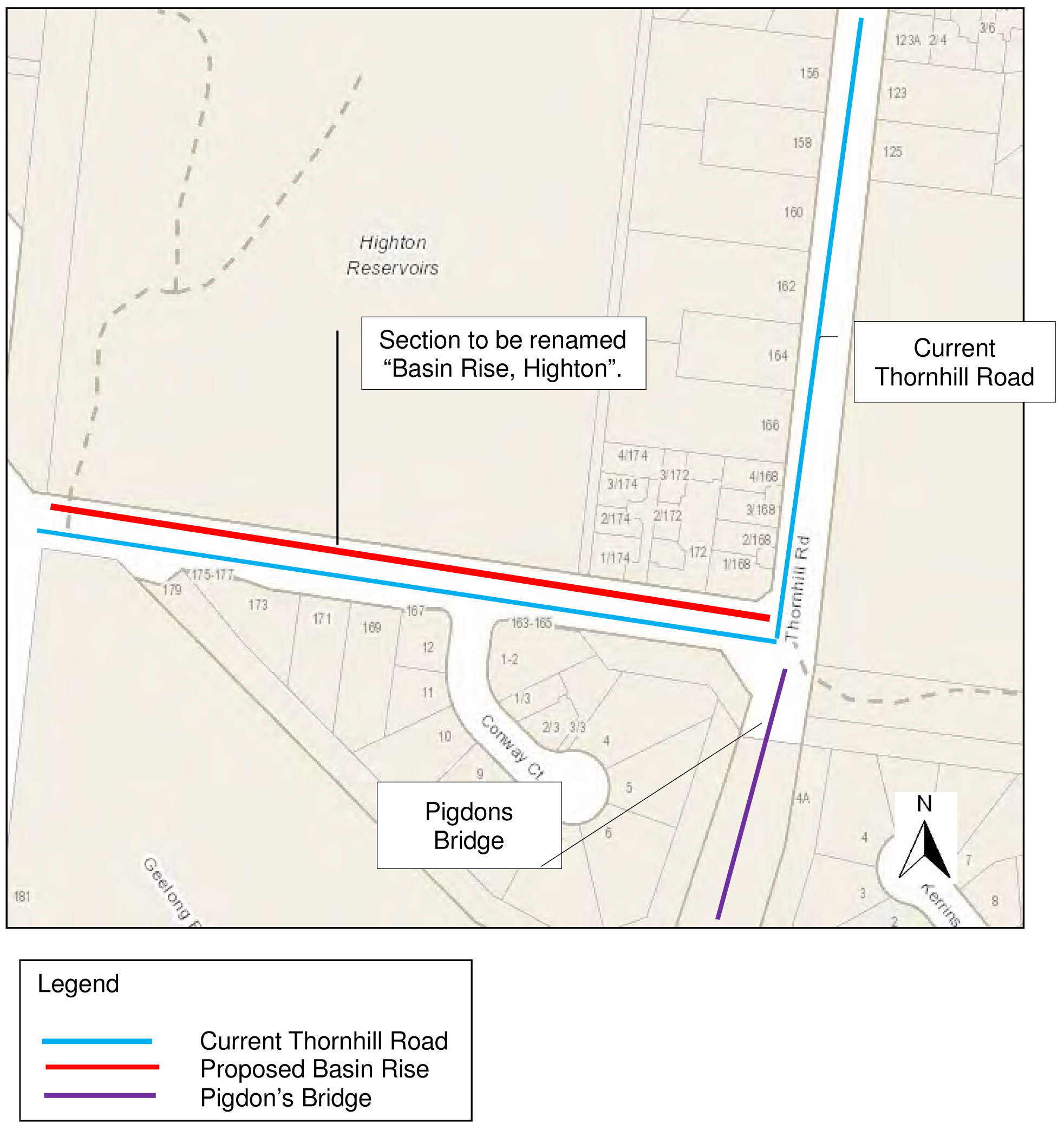
Source: |
Finance & Strategy - Financial Services |
Acting Director: |
Peter Anderson |
Index: |
Financial Management Reporting |
To seek aproval to rename W Boulevard, Armstrong Creek to “Warralily Boulevard, Armstrong Creek”.
Subdivisional developments occurred in Armstrong Creek from Barwon Heads Road to Torquay Road. Simultaneous stages were commenced at different locations causing the proposed roadway to be un-navigable from Barwon Heads Road to Torquay Road. As the roadway was constructed in sections, each section had to have a unique name. The first stage of the development which resulted in a roadway being named Warralily Boulevard began in 2011. The section from Horseshoe Bend Road to Torquay Road, began in 2014, was named W Boulevard with the intention of renaming the roadway when it became navigable from Barwon Heads Road to Torquay Road (Attachment 2).
Potential property owners were made aware that when the roadway became navigable, W Boulevard would become Warralily Boulevard through a road renaming process. This information was included within the Contract of Sale documentation.
Warralily Boulevard is now navigable from Barwon Heads Road to Torquay Road, Armstrong Creek and therefore W Boulevard is required to be renamed.
Council is responsible as a naming and numbering authority designated under the Local Government Act 1989 and is required to utilise the naming Rules for Places in Victoria 2017 (the Rules).
The Rules state in Section 3.2.2 that if a proposed road is being constructed in multiple stages as part of a multi lot subdivision the proposed roads should have unique names aplied. When the middle section of road is constructed renaming of the two unique roads should take place to recognise the full extent of the road.
The developer agreed that W Boulevard would be named as an interim road name with intention to rename to Warralily Boulevard when the roadways intersected.
This road renaming will result in 71 properties requiring re-addressing.
Letters have been sent to all affected and adjoining property owners (71) including a survey for response.
21 surveys were responded to in favour of the renaming.
Responses have been sent to all survey submissions advising that Warralily Boulevard has been selected for the road rename.
Advertisement was placed in the Geelong Advertiser newspaper on 15 July 2017.
Proposal was placed on the Council Website for 30 days as per statutory requirement.
Three online submissions in favour were received.
P Dorling moved, L Gardner seconded -
That Council aprove the renaming of W Boulevard to “Warralily Boulevard, Armstrong Creek”.
Carried.
It is proposed to rename W Boulevard, Armstrong Creek to Warralily Boulevard, Armstrong Creek and register the new road name with the Office of Geographic Place Names.
At the time of subdivisional development W Boulevard was dissected from Warralily Boulevard and was required to have a unique road name aplied.
The Rules state in Section 3.2.2 that if a proposed road is being constructed in multiple stages as part of a multi lot subdivision the proposed roads should have unique names aplied. When the middle section of road is constructed renaming of the two unique roads should take place to recognise the full extent of the road.
W Boulevard was chosen as a temporary road name for this section of roadway. Developers advised potential purchasers of properties, via the Contract of Sale, that W Boulevard would be renamed to Warralily Boulevard when both roads intersected. Council has been advised that these roadways have now become navigable and therefore a road renaming process has commenced.
The proposed renaming was advertised in the Geelong Advertiser newspaper on 15 July 2017.
The aproximate cost to Council is $2,000. This includes advertising, notification to adjoining property owners, notification to authorities and street signage.
The developers were advised that there would be a cost to them to renumber the roadway and this was agreed to. The developers have been sent an account for $5,680 (71 x $80).
Council has communicated via letter and survey with 71 affected property owners. The survey was issued in accordance with the Rules and requested owners to advise if they agreed or disagreed with the renaming. 21 surveys in favour have been returned to Council. Three online submissions in favour were also received.
The proposal was advertised in the Geelong Advertiser newspaper on 15 July 2017. No submissions has been received from the advertisement of the proposal.
The proposal was published on Council’s Geelong Australia website for 30 days as per the Naming Rules for Places in Victoria 2017.
Subject to Council and the Registrar of Geographic Names aproval, the relevant authorities and abutting property owners will be notified of the official registration of this road renaming.
The Local Government Act 1989, the Geographic Place Names Act 1998 and the Naming Rules for Places in Victoria 2017 have been followed.
This proposal aligns to City Plan with the encouragement of Community Wellbeing.
There is no Council Officer direct or indirect interest involved in this report.
If an emergency situation occurred, Council’s proposal to rename this section of roadway could minimise the risk or failure to be able to access a situation in a timely manner.
There are no environmental issues arising from this report.
Source: |
Engineering Services - City Services |
Acting Director: |
Peter Godfrey |
Index: |
Thompson Road and Furner Avenue, Bell Park, Geelong, Special Rates and Charges |
This report seeks a resolution by Council to consider an intention to declare a Special Charge Scheme to partially fund the construction of a footpath along Thompson Road and Furner Avenue, Bell Park (See plan – Attachment 5).
Council’s footpath network strategy identifies the footpath construction priorities of which Thompson Road and Furner Avenue, Bell Park is listed. It is considered that the proposed new footpath completes a key pedestrian link between Norlane and Bell Park residential and commercial areas. The new footpath will provide safer pedestrian access for all users.
Thompson Road and Furner Avenue carry in excess of 14,000 vehicles per day (both directions). Thompson Road is managed by Vic Roads as an arterial road and Furner Avenue is a major road under Council management. The planned footpath will better satisfy the design parameters of the Planning Scheme and Infrastructure Design Manual for footpath provision for main and arterial roads.
It is proposed to construct 1 kilometre of 1.5 metre wide footpath to provide for pedestrian access along the west side of Thompson Road and Furner Avenue, Bell Park.
There are twenty one (21) properties abutting the proposed footpath that will receive special benefit. There are two (2) Council owned properties in the scheme.
The total estimated project cost is $317,823. Additional works estimated at $34,106 will be funded by Council to improve existing infrastructure.
A Benefit Ratio of 0.28 has been calculated in accordance with Section 163 of the Local Government Act, which equates to a Council contribution to the scheme of $204,276 and property owner contribution of $79,441.
Council’s contribution reflects the large pedestrian catchments to the North and along South that will use these pedestrian links. Worn paths along the nature strips indicate high usage.
Property owners are considered to receive benefit from the works by way of improved pedestrian access and general amenity including pedestrian safety improvements.
The scheme has been prepared in accordance with the Special Rate and Charges provisions of the Local Government Act 1989 along with the 2004 Ministerial Guidelines and Council’s Special Rates and Charges Policy.
P Dorling moved, L Gardner seconded -
That Council:
Gives notice of its intention to declare a Special Charge Scheme in accordance with Section 163 (1A) of the Local Government Act 1989 (The Act), as follows:
The Special Charge is declared for a period of five (5) years commencing upon completion of the works.
The Special Charge be declared for the purpose of defraying any expenses incurred by Council in relation to the construction of the footpath on Thompson Road and Furner Avenue, Bell Park. Council considers the project:
Will provide proper pedestrian access, improved pedestrian safety and enhancement to the general amenity for each of the properties included in the scheme;
Will provide a special benefit to those persons required to pay the special charge (and who are described in succeeding parts of this Resolution); and
Arises out of Council’s function of planning for and providing infrastructure for property owners.
The total cost of project, be recorded as $317,823 (Schedule A).
It be recorded that, for the purposes of Section 163 (2A) of the Act, the special charge proceeds will not exceed the amount calculated in accordance with the prescribed formula (R x C = S), the:
‘benefit ratio’ (R) being calculated at 0.28 represents the special benefits to all persons liable to pay the special charge (Schedule B);
‘total cost’ (C) of performing the function described in part 1 (b) of this resolution based on estimated cost be recorded as $283,717; and
‘Maximum levy’ (S) be recorded as $79,440.76.
the following be specified as the area for which the special rate is so declared:
The area within municipal district of Council highlighted in the plan attached to this Resolution (Attachment 5).
the following be specified as the land in relation to which the special charge so declared:
Land within the area shown on the plan.
the following be specified as the criteria which form the basis of the special charge so declared:
Ownership of any land described in Part 1(e) of this Resolution.
the following be specified as the manner in which the special charge so declared will be assessed and levied:
Each lot receives a primary access and amenity benefit;
The maximum levy is divided on an access and frontage share basis;
The special charge will be levied by sending a notice to the person who is liable to pay, pursuant to section 163(4) of the Act.
having regard to the preceding parts of this Resolution but subject to Section 166 (1) of the Act, it be recorded that;
the owners of the land described in column 2 and 3 of Schedule C to the resolution are estimated liable for the respective amounts set out in column 7 of Schedule C; and
such owners may, subject to any further resolution of Council pay the special charge in the following manner;
the charge will become due and payable within one month of the issue of the notice requesting payment pursuant to Section 167 (3) of the Act;
interest will not be charged for six months after the issue of the notice provided the person liable makes timely payment in accordance with any repayment arrangements that may be agreed on by Council; and
in accordance with Section 172 of the Act, the interest rate payable on the special charge which has not been paid by the specific date is set at Council’s overdraft rate, reviewed every three months (provided that it shall not exceed the rate fixed by the Governor in Council by Order for the purposes of Section 172 (2A) in which case the rate of interest shall be the maximum rate fixed by the Governor in Council by Order for the purposes of this section).
Consider any submissions made under Section 223 of the Act and the proposed declaration via Council’s Submissions Review Panel, and then by Council at a subsequent meeting, at which time Council will consider to make declaration in the form proposed.
Authorise the Chief Executive Officer to give public notice of the proposed declaration in accordance with sections 163 (1A) and (1B) of the Act and send a copy of the public notice to each person who is liable to pay the special charge in accordance with Section 163 (1C) of the Act.
Carried.
Council’s footpath network strategy identifies the footpath construction priorities of which the Thompson Road and Furner Avenue, Bell Park is listed as a high priority for construction. It is considered that the proposed new footpath will provide the missing pedestrian link between the Morgan Street rail underpass in Norlane and the Bell Park industrial and residential areas including Bell Park Primary School.
Council Officers have developed a Special Charge Scheme proposal including a cost estimate, Benefit Ratio calculation and cost aportionment spreadsheet. The estimated charges, along with more detailed information on the scheme, were shown to all potentially affected property owners who were asked to respond to the proposal via survey.
The survey results had six (6) property owners respond representing a 29% response rate with two (2) in favour and four (4) oposed to the scheme proposal. Of those oposing the scheme, concerns raised included:
We are a warehouse distributor without need for foot traffic.
Footpaths not warranted in this industrial area.
A footpath will not add value or be of benefit to these properties.
The project is a one off capital cost and there will be minimal ongoing maintenance costs. If aproved, the scheme could proceed this financial year under the core footpath program C02303 – 2017/2018. Financial details are as follows:
Scheme levy to Property Owners (income) |
$79,440.76 |
Scheme Levy to Council – $204,276.24 Direct Funding by Council for pavement reinstatement and a suporting reinforced concrete retaining wall and footing - $34,106 |
$238,382.24 |
|
Total Project Cost |
$317,823.00 |
From the table above, the net cost to Council for this project is estimated to be $238,382
Consultation carried out as follows:
May – June 2017 - Information pack to affected property owners that included an initiation letter, a plan showing the location of works, a Special Rates and Charge Scheme brochure, a detailed cost aportionment spreadsheet and informal survey form. Six responses received.
Further correspondence to the affected property owners will be sent should Council resolve to make its intention to declare the Special Charge.
The scheme has been prepared in accordance with the Special Rate and Charge provisions of the Local Government Act 1989 along with the 2004 ministerial guidelines and Council’s Special Rates and Charges Policy and Community Engagement Guidelines.
This report aligns with the City Plan as follows: Sustainably Built and Natural Environment
Suport our Community to live sustainably – Encourage increased use of alternatives to car transport and seek efficient traffic movement throughout the municipality.
Advocate for and promote sustainable design and development – Promoting sustainable design and retrofitting.
Acknowledge the community’s desire to have their say and be involved in planning for the future of Greater Geelong.
No Council Officer involved with this process has any direct or indirect interest in the properties.
Provision of a sealed pathway will provide safer walking conditions for pedestrians by minimising the risk of personal injuries through conflict with vehicles and the elimination of uneven and slipery surfaces.
There are no identified risks for Council in making its Intention to Declare the scheme.
The provision of a sealed pathway surface provides a permanent and safe means of access. During the course of construction and the manufacture and procurement of materials, energy is expended resulting in some greenhouse gas emissions. This ceases when construction is complete.
The project does not create waste with the exception of some excavated material. The proposal does not affect any natural habitats.
The proposal will require some nature strip trees and shrubs to be trimmed but removal of vegetation is not expected.
The works for the construction of footpaths in Thompson Road and Furner Avenue Bell Park which consist of excavation, footpath, reinstatement of nature strip and driveways, miscellaneous construction works, legal advice and professional services associated with survey, engineering design, drafting, supervision and administration of the project all as included in the cost estimate shown below.
SCHEME WORKS |
|||||
|
ITEM |
DESCRIPTION |
QTY |
UNIT |
RATE $ |
AMOUNT $ |
1.00 |
Initial site establishment and set up, decamping and site clean-up and other fixed costs up to time of completion of works. |
1 |
ITEM |
$28,000.00 |
$28,000.00 |
2.00 |
Traffic management costs. |
10 |
ITEM |
$800.00 |
$8,000.00 |
3.00 |
Setting out of works. |
1 |
ITEM |
$500.00 |
$500.00 |
4.00 |
Service / Cable locations |
1 |
ITEM |
$1,000.00 |
$1,000.00 |
5.00 |
Excavation and disposal of all materials to limits of work as indicated on plan, including trimming for spots and removal of concrete. |
20 |
m3 |
$60.00 |
$1,200.00 |
6.00 |
Concrete pram crossing 1.5m wide, including fine crushed rock bedding. (116-122 Furner Ave) |
5 |
No. |
$250.00 |
$1,250.00 |
7.00 |
125mm (25 Mpa) concrete paving with SL72 mesh including crushed rock bedding. |
1383 |
m2 |
$135.00 |
$186,705.00 |
8.00 |
Tactile Ground Surface Indicator Tiles, suplied and placed.(116-122 Furner Ave) |
2 |
m2 |
$250.00 |
$500.00 |
9.00 |
Top soiling and seeding nature strips, medians and outer separators. |
922 |
m2 |
$8.00 |
$7,376.00 |
10.00 |
Remove white posts and concrete footings. 283-285 Thompson Road) |
2 |
No |
$200.00 |
$400.00 |
11.00 |
Drainage pit lids and housings raised to match new path. (257 (3#) & 271-281 (2#) Thompson Road) |
5 |
No |
$300.00 |
$1,500.00 |
SUB-TOTAL |
$236,431.00 |
||||
10% Contingency |
$23,643.00 |
||||
Design |
$11,821.55 |
||||
Project administration |
$11,821.55 |
||||
CONSTRUCTION COST ESTIMATE |
$283,717.00 |
||||
COUNCIL FUNDED WORKS |
||||||
|
ITEM |
DESCRIPTION |
QTY |
UNIT |
RATE $ |
AMOUNT $ |
|
1.00 |
Initial site establishment and set up, decamping and site clean-up and other fixed costs up to timeof completion of works. |
1 |
ITEM |
$2,000.00 |
$2,000.00 |
|
2.00 |
Setting out of works. |
1 |
ITEM |
$500.00 |
$500.00 |
|
3.00 |
225mm dia UPVC pipe, suplied, laid and jointed including excavation, placement of aproved fine crushed rock bedding and back-filling with aproved material.(283-285 Furner Ave) |
4.88 |
m |
$118.00 |
$575.84 |
|
4.00 |
Saw-cutting of Asphalt paving and concrete. Including vehicle crossing to 124 to130 Furner Avenue. |
1 |
Item |
$500.00 |
$500.00 |
|
5.00 |
Suply, place and compaction of 20mm Class 2 FCR in pavement area in front of kerb and channel to 300mm deep including, 30mm compacted depth 10mm nominal size type N Asphalt spread and compacted including emulsion prime & grit. (104, 106-114 & 116-122 Furner Ave) |
30 |
m2 |
$155.00 |
$4,650.00 |
|
6.00 |
B2 Barrier kerb and channel 450mm wide, including fine crushed rock bedding. (104, 106-114 & 116-122 Furner Ave) |
16 |
m |
$136.00 |
$2,176.00 |
|
7.00 |
Reinforced Concrete Retaining Wall and Footing with SL72 mesh including 50mm compacted depth Class 3 FCR bedding and reinstate nature strip. (90-94 Furner Ave) |
42 |
m |
$410.00 |
$17,220.00 |
|
8.00 |
Reconstruction of pipe post and rail fence. Suply and install two posts and alter the rail at two locations. (66-72 Furner Ave) |
2 |
No |
$400.00 |
$800.00 |
|
SUB-TOTAL |
$28,422.00 |
|||||
10% Contingency |
$2,842.20 |
|||||
Design |
$1,421.09 |
|||||
Project administration |
$1,421.09 |
|||||
CONSTRUCTION COST ESTIMATE |
$34,106.00 |
|||||
A |
Purpose To construct a footpath in Thompson Road and Furner Avenue Bell Park to provide all weather pedestrian access for property owners and the wider community. |
|
||||
B |
Coherence The footpath will connect with the Furner Avenue Railway Reserve underpass and provide a pedestrian link between Norlane and Bell Park. It will also provide an additional link with the Council Reserve at 66-72 Furner Avenue. It will provide a special benefit to adjoining properties and benefit to the wider community. |
|
||||
C |
Total Cost C Total Estimated cost of works |
$317,823.00 |
||||
|
Direct funding by Council to construct a suporting reinforced concrete retaining wall and minor pavement replacement works. Total Cost of Footpath Construction |
$34,106.00 $283,717.00 |
||||
D |
Identify Special Beneficiaries 21 properties with frontages to the proposed footpath are considered to receive access and amenity benefits. |
|
||||
E |
Properties to include 21 abutting properties receive both access and amenity benefits. Therefore: |
|
||||
|
Total Special Benefits (in) is aportioned to 21 properties. There are two (2) Council owned properties in the scheme. Therefore Total Special Benefits out of the scheme is aportioned to 2 properties. |
|
||||
F |
Estimate of Total Special Benefits For this scheme, benefit will be aportioned on the basis of access and amenity by way of a Benefit Unit (BU). We shall assume that the makeup of the BU for each property comprises 1/2 BU of amenity and 1/2 BU for access benefits. The Council owned properties share the same access and amenity benefit as the private properties but has a larger frontage and double the footpath extent. A summary of the special benefits is shown in table form below: |
|
||||
|
|
21 Private Properties TSB(in) |
2 Council Properties TSB(out) |
|
|
|
|
Access |
10.5 BU |
2.0BU |
TSB (in) = |
21.0 |
|
|
Amenity |
10.5 BU |
2.0BU |
|
|
|
|
Total Special Benefits |
21 BU |
4.0BU |
TSB (out) = |
4.0 |
|
G |
Estimate of Total Community Benefit -TCB It is considered that people in the community will receive a benefit from the works as the pathway is used to access other areas. Estimated pedestrian use of the footpath is 20% for the abutting properties and 80% for the wider community. There are no amenity benefits considered for the wider community. If 20% of access benefit represents a total of 12.5 BU, 80% will represent 50BU. |
TCB = |
50.0 |
|
||
H |
Calculate "Benefit Ratio" - R |
|
|
|
|
|
|
Benefits Ratio = |
TSB (in) |
- |
21 = |
0.28 |
|
|
|
TSB (in) + TSB (out) + TCB |
|
21 + 4 + 50 |
|
|
I |
Maximum Total Levy (S) |
|
||||
|
Maximum Total Levy S = R X C |
$79,440.76 |
||||
|
Council Contribution to Special Charge Scheme |
$204,276.24 |
||||
COLUMN 1 |
COLUMN 2 |
COLUMN 3 |
COLUMN 4 |
COLUMN 5 |
COLUMN 6 |
COLUMN 7 |
Prop Key |
Address |
Legal Details |
Aportion able frontage (m) |
Access Benefit |
Amenity Benefit |
Footpath Cost |
278118 |
76-88 Furner Avenue, BELL PARK |
Lot 1 LP 131085 |
48.2 |
$2,337.87 |
$2,751.11 |
$5,088.98 |
278119 |
90-94 Furner Avenue, BELL PARK |
Lot 2 LP 131085 |
43.7 |
$2,337.87 |
$2,494.73 |
$4,832.60 |
278120 |
96-102 Furner Avenue, BELL PARK |
Lot 3 LP 131085 |
66.9 |
$2,337.87 |
$3,818.32 |
$6,156.19 |
354743 |
104 Furner Avenue, BELL PARK |
Lot 2 PS 715070 |
2.7 |
$2,337.87 |
$155.88 |
$2,493.75 |
354742 |
106-114 Furner Avenue, BELL PARK |
Lot 1 PS 715070 |
64.5 |
$2,337.87 |
$3,684.14 |
$6,022.00 |
299930 |
116-122 Furner Avenue, BELL PARK |
Lot A PS 504302 |
16.8 |
$2,337.87 |
$961.58 |
$3,299.44 |
315801 |
124-130 Furner Avenue, BELL PARK |
Lot 1 PS 449381 |
28.7 |
$2,337.87 |
$1,640.50 |
$3,978.37 |
320563 |
Factory No 1/132-136 Furner Avenue, BELL PARK |
1/2 Share of Lot 2 PS 449381 |
39.4 |
$1,168.93 |
$2,248.91 |
$3,417.84 |
315802 |
Factory No 2/132-136 Furner Avenue, BELL PARK |
1/2 Share of Lot 2 PS 449381 |
39.4 |
$1,168.93 |
$2,248.91 |
$3,417.84 |
280221 |
231-233 Thompson Road, BELL PARK |
Lot 1 LP 215029 |
17.3 |
$2,337.87 |
$987.84 |
$3,325.71 |
280222 |
235-237 Thompson Road, BELL PARK |
Lot 2 LP 215029 |
23.0 |
$2,337.87 |
$1,313.32 |
$3,651.18 |
298668 |
239-241 Thompson Road, BELL PARK |
Lot 2 PS 337777 |
25.7 |
$2,337.87 |
$1,465.77 |
$3,803.64 |
298669 |
243-245 Thompson Road, BELL PARK |
Lot 1 PS 337777 |
20.0 |
$2,337.87 |
$1,143.73 |
$3,481.59 |
296611 |
251 Thompson Road, BELL PARK |
Part Share of Lot 1 PS 601749 |
16.8 |
$1,168.93 |
$959.29 |
$2,128.23 |
295120 |
253 Thompson Road, BELL PARK |
Part Share of Lot 1 PS 601749 |
16.8 |
$1,168.93 |
$959.29 |
$2,128.23 |
280225 |
255 Thompson Road, BELL PARK |
Lot A PS 601749 |
83.0 |
$2,337.87 |
$4,739.36 |
$7,077.23 |
280226 |
1/271-281 Thompson Road, BELL PARK |
Lot 1 PS 311991 |
26.6 |
$2,337.87 |
$1,520.02 |
$3,857.89 |
280227 |
2/271-281 Thompson Road, BELL PARK |
Lot 2 PS 311991 |
40.7 |
$2,337.87 |
$2,322.86 |
$4,660.72 |
280228 |
283-285 Thompson Road, BELL PARK |
Part Share of Lot 1 PS 530757 |
25.1 |
$771.50 |
$1,434.94 |
$2,206.44 |
311845 |
287-289 Thompson Road, BELL PARK |
Part Share of Lot 1 PS 530757 |
25.1 |
$771.50 |
$1,434.94 |
$2,206.44 |
311846 |
291-295 Thompson Road, BELL PARK |
Part Share of Lot 1 PS 530757 |
25.1 |
$771.50 |
$1,434.94 |
$2,206.44 |
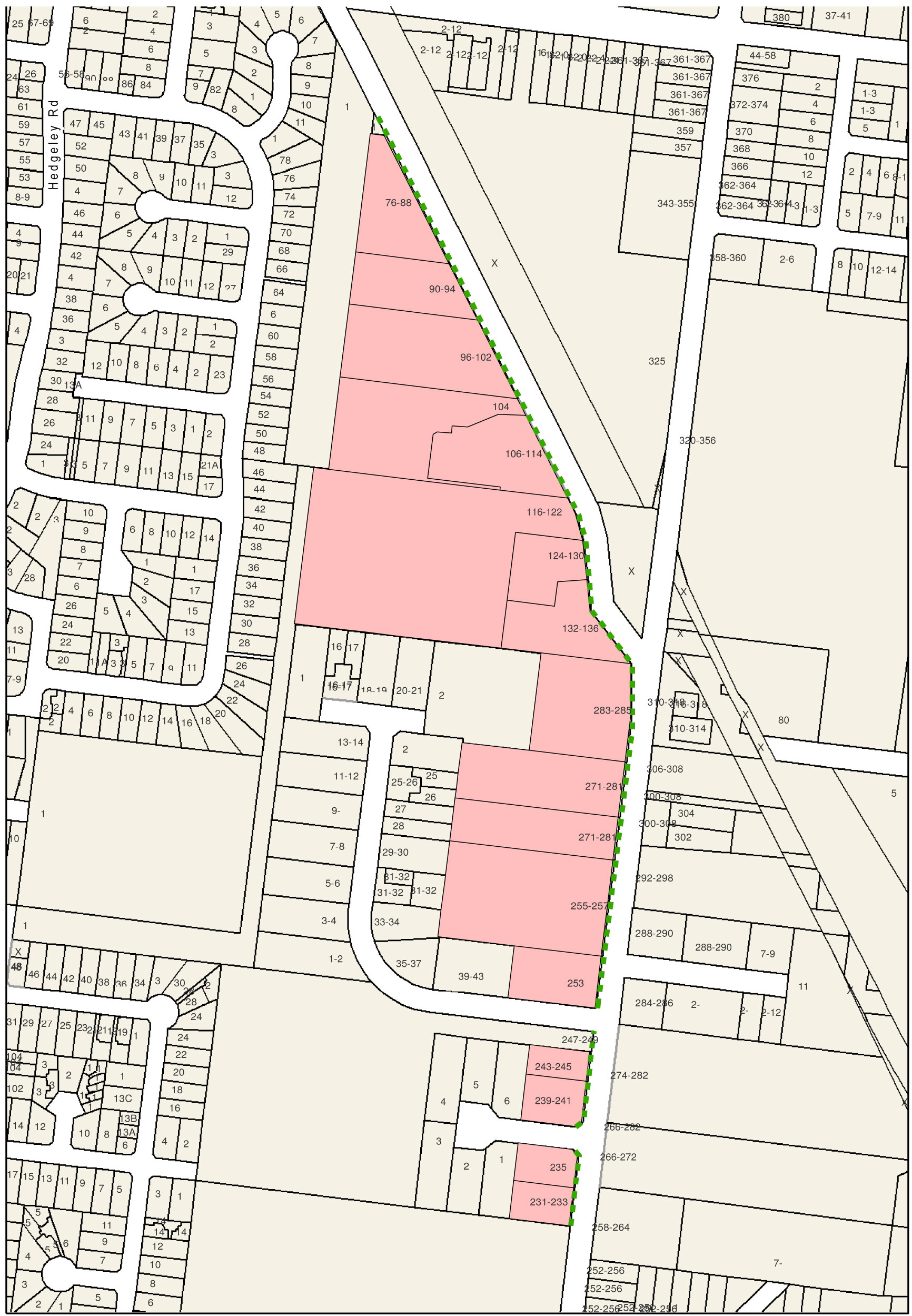
Stage |
Status |
Description |
Aproval to prepare scheme |
|
Decision made to prepare scheme following consideration of surveys of residents and feedback from the community via informal survey. Council may then place the project in the budget system or proceed immediately to prepare a scheme. Scheme preparation involves survey, design and preparation of an aportionment of costs. May 2017 |
Intention to Declare Scheme |
|
Report to Council providing information on scheme including advice of impending advertising of scheme and declaration of charge. Seeks Council aproval by resolution to proceed with process. |
Advertisement |
|
The scheme is advertised in the local newspaper and all allotted property owners are notified by mail. This advertisement indicates Council’s intention and notification to ‘declare’ a scheme in a month’s time. |
Submissions |
|
From the time of advertising property owners have 28 days (as set down by the Local Government Act) to lodge submissions, either in suport or oposition to the scheme. |
Submissions Review Panel Hearing |
|
A Submissions Review Panel is convened (quorum of three Councillors) and meets to consider submissions. Some submissions are written only, and other submitters may wish to be heard before the Panel. The Panel makes a recommendation to Council regarding the scheme. |
Declaration Report |
|
Any time 28 days after advertising the scheme and after the Submissions Review Panel has met and considered submissions, Council considers a report and may proceed to “declare” the charges in accordance with its advertised intent. Subsequent to this the Finance Manager issues the levy notices and there is a formal charge placed on the property. This is the final step in the process for Council to make a decision on the scheme. |
Apeal |
|
Property owners may lodge an aplication for review with the Victorian Civil and Administrative Tribunal (VCAT) within one month of issue of the levy notice. An apeal is listed, heard and determined by the Tribunal and this process generally takes three to four months. Decisions made by VCAT are binding on all parties. |
Construction |
|
Council may then proceed to construct the works. Invoices are issued seeking payment of the estimated cost within one month of commencement. |
Final Cost Report |
|
At the completion of the works the scheme is “finalised” taking into account actual costs incurred and payments are adjusted accordingly. |
Source: |
Planning & Development - Strategic Implementation |
Acting Director: |
Geoff Lawler |
Index: |
Amendment C251 |
To consider the Independent Panel Report and adopt Planning Scheme Amendment C251.
Amendment C251 aplies to Commonwealth land at 1 Henry Street, Belmont. The Amendment proposes to zone the land General Residential Zone Schedule 1 concurrent with a staged multi-lot residential subdivision. The Amendment is suported by a Section 173 Agreement to levy developer contributions for social infrastructure improvements in the Belmont/ Highton area.
Exhibition of the Amendment from 3 March to 10 April 2017 resulted in the receipt of 11 submissions. A Panel Hearing was held on 19 June 2017 and the Panel has suported the Amendment and Permit.
The former CSIRO site was conditionally sold to a developer in 2015 who lodged a Section 96A Planning Scheme Amendment request and Permit Aplication.
Following exhibition of the Amendment and draft Permit, Council received submissions that objected to the proposed road and bicycle network, tree retention conditions and some aspects of the development design.
Under delegation on 1 May 2017, Council resolved to refer all the submissions to an Independent Panel. A hearing was held on 19 June and Council received the Panel Report on 24 July 2017.
The Panel considers the Amendment/Permit has strong strategic planning suport.
The Panel recommends that the Amendment be adopted and the Permit issued; both subject to changes recommended by the Panel. The changes are agreed with minor corrections as outlined in this report.
L Gardener moved, P Dorling seconded -
That Council resolves to:
Adopt Amendment C251 in the form as outlined in Attachment 2 of this report;
Submit the adopted Amendment together with the prescribed information to the Minister for Planning requesting aproval;
Recommend to the Minister for Planning that Planning Permit 408/2016 be granted pursuant to Section 96G of the Planning and Environment Act 1987 (the Planning Permit is in Attachment 3 of this report); and
Sign and seal the Section 173 Agreement accompanying this Amendment to formalise social infrastructure contribution arrangements (Attachment 4 is a copy of the Agreement).
Carried.
On 29 March 2016 a request from Tract Consultants for a combined Section 96A Planning Scheme Amendment and Permit was received by Council for the land at 1 Henry Street, Belmont. The request was made on behalf of the developer, Belmont Projects Pty Ltd
The aplication seeks to zone the land to the General Residential Zone Schedule 1. The 6.2 hectare site is owned by the Commonwealth Government (with a sale contract) and is not zoned in the Greater Geelong Planning Scheme.
The site had previously been used as the CSIRO Materials and Fibre Engineering Laboratory. The CSIRO has now relocated to a new $102M research facility at Deakin University’s Waurn Ponds campus.
The Amendment also proposes to aply the Environmental Audit Overlay (EAO) and the Development Plan Overlay to the land. The Amendment is suported by a Section
173 Agreement for developer contributions towards community infrastructure improvements in the local area and the provision of public open space.
Concurrent with the Amendment request a planning permit (408/2016) is sought to allow subdivision that includes a Stage 1 construction of 26 townhouses and the creation of 61 residential lots. The preliminary site layout (Attachment 5) shows vehicle access to Stage 1 directly from Henry Street and a new internal Council road.
On 7 February 2017 Council resolved under delegation to exhibit Amendment C251. Public exhibition commenced on 3 March and closed on 10 April 2017. Eleven submissions were received, including five from local residents. Given the site’s high exposure and drawn-out history, this very low number of submissions indicates overwhelming community suport for the redevelopment and the certainty it provides.
No submission oposed the strategic basis of the Amendment and proposed residential zone.
Council (under delegation) then considered a report on the submissions and resolved on 1 May 2017 to request the Minister for Planning apoint an Independent Panel to consider the submissions.
Panel Hearing and Panel Report Recommendations
A single person Panel conducted the Hearing on 19 June 2017. Submissions at the Hearing were made by Council officers; a lawyer for the proponent calling expert evidence in planning, traffic and landscape; and two local residents.
The main issues presented to the Panel were:
Concern about the requirement to retain six native trees and the consequent impact in terms of lost development potential and design;
The apropriateness of providing access to dwellings from adjoining open space and whether this contributes to the 10% open space contribution required by Development Plan Overlay Schedule 35;
Potential impacts on traffic and cycling;
Concerns about certainty around future stages of development; and
The apropriateness of identifying potential retail/medical centre uses in the Development Plan Overlay Schedule 35.
The Panel considered all written submissions made in response to the exhibition of the Amendment/Permit; as well as further submissions, evidence and other material presented to it during the Hearing, and its observations from a site visit.
In its 24 July 2017 report, the Panel noted that (p. 4):
“…there were no submissions which challenged the strategic justification for the proposed redevelopment of the site for residential purposes, the proposed aplication of the GRZ1, DPO35 and EAO, changes to Clause 61.03; or to the grant of a permit for the subdivision/development of this land. Rather, the submissions focused on the details surrounding the future development of the site as outlined in DPO35 and the conditions contained in the draft planning permit.”
The key Panel findings were:
Stage 1 of the proposed development is not likely to have a significant impact on the road network and not require the widening of Henry Street or the provision of dedicated cycling paths. Future stages of the development will be subject to a planning permit aplication and will involve the consideration of any additional traffic impacts.
The retention of trees 55, 57, 59, 72 and 196 is suported, as is Council’s permit condition which requires the modification to the subdivision layout to ensure they are retained within public reserves. The Panel found this a reasonable balance between protecting neighbourhood character and urban consolidation.
Any encumbered open space that provides access to abutting residential properties should not form part of the Open Space Contribution.
The DPO35 and the Development Plan (which is still to be aproved by Council) will provide certainty for all key stakeholders about the form and nature of the future development of the site.
Whilst the DPO35 identifies the potential for retail/medical centre uses in the north- east corner of the site, this is not a mandatory requirement and the potential impacts of such a development will be considered as part of a future planning permit.
The Panel recommended that Amendment C251 be adopted and the Permit issued; both subject to changes recommended by the Panel.
A copy of the Panel Report’s Executive Summary is in Attachment 6.
Council officer response
The Panel Report findings and recommendations are all suported except for one change discussed below.
The Development Plan Overlay Schedule 35 to be adopted (refer to Attachment 2) has included the changes recommended by the Panel. This includes minor formatting and content changes consistent with the Ministerial Direction under section 7(5) of the Planning and Environment Act 1987.
The only change to the Schedule 35 not suported relates to Clause 3.0 Open Space and Landscape Masterplan Dot Point 1. The Panel recommended ‘pedestrian link reserves’ should not be credited as public open space if encumbered by a carriageway easement, road reserve or the like. It is better to simply state that encumbered land includes pedestrian link reserves.
It is noted – as identified by the Panel – that adoption of the EAO is apropriate. However if a Certificate of Environmental Audit is issued prior to the aproval of the Amendment by the Minister for Planning, it would be apropriate for the Minister’s office to remove it from this Amendment.
Planning Permit 408-2016
The Panel highlighted that there were no objections to the issue of the planning permit. The Panel discussed agency comments and accepted VicRoads revised position that works to the intersection of Corio Waurn Ponds Road and Henry Street were no longer required as a result of the development.
The Panel recommended changes to the permit and that the permit be adopted as shown in the Panel Report Apendix D.
Council officer response
The recommended changes to the planning permit are agreed except for Condition 30.
Condition 30 relates to the provision of a 10% public open space contribution. The Panel removed that part of the condition allowing land required for tree retention to be calculated as public open space. The Panel Report does not explain this change.
Council, in considering submissions and in its representations at the Panel Hearing, sought to include any land required for the Henry Street trees reserves as part of the public open space contribution. This position is consistent with the draft Development Plan and Section 173 Agreement.
Council officers maintain that the land area required for retention of the Henry Street trees shall form part of the public open space contribution.
The Section 173 Agreement will legally bind Council to deliver social infrastructure improvements in the Belmont/ Highton area from the developer levy it is paid. The levy will be $2,000 per dwelling totalling aproximately $400,000; payable at Statement of Compliance in respect of each residential lot to be created upon registration of that plan of subdivision.
Council officers have written to the Amendment submitters to advise them of the release of the Panel Report. Submitters will be notified of the final decision of Council and the Minister for Planning.
Aplication of the General Residential Zone and permit are consistent with a range of State and Local policies as outlined in the Amendment C251 Explanatory Report.
The Amendment suports the ‘Growing our Economy’ strategic direction of City Plan by providing jobs during the construction period and a range of quality new housing stock in the municipality close to existing services.
No officers involved in this report have direct or indirect interest in accordance with Section 80C of the Local Government Act.
There are no notable risks associated with implementing the recommendations contained in this report.
Risks associated with potentially contaminated land will be addressed by the CSIRO and its contractors, including the completion of an environmental audit.
The former CSIRO site includes an area of contamination that will require remediation. The Commonwealth Government has engaged CH2M to project manage the remediation. The requirements of the Environmental Audit Overlay will further ensure that potentially contaminated land is suitable for future residential use.
The design of the new residential subdivision integrates existing canopy trees that add value and positively contribute to neighbourhood character.
The quality of stormwater draining from the site will be improved as a result of the redevelopment. Measures will be installed to prevent run-off to adjoining properties during the construction period.
Source: |
Planning & Development – Strategic Implementation |
Acting Director: |
Geoff Lawler |
Index: |
Amendment C327 |
To consider the Independent Panel Report and to adopt Amendment C327.
Amendment C327 proposes the rezoning of five lots in Portarlington with a total area of aproximately 27 ha from Farming Zone to General Residential Zone Schedule 1. The Amendment also proposes to aply Design and Development Overlay Schedule 14 (DDO 14) and a Development Plan Overlay (DPO) to the land.
The Amendment was exhibited between 17 November and 19 December 2016. 21 submissions were received, including 12 objections. A Panel Hearing was held on 5 and 6 April 2017. The Panel Report was received on 31 May 2017 (executive summary at attachment 7).
Amendment C352, seeking to implement the Portarlington Structure Plan (2016) and Indented Head Structure Plan (2016), was exhibited concurrently with this Amendment. It was also considered at the same Panel Hearing. Council adopted Amendment C352 at its meeting of 25 July 2017.
Issues raised in the 12 objecting submissions included land suply and demand, interface with and impact on adjacent residents of rural land, visual impact on landscape values and the Bellarine Hills, loss of agricultural land, impact on adjacent agricultural use and the density of residential development.
The Panel conclusions included: the Amendment is suported by and implements the State and Local Planning Policy Framework; the Amendment is well founded and strategically justified; the Amendment is suported by residential land demand and suply forecasts; that the future residential/rural interface is unlikely to adversely affect adjoining rural landowners or result in unacceptable impacts on adjoining agricultural land use; and the Amendment is unlikely to adversely impact on the visual landscape quality or backdrop of Portarlington.
The Panel’s recommended changes to the DPO Schedule reflect Council officers’ recommendations and are suported. One additional change to the DPO Schedule is recommended so that a condition may require a Section 173 Agreement to address drainage infrastructure and staging and community infrastructure contributions, as it is understood that the owners of one of the five lots do not intend the sign the Section 173 Agreement exhibited with the Amendment.
L Gardner moved, P Dorling seconded -
That Council:
Adopts Amendment C327 in the form outlined in Attachment 5 of this report;
Submits the adopted Amendment together with the prescribed information to the Minister for Planning requesting aproval; and
Signs and seals the Section 173 Agreements accompanying this Amendment to formalise development contributions arrangements (a model Agreement is in Attachment 6 of this report).
Carried.
Exhibition and submissions
The subject land is shown in the location plan at Attachment 2. The zoning of the subject and surrounding land is shown at Attachment 3.
The Amendment was exhibited between 17 November and 19 December 2016. 21 submissions were received. Of these 12 were objections, including an objection from owners of one lot within the Amendment area. Five government agencies provided comment, with two requesting a change to the DPO Schedule. Two landowner submissions provided comment but did not object; another submission expressed no objection. A submission from the aplicant suported the Amendment.
A wide range of issues were raised in objecting submissions; key issues raised included:
the need for the rezoning given land suply and demand;
the interface with and impact on adjacent residents of rural land;
visual impact of development on landscape values and the Bellarine Hills;
loss of agricultural land;
impact on adjacent agricultural use; and
the density of residential development.
On 31 January 2017, Council resolved under delegated authority to refer submissions to a Panel.
Panel Hearing
At the Panel Hearing on 5 and 6 April 2017, Council officers indicated that the Amendment is strategically justified, is consistent with both the 2008 and 2016 Portarlington Structure Plans and that none of the issues raised in submissions warranted abandonment of the Amendment or changes to the proposed zoning or extent of the DDO 14 and DPO Schedules. Council officers expressed suport for the Amendment subject to minor changes to the exhibited DPO Schedule to address issues raised in submissions.
Panel Report
The Panel Report, received on 31 May 2017, recommends the Amendment be adopted subject to minor changes to the DPO Schedule proposed/agreed by Council. The Executive Summary of the Panel Report is at Attachment 7.
The Panel’s conclusions included:
Amendment C327 is suported by, and implements, the relevant sections of the State and Local Planning Policy Framework; is consistent with the relevant Ministerial Directions and Planning Practice Notes; is well founded and strategically justified; and is suported by residential land demand and suply forecasts.
The future residential/rural interface resulting from the future development of the Amendment land is unlikely to adversely impact adjoining rural landholders.
The proposed rezoning will not result in unacceptable loss of agricultural land as it has been long identified as future residential land that is located within the Portarlington settlement boundary.
The residential use and development of the land arising from rezoning will not result in unacceptable impacts on adjacent agricultural land use.
Council’s post-exhibition changes to the DPO Schedule relating to interface treatment would help manage this matter.
The Amendment is unlikely to adversely impact on the visual landscape quality or backdrop of Portarlington.
The future development density envisaged by the Amendment is apropriate for the site and Portarlington.
The Amendment apropriately responds to stormwater runoff, local wildlife and potential land contamination.
The Amendment would enable development that apropriately manages traffic and infrastructure matters.
Amendment C327 apropriately responds to planning matters; however the Panel agrees with Council’s post-exhibition changes which respond to issues, clarify intent and improve the operation of planning provisions.
An Apendix to the Panel Report provided the Panel’s recommended wording of the DPO Schedule. These reflect the changes recommended by Council in its Panel Submission, along with a further clerical change.
Officer response:
The Panel’s conclusions and recommendations are suported, as is the Panel’s recommended wording of the DPO Schedule, with one additional change discussed below under the heading Section 173 Agreements. The revised DPO Schedule, recommended for adoption, is shown in track changes format in Attachment 4 and included in Attachment 5.
The substantive changes made to the exhibited DPO Schedule are:
in Point 2.0, specifying that conditions of a permit may include a condition requiring a Section 173 Agreement to facilitate delivery of local infrastructure identified in the Staging and Infrastructure Delivery Plan and to provide a contribution to community infrastructure;
in Point 3.0, requiring the Urban Design Masterplan to show a general subdivision layout and interface treatment with dwellings on lots abutting Batman and Allens Roads generally fronting those roads;
in Point 3.0, requiring the Urban Design Masterplan to include a subdivision design that ensures:
no new intersections with Geelong-Portarlington Road;
no direct vehicular access from any lot to Geelong-Portarlington Road;
a 3.0 m wide vegetation reserve along Geelong-Portarlington Road; and
residences address Geelong-Portarlington Road by use of service roads or internal roads to enable dwellings to front that road but with no direct access to it;
in Point 3.0, requiring the Urban Design Masterplan to include provision for public open space such that public open space includes the highest (south-western) point of the site adjacent to the Batman and Allens Roads intersection to help ensure built development does not intrude on the nearby ridgeline as viewed from the Point Richards area;
in Point 3.0, including specific reference to the Drooping Sheoke, which is of Regional Conservation Significance and has been recorded on the site, in vegetation to be retained on the Landscape Master Plan;
in Point 3.0, requiring that a concept plan for all areas that interface with adjoining road reserves, with landscaping to soften the interface between new residential development and existing rural areas, also specify that the siting and species used do not substantially impede coastal views from existing dwellings on adjacent rural land; and
in Point 3.0, deleting a Road Network and Traffic Management Plan requirement that has now been included in the Urban Design Masterplan requirements.
Some changes to formatting and wording have also been made to comply with the April 2017 Ministerial Direction on the Form and Content of Planning Schemes.
Section 173 Agreements
A draft Section 173 Agreement relating to development contributions for community infrastructure was exhibited with the Amendment. Landowners were to agree to a contribution of $2670 per residential lot (or dwelling, if subdivision does not take place), indexed to inflation, to be spent by Council for the purpose of providing community facilities within Portarlington or for providing sub-regional facilities in a nearby town.
Owners of four of the five lots have signed the Section 173 Agreement (a model Section 173 Agreement, with individual landowner details removed, is at Attachment 6). At the time of writing, it is understood that the owners of the remaining lot, who lodged an objection to the Amendment, do not intend to sign the Agreement to allow for this eventuality, the amendment has been adjusted to allow for an agreement to be entered when a subdivision permit is aplied for. This would enable the dissenting owners to, or a future owner of the land to participate at a later date.
Section 173 Agreements relating to development contributions will assist in the funding of community facilities within the catchment of the proposed development.
The Amendment was exhibited in accordance with the provisions of the Planning and Environment Act 1987 to provide for full public comment. Surrounding landowners and occupiers, government and service authorities were notified and invited to comment.
The Independent Panel report has been publicly released with a copy made available to submitters.
The Amendment is consistent with the State Planning Policy Framework (Clauses 11.02-1, 11.05-1, 11.05-2, 11.09-2 and 11.09-3) and the Local Planning Policy Framework (Clauses 21.06-2, 21.14-2 and 21.14-5) in the Greater Geelong Planning Scheme.
The Amendment suports both the Growing Our Economy and Sustainable Built and Natural Environment strategic directions of City Plan, particularly as it facilitates sustainable development in accordance with an adopted township structure plan.
No Council Officers involved in the preparation of this report have any direct or indirect interest, in accordance with Section 80C of the Local Government Act.
There are no notable risks associated with implementing the recommendation contained in this report.
The subject land is almost entirely cleared of native vegetation and has been used for rural and rural residential purposes for many decades. There is a small area of scattered native vegetation (sheokes) on one lot. A biodiversity assessment will be required as part of the Development Plan.
A detailed requirement of the Development Plan will be an ecological assessment of the cumulative impact of stormwater drainage from the site on wetlands in and adjacent to the Point Richards Flora and Fauna Reserve that demonstrates that there will be no unacceptable impact on those wetlands.
Source: |
Planning and Development |
Acting Director: |
Geoff Lawler |
Index: |
Aplication C351 |
To adopt Planning Scheme Amendment C351 Part 1.
Amendment C351 seeks to rezone part of land at 732-770 Banks Road Ocean Grove from General Residential Zone Schedule 1 (GRZ1) to Public Use Zone 1 (PUZ1) and aply a Public Acquisition Overlay (PAO7) to the land being rezoned.
The Amendment will enable Barwon Water to negotiate the purchase of the land for a sewage pump station.
Council sought and received exemption from the Minister for Planning from normal notification of the Amendment other than the prescribed Ministers and the owner of the land. The only submission received is a suporting submission from the owner.
Part 1 of the Amendment can now be adopted. Part 2 which will aply the PUZ will need to await acquisition of the site by Barwon Water.
Barwon Water and the owner of the land requested expeditious processing of this Amendment to facilitate resolution of land valuation issues which have arisen as part of the property acquisition process.
The subject land has been identified by Barwon Water in consultation with the land owner/property developer. The sewage pump station is required to serve the needs of the surrounding rapidly growing residential area.
The Amendment site falls within a designated growth area in the Ocean Grove Structure Plan which also specifically identifies the need for the new sewage pump station being proposed.
Council officers recommend Amendment C351 part 1 be now adopted.
L Gardner moved, P Dorling seconded -
That Council:
Adopts Amendment C351 part 1 in the form as outlined in Attachment 5 of this report; and
Submits the adopted Amendment together with the prescribed information to the Minister for Planning requesting aproval.
Carried.
Amendment C351 resulted from an aplication made by GHD on behalf of Barwon Water to rezone a 2548 sq.m portion of 732-770 Banks Road Ocean Grove from GRZ1 to PUZ1 with a PAO7 to be aplied to the land to be rezoned. A detailed plan showing the dimensions of the subject land and its location is Attachment 2.
The subject land has been identified by Barwon Water in consultation with the owner of the site which is required for a new pump station to serve the needs of the rapidly growing surrounding residential area and recently rezoned residential area to the south.
The existing zoning of the subject land and surrounding area is Attachment 3.
The subject land and surrounding area consists of vacant farmland with the developing Kingston Downs residential estate rapidly expanding to the west. Attachment 4 is an aerial photo of the subject land and surrounds.
The subject land falls within the designated “North-east growth area” in Council’s adopted Ocean Grove Structure Plan 2015.The proposal for a new sewage pump station and rising main in Banks Road is specifically referred in the Structure Plan document (page 108) with a scheduled construction date of 2018/9.
This Amendment is being sought particularly to assist the parties to resolve land valuation and acquisition issues. The owner of the land suports this Amendment aplication and on this basis exemption was sought and granted by the Minister for Planning from normal exhibition notification (other than mandatory notification of prescribed Ministers and the land owner).
Whilst the land remains in private ownership its inclusion in a PUZ will not comply with the Ministerial Direction on “The Form and Content of Planning Schemes” which would require the land to be owned by Barwon Water as a prerequisite. As the land transfer has not yet occurred, aproval of this Amendment will need to be progressed in two parts (part 1 to now be adopted to aply the PAO, part 2 to be adopted at a later date to include the land in a PUZ).
Adoption of Amendment C351 part 1 will facilitate the continued residential growth in the north-east sector of Ocean Grove in accordance with the adopted township Structure Plan. Attachment 5 is the Amendment recommended for adoption.
This Amendment, which assists in the provision of sewerage infrastructure by Barwon Water, raises no financial issues for Council.
Exemption from the normal exhibition requirements were sought and granted by the Minister for Planning as set out in this report.
The adopted Ocean Grove Structure Plan, which was subject to extensive community consultation, identifies this area for future residential development and specifically refers to the need for this sewage pump station, which this Amendment is facilitating.
The Amendment suports the overall thrust of State and Council planning policies which suport development of designated growth areas in accordance with an aproved Structure Plan and the provision of infrastructure in a timely manner.
The Amendment falls within a designated growth area in Council’s adopted Ocean Grove Structure Plan which also suports the need for the new sewage pump station now being facilitated.
The Amendment suports the overall thrust of Growing our Economy and Sustainable Built and Natural Environment Strategic Directions in that it facilitates the development of land identified as being suitable for future residential development.
No Council officers involved in the preparation of this report have a direct or indirect interest ,in accordance with Section 80C of the Local Government Act, to which this Amendment relates.
No risks have been identified in adopting Amendment C351 Part 1 as being recommended by this report.
Environmental issues associated with the development of this area were considered as part of its rezoning to enable it to be developed for residential purposes (Amendment C60). This Amendment raises no new environmental issues.
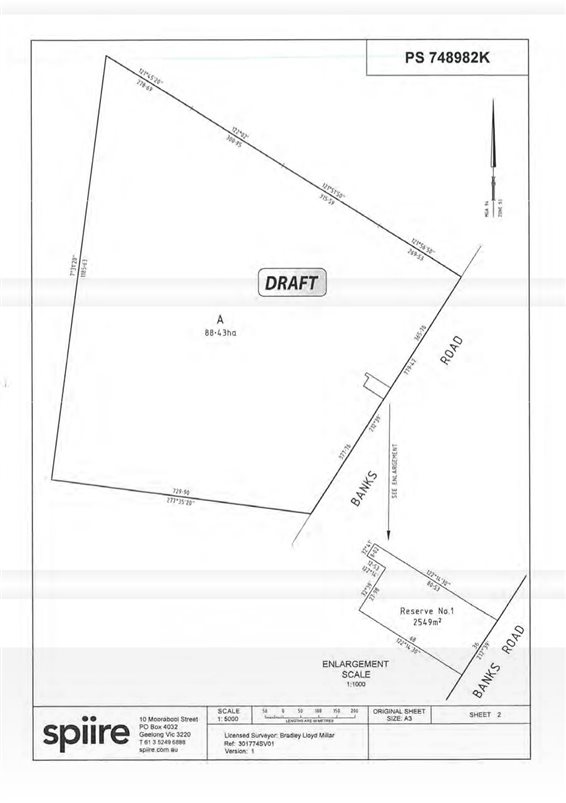
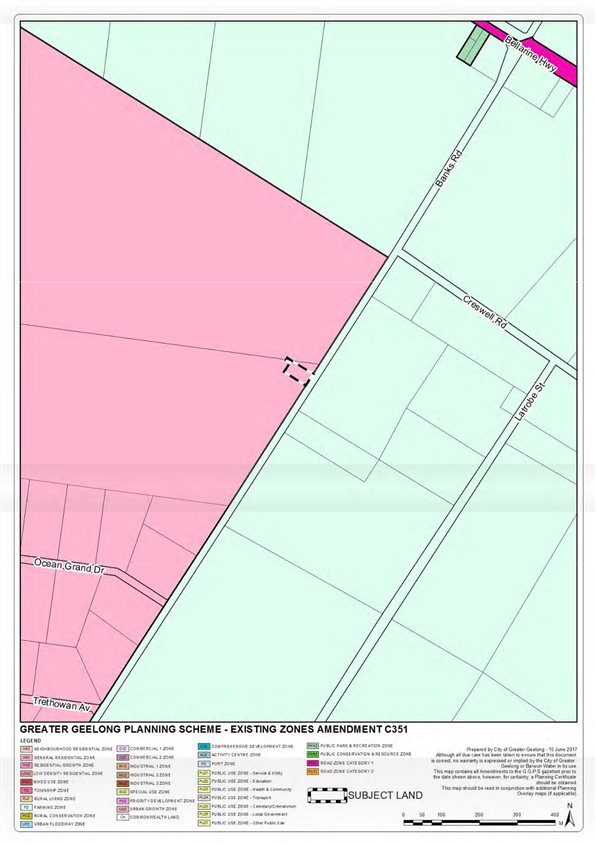
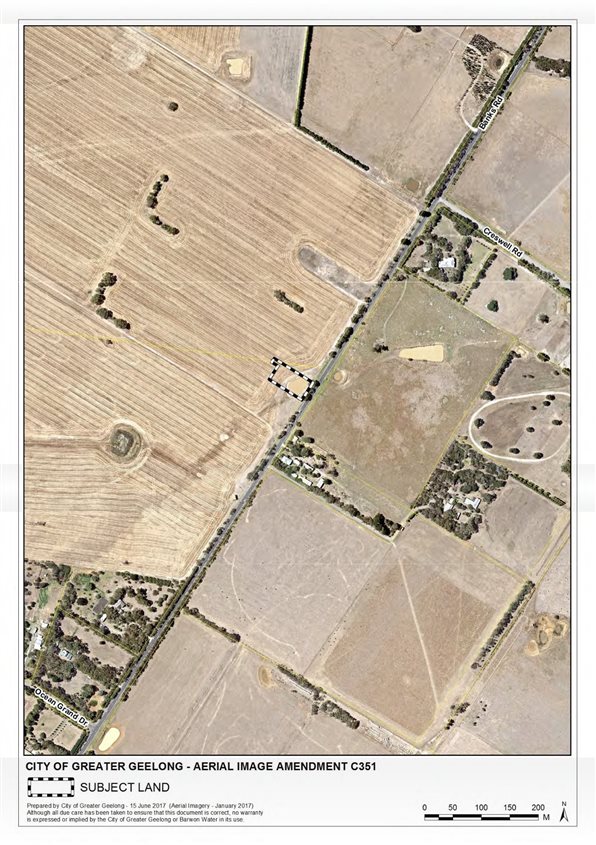
Planning and Environment Act 1987
INSTRUCTION SHEET
The planning authority for this amendment is the City of Greater Geelong The Greater Geelong Planning Scheme is amended as follows:
The Planning Scheme Maps are amended by a total of one attached map sheets.
Overlay Maps
Amend Planning Scheme Map No.82 PAO in the manner shown on the attached map marked “Greater Geelong Planning Scheme, Amendment C351”.
End of document
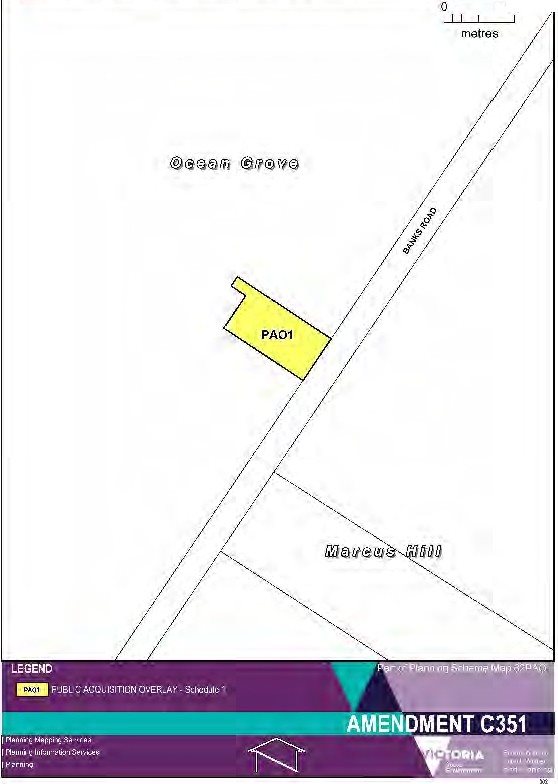
Source: |
Planning and Development – Strategic implementation |
Acting Director: |
Geoff Lawler |
Index: |
Aplication C353 |
To consider the submissions received following the exhibition of Amendment C353 and to adopt the Amendment.
A Planning Scheme Amendment aplication has been made by Jewell Partnership acting on behalf of TOM Assets and Beckley Park Committee of Management. It seeks to amend Schedule 4 of the Special Use zone to enable a permit to be considered for major promotional signage. The Committee of Management has obtained the agreement of the Land Management Policy section of DELWP to make this aplication.
This aplication arose out of recommendations of the Beckley Park Working Group, chaired by the previous Member for Western Victoria with representatives of Beckley Park users, Committee of Management and Council with observers from various Government Departments. The Working Group met during 2012-2014 to investigate options to improve the on-going financial sustainability of the facility, which operates on Crown Land.
Beckley Park is the home of Geelong Harness Racing club, Geelong Greyhound Racing club, Geelong Karting club and Beckley Park Community Market. In the words of the aplicant, the proposed signs “will provide revenue and the funds can be used to offset operating costs and suport future development works at Beckley Park” .
The amendment was exhibited between 13 July 2017 and 14 August 2017, with two submissions being received, from VicRoads and the Department of Environment, Land, Water & Planning, neither of which objected to the Amendment as exhibited.
L Gardner moved, P Dorling seconded -
That Council:
adopts the exhibited Amendment C353, as contained in Attachment 2 to this report; and
submits the adopted Amendment and prescribed information to the Minister.
Lost.
K Alexander moved, P Dorling seconded –
That the report be deferred for future consideration.
Carried.
Beckley Park is situated at a high profile location which makes it an attractive site for large scale outdoor advertising. On aproaching Geelong from the direction of Melbourne, Beckley Park marks the entrance to the city’s northern suburbs. At this location large promotional signs similar in nature to the one at Avalon Airport will be very clearly visible to all road users coming to or leaving Geelong.
This amendment is being sought because major promotional signs are prohibited under the current SUZ4 zone provisions. The Special Use Zone provisions at Clause 37.10-5 aply the Category 3 set of controls to advertising signs, “unless a schedule to this zone specifies a different category”. The Category 3 advertising provisions prohibit major promotional signage.
The amendment introduces a new Clause 4.0 to Schedule 4 to the Special Use Zone, which identifies that the Beckley Park land falls under Category 2 of the advertising controls, contained in Clause 52.05 of the planning scheme. A permit will be required to erect the signs.
The amendment will place a mandatory limitation on the number and height of the proposed major promotional signs. The aplicant’s consultant has agreed with these proposed restrictions to limit the number of such signs to two with an overall height of 15 metres.
Plans submitted with the request for amendment show a major promotional sign is proposed to be erected in a generally central location on each of the Princes Highway and Geelong Bypass frontages such that they are very well clear of the residential area on the west side of Broderick Road.
It should be noted that this aplication makes it clear that aproval will be subsequently sought for these signs to include an electronic or digital component.
It is not being recommended that a mandatory prohibition be placed on electronic advertising as part of this amendment. Therefore, the subsequent permit aplication if aproved will set a precedent for electronic advertising on major roads in Geelong. Examples of such advertising on main roads in the metropolitan areas of Melbourne have been aproved and VCAT has already suported some cases. In these circumstances, prohibition of electronic advertising on the Beckley Park site is difficult to justify.
Attachment 2 contains the amendment documentation, for adoption, which includes the amended Schedule 4 to the Special Use Zone with the proposed changes as described above included in tracked changes format. It should be noted reference has now also been made to Beckley Park in the Schedule name and Purpose to indicate it does not only aply to the Geelong Showgrounds and Racecourse.
Attachment 3 shows the zoning of Beckley Park and the surrounding area Attachment 4 is an aerial photograph of the same area.
Prior to seeking Authorisation to exhibit, the aplication was referred to VicRoads which indicated it did not object subject to the imposition of conditions on any subsequent permit issued relating to electronic signage.
There are pros and cons to be considered. On one hand Beckley Park is clearly an urban use where some form of substantial advertising would normally be considered acceptable, particularly as it is unlikely to be visible from the nearest residential areas to the west of Broderick Road. On the other hand, these proposed signs will be highly prominent at the entrance to urban Geelong and may be viewed as being at odds with the Council’s long-standing program to beautify the city’s northern entry along Princes Highway.
It is important to acknowledge (as does the aplicant) that Council’s suport for this amendment does not bind Council’s consideration of any future planning permit aplication which would be assessed against State and Council planning policies and the provisions of Clause 52.05 of the Planning Scheme, the purpose of which is:
to achieve high quality visual standards for the siting of major promotion signs.
to ensure that the signs are not detrimental to the apearance of their surroundings or the safe and efficient operation of the route through the aplication of consistent planning controls.
The decision guidelines to this Clause require Council to consider the effect of such signs on streetscapes, a significant view corridor, gateway location etc. and a range of locational principles.
On balance, this amendment is suported having regard to the history of the aplication as outlined above, the proposed limitation of signs to two in number with a maximum 15 metres height limit, as any such signage is unlikely to impact on nearby residential areas and would be located on the site of an existing substantial use within the urban area.
The proposal will have no financial implications for Council.
The amendment was exhibited in the normal manner with two submissions received, neither of which objected to the amendment in the form exhibited.
Clause 18.02-4 of the Planning Scheme (management of the road system) to “regulate the design of transport routes and nearby areas to achieve visual standards apropriate to the importance of the route with particular reference to landscaping, the control of outdoor advertising”…etc.
Clause 21.08-2 similarly highlights the importance of the presentation of development along highways and main roads. One of its objective is “to improve the apearance of transport routes at key entrances to townships and urban areas”.
The amendment is consistent with City Plan’s Strategic Direction of Growing our Economy, in particular the Priority of Suporting Existing Businesses.
No Council officers have declared a direct or indirect interest in this matter, in accordance with Section 80(c) of the Local Government Act, to which this amendment relates.
No risks have been identified in relation to the adoption of Amendment C353 as is recommended by this report.
The amendment will have no environmental implications.
Source: |
Planning & Development - Strategic Implementation |
Acting Director: |
Geoff Lawler |
Index: |
Amendment C358 |
To consider submissions and adopt the Planning Scheme Amendment C358.
In March 2017 Sincock Planning submitted a planning scheme amendment request to rezone the land at 55, 57 & 59 Kilgour Street, Geelong and 322-328 Moorabool Street, Geelong from the General Residential Zone to the Mixed Use Zone.
The site is located on the north-west corner of Kilgour Street and Moorabool Street Geelong. The site is developed with a four storey building comprising 30 apartments at levels 1-3 (10 apartments per level) and three commercial tenancies along with common property car parking at the ground floor.
The shop-fronts at the ground floor level comprises three titles with the following floor areas: 55 Kilgour Street 73sq.m; 57 Kilgour Street 73sq.m; and 59 Kilgour Street 78sq.m. The three tenancies are vacant and have been for an extended period of time.
On 29 March 2017 Council resolved under delegation to exhibit Amendment C358. Exhibition from 4 May to 12 June 2017 resulted in ten submissions.
Of the ten submissions received, six were from residents of the building who objected to the rezoning of the uper level apartments to the Mixed Use Zone. Concerns related to possible business ventures, security, noise and parking issues.
The uper level apartments are owned by the Housing Association Haven; Home Safe and tenanted to the over 55s. Haven; Home Safe in their submission suport efforts to activate the shops however are sensitive to the concerns of the tenants.
With agreement from the aplicant, Council officers decided to replace the proposal to rezone the land with a site-specific (to the commercial tenancies) incorporated document in the Greater Geelong Planning Scheme.
The effect of this change would mean the site remains in the General Residential Zone while allowing a greater range of commercial uses. As a result of this proposed change all objections were withdrawn. There are now no submissions that seek to change the Amendment and the Amendment can be adopted.
Parking restrictions fronting the site on Moorabool Street will also be changed to 1 hour (4 spaces) and ¼ hour (1 space).
L Gardner moved, P Dorling seconded -
That Council resolves to:
Adopt Amendment C358 in the form as outlined in Attachment 2 of this report;
Submit the adopted Amendment together with the prescribed information to the Minister for Planning requesting aproval; and
Change the Moorabool Street parking restrictions fronting the site to 1 hour (4 spaces) and ¼ hour (1 space).
Carried.
In March 2017 Sincock Planning on behalf of Steven Li and Frank Furnari submitted a planning scheme amendment request to rezone the land at 55, 57 & 59 Kilgour Street, Geelong and 322-328 Moorabool Street, Geelong from the General Residential Zone Schedule 1 to the Mixed Use Zone.
The land proposed to be rezoned originally formed part of the larger Gordon Institute of TAFE site, which now has its campuses in the CBD close to the Geelong Train Station, and at East Geelong.
This created the oportunity for an urban renewal project managed by Places Victoria that in 2009-10 delivered a mix of apartment living and inner city townhouses. The development also included ground level commercial tenancies to enliven the building and activate the intersection of Moorabool Street and Kilgour Street (see Attachment 3).
Commercial viability has proven unsuccessful with the tenancies struggling to attract and retain businesses. All three tenancies have been vacant for an extended period of time and therefore not provided the street activation and employment oportunities as envisaged by Places Victoria.
Rezoning the ground floor commercial tenancies only was explored, however the Mixed Use Zone cannot be aplied vertically. The Mixed Use Zone was still considered apropriate given its purpose includes to provide for a range of commercial uses and housing at higher densities.
On 29 March 2017 Council resolved under delegation to exhibit Amendment C358 to rezone the site to the Mixed Use Zone. Public exhibition commenced on 4 May and closed on 12 June 2017.
Council received ten submissions including six objecting submissions from residents of the uper levels of the building. Concerns related to possible business ventures on the uper levels, security, noise and parking issues. There was a general view by the residents that the peace and safety afforded by the building would be compromised. None of the objecting submitters oposed rezoning the ground floor commercial tenancies.
Council officers also discussed the proposal with other residents who did not wish to lodge a submission but raised similar concerns. Importantly, the landowner, Haven; Home Safe, in their submission suported efforts to activate the shops however were sensitive to the concerns of the tenants.
Three written submissions were received in suport of the Amendment.
Having considered the submissions Council officers decided to replace the proposal to rezone the land with a site-specific incorporated document to be implemented into the Greater Geelong Planning Scheme, to be aplied to the commercial tenancies only.
This aproach was agreed upon by the aplicant.
The effect of this change means the site remains in the General Residential Zone while allowing a greater range of commercial uses. The incorporated document aplies to the street level properties at 55, 57 and 59 Kilgour Street allowing office, shop and food and drink premises uses that would otherwise be permit required or prohibited in the zone.
This aproach essentially achieves the same outcome as was originally intended by the previously proposed Mixed Use Zone.
Some of the submissions also raised concerns about the lack of available on-street car parking in the general area and, more specifically, the ¼ hour restrictions imposed on the five spaces located to the front of the building on Moorabool Street. Councils Traffic Unit has agreed to change the restrictions to 1 hour (4 spaces) and ¼ hour (1 space) between the hours of 9:00am and 5:00pm.
Attachment 4 summarises all of the submissions and provides a council officer response.
There are no financial implications.
After the submission period closed, Council planning and traffic officers convened an on- site meeting on Wednesday 5 July at 3:00PM. Invited to the meeting were all of the uper level residents, Haven; Home Safe staff and the aplicant.
The meeting was attended by 11 residents, two staff members of Haven; Home Safe and the aplicant and the aplicant’s planning consultant. The 11 residents included five of the six objecting submitters. Council officers explained the proposal to replace the rezoning with the introduction of a site-specific planning control to aply to the commercial tenancies only. Officers also agreed to consider changes to the parking restrictions fronting the site on Moorabool Street.
There was unanimous suport for these changes at the meeting.
Following the meeting all objecting submitters, Haven; Home Safe and the aplicant were sent a letter formalising Council officers changed position. Attached to the letter was a draft of the incorporated document, a withdrawal form and the proposed changed car parking restrictions. The suporting submitters were contacted directly by phone.
All objecting submissions were withdrawn in writing; one being a verbal withdrawal recorded in writing. Haven; Home Safe responded positively, saying they suport the progress of Amendment C358.
Planning Policy
The proposed amendment to Clause 52.03 Specific Sites and Exclusions is considered to be the most apropriate Victorian Planning Provision for the site.
The purposes of Clause 52.03 are:
To recognise specific controls designed to achieve a particular land use and development outcome existing on the aproval date.
To provide in extraordinary circumstances specific controls designed to achieve a particular land use and development outcome.
The clause states land may be used in accordance with the specific controls contained in the incorporated document corresponding to that land.
Given the past history of the site: the building was constructed in 2009-10; the ground floor was purpose built for commercial uses that have continually failed; the uper levels are owned by a housing association and tenanted to over 55s; and the genuine concerns raised by residents to the previously proposed Mixed Use Zone, the use of Clause 52.03 is considered apropriate.
The Amendment accords with a number of policies including Clause 17 Economic Development; Clause 21.07 Economic Development and Employment; and Clause 21.9 Central Geelong.
The Amendment is also consistent with local policy 22.01 Discretionary Uses in Residential Areas. Given the size of the tenancies, only small scale uses are possible which limits potential amenity impacts. The area generally is considered to be mixed use in nature and both Kilgour and Moorabool Streets are busy routes in Central Geelong. The policy encourages non-residential uses to be located on sites that have a lower standard of residential amenity.
Procedural requirements
Pursuant to section 23(1) of the Planning and Environment Act, after considering a submission which requests a change to the amendment, the planning authority must (a) change the amendment in the manner requested; or (b) refer the submission to a panel apointed under Part 8; or (c) abandon the amendment or part of the amendment.
In this case no submission oposed the rezoning of the ground floor tenancies to the Mixed Use Zone. The objecting submitters sought to change the Amendment by removing the proposal to rezone the uper levels. As stated earlier in the report, vertical zoning is not possible in the Mixed Use Zone.
The decision to progress the Amendment by replacing the proposed Mixed Use Zone with an incorporated document specific to the commercial tenancies is not considered to be a transformation of the Amendment. Moreover, the process of considering submissions has satisfied the requirement for natural justice for all submitters.
In Greater Dandenong C96 (PSA) 2010, the Independent Panel considered the issue of transforming an amendment and held:
The general principle aplied in panel hearings is that modifications to amendments are acceptable so long as they do not result in a transformation of the proposal.
Panels are guided by the general objective to achieve good outcomes without unnecessary delay or protraction of process. To do this, panels need to be prepared to facilitate the decision making process. Therefore, if modifying a proposal will achieve a good outcome, which overcomes legitimate and reasonable concerns, it is considered better to do so as part of the process of considering the matter than to reject it and require the process to be recommenced. This can mean that we could legitimately consider changes to the amendment that are quite significant, so long as they do not transform the amendment into something else.
What constitutes a transformation must be judged according to its own circumstances, but it would need to be something quite different to that originally proposed.
It is only possible to consider such significant changes to an amendment if the rules of natural justice are adhered to. The particular rule of natural justice, which must be satisfied, is the requirement that all matters upon which a decision will be based are revealed to the parties and they are given an oportunity to be heard.
The use of a site specific exemption instead of rezoning the land to the Mixed Use Zone has essentially achieved the same outcome as was originally intended. That being; to provide oportunity for a wider range of ground floor commercial uses.
All uper level tenants (and not only the submitters to the exhibited Amendment) were invited to the meeting on Wednesday 5 July. 11 of the 17 attendees at the meeting were apartment residents, including five of the six objecting submitters. The proposed changes were explained at the meeting and submitters received a follow up letter and draft incorporated document.
All objections were subsequently withdrawn on the basis that the land would remain in the General Residential Zone.
The Amendment suports the ‘Growing our Economy’ strategic direction of City Plan by broadening the range of commercial oportunities on the site.
No officers involved in this report have any direct or indirect interest In accordance with Section 80C of the Local Government Act.
There are no notable risks associated with implementing the recommendations contained in this report.
There are no environmental implications.
Planning and Environment Act 1987
The planning authority for this amendment is the Greater Geelong City Council. The Greater Geelong Planning Scheme is amended as follows:
Planning Scheme Ordinance
The Planning Scheme Ordinance is amended as follows
In Particular Provisions – Clause 52.03, replace the Schedule with a new Schedule in the form of the attached document.
In Incorporated Documents – Clause 81.01, replace the Schedule with a new Schedule in the form of the attached document.
End of document
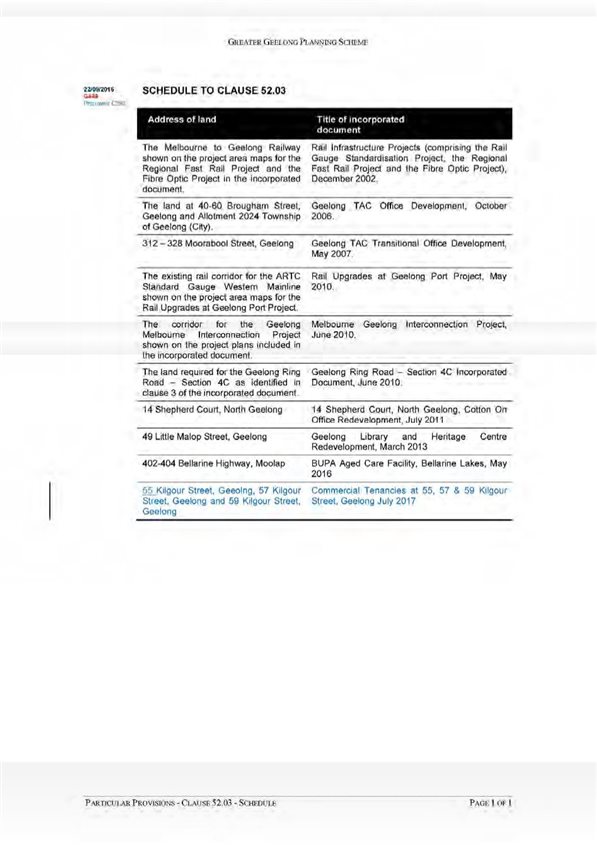
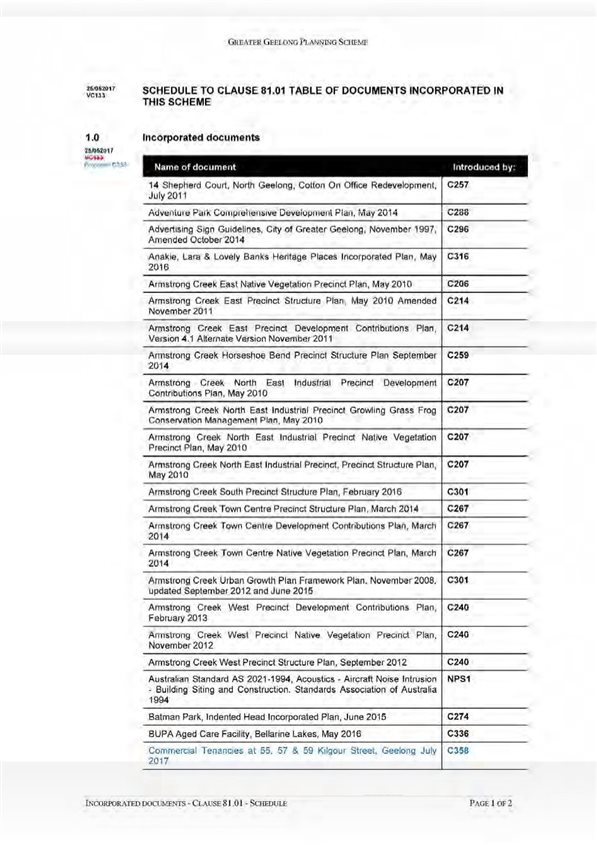
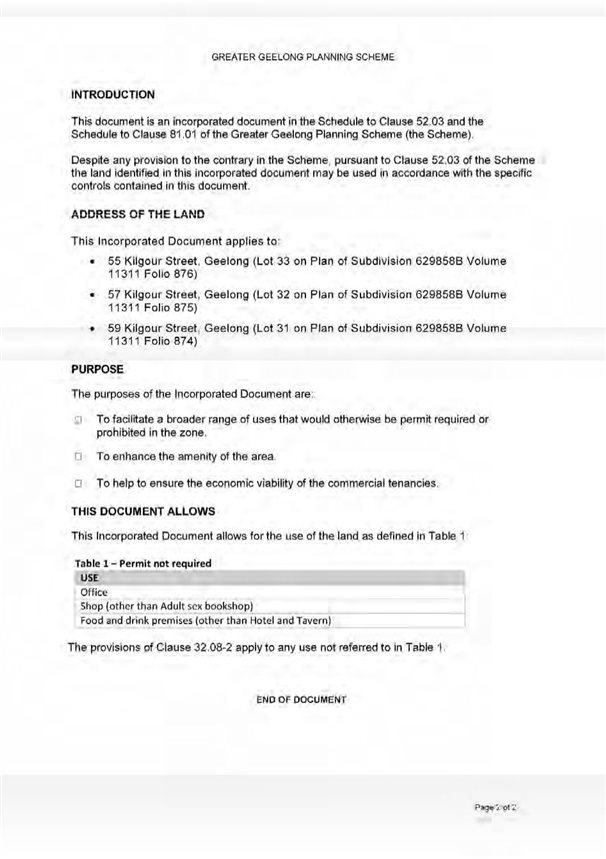
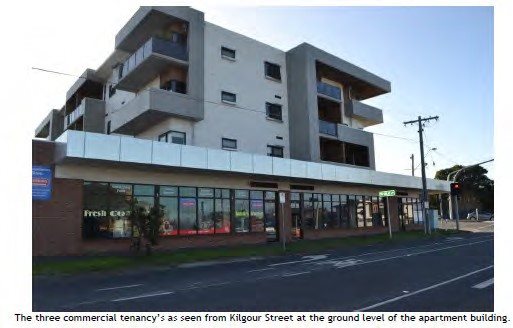
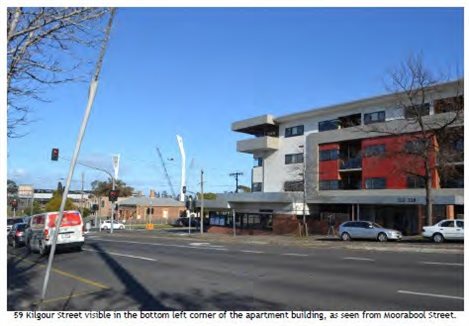
No. |
Name |
Address |
Type |
Summary of Submission (to exhibited proposed rezoning to MUZ) |
Summary of Submission (to post-exhibition replacement of MUZ with site specific Incorporated Document and changes to Kilgour St parking restrictions) |
Response |
1 |
T Baker |
322-328 Moorabool St. GEELONG |
Objection |
No objection to the existing commercial areas being rezoned. Strongly objects to levels I, 2 and 3 being rezoned to anything other than residential. As the apartments are designed to house vulnerable tenants over the age of 55, there could be personal security and noise issues relating to foyer and apartments for any future business venture to be operated by any existing or future tenant. |
I withdraw all and any objections (written; dated 4.8.2017). |
Noted |
2 |
E De Vries |
322-328 Moorabool St. GEELONG |
Objection |
Strongly objects due to the fact that this is a secure residential facility for over 55s. Changing to a mixed purpose use would leave it open to to people to open small businesses on the property. There will no longer be secure living in this place. |
I withdraw my submission (written; dated 10.8.2017). |
Noted |
3 |
J Gower |
322-328 Moorabool St. GEELONG |
Objection |
No objection to the three existing shops on Kilgour Street being rezoned. A change in parking times from half an hour to one hour would be of great benefit to both the shops and apartment tenants for visitors and home-care assistance workers. Only concern as with other tenants is the suggestion of changing levels 1, 2 & 3 to anything other than residential, as it could lead to security problems. |
I withdraw my submission (verbal; dated 2.8.2017). |
Noted |
4 |
K-A Greenman |
322-328 Moorabool St. GEELONG |
Suport |
No objection |
Remains suportive (verbal; dated 1.8.2017). |
Noted |
5 |
Haven; Home Safe |
T Ray 6 Pakington St. GEELONG WEST |
Comment |
The site contains 3 ground floor shop and uper levels of apartments with underground car parks. Haven; Home, Safe owns the apartments whilst the 3 shops have been sold on separate titles. The 3 shops areas have failed to be successful tenancies which is obviously why the council is seeking to change the zone to expand the range of uses in order to attract different tenants. Haven; Home, Safe is not oposed to the mixed zone use for the commercial shop fronts as we understand this might broaden the attractiveness of the space. Our tenants are concerned that by rezoning the entire complex this could result in personal security issues to the tenants as well as concerns about some non- residential uses permitted on the apartment levels that would be of a concern. They are also concerned that in the under the clause 21.07 of the explanatory report that relevant uses include shop, office and food and drink premises which is of concern if a drink (bar premises) was in place which we know is technically possible under the proposed zone and we know that there would be an outcry from tenants and Haven; Home, Safe leading to objections and possible VCAT apeals. At present the apartments have had a poor interface with the vacant shops at the ground level and itapears that occupied shops would be a better outcome and maybe complimentary to the apartments. We are just wanting to ensure all potential risks associated with the potential commercial intrusion is minimal. As a Housing Association we pride ourselves on providing safe, secure and stable and affordable accommodation to those that are kept out of the private rental market due to unaffordable rents. The tenants in this complex enjoy a quiet lifestyle and we are keen to ensure that this continues as there are not many affordable housing options for this tenant cohort (over 55s) so any rezoning needs to be sensitive to the concerns of the tenants. |
It is very clear what the proposal looks to achieve and the accompanying change parking restrictions meet the conversations of all whom attended the meeting on 5th July with regards to a 1 hour parking restriction and a 15 minute loading zone, which I see is now 15 minute parking which in reality does the same thing. Therefore based on all of this information we are hapy to suport the progress of amendment C358 by implementing the incorporated document into the planning scheme and abandon the exhibited proposed mixed use zone. I would like to thank you and the Council for taking the time to hear our tenants concerns and meet with us, I think the outcome that has been achieved will work well for all stakeholders. (Written; dated 20.7.2017) |
Noted |
6 |
E McLay |
322-328 Moorabool St. GEELONG |
Objection |
Oposes the building being changed to Mixed Use Zone. Residents have to park on the street, extremely busy corner, former milk bar was broken into, there is no available parking since the units behind were completed. |
I withdraw my submission only if:
Still concerned about lack of parking spaces in the area. (Written; dated 17.8.2017) |
Noted On-street parking and traffic management is under the responsibility and review by Council Traffic Unit. |
7 |
Sincock Planning |
Toni Sincock PO Box 284 GEELONG |
Suport |
On behalf of the aplicant, we suport the proposed rezoning to the Mixed Use Zone as it will provide greater potential for the three commercial tenancies to find suitable tenants without having any impact on the surrounding properties. The current zone permits very few uses, and those most suitable are food anddrink premises which have much greater potential to impact residents than uses such as shop and office that are permitted by the Mixed Use Zone. My clients wish to enhance the site by the realization of activity in the commercial premises which will liven the street and provide greater security via ground floor direct access and visibility of the streets. The Mixed Use Zone maintains a residential purpose and provides for a range of uses that are generally accepted in inner city location and adjacent to and within buildings that provide for higher density housing. It is accepted that the range of uses in the MUZ are apropriate uses within residential apartment buildings, and the uses will have no impact on the existing residential amenity of the residents. We rely on our original submission to address all issues in detail. |
Confirmed suport for proposed changes and draft documents. (Written; dated 24.7.2017) |
Noted |
8 |
D Stephens |
322-328 Moorabool St. GEELONG |
Objection |
I strongly object to this amendment as the rezoning of this property is not going to enhance the shop owners chances of filling these businesses. The Council has already (without notice to the tenants) altered the parking times to ½ hour in Moorabool St to attract interest in these shops, this has been a complete failure. I would also like to point out that rezoning this property for mixed use could open up the possibility of commercial enterprises to be established on the uper floors of the building and compromise the security and safety of all current residents. The building provides affordable living for people 55 years and over and to many, perhaps live out their days in this quiet environment feeling secure and safe. |
I withdraw my objection to the Amendment upon the proviso that the Council no longer proposes to rezone the land (written; dated 24.7.2017). The submitter also states that he still does not agree with the proposed 15 minute parking bay in Moorabool St as it has taken away another park from the residential tenants. |
Noted On-street parking and traffic management is under the responsibility and review by Council’s Traffic Unit. |
9 |
R Wright |
PO Box 319 BAROOGA |
Suport |
As the owner of Unit 4/Lower Ground 312-320 Moorabool St Geelong, I give my full suport to the proposed amendment. |
Remains suportive (verbal; dated 1.8.2017). |
Noted |
10 |
R & R Young |
322-328 Moorabool St. GEELONG |
Objection |
I have no objection to the 3 existing commercial areas being rezoned. However I strongly object to levels 1, 2 & 3 being rezoned to anything other than Residential. As the apartments are designed to house vulnerable tenants over the age of 55, there could be security issues relating to foyer and apartments. Rezoning the apartments could lead to the possibility of tenants opening various businesses. This could endanger the peace and security of existing aged residents. You the Council have already altered the parking at the front of the building. |
We withdraw our submission (written; dated 23.7.2017). |
Noted |
Source: |
Planning and Development |
Acting Director: |
Geoff Lawler |
Index: |
Aplication: Amendment C367 |
To exhibit a combined planning scheme amendment C367 and planning permit to rezone land at 2-120 Mollers Lane Leopold to the General Residential Zone 1 with a Design and Development Overlay and subdivide the land for conventional residential development.
This amendment and permit aplication has been made at the request of TGM Consulting on behalf of Mollers Lane Development Pty Ltd, Mollers Lane Holdings Pty Ltd and Pamas Property Pty Ltd.
The area is generally identified in the Leopold Structure Plan for future urban development, located at the south east corner of the town.
The South East Leopold Framework Plan was prepared in 2016 to guide the rezoning and development of aproximately 80 hectares south of the Bellarine Highway between Ash Road and Mollers Lane. This aplication covers about half of the area, known as the Mollers Lane side.
Amendment C367 is suported by the Leopold Structure Plan adopted by Council in 2013, which identified this land as suitable for conventional residential development in one of the City’s growth areas.
The general layout of the proposed subdivision accords with the South East Leopold Framework Plan 2016 and will allow for a cohesive development across the south east growth area of the township.
The lot yield will be aproximately 460 lots.
The proposal extends the amendment south of the settlement boundary to allow for an improved drainage outcome, a decrease in the number of sewerage pump stations required and to facilitate re-instatement of the southern creek.
The aplication has demonstrated that the Significant Landscape Overlay boundary can be changed due to the undulations across the area and the lack of visibility of the southern end of the site from Lake Connewarre and surrounds.
The proximity of the site to Lake Connewarre necessitates assessment of the impact of freshwater flows into the Lake and may require a separate aplication to the Commonwealth Government under the EPBC Act.
Development will need to coordinate with land to the west.
L Gardner moved, P Dorling seconded:
That Council:
Endorse the preparation and exhibition of Amendment C367 to the Greater Geelong Planning Scheme to rezone land at 2-120 Mollers Lane Leopold from Farming Zone to General Residential Zone 1 with an accompanying Design and Development Overlay, a change to the extent of the Significant Landscape Overlay aplying to the land, and change to Clause 21.14 to extend the settlement boundary to include all of the land at 92-120 Mollers Lane and include the South East Leopold Framework Plan 2016 as a reference document;
Writes to the DELWP to raise citizen’s issues of concern with the behaviour of shooters at the State Game Reserve impacting on residential and other private property to the north, and to consider the future and extent of the State Game Reserve concurrently with this proposed Amendment.
Considers the aplication for a planning permit for a multi-lot subdivision, removal of native vegetation and alteration to access to a Road Zone Category 1 for 2-120 Mollers Lane Leopold concurrently with the preparation of the Amendment, in accordance with the provisions of Section 96A of the Planning and Environment Act 1987;
Prepares a S173 Agreement for development contributions; and
Requests the Minister for Planning to authorise the preparation and exhibition of Amendment C367 and Planning Permit 1463/2016.
Carried.
The subject land, aproximately 41 hectares in area, is comprised of six separate properties being 2-20, 22-30, 32-40 and 32A, 42-90 and 92-120 Mollers Lane, of which
9.5 hectares is outside the current settlement boundary. The northern part of the site is aproximately 195 metres wide which then broadens to aproximately 385 metres. The overall length of the subject land is aproximately 1,200 metres.
The following extract from the aplication report describes the subject land:
“generally undulating in nature with a fall from the northern boundary along the Bellarine Highway where the contours are relatively gentle, to the south where the land forms a series of hillocks that extend through the entire subject land and beyond to the shores of Lake Connewarre. Two major dams located at 40 Mollers Lane form a significant landscape feature along the natural drainage line that flows from northwest to the southeast. A similar drainage line located to the south also flows through the subject land into the wider creek system to the east. This drainage line, like the one to the north, is degraded in nature and has a small dam located in the south eastern corner. Both tributaries flow into a broader creek network located to the east that ultimately flow into Lake Connewarre.
The majority of the land has been individually owned and used predominantly for agricultural purposes in the form of grazing and croping and thus is substantially cleared. However trees in the form of windrows and shelter belts located along boundaries and bisecting paddocks have been established to provide shade and wind breaks for farm animals and to provide privacy between allotments.
As the majority of the allotments have previously been individually owned and developed there are a number of dwellings and sheds that remain on the land. Land at 32 Mollers Lane is owned by the Lutheran Church and contains the Holy Trinity Leopold Lutheran Church which is a small single storey, pitched roof weatherboard building located at the rear of the site (aproximately 150m from the road frontage) with a cleared car parking area in the front setback. This land also contains a number of communications towers located along the Mollers Lane frontage.
Land at 92 Mollers Lane contains the former Karingal Mollers Lane Plant Farm Nursery and rural workshop established in 1982/83. Known as Mollers Lane Industries, the site was abandoned due to transport costs and the operation was eventually relocated to Baxter Road in North Geelong however the disused and dilapidated buildings and glasshouses still remain on-site.
The subject land adjoins the Bellarine Highway to the north which is a dual lane road with vegetated centre median strip and grassed verges. Mollers Lane is a formed gravel road with grassed verges.” The following figures show the area subject of the amendment and the area subject of the permit aplication.
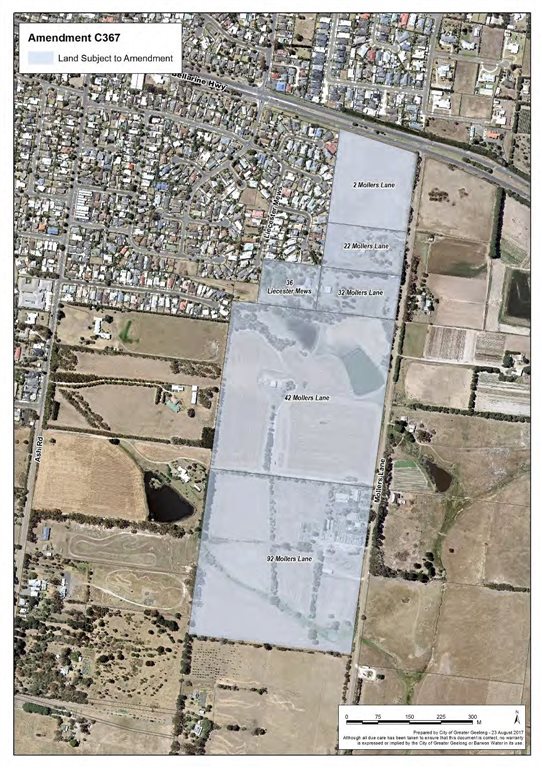
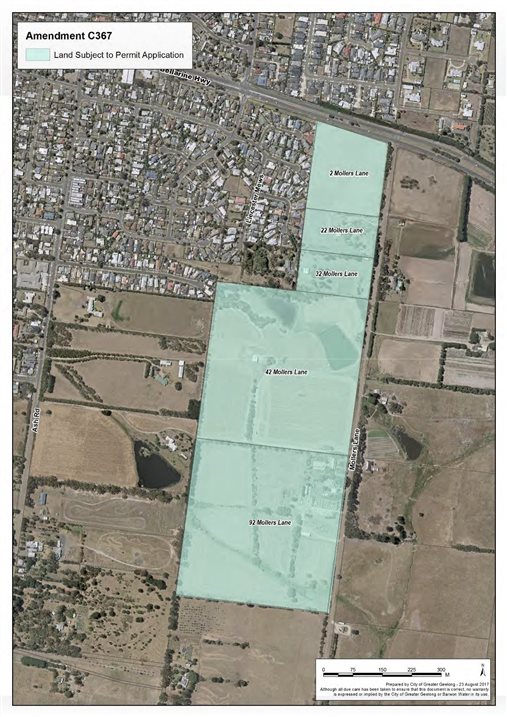
South East Leopold Framework Plan
In 2016 the City of Greater Geelong engaged Tract Consultants to prepare a Framework Plan for the South East Leopold Growth Area to guide the subsequent rezoning and development processes. It was essentially developed as a tool to guide future development and ensure a coordinated aproach given the current development pressures in Leopold. The Framework Plan was developed in consultation with landowners, Council Officers and relevant referral agencies who all provided input into the overall design direction for the area.
The Framework Plan included the subject land and the addition of the southernmost parcel at 92-120 Mollers Lane in its entirety, as only part of this land was earmarked for residential growth in the Leopold Structure Plan. This additional area was included to better reflect drainage catchments and to facilitate drainage and sewer servicing.
The Framework Plan recommends key features to be incorporated into the overall future residential development of the area including linear open space reserves along the creek network, connector roads to provide east/west integration, a shared pathway network, and retention of some stands of mature trees to provide character and interest to the area.
Attachment 2 shows the South East Leopold Framework Plan Map.
Proposal
The amendment request was lodged by TGM Consulting on behalf of several landowners, who are also the aplicants for planning permit 1463/2016.
The combined aplication for the amendment and planning permit is accompanied by several reports addressing traffic, infrastructure, environment, landscape storm water management and cultural heritage.
The rezoning and planning permit will enable the land to be developed in a manner that will ensure integration with the balance of the growth area to the west, which will optimise the conventional residential development potential of this land, consistent with the objectives of the Leopold Structure Plan.
The aplication is made pursuant to Section 96A of the Planning and Environment Act 1987 and seeks aproval for the combined rezoning, multi lot subdivision and native vegetation removal of land at 2-120 Mollers Lane, Leopold. The details of the Amendment include:
Rezoning land at 2-120 Mollers Lane (41 hectares) from the Farming Zone to the General Residential 1 Zone.
Aplying a Schedule to the Design and Development Overlay to the subject land.
Revising the extent of the current SLO10.
Amending clause 21.14 of the Municipal Strategic Statement to reference the South East Leopold Framework Plan, to extend the settlement boundary southward and to show the subject land as General Residential Zone 1
The creation of a multi-lot conventional subdivision at 2-120 Mollers Lane consistent with relevant planning provisions of the Greater Geelong Planning Scheme.
The removal of Native Vegetation.
The aplication for the subdivision originally included the land at 10 Willows Place. This property is already included in the General Residential 1 Zone, but was shown on the proposed subdivision aplication. This site is to be removed from the subdivision aplication as it is in separate ownership and not available or intended for subdivision at this time.
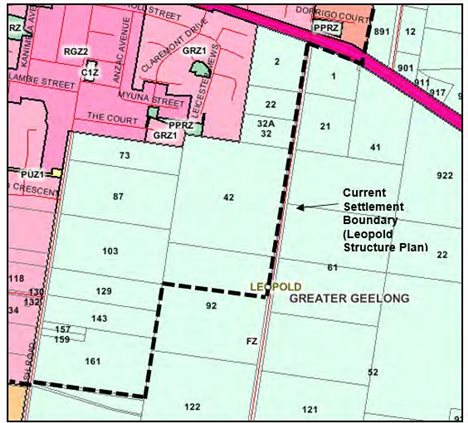
Current zoning map and settlement boundary
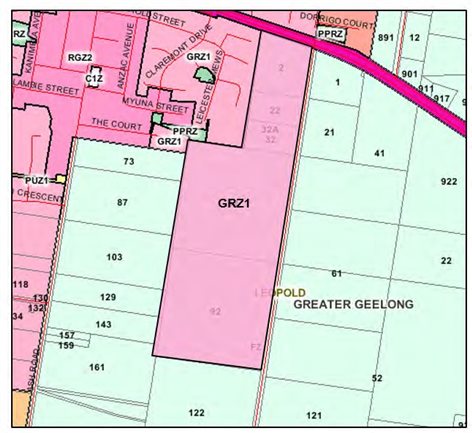
Proposed Zoning Map
Settlement Boundary and Extent of Significant Landscape Overlay (SLO)
The southeast portion of the site is covered by Schedule 10 to the Significant Landscape Overlay (Lake Connewarre Escarpment) which aims to maintain the largely unbuilt and partially vegetated character of the prominent slopes above Lake Connewarre.
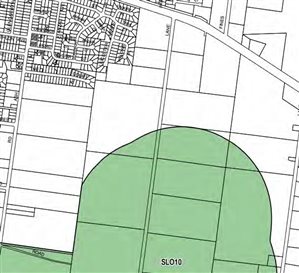
Current SLO10 Overlay
The Settlement Boundary in this part of Leopold bisects the property at 92-120 Mollers Lane as shown on the Structure Plan map. It follows an alignment to roughly accord with the extent of the SLO.
This rezoning aplication seeks to include all of the land at 92-120 Mollers Lane within the settlement boundary. This is considered logical as it will prevent the creation of a small 9.5 hectare Farming Zone lot and provide open space, drainage and environmental benefits for this south east area of Leopold. The Mollers Lane, Leopold Victoria Significant Landscape Overlay Re-assessment by XUrban has assessed the visual impact implications of the current SLO and ascertained whether the current boundary is responsive to the existing visual setting as well as key topographical features such as the drainage lines and ridgelines.
This report reconfirmed that the landscape setting of Lake Connewarre is an important feature to be maintained, but assessed that the SLO boundary adjacent to Mollers Lane apears to be overly conservative and that the same degree of protection could be afforded if the SLO boundary was relocated further to the south. This change to align with the 25 metre contour line would not impact on the amenity of Lake Connewarre.
Officers confirmed through site inspections that views to the southern portion of the subject land from various vantage points around Lake Connewarre were not possible and that the SLO was unnecessary in this location and should not be a barrier to consideration of residential development southward of the existing settlement boundary. The development of this portion of the subject land is unlikely to detrimentally impact on the visual landscape values of surrounding the Lake due to the undulating topography of the escarpment.
Given the strategic direction for this land to facilitate residential growth and its location away from the visual landscape surrounding Lake Connewarre, the removal of the SLO and the extension of the settlement boundary can be suported.
Open Space
The majority of public open space is proposed to be provided as linear reserves alongside the two waterways generally in accordance with the Framework Plan. A 0.75 hectare local park is proposed adjacent to the northern east-west connector road, co- located with the linear open space. The drainage reserves are co-located with the linear open space. All proposed open space is bounded by public roads to provide casual passive surveillance.
Provision is made in the linear open space along the southern waterway for the continuation of a shared pathway that will continue the planned link along the southern edge of urban Leopold between Melaluka Road and Mollers Lane.
The Planning Scheme requires a 10% contribution for open space for residential subdivision and Council seeks to attain this as unencumbered land or cash equivalent or a combination of both. Final calculations and configurations are being negotiated and will be completed for exhibition.
Further open space is provided south of the southern waterway and officers consider this to be encumbered open space. Officers have agreed to suport the extension of the settlement boundary to include 92-120 Mollers Lane in its entirety and to adjust the SLO extent along the 25 metre contour on the basis that there are benefits to be gained from reduced infrastructure requirements and to achieve the full reinstatement of the southern waterway. This was on the proviso that land south of the southern waterway would be retained as encumbered open space and no credit would be provided for it. This issue is still to be resolved and will be negotiated in the preparation of the amendment documents and draft planning permit for exhibition.
Road network
Primary access to this area will be off Mollers Lane. At present it is a formed, gravel road with a 20 metre road reserve. It is proposed to be widened to create a 22 metre wide road reserve and will be constructed with kerb, channel and bitumen seal on the west side adjoining the rezoned land.
To accommodate significantly increased traffic using Mollers Lane, the Bellarine Highway/ Mollers Lane intersection will need to be upgraded. Traffic signals, left turn land on the Highway, bicycle lands, street lighting, bus stops and vegetation removal to improve sight lines will eventually be required. Upgrading of this intersection will be done in stages commensurate with the development of the subdivision. VicRoads advises that it expects that the intersection could continue to operate under the current ‘give way’ priority controls in the early subdivision stage (subject to interim upgrading including a left turn lane, street lighting and sight line improvements). The developer will meet the costs of undertaking this work.
There are two proposed east-west connector roads within the subdivision – one in the north and one in the south. The northern road is based around the existing Barwon Water easement that runs east-west through the site and contains the two Bellarine Water Transfer Main pipelines. The southern road is located to provide a westerly link with the Estuary Boulevard/Walkers Road on the west side of Ash Road and is a key design parameter in the Framework Plan.
Design of the subdivision and the provision of two connector roads will allow for the future provision of bus routes through the new subdivision.
Direct lot access to the proposed lots along Mollers Lane in the steep sections near the current 22 and 32 Mollers Lane is questioned and will need to be addressed with the submission of a road cross section prior to the finalisation of a draft planning permit for exhibition. If safe access cannot be achieved then a minor redesign of the subdivision to gain internal access will be required.
No new road access will be gained to the area along the Bellarine Highway frontage, with lots to be accessed from an internal road. A tree reserve will be required along this strip continuing this aproach used to the west of the subject land.
Integration with existing residential area
All existing residential development to the west of the northern part of the subject land consists of cul-de-sac street pattern. This is reflective of the favoured development type of the era they were subdivided and the earlier settlement boundaries of Leopold. It is a pattern that is not conducive to integrating the proposed subdivision with the existing. There is however an oportunity to connect the proposed northern lineal open space and waterway with the Myuna Street basin and with the land at 10 Willows Court if that becomes available for subdivision in the future.
For that part of the subject land which adjoins the Farming Zone to the west, roads in the proposed subdivision have been designed to continue westwards to connect with the Ash Road side of this growth area, in particular the east-west connector roads.
Storm water management
The key environmental and open space feature of the subdivision is the proposed reinstatement of two creek tributaries that bisect the subject land. The creeks will be designed to manage flows up to the 1 in 100 flood events and provide habitat for native flora and fauna. A small section of the northern creek will need to be piped under the proposed connector road and Mollers Lane to the natural continuation of the waterway on its east side.
The creeks will be edged by 30 metre wide buffers in accordance with the requirements of the planning scheme.
The subdivision design also features two reserves set aside to manage stormwater generated by the future subdivision of the land. These reserves will have the capacity to treat stormwater consistent with the principles of water sensitive urban design and detain stormwater to predevelopment flows to ensure that there are no downstream impacts.
With its urban development, water volume discharge from the subject land will increase into the existing defined waterways. The onsite detention basins will ‘flatten out’ the peaks of discharge.
Out of sequence development
The subject land is at the eastern edge of the south east Leopold growth area. Land on the west side of Ash Road was rezoned by Amendment C280 in March 2016 but is yet to have a development plan prepared. The land on the east side of Ash Road or the western half of the growth area is still in the Farming Zone with no immediate rezoning aplication and development plans in sight, albeit some initial developer interest is occurring. The subject land benefits from a handful of landowners working together with a landowner-developer who has undertaken the background work and studies to advance a combined rezoning and permit aplication. This might seem like it is out of sequence but is consistent with the Framework Plan. This Plan addressed the growth area as a whole and set up the development parameters that can be implemented regardless of which ‘side’ of the area would proceed first.
The amendment will introduce a Schedule to the Design and Development Overlay (DDO) to guide the development of the land should the proposed planning permit expire. The DDO will implement the South East Leopold Framework Plan and facilitate the orderly and integrated residential development of the area.
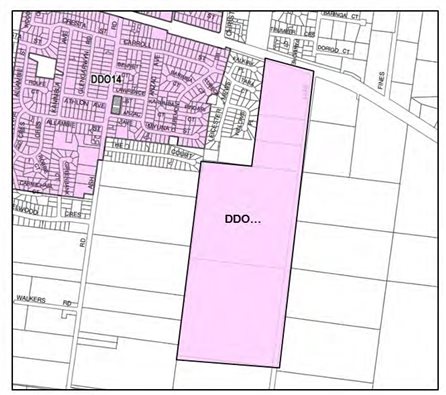
Proposed Design and Development Overlay Extent
Road and drainage infrastructure and open space will be provided by the developer. Community contributions will be gained through a S173 Agreement.
Council planners sought referral comments from Council departments and external referral agencies. Most issues raised in comments have been resolved or are addressed by draft Planning Permit conditions. This report has outlined those matters which are still being negotiated prior to commencing exhibition.
All nearby owners and other parties were consulted in the preparation of the South East Leopold Framework Plan.
The proposal accords with the objectives of Planning in Victoria as set out in the Planning and Environment Act 1987 as it will provide for the rezoning and subdivision of land to achieve an orderly, well planned outcome consistent with the strategic direction of Leopold.
The amendment is consistent with the Leopold Structure Plan which identified this land as suitable for conventional residential development as the key remaining growth area within the Leopold settlement boundary. The amendment recommends a change to the settlement boundary to provide an improved drainage and infrastructure outcome.
The proposal is consistent with and will implement the State Planning Policy Framework (SPPF):
Clause 11.02 Urban Growth seeks to ensure the provision of land suported by infrastructure to suport sustainable urban development.
Clause 11.02-2 Planning for growth areas seeks to concentrate urban development in growth areas close to services and public transport.
Clause 11.02-3 Structure Planning seeks to facilitate orderly development of urban areas through the preparation of strategic plans.
Clause 11.03 -1 Open space planning seeks to assist create a diverse and integrated public open space network linked via paths and trails to meet the community’s needs.
Clause 11.07 Geelong (G21) Regional Growth – Leopold is identified as an area to ‘Suport planned growth and reinforce the role of distinct towns’ (see plan below). Relevant policies relate to planning for growth, connected communities and sustainable communities.
Clause 11.07-1 Planning for growth seeks to optimise infrastructure and consolidate growth in district towns including Leopold.
Clause 11.07-4 Environmental assets seek to protect and restore environmental assets including waterways.
Clause 12.01-1 Protection of biodiversity seeks to ensure that strategic planning avoids and minimises significant impacts on Victoria’s biodiversity.
Clause 12.01-2 Native vegetation management seeks to ensure that permitted clearing of native vegetation results in no net loss to biodiversity in Victoria.
Clause 12.04-2 Landscapes seeks to ensure the protection of significant landscapes.
Clause 15.01-1 Urban design seeks to promote functional and quality urban environments that responds to the site and context.
Clause 15.01-2 Urban design principles seeks to achieve positive urban character outcomes by consideration of issues such as site context, open space safety, landscapes and pedestrian oportunities.
Clause 15.03-2 Aboriginal cultural heritage seeks to ensure conservation of cultural heritage is apropriately addressed.
Clause 16.01-4 Housing diversity seeks to provide a range of housing types to meet the varying needs of the community.
Clause 19.03-2 Stormwater seeks to reduce the impact of stormwater on bays and catchments by the incorporation of water-sensitive design techniques.
The amendment is also consistent with the following elements of the Local Planning Policy Framework:
21.06-2 Urban growth – This policy seeks to retain development within defined urban growth areas and provide a mix of housing suited to the needs of a diverse range of household types.
21.06-3 Urban consolidation – This policy seeks to encourage urban consolidation and encourage a range of development densities.
Clause 21.05-2 Waterways seeks to enhance and protect waterways by the apropriate management of stormwater runoff from developments.
Clause 21.05-7 Flooding seeks to protect floodplains and minimise the risk of flood damage.
Clause 21.06 – Settlement & Housing – Identifies a number of issues which influence urban form and direct future growth for the region.
Clause 21.06-2 – Urban growth to limit urban development to designated urban growth areas which includes Leopold.
Clause 21.06-3 – Urban Consolidation – provides for the consolidation of existing urban areas in a managed way, encourages an apropriate range of development densities and to improves accessibility to urban services.
Clause 21.06-4 Neighbourhood character seeks to ensure that new development positively responds to the established urban character of the area.
21.08 Development and Community Infrastructure – policy recognises the need to provide for the efficient use of services and conservation of water.
21.08-3 Development Contributions – Encourages development to proceed in a contiguous manner which maximises the use of development and community infrastructure.
21.08-5 Accessibility – Recognises the need to have safe access to infrastructure for all members of the community and provide shared spaces and passive surveillance of all recreational areas.
Clause 21.14 Bellarine Peninsula identifies Leopold as a growth town where development will be facilitated. Also seeks to protect waterways including Lake Connewarre.
The proposal accords with the direction for residential growth in Leopold. Leopold is a designated growth town where urban growth is expected and encouraged. The site represents a logical rezoning as it forms part of a broader area of South East Leopold identified for residential growth in the Leopold Structure Plan. The inclusion of land at 92-120 Mollers Lane in its entirety is considered to be a logical inclusion as it will allow the full enhancement of the creek consistent with the creek to the north, provide better servicing outcomes and assist with establishment of an integrated and well planned open space network. It will not compromise the visual integrity of Lake Connewarre and its surrounds.
The land will provide an integrated open space network via the provision of linear open space areas, local parks and storm water basins either adjoining or adjacent to the creeks. These features will be interconnected by a shared pathway network to provide for easy walking and cycling access throughout the estate and with oportunities to extend this network to future proposed residential land to the west (yet to be rezoned).
The proposal will also result in the restoration of the degraded creek network that traverses the subject land at two locations. This restoration work will include redefining the natural creek bed and incorporation of habitat features such as native plants to provide a positive environmental outcome. The urban design and open space aproach incorporates street edged open space areas for public safety and ready access. An aproved Cultural Heritage Management Plan requires the salvage of artefacts found at the subject land.
The proposed subdivision will contribute a range of lot sizes consistent with the offerings in the other recently subdivided areas of Leopold and will meet Council’s policy of 15 lots per hectare. The subject land will be drained using current best practice water sensitive urban design principles and meet Council and CCMA requirements ensuring no downstream impacts on neighbouring properties and Lake Connewarre.
Development contributions will be obtained via a Section 173 Agreement at the rate of $2670 per residential lot or $40,000 per hectare based on a yield of 15 lots per developable hectare. These contributions could go towards a range of infrastructure items and programs in Leopold. A draft Section 173 Agreement will be exhibited with the amendment to nominate contributions to be directed towards a project(s) identified as a priority by the Social Planning and Investment Department.
This report aligns with the directions of the Sustainable Built and Natural Environments theme in City Plan.
No Council officers involved in the preparation of this report have any direct or indirect interest, as defined in Section 80C of the Local Government Act, with respect to the matters to which this Amendment and Permit relate.
There are no risks with proceeding with the recommendation of this report.
The permit aplication seeks aproval to remove native vegetation which is located in patches across the subject land, in particular along Mollers Lane and within the existing dams which are proposed for removal. Offsets are proposed to address the native vegetation loss. Surveys and assessment by Ecology Australia for the aplicant has not found any evidence of the presence of the Growling Grass Frog at the subject land.
Reinstatement of the two waterways will provide habitat and native vegetation for the area, but will be in the context of their provision as waterways and part of the broader areas of public open space.
The impact of the proposal on Lake Connewarre has been assessed and modelling shows that there is likely to be only a minimal change to a small area of wetland habitat along the foreshore of Lake Connewarre and this is unlikely to be noticed by any of the ecological components.
DELWP has been provided with the aplication and suporting documents for their consideration
The Environmental Assessment has found that the land is suitable for residential development.
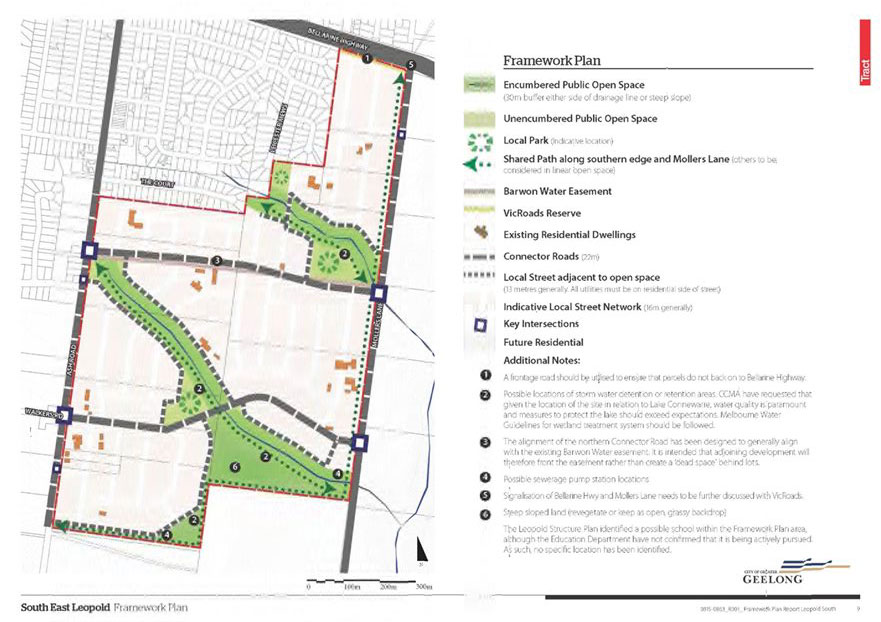
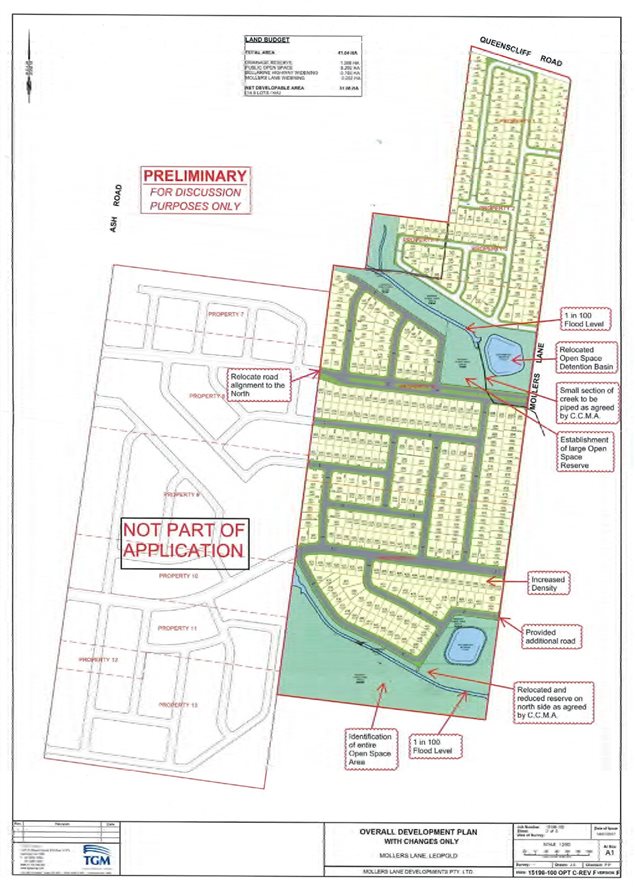
Source: |
Planning and Development |
Acting Director: |
Geoff Lawler |
Index: |
Aplication C-338, PP-1418-2015 |
To consider the Independent Panel Report and adopt Planning Scheme Amendment C338 and Planning Permit 1418/2015.
C338 seeks to rezone surplus Barwon Water land at 176-194 Thornhill Road Highton from Public Use Zone 1 to General Residential Zone 1 and aply Design and Development Overly 14. The permit is for residential subdivision and associated works.
Barwon Water is also constructing a 1.6km long shared path from the site north to Roslyn Rd through its Pipe Track reserve in lieu of providing public open space.
On 17 January 2017 Council (under delegation) resolved to suport the exhibition of the amendment subject to Ministerial authorisation. The amendment and permit were exhibited from 2 March 2017 to 3 April 2017. 17 submissions were received - 2 in suport, 7 objecting and 8 providing comments.
The submissions were referred to an Independent Panel which conducted a hearing on 27 June 2017 and has provided a report suporting the amendment.
Issues raised in submissions include: the density of the subdivision; potential for student housing; removal of trees; traffic and car parking; crossing of Thornhill Road; contaminated land assessments; pump station noise; decommissioning of the water basin and sensitive land uses near a gas pipeline.
The Independent Panel concludes:
The proposal provides an oportunity to more fully utilise the subject land and provide for a small scale urban consolidation project in Highton.
The Amendment is strategically justified and the aplication should be suported.
The accompanying planning permit should be suported subject to changes.
Council officers consider the relevant issues are addressed through the proposed permit conditions and recommend adoption of the Amendment.
L Gardner moved, P Dorling seconded -
That Council:
Adopts Amendment C338 in the form as outlined in Attachment 6 of this report;
Submits the adopted Amendment together with the prescribed information to the Minister for Planning requesting aproval; and
Recommends to the Minister for Planning that Planning Permit 1418/2015 be aproved in the form outlined in Attachment 6 of this report.
Carried.
In October 2015, SMEC consultants on behalf of Barwon Water submitted a combined planning scheme amendment and planning permit aplication for land at 176-194 Thornhill Road, Highton. The aplication was accompanied by a Planning Report with a comprehensive set of technical reports.
The land subject to the amendment is 176 – 194 Thornhill Road, Highton as shown in the map in Attachment 2. The site is owned by Barwon Water and has partly been identified as surplus.
The land is in close proximity to major education and medical institutions including two campuses of Christian College secondary school, the Marcus Oldham Agricultural College, the Epworth Hospital and Deakin University. It is aproximately 2.5km by road to the Highton Shoping Centre (a neighbourhood activity centre) and 2.7km to the Waurn Ponds Shoping Centre (a sub regional activity centre).
Proposed Amendment
The proposal is to remove the water storage basin from the southern half of the land and rezone it from Public Use Zone 1 to General Residential Zone 1 with a Design and Development Overlay (DDO14). The northern basin is to be retained and this section of the site is not proposed for rezoning. An aerial photo of the site is in Attachment 3.
Proposed Planning Permit
Planning permit aplication 1418/2015 seeks aproval to subdivide the land for residential development and remove native vegetation. In association with the subdivision, the aplicant has undertaken to complete the construction of a pedestrian access path from the development site north to Roslyn Road, through the aplicant’s land that contains underground water infrastructure, otherwise known as the Pipe Track.
The subdivision will create 30 residential allotments, varying in size from 413sqm to 685sqm. Lot frontages vary from 12.5m through to 18m.
In addition, the subdivision concept plan provides for two “super lots” which front Thornhill Road and have a combined area of 5100sqm. It is expected that the super lots will be the subject of further aplication to develop the land for multiple dwellings.
A copy of the exhibited subdivision concept plan is in Attachment 4.
On 10 January 2016 Council’s delegate considered a report on the proposal and resolved to prepare and exhibit the amendment subject to Ministerial authorisation.
The amendment and permit were exhibited from 2 March 2017 to 3 April 2017.
Letters and an information sheet were mailed to 168 owners and occupiers of properties next to the rezoning site and the pipe track which is proposed for a shared pathway. Letters were also sent to relevant government and service authorities and prescribe Ministers.
Notices were published in the Independent Newspaper on 24 February 2017, the Geelong Advertiser on 25 February 2017 and the Government Gazette on 2 March 2017.
As a result of public exhibition of the proposal a total of 17 submissions were received. Of these 2 submissions were in suport, 7 submissions objected and 8 submissions provided comment or no objection. One submission included a petition signed by 10 people concerned at student housing and loss of gum trees.
Issues raised in submissions include: the density of the subdivision; potential for student housing; removal of trees; traffic and car parking; crossing of Thornhill Road; contaminated land assessments; pump station noise; decommissioning of the water basin and sensitive land uses near a gas pipeline.
On 5 May 2017 Council’s delegate considered a report on the submissions and resolved to refer the submissions to an independent Panel.
The Independent Panel conducted a hearing on 27 June 2017 and has provided a report suporting the amendment. A copy of the Executive Summary is in Attachment 5. A full copy of the Panel Report has been placed on Council’s amendments webpage and submitters have been notified of its release.
The Panel deals with the following issues in its report:
Subdivision layout and traffic
Student housing
Loss of mature trees and vegetation
Construction, noise and amenity
Choice of zone
Permit conditions
Other issues.
The Panel concludes:
The proposal provides an oportunity to more fully utilise the subject land and provide for a small scale urban consolidation project in Highton.
The Amendment is strategically justified and the aplication should be suported.
The accompanying planning permit should be suported subject to changes.
The Panel recommends:
Adopt Amendment C338 to the Greater Geelong Planning Scheme as exhibited.
Issue Planning Permit 1418/2015, subject to the amended conditions provided in Apendix C.
Council officers suport the Panel recommendations and recommend that Council now adopt the Amendment and permit documents in Attachment 6.
There are no financial implications associated with adopting this Amendment.
The proposal was placed on public exhibition in accordance with the Planning and Environment Act. All submitters were provided with the oportunity to present their views to the independent Panel. Submitters have been notified of the Panel recommendations.
The amendment is consistent with State Planning Policy including:
Clause 11.02 Urban Growth, by ensuring a sufficient suply of land is available for residential uses.
Clause 11.04-2 Housing Choice and Affordability, by providing a diversity of housing in defined locations that cater for different households and areas close to jobs and services.
Clause 11.07 Geelong (G21) Regional Growth, by enabling the land to be used and developed consistent with established planning for the surrounding area.
Clause 14.02-3 Water Conservation, by ensuring that water resources are managed in a sustainable way.
Clause 16.01 Housing, by providing additional residential land for infill development.
The amendment is consistent with Local Planning Policy including:
Clauses 21.06-2 Urban Growth, by limiting urban sprawl whilst maintaining apropriate urban land suplies.
Clause 21.06-3 Urban Consolidation, by providing for the consolidation of existing urban areas, encouraging a range of densities and accessibility to urban services.
No Council officers involved in the preparation of this report have a direct or indirect interest, in accordance with Section 80C of the Local Government Act, to the matters to which this amendment relates.
There are no notable risks associated with adopting this Amendment.
Potentially contaminated land has been considered in accordance with Ministerial Direction No.1 and the General Practice Note on Potentially Contaminated Land (June 2005). A Land Contamination Investigation of the site by Environmental Site Assessments identified that the land is not contaminated and is suitable for residential development and other sensitive land uses.
Areas of remnant native vegetation across the entire subject site are limited to small fragmented patches of the Grassy Woodland Ecological Vegetation Class (0.391ha in total). An impact assessment of the development on the identified EVC has been undertaken and identifies biodiversity offsets which will need to be contributed.
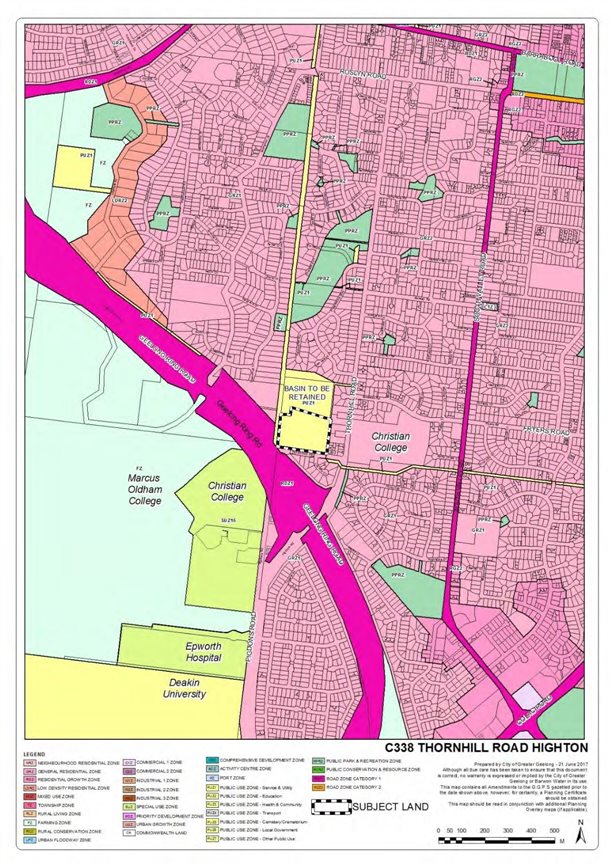
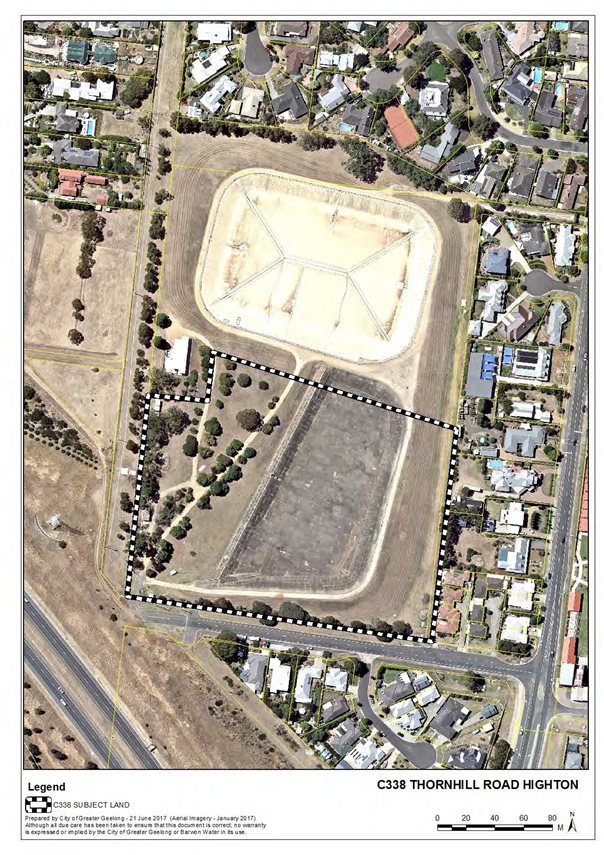
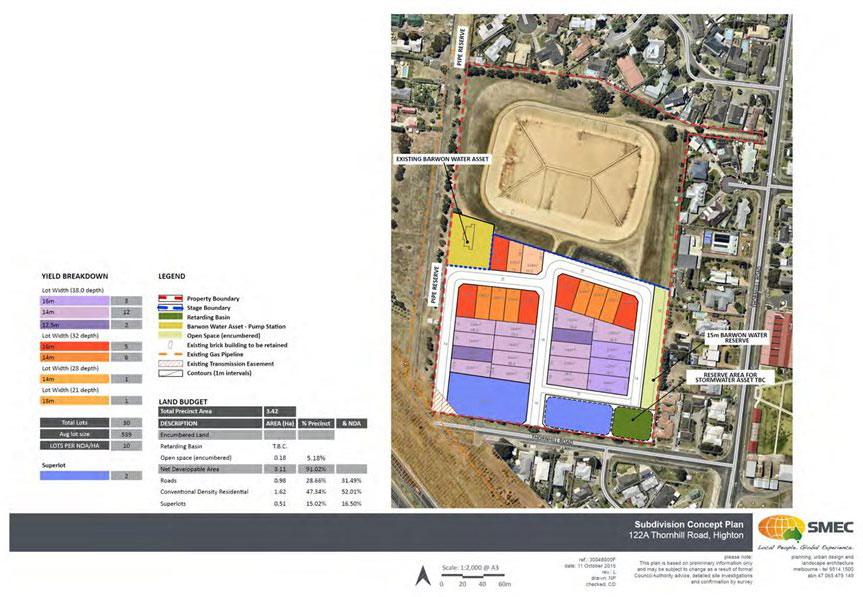
Source: |
Planning & Development |
Acting Director: |
Geoff Lawler |
Index: |
Aplication C356, PP1027/2016 |
To consider the Independent Panel report and seek adoption of Planning Scheme Amendment C356 and Planning Permit 1027/2016.
Amendment C356 seeks to rezone part of land at 42-44 Ponds Drive and 60 Forest Road North, Lara from Urban Floodway Zone (UFZ) to General Residential Zone Schedule 1 (GRZ1) and aply a Special Building Overlay (SBO) to part of the site. The accompanying permit aplication is seeking a 5 lot subdivision and construction of 4 two storey dwellings at 42-44 Ponds Drive. It also seeks the removal of a restrictive covenant from the Titles of both properties.
Amendment C356 and accompanying permit were exhibited between 9 February 2017 and 13 March 2017. Three submissions were received including one objecting submission from an adjoining neighbour.
The submissions were referred to an Independent Panel which conducted a hearing on 27 July 2017 and has provided a report suporting the amendment.
The issues raised in the submission from the adjoining neighbour included concerns about garbage collection arrangements, increased traffic, access and parking arrangement for the additional dwellings, easement restrictions and loss of property values.
The Independent Panel concludes
the amendment is consistent with State and Council planning policies;
the proposed development is apropriate for the site;
the Council and aplicant have satisfactorily resolved garbage collection issues; and
traffic, parking, access and easement restrictions have all been adequately addressed and there is no evidence about adverse impact on property values.
Council officers recommend Amendment be adopted and some additional conditions be aplied to the accompanying permit, as recommended by the Panel.
L Gardner moved, P Dorling seconded -
That Council
Adopts Amendment C356 in the form as outlined in Attachment 6 of this report;
Submits the adopted Amendment together with the prescribed information to the Minister for Planning requesting aproval; and
Recommends to the Minister for Planning that Planning Permit 1027/2016 be aproved in the form outlined in Attachment 6 of this report.
Carried.
Amendment C356 is a combined Planning Scheme Amendment and Planning Permit resulting from an aplication made by Tract Consultants on behalf of Angelo Martucci, the owner of 42-44 Ponds Drive, Lara.
The Amendment proposes to rezone land at both 42-44 Ponds Drive and 60 Forest Road North, Lara from Urban Floodway Zone (UFZ) to General Residential Zone 1 (GRZ1) and aply a Special Building Overlay (SBO) to part of the site. The owner of 60 Forest Road North has provided written suport for the proposal.
The accompanying permit is for aproval for a 5 lot subdivision and construction of 4 two storey townhouses at 42-44 Ponds Drive. It also seeks removal of a restrictive covenant aplying to the Titles of both properties which prevents the development of the land “other than in accordance with an aproved neighbourhood design plan”. The current restriction on Title prohibits the subdivision and development being proposed.
Each of the two properties are occupied by an existing detached house which are located outside the portion of the sites being rezoned by this Amendment.
Attachment 2 shows the two properties subject of this Amendment superimposed on an existing zoning plan. 42-44 Ponds Drive has a total area of 2070 sq m, aproximately half of which currently falls within the UFZ. 60 Forest Road North has a total area of 7201 sq m of which aproximately a quarter falls within the UFZ.
Attachment 3 is an aerial photo of the subject land and the surrounding area. Land to the south and east is a well established residential area, whilst the Hovells Creek reserve containing an existing levee bank forms the northern boundary. On the west side of Forest Road North is the site of an ex-limestone processing plant and quarry currently being rehabilitated and subject to a current rezoning proposal (Am C320).
Attachment 4 shows the exhibited subdivision and 4 dwelling development site layout proposed at 42-44 Ponds Drive.
The adopted 2011 Lara Structure Plan has identified the subject land as a future residential development oportunity subject to augmentation of the adjoining levee bank to enable the site to be declared flood free. The aplicant has negotiated with Council’s Engineering Services Department regarding the design and funding of the levee upgrade and these works will be completed before the Amendment/permit is sent to the Minister for aproval.
All of the requirements of Council’s Engineering Services Department and the Corangamite Catchment Management Authority have been included as conditions on the permit.
Amendment C356 and accompanying permit were exhibited between 9 February 2017 and 13 March 2017. Notices apeared in the Geelong Independent on 3 February 2017 and the Geelong Advertiser on 4 February 2017, with all adjoining and nearby properties individually notified.
As a result of exhibition of the Amendment a total of 3 submissions were received. One from the adjoining neighbour at 46 Ponds Drive raised issues of concern. The submissions received were from:-
Tract Consultants on behalf of the aplicant setting out reasons why Council should suport the proposal;
Barwon Water offering no objection to the Amendment, its requirements having being included as conditions on the permit; and
the owner of 46 Ponds Drive raising a number of issues of concern about unsatisfactory arrangements for garbage collection, safety issues resulting from the additional traffic generated by the proposed additional 4 dwellings, impact of the existing easement on the proposed development, suitability of driveway access arrangements to cater for 5 dwellings & potential negative impact on his property valuation.
On 2 June 2017 Council’s delegate considered a report on the submissions and resolved to refer them to an Independent Panel apointed by the Minister for Planning.
The Independent Panel conducted a hearing on 27 July 2017 and has provided a report suporting the amendment. A copy of the Executive Summary is in Attachment 5. A full copy of the Panel Report has been placed on Council’s amendment webpage and submitters have been notified of its release.
The Panel has addressed all of the issues raised in the concerns of the adjoining neighbour as outlined above and has concluded.
The amendment and accompanying permit are consistent with State and Council policies.
Ponds Drive can accommodate the traffic generated by the development and there is no reason to suggest residents’ safety will be compromised by additional traffic.
Adequate on site provision has been made for car parking.
Council’s proposed arrangements to cater for garbage bin collection, to be implemented by additional permit conditions, will address the concerns of the submitter.
There is no evidence to suggest an adverse impact on amenity or property value of neighbours.
Clarification of wording of “what the Permit allows” and work requirements of the adjoining levee bank (as agreed by parties at the hearing).
Based on the above, the Panel makes the following recommendations:-
Amendment C356 be adopted as exhibited.
Planning Permit Aplication PP1027/2016 be aproved and the permit issue subject to the conditions outlined in its report.
Council officers suport the Panel recommendations and recommend that Council now adopt the Amendment and permit documents in Attachment 6.
The Amendment and permit will result in no future financial implications for Council. Agreement has been reached between the aplicant and Council re: funding the upgrading of the levee. Any modification of the Ponds Drive court-head to facilitate garbage collection will be funded by the aplicant.
All affected persons have been notified at the time of exhibition of this Amendment to enable them to make a submission and apear before and independent Panel apointed by the Minister for Planning if they so wish. Submitters have been notified of the Panel recommendations.
The Amendment is consistent with the broad thrust of State and Council planning policies which suport urban consolidation/infill housing in locations which have good access to existing community services and facilities.
The Amendment specifically implements recommendations contained in Council’s adopted Lara Structure Plan referred to in Clause 21.13 of the Planning Scheme.
The Independent Panel agrees that the amendment and permit are consistent with State and Council policies.
The Amendment suports the overall thrust of Growing our Economy and Sustainable Built and Natural Environment Strategic Directions in that it facilitates the development of land identified as being suitable for future residential development.
No Council officers involved in the preparation of this report have a direct or indirect interest, in accordance with Section 80(c) of the Local Government Act, to which this Amendment relates.
No risks have been identified in processing Amendment C356 and accompanying permit as being recommended by this report.
The Amendment and accompanying permit will result in no adverse environmental implications.
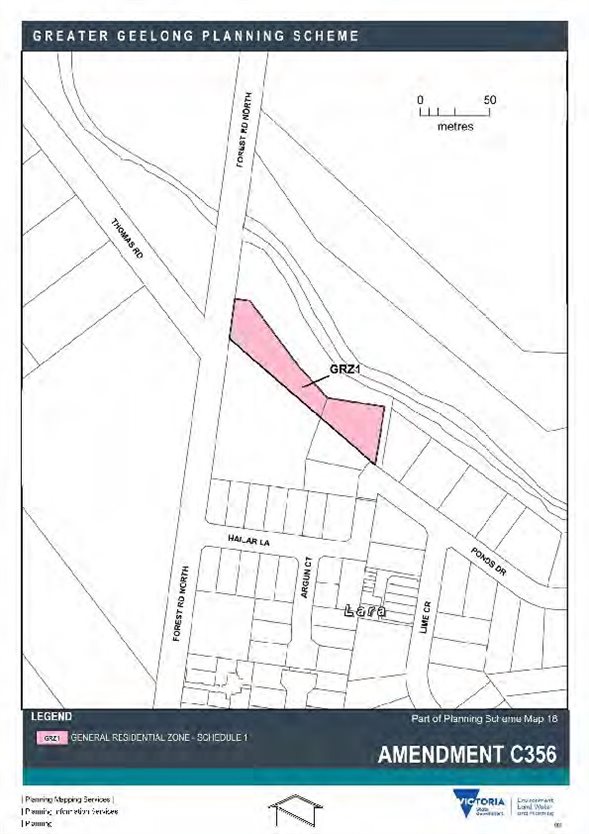
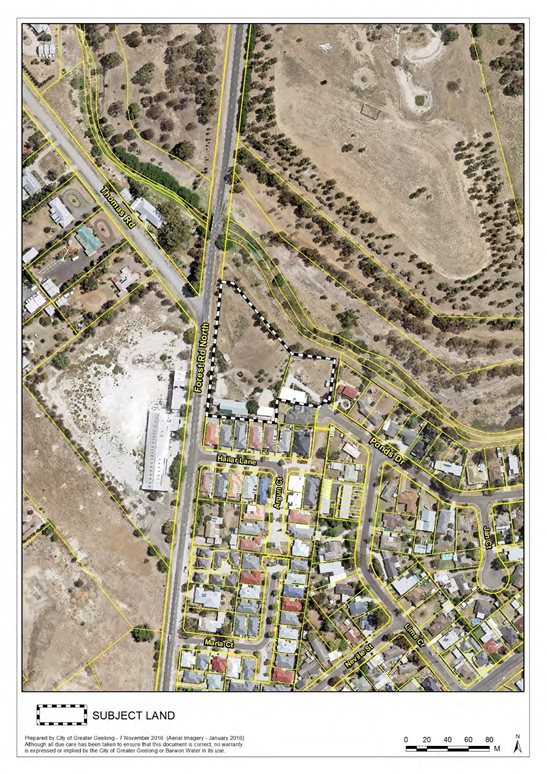
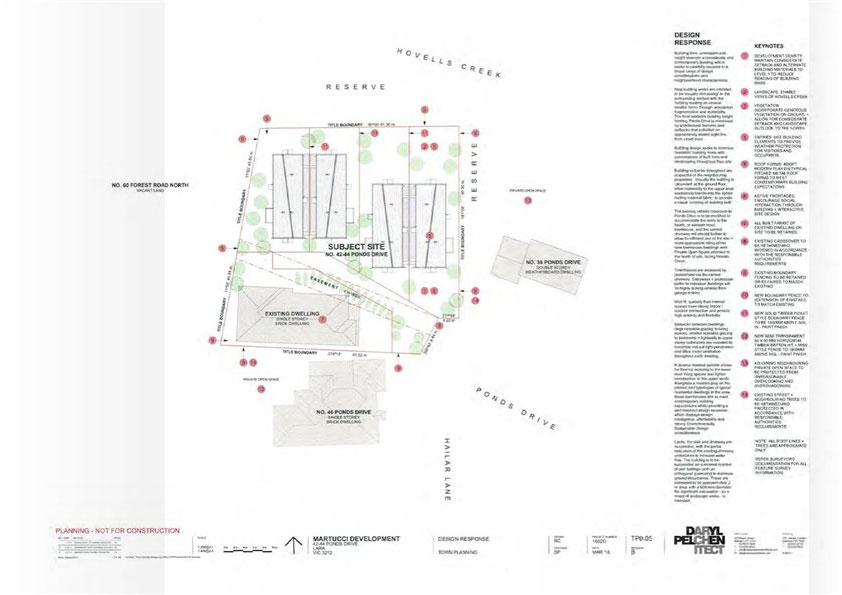
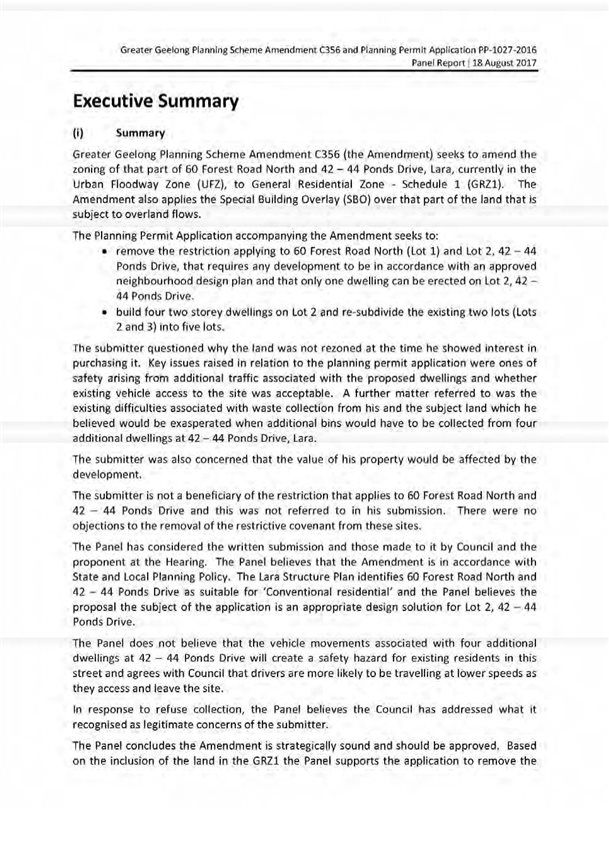
Greater Geelong Planning Scheme Amendmem C356 and Planning Permit Aplcatfon PP-1027-2016
Panel Report I18 August 2017
restrictive covenant to build four two storey dwelltngs in accordance with the conditions on the rnodified permit at Apendix C of this Report.
Recommendations
Based on the reasons set out in this Report, the Panel recommends that:
Amendment C356 to the Greater Geelong Planning Scheme be adopted as exhibited.
Planning Permit Aplication PP-1027 2016 be issued subject to the condition.& ncluded In Apendix C of this Report.
Source: |
Planning & Development – Planning Strategy |
Acting Director: |
Geoff Lawler |
Index: |
Project: Municipal Heritage Strategy 2017-2021 |
To adopt the Greater Geelong Municipal Heritage Strategy 2017-2021 and commit to the formation of a Heritage Advisory Committee.
In late 2016 work commenced on the preparation of a draft Municipal Heritage Strategy for Greater Geelong. The Strategy is based on the ‘Municipal Heritage Strategies: A guide for Councils’ toolkit prepared by the Department of Environment, Land, Water and Planning. The draft was prepared with input from a specially formed Community Project Reference Group, key external stakeholders and relevant Council departments. Public consultation on the draft has been completed with minor changes made to address some of the submissions. The Strategy is now recommended for adoption.
The Strategy sets out a framework to guide Council on heritage matters within the organisation and the broader community. It will assist Council to meet its obligations under the Planning & Environment Act, Heritage Act, Aboriginal Heritage Act and the Planning Scheme. It is recommended to be reviewed alongside City Plan.
The Strategy celebrates achievements such as the ongoing implementation of the Karreenga Aboriginal Action Plan, annual heritage awards in conjunction with the National Trust, award winning Mountain to Mouth project, minor heritage loans program to name a few.
The Strategy was prepared in consultation with the relevant Council departments, Geelong Regional Library Corporation (Heritage Centre), Wathaurung Aboriginal Corporation and Community Reference Group.
The draft Strategy was placed on public exhibition for 5 weeks in June/July 2017 with 11 submissions received. Submissions were generally suportive with some minor changes requested/recommended.
Submissions strongly suported the creation of a ‘Heritage Advisory Committee’ or similar body to assist Council achieve its vision.
There was community suport for Council to have a dedicated unit or at least an officer(s) to oversee Council’s heritage activities and to deliver the actions of the Strategy. As there is currently no such resourcing for this, an Internal Steering Committee is proposed to provide a cross-organisation aproach to heritage.
K Alexander moved, L Gardner seconded -
That Council
Adopts the Greater Geelong Municipal Heritage Strategy 2017-2021 (refer to Attachment 1)
Endorses the establishment of a Heritage Advisory Committee in 2018.
Recommends that the Chief Executive Officer considers the resources necessary to provide a single point of coordination for heritage issues.
Notes that a thematic history for Greater Geelong will be commissioned in the 2017/18 financial year.
Carried.
The Strategy sets out a framework to guide Council on heritage matters within the organisation and the broader community. The Strategy is a ‘whole of Council’ strategy and will be reviewed alongside the City Plan. The Strategy provides a concise overview of Council activities in the heritage space and provides suport for Council departments to deliver more specific and detailed work.
The Strategy comprises of a ‘background’ section outlining the context, policy, history snapshot, achievements and challenges and an ‘action plan’ which contains the vision, objectives, actions and implementation.
The focus of the Strategy relates to Council’s responsibilities and areas of influence in relation to:
Identifying positive heritage measures;
Identifying and prioritising work to be done in the future;
Apropriately managing and monitoring the heritage assets of the community and
Reporting on and celebrating achievements.
The implementation of actions identified in the Strategy will rest with the relevant departments and be subject to departmental work plans, capacity and future operational budgets for Council’s consideration.
The Strategy acknowledges Council will need to build its capacity in relation to staff and Councillor training, additional resourcing and external funding.
The key issues to come out of the consultation phase (council departments, community reference group and public submissions) included:
Strategy Document
A number of minor changes or suggestions were made in relation to the draft which updated or corrected information. The majority of minor changes and corrections have been made. A copy of the final Strategy is found at Attachment 1.
It was recommended the document layout be more user friendly. The whole document is now A4 portrait and will be available in both colour and black and white.
A number of comments related to specific sites or buildings. While it is not the role of this Strategy to look at individual sites many of the suggestions fall under broader policy actions. It is also anticipated the Heritage Advisory Committee will have a role in nominating sites and recommending actions.
Implementation and Timeframes
The National Trust submissions recommended adding specific timeframes and resourcing (in-line with the toolkit) to assist delivery. The Strategy contains action delivery timeframes of short 1-2 years, medium 3-5 years or long term 5+ years.
Response
The current timeframes are considered apropriate for the first Municipal Heritage Strategy. Funding has been provided in the 2017/18 budget for the development of the Strategy and the development of a thematic history. The delivery of actions will rely on the capacity within existing units, work priorities and annual budget allocation. Some actions will form part of a unit’s existing responsibilities and some actions will require additional resources. It is anticipated that over the next four years the capacity within Council to respond to heritage matters will increase.
Heritage Advisory Committee
The establishment of a Heritage Advisory Committee is seen by most submitters as vital to oversee the delivery of the Municipal Heritage Strategy and to ensure a community voice is heard by Council in relation to heritage matters.
Response
A number of Councils across Victoria have a Heritage Advisory Committee, established under a terms of reference. As an example, the City of Ballarat committee includes two councillors, two community representatives and ten representatives from relevant heritage related or community organisations/agencies with the Council providing officers to suport the Committee. The Committee meet once a month with functions relating to promoting heritage, considering funding aplications, offering advice on any heritage matters brought to the committee, assisting with sourcing external funding, providing policy advice, making recommendations to council on heritage matters etc.
It is a recommendation of this report that the Heritage Advisory Committee be established in 2018. The Advisory Committee will operate under Section 3(F) of the Local Government Act and will have no delegated powers and will be guided by a Terms of Reference. At this time the Planning Strategy unit will suport the establishment and ongoing management of the Committee, this will include developing a Terms of Reference and carrying out membership recruitment.
Lack of a Heritage Department/Officer
It was noted in a number of submissions that Council used to have a Heritage Planner position. The perception is that no officer(s) or department within Council are ‘responsible’ for heritage. By way of comparison it was noted the City of Ballarat employs a Heritage Coordinator, a historian, heritage advisor (3 days per week) and administration staff, the equivalent of four full time positions.
Response
At this time Council has no dedicated and suitably qualified staff member(s) that deals exclusively with heritage matters. The Statutory Planning Department engages a heritage consultant 2 days per week to primarily assist with planning permit aplications.
A search of the HERMES database reveals City of Greater Geelong has 12,223 records and the City of Ballarat has 11,933 records. This shows the comparison pointed out by the submitter is not unreasonable.
Heritage matters are picked up across Council by the relevant departments as required. Departments will generally engage heritage consultants or utilise the Heritage Advisor if projects require heritage input or advice. This aproach does lead to gaps with no staff member or team tasked with keeping abreast of heritage related Acts or legislation, funding oportunities etc as these changes may have impacts across the organisation not just one department.
In order to provide a cross organisational aproach to heritage it is recommended an internal working group known as the Heritage Steering Committee be established in 2017. Departments that deal with heritage related matters will be invited to share projects, information, expertise etc and will also have an oportunity to look at training oportunities and resource requirements now and for the future. This committee will be established and initially suported by the Planning Strategy unit with the ongoing responsibility for the committee to be determined.
Heritage Advisory Service
It was widely acknowledged that the Heritage Advisor role is currently operating at capacity. This position is filled by an external consultant on a 3 year contract 2 days per week. The Advisor role includes meeting with prospective and current planning permit aplicants, providing written referral advice to planning officers on planning permit aplications, providing in-house advice to staff on heritage matters including on Council owned or managed heritage assets etc. While the number of heritage overlays and therefore enquiries and permits have steadily increased over the years the time allocation for the Advisor has not. A number of submissions noted this role should be expanded or made full time.
Response
An action in the work plan includes reviewing the Heritage Advisory Service ongoing to ensure it meets current and future demand. This process occurs as part of the contract renewal process by the Statutory Planning Department. Council has committed to the Heritage Advisory Service for another 3 years. It is noted the Heritage Advisor only provides advice in relation to post colonial heritage matters.
Lack of Suport for Heritage
There was a perception by some submitters and by participants at the Community Reference Group workshop that heritage is not given the attention, resources and funding it deserves within Council. This was expressed in the issues already noted above as well as the lack of investment in relation to Council owned and or managed heritage assets, as one submitter noted they (the properties) should be treated as an ‘asset to the community rather than a burden’.
Response
The MHS celebrates a number of heritage achievements across a diverse range of heritage activities from heritage studies and associated planning controls, exhibitions, festivals, restorations, education and interpretation and site protection. These activities show Council is committed to nurturing our history and heritage.
The sale of heritage listed Council assets is contentious and a number of properties have come up for discussion in recent times. It is a recommended action that Council prepare heritage asset plans which could include considerations such as maintenance, works program, redundant assets plan, a policy for asset transfer etc. This will help provide a more transparent aproach to Council’s heritage asset management.
The MHS proposes a number of actions to address the challenges identified. While some actions form part of the core business for various Council departments other actions will require successful budget bids in order for them to be implemented. The proposed establishment of the Steering Committee and Advisory Committee will ensure greater suport for heritage across the organisation.
Alongside the preparation of the MHS, $80,000 is available in the budget funding for Strategy implementation. This will include the preparation of a thematic history for Greater Geelong including Aboriginal and post colonisation heritage.
Aboriginal Cultural Heritage
There was strong suport for continuing to build relationships and partnerships with Aboriginal people, communities and organisations.
A submitter noted that previous oportunities to include Aboriginal heritage as part of Council’s project work had been missed and queried how this will be addressed in the future.
Response
The formation of the internal Steering Committee and community based Heritage Advisory Committee will greatly assist Council officers to build on existing relationships with the Aboriginal community.
Heritage in Central Geelong
Since the Minister for Planning took over responsibility for major development aplications in central Geelong the community do not have the same ability to view, provide feedback or participate in the planning permit process. The protection of heritage places therefore requires that the heritage overlay planning scheme controls are up to date and meet current practice.
Response
The Council has written to the Minister for Planning (April 2017) to outline a process whereby the community could share their views on major development aplications in Geelong. The Minister replied that he was suportive of the initiative but it is Council who would be responsible for implementing the process. Officers are in the process of establishing the process which will be introduced after Council elections.
Community Collections
Geelong Regional Libraries noted the challenges community collections face. They offered it could be useful for Council to have a corresponding action that would give both organisations oportunities for collaboration.
A submitter also raised the benefits of making policy documents such as a heritage tree register, plaques, memorials, monuments and public art and collections registers available to the public.
Response
The Arts and Culture unit indicated there is suport for community collections in existing strategies.
It is up to the relevant department to make documents available to the public if apropriate.
Archaeological Sites
A submitter noted the issue of protecting archaeological sites (Aboriginal, Historic and Maritime) as part of development proposals. Under the legislation (listed in the MHS) various requirements must be met. The submitter indicated specific reference to these requirements should be made in the document. It was also noted there are Conservation Management Plans, Cultural Heritage Management Plans and other archaeological site plans that have been prepared for specific sites that could also be referenced in the MHS.
Response
The MHS has been prepared in accordance with the toolkit prepared for Councils by the Department and Heritage Victoria and addresses the matters outlined in the toolkit. There is reference to Conservation Management Plans and Cultural Heritage Management Plans as a management mechanism but site specific plans have been limited to Council owned or managed sites since the MHS focus is on Council activities, there are also cultural sensitivities around the details of Aboriginal heritage sites. Heritage Studies included in the attachment are generally those referenced in the planning scheme. This is consistent with other MHS’s prepared by other Councils.
The challenge of protecting archaeological sites has now been included in the ‘challenges’ section of the MHS.
Actions included in the MHS make reference to providing training and education for staff around Council’s obligations under the various heritage legislation. This includes the Heritage Act and the requirements around archaeological relics including utilising resources such as the Victorian Heritage Register and the Heritage Inventory.
Heritage Victoria
A submitter questioned whether Heritage Victoria had been consulted in the preparation of the Strategy.
Response
The Strategy was prepared using the guidelines prepared by Heritage Victoria. The draft was referred to Heritage Victoria who recommended some inclusions around archaeological sites and broader policy matters. These have been included in the MHS.
A thematic history of maritime infrastructure in Victoria was prepared and makes some references to Geelong. This study has been added to the ‘heritage studies and documents’ in the MHS. Reference to the Maritime Infrastructure Project has also been included, although the Geelong component that never made it past the draft phase.
There are no impacts on the budget as a result of adopting this report. Actions outside departmental core business will be subject to separate budget bids.
The preparation of the Strategy involved consultation with internal Council departments who deal with or interact with heritage, this involved interviews and written feedback on drafts. An external Community Reference Group was also established after expressions of interest were advertised in local papers to inform the content of the MHS. There were 6 representatives from the Little River Historical Society Inc, National Trust Geelong, Onefire Geelong, Geelong Environment Council, Osbourne Park Association and the Wathaurung Aboriginal Corporation who were involved in a workshop and invited to provide feedback to the draft.
The preparation of the Municipal Heritage Strategy will assist Council meet its obligations under the Heritage Act, Planning and Environment Act and the Aboriginal Heritage Act.
The Strategy aligns with the directions of the Sustainable Built and Natural Environments theme in City Plan.
The Strategy aligns with ‘A Clever and Creative Future’ as protecting and celebrating our heritage will contribute to the culture and uniqueness of Greater Geelong making it an attractive place.
No Council officers involved in the development of the Municipal Heritage Strategy have a direct or indirect interest in the issue, in accordance with Section 80C of the Local Government Act, to which this report relates.
Implementing the recommendations of the Municipal Heritage Strategy will assist Council meet its obligations under the various Acts and legislation relating to heritage.
There are no environmental implications in relation to the Municipal Heritage Strategy.
Source: |
City Services |
Interim Director: |
Peter Godfrey |
Index: |
Barwarre Road, Marshall; Special Rates and Charges |
This report seeks a resolution by Council to declare the charges for a Special Charge Scheme to partially fund the construction of three road segments along Barwarre Road (east side) between Marshalltown Road and Reserve Road, Marshall. (See plan – Attachment 5).
This proposal will see the construction of these missing segments in Barwarre Road including road widening, kerb and channel, underground drainage and a footpath section.
The proposal was first introduced to affected property owners in 2013 where considerable consultation was carried out. Because of the small number of properties affected by this proposal, a funding mechanism known as an ‘up front agreement’ was initiated. A this time, 100% agreement was struck however due to the relatively large cost to property owners, a request was made to pay via instalments. Council considered this option at the time however it was rejected on the grounds of having no legal control over the recovery of funds outside a legislated framework. The agreement aproach was therefore abandoned.
Special Charge Scheme has been reinitiated and all affected property owners have been advised same.
Council resolved to make its Intention to Declare a scheme at its meeting of 27 June 2017. During the subsequent submissions period, no submissions were received which nullified the requirement of a submissions panel hearing.
A Special Charge Scheme been initiated and consists of three sub scheme components. Sub Scheme 1 is adjacent to three properties between 129 and 137 Barwarre Road. The works will include road widening, kerb and channel and a new footpath section.
Sub Scheme 2 is adjacent to two properties between 181 and 185 Barwarre Road. The works consist of road widening and kerb and channel.
Sub Scheme 3 is adjacent to one property at 193-197 Barwarre Road and also includes road widening and kerb and channel.
Council resolved to makes its Intention to Declare a scheme at its meeting of 27 June 2017.
During the subsequent submission period, none were received therefore a panel hearing was not required.
P Dorling moved, L Gardner seconded -
That Council:
Resolves to declare the Special Charge Scheme as follows:
The Special Charge is declared for a period of five (5) years commencing upon commencement of the works.
The special charge be declared for the purposes of defraying expenses incurred by Council in relation to the construction of Barwarre Road, Marshall which:
will provide proper sealed road access, improved street drainage and enhancement to the general amenity for each of the properties included in the scheme;
Council considers is or will be a special benefit to those persons required to pay the special charge (and who are described in succeeding parts of this Resolution); and
arises out of Council’s function of planning for and providing infrastructure for property owners.
it be recorded that, for the purposes of Section 163 (2A) of the Act, the special charge proceeds will not exceed the amount calculated in accordance with the prescribed formula (R x C = S), the:
‘benefit ratio’ (R) being calculated at 0.26 for Sub Scheme 1, 0.28 for Sub Scheme 2 and 0.14 for Sub Scheme 3 represents the special benefits to all persons liable to pay the special charge; and
‘total cost’ (C) of performing the function described in Part b of this Resolution based on estimated cost be recorded as $191,783 for Sub Scheme 1, $80,401 for sub scheme 2 and $72,574 for sub scheme 3.
‘maximum levy’ (S) total amount of the special charge be levied and recorded as $49,021 for sub scheme1, $22,844 for sub scheme 2 and $10,332 for sub scheme 3.
the following be specified as the area for which the special rate is so declared:
the area within municipal district of Council highlighted in the plan attached to this Resolution (“the area”).
the following be specified as the land in relation to which the special charge so declared:
All land within the area shown on the plan.
the following be specified as the criteria which form the basis of the special charge so declared:
Ownership of any land described in Part 1(e) of this Resolution.
the following be specified as the manner in which the special charge so declared will be assessed and levied:
The costs to be aportioned based on access and amenity benefits. g2) The special charge will be levied by sending a notice to the person who is liable to pay, pursuant to section 163(4) of the Act.
having regard to the preceding parts of this Resolution but subject to Section 166 (1) of the Act, it be recorded that:
the owners of the land described in column 1 and 2 of Schedule C to the Resolution are estimated liable for the respective amounts set out in column 8 of Schedule C; and
such owners may, subject to any further resolution of Council pay the special charge in the following manner:
the charge will become due and payable within one month of the issue of the notice requesting payment pursuant to Section 167 (3) of the Act;
interest will not be charged for six months after the issue of the notice provided the person liable makes timely payment in accordance with any repayment arrangements that may be agreed on by Council; and
in accordance with Section 172 of the Act, the rate of interest which is payable on the special charge which has not been paid by the specified date is set at Council’s overdraft rate, reviewed every three months (provided that it shall not exceed the rate fixed by the Governor in Council by Order for the purposes of Section 172 (2A) in which case the rate of interest shall be the maximum rate fixed by the Governor in Council by Order for the purposes of this section).
Authorise Council’s Chief Executive Officer to levy the Special Charge in accordance with Section 163 (4) of the Act.
Carried.
The project has a one off capital cost and there will be minimal ongoing maintenance costs. The scheme is funded from the core road construction program C02301 and could proceed in the 2017/18 financial year if aproved.
A breakdown of costs is as follows:
Estimated scheme cost to property owners Sub Scheme 1 - $49,021 Sub Scheme 2 - $22,844 Sub Scheme 3 - $10,332 |
$82,197 |
Estimated scheme cost to Council Sub Scheme 1 – $142,762 Sub Scheme 2 – $57,557 Sub Scheme 3 - $62,242 |
$262,561 |
Total Project Cost |
$344,758 |
The total estimated net cost to Council for this project is $262,561.
Consultation with the affected property owners has taken place as follows:
2013 - 2014 – Mail out and community meeting held at the Grovedale Community Centre in regards to the proposed ‘up front’ agreement. 100% agreement was gained at this time.
March 2017 - un update letter was mailed advising of the change to a Special Charge Scheme. This letter included advice on the revised scheme charges.
July 2017 – Letter advising of Council’s Intention to Declare a scheme and invitations to make a submission.
8 July 2017 – Public Notice placed in the local newspaper. 11 July 2017 – Copy of public noticed mailed out.
Further information will be sent to all affected property owners should Council resolve to make its Declaration of the scheme.
The scheme has been prepared in accordance with the Special Rate and Charge provisions of the Local Government Act 1989 along with Council’s Special Rates and Charges Policy and community engagement guidelines.
This report aligns with the City Plan as follows: Community Wellbeing:
Healthy Lifestyles – Facilitating and promoting physical activity.
Healthy Environments – Safe, hazard and nuisance free environments. Sustainably Built and Natural Environment
Enhance and protect natural areas and ecosystem health.
Suport our Community to live – Encourage increased use of alternatives to car transport.
Advocate for and promote sustainable design and development – Promoting sustainable design and retrofitting and acknowledging the communities desire to have their say.
No Council Officer involved with this process has any direct or indirect interest in the properties.
Provision of sealed roads will provide safer driving conditions for motorists with a defined and widened road profile. Walking conditions for pedestrians will also be enhanced by minimising the risk of personal injuries through conflict with vehicles. The improved drainage will reduce the hazards associated with water over roads and the affects of nuisance flooding to property.
There are no other identified risks for Council in making its intention to declare the scheme.
The road infrastructure proposal provides proper sealed access, improved drainage and improved safety for pedestrian and vehicular traffic. Dust is eliminated.
Storm water runoff will be less contaminated with silt prior to discharge as the bulk of the storm water will be cleaner coming off a sealed road environment.
It is anticipated that minimal vegetation removal will be required to complete the project. The design has taken existing vegetation into consideration.
During the course of construction and the manufacture and procurement of materials, there is expenditure of energy sources and greenhouse gas emissions. This does cease, however, when construction is complete.
The project does not create waste with the exception of some excess spoil. The proposal does not affect any natural habitats.
The works for Barwarre Road, Marshall which consist of excavation, concrete footpath, kerb and channel, reinstatement of nature strip, miscellaneous construction works, legal advice and professional services associated with survey, engineering design, drafting, supervision and administration of the project all as included in the cost estimate shown below.
Estimated cost of road and footpath construction |
|||||
ITEM |
DESCRIPTION |
QUANTITY |
UNIT |
RATE |
AMOUNT |
1.01 |
Initial site establishment and set up, decamping and site cleanup and other fixed costs up to time of completion of works. |
1 |
ITEM |
$12,000.00 |
$12,000.00 |
1.02 |
Traffic management costs. |
5 |
ITEM |
$800.00 |
$4,000.00 |
1.03 |
Setting out of works. |
1 |
ITEM |
$500.00 |
$500.00 |
2.00 |
EARTHWORKS & DEMOLITION |
|
|
|
|
2.01 |
Excavation and disposal of all materials to limits of work as indicated on plan, including trimming for new road pavement, excavation of soft spots and removal of concrete. |
370 |
m3 |
$60.00 |
$22,202.40 |
2.02 |
Removal of existing rural crossings, endwalls and pipes if in good condition to be shiped to COGG Belmont depot. |
4 |
ITEM |
$250.00 |
$1,000.00 |
2.03 |
Break out top of pits fill with FCR and 100mm topsoil. |
2 |
No. |
$350.00 |
$700.00 |
2.04 |
Placement and consolidation of engineered fill with aproved materials in preparation for new works. |
10 |
m3 |
$60.00 |
$600.00 |
2.05 |
Saw-cutting of asphalt paving. |
145 |
m |
$3.50 |
$507.50 |
3.00 |
PAVEMENT WORKS |
|
|
|
|
|
BIDIM A34 Geofabric laid on sub base |
293 |
m2 |
$20.00 |
$5,860.00 |
3.01 |
400mm compacted depth Class 3, 40mm crushed rock, suplied, spread and compacted. |
117 |
m3 |
$100.00 |
$11,720.00 |
3.02 |
150mm compacted depth Class 2, 20mm crushed rock, suplied, spread and compacted. |
44 |
m3 |
$120.00 |
$5,274.00 |
3.03 |
30mm compacted depth 10mm nominal size type N asphalt spread and compacted including emulsion prime & grit using a paver. |
638 |
m2 |
$35.00 |
$22,330.00 |
4.00 |
CONCRETE WORKS: |
|
|
|
|
4.01 |
B2 Barrier kerb and channel 450mm wide and associated laybacks for vehicle crossings, including fine crushed rock bedding. |
140 |
m |
$136.00 |
$19,040.00 |
4.02 |
Concrete pram crossing 1.5m wide, including fine crushed rock bedding. |
2 |
No. |
$250.00 |
$500.00 |
4.03 |
125mm concrete paving with SL72 mesh including crushed rock bedding and reinstate nature strip. |
245 |
m2 |
$125.00 |
$30,625.00 |
4.04 |
O2 porous pave, or equivalent, suplied and placed as per manufacturer's specification. |
77 |
m2 |
$280.00 |
$21,560.00 |
5.00 |
LANDSCAPING |
|
|
|
|
5.01 |
Top soiling and seeding nature strips, medians and outer separators. |
140 |
m2 |
$10.00 |
$1,400.00 |
SUB-TOTAL |
$159,819 |
||||
10% Contingency |
$15,981.89 |
||||
Design |
$7,991 |
||||
Project Administration |
$7,991 |
||||
CONSTRUCTION COST ESTIMATE |
$191,783 |
||||
Estimated total cost of road widening and kerb and channel |
|||||
ITEM |
DESCRIPTION |
QUANTITY |
UNIT |
RATE |
AMOUNT |
1.00 |
Initial site establishment and set up, decamping and site cleanup and other fixed costs up to time of completion of works. |
1 |
ITEM |
$6,000.00 |
$6,000.00 |
1.01 |
Traffic management costs. |
5 |
ITEM |
$800.00 |
$4,000.00 |
1.02 |
Setting out of works. |
1 |
ITEM |
$1,000.00 |
$1,000.00 |
2.00 |
EARTHWORKS & DEMOLITION |
|
|
|
|
2.01 |
Excavation and disposal of all materials to limits of work as indicated on plan, including existing rural vehicle crossings, trimming for new road pavement, excavation of soft spots and removal of concrete. |
173 |
m3 |
$60.00 |
$10,362.62 |
2.02 |
Removal of existing rural crossings, endwalls and pipes if in good condition to be shiped to COGG Belmont depot. |
2 |
ITEM |
$250.00 |
$500.00 |
2.03 |
Saw-cutting of asphalt paving. |
88 |
m |
$.50 |
$308.00 |
3.00 |
PAVEMENT WORKS |
|
|
|
|
3.01 |
BIDIM A34 Geofabric laid on sub base |
287 |
m2 |
$20.00 |
$5,740.00 |
3.02 |
150mm compacted depth Class 2, 20mm crushed rock, suplied, spread and compacted. |
43 |
m3 |
$100.00 |
$4,305.00 |
3.03 |
400mm compacted depth Class 4, 40mm crushed rock, suplied, spread and compacted. |
115 |
m3 |
$100.00 |
$11,480.00 |
3.04 |
30mm compacted depth 10mm nominal size type N asphalt spread and compacted including emulsion prime & grit using a paver. |
287 |
m2 |
$35.00 |
$10,045.00 |
4.00 |
CONCRETE WORKS: |
|
|
|
|
4.01 |
B2 Barrier kerb and channel 450mm wide including fine crushed rock bedding. |
82 |
m |
$145.00 |
$11,948.00 |
5.00 |
LANDSCAPING |
|
|
|
|
5.01 |
Top soiling and seeding nature strips. |
164 |
m2 |
$8.00 |
$1,312.00 |
SUB-TOTAL |
$67,001 |
||||
10% Contingency |
$6,700.06 |
||||
Design |
$3,350 |
||||
Project Administration |
$3,350 |
||||
CONSTRUCTION COST ESTIMATE | $80,401 |
||||
Estimated cost of road widening and kerb and channel |
|||||
ITEM |
DESCRIPTION |
QUANTITY |
UNIT |
RATE |
AMOUNT |
1.01 |
Initial site establishment and set up, decamping and site cleanup and other fixed costs up to time of completion of works. |
1 |
ITEM |
$5,500.00 |
$5,500.00 |
1.02 |
Traffic management costs. |
5 |
ITEM |
$800.00 |
$4,000.00 |
1.03 |
Setting out of works. |
1 |
ITEM |
$500.00 |
$500.00 |
2.00 |
EARTHWORKS & DEMOLITION |
|
|
|
|
2.01 |
Excavation and disposal of all materials to limits of work as indicated on plan, including trimming for new road pavement, excavation of soft spots and removal of concrete |
142 |
m3 |
$60.00 |
$8,526.00 |
2.02 |
Placement and consolidation of engineered fill with aproved materials in preparation for new works. |
12 |
m3 |
$50.00 |
$600.00 |
2.03 |
Saw-cutting of concrete and/or asphalt paving. |
78 |
m |
$30.00 |
$2,340.00 |
2.04 |
Removal of existing rural crossings, endwalls and pipes if in good condition to be shiped to COGG Belmont depot. |
3 |
No |
$250.00 |
$750.00 |
3.00 |
PAVEMENT WORKS |
|
|
|
|
3.01 |
400mm compacted depth Class 3, 40mm crushed rock, suplied, spread and compacted. |
98 |
m3 |
$90.00 |
$8,820.00 |
3.02 |
150mm compacted depth Class 2, 20mm crushed rock, suplied, spread and compacted. |
37 |
m3 |
$110.00 |
$4,042.50 |
3.04 |
30mm compacted depth 10mm nominal size type N asphalt spread and compacted including emulsion prime & grit. |
350 |
m2 |
$35.00 |
$12,250.00 |
4.00 |
DRAINAGE |
|
|
|
|
4.01 |
Connect existing household storm water to kerb and channel. Including excavation, suply and placement of kerb adapters. |
1 |
No. |
$250.00 |
$250.00 |
4.02 |
Convert existing SEP to 1900mm x 600mm double S.E. Pit up to 1.5m deep, with gatic type cover, suplied and placed including excavation, placement of aproved fine crushed rock bedding and back-filling with aproved material. |
1 |
No. |
$1,850.00 |
$1,850.00 |
5.00 |
CONCRETE WORKS & LANDSCAPING |
|
|
` |
|
5.01 |
B2 Barrier kerb and channel 450mm wide, including fine crushed rock bedding. |
70 |
m |
$115.00 |
$8,050.00 |
5.02 |
Concrete |
2 |
m2 |
$300.00 |
$600.00 |
5.03 |
Top soiling and seeding nature strips, medians and outer separators. |
300 |
m2 |
$8.00 |
$2,400.00 |
SUB-TOTAL |
$60,479 |
||||
10% Contingency |
$6,047.85 |
||||
Design |
$3,024 |
||||
Project Administration |
$3,024 |
||||
CONSTRUCTION COST ESTIMATE |
$72,574 |
||||
A |
Purpose |
|
|||||
|
To provide infill road widening and footpath for Barwarre Road, east side abutting 129-137 Barwarre Road, Marshall. |
|
|||||
B |
Coherence |
|
|||||
|
The works will provide proper continuity of Barwarre Road and will be a direct benefit for abutting properties and the wider community. |
|
|||||
C |
Total Cost C |
|
|||||
|
Total Estimated cost of works |
|
|||||
|
TOTAL COST |
$191,783.00 |
|||||
D |
Identify Special Beneficiaries |
|
|||||
|
3 properties are considered to receive access and amenity benefits. The community will also receive benefit by way of improved road drainage and safety. |
|
|||||
E |
Properties to include |
|
|||||
|
Total Special Benefits (in) is aportioned to 3 properties |
|
|||||
|
There are no Council owned properties in the scheme. Therefore: Total Special Benefits out of the scheme |
|
TSB (out) |
= |
0 |
|
|
F |
Estimate of Total Special Benefits |
|
|||||
|
For this sub scheme it is considered that the benefit is for pedestrian and vehicular access and property amenity. It is estimated that 75% of benefit relates to access and 25% relates to amenity. From current traffic counts the estimated use of the road is 99.25% for the wider community and 0.75% for the affected property owners. There are no amenity benefits aportioned for the wider community. Amenity benefit is based on frontage with 100% of the new kerb and channel fronting benefiting properties. TSB (in) is therefore calculated as follows: |
|
|||||
|
TSB (in) |
= |
75% X 0.75%(access) + 25% X 100% (amenity) |
= |
25.6% |
|
|
G |
Estimate of Total Community Benefit -TCB |
|
|
||||
|
It is considered that people in the community will receive an access benefit from the works as the roadway is used to access other areas and provides improved safety. TCB is calculated as follows: |
|
|||||
|
TCB |
= |
75% X 99.25% (access) |
= |
74.4% |
|
|
H |
Calculate "Benefit Ratio" - R |
|
|
|
|
|
|
|
Benefits Ratio |
= |
TSB (in) |
= |
20.6 |
0.255606 |
|
|
|
|
TSB (in) + TSB (out) + TCB |
|
20.6 +0 + 79.4 |
|
|
I |
Maximum Total Levy (S) |
|
|||||
|
Maximum Total Levy S |
= |
R X C |
|
|
|
$49,020.96 |
|
Council Contribution to Special Charge Scheme |
$142,762.04 |
|||||
A |
Purpose |
|
|||||
|
To provide infill road widening and kerb and channel for Barwarre Road, east side between 181 - 185 Barwarre Road, Marshall. |
|
|||||
B |
Coherence |
|
|||||
|
The works will provide proper continuity of Barwarre Road and will be a direct benefit for abutting properties and the wider community. |
|
|||||
C |
Total Cost C |
|
|||||
|
Total Estimated cost of works |
|
|||||
|
TOTAL COST |
$80,401.00 |
|||||
D |
Identify Special Beneficiaries |
|
|||||
|
2 properties are considered to receive access and amenity benefits. The community will also receive benefit by way of improved road drainage and safety |
|
|||||
E |
Properties to include |
|
|||||
|
Total Special Benefits (in) is aportioned to 2 properties There are no Council owned properties in the scheme. Therefore: |
|
|||||
|
Total Special Benefits out of the scheme |
|
TSB (out) |
= |
0 |
|
|
F |
Estimate of Total Special Benefits |
|
|||||
|
For this sub scheme it is considered that the benefit is for vehicular access and property amenity. It is estimated that 70% of benefit relates to access and 30% relates to amenity. From current traffic counts the estimated use of the road is 99.2% for the wider community and 0.8% for the affected property owners. There are no amenity benefits aportioned for the wider community. Amenity benefit is based on frontage with 90% of the new kerb and channel fronting benefiting properties. TSB (in) is therefore calculated as follows: |
|
|||||
|
TSB (in) |
= |
70% X 0.8%(access) + 30% X 90% (amenity) |
= |
27.6% |
|
|
G |
Estimate of Total Community Benefit -TCB |
|
|
||||
|
It is considered that people in the community will receive an access benefit from the works as the roadway are used to access other areas and provides improved safety. TCB is calculated as follows: |
|
|||||
|
TCB |
= |
70% X 99.2% (access) |
= |
69.4% |
|
|
H |
Calculate "Benefit Ratio" - R |
|
|
|
|
|
|
|
Benefits Ratio |
= |
TSB (in) |
= |
20.2 |
0.284 |
|
|
|
|
TSB (in) + TSB (out) + TCB |
|
20.2 +0 +79.8 |
|
|
I |
Maximum Total Levy (S) |
|
|||||
|
Maximum Total Levy S |
= |
R X C |
|
|
|
$22,843.83 |
|
Council Contribution to Special Charge Scheme |
|
|
|
|
|
$57,557.17 |
A |
Purpose |
|
|||||
|
To provide infill road widening for Barwarre Road, east side abutting 193-197 Barwarre Road, Marshall. |
|
|||||
B |
Coherence |
|
|||||
|
The works will provide proper continuity of Barwarre Road and will be a direct benefit for abutting properties and the wider community. |
|
|||||
C |
Total Cost C |
|
|||||
|
Total Estimated cost of works |
|
|||||
|
TOTAL COST |
$72,574.00 |
|||||
D |
Identify Special Beneficiaries |
|
|||||
|
1 property is considered to receive access and amenity benefits. The community will also receive benefit by way of improved road drainage and safety |
|
|||||
E |
Properties to include |
|
|||||
|
Total Special Benefits (in) is aportioned to 1 property There are no Council owned properties in the scheme. Therefore: |
|
|||||
|
Total Special Benefits out of the scheme |
|
TSB (out) |
= |
0 |
|
|
F |
Estimate of Total Special Benefits |
|
|||||
|
For this sub scheme it is considered that the benefit is for vehicular access and property amenity. It is estimated that 80% of benefit relates to access and 20% relates to amenity. From current traffic counts the estimated use of the road is 99.70% for the wider community and 0.30% for the affected property owner. There are no amenity benefits aportioned for the wider community. Amenity benefit is based on frontage with 65% of the new kerb and channel fronting benefiting properties. TSB (in) is therefore calculated as follows: |
|
|||||
|
TSB (in) |
= |
80% X 0.30%(access) + 20% X 65% (amenity) |
= |
13.2% |
|
|
G |
Estimate of Total Community Benefit -TCB |
|
|
||||
|
It is considered that people in the community will receive an access benefit from the works as the roadway is used to access other areas and provides improved safety. TCB is calculated as follows: |
|
|||||
|
TCB |
= |
80% X 99.70% (access) |
= |
79.8% |
|
|
H |
Calculate "Benefit Ratio" - R |
|
|
|
|
|
|
|
Benefits Ratio |
= |
TSB (in) |
= |
13.24 |
0.142 |
|
|
|
|
TSB (in) + TSB (out) + TCB |
|
13.24 + 0 +79.8 |
|
|
I |
Maximum Total Levy (S) |
|
|||||
|
Maximum Total Levy S = R X C |
$10,332.04 |
|||||
|
Council Contribution to Special Charge Scheme |
$62,241.96 |
|||||
Barwarre Road Construction Cost Aportionment |
|||||||
Column 1 |
Column 2 |
Column 3 |
Column 4 |
Column5 |
Column 6 |
Column 7 |
Column8 |
Prop Key |
Address |
Aportionable Frontage (Road) |
Aportionable Frontage (Footpath) |
Access and Amenity Benefit (Road) |
Access benefit (f/path) |
Amenity benefit (f/path) |
Estimated total cost |
Sub Scheme 1 – Road widening and footpath |
|||||||
340265 |
129-131 Barwarre Road, MARSHALL VIC 3216 |
32.00 |
42.07 |
$9,768.84 |
$1,208.33 |
$1,038.15 |
$12,015.32 |
220760 |
135 Barwarre Road, MARSHALL VIC 3216 |
46.83 |
46.83 |
$14,296.09 |
$1,208.33 |
$1,155.61 |
$16,660.03 |
220759 |
137 Barwarre Road, MARSHALL VIC 3216 |
58.00 |
58.00 |
$17,706.03 |
$1,208.33 |
$1,431.25 |
$20,345.61 |
Sub Scheme 2 – Road widening |
|||||||
220754 |
181-183 Barwarre Road, MARSHALL VIC 3216 |
50.60 |
- |
$13,286.18 |
- |
- |
$13,286.18 |
220756 |
185 Barwarre Road, MARSHALL VIC 3216 |
36.40 |
- |
$9,557.65 |
- |
- |
$9,557.65 |
Sub Scheme 3 – Road widening |
|||||||
312728 |
193-197 Barwarre Road, MARSHALL VIC 3216 |
40.00 |
- |
$10,332.04 |
- |
- |
$10,332.04 |
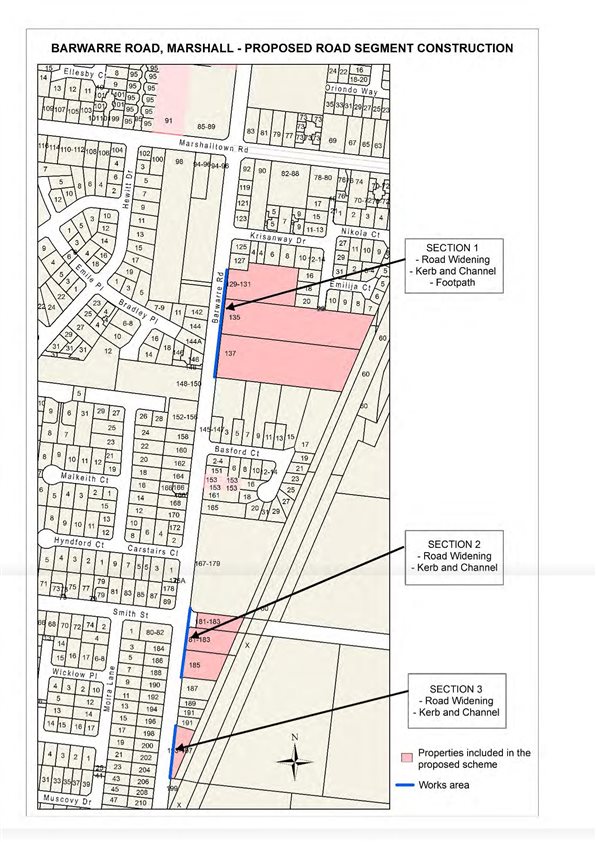
Stage |
Status |
Description |
Aproval to prepare scheme |
|
Decision made to prepare scheme following consideration of surveys of property owners and feed back from the community. Council may then place the project in the budget system or proceed immediately to prepare a scheme. Scheme preparation involves survey, design and preparation of an aportionment of costs. April 2015. |
Intention to Declare Scheme |
|
Report to Council providing information on scheme including advice of impending advertising of scheme and declaration of charge. Seeks Council aproval by resolution to proceed with process. 27 June 2017 |
Advertisement |
|
The scheme is advertised in the local newspaper and all allotted property owners are notified by mail. This advertisement indicates Council’s intention and notification to ‘declare’ a scheme in a month’s time. 8 July 2017 |
Submissions |
|
From the time of advertising property owners have 28 days (as set down by the Local Government Act) to lodge submissions, either in suport or oposition to the scheme. No submissions. |
Submissions Review Panel Hearing |
|
A Submissions Review Panel is convened (quorum of three Councillors) and meets to consider submissions. Some submissions are written only, and other submitters may wish to be heard before the Panel. The Panel makes a recommendation to Council regarding the scheme. Not required. |
Declaration Report |
|
Any time 28 days after advertising the scheme and after the Submissions Review Panel has met and considered submissions, Council considers a report and may proceed to “declare” the charges in accordance with its advertised intent. Subsequent to this the Finance Manager issues the levy notices and there is a formal charge placed on the property. This is the final step in the process for Council to make a decision on the scheme. |
Apeal |
|
Property owners may lodge an aplication for review with the Victorian Civil and Administrative Tribunal (VCAT) within one month of issue of the levy notice. An apeal is listed, heard and determined by the Tribunal and this process generally takes three to four months. Decisions made by VCAT are binding on all parties. |
Construction |
|
Council may then proceed to construct the works. Invoices are issued seeking payment of the estimated cost within one month of commencement. |
Final Cost Report |
|
At the completion of the works the scheme is “finalised” taking into account actual costs incurred and payments are adjusted accordingly. |
Source: |
City Services - Capital Projects |
General Manager: |
Peter Godfrey |
P Dorling moved. L Gardner seconded -
That in accordance with Section 89 (2) (d) of the Local Government Act 1989, this contractual matter be considered at the conclusion of all other business at which time the meeting be closed to members of the public.
Carried.
Source: |
Property and Procurement - Strategy and Performance |
Acting Director: |
Peter Anderson |
P Dorling moved, L Gardner seconded -
That in accordance with Section 89 (2) (e) of the Local Government Act 1989, this matter which contains commercial information relating to a proposed development be considered at the conclusion of all other business at which time the meeting be closed to members of the public.
Carried.
Source: |
Community Life - Leisure and Recreation Services |
Director: |
Linda Quinn |
Index Reference: |
Tender T1700019 |
To seek Council endorsement to award Contract C1700019 for suply, installation and ongoing maintenance of strength and cardio equipment at Council’s four Leisure Centres to the Evaluation Panel’s preferred suplier, The Fitness Generation t/a NovoFit.
Council owns and directly operates a number of leisure and aquatic facilities. These facilities have been equiped with high quality cardio and strength equipment which is continually upgraded and is a key driver of membership sales and retention.
To deliver this Contract, Council sought the services of an experienced health and fitness equipment suplier for replacement and upgrade of gymnasium equipment over the next five years (inclusive of extension options).
Council received a total of five tender submissions. The assessment panel comprised the Manager Leisure & Recreation Services, Co-ordinator Leisure Projects and Assets, Co-ordinator Leisure Facilities and Centre Manager Waterworld,.
Submissions were assessed against price and non-price criteria including technical capability, service and maintenance and the tenderers economic contribution to the local community.
The Panel recommended The Fitness Generation t/a NovoFit as the preferred suplier. NovoFit have suplied Council with strength and cardio for the past eight years and have a proven track record of quality, reliability and service.
NovoFit tendered the lowest overall price based on annual estimated requirements for the next five years and achieved the highest comparative criteria score.
NovoFit recognises Councils commitment to a healthier community and have included in their proposal, sponsorship of Council’s Water Smart Kids Program at Waterworld and Splashdown Centres for the total value of $20,000 per annum over the term of the contract (value $100,000 over five years). Economic contribution to the Geelong region was a criteria in the request for tender.
The total procurement spend over the five year period will be aproximately $2.5 million (excluding GST, however pricing may be subject to change due to currency fluctuations between AUD/USD). This will be dependent on the availability of funds through Council’s capital budget process. There is $409,650 (ex-GST) in 2017-18 budget allocation for strength and cardio gymnasium equipment replacement.
P Dorling moved, L Gardner seconded -
That Council award Contract C1700019 for the Suply and Installation of Gymnasium Equipment for Leisure Centres, to The Fitness Generation Pty Ltd t/a NovoFit at their tendered rates for the next three years with the option of two further years at the sole discretion of Council.
Carried.
Currently there is $409,650 (ex-GST) in 2017-18 budget allocation for strength and cardio gymnasium equipment replacement.
It is anticipated that the total procurement spend over the five year contract period will be aproximately $2.5 million subject to budget allocations.
Tender pricing is fixed for 12 months and is based on .75c AUD/USD. Due to currency fluctuations quoted prices may vary over the Contract term.
Transport costs of the new equipment to site (including the removal of the existing equipment) and all ongoing maintenance and parts is included over the five year Contract term.
NovoFit will contribute $20,000 per annum over the term of the Contract (value $100,000 over five years) to Council’s Water Smart Kids Program at the Waterworld and Splashdown Centres.
The Tender process was subject to consultation between the key stakeholders within the Leisure and Recreation Services Department and the Procurement Unit.
This Tender was publicly tendered in accordance with the requirements of section 186 of the Local Government Act 1989 and the tender process has been conducted in accordance with Council’s Procurement Policy.
The Tender evaluation process involved the assessment of Work, Health and Safety policies, procedures and risk assessment documents.
Council’s commitment to improve the health and wellbeing of the Geelong community is evidenced by the operation of our four Leisure Centre facilities which encourage community participation while incorporating the latest advancements in strength and cardio technology.
Apart from the community benefits the project aligns to the City Plan priorities in the area of Responsible and Sustainable Financial Management.
The officers responsible for this report have no direct or indirect interests requiring disclosure.
Contents | Previous Page: Section A - Procedural Matters | Next Page: Section C - Assembly of Councillors
