
Council Minutes - Section B: Reports - 30 January 2018
Contents | Previous Page: Section A - Procedural Matters | Next Page: Section C - Assembly of Councillors
Contents | Previous Page: Section A - Procedural Matters | Next Page: Section C - Assembly of Councillors
Reports tabled at the Ordinary Meeting of Council on Tuesday date held at the Council Conference and Reception Centre in City Hall, 57 Little Malop Street, Geelong.
Source: |
Strategy & Performance – Financial Services |
Director: |
Peter Anderson |
Index Reference: |
SUB-16-2053 |
To present to Council the Financial Performance information to 31 December 2017.
On 27 June 2017 the Final Budget was adopted with a recurrent deficit of ($8.7 million) and higher opening cash balance of $77.9 million. This change recognised the early receipt of expected 2017-18 Commonwealth Government Grants Commission funding (50% of allocation).
On 5 September 2017 Council approved the carryover of Capital and Non Capital project funding into 2017-18 along with other funding priorities. This change known as 2017-18 Projection was in response to funding allocated in 2016-17 for projects not completed, resulting in higher than expected opening cash balance of $103 million.
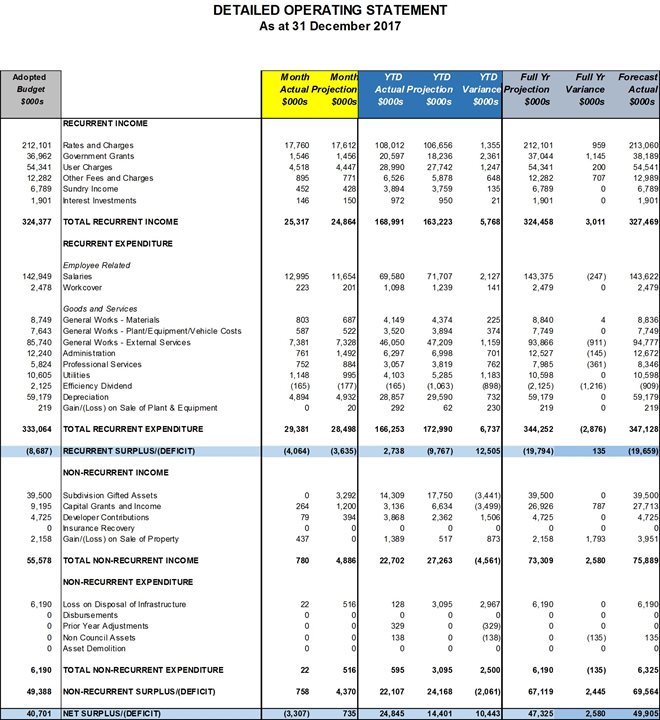
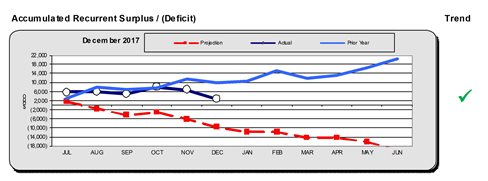
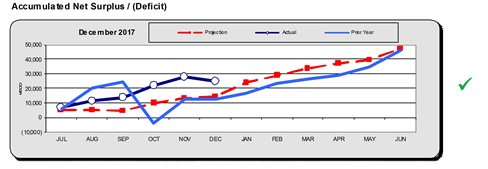
The 2017-18 Recurrent Projection is an operating deficit of ($19.8 million) and Non recurrent surplus of $67.1 million.The 2017-18 Full Year Projected Net Result is a surplus of $47.3 million.
The financial statements and commentary is for the period July – December 2017, which compares the budget projection with actual revenue and expense.
The recurrent operating result for the six month period is a surplus of $2.7 miliion. The projected position was a deficit of ($9.8 million) so our result represents a better than anticipated outcome of $12.5 million. It is expected however that in the full year this surplus will reduce to our projected position of ($19.7 million) deficit with perhaps a small favourable saving of $0.1 million. A summary of the half year variances are provided on pages 3 - 6 of this report.
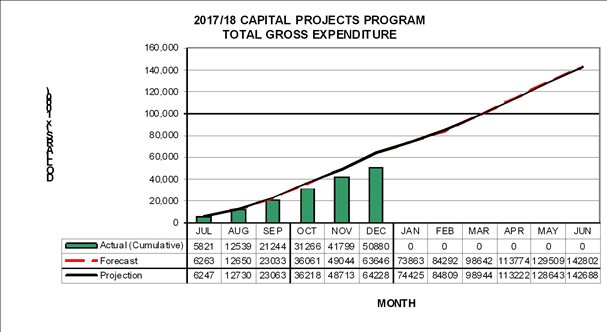
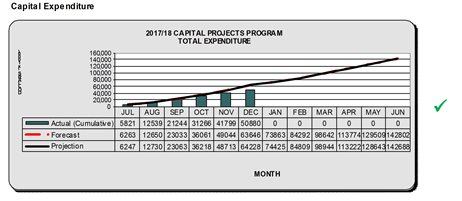
Capital expenditure year to date is $50.9 million against a projection of $64.2 million. It is anticipated that there will be a carryover figure of $29 million for works not completed by the end of the financial year. This figure will be reviewed during the first quarter of 2018. A summary of capital expenditure variances is provided on page 8 of this report.
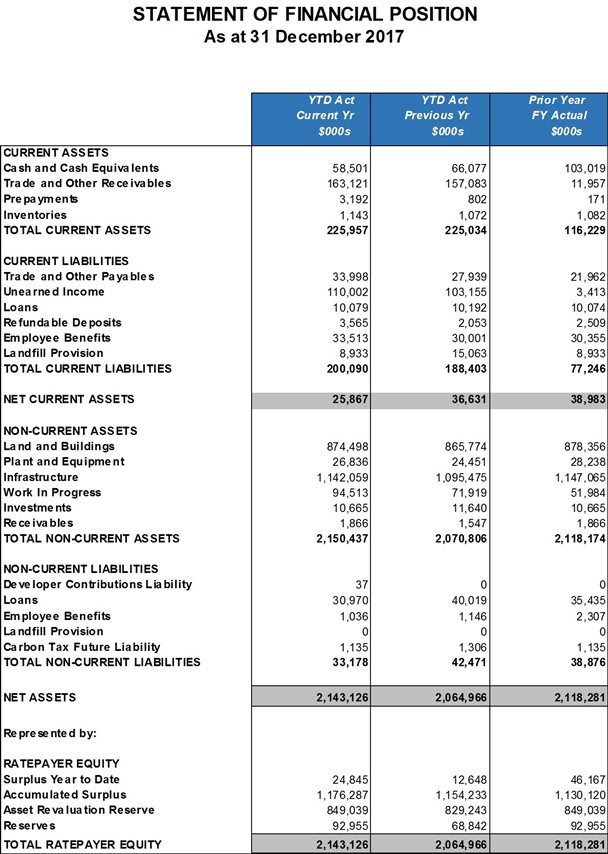
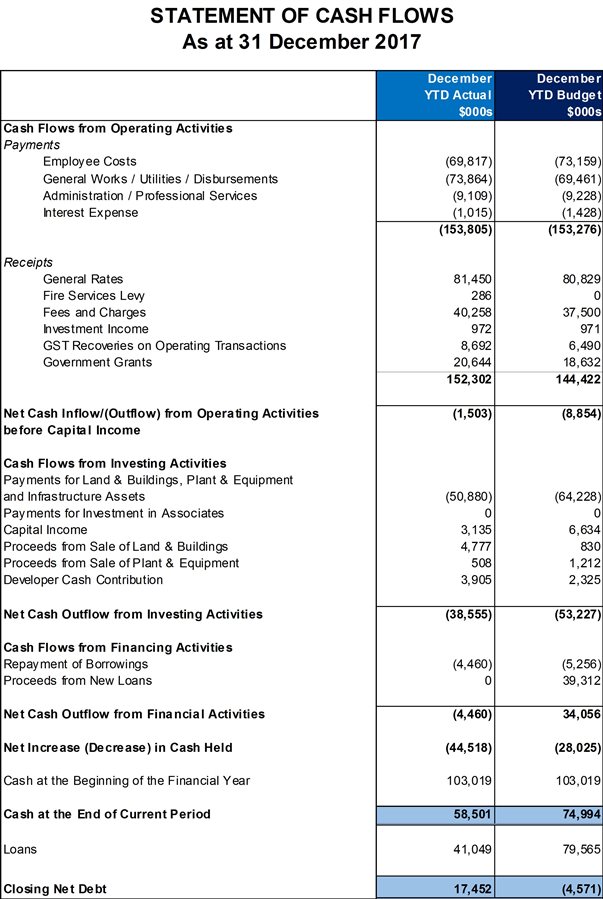
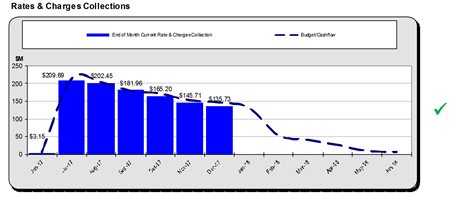
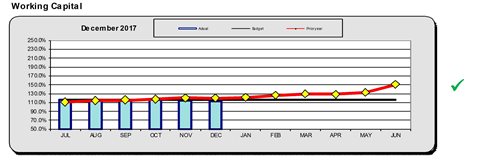
The cash and investment balance of $58.5m is less than was expected to be the result at this stage of the year ($16.5 million less). Capital projects have been funded from working capital to date and Council has not taken out any new loan borrowings (budgeted to borrow $39.3 million this year). Capital expenditure continues to be monitored and new loans will be taken up when and if required. A summary of the cash and investments is provided on page 13 of this report.
When non recurrent items are included (for example: Gifted assets from development, Sale of properties, developer cash contributions to infrastructure etc.) the result for the six month period was a surplus of $22.1 million. However this was ($2.1 million) unfavourable to the anticipated position. At the end of the year it is expected that the positon will be $2.4 million better than anticipated. A summary of the non recurrent variances is provided on page 7 of this report.
There were no Environmental Upgrade Agreements entered into for the quarter. The existing agreement is valued at $0.115 million.
Councillor Murnane moved, Councillor Mason seconded -
That Council endorse the Financial Report to 31 December 2017.
Carried.
The 2017-18 Full Year projected Net Result is a surplus of $47.3m. Refer following Table.
|
Expenditure |
Income |
Surplus/(Deficit) |
Opening Cash Balance |
Council Draft 2017-18 Budget - Recurrent Surplus/(Deficit) |
333,039 |
333,940 |
901 |
$67.9m |
Grants Commission 2017-18 - 50% received in 2016-17 |
|
(9,588) |
(9,588) |
|
Council adopted 2017-18 Budget - Recurrent Surplus/(Deficit) |
333,039 |
324,352 |
(8,687) |
$77.9m |
2016-17 Non Capital Carryover Requests |
9,998 |
106 |
(9,892) |
|
Other Projection changes |
|
|
|
|
Library Contribution increase |
215 |
0 |
(215) |
|
Osborne House |
1,000 |
0 |
(1,000) |
|
2017-18 Recurrent Projection |
344,252 |
324,458 |
(19,794) |
$103m |
Non Recurrent Surplus/(Deficit) |
6,190 |
73,309 |
67,119 |
|
Net Result Surplus/(Deficit) |
350,442 |
397,767 |
47,325 |
|
The December Management reports are provided in the following table to report year-to-date performance and full-year forecast performance versus projection.
Summary |
||||||
|
YTD |
YTD |
YTD Var |
FY |
FY |
FY Var |
Recurrent Surplus/(Deficit) |
2.74 |
(9.76) |
12.50 |
(19.79) |
(19.66) |
0.13 |
Non-Recurrent Surplus/(Deficit) |
22.10 |
24.16 |
(2.06) |
67.12 |
69.57 |
2.45 |
Net Surplus/(Deficit) |
24.84 |
14.40 |
10.44 |
47.33 |
49.91 |
2.58 |
Capital Expenditure |
50.88 |
64.23 |
13.35 |
142.69 |
142.80 |
(0.11) |
Closing Net Cash Positive/(Neg) |
58.50 |
74.99 |
(16.49) |
61.40 |
|
|
2. Recurrent Variance Commentary |
||||||
|
YTD |
YTD |
YTD Var |
FY |
FY |
FY Var |
Recurrent Income |
168.99 |
163.22 |
5.77 |
324.46 |
327.47 |
3.01 |
Recurrent Expenditure |
166.25 |
172.98 |
6.73 |
344.25 |
347.13 |
(2.88) |
Recurrent Surplus/(Deficit) |
2.74 |
(9.76) |
12.50 |
(19.79) |
(19.66) |
0.13 |
YTD Variance - $12.50m Favourable |
||||||
The following major variances contributed to this result:
Recurrent Income
|
Actual YTD $M |
Variance Fav/(UnFav) $M |
General Rates and Charges – Favourable rates generation and supplementary rates YTD, expected to be partly offset by objections in full year. |
108.01 |
1.36 |
Government Grants Main favourable variances consist of:
|
20.60 |
2.36 |
User Charges Main favourable variances consist of:
Offset by:
|
28.99 |
1.25 |
Other Fees & Charges Favourable mainly due to:
Offset by:
|
6.53 |
0.65 |
Sundry Income
|
3.89 |
0.13 |
Interest on Investments |
0.97 |
0.02 |
Recurrent Income Sub-total |
$168.99m |
$5.77m |
Recurrent Expenditure
|
Actual YTD $M |
Variance Fav/(UnFav) $M |
Employee Related Expenditure – Favourable salary related costs $2,275,000 mainly relating to unfilled vacancies. Offset by unfavourable supplementary labour costs ($2,778,000) (see external services). |
70.68 |
2.27 |
General Works: Materials $225,000 favourable with the main variance being Road Making Materials $380,000 (phasing only) Plant / Equip / Vehicle Costs $374,000 favourable with the main variances being External Plant & Equipment Hire $143,000 and Repairs & Maintenance $121,000 (both phasing only). External Services is $1,159,000 favourable mainly due to:
Offset by:
|
53.72 |
1.76 |
Administration costs $701,000 favourable mainly due to :
|
6.30 |
0.70 |
Professional Services costs $762,000 favourable mainly due to:
Offset by:
|
3.05 |
0.76 |
Utility costs are $1,183,000 favourable mainly due to Electricity $737,000 and Water $386,000 (phasing and timing of invoices). Efficiency Dividend ($898,000) unfavourable |
4.10 (0.17) |
1.18 (0.90) |
Depreciation costs $732,000 favourable (timing of capitalisations). |
28.86 |
0.73 |
(Gain)/Loss on Sale of Plant and Equipment $230,000 favourable. |
(0.29) |
0.23 |
Recurrent Expenditure Sub-total |
$166.25m |
$12.50m |
Full Year Forecast
The 2017-18 full year Recurrent forecast has improved by $0.13m including:
Leopold Library Book Collection – transfer from Capital ($433,000).
Victorian WorkCover Authority Enforceable Undertaking ($317,000).
Geelong Saleyards Precinct Plan – funded from reserve ($160,000).
Corrective action at two long term hoarding properties – unbudgeted ($150,000).
Merchant Service Bank Fees increase ($150,000).
Efficiency Dividend yet to be identified ($1,216,000).
Supplementary rates issued have provided additional revenue of $959,000.
Planning Permit Income $707,000.
Grants Commission increase over projection $560,000.
Road Occupation Income $200,000.
2. Non Recurrent Variance Commentary |
||||||
|
YTD |
YTD Projection |
YTD Var Fav/ (UnFav) |
FY Projection |
FY |
FY Var Fav/ (UnFav) |
Non-Recurrent Surplus/(Deficit) |
22.10 |
24.16 |
(2.06) |
67.12 |
69.57 |
2.45 |
YTD Variance – ($2.06m) unfavourable |
||||||
The following variances contributed to this result:
|
Actual YTD $M |
Variance Fav/(Unfav) $M |
|
Subdivision Gifted Assets (3,441,000) unfavourable. |
14.31 |
(3.44) |
|
Capital Grants & Income ($3,499,000) unfavourable. |
3.14 |
(3.50) |
|
Developer Contributions $1,506,000 favourable. |
3.87 |
1.50 |
|
Gain/(Loss) on Sale of Property $879,000 favourable. |
1.39 |
0.88 |
|
Loss on Disposal of Infrastructure $2,957,000 favourable. |
(0.13) |
2.97 |
|
Prior Year Adjustments ($329,000) unfavourable. Non Council Assets ($138,000) unfavourable |
(0.33) (0.14) |
(0.33) (0.14) |
|
$22.11 |
($2.06) |
Full Year Forecast
The 2017-18 full year Non Recurrent forecast has improved by $2.45 million including:
Capital Income $787,000 favourable – unbudgeted grants received $537,000 and amended timing of grant milestones $250,000.
Gain/(Loss) Sale of Property $1,793,000 favourable – mainly unbudgeted Geelong Ring Road Employment Precinct land sales – Sales value $7,956,000 less WDV $6,281,000, Net Gain $1,675,000.
Non Council Assets ($135,000) – Capital expenditure on Non Council asset expensed.
The full year Net operating forecast is $49.9m, an increase of $2.6 million.
|
Annual Projection $’000 |
Annual Forecast $’000 |
Movement $’000 |
Recurrent Income |
324,458 |
327,469 |
3,011 |
Recurrent Expenses |
344,252 |
347,128 |
(2,876) |
Recurrent Surplus/(Deficit) |
(19,794) |
(19,659) |
135 |
Non Recurrent Surplus/(Deficit) |
67,119 |
69,564 |
2,445 |
Net Surplus/(Deficit) |
47,325 |
49,905 |
2,580 |
3. Capital Expenditure Variance Commentary |
||||||
|
YTD |
YTD Projection |
YTD Var Fav/ (UnFav) |
FY Projection |
FY |
FY Var Fav/ (UnFav) |
Capital Expenditure |
50.88 |
64.23 |
13.35 |
142.69 |
142.80 |
(0.11) |
YTD Variance – $13.35m favourable |
||||||
The capital program is $13.35m underspent, with the major project variances as follows:
|
|
$ million |
• |
Federal Roads Program |
1.79 |
• |
Street Construction SRC |
1.78 |
• |
Heavy & Dedicated Plant |
1.12 |
• |
Portarlington North East SRC Road Construction |
1.04 |
• |
DCP – HBP – Reserve Rd Retaining Basin |
1.00 |
• |
Elcho Channel SRC Scheme |
0.95 |
• |
Leopold Community Hub |
0.74 |
• |
Drysdale Landfill Cell 5 |
0.72 |
• |
Johnstone Park Improvements |
0.59 |
• |
Johnstone Park Rain Garden |
0.59 |
• |
DCP – ACWP – Acquisition Drainage Reserves |
0.58 |
• |
Building Renewal Works |
0.51 |
• |
Other |
2.94 |
|
|
$ 13.35 |
Carryover of expenditure to 2018-2019 on incomplete projects as at 30 June 2018 is projected to be $29.0 million and this will be further reviewed and updated for the March quarter report.
The graph below summarises total capital gross expenditure to date compared to budget and projection.
Environmental Upgrade Agreements
An environmental upgrade agreement was entered into for Lot 2 on Plan Subdivision 041455, Volume 08704 Folio 526.
Council only has one environmental upgrade agreement in place.
The total charge for this agreement is $0.115 million and all payments that have fallen due have been remitted.
The total value of payments that are yet to fall due is $0.109 million.
4. Cash and Investments |
||||||
|
YTD |
YTD Projection |
YTD Var Fav/ (UnFav) |
FY Projection |
FY |
FY Var Fav/ (UnFav) |
Closing Net Cash Positive/(Neg) |
58.50 |
74.99 |
(16.49) |
61.40 |
|
|
YTD Variance – ($16.49m) unfavourable |
||||||
The month end cash and investments balance was $58.50 million. This was ($16.49 million) unfavourable , mainly due to deferring of loans of $39.2 million for 3 months, partly offset by favourable recurrent surplus and underspend on Capital.
Council has future commitments for $30.4 million, which are fully cashed back:
Long Service Leave |
$21.8m |
Statutory Reserves |
$ 1.2m |
Refundable Deposits |
$ 3.6m |
Income in Advance |
$ 3.2m |
Asset Development |
$ 0.6m |
Total |
$30.4m |
The Landfill Provision balance is currently $8.9 million.
Working capital funds are invested in short term deposits and investment returns are as follows.
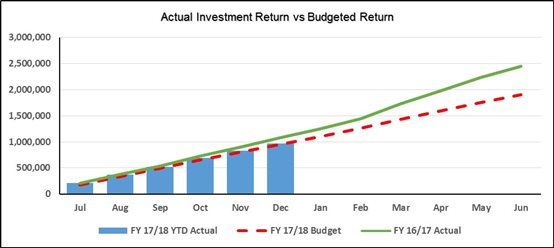
Investment returns are trending as per 2016-17 actuals and consistent with 2017-18 budget.
Source: |
City Services - Engineering Services |
Director: |
Guy Wilson-Browne |
Index Reference: |
Flood Plain Management |
To provide an overview of the Corangamite Regional Floodplain Management Strategy (Attachment 2) for endorsement as a regional partner prior to the final document being released to the public.
The Corangamite Regional Floodplain Management Strategy (the regional strategy) will provide a single, regional planning document for floodplain management and a high level regional work program to guide future investment priorities for the Corangamite Catchment Management Authority (CCMA) region.
It will provide the starting point for councils and other stakeholders to identify priority flood management activities, which may include flood warning systems and flood emergency response to local needs, improving flood overlays in land use planning schemes, but predominately deals with riverine flooding issues only acknowledging coastal and urban storm water as contributing flooding issues.
It aims to align the efforts of various agencies and communities to deliver the outcomes called for by the Victorian Floodplain Management Strategy.
The development of the regional strategy produced by the CCMA in collaboration with regional partners will ensure the following key outcomes:
That roles and responsibilities for floodplain management are clear and that stakeholders and communities are aware of their flood risks and actively managing them appropriately;
That all agencies with flood emergency management functions have aligned priorities;
This will enable agencies to align their potential to source and allocate funds towards priority actions;
That communities are empowered by being aware of their flood risks; and
That local knowledge has informed the development of the strategy.
The regional strategy is a high level strategic document. The strategy will not develop individual or localised projects (for example: flood studies, planning scheme amendments, structural works such as levees etc.). These will form actions out of the strategy and prioritised across the region.
Rural drainage issues are not included in the regional works program, and are out of the scope of the regional strategy.
All information provided in the regional strategy will be used in combination with a range of other information sources and will not be seen as the ‘single source of truth’ regarding a local flood issue.
The regional strategy is not a property scale document; the regional strategy is interested in community identified assets at risk of flooding and the identification of local flood risks at a regional scale.
Although the regional strategy has limited acknowledgement of the role stormwater has in floodplain management, it will provide the platform to complete a review of the 2013 Greater Geelong Flood Management Plan in 2018 which will extensively cover stormwater flooding.
Councillor Mansfield moved, Councillor Sullivan seconded -
That Council, as a regional partner endorse the Corangamite Regional Floodplain Management Strategy 2017-2027 for public release.
Carried.
The regional strategy identifies a number of actions which CoGG will be responsible for delivering and funding. Some of these, such as the Lara Flood Study are already in progress with budget available. Others will be subject to future budget proposals.
Current Budget
No. |
Title |
Estimate Cost |
Status |
C023316 |
Design & Investigation (Flooding, Drainage and Basins) |
$219,000 |
In Progress |
Budget Bids
No. |
Title |
Estimate Cost |
Status |
PR160022 |
Design & Investigation (Flooding, Drainage and Basins) |
$219,000 |
Draft |
PR160023 |
CORE - Design & Investigation Sub Program - Special Rates & Charges |
$219,000 |
Draft |
A review in 2018 of the Greater Geelong Flood Management Plan will incorporate these and additional actions which will inform future budget proposals and prioritisation of existing budget allocations.
The CCMA has engaged the community to understand local flood risks, the community’s perceptions of flood risks and important community assets at risk of flooding. The CCMA has received community input into the identification of important community infrastructure at risk of flooding, and the community’s level of tolerance to flood risks. This engagement and input has informed the development of the regional strategy.
The engagement undertaken for the development of the regional strategy has been as follows:
Engagement Event |
Approximate Dates |
Community attitudes online survey |
November/December 2016 |
Face to face workshops |
April/May 2017 |
Data capture through online portal |
April 2017 |
Public exhibition of draft strategy |
October/November 2017 |
Final Strategy released |
February 2018 |
A “drop in session” was held in Geelong which was attended by eight (8) people, five (5) of which were from regional partner agencies.
Links to the draft regional strategy were provided on council, CCMA and VicSES websites and promoted through social media. There were a total of 47 brochure downloads, 13 via the CoGG website. Only two (2) online surveys were completed, both outside the CoGG area.
Engineering Services have been representing the City of Greater Geelong on the regional strategy steering committee. Although the regional strategy has limited acknowledgement of the role stormwater has in floodplain management, it will provide the platform to complete a review of the Greater Geelong Flood Management Plan in 2018 which will extensively cover stormwater flooding.
Flood risk is the potential risk of flooding to people, their social setting, and their built and natural environment. The degree of risk varies with circumstances across the full range of floods.
The Victorian Floodplain Management Strategy (VFMS) launched in April 2016 was developed by the Department of Environment, Land, Water and Planning (DELWP) with input from key stakeholders and the broader Victorian community.
The regional strategy devolves implementation of the VFMS policies, actions and accountabilities to manage local and regional flood risks.
A scheduled review in 2018 of the Greater Geelong Flood Management Plan will consider both the VFMS and regional strategy in developing local flood management policy and actions.
The regional strategy supports integrated water cycle management, which provides opportunities to manage urban flooding through, for example, stormwater and rainwater harvesting, water-sensitive urban design and reduced connection of hard surfaces to drainage systems.
The regional strategy also reiterates the requirements of Clause 56 of the Victorian Planning Provisions for new subdivisions and the need to ensure that developments do not increase flows downstream of the site by including appropriate stormwater detention and treatment.
From the City Plan 2013-2017, drainage and flood management strategies and plans will assist in delivering Sustainable Built and Natural Environment priorities. The Corangamite Regional Floodplain Management Strategy will inform flood mitigation investment priorities and minimise our environmental footprint.
The stormwater flood risk and the management of stormwater quality is a key concern for urbanised areas built alongside significant waterways and water bodies. Consequently, stormwater and riverine flood risks are interrelated and must be considered as part of a ‘whole of catchment’ approach to floodplain management.
The regional strategy has identified areas with a history of stormwater flooding but does not recommend treatment options. It is recommended this should occur through existing processes, such as stormwater management plans or capital work programs.
The regional strategy does considers a number of risks, specifically the change of flooding from rivers (not stormwater drainage) in a 1 in 100 year event (1% AEP).
Estimated number of property parcels within 1% AEP riverine flood extent |
Residential |
Commercial |
Industrial |
Total |
965 |
61 |
203 |
1,229 |
Comparison of the total area of 1% AEP riverine flood extent and flood controls in the Planning Scheme |
Percent of LGA covered by 1% AEP Riverine Flood Extent |
Percent of LGA with flood Planning Controls |
11.67% |
9.51% |
Priority risk areas including Point Lonsdale and South Geelong were identified as significant risk areas. Point Lonsdale, with flood risks associated with Lake Victoria, and South Geelong with flood risks associated with the Barwon River.
While not directly related to this Strategy, the flood risks associated with stormwater and overland flows are extensive. Given the highly developed nature of the City, managing the risks associated with overland flows and the large population identified as being subject to above-floor flooding during major storm events is a significant risk for the City. Additional ageing infrastructure and competing priorities for capital investment add complexity to the risk.
There are a number of urbanised catchments that are subject to periodic flash flooding or stormwater flooding. The Moolap area is one such catchment. It has a history of flooding, primarily due to poor drainage caused by the flat topography and ground elevations relative to Stingaree Bay and a number of ‘bottlenecks’ in the overland flow paths. The catchment supports urban and industrial development and is mostly less than 2.5 m above mean sea level.
Actions identified in the regional strategy with a “high” priority specific to the City of Greater Geelong area are as follows:
Support the implementation of the Barwon and Moorabool Rivers flood study.
Ensure that relevant components of the Barwon and Moorabool Rivers flood study are operationalised. For example, updating the Municipal Flood Emergency Plan (MFEP) to include:
inundation plans that include above floor flooding
impacts on significant infrastructure
key triggers for evacuations and road closures
Undertake community flood education activities and develop flood awareness products for Geelong that may include pre-recorded flood education videos, local flood guides, community response plans, community signs and gauge boards. This work will include educating the community about the role of retarding basins in floodplain management.
Complete flood and drainage strategy for Lara.
Implement recommendations from the Lara flood and drainage study, for example updating the MFEP to include:
inundation plans that include above floor flooding
impacts on significant infrastructure
key triggers for evacuations and road closures
Implement recommendations from the Lara Flood Levee Audit, SMEC 2016.
Investigate the most appropriate planning process to ensure flood study outputs from the ‘Our Coast’ program are incorporated into the Planning Scheme.
Identify existing flood data gaps and future data needs in relation to flood risk in and around land development and where riverine and stormwater are identified as a joint risk. For example, Drysdale, Clifton Springs, Leopold, Armstrong Creek, Ocean Grove, Waurn Ponds and Cowies Creek areas.
Flooding provides a number of environmental benefits. For example, floods provide cues for the spawning of certain flora and fauna species, shelter for juvenile fish and increase aquatic habitat. Following a flood, the benefits to the ecosystem include recharged aquifers, natural deposition of nutrients and sediments, and healthy populations of aquatic species.
Flooding also has benefits to the soil structure, such as improving soil moisture and the deposition of silt that can improve soil fertility. Floodplains provide natural overland flow paths and storage areas where floodwaters remain for slow release back into waterways as water levels recede. This natural process reduces the potential for channel erosion from high energy flows. Nutrients, large wood and sediment also settle out during this process, protecting waterways from high sediment and nutrient loads, improving water quality and contributing to floodplain productivity.
Since European settlement, a number of modifications have isolated floodplains and wetlands from rivers and this has led to changes to the natural flooding regime with detrimental effects on associated ecosystems.
Aligning with the VFMS, the regional strategy adopts the principle that waterways should, wherever possible, be allowed to flood naturally, maintaining connectivity to floodplains and their associated wetlands. The regional strategy aims to balance the management of flood risks with the protection of floodplains for their environmental and cultural values.
Source: |
Planning and Development |
Director: |
Peter Anderson |
Index Reference: |
Land Sales |
The purpose of this report is to clarify the delegation of authority to the CEO to sign contracts of sale for land at the Geelong Ring Road Employment Precinct (GREP).
The GREP is an industrial land project covering original holdings of 128ha most of which were gifted to Council by the Government in 1994, of which Council still owns 77ha.
In December 2012 Council adopted a resolution that delegated authority to the CEO to sell land at the GREP on various conditions. That delegation has been effective in selling $13.3m of land, and a further $5.9m of land has been sold under specific Council resolutions.
When selling land in the GREP there are occasions where a purchaser seeks an option agreement being an agreement setting out conditions that trigger the signing of an incorporated contract of sale. There may be circumstances when it is advantageous to enter into other forms of agreements involving multiple purchasers.
Currently, options and other forms of agreement incorporating contracts of sale are unable to be executed by the CEO using the December 2012 delegation. The recommendation here will replace the 2012 resolution.
To avoid doubt it is recommended that Council resolve to delegate authority to the CEO to enter into contracts of sale for the remaining land at the GREP including options and other forms of agreement to sell land. All other terms in the Recommendation below remain identical to the December 2012 resolution with the land parcels re-described taking into account sales since 2012.
The GREP is a commercial land development project requiring pragmatic and expedient decisions on sales which can be achieved by delegating authority to the CEO to approve sales. Delays in obtaining Council approvals for sales can increase project risks.
Councillor Aitken moved, Councillor Grzybek seconded -
That Council in relation to the subdivision and sale of GREP land at 8 Innovation Drive, 120, 130 and 220 Heales Road, New Station Estate and 164-200 McManus Road (“the land”) in the GREP proceeds as follows:
the land be sold on the following terms and conditions –
the price to be set at no less than the certified valuation of the land;
where land is required to be subdivided as a condition of sale that sufficient pre-sales of land be achieved to cover the cost of subdivision;
purchasers being required to enter into a s173 Agreement requiring substantial commencement of use and development of the land within two years of settlement;
if required, leases be entered into allowing early access to the land subject to the purchaser being required to purchase the land at a time determined by the Council upon registration of the relevant plan of subdivision;
such other terms and conditions considered appropriate to be included in the Contract of Sale, leases and other relevant documents; and
Notes that the statutory procedures under section 189 of the Local Government Act 1989 (“the Act”) to sell the land and section 190 of the Act to lease the land were completed in December 2017 and;
the Chief Executive Officer be authorised to execute the leases and/or Contract(s) of Sale including option agreements and any other form of agreement to sell land; and
the Transfer(s) of Land, s173 Agreements and leases where required be signed and sealed.
Carried.
Council has to date invested $19.2m in both public infrastructure and land development projects including $2.5m in Government grants in the GREP project . Land sales to date amount to $19.2m including land under contract of sale.
There remains Council owned land of value exceeding $20m in the GREP and there are currently significant offers with Council pending approval by the delegate.
There have been several engagement actions over the life of the GREP in the form of statutory notices and landowner notifications through planning scheme amendments, planning permits, special rate and charge schemes and notices of intention to sell land.
Council also provides a dedicated website for the precinct.
Community engagement will be conducted in respect of land sales within the GREP in accordance with the requirements of the Local Government Act (Vic) 1989 (“the Act”).
There are no social equity considerations relevant to the recommendations of this report.
Notice of intention to sell land under s189 of the Act has been published three times over the life of the GREP project and no submissions have been received pursuant to those notices.
Other provisions of the Act require obtaining of current valuations prior to the sale of land.
The GREP project aligns with the Growing the Economy objective of City Plan.
No officers, consultants or contractors involved in the development and sale of land at the GREP have a direct or indirect interest in the sale of GREP land.
Being involved in the subdivision and sale of industrial land is not without risk and the project needs to be managed actively and competently. The risk mitigation strategy of requiring sufficient sales or pre-sales of lots to cover the construction costs of each stage has been discussed above and central to risk management for this project.
Strategies used for managing project risks include –
Ensuring that contracts of sale are appropriately written to allow the Council sufficient scope to deliver titles while managing any contractual consequences.
Engaging competent consultants to provide advice and services at appropriate stages during the project.
Implementing Council’s contract management procedures to ensure that the civil works component is delivered on time and on budget and within the occupational health and safety guidelines.
The use of officer delegations to approve contracts of sale and a civil works contracts will assist in delivering titles in a timely manner and reduce risk.
Water sensitive urban design (WSUD) principles have and will in future be implemented in construction of three major drainage retention basins that will service the entire GREP precinct and catchments beyond.
Source: |
City Services - Capital Projects |
Director: |
Guy Wilson-Browne |
Index Reference: |
Tender T1770859 |
Cr Nelson moved, Councillor Asher seconded -
That in accordance with Section 89 (2) (d) of the Local Government Act 1989, this contractual matter be considered at the conclusion of all other business at which time the meeting be closed to members of the public.
Carried.
Source: |
City Services |
Director: |
Guy Wilson-Browne |
Index Reference: |
Subject: City Services Traffic Management |
Cr Nelson moved, Councillor Asher seconded -
That in accordance with Section 89 (2) (d) of the Local Government Act 1989, this contractual matter be considered at the conclusion of all other business at which time the meeting be closed to members of the public.
Carried.
Source: |
Strategy and Finance - Facilities & Procurement |
Director: |
Peter Anderson |
Index Reference: |
Tender EC8310-2018 (MAV) |
Cr Nelson moved, Councillor Asher seconded -
That in accordance with Section 89 (2) (d) of the Local Government Act 1989, this contractual matter be considered at the conclusion of all other business at which time the meeting be closed to members of the public.
Carried.
Source: |
Governance and Legal Services- Internal Audit |
Executive Manager: |
Rebecca Leonard |
Index Reference: |
Audit CG - Internal |
Cr Nelson moved, Councillor Asher seconded -
That in accordance with Section 89 (2) (h) of the Local Government Act 1989, this matter which the Council considers would prejudice the Council or any person be considered at the conclusion of all other business at which time the meeting be closed to members of the public.
Carried.
[Back to List]Contents | Previous Page: Section A - Procedural Matters | Next Page: Section C - Assembly of Councillors
