
Council Minutes - Section B: Reports - 27 February 2018
Contents | Previous Page: Section A - Procedural Matters | Next Page: Section C - Assembly of Councillors
Contents | Previous Page: Section A - Procedural Matters | Next Page: Section C - Assembly of Councillors
Reports tabled at the Ordinary Meeting of Council on Tuesday date held at the Council Conference and Reception Centre in City Hall, 57 Little Malop Street, Geelong.
Amendment C349 – Ocean Grove Significant Tree Project – Consideration of Panel Report and Adoption
Rural and Peri-Urban Advisory Committee – Terms of Reference
Contractual Matter (Confidential)
Tender T1770867 Northern ARC Health and Wellbeing Hub – Design Services (Confidential)
Source: |
Planning & Development - Strategic Implementation |
Director: |
Kelvin Walsh |
Index Reference: |
Amendment C349 |
To consider the Panel Report on Amendment C349 and to adopt the Amendment subject to changes, consistent with the Panel Report’s recommendations.
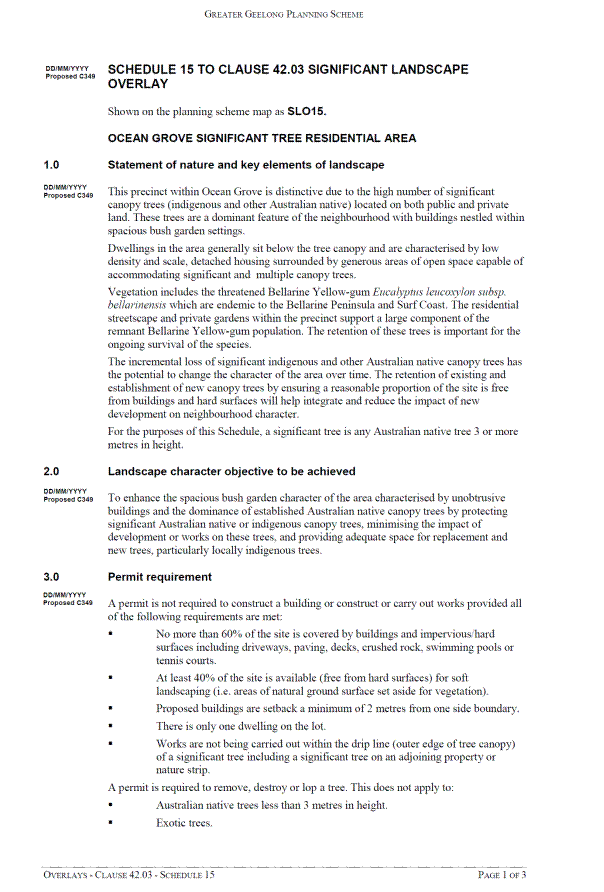
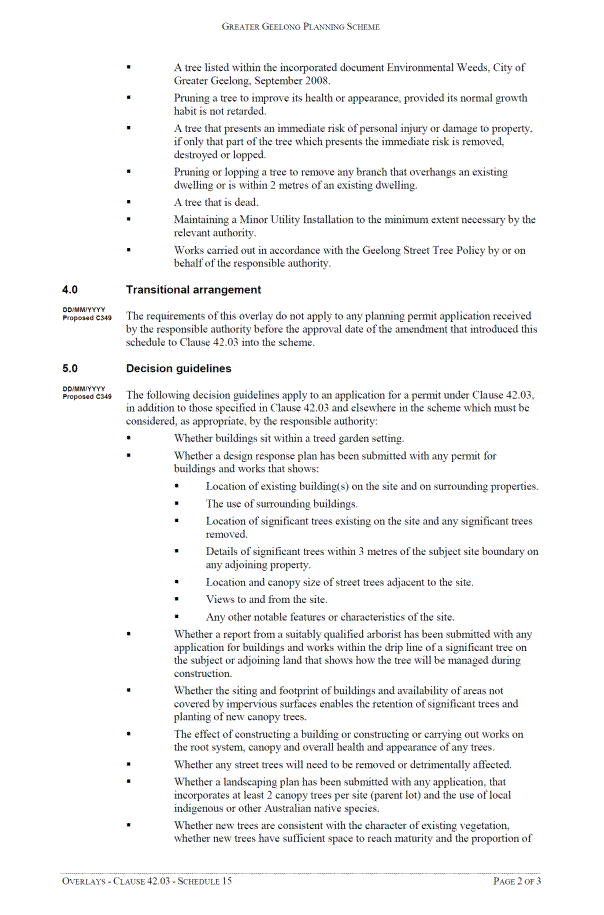
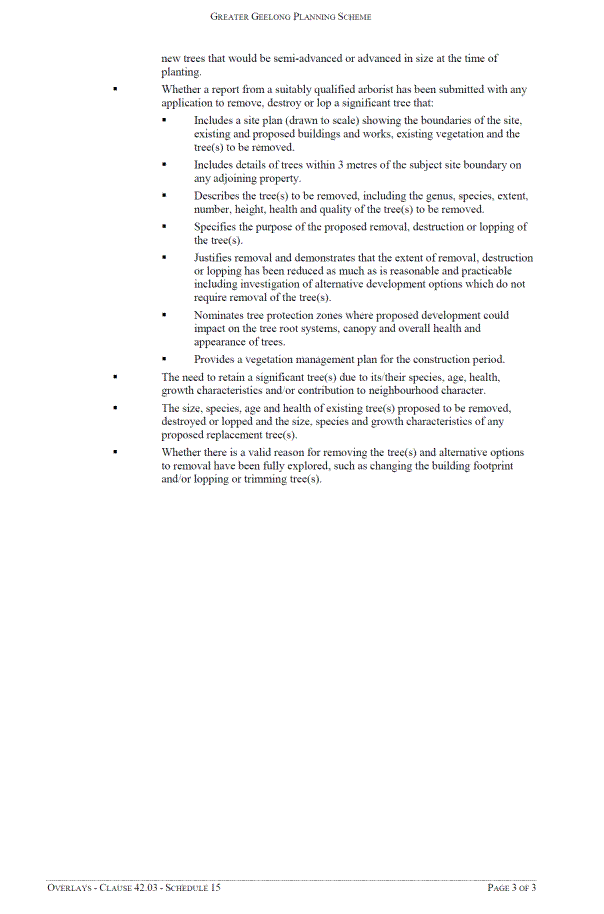
Amendment C349 implements the Ocean Grove Significant Tree Project (OGSTP) Final Report 2016, adopted by Council in September 2016. The Amendment aims to better protect the unique coastal/bush landscape character within well-established areas of Ocean Grove by way of new or revised zone schedules, Significant Landscape Overlays (SLOs) and other provisions.
The Amendment was exhibited in March and April 2017, with 20 submissions received. In August 2017, further consultation was carried out with affected landowners regarding a proposed post-exhibition change to respond to changes in maximum building heights in the State Government’s Amendment VC110 (Reformed Residential Zones) in March 2017. 54 submissions were received during this further consultation. Of the 74 submissions in total, 31 objected or requested changes.
Submissions were referred to an independent Panel, appointed by the Minister for Planning. The Panel Hearing was held on 30 and 31 October 2017 and the Panel Report received on 13 December 2017.
Key issues raised in the 9 objecting submissions during exhibition in March and April 2017 included objections to proposed new zones and controls and their impact on development potential, inadequate application of the current SLO 7 and bushfire management controls.
Council proposed and sought comment from affected owners on a post-exhibition change to zoning of the Hillside Area to retain building height limits consistent with those exhibited in the Amendment and recommended by the OGSTP. 32 submissions supported the change; key issues in 22 objecting submissions included inconsistency with State Government policy supporting increased maximum building heights, and more restrictive zone purposes and storey limits.
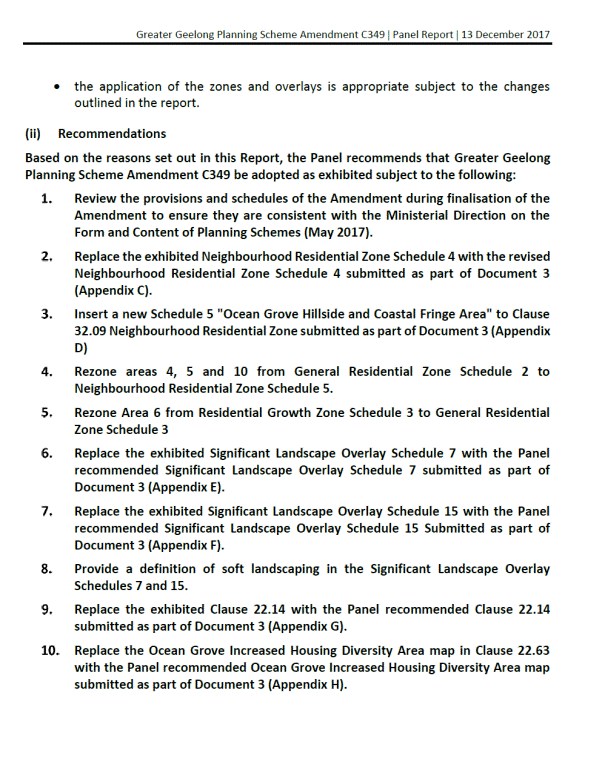
The Panel concluded that the OGSTP provides a sound quantitative basis for the Amendment’s proposals and that the application of and schedules for proposed zones and overlays are appropriate. The Panel supported Council’s post-exhibition change in the Hillside Area, except for a small area west of Field Street South, where the Panel recommends the exhibited General Residential Zone Schedule 3 rather than the now proposed Neighbourhood Residential Zone Schedule 5. The Panel recommended other mostly minor changes.
The Panel’s recommendations are supported, except for one minor error.
Clause 52.48 of the scheme may undermine some of the Amendment’s objectives by permitting certain vegetation removal without a permit. Council should reiterate its previously expressed concerns on this matter.
Councillor Asher moved, Councillor Mason seconded -
That Council:
Adopts Amendment C349 in the form outlined in Attachment 7 of this report;
Submits the adopted Amendment together with the prescribed information to the Minister for Planning requesting approval; and
Writes to the Minister for Planning to reiterate concerns relating to vegetation clearing permissible under Clause 52.48 Bushfire Protection raised by Council in May 2016 and to request an update on this matter.
Carried.
Background – SLO 7 and Ocean Grove Significant Tree Project
Significant Landscape Overlay Schedule 7 (SLO 7)
SLO 7 was introduced into the Scheme in April 2003 by Amendment C74. Its extent was slightly adjusted by Amendment C78 in February 2008 and has remained unchanged since. Amendment C300 (Reformed Residential Zones) made minor changes to SLO 7 controls in November 2014. In January 2010, Amendment C129(Part 1) introduced a further work task in Clause 21.14 to review the application of SLO 7.
Ocean Grove Structure Plan 2015
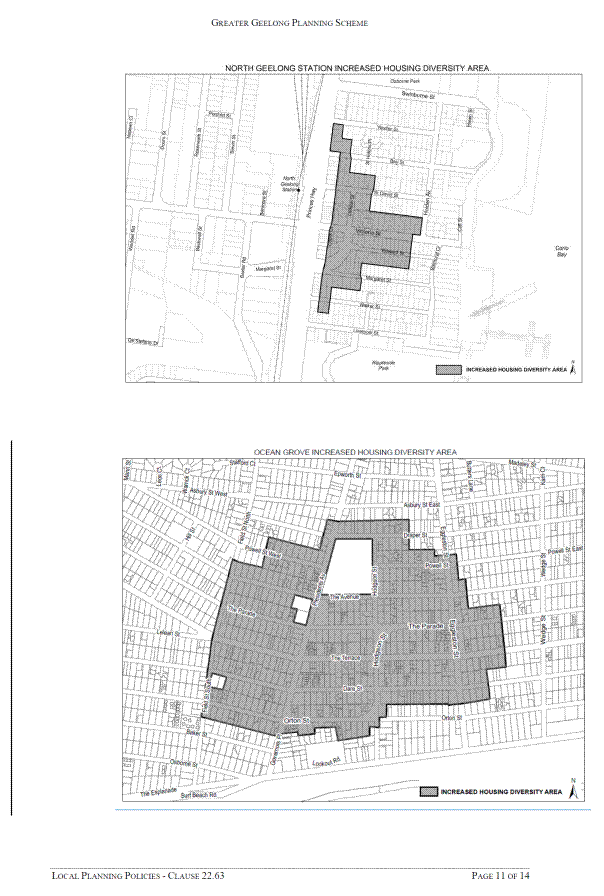
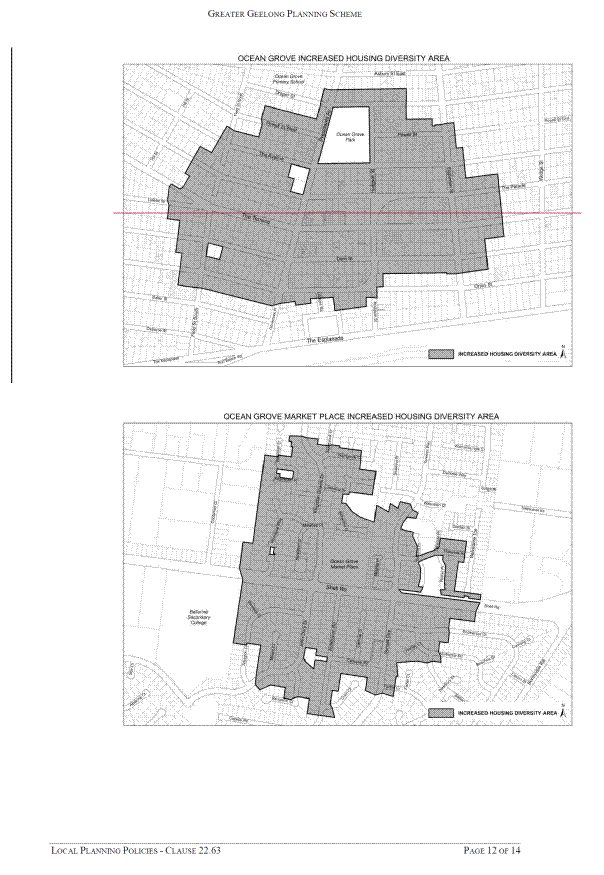
Issues with the operation of SLO 7 were raised during preparation of the Ocean Grove Structure Plan 2015, including the conflict between SLO 7 and the Increased Housing Diversity Area (IHDA) for land zoned Residential Growth Zone 3 (RGZ 3), permit trigger clarity, effectiveness in protecting vegetation and usefulness of decision guidelines. The Structure Plan recommended these matters be further investigated as part of the review of SLO 7.
The Structure Plan 2015 was implemented by Amendment C346, which made changes to Clause 21.14 (Bellarine Peninsula), including:
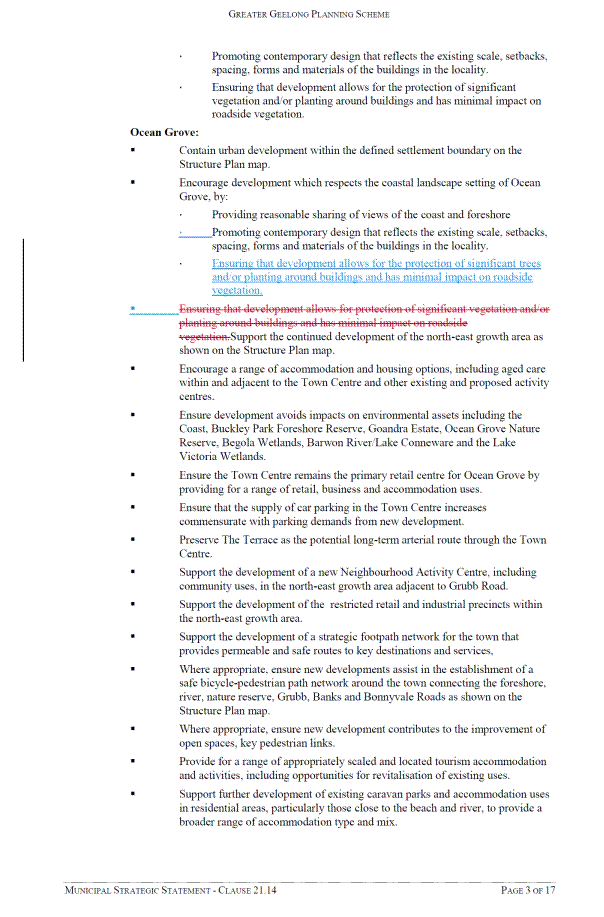
adding as part of a strategy: “Ensuring that development allows for protection of significant vegetation and/or planting around buildings and has minimal impact on roadside vegetation”; and
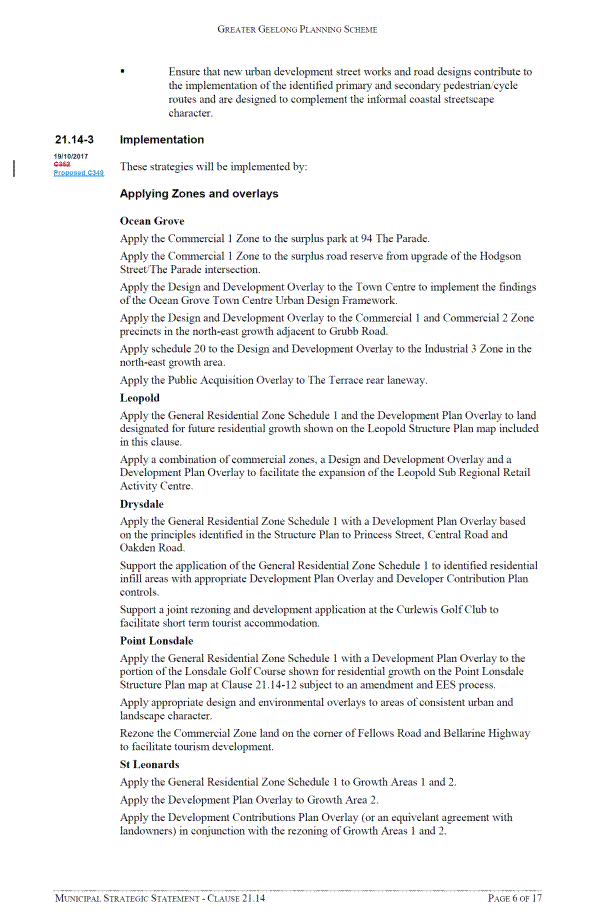
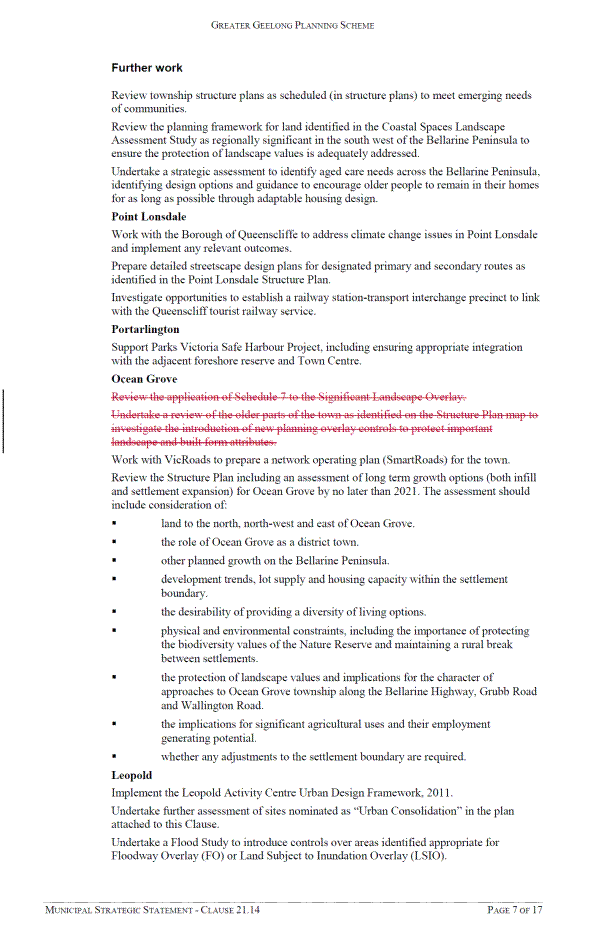
adding as a Further Work task: “Undertake a review of the older parts of the town as identified on the Structure Plan map to investigate the introduction of new planning overlay controls to protect importatnt landscape and built form attributes”.
Ocean Grove Significant Tree Project (OGSTP)
The OGSTP aimed to identify and protect, through planning controls, the unique coastal/bush landscape character within the well-established areas of the township of Ocean Grove.
The project was carried out concurrent with the review of the 2007 Ocean Grove Structure Plan and development of the Ocean Grove Structure Plan 2015. The 2007 Structure Plan identified a number of issues and concerns with SLO 7 and made recommendations on how to address them. The Ocean Grove community also identified a desire to protect and enhance significant vegetation in older parts of the township.
Ecological consultants, Okologie, undertook vegetation surveys between July and September 2015 on public and private land to identify the extent of significant trees (both indigenous and other Australian native) on public and private land. The surveys covered two areas of old Ocean Grove (the Significant Tree Area and the current extent of SLO7).
The surveys recorded 1050 significant trees on private land and 517 significant street trees within the Significant Tree Area, and 1330 significant trees on private land and 233 significant street trees in the SLO 7 area. Of note in the Significant Tree Area was the Bellarine Yellow-gum, endemic to the Bellarine and Surf Coast and listed as threatened in Victoria; the population of these trees in the study area is significant and its management is important for the survival of the species.
Along with vegetation surveys a detailed Background Report was prepared to inform the draft planning controls. This report identified three precincts with proposed customized planning controls, with the SLO 7 area divided into two precincts, the Hillside Area and the Coastal Fringe Area. Changes to zones and SLO 7 controls and new overlays were recommended.
Informal public consultation on the Background Report and draft controls took place in April and May 2016. 26 submissions were received, of which 20 raised objections or recommended changes. Issues raised in submissions were considered and responded to in the OGSTP Final Report.
A number of changes were made to the draft controls in response to submissions. A key change was including the Coastal Fringe Area and Hillside Area in a single Hillside Precinct (generally the SLO7 extent), with maximum site coverage of 50% (40% had been proposed for the Coastal Fringe Area) and maximum building height of 9 m (8 m had been proposed for the Coastal Fringe Area).
At its meeting of 27 September 2016, Council adopted the OGSTP Final Report and sought the Minister’s authorisation to prepare an Amendment in accordance with its recommendations. Council also sought an interim SLO 15 while the Amendment was prepared and considered. Interim SLO 15 was gazetted on 2 March 2017 and operates until 28 February 2018.
Amendment C349 – exhibition, submissions and Council consideration of submissions
Exhibition – March and April 2017
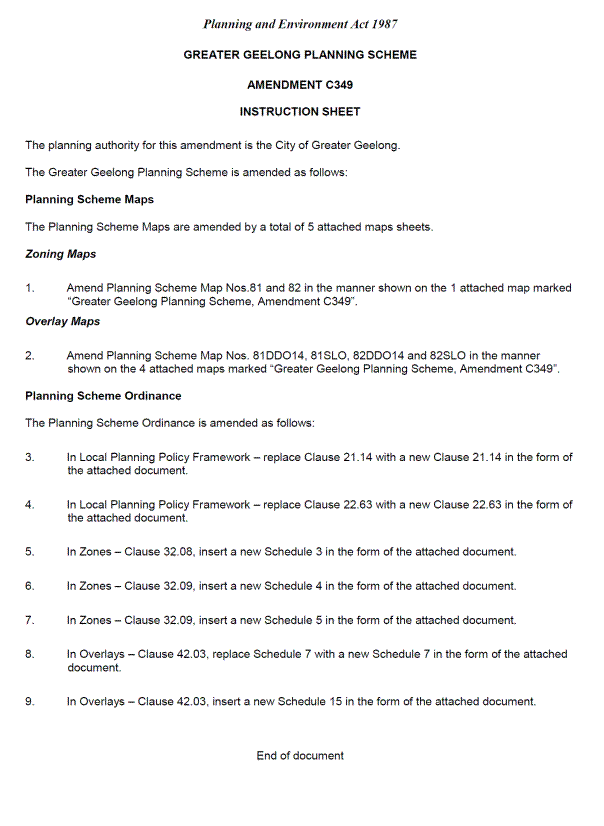
Amendment C349, as exhibited, proposed to implement the OGSTP Final Report by:
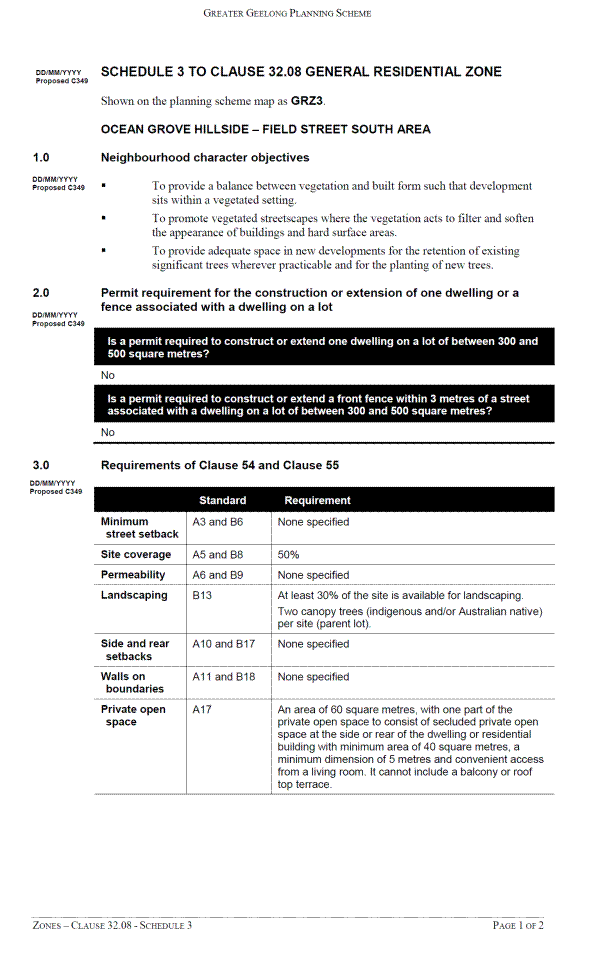
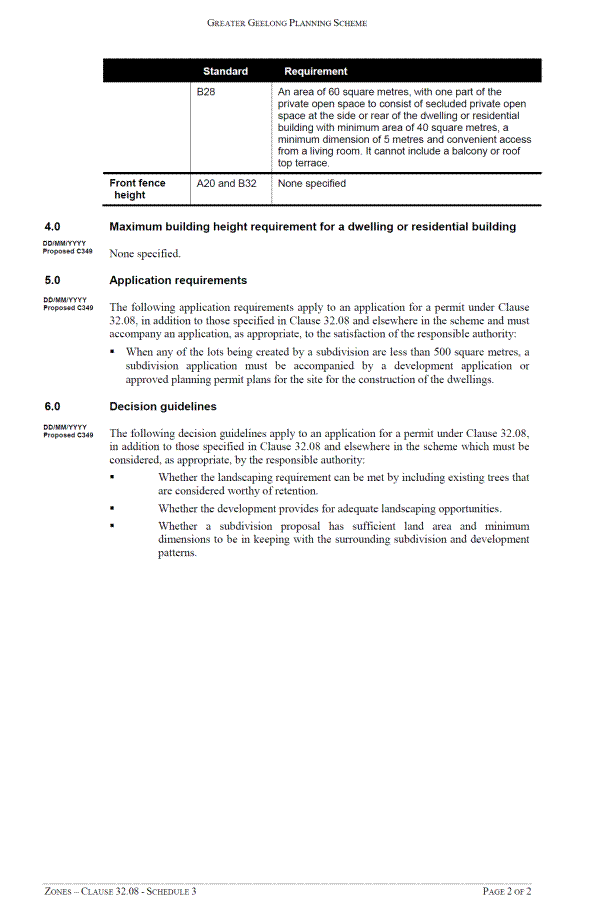
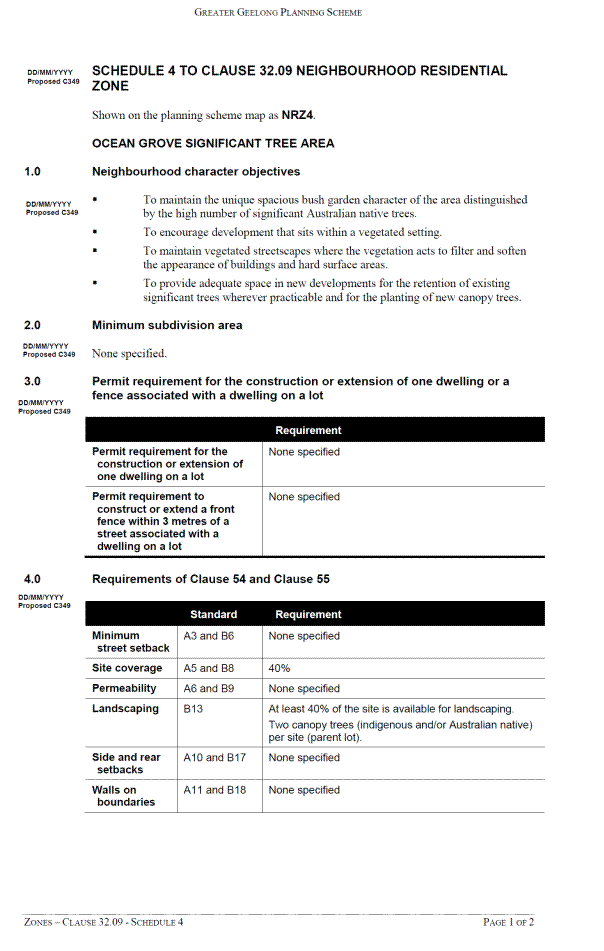
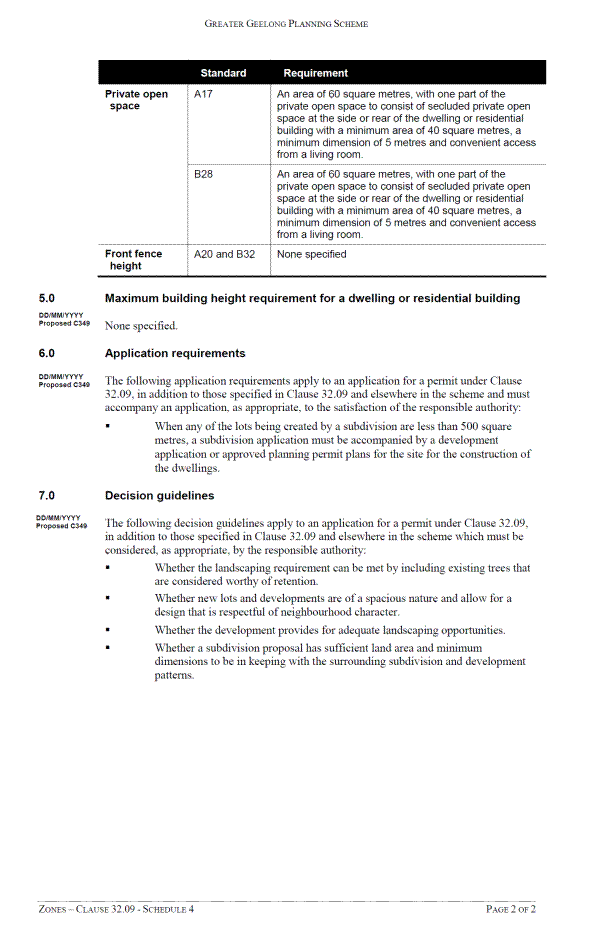
introducing and applying new schedules to the General Residential Zone and the Neighbourhood Residential Zone (GRZ 3 and NRZ 4 respectively);
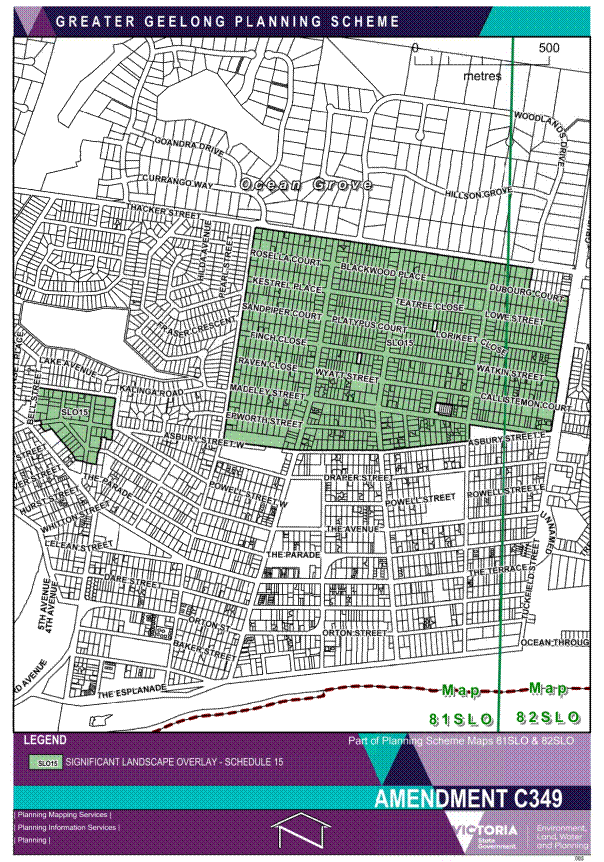
introducing and applying a new Significant Landscape Overlay Schedule 15 (SLO 15);
amending Schedule 7 to the Significant Landscape Overlay (SLO 7);
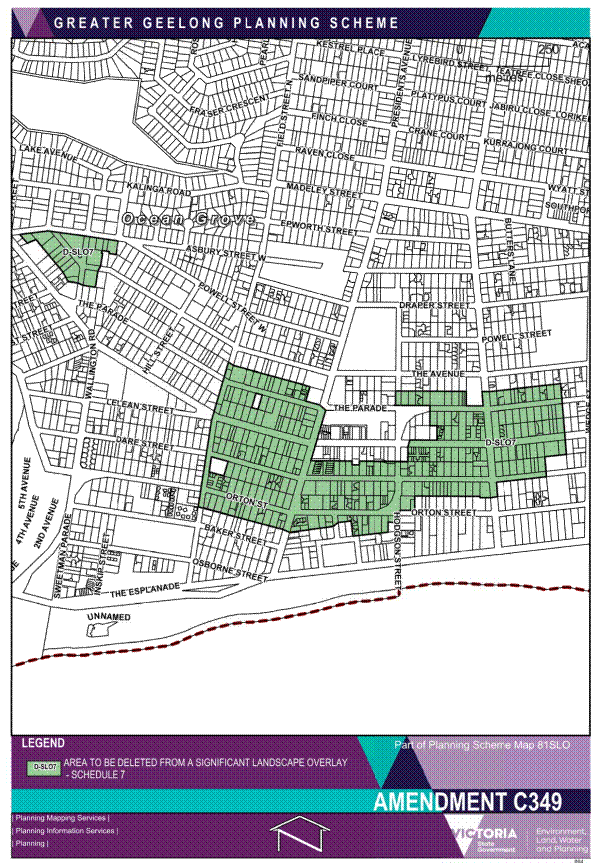
removing properties from Schedule 7 to the Significant Landscape Overlay (SLO 7);
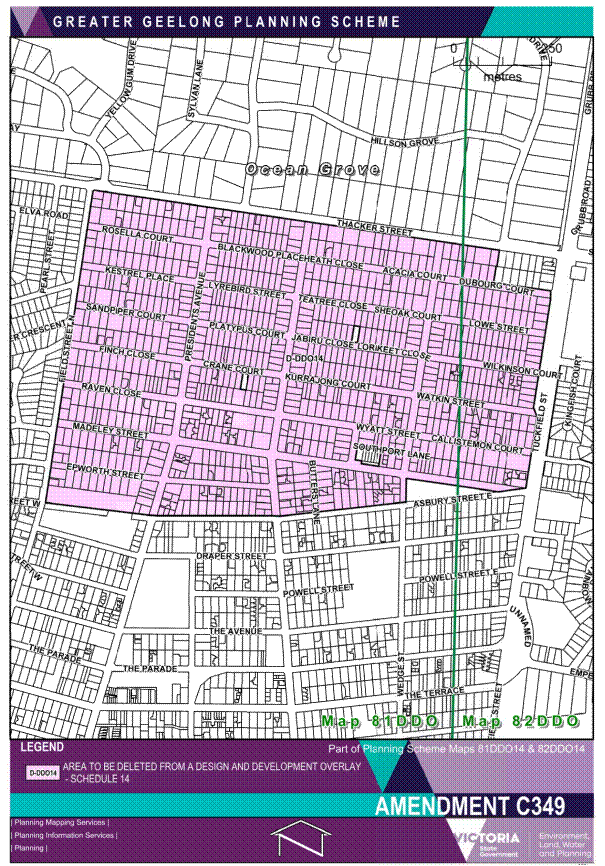
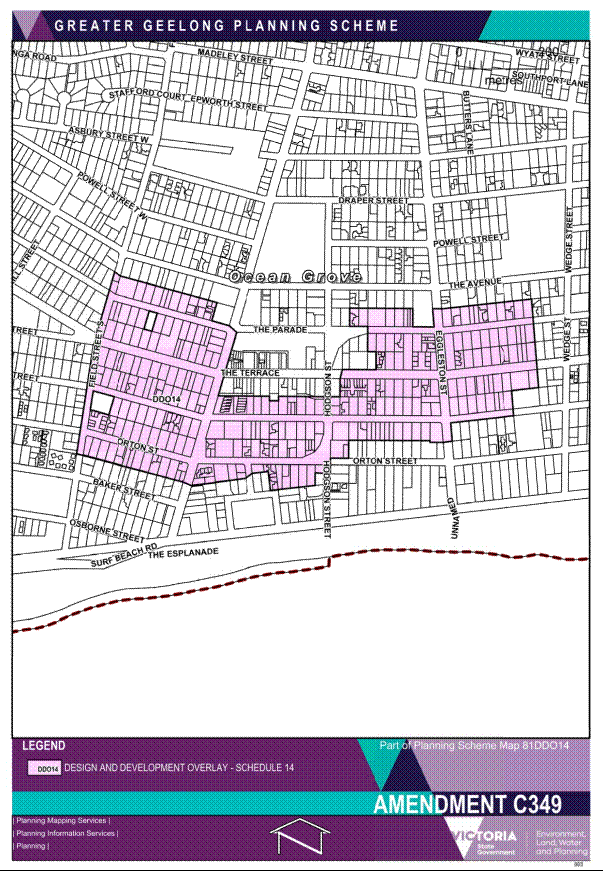
removing and adding properties from/to Schedule 14 to the Design and Development Overlay (DDO 14); and
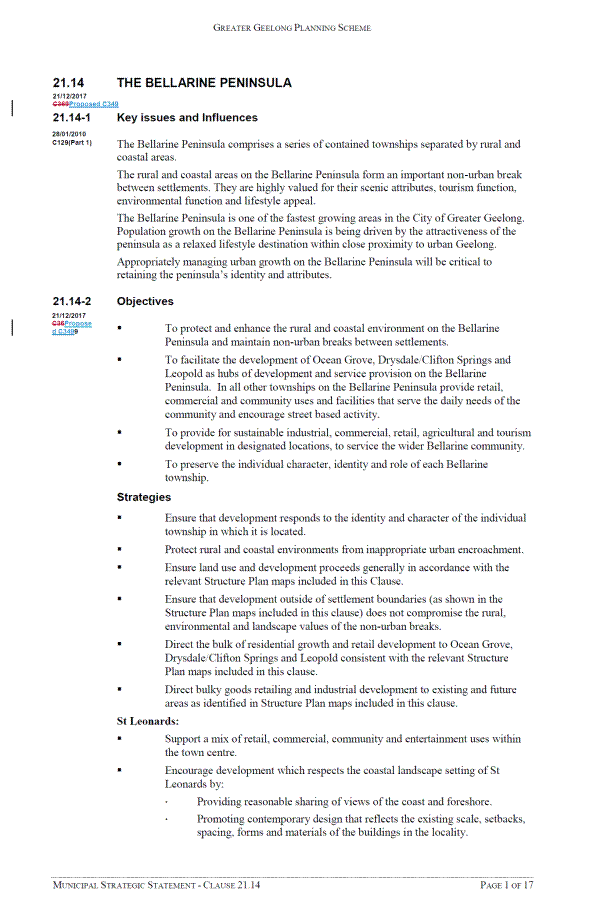
amending Clause 21.14 Bellarine Peninsula.
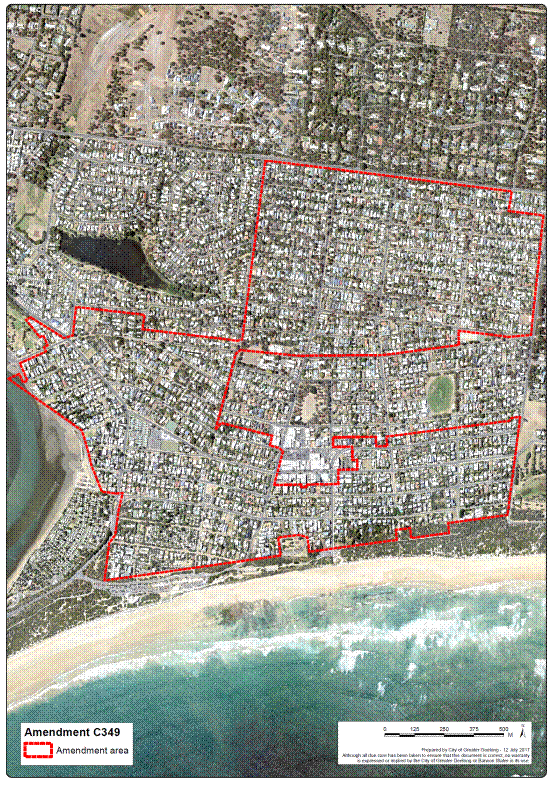
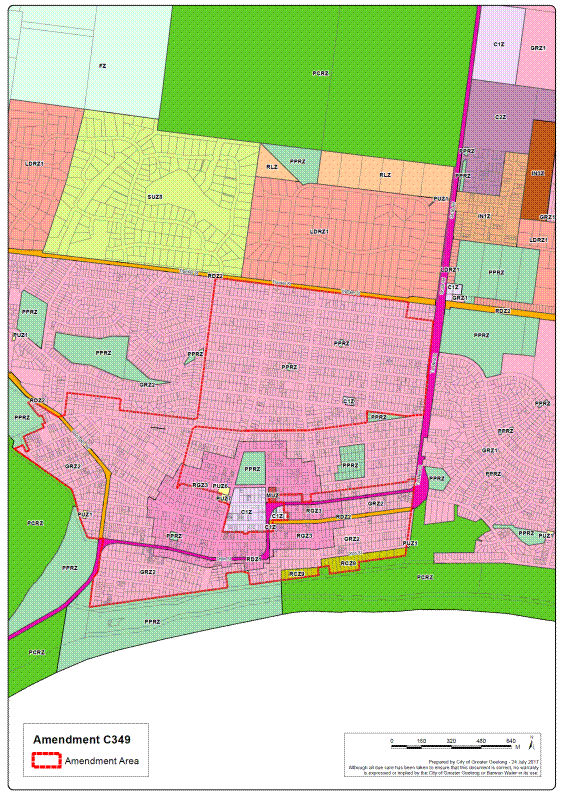
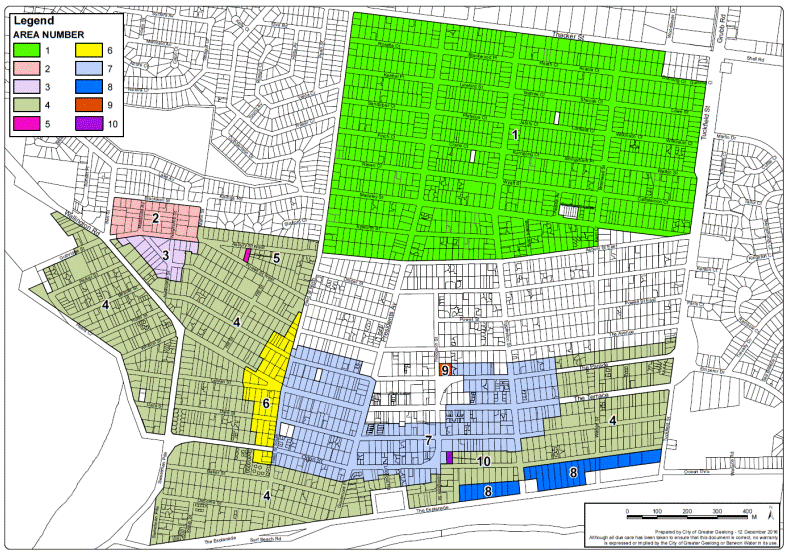
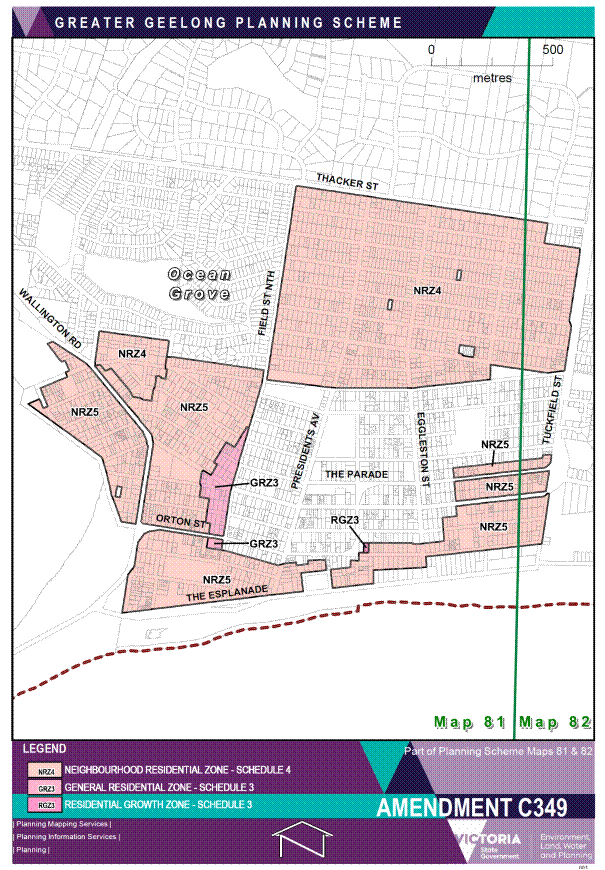
The land subject of the Amendment is shown at Attachment 2. The current zoning of the subject and surrounding land is shown at Attachment 3. A map dividing the subject area into ten separate areas differently affected by the Amendment is at Attachment 4, with a list of the exhibited proposed changes in each of those areas at Attachment 5.
The Amendment was exhibited from Thursday 16 March 2017 to Tuesday 18 April 2017. Notice of the Amendment was mailed to all owners of land affected by the Amendment (2249 letters), with letters specific to each of the ten areas shown at Attachment 4.
20 submissions were received during exhibition. Of 18 submissions from landowners, 9 supported or provided neutral or generally favourable comment, while 9 objected, requested changes or provided generally negative comment. Two submissions were received from government agencies supporting the amendment, with one suggesting minor changes.
Key issues raised in objecting submissions were:
objections to proposed GRZ 3 area and controls;
objections to proposed NRZ 4 area and controls;
inadequate application of current SLO 7;
bushfire management controls; and
objections from Wynndean Holiday Resort.
Consideration of submissions and Amendment VC110 (Reformed Residential Zones)
On 27 March 2017, during exhibition of Amendment C349, the State Government approved Amendment VC110 (Reformed Residential Zones). This Amendment introduced changes to residential zone provisions affecting garden areas, building heights, neighbourhood character objectives and the number of buildings per lot.
Amendment VC110 introduced mandatory maximum building heights and number of storeys for the GRZ and NRZ. In the GRZ, the discretionary building height limit of 9 metres was replaced with a mandatory building height limit of 11 metres and a maximum of three storeys. In the NRZ, the mandatory maximum building height limit of 8 metres was increased to 9 metres with a maximum of two storeys. Any new Schedules to these Zones can only vary the maximum building height by increasing it. Existing Schedules with a lower maximum building height were not changed by Amendment VC110, but the State Government expects such Schedules to be amended by Councils over the next few years to remove any such lower maximum heights.
These changes, not anticipated when Amendment C349 was prepared and exhibited, affected the Amendment’s proposals, particularly in the Hillside Area proposed to be rezoned to GRZ 3. The area being proposed to be rezoned from GRZ 2 to GRZ 3 (Areas 4 and 5 on the map at Attachment 4) has a 9 m mandatory height under GRZ 2 and the exhibited GRZ 3. As a result of Amendment VC110, this would be increased to an 11 m mandatory height limit, with a maximum of three storeys. The area proposed to be rezoned from RGZ 3 to GRZ 3 (Area 6 on the map at Attachment 4) was proposed to have its mandatory height limit reduced from 10.5 m to 9 m, yet Amendment VC110 sees this change to an increase from 10.5 m to 11 m and maximum of three storeys. These changes were a substantial departure from the exhibited Amendment C349.
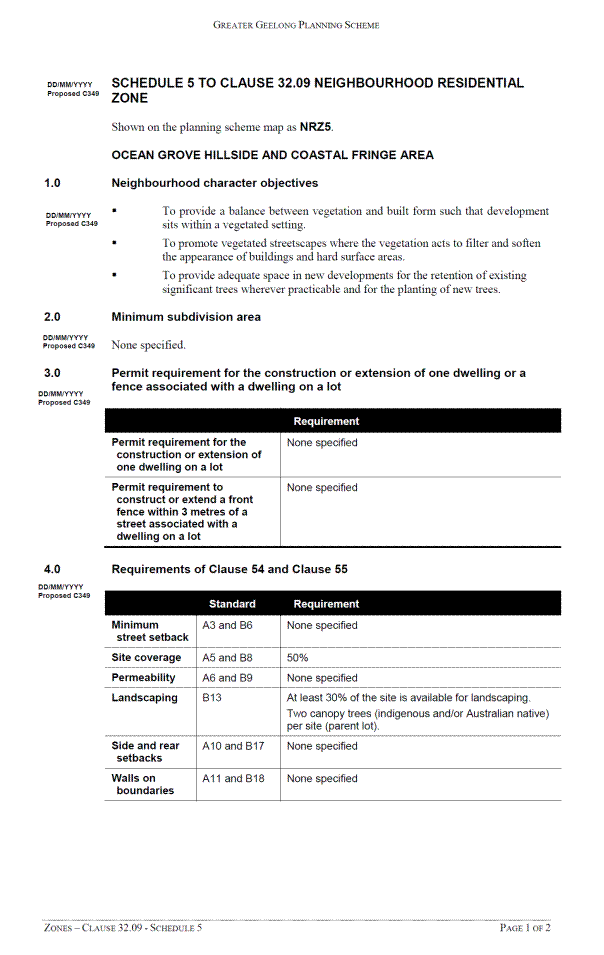
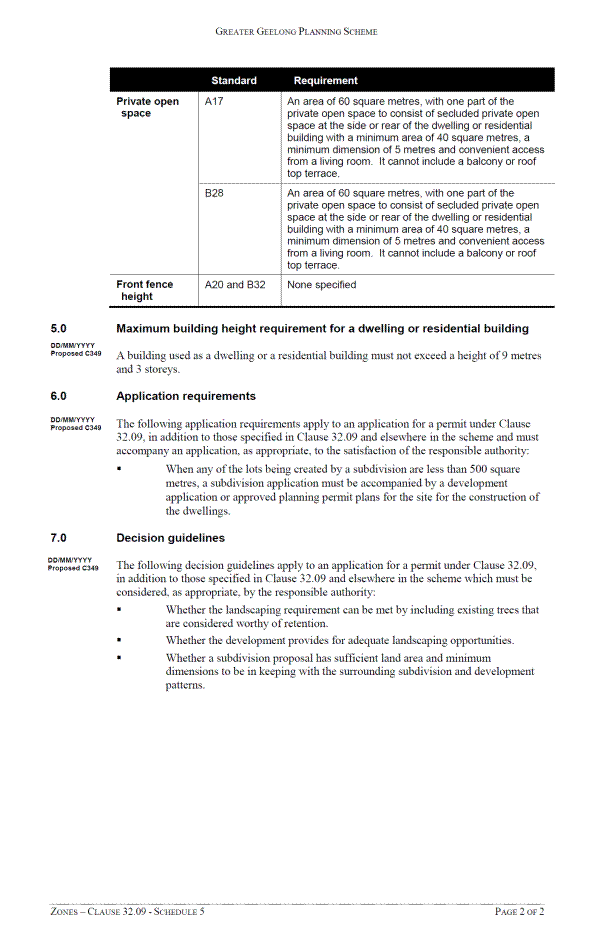
Council, in a Delegate Report on 1 August 2017, considered submissions on Amendment C349. With respect to building heights changes introduced by Amendment VC110, Council took the view that, in order to retain building height limits consistent with those exhibited in Amendment C349 and which were recommended in the OGSTP, and which will minimise adverse visual impacts in a highly visible area of recognised landscape significance on a hillside and coastal fringe, the proposed GRZ 3 area now be rezoned to a new NRZ 5. It was recommended that this NRZ 5 schedule have the same requirements as the exhibited GRZ 3 schedule.
Council, in the Delegate Report of 1 August 2017, resolved to:
Seek comment from affected landowners regarding rezoning the area exhibited as General Residential Zone Schedule 3 to a new Neighbourhood Residential Zone Schedule 5, as outlined in this report;
Consider any further or revised submissions resulting from the consultation in 1) in a separate report;
Request the Minister for Planning to appoint a Panel under Part 8 of the Planning an Environment Act 1987;
Refer all submissions on Amendment C349 to the Panel;
Submit to the Panel its response to the submissions generally as outlined in this report and any subsequent report; and
Revise the Amendment Clause and Schedules generally as outlined in this report prior to the Panel Hearing.
Further consultation on post-exhibition change – August 2017
Landowners affected by this post-exhibition change were given the opportunity to comment on this proposed change. All affected landowners (over 850) were contacted by mail, with letters sent on Thursday 10 August 2017, and given until Thursday 31 August 2017 to comment. Information on the proposed post-exhibition change was placed on the Amendment’s webpage on Council’s website.
54 submissions were received regarding this proposed post-exhibition change (in addition to the 20 submissions on the Amendment during formal exhibition in March and April 2017). Of these 54 submissions, 32 supported the proposed change while 22 opposed it.
Five of the 54 submissions were from submitters who also made submissions on the Amendment during exhibition in March/April or a company on whose behalf a submission was made in March/April. Two submissions supporting the proposed change were from the same submitters with respect to two separate properties; two submissions opposing the proposed change were from the same person representing different owners of adjacent strata properties.
The main issues raised in submissions supporting the proposed change were:
support for landscape protection;
concern at potential loss of views; and
opposition to the change made to the maximum building height for GRZ by the State Government.
Among several others, the main issues raised in submissions opposing the proposed change were:
inconsistency with State Government policy and its direction with the Reformed Residential Zones;
the more restrictive zone purposes of NRZ as opposed to GRZ;
SLO 7 provisions including the 7.5 m building height permit trigger should be sufficient to address landscape impacts;
NRZ limited to two storeys whereas exhibited GRZ 3 allowed three; and
additional maximum building height compensates for reduced maximum site coverage.
On Wednesday 6 September 2017, a Council delegate considered the post-exhibition submissions on Amendment C349 and resolved to:
Refer all submissions on the proposed post-exhibition change to Amendment C349 to the Panel that has been appointed under Part 8 of the Planning and Environment Act 1987;
Submit to the Panel its response to the submissions generally as outlined in this report; and
Revise proposed Schedule 5 to the Neighbourhood Residential Zone and Significant Landscape Overlay Schedule 15 generally as outlined in this report prior to the Panel Hearing.
Panel Hearing
At the Panel Hearing on 30 and 31 October 2017, Council officers reflected the Council delegated authority resolutions and argued that: the Amendment is strategically justified; the OGSTP recommendations it implements result from rigorous analysis, vegetation surveys and review; and the controls proposed for both the Significant Tree Area and the Hillside and Coastal Fringe Area are appropriate, given the number of identified significant trees on both public and private land throughout each area. Council officers indicated that a series of post-exhibition changes to the Amendment were recommended to respond to issues raised in submissions, to State Government changes, particularly the Reformed Residential Zones, and to provide improved wording for clarity and consistency.
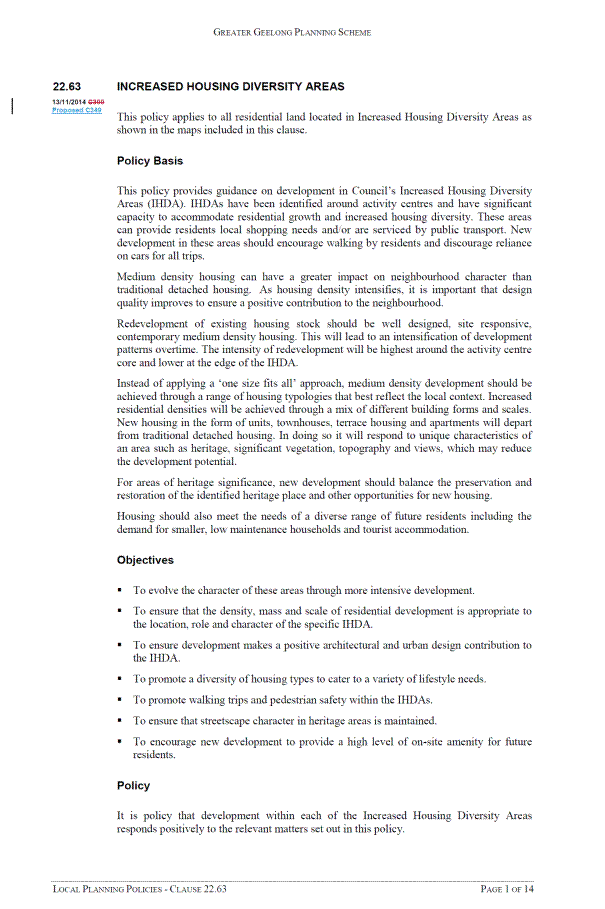
The key change recommended was the proposed post-exhibition change whereby the area previously proposed to be rezoned to GRZ 3 would instead be rezoned to a new NRZ 5. Another change was to modify the Ocean Grove IHDA map at Clause 22.63 to exclude Area 6 as shown at Attachment 4, the small area west of Field Street South that was exhibited as being rezoned from RGZ 3 to GRZ 3 (and was now proposed to be rezoned to NRZ 5).
Panel Report Recommendations
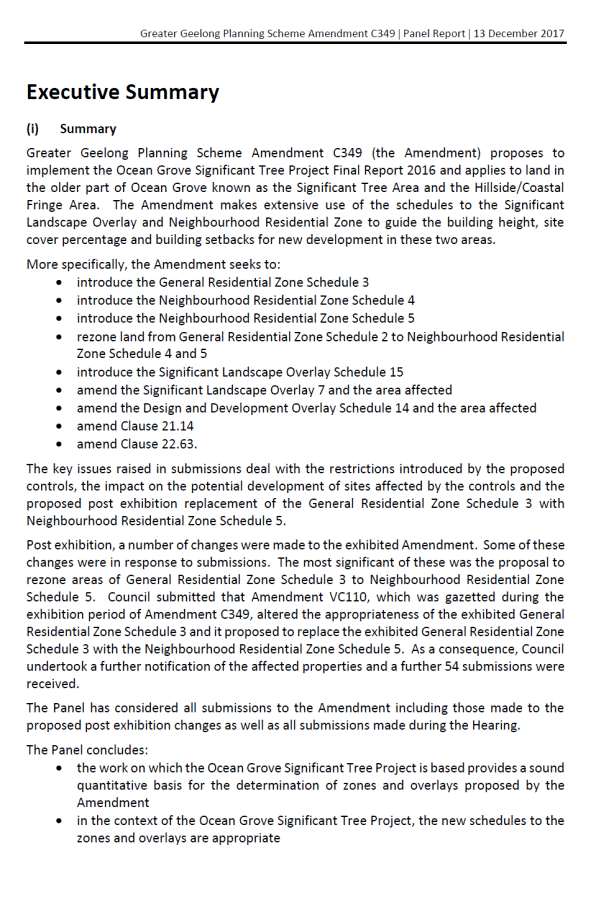
The Panel Report, received on 13 December 2017, supports Council’s position on the Amendment, with the exception of the zoning of one small area and other minor changes. The Panel Report’s Executive Summary is at Attachment 6.
The Panel concluded that:
the work on which the OGSTP is based provides a sound quantitative basis for the determination of zones and overlays proposed by the Amendment;
in the context of the OGSTP, the new schedules to the zones and overlays are appropriate; and
the application of the zones and overlays is appropriate subject to the changes outlined in the report.
The Panel recommended that Amendment C349 be adopted as exhibited, subject to:
rezoning Area 6 (as shown at Attachment 4) from RGZ 3 to GRZ 3 [as exhibited, rather than to NRZ 5 as in Council’s proposed post-exhibition change];
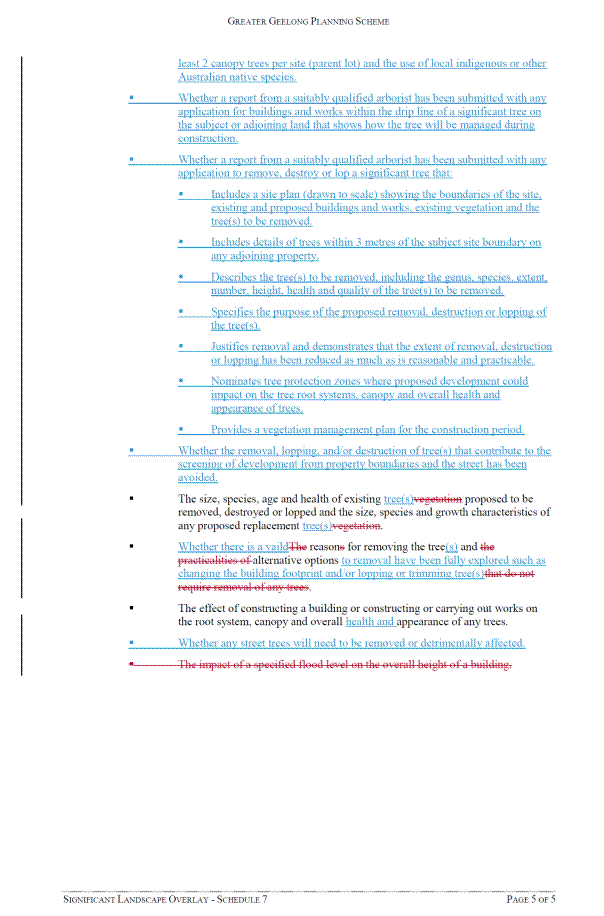
providing a definition of soft landscaping in SLO 7 and SLO 15; and
reviewing the Amendment’s provisions and schedules during finalisation of the Amendment to ensure they are consistent with the Ministerial Direction on the Form and Content of Planning Schemes (May 2017);
as well as other changes that had been recommended by Council at the Panel Hearing:
rezoning Areas 4, 5 and 10 (as shown at Attachment 4) to a new NRZ 5 instead of the exhibited GRZ 3;
changes to the wording of the exhibited NRZ 4, SLO 7, SLO 15 and Clause 21.14; and
changing the Ocean Grove IHDA map in Clause 22.63.
Officer response:
The Panel’s recommendations are supported, with the exception of one minor error.
The Panel’s recommendation that Area 6 be zoned GRZ 3, as exhibited, is supported, as is the removal of this area from Council’s IHDA policy.
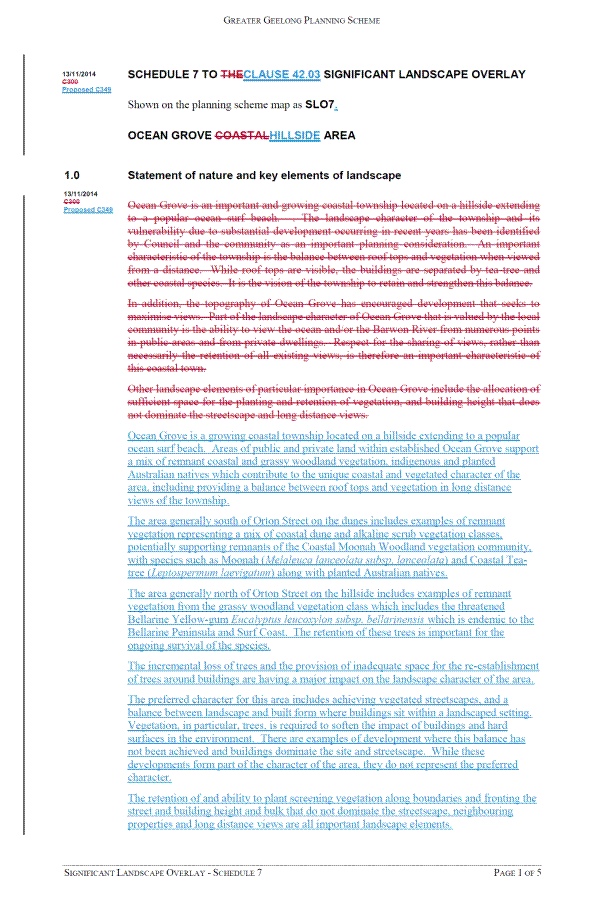
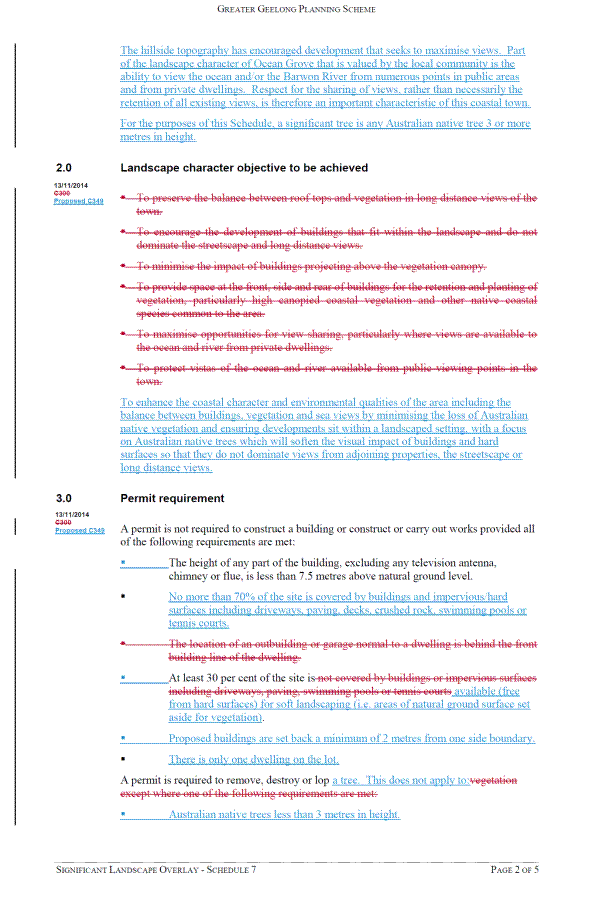
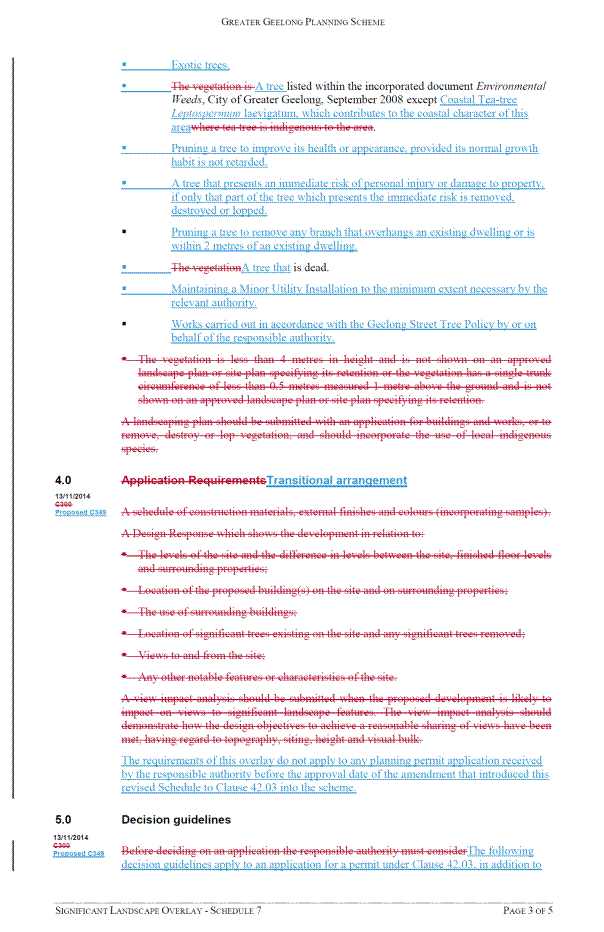
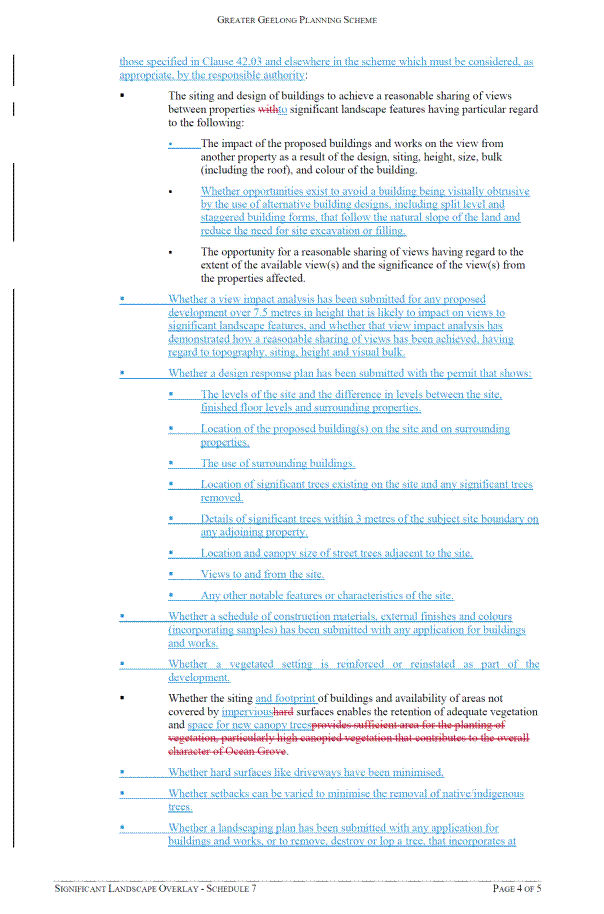
A definition of soft landscaping is included in the recommended SLO 7 and SLO 15 Schedules at Attachment 7.
The Amendment’s provisions and schedules have been reviewed and modifications are recommended as appropriate to ensure consistency with the Ministerial Direction on the Form and Content of Planning Schemes (May 2017). Advice was obtained from the Department of Environment, Land, Water and Planning in carrying out this redrafting. The most substantial changes required were to the SLO 7 and SLO 15 Schedules. These schedules were exhibited with eight and eleven landscape character objectives respectively, but only a single objective for each is allowed under the Ministerial Direction. As application requirements are not allowed in an SLO under the Ministerial Direction, the exhibited application requirements (some of which already apply in SLO 7) have been generally redrafted as decision guidelines.
The Panel’s recommendations include:
Rezone areas 4, 5 and 10 from General Residential Zone Schedule 2 to Neighbourhood Residential Zone Schedule 5.
The rezoning of Areas 4 and 5 from GRZ 2 to NRZ 5 is as Council’s proposed post-exhibition change. However, there is no basis for rezoning Area 10 as indicated in the Panel recommendation.
Area 10 was exhibited as a proposed rezoning from GRZ 2 to RGZ 3. This change is to correct a zoning anomaly whereby one property (91 Orton Street) is split zoned by extending the RGZ 3 zoning over the whole of that property. For a more logical boundary, the change includes the adjacent 93 Orton Street. There was no submission relating to the zoning of the properties and the matter did not arise in the Panel hearing. The Panel Report (section 4.1, page 21) erroneously indicates that the exhibited Amendment proposed Area 10 be rezoned from GRZ 2 to GRZ 3 (not RGZ 3). It is assumed the recommendation is also in error. It is recommended that Area 10 is rezoned from GRZ 2 to RGZ 3 as exhibited.
The final recommended provisions and schedules at Attachment 7 incorporate the abovementioned Panel recommendations as well as Council’s other post-exhibition changes supported by the Panel.
Clause 52.48 of the scheme provides permit exemptions for removal, destruction or lopping of vegetation in some circumstances, to create defendable space around buildings, or along fences, that were existing or approved before 10 September 2009. This is a Victoria Planning Provision (VPP) introduced in response to the recommendations of the 2009 Victorian Bushfires Royal Commission. The Clause applies across the municipality regardless of the identified bushfire hazard level, and overrides the vegetation protection requirements proposed by this Amendment. Many of the trees that require a permit for removal, destruction or lopping under current and proposed SLO 7 and proposed SLO 15 are exempted from that requirement by Clause 52.48.
Council considered issues with Clause 52.48 at its meeting of 15 March 2016 and resolved to write to the Minister for Planning expressing its concerns. Accordingly, in May 2016, Council wrote to the Minister expressing its concerns with Clause 52.48 and requesting that this exemption be more strategically applied as it was leading to vegetation removal in urban areas where there is no identified bushfire threat. The Minister replied indicating that the Department was investigating a more risk based approach and would consider the matter in due course.
It is timely for Council to revisit this matter as Amendment C349 has a focus on vegetation protection in an urban context which could be undermined by Clause 52.48. It is recommended that Council writes to the Minister for Planning reiterating its concerns and requesting an update on the matter.
There will be no significant financial implications on Council. There may be a slight increase in planning permit applications in the affected area.
The Amendment was exhibited in accordance with the provisions of the Planning and Environment Act 1987 to provide for full public comment, including notifying all affected landowners by mail. All landowners affected by a proposed post-exhibition change were further consulted to provide the opportunity for comment.
Submitters have been notified of the release of the Panel Report and will be notified of the final decision on the Amendment of Council and the Minister for Planning.
The Amendment does not raise any social equity issues.
Policy/Legal/Statutory Implications
The Amendment is consistent with the State Planning Policy Framework (Clauses 11.05-2, 12.01-1 and 15.01-5) and the Local Planning Policy Framework (Clauses 21.05-3, 21.06-4, 21.14-2, 21.14-3 and 21.14-7) in the Greater Geelong Planning Scheme. Changes to exhibited provisions are recommended to bring the Amendment into line with the May 2017 Ministerial Direction on the Form and Content of Planning Schemes.
The Amendment supports the Sustainable Built and Natural Environment strategic direction of City Plan, particularly with respect to protecting biodiversity, limiting loss of native species and encouraging new indigenous or other Australian native plantings.
No Council Officers involved in the preparation of this report have any direct or indirect interest, in accordance with Section 80C of the Local Government Act.
There are no notable risks associated with implementing the recommendation contained in this report. There is a risk of continued loss of the vegetated landscape character of the subject area without the introduction of the recommended planning controls.
The Amendment has positive environmental implications, including improved retention of existing significant trees and increased planting of new trees, biodiversity protection and enhancement, habitat and urban heat impact outcomes.
Rezone from General Residential Zone Schedule 2 to Neighbourhood Residential Zone Schedule 4.
Replace Design and Development Overlay Schedule 14 with permanent Significant Landscape Overlay Schedule 15. [Interim Significant Landscape Overlay applies until 28 February 2018]
Area 2
Rezone from General Residential Zone Schedule 2 to Neighbourhood Residential Zone Schedule 4.
Apply a permanent Significant Landscape Overlay Schedule 15. [Interim Significant Landscape Overlay applies until 28 February 2018]
Area 3
Rezone from General Residential Zone Schedule 2 to Neighbourhood Residential Zone Schedule 4.
Replace Significant Landscape Overlay Schedule 7 with permanent Significant Landscape Overlay Schedule 15.
Area 4
Rezone area from General Residential Zone Schedule 2 to General Residential Zone Schedule 3.
Revise the wording of Significant Landscape Overlay Schedule 7.
Area 5
Rezone from General Residential Zone Schedule 2 to General Residential Zone Schedule 3.
Area 6
Rezone from Residential Growth Zone Schedule 3 to General Residential Zone Schedule 3.
Revise the wording of Significant Landscape Overlay Schedule 7.
Area 7
Replace Significant Landscape Overlay Schedule 7 with Design and Development Overlay Schedule 14.
Area 8
Revise the wording of Significant Landscape Overlay Schedule 7.
Area 9
Delete Significant Landscape Overlay Schedule 7.
Area 10
Rezone from General Residential Zone Schedule 2 to Residential Growth Zone Schedule 3.
Replace Significant Landscape Overlay Schedule 7 with Design and Development Overlay Schedule 14.
Source: |
Planning and Development - Strategic Implementation |
Director: |
Kelvin Walsh |
Index Reference: |
Amendment C353 |
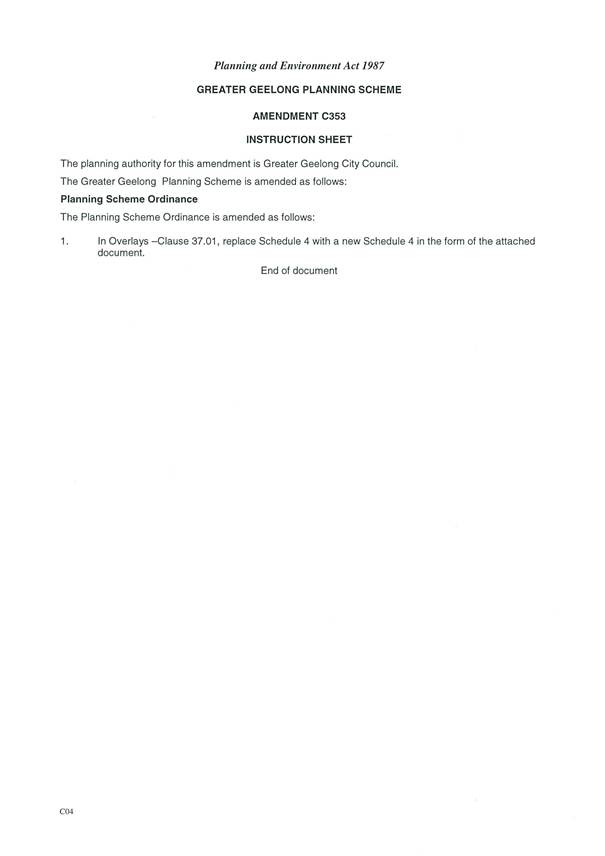
To consider the submissions received following the exhibition of Amendment C353 and to adopt the Amendment.
A Planning Scheme Amendment application has been made by Jewell Partnership acting on behalf of TOM Assets and Beckley Park Committee of Management. It seeks to amend Schedule 4 of the Special Use zone to enable a permit to be considered for major promotional signage. The Committee of Management has obtained the agreement of the Land Management Policy section of Department of Environment, Land, Water & Planning (DELWP) to make this application. Promotional signage can carry a range of commercial, not for profit or government agency (eg. TAC, VicHealth) messaging and would be unlikely to advertise Beckley Park events.
This application arose out of recommendations of the Beckley Park Working Group, chaired by the previous Member for Western Victoria with representatives of Beckley Park users, Committee of Management and Council with observers from various Government Departments. The Working Group met during 2012-2014 to investigate options to improve the on-going financial sustainability of the facility, which operates on Crown Land. The Working Group was made aware of the requirements of the planning scheme amendment process.
Beckley Park is the home of Geelong Harness Racing club, Geelong Greyhound Racing club, Geelong Karting club and Beckley Park Community Market. In the words of the applicant, the proposed signs “will provide revenue and the funds can be used to offset operating costs and support future development works at Beckley Park”.
The amendment was exhibited between 13 July 2017 and 14 August 2017, with two submissions being received, from VicRoads and the DELWP, neither of which objected to the Amendment as exhibited.
The key issue is that on the one hand there is potential high visual impact of the proposed signs at the city’s major northern entrance whilst on the other there is an opportunity to provide the Committee of Management with important operating revenue.
On balance, this report recommends the report be adopted.
Councillor Aitken moved, Councillor Grzybek seconded -
That Council:
adopts the exhibited Amendment C353, as contained in Attachment 2 to this report; and
submits the adopted Amendment and prescribed information to the Minister.
Carried.
Beckley Park is situated at a high-profile location which makes it an attractive site for large scale outdoor advertising. On approaching Geelong from the direction of Melbourne, Beckley Park marks the entrance to the city’s northern suburbs. At this location large promotional signs similar in nature to the one at Avalon Airport will be clearly visible to all road users coming to or leaving Geelong.
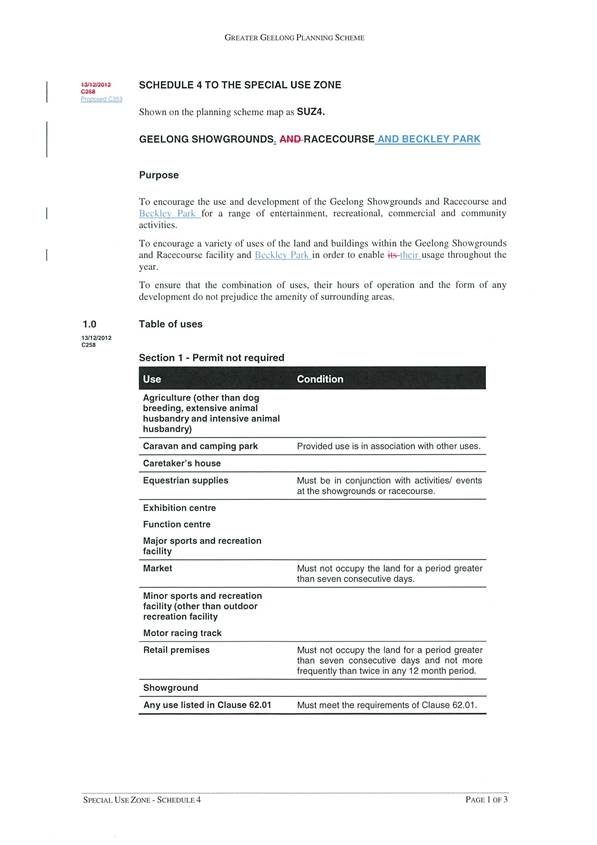
This amendment is being sought because major promotional signs are prohibited under the current provisions of Schedule 4 to the Special Use Zone. The Special Use Zone provisions at Clause 37.10-5 apply the Category 3 set of controls to advertising signs, “unless a schedule to this zone specifies a different category”. The Category 3 advertising provisions prohibit major promotional signage.
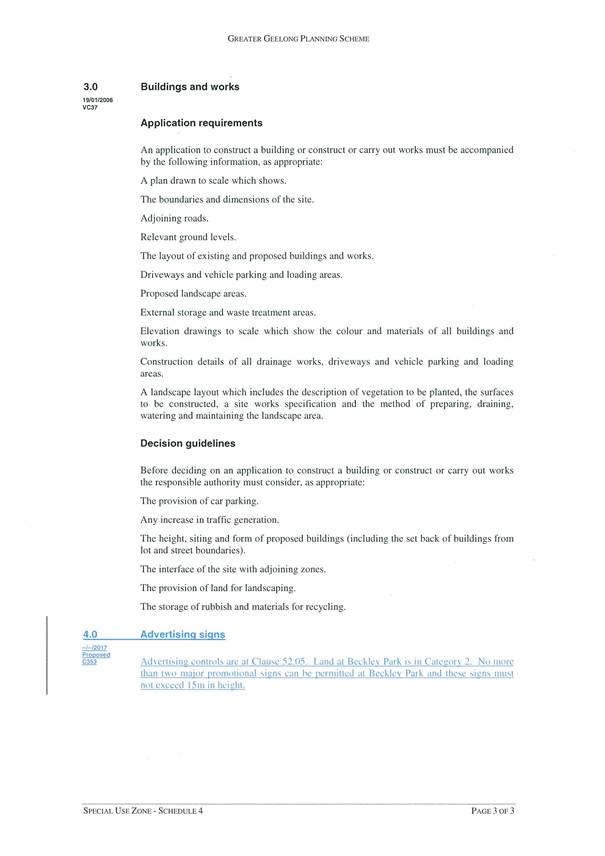
The amendment introduces a new Clause 4.0 to Schedule 4 to the Special Use Zone, which identifies that the Beckley Park land falls under Category 2 of the advertising controls, contained in Clause 52.05 of the planning scheme. A permit will be required to erect the signs.
The amendment will place a mandatory limitation on the number and height of the proposed major promotional signs. The applicant’s consultant has agreed with these proposed restrictions to limit the number of such signs to two with an overall height of 15 metres.
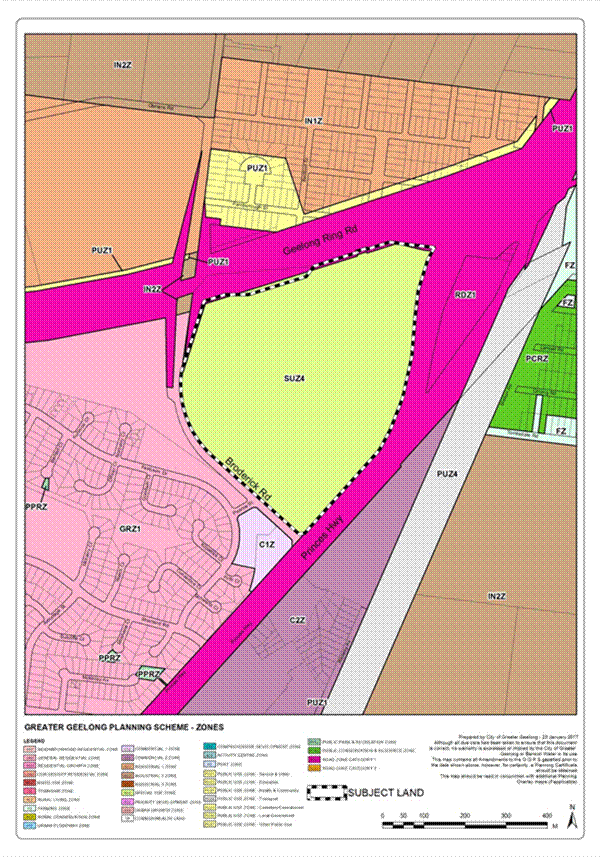
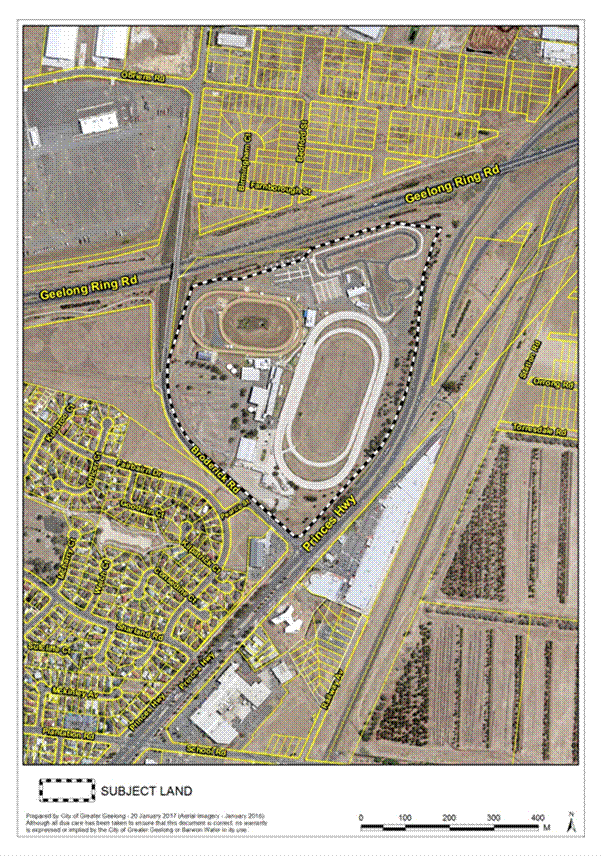
Plans submitted with the request for amendment show a major promotional sign is proposed to be erected in a generally central location on each of the Princes Highway and Geelong Bypass frontages such that they are very well clear of the residential area on the west side of Broderick Road.
It should be noted that this application makes it clear that approval will be subsequently sought for these signs to include an electronic or digital component.
It is not being recommended that a mandatory prohibition be placed on electronic advertising as part of this amendment. Therefore, the subsequent permit application if approved will set a precedent for electronic advertising on major roads in Geelong. Examples of such advertising on main roads in the metropolitan areas of Melbourne have been approved and VCAT has already supported some cases. In these circumstances, prohibition of electronic advertising on the Beckley Park site is difficult to justify.
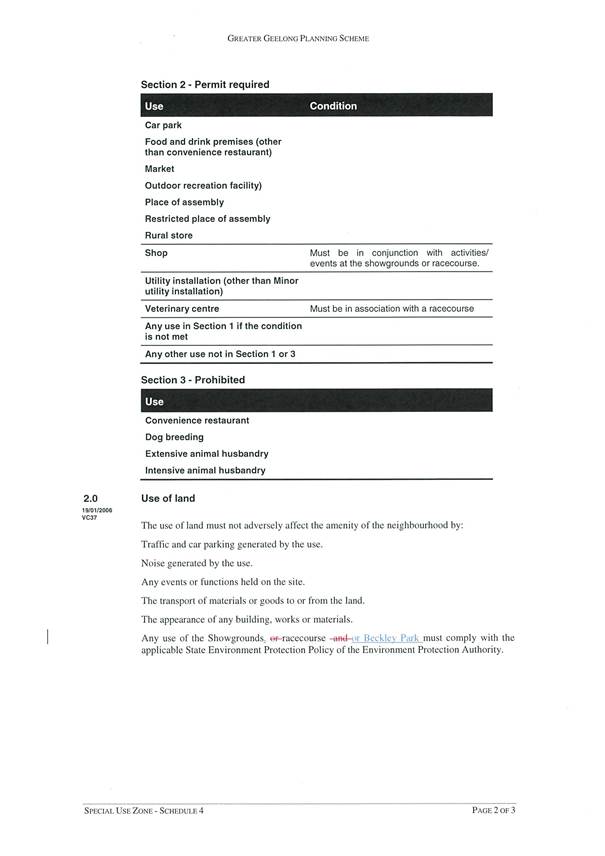
Attachment 2 contains the amendment documentation, for adoption, which includes the amended Schedule 4 to the Special Use Zone with the proposed changes as described above included in tracked changes format. It should be noted reference has now also been made to Beckley Park in the Schedule name and Purpose to indicate it does not only apply to the Geelong Showgrounds and Racecourse.
Attachment 3 shows the zoning of Beckley Park and the surrounding area.
Attachment 4 is an aerial photograph of the same area.
Prior to seeking Authorisation to exhibit, the application was referred to VicRoads which indicated it did not object subject to the imposition of conditions on any subsequent permit issued relating to electronic signage.
There are pros and cons to be considered. On one hand Beckley Park is clearly an urban use where some form of substantial advertising would normally be considered acceptable, particularly as it is unlikely to be visible from the nearest residential areas to the west of Broderick Road.
On the other hand, these proposed signs will be highly prominent at the entrance to urban Geelong and may be viewed as being at odds with the Council’s long-standing program to beautify the city’s northern entry along Princes Highway. Motorists entering the city either along the Ring Road or Princes Highway will be greeted with large scale conspicuous advertising which could well set a precedent for similar signage elsewhere along the city’s major roads.
It is important to acknowledge (as does the applicant) that Council’s support for this amendment does not bind Council’s consideration of any future planning permit application which would be assessed against State and Council planning policies and the provisions of Clause 52.05 of the Planning Scheme, the purpose of which is:
to achieve high quality visual standards for the siting of major promotion signs;
to ensure that the signs are not detrimental to the appearance of their surroundings or the safe and efficient operation of the route through the application of consistent planning controls.
The decision guidelines to this Clause require Council to consider the effect of such signs on streetscapes, a significant view corridor, gateway location etc. and a range of locational principles.
On balance, this amendment is supported having regard to the history of the application as outlined above, the proposed limitation of signs to two in number with a maximum 15 metres height limit, as any such signage is unlikely to impact on nearby residential areas and would be located on the site of an existing substantial use within the urban area.
The proposal will have no financial implications for Council.
Stakeholder Consultation and Communication
The amendment was exhibited in the normal manner with two submissions received, neither of which objected to the amendment in the form exhibited.
Clause 18.02-4 of the Planning Scheme (management of the road system) to “regulate the design of transport routes and nearby areas to achieve visual standards appropriate to the importance of the route with particular reference to landscaping, the control of outdoor advertising”…etc.
Clause 21.08-2 similarly highlights the importance of the presentation of development along highways and main roads. One of its objective is “to improve the appearance of transport routes at key entrances to townships and urban areas”.
The amendment is consistent with City Plan’s Strategic Direction of Growing our Economy, in particular the Priority of Supporting Existing Businesses.
No Council officers have declared a direct or indirect interest in this matter, in accordance with Section 80(c) of the Local Government Act, to which this amendment relates.
No risks have been identified in relation to the adoption of Amendment C353 as is recommended by this report.
The amendment will have no environmental implications.
Source: |
Strategy and Performance |
Director: |
Peter Anderson |
Index Reference: |
Land Sales |
To seek Council’s approval to offer to sell the former Geelong Post office, and give public notice of its intention to do so.
The Council purchased the Geelong Post Office from the State in 1996 using an interest free loan of $670,000 which remains outstanding. Since purchase of the property it has been used for both Council accommodation and leased to tenants mainly engaged in the provision of youth services.
Of the 1,544m2 of floor space in the building, 623m2 is occupied by Council staff. The Council staff are due to be relocated in April 2018, leaving the property entirely vacant.
The building with its solid internal and external walls is inefficient and difficult to adapt to contemporary office standards and has no identified role in any future Council operations or requirements. A recent estimate of the cost of refurbishing the building for office accommodation is $3.73m.
Enquiries have been received from potential purchasers and, subject to approval, the building has potential for conversion to alternative uses including apartments or short stay accommodation. There is limited on-site parking available.
The heritage aspects of the building are adequately protected through its inclusion on the Victorian Heritage Register and within a heritage overlay on the planning scheme. A Conservation Guidelines report is being prepared by an experienced heritage consultant which will be made available as part of the sale process. The report will define fabric loss and change, provide conservation guidelines and will be used to assist in the approvals processes at Heritage Victoria and Council should future changes to the fabric be proposed.
It is recommended that the building be sold without conditions relating to future use or development. An agent will be appointed and will advise upon the method of sale, and the price will not be less than Council’s certified valuation to be obtained.
Council is required to give public notice of its intention to sell the property under s189 of the Local Government Act 1989 (LGA). Any person is able to make a submission and be heard in respect of that submission. If submissions require hearing they will be heard by Council’s Submissions Review Panel and a further report will be put to Council. .
Discussions have commenced with the State Government on the possible redeployment of the outstanding loan to other heritage related Council projects.
Councillor Mason moved, Councillor Aitken seconded –
That the report be deferred.
Carried.
Source: |
Governance and Legal Services |
Executive Manager: |
Rebecca Leonard |
Index Reference: |
Advisory Committee |
To establish a Rural and Peri-Urban Advisory Committee (the Committee) and endorse the Committee’s terms of reference.
The Community Focus Committee, at its 13 February 2018 meeting, made the following resolution:
That the Community Focus Committee:
recommends to Council that it establishes a Rural and Peri-Urban Advisory Committee consisting of appropriately experienced and skilled members to provide advice to Council regarding key strategic and service matters affecting the rural and peri-urban community of the municipality;
requests the Chief Executive Officer to draft a Terms of Reference for the Rural and Peri-Urban Advisory Committee for approval by Council at the 27 February 2018 Council Meeting. Such Terms of Reference to include an objective of considering and providing advice to Council on matters relevant to rural and peri-urban constituents, including:
Transition strategies for saleyards services such as:
Livestock exchange;
Information exchange;
Hygiene and vehicle wash-down;
Ongoing community advocacy and policy development for best rural and peri-urban agricultural and environmental management practices;
Bio-security strategies;
Council plan strategies;
Collaboration with G21 members, major and other local, State and Federal government organisations;
Key planning strategies and structure plans;
Considering past consultation, reports and decisions as well as current and new strategy documents and externally sourced technical information; and
Undertaking consultation to inform advice as required.
Appoints a Councillor as Chair of the Rural and Peri-Urban Advisory Committee.
A further resolution of the Community Focus Committee was:
That Councillor Jim Mason be appointed as Chair of the Rural and Peri-Urban Advisory Committee.
This report gives effect to those resolutions.
Council is able to establish advisory committees by resolution to provide advice to Council on a particular matter. Such committees do not have delegated powers and may not allocate Council funds or resources.
The work of the Rural and Peri-Urban Advisory Committee (the Committee) will strengthen and support the commitment of the City of Greater Geelong (the Council) to the wellbeing and sustainability of its rural and peri-urban communities.
Terms of reference for the Committee (Attachment 2) have been prepared and reflect the resolution made by the Community Focus Committee meeting on 13 February 2018 for endorsement by the Council.
Councillor Mason moved, Councillor Aitken seconded -
That Council:
Establishes a Rural and Peri-Urban Advisory Committee consisting of appropriately experienced and skilled members to provide advice to Council regarding key strategic and service matters affecting the rural and peri-urban community of the municipality;
Appoints a councillor to be chairperson of the Rural and Peri-Urban Advisory Committee;
Appoints Councillor Jim Mason to be the inaugural chairperson of the Rural and Peri-Urban Advisory Committee;
Endorses the Rural and Peri-Urban Advisory Committee Terms of Reference at Attachment 2 of this report.
Carried.
There are no financial implications arising from the subject of this report.
The establishment of the Committee will enhance engagement on matters affecting Council’s rural and peri-urban community.
The Committee will allow consideration of social equity issues that affect Council’s rural and peri-urban constituents.
Policy/Legal/Statutory Implications
Formation of the Committee is compliant with the Local Government Act 1989 as well as Council’s policies and procedures relating to the establishment of advisory committees.
The work of the Committee will support delivery of the City Plan and future consideration of rural and peri-urban strategic needs.
No Council officers or contractors who have provided advice in relation to this report have declared a conflict of interest regarding the matter under consideration.
There are no significant or high risks associated with the subject of this report.
There are no environmental implications arising from the subject of this report.
Source: |
Chief Executive |
Director: |
Kelvin Spiller |
Index Reference: |
Transformation Program |
As required to provide a quarterly update on the progress of the Transformation Program as at 31 December 2017 to the Council and the Minister for Local Government.
The Transformation Program was primarily developed in June 2016 to ensure that the 12 key recommendations and 25 secondary recommendations of the Commission of Inquiry report and actions from the Halliday Report are carried out.
The Transformation Program is organised under eight focus areas and contains 28 projects. The focus areas and projects are listed in the attached report.
In October 2017 Ernst & Young (EY) was engaged by the CEO at the request of the Administrators to provide an independent status update of the City of Greater Geelong’s progress in achieving this program.
EY found that the Transformation Program will continue to require a high level of sustained focus and that many of the initiatives will require a longer period of continued effort to see through transformation.
The objective is to enable transformation to the most efficient and effective organisation possible to fulfil its purpose of working together for a thriving community.
The report has also been provided to the Primary Municipal Monitor and signed with the intention to be forwarded to the Minister for Local Government. My office is working closely with the Primary Municipal Monitor in monitoring and validating evidence of the implementation of the program.
Of the 28 projects, 20 are 50 per cent complete or over with the remaining eight under 50 per cent complete.
The attached report contains highlights, focus areas and issues /delays to be addressed next quarter. Key issues to be addressed next quarter include:
Councillor induction to be completed
Integration of Greater Geelong: A Clever and Creative Future into the Council Plan
Employee Opinion Survey (2017) Action Plan completed and signed off by the Executive Leadership Team
Interim workforce resource plan (current state)
ICT underfunding to be addressed.
Implementation of the program is progressing satisfactorily.
Councillor Grzybek moved, Councillor Murrihy seconded -
That Council note the December 2017 quarterly update of the Transformation Program.
Carried.
A number of projects such as the ICT strategic review implementation, internal communications resourcing and civic accommodation are subject to 2018-19 Budget funding and beyond.
The review of the Community Engagement Strategy is one of the projects within the Transformation Program.
Progress on the Transformation Program is reported to the Executive Leadership Team on a quarterly basis with further updates provided to staff via Interlink and CEO weekly email.
The Social Infrastructure Plan review is one of the 28 projects in the Transformation Program.
The Transformation Program was developed in response to the 2016 Commission of Inquiry report. In that report there were 12 key recommendations and 25 secondary recommendations to be addressed. The Primary Municipal Monitor will continue to review the progress of the Transformation Program and report to the Minister of Local Government.
Progress on the Transformation Program is monitored by the Chief Executive Officer, Primary Municipal Monitor and Council.
Transformation Program is managed by the Coordinator Transformation, Program Integration and Development.
The program is also monitored via the organisations enterprise risk update.
Source: |
Governance and Legal Services |
Executive Manager: |
Rebecca Leonard |
Index Reference: |
Corporate Management - Legislation |
To endorse the Greater Geelong City Council submission (Attachment 2) in response to the Victorian Government’s Local Government Bill 2018 Exposure Draft.
The Victorian State Government has released, in December 2017, an exposure draft of the Local Government Bill 2018 (the Draft Bill). This is the culmination of an extensive three-stage engagement program with councils, ratepayers, the wider community and specific stakeholders. Council has made submissions at various stages of this process.
There is now an opportunity for Council to make a submission on the Draft Bill.
Submissions in response to the Draft Bill close on Friday 16 March 2018 at 5pm. This timeline has been set with the objective of having the new Act in place by June 2018.
The Draft Bill proposes the revocation of the City of Greater Geelong Act 1993.
Governance recommendations arising from the Geelong Citizens’ Jury and Commission of Inquiry into Greater Geelong City Council have been reviewed against the Draft Bill. Areas of deficiency that may be accommodated in the legislation include:
Induction training, ongoing training and performance reviews for Councillors;
Education of the community to promote democratic processes;
Limitations on the maximum size of municipalities;
Prohibition of developer financial and in-kind contributions to candidates and council staff.
Council management have reviewed the Draft Bill and made recommendations which have been incorporated in the proposed submission.
The proposed submission is generally supportive of the direction the legislative reform is taking.
Councillor Aitken moved, Councillor Mansfield seconded -
That Council:
adopts the Greater Geelong City Council submission to the Local Government Bill 2018 Exposure Draft at Attachment 2; and
sends the submission to the Local Government Act Review Secretariat.
Carried.
There are no direct financial implications arising from the subject of this report.
The engagement process has been managed by the State Government and has involved four stages.
Stage 1 – September 2015 Discussion Paper canvassing reform ideas – 348 submissions; 10 community forums; 12 commissioned specialist papers; six technical working groups; meetings with peak council and ratepayer groups.
Stage 2 – June 2016 Directions Paper outlining 157 potential reform directions – 333 submissions; 18 community forums with Mayors, council CEOs and community members; meetings with peak council and ratepayer groups.
Stage 3 – 2017 Implementation Challenges targeted consultation – seven technical working groups of over 100 senior sector experts; meetings with peak ratepayer groups, key stakeholders on specific reforms, council peak organisations and new councillors.
Stage 4 – December 2017 Draft Bill for community submissions.
Council has participated through submissions and involvement in each stage of the process to date.
An analysis of governance recommendations of the Geelong Citizens’ Jury community engagement process has identified areas of deficiency in the Draft Bill (Attachment 3). These have been included in the proposed submission, including:
Induction training, ongoing training and performance reviews for Councillors to gain and maintain an understanding of the responsibilities of the position enabling the best possible performance in the role;
Education of the community to promote democratic processes and to ensure the public is informed in matters of local government and improve democratic representation;
Limitations on the maximum size of municipalities to minimise disparity of representation among different municipalities, distinguish local level government from higher-level government and enhance local representation; and
A prohibition of developer financial and in-kind contributions to candidates and council staff, consistent with other states’ legislation to assist with the avoidance of fraudulent and corrupt behaviour.
Relevant governance recommendations from the Commission of Inquiry into Greater Geelong City Council Report March 2016 have been reviewed in light of the Draft Bill (Attachment 4). All of those recommendations have been catered for in the Draft Bill.
Management has been consulted on implications of the Draft Bill. The proposed submission point coming from this consultation was:
The authorised officer provision has changed wording when comparing clause 326 of the Draft Bill with section 224(7) of the Local Government Act 1989 (the Act).
The wording in the Act, ‘An authorised officer may enter any land or building in the municipality district at any reasonable time to carry out and enforce this or any other Act or regulation or local law.’ has had the words ‘or any other Act’ removed. The omission of the wording ‘or any other Act’ now removes the ability for Council fire prevention officers to enter a property to form an opinion whether a property may be a fire hazard when enforcing the provisions of the Country Fire Authority Act 1958. A return to the wording in section 224(7) of the Act is required to enable this vital function to continue to be performed effectively.
There are no social equity implications arising from the subject of this report.
The Draft Bill is the final step in the process of establishing a new local government Act.
A new local government Act will establish the legislative framework for how Council does business in the future.
No Council officers or contractors who have provided advice in relation to this report have declared a conflict of interest regarding the matter under consideration.
There are no significant or high risks associated with the subject of this report.
There are no environmental implications arising from the subject of this report.
Source: |
Governance and Legal Services |
Executive Manager: |
Rebecca Leonard |
Index Reference: |
Elections |
To submit to Council the Victorian Electoral Commission’s (the VEC) Election Report for the Greater Geelong City Council General Election 2017.
The Greater Geelong City Council general election was held on 28 October 2017 by postal voting.
The election was conducted by the VEC, as the statutory election service provider to Greater Geelong City Council in accordance with clause 1 of Schedule 2 of the Local Government Act 1989 (the Act). The VEC is an independent and impartial statutory authority established under the Electoral Act 2002.
The Act requires that:
the returning officer must prepare a report to the Chief Executive Officer on the conduct of the election within the period of three months after Election Day;
the report must include a certified record of the number of ballot-papers and declarations printed, issued, used, spoiled and returned; and
the Chief Executive Officer must ensure that the report is submitted to the Council at the earliest practicable meeting of the Council held after the report is received by the Chief Executive Officer.
The report was received by Council on 24 January 2018.
The report includes detailed information about the role of the Returning Officer, the Election Office, candidate services, enquiry services, issuing and return of ballot papers, the computer count and declaration of the results, voter participation, the communication campaign and complaints.
The participation rate (total number of votes received as a percentage of the total enrolment) was 79.73% which compares favourably to the average of 75.67% for all postal elections held across the State at the 2016 local government elections (excluding Melbourne City Council).
The informal voting rate was 6.53% which compares unfavourably with 6.06% for all postal elections held across the State at the 2016 local government elections. Greater Geelong City Council recorded an informal rate of 2.41% at its last general election in October 2012.
The VEC received six written complaints during the election period. Four complaints were in relation to the administration of the election and two related to the conduct of a participant in the election.
The VEC did not refer any complaints to the Local Government Investigations and Compliance Inspectorate as none alleged a breach of the Act.
Councillor Grzybek moved, Councillor Kontelj seconded -
That Council notes the Victorian Electoral Commission Greater Geelong City Council General Election 2017 Report at Attachment 2 to this report.
Carried.
There are no financial implications arising from the subject of this report.
The VEC carried out a number of communications activities whilst conducting the election process. They included:
publishing a series of statutory notices in relation to the Greater Geelong City Council general election. These notices are required by the Act and contain critical information relevant to each point of the election timeline.
featuring interactive advertisements on Facebook targeting the Greater Geelong geographic area.
conducting staged media releases aimed to highlight key milestones during the election timetable and capitalise on existing general news coverage.
working with local community-based organisations to advertise the election, and to deliver a range of electoral inclusion initiatives, including enrolment sessions, voting, other electoral information and the provision of support resources. This focused on campaigns with three key target populations which included:
people experiencing homelessness;
culturally and linguistically diverse communities; and
people living with disability.
There are no social equity implications arising from the subject of this report.
There is no Council policy relevant to the subject of this report.
Clause 14 of Schedule 3 of the Act requires the Chief Executive Officer to submit the report to Council at the earliest practicable meeting of Council held after the report is received by the Chief Executive Officer.
No Council officers or contractors who have provided advice in relation to this report have declared a conflict of interest regarding the matter under consideration.
There are no significant or high risks associated with the subject of this report.
There are no environmental implications arising from the subject of this report.
Source: |
Governance and Legal Services |
Executive Manager: |
Rebecca Leonard |
Index Reference: |
Council Policies |
To adopt an amended Public Question and Submission Time Policy.
The Public Question and Submission Time Policy (“Policy”) was adopted by Council in September 2017. It provided for 15 minutes to be made available for public questions and submissions at Council and Special Committee meetings, including the Community Focus Committee meetings. This could be extended to a total time of 45 minutes.
It is important that community members are able to ask questions and make submissions at Council and Community Focus Committee meetings, to ensure that Councillors are accessible, and that they receive information on important issues.
Council has historically received questions at the start of every Council meeting. This has been effective in allowing community to address Council on Council operations, community issues and matters coming before the Council for decision.
The Policy has been amended to provide 45 minutes for questions and submissions at the start of every Council and Community Focus Committee meeting.
The guaranteed 45-minute timeframe will give the community an opportunity to engage more deeply on issues that matter to them.
The Policy also requires questions and submissions to be made in writing and submitted to the Council by 12:00pm on the day before the Council or Committee meeting. Questions and submissions that are not made in writing and submitted in time may only be considered by the Council or the Committee if time permits.
The amended Policy is provided as Attachment 2. A marked-up version showing proposed changes is included as Attachment 3.
Councillor Murnane moved, Councillor Sullivan seconded -
That Council adopts the amended Public Question and Submission Time Policy at Attachment 2 of this report.
Carried.
There are no direct financial implications arising from the matters in this report.
The Public Question and Submission Time policy was the subject of a public consultation process before it was adopted in September 2017. The changes proposed to the policy are minor and increase the opportunity for the public to ask questions or make submissions to Council at a Council or Community Focus Committee meeting. No further consultation is required by law.
The Policy provides for greater accessibility to provide feedback or ask questions in relation to Council business. The Policy also provides for questions to be received in a language other than English and requires the Chief Executive Officer to take reasonable steps to ensure that the processes and procedures provided for in this Policy are accessible to all members of the community.
The Public Question and Submission Time Policy is identified in the Meeting Procedures Local Law 2017.
The Public Question and Submission Time Policy aligns with How We Do Business.
No conflict of interest arises for any Council officer involved in the preparation of his report.
No significant risks have been identified which relate to the amendment of this Policy.
There are no direct environmental considerations relating to this Policy amendment.
Source: |
Governance and Legal Services |
Executive Manager: |
Rebecca Leonard |
Index Reference: |
Delegations |
To appoint a Council officer as an authorised officer under the Planning and Environment Act 1987 (the P&EA).
Council officers are appointed as authorised officers to exercise statutory powers under various Acts and Regulations. Appointments as authorised officers are to individual staff members.
The P&EA regulates enforcement and is reliant on authorised officers acting on behalf of the Responsible Authority (Council).
Where there is a specific power within an Act, Council should appoint authorised officers pursuant to that Act. This is the case for the P&EA.
A planning staff member has recently been employed by Council and is required to be authorised under the P&EA.
Attachment 2 sets out the Instrument of Appointment and Authorisation under the P&EA and lists the staff member to whom this authorisation applies (the instrument).
Councillor Kontelj moved, Councillor Murrihy seconded -
In the exercise of the powers conferred by section 224 of the Local Government Act 1989 and the other legislation referred to in the attached instrument, Greater Geelong City Council (Council) RESOLVES THAT -
The member of Council staff referred to in the instrument be appointed and authorised as set out in the instrument;
The instrument comes into force immediately upon the common seal of Council being affixed to the instrument, and remains in force until Council determines to vary or revoke it;
The instrument be sealed.
Carried.
There are no financial implications arising from the subject of this report.
Relevant Council managers have been consulted regarding this recommended appointment and authorisation.
There are no social equity implications arising from the subject of this report.
The recommended appointment and authorisation of this staff member complies with the relevant provisions of the P&EA and the Local Government Act 1989.
The recommended appointment and authorisation of this staff member supports the delivery of Council planning services.
No Council officers or contractors who have provided advice in relation to this report have declared a conflict of interest regarding the matter under consideration.
There are no significant or high risks associated with the subject of this report.
There are no environmental implications arising from the subject of this report.
Source: |
Finance & Strategy |
Director: |
Peter Anderson |
Councillor Murrihy moved, Councillor Nelson seconded -
That in accordance with Section 89 (2) (d) of the Local Government Act 1989, this contractual matter be considered at the conclusion of all other business at which time the meeting be closed to members of the public.
Carried.
Source: |
Finance and Strategy |
Director: |
Peter Anderson |
Index Reference: |
Tender T1770867 |
Councillor Kontelj moved, Councillor Grzybek seconded -
That in accordance with Section 89 (2) (d) of the Local Government Act 1989, this contractual matter be considered at the conclusion of all other business at which time the meeting be closed to members of the public.
Carried.
Contents | Previous Page: Section A - Procedural Matters | Next Page: Section C - Assembly of Councillors
