
Council Minutes - Section B: Reports - 24 April 2018
Contents | Previous Page: Section A - Procedural Matters | Next Page: Section C - Notices of Motion
Contents | Previous Page: Section A - Procedural Matters | Next Page: Section C - Notices of Motion
Reports tabled at the Ordinary Meeting of Council on Tuesday date held at the Council Conference and Reception Centre in City Hall, 57 Little Malop Street, Geelong.
2018 General Valuation – Compliance with Valuation of Land Act 1960
UNESCO Creative Cities Network Annual General Meeting and Waste to Energy Study Tour
Operation of Services in Armstrong Creek Integrated Children’s Centre
Live Streaming and Publishing Recordings of Council Meetings
Proposed Development (Confidential)
Tender T1800012 – Cloverdale Community Hub Construction (Confidential)
Source: |
Planning and Development – Strategic Implementation |
Acting Director: |
Joanne Van Slageren |
Index Reference: |
Application: C-373 |
Portfolio: |
Sustainable Development |
To consider submissions and adopt Planning Scheme Amendment C373 and Planning Permit 879/2017.
Amendment C373 seeks to rezone vacant farmland south of the Lonsdale Golf Club’s Golf Course at Point Lonsdale to Special Use Zone 3 to provide for a modest golf course expansion.
Amendment C373 modifies the previously approved Amendment C67 which allowed the course to be extended around the sensitive edges of Lake Victoria which will now be back zoned to the Rural Conservation Zone. The existing Development Plan Overlay Schedule 26 also needs to be amended to apply to the changed areas of the golf course. The amendment does not affect the area that was rezoned by C67 for residential development and is now being subdivided and developed for housing.
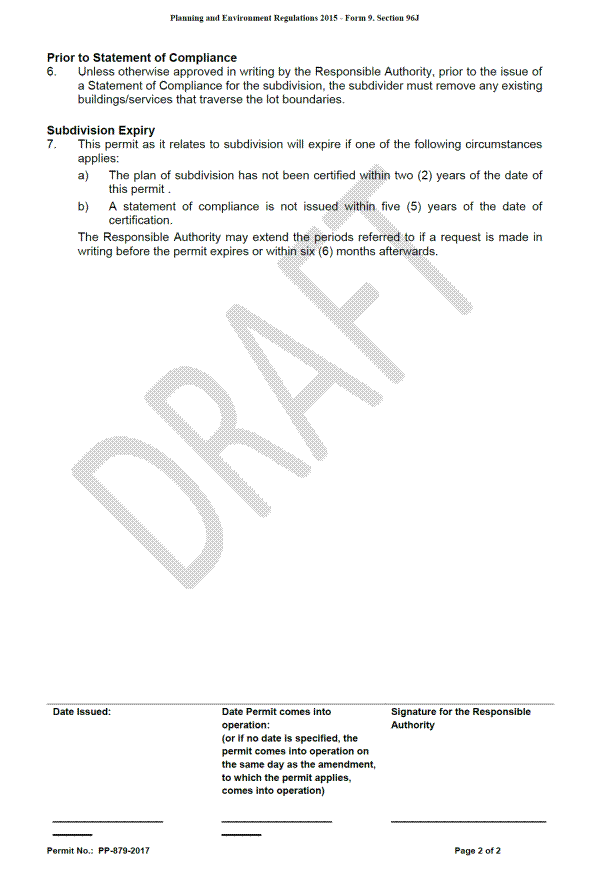
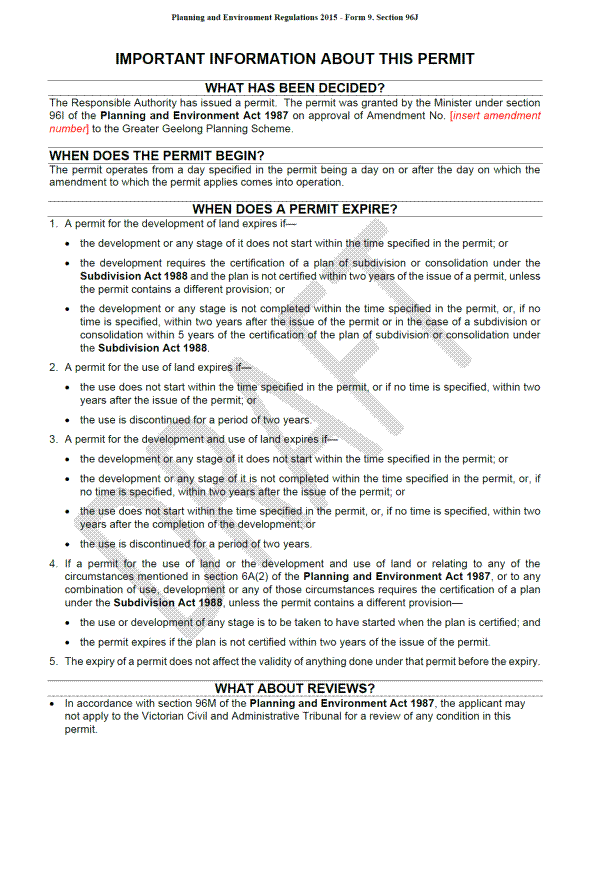
The permit is for a 2 lot subdivision to enable the Club to purchase land from the adjoining rural property owner for new golf course holes.
On 12 December 2017 Council resolved to support the exhibition of the amendment subject to Ministerial authorisation. The amendment and permit were exhibited from 8 February to 12 March 2018. Nineteen submissions were received – all in support of the amendment.
Amendment C67, gazetted in 2013, was subject to a protracted 10 year planning approval process including an Environment Effects Statement which generated substantial interest from environmental and community groups and residents.
The new proposal, which will have substantially reduced environmental impacts, requires approval of a fresh planning scheme amendment.
As no submissions objected to Amendment C373, it can now be adopted and forwarded to the Minister for approval.
Councillor Mason moved, Councillor Sullivan seconded -
That Council:
Adopts Amendment C373 in the form as outlined in Attachment 3 of this report;
Submits the adopted Amendment together with the prescribed information to the Minister for Planning requesting approval; and
Recommends to the Minister for Planning that Planning Permit 879/2017 be approved in the form outlined in Attachment 4 of this report.
Carried.
In 2017, Spiire Australia submitted a combined planning scheme amendment and planning permit application on behalf of the Lonsdale Golf Club to enable an expansion of the 18 hole Golf Course as part of a major redevelopment project.
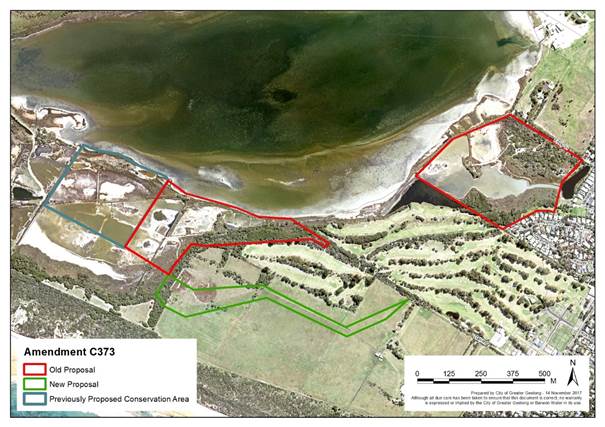
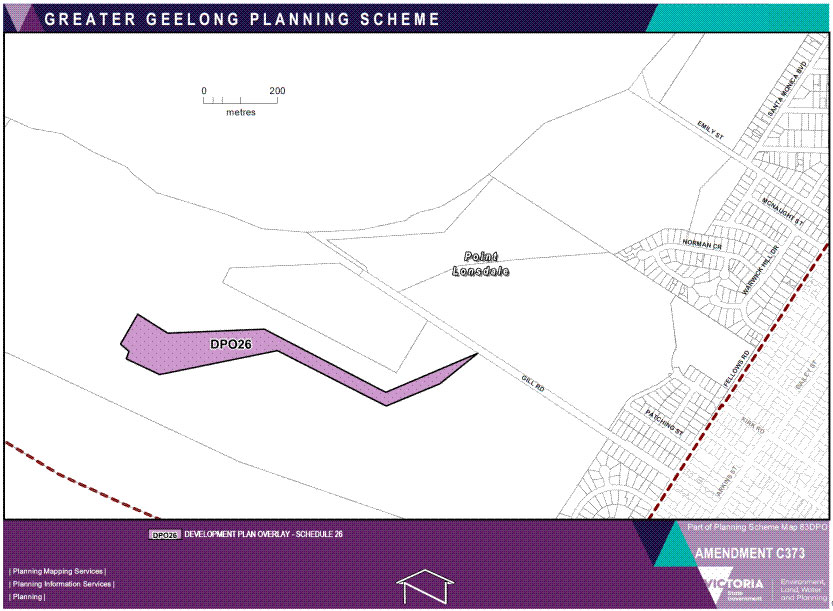
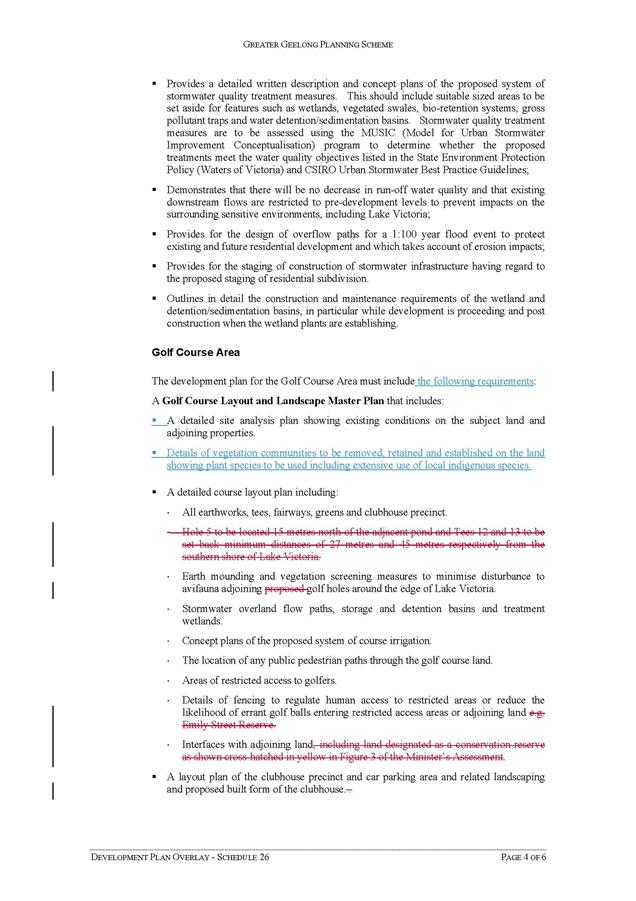
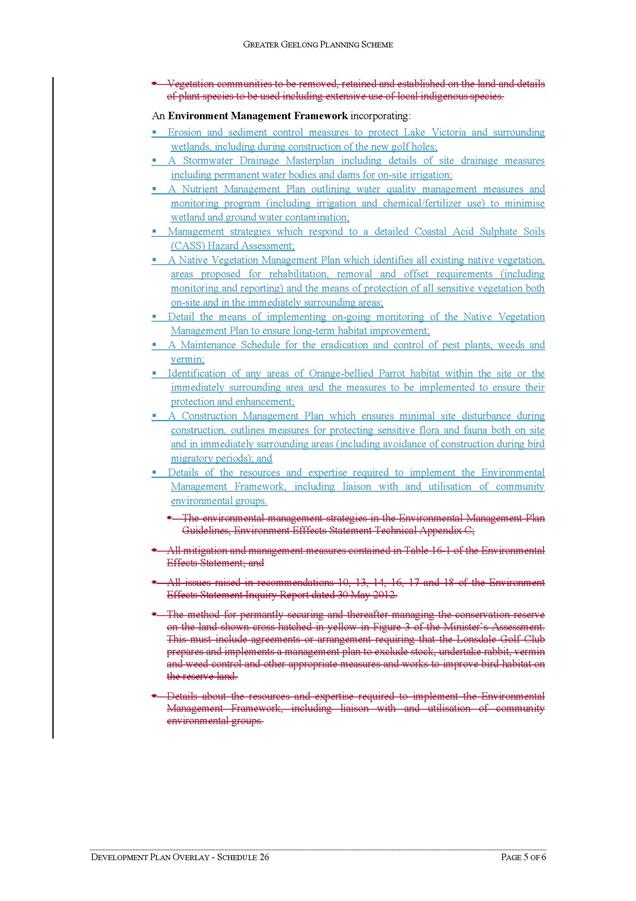
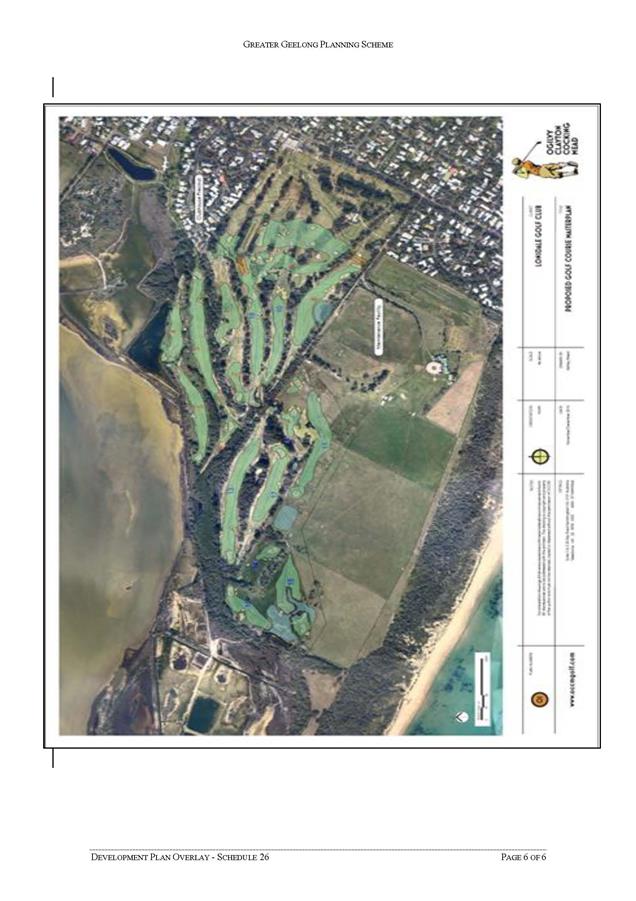
The Amendment applies to land occupied by the Lonsdale Golf Course, off Fellows Road, Point Lonsdale together with the adjoining privately owned land fronting Gill Road and Emily Street, as shown in the aerial photo below.
The Amendment is a combined planning permit application and planning scheme amendment under Section 96A of the Act.
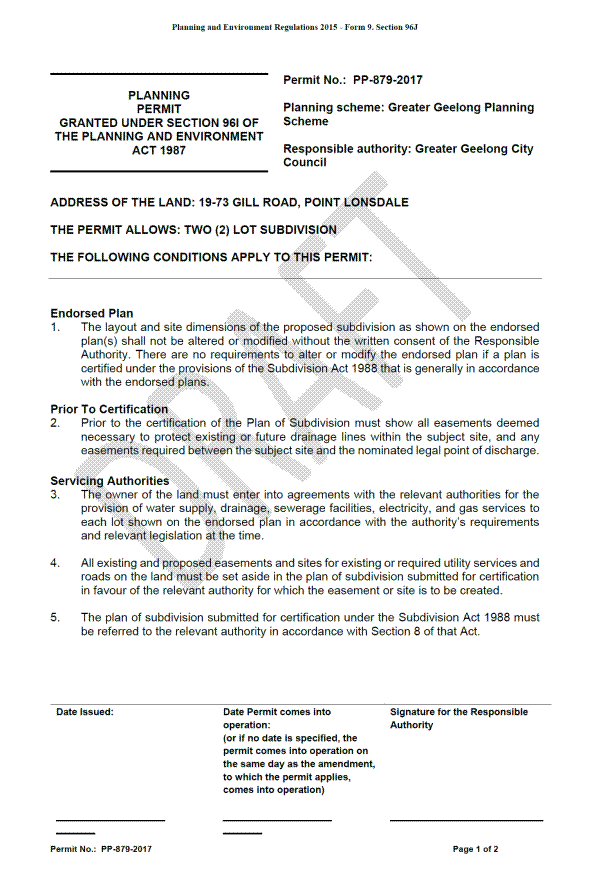
The planning permit application applies to 19 – 73 Gill Road, Point Lonsdale (Lot 1 Title Plan 822391K) and seeks approval for a 2 lot subdivision to enable the golf club to purchase the newly rezoned Special Use Zone 3 land from the adjoining property owner.
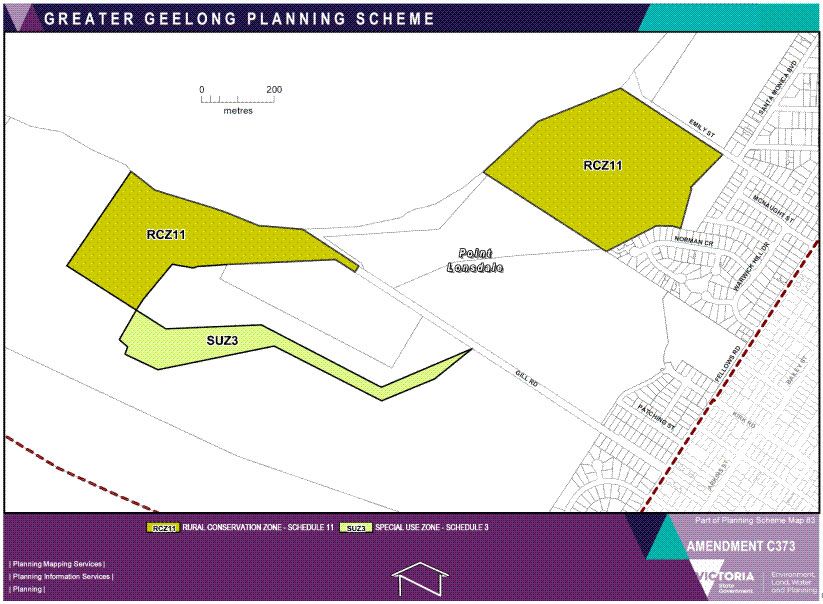
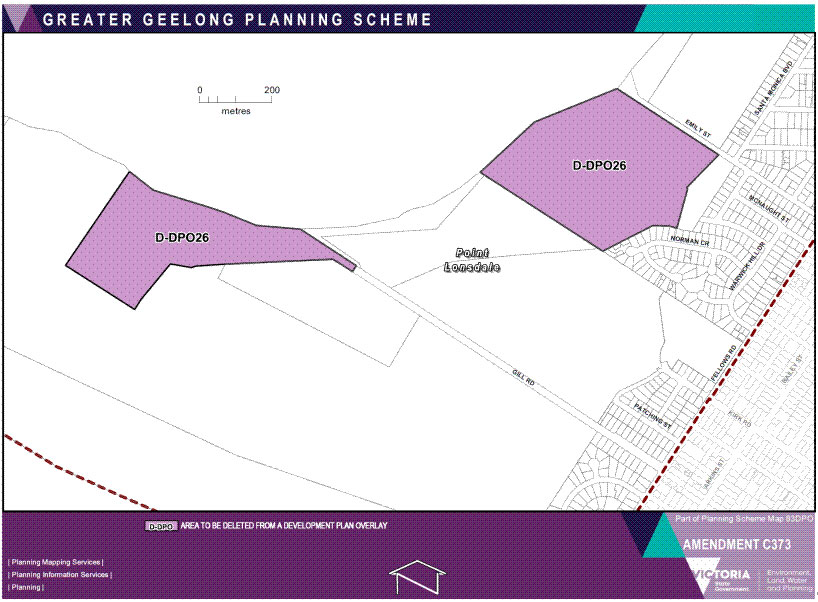
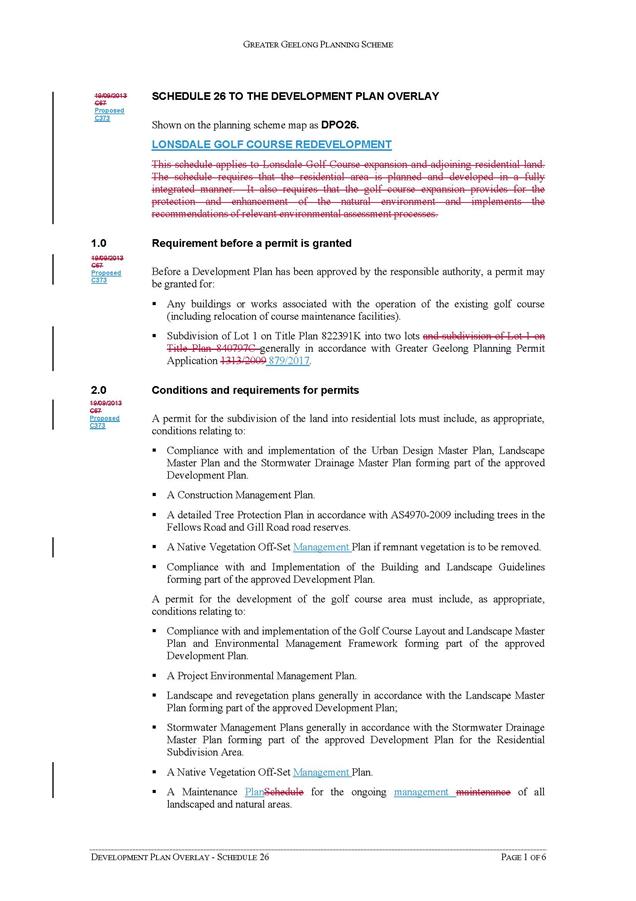
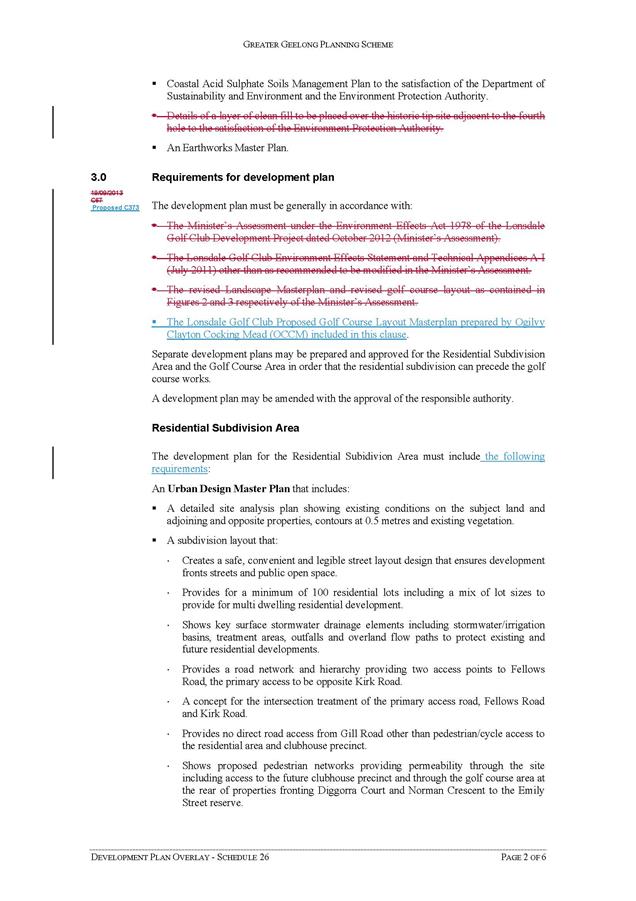
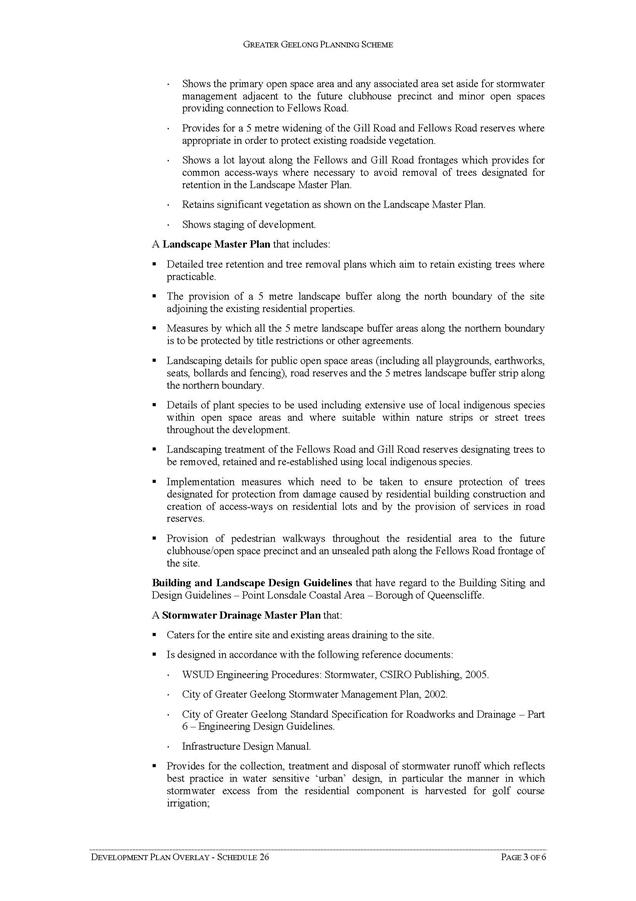
The amendment proposes to rezone vacant farmland along the southern edge of the Lonsdale Golf course, off Gill Road, Point Lonsdale, from Farming Zone and Rural Conservation Zone to Special Use Zone 3 (Private Golf Course) to provide for a modest expansion of the existing golf course. It also substantially modifies the previously approved proposal to extend the course around the edges of Lake Victoria which are now proposed to be back zoned from Special Use Zone 3 to Rural Conservation Zone as shown on the map on the previous page. The amendment also proposes to amend the existing Development Plan Overlay 26 map and schedule to reflect the new course arrangements.
The changes to the previously approved Amendment C67 mean that the reconfiguration of the Golf Course and its extension will be undertaken without the need to extend into the environmentally sensitive areas around the shores of Lake Victoria.
The new, more modest plans will result in a greatly improved environmental outcome and provide a positive closure to this long-running project.
On 12 December 2017 Council resolved to support the exhibition of the amendment subject to Ministerial authorisation.
Authorisation was granted by the Minister’s delegate and the amendment and permit were exhibited from 8 February to 12 March 2018.
A total of 19 submissions were received – all in support of the amendment. The submissions were from local residents and landowners and also groups such as the Geelong Field Naturalist Club and the Corangamite Catchment Management Authority. A summary of submissions is in Attachment 2.
The following comments are examples of the support provided by the submitters:
it allows the golf club to develop new holes and will enable it to have a high quality 18 hole course when completed.
improved golf course layout and provides superior environmental protection of the Lake Victoria surrounds.
the proposed land to be purchased is ideal for golf holes as demonstrated by adjoining holes and will fit well with current landscape.
it will not interfere with wetlands, flora and fauna along Lake Victoria which will be rezoned back to its original zoning and no longer be affected.
simplifies the original proposal and removes the golf course to adjacent farmland rather than encroaching on Lake Victoria surrounds and its sensitivity.
provides a better outcome for the environment (especially for bird life) and the maintenance and planting of trees will enhance appearance of the proposed land.
Geelong Field Naturalist Club applauds this move as it will stop the significant impact on habitat and wildlife in high conservation areas… protecting valuable habitat and feeding areas for a range of migratory shorebirds.
the clubhouse facility will provide an outstanding venue for all residents of the community.
the economic benefit to Point Lonsdale and the Bellarine will be significantly enhanced by the development of another quality golf course and accompanying golf club house (entertainment facility).
we urge Council to approve this proposal as soon as possible in order that development can occur.
As none of the submissions object or seek to change the amendment it is not required to be referred to an independent panel. The amendment and permit can now be adopted in the same form as they were exhibited and forwarded to the Minister for the Planning for approval.
The amendment documents and permit to be adopted are in Attachments 3 and 4.
The Club is a private entity and will be responsible for the full funding of this project. There are no financial implications for Council.
The Amendment was exhibited in accordance with the provisions of the Planning and Environment Act 1987 to provide for full public comment, including notifying all adjoining landowners by mail.
The Amendment does not raise any social equity issues.
The previous project was considered to be consistent with State and Council planning and environmental policies. The new proposal will have significantly reduced impacts and as a result will also comply with these policies.
The Amendment supports the overall thrust of the Sustainable Built and Natural Environment Strategic Directions in that it supports development which respects and enhances the natural environment.
No Council officers or contractors involved in the preparation of this report have a conflict of interest regarding the matter under consideration.
There are no notable risks associated with adopting the recommendations of this report.
The revised golf course layout will result in an approved environmental outcome as sensitive land close to the edge of Lake Victoria will no longer be developed.
The revised Development Plan Overlay requires a range of environmental matters to be addressed prior to any development of the golf course.
No. |
Surname |
First name |
Address |
Suburb |
Summary of Submission |
1. |
Anderson |
Wallace |
Bellarine Highway |
Point Lonsdale |
Support – the amendment will have two significant benefits: firstly, it allows the golf club to develop new holes and will enable it to have a high quality 18 hole course when completed. Secondly, it means that the land along the edge of Lake Victoria can be rezoned for conservation purposes. |
2. |
Callan |
Tim |
Norman Crescent |
Point Lonsdale |
Support - key reason of support is social &financial uplift this development will deliver for residents and tourists of Point Lonsdale alike. |
3. |
CCMA |
|
PO Box |
Colac |
Support - Corangamite CMA has assessed this application in accordance with its functions as the Floodplain Management Authority for the Corangamite Waterway Management District pursuant to Sections 201 to 212 of the Water Act 1989. The background and details of the Authority’s assessment of this application are detailed in the Authority’s response. In light of this assessment and pursuant to Section 56 of the Planning and Environment Act 1987, the Authority supports the granting of a permit for the proposed 2 lot subdivision with the proposed draft conditions. The Corangamite CMA also supports the proposed planning scheme amendment C373. The authority will not be making a submission to the panel hearings. |
4. |
Corinaldi |
Rod |
Emily St |
Point Lonsdale |
Support - very sensible Amendment which will make for an improved golf course layout and also provide superior environmental protection of the Lake Victoria surrounds. |
5. |
Cotton |
James |
Tunah St |
Howrah TAS |
Support - simplifies the original proposal and removes the golf course to adjacent farmland rather than encroaching on Lake Victoria surrounds and its sensitivity. New application enhances our support as a better proposal than before. As agreement has been reached with the landowner there is no impediment to the amendment. More firmly in favour of this new proposed golf course. Request that you implement the Application expeditiously so that work can commence this year. |
6. |
Dowling |
Michael |
PO Box |
Geelong |
Support - better outcome for the environment (especially for bird life) and the maintenance and planting of trees will enhance appearance of the proposed land. Approval of amendment will enable the Golf Club to progress with very positive plans to build a better golf course and club facilities and in doing so have an enhanced facility within the Point Lonsdale community and the Bellarine. Encourages approval to the amended plan at the earliest opportunity. |
7. |
Geelong Field Naturalists Club |
|
PO Box |
Geelong |
Support – provides history of the Geelong Field Naturalists Club (GFNC) involvement with the Lonsdale Golf Club (LGC) redevelopment. Former proposal Parcel1 - 16.6 ha - The GFNC opposed rezoning the Emily Street wetlands to the north of the LGC from RCZ to SUZ. those sites regularly hosted many species of birds, some of which were protected by international treaty obligations. Parcel 2 - 20.5 ha - Similarly, West of the LGC, a section of saltmarsh adjacent to Lake Victoria was proposed to be rezoned from Rural Conservation Zone to Special Use Zone. That would then have allowed the golf course to expand into the saltmarsh area. After the Panel Hearing in 2012, the outcome was that lands in Parcel 1 and Parcel 2 were rezoned to SUZ in anticipation of the LGC developing the course at the sites. New proposal |
8. |
Goodman |
John |
Landy Crt |
Point Lonsdale |
Support - amendment will result in a net benefit to the environment as the land to be back zoned in the vicinity of Emily St will provide better bird / creature and conservation habitat now the golf course extension will move away from this area. The Gill Rd part of the amendment will provide vital land for the golf course extension. |
9. |
Greer |
Rod |
PO Box |
Ocean Grove |
Support - new proposal is a significant improvement on the original proposal, in that the environmental impact is significantly reduced. New proposal allows the Lonsdale Golf Club to develop a facility that will be an enhancement to the local community. Economic benefit to Point Lonsdale and the Bellarine will be significantly enhanced by the development of another quality golf course and accompanying golf club house (entertainment facility). Urges Council to approve this proposal as soon as possible in order that development can occur. |
10. |
Heseltine |
James |
Jennifer Crescent |
Point Lonsdale |
Support |
11. |
Horden |
David and Rosemary |
Norman Crescent |
Point Lonsdale |
Support |
12. |
Hudson |
Jeanette & Ian |
Norman Crescent |
Point Lonsdale |
Support – submission from retired Town Planner / Land Surveyor. Refreshing and much improved application. Environmentally the proposal is a vast improvement on the original and retains areas adjacent to Lake Victoria for waterbirds. Hoping for speedy approval so re-development can occur soon. |
13. |
Hutchinson |
Rob |
PO.Box |
Point Lonsdale |
Supports - Significant reduction in impact on the lakeside environment of Lake Victoria. Land previously approved for use by the golf club adjoining lake now being returned to Rural Conservation Zone status is a decision of great merit. |
14. |
Iser |
Robert & Elizabeth |
Gill Road |
Point Lonsdale |
Supports changes. Would like any laneway added between properties where applicable e.g. end of court to the next street adjoin boundaries giving laneway access to Lake Victoria, conservation areas, golf course, beach, other streets. |
15. |
Kiely |
Moira |
Griffin Close |
Surrey Hills |
Support - member of LGC for over 20 years and being involved in many of the previous planning submissions. Feel that the current proposal is by far the best option the Club has ever considered. The proposed land to be purchased is ideal for golf holes as demonstrated by adjoining holes and will fit well with current landscape as has indigenous trees similar to those on the rest of the course. It will not interfere with wetlands, flora and fauna along Lake Victoria which will be rezoned back to its original zoning and no longer be affected. |
16. |
Larcombe |
Lorel |
Norman Crescent |
Point Lonsdale |
Support |
17. |
McKenzie |
Ross |
PO Box |
Point Lonsdale |
Support - purchased land and built a new house in the first stage of the LGC residential subdivision “Lonsdale Shores”. Involved in the administration of the LGC development project for approximately 8 years, including leading the LGC through the previous Planning Scheme Amendment and Panel Hearing in 2012. The decision by LGC to move away from developing golf holes in the wetlands adjacent to Lake Victoria, removes the issues upon which the various environmental groups based their objections in the previous amendment proposal (2012). Recalls number of people who represented environmental objectors, asking us why we were wanting to build golf holes in the wetlands, rather than on farmland to the east (See highlighted paragraph in Attachment “A”). The simple answer at the time was that insufficient farmland was available for purchase to accommodate the golf course extension. That situation has now changed and extra farmland has been secured for purchase by LGC. Golf holes built on the farmland will, I believe, be a better outcome for LGC. Reduced construction costs and reduced ongoing maintenance costs will increase the viability of the Golf Club. The golf holes built on the farmland will be more interesting than those that were proposed in the wetlands. This is clearly a WIN/WIN, a win for LGC and a win for the environment. |
18. |
Miller |
Ian |
Aurelia Close |
Point Lonsdale |
Support - project was initially undertaken to ensure self sufficiency in water supplies for course maintenance. The project had to satisfy a multitude of requirements including federal government environmental concerns; state government environmental concerns; matters relevant to the City of Greater Geelong; the Borough of Queenscliff; and the local community. Progress has been slow with many impediments to be overcome and altered criteria to be addressed during the process. The Lonsdale Golf Club and its members have invested significant material assets and immeasurable amounts of effort and energy towards the satisfaction of all requirements. If the Golf Club is to be a successful and vibrant community asset once again, this project needs to proceed to conclusion. The abandonment of the land along the shores of Lake Victoria with attendant environmental and wildlife sensitivities, in favour of cleared grazing land remote from the lake is surely something that is unlikely to attract any justifiable objection. The Club has been, for many generations, an important community asset for Point Lonsdale, Queenscliff, Bellarine Peninsula and Ocean Grove with many members residing in those communities. It has made an important contribution to the social, emotional and physical well being of its members, associates, employees and general public for ninety years. The depth of frustration and disappointment among submitter’s family at the delay and obstruction encountered in pursuit of this project is profound. As a member of the Club I strongly recommend prompt approval of planning amendment C373 & PP879/2017. Approval will allow us to simply get on with it. |
19. |
Watson |
Alan & Lorraine |
23 Emily Street |
Point Lonsdale |
Support – happy to see it returned to the original environmental state. |
Source: |
Finance and Strategy |
Director: |
Peter Anderson |
Index Reference: |
Accommodation |
Portfolio: |
Finance |
In relation to the consolidation of Council’s administrative offices, to:
Confirm Council’s commitment to consolidate its administrative offices to one location within the Geelong central business district;
Confirm Council’s support for the expansion of the Geelong Art Gallery into City Hall;
Create a Project Advisory Committee and appoint 6 Councillors to that Committee to consider the key issues relating to the consolidation of Council’s administrative offices; and
To identify the consolidation of Council administrative offices project (Project) in the 2018-2021/22 Strategic Resource Plan.
As early as 2000, Council identified the need to consolidate its administrative offices. In 2016 the State Government Commission of Inquiry also identified the consolidation project as a priority.Recommendation 12 of the Commission’s report stated:
“Action be initiated to consolidate Council departments in one central location to unify the organisation, deliver increased efficiency and productivity and release surplus assets for more economic uses”.
Land at 137 Mercer Street was purchased in 2007 for the purpose of office consolidation. After evaluating a number of sites, Council in 2017 again confirmed 137 Mercer Street as its preferred location.
Council agreed in 2015 to support expansion of the Geelong Art Gallery to the existing City Hall building should sufficient space become available.
There are significant benefits of consolidating Council administrative offices, including:
Operational cost savings. For example, energy use;
A single customer focus;
Improved workplace amenity and culture, employee time savings from not moving between offices, no duplicated IT infrastructure and increased opportunities for improving staff health and wellbeing;
The opportunity to incorporate community infrastructure into any building for Council administrative offices; and
Creation of a single recognisable ‘seat of governance’ presence in the City.
Council’s office consolidation project could be used as a catalyst project to stimulate additional Government and private sector investment with broad community benefit. Government funding assistance for the Council project could be available under these circumstances, for example: Regional Infrastructure Funding.
Council could also include within any new building relevant community facilities to service a growing residential population. For example, 2,200m2 of additional floor space for community facilities would add $15m to the total cost of the project.
Based on research and using the larger City of Casey as a model, Council would need approximately 8,000m2 of gross office floor space if it embraced Activity Based Working design principles. A building of 10,000m2 has been used for the purpose of this analysis.
Several development options have been evaluated against the ‘status quo’ scenario. A financial model has also been developed.
In addition to the non-monetary benefits the project creates, the financial analysis using a 25 year planning period shows:
Options |
Net Present Cost |
Considerations |
|
92.9 |
Retention of Busport assumed (Approx. $5 million at end) |
|
104.7 |
Assumes debt fully repaid. Asset at end worth $38 million. Savings of over $25 million over 25 year period. |
|
NA |
Too many variables to cost. Risky and highly regulated option. |
|
112.9 |
Savings of $25 million over the 25 year period |
Current financial modelling suggests that option 2 is preferred as it achieves consolidation and relative to the ‘status quo’ option achieves a better financial result after factoring in asset value and savings.
Assuming Council funded the preferred option (2) entirely from borrowings Council’s long term financial plan shows total borrowings in 2023/24 to reach $262m or a debt to rate revenue ratio of 164%. This means that in 2023/24 Council would have more total liabilities than it raises annually in rates revenue. This ratio however still sits within the financial capacity of Council to service and repay debt and Council would still have over $2b in net assets in 2023/24. In an earlier financial review (Ernst and Young 2016) it was suggested that a sustainable debt level for COGG could be up to $322m.
Future outstanding debt levels could be significantly reduced by focussed management of Council’s property investment portfolio. Council could also create more capacity to pay off debt through recurrent operational efficiencies and savings.
Future reliance on borrowings is also offset by any Government funding which could possibly be able to be obtained for the project.
Given the significance of this project to the Council and the community, as well as the complexity of the issues that need to be considered in consolidating Council administrative offices, a project advisory committee should be established to provide proper governance oversight of the process.
Councillor Murnane moved, Councillor Grzybek seconded -
That Council:
Agrees in principal to the consolidation of its administrative functions to one location within the Greater Geelong area;
Affirms support for the expansion of the Geelong Gallery to all or part of the existing Geelong Town Hall subject to the Central Administrative Office Project proceeding;
Creates a Project Advisory Committee and approves the terms of reference (Attachment 2);
Nominates 6 Councillors to be on the Project Advisory Committee;
The Project Advisory Committee be asked to report to Council at a July 2018 Council meeting on:
Scope of the Project;
Preferred siting and funding options;
Opportunities for the Project to be a catalyst for further CBD revitalisation projects (e.g. additional development in the Civic Precinct, the Convention Centre precinct or incorporating a Government services hub);
Preferred future arrangements for civic and ceremonial functions;
Expansion of the Geelong Gallery to part or all of the existing Geelong Town Hall; and
Opportunities to attract State and Federal Government funding for the project.
Identify the Project in the 2018/19-2021/22 Strategic Resource Plan.
Carried.
The financial implications of this project both in term of capital funding and operational costs have been summarised in the report and have been the subject of more detailed work with Ernst and Young. Options for funding have been considered and a funding formula suggested.
Should Council proceed with the recommendation to further examine this project via the Project Committee the financial implications will form part of this further review.
The community has not yet been engaged in the planning for this project. If the project moves to the next stage it is expected that the Council Plan and accompanying strategic resource plan will provide opportunity for engagement. The establishment of a consolidated administrative office has been considered by the Council since 2000 and during this time there has been community engagement.
No identifiable social equity impacts if recommendations were implemented.
No impacts in relation to the Human Rights Charter. Compliance with provisions of the Local Government Act will occur.
The project is identified in the draft 2018/2021 Council Plan. This Plan will be subject to further community engagement.
No officer involved in the preparation of this report has a direct or indirect conflict of interest in relation to the contents of this report.
No identifiable risk if recommendations were implemented.
No identifiable environmental implications if recommendations were implemented.
Source: |
Finance & Strategy - Financial Services |
Director: |
Peter Anderson |
Index Reference: |
Financial Management Reporting |
Portfolio: |
Finance |
To undertake the 2018 General Valuation in compliance with the Valuation of Land Act (Vic) 1960.
Council is required under the Valuation of Land Act (Vic) 1960 (Act) to conduct bi-annual valuations.
In accordance with the Act, administrative matters are to be noted and recorded in the minutes of Council.
Recent changes to the Act mean that 2018 is the last General Valuation to conducted by Council. Future General Valuations will be conducted annually by the Valuer-General Victoria. The 2019 valuation will become the first annual General Valuation.
To comply with the Act, administrative matters required to be resolved by Council include:
That a General Valuation be undertaken by Council as the valuation authority responsible for the municipal area;
To advise every other rating authority within its area of Council’s resolution to cause a general valuation to be made.
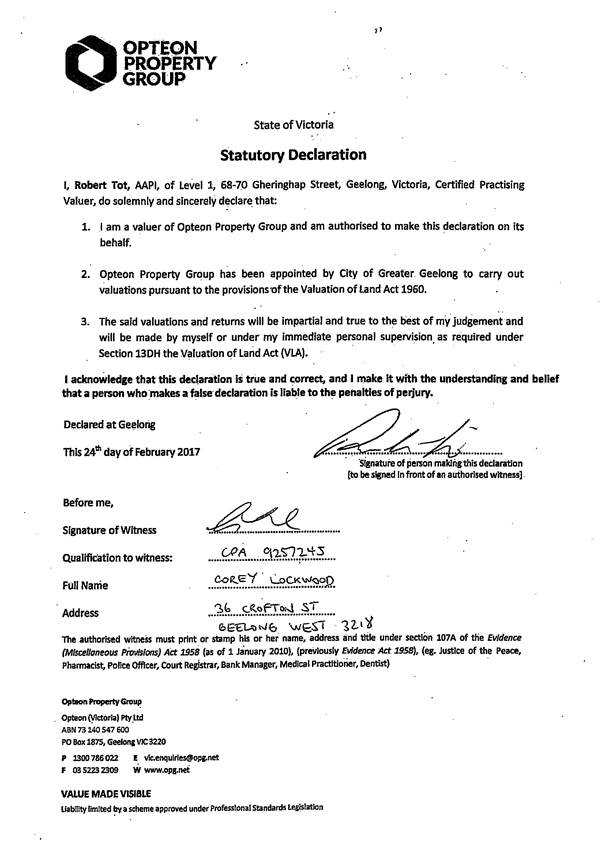
To note the statutory declaration by the appointed Valuer that the valuation and return will be impartial and true (Attachment 2).
Council has contracted Opteon Property Group to undertake the 2018 General Valuation.
Councillor Murnane moved, Councillor Sullivan seconded -
That Council, in accordance with the Valuation of Land Act (Vic) 1960 as the valuation authority, resolves to:
Undertake the 2018 General Valuation;
Give the necessary notice to other statutory authorities, and;
Note receipt of the Contract Valuer’s statutory declaration (Attachment 2).
Carried.
The 2018 General Valuation including objections is to be conducted in accordance with Contract Number C1700005 by Opteon Property Group.
The Valuer-General Victoria, the State Revenue Office and the following neighbouring municipalities will be advised of Council’s resolution:
Surf Coast Shire Council
Wyndham City Council
Golden Plains Shire Council
Borough of Queenscliffe
Moorabool Shire Council
There are no social equity implications arising from this report.
All municipal rating valuations must comply with the Valuation of Land Act 1960, the Local Government Act 1989 and the Fire Services Property Levy Act 2012.
This report is aligned in Council’s City Plan objective on ‘How We Do Business’.
No officer involved in the preparation of this report has any direct or indirect conflict of interest in the matters raised in this report.
Compliance with legislation negates any risk.
There are no environmental impacts arising from this report.
Source: |
Finance & Strategy |
Director: |
Peter Anderson |
Index Reference: |
Financial Services |
Portfolio: |
Finance |
To delegate powers and functions to the Chief Executive Officer to accept or reject a tender for the provision of a $12.1m loan and authorise the Chief Executive Officer and Mayor to execute all necessary documents to secure the loan.
Council adopted its 2017-18 Budget on 27 June 2017. The Budget provides for loan borrowings of $39.31m in 2017-18.
Loan borrowings are timed based on working capital requirements and expenditure forecasts for each specific capital project.
A review of cash flows by project has been completed. Opportunities to defer borrowings and realise both interest and principal savings in 2017-18 have been identified.
The 2017-18 budget includes provisions for new borrowings of $39.3 million.
It is proposed that, based on project cash flow requirements, a loan tender for a $12.1millionloan be issued.
The 2017-18 loan borrowing is sought for the Hendy Street Reserve Development, Leopold Community Hub Stage 2, Drysdale Clifton Springs Sports Precinct and Drysdale Landfill Cell 5.
Tight timeframes apply to acceptance of loan borrowing tenders with financial institutions only holding quoted interest rates for a short period of time, requiring draw down within one week in some cases. This constraint prevents Council from having an opportunity to formally consider the tender prior to acceptance.
It is proposed Council delegate its powers and functions to the Chief Executive Officer to accept the lowest conforming tender, and for the Mayor and Chief Executive Officer to sign all necessary documentation to execute the $12.1millionloan (such documentation would include: Bank – Letter of Offer; Deed of Charge and Certificate in relation to Deed of Charge).
An updated report will be presented to Council to notify the final rate settlement agreed for the loan.
The reduction in planned loan borrowings is forecast to save $1.1millioninterest in 2017‑18.
The revised loan borrowings will result in a loan balance as at 30 June 2018 of $48.1millionrelative to the 2017 opening loan balance $45.5m.
Councillor Murnane moved, Councillor Kontelj seconded -
That Council delegates to the Chief Executive Officer its powers and functions to accept or reject a tender for the provision of a $12.1millionloan and authorise the Mayor and Chief Executive Officer to sign all necessary documentation to secure the loan.
Carried.
In order to respond quickly to tender submissions, authority is sought from Council to delegate the awarding of the provision of $12.1millionloan to the Chief Executive Officer. The most suitable tenderer will be selected having consideration to the interest rate; loan repayment term (ie. ten year term) and principal and interest repayments that delegate authority to sign and execute all related loan documentation to the Chief Executive Officer and Mayor.
Upon execution of the $12.1 million loan documentation, an updated confidential report will be presented to Council to confirm details and rates of the loan and how the final rates compare with budget assumptions.
A review has been undertaken of Council’s loan borrowings with the aim of reducing Council’s new loan borrowings from $39.31 million in 2017-18.
Opportunities to reduce borrowings in 2017-18 from $39.3 million to $12.1 million will result in interest savings of $1.09 million in 2017-18.
Table 1 lists the borrowings by project comparing budget borrowings to revised borrowings.
Table 1 |
Budget Borrowings 2017-18 |
Revised Borrowings 2017-18 |
Variance Fav/(Unfav) |
Deferred Borrowings to 2018-19 |
Hendy Street Children’s Hub |
4,300 |
0 |
4,300 |
4,300 |
Central Geelong Action Plan |
7,190 |
|
7,190 |
0 |
Hendy St Reserve Redevelopment |
1,500 |
1,800 |
(300) |
0 |
Leopold Community Hub Stage 2 |
3,800 |
3,800 |
0 |
0 |
Rosewall Neighbourhood House |
2,100 |
|
2,100 |
2,100 |
Highton Family Hub |
506 |
|
506 |
506 |
DCP’s Armstrong Creek |
9,386 |
|
9,386 |
9,386 |
Drysdale Clifton Springs Sports Precinct |
3,226 |
3,226 |
0 |
0 |
GREP – Elcho Drain |
2,419 |
|
2,419 |
2,419 |
Cloverdale Community Hub |
1,000 |
|
1,000 |
1,000 |
Drysdale Landfill Cell 5 |
3,285 |
3,285 |
0 |
0 |
Drysdale Integrated Children’s Centre |
600 |
|
600 |
600 |
Purnell Road CFC |
|
|
|
|
Grand Total |
$39,312 |
$12,111 |
$27,201 |
$20,311 |
An opportunity exists to utilise the higher than projected receipts from property sales of $8,604 to offset planned borrowings for Central Geelong Action plan projects Net cost $7,190. These planned borrowings are recommended to be cancelled.
Cumulative receipts from Developer Contribution levies are $12.1 million and cumulative expenditure year to date is $8.5million leaving a positive cash balance of $3.6 million. Planned borrowings can therefore be deferred into 2018-19.
Planned borrowings for Hendy Street Children’s Hub, Rosewall Neighbourhood House, Highton Family Hub, GREP Elcho drain, Cloverdale Community Hub and Drysdale ICC can all be deferred into 2018-19 based on delays to these projects and anticipated cash flows.
Table 2 summarises the forecast annual principal repayments, interest payments and loan balance amounts each year. The loan balance is forecast to increase in line with proposed new loans, however these estimates will be updated as part of the 2018-19 Strategic Resource Plan.
Table 2 |
Opening loan Balance |
New Borrowings |
Principal Repayments |
Loan Balance |
Borrowing Imposed limit |
2017-18 |
45,509 |
(12,111) |
(9,566) |
48,054 |
|
2018-19 |
48,054 |
(44,577) |
(9,826) |
82,804 |
132,176 |
2019-20 |
82,804 |
(31,695) |
(10,432) |
104,067 |
137,438 |
2020-21 |
104,067 |
(56,588) |
(12,857) |
147,798 |
142,842 |
2021-22 |
147,798 |
(90,706) |
(16,163) |
222,341 |
148,168 |
Favourable receipts from property sales in 2017-18 of $8.6millionprovide an opportunity to cancel planned loan borrowings.
Cash flows for projects requiring loan borrowing funding have been reviewed and an opportunity for deferment of $20.3millionloan borrowings to 2018-19 exists.
The reduction in planned loan borrowings is forecast to save $1.1millioninterest in 2017‑18.
Provision for loan borrowings was communicated through the 2017-18 budget process.
There are no social considerations associated with the acceptance of this tender.
This report complies with Council’s Loan Borrowing Policy CPL510.4.
This report contributes to responsible and sustainable financial management as aligned in the Council’s City Plan objective on How We Do Business.
No officer involved in the preparation of this report has any direct or indirect conflict of interest in the matters raised in this report.
There are no risks associated with the acceptance of this tender.
There are no environmental implications associated with the acceptance of this tender.
Source: |
Investment & Attraction – Economic Development & Events |
Acting Director: |
Tim Ellis |
Index Reference: |
UNESCO Creative Cities Network |
Portfolio: |
Economic Development |
To explain Council’s designation to the UNESCO Creative Cities Network; the opportunities this presents and the obligations as Secretariat.
This report provides a recommendation for the Mayor’s attendance at the UNESCO Creative Cities Network XII Annual General Meeting in Krakow Katowice, Poland, 12-15 June 2018 (see Draft Programme for Delegates - Attachment 3).
The report also recommends the Mayor conduct a study tour of two UNESCO Creative Cities, Dundee and Turin, to understand how best to leverage the opportunity and to examine their waste to energy operations as a fact finding mission (see Greater City of Geelong - Suggested Mayoral Itinerary - Attachment 2).
On the 31st October 2017, Council was notified that its application to become a member of the UNESCO Creative Cities Network was successful.
Geelong is Australia’s first (and only) City of Design and it is the only non-capital city in Australia to have UNESCO Creative Cities Network designation. Other Australian members of the UNESCO Creative Cities Network are Melbourne (Literature), Sydney (Film) and Adelaide (Music).
The UNESCO Creative City designation is a key step in Greater Geelong’s journey to transform our community’s clever and creative vision aspirations into reality.
One of Council’s obligations as designated Secretariat is for the Mayor, as Council’s lead representative, to attend the UNESCO Creative Cities Network Annual General Meetings. The 2018 Annual Meeting is in Krakow Katowice, Poland, 12-15 June 2018.
To better understand and determine how best Council can leverage the UNESCO designation, the benefits, implement the best governance structure and resources, funding models and projects for the benefit of Greater Geelong, it is proposed that the Mayor visit two other members of the UNESCO Creative Cities Network, Dundee and Turin.
Dundee and Turin are excellent examples of how cities have transformed their economies from their traditional manufacturing base utilising the UNESCO Creative City designation and global network.
It is also proposed that, whilst in Dundee and Turin, the Mayor conduct a study tour of two waste to energy plants. This will seek to further Geelong’s understanding of opportunities that exist in waste to energy and help Geelong establish a position on how to take this technology forward. A letter of invitation from the Mayor of Dundee has been received and attached to this report (Attachment 4)
The UNESCO Creative City designation is a four-year commitment and the Mayor is the lead representative for the City. The designation requires Council to:
Have the Mayor attend UNESCO Creative Cities Network Annual General Meetings each year in various locations;
Establish a Secretariat to coordinate awareness raising activities, facilitate a strategic Advisory Group, create and coordinate delivery of a number of project management plans (that is: strategic plan, communications and marketing plan, stakeholder engagement plan), create a website and a logo, and provide support to other stakeholders in the region to leverage off the network designation; and
Report every four years on how Greater Geelong is benefiting by contributing to the United Nations Sustainable Development Goal 11 (sustainable cities and communities) and the New Urban Agenda.
The issues of waste and energy are high on the national and regional agenda and pose large challenges for the region from an environmental, financial and community perspective.
Understanding the opportunities, challenges and commercial models for the establishment of a waste to energy plant in the region will assist and enable Geelong to collaborate with the G21 Councils, the western interface Councils and state government to work on a region wide solution to potentially mitigate the current challenges.
Councillor Murrihy moved, Councillor Mason seconded -
That Council:
Notes the requirements of maintaining the UNESCO Creative City designation to the UNESCO Creative Cities Network;
In accordance with Councillors’ Expenses and Facilities Policy, authorise the Mayor, Councillor Bruce Harwood, to attend the XII Annual General Meeting of the UNESCO Creative Cities Network in Krakow Katowice, Poland, 12-15 June 2018; and
Notes that the Mayor, whilst in Europe, will undertake a fact finding visit to two other UNESCO Creative Cities Network, Turin and Dundee, and visit waste to energy plants in these cities, as per invitations received from the UNESCO representatives from these cities.
Carried.
The City of Greater Geelong was successful in its application to become a member of the UNESCO Creative Cities Network in the field of design.
There are currently 180 members of the UNESCO Creative Cities Network each having a designation in one of seven sub-networks; Design, Film, Gastronomy, Literature, Media Arts, Music, Craft and Folk Art.
The UNESCO Creative Cities Network was created in 2004. Council’s designation is a four year commitment and requires the City to adhere to and report on key deliverables as earlier described.
Members of the network work together on the common objective of placing creativity and design thinking at the heart of their development plans at the local level; and cooperate actively at the international level.
Council’s designation to the UNESCO Creative Cities Network will benefit the Greater Geelong community in the following ways:
Improve Greater Geelong’s liveability by encouraging policy that supports design thinking, which transforms the community’s vision aspirations into reality; this will be achieved by drawing on the international network of practitioners to share best practice, help solve problems and pursue funding.
Strengthen Greater Geelong’s international profile and leadership by providing visibility for our innovative policies, strategies and activities towards design thinking and sustainable urban development.
Increase Greater Geelong’s regional and international attractiveness to economic investors and stakeholders, skilled design professionals or visitors, and facilitate the financial resources from the public and private sectors.
Network with fellow Creative Cities Network members through joint events and common projects, knowledge sharing and creative partnerships.
Build momentum around Greater Geelong’s design capability by putting the spotlight on design thinking as a driving force, mobilising all stakeholders and encouraging dialogue between local authorities, public and private organisations, academia and the design community.
A draft project plan has been developed to ensure the UNESCO Creative City designation in the first four years is successful, and that opportunities for the Greater Geelong community are maximised.
Council’s current priorities during 2018 are:
Host a launch;
Mayor to attend UNESCO Creative Cities Network Annual General Meeting in Krakow Katowice, Poland;
Establish a Secretariat to coordinate awareness raising activities, facilitate a strategic Advisory Group, create and coordinate the delivery of a number of project management plans (that is: strategic plan, communications and marketing plan, stakeholder engagement plan), create a website and create a logo, and support other stakeholders in the region to leverage off the UNESCO Creative Cities Network designation;
Establish a strategic Advisory Group; and
Secure funding to support the Secretariat and network activities.
Council’s identified priorities during 2019-2021 are:
Progress M~M Greening the Songline;
Complete the Geelong cultural precinct redevelopment;
Facilitate the Secretariat;
Attend UNESCO Creative Cities Network Annual General Meetings;
Share knowledge and best practice about creative solutions;
Use design thinking to enhance our urban form, commercial and industrial sectors and the community;
Support iconic projects, competitions and knowledge transfers; and
Report on Greater Geelong’s contributions to the New Urban Agenda and the United Nations Sustainable Development Goal 11.
One obligation of the UNESCO Creative City designation is for Council’s lead representative to attend the Annual Conference each year. The 2018 Annual General Meeting will be held in Krakow Katowice, Poland, 12-15 June 2018.
Attending the Annual General Meetings delivers on our obligation as Secretariat and will enable us to start to form relationships with other designated cities and to learn more of the opportunities the network provides. It is also recommended that the Mayor is accompanied by a Council officer to attend relevant non Mayoral activities of the Annual General Meeting.
To better understand and determine how best the City of Greater Geelong can leverage the UNESCO Creative designation, implement the best governance structure and resources, funding models and projects for the benefit of Greater Geelong it is proposed to visit two other Creative City members in the field of design, Dundee and Turin.
Turin is one of Italy’s main industrial centres that has made the transition from a traditional manufacturing base into a creative hub through its membership of the UNESCO Creative Cities Network. There are a number of parallels with Greater Geelong and having been part of the network since 2008 can provide a wealth of experience and insight.
Visiting Turin also provides the chance to visit the Turin waste to energy plant. The Turin waste to energy plant has been designed as a structure that is well integrated in the local area and open to the public. The plant includes a visitor centre and takes visitors on a discovery about waste to energy, through a multimedia production that describes the objectives of the plant and how it operates using images, text and interactive games.
Dundee is another similar city to Geelong as regional capital. Dundee have used their designation to embed design thinking across all their business activities, support investment into iconic infrastructure (Victoria & Albert Museum), and to help solve community issues such as homelessness. The Dundee region also has a waste to energy plant that has been in operation since 1994 and has recently secured investment for the build of a new waste to energy plant that will have the capacity to support 110,000 tonnes per annum.
The learnings from like cities such as Dundee and Turin will be invaluable to assisting Geelong to implement and leverage the UNESCO Creative City designation and to understand the opportunities to progress a waste to energy facility in the region.
The set up cost to cover our obligations as a UNESCO Creative Cities Network member, and for UNESCO website presence, a launch event, development of website and logo is $25,000.
The approximate travel costs for the Mayor and a Council officer, to attend the 2018 UNESCO Creative Cities Network XII Annual General Meeting in Poland and to also visit Dundee and Turin is approximately $18,000.
Funding to support our Secretariat obligations, will be sought from representative organisations in Geelong and the state government. The Secretariat obligations are currently being managed by the Economic Development Unit.
Council’s application to the UNESCO Creative Cities Network was prepared in partnership with a number of internal and external stakeholders; Deakin University, the Australian Centre for Innovation and Design, Runway, Creative Geelong, and the state government, through Creative Victoria; along with Council’s Arts & Culture team, Economic Development Unit and the Strategy & Program Delivery team.
Letters of support were provided for the application from a number of these stakeholders and other UNESCO Creative Cities Network members (e.g. Montreal).
G21 have provided a letter of support for the City of Greater Geelong to attend the 2018 UNESCO Creative Cities Network XII Annual General Meeting in Poland and to visit waste energy plants in Europe (Attachment 5).
The Secretariat will engage with the community to ensure the international network provides an opportunity to share best practice, solve problems and pursue funding.
The Greater Geelong community can use the network to address challenges and seek new ways to operate, by asking other members of the network to share best practice.
There will be opportunities to collaborate, share ideas and build capability to deliver on the Council’s commitment to social equity and create a more safe, resilient and sustainable city and community.
There are no legal or statutory implications of this report. There are policy implications. As a member of the Network, we commit to using the membership to drive policies, strategies and activities towards the United Nations Sustainable Development Goal 11. This goal is about making cities and human settlements inclusive, safe, resilient and sustainable.
Council’s designation to the UNESCO Creative Cities Network is aligned to a number of priorities outlined in the City Plan including: arts and culture, economic development, sustainable development, an inclusive and diverse community, tourism and events, transport and connections, disability access, inclusion and volunteering, community health and safety, environment and sustainability, social infrastructure and planning, leadership and governance, finance, strategy and communications.
Membership of the network provides an opportunity to transform these priorities, and the community- led aspirations in Greater Geelong: A Clever and Creative Future, into reality by drawing on an international network of practitioners to form relationships, recognise, create or act on opportunities, share information and seek potential partners for projects.
Council’s community-led vision is that “By 2047, Greater Geelong will be internationally recognised as a clever and creative city-region that is forward looking, enterprising and adaptive, and cares for its people and environment.”
As members of the UNESCO Creative Cities Network, the designation supports the delivery of the community-led vision through international recognition in the creative field of design.
Currently, Council’s led initiatives include the Geelong Library and Heritage Centre, the Mountain to Mouth extreme arts event, the iconic Waterfront redevelopment, little Malop St redevelopment and Geelong central business district revitalisation.
No Council officers who have provided advice in relation to this report have declared a conflict of interest regarding this report.
If resources are not made available to support the Mayor’s and Council officers attendance to future UNESCO Creative Cities Network Annual General Meetings held in various locations each year, and if the Council fails to report on activities every four years, there is a risk of losing the UNESCO Creative City designation.
There are no environmental implications of this report.

A Draft Programme for Delegates has now been issued to Council from UNESCO.
Friday 08.06.18 - Saturday 09.06.18 - Travel
Travel from Melbourne, Australia to Krakow, Poland
Sunday 10.06.18 – Krakow
Rest and acclimatise
Monday 11.06.18 – Thursday 14.06.18 – Krakow / Katowice
XII UNESCO Creative Cities Network Annual General Meeting
Friday 15.06.18 – Travel from Katowice to Edinburgh, Scotland
Travel
Saturday 16.06.18 – Edinburgh
Day in Edinburgh
Sunday 17.06.18 – Travel to Dundee by Train
Travel
Monday 18.06.18 - Dundee
Meet with Dundee Council Creative City Design
Tuesday 19.06.18 – Dundee
Tour of Waste to Energy Plant (Dundee Energy Recycling)
Wednesday 20.06.18 – Dundee to Turin, Italy
Travel
Thursday 21.06.18 – Turin
Meet with Turin Creative City Design
Friday 22.06.18 – Turin
Tour of Waste to Energy Plant (TRM – Trattamento Rifiuti Metropolitani)
Saturday 23.06.18 - Sunday 24.06.18
Travel from Turin to Milan
Sunday 24.06.18 – Milan to Kuala Lumpur
Travel
Monday 25.06.18 – Kuala Lumpur
Meet with Air Asia X
Tuesday 26.06.18 – Travel
Travel to Melbourne, Australia
Draft programme for delegates
The XIIth annual gathering of the UNESCO Creative Cities Network will be hosted by the member cities of Krakow and Katowice (Poland) from 12 to 15 June 2018. “Creative crossroads” will be the common thread across this year’s meeting, celebrating the collaborative spirit which lies at the core of the Network and drives member cities’ local and international action.
Stimulating innovative collaborations across the different creative fields, geographic regions and disciplines is the common ambition that for this year’s meeting. To invite member cities to share ideas, connect and co-create, innovative interactive formats are proposed, from thematic workshops to interdisciplinary sessions, where member cities will be able to pool their creative thinking to reflect on common initiatives.
Streamlining member cities’ local and international efforts towards the 2030 Agenda for Sustainable Development is a major objective of the Network’s strategic framework, approved in July 2017. The 2030 Agenda for Sustainable Development provides a global entry point for demonstrating the power of local actions on culture and creativity towards global goals.
The UCCN is already recognised globally as a significant and visible platform for showcasing the numerous and innovative ways in which cities implement the 17 Sustainable Development Goals. Member cities are innovating locally through numerous thematic initiatives and the Secretariat has launched the Lab.2030 initiative to capture and voice these innovative experiences. Building on this accumulated knowledge will be at the core of this year’s plenary sessions and will also be addressed within the creative fields workshops.
Monday 11 June 2018 |
|
8.00 am – 6.00 pm |
Registration |
10 a.m. – 12.30 p.m. |
Welcoming in the Network member cities designated in 2017 An integration session will be organised by the UCCN Secretariat for new member cities designated in 2017, to support their smooth integration in the Network. This session will be the opportunity to discuss UCCN key strategic priorities and working mechanisms and to meet through informal exchanges.
|
12.30 p.m. – 1.30 p.m. |
Lunch (to be covered by the participants) |
1.30 p.m. – 5.30 p.m. |
Informal Creative Fields Workshops
|
6 p.m. – Midnight |
Cultural evening (optional) |
Tuesday 12 June 2018 |
|
8.00 a.m. – 9.00 a.m. |
Welcome of participants and registration |
9.00 a.m. – 10.15 a.m. |
Opening Ceremony Welcome concert Joint welcome address by the Host Cities
|
|
Opening remarks
Keynote speech
Poetry performance |
10.30 a.m. – 11.00 a.m. |
Coffee | Music break – Dzielnica Brzni Dobrze |
11.00 a.m. – 1.00 p.m. |
Opening the path towards creative sustainable cities: UCCN’s core commitment towards 2030 Through its founding principle – placing creativity at the core of urban development through local action and international cooperation – UCCN is supporting a new vision for a sustainable urban future, where cities are made for and by their citizens, pooling together their creative resources. This vision is echoed in the international policy framework: the 2030 Agenda for Sustainable Development and the New Urban Agenda engage policy-makers and communities around the world in building more inclusive, safe, resilient and sustainable cities. Within this framework, culture has been recognised as a driver for sustainable development. The UCCN has clearly endorsed this commitment within its 2017 Strategic Framework. UNESCO is engaged into advocacy, data collection and transversal reflection on culture’s multifaceted contribution to making better cities. Meanwhile, member cities are piloting innovative experiences to substantialise Sustainable Development Goals in their own policies and field action. How is the Network moving forward towards 2030? What is the ongoing discussion? What are the key achievements and ways forward? After an introduction by UNESCO, three panel discussions will be organised on three key thematic approaches to the 2030 Agenda, reflecting ways in which UCCN can contribute to the global discussion on urban sustainability. |
|
Up-lifting culture and creativity in the urban agenda: achievements and ways forward (20 minutes)
Panel #1_Creativity for People: Engaging citizens to build cities for all (30 minutes)
Panel #2_Creativity for Prosperity: Stimulating sustainable growth and entrepreneurship (30 minutes)
Panel #3_Creativity for the Planet: Fostering resilience and environmental awareness (30 minutes)
Wrap up and conclusion (10 minutes) |
1.00 p.m. – 2.30 p.m. |
Lunch |
2.30 p.m. – 3.00 p.m. |
Walk/Transportation to venues of the Creative Field Workshops |
3.00 p.m. – 6.00 p.m. |
Creative Fields Workshops #1
|
6.00 p.m. – 7.30 p.m. |
Break |
7.30 p.m. – 11 p.m. |
Dinner and cultural evening |
Wednesday 13 June 2018 |
|
9.00 a.m. – Noon |
Creative Fields Workshops #2
|
Noon – 1.30 p.m. |
Lunch |
1.30 p.m. – 4.30 p.m. |
Mayors’ Forum UCCN acts as a laboratory where member cities develop creative solutions to the world’s most pressing development issues. The 2030 Agenda offers a framework to guide decision making and strategic planning at the city level and streamline local, national and international efforts towards a common mission. The Mayors’ Forum opens a platform for Mayors to showcase their cities’ vision and share with other delegates through interactive exchanges.
|
4.30 p.m. – 5.00 p.m. |
Coffee | Music break – Dzielnica Brzmi Dobrze |
5.00 p.m. – 6.30 p.m. |
Urban Talks : the creative city we want Through the New Urban Agenda, adopted in 2016, the international community sent a clear message: the prevailing urban development models used for decades around the world need to be thoroughly reformed. The sectoral or functionalist planning approaches favored in the second half of the twentieth century contributed to urban sprawl, depletion of natural resources and increased spatial and social segregation. Yet in addition to planning practices, urban governance must also evolve in order to involve citizens more closely in public decision-making. In a context of rapid urban growth, policymakers, professionals and civil society have been called upon to reinvent urban development paradigms in order to build more sustainable, resilient and inclusive cities and to make governance more participatory. |
|
In this context, the founding principle of the UNESCO Creative Cities Network – placing creativity at the heart of urban development – has become increasingly relevant. How can this approach contribute new ideas to urban policymaking? How can it inform our responses to the massive social and economic changes of our time, from changes to the way we work to the emergence of artificial intelligence? How can it help us transition to a greener economy? How can the creative sector respond to the concerns and needs of youth? Are there any downsides to this approach? Beyond urban marketing, how can we build and cement a truly participatory and inclusive approach to the creative city we want? To shed light on these issues, this year's Annual Meeting will host an open discussion involving three guests, a city thinker, a creative practitioner and a youth representative. These participants will have the chance to share their views and experiences of the city, providing a fresh perspective that will contribute greatly to the Network’s ongoing efforts to make cities more sustainable. |
6.30 p.m. – 7.30 p.m. |
Break |
7.30 p.m. – 11 p.m. |
Dinner and cultural evening |
Thursday 14 June 2018 |
|
9.00 a.m. – Noon
|
Creative Cities as incubators for innovation: transversal thematic workshops Creative Cities are called upon innovating public policies and mobilising widely creative sectors to address major issues of the urban development agenda, for the wellbeing and with the participation of their local communities. Across the different creative fields, new ideas and approaches are moulded. The purpose of these five parallel workshops is to build on cities’ ideas and creative power to explore emerging issues that are currently arising on the urban discussion scene. For each workshop, following a short conceptual introduction, 2 or 3 case studies relevant to the topic will be presented by member cities. Building notably on design thinking methodology, a discussion will then be organised in small groups to capture key ideas and proposals and explore further local experiments. A background document will be provided, including the concept rationale and the summary of the case studies. |
Workshop #1_Culture for better policies: measuring and monitoring culture
Workshop #2_Digital frontline: embrace the future
Workshop #3_Creative mobilities for people-centered cities
Workshop #4_Housing and public spaces for all: creative visions
Workshop #5_Creativity for the youth: stimulating entrepreneurship and civic engagement
|
|
12.00 p.m. – 1.30 p.m. |
Lunch |
1.30 p.m. – 3.30 p.m. |
UCCN in motion: showcasing progress and sharing inspiring ideas Moderation: UNESCO representative
|
3.30 p.m. – 6.30 p.m. |
Pack-up and transfer to Katowice (provided by the Host Cities) |
6.30 p.m. – 11 p.m. |
Dinner and cultural evening |
Friday 15 June 2018 |
|
9.00 a.m. – Noon |
Interdisciplinary Sessions #1 Meetings with local creatives How to stimulate new ideas and approaches to implement the Sustainable Development Goals? A group of young creative thinkers from Katowice will take up the challenge, and facilitate the sessions aimed to encourage member cities to address collectively the SDGs through innovative methodologies such as the lotus flower and the honeycomb, bringing together member cities across the different creative fields. |
Noon – 1.30 p.m. |
Lunch |
1.30 p.m. – 3.00 p.m. |
Interdisciplinary Sessions #2 How much do you know about your peer? How much do your peer know about you? Two parallel sessions will be designed to foster capacity-building and networking through a speed dating and a project market place. The speed dating session will invite a series of member cities to present a flagship initiative to nine of their peers around a table. After a five-minute presentation, peers will have the opportunity to ask all questions they may have about the initiative during a limited time. For more spontaneous interventions, the project market place is the place to be. A stage will be at the disposal of all delegates to take the floor and display in 3 minutes one creative initiative that makes their city proud. A background document will be provided for each session (including the concept rationale and format). Delegates are highly encouraged to participate in one session. |
3.00 p.m. – 4.30 p.m. |
Creative Fields Reports Conclusions of the 7 creative fields workshops will be restituted by each creative field’s coordinator in plenary. |
4.30 p.m. – 5.00 p.m. |
Coffee break |
5.00 p.m. – 6.00 p.m. |
UCCN Annual Meeting in the future
|
6.00 p.m. – 8.00 p.m. |
Closing Ceremony (with dinner)
|
8.00 p.m. – 11 p.m. |
Dinner and cultural evening |
Source: |
Community Life – Family Services |
Director: |
Linda Quinn |
Index Reference: |
Family Services |
Portfolio: |
An Inclusive & Diverse Community |
To seek approval to tender the operation of long day care and kindergarten services in the Armstrong Creek Integrated Children’s Centre to an Early Years Manager.
The Council currently owns and operates 11 centre-based early years facilities across the municipality, equating to approximately 11% of the early years market. There are four standalone long day care centres, one standalone kindergarten, three Enhanced Early Learning Centres (EELC) and three Integrated Children’s Centres (ICC). ICCs include a mix of early years services, such as kindergarten, occasional care, maternal and child health, playgroups, toy libraries, school holiday programs and long day care. EELCs include a mix of early years services, such as those listed above, but not including long day care.
Currently, Council governs and directly operates existing EELCs and ICCs. Under a model where an external provider delivers child care from a Council facility, the quality of the service can be managed through contract provisions.
Many Council-owned early years assets across Victoria are operated by Early Years Managers (EYMs). EYMs often operate multiple services in one location or municipality. They are regulated under national education and care legislation and are financially supported through state and federal government funding.
The Council cannot sustain an increase in the service delivery of child care without significant investment in not only operational centre staff, but additional staff in family services management and Council resources to support those service staff, including from People & Organisational Development, IT and Finance.
Stage one of the Armstrong Creek ICC is due to finish construction in November 2018 and open in January 2019. If Council chooses to directly operate this facility it will require significant financial investment in the 2018/19 budget. In order to efficiently and effectively deliver the services in the Armstrong Creek ICC, it is recommended that Council lease its premises to an external EYM provider.
In order to support the commencement of operation of the Armstrong Creek ICC at the start of 2019, the governance and operating model needs to be decided upon by the end of April.
Council will continue to operate the maternal and child health service in the new ICC.
Councillor Nelson moved, Councillor Murrihy seconded -
That Council authorises the tendering of a contract seeking an external provider to occupy and operate the long day care and kindergarten in the Armstrong Creek Integrated Children’s Centre.
Carried.
Councils across Victoria have implemented a range of different models in the delivery of early years services in Council owned buildings. These service delivery models have been explored in the table below.
|
Advantages |
Disadvantages |
Option 1: Direct Council management (Council maintains governance and operation) |
Provides clear and cohesive governance. Strong management and established support systems. Direct control over quality and service management. Capacity to sub-contract as required. Driven by non-commercial community interests. Maintains a mixed economy of local service provision (e.g. not for profit, local government and commercial providers). |
Imposes additional responsibility on Council. Increases Council’s liabilities and costs in relation to the direct service delivery. Requires additional resources in staff at an operational, management and organisational level. Reduces opportunity for Early Years Managers to enter the market without capital investment. |
Option 2: Indirect Council management |
Provides clear and cohesive governance. Driven by non-commercial community interests. Eliminates the responsibility of service delivery from Council to an Early Years Manager. Does not increase Council’s liabilities or costs in relation to the direct service delivery. Does not require additional resources in staff at an operational or organisational level. Contracting of Council facilities enables EYMs to enter the market without capital investment. Promotes strong partnerships between Council and EYMs leading to enhanced program delivery to the community. Promotes economic growth. Ensures quality service provision through monitoring of specific contract requirements. Potential financial gain to Council subject to commercial rent. |
Council does not have immediate control over quality of service provision. Does not maintain a mixed economy of local service provision. If service provider doesn’t deliver the service in line with contract requirements it could lead to reputational damage to Council. |
Option 3: Lease arrangement (the EYM leases the entire building and is responsible for the operation and governance of all early years services except maternal and child health). |
Provides clear and cohesive governance. Driven by non-commercial community interests. Reduces the responsibility of service delivery from Council to an Early Years Manager. Does not require additional resources in staff at an organisational, operational and/or management level. Reduces liability and costs for Council. Clearly defined lines of reporting and accountability. Potential financial gain to Council subject to commercial rent. |
Minimises Council’s involvement and oversight of the operation and governance. Does not eliminate Council liabilities and asset maintenance. Reduced control over quality and service management. May compromise the integrated service delivery for maternal and child health. |
Recommended Option
Officers recommend that Council adopt Option 3 as the preferred method of operation of the Armstrong Creek ICC.
The current early years market includes a range of service providers including private, not-for-profit and local government. Under Option 3, the Council would enter into a lease agreement with the successful tenderer. The Council frequently enters into lease agreements with organisations, businesses and community groups who provide services in Council buildings and/or on Council land.
A large number of Councils across Victoria have successfully leased or contracted the operation of long day care and kindergarten programs in Council-owned facilities. In order to ensure close monitoring of the delivery of quality early years services, and to promote integrated service delivery, the Council would maintain the overall governance of the facility while leasing out the operation of long day care and kindergarten services.
The Armstrong Creek Integrated Children’s Centre
The Armstrong Creek ICC is the next new centre being built by the Council and will be ready for operation from January 2019. It will deliver 92 long day care places and 99 preschool places.
It has been designed to provide an integrated early childhood service that delivers a comprehensive range of early childhood education and care services for the growing community of Armstrong Creek and surrounding area.
The new Armstrong Creek ICC will include provision for maternal and child health, long day care, kindergarten, playgroups, family support, health, toy library and early intervention services, along with stronger partnerships across and between the services to deliver better outcomes for children.
The location of the new Armstrong Creek ICC provides a key focal point for the local community, and opportunity for close integration and linkages with other education, community, and recreation services and amenities.
Armstrong Creek ICC would require approximately 20-30 EFT to operate long day care and kindergarten programs. The final number will depend on the number of children attending, with fees offsetting, but not entirely covering, the majority of the direct cost.
No additional financial resources have been included in the 2018-2019 budget for the Council to operate long day care and kindergarten at the Armstrong Creek ICC. However, provision has been made for maternal and child health.
If the Council were to operate the Armstrong Creek ICC, the cost implications are listed below:
2017/18 (based on Ocean Grove ICC)
Income |
$3,847,000 |
Expenditure |
$4,161,205 |
Total |
-$314,205 |
During the establishment period (up to three years) a new service such as Armstrong Creek may experience higher costs depending on the number of children accessing the service.
Community engagement was undertaken on the design of the Armstrong Creek building and a community meeting held at the Geelong West town hall in May 2017 in conjunction with the new school. This provided an opportunity for members of the Armstrong Creek Community to provide input into the design of the new building.
Project information and an invitation to provide feedback was posted on the Council’s website in May 2017.
Notification was sent to adjoining property owners in accordance with planning permits, approval processes and complete copy of the planning application uploaded on the Council’s website for public access and notification in July 2017.
Providing accessible early years infrastructure to a new and emerging community in Armstrong Creek applies social equity. This will be the first Council-owned early years building in Armstrong Creek.
The Council’s Procurement Policy will be followed in tendering the Armstrong Creek ICC contracts.
The recommended option aligns with the City Plan in the objective of ‘securing Geelong’s economic future’, which lists a priority as ‘support existing businesses and encourage new and emerging growth sectors’.
It also aligns with the objective ‘we will focus on developing and maintaining effective working relationships to deliver the Council’s strategic directions and cost effective services that meet the changing needs of the community’. This objective includes the priority, ‘responsible and sustainable financial management’.
No officer involved in the preparation of this report has any direct or indirect conflict of interest in relation to this report.
The community of Armstrong Creek may be disappointed Council is not operating the long day care and kindergarten in the new Armstrong Creek ICC.
Poor service provision by an external agency may lead to Council reputational damage.
The careful and considered appointment of a suitable Early Years Manager will be undertaken in order to reduce the risk to Council. Contract management and DET regulations enforcing quality service provision will further reduce the risk to Council.
There are no known environmental impacts associated with this recommendation.
Source: |
Governance and Legal Services |
Executive Manager: |
Rebecca Leonard |
Index Reference: |
Councillor Allowances |
Portfolio: |
Leadership and Governance |
To review allowances payable to Councillors as required by section 74 of the Local Government Act (Vic) 1989.
Pursuant to section 74 of the Local Government Act (Vic) 1989 (Act), this Council must review and determine the level of Councillor allowance by 30 June 2018. This review does not include a review of the allowances of the Mayor and Deputy Mayor, which are set pursuant to the City of Greater Geelong Act (Vic) 1993.
Section 74A(2) of the Act requires the City of Greater Geelong (City) to pay an allowance to each of its Councillors (except where a Councillor does not wish to receive an allowance). The allowance is in addition to any out-of-pocket expenses incurred by Councillors while performing their duties as members of the Council.
The Minister for Local Government (Minister) establishes the limits and ranges of Councillor allowances by Order in Council made under section 74B of the Act or by a Minister's notice published under section 73A, 73B or 74C of the Act. The City must pay a Councillor allowance within the limits and ranges specified in the most recent of these Orders or notices. This notice does not apply to the Mayor and Deputy Mayor of the Greater Geelong City Council.
Mayor and Deputy Mayor allowance amounts must be paid by the City as specified in the most recent of either an Order in Council made under section 12 of the City of Greater Geelong Act (Vic) 1993 or a Minister's notice made under section 13(3) of the City of Greater Geelong Act (Vic)1993 (except where a Mayor or Deputy Mayor does not wish to receive an allowance).
The Minister conducts an annual review of the limits and ranges of Councillor allowances. The most recent review approved an adjustment factor of 2.0% and became effective on 1 December 2017 as published in the 23 November 2017 Victoria Government Gazette in the Minister’s notice made under section 73B(4) of the Act.
Councillor allowance amounts for Category 3 Councils (which includes the City) are able to be set within the range between $12,614 per annum and $30,223 per annum. The City currently pays Councillors at 100% of the maximum allowance payable which is $30,223 per annum.
Most Victorian Councils pay the maximum allowable amount to their Councillors.
On a conservative estimate, the role requires at least an average of 20 hours per week in reading meeting business papers, attending Council meetings, attending Council committee meetings, meeting with community organisations, responding to requests and correspondence as well as personally meeting with residents, ratepayers and stakeholders.
The payment of an allowance to Councillors can have a significant impact on a person’s decision to stand for Council and to return for a second or subsequent term. In particular, surveys have shown that women, single parents and young adults with or without children can be under-represented in candidacies as well as business owners and young professionals due to the time and effort required for the role.
Council must review and determine the level of Councillor allowance by 30 June 2018. There is no review of the allowance paid to the Mayor and Deputy Mayor, whose allowances are set by the City of Greater Geelong Act 1993.
A person has a right to make a submission under section 223 of the Act in respect of a review of allowances.
Councillor Kontelj moved, Councillor Mason seconded -
That Council:
In accordance with Section 223 of the Local Government Act (Vic) 1989 (Act), provides public notice of Council’s intention to set the Councillor allowance amount at $30,223 per annum;
Stipulates in the public notice given under paragraph 1 that:
persons may make a written submission on Council’s intention to set the Councillor allowance amount under Section 74 of the Act at $30,223 per annum; and
written submissions must be received by 5.00pm, Monday 28 May 2018;
a person making a written submission under paragraph 2(a) is entitled to request in the submission that the person wishes to appear in person, or to be represented by a person specified in the submission, at a meeting to be heard in support of the submission;
If a request has been made under paragraph 2(c), provides the person with the opportunity to be heard in support of the submission in accordance with the request at a meeting of the Council or of a committee determined by the Council in accordance with section 223(1)(b) of the Act;
If a committee hears submissions, the committee must provide a report on its proceedings, including a summary of hearings, to the Council in accordance with section 223(1)(c) of the Act;
Considers all the submissions made under paragraph 2 and any report made under paragraph 4 when making the decision in respect of which the submissions have been made;
Notifies in writing, each person who has made a separate submission, and in the case of a submission made on behalf of a number of persons, one of those persons, of the decision and the reasons for that decision; and
If no submissions are made under paragraph 2, sets the Councillor allowance amount at $30,223 per annum, payable from 24 April 2018.
Carried.
The City’s 2017/18 budget contains provision for the payment of Councillor allowances.
There are no financial implications for the 2017/18 budget that relate to this report as the proposal does not propose to increase or decrease Councillor allowance amounts from those currently paid.
The review of Councillor allowance amounts is subject to statutory community consultation provided by section 223 of the Act.
The Councillor allowance amount proposed has been chosen to assist and encourage women, single parents and young adults with or without children, as well as business owners and young professionals to stand for election as Councillors given the time and effort required for the role.
There are no policy implications related to the subject of this report.
The proposal complies with sections 74, 74A and 223 of the Act.
The Governor in Council by Order in Council has most recently set the Councillor allowance category for the City as Category 3 effective on 27 October 2012 as published in the 5 July 2012 Victoria Government Gazette.
The Minister conducts an annual review of the limits and ranges of Councillor allowances under section 73B of the Act. The most recent review approved an adjustment factor of 2.0% and became effective on 1 December 2017 as published in the 23 November 2017 Victoria Government Gazette in the Minister’s notice made under section 73B(4) of the Act. Refer to the Victoria Government Gazette extract below.
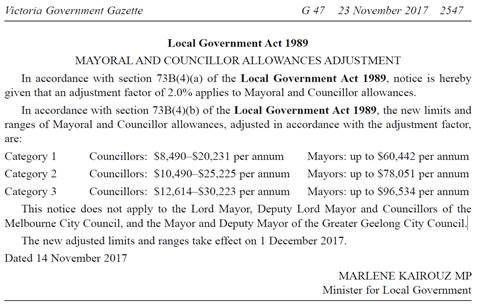
The subject of this report aligns with the City Plan strategic direction – How We Do Business – by ensuring compliance with the requirements of the Act.
No Council officers or contractors who have provided advice in relation to this report have declared a conflict of interest regarding the matter under consideration.
There are no high or extreme risks associated with implementing the recommendation contained in this report.
There are no environmental implications associated with the subject of this report.
Source: |
Governance and Legal Services |
Executive Manager: |
Rebecca Leonard |
Index Reference: |
Council Meetings |
Portfolio: |
Leadership and Governance |
To seek Council approval to proceed with live streaming and recording and publishing Council meetings upon installation of the appropriate equipment.
The Citizens’ Jury (Jury) recommended that Council broadcast Council meetings through multiple media platforms. The Jury highlighted that broadcasting would:
Provide unedited data and information to the wider community in an open and transparent public forum;
Provide a platform for the public to refer back to, fostering a sense of involvement; and
Hold Councillors to account to the Code of Conduct.
The Victorian Government encouraged the Council to implement this recommendation.
In response to the Jury’s recommendation, in September 2017 Council approved the Live Streaming and Publishing Recordings of Council Meetings Policy (“Policy”) (Attachment 2). The Policy provides a framework for how Council meetings could be streamed and/or recorded and published.
There are many benefits in streaming and publishing recordings of Council meetings, including but not limited to:
Accessibility to residents who might be unable to personally attend Council meetings for whatever reason;
Improved transparency in decision making and improved communication and interaction at Council meetings; and
Providing an objective documentary account of Council proceedings as a complement to formal minutes of the meeting (which only record outcomes of motions – not debate or other contextual material).
The Victorian Ombudsman in her report: Investigation into the Transparency of Local Government Decision Making 2016 noted that live streaming is another way for Councils to increase the public’s accessibility to Council meetings, particularly for people who find it difficult to physically attend.
In addition, equipment used to stream or broadcast Council meetings can also be used for other purposes, such as facilitating other community engagement processes, broadcasting citizenship ceremonies and use internally by staff to communicate with each other and stakeholders.
Viewing of recordings of Council meetings has been embraced by other communities, for example, the City of Moreland has up to 2,500 viewers of its streamed Council meetings on Facebook after 3 years.
Live streaming or publishing recordings of Council meetings comes with some risk. The key risks are (including but not limited to):
Council becoming liable for breach of legislation for streaming or publishing recorded material which is in breach of legislation, for instance, defamatory statements;
Councillors, Council officers, or members of the public becoming personally liable for statements made which constitute a breach of legislation;
Misuse of recordings by a third party;
Ensuring that the production quality of the live or recorded content is of a standard that would encourage public interest, including clearly identifying who is talking, good quality audio and visual recording; and
Having the technical skills necessary to operate the recording equipment.
In consideration of the risks, the following mitigating actions have and can be implemented by Council officers:
The Policy provides for notices to be published at meetings, with any recordings published on the internet;
Council officers will undertake appropriate training to enable them to operate the recording equipment and to understand their legal obligations;
Additional Council officer resourcing will be required to operate recording equipment and edit recording content to remove any offending statements that might cause Council to breach any legislation, or void its insurance, with an estimated cost of $30,000 per year;
Council has insurance that would provide indemnity in some cases for Councillors, Council Officers and Council if a defamatory statement was (accidentally or unintentionally) published by Council. There are exclusions in Council’s insurance policies which would need to be carefully managed.
Quotes to obtain the relevant audio, video and lighting equipment and technology to enable the live streaming and/or publishing of recordings of Council meetings indicate a cost of at least $80,000. Budget has been allocated to purchase and install this equipment in this financial year. It may take up to 2 months to procure, install and test the appropriate equipment to live-stream and record Council meetings.
Councillor Kontelj moved, Councillor Grzybek seconded -
That Council:
Authorises the Chief Executive Officer to stream or publish recordings of Council meetings in accordance with the Live Streaming and Publishing Recordings of Council Meetings Policy;
Notes the risk mitigation measures that will be adopted by the City in respect of streaming or publishing recordings of Council meetings; and
Notes that streaming or publishing recordings of Council meetings will commence by the Council’s Ordinary Meeting on 24 July 2018.
Carried.
The cost of upgrading existing equipment and purchasing and installing new equipment to support streaming and recording and publishing recordings of Council meetings is estimated to be at least $80,000. Additional staff attendance would also be required to support the streaming and recording and publishing recordings of Council meetings with an estimated cost of $30,000 per year.
The Citizens’ Jury considered the issue of live streaming Council meetings. No other community consultation has been undertaken in relation to this policy. In accordance with our Community Engagement Policy, any changes would need to be communicated to the community.
Council meeting content may be made more accessible to the community through live streaming and/or publishing recordings of Council meetings.
Legal risks associated with live streaming and publishing recordings are outlined in this report.
The live streaming and/or publishing of recordings of Council meetings aligns with How We Do Business.
No officer involved in the preparation of this report has any direct or indirect conflict of interest in the matters raised in this report.
A risk assessment has been completed to identify key risks of recording and publishing recordings of Council meetings. Those risks have been considered in the Live Streaming and Publishing Recordings of Council Meetings Policy.
No direct environmental implications arise from this report.
The following will be posted in a prominent location at a Council Meeting that which is to be recorded or streamed live:
This public meeting is being streamed live on the internet via the City of Greater Geelong Facebook page. The recording will be made available on Council’s website www.geelongaustralia.com.au after the meeting. What you say at this meeting may be live streamed or recorded and/or published.
All care will be taken to maintain your privacy, however, as a visitor in the public gallery your presence may be recorded. By remaining in the public gallery it is implied that you give consent to your image and what you say being broadcast and/or recorded.
You are personally responsible for what you say at this meeting. You may be personally liable at law for what you say, including in an action brought by another person for a breach of any relevant law, including for defamation, discrimination, privacy.
A copy of the Council’s Live Streaming and Recording of Council Meetings Policy is available on the Council’s website.
The following statement is to be read by the Chair at the commencement of each Council Meeting which is to be recorded and/or streamed live:
This public meeting is being streamed live on the internet via the City of Greater Geelong Facebook page. The recording will be made available on Council’s website www.geelongaustralia.com.au after the meeting. What you say at this meeting may be live streamed or recorded and/or published.
All care will be taken to maintain the privacy of members of the public sitting in the public gallery, however, as a visitor in the public gallery, your presence and what you say may be recorded. By remaining in the public gallery it is implied that you give consent to your image and what you say being broadcast and/or recorded.
Everyone at this meeting is personally responsible for what they say here. You may be personally liable at law for what you say, including in an action brought by another person for a breach of any relevant law, including for defamation, discrimination, privacy.
A copy of the Council’s Live Streaming and Recording of Council Meetings Policy is available on the Council’s website.
Attachment 3
Agenda Notice
The following statement is to be included at the start of the agenda of any Council Meeting which is to be recorded and/or streamed live:
This public meeting is being streamed live on the internet via the City of Greater Geelong Facebook page. The recording will be made available on Council’s website www.geelongaustralia.com.au after the meeting. What you say at this meeting may be live streamed and/or recorded and published.
All care will be taken to maintain the privacy of members of the public attending this meeting, however, anyone sitting in the public gallery may be recorded. By remaining in the public gallery it is implied that people attending the meeting give their consent to their image and what they say being broadcast and/or recorded.
Members of the public attending this meeting are personally responsible for what they say. Members of the public may be personally liable at law for what they say, including in an action brought by another person for a breach of any relevant law, including for defamation, discrimination, privacy.
A copy of the Council’s Live Streaming and Publishing Recordings of Council Meetings Policy is available on the Council’s website.
Attachment 4
Website Disclaimer
The opinions or statements made during the course of a Council meeting are those of the particular individuals, and not necessarily the opinions or statements of Council. The Council does not necessarily endorse or support the views, opinions, standards or information contained in the live streaming or recording of the Council meetings.
The Council does not accept any responsibility for the comments made or information provided during Council Meetings and does not warrant nor represent that the material or statements made during the streamed Council Meetings are complete, reliable, accurate or free from error. The Council does not accept any responsibility or liability for any loss, damage, cost or expense that a person might incur howsoever arising as a result of or in connection with the viewing, using or relying on information or statements provided in the live streaming or recording of Council Meetings.
A recording Council Meeting may not be available from time to time. Whilst Council will use its best endeavours to ensure the live streaming and website are functioning, the Council takes no responsibility for and cannot be held liable for the temporary unavailability of live streaming or the Council website because of technical issues beyond its control.
Technical issues may include, but are not limited to the availability of the internet connection, device failure or malfunction, unavailability of social media platforms or power outages.
[Back to List]
9. Mayor and Councillors' Media Engagement Policy (2018)
Source:
Governance & Legal Services
Executive Manager:
Rebecca Leonard
Index Reference:
Mayor and Councillors Media Engagement
Portfolio:
Leadership & Governance
Purpose
To present the revised Mayor and Councillors’ Media Engagement Policy (2018) for adoption by Council, noting that this revision recognises Council’s re-introduction of councillor-assigned portfolios, and councillor representation on a range of internal and external committees, boards, associations and forums.
Background
Council adopted the inaugural Mayor and Councillors’ Media Engagement Policy in October 2015 to better clarify and assure the mayor’s role (under the Local Government Act) as the ‘principal spokesperson’ for Council.
Council then adopted a revised version in August 2017 that recognised the Victorian Electoral Commission’s changes to the municipality’s ward structure, and further changes in the media landscape – particularly social media.
Key Issues
Victoria’s Local Government Act (Vic) 1989 (Act) appoints the Mayor of any Victorian Council as the principal spokesperson for that council, representing its views, and those of the community; and is responsible for carrying out the civic and ceremonial event duties of the Office.
However, the Act’sbrevity on these important duties means that further guidance is needed (for councillors and officers) on who fulfils these roles in the mayor’s absence, and for the roles of individual councillors in engaging with media.
Without such guidance, there is a risk of an unintended breach of protocol for councillors and staff, potentially impacting the council’s and organisation’s reputations.
The latest (2018) revision of the Mayor and Councillors’ Media Engagement Policy accommodates the re-introduction (13 March 2018) of councillor-assigned portfolios, and councillor appointments to a range of council committees, and as representatives to council-endorsed external committees, boards, associations and forums.
Councillor Asher moved, Councillor Kontelj seconded -
That Council adopt the Mayor and Councillors’ Media Engagement Policy 2018.
Carried.
Attachment 1
Financial Implications
There is no impact to budget from the matters arising from this report.
Community Engagement
Corporate Communications and Marketing Services has previously consulted with and monitored the activities of other ‘like councils’ as to how they manage media engagement. Notably, the City has based this policy on the City of Melbourne’s similar policy (revised July 2017).
Social Equity Considerations
This revision will help ensure fair, transparent engagement by the mayor and councillors with the community they serve.
Policy/Legal/Statutory Implications
The revised policy is in line with relevant Victorian Government Acts for the good governance of local councils generally, and the role of the mayor and councillors in particular.
Alignment to City Plan
The revised policy aligns with City Plan’s ‘How We Do Business’ by facilitating and ensuring appropriate engagement and communication between our mayor and councillors, and the community they serve.
Conflict of Interest
City staff have had no conflict of interest in the preparation or submission of this report.
Risk Assessment
The Mayor and Councillors’ Media Engagement Policy willhelp generate effective communication and engagement between the council and its community.
Environmental Implications
There are no environmental impacts from the matters arising in this report.
[Back to List]
10. Proposed development
Source:
Finance and Strategy
Director:
Peter Anderson
Portfolio:
Finance
Councillor Murnane moved, Councillor Grzybek seconded -
That in accordance with Section 89 (2)(h) of the Local Government Act 1989, this matter which the Council considers may prejudice the Councillor any other person, be considered at the conclusion of all other business at which time the meeting be closed to members of the public.
Carried.
[Back to List]
11. Tender T1800012 - Cloverdale Community Hub Construction
Source:
Finance & Strategy
Director:
Peter Anderson
Index Reference:
T1800012
Portfolio:
An Inclusive and Diverse Community
Councillor Murnane moved, Councillor Nelson seconded -
That in accordance with Section 89 (2) (d) of the Local Government Act 1989, this contractual matter be considered at the conclusion of all other business at which time the meeting be closed to members of the public.
Carried.
Contents | Previous Page: Section A - Procedural Matters | Next Page: Section C - Notices of Motion

- Copyright CoGG 2012
- Contacts
- Disclaimer
- Privacy
- Last Update: 7 June 2018