
Council Minutes - Section B: Reports - 22 May 2018
Contents | Previous Page: Section A - Procedural Matters | Next Page: Section C - Notices of Motion
Contents | Previous Page: Section A - Procedural Matters | Next Page: Section C - Notices of Motion
Reports tabled at the Ordinary Meeting of Council on Tuesday date held at the Council Conference and Reception Centre in City Hall, 57 Little Malop Street, Geelong.
Source: |
Strategy & Performance |
Director: |
Peter Anderson |
Index Reference: |
Sale of Land |
Portfolio: |
Arts, Culture and Heritage |
To seek Council’s endorsement to offer for sale the former Geelong Post Office, and give public notice of its intention to do so.
The Council purchased the Geelong Post Office from the State in 1996 using an interest free loan of $670,000 which remains outstanding. Since purchase of the property it has been used for both Council accommodation and leased to private tenants.
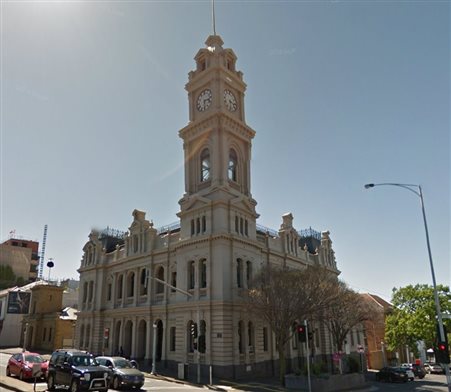
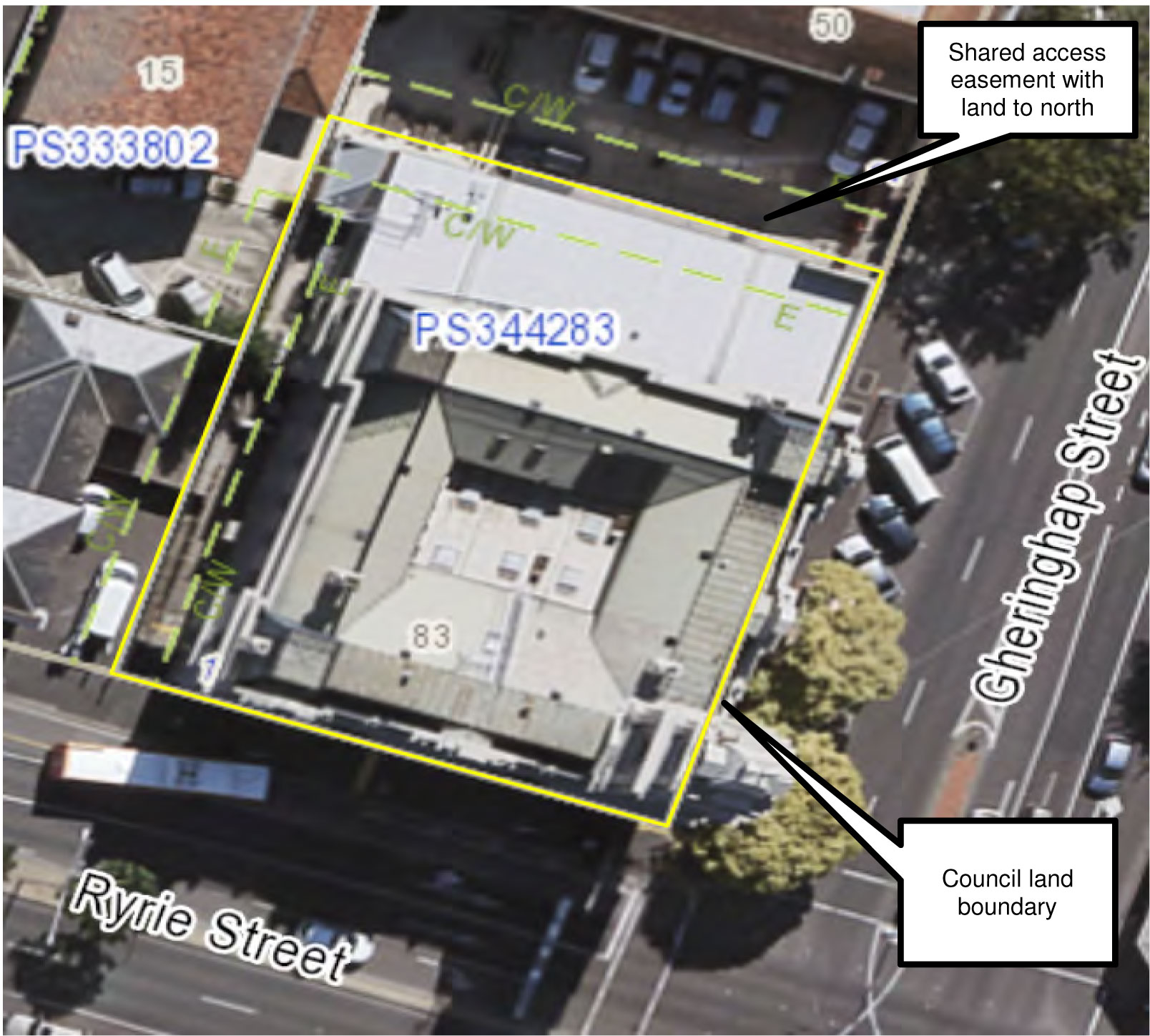
Built in 1889 and opened in 1891, the former Geelong Post Office building is situated on an allotment of 1,300m2 and is owned freehold by Council subject to the loan arrangements with the Minister for Planning. It is zoned Activity Centre Zone and located in the Core Precinct which allows a broad range of uses including shop, food and drink premises, offices subject to Council approval (STCA) and accommodation (STCA). The land is included within a Heritage Overlay and the building appears on the Heritage Victoria Register H1046. The Geelong Post Office is depicted in Attachment 2.
Since purchase of the property it has been used for both Council accommodation and leased to tenants mainly engaged in the provision of youth services. The building provides 1,544m2 of low grade office type floor space of which 623m2 is currently occupied by Council staff who are due to vacate the building in June 2018.
Apart from installation of an internal lift and minor interior refurbishment, little has been done to bring the interior up to acceptable standards for office use. The maximum annual rental yield from the property was $137,000 when fully occupied in 2016. Average annual maintenance, security and cleaning costs over the past 3 financial years have been $138,000 per year, and annual utilities charges are approximately $26,000.
The cost of bringing the building up to standard for office use was recently estimated to be $3.73m.
Since the building is not intended to play a role in Council’s future accommodation strategy or any other Council operations it is recommended that consideration be given to sale of the property.
Occasional enquiries are received from prospective purchasers about the property. It is feasible to convert the property into residential apartments or upgraded office uses subject to approvals from Heritage Victoria and Council.
A Conservation Management Plan has been prepared by an experienced heritage advisor and will be made available as part of any sale process. The report provides information on the significance of the building and guidelines on internal modifications.
Of the 1,544m2 of floor space in the building, 623m2 is occupied by Council staff. The Council staff are due to be relocated in June 2018, leaving the property entirely vacant.
The building with its solid internal and external walls is inefficient and difficult to adapt to contemporary office standards and has no identified role in any future Council operations or requirements.
Enquiries have been received from potential purchasers and, subject to approval, the building has potential for conversion to alternative uses including apartments or short stay accommodation. There is limited on-site parking available.
The heritage aspects of the building are adequately protected through its inclusion on the Victorian Heritage Register and within a heritage overlay on the planning scheme. A Conservation Management Plan (Attachment 3) has been prepared by an experienced heritage consultant. The report will be made available as part of the sale process. The Report builds on and supports work undertaken by Heritage Victoria which resulted in the preparation of Statement of Cultural Significance for the building in 1994.
The Conservation Management Plan defines fabric loss and change, provides conservation guidelines and will be used to assist in the approvals processes at Heritage Victoria and Council should future changes to the fabric or use be proposed. The report identifies the significant changes that had been made to the former Post Office over the years and importantly those features to be preserved and/or enhanced. Whilst the report identifies the need to preserve the original exterior of the building and its existing profile against the sky, it does not advocate retention of most of the internal additions or any “restoration” of the interior back to a specific period or previous appearance.
The Conservation Management Plan also recommends a history of the former Post Office building be prepared (for posterity and future research). The history will be commissioned and be available for any party to better understand the evolution of the property.
It is recommended that, subject to completion of the requirements of the Local Government Act 1989, the building could be sold without conditions relating to future use or development. Should Council eventually proceed with sale an agent would be appointed and would advise upon the method of sale and the price will not be less than Council’s certified valuation to be obtained.
Council is required to give public notice of its intention to sell the property under s189 of the Local Government Act 1989 (LGA). Any person is able to make a submission and be heard in respect of that submission. If submissions require hearing they will be heard by Council’s Submissions Review Panel and a further report will be put to Council.
Strategic Context.
Discussions have commenced with the State Government on the possible redeployment of the outstanding loan to other heritage related Council projects. The most recent advice on this matter from Heritage Victoria is:
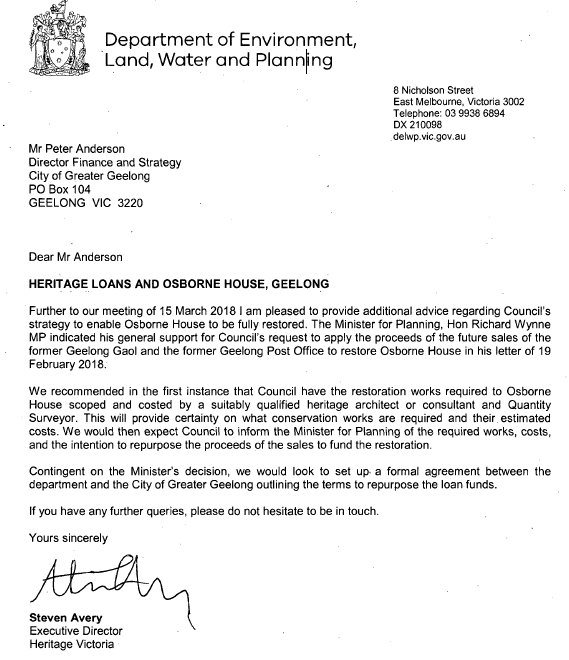
Having regard to advice received from Heritage Victoria and subject to compliance with statutory requirements, the successful sale of the property and the Minister’s consent the proceeds of the sale of this building would be redirected to supporting the restoration of Osborne House and the stables building within Osborne Park. At the appropriate time Council would need to consider amending its annual budget to give effect to this reallocation.
In terms of Council’s strategic approach to heritage building conservation it would be possible, with Heritage Victoria consent, for Council to establish a heritage fund as a result of the sale of the former Post Office and the Gaol.
This heritage fund could be applied to continued restoration of Council owned heritage buildings (National Wool Museum, Customs House, Osborne House and Stables, City Hall, etc.). At the moment Council has an annual heritage grants program which it has loosely described as a Heritage Fund.
The establishment of a separate and distinct Geelong Heritage Restoration Fund incorporating the current grants program but also including capital funding for funding preservation of Council Historic buildings could form part of a broader Council policy on heritage protection and building conservation.
Councillor Mason moved, Councillor Murnane seconded -
That Council:
Gives notice under section 189 of the Local Government Act 1989 of its intention to sell the Geelong Post Office and such notice be placed in the Geelong Advertiser and the Geelong Independent;
Includes in notices given as required by paragraph 1 above advice regarding the right of a person to make a written submission on the proposed sale and to be heard in respect of their written submission;
Appoints the Submissions Review Panel to hear any submissions;
Be provided a further report to consider the outcomes of the Submission Review Panel and or the sale of the property; and
Refer the Conservation Management Plan dated 2 May 2018 to Heritage Victoria and the National Trust for comment, with comments available to Council by 31 July 2018.
Carried.
In June 2013 the Minister for Planning advised Council that an interest free loan from 1994-95 of $670,000 shall be payable upon sale of the property. A similar arrangement is in place for the Old Geelong Gaol which was purchased from the State at the same time. The Minister in 2013 advised that upon repayment of the loan, consideration would be given to establishing a Geelong Heritage Restoration Fund for the conservation of heritage places. It is noted that the Fund has now been established and representation has been made to State Government for the possible redeployment of the loan repayments for both the Gaol and Post Office into other heritage related Council projects.
The proceeds from the sale of the land will be non recurrent income. As property assets are disposed of the written down value is adjusted on the asset register. Given the advice of Heritage Victoria and Council’s existing budget commitment to restore Osborne House and the stables it is suggested that the proceeds of the sale of the former Post Office be directed toward the restoration of Osborne House and the stables. At the appropriate time a budget transfer would be made to give effect to this intention. This allocation would include the amount that would have otherwise been payable to the State. Should surplus funds be available Council could consider the establishment of a heritage fund.
Should Council decide to retain the former Post Office Building it will need to offer the building for commercial lease to offset annual operating and maintenance liabilities (est $140k annually). No provision has been made in the 2018/19 budget for any shortfall in expenditure on the building and no provision has been made for any restoration to occur. The property is shown on Council’s forward sales program.
Any person will have an opportunity to make a written submission on the proposed sale under the notice of intention to sell land. A submitter is entitled to request in the submission that the person wishes to appear in person, or to be represented by a person specified in the submission, at a meeting to be heard in support of the submission.
There are no social equity issues associated with this matter.
Section 189 of the LGA requires that Council must obtain from a person who holds the qualifications or experience specified under section 13DA(2) of the Valuation of Land Act 1960 a valuation of the land which is made not more than 6 months prior to the sale. The price for the property will be not less than this valuation.
Under the same section of the LGA the Council is required to give public notice of its intention to sell the land and consider any submissions received. If any submissions are received they will be heard by the Submissions Review Panel followed by a report to Council. If no submissions are received the property a recommendation will be made to Council to sell the property.
Should the sale proceed an agent will be appointed to sell the property by a public process and the method of sale will be determined in consultation with the agent. Sale options include public auction, sale by expressions of interest or listing.
The recommendation supports the action priority relating to Responsible and Sustainable Financial Management where the sale of assets no longer required will support the identified progress indicators.
No officers or contractors involved in the preparation of this report have a direct or indirect interest in the matters to which this report relates.
No notable risks associated with implementation of the recommendations.
Heritage protection is provided and a Conservation Management Plan issued as part of the sale process.
Former Geelong Post Office
Councillor Kontelj declared an Indirect Interest in Agenda Item 2 – 2018-2019 State Government of Victoria World Game Facilities Fund, in that his daughter plays soccer at Bell Park Sports Club and left the meeting room prior to discussion at 8:00pm.
Source: |
Community Life – Social Planning & Investment |
Acting Director: |
Fiona Reidy |
Index Reference: |
Sport & Recreation Grants & Funding - Incoming |
Portfolio: |
Social and Infrastructure Planning |
To seek Council endorsement to apply to the State Government’s 2018/19 World Game Facilities Fund.
The State Government’s World Game Facilities Fund (WGFF) aims to support local football (soccer) clubs to upgrade existing facilities or develop new facilities. Only local government areas are eligible, so clubs must apply to their Council via an Expression of Interest (EOI). Applications must be submitted to Sport & Recreation Victoria (SRV) by 30 May, 2018.
Due to the tight timeframes set by the State Government, the expression of interest process for football (soccer) clubs was open from Friday 13 April to midnight on Sunday 22 April, 2018.
Following an assessment of the eight (8) Expressions of Interest received, the Bell Park Sports (Soccer) Club female friendly facilities upgrade is the recommended project for submission to SRV. This project has the greatest alignment to Council policy, the WGFF criteria and readiness for delivery and construction.
The maximum total grant amount available from the WGFF is $250,000. Council can submit up to two applications. As the recommended project is seeking the maximum contribution of $250,000 from the funding program, only one application is proposed.
The total project cost is $810,000 and the project will require a Council contribution of $270,000. The Bell Park Sports Club will contribute $170,000 cash and $120,000 in-kind.
The project will address the lack of adequate change facilities to support more than 60 females currently participating at the Bell Park Sports Club. The current change facility is in poor condition and not appropriate for female use.
Councillor Murrihy moved, Councillor Aitken seconded -
That Council:
endorses the development of a submission to Sport & Recreation Victoria’s World Game Facilities Fund for the Bell Park Sports Club female change facility development;
allocates an amount of $270,000 in the 2018/19 Budget, noting that should this application be unsuccessful, Council’s contribution will not be required.
Carried.
Information on the World Game Facilities Fund can be found at: www.sport.vic.gov.au/grants-and-funding/our-grants/world-game-facilities-fund.
The Bell Park Sports (Soccer) Club female friendly change facility upgrade will deliver two sets of unisex change rooms and amenities, umpire change rooms and first aid area. It will provide a facility that is welcoming for females and supports growth in women’s soccer. At present, the Bell Park Sports Club has 60+ female participants who do not have access to appropriate change facilities. The current change facilities are outdated and without adequate privacy. The project will also strengthen existing community partnerships between the Bell Park Sports Club and local not-for-profit organisations and aligns with Council’s strategic planning to deliver a facility that is in line with Football Federation Victoria facility guidelines. This project was unsuccessful in the most recent round of the State Government’s 2018/19 Community Sport Infrastructure Fund. Feedback from the previous application has been sought from Sport & Recreation Victoria representatives and will be addressed in the submission to the WGFF.
Other submissions received through the Expression of Interest (EOI) process were of a high standard, however many of the EOIs require further project planning to demonstrate a robust understanding of cost and scope. Officer support will be provided where identified to strengthen these applications for future funding opportunities.
Should the funding submission to SRV be successful, Council will be expected to make a commitment to the project in the 2018-19 financial year. The minimum funding ratio for this program is $1.5 State : $1 Local
Proposed funding:
Funding Source |
Confirmed |
Amount |
World Game Facilities Fund |
N |
$250,000 |
Council contribution 2018/19 |
N |
$270,000 |
Bell Park Sports Club (cash) |
Y |
$170,000 |
Bell Park Sports Club (in-kind) |
Y |
$120,000 |
Total income/total project cost |
|
$810,000 |
Requires amendment to budget.
Pending a successful outcome of this grant submission, a total contribution of $270,000 from Council’s 2018/19 Budget will be required.
$245,000 is already allocated to the project in the draft 2018/19 Council Budget. An additional contribution of $25,000 will be required in the 2018/19 to bring Council’s total budget contribution for this project to $270,000. The $25,000 difference is due to cost escalation and more detailed quantity surveyor costings. If the grant application is unsuccessful, no contribution from Council will be required.
Council will not have maintenance responsibility for this facility as it is located on private land and will be the responsibility of the Bell Park Sports Club.
Following the State Government opening the grant applications on 27 March, 2018 Council advertised and opened an Expression of Interest (EOI) process which called for submissions from all soccer clubs within the municipality. Soccer clubs were contacted directly advising them of the new funding round.
EOIs were assessed against the WGFF Guidelines along with Council’s budget drivers and the Our Future Community Indicators. Alignment to supporting strategies such as the G21 Regional Football (Soccer) Strategy and project readiness was also considered. Discussions were held with local SRV and FFV representatives to ensure both had a level of comfort with the proposal. The assessment of applications can be found at Attachment 2.
The proposed project will support growth in football (soccer) across the municipality and within the Bell Park Sports Club. The current facility cannot accommodate the existing 60+ female participants due to being outdated and not aligning with modern standards. The project will provide a truly gender neutral facility that is compliant and appropriate for females.
There are no legislative or legal ramifications associated with the adoption of this report.
The proposed funding contributions for this project meet the requirements of Council’s Private Sporting Infrastructure Capital Co-Contribution Policy. As the Bell Park Sports Club are located on private land, the policy notes that Council will contribute up to one-third of the total project cost, with the Club to contribute a minimum two-thirds of the total project cost from any other funding sources including cash and in-kind. The proposed contribution from both the State Government and the Bell Park Sports Club equates to two-thirds of the total project cost.
The recommended project aligns to the City Plan’s priority of Community Wellbeing along with the City’s Clever and Creative vision through the Inclusive, Diverse, Healthy and Socially Connected Communities. This project will encourage healthy lifestyles and connected communities through active recreation and participation in sport.
No officer has any known indirect or direct conflict of interest in the preparation of this report.
There are no immediate risks associated with this report. The project will include relevant risk management and Occupational Health & Safety assessments.
There are no foreseeable environmental implications associated with this report. Environmentally sustainable design initiatives will be incorporated into the design where practicable.
Councillor Kontelj re-entered the meeting room at 8.10pm.
Source: |
City Services - Environment and Waste Services |
Director: |
Guy Wilson-Browne |
Index Reference: |
Hard Waste Investigations |
Portfolio: |
Environment and Sustainability |
To recommend a proposal for the introduction of a residential hard waste collection commencing in April 2019, entitling each property to one hard rubbish collection per year.
Sustainability Victoria’s data shows that 42 of the 79 local governments in Victoria provide a hard waste collection. Hard waste collections pick up solid waste that is either not accepted or does not fit into garbage bins such as furniture and white goods.
The City has received many requests from residents for a hard waste service over many years. One of the main reasons for the requests is that many residents lack the ability to transport bulky items for disposal at landfills or resource recovery centres.
The benefits of a hard waste service can include:
improved opportunities to recycle;
better outcomes for elderly residents and people with disabilities through on-property removal of waste;
improved access to waste disposal services for those unable to transport material to resource recovery centres or landfills;
provision of a high level of service to residents and ratepayers; and
reduced cost of removal of hard waste items for residents.
The design of the hard waste service must be one that best meets the needs of the community. While there are advantages and disadvantages to different hard waste delivery models, a residential booked at-call hard waste service offering collection from both the kerbside and within the property boundary has a number of key advantages over other models including:
increased flexibility for residents;
greater waste diversion from landfill;
increased safety and reduced loss of amenity for residents and collection workers;
higher level of service as waste is collected from within the property;
likely to be a lower cost in long term;
suitable for densely built-up areas; and
decreased scavenging.
The collection service will be delivered by a third party provider and will allow for one collection per annum.
The estimated budget required for this service for the 2018-19 financial year is $750,000 with an April 2019 start. The estimated cost for the 2019-20 financial year is $3 million. These estimates allow for one collection per residential property per annum.
A hard waste service will operate in conjunction with the City’s existing waste and resource recovery disposal programs. These include free disposal of white goods, paint, scrap metals, oils, car batteries, BBQ gas cylinders, televisions, computers equipment and excess recycling at the Drysdale and Geelong resource recovery centres.
The City conducts discount offers for items that are difficult to get to the resource recovery centres. One is the lounge suite pick up service. Residents can have their old lounge suite picked up for $20. The City subsidises the remainder of the cost, which is $80. Since starting in June 2017, the City has picked up over 1,000 lounge suites.
Another is the discount mattress offer. It operates during June and November each year. Residents can drop off their mattress for $10 or have it picked up for $15. The normal drop off and collection cost is $22.50 and $35 respectively. The City collects around 1,400 to 1,800 mattresses during each of these months. Normally, the monthly average is 300 mattresses.
All other existing waste and recycling services will continue.
Councillor Mason moved, Councillor Kontelj seconded -
That Council authorises the implementation of a booked at-call hard waste service for a 12 month period commencing in April 2019, subject to approval of funding in the 2018-19 budget, which allows one booking per year per residential property and collection from within the property boundary or kerbside.
Carried.
Booked hard waste services provide residents the ability to arrange a limited number of collections at any point throughout the year. This model is by far the most common in Melbourne with 20 of the region’s 31 councils offering a booked hard waste collection. Some councils also allow residents to book additional collections for a fee.
Blanket hard waste services are a ‘one size fits all’ approach, offering a hard waste service to all residents in a defined area, or suburb, at a date and time set by a council. Seven of the 31 metropolitan councils offer blanket collection services.
A range of factors influence the participation rate by residents of a hard waste service. These include the extent to which residents are aware of a council’s hard waste service or alternative management options such as local waste transfer facilities, or community enterprises that provide drop off opportunities for residents.
The following is a summary of the main factors to consider when designing a booked at-call hard waste service.
Scheduling Systems (booked services)
Booked service collections require bookings that are localised within suburbs and grouped to minimise travel across the municipality. Booked services also require guaranteed maximum waiting times to be set.
Property Mix
The mix of properties, width of pathway, presence of a nature strip and presence of a front yard impact the placement of material within a property and on street. In areas where there is a significant number of multi-unit developments, there can be constrained space for the placement of waste material for collection. This has significant impacts on blanket-based services. Retirement villages may also have constrained spaces for placement of waste and may require smaller collection vehicles.
Infrastructure and Events
Narrow access roads, slow traffic, local events and seasonal influx of visitors may affect the ability of residents to place waste in a suitable area and could reduce the speed of collection. Appropriate scheduling of services can help reduce this issue.
Non-Conforming Materials
Council will specify which materials are able to be collected via the hard waste service. Non-conforming materials and volumes can result in safety, amenity, legal and financial issues. To restrict the placement of non-conforming items Council will need to set clear parameters for materials that will, and will not be collected.
Communication and Promotion
The extent of promotion for a hard waste service can influence the participation rate by the community. The City will implement a communication plan to promote the service. Most councils that operate a successful hard waste service undertake significant promotion and enable bookings via their website.
Type of Service
It is important to design a service that meets the needs of residents, reduces impacts on amenity and the environment, and minimises costs and risks.
In determining the needs of residents, it is important to consider the type of service - whether it be a blanket area service or booked at-call service. Another consideration is the collection point – whether it is from the kerbside, within the property boundary, or both.
Monitoring the Service
The City will regularly monitor the hard waste service to ensure a high participation rate, effective diversion of material from landfill, lowest possible service costs and responsive management of service safety issues. To help ensure the success of the service a formal review will be undertaken after 12 months.
Service Key Performance Indicators (KPIs) and targets will enable residents, staff and contractors to provide feedback on performance. The KPIs include:
percentage of material diverted from landfill;
tonnes of hard rubbish collected per month;
number of bookings per month;
unit cost per service;
number of complaints;
community satisfaction; and
number of dumped rubbish complaints per month.
Service Models
There are four hard waste service models:
Option 1 - booked by the resident, and waste is collected from within the property boundary;
Option 2 - booked by the resident and waste is collected from the kerbside;
Option 3 - booked by the resident and material is collected from either within the property or on the kerbside; and
Option 4 - blanket (suburb or area based) kerbside collection.
The following describes the four hard waste service models.
Option 1: Booked by the resident and waste is collected only within the property boundary
Under this option, the resident books a collection via council’s website or at a customer service centre for waste collection within the property boundary. A booked service allows council and contractor to liaise with the resident to determine the most appropriate time and date to collect the waste material. Material presented for collection is for a limited time prior to collection, which helps prevent scavenging, reduces windblown litter and improves safety. Collection within the property minimises the impact on street amenity.
The disposal costs for a booked hard waste service are often higher than a blanket service, with sorting and transportation of recovered material more expensive than compacting on site and transporting direct to landfill. Advantages include lower volumes collected when compared to a blanket service, together with higher volumes of recyclable material collected for profit.
The opportunity to recycle material is greater due to the increased ability to stagger collections and take material back to a depot for extraction of recyclable materials.
Collecting from only within the property boundary can cause issues in highly built–up areas where properties may not have the area within the property boundary to place the material. It does however keep kerbside areas free for other residents, particularly those using the footpath.
Option 2: Booked by the resident and waste is collected only from the kerbside
Similar to option 1 but waste collection is from the kerbside rather than within the property boundary. However, this decreases street amenity.
Being a booked service it has the benefit of setting an agreed date and time for the collection and increases the opportunity for recycling. Generally, the contractor will arrange for a number of collections from an area to decrease costs and increase efficiency.
Kerbside waste placement leads to a greater risk of salvaging, windblown litter and subsequent safety risks when compared to collection within the property boundary. Others could also add to the material placed at the kerb.
Option 3: Booked by the resident and material is placed either within the property or on the kerbside
This option has the benefits outlined above for a booked service, however provides residents with the flexibility to place materials within the property boundary or on the kerbside.
One of the major advantages of this service is that it allows residents with minimal or no front yard to place material on the kerb. Alternatively, if there is minimal or no kerb, the resident can use space within their property boundary. This option enables collections in areas with a broader mix of properties including higher density areas compared to the other booked service options.
There may be safety and amenity issues with material placed onto the kerb, however the amount of material placed on the kerb will be less than option 2, and being a booked service reduces the time material is on the kerb.
Option 4: Blanket (suburb or area based) kerbside collection
This option provides residents living within an area or suburb to place material on the kerb for collection. This has significant risks associated with it, including safety, salvaging, dislodging of materials and placement of material by others. Dislodged material, particularly during windy weather, becomes a significant safety issue. It may also block roads and footpaths.
The large amount of material placed on the kerb reduces the ability to rapidly identify and remove non-conforming materials when compared to booked services. The ability of contractors to store collected material, as well as sort and retrieve recyclable material is also limited compared to the booked service options due to the very large volume of material collected at the same time.
There are significant amenity issues with a blanket service due to the large amount of waste material placed on the kerbside. Councils that operate this service experience a high number of complaints from residents due to amenity and safety concerns.
Only seven of 31 councils in the Melbourne metropolitan area use a blanket service and a number of these are moving to a booked service model in the next 2 years.
Table 1 compares each of the models.
Option |
1. Booked – within property |
2. Booked – kerbside only |
3. Booked – within property & kerbside |
4. Blanket kerbside |
Criteria |
||||
Cost |
High |
High |
High |
High |
Safety Risk |
Low / Medium |
Medium |
Medium |
High |
Theft & Dumping Risk |
Low |
Medium |
Low / Medium |
High |
Impact Urban Amenity |
Medium |
High |
Medium / High |
High |
Flexibility of service to cater to residents and contractors |
Medium |
Medium |
Very High |
Medium |
Recycling |
High |
High |
High |
Low |
Community Satisfaction |
High |
Medium / High |
High |
Medium |
The cost of hard rubbish services vary widely and depend upon the service model, specifications and characteristics of a municipality such as size, density and demographics. Melbourne metropolitan councils spend approximately $29.84 million and non-metropolitan councils $600,000 to deliver hard waste services.
Generally, blanket services have higher service costs. There is more material to collect, sort and dispose of compared to a booked at-call service. Casey City, which is a similar size to the City in terms of population, has a twice-yearly booked residential service. It has a high service uptake with over 50,000 bookings per annum. The service costs the Casey about $4 million per annum.
Yarra Ranges Shire has about half the properties of Casey and provides a blanket collection. Presentation to the kerbside is almost 100%. This is common for blanket services. The cost of this service is about $2 million per annum.
The hard waste costs at other councils provide a guide as to what a booked at-call service for the City might cost. Table 2 provides a summary of a tender for a booked hard waste service in 2017. The data relates to an outer metro council, which has about 80% of the number of properties compared to the City. Residents that use the service mostly only do so once a year, despite being able to access two services annually.
As part of the tender specifications many councils are now setting the number of collections per year and tenders request costs based on this rather than the number of properties.
Table 2: 2017 hard waste tender costs for a large outer metro council
Contractor |
Schedule rate |
No of Collections per Year |
Total Cost |
|||
Collection, Sorting, Recycling & Disposal |
Call Receival |
Collection |
Call Receival |
Total Cost |
||
A |
$59.40 |
$7.95 |
19,100 |
$1,134,540 |
$151,845 |
$1,286,385 |
B |
$77.60 |
$3.55 |
19,100 |
$1,482,160 |
$67,805 |
$1,549,965 |
C |
$90.54 |
$3.86 |
19,100 |
$1,729,314 |
$73,726 |
$1,803,040 |
Various hard waste budget options have been prepared based upon varying participation rates and figures from other councils (Table 3).
The City’s hard waste service will be limited to a maximum of one booking per residential property per year to help minimise costs. The City anticipates considerable demand for the service so it is important to limit collections initially.
The estimated budget required for this service for the 2018-19 financial year is $750,000 assuming an April 2019 start. The estimated 2019-20 cost is $3 million.
Limiting the type and volume of waste accepted and charging for some items can reduce net cost.
Each booked service will have a maximum volume of three cubic metres. Timber pieces will be limited to 1.5 metres length. The service will not accept mattresses. However the City will continue to offer mattress disposal promotions and options.
The tender will be for a 12 month service with options to extend at Councils discretion subject to satisfactory performance.
Table 3: Estimated hard waste service option costs
Proportion of 110,000 Properties Serviced |
Number of Collections |
Total Service Cost At $70 per collection |
Residential Waste Charge with Hard Waste Service and Recycling Impacts $ per assessment |
% Increase in Waste Charge over 2016-17 level ($278.05) |
Added Cost to Residential Waste Charge Excluding Recycling Impacts $ per assessment |
% Increase to Residential Waste Charge Excluding Recycling Impacts |
0.0% |
0 |
0 |
310.00 |
11.5% |
0 |
0.0% |
7.5% |
8,200 |
750,000 |
316.90 |
14.0% |
6.90 |
2.2% |
17.5% |
19,200 |
1,500,000 |
323.70 |
16.4% |
13.70 |
4.4% |
37.0% |
40,629 |
3,000,000 |
337.40 |
21.3% |
27.40 |
8.8% |
50.0% |
54,914 |
4,000,000 |
346.00 |
24.4% |
36.00 |
11.6% |
* Please note that the above number of collections within the set budgets includes additional costs e.g. promotion of the service.
Funds will be required to implement and manage the service. These include:
Recruitment of a full time officer to maintain the service at an estimated cost of $106,000 per year. The officer will coordinate management of the service contract and assist in the management of complaints and issues associated with bookings such as safety issues, damage to footpaths and removal of non-compliant waste material.
Promotion and advertising at an estimated total cost of $50,000 per year, including:
Letter drop box - $12,000
Community Update - $2,000
Rate notice - $5,000
Animal Registrations - $2,000
Rethink Your Rubbish newsletter – N/A
Local newspapers advertisements & CityNews - $16,000
Social media - $3,000
Radio - $3,000
Posters $2,000
Media releases – N/A
Customer service centres – N/A
Billboards - $5,000
Development of a booking system estimated to cost is $40,000
Service promotion and community awareness will determine uptake of the service. As the hard waste service will be a new service, extensive promotion will be required. The City will develop and implement a detailed communication strategy for the introduction of a hard waste service.
The implementation of a hard waste service will provide all residents with an additional method to dispose of waste materials. This will help maintain a clean and safe community.
There are no legal or statutory implications related to the recommendation in this report.
The hard waste service aligns with the City’s strategic priorities for a sustainable built and natural environment.
There is no direct or indirect and conflict of interest relating to the advice or report for any staff member.
There are a number of potential risks associated with the delivery of a hard waste service. In general, a booked at-call service has fewer hazards than a blanket service. Some blanket hard waste collections have resulted in waste on kerbsides, on footpaths and on roads for over 4 weeks presenting a significant safety and amenity issue.
Risks can be minimised by using the the WorkSafe Safe Collection of Hard Waste Guidelines, which recommend:
identifying hazards associated with collection practices,
finding the identified hazard in the table,
eliminating the hazard where practicable, and
if elimination is not reasonably practicable, implementing lower order risk control methods.
The City will need to undertake further research to identify, mitigate and where possible eliminate risks associated with its hard waste service.
Table 4: comparison of OH&S issues for booked and blanket hard waste services
Issue |
At-call Service |
Blanket Area Collection |
Discussion |
Manual handling large, bulky and awkward items |
Fewer oversized objects on the property and kerb – thus decreasing the risk. |
Likely to have more oversized objects in an area. If many are not collected, they pose a significant risk. |
At-call service provides greater potential for hazard reduction. |
Slips and trips – waste on pathway |
Waste where possible can be collected from resident’s property. |
Waste on footpath provides a potential hazard. |
At-call service provides greater potential for hazard reduction. |
Hazardous substances and dangerous goods. Inadvertent collection of hazardous substances and dangerous goods Exposure of public to hazardous substances and dangerous goods placed on kerb |
Knock back policy easier to administer with at-call. |
Hazardous substances pose risk to public if left on kerb. |
At-call service provides greater potential for hazard reduction. |
Occupational violence – residents, scavengers and road users |
Entering resident’s property must be managed. |
Scavengers are a management issue with area collections. |
Carefully manage risks for both booked and blanket collections. |
Stacked waste reducing traffic visibility |
Less material placed onto the kerb at once. |
Greater volume of material on the kerb can reduce visibility. |
At-call service provides greater potential for hazard reduction. |
Careful management of the hard waste service can minimise environmental impacts through the development of service specifications that place a high priority on:
maximising recycling of materials,
minimising material going to landfill,
minimising transport,
ensuring collection within established timeframes, and
reporting of environmentally hazardous items.
Recycling and resource recovery
A booked service should generate less waste and allow more recycling compared to a blanket service, though it is difficult to compare services due to their differences e.g. what can be picked-up. The amount of material collected varies considerably between councils in the range of 50kg to 200kg per property per year. The average is about 75kg per household per booking. The average recycling rate for the Melbourne metropolitan area is 25%. If the City were to adopt a service with one booking per annum and an anticipated 37% participation rate and 75kg collected per booking, the approximate amount of material collected will be 3,053 tonnes. At an average recycling rate of 25%, 763 tonnes of material will be recycled and 2289 tonnes of material landfilled. This represents approximately 2% of the amount of material currently being disposed of at the Drysdale landfill per annum.
Summary
The preferred model is a booked hard waste service, allowing for one booking per year for residential properties over a 12-month period to commencing in April 2019. This is the preferred model as it minimises safety risks, provides greater opportunity for recycling, minimises impacts on amenity and provides greater flexibility for residents to select the date of their service.
Source: |
City Services - Environment and Waste Services |
Director: |
Guy Wilson-Browne |
Index Reference: |
Waste and Resource Recovery Strategy 2018-2023 |
Portfolio: |
Environment and Sustainability |
To inform Council of the development of the Waste and Resource Recovery Strategy 2018-23.
In September 2012, Council adopted the Waste Management Position Paper 2012-16. This set Council’s strategic waste position:
“to focus upon the consolidation of its existing waste services while observing and positioning itself to take advantage of opportunities to process additional waste material should proven means of processing be identified”
Guided by this strategic waste direction, the City has:
received a $500,000 grant from the State Government for a green organics composting facility;
commenced construction of the green organics composting facility in Anakie;
developed a hard waste collection service for Home and Community Care clients and other residents in need of assistance;
received a $100,000 grant from the Alcoa Foundation and collaborated with local communities and primary schools to introduce public place recycling bins in Portarlington, Drysdale, Ocean Grove and St Leonards;
informed and engaged communities through waste education programs and community meetings such as the Drysdale Landfill Community Consultation Group;
expanded the range of items that can be dropped off at resource recovery centres e.g. electrical items, car and household batteries, fluorescent tubes;
undertaken kerbside bin surveys and utilised the results to implement education programs resulting in a significant reduction in green organics and recycling bin contamination levels;
upgraded the Drysdale landfill, including the construction of new waste cells which incorporate best practice technology to minimise environmental impacts; and
continued to work with the Barwon South West Waste and Resource Recovery Group to help implement community waste education programs, joint procurement and development of waste strategies.
As the City continues to grow, a new strategy is required to set a waste management vision, waste management directions and strategic actions to reduce waste and increase resource recovery.
The proposed vision for the strategy is “to achieve zero waste to landfill from all Council’s operations and services, and to support the community to achieve the same”, which is in line with the City’s commitment to the One Planet Living principles.
Consultation on the development of the strategy will have two stages. The first stage will see development of a background report and discussion paper and stakeholder consultation. The report and paper will provide stakeholders with a summary of waste services, current strategic directions from regional waste groups and state government departments, and a summary of issues and opportunities. The City will consider feedback collected from stakeholders for incorporation into a draft Waste and Resource Recovery Strategy.
In stage 2, the draft strategy will be exhibited and further consultation undertaken. The City will refine the draft strategy based on this consultation into a final strategy for Council to consider for adoption.
Councillor Mansfield moved, Councillor Mason seconded -
That Council notes the development of the Waste and Resource Recovery Strategy 2018-23.
Carried.
The Waste and Resource Recovery Strategy 2018-23 will provide a strategic blueprint for the management of solid waste, recyclables and resources in the City. Driving the development of the strategy is the community aspiration ‘Development and Implementation of Sustainable Solutions’ in the City’s 30-year vision document Greater Geelong: A Clever and Creative Future and the City Plan. The City aims to move to a zero-waste community and encourage economically viable, environmentally sound and socially responsible business practices.
National, state, regional and local waste management frameworks have also guided the strategy, including:
the Statewide Waste and Resource Recovery Infrastructure Plan Victoria 2015-44;
the Barwon South West Waste and Resource Recovery Group Implementation Plan 2017-26; and
the City’s Environment Management Strategy 2014-17.
In September 2012, Council adopted a Waste Management Position Paper. It set Council’s position:
“to focus upon the consolidation of its existing waste services while observing and positioning itself to take advantage of opportunities to process additional waste material should proven means of processing be identified”.
As the municipality continues to grow, a new strategy is required to set a waste management vision, waste management directions and strategic actions to reduce waste and increase resource recovery in the City. The strategy will guide the City to plan and review waste infrastructure and service levels.
The proposed vision for the strategy is “to achieve zero waste to landfill from all City operations and services, and to support the community to achieve the same”, which is in-line with Council’s commitment to the One Planet Living principles. There are three proposed strategic objectives:
Council Leadership: take the lead to avoid and reduce waste generated in the City’s operations and services and increase resource recovery;
Sustainable Community: encourage and support waste management initiatives by the community and industry; advocate and facilitate circular economy within the municipality and region, and
Collaboration: work in partnership with adjoining councils, governments and organisations to move towards a zero-waste city and region.
Consultation for the development of the strategy is budgeted at $40,000. Actions arising out of the strategy will be subject to future annual budget processes.
Consultation for the development of the Strategy will have two stages. Stage 1 will involve the development of a background report and discussion paper. Consultation will involve councillors, City staff, stakeholders and the community. The City will consider feedback collected for incorporation into a draft Resource Recovery and Waste Management Strategy. Stage 2 will involve exhibiting the draft strategy for feedback. The City will develop a detailed communications and engagement plan to facilitate consultation.
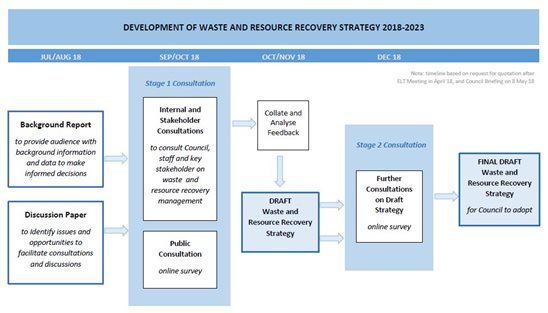
An internal Project Control Group (PCG) will assist with consultation and development of the Strategy. The Environment and Waste Department will chair the PCG. Other PCG members will come from:
Financial Services
Customer Service
Corporate Communication and Marketing
Social Planning and Investment
Planning Strategy and Urban Growth
Enterprise Geelong
Executive Leadership – Guy Wilson-Browne
The development and implementation of the Waste and Resource Recovery Strategy will help ensure the City maintains affordable and efficient waste services. This helps maintain a clean and safe community.
The development of the Strategy will require a review of existing Council strategies, as well as those of the Barwon South West Waste and Resource Recovery Group and other state government agencies.
The Waste and Resource Recovery Strategy aligns with Council’s strategic priorities for a sustainable built and natural environment.
No Council officers who have provided advice in relation to this report have declared a conflict of interest regarding the matter under consideration.
The development of the Waste and Resource Recovery Strategy will help identify and reduce risks associated with waste and resource recovery services.
The Waste and Resource Recovery Strategy will provide direction and actions to reduce the impact of waste on the environment. It will provide an opportunity to outline ways to decrease consumption and increase resource recovery and recycling.
Source: |
Engineering Services - City Services |
Director: |
Guy Wilson-Browne |
Index Reference: |
Thompson Road and Furner Avenue, Bell Park, Geelong, Special Rates and Charges |
Portfolio: |
Social and Infrastructure Planning |
To declare the charges for a Special Charge Scheme to partially fund the construction of a footpath along Thompson Road and Furner Avenue, Bell Park.
Council’s footpath network strategy identifies the footpath construction priorities of which Thompson Road and Furner Avenue, Bell Park is listed (See plan – Attachment 5). It is considered that the proposed new footpath will provide a missing pedestrian link between Norlane and Bell Park residential and commercial areas. The new footpath will provide safer pedestrian access for all users.
Council made its intention to declare the Special Charge Scheme on 20 September 2017. In the subsequent submissions period, no submissions were received. A formal submissions panel hearing was therefore not required.
It is proposed to construct 1 kilometre of 1.5 metre wide footpath to provide for pedestrian access along the west side of Thompson Road and Furner Avenue, Bell Park.
There are 21 properties abutting the proposed footpath that will receive special benefit. There are 2 Council owned properties in the scheme.
The total estimated project cost is $317,823. Additional works estimated at $34,106 will be funded by Council to improve existing infrastructure.
A Benefit Ratio of 0.28 has been calculated in accordance with section 163 of the Local Government Act 1989 (Act), which equates to a Council contribution to the scheme of $204,276 and property owner contribution of $79,441.
Property owners are considered to receive benefit from the works by way of improved pedestrian access and general amenity including pedestrian safety improvements.
The scheme has been prepared in accordance with the Special Rate and Charges provisions of the Act along with the 2004 Ministerial Guidelines and Council’s Special Rates and Charges Policy.
All affected property owners were notified be letters and public notices of the scheme.
Councillor Kontelj moved, Councillor Mansfield seconded -
That Council:
Resolves to declare the Special Charge Scheme as follows:
The Special Charge is declared for a period of 5 years commencing upon completion of the works.
The Special Charge be declared for the purpose of defraying any expenses incurred by Council in relation to the construction of the footpath on Thompson Road and Furner Avenue, Bell Park. Council considers the project:
will provide proper pedestrian access, improved pedestrian safety and enhancement to the general amenity for each of the properties included in the scheme;
will provide a special benefit to those persons required to pay the special charge (and who are described in succeeding parts of this Resolution); and
arises out of Council’s function of planning for and providing infrastructure for property owners.
The total cost of project, be recorded as $317,823 (Schedule A at Attachment 2).
It be recorded that, for the purposes of section 163 (2A) of the Local Government Act 1989 (Act), the special charge proceeds will not exceed the amount calculated in accordance with the prescribed formula (R x C = S), the:
‘benefit ratio’ (R) being calculated at 0.28 represents the special benefits to all persons liable to pay the special charge (Schedule B at Attachment 3);
‘total cost’ (C) of performing the function described in part 1 (b) of this resolution based on estimated cost be recorded as $283,717; and
‘Maximum levy’ (S) be recorded as $79,440.76.
The following be specified as the area for which the special charge is so declared:
The area within municipal district of Council highlighted in the plan attached to this resolution (Attachment 5).
The following be specified as the land in relation to which the special charge is so declared:
Land within the area shown on the plan (Attachment 5).
The following be specified as the criteria which form the basis of the special charge is so declared:
Ownership of any land described in Part 1(e) of this resolution.
The following be specified as the manner in which the special charge so declared will be assessed and levied:
Each lot receives a primary access and amenity benefit;
The maximum levy is shared between lots and divided on an access benefit plus amenity benefit based on frontage;
The special charge will be levied by sending a notice to the person who is liable to pay, pursuant to section 163(4) of the Act.
Having regard to the preceding parts of this resolution but subject to section 166 (1) of the Act, it be recorded that:
The owners of the land described in column 2 and 3 of Schedule C (Attachment 4) to the resolution are estimated to be liable for the respective amounts set out in column 7 of Schedule C; and
Such owners may, subject to any further resolution of Council pay the special charge in the following manner;
The charge will become due and payable within one month of the issue of the notice requesting payment pursuant to section 167 (3) of the Act;
Interest will not be charged for six months after the issue of the notice provided the person liable makes timely payment in accordance with any repayment arrangements that may be agreed on by Council; and
In accordance with section 172 of the Act, the interest rate payable on the special charge which has not been paid by the specific date is set at Council’s overdraft rate, reviewed every three months (provided that it shall not exceed the rate fixed by the Governor in Council by Order for the purposes of section 172 (2A) of the Act in which case the rate of interest shall be the maximum rate fixed by the Governor in Council by Order for the purposes of this section).
Authorises the Chief Executive Officer to levy the Special Charge in accordance with section 163 (4) of the Act.
Carried.
The project is a one off capital cost and there will be minimal ongoing maintenance costs. If approved, the scheme could proceed this financial year under the core footpath program C02303. Financial details are as follows:
Scheme levy to Property Owners (income) |
$79,440.76 |
Scheme Levy to Council – $204,276.24 Direct Funding by Council for pavement reinstatement and a supporting reinforced concrete retaining wall and footing - $34,106 |
$238,382.24 |
Total Project Cost |
$317,823.00 |
From the table above, the net cost to Council for this project is estimated to be $238,382.24.
Consultation was carried out as follows:
June 2017 - Information pack to affected property owners that included an explanation letter, a plan showing the location of works, a Special Rates and Charge Scheme brochure, a detailed cost apportionment spreadsheet and informal survey form. Six responses were received.
November 2017 – Letter to owners on advertising the scheme
11 November 2017 – Public Notice in local newspaper
November 2017 – Letter to owners with copy of the public notice
Further correspondence to the affected property owners will be sent should Council resolve to declare the Special Charge.
The proposed new footpath works towards achieving the objectives of the Greater Geelong – A Clever and Creative Future document through the provision of:
a sustainable, connected and networked walking, cycling and public transport services that allow all abilities access into and across the city-region
support for the most vulnerable community members
The proposed new footpath removes a missing link between Norlane and Bell Park residential and commercial areas, connecting residents with North Geelong Secondary College, local Child Care services and existing pedestrian crossing facilities on the Geelong-Ballarat railway line.
Removing the need for pedestrians to walk on Furner Avenue and Thompson Road will improve the safety of all pedestrians, especially children and the elderly accessing adjoining facilities.
The scheme has been prepared in accordance with the Special Rate and Charge provisions of the Act along with the 2004 Ministerial Guidelines and Council’s Special Rates and Charges Policy and Community Engagement Guidelines.
This report aligns with the City Plan as follows:
Sustainably Built and Natural Environment
Support our Community to live sustainably – Encourage increased use of alternatives to car transport and seek efficient traffic movement throughout the municipality.
Advocate for and promote sustainable design and development – Promoting sustainable design and retrofitting.
Acknowledge the community’s desire to have their say and be involved in planning for the future of Greater Geelong.
No Council Officer involved with this process has any direct or indirect interest in the properties.
Provision of a sealed pathway will provide safer walking conditions for pedestrians by minimising the risk of personal injuries through conflict with vehicles and the elimination of uneven and slippery surfaces.
There are no identified risks for Council in declaring the scheme.
The provision of a sealed pathway surface provides a permanent and safe means of access. During the course of construction and the manufacture and procurement of materials, energy is expended resulting in some greenhouse gas emissions. This ceases when construction is complete.
The project does not create waste with the exception of some excavated material.
The proposal does not affect any natural habitats.
The proposal will require some nature strip trees and shrubs to be trimmed but removal of vegetation is not expected.
The works for the construction of footpaths in Thompson Road and Furner Avenue Bell Park, which consist of excavation, footpath, reinstatement of nature strip and driveways, miscellaneous construction works, legal advice and professional services associated with survey, engineering design, drafting, supervision and administration of the project all as included in the cost estimate shown below.
SCHEME WORKS |
|||||
ITEM |
DESCRIPTION |
QTY |
UNIT |
RATE $ |
AMOUNT $ |
1.00 |
Initial site establishment and set up, decamping and site clean-up and other fixed costs up to time of completion of works. |
1 |
ITEM |
$28,000.00 |
$28,000.00 |
2.00 |
Traffic management costs. |
10 |
ITEM |
$800.00 |
$8,000.00 |
3.00 |
Setting out of works. |
1 |
ITEM |
$500.00 |
$500.00 |
4.00 |
Service / Cable locations |
1 |
ITEM |
$1,000.00 |
$1,000.00 |
5.00 |
Excavation and disposal of all materials to limits of work as indicated on plan, including trimming for spots and removal of concrete. |
20 |
m3 |
$60.00 |
$1,200.00 |
6.00 |
Concrete pram crossing 1.5m wide, including fine crushed rock bedding. |
5 |
No. |
$250.00 |
$1,250.00 |
7.00 |
125mm (25 Mpa) concrete paving with SL72 mesh including crushed rock bedding. |
1383 |
m2 |
$135.00 |
$186,705.00 |
8.00 |
Tactile Ground Surface Indicator Tiles, supplied and placed.(116-122 Furner Ave) |
2 |
m2 |
$250.00 |
$500.00 |
9.00 |
Top soiling and seeding nature strips, medians and outer separators. |
922 |
m2 |
$8.00 |
$7,376.00 |
10.00 |
Remove white posts and concrete footings. (283-285 Thompson Road) |
2 |
No |
$200.00 |
$400.00 |
11.00 |
Drainage pit lids and housings raised to match new path. (257 (3#) & 271-281 (2#) Thompson Road) |
5 |
No |
$300.00 |
$1,500.00 |
SUB-TOTAL |
$236,431.00 |
||||
10% Contingency |
$23,643.00 |
||||
Design |
$11,821.55 |
||||
Project administration |
$11,821.55 |
||||
CONSTRUCTION COST ESTIMATE |
$283,717.00 |
||||
COUNCIL FUNDED WORKS |
|||||
ITEM |
DESCRIPTION |
QTY |
UNIT |
RATE $ |
AMOUNT $ |
1.00 |
Initial site establishment and set up, decamping and site clean-up and other fixed costs up to time of completion of works. |
1 |
ITEM |
$2,000.00 |
$2,000.00 |
2.00 |
Setting out of works. |
1 |
ITEM |
$500.00 |
$500.00 |
3.00 |
225mm dia UPVC pipe, supplied, laid and jointed including excavation, placement of approved fine crushed rock bedding and back-filling with approved material.(283-285 Furner Ave) |
4.88 |
m |
$118.00 |
$575.84 |
4.00 |
Saw-cutting of Asphalt paving and concrete. Including vehicle crossing to 124 to130 Furner Avenue. |
1 |
Item |
$500.00 |
$500.00 |
5.00 |
Supply, place and compaction of 20mm Class 2 FCR in pavement area in front of kerb and channel to 300mm deep including, 30mm compacted depth 10mm nominal size type N Asphalt spread and compacted including emulsion prime & grit. (104, 106-114 & 116-122 Furner Ave) |
30 |
m2 |
$155.00 |
$4,650.00 |
6.00 |
B2 Barrier kerb and channel 450mm wide, including fine crushed rock bedding. (104, 106-114 & 116-122 Furner Ave) |
16 |
m |
$136.00 |
$2,176.00 |
7.00 |
Reinforced Concrete Retaining Wall and Footing with SL72 mesh including 50mm compacted depth Class 3 FCR bedding and reinstate nature strip. (90-94 Furner Ave) |
42 |
m |
$410.00 |
$17,220.00 |
8.00 |
Reconstruction of pipe post and rail fence. Supply and install two posts and alter the rail at two locations. (66-72 Furner Ave) |
2 |
No |
$400.00 |
$800.00 |
SUB-TOTAL |
$28,422.00 |
||||
10% Contingency |
$2,842.20 |
||||
Design |
$1,421.09 |
||||
Project administration |
$1,421.09 |
||||
CONSTRUCTION COST ESTIMATE |
$34,106.00 |
||||
A |
Purpose |
|
|||
|
To construct a footpath in Thompson Road and Furner Avenue Bell Park to provide all weather pedestrian access for property owners and the wider community. |
|
|||
B |
Coherence |
|
|||
|
The footpath will connect with the Furner Avenue Railway Reserve underpass and provide a pedestrian link between Norlane and Bell Park. It will also provide an additional link with the Council Reserve at 66-72 Furner Avenue. It will provide a special benefit to adjoining properties and benefit to the wider community. |
|
|||
C |
Total Cost C |
|
|||
|
Total Estimated cost of works |
$317,823.00 |
|||
|
Direct funding by Council to construct a supporting reinforced concrete retaining wall and minor pavement replacement works. |
$34,106.00 |
|||
|
Total Cost of Footpath Construction |
$283,717.00 |
|||
|
|
|
|||
D |
Identify Special Beneficiaries |
|
|||
|
21 properties with frontages to the proposed footpath are considered to receive access and amenity benefits. |
|
|||
E |
Properties to include |
|
|||
|
21 abutting properties receive both access and amenity benefits. Therefore: |
|
|||
|
Total Special Benefits (in) is apportioned to 21 properties. There are two (2) Council owned properties in the scheme. Therefore Total Special Benefits out of the scheme is apportioned to 2 properties. |
|
|||
F |
Estimate of Total Special Benefits |
|
|||
|
For this scheme, benefit will be apportioned on the basis of access and amenity by way of a Benefit Unit (BU). We shall assume that the makeup of the BU for each property comprises 1/2 BU of amenity and 1/2 BU for access benefits. The Council owned properties share the same access and amenity benefit as the private properties but has a larger frontage and double the footpath extent. A summary of the special benefits is shown in table form below: |
|
|||
|
|
21 Private Properties TSB(in) |
2 Council Properties TSB(out) |
|
|
|
Access |
10.5 BU |
2.0BU |
TSB (in) = |
21.0 |
|
Amenity |
10.5 BU |
2.0BU |
|
|
|
Total Special Benefits |
21 BU |
4.0BU |
TSB (out) = |
4.0 |
G |
Estimate of Total Community Benefit -TCB |
|
|||
|
It is considered that people in the community will receive a benefit from the works as the pathway is used to access other areas. Estimated pedestrian use of the footpath is 20% for the abutting properties and 80% for the wider community. There are no amenity benefits considered for the wider community. If 20% of access benefit represents a total of 12.5 BU, 80% will represent 50BU. |
TCB = 50.0 |
|||
H |
Calculate "Benefit Ratio" - R |
|
|||
|
Benefits Ratio = |
TSB (in) |
= |
21 |
|
|
|
TSB (in) + TSB (out) + TCB |
21 + 4 + 50 |
0.28 |
|
I |
Maximum Total Levy (S) |
|
|||
|
Maximum Total Levy S = R X C |
$79,440.76 |
|||
|
Council Contribution to Special Charge Scheme |
$204,276.24 |
|||
COLUMN 1 |
COLUMN 2 |
COLUMN 3 |
COLUMN 4 |
COLUMN 5 |
COLUMN 6 |
COLUMN 7 |
Property Key |
Address |
Legal Details |
Apportionable frontage |
Access Benefit |
Amenity Benefit |
Footpath Cost |
278118 |
76-88 Furner Avenue, BELL PARK |
Lot 1 LP 131085 |
48.2 |
$2,337.87 |
$2,751.11 |
$5,088.98 |
278119 |
90-94 Furner Avenue, BELL PARK |
Lot 2 LP 131085 |
43.7 |
$2,337.87 |
$2,494.73 |
$4,832.60 |
278120 |
96-102 Furner Avenue, BELL PARK |
Lot 3 LP 131085 |
66.9 |
$2,337.87 |
$3,818.32 |
$6,156.19 |
354743 |
104 Furner Avenue, BELL PARK |
Lot 2 PS 715070 |
2.7 |
$2,337.87 |
$155.88 |
$2,493.75 |
354742 |
106-114 Furner Avenue, BELL PARK |
Lot 1 PS 715070 |
64.5 |
$2,337.87 |
$3,684.14 |
$6,022.00 |
299930 |
116-122 Furner Avenue, BELL PARK |
Lot A PS 504302 |
16.8 |
$2,337.87 |
$961.58 |
$3,299.44 |
315801 |
124-130 Furner Avenue, BELL PARK |
Lot 1 PS 449381 |
28.7 |
$2,337.87 |
$1,640.50 |
$3,978.37 |
320563 |
Factory No 1/132-136 Furner Avenue, BELL PARK |
1/2 Share of Lot 2 PS 449381 |
39.4 |
$1,168.93 |
$2,248.91 |
$3,417.84 |
315802 |
Factory No 2/132-136 Furner Avenue, BELL PARK |
1/2 Share of Lot 2 PS 449381 |
39.4 |
$1,168.93 |
$2,248.91 |
$3,417.84 |
280221 |
231-233 Thompson Road, BELL PARK |
Lot 1 LP 215029 |
17.3 |
$2,337.87 |
$987.84 |
$3,325.71 |
280222 |
235-237 Thompson Road, BELL PARK |
Lot 2 LP 215029 |
23.0 |
$2,337.87 |
$1,313.32 |
$3,651.18 |
298668 |
239-241 Thompson Road, BELL PARK |
Lot 2 PS 337777 |
25.7 |
$2,337.87 |
$1,465.77 |
$3,803.64 |
298669 |
243-245 Thompson Road, BELL PARK |
Lot 1 PS 337777 |
20.0 |
$2,337.87 |
$1,143.73 |
$3,481.59 |
296611 |
251 Thompson Road, BELL PARK |
Part Share of Lot 1 PS 601749 |
16.8 |
$1,168.93 |
$959.29 |
$2,128.23 |
295120 |
253 Thompson Road, BELL PARK |
Part Share of Lot 1 PS 601749 |
16.8 |
$1,168.93 |
$959.29 |
$2,128.23 |
280225 |
255 Thompson Road, BELL PARK |
Lot A PS 601749 |
83.0 |
$2,337.87 |
$4,739.36 |
$7,077.23 |
280226 |
1/271-281 Thompson Road, BELL PARK |
Lot 1 PS 311991 |
26.6 |
$2,337.87 |
$1,520.02 |
$3,857.89 |
280227 |
2/271-281 Thompson Road, BELL PARK |
Lot 2 PS 311991 |
40.7 |
$2,337.87 |
$2,322.86 |
$4,660.72 |
280228 |
283-285 Thompson Road, BELL PARK |
Part Share of Lot 1 PS 530757 |
25.1 |
$771.50 |
$1,434.94 |
$2,206.44 |
311845 |
287-289 Thompson Road, BELL PARK |
Part Share of Lot 1 PS 530757 |
25.1 |
$771.50 |
$1,434.94 |
$2,206.44 |
311846 |
291-295 Thompson Road, BELL PARK |
Part Share of Lot 1 PS 530757 |
25.1 |
$771.50 |
$1,434.94 |
$2,206.44 |
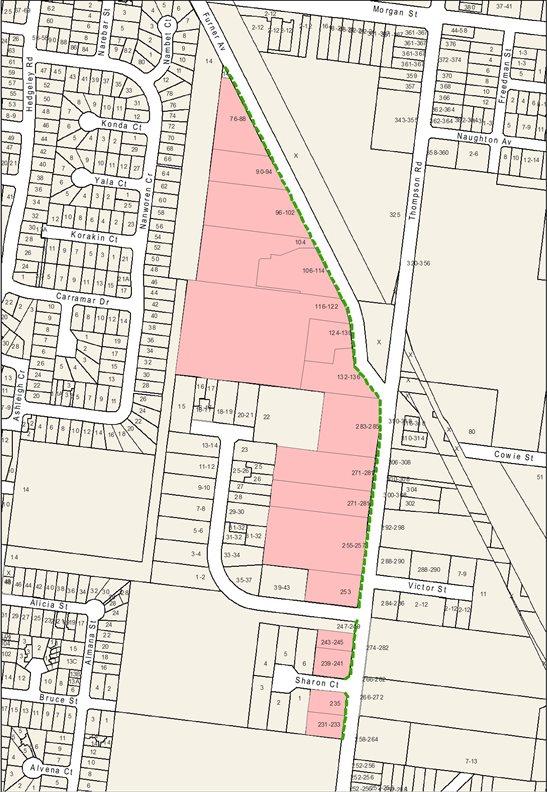
Thompson Road and Furner Avenue, Bell Park
Stage |
Status |
Description |
Approval to prepare scheme |
✓ |
Decision made to prepare scheme following consideration of surveys of residents and feedback from the community via informal survey. Council may then place the project in the budget system or proceed immediately to prepare a scheme. Scheme preparation involves survey, design and preparation of an apportionment of costs. May 2017 |
Intention to Declare Scheme |
✓ |
Report to Council providing information on scheme including advice of impending advertising of scheme and declaration of charge. Seeks Council approval by resolution to proceed with process. 20 September 2017 |
Advertisement |
✓ |
The scheme is advertised in the local newspaper and all allotted property owners are notified by mail. This advertisement indicates Council’s intention and notification to ‘declare’ a scheme in a month’s time. 11 November 2017 |
Submissions |
✓ |
From the time of advertising property owners have 28 days (as set down by the Local Government Act) to lodge submissions, either in support or opposition to the scheme. No submissions received. |
Submissions Review Panel Hearing |
✓ |
A Submissions Review Panel is convened (quorum of three Councillors) and meets to consider submissions. Some submissions are written only, and other submitters may wish to be heard before the Panel. The Panel makes a recommendation to Council regarding the scheme. Not required. |
Declaration Report |
✓ |
Any time 28 days after advertising the scheme and after the Submissions Review Panel has met and considered submissions, Council considers a report and may proceed to “declare” the charges in accordance with its advertised intent. Subsequent to this the Finance Manager issues the levy notices and there is a formal charge placed on the property. This is the final step in the process for Council to make a decision on the scheme. |
Appeal |
|
Property owners may lodge an application for review with the Victorian Civil and Administrative Tribunal (VCAT) within one month of issue of the levy notice. An appeal is listed, heard and determined by the Tribunal and this process generally takes three to four months. Decisions made by VCAT are binding on all parties. |
Construction |
|
Council may then proceed to construct the works. Invoices are issued seeking payment of the estimated cost within one month of commencement. |
Final Cost Report |
|
At the completion of the works the scheme is “finalised” taking into account actual costs incurred and payments are adjusted accordingly. |
Contents | Previous Page: Section A - Procedural Matters | Next Page: Section C - Notices of Motion
