
Council Minutes - Section B: Reports - 14 August 2018
Contents | Previous Page: Section A - Procedural Matters | Next Page: Section C - Notice of Motion
Contents | Previous Page: Section A - Procedural Matters | Next Page: Section C - Notice of Motion
Reports tabled at the Community Focus Committee Meeting of Council on Tuesday 14 August 2018, held at the Geelong West Town Hall, 153 Pakington Street, Geelong West.
Planning Scheme Amendment – Environmentally Sustainable Development (ESD) Local Policy
Revitalising Central Geelong Partnership Laneways Action Plan
Source: |
Planning & Development - Health & Local Laws |
Acting Director: |
Joanne Van Slageren |
Index Reference: |
Animal Management - Dogs in Public Places Policy 2018-2021 |
Portfolio: |
Community Health and Safety |
To approve an amended Dog Controls in Public Places Policy pursuant to Section 26 (2) of the Domestic Animals Act 1994 and allow for further public comment on the policy.
On the 13 March 2018 Council adopted the Domestic Animal Management Plan 2018-2021. A key recommendation of the Plan was to review the Dog Controls in Public Places Policy.
The Dog Controls in Public Places Policy establishes categories of Dog Control Orders that apply to all public places managed by the City. These orders become legally effective through the Council resolution and publication in the Government Gazette, which enables Council to undertake compliance activities.
A month long community engagement process was conducted which consisted of 5 drop in sessions held in Portarlington (x2), Geelong West, Belmont and Norlane and an online survey with hard copy versions being made available at all customer service centres. Input was also provided by key Council departments.
There were 469 responses to the survey. A number of themes emerged, such as needing to establish safe shared spaces, improved enforcement, improved signage and more accessible dog waste bins. (See Attachment 2 for ‘Discussion’ and Attachment 3 for ‘Summary of Comments’).
The Dog Controls in Public Places Policy (including maps of the Council’s coastal dog orders) has been amended accordingly to reflect the community engagement feedback (see Attachment 4).
General feedback suggests that the community is seeking safe and shared public places. Overall the community is satisfied with the existing Dog Control Orders but are seeking more presence and enforcement of such orders to manage poorly behaved dogs and irresponsible owners.
There is likely to be financial implications associated with the community’s request for more enforcement, education, patrolling, signage and waste bins. An assessment of this will be undertaken over the next 12 months in conjunction with the relevant asset managers.
The adoption of the Dog Controls in Public Places Policy enables the City to undertake a range of compliance activities including education and awareness campaigns, proactive patrols and enforcement activities.
Key changes to the Policy are outlined in Attachment 2 ‘Discussion’.
Councillor Murrihy moved, Councillor Kontelj seconded -
That Council:
Approve the Draft Dog Controls in Public Places Policy;
Agree to a further online engagement process of 6 weeks to allow the community to comment on the proposed changes to the Dog Controls in Public Places Policy; and
Before the draft policy is released for public comment, review if any other Council owned ovals should be “Off-Leash Supervised Area”, and include in Table 2.
Carried.
The City will need to undertake an assessment to evaluate the level of resources required to implement increased educational programs and patrolling and enforcement activities. In conjunction with the asset managers, a signage audit should be conducted to establish a program to remove old signs and install new signs. In conjunction with the asset managers a bin audit should be undertaken along key walking tracks and reserves with the view of increasing the number of accessible bins.
The City conducted its community engagement process, which included 5 “drop in” sessions held in Portarlington (30 attendees during the day session and 3 attendees at the evening session), Geelong West (6 attendees), Norlane (0 attendees) and Belmont (3 attendees). A greater response was received through the online survey. The social media campaign reached 32,629 people with 368 actions to click the engagement link. Facebook was the most used platform with 28,654 people reached, Twitter reached 2,135 people and Instagram reached 1,480 people.
The average engagement rate for the City’s social media posts is approximately 2% and the engagement rate for the dog control orders was 13.37% making it the second highest post for the month.
Significantly 65% of all traffic to the page was through social media. The survey was also made available in hard copy at customer service centres around Geelong.
The City received 469 responses.
The community engagement undertaken provided opportunity for all groups and all members of our community to have access to information and an avenue for feedback. The resultant Dog Controls in Public Places Policy has considered the delivery of safe and accessible public spaces for all and there are no foreseeable barriers in this regard.
By amending the policy the City will implement increased preventative action which aims to promote safety in public places for all users through reduced number of incidents.
Under Section 26(2) of the Domestic Animals Act 1994, Council may by resolution make an Order which sets out conditions with respect to dogs in public places. This Order must be published in the Government Gazette and in a newspaper circulating in the municipal district of the Council making the Order.
Improved Health and Safety of our Community.
Providing safer public places
Encouraging responsible pet ownership
Promoting active living
Informed Social Infrastructure and Planning
Provide more quality spaces that support active lifestyles
More inclusive and Diverse Community.
Supporting activities that improve social connections in our community
Further developing programs that support older people and young people in our community.
There is no conflict of interest with respect to any officer in the preparation of this report.
Council can minimise its risks by applying practical, fair and reasonable dog control orders in public places to ensure the safety of all users. The Orders provide a platform for community education, against which compliance activities can be undertaken.
There is recognition of the existence of several environmentally sensitive areas that will be provided with the adequate controls contained within these proposed dog control orders.
Council has had a Dog Controls in Public Places Policy in place since 2008, with 3 revisions of that policy having taken place since that time. The review of the policy has normally been done in conjunction with the review of Council’s Domestic Animal Management Plan that occurs every 4 years.
On this occasion, the review was undertaken separately from the above process and as one of the first action items arising from Council’s 2017-21 Domestic Animal Management Plan.
It is proposed to amend this policy to;
Reflect the feedback received; and
To remove reference to land not managed by the City (to be managed by a separate process).
Any dog rules that may be applied to open spaces within the municipality on land managed by other land managers would be covered by a separate process in which Council can choose to enter into a formal agreement pursuant to Section 26 (2A) of the Domestic Animals Act 1994. A copy of the amended ‘marked up’ version of the Dog Controls in Public Places Policy is attached as Attachment 4.
Feedback was also sought from the City’s various asset managers who have indirectly been provided with community feedback from their various customers and lease holders.
Overall there were 469 respondents to the survey and the number of responses with respect to key themes are listed in as follows:
Establishing Safe Shared Spaces (157 Responses)
Effectiveness of Enforcement (71)
Effectiveness of Off Leash Areas/Need for More Off Leash Areas (71)
Dog Poo/Dog Bins (61)
Effectiveness and need for more on leash areas (50)
Signage (48)
Education and Environment Protection (43)
Impact of Aggressive/Nuisance Dogs (26)
Dog Parks (24)
A ‘Summary Comments’ spreadsheet has been attached as Attachment 3, which highlights the range of comments expressed.
There is no indication that the broader community want more prohibitions on dogs in public places and in fact there is acknowledgement about the importance of dog ownership with respect to improving health wellbeing outcomes. However, there is a consistent theme supporting the implementation of the necessary measures that would facilitate the establishment of safe and shared public spaces for all users.
Significant feedback was received about the need to promote our public spaces as being for all users with no specific group having greater entitlement to these spaces over any other group. Whilst not relevant to this policy, significant comment was received about the unsafe interactions of speeding cyclists and dog walkers and general walkers along the trails. This matter will be referred to City’s relevant departments with the view of delivering educational messages that may assist in resolving this issue.
Several comments were made about changing some of the common walking trails and coastal tracks such as Bellarine Rail Trail, Waurn Ponds Track and Ted Wilson Trail to conditional off leash prior to 10:00am and after 5:00pm each day. As these and other similar walking trails are linear in nature and highly used areas, creating off leash scenarios is not supported as it is likely to create conflict between the users who have competing interests. Similarly a request to make Red Gum Island an off leash area is not supported due to environmental considerations as endorsed by the Geelong Environment Council through the City’s Environment department.
While submitters were advised that a separate piece of strategic work is being conducted by the City’s Social Planning and Investment department, many requests for the City to consider developing a range of strategically located dog parks were submitted. These have been forwarded to that department for incorporation into that process.
There were no requests to change any of the CoGG coastal orders through the review, however a number of other changes to the policy (see Attachment 4) were recommended as follows:
Limiting the policy to Council managed lands and dealing with Dog Orders on other lands through a separate process (Section 26(2A) of the Domestic Animals Act 1994);
Prohibit dogs from sports playing surfaces during organised sport (the policy is silent on this at present);
Prohibiting dogs on artificial sport playing surfaces such as synthetic turf, asphalt, flexi-pave etc.;
Keeping dogs a minimum of 10 metres away from turf wickets;
Dogs to be prohibited a minimum of 10 metres from children’s playground equipment and must be tethered beyond that point;
Dogs when tethered must not be left unattended;
Dogs to be on leash around boat ramps;
Deletion of the ‘Reserves - On Leash – Controlled Areas’ Table (as this is covered by the general requirement that all areas are on leash unless otherwise signed);
Deletion of ‘Map 8’ from the ‘Dog Controls in Coastal and Other Open Space Areas’ (as the Bellarine Bayside Foreshore Committee of Management lands will be covered by a separate process).
The community expressed a desire for more compliance and enforcement activities to be undertaken by the City. It was also felt that the inadequacy of signage throughout the City may be contributing to on-going non-compliant behaviour. Enforcement involves monitoring dogs to be on leash in on leash areas, ensuring that dog owners have effective control of their dog in off leash areas and that dog owners take responsibility in cleaning up after their dog/s.
This a significant task over a vast area of land, including several hundreds of kilometres of walking paths, coastal trails, hundreds of reserves and other open spaces. A resource assessment will be required to evaluate what may be required into the future with respect to increasing our presence and response capacity in such public places.
With respect to signage, there has been an inconsistent approach over the various asset spaces in providing signage to a level which adequately informs the broader community about the dog rules that apply to a certain area. This also impacts on our ability to educate the community through such signage messaging. It is proposed that an audit be conducted by the Animal Management staff in conjunction with the City’s various asset managers to determine future signage needs and to update/replace old superseded signs.
Similarly, an audit of all bins in the vicinity of key dog walking trails and reserves etc needs to be undertaken and where necessary provision made for the installation of more bins.
The provision of off leash areas is not intended to mean that dogs and their owners are the sole users of that place nor does it imply that the place in question is a ‘dog reserve’ or a ‘dog beach’. These places are public reserves or public beaches for all users but also permit dogs to be off leash on the proviso of being under effective control. This is a common grievance that has emerged from the feedback, being that some dog owners feel that the designated off leash place is for dogs only and that their view of what effective control differs greatly from what a non-dog owner’s view of this is.
Many responses mentioned the fact that non-dog owner’s, whilst not necessarily objecting to an off leash area, simply object to unwanted attention from dogs in a public place, whether that dog is aggressive, excited or over friendly.
Furthermore, in the event of any act of aggression, it is no defence by an owner to divest their legal responsibility by suggesting that the place in question is solely for dogs. Clearly this is an area that warrants a significant amount of community education and awareness and increase patrolling and enforcement to reduce such tensions.
Source: |
Planning & Development - Health & Local Laws |
Acting Director: |
Joanne Van Slagerenn |
Index Reference: |
Animal Management - Dogs in Public Places Policy 2018-2021 |
Portfolio |
Community Health and Safety |
To seek approval to enter into an agreement to adopt the Bellarine Bayside Foreshore Committee of Management (BBFCM) dog control orders pursuant to Section 26 (2A) of the Domestic Animals Act 1994.
During the past 18 months, the City has worked closely with the BBFCM in developing draft dog orders that the Council could consider adopting. The adoption of the dog orders would mean that the City has the legislative ability to undertake compliance and enforcement action which also involves community education and awareness.
Through BBFCM’s initial community engagement processes in May 2017 and August 2017, 121 submissions were received which generally supported the proposal.
The City incorporated the BBFCM draft orders into its own review process for the Dog Controls in Public Places Policy. Feedback from the City’s community engagement process resulted in 44 responses relating to the BBFCM draft orders. Collectively from all the consultative processes 165 responses were received including one petition signed by 866 people. (Refer to Attachment 2 for ‘Discussion’ and Attachment 3 ‘Summary of Comments’)
The proposed dog orders (Attachment 4) have considered the feedback received and would provide appropriate controls to enable all users to have safe and shared access to public places.
The City currently has two Agreements in place with respect to Dog Control Orders with the Corangamite Catchment Management Authority and Barwon Coast Committee of Management. There have not been dog control orders adopted for BBFCM previously.
The BBFCM coastal land extends between Point Richards Road to St Leonards (Emergency Beach Location Marker 18B). (Refer to maps Attachment 4).
Approximately 44 comments were received directly in relation to BBCFM draft orders, the majority of which were favourable.
Councillor Grzybek moved, Councillor Mason seconded -
That Council:
Enter into a Domestic Animal Control Agreement in accordance with Section 26 (2A) of the Domestic Animals Act 1994 to adopt the Bellarine Bayside Foreshore Committee of Management dog control orders;
Delegate to the Manager Health and Local Laws the authority to carry out the required statutory advertising in the making of the order by Council.
Carried.
There may be a small overall cost associated with the City incorporating the patrolling of this land into its overall animal management patrol program. Any fines issued will be retained by the City and it is envisaged that there will be some resource sharing arrangement between the City and BBFCM.
Collectively, there has been three consultative processes undertaken (two by BBFCM and once by the City), resulting in three versions of the draft orders, the final version being developed after the City’s community engagement process.
The BBFCM consultations included advertising in local newspapers, utilising the BBCFM social media pages and inviting campers to comment. There were 121 submissions received including a submission from Woofers and Walkers which was signed by 866 people.
The City conducted its community engagement process which included two drop in sessions held in Portarlington (30 attendees during the day session and three attendees at the evening session). A greater response was received through the online survey. The social media campaign through our engagement process reached 32,629 people with 368 actions to click the engagement link. Facebook was the most used platform with 28,654 people reached, Twitter reached 2,135 people and Instagram reached 1,480 people.
The average engagement rate for the City’s social media posts is approximately 2% and the engagement rate for the dog control orders was 13.37% making it the second highest post for the month.
Significantly 65% of all traffic to the page was through social media. The survey was also made available in hard copy at customer service centres around Geelong.
The City received 469 total responses with 44 related to the BBFCM land.
The manner in which information was sought from the community provided opportunity for all groups and all members of our community to have access to information and avenue for feedback. The resultant dog control orders have considered the delivery of safe and accessible public spaces for all and there are no foreseeable barriers in this regard.
By implementing dog control Orders, this will enable the City to implement preventative action which aims to promote safety in public places through reduced number of incidents.
Under Section 26(2A) of the Domestic Animals Act 1994, Council has the ability to adopt dog control orders on lands not managed by the City. Whilst this is not a mandatory requirement, there is merit in the City working in partnership with such land agencies for the greater benefit to the community, that being safe shared public spaces for all users.
Improved Health and Safety of our Community:
providing safer public places;
encouraging responsible pet ownership;
promoting active living.
Informed Social Infrastructure and Planning:
Provide more quality spaces that support active lifestyles.
More inclusive and Diverse Community:
Supporting activities that improve social connections in our community;
Further developing programs that support older people and young people in our community.
There is no conflict of interest with respect to any officer in the preparation of this report.
In partnership with BBFCM the City will be able to implement education and awareness programs around the dog orders in order to minimise incidents and promote responsible pet ownership. Furthermore this provides the legal standing to the City in order to prosecute matters that cannot be resolved.
There is recognition of the existence of several environmentally sensitive areas that will be provided with the adequate controls contained within these proposed dog control orders.
During the past 18 months the City has worked closely with the Bellarine Bayside Foreshore Committee of Management (BBFCM) in developing draft dog orders that the City could consider adopting through its legislative powers under Section 26 (2A) of the Domestic Animals Act 1994.
Initially the BBFCM pro-actively engaged with the community in May 2017 and again in August 2017, which resulted in the draft orders being modified 3 times prior to the official proposed orders being presented to the City for consideration. A total of 121 submissions were received, including one from a dog walking group (Woofers and Walkers) who had commissioned a further 866 signatures to support their submission. During the process:
53.7% of respondents supported less dog restrictions;
11.5% could see the benefit of both on and off leash zones and wanted a good and fair combination of these; and
34.7% wanted more dog restrictions.
Of the 34.7% that want more dog restrictions, most of this was based on some of the historical ‘dog orders’ that the BBFCM was promoting on its lands, which included the track being designated intermittently as either off leash all year round or prohibited all year around. Clearly these arrangements were not suitable to the changing needs of the community and the BBFCM have responded accordingly to amend the draft dog orders so that they will provide benefit to all stakeholders by providing safe and accessible spaces for people and/or dogs to exercise and walk.
Following the second round of consultation, the key items addressed included:
Reducing the number of ‘prohibited’ zones;
Increasing the number of ‘controlled’ zones (on leash all year) to provide general safety to all users;
Enabling safe access through the various caravans parks all year round (24 December-28/29 February – on leash) and (1 March - 23 December – off leash);
In turn, this changes the existing trail to be continuous all the way between Portarlington to St Leonards;
Establishing ‘seasonal’ off leash zones between 1 March and 23 December (on leash at other times) in lower use locations; and
Establishing a specific ‘seasonal’ on leash zone in front of the Portarlington Holiday Park to enable access through this location between 1March and 23 December (prohibited at other times during peak camping season).
Upon officially receiving the draft orders from BBFCM, the City incorporated these into its own review process for the Dog Controls in Public Places Policy and the community engagement process that followed. Feedback from the City’s community engagement process relating to these lands resulted in the following:
Approximately 44 comments were received directly in relation to BBCFM draft orders. These related to:
20 comments about the seasonal orders which were mostly favourable;
10 comments favourable of seasonal orders but requesting consideration for off leash times early morning and evening;
9 comments about needing improved signage;
8 comments requesting greater enforcement;
8 comments to request the removal of the prohibited area on the eastern side of the pier;
6 comments relating to wanting safe shared spaces for all;
6 comments concerning protection of the environment;
4 comments requesting more education for people to understand what it means to have a dog under effective control;
3 comments in relation to dog poo/bins.
Considering all the feedback received from the engagement process, it is believed that BBFCM has created considered and measured dog control orders. The seasonal restrictions accommodate for the swell in population during the holiday season and allow residents more off leash areas during the quiet months. The orders are easy to understand and enable continuity for dog walkers along the entirety of the subject land.
Source: |
Planning and Development - Planning Strategy |
Acting Director: |
Joanne van Slageren |
Index Reference: |
Subject: Environmentally Sustainable Development (ESD) Local Policy |
Portfolio: |
Sustainable Development |
To request endorsement from Council to seek authorisation from the Minister for Planning to prepare and exhibit a planning scheme amendment to introduce an environmentally sustainable development local planning policy into the Greater Geelong Planning Scheme.
A proposed Local Planning Policy (Attachment 2) has been prepared to encourage environmentally sustainable development (ESD) outcomes to be achieved in a manner that will ensure new developments achieve best practice and ensure more developments achieve above mandatory building standards.
The introduction of a local planning policy follows an 18 month Council led ESD pilot program which that the internal referral process did not impact timeframes for the assessment of applications. Attachment 3 includes a report of the pilot program. The policy builds on a significant body of work undertaken at the local and state level to improve the integration of ESD into the planning system. To date, similar ESD policies have been successfully implemented by ten Victorian councils, with another seven in train.
The proposed local policy will require that multi-unit, mixed use and commercial development include an ESD assessment as part of the planning permit process.
The proposed local policy will ensure that development achieves best practice in environmental sustainability, from the design stage through to construction and operation.
Assessment of medium to large scale and complex applications will be undertaken by an ESD officer and small applications will be assessed by the statutory planners.
The proposal strongly aligns with the Council Plan, the Clever and Creative Vision, Environmental Management Strategy, and the Low Carbon Growth Plan for Geelong. There are clear positive economic, social and environmental benefits to be gained through improved sustainable development outcomes in planning.
Councillor Mason moved, Councillor Asher seconded -
That Council resolve to seek authorisation from the Minister for Planning to prepare and exhibit an amendment to the Greater Geelong Planning Scheme to include an Environmentally Sustainable Development Local Planning Policy and consequential changes to the municipal strategic statement.
Carried.
The report proposes the introduction of new policy into the planning scheme via a planning scheme amendment process. Attachment 2 includes a summary of the proposed policy and application and a copy of the draft policy provisions.
The implementation of the local policy can be managed with existing resources. Not all applications that trigger an ESD assessment will need to be referred to an ESD Officer. However, this will mean that statutory planners will require extra training to be able to assess Sustainable Design Assessments that are submitted with planning applications.
Over the past 18 month trial period, the concept of ESD has been introduced to the community. An ESD Officer has been available from the pre-application stage, and through the planning application process. The ESD Officer has been available to provide free advice, with some applicants using the service multiple times before submitting an application.
An amendment under the Planning and Environment Act 1987 will include public consultation.
A local ESD policy will facilitate sustainable built form outcomes which will provide affordable living outcomes over the life of the building for commercial and residential occupiers. As ongoing servicing costs will be reduced, it will have a positive community benefit
Council Plan 2018-2022, continues our commitment to make the city a more sustainable place to live and work.
The strategic priorities for planned sustainable development include having planning controls in place to require a mandatory sustainable design assessment for all new developments.
Currently, residential and non-residential buildings making up more than two-thirds of the total annual carbon emissions in the Geelong region. Aside from this, the construction of buildings, including demolition waste, contributes to 40% of all materials sent to landfill. During operation buildings use large amounts of potable water for non-drinking purposes.
The amendment is expected to have a positive effect on environmental outcomes as it requires new developments to achieve best practice ESD outcomes. It provides a framework for early consideration of environmental sustainability at the building design stage ensuring that developments are above minimum standards and achieve best practice outcomes by introducing objectives for the above mentioned ESD principles.
The Low Carbon Growth Plan for Geelong identifies the significant carbon emission reduction benefit from focusing on reducing energy costs (heating and cooling) from residential and commercial buildings.
The ESD policy will introduce objectives for the following ESD principles to ensure that developments achieve best practice in development applications:
Energy Performance
Water Resources
Indoor Environment Quality
Stormwater Management
Transport
Waste Management
Urban Ecology
The proposed policy will apply in instances when a planning permit application is already required by the planning scheme. The proposal will ensure that development achieves best practice in environmental sustainability, from the design stage through to construction and operation. This will ensure that a greater number of proposed developments will incorporate ESD measures beyond minimum standards, to the benefit of the wider community of Greater Geelong.
Advice from the Department of Environment, Land, Water and Planning (DELWP) is that the policy must be practically identical to the ESD policies recently introduced by the Cities of Darebin and Manningham in Amendment GC42. The only variation should be the specific planning triggers that are set, with the rest of the policy and objectives remaining the same.
A copy of the proposed policy – Clause 22.68 ESD local planning policy follows this summary introduction.
Table 1 outlines the two types of ESD reports that applicants will be required to submit alongside their planning applications. The level of assessment necessary is determined by the size of the proposed development:
For small-to-medium developments a Sustainable Design Assessment (SDA) is a simple sustainability assessment of a proposed design at the planning stage. An SDA can be prepared by the applicant. Submitting a Built Environment Sustainability Scorecard (BESS) report, will satisfy the application requirements for a SDA;
For large developments a Sustainable Management Plan (SMP) is a detailed assessment of a proposed design at the planning stage. An SMP requires more information about performance outcomes and how a higher level of sustainability will be achieved, and usually requires engaging a consultant.
The key tool used to assess the sustainability performance of a development is BESS, which is a free online tool developed specifically for Victorian local governments. It provides a sustainability rating for residential, non-residential and mixed-use developments. Alternatively, Green Star rating is a more complex tool and also provides holistic ratings.
The outcomes of the Sustainable Design Assessment Pilot program are highlighted in the Environmentally Sustainable Design (ESD) – Pilot Assessment report – attachment 3.
The outcomes of the pilot, the identified potential environmental benefits, and an analysis of permit statistics of Greater Geelong determined the recommended threshold triggers for the ESD Policy, outlined in Table 1 below.
Table 1 – Proposed ESD Application Triggers and Application Requirements
TYPE OF DEVELOPMENT |
APPLICATION REQUIREMENTS |
Example tools |
Accommodation/Mixed Use with residential component of: |
||
|
Sustainable Design Assessment (SDA) |
BESS STORM |
|
Sustainability Management Plan (SMP) Green Travel Plan (GTP) |
Green Star MUSIC STORM |
Non-Residential: |
||
|
Sustainable Design Assessment (SDA) |
BESS MUSIC STORM |
|
Sustainability Management Plan (SMP) Green Travel Plan (GTP) |
BESS Green Star MUSIC STORM |
The SDA or SMP will be assessed as part of the planning permit application and conditions will be included on resulting planning permits to give effect to the recommendations of the ESD assessment.
The policy is worded to allow flexibility in meeting the objectives of the policy, and a fit-for-purpose solution will be sought in each individual application.
Interaction with the Building Legislation
Concerns about the potential for overlap and conflict of an ESD planning policy with the National Construction Code (NCC) has been deliberated at length in the previous Group Council Amendments. The findings of the most recent GC42 panel states:
The policy does not overlap of contravene the role of the NCC because the NCC only seeks to achieve minimum compliance, whereas considering and incorporating ESD at the planning stage allows an opportunity to exceed minimum compliance through using basic passive design principles which is best done at project conception.
The NCC does not cover passive design, water use reduction (except for class 1 buildings), stormwater pollution, materials and waste which all need to be considered to create a sustainable building.
Interaction with subdivision
The City has been collaborating with eight other regional councils on an ESD Subdivision Policy proof of concept study for regional Victoria. The key findings of the work showed there are clear social, economic and environmental benefits associated with ESD in regional subdivisions. These benefits differ across Victoria’s climate regions, as does the nature and capacity of councils and the residential development industry. While the period of analysis was 30 years, the life of a residential subdivision is much more enduring and so subdivision-wide sustainability measures warrant greater consideration.
It is not proposed to include a sustainable subdivision local policy at this time. There is further opportunity for work collaboratively with government and industry to build awareness of the benefits of ESD, strengthen policy and guidelines, use voluntary tools and assessments and undertake demonstration projects.
TheEnvironmentally Sustainable Design for Subdivisions in Regional Victoria report is available at www.geelongaustralia.com.au/strategicplanning.
DRAFT LOCAL POLICY
22 |
LOCAL PLANNING POLICIES |
|||||||||||||||||||
22.## |
ENVIRONMENTALLY SUSTAINABLE DEVELOPMENT |
|||||||||||||||||||
DD/MM/YYYY Proposed c## |
This policy applies throughout the City of Greater Geelong to residential and non-residential development that requires a planning permit in accordance with the thresholds in Table 1 of this Policy. |
|||||||||||||||||||
22.##-1 |
Policy Basis |
|||||||||||||||||||
DD/MM/YYYY Proposed C## |
This policy builds on and implements the sustainability objectives and strategies expressed in Clause 21.02 of the Municipal Strategic Statement relating to environmentally sustainable development (ESD). The City of Greater Geelong is committed to delivering environmentally sustainable development that responds to climate change. Critical to achieving this commitment is for development to incorporate appropriate environmental design standards. This policy provides a framework for early consideration of environmental sustainability at the building design stage in order to achieve the following efficiencies and benefits:
If Environmentally Sustainable Development is not considered at the time of planning approval, the ability to achieve environmentally sustainable development may be compromised by the time these matters are considered as part of a building approval. In addition, there may be difficulties or extra costs associated with retro-fitting the development to implement environmentally sustainable design principles. This policy does not prescribe performance outcomes. The policy enables the provision of information and provides decision guidelines which will assist in the assessment of whether development meets environmentally sustainable design principles. This policy complements a range of non-statutory measures aimed at encouraging environmentally sustainable development. These measures include educating residents and applicants, assisting applicants to use Environmentally Sustainable Development (ESD) tools, leading by example with Council projects, promotion of exemplary private projects and promotion of the use of materials with favourable life cycle impacts. |
|||||||||||||||||||
22.##-2 |
Objectives |
|||||||||||||||||||
DD/MM/YYYY Proposed C## |
The overarching objective is that development should achieve best practice in environmentally sustainable development from the design stage through to construction and operation. In the context of this policy best practice ESD is defined as a combination of commercially proven techniques, methodologies and systems, appropriate to the scale of development and site specific opportunities and constraints, which are demonstrated and locally available and have already led to optimum ESD outcomes. Best practice in the built environment encompasses the full life of the build. It is a policy objective to encourage innovative technology, design and processes in all development, which positively influence the sustainability of buildings. The following objectives should be satisfied where applicable: Energy performance
Water resources
Indoor environment quality
Stormwater management
Transport
Waste management
Urban ecology
|
|||||||||||||||||||
22.##-3 |
Policy |
|||||||||||||||||||
DD/MM/YYYY Proposed C## It is policy to ensure innovative technology, design and processes positively influence the sustainability of all development. It is policy that applications for the types of development listed in Table 1 be accompanied by information which demonstrates how relevant policy objectives will be achieved. It is policy that applications for larger non-residential developments (as specified in Table 1) be accompanied by a Green Travel Plan. |
||||||||||||||||||||
22.##-4 |
Application Requirements |
|||||||||||||||||||
DD/MM/YYYY Proposed C## |
An application must be accompanied by either a Sustainable Design Assessment or a Sustainability Management Plan as specified in Table 1, as appropriate. A Sustainable Design Assessment will usually not need to be prepared by a suitably qualified professional. It should:
A Sustainability Management Plan should:
Various assessment tools have been listed in Table 1 which may be used to assess how the proposed development addresses the objectives of this policy, as appropriate. Table 1 – ESD Application Requirements
Note 1: Development (in Table 1) has the same meaning as in Section 3 of the Planning and Environment Act 1987, but does not include subdivision. To remove any doubt, development also includes alteration and additions. In the case of alterations and additions, the requirements of the Policy apply only to the alterations and additions. Note 2: Mixed Use developments are required to provide the information applicable to each use component of the development. |
|||||||||||||||||||
22. ##-5 |
Decision Guidelines |
|||||||||||||||||||
DD/MM/YYYY Proposed C## |
In determining an application, the Responsible Authority will consider as appropriate:
|
|||||||||||||||||||
22.##-6A |
Reference Documents |
|||||||||||||||||||
DD/MM/YYYY Proposed C## |
BESS (Built Environment Sustainability Scorecard), Council Alliance for a Sustainable Built Environment (CASBE), 2015 Green Star, Green Building Council of Australia, Nationwide House Energy Rating Scheme (Nat HERS), Department of Climate Change and Energy Efficiency, STORM, Melbourne Water, Urban Stormwater Best Practice Guidelines, CSIRO, 2006 |
|||||||||||||||||||
Note: |
The above reference documents and websites may be amended from time to time. It is intended that these documents and websites (or amended versions) are relevant reference documents to this policy. |
|||||||||||||||||||
22.##-7 |
Commencement |
|||||||||||||||||||
DD/MM/YYYY Proposed C## |
The ESD Application requirements in Table 1 do not apply to applications received by the responsible authority before the gazettal date of this clause. |
|||||||||||||||||||
22.##-8 |
Expiry |
|||||||||||||||||||
DD/MM/YYYY Proposed C## |
This policy will expire on xxxxx, or earlier if it is superseded by an equivalent provision of the Victoria Planning Scheme. |
|||||||||||||||||||
Source: |
Community Life - Healthy Communities |
Director: |
Linda Quinn |
Index Reference: |
Diversity |
Portfolio |
An Inclusive and Diverse Community |
To present the draft Multicultural Action Plan 2018 – 2022 (Attachment 2) to Council for release to the community for final consultation.
The City of Greater Geelong has consistently embraced cultural diversity and acted on opportunities to create a positive social, cultural and economic impact.
Migrants have been important to greater Geelong’s development since the mid-1800s. In the mid-1900s the City’s manufacturing sector benefited from the skills and labour of our multicultural community and the City continues to welcome both skilled migrants and refugees.
Fifty-one cultural communities are currently affiliated with the Geelong Ethnic Communities Council and between the 2011 – 2016 Census, the number of people born overseas increased by 13.2% (4,425 people).
The draft Multicultural Action Plan 2018 – 2022 (the Plan) builds on Council’s first Multicultural Action Plan 2011 – 2014. It will support achievement of our purpose “working together for a thriving community”. The City will do this by working with the multicultural communities and organisations that support them, along with the broader community to create a more inclusive and diverse community. The Plan was guided by the Multicultural Action Plan Advisory Committee.
The draft Multicultural Action Plan 2018 – 2022 seeks to respect and recognise all multicultural communities, increase their social, economic and health equity, increase inclusive service, place and activity planning and connect and engage the community.
The draft Multicultural Action Plan 2018 – 2022 builds on the 2011 – 2014 Plan and incorporates the results of a review and priority setting undertaken by the Multicultural Action Plan Advisory Committee.
The plan articulates the action areas that will contribute to achieving greater social cohesion, and a more inclusive, connected and vibrant community through activities that respect and recognise all culturally and linguistically diverse (CALD) communities; increase social and health equity; pursue inclusive service, place and activity planning; and connect and engage the CALD community.
Councillor Mansfield moved, Councillor Grzybek seconded -
That Council release the draft Multicultural Action Plan 2018 – 2022 for community consultation.
Carried.
The Plan will be delivered within existing budget and resources. Grant applications will be submitted when funding opportunities arise.
The Multicultural Action Plan is supported by the Multicultural Action Plan Advisory Committee, which provides a two-way link with the broader multicultural communities and Council.
Community engagement will be conducted with all members of the Ethnic Communities Council and key stakeholders to confirm or adjust the draft Multicultural Action Plan and identify opportunities for the implementation process.
The Plan will contribute to addressing all the adopted Social Equity principles. The focus on addressing inequality, inequity and social exclusion for multicultural communities and their members is key to achieving social equity in Geelong.
Actions that promote a diverse respectful society combating racism, social stereotyping, harassment and discrimination are within the Council’s remit and responsibility under the Human Rights Charter.
Recognition, connection, celebration and engagement with Geelong’s multicultural communities as well as inclusive service, place and activity planning will positively contribute and underpin all ten of the Council Plan strategic priorities. In particular a more inclusive and diverse community; improved health and safety of our community; informed social infrastructure and planning; vibrant arts and culture; a thriving and sustainable economy; and organisational leadership, strategy and governance. A City that has a thriving supported multicultural focus positively supports and complements all aspects of the Clever and Creative Future vision in particular the achievement of an inclusive, diverse, healthy and socially connected community; a community where people feel safe; and a prosperous economy that supports jobs and education opportunities.
No conflict of interest was identified in the development of this report.
There is a risk to Council’s reputation should the organisation not be actively engaging with and taking advice from the multicultural community.
There are no direct environmental implications arising from this report..
Source: |
Investment & Attraction / Central Geelong & Waterfront |
Director: |
Brett Luxford |
Index Reference: |
PRJ-16-1281 – Central Geelongt |
Portfolio |
Social and Infrastructure Planning |
To seek endorsement of the Laneways Action Plan for implementation by the Revitalising Central Geelong Partnership.
The Revitalising Central Geelong Action Plan proposes outcomes of a Stronger CBD, better Planning for Growth, development of the Green Spine and Getting Around initiatives to deliver integration and diversity of health, education, residential, commercial, entertainment and cultural uses.
The continual improvement of the cities laneways and the creation of new property breakthroughs to support greater pedestrian permeability away from the major streets supports these outcomes.
The Laneways Action Plan, prepared by the Revitalising Central Geelong Partnership identifies principles for laneways, shows different laneway functions within Central Geelong and identifies new laneway connections to allow mid-block north-south pedestrian movement.
The Revitalising Central Geelong Action Plan establishes a number of actions in relation to Geelong’s CBD laneways including:
Investigate and identify priority locations where breakthrough pedestrian laneway connections can be established or created; and
Prepare and implement a land acquisition strategy to develop identified priority laneway connections, subject to funding approval.
Both of these actions relate to 28 Malop Street and Denny’s Place (between Malop and Lt Malop Streets) and 184 Ryrie Street between Ryrie and Lt Ryrie Streets, identifying 2 key properties for acquisition.
The Revitalising Central Geelong Partnership requires Council’s support and endorsement of the Laneways Action Plan to proceed.
The State Government and Council are working together to deliver breakthroughs. Funding for breakthroughs will be considered in future Council budgets.
Councillor Murrihy moved, Councillor Aitken seconded -
That Council endorse the Laneways Action Plan for implementation by the Revitalising Central Geelong Partnership.
Carried.
Projects identified in the Laneways Action Plan will be funded by the Revitalising Central Geelong Partnership annual budget. All expenditure will be undertaken according to future approved State and Council budgets.
Community engagement for the Laneways Action Plan took place in November 2017. A summary of the public comments and subsequent responses is attached.
As determined by the Public Realm Framework (adopted by Council September 2017), all streetscapes, activation and entertainment programs within the CBD will be designed to be fully accessible.
The Laneways Action Plan is consistent with the Central Geelong Action Plan, the Revitalising Central Geelong Action Plan and State and Council planning policies.
New hard and soft landscaping resulting from the plan will reference Council’s urban design guidelines, public realm framework and support sustainable development and respond to community needs. Future physical works determined by this action Plan will reference plans and outcomes for the adjacent precincts including the West End Precinct, the Green Spine and the Arts & Cultural Precinct.
This project is directly aligned to the City Plan ‘Growing the Economy’ strategic priority which articulates a continuing focus on improvement of the CBD via the implementation of the Central Geelong Action Plan and the Revitalising Central Geelong Action Plan.
The Officer preparing this report is not aware of any direct or indirect interests of parties involved in the preparation of the Laneways Action Plan.
No risks have been identified in endorsing the Laneways Action Plan.
A management strategy and trial is currently being undertaken in relation to the management of waste within the West End Precinct. Successful elements of this trial will be implemented as appropriate through future laneways.
Some lanes within the study area form part of the overland flow path for storm water and some sites are encumbered by a Special Building Overlay. New laneway designs will account for storm water management and drainage, and will consider opportunities to incorporate Water Sensitive Urban Design (WSUD) to manage water collection and re-use in and around the CBD.
Councillor Grzybek declared a Direct Interest in Agenda Item 6, Building Better Bike Connections -Western Link, in that she is an employee of TAC, and left the meeting room prior to discussion of the item at 8:50pm.
Source: |
City Services - Engineering Services |
Director: |
Guy Wilson-Browne |
Index Reference: |
D18-266878 |
Portfolio |
Transportation and Connections |
To approve the Building Better Bike Connections – Western Link route and proceed to tender and construction.
The Building Better Bike Connections Project will adopt best practice from around the world, to provide routes that are designed to be used by cyclists of a wide range of ages and abilities to safely ride to destinations like shopping areas and key employment precincts.
This project aims to attract cyclists by creating a low speed traffic environment where cyclists can safely share the road with cars and providing a direct and convenient route for efficient travel by bike.
The City of Greater Geelong received $4.7 million from the TAC’s Safer Pedestrian and Cyclist Fund to create two cycling routes from Central Geelong to Herne Hill (Western Link route) and Central Geelong to Waurn Ponds (Southern Link route), as part of the Building Better Bike Connections project.
$1.325 million in funding is allocated for the construction of the Western Link route, where cars and bikes will share the road – See Attachment 2.
The TAC funding is being managed by VicRoads. The scope of the project can be accommodated within the allocated budget.
The design consists of traffic management treatments to slow speeds and increase the awareness of cyclists in Villamanta Street, Gertrude Street and Sydenham Avenue - See Attachment 3. The design includes new and modified signalised crossings of Latrobe Terrace, Pakington Street and Shannon Avenue.
A six week consultation period in January and February 2018 included an online survey. Of the 299 respondents who provided feedback on the western link, 71 per cent strongly supported the project.
Feedback from residents was overwhelming positive, however some raised concerns relating to traffic treatments impacting parking outside of residential properties. Designs have been amended to rectify this issue.
The Western Link route design has been finalised and is now pending review by the VicRoads signals team.
Councillor Kontelj moved, Councillor Nelson seconded -
That Council approve the Building Better Bike Connections – Western Link route Attachment 2 and endorse proceeding to tender and construction.
Carried.
The Building Better Bike Connections project, which includes both the Western Link route and the Southern Link route, is currently funded in whole by the TAC through its Safer Pedestrian and Cyclist Fund. The total original budget is $4.7M, of which $4.35 million as allocated to the City to deliver the works. The remaining amount has been reserved for VicRoads management of the state wide program.
The approved portion of the budget to be used on the construction phase of the Western Link route is $1.325 million The scope of works is within the budget.
VicRoads is the fund manager on behalf of the TAC.
A six week consultation period between 8 January and 16 February 2018 included:
Mail outs to residents and property owners;
Drop in sessions at Geelong West Town Hall and Geelong Library;
A community survey;
Social media campaign;
Newspaper advertising.
299 people responded to the Western Link section of the survey.
Support for the proposed plan |
Percentage |
Strongly support |
71 |
Somewhat support |
11 |
Somewhat opposed |
2 |
Strongly opposed |
12 |
Neutral or had not seen plans |
4 |
Feedback from residents was overwhelmingly positive, however some residents raised concerns relating to traffic treatments impacting parking outside of residential properties. Designs have been amended to rectify this issue and minimise parking impacts whilst improving street safety and amenity.
Women, children and elderly Victorians cycle far less than the typical cyclist, who is male and under 45. Women and older people say that safety concerns discourage them from cycling. Research show that implementing the type of treatments proposed in this project1, by creating safer environments, will enable greater gender and age balance in cycling.
Cycling improves connections within and between communities, which increases participation in social activities and employment. Cycling is an affordable mode of transport for many people. It can improve the mobility of women, children, seniors, students, people with low incomes and people who have recently arrived in Australia1.
1. Victorian Cycling Strategy 2018-28
Cycling for transport is heavily incorporated in numerous transport, health, environmental and planning strategies and polices across Council including: Council’s 30 year vision: A Clever and Creative Future; Integrated Comprehensive Transport Plan; Physical Activity Strategy; Open Space Strategy and the Central Geelong Action Plan.
The Building Better Bike Connections Project aligns to the themes of Integrated Transport Connections by delivering better-connected walking, cycling and trail paths between Waurn Ponds and Central Geelong; and Improved Health and Safety of Our Community by working towards having the safest roads in Victoria.
No Council officers have declared a direct or indirect interest in this matter, in accordance with Section 80(c) of the Local Government Act, to which this amendment relates.
No risks have been identified in relation to progressing and advertising the Western Link corridor for tender as is recommended by this report.
A project delivery risk assessment will be prepared.
The One Planet Living Principle of Sustainable transport aim is: Reducing the need to travel, and encouraging low and zero carbon modes of transport to reduce emissions.
The provision of public transport services, promotion of active transport and the movement of vehicles through and around Geelong have also been identified as critical issues for the region. Geelong has a strong reliance on motor vehicles and in order to be sustainable the region will need to implement opportunities to increase the use of more sustainable transport2.
Motor vehicles are the dominant contributor to the air pollution (predominantly carbon monoxide) in the region. It should be noted that particulate emissions are of increasing concern, with diesel trucks and cars contributing to this2.
2. City of Greater Geelong Environmental Management Strategy
Councillor Grzybek re-entered the meeting room at 9:15pm.
Source: |
Finance & Strategy |
Director: |
Peter Anderson |
Index Reference: |
SUB-16-2053 |
Report To: |
Council Meeting |
Portfolio |
Finance |
To amend the 2018-19 differential rates in response to an administrative error in the recording of 2018 Capital Improved Valuation information used for setting the 2018-19 differential rates and rating strategy.
The City of Greater Geelong is required by the Essential Services Commission (ESC) to complete an Annual Compliance Information 2018-19 report. The ‘fair go’ rates system requires Councils to self-regulate and prepare an annual compliance statement declaring conformance with the applicable rate cap. The completion of the report has highlighted an administrative error in the disclosure of 2018 Capital Improved Valuations used for setting the differential rates in the dollar.
The 2018-19 rate cap has been set at 2.25%. A reconciliation has revealed that the 2018-19 differential rates (set when the budget was adopted on 26 June 2018) when applied to the 2018 Capital Improved Valuations, as certified by the Valuer General for rateable property, would be non-compliant at 2.6%.
The 2018-19 budget incorrectly recorded Capital Improved Valuations at $63.3 billion which was understated by approximately $190 million. This resulted in differential rates being set at levels that were marginally higher than they should otherwise be.
Council has an obligation to conform to the 2018-19 rate cap at 2.25%.
The preparation of the annual compliance information report to the ESC has revealed an administrative error that occurred in the recording of Capital Improved Valuations by differential during the 2018-19 budget process. This error led to the rate in the dollar for each differential rate being set at marginally higher levels.
Given the 2018-19 rate notices have not yet been issued there is an opportunity to correct this error and reset the 2018-19 rate differentials.
Failure to act now would result in Council receiving an additional 0.35% rate income in excess of the budget provision. The ESC would also be advised of non-compliance to the rate cap and corrective action being imposed on Council.
Councillor Murnane moved, Councillor Murrihy seconded -
That Council:
Authorise an amendment to the 2018-19 Budget & Rating Strategy in response to an administrative error in the recording of Capital Improved Values used for each differential rating category by:
1.1. Change the Differential Rate in the Dollar as follows:
2018-19 Budget |
Amended 2018-19 Rate in the Dollar |
Farm Land .002390 (or .2390 percent of Capital Improved Value). |
>Farm Land .002385 (or .2385 percent of Capital Improved Value). |
Residential Land .002390 (or .2390 percent of Capital Improved Value). |
Residential Land .002385 (or .2385 percent of Capital Improved Value). |
Vacant Land .003641 (or .3641 percent of Capital Improved Value). |
Vacant Land .003740 (or .3740 percent of Capital Improved Value). |
The Point Residential Land .002390 (or .2390 percent of Capital Improved Value). |
The Point Residential Land .002385 (or .2385 percent of Capital Improved Value). |
The Point Vacant Land .003641 (or .3641 percent of Capital Improved Value). |
The Point Vacant Land .003740 (or .3740 percent of Capital Improved Value). |
The Point Commercial Land .005473 (or .5473 percent of Capital Improved Value). |
The Point Commercial Land .005390 (or .5390 percent of Capital Improved Value). |
Petroleum Production Land .006871 (or .6871 percent of Capital Improved Value). |
Petroleum Production Land .006797 (or .6797 percent of Capital Improved Value). |
Industrial Land .006871 (or .6871 percent of Capital Improved Value). |
Industrial Land .006797 (or .6797 percent of Capital Improved Value). |
Commercial Land .005473 (or .5473 percent of Capital Improved Value). |
Commercial Land .005390 (or .5390 percent of Capital Improved Value). |
Mixed Use Land .003604 (or .3604 percent of Capital Improved Value). |
Mixed Use Land .003617 (or .3617 percent of Capital Improved Value). |
Cultural and Recreational .001792 (or .1792 percent of Capital Improved Value). |
Cultural and Recreational .001789 (or .1789 percent of Capital Improved Value). |
1.2. Change the Farm Rebate from 36.3% to 37.3%
1.3. Change the Cultural & Recreation Rate from .001792 to .001789
Council notes that these changes are necessary to ensure compliance with 2018-19 Rate cap of 2.25%, without altering the adopted 2018-19 budgeted rate income; and
Council notes that the 2018-19 Rate notices will be issued reflecting these amended differential rates.
Carried.
Rate modelling for the 2018-19 budget was based on 2018 level valuations for all property types (Residential, Industrial etc.) in the municipality.
The valuations were extracted from the valuation contractor’s database for the first time rather than Council’s valuation database. An administrative error occurred resulting in the valuation extract excluding increases to some property valuations (supplementary valuations) and the Capital Improved Valuations used for rate setting purposes were incorrect.
The supplementary valuations for effected properties were subsequently updated and included in the finalisation of the 2018 level valuations certified by the Valuer General Victoria.
This error resulted in the Capital Improved Valuations by differential being understated and caused the rate in the dollar to be marginally higher than it otherwise should be.
Table 1 is a summary of the Capital Improved Valuations used for the 2018-19 budget, the rate in the dollar set for each differential and the budgeted rate income of $190.8 million.
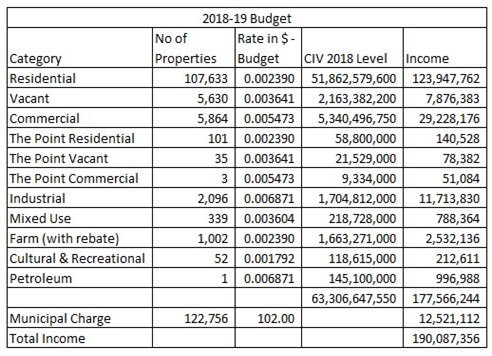
Preliminary processing has been completed to generate expected 2018-19 rate income. This process highlighted that the Capital Improved Valuations were higher than the budget level with a variance of $190.7 million. The higher valuations when multiplied by the rate in dollar for each rating differential indicated additional rate revenue of $710,785 relative to the 2018-19 budget or a 2.6% overall rate increase exceeding the rate cap by 0.35%.
Table 2 highlights the impact on revenue when the corrected Capital Improved Valuations are applied to the 2018-19 differential rates resulting in Rate income of $190.8 million representing non-compliance with the rate cap.
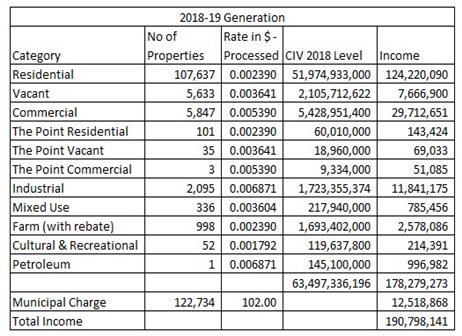
It is proposed that Council amend the 2018-19 differential rates to adjust the revenue to 2018-19 budgeted rates revenue. Since the error effected all differentials, it is proposed that the rate in the dollar be re-set to ensure an equitable solution for all ratepayers.
The farm rebate will be increased from 36.3% to 37.3% as part of the changes required. All other criteria of the 2018-19 rating strategy approved by Council will remain. This change will ensure that the 2018-19 budget rate revenue is achieved and Council is compliant with the rate cap at 2.25%. This will also ensure compliance with the Annual Compliance Information 2018-19 report to the ESC due in September 2018. The ESC have been contacted and advised of the proposed corrective action.
Table 3 provides a summary of the new rate in the dollar for each differential which restores budgeted rate income to $190.1 million.
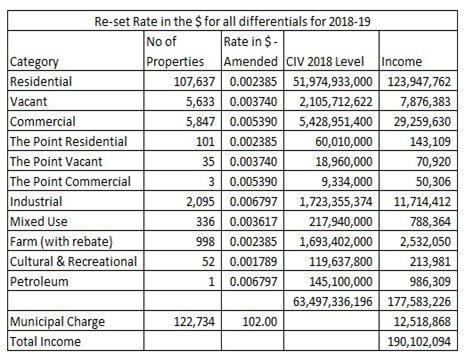
The understatement of valuations as part of the 2018-19 budget was $190 million and applying the original 2018-19 differential rate in dollar would increase rate revenue by $710,785.
The resetting of differential rates will bring the rate revenue in line with the adopted rate revenue budget and the 2018-19 Rate Cap of 2.25%.
This recommendation represents a correction of an administrative error only and the changes can be made in time for the 2018-19 rate notices to be issued late August 2018. This minimises any adverse impact on the community.
There are no social implications arising from this report.
This report is provided in accordance with requirements under the Local Government Act 1989. The change to the differential rates does not represent an amended budget.
This report contributes to responsible and sustainable financial management as aligned in the Council Plan strategic objective Innovative Finances and Technology.
No Council officers have a direct or indirect interest in any matter to which this report relates.
Council will not be compliant in conforming to the rate cap if the recommendations in this report are not implemented.
There are no environmental implications arising from this report.
Contents | Previous Page: Section A - Procedural Matters | Next Page: Section C - Notice of Motion
