
Council Minutes - Section B: Reports - 28 August 2018
Contents | Previous Page: Section A - Procedural Matters | Next Page: Section C - Assembly of Councillors
Contents | Previous Page: Section A - Procedural Matters | Next Page: Section C - Assembly of Councillors
Reports tabled at the Ordinary Meeting of Council on Tuesday date held at the Council Conference and Reception Centre in City Hall, 57 Little Malop Street, Geelong.
Barwon Region Strategic Directions Statement - Integrated Water Management
Audit and Risk Committee Summary Report (Confidential)
Source: |
Planning and Development |
Acting Director: |
Joanne van Slageren |
Index Reference: |
Project: Geelong Saleyards Precinct Plan |
Portfolio: |
Sustainable Development |
To update Council on preparation of the Geelong Saleyards Precinct Plan and to seek Council’s support for a mixed use development, including residential as the preferred future use in the precinct.
In August 2017 a resolution was made to close the Geelong Saleyards and, amongst other things, to:
engage with the community to develop a strategy to recognise the history of the Geelong Saleyards;
identify Heritage elements to be retained at the Geelong Saleyards, and to make safe the site by demolishing unsafe infrastructure;
develop a Precinct Plan for the Weddell Road site incorporating the provision of public open space.
The Geelong Saleyards is located on Weddell Road, Geelong West. The existing truck wash and poultry sales operations on the site are planned to cease. The farm supplies business is the subject of a lease with the City.
The heritage significance of the Saleyards site has changed with the cessation of livestock sales and two fires which destroyed key buildings. A strategy to recognise the history of the Saleyards will be prepared consistent with the previous resolution.
The Saleyards Precinct Plan will identify the preferred future land use for the precinct.
The Plan will include detailed design guidelines on how the Saleyards site should be developed. The study area for the Precinct Plan is included in Attachment 2. The study area includes land around the Saleyards site to enable strategic consideration of the broader area. The established industries in the north of the study area will remain, but this land has been included to ensure that interface issues between any residential development and the existing industry are addressed. The highlighted areas on Attachment 2 define the areas where development opportunities will be investigated as part of the Precinct Plan this includes adjoining land owned by Target and the Sphinx entertainment facility.
All landowners and occupiers have been notified about the commencement of the project and meetings have been held with landowners who wished to discuss it in more detail.
An Environmental Site Assessment indicates that remediation of the site is required prior to a new use commencing. Remediation options are available which would render the site suitable for commercial, industrial or residential use.
A decision on the preferred future use of the site is required to inform the Plan. A mixed use development which includes medium density residential development is considered the most suitable future land use for the site.
Industrial development on the site is not supported given the potential for land use conflict with the aged care facility on Weddell Road.
Commercial development to allow shops would be contrary to the City’s Retail Strategy which seeks to avoid out of centre retails development. Large scale office development could undermine the City’s aim of increasing the number of workers in Central Geelong as defined in the Central Geelong Action Plan.
The draft Precinct Plan will be released for community consultation later this year to enable local residents and business owners to have their say on the proposed use and design of the future mixed use area.
A report will be prepared for Council’s consideration on the final Precinct Plan.
Councillor Mason moved, Councillor Kontelj seconded -
That Council:
Support a mixed use development incorporating residential development in the Saleyards Precinct Plan;
Note the progress of work on the Geelong Saleyards Precinct Plan; and
Support consultation with the community and affected landowners to inform the directions of the Geelong Saleyards Precinct Plan.
Carried.
Preparation of the Geelong Saleyards Precinct Plan is included within existing budget allocations.
Current approved budget.
Preparation of the Geelong Saleyards Precinct Plan is underpinned by a Communications Plan which will ensure that the broader community has an opportunity to get involved in the preparation of the Precinct Plan.
Preparation of the Geelong Saleyards Precinct Plan does not raise any social equity considerations.
The Geelong Saleyards Precinct Plan will be prepared in accordance with relevant State and Local planning policies.
Industrial development on the site would be consistent with the existing zoning of the land but a large scale industrial development could pose interface issues given the proximity to the aged care facility opposite the site on Weddell Road and surrounding residential area.
Commercial development to allow shops would be contrary to the City’s Retail Strategy which seeks to prevent the development of new “out of centre” retail developments in order to protect the existing hierarchy. Similarly, providing for significant office accommodation on this site could undermine the City’s efforts to increase the number of jobs in Central Geelong.
A mixed use development which includes medium density residential development is the most suitable future land use for the site. This is consistent with the City’s housing policies which support more infill housing development in established areas, particularly in proximity to train stations. A residential development provides a more appropriate land use adjacent to the aged care facility and could also be designed to incorporate open space as required by the previous Council resolution. The design of a residential development provides greater opportunities for interpretation of heritage elements reflective of the Saleyards layout. A change in land use in the precinct would also facilitate plans by Target to redevelop their site for a new use which may include housing or offices.
Implementation of the Plan will require a planning scheme amendment to the Greater Geelong Planning Scheme.
A planning permit application to demolish much of the unsafe infrastructure that remains on site has been lodged and is currently under consideration. Design guidelines for the Saleyards site will also ensure that a future development incorporates heritage elements wherever possible.
If Council resolved to sell the Saleyards site, then it could do so at any time pursuant to the requirements of the Local Government Act.
Preparation of the Geelong Saleyards Precinct Plan supports the Planned Sustainable Development strategic priority in Council Plan 2018-22.
Conflict of Interest No officers involved in the preparation of the report have any direct or indirect interest in the matter to which the report relates in accordance with Section 80C of the Local Government Act.
The potential for soil and ground water contamination is being addressed in the project through the commissioning of expert advice.
Preparation of the Geelong Saleyards Precinct Plan will have regard to best practice environmental design.
Site Location and Context
When it was established in 1869 the Saleyards were on the edge of the city. As Geelong has grown over the past century the Saleyards site is now surrounded by urban development and is part of Geelong’s inner ring of suburbs.
The Geelong Saleyards is located on Weddell Road, Geelong West. It comprises two land parcels; Crown land and Council owned land of 1.2 and 6 hectares in area respectively.
The site is strategically located being just 600 metres from the North Geelong Railway Station, 3 kilometres from Central Geelong, 1 kilometre from the waterfront and 1.5 kilometres from the core of the activity centre on Pakington Street in Geelong West.
The Saleyards is included in a Heritage Overlay, however the heritage significance of the place has been affected by the cessation of the use for livestock sales and the demolition (by fire) of the market office building and the caretakers cottage. The City has commissioned several reports on the condition of the built fabric that remain on site which concluded that many of the structures were unsafe and not fit for purpose. A planning permit application to demolish much of the unsafe infrastructure has been lodged and is currently under consideration.
The City is working with Barwon Water to relocate the truck wash from the site to a more appropriate location. The weekly poultry sales at the site are due to cease in August upon the expiration of the operators lease. A private operator has a lease with the City on part of the site and runs a farm supplies business.
The stormwater harvesting facility in the north of the site will remain.
Changes to this part of Geelong have occurred in recent years with the residential development on the Geelong Golf Club and the establishment of the MACS/Bella Cara aged care facility.
Precinct Plan Study Area
The Saleyards Site adjoins the Target office site which is due to be vacated by the end of 2018. With the existing uses on these two large sites coming to an end, an opportunity to plan strategically for the future of the broader area was identified. The study area for the project is therefore broader than just the Saleyards site.
The study area covers nearly 25 hectares of land across approximately 50 land parcels.
The existing industrial development in the north of the study area is planned to remain, given the fragmented ownership and the relatively recent investment in some of the building stock. The established uses in this area include light industrial uses, small scale manufacturing, an indoor sports centre, retail and transport uses. The Precinct Plan will have to make provision for an appropriate interface between any new use in the south of the precinct to protect the ongoing operations of these uses.
The greatest opportunity for land use change is in the south of the study area, particularly the Saleyards, the Target site and the vacant land behind the Sphinx entertainment facility which are highlighted on the image below. At this time it is not clear whether the Crown Land could form part of any future development opportunity. Discussions with the Department of Environment, Land, Water and Planning will explore this further.
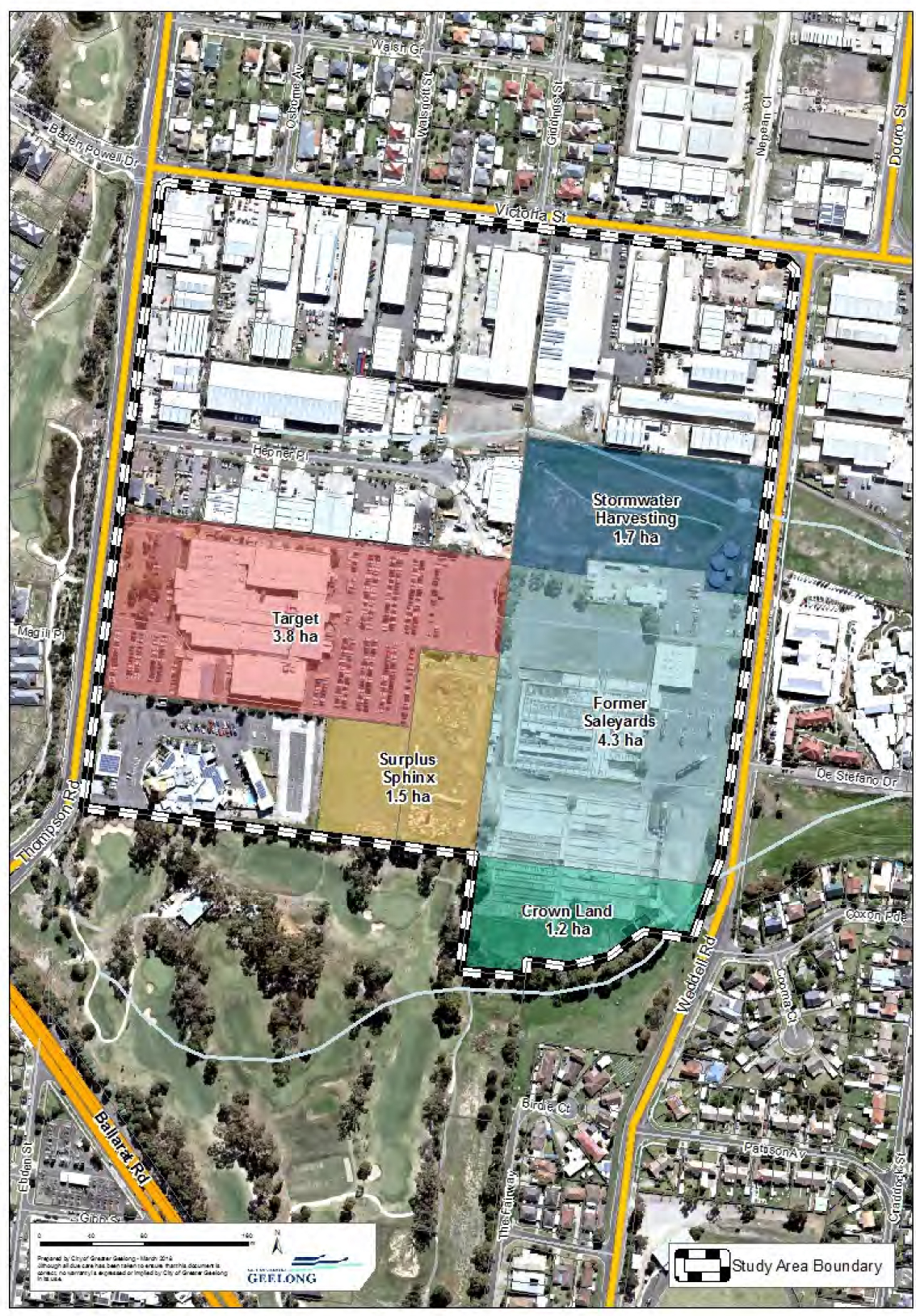
Preparation of the Precinct Plan will consider a range of issues including traffic, drainage, planning policy, urban design, preferred land use, views of key stakeholders and agencies and broader community feedback.
The potential for ground and ground water contamination is also a relevant consideration given the Industrial Zoning of land in the study area. Landowners are required to prepare an Environmental Site Assessment for any site which may be considered for rezoning to allow more sensitive uses such as residential.
The City commissioned an Environmental Site Assessment on the Saleyards site. The results indicate that in its current state the site is not suitable for a new use due to the concentrations of contaminants in the soil exceeding screening level assessment criteria.
However the report identified that remediation options were available which could render the site suitable for all uses including residential uses. The report recommended that the remediation response should be informed by a future development layout and could vary from complete removal of all contaminated material to leaving soils in situ with appropriate capping to prevent disturbance. Remediation costs will vary depending on the nature of a future land use and the design and layout of any future development proposal.
Internal referrals within the City concluded that the Saleyards site is not required for any other municipal purpose, with the exception of the Stormwater harvesting facility which occupies 1.7 hectares in the north of the site.
Stakeholder engagement with representatives from Target have revealed that they are interested in disposing of their site and their advice is that the highest and best use of their site may be offices or medium density housing.
Industry
Land in the study area is within the Industrial 1 Zone. However given the recent changes in land use surrounding the precinct, including the development of the Geelong Golf Club and the MAC/Bella Chara aged care facility, it is considered that large scale industrial development would no longer be appropriate in the study area. The conversion of this land will not negatively impact the City’s supply of industrial land, given the size of the area and the fact that it has not been used for industrial purposes in the past.
Retail
The City’s policies to guide the future development of retailing in Geelong are included at Clause 21.07 and 22.03 of the Greater Geelong Planning Scheme. They define a retail activity centre hierarchy across Geelong which is to be protected by discouraging new out of centre retail development except in cases where there is an identified demand and where there is no adverse impact on existing centres.
Detailed economic modelling has not been undertaken. However it is considered that any proposal for large scale retailing in the study area would undermine the existing retail hierarchy. It would also negatively impact the nearby activity centres at Pakington Street, Separation Street and Shannon Avenue by drawing trade away from these centres. Thus a retail use in the Saleyards Precinct Plan is not supported by existing planning policies.
Residential and Mixed Use
The City’s policies to guide the future of housing in Geelong are included at Clause 21.06 of the Greater Geelong Planning Scheme. Housing policy is also being further developed through the draft Settlement Strategy which has recently been subject to public consultation. It is well documented that demand for smaller dwelling types and demand for housing in established areas with good access to services is increasing. Clause 21.06 notes the environmental, economic and social benefits of housing consolidation in areas that have access to activity centres and public transport. This reduces urban sprawl and creates more vibrant urban areas
The precinct is ideally located to accommodate residential development given the proximity to the train station, existing activity centres and Central Geelong. A residential development in this precinct will also avoid the potential for land use conflict with the nearby residential development at the Geelong Golf Club and the aged care facility on Weddell Road.
A mixed use development would provide an opportunity to facilitate other uses within the precinct potentially including small scale local retailing which would service the new community without impacting on existing centres. This would also enable smaller scale office development, as is currently being contemplated by Target for their site.
The Precinct Plan will include detailed requirements for the layout and design of future development on the Saleyards site and higher level design principles for the broader study area. These design requirements can address the interface to the existing light industrial businesses in the north of the precinct as well as the Sphinx entertainment facility to manage issues such an noise and other emissions.
Design guidelines for the Saleyards site will also ensure that a future development incorporates heritage elements wherever possible. This could include retention of some of the heritage fabric and interpretation of the site through overall site layout, use of specific building materials and potentially the incorporation of interpretive art work and/or signage. A residential use would also allow greater access to site by the broader community, allowing for greater appreciation of the former use of the site. A similar project in Melbourne was undertaken at the former Newmarket Saleyards which were redeveloped into the Kensington Banks housing development. This incorporated timber post and rail fencing reflective of the livestock pens and included the former “stock route” in the layout of the open space on site.
Once Council has determined its preferred land use direction, work will continue on preparing the draft Precinct Plan. The draft Precinct Plan will be released for consultation with the community, ensuring that local residents and business owners can have their say on the directions of the plan.
A final Precinct Plan will be prepared for Council’s consideration. The adopted plan will then be given statutory effect via an amendment to the Greater Geelong Planning Scheme.
Source: |
City Services - Engineering Services |
Director: |
Guy Wilson-Browne |
Index Reference: |
Stormwater Management Strategy |
Portfolio: |
Social and Infrastructure Planning |
To endorse the Barwon Region Strategic Directions Statement (SDS) – Integrated Water Management (IWM) (Attachment 6) as a regional partner prior to the final document being presented to the Minister for Water in August 2018.
Integrated Water Management (IWM) Forums were established in Victoria by the Department of Environment, Land, Water and Planning (DELWP) in 2017 to identify, coordinate and prioritise opportunities and areas that would most benefit from collaborative water cycle planning and management.
The Forums were designed to help local governments, water corporations, catchment management authorities, the Victorian Planning Authority (VPA) and Traditional Owners work together to ensure the water cycle efficiently contributes to the liveability of a region.
The purpose of the Barwon Integrated Water Management Forum (the Forum) is to provide a collaborative platform for overseeing, supporting and, where necessary, facilitating water’s contribution to community prosperity, resilience and liveability in the Barwon Region. The following organisations will be invited to participate in the Forum:
Barwon Water
Corangamite Catchment Management Authority
Southern Rural Water
Department of Health and Human Services
DELWP Barwon South West
Wathaurung Aboriginal Corporation
Eastern Maar Aboriginal Corporation
Borough of Queenscliffe
City of Greater Geelong
Colac Otway Shire
Golden Plains Shire and
Surfcoast Shire.
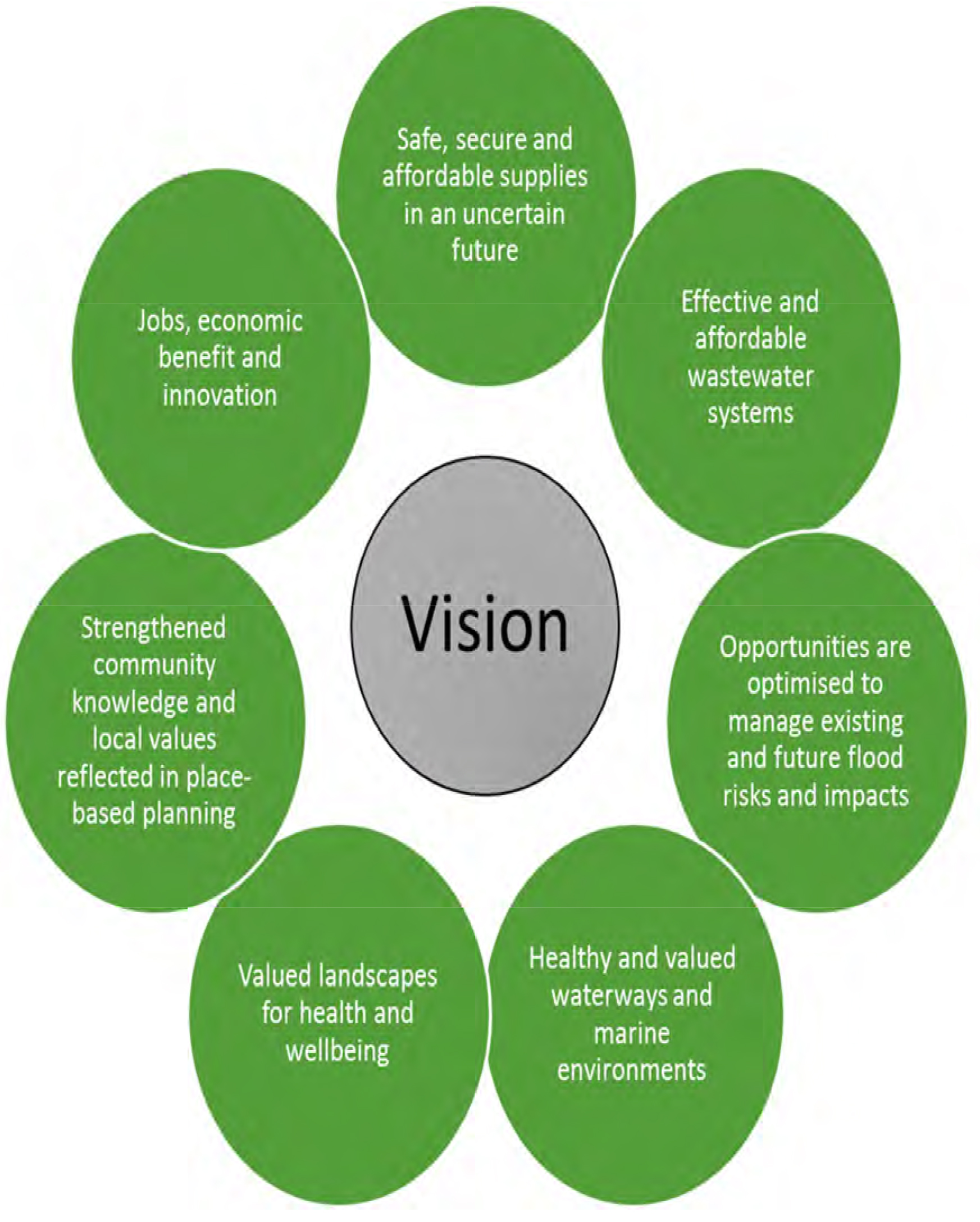
Each Forum will develop a SDS that comprises a shared vision statement, strategic forum objectives, a summary of IWM opportunities under investigation and a range of strategic enablers to address barriers to IWM in Victoria.
A robust and transparent process to prioritise IWM opportunities according to opportunity urgency and impact is undertaken by the IWM Forum and Working Groups.
A robust and transparent process to prioritise strategic policy and framework to address barriers to IWM in Victoria is undertaken by the IWM Forum and Working Groups.
Each member of the Barwon Forum has been requested by DELWP to endorse the Barwon Region SDS prior to presentation to the Minister for Water.
In principle support for the SDS was provided by attending members at the Forum held on the 13 July 2018.
It is envisaged that the SDS will be a living document which will be updated every two to three years to reflect the current IWM Forum’s priorities and opportunities.
Further refinement of the SDS content will be completed by IWM Working Group members and Forum secretariat with support from DELWP prior to the presentation of a final draft SDS at the following IWM Forum.
The IWM Forum chairperson will present the final SDS as endorsed by the IWM Forum to the Minister for Water in August 2018.
Councillor Murrihy moved, Councillor Aitken seconded -
That Council endorse the final draft Barwon Region Strategic Directions Statement (SDS).
Carried.
Endorsement of the SDS does not commit organisations to fund identified IWM opportunities.
IWM Forum Process – Phase One
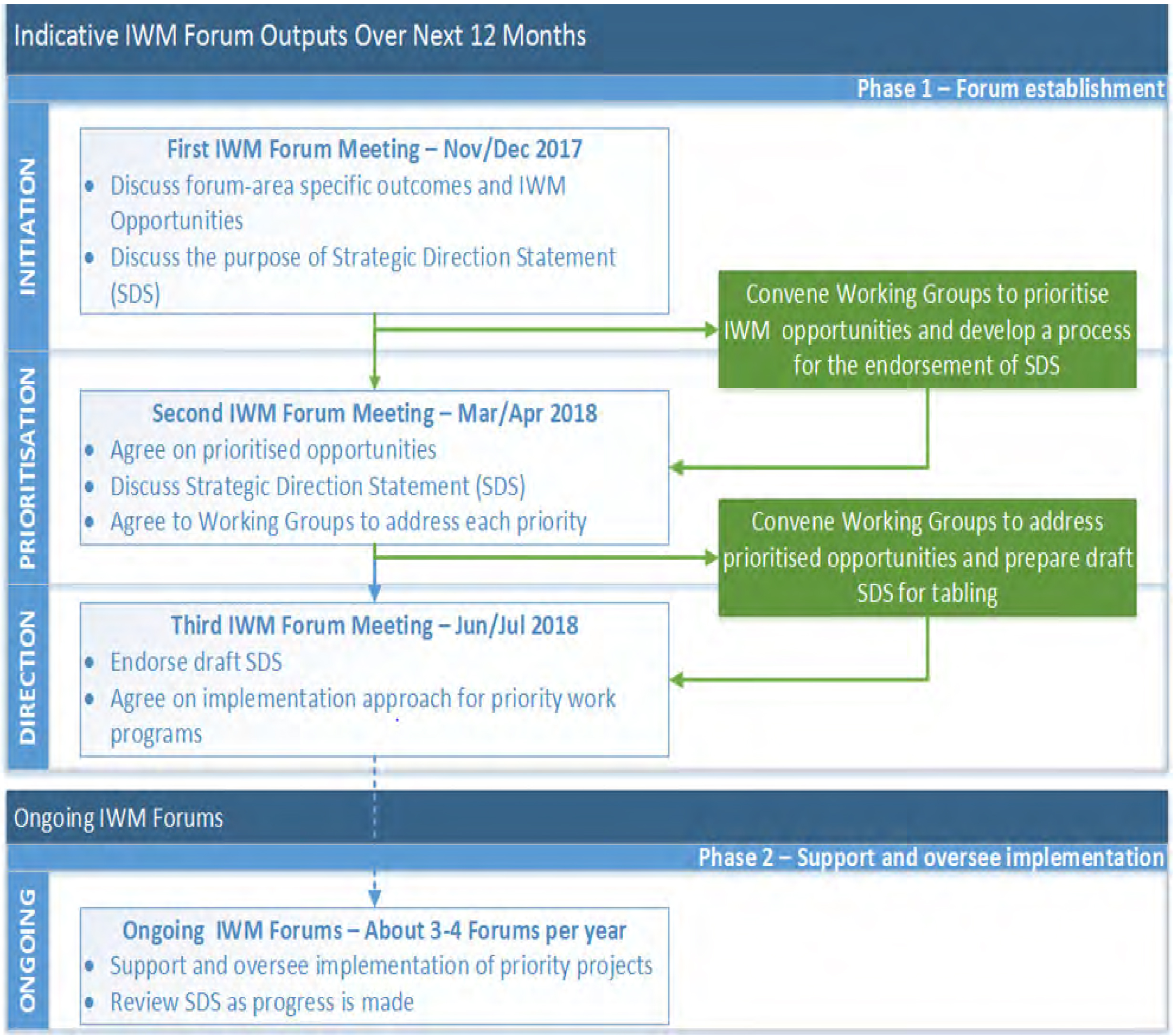
Several IWM Forums are established in Victoria reflecting geographical and catchment areas across Greater Metropolitan Melbourne and regional Victoria. This represents Phase One of Two in the IWM Forum cycle (refer to Attachment 3).
Phase One of the IWM Forum cycle is driven by the experience of the participants. A core component of this phase involves formalising the governance and collaborative processes involved, as well as identifying the scope of specific IWM opportunities.
Phase One also involves the development of regional context specific to IWM for each Forum Area to inform strategic work undertaken in Phase Two.
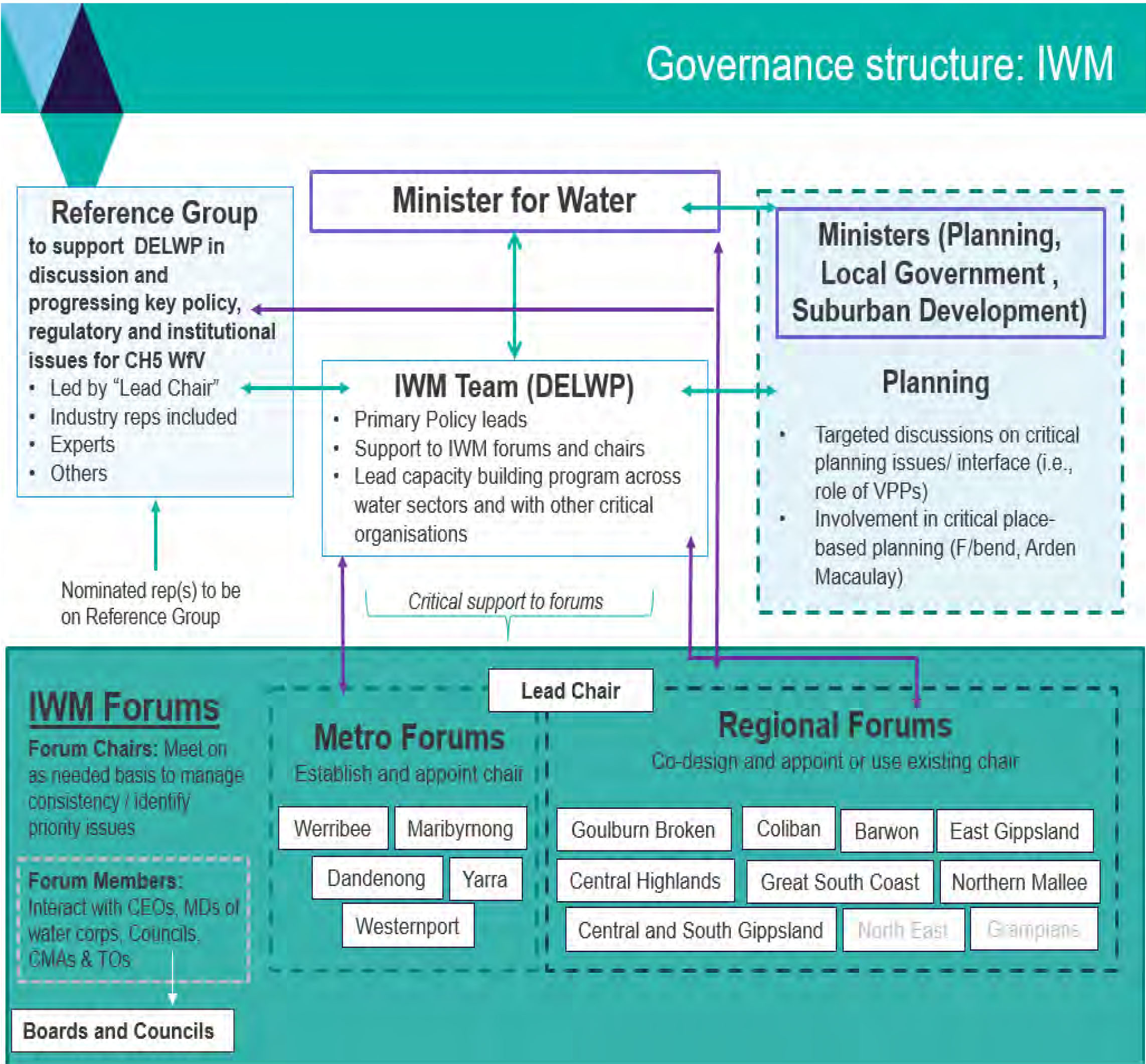
Each IWM Forum is facilitated by a chairperson whose primary role is to facilitate Forum discussions and work with Forum Members (participants) to ensure that all participating parties are heard and community and Aboriginal values are represented.
All IWM chairpersons meet regularly as a group to discuss and align on key outcomes sought at the IWM Forums. This meeting is facilitated by a Lead Chair with support from DELWP.
The IWM Forum Members are a collaborative group of leaders, including Chief Executive Officers and Managing Directors, who represent organisations with an interest in water cycle management, such as water corporations, local governments, catchment management authorities, the VPA- and representatives of Traditional Owner interests.
IWM Forums typically meet three to four times a year as agreed by the Forum Chair, Forum Members and DELWP.
On behalf of the IWM Forum, the chairperson advises DELWP and the Minister for Water on the forum’s progress and any other issues as required.
Phase Two of the IWM Forum cycle involves strategic IWM implementation and planning support.
Resilient Cities and Towns Reference Group
The Resilient Cities and Towns Reference Group has been established to support the implementation of integrated water management and planning across metropolitan Melbourne and regional Victoria.
The Reference Group will provide advice to DELWP on the development and implementation of key initiatives in relation to policy, processes or knowledge gaps in IWM.
The Reference Group has diverse membership that represents the breadth of the urban water sector.
IWM Working Group
Each IWM Forum establishes an IWM Working Group to conduct detailed work based on the recommendations of the IWM Forum.
This work includes the development of a shared vision statement and strategic forum objectives, the identification and prioritisation of IWM opportunities and the identification of a range of strategic enablers to address barriers to IWM.
The IWM Working Groups typically meet three times per year or as needed to develop catchment scale initiatives, including a Strategic Directions Statement (SDS) for the Forum area, as agreed by the Forum, Working Group members and DELWP.
A member of the DELWP Water and Catchments Group contributes support to the IWM Working Group as required and agreed by the IWM Forum Members. Support includes the development of common vision statements and strategic forum objectives for each IWM Forum to tailor to their unique catchment needs (refer to Attachment 4).
IWM Working Groups create an opportunity for IWM Forum Member organisations to benefit from shared learnings and the development of collaborative tools to effectively manage IWM opportunities.
IWM Forum Process – Phase Two
Phase Two of the IWM Forum cycle involves strategic IWM implementation and planning support for IWM opportunities identified in Phase One. It is anticipated that these opportunities are dynamic and will be further developed by the IWM Forum Members and their organisations to reflect a strategic catchment-wide approach to IWM (refer to Attachment 3).
It is envisaged that a rigorous feasibility and business case assessment, in addition to other implementation requirements as determined by each collaborative delivery partner, will ultimately be included for all prioritised IWM opportunities.
The IWM Forum SDS will be reviewed in Phase Two to reflect IWM progress and the inclusion of additional IWM opportunities.
Phase Two of the IWM Forum cycle creates an opportunity to evaluate and share learnings from Phase One to benefit stakeholders, optimise resources and explore the development of standard approaches to IWM in the future.
This Phase also provides the opportunity for IWM Forum members to update relevant organisational policies, plans and strategies to reflect the IWM Forum SDS outcomes. It also provides an opportunity for organisations to engage with regional stakeholders and socialise emerging organisational challenges, directions and initiatives.
Progress to date
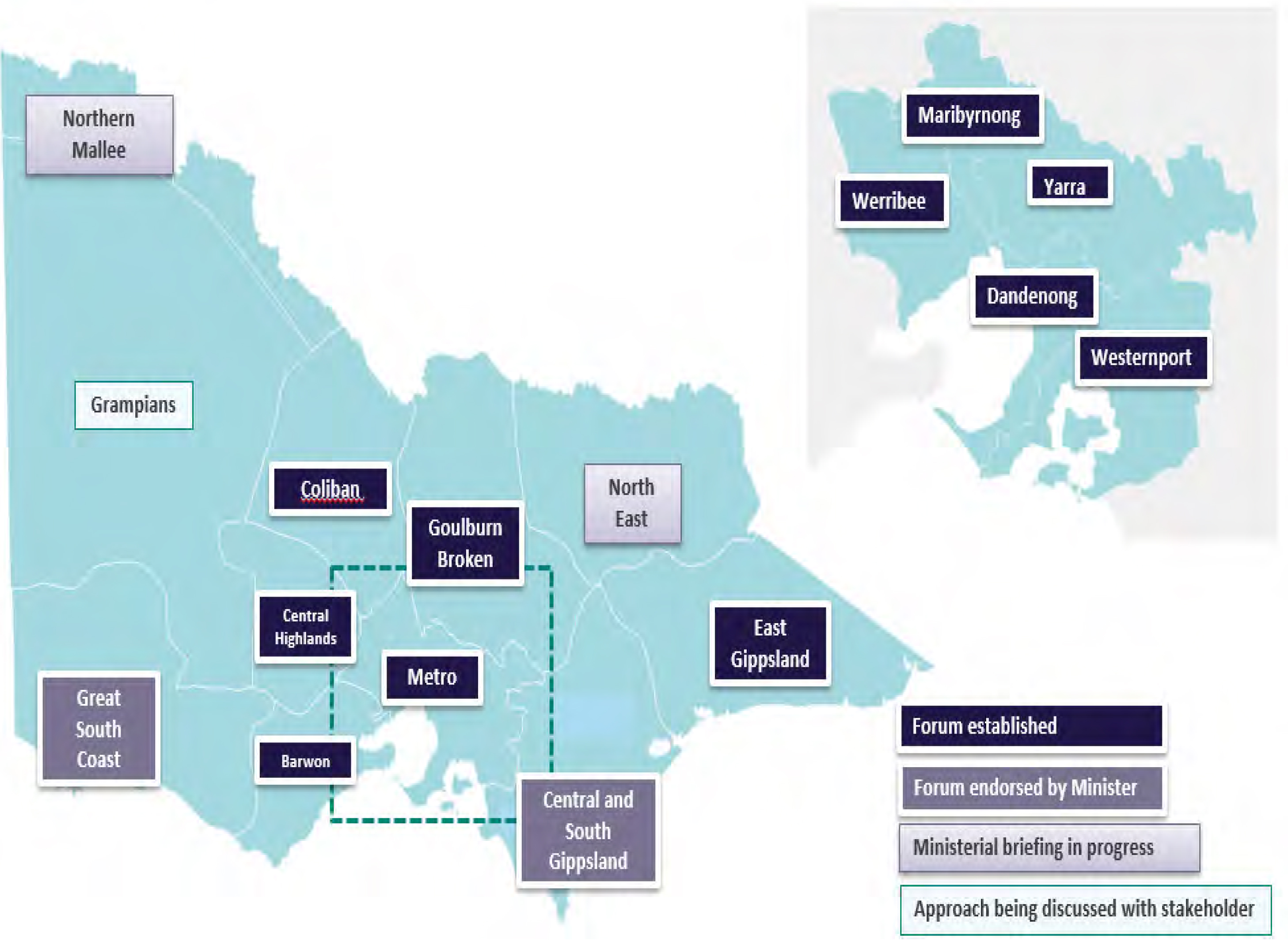
To date, 13 out of 15 IWM Forums are established across Victoria.
The established IWM Forums comprise eight Regional Forums in regional Victoria, and five Metropolitan Forums representing all Greater Metropolitan Melbourne catchment areas (refer to Attachment 5).
The first and second rounds of the Barwon IWM Forum is complete. The Third Meeting of the IWM Forum will take place 13 July 2018.
The Regional IWM Forums are being co-designed with stakeholders and are being progressively established over the 2018-2019. Goulburn Broken IWM Forum was the first IWM Forum established in May 2018 and has been used as a pilot for the rest of Victoria.
The Resilient Cities and Towns Reference Group was established in April 2018. It is chaired by Rob Skinner, the Lead Chair of the Victorian IWM Forums, and supported by DELWP. Greater Geelong City Council 28 August 2018 Minutes of Ordinary Council SECTION B - REPORTS Page 16 To date, 22 IWM Forums and 19 IWM Working Group meetings have been held across Victoria.
More than 400 IWM opportunities have been identified by the IWM Forums across Victoria, yielding a shortlist of 159 IWM opportunities.
More than 50 strategic enablers to address barriers to IWM have been identified by the IWM Forums across Victoria.
Across Victoria, seven draft Strategic Direction Statements have been developed by their respective IWM Forums.
The IWM Forums have engaged 64 or the 79 local government organisations across Victoria.
The IWM Forums have engaged eight of the 11 Registered Aboriginal Parties.
The IWM Forums have engaged all 10 catchment management authorities in Victoria, as well as all 19 of the urban and/or rural water corporations.
Other organisations engaged include the Victorian Planning Authority, Regional Development Victoria, Parks Victoria, and Department of Health and Human Services.
There are a number of acts, regulations, policies and plans that guide how we manage stormwater and associated issues. In all of this, our role is not always clear. The legislation that assigns management and control of drains to local government is the Local Government Act 1986 – Section 198. However, the Act provides no information about how this ‘management and control’ should be conducted.
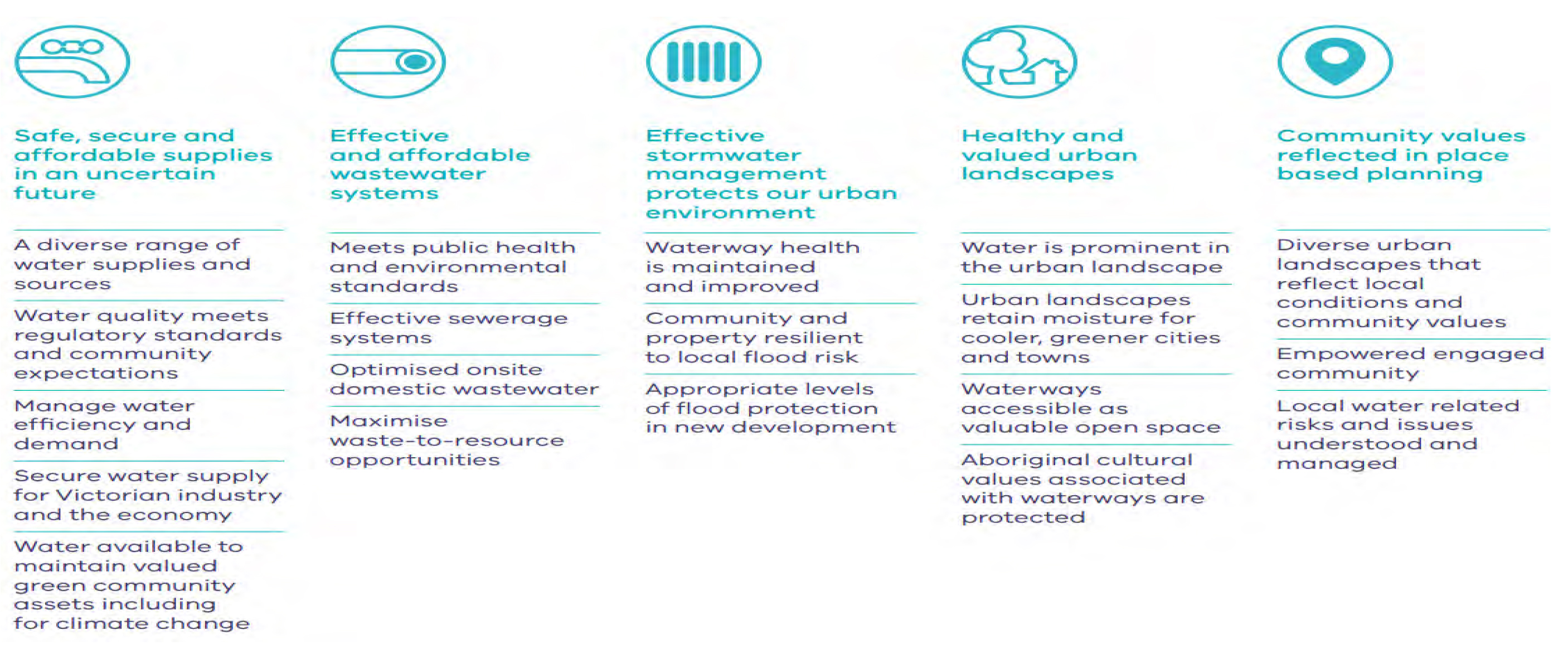
The Forums respond to Chapter 5 of the Victorian Government’s strategic plan for management of the State’s water resources, Water for Victoria (2016), which sets clear objectives on the role of water for the creation of liveable cities and towns across the State.
Chapter 5, Action 5.7 of Water for Victoria describes how the IWM Forums will represent community values and local opportunities in planning.
The subsequent Integrated Water Management Framework for Victoria (2017) outlines how greater community value can be delivered by consistent and strategic collaboration within the water sector and through links with organisations involved in land use planning.
The IWM Framework for Victoria details the IWM planning framework and governance structure to translate community objectives for water management into practice (refer to Attachment 2). Alignment to City Plan
This report aligns directly to City Plan’s Strategic direction of “a Sustainable Built and Natural Environment”. The Municipal Road Management Plan is identified as a key strategy that will assist in delivering the priorities identified.
From the Council Plan 2018-2022, Integrated Water Management strategies, plans and actions will support a number of priorities, aligning with:
Informed Social Infrastructure and Planning
Providing more quality spaces that support active lifestyles
Planned Sustainable Development
A coordinated approach to drainage and water sensitive urban design
An IWM approach to planning requires water sector members to clearly understand their own accountabilities and those of other organisations. This clarity facilitates the allocation of benefits, costs and risks for integrated solutions.
Across Victoria, no single organisation is responsible for managing the urban water cycle. This separation of responsibilities makes a collaborative approach essential for planning that effectively recognises water cycle complexities. The water services regulatory framework and its institutional arrangements are clear about core services.
However, there are a range of water management functions – such as lake management, stormwater harvesting and public open space management – where accountabilities are less clear. The IWM process provides an opportunity to work through areas of ambiguous accountabilities.
The IWM approach involves understanding the water cycle, how water cycle services are provided and the drivers or constraints that influence its management, such as climate change, population growth, land use change, environmental decline and community preferences.
Source: |
Finance and Strategy - Financial Services |
Director: |
Peter Anderson |
Index Reference: |
Financial Management/reporting |
Portfolio: |
Finance |
To approve “in principal” the audited Financial Statements and Performance Statement and authorise two Councillors to certify the statements.
Under Section 131 of the Local Government Act 1989 (LGA), a Council must in respect of each financial year, prepare an Annual Report that includes audited Financial Statements and a Performance Statement for the financial year. These statements must be prepared in the prescribed manner and form and be certified by Council’s auditors.
Council’s current auditors are Victorian Auditor General’s Office (VAGO).
The draft Financial Statements and Performance Statement have been reviewed by VAGO and there were no major issues of high risk identified in the draft closing audit report. VAGO representatives will attend the Audit and Risk Committee meeting on 22 August 2018 to present and discuss the 2017-2018 Audit Management Letter.
Council’s internal Audit and Risk Committee have the responsibility according to Section 4.1 of its Charter “Financial Reporting Responsibilities” to:
4.1.2 - Review the annual financial report and performance statement and consider whether they are complete, consistent with information known to committee members and reflects appropriate accounting treatments;
4.1.4 - Recommend the adoption of the annual financial report and performance statement to Council.
Under Section 132 of the LGA, Council is required to approve “in principle” the Statements prior to receiving final certification from the Auditor General. Council’s approval requires nominating two Councillors to certify those Statements, together with Chief Executive Officer and Principal Accounting Officer and to lodge these statements with the Auditor General.
The 2017-2018 Financial Statement of Accounts and Performance Statement have been prepared and reviewed by the Victorian Auditor General’s Office (VAGO) with no major issues identified.
These Statements have been prepared in accordance with Australian equivalents to International Financial Reporting Standards.
The final closing audit report and final Management letter has been received from VAGO and there were no major issues of high risk to Council.
The 2017-2018 Financial Statement of accounts record a satisfactory period of operation with a $65.0 million surplus, high closing cash balances of $103 million and significant asset growth to $2.3 billion.
The overall spend in 2017-2018 was $467.5 million including operating expenditure $354.2 million and capital expenditure $113.3 million.
The Comprehensive Income Statement highlights a surplus for the year of $65.0 million plus $141.5 million land and building and drainage revaluation increment for a total comprehensive result of $206.5 million.
The result includes $10.6 million for early receipt of 50% Commonwealth Grants Commission funding for 2018-2019.
Debt levels increased during the year from $45.5 million to $48.7 million with $12.1 million of new loans and $8.9 million repayment of borrowings.
The Audit and Risk Committee made the following resolution at its meeting held on 22 August 2018:
Endorse the 2017-2018 draft Financial Statements (Appendix 1) and Performance Statement (Appendix 2) subject to resolution of any outstanding audit issues with any material changes to be notified to the Chair of the Audit and Risk Committee; and
Recommends that Council, at its meeting on 28 August 2018, adopts the Statements “In Principle” and forwards the statements to the Auditor General for certification.
Councillor Murnane moved, Councillor Harwood seconded -
That Council:
Give approval in principle to the “2017-2018 Financial Statements” (as per Appendix 1) and the “Performance Statement” (as per Appendix 2); and
Authorise two Councillors being the Mayor, Councillor B Harwood and Councillor P Murnane to certify the Statements subject to any changes recommended and agreed with the Auditor General.
Carried.
The Financial Statement of Accounts 2017-2018 (refer Appendix 1) record a satisfactory period of operation with a favourable operating surplus, high closing cash balances and significant asset growth.
The surplus result for 2017-2018 of $206.5 million includes the following major items:
|
|
$ million |
• |
Net movement in early receipt Grants Commission funds (2016-17 v 2017-2018) |
0.1 |
• |
Non capital projects unspent amount |
7.4 |
• |
Net Income/expenses |
(3.0) |
Recurrent Surplus |
4.5 |
|
• |
Capital Grants Income/ Dev. Cap |
27.9 |
• |
Recognition of Infrastructure |
47.1 |
• |
Asset Disposals |
(20.5) |
• |
Sale of Property |
8.5 |
• |
Other |
(2.5) |
Non Recurrent Surplus |
60.5 |
|
SURPLUS/(DEFICIT) FOR THE YEAR |
65.0 |
|
Net Asset revaluation (Land & Buildings, Drainage) increment |
141.5 |
|
TOTAL COMPREHENSIVE RESULT |
206.5 |
|
The $65.0 million surplus result was ($20.7 million) favourable to adopted Budget and included the following favourable and unfavourable income and expenditure items (refer Note 1.1 - Appendix 1).
Main variances are as follows:
|
Budget 2018 |
Actual 2018 |
Variance |
Ref |
INCOME |
|
|
|
|
Rates and charges |
217,456 |
218,809 |
1,353 |
|
Statutory fees and fines |
13,139 |
13,881 |
742 |
|
User fees |
59,183 |
60,968 |
1,786 |
|
Grants - operating |
36,962 |
53,924 |
16,962 |
1 |
Grants - capital |
4,530 |
14,159 |
9,629 |
2 |
Contributions - monetary |
4,725 |
7,429 |
2,704 |
3 |
Contributions - non monetary |
39,500 |
46,687 |
7,187 |
4 |
Share of net profits/(losses) of associates and joint ventures |
0 |
29 |
29 |
|
Other income |
2,277 |
5,572 |
3,096 |
5 |
Total Income |
377,772 |
421,259 |
43,487 |
|
EXPENSES |
|
|
|
|
Employee Costs |
149,674 |
151,144 |
(1,469) |
|
Materials & Services |
99,079 |
105,639 |
(6,560) |
|
Bad & Doubtful Debts |
870 |
1,409 |
(539) |
6 |
Depreciation & Amortisation |
59,179 |
58,638 |
542 |
|
Borrowing Costs |
3,086 |
1,902 |
1,184 |
7 |
Net gain/(loss) on disposal of property, infrastructure, plant and equipment |
3,813 |
1,990 |
(1,824) |
8 |
Other expenses |
21,369 |
35,497 |
(14,129) |
9 |
Total Expenses |
337,071 |
356,219 |
(22,795) |
|
Surplus/(Deficit) for the year |
40,701 |
65,040 |
20,692 |
|
Variance explanation:
Grants Commission 2018-2019 50% received in June 2018 ($10.6 million favourable) and increased allocation $0.6 million received in 2017-2018. Budget had been adjusted for payment of 50% of 2017-2018 being received in 2016-2017. Increased grants received for Home Care services $2.4 million and increased child care benefits received $2.6 million.
Gheringhap Street Drain grant $2.5 million received earlier than budgeted for and $7.4 million of grants carried over from previous years were received.
Early receipt of Community Infrastructure levies for Armstrong Creek, Ocean Grove and Jetty Road $0.6 million and Developer Infrastructure levies for Armstrong Creek $1.5 million and Jetty Road $0.5 million.
Increased Subdivision assets $3.0 million and recognition of open space $3.3 million.
Other income $3.1 million favourable with additional Interest received $0.2 million, Northern Arc Project Design $0.5 million, Greenhouse reduction program $1.4 million, Central Geelong Activity Area Pedestrian Network $0.2 million and Drainage program $0.3 million.
Bad & Doubtful debts ($0.5 million) unfavourable due to increase in provision for Infringement debtors – mainly parking infringements.
Borrowing costs $1.2 million favourable with deferral and cancellation of loan borrowings.
Increased proceeds received for assets disposed of during the year.
Other expenses unfavourable ($14.1 million) including recognition of Drysdale Landfill Rehabilitation costs $9.5 million, gates fees for waste being diverted to Wyndham $3.4 million and efficiency dividend $2.1 million.
The Balance Sheet shows that Council has a very strong asset position with over $2.3 billion worth of assets that are used to provide services to the community.
Current Assets are $117 million which has remained constant with the end of the 2016-2017 financial year.
Current liabilities are $80.7 million which is predominately leave provisions and trade payables and non-current liabilities are $54.9 which has increased due to the drawing down of a loan in 2017-2018 and the recognition of the Drysdale Landfill Rehabilitation costs.
Total loan balance has increased from $45.5 million to $48.7 million.
Council’s cash position at the end of the year is $102.6 million, which is only a slight decrease from the opening balance.
The cash balance will provide funds to complete Capital and Non Capital projects carried over from 2017-2018 and working capital to ensure service provision continues at the same levels in 2018-2019.
Council has an extensive capital works program to renew, upgrade and provide new assets to ensure the continuation and improvement of services provided to the community. Council spent $113.3 million on capital works in 2017-2018 and included the following highlights:
|
Actuals |
Road replacement and construction |
13.6 |
Drainage replacement and construction |
6.0 |
Malop St Green Spine |
5.6 |
Drysdale Clifton Springs Sports Precinct |
5.4 |
Corio Landfill Rehabilitation |
5.3 |
Central Geelong Advancement Fund |
5.0 |
Leopold Community Hub Stage 2 |
4.9 |
DCP - ACEP – NAC Community Complex |
4.7 |
Drysdale Landfill Cell 5 |
4.4 |
Plant and Vehicles |
4.1 |
Johnstone Park Raingarden & Improvements |
3.3 |
Composting Site Setup Works |
3.1 |
AC Town Centre Community Facilities Site |
2.9 |
Footpath replacement and construction |
2.7 |
Kerb & Channel replacement and construction |
2.3 |
Hendy St Reserve Redevelopment |
2.3 |
Portarlington North East SRC Road Construction |
2.0 |
Leisuretime Synthetic Multi-use Pitch |
1.8 |
Melaluka Road Clubroom Upgrade |
1.5 |
Home for Cycling Regional Pavilion |
1.4 |
Highton Family Hub |
1.4 |
DCP – ACEP – NAC Community Pavilion |
1.2 |
Building Renewal Works |
0.9 |
DCP –HBP – Reserve Rd Retarding Basin |
0.9 |
IT Asset Replacements |
0.8 |
Anakie Reserve Facility Upgrade |
0.8 |
Drysdale Integrated Children’s & Family Centre |
0.7 |
DCP – ACWP – Acquisition Drainage Reserve |
0.7 |
Purnell Rd CFC |
0.6 |
Performance Statement as at 30 June 2018
Council is required to prepare and include a performance statement (refer Appendix 2) within its annual report. The performance statement includes the results of the prescribed sustainable capacity, service performance and financial performance indicators and measures together with a description of the municipal district and an explanation of material variations in the results. This statement has been prepared to meet the requirements of the Local Government Act 1989 and Local Government (Planning and Reporting) Regulations 2014.
A Governance and Management checklist has been completed for 2017-2018. The results in the prescribed form represent Councils assessment against the prescribed Governance and Management checklist as at 30 June 2018.
Where applicable the results in the performance statement have been prepared on accounting bases consistent with those reported in the Financial Statements. The other results are based on information drawn from Council information systems or from third parties (e.g. Australian Bureau of Statistics).
The performance statement presents the actual results for the current year and for the prescribed financial performance indicators and measures, the results forecast by the Council’s Strategic Resource Plan.
The forecast figures included in the performance statement are those adopted by Council in its Strategic Resource Plan on 27 June 2017 and which form part of the Council plan.
The results for 2017-2018 are consistent with the results from the previous year.
The Performance Statement results and the Service Performance Indicators prescribed under the Local Government Performance Reporting Framework will be reported on the ‘Know Your Council’ website (www.knowyourcouncil.vic.gov.au).
In accordance with the requirements of Section 132 of the Local Government Act 1989 the nominated Principal Accounting Officer of Council, two Councillors and the Chief Executive Officer are required to sign the Performance Statement. The Governance & Management checklist is required to be signed by Chief Executive Officer and The Mayor to represent the status of Council’s Governance and Management arrangements.
The external audit, conducted by the Victorian Auditor General’s Office (VAGO), was completed on Friday, 10 August 2018 as per the audit plan. There were no major issues affecting the Financial Statements. A closing report summarising the Audit findings and a Final management letter is to be reviewed by the Audit & Risk Committee.
As detailed within accompanying Financial Statements – refer Appendix 1.
The Financial Statement of Accounts and the Performance Statement will be available to the public as part of the published Annual report and accessible via our website.
The prescribed indicators and measures of service performance outcome, financial performance and sustainable capacity as per section 131(3) and 131(4) of the Local Government Act 1989 will also be available on the State Government ‘Know Your Council’ website from November 2018.
Incomes and Expenditures on Council’s social equity programs are included in the Financial Statements.
Under Section 131 of the Local Government Act the Council must in respect of each year prepare an Annual Report, which includes audited financial statements for the financial year.
Under Section 131 a Council must not submit the Financial Statements to its auditors or the Minister unless it has passed a resolution giving approval “in Principle” to the statements.
Under Section 131 a Council must authorise two Councillors to certify the Statements in their final form after any changes recommended, or agreed to with the auditor.
The actions outlined in this report are aimed at complying with the requirements of the Act. wellbeing and quality of life; reduced impact of social isolation; and greater parental engagement with children and early childhood services.
The Financial Statements and the Performance Statement highlight that 2017-2018 Council operations have been managed in a responsible manner. The results contribute to responsible and sustainable financial management as aligned in the Council Plan strategic objective ‘Innovative Finances and Technology.
Council staff preparing this report have no direct or indirect interest.
The Statements are released as a draft and are still subject to being signed off by the Auditor General.
Incomes and Expenditures on Council’s environmental preservation and enhancement programs are included in the Financial Statements.
Source: |
Finance and Strategy - Financial Services |
Director: |
Peter Anderson |
Index Reference: |
Financial Management/reporting |
Portfolio: |
Finance |
To adopt the 2018-2019 Capital and Non Capital projection changes to complete projects carried over from 2017-2018.
Each year as part of the annual budget process Council commits to Capital & Non Capital projects notwithstanding that many of these projects may take more than the current budget year to deliver.
At 30 June each year a review is undertaken of current year Capital and Non Capital programs that are incomplete and represent commitments to be carried over into the subsequent financial year.
Council’s endorsement is sought for carryover of funding to complete those projects that are either in progress but not completed or have not, for reasons within or beyond Council’s control, commenced.
The 2018-2019 budget process provided increased attention to the planned delivery and phasing of Capital & Non Capital projects. The list of works now focusses on just the Capital and Non Capital works that will be completed this year and aims to exhaust any carryovers from periods prior to 2018-2019 and to complete most of the 2018-2019 budgeted works. Regular reviews will be undertaken with responsible Managers and Directors will be held accountable for delivery of the projects.
The 2018-2019 budget was developed to include $50.5 million of expected Capital carryover.
This report amends the actual carryover by project to $49.5 million with $1 million of project savings. The change to include carryover by project in the budget process will not only improve accountability in delivery of projects it will improve the understanding of when actual funding is required.
Where a project has to depart from plan and is to be delayed and this delay will necessitate a movement of funds from one budget cycle to another, the quarterly finance report will list the projects and the reasons for the delay and seek endorsement of the funding transfer. The volume of carryover projects under the revised approach will be significantly reduced relative to this year’s report.
The carryover requirements are incorporated as part of 2018-2019 projection changes. No extra funding is required to complete the committed projects and there will be a minor favourable impact on the closing cash position as outlined in the adopted 2018-2019 Budget.
A review of the 2017-2018 Capital and Non Capital program expenditure has highlighted programs that are incomplete with income and expenditure required to carry over into 2018-2019.
The 2017-2018 income and expenditure amounts required to carryover are added to the 2018-2019 budget program with the expanded program defined as the 2018-2019 Projection. The 2018-2019 Projection is the authorised program and will be used for variance reporting on a quarterly basis through 2018-2019.
The Capital carryover amounts represent commitments where program managers have provided updated project expenditure phasing. A total of $49.5 million expenditure and $12.6 million income is now phased for completion in 2018-2019. The 2018-2019 Projected Capital program expenditure is $127.2 million with Projected Capital income $32.3 million. The Capital program is fully funded and there will be a minor favourable impact on the closing cash position. Appendix 1 shows all Capital Projects carried over.
A review of the Non-Capital program at 30 June 2018 indicates that funding of $9.3 million is required to carry over into 2018-2019. The Non Capital program will increase the projected 2018-2019 operating deficit by $(9.3 million). The program is fully funded and these projection changes will have no impact on the closing cash position (30 June 2019) as outlined in the adopted 2018-2019 Budget. Appendix 2 shows all Non Capital Projects carried over.
The combined impact of the Capital and Non Capital program carryover is fully funded and will have no impact on the closing budgeted cash position.
The Projected Operating expenditure is $363.91 million and Income $346.64 million with a Deficit of $17.27 million. This deficit will be funded from higher than expected cash balance as at 30 June 2018 of $41.2 million.
The projected Capital and Non Capital program will be used for variance reporting (Actual versus Projection) in the Quarterly Finance reports to Council.
Councillor Murnane moved, Councillor Murrihy seconded -
That Council:
Adopt the 2018-2019 Capital (Table 1) and Non Capital (Table 2) projection changes;
Note that the budget process gave increased attention to the planned delivery and phasing of Capital and Non Capital projects.
Carried.
Carryover requirements
Of the 243 projects listed in 2017-2018, project managers have advised that 126 projects have been fully completed, with 117 projects identified as requiring some carryover funds in 2018-2019 to complete works.
During the 2018-2019 Budget development the Capital carryover was projected to be net $38.80m comprising of $50.49 million expenditure and $11.69 million Income. At the end of the 2017-2018 financial year a review was carried out to determine the actual Capital Program carryover requirements.
The review indicates a net carryover of $36.59 million comprising of $49.53 million expenditure and $12.64 million income is required to complete the projects planned for 2017-2018. The net variance between actual Net ($36.89 million) and estimate included in 2018-2019 Budget ($38.60 million) is $1.71 million.
Of the 117 projects identified as requiring carryover funds, 15 project categories represent 71% of the total carryover expenditure of $49.5 3illionm. Example of the types of project commitments and rephasing of expenditure into 2018-2019 is as follows:
Capital Project Category |
$ |
DCP Projects |
11,066,401 |
Construction Projects |
10,536,208 |
Engineering Projects |
7,579,094 |
Waste Projects |
3,318,976 |
Fleet Purchases |
2,567,367 |
Sub Total Carryover to 2018-2019 |
35,068,046 |
The budgeted Capital program carryover into 2019-20 is $26.5 million. This will be reviewed on a quarterly basis and updated projections made following review of planned program delivery and phasing of project expenditure.
The Projected Capital Program will be used for variance reporting in the Monthly Management Report and Quarterly Finance Reports.
Table 1 – 2018-2019 Projected Capital Program
|
Expenditure $ |
Income $ |
Net Expenditure $ |
Council adopted 2018-2019 Budget - New Capital Funding (excluding Carryover) |
104,184,327 |
19,630,409 |
84,553,918 |
2017-2018 Capital Carryover Requests |
49,530,600 |
12,643,599 |
36,887,001 |
Planned Carryover into 2019-20 (June 2019) |
(26,500,000) |
0 |
(26,500,000) |
2018-2019 Projected Capital Program |
127,214,927 |
32,274,008 |
94,940,919 |
Non Capital Projects Carryover requirements
In addition to the Capital Program, Project Managers have undertaken a review of incomplete Non Capital Projects budgeted in 2017-2018 that have been requested to be carried over into the 2018-2019 financial year.
The 2017-2018 Recurrent Operating result was favourably impacted by $9.28 million of incomplete Non Capital programs which are being re-phased on completion in 2018-2019.
Requested Non Capital Program Carryover:
|
Expenditure $ |
Income $ |
Net Expenditure $ |
2018-2019 Non Capital Program |
5,297,240 |
230,000 |
5,067,240 |
2018-2019 Disbursements (Discretionary) |
2,634,434 |
0 |
2,634,434 |
Fully Funded Non Capital Projects |
2,963,770 |
2,963,770 |
0 |
Council adopted 2018-2019 Budget - Non Capital Program |
10,895,444 |
3,193,770 |
7,701,674 |
2017-2018 Non Capital Carryover Requests |
9,359,032 |
78,850 |
9,280,182 |
Authorised 2018-2019 Non Capital Program |
20,254,476 |
3,272,620 |
16,981,856 |
The net 2018-2019 Non Capital Program is noted as $16.98 million to reflect the additional $9.28 million carried over from 2017-2018.
The impact of the requested Non Capital program carryover affecting the 2018-2019 Projected Operating Surplus/(Deficit) is summarised in Table 2 below.
Table 2 – 2018-2019 Projected Operating Surplus/(Deficit)
|
Expenditure $ |
Income $ |
Surplus/(Deficit) $ |
Council adopted 2018-2019 Budget - Recurrent surplus/(Deficit) |
354,553,616 |
346,560,278 |
(7,993,338) |
2017-2018 Non Capital Carryover Requests |
9,359,032 |
78,850 |
(9,280,182) |
2018-2019 Operating Projection |
363,912,648 |
346,639,128 |
(17,273,520) |
The program variances and carryover represents commitments that have been rephased for completion into 2018-2019.
The incomplete program, together with other favourable cash flows have increased Councils year end cash balance (30 June 2018) to a total of $102.5 million or $41.2 million higher than projected.
Stakeholder Consultation and Communication Project Managers have submitted requests for carryover and will be advised of the outcome pending consideration of this report by Council.
Section 144A part 1 of the Local Government Act states “A Council must prepare a revised budget if circumstances arise which cause a material change in the budget and which affect the financial operations and position of Council.” In the context of the total budget, the projected changes to the closing cash position is not considered material.
This report contributes to responsible and sustainable financial management as aligned to the Council Plan key priority – Innovative Finance and Technology.
Council staff preparing this report have no direct or indirect interest.
Capital projects by their nature are susceptible to delays for a large variety of reasons including weather, delays in approvals (i.e. Special Rates & Charges programs) contractor availability, performance, etc.
The carryover Capital Program will result in a gross capital program for 2018-2019 of $153.7m.
The adoption of the 2017-2018 carryover program recognises the required funding to complete the environmental programs previously approved as part of the 2017-2018 Budget.
Source: |
Chief Executive's Office |
Chief Executive Officerr: |
Martin Cutter |
Index Reference: |
Transformation Program |
Portfolio: |
Leadership and Governance |
To provide a quarterly update on the progress of the Transformation Program as at 30 June 2018 to the Council and the Minister for Local Government.
The Transformation Program was primarily developed in June 2016 to ensure that the 12 key recommendations and 25 secondary recommendations of the Commission of Inquiry report and actions from the Halliday Report are carried out.
The Transformation Program is organised under eight focus areas and contains 28 projects. The focus areas and projects are listed in the attached report.
In October 2017 Ernst & Young (EY) was engaged by the CEO at the request of the Administrators to provide an independent status update of the City of Greater Geelong’s progress in achieving this program.
EY found that the Transformation Program will continue to require a high level of sustained focus and that many of the initiatives will require a longer period of continued effort to see through transformation.
The objective is to enable transformation to the most efficient and effective organisation possible to fulfil its purpose of working together for a thriving community.
This report has also been provided to the Primary Municipal Monitor, signed and forwarded to the Minister for Local Government. The CEO’s office is working closely with the Primary Municipal Monitor in monitoring and validating evidence of the implementation of the program.
Of the 28 projects, four are complete, 19 are 50 per cent complete or over with the remaining five under 50 per cent complete.
The attached report contains highlights, focus areas, Primary Municipal Monitor and Chief Executive comments.
Achievements during this quarter have included:
Council Plan adopted and integrated with A Clever and Creative Future vision.
Successful Enterprise Agreement result with more than 91 per cent of the employees who voted, voting ‘yes’ to the new Enterprise Agreement.
Council agreed in principle to the consolidation of its administrative functions to one location within Central Geelong. A Project Advisory Committee and an Internal Control Group have been established.
Adoption of the 2018-2019 Budget (including Fees and Charges, Borrowing Program, Rating Strategy and financial statements for the four year Strategic Resource Plan).
Social Infrastructure Plan community engagement plan developed and consultants appointed following procurement process. Social Infrastructure Plan governance strengthened with Project Control Group created.
10 year Financial plan has been updated including 3 scenarios with detailed commentary and financial risks identified.
A number of reviews and action plans completed including the Diversity Diagnostic Review, Diversity and Inclusion Action Plan and the Gender Pay Equity Review.
Developed a draft Monthly CEO Headline Report as an online dashboard.
The ICT (Information and Communications Technology) Steering Committee has been formed and now operating. Budget provision for years two and three of the Strategic Resource Plan has been identified and allocated for ICT projects.
Rationalisation of 290 operational risks into 35 enterprise risks.
Customer Focus Strategy including customer service charter (17 actions to be completed over three years) being delivered. Service improvement team has been established to ensure change is managed appropriately and effectively.
The review of bill distribution and payment methods is also complete.
Key issues to be addressed next quarter include: Policy review framework to be developed and review delegations.
Social Infrastructure Plan community engagement to commence.
Introduction to Lean Thinking sessions to take place once a week from July with the aim to educate 800 staff.
Launch new Complaints Review Framework.
Civic Accommodation community engagement.
Deliver MyPLAN and appoint provider for Leadership Capability Framework.
Identify renewal gap for key asset categories and define roles and responsibilities for assets.
Internal communications plan implementation.
Primary stakeholder sign-off and identification of secondary stakeholders to commence.
Councillor Grzybek moved, Councillor Murrihy seconded -
That Council note the June 2018 quarterly update of the Transformation Program.
Carried.
A number of projects such as the ICT strategic review implementation, internal communications resourcing, risk management and civic accommodation are subject to 2018/19 Budget funding and allocation in the Strategic Resource Plan.
The review of the Community Engagement Strategy is one of the projects within the Transformation Program.
Progress on the Transformation Program is reported to the Executive Leadership Team on a quarterly basis with further updates provided to staff via the CEO weekly email and Interlink.
The Social Infrastructure Plan review is one of the 28 projects in the Transformation Program. The delivery of the Diversity and Inclusion and Gender Equity plans are also part of the Transformation Program.
The Transformation Program was developed in response to the 2016 Commission of Inquiry report. In that report there were 12 key recommendations and 25 secondary recommendations to be addressed. The Primary Municipal Monitor will continue to review the progress of the Transformation Program and report to the Minister for Local Government.
This report aligns with the Council Plan Strategic Objective Organisational Leadership, Strategy and Governance.
No Council officers have a direct or indirect interest in any matter to which this report relates.
Progress on the Transformation Program is monitored by the Chief Executive Officer, Primary Municipal Monitor and Council.
Transformation Program is managed by the Coordinator Transformation, Program Integration and Development.
The program is also monitored via the organisations enterprise risk update.
No direct environmental implications arising from this report.
[Back to List]Source: |
Community Life - Healthy Communities |
Director: |
Linda Quinn |
Index Reference: |
Municipal Public Health and Wellbeing Plan |
Portfolio: |
Community Health and Safety |
To present the draft Municipal Public Health and Wellbeing Plan 2018 - 2021 to Council for release to the community for final consultation.
The Victorian Public Health and Wellbeing Act 2008 requires Councils to prepare a Municipal Public Health and Wellbeing Plan within 12 months of Council elections.
This plan must include an examination of health data, identify goals and strategies, specify measures to prevent family violence and respond to victims, and be consistent with the Municipal Strategic Statement. It must also involve the community in its development, implementation and evaluation and specify partnership relationships to deliver the goals and strategies.
A review of health policy confirms that the conditions in which people are born, grow, live, work and age determines health outcomes.
Councils have a key role in health prevention by creating healthy social and cultural, economic, built and natural environments.
Achieving health equity is a key challenge as socio-economic status, life stage, gender, disability, cultural and linguistic diversity and Aboriginal status can impact on health outcomes.
Community input has identified the following Municipal Public Health and Wellbeing Plan 2018 - 2021 goals:
Improving mental health through social connections
Increasing participation in physical activity
Improving access to safe and healthy local environments, services and food and
Increasing community safety and preventing violence and injury.
Councillor Grzybek moved, Councillor Mason seconded -
That Council release the draft Municipal Public Health and Wellbeing Plan 2018 - 2021 for community consultation.
Carried.
A review of health policy confirms that the conditions in which people are born, grow, live, work and age determines health outcomes.
Councils have a key role in health prevention by creating healthy social and cultural, economic, built and natural environments.
Achieving health equity is a key challenge as socio-economic status, life stage, gender, disability, cultural and linguistic diversity and Aboriginal status can impact on health outcomes.
Community input has identified the following Municipal Public Health and Wellbeing Plan 2018 - 2021 goals: o Improving mental health through social connections; o Increasing participation in physical activity; o Improving access to safe and healthy local environments, services and food; and o Increasing community safety and preventing violence and injury.
Councillor Grzybek moved, Councillor Mason seconded -
That Council release the draft Municipal Public Health and Wellbeing Plan 2018 - 2021 for community consultation.
Carried.
The Municipal Public Health and Wellbeing Plan 2018 - 2021 includes an action plan for 2018 – 2019 which is supported by Council’s adopted budget.
Planning and funding for actions to continue meeting the Plan’s goals and strategies will return to Council for decision through the annual business planning and budget process.
Extensive engagement with the community and stakeholders to develop the Municipal Public Health and Wellbeing Plan 2018 - 2021 commenced in 2016 and included:
Analysis of the views of 16,000 Greater Geelong community members during the Greater Geelong: A Clever and Creative Future community vision to identify health related aspirations
An online and paper based survey entitled “Help Geelong be Healthy and Safe” where residents ranked the six Victorian Public Health and Wellbeing Plan priorities
A survey of local early childhood and educational settings regarding health priorities; and • Facilitated community focus groups in Drysdale, Norlane, Highton and East Geelong to further test the four proposed goals.
Council officers have also been engaged with members of the G21.
Subject to Council’s agreement, the draft Municipal Public Health and Wellbeing Plan 2018 - 2021 will be released for further community comment during September 2018.
Analysis of community comment will be incorporated into the final Municipal Public Health and Wellbeing Plan 2018 - 2021 which will return to the Council meeting in October 2018.
When finalised, the Plan will be forwarded to the Secretary Department of Health and Human Services.
The Municipal Public Health and Wellbeing Plan 2018 - 2021 acknowledges the policy and population evidence base that the conditions in which people are born, grow, live, work and age determines health outcomes and that the distribution of money, power and resources shape health.
It identifies population groups at risk of poorer health outcomes and actions that will respond to these challenges to achieve equitable health outcomes.
The Municipal Public Health and Wellbeing Plan 2018 - 2021 meets the requirements of the Victorian Public Health and Wellbeing Act 2008.
The Municipal Public Health and Wellbeing Plan 2018 - 2021 is directly aligned to the 11 Strategic Priorities identified in the City of Greater Geelong Council Plan 2018 - 2022.
No conflict of interest has occurred in the development of this plan.
Given the alignment of the Municipal Public Health and Wellbeing Plan 2018-2021 with the Council Plan 2018-2022 and Budget 2018-2019, no risks have been identified.
The Municipal Public Health and Wellbeing Plan 2018 - 2021 identifies the requirements of the Climate Change Act 2017 by having regard to climate change and actions that will contribute to community health and wellbeing.
Source: |
Governance and Legal Services |
Executive Manager: |
Rebecca Leonard |
Index Reference: |
Audit - CG - Internal |
Portfolio: |
Leadership and Governance |
Councillor Grzybek moved, Councillor Kontelj seconded -
That in accordance with Section 89 (2) (h) of the Local Government Act 1989, this matter which the Council considers would prejudice the Council or any person, be considered at the conclusion of all other business at which time the meeting be closed to members of the public.
Carried.
Contents | Previous Page: Section A - Procedural Matters | Next Page: Section C - Assembly of Councillors
