
Council Minutes - Section B: Reports - 11 September 2018
Contents | Previous Page: Section A - Procedural Matters | Next Page: Section C - Urgent Business
Contents | Previous Page: Section A - Procedural Matters | Next Page: Section C - Urgent Business
Reports tabled at the Community Focus Committee Meeting of Council on Tuesday 11 September 2018, held at the Lara Sporting Club, 1 Mill Road, Lara.
Lara Prison Expansion Project – 110-160 Peak School Road and 5-75 Chisholm Road, Lara
Revocation of Flood Prone Area Designation of New Lots at Warralily, Stages 72, 74, 75, 113 and 118
Revocation of Flood Prone Area Designation of New Lots at Armstrong Waters, Stage 5
Source: |
Planning & Development - Strategic Implementation |
Acting Director: |
Joanne Van Slageren |
Portfolio: |
Sustainable Development |
To consider the Panel Report about Amendment C368 and PP11/2017 and to adopt the Amendment and recommend to the Minister that he approve the Amendment and Planning Permit.
The Amendment re-zones land at 143 – 179 Flinders Avenue, Lara from the Rural Living Zone (RLZ) to the General Residential Zone, schedule 1 (GRZ1). The Planning Permit PP11/2017 allows the staged subdivision of the re-zoned land into conventional residential lots.
The Amendment was exhibited between 9 November and 11 December 2017.
Fifty (50) submissions were received in response to the exhibition of the Amendment and Planning Permit application.
All submissions were referred to an independent Panel, appointed by the Minister for Planning. A Directions Hearing was held on Monday 9 March 2018. The Panel hearing was held on 23 April 2018 and the Panel Report received on 13 June 2018.
The Panel conclusions included that:
The Amendment is supported by and implements the relevant sections of the State and Local Planning Policy Frameworks and is consistent with the relevant Ministerial Directions and Practice Notes.
The proposed General Residential Zoning of part of the land is a logical inclusion of conventional residential land.
The Rural Living Zone 200 metre buffer along the northern part of the site, south of Serendip Sanctuary, is appropriate.
The Structure Plan Map in the Lara Structure Plan (2011) should be updated to show the 200 metre buffer.
Pedestrian access to both Spoonbill Court and Firetail Way is appropriate.
The Planning Scheme Amendment and Planning Permit will be consistent with the bushfire policy at Clause 13.05 of the Planning Scheme subject to the requirements and recommendations of the bushfire risk assessment being given effect through the Planning Permit for the subdivision of the land.
The requirement for a financial contribution for the public open space contribution for the subdivision is appropriate.
Flinders Avenue is to be constructed along the frontage of the subject site and the adjoining property to the south (131A Flinders Avenue) to comprise a traffic lane in each direction, kerb and channel, a parking lane, cycle lane, and a sealed pedestrian path on the on the north-western side of Flinders Avenue, and a table drain on the south-east side.
The conditions of the draft Planning Permit as exhibited should be amended in accordance with the conclusions and recommendations of this report.
Council officers agree with the Panel’s findings and recommend that the Amendment and Planning Permit be adopted with minor changes to the permit conditions.
Councillor Asher moved, Councillor Aitken seconded -
That the report be deferred.
Carried.
Source: |
Planning & Development - City Development |
Acting Director: |
Joanne Van Slagerenn |
Portfolio |
Community Health and Safety |
To seek Council’s support for an amendment to the Planning Scheme to rezone land adjacent to the Lara Prison Precinct to facilitate a new 700 bed maximum-security facility.
The City has received correspondence from the Department of Justice and Regulation seeking support for an amendment to rezone land adjoining the existing Lara Prison complex to allow the development of a new maximum security facility. In mid-September, the Minister for Corrections will request the Minister for Planning to prepare an amendment to rezone the land. Land to the west is already zoned Special Use Zone Schedule 9 (SUZ9) and is developed as a prison complex including the maximum security 448-bed Barwon Prison, the 394-bed medium security Marngoneet Correctional Centre and its Karreenga facility annex. Barwon Prison was opened in 1990, Marngonnet in 2006 and Karreenga in 2016.
The Victorian Government is proposing to build a new maximum security prison next to the existing Lara Prison Precinct on Bacchus Marsh Road, Lara as part of its commitment to improving community safety.
A land zoning change is required to facilitate the project, and a request will be made to the Minister for Planning, pursuant to Section 20(4) of the Planning and Environment Act 1987, to rezone the land to Special Use Zone Schedule 9. Some changes to the SUZ9 will also be sought to include additional matters to be addressed in a Correctional Facility Development Plan.
The Department is requesting Council’s support for the amendment.
The amendment will not be formally exhibited, although extensive community consultation is to be undertaken by the Department of Justice and Regulation.
Under the proposed zoning, a planning permit will not be required for the project. A Correctional Facilities Development Plan will be prepared as required by the SUZ9 provisions to the satisfaction of the Minister for Planning.
The land at 110-160 Peak School Road is covered by Environmental Significance Overlay Schedule 4 (ESO4) for Grasslands within the Werribee Plains Hinterland.
Councillor Mason moved, Councillor Aitken seconded -
That Council:
supports the Department of Justice and Regulation’s proposal to amend the Planning Scheme to rezone the land at 110-160 Peak School Road and 5-75 Chisholm Road, Lara from Farming Zone to Special Use Zone – Schedule 9; and
notes that the Department of Justice and Regulation will consult with the local community about the project and amendment.
Carried.
There are no financial implications arising from this report.
The Department of Justice is undertaking community consultation. A Community Advisory Group to be established which will include local representation.
There is no specific planning policy on prison facilities within the Planning Scheme. The proposed amendment generally implements the objectives of planning in Victoria and is supported by the strategies in the Planning Policy Framework.
The new prison will meet a need for additional prison facilities and its provision is seen as an essential part of the Government’s commitment to improving community safety. The siting adds to an existing facility where infrastructure is already provided, in a setting away from the township area of Lara.
There are no social equity considerations.
The proposal aligns with the ‘Improved Health and Safety of our Community’, ‘Informed Social Infrastructure and Planning’, ‘Planned Sustainable Development’, and ‘A Thriving and Sustainable Economy’ of Council Plan through the citing of a new facility adjacent to the existing prison complex in the north of the municipality.
No Council Officers have any direct or indirect interest, in accordance with Section 80C of the Local Government Act to which this Amendment relates.
All risks with the application are being managed by the Department of Justice and regulations. There are no risks with either implementing or not implementing the recommendations of this report.
Investigations are ongoing to assess flora and fauna presence and to identify any required mitigation measures. The ESO4 applicable to the land at 110-160 Peak School Road will have to be addressed in the development approval process.
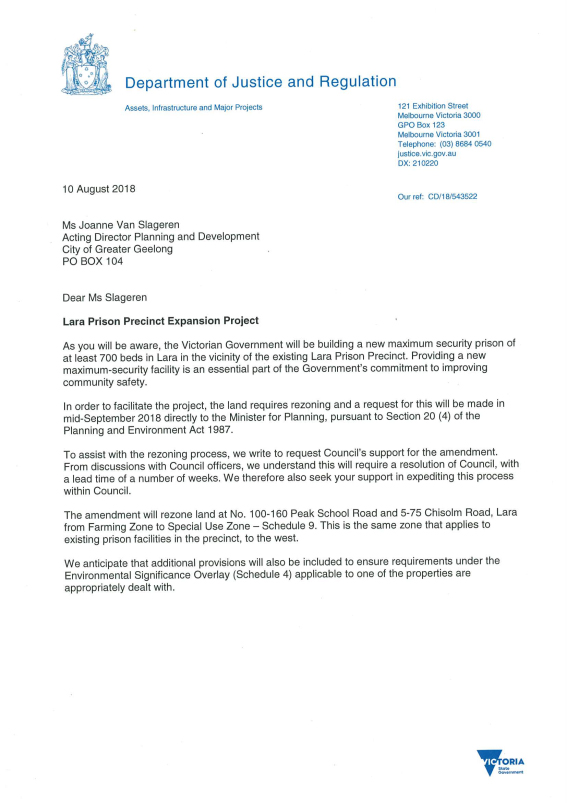
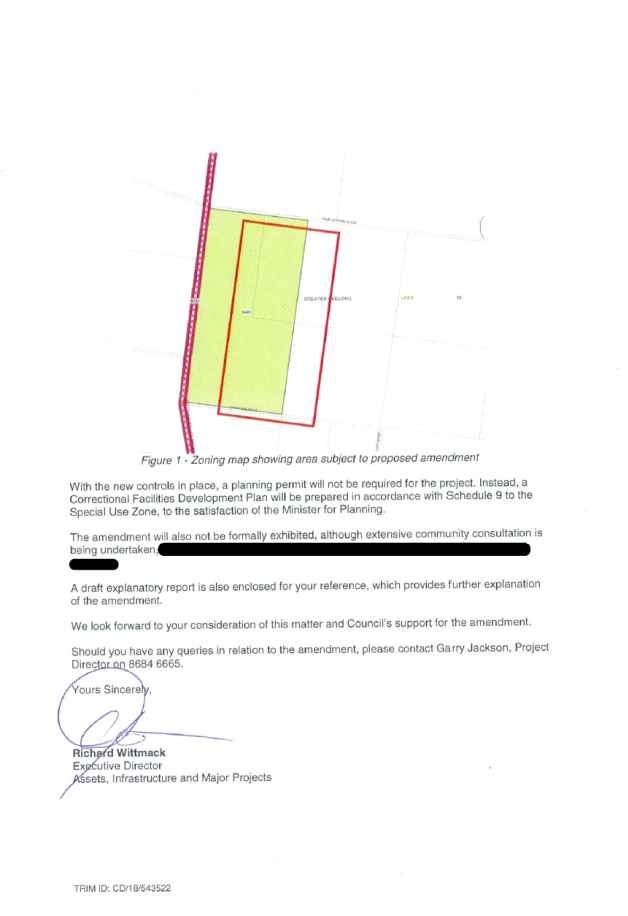
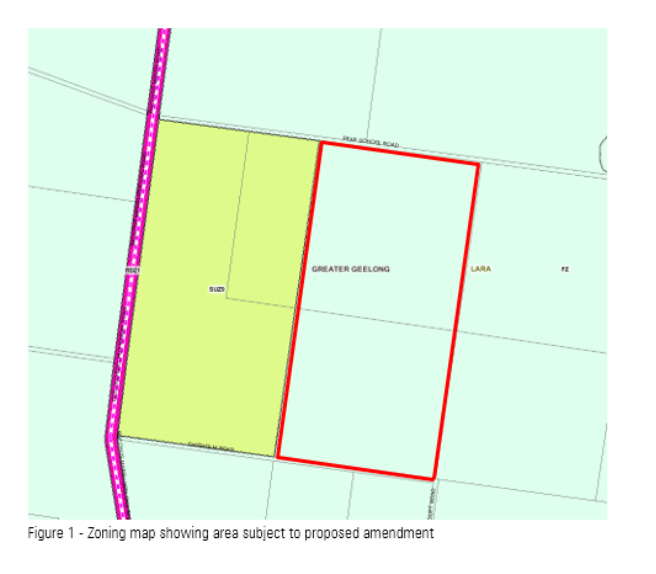
Note - the red outline of the site on the map in the letter has shifted unintentionally in drafting. For clarity, the site comprises No. 100-160 Peak School Road and 5-75 Chisolm Road, as shown on the following plan:
Source: |
Community Life – Connected Communities |
Acting Director: |
Robyn Stevens |
Portfolio: |
Sustainable Development |
To present the draft Access and Inclusion Action Plan 2018–2022 to Council and seek approval to release the plan for community consultation for a period of four weeks.
The first Disability Action Plan in the City of Greater Geelong was adopted in 2002. Since then, there have been regular updates to the plan and from this year it will be referred to as the Access and Inclusion Action Plan to reflect the current sector approach.
Each plan has promoted access and inclusion for people with disability in all parts of community and civic life, but with a particular focus on reducing barriers for people with disability in accessing goods and services and employment, promoting participation in community life and reducing discrimination.
Key achievements from the 2014-2017 plan include: Changing Places and adult change facilities being installed, Johnstone Park accessibility improvements, Geelong Revival Festival used as platform for distributing postcards featuring local artists with a disability, Access All Areas Film Festival at Geelong Performing Arts Centre, Geelong Library and Heritage Centre Exhibition: One Million Stars to End Violence, and Mobility Access Directories being developed and made available to the community.
The City of Greater Geelong’s Access and Inclusion Action Plan 2018–2022 (AIAP) – Attachment 2 – is the City’s commitment to upholding the rights of equal and dignified access for all persons in accordance with the Disability Discrimination Act 1992.
The AIAP has been developed to meet legislative requirements and will be registered with the Australian Human Rights Commission, where it must be taken into account in any complaints that may be made against the City in relation to disability discrimination.
A fully accessible community has immediate benefits for the whole of community. Embracing the concept of universal design and an accessible environment offers the opportunity for participation and inclusion for all people regardless of ability.
A number of priority areas have been identified through targeted consultation and will be further tested through the consultation period including: accessible built environment, accessible communication and input to decision making and accessible events.
The AIAP specifies the actions Council will take to reduce discrimination and promote inclusion of people with disabilities in these areas.
Councillor Mansfield moved, Councillor Grzybek seconded -
That Council release the draft Access and Inclusion Plan 2018–2022 for public comment for a period of four weeks.
Councillor Nelson left the meeting room at 8:48pm
Councillor Nelson re-entered the meeting room at 8:51pm
Carried.
The 2018/2019 budget includes an allocation of $29,500 to support implementation activities associated with the AIAP. A budget allocation will be required for subsequent years.
In addition, the long-term recurrent funding for Building Inclusive Communities (formerly Rural Access) from the Department of Health and Human Services of $289,000 per annum will cease in June 2019. Short-term project based funding will become available from the National Disability Insurance Agency (NDIA), and Council will need to determine what resources and additional funding will be required to maintain our commitment to community members with disabilities.
Extensive internal consultation, as well as targeted external consultation including consultation with the City’s Access and Inclusion Advisory Committee, has contributed to the development of the draft AIAP. The public exhibition period will ensure interests and ideas of the broader community can be included as part of the final plan.
Implementation of the AIAP will continue to embed enhanced opportunities for people with disabilities to participate in community life, and for the community to be enriched by their inclusion. It is also expected that there will be a flow-on to the wider community of understanding and consideration for the inclusion of people with disabilities in all aspects of community life. The AIAP aims to promote the development of sustainable organisational structures to help minimise access and inclusion issues and looks to achieve this goal through our social inclusion principles:
All our activities will be informed by up-to-date demographic and geographic information on social equity in the region to identify priority areas and groups for attention;
All activities planning will be informed by effective, focused partnerships and engagement with priority groups and areas, aimed at fully understanding the particular needs and obstacles experienced in accessing services and facilities; and
Service and infrastructure design, location, communication and support arrangements will address the particular needs and obstacles faced by priority areas and groups.
Section 38 of the Disability Act 2006 specifies that a public sector body must ensure that a Disability Action Plan is prepared for the purpose of:
Reducing barriers to persons with a disability accessing goods, services and facilities.
Reducing barriers to persons with a disability obtaining and maintaining employment.
Promoting inclusion and participation in the community of persons with a disability.
Achieving tangible changes in attitudes and practices which discriminate against persons with a disability.
Council’s AIAP specifies the actions Council will take to reduce discrimination of people with disabilities in these areas.
The AIAP aligns to the Council Plan strategic priority to ‘create a more inclusive and diverse community’. A key strategy to achieve this is improving access to facilities and programs for people of all abilities. The actions in the AIAP will support the delivery of this priority.
No officer involved in the preparation of any aspect of this report has any direct or indirect conflicts of interest.
The AIAP will enable Council to address its statutory requirements in addressing barriers for participation for people with disability.
Not applicable.
Source: |
Community Life - Family Services |
Director: |
Linda Quinn |
Portfolio |
An Inclusive and Diverse Community |
To present the draft Municipal Early Years Plan 2018-2022 (MEYP) to Council and seek approval to release the plan for community consultation for a period of four weeks.
The Municipal Early Years Plan 2018-2022 (MEYP) sets out a range of key strategies and actions for the next four years to address local needs and priorities to improve the health and wellbeing of children aged 0-8 and their families in the City of Greater Geelong.
The MEYP is a key strategic priority in the Council Plan 2018-2022. The Greater Geelong: A Clever and Creative Future engagement undertaken in 2017, capturing more than 16,000 voices from our community, was used to inform the development of the four themes in the MEYP.
The themes identified were:
supporting families to help children to achieve their full potential;
promote high quality innovative services;
provide early and sustained support to those who need it most; and
provide accessible and inclusive services.
Although MEYPs are not statutorily required, they are important for the strategic alignment of effort across a council to achieve the health and wellbeing of children, and to influence and improve their educational and developmental outcomes.
Councils across Victoria have an agreement with the Municipal Association of Victoria (MAV) to deliver MEYPs. The MAV provides a planning framework for Councils to use when developing their MEYPs.
The MEYP builds on City of Greater Geelong’s previous municipal early years plans and considers relevant state and federal government policy and planning frameworks.
Councillor Mansfield moved, Councillor Grzybek seconded -
That Council releases the draft Municipal Early Years Plan 2018-2022 for public comment for a period of four weeks.
Carried.
The implementation costs of some components of the plan may be the subject of consideration for future budgets. External sources of funding may also be sought.
Increased attention on the importance of reducing risk factors that have adverse implications for children, families and communities are acknowledged as providing clear social, economic and developmental benefits to the whole community.
Evidence would widely support that investment in early childhood services has a long lasting economic benefit to the community. Longitudinal studies conclude that the return on investment in providing high quality early childhood services is approximately 13% per annum through reducing the interventions required later in life.
The development of the City of Greater Geelong MEYP 2018-2022 has been informed by the Clever and Creative community engagement, during which the community told us they:
want a safe environment for children to grow up in and a family oriented culture;
value access to quality services, health services and a strong sense of community;
value living in a community that supports vulnerable community members and has clean, safe and fun environments for everyone; and
value living in a community where there is community vibrancy, diversity and inclusiveness.
Feedback was also sought on the MEYP from key internal and external stakeholders.
Themes such as ‘Provide accessible and inclusive services’ have been included in the MEYP and address social equity considerations by ensuring our services are accessible and inclusive of all children and their families.
Local government’s planning role is legislated in the Local Government Act 1989, Planning and Environment Act 1987 and the Health Act 1958. Corporate plans, municipal public health plans and the municipal strategic statement are required by statute. Early childhood development clearly fits within a social health framework and therefore it is intended that the MEYP is closely integrated with Council’s Municipal Public Health & Wellbeing Plan.
The MEYP 2018-2022 aligns with the Council Plan. The following strategic priorities are of particular relevance:
improve the health and safety of our community;
a more inclusive and diverse community; and
organisational leadership, strategy and governance.
No officer involved in the preparation of this report has any direct or indirect interest relative to the advice provided in the report.
Council has a shared responsibility with state and federal governments to ensure locally accessible family and children’s services. This limits risk factors such as fragmentation, disadvantage, opportunities to attract funding and resources which in turn builds the capacity of the local community to adequately and effectively support families in the wellbeing of young children.
The MEYP 2018-2022 continues to enhance and strengthening local support for children and families especially in relation to improving outcomes for the most vulnerable and ensures our services are accessible and inclusive.
The MEYP provides a coherent framework within which the various issues, challenges and potential risks for children, families and local service providers can be progressively address and mitigated.
None.
Source: |
City Services - Environment and Waste Services |
Director: |
Guy Wilson-Browne |
Portfolio |
Environment and Sustainability |
To seek Council endorsement of the Community Zero Carbon Action Plan.
The development of the Community Zero Carbon Action Plan is a key initiative from the Zero Carbon Emissions Strategy 2017-2020. This strategy sets a strong emissions reduction target for the City’s operations based emissions; 50% by 2020 based on 2014-15 levels.
In late 2017, a stakeholder group was formed and a range of consultation activities were undertaken in developing the Community Zero Carbon Action Plan.
The City also recognises that it can play a key role in enabling positive change and reducing emissions in the community.
The actions listed in the Action Plan will contribute to reducing community emissions and help work towards the goal of Geelong being a carbon neutral city-region by 2047.
From an extensive list of actions, five “flagship” actions were selected through a collaborative decision-making process, these include:
Solar Savers Project;
LED street lighting upgrade;
Transition Streets;
Community Renewable Energy Transformation Project;
Environmentally Sustainable Design (ESD) in the planning process.
These actions which have the potential for significant impact will be delivered by the nominated lead organisations. Lead organisations include Transition Streets, Barwon Heads Sustainability Group and the City of Greater Geelong.
Tracking progress towards carbon neutrality will be an important part of the program. To do this, the City will develop a community-wide greenhouse gas emissions profile for the Geelong region using and complying with the Global Protocol for Community-Scale Greenhouse Gas Emission Inventories (GPC).
Councillor Mansfield moved, Councillor Mason seconded -
That Council endorse the Community Zero Carbon Action Plan.
Carried.
The main mechanism for the City to support community led actions within the Action Plan (and those that are not listed) is via the Environment and Sustainability Grants program, providing up to $6,000 for successful projects. The Environment and Sustainability grants program currently has a total funding pool of $50,000. In 2017-18 applications to the funding stream exceeded $100,000. Consideration needs to be given to increasing this funding amount to better reflect and resource community demand to undertake projects that reduce environmental impacts.
Input for the Action Plan incorporates outcomes from consultation activities including:
Interviews with key stakeholders groups;
Community survey: 143 completed surveys received. The purpose of the survey was to gain an understanding of what actions community members were undertaking and what support they may need to reduce carbon emissions at their homes;
Two workshops were conducted with the Project Stakeholder Group:
The first workshop titled “Where Are We Now” provided an opportunity for stakeholders to present on actions that had already been carried out and to identify priority actions out to 2020. A list of ten priority actions were agreed to by the Group.
The second workshop titled “Where to Next” focussed on refining the selection of potential key actions identified in the first workshop. Utilising the multi-criteria analysis (for example: impact, ease of implementation, cost and responsibility) five immediate priority projects were selected. These projects are referred to as Flagship Actions.
A draft Action Plan was circulated to the Project stakeholder Group for comment – comments were incorporated into the final draft.
This Action Plan has brought together key community sustainability groups to agree to priority actions selected through a collaborative decision-making process. The priority actions will have community benefits including but not limited to improved health outcomes from reducing carbon emissions.
The Community Zero Carbon Action Plan aligns closely with Council Plan strategic direction. An objective within this is to partner with our community to encourage sustainable design and reduce resource consumption.
As a certified One Planet Living Council, which is an internationally recognised framework to guide corporate and community environment and sustainability objectives, implementation of the Community Zero Carbon Action Plan supports the One Planet Living Program and reduces potential organisational reputational risk. The Community Zero Carbon Action Plan was also identified as a key action in the Zero Carbon Emissions Strategy 2017-2020, endorsed by Council in 2017.
Carbon emissions are a major factor in driving global climate change. The Community Zero Carbon Action Plan will assist in reducing community generated greenhouse emissions. The implementation of the Plan will also reduce air pollution resulting from the use of fossil fuels.
Source: |
Investment & Attraction / Central Geelong & Waterfront |
Director: |
Brett Luxford |
Portfolio |
Tourism & Events and Economic Development |
To provide a report on activities undertaken by Central Geelong Marketing Committee (CGMC) 2017-2018 and to seek Council endorsement of the amended s86 Committee Terms of Reference.
This report provides an overview of Central Geelong Marketing Committee (CGMC) activities for the period of 1 July 2017 to 30 June 2018.
In February 2016, Council resolved to continue the Central Geelong special rate for a further five year term until end June 2021 after consultation with Central Geelong business and property owners.
The Committee exists to market, promote and activate Central Geelong via a special rate.
The current Terms of Reference require amendment to reflect changes to stakeholder sector representative bodies.
The CGMC, through its flagship activities, delivered a Total Economic Output of $16.74M in 2017-2018 from a total income of $1.066M from the special rate, bringing a $1:$15 return on investment.
Over 136,346 people participated in a Central Geelong Marketing delivered activity in 2017-2018 as highlighted in ‘The Story Continues 2017-2018’ (Attachment 2).
CGMC will continue to deliver a suite of existing and new programs in 2018-2019. The CGMC has adopted a Central Geelong Marketing Strategic Framework for 2016-2021 and will deliver a range of activities, marketing, promotions and events via the Central Geelong Marketing Annual Activities Plan 2018-2019. (Attachment 3).
The current Terms of Reference (Attachment 4) require amendment to;
Reflect changes to stakeholder sector representative groups Real Estate Institute Geelong and Waterfront Operators Group who no longer operate;
Reflect the changed name and abbreviation of Victorian Chamber of Commerce and Industry (VCCI); and
Broaden the Arts sector representation to Arts/ Culture sector.
Councillor Sullivan moved, Councillor Murrihy seconded -
That Council:
Note the Central Geelong Marketing Committee - Annual Activities Report 2017-2018, ‘The Story Continues 2017-2018’ document (Attachment 2) and the Central Geelong Marketing Strategic Framework 2016-2021 and Annual Activities Plan 2018-2019 (Attachment 3); and
Endorse the revised Terms of Reference for the Central Geelong Marketing Committee as shown in Attachment 4.
Carried.
The CGMC delivered the 2017-2018 Annual Activities Plan within budget.
The flagship activities of the Central Geelong Shopping Festival + Sidewalk Sales, Christmas in Central Geelong, May Magic, Tastes of Central Geelong and the Central Geelong School Holiday Fun Program bring an estimated $16.74M to Central Geelong business operators which is more than 15 times the monies generated from the special rate.
Central Geelong Marketing, through its consolidated approach, is able to leverage its program to obtain significant financial and in-kind support and bulk purchasing discounts that greatly increase the benefits obtained with the special rate funds. This is estimated at $400,000 in 2017-2018.
The recommended changes to the existing Terms of Reference have no financial implications.
CGMC regularly communicates and consults with business operators via newsletters, email communications, face to face meetings and feedback from event and activity participation. CGMC undertakes regular communication and consultation with activity participants via email communications and feedback/ surveys from events and activities.
The activities and programs that result from the special rate add significantly to the vibrancy and experience of Central Geelong.
The ongoing success of Central Geelong as the ‘heart’ of the region is an essential element of broader community benefit.
The majority of activities delivered by Central Geelong Marketing are free and open to the general public for participation.
There are no Policy/ Legal/Statutory implications associated with this report. The CGMC as a Section 86 Committee of Council has delegated authority and decision making within its allocated budget, Terms of Reference and agreed Strategic Plan.
All activities undertaken were within the Committee’s Terms of Reference as specified by Council.
The Central Geelong Marketing program is a key strategy in delivering Growing our Economy Priorities.
This report has been prepared by the Executive Officer of the Central Geelong Marketing Committee. There are no direct or indirect conflicts of interests in matters raised in this report.
There are no significant risks associated with this report.
There are no direct environmental implications associated with the special rate program.
Source: |
Planning |
Acting Director: |
Joanne van Slageren |
Portfolio |
Arts, Culture and Heritage |
To endorse the updated Geelong Heritage Advisory Committee (the Committee) Terms of Reference and update the Council on the establishment and first two meetings of the Committee.
Council adopted the Municipal Heritage Strategy 2017-2021 on 20 September 2017. At this time Council endorsed the establishment of a Heritage Advisory Committee.
The Committee was established as an operational committee and the terms of reference did not include councillor representation of the Committee. Since then councillor portfolios have been created. The arts, culture and heritage portfolio holder is well placed to take an active role in the Committee. A summary of the establishment of the Committee and changes to the Terms of Reference are noted in Attachment 3.
The Terms of Reference (Attachment 2) includes a Councillor as a member and Chair of the Committee.
The first two meetings of the Committee nominated advocacy and promotion of heritage as key areas of interest. Advocacy about dedicated heritage resources for the City was identified as for the priority for the Committee.
Councillor Murrihy moved, Councillor Sullivan seconded -
That Council:
Endorse the Geelong Heritage Advisory Committee Terms of Reference (September 2018) at Attachment 2 of the report;
Appoint the Arts, Culture and Heritage portfolio holder to be the chair of the Heritage Advisory Committee.
Carried.
There are no financial implications as a result of updating the Terms of Reference.
Public notices were published to call for interested people to join the Committee. The Committee has now been appointed and has seventeen members.
There are no social equity considerations.
The establishment of the Committee is in accordance with the adopted Municipal Heritage Strategy and Committee Representation Council Policy.
Alignment to City Plan under section 6. Vibrant Arts and Culture – We treasure Geelong’s culture and heritage and will help our creative community to grow.
No Council officers involved in the development of the Strategy and preparation of the report have a direct or indirect interest in the issue to which this report relates.
There is low risk associated with updating the Committee Terms of Reference. The establishment of the Committee has followed the Committee Representation Council Policy. The Committee provides advice to Council and the conduct of any projects would be subject to further review by officers and a future decision of Council.
There are no environmental implications with updating the Committee Terms of Reference.
Council endorsed the establishment of a Heritage Advisory Committee in 2018 at its 20 September 2017 meeting.
A Terms of Reference was approved by the Executive Leadership Team in March 2018 with no provision for a Councillor to be nominated to the Committee.
The Committee operates under Section 3(F) of the Local Government Act and has no delegated powers. It will assist Council to meet its obligations under the Municipal Heritage Strategy, Planning and Environment Act, Greater Geelong Planning Scheme, Heritage Act and the Aboriginal Heritage Act.
The Planning Strategy unit supports its ongoing administration.
Applications for three individuals not associated with a heritage group were invited to apply to become a member in May 2018.
Eight high quality applications were received with four individuals successful. Two of the applicants represented groups and therefore could join as representing a group.
The heritage organisations that expressed interest in the Committee included; Lara Heritage and Historical Inc, Little River Historical Society, Mt Duneed History Group, National Trust Geelong, Wathaurung Aboriginal Corporation, Geelong Environment Council, Osborne Park Association, Geelong One Fire Reconciliation Group and the Royal Geelong Agricultural and Pastoral Society.
The inaugural meeting of the Committee was held on 14 June 2018. An independent facilitator ran the meeting to assist the establishment of the group. The second meeting was held on 26 July 2018 with the next meeting set down for 27 September 2018.
The original Terms of Reference did not include any Councillor participation. Post the allocation of portfolios it was deemed appropriate for the relevant portfolio holder to be involved.
The revised Terms of Reference include the following changes:
the document approved by Council not ELT
review date September 2021 not March 2021
addition of Royal Geelong Agricultural and Pastoral Society to participating groups
increase individual members from three to four
addition of a ‘Chair and Councillor Representatives’ section
replace chairperson with chair
removal of the need to vote for a chair
addition of the word working group in reference to sub-committees
Source: |
City Services – Engineering Services |
Director: |
Guy Wilson- Browne |
Portfolio: |
Sustainable Development |
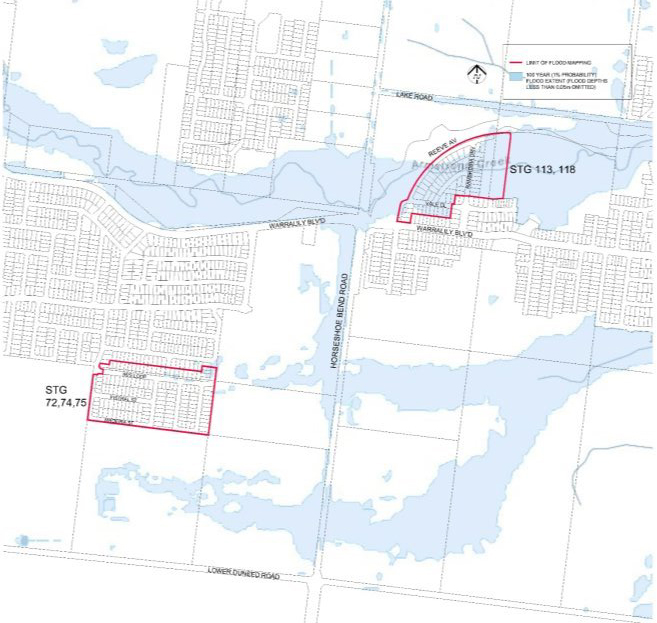
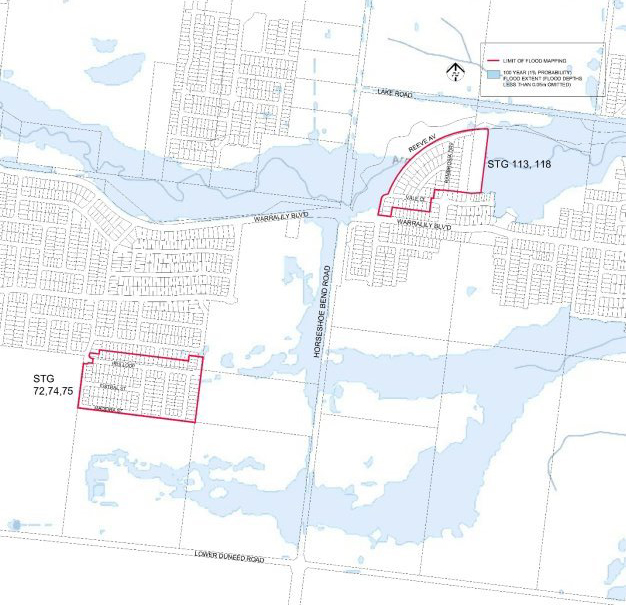
To consider revoking Council’s designation of 12 December 2006 of flood affected land Warralily, Stages 72, 74, 75, 113 and 118 as liable to flooding pursuant to Regulation 802 (2) of the Building Regulations 2006.
Council has a statutory obligation under the Building Regulations 2006 to designate land as liable to flooding where it reasonably knows it to be prone to flooding. Conversely, there is an obligation to remove the encumbrance of designation from land that is no longer considered to be flood-prone.
The current designated flood mapping (refer to Attachment 2) was designated by Council at its meeting of 12 December 2006, under the provisions of the Building Regulations 2006.
The subject of this report is the residential land at Warralily fronting 70 Lake Road and 81 Lower Duneed Road, Armstrong Creek. Prior to subdivision the parent lot was used primarily as farmland.
The flood mapping is subject to a revision due to the subdivision and development at 70 Lake Road and 81 Lower Duneed Road, Armstrong Creek. Prior to subdivision the parent lot was considered to be liable to flooding. This development site, which is also known as Warralily, Stages 72, 74, 75, 113 and 118, achieves flood immunity for newly created lots for flood events up to and including the 100 year Average Recurrence Interval (ARI) event due to approved internal earthworks.
The earthworks undertaken have resulted in the floodwaters from the 100 year ARI event being contained within the boundaries of the road network (refer Attachment 3).
It should be noted that designation is separate to the creation of flood overlays within the Planning Scheme, which generally follows designation. In the case of this development, the planning scheme amendment to create post-development flood zones or overlays is proposed after the design of the proposed precincts.
Councillor Nelson moved, Councillor Murnane seconded -
That Council revoke the Council designation of 12 December 2006 of flood affected land Warralily, Stage 72, 74, 75, 113 and 118 as liable to flooding pursuant to Regulation 802(2) of the Building Regulations 2006.
Carried.
No impact to budget.
A revocation of designation does not warrant public consultation as it constitutes the removal of an encumbrance on land.
Relevant Council databases and flood maps will be revised and updates sent to the Corangamite Catchment Management Authority and Building Control Commission.
Council have a responsibility to the community to provide the best possible information on areas that are flood prone.
The City has various statutory responsibilities for drainage management and flood management (prevention, response and recovery) as set out in the Local Government Act 1989, Local Government Regulations 1990, Planning and Environment Act 1987, Building Regulations 2006, Water Act 1989, Subdivision Act 1988 and Emergency Management Act 1986.
The recommendations of this report are consistent with Council Plan, in relation to Growing our Economy and promoting a sustainable built environment, sustainable land use and development.
There are no officer direct or indirect interests with respect to this report.
Council also has some risk exposure with any failure to disclose the flood-prone status of a property in a Land Information Certificate.
The revocation of the designation is the final step in minimising Council’s risk.
The revocation of flood-prone areas designation and designation of revised flood data through the design of this stage is considered unlikely to result in any known adverse environmental impacts.
Source: |
City Services - Engineering Services |
Director: |
Guy Wilson-Browne |
Portfolio |
Social and Infrastructure Planning |
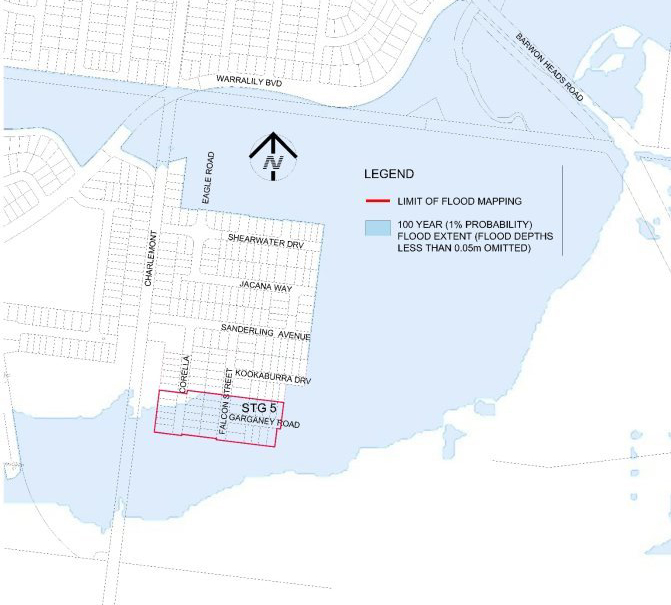
To consider revoking Council’s designation of 12 December 2006 of flood affected land Armstrong Waters Stage 5 as liable to flooding pursuant to Regulation 802 (2) of the Building Regulations 2006.
Council has a statutory obligation under the Building Regulations 2006 to designate land as liable to flooding where it reasonably knows it to be prone to flooding. Conversely, there is an obligation to remove the encumbrance of designation from land that is no longer considered to be flood-prone.
The current designated flood mapping (refer to Attachment 2) was designated by Council at its meeting of 12 December 2006, under the provisions of the Building Regulations 2006.
The subject of this report is the residential land at Armstrong Waters fronting 291 – 411 Charlemont Road, Armstrong Creek. Prior to subdivision the parent lot was used primarily as farmland.
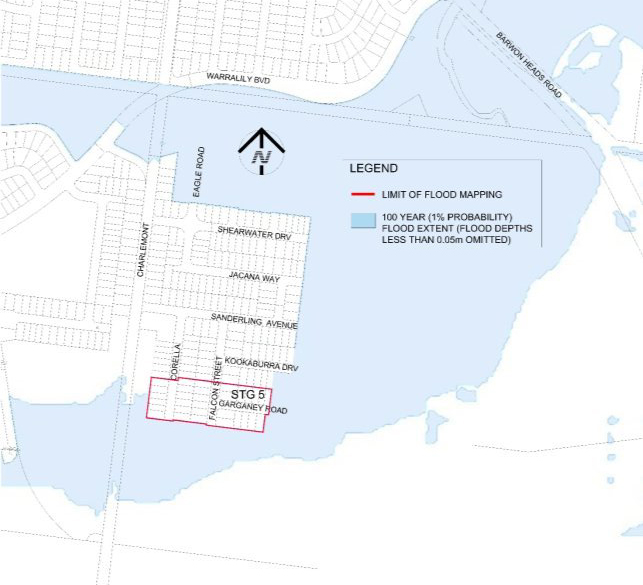
The flood mapping is subject to a revision due to the subdivision and development at 291 – 411 Charlemont Road, Armstrong Creek. Prior to subdivision the parent lot was considered to be liable to flooding. This development site, which is also known as Armstrong Waters, Stage 5, achieves flood immunity for newly created lots for flood events up to and including the 100 year Average Recurrence Interval (ARI) event due to approved internal earthworks.
The earthworks undertaken have resulted in the floodwaters from the 100 year ARI event being contained within the boundaries of the road network (refer Attachment 3).
It should be noted that designation is separate to the creation of flood overlays within the Planning Scheme, which generally follows designation. In the case of this development, the planning scheme amendment to create post-development flood zones or overlays is proposed after the design of the proposed precincts.
Councillor Nelson moved, Councillor Murnane seconded -
That Council revoke the Council designation of 12 December 2006 of flood affected land Armstrong Waters, Stage 5 as liable to flooding pursuant to Regulation 802(2) of the Building Regulations 2006.
Carried.
No impact to budget.
A revocation of designation does not warrant public consultation as it constitutes the removal of an encumbrance on land.
Relevant Council databases and flood maps will be revised and updates sent to the Corangamite Catchment Management Authority and Building Control Commission.
Council have a responsibility to the community to provide the best possible information on areas that are flood prone.
The City has various statutory responsibilities for drainage management and flood management (prevention, response and recovery) as set out in the Local Government Act 1989, Local Government Regulations 1990, Planning and Environment Act 1987, Building Regulations 2006, Water Act 1989, Subdivision Act 1988 and Emergency Management Act 1986.
The recommendations of this report are consistent with Council Plan, in relation to Growing our Economy and promoting a sustainable built environment, sustainable land use and development.
There are no officer direct or indirect interests with respect to this report.
Council also has some risk exposure with any failure to disclose the flood-prone status of a property in a Land Information Certificate.
The revocation of the designation is the final step in minimising Council’s risk.
The revocation of flood-prone areas designation and designation of revised flood data through the design of this stage is considered unlikely to result in any known adverse environmental impacts.
Contents | Previous Page: Section A - Procedural Matters | Next Page: Section C - Urgent Business
