
Council Minutes - Section B: Reports - 23 October 2018
Contents | Previous Page: Section A - Procedural Matters | Next Page: Section C - Notices of Motion
Contents | Previous Page: Section A - Procedural Matters | Next Page: Section C - Notices of Motion
Reports tabled at the Ordinary Meeting of Council on Tuesday date held at the Council Conference and Reception Centre in City Hall, 57 Little Malop Street, Geelong.
Source: |
Planning and Development - Strategic Implementation |
Acting Director: |
Joanne van Slageren |
Portfolio: |
Sustainable Development |
To consider the submissions received in relation to the exhibition of Amendment C376 and to adopt the Amendment.
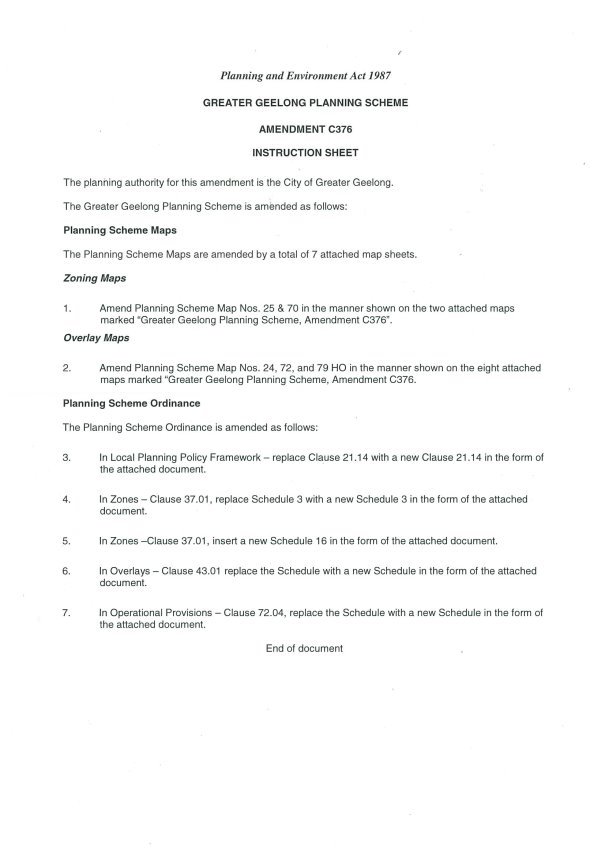
Amendment C376 proposes to make a number of minor changes to the Greater Geelong Planning Scheme. The Amendment is a ‘bundled’ Amendment, to both correct errors and introduce a number of minor changes to the Scheme ordinance and mapping.
Following exhibition in May 2018, four submissions were received. One submission sought a reduced application of the Batesford Quarry Heritage Overlay, while the National Trust Geelong Branch supports the Amendment but requests that it be provided with additional information which does not relate to the adoption of the Amendment. All other submissions were supportive.
Having exhibited the Amendment and considered the submissions Council can adopt those parts of the Amendment to which no objecting submissions have been received.
A summary of the four submissions received, together with officer response where required, is included at Attachment 2.
As discussed in Attachment 3 it is recommended that the Amendment be separated into two parts and that Council adopt Amendment C376 Part 1 (set out in Attachment 4). It is also recommended that Council defer consideration of two exhibited changes to the Heritage Overlay (this will be Part 2) as set out in Attachment 5, pending discussions with the landowner and Heritage Victoria, in relation to a redundant listing on the Victorian Heritage Register relating to the Batesford Quarry.
Councillor Mason moved, Councillor Asher seconded -
That Council:
Adopt Amendment C376 Part 1 in the form outlined in Attachment 4 of this report;
Submit the adopted Amendment together with the prescribed information to the Minister for Planning requesting approval; and
Defer consideration of Amendment C376 Part 2 pending:
review of the listing of the Former Bachyrus Steam Shovel site at Batesford Quarry on the Victorian Heritage Register; and
discussions with the affected landowner of the proposed extent of the revised listing of the Batesford cement elevator in the schedule to the Heritage Overlay.
Carried.
There will be no significant financial implications for Council as a result of the adoption of this Amendment.
The Amendment was exhibited in accordance with the provisions of the Planning and Environment Act 1987 from Thursday, 3 May to Monday, 4 June 2018, with four submissions received in response.
The amendments proposed to be adopted as part of this report were not the subject of submissions which objected or sought changes.
In the case of amendments, the determination of which is proposed to be deferred, further discussions will take place with the submitters and other relevant stakeholders prior to a further report and recommendation being made to Council.
The Amendment is largely policy neutral and there are no adverse social equity impacts.
The changes proposed by this Amendment are essentially of a minor administrative nature.
The Amendment will result in good planning outcomes by ensuring that the provisions of the Planning Scheme recognise existing land uses and ensure that inaccurate application of overlay provisions do not result in unnecessary requirements for planning permits.
The Amendment supports the Sustainable Built and Natural Environment strategic direction of the Council Plan 2018-22 and is consistent with the strategic direction of community wellbeing and the priority of connected, creative and strong communities.
No Council officers or contractors who have provided advice in relation to this report have declared a conflict of interest regarding the matter under consideration.
No significant risks associated with implementing the recommendation contained in this report have been identified. Risk to places of heritage significance could potentially result from a failure to correct the identified errors to the Schedule to the Heritage Overlay in the manner recommended in this report.
The proposed Amendment will not have any adverse effects on the environment.
No |
Name |
Address |
Type |
Summary of Submission |
Officer Response |
1 |
Enviornment Protection Authority |
GPO Box 4395 Melbourne, Victoria 3001 |
Neutral |
“The EPA has no objections” |
No Response Required |
2 |
Geelong and Region Branch National Trust of Australia (Victoria) |
PO Box 1512 Geelong 3220 |
Supporting |
“Supportive of most aspects outlined in Amendment C376.” Requests investigation as to the following:
|
As it is some years since the assessment was prepared, combined with the fact that the address is part of a larger property,, it will be necessary for the statement of significance to be reviewed and the extent of the proposed application of the overlay to be determined. |
3 |
Novo Planning Pty Ltd On behalf of Curlewis Golf Club |
No mailing address included |
Supporting |
“The amendment is strongly supported” |
Relates to the alteration to Special Use Zone – Schedule 3 Private Golf Courses. No matters raised which require an officer response. |
4 |
TGM Group Pty Ltd On behalf of Riverlee Heights Pty Ltd |
PO Box 1137 Geelong 3222 |
Seeking to change the amendment |
“If … a representative section of the conveyor be retained, this should preferably be at ground level in an open space reserve or included in the existing Public Conservation and Resource Zoned land adjacent to the Moorabool River where the existing overlay is in place.” |
Relates to the proposed change to the extent of the propsed extension of HO 1740. The officer recommendation proposes deferral of this element of the amendment to allow further investigation, with a view to applying the changed extent of application of HO1740 consistent with the submission. |
The decision to prepare and exhibit the Amendment was made by a delegated Council Officer on 2 March 2018. The Amendment is a ‘bundled’ Amendment, to both correct errors and introduce a number of minor changes to the Greater Geelong Planning Scheme ordinance and mapping.
Amendment C376 Part 1
The following elements of the exhibited Amendment were not the subject of submissions in opposition or seeking a change. Accordingly, the Amendment recommended to be adopted (as set out in Attachment 4) includes:
Land affected:
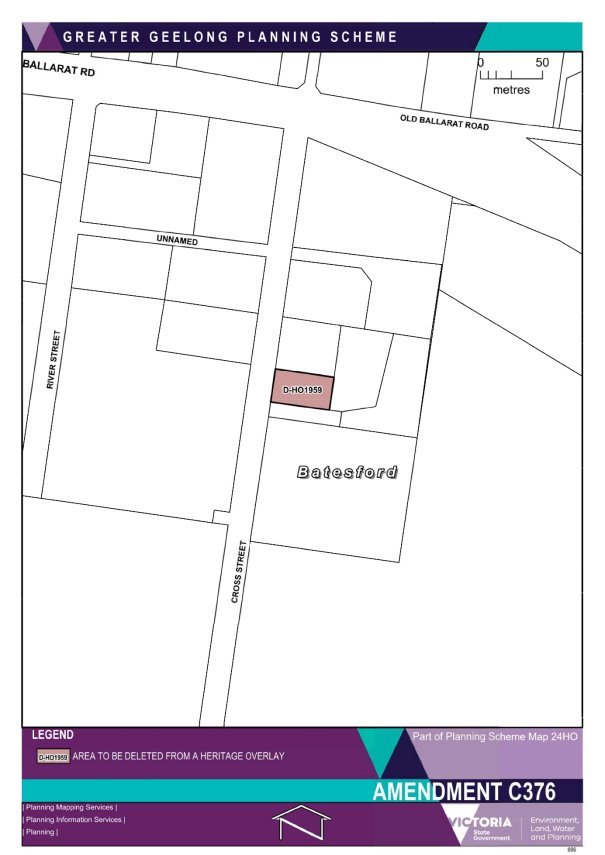
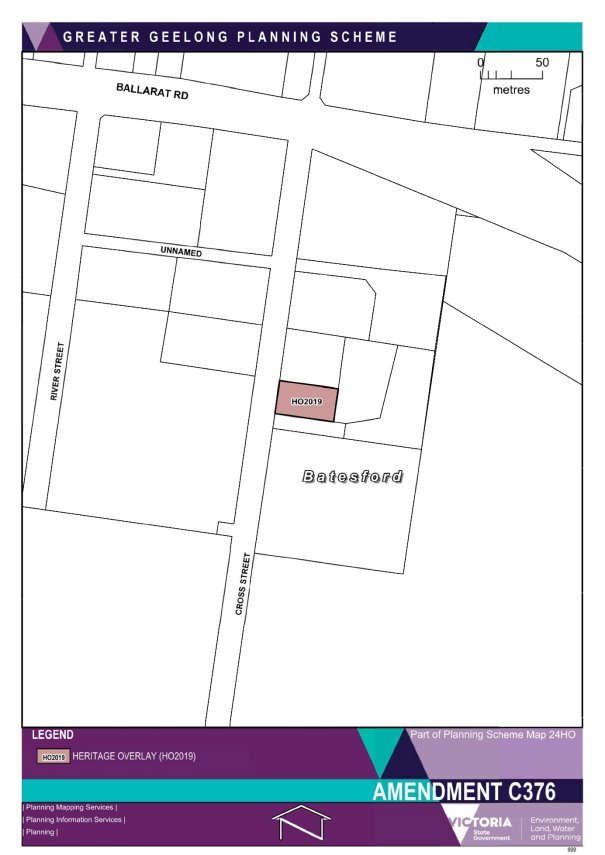
31 – 33 Cross Street, Batesford
33 Cross Street, Batesford
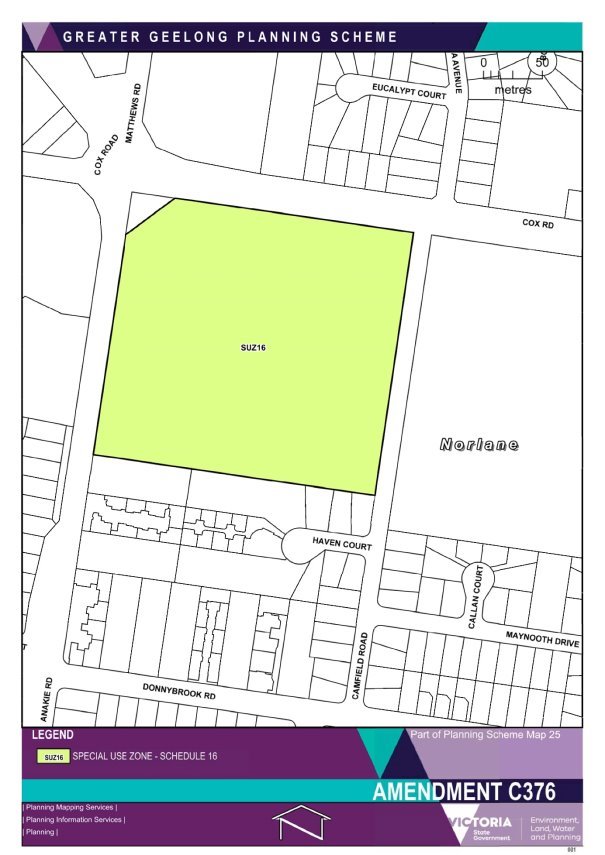
169 – 199 Cox Road, Corio
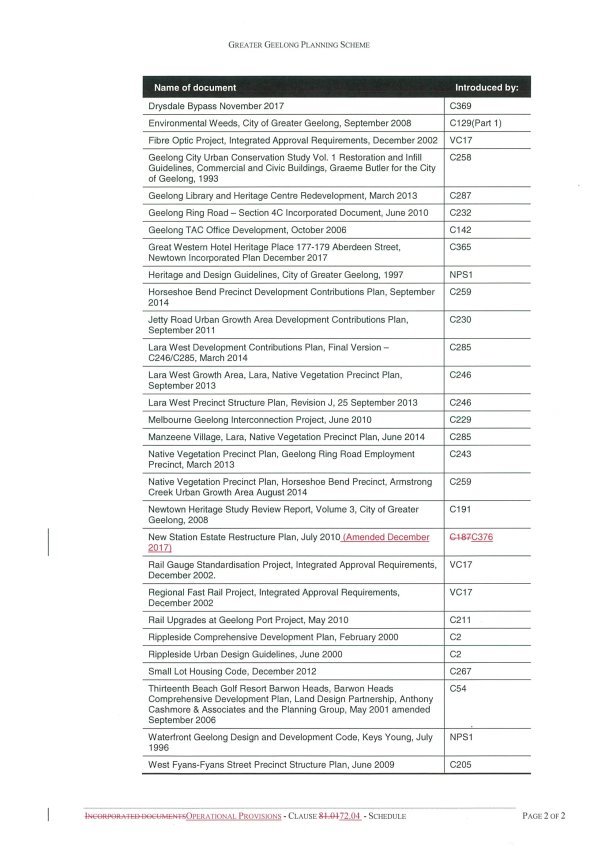
New Station Estate, Corio
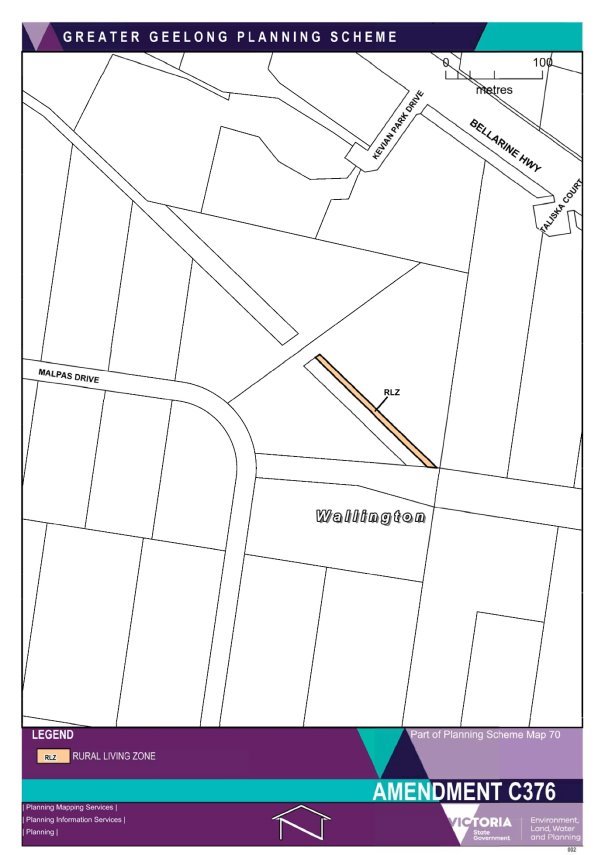
36 – 79 Malpas Drive, Wallington
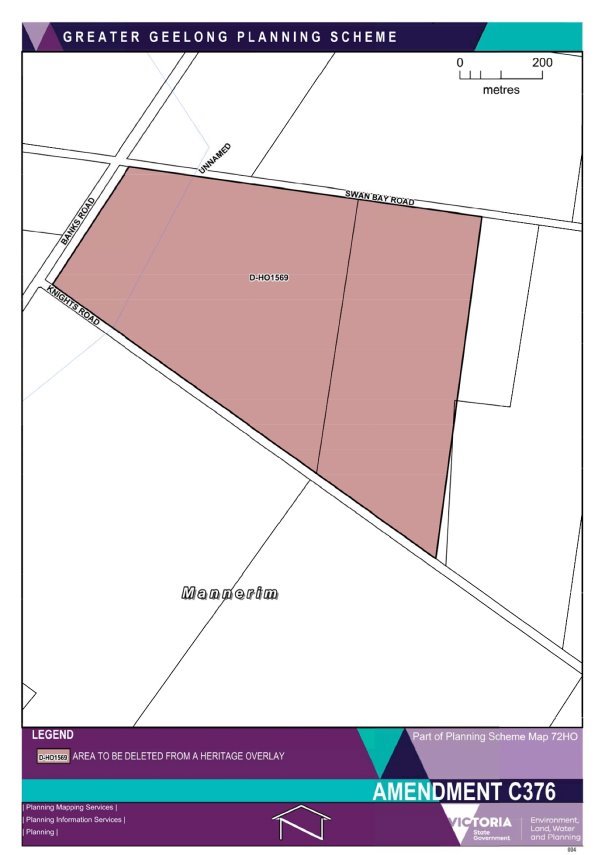
712 – 824 Swan Bay Road, Mannerim
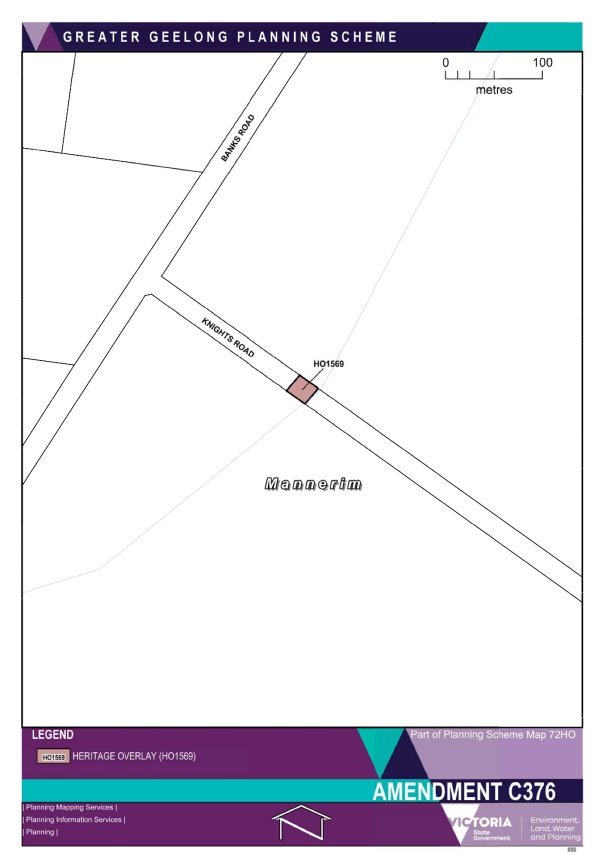
Ford over Yarram Creek, Knights Road, Mannerim
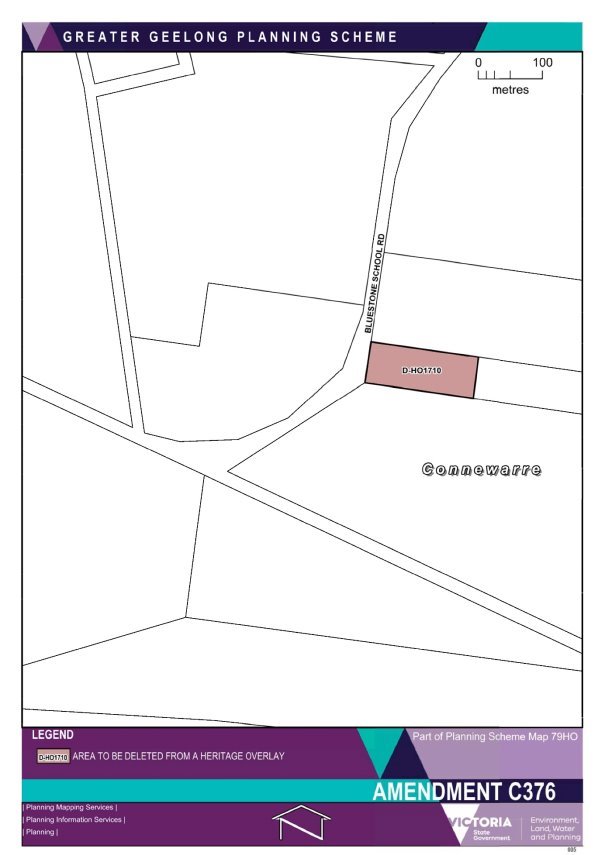
502 Bluestone School Road, Connewarre
Portarlington Golf Course, Portarlington
Curlewis Golf Course, Curlewis
Detailed Changes
The Amendment makes the following detailed changes to the Greater Geelong Planning Scheme:
Planning Scheme Map Changes:
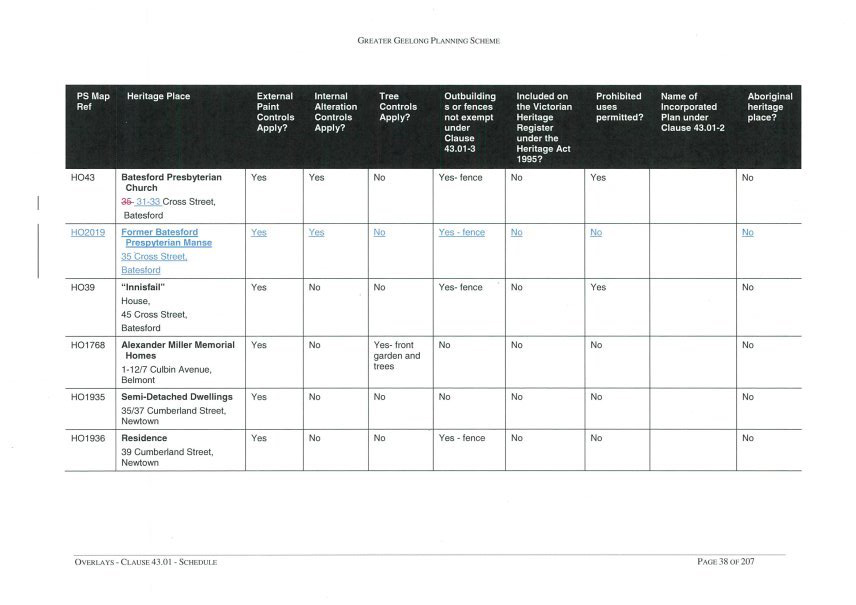
Delete HO1959 from the land at 35 Cross Street, Batesford and apply HO2019 to the land at 35 Cross Street, Batesford.
Delete HO1569 from the land at 712 – 824 Swan Bay Road, Mannerim, and apply HO1569 to the Yarram Creek ford, Knights Road Mannerim, to the extent of the land 20 metres either side of the ford, consistent with the identification of heritage site in the Schedule to the Heritage Overlay.
Delete HO1710 from the land at 502 Bluestone Creek, Connewarre.
Rezone part of the land at 36 – 79 Malpas Drive, Wallington PUZ1 to RLZ.
Planning Scheme Ordinance Changes
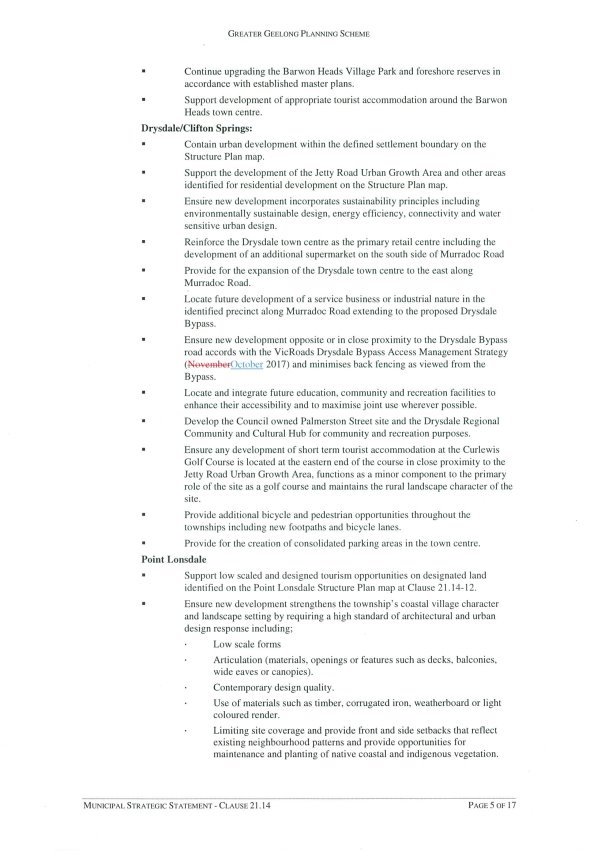
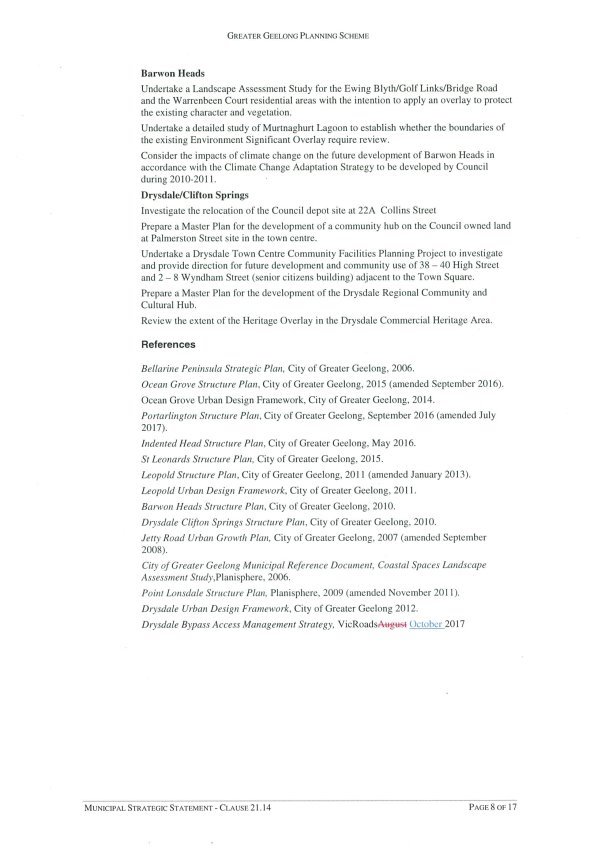
Replace Clause 21.14 with a new Clause 21.14
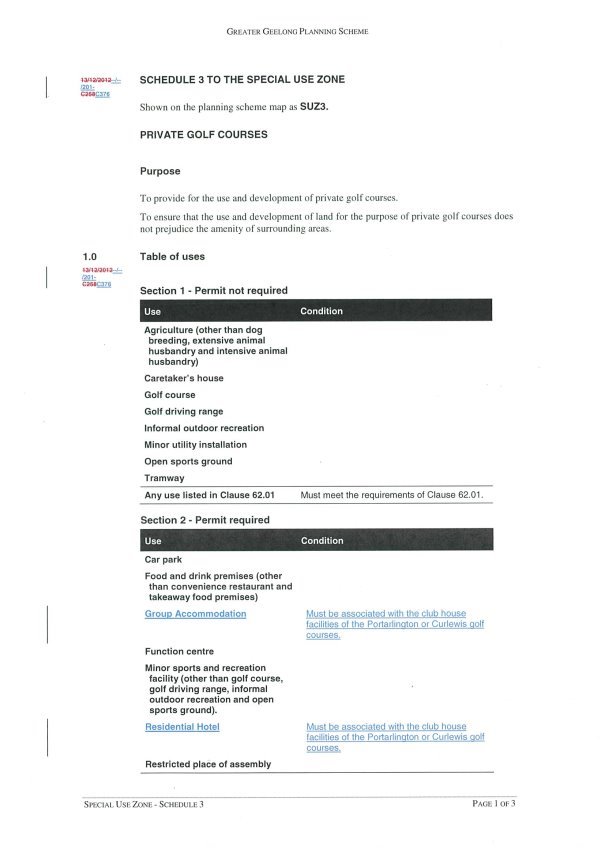
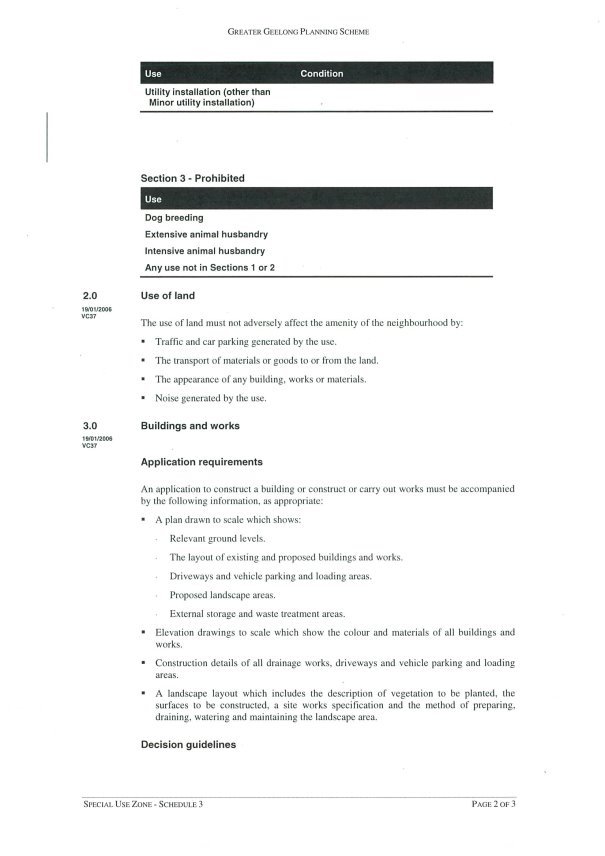
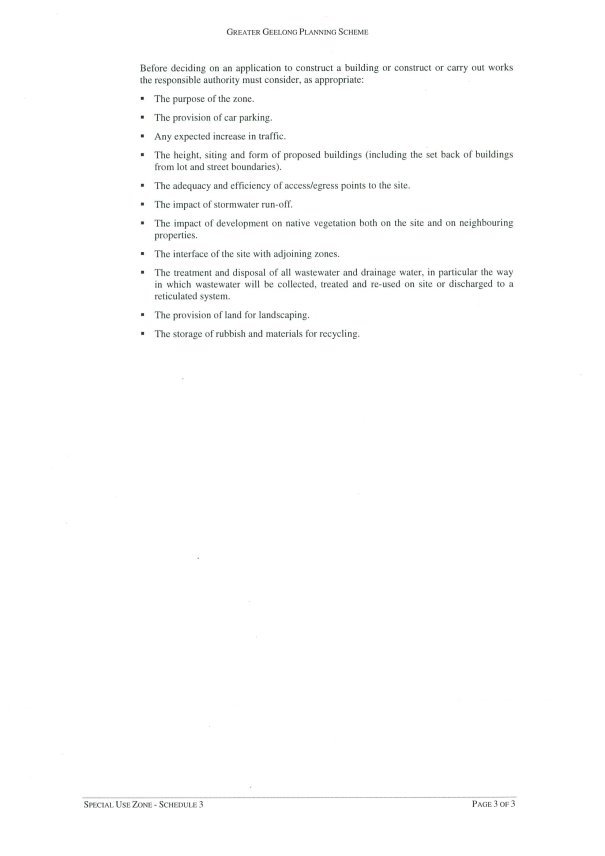
Replace Schedule 3 to Clause 37.01 with a new Schedule 3.
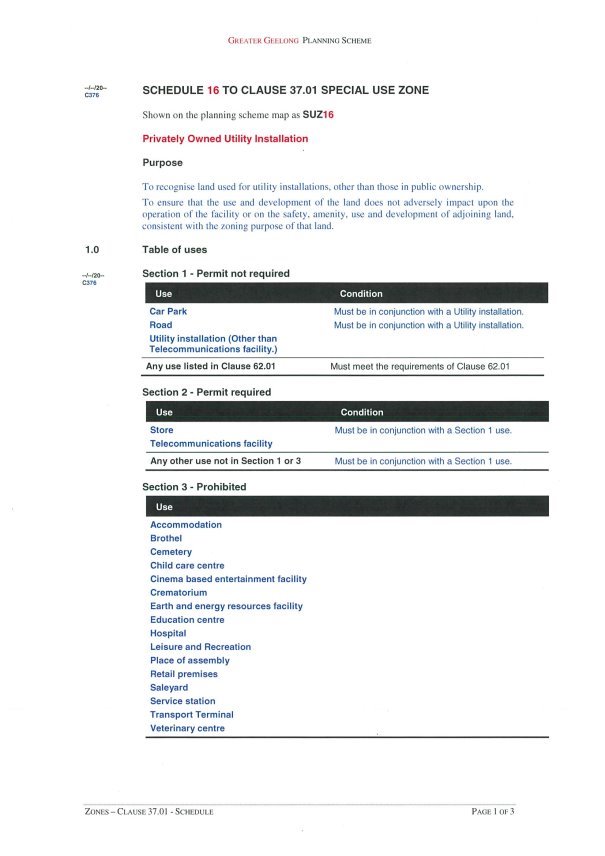
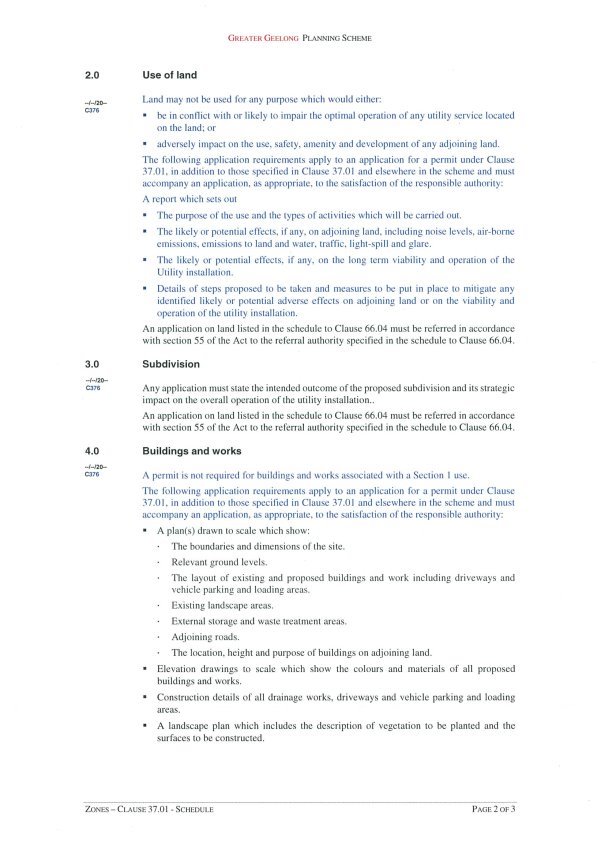
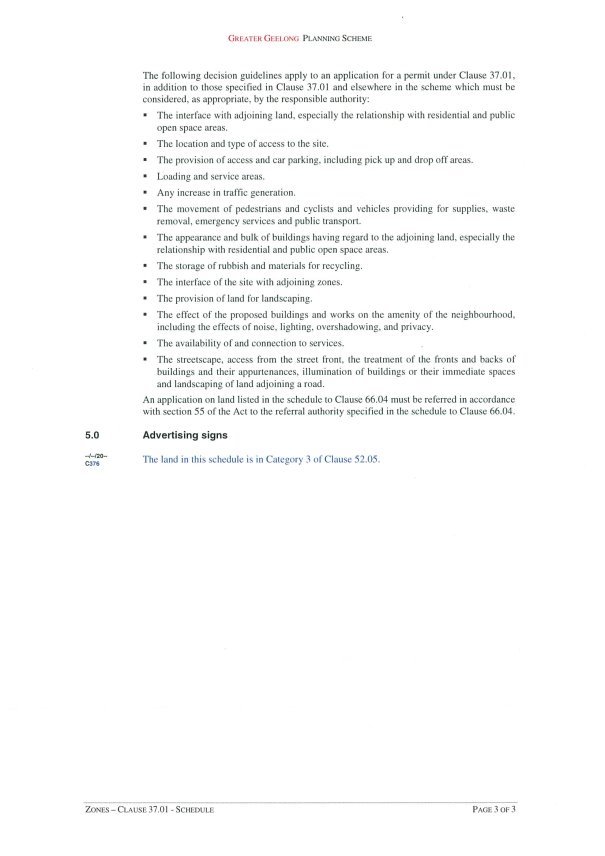
Introduce a new Schedule 16 to Clause 37.01
Amend the Schedule to Clause 43.01 to delete the entry for HO43.
Amend the Schedule to clause 41.03 to amend the identification of the heritage place in the entry for HO43 to 31 – 33 Cross Street Batesford.
Replace the Schedule to Clause 45.05 with a new Schedule.
Replace Clause 61.01 with a new Clause 61.01.
Amendment C376 Part 2
It is proposed that the following exhibited changes (Attachment 5) which formed part of the Amendment be deferred for further consideration.
Land affected:
Batesford Quarry
Detailed Changes
Planning Scheme Map Changes:
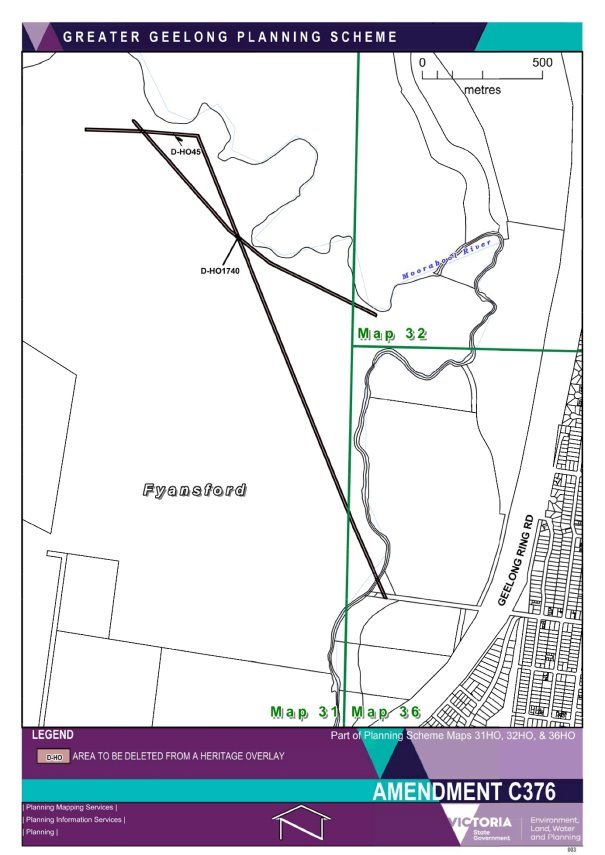
Delete HO45 from the land at Batesford Quarry.
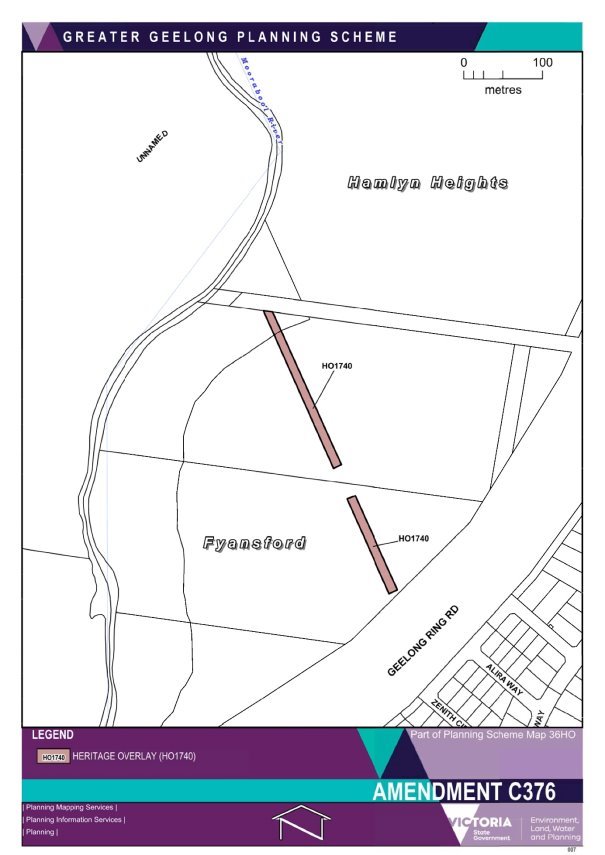
Delete HO1740 from part of the land at Fyansford Quarry, and apply HO1740 to another part of the land at Fyansford Quarry, consistent with the remaining extent of the overhead conveyor structure.
Planning Scheme Ordinance Changes
Amend the Schedule to Clause 43.01 to delete the entry for HO1710.
The reasons for the proposed deferment of consideration are to:
discuss with Heritage Victoria the basis of the Victorian Heritage Register (VHR) listing of HO45, given that the Bachyrus Steam Shovel to which it applies has been removed from the site and has now been restored and is located at Lake Goldsmith; and
discuss with the owner of the land on which part of the remnant cement conveyor is located the proposed extent of the revised application of HO1710.
240 Bacchus Marsh Road, Corio
One of the elements of the exhibited Amendment was to delete the Special Building Overlay (Planning Scheme Map 26SBO) from part of the land at 240 Bacchus Marsh Road. Subsequent to exhibition, Council drainage engineers advised that further assessments and discussions with the Flinders Park Estate developer concluded that site flood risk remains sufficient to warrant controls.
As a result, the proposed deletion of the SBO from part of 240 Bacchus Marsh Road no longer forms part of the Amendment and continues to be applied to the land.
Source: |
Community Life - Healthy Communities |
Director: |
Linda Quinn |
Portfolio: |
An Inclusive and Diverse Community |
To present the Multicultural Action Plan 2018-2022 to Council for endorsement.
The City of Greater Geelong has consistently embraced cultural diversity and acted on opportunities to create a positive social, cultural and economic impact.
Migrants have been important to Greater Geelong’s development since the mid-1800s. In the mid-1900s the City’s manufacturing sector benefited from the skills and labour of our multicultural community and the City continues to welcome both skilled migrants and refugees.
Fifty-one cultural communities are currently affiliated with the Geelong Ethnic Communities Council and between the 2011 Census and 2016 Census, the number of people born overseas increased by 13.2% (4,425 people).
The Multicultural Action Plan 2018-2022 (Attachment 2) supports the achievement of our Council Plan strategic priority to achieve “a more inclusive and diverse community”. The City will do this by working with multicultural communities and the organisations that support them, along with the broader community, to create a more inclusive and diverse community.
The Plan was presented to Council in draft on 14 August 2018, prior to a final period of community consultation. The draft has since been adjusted to reflect comments from the Multicultural Action Plan Advisory Committee and public submissions lodged between 17 August – 14 September 2018. The feedback received has been summarised and attached to this report (Attachment 3) as a number of points raised did not require changes to the Plan, but will enhance implementation.
The Multicultural Action Plan 2018-2022 seeks to respect and recognise all multicultural communities, increase their social, economic and health equity, increase inclusive service, place and activity planning and connect and engage the community.
The Multicultural Action Plan 2018-2022 builds on the 2011-2014 Plan and incorporates the results of a review and priority setting undertaken by the Multicultural Action Plan Advisory Committee.
The plan articulates the action areas that will contribute to achieving greater social cohesion, and a more inclusive, connected and vibrant community through activities that respect and recognise all culturally and linguistically diverse (CALD) communities; increase social and health equity; pursue inclusive service, place and activity planning; and connect and engage the CALD community.
Councillor Grzybek moved, Councillor Mansfield seconded -
That Council endorse the Multicultural Action Plan 2018-2022.
Carried.
The Plan will be delivered within existing budget and resources. Grant applications will be submitted when funding opportunities arise.
The Multicultural Action Plan was available for comment on Council’s “Have Your Say” page from 17 August – 14 September 2018. There were 272 page views and one written submission was lodged. Comments were also provided by Multicultural Action Plan Advisory Committee members at their regular meeting on 29 August 2018. See Attachment 3.
The Plan will contribute to addressing all the adopted Social Equity principles. The focus on addressing inequality, inequity and social exclusion for multicultural communities and their members is key to achieving social equity in Geelong.
Actions that promote a diverse respectful society combating racism, social stereotyping, harassment and discrimination are within the Council’s remit and responsibility under the Human Rights Charter.
Recognition, connection, celebration and engagement with Geelong’s multicultural communities as well as inclusive service, place and activity planning will positively contribute and underpin all ten of the Council Plan strategic priorities. In particular, a more inclusive and diverse community; improved health and safety of our community; informed social infrastructure and planning; vibrant arts and culture; a thriving and sustainable economy; and organisational leadership, strategy and governance. A City that has a thriving, supported multicultural focus positively supports and complements all aspects of the Clever and Creative Future vision in particular the achievement of an inclusive, diverse, healthy and socially connected community; a community where people feel safe; and a prosperous economy that supports jobs and education opportunities.
No conflict of interest was identified in the development of this report.
There is a risk to Council and community should the organisation not be actively engaging with, and taking advice from, the multicultural community.
There are no direct environmental implications arising from this report.
Source: |
Community Life - Healthy Communities |
Director: |
Linda Quinn |
Portfolio: |
Community Health and Safety |
To present the Municipal Public Health and Wellbeing Plan 2018-2021 to Council for endorsement.
The Victorian Public Health and Wellbeing Act 2008 requires Councils to prepare a Municipal Public Health and Wellbeing Plan within 12 months of Council elections.
This plan must include an examination of health data, identify goals and strategies, specify measures to prevent family violence and respond to victims, and be consistent with the Municipal Strategic Statement. It must also involve the community in its development, implementation and evaluation and specify partnership relationships to deliver the goals and strategies.
The Municipal Public Health and Wellbeing Plan 2018-2021 (Attachments 2 and 3) supports the achievement of our Council Plan strategic priority to achieve “a healthy and safe community”.
The Plan was presented to Council in draft on 28 August 2018. The draft has since been adjusted to reflect public submissions and stakeholder comments lodged between 29 August 2018 and 25 September 2018. The feedback received has been summarised with responses and attached to this report (Attachment 4).
A review of health policy confirms that the conditions in which people are born, grow, live, work and age determines health outcomes and that Councils have a key role in preventative health by creating healthy social and cultural, economic, built and natural environments.
Achieving health equity is a key challenge as socio-economic status, life stage, gender, disability, cultural and linguistic diversity and Aboriginal status can impact on health outcomes.
Community input has confirmed the following Municipal Public Health and Wellbeing Plan 2018-2021 goals:
supporting social connections to improve mental health;
increasing participation in physical activity;
improving access to safe and healthy local environments, services and food; and
increasing community safety and preventing violence and injury.
Councillor Mason moved, Councillor Grzybek seconded -/p>
That Council endorse the Municipal Public Health and Wellbeing Plan 2018-2021.
Carried.
The Municipal Public Health and Wellbeing Plan 2018-2021 includes an action plan for 2018-2019 which is supported by Council’s adopted budget.
Planning and funding for actions to continue meeting the Plan’s goals and strategies will return to Council for decision through the annual business planning and budget process.
Extensive engagement with the community and stakeholders to develop the Municipal Public Health and Wellbeing Plan 2018-2021 commenced in 2016 and included:
analysis of the views of 16,000 Greater Geelong community members during the Greater Geelong: A Clever and Creative Future community vision to identify health related aspirations;
an online and paper based survey entitled “Help Geelong be Healthy and Safe” where residents ranked the six Victorian Public Health and Wellbeing Plan priorities;
a survey of local early childhood and educational settings regarding health priorities; and
facilitated community focus groups in Drysdale, Norlane, Highton and East Geelong to further test the four proposed goals.
Following Council’s decision to release the draft Municipal Public Health and Wellbeing Plan 2018-2021 for further community comment on 28 August 2018, Council officers made the Plan available on Council’s website on the “Have Your Say” page from 29 August 2018 - 25 September 2018. There were 663 page views, eight online submissions lodged, six social media comments and 13 emails received.
Comments were provided following presentations and meetings to discuss the Plan with senior leaders and officers from Barwon Health, Bellarine Community Health, the Western Region Primary Health Network, Give Where You Live and current partners through the G21 Health and Wellbeing Pillar (Primary Care Partnership).
The Department of Health and Human Services also provided comments.
Comments provided from 29 August 2018 - 25 September 2018 are incorporated into the attached Municipal Public Health and Wellbeing Plan 2018-2021 and identified in Attachment 4.
The Plan will be forwarded to the Secretary Department of Health and Human Services by end October 2018 in accordance with the Public Health and Wellbeing Act 2008.
The Municipal Public Health and Wellbeing Plan 2018-2021 acknowledges the policy and population evidence base that the conditions in which people are born, grow, live, work and age determines health outcomes and that the distribution of money, power and resources shape health.
It identifies population groups at risk of poorer health outcomes and actions that will respond to these challenges to achieve equitable health outcomes.
The Municipal Public Health and Wellbeing Plan 2018-2021 meets the requirements of the Victorian Public Health and Wellbeing Act 2008.
The Municipal Public Health and Wellbeing Plan 2018-2021 is directly aligned to the 11 Strategic Priorities identified in the City of Greater Geelong Council Plan 2018-2022.
No conflict of interest has occurred in the development of this plan.
Given the alignment of the Municipal Public Health and Wellbeing Plan 2018-2021 with the Council Plan 2018-2022 and Budget 2018-2019, no significant risks have been identified.
The Municipal Public Health and Wellbeing Plan 2018-2021 identifies the requirements of the Climate Change Act 2017 by having regard to climate change and actions that will contribute to community health and wellbeing.
Source: |
Community Life - Social Planning & Investment |
Director: |
Linda Quinn |
Portfolio: |
Social and Infrastructure Planning |
To inform Council of the draft G21 Regional Hockey Strategy and seek approval to release the strategy for a six week public exhibition period.
The draft strategy has been developed to identify a collective direction for hockey across the region. The strategy provides a framework to support the future development, governance and growth of the sport over the next 10 years. This strategy is a collaborative planning project between the G21 Region Alliance, local government authorities (LGAs) in the G21 Region, Hockey Victoria and other key stakeholders.
The development of the draft G21 Regional Hockey Strategy included comprehensive consultation with the hockey community, a workshop with key stakeholders, a member survey to all registered participants across the region and a Project Control Group with representatives from each G21 LGA and Hockey Victoria.
The draft Strategy has identified six (6) strategic priorities which aim to improve and develop the sport. These are:
Priority 1 – Provide functional and accessible hockey facilities;
Priority 2 – Increase capacity of existing facilities and deliver new pitches to meet future demand;
Priority 3 – Increase hockey participation through improved programming
Priority 4 – Embrace new formats that engage new participants;
Priority 5 – Adopt strategies that support the development of sustainable clubs; and
Priority 6 – Promote hockey in the G21 Region through collective marketing strategies and initiatives.
There are no immediate investment or resource implications for the City in the draft strategy.
The main priority in the draft strategy is to improve participation and access to existing hockey facilities across the region.
All G21 LGA’s will release the draft Strategy for public exhibition from Thursday 25 October, 2018 for a six week period.
Councillor Aitken moved, Councillor Kontelj seconded -
That Council approve the release of the draft G21 Hockey Strategy for public exhibition from Thursday, 25 October 2018 for a six-week period.
Carried.
There are no financial implications arising from this report. Funding for any action noted in the draft G21 Hockey Strategy into the future will be sought through a range of funding opportunities and through Council’s budgetary process.
The draft G21 Hockey Strategy provides the strategic framework to support the future development, governance and growth of hockey throughout the G21 region over the next 10 years. The draft strategy demonstrates that, to achieve the identified strategic priorities, there must be a collaborative approach between sport, local and state governments. The draft strategy provides regional directions and recommendations, as well as prioritising actions to be delivered by Hockey Victoria, Geelong Hockey Association, local clubs and LGAs.
The development of the draft strategy has included comprehensive consultation with the hockey community alongside a Project Control Group (PCG) comprising representatives from each G21 LGA, Hockey Victoria and the Geelong Hockey Association. Consultation with stakeholders included a workshop and member survey to all registered players within the region. The key findings from the community engagement period identified a number of priorities, including:
Better quality hockey facilities and supporting amenities;
Employment of a Hockey Victoria Regional Club Development Officer;
Additional satellite facility provision to minimise travel times – travel times were considered a significant barrier to participation;
Partnerships with Councils, Hockey Victoria and state government to further develop the game; and
Strategies to recruit new participants and increase participation.
As a result of the engagement period and the ongoing work through the PCG, the draft Strategy has identified 6 key strategic priorities. These are:
Priority 1 – Provide functional and accessible hockey facilities
It is identified that existing hockey facilities, particularly those on education land, could be activated more broadly to support participation. With fewer hockey pitches in G21 than in comparison to more popular sports, there is general consensus among the hockey community that there is a requirement to travel to play hockey. That said, the opportunity to improve access to existing pitches will assist in the provision of satellite/training venues for local demand. A critical action under this priority is for Hockey Victoria and the Geelong Hockey Association to strengthen partnerships with schools to facilitate broader hockey facility access.
Priority 2 – Increase the capacity of existing facilities and deliver new pitches to meet future demand
Floodlighting is identified in the strategy as a way to support participation growth through increasing the capacity of existing venues. While the provision of hockey pitches to population ratio is well within recommended limits, floodlighting existing venues will allow these facilities to be programmed longer throughout the winter season, improving opportunities for people to participate.
As most hockey pitches in G21 are located in Geelong’s municipal boundaries, there is not equitable access to facilities across the network. The majority of senior hockey competition and training is at Stead Park, Corio which presents a barrier due to travel time, particularly for those outside Geelong.
The critical action identified under this priority is for the City is to work in partnership with Hockey Victoria to advocate for the inclusion of multi-purpose hockey pitches within the Armstrong Creek West Regional Sporting Precinct. The draft master plan for this precinct identifies two multi-use hockey pitches alongside soccer and tennis facilities. The strategy identifies the importance of hockey retaining this presence to assist in addressing the gap in hockey facilities from a regional perspective in the medium to long term.
The second action for the City will be to support the development of a floodlit synthetic pitch at King Lloyd Reserve as per the reserve’s master plan. This development however will be subject to further detailed investigations prior to any funding commitment being made and will need to demonstrate widespread participation outcomes as a result.
In addition, the delivery of a new local multipurpose synthetic facility in the Torquay Sports Precinct in partnership with Surf Coast Secondary College in the short term will provide more immediate provision.
Priority 3 – Increase hockey participation through improved programming
Delivering flexible and affordable hockey programs that re-engage existing members and attract new players will be key to improving participation and supporting the sport’s prosperity into the future. This includes reviewing the current training and competition schedule of the regional Stead Park facility to ascertain how the facility may be more widely programmed. In addition, investigating opportunities to host more state and national level events and competitions at Stead Park to increase interest in hockey and contribute to the local economy.
Priority 4 – Embrace new formats that engage new participants
Engaging with more schools and the G21 community through improved and diversified formats including social hockey will support increased participation. Hockey Victoria has an ambitious goal of achieving 15,000 new or re-engaged participants across the state by 2020 and identifies the need to increase its offerings to meet this target. Hockey Victoria will drive this priority with assistance from local clubs and associations. Critical actions under this priority will support the facilitation, activation and delivery of hockey along with improved partnerships for greater grass roots level and social non-structured participation.
Priority 5 – Adopt strategies that support the development of sustainable clubs
Support the local hockey association, Geelong Hockey Association, to develop a business plan, in conjunction with the regional strategy, that provides clear organisational and operational directions. In addition, review the structure of hockey and identify any preferred management and operational models in anticipation of a new local multi-use pitch at Torquay and the proposed regional development at Armstrong Creek West. Under this priority, Hockey Victoria will also aim to review their affiliation fees to clubs to ensure that the charges are reflective of the level of support provided.
Priority 6: Promote hockey in the G21 Region through collective marketing strategies and initiatives.
Promote hockey in the region through collective marketing strategies and initiatives along with increased support from Hockey Victoria through the appointment of a Regional Club Development Officer.
This critical priority arose from consultation with associations, clubs and players who felt that greater support from Hockey Victoria was required to improve participation outcomes and strategic direction, particularly for the implementation of more non-traditional, unstructured formats of the game.
The G21 Region is forecast to experience an estimated growth of 670 traditional hockey players from 2011 to 2031. In addition to traditional participation growth, the implementation of diversified hockey formats such as social hockey should see an another 500 new participants in the short term.
At present, all competition is played at the regional hockey facility at Stead Park, Corio. While the facility offering is of a premier standard and hosts the preferred synthetic competition surface, travel times for competition for those outside of Geelong is considered a major barrier to participation.
The strategy notes that the addition of multi-purpose satellite competition surfaces outside of Greater Geelong be considered a priority for investment, particularly within Surf Coast Shire. This outcome will ensure a broader number of facilities are more accessible for the wider G21 population. The provision of additional satellite competition facilities is supported by Hockey Victoria and the Geelong Hockey Association who operate the Stead Park facility.
In addition, the strategy recommends that disadvantaged and low socio-economic communities should be engaged through the implementation of introductory hockey programs with a specific focus on Corio/Norlane. Given the proximity of the Stead Park facility, this presents Hockey Victoria and the Geelong Hockey Association an opportunity to involve members of this community.
There are no policy, legal or statutory implications arising from this report.
This report aligns to Council’s priorities of ‘Improved Health and Safety of Our Community’ and ‘Informed Social Infrastructure and Planning’ as per the 2018-2022 Council Plan.
By consulting with the community and developing a prioritised action plan with key stakeholders, the draft G21 Hockey Strategy will provide greater participation opportunities and health outcomes through sport. Furthermore, this plan will support and provide strategic justification through a well-developed evidence base for any future hockey infrastructure within the G21 region
No Council officers involved in the preparation of this report or draft strategy are known to have a direct or indirect interest in matters to which this report relates.
There are no notable risks associated with this report.
There are no environmental implications associated with this report.
Councillor Murnane declared a Conflict of Interest in Agenda Item 5 - Draft G21 and Cricket Victoria Barwon Regional Cricket Strategy and left the meeting room prior to discussion at 7:38pm..
Source: |
Community Life - Social Planning & Investment |
Director: |
Linda Quinn |
Portfolio: |
Social and Infrastructure Planning |
To update Council about the draft G21 and Cricket Victoria Barwon Regional Cricket Strategy and to seek approval to release the strategy for a six-week public exhibition period.
The draft G21 and Cricket Victoria Barwon Regional Cricket Strategy aims to guide the future planning and development of cricket across the Barwon region to 2028. The strategy provides a framework to support the future management, development and infrastructure outcomes for the sport. The strategy is a collaborative planning project between the G21 Region Alliance, G21 local government authorities (LGAs), Cricket Victoria, Victorian Government and the local cricket community.
The development of the draft G21 and Cricket Victoria Barwon Regional Strategy investigates issues and opportunities facing cricket identified through extensive consultation with the cricket community and the five G21 LGAs (City of Greater Geelong, Surf Coast Shire, Borough of Queenscliffe, Golden Plains Shire and Colac Otway Shire).
The draft strategy has identified five key strategic priorities which aim to improve and develop the sport. These are:
Priority 1 – Governance and cricket activity management;
Priority 2 – Participation growth;
Priority 3 – Facility provision, capacity and renewal
Priority 4 – Regional cricket and community centre;
Priority 5 – Resourcing and partnerships.
There are no immediate investment or resource implications for the City in the draft strategy. Further detail regarding future priorities are detailed in the discussion section of this report.
The draft strategy notes improving the structure and governance of cricket as the main critical priority.
All G21 LGA’s will release the draft strategy for public exhibition from Thursday, 25 October 2018 for a six week period.
Councillor Aitken moved, Councillor Kontelj seconded -/p>
That Council approve the release of the draft G21 and Cricket Victoria Barwon Regional Cricket Strategy for public exhibition from Thursday, 25 October 2018 for a six-week period.
Carried.
There are no financial implications arising from this report. Funding for any action noted in the draft G21 and Cricket Victoria Barwon Regional Cricket Strategy into the future will be sought through a range of funding opportunities and through Council’s budgetary process.
The draft G21 and Cricket Victoria Barwon Regional Cricket Strategy provides the strategic framework to support and improve the sport of cricket over the next 10 years. The Strategy has been driven through extensive engagement with the cricket community including club and school survey’s, cricket stakeholder workshops as well as Project Control Groups and Project Reference Groups. Overarching strategic documents also used to guide the draft Strategy’s development include Cricket Victoria’s ‘Common Ground: A Unified Plan for Victorian Cricket Facilities’ (2014), Cricket Australia’s National Facilities Audit (2015-2017), Cricket Australia Community Infrastructure Guidelines (2015) and the Victorian Cricket Infrastructure Strategy (2018).
The consultation period for the strategy has identified a vision for the Barwon Cricket Region being ‘More cricket, played by more participants, across a diversity of programs and locations’. To achieve this vision, the draft Strategy has identified 5 key strategy priorities, these are:
Priority 1 – Governance and Cricket Activity Management
The structure of cricket within the Barwon region provides a mixed approach to the delivery of services, competitions, programs and activities with a number of separate clubs, associations, committees and player development programs operating independently of each other. It is therefore that the most immediate priority and challenge facing cricket across the region is the current governance and management structure. This is impacting on the viability of all other elements of the game and needs to be addressed in order for the sport to prosper. The most critical action under this priority is to ‘Develop an aligned and collaborative structure to manage cricket’ and for Cricket Victoria to lead a stakeholder working party to investigate this in partnership with the cricket community. It is identified that all other strategic directions cannot be progressed until this is addressed. A future amended governance model will require coordinated and supported administration through sustainable management, along with broad consultation from leagues, clubs and associations within G21.
Priority 2 – Participation Growth
This priority aims to grow cricket, its range of activities, club capacity and profile across the region. It is identified within the draft strategy that cricket in G21 has experienced a decline in participation in recent seasons which is in contrast to the rest of Victoria. In addition, despite considerable improvement in the past two years, female participation rates are very low and clubs and associations require continued support from Cricket Victoria to provide diversified and flexible formats to help address this.
Within this priority is a need for Cricket Victoria to lead a strategic review of current structures and game formats and to work with clubs to introduce diversified programs. This includes engaging and promoting junior, youth and female programs and growing inclusive cricket programs for multi-cultural and Indigenous communities. Along with this wider suite of cricket programs and opportunities, there must be adequate resources to support implementation and ongoing operation.
Priority 3 – Facility Provision, Capacity and Renewal
The Barwon region’s unique ‘metro meets country’ hybrid profile means that there is no one size sits all approach when looking at future cricket facility provision. Of the 155 playing fields in G21, 70% of those are located within the City, 12% in Colac Otway Shire, 11% Surf Coast Shire, 6% in Golden Plains Shire and 1% in the Borough of Queenscliffe.
The provision of playing facilities in the G21 aligns with recommendations for both country and metropolitan areas however the unique geographical spread of the region sees varying levels of demand for infrastructure. Due to this, the draft Strategy notes that the prioritisation of new venues and facilities should be led by clubs reaching capacity or within areas of forecast population growth (e.g. Armstrong Creek). It is identified within the draft strategy that some existing facilities within G21 are not meeting recommended standards for cricket at a local level. In order to attract investment and subsequent development of these sites, the first critical action under this priority is for Cricket Victoria, G21 LGA’s and SRV to assist clubs in developing individual facility renewal plans with projects that promote diversity and inclusion prioritised.
Importantly, the draft strategy also notes that the development of additional turf pitch playing fields within the City is not supported in the short to medium term given the existing high level of turf pitch provision. Whilst this provision is commensurate with higher population and participation numbers, it may also be restricting the capacity of existing sites and constraining the flexibility and opportunity for expansion of the game. While ensuring a suitable balance of turf and synthetic pitches will be a key focus for the Barwon Region into the future, there is to be no net gain of turf provision in the Barwon region during the life of this strategy or until ‘Priority 1 – Develop an aligned and collaborative structure to manage cricket’ is resolved. This extends to turf practice wickets also.
Priority 4 – Regional Cricket and Community Centre
Cricket Victoria has identified a need to deliver and activate regional level Cricket and Community Centres in a number of regions, including G21, to achieve and address the following key roles and functions:
Participation development – for year-round competition activities, program delivery and school participant development including a venue suitable for finals and events.
Education – provide adequate support, education and training for players, coaches, umpires and off-field support services including volunteers.<
High performance – provision of indoor, outdoor, health and fitness infrastructure, particularly within an area where access to such facilities may be limited.
Shared regional services – to provide a more centralised and streamlined approach to future cricket activities including competition, marketing and promotion.
The delivery of a regional centre includes the opportunity to leverage off existing facilities using a multi-use approach.
The critical action under this priority is for a working group to further progress this investigation and consider potential locations. It is noted that any investment for a Regional Cricket and Community Centre will require a collaborative approach from G21 along with Cricket Victoria, Cricket Australia, state and federal governments and potentially commercial partners.
Priority 5 – Resourcing and Partnerships
It is identified within the draft strategy that no single organisation can deliver all activities and priorities alone, and that collaboration is required to create cohesive and efficient sports administration, programs, partnerships and infrastructure for the Barwon cricket region. Once the financial impact of implementing proposed actions is known, a coordinated approach to the delivery and funding of priorities is important to achieve collective outcomes.
The critical action under this priority will be for G21 LGAs and Cricket Victoria to actively advocate to the State Government and Cricket Australia for the continuation of Sport & Recreation Victoria’s Community Sports Infrastructure Fund ‘Cricket Facilities’ category along with Cricket Australia’s National Facilities Funding Scheme. In addition, project partners will be encouraged to work together to provide structured communication and promotion of the strategy and its progression.
The draft strategy recognises the need to improve diversity and inclusion in cricket across the Barwon region. There is a strong focus on delivering programs which promote and support female participation, all-abilities as well as Indigenous and Multicultural communities.
It is noted within the strategy that female participation in the region is well below the State’s average, and a key action under Priority 2 – ‘Grow cricket, its range of activities and profile across the Barwon region’ is to support local clubs and associations in engaging and growing their female participant base. In addition to strengthening the female cricket pathway, it will be important to diversify and offer more flexible, non-structured formats to engage more people outside of their current traditional player profile. These opportunities will target participants with time or financial constraints who may not be inclined to participate on a more structured basis.
The strategy also highlights improving female friendly facilities by working with clubs on developing improvement plans that prioritise inclusive outcomes.
There are no policy, legal or statutory implications arising from this report.
This report aligns to Council’s priorities of ‘Improved Health and Safety of Our Community’ and ‘Informed Social Infrastructure and Planning’ as per the 2018-2022 Council Plan. By consulting with the community and developing a prioritised action plan with key stakeholders, the draft G21 and Cricket Victoria Barwon Regional Cricket Strategy will provide greater participation opportunities and health outcomes through sport. Furthermore, this plan will support and provide strategic justification through a well-developed evidence base for future management and infrastructure requirements for the sport within the G21 region.
No Council officers involved in the preparation of this report or draft strategy are known to have a direct or indirect interest in matters to which this report relates.
There are no notable risks associated with this report.
There are no environmental implications associated with this report.
Councillor Murnane re-entered the meeting room at 7:46pm
Source: |
Strategy & Program Delivery |
Director: |
Peter Anderson |
Portfolio: |
Strategy and Communications |
To have Council consider the City of Greater Geelong Annual Report 2017-18 (Annual Report) in accordance with its obligations under section 134 of the Local Government Act 1989 (the Act).
The Annual Report provides a comprehensive review of the City’s activities, achievements, challenges and financial position from 1 July 2017-30 June 2018 against City Plan 2013-17 and Budget 2017-18.
The Annual Report has been prepared to comply with section 131 of the Act that requires it to contain the following:
a report of Council’s operations;
a performance statement and a copy of the auditor’s report on the performance statement;
financial statements and a copy of the auditor’s report on the financial statements; and
any other matter required by the regulations.
Reporting) Regulations 2014 requires that Council must consider and discuss the Annual Report at an open meeting of Council within one month after submitting the Annual Report to the Minister.
The Annual Report was sent to the Minister for Local Government on 26 September 2018.
Councillor Murnane moved, Councillor Asher seconded -/p>
That Council note that it has considered the Annual Report in accordance with section 134 of the Act.
Carried.
There are no financial implications arising from the subject of this report.
The Annual Report has been prepared in close consultation with the Executive Leadership Team, Managers, Coordinators and Officers from across the organisation. Public notice regarding the Council meeting and availability of the Annual Report from Council’s website and Customer Service Centres was given on 5 and 6 October 2018.
The Annual Report provides information to the community on how the resources of the City have been allocated between the Social, Environment and Economic needs of the community.
Section 134 of the Act in combination with Regulation 22 of the Local Government (Planning and Reporting) Regulations 2014 requires that Council must consider and discuss the Annual Report at an open meeting of Council within one month after submitting the Annual Report to the Minister.
City Plan 2013-17 (2016-17 Update) is the guiding document for the Annual Report. The Annual Report provides an update on the achievements under the Community Wellbeing, Growing Our Economy, Sustainable Built and Natural Environment and How We Do Business strategic directions.
There have been no direct or indirect interests declared.
There are no identified risks arising from this report.
The Annual Report has been published online. Minimal copies of the Annual Report have been produced to satisfy the requirements of the Act.
Source: |
Investment & Attraction |
Director: |
Brett Luxford |
Portfolio: |
Economic Development |
To seek Council’s support to tender for the installation of Geelong’s Iconic Floating Christmas Tree for a further five years from 2019 to 2023 inclusive.
Since the City launched the Iconic Floating Christmas Tree in November 2014, it has become the key element of the City’s annual Christmas in Geelong program. This program aims to:
help generate community pride and a spirit of festive goodwill across the entire Geelong community;
stimulate economic activity directly in Central Geelong, and more broadly across our municipality (through external visitations, etc.);
positively boost the public and media profile of Central Geelong, the City of Greater Geelong and our broader municipality; and
offer a range of Christmas celebration activities, freely accessible by all surrounding communities.
In early 2016, the City commissioned an independent economic impact and cost benefit analysis that determined that Geelong’s Iconic Floating Christmas Tree returned 5.4 times return-on-investment (see Attachment 3).
A total of 164,872 people viewed the tree during its eight week Waterfront display over the 2017-2018 festive season, and the total economic output of the 2017-2018 Christmas in Geelong program was $17.3 million.
From 9 November 2018 to 7 January 2019 the tree will be displayed for the fifth (and final) year under its current Council approved allocation of $400,000.
Following an engineering assessment earlier this year, and some minor repairs, it was determined that the tree is structurally sound and could be displayed for a further five years.
Council would need to approve total expenditure of $2,303,990 over the five-year period (2019-23) as outlined in the table in Attachment 1, commencing with $420,666 in the 2019-20 budget.
Councillor Sullivan moved, Councillor Nelson seconded -/p>
That Council:
note the economic impact of the Iconic Floating Christmas Tree and its overall impact on the Christmas in Geelong program;
support the installation of the Iconic Floating Christmas Tree for a five-year period from 2019-2023, inclusive;
approve a total allocation of $2,303,990 in the recurrent budgets for the period 2019-23 inclusive as detailed in this report to fund the maintenance, storage and installation of the Iconic Floating Christmas Tree;
investigate further opportunities to modify and enhance the Iconic Floating Christmas Tree over the five-year period and consider any changes and the budget implications of any changes at a future meeting.
Carried.
For: Councillors Grzybek, Kontelj, Mansfield, Murrihy, Mason, Asher, Sullivan, Nelson, MurnaneAgainst: Councillor Aitken
Council would need to approve total expenditure of $2,303,990 over the five-year period (2019-23) as outlined in the table below, commencing with $420,666 in the 2019-20 budget.
2017-18 Actual Costs |
2018-19 Budget |
2019-20 |
2020-21 |
2021-22 |
2022-23 |
2023-24 |
$378,763 |
$400,000 |
$420,666 |
$439,827 |
$459,872 |
$480,843 |
$502,782 |
Note:
The tabled figures assume the tree’s cost will increase annually above CPI over the next five-year period.
These costs assume GeelongPort will continue its in-kind support.
These cost include barge hire, assembly, display and the light and sound show.
These costs do not include any substantial improvements or new elements added to the tree.
In addition, officers believe the tree would significantly benefit from a further investment in years two and four for improvements and additions to ensure the tree continues to have high impact and return visitation. These improvements are yet to be determined and would be the subject of a future report to Council.
If Council commits to financially support the tree for a further five years, Council officers would investigate alternate mooring sites along the Geelong Waterfront that could:
help reinvigorate the tree display;
offer new opportunities for land-based support activation (for example: new Christmas displays on Steampacket Gardens); and
allow Steampacket Quay to continue operating as a ferry berthing terminal during the busy summer holidays (noting that the quay is unusable when the tree is moored there too).
Since its launch in November 2014, the Iconic Floating Christmas Tree has cost $1.52 million (including this year’s structural assessment, repairs, and check of lighting equipment).
Council officers evaluated the tree’s visitation figures using the following methods:
Bluetooth and Wi-Fi data counting mobile devices in zones within central Geelong;
Face to face and online surveys, completed for the opening weekend (250 online and face to face) and the ongoing program (290 online and face to face);
Social media reach of 872,985 people for City accounts, and 154,860 for Central Geelong Marketing (Facebook, Twitter and Instagram);
ndependent assessment of PR value of the tree’s media activity (an estimated $2.51 million in positive media coverage through 504 separate media items).
Geelong’s Iconic Floating Christmas Tree and the broader Christmas in Geelong program offer a range of free events to appeal to our entire community, regardless of income or any other social barrier (see Attachment 2).
As such, the tree and the Christmas in Geelong program help advance social inclusion and community strengthening – as advocated in Council Plan 2018-22 and other Council documents.
The City has managed all policy, legal and statutory implications associated with this project.
The City is limited from seeking major sponsorship to help off-set the tree’s cost due to Planning Scheme constraints on sponsor advertising on Corio Bay or along the Waterfront.
The City has received an estimated $75,000 worth of in-kind sponsorship each year from GeelongPort to assist with the tree’s storage, assembly and disassembly, and officers are negotiating with GeelongPort to ensure this major sponsorship continues under a new five-year funding arrangement.
The Christmas in Geelong program aligns with the Community Wellbeing, Growing our Economy, and How We Do Business strategic directions of Council Plan 2018-22.
No officers involved in the preparation of this report have a direct or indirect interest in matters to which it relates.
The Christmas Project Control Group (PCG) and Christmas Project Working Group (PWG) structure has managed risk, with advice from specialist Council officers.
Council officers have considered all potential environmental impacts for the Iconic Floating Christmas Tree. There are no detrimental environmental impacts that have been identified as a result of the Iconic Floating Christmas Tree. Should the tree be relocated to another location a further environmental assessment would need to be made on any proposed new location.
Source: |
Office of the Chief Executive Officer |
Chief Executive Officer: |
Martin Cutter |
Portfolio: |
Leadership and Governance |
To seek Council’s approval to join with its neighbouring G21 Councils to submit a joint expression of interest to the Local Government Victoria Rural Councils Transformation Program.
In August 2018 Local Government Victoria (LGV) launched its Rural Councils Transformation Fund (Fund). The Fund aims to support large scale proposals by rural and regional councils to transform existing council functions and improve service to the community.
Groups of councils from across the state are encouraged to work together to identify opportunities to create efficiencies from shared service models and apply for funding to develop a business case and to implement shared service initiatives. The Fund has a total of $20 million to be allocated towards 4-5 transformational projects across the state.
The five G21 Councils – City of Greater Geelong, Surf Coast Shire, Colac Otway Shire, Golden Plains Shire and the Borough of Queenscliffe (Councils) – have agreed in principle to explore opportunities for transformational shared services with a view to submitting a joint expression of interest to the Fund. Areas currently being considered by the Councils for a shared service model include customer-facing, corporate support and strategic areas of the Councils.
LGV requires participating council Chief Executive Officers to sign a Memorandum of Understanding (MOU) in support of the submission of the expression of interest, confirming their respective Council’s commitment to apply to the Fund. Expressions of interest close in November 2018.
If the expression of interest is successful, the Councils will be invited to develop a detailed business case for their proposed shared service and the cost of preparing a detailed business would be fully funded by the Fund. The detailed business case must be completed and submitted by 31 March 2019. A formal Council resolution is required to support the submission of the business Case submission.
An announcement of the successful shared service proposals is expected in May 2019.
Information distributed by LGV about the Fund is included in Attachment 2 >and Attachment 3.
Councillor Mason moved, Councillor Grzybek seconded -/p>
That Council endorses its participation in an application to the Victorian Government’s Rural Councils Transformation Program, noting the following:
This is a joint application of the five local government authorities within the G21 region;
The program aims to improve the efficiency and financial sustainability of rural and regional Councils;
The application proposes increased collaboration amongst councils, including the potential for a shared operational delivery model;
Each Council would retain autonomy for setting its strategy, service levels and policies in relation to the included services; and
The application requires each Council’s Chief Executive Officer to sign a Memorandum of Understanding affirming the Council’s willingness to participate.
Carried.
Shared service initiatives between councils create opportunities to consider alternative ways and means for Councils to service its community more efficiently and effectively.
At this early stage of this application process, there is no need to undertake consultation. As the shared service models become more defined, appropriate consultation will be undertaken.
Any agreed shared service model will take into account the Council’s social equity principles.
The Fund is administered by LGV and applications will need to comply with any applicable state guidelines.
A shared service model which delivers Council services more efficiently aligns with Council Plan – Leadership and Governance.
No officer involved in the preparation of this report has any direct or indirect interest in the substance of this report.
A shared service model which delivers efficiencies for Council contributes to mitigating the risks associated with financial sustainability and its ability to deliver community services. Any specific risks associated with a more defined shared service model will be considered as part of the business case.
The application will take into account any relevant environmental implications for Council and the community.
Source: |
Governance & Legal Services - Governance |
Executive Manager: |
Rebecca Leonard |
Portfolio: |
Leadership and Governance |
To review and update the Greater Geelong City Council (Council) instrument of delegation to members of Council staff.
The Local Government Act 1989 (the Act) provides for the delegation of Council’s powers, duties and functions under that Act or any other Act.
Council delegates its powers, duties and functions, subject to some exceptions and limitations, to the members of Council staff where they cannot be delegated through the CEO.
Council last reviewed the delegation to members of Council staff on 27 September 2016. The approved Council instrument of delegation to members of Council staff was executed on 11 October 2016.
The powers conferred on the Council under some legislative instruments cannot be delegated through the CEO, and must be delegated by resolution directly to Council officers.
It is important to ensure that Council has properly delegated powers, duties and functions, in order to avoid any issues arising regarding the legality of a decision or an action purportedly made or taken on behalf of the council.
The schedule to the instrument of delegation has been updated to reflect various legislative changes. The following changes have been made:
Minor amendments to provisions of the Road Management Act 2004 relating to bus stopping points and infrastructure resulting in no changes to delegations
Planning and Environment (Fees) Regulations 2016 replaced the Planning and Environment Regulations (Fees) Interim Regulations 2015 resulting in no changes to delegations
The Victorian Planning Authority replaces the Growth Areas Authority in some sections of the Planning and Environment Act 1987> resulting in no changes to delegations
Inserted s.19(3) of the Food Act 1984> to provide for expedient closure of temporary food premises or mobile food premises. This delegated power is proposed to be limited to senior environmental health staff
Inserted s.173(1A) of the Planning and Environment Act 1987 which enables a responsible authority to enter into an agreement with an owner of land for the development or provision of land in relation to affordable housing. This delegation is proposed to be limited to the Director Planning & Development consistent with the existing s.173 delegation
The conditions and limitations column for s.41A(1) in the Domestic Animals Act 1994 has been updated to reflect new authorised officer terminology and resulting in no changes to delegations
The Heritage Act 1995 has been replaced by the Heritage Act 2017 and the relevant provision for councils has now changed from s 84(2) to s 116. It is proposed that this power continues to be ‘not delegated’
Part 3AB of the Planning and Environment Act 1987 has been extensively amended to introduce a land contribution for the infrastructure contributions plan scheme. This was done to enable land or funding for land required for public purposes to be provided as part of an infrastructure contribution when land is developed. The proposed delegations are consistent with the previous delegation settings for the former part 3AB which provided for funding for land only.
The Planning and Environment Act 1987 has been extensively amended to provide for the declaration of distinctive areas and landscapes and the preparation and implementation of a Statement of Planning Policy for a declared area to ensure coordinated decision-making by public entities in relation to declared areas. It is proposed to limit related delegated powers, duties and functions to:
senior Planning and Development managers for the function of being consulted;
the Director Planning & Development for the power to endorse the draft Statement of Planning Policy;
professional planning officers for the duty not to prepare an amendment that is inconsistent with a Statement of Planning Policy for the declared area or act inconsistently with any provision of the Statement of Planning Policy.
Delegated officer titles have been updated to reflect council's current organisational structure.
The Act requires that Council reviews delegations to members of Council staff that are in force by 28 October 2018.
The proposed Council instrument of delegation to members of Council staff reflects legislative and organisational changes, and the powers, duties and functions so delegated are reasonable to effectively manage the day-to-day operations of the Council. Refer to Attachment 2.
Councillor Grzybek moved, Councillor Sullivan seconded -
In the exercise of the powers conferred by section 98(1) of the Local Government Act 1989 (the Act) and the other legislation referred to in the attached instrument of delegation, the Greater Geelong City Council (Council) resolves that:
There be delegated to the members of Council staff holding, acting in or performing the duties of the offices or positions referred to in the attached Instrument of Delegation to members of Council staff, the powers, duties and functions set out in that instrument, subject to the conditions and limitations specified in that Instrument (Attachment 2);
The instrument comes into force immediately the common seal of Council is affixed to the instrument;
On the coming into force of the instrument all previous delegations from Council to members of Council staff (other than the Chief Executive Officer) are revoked; and
The duties and functions set out in the instrument must be performed, and the powers set out in the instruments must be executed, in accordance with any guidelines or policies of Council that it may from time to time adopt.
Carried.
There are no financial issues arising from the subject of this report.
The attached instrument of delegation to members of Council staff has been prepared to reflect consultation with relevant Council officers.
There are no social equity issues arising from the subject of this report.
Power to delegate
Section 98(1) of the Act allows Council, by instrument of delegation, to delegate to a member of its staff certain powers, duties or functions under the Act or any other Act, other than:
this power of delegation; and
the power to declare a rate or charge; and
the power to borrow money; and
the power to approve any expenditure not contained in a budget approved by the Council; and
any power, duty or function of the Council under section 223 of the Act; and
any prescribed power.
The powers conferred on the Council under some legislative instruments cannot be delegated through the CEO, and must be delegated by resolution directly to Council officers. The Acts and Regulations referred to in Attachment 2 are among those which require direct delegation.
Legislative changes
The legislative changes reflected in the updated instrument of delegation include:
Minor amendments have been made in relation to provisions of the Road Management Act 2004 relating to bus stopping points and infrastructure
s.48M(3) amended - for "Secretary" substitute "relevant authority" - function of consulting with the Secretary relevant authority for purposes of developing guidelines under section 48M [relating to bus stopping points and bus stop infrastructure]
s.48N amended - for "Secretary" substitute "relevant authority" – duty to notify the Secretary relevant authority of the location of the bus stopping point and the action taken by council
no changes are proposed to any delegations
The Planning and Environment (Fees) Regulations 2016 replaced the Planning and Environment Regulations (Fees) Interim Regulations 2015
r.16 - becomes r.20 - power to waive or rebate a fee other than a fee relating to an amendment to a planning scheme
r.17 - becomes r.19 - power to waive or rebate a fee relating to an amendment of a planning scheme
r.18 - becomes r.21 and references to r.16 and r.17 are changed to r.19 and r.20 respectively - duty to record matters taken into account and which formed the basis of a decision to waive or rebate a fee under r.16 r.19 or r.17 r.20
no changes are proposed to any delegations
Under the Victorian Planning Authority Act 2017 the Victorian Planning Authority replaces the Growth Areas Authority in the following sections of the Planning and Environment Act 1987:
s.46AS(ac)
s.201UAB(1)
s.201UAB(2)
s.224(8)
no changes are proposed to any delegations
Inserted s.19(3) of the Food Act 1984 - to direct by written order that the food premises not be kept or used for the sale, or handling for sale, of any food, or for the preparation of any food, or for any other specified purpose, or for the use of any specified equipment or a specified process. This power is subject to the following conditions and limitations:
If the relevant authority is satisfied from the report of an authorised officer that—
a food premises is in an unclean or unsanitary condition or in a state of disrepair; or
food being prepared, sold or otherwise handled at a food premises is unsafe or unsuitable; or
food is prepared, sold or otherwise handled at a food premises in a manner that makes it likely the food is unsafe or unsuitable.
Only in relation to temporary food premises or mobile food premises
This delegated power is proposed to be limited to senior environmental health staff, including the Manager Health & Local Laws, the Co-ordinator Environmental Health and the Team Leaders Environmental Health.
Inserted a new subsection (1A) into section 173 of the Planning and Environment Act 1987 which enables a responsible authority to enter into an agreement with an owner of land for the development or provision of land in relation to affordable housing. An agreement entered into pursuant to subsection (1A) will be an agreement for the purposes of section 173 of the Planning and Environment Act 1987.
Accordingly, Division 2 of Part 9 of that Act will apply to agreements relating to affordable housing - Without limiting subsection (1), a responsible authority may enter into an agreement with an owner of land for the development or provision of land in relation to affordable housing. - Delegation proposed to be limited to the Director Planning & Development consistent with the existing s.173 delegation.
The conditions and limitations column for s.41A(1) in the Domestic Animals Act 1994 has been updated to reflect the new language in the amended section 41A(4) of the Domestic Animals Act 1994 where the reference to "an authorised officer" has been replaced with "a Council authorised officer" - no changes to delegations proposed.
The Heritage Act 1995 has been replaced by the Heritage Act 2017 and the relevant provision for councils has now changed from s 84(2) to s 116 - it is proposed that this power continues to be ‘not delegated’.
The Planning and Environment Act 1987 has been extensively amended to introduce a land contribution for the infrastructure contributions plan scheme. This was done to enable land or funding for land required for public purposes to be provided as part of an infrastructure contribution when land is developed. Specific amendments include:
substitutes Part 3AB in its entirety to introduce a land contribution model for the infrastructure contributions plan scheme resulting in:
removal of s.46GF to s.46Gl(5), s.46GL and s.46GM.
insertion of s.46Gl(2)(b)(i) to s.46LB(3), which are provisions conferring powers, and functions, and imposing duties, on Council acting in one or more of the following capacities:
collecting authority;
development authority;
municipal council;
planning authority;
amendment of s.62(5)(a) and s.62(6)(a) to include reference to an approved infrastructure contributions plan and the addition of referenced sections s.46N(1) and 46GV(7), respectively;
only for monetary contributions to fund the provision of infrastructure in relation to the development of land.
The Planning and Environment Act 1987 has been extensively amended to provide for the declaration of distinctive areas and landscapes and the preparation and implementation of a Statement of Planning Policy for a declared area to ensure coordinated decision-making by public entities in relation to declared areas. Specific amendments include:
Insertion of s.46AW - function of being consulted by the Minister where Council is a responsible public entity - Delegation proposed to be limited to the Director Planning & Development, Manager City Development and Manager Planning Strategy & Urban Growth;
Insertion of s.46AX - function of receiving a draft Statement of Planning Policy and written direction in relation to the endorsement of the draft Statement of Planning Policy and power to endorse the draft Statement of Planning Policy where Council is a responsible public entity - Delegation proposed to be limited to the Director Planning & Development;
Insertion of s.46AZC(2) - duty not to prepare an amendment to a declared area planning scheme that is inconsistent with a Statement of Planning Policy for the declared area that is expressed to be binding on the responsible public entity where Council is a responsible public entity – Delegation proposed to be made to professional planning officers;
Insertion of s.46AZK - duty not to act inconsistently with any provision of the Statement of Planning Policy that is expressed to be binding on the public entity when performing a function or duty or exercising a power in relation to the declared area where Council is a responsible public entity - Delegation proposed to be made to professional planning officers.
The subject matter does not raise any issues in respect of the Charter of Human Rights and Responsibilities.
The recommendation furthers the Council Plan 2018-22 strategic priority of organisational leadership, strategy and governance by supporting the key priority of making our processes more effective and efficient.
There are many Acts and Regulations, which confer a responsibility on councils to take action or determine matters. It is not practical for Council alone to exercise the many statutory powers, duties and functions bestowed on the Council.
Given the extensive variety of services provided by local government it would be practically impossible for the council to make all decisions. Local government everywhere use delegations to senior officers to provide an appropriate level of service within acceptable time frames.
No Council officers or contractors who have provided advice in relation to this report have declared a conflict of interest regarding the matter under consideration.
There are no high or extreme risks associated with the subject of this report.
There are no environmental implications identified for the subject of this report.
Source: |
Governance & Legal Services - Governance |
Executive Manager: |
Rebecca Leonard |
Portfolio: |
Leadership and Governance |
To review and update the Greater Geelong City Council (Council) instrument of delegation to the Chief Executive Officer (CEO).
The Local Government Act 1989 (the Act) provides for the delegation of Council’s powers, duties and functions under that Act or any other Act.
Council delegates its powers, duties and functions, subject to some exceptions and limitations, to the CEO.
Council last reviewed the delegation to the CEO on 27 September 2016. The approved Council instrument of delegation to the CEO was executed on 11 October 2016.
The attached instrument of delegation relates to the powers, duties and functions that need to be exercised by the CEO to effectively facilitate Council business.
The instrument provides for the sub-delegation by the CEO to council officers for the efficient administration of council powers, duties and functions. The advantage for Council in conferring on the CEO the power of sub-delegation is that it need not concern itself with the many details of Council administration so that decisions can be made at the appropriate level within the City in line with an officer’s level of responsibility. Note that a number of other Acts do not permit any sub-delegation and these instead are delegated direct from Council to staff, for instance, delegations under the Planning and Environment Act 1987 and the Environment Protection Act 1970.
There have been no legislative changes that require a change to the current instrument of delegation.
The Act requires that Council reviews delegations to the CEO that are in force by 28 October 2018.
No changes are proposed to the current Council instrument of delegation to the CEO, and the powers, duties and functions so delegated are reasonable to effectively manage the day-to-day operations of the Council. Refer Attachment 2.
Councillor Grzybek moved, Councillor Sullivan seconded -
In the exercise of the powers conferred by section 98(1) of the Local Government Act 1989 (the Act) and the other legislation referred to in the attached instrument of delegation, Greater Geelong City Council (Council) RESOLVES THAT:
There be delegated to the person holding the position, acting in or performing the duties of Chief Executive Officer the powers, duties and functions set out in the attached Instrument of Delegation to the Chief Executive Officer, subject to the conditions and limitations specified in that Instrument (Attachment 2);
The instrument comes into force immediately the common seal of Council is affixed to the instrument;
On the coming into force of the instrument all previous delegations to the Chief Executive Officer are revoked;
The duties and functions set out in the instrument must be performed, and the powers set out in the instruments must be executed, in accordance with any guidelines or policies of Council that it may from time to time adopt;
It is noted that the instrument includes a power of delegation to members of Council staff, in accordance with section 98(3) of the Act.
Carried.
Industry benchmarking and the exercise of this delegation in the recent past have shown that the financial delegations and associated conditions and limitations in the current instrument are set at appropriate levels.
No public consultation is required for the Council to delegate its powers.
There are no social equity issues arising from the subject of this report.
Section 98(1) of the Act allows Council, by instrument of delegation, to delegate to a member of its staff certain powers, duties or functions under the Act or any other Act, other than:
this power of delegation; and
the power to declare a rate or charge; and
the power to borrow money; and
the power to approve any expenditure not contained in a budget approved by the Council; and
any power, duty or function of the Council under section 223 of the Act; and
any prescribed power.
The instrument of delegation to the CEO has been prepared to reflect the requirements of the Act.
The subject matter does not raise any issues in respect of the Charter of Human Rights and Responsibilities.
The recommendation furthers the Council Plan 2018-22 strategic priority of organisational leadership, strategy and governance by supporting the key priority of making our processes more effective and efficient.
There are many Acts and Regulations, which confer a responsibility on councils to take action or determine matters. It is not practical for Council alone to exercise the many statutory powers, duties and functions bestowed on the Council.
No Council officers or contractors who have provided advice in relation to this report have declared a conflict of interest regarding the matter under consideration.
There delegated powers, duties and functions of the Council to the CEO are reasonably required to manage operational risk.
There are no environmental implications identified for the subject of this report.
Source: |
Governance & Legal Services - Governance |
Executive Manager: |
Rebecca Leonard |
Portfolio: |
Leadership and Governance |
To review and update the Greater Geelong City Council (Council) instruments of delegation to special committees.
The Local Government Act 1989 (the Act) allows Council to establish special committees of the Council. Council may also delegate powers functions or duties to a special committee by instrument of delegation.
Special committees can only act under delegation when sitting in a formally constituted meeting. Meetings are subject to the provisions of the Act and Council’s Meeting Procedure Local Law.
The following Committees have been established as special committees:
Geelong Major Events
Central Geelong Marketing
Bellarine Multi Arts Facility (Potato Shed) Committee of Management
CEO Employment Matters Committee
Planning Committee
Development Hearings Panel.
Each committee has an instrument of delegation that delegates relevant powers, duties and functions to effectively facilitate the delivery of Council business.
The Act requires that Council reviews delegations to special committees that are in force by 28 October 2018. The date of last review of the delegations and action required for each existing committee are as follows:
Committee |
Last Reviewed |
Action Required |
Geelong Major Events Committee |
10 May 2016 |
Review with no change recommended |
Central Geelong Marketing Committee |
26 July 2016 |
Review with no change recommended |
Bellarine Multi Arts Facility (Potato Shed) Committee of Management |
12 February 2013 |
Review with no change recommended |
CEO Employment Matters Committee |
28 November 2017 |
Adopted by current Council and not subject to this review |
Planning Committee |
12 February 2013 |
Review with no change recommended |
Development Hearings Panel |
12 February 2013 |
Review with no change recommended |
The CEO Employment Matters Committee instrument of delegation does not require review as it was established by the current Council.
Attachments 3, 4 and 5 relate to the Geelong Major Events Committee, Central Geelong Marketing Committee and the Bellarine Multi Arts Facility (Potato Shed) Committee of Management respectively. No changes are proposed to the current Council delegations to these committees.
relate to the Planning Committee and Development Hearings Panel respectively. No changes are proposed to the current Council delegations to these committees.
Councillor Grzybek moved, Councillor Sullivan seconded -
In exercise of the powers conferred by sections 86 and 87 of the Local Government Act 1989 (the Act), and by section 188 of the Planning and Environment Act 1987, as the case may be, Council resolves that:
From the date of this resolution, there continue to be established as special committees the Geelong Major Events Committee, Central Geelong Marketing Committee, the Bellarine Multi Arts Facility (Potato Shed) Committee of Management, the Planning Committee and the Development Hearings Panel;
The purposes of the committees are those set out in the schedules to each of the instruments of delegation and associated incorporated terms of reference;
The committees are required to report to Council at the intervals specified in the schedules to each of the instruments of delegation and associated incorporated terms of reference;
The members of the Geelong Major Events Committee and Central Geelong Marketing Committee who are not Councillors are not exempted from being required to submit a primary return or ordinary return, pursuant to section 81(2A) of the Act;
The members of the Bellarine Multi Arts Facility (Potato Shed) Committee of Management who are not Councillors are exempted from being required to submit a primary return or ordinary return, pursuant to section 81(2A) of the Act;
All members of the Geelong Major Events Committee, Central Geelong Marketing Committee, the Bellarine Multi Arts Facility (Potato Shed) Committee of Management, the Planning Committee and the Development Hearings Panel have voting rights on their respective committee;
There be delegated to the Geelong Major Events Committee, Central Geelong Marketing Committee, the Bellarine Multi Arts Facility (Potato Shed) Committee of Management, the Planning Committee and the Development Hearings Panel the powers, duties and functions set out in the attached Instruments of Delegation (the Instruments – Attachment 3, Attachment 4, Attachment 5, Attachment 6 and Attachment 7, respectively);
The Instruments:
come into force immediately the common seal of Council is affixed to the Instruments; and
remain in force until Council determines to vary or revoke them.
The powers, duties and functions conferred on the committees by the Instruments must be exercised in accordance with any guidelines or policies Council may from time to time adopt; and
The Instruments be sealed.
Carried.
There are no financial implications relating to this report.
The attached instruments of delegation to special committees have been prepared to reflect consultation with relevant Council officers.
There are no social equity issues arising from the subject of this report.
Section 86 of the Act allows Council, by instrument of delegation, to delegate to a special committee certain powers, duties or functions under the Act or any other Act, other than:
this power of delegation; and
the power to declare a rate or charge; and
the power to borrow money; and
the power to enter into contracts for an amount exceeding an amount previously determined by the Council; and
the power to incur any expenditure exceeding an amount previously determined by the Council; and
any prescribed power.
The instruments of delegation to special committees have been prepared to reflect the requirements of the relevant Acts.
The subject matter does not raise any issues in respect of the Charter of Human Rights and Responsibilities.
The recommendation furthers the Council Plan 2018-22 strategic priority of organisational leadership, strategy and governance by supporting the key priority of making our processes more effective and efficient.
There are many Acts and Regulations, which confer a responsibility on councils to take action or determine matters. It is not practical for Council alone to exercise the many statutory powers, duties and functions bestowed on the Council.
No Council officers or contractors who have provided advice in relation to this report have declared a conflict of interest regarding the matter under consideration.
There are no high or extreme risks associated with the subject of this report.
By adopting and reviewing the terms of reference and delegations of the special committees any perceived risk is minimised and ensure adherence to regulatory requirements. The operations of the committees in this report are designed to offer transparency and to ensure good governance procedures are in place.
There are no environmental implications identified for the subject of this report.
Geelong Major Events Committee (GME)
Geelong Major Events (GME) was established as a Council Advisory Committee in 1998 and formalised as a special committee under section 86 of the Act in October 1999.
GME terms of reference have been reviewed on a number of occasions to ensure that the overall objectives, scope and constituency of the committee remain appropriate.
The instrument of delegation is consistent with the committee’s terms of reference and no changes are recommended.
Central Geelong Marketing Committee
Previously named Central Geelong City Management Committee, the Central Geelong Marketing Committee was established in 2001.
Originally established to revitalise the City Centre, the committee was responsible for the management of funds collected from commercial properties via a special rate.
The committee’s role has evolved into promoting and marketing the image of the City in partnership with Central Geelong businesses and the community.
The instrument of delegation is consistent with the committee’s terms of reference and no changes are recommended.
Bellarine Multi Arts Facility (Potato Shed) Committee of Management
The Potato Shed is a joint venture by the City of Greater Geelong, Bellarine Secondary College and St Ignatius College Geelong (formerly Catholic Regional College) with the State Government providing additional funding from the Community Support Fund.
Council established a section 86 Committee of Management to oversee the establishment of the Potato Shed as required by the signed Development and Joint Use Agreement. The venue opened on 15 March 2001.
The instrument of delegation is consistent with the Development and Joint Use Agreement and no changes are recommended.
A requirement for special committee members to complete primary and ordinary interest returns is flexible in relation to those members of the committee who are not Councillors. Section 81 (2A) of the Act enables Council to exempt non-councillors from completing these returns.
Given that the non-Councillors on this committee are nominees of the two schools and voluntary community representatives, Council has previously resolved to exempt them of this requirement. It is proposed that this exemption continue.
CEO Employment Matters Committee
This committee was established to assist Council in fulfilling its responsibilities relating to CEO employment and performance matters.
The committee’s role involves recruitment of the CEO, determining the CEO’s Performance Plan, assessing the CEO’s performance against that plan and determining the remuneration of the CEO.
The instrument of delegation was adopted by the current Council and consequently, does not require review at this point in time.
Planning Committee
This committee has been formed to consider and determine upon town planning or development approval applications which a Councillor has “called in” following consultation with the Ward and Portfolio Councillor/s based on written justification.
There are no implications arising from the review of the terms of reference of this committee.
No changes to the instrument of delegation are recommended.
Development Hearings Panel
This committee was formed to consider and determine upon town planning or development approval applications where there are six or more objectors, or a matter has been referred by either a Councillor or Planning officer or is recommended for refusal.
There are no implications arising from the review of the terms of reference of this committee.
No changes to the instrument of delegation are recommended.
Contents | Previous Page: Section A - Procedural Matters | Next Page: Section C - Notices of Motion
