
Council Minutes - Section B: Reports - 11 December 2018
Contents | Previous Page: Section A - Procedural Matters | Next Page: Section C - Assembly of Councillors
Contents | Previous Page: Section A - Procedural Matters | Next Page: Section C - Assembly of Councillors
Reports tabled at the Ordinary Meeting of Council on Tuesday date held at the Council Conference and Reception Centre in City Hall, 57 Little Malop Street, Geelong.
Revocation of Flood prone Area Designation of New Lots at Watermark, Stages 6, 8 and 9
Council Audit and Risk Committee Summary Report (Confidential)
Tender T1800026 – Supply of Concrete and Concrete Works (Confidential)
Tender T1800053 – Hard Waste Collection Service (Confidential)
Source: |
Planning and Development - Strategic Implementation |
Director: |
Gareth Smith |
Portfolio: |
Sustainable Development |
To seek a Council resolution to prepare and exhibit Amendment C372 and associated planning permits subject to authorisation by the Minister for Planning.
On 29 June 2017 Taylors Development Strategists on behalf of landowners Echin Pty Ltd and Waurn Ponds Unit Trust lodged a combined rezoning and planning permit application to allow a multi lot subdivision at 35 & 69-93 Hams Rd, Waurn Ponds.
The site is bounded by Hams Road to the north, Ghazeepore Road to the east, the Geelong/Warrnambool railway line and the Baanip Boulevard to the south and the Princes Freeway (Geelong Ring Road) to the west.
A previous proposal for the land (Amendment C276) was exhibited in 2014 but was subsequently abandoned by Council on 28 April 2015 due to community opposition.
Residents in the adjoining Grange Park Estate were concerned at potential car movements through the local street network and opposed the density of housing proposed next to Grange Park which has larger than normal house block sizes.
Amendment C276 was a rezoning only and didn’t include a subdivision master plan showing the proposed layout.
The current proposal includes more detailed masterplans and responds to the previous concerns with large lots proposed along Hams Road to reflect the density on the north side of the road.
The land is the last Farming Zone site inside the Ring Road / Anglesea Rd in this part of the municipality.
Strategic justification for rezoning is provided by the Armstrong Creek Urban Growth Plan, the G21 Regional Growth Plan and the Settlement Strategy.
The site is strategically well located for residential development being close to the Waurn Ponds Railway Station and major roads including Bannip Boulevard, the Ring Road and Ghazeepore Road. It will provide further housing relatively close to the major employment, education and retail hubs of the Epworth Hospital, Waurn Ponds Shopping Centre and Deakin University.
The application was referred to internal Council departments and external government authorities. The original masterplans have been modified taking into account requested changes on key issues including open space and street layout.
The masterplan proposed as part of the two planning permits is now supported in principle and provides a central creek reserve corridor and a large 0.9 ha park to serve the proposed 258 residential lots (plus medium density sites).
Buffers from land owned by Boral to the south, which is potentially subject to limestone quarrying, are satisfactory subject to confirmation from the State Government. It is noted that Boral has indicated it won’t be quarrying this area and has sought Council support for rezoning as part of the Settlement Strategy process.
Developer contributions and offsite works are proposed to be dealt with via a Section 173 Agreement. This will be prepared for public exhibition and require the owners/developers to construct an intersection at Hams/Ghazeepore Roads, provide a contribution to community infrastructure and provide fully developed and constructed parkland.
Draft planning permits and a Design and Development Overlay are being prepared for public exhibition. They will provide detailed conditions and requirements for the development of the site in relation to open space, drainage, traffic, street trees, pedestrian pathways, intersection upgrades and infrastructure servicing (e.g. water, sewerage, electricity and gas).
The proposal is now recommended by officers for exhibition as part of the planning scheme amendment process.
Councillor Murnane moved, Councillor Harwood seconded -
That Council:
support the preparation and exhibition of Amendment C372 to the Greater Geelong Planning Scheme to:
rezone land at 35 & 69-93 Hams Road, Waurn Ponds from Farming Zone (FZ) to General Residential Zone – Schedule 1 (GRZ1);
rezone the land within the Barwon Water reserve (north of the railway line) from Farming Zone (FZ) to Public Use Zone (PUZ);
introduce and apply a new Design and Development Overlay (DDO) to 35 & 69-93 Hams Road, Waurn Ponds;
consider the application for two planning permits for multi-lot subdivision and removal of native vegetation at 35 & 69-93 Hams Road, Waurn Ponds concurrently with the preparation of the Amendment, in accordance with the provisions of Section 96A of the Planning and Environment Act 1987;
resolve to prepare and exhibit a draft Section 173 Agreement, as outlined in this report, concurrently with the Amendment; and
request the Minister for Planning to authorise the preparation and exhibition of Amendment C372 and Planning Permits 662/2017 & 663/2017.
Carried.
There are no significant financial implications to Council beyond that usually associated with the planning scheme amendment process. Negotiating a Section 173 Agreement on development contributions will assist in the provision of community facilities within the catchment of the proposed development.
If Council resolves to support exhibition, nearby landowners and occupiers, prescribed Ministers and other relevant agencies will be directly notified during the statutory exhibition period. The broader community will be notified through notices in local newspapers and the City of Greater Geelong website.
The amendment addresses social equity by potentially providing further housing choices to the Geelong community. There are a range of lot sizes proposed which would suit different homebuyers and demographics ranging from medium density sites and small conventional house lots to larger allotments of 850 square metre plus along Hams Road.
Planning Scheme Policy
The amendment is consistent with the following clauses of the Greater Geelong Planning Scheme Planning Policy Framework:
Clause 11.01-1S Settlement - The amendment supports this policy as it will facilitate residential growth in an orderly manner located close to educational and community services in a broader established residential context;
Clause 11.01-1R Settlement Geelong (G21) - The amendment supports this policy as the area is identified to support planned growth and optimises the use of existing infrastructure and services;
Clause 15.01-1S Urban Design – The proposed rezoning, subdivision layout and open space are considered to meet the objective: “To create urban environments that are safe, healthy, functional and enjoyable and that contribute to a sense of place and cultural identity”; and
Clause 21.06 Settlement and Housing discusses the importance of urban consolidation. The proposal supports this policy by locating development in an area that is well serviced and has the capacity to accommodate sustainable development.
Further strategic planning justification for residential development on these sites was previously set out as part of Amendment C276 and includes the Armstrong Creek Urban Growth Plan and G21 Regional Growth Plan.
The land is also within the proposed permanent settlement boundary in the Settlement Strategy recently adopted by Council on 9 October 2018 but not yet incorporated into the Planning Scheme.
The Amendment supports the Sustainable Built and Natural Environment strategic direction of the Council Plan 2018-22 and is consistent with the strategic direction of community wellbeing and the priority of connected, creative and strong communities.
No Council officers involved in the preparation of this report have any direct or indirect interest in the matter to which this report relates, in accordance with Section 80C of the Local Government Act.
There are no notable risks associated with implementing the recommendations contained in this report.
An updated flora and fauna assessment was submitted with the application and its findings include:
The site contains patches of remnant native vegetation primarily in the northern portion of the property. This includes a patch of Grassy Woodland that is located within the Hams Road reserve, other patches of depleted Grassy Woodland now represented largely by remnant native grasses; and wetland and creek line vegetation along the waterway and wetland areas in the northern portion of the study site;
Some patches of weeds were identified that require management under the Catchment and Land Protection Act, 1994 (documented in the 2014 report); and
The waterway and its wetlands contain the most environmentally sensitive areas within the site and requires careful consideration to avoid adverse impacts at any future design stages.
In terms of the designated waterway, the Corangamite Catchment Management Authority and Council open space and environmental planners have advised that a 30m vegetated buffer will be required on both sides of the waterway and that the natural creek alignment should be retained.
The proposed creation of a creek reserve incorporating the waterway, vegetated buffers and linear open space will result in a good planning and environmental outcome. It will contribute to the rehabilitation of the waterway and formalise this part of the site as a recreational and ecological corridor similar to the approach adopted in the Armstrong Creek Urban Growth Area.
Site and location
The Town Planning Report by Taylors submitted with the application describes the site and surroundings as follows:
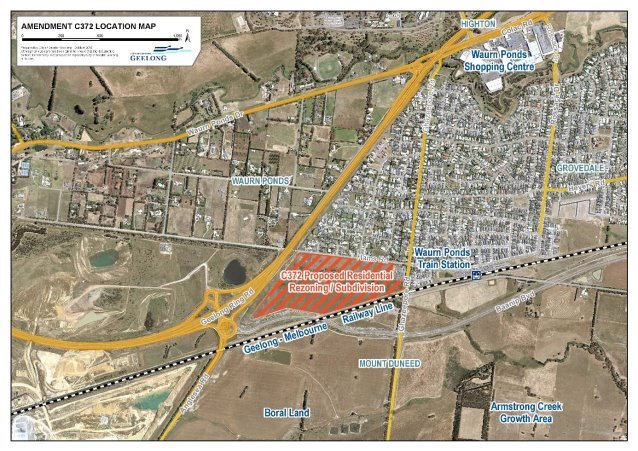
“The site is irregular in shape with a total approximate area of 23.86 hectares. The site is defined by Hams Road to the north, Ghazeepore Road to the east, the railway line and Baanip Boulevard to the south and Princes Freeway/Geelong Ring Road to the west. At the north-east corner of the site is a Powercor owned Substation and traversing through the site is a tributary of Armstrong Creek.
To the north and northeast of the site are established residential areas. Residential land to the north of the site is known as Grange Park, with predominantly larger lots.
To the east of the site is currently vacant land zoned as Urban Growth Zone 3 (UGZ3) and is affected by the Armstrong Creek West PSP. The land has been identified as predominantly conventional and medium density housing. The Waurn Ponds train station is also located to the east of the site.
To the south of the site is currently zoned Special Use for quarrying, however is currently inactive other than for some limited agricultural use.”
An aerial photo and location map showing the site is provided below:
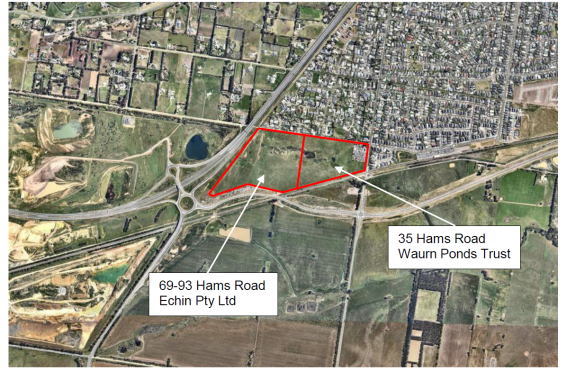
The land is in two titles, with separate landowners - Echin Pty Ltd and Waurn Ponds Unit Trust. Land ownership is shown below (taken from Town Planning Report by Taylors).
Proposal
On 29 June 2017 Taylors Development Strategists on behalf of the two landowners lodged a combined planning scheme amendment and two planning permit applications to allow a multi lot subdivision at 35 & 69-93 Hams Road, Waurn Ponds.
The amendment proposes the following:
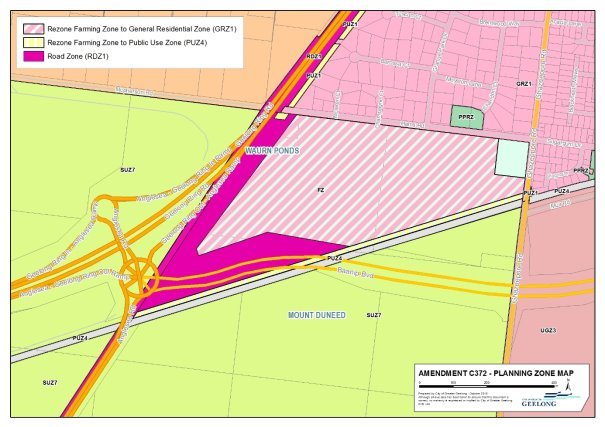
Rezoning of land from the Farming Zone (FZ) to the General Residential Zone (GRZ);
Rezone the land within the Barwon Water reserve (north of the Geelong/Warnambool Railway line) from FZ to Public Use Zone (PUZ);
Introduction of a Design and Development Overlay (DDO) to inform the key built form outcomes for the land.
The amendment is accompanied by two planning permit applications:
PP662/2017 for multi lot subdivision of the land at 35 Hams Road owned by Waurn Ponds Trust; and
PP663/3017 for multi lot subdivision of the land at 69-93 Hams Road owned by Echin Pty Ltd.
The map below shows the proposed zoning changes (the DDO would apply to the area being rezoned to GRZ1):
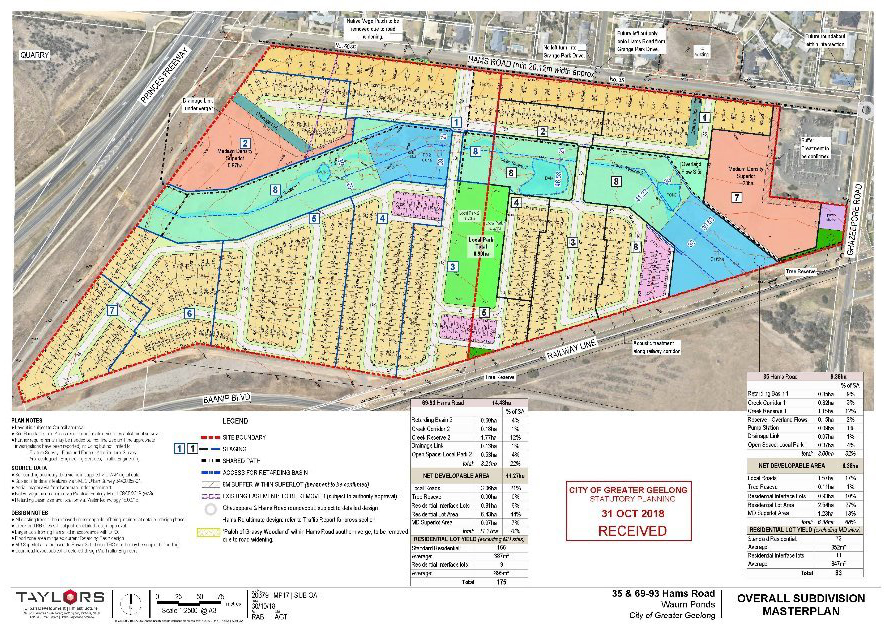
The overall subdivision masterplan proposed for exhibition is provided in Attachment 3.
Consideration and assessment of the proposal
The application (including technical reports and plans) were referred to internal Council departments and external government authorities for comment in August 2017.
The feedback from the initial referral was that the application lacked detail in several areas and required further work. Council officers issued a “further information” letter to the applicant on 10 October 2017 requesting a response to a list of twenty issues that had been raised by referral authorities.
The applicant took several months to undertake further investigations and refine its’ plans as requested in Council’s letter.
On 16 May 2018 the applicant responded to Council’s request for further information. An updated set of plans and reports were submitted including:
Traffic Engineering Assessment;
Flood Modelling;
Flora and Fauna Assessment;
Urban Design Masterplan;
Town Planning Report;
Acoustic Report;
Site investigation (soil contamination); and
Buffer study (from quarry).
These documents were then re-circulated for comment and further feedback was provided to the applicant.
The end result is a version of the masterplan that officers generally support and are willing to recommend for public exhibition (see Attachment 3).
A summary of the development as detailed in the latest masterplan includes:
A total of 258 residential lots;
21 larger ‘interface’ lots on Hams Rd with an average of 850 square metres approx.;
Two medium density ‘superlot’ sites;
A 0.9 ha local park central to the site to be delivered across the two developments;
A creek reserve with an average width of 30m either side of the creek;
Traffic treatments to discourage increased use of Grange Park Drive;
Drainage retarding basins on each title; and
A sewer pump station for the development.
Draft planning permits, a Design and Development Overlay and a Section 173 Agreement are being prepared and subject to Council resolution will be exhibited alongside the amendment and other documents for public comment in early 2019.
(Previously agenda item 1)
Source: |
Investment & Attraction / Central Geelong & Waterfront |
Director: |
Brett Luxford |
Portfolio: |
Transportation and Connections |
To seek Council’s endorsement to release the ‘Parking in Central Geelong - Discussion Paper December 2018’, for stakeholder and community engagement.
GTA Consultants were engaged by the Revitalising Central Geelong Partnership to develop a ‘Parking in Central Geelong - Discussion Paper’ (Attachment 2) and supporting technical analysis report (Attachment 3) for the area generally bound by Latrobe Terrace, the Waterfront, Garden and Carr Streets.
The discussion paper, proposes 17 parking considerations which seek to complement the vision for a revitalised Central Geelong with more people living, working and playing in the city centre.
The paper also aims to deliver on many of the Clever and Creative aspirations, namely a fast, reliable and connected transport network, an inclusive, diverse, healthy and socially connected community, a destination that attracts local and international visitors and encourages sustainable solutions to ensure that public land is being used to support an active, healthy and vibrant community.
A communication and engagement strategy will be developed to guide and inform the engagement process. Engagement will include forums, surveys, one-on-one discussions and will seek feedback via various channels.
There are a range of opinions around the provision of parking within any shopping centre and parking is often a highly emotive issue;
As Central Geelong develops further the need for an integrated solution to accessing Central Geelong becomes even more important;
The ‘Parking in Central Geelong - Discussion Paper’ highlights a range of considerations that are based on the technical evidence and experience around other key centres;
The release of this discussion paper will help stimulate conversations around parking and encourage people to think further around what the future of Geelong might look like;
The consultation is proposed to be open for 100 days to ensure a wide range of people are able to provide feedback on the discussion paper to help inform the development of a Parking Strategy for Central Geelong.
Councillor Kontelj moved, Councillor Mansfield seconded -
That Council endorses the release of the ‘Parking in Central Geelong – Discussion Paper December 2018’ for stakeholder and community engagement from Thursday 20 December 2018 until Friday 29 March 2019 (100 days).
Carried.
The cost of the stakeholder and community engagement will include material production (animated video and printing) and forum facilitation which is approved in the Central Geelong Revitalisation budget (DELWP and CoGG funding) for the Parking Study.
Expenditure is estimated to be around $17,000.
The stakeholder and community engagement will be undertaken for a period of 100 days. This is to ensure all groups and individuals that wish to make comment will have the opportunity, outside the traditional Christmas/New Year holiday period.
The discussion paper is written in such a way that it encourages contemplation and consideration of all aspects associated with parking in the CBD. It asks those responding to really put thought in to what type of city we want, how we best use our space and what outcomes will make us happier, healthier and more connected in the future.
The communication and engagement strategy will include public and stakeholder forums which will be facilitated by subject experts and Council staff.
A short animated video is being produced with the contents of the discussion paper and will support the discussion forums. In addition, documentation will be provided to facilitate the forums, surveys and one-on-one discussions.
Following the engagement process, feedback will be collated, aims and objectives will be established and issues, opportunities and challenges will be outlined to assist with the development of the strategic direction for a draft parking strategy to be presented to Council mid-2019.
Geelong’s Clever and Creative Future highlights that the community values sustainable, connected and networked walking, cycling and public transport services.
A measure of success in A Clever and Creative Future is achieving a fast, reliable and connected transport network where at least 50% of journeys to work are made by public transport, walking or cycling. Currently 92% of commuter trips within 6km of Central Geelong are taken by car.
The Parking in Central Geelong - Discussion Paper December 2018 includes recommendations which address social inequity by ensuring CBD public land is used to its highest and best use for the community.
The discussion paper will lead to the development of strategy that will seek to support the development of Central Geelong for many years to come. The City has a statutory role in shaping how the city develops and operates and the orderly movement of people into and through the city is a key element.
This report aligns with the following key priorities of the Council Plan 2018 – 2022:
Continuing to work with government to deliver projects that revitalise Central Geelong;
Improving our road management and engagement program;
Proactively managing our assets, including land holdings;
Providing more quality spaces that support active lifestyles;
Delivering Smart Cities infrastructure using electronic data collection to better manage assets and resources;
Reducing our carbon footprint.
There are no direct or indirect conflicts of interest relating to the officer that prepared this report or the consultant/officer team that produced the discussion paper or technical analysis report.
Not taking appropriate action to fully and thoroughly engage with all stakeholders and the broader community poses a reputational risk to Council and undermines our credibility as a community leader.
Parking is a passionately debated topic within the community and it is the responsibility of Council to show leadership in this space and demonstrate to the city that our thoughts are considered, progressive and aligned with the thinking of modern prosperous, healthy global cities.
There are considerable environmental benefits to be gained by encouraging the community to choose active and mass transport options. Lower emissions and less congestion are two of the most visible which we hope would be referenced through the engagement process.
Source: |
Investment & Attraction |
Director: |
Brett Luxfod |
Portfolio: |
Economic Development |
To provide Council with the Melbourne - Geelong Fast Rail strategy report and to discuss the next steps Council could take in advocating for this important infrastructure initiative for Geelong and the other regional centres.
Improved rail travel time from Geelong to Melbourne has long been seen as a key to enhancing the connections between Victoria’s two largest cities. With the continued population growth in the Geelong region and the increasing opportunities for employment, the need for a fast rail service has never been stronger.
To be in a position to better understand the options and to be able to prosecute an informed position, the City commissioned a report on the economic, planning and finance merits of a Regional Fast Rail service between Melbourne and Geelong.
The Melbourne - Geelong Fast Rail strategy report (Attachment 2) has been presented to the Victorian Government’s Minister for Public Transport and Major Project, Jacinta Allan MP who, on 15 October 2018, attended with the Premier in Geelong to announce the next phase in the Victorian Government’s planning for fast rail to regional centres and highlighted the need for the Victorian Government to work in partnership with Local Government in delivering this initiative.
To be an informed advocate, the City needed to understand the opportunities and issues with any fast rail proposal.
The City needs to be the local voice to ensure that the Victorian Government understands the local issues and the City can work in partnership with the Victorian Government on the delivery of this key piece of infrastructure.
The fast rail initiative as outlined in the report will add significantly to the connectivity between Melbourne and Geelong but will also enhance opportunities for other regional centres and Western Melbourne’s metropolitan rail network.
The report highlights the interlinkages between regional rail services and the metropolitan services to Melbourne’s west.
The development of an informal partnership, led by the City and titled the “New Spirit of Progress Committee”, has begun to bring together key stakeholders.
The partnership comprising representatives from Local Government in the key regional centres of Ballarat, Bendigo, Shepparton, Colac, and Latrobe will meet and seek to add to the advocacy opportunities.
This partnership would be complemented with other key representatives from Melbourne City Council, Wyndham City Council, Melton City Council, Deakin University, Federation University and the Australian Rail Futures Institute.
Councillor Harwood moved, Councillor Sullivan seconded -
That Council:
Note the Melbourne - Geelong Fast Rail strategy report;
Note the development of the ‘New Spirit of Progress Committee’ and appoint the Mayor and Deputy Mayor as the Councillor representatives on the ‘New Spirit of Progress Committee’; and
Continue to advocate strongly for a Melbourne - Geelong Fast Rail service.
Carried.
The Melbourne - Geelong Fast Rail strategy report was commissioned by the City and developed at a cost of $30,000. The document is a key report to drive the opportunities for fast rail between Melbourne and Geelong and has already driven discussions between the Victorian Government and the City.
There has been considerable public discussion around the need for a fast rail service, however this report was developed by industry experts and there was no community engagement in the development of this report. The report looks at the technical and economic merits of the case.
It is anticipated that, as this project continues to move forward, there will be significant engagement with the community around the model and service that our community is seeking for fast rail.
An effective and efficient public transport system is a key consideration in addressing social equity. A fast rail service will enable everyone within our community to access opportunities for additional employment and services in metropolitan Melbourne with greater ease.
A fast rail service will also help drive the Geelong region economy which will in turn open up further opportunities for employment and the development of other key pieces of social infrastructure.
The development of the report and the advocacy surrounding advocacy is a key role for local government and complies with all relevant legislation.
Melbourne to Geelong fast rail aligns with many key themes and strategic priorities within the Council Plan 2018-22 including:
Planned sustainable development
Effective environmental management
Integrated transport connections
A thriving and sustainable economy
Effective and efficient public transport infrastructure allows communities to develop and provides opportunities for all.
No Council Officer in the development of this report has any real or perceived conflict of interest.
A key role for local government is advocating for the needs of the community. The City’s involvement in this project reduces any risk that Geelong’s community will not be adequately represented in discussions around fast rail in Victoria.
The ‘New Spirit of Progress Committee’ will enable key stakeholders to work together with the Victorian Government to enhance the potential for the delivery of this much needed infrastructure.
An effective rail connection between Melbourne and Geelong will reduce the dependency of many within both communities on the car as a key form of transport. As more and more people choose to travel by train this will reduce the impact on the environment and reduce the quantity of greenhouse gas emissions.
[Back to List](Previously agenda item 3)
Source: |
Planning & Development - Health & Local Laws |
Director: |
Gareth Smith |
Portfolio: |
Community Health and Safety |
To approve an amended Dog Controls in Public Places Policy pursuant to Section 26 (2) of the Domestic Animals Act 1994.
On 14 August 2018 Council approved a Draft Dog Controls in Public Places Policy following a community consultation period of 4 weeks which received 469 responses. At this meeting Council also resolved to conduct a second stage of consultation for a period of 6 weeks on the draft Policy.
This secondary six-week consultation process consisted of an online survey with hard copy versions being made available at all customer service centres. Input was also provided by Council Departments and Council Asset Managers. (See Attachment 2 ‘Discussion’)
The City received 122 responses which have been summarised in Attachment 3 ‘Community Feedback Summary Report’.
The proposed Dog Controls in Public Places Policy has been amended accordingly to reflect the community engagement feedback received and safety considerations from Asset Managers (see Attachment 4). Maps are included as Attachment 5.
Feedback received from the Stage 2 consultation process is consistent with that received during Stage 1, that being the community is seeking safe and shared public places.
The community are seeking more presence and enforcement of such orders to manage poorly behaved dogs and irresponsible owners.
Engagement resulted in 122 submissions with 2130 page views and 324 document downloads.
There is likely to be financial implications associated with the community’s request for more enforcement, education, patrolling, signage and waste bins. An assessment of this will be undertaken over the next 12 months in conjunction with the relevant asset managers.
New Orders with respect to on and off-leash are proposed for the Kardinia Park Precinct.
The revised policy if adopted would see a 150% increase of off-leash Reserves and open spaces (From 18 to 39) in addition to the existing 43 Sporting Reserves that are currently available.
Track changes on the document (Attachment 4) show all changes made from the existing policy as a result of the two rounds of engagement.
Councillor Murrihy moved, Councillor Mason seconded -<
That Council:
Note the completion of Stage 1 and 2 of the consultation process;
Adopt the Dog Controls in Public Places Policy, with the following amendment:
Replace sub dot point 6 under the heading On Leash ‘Controlled’ Areas with the words: “All areas in the Kardinia Park Reserve Precinct (except for the Kardinia Park West ground playing surface and Geelong Cricket Ground playing surface) at all times”;
Authorise the making of the Order under Section 26 of the Domestic Animals Act 1994; and
Delegate to the Manager Health and Local Laws the authority to carry out the required statutory advertising in the making of the Order by Council.
Carried.
The City will need to undertake an assessment to evaluate the level of resources required to implement increased educational programs and patrolling and enforcement activities. In conjunction with the asset managers, a signage audit should be conducted to establish a program to remove old signs and install new signs. In conjunction with the asset managers a bin audit should be undertaken along key walking tracks and reserves with the view of increasing the number of accessible bins and bag dispensers.
Overall between Stage 1 and 2 the City conducted a 10-week long community engagement process which consisted of an online survey with hard copies available at customer service centres. The survey was advertised in local newspapers, through social media as well as posters displayed on some key walking tracks.
Engagement resulted in 122 submissions with 2130 page views and 324 document downloads.
The City received 580 responses in total (stage 1 and 2) with 122 being received during stage 2.
The community engagement undertaken provided opportunity for all groups and all members of our community to have access to information and an avenue for feedback. The resultant Dog Controls in Public Places Policy has considered the delivery of safe and accessible public spaces for all and there are no foreseeable barriers in this regard.
By amending the policy, the City will implement increased preventative action which aims to promote safety in public places for all users through reduced number of incidents.
Under Section 26 of the Domestic Animals Act 1994, Council may by resolution make an Order which sets out conditions with respect to dogs in public places. This Order must be published in the Government Gazette and in a newspaper circulating in the municipal district of the Council making the Order.
Improved Health and Safety of our Community:
Providing safer public places
Encouraging responsible pet ownership
Promoting active living
Informed Social Infrastructure and Planning:
Provide more quality spaces that support active lifestyles
More inclusive and Diverse Community:
Supporting activities that improve social connections in our community
Further developing programs that support older people and young people in our community
There is no conflict of interest with respect to any officer in the preparation of this report.
Council can minimise its risks by applying practical, fair and reasonable Dog Control Orders in public places to ensure the safety of all users. The Orders provide a platform for community education, against which compliance activities and preventative measures can be undertaken.
There is recognition of the existence of several environmentally sensitive areas that will be provided with the adequate controls contained within these proposed Dog Control Orders.
Council has had a Dog Controls in Public Places Policy since 2008, with three revisions of that policy having taken place since that time.
Any dog rules that may be applied to open spaces within the municipality on land managed by other land managers would be covered by a separate process in which Council can choose to enter into a formal agreement pursuant to Section 26 (2) of the Domestic Animals Act 1994. A copy of the proposed ‘marked up’ version of the Dog Controls in Public Places Policy is attached as Attachment 4.
Feedback was also sought from the City’s various asset managers who have indirectly been provided with community feedback from their various customers and lease holders with respect to providing a balanced approach to the safe and shared use of such open spaces.
Overall there were 122 respondents to the survey. The issues raised are reflected in the Community Feedback Summary (Attachment 3). Responses and recommendations are included against each issue raised.
Limiting the policy to Council managed lands and dealing with Dog Orders on other lands through a separate process under the Domestic Animals Act 1994.
Proposal to make the beach to the west of the Clifton Springs Boat Harbour up to Griggs Creek a ‘dogs off leash’ area (Map 9).
Increase the number of ‘dogs off leash’ open space reserves (as per Table 1 of the Policy).
Increase accessibility to waste bins for dog walkers and placing the onus on such to dispose of dog waste.
Improved quality and quantity of signage to assist dog walkers to understand the requirements of public spaces.
Prohibit dogs from sports playing surfaces during organised sport (the policy is silent on this at present).
Prohibiting dogs on artificial sport playing surfaces such as synthetic turf, asphalt, flexi-pave etc.
Keeping dogs a minimum of 10 metres away from turf wickets.
Dogs to be prohibited a minimum of 10 metres from children’s playground equipment and must be tethered beyond that point.
Dogs when tethered must not be left unattended.
Dogs to be on leash around boat ramps, including adjoining car park.
Deletion of the ‘Reserves - On Leash – Controlled Areas’ Table (as this is covered by the general requirement that all areas are on leash unless otherwise signed).
Deletion of ‘Map 8’ from the ‘Dog Controls in Coastal and Other Open Space Areas’ (as the Bellarine Bayside Foreshore Committee of Management lands will be covered by a separate process).
Facilities of Regional importance including the John Landy Athletics Track/Field, Goldsworthy Athletics Track/Field, Geelong Baseball Centre (Pioneer Park) shall have dogs prohibited at all times.
The football playing surface of Kardinia Park West be an off-leash area when not in use and the remainder of the Kardinia Park Reserve Precinct to be on-leash at all times.
Under effective control definition is less descriptive but places the onus on the owner to avoid incidents.
More Dog Parks.
More enforcement and patrols.
Request to change the Dell to conditional off-leash area.
Elcho Park Equestrian Centre/other Equestrian Centres to be an on leash at all times.
The importance of dog ownership with respect to improving health wellbeing outcomes is acknowledged. Whilst the broader community are relatively satisfied with the balance of the existing Dog Control Orders, there remains a small number of people who either want tighter dog controls or less onerous dog controls. In considering all of the collective views, the Draft Dog Controls in Public Places Policy aims to provide the greatest benefit to the broader community in the interest of providing safe and shared public spaces for all users.
Significant feedback was received about the need to promote our public spaces as being for all users with no specific group having greater entitlement to these spaces over any other group. The provision of off leash areas is not intended to mean that dogs and their owners are the sole users of that place nor does it imply that the place in question is a ‘dog reserve’ or a ‘dog beach’. These places are public reserves or public beaches for all users but also permit dogs to be off leash on the proviso of being under effective control.
There has been a strong demand for more education about compliance requirements of this policy and a greater presence of officers patrolling these public spaces in order to improve compliance outcomes and reduce any tension/conflict between the various users of such places.
While submitters were advised that a separate piece of strategic work is being conducted by the City’s Social Planning and Investment department, many requests for the City to consider developing a range of strategically located dog parks were submitted. These have been forwarded to that department for incorporation into that process.
There were no requests to change any of the City of Greater Geelong coastal orders except for a request from a Clifton Springs resident which is summarised in the Community Feedback Summary.
(Previously agenda item 4)
Source: |
Finance and Strategy - Property and Procurement |
Director: |
Michael Dugina |
Portfolio: |
Social and Infrastructure Planning |
To provide an update on the progress of the Osborne Park Master Plan.
On 24 July 2018, Council considered the ownership and restoration of Osborne House and the Stables and the future of Osborne Park. As a result, Council resolved, amongst other things, to:
Complete a Master Plan and Business case for the future use of Osborne Park, Osborne House and the Stables, taking into consideration suggestions and recommendations from the Conservation Management Plan for Osborne Park and the Stables; and
Accept Master Planning for the entire site, including Osborne House and the Stables must be completed by December 2018:
The Master Planning process, which also consists of scoping and costing the required restoration and development works, must include public and community consultation with relevant stakeholders such as Osborne Park Association, Vietnam Veterans, Corio Bay Camera Club, Geelong Memorial Brass Band, Maritime Museum, North Geelong Football, Netball and Cricket Club and other Osborne House/Park tenants.
Council officers have acted to implement the resolution of Council and wish to update Council on the progress made and the anticipated time for delivery of the Master Plan for Osborne Park.
he Master Plan was not able to commence until the City engaged a suitably qualified consultant with the relevant skills set to deliver the diverse needs of the Master Planning project.
A comprehensive review of relevant information about Osborne House and the Stables and Osborne Park has been completed.Site inspections and analysis will be completed prior to Christmas to support the Master Plan.
The draft Master Plan will be ready for community consultation in February 2019. Over 25 community groups will be directly engaged prior to general community consultation which is scheduled for February 2019.
The Master Plan is anticipated to be finalised in April 2019.
Councillor Kontelj moved, Councillor Murrihy seconded -
That Council:
Note that the Osborne Park Master Plan will not be delivered by the date of December 2018 as per the resolution made on 24 July 2018;
Approve the adjusted timeline for the completion of the Master Plan that will see the finalised Master Plan presented to Council by no later than June 2019.
Council conducts a community consultation by the end of December 2018 to include the working group and stakeholders as documented in Item 4 of the resolution of 24 July 2018.
That the working group are kept actively engaged throughout the entire master plan development process.
Carried.
The contract and budget allocation for this consultancy engagement has now been allocated through an existing budget. The cost of this project will not be impacted by the delay in the delivery of the project.
The City has met with key identified community groups (working group).
Members of the working group have been invited to discuss their individual needs, thoughts and ideas for precinct during in January.
The working group will then meet to agree on the future options and plans for Osborne Park, prior to public consultation.
Public consultation will take place in February 2019.
To ensure social equity, community consultation sessions will be held in the City as well as within the precinct.
Building code, traffic requirements, heritage and local cultural sensitives need to be considered throughout the development and implementation of this masterplan.
This aligns to the following Council Plan priorities: A destination that attracts local and international visitors; People feel safe where they are; An inclusive, diverse, healthy and socially connected community.
No officers involved in this project have any conflicts to declare.
The development of a Master Plan for Osborne Park is a significant project which is currently subject to tight deadlines. There are a number of factors that may impact on the timing of the delivery of the Master Plan, including the Christmas/New Year period and the availability of community groups to participate in public consultation. The City is aware of these risks and is taking steps to manage them through a comprehensive project plan.
This site has several environmental considerations. Mould within Osborne House is an ongoing issue that will continue to be monitored. Drainage issues with the Osborne Park car park is a known issue that will be addressed as part of rectification works. Environmental land and coastal land are also prominent within this zone and these will be considered as part of the Master Plan.
[Back to List]
(Previously agenda item 5)
Source: |
Community Life |
Acting Director: |
Robyn Stevens |
Portfolio: |
Social and Infrastructure Planning |
To note feedback provided through the ‘Have Your Say’ and the Submissions Review Panel processes and seek Council authorisation to construct a local playground at 13-17 Sandbar Street, St Leonards known as Sandbar Street Reserve.
The Geelong Play Strategy 2012-2021 identifies the reserve on Sandbar Street in St Leonards as being the appropriate site to develop a local playground in order to address a gap in play provision in this neighbourhood.
In 2016 a proposal to construct play equipment at this reserve was initiated in response to ratepayer requests for a local playground in this area. A design proposal which was circulated to local residents for their feedback was subject to a petition of local residents opposed to the plan. Despite efforts by Council officers to redesign the proposal to address their concerns, the group remained opposed to the playground and the project did not proceed.
Council officers have since followed the Approval Procedure for Open Space Development Projects to determine a way forward. In September 2018 residents and owners of properties within 400 meters of the reserve were invited to provide feedback on the proposed playground. Of the 129 responses received, 115 (89%) were in favour of the proposed playground construction, with 14 (11%) opposed.
On 17 October, 2018 Council officers met with objectors with the intention of better understanding their concerns and exploring potential design solutions. At the conclusion of this meeting attendees remained opposed to the construction of play equipment at this reserve and the matter proceeded to a Submissions Review Panel on 13 November, 2018. Minutes of the meeting are provided at Attachment 2. A decision of Council is now required regarding the construction of a playground at this reserve.
There is an identified gap in playground provision in this area of St Leonards.
Alternative sites have been investigated and found unsuitable.
Alternate designs have been explored and the play equipment minimised in an attempt to address objector concerns.
There has been community feedback indicating a strong majority of support for construction of a play space at this reserve. However, it is important to note that a number of residents live immediately adjacent to the reserve are opposed to the playground, and the details of their submission were presented to the submission review panel (refer to Attachment 2).
Councillor Murrihy moved, Councillor Aitken seconded -
That Council:
Note community feedback received through the ‘Have your say process’ and the proceedings of the Submissions Review Panel; and
Authorise officers to proceed with the construction of a local level play space within the approved $30,000 budget at the Sandbar Street Reserve.
Carried.
The estimated cost of the playground (based on current design) is $30,000. Funds for the playground were approved in the 2016-17 Council budget and have been carried over since this time.
The construction of the shelter is estimated to cost $15,000, which is additional to the $30,000 playground budget. Funding for the shelter has been identified within the 2018/19 recurrent playground upgrade budget. No additional funding is required.
In November and December 2016, following development of a business case and subsequent funding for this playground in the 2016-17 budget, residents living within 400m of Sandbar Reserve had the opportunity to vote and make comments on the proposed playground. While 22 positive comments were received, the City also received a petition signed by 33 people, objecting to a new playground in this location. The petition was formed around issues relating to aesthetics, lack of parking, existing provision, aged demographic group, impact on amenity including noise and maintenance.
A number of meetings were held between representatives of the petitioners and Officers to discuss and understand concerns and to find a compromise. The objecting residents felt a passive space that supported quiet reflection and small groups coming together was most appropriate for the location. Officers engaged a landscape architect to revise the playground design in response to these discussions.
In response to the revised plan, the objecting petitioners supported elements of the new plan, but still objected to the play equipment citing concerns about possible anti-social behaviour. As a result, the playground construction has not progressed since this time.
In early 2018, Council was approached by residents who had supported the original proposal, requesting that construction of the playground proceed. As a result, a decision was made to trigger the Approval Procedure for Open Space Development Projects policy, in order to reach a decision on this matter.
The process followed is outlined below:
Monday 10 September, 2018 - A letter was sent to all residences and owners of properties within a 400m radius of Sandbar Street Reserve and signage was displayed inviting feedback/submissions on the proposed construction of a playground at this reserve. The consultation period closed on Thursday 27 September. An outline of the community engagement outcomes is provided in Attachment 3.
129 responses were received (21.5% response rate), comprising 122 online surveys through Councils ‘Have Your Say’ platform along with six (6) emails and one (1) letter. 83% of respondents indicated they lived within 400m of the reserve.
Overall, support for the playground was overwhelming, with 115 responses (89%) in favour of the playground and 14 responses (11%) in opposition. A summary of community feedback received through this process is provided at Attachment 3.
All 14 objectors to the proposal were invited to attend a meeting with Officers held on Wednesday 17 October 2018. Thirteen objectors attended this meeting. Predominantly these residents occupied homes directly abutting the reserve.
Objectors expressed a range of concerns with the proposal. These focussed on issues relating to the local elderly demographic and concerns of noise, safety and maintenance. Council Officers were unsuccessful in negotiating design solutions to the playground. The resolution from this meeting was that the attendees remained opposed to the proposed playground and that the matter would proceed to a Submissions Review Panel as the next step in the Approval Procedure for Open Space Development Projects.
All respondents to the initial feedback process were invited to attend a Submissions Review Panel held at Council Chambers on 13 November 2018. The Panel was chaired by Councillor Asher and comprised Councillors Harwood, Murrihy, Sullivan, Mason and Grzybek.
Thirteen residents attended the Panel, with one person nominated to address the Councillors on behalf of the opponents to the playground. Another individual briefly spoke in support of the playground. Minutes of this Panel meeting are provided in Attachment 2.
The Geelong Play Strategy 2012-2021 identified an area south of Leviens Road, St Leonards as having a gap in play space provision. The strategy suggested a new playground in either the reserve on Sandbar Street, managed by the City, or the reserve between Bluff and Lower Bluff Roads, managed by Bellarine Bayside Foreshore Committee of Management. New residential development to the west of Sandbar Street will include open space and playgrounds, but they will be outside the area of need identified in the Play Strategy. Failure to provide quality, well-maintained play spaces can make it difficult for children to access play spaces, particularly if the closest play space is some distance from their home.
After assessing the two suggested locations, as well as an additional location, Officers concluded Sandbar Street was the more appropriate and central location for a play space. The other locations were discounted for a range of reasons including limited provision of space, not being managed by the City, being poorly located for the targeted residential catchment and not being easily accessible.
The playground designs have been amended and the proposed play equipment simplified in an attempt to address objector concerns. Any further reduction in the provision of equipment is not recommended as it will likely result in a play space that offers minimal play value and a poor experience for users. The material of the play equipment will also be considered in the procurement process to see if this aspect of the objectors concerns can be addressed, but this will be subject to budget.
There are no known policy, legal or statutory implications associated with this report.
The development of the Sandbar Street Reserve Play Space is consistent with three of the eleven strategic priorities of the Council Plan 2018-2022. The development of a playground at this location will;
Improve health and safety for our community; by creating more play opportunities through improved community recreation infrastructure;
Informed social infrastructure and planning; through implementing the recommendations in the Geelong Play Strategy 2012-2021, the Sandbar Reserve Play Space will address a gap in facilities and improve play experiences for children; and
A more inclusive and diverse community; by supporting activities that improve social connections in our community through recreational infrastructure.
No officer involved in the preparation of this report has any known direct or indirect conflict of interest.
A small group of objectors to the proposal are likely to be critical of a decision to construct a playground at this reserve. A decision not to construct may also result in negative feedback from a broader group of nearby residents.
There are no foreseeable environmental implications associated with this report and recommended action.
Source: |
Community Life - Healthy Communities |
Acting Director: |
Robyn Stevens |
Portfolio: |
Community Health and Safety |
To provide advice to Council on the resource implications of re-establishing Council’s Gambling Advisory Committee.`
At the Council meeting on 25 September 2018, Council supported a harm minimisation for problem gambling Notice of Motion that resolved to:
confirm their support for the Alliance for Gambling Reform and consider becoming a member during the 2019/2020 budget period;
provide advice on the resource implications to re-establish the Gambling Advisory Committee and have officers report back to Council no later than 30 November 2018; and
reaffirms that all responses to the VCGLR regarding applications by venues to obtain additional EGMs are brought to the chamber for a decision by Council.
Council established the Geelong Gambling Advisory Committee at its meeting held 12 April 2011. The Terms of Reference (Attachment 2) for the Committee stipulated that the Committee had a Councillor as Chair, allowed for membership from neighbouring municipalities and community organisations and a community representative.
The Committee provided a mechanism to review Council plans and to have input into the construction of community forums and community awareness campaigns.
As part of a general review of Council Committees, the Committee ceased operation in 2017.
The purpose of the Gambling Advisory Committee was to provide specialist advice to Council with respect to gambling harm minimisation in the wider Geelong community. The Committee was created (2011) at a time when the City of Greater Geelong recorded the fifth highest level of gambling losses from electronic gambling machines (EGMs) among municipalities in Victoria. This continues to be the case. Despite not being at its cap for the number of EGMs, Greater Geelong continues to record more than $9.5 million per month in gambling losses.
To re-establish the Gambling Advisory Committee, it is estimated that $52,550 will be required to satisfy the following functions:
secretariat to handle meeting administration;
public awareness raising programs such as information campaigns during Gambling Harm Awareness Week and Mental Health Week;
public forums on recent gambling research findings; and
public advocacy including facilitating public engagement into Victorian Gambling and Liquor Regulation (VCGLR) decision processes when handling EGM applications.
Council has a mandated responsibility to respond to applications for electronic gaming and liquor, this is provided for within existing resources. Current resources leave limited capacity to carry out community education activities targeting the reduction of harm from gambling.
Councillor Mansfield moved, Councillor Mason seconded -
That Council:
consider the financial and staffing implications of re-establishing the Gambling Advisory Committee; and
note the estimated costs of $52,550 which will be referred to the 2019/20 budget considerations.
Carried.
There is no current funding or staffing allocation to support a Gambling Advisory Committee. In order to service the Gambling Advisory Committee a 0.4 equivalent full time (2 days per week) position will be required to be funded (approx. $37,550). In order to satisfy the education and advocacy costs a further $15,000 will be required to conduct a number of community awareness programs. This will require an annual budget of $52,550.
Financial contributions could be considered as an option for any regional memberships.
The development of a gambling advisory committee will assist in facilitating community involvement in harm reduction measures. Whilst the Committee will have a Geelong focus there will be advantages in maintaining the previous regional approach by inviting other key representatives, notably from the municipalities of Surf Coast, Queenscliffe, Golden Plains and Colac-Otway and G21’s Health and Wellbeing division.
Council’s Electronic Gaming Policy highlights that the concentration of EGMs tend to be highest in disadvantageous communities. This is not uncommon in other local government areas in Victoria as well. Through community liaison and education, the Gambling Advisory Committee will be in a position to carry out campaigns that aim to reduce harm from gambling in such communities.
The Gambling Advisory Committee will assist Council in meeting its statutory (Greater Geelong Planning Scheme - particularly clause 21.07, 22.57 and 52.28) and regulatory (Gambling Regulation Act 2003) obligations outlined in Council’s Electronic Gaming Policy by encouraging community responses to applications for increasing the number of EGMs in venues in Greater Geelong.
The establishment of a Gambling Advisory Committee with the objective of minimising harm in the community from gambling aligns with the Council Plan goal of ‘Improved Health and Safety of Our Community’.
The author of this reports that there is no conflict of interest connected with the writing this report.
It is well documented that gambling harm poses significant risks to certain members of the community.
There are no environmental impacts associated with the subject matter of this report.
Source: |
City Services - Environment and Waste |
Director: |
Guy Wilson-Browne |
Portfolio: |
Environment and Sustainability |
To provide a report to Council on options, initiatives and financial implications of a plastic wise initiative aimed at reducing single use plastic for the community and Council including Council events, functions and activities.
At the Community Focus Council Meeting on the 14 August 2018, the following Notice of Motion was adopted by Council:
That:
Council requests officers to provide a report detailing options, requirements and financial implications of a waste wise and sustainability initiative aimed at reducing plastic waste;
The report is to include options for all Council events, functions and activities, as well as activities on Council land; and
The report be presented to Council by the 30 November 2018.
The City currently has many examples of initiatives across the organisation that reduce the use of single-use plastics. The Child and Family Care Centres use reusable drink bottles, as well as kitchen crockery and cutlery instead of plastic for everyday use and events. The City’s events permit process discourages the release of large numbers of balloons at events and also supports the development of waste management plans for events.
Key areas that fall within Council’s control in relation to single-use plastics include:
events such as official functions, civic events, community forums and workshops;
civic accommodation offices and depots such as, City Hall, Brougham St, Corio Street, Mercer Street, Busport, National Wool Museum and administrative functions being performed at depots; and
staff and contractors engaged in the operation of Council business.
Millions of tonnes of plastic enter the world’s rivers and oceans each year.
Single-use plastics have a negative impact on our environment, harm wildlife including aquatic species and marine bird life.
Council has a leadership opportunity to reduce single use plastics by developing a Plastic Wise Program that applies to Council staff, office buildings, contractors and events organised or approved by Council.
The event permit process is recommended to be reviewed to include provisions relating to single-use plastics. Key issues for consideration include:
A staged implementation of the updated event permit process and Plastic Wise Program will be required to ensure their successful implementation;
Exemptions may be required to allow the use of single-use plastics for some events to address OH&S requirements relating to the use of alternatives such as glass in public places.
Other Council policies such as the Procurement Policy and Sustainable Buildings Policy, as well as building tenancy lease agreements will be reviewed and updated to provide consistency and support to the delivery of a Plastic Wise Program including:
Reviewing the Procurement Policy to consider further provisions to reduce and/or eliminate sources of single use plastics in contracts and tenders;
Reviewing the Sustainable Building Policy to include provisions that inform leased buildings and tenancy agreements in relation to best practice waste management.
Development of Waste Management Plans for Council buildings will provide an audit of current performance. The Plans will optimise bin set-up, develop custom signage and labels, protocols for tenants, cleaners and building operations. These measures will help engage tenants and raise awareness.
Councillor Mansfield moved, Councillor Mason seconded -
That Council:
Support the development of a Plastic Wise Program by December 2019;
Note the estimated cost of $55,000 to develop and implement the Plastic Wise Program (refer to Attachment 2), which will be considered as part of the 2019/20 budget process; and
Note that a review of Council’s Sustainable Buildings Policy, Procurement Policy, and Events Permit process will take place to include additional provisions to reduce the use of single-use plastics.
Councillor Kontelj left the meeting room at 9:04pm
Carried.
The cost of works associated with introducing a Plastic Wise Program are estimated to be $55,000 for the 2019/20 financial year, including:
$35,000 to develop and implement waste management plans for Council offices;
$5,000 to develop campaign material for and to promote the Geelong War on Waste Campaign;
$5,000 promoting waste reduction programs;
$5,000 to support Coastal Committees of Management plastic waste reduction initiatives;
$5,000 for education and promotion of clean waterways.
The report has been prepared following consultation with a range of Council departments. Officers have also liaised with other Councils that have been or are involved in the development of similar policies.
The reduction in the use of single use plastics will be a component of the development of the Resource and Recovery Waste Management Strategy. This process will involve extensive consultation with Councillors, staff, stakeholders and the community.
Feedback collected will be considered for the draft Resource Recovery and Waste Management Strategy and also the Plastic Wise Program. The draft Strategy will then be exhibited for feedback.
Stakeholders will also be engaged as part of the review of the Events Permit process.
There are no social equity implications arising from the subject of this report.
Council’s Sustainable Building Policy will be reviewed to include provisions relating to the ongoing management of buildings post construction to ensure existing buildings comply with best practice waste management practices.
The development of a Plastic Wise Program as part of the Waste and Resource Recovery Strategy aligns with Effective Environmental Management and Improved Health and Safety for our community.
No Council officers who have provided advice in relation to this report have a conflict of interest regarding the matter under consideration.
There are no significant or high risks associated with the subject of this report.
The Plastic Wise Program and the Waste and Resource Recovery Strategy will provide direction and actions to reduce the impact of waste to the environment.
The Plastic Wise Program will be developed in conjunction with the Waste and Resources Recovery Strategy 2018-2023. One of the three Strategic Objectives in the Draft Waste and Resource Recovery Strategy is “Council leadership: take the lead to avoid and reduce waste generated in Council’s operations and services and increase resource recovery”
The Plastic Wise Program will include but not be limited to:
Development of a Plastic Wise Program for events and Council facilities
Review Council’s events permit process to include additional provisions such as training and educational resources to support implementation to reduce single use plastics. Council officers from the Events, Environment, Health and local Laws and Waste Teams will review the process and ensure any changes can be implemented, possibly in a staged approach.
Actively work with and support externally run events on Council land or buildings to reduce the use of single use plastics.
Develop waste management plans for key Council office buildings. Specialist building and waste consultants will be required to assist in the development of the plans. The consultants will engage closely with the City’s building and waste departments, as well staff located in the selected buildings. The estimated cost to develop and implement the plans is $35,000, which will be considered as part of the 2019-20 budget process.
Review of the Sustainable Buildings and Procurement Policies in relation to reducing single use plastics. No additional funding is required to undertake the review.
Plastic Wise Communities
Develop a Geelong War on Waste Campaign to provide information and encourage others to reduce single use plastics. Social media, the City’s website and monthly waste magazine, as well as other advertising will be used to promote the campaign. The development of the campaign material and promotion will cost an estimated $5,000 per annum, and will be considered as part of the 2019-20 budget process.
Support community groups via Council’s Community Grants Program to run free workshops on reducing waste and single use plastics. Funding from the existing Environment Grants Program will be used to cover the estimated $5,000 cost.
Continue the City’s support for the Caring for Our Bays program to identify litter that flow into the bays, the source of the litter and how we can work with others to prevent it from happening. No additional funding is required.
http://www.environmentbellarine.org.au/cb_pages/cuthbertsons_creek.php
Promoting waste reduction programs such as National Recycling Week, Clean up Australia Day and Plastic Free July. The estimated cost for this activity is $5,000 per annum and will include provision of skip bins, waste disposal costs and promotion for the events. This promotional work will be considered as part of the 2019/20 budget process.
Support initiatives by Coastal Committees of Management to reduce single use plastics. The estimated cost of this activity is $5,000 per annum which includes the development and production of educational materials as well as advertising. These initiatives will be considered as part of the 2019/20 budget process.
Lead clean-up days on our coastal foreshore reserves and encourage local users and visitors to our beaches to be part of programs such as Take 3 for the sea campaign https://www.take3.org/. Funding for this activity will be sourced from existing budgets.
Plastic Wise Businesses
Partner with key businesses to reduce single use plastics and be part of Clean-up Australia Day and Plastic Free July. The City already participates in these programs and no additional funding is required.
Support businesses located adjacent to waterways to sponsor signage and support education to reduce single use plastics. The estimated cost of this activity is $5,000 per annum, which includes signage and development of targeted educational material. This activity will be considered as part of the 2019-20 budget process.
Encourage businesses to adopt plastic wise principles. This will be undertaken through existing networks and forums.
(Previously agenda item 8)
Source: |
Investment and Attraction / Economic Development and Events |
Director: |
Brett Luxford |
Portfolio: |
Tourism and Events |
To provide an overview of the Geelong Major Events Committee (GME) including a summary of the decisions of GME for the period 1 July 2017 to 30 June 2018.
Council established GME in August 1998 pursuant to section 86 of the Local Government Act (Vic) 1989.
The continued success of GME to attract and fund major events requires an ongoing funding commitment from Council.
GME’s focus is on attracting and sponsoring major events to the region based on the economic and reputational outcomes these provide.
Between 1 July 2017 and 30 June 2018, 24 major events supported by GME were successfully hosted in the Geelong Region, including 9 new events.
The 24 major events stimulated economic activity and provided social benefits to our community. An estimated $64.6million of event expenditure was generated in our region from local and non-local sources, which supports the equivalent of 517 full time jobs in the Greater Geelong region and represents a return on investment of 46:1.
Around 500,000 participants and spectators are estimated to have attended the 24 major events sponsored by GME (Attachment 2 - Summary of Events Sponsored by GME 2017-2018). It also includes the estimated economic benefit to the region and attendance numbers.
The 2017-2018 GME sponsored events also provided additional social benefits for the local community through participation and spectator opportunities, with 70 percent of our major events offering some free public access and entertainment for all ages.
Councillor Murrihy moved, Councillor Sullivan seconded -
That Council notes this report providing an overview and a summary of the Geelong Major Events Committee decisions for the 2017-2018 year.
Councillor Kontelj re-entered the meeting room at 9;13pm
Councillor Mason left the meeting room at 9:13pm
Councillor Mason re-entered the meeting room at 9:15pm
Carried.
The total Council allocation of sponsorship funding of $1,402,842 paid during the period was within budget.
The event expenditure generated by the 24 events staged during the period 1 July 2017 to 30 June 2018 is estimated to be $64.6m. This event expenditure is estimated to support the equivalent of 517 full-time jobs in Greater Geelong and represents a return on investment for our community of 46:1.
GME meetings are currently held on the third Monday of each month commencing at 4.00pm at City Hall.
Up to six ordinary GME meetings are held annually and are open to the public. Each alternate month, the meetings are strategic sessions which allow for informal and strategic discussions with existing and potential event organisers and event briefings on confidential matters.
The GME consists of:
Up to four members of Council;
Up to six external representatives of the business/media/arts or events community;
The CEO (or his proxy); and
The Executive Director of Tourism Greater Geelong & The Bellarine Inc.
All members have full and equal voting rights.
GME funding decisions are guided by a Matrix of Events, a GME Funding Criteria and a Geelong Major Events Strategy which ensures a transparent governance process for the allocations and access to funding by the community at large.
Major events in Geelong make a significant contribution to the social, environmental and economic well-being of the community. These events can also provide a legacy for the community through redeveloped or newly constructed infrastructure.
The events staged within this reporting period provided social benefits for the local community through participation and spectator opportunities, with 17 of these major events offering free public access to the event.
It is estimated that up to 500,000 spectators attended the 24 events staged during the period ending 30 June 2018.
In August 1998, Council established GME as a section 86 Committee under the provisions of the Local Government Act (Vic) 1989 to stimulate and encourage events within the municipality.
The objectives of GME are to:
Strive to stimulate and encourage events that offer the best opportunity to provide measureable economic benefits, potential to market Geelong outside the municipality and enhance local community through participation of residents;
Support the development and improvement of hallmark, major and developing events while focusing its activities on a clearly defined strategic program;
Establish and maintain strong links with the private sector, government and our communities to achieve high levels of stakeholder investment and activity required to realise the events potential of Geelong.
GME undertake a range of overarching actions to achieve their objectives including:
A Geelong Major Events Strategy and Business Plan in accordance with terms of reference;
Maintenance of a funding submissions and evaluation process;
The development and attraction of new events;
The continuous improvement of current events;
Facilitation of state, federal government and private sector funding whatever possible; and
Recommendations to Council regarding event infrastructure needs.
This report aligns with the Council Plan as follows:
At the heart of Greater Geelong; A Clever and Creative Future are a series of community-led aspirations focusing on the region’s economy and employment, the environment, arts and culture, tourism and growth.One of the nine aspirations is for the Geelong region to be a destination that attracts local and international visitors through the securing of world class events and entertainment. This aspiration is supported by the objectives and activities of GME.
In addition, Council Plan identifies its key partnerships in this area including events related groups such as Visit Victoria and the Victorian Events Industry Council, along with event owners and operators. These key relationships are maintained and enhanced through the actions of GME.
No officers involved in preparing this report have any direct or indirect interest in any matter raised in this report.
The management of risks associated with events is an important aspect to protect the community and Council’s assets. Significant processes are in place to ensure all events staged in the region have adequate risk and emergency management procedures in place, particularly focussed on the contemporary security threats now facing mass crowd events.
All high risk major events are required to present event plans to Geelong’s Events Multi Agency Working Group, which is coordinated by Council’s Event Services Unit and chaired by the Victoria Police. During this process, feedback and advice is given to event organisers from the represented agencies and stakeholders on the working group, such as Victoria Police, WorkSafe, CFA and the Municipal Building Surveyor.
Each application for funding to Geelong Major Events is assessed against a range of criteria including environmental impact.
Environmental considerations include energy usage, use of renewable sources, water usage, waste and or recycling generated, traffic congestion, use of non-powered transport options, pollution, destruction or damage to natural environments, event legacies of new or reinvigorated nature and resources. The environmental impact for each event is assessed and where appropriate actions are identified to protect the environment.
Council plays a leading role in working with external agencies and event organisers to ensure that environmental implications are appropriately managed.
The events staged during this period implemented a range of programs to minimise their environmental impacts and to proactively provide positive legacies from their events.
The following table provides a summary of the events sponsored during the period, including the estimated economic benefit from each event and the estimated attendance numbers.
Event Name |
Sponsorship Amount |
Estimated Economic Benefit |
Estimated Attendees |
2017 Southern University Games |
$35,000 |
$1,152,323 |
1,699 |
2017 AFL Masters National Carnival |
$40,000 |
$2,154,684 |
1,793 |
2017 Australian Squash Championships |
$5,000 |
$898,011 |
765 |
2017 Archibald Prize @ Geelong Gallery |
$100,000 |
$7,211,125 |
58,268 |
2017 Word for Word Festival |
$12,500 |
$329,314 |
2,608 |
2017 Toast To The Coast |
$25,000 |
$540,533 |
6,154 |
2017 Geelong Revival Festival |
$180,000 |
$5,973,091 |
26,430 |
2017 FFA Australia v China @ GMHBA Stadium |
$30,000 |
$646,351 |
6,406 |
2017 Targa Florio Australian Tribute |
$50,000 |
$1,164,368 |
2,430 |
2018 BBL Melbourne Renegades @ GMHBA Stadium |
$20,000 |
$1,419,066 |
25,000 |
2018 A-League Melbourne Victory @ GMHBA Stadium |
$45,000 |
$714,615 |
6,682 |
2018 Festival of Sails |
$203,000 |
$10,281,889 |
53,717 |
2018 Cadel Evans Great Ocean Road Race** |
$150,000 |
$10,000,000 |
80,000 |
2018 Victorian Open Golf Tournament |
$70,000 |
$2,591,216 |
21,426 |
2018 SuperFoiler Grand Prix |
$40,000 |
$893,741 |
4,676 |
2018 Ironman 70.3 Geelong |
$150,000 |
$2,622,550 |
10,735 |
2018 Great Australian Beer Festival |
$20,000 |
$827,594 |
4,755 |
2018 Pako Festa |
$71,050 |
$5,034,593 |
104,592 |
2018 Wooden Boat Festival** |
$20,000 |
$1,000,000 |
10,000 |
2018 Geelong Highland Gathering |
$12,000 |
$235,112 |
2,146 |
2018 Head of the Schoolgirls Regatta |
$22,292 |
$2,017,536 |
9,900 |
2018 Lara Food & Wine Festival |
$15,000 |
$454,203 |
6,405 |
2018 Aust Women's Baseball Championships (Youth & Open) |
$12,000 |
$834,447 |
656 |
2018 U18 National Basketball Championships |
$15,000 |
$1,368,598 |
2,851 |
2018 Geelong After Dark & M~M |
$20,000 |
$2,136,540 |
30,644 |
2018 National Celtic Festival |
$40,000 |
$2,136,126 |
18,102 |
** Post-event evaluation to be finalised.
Source: |
City Services – Engineering Services |
Director: |
Guy Wilson- Browne |
Portfolio: |
Social and Infrastructure Planning |
For Council to consider revoking its designation of 12 December 2006 of flood affected land Watermark, Stages 6, 8 and 9 as liable to flooding pursuant to Regulation 802 (2) of the Building Regulations 2006.
Council has a statutory obligation under the Building Regulations 2006 to designate land as liable to flooding where it reasonably knows it to be prone to flooding. Conversely, there is an obligation to remove the encumbrance of designation from land that is no longer considered to be flood-prone.
The current designated flood mapping (refer to Attachment 2) was designated by Council at its meeting of 12 December 2006, under the provisions of the Building Regulations 2006.
The subject of this report is the residential land at Watermark fronting 228 – 262 Reserve Road, Charlemont. Prior to subdivision the parent lot was used primarily as farmland.
The flood mapping is subject to a revision due to the subdivision and development at 228 – 262 Reserve Road, Charlemont. Prior to subdivision the parent lot was considered to be liable to flooding. This development site, which is also known as Watermark, Stages 6, 8 and 9, achieves flood immunity for newly created lots for flood events up to and including the 100 year Average Recurrence Interval (ARI) event due to approved internal earthworks.
The earthworks undertaken have resulted in the floodwaters from the 100 year ARI event being contained within the boundaries of the road network (refer
Attachment 3).
It should be noted that designation is separate to the creation of flood overlays within the Planning Scheme, which generally follows designation. In the case of this development, the planning scheme amendment to create post-development flood zones or overlays is proposed after the design of the proposed precincts.
Councillor Murnane moved, Councillor Sullivan seconded -
That Council revoke the Council designation of 12 December 2006 of flood affected land Watermark, Stages 6, 8 and 9 as liable to flooding pursuant to Regulation 802(2) of the Building Regulations 2006.
Carried.
No impact to budget.
A revocation of designation does not warrant public consultation as it constitutes the removal of an encumbrance on land.
Relevant Council databases and flood maps will be revised and updates sent to the Corangamite Catchment Management Authority and Building Control Commission.
Council have a responsibility to the community to provide the best possible information on areas that are flood prone.
The City has various statutory responsibilities for drainage management and flood management (prevention, response and recovery) as set out in the Local Government Act 1989, Local Government Regulations 1990, Planning and Environment Act 1987, Building Regulations 2006, Water Act 1989, Subdivision Act 1988 and Emergency Management Act 1986.
The recommendations of this report are consistent with Council Plan, in relation to planned sustainable development.
There are no officer direct or indirect interests with respect to this report.
Council also has some risk exposure with any failure to disclose the flood-prone status of a property in a Land Information Certificate.
The revocation of the designation is the final step in minimising Council’s risk.
The revocation of flood-prone areas designation and designation of revised flood data through the design of this stage is considered unlikely to result in any known adverse environmental impacts.
Source: |
Chief Executive |
Director: |
Martin Cutter |
Portfolio: |
Leadership and Governance |
To provide a quarterly update on the progress of the Transformation Program as at 30 September 2018 to the Council.
The Transformation Program developed in June 2016 to ensure that the 12 key recommendations and 25 secondary recommendations of the Commission of Inquiry report and actions from the Halliday Report were implemented.
In October 2017 Ernst & Young (EY) was engaged to provide an independent status update of the City of Greater Geelong’s progress in achieving the program actions.
The objective of the program is to enable the City to become the most efficient and effective organisation to fulfil its purpose of working together for a thriving community.
The implementation of the Transformation Program is overseen by the Principal Municipal Monitor, who reports on progress to the Minister for Local Government. The CEO’s office is working closely with the Principal Municipal Monitor to ensure the continued implementation of the program.
Of the 28 projects, four are complete, 19 are 50 per cent complete or over with the remaining five under 50 per cent complete.
The quarterly report (Attachment 2) contains highlights and focus areas, as well as comments from the Principal Municipal Monitor and Chief Executive.
Some key achievements during this quarter include:
Social Infrastructure Plan community engagement launched 21 September 2018 and strategy position appointed. Recently completed audits conducted on all buildings will be used in developing the updated plan;
A new online complaints process is now publicly available and staff training and awareness sessions held with relevant departments; and
The Central Administrative Office Project Advisory Committee (Civic Accommodation) has been established and terms of reference adopted. Site selection and budget/funding model has been confirmed.
Councillor Murrihy moved, Councillor Murnane seconded -
That Council note the September 2018 quarterly update of the Transformation Program.
Carried.
A number of projects such as the ICT strategic review implementation, internal communications resourcing, risk management and civic accommodation are subject to 2018-19 Budget funding and allocation in the Strategic Resource Plan.
The review of the Community Engagement Strategy is one of the projects within the Transformation Program. The Engagement Champions Program has commenced with the first workshop to look at engagement improvements to take place in November.
Progress on the Transformation Program is reported quarterly to the Council and the report is made publicly available.
The Social Infrastructure Plan review is one of the 28 projects in the Transformation Program. The delivery of the Diversity and Inclusion and Gender Equity plans are also part of the Transformation Program.
The Transformation Program was developed in response to the 2016 Commission of Inquiry report. In that report there were 12 key recommendations and 25 secondary recommendations to be addressed. The Primary Municipal Monitor will continue to review the progress of the Transformation Program and report to the Minister for Local Government.
This report aligns to the Council Plan strategic priority Organisational Leadership, Strategy and Governance.
No officer involved in the preparation of this report has a direct or indirect interest.
Transformation Program is managed by the Coordinator Transformation, Program Integration and Development and progress on the Transformation Program is monitored by the Chief Executive Officer, Principal Municipal Monitor who reports to the Minister for Local Government and Council.
Delivery of the program has been identified as a strategic risk for the organisation and its implementation is overseen and managed by the Executive Leadership Team. The program is also monitored via the organisation’s enterprise risk update and reported to the Audit and Risk Committee.
There are no environmental implications arising from this report.
Source: |
Finance & Strategy - Digital Information and Technology |
Director: |
Michael Dugina |
Portfolio |
Finance |
To seek Council approval for the commitment of resources in future budgets (2019-20 to 2021-2022) in order to fully deliver the Digital Transformation Program.
The City of Greater Geelong, like many Councils, is under increasing pressure to provide significantly more and higher quality services to a growing population within a financially constrained environment under rate capping.
The City recognises that they have aging and outdated applications that do not support ‘Online’ access to Council services. Many of the business processes are paper based, heavily manual, and with minimal integration resulting in inefficient services both to the business and to the community.
An effective Digital Transformation Program is a key part of meeting this challenge and this aligns to:
ICT Strategy (Deloitte) developed out of the EY Transformation Report;
Clever and Creative Future;
Working Better Together; and
igital Geelong Strategy
The Digital Transformation Program will operate over four years from 2018 to 2022 and will replace all of Council’s core business processes and supporting business applications at a cost of $20.5 million delivering a total savings of $33.7 million over 10 years for a net benefit of $19.5 million, including:
Improved community access to Council;
Online access to Council Services;
Giving the community choice to engage with Council;
Reduced lead times to get outcomes;
Reduced cost to deliver increasing level and quality of service through both cost avoidance (FTE growth) and efficiency gains (redeployment of resources and software costs); and<
Reduced risk for the organisation of manual processing.
The commitment of funding in order to recruit and attract key resources requires a multi-year budgetary commitment to this key organisational project.
The Digital Transformation Program will assess our current online community facing services. The program will then develop automated online services to replicate most of the current manual processes. This will give the community choice to either use our online services, or continue to use our manual services.
The program will assess and analyse Council’s business processes and map the business data.
Once the agreed solution has been designed, sourced, implemented and existing information migrated, legacy applications and infrastructure will be decommissioned.
Councillor Murnane moved, Councillor Murrihy seconded -
That Council:
Approve the Digital Transformation Project;
Note capital funding of $1.6 million already committed for calendar year 2018-2019; and
Approve the allocation of capital funding in the Strategic Resource Plan of $4.15 million for calendar year 2019-2020, $6.54 million for calendar year 2020-2021 and $3.2 million for calendar year 2021-2022.
Carried.
The total investment for the Digital Transformation is $20.5 million over five years:
2018-2019 $1.6 million already funded;
2019-2020 $4.11 million request for funding;
2020-2021 $6.54 million request for funding;
2021-2022 $3.2 million request for funding; and
$5 million licencing costs have already been accounted for through cost avoidance.
The project will return $33.7 million in savings over a ten-year period.
Community engagement will commence in 2019 (calendar year) to assess community satisfaction with current online services, and will seek feedback for delivery of new services.
Both the online services and internal corporate services delivered through this project will include significant work to ensure social equity around accessibility, access, inclusion, and choice. Working closely with Council’s social equity practitioners will ensure these principles guide the program’s deliverables.
Complies with all regulatory and statutory obligations and implications. There will be full probity oversight to the project.
In response, the City of Greater Geelong Council Plan outlines eleven strategic priorities for 2018-2022. Number ten of the strategic priorities is Innovative Finances and Technology. Two of the seven sub priorities are of relevance to this initiative being:
Developing digital tools and technologies to improve service delivery and our customer experience.
Establish sustainable financial and infrastructure management systems for our future.
Furthermore, there are thee related aims of:
Improve digital access for the Geelong community.
Drive digital transformation in the organisation.
Review the efficiency of our service delivery.
Each employee or contractor involved in the Digital Transformation Program will be required to sign a Conflict of Interest and Confidentiality Declaration.
No Council Officer involved in the preparation of this report has a conflict of interest.
he inherent risk of “do nothing” is significant and increases each year Council does not address the current issues.
Further, Council data and applications are difficult to manage to both extend the current services and to add new services such as hard rubbish collections.
Council is also exposed to reputational risk, due to potential service outages due to our aging application portfolio.
Working with the Senior Leadership Team and internal stakeholders, the project will be completing a Risk Management workshop in December to accurately identify and quantify the inherent and residual risk.
The program will have a positive impact on the environment.
The solution will be cloud based. As such, services can be shut down in our datacentre reducing electricity and cooling consumption.
The Program’s print services strategy will reduce the printer consumables by over 20% saving both toner and paper. Further, all printers in the CBD will be replaced with modern printers which power down when not in use, and power back up within two seconds. This will realise a saving in power consumption.
As Council moves to a digital platform and move supporting business processes from paper, the project will realise a further saving on paper and toner consumables by over 15%.
[Back to List]Source: |
Chief Executive’s Office |
Chief Executive Officer: |
Martin Cutter |
Portfolio: |
Leadership and Governance |
To seek Council endorsement for funding of additional resources in the 2018-19 budget and inclusion of ongoing resourcing within the long term financial plan to ensure the City can adequately meet the service needs of the Greater Geelong community.
The City of Greater Geelong is operating in a dynamic environment, underpinned by record population growth, climate change and rate capping. These external influencing factors are driving ever-increasing pressures on the efficient and effective delivery of services and the use of the City’s limited resources.
In response, since June 2018, a broad and holistic review of the City’s functions and services has been carried out to ascertain if the City is adequately resourced to meet the increasing requirements to provide services in the Greater Geelong region.
There has been a significant increase in the service needs of the community arising from record population growth, borne out by the following data:
the City has experienced a 50 per cent increase in receipt of planning referrals (2011-2017);
a 200 per cent increase in drainage approvals (2007-2017) and recreation and open space referrals (2014-2017);
native vegetation applications have increased fourfold (2019-2017); and
environment planning referrals have increased by 100 per cent (2009-2017).
The City’s resourcing is currently inadequate to meet the increasing service needs of the community due to growth and there is an immediate need to improve resourcing in the following areas:
Planning Strategy and Urban Growth, relating to the planning needs arising from the Northern and Western Growth Areas, the administration of Development Contributions across the entire municipality and the management of the municipality’s built form heritage;
City Development, relating to planning and building applications lodged in line with the increased level of development across the municipality;
Engineering Services, relating to design and build of core infrastructure to support the growing population;
Environment and Waste, relating to planning for environmental sustainability, and environmental approvals relating to development, whilst also planning for future waste management needs of the municipality; and
Social Planning and Investment, relating to planning for the need and access to community services and infrastructure across the municipality.
In the face of increasing cost pressures, the City must also focus on delivering better community value by improving its focus and resourcing in the following areas:
support for effective advocacy to generate greater cut through with State and Federal Governments on priority Council matters;
enhanced ways to do more within its existing budgets by focusing on Business Improvement opportunities across systems and processes; and
increasing the revenue for the community by strategically and proactively pursuing grants available from existing state and federal grant programs.
Councillor Murnane moved, Councillor Mason seconded -
That Council:
Note the need for the City to respond to the challenges of record population growth, climate change and rate capping which drives pressures on the efficient and effective delivery of services and the use of the City’s limited resources;
Approve an allocation in the 2018-19 budget of $858,000 for resourcing, to be applied at the direction of the Chief Executive Officer, to address the challenges and pressures in 1) above and to ensure the City is positioned to adequately service the community; and
Recognise the inclusion of ongoing resourcing within the long term financial plan to address the challenges and pressures in 1) above and to ensure the City is positioned to adequately service the community.
Carried.
The impact to the 2018-19 budget is an amount of additional expenditure of $858,000, along with a net annual impact in the long term financial of $1.5m. Management expect that the improved resourcing, along with efficiencies created by the Digital Transformation project, will result in significant operation savings for the City up to $2m annually over the next 10 years.
Community feedback has been included in the assessment of the need for additional resources. For instance, two planning forums were convened where a range of developers provided insights into the challenges to the timely delivery of development if the resourcing of the City’s planning and approvals areas are inadequate. The City is also aware of feedback from relevant industry associations, customers and the broader community provided to officers about the timely delivery of services.
The additional resourcing proposed for the City includes a focus on community advocacy and social infrastructure planning. Throughout 2018, the City has consulted broadly with the community on its Social Infrastructure Plan which will assist the Council to make decisions about prioritising social infrastructure, particularly to address social equity. Improved resourcing in Social Infrastructure Planning is proposed.
Council may approve additional resource allocation in its 2018-19 budget.
Implementing improved resourcing for the City broadly supports the implementation of all of the Council Plan priorities, with a direct alignment with:
Informed social infrastructure and planning;
Effective environmental management;
Planned sustainable development;
Innovative finance and technology; and
Organisational leadership, strategy and governance.
No officer involved in the preparation of this report has any conflict of interest in the subject matter of this report.
By improving resourcing in the noted areas, the City is mitigating significant risks to the community by:
Improving its ability deliver timely and quality services to the community, particularly in response to population growth;
Improving its planning for growth areas, environmental sustainability and heritage;
Improving its long term financial sustainability by pursuing other revenue sources that will be used to directly benefit the community and improving the efficiency of its internal processes; and
Effectively advocating on behalf of its community.
The City proposes to improve its resourcing to respond to an increase in environmental approvals associated with development. It is important that the City takes the required action to manage and preserve its important and valued environment.
Source: |
Governance & Legal Services - Governance |
Executive Manager: |
Rebecca Leonard |
Portfolio: |
Sustainable Development |
To appoint a Council officer as an authorised officer under the Planning and Environment Act 1987 (P&EA).
Council officers are appointed as authorised officers to exercise statutory powers under various Acts and Regulations. Appointments as authorised officers are to individual staff members.
The P&EA regulates enforcement and is reliant on authorised officers acting on behalf of the Responsible Authority (Council).
Where there is a specific power within an Act, Council should appoint authorised officers pursuant to that Act. This is the case for the P&EA.
A planning staff member has recently been employed by Council and is required to be authorised under the P&EA.
Attachment 2 sets out the Instrument of Appointment and Authorisation under the P&EA and lists the staff member to whom this authorisation applies (the instrument).
Councillor Mason moved, Councillor Asher seconded -
In the exercise of the powers conferred by section 224 of the Local Government Act 1989 and the other legislation referred to in the attached instrument, Greater Geelong City Council (Council) resolves that -
The member of Council staff referred to in the instrument be appointed and authorised as set out in the instrument (Attachment 2);
The instrument comes into force immediately upon the common seal of Council being affixed to the instrument, and remains in force until Council determines to vary or revoke it; and
The instrument be sealed.
Carried.
There are no financial implications arising from the subject of this report.
Relevant Council managers have been consulted regarding this recommended appointment.
There are no social equity implications arising from the subject of this report.
The recommended appointment and authorisation of this staff member complies with the relevant provisions of the P&EA and the Local Government Act 1989.
the recommended appointment and authorisation of this staff member supports the delivery of planning services that underpin the strategic priority of planned sustainable development.
No Council officers or contractors who have provided advice in relation to this report have declared a conflict of interest regarding the matter under consideration.
There are no significant risks associated with the subject of this report.
There are no environmental implications arising from the subject of this report.
As the time limit threshold,as per Council Meeting Procedures Local Law 2017 (3.31.2), was reached at 10:00pm the Chairperson asked Councillors to vote if in favour of continuing the meeting.
A show of hands indicated the majority of members were in agreeance of continuing beyond 10:00pm
Source: |
Governance and Legal Services |
Executive Manager: |
Rebecca Leonard |
Portfolio |
Leadership and Governance |
Councillor Sullivan moved, Councillor Asher seconded -
That in accordance with Section 89 (2) (h) of the Local Government Act 1989, this matter which the Council considers would prejudice the Council or any person, be considered at the conclusion of all other business at which time the meeting be closed to members of the public.
Carried.
Source: |
Finance and Strategy |
Director: |
Michael Dugina |
Portfolio |
Finance |
Councillor Sullivan moved, Councillor Asher seconded -
That in accordance with Section 89 (2) (d) of the Local Government Act 1989, this contractual matter be considered at the conclusion of all other business at which time the meeting be closed to members of the public.
Carried.
Source: |
Finance & Strategy |
Director: |
Michael Dugina |
Portfolio: |
Finance |
Councillor Sullivan moved, Councillor Asher seconded -
That in accordance with Section 89 (2) (d) of the Local Government Act 1989, this contractual matter be considered at the conclusion of all other business at which time the meeting be closed to members of the public.
Carried.
Contents | Previous Page: Section A - Procedural Matters | Next Page: Section C - Assembly of Councillors
