
Council Minutes - Section B: Reports - 10 December 2019
Contents | Previous Page: Section A - Procedural Matters | Next Page: Section C - Notice of Motion
Contents | Previous Page: Section A - Procedural Matters | Next Page: Section C - Notice of Motion
Reports tabled at the Ordinary Meeting of Council on Tuesday date held at the Council Conference and Reception Centre in City Hall, 57 Little Malop Street, Geelong.
Amendment C363 – Central Road, Drysdale – Consideration of Submissions
Revocation of Flood Prone Area Designation of New Lots at Watermark Estate, Stages 10-12
Contractual Matter (Confidential)
Contractual Matter (Confidential)
Contractual Matter (Confidential)
Source: |
City Services - Environment and Waste Services |
Director: |
Guy Wilson-Browne |
Portfolio: |
Environment and Sustainability |
To seek Council endorsement to release the draft Waste and Resource Recovery Strategy for community consultation for a period of 8 weeks.
The draft Waste and Resource Recovery Strategy sets a vision that leads the City and our community to manage waste and resource recovery and minimise impacts on the environment. It sets a series of actions and targets for the next 10 years to achieve our vision and goals.
The proposed vision for the Strategy is ‘The City contributes to a circular economy by leading and supporting the community to actively avoid waste and increase resource recovery’.
The draft Strategy has set 3 goals to guide the City’s operations, services and programs to achieve our vision to reduce, re-use and eliminate waste. The goals are:
Avoid creating waste – to reduce waste by actively avoiding it;
Recover more resources – to value waste as a resource and recover more from it; and
Protect the environment – to reduce the impact waste has on the environment.
Actions and targets that support our vision and goals have been developed from the feedback received during consultation with the community, Councillors, the waste industry, government agencies, stakeholders and staff.
By implementing this new Strategy, the City and our community will transition to a more circular economy and drive changes in waste management. New programs, services and infrastructure will be delivered for community needs and aspirations.
The draft Strategy will enable improved recyclable materials processing and recovery, which has been highlighted in the City’s October 2019 Recycling Options Report that focussed on the challenges and opportunities in addressing the recycling crises. The Draft Strategy was produced before the Victorian Government released its report from the inquiry into recycling and waste management and the Infrastructure Victoria Recycling and Resource Recovery Interim Report which will inform additional actions at a later stage.
The Victorian Government is also developing a Circular Economy Policy and is reviewing Victoria’s kerbside services. These along with the Infrastructure Victoria Final Report will guide the City’s waste services and planning. The City’s final Waste Strategy will incorporate community feedback and align with the new Victorian policies and targets.
Councillor Nelson moved, Councillor Harwood seconded -
That Council approve the release of the draft Waste and Resource Recovery Strategy (Attachment 3) for public exhibition for a period of 8 weeks.
Carried.
Funding required to implement the actions of the Waste and Resource Recovery Strategy will be considered in the annual planning and budget cycles. The City will also seek external funding opportunities to further progress our vision, goals and actions.
Extensive community and stakeholder engagement between November 2018 and September 2019 has informed the Draft Waste and Resource Recovery Strategy. Over 850 people have participated and thousands of comments were received.
Four discussion papers and a draft Background Report (Attachment 4) were released during the Geelong’s War on Waste community consultation process. Our community’s feedback was received through the Have Your Say survey and the Online Advisory Community forums during February and April 2019. The details and results are in Attachment 2.
The City has also consulted external and internal stakeholders through open house events and workshops. External stakeholders such as Sustainability Victoria, Barwon South West Waste and Resource Recovery Group, Barwon Water, Barwon Health, Deakin University and various waste services providers have participated and provided feedback. Councillors, executive team and staff from different departments within the City have also been engaged to design goals and actions for the Strategy.
The Draft Waste and Resource Recovery Strategy (Attachment 3) will be released for community consultation following Council’s endorsement.
The delivery of actions under the Waste and Resource Recovery Strategy enables all residents and community members to manage their waste and resources and minimise impacts on the environmental.
The Waste and Resource Recovery Strategy aligns with the Victorian Waste and Resource Recovery Framework outlined in the Environment Protection Act 2017 and the Environment Protection Amendment Act 2018.
It supports the Victorian Waste and Resource Recovery Infrastructure Plan and the Barwon South West Waste and Resource Recovery Implementation Plan under the Victorian waste management framework.
The Waste and Resource Recovery Strategy supports the strategic priority of effective environmental management and shows leadership to address waste, climate change and environmental challenges.
No City officers or contractors involved in the preparation of this report have a direct or indirect interest in the matters to which this report relates.
The delivery of actions under the Waste and Resource Recovery Strategy will enable the City to adjust to the changes in the waste industry, support a circular economy and prepare for Geelong’s population and economic growth. It is a future proofing document to minimise and control the City’s risks in waste and resource recovery management.
The City is only one player in the complex waste management system. All levels of government and our community have responsibilities and roles to play. The partnerships and advocacy actions in the Strategy will guide the City to advocate and influence issues that we do not have control over to reduce and manage our risks.
The purpose of the Waste and Resource Recovery Strategy is to set vision and goals that provide leadership for the City and our community to manage waste and resource recovery and to minimise impacts on the environment.
Through the extensive consultation process we found that the community want more resource recovery services, alternatives to landfill and ways to protect the environment from waste.
Food organics makes up about 33 per cent of the City’s kerbside household garbage and this currently goes to landfill. While over 50 per cent of survey respondents indicated that they compost at home, there is still very high support for a kerbside service.
Recovering resources was the most common topic commented on by participants in the engagement process. Suggestions to do this included developing a container deposit scheme and offering more soft plastic drop off sites.
The key actions for the City within the Strategy include:
Phase out single use plastics across City owned buildings;
Implement a trial food organics collection services;
Investigate options and prepare a business case for establishing a food organics processing facility;
Prepare a business case to establish a best practice facility for bulk transport of residual waste;
Provide education and behaviour change programs that reduce kerbside bin contamination and increase resource recovery; and
Partner with government agencies, local governments and organisations to explore opportunities for resource recovery and alternative waste technologies.
The development of a circular economy is essential to ensure the viability of kerbside recycling. The Strategy highlights examples of how the City, research institutions, local businesses and community are working towards a circular economy. This includes Cleantech Innovations Geelong which supports businesses in the Geelong region to develop markets for clean technologies that help address waste issues.
Source: |
City Services - Engineering Services, Infrastructure Planning |
Director: |
Guy Wilson-Browne |
Portfolio: |
Parks, Gardens and City Services |
To seek Council’s endorsement to release the Draft Stormwater Service Strategy 2020-30, (Attachment 2) for stakeholder and community engagement.
The City’s role in managing stormwater ensures equitable services associated with land use planning, responding to storm events, maintaining the drainage network, protecting local waterways and the marine environment, providing and maintaining public open space and recreation assets and protecting transport corridors.
The City’s stormwater networks are valued at over $600 million and include approximately 1,900km of pipes, over 64,000 stormwater pits, over 300 retarding basins, 20 pump stations, over 150km of open stormwater drains, 5km of flood levees and over 150 Water Sensitive Urban Design (WSUD) assets including wetlands and swale drains.
It is estimated only 20% of urban areas have reliable flood intelligence, and less than 5% of the drainage network has recorded condition data. This limits the City’s capacity to prepare for and respond to storm events, such as the heavy rainfall in 2017 which caused extensive overland flows and above-floor flooding in many buildings.
Significant and rapid change as a result of unprecedented rates of population growth and economic development over the next 10 years will see a consequential impact on stormwater systems with an expected 20% growth in the extent of the drainage network. In addition, climate change is challenging our existing stormwater systems which will be impacted by more intense storm events.
The development of a Stormwater Service Strategy (Strategy) will establish a 10 year approach to managing flooding, protecting the environment from stormwater pollution, and increasing stormwater reuse through adaptation and integration.
The Strategy identifies four “flagship projects” which bridge the gap in stormwater service performance across multiple service objectives. These projects will support and encourage advocacy and engagement with the community and stakeholders:
The Northern Geelong Green Corridor Project;
Waterproofing Urban Geelong;
Lake Connewarre Protection Project; and
Bellarine Peninsula Sustainable Water Project.
The Strategy supports a basic level of service funded from current rates and charges. Flagship projects, and extension of service (new and upgraded assets) or accelerated service delivery actions, are to be considered for funding via special rates and charges, development contributions, government grants, partnerships or other external sources.
A series of objectives have been established to address specific aspects of the Strategy’s four goals which align with best practice for water sensitive cities in Australia. Each objective is measured to enable the City, and the community, to assess the extent to which objectives have been achieved.
Consultation with the general public will be open for approximately eight weeks to ensure a wide range of people are able to provide feedback on the draft strategy to inform the development of a final Stormwater Service Strategy and action plan (with resource and budget implications) which is scheduled to commence implementation from July 2020.
Councillor Aitken moved, Councillor Mason seconded -
That Council endorse the release of the Draft Stormwater Service Strategy 2020-30, for stakeholder and community engagement from January 2020 until March 2020 (8 weeks).
Carried.
The Stormwater Service Strategy forms part of a $200,000 project, supported by the Victorian Planning Authority (VPA) who have contributed $100,000 through the Streamlining for Growth program, recognising this project contributes to:
Unblocking strategic planning projects;
Accelerating the delivery of employment and residential land;
Achieving employment growth; and
Increasing housing choice and affordability.
Community engagement is estimated to be $15,000 and will be funded from the existing project budget.
The Strategy supports a basic level of service funded from current rates and charges. Flagship Projects, and extension of service or accelerated service delivery actions, are to be considered for funding via special rates and charges, development contributions, Government grants, partnerships or other external sources.
The final Strategy will include an action plan (with resource and budget implications) to commence implementation from July 2020.
The project has been led by Engineering Services, with support from across internal departments involved in 1-to-1 sessions and four workshops:
Internal Workshop 1, 30 April 2019 – service objectives;
Internal Workshop 2, 30 May 2019 – prioritisation approach;
Internal Workshop 3, 19 September 2019 – catchment opportunities; and
Internal Workshop 4, 16 October 2019 – priority actions.
A number of external agencies have been informed of the Strategy development, and were referred information and invited to contribute at two workshops:
Agency Workshop 1, 30 May 2019 – background and service objectives;
Agency Workshop 2, 16 October 2019 – prioritisation approach and actions; and
Agencies who been engaged during the Strategy development include:
Barwon Water;
Corangamite Catchment Management Authority (CCMA);
Deakin University;
Department of Environment Land Water and Planning (DELWP);
Environment Protection Authority (EPA) – Victoria;
Institute of Public Works Engineering Australasia (IPWEA) – Victoria;
Local Government – neighbouring Councils;
Local Government Infrastructure Design Association (LGIDA);
Melbourne Water;
Urban Development Institute of Australia (UDIA) – Geelong Chapter;
Southern Rural Water; and
Stormwater Victoria.
Broader community engagement is planned through an exhibition and submission process following Council’s endorsement to release the Strategy:
The community engagement will be undertaken for a period of approximately eight weeks, commencing in January 2020 to ensure all groups and individuals that wish to make comment will have the opportunity to do so;
The Strategy is written specifically for the community, and should enable the community to understand the range of stormwater services provided by the City, reflect on their service needs and provide feedback on the City’s priorities; and
Following the engagement process, feedback will be collated, summarised and considered in the finalisation of the Stormwater Service Strategy to be presented to Council anticipated in June 2020.
The Strategy will establish a ‘Service Planning Framework’ for stormwater management which can recognise the varying service needs and be consistently applied across the municipality which:
Determine the purpose and desired outcomes of the service, in line with the City’s strategic objectives;
Ensure services meet the requirements of relevant Federal and State Government legislation, regulations and frameworks, and are delivered consistent with the City’s policies;
Determine the level of community need and standards for the service being delivered, and consider if changes are required to current service provision levels or if additional/different services are required;
Clarify the City’s role in the service, determine if the City is the most appropriate and cost-effective agency to deliver the service, and identify the community’s capacity to contribute to the services;
Consider, and as required seek, community/service user’s feedback about the adequacy and satisfaction of services in responding to needs and expectations;
Assess and monitor the effectiveness, efficiency and quality of the service delivery model;
Identify service resource requirements for the longer term and consider what impact, if any, this will have on the City’s long-term sustainability;
Consider, and if necessary take steps to manage risks and community impacts associated with delivering (or not delivering) the service; and
Ensure that services are being delivered in a responsible, prudent and cost effective manner, providing value for ratepayer money.
There are a number of acts, regulations, policies and plans that guide how we manage stormwater, and the City’s role is not always clear.
The Local Government Act (Vic) 1989 (Act) has the provision for the management and control of drains to Councils, however the Act provides no information about how this ‘management and control’ should be conducted.
Funding of stormwater, in particularly for new and upgrade works are likely to be reliant on special charge schemes and development contribution plans as prescribed in the Act and the Planning and Environment Act (Vic) 1987 respectively to enable implementation of these services.
The State Environment Protection Policy (Waters of Victoria), plays a significant role in improving the environmental management of urban stormwater. The Environmental Protection Agency (EPA) are leading a review of the policy likely to include:
Recognition that stormwater as a resource should be retained where it falls;
Retention of the Best Practice Environmental Management guidelines as the main regulatory tool for new developments (consistent standard with Victorian Planning Provisions);
The need to strengthen obligations for owners / managers of stormwater assets to maintain them for the purpose they were constructed (including a maintenance program) and ensure outfalls meet requirements of receiving waters; and
Retention of the obligation for local government and partners to develop and implement stormwater management plans.
Water for Victoria is a strategic plan for management of water resources to ensure management of water to support a healthy environment, a prosperous economy and thriving communities is achieved. The Plan:
Aims to meet the challenges of climate change and population growth, to ensure that water systems are efficient and innovative and make better use of alternative water resources – like recycled water and stormwater – to reduce the impact on our rivers and environment;
Sets out better stormwater management for a healthy and resilient urban environments by supporting:
Improved stormwater management for greener environments and healthier waterways through green priority spaces for community health and wellbeing using stormwater and recycled water; and
Integrated water management through a new planning framework to guide the development of place-based integrated water management plans to provide integrated water services and support liveable and resilient urban places.
The Victorian Government’s Integrated Water Management Framework and regional initiatives are a starting point for agencies to collaborate on water related projects, but this does not cover all aspects of stormwater management.
The Council Plan 2018-22 has a number of strategic priorities that can be supported by the Stormwater Service Strategy, in particular:
Planned sustainable development;
Effective environmental management; and
Organisational leadership, strategy and governance.
Some key priorities include:
Educate and assist our community to act on climate change, by reducing waste, emissions and water usage;
Work with partners for an integrated water strategy for the Northern and Western Geelong Growth Areas;
Support Barwon Water to deliver a regional Integrated Water Management Strategy;
Improve the environmental performance of new developments using planning controls;
Preserve nature reserves, rural and coastal environments; and
Implement Council program of infrastructure upgrades including streets, roads and drains
No Council officers or contractors who have provided advice in relation to this report have declared a conflict of interest regarding the matter under consideration.
The Stormwater Service Strategy is the foundation document for all the stormwater management practices and actions by the City, and will guide the improvement in response to many issues associated with:
Flood Risks:
Heavy rainfall in the Geelong region in 2017 caused extensive overland flows and above-floor flooding in many buildings. Due to the significance of these events and the subsequent response required, many actions are still outstanding over 2 years later due to the need for flood investigations; and
Investigations help to define the nature and extent of flood hazards, and it is estimated we have flood knowledge and mapping for only 20% of our urban areas. Completed investigations have identified opportunities to mitigate and reduce flood risk.
Flood emergency planning has identified challenges related to:
Increasing number of basins with no water level monitoring equipment and ageing infrastructure;
15 stormwater pump stations with no effective telemetry that allows for remote monitoring;
Two flood warning systems reliant on six stations;
A large number of flood-ways with no monitoring and in some cases no gauge boards or warning signs; and
More than 5km of flood levees (including protection of Barwon Heads) with no remote monitoring equipment.
Legislation Gaps and Agency Collaboration
There are a number of acts, regulations, policies and plans that guide how we manage stormwater, and our role is not always clear. The Act has the provision for the management and control of drains to councils, however the Act provides no information about how this ‘management and control’ should be conducted.
The Victorian Government’s Integrated Water Management Framework and regional initiatives are a starting point for agencies to collaborate on water related projects, but this does not cover all aspects of stormwater management.
City Growth and Development Coordination
Our Settlement Strategy identifies that our close proximity to Melbourne, strong employment growth and affordable housing and lifestyle has seen the population grow over the last five years. During this time, the growth rate increased from 1.5%, to 2.7%, resulting in residential growth challenges such as:
Increased demand on the existing stormwater network;
Increased stormwater runoff, which can adversely impact waterways, if not managed properly; and
Increased number of assets in our network (estimated to increase by approximately 20% in the next five years).
Historically, urban growth planning has occurred at a local level not necessarily assessing development in a coordinated way. This has led to multiple (and sometimes different) stormwater management strategies being implemented at the same time (as was demonstrated in parts of the Armstrong Creek Growth Area). The Settlement Strategy and Precinct Structure Plans (PSP) are intended to address these challenges in a more organised approach to whole-of-catchment planning.
Ageing Infrastructure and Budget Pressure
Typically, drainage assets have a long-life, with some of the first pipelines constructed in Geelong in the late 19th century still be in service today. Our older, developed areas are at greatest risk of flooding because their drainage systems were built to standards no longer considered adequate.
In these areas, overland flows have not always been considered, and this has resulted in properties and buildings being built in active flow paths and hazardous flooding areas. Addressing this issue with new and upgraded drainage infrastructure is at best very expensive and, at worst, impractical and unfeasible.
Our ability to fund renewal work is significantly impeded by the new and upgrade works required. Most of our annual $1.2 million renewal budget goes towards responding to customer requests, rather than addressing larger network issues. Our assessment of the annual renewal requirement is estimated to be between $3.5 million and $6.0 million, resulting in a significant ‘renewal gap’ and increased risk to service delivery.
We spend annually over $2.5 million on operations and maintenance specific to stormwater infrastructure. This is less than 0.5% of the total replacement value of this infrastructure, whereas we spend over 1% or the total replacement value of roads on road operations and maintenance.
Asset Information
We estimate we have mapped 90% of the drainage network, however the data is considered to have a relatively high number of inaccuracies. Less than 5% of the drainage network has recorded condition data and unlike roads and footpaths, our drainage network has never been subject to regular monitoring and review due to the majority being underground. We do not currently have any established asset performance related to the quality, function and capacity for service standards of our drainage assets.
Customer Experience
We acknowledge that customers are frustrated with the progress being made on resolving flooding issues on their property, with a number of property owners feeling compelled to escalate their complaints with many feeling a great sense of anxiety every time heavy rain is forecast. We are regularly requested to respond to drainage complaints with advice indicating we are yet to start works or we have made limited progress – and the issue remains unresolved.
In order for us to plan for works we prioritise the responses to drainage requests generally focusing on escalated, committed to, or properties with flooding above their floor level.
The City of Greater Stormwater Services Strategy establishes a 10-year approach to managing floods, protecting the environment from stormwater pollution, and increasing stormwater reuse through integrated water management. The strategy’s mission is to:
“Lead the adaptation and integration of stormwater services to support the City’s growth, health and liveability.”
This mission is supported by four supporting goals:
Goal 1: Foster healthy and resilient communities
Goal 2: Support innovative and sustainable growth
Goal 3: Enhance the natural and built environments
Goal 4: Create positive community experiences
The goals are further supported by 14 best-practice objectives, targets and measures to guide us.
The Stormwater Services Strategy has a strong connection to the City’s Climate Adaption Strategy and Environmental Management Strategy in that it will guide communities to be more resilient and adapt to the impacts of climate change.
Goal 3 to “Enhance built and natural environments” is intended support the integration of natural and built environments to create pleasant outdoor environments in parks, streets and gardens; protects and enhances bays and waterways, particularly those with international significance; supports conservation of drinking water supplies; and improves community health and wellbeing through urban cooling.
Service plans support the strategy as part of the service planning framework by documenting the technical assessments undertaken to inform the strategy on flood management, stormwater quality and integrated water management.
The Stormwater Quality Plan (2015) which forms part of this framework:
Explores stormwater treatment opportunities, such as stormwater treatment wetlands within parks and retarding basins near waterways, streetscape opportunities and stormwater harvesting and implement those where the greatest progress can be made towards protecting high value waterways, wetlands and bays.
Will be reviewed and amended following the adoption of the final Stormwater Service Strategy to reflect the levels of service and create a greater connection to waterway management and the Environmental Management Strategy.
Source: |
Planning, Design & Development - Strategic Implementation |
Director: |
Gareth Smith |
Portfolio: |
Sustainable Development |
To consider submissions to Planning Scheme Amendment C363 and recommend all the submissions be referred to an Independent Planning Panel.
On 28 May 2019 Council resolved to prepare and exhibit Amendment C363.
The Amendment seeks to rezone 28 Rural Living zoned properties on either side of Central Road, Drysdale, to facilitate residential development. The rezoning is supported by overlay controls to manage orderly planning, subdivision design, connectivity and developer contributions. The area proposed to be rezoned is shown in Attachment 2.
Exhibition of Amendment C363 commenced on 5 September and closed on 14 October 2019. Notices were sent to 236 landowners and occupiers and appeared in local newspapers. The Amendment documentation was made available on the Geelong Australia website and at the Drysdale Library.
71 submissions were received. 40 submissions from local residents and Bellarine community groups, as well as two owners whose land is proposed to be rezoned, do not support the Amendment. There were also 21 objections from residents of Marsh Court to the proposed Marsh Court road connection to the new residential estate.
Generally supportive submissions were received from six owners whose land is proposed to be rezoned, including the proponent, Bellarine Springs Retirement Village and owners on the east side of Central Road with development interests.
Key issues can therefore be summarised as: (1) the Amendment is contrary to the town’s character and planning policy; (2) the proposed road connection to Marsh Court should be removed; and (3) a broad range of concerns, objections or support from directly affected landowners.
In accordance with the Planning and Environment Act Council must now either: change the Amendment in the manner requested by the submitters, refer the submissions to an Independent Panel or abandon the Amendment.
Council officers have considered the submissions and recommend:
Removal of the proposed road connection to Marsh Court and replacement with a linear reserve for pedestrian, bicycle and stormwater drainage use only; and
Removal of the application of GST costings from the draft Central Road Drysdale Development Contributions Plan.
It is recommended that all submissions be referred to an Independent Panel appointed by the Minister for Planning.
Councillor Sullivan moved, Councillor Mason seconded -
That the report be deferred.
Carried.
Source: |
City Services - Engineering Services |
Director: |
Guy Wilson-Browne |
Portfolio: |
Transport and Connections |
To update Council with the results of the independent traffic review undertaken for Malop Street Green Spine including the assessment of the installation of vehicle turning lanes at the intersection of Malop Street and Yarra Street and Malop Street and Moorabool Street.
At the 12 February 2019 Community Focus Council Meeting, Council resolved to seek a review of the operations of the Malop Street Green Spine post implementation, particularly how it related to traffic flow and safety.
At the 25 June 2019 Council Meeting, Council resolved to:
Request the Chief Executive Officer to provide a report to Council by November 2019, which includes an outline of the work scope, the potential impacts on the Green Spine design, pros and cons, costs and timelines for implementation to install/introduce vehicle turning lanes at the intersections of Malop Street and Yarra Street and Malop Street and Moorabool Street.
The Malop Street Green Spine is highlighted as a catalyst project in the Vision 2 strategy and is identified in Council’s 2013 Central Geelong Action Plan, including the Victorian Government’s Revitalising Central Geelong Action Plan.
The objective of the project is to develop a streetscape that makes the city more liveable and encourages people to spend longer in the space.
In response to the request to review operations and impacts of introducing turning lanes, Traffic Engineering Consultants GHD were engaged to undertake data collection and traffic modelling to produce the Malop Street Traffic Assessment Report (the Report) (refer to PDF version of these minutes - Attachment 2).
The Report provides a summary of existing conditions on the Malop Street Green Spine corridor between Mercer Street and Bellarine Street in central Geelong.
The conclusion of the Report is that there are minimal improvements with either additional right turn lanes or left turn lanes out of the Malop Street Green Spine. As such, introducing right turn lanes or left turns lanes on Malop Street at Yarra Street and Moorabool Street will not provide significant benefits to the community.
The Report also recommends that the current delays to pedestrians at all crossings could be improved.
A concept design with turning lane layouts at Yarra Street and Moorabool Street intersections was prepared. An engineering cost assessment determined the total capital cost at $1.1 million to install right and left turning lanes at each of the intersections.
Councillor Kontelj moved, Councillor Nelson seconded -
That Council:
Note the findings of the Malop Street Traffic Assessment Report (GHD October 2019); and
Continue to evaluate the changes in traffic conditions and driver behaviour and receive a further report on the measures in March 2020 as per Council’s 25 June 2019 resolution.
Request the Chief Executive Officer to provide a report to Council by no later than March 2020 which includes an outline of various options, work scope, the potential impacts on the Green Spine design, pros and cons, costs and timelines, including but not limited to:
build capacity into Malop Street between Moorabool Street and Yarra Street, which will efficiently service an increase in traffic flow of 11,000 plus car movements per day,
achieve service levels for vehicle movements equal to or better than April 2016 (pre-Green Spine);
install left and right vehicle turning lanes at the intersections of Malop Street and Yarra Street and Malop Street and Moorabool Street;
increase on street 2P car parking locations on Malop Street between Moorabool Street and Yarra Street by up to 100% more than current;
improve pedestrian safety and vehicle delays at pedestrian crossings;
ensure relevant costings are provided to Councillors in order to consider inclusion into the 2020 / 2021 Council budget.
Carried.
Division Requested:
For: Councillors Aitken, Murrihy, Kontelj, Asher, Grzybek, Mason, Sullivan, Nelson
Against: Councillors Mansfield, Harwood, Murnane
Councillor Grzybek left the meeting room at 8:49pm.
Councillor Grzybek re-entered the meeting room at 8:51pm.
The total cost to install right and left turn lanes on Malop Street at the intersections of Yarra Street and Moorabool Street is $1,100,000.
Community engagement was not undertaken in the development of this report or the traffic data and movement review.
Social equity has been considered in the development of the Green Spine project, particularly relating to provision of access for those community members with a disability or impairment. The concept design to include turning lanes in the Green Spine has prioritised bicycle lanes or pedestrian accessibility, and utilises space from parking (these are concept designs only and would need further detailed design undertaken).
There are no policy, legal or statutory implications arising from this report.
The Green Spine is identified as a key catalyst project in Vision 2, Central Geelong Action Plan, Revitalising Central Geelong and Council Plan supporting Integrated Transport Connections and A Thriving and Sustainable Economy.
No City officers or contractors involved in the preparation of this report have a direct or indirect interest in the matters to which this report relates.
Safety is paramount and the City adopts the Safe System Principles lead by TAC in reviewing and monitoring the municipalities road network. Traffic speed in Central Geelong has been reduced to 40km/h in recognition of the need to reduce traffic speed and prioritise the safety of vulnerable users, pedestrians and cyclists.
The Green Spine is designed to make the City more liveable and encourage people to spend longer along the Malop Street Green Spine. As such, we have considered the need to reduce the impact of vehicles in this space and reprioritise for pedestrians.
The traffic investigation identified risks to pedestrians with vehicles stopping within pedestrian crossings in Central Geelong. We have been liaising with Victoria Police to monitor and assist enforcing poor driver behaviour, as well as developing an education campaign ‘don’t block the intersection’.
There are no identified environmental implications arising from this report.
At the 25 June 2019 Council Meeting, Council amended the resolution to:
Note the findings of the Malop Street Green Spine Investigation report;
Note the measures outlined in the report Malop Street Green Spine Investigation report; and
Note that with the exception of the PM east bound traffic, all other legs of the Moorabool / Malop Street intersection have resulted in comparatively minor increases or decreases in travel times and that any decreases are largely due to the decrease in vehicular traffic entering or egressing the Malop Street Green Spine.
Note that officers will implement the following short term actions:
Continue to work with Regional Roads Victoria to improve traffic signal phasing;
Develop an education campaign to reduce traffic blocking intersections; and
Implement the identified directional signage improvements.
Further evaluate the changes in traffic conditions and driver behaviour following the implementation of the above actions and that Council receive a further report on the measures in March 2020.
Request the Chief Executive Officer to provide a report to Council by November 2019, which includes an outline of the work scope, the potential impacts on the Green Spine design, pros and cons, costs and timelines for implementation to install/introduce vehicle turning lanes at the intersections of Malop Street and Yarra Street and Malop Street and Moorabool Street.
Consultants, GHD, were engaged to undertake:
Further data collection, including vehicle volumes, vehicle travel time, vehicle queue lengths and pedestrian delays; and
Traffic modelling to assess the impacts of installing right or left turn lanes, relative to existing conditions.
GHD prepared a Malop Street Traffic Assessment report (Attachment 2). This report details the methodology, survey results, and comparisons between data from April 2016 (pre-Green Spine), February 2019 (post-Green Spine) and September 2019 (post-Green Spine).
In summary, the results from GHD’s investigations and survey data conclude that:
Traffic volumes in the Green Spine are consistent from February to September 2019, approximately 6,000 vehicles per day. This compares to almost half the traffic volumes in April 2016, 11,500 vehicles per day;
Turning movements between February and September 2019 at the intersections of Moorabool and Yarra Streets are generally consistent, which are at much lower levels compared to 2016 volumes due to lower overall traffic volumes;
The pedestrian movements at the recorded locations are all consistent between February and September 2019;
Travel time survey was collected between Gheringhap Street and Bellarine Street, for both westbound and eastbound traffic. As expected, travel time varies through the day relative to the traffic volumes;
The ‘free flow’ time between Gheringhap and Bellarine Streets is just over one minute (assuming 40km/h speed). The cumulative delay imposed with the traffic signals at the Clare Street signalised pedestrian crossing, the Moorabool/Malop Street traffic signals, the Westfield/Market Square signalised pedestrian crossing; and, the Yarra/Malop Street traffic signals in total, is 1 minute 3 seconds. Peaking just over 2 minutes for a 15 minute period in the PM peak;
Intersection modelling was undertaken for Moorabool/Malop Street and Yarra/Malop Street intersections. Two options were modelled, Option 1 included right turns to the Malop Street legs of the Green Spine, Option 2 included left turn lanes to the Malop Street legs of the Green Spine;
Intersection modelling results determined that on average the inclusion of either a left or right turn has an overall benefit of, at most, 1 second to the overall delay;
Pedestrian delays were estimated from video footage and vary from 25 to 40 seconds per phase; and
GHD’s findings conclude that there are minimal improvements with either additional right turn lanes or left turn lanes out of the Malop Street Green Spine. As such, introducing right turn lanes or left turns lanes on Malop Street at Yarra Street and Moorabool Street will not provide significant benefits to the City of Greater Geelong or the driving community.
An engineering assessment was undertaken to determine the estimated capital cost to install turn lanes to the; Malop Street east approach of the Moorabool/Malop Street intersection; and, Malop Street west approach of the Yarra/Malop Street intersection. The estimate was derived from concept designs of the proposed additional turning lanes were they to be installed. The estimate came to a total cost of $1,100,000. Should the installation of turning lanes progress in the future, a detailed design would be required in order to provide a detailed estimate and breakdown of costs.
Source: |
Community Life – Community Care |
Director: |
Robyn Stevens |
Portfolio: |
Community Health, Wellbeing and Safety |
To seek approval from Council to establish an Ageing Well Advisory Committee, present the draft terms of reference and request a Chair be appointed for the Committee.
Advisory committees act in an advisory role to Council on matters within their respective portfolios across the municipality. They have no executive authority but provide an important platform for consultation with the community.
Council currently has seven advisory committees across areas such as youth, heritage, gender equity, multiculturalism and access and inclusion.
At present, the City provides direct service delivery to less than ten per cent of the 65+ population. The City will soon begin work on an Ageing Well Strategy to help identify how we can best support all older people in our community in the future.
Establishing an Ageing Well Advisory Committee will provide an important forum and opportunity for informed discussion, consultation and collaboration on issues affecting older members of the Municipality.
The Committee will utilise the experience and expertise of older people and bring new perspectives to both existing and emerging issues ensuring effective policy and future provision of services.
Feedback from local government authorities who have developed an ageing well strategy is that an advisory committee has been an essential mechanism for engagement with a diverse group of older residents and that it contributed to the successful development of a robust and meaningful age-friendly strategy.
Councillor Murnane moved, Councillor Mansfield seconded -
That Council:
Approve the establishment of an Ageing Well Advisory Committee to begin in 2020;
Approve the terms of reference for the Ageing Well Advisory Committee; and
Appoint a Councillor as Chair for the Ageing Well Advisory Committee.
Carried.
Councillor Nelson moved, Councillor Grzybek seconded –
That Councillor Pat Murnane be nominated to the position as Chair for the Ageing Well Advisory Committee.
Carried.
Councillor Murnane was duly elected to the position as Chair for the Ageing Well Advisory Committee.
Financial implications will be managed within existing budgets for staff time to provide secretariat and support to the committee.
Advisory committee positions are volunteer positions and not remunerated.
Council currently has seven advisory committees:
the Access and Inclusion Advisory Committee;
the Heritage Advisory Committee;
the Karreenga Aboriginal Advisory Committee;
the Multicultural Action Plan Advisory Committee;
the Rural and Peri-Urban Advisory Committee;
the Women in Community Life Advisory Committee; and
the Youth Council Advisory Committee.
This committee will allow the voices of diverse older communities within our Municipality to be heard and will be instrumental in shaping how the City supports older members of our community.
The committee will particularly have input in the City’s Ageing Well Strategy through its development, though it should be noted there will be other engagement opportunities in the development of the strategy for older people other than Committee members.
Through provision of services, Council has built a strong social contract with a segment (less than 10 per cent of the population aged 65+) of the community. An Ageing Well Advisory Committee will extend this engagement and help determine more broadly how we support all older people within our community.
There are no foreseen policy or legal issues in establishing an advisory committee and their terms of reference. The Local Government Act 1989 requires Council to provide governance and leadership for its community through advocacy, decision making and action.
Advisory committees are not a statutory requirement and are established under a resolution of Council.
This proposal aligns to two strategic priorities in the Council Plan:
Improved health and safety of our community by engaging with members to identify what assists older people feel safe within their homes and communities.
A more inclusive and diverse community by engaging with members to ensure older people are connected with their community and by defining what opportunities we have within our community that support this to occur.
No Council officers or contractors who have provided advice in relation to this report have declared a conflict of interest regarding the matter under consideration.
Committee members and staff participating in this advisory committee may need to declare a conflict of interest if recommendations made may affect their personal or family use of, or employment within, services offered by the City.
Establishing an Ageing Well Advisory Committee reduces the risk of the City developing an Ageing Well Strategy not supported by, or relevant to, the older population of Geelong. Conversely, the Committee will be an integral part of developing a robust Ageing Well Strategy.
There are no significant environmental issues arising from this report.
Source: |
Customer & Corporate Services – Financial Services |
Director: |
Michael Dugina |
Portfolio: |
Finance |
To seek approval to rename roads that have been truncated (definition: shortened by; or as if having a part cut off) by the Drysdale Bypass Project.
The Drysdale Bypass is 6km of roads between Jetty Road and Whitcombes Road, Drysdale to improve safety and ease congestion on the Bellarine Peninsula.
The project is expected to be completed mid-2020.
This has caused nine roads to be truncated and they must be renamed. The suggested names have come from the previously approved ANZAC register (refer attached maps).
The Naming Rules for Places in Victoria 2016 requires all roadways which become non-navigable from point A to point B in a direct manner to be separately named.
An advertisement was placed in the Geelong Advertiser newspaper on 7 September 2019. The proposed renaming was also placed on the City’s website for 30 days as per statutory requirement.
Affected property owners and residents have been consulted with regards to the renaming(s).
Submissions have been reviewed as per the Naming Rules for Places in Victoria 2016.
Four of the nine road renamings are supported by the community:
In favour |
No Response* |
Total |
Not in Favour |
Street Name |
3 |
7 |
10 |
1 |
High Street (from Portarlington Road) |
2 |
8 |
10 |
2 |
McKiernan Street (from Andersons Road) |
2 |
5 |
7 |
3 |
Hackwill Place (from Jetty Road) |
2 |
0 |
2 |
0 |
Benham Street (from Princess Street) |
* non return of surveys indict in favour of the preferred option
Further consultation with the community is underway for the five sections of the Drysdale Bypass where alternate names have been suggested. A separate report will be presented to Council in January 2020.
The Naming Rules for Places in Victoria 2016 do not allow the use of suffix’s with road names, that is: east, west, etc.
The Office of Geographic Names supports the approach taken by the City regarding public consultation.
All submissions for the recommended roads have been addressed.
Councillor Aitken moved, Councillor Mason seconded -
That Council approve the renaming of:
Section of Portarlington Road from Jetty Road to Railway Crescent, rename to “High Street, Drysdale”;
Section of Andersons Road from Grubb Road to Princess Street, rename to “McKiernan Street, Drysdale”;
Section of Jetty Road accessed off Portarlington Road, rename to “Hackwill Place, Drysdale”; and
Section of Princess Street to Andersons Road Intersection, rename to “Benham Street, Drysdale”.
Carried.
The approximate cost to the City is $500 per renaming. This includes advertising, notification to adjoining property owners and residents, notification to authorities and street signage.
Surveys were sent to all affected and adjoining property owners and residents advising of the proposals and seeking feedback.
An advertisement was placed in the “Have your say” section of City News in the Geelong Advertiser on 7 September 2019.
The proposal was open for comment on the Geelong Australia website for 30 days from the date of the newspaper advertisement.
Names from the previously approved ANZAC register were suggested as the new road names.
Submissions were reviewed as per Naming Rules for Places in Victoria 2016.
Four of the nine names have been accepted and are proceeding in this report.
Five of the nine names were rejected by the community, and new surveys have been issued using the names suggested by the community (where compliant).
Property owners are given assistance packages to support them in the transition to their new address.
Business owners will be supported by Council and Major Roads Victoria with signage and other assistance as appropriate.
The City has a responsibility to the community to ensure that all properties are able to be identified in a clear and logical manner for emergency services and visitors to the area.
The Local Government Act 1989, the Geographic Place Names Act 1998 and The Naming Rules for Places in Victoria 2016 have been followed.
The proposed road renaming’s are consistent with Council Plan strategic priorities for:
Improved Health and Safety of our Community by enabling emergency services to locate properties on these roadways in a timely manner with minimal confusion; and
A more inclusive and diverse Community by respecting the language barrier with different cultures and the way in which words are pronounced.
No Council officers or contractors who have provided advice in relation to this report have declared a conflict of interest regarding the matter under consideration.
If an emergency situation occurred, the City’s proposal to rename these sections of roadway could minimise the risk or failure to be able to access a situation in a timely manner.
There are no environmental implications arising from the subject of this report.
It is proposed to rename Portarlington Road to High Street, Drysdale. Section to be renamed is highlighted below by the broken line.
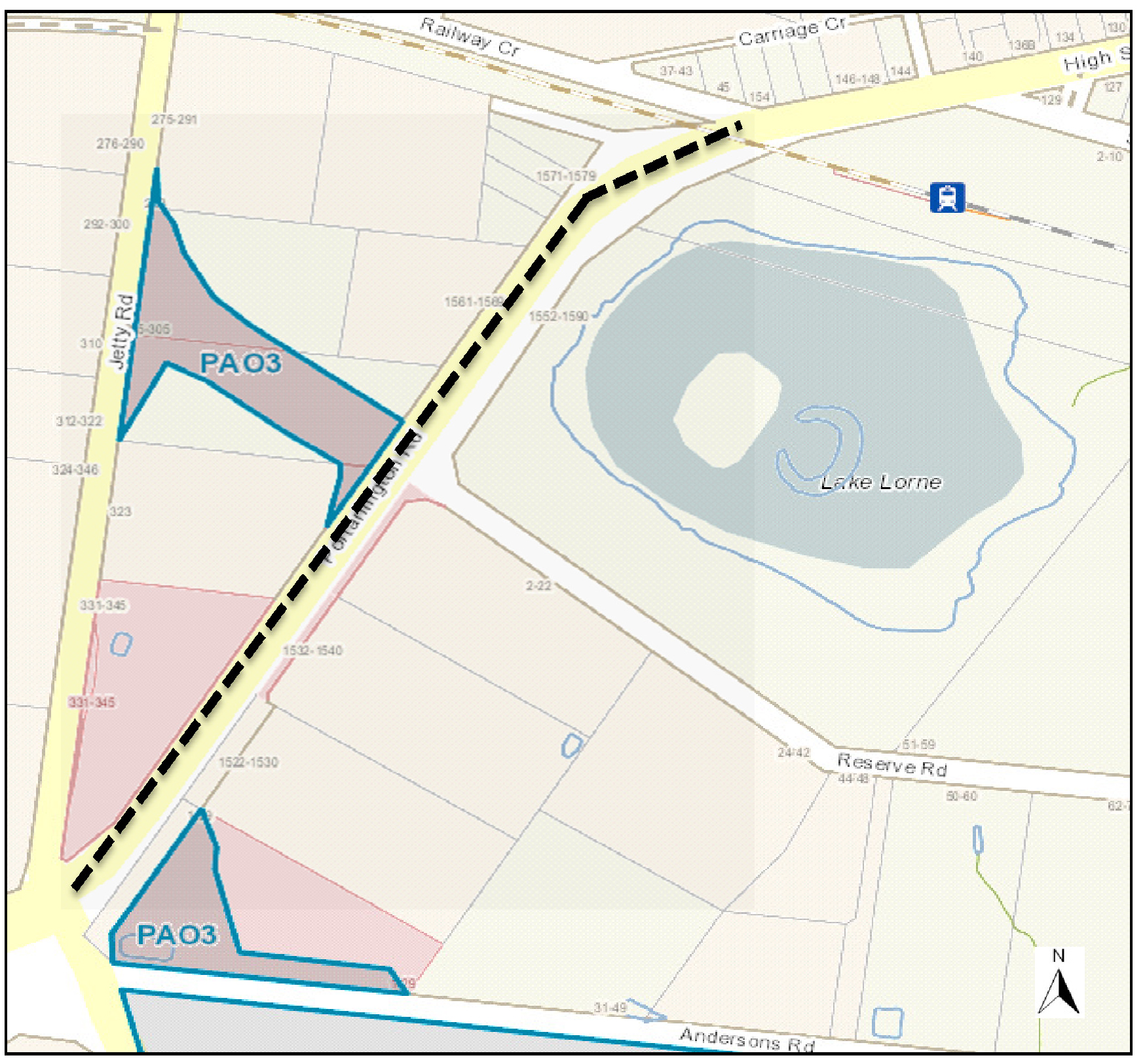
High Street
We will need to rename this section of Portarlington Road continuing the name High Street. There will be no need to renumber these properties as the numbering will flow correctly. This will allow the bypass to be known as Portarlington Road.
It is proposed to rename Andersons Road to McKiernan Street, Drysdale. Section to be renamed is highlighted below by the broken line.
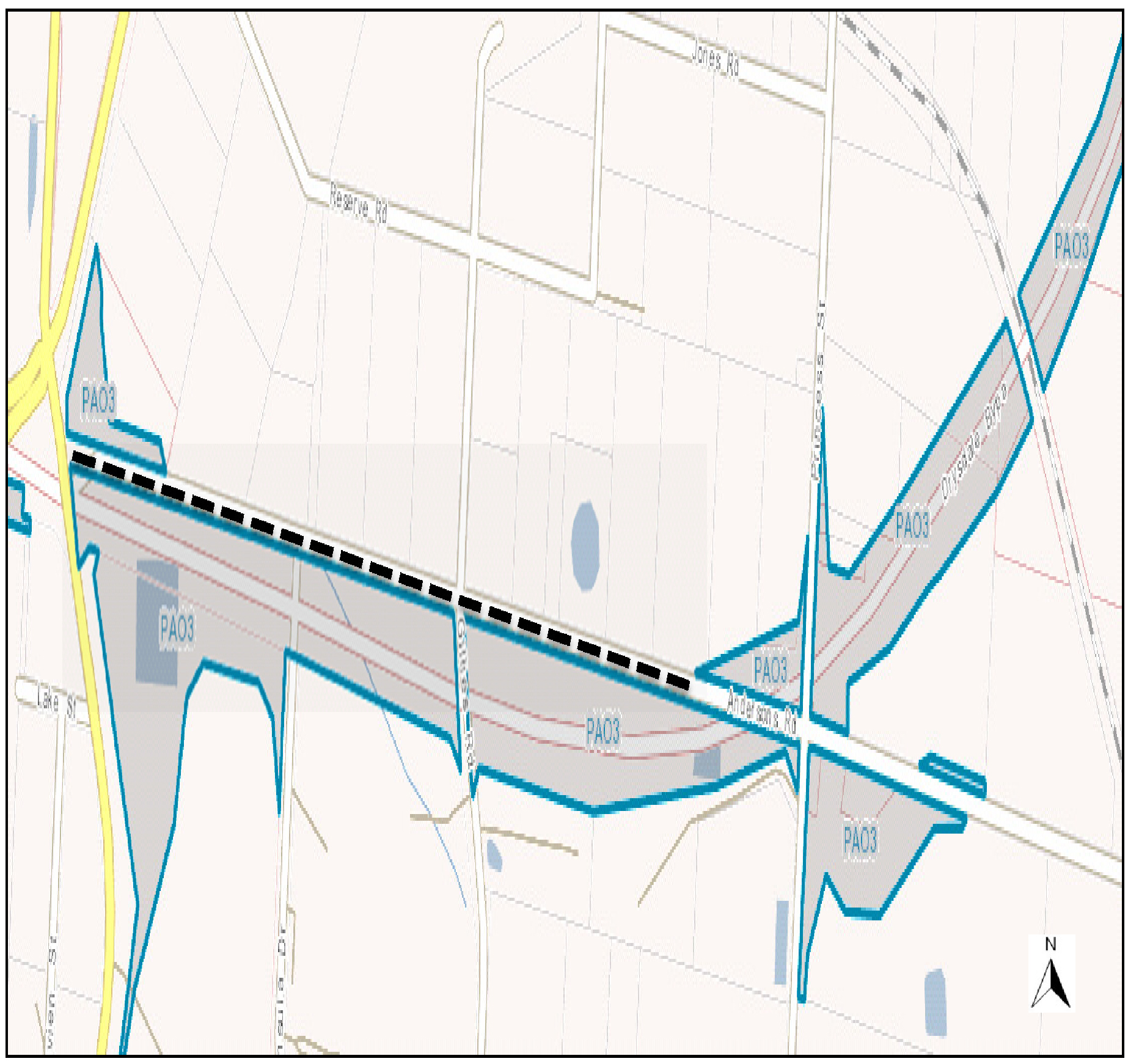
McKIERNAN – Lawrence Nicholas
Born in Drysdale. Enlisted November 1942 in the Field. Served as Private with 20 Australian Pioneer Battalion AIF. Discharged in November 1945.
It is proposed to rename Jetty Road to Hackwill Place, Drysdale. Section to be renamed is highlighted below by the broken line.
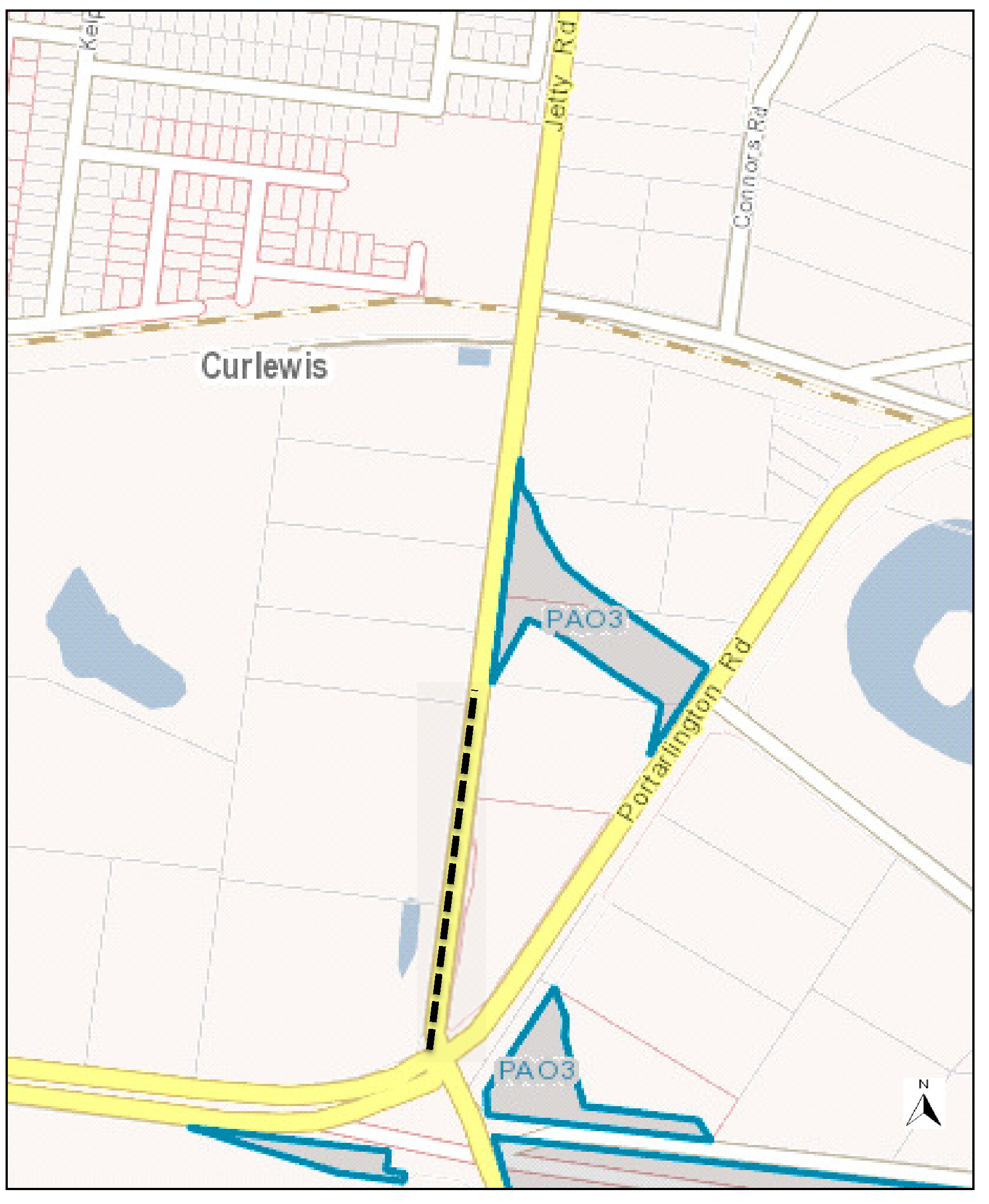
HACKWILL – William Mercer
Born in Drysdale on 12 March 1899. Enlisted on 14 March 1941. Served as a Lieutenant with District Accounts Office. Discharged on 21 June 1946.
It is proposed to rename Princess Street to Benham Street, Drysdale. Section to be renamed is highlighted below by the broken line.
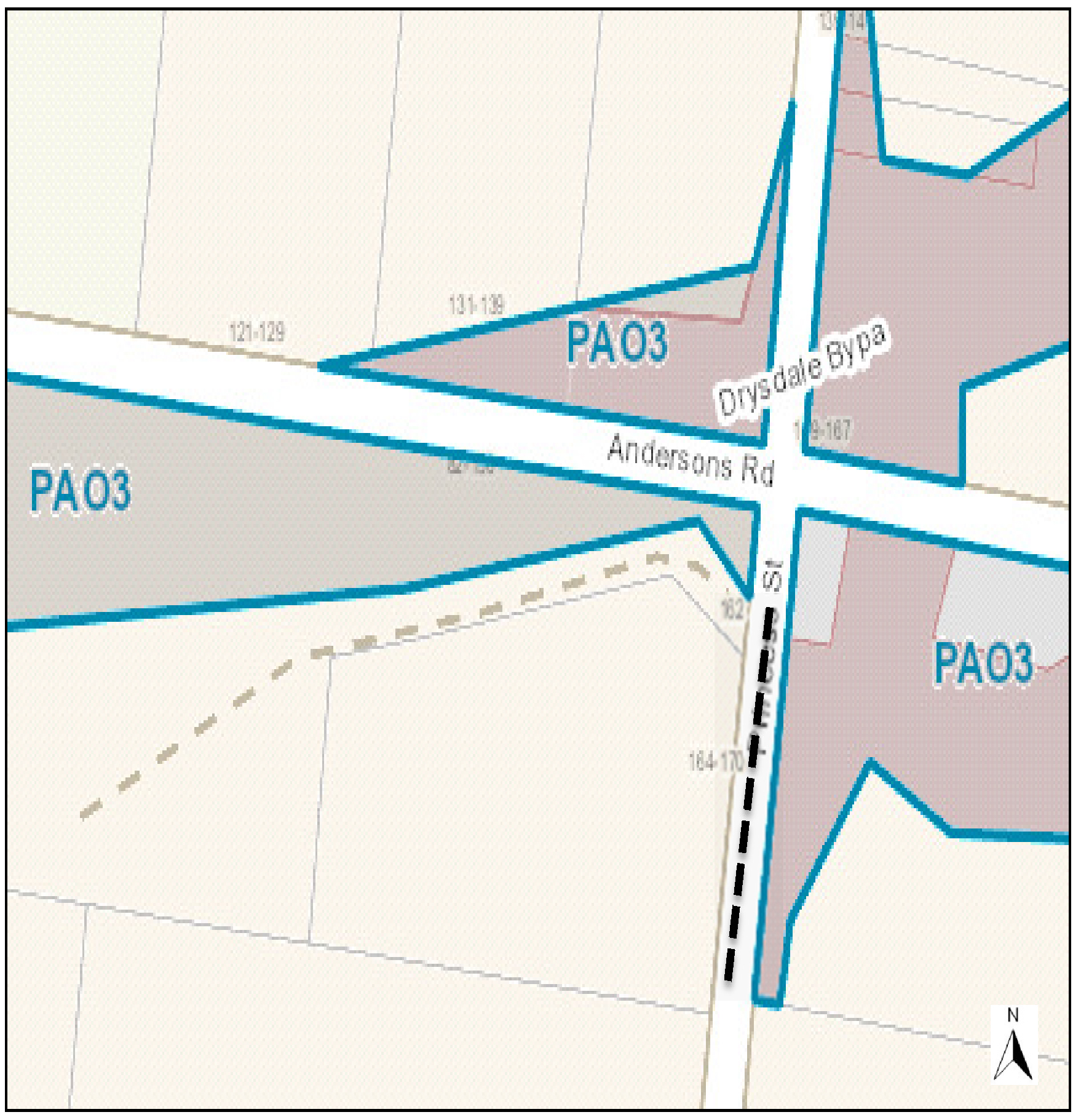
BENHAM – Winifred Mae
Born in Drysdale on 30 March 1927. Enlisted on 13 April 1945. Served as a private with the Australian Women’s Army Service. Discharged on 5 December 1946.
Source: |
Community Life - Healthy Communities |
Acting Director: |
Robyn Stevens |
Portfolio |
Social Inclusion |
To present an annual report to Council on the work of the Access & Inclusion Advisory Committee, the Multicultural Action Plan Advisory Committee, the Women in Community Life Advisory Committee and the Karreenga Aboriginal Advisory Committee.
Advisory committees act in an advisory role to Council on matters within their respective portfolios across the municipality. They have no executive authority but provide an important platform for consultation with the community.
Council established the Access & Inclusion Advisory Committee in 2003, the Multicultural Action Plan Advisory Committee in 2010, the Women in Community Life Advisory Committee in 2013 and the Karreenga Aboriginal Advisory Committee in 2017.
These four advisory committees are provided support and secretariat by the Community Life directorate.
The advisory committees operate within their terms of reference and set the following strategic priorities:
Identifying barriers to participation and inclusion in community and civic life;
Providing advice to Council on social equity principles of access, diversity, inclusion and equality;
Providing advice and information to Council on social and political trends relevant to the City’s key priorities; and
Providing advice and input with regards to the future direction of the committees.
The advisory committees meet four to eight times per year depending on the nature of activities.
The City is hosting an end of year event on 16 December 2019 at City Hall to thank the members of the Council’s advisory committees for their contribution throughout the year.
Councillor Mansfield moved, Councillor Murnane seconded -
That Council note the annual report to Council on the work of the Access and Inclusion Advisory Committee, the Multicultural Action Plan Advisory Committee, the Women in Community Life Advisory Committee and the Karreenga Aboriginal Advisory Committee.
Carried.
Activities related to the work of advisory committees are funded by relevant departments within existing resources and budget. Any actions that require additional funding will form a business case as part of the annual budget process.
The advisory committees comprise community representatives and a range of organisations and stakeholders.
The main objective of the advisory committees is to enhance and increase community participation and inclusion in all aspects of community life including economic and civic participation and collaborate with those accessing particular services and programs from the City.
The work of the advisory committees aligns with:
The City of Greater Geelong Community Engagement Policy;
The Victorian Charter of Human Rights and Responsibilities (2006);
Access & Inclusion Action Plan 2018-2022;
Ba-gurrk Gender Equity Framework;
Karreenga Aboriginal Action Plan 2014-2017; and
Multicultural Action Plan 2018-2022.
The actions of the advisory committees align with City’s key priority in the Council Plan of ‘Creating a more inclusive and diverse community’ and with the City’s Municipal Public Health and Wellbeing Plan.
No Council officer involved in the preparation of this report has a direct or indirect interest in the matter to which the report relates.
Risk assessment arising from actions of the advisory committees will be carried out by the departments responsible for each action.
There are no environmental implications arising from the subject of this report.
Source: |
Governance, Strategy & Performance - Governance |
Director: |
Rebecca Leonard |
Portfolio |
Leadership and Governance |
To seek Council endorsement of the schedule of Council meeting dates for 2020.
Council establishes the schedule of meeting dates in order to arrange meeting venues and associated logistics and for the planning of Council business.
Attachment 2 sets out the schedule of 2020 meeting dates.
The schedule shows that Ordinary Council Meetings in 2020:
Are generally planned for the fourth Tuesday of each month. Exceptions to this are:
The October meeting, which will be held on the second Tuesday of that month. It will replace the Community Focus Council meeting as that meeting date falls within the election period for the general election, during which community focus council meetings are not permitted. Also, the fourth Tuesday in October occurs just after the election day which will be before election results are declared and councillors sworn in; and
The December meeting, which is held on the second Tuesday of that month
Are set to commence at 7:00pm at the Council Chambers at City Hall, Geelong; and
Provisionally include a January 2020 meeting subject to operational needs.
Community Focus Council Meetings in 2020 are:
Generally planned for the second Tuesday of each month from February through to September, noting that:
The October meeting will not occur because it falls inside the election period for the general election, during which community focus council meetings are not permitted; and
A newly elected council will be sworn in on the November meeting date at City Hall together with the election of the mayor and deputy mayor.
Set to commence at 7:00pm at locations across the municipality.
Councillor Asher moved, Councillor Grzybek seconded -
That Council endorse the schedule of Council meeting dates for 2020 listed in Attachment 2.
Carried.
Hall hire and audio system hire costs are incurred at locations other than City Hall. These costs can be met from Council’s budget.
Provision of meetings at locations other than City Hall together with internet live streaming of City Hall meetings will enhance community participation in Council decision making processes.
The proposal continues to provide for improved access for community participation in the decision making processes of Council.
This proposal complies with the provisions of the Public Question and Submission Time Policy, the Greater Geelong City Council - Council Meeting Procedures Local Law 2017 and the Election Period Policy.
The recommendation supports the Council Plan 2018-22 strategic priority of organisational leadership, strategy and governance by supporting the key priority of communicating and engaging more effectively with the community, in areas of need.
No City officers who have provided advice in relation to this report have declared a conflict of interest regarding the matter under consideration.
There are no significant risks associated with the matter under consideration.
There are no environmental implications identified for the subject of this report.
Tuesday, 28 Jan 2020 |
Ordinary meeting (subject to operational needs) |
Tuesday, 11 Feb 2020 |
Community Focus Council meeting - Brownbill |
Tuesday, 25 Feb 2020 |
Ordinary meeting |
Tuesday, 10 Mar 2020 |
Community Focus Council meeting - Windermere |
Tuesday, 24 Mar 2020 |
Ordinary meeting |
Tuesday, 14 Apr 2020 |
Community Focus Council meeting - Kardinia |
Tuesday, 28 Apr 2020 |
Ordinary meeting |
Tuesday, 12 May 2020 |
Community Focus Council meeting - Bellarine |
Tuesday, 26 May 2020 |
Ordinary meeting |
Tuesday, 9 Jun 2020 |
Community Focus Council meeting - Brownbill |
Tuesday, 23 Jun 2020 |
Ordinary meeting |
Tuesday, 14 Jul 2020 |
Community Focus Council meeting - Windermere |
Tuesday, 28 Jul 2020 |
Ordinary meeting |
Tuesday, 11 Aug 2020 |
Community Focus Council meeting - Kardinia |
Tuesday, 25 Aug 2020 |
Ordinary meeting |
Tuesday, 8 Sep 2020 |
Community Focus Council meeting - Bellarine |
Tuesday, 22 Sep 2020 |
Ordinary meeting (Election Period) |
Tuesday, 13 Oct 2020 |
Ordinary meeting (Election Period – Annual Report) |
Tuesday, 24 Nov 2020 |
Ordinary meeting |
Tuesday, 8 Dec 2020 |
Ordinary meeting |
Source: |
Planning, Design & Development - City Development |
Director: |
Gareth Smith |
Portfolio |
Planning |
To appoint a City officer as an authorised officer under the Planning and Environment Act 1987 (P&EA).
City officers are appointed as authorised officers to exercise statutory powers under various Acts and regulations. Appointments as authorised officers are to individual staff members.
The P&EA regulates enforcement and is reliant on authorised officers acting on behalf of the responsible authority (Council).
Where there is a specific power within an Act, Council should appoint authorised officers pursuant to that Act. This is the case for the P&EA.
A planning staff member has recently been employed by the City and is required to be authorised under the P&EA.
Attachment 2 sets out the Instrument of Appointment and Authorisation under the P&EA and lists the staff member to whom this authorisation applies (instrument).
Councillor Sullivan moved, Councillor Mason seconded -
In the exercise of the powers conferred by section 224 of the Local Government Act 1989 and the other legislation referred to in the Greater Geelong City Council Instrument of Appointment & Authorisation - Planning & Environment Act 1987 only (instrument) (Attachment 2), Greater Geelong City Council (Council) resolves that the:
Member of City staff referred to in the instrument be appointed and authorised as set out in the instrument;
Instrument comes into force immediately upon the common seal of Council being affixed to the instrument, and remains in force until Council determines to vary or revoke it; and
Instrument be sealed.
Carried.
There are no financial implications arising from the subject of this report.
Relevant City managers have been consulted regarding this recommended appointment and authorisation.
There are no social equity implications arising from the subject of this report.
The recommended appointment and authorisation of the staff members complies with the relevant provisions of the P&EA and the Local Government Act 1989.
The recommended appointment and authorisation of the staff members supports the delivery of Council planning services.
No City officers who have provided advice in relation to this report have declared a conflict of interest regarding the matter under consideration.
There are no significant or high risks associated with the subject of this report.
There are no environmental implications arising from the subject of this report.
Source: |
Customer & Corporate Services - Property, Procurement and Assets |
Director: |
Michael Dugina |
Portfolio |
Finance |
To award Contract C2000008 for the Free Wi-Fi and Enhanced Broadband Services project to ENE.HUB Pty Ltd (ABN 25 165 757 559).
The State of Victoria as represented by the Department of Jobs, Precincts and Regions has developed a $45 million Connecting Regional Communities Program (CRCP) aimed to address multiple digital issues in regional Victoria. Geelong has been identified as regional partner in the CRCP to establish an Enhanced Broadband Pilot and expand the public free Wi-Fi network focusing on improving digital connectivity and addressing disparities of access and affordability of internet access to the northern suburbs of Geelong.
The City of Greater Geelong is seeking to deliver and maintain new or upgraded infrastructure that enables affordable new technical and commercial business grade broadband offerings that drives uptake in the northern suburbs of Geelong.
Procurement Services undertook an open tender process seeking to appoint a suitably qualified and experienced contractor to undertake services associated with the Free Wi-Fi and Enhanced Broadband Services project.
The submissions were evaluated in accordance with the processes detailed in the City’s ‘Procurement and Contracts Manual’.
Based on the tenderers project experience, expertise and value for money the Tender Evaluation Panel (TEP) recommend that ENE.HUB Pty Ltd to be awarded the contract for the provision of these services.
Subject to Council awarding the Contract, the project will commence 6 January 2020.
The lump sum price for the delivery of the project is $1,500,000.00 (excl. GST). This is the contribution required by the City for the provision, installation and operation of delivering Free Wi-Fi and Enhanced Broadband Services, for the term of this contract ending January 2024.
Councillor Aitken moved, Councillor Grzybek seconded -
That Council:
Award Contract C2000008 for the Free Wi-fi and Enhanced Broadband Services project to ENE.HUB Pty Ltd (ABN 25 165 757 559) for the tendered lump sum price of $1,500,000.00; and
Authorise the Chief Executive Officer to execute Contract No. C2000008 and any other documents required by or to give effect to the terms of the Contract on behalf of Council.
Carried.
The project is fully funded by the City of Greater Geelong through a $1,825,000 million grant from the Department of Jobs, Precincts and Regions Victoria.
The remaining $325,000 of the grant is to manage additional costs associated with the project over the contract term until January 2024. Additional costs include project management and governance, procurement, community engagement, marketing and communications, contingencies, wi-fi and enhanced broadband usage and reporting requirements.
On completion of the contract there will be ongoing costs of $136,000 per annum, which will be funded by the City.
The project proposal has been guided by a Project Working Group that includes representatives from internal departments are well as Victorian State Government. Consultation with the local community has provided supporting reference to address specific location access issues through installation of new infrastructure. Further consultation is planned in early 2020 with internal stakeholders and the community to establish the final location of proposed infrastructure.
This project will provide the infrastructure that addresses the needs of the Free Wi-Fi connectivity and enhanced broadband services for local community while generating economic benefits to local businesses through reduced service fees for fast internet access.
This tender was publicly advertised in accordance with the requirements of section 186 of the Local Government Act 1989 and the tender process has been conducted in accordance with the City’s Procurement Policy.
Council to CEO delegation requires that when awarding a contract exceeding $1m where it is proposed not to accept the lowest priced tenderer the decision must rest with Council.
This project aligns to several of the City’s strategic priorities:
Improved Health and Safety of our Community, enabling safer public spaces, crime prevention and improving safety in our community;
Informed Social Infrastructure and Planning where one of our key priorities is to deliver accessible and attractive community infrastructure, based on community need;
A more Inclusive and Diverse Community, improving access and affordability;
A Thriving and Sustainable Economy, by attracting new investments and supporting local business; and
Innovative Finances and Technology, delivering smart technology, increasing free public Wi-Fi and improving data collect to better manage assets and resources.
No Officers or contractors involved in the preparation of this report have a direct or indirect interest in matters to which this report relates.
The tender evaluation process involved the assessment of Work, Health and Safety policies, procedures and risk assessment documents. Any other risks associated with the acceptance of this tender will be managed through the contract conditions.
The City engaged the services of Pitcher Partners to provide independent, experienced and objective probity advice to ensure the integrity of the tender process.
Any environmental implications associated with this contract will arise from the execution of the works. It is considered that these are the responsibility of the Contractor and will be managed through the contract documentation.
Contract C2000008 for Free Wi-Fi and Enhanced Broadband Services
The City issued tender T2000008, closing 2:00pm Wednesday 2 October 2019, seeking to appoint a suitably qualified and experienced contractor to undertake services associated with the Free Wi-Fi and Enhanced Broadband Services project.
Table 1 Invitations to Tender
3. Medium |
4. Date Advertised |
|---|---|
5. Geelong Advertiser |
6. 24 August 2019 |
7. eProcure |
8. 24 August 2019 |
9. Geelong Australia Website |
10. 24 August 2019 |
The Tender Evaluation Panel comprised the following staff.
Table 2 Tender Evaluation Panel
Position Title |
Panel role |
|---|---|
Procurement Specialist |
Chair (non-voting) |
Senior Lead Smart City |
Member (voting) |
Strategic Projects Officer |
Member (voting) |
Co-ordinator Information Technology |
Member (voting) |
Manager Economic Development & Events |
Member (voting) |
Director Economy, Investment & Attraction |
Member (non-voting) |
The independent advisors to the Tender Evaluation Panel comprised the following staff.
Table 3 Independent Advisors to the Tender Evaluation Panel
Position Title |
Panel role |
|---|---|
Probity Adviser |
Advice |
Enhanced Broadband and Public Wi-Fi Lead, Victorian Government |
Advice |
Tenderers had to comply with the following mandatory criteria:
OH&S system – if the tenderers OH&S processes and procedures do not meet a minimum standard determined by the City, the tenderer will not be considered for the Contract;
Tenderer must have a heat and UV radiation exposure management procedure, and if not, must be willing to abide by the City’s Heat and UV Radiation Exposure and Outdoor Clothing Procedures (Long/Long);
Tenderer must hold a Carriers Licence as defined by the Australian Communications and Media Authority or have a contractual arrangement with a holder of a Carriers Licence; and
Tenderer must offer services which are guaranteed to the customer by a service level agreement.
All tenderers complied with the mandatory criteria and all submissions were received before tender close.
Table 4 Tender Submissions Received
(a) Tender |
|
(b) Conforming tender |
|---|---|---|
A |
ENE.HUB Pty Ltd |
Yes |
B |
Tender B |
Yes |
C |
Tender C |
Yes |
D |
Tender D |
Yes |
E |
Tender E |
Yes |
The Evaluation Panel used the following qualitative criteria (in order of weighting) to assess the submissions:
Table 5 Comparative Criteria Weighting
Comparative Criteria |
Weighting % |
|---|---|
Proposed Solution |
50% |
Proposed Resources and Systems |
25% |
Economic & Local Content Contribution |
10% |
Clever and Creative (Innovation) |
10% |
Experience |
5% |
The tender was evaluated by the evaluation panel in a two staged process:
Qualitative assessment of a weighted score totalling 100%.
Evaluation of price against weighted score:
VFM = Tendered Price ÷ Weighted Score (lowest VFM Score = preferred supplier).
ENE.HUB Pty Ltd were deemed the best value for money tenderer, with the third lowest price and highest ranked tender, demonstrating best value for money for the City, and placing them as the preferred tenderer to progress to interview stage.
At the conclusion of the evaluation the tenders were ranked in the following order. The tender evaluation panel elected to set aside Tender E as they concluded that they were unlikely to be recommended as the preferred tender, even if the tender was fully evaluated, due to the tendered prices being significantly over budget.
Table 6 Tender Evaluation Scores
Tender |
|
Rank |
|---|---|---|
A |
ENE.HUB Pty Ltd |
1 |
B |
Tender B |
2 |
C |
Tender C |
3 |
D |
Tender D |
4 |
The Evaluation Panel sought identical clarifications from all tenderers (in writing) regarding tendered price breakdown, required approvals, mitigation of risks and end user experience of services offered. Scoring was reviewed post clarifications, identifying ENE.HUB Pty Ltd as a shortlist for interview (held Tuesday 12 November at 10:00am). At interview, ENE.HUB Pty Ltd demonstrated their ability to deliver the contract and illustrated that they have undertaken the appropriate due diligence and have allocated the required resources.
ENE.HUB Pty Ltd demonstrated a thorough understanding of the requirements of the specification with a proven record of delivering comparable contracts. The Tender Evaluation Panel noted that ENE.HUB Pty Ltd are an experienced provider of comparable projects requiring experience in the delivery of free wi-fi and broadband services. They have undertaken contracts of similar scope and value for other government clients over past three (3) years including Royal Botanic Garden and Domain Trust (NSW), City of Canada Bay (NSW), City of Los Angeles (USA) and City of Blacktown (NSW).
ENE.HUB Pty Ltd submission identified all the experienced personnel, infrastructure and subcontractors required for this program.
ENE.HUB Pty Ltd project methodology demonstrated that they have the available resources and expertise to successfully deliver the services as tendered and provided evidence of their capability to deliver the project within the City’s timeframes.
ENE.HUB Pty Ltd OHS documentation addressed the high risk tasks associated with the works providing examples of SWMS used on a project with a comparable risk profile and all relevant qualifications required.
No probity issues identified.
Source: |
City Services - Engineering Services |
Director: |
Guy Wilson-Browne |
Portfolio |
Social and Infrastructure Planning |
To revoke Council’s designation of 12 December 2006 of flood affected land Armstrong Estate, Stages 40, 40A, 40B, 42, 43 and 48 inclusive as liable to flooding pursuant to regulation 153 of the Building Regulations 2018.
Council has a statutory obligation under the Building Regulations 2018 to designate land as liable to flooding where it reasonably knows it to be prone to flooding. Conversely, there is an obligation to remove the encumbrance of designation from land that is no longer considered to be flood-prone.
The current designated flood mapping (Attachment 2) was designated by Council at its meeting of 12 December 2006.
This revocation will result in another stage of new lots in Armstrong Estate fronting 165 – 191 Boundary Road, Mount Duneed being free of their flood prone status, paving the way for owners to build homes on their land.
The flood mapping is subject to a revision due to the subdivision and development at 165 – 191 Boundary Road, Mount Duneed. Prior to subdivision the parent lot was considered to be liable to flooding. This development site, which is also known as Armstrong Estate, Stages 40, 40A, 40B, 42, 43 and 48 inclusive, achieves flood immunity for newly created lots for flood events up to and including the 100 year Average Recurrence Interval (ARI) event due to approved internal earthworks.
The decision by the City that the flood prone status can be removed includes assessment of internal drainage, road construction and earthworks to contain potential floodwaters from the 100 year ARI event within road and drainage reserves (Attachment 3).
It should be noted that designation is separate to the creation of flood overlays within the Planning Scheme, which generally follows designation. In the case of this development, the planning scheme amendment to create post-development flood zones or overlays is proposed after the design of the proposed precincts.
Councillor Harwood moved, Councillor Murnane seconded -
That Council revoke the Council designation of 12 December 2006 of flood affected land at Armstrong Estate, Stages 40, 40A, 40B, 42, 43 and 48 inclusive as liable to flooding pursuant to regulation 153 of the Building Regulations 2018.
Carried.
No impact to budget.
A revocation of designation does not warrant public consultation as it constitutes the removal of an encumbrance on land.
Relevant Council databases and flood maps will be revised and updates sent to the Corangamite Catchment Management Authority and Building Control Commission.
Council have a responsibility to the community to provide the best possible information on areas that are flood prone. The removal of flood prone designation allows owners to build on their land without a special permit from the City, and without raising the floor level of their home. It also reduces the cost of property insurance.
The City has various statutory responsibilities for drainage management and flood management (prevention, response and recovery) as set out in the Local Government Act 1989, Local Government Regulations 1990, Planning and Environment Act 1987, Building Regulations 2018, Water Act 1989, Subdivision Act 1988 and Emergency Management Act 1986.
The works have resulted in the lots being protected from flooding during a major storm event that has a one per cent probability of occurring in any one year, and occurs on average once in 100 years. This is the required standard for new subdivisions.
The recommendations of this report are consistent with Council Plan, in relation to planned sustainable development.
There are no officer direct or indirect interests with respect to this report.
Council also has some risk exposure with any failure to disclose the flood-prone status of a property in a Land Information Certificate.
The revocation of the designation is the final step in minimising Council’s risk.
The revocation of flood-prone areas designation and designation of revised flood data through the design of this stage is considered unlikely to result in any known adverse environmental impacts.
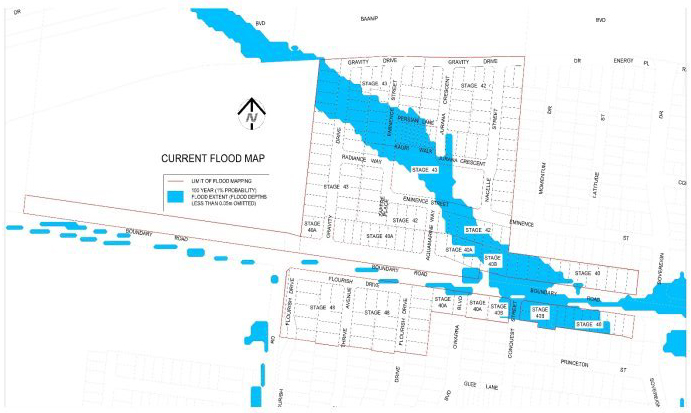
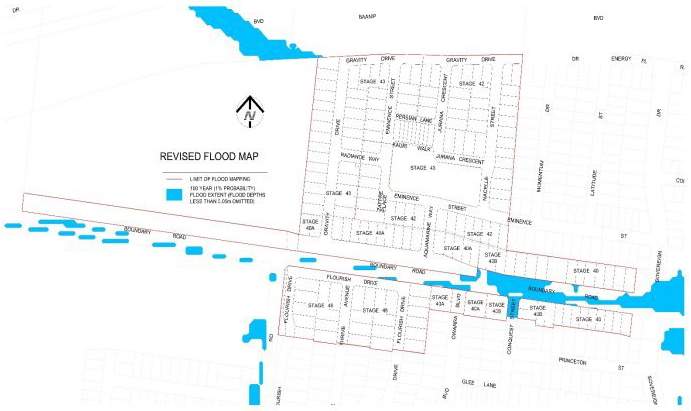
Source: |
City Services - Engineering Services |
Director: |
Guy Wilson-Browne |
Portfolio |
Social and Infrastructure Planning |
To revoke Council’s designation of 12 December 2006 of flood affected land Watermark Estate, Stages 10 – 12 inclusive as liable to flooding pursuant to regulation 153 of the Building Regulations 2018.
Council has a statutory obligation under the Building Regulations 2018 to designate land as liable to flooding where it reasonably knows it to be prone to flooding. Conversely, there is an obligation to remove the encumbrance of designation from land that is no longer considered to be flood-prone.
The current designated flood mapping (Attachment 2) was designated by Council at its meeting of 12 December 2006.
This revocation will result in another stage of new lots in Watermark Estate fronting 520 – 540 Barwon Heads Road, Charlemont being free of their flood prone status, paving the way for owners to build homes on their land.
The flood mapping is subject to a revision due to the subdivision and development at 520 – 540 Barwon Heads Road, Charlemont. Prior to subdivision the parent lot was considered to be liable to flooding. This development site, which is also known as Watermark Estate, Stages 10 – 12 inclusive, achieves flood immunity for newly created lots for flood events up to and including the 100 year Average Recurrence Interval (ARI) event due to approved internal earthworks.
The decision by the City that the flood prone status can be removed includes assessment of internal drainage, road construction and earthworks to contain potential floodwaters from the 100 year ARI event within road and drainage reserves (Attachment 3).
It should be noted that designation is separate to the creation of flood overlays within the Planning Scheme, which generally follows designation. In the case of this development, the planning scheme amendment to create post-development flood zones or overlays is proposed after the design of the proposed precincts.
Councillor Murnane moved, Councillor Nelson seconded -
That Council revoke the Council designation of 12 December 2006 of flood affected land at Watermark Estate, Stages 10 – 12 inclusive as liable to flooding pursuant to regulation 153 of the Building Regulations 2018.
Carried.
No impact to budget.
A revocation of designation does not warrant public consultation as it constitutes the removal of an encumbrance on land.
Relevant Council databases and flood maps will be revised and updates sent to the Corangamite Catchment Management Authority and Building Control Commission.
Council have a responsibility to the community to provide the best possible information on areas that are flood prone. The removal of flood prone designation allows owners to build on their land without a special permit from the City, and without raising the floor level of their home. It also reduces the cost of property insurance.
The City has various statutory responsibilities for drainage management and flood management (prevention, response and recovery) as set out in the Local Government Act 1989, Local Government Regulations 1990, Planning and Environment Act 1987, Building Regulations 2018, Water Act 1989, Subdivision Act 1988 and Emergency Management Act 1986.
The works have resulted in the lots being protected from flooding during a major storm event that has a one per cent probability of occurring in any one year, and occurs on average once in 100 years. This is the required standard for new subdivisions.
The recommendations of this report are consistent with Council Plan, in relation to planned sustainable development.
There are no officer direct or indirect interests with respect to this report.
Council also has some risk exposure with any failure to disclose the flood-prone status of a property in a Land Information Certificate.
The revocation of the designation is the final step in minimising Council’s risk.
The revocation of flood-prone areas designation and designation of revised flood data through the design of this stage is considered unlikely to result in any known adverse environmental impacts.
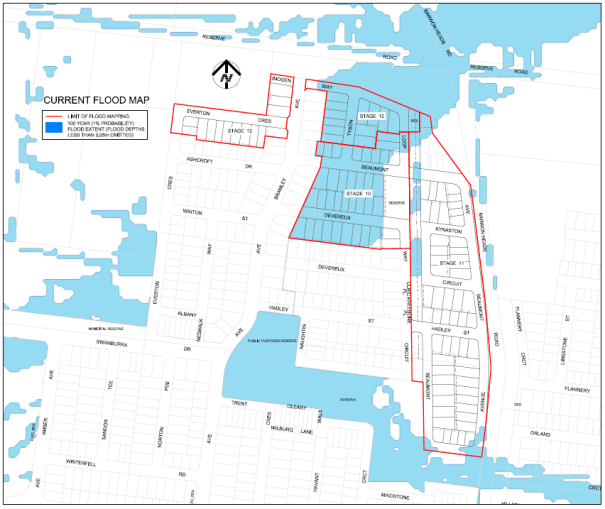
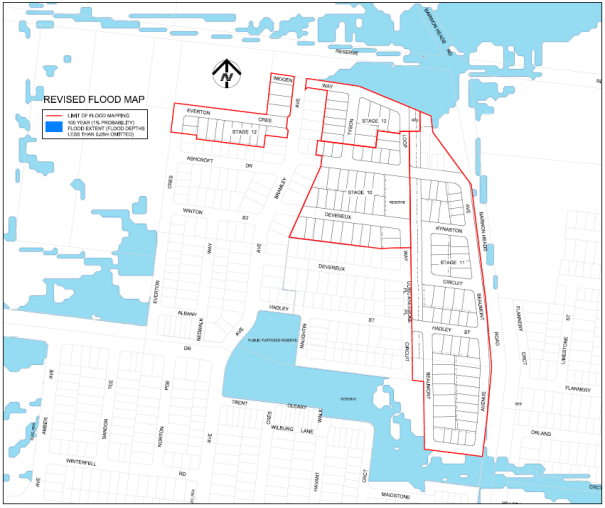
Source: |
Customer and Corporate Services |
Director: |
Michael Dugina |
Portfolio |
Finance |
Councillor Grzybek moved, Councillor Aitken seconded -
That in accordance with Section 89 (2) (d) of the Local Government Act 1989, this contractual matter be considered at the conclusion of all other business at which time the meeting be closed to members of the public.
Carried.
Source: |
Chief Executive - Office of the CEO |
Chief Executive Officer: |
Martin Cutter |
Portfolio |
Leadership and Governance |
Councillor Harwood moved, Councillor Grzybek seconded -
That in accordance with Section 89 (2) (d) of the Local Government Act 1989, this contractual matter be considered at the conclusion of all other business at which time the meeting be closed to members of the public.
Carried.
Source: |
Chief Executive |
Director: |
Kaarina Phyland |
Portfolio |
Leadership and Governance |
Councillor Asher moved, Councillor Grzybek seconded -
That in accordance with Section 89 (2) (d) of the Local Government Act 1989, this contractual matter be considered at the conclusion of all other business at which time the meeting be closed to members of the public.
Carried.
Contents | Previous Page: Section A - Procedural Matters | Next Page: Section C - Notice of Motion
