
Council Minutes - Section B: Reports - 25 August 2020
Contents | Previous Page: Section A - Procedural Matters | Next Page: Section C - Notice of Motion
Contents | Previous Page: Section A - Procedural Matters | Next Page: Section C - Notice of Motion
Reports tabled at the Ordinary Meeting of Council on Tuesday date Held virtually by Zoom and broadcast on the City's website.
Endorsement of Colac Otway Shire Joining Geelong Regional Library Corporation
Contractual Matter (Confidential)
Contractual Matter (Confidential)
Councillor Kontelj declared a Conflict of Interest in Agenda Item 1 Amendment C395 – Settlement Strategy and Northern and Western Growth Area Framework Plan – Adoption, and left the meeting room at 7:05 prior to discussion.
Source: |
Planning, Design & Development – Strategic Implementation |
Director: |
Gareth Smith |
Portfolio: |
Planning |
To consider the Panel report on Amendment C395ggee and adopt the Amendment.
C395ggee (the Amendment) is primarily a policy-based amendment that implements the municipal wide Settlement Strategy and the Northern and Western Geelong Growth Areas Framework Plan (the Framework Plan) into the planning scheme.
The Amendment was exhibited in June 2019 with a total of 102 submissions received. On 24 September 2019 Council resolved to refer the submissions to an independent Panel appointed by the Minister under the Planning and Environment Act (the Act) (Panel).
The 3-member Panel held a hearing in Geelong and Melbourne over 28 days between November 2019 to March 2020. Many submitters were landowners represented by legal advocates and more than 50 pieces of expert evidence were called. The Panel provided its report to Council in mid May 2020 and it was publicly released in late May.
The Panel has strongly supported Council’s strategic work and concludes:
“Geelong has undergone a sustained period of high population growth which is predicted to continue. The Amendment is a well thought out and visionary response to logically cater for this predicted growth... there is a high level of support for the overall direction of the Amendment, and particularly the Framework Plan.
The refocusing of long-term growth away from the Bellarine Peninsula is a conscious policy decision of Council and the State Government; implementation of this policy requires some further consideration of long term or permanent settlement boundaries. Subject to addressing some issues of principle and detail, the Panel strongly supports the Amendment.”
(see Executive Summary in Attachment 5).
The Panel recommends adoption of the Amendment generally with changes outlined in its 13 recommendations which must be considered by Council as the Planning Authority.
It is recommended that Council accept all the Panel recommendations, adopt the Amendment and updated versions of the Settlement Strategy and Framework Plan and forward the Amendment to the Minister for Planning for final approval.
Councillor Aitken moved, Councillor Grzybek seconded -
That Council:
Adopt Amendment C395ggee in the form outlined in Attachment 8 of this report;
Submit the adopted Amendment C395ggee together with the prescribed information to the Minister for Planning requesting approval; and
Adopt the City of Greater Geelong Settlement Strategy (August 2020) and the Northern and Western Geelong Growth Areas Framework Plan (August 2020).
Carried.
Adoption of the Amendment will not have any significant financial implications to Council. The Amendment has incurred significant costs in the order of $0.5M associated with the lengthy panel hearing including the Planning Panels Victoria fees, legal advocate fees and engagement of expert witnesses to support Council’s case.
Both the Settlement Strategy and the Framework Plan were based on extensive community engagement and the Amendment was exhibited in accordance with the requirements of the Planning and Environment Act 1987.
All 102 submitters had an opportunity to be heard before an Independent Panel appointed by the Minister for Planning.
The Independent Panel report has been publicly released and all submitters notified of its availability on the City’s C395 webpage.
A component of the Settlement Strategy considers the need to increase the level of affordable and social housing within the municipality. This is reflected in the policy changes proposed by the amendment.
The Framework Plan contains significant social equity considerations, responding to Greater Geelong’s significant growth rate by planning for the future provision of affordable housing and employment opportunities to meet the needs of the community.
The Amendment is broad ranging and supports and implements numerous state policies. The most relevant policies are listed below:
Clause11.01-1S Settlement;
Clause 11.01-1R Settlement Geelong G21;
Clause 11.02-1S Supply of urban land;
Clause 11.02-2S Structure Planning;
Clause 11.02-3S Sequencing of development;
Clause 11.03-4S Coastal settlement;
Clause 11.03-5S Distinctive areas and landscapes;
Clause 13.03-1S Floodplain management; and
Clause 14.03-1S Resource exploration and extraction.
The Amendment supports and implements the following policies from the Local Planning Policy Framework:
Clause 21.02 City of Greater Geelong Sustainable Growth Framework;
Clause 21.04 Municipal Framework Plan;
Clause 21.05-7 Flooding;
Clause 21.06 Settlement and Housing;
Clause 21.08 Development and Community Infrastructure; and
Clause 21.14 Bellarine Peninsula.
The Amendment, Settlement Strategy and Framework Plan align with the Planned Sustainable Development strategic priority of the Council Plan. They will deliver the following key priorities identified in the Council Plan: ensuring housing supply, diversity and affordability can meet the needs of our growing community; facilitating opportunities for infill residential development; continuing to develop urban growth areas across the region; improving the environmental performance of new developments; and managing the impact of development on the unique character of our townships.
No Council officers involved in the preparation of this report have any direct or indirect interest.
Adopting the Amendment and implementing the new strategic planning work into the Planning Scheme reduces risk by providing certainty for the future development of the municipality.
Adopting the Panel recommendations reduces the risk of the Minister for Planning changing the amendment at the approval stage.
The Settlement Strategy has a number of environmental implications including the need to take into account environmental risks and values when considering the spatial distribution of housing, looking at how development can be more sustainable into the future, increasing the share of housing provided by urban consolidation and thus reducing pressure for outward expansion, increasing housing diversity and implementing the One Planet Living principles.
Environmental implications were considered in the preparation of the Framework Plan. Technical studies relating to land capability including assessments of native flora and fauna, geotechnical, hydrogeological and environmental constraints, stormwater drainage and land use buffers were undertaken.
An overarching Biodiversity Conservation Strategy will be prepared prior to the finalisation of any Precinct Structure Plans (PSP).
The Framework Plan identifies actions to prepare an environmentally sustainable design (ESD) action plan for each PSP demonstrating the actions that urban development will take to contribute net zero carbon to the City.
The Settlement Strategy
The Settlement Strategy provides a planning framework to ensure the municipality can meet the region’s housing needs to 2036. The Strategy was adopted by Council in October 2018.
The Settlement Strategy reviews the city’s demographics, analysing current and anticipated future population and housing needs. The Strategy includes directions for both urban consolidation and greenfield development.
The Amendment includes the Settlement Strategy as a Background Document to the Planning Scheme. It amends Local Planning Policies in the Scheme to implement key recommendations of the Strategy including:
Directing the majority of future housing needs to urban Geelong (urban infill, Armstrong Creek and the Northern and Western Geelong Growth Areas);
Reducing the share of new housing development on the Bellarine Peninsula;
Ensuring residential development occurs within designated settlement boundaries; and
Facilitating infill development to increase its contribution to housing supply.
The Department of Environment, Land, Water and Planning (DELWP) has declared the Bellarine Peninsula a Distinctive Area and Landscape (DAL) under the Planning and Environment Act 1987. This process will introduce a Statement of Planning Policy (SPP) and set long-term settlement boundaries and review height controls within townships on the Bellarine. Outcomes in relation to the Amendment will inform and contribute to the DAL process.
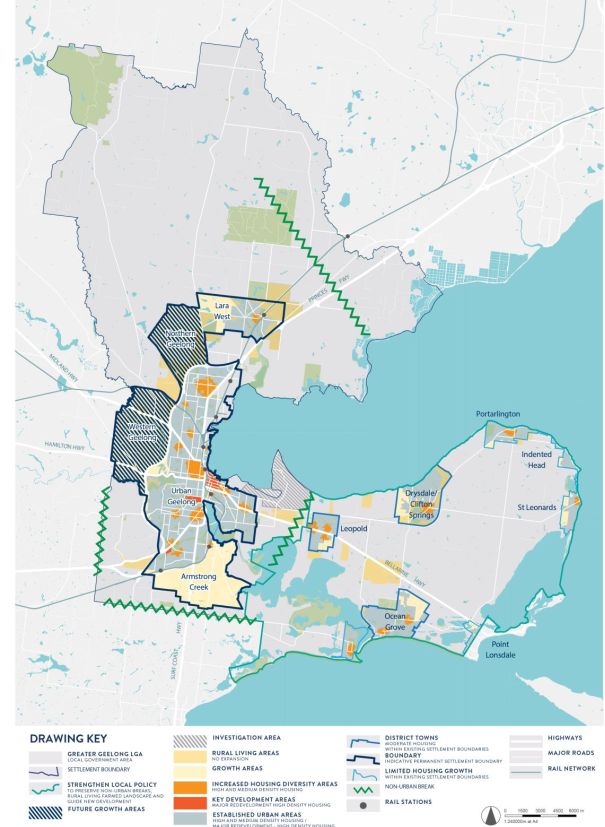
The exhibited version of the Housing and Settlement Framework Plan from the Settlement Strategy is in Attachment 3.
Northern and Western Geelong Growth Areas Framework Plan
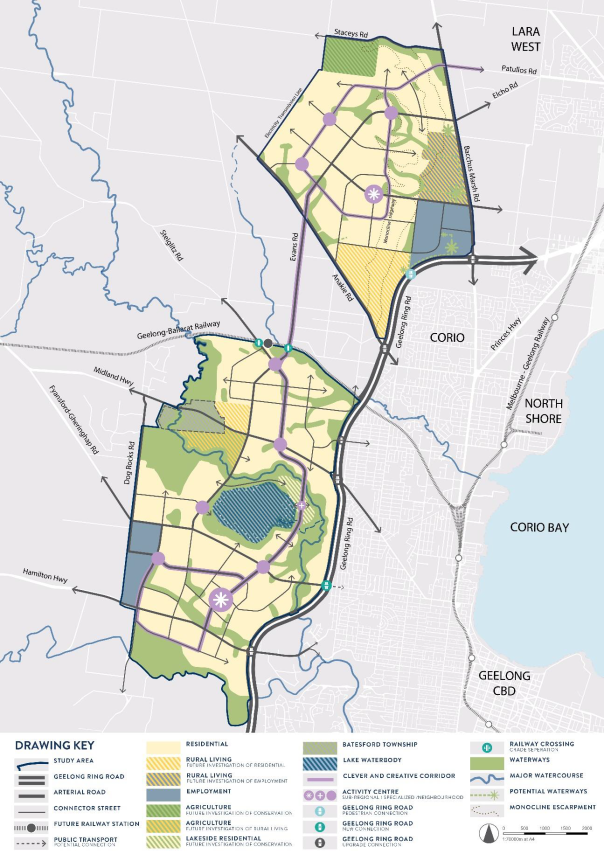
The Northern and Western Geelong Growth Areas (NWGGA) are the largest greenfield urban development project in regional Victoria with the capacity to accommodate around 110,000 residents. The NWGGA Framework Plan was adopted by Council in March 2019.
The Framework Plan outlines principles and actions to achieve the community’s Clever and Creative vision in the development of the growth areas. The Framework Plans set out these principles and actions for each of six themes: Clever and Creative, Environment, Neighbourhood, Economy, Movement and Delivery.
The Amendment includes the Framework Plan as a Background Document to the Planning Scheme. It introduces a new Local Planning Policy (Northern and Western Geelong Growth Areas) into the Scheme to implement key recommendations of the Strategy including:
Developing Precinct Structure Plans in an orderly sequence within each growth area;
A Clever and Creative Corridor as a focal point for design of sustainable, interconnected neighbourhoods;
Ensuring a network of activity centres provide for the needs of local residents;
Locating high and medium density housing near activity centres and key transport routes;
Identifying an employment precinct in each growth area;
Prioritising active and public transport over private vehicles in neighbourhood and transport network design;
Establishing a buffer of lower density residential development north and east of the Batesford township;
Completing rehabilitation of the Batesford Quarry and master planning for its transformation to a recreational lake; and
Undertaking an overarching biodiversity conservation strategy for each growth area.
The exhibited version of the NWGGA Framework Plan Map is in Attachment 4.
The Amendment also rezones to the Urban Growth Zone most land in the growth areas identified for short or medium term urban development that has not already been included in that zone.
What the Amendment does
As discussed above, the Amendment implements the Settlement Strategy and Framework Plan into the planning scheme. The Amendment includes policy changes to the Municipal Strategic Statement (MSS) and rezones land in the NWGGA to the Urban Growth Zone. Specifically, the Amendment seeks to:
Amend Clause 21.03 Objectives - Strategies – Implementation to include reference to 21.18 Corio Norlane and 21.20 Northern and Western Geelong Growth Areas;
Replace Clause 21.04 Municipal Framework Plan with a new Clause 21.04 to implement the Settlement Strategy through a new Municipal Framework Plan;
Replace Clause 21.06 Settlement and Housing with a new clause including objectives, strategies and references to implement the Settlement Strategy;
Amend Clause 21.08 Development and Community Infrastructure to update strategies on Transport and Development Contributions to implement the Settlement Strategy;
Amend Clause 21.11 Armstrong Creek Urban Growth Area to reflect the role of the Northern and Western Geelong Growth Areas;
Amend Clause 21.14 The Bellarine Peninsula to update objectives, strategies, further work and references to implement the Settlement Strategy;
Amend Clause 21.16 Anakie to implement the Settlement Strategy by amending objectives and strategies, deleting reference to the Anakie Structure Plan 1996;
Insert a new Clause 21.20 Northern and Western Geelong Growth Areas including new objectives, strategies and plans to implement the Framework Plan; and
Replace the Schedule to Clause 72.08 Background Documents with a new Schedule that includes the Settlement Strategy and Framework Plan.
Public Exhibition and Panel Hearing
The Amendment was exhibited in accordance with the requirements of the Planning and Environment Act 1987 from 21 June to 29 July 2019.
Notices were placed in five separate newspapers. Around 1450 affected or nearby landowners and residents were notified by mail, while around 500 email notifications were sent to stakeholders and interested parties. Open House information sessions on the Framework Plan component of the Amendment were held at the Batesford Hall on 17 July and the Corio Library on 18 July.
As a result of exhibition, a total of 102 submissions were received.
Council considered a report on the submissions on 24 September 2019 and resolved to refer the submissions to an independent Panel appointed by the State Government under the Act.
A 3-member Panel of Nick Wimbush (Chair), John Hartigan and Deanne Smith held a lengthy hearing in Geelong and Melbourne between November 2019 to March 2020. A total of 37 different parties appeared at the hearing. They included the City, state government agencies, developers, landowners, community groups and individuals.
The City was represented throughout the Panel hearing by Greg Tobin of Harwood Andrews Lawyers and instructed and advised by officers from the City’s Strategic Implementation and Planning Strategy units.
The City called the following six experts in planning, lot supply, demographics and transport planning:
Michael Barlow (Urbis) – strategic planning;
John Collins (Spatial Economics) – strategic planning;
Mark Woodland (Echelon Planning) – strategic/growth area planning;
Reece Humphries (GTA) – transport planning and engineering;
Dale Stokes (Spatial Economics) – lot supply and economics; and
Jeremy Reynolds (Spatial Economics) – demography.
The Panel provided its Panel Report to Council in mid May 2020 and it was publicly released in late May.
Panel Report Executive Summary and City Response
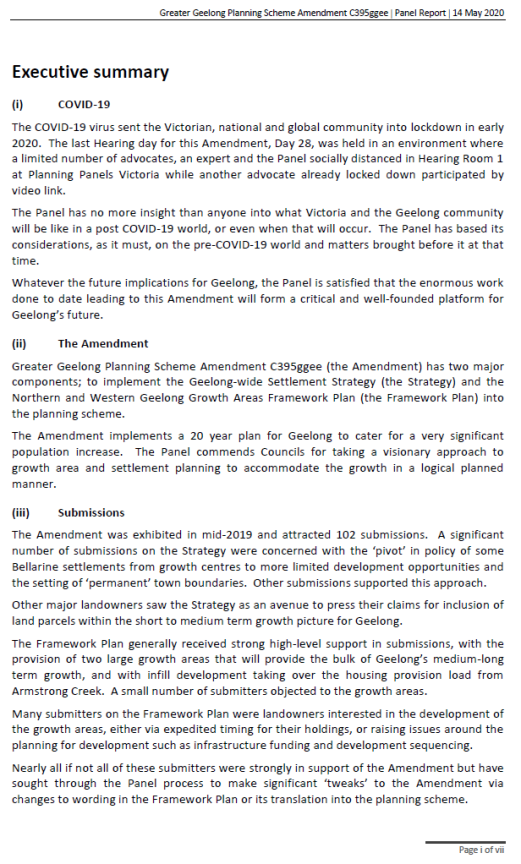
The following section of this Council report discusses and responds to the Panel’s Executive Summary including its findings on the key issues, conclusions and recommendations. The Executive Summary is in Attachment 5. Where necessary references are also made to Panel commentary from the main Panel report.
Further discussion and response to all the sub issues covered in the Panel report is not provided in this Council report. This would duplicate information which is already comprehensively covered by the Panel in its report which includes quotes and accurate descriptions of the submissions made by the parties including the City.
The Panel Report (Appendix D) includes a list of detailed changes to the Amendment, Settlement Strategy and Framework which the Panel recommends and which is derived from a document that Council submitted to the Panel during the hearing. This list is reproduced in Attachment 6 to this Council report.
The Panel’s recommendations and the City’s responses are listed in Appendix 7.
COVID-19
The Panel refers to the hearing being in its final stages as the COVID-19 virus started to send the Victorian, national and global community into lockdown in early 2020.
In relation to potential changes that COVID-19 could bring to society the Panel says it “has no more insight than anyone into what Victoria and the Geelong community will be like in a post COVID-19 world, or even when that will occur. The Panel has based its considerations, as it must, on the pre-COVID-19 world and matters brought before it at that time.”
The Panel provides positive commentary on the strategic work undertaken saying: “Whatever the future implications for Geelong, the Panel is satisfied that the enormous work done to date leading to this Amendment will form a critical and well-founded platform for Geelong’s future.”
The Amendment
The Panel describes the Amendment as having two major components; to implement the Geelong-wide Settlement Strategy and the Northern and Western Geelong Growth Areas Framework Plan into the planning scheme.
The Panel describes the Amendment as implementing “a 20-year plan for Geelong to cater for a very significant population increase. The Panel commends Councils for taking a visionary approach to growth area and settlement planning to accommodate the growth in a logical planned manner.”
Submissions
In the main body of its report the Panel says it considered all written submissions made in response to the exhibition of the Amendment, observations from site visits, and submissions, evidence and other material presented to it during the Hearing. The Panel explains it reviewed a large volume of material and has had to be selective in referring to the more relevant or determinative material in the Report. All submissions and materials have been considered by the Panel in reaching its conclusions, regardless of whether they are specifically mentioned in the Report.
The Panel observes that a “significant number of submissions on the Settlement Strategy were concerned with the ‘pivot’ in policy of some Bellarine settlements from growth centres to more limited development opportunities and the setting of ‘permanent’ town boundaries”. While it found that submissions supported this approach it also found that “Other major landowners saw the Strategy as an avenue to press their claims for inclusion of land parcels within the short to medium term growth picture for Geelong.”
The Panel found that the Framework Plan generally received strong high-level support in submissions and says “Many submitters…were landowners interested in the development of the growth areas, either via expedited timing for their holdings, or raising issues around the planning for development such as infrastructure funding and development sequencing.
The Panel found that “Very few submissions if any called for the abandonment of the Amendment as a whole, testament to the strategic planning work that Council has put into the Amendment over the past several years.”
The Panel Hearing
The Panel held 28 days of Hearing in Geelong and Melbourne and undertook two accompanied site inspections and numerous unaccompanied inspections.
The Panel describes the hearing as follows: “Because of the scale of the Amendment the Hearings were complex and many of the submitters were landowners represented by legal advocates and calling expert evidence.
More than 50 pieces of expert evidence were called in traffic engineering, planning, infrastructure planning, stormwater management, ecology, noise, dust, economics and land supply. In addition, a small number of concerned individual submitters expressed their views in support of, or opposition to, particular parts of the Amendment.”
The City and its legal advocate were present throughout the Panel hearing and found the Panel conducted a very professional and fair process affording all parties the opportunity to have their say, make submissions and cross examine witnesses. Some of the major developer submitters took several days to present their cases with multiple experts. Where possible the City tried to resolve and come to agreement on matters with the other parties in order to reduce the number of issues at stake.
Panel findings - Settlement Strategy
Policy ‘pivot’ and the DAL process
The Panel describes the Settlement Strategy as including a “policy ‘pivot’ from providing growth areas in some Bellarine Peninsula towns (primarily Ocean Grove and Leopold) and directing this growth to the Northern and Western Geelong Growth Areas (NWGGA) and the continuing development of Armstrong Creek.”
It says “In addition to this significant policy change from Council, the State Government has declared the Bellarine and Surf Coast Distinctive Areas and Landscapes (DAL) under the Planning and Environment Act 1987 (Part 3AAB). The declarations occurred in mid-late 2019 and a State policy development process is underway.”
The Panel “considers that the conscious policy change away from further significant urban growth on the Peninsula is a choice Council has made; it is not for the Panel to interrogate this choice in principle. The change, in conjunction with the provision of significant new growth areas in the west and north, makes a powerful case for Council having an overall plan to accommodate growth.”
The Panel makes it clear that its role is not to challenge or question the DAL declaration and planning process which has been developed and implemented by the State Government.
The City sees the Panel’s findings as an endorsement of the logical, long term approach to municipal settlement planning provided in the Settlement Strategy. The City believes the directions of the Settlement Strategy and the new high-level policy being introduced by the Amendment are consistent with and complement the DAL process.
Bellarine Peninsula Settlement Boundaries
The Panel describes the big area of contention behind the Council policy ‘pivot’ and the DAL process as “not so much the question of whether there should be eventual township boundaries to limit growth on the Bellarine, but rather where those boundaries should be”.
The Panel says one school of thought in submissions suggests township boundaries should be closely tied to existing residential zoned land or land already identified in the planning scheme as suitable for rezoning.
It describes the other school of thought in submissions (often advanced by landholders with existing development interests on the edge of Bellarine towns), is that if an eventual town boundary is proposed, there should be an opportunity to bring in additional land on the edges of existing towns into the ‘final’ town boundary.
In describing the significant pressure it was under due to multiple submitters (many being developers represented by lawyers and with planning experts) seeking to promote land being included in town boundaries, the Panel says: “For an Amendment that does not set any town boundaries, the Panel has felt significant pressure to make findings on the issue in principle and even on particular landholdings as to whether they should be ‘in’ or ‘out’ of eventual town boundaries. This of course it has not been tempted to do; that would be straying far outside of its remit.”
The City agrees with the above comment. Although the Settlement Strategy provides policy direction towards permanent settlement boundaries, it was not the intent of the Amendment to lock the boundaries in now. That would be done by the DAL for the Bellarine and a logical inclusion process for urban Geelong.
The City’s central position was that this Amendment was not the correct process to facilitate changes to settlement boundaries that will be considered as part of the Bellarine and Surf Coast DALs. It submitted to the Panel that the DAL process must be undertaken before more detailed review of existing structure plans occur, and that it would be poor planning to pre-empt the DAL outcome.
On the issue of whether more land should be included within town boundaries the Panel comments “that at the planning principles level, and this is explicit in some parts of the planning scheme such as for Ocean Grove, that this further review prior to the ‘locking down’ of town boundaries should be considered. This is not an explicit or implicit endorsement of any particular submission requesting inclusion in a Bellarine township boundary.”
The Panel says it is “neither fair, nor sound planning, to ‘shut the gate’ at a particular point of time without a logical review of what is inside or outside the paddock at the point in time when the gate shuts.”
The Panel in its report makes it clear that it considers that a future process for refining township boundaries is necessary (see page 29 of the Panel report).
The Panel makes a recommendation (No.2) to revise the Settlement Strategy to clearly articulate that for the Bellarine Peninsula, the process to finalise an enduring boundary for Geelong will be: secured by the DAL program; and, if not addressed by the DAL, through the proposed review of structure plans; or where no Structure Plan review is proposed in the near future, then the logical inclusions process as described in the Settlement Strategy.
The City advised the Panel of additional wording to be included in the Settlement Strategy to clarify this issue. The full wording is in the table is in the Appendix 7 response to recommendation no.2 and includes: “The City considers the Distinctive Areas and Landscapes the most appropriate process to determine long term boundaries for the Bellarine. If long term boundaries are not resolved, the City will need to determine long term boundaries via a separate consultative process for the district towns with regard to Statement of Planning Policy”.
Logical inclusions process
For the other parts of Geelong addressed in the Settlement Strategy, the Panel considers these can be broken down into a ‘logical inclusions’ process and a ‘strategic landholdings’ group.
Several parties submitted to the Panel that certain parcels of land along the southern edge of Armstrong Creek Growth Area should be included in the urban growth boundary of Geelong.
The Panel considers there are several parcels that have been identified in submissions, and probably others, that could be included in the urban area in the Settlement Strategy. The Panel says it does not try to pick ‘winners and losers’ but supports a process being undertaken.
The City submitted that a planning scheme amendment to determine the long-term boundary for urban Geelong through a logical inclusions process will occur upon the implementation of Amendment C395ggee. A draft ‘long term’ or ‘permanent boundary’ to replace the ‘indicative’ boundary exhibited through this Amendment will be prepared and will include the final methodology and criteria used to come to Council’s preferred position.
The revised Clause 21.06 for adoption includes the strategy: “Deliver defendable long-term settlement boundaries via a consultative boundary review process”.
Strategic landholdings
The ‘strategic landholdings group’ as termed by the Panel includes the Western Industrial Precinct (WIP) within the Armstrong Creek Growth Area and the Boral landholding further west at Waurn Ponds. The Panel has dealt with these separately to other areas that it heard submissions on as it considers them to be “very significant landholdings which will have an important part to play in the future growth and development of Geelong.”
Strategic landholdings - Western Industrial Precinct
The Panel considers the WIP needs to be considered within the broader picture of Armstrong Creek and Geelong’s growth. It says a large portion of the WIP is in a single ownership, and the owners expressed a strong desire to consider an urban residential, rather than industrial, future. The Panel “notes the submissions on this land but considers it is in no stronger a position than to note the submission for future consideration. Changing the future land use for such a major parcel of land will require a specific investigation.”
Strategic landholdings - Boral Waurn Ponds
Boral and Blue Circle Southern Cement own a 1,020 hectare area of land at Waurn Ponds. Boral submitted that the land should be rezoned Urban Growth Zone and included within the urban growth boundary. The Victorian Planning Authority submitted that the Boral land should at least be considered a ‘Long Term Investigation Area’ in Figure 1 of the Settlement Strategy.
The Panel states the “significant land holdings owned by Boral in Waurn Ponds appear to the Panel to be a strategic land resource for the future of Geelong that will require careful planning, and perhaps in conjunction with the future land use in the WIP. The Panel is satisfied that the medium to long term future of the land is not in the quarry resource, but rather as an alternative, higher economic value land use, probably including urban uses”.
The Panel considers that “such future land use planning is in its infancy and given Council’s measured strategic approach to growth area planning, the ‘bringing on’ of this land should be undertaken carefully and strategically. The Panel has thus recommended that the Boral land be identified at a high level for potential future urban growth, but no more strongly than this, and with no great imperative to bring the land forward for development with a sense of urgency”.
In its closing submission, the City acknowledged the future potential of the Boral land. It proposed changes to the Settlement Strategy to specifically recognise that at the end of its extractive use and resolution of the DAL process it is one of several sites for investigation to meet the municipality’s future housing needs.
The specific wording the City advised the Panel it would insert into the Settlement Strategy and which has subsequently been inserted into the August 2020 version of the Settlement Strategy is in Appendix 7 in response to recommendation 3.
Panel findings - Northern and Western Geelong Growth Areas Framework Plan
Overall Panel comments and recommendations on the Framework Plan
In relation to the Framework Plan, the Panel found there was strong support for the work Council has undertaken in bringing the NWGGA forward for planning and development. Later in its report (page 48) the Panel says “There was overall support for the Framework Plan as an important strategic document to guide the development of the two growth areas. No parties questioned whether it should be listed in the Greater Geelong Planning Scheme as a background document”.
In the Executive Summary the Panel makes several recommendations relating to the NWGGA including recommendation no.4 to add a preamble to the Framework Plan to: clearly state its purpose; provide flexibility in its interpretation in the next stages of the planning process; and confirm that the PSPs included in the Framework Plan are concept plans only.
The City supports the addition of such a preamble as this properly reflects the intent of the Framework Plan document. The exact wording is in Appendix 7 in response to Panel recommendation number 4.
The Amendment includes a new Clause 21.20 which is a stand-alone planning policy for the NWGGA and includes the Framework Plan map. The Panel in its recommendation number 5 recommends amending the “exhibited Clause 21.20 by adopting the changes proposed by Council as set out in Document 245 to the Hearing with the deletion of the last dot point under Clause 21.20-3 Strategies.”
In a separate recommendation (number 9) the Panel also recommends an additional strategy be added to Clause 21.20 requiring a detailed biodiversity assessment prior to any Precinct Structure Plan (PSP) being approved.
The City agrees that at a broad level there was strong support for the Framework Plan. The two changes to Clause 21.20 recommended by the Panel are supported and have been made to the document for adoption in Attachment 8.
Level of detail in the Framework Plan
In its main report (page 49) the Panel says there were several submitters who questioned some aspects of the Framework Plan, in particular that it was too detailed for a strategic document. The Panel says it also shares the concerns of some submitters that the Plan is very detailed and if narrowly interpreted could diminish flexibility in the development of the Precinct Structure Plans in the two growth areas. The Panel goes on to say that it “accepts however that the included PSPs are intended to be no more than concepts at this stage and much more detailed analysis will be needed to determine PSPs to guide future land use development and infrastructure provision”.
The Panel also says that a number of submitters made strong representations to the Panel about development sequencing and timing and infrastructure funding amongst others
In the Executive Summary the Panel states that “many of these issues are appropriately addressed at the Precinct Structure Plan (PSP) stage and the detail of infrastructure provision, road alignments and so on will be debated and finalised through those processes.
Whilst the Framework Plan does provide a higher level of apparent detailed design, including ‘draft’ PSPs, the Panel considers that provided the reference to the Framework Plan allows appropriate flexibility to make changes where it is warranted in PSPs then this should not be a major impediment to growth area planning and development.”
The City appreciates that the Framework Plan does have some detail that would not normally be found in a plan at this level of the planning hierarchy. However, it agrees with the Panel that much of the detail is conceptual only. The preamble being inserted at the front of the Plan to describe its role and other changes recommended by the panel will ensure flexibility as the plan is implemented.
The City agrees with the Panel that many of the detailed issues raised in the Panel hearing in relation to the NWGGA can be addressed, debated and finalised at the PSP stage.
PSP sequencing and boundaries
The Panel heard submissions from several of the NWGGA landowners seeking land to be included in PSP precincts earmarked for the initial first stage of PSP preparation.
The Panel found that it understands the sequencing of PSPs that has been proposed in the Framework Plan by Council and notes “it is based on a logical, ordered process for providing growth areas, and one that can be accelerated if growth occurs faster than planned. The Panel considers however that while the sequencing proposed may be a good starting point, there should be flexibility in PSP preparation and implementation to allow different arrangements to come forward when it is shown there is potential for a superior outcome.”
The Panel says it has “not attempted to devise its own sequencing scheme based on submissions, as that would merely be a different approach, and not necessarily superior. The Panel has however based on submissions, attempted to recommend a more flexible approach to determine the final precincts and PSP sequencing”.
Later in its report the Panel (in reference to the submissions and evidence put to it over several days by developers seeking to have PSP boundaries amended) says “In short, with one exception the Panel is not convinced on the evidence presented to it that any of the requested changes to the PSP boundaries should be made at this time”.
The exception the Panel provides is the small area of land in the southeast corner of the Batesford South precinct that Council has already agreed to move into the McCanns Lane PSP at the request of the McCann Family. The Panel endorses this change.
The Panel goes on to say that it “does not conclude that there is no merit in any of the requested changes. Rather more analysis and assessment is needed and that this is best done through the detailed PSP planning development and review process.” (page 49)
As mentioned earlier, the Panel recommends that a preamble be added in the Framework Plan background document to clarify its purpose and provide flexibility in its interpretation in the next stages of the planning process.
The City notes the Panel commentary on this issue and accepts the relevant recommendations to the Framework Plan and Clause 21.20.
Infrastructure funding
Several submissions were made regarding development contributions to fund infrastructure in the growth areas. Several parties requested that the Panel determine that a global (or universal) Infrastructure Contributions Plan (ICP) or Development Contributions Plan (DCP) should be prepared for the Western Growth Area.
The Panel found that “a major issue that will be critical for the success of the growth areas is infrastructure funding and apportionment of large-scale infrastructure projects across many PSP areas within the two growth areas”.
The Panel believes there is merit in a layered scheme to fund large scale (expensive) projects across a whole growth area, possibly including state funding, and then having a more traditional precinct scale DCP or ICP to fund the precinct specific infrastructure.
The Panel has “not strongly concluded that there is one perfect answer but after considering submissions does conclude that it is vital that flexibility is retained to enable further consideration of options for funding infrastructure”.
In the Panel’s view, “the proposed planning scheme ordinance (at Clause 21-08) does provide sufficient flexibility and does not, for example, preclude the adoption of a global ICP/DCP for the growth areas should further work in progress demonstrate that such an approach is the best way to fund and deliver key infrastructure.”
The City accepts the Panel’s findings and conclusions on infrastructure funding and notes that no amendments to Clauses 21.08 or 21.20 are required.
Clever and Creative Corridor
The Panel found the Clever and Creative Corridor (CCC) concept was generally supported by submitter landowners with some reservations as to detail. In the Western Geelong Growth Area (WGGA) it was suggested that the CCC should be placed west of the Batesford Quarry. The Panel has not accepted that submission.
The City described the CCC in its Part B statement as a tree-lined boulevard style transit corridor with priority for active and public transport between key destinations within the growth areas. The City did not object to removal of the detail on pages 45-51 of the Framework Plan to take out references to carriageway width of standard road features, parking bays and other features.
The Panel’s recommendation no.6 (see Appendix 7) includes its changes to the detail of the CCC in the Framework Plan. The City accepts these recommendations and has changed the document accordingly.
Activity centres
The Panel found that activity centre locations attracted numerous submissions. In response to these, Council has agreed to some changes to activity centre number and location in the Northern Geelong Growth Area (NGGA) which the Panel supports.
The City has subsequently updated the Framework Plan and Clause 21.20 to reflect the new activity centre arrangements. The same changes are also proposed to Amendment C393ggee which implements a new Retail Strategy and is being considered as a separate agenda item.
The Settlement Strategy and Framework Plan documents
In relation to the two background documents that underpin the Amendment, the Panel found that “Many submitters to the Strategy and Framework Plan sought to have the Panel redraft the documents or at the least recommend the inclusion of specific wording. The Panel has generally avoided this approach. Rather it provides recommendations that should help Council redrafting.”
The Panel says it “is aware that the documents have been drafted over many years by teams of Council staff and consultants and trying to ‘remake them in our own image’ would be a difficult task within the timeframes expected of a Panel to report... where the Panel considers critical changes to the documents need to be made, recommendations have been made, even if the detailed drafting is not included”.
The City has made all the changes to the Settlement Strategy and Framework Plan generally as recommended by the Panel (as described in Attachments 6 and 7) along with some other minor changes and corrections. A small number of changes in Attachment 6 have not been made as they have been superseded by changes agreed by the City later in the hearing or by Panel recommendations.
The revised “August 2020” versions of the Settlement Strategy and Framework Plan are recommended for re-adoption alongside the Amendment. They are too lengthy to attach to this Council report but can be viewed on the C395 webpage.
Panel overall conclusions
The Panel’s overall conclusions are:
“The Panel concludes:
Geelong has undergone a sustained period of high population growth which is predicted to continue;
The Amendment is a well thought out and visionary response to logically cater for this predicted growth;
Whilst there were some outright objections and many requests for changes, the Panel considers there is a high level of support for the overall direction of the Amendment, and particularly the Framework Plan;
The refocusing of long-term growth away from the Bellarine Peninsula is a conscious policy decision of Council and the State Government; implementation of this policy requires some further consideration of long term or permanent settlement boundaries;
Subject to addressing some issues of principle and detail, the Panel strongly supports the Amendment.”
The City considers the Panel’s overall conclusions are a very strong endorsement of the strategic planning work that has been undertaken over several years to plan for Geelong’s future growth through the preparation of the Settlement Strategy, Framework Plan and the Amendment.
Panel recommendations
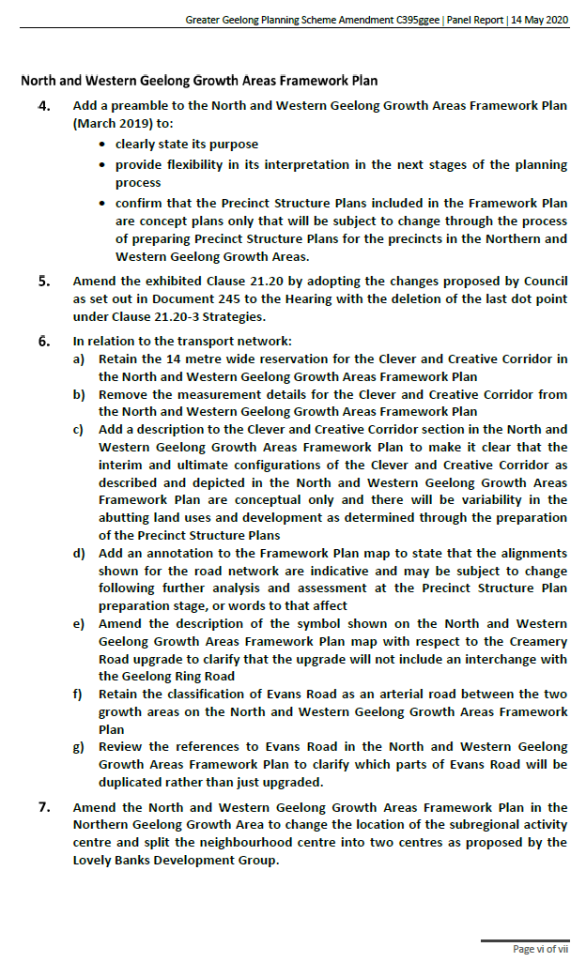
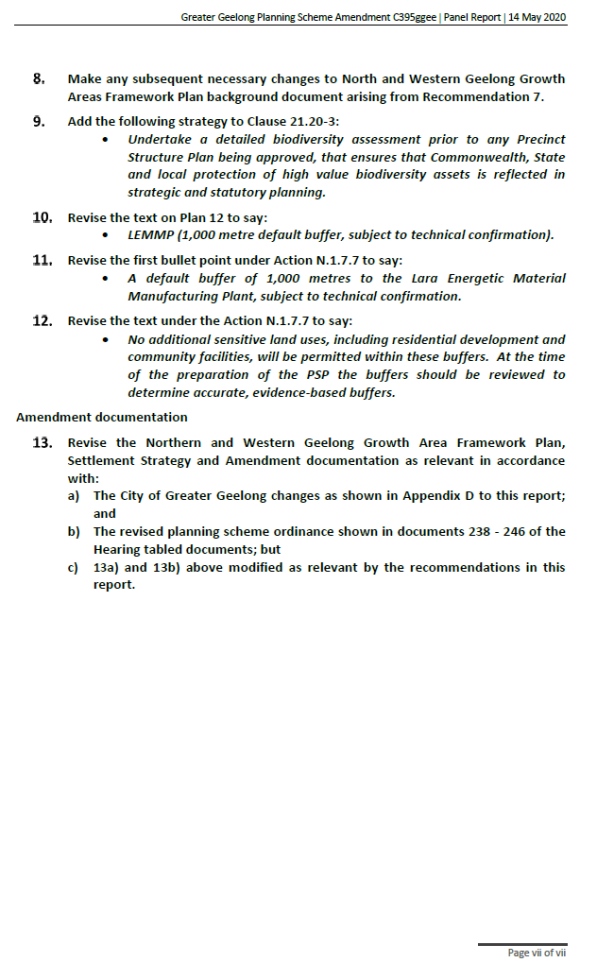
The Panel recommendations are the most critical part of a Panel report and the Act requires that Council as the Planning Authority must consider the recommendations as part of adoption of an amendment. A full list of the thirteen recommendations is provided and responded to in Attachment 7.
The first recommendation represents the Panel’s overall stance on the amendment:
“1. Adopt Greater Geelong Planning Scheme Amendment C395ggee as exhibited subject to the changes recommended in this report.”
The remaining twelve recommendations (see Attachment 7) describe the Panel’s recommended changes to the Settlement Strategy, Framework Plan and the Amendment that is: the planning scheme ordinance (local policy clauses) and zone maps.
The City’s position is that all the Panel recommendations should be accepted.
The City is supportive of the Panel’s recommended changes as they generally reflect the City’s position on the key issues as resolved at the 24 September 2019 Council meeting and the subsequent changes that were agreed to (under delegation) in the submissions and responses provided to the Panel during the lengthy hearing.
Amendment for Adoption
The Amendment (that is: local policy and zone maps) has been updated generally in accordance with the Panel recommendations. The documents recommended for adoption are in Attachment 8. There are two changes/variations to the previous Council positions which are worth noting and these are described below:
Zone map change
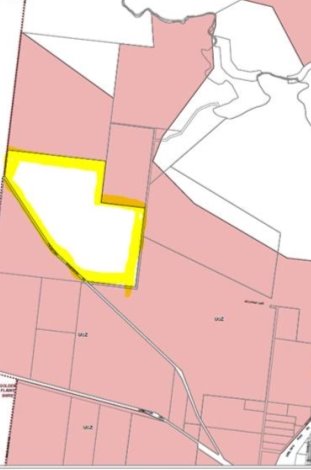
An additional change has also been made to zone map 31. The exhibited zone maps for the Western Geelong Growth Area showed the Urban Growth Zone (UGZ) being applied to several properties but any that were in the quarry Works Authority No.3 (WA3) were to remain in the Special Use Zone.
During the hearing the City agreed to a request by Adelaide Brighton Cement Limited (ABCL) to include additional properties into the UGZ if they were excised from WA3 prior to adoption of the Amendment.
ABCL subsequently obtained approval from Earth Resources Division to vary WA3 and excised the land. As a result, additional land has been included in the UGZ including two of ABCL’s Farming Zone properties that would have been an “island” of FZ surrounded by UGZ. The areas highlighted below are now to be included in UGZ on Map 31 in Appendix 8.
Map showing additional UGZ land
Clause 21.06 Housing and Settlement Framework Map
As discussed earlier, a small number of changes in Attachment 6 have not been made as they have been superseded by changes agreed by the City later in the hearing or by Panel recommendations. In addition, the City has decided not to include smaller segment versions of the Housing and Settlement Framework Plan map in Clause 21.06 (as listed in Attachment 6 line item 2). The additional “zoomed in” segment maps will be added to the Settlement Strategy but not Clause 21.06.
The City considers the plan is legible at the municipal scale and will consider breaking it into segments in Clause 21.06 after long term settlement boundaries are resolved through the DAL process (for the Bellarine) and the settlement boundary review/logical inclusions process (for urban Geelong).
Number |
Modification to |
Source |
Date |
Clause/map/page |
Change |
|---|---|---|---|---|---|
1 |
ordinance |
Identified by Council officers |
24 Sep 2019 - Council |
21.06 |
On the drawing key on Housing and Settlement Framework Plan proposed in Clause 21.06, change “BOUNDARY – INDICATIVE PERMANENT SETTLEMENT BOUNDARY” to “SETTLEMENT BOUNDARY – INDICATIVE LONG TERM BOUNDARY” |
2 |
ordinance |
Identified by Council officers |
24 Sep 2019 - Council |
21.06 |
In addition to the single Housing and Settlement Framework Plan for the whole municipality, include several segment maps covering smaller areas for clearer interpretation |
3 |
ordinance |
Panel submission |
6 Feb 2020 - Gareth Smith approved |
21.06-1 |
Under the heading Key issues and influences, change “Geelon’s” to “Geelong’s”. |
4 |
ordinance |
Panel submission |
6 Feb 2020 - Gareth Smith approved |
21.06-1 |
In the first sentence under the heading Demographics, change “annual growth” to “average annual growth”. |
5 |
ordinance |
Panel submission |
6 Feb 2020 - Gareth Smith approved |
21.06-1 |
In the first paragraph under the heading Housing, change “Inceasing” to “Increasing” and change “maintainence” to “maintenance”. |
6 |
ordinance |
Panel submission |
6 Feb 2020 - Gareth Smith approved |
21.06-1 |
In the last paragraph under the heading “Settlement”, change “settlemement” to “settlement”. |
7 |
ordinance |
Identified by Council officers |
24 Sep 2019 - Council |
21.06-2 |
Change the heading of proposed 21.06-2 from Spatial Distribution of Growth and Land Supply to Spatial distribution of growth and land supply |
8 |
ordinance |
Panel submission |
6 Feb 2020 - Gareth Smith approved |
21.06-2 |
Replace the fourth strategy (commencing with “Confirm enduring …”) with the following: “Deliver defendable long-term settlement boundaries via a consultative boundary review process”. |
9 |
ordinance |
Panel submission |
6 Feb 2020 - Gareth Smith approved |
21.06-3 |
Delete the third strategy relating to One Planet Living principles. |
10 |
ordinance |
Panel submission |
6 Feb 2020 - Gareth Smith approved |
21.06-4 |
In the last strategy, change “faciltities” to “facilities”. |
11 |
ordinance |
Submission 26 |
24 Sep 2019 - Council |
21.06-8 |
In proposed 21.06-9 (Implementation), modify the proposed third Further Work item by changing the words “special local environmental or landscape values” to “environmental or landscape values of local, state or national importance” |
12 |
ordinance |
Panel submission |
6 Feb 2020 - Gareth Smith approved |
21.06-8 |
Replace the fourth point under the heading Further work (commencing with “Establish a …”) with the following: “Undertake a consultative settlement boundary review process.” |
13 |
ordinance |
Panel submission |
6 Feb 2020 - Gareth Smith approved |
21.06-8 |
In the fifth point under the heading Further work, change “opportunities” to “opportunities”. |
14 |
ordinance |
Submission 14 |
24 Sep 2019 - Council |
21.06-8 |
In proposed 21.06-8 (Implementation), modify the proposed fifth Further Work item by adding the words “and mixed use development” after “train station environs to future housing needs” |
15 |
ordinance |
Panel submission |
6 Feb 2020 - Gareth Smith approved |
21.06-8 |
In the final paragraph under the heading Further work, change “resinential” to “residential”. |
16 |
ordinance |
Panel submission |
6 Feb 2020 - Gareth Smith approved |
21.06-8 |
In the References, replace the date for the Settlement Strategy with “(XX, YY)”. |
17 |
ordinance |
Submission 25 |
24 Sep 2019 - Council |
21.06 Housing and Framework Plan map |
On the drawing key on Housing and Settlement Framework Plan proposed in Clause 21.06, change “SETTLEMENT BOUNDARY” to “MUNICIPAL BOUNDARY” |
18 |
ordinance |
Identified by Council officers |
24 Sep 2019 - Council |
21.06 Housing and Framework Plan map |
Housing and Settlement Framework Plan: on the map, show the future growth areas as growth areas and delete “FUTURE GROWTH AREAS” from the drawing key |
19 |
ordinance |
Mark Woodland evidence |
18 Nov 2019 - Part B submission |
21.06 Housing and Framework Plan map |
Modify the Housing and Settlement Framework Plan map at Clause 21.06-8 to remove the word 'permanent' from 'indicative permanent settlement boundary' |
20 |
ordinance |
Identified by Council officers |
6 Feb 2020 - Gareth Smith approved |
21.06 Housing and Framework Plan map |
In the Drawing Key for the Housing and Settlement Framework Plan map, change “INDICATIVE PERMANENT SETTLEMENT BOUNDARY” to “SETTLEMENT BOUNDARY”. |
21 |
ordinance |
Panel submission |
6 Feb 2020 - Gareth Smith approved |
21.06 Housing and Framework Plan map |
In the Drawing Key for the Housing and Settlement Framework Plan map, under DISTRICT TOWNS, change “EXISTING SETTLEMENT BOUNDARIES” to “SETTLEMENT BOUNDARIES”. |
22 |
ordinance |
Submission 55 |
28 Oct 2019 - Part A submission |
21.08-3 |
In 21.08-3 (Strategies), modify the first proposed strategy by adding “expected” before “metropolitan-equivalent” |
23 |
ordinance |
Panel submission |
6 Feb 2020 - Gareth Smith approved |
21.08-6 |
In the References, replace the date for the Settlement Strategy with “(XX, YY)”. |
24 |
ordinance |
Submission 25 |
24 Sep 2019 - Council |
21.11-1 |
1st paragraph: change “54,000 persons and 22,000 dwellings” to “approximately 55,000 to 65,000 persons” |
25 |
ordinance |
Panel submission |
6 Feb 2020 - Gareth Smith approved |
21.11-3 |
Add the following point under the heading Further Work: Implement any relevant findings of the logical inclusions process undertaken pursuant to Clause 21.06". |
26 |
ordinance |
Michael Barlow evidence |
18 Nov 2019 - Part B submission |
21.14-4 |
Update the proposed Further Work task "Work with the state government on the designation of the Bellarine Peninsula under the Distinctive Area and Landscapes Act 2018" to reflect the fact the declaration has been made and the next step is to finalise a Statement of Planning Policy |
27 |
ordinance |
Panel submission |
6 Feb 2020 - Gareth Smith approved |
21.14-4 |
In the References, replace the date for the Settlement Strategy with “(XX, YY)”. |
28 |
ordinance |
Panel submission |
6 Feb 2020 - Gareth Smith approved |
21.16-3 |
In the References, replace the date for the Settlement Strategy with “(XX, YY)”. |
29 |
ordinance |
Panel submission |
6 Feb 2020 - Gareth Smith approved |
21.20-2 |
In the second last objective, change “in the short to medium term” to “while it remains operational” and delate “in the long term”. |
30 |
ordinance |
Submission 26 |
24 Sep 2019 - Council |
21.20-2 |
Add the following objective: “To retain and protect or appropriately offset valuable biodiversity assets, including grassland areas” |
31 |
ordinance |
Mark Woodland evidence Jason Black evidence |
18 Nov 2019 - Part B submission 6 Feb 2020 - Gareth Smith approved |
21.20-3 |
Replace the first strategy with the following: “Prepare Precinct Structure Plans that: |
32 |
ordinance |
Panel submission |
6 Feb 2020 - Gareth Smith approved |
21.20-3 |
Replace the second strategy with the following: “Prior to resolving to commence a Precinct Structure Plan, consider, as relevant: § The City of Greater Geelong Settlement Strategy (XX, YY). § Development sequencing set out in the Northern and Western Geelong Growth Areas Framework Plan (City of Greater Geelong, XX, YY). § The need to maintain an adequate supply of urban land. § Third party funding agreements with land developers to undertake technical studies. § Whether the precinct will enable the staged extension of infrastructure networks in a way that minimises the real cost of infrastructure provision. § Whether or not a precinct is subject to major constraints or uncertainties that is likely to delay development. § Whether or not the precinct is of a size that is likely to result in a substantial and predictable development yield. § The pattern of land ownership and the potential for multiple landowners to co-ordinate the planning and development of the precinct. § Whether a precinct’s development will support the effective and early development of public transport infrastructure, town centre and employment precincts.” |
33 |
ordinance |
Panel submission |
6 Feb 2020 - Gareth Smith approved |
21.20-3 |
In the fifth strategy, replace “effeicient” with “efficient”. |
34 |
ordinance |
Mark Woodland evidence |
18 Nov 2019 - Part B submission |
21.20-3 |
Include an additional strategy in Clause 21.20-3: "Land use and development should have regard to the Northern and Western Geelong Growth Areas Framework Plan." |
35 |
ordinance |
Submissions 1, 37 |
11 Nov 2019 - Gareth Smith approved |
21.20-3 |
Reword the second last strategy in Clause 21.20-3 to read: "Maintain an appropriate buffer around the Work Authority boundary of the Batesford Quarry to minimise the impacts of activities that may be carried out under the Work Authority." |
36 |
ordinance |
Panel submission |
6 Feb 2020 - Gareth Smith approved |
21.20-4 |
In the References, replace the date for the Framework Plan with “(XX, YY)”. |
37 |
ordinance |
Panel submission |
6 Feb 2020 - Gareth Smith approved |
21.20-5 |
Revise the Northern and Western Geelong Growth Areas Framework Plan map to reflect all modifications in this schedule to Plans 2, 3, 4 and 5 of the Framework Plan. |
38 |
Maps |
Submission 46 |
28 Oct 2019 - Part A submission |
Maps 16, 17 |
Rezone land between the north-western boundary of the exhibited Urban Growth Zone and the high voltage transmission line easement from Farming Zone to Urban Growth Zone |
39 |
Maps |
Panel submission |
6 Feb 2020 - Gareth Smith approved |
Map 31 |
Rezone land outside of the current Work Authority for the Batesford Quarry from Special Use Zone Schedule 7 to Urban Growth Zone. |
40 |
Maps |
Submission 37 |
24 Sep 2019 - Council |
Map 31 |
Rezone 80 Thoona Lane, Fyansford from Special Use Zone Schedule 7 to Urban Growth Zone |
41 |
Settlement Strategy |
Identified by Council officers |
6 Feb 2020 - Gareth Smith approved |
Various |
Throughout the text of the Strategy, change “permanent settlement boundary” (or “… boundaries”) to “long term boundary” (or “… boundaries”). |
42 |
Settlement Strategy |
Identified by Council officers |
6 Feb 2020 - Gareth Smith approved |
12 |
In the Drawing Key, change “INDICATIVE PERMANENT SETTLEMENT BOUNDARY” to “SETTLEMENT BOUNDARY”. |
43 |
Settlement Strategy |
Identified by Council officers |
6 Feb 2020 - Gareth Smith approved |
12 |
In the Drawing Key, under DISTRICT TOWNS, change “EXISTING SETTLEMENT BOUNDARIES” to “SETTLEMENT BOUNDARIES”. |
44 |
Settlement Strategy |
Submission 13 |
24 Sep 2019 - Council |
12 |
Change the Barwon Heads settlement boundary on the Housing Framework Plan in the Settlement Strategy to match that in Clause 21.14-10 and that proposed in Clause 21.06 |
45 |
Settlement Strategy |
Submission 25 |
24 Sep 2019 - Council |
12 |
Change the non-urban breaks on the Housing Framework Plan in the Settlement Strategy to match those proposed on the Housing and Settlement Framework Plan in Clause 21.06 |
46 |
Settlement Strategy |
Identified by Council officers |
6 Feb 2020 - Gareth Smith approved |
52 |
Table 11 caption: change “1 January 2017” to “1 November 2017”. |
47 |
Settlement Strategy |
Identified by Council officers |
6 Feb 2020 - Gareth Smith approved |
59 |
In the second paragraph, change “The bulk of” to “The major share of”. |
48 |
Settlement Strategy |
Identified by Council officers |
6 Feb 2020 - Gareth Smith approved |
59 |
In the first paragraph under the heading Land Supply, change “20” to “17”. |
49 |
Settlement Strategy |
Identified by Council officers |
6 Feb 2020 - Gareth Smith approved |
63 |
In direction e. under the Principle “Provide clear strategic direction …”, add the words “upon completion of the Bellarine Peninsula Distinctive Area and Landscape process” after “process for townships”. |
50 |
Settlement Strategy |
Panel submission |
6 Feb 2020 - Gareth Smith approved |
63 |
Change direction b. under the Principle “Maintain an adequate supply …” to “Continue to monitor and review land supply and respond accordingly.” |
51 |
Settlement Strategy |
Submission 38 |
24 Sep 2019 - Council |
69-70 |
Add reference to value capture opportunities in the Costs of Housing Growth section |
52 |
Settlement Strategy |
Submission 32 |
24 Sep 2019 - Council |
70 |
Include reference to considering industry and infrastructure buffers in the Managing Future Growth section |
53 |
Settlement Strategy |
Submissions 1, 22 |
24 Sep 2019 - Council |
71 |
Add this direction under the Principle “Manage the release of new growth areas …”: “Ensure infrastructure funding strategies recognise items that deliver high level infrastructure that benefits multiple precinct structure plan areas will require a contribution.” |
54 |
Settlement Strategy |
Panel submission |
6 Feb 2020 - Gareth Smith approved |
73 |
In the last paragraph, change “permanent settlement boundaries will undoubtedly” to “protected or long-term settlement boundaries may”. |
55 |
Settlement Strategy |
Identified by Council officers |
6 Feb 2020 - Gareth Smith approved |
75 |
In the last paragraph before the heading Urban growth boundaries, change “There are two options” to “There a number of options”. |
56 |
Settlement Strategy |
Identified by Council officers |
6 Feb 2020 - Gareth Smith approved |
75 |
Add the following heading and text after the heading and text for Urban growth boundaries: “Long term settlement boundaries |
57 |
Settlement Strategy |
Identified by Council officers |
6 Feb 2020 - Gareth Smith approved |
75 |
Change the heading “Distinctive Areas and Landscapes Bill 2017” to “Distinctive Areas and Landscapes”. |
58 |
Settlement Strategy |
Identified by Council officers |
6 Feb 2020 - Gareth Smith approved |
75 |
Replace the text under the heading Distinctive Areas and Landscapes with the following, to reflect the current status of the project: “On 29 October 2019 the Bellarine Peninsula was declared a Distinctive Area and Landscape under the Planning and Environment Act 1987. This declaration triggers the requirement to prepare a Statement of Planning Policy by October 2020. The Statement of Planning Policy will include a 50-year vision and land use strategies to better protect the unique features of the Bellarine for current and future generations. It also provides the opportunity to designate long term settlement boundaries. The policy will be informed by strategic planning work already undertaken, relevant technical studies and outcomes from community engagement. The City considers the Distinctive Areas and Landscapes the most appropriate process to determine long term boundaries for the Bellarine. If long term boundaries are not resolved, the City will need to determine long term boundaries via a separate consultative process for the district towns with regard to Statement of Planning Policy.” |
59 |
Settlement Strategy |
Identified by Council officers |
6 Feb 2020 - Gareth Smith approved |
75 |
In the first paragraph under the heading Defining the Boundary, change “should be based” to “should be largely based”. |
60 |
Settlement Strategy |
Identified by Council officers |
6 Feb 2020 - Gareth Smith approved |
75 |
Delete the third last dot point (commencing “establishing the timing …). |
61 |
Settlement Strategy |
Identified by Council officers |
6 Feb 2020 - Gareth Smith approved |
75 |
Add text after the list of dot points under the heading Defining the Boundary that reflects the principles set out in Council’s Part B Panel Submission for considering land through the logical inclusions process. |
62 |
Settlement Strategy |
Identified by Council officers |
6 Feb 2020 - Gareth Smith approved |
75 |
Replace the second last paragraph under the heading Defining the Boundary with the following: “A long-term settlement boundary process should commence as soon as resources allow.” |
63 |
Settlement Strategy |
Panel submission |
6 Feb 2020 - Gareth Smith approved |
77 |
Townships on the Bellarine Peninsula, 2nd last paragraph, last sentence: change “will impact” to “may impact”. |
64 |
Settlement Strategy |
Panel submission |
6 Feb 2020 - Gareth Smith approved |
77 |
Delete direction d. under the Principle “Contain growth within …” |
65 |
Settlement Strategy |
Panel submission |
6 Feb 2020 - Gareth Smith approved |
77 |
Replace direction c. under the Principle “Maintain the unique …” with the following: “Work with the state government on the Bellarine Peninsula Distinctive Areas and Landscapes process and the development of a Statement of Planning Policy for the Bellarine Peninsula.” |
66 |
Settlement Strategy |
Submission 32 |
24 Sep 2019 - Council |
78 |
Include reference to considering industry and infrastructure buffers in the Urban Consolidation section |
67 |
Settlement Strategy |
Submission 90 |
24 Sep 2019 - Council |
80 |
Table 12, North Geelong station, Opportunity: revise to exclude land within Port Environs from investigation for expansion of Increased Housing Diversity Area or identification as Key Development Area |
68 |
Settlement Strategy |
Submission 90 |
24 Sep 2019 - Council |
84 |
Under the Principle “Increase the role of urban consolidation as part of Geelong’s overall housing supply”, Direction c: change “Breakwater” to “Waurn Ponds” |
69 |
Settlement Strategy |
Submission 14 |
24 Sep 2019 - Council |
84 |
Under the Principle “Articulate the preferred location for increased housing densities”, add the words “and mixed use development” after the words “train station environs to future housing needs” |
70 |
Settlement Strategy |
Identified by Council officers |
6 Feb 2020 - Gareth Smith approved |
85 |
In the Drawing Key, change “INDICATIVE PERMANENT SETTLEMENT BOUNDARY” to “SETTLEMENT BOUNDARY”. |
71 |
Settlement Strategy |
Identified by Council officers |
6 Feb 2020 - Gareth Smith approved |
85 |
In the Drawing Key, under DISTRICT TOWNS, change “EXISTING SETTLEMENT BOUNDARIES” to “SETTLEMENT BOUNDARIES”. |
72 |
Settlement Strategy |
Submission 13 |
24 Sep 2019 - Council |
85 |
Change the Barwon Heads settlement boundary on the Overall Framework Plan in the Settlement Strategy to match that in Clause 21.14-10 and that proposed in Clause 21.06 |
73 |
Settlement Strategy |
Submission 25 |
24 Sep 2019 - Council |
85 |
Change the non-urban breaks on the Overall Framework Plan in the Settlement Strategy to match those proposed on the Housing and Settlement Framework Plan in Clause 21.06 |
74 |
Settlement Strategy |
Submission 90 |
24 Sep 2019 - Council |
85 |
Amend the extent of land identified on the Overall Framework Plan as “Investigate opportunities for higher density in the rail corridor” by excluding land within the Port Environs |
75 |
Settlement Strategy |
Identified by Council officers |
24 Sep 2019 - Council |
85 |
In addition to the single Housing and Settlement Framework Plan for the whole municipality, include several segment maps covering smaller areas for clearer interpretation |
76 |
Settlement Strategy |
Identified by Council officers |
6 Feb 2020 - Gareth Smith approved |
88 |
At the end of the Monitoring and Review section, but before the Principles and Directions, add a heading and text as follows: |
77 |
Framework Plan |
Various submissions |
12 Nov 2019 - Council opening submission |
5 |
Include a new introductory section with a heading "Role of the framework plan" that reads in accordance with the wording in Paragraph 107.2 at Pages 26 and 27 of Council's Opening Submission |
78 |
Framework Plan |
Submissions 12, 58 |
24 Sep 2019 - Council |
44 |
Plan 5 – Clever and Creative Corridor: Delete 400 metre catchment from land between the two growth areas |
79 |
Framework Plan |
Mark Woodland evidence |
18 Nov 2019 - Part B submission |
44 |
Plan 5 – Clever and Creative Corridor: Identify the key destinations that the Clever and Creative Corridor is intended to link to, including the Geelong CBD and key train stations. |
80 |
Framework Plan |
Panel submission |
6 Feb 2020 - Gareth Smith approved |
44 (and others) |
Consider modifying the alignment of the Clever and Creative Corridor to accommodate revised Neighbourhood Activity Centre locations in the Northern Geelong Growth Area. If the alignment is modified, revise all relevant maps and text in the Framework Plan accordingly. |
81 |
Framework Plan |
Mark Woodland evidence |
18 Nov 2019 - Part B submission |
45 |
Include additional text in the Clever and Creative Corridor section to clarify how the land use framework along the Clever and Creative Corridor is expected to deliver an urban density and land use mix that can sustain the level of public transport service needed to support public transport patronage in this corridor. |
82 |
Framework Plan |
Submission 55 |
7 Nov 2019 - Gareth Smith approved |
45-53 |
Revise the Clever and Creative Corridor section (pages 45 to 53) by removing reference to specific reservation widths, except for reference to the 14 metre median reserve, which is to be retained. |
83 |
Framework Plan |
Panel submission |
6 Feb 2020 - Gareth Smith approved |
47, 49, 51, 53 |
Add the following text under the headings CLEVER AND CREATIVE CORRIDOR – INTERIM CONFIGURATION and CLEVER AND CREATIVE CORRIDOR – INTERIM CONFIGURATION: |
84 |
Framework Plan |
Panel submission |
6 Feb 2020 - Gareth Smith approved |
65 |
Action N1.2.9, 2nd paragraph, 2nd sentence: Change “may be considered” to “will be considered”. |
85 |
Framework Plan |
Panel submission |
6 Feb 2020 - Gareth Smith approved |
67 |
Action N1.3.3: Change “Corridors will be located” to “Corridors may be located”. |
86 |
Framework Plan |
Submission 55 |
24 Sep 2019 - Council |
68 |
Biodiversity – Northern Geelong Growth Area: Action N1.3.7, second paragraph: change “securing offsets within the growth area” to “securing offsets in accordance with the outcomes of the biodiversity conservation strategy” |
87 |
Framework Plan |
Submissions 4, 55 |
8 Nov 2019 - Gareth Smith approved |
83 |
Environment - Northern Geelong Growth Area: Reword Action N1.6.8 to read: "Land uses within 570 metres of the gas pipeline easement must be planned carefully to minimise risk to community safety |
88 |
Framework Plan |
Panel submission |
6 Feb 2020 - Gareth Smith approved |
92 (and others) |
Revise Plan 16 by adjusting the width of the Waterways designation on 30 Avonlea Road, Bell Post Hill to better reflect the underlying background report. Revise Plans 2, 4, 5, 17, 25, 26, 27, 30, 31, 35, 36, 37, 47, 48, 49, 50 and 51 accordingly. |
89 |
Framework Plan |
Panel submission |
6 Feb 2020 - Gareth Smith approved |
95 |
Action W1.2.9, 2nd paragraph, 2nd sentence: Change “may be considered” to “will be considered”. |
90 |
Framework Plan |
Panel submission |
6 Feb 2020 - Gareth Smith approved |
98 |
Action W1.3.3: Change “Corridors will be located” to “Corridors may be located”. |
91 |
Framework Plan |
Panel submission |
6 Feb 2020 - Gareth Smith approved |
98 |
Action W1.3.3: Change “moment” to “movement”. |
92 |
Framework Plan |
Submission 55 |
24 Sep 2019 - Council |
99 |
Biodiversity – Western Geelong Growth Area: Action W1.3.8, second paragraph: change “securing offsets within the growth area” to “securing offsets in accordance with the outcomes of the biodiversity conservation strategy” |
93 |
Framework Plan |
Submission 16 |
6 Feb 2020 - Gareth Smith approved |
102 |
Plan 18 Drawing Key: Change “EXISTING ARCHAEOLOGICAL SITE” to “REGISTERED ABORIGINAL PLACES – SITE EXTENTS” |
94 |
Framework Plan |
Submissions 1, 77 |
24 Sep 2019 - Council |
106 |
Plan 19 – Post Contact Heritage – Western Geelong Growth Area: Delete HO 45 and most of HO 1740, in accordance with Amendment C376 (Pt 2) |
95 |
Framework Plan |
Submission 47 |
24 Sep 2019 - Council |
110 |
Plan 20 – Built Environment – Western Geelong Growth Area: Include Idyll Wines Co. winery on map |
96 |
Framework Plan |
Submission 47 |
24 Sep 2019 - Council |
111 |
Built Environment – Western Geelong Growth Area - Context: 3rd last dot point: Change “a vineyard’ to “a winery” |
97 |
Framework Plan |
Submission 60 |
24 Sep 2019 - Council |
114 |
Plan 21 – Surrounding Areas – Western Geelong Growth Area: Change Plan 21 to show The Dog Rocks in the correct location, and the land currently shown as The Dog Rocks as Agricultural, not Recreation |
98 |
Framework Plan |
Identified by Council officers |
24 Sep 2019 - Council |
123 |
Neighbourhood Design – Northern Geelong Growth Area: Action N2.1.7, 2nd dot point: change “halves of these catchments” to “half of this catchment” |
99 |
Framework Plan |
Identified by Council officers |
24 Sep 2019 - Council |
128 |
Neighbourhood Sustainability – Northern Geelong Growth Area: Third paragraph under Context: change “Western Geelong Growth Area” to “Northern Geelong Growth Area” |
100 |
Framework Plan |
Identified by Council officers |
24 Sep 2019 - Council |
135 |
Social Infrastructure – Northern Geelong Growth Area: 2nd sentence of 2nd paragraph under Context: change "Geelong's new" to "Northern Geelong's new" |
101 |
Framework Plan |
Submission 55 |
24 Sep 2019 - Council |
135 |
Neighbourhood Amenity – Northern Geelong Growth Area: Change 3rd dot point to “A mix of local, indigenous and exotic species” |
102 |
Framework Plan |
Identified by Council officers |
24 Sep 2019 - Council |
141 |
Neighbourhood Design – Western Geelong Growth Area: Action W2.1.6, 2nd dot point: change “halves of these catchments” to “half of this catchment” |
103 |
Framework Plan |
Submission 55 |
24 Sep 2019 - Council |
144 |
Neighbourhood Amenity – Western Geelong Growth Area: Change 3rd dot point to “A mix of local, indigenous and exotic species” |
104 |
Framework Plan |
Identified by Council officers |
24 Sep 2019 - Council |
150 |
Housing – Western Geelong Growth Area: Action W2.4.4 – 2nd paragraph: replace with explanatory text relating to the action |
105 |
Framework Plan |
Panel submission |
6 Feb 2020 - Gareth Smith approved |
162 (and others) |
Plan 28: Replace the north-eastern Neighbourhood Activity Centre with two Neighbourhood Activity Centres, in accordance with expert evidence provided for Lovely Banks Development Group. Revise Plans 2, 3, 5, 23, 24, 29, 32, 33, 34, 41, 42, 43, and 44, and any associated text accordingly. |
106 |
Framework Plan |
Identified by Council officers |
24 Sep 2019 - Council |
163 |
Activity Centres - Northern Geelong Growth Area: Action N3.1.1: delete last dot point |
107 |
Framework Plan |
Identified by Council officers |
24 Sep 2019 - Council |
167 |
Activity Centres – Northern Geelong Growth Area: Add an action relating to local activity centres for the Northern Geelong Growth Area |
108 |
Framework Plan |
Identified by Council officers |
24 Sep 2019 - Council |
179 |
Employment – Western Geelong Growth Area: Renumber Actions W3.2.2 to W3.2.4 as Actions W3.2.1 to W3.2.3 respectively |
109 |
Framework Plan |
Identified by Council officers |
24 Sep 2019 - Council |
194 |
Integrated Transport – Northern Geelong Growth Area: Action N4.3.2 – 2nd last dot point: delete reference to the Batesford township |
110 |
Framework Plan |
Submission 90 |
24 Sep 2019 - Council |
196 |
Plan 35 – Active Transport – Western Geelong Growth Area: Extend the shared path along Friend in Hand Road south to Hamilton Highway |
111 |
Framework Plan |
Identified by Council officers |
24 Sep 2019 - Council |
201 |
Public Transport – Western Geelong Growth Area: Change two references to “Northern Geelong Growth Area” to “Western Geelong Growth Area” |
112 |
Framework Plan |
Identified by Council officers |
24 Sep 2019 - Council |
201 |
Public Transport – Western Geelong Growth Area: Under context, 5th dot point: change “Creamery Road” to “Rollins Road and Braund Avenue” |
113 |
Framework Plan |
Panel submission |
6 Feb 2020 - Gareth Smith approved |
203 |
Action W4.2.5: In the first paragraph (bold font), change “ and Cowies Creek corridors and Batesford Quarry” to “, Barwon River and Cowies Creek corridors, Batesford Quarry and the Geelong Ring Road”. |
114 |
Framework Plan |
Panel submission |
6 Feb 2020 - Gareth Smith approved |
203 |
Action W4.2.5: In the second paragraph, change “ and quarry” to “, quarry and Geelong Ring Road”. |
115 |
Framework Plan |
Panel submission |
6 Feb 2020 - Gareth Smith approved |
212 |
In the fifth paragraph (commencing “The Clever …”, change “short, medium and long term precincts” to “new growth areas”. |
116 |
Framework Plan |
Mark Woodland evidence |
18 Nov 2019 - Part B submission |
215 |
Utilities and Infrastructure – Northern Geelong Growth Area: Include a statement of limitations explaining that the precinct concept plans at pages 222-229 are only intended to show the potential combination of land uses and infrastructure requirements that need to be addressed at the PSP stage, and that the plans do not represent a final or preferred urban structure for the precinct |
117 |
Framework Plan |
Mark Woodland evidence |
18 Nov 2019 - Part B submission |
215 |
Utilities and Infrastructure – Northern Geelong Growth Area: Include a statement of limitations explaining that the purpose of the Precinct Infrastructure Requirements at pages 222-229 is to identify the broad infrastructure needs for each precinct, but that these will be refined as each PSP is prepared |
118 |
Framework Plan |
Identified by Council officers |
24 Sep 2019 - Council |
217 |
Utilities and Infrastructure – Northern Geelong Growth Area: Change Action N5.1.5 to reflect Action W5.1.5 and adjust N5.1.4 accordingly |
119 |
Framework Plan |
Mark Woodland evidence |
18 Nov 2019 - Part B submission |
220 |
Delivery - Northern Geelong Growth Area: Include the following additional factors in Action N5.2.1: * Whether the precinct will enable the staged extension of infrastructure networks in a way that minimizes the real cost of infrastructure provisions * Whether or not a precinct subject to major constraints or uncertainties that could delay development and are of a size and with a pattern of land ownership that is likely to result in a substantial and predictable yield of housing and/or industrial land * Whether a precinct's development will support the effective and early development of public transport infrastructure, town centres and employment precincts |
120 |
Framework Plan |
Panel submission |
6 Feb 2020 - Gareth Smith approved |
220, 236 |
In Actions N5.2.1 and W5.2.1, replace the dot points with the following: “ * The City of Greater Geelong Settlement Strategy. * Development sequencing set out in the Northern and Western Geelong Growth Areas Framework Plan. * The need to maintain an adequate supply of urban land. * Third party funding agreements with land developers to undertake technical studies. * Whether the precinct will enable the staged extension of infrastructure networks in a way that minimises the real cost of infrastructure provision. * Whether or not a precinct is subject to major constraints or uncertainties that is likely to delay development. * Whether or not the precinct is of a size that is likely to result in a substantial and predictable development yield. * The pattern of land ownership and the potential for multiple landowners to co-ordinate the planning and development of the precinct. * Whether a precinct’s development will support the effective and early development of public transport infrastructure, town centre and employment precincts.” |
121 |
Framework Plan |
Identified by Council officers |
6 Feb 2020 - Gareth Smith approved |
223, 223, 225, 227, 229, 239, 242, 243, 245, 247 |
Add the following additional note at the foot of each page after the note “* Infrastructure required to support multiple precincts”: |
122 |
Framework Plan |
Identified by Council officers |
24 Sep 2019 - Council |
226 |
Integrated Transport – Western Geelong Growth Area: Action W4.3.2, 6th dot point: delete “and within the Batesford township” |
123 |
Framework Plan |
Identified by Council officers |
24 Sep 2019 - Council |
227 |
Delivery – Heales Road West PSP: Change “One integrated children’s centres” to “One integrated children’s centre”; and change “One long day child care centres” to “one long day child care centre” |
124 |
Framework Plan |
Mark Woodland evidence |
18 Nov 2019 - Part B submission |
231 |
Utilities and Infrastructure – Western Geelong Growth Area: Include a statement of limitations explaining that the precinct concept plans at pages 238-248 are only intended to show the potential combination of land uses and infrastructure requirements that need to be addressed at the PSP stage, and that the plans do not represent a final or preferred urban structure for the precinct |
125 |
Framework Plan |
Mark Woodland evidence |
18 Nov 2019 - Part B submission |
231 |
Utilities and Infrastructure – Western Geelong Growth Area: Include a statement of limitations explaining that the purpose of the Precinct Infrastructure Requirements at pages 238-248 is to identify the broad infrastructure needs for each precinct, but that these will be refined as each PSP is prepared |
126 |
Framework Plan |
Submission 60 |
7 Nov 2019 - Gareth Smith approved |
234 |
Change the south-eastern boundary of the McCanns Lane precinct as shown on the attached plans. |
127 |
Framework Plan |
Mark Woodland evidence |
18 Nov 2019 - Part B submission |
236 |
Delivery - Western Geelong Growth Area: Include the following additional factors in Action W5.2.1: * Whether the precinct will enable the staged extension of infrastructure networks in a way that minimizes the real cost of infrastructure provisions * Whether or not a precinct subject to major constraints or uncertainties that could delay development and are of a size and with a pattern of land ownership that is likely to result in a substantial and predictable yield of housing and/or industrial land * Whether a precinct's development will support the effective and early development of public transport infrastructure, town centres and employment precincts |
128 |
Framework Plan |
Panel submission |
6 Feb 2020 - Gareth Smith approved |
239 |
Add the following point under Integrated transport infrastructure: “Upgrade the Creamery Road flyover of the Geelong Ring Road.” |
129 |
Framework Plan |
Identified by Council officers |
24 Sep 2019 - Council |
241 |
Delivery – Batesford North PSP: Change “One integrated children’s centres” to “One integrated children’s centre” |
130 |
Framework Plan |
Identified by Council officers |
24 Sep 2019 - Council |
243 |
Delivery – McCanns Lane PSP: Change “One long day child care centres” to “one long day child care centre” |
131 |
Framework Plan |
Identified by Council officers |
24 Sep 2019 - Council |
247 |
Delivery – Batesford South PSP: Change “One integrated children’s centres” to “One integrated children’s centre” |
Number |
Panel Recommendation Greater Geelong Planning Scheme Amendment C395 |
City Response |
Reference |
|---|---|---|---|
1 |
Adopt Greater Geelong Planning Scheme Amendment C395ggee as exhibited subject to the changes recommended in this report. |
Agreed. |
Refer to Attachment 8 |
2 |
Revise the Settlement Strategy to clearly articulate that for the Bellarine Peninsula, the process to finalise an enduring boundary for Geelong will be:
|
Agreed. page 75 - The text under the heading Distinctive Areas and Landscapes has been replaced with the following, to reflect the current status of the project: “On 29 October 2019 the Bellarine Peninsula was declared a Distinctive Area and Landscape under the Planning and Environment Act 1987. This declaration triggers the requirement to prepare a Statement of Planning Policy by October 2020. The Statement of Planning Policy will include a 50-year vision and land use strategies to better protect the unique features of the Bellarine for current and future generations. It also provides the opportunity to designate long term settlement boundaries. The policy will be informed by strategic planning work already undertaken, relevant technical studies and outcomes from community engagement. The City considers the Distinctive Areas and Landscapes the most appropriate process to determine long term boundaries for the Bellarine. If long term boundaries are not resolved, the City will need to determine long term boundaries via a separate consultative process for the district towns with regard to Statement of Planning Policy.” |
Refer to revised Settlement Strategy on C395 website |
3 |
Council consider revising the Settlement Strategy to identify the Boral land as an ‘Investigation Area’ for future urban development. |
Agreed. The following wording has been added to the Settlement Strategy: “PLANNING FOR THE NEXT PHASE OF GROWTH Investigations should include consideration of the Boral Waurn Ponds site and amongst any other relevant factors have regard to substantial parcels contiguous with existing urban area, ability to integrate with existing and planned urban areas, excellent rail and road access, cost effective servicing, protection of productive farmland and significant landscapes, other land use needs and requirements for Geelong.” |
Refer to revised Settlement Strategy on C395 website |
4 |
Add a preamble to the North and Western Geelong Growth Areas Framework Plan (March 2019) to:
|
Agreed. The following text has been inserted taken from page 26,27 of Council’s opening submission with addition of 2 paragraphs highlighted grey to reflect the Panel rec. Role of the framework plan The Northern and Western Geelong Growth Areas Framework Plan is a high-level strategic document that describes considerations related to future urban development in the growth areas. The Framework Plan acts as a background document and should be interpreted in that light. It provides flexibility in its interpretation in the next stages of the planning process. The framework plan describes the existing site context of the growth areas and outlines a vision and set of urban development objectives and actions to inform the subsequent detailed preparation of precinct structure plans (PSPs). The framework plan proposes the sequential preparation of nine PSPs. Each PSP provides the basis for localised urban development and investment and will further consider and incorporate relevant directions outlined in this framework plan. Each PSP will elaborate on the framework plan by adding important land uses that support the local community such as local roads, schools, community facilities and open space not included at this preliminary level of planning. Preparation of each PSP will be the subject of further detailed technical investigations and reports specific to that precinct. A separate planning scheme amendment will facilitate the detailed future urban structure and infrastructure requirements of the precincts. The location and extent of some features (e.g. road network, waterways and activity centres) depicted in plan set of the framework plan are accordingly illustrative or enlarged with the intent that they will be refined or amended as part of the preparation of each PSP. The framework plan summarises existing technical investigations that provide a preliminary basis for the preparation of each PSP. It is important to ensure that the preparation of the PSP allows for the consideration and adoption of new technical information that may provide increased benefits to the future community. Concept Precinct Structure Plans at pages 226-233 and 242-252 of this Framework Plan are only concept plans and will be subject to change through the process of preparing Precinct Structure Plans for the precincts in the growth areas. |
Refer to revised Framework Plan on C395 website |
5 |
Amend the exhibited Clause 21.20 by adopting the changes proposed by Council as set out in Document 245 to the Hearing with the deletion of the last dot point under Clause 21.20-3 Strategies. |
Agreed. |
Refer to Clause 21.20 Attachment 8 |
6 |
In relation to the transport network:
|
Agreed All the recommended changes have been addressed with changes made to the Framework Plan. In relation to 6 g) Evans Road has been reviewed but it is too early to clarify which sections will eb duplicated rather than just upgraded, as a result no change has been made in response to this Recommendation. |
Recs 6a)-6d) refer to revised Framework Plan on C395 website Rec 6e) change also made to Clause 21.20 map – see Attachment 8 |
7 |
Amend the North and Western Geelong Growth Areas Framework Plan in the Northern Geelong Growth Area to change the location of the subregional activity centre and split the neighbourhood centre into two centres as proposed by the Lovely Banks Development Group. |
Agreed. |
Refer to revised Framework Plan on C395 website Clause 21.20 map in Attachment 8 |
8 |
Make any subsequent necessary changes to North and Western Geelong Growth Areas Framework Plan background document arising from Recommendation 7. |
Agreed. |
Refer to revised Framework Plan on C395 website |
9 |
Add the following strategy to Clause 21.20-3:
|
Agreed. |
Refer to Clause 21.20 map in Attachment 8 |
10 |
Revise the text on Plan 12 to say:
|
Agreed. |
Refer to revised Framework Plan on C395 website |
11 |
Revise the first bullet point under Action N.1.7.7 to say:
|
Agreed. |
Refer to revised Framework Plan on C395 website |
12 |
Revise the text under the Action N.1.7.7 to say:
|
Agreed. |
Refer to revised Framework Plan on C395 website |
13 |
Revise the Northern and Western Geelong Growth Area Framework Plan, Settlement Strategy and Amendment documentation as relevant in accordance with:
|
Agreed. |
Refer to Attachment 8 and the revised Settlement Strategy and Framework Plan on the C395 website |
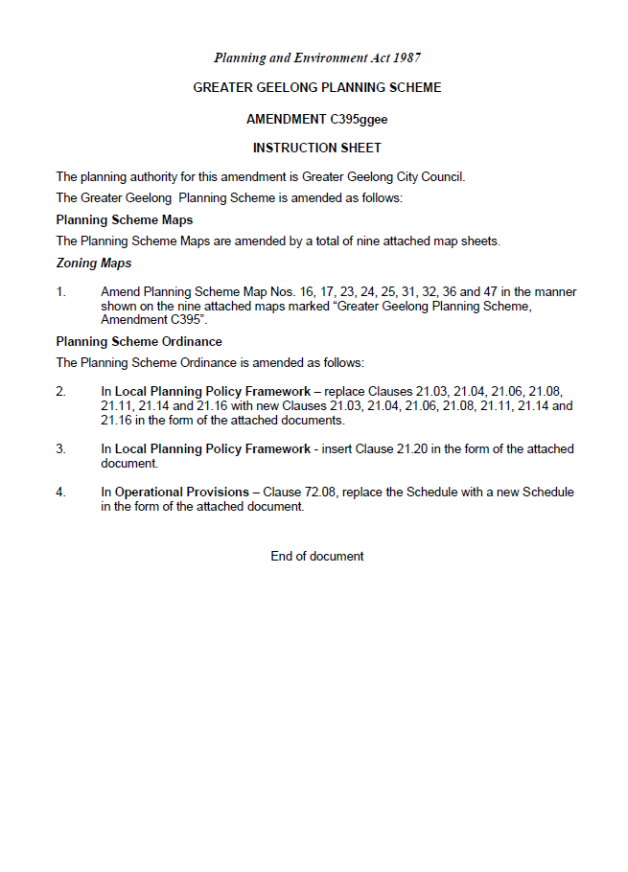
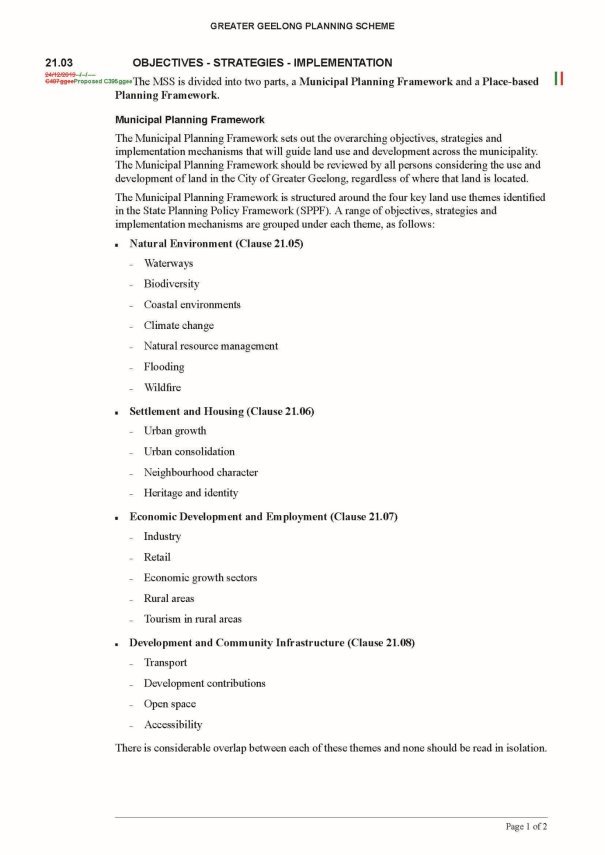
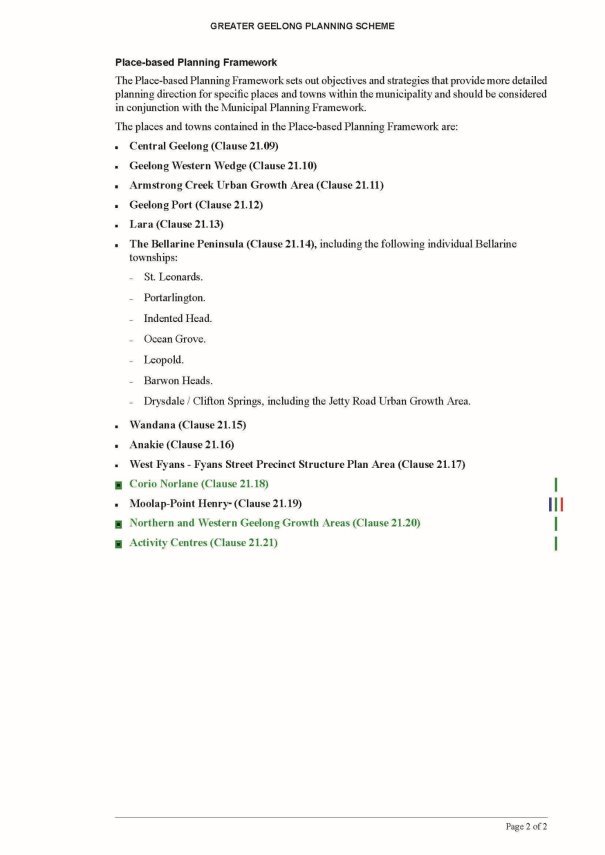
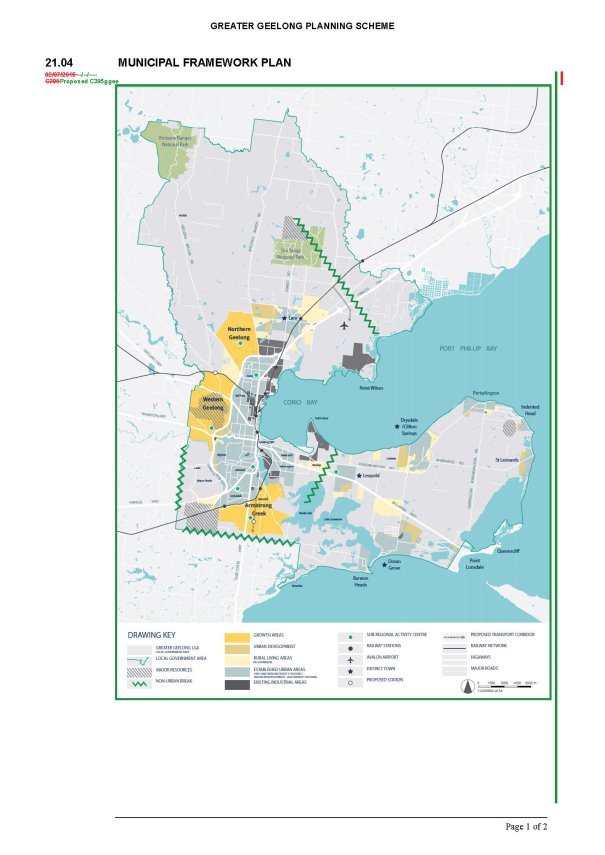
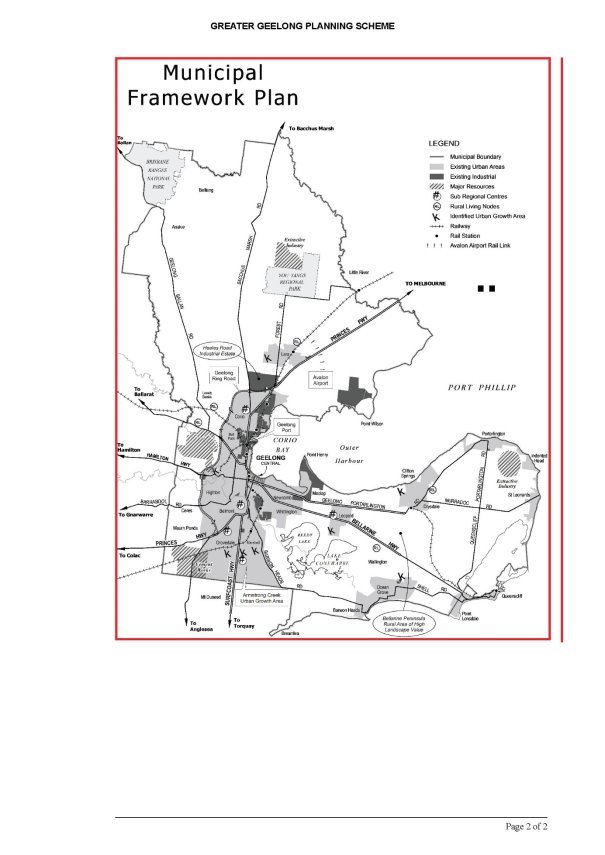
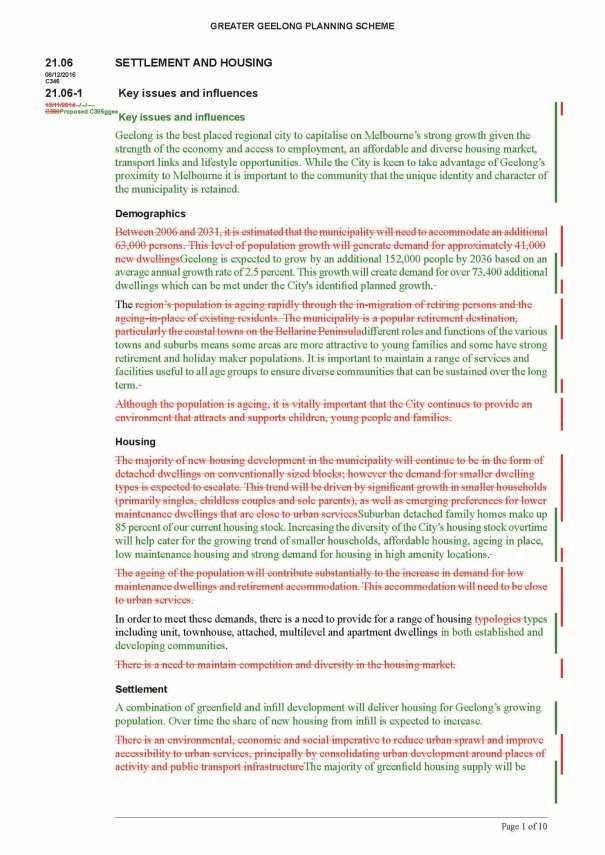
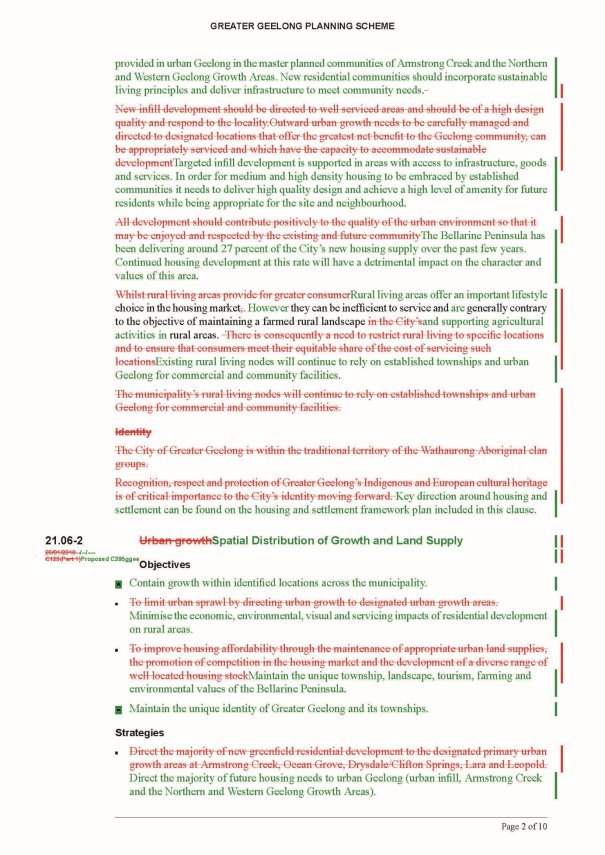
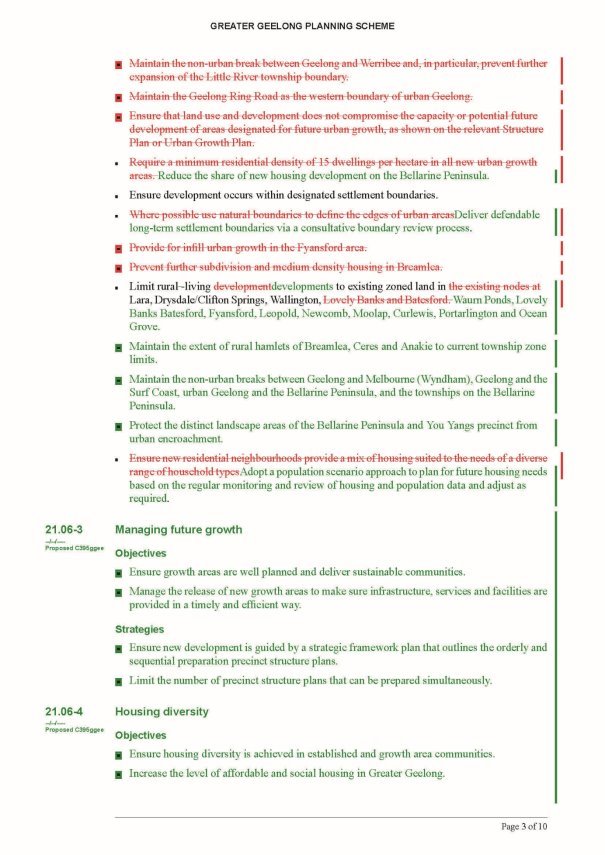
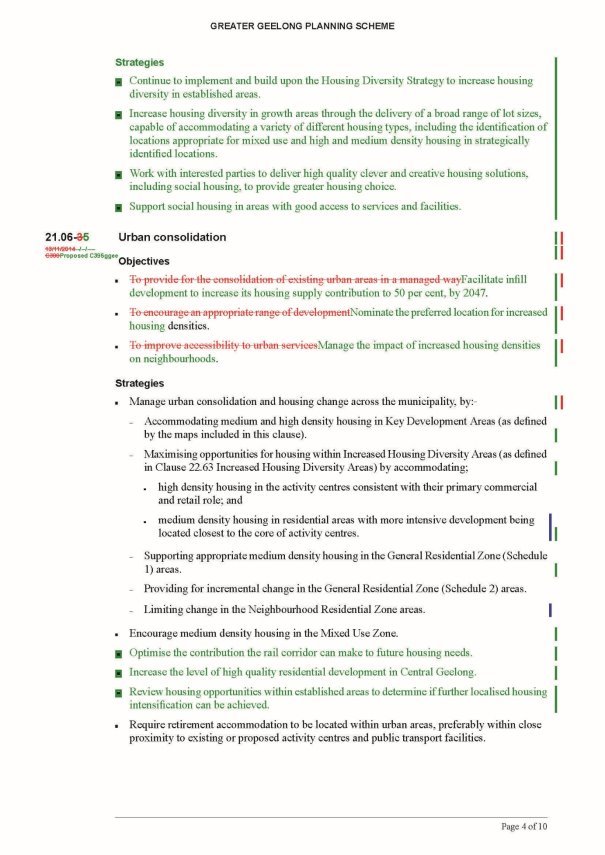
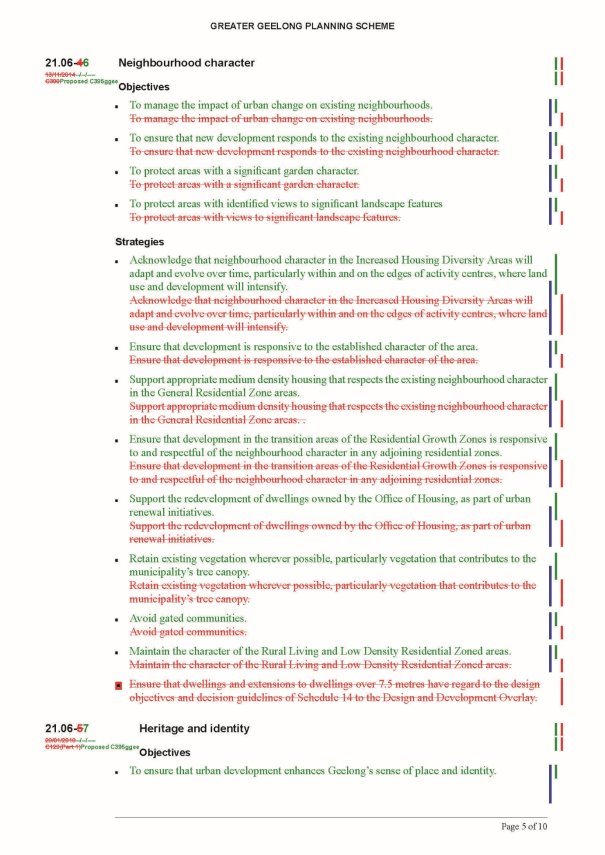
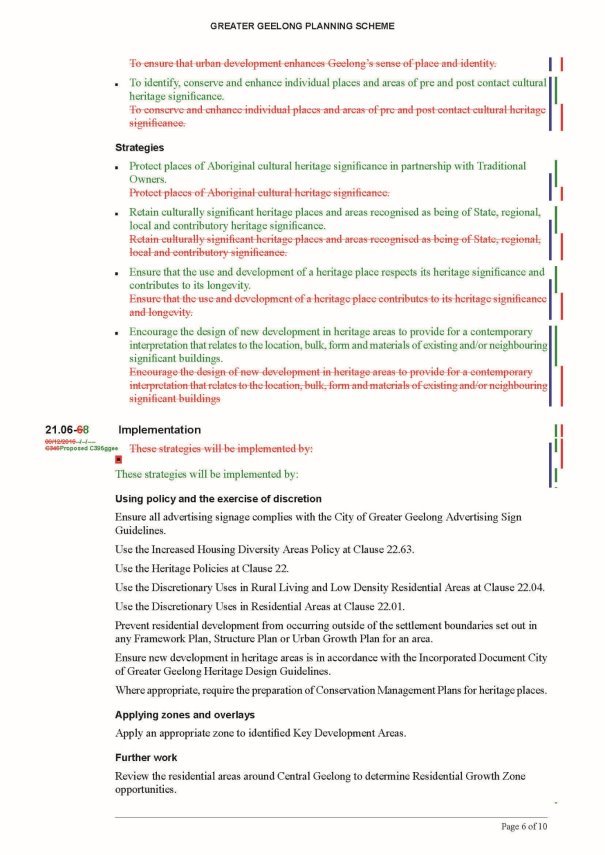
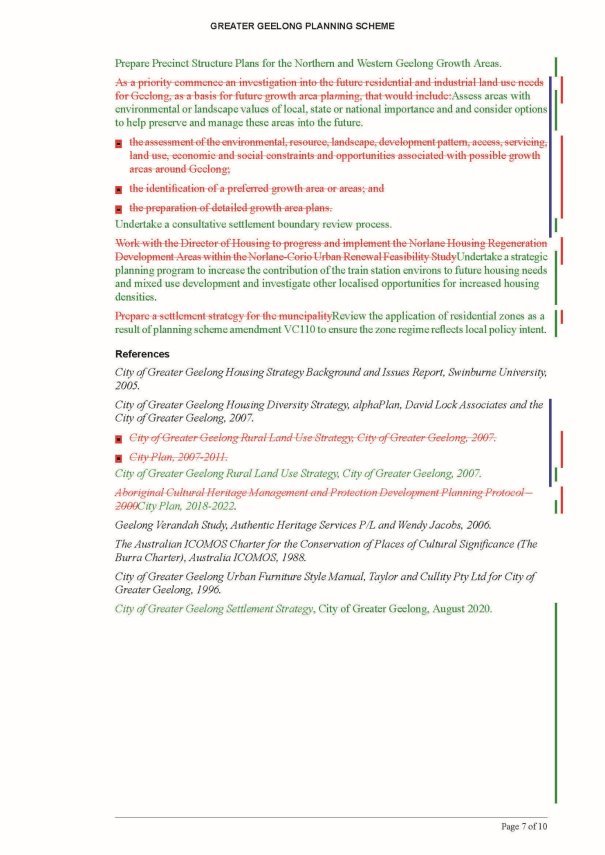
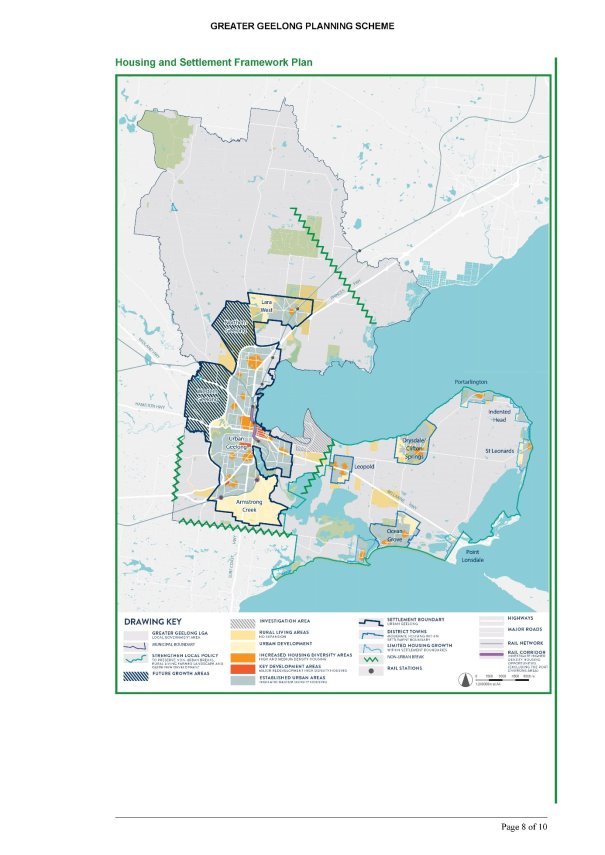
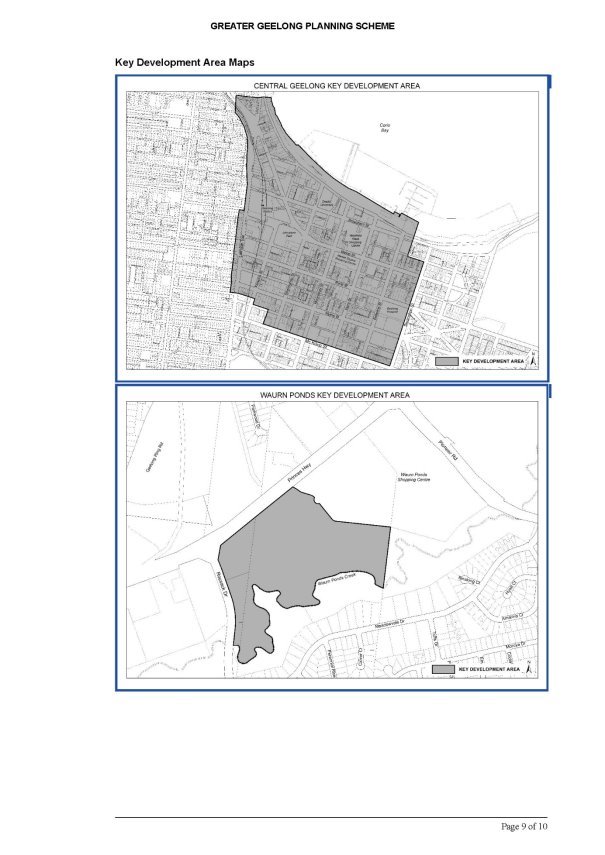
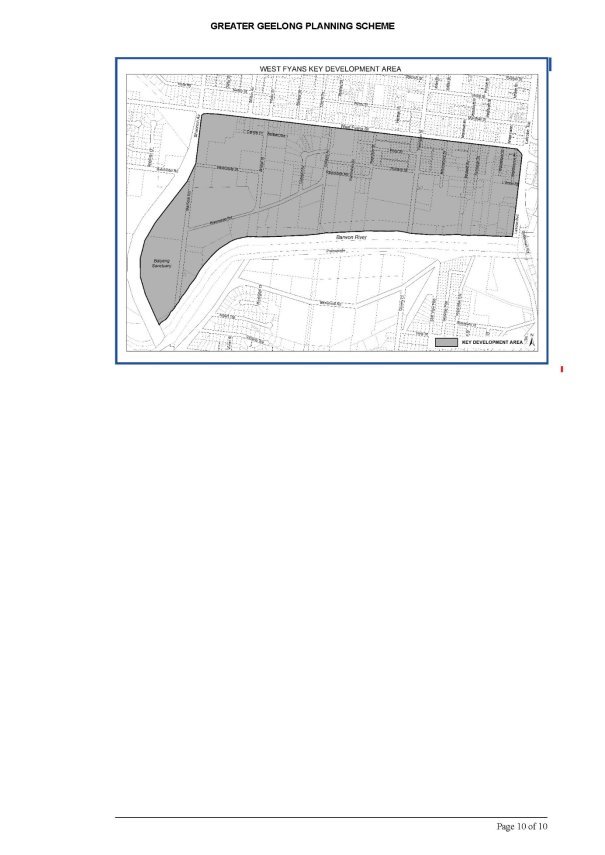
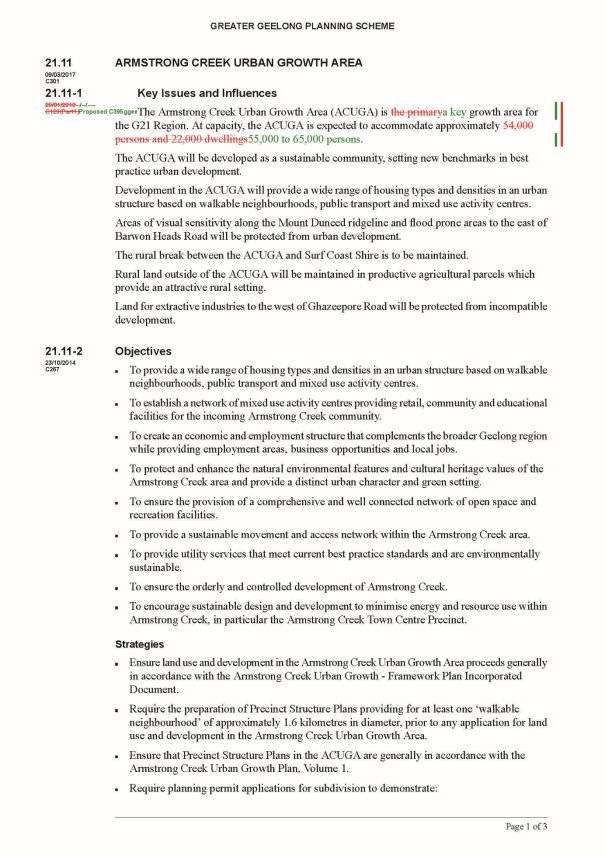
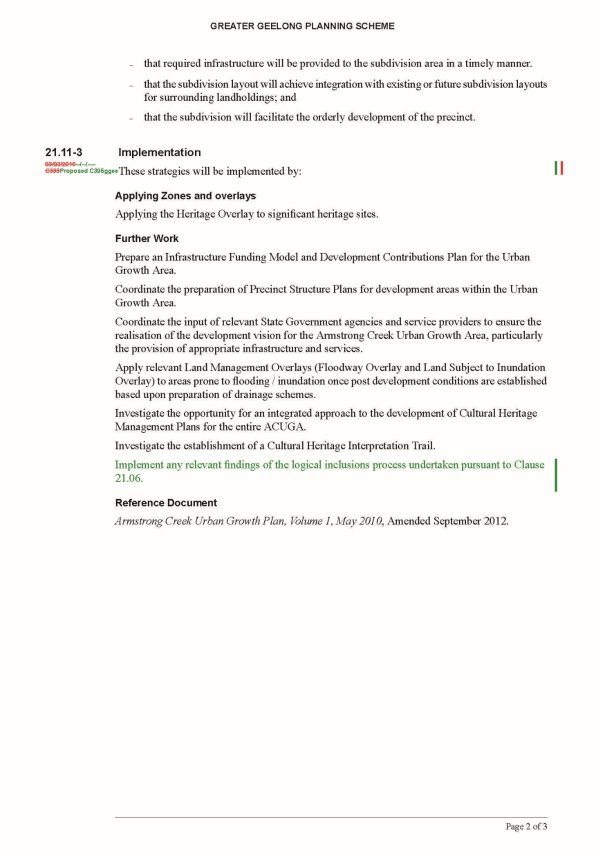
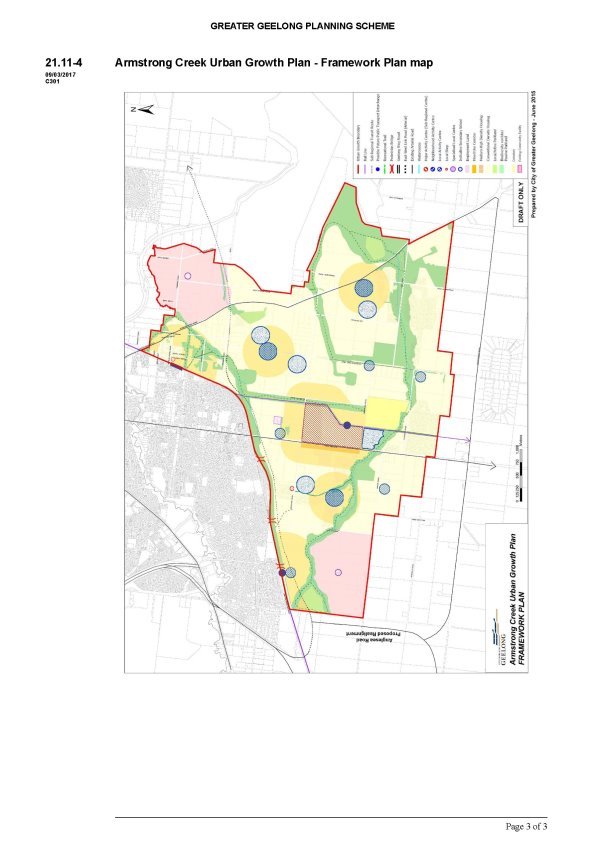
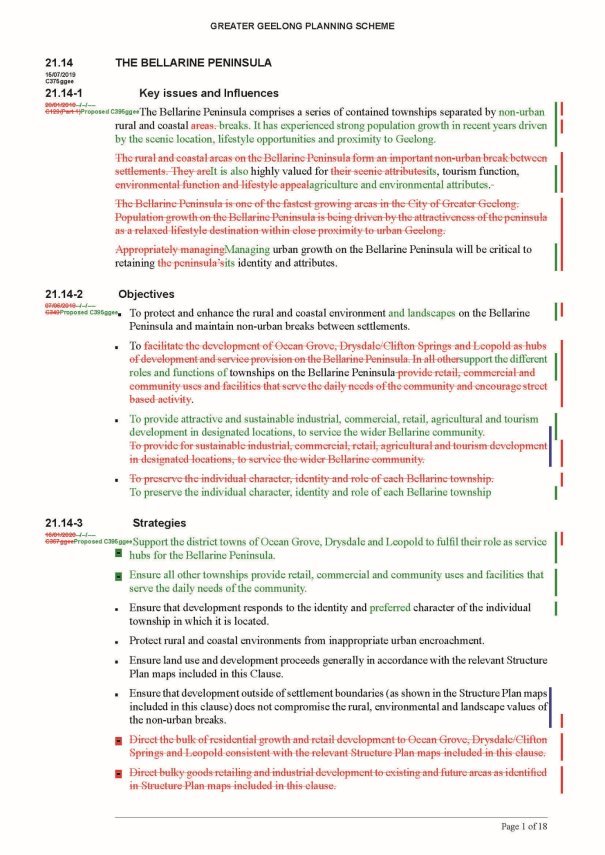
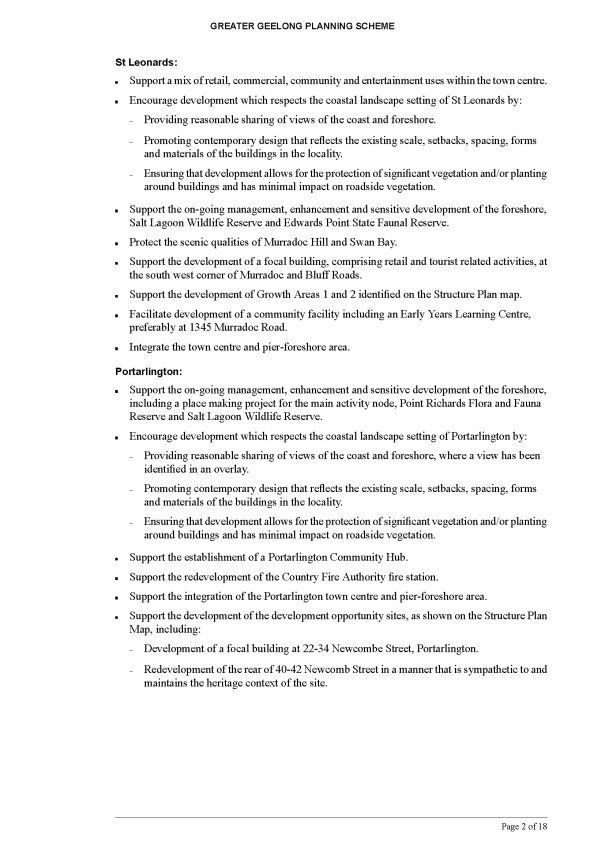
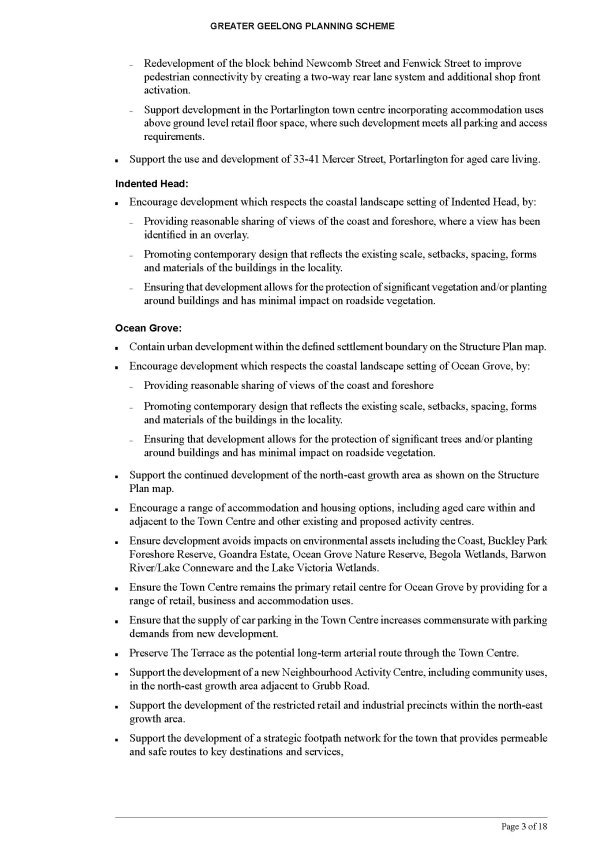
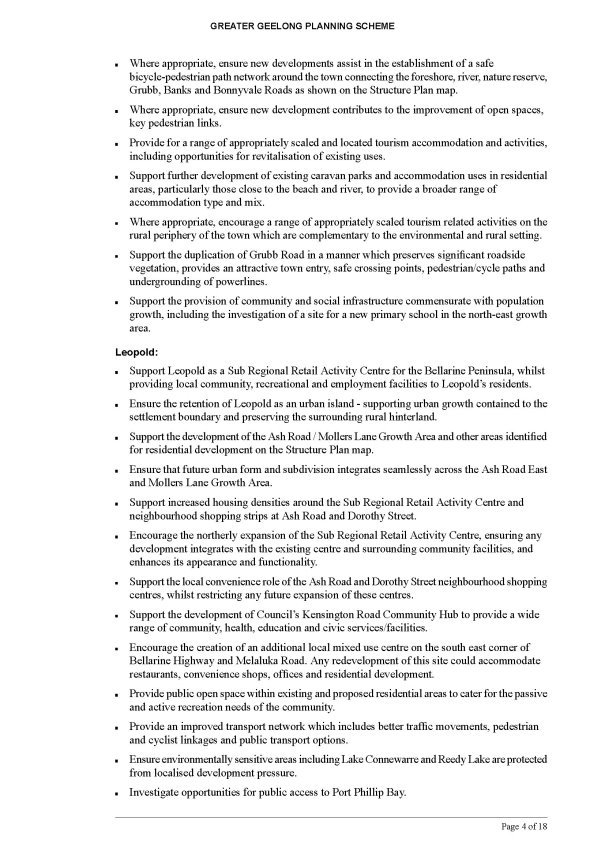
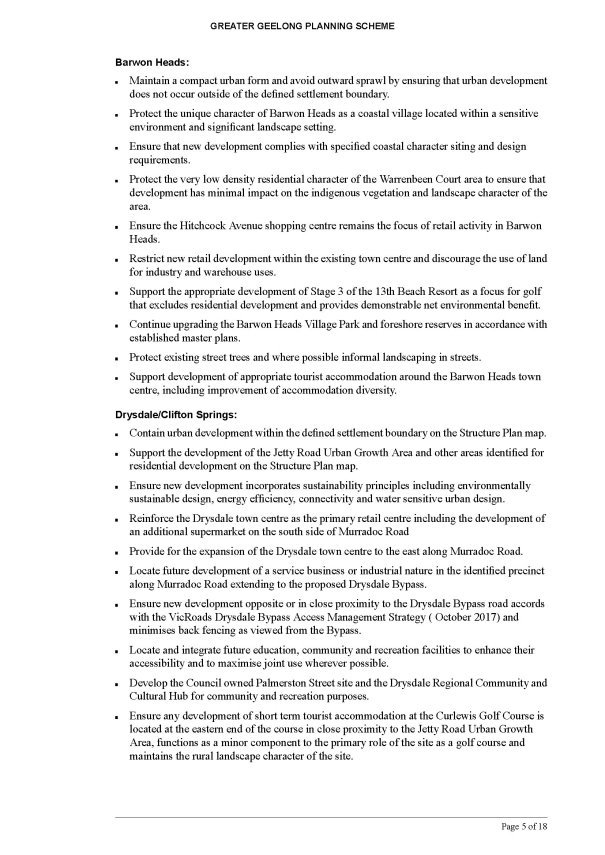
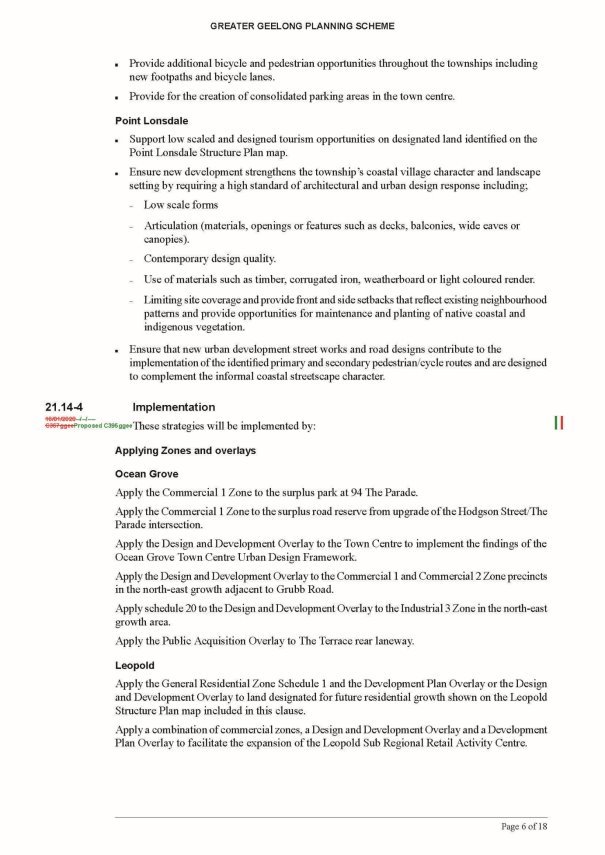
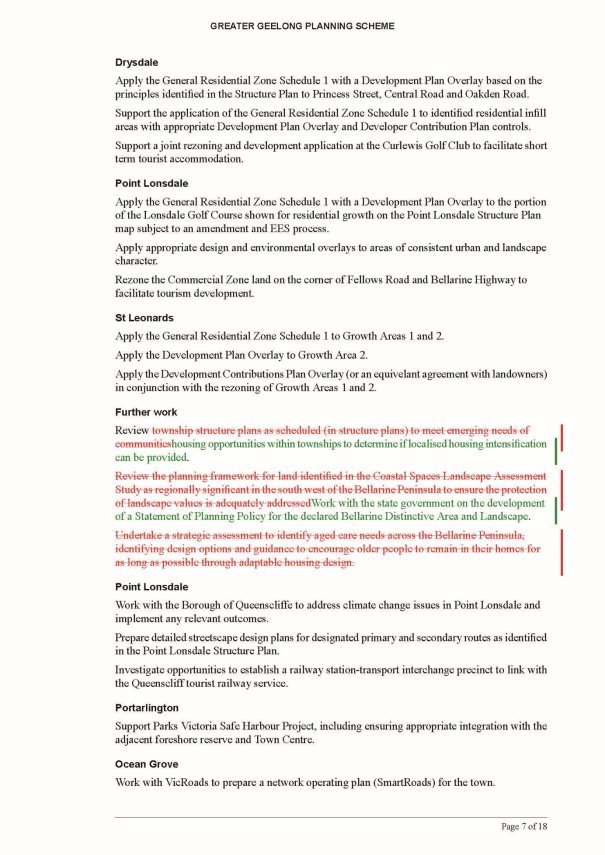
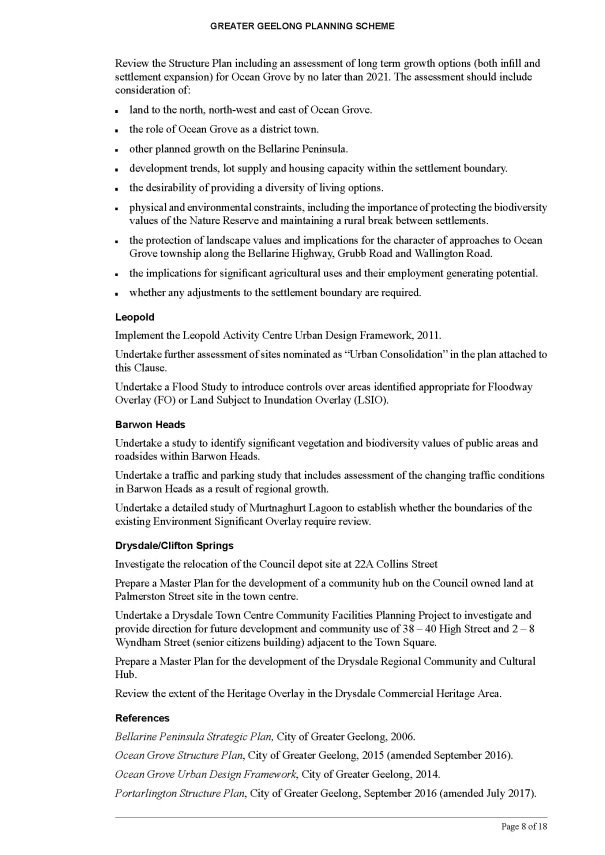
NOTE: Structure Plan maps from Clause 21.4 have been excluded from this Appendix as they are not being amended
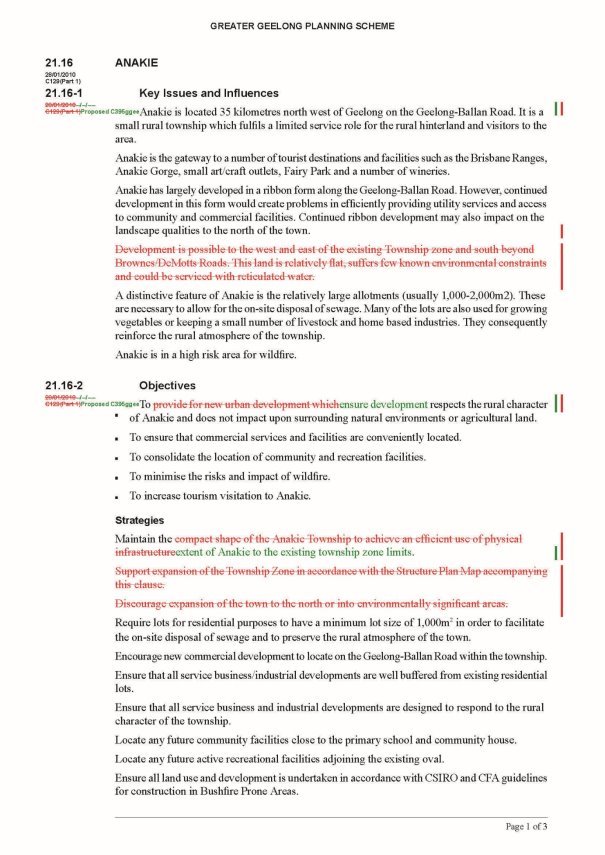
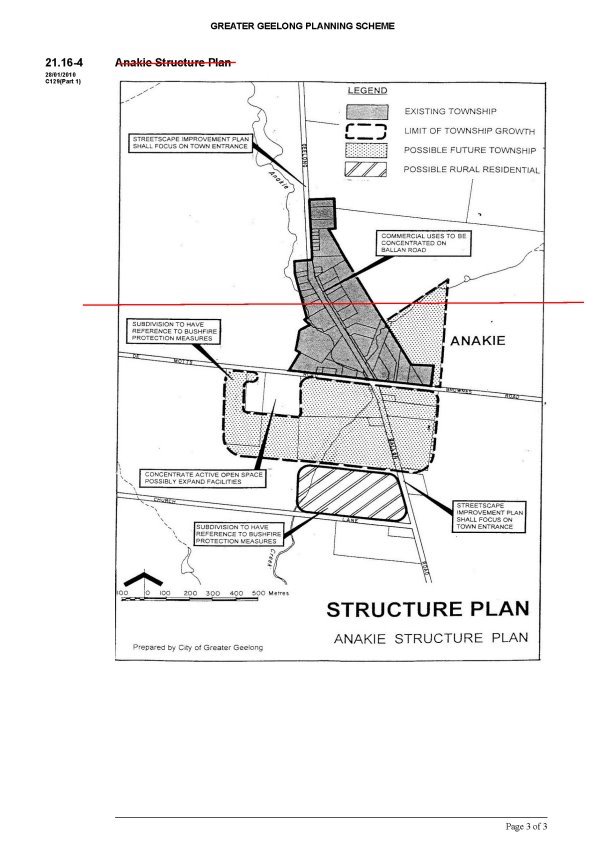
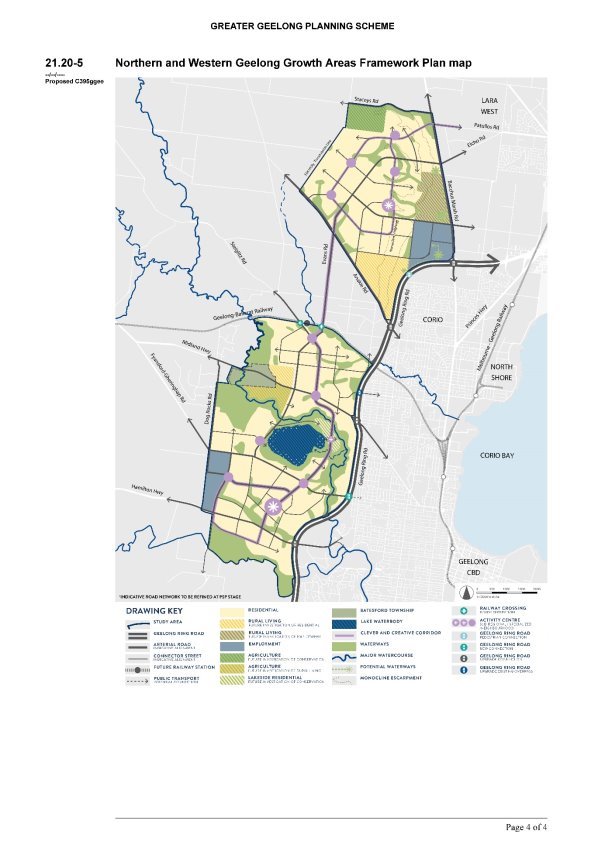
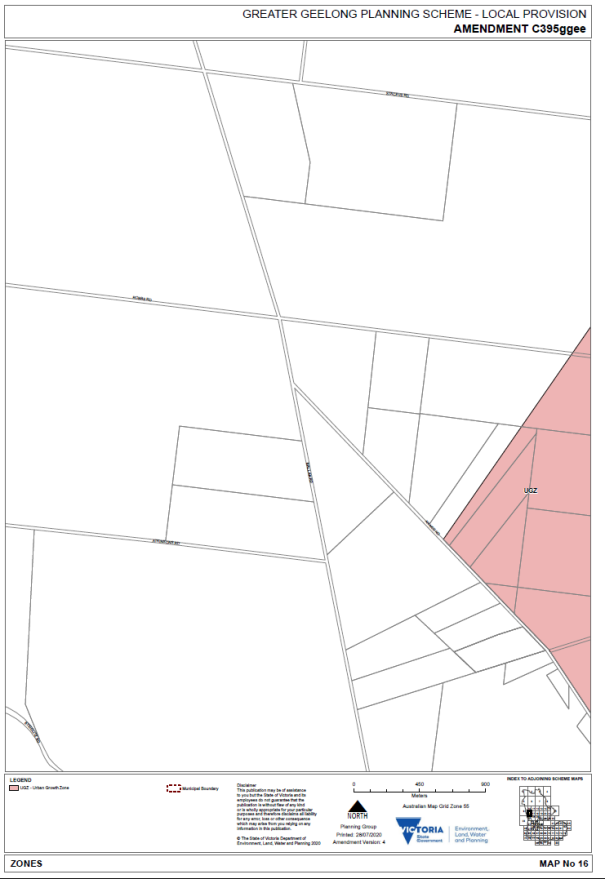
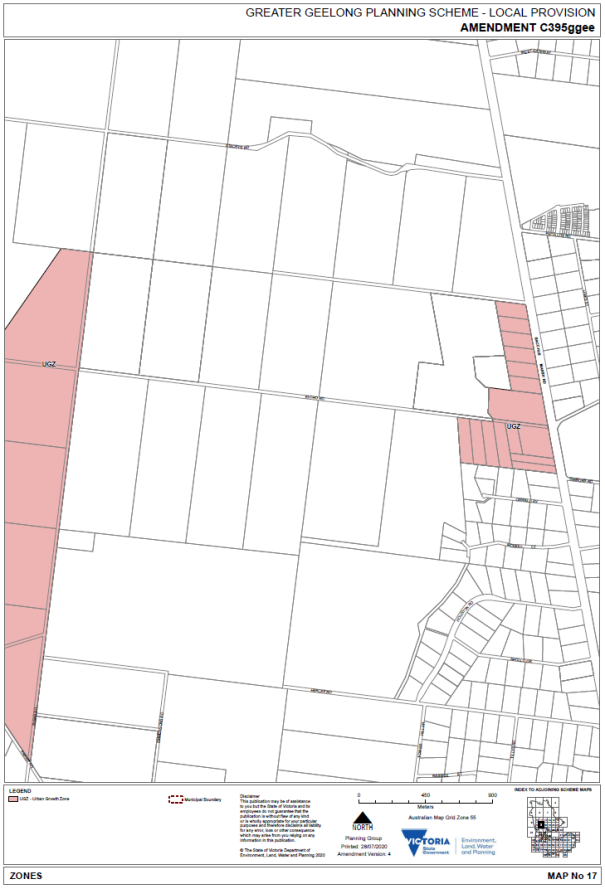
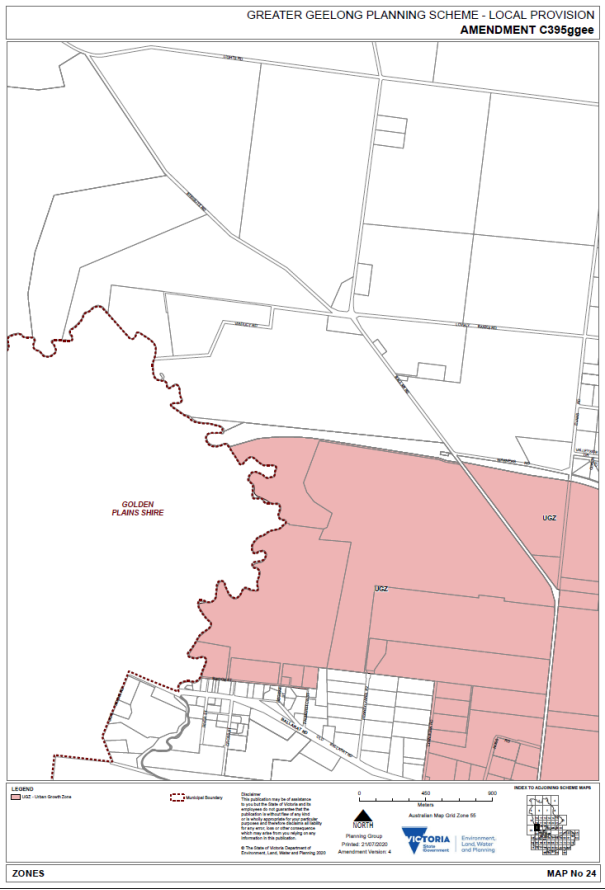
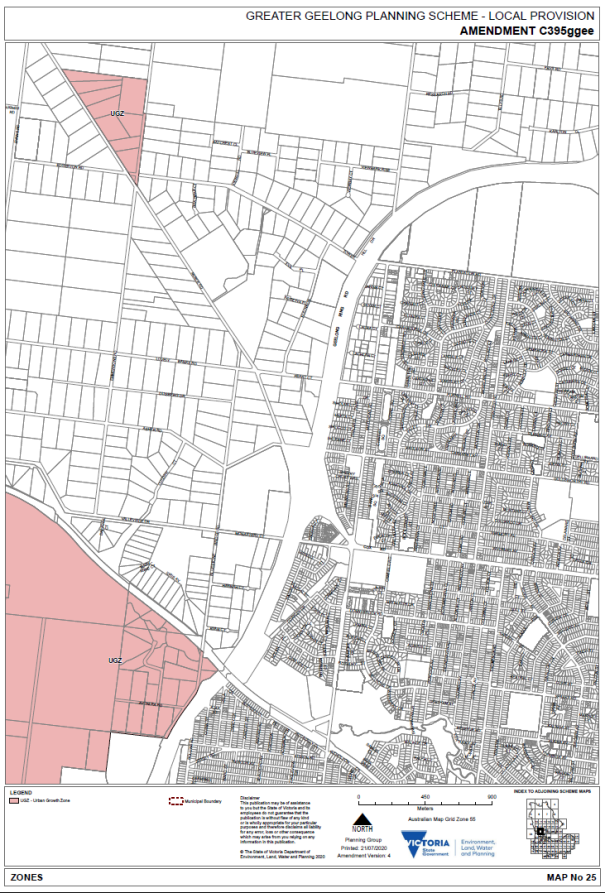
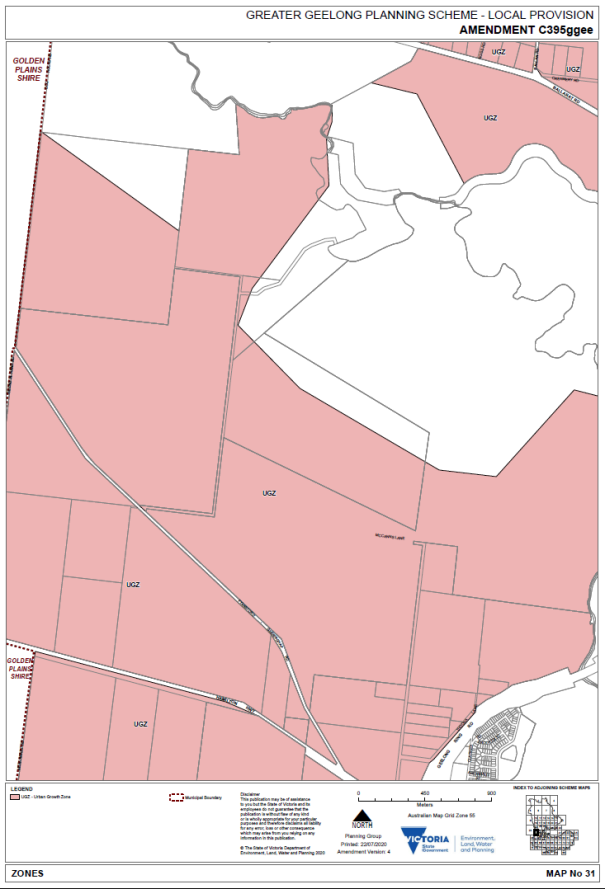
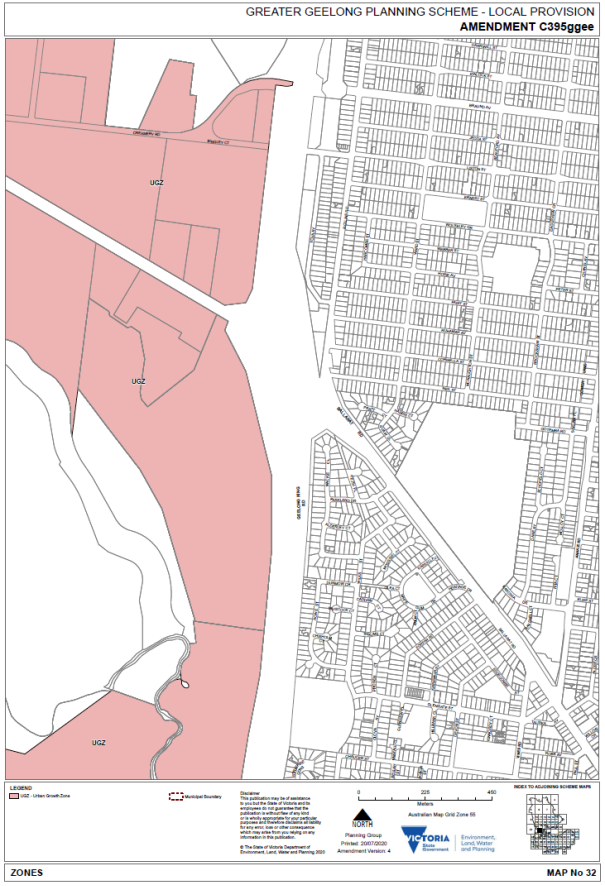
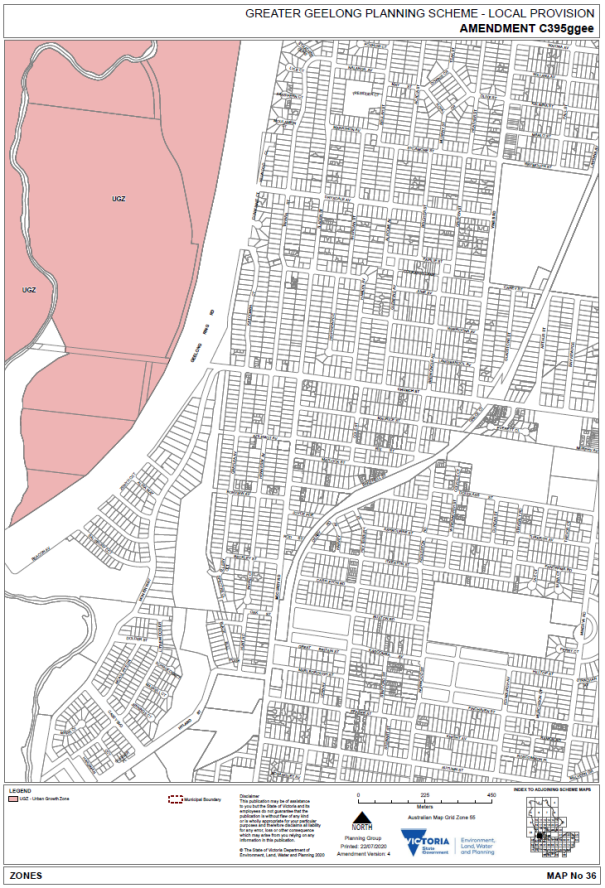
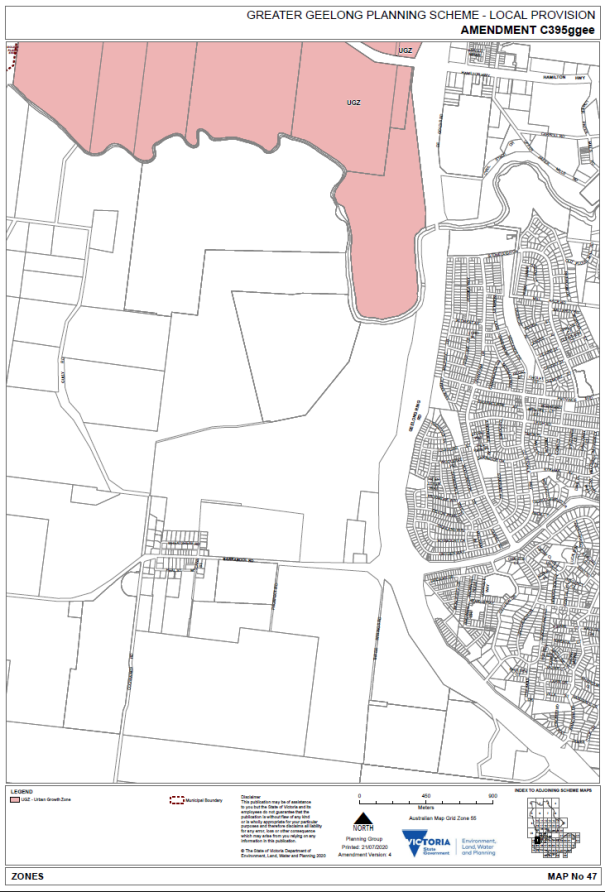
Councillor Kontelj re-entered the meeting room at 7:29pm.
Source: |
Planning, Design & Development – Strategic Implementation |
Director: |
Rebecca Leonard |
Portfolio: |
Planning |
To consider the Amendment C393ggee Panel Report and adopt the Amendment; and
To adopt a revised version of the City of Greater Geelong Retail Strategy.
Review of the 2006 Retail Strategy led to the adoption of The City of Greater Geelong Retail Strategy 2016-2036 in November 2018. Council, acting as the Planning Authority, then initiated Amendment C393ggee (the Amendment) to implement the key elements of the 2018 Retail Strategy into the Greater Geelong Planning Scheme.
The Amendment applies to the entire municipality and changes activity centre and retail planning policy only. It does not rezone or apply overlay controls to any land.
Exhibition of the Amendment in April and May 2019 resulted in 14 written submissions. Submissions were received from a range of retail and land developer businesses with interests in the Geelong region. Many of the submissions supported some parts of the Amendment but not other parts of the Amendment.
The submissions were considered under delegation on 22 August 2019 where it was resolved to refer all the submissions to an Independent Panel appointed by the Minister for Planning.
Following several hearing days in late 2019 and January 2020, a Panel Report was received by Council officers dated 31 January 2020 and then released to the public. Under Section 27 of the Planning and Environment Act the Planning Authority must consider the Panel’s report before deciding whether or not to adopt the Amendment.
The Panel recommends the Amendment be adopted subject to some minor policy changes. The Panel has supported the Amendment’s continued application of a municipal hierarchy of retail centres and the use of floor space caps to manage growth area and sub-regional centres.
On individual centre contentious issues addressed in the report, the Panel:
recommended an 11,000sqm cap be applied to the new Kingston Neighbourhood Activity Centre in Ocean Grove. This report accepts the recommendation;
recommended the proposed boundary of the Kingston Neighbourhood Activity Centre be extended. This report does not accept the recommendation; and
concluded that an acceptable case has been made for a review of policy which supports the future direction of the Leopold Sub-Regional Activity Centre. This report accepts the conclusion in part. Supporting text is included in the Retail Strategy to review the centre’s planning controls but within the confines of the existing Leopold settlement boundary.
At Attachment 5 a response to each recommendation provides justification where officers prefer alternative wording to the Panel’s recommended planning policy drafting. A response to all the Panel Report findings is provided in Attachment 6.
It is recommended that the Amendment be adopted and submitted to the Minister for Planning requesting approval.
Substantial revisions of the 2018 Retail Strategy have resulted from the panel hearing process. It is therefore also recommended that a new, retitled: City of Greater Geelong Retail Strategy 2020-2036 (August 2020) be adopted.
Councillor Sullivan moved, Councillor Mason seconded -
That Council:
Adopt Amendment C393ggee (Attachment 3 of this report);
Submit the adopted Amendment and prescribed information to the Minister for Planning requesting approval; and
Adopt the City of Greater Geelong Retail Strategy 2020-2036 (August 2020).
Carried.
There are no financial implications to Council associated with adopting the Amendment.
The Amendment was exhibited in accordance with Sections 17, 18 and 19 of the Planning and Environment Act.
Letters were sent to commercial zoned landowners and major retailers in the region. Notices were placed in the Geelong Independent and Geelong Advertiser newspapers. The documentation was available on the Geelong Australia website and at Council’s Brougham Street Geelong offices. Submitters to the draft Strategy were also notified.
All persons and organisations who lodged a submission had an opportunity to be heard before an Independent Panel appointed by the Minister for Planning. The Panel considered all submissions referred to it, not just submissions presented at the hearing.
The Amendment has appropriately considered social equity principles. The new policies will fairly and equally apply to all future retail planning permit applications and rezoning requests.
The Amendment C393 Explanatory Report outlines the relevant state, regional and local planning policies. This includes the proper use of the Victoria Planning Provisions and compliance with relevant Ministerial Directions.
The Amendment supports the ‘Growing our Economy’ strategic direction of City Plan by supporting the role and function of existing activity centres and development of new centres consistent with the City’s established Greater Geelong Retail Hierarchy.
No Council officer involved in the preparation of this report has any direct or indirect interest, in accordance with Section 80(c) of the Local Government Act.
There are no notable risks associated with implementing the recommendations contained in this report.
The Amendment does not directly impact on land use and development. Any ‘on the ground’ effects would be considered during a rezoning or planning permit application process. At a policy level, the Amendment supports the established retail hierarchy, urban consolidation objectives and convenient and walkable access to centres.
The City of Greater Geelong Retail Strategy 2016-2036 (the Strategy) replaces the 2006 Retail Strategy. The Strategy was prepared in partnership with SGS Economics and Planning.
A draft of the Strategy was made available for informal public comment in 2017 and after considering 12 submissions, the Strategy was adopted on 27 November 2018. View the report in the minutes.
In addition to adopting the Strategy, Council resolved to prepare and exhibit a planning scheme amendment to include the necessary elements of the Strategy in the Greater Geelong Planning Scheme, subject to authorisation by the Minister for Planning.
Council, acting as the Planning Authority, then initiated Amendment C393 in early 2019.
The Amendment was authorised for exhibition with conditions by the Minister’s delegate on 22 March 2019.
What the Amendment does is detailed in the ‘Instruction Sheet’ at Attachment 3. The Amendment introduces a new retail planning policy framework: new objectives and strategies; an updated retail hierarchy; application of floor space caps to sub-regional centres and centres in growth locations; and an updated local policy requiring an economic impact assessment if a cap is exceeded.
The Amendment does not rezone or apply overlay controls to any land.
The Amendment was exhibited between 10 April and 20 May 2019. Fourteen submissions were received from the following persons/organisations:
ALDI Stores;
Algo Properties, owners of land in the Jetty Road Neighbourhood Activity Centre;
APD Projects, part owners and development managers of the Warralily Neighbourhood Activity Centre;
Geelong Warehouse Traders, 370 Thompson Road, North Geelong;
Merost Pty Ltd, owner of Bell Park Plaza;
Kaufland Australia;
Lascorp Development Group, with interests in the Leopold Sub-Regional Activity Centre and the Kingston Downs Neighbourhood Activity Centre, Ocean Grove;
Lovely Banks Development Group;
Morgan & Griffin, owners and developers of Oakdene Estate, Ocean Grove;
Ramsey Property Group, part of the land consortium for the Western Geelong Growth Area;
Shell Road Developments, landowner and developer of the Kingston Downs estate and activity centre, Ocean Grove;
Westfield Geelong;
Landowners of 92 Melaluka Rd Leopold, which is the land designated as Stage 2 of the Leopold Sub-Regional Activity Centre (Perez Family); and
McCann Family, landowner within the Western Geelong Growth Area.
Key issues raised in the submissions related to the application of floor space caps for ‘Shop’ in sub-regional and planned neighbourhood activity centres, deficiencies in the economic modelling, the location of centres and drafting of the new policy provisions.
A Delegated Authority Report dated 22 August 2019 both summarised all the submissions and provided an officer response to the issues raised. Council agreed with some of the requested changes to the Amendment.
In the report of 22 August, Council’s delegate also resolved to refer all the submissions to an Independent Panel appointed by the Minister for Planning under Sections 23(1) & (2) of the Planning and Environment Act.
The Minister appointed a two-person Panel consisting of Kathy Mitchell, Chief Panel Member of Planning Panels Victoria and Rodger Eade, Senior Sessional Member.
A Directions Hearing was convened on 18 September 2019 and the main hearing on 28-31 October, with additional days on 7 November and 10 December 2019, and 21 January 2020. The venue for all hearings was 1 Spring Street, Melbourne.
Council was represented at the hearings by Kate Morris, Principal Lawyer, Harwood Andrews, and called expert retail economics evidence from Julian Szafraniec of SGS Economics and Planning.
Other parties to the hearing were Kaufland Australia, Shell Road Developments, Lascorp Development Group, Morgan & Griffin, Lovely Banks Development Group and the Perez family. All were represented by planning lawyers or consultants and Shell Road Developments and Lascorp called evidence in economics and town planning.
Submissions from ALDI Stores, Ramsey Property Group and the McCann Family were withdrawn prior to the Panel Hearing. These parties were satisfied with Council’s proposed changes to the Amendment.
The Panel provided its report to Council on 31 January 2020 and recommended that Amendment C393 be adopted with some changes. Attachment 4 is the Executive Summary of the Panel Report and contains the consolidated panel recommendations (that is: recommended changes to the Greater Geelong Planning Scheme and Strategy).
The delay in considering the report is due to implications of findings of the Amendment C395 Panel Report (dated 14 May 2020). The C395 Panel Report is relevant to the consideration of the boundary location for the Leopold Sub-Regional Activity Centre and the number and location of centres in the Northern and Western Geelong Growth Areas.
Officer response to Panel Report Executive Summary
The Panel considered all written submissions, undertook site visits and read a large volume of supporting documents. At the Hearing, the Panel had the benefit of expert evidence in the fields of town planning, retail economics and hydrology.
The Panel observed that since the current Retail Strategy (referenced in the planning scheme) was prepared in 2006, the population of Greater Geelong has grown substantially and is expected to continue growing strongly over the coming decades. Clearly the 2006 Retail Strategy is out of date as noted by the Panel.
The Panel ultimately supported the Amendment subject to some changes. In its discussion and conclusions at Chapter 2 Planning context, the Panel said that planning policy matters were not really contested. The Panel concluded that the Amendment is sufficiently founded and strategically justified.
The Panel Report confirms the importance of Geelong’s activity centre hierarchy policy in planning for retail growth and supporting existing centres. The report also vindicates the substantial time and resources committed by the City in preparing the Retail Strategy.
The focus of the Hearing was on contested centres at:
Leopold (Leopold Sub-Regional Activity Centre);
Waurn Ponds (Waurn Ponds Sub-Regional Activity Centre); and
Ocean Grove (Kingston Neighbourhood Activity Centre, Grubb Road).
Five of the six recommendations listed in the Executive Summary are supported (see Attachment 5). Recommendation No. 2, regarding the southern boundary of the Kingston Neighbourhood Activity Centre, is not supported, and reasons are given in Attachment 6.
The Panel made no Leopold Sub-Regional Activity Centre recommendations. However, the Panel did conclude that an acceptable case has been made for a review of policy which supports the future direction of the Leopold Sub-Regional Activity Centre. Officers support the conclusion in part and reasons are also provided in Attachment 6.
The Panel supported Council’s proposed boundary location and floorspace cap of 47,000 square metres for the Waurn Ponds Sub-Regional Activity Centre.
Recommendations 3, 4 and 5 reflect the substantial critique and review of the Strategy over the course of the Hearing. This has led to the preparation of a revised Strategy retitled: City of Greater Geelong Retail Strategy 2020-2036 (August 2020) (2020 Retail Strategy). The 2020 Retail Strategy is recommended for adoption in this report and the 2020 Retail Strategy will appear as a Background Document in the planning scheme. A copy of the updated report is available for viewing on the C393 website.
Officer response to Panel Report
The Panel Report provided discussion and a series of conclusions and recommendations under the following themes:
Chapter 3 Key strategic issues;
Chapter 4 Leopold sub-regional centre;
Chapter 5 Kingston Downs Neighbourhood Activity Centre;
Chapter 6 Waurn Ponds sub-regional centre;
Chapter 7 Other issues; and
Chapter 8 Statutory issues.
An officer summary and response to each theme is provided in Attachment 6.
It is noted that any reference in this report to ‘Clause 21.19’ is now adopted as ‘Clause 21.21’. This is in recognition of intervening policies introduced to the planning scheme at Clause 21.19 Moolap – Point Henry and 21.20 Northern and Western Geelong Growth Areas.
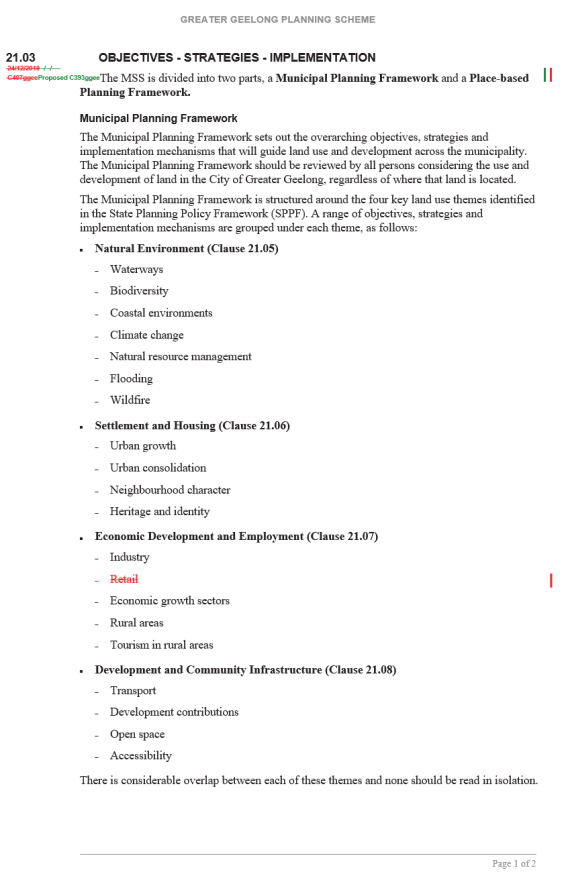
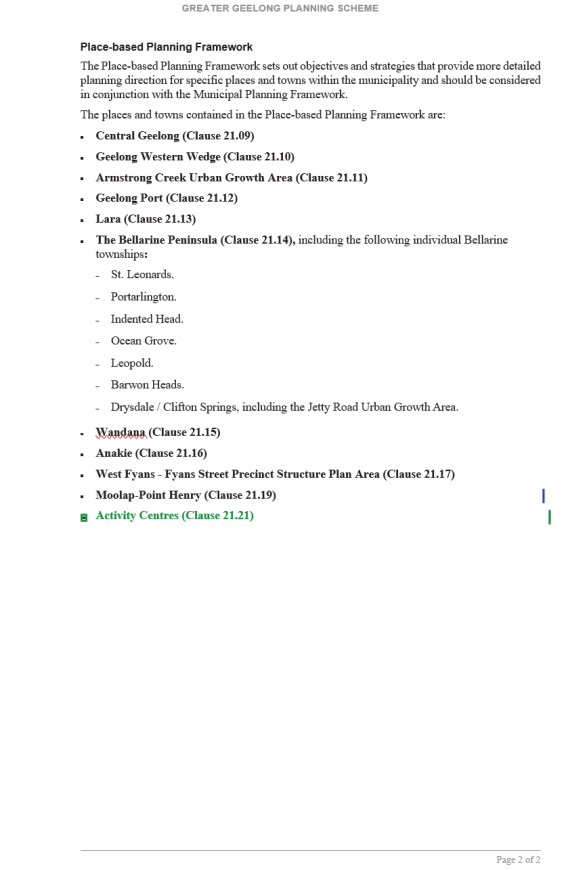
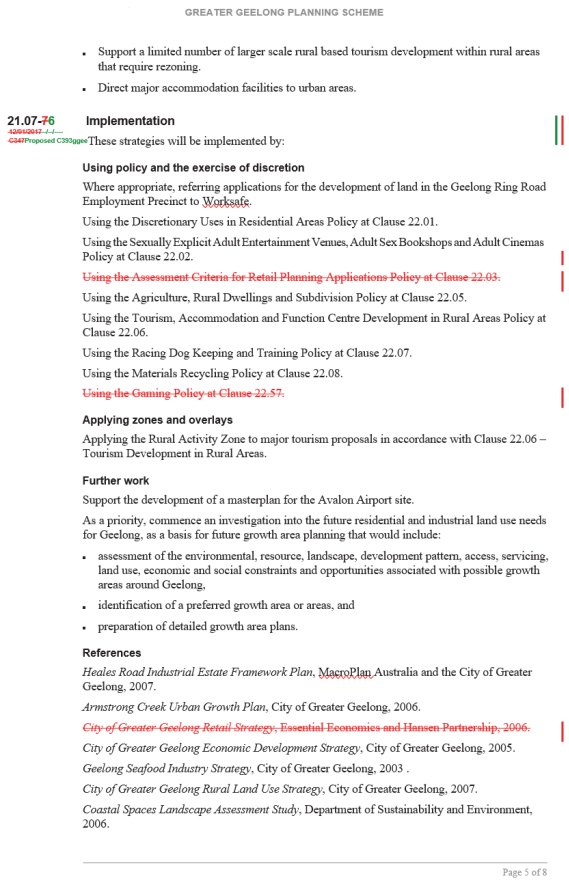
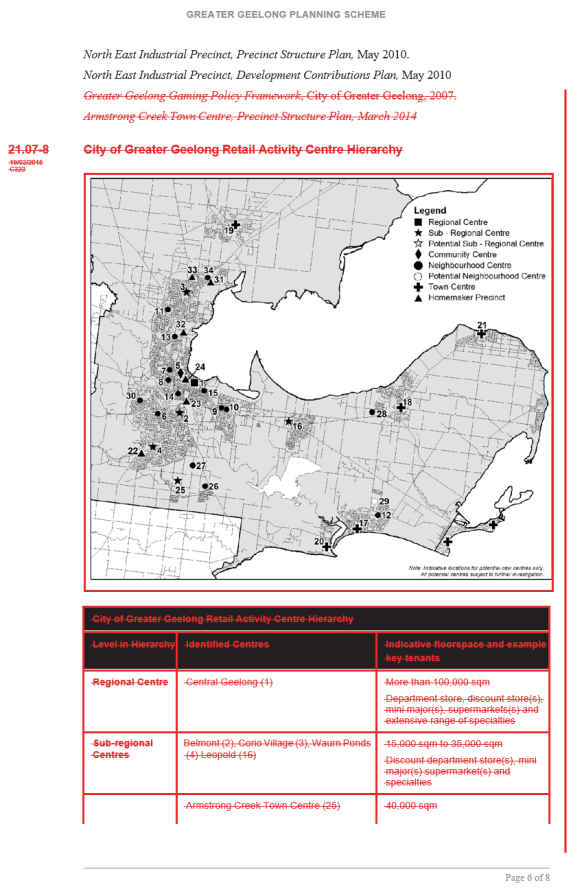
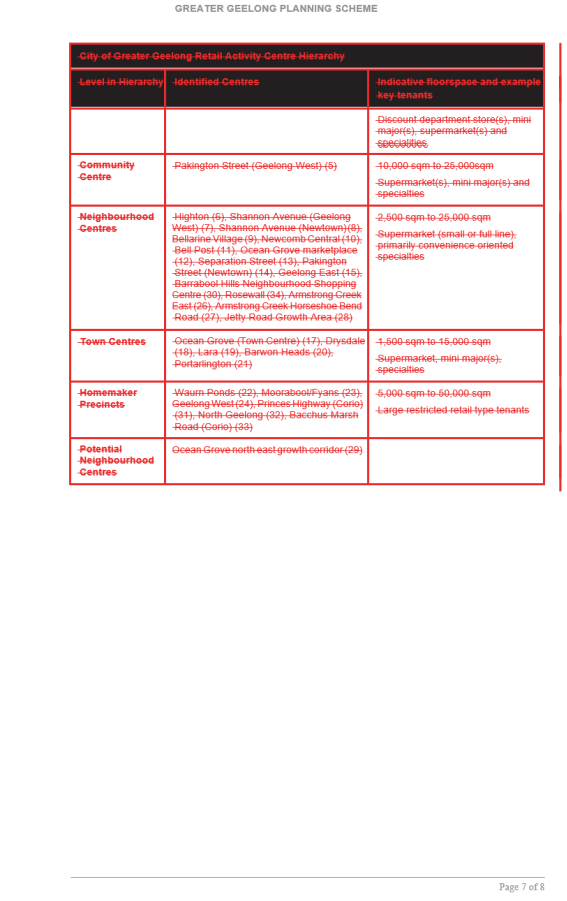
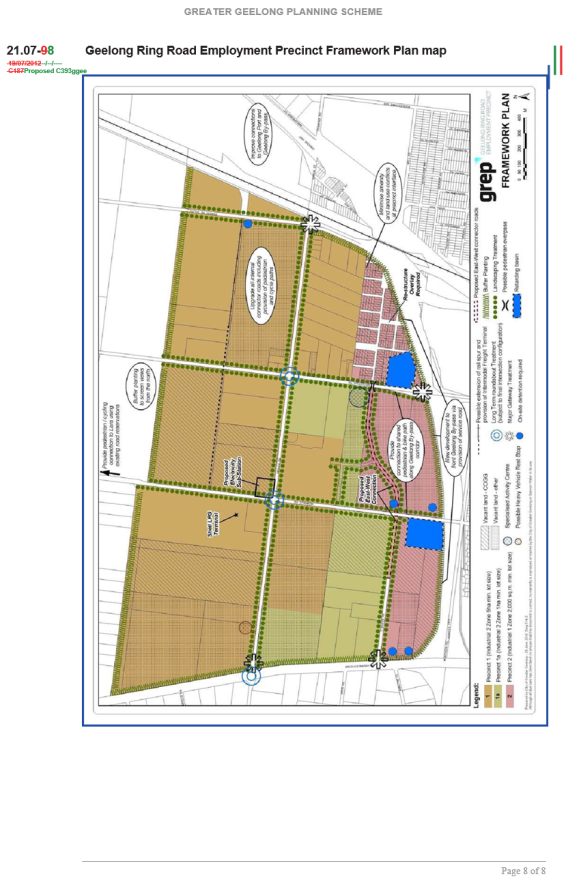
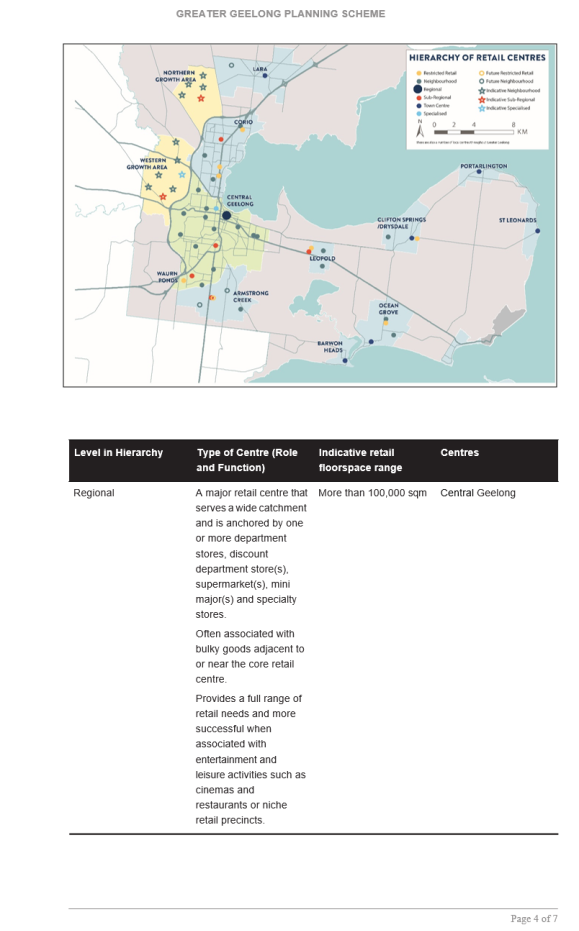
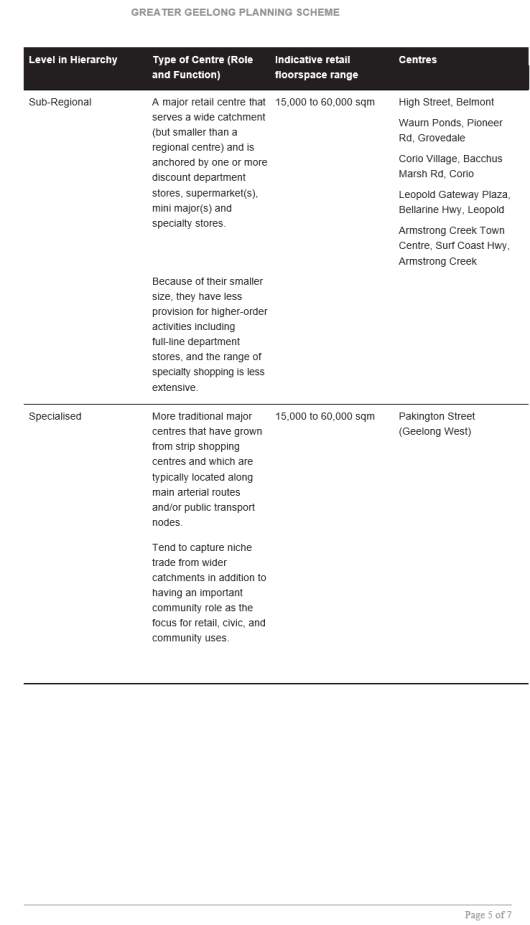
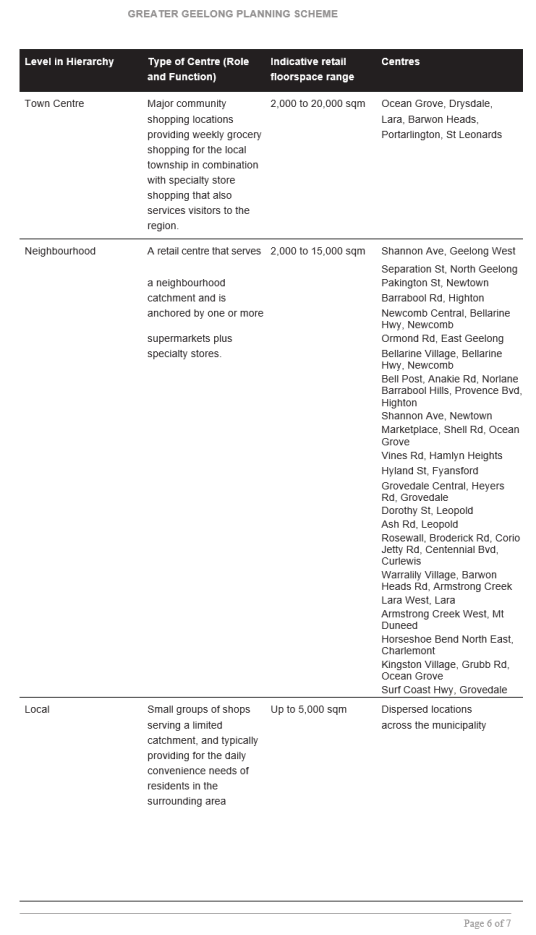
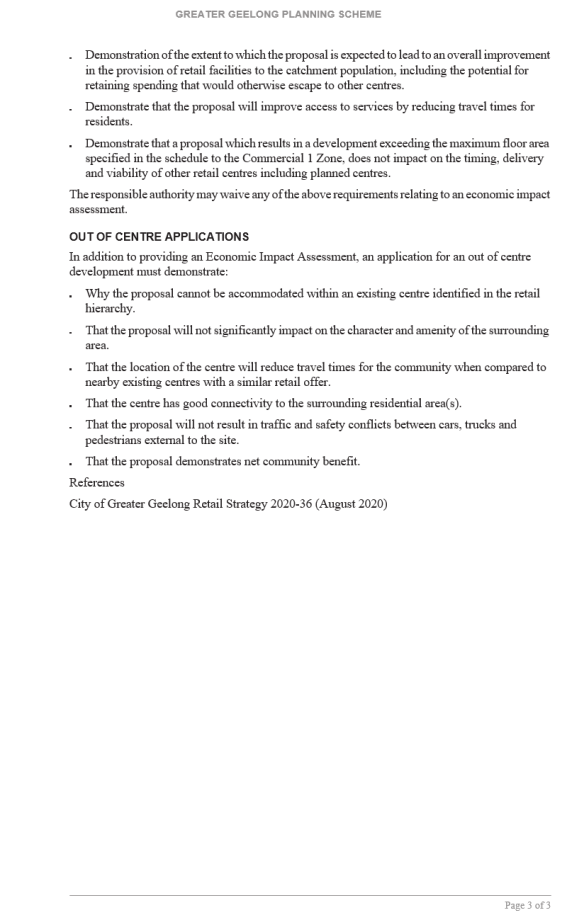
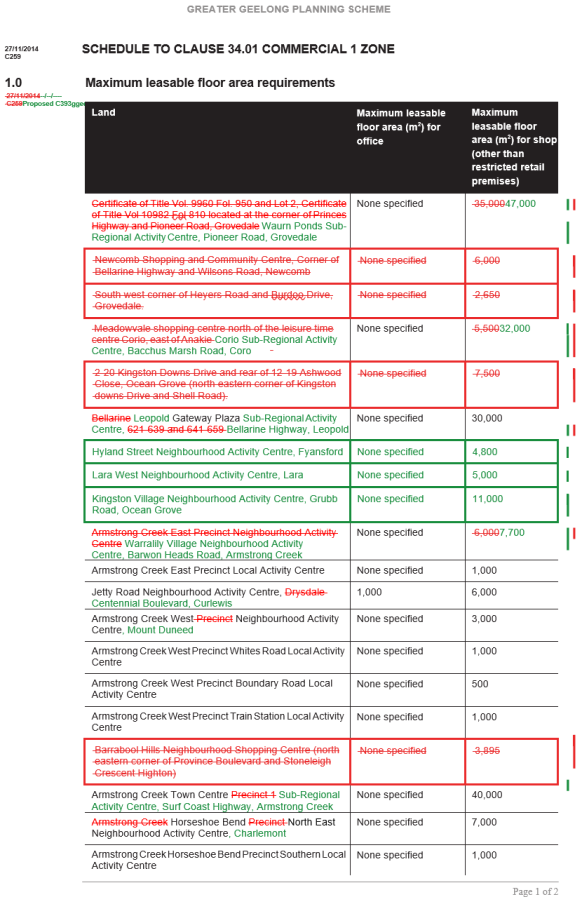
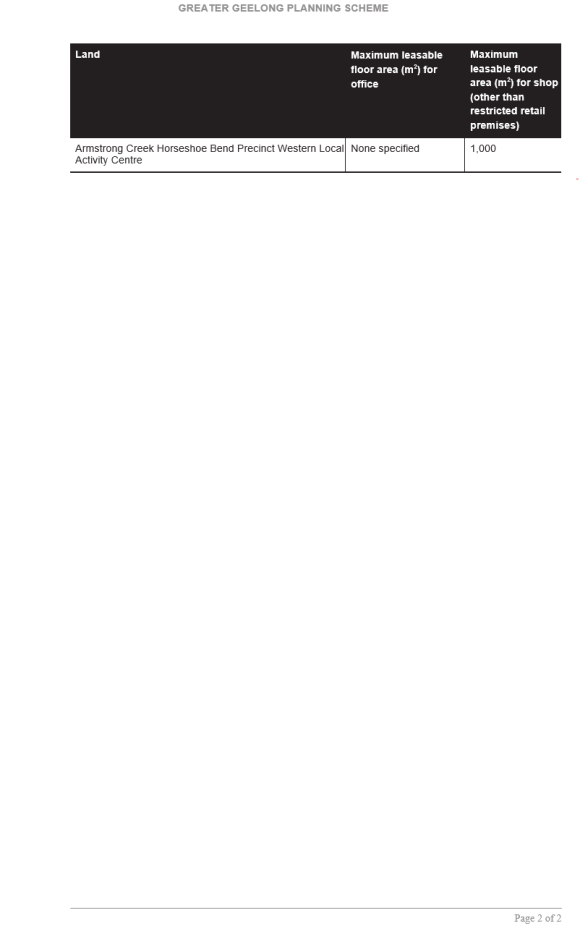
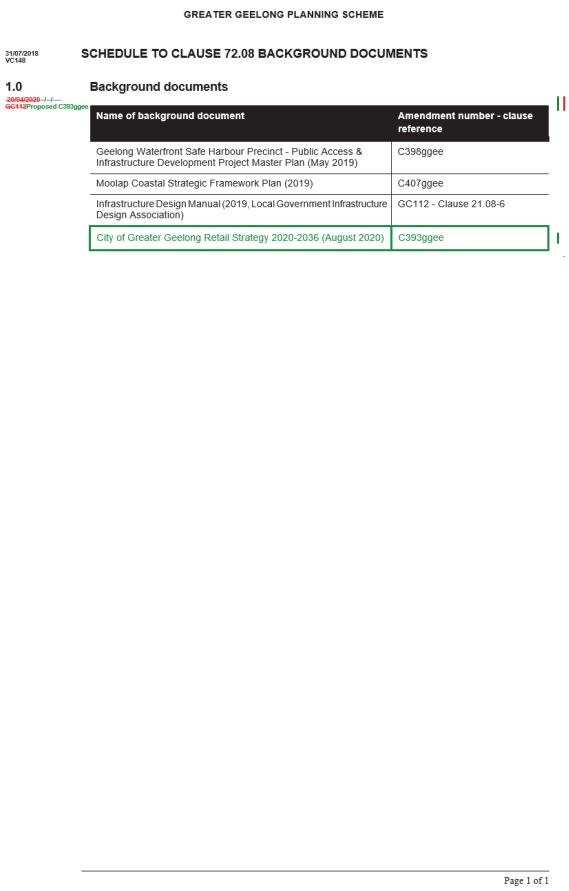
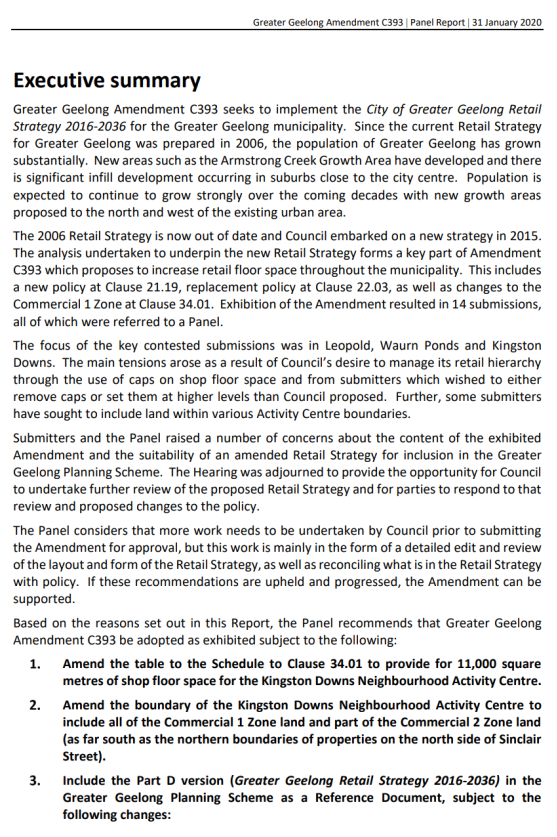
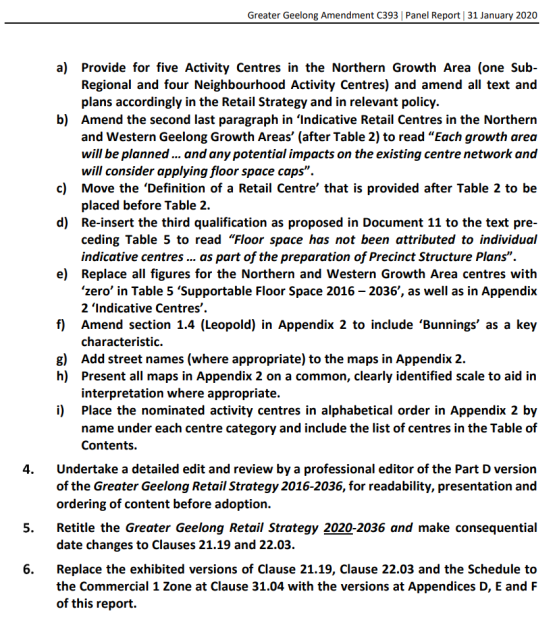
Number |
Panel Recommendation |
City Response |
Reference |
|---|---|---|---|
1 |
Amend the table to the Schedule to Clause 34.01 to provide for 11,000 square metres of shop floor space for the Kingston Downs Neighbourhood Activity Centre. |
Agreed. Note: the name of some centres have been changed to correspond with names used in the 2020 Retail Strategy. |
Attachment 3 (Schedule to Clause 34.01 Commercial 1 Zone) |
2 |
Amend the boundary of the Kingston Downs Neighbourhood Activity Centre to include all of the Commercial 1 Zone land and part of the Commercial 2 Zone land (as far south as the northern boundaries of properties on the north side of Sinclair Street). |
Not agreed. Combining the commercial areas would create a centre inconsistent with its role and function in the Geelong Retail Hierarchy at Clause 21.21. A detail response is provided in Attachment 6. |
2020 Retail Strategy |
3 |
Include the Part D version (Greater Geelong Retail Strategy 2016-2036) in the Greater Geelong Planning Scheme as a Reference Document, subject to the following changes: |
Agreed. |
2020 Retail Strategy |
|
Agreed. |
||
|
Agreed. |
||
|
Agreed. |
||
|
Agreed. |
||
|
Agreed. |
||
|
Agreed. |
||
|
Agreed. |
||
|
Agreed, other than for Central Geelong which, because of its size, requires a smaller scale. |
||
|
Agreed. |
||
4 |
Undertake a detailed edit and review by a professional editor of the Part D version of the Greater Geelong Retail Strategy 2016-2036, for readability, presentation and ordering of content before adoption. |
Agreed. A review and edit was completed by the City’s Senior Publishing editor. |
2020 Retail Strategy |
5 |
Retitle the Greater Geelong Retail Strategy 2020-2036 and make consequential date changes to Clauses 21.19 and 22.03. |
Agreed. |
Attachments 3 and 2020 Retail Strategy |
6 |
Replace the exhibited versions of Clause 21.19, Clause 22.03 and the Schedule to the Commercial 1 Zone at Clause 31.04 with the versions at Appendices D, E and F of this report. |
Agreed. The only exception relates to Clause 22.03 ‘area to which the policy applies’ sentence under the main heading and before the Policy Basis section. The Council officer drafting is necessary to differentiate applications for development only (that is: where no use permit is required). Note: Clause 21.19 has been revised to ‘Clause 21.21’. |
Attachment 3 |
Source: |
Planning, Design & Development – Urban Design & Heritage |
Director: |
Gareth Smith |
Portfolio: |
Arts, Culture and Heritage |
To endorse the Geelong Town Hall Conservation Management Plan 2020.
City Hall is entered in the Victorian Heritage Register under the title ‘Geelong Town Hall’ and permits are required from Heritage Victoria for all future works to the building.
The purpose of a Conservation Management Plan (CMP) is to identify what is significant about a place and specifically what aspects of a building need to be retained and conserved, along with what constraints apply to new development. Therefore, this CMP does not showcase future development plans or options but will be useful to persons designing alterations and additions to accommodate future use, and compliance with the recommendations of the CMP should expedite the necessary permit approvals.
GJM Heritage consultants were commissioned by the City in October 2018 to prepare this CMP and in April 2020, Council endorsed release of the draft CMP for public comment.
Thirty-two community submissions were received in response to the consultation on the draft Geelong Town Hall CMP. Responses are included in full at Attachment 3.
All were private submissions except that of the Board and management of Geelong Gallery.
Six responses commended on the overall document or recommendations.
No responses challenged the heritage significance of City Hall or need for a CMP.
One response raised a specific issue as to disagreeing to the stated architectural style. That concern is not supported and no change is proposed to the CMP. Refer discussion at Attachment 2.
Twenty-nine responses included comments as to a preferred future use – 16 supporting expansion of the art gallery into City Hall, 9 supporting a continuation of Council meeting and civic ceremonial use; 2 supporting a shared art gallery and council/civic use, and 2 supporting use as a venue for musical performances (chamber music and contemporary). All this feedback is valuable for future decisions of Council, they are not applicable to current consideration before Council of endorsing the CMP.
There were also comments on ownership-related matters and other general matters which were also not applicable to the current decision before Council.
**The Chief Executive Officer withdrew the report due to an error within the document and will be re-presented in a forthcoming future Council Meeting.
Source: |
Economy, Investment & Attraction – Arts and Culture |
Acting Director: |
Brett Ince |
Portfolio: |
Arts, Culture and Heritage |
To seek Council endorsement for Colac Otway Shire Council to join the Geelong Regional Library Corporation (GRLC) in delivering shared library services.
The GRLC provides library and information services to all residents and visitors in the Geelong region. One of 47 library services in the state of Victoria, the Corporation was formed in 1997 under the provisions of Section 196 of the Local Government Act, 1989.
The GRLC is governed by a Board of seven members made up of representatives of the four member Councils including the City of Greater Geelong; Borough of Queenscliffe; Golden Plains Shire and Surf Coast Shire.
Colac Otway Shire (COS) is currently a member of the Corangamite Regional Library Corporation (CRLC). In February 2019, COS resolved to commence a detailed investigation and review of its library services.
Based on the review findings and community feedback, the consultant’s report recommended that the “Colac Otway Shire withdraw from the Corangamite Regional Library Corporation and seek to join Geelong Regional Library Corporation”. For additional information and background please refer to Attachment 2.
In June 2020, the GRLC Board unanimously endorsed Colac Otway Shire joining Geelong Regional Library Corporation as a Member Council in principle.
Endorsement is required by all existing member Councils including the City for Colac Otway Shire to become a member of the GRLC. There are no changes to the current obligations for the City as a member of the GRLC as a result of COS becoming a member Council, and COS is obligated to abide by all the current GRLC agreement.
Advantages for the City relating to Colac Otway Shire joining the GRLC include:
Increased community access to quality collections (additional 40,000 collection items), strengthened collaboration and delivery of shared library services;
Reduced costs due to economies of scale through sharing of regional administrative costs with an additional partner;
Greater state government grant contributions received through Colac Otway Shire’s membership of GRLC; and
Enhanced strategic planning, capacity building and expertise.
Councillor Nelson moved, Councillor Sullivan seconded -
That Council:
Endorse Colac Otway Shire Council joining the Geelong Regional Library Corporation; and
Authorise the Chief Executive Officer to execute all necessary documents to give effect to resolution 9.1 above.
Carried.
There are no additional financial implications to the City, other existing member Councils or GRLC. The apportionment of costs is clearly detailed in the Library Agreement. An additional member Council will provide economies of scale through financial contribution for regional costs. The direct costs of services as well as maintenance for building assets in the COS are the responsibility of its Council as per the library agreement.
The admission of COS provides several financial advantages including a contribution to regional costs of approximately $300k. The State Government grant currently received by CRLC of $190K relating to COS would be redirected to the GRLC.
There are economies of scale that can be achieved through an additional member Council across the Corporation headquarters that will benefit existing member Councils. An additional 41,000 collection items would be added to the shared regional collection providing a greater range of items to the community.
COS will cover all costs associated with integration into GRLC. COS contributes a higher per capita contribution than other CRLC member Councils at $33.66, which this year totaled $727K. By way of comparison, GRLC currently has an average member Council contribution of $38.95 per capita. COS has indicated they are prepared to increase their contribution to library services to join GRLC for the improvement it will provide in the range and quality of services to their residents.
An independent report produced by SGS Economics titled Libraries Work! The socio-economic value of public libraries to all Victorians found that “every dollar invested in public libraries generate $4.30 of benefits to the community”. In addition, the report stated that “additional funding for public libraries has close to zero risk of diminishing returns.”
Appropriate community engagement has been undertaken to inform direction and decision making with majority community support for joining the GRLC. The GRLC Board have discussed the possibility of COS joining since 2017 and specifically on twelve occasions during progress updates at Board Meetings.
Public Libraries contribute significantly to community in a variety of ways including:
Creating informed communities, supporting and strengthening democracy through the equitable and free provision of access to local and global information sources;
Providing free and universal access to information technology infrastructure, computer literacy and technology resources;
Providing opportunities for lifelong learning and culture through resources to support self-directed learning and programmed information, reading, cultural and digital literacy activities; and
Building community by providing welcoming, neutral, community space that is open to all members of the community from all walks of life and by connecting individuals, groups and government.
Endorsement is required by all existing member Councils including the City for Colac Otway Shire to become a member of the GRLC. A Supplemental Agreement has been prepared to joint COS to the GRLC. There are no changes to the current agreement for the City and COS is obligated to abide by all the current agreement conditions.
In order for the Agreement to be executed, all Member Councils must endorse the Supplemental Agreement. The common Seal of each Member Council must then be affixed to the final document. The Supplemental Agreement is then to be sent to the Minister for Local Government for final approval.
The provision of library services and the programs offered by GRLC align directly to the following strategic priorities:
Improved health and safety of our community;
A more inclusive and diverse community;
Vibrant arts and cultural landscape;
A thriving and sustainable economy; and
Growing our tourism and events offering.
There is no direct or indirect interest by Council Officers involved in the preparation of this report.
Section 196(7A) of the Local Government Act exempts a member of the governing body of a regional library from having a conflict of interest if their only interest is as a Councillor or member of Council staff, who was appointed to the Board by Council.
There are very few risks if any to the City, current member Councils and the GRLC through the admission of COS as a member. Regional Library Corporation Agreements are very detailed and provide a clear framework and direction for strategic, budgetary and operational matters.
The size of the COS operation compared to GRLC is small. Though it is currently a large stakeholder in its current arrangements with CRLC, with two representatives on the board at the CRLC there would be a single board member designated in line with GRLC current practice. There will be no negative impact or dilution of effort in existing services delivered by GRLC on behalf of its member Councils.
There are no specific environmental implications for the City in the adoption of this report.
A key identified benefit of libraries is the environmental saving offered by multiple usages and sharing of materials. Multiple accessing of library print materials such as books and newspapers, non-print materials such as eCollections, CDs and DVDs and digital collections are more resource friendly.
Colac Otway Shire (COS) has, for some years now, been exploring its options for future library service provision. This exploration has included the possibility of becoming a member of the Geelong Regional Library Corporation (GRLC), with positive discussions between COS and GRLC taking place since 2017.
Following extensive review and community consultation, COS resolved to request the opportunity to join GRLC. On the 24th June 2020 the GRLC Board resolved to endorse accepting COS as a GRLC member in principle, subject to all member Councils endorsing the membership as required under the library agreement. If endorsed this would see Colac Library, Apollo Bay Library and mobile library services integrated into the GRLC. Up to 10 staff would transfer to GRLC.
In order for COS to become a member of the GRLC, endorsement is required by all existing member Councils. There are no changes to the current Agreement for existing member Councils and COS is obligated to abide by all the current agreement conditions. In order for the Agreement to be executed, all Member Councils must endorse the Supplemental Agreement. The common Seal of each Member Council must then be affixed to the final document. The Supplemental Agreement is then to be sent to the Minister for Local Government.
Service Quality and Standards
Overall, the services delivered by CRLC are of good quality and the customer satisfaction rating they achieved last year is 95%. The collection is quite up to date with 67% of items purchased in the past five years. However, on 20 of the key performance indicators reported on in the Annual Survey of Public Libraries, performance falls below GRLC performance. COS is seeking to improve their industry standing through improved service delivery to their residents and for this reason has indicated it is willing to increase its contributions per capita to library services to meet GRLC standards and requirements.
Strategic and Geographic Alignment
The COS review and subsequent decisions demonstrate great understanding of the importance of public libraries in communities and the positive impacts they deliver for community wellbeing. COS is clearly committed to improving library services as evidenced by their investment in an extensive review and community consultation.
The inclusion of COS in the Geelong region has precedents. COS is a member of the G21 Regional Alliance and is active on two G21 pillars with representatives from the GRLC – the Arts Heritage & Culture Pillar and the Education & Training Pillar. Through its membership of CRLC, COS is also a member of Public Libraries Victoria, alongside GRLC. Many residents of the Shire work, shop, study and access a range of services including library, retail and medical services in Geelong.
The current Colac Otway Library Service
The COS has a population of 21,500 with library services delivered from two branches and a mobile vehicle as per the following:
Colac Library, a large (1,078m2) modern library located at the Colac Secondary College. It is open 48.5 hours per week and operates under a joint use agreement with the College in a building owned by the Department of Education. An equivalent sized GRLC library branch is Waurn Ponds Library (open 58 hours per week). In the CRLC 2018/19 Annual Report, Colac Library is shown to have 9,714 members, annual visits of 86,567, 120,494 loans, 6,192 attendances to programs, a collection size of 33,000 items and 8 public computers utilised for 9,898 sessions. Wi-Fi is also provided;
Apollo Bay Library is relatively small at 180m2 which operates from a leased site owned by Great Ocean Road Health (an amalgamation of Otway Health and Lorne Community Hospital). An equivalent sized library at GRLC is Barwon Heads or Chilwell. It is open 18 hours per week, has 1,340 members, annual visits of 11,533, 10,274 loans, 340 attendances to programs, a collection size of 5,422 items and 1 public computer utilised for 572 sessions. Wi-Fi is also provided; and
Mobile Library Services are delivered across the Corangamite region to 12 townships. Eight of these are in COS – Beeac, Beech Forest, Birregurra, Coragulac, Cressy, Forrest, Gellibrand, and Lavers Hill on a fortnightly basis from a large library outreach van that holds 1,200 collection items.
Source: |
Customer & Corporate Services – Financial Services |
Director: |
Guy Wilson-Browne |
Portfolio: |
Finance |
To authorise the Chief Executive Officer to commence the procurement process for the provision of a $41m and $4m loan, and to accept or reject the lowest confirming tender for each individual loan and to increase the current overdraft facility.
Council adopted its 2020-2021 budget on 30 June 2020. The budget provides for loan borrowings of $66.9m.
Loan borrowings are timed based on working capital requirements and expenditure forecasts for each specific capital project.
The 2020-2021 budget included provisions for new borrowings of $66.9m, including $7.3m deferred borrowings from 2019-20.
It is proposed that, based on project cash flow requirements, a loan tender for a $41m and $4m loan be issued.
These loan borrowings are sought for the Civic Precinct (the project to be partly funded by asset sales) and the LED Streetlighting and Smart Controls project. The projects are included in the City’s capital works program and will provide significant economic input.
Tight timeframes apply to acceptance of loan borrowing tenders with financial institutions only holding quoted interest rates for a short period of time, requiring draw down within one week in some cases. This constraint prevents Council from having an opportunity to formally consider the tender prior to acceptance.
In accordance with the Council Borrowing Policy, authorisation is sought for the Chief Executive Officer to commence a procurement process for a $41m loan for a term of 10 years, with fixed interest repayments and a $4m loan for a term of 10 years with principal and fixed interest repayments. Authorisation is also sought for the Chief Executive Officer to accept the lowest conforming tender for each loan, and for the Mayor or Chief Executive Officer to sign and seal the necessary documentation to secure the $41m and $4m loan (such documentation would include: Bank – Letter of Offer; Deed of Charge and Certificate in relation to Deed of Charge).
The revised loan borrowings will result in a loan balance as at 30 June 2021 of $116.1m.
The current banking agreement has a $5m overdraft available. Due to the impacts of COVID-19 and current operating environment, additional flexibility is required to meet short term operating needs and an increase to $10m is required to meet operational needs.
Councillor Aitken moved, Councillor Grzybek seconded:
That Council:
Authorise the Chief Executive Officer to commence the procurement process for a:
$41m fixed interest rate only loan for a term of 10 years; and
$4m principal and fixed interest rate loan for a term of 10 years.
Authorise the Chief Executive Officer to accept or reject the lowest conforming tender for the two specified loans;
Authorise the Chief Executive Officer and/or the Mayor to execute the loan documentation and any other documents required by or to give effect to the terms of the contract on behalf of Council; and
Approve an increase in the value of the banking agreement overdraft to $10m and authorise the Chief Executive Officer to execute all necessary documentation to affect the increase.
Carried.
Table 1 summarises the forecast annual principal repayments and loan balance amounts to 30 June 2021.
Year |
Opening loan Balance |
New Borrowings |
Principal Repayments |
Loan Balance |
|---|---|---|---|---|
2020-2021 |
81,578 |
41,000 |
10,461 |
116,117 |
Table 2 summarises the planned loan borrowings relative to the original budget provision
Project |
Budget borrowings 2020-2021 |
Borrowings not yet required |
Borrowings 2020-2021 |
|---|---|---|---|
Civic Precinct |
50,000 |
9,000 |
41,000 |
LED Streetlighting and Smart Controls |
4,387 |
387 |
4,000 |
Armstrong Creek, Jetty Road and Lara West DCP Projects (Deferred from 2019-20) |
7,349 |
7,349 |
0 |
New Station Estate Land Development |
5,000 |
5,000 |
0 |
Central Lara Family Hub |
200 |
200 |
0 |
Total |
66,936 |
21,936 |
45,000 |
Financial performance indicators for loans and borrowings indicate that council can be described as having low to medium debt levels with capacity to increase debt levels into the future for major infrastructure projects. The table below shows the increase in debt levels due to initial loans associated with the Civic Precinct project.
Indicator |
Description |
Greater Geelong |
Similar Council comparison |
Risk |
|---|---|---|---|---|
Internal Financing (%) |
Net operating cash flow / net capital expenditure |
80.72% |
Not available |
Medium |
Indebtedness (%) |
Non-current liabilities / own sourced revenue |
30.40% |
27.81% |
Low |
Debt Commitment Ratio |
Interest bearing loans / rate revenue |
33.72% |
31.61% |
Low |
Borrowing Rates Ratio |
Interest & principal repayments / rate revenue |
4.33% |
3.98% |
Low |
Provision for loan borrowings was communicated through the 2020-2021 budget process.
There are no social equity considerations associated with the acceptance of this tender.
The report is required to comply with Council’s Loan Borrowing Policy.
This report contributes to responsible and sustainable financial management as aligned to the Council Plan strategic objective ‘Innovative Finances and Technology’.
No officer involved in the preparation of this report has any direct or indirect conflict of interest in the matters raised in this report.
There are no risks associated with the acceptance of this tender.
There are no environmental implications arising from the subject of this report.
Source: |
City Services – Environment and Waste Services |
Director: |
Guy Wilson-Browne |
Portfolio: |
Waste Management |
To seek Council authorisation to continue the City’s participation in the Regional Renewable Organics Network following the conclusion of Phase 1.
The Regional Renewable Organics Network project seeks a regional solution to divert organic waste from landfill and use this waste to generate dispatchable renewable energy and soil fertiliser products.
Barwon Water facilitates the delivery of the Regional Renewable Organics Network as the investigation lead. G21 councils and Wyndham City Council participate in this regional collaboration initiative under a Memorandum of Understanding (MoU).
This collaboration is supported by the City’s Waste and Resource Recovery Strategy 2020-30, which set targets and actions to reduce the volume of organic waste going to landfill and to investigate options to establish a food organics processing facility.
The following recommendations from the Report titled Regional Renewable Organics Network – Memorandum of Understanding were endorsed at the Council meeting on 26 May 2020;
Agree to enter into the MoU for the Regional Renewable Organics Network and authorise the Chief Executive Officer to sign the Memorandum of Understanding;
Allocate $25,000 from the 2019-2020 waste management budget toward the development of the business case under the MoU; and
Authorise the CEO at his discretion to communicate the contents of this report, including the resolution, publicly.
Phase 1 of the Regional Renewable Organics Network Project has been completed. Following preliminary assessment of technologies and feedstock, three shortlisted options have been identified to take forward to Phase 2.
Phase 2 will investigate the technical and commercial details of the shortlisted options. The MoU participants will provide financial contributions to Phase 2 pending results of funding opportunities from the State Government. The City will contribute $25,000 towards Phase 2 from the existing 2020/21 waste management budget if no external funding is available.
Phase 3 involves delivery of a commercial busines
Councillor Nelson moved, Councillor Kontelj seconded -
That Council:
Approve participation in Phase 2 of the Regional Renewable Organics Network project;
Allocate $25,000 from the 2020/21 waste management budget towards Phase 2 of the project if external funding from the State Government is not available;
Authorise the Chief Executive Officer to proceed to Phase 3 of the project subject to an assessment by the Chief Executive Officer of the viability of the project at the end of Phase 2;
If the project proceeds to Phase 3, allocate $25,000 from the 2020/21 waste management budget towards Phase 3 of the project if external funds are not available; and
Note that a further report will be presented to Council in early 2021 to consider whether or not to proceed with the Regional Renewable Organics Network project.
Carried.
Under the Memorandum of Understanding (MoU) for the Regional Renewable Organics Network, all participants will provide financial contributions to investigate the organic waste processing options for the G21 region.
The City will contribute $25,000 from the existing waste and resource recovery budget towards Phase 2 of the project. A further $25,000 will be contributed if the project proceeds to Phase 3. This funding is in addition to the $25,000 already contributed to Phase 1.
Communication and engagement will be coordinated by Barwon Water who will work with G21 councils and Wyndham City Council on communications and community engagement activities.
This investigation into the region’s organic waste processing options aims to provide residents and community members with a local solution to manage their waste and to generate renewable energy using this resource.
The Regional Renewable Organics Network initiative is consistent with the new Victorian Government waste policy – Recycling Victoria: A new economy and tackles waste management security, climate change and containing community costs at a regional level.
The City and the Victorian Government have both set targets to halve the volume of organic material going to landfill between 2020 and 2030, with an interim target of 20 per cent reduction by 2025.
This regional initiative supports the strategic priority of effective environmental management and shows leadership to address waste, climate change and environmental challenges.
No City officers or contractors involved in the preparation of this report have a direct or indirect interest in the matters to which this report relates.
The Regional Renewable Organics Network initiative will assess risks associated with different organic waste processing options and identify measures to manage risks for the shortlisted options.
The Regional Renewable Organics Network initiative will address climate change impact through the reduction of greenhouse gas emissions and enable an organic waste processing solution to avoid sending this resource to landfill.
The City’s 2018 kerbside bin audit showed that food organics make up about 33% of the landfill waste found in our kerbside garbage bins. This is the equivalent of each Geelong resident throwing out approximately 70kg of food scraps/waste per annum.
Food organics is a significant source of greenhouse gas emissions as it decomposes and produces methane under anaerobic conditions at the landfill.
During the development of the City’s new Waste and Resource Recovery Strategy, we received strong support from our community for a food organics collection service.
The Barwon South West Waste and Resource Recovery Group commissioned a Food Organic and Garden Organic Direction Study in 2018. This study reviewed residential kerbside food and garden organics collection services across Australia and highlighted the key learnings from their experiences. Local challenges such as the lack of processing capacity for food organic and garden organic materials for the City were identified.
The City of Greater Geelong began processing kerbside collected garden organics at its new composting site in Stacey’s Road, Lovely Banks in February 2019. This has proven very successful with over 28,000 tonnes processed to-date. It is an excellent example of the City driving the development of a local circular economy with kerbside collected garden material processed into compost for use on local farms.
The Regional Renewable Organics Network will investigate organics processing technology (or site upgrade) options at the City’s Stacey’s Road site (as a back-up plan if Regional Renewable Organics Network does not go ahead in the future e.g. commercially not viable). The Stacey’s Road site would require upgrades and EPA approval to enable it to process food waste.
In conjunction with the Regional Renewable Organics Network, the City has engaged a consultant to provide direction for the City’s Towards Zero Food Waste Program. This will include the rollout of a food organics collection trial and full service across the municipality and will consider City’s service options, communications and engagement program, contamination management, timelines and resources.
The following diagram provides the approximate timelines of the Regional Renewable Organics Network project.
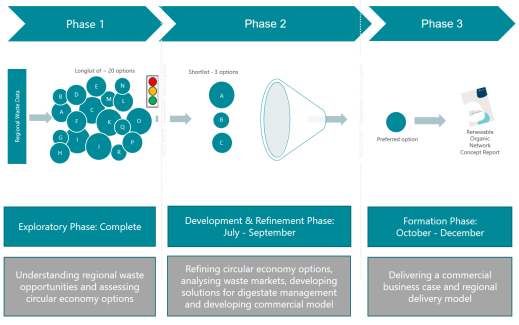
Key project decision points are:
May 2020 – Council confirmed involvement and agreed to sign MOU
August 2020 – Council to confirm involvement in phase 2
October 2020 – Council to confirm involvement in Phase 3
Early 2021 – Final decision to proceed with the project
The decision on whether the Council continues involvement in Phase 3 of the project will be made during the council election caretaker period, hence the request to delegate this decision to the CEO.
In Phase 1, potential feedstock available in the region and technology options have been identified and assessed against the agreed evaluation criteria.
This assessment has identified a range of potentially viable options from a financial, economic and social perspective, utilising anaerobic digestion of different combinations of organic feedstocks (for example, commercial and industrial organic waste; kerbside collected Food Organics Garden Organics (FOGO); Food Organics (FO) as well as Barwon Water Biosolids.
Source: |
City Services – Environment and Waste |
Director: |
Guy Wilson-Browne |
Portfolio: |
Waste Management |
To inform Council of the need to prepare waste and resource recovery transition plans to help plan and deliver reforms to the waste and resource recovery sector and household waste services.
The City’s Waste and Resource Recovery Strategy 2020-2030 sets a vision and goals that will ensure that the City and our community manage waste and resources by transitioning to a circular economy and minimising impacts on the environment.
The Waste and Resource Recovery Strategy supports the Victorian Government’s new circular economy policy – Recycling Victoria: A new economy, which commits to reform the way households recycle and provides requirements for future waste collection services.
As part of the waste service changes councils must develop Transition Plans which describe their current service model and the actions that will need to be implemented to deliver household waste and recycling reforms.
The draft Transition Plan must be completed by the end of September 2020 and the final Transition Plan completed six months in advance of commencement of service changes.
The Department of Environment, Land, Water and Planning (DELWP) is responsible for oversight of the transition.
The Victorian Government’s waste and resource recovery reforms require councils to provide a four bin or service model or access to an equivalent service for:
The separate collection of glass by 2027;
Comingled recycling for paper, plastic and metals;
Collection services for food organics and garden organics by 2030; and
Residual garbage collection.
Councillor Nelson moved, Councillor Aitken seconded -
That Council:
Note the requirement and timelines to develop a Transition Plan for future household waste and resource recovery services;
Note that City has completed the first step in the process which is to register our intention to develop a Transition Plan; and
Allocate $10,000 from the 2020/21 waste management budget toward the development of the draft Transition Plan.
Carried.
Up to $10,000 is available from the Victorian Government to prepare the draft Transition Plan. It is forecast that a further $10,000 will be required from the City’s existing waste and resource recovery budget.
The City is one of five councils (together with City of Melbourne, City of Yarra, Mitchell Shire and Macedon Ranges) testing a Transition Plan financial model.
Extensive community consultation was undertaken during the development of the City’s Waste and Resource Recovery Strategy. The feedback was broadly in-line with the four bin, or service model, particularly in relation to the implementation of a new household food collection service.
A Communication Plan will be developed and extensive community engagement will be undertaken during the development of the final Transitional Plan, prior to the implementation of new services.
The development and implementation of the Transition Plan will increase access to sustainable waste and resource recovery services.
The development of the Transition Plan is a requirement of the Victorian Government waste policy – Recycling Victoria: A new economy. The policy addresses issues such as waste management security, climate change and containing community costs.
This initiative supports the strategic priority of effective environmental management and shows leadership to address waste, climate change and environment challenges.
No officers involved in the preparation of this report have a direct or indirect interest in the maters to which this report relates.
The Transition Plan will assess risks and costs associated with different household waste collection services and identify measures to manage risks.
The Transition Plan will guide the development and implementation of future waste and resource recovery services which will reduce greenhouse emissions, improve recycling rates and decrease contamination, develop the circular economy and reduce material going to landfill.
The development of a household waste service Transition Plan will support the three goals contained in the City’s Waste and Resource Recovery Strategy:
Avoid creating waste;
Recover more resources; and
Protect the environment.
The Transition Plan will also support key actions in the City’s strategy including:
Implement a food organics collection service;
Investigate options and prepare a business case for establishing a food organics processing facility;
Prepare a business case for developing waste and resource recovery facilities and services that fosters a circular economy with regional partners and local governments;
Provide education and behaviour change programs that reduce bin contamination and increase resource recovery; and
Partner with government agencies, local governments and organisations to explore opportunities for resource recovery and alternative waste technologies.
The Victorian Government has committed $129 million to reform household recycling which will support councils develop transition plans, implement the reform to collection systems and support the reform with behaviour change programs. This will be complemented by a container deposit scheme.
To access this funding councils and alpine resorts will need to:
Register the intent to develop transition plans and transition current council services to comply with Victorian Government reforms by the end of July 2020;
Prepare and submit a draft Transition Plan by the end of September 2020;
Work with DELWP and Waste and Resource Recovery Groups to identify models of procurement to support reform and create a viable and sustainable recycling system; and
Undertake community engagement on the final transition plan and seek appropriate council approvals of the proposed service changes prior to the submission of final plans.
To implement the services the City will need to:
Develop and implement new contracts;
Develop additional processing infrastructure, particularly for food organics; and
Work with the Victorian Government and industry to ensure suitable end markets exist for materials.
The government will provide funding toward the costs for:
Development of the transition plan e.g. staff costs, short term backfill, engagement of consultant;
Provision of bins for glass and food organics and garden organics, either kerbside or other collection points;
Minor works to reconfigure rural/regional transfer stations to accommodate the new collection service; and
Implementation of local education programs to support the new services.
DELWP will actively engage with councils in relation to other reforms such as the design of the Container Deposit Scheme (CDS), the development of a new Act for waste and the formation of a Waste Authority as well as other opportunities for Councils to benefit from the transition to a circular economy.
Source: |
Customer & Corporate Services – Property, Procurement and Assets |
Director: |
Michael Dugina |
Portfolio: |
Finance |
To provide a report and recommendation to Council following the issue of the public notice of the intention to sell the land being certificate of title volume 9332 folio 123, addressed as part 11 McHarry Court, Corio. Refer Attachment 3 for location.
Consideration of the potential future sale of this land originated from the Council meeting on 25 November 2014 when, while considering rezoning the adjacent land, the Council resolved that “Officers prepare a report on the sale and rezoning of Connections Park East (BMX Site)”.
This led to the Planning Scheme Amendment C330 - a Council initiated amendment which rezoned Connections Park East, Corio from the Public Park and Recreation Zone to the General Residential Zone Schedule 1 – this is the parcel known as part 11 McHarry Court, Corio although the parcel of land connects to Welch Court, Consedine Court, Kilpatrick Court, and Goodwin Court, Corio.
When the Council adopted Amendment C330, the report noted that:
“Rezoning of the site to a residential zone will improve Council’s ability to attract investment in a challenging urban renewal precinct that will also see the redevelopment of the adjacent former Rosewall Primary School land. The long-term strategy to redevelop Connections Park East for residential use complements other renewal projects that will bring significant benefits for the local community. These include redevelopment of the former primary school land, sporting improvements to Flinders Peak Reserve, development of the Hendy Street Family Hub and the redevelopment of the Rosewall Neighbourhood House. The retention of the western part of Connections Park at over 1.3 hectares, with established playground equipment and neighbouring the Rosewall Neighbourhood House, will adequately serve local open space needs. The loss of the site as designated open space in the Planning Scheme will not adversely impact on the community”.
At its meeting of 12 May 2020, the Council resolved to commence the process to sell the property by giving public notice and inviting submissions, requiring that, if submissions were received, a further report will be put to Council.
Public notice was issued in accordance with sections 189 and 223 of the Local Government Act (Act) and submissions were invited.
Six submissions were received and a full copy of each has been provided to the Councillors, as well as a summary on Attachment 2.
No submitter requested to be heard by a submissions review panel.
In considering the submissions, it is noted:
The reserve is poorly situated and suffers from a lack of passive surveillance and safety concerns. Redevelopment of the surrounding land will address the objectives within the Corio Norlane Structure Plan 2012 of creating improved access and visibility of the remaining part of Connections Park located to the West.
The report presented to the Council meeting of 16 February 2016 noted “the long-term strategy to redevelop Connections Park East for residential use complements other renewal projects that will bring significant benefits for the local community”.
The report also noted that “The retention of the western part of Connections Park at over 1.3 hectares, with established playground equipment and neighbouring the Rosewall Neighbourhood House, will adequately serve local open space needs. The loss of the site as designated open space in the Planning Scheme will not adversely impact on the community”.
The Council has recently completed the $3.76m construction of the Rosewall Community Centre which provides a meeting point for community groups, adult education classes and social gatherings and art activities.
The ‘reserve’ status on the certificate of title will need to be removed by a planning permit prior to sale so the land can be developed in accordance with the General Residential Zone.
The nearby property, formerly the Rosewall Primary School, is likely to be sold by the State Government and be a complimentary redevelopment opportunity to the City’s land.
Councillor Grzybek moved, Councillor Aitken seconded -
That consideration of the report be deferred.
Carried.
Source: |
Governance, Strategy & Performance |
Director: |
Rebecca Leonard |
Portfolio: |
Leadership and Governance |
To provide an update on the progress of the Transformation Program 2.0 as at the end of June 2020.
Transformation Program 2.0 continues the work undertaken during the first phase of the transformation program and now focuses on six critical areas of change with 10 active projects being monitored under these.
The six focus areas are Civic Accommodation, Digital Modernisation, Asset Management, Advocacy and Stakeholder Management, People and Culture, and Service Planning and Review.
Key achievements for the last quarter include:
Planning permit for the Civic Precinct was issued on 25 June 2020;
Business Systems Refresh Request pre-qualifications report completed and request for tender short list completed with support from KPMG;
Asset Management Policy and Non-Current Asset Accounting Policy presented to and endorsed by Council in May 2020;
Asset handover for 2019-2020 completed, gifted assets captured, aged work-in-progress 90 per cent cleared;
Endorsement of the Draft Social Infrastructure Plan for release for community consultation with final adoption taking place on 28 July 2020. Engagement on the draft reached 44,573 people with 3,612 engagements resulting in 79 formal submissions. 95 per cent of submissions indicated support for the new policy and plan and 31 per cent provided suggestions for improvement;
Corporate Affairs Manager and Government Relations and Advocacy Lead commenced in April 2020;
Key functions of Communications and Engagement have been realigned within the new Corporate Affairs team and a dedicated government relations and advocacy function established to strengthen the City’s capacity to protect and enhance its reputation with governments, stakeholders and the community; and
Since the Working Better Together program was launched in September 2019, three sessions have been held for the Executive, Senior Leadership Team and Joint Coordinators Group leadership cohorts to support leadership commitment, set clear expectations and accountability, and increase leadership capability.
A detailed progress update on the Transformation Program 2.0 is provided in Attachment 2 – Transformation Program 2.0 – June 2020 Update.
Councillor Asher moved, Councillor Grzybek seconded -
That Council note the Transformation Program 2.0 – June 2020 Update report.
Carried.
Several projects such as civic accommodation, digital modernisation, asset management, social infrastructure plan, workforce planning and leadership development are subject to current and future budget funding and are allocated in the strategic resource plan.
Progress on the Transformation Program 2.0 is reported to the Executive Leadership Team, Council, Municipal Monitor and to the Local Government Minister on a quarterly basis and is available publicly after it has been to Council.
The Social Infrastructure Plan review is one of the current 10 projects in the Transformation Program 2.0. The diversity and inclusion and gender equity plans were delivered during phase one of the Transformation Program.
The Transformation Program was originally developed in response to the 2016 Commission of Inquiry report. In that report there were 12 key recommendations and 25 secondary recommendations to be addressed. The Municipal Monitor continues to review the progress of Transformation Program 2.0 and reports this to the Minister for Local Government. This will occur up to the Council election to be held in October 2020.
This report aligns to the Council Plan strategic priority Organisational Leadership, Strategy and Governance.
No officer involved in the preparation of this report has a direct or indirect interest.
The Transformation Program is managed by the Coordinator Transformation, Program Integration and Development (this ceases 28 August 2020) and progress is monitored by the Chief Executive Officer, Municipal Monitor and Council.
The program is also monitored via the organisations enterprise risk update and reported to the Audit and Risk Committee.
There are no environmental implications arising from this report.
Source: |
Customer & Corporate Services – Property, Procurement and Assets |
Director: |
Michael Dugina |
Portfolio: |
Finance |
Councillor Nelson moved, Councillor Sullivan seconded -
That in accordance with Section 89 (2) (d) of the Local Government Act 1989, this contractual matter be considered at the conclusion of all other business at which time the meeting be closed to members of the public.
Carried.
Source: |
Community Life – Social Planning and Investment |
Director: |
Robyn Stevens |
Portfolio: |
Sport and Recreation |
Councillor Mason moved, Councillor Nelson seconded -
That in accordance with Section 89 (2) (d) of the Local Government Act 1989, this contractual matter be considered at the conclusion of all other business at which time the meeting be closed to members of the public.
Carried.
Contents | Previous Page: Section A - Procedural Matters | Next Page: Section C - Notice of Motion
