
Council Minutes - Section B: Reports - 12 February 2013
Contents | Previous Page: Section A – Procedural Matters | Next Page: Section C - Common Seal
Contents | Previous Page: Section A – Procedural Matters | Next Page: Section C - Common Seal
Reports 1-9, tabled at the Ordinary Meeting of Council on Tuesday 12 February 2013 held at City Hall, Little Malop Street in Geelong.
Boundary Realignment - North Geelong (Bay Section) to Rippleside
Final Evaluation Report: Early Childhood Innovation and Development Project
Portfolio: |
Planning – Cr Macdonald |
Source: |
Economic Development, Planning & Tourism - Strategic Implementation |
General Manager: |
Peter Bettess |
Index Reference: |
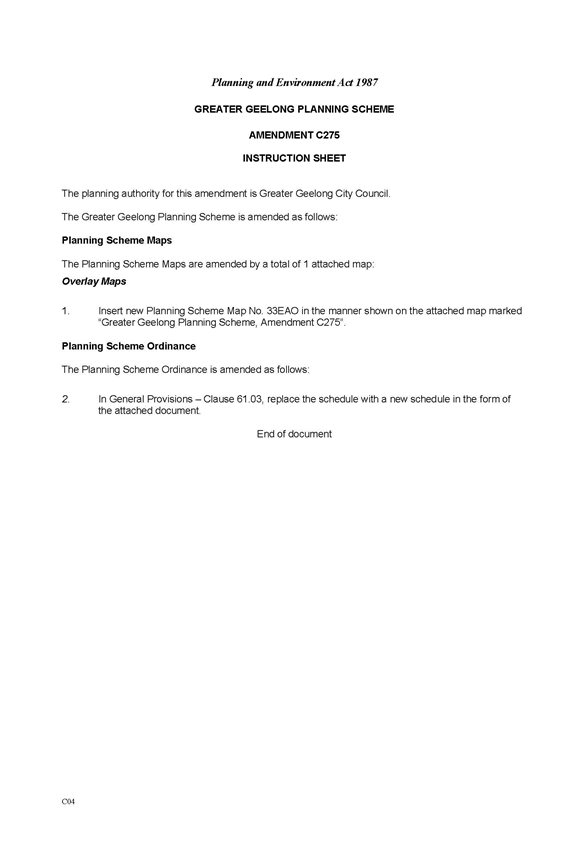
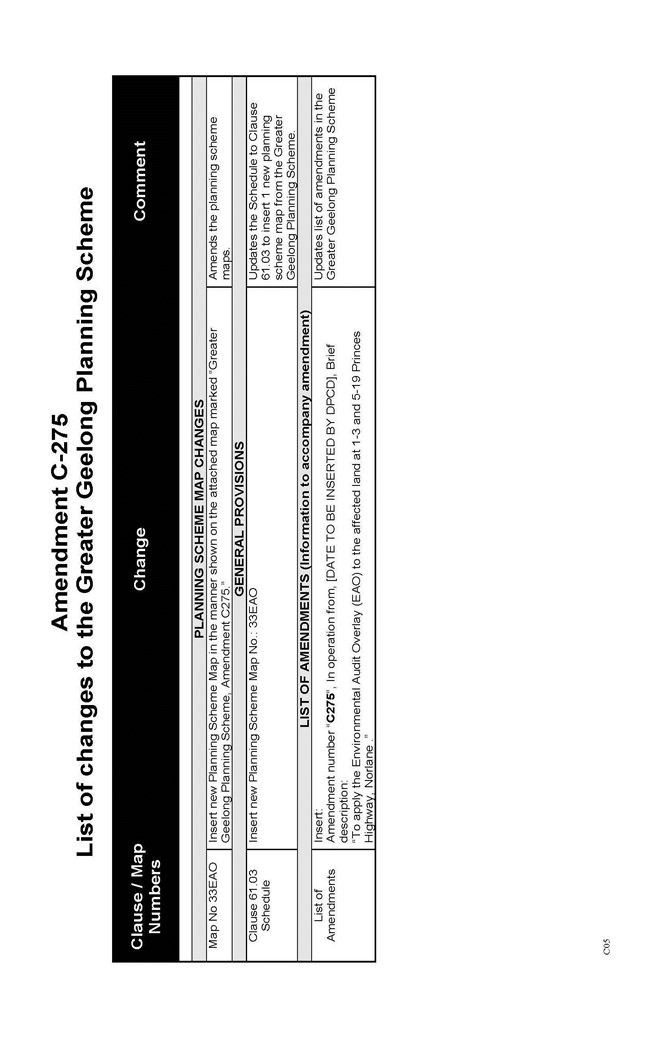
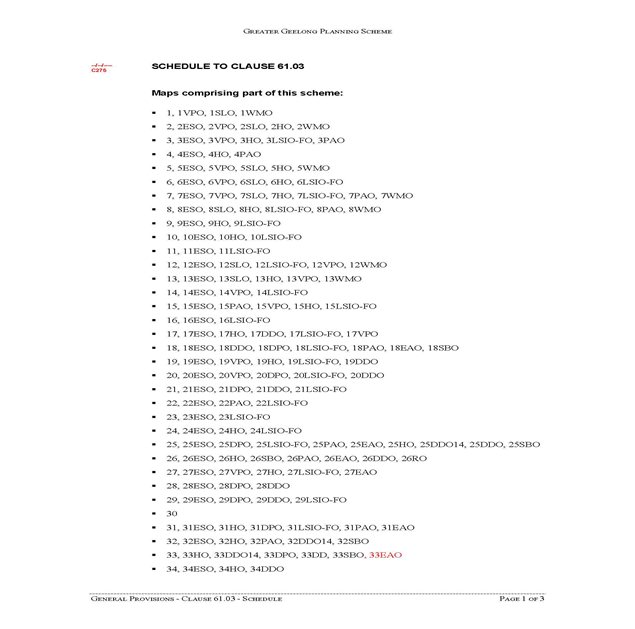
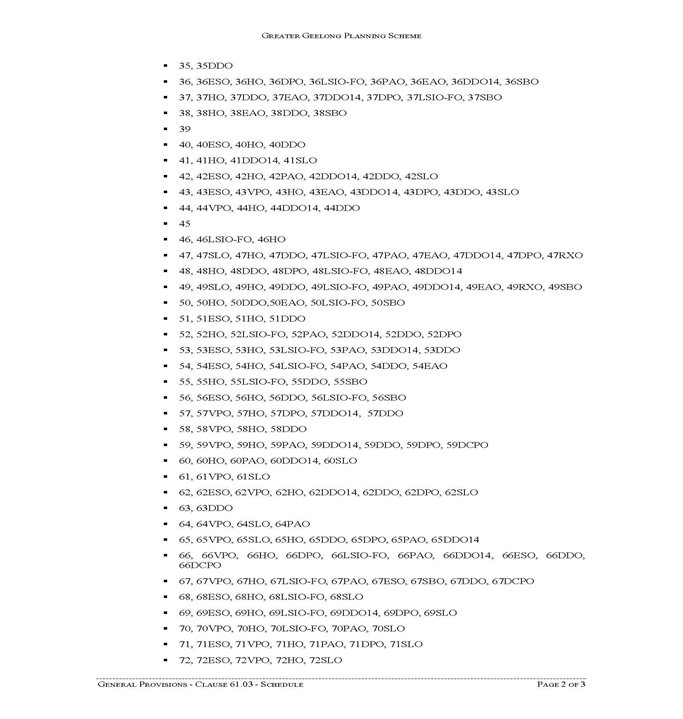
Amendment C275 Environmental Audit Overlay Consideration to Adopt |
This report provides a review of the formal exhibition of Amendment C275 and recommends the adoption of C275 to the Greater Geelong Planning Scheme.
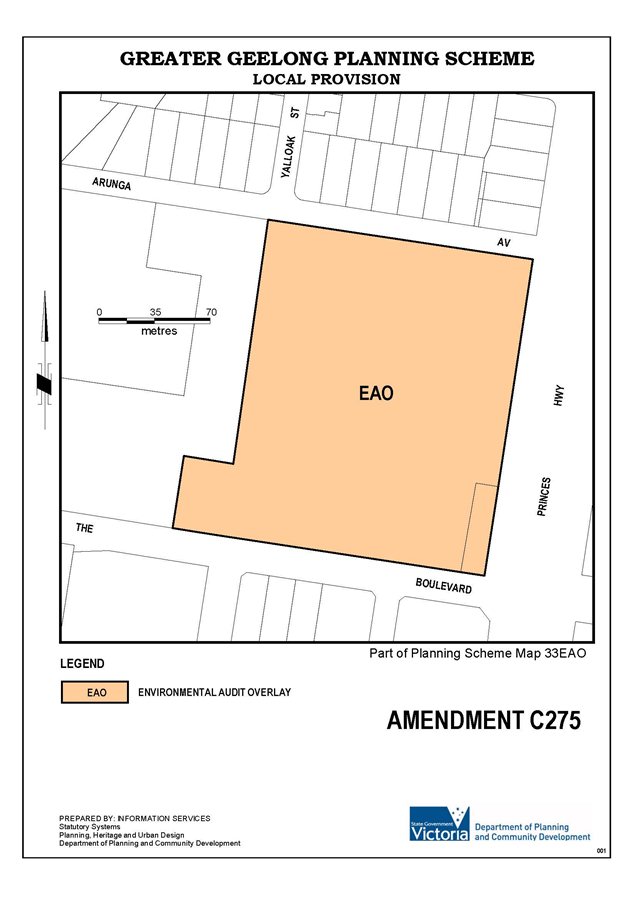
Amendment C275 is Council-initiated and will amend the Planning Scheme by applying the Environmental Audit Overlay (EAO) to the affected land at 1-3 and 5-19 Princes Highway, Norlane.
C275 is a direct response to Amendment C253, which seeks to rezone the subject land from the Industrial 2 Zone to the Business 4 Zone to facilitate the sale of restricted retail goods at the new Bunnings Store. The store has recently opened for business.
The purpose of the Amendment is to ensure the affected land is suitable for a sensitive use that could be permitted under the proposed Business 4 Zone. In this case, a sensitive use means a child care centre. The EAO will ensure that soil contamination is addressed before any sensitive uses are permitted on the site.
The Minister for Planning has deferred a final decision for Amendment C253 pending the conclusion of the separate amendment process for C275.
Under Council delegation powers, a resolution to prepare and exhibit Amendment C275 was issued on 22 August 2012.
The Minister for Planning authorised the preparation and exhibition of C275 on 17 September 2012.
Formal exhibition commenced on 29 October and closed on 27 November 2012.
No submissions were received during the exhibition period.
Amendment C275 is consistent with the objectives of planning in Victoria as outlined in the Planning and Environment Act 1987 and existing planning policy. Amendment C275 will result in a good planning outcome and will be to the betterment of any future sensitive land use that may be permitted, by way of planning permit, under the impending Business 4 Zone.
It is recommended that C275 be adopted as shown in Appendix 1-1 and sent to the Minister for Planning seeking approval.
Cr Macdonald moved, Cr Fisher seconded -
That Council resolves to adopt Amendment C275 and submit the adopted Amendment together with the prescribed information to the Minister for Planning requesting approval (the Amendment to be adopted is Appendix 1-1).
Carried.
C275 is Council-initiated and will alter the scheme by applying the Environmental Audit Overlay to the affected land at 1-3 and 5-19 Princes Highway, Norlane.
The subject land comprises two properties, 1-3 Princes Highway and 5-19 Princes Highway, Norlane. 1-3 Princes Highway is a single lot. 5-19 Princes Highway comprises one large lot and two smaller lots.
5-19 Princes Highway is now occupied by the new Bunnings Store. 1-3 Princes Highway is occupied by the Dunlop Norlane Tyre Service Centre.
For the purposes of this Amendment, 1-3 Princes Highway forms part of the affected land. (It does not form part of the new Bunnings Store development site.)
To ensure consistency with Amendment C253, the inclusion of 1-3 Princes Highway will avoid leaving a small remnant parcel of land at the corner of Princes Highway and The Boulevard, Norlane, without an appropriate control to ensure that a future sensitive use would be suitable for the land given the anticipated environmental conditions.
In 2009, Bunnings acquired 5-19 Princes Highway, Norlane. Subsequently, Bunnings applied to the Council for a planning permit in 2009. The permit sought to allow the use and development of the site for trade supplies, the display of advertising signage, alterations of an access to a Road Zone Category 1 and a partial waiver of bicycle facilities requirements of the planning scheme. A permit was issued in April 2010.
To facilitate the use of 5-19 Princes Highway for the sale of restricted retail goods, over and above the permitted sale of trade supplies, Amendment C253 was initiated by Bunnings.
Amendment C253 seeks to:
rezone the subject land from an Industrial 2 Zone to a Business 4 Zone; and
remove the Development and Design overlay- Schedule 20 (DDO20) affecting the land because it would have no relevance to land in a Business 4 Zone.
Amendment C275 is necessary to ensure that the historical land use of the affected land (and associated potential for soil contamination) would not impact on the potential future sensitive use of the land.
The Minister for Planning authorised the preparation of the Amendment on 17 September 2012.
The Minister’s authorisation letter also confirmed Council’s request for reduced notice, pursuant to the Planning and Environment Act 1987. The Minister for Planning considered that compliance with the requirements of sections 19(2) and 19(3) of the Act were not warranted. The exemption referred to the requirement of the Responsible Authority to place an advert in the local newspaper and notice in the Government Gazette.
Notice of exhibition was sent to both affected landowners, Bunnings Group Ltd. and Norlane Dunlop Tyre Service Centre, and prescribed Ministers.
C275 was formally exhibited between 29 October 2012 and 27 November 2012. On 17 October 2012, notice of exhibition was sent to both affected landowners and prescribed Ministers.
No submissions were received during the formal exhibition period of C275.
It is recommended that Council adopt Amendment C275, as exhibited on 29 October 2012 and as per Appendix 1-1 of this report.
C275 is consistent with the objectives of planning in Victoria as outlined in the Planning and Environment Act 1987 and existing planning policy.
The Amendment is consistent with the Ministerial Direction on the Form and Content of Planning Schemes under section 7(5) of the Planning and Environment Act 1987.
The Amendment is consistent with Ministerial Direction No. 1 Potentially Contaminated Land under section 12 of the Planning and Environment Act 1987.
The purpose of this Direction is:
to ensure that potentially contaminated land is suitable for a use which is proposed to be allowed under an amendment to a planning scheme and which could be significantly affected by any contamination.
“potentially contaminated land” means land used or known to have been used for”
a) industry,
b) mining, or
c) the storage of chemicals, gas, wastes, or liquid fuel (if not ancillary to another use of the land).
“sensitive use” means a residential use, a child care centre, a pre-school centre or a primary school.
The proposed overlay control will apply to former industrial land, as per sub-section a) above.
The Environmental Audit Overlay is a mechanism provided in the Victoria Planning Provisions to defer the requirements of Direction No.1 for an environmental audit until the site is to be developed for a sensitive use.
The Amendment is consistent with State Planning Policy relating to Environmental Risks (Clause 13.03-1 Use of contaminated and potentially contaminated land) and the associated objectives and strategies, which seek to adopt a best practice environmental management and risk management approach to avoid or minimise environmental degradation and hazards. Amendment C275 is consistent with State Planning Policy demonstrating support for the adoption of a precautionary principle in relation to the potential for significant adverse impact of contaminated land on sensitive land uses.
The Amendment will result in a good planning outcome and will ensure that any soil contamination risks are addressed before a future sensitive land use could be permitted under the Business 4 Zone, as proposed by C253.
Amendment C275 will ensure that on site environmental conditions are suitable for sensitive land uses. No adverse environmental impacts are expected as a result of the Amendment as it seeks to impose a control rather than a rezoning.
It is not expected that the proposed amendment will result in any financial implications for Council, other than those associated with the usual processing of a planning scheme amendment.
The strategic application of the EAO on the affected land is consistent with current policy.
The Amendment will result in a good planning outcome.
In accordance with Sec 80(c) of the Local Government Act Peter Bettess, General Manager, Economic Development, Planning & Tourism declares an indirect financial interest in that he owns Woolworths and Wesfarmers shares.
No other Council Officers involved in this report have any direct or indirect interest, in accordance with Section 80(c) of the Local Government Act.
The Environmental Audit Overlay requires the Responsible Authority to satisfy itself that there will be no detrimental impact on the sensitive use of land. The Environmental Audit Overlay applies a control to land that requires either the issue of a certificate of environmental audit or the appointment of an environmental auditor to identify the environmental quality of the land and any detriment to the beneficial uses of the land.
Potential for soil contamination is the area of concern in relation to the subject land. Given land at 5-19 Princes Highway now contains the new Bunnings Store, the potential contamination risk on a future sensitive use of the site is considered low.
The preparation of the planning scheme amendment is in accordance with the requirements of Ministerial Direction No.1 Potentially Contaminated Land and Ministerial Direction on The Form and Content of Planning Schemes.
There will be no adverse impacts on surrounding land uses as a consequence of the Amendment.
The Amendment was exhibited in accordance with the provisions of the Planning and Environment Act 1987 for a period of one month. The affected landowners were sent a notice of exhibition and will be advised of the final decision of the Minister for Planning.
Portfolio: |
Knowlege Economy – Cr Macdonald |
Source: |
Economic Development Planning & Tourism |
General Manager: |
Peter Bettess |
Index Reference: |
Geelong Open for Business |
This is a periodic report to Council outlining the progress of the Economic Development Unit Business Visit Program in the eight months from May to December 2012.
The Business Visit Program is an information exchange between business, industry and Local Government. The aim is to facilitate open discussion and to provide information from all tiers of Government including grant availability, mentoring services, access to networks and training.
Visits are conducted by senior Economic Development staff with the leads generated from the Geelong Small Business Festival, the Business Register, Business Café and business to business referral.
Visits provide an opportunity to discover challenges facing business enabling services to be shaped, problems to be resolved, with business expansion and growth encouraged.
The program seeks to be a proactive means to assist the small business community, actively seeking involvement with business to help them succeed.
Information gathered will be used to provide direction to the Economic Development business support staff, direct the resources of the Economic Development Unit during budget proposal development and provide input into the Economic Development Strategy directions.
Cr Macdonald moved, Cr Harwood seconded -
That Council notes the report.
Carried.
The current Geelong Economic Development Strategy 2005 – 2010 identifies 5 strategic growth sectors:
Knowledge, innovation and research
Advanced manufacturing
Health
Tourism
Small, micro and home based business
Food and horticulture
The majority of businesses in Geelong, 84% of the total number employ less than 5 people, are very diverse in their operation and geographically dispersed throughout the city. Engaging and fostering relations with this group is particularly challenging, yet from an investment and growth perspective it is this sector that is more likely to provide employment opportunities particularly for local people. Inward investment on the other hand has the potential to offer greater rewards but does entail greater risk and cost. It is also an area pursued by both State and Federal Governments. While Local Government has a part to play in this scenario a focus on nurturing local businesses is a logical policy to pursue.
The Economic Development Unit over the last 12 months has repositioned to focus more overtly on the small business sector. A number of tools have been deployed to do this, with an underlying emphasis upon trying new things, reviewing and amending in a shorter time cycle than would be normal in a Local Government setting. This is necessary because of the complex nature of the small business sector.
The tools that have been put in place are as follows:
Business visit program
Business café (networking facilitation)
Geelong Business TV (GBTV)
Geelong Business Calendar
Geelong Small Business Festival
Geographically defined small business networks
Refreshed web site emphasising visual and interactive material
Small Business Mentoring Service Voucher Scheme
Programs and tools in development or at inception stage include:
Angel Investor Group
Chinese Economic Development Profile (web based)
Local Jobs / Local People Program
Move to Geelong You Tube Campaign
Wifi and Eduroam CBD Geelong (collaborative project)
The Business visit program is framed round an interview survey which acts as an information gathering device and as an engagement tool. In the period of May to December 2012 the Economic Development staff undertook 143 surveys and visits, 90 have been analysed. The analysis is appended to this report.
Recurrent themes of note are;
Reliance on the local market
Niche products and flexibility businesses perceive as their competitive advantage
Only 58% of businesses visited had a written business plan
The regulatory environment, planning and poor internet connectivity are the main challenges
Difficulties in attracting and retaining a skilled workforce
64% interested in local small business networks and groups
Networking, seminars/workshops and promotion of the region seen as the activities Council should be pursuing.
Information gathered from the survey and feedback from business indicates the program is very worthwhile and reaffirms that the activities presently being offered are valued. Importantly the two way information exchange is aiding to inform Economic Development regarding issues such as;
Plans for future expansion
Specific impediments to growth
Perception of Council services
This information is now able to be used as the foundation for continuous improvement of council services and will be used to shape the direction and focus of the Economic Development Unit over the coming period. In this way we are able to be responsive and proactive in supporting business prosperity in Geelong.
The Business Visit Program has generated leads for the Geelong Ringroad Employment Precinct and for the Skilled Migration Project.
The Small Business Mentoring Scheme voucher has resulted in 50 businesses taking up mentoring sessions helping them to grow and perform better.
Several businesses have been referred to the Future Proofing program and are now also in receipt of ongoing support from the Future Proofing team.
The Business Visit program is the basis for Geelong Business TV, a YouTube repository of the Geelong business story and diversity of business activity in Geelong. Businesses are only afforded the GBTV opportunity following a business visit. This provides additional connection with the business and provides a genuine offer from Council for business. The clips are shot and edited in-house using the existing capabilities of the Economic Development Unit.
As the program continues it is hoped case studies will be forthcoming some of which will be reported in an interactive fashion on the Councils web site as well as directly to Council, illustrating the successes of the program.
The program is intended to build ongoing relationships with business. As part of that commitment each staff member follows up with the business regularly and the Economic Development unit provide ongoing communication including special invitations, training opportunities, workshops and our Open for Business e-news.
There are no known environmental implications for Council.
The Business Visits Program has no financial implications outside the existing economic development budget.
Policy/Legal/Statutory Implications
Section 3C, 2d of the Local Government Act 1989 states that a Council must have regard to the following facilitating objectives; “to promote appropriate business and employment opportunities”.
Office Direct or Indirect Interest
No officer involved has a direct or indirect financial interest.
Not applicable.
Not applicable.
The Business Visit Program is promoted under the wider banner of Economic Development activities.
The Communications and Marketing Unit have provided a media release regarding the program including a case study detailing a micro business who have employed a person following the connections made via the Business Visit Program.
The Business Visit Program is promoted via www.geelongaustralia.com.au/business
Portfolio: |
Environment and Sustainability - Cr Richards |
Source: |
City Services - Environment and Natural Resources |
General Manager: |
Gary Van Driel |
Index Reference: |
Council Reports 2013 |
The purpose of this report is to seek formal endorsement of the Mt Brandon Landscape Plan by Council following a public exhibition and community consultation period of four weeks.
public exhibition and community consultation process, 27th August to 24th October 2012, was undertaken following the release of the draft Plan. The draft Plan was displayed at each of the City Customer Service Centres and was also available for viewing on the City’s web site together with copies of the Information Leaflet/Questionnaire during the consultation period. The Information Leaflet/Questionnaire was mailed out to the adjoining landowners.
A total of 27 questionnaires were completed and returned along with 2 detailed written responses by closing date of 24th October 2012.
The intent of the Mt Brandon Landscape Plan is to co-ordinate the staged development of future recreational infrastructure such as paths, bridges, platforms, picnic areas, public toilets, playgrounds, seating and car parking. The Mt Brandon Landscape Plan will also guide ongoing weed control and revegetation works, within the Mt Brandon and Wandana precincts of the Barwon and Moorabool River Reserves Masterplan and Management Plan (2006).
The Mt Brandon Landscape Plan has been prepared in accordance with the overall intent of the Barwon and Moorabool River Reserves Masterplan and Management Plan (2006).
Cr Nelson moved, Cr Richards seconded -
That Council:
notes the outcomes of the public exhibition and community consultation process.
formally endorses the Mt Brandon Landscape Plan.
Carried.
The Environment and Natural Resources Unit of the City of Greater Geelong (CoGG) is responsible for managing the Barwon and Moorabool River Reserves (BMRR) between the Queens Park Bridge and the Geelong Ring Road. Comprising both government and community representatives the Barwon and Moorabool River Reserves Advisory Committee (BMRRAC) provide the CoGG with advice and support around the management of the reserves. The Mt Brandon Landscape Plan has been prepared in consultation with BMRRAC.
The key strategic document for management of these reserves is the Barwon and Moorabool River Reserves Master Plan and Management Plan 2006 (BMRRMMP). The BMRRMMP identified a system of public open space reserves that extend on both sides the Barwon River from the Geelong Ring Road to the existing Queens Park Bridge, and public land along the Moorabool River at Fyansford to the confluence with the Barwon River including future open space areas that had not yet been transferred to Council. In 2009 and 2010, new parkland areas along the Barwon River known as Mt Brandon and Wandana were transferred to Council.
The area attracts many visitors and the visitation rate is increasing as the surrounding area changes from rural / industrial to residential. Now that homes are being built and occupied in the adjoining area, public use and expectations of appropriate facilities, such as path networks in the public open space is high and will continue to increase.
The Mt Brandon Landscape Plan (2012) provides a more detailed plan to co-ordinate the implementation of on-ground actions in accordance with the intent of the BMRRMMP, specifically in the areas known as Mt Brandon and Wandana. These actions include restoration works, car parking, picnic facilities, a playground, flat grassed informal recreation areas and toilet facilities to complement other facilities along the Barwon River.
A public exhibition (27th August to 24th October 2012) and community consultation phase was undertaken following the release of the draft Landscape Plan. The draft Landscape Plan was displayed at each of the City Customer Service Centres and was also available for viewing on the City’s web site together with copies of the Information Leaflet/Questionnaire during the consultation period. The Information Leaflet/Questionnaire was mailed out to the adjoining landowners. The local media was used to promote the opportunity for public comment on the draft Landscape Plan.
A total of 27 questionnaires were completed and returned along with 2 detailed written responses by closing date of 24th October 2012.
The feedback received was used to inform the finalisation of the Mt Brandon Landscape Plan.
Following a report to Council in August 2012 the draft Landscape Plan was released for a minimum period of 4 weeks for public exhibition and community consultation. The summary of the outcomes of the consultation is detailed in Mt Brandon Landscape Plan Community Consultation Report, 2012. Table 1 Consultation Summary and Recommendations summarises the key issues raised in the questionnaire, responses and the recommendations. No significant changes were made to the draft Mt Brandon Landscape Plan as a result of the public exhibition and community consultation process.
Table 1 Consultation Summary and Recommendations
|
No. |
Plan Ref |
SUMMARY OF COMMENT |
RESPONSE |
|
3. |
Access |
||
|
3.1 |
|
Bridge crossing is the most important of all the recommendations. |
The need for the new Barwon River Bridge is identified as a high priority on the plan and is supported in the Barwon River Parklands Strategic Plan. The bridge will be a high cost regional asset and cannot be achieved without State Government funding. Noted. |
|
3.2 |
|
Consider rope bridges for river crossings. |
The Barwon River is subject to frequent and sometimes severe flooding. Use of low level or informal crossings is not possible due to current safety and maintenance requirements. New bridges must be designed to meet current Australian Standards AS5100 to ensure safety of the public and durability of the asset. Noted. |
|
3.3 |
|
Provide all-ability access and decrease gradient of path to allow all ability access. |
The Barwon River Trail extension from Highett Road to the Geelong Ring Road will be constructed in accordance with current all ability standards as defined in AS1428. Due to existing topography, cultural and environmental constraints, bushwalking tracks along the river will remain in their current alignment and will only provide informal access. Noted. |
|
3.4 |
|
Provide a link along Gully 2 to river parklands and trails. |
Path and open space links south along Gully 2 are proposed as part of future development works but are outside the scope of the Mt.Brandon Peninsula Landscape Plan. Noted. |
|
3.5 |
|
Increase weed maintenance of paths. Ensure paths are maintained and increase rubbish removal. |
As new paths are established weed control and maintenance will be undertaken in accordance with Council standards.
Noted. |
|
3.6 |
1 |
Retain Gully 3's natural characteristic, no sealed paths, only gravel surface. |
Establishment of the new Barwon River Trail link around Gully 3 is to provide for both cyclists and pedestrians. The route was selected to avoid sensitive environmental and cultural values along the Barwon River. The steep grades mean use of an unsealed path is not recommended due to potential erosion and maintenance issues. Noted. |
|
3.7 |
1 25 |
Cyclist not to be permitted on riverside tracks. Shared path not be located near the river. |
The shared path will be located away from the Barwon River as shown on the plan. Riverside access will remain as unsealed and informal walking tracks. Use of riverside tracks for cycling is not supported in the Landscape Plan due to safety and to minimise impacts on environmental values and natural experience. Noted. |
|
3.8 |
|
Implement speed and safety regulations for cyclists |
Council standard code of conduct signage will be installed to all new sections of shared trail. It is not possible to enforce speed bans on cyclists, hence the need to ensure designated shared trails meet the required standards to ensure safe access for all users. Noted. |
|
3.9 |
4 |
Improve alignment of informal tracks to minimise erosion and damage to existing vegetation. |
Changes to alignment of existing informal tracks may not be possible or desirable in some areas due to potential cultural heritage impacts. Use of existing routes is preferred as these areas are already disturbed. Noted. |
|
3.10 |
8 |
Concerns over the muddiness and erosion of banks around Baum's Weir, condition would worsen if access is encouraged. |
The existing informal riverside tracks will remain as a natural surface. Occasionally they will get muddy after rainfall and flood events and natural restrictions on access will occur. This approach is preferred as formalisation of access is not sustainable in flood conditions and may further encourage use by cyclists which will impact on environmental values. Noted. |
|
3.11 |
2 |
Design Gully 3 bridge similar to Highett Road wetland bridge. |
The Gully 3 bridge will become part of the Barwon River Shared Trail network. It is located at the bottom of a steep ramp and surfacing will need to be non slip asphalt or concrete (not timber or gravel) to reduce risk to cyclists. Design of handrails and cladding will be similar to the existing wetland bridge at Highett Road using natural Australian Hardwood. Noted. |
|
3.12 |
|
Increase measures to protect native fauna in the area such as the Platypus. |
Protection of environmental values and habitat is a key and ongoing objective for the Landscape Plan and management of the area by Council. Council will continue to liaise with the Corangamite CMA to ensure protection of Platypus habitat in the Barwon River. Noted. |
|
4 |
Infrastructure |
||
|
4.1 |
13 25 |
Do not support the current car park location as it is located too close to Orchardview Drive. Relocate car park closer to Grantham Drive behind the sewer waste pumping station.
|
The location of the car park is designed to provide all ability access to the new picnic area overlooking the Barwon River. It has been carefully sited at the end of the road to minimise impacts on views from the nearby houses. Relocation of car parking to a site behind the sewer pumping station on the western side of the Gully 2 outfall to the river is not suitable. The location must remain visible from the road for security purposes and provide the required all ability access to the main picnic area, future playground and Barwon River. Noted. |
|
4.2 |
|
Increase amount of toilet locations. |
Recreational use of the reserve is currently low. Following connection to the Barwon River Trail, and as use increases, public toilets will be provided near the main picnic area as shown on the Landscape Plan. Noted. |
|
4.3 |
|
Café/kiosk/ restaurant required. |
Commercial development within public open space along the Barwon River at Mt Brandon Peninsula is not supported. Noted. |
|
4.4 |
|
Provide wind sculptures throughout the parklands. |
Development of public art/sculptures may be considered at later stages of the park development subject to funding and increasing levels of public use. Recommendation: No change to plan |
|
4.5 |
11 |
Viewing platform to be as close as possible to ground level, do not support viewing “tower” structure. |
The proposed seating viewing area will not involve establishment of a structure. It will be a ground level seating area located to take advantage of the naturally elevated views up the Barwon River from the escarpment. Longer term some active vegetation management may be required to maintain views up the river as revegetation becomes more established. Recommendation: Amend plan note 11 to clarify the intent of the seating area as noted above.
|
|
5 |
Overall Landscape Plan |
||
|
5.1 |
|
Concerns over cost of the project in comparison to the needs of the community. |
The new park area is the most important open space asset for new adjoining residents and a key destination for the people of Geelong and other visitors as part of the Barwon River Parklands. The cost of both land management/restoration and development of new infrastructure will however be high. Funding for environmental protection and enhancement works will continue to be prioritised to areas with existing values before new areas of revegetation are opened up. The Plan recommends a staged approach, only opening up new areas of park to public access as funding permits, development proceeds, new residents move into the area and the Park becomes more popular with Geelong locals and visitors. Noted. |
|
5.2 |
|
Plan to include ‘words environmental enhancement and development’. Too much emphasis on infrastructure development Plan does not discuss enhancement of environmental values.
|
The Landscape Plan is not a management plan. Protection and enhancement of environmental values is a key objective for the site however the purpose of this plan is to engage with the local community about access to the park and priorities for staged development. This does not mean there is any reduction in commitment to protection and enhancement of environmental values on the site. Recommendation: Include additional text regarding environmental enhancement in the overall design intent. |
|
5.3 |
|
Overall design, grazing cropping unsuitable. Would require slashing 2-3 times annually groves of trees, shrubs, grasses etc and scattered red gums planted will suppress the grass. |
The parkland area is over 28ha. While the Plan clearly articulates a vision for extensive revegetation and environmental improvement this will take many years to achieve. In accordance with best practice land management principles, resources will be prioritised to areas with existing environmental value. Recommendation: Change plan to indicate that the area will be maintained by slashing (low frequency/level of service) rather then an agricultural use. |
|
5.4 |
|
Increase rabbit control measures. |
Rabbit control in areas located on the riverbank and adjoining rural areas is difficult. Council will continue to liaise with Department of Primary Industries and adjoining private land owners to monitor and where possible control rabbits. Noted. |
|
5.5 |
6 |
Tidy up the mess at end of Old Flour Mill Road. |
As part of Stage 1 trail works vehicle control and landscaping improvements will be completed at the end of Highett Road. Noted. |
|
5.6 |
|
Improve dog waste control measures. |
As new path and open space areas are opened to the public dog waste bins will be established in accordance with recommendations of the Domestic Animal Management Plan. Noted. |
|
5.7 |
|
Provide controlled dog off lead areas. |
Dog off lead areas will be provided away from the Barwon River in accordance with recommendations of the Domestic Animal Management Plan. Noted. |
|
5.8 |
|
No dogs off lead along riverside tracks. Enforce dog on lead policy. |
Dogs are to be kept on lead at all times in sensitive environmental areas along the Barwon River. Enforcement of local laws will be in accordance with recommendations of the Domestic Animal Management Plan. Noted. |
|
5.9
|
12 |
Clearance of debris and build up of soil in places to display the original construction to the flour mill site. |
Accumulation of sediment and water borne debris is a natural occurrence along the Barwon River and ruin foundations of the former flour mill site have been subject to these forces for over 100 years. Attempts to physically remove sediment may damage ruins and potentially also impact on other cultural heritage values and this practice is not recommended. Noted. |
|
6 |
Informal Recreational Facilities |
||
|
6.1 |
|
No skate parks. |
Skate parks are not proposed for this parkland. Noted. |
|
6.2 |
|
Playgrounds and fishing platforms are highest priority. Increase recreational areas for children. |
Establishment of walking path loops and links to the Barwon River Trail will be used to improve access and encourage more people to visit and use the Park. Establishment of fishing platforms (water access) and a playground will follow as funding becomes available. Noted. |
|
6.3 |
14 |
Relocate proposed picnic area closer to the car park to protect the riverbank. Play-ground to be located closer to Orchardview Court as it is a more visible open area and safer for children.
|
The Barwon River is a key reason for visiting the Park and the main picnic area located to the base of the escarpment (toward the end of Orchardview Court) will provide shade/shelter and views to the river. The location is consistent with other popular riverside picnic areas in Geelong and the proposed picnic area is located approximately 50m back from the edge of the Barwon River. Final siting of the playground will be confirmed at detailed design. Noted. |
|
6.4 |
|
Provide sheltered picnic areas. |
Extensive tree planting has already been undertaken and this will continue to provide shelter for proposed new picnic areas. Noted. |
|
6.5 |
|
Increase seating areas. |
As paths and improved access is provided new seats overlooking the Barwon River and other features of the Park will be established. Noted. |
|
6.6 |
15 24 |
Concern over damaged caused to riverbanks by use of proposed fishing platforms.
|
The provision of a dedicated and well designed fishing platform/water access point will reduce public risk/erosion and damage to banks from increasing public use of the various existing steep informal water access points. Noted. |
|
7 |
Vegetation Management |
||
|
7.1 |
|
Control vegetation height along fencelines not to impact views. |
Careful placement of trees will assist in retaining views from existing outdoor decks and windows as these views also provide an important role in security and surveillance of open space. Noted. |
|
7.2 |
1 |
Do not support fire breaks, houses should develop own fire protection.
|
Where properties directly adjoin the open space retention of maintenance and fire access is required along the fence line. Noted. |
|
7.3 |
|
Do not support removal of European trees. Provide a mixture of indigenous and non-indigenous trees and vegetation.
|
The Barwon River Parklands including the Park are a primary biodiversity and habitat corridor and all new planting is to be undertaken using indigenous species grown from locally collected/sourced seed. This is aimed at both improving the habitat for the many native birds and animals which use the river corridor and adjoining bushland and to also protect the biodiversity values associated with both this area and downstream sections of the Barwon River. Invasive weed species such as Ash and Willows will be removed to reduce potential spread along the lower sections of the Barwon River. Established and less invasive exotic trees including Cypress and Peppercorns will be retained short term to maintain landscape character and habitat value while new indigenous revegetation is established. However eventually these trees will also be removed when they become structurally unsound or to allow completion of the final stages of revegetation works in that particular area. Noted. |
|
7.4 |
|
Revegetation near Rivergum Drive not required, would only require occasional slashing.
|
Tree planting shown along Rivergum Drive is for street trees only and many of these have already been planted. Only scattered tree planting is proposed to retain views and to ensure passive surveillance of the open space from the road and adjoining properties. Noted. |
|
7.5 |
|
Increase weed control. Use indigenous planting as a method for weed control |
Despite extensive weed removal by Friends of Buckley Falls (FOBF) and Council there remains significant weed infestation in the Park. Areas with existing native vegetation and higher conservation values will remain the highest priority for control of weeds. In other areas weed control will be increased overtime as funding permits. Noted. |
|
7.6 |
9 |
Ground is prickly and not suitable as an open space area for recreational use |
Existing open grass areas are covered with Galena and other ground layer weeds which make the surface unusable. As outlined in the plan these areas are to be weed sprayed and top dressed to enable establishment of areas of mown grass. These flat areas can then be used by the local community for informal active recreation. Noted. |
|
7.7 |
|
Do not support formal sports field.
|
Formal sporting fields are not proposed for this parkland. Noted. |
|
7.8 |
9 23 |
Do not support mown open spaces, area was planned to become example of Barrabool Hills Ecosystems. Suggest woodland with grassy understorey and wildflower beds. Consider renaming “future open space” to “restoration of Barrabool Hills vegetation”
|
The parkland has been acquired by Council to provide for both environmental protection and enhancement and the provision of passive open space for adjoining residents and other visitors in an area where flat open space is limited by the natural topography. The retention and size of the three areas of open mown grass shown on the Landscape Plan was clearly established in the Barwon and Moorabool River Reserves Plan 2007. This Council endorsed plan was developed in close consultation with the community and was supported by both Geelong Environment Council and Friends of Buckley Falls. The vast majority of the Park will eventually be restored to a natural state in accordance with the prevailing Ecological Vegetation Class. These open mown grass area will be informally shaped and eventually surrounded by scattered indigenous trees and open grasslands consistent with the natural vegetation of the surrounding Barrabool Hills. These surrounding areas may occasionally be slashed to assist in control of weed seed setting and for fire management purposes however when the Park is eventually fully revegetated only these three areas 100x60m, 140x60m and 70x70m will be actively managed as open mown grass. These three areas in total constitute less than 10% of the overall Park area and are critical to providing useable passive open space for local residents and visitors to the Park to run about, play informal ball games and undertaken other passive recreational activities in an informal parkland setting. Recommendation: Update Plan to reflect the actual size of the proposed open mown grass areas on the Plan rather than just referring to them in the text. On the Plan add additional reference to restoration of Barrabool Hills vegetation. |
|
7.9 |
9 |
Friends of Buckley Falls strongly object to recreational usage of Mt Brandon Peninsula as it was planned for revegetation. Steeper slopes and riverside areas to be classified as nature reserve rather than public recreation area. Importance to protect and enhance biodiversity values.
|
As confirmed in the Barwon and Moorabool River Reserves Plan 2007 the parkland has been established to provide for both environmental protection and restoration and informal active and passive recreation. As outlined above there is no intention to establish formal sports fields however the steepness of the adjoining land and open space needs of the large future residential community must also be provided for, including areas to run about and play games etc. This will not prevent extensive revegetation along the river and surrounding open space areas. Noted. |
|
8 |
Traffic Management |
||
|
8.1 |
|
Increase traffic control measures, e.g. speed humps and traffic islands. Concerns about increased traffic on Grantham Drive |
Consideration of traffic control measures for surrounding streets is outside the scope of the landscape plan. Noted. |
|
8.2 |
18 |
Reduce traffic noise and wind. Revegetate Ring Road area to reduce wind and traffic noise |
Extensive revegetation is planned for the Geelong Ring Road end of the parkland. Staged establishment of street tree planting and revegetation as outlined in the Landscape Plan will also assist in reducing the impacts of traffic noise and formation of natural wind breaks. Noted. |
The intent of the Mt Brandon Landscape Plan (see Attachment 1) is to coordinate the staged development of future recreational infrastructure such as paths, bridges, platforms, picnic areas, public toilets, playgrounds, seating and car parking with ongoing weed control and revegetation works. The Mt Brandon Landscape Plan has been prepared in accordance with the overall intent of the Barwon and Moorabool River Reserves Masterplan and Management Plan (2006) and more recently completed Council and Friends of Buckley Falls (FoBF) projects.
Included with the Mt Brandon Landscape Plan is the staged implementation schedule and indicative capital costs for the works identified in the Landscape Plan. The total costs of all the works proposed in the Landscape Plan is estimated at $2,763,450 (when preparing budgets a contingency costs of 10% will be included) and is broken down into six stages as indicated in Table 2 Mt Brandon Landscape Plan Indicative Costs. Funding support from federal, state and regional funding bodies, such as the Barwon River Parklands Project will be sought to support the implementation of the
Plan. The Barwon River Parklands Project has already provided approximately $180,000 towards project implementation.
Table 2: Mt Brandon Landscape Plan Indicative Costs
|
STAGE |
COST |
|
1 |
$455,800 |
|
2 |
$373,900 |
|
3 |
$436,750 |
|
4 |
$420,500 |
|
5 |
$524,000 |
|
6 |
$552,500 |
|
TOTAL WORKS |
$2,763,450 |
As works will be staged over many years the intent is to confirm the footprint and layout of infrastructure to enable progressive development of the site while retaining sufficient space for integrated future development. This will help the Barwon and Moorabool River Reserves Advisory Committee guide works and activities at Mt Brandon and Wandana.
The Friends of Buckley Falls (FoBF) are an extremely active community group. They have regular working bees and undertake many revegetation and rehabilitation projects within the BMRR with funding assistance from Council. This work is overseen by the Barwon and Moorabool River Reserves Advisory Committee which was recognised in the 2011 Keep Australia Beautiful Victoria Sustainable Cities and Clean Beaches Awards by being awarded winners in the category of Sustainable Cities Community Government Partnership. It is envisaged that the FoBF will play a significant role in implementing many of the restoration actions identified in the Landscape Plan.
The total costs of the all the works proposed in the Landscape Plan is estimated at $2,763,450 and is broken down into six stages. Also included are approximate annual maintenance costs after each stage has been delivered.
The costs at each stage are prioritised as indicated in the Table 3 below.
The study area covered by the Landscape Plan contains biodiversity sites recognised in the City’s Biodiversity Strategy and is also part of the larger network of designated Primary Biodiversity Zones. National and state significant flora and fauna make up the diverse range of biodiversity to be found in the area.
A major threat to these values is weed invasion. The Landscape Plan provides clear direction for an ongoing staged program of works which co-ordinates weed control and revegetation activities, within the Mt Brandon and Wandana precincts. Such a program will significantly contribute to the protection and enhancement the biodiversity values in the area.
The increasing public access may impact on existing and future habitat values. The Plan provides direction for establishing sealed shared tracks to maximise links along the river and for low impact unsealed walking paths. The Landscape Plan also provides direction for the layout of infrastructure to enable progressive development of the site while retaining sufficient space for integrated future development while minimising impacts on environmental and habitat values.
The Landscape Plan indicates proposed revegetation zones and priorities with species lists in accordance with the Ecological Vegetation Community benchmarks. All revegetation will be undertaken with the use of locally sourced indigenous species.
The Landscape Plan has no direct implications on energy use and greenhouse emissions other than in the infrastructure construction stages. Implementation will have positive indirect implications by providing shared trail links to the existing Barwon River Shared Trail network for cyclists to commute to and from home and school/work, and potential carbon offset via the revegetation program.
Design of infrastructure e.g. toilets will utilise best practice energy and water efficiency design options. Re-vegetation will be undertaken with indigenous species as they are best suited to the local conditions, requiring minimal watering particularly once established.
A key component of implementation of the Landscape Plan will be to Buy with the Environment in Mind a part of the City’s EcoChallenge initiative.
Implementation of the staged program of works which coordinates weed control and revegetation activities proposed in the Landscape Plan will also have beneficial impacts on the environmental values within the reserve.
The Landscape Plan proposes activities to be implemented as part of a six stage program, the timing of which will be dependant on funding availability from a range of sources. The full implementation of the actions listed in the Landscape Plan will cost approximately $2.7million. It is expected that opportunities for co-contribution from federal, state and regional funding sources will be available and sourced during all stages of implementation of the Landscape Plan.
Parks Victoria have already provided $180,000 towards the Mandatory Activities in Stage 1 of the Mt Brandon Landscape Plan.
A prioritised breakdown of costs at each stage is provided in Table 4 below.
Table 4
|
STAGE |
Priority |
COST |
Sub totals |
|
1 |
Mandatory |
$268,000 -$180,000 |
|
|
|
High |
$72,000 |
|
|
|
Medium |
$50,300 |
|
|
|
Low |
$65,500 |
$455,800 |
|
2 |
Mandatory |
$5,000 |
|
|
|
High |
$140,000 |
|
|
|
Medium |
$109,900 |
|
|
|
Low |
$119,000 |
$373,900 |
|
3 |
Mandatory |
$5,000 |
|
|
|
High |
$291,000 |
|
|
|
Medium |
$41,500 |
|
|
|
Low |
$99,250 |
$436,750 |
|
4 |
Mandatory |
$2,000 |
|
|
|
High |
$34,500 |
|
|
|
Medium |
$215,000 |
|
|
|
Low |
$169,000 |
$420,500 |
|
5 |
Mandatory |
$2,000 |
|
|
|
High |
$18,000 |
|
|
|
Medium |
$454,000 |
|
|
|
Low |
$50,000 |
$524,000 |
|
6 |
Mandatory |
$2,000 |
|
|
|
High |
$257,500 |
|
|
|
Medium |
$110,000 |
|
|
|
Low |
$183,000 |
$552,500 |
|
Total |
$2,763,450 |
$2,763,450 |
The Mt Brandon Landscape Plan recognises that all community members have equal rights to participate in and enjoy the benefits of public open space. The development of the Landscape Plan has considered and incorporated solutions to facilitate and encourage access for all wherever possible.
The completed draft design will be used as the basis for preparation of an 'Activity Statement' which will describe in detail the proposed works and construction methods to enable preparation of an archaeological brief and to enable confirmation of the details of the Cultural Heritage Management Plan if required.
No Council staff engaged in development of this plan have a direct or indirect interest in the development of the Mt Brandon Landscape Plan.
The Mt Brandon Landscape Plan provides for the coordinated, staged development of future recreational infrastructure such as paths, bridges, platforms, picnic areas, public toilets, playgrounds, seating and car parking and ongoing weed control and revegetation works.
Implementation of the Landscape Plan will reduce the potential for damage to the environmental and cultural values of the study areas through inappropriate access and development of the areas which have known environmental and culturally significant values.
Appropriate risk management measures will be put into place when implementing the Landscape Plan. The completed draft design will be used to enable preparation of archaeological brief and to enable confirmation of the details of the Cultural Heritage Management Plan if required. Management of risk will also be considered during the design and construction phase.
The implementation of the Mt Brandon Landscape Plan will provide a direct social benefit via the development of walking path links in new areas of public open space and provision of family friendly recreational facilities improving the recreational and social experiences of visitors to this reserve.
Indirect social benefits will be derived from improved environmental conditions for the conservation of biodiversity and habitat values within the reserve.
Protection of European and Aboriginal Cultural Heritage sites is a key consideration in the development of the draft Plan.
The development of the Landscape Plan has involved consultation with Council staff and the Barwon and Moorabool River Reserves Advisory Committee including a site inspection and a follow up meeting to review the draft Plan.
The draft Mt Brandon Landscape Plan was displayed at each of the City Customer Service Centres together with copies of the Information Leaflet/Questionnaire during the consultation period of 27 August to 24 October 2012. During this period the draft Landscape Plan was also available for viewing and comment on the City’s web site. The Information Leaflet/Questionnaire was mailed out to the adjoining landowners. The local media was used to promote the opportunity for public comment on the draft Landscape Plan.
The feedback received was used to inform the finalisation of the Mt Brandon Landscape Plan.
Portfolio: |
Governance - Mayor |
Source: |
Corporate Services - Financial Services |
General Manager: |
Jeff Wall |
Index Reference: |
Subject: Roads, Footpaths and Streets |
Council considered a report on 8 May 2012 regarding a proposed boundary realignment of the bay section of North Geelong to Rippleside based on a submission received from a resident group.
A letter and survey seeking approval/disapproval to the realignment was sent to all affected property owners and residents (323) on 19 June 2012.
The majority of survey responses returned were in favour (181).
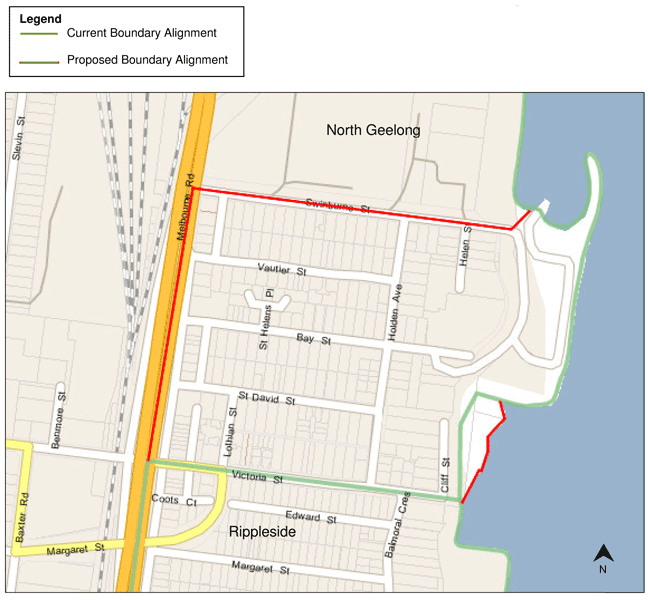
The realignment affects eleven streets (See Appendix 4-1).
The State Government’s naming administrative body – the Office of Geographic Names (OGN), agrees with the proposed realignment.
The proposed realignment will allow for easy identification to the public and utility services in case of an emergency.
The postcode for North Geelong and Rippleside being 3215, remains unchanged.
Cr E Kontelj moved, Cr Macdonald seconded -
That Council approves the boundary realignment of the section of North Geelong bounded by Swinburne Street to the north, Victoria Street to the south, Melbourne Road to the west, and Corio Bay to the east, to “Rippleside”.
Carried.
On 1 August 2011, Council received a letter from a resident within North Geelong, on behalf of a residents’ group, requesting that Council rename the section of North Geelong bounded by Swinburne Street to the north, Victoria Street to the south, Melbourne Road to the west and Corio Bay to the east. The new locality name requested was “St Helens”.
Council advised that this name would be a duplicate name and therefore was unable to be used.
It was then proposed to extend the Rippleside boundary to Swinburne Street, enabling eleven streets currently known as North Geelong to become part of the Rippleside locality.
In September 2011, the residents’ group conducted their own private survey with affected property owners and submitted these responses to Council, as per the following table:
|
|
In Favour |
No Response |
Total Properties* |
|
Victoria Street |
0 |
24 |
24 |
|
Melbourne Road |
0 |
39 |
39 |
|
Cliff Street |
0 |
5 |
5 |
|
St David Street |
15 |
21 |
36 |
|
Lothian Street |
3 |
2 |
5 |
|
Vautier Street |
13 |
26 |
39 |
|
St Helens Place |
5 |
3 |
8 |
|
Holden Avenue |
5 |
14 |
19 |
|
Bay Street |
13 |
21 |
34 |
|
Helen Street |
2 |
7 |
9 |
|
Swinburne Street |
8 |
13 |
21 |
|
Total |
64 |
175 |
239 |
*Please note – not all ratepayers were included in the resident’s private survey.
Councils are responsible for allocating and realigning geographic locality boundaries.
Council consulted the Office of Geographic Names on the proposal.
The Office of Geographic Names replied that “extension of the Rippleside boundary to Swinburne Street, from a public safety perspective, meets the requirements of Principle 1(c) Ensuring public safety, under the Guidelines for Geographic names 2010.
The current boundary has the potential for confusion as geographically the subject area, may be confused as to being part of Rippleside and not North Geelong.
The OGN were favourable towards the proposal and advised that consultation with all residents within the area would be necessary.
On 8 May 2012 Council resolved to commence a process of investigation and consultation into a realignment of the North Geelong boundary. Letters were sent to all affected property owners and residents on 19 June 2012, seeking their assistance in return of a survey indicating their preference.
The table below summarises the results received for Council’s survey:
|
Invited Comments |
Agree with Proposal |
Do Not Agree with proposal |
Undecided |
No response Received |
|
323 |
181 |
16 |
1 |
125 |
Council has received a submission from one of the businesses situated on Melbourne Road that is strongly opposed to the change in locality naming. The business has been advised that the matter is being dealt with in accordance with the applicable Guidelines.
The proposed new alignment complies with Principle 3(A) of the Guidelines administered by the Department of Sustainability and Environment’s OGN.
The postcode for North Geelong and Rippleside being 3215, remains unchanged.
There are no environmental issues arising from this report.
Council offers a standard assistance package to residents when their property address is altered. This assistance package consists of 10 postage paid envelopes and 10 “Change of Address” forms. Other assistance may be offered on a case by case basis.
The Geographic Place Names Act 1998, the Guidelines for Geographic Names 2010, the Local Government Act 1989 and Council Policy have been followed and met.
There is no officer direct or indirect interest in this report.
The realignment of this boundary will allow for easy identification to the public and utility services in case of an emergency.
Real Estate Agents regularly refer to properties within the affected area as Rippleside as part of their advertising campaign. In this respect it could be argued that residents are purchasing / renting properties in the belief that the property is located within Rippleside and therefore when requesting emergency services they may be utilising an incorrect locality which could cause a delay in the response time.
The realignment of this boundary will minimise confusion to residents and visitors to the area.
Notification letters were sent to all affected property owners and residents on 19 June 2012.
Following Council resolution resolving to change the boundary, public notice will be published and notification forwarded to all effected properties. There is a 30 day submission period from notice publication.
Subject to Council and The Registrar of Geographic Names approval, the relevant authorities, abutting owners and residents will be notified of the official registration of this change in locality name.
Australia Post will recognise a change of address / locality for property owners for a period of six to 12 months to ensure a smooth transition from the old to the new address / locality. Whilst this has always been the unofficial practice of the local Australia Post delivery centres, this is now incorporated into the Guidelines as a policy position.
Portfolio: |
Environment and Sustainability - Cr Richards |
Source: |
City Services - Environment and Natural Resources |
General Manager: |
Gary Van Driel |
Index Reference: |
Council Reports 2013 |
The purpose of this Report is to provide Council with an update on the development of the next Environment Management Strategy.
Strategic direction for Councils environment and sustainability programs has been derived from the Environment Management Strategy 2006-2011.
The Environment Management Strategy 2006-2011 identified 223 actions, involving a large number of key participants, with the City taking the lead role in directing and facilitating environmental reform.
Approximately 75% of the actions have been implemented.
Council’s Environment Management Strategy 2006-2011 (EMS) has expired, though many of the actions and strategic directions are still relevant and continuing.
The development of the Strategy is being overseen by an Advisory Committee consisting of Council, community groups and government departments and agencies.
Input for the new strategy has been sought from Council staff, community and government departments and agencies.
A community survey has been undertaken with 175 individuals and community groups responding to questions about the regions environmental future.
A biodiversity and landscape protection workshop was attended by 26 environment groups as well as government departments and agencies, attracting over 50 attendees in total.
A clean technology workshop was attended by representatives from industry, business and educational sectors, including peak bodies such as the Geelong Manufacturing Council.
Further consultation is being undertaken.
Cr Richards moved, Cr Harwood seconded -
That Council notes the:
ongoing development of the next Environment Management Strategy.
community consultation undertaken to-date including high level of interest from community groups.
Carried.
The City of Greater Geelong has acknowledged the importance of environmental management for many years and this led to Council adopting its first Environmental Management Strategy in 1999. Council re-confirmed its commitment to sustainability and sound environmental management in Geelong by adopting the Environment Management Strategy 2006-2011 (EMS). This EMS covered many topics and listed ‘Achievements’, ‘Objectives’, ‘Targets’ and ‘Actions’ for each of the topics. Topics within the EMS included:
Council Policy, Programs and Planning
Education and Partnerships
Biodiversity Management
Sustainable Agriculture
Coastal and Marine
Waterways and Wetlands
Air Quality
Resource Use
Waste, Recycling and Reuse
Urban Settlements
In addition to the two EMS documents (1999 as well as 2006-2011) Council has adopted various additional strategies which were either identified as priority actions within the two EMS documents and/or further assist with setting strategic environment and sustainability directions. These strategies include:
Sustainable Water Use Strategy
Biodiversity Strategy
Geelong Wetland Strategy
Greenhouse Response 2008-2011
Climate Change Adaptation Strategy
The Environment Management Strategy 2006-2011 identified 223 actions, involving a large number of key participants, with the City taking the lead role in directing and facilitating environmental reform. To-date approximately 75% of the actions within this EMS have been implemented. Work is ongoing to continue to implement actions within the EMS 2006-2011 including development and implementation of a Sustainable Buildings Policy, Pest Plant and Animal Strategy, reduce corporate greenhouse emissions, enhance relationships with key stakeholders and incorporate sustainability throughout the organisation via the ‘EcoChallenge’ program.
Since the development of the City’s Environment Management Strategy 2006-2011 issues have arisen that were not given adequate consideration in this strategy, for instance climate change. In addition Council has undertaken considerable strategic work in other areas which need to be incorporated into the next Environment
Management Strategy. With the expiry of Council’s EMS 2006-2011 work began in early 2012 on the development of Councils next Environment Management Strategy. It is anticipated that this document will continue many of the actions and strategic directions set out in the previous document as they continue to be relevant and ongoing.
Environment Management Strategies are a strategic vehicle by which local governments can plan and prioritise the development and delivery of services and support for environment programs, and to enhance sustainable environmental, economic and social outcomes.
In particular, environment management strategies facilitate local government’s ability to work in partnership with the community and to improve environment and community outcomes by:
increasing support for environment programs
improving access to services, support and opportunities for participation
providing a framework and facilitate integration between various Council and community environment initiatives
increasing the responsiveness of services and efficient use of other resources, by identifying service integration and collaboration opportunities
promoting environment areas and programs as important to local communities
maximising resources and undertaking long-term planning for environment programs including the development and evaluation of services, activities and facilities which enable Council to make more informed and strategic decisions about future needs and priorities
providing a mechanism to respond locally to national, state and regional environmental objectives; and
providing a framework for monitoring and reporting around environmental issues and outcomes.
Following an Expression of Interest process, Russell Fisher, Managing Director of Sustainability in Mind was selected to assist with the preparation of the Strategy. Russell has extensive experience in the environmental and education fields, including development of environment strategies for Councils and state government departments, as well as previously holding roles such as President of Environment Victoria and board member of the Alternative Technology Association.
An Advisory Committee has been created to oversee and provide assistance and direction with the development of the new Strategy. The Committee consists of;
Internal
A Councillor, being the Environment and Sustainability Portfolio Councillor, or his or her proxy, should the Portfolio Councillor be absent.
General Manager City Services
Manager - Environment and Natural Resources (Project Manager)
External
One representative from each of the following authorities: Department of Sustainability & Environment (DSE), Department of Primary Industries (DPI), Environment Protection Authority (EPA), Barwon Water, Sustainability Victoria & Corangamite Catchment Management Authority (CCMA).
One representative from the Geelong Environment Council Inc.
One representative from the Geelong Field Naturalists Club Inc.
One representative from the Geelong Sustainability Group
One representative from the Barwon Regional Waste Management Group
One representative from the Wathaurung Aboriginal Corporation
One of the first tasks for the consultant was the development of a Discussion Paper. The purpose of the Paper was to gain input from the Advisory Committee (and subsequently staff and broader community) on the following topics and questions raised in the paper;
Role of Council
State of the Greater Geelong Environment
Future Trends & Issues
Council’s Approach to Environmental Sustainability
Implications for Strategic Directions
Extensive consultation has occurred to-date. A Council staff survey was undertaken in July/August 2012. The purpose of the survey was to canvass staff views on how their work is connected to environmental issues, and what information and support is needed by staff to contribute to Council’s overall environmental efforts.
A community survey was undertaken in November 2012 which asked respondents to answer a series of questions relating to the regions environment future. The survey sought to identify community concerns, what local environment features the community values, ideas and opportunities as well as what is currently working. One hundred and seventy five individuals and community groups responded to the survey.
A biodiversity and landscape protection workshop was held in late November 2012. The workshop was attended by 26 environment groups as well as government departments and agencies, attracting over 50 attendees in total. The primary objectives of the workshop were to;
Identify key trends and issues affecting land use, land management and biodiversity in the COGG.
Assess implications of these and identify clearly the role of Council.
Identify ideas for strategic direction for Council and priorities for action and innovation.
A clean technology workshop, organised in conjunction with Councils Planning Strategy and Economic Development unit, was held in early December 2012. This was attended by representatives from industry, environment, business and educational sectors, including peak bodies such as the Geelong Manufacturing Council. The primary objectives of this workshop were to:
Learn about the strategic trends and issues for clean technology innovation.
Focus on opportunities for clean tech innovation in CoGG.
Develop action plans for network clusters for clean tech industries, services and green buildings.
Further consultation has been undertaken via facilitated meetings with key community groups, such as the Barwon Heads Sustainability Group.
The surveys, workshops and meetings have provided a wealth of information upon which the Environment Management Strategy can be developed. Major topics of concern, interest and/or action identified to-date include;
Climate Change
Biodiversity
Sustainable development
Waste disposal and recycling
The need for partnerships across environment groups, agencies etc
Air quality
Food security (growing food locally)
Maintain and expand open space
Further staff and community consultation will be undertaken over coming weeks. Following this a draft strategy will be developed and presented to Council for consideration for public comment.
It is recognised that all recommendations provided in the Strategy must be realistic and achievable. The EMS will be a high level strategic document that will provide the framework and an implementation plan to progress improvements in the built and natural environments. It will be used to provide direction to the community, developers, government agencies and other key partners to ensure the environment is considered as a high priority in existing areas and all new developments.
The implementation of the new EMS will have considerable environment and sustainability benefits for the community as well as natural and built environments.
It is envisaged that implementation of the new EMS will assist Council efforts to;
Increase community awareness, confidence and knowledge of energy, water conservation and waste minimisation
Preserve and enhance biodiversity
Reduce sources of carbon emissions
Ensure compliance with relevant policy and legislation
Improve marine and freshwater habitats
Improve urban and rural water quality
Enhance sustainability features of new urban developments
Assist maintenance and development of sustainable agriculture
Improve air quality
Report on sustainability requirements and targets
Once completed the new EMS will have a range of actions. It is anticipated that many of these will be built into normal business operations. Any additional funding for specific actions can be considered by EMT and Council through normal budget processes.
The development and maintenance of the EMS is an important part of meeting Council’s Corporate Plan (City Plan 2009-2013) objectives, in particular that ‘the City of Greater Geelong leads the community in sustainable planning and environment action’.
It is important that the EMS is updated to take into account new State and Federal policy and legislation. A new EMS is likely to identify areas of further policy development to be undertaken by Council.
No Council officers involved in the preparation of this report have a direct or indirect interest in the matter to which the report relates.
There have been no identified risks to Council in the development of the new EMS. The new EMS will aim to minimise Councils Risk by developing actions that ensure sound environmental management, and ensure compliance with relevant legislation.
The development of the EMS is an opportunity for the community to provide input into Council’s environment and sustainability initiatives. Implementation of the EMS will involve working constructively with members of the public and community groups and all levels of government.
Council’s Environment Department has been working in conjunction with the Marketing and Communication Department as well as the Advisory Committee to provide communication and actions associated with this project. Community consultation is an important component of the development and implementation of the Strategy. Council has proactively been seeking ideas, and feedback through the development of the Strategy by utilising a range of techniques including surveys, Council’s CONSULT system, workshops, meetings and via traditional media e.g. newspapers.
Portfolio: |
Arts & Culture - Cr Heagney |
Source: |
Community Services |
General Manager: |
Jenny McMahon |
Index Reference: |
Subject: Arts & Culture/Art Galleries |
The purpose of this report is to provide Council with the Geelong Gallery’s 2011-2012 Evaluation Report (Appendix 1) as an audit requirement of Council’s annual contribution to the Geelong Gallery. The Gallery’s 2011-2012 Annual Report is available under separate cover.
The Geelong Gallery’s collection of historical and contemporary art is widely acknowledged as one of the finest and most valuable held by a regional gallery in Australia. The Gallery continues to provide the region’s residents and visitors with outstanding exhibition, public and educational programmes as well as curatorial services.
In 2011-2012 Council’s contribution to the Geelong Gallery was $968,000, representing the second year of the fourth Triennial Funding Agreement between the Greater Geelong City Council and Geelong Gallery.
The Gallery’s collection of works of art is held in trust for the region and is managed and developed in accordance with international standards of museum practice. The collection includes iconic works of art such as View of Geelong by Eugene von Gerard and Bush Burial by Frederick McCubbin.
A total of 63,102 visits were made to the Gallery throughout 2011-2012 an increase of 5,257 from the previous 2010-2011 year.
The highlights for 2011-2012 included the major international exhibition Reflections of the soul – contemporary Chinese ink/wash painting, developed by the Gallery in partnership with the National Art Museum of China (NAMoC) Beijing. The gallery in collaboration with the Gippsland Art Gallery, Sale, presented (as the exhibition’s principal venue) Nicholas Chevalier – Australian Odyssey. This was the first-ever survey of the painting of this important colonial artist.
The Geelong Gallery’s extended loan of paintings by Eugene von Gerard to the Queensland Art Gallery and The National Gallery of Australia, for the National Gallery of Victoria’s grand retrospective of the work of the greatest of Australia’s colonial artists, Eugene von Guerard – Nature revealed, further promoted the gallery’s presence in this landmark touring exhibition.
Cr Heagney moved, Cr Harwood seconded -
That Council note the Geelong Gallery 2011-2012 Annual Report and the 2011-2012 Evaluation Report.
Carried.
The Geelong Gallery’s collection of works of art is held in trust for the Region and is managed and developed in accordance with international standards of museum practice. The Gallery’s holdings of historical and contemporary art are widely acknowledged as one of the finest and most valuable collections held by a regional gallery in Australia. The Gallery’s collection includes iconic works of art such as View of Geelong by Eugene von Gerard, Ocean blue, Lorne by Arthur Streeton and A Bush Burial by Frederick McCubbin.
The Geelong Gallery is open to the public seven days a week and entry is free. The Gallery presents art exhibitions, educational and public programmes and curatorial services to the residents of and visitors to the region.
This evaluation report covers 2011-2012 which is the second year of the fourth Triennial Funding Agreement between the Geelong Gallery and the City of Greater Geelong.
As part of the funding agreement with Council, KPI’s are set for the Gallery’s annual performance. Most were exceeded in 2011-2012 and have been summarised below;
63,102 people visited the Gallery – annual target 60,000
2,180 memberships – annual target 2,250
20 exhibitions were mounted in total – agreed target 20
15 exhibitions were self initiated – agreed target 10
7 exhibitions were held in the Community Access Gallery – agreed target 7
9 exhibitions embraced subjects relating to local/regional history and featured work by artists active in the Geelong region – agreed target 8
38 lectures, seminars, and workshops were presented – agreed target 30
26 public programmes were presented – agreed target 16
6 access space exhibitions involving schools and community groups were presented – agreed target 4
27,000 Quarterly Newsletters were distributed – agreed target 27,000
Exhibition highlights for 2011-2012 include:
Reflections of the soul – Chinese contemporary ink wash painting – received widespread acclaim and was an unusually ambitious undertaking for a regional gallery, mounted in recognition of 2011 as the Year of Chinese Culture in Australia.
Nicholas Chevalier – Australian Odyssey – one of the most popular attractions for the year and was the first ever survey of the painting of this important colonial artist.
In search of the picturesque – the architectural ruin in art – exclusive to Geelong and initiated and developed by the Geelong Gallery, was both popular and a critical success and constituted the most valuable exhibition of paintings ever presented in a regional gallery.
The Gallery was visited by many VIP and government visitors during the 2011-2012 year including the Victorian Governor, Alex Chernov and Mrs Chernov. International visitors included the Duke and Duchess of Somerset who inspected the Gallery collections on a private visit. The Federal Minister for the Arts, the Hon Simon Crean officially opened Reflections of the soul – contemporary Chinese ink/wash painting at a large function that was also attended by Mr. Fan Dian, Director of NAMoC, accompanied by senior members of his staff, representatives of the Chinese Embassy in Canberra and the Chinese Consulate in Melbourne.
The Gallery was thrilled to acquire Arthur Streeton’s painting Ocean blue, Lorne (1921), the most important painting executed in the wider Geelong region by Australia’s best-known landscape painter. The purchase was made possible through the Geelong Art Gallery Foundation on the strength of a public fund raising campaign.
The Gallery also secured an array of works in a variety of media including a folio of drawings and photographs by contemporary Australian artist, Andrew Seward, as a donation through the Federal Government’s Cultural Gifts Programme. The Gallery also negotiated the gift of an outstanding watercolour painting by Hans Heysen.
The Gallery delivered special public programmes including floor talks and volunteer guides, conducted tours every Saturday and, as requested, for group visits. During school holidays the Gallery also offered the children’s Eye Spy discovery tours every Wednesday.
The Gallery’s Educational Services continued a free loan programme to classroom teachers of five Art without borders learning boxes: William Buckley; Myths and Rituals; Art industry contexts; Who’s Who – portraits; and Printmakers – artists and art.
Students of 12 Primary Schools and 31 Secondary Schools from the Geelong Region, metropolitan Melbourne and regional Victoria attended tours of the Gallery, with some teachers also attending professional development programmes.
A further 31 tertiary institutions and community groups also visited the Gallery on organised tours during the 2011-2012 year.
Geelong Gallery is a purpose built gallery designed to make the most of natural light, while keeping within international environment standards for museums. The addition of two new clauses in the fourth Triennial Funding Agreement between Council and the Gallery relating to maintenance of the building enables the Gallery to benefit from contractors already engaged by Council who are encouraged to meet environmentally responsible principles where possible.
The City of Greater Geelong is the Gallery’s largest funding partner. Council makes an annual contribution to the Gallery in accordance with the Triennial Funding Agreement. In 2011-2012 Council’s contribution was $968,000.
LBW Chartered Accountants have completed their audit of the Gallery’s financial position for 2011-2012 and have given the Gallery a positive assessment.
The Geelong Art Gallery is located on Crown Land with a lease period of 999 years due to expire on the 16th June 2854. The Building is a Council asset, operated by the Geelong Art Gallery Incorporated, as a body associated for artistic and cultural purposes. The Board is composed of 12 persons, elected each year at the Annual General Meeting. The Board operates under a Charter. Councillor Barbara Abley, Portfolio Holder for Arts & Culture was Council’s representative on the Geelong Gallery Board for the 2011-2012 year.
The Geelong Gallery is an important cultural facility, which assists the City of Greater Geelong to deliver the actions outlined in Council’s Culture Strategy Creativity +, as well as the Strategy’s Vision: to develop the City of Greater Geelong as a regional centre of innovation and excellence. The Gallery is one of the key Cultural Precinct facilities identified in the Geelong Future Cities Masterplan.
There is no direct or indirect interest by Council Officers involved in the preparation of this report.
The 2011-2012 Financial Statements of the Geelong Gallery have been subject to an independent Financial Audit by LBW Chartered Accountants. The Triennial Agreement and six month reporting and evaluation measures against KPI’s ensure the Gallery’s performance is regularly reviewed and assessed.
Galleries play a significant role in the cultural, social, educational and economic development of the community. The Geelong Gallery plays an important role in the collection, conservation and exhibition of the Region’s material heritage as expressed in works of art. The reputation of the Gallery, as one of the finest regional galleries in Australia, is a source of civic pride. The Galleries exhibitions, educational and public programmes as well as curatorial services are highly valued cultural resources. The opportunities that the Gallery provides for our emerging and established artists are extremely crucial to the Region’s cultural development. The Gallery contributes to the amenity and attraction of Central Geelong and, as one of the City’s major cultural attractions in the Cultural Precinct, contributes significantly to cultural tourism.
The Arts & Culture Department in consultation with Communication and Marketing will be responsible for communicating this report.
Portfolio: |
Community Development - Cr Fisher |
Source: |
Community Services - Family Services |
General Manager: |
Jenny McMahon |
Index Reference: |
Community Services - Projects/Programs - Early Childhood Innovations Development Project |
The purpose of this report is to provide Council with a summary of the outcomes from the Early Childhood Innovations and Development (ECID) Project, completed in December, 2012.
The ECID project was an eighteen month initiative funded by the Department of Education and Early Childhood Development (DEECD).
The ECID project was aimed at the development and implementation of strategies to support the engagement and participation of children aged between 0-8 years of age, from high risk, vulnerable and marginal backgrounds, in universal early childhood and education services throughout the City of Greater Geelong.
The project aimed to identify and develop service initiatives that contribute to building sustainable, systemic change, and enhance the capacity of local services to more effectively engage vulnerable children and families.
In 2009 the Australian Early Development Index (AEDI) was completed in Greater Geelong for 2,453 children in their first year of primary school. This evidence indicates that overall, there are approximately nineteen per cent of local children who are classified as being developmentally vulnerable on one or more domain/s of the AEDI, and 9.4 per cent being developmentally vulnerable on two or more domains. The AEDI assesses children across five domains.
Factors that contribute to children’s vulnerability include: poverty and parental unemployment, disability, non-English speaking or Indigenous backgrounds, exposure to family violence and abuse, family instability, displacement, transient and/or homelessness, being placed in out-of-home care.
Research clearly provides evidence that early intervention, provision of consistent support, and engagement in quality education are essential factors to promote positive protection, reduce critical risks, and optimise children’s learning, development and health potential in the early formative years of life.
An independent consultant was employed to conduct an evaluation of the ECDIP and identify key outcomes. The result of this evaluation concluded that despite the relatively brief duration of the project, there was clear evidence to indicate the project had made a valuable contribution toward better equipping service providers to respond to the complex needs and challenges associated with working with vulnerable children and families.
Cr Fisher moved, Cr Heagney seconded -
That Council:
acknowledges the achievements of the Early Childhood Innovations and Development Project and noted the evaluation report.
writes to the Minister to encourage further investment by the Victorian State Government into appropriate interventions that strengthen support for vulnerable children and families.
Carried.
The Early Childhood Innovation and Development (ECID) Project commenced in April 2011, with funding of $125,000 provided to Council from the Regional Innovation and Disadvantage Fund, through the Department of Education and Early Childhood Development (DEECD), Barwon South Western Region.
Council was responsible for the management and implementation of the ECDIP over an 18 month period, until 30 December 2012. A full time project officer was employed for the duration of the project. The principal aims of the project were to:
increase the participation of children (aged 0-8) from high risk and vulnerable backgrounds in universal early childhood and education services;
improve the engagement of vulnerable children and families in universal early childhood and education services; and
strengthen integration and partnership linkages between universal early childhood and education services, primary education provision, and organisations working with vulnerable children and families.
Vulnerable children and families commonly experience a range of significant barriers when seeking to access services and support. Evidence suggests these barriers are both systemic (part of the way services are provided) and personal (associated with the complex and individual nature of presenting client needs and issues). Commonly, these barriers tend to aggregate and many vulnerable families experience several concurrent barriers that impact on their access and inclusion within universal services.
A range of intervention strategies and project approaches were developed in response to the aims of the project and to address barriers referred to above.
Project events and activities resulted in 31 professional development training sessions being conducted with approximately 734 participants from local service organisations and education providers.
The experience of many early childhood services is that vulnerable and marginalised children and families often access services intermittently and may disengage or cease using support services for a variety of reasons. Consequently, some vulnerable children and families need more help to engage with services, and providers need to ensure their service delivery practices are relevant and responsive to the needs of children and families from vulnerable backgrounds.
The ECDIP was responsible for conducting a specific pilot project aimed at engaging high risk families that had not maintained contact with Council’s Enhanced MCH Service (EMCH). This initiative sought to:
identify and re-contact families who had not maintained contact with the Enhanced MCH Service;
explore the reasons why engagement or contact had not been sustained; and
assist and support families to reestablish contact with either the Enhanced MCH or Universal MCH services.
This aspect of the ECDIP was responsible for conducting follow-up with a total of 215 children recorded on the EMCH data base.
Kindergarten enrolments for eligible three year old children known to Child Protection through the State Government’s Early Start Kindergarten Subsidy, increased across Greater Geelong by over 89 per cent in conjunction with the ECDIP and other associated intervention activities.
Current research evidence and service delivery practice clearly indicates that early intervention, support and education are essential to optimise children’s learning, development and health in the early formative years and for life long health and wellbeing, especially amongst the most vulnerable children.
However, evidence also indicates that children and parents most in need often tend to be the ones who are least likely to access support. Families that are most vulnerable include those on low incomes; young parents; sole parents; Indigenous families; families from culturally and linguistically diverse communities, children and/or parents with disability, families experiencing problems with homelessness, domestic violence and abuse, substance abuse, and mental health or child protection issues.
The ECDI project was developed in the context of increasing concern amongst Australian Governments regarding the capacity of the existing service system to address the increasingly complex needs of vulnerable children.
In January 2011, the State Government commissioned an enquiry to comprehensively investigate systemic problems in Victoria’s child protection system and make recommendations to strengthen and improve protection and support. The resulting report on the outcomes of the enquiry was released in January 2012, and included recommendations regarding a number of major system reforms including the need for: “a sector-wide approach to professional education with greater development and application of knowledge to inform policy and service delivery”.
The ECDIP was aimed at the development and implementation of strategies that would more effectively support the engagement and participation of children aged between 0-8 years of age, from high risk, vulnerable and marginal backgrounds, in universal early childhood and education services throughout the City of Greater Geelong. This includes participation in services such as Maternal and Child Health, kindergarten, child care, primary school, along with allied health and family support services.
In May 2012, external consultants Kismet Forward were engaged to evaluate the ECID project. A copy of the evaluation report is attached for further reference and information.
The ECID project developed and implemented several successful strategies in an attempt to address the systemic barriers that often impede access for vulnerable children to receiving support and their participation in universal services.
A key focus of the ECDI project has been to build the capacity and understanding amongst the local workforce on strategies to work more effectively with vulnerable children and families. As identified in the State Government’s Inquiry into Protecting Victoria’s Children, it is necessary to ensure knowledgeable and skilled staff are available when working with vulnerable children and families.
The value of understanding why a family may be vulnerable and how service providers can best respond to and support the individual needs of a family is paramount in maintaining the confidence and participation of the family with available services.
The complex and challenging nature of the issues commonly involved for staff when working with vulnerable children and families requires a multi-disciplinary approach. The ECDI project facilitated the development of opportunities for multi-disciplinary professional consultations and reflective practice through the creation of regular Mentoring Groups for early year’s professionals.
These facilitated groups, provided valuable opportunities for discussion and relationship building amongst professionals working with vulnerable families, while also promoting a sound knowledge and understanding of available support services and referral requirements, especially working with child protection and family support.
Also clear from the implementation of the ECDI project was the importance of persistent and proactive follow-up of children and families that have disengaged or that are no longer attending a service. Processes and procedures to keep track of children and families are very important, and the ECDIP was able to implement specific pilot initiatives to follow-up children and families that had previously disengaged from Council’s Enhanced Maternal and Child Health Service.
Outcomes from the ECDI project indicate that it is necessary to ensure that such capacity is sustained, and similar initiatives adopted as part of routine practice within other parts of the universal early childhood and education service system. All too often children continue to ‘fall through the net’ and are not identified until a critical incident brings them to the attention of authorities.
In addition to the activities referred to above, the ECDI project hosted a total of 17 local professional development forums. This included a special community forum to acknowledge 2012 Child Protection Week. The Child Protection Week forum was opened by the former Mayor, Cr John Mitchell and featured presentations by the Victorian Child Safety Commissioner, Mr Bernard Geary; Dr Karen Sutherland, Principal Practitioner, Department of Human Services, Child Protection and Family Services Branch; Gabrielle Nagle, Chief Executive Officer Glastonbury Community Services; and Grant Boyd, Chief Executive Officer, Bethany Community Support.
In conjunction with the ECDIP, Council has also been involved with a parallel Early Childhood Development Project funded by the Department of Human Services and managed by Bethany Community Services. The aim of the Early Childhood Development (ECD) pilot project has focussed on strengthening the collaboration, linkages and partnerships between the early years’ service system and the Child FIRST/Family services system.
Phase one of the ECD Project included a local scoping study which involved consultation with local services, a document review and literature scan. Phase one also included developing a System Improvement Service Enhancement outcomes framework and a range of resources to support the pilot. This was developed in collaboration with the ECD pilot project team and Steering Group on which Council has also been represented.
Both projects referred to above have now been concluded. The short-term nature of any project reduces the capacity for local actions to be sustainable and become embedded in routine policies and practices. However, evaluations of the ECDIP and ECD projects referred to in this report; clearly indicate that positive outcomes have been achieved. A range of opportunities have also been identified where some activities and approaches could be potentially sustained through ongoing commitment and collaboration amongst local organisations.
A number of important findings and implications have emerged from these projects, including information and research on vulnerability and risk factors amongst children and families. These include:
Vulnerability is unpredictable and is not static – a child, young person or family may be vulnerable at different stages of their life depending on changing family circumstances and a child’s developmental needs;
Vulnerability commonly appears to be concentrated in particular geographic locations where there is also socioeconomic disadvantage, however evidence also indicates that different forms of childhood vulnerability exist in all communities;
Access and inclusion do not automatically result from the mere existence of a program or service.
In planning and developing early childhood and family support services and service systems, consideration should be given to ensuring that the known barriers to service access for vulnerable families are minimised.
Preventing childhood vulnerability is about changing the balance between risk and protective factors so that risks are reduced and protective factors are promoted to increase children’s resilience and boost their healthy development.
Further substantial and sustained investment is required in order the build effective capacity to respond to the needs of vulnerable children and families throughout Greater Geelong.
There are no environmental considerations.
The cost of the Early Childhood Innovations and Development Project (ECDIP) was fully funded ($125,000 over 18 months) by the Regional Innovation and Disadvantage Fund, through the Department of Education and Early Childhood Development (DEECD), Barwon South Western Regional Office.
A small amount of additional surplus income received by Council through the State Government Early Start Kindergarten Partnership Pilot was also used to support the implementation of the ECDIP.
Local government has an intrinsic role in building the capacity and responding to the needs of younger members of their communities. Council’s role in supporting engagement and participation of vulnerable children and families into universal early childhood and education services is consistent with local government requirements stipulated under Section 3E (a) and (b) of the Victorian Local Government Act 1989 and also the Victorian Charter of Human Rights and Responsibilities.
Council also has statutory responsibilities for vulnerable children through the various services it operates for children. Section 5 of Victoria’s Child Wellbeing and Safety Act 2005 sets out a number of principles relevant to the issue of child wellbeing including: societal aspirations for all children; key indicators associated with wellbeing; responsibilities; and the role of government.
Council’s City Plan 2010-14 details corporate planning objectives, service delivery priorities and commitments that are consistent with and closely aligned to the matters contained in this report, especially in relation to ‘improving the health and quality of life of all residents of Greater Geelong’; and improving opportunities for ‘increased life long learning and literacy.’
The role and responsibilities of Council in relation to the issues referred to in this report are consistent with key recommendations endorsed by Council in the existing Municipal Early Years Plan and existing Children’s Services Policy (2006).
No officers or contractors involved in the preparation of this report have a direct or indirect interest in matters to which this report relates.
Inadequate provision of relevant support or access to services is likely to have a prejudicial impact on the outcomes for vulnerable children and families, who already face a significant range of challenges. Australian-based research provides clear evidence that early childhood vulnerability, including abuse and neglect, can lead to social disadvantage and exclusion which persists in adult life.
All levels of governments and the community as a whole have a part to play in supporting the most vulnerable members of our community. The cost of failing to provide timely support to vulnerable children and families is considerable – as problems worsen, they become more difficult and expensive to remedy, and children and families become more marginalised.
Children’s active engagement and participation in universal early childhood and education services has significant social and developmental benefits, particularly among children experiencing disadvantage.
Disadvantaged neighbourhoods and communities, which may be characterised by high unemployment, high crime rates, lack of services and social supports, or poor community and social infrastructure, can compound vulnerability for individuals and families, in particular children. Conversely, strong, cohesive communities can provide important social supports and informal networks which play an important protective role for individuals, families and children and decrease the risk of negative outcomes.
Creating the opportunities and resources that every family needs to fully participate in the economy and community life through education, skills training, employment, adequate income support, secure housing, and access to support services when people need them are necessary to mitigate childhood vulnerability and disadvantage. Having at least one parent with a job helps to give children a positive start in life – it is a valuable source of economic security, family stability and positive role modelling.
Social capital is increased when children at risk are protected and vulnerable families are supported. With support vulnerable children have a greater chance of developing into adults who are healthy, more actively and constructively involved in society and who have improved employability due to achieving higher levels of education.
Provision of universally accessible services has an important role in responding to the needs of children and families. Strengthening the capability of those services and organisations involved lies at the heart of enhancing early identification of and intervention targeted at children and families at risk.
A copy of the final evaluation report for the ECDIP has been forwarded to the Department Education and Early Childhood Development.
Portfolio: |
Governance - Mayor |
Source: |
Corporate Services - Administration and Governance |
General Manager: |
Jeff Wall |
Index Reference: |
Subject: Delegations |
Council as a legal entity can only act in one of two ways, by resolution or through others acting on its behalf. To enable effective and efficient functioning of local government, decision making powers are allocated by formal delegation.
The Local Government Act 1989 enables Council to delegate to the Chief Executive Officer (CEO), with specified exemptions, “any power duty or function of a council under this Act or any other Act”.
All delegations must be reviewed within 12 months of a Council Election. No changes are proposed for the delegation to the CEO from the previously approved Instrument of Delegation adopted March 8, 2011.
Section 98 of the Local Government Act 1989, section 188 of the Planning and Environment Act 1987, section 58A of the Food Act 1984 and other legislation empowers Council to delegate its powers, duties and functions to appropriate Council officers.
Whilst most delegations to Council staff are in the form of a sub-delegation from the Chief Executive Officer, there are a small number which require delegation from Council.
This report addresses delegations from Council to the CEO and to members of staff.
Cr S Kontelj moved, Cr Harwood seconded -
In the exercise of the powers conferred by section 98(1) of the Local Government Act 1989 (the Act) and the other legislation referred to in the attached instruments of delegation, Council resolves that -
There be delegated to the person holding the position, acting in or performing the duties of Chief Executive Officer the powers, duties and functions set out in the attached Instrument of Delegation to the Chief Executive Officer (Appendix 1), subject to the conditions and limitations specified in that Instrument.
There be delegated to the members of Council staff holding, acting in or performing the duties of the offices or positions referred to in the attached Instrument of Delegation to members of Council staff (Appendix 2), the powers, duties and functions set out in that instrument, subject to the conditions and limitations specified in that Instrument.
The instruments come into force immediately the common seal of Council is affixed to the instruments.
On the coming into force of the instruments all previous delegations to the Chief Executive Officer and members of Council staff are revoked.
Carried.
Delegation of powers in local government is considered essential to enable day to day decisions to be made and actioned in a timely manner.
Council must review all delegations in force under Section 98 (6) of the Local Government Act 1989 within 12 months after a Council Election.
These delegations are based on a model developed and maintained by Maddocks lawyers who are engaged to provide an update service for Council and include changes up to December 2012.
The Maddocks model is based on:
Delegation from Council to the CEO
Delegations from Council to members of Council staff
Sub-delegations from the CEO to Council staff
This report covers the first two models of Instrument of Delegation of Council to the CEO and members of Council staff.
Section 98(3) of the Local Government Act 1989 empowers the CEO to sub delegate powers to Council staff at regular intervals without the need to submit the matter to Council.
Under the Local Government Act the Chief Executive Officer is responsible for the day to day management of the Council’s operations in accordance with the corporate plan.
The delegation from Council to the CEO is based on ‘exception’, which involves the delegation of all Council duties, functions and powers except those expressly reserved for Council. For example, the delegation limits the CEO’s ability to approve contracts within budget to $2,000,000. No changes are proposed to the existing delegations from Council to the CEO as approved by Council resolution March 8, 2011.
The proposed delegations of Council to members of Staff detail particular sections of the Acts/Regulations and nominate officers by position title to undertake specific powers, duties or functions on behalf of Council. These delegations were last updated and approved by Council in April 2012.
Attachment 1 to the Instrument of Delegation sets out the complete schedule of the relevant powers, duties and functions being delegated, and specifies which officer(s) has responsibility for each power, duty or function.
Attachment 2 lists the changes from the previous delegations approved in April 2012.
The latest review of legislation by Maddocks Lawyers recommended the following changes to the schedule:
Inclusion of sections 19AA of the Food Act that delegate the power to officers to take certain actions in relation to food premises, including power to direct persons not to allow food to be removed from the food premises.
Two new provisions in the Residential Tenancies Act 1997 regarding recording of information in respect of rooming houses.
Renaming the Planning and Environment (Fees) Regulations 2000 to Planning and Environment (Fees) Interim Regulations 2012.
There are no environmental implications relative to this report.
There are no financial implications relative to this report.
The delegation schedule has been prepared in accordance with the Maddocks Lawyers model and complies with the provisions of the Local Government Act 1989.
No officer involved in the preparation of this report has any conflicts of interest.
A properly maintained system of delegations minimises the likelihood of officers acting outside their powers and exposing Council to unacceptable risk. Regular review of the delegations ensures accountability and responsibility for decisions when the decision makers are identified. Delegations can be subject to legal scrutiny in courts and tribunals.
There are no social implications relative to this report.
Delegations are published and maintained on Council’s intranet site, Cityweb. Delegations are linked directly to position that enables officers to understand and access what their delegated responsibilities are.
In exercise of the power conferred by section 98(1) of the Local Government Act 1989 ("the Act"), the Greater Geelong City Council ("Council") delegates to the member of Council staff holding, acting in or performing the position of Chief Executive Officer, the powers, duties and functions set out in the Schedule to this Instrument of Delegation,
AND declares that
this Instrument of Delegation is authorised by a Resolution of Council passed on <insert date>
the delegation
2.1 comes into force immediately the common seal of Council is affixed to this Instrument of Delegation;
2.2 is subject to any conditions and limitations set out in the Schedule; and
2.3 must be exercised in accordance with any guidelines or policies which Council from time to time adopts, and
2.4 remains in force until Council resolves to vary or revoke it.
The member of Council staff occupying the position or title of or acting in the position of Chief Executive Officer may delegate to a member of Council staff any of the powers (other than the power of delegation conferred by section 98(3) of the Act or any other powers not capable of sub-delegation) which this Instrument of Delegation delegates to him or her.
THE COMMON SEAL of GREATER )
GEELONG CITY COUNCIL was affixed )
hereto in the presence of: )
____________________________
Mayor
____________________________
Chief Executive Officer
SCHEDULE
The power to:
determine any issue;
take any action; or
do any act or thing
arising out of or connected with any duty imposed, or function or power conferred on Council by or under any Act.
Conditions and Limitations
The delegate must not determine the issue, take the action or do the act or thing
if the issue, action, act or thing is an issue, action, act or thing which involves
1.1 awarding a contract exceeding the value of $2,000,000 (excluding GST), or exceeding $1,000,000 (excluding GST) where it is proposed not to accept the lowest tender;
1.2 making a local law under Part 5 of the Act;
1.3 approval of the Council Plan under s.125 of the Act,
1.4 adoption of the Strategic Resource Plan under s.126 of the Act;
1.5 preparation or adoption of the Budget or a Revised Budget under Part 6 of the Act;
1.6 adoption of the Auditor's report, Annual Financial Statements, Standard Statements and Performance Statement under Part 6 of the Act;
1.7 noting Declarations of Impartiality by Valuers pursuant to section 13DH(2) of the Valuation of Land Act 1960;
1.8 determining pursuant to s.37 of the Act that an extraordinary vacancy on Council not be filled;
1.9 exempting a member of a special committee who is not a Councillor from submitting a return under s.81 of the Act;
1.10 appointment of councillor or community delegates or representatives to external organisations; or
1.11 the return of the general valuation and any supplementary valuations;
if the issue, action, act or thing is an issue, action or thing which Council has previously designated as an issue, action, act or thing which must be the subject of a Resolution of Council;
if the determining of the issue, taking of the action or doing of the act or thing would or would be likely to involve a decision which is inconsistent with a
3.1 policy; or
3.2 strategy
adopted by Council; or
if the determining of the issue, the taking of the action or the doing of the act or thing cannot be the subject of a lawful delegation, whether on account of section 98(1)(a)-(f) (inclusive) of the Act or otherwise; or
the determining of the issue, the taking of the action or the doing of the act or thing is already the subject of an exclusive delegation to another member of Council staff.
Greater Geelong City Council
Instrument of Delegation
to Members of Council Staff
In exercise of the power conferred by section 98(1) of the Local Government Act 1989, and the other legislation referred to in the Schedule (Attachment 1), Greater Geelong City Council ("Council") by this instrument:
delegates each duty and/or function and/or power described in columns 1 and 2 of the Schedule (and summarised in column 3 of the Schedule) to the member of Council staff holding, acting in or performing the duties of the office or position described opposite each such duty and/or function and/or power in column 4 of the Schedule;
delegates each duty and/or function and/or power described in columns 1 and 2 of the Schedule (and summarised in column 3 of the Schedule) to any member of Council staff to whom a member of Council staff listed in column 4 of the Schedule reports;
declares that a delegate is not authorised by this Instrument of Delegation to:
determine any planning permit application which any Councillor requests be referred to the Development Hearings Panel, Planning Committee or Council and such request is made before the delegate has made a decision on the permit application; or
exercise the power conferred by the Planning and Environment Act 1987 to determine upon any application in cases where six or more objections to the grant of the permit have been made.
refuse a permit under Section 52(1A) of the Planning and Environment Act 1987.
declares that -
this Instrument of Delegation is authorised by a resolution of Council passed on <insert date>; and
the delegation authorised by a resolution of Council passed on 24 April 2012 is revoked; and
the delegation:
comes into force immediately the common seal of Council is affixed to this Instrument of Delegation;
remains in force until Council resolves to vary or revoke it;
is to be exercised in accordance with the exceptions, conditions and limitations set out in the Schedule and with the guidelines or policies which Council from time to time adopts.
must be exercised in accordance with any guidelines or policies which Council from time to time adopts; and
the delegate must not determine the issue, take the action or do the act or thing:
if the issue, action, act or thing is an issue, action or thing which Council has previously designated as an issue, action, act or thing which must be the subject of a Resolution of Council; or
if the determining of the issue, taking of the action or doing of the act or thing would or would be likely to involve a decision which is inconsistent with a
policy; or
strategy
adopted by Council; or
if the determining of the issue, the taking of the action or the doing of the act or thing cannot be the subject of a lawful delegation, whether on account of section 98(1)(a)-(f) (inclusive) of the Act or otherwise; or
the determining of the issue, the taking of the action or the doing of the act or thing is already the subject of an exclusive delegation to another member of Council staff
THE COMMON SEAL of GREATER )
GEELONG CITY COUNCIL was affixed )
hereto in the presence of: )
____________________________
Mayor
____________________________
Chief Executive Officer
[Back to List]
Portfolio: |
Governance - Mayor |
Source: |
Corporate Services - Administration and Governance |
General Manager: |
Jeff Wall |
Index Reference: |
Subject: Delegations |
Section 98(6) of the Local Government Act 1989 requires Council to review all delegations within 12 months of a Council election.
Council has a number of Committees which are termed Special Committees under the Local Government Act, 1898. These Committees have delegated authority to exercise powers, duties and functions on behalf of Council.
This report addresses delegations to Special Committees.
Cr Harwood moved, Cr S Kontelj seconded -
That in exercise of powers conferred by sections 86 and 87 of the Local Government Act 1989 (“The Act”), Council resolves to adopt the:
Geelong Major Events Terms of Reference (Appendix 1) and attached Instrument of Delegation (Appendix 2).
Central Geelong Marketing Committee Terms of Reference (Appendix 3) and attached Instrument of Delegation (Appendix 4).
Potato Shed Committee of Management Terms of Reference and incorporated delegations (Appendix 5) and confirm that Committee members who are not Councillors are exempt from having to submit a primary and ordinary return as per section 81 (2A) of the Act.
Performance Review Committee – Chief Executive Officer Terms of Reference (Appendix 6) and attached Instrument of Delegation (Appendix 7).
That in exercise of powers conferred by sections 86 and 87 of the Local Government Act 1989 and section 188 of the Planning and Environment Act 1987 Council resolves to adopt the:
Planning Committee Terms of Reference (Appendix 8) and attached Instrument of Delegation (Appendix 9).
Development Hearings Panel Terms of Reference (Appendix 10) and attached Instrument of Delegation (Appendix 11).
Revokes the previous Instrument of Delegations for the Committees listed in this report.
Carried.
The Local Government Act 1989 (“the Act”) empowers Councils to establish special committees of the Council. The Council may also delegate powers functions or duties to a special committee which are to be reviewed within 12 months of a Council Election.
The powers, duties and functions set out in the Instrument are delegated to the Committee. This means that the Committee can only act under delegation when sitting in a formally constituted meeting. Meetings are subject to the provisions of the Local Government Act, 1989 and Council’s Meeting Procedure Local Law.
The following Committees have been established as Special Committees and are therefore required to be reviewed.
|
Committee |
Review Status |
Action |
|
Geelong Major Events |
Last reviewed 12 June 2012 |
Propose adoption without change |
|
Central Geelong City Management Committee |
Last reviewed 22 March 2011 |
Propose adoption without change |
|
Bellarine Multi Arts Facility (Potato Shed) |
Last reviewed 10 November 2009 |
Propose adoption without change |
|
Performance Review Committee – Chief Executive Officer |
Last reviewed 10 November 2009 |
Propose adoption without change |
|
Planning Committee |
Last reviewed 22 March 2011 |
Propose adoption without change |
|
Development Hearing Panel (Planning) |
Last reviewed 22 March 2011 |
Propose adoption without change |
Geelong Major Events (GME)
Geelong Major Events (GME) was established as a Council Advisory Committee in 1998 and formalised under Section 86 of the Local Government Act 1989 in October 1999. GME Terms of Reference have been reviewed on a number of occasions to ensure that the overall objectives, scope and constituency of the Committee remain appropriate. GME will be undertaking a further review later this year, including the development of a 10 year strategy which may impact existing Terms of Reference.
The existing Instrument of Delegation to GME was reviewed in June 2012 and no further changes are proposed.
Central Geelong Marketing Committee
Previously named Central Geelong City Management Committee, the Central Geelong Marketing Committee was established in 2001. Originally established to revitalise the City Centre, the Committee was responsible for the management of funds collected from commercial properties via a Special Rate. The Committee’s role has evolved into promoting and marketing the image of the City in partnership with Central Geelong businesses and the community. The current Terms of Reference adopted in March 2011 reflect this activity and no further change are proposed.
Bellarine Multi Arts Facility (Potato Shed)
The Potato Shed was a joint venture by the City of Greater Geelong, Bellarine Secondary College and St Ignatius College Geelong (formerly Catholic Regional College) with the State Government providing additional funding from the Community Support Fund. Council established a section 86 Committee of Management to oversee the establishment of the Potato Shed, and a Development and Joint Use Agreement was signed. The venue opened on 15 March 15 2001.
Since this initial appointment the Committee’s role has evolved to one of promotion and development of the facility and the current Terms of Reference reflect this practice. No further changes to the Terms of Reference are recommended. However, should funding arrangements change the Terms of Reference will be subject to further review and report to Council.
A requirement for Special Committee members to complete primary and annual interest returns is flexible in relation to those members of the committee who are not Councillors. Section 81 (2A) enables Council to exempt non Councillors from completing these returns, given that the non Councillors on this Committee are nominees of the two schools and voluntary community representatives, Council has previously resolved to exempt them of this requirement. It is proposed that the same exemption continue.
Performance Review Committee – Chief Executive Officer
Council must review the performance of its Chief Executive Officer annually and a Special committee was established to undertake this process.
The committee, comprising of the Mayor and two other councillors is appointed as per the annual committee representation report to Council. The Committee’s role is to review the CEO’s position description and evaluate performance against set criteria, any changes to remuneration or unsatisfactory performance of the officer are subject to a separate report to Council.
There are no changes proposed to the existing Terms of Reference and delegated authority.
Development Hearings Panel
This committee, consisting of the Portfolio Councillor and officers was formed to consider and determine upon town planning or development approval applications where there are six or more objectors, or a matter has been referred by either a Councillor or Planning officer or is recommended for refusal.
There are no changes proposed to the existing Terms of Reference, however the Instrument of Delegation has been reviewed to reflect existing practices, rather than a broad delegation of powers duties and functions under the Planning and Environment Act.
Planning Committee
This committee has been formed to consider and determine upon town planning or development approval applications which a Councillor has “called in” following consultation with the Ward and Portfolio Councillor/s based on written justification.
There are no changes proposed to the existing Terms of Reference, however the Instrument of Delegation has been reviewed to reflect existing practices, rather than a broad delegation of powers duties and functions under the Planning and Environment Act.
There are no environmental implications relative to this report
There are no financial implications relative to this report.
Special Committees established under section 86 of the Local Government Act, 1989 are open to the public, except where matters of a confidential nature, as prescribed in the Act, are to be dealt with. These Committees may be delegated various responsibilities by the Council.
The Terms of Reference and delegations for the various committees have been review in accordance with the requirements of the Act.
No officers involved in the preparation of this report have a direct or indirect interest in the report content.
By adopting and reviewing the Terms of Reference and delegations of the committees any perceived risk is minimised and ensure adherence to regulatory requirements. The operations of the committees in this report are designed to offer transparency and to ensure good governance procedures are in place.
The appointment of committees to focus on aspects of the Council role enables committee members to gain expertise in the operation of a committee in a forum which is readily accessible and open to the community.
Terms of Reference and minutes are available on Council’s website or upon request.
Contents | Previous Page: Section A – Procedural Matters | Next Page: Section C - Common Seal
