
Council Minutes - Section B: Reports - 12 March 2013
Contents | Previous Page: Section A – Procedural Matters | Next Page: Section C - Notice of Motions
Contents | Previous Page: Section A – Procedural Matters | Next Page: Section C - Notice of Motions
Reports 1-10, tabled at the Ordinary Meeting of Council on Tuesday 12 March 2013 held at City Hall, Little Malop Street in Geelong.
Proposed Boundary Realignment – Drysdale/Clifton Springs (West of the Geelong/Portarlington Road)
Draft Ministerial Guidelines for Differential Rates - Submission
Road Renaming – Eastern Section Coriyule Road to Appleby Street, Curlewis
Portfolio: |
Planning – Cr Macdonald |
Source: |
Economic Development, Planning and Tourism – Strategic Implementation |
General Manager: |
Peter Bettess |
Index Reference: |
Council Reports 2013 |
This report considers submissions to the exhibition of Planning Scheme Amendment C246 and recommends Council approval to refer the submissions to an Independent Panel. The amendment is referred to as the Lara West Growth Area or Lara West Precinct (LWP).
Amendment C246 seeks to rezone 390 hectares of land on the western fringe of the Lara Township to the Urban Growth Zone, accompanied by a Precinct Structure Plan, Native Vegetation Precinct Plan and Development Contributions Plan (DCP).
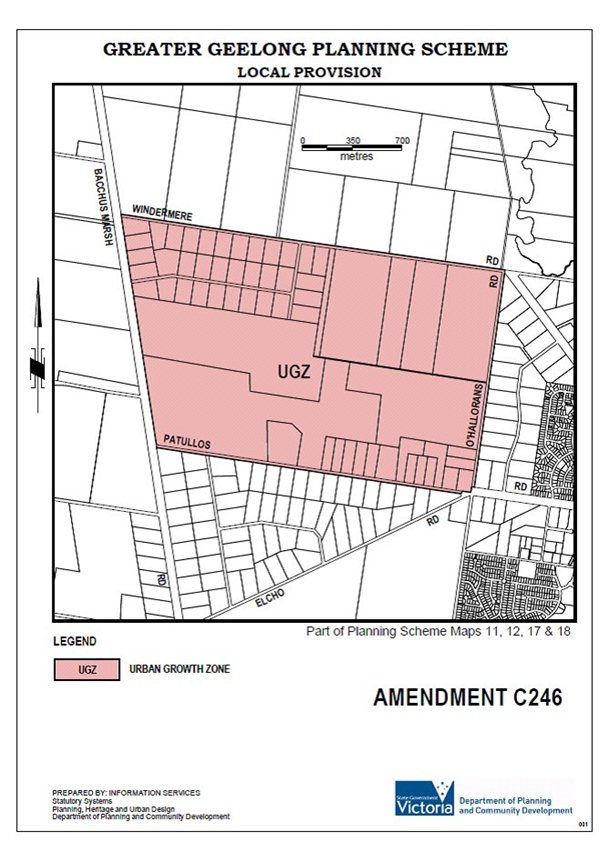
The land affected is bounded by Bacchus Marsh Road, Patullos Road, Windermere Road and O’Hallorans Road, Lara. The area comprises multiple lots developed with dwellings in the Rural Living Zone and Farming Zone, as well as some larger farming properties.
Public Exhibition of Amendment C246 commenced on 16 November 2012 and closed on 24 December 2012, though submissions were accepted up to and including 31 January 2013.
As required by Ministerial Direction No. 15 a Planning Panel Hearing has been pre-set for the week of 29 April 2013. The Panel Hearing dates were included in the exhibition notice.
Council received 53 submissions: 33 offering no objection or support; 1 requesting further information and 19 objecting. Four landowners out of a total of 56 properties in the growth area lodged written submissions in opposition to the Amendment.
The main concern from the broader Lara community is the additional strain on services and infrastructure brought on by more people. Some residents suggest the development should be stopped until road and shopping facilities are improved. Other submissions support the development, believing it will deliver much needed community infrastructure.
A comprehensive submission was received from Spiire P/L representing Dacland P/L, the proponent of the proposed adjacent Manzeene Village development. In principle, Dacland is supportive but has concerns relating to policy, process, urban structure and the exhibited DCP.
Nine submissions were received from State Government departments and authorities. APA GasNet, who own and operate the South West Natural Gas Pipeline which traverses the area, has requested modifications to the Precinct Structure Plan. A joint submission from the Dept of Transport / Public Transport Victoria / VicRoads has also requested changes.
In accordance with the Planning and Environment Act 1987, Council must now either: change the Amendment in the manner requested by the objecting submissions; refer submissions to an Independent Panel appointed by the Minister for Planning; or abandon the Amendment or part of the Amendment.
Council officers have considered the submissions and do not recommend any major departures from what was exhibited.
Some changes are recommended as a result of submissions. Key changes include the realignment of the southern east-west connector road to satisfy APA GasNet requirements and cross-section redesign of some collector roads as a result of Department of Transport comments.
This report addresses the issues raised in the submissions and recommends they be referred to an Independent Panel appointed by the Minister for Planning. In response to the complex set of DCP issues raised, the services of Maddocks Lawyers will be engaged to represent Council at the Hearing.
Cr Macdonald moved, Cr Ansett seconded -
That Council, having considered all submissions to Amendment C246 to the Greater Geelong Planning Scheme, resolves to:
request the Minister for Planning to appoint an Independent Panel under Part 8 of the Planning and Environment Act 1987;
refer all submissions that have not been resolved to the Panel; and
submit to the Panel its response to the submissions generally as outlined in this report.
Carried.
The Lara Structure Plan April 2011 states that the land bounded by Patullos, Bacchus Marsh, Windermere and O’Hallorans Road (the ‘land’) provides the best un-fragmented opportunity for Lara’s future growth. Lara has long been identified in the Municipal Strategic Statement of the Greater Geelong Planning Scheme (GGPS) as a designated green field residential growth node.
Key landowners in the Growth Area formed Lara Lakes Pty Ltd who engaged Lara Lakes Project Management (LLPM) to achieve a rezoning of the land to enable its development for residential purposes. LLPM have engaged ABC Project Management as project manager and SMEC Urban Pty Ltd as the planning consultant.
The Lara West Growth Area will be a fully planned community designed to accommodate approximately 11,000 people. These new residents will be supported by a range of services including retail and employment precincts, schools, Council community centres, sporting facilities, parklands and walking trails and essential infrastructure.
At its meeting on 28 August 2012, Council resolved to support the preparation and exhibition of Amendment C246 to the Greater Geelong Planning Scheme, subject to authorisation by the Minister for Planning. Ministerial Authorisation was received on 25 September 2012.
Public exhibition of Amendment C246 occurred between 16 November 2012 and 24 December 2012. Late submissions were also accepted up to and including 31 January 2013 and have been considered in this report.
The exhibited amendment proposes to:
Rezone the land from the Farming Zone and the Rural Living Zone to the Urban Growth Zone (UGZ);
Apply a new schedule to Clause 37.07 (Urban Growth Zone);
Amend Clause 21.13 Lara to update the implementation section relating to the ‘future residential’ area;
Delete the Land Subject to Inundation Overlay that applies to part of the land;
Incorporate the Lara West Precinct Structure Plan, June 2012, to the schedule to Clause 81.01;
Incorporate the Lara West Native Vegetation Precinct Plan, June 2012, to the schedule to Clause 52.16;
Incorporate the Lara West Native Vegetation Precinct Plan, June 2012, to the schedule to Clause 81.01;
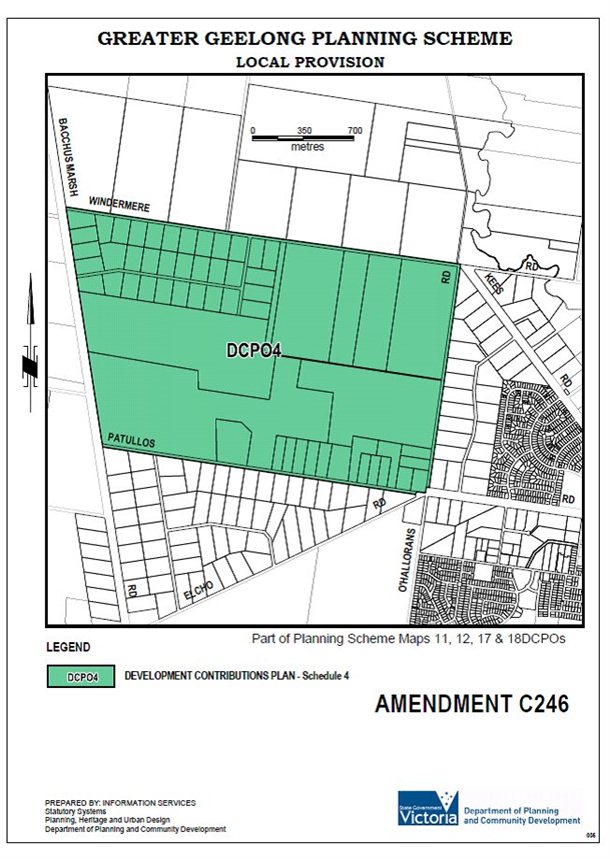
Apply a new schedule to Clause 45.06 (Development Contributions Plan Overlay (DCPO)); and
Incorporate the Lara West Development Contributions Plan to the schedule to Clause 81.01.
Letters and notices were sent to relevant Government Departments, statutory authorities and all landowners directly affected by any zoning or overlay changes, as well as to surrounding landowners.
A notice of the preparation of the Amendment appeared in the Victorian Government Gazette on 22 November 2012. Notices appeared in the Geelong Independent on 16 November 2012, and the Geelong Advertiser and Lara Happenings on 17 November 2012. A complete set of the amendment documents were available on the Geelong Australia and DPCD websites.
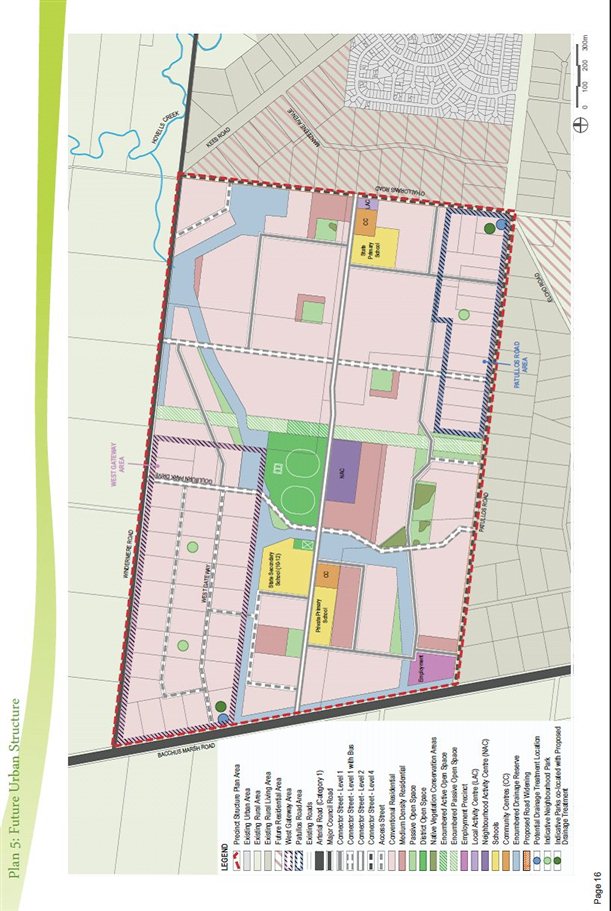
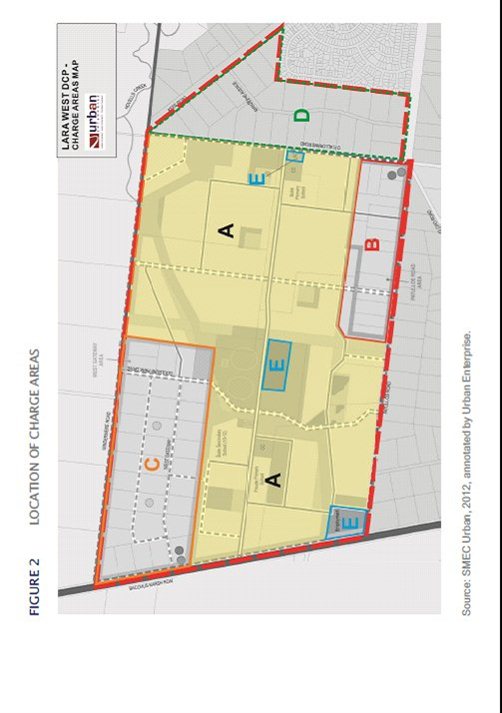
Appendix 1-1 shows the land proposed to be rezoned and Appendix 1-2 is the exhibited Lara West Future Urban Structure Plan. Appendix 1-3 and 1-4 respectively show the exhibited DCPO and the Lara West DCP Main Catchment Area and Charge Areas.
As a consequence of the Amendment C246 exhibition, a total of 53 submissions were received. Appendix 1-5 contains a schedule which summarises the submissions and Planning Officer response. ‘In principle support’ submissions which then raised concerns were treated as an objection.
For the purposes of this report, a detailed breakdown of submissions shows:
Of the 15 Patullos Road rural living properties (Patullos Road Area), 2 lodged objecting submissions.
Of the 35 farming zoned 2 hectare properties in the West Gateway Area, 4 lodged supporting submissions, 1 lodged an objecting submission and 1 requested further information.
9 supporting submissions were received from landowners of the larger broad acre farming properties within the LWP.
A submission raising a number of concerns was received from TGM, acting on behalf of one of the larger broad acre farming landowners within the LWP.
10 objections were received from Lara residents outside the growth area, including 2 from representative bodies; the Lara RSL and the TLC Group Lara Inc.
5 supporting submissions were received from Lara residents outside the growth area.
3 supporting submissions were received from residents outside Lara.
2 of the landowners affected by the proposed upgrade and signalisation of the Patullos/Elcho/O’Hallorans Road intersection lodged objecting submissions.
3 submissions supporting the amendment were received from landowners to the west of Bacchus Marsh Road.
There were 9 submissions received from Government agencies and authorities.
There were supporting submissions from the proponent and the Catholic Education Office and an opposing submission from Dacland P/L (the developers of Manzeene Village).
Pursuant to the Planning and Environment Act 1987, the Council is required to consider all submissions made to an Amendment and must:
Change the Amendment as requested by the submissions; or
Refer the submissions to an Independent Panel appointed by the Minister for planning; or
Abandon the Amendment.
Appendix 1-6 shows a table itemising the proposed changes to the Amendment C246 exhibited documentation as a result of the submissions.
The next section of this report outlines the key issues raised in the submissions and provides an officer response. In the event the submissions are referred to an Independent Panel, as recommended in this report, these responses will form the basis for Council’s presentation to the Panel.
Infrastructure Provision in Lara
The Lara RSL, the Township of Lara Care Group and a number of local residents are concerned about the impact of an additional 10,000 people on the existing facilities and infrastructure in Lara, such as the road and transport network, schools, health and community services and retail shopping.
The submitters note that the town is already experiencing significant traffic and grocery shopping problems and that any new housing developments should not be supported until these issues have been addressed.
Some submitters are particularly concerned about changes to Windermere Road and its elevation as a commercial truck route as a result of Amendment C246.
Officer Response
This is a common issue for many Lara residents who have been experiencing a gradual but increasing strain on services and infrastructure. The Lara Town Centre Expansion project will provide a new full line supermarket, specialty retail shops and the redevelopment of Austin Park. The supermarket is expected to be operational by 2015.
However, an expanded town centre on its own is not going to solve many of the deficiencies raised in the submissions. It is understandable that residents consider the current problems will only be worsened by the Lara West development, which some submitters say has resulted from a lack of planning and vision. “Growing pains” are a common issue in many rapidly expanding towns close to Melbourne and it is important to understand how such matters are addressed in the Planning and Environment Act 1987.
Firstly, state planning policy requires Councils to maintain at least a 15 year supply of land to meet expected residential demand in locations identified for growth. The Greater Geelong Planning Scheme identifies Lara as a designated growth node and supports the rezoning of the LWP when a review of lot supply indicates rezoning is necessary to continue to achieve at least 15 years lot supply. This requirement has been demonstrated in the assessment of land supply in Lara included as part of the Amendment documentation.
Secondly, the Act outlines the statutory provisions relating to development contributions. In other words, the Act clearly spells out what infrastructure should reasonably be levied on developers as part of a planning scheme amendment to rezone land for residential use.
Council has identified a need for each of the community and development infrastructure items that have been included in the Development Contributions Plan – a planning control forming part of this Amendment. Items include intersection works, community centres, sporting fields, road/intersection construction and footpaths external to the LWP, and contributions to a pavilion in the District Open Space and a new library in the Lara Town Centre. Total costs attributable to the LWP is approximately $36.9 million
The LWP, as outlined in the Lara West Precinct Structure Plan, will provide a range of other services and infrastructure to support this new community. The proposed Neighbourhood Activity Centre includes a full-line supermarket, there will be local parks linked to a network of walking/cycling trails, and educators are to provide two primary schools and a campus of Lara Secondary College. Developers will also fund infrastructure for sewer, water, gas, electricity, telecommunications and stormwater drainage.
It is important to remember that the LWP will be developed over 20+ years. There will not be 10,000 additional residents overnight and services and infrastructure are to be provided in conjunction with demand.
In addition to the Planning and Environment Act, there is a responsibility on the three levels of government to plan and provide for new infrastructure to meet the needs of growing communities. Many of the submissions call for the proposed development to be placed on hold until large-scale infrastructure projects are completed, such as the railway crossing at Station Lake Road. Funding for large projects is outside the scope of this amendment. The population pressures brought on by the LWP may in fact add weight to the delivery of large infrastructure projects.
Council is aware of the infrastructure deficiencies in Lara, particularly the road and transport network. The Asset and Traffic Management Unit is soon (in 2013) to undertake a review of the 2002 Lara Transport Management Plan. The study will include community consultation and workshops, together with representation from key stakeholders. The study will factor-in the LWP and other recent developments in Lara and form the basis for future infrastructure funding applications and works.
The Asset and Traffic Management Unit continue to work with the Department of Transport, VicTrack and VicRoads regarding safety issues at the railway crossing and improvements to the Six Ways intersection. A road reserve has been set aside to allow the construction of an overpass at McClelland Avenue / Station Lake Road. Delivery of such a large piece of infrastructure is subject to a range of factors.
Windermere Road is classified in the O’Brien Transportation Assessment June 2012 as a major Council Road under the control of Council. The 20m wide road reserve has a pavement width of 6.4m and a speed limit of 100km/h applies along the road between Bacchus Marsh Road and Forest Road North. The Department of Transport note the long term strategic importance of Windermere Road as a route to Avalon Airport. Council engineers advise that the road is not designed to support heavy vehicles. Any change to the function of Windermere Road will be guided by findings from the transport study referred to above and have no relationship with Amendment C246.
Patullos Road Area
Two landowners of the rural living properties fronting Patullos Road are opposed to having their land rezoned to the Urban Growth Zone. These landowners had bought into the area for its rural environment and consider the development will negatively impact on their lifestyle.
Officer Response
The Amendment is initiated by Lara Lakes Project Management Pty Ltd, a consortium of the larger farming property owners. It is acknowledged that there are residents within the Patullos Road rural living lots who are aggrieved by the proposal and prefer to continue living in the semi-rural environment they presently enjoy. There are however landowners who do support the development.
Rezoning land from the Rural Living Zone to the Urban Growth Zone does not prevent continued existing use and there is no requirement for the land to be sold or developed for urban purposes. However, the rezoning is likely to mean an increase in rates over time (though rates could potentially rise regardless given the direction in the Lara Structure Plan 2011 and Clause 21.13 of the Greater Geelong Planning Scheme). There is also the prospect that nearby land will be developed for housing and associated infrastructure over time.
The Patullos Road Area is accorded specific provisions in the Schedule 3 to the Urban Growth Zone. A master plan would need to be prepared for each area prior to any development occurring. Development is most likely when a developer can acquire a number of contiguous lots together to make a viable parcel.
The Lara Structure Plan established a settlement boundary for Lara and nominated land within the boundary for rezoning to a conventional residential zone and land to be retained for low density residential and rural living use. Considerable areas within the settlement boundary are to remain in the Rural Living Zone, including land to the north of Elcho Road, east of Serendip Sanctuary, east of the railway line and south of the Princes Freeway (to the west of Avalon Road).
The pupose of Structure Plans is to periodically review (approx every 10 years) the key strategic planning issues for a place and articulate preferred land use directions. Structure Plans are prepared in consultation with the local community. By their very nature, Structure Plans will identify land for approprite new or changed use, usually subject to a number of requirements.
Proposed Manzeene Village, Lara
A submission was received from Spiire Australia, acting on behalf of Dacland Pty Ltd - the proponent of the proposed Manzeene Village development. In principle, Dacland is supportive of the amendment.
The Manzeene Village development is the subject of a current amendment request (C285), lodged on 6 December 2012. Amendment C285 seeks to rezone land bounded by O’Hallorans, Patullos and Kees Roads and to the west of existing residential land, to the Residential 1 Zone and the Business 1 Zone to facilitate the development of new community inclusive of a Neighbourhood Activity Centre. The proposed Manzeene Village Development Plan is shown in Appendix 1-7.
The submission raises a number of concerns with the Amendment in its current form which are summarised in turn as follows:-
Policy & Process: The Lara Structure Plan (LSP) adopts a consolidation boundary for the town to ensure a compact urban form. The Manzeene Village area is within the consolidation boundary and is identified as an infill development site, whilst Lara West is located outside the consolidation boundary and is identified as a future growth area.
The Structure Plan anticipates development of Manzeene Avenue in the short term and that Lara West will come forward for development when Lara’s lot supply falls below 15 years. It is clear the LSP expects the growth of Lara West to occur from east (O’Hallorans Rd) to west, preceded by the infill development at Manzeene Avenue.
In our view, the two projects should have been considered by Council concurrently to ensure integration and proper sequencing. Council needs to consider proposed Amendment C285 at the time it makes a decision on the Lara West Growth Area. It is important that Amendment C285 is placed on public exhibition as soon as possible to allow the proposals to be considered concurrently.
Urban Structure & Integration: A more appropriate location for the Neighbourhood Activity Centre (NAC) is that proposed by the Manzeene Village proposal; on the corner of O’Hallorans Roadd and Patullos Road. This site presents the best opportunity to develop a vibrant and viable centre at the earliest possible opportunity. The economic impact assessment submitted with C285 supports the development of the NAC by 2020 – we believe it unlikely the NAC in Lara West would be supported by that date.
The corner site has the potential to become a hub of activity providing services to existing residents, Grand Lakes, Manzeene Village, Lara West and the south west growth area. Importantly, the area spans existing and future development sites, providing a physical ‘link’ that integrates the precincts.
The LSP does not consider the future location of a NAC, nor are locational attributes for a new NAC described. The only policy direction as to the most appropriate direction for a new NAC is the Geelong Retail Strategy and the Panel Report for Amendment C198 (the LSP).
The Panel Report states that ‘any future centre should be located ‘inboard’ on the eastern end of the proposed growth area, so they can serve the broader Lara community’. The Retail Strategy suggests that new neighbourhood centres should be located with frontage to a main road.
Drainage: It is important that the drainage systems are designed so that they integrate across the development areas. The scale of the drainage infrastructure required within the Manzeene Village development may be influenced as a result of future development at Lara West. The interdependency of the drainage infrastructure gives further cause for the two Amendment proposals to be considered concurrently by Council.
Development Contributions Plan: The proposed DCP covers both the LWP and Manzeene Village. Dacland supports the application of a DCP or similar mechanism to ensure critical infrastructure is delivered but has had no involvement to date in its preparation.
The DCP as exhibited contains a number of flaws relating to:
Land Budget, Charge Areas and Demand Units
Infrastructure Items
Officer Response
Amendment C285 has been lodged and is currently on internal and external referral. When referral comments are received the Amendment will be further considered prior to the preparation of a report to Council. This is the normal process for all planning scheme amendments. The submission concerns are addressed as follows:-
Policy & Process: The trigger upon which to consider the Lara West Growth Area is clearly stated in Clause 21.13 (Lara) of the Greater Geelong Planning Scheme:
“Support the rezoning of ‘future residential’ areas when a review of lot supply indicates rezoning is necessary to continue to achieve at least 15 years lot supply taking into consideration any infill opportunities that will not be realised in the short term.”
As part of the Lara West C246 Amendment application, a comprehensive assessment of the adequacy of land supply at Lara was prepared by Spade Consultants. This assessment concludes that there is an estimated 7.4 years supply and no more than 12.2 years supply of land at Lara, and the supply situation can be said to be approaching a severely constrained situation. This assessment has not been challenged in the submission.
Clause 21.13 also states as its first strategy: “Contain urban development within the defined settlement boundary in accordance with the Structure Plan map included in this clause”. The Lara West Growth Area is located within the settlement boundary.
The assertion that development of the growth area is to be preceded by development at Manzeene Avenue is simply incorrect. There is no provision in either Clause 21.13 or the Lara Structure Plan that states this. The submission refers to the “consolidation boundary”, which does form part of the LSP map. The context of this boundary is important as areas identified for “conventional residential” and “Low Density Residential” invariably consist of fragmented land ownership and severe drainage constraints. In other words, it is highly unlikely these areas will be rezoned in the short to medium term.
This is why the Clause 21.13 provision stated above concludes with the words “… taking into consideration any infill opportunities that will not be realised in the short term”.
Ideally, given the status of O’Hallorans Road and close spatial relationship of the two sites, development should occur simultaneously. This is still likely to be the case as development of the LWP is not expected until some 12-18 months after the land is rezoned, giving time for the Manzeene Village amendment to progress. This will allow for efficient delivery of service infrastructure and housing choice to the market. Development is expected to proceed from east to west as indicated in the staging plan shown at page 28 of the Lara West Precinct Structure Plan.
Amendment C285 (Lara Village) was formally lodged with Council on 6 December 2012 and will be exhibited following review of the application. The concerns raised in the submission have been comprehensively addressed in this report and there will be an opportunity for Spiire/Dacland to present at the forthcoming Panel Hearing.
The assertion that the two development sites have not been considered concurrently to ensure integration and proper sequencing is incorrect. The DCP which forms part of Amendment C246 includes Manzeene Village in the Main Catchment Area. Planning for the growth area has effectively ensured that future residents of Manzeene Village will benefit from the range of community and infrastructure projects identified.
The Stormwater Management Report submitted to support the Manzeene Village proposal includes the Lara West Surface Water Management Strategy as an appendix. There has been considerable communication between Council drainage engineers and engineers engaged by both developers. The current unmade O’Hallorans Road reserve, when developed, will allow for easy access and integration on both sides of the road. Upgrades to the O’Hallorans/Patullos/Elcho Road intersection and the O’Hallorans/Windermere/Kees Road intersections will support the predicted increase in traffic volumes. Barwon Water has not indicated any servicing difficulties to the LWP.
The proponents of Manzeene Village have been kept informed of the progress of Amendment C246. A meeting with officers from Spiire (previously CPG) and Dacland on 15 December 2011 included discussion about the preliminary planning for Lara West and the likely lodging of an amendment application in mid 2012. Dacland were targeting a similar lodgement date. A subsequent meeting on 14 March 2012 also canvassed the Lara West proposal. This was followed by a meeting on 3 April 2012 with the Lara West developers, Spiire/Dacland, Urban Enterprise and Council officers to discuss the DCP process and parameters. Further meetings took place on 1 August, 1 October and 30 October of 2012.
Urban Structure & Integration: The proposed alternative location for the NAC is not supported and should be retained as identified in the LWP. The assertion that the only policy direction as to the most appropriate location for a new NAC is the Geelong Retail Strategy and the Panel Report for Amendment C198 LSP is incorrect.
The location of the NAC is identified in Clause 21.13 of the Greater Geelong Planning Scheme, where strategies will be implemented by (amongst others): “Support a precinct planning approach to the ‘future residential’ area west of O’Hallorans Road and apply appropriate zones and/or overlays”.
The term ‘precinct planning approach’ by definition means master planning for whole communities catering for 10,000 plus people. The planning tool used to deliver these communities is a Precinct Structure Plan (PSP). The Growth Areas Authority (GAA) states that PSPs: “lay out roads, shopping centres, schools, parks, housing, employment and connections to transport, and generally resolve the complex issues of biodiversity, cultural heritage, infrastructure provision and council charges”. The LWP has been planned including a centrally located NAC.
Clause 11 of the State Planning Policy Framework (SPPF) requires planning authorities to consider the Precinct Structure Planning Guidelines (GAA 2009) when planning for growth areas.
In considering retail options outside the Lara Town Centre, the LSP states: ‘It may be appropriate to consider a new small scale neighbourhood activity centre as part of the planning for the long term growth area to the west of the township to serve the daily and weekly convenience needs of residents”.
The LSP and Clause 21.13 contain objectives to consolidate retail and commercial activities in the existing Lara Town Centre. The submission states that the Patullos Road/O’Hallorans Road corner site can be delivered earlier and will better serve communities of the LWP, Manzeene Village, Grand Lakes and the south-west future growth area. This is at odds with the LSP which identifies a NAC to serve the needs of growth area residents. Reference to the south-west future growth area (identified as “Elcho Road” in the LSP) is somewhat misleading given the land is substantially flood prone and unlikely to be developed in the next 30-40 years.
The submission also fails to note that both Clause 21.13 and the LSP give clear direction to the future use of Manzeene Avenue for conventional residential development. There is no direction or consideration for land in the Manzeene Avenue / Kees Road area (as described in the LSP) to include a Business 1 Zone component. In fact, the CPG (now Spiire) 23 page submission to the Panel for Amendment C198 included a comprehensive assessment of the merits of the Residential 1 Zone with an accompanying Development Plan Overlay. There was no mention in the submission of a NAC to serve current and future residents of this area.
While panel reports are useful tools in considering the merits of planning proposals, they carry no statutory weight and can hardly be used as the primary strategic justification in this case. The submission is correct that the Geelong Retail Strategy suggests that new neighbourhood centres should be appropriately located with frontage to a main road. The future Level 2 east-west connector street in the LWP will be a main road.
The assertion that the NAC is poorly situated in the LWP and that the corner of O’Hallorans Road and Patullos Road presents the best opportunity to develop a vibrant and viable hub of activity is disputed.
There is considerable policy in the SPPF and guidelines such as the Activity Centre Design Guidelines and the Precinct Structure planning Guidelines that support retail centres being co-located with uses such as community centres, sporting precincts, schools and higher density residential areas in walkable catchments. The proposed alternative NAC location has none of these attributes.
Drainage: The drainage comments are noted. Councils’ Engineering Services Unit has maintained from the outset, an approach that encouraged and indeed required the two parties to consult on C246 LWP and C285 Manzeene Village, and work together to provide justification for the framework making up the overall site stormwater management plan for the west and south-falling catchments.
It would not be possible to categorically exclude either development from occurring first, but design of systems would need to demonstrate that no adverse impacts can occur with any interim arrangements.
Development Contributions Plan:
Infill versus Greenfield Development:
The submission raises the issue of classifying Manzeene Village as an infill development as opposed to the LWP classification of Greenfield development. The basis of this classification is their review of the new State Government development contributions framework, recently released for comment, which makes reference to infill development having less DCP levies imposed upon it based on existing infrastructure surrounding these sites.
The Manzeene Avenue area is no different to many other areas on the fringe of Melbourne and Geelong that simply integrate with future Greenfield developments. These areas are un-serviced and undeveloped areas as opposed to infill sites that usually relate to areas of land that have surrounding infrastructure and facilities already provided and therefore only need to contribute to the increased infrastructure demand of these sites alone.
Greenfield sites on the other hand require delivery of a complete suite of infrastructure. This is the case for both Manzeene Avenue and the LWP, which have little to no infrastructure to be able to service this growth area.
Council has given due consideration to the Manzeene Avenue site, along with the Patullos Road and West Gateway areas, to ensure a responsive levy is set. These areas have already gone through one stage of subdivision to create rural living type lots. Based on this first phase of development, minor level infrastructure has been provided and as such contributions lower, to provide critical infrastructure required to service new residential areas. Examples include community facilities, recreation facilities and higher order traffic management infrastructure (such as traffic signals and intersection works).
It is therefore concluded that the establishment of a differential rate DCP, as has been exhibited, accurately responds to the different development settings for the three key rural living areas located within the DCP catchment.
It is also noted that the current DCP discussion paper prepared by the State Government has no legal status and does not form part of the planning scheme.
Land Budget, Charge Areas and Demand Units:
The submission raises concern regarding the development being classified entirely residential, while the proposal includes a commercial site. This commercial site is not supported by Council officers and hence has not been recognised in the DCP.
The submission disputes the charge area methodology and believes that charge areas B and C, being the other fragmented land ownership areas of Patullos Road and Western Gateway, should be charged the same levy as charge area A. These charge areas have a lower levy based on principles including fragmented ownership, an initial development phase, long term delivery and nexus to several infrastructure projects.
Infrastructure Items:
Eastern Multipurpose Community Centre Apportionment
Concerns regarding this project being apportioned to charge area A and D only, and not charge area B (the Patullos Road charge area). Officers have attributed this apportionment based on the long time frames associated with charge area B and that once this comes online it would have a greater nexus of triggering catchment needs for the second centre in the west than it would to the closer centre in the east. It should be noted that if populations of charge area B and C were not included in the eastern facility, it would still be required for charge areas A and D and would be a substantially larger size to accommodate these two areas.
Multipurpose Stadium
The characterisation of this item as a development infrastructure item within the Lara West Development Contributions Plan is questioned.
This item has been included in the DCP based on the consistent application of projects identified within the Armstrong Creek growth area. Multipurpose stadiums have been classified as development infrastructure in the Armstrong Creek East Precinct despite commentary from the advisory committee recommending otherwise, and has also been consistently implemented in the Armstrong Creek West Precinct soon to be adopted by the Minister. The project has been consistently classified as development infrastructure and provides a significant benefit to the community as a jointly funded project, including contributions from the City of Greater Geelong and the Department of Education.
Intersection Signalisation
There are concerns regarding the inclusion of signals over a roundabout treatment at the Patullos/Elcho/O’Hallorans Road intersection. Council's response to this is the cost of providing a double roundabout treatment as proposed in the original O’Brien report would actually be of higher cost than the proposed signalised intersection. Council believes the signalised intersection provides a far better community outcome in relation to safety, connectivity and movement.
The submission queries the mechanism to acquire land for the intersection. Officers have prepared a new planning scheme amendment (C290), to apply a Public Acquisition Overlay (PAO) to the land required. Amendment C290 has been prepared under delegation and sent to the Minister for Authorisation.
The second matter raised relates to the apportionment of this project to the Manzeene Avenue charge area D. This project has a strong relationship with the Manzeene Avenue growth area in conjunction with the broader Lara West growth area. This intersection is required to accommodate future growth, and as such, even charge areas like the West Gateway Area have been attributed cost. The intersection is one of the major entry points or gateways of the growth area into the existing Lara Township.
The questions raised regarding external contributions for this project are not supported. External apportionment is usually used on the basis of a direct nexus with another area that is attributed to the particular project. The identified growth area to the south of Elcho Road is a long-term project, potentially 30 to 40 years away, and cannot be established to have a nexus with the 20 year DCP for Lara West.
In relation to external traffic volumes, all roads in or around growth areas will have external increases in traffic volumes however this does not negate the need for the delivery of traffic management infrastructure to accommodate the movement of traffic in an out of the growth areas.
Library
The submission raises concern about the Council estimate for the library project as noted in the DCP, and request further information regarding its timing and total costs. Current Council estimates suggest a community library within the Township of Lara will be required at a scale of approximately $5-$7 million to accommodate the existing township of Lara and the future growth surrounding the Lara Township. It is on this basis that Council sees a contribution of $1.1 million as being a fair and equitable contribution to this facility to ensure its scale and standards are appropriate to service this new growth area.
Drainage
Dacland/Spiire considers the DCP should include additional projects relating to drainage outfall systems and any interaction of drainage projects between Manzeene Avenue and the LWP. Council would need to consider the types of infrastructure that Dacland are proposing and will discuss this matter in further detail with the relevant parties.
Patullos Road East Road Widening
Dacland/Spiire has identified an error in Table 6 of the DCP relating to this project not apportioning a charge to area D in the West Gateway area. However they have rightly pointed out that these costs have been attributed to this charge area within the workings of Table 7 and the overall final levy. They also make a point that they don't believe charge area D – being the Manzeene Avenue area, should be charged this amount. The position of Council is that all of the growth area including Manzeene Avenue has a direct nexus to the widening of Patullos Road to ensure that it is of a standard that can service this new growth area.
The project does not include the duplication of Patullos Road but instead the widening of the existing road to provide appropriate traffic lanes, shoulders and bike lanes, including a shared off-road path, to service this new area as a connection to back into existing Lara.
PSP Planning Costs
The submission raises concern regarding the apportionment of PSP planning costs to charge area D in Table 7 however Table 6 has noted Dacland as not being a contributor to this project. Council is sympathetic to these concerns relating to the $4000 charge per hectare for these costs. Council will discuss this matter with the submitter with the likelihood of potentially removing these apportionments to charge area D due to the requirement for funding their own amendment to rezone Manzeene Avenue.
Outstanding issues not resulting from submissions
Public Art
The City of Greater Geelong Arts & Culture department has highlighted the importance of planning for public art in the Lara West growth area. Council adopted a Public Place Art Strategy on 11 September 2012. The strategy seeks to ensure proper planning for public art in green field developments and the need to avoid limited, repetitive and competing outcomes.
The exhibited Amendment C246 documentation did not included any specific commentary of guidelines about public art. The Arts & Culture department suggest that public art planning should be integrated into development project planning at the earliest possible stage to achieve a consistent approach to public art.
Given that there is now an adopted public art strategy, it is considered appropriate that additional wording be included in the Lara West PSP. It is noted that the planning for the Horseshoe Bend Precinct in Armstrong Creek includes design principles for public art. Similar wording is proposed to be inserted into the Lara West PSP.
Main East-West Connector Road / O’Hallorans Road Intersection
This intersection is proposed to be a T intersection as shown in the Lara West PSP. The proposed Amendment C285 Manzeene Village, as extensively discussed above, is currently on referral. Comments received from Councils’ Traffic Unit and the Department of Transport recommend that the LWP main east-west Connector Street (Level 2) should be extended to Manzeene Avenue.
The C285 Manzeene Avenue draft plan (shown in Appendix 7) does not include a continuation of the LWP main east-west connector road to Manzeene Avenue. It is considered appropriate that this matter be further explored at the Panel Hearing. The major implication of any change would be to the Development Contributions Plan.
The amendment is supported by the Lara West Precinct Structure Plan (LWPSP), a high level strategic planning document that will be incorporated into the Greater Geelong Planning Scheme. The LWPSP includes a number of objectives that support sustainable development including walkable neighbourhoods close to services, interconnected public open spaces, provision for convenient public bus routes, a diverse choice of housing and water sensitive urban design.
The LWP can efficiently connect to gas and electricity infrastructure immediately to the east. Smarter home designs, as advocated by the City’s Future Proofing Geelong Program, is a significant way for developers and home owners to reduce energy use.
Barwon Water has indicated a preference for growth to occur in a structured, staged way, remaining closely aligned with trunk infrastructure. The Authority states that Class A recycled water will not be considered for the development at this stage. The LWPSP includes water management objectives to protect and/or enhance downstream environments and fit for purpose stormwater re-use.
The flora and fauna assessment concludes that cropping, ploughing and grazing have significantly modified or removed remnant grassland communities through much of the study area. A Native Vegetation Precinct Plan forms part of the amendment documents and includes identified conservation areas. Extensive revegetation will occur in areas of public open space, particularly along and in water ways, in conjunction with the surface water management strategy.
Costs Associated with Amendment C246
In response to the complex set of Developer Contributions Plans issues raised in some submissions, the services of Maddocks Lawyers will be engaged to represent Council at the Panel Hearing. Total costs to engage Maddocks and any required expert witnesses are estimated to be in the order of $50,000.
Future Costs
Planning for the Lara West Growth Area will require Council resources. The main financial implications ultimately will relate to the provision of services and infrastructure for a new community.
A Development Contributions Plan Overlay (DCPO) forms part of the Amendment. The purpose of the DCPO is to levy developer contributions for the provision of works, services and facilities before development can commence.
Clause 11.02 ‘Urban Growth’ of the State Planning Policy Framework requires planning authorities to ensure that sufficient land is available to meet forecast demand.
The Lara West Growth Area is identified as “Future residential” in the Lara Structure Plan and Clause 21.13 of the Greater Geelong Planning Scheme. Clause 21.13 supports the rezoning when a review of lot supply indicates rezoning is necessary to continue to achieve at least 15 years lot supply taking into consideration any infill opportunities that will not be realised in the short term.
The Amendment documentation includes an assessment of land supply in Lara by Spade Consultants Pty Ltd. The assessment finds that there is between 7 and 12 years supply of land. The assessment is considered accurate and provides sufficient strategic merit to advance the rezoning at this time.
Lara West is also identified in the G21 Regional Growth Plan for planned urban growth.
No Council Officers have any direct or indirect interest, in accordance with section 80(c) of the Local Government Act, to which this report relates.
Pursuant to Ministerial Direction No. 15, gazetted on 25 October 2012, timeframes have been imposed on all planning authorities amending planning schemes across Victoria. Under section 12(2) of the Planning and Environment Act, a planning authority must have regard to the Minister’s directions.
Failure to comply with the timeframes in the Direction may prompt the Minister to exercise his existing powers under section 185A of the Act. This section allows the Minister to direct a planning authority to take any steps in the amendment process within a specific time. Not implementing the recommendation in this report to refer the submissions to a Panel may result in Council failing to meet its statutory timeframes for the amendment.
There are no other notable risks associated with implementing the recommendation contained in this report.
Councils are required to ensure a sufficient supply of land is available in designated growth areas for residential, commercial and other community uses, including affordable housing close to jobs, transport and services.
The Lara West Growth Area will be a fully planned community that promotes affordable housing. The scale of development, staged over many years, will also be a significant economic and employment generator for the Geelong region.
Formal exhibition of Amendment C246 occurred from 16 November 2012 to 24 December 2012 via the following means:
Notices sent to directly affected landowners and occupiers (i.e. properties proposed to be rezoned to the Urban Growth Zone) and adjacent landowners and occupiers including landowners of the Manzeene Avenue area;
Notices published in the Geelong Advertiser, Geelong Independent, Lara Happenings and the Victorian Government Gazette;
Notices sent to Government Departments and Statutory Authorities;
A complete set of the Amendment documentation available to be viewed on the Geelong Australia website and the DPCD website; and hard copies at 100 Brougham Street, Geelong and the Lara Library.
It is noted that late submissions were accepted up to and including 31 January 2013, and have been considered in this report.
In accordance with clause 4(2) of Ministerial Direction No.15 the following panel hearing dates have been set for this amendment:
Directions Hearing: week of 25 March 2013.
Panel Hearing: week of 29 April 2013.
Planning Panels Victoria will notify all submitters of the Panel dates and invite requests to be heard at the Panel Hearing.
|
No |
Name |
Address |
Type |
Summary of Submission |
Response |
|
1 |
C M Hussell |
75 Links Street |
Objection |
Landowner on the south side of Patullos Road. Objects to the impacts on rural view to the You Yangs, increase in traffic and property prices. Considers that land to the south of Patullos Road should also be rezoned for residential development. |
The land to the north of Patullos Rd between Bacchus Marsh Rd and O’Hallorans Rd is designated for rezoning to the Urban Growth Zone, while land to the south is to be retained in the Rural Living Zone, as per Clause 21.13 of the Greater Geelong Planning Scheme (GGPS). Impacts on the submitter’s rural views will be affected in-so-far as the existing vacant farmland to the north will be developed for housing. However there will still be views to the You Yangs. There are no planning controls in the GGPS to protect such views. Traffic increases will be gradual and considered reasonable, while impacts on property prices are not a relevant planning consideration. |
|
2 |
T Tran |
49 Stanhope Street |
Further Information Requested |
Landowner of 15 Goulburn Park Drive. Notes that the plan shows a proposed road on his property and queries who would pay and method of reimbursement.
|
Construction of any road on the property would require the permission of the landowner. Should the property ultimately be sold to a developer then there would be no requirement for the submitter to construct the road or pay for its construction. |
|
3 |
J M Walkley |
545 Windermere Road |
Objection |
Resident who is concerned about the proposed 12m wide service road on the northern boundary of the LWP. Queries whether there will be a part acquisition of his property to accommodate the road reserve.
The landowner lodged a follow-up submission: I submit that section “2.4 Specific provisions West Gateway Area” in the document “Schedule 3 to the Urban Growth Zone” is unduly restrictive to existing land owners within the West Gateway Area. Specifically the refusal to grant a permit to subdivide land until a Masterplan of the West Gateway Area has been prepared to the satisfaction of the responsible authority. I submit that this section should be amended to allow existing and future land owners to subdivide their land into no more than two parts and this subdivision can occur before a Masterplan of the West Gateway Area has been prepared. Furthermore, “part one” must include the main dwelling and retain a road frontage and be no smaller than an arbitrary size, for example one acre. The remainder of the land would become “part two”.
|
The 12m wide internal (not service) road would not form part of the exisitng Windermere Rd reservation. Construction of any road on the property would require the permission of the landowner. A part acquisition is highly unlikely. Should the property ultimately be sold to a developer then there would be no requirement for the submitter to construct the road or pay for its construction.
The submission raises a number of valid arguments and offers considered solutions. The submitter is correct to note that the specific provision for the West Gateway Area in the UGZ Schedule 3 requires a master plan to be prepared. The submitter also correctly highlights that this provision restricts the ability to subdivide until a master plan has been prepared for the Area to the satisfaction of the responsible authority (i.e. Council). The submission however is not supported. There are 35 separate titles / landowners in the West Gateway Area. If every landowner was permitted to subdivide their property into 2 lots, this would undermine the purpose of the provision. It would be extremely difficult to prepare a well planned and orderly residential estate with the further constraints of setting aside dispersed house lots. Until a masterplan is prepared futher fragmentation of the Area should be avoided. The Lara West PSP requires development to be staged, progressing from east to west. This will enable essential services to be delivered in an efficient manner. Permitting 2 lot subdivison in this area would not be in accordance with the PSP. There may be opportunites to incorporate house lots during the detailed planning permit application stage, following approval of a master plan. The development of this area is most likely to occur when a developer can acquire a number of contiguous parcels to make a project viable. Concerns about rate increases are understandable. The rezoning is likely to mean an increase in rates over time, though rates could potentially rise regardless given the direction in the Lara Structure Plan and Clause 21.13 of the GGPS. Potential impacts on rates (or property values) are not a relevant planning consideration. It is noted that Council valuations and rates will change in line with changes to sales values, not necessarily immediately in line with any rezoning. Councils’ Revenue, Property & Valuations Unit are responsible for valuations. Council provides a number of assistance measures to reduce rates stress.
|
|
4 |
N Brunacci |
85 Stephenson St |
Support |
Considers the Lara West development is a good plan. However is concerned that the proposed location of the Yr 10-12 Lara Secondary College is not in walking distance to Lara Station and will restrict access to Melbourne for further education.
|
Noted. With the predicted population growth of Lara the existing Secondary College is constained and the Dept of Education prefer to relocate the senior campus to the LWP. This will not occur for many years and it is planned that bus services will be able to transport students to the Station. However, as observed in the submission, the greater distance to the station is likely to deter students from walking. |
|
5 |
Country Fie Authority |
Peter Hamilton
|
No Objection |
No objection to the content of the planning scheme amendment. |
Noted. |
|
6 |
APA Group |
Colin Mason, Land Manager |
Objection |
APA owns and operates the South West Natural Gas Pipeline which includes a 20m wide easement through the LWP. APA is the responsible authority for the gas transmission networks in this region. APA is concerned about changes to the zoning and land use context for the following reasons:
APA requests that development will be prohibited within the easement. The easement needs to be incorporated into a reserve, contain no native vegetaton offset planting or roads. Crossing of the easement with roads and services would be permitted with the approval of APA. |
Council officers met with APA and the proponent on 16 January 2013 to discuss the submission. In order to satisfy APA requirements, the alignment of the southern east-west Connector Street will be shifted to safeguard the 20m wide easement. A new design has been prepared by the proponent and forwarded to APA for consideration. APA are now reviewing the changes. Resolution of this matter is on-going. The easement will also be shown, similar to that of the electrictity transmission tower lines, through the LWP. It must be identified as encumbered land within the land use budget to ensure it is appropriately recognised as non-developable land and as such is not charged developer contributions. |
|
7 |
J & J Doolan
|
70 Stacey’s Road |
Support |
The planned growth will be good for the area and enable Lara to get better facilities and services, and provide for business opportunities. |
Noted.
|
|
8 |
WJM Lawyers for D & C Trigg |
180 Patullos Road |
Objection |
Landowner whose property is affected by the proposed Patullos/Elcho/O’Hallorans intersection upgrade. Submits that the redesign of the intersection to include signals be changed to a previous design that showed roudabouts. The roundabout design better distributes the burden of compolsory land acquistion more equitably between the owners of the affected parcels.
|
Change not supported. The exhibited design of the Patullos/Elcho/O’Hallorans Rd intersection is considered superior to the dual roundabout previously proposed. Reasons for this include:
Compolsory land acquisition will be spread over 3 landowners and the land area required of the submitter will be similar regardless of the intersection design. |
|
9 |
E J Spalding |
295 Patullos Road |
Support |
Fully supports the amendment which will bring much needed infrastructure and services to support people of all ages. |
Noted.
|
|
10 |
C Cullen |
65 Fakenham Rd |
Support |
Owns land at 285 Patullos Road. Supportive of the amendment.
|
Noted.
|
|
11 |
L Spalding |
800 Bacchus Marsh Road |
Support |
Believes the development will provide facilities and services that Lara needs, especially schools, sport and community facilities and road upgrades. |
Noted. |
|
12 |
B Spalding |
800 Bacchus Marsh Road |
Support |
Supportive of the amendment as the area will be well planned for residential development and associated services. |
Noted.
|
|
13 |
SP Ausnet |
Neil McLeod |
No Objection |
SPI PowerNet has two 220 kilovolt electricity transmission lines bisecting the LWP and requests to be kept informed. Any development (including roads, earthworks, landscaping, wetlands, etc) within 60m of the easement must be referred to SPI PowerNet for approval prior to the commencement of any works on site. |
Noted. The Lara West Precinct Structure Plan will be amended to include a referral requirement to SPI PowerNet for works within 60m of the transmission easement. |
|
14 |
EPA Victoria |
Eve Graham – Mgr EPA South West |
No Objection |
EPA has no concerns with the proposed amendment, however notes that the responsible authority must be satisfied that the subject land is not contaminated through previous uses as outlined in Ministerial Direction no 1. |
Noted. The proposed Schedule 3 to the UGZ addresses contamination issues by requiring permit applications to consider the SMEC Australia Phase 1 Environmental Site Assessment, 15 July 2011. This assessment forms part of the Amendment documentation. |
|
15 |
Catholic Education Office
|
Stephen Elder |
Support |
The submission concurs with the plan location and need for a Catholic primary school in the area. Happy with the proposed siting of the school adjacent a community centre and near the NAC and the active and passive open space. Notes that at least three road frontages would be required to accord with planning guidelines to better facilitate traffic circulation and access. Prefers that the site is annotated as “Non-Government (Catholic) School” on the plan. Would welcome the opportunity to discuss the option of incorporating a kindergarten and negotiate its siting. |
The ASR Community Infrastructure Assessment supporting the Amendment finds that a new Catholic Primary School may be needed as a result of the development. However, while the Lara West PSP identifies a site for a private primary school, it does not specifically state it to be “Catholic”. Council would prefer the notation of simply “non-government school” on this site as the Catholic Education Office doesn’t have a current interest in the land as an owner but would instead be a future purchaser of this potential site. This does not limit opportunities for other non-government school entities to make arrangements with the landowner to purchase this site for the development of their facility. Council recognises the role of the Catholic Education Office in the provision of key community facilities and education however it would be biased to simply label one party as being interested if no contract ownership has been established. A design guideline will be added to Section 4.3.3 of the PSP stating that schools should be provided with three road frontages. Council is agreeable to on-going discussions with the Catholic Education Office regarding the future development of the primary school site. |
|
16 |
R Collins
|
38 Heytesbury Drive |
Support |
The submitter has an interest in the amendment, as he has family who live in the LWP. Wishes to register support for the development. |
Noted. |
|
17 |
T Spalding
|
800 Bacchus Marsh Road |
Support |
Supportive of the amendment as the area will be well planned for residential development and associated services. |
Noted. |
|
18 |
B Wilks |
290 Patullos Road |
Support |
Landowner of 245 O’Halloran’s Road and part owner of 465 Windermere Road. Supports the amendment knowing it will provide housing for Lara and Geelong’s northern suburbs. |
Noted.
|
|
19 |
Lara RSL |
K Simons |
Objection |
Considers development should be delayed until a number of issues are addressed: Corner of Elcho Rd and Bacchus Marsh Rd 6 ways roundabout Station Lake & McClelland Rd roundabout The railway crossing Rennie St & McClelland Rd roundabout Increased traffic will endanger students going to school Police, fire and state emergency services are on the west side of the rail line and will also be affected by increased traffic Also queries where landowners who do not want to be part of the development stand.
|
Refer to the discussion section in the body of this report under the ‘Infrastructure Provision in Lara’ section. The traffic and transport issues raised in this submission are beyond the scope of the Amendment. Council’s Asset and Traffic Management Unit is soon (in 2013) to undertake a review of the 2002 Lara Transport Management Plan. The study will include community consultation and workshops, together with representation from VicRoads and the Department of Transport. The study will factor-in the LWP and other developments in Lara and form the basis for future infrastructure funding applications and works. Landowners who do not want to be part of the development can object and seek to have their property excluded from the Amendment. However in the event of rezoning, there is no legal requirement to sell or develop for urban purposes, and existing use rights prevail. |
|
20 |
A Mueller |
50 Fairway Drive Lara VIC 3212 |
Support |
The submitter recently purchased property in Fairway Drive to build family home and pleased to see new facilities nearby. |
Noted. |
|
21 |
Dept of Transport / VicRoads |
Mark Hearsch |
Objection |
Coordinated response from Dept of Transport, VicRoads and Public Transport Victoria (PTV). Public Transport
Cycling and Walking
Arterial Road Network Suggested changes to the LWPSP:
Suggested changes to the DCP:
|
Council officers met with DoT, VicRoads and the proponent to discuss the submission. A supplementary submission, dated 24 January 2013, was subsequently provided. The following is a response to the submission and supplementary submission: Public Transport PSP wording changed to ‘Potential Bus Route’. PTV has further submitted that Bacchus Marsh Road is unlikely to be used as a bus route. Response: Plan 17 of the PSP (and other relevant plans) is to be amended to remove the proposed bus route and stops on Bacchus Marsh Rd and to include the north-south connector road in the south west of the precinct as a potential bus route. The West Gateway Area is to include an objective for the provision of a potential bus route. Bus stop installation is to remain as developer funded and included as a condition on any subdivision permit. Standard stop locations to be removed from PSP Plan 17 and replaced with wording suggested by PTV. The main east-west road cross section to be changed to show a 7m clear zone for buses, rollover/mountable curbing and 1 row of median street trees. Also include wording in the PSP guidelines.
DoT confirmed that the Connector Street Level 1 with Bus does not accord with DoT Guidelines and that a marked on road 1.7m bicycle lane should be added for each direction of travel. Response: Supported in part – an additional 0.7m road width to be added for each direction of travel. This will allow for a shared parking/bicycle lane in addition to the 7m trafficable road width required for bus operations. This accords with Clause 56.06-8 and the DoT Public Transport Guidelines. This will require the addition of 1.4 metres to the width of the road reserve/cross-section. Given the relatively low traffic volumes estimated in the O’Brien Transport Assessment and desire to limit areas of road pavement, the design response is considered apropriate. References to the Director of Public Transport to be replaced with ‘Public Transport Victoria’. Cycling and Walking A 2.5m wide (currently shown as 1.5m) shared path is to be provided on the south side of the main east-west connector street from the western end of the private primary school site to OHallorans Road. No change to the width of the road reserve is required. In relation to the provision of a 2.5m wide shared path on Patullos Rd & O’Hallorans Rd, DoT further submitted that an amended plan be provided showing how the shared path network would link to the proposed off-road shared path on Patullos Rd, east of the site. Response: The DoT comments have recognised a gap in the shared path network. Both Patullos Rd and O’Hallorans Rd are to include a 2.5m shared path on the inward (Amendment land) side to complete the network and link back to Patullos Rd east. This will require the addition of 1 metre to the width to these road reserves/cross-sections. The change better supports the vision in Section 3 of the PSP. DoT has further submitted that the off-road shared path within the transmission easement need only extend northwards to the West Gateway extension road (not Windermere Rd). This change is supported. A design objective will be included in the PSP regarding locating Connector St L1 shared paths, where applicable, on the side which is adjacent to the drainage reserve so as to link with off-road shared paths. Arterial Road Network Given the high level status of Plan 5, it is not considered appropriate to show future internal roads. Wording to be tightened in the PSP Section 4.6.3. Regarding closure of West Gateway access to Bacchus Marsh Rd, VicRoads has further submitted that as part of the future master planning for the West Gateway Area, a decision will need to be made whether the existing Bacchus Marsh Rd/West Gateway intersection remains or is closed and intersected with a new internal road. Response: additional wording to be added to Schedule 3 of the UGZ. VicRoads has further submitted: “The current Bacchus Marsh Rd/West Gateway intersection in unsuitable for increased turning traffic volumes. If the intersection remains it will need to be upgraded. This intersection upgrade will need to be covered as a condition on a future planning permit for development of West Gateway”. Response: wording to be added in the PSP. As stated above, bus stops are not required for Bacchus Marsh Rd. Council has concerns with Windermere Rd being a designated truck route. Council will undertake a new Lara transport study in 2013 which will provide direction for the future function of the road. No change to intersection concept layouts but include additional objective in the PSP. Council officers are reviewing DCP trigger provisions for the upgrade of the 3 Bacchus Marsh Rd intersections with VicRoads. |
|
22 |
D Parsons |
160 Patullos Road |
Objection |
Access to the submitters’ property will be impacted by the proposed redesign of the Patullos/Elcho/O’Hallorans Rd intersection. Objects to the current design because:
|
The exhibited design of the Patullos/Elcho /O’Hallorans Rd intersection is conceptual only and not the final design. However, the current design if constructed, would not permit a right turn from the submitter’s property into Patullos Road. Addressing vehicle noise, lighting and signal design would be considered at the detailed planning phase of the intersection. The Lara Structure Plan does identify the property and surrounding properties known as the “McHarrys Road Area” for rezoning to the Low Density Residential Zone. Any rezoning would be subject to the planning scheme amendment process. Regardless of access issues, subdivision (subject to permit) would retain legal access to both Patullos Rd and O’Hallorans Rd. Property values are not a relevant planning consideration. |
|
23 |
R & J Barry |
197 Patullos Road |
Objection |
Purchased property in 1995 because of its rural living zoning and has undertaken substantial improvements. Objection based on the following facts/reasons:
In summary the submitters are not seeking an indefinite RLZ but for reasonable tenure and choice to sustain their lifestyle. Do not wish to deny the proponent the ability to develop. Seeking to retain Patullos Rd as a “rural edge”. |
The arguments raised in the submission are valid and understandable. The timing of the rezoning has surprised many landowners in the Patullos Rd area, however a comprehensive assessment of land supply provides justification for the proposal. While the developer/landowners have initiated the amendment, the GGPS designates the area for residential development. Therefore, it is Council policy to facilitate the development subject to certain requirements being met. Rates are not a relevant planning matter and given no consideration in assessing the proposal. The Lara Structure Plan 2011 and Clause 21.13 of the GGPS identify the area bounded by Patullos, O’Hallorans, Windermere and Bacchus Marsh Roads for rezoning to the Urban Growth Zone. This is what the amendment seeks to do. The UGZ is a planning tool designed to simplify the planning process. The UGZ is supported by the Lara West Precinct Structure Plan, which is a long-term strategic plan and lays out housing, roads, shopping centres, schools, community facilities, parks, etc as well as infrastructure such as drainage reserves. The Rural Living Zone Patullos Rd area is an important part of this long-term plan. Excluding all these properties is not consistent with the strategic direction established by the Lara Structure Plan. This area is central to linking the broader Lara West Growth Area to the existing Lara Township. There are also likely to be other landowners that are supportive of the amendment. The Patullos Rd properties are unlikely to be developed in the short-term and while the submission is correct in saying that the development will encroach on their lifestyle, there is no requirement for the landowner to sell or develop their land should it be rezoned With regards to the DSE Practice Note, the amendment is seeking to apply the Urban Growth Zone not a Rural Zone. Retaining Patullos Rd as a “rural edge”, for the reasons outlined above, would be an inefficient use of resourses. Land to the south of Patullos Rd is to remain in the Rural Living Zone, which supports Lara’s rural character. |
|
24 |
TGM for G & L Wilks |
385 Windermere Road |
Objection |
The submission expresses general support for the amendment, but raises the following issues: Open Space Distribution Suggests that the reserve along the south western corner of the property be relocated north and east where it would be able to service additional residents to the north and east whilst still being within appropriate walking distance for residents to the south. Drainage Design Concerns regarding the considerable area identified to manage drainage flows and query whether one landowner should be responsible for mitigating flood waters of other properties. Medium Density Location Queries the location of the 3 identified medium density housing locations on the property. Section 4.2.3 Subdivision & Housing Guidelines Recommends that the objective ‘Development of conventional housing density must achieve an overall (site) average of at least 15 dwellings per Net Residential Hectare’ be identified as a target density only. Considers a mandatory 15 dwelling per NDH does not respond to Lara’s rural character and local developed density. Therefore it is unknown whether this higher yield level will encourage take-up particularly as many local residents have been attracted to Lara due to its broader rural attributes. Section 4.1.3 Image & Character Guidelines The mandatory requirement for an open space link along the drainage corridor should be acknowledged as part of the open space contribution provided by the landowners. Queries whether the maintenance of the remnant vegetaton reserve (eastern conservation area) within a residential context is of benefit. It may be useful to add to or include an objective requiring a contribution to a nearby reserve of greater importance to compensate for the removal of this patch should this prove to be a more important contribution to the local environment. Road Network To provide certainty regarding developability of the landowners land recommends that the plan be modified to show a small access road from O’Hallorans Rd between the drainage reserve and the medium density area on the south-east corner Also suggests that a condition be included on the future planning permit of the land to the south which enables the early construction of the main east/west road and part of the Connector St Level 1 to allow access to the landowners land. Table 7: Infrastructure Required in LWP
|
Council officers met with TGM and the proponent on 25 January 2013 to discuss the submission. Open Space Distribution Supported. The reserve is to be relocated north and directly connected to the east-west Connector Street – Level 1. Drainage Design Drainage matters were discussed at the recent meeting. The proponent has forwarded TGM functional sketch plans for the 2 retarding basins on 385 Windermere Road, prepared by N Craigie. Council drainage engineers are supportive of the principles established in the Surface Water Management Strategy, which forms part of the amendment technical reports. Medium Density Location No changes are proposed to the medium density locations. Site 1 on the corner of O’Hallorans Rd and the main East-West Rd is conveniently located near community facilities with good access to collector roads and likely bus routes. Responsive design can address amenity issues and traffic congestion. Sites 2 and 3 directly adjoin open space reserves, where streets and dwellings can combine to provide active frontages. Section 4.2.3 Subdivision & Housing Guidelines SPPF Clause 11.02-2, the GAA PSP Guidelines and MSS Clause 21.06 support an average density of at least 15 dwellings per net residential hectare in growth areas. A range of lot sizes can be provided.
Lara’s ‘rural character’ is the sum of many contributing factors not just residential lot size.
Section 4.1.3 Image & Character Guidelines Not supported. Where an unencumbered portion of land along a creek or drainage line could not possibly serve as a park in its own right, or is provided in order to square up the creek reserve for the road network, it cannot be credited. Narrow strips like this were not accepted as an open space contribution in the Armstrong Creek West PSP.
The remnant vegetation reserve on the property forms part of the Native Vegetation Precinct Plan as part of this amendment. The vegetation forms part of a larger open space park to be transferred to and managed by the City of Greater Geelong. Road Network No change is proposed to the road hierarchy, designed by O’Brien Traffic in accordance with the GAA PSP Guidelines. 385 Windermere Rd fronts O’Hallorans Rd and road access can be further assessed at the subdivision permit application stage. Table 7: Infrastructure Required in LWP Council is comfortable that the Patullos Rd East shared path has a direct relationship to the growth area as a key connection back into the Lara Township. The project is supported by the Patullos Road widening that ensures the growth area is appropriately serviced by road infrastructure to connect to existing road networks. The inclusion of drainage projects in the DCP is not supported. Drainage infrastructure has consistently been treated as a developer funded item through the preliminary planning process. The impact on the submitter’s property is negligible in the context of the infrastructure required to service the land in isolation from a drainage point of view, and if the development of the site were done independently. The property is also subject to significant existing flooding constraints which have been reduced due to the overall drainage strategy for the LWP. |
|
25 |
R Wilks |
465 Windermere Rd |
Support |
Part landowner at 465 Windermere Rd in the LWP and resides at 370 Windermere Rd. Supports the rezoning which is consistent with the Lara Structure Plan and provide much needed facilities for the town. |
Noted. |
|
26 |
D & P Delahoy |
203 Patullos Road |
Objection |
The landowners object to the lifestyle impacts the rezoning and eventual development will have. Deliberately purchased the rural property in 1995 to live a rural lifestyle. Concerned about the proposed Development Infrastructure Levy (Charge Area B) – not clear what the financial impact would be. |
The property is in the Rural Living Zone but identified for rezoning to the Urban Growth Zone in the Lara Structure Plan 2011 and Clause 21.13 of the GGPS. The pupose of Structure Plans is to periodically review (approx every 10 yrs) the key strategic planning issues for a place and articulate preferred land use directions. Lara is a designated growth town in the GGPS and the LWP provides the best un-fragmented opportunity for that growth. The Development Infrastructure Levy is to be applied at a rate of $72,559.83 per hectare of developable land for Charge Area B. The levy is only payable upon subdivision of the land.
|
|
27 |
J Epps & P Lasmanis |
505 Windermere Rd |
Support |
The landowner/resident supports the amendment as it is in line with the Lara Structure Plan and allows for urban growth with planned community infrastructure. |
Noted. |
|
28 |
S & M Morrison |
127 Isabella Street |
Support |
Supports the amendment as a former Lara resident unable to find affordable family housing to return to Lara. |
Noted. |
|
29 |
E Morrison |
8 Honeyeater Court |
Support |
The submitter is a Lara resident for more than 50 years and believes the amendment provides an important opportunity for the growth of Lara. |
Noted. |
|
30 |
Spiire Australia for Dacland P/L |
Sarah Auld |
Objection |
Submission lodged by the developers of the proposed Manzeene Village, Lara. Support the Amendment in principle but raise a number of concerns. Refer to the discussion section of this report for a summary of the submission. |
Refer to the discussion section of this report for a response. |
|
31 |
G & J Rees |
245 Patullos Road |
Support |
Residents’ of 245 Patullos Rd and hold an interest in the broadacre property at 285 Patullos Rd. Pleased and proud to be able to provide the land for new schools, public amenities and commercial opportunities for the next generation of Lara residents. Submission suggests that the PSP give due consideration to generous road widths and street parking as this is an issue in other estates. |
Noted. The LWP includes a range of road categories designed to cater for expected traffic volumes and ensure orderly flow. All proposed Connector roads contain on-street parking lanes. Road widths need to balance the needs of vehicles and the needs of pedestrians/cyclists. |
|
32 |
G McQueen |
55 West Gateway
|
Support |
In favour of the development. |
Noted.
|
|
33 |
J & D Vukic |
785 Bacchus Marsh Road |
Support |
Landowners directly opposite the western edge of the proposed LWP. Supports the rezoning which is consistent with the Lara Structure Plan and provide much needed facilities for the town. |
Noted.
|
|
34 |
G Kerr |
815 Bacchus Marsh Road |
Support |
Landowner directly opposite the western edge of the proposed LWP. Wholeheartedly supports the proposed amendment.
|
Noted.
|
|
35 |
M Helman |
45 Waverley Rd
|
Objection |
The submitter clearly states he is not opposed in principle to the proposed LWP. However, given the size of the developmet raises the following issues: Council needs to put in place the infrastructure that is already deficient prior to approval for C246 to proceed. The Lara Lakes estate is not supported by any community infrastructure and the road network is too narrow. Forrest Rd and McClelland Rd are both single lane roads and traffic flows are held up as the former runs into Sixways roundabout and the latter into the mess that is the railway crossing The amenity of Lara residents continues to deteriate as the existing infrastructure only meets what is essentially a country town. Wants Council to ensure that development of non residential facilities will be confirmed at the same time as housing development commences. |
Refer to the discussion section in the body of this report under the ‘Infrastructure Provision in Lara’ section. Council’s Asset and Traffic Management Unit is soon (in 2013) to undertake a review of the 2002 Lara Transport Management Plan. The study will include community consultation and workshops, together with representation from VicRoads and the Department of Transport. The study will factor-in the LWP and other developments in Lara and form the basis for future infrastructure funding applications and works. The Lara West Development Contributions Plan includes provision for road/intersection construction, community facilities, sporting fields and facilities. Subdivision and development for housing is subject to compliance with the requirements of the DCP. |
|
36 |
Corangamite Catchment Management Authority (CCMA) |
Dr G Taylor
|
No Objection |
The CCMA provided comments on designated waterways, flood mapping, flood hazard, water sensitive urban design (WSUD) and the proposed rezoning. Council officers and the CCMA met on 30 January 2013 to further discuss the submission and provide additional information. The CCMA provided a supplementary submission, dated 31 January 2013. The Authority notes Plan 19 in the Lara West PSP which identifies the flood boundary for existing and post development conditions for the 1% AEP flood event. The CCMA will require developers to demonstrate that no off-site hydraulic impacts occur and no loss of flood storages arises. The submission notes the proposal to remove the existing LSIO. The CCMA suggest that the LSIO be retained until post development 1% AEP flood extent is confirmed at development stage. This will ensure that any planning permits issued to these affected lots captures the relevant flood related controls. The CCMA is satisfied that WSUD issues have been addressed in the PSP and Surface Water Management Strategy. The Authority notes that designated waterways traverse the LWP and the CCMA is responsible for all approving works and activities along designated waterways under the Water Act 1989. |
The submission is noted and flooding and stormwater drainage is considered to be adequately addressed in the PSP. Regarding the LSIO, it is still proposed to be removed as part of Amendment C246. Retaining the LSIO would be inconsistent with the use of the Urban Growth Zone (UGZ) and Precinct Structure Plan. To ensure planning permits are subject to CCMA assessment where required, a new provision will be inserted in the Schedule 3 to the UGZ, similar to that which is applied for the Armstrong Creek East Precinct (UGZ Schedule 2 – ‘Flood Mitigation’). |
|
37 |
F Chalifour
|
PO Box 336
|
Objection |
The submitter is a landowner living in Lara. Calls on Council to stop Lara West and all new estates until Lara's Roads, schools, shopping centre, fire and police services, train service, parking, crosswalks, etc. catch up before allowing any further large scale developments to proceed. Also submits that C246 includes the plan to allow substandard Windermere Road (5 tonne limit) to be a commercial truck route to make Lara West work. |
Refer to the discussion section in the body of this report under the ‘Infrastructure Provision in Lara’ section. Amendment C246 does not include any plan or proposal or action for Windermere Road be become a “commercial truck route”. |
|
38 |
R Clancy
|
53 Fairview Ave |
Support |
In favour of the development. |
Noted. |
|
39 |
G Cullen
|
65 Fakenham Rd |
Support |
Owns land at 285 Patullos Road. Supportive of the amendment. |
Noted.
|
|
40 |
A Meuller
|
3 Mallard Court
|
Support |
Believes the new growth area will be good for jobs, particularly as he’s an electrician. Supports the proposed shopping centre as it will keep traffic out of the train station area. |
Noted. |
|
41 |
D Thomas
|
34 Mill Road
|
Objection |
Objects on the grounds that the Amendment does not include other routes to and from Lara, such as Mill Rd and McLelland Rd. Add to this the new Lara Town Centre supermarket and sporting facilities at Alkara Ave, and extreme traffic conditions will result. |
Refer to the discussion section in the body of this report under the ‘Infrastructure Provision in Lara’ section. As stated, large infrastructure improvements external to the LWP are beyond the scope of this Amendment. |
|
42 |
H Boyd
|
171 Windermere Rd Lara VIC 3212
|
Objection |
It is the submitters understanding that the development includes plans for Widermere Rd to become an alternative truck route. Considers this to be totally inappropriate given the presence of Serendip, wildlife and domestic traffic on the road.
|
Amendment C246 does not include any plan or proposal or action for Windermere Road be become an “alternative truck route”. Also refer to Submission no. 35. |
|
43 |
S Goatman
|
209 Windermere Rd Lara VIC 3212
|
Objection |
Objects to C246 for the following reasons: Lara is already clearly suffering from a lack of infrastructure and planning due to large scale residential growth. Lack of full-line supermarket, doctors, childcare, schools at capacity, water and sewerage. Roads and lack of vision has created bottlenecks and congestion especially at railway crossing at Station Lake Rd and Patullos /Forest Rd. Lara needs to catch up with existing infrastructure and roads NOW before any approval is entertained. It is unsustainable and defies logic and commonsense to do so. Lara is renowned for being flood prone and in the forefront of high fire danger, being close to farms, grasslands/woodlands and You Yangs Regional Park and Serendip Sanctuary. Conscious and balanced planning must be factored-in and considered. Environmental sensitivity due to encroachment on green wedges. Windermere Road should not be used as a main thoroughfare. The submitter reminds Council of its promise to the community of Lara to get infrastructure in place before any further growth is entertained. Considers it a disgrace that this amendment was been brought forward separately from the Lara Structure Plan. |
Refer to the discussion section in the body of this report under the ‘Infrastructure Provision in Lara’ section. The LWP includes extensive reserves set aside for stormwater drainage, including catering for extreme storm events. The Lara West PSP details planning and design guidelines that must be met as part of any development. The City’s Municipal Fire Management Planning Committee has reviewed the municipality and assessed the Lara Township as being a “high” fire risk. The threat of grassfire impacting on Lara would likely come from the north and north-west and on a day of very high or above fire danger rating a grassfire would be expected to run into the proposed LWP. The Lara West PSP includes design guidelines for a 12 metre internal road to be provided along the western boundary of the site abutting Bacchus Marsh Road and a 12 metre internal road to be provided along the northern boundary of the site abutting Windermere Road. A drainage corridor is also provided along a significant portion of Bacchus Marsh Road and Windermere Road. These design features will ensure dwellings are separated by an appropriate buffer from grassfire and allow for adequate access, management and control in emergencies. Both the DSE and CFA do not object to the Amendment. Amendment C246 does not include any plan or proposal or action to change the status of Windermere Road. The amendment is considered to be consistent with conscious and balanced planning. The amendment implements a key direction of the Lara Structure Plan and Clause 21.13 of the GGPS by taking a precinct planning approach. The LWP is not identified as “green wedge” land. Structure Plans establish a strategic framework for the future planning and development of a township. It therefore is proper and approprite that the amendment would follow after the Structure Plan has been prepared, tested and adopted. |
|
44 |
M Goatman |
209 Windermere Rd Lara VIC 3212 |
Objection |
States that Lara is clearly not coping with all the added pressure of housing, people, traffic and lack of infrastructure. “Enough is enough. Fix the problems now, don’t add to them!” |
Refer to the discussion section in the body of this report under the ‘Infrastructure Provision in Lara’ section. |
|
45 |
N & F Foot
|
390 Windermere Rd Lara VIC 3212
|
Objection |
The family have owned the property for over 60 years and it is located opposite the LWP. Raises a number of concerns as follows: The increased traffic will have a detrimental affect on the quality of our lifestyle. This traffic will only add to the safety issues in the Kees Road/Duggans Lane/ O’Hallorans Rd intersection and make it almost impossible for us to have safe access to our home. The independent report from N Craigie (page 12) shows the flow of water going from our property (in the north), across Windermere Road, and on to the proposed LWP land. This is incorrect. The water flows from Bacchus Marsh Road, down through the LWP land and crosses Windermere Rd into our property. Extremely worried that excess water generated in the LWP will find its way onto our property, causing flooding issues. We seek proper clarification that our land will not suffer inundation. The increase in water levels in Hovells Creek from the growth area will cause flooding issues for anyone in Lara who is downstream of the subdivision. There is a sewerage treatment plant to be situated just to the west of our home, facing Windermere Rd. What measures will be put in place to prevent leakage from the facility finding its way into Hovells Creek, in the event of a breakdown? We would also like to know how much noise/smell this treatment plant will emit. The proposed subdivision is in a designated Bushfire Prone Area and the increase in population and associated buildings will increase the risk of major property loss. |
The O’Brien’s traffic assessment prepared for the LWP estimates that 1,000 vehicles per day currently use Windermere Rd. This is expected to increase to 3,300 vpd to the west of O’Hallorans Rd and 5,200 vpd to the east of O’Hallorans Rd. The assessment finds that, consistent with its major road classification, the existing cross section of Windermere Rd will have sufficient capacity to cater for the increased traffic volumes. The intersections of Windermere Rd/Kees Rd and Windermere Rd/O’Halloran’s Rd/Duggans Lane are to be upgraded to cater for the increased traffic volumes. These works are included as an infrastructure item in the Development Contributions Plan. N Craigie’s reports are based on engineering industry accepted techniques for evaluating flooding and drainage and the results are consistent with what can be expected for the 1 % AEP rainfall events applied to the catchments. With respect to flow directions and ground slope, it is entirely feasible that flow direction may be against the land surface slope, the occurrence being dependant on flood depth and levels in the different catchments. It is not feasible to expect Council to offer an unconditional guarantee. However, stormwater drainage flows from the development have been assessed by Craigie and presented in his reports. The report states an assurance that flows will not exceed the predevelopment levels. Generally a requirement for development is that flow rates do no exceed pre-development levels and any increase in run-off rates is managed by temporarily detaining the volume increase in retarding basins and releasing only at this predevelopment rate. The consequence of dealing with an increased volume of water is generally that flows run for a longer period rather than increasing water levels in receiving waters. Barwon Water have advised that land will be required in the LWP immediately south of Windermere Rd (approx 200m west of the submitters property boundary) for a sewer pump station. The proposed asset is not a “treatment plant”. Barwon Water would be responsible for the proper management of the facility. The proposed subdivision is not in a designated Bushfire Prone Area. Both the DSE and CFA do not object to the Amendment. |
|
46 |
W Baraciolli |
5 West Gateway
|
Support |
Landowner in favour of growth in the area. Considers the plan allows for services which the community will require. Only concern is the impact the Amendment will have on owning more than 5 acres with their prime residence. |
Noted. There is no “impact” as such should the land be rezoned. Subdivision and development can only occur with the approval of the landowner. There is the potential of a rate increase should the land be rezoned to the Urban Growth Zone. |
|
47
|
R Baraciolli |
5 West Gateway
|
Support |
Landowner in favour of the Amendment. Supports the additional facilities and work opportunities during the building process.
|
Noted. |
|
48 |
B White for TLC Group Lara Inc |
PO Box 281
|
Objection |
The Group are not opposed in-principle to the proposed Lara West development, however raise the following concerns: Traffic Management & Safety Risks The implications for traffic flows in and around Lara are clear – and serious. The comment has been made to us that the development will take many years to reach capacity. This is what good planning should be about – to address the problems before they occur. We have little confidence from discussions to date that these future problems have been adequately recognised and addressed. Lara has two major ‘hot-spots’ regarding traffic flows. The first relates to movements through the ‘Six-ways’ shopping precinct. Of even greater concern is the likelihood that traffic volumes will grow exponentially when Lara West residents attempt to access the railway station and use the Walkers Road/Mill Road/Station Lake Road round-about and boom gate crossing. The problem will be compounded once the supermarket development is completed. The above concerns require immediate planning action including recommendations for an overpass or underpass at the present rail crossing site. In addition, both sides of the present rail crossing have inadequate pedestrian crossing facilities with inherent safety risks, particularly for school children who are required to cross an increasingly busy road and rail crossing as well as for residents on the McLelland Ave/Rennie Street side of the crossing. An additional concern relates to a suggestion that Windermere Rd will be used as a by-pass for heavy traffic and heavy haulage trucks. Fire Risk & Management Some arguable fire risk mitigation guidelines are suggested in the Explanatory Report and it concludes that ‘The Amendment does not include any new planning controls to manage bushfire risk’. Clearly, this is unsatisfactory and given experiences in Lara in the past and more recently in built up residential areas such as was the case in Canberra several years ago, much greater attention to fire risk and management is needed. Reference to development plans for this area needs to highlight exit points/roads for residents in case of a fire emergency and greater access created for movements onto Bacchus Marsh Road. Infrastructure Existing schools are at capacity and retail shopping is inadequate – particularly supermarket facilities. Whilst we acknowledge that rezoning for these facilities are included in the plans, we seek assurances that they will actually be developed and not simply be ‘planned for’ as has been the case with the Lara supermarket which has taken many years to progress. Environmental Protection Notes that indigineous vegetation has been identified and that the majority of this vegetaion is proposed to be protected. Seeking Council and developer assurances that these areas will indeed be protected. As a sizable portion of the LWP is designated flood prone assurances are also sought that adequate food mitigation infrastructure is in place prior to commencement of residential development. Community Consultation Submits that there has been little direct consultation with the Lara Community at large. The exhibition period and call for submissions, coinciding with the Xmas/New Year holiday period, has meant that many residents are unaware of the intended development. Given the size of this development, we believe that much greater efforts should have been made by Council to raise community awareness and encourage consultation. |
Traffic Management & Safety Risks Refer to the discussion section in the body of this report under the ‘Infrastructure Provision in Lara’ section. Amendment C246 does not include any plan or proposal or action to change the status of Windermere Road. Fire Risk & Management The Wildfire Management Overlay (WMO) is the planning tool used to identify areas where the bushfire hazard requires specified bushfire protection measures. The WMO has been applied to the You Yangs State Park and areas around Anakie following mapping by the DSE/CFA. The LWP is not covered by the WMO. The LWP is proposed to be developed into an urban environment and the WMO is not an appropriate planning control for urban areas. The PSP is considered to address fire risk. Both the DSE and CFA do not object to the Amendment. Infrastructure A Development Contributions Plan (DCP) and a DCP Overlay form part of the Amendment. The DCP is a statutory mechanism used to levy new development for contributions as allowed for under the Planning and Environment Act 1987. The Lara West DCP includes provision for road/intersection construction, community facilities, sporting fields and facilities. Subdivision and development for housing is subject to compliance with the requirements of the DCP.
The Lara West PSP makes provision for 2 Government schools and 1 private school. It is the responsibility of educators to fund and establish new schools.
The Lara Town Centre Expansion project is progressing and a supermarket is expected to be operational by 2015. The LWP will contain its own shopping centre to support this community. Actual construction and operation of the centre will depend on market demand. The economic assessment prepared for the Amendment recommends a centre would be supportable from 2020. Environmental Protection Am C246 includes the implementation of the Lara West Growth Area Native Vegetation Precinct Plan (NVPP) into the GGPS. The NVPP is a statutory tool to ensure that areas set aside to protect native vegetation are managed appropriately. The Lara West PSP that forms part of the Amendment will ultimately be implemented as an Incorporated Document in the GGPS. The PSP includes objectives and requirements for integrated drainage and floodplain management to be translated as permit conditions to subdivide and develop land. Community Consultation Exhibition of planning scheme amendments must comply with prescribed timeframes and forms. Public notices appeared in local newspapers on Saturday 17 November 2012 which is 4 full weeks priod to xmas week. Council has also accepted submissions up to 18 January 2013. Prior to the exhibition of Amendment C246, Council had noted a report about planning for the Lara West Growth Area at its 14 February 2012 meeting, as well as a report to prepare and exhibit the Amendment on 28 August 2012. Direct consultation has occurred with landowners and occupiers of the growth area in the form of a meeting held at the Bisinella Centre on 15 February 2012. |
|
49
|
Dept of Sustainability and Environment |
S Dekker |
No Objection |
The DSE has reviewed the documentation provided and has no concerns regarding the amendment. |
Noted. |
|
50 |
Dept of Primary Industries
|
B Champion |
No Objection |
Earth Resources Regulation Victoria of the DPI has reviewed the amendment and provided the following advice: The proximity of the LWP to Work Authority 198 (Lara Lime P/L) will not be cause for objection. DPI has been in contact with Energy Safe Victoria (ESV) to determine whether the LWP sufficiently accounts for human safety with respect to siting of residential areas in proximity to the APA gas pineline. DPI will pass on ESV’s advice when this occurs.
|
The submission is noted. Council has sought further information from DPI regarding the ESV comments. DPI advise that they are presently following up this matter with ESV. |
|
51 |
S Petsinis
|
85 Manzeene Avenue
|
Support |
Owner of property at 85 Manzeene Ave, directly opposite the eastern edge of the proposed LWP. Supportive of the development. |
Noted. |
|
52 |
G Underwood, Director Lara Lakes Project Mgt (LLPM) P/L |
Suite 1 |
Support |
Submission on behalf of landowners of 800 Bacchus Marsh Rd, 285 Patullos Rd, 295 Patullos Rd and 245 O’Hallorans Rd. The landowners are fully supportive and see the Amendment as the culmination of past Lara Strategy Plans. The submission notes that LLPM, with its expert consultant team, has had responsibilty for preparing background and supporting material for the Amendment. The resulting Precinct Structure Plan provides a range of community facilities as well as works and services to accommodate the needs of future residents. A Development Contributions Plan (DCP) is proposed as part of the Amendment to ensure funding of the infrastructure and services while other items, such as drainage, will be funded as costs of the development. |
Noted.
|
|
53 |
Barwon Water |
Rhys Bennett |
No Objection |
Barwon Water note their lengthy involvement in the planning process. Barwon Water consider their previous comments have been adequately incorporated into the Amendment documentation. |
Noted. |
|
Document |
Item Reference |
Item as Exhibited |
Proposed Change |
Reason for Change |
Item No. |
|
Lara West Precinct Structure Plan |
|
|
|
4.7.3 Planning and Design Guidelines: Utilities and Energy |
Not mentioned. |
Include new dot point as follows:
|
As a result of SPI PowerNet submission. |
24 |
|
Schedule 3 to the Urban Growth Zone |
|
|
Lara West Development Contributions Plan |
General |
Various |
Changes to be confirmed and reviewed at Panel Hearing. |
Response to submissions and correction of errors. |
28 |
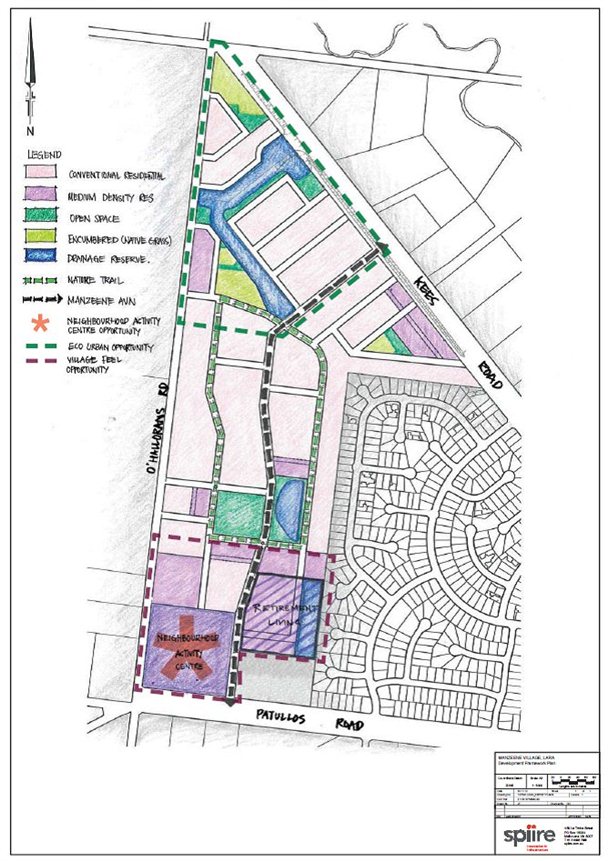
Portfolio: |
Enterprise Geelong – Cr Harwood |
Source: |
Economic Development, Planning and Tourism |
General Manager: |
Peter Bettess |
Index Reference: |
Council Reports 2013 |
This report seeks Council’s endorsement to establish Enterprise Geelong.
It discusses the vision, operating principles, activity and proposed structure of Enterprise Geelong. Appendices to the report outline issues relating to:
local government’s role in investment attraction in the context of research on investment attraction;
investment attraction activities carried out by other levels of government to provide a context for Council’s role in economic development;
Council’s economic strategy and current economic development activities and the emerging strategic directions for economic development;
the importance of alliances.
The proposed governance model is for Enterprise Geelong to be established within the City of Greater Geelong (CoGG) structure, led by an Executive Director who is advised by a skills-based Advisory Board.
Cr Richards moved, Cr Harwood seconded -
endorses the establishment of Enterprise Geelong;
endorses a governance model of an Advisory Board with a Terms of Reference generally as set out in Appendix 2-1, with the following modifications:
a new section is to be added after REPORTS
MEDIA COMMUNICATION
Media communication will be managed through the Council’s Media Unit, unless the CEO authorises another person to be spokesperson on an issue.
under MEMBERSHIP the following is to be added:
“Councillors not appointed to the Advisory Committee will be invited to attend in an observer capacity”
considers the bid for $266,510 for Enterprise Geelong in addition to the Economic Development Unit budget as a priority in the 2013/14 budget.
that the Knowledge Economy, Central Geelong and Primary Industries Portfolio Holders be alternates on the interview panel for selection of the Advisory Committee, where there may be a Conflict of Interest from one of the other panel members. The Knowledge Economy, Central Geelong and Primary Industries Portfolio Holders are to be invited to all preparatory meetings such as those required for short list, etc.
Carried.
The vision for Enterprise Geelong:
Building a stronger, more robust, resilient, diverse and growing economy by pursuing and facilitating employment growth opportunities and encouraging investment in Greater Geelong – it is all about jobs.
A strong and developing community in Greater Geelong needs to be underpinned by a strong, diverse and growing economy. The initiatives we pursue now to build our economy will in many ways define our future community.
Enterprise Geelong will bring a fresh, innovative and focused approach to Greater Geelong’s economic development.
Sustainable employment growth and business investment needs to be given very high priority in Council policies and activities. The small to medium sized business sector needs to be particularly encouraged as a key driver of economic activity and employment, both existing enterprises and potential new ones.
Creating sustainable jobs is a key way to address social disadvantage in Greater Geelong in the medium to long term. It will improve people’s lives and create a stronger community.
We need to show by our actions that Geelong is a ‘Can-Do City’ and that our Council is a ‘Can-Do Council’, building confidence that Geelong is a great place to do business — both for those enterprises already here and those we seek to attract. This does not mean development at any cost, but that we will do our best to facilitate appropriate developments and opportunities.
In this context, Enterprise Geelong will lead Council’s economic development efforts to drive much harder and in a more targeted, commercially oriented manner to achieve sustainable employment and economic growth through more aggressive key performance indicators on sustainable jobs and investment attraction.
Enterprise Geelong will build on the good work done to date by CoGG Economic Development Unit, and the current efforts in this area are acknowledged. However it will represent a significant shift in thinking, approach, philosophy and activities through a much higher level of pro-activity and a shift in emphasis to a more aggressive marketing and business development focus.
Appendix 2-2 contains a detailed description of Council’s current economic development activities and associated issues, which provide a sound basis to the development of Enterprise Geelong.
Through the leadership of the Executive Director and assisted by the Advisory Board, Enterprise Geelong will send a stronger, clearer message to the national and international business market that Geelong is serious and committed to growing our economy.
Its style will be open, progressive and providing a seamless ‘end to end’ facilitation and support service for potential new enterprises and existing ones that want to grow.
Whilst there is a need to continue with analysis, the collection of data, the production of reports, etc. the purpose of this must only be to support and enhance this enhanced marketing thrust.
It is expected that if the recommendations are endorsed by Council at its meeting on 12 March 2013, that Enterprise Geelong will be operational by May/June 2013. In the meantime, the full range of Council Economic Development activities will continue as normal.
To be an active player and facilitator in the local, national and global market place, incentives can be important at times – particularly if competitors are offering this - but should not be our main on-going way of doing business. Geelong should be able to put together a compelling case with all we already have to offer.
In order for Enterprise Geelong to achieve its full potential, it needs to have a separate identity, brand and logo, while still within the City of Greater Geelong structure. It needs to separate from the auspices of the Planning Department to enable each area to focus on their respective streams of expertise, notwithstanding both areas will need to have important links with each other.
Enterprise Geelong will live out all four key Council Values:
Integrity
Responsibility
Innovation
Respect
These relate well to ethical business development and encourage innovation and creativity in achieving good, long term productive outcomes.
Enterprise Geelong will work alongside and complement the activities of existing related organisations and major institutions in Greater Geelong – it is not intended to compete but enhance. It is envisaged that the Enterprise Geelong team will connect with and work alongside key related organisations, marketing Geelong as a great destination for business.
Through Enterprise Geelong, Geelong will be recognised as a genuine, respected and even more active economic development player, with an even stronger sense of urgency and timeliness to achieve jobs growth and investment.
With the assistance of the Enterprise Geelong Advisory Board, the Executive Director and team at Enterprise Geelong will initially conduct a full review of the current approach, targeted industry sectors, key performance indicators and modus operandi, and examine other valuable work that has already been completed, especially the draft G21 Economic Development Strategy.
In summary, Enterprise Geelong will symbolise an acute shift in emphasis and style. It is not window dressing and will be much more than a new name. It represents a ‘sea change’ in the way we do business, account manage and facilitate potential opportunities and aggressively pursue stretch targets and key performance indicators.
Enterprise Geelong will also send a constructive message to all staff and residents that Geelong means business, that we want to build jobs and investment and that we will more actively pursue opportunities than ever before. It also says that we can be judged on our responsiveness, helpfulness, time to market and be recognised as the best regional capital in Australia.
The key to the success of Enterprise Geelong will be maintaining its singular focus on facilitating job creation and encouraging investment.
It will be important to constantly review activities to ensure that Enterprise Geelong is not diverted from these key priorities.
Principles of Operation:
Enterprise Geelong will embrace a culture of:
Facilitation
Can do, service based approach
Here to help make it happen
Outcome based
Enthusiastic
Responsible urgency
Collaboration: Build partnerships and relationships
Main Areas of Activity
The main activities of Enterprise Geelong could include but not restricted to:
Major Activities:
Attract new enterprises from within Australia and overseas, with a strong and effective marketing approach, relationship based.
Champion such possibilities within CoGG organisation and other relevant agencies, making it as easy as possible for such enterprises to succeed in establishing in Geelong.
Work with Deakin and relevant stakeholders to develop new enterprises applying new technologies into commercial application.
Advocate actively with the Victorian and Federal governments for the location in Geelong of major government instrumentalities, building on the successful TAC re-location experience.
Promote opportunities for large companies to relocate part or all of their administration activities to Geelong.
Encourage growth of Geelong’s Port by working pro-actively with Port of Geelong, Victorian Regional Channels Authority, Victorian Government and other stakeholders.
Advocate actively for Avalon to become an international airport and working collaboratively with Avalon on their Master Plan.
Work to establish Geelong's first Business Incubator, if possible in the northern suburbs e.g. Norlane High School site. This would be done in partnership with relevant organizations. If successful, this project could be replicated in the eastern suburbs and the Bellarine Peninsula.
Work with and support existing businesses in Greater Geelong to grow eg. business improvement, exploring new markets, efficiency, etc.
Supporting Activities
Encourage new, appropriate property developments esp. in the CBD.
More actively promote the Geelong Ring Road Employment Precinct
Establish a revitalised ‘Ambassadors for Geelong’ program.
Engage with Business Victoria for better outcomes for Geelong.
Engage with relevant Melbourne-based and national organisations e.g. Melbourne Chamber of Commerce, Property Council.
Engage with relevant State and Federal Govt. Business development and trade activities.
Pursue relevant funding opportunities and other forms of assistance if appropriate.
Build market intelligence, business contact networks, organisational links, etc.
Promote the business benefits of the National Broadband Network for businesses.
Investigate establishing a Buy Geelong program, focusing on both ‘Buy in Geelong’ and ‘Buy of Geelong’. Council should lead this as much as possible with its purchasing policies.
Promote the quality of the produce from our primary industries on the Bellarine and other areas.
The above is not intended to restrict or be the only activities of Enterprise Geelong nor is the distinction between Major and Supporting activities meant to be definitive. It is intended that this list indicates possible productive directions - Enterprise Geelong should be enabled to pursue opportunities across a variety of areas if they will deliver jobs growth and investment.
Alliances and working partnerships are very important, whether formal or informal. Relevant organisations may wish to partner with Enterprise Geelong on specific activities or may offer to take a lead role on specific projects.
On relevant issues, it is intended that Enterprise Geelong work pro-actively with key institutions such as Geelong Manufacturing Council, VECCI, Geelong Chamber of Commerce, Trades Hall, Committee for Geelong, Deakin University, VCAMM, The Gordon, Barwon Health, TAC, G21 Councils, G21 Economic Development Pillar, City of Wyndham, Lead West City of Melbourne, etc. This list is indicative and is not intended to be comprehensive or definitive.
It is intended that Enterprise Geelong will continue to build and improve alliances with Commonwealth and State governments and the private sector to attract investment to Geelong. The G21 alliance of the five regional councils has strength in attracting Government funding to the region.
With a clear results and outcomes focus, it is expected that Enterprise Geelong staff will need to attend and promote Greater Geelong at strategic business conferences, property expos, etc. - expected to be mostly in Australia, NZ, Asia and sub-continent - and relevant trade missions to promote Geelong in Australia and overseas.
It is noted that Enterprise Geelong, as a local government entity, would be bound by National Competition principles and would need to operate on a level playing field with private sector entities. It could not use its local government status to favour. Therefore there has to be a clear separation between the enterprise investment promotion and regulatory roles of the Council.
Organisation Structure
The structure of Enterprise Geelong is proposed to have an Executive Director with significant commercial experience in marketing, business development, export / import or overseas, commercial property, government liaison, etc.
The Executive Director of Enterprise Geelong will be a Council employee and be advised by the Enterprise Geelong Advisory Board. The position of Executive Director, Enterprise Geelong will be advertised. The options which were considered for the establishment of the Advisory Board are outlined in Appendix 2-3.
Existing council staff will form the staff of Enterprise Geelong. In conjunction with the CEO, the Executive Director will determine an appropriate organisational structure. Unions and staff will be consulted as required due to the change in organisation arrangements.
Enterprise Geelong will need its own brand and logo, within the CoGG recognised corporate identity.
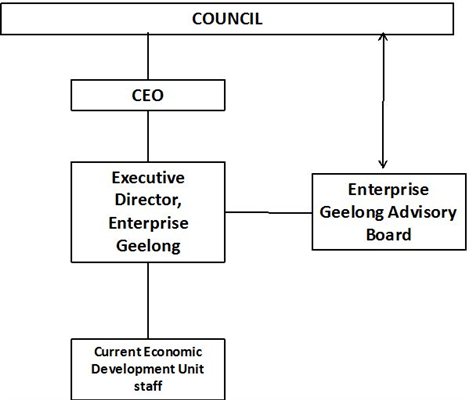
Enterprise Geelong Advisory Board
The purpose of the Enterprise Geelong Advisory Board is to:
Provide expert and strategic advice and support to Enterprise Geelong Executive Director.
Assist in identifying employment, business, investment and other relevant opportunities.
Assist with and activate contacts and networks
A draft Terms of Reference for the Advisory Board is in Appendix 2-1. The Board is proposed to meet monthly in first six months. The Board will then review the frequency of meetings.
The Board is proposed to comprise seven to ten members appointed by the Council following a public Expressions of Interest process.
The criteria for membership will be set to provide for a Board with experience across a range of disciplines including business development, marketing, commercial property, international business and financing. It is expected that each member will need to be commercially experienced and well-connected to business and/or government. Members will not represent any organisation but apply their personal skills, experience, knowledge and contacts. Membership is honorary.
There are no environment implications relevant to this report.
The existing Economic Development Unit budget is $879,037. It is estimated that additional funding of $266,510 is required to achieve the objectives for Enterprise Geelong. The budget proposed for Enterprise Geelong is $1,145,547. On-going recurrent funding will be considered in the 2013/14 budget process. This indicative budget does not include any office fit-out that may be required.
State Government assistance will be sought, where appropriate, to support the activities of Enterprise Geelong.
There are no significant legal issues and any that may arise will be addressed through the establishment process.
No Council officers associated with the writing of this report have any direct or indirect interest, in accordance with Section 80© of the Local Government Act.
There are no significant risks associated with this report. Risks relating to the establishment and operation of Enterprise Geelong will be managed as part of the establishment process.
The establishment of Enterprise Geelong will assist in addressing some of the social issues relating to the lack of employment opportunities in the community.
A communication plan will need to be established.
OBJECTIVE
The Enterprise Geelong Advisory Board will assist Council to achieve sustainable employment growth in a strong, diverse and growing economy to underpin the development of the Geelong community.
AUTHORITY
The Enterprise Geelong Advisory Board is to be established as an Advisory Committee by resolution of the Council. It is an Advisory Committee to Council management.
It is proposed that the Council would call for Expressions of Interest for the Board. Applications would be assessed by a Sub-Committee of Council consisting of Mayor, Enterprise Geelong Portfolio Holder and CEO and then make a recommendation to Council to appoint Members.
The Council will then appoint the members and a person as Chairperson of the Advisory Board. In the absence of the Chairperson at a meeting, the Advisory Board will elect a Chairperson from the members present to chair that meeting.
ADVISORY BOARD RESPONSIBILITIES AND FUNCTIONS
The Advisory Board will be responsible for
Providing expert and strategic advice and support to Enterprise Geelong Executive Director;
Assisting in identifying enterprise and other opportunities that will achieve the greatest return on Council’s investment in economic development; and
Assisting with contacts and networks to proactively promote Geelong as an attractive investment destination.
MEMBERSHIP
The Advisory Board shall consist of up to ten (10) persons. The composition of the Board will be “skills based”. Members will comprise people with experience and standing in the following areas:
Council Enterprise Geelong Portfolio Holder
Investment/banking/finance
Business/commerce
Education/training
Marketing/promotion
Research/innovation
International business development
Government relations
Mayor (ex officio)
A vacancy for a member (not being a Councillor) may occur upon their resignation, death, failure to attend without cause three consecutive meetings, or by removal by resolution of the Council.
The Advisory Board may establish informal sub-committees or working groups comprising Advisory Board members or other persons to assist in fulfilling its responsibilities and functions.
OBLIGATIONS OF ADVISORY BOARD MEMBERS
Advisory Board Members, in performing their duties, shall:
Act in accordance with Council’s Values
Act honestly and in good faith.
Participate in the work of the Advisory Board.
Perform their duties in a manner that public trust in the integrity, objectivity, and impartiality of the Advisory Board is conserved and enhanced.
Exercise the care, diligence and skill that would be expected of a reasonable person in comparable circumstances.
Comply with the Terms of Reference of the Advisory Board.
Comply with Council’s Code of Conduct
CONFLICTS OF INTEREST
In the event of a conflict of interest arising for any member of the Advisory Board, the conflict must be immediately declared and the member must leave the room and abstain from any discussion or decision making regarding the matter.
MEETINGS AND MINUTES
The Advisory Board will establish its own schedule of meeting which it will provide to the Council. It is anticipated that the Board will meet monthly for the first six (6) months then determine its own meeting pattern, although it is expected to be no less than six (6) times per year. Advisory Board members must be either physically present at the meeting or participate in the meeting through pre-arranged technologies.
Meetings of the Advisory Board shall be called by the Chairperson with notice of the meeting being forwarded to members with an agenda with at least seven (7) day’s notice.
The quorum for meetings shall be as shown in the following table.
|
Number of Members appointed |
Quorum |
|
10 |
7 |
|
9 |
6 |
|
8 |
5 |
|
7 |
4 |
|
6 |
4 |
If the Board decides to record a vote, the Chairperson will have a casting vote, as well as an original vote.
Advisory Board meeting minutes are to be approved for distribution by the Chairperson and confirmed at the next Meeting of the Advisory Board. The Minutes will be distributed to Advisory Board members, Councillors, Council’s Executive Management Team and available on Council’s website for general access. As per normal Council procedures, any items of a commercial in-confidence nature will be excluded from the publicly available minutes.
REPORTS
Advice and recommendations of the Advisory Board relating to specific Council projects and policies will be reported to Council as part of the project reporting process.
Any other matters identified by the Advisory Board that require a separate decision of Council will be reported to Council by the Executive Director, Enterprise Geelong through the CEO.
The Advisory Board shall submit a report of its activities to the Council at least annually.
EVALUATION AND REVIEW
A review of the Enterprise Geelong Advisory Board will be undertaken every two years to ensure that the purpose, membership and operation of the board is current and to make appropriate changes if required.
REMUNERATION AND EXPENSES
There is no remuneration for members.
Reimbursement of reasonable expenses incurred by members in relation to their responsibilities as members of the Advisory Board will require prior approval. These expenses must relate directly to tasks completed for the Advisory Board business and will be reimbursed at the discretion of Council.
No member of the Advisory Board will incur any expenses in relationship to his or her activities as a member of the Advisory Board, without prior approval of Council’s nominated officer.
TERM OF APPOINTMENT
Board members will be appointed until 29 October 2016 to coincide with the term of the current Council.
Local government is limited in its ability to directly influence or control most of the factors either in triggering investment decisions or making decisions on location. The areas where local government can influence are:
Marketing of locational advantages e.g. workforce skills, lifestyle attributes, raw materials and synergies with other industries, infrastructure.
Information and research.
Limited incentives through rate concessions or land provision
Regulatory – ‘fast track’ development approvals and local policies to support investment
Advocacy
Each level of government carries out investment facilitation. Enterprise Geelong’s success will depend on effectively using resources of other levels of government rather than competing with them. Establishing alliances with existing government agencies will be vital to the success of Enterprise Geelong.
Austrade
The Australian Trade Commission – Austrade – is the Australian Government’s trade, investment and education promotion agency. Its role is to advance Australia's international trade, investment and education interests by providing information, advice and services.
Austrade has a network of offices in over 50 countries specifically to:
Help Australian companies to grow their business in international markets, including through administration of the Export Market Development Grants (EMDG) scheme and the TradeStart program.
Provide coordinated government assistance to attract and facilitate productive foreign direct investment (FDI) into Australia.
Promote the Australian education sector in international markets and assist Australian education providers with market information.
Provide advice to the Australian Government on its trade and investment policy agenda.
Manage the Building Brand Australia program to enhance awareness of contemporary Australian skills and capability and enrich Australia’s global reputation.
Regional Development Australia
Regional Development Australia (RDA) is a partnership between the Australian, state and territory and local governments to support the growth and development of Australia's regions.
A national network of 55 RDA committees has been established to provide a strategic framework for economic growth in each region.
The RDA committees work to:
support informed regional planning
consult and engage with the community on economic, social and environmental issues, solutions and priorities
liaise with governments and local communities about government programs, services, grants and initiatives for regional development
contribute to business growth plans and investment strategies, environmental solutions and social inclusion strategies in their region.
There are nine RDA committees in Victoria.
Regional Development Australia Barwon South West works in partnership with community, business and all levels of government to support and contribute to strategic regional development across the region.
RDA BSW has as its core responsibilities:
To be a key facilitator of strategic change and economic, social and environmental development in the region
To be the link between government, business and the community
To facilitate whole of government responses to opportunities in the community.
Commonwealth regional funding is primarily channelled through the RDAs.
Invest Assist - Department of Business and Innovation
The Department of Business and Innovation (DBI) engages with businesses and represents their needs to all levels of government; provides strategic economic planning advice and targeted business development assistance; encourages investment and trade; and markets Victoria in Australia and internationally. DBI through Invest Assist facilitates and assists with the coordination of private sector investments in Victoria and, as the client, oversees the development and operation of significant public private partnership projects on behalf of Government.
The three key functions performed by Invest Assist are:
Business Victoria is DBI’s web portal for Government information on starting, running and growing a business. Enterprise Geelong will need to work with DBI to link to the Business Victoria website to promote Geelong as a place to invest and grow a business.
Regional Development Victoria - Department of Planning and Community Development
Regional Development Victoria (RDV) is the Victorian Government’s lead agency in developing rural and regional Victoria.
Its focus is on investment attraction, job creation, exports, creating stronger economies, communities and infrastructure to create a strong and growing regional and rural Victoria. RDV has a number of programs to:
promote business and industry development
work with local government and communities
help new businesses establish themselves
pave the way for existing industries to grow and diversify
The Geelong Economic Development Strategy 2005-2010 provided a framework for Council activities in economic development. The review of the Council’s strategy is part of the development of the G21 Economic Development Strategy. A draft G21 Economic Development Strategy has been completed for consideration by G21 Councils in early 2013. Some key recommendations of the draft Strategy are discussed in the Emerging Strategic Context heading in this paper.
The 2005-2010 Strategy has three key themes:
Strategic growth sectors, including:
Knowledge, innovation and research
Advanced Manufacturing
Health
Tourism
Small, Micro and Home Based Business
Food and Horticulture
Foundation Projects
Infrastructure
Workforce Skills and Capacity
Business Support Services
Bridging Initiatives
Investment attraction
Strategic Partnerships and Alliance
Investment Facilitation
Strategic growth sectors
bioGeelong – The major project is the Geelong Centre for Emerging Infectious Diseases (GCEID ) with an application ready for lodgement in December 2012 for the Regional Australia Infrastructure Development Fund.
ICT – supporting the ever-growing information communications and technology sector in Geelong – a very active sector with key annual events of the invention test to provide for support for start-up ICT businesses.
Sport and technology - a national cluster centred in Geelong providing support for the growth of individual firms in this growth sector in Australia. The sector includes multiple universities, and major private sector interests, with the recent conference being a significant success for the cluster in its initial days.
Food and co-products cluster – a major success across particularly the agriculture sector with the development of major collaborations and commercial joint venture between fish processors in Geelong. This cluster has been rated by the State Government as the most successful cluster in the State.
Agribusiness – this cluster supports the production of agricultural produce across the region and the growth of processing and supply chain support for the agricultural sector. Again a recent conference held in Geelong was a success and provides significant momentum for growth of this cluster.
Geelong Manufacturing Council/Engineering Network – The City of Greater Geelong supports and is intimately involved with the Geelong Manufacturing Council and Engineering Network. The Council’s work with this major sector of our economy, includes membership of the Geelong Manufacturing Council and working hand-in-hand with the executive officer on a daily basis in progressing projects across leadership in manufacturing, quality enhancement processes, lean manufacturing, and waste wise approach to manufacturing.
Foundation Projects
Infrastructure
Strategy development for the development of private and publicly held land across the Geelong Ring Road Employment Precinct (GREP) – currently delivering serviced land in the south O’Brien’s catchment, and developing strategic direction for the northern catchment to open up significant tracts of industrial land for development for the future for jobs in the north. This is a major effort of Economic Development Unit and there is a dedicated project manager for this project.
Wi-Fi Services across Central Geelong. The Economic Development unit has been responsible for the development with Central Geelong and Engineering Services for the Wi-Fi network which now services Central Geelong in partnership with other stakeholders including Deakin University.
Workforce Skills and Capacity
Council undertakes a range of training on a regular basis in consultation with Small Business Victoria and other State agencies, and private sector agencies.
Major training initiative is the Small Business Festival run during the month of August with in excess of 40 events run during the month to provide a raft of training to small business. The City of Greater Geelong’s Economic Development Unit coordinates this entire activity with minimal support from the State Government and is recognised as a leader in the State in this work.
The Skilled Migration Program continues under the control of the Economic Development Unit with support for key placements across the health, manufacturing and full range of sectors in the economy to fill key gaps that have not been able to be filled by local workers. Currently working with in the order of 300 businesses at any one time and have filled over 200 key placements in businesses across the region. Council is taking on the regional certifying body responsibilities and will be responsible for certification of businesses as meeting relevant criteria for engagement of skilled overseas professionals.
Business Support Services
Business support – this includes business visits with over 100 individual businesses visited in the calendar year to date, with individual issue ranging from support for alfresco dining applications, to engagement of mentor services to help grow the business. These businesses visits are conducted by three - four individuals across the Economic Development Unit and are a core part of our operation to ensure that we provide whatever assistance possible for business to prosper in Geelong.
Out of the businesses visits program Geelong Business TV has grown, which is a marketing/showcase opportunity for individual businesses to demonstrate their innovation and operations across Geelong and beyond. This tool is a marketing technique to grow credibility of Geelong as a place to do business and invest.
Information/statistical support – a major function of Economic Development Unit is the development of the Economic Indicators Bulletin on an annual basis; provision of a monthly Economic Development Indicator; and specific support for all business and public sector organisations in the development of statistical/data required as part of the business case and/or funding submissions. This is a major plank of Economic Development Unit’s operation.
The City hosts and assist in the delivery of outplacement services with the Department Business and Innovation for the major firms which have experienced downturns and the necessity to go through a compulsory redundancy processes, currently undertaking the Ford processes with Department of Business and Innovation.
Bridging Initiatives
Investment attraction
Major marketing efforts include producing Cityscope on an annual basis (document marketing the activities business development and business growth across Geelong). The Council’s support of the Regional Living Festival run on a State-wide basis, resulted in Geelong being one of the most prominent regions at the recent Victorian Provincial Living Festival.
Strategic Partnerships and Alliance
Economic Development Unit is the lead unit in the liaison with major businesses of Alcoa, Shell, Ford and Avalon Airport in development of the strategic planning initiatives, liaison with other tiers of Government with Economic Development Unit leading the support full Council in the lobbying of Federal and State Government in relation policy position/carbon trading system with its major impact on Alcoa’s operations.
Support for Avalon Airport via attendance at Super Trade Mission to China with State Government in the aerospace and aeronautic areas given the significant role that Avalon Airport plays as a regional economic development driver.
International engagement of Council is predominantly undertaken by the Economic Development Unit with support from many international missions, and provision of materials to all State and Austrade offices worldwide to ensure that Geelong is marketed to the world.
The City supports the Economic Development Pillar for G21 providing the Chair and Co-chair in Terry Demeo and Roger Grant respectively and has provided the management for the draft Economic Development Strategy which will be brought back to Council for ratification in the next little while. Major economic directions out of G21 are predominantly influenced by the City of Greater Geelong.
Work with Regional Development Victoria and Department of Business and Innovation and Regional Development Australia
The key State and Federal agencies across Geelong have their strongest link liaison across the City with the Planning Strategy and Economic Development Unit with regular meetings and coordination of activity given the complementary nature of our work.
Investment Facilitation
Investment facilitation at GREP
The Economic Development Unit is working with Planning Strategy on the implementation planning for the NBN rollout with the NBN company and industry capability network to ensure a smooth rollout and to identify opportunities for business to take advantage of the NBN and to engage with businesses that may be able to provide services as part of the rollout.
Working with private and public sector to develop land for mussel spat hatchery to allow for expansion of mussel/shellfish industry across Port Phillip Bay.
The draft Strategy developed by the AECGroup supports the directions suggested for Enterprise Geelong. The draft G21 region economic development strategy examined three scenarios
Scenario 1 - More of the same
Scenario 2 - Building on our regional strengths
Scenario 3 - Focusing on “game changer” projects that have the potential to transform the region
The first two scenarios were considered to be able to be delivered by local government under the current economic development and governance structures. The preferred scenario 3 required new mechanisms for delivery. The consultants identified the following outcomes associated with the “game changer” scenario:
|
Attribute |
Outcome of strategy delivery |
|
Future population |
500,000+ People |
|
Labour Force Capacity |
New range of skills – individual are skilled in new areas and industries, with new skills being attracted to the region to assist in broader capability development of the labour force |
|
Economic Diversity |
A diverse economy with a focus on industry with strong flow on effects |
|
Cultural Activity |
A highly sought after region of choice, attracting attendance from outside the region |
|
Innovation |
Global centre of innovation and commercialisation |
|
Infrastructure |
Key infrastructure is planned for and delivered ahead of time |
|
Governance |
Leading with shared strategic vision |
|
Regional Perception |
Identified and recognised as a region of choice |
|
Role and Function |
Provide high-level service centre alternative to Melbourne Central Activity Centre for Victoria |
The identified game changing projects are:
Completion of the Ring Road with Surf Coast, Bellarine Peninsula, Bannockburn and Colac connections;
Geelong City Centre Reactivation;
Coordinated Delivery of Critical Infrastructure to Support Growth;
Globally Significant Innovation & Research Centre; and
G21 is Open for Business
The AECGroup also reviewed governance models and recommended a new entity for the delivery of the game changers. This was premised on a singular focus on achieving the game changers without the pressures of other day-to-day activates.
One of the key issues for Enterprise Geelong will be whether it focuses on the game changers or the broad range of economic development functions. It is important that the functions assigned to Enterprise Geelong do not divert its focus from the activities that will achieve job creation.
Three broad options were considered for constituting the Board:
Option 1 – an advisory board guiding a Council business unit;
Option 2 – a statutory council committee;
Option 3 – a Council business entity.
Option 1 - Advisory board or committee overseeing or guiding a council business unit.
Example: Armidale Economic Development Committee in New South Wales. This committee brings together business, university and council to inform the Armidale Dumaresq Council’s economic development activities.
Advantages
Provides a forum for private sector advice to Council on economic development activities
Directly accountable to the council for outcomes
Low cost
Disadvantages
Operates under direct council control
Option 2 – Council created entity reporting to Council on annual outcomes
The Council could establish the Board of Enterprise Geelong as a Section 86 Committee with delegated powers from the Council. Enterprise Geelong staff would be Council staff. Council funding and ultimate control is through the setting of an annual outcome-based work plan. A Council appointed board would oversee the performance against the Council approved annual outcomes-based work plan.
Example: Mildura Development Corporation
This is a similar governance arrangement to Geelong Otway Tourism.
Advantages
Delivery/outcome focused board driving performance
Provides a forum for private sector advice to Council on economic development activities
Directly accountable to the council for outcomes
Disadvantages
External funding may be limited
Operates within the council bureaucracy
Option 3 – Incorporated entity as a council enterprise
Enterprise Geelong would be established as an incorporated entity.
Example: New York Economic Development Corporation (NYEDC)
Advantages
Independent entity operating under a board/CEO structure
Allows for external funding
Able to quickly react to issues
Disadvantages
Council has less control over activities
Council still bears the political risk of failures
Would need to comply with the Council enterprise provisions of the Local Government Act.
Conclusion
Option 1 is preferred by the Council as it retains the Council’s decision making role in policy, resource allocation and specifying outcomes to be achieved by Enterprise Geelong.
Portfolio: |
Governance – Cr Fagg, Mayor |
Source: |
Corporate Services – Financial Services |
General Manager: |
Jeff Wall |
Index Reference: |
Subject/Roads, Footpaths & Streets |
Council resolved at its’ meeting held on 8 May to commence a process of investigation and consultation to realign the locality boundaries between Drysdale and Clifton Springs.
After a process of community consultation, Council considered a further report on 13 November 2012 regarding an amended proposal to Area 1 of the Drysdale and Clifton Springs boundary realignment.
The amended proposal for Area 1 was advertised in the City News section of the Geelong Independent on 23 November 2012 and the Geelong Advertiser on 24 November 2012.
Two submissions were received in favour of the proposal and no submissions were against the proposal.
Once Council adopts the recommended amended boundary realignment, registration will occur in accordance with Geographic Naming requirements.
Cr Macdonald moved, Cr Ellis seconded -
That Council approves the amended boundary realignment for Area 1 as follows:
To extend the existing Clifton Springs boundary from the rear of the property known as 52 Delungra Avenue in an easterly direction to the south east corner of the property known as 54A Delungra Avenue, then continue the Clifton Springs boundary north to intersect with the existing boundary at the rear of the properties known as 7 Wintersun Court and 12 Waterford Place (refer Appendix A).
Carried.
Council is responsible for allocating geographic locality boundaries. Council received advice dated 16 February 2012 from the Registrar of Geographic Names requesting that in the interests of public safety Council proceed with a boundary realignment between Drysdale and Clifton Springs, west of the Geelong-Portarlington Road.
Principal 3(A) of the Guidelines for Geographic Names 2010 stipulates that locality boundary should align with the cadastral fabric, road centre lines or easily distinguishable topographical features. In accordance with Section 3.2.1 of the guidelines, the Registrar may request Council to amend a locality boundary in the interests of public safety.
The locality boundary between Clifton Springs and Drysdale, west of the Geelong-Portarlington Road, passes through numerous residential properties in Wintersun Court and Narawi Avenue which is creating particular confusion for emergency and communication services.
Ambulance Victoria has emphasised the need for correct locality to avoid confusion in an emergency response situation. In this case, the locality boundary does not comply with Principal the Guidelines.
Council resolved on 8 May 2012 to commence a process of investigation and consultation to realign the locality boundaries between Drysdale and Clifton Springs.
Following the community consultation process, including public meetings held on 8 and 15 August 2012, it was determined as part of the communities request to amend the Area 1 proposal.
A further report was tabled at the Council meeting of 13 November 2012, with a revised proposal for Area 1 agreed.
This proposal was advertised in the City News section of the Geelong Independent on 23 November 2012 and the Geelong Advertiser on 24 November 2012. Letters were sent to all affected property owners / residents at this time advising them of the amended proposal. No submissions were received against the proposal and two submissions were received in favour of the amended proposal thanking Council for listening to resident concerns.
The above proposal meets the requirements of the Guidelines for Geographic Names 2010.
There are no environmental issues arising from this report.
Council offers a standard assistance package to residents when their property address is altered. This assistance package consists of 10 postage paid envelopes and 10 Change of Address forms. Other assistance may be offered on a case by case basis.
The Geographic Place Names Act 1998, the Guidelines for Geographic Names 2010 and Council Policy have been followed and met.
There is no officer direct or indirect interest in this report.
Council’s proposal to realign this boundary will minimise the risk of emergency services not being able to locate properties.
The realignment of this boundary will allow for easier identification to the public and utility services in case of an emergency.
The proposed realignment was advertised in the Geelong Independent newspaper on 23 November 2012 and the Geelong Advertiser newspaper on 24 November 2012. Letters were also sent to the affected owners in Area 1 advising of the proposed realignment.
Subject to Council and the Registrar of Geographic Names approval, the relevant authorities and affected owners will be notified of the official Registration of the new alignment.
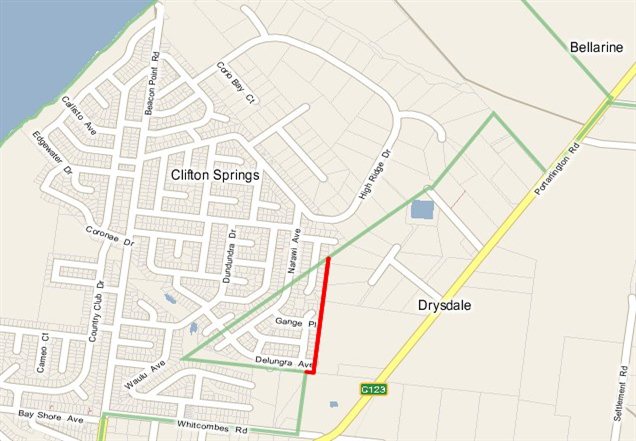
Portfolio: |
Tourism and Major Events - Cr Nelson |
Source: |
Economic Development, Planning & Tourism |
General Manager: |
Peter Bettess |
Index Reference: |
Subject: Tourism Administration |
The City of Greater Geelong is a foundation partner of Geelong Otway Tourism Inc. The partnership has existed since 1993.
The partnership with Geelong Otway Tourism and the other four member Municipal Councils of the Geelong Otway Region is detailed through a Memorandum of Understanding and further outlined in Councils Tourism Policy.
The performance of the tourism industry under the leadership of Geelong Otway Tourism remains very strong at both the Municipal and Regional level.
The State Government through Tourism Victoria has reviewed regional tourism structures across the State and as part of that process established an Interim Great Ocean Road Tourism Board to present to State and Local Government structural options for the Great Ocean Road Region.
The City of Greater Geelong is included in the Great Ocean Road Region that encompasses the area from Geelong to the South Australian Border.
The Interim Board has presented a Report to Stakeholders that details the establishment, strategic objectives, priorities, governance and recommended structure of the new Regional Tourism Board for the Great Ocean Road Region.
The Report to Stakeholders, after consideration of three structural options recommends a fully integrated structure for the total Great Ocean Road Region that would transfer all tourism staff, funding and facilities to the proposed new Regional Tourism Board to be called ‘South West Victoria Regional Tourism Pty Ltd’.
The Report makes 19 recommendations and states that the new structure should commence at the start of the 13/14 financial year and it initially be supported by base funding of $345,000 from Tourism Victoria with Local Government in the region maintaining current contribution levels (2012/13 COGG Tourism Administration budget $926,552).
The tourism industry through Geelong Otway Tourism has considered the Report to Stakeholders and has resolved to support the establishment of a consolidated structure for the Great Ocean Road Region but only on the basis of the establishment of a new financial model to underpin the structure. The new financial model would have to include a significant increase of funding by Tourism Victoria, a more equitable contribution from Local Governments throughout the region and a more realistic contribution from industry to sustain the structure and deliver quality outcomes for the tourism sector.
Tourism Victoria has requested that Council provides a written response to the Report’s recommendations by 31 March 2013.
Cr Nelson moved, Cr Harwood seconded -
That Council:
writes to Tourism Victoria acknowledging and supporting the primary recommendation of the ‘Report to Stakeholders’ to establish a consolidated Regional Tourism Structure for the total Great Ocean Road Region. This support however is based and conditional upon the establishment of a new financial model to deliver the proposed consolidated Regional Tourism Structure.
requests that the new financial model addresses to the satisfaction of Council the following areas of concern:
A significant increase in funding by Tourism Victoria to better reflect the status of the proposed new regional structure and to represent a fairer more equitable partnerships arrangement with both Local Government and industry partners.
An adjusted and more equitable contribution level between all municipal partners based on tourism specific benchmarks that better reflects the municipal benefit derived from the partnership structure.
All contribution levels (Local Government and industry) reflect the current financially challenging environment and that levels of contribution be established that are sustainable, equitable, transparent and realistic.
will continue to retain and fund Business Events and Visitor Information Services and as such both those functions will be excluded in the funding model and business plan of the proposed new regional tourism structure.
will work in partnership with the tourism industry and neighbouring Councils to establish a more localised tourism structure that better services the needs of both industry and the City of Greater Geelong, if a satisfactory financial model that addresses all of Councils concerns can not be established.
Carried.
Geelong Otway Tourism Inc was established in 1993 as a regional tourism body following the amalgamation of municipalities to create the City of Greater Geelong.
A regional approach to tourism was adopted following direction and advice from both the Australian Tourist Commission and Tourism Victoria.
The newly created City entered into a partnership with the tourism industry as represented by four local tourism associations (Tourism Geelong, Bellarine Tourism, Otways Tourism and Surf Coast Tourism).
The basis of the partnership is that the City provides resources for staffing, accommodation and administration for the regional body whilst the tourism industry through membership, sponsorship and advertising, funds the annual marketing and development program.
This partnership has been most effective and the Geelong Otway Tourism region now includes Surf Coast Shire, Colac Otway Shire, Golden Plains Shire and the Borough of Queenscliffe and the relevant local and municipal tourism bodies that fall within these municipal boundaries.
In Geelong, the role was subsequently expanded to now include co-ordination, management and operations of Visitor Information Centres as well as facilitation and marketing of Business Events (Meetings, Incentives, Conferences and Exhibitions - MICE).
At present, and in partnership with Tourism Victoria and the relevant local tourism associations (Tourism Geelong and Bellarine Tourism), a structural review has been undertaken to explore better integration across the Great Ocean Road Region (Barwon South West Region). The State Government has committed additional resources to market Geelong and the Bellarine in their own right for intrastate promotion and branding.
The two Local Tourism Associations located within the City of Greater Geelong, Tourism Geelong and Bellarine Tourism, have agreed in principle to explore the potential to join forces to create a new single entity “Tourism Geelong/Bellarine.”
At the request of the Local Tourism Association’s, Geelong Otway Tourism is working with a contracted Governance Consultant (Corporate Assist) to present to the LTA’s the most cost efficient clear path to amalgamation. This joining of forces requires member support as per their Statement of Rules as Incorporated Associations.
It is proposed that these changes will be considered by the membership for introduction at the commencement of 13/14 Financial Year.
Effective regional industry structures are a key factor in building successful tourism destinations. The partnership model established in the creation of Geelong Otway Tourism has performed strongly now for over 20 years. The structure of Victoria’s regional tourism industry is facing a number of new challenges due to the rapidly changing environment which needs to be addressed to provide a stronger platform for improved performance and growth. Through the consolidation and devolution of State funding through to the new structures greater efficiencies and coordination of program and funding may occur.
Geelong and the Bellarine have matured as destinations since the establishment of Geelong Otway Tourism. The product strengths of Geelong and the Bellarine are compatible but different to the nature based product of the Great Ocean Road. Geelong and the Bellarine have a unique and distinct brand and are marketed as stand alone destinations in Melbourne and some intrastate markets. Marketing activity for Geelong and the Bellarine includes destination specific visitor’s guides, website, social media, public relations, advertising and tactical marketing. Geelong and the Bellarine however have a close and beneficial relationship with the Great Ocean Road particularly for interstate and international markets.
It should be noted that regardless of organisational structure, Geelong and the Bellarine will continue to be marketed as stand alone destinations with the promotion of their unique and separate experiences, locations and townships.
In any of the structural options, the issue of equity of contribution is a critical factor. This is particularly so when some of the region has a high level of non-permanent population (non-residential rate payers). It should also be noted that municipalities across the Great Ocean Road region have differing capacities to both generate income and to make existing and increased contributions to tourism at both the local and regional level.
The table below details in percentage terms Local Government area by rateable property, tourism employment and population as a potential guide to equitable contribution:
|
Local Government Area |
Rateable Properties in 10/11 |
% of Total |
Tourism Jobs as per Destination Management Plan |
% of Total |
2011 Estimated Residential Population |
% of Total |
|
Geelong |
104,069 |
53% |
3,355 |
48% |
215,151 |
58% |
|
Surf Coast |
19,070 |
10% |
792 |
11% |
26,493 |
7% |
|
Colac Otway |
14,398 |
7% |
643 |
9% |
20,578 |
6% |
|
Queenscliffe |
3,002 |
2% |
226 |
3% |
3,054 |
1% |
|
Golden Plains |
4,685 |
2% |
48 |
1% |
18,917 |
5% |
|
Glenelg |
9,448 |
5% |
401 |
6% |
19,843 |
5% |
|
Moyne |
10,936 |
6% |
277 |
4% |
16,175 |
4% |
|
Corangamite |
15,478 |
8% |
325 |
5% |
16,504 |
4% |
|
Warrnambool |
13,890 |
7% |
930 |
13% |
32,592 |
9% |
|
Total |
194,976 |
100% |
6,997 |
100% |
369,307 |
100% |
As the tourism employment table is an industry specific benchmark it would therefore best constitute the most equitable model of Local Government contribution.
In addition, the table below presents each Local Government Area relating to National Visitor Survey and International Visitor Survey visitation providing a percentage comparison against visitors and nights. It should be noted that this equity model is related to the location of accommodation in the region which does skew the outcomes.
|
Travel to Great Ocean Road by local government area, YE Sep 12 |
|
|
Visitors ('000) |
Nights ('000) |
|
Local Government Area |
Domestic overnight visitors |
Domestic daytrip visitors |
Int. overnight visitors |
Total visitors |
% of Total |
Domestic nights |
Int. nights |
Total nights |
% of Total |
|
Greater Geelong |
764 |
2,691 |
36 |
3,491 |
41% |
2,226 |
733 |
2,959 |
34% |
|
Queenscliffe |
192 |
174 |
3 |
369 |
4% |
496 |
20 |
516 |
6% |
|
Golden Plains |
19 |
247 |
1 |
267 |
3% |
33 |
3 |
36 |
0% |
|
Surf Coast |
615 |
835 |
29 |
1,479 |
18% |
1,856 |
216 |
2,072 |
23% |
|
Colac-Otway |
377 |
485 |
46 |
908 |
11% |
973 |
104 |
1,077 |
12% |
|
Corangamite |
102 |
210 |
22 |
334 |
4% |
330 |
61 |
391 |
4% |
|
Moyne |
177 |
97 |
18 |
292 |
3% |
517 |
54 |
571 |
6% |
|
Warrnambool |
277 |
693 |
22 |
992 |
12% |
690 |
84 |
774 |
9% |
|
Glenelg |
144 |
156 |
11 |
311 |
4% |
391 |
32 |
423 |
5% |
|
TOTAL REGION |
2,667 |
5,588 |
187 |
8,442 |
100% |
7,512 |
1,307 |
8,819 |
100% |
|
|
|
|
|
|
|
|
|
|
|
|
ESTIMATES HIGHLIGHTED IN RED ARE CONSIDERED STATISTICALLY UNRELIABLE AND ARE FOR INTERNAL USE ONLY |
|
| Sources: NVS and IVS, YE Sep 12, Tourism Research Australia |
Interim Board
Tourism Victoria appointed Mr Wayne Kayler-Thomson to be the Chair of the Great Ocean Road Interim Regional Tourism Board. The Interim Board consists of representatives of the nine Municipal Councils in the Great Ocean Road Region (Geelong to the South Australian Boarder) and the two Regional Tourism Boards, Geelong Otway Tourism and Shipwreck Coast Marketing.
The Interim Board have distributed a report to Local and State Government that details and recommends the establishment, strategic objectives, priorities and structure of a new Regional Tourism Organisation.
It should be noted that the City of Greater Geelong and all Municipal Councils and Industry partners have been requested to formally report in writing to the Report to Stakeholders.
Report to Stakeholders
The Report states that there is a compelling case to support the establishment of a new Regional Tourism Organisation with a skilled and representative Board to provide leadership to meet the changes and maximise tourism competitiveness for the Great Ocean Road Region. The Report goes on further to state that the tourism performance of the Great Ocean Road Region currently falls short of being Australia’s foremost sustainable destination delivering outstanding visitor experiences and being valued by its community and stakeholders for achieving balanced economic, social, environmental and cultural benefits to the destination and region. The Report concludes that a new generation Regional Tourism Organisation is proposed and that the organisation will need to be competitively resourced by Governments (especially Local Government) and the industry over the next three years.
The Report recommends:
The establishment of a new Regional Tourism Organisation (South West Victoria Regional Tourism Pty Ltd) for the geographic area incorporating the Local Governments from Greater Geelong to Glenelg (Geelong to the South Australian border).
The new Board would have two Council representatives from the G21 Councils and two from the Great South Coast Councils, five skills based industry Board members, an independent Chair and ex-officio representation from Tourism Victoria, Parks Victoria and Regional Development Victoria.
Geelong Otway Tourism (and Shipwreck Coast Tourism) be wound up and its functions, funding contributions and staffing be transferred to the new Regional Tourism Organisation. The financial model assumes that Council will continue to support the funding of premises and facilities as currently provided to Geelong Otway Tourism (as per GOT Administration budget).
That Local Government considers what functions (Visitor Information Services, Business Events and Cruise Ship Marketing etc) be retained or transferred to the RTO and the relevant resource mix (staffing, funding, facilities and support).
The current total staffing and funding contributions by Local Governments for tourism be maintained as a minimum for the 2013/14 financial year, however be delivered by the proposed new structure.
That the Competitive Financial Model contributions be applied in year 1, in addition to transferred resources, with progression to the Optimum Model over 3 years.
Discussion – Performance
Tourism Research Australia (TRA) is an independent arm of the Commonwealth Government that collects, collates and reports on Regional visitation by both domestic and international visitors. The following data is from the latest TRA report for Geelong for the year ending September 2012.
‘Geelong’ as defined in the TRA data includes The City of Greater Geelong and the Borough of Queenscliffe.
Visitation – Year Ending September 2012
|
Domestic Arrivals - Geelong |
|
TOTAL |
%Change 00/12 |
%Change 11/12 |
AAG 00/12 |
AAG 08/12 |
|
Geelong 955,000 |
+11.4% |
+10.9% |
+0.9% |
+0.5% |
|
Regional Victoria 11,725,000 |
-0.6% |
+7.0% |
-0.0% |
-0.5% |
|
|
|
Domestic Nights - Geelong |
|
TOTAL |
%Change 00/12 |
%Change 11/12 |
AAG 00/12 |
AAG 08/12 |
|
Geelong 2,772,000 |
+22.1% |
+18.7% |
+1.7% |
+3.0% |
|
Regional Victoria 35,474,000 |
+4.1% |
+4.6% |
+0.3% |
+0.9% |
|
|
|
Domestic Day Trips - Geelong |
|
TOTAL |
%Change 00/12 |
%Change 11/12 |
AAG 00/12 |
AAG 08/12 |
|
Geelong 2,924,000 |
-5% |
-3.3% |
-0.5% |
+2.5% |
|
Regional Victoria 28,508,000 |
+0.5% |
+13.9% |
0.0% |
+3.8% |
|
|
|
International Arrivals - Geelong |
|
TOTAL |
%Change 00/12 |
%Change 11/12 |
AAG 00/12 |
AAG 08/12 |
|
Geelong 39,000 |
N/A |
-0.8% |
+3.8% |
+2.7% |
|
Regional Victoria 326,000 |
N/A |
-3.6% |
+2.0% |
-0.4% |
Comment:
Geelong is significantly outperforming Regional Victoria in all domestic and international TRA Benchmarks with the exception of domestic day trips.
Geelong Otway Region – Year ended September 2012
General
The Geelong Otway Region received 76.1% of all domestic visitors to the Great Ocean Road Region.
The Geelong Otway Region received 1.9 Million domestic overnight visitors – up by 8.1% on YE September 2011.
The Geelong Otway Region – visitors spent nearly 5.6 million nights in the Region – up by 15.8% on YE September 2011.
The Geelong Otway Region received 103,400 international overnight visitors – down by 2.2% on YE September 2011.
International visitors spent 1.1 Million nights in the Region – up by 28.0% on YE September 2011.
The Geelong Otway Region received 78.6% of international nights to the Great Ocean Road Region.
Comment
The Geelong Otway Region is significantly outperforming Regional Victoria in both domestic and international TRA Benchmarks.
Geelong Visitor Information Centres (VIC’s)
During the 2011/12 period the Geelong Visitor Information Centres (located at Little River Service Centre, National Wool Museum, Market Square, Geelong Waterfront and Barwon Heads) welcomed just over 170,000 walk in visitors. Further to this the VIC’s responded to 9,669 telephone calls and 6,700 emails seeking information. In total the Geelong VIC’s responded to 186,400 visitor enquiries over that 12 month period.
The total enquiries have increased by 5% per annum over the past five years with 40% of enquiries being made by international visitors.
In the last 12 months visitors to the region who called into Geelong VIC’s were surveyed post trip to determine the impact of information received on their original travel plans. The results showed that 80% of visitors stated that they spent more time in the region than originally planned, with 46% spending an extra day or more due to the information received.
From this data it can be estimated that an additional $14.5 Million of visitor expenditure was injected as a direct result of information support services delivered by the network of Geelong VIC’s. The VIC’s are staffed by two permanent staff and over 100 dedicated volunteers.
It is recommended that Council resolves to retain management of Geelong Visitor Information Centres and as such they should not be considered within the proposed integrated tourism structure.
Business Events
The business events unit of Geelong Otway Tourism is called Business Events Geelong.
Business Events Geelong works with industry to secure conferences, meetings, expositions, incentive travel and to maximise the economic return from hosting such business events.
The bidding process to secure business events is very competitive and whilst Geelong has no major Convention and Exhibition Centre the Business Events Unit is very active and highly successful as recognised by winning Meeting and Events Australia’s National Award as Australia’s top Regional Destination Marketing Organisation for the past two consecutive years of 2011 and 2012.
In the last financial year Business Events Geelong secured 1,682 business events that totalled 2,941 business events days. The number of delegates attending business events was 66,965 with delivered 119,841 delegate days.
The average event size was 40 persons and the economic impact of these events was $49.4 Million. It should be noted that by comparison to previous years that the average number of event delegates per event has reduced as a direct result of both changing economic circumstances but of greater constraint is the scope and scale of venues available in Geelong to meet the needs of the high yielding Business Events sector.
It is recommended that Council resolves to retain management of Geelong Visitor Information Centres and as such they should not be considered within the proposed integrated tourism structure.
Tourism Economic Impact Analysis
As part of the Destination Management Plan, a Federal/State Government funded initiative managed by Geelong Otway Tourism, a detailed Economic Impact Study of tourism was undertaken at both the Municipal and Regional level.
The research undertaken by ‘Compelling Economics’ was an ‘Input Output’ study that determined the total employment and economic activity generated by tourism across the regional economy.
As such Tourism was viewed in terms of an amalgam of activities such as retail, accommodation, cafes, restaurants, cultural and recreation services. The study measured peoples spending whilst visiting the City (both Domestic and International Visitors) and included recreation tourism, people visiting friends and relatives, business travellers and also people visiting to access services such as retail, health, education and government services. The data used was based on the 2009/2010 year.
Results
The tourism sector in Greater Geelong is estimated to generate $553 Million in annual direct economic output.
Further to this for every $1 Million of direct expenditure by visitors in the local economy a further $.848 Million is generated with flow-on industrial and consumption effects.
Applying the tourism industry multiplier to the total output generated by the City of Greater Geelong’s tourism sector of $553 Million the total value (direct + industrial + consumption) of tourism to Geelong’s economy is estimated at up to $1.022 Billion per annum. This economic output is estimated to support 5,151 jobs in the municipality.
It should be noted that this $1.022 Billion economic output for Greater Geelong represents close to half of the total $2.1 Billion economic output of the total tourism industry for the Great Ocean Road Region.
Geelong Otway Tourism 2012 Benchmarking Study
In 2012, Geelong Otway Tourism (GOT) commissioned an assessment by independent agency Insight Communications of its operational structure against new benchmarks for Victorian regional tourism organisations (RTO) developed by Urban Enterprise, as well as a review of visitor activity in the region.
The results of the study demonstrate that GOT is operating at a budget and staffing level that is well beyond other tourism boards across the state. The scope of its strategic objectives and resulting activities are significantly more comprehensive than the RTO average for Victoria, and encompass almost all of the possible roles of an RTO. GOT has also secured an extensive membership base of tourism operators and local government partners that provide a significant proportion of income and stability to the organisation. GOT is also making solid achievements in terms of generating visitor growth and length of stay in the region.
Following is a summary of the key benchmarks and results that are discussed in this report:
|
Benchmark category |
Vic RTO Benchmark (2010/11) |
GOT Result (2010/11) |
GOT Result (2011/12) |
Summary of GOT Result |
|
63% of listed services |
95% |
95% |
Higher than benchmark |
|
362 members |
1033 |
1029 |
Higher than benchmark |
|
78.4% businesses |
98.4% |
98% |
Higher than benchmark |
|
Majority (58%) meet monthly |
Bi-monthly |
Bi-monthly |
Suits a wider geographic area |
|
4.7 staff |
12.4 |
13.2 |
Higher than benchmark |
|
31.7 volunteers |
120 |
105 |
Higher than benchmark |
|
$1 million |
$2.58 million |
$3.02 million |
Higher than benchmark |
|
31% for large RTOs |
54% |
56% |
Higher than benchmark |
|
Marketing - 36% |
|
30% 8% 2% 6% 9% 31% |
Generally consistent with large RTO average |
|
69% of scope outlined |
100% |
100% |
Higher than benchmark |
Despite the positive results, Insight Communications outlined that GOT is experiencing the impacts of a delayed industry restructure. It outlined that the proposed establishment of a Great Ocean Road region RTO has been in the pipeline for 3 to 4 years but has not yet come to fruition. Its introduction will see the disbanding of GOT. The delayed commencement of the new RTO is affecting GOT’s capacity to undertake longer-term strategic planning for tourism in the region.
In its last annual report to Council, Geelong Otway Tourism Inc outlined a range of initiatives related to environment issues that have been implemented including accreditation by Earth Check.
Earth Check is a program aimed at reducing the impact of tourism related activities on the environment that includes training and incentives for those who participate.
A component of Earth Check is making sure the operations of Geelong Otway Tourism Inc itself are environmentally friendly. Geelong Otway Tourism was benchmarked in 2009 and again in 2012.
A further program called Sustainable Practice 360 Degrees assists businesses in reducing their water, waste and energy consumption.
Geelong Otway Tourism Inc has also worked with conference organisers and tour operators to achieve best practice in the environmental impact of their operations and design.
A breakdown of City of Greater Geelong’s budget support to Geelong Otway Tourism from 2008/09-2012/13 is outlined in the table below:
|
Service |
2008/09 |
2009/10 |
2010/11 |
2011/12 |
2012/13 |
|
GOT Administration |
$791,000 |
$770,000 |
$865,400 |
$940,276 |
$926,552 |
|
Visitor Information Centres |
$246,500 |
$257,500 |
$307,220 |
$401,222 |
$367,409 |
|
Conference & Business Travel |
$261,000 |
$290,000 |
$303,770 |
$320,193 |
$372,445 |
|
TOTAL |
$1,298,500 |
$1,317,500 |
$1,476,390 |
$1,661,691 |
$1,666,406 |
Council’s contribution to tourism in 2012/13 via Geelong Otway Tourism is $1,666,406. This total figure should be assessed in the three sections outlined in the table, namely GOT Administration $926,552, Visitor Information Centres $367,409 and Conference & Business Travel $372,445. Visitor Information Centres and Conference & Business Travel are sectors which have always been separated from general GOT administration as these sectors relate to direct functions of Council.
It should be noted that the current contribution outlined below in explaining each funding model from the Report is based on the 2010/11 total tourism funding contribution including GOT Administration, Visitor Information Centres and Conference & Business Travel. As stated in the Report, Local Government needs to consider what functions (Visitor Information Services, Business Events, Cruise Ship Marketing etc) be retained or transferred to the RTO and the relevant resource mix (staffing, funding, facilities and support).
All councils in the Great Ocean Road region are currently addressing unprecedented demands on budgets that has significantly reduced their capacity to meet the proposed contribution targets as details in the financial model as presented in the Report to Stakeholders.
The Report states that the new structure should commence at the start of the 13/14 financial year and it initially be supported by base funding of $345,000 from Tourism Victoria with Local Government in the region maintaining current contribution levels. The current contribution level for the City of Greater Geelong stated in the report is $1.48M based on the total 2010/11 contribution to Tourism (inclusive of Visitor Information Centres and Conference & Business Travel). If referring to GOT Administration from 2010/11 only, then the figure from 2010/11 would be $865,400. The 2012/13 figure for GOT Administration only is $926,552 as stated above. This current contribution would need further consideration of all functions as requested from the Report.
In summary, the direct financial implication for 2013/14 would be an increase of $553,448, if Council’s current contribution of $1,480,000 as stated in the report was provided (in 2012/13 the GOT Administration budget (if retaining the Business Events and Visitor Information Centres functions with Council) was $926,552). In subsequent years, the increase would be $1,197,448 for 2014/15 and approximately $1,372,448 in 2015/16 when comparing to the direct GOT Administration contribution of $926,552 in 2012/13.
In subsequent years (14/15 and 15/16) the report recommends a transitional funding model that increases funding from Tourism Victoria, Local Government and Industry. The model proposes that in year 14/15 Tourism Victoria funding be increased to $500,000 and the City of Greater Geelong’s contribution to $2,124,000 under a competitive financial model.
The Competitive Financial Model (outlined as 2014/15 funding) contribution is outlined in the following table from the Report to Stakeholders:
|
Funding Contributor |
Current (COGG based on total 10/11 figure) |
RTB Mgmt Fee (additional) |
RTB Coop Marketing (additional) |
TOTAL |
|
Geelong |
$1,480,000 |
$322,000 |
$322,000 |
$2,124,000 |
|
Surf Coast |
$75,000 |
$30,000 |
$30,000 |
$135,000 |
|
Colac Otway |
$75,000 |
$24,000 |
$24,000 |
$123,000 |
|
Queenscliffe |
$15,000 |
$4,000 |
$4,000 |
$23,000 |
|
Golden Plains |
$8,000 |
$21,000 |
$21,000 |
$50,000 |
|
Glenelg |
$41,000 |
$23,000 |
$23,000 |
$87,000 |
|
Moyne |
$94,000 |
$18,000 |
$18,000 |
$130,000 |
|
Corangamite |
$80,000 |
$19,000 |
$19,000 |
$118,000 |
|
Warrnambool |
$167,000 |
$39,000 |
$39,000 |
$245,000 |
|
Industry |
$1,025,000 |
|
$500,000 |
$1,525,000 |
|
Tourism Victoria |
$500,000 |
$500,000 |
|
SUB TOTAL |
$3,060,000 |
$500,000 |
$1,500,000 |
$5,060,000 |
|
GRAND TOTAL of $5,060,000 |
The Report provides a comparison of Local Government contributions across the nine Municipalities. Based on updated figures and with the removal of the Business Events Geelong and Geelong Visitor Information Centres budget (to be delivered directly by COGG and thus not included in the consolidated comprehensive financial model), the table below is a clearer reflection of the financial model proposed for 2014/15:
|
Funding Contributor |
Current (GOT region based on 12-13 GOT contributions from Local Government) |
RTB Mgmt Fee (additional) |
RTB Coop Marketing (additional) |
TOTAL |
|
Geelong |
$926,552 |
$322,000 |
$322,000 |
$1,570,552 |
|
Surf Coast |
$78,198 |
$30,000 |
$30,000 |
$138,198 |
|
Colac Otway |
$78,198 |
$24,000 |
$24,000 |
$126,198 |
|
Queenscliffe |
$14,896 |
$4,000 |
$4,000 |
$22,896 |
|
Golden Plains |
$6,125 |
$21,000 |
$21,000 |
$48,125 |
|
Glenelg |
$41,000 |
$23,000 |
$23,000 |
$87,000 |
|
Moyne |
$94,000 |
$18,000 |
$18,000 |
$130,000 |
|
Corangamite |
$80,000 |
$19,000 |
$19,000 |
$118,000 |
|
Warrnambool |
$167,000 |
$39,000 |
$39,000 |
$245,000 |
|
Industry |
$1,025,000 |
|
$500,000 |
$1,525,000 |
|
Tourism Victoria |
$500,000 |
$500,000 |
|
SUB TOTAL |
$2,510,969 |
$500,000 |
$1,500,000 |
$4,510,969 |
|
GRAND TOTAL of $4,510,969 |
In 15/16 an optimum funding model is proposed with Tourism Victoria funding increased to $750,000 and the City of Greater Geelong’s contribution increased to approximately $2,299,000.
In addition to the contribution schedule from the City of Greater Geelong, further financial implications could be incurred relating to employee entitlements. Geelong Otway Tourism staff are employed under the City of Greater Geelong Enterprise Agreement (No. 7) 2011.
Geelong Otway Tourism is currently operating on an extended Memorandum of Understanding with the five municipalities in the Geelong Otway region (City of Greater Geelong, Borough of Queenscliffe, Golden Plains Shire, Surf Coast Shire and Colac Otway Shire) which expires on 30th June 2013. It is anticipated in the Report that the proposed new structure would commence from 1 July 2013. A potential extension of the current arrangement may need to be considered.
Further consideration needs to be provided from the City of Greater Geelong and all affected municipalities as to the financial, operational and human resource implications relating to a further delay of the proposed new tourism structure. Consideration needs to be provided to permanent and temporary employees employed by the City of Greater Geelong and legal implications that would be presented in relation to the secondment or transfer of staffing.
This report has been prepared by the Tourism Manager, City of Greater Geelong, who is also the Executive Director of Geelong Otway Tourism.
Geelong Otway Tourism Inc plays a pivotal role in advocating on tourism related issues in a variety of settings and at different levels of government. The organisation provides leadership to the region’s tourism industry in dealing with both demand and supply issues, as well as opportunities to collaborate on a range of campaigns and initiatives.
Without an organised and united approach the industry would most likely suffer or remain stagnant. Geelong Otway Tourism Inc, in its current form has been unable to plan in a long term approach due to the delay in finalising a proposed tourism structure for the region. The basis of the proposed altered structure of tourism in the region is the changing dynamics impacting on the business environment and tourism performance.
Geelong Otway Tourism staff are employed under the City of Greater Geelong Enterprise Agreement (No. 7) 2011. The Report states that ‘Geelong Otway Tourism be wound up and its functions, funding contributions and staffing be transferred to the Regional Tourism Board’. This could result in considerable change to the employment conditions of temporary and permanent staff, particularly relating to individual staff entitlements under the City of Greater Geelong Enterprise Agreement (No. 7) 2011.
The social impacts of tourism have been the subject of recent research by the Sustainable Tourism Cooperative Research Centre. A set of indicators have been developed to measure these impacts, with further work proposed following the structure resolution.
A written response to Tourism Victoria will be prepared by the Chief Executive Officer outlining Council’s resolutions and position.
Portfolio: |
Governance – Cr Fagg - Mayor |
Source: |
Corporate Services - Revenue Section |
General Manager: |
Jeff Wall |
Index Reference: |
Subject EMT Issues 2013 |
The Local Government Legislation Amendment Act (Miscellaneous) Act 2012 was proclaimed on 30 October 2012 and made a number of changes to the Local Government Act 1989.
This report outlines the changes to Differential Rates and changes to Penalty Interest.
A change to the Act allows the Minister to set differential rating guidelines, and empowers the Minister to seek an Order in Council to prevent the application of inconsistent differential rates.
This change represents a significant increase in ministerial powers to intervene in Council’s rating processes. Local Governments must have regard to the guidelines before declaring a differential rate for any land or risk a prohibition order.
The Ministerial Guidelines and Discussion Paper were released for public consultation in January 2013.
Public forums will be conducted across Victoria. A forum was held in Geelong on 26 February 2013.
A submission in response to the Ministerial Guidelines and Discussion Paper is to be lodged by 14 March 2013.
Cr S Kontelj moved, Cr Harwood seconded -
That Council notes:
the release of the Ministerial Guidelines;
that officers will prepare a submission in accordance with the content of this report.
Carried.
The Local Government Legislation Amendment Act (Miscellaneous) Act 2012 was proclaimed on 30 October 2012 and made a number of changes to the Local Government Act 1989. A report was presented to Council on 20 November 2012 highlighting some of these changes.
The Local Government Legislation Amendment (Miscellaneous) Act 2012 enacted the following change:
Section 161
(4) On the recommendation of the Minister, the Governor in Council may by Order in Council prohibit any Council from making a declaration of a differential rate in respect of a type or class of land, if the Minister considers that the declaration would be inconsistent with any guidelines made under subsection (2B).
(2A) A Council must have regard to any Ministerial guidelines made under subsection (2B) before declaring a differential rate for any land.
(2B) The Minister may, by notice published in the Government Gazette, make guidelines for or with respect to - the objectives of differential rating, suitable uses of differential rating powers, the types or classes of land that are appropriate for differential rating.
This change is in response to community concerns about councils’ use of differential rating powers, and the insufficient guidance provided to councils regarding the application of differential rates. There has been criticism that some councils have been trying to influence social policy through differential rating penalties.
The impact of Sec 161 (4) represents a significant increase in ministerial powers to intervene in councils rating processes. Local Governments must have regard to the guidelines before declaring a differential rate for any land or risk a prohibition order.
The Draft Ministerial Guidelines and Discussion Paper were released for public consultation in January 2013.
Public forums were conducted across Victoria prior to finalising the guidelines which will be effective for the 2013-2014 rating year. A forum was held in Geelong on 26 February 2013 and was well attended by Local Government representatives, Councillors, farmers and other ratepayer groups.
A submission in response to the Ministerial Guidelines and Discussion Paper is to be lodged by 14 March 2013.
Council currently has 14 differentials which have been in place for a number of years and have well defined objectives and land use characteristics.
The Act also included changes in the calculation of penalty interest on overdue rates which will be relevant to Council’s Rating Strategy considerations for 2013-2014.
A discussion paper and draft Ministerial Guidelines were released by the Department of Planning and Community Development in January 2013. The legislation Sec 161(4) makes specific reference to the Guidelines which in turn refer to accompanying supporting material, discussion paper, background paper and fact sheets.
The linking of the discussion paper, etc. to the guidelines creates confusion and difficulties in interpretation. The discussion paper should have no status and not be referred to in the guidelines. The discussion paper, background notes and fact sheets
will have a ‘shelf life’ in the medium term and require considerable re-writing in order to be helpful in the short term.
The intention of the draft guidelines is to promote good practice and provide greater clarity and consistency for councils in their decision making about the setting and use of differential rates.
Listed below is a summary of the key points of the draft guidelines and Council’s current practice and response:
|
Key Points: Draft Ministerial Guidelines |
Council practice and response |
|
Specifying the objectives |
|
|
Council is to provide evidence of good practice taxation principles. |
Agreed. Council’s Rating Strategy makes reference to public finance theory which sets three major criteria for successful taxation policy: Equity, Efficiency and Simplicity. These criteria are considered by Council within a rating framework when determining differential rates. |
|
Council is to provide evidence of modelling the impact of the rating decision against other rates. |
Agreed. Councils Rating Strategy and the Budget Report: 2012-2013, Section 3. An extensive process is in place that monitors the impact of differential rates against one another. |
|
Council is to have regard for the council plan, valuation movement report, policies and rating strategies. |
Councils Rating Strategy and the Budget Report: 2012-2013, Section 3-7 onwards which list the strategies that have been considered. |
|
Suitable uses of differential rates |
|
|
Councils must undertake a process of deliberation to determine the suitability of applying a differential rate. Council should consider other rating instruments available under the LGA. |
Agreed. A separate Council report was prepared to research rating options prior to ‘The Point’ differentials being established. Council fully utilises available flexibility within LGA. These are outlined and explained in Councils Rating Strategy and the Budget Report: 2012-2013. Flexibility with S162(1)(d) to establish other service charges could provide assistance to Councils. |
|
Council must consider the provisions of Section 161 (2) which include objectives, effectiveness, and classes of land. |
Agreed. The Council budget report which sets Differential rates each year defines Objectives, Land use characteristics, and geographic area. Council determines that Council differential tariff groups are appropriate, not the minister, and this principal should be reinforced in the submission. |
|
Types and classes of land appropriate for differential rating |
|
|
Councils must define the types or classes of land in accordance with (a) Classes of land specified in Sec 161A (b) AVPCC tertiary codes- Residential, Farm, Commercial, Industrial, Community services etc (c)Vacant land (d) Retirement village land |
Changes are required. (a) The reference to classes of land in Sec 161A (being farm land, urban farm land and Residential use land) is only relevant to councils who use other than CIV differential rating. This needs to be corrected in the guidelines. (b) (c) (d) Is the intention that the specific reference to classes of land specified at tertiary level AVPCC codes (Residential, Commercial, Industrial etc), Vacant land and Retirement Village land (page 6& 7 of the guidelines) are to be the only suitable classifications for differential rates? This position would be rejected as inappropriate prescriptive application to councils. Councils rely on sec 161 (2) (a) (ii) for the setting of differentials. It is not the intention of Council that land use should be identified at the tertiary level AVPCC code classification and therefore should necessarily have the same Rating differential ie. Petroleum (335) & Automobile (312) have the same Tertiary level AVPCC code – Industrial, but Council has determined to have separate rating differentials. |
|
Transparency and disclosure |
|
|
Council is to provide transparency to the community via community consultation. Council to consider the use of impact assessment tools and modelling where appropriate to support decision making |
Agreed. Notice is given to the community via public notice once the draft budget document is available for review. The draft budget document is on public display for 28 days. Any person can make a submission under Section 223 regarding the information contained within the document. Impact on Residential ratepayers is our focus representing 88% of ratepayers. |
Additional comments to be incorporated in Councils submission:
Discussion paper
This paper is not helpful and creates confusion. A better practice guide that highlights what some councils are doing to comply with the guidelines would be most worthwhile. This would assist greatly in achieving the stated objective of the guidelines.
Timing of the Guidelines
The draft guidelines will undergo an amendment process in response to the consultation process. Following the consultation, the Differential Rates Ministerial Committee will report back to the Minister for Local Government with their recommendations as to the content of the final Guidelines. It is anticipated that the final Ministerial Guidelines will be released in late March, early April.
Council’s budget process, including rating strategy discussions and differential rate considerations will take place at the same time. It is likely that once the guidelines are finalised it will take Council time to develop a full understanding of the requirements and impact. The risk of non compliance and being issued with a prohibition notice is such that all councils will want to be fully compliant with the guidelines and can demonstrate that Council has fully considered all matters.
The 2013-2014 budget process for most councils has already commenced and rating strategy discussions will be completed in March. Budget discussions and considerations continue through April with the draft budget being completed in the first week of May.
Therefore, it is requested that in order not to disrupt the 2013-2014 budget process, that a transition strategy be agreed to with the Minister providing until 1 July 2014 for councils to comply with the guidelines. Non compliance would therefore be a Ministerial consideration from 1 July 2014.
A further issue is the ability for the Guidelines to be amended from time to time outside the Parliamentary process.
Compliance of existing Differentials
The application of the guidelines means that all existing differentials must comply not just new or proposed differentials.
The existing differentials have well defined characteristics, land use descriptions and objectives that are set. The impact on these differentials is effectively retrospective in application. Therefore, the impact needs to be carefully considered with advice measured by Council officers and solicitors. In effect, a complete review of Council’s rating strategy must be undertaken, including some degree of community consultation. This can only commence once the guidelines are finalised and understood.
Rate modelling is a significant and time consuming process and completing this task would not be possible for the 2013-2014 budget development.
Councils require access to a ‘Better Practice guide’ a procedure to best measure compliance with the guidelines.
Other rating instruments
The Minister could provide assistance to Councils by providing flexibility to utilise section 162 (1)(d) of the act with a prescribed service charge in particular circumstances. Currently, council’s need approval by the Minister to specify a service charge. This flexibility would remove the need to have some specific differentials (ie. Late Licence & ‘The Point’ differentials) where additional costs of land use are identified.
Penalty Interest
The 2013-2014 Rating Strategy will need to reflect changes to Penalty interest included in the Local Government Legislation Amendment Act.
Currently, penalty interest in respect of a lump sum payment may be back dated to the date from when Council declared the rate ie. 1 July of the rate year.
From 2013-2014 interest is to be charged from the date when each instalment was due, irrespective of whether a lump sum option is available.
Local Government Act 1989, Section 172(2)(b)(iii)
(iii) if the payment was payable either in instalments or in a lump sum, and neither the first instalment nor the lump sum were paid by the dates the first instalment or the lump sum were due, on and from the date on which each missed instalment was due.
The effect of this provision is that, where a person makes a late payment of their rates as a lump sum, penalty interest will be calculated as if the person was paying by instalments. This change has the impact of rewarding those ratepayers who pay don’t pay their annual rate notice on time. This will cause a reduction in the amount of interest charged to ratepayers and affect the 2013-2014 budget by $200,000.
There are no environmental implications arising from this document.
There may be some financial impacts on Council’s current rating strategy pending the finalisation of guidelines to differential rates issued by the Minister for Local Government.
Legal advice will be sought to review Councils rating setting process once the guidelines have been finalised.
Penalty interest payments received on overdue rates and charges will be considerably lower. It is estimated at a reduction of $200,000 to the 2012-2013 budgeted amount.
On an overdue rate account of $1,000 interest would be calculated as follows:
2012-2013 current calculation of interest $69.90.
2013-2014 calculation of interest $17.33.
This equates to a 75% reduction in the amount of interest charged on current rates.
The Local Government Legislation Amendment Act (Miscellaneous) Act 2012 results in compliance with new requirements.
There are no Council officers involved in preparing this report who have a direct or indirect interest.
Compliance with the requirements will avoid breaching the respective Acts.
There are no social implications in relation to this report.
Departments, staff and Councillors will be advised of the changes to the Local Government Act 1989 and guidelines with the effects of the changes.
Portfolio: |
Finance - Cr S Kontelj |
Source: |
Corporate Services - Financial Services |
General Manager: |
Jeff Wall |
Index Reference: |
Financial Management \ Reporting |
The Quarterly Financial Report for the period ending 31 December 2012 is prepared as a requirement of Section 138 of the Local Government Act 1989.
Council approved amendments to the adopted Budget on 28 August 2012 and variances are reported based on comparing actuals to amended budget.
The recurrent operating surplus for the half year is $0.1M, being $7.9M favourable to amended budget and reflects favourable performance and timing issues.
The non-recurrent surplus for the half year is $20.4M, being ($0.8M) unfavourable to budget with unfavourable Recognition of Infrastructure.
Capital expenditure for the year to date is $26.4M against a year to date projection of $29.6M, which is $3.2M underspent to projection.
The cash and investment balance of $24.3M is ($22.3M) unfavourable to budget, mainly due to unbudgeted payment of $17.0M made towards outstanding balance of Unfunded Superannuation Liability and deferment of budgeted loans.
Cr S Kontelj moved, Cr Harwood seconded -
That Council notes the Quarterly Financial Management Report to 31 December 2012.
Cr Nelson left the meeting room at 8:00pm
Cr Nelson re-entered the meeting room at 8:02pm
Carried.
The report is prepared as a requirement of Section 138 of the Local Government Act 1989 which requires that at least every three months a statement be presented to Council comparing the budget with the actual revenue and expense for the financial year-to-date.
Operating
The December Management reports are provided in the following table to report year-to-date performance and full-year projection performance versus budget.
Financial Results Summary
Summary
|
|
YTD |
YTD |
YTD Var |
FY Proj |
FY |
FY Var |
|
Recurrent Surplus/(Deficit) |
0.15 |
(7.72) |
7.87 |
(16.15) |
(15.82) |
(0.33) |
|
Non-Recurrent Surplus/(Deficit) |
20.40 |
21.21 |
(0.81) |
53.60 |
46.28 |
7.32 |
|
Net Surplus/(Deficit) |
20.55 |
13.49 |
7.06 |
37.45 |
30.46 |
6.99 |
|
Capital Expenditure |
26.41 |
29.64 |
3.23 |
110.06 |
108.97 |
(1.09) |
|
Closing Net Cash |
24.28 |
46.63 |
(22.35) |
|
50.59 |
|
The Adopted Budget was amended by Council on 28 August 2012 to include Carryover Capital and discretionary projects, plus other Capital and recurrent amendments.
The impact on the Recurrent Expenditure Budget is ($15.99M), consisting of carryover discretionary projects funded in 2011-2012, plus other budget amendments including adjustment for early receipt of first two quarters Grants Commission funding in June 2012.
The impact on Non Recurrent income was $3.10M for carryover of capital income from 2011-2012 projects.
The amended capital expenditure budget included an additional $58.76M to complete 2011-2012 Projects, including Civic Accommodation, Corio Landfill Rehabilitation and Ocean Grove Integrated Children’s Centre.
|
|
YTD |
YTD |
YTD Var |
FY Proj |
FY |
FY Var |
|
Recurrent Income |
130.02 |
127.45 |
2.57 |
252.79 |
252.56 |
0.23 |
|
Recurrent Expenditure |
129.87 |
135.17 |
5.30 |
268.94 |
268.38 |
(0.56) |
|
Recurrent Surplus/(Deficit) |
0.15 |
(7.72) |
7.87 |
(16.15) |
(15.82) |
(0.33) |
YTD Variance - $7.87M Favourable
The following major variances to budget contributed to this result:
Recurrent Income
|
|
|
$M |
|
|
General Rates and Charges– Favourable rates generation and supplementary rates YTD, expected to be offset by objections in full year. |
0.78 |
|
|
Government Grants Main favourable variances consist of:
Offset by:
|
0.47 |
|
|
User Charges Main favourable variances consist of:
Offset by:
|
0.22 |
|
|
Other Fees & Charges Favourable mainly due to:
|
0.34 |
|
|
Sundry Income Favourable due mainly to: Reimbursements & Recoveries $396K – mainly unbudgeted receipts for Armstrong Creek Town Centre $189K and Lara Town Centre Expansion $135K (offset by expenditure). Sundry Income $280K (Unbudgeted income for projects in Environment and Planning Strategy – will be offset by expenditure). Offset by: Infringements Withdrawn ($95K) unfavourable. |
0.56 |
|
|
Interest on Investments Higher than budgeted cash balances. |
0.20 |
|
|
Recurrent Income Sub-total |
$2.57M |
Recurrent Expenditure
|
|
|
$M |
|
|
Employee Related Expenditure – Favourable salary costs $2,353K mainly relating to unfilled vacancies and Workcover $130K. Partially offset by unfavourable supplementary labour costs ($830K) (see external services). |
2.48 |
|
|
General Works: Materials $80K favourable with the main variance being Ground Maintenance Materials $138K (ground renovations have commenced).
External Services is $1,009K favourable mainly due to:
|
1.22 |
|
|
Administration costs ($93K) unfavourable mainly due to :
Offset by favourable phasing variances in:
|
(0.09) |
|
|
Professional Services costs $21K favourable mainly due to:
|
0.02 |
|
|
Utility costs are $710K favourable mainly due to Water usage costs $419K (seasonal factors) and Electricity $222K (phasing only). |
0.71 |
|
|
Depreciation costs $1,161K favourable (partly due to delay in completion of Drysdale Landfill Cell $450K plus phasing). |
1.16 |
|
|
Gain/(Loss) on Sale of Plant and Equipment ($201K) unfavourable. |
(0.20) |
|
|
Recurrent Expenditure Sub-total |
$5.30M |
Full Year Recurrent Projection – ($0.33M) unfavourable to Amended Budget
|
The main projection changes are favourable / (unfavourable): |
$M |
|
Grants Commission decrease |
(1.15) |
|
Rental Expense – Brougham St & Corio St (Jan to June 2013) |
(0.90) |
|
Insurance Premium Increase |
(0.27) |
|
Library Cleaning Contract (new 4 yr contract) |
(0.13) |
|
Transfers from Capital to Recurrent / Recurrent to Capital |
(0.06) |
|
Interest Paid Saving – deferment of loan for Civic Accommodation |
0.92 |
|
Workcover Premium saving |
0.52 |
|
Reduction in Depreciation (Drysdale Landfill Cell) |
0.45 |
|
Myers St – Surrender of lease savings |
0.19 |
|
Other |
0.10 |
|
|
($0.33M) |
|
|
YTD |
YTD |
YTD Var |
FY Proj |
FY |
FY Var |
|
Non-Recurrent Surplus/(Deficit) |
20.40 |
21.21 |
(0.81) |
53.59 |
46.28 |
7.32 |
YTD Variance – ($0.81M) unfavourable
|
|
$M |
|
|
Capital Grants & Income ($664K) unfavourable – mainly Clean Energy Grant ($0.55M) not received yet. |
(0.66) |
|
|
Unfunded Superannuation $1,205K favourable – savings on early payment of liability. |
1.21 |
|
|
Developer Contributions $2,844K favourable – mainly Public Open Space Levies $995K favourable plus unbudgeted Community and Development Infrastructure Levies $1,637K. |
2.84 |
|
|
Prior year Adjustments ($523K) unfavourable – Capital Work in Progress expensed. |
(0.52) |
Other Phasing Variances
|
|
Recognition of Infrastructure ($3,177K) unfavourable. |
(3.18) |
|
|
Loss on Disposal of Infrastructure $1,171K favourable. |
1.17 |
|
|
Gain/(Loss) on Sale of Property - ($1,669K) unfavourable. |
(1.67)
|
|
|
YTD |
YTD |
YTD Var |
FY Proj |
FY |
FY Var |
|
Capital Expenditure |
26.41 |
29.64 |
3.23 |
110.06 |
108.97 |
(1.09) |
YTD Variance – $3.23M favourable
The capital program is $3.23M underspent compared to Projection year to date, with the major project variances as follows:
|
|
|
$M |
|
|
NSEP Development Drainage Works – Project cancelled Heavy & Dedicated Fleet – major tender released in November. |
1.00 0.77 |
|
|
Clean Energy – Bldg, Plant & Equip – project yet to commence. |
0.64 |
|
|
Light Fleet Replacement – awaiting delivery. |
0.53 |
|
|
Building Renewal Works – project yet to commence. |
0.47 |
|
|
Drysdale Landfill Cell 4A – project delayed due to wet weather. |
0.42 |
|
|
Lara Sporting Club Development - behind budget schedule. |
0.37 |
|
|
Purchase of Gym Equipment - behind budget schedule. |
0.31 |
|
|
Corio – Norlane Regeneration Project - behind budget schedule. |
0.30 |
|
|
Geelong Library & Heritage Centre – project ahead of schedule. |
(0.29) |
|
|
Ocean Grove Integrated Children’s Centre – project ahead of schedule. |
(0.42) |
|
|
Shell Road Reserve Sporting Infrastructure – project ahead of schedule. |
(0.80) |
|
|
Civic Accommodation Brougham St Fitout – unbudgeted. |
(0.97) |
|
|
Other |
0.90 |
|
|
|
$3.23M |
|
|
YTD |
YTD |
YTD Var |
FY Proj |
FY |
FY Var |
|
Closing Net Cash |
24.28 |
46.63 |
(22.35) |
|
50.59 |
|
YTD Variance – ($22.35) unfavourable
The month end cash and investments balance was $24.28M. This was ($22.35M) unfavourable to budget, mainly due to unbudgeted payment of $17.0M made towards outstanding balance of Unfunded Superannuation Liability and deferment of budgeted loans of $10.85M.
Council has future commitments for $24.4M, which are fully cashed back:
Long Service Leave |
$ |
16.4M |
Statutory Reserves |
$ |
1.2M |
Refundable Deposits |
$ |
3.8M |
Income in Advance |
$ |
2.7M |
Asset Development |
$ |
0.3M |
Total |
$ |
24.4M |
The Landfill Provision balance is currently $17.7M.
There are no environmental implications arising from this report.
As detailed in the attached report.
The report is provided in accordance with requirements under the Local Government Act 1989.
Council staff preparing this report have no direct or indirect interest.
There are no risk implications arising from this report.
There are no social implications arising from this report.
The attached report is provided for information and public record and is available from the Council Governance or Financial Reporting units.
Portfolio: |
Education and Youth – Cr Farrell |
Source: |
Community Services/Community Development |
General Manager: |
Karen Pritchard |
Index Reference: |
Subject: Youth Services |
The purpose of this report is to provide Council with the outcomes of the GEEYOUNG Project: Geelong Community Youth Strategy – a strategy for planning the future through a new understanding and practice of youth participation.
In 2011 Council engaged MoHow consultants and commenced a significant youth participation/engagement project aimed at informing and shaping a Geelong Community Youth Strategy. This project, given the title ‘GEEYOUNG Project’, has over the past 12 months, extensively engaged and consulted with young people, stakeholders, community organisations and business through surveys, social media, workshops, public forums and one-on-one meetings. The result of this work has produced a strategy for planning the future through a new understanding and practice of youth participation.
The GEEYOUNG Project builds upon the process and outcomes of the Geelong Better Youth Services Pilot (BYSP) that was lead by the City of Greater Geelong in partnership with the Department of Planning and Community Development. The BYSP has resulted in a range of initiatives and investment in services and programs through the Department of Education and Early Childhood Development Youth Partnership programs. The BYSP was completed in 2011.
The GEEYOUNG Project focused on young people contributing to:
A better understanding of what is working well for young people in Geelong
A better understanding of what young people aspire to achieve in Geelong
Ideas for developing and supporting a collaborative approach between young people and their community, and the business and education communities to achieve a bright and wonderful future in Geelong.
The GEEYOUNG Project identifies a range of initiatives aimed at ensuring continued youth participation in the ongoing development of vision, culture, services and opportunity for young people in Geelong. The recommendations are innovative, and build on the research and thinking of the BYSP. To date the recommendations and process of the GEEYOUNG Project has received widespread support from young people, community and business leaders, and service providers.
The GEEYOUNG team found that young people want Geelong to offer career and employment opportunities, diversity and a positive youth culture. It was discovered that many education providers and the business community want to involve young people in the future of Geelong. Young people confirmed that they want time, space and support to be involved in creating the culture and community that they want to experience.
Key recommendations of the project include:
Development of a Creative Space (incubator) for young people
Continued facilitation of the GEEYOUNG Youth participation model by the City of Greater Geelong
Resourcing the GEEYOUNG website and social networking tools
Investigating the establishment of a youth network
Seeking funding partners to further develop the GEEYOUNG Project.
The GEEYOUNG Project final draft report (Appendix 7-1) proposes a range of actions to continue and extend the participation of young people in the development of an overarching framework and strategic approach for a Geelong Community Youth Strategy and ultimately a Geelong Youth Strategy Plan.
Cr Fisher moved, Cr Richards seconded -
That consideration of the report be deferred.
Carried.
Portfolio: |
Governance – Cr Fagg - Mayor |
Source: |
Corporate Services - Financial Services |
General Manager: |
Jeff Wall |
Index Reference: |
Subject/Financial Management-Reporting |
The current subdivisional development to the west of Jetty Road, Drysdale will result in Coriyule Road splitting into two separate roadways. It is proposed to rename the eastern section of Coriyule Road to “Appleby Street” Curlewis.
The applicable section of Coriyule Road exists in the locality known as Drysdale, however this area of the locality is in the process of being renamed to Curlewis, as resolved by Council on 13 November 2012.
The proposed renaming of the eastern section of this roadway will enable all future properties to have unique identifiable street addresses.
The proposed name has been chosen from Council’s ANZAC register.
This proposed renaming was advertised in The Independent newspaper on 3 August 2012 and the Geelong Advertiser newspaper on 4 August 2012.
Two submissions were received. One submission was against the proposal suggesting other names that do not comply with requirements. The other submission was in favour.
Cr Macdonald moved, Cr Ellis seconded -
That Council approves the renaming of the eastern section of Coriyule Road, Curlewis to “Appleby Street”, Curlewis.
Carried.
New subdivisional development is occurring west of Jetty Road, Drysdale. This new development splits Coriyule Road, Curlewis into two separate roads (refer Attachment 1). It is proposed to rename the eastern section of Coriyule Road between Jetty Road and the truncation.
The applicable section of Coriyule Road exists in the locality known as Drysdale, however this part of the Drysdale locality is currently being renamed to Curlewis, as resolved by Council at its meeting of 13 November 2012.
The majority of properties being accessed from this section of roadway are currently vacant land and therefore the renaming will not create a major impact / inconvenience to property owners.
The Heritage Victoria registered Coriyule Homestead is located on the section of roadway that retains the name “Coriyule Road”.
The name “Appleby Street” has been selected from the recently compiled ANZAC register of suitable road names. Mr Appleby served in the 2nd Pioneer Battalion and was born in Drysdale.
As part of the functional road hierarchy planning for this subdivision, Coriyule Road has been truncated to lessen the importance and subsequent traffic volume of this road. Residents to the east of the truncation will be encouraged to use Jetty Road to access the main arterial road, namely the Geelong - Portarlington Road. Residents to the west of the truncation will have access to a proposed new north-south road that will provide access to the Geelong - Portarlington Road.
Renaming the section between Jetty Road and the truncation on Coriyule Road will eliminate any impression that there is a direct road link between Jetty Road and the future north-south road and Hermsley Road.
Renaming the eastern section of Coriyule Road will ensure compliance with the Guidelines for Geographic Names 2010. The Guidelines require a disjointed road to have separate names for each section of the roadway.
The suggested naming meets the requirements of the Geographic Place Names Act 1998 and the Guidelines for Geographic Names 2010.
The proposed renaming was advertised in The Independent newspaper on 3 August 2012 and the Geelong Advertiser newspaper on 4 August 2012 and all abutting land owners were notified at this time. Council received two submissions regarding this renaming.
One submission was against the proposed name and suggested two other names that are not suitable since they would cause a name duplication and do not comply with the Guidelines for Geographic Names 2010.
There are no environmental issues arising from this report.
Council is responsible for street signage.
The Local Government Act 1989, Geographic Place Names Act 1998 and The Guidelines for Geographic Names 2010 have been followed and met.
The proposal was advertised in The Independent newspaper on 3 August 2012 and the Geelong Advertiser Newspaper on 4 August 2012 with two submissions being received.
There is no Council Officer direct or indirect interest involved in this report.
Should an emergency situation occur within this roadway, Council’s proposal to rename this section will minimise the risk of emergency services not being able to locate the situation.
The renaming of this section of roadway will allow for easy identification to the public and utility services in case of an emergency.
The proposed renaming of this roadway was advertised in The Independent newspaper on 3 August 2012 and the Geelong Advertiser newspaper on 4 August 2012.
Subject to Council and The Registrar of Geographic Names approval, the relevant authorities and abutting owners will be notified of the official registration of this road renaming.
Confirmation of the intention to rename was advertised in the Geelong Advertiser on 5 January 2013.
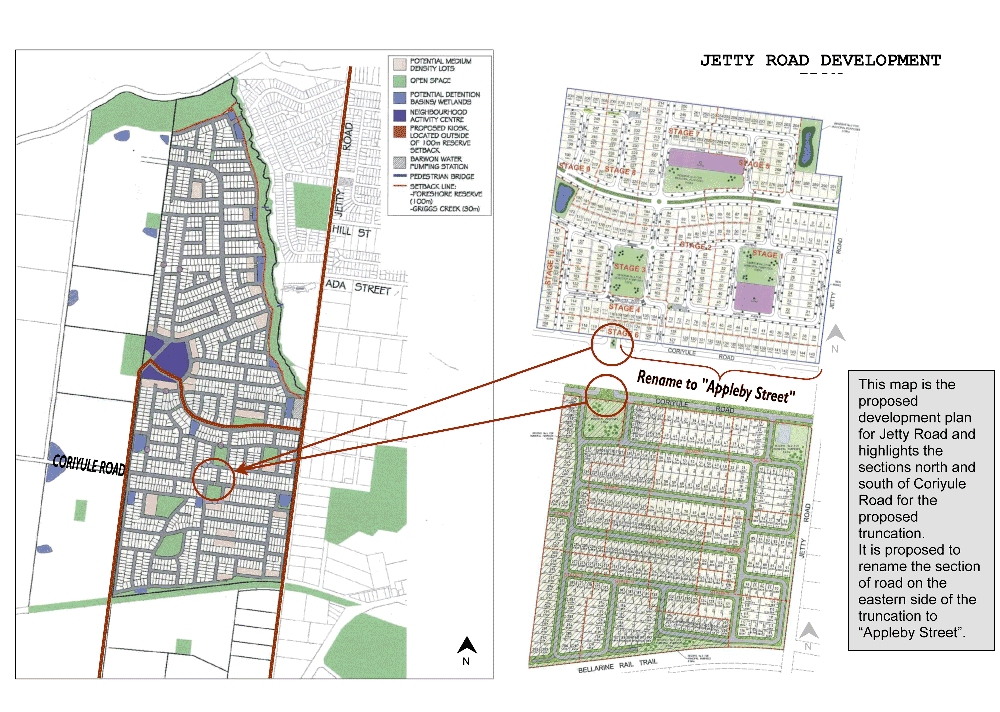
PUBLIC NOTICE: ROAD RENAMING – DRYSDALE
Portfolio: |
Governance – Cr K Fagg - Mayor |
Source: |
Corporate Internal Auditor and Ombudsman |
General Manager: |
Stephen Griffin |
Index Reference: |
Audit CG - Internal |
Cr Macdonald moved, Cr Fisher seconded -
That in accordance with Section 89 (2) (h) of the Local Government Act 1989, this report be considered at the conclusion of all other business, at which time the meeting be closed to members of the public.
Carried.
Portfolio: |
Rural Communities - Cr Ansett |
Source: |
Economic Development and Planning Strategy |
General Manager: |
Stephen Griffin |
Index Reference: |
Lara Town Centre |
Cr Macdonald moved, Cr Fisher seconded -
That in accordance with Section 89 (2)(d) and (e) of the Local Government Act 1989, this contractual matter be considered at the conclusion of all other business at which time the meeting be closed to members of the public.
Carried.
Contents | Previous Page: Section A – Procedural Matters | Next Page: Section C - Notice of Motions
