
Council Minutes - Section B: Reports (1-4) - 23 April 2013
Contents | Previous Page: Section A - Procedural Matters | Next Page: Section B – Reports 5-11
Contents | Previous Page: Section A - Procedural Matters | Next Page: Section B – Reports 5-11
Reports 1-4 tabled at the Ordinary Meeting of Council on Tuesday date held at City Hall, Little Malop Street in Geelong.
State Government Ports and Environs Advisory Committee and Port of Geelong Structure Plan
Barwon Regoional Waste Management Group - Appointment of Skills Based Directors
Barwon Regoional Waste Management Group - Appointment of Skills Based Directors
Portfolio: |
Planning - Cr Macdonald |
Source: |
Economic Development, Planning and Tourism |
General Manager: |
Peter Bettess |
Index Reference: |
Amendment C158 |
The State Government appointed an Advisory Committee in 2009 to review the planning controls in and around Victoria’s four commercial ports; Hastings Melbourne, Geelong and Portland.
Their Terms of Reference required the Advisory Committee to consider whether existing planning controls were adequate to protect the ports from encroachment by sensitive uses.
Implementation of Council’s Geelong Port Structure Plan was delayed in 2010 pending the outcome of this Advisory Committee process.
The report of the Ports and Environs Advisory Committee was released in May 2012. In response the State Government;
applied an Environmental Significance Overlay to the North Shore residential area;
released a new Ministerial Direction which councils must consider in planning scheme amendments in the port’s environs;
strengthened the State Planning Policy Framework to reflect the significance of the ports to Victoria; and
is developing a new Port Zone to be applied at the four ports.
is developing a new Planning Practice Note to guide decision making.
The Environmental Significance Overlay seeks to “manage potential conflicts between land in the port environs and the adjoining Port of Geelong”. The statutory interpretation and process to consider applications is of concern given the lack of clarity of this control and the uncertainty in its application in the assessment of medium density housing applications. The control is onerous as it triggers the need for planning permits for minor works. It is recommended that Council write to the Minister for Planning and the Minister for Ports and request changes to the control.
Considerable strategic planning was undertaken in the preparation of the Geelong Port Structure Plan. It is recommended that Council proceed to implement the findings of the structure plan by recommencing the planning scheme amendment process to update Clause 21.12 Geelong Port as set out in Appendix 1-1.
Cr Macdonald moved, Cr Richards seconded -
That Council:
notes the Ports and Environs Advisory Committee Recommendations and the Government’s response.
requests authorisation from the Minister for Planning to prepare an amendment to the Greater Geelong Planning Scheme to implement the Geelong Port Structure Plan generally in accordance with the amendment documents in Appendix 1-1.
authorises the Mayor to write to the Minister for Planning and the Minister for Ports to inform them of concerns with the Environmental Significance Overlay recently applied to the North Shore residential area and request changes to make minor matters exempt from the requirement for a planning permit.
Carried.
In 2007 Council prepared and adopted the Geelong Port Structure Plan. It seeks to address a number of issues around the port including the loss of industrial land for port related uses, industry emissions, traffic and the competing demands for land within the port precinct to balance the needs of industry and the community.
The structure plan was prepared at the same time as the Port Land Use Strategy (PLUS) for Geelong Port was developed by the State Government.
The two documents are largely consistent, the notable differences are
The structure plan identifies four precincts and the PLUS identifies three precincts (the structure plan splits Corio Quay and Lascelles Wharf into two precincts)
The structure plan seeks to limit bulk liquid storage to the Terminals’ site
The structure plan imposes additional requirements relating to the Terminal site (for example, chemical class zones, health and safety emergency plans etc)
In November 2009 Council sought authorisation to prepare Amendment C158 to implement the recommendations of the Geelong Port Structure Plan.
The authorisation request was refused in January 2010. In his letter the Minister for Planning stated that “the changes to the planning controls at the Port of Geelong proposed by council’s amendment clearly fall within the scope of the tasks I have set for the (Ports and Environs) Advisory Committee. The Terms of Reference already direct the Advisory Committee to have regard to the Geelong Port Structure Plan and the committee will also advise me on appropriate planning controls for land at the Port. The land adjacent to the Port and the zoning or overlay changes proposed by council’s amendment are matters of state significance and it is essential that the planning controls over this land support the competitive and sustainable operation of the Port.”
The Geelong Port Structure Plan was effectively placed on hold pending the findings of the Ports and Environs Advisory Committee.
The State Government released the Ports and Environs Advisory Committee Report and its response to the report in May 2012.
The State Government has responded by;
Applying an Environmental Significance Overlay to land around the ports, in Geelong, Schedule 5 to the Environmental Significance Overlay (ESO5) was applied to the North Shore residential area.
Introducing Ministerial Direction Number 14 Ports Environs. The Direction states that “in preparing an amendment affecting land in the port environs, a planning authority must ensure that the curfew free operations and future development of the port… will not be prejudiced”. It also requires Council to consider the views of the Minister for Ports and the port manager in the preparation of planning scheme amendments at the Port.
Making changes to the State Planning Policy Framework to strengthen the objectives and strategies related to planning for ports and their environs.
Indicating that it intends to introduce and apply a Port Zone at the Port of Geelong and the ports of Hastings and Portland. The Port Zone will replace the existing Schedule 6 to the Special Use Zone which applies to all land owned by GeelongPort (the port manager). The provisions of the Port Zone have not been released to date.
Noting its intention to develop a Planning Practice Note to provide further guidance on land use planning around the ports.
Environmental Significance Overlay-North Shore
The ESO5 was applied to the residential area of North Shore. It includes environmental objectives “to minimise the potential for future land use conflicts between the port and the port environs” and “ensure that any use and intensity of development in the overlay area does not constrain the ongoing operation and development of the commercial port”. ESO5 is included at Attachment 1.
This control triggers the need for a planning permit for any buildings and works associated with the use of the land for offices and accommodation including single dwellings. There is concern about the decision guidelines which require the City to consider whether development proposals would impact on the future development of the port and amongst other things;
Whether the proposed use or development has the potential to expose people unnecessarily to any off-site impacts associated with the 24-hour, 7 day a week operation of the port.
Whether the siting and design of the proposed use or development includes appropriate measures to ensure that the amenity of the proposed use will not be impacted by off-site impacts associated with the 24-hour, 7 day a week operation of the port.
Whether the proposal will result in an increase in the number of people affected by exposure to risk to health or life arising from port operations.”
Council will potentially face difficulties in determining the risks to health or life from existing port operations. Further, the need for “appropriate measures” in the siting and design of new developments to ensure that amenity is not impacted could in fact have the opposite effect and result in reduced amenity for residents, for example conditions requiring fixed glazing or which limit the location of open space to avoid impacts from nearby industry.
The ESO5 triggers the requirement for planning permits to be sought for minor works to existing dwellings, such as garages. This is considered unnecessary given that the objective of ESO5 is to manage the potential land use conflict between the port and the residential area.
It is recommended that Council write to the Minister for Ports and the Minister for Planning to highlight the potential difficulties Council faces in administering this control and request that the control be amended to provide exemptions for minor works to existing dwellings.
Advisory Committee Recommendations on the Geelong Port Structure Plan
The Advisory Committee commentary on the Geelong Port Structure Plan, the officers response, and changes to the proposed amendment are detailed below;
The draft Geelong Port Structure Plan should not be included as a reference document in the Greater Geelong Planning Scheme.
Officer response
This recommendation is accepted. The Advisory Committee’s lack of support for the inclusion of the structure plan as a reference document was based on the need for consistency between reference documents (the PLUS and the structure plan), it was not based on the merits of the Geelong Port Structure Plan. As the key points from the structure plan have been translated into the proposed planning policy, Council will still be able to capitalise on the work done to prepare the structure plan. Whilst this in inconsistent with the approach used for other structure plans, it is accepted in this instance particularly as there has been a five year time delay since the Geelong Port Structure Plan was adopted.
Further strategic planning should be undertaken by GeelongPort and the City of Greater Geelong, including stakeholder consultation, to resolve the number and nature of precincts within the Port and of the location, capacity and conditions for Bulk Liquid Storage within the appropriate precinct in Geelong Port;
Officer Response
This recommendation is not accepted. The strategic work and the stakeholder consultation suggested by the Advisory Committee was done in the development of the Geelong Port Structure Plan. Council has already formed a position on the nature and number of precincts at the port and this position should now be properly considered through the planning scheme amendment process.
Once agreement is reached on the strategic port planning matters noted above, the City of Greater Geelong should prepare a new local planning policy addressing, but not limited to, both the strategic importance of the ports and the need for the two-way management of port interfaces to be undertaken in a manner that protects efficient operation of the ports and the reasonable amenity of surrounding land uses, especially residential and other sensitive uses; and
Officer Response
This recommendation is accepted. The proposed planning policy included at Appendix 1 is consistent with the Advisory Committee recommendation. The policy notes the strategic importance of the port to the economy and acknowledges that the port operates in an environment with sensitive interfaces to residential areas.
On the storage of chemicals at the port, the Advisory Committee stated “In relation to the Structure Plan’s proposals for limiting the Bulk Liquid Storage to the Terminals site, this is a strategic planning matter that is beyond the scope of this Committee.”
Officer Response
The limiting of bulk chemical storage was recommended by the structure plan. This has been translated into the proposed local policy in Appendix 1 which includes the objective “to direct bulk liquid chemical storage activity in the area adjacent to Refinery Pier”. This direction will be given full consideration through the planning scheme amendment process.
The Advisory Committee questioned “the appropriateness of including additional requirements relating to the Terminals site in a planning document. Such matters may be more appropriately addressed (in) SEMPS that port managers must prepare or in other documents that are required under environmental and public health legislation.” SEMPS are Safety and Environmental Management Plans which are required to be prepared by port managers under the Port Management Act, 1995.
Officer response
This recommendation is accepted. The structure plan recommended that health and safety requirements be addressed in planning applications for the bulk storage of chemicals. However given the Advisory Committee recommendation, and the requirement that planning doesn’t duplicate other legislation, these aspects have been omitted from the proposed planning policy included at Appendix 1.
As noted in Section 6.2 (of the Advisory Committee Report), the Council also consider amending its local policy to recognise the buffering role played by the south side of Seabreeze Parade and Phosphate Paddocks
Officer Response
This recommendation is accepted. The structure plan map which forms part of the proposed planning policy includes a notation to enhance the buffer role of land along the south side of Seabreeze Parade and on the land surrounding the Incitec Pivot administration building, known locally as Phosphate Paddocks.
Greater Geelong City Council consider whether any additional requirements relating to density and height of development in the North Shore residential area are appropriate
Officer Response
The PLUS and the Geelong Port Structure Plan both identified the need for further work to be done on buffers around North Shore. The PLUS called for the development of a “Local Area Plan” and the structure plan included a direction relating to the development of a buffer strategy and community plan in consultation with the State Government, the community and the port manager. This work has not been undertaken to date. The Corio Norlane Structure Plan has also identified this as further work, it includes as an action to “investigate application of an appropriate planning control to manage intensification of residential development within the North Shore residential area”.
The proposed local planning policy includes a recommendation for further work to examine this issue further in addition to monitoring of the operation of ESO5.
In relation to the proposed Design and Development Overlay to the land at 309-363 and 365-377 Melbourne Road in North Geelong, the Advisory Committee accepted Council’s motivation to ensure a high quality development at these gateway sites and saw “no obstacles to this aspect from (of) the Amendment proceeding to exhibition.”
Officer Response
The maps and the proposed planning policy which form part of the amendment at Appendix 1-1 include the application of the Design and Development Overlay on this land (the former Ford site which was the site of the previously proposed Hometown development).
Amendment C158
When the authorisation request for the amendment to implement the Geelong Port Structure Plan was refused, it was not based on any assessment of plan. Similarly, the Ports and Environs Advisory Committee has not considered the structure plan in detail.
The Council’s strategic planning work undertaken in the preparation of the Geelong Port Structure Plan prior to 2007 can be given sufficient weight in planning permit applications if the relevant structure plan recommendations, which were supported by the Advisory Committee, are translated into a planning policy in the planning scheme to give effect to the structure plan.
Officers from the Department of Planning and Community Development have accepted that there is merit in pursuing an amendment to the scheme to clarify Council’s position on development at the port. It is recommended that Council should therefore recommence the amendment process to implement the key strategic directions of Geelong Port Structure Plan.
The key elements of this amendment included at Appendix 1 are;
The inclusion of a new planning policy to provide direction on the location of bulk liquid storage, future growth of port infrastructure, the application of zones and overlays.
Rezoning of land and assets owned by GeelongPort to Special Use Zone 6 (or the Port Zone if the Minister for Planning has introduced it), consistent with the rest of the port
Rezoning of land in smaller lots in the North Shore industrial area from Industrial 2 Zone to Industrial 3 Zone to reflect its location at the residential interface.
Rezoning a strip of unused vacant Crown land on the coast from Industrial 2 Zone to Public Conservation and Resource Zone
The application of a Design and Development Overlay (DDO) to a gateway site on the Melbourne Road (the former Ford land which was the site of the unsuccessful Hometown proposal)
The structure plan considers environmental issues relating to industrial operations. It also discusses the need to manage the impacts on sensitive environments along the foreshore. The proposed planning policy acknowledges that the port is in an environment with sensitive interfaces to coastal areas and includes objectives seek improved environmental outcomes.
Council will incur the standard fee and panels costs associated with the processing of Council initiated amendments.
The amendment is consistent with the Geelong Port Structure Plan which was adopted by Council in 2007. It is consistent with the State and Local Planning Policy Frameworks and generally accords with the Port Environs Advisory Committee recommendations. The amendment process will provide a further opportunity for affected parties to make a submission about the amendment and the policy.
No council officers have any direct or indirect interest in the land, in accordance with Section 80(C) of the Local Government Act to which this amendment relates.
It is considered that the risks associated with the preparation of this amendment are minimal, the amendment will provide greater direction for decision makers at the port.
The structure plan examined social impacts associated with the development of the port. The proposed planning policy clarifies the strategic framework for the port and will provide certainty for the community.
The preparation of the structure plan was undertaken in consultation with the community and businesses at the port. Individuals who lodged a submission on the draft Geelong Port Structure Plan will also receive notice of the amendment. The amendment will be exhibited in accordance with the requirements of the Planning and Environment Act, 1987 with notices in the Government Gazette, local papers and notices to affected landowners.
21.12 |
GEELONG PORT |
21.12-1 |
Importance and Key Issues |
|
|
|
21.12-2 |
Objectives |
|
|
Strategies |
|
|
|
21.12-3 |
Implementation |
These strategies will be implemented by: Using policy and the exercise of discretion Ensure that subdivision, use and development applications in the Special Use Zone – Schedule 6 / Port Zone, are port related and port dependent. Applications with the potential to impact on port operations and/or port related uses, or on existing sensitive uses are to be accompanied by a Reverse Amenity Impact report which demonstrates ‘two way’ buffering. Where appropriate new use and development proposals with off site discharges to waterways, foreshore and marine environments must be accompanied by an Ecological Risk Assessment and Environmental Management Plan.
Applying the Special Use Zone – Schedule 6 / Port Zone to new port facilities and assets including wharf extensions and land used for port purposes by the port operator. Applying the Industrial 2 Zone to core port related industrial areas close to the port. Applying the Industrial 3 Zone to small lot industrial areas to the west of the North Shore residential area. Further Work Facilitate the establishment of an industrial marine precinct in the St Helens area adjacent to Osborne House. Work with the port operator and relevant agencies to develop a Comprehensive Buffer Strategy and Community Development Plan for the North Shore residential area. Liaise with VicRoads to investigate options for providing direct linkages between the port, the Geelong Ring Road and the Geelong Ring Road Employment Precinct .References
Port of Geelong, Port Land Use Strategy 2009, Geelong Port and Department of Transport. |
|
21.12-4 |
Geelong Port map |
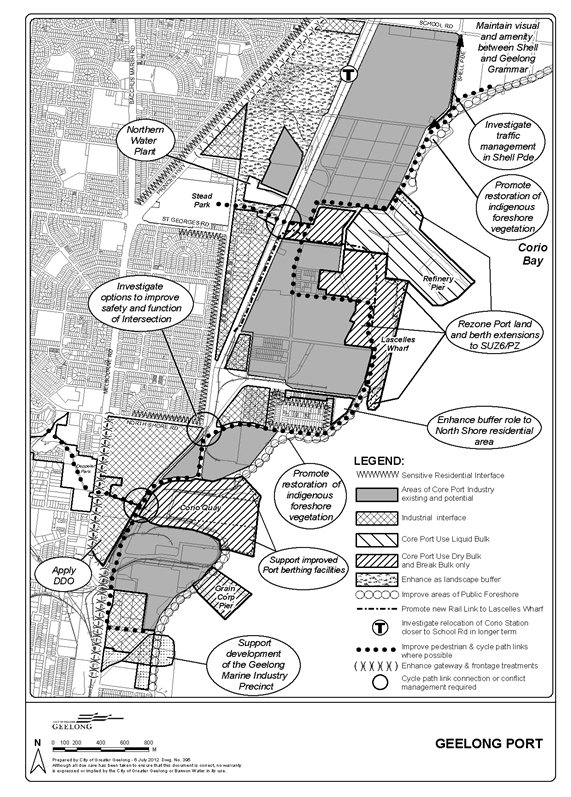 |
|
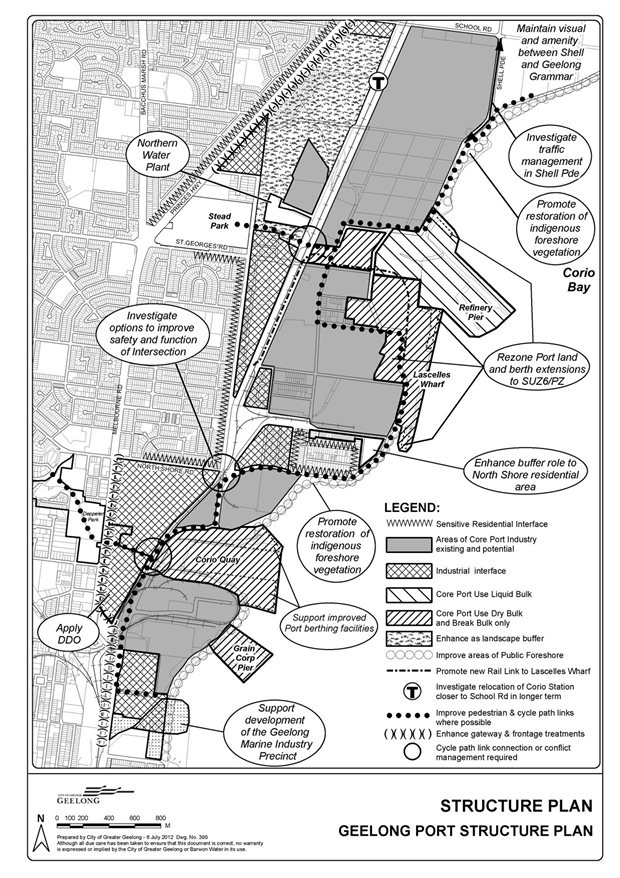 |
Portfolio: |
Planning – Cr Macdonald |
Source: |
Planning Strategy and Economic Development |
General Manager: |
Peter Bettess |
Index Reference: |
Council Reports 2013 |
At the Council meeting on 26 February 2013 Council resolved to make a submission to the State Government about the Discussion Paper for the new Metropolitan Planning Strategy “Melbourne lets talk about the future”.
The submission at Appendix 1 will be sent to the Department of Planning and Community Development as Council’s submission.
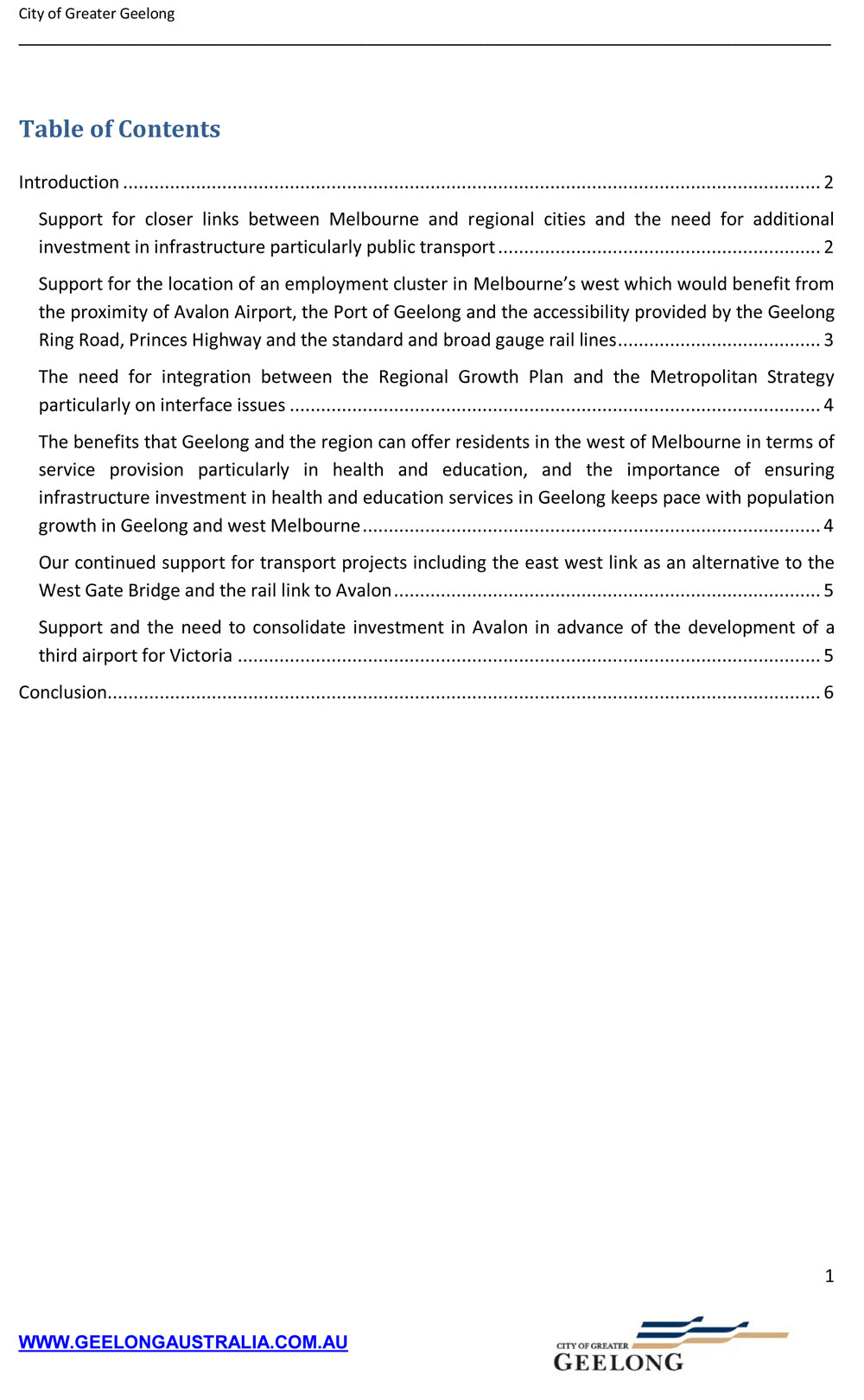
Six key points are addressed in the letter:
Support for closer links between Melbourne and regional cities and the need for additional investment in infrastructure particularly public transport,
Support for the location of an employment cluster in Melbourne’s west which would benefit from the proximity of Avalon Airport, the Port of Geelong and the accessibility provided by the Geelong Ring Road, Princes Highway and the standard and broad gauge rail lines,
Acknowledgement of the Metropolitan Planning Strategy identifying the need for integration between the G21 Regional Growth Plan and the Metropolitan Strategy particularly on interface issues,
The benefits that Geelong and the region can offer residents in the west of Melbourne in terms of service provision particularly in health and education, and the importance of ensuring infrastructure investment in health and education services in Geelong keeps pace with population growth in Geelong and west Melbourne,
The continued support for transport projects including the east west link as an alternative to the West Gate Bridge and the rail link to Avalon
The support and the need to consolidate investment in Avalon in advance of the development of a third airport for Victoria.
Cr Macdonald moved, Cr Harwood seconded -
That Council endorse the response at Appendix 1 to be sent to the State Government as Council’s submission to the Metropolitan Planning Strategy Discussion Paper “Melbourne lets talk about the future”.
Cr Richards left the meeting room at 7:37pm
Cr Richards re-entered the meeting room at 7:40pm
Carried.
Council resolved on 26 February 2013 to make a submission to the Discussion Paper for the new Metropolitan Planning Strategy “Melbourne lets talk about the future”.
The Discussion Paper is based around nine principles and identifies key themes and desirable principles to be achieved. There is limited geographic analysis on how and where the principles will be applied.
The attached submission provides more detail on the six key points which Council should highlight.
The relationship between Geelong and Melbourne is quite unique given its proximity, and significant levels of migration from Melbourne to Geelong and the pattern of commuting to Melbourne for work.
The increasing population in fringe areas in Melbourne’s west in Wyndham will be a greater influence on Geelong as this community looks to Geelong for services such as health and education.
The City welcomes the development of the Discussion Paper and the opportunities that it presents for Geelong. The need for appropriate investment in infrastructure is essential to ensure that these opportunities are realised.
The lodgement of a submission on the Discussion Paper will not result in direct environmental impacts.
Lodging a submission to the State Government’s Discussion Paper will not result in any financial implication for Council.
Council’s submission is consistent with its existing policies including the adopted G21 Regional Growth Plan and its aim of developing a freight and logistics precinct in the north.
No Council officer has a direct or indirect interest in this report.
The lodgement of a submission to the Discussion Paper will not result in any risks to Council.
The submission notes that continued growth in Geelong will require appropriate levels of funding for infrastructure including social infrastructure such as education and health facilities. An increase in workforce participation is a key social consideration and Council’s submission highlights the need for greater access to employment in Melbourne’s west which will complement employment opportunities in Geelong.
Preparation of this report was done in consultation with G21. Council’s submission will be provided to the Department of Planning and Community Development.

Portfolio: |
Community Safety - Cr Farrell |
Source: |
Community Services - Health & Local Laws |
General Manager: |
Jenny McMahon |
Index Reference: |
Local Laws/Animal Management |
Council has a legal obligation under the Domestic Animals Act 1994 to develop and review the Domestic Animal Management (DAM) Plan every four years.
The purpose of this report is to present to Councillors the review of the existing DAM Plan (2008–2011), which incorporates the Dogs in Public Places policy, and the development of the Draft Domestic Animal Management Plan (DAM) Plan for 2013–2017. (See Appendix 1)
Council’s first DAM Plan 2008–2011 was adopted in June 2008. A range of actions focusing on compliance, policy education, promotion and marketing were implemented.
A range of data has been collected to inform the proposed activities in the Draft Plan, including responses from the community highlighting their expectations and concerns, feedback from animal behaviourists and through the observations and experiences of Council’s Animal Compliance Officers.
As a consequence of feedback, some necessary improvements were identified in the ‘Dogs in Public Places Policy’.
Pet owners need to demonstrate individual responsibility in conjunction to the work of Council to ensure community safety and harmony.
Cr Fisher moved, Cr Farrell seconded -
That Council note the Draft:
Domestic Animal Management Plan 2013–2017 and release for community consultation for a period of four weeks;
Dogs in Public Places Policy 2013–2017 and release for community consultation for a period of four weeks.
Carried.
Council has a legal obligation under the Domestic Animals Act 1994 to produce a four year DAM Plan. After considerable consultation with the community, stakeholders and interested groups in 2008, Council adopted its first DAM Plan 2008–2011. The purpose of the Domestic Animals Act 1994 is to promote animal welfare, responsible pet ownership and to protect the community and environment.
In fulfilling its animal management responsibilities Council commits $1.876M expenditure to deliver a range of compliance programs including the delivery of services to Councils Animal Pound. Council receives $2.123M of revenue generated through user fees, charges and penalties. During the period of the first DAM Plan, the Department of Primary Industries further extended the expiry date from June 2011 to December 2012 so as to align the Plan with Councillors four year terms. Following feedback from the majority of Victorian Councils that this timeline was going to be difficult to achieve due to the Council elections and the ‘caretaker’ period, the Department of Primary Industries further extended the completion date for the 2013–2017 DAM Plan to 30 June 2013.
The first DAM Plan (2008–2011) identified three strategic objectives:
Responsible Pet Ownership
Dogs in Public Places
Leadership.
Council adopted and implemented a range of dog control orders throughout the municipality including coastal, open space areas, public places and areas under the control of other Land Mangers, under the provision of Section 26 of the Domestic Animals Act. Dog control orders provide residents with the necessary information about where and when they can walk their dog/s on and off leash in order to protect community safety and the environment. The relevant Land Managers with whom Council has adopted Dog Control Orders include:
Corangamite Catchment Management Authority
Barwon Coast Committee of Management.
With the review and development of a new DAM Plan (2013–2017), an extensive community feedback and survey process was conducted in June 2012. This focused on gaining feedback regarding the strengths and weaknesses associated with the current Plan and any opportunities and suggestions that may be incorporated into the new Plan. This survey comprised a three week online questionnaire, which was also available in hard copy from various locations throughout the municipality.
Feedback was received from a wide audience including community members, special interest groups and both internal and external stakeholders of the City of Greater Geelong.
While pets, at times, can cause a degree of nuisance and impact on others, studies demonstrate that companion animals play a significant role in enriching the lives of many in the community and contribute to building happy, healthy and active communities.
Statistics provided by the Petcare Information and Advisory Service (PIAS) state that 63% of Australian households have some type of pet, with 53% of households owning a dog or cat. The City of Greater Geelong has one of the largest animal populations of any Victorian municipality and currently has over 45,781 registered dogs and cats.
The City of Greater Geelong is quite a large diverse municipality, which presents challenges in terms of conducting animal enforcement and compliance activities. The municipality includes:
A total land area of 1,250 square kilometres
349 reserves and parks
1,300 kilometres of footpaths and shared use paths
Over 115 kilometres of creeks and trails
A vast coast line from Avalon Beach in the north-east, along the Bellarine Peninsula coastline to Breamlea in the south (approximately 100kms).
Community Feedback
To inform the community about the community feedback process, an extensive advertising campaign was implemented prior and during the period in which the survey was conducted. The advertising included print media, radio, web and community billboards.
A comprehensive mail distribution was carried out to over 300 target group contacts, including dogs clubs, kindergartens, local veterinarians, senior citizen groups, child care centres, primary and secondary schools, environment groups and Council departments with Council’s Corporate Planning Department assisting with the evaluation process. Comparatively, the overall response rate was encouraging and provided a sound base upon which to make informed decisions and recommendations for the next DAM plan.
A total of 568 responses were received, including 349 on line responses and 219 written responses. The respondents’ demographics included:
77% of respondents were aged between 35 and 69 years of age
75% of respondents were female
Respondents came from all areas of the municipality with 81% of respondents residing in 20 suburbs
86% of respondents owned either a dog or a cat
14% were non pet owners.
Overall, it was felt that this sample cohort was a reasonable representation of community sentiments towards animal management and compliance issues.
Respondents evaluated the effectiveness of the programs within the existing DAM Plan resulting in the following findings:
90% declared dog attacks as the most important future direction needing to be addressed
Compulsory de-sexing of cats and dogs was well supported with 97% supporting the de-sexing of cats from the pound, 82% agreed to de-sexing newly registered cats and 85% were supportive of de-sexing registered cats. 64% of respondents were in support of de-sexing dogs
77% stated that they wish to see a decrease in dogs at large and menacing/rushing dogs and 67% indicated a need for clearer dog control orders
The cat curfew and education on pet selection were seen to be the least effective (28% and 23% respectively)
Only 40% indicated the on/off leash areas were considered effective
A general theme of support for increased patrols to address issued such as dog attacks, dog litter, dog control orders and other nuisance activities
49% believed the ‘Dogs on Leash At All Times’ sign/order was clear but only 29% found the observance of the sign to be effective
The majority of respondents felt that the ‘Dogs on Leash On and Within 5 Metres of a Path’ sign/order was a major challenge to understand and may be leading to incidents
37% felt that the ‘Dogs Under Effective Control’ sign/order was clear but only 21% found the observance of the sign to be effective
32% were uncertain as to whether education on responsible pet ownership was effective
The micro-chipping and registration road-shows were perceived to be the most effective by 61% of respondents
86% of respondents are respectful of Council being a dog friendly municipality while maintaining community safety through compliance and regulatory presence/programs.
Residents were informed that three actions remained outstanding from the 2008–2011 plan including pet selection, compulsory de-sexing and Dog Activity Parks.
Animal Compliance Trends and Data – Dogs
Animal behaviourist specialist, Dr Jacqui Ley, FVSc, hons MANZCV Sc (Veterinary Behaviour) PhD DECAWBN CMAVA, states: “Aggression in dogs is a major community concern. Aggressive behaviour in dogs develops through a combination of their genetics, their experiences and their environment”.
The statistics relating to dog attacks and subsequent incidences during 2008–2011, indicate an increasing trend that requires corrective action and intervention by Council in the interest of community safety.
A study conducted by Monash University ‘Hospital Treated Dog Bite Injury among Greater Geelong Residents 08/09–10/11’, revealed the following statistics for the City of Greater Geelong:
112 Greater Geelong residents were hospitalised due to dog bite incidents during 2008 – 2011
99 Greater Geelong residents reported to Emergency Departments for dog bite related incidents
512 dog attacks were reported to Council in the same timeframe
177 dog attacks have been reported to Council during 2012 compared to 117 in 2011 (an increase of 51%)
Over the past four years there has been a 24% increase in the number of dogs at large, escalating to over 3,435 at the end of 2011.
* The above figures do not include victims who may have reported to the police or to a local General Practitioner independently.
Dog Bite Emergency Department Admissions
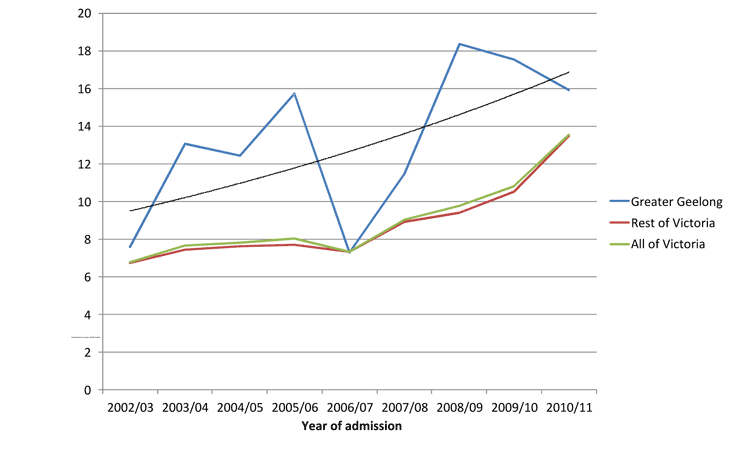
During 2002/03–2010/11 rates per 100,000 population for residents of Geelong, the rest of Victoria and all of Victoria show that the dog bite injury hospitalisation rate for Geelong increased significantly over the nine year period from 7.6 dog bite hospitalisations/100,000 population in 2002/03 to 15.9/100,000 in 2010/11 representing an estimated annual change of 7% and an overall increase of 109% based on the trend line.
The dog bite injury hospitalisation rate for the rest of Victoria increased, from 6.7/100,000 population in 2002/03 to 13.5/100,000 in 2010/11 with an overall increase of 103%.
The rate for all of Victoria (including CoGG rates) increased from 6.8/100,000 population in 2002/03 to 13.6/100,000 in 2010/11, an overall increase of 101%.
The City of Greater Geelong has had higher starting rates that have continued to increase. As the Council with the largest number of registered dog numbers, this increased rate translates to significant numbers as outlined in this report.
Dog Bite Presentations to Hospital Emergency
Departments 2002/3 – 2010/11
Dogs behave differently in difficult circumstances due to fear, being startled, excited, surprised, agitated, confronted etc. Council has a role in incident prevention by controlling situations, environments and circumstances where a dog may revert to aggression.
A strong correlation exists between the number of dogs at large and the consistent influence this has on the number of dog attacks and menacing dogs. It could be argued that any measure that would reduce the number of dogs at large would most likely lead to a reduction in dog attacks simply by reducing any opportunities for such an incident to occur. Council’s Dogs in Public Places Policy (Appendix 2) has been reviewed accordingly so as to reflect the community’s concern and Council’s need to meet its duty of care by addressing high priority issues in a preventative manner.
Four important determinants exist for safety and dogs; genetics, proper handling, training and care, and controlled environment that affords community safety.
While Council can influence handling, training and care practices through education and awareness programs, its greatest level of control exists through introducing measures that influence a safe environment with dogs in public places.
Over the past four years and as a result of Council’s animal impounding responsibilities, there have been in excess of 2,400 cats and 800 dogs euthanised annually. In 2010/2011, 2,406 cats (many of these were either kittens or feral cats) and 803 dogs were euthanised. While this rate has reduced during 2011/2012 to 1244 and 283 respectively, these numbers remain unacceptably high, particularly for cats.
From the DAM Plan feedback process, the community has indicated strong support for the mandatory de-sexing of dogs and cats to reduce the number of unwanted and abandoned pets being impounded at Councils Animal Pound, many of which are subsequently euthanised. The introduction of mandatory de-sexing for any cat or dog being registered for the first time or any cat currently registered within the four year period of the Plan has been included for Council’s consideration in Council’s Dogs in Public Places Policy and as part of the new DAM Plan. To assist the community, it is envisaged that subsidised de-sexing programs may be able to be established through partnerships with veterinarians, relevant funding agencies and sponsors.
Respondents are supportive of Council providing fenced off spaces or Dog Activity Parks. This was also a popular activity in the DAM Plan (2008–2011). 65% of respondents are supportive of the establishment of areas that are fenced off or are a designated Dog Activity Park.
These spaces allow for the facilitation of dogs’ socialisation, training and the opportunity for dogs to be walked off leash in a secure fenced area. The benefit of a dog participating in exercise, socialisation and interaction with its owner has the ability to reduce behavioural and anti social issues.
While residents regarded barking dogs and nuisance cats as lesser priorities at 52% and 63% support respectively, Council’s Request For Service statistics show that these are areas of high concern and impact within the community as is the issue of dog attacks.
Research indicated that pet ownership provides a range of benefits to owners such as companionship, social interaction, exercise and an improved quality of life. Council recognises there is an opportunity to explore options for the development of a Health and Wellbeing program, a dog walking service which would be implemented for eligible dog owners unable to walk their dog/s due to ill health, age, impairment or disability. It is envisaged that this program would be assisted by trained volunteers. 76% of respondents supported this initiative.
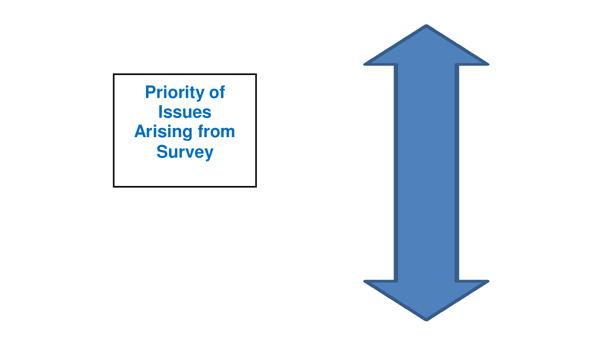
Consideration was given towards prioritising those issues of highest concern to the community, which along with relevant data and officer feedback have informed the development of the Draft DAM Plan 2013–2017 (see Appendix 1). Actions have been developed in response to these issues and have been categorised under the following sections:
Proposed Dogs in Public Places Policy Outline 2013–2017
Training of Authorised Officers
Registration and Identification
Nuisance
Dog Attacks
Dangerous, Menacing and Restricted Breeds
Over Population and High Euthanasia
Domestic Animal Businesses
Other Matters
Annual Revision of Plan and Annual Reporting.
 |
With respect to the changes and areas of program improvement to the Draft DAM Plan 2013–2017, the following can be summarised as key changes for Council to consider as part of adopting the proposed Plan and revised Policy;
Amending the Dogs in Public Places Policy by providing greater clarity around ‘On Leash’ and ‘Off Leash’ areas. Due to the impracticality and cost of providing ‘On Leash’ signage in all public open spaces (where relevant), the policy has been re-worded so that in the absence of any sign and unless specifically designated as an off leash (supervised) area, the subject open space is proposed to be deemed to be an ‘On Leash – Supervised’ area. Many new ‘Off Leash – Supervised’ areas have been established and are included in the revised Dogs in Public Places Policy (Appendix 2).
The above amendments would reduce confusion within the community about what dog order prevails; places the onus on the dog owner to act responsibly; and enables Council to focus on providing signs in ‘Off Leash – Supervised’ areas and high activity ‘On Leash – Controlled’ areas.
Re-badge the ‘Off Leash’ to ‘Off Leash (Supervised)’ and ‘On Leash’ to ‘On Leash (Controlled)’ in order to promote and clarify the responsibilities of dog owners when in such places with their dog/s.
Amend the ‘On Leash On or Within 5 Metres of a Pathway’ to an ‘On Leash On and Adjoining a Pathway’ order. This is in response to the many incidents that have occurred along highly used linear tracks and pathways involving other dogs, walkers and cyclists and the need to reduce the opportunity for this to occur.
A number of conditions have been attached to the ‘Off Leash – Supervised’ order. This is as a result of the misunderstanding or misinterpretation by some that this means that a dog can run at large at will. The most important condition, which aims to prevent the continuing increase of dog incidents is, ‘when encountering others/other dogs using an off leash area, the dog must be recalled and restrained until both parties have moved apart at a safe distance’.
Apart from the safety issues, many members of the public are opposed to the unwelcome attention of a dog while they are walking, running, riding etc.
Some minor changes have been made to certain dog control orders. It is proposed to bring back the afternoon restriction time from 8.00pm (daylight savings) and 6.00pm (other times) to 5.00pm at any time. This will provide the community with greater opportunity to walk their dogs in safer circumstances.
An additional order has been created for stretches of ocean coastline, which are the habitat of the endangered Hooded Plover. It is proposed that the intent of the Order is reversed from ‘Off Leash – except when hooded plover are nesting’ to ‘On Leash – Supervised – except when hooded plovers are not present’. This will be a clearer and fair message for the general community to abide by and easier for Council and Birds Australia officers to monitor for compliance.
Council has existing Dog Control Orders with the Corangamite Catchment Management Authority (CCMA) and the Barwon Coast Foreshore Committee of Management (BCFCM). These Orders remain unchanged.
Council is continuing to liaise with the Bellarine Bayside Committee of Management (BBCM) who has expressed interest in adopting Dog Control Orders that are in harmony with Council’s existing Orders. As part of putting this draft plan (which includes the BBCM proposed Orders) to the community for further comment, it is envisaged that a final position will be reached with BBCM with respect to meeting the community’s expectations. Previous community concerns about the break in continuity of the walking track for dog walkers and large sections of areas that could be better served as ‘dogs on leash – controlled’ areas rather than ‘dogs prohibited’ areas have been addressed and amended accordingly.
As an extension to the existing mandatory micro-chipping order, it is proposed to introduce mandatory de-sexing as a condition of all new cat and dog registrations.
The adoption of an order which requires all existing (registered) cats to be de-sexed during the four year term of the Plan. This is due to the practical difficulty in enforcing cat containment breaches, cats’ nomadic/roaming instincts, feral cats, the high number of abandoned cats and litters of kittens that lead to the high rates of euthanasia at the rate payers’ expense. Council will explore funding and partnership opportunities for the implementation of de-sexing programs.
Promote the fact that dog litter can be disposed of in any Council litter bin when wrapped/packaged in any type of bag. Currently the City has 71 dog litter bins (at a cost of $1,130/annum operating/servicing costs) and over 1600 public place litter bins (at a cost of $380/annum operating/servicing costs). With the new side loading functionality of waste collection trucks, there is no longer an OH&S issue associated with the loading of public place litter bins that may contain dog litter. Therefore, by adopting public place litter bins as acceptable containers for the deposit of dog litter, the City will provide a far more accessible and convenient waste facility as a more economical alternative to the existing dog litter bins.
The City of Greater Geelong is a municipality offering a great lifestyle mix of urban, coastal and rural living environments. The surrounds are perfect for providing a balance between the needs of the community and pet owners.
It is evident from the survey that respondents are proud of the region and value the natural beauty and aesthetics of the City. There is a high level of expectation by the respondents that dog owners should be more vigilant of their dog’s behaviour in public spaces particularly in relation to dog waste, wildlife and protecting the environment. Also from the survey the respondents consider that it is the City’s responsibility to make good the poor behaviour of irresponsible dog owners by providing dog litter bags and ample waste bins.
Equally, respondents despair at the number of feral cats in Ramsar Wetlands (Ramsar Wetlands are wetlands of international importance listed under the Convention on Wetlands), and around protected hooded plover sites along the coastline at Ocean Grove and Breamlea. With a number of new developments and subdivisions abutting reserves many of the respondents are calling for Cat Free Zones for estates that buffer onto areas of environmental value. There was no consideration from respondents on how this desire would be implemented. However, it is envisaged this course of action would require the expertise of the Environmental and Natural Resources Unit, together with relevant State and Federal bodies.
Costs associated with the current consultative process are included in the 2012/13 departmental budget. On adoption of the final plan, a costing framework will be provided to Council on a four year project basis.
Under Section 68A of the Domestic Animals Act 1994, every Council must prepare a Domestic Animal Management Plan, which aims to promote animal welfare, responsible ownership of dogs and cats and to protect the environment. In adopting such a plan, the City has an opportunity to deal with specific issues relevant to its community and in response to any compliance matters that may impact on the health, safety and amenity of the community and environment.
No Council officer has direct or indirect interest in the preparation of the report.
There are no known risks associated with the development of the Domestic Animal Management Plan 2013–2017. The actions outlined in the Plan have been developed to minimse risks to the community and Council from a legal perspective. The deliverable actions undertaken during the life of the plan would be subject to relevant risk management assessments.
The objectives of the DAM Plan recognise a community that values responsible pet ownership and high standards of animal welfare. The actions proposed to be undertaken in the 2013–2017 DAM Plan strive to promote safe and cooperative behaviour by pet owners and provide a municipality that is pet friendly. Council recognises that not everyone feels comfortable around dogs and some environments are sensitive to their use. The plan aims to provide a framework that offers a balanced approach to all members of the community having a fair and reasonable access to public places and spaces with their dogs while enabling Council to meet its legal and risk management responsibilities.
A Draft DAM Plan (2013–2017) will be put on exhibition for a period of four weeks by:
being advertised in the Public Notices section
being accessible on-line
directly liaising with key stakeholders and industry bodies.
Leading up to the development of the draft plan, a four week advertising campaign with a mix of print and radio media, internet, mailing databases and community billboards was implemented inviting residents, pet owners and special interest groups to participate in the ‘feedback’ process.
A series of working group sessions were held with external and internal stakeholders and these included representatives from:
Barwon River Parklands
Corangamite Catchment Management Authority
Bellarine Bayside Foreshore Committee of Management
Barwon Coast Committee of Management
Parks Victoria
Department of Sustainability and Environment
CoGG Recreation and Open Spaces
CoGG Environment and Natural Resources
CoGG Infrastructure and Waste Services
CoGG Local Laws, Animal Unit, Animal Officers
Discussion topics included:
Dog waste littering
Existing dog control orders
Development of new dog control orders
Standardisation of coastal dog control orders
Environmental issues including the hooded plover
Open space, parks and reserves
The future of on/off leash open spaces in growth development areas.
Domestic Animal Management Plan
City of Greater Geelong
DRAFT 2013 - 2017
DOMESTIC ANIMALS ACT – 1994 (PART 1)
Purpose of the Domestic Animals Act 1994 (as amended)
Domestic Animal Management Plans
68A Councils to prepare domestic animal management plans
Overview of the City of Greater Geelong
Community Consultation
Summary of Respondents Concerns
Overview of the Community Consultation - Results
Our Orders, Local Laws, Council Policies and Procedures
Orders & Policy
General Local Law 2005
Dog Excrement
Permitted number of Dogs and Cats without the need for a permit
Glossary
PROPOSED DOGS IN PUBLIC PLACES POLICY OUTLINE 2013 – 2017
Off Leash ‘Supervised’ Areas
Locations
Conditions Applicable to ‘Off Leash - Supervised’ Areas
Signage
On Leash ‘Controlled’ Areas
Conditions applying to all ‘On Leash Controlled Areas’ and ‘Off Leash Supervised Areas’
Dog Control Categories
Category 1 (Green) – Off leash ‘Supervised’ Area
Category 2 (Yellow) – Conditional Off Leash ‘Supervised’ Area
Category 3 (Blue) – Conditional On Leash ‘Controlled’ Area
Category 4 (Brown) – On Leash ‘Controlled’ Area (Environmentally Sensitive Areas)
Category 5 (Purple) – Conditional On Leash ‘Controlled’ Area (Hooded Plover and Wildlife Zones)
Category 6 (Red) - Exclusion Area All Year Round
Designated ‘Off Leash - Supervised’ Areas
Dog Controls in Coastal and Other Open Space Areas
TRAINING OF AUTHORISED OFFICERS
Current Situation
Councils Policies and Procedures
Summary
Our Plans
REGISTRATION AND IDENTIFICATION
Current Situation
Council Policies and Procedures
Our current Education/Promotion Activities include:
Our Current Compliance Activities
Summary
Our Plans
Current Situation
Council’s Dog in Public Places Policy
Our current Education/Promotion Activities
At large and trespass (see ‘All nuisances’ and the following)
Barking dogs (see ‘All nuisances’ and the following)
Dog poo (see ‘All nuisances’ and the following)
Our current Compliance Activities
At large and trespass (see ‘All nuisances’ and the following)
Barking dogs (see ‘All nuisances’ and the following)
Dog poo (see ‘All nuisances’ and the following)
Summary
Our Plans
Current Situation
Council Policies and Procedures:
Our current Education/Promotion Activities
Our current Compliance Activities
Our Plans
DANGEROUS, MENACING AND RESTRICTED BREED DOGS
Current Situation
Council Policies and Procedures
Our Current Education/Promotion Activities
Our Current Compliance Activities
Summary
Our Plans
OVERPOPULATION AND HIGH EUTHANASIA
Current Situation
Council Policies and Procedures
Our current Education/Promotion Activities
Our current Compliance Activities
Summary
Our Plans
Current Situation
Council Policies and Procedures
Our Current Education/Promotion Activities
Our Current Compliance Activities
Summary
Our Plans
Current Situation
Council Policies and Procedures
Our current Education/Promotion Activities
Our current Compliance Activities
Summary
Our Plans
ANNUAL REVIEW OF PLAN AND ANNUAL REPORTING
The purpose of this Act is to promote animal welfare, the responsible ownership of dogs and cats and the protection of the environment by providing for:
A scheme to protect the community and the environment from feral and nuisance dogs and cats;
A registration and identification scheme for dogs and cats which recognises and promotes responsible ownership;
The identification and control of dangerous dogs, menacing dogs and restricted breed dogs;
A registration scheme for domestic animal businesses promoting the maintenance of standards of those businesses;
Matters related to the boarding of dogs and cats;
The regulation of the permanent identification of dogs, cats, horses and other animals;
Payments to the Treasurer from fees received by Councils under this Act; and
Other related matters.
Under Section 68A of the Domestic Animals Act, every Council must prepare a domestic animal management plan, as follows:
Every Council must, in consultation with the Secretary (of the Department of Primary Industries), prepare at 4 year intervals a domestic animal management plan.
A domestic animal management plan prepared by a Council must—
set out a method for evaluating whether the animal control services provided by the Council in its municipal district are adequate to give effect to the requirements of this Act and the regulations; and
Outline programs for the training of authorised officers to ensure that they can properly administer and enforce the requirements of this Act in the Council's municipal district; and
Outline programs, services and strategies which the Council intends to pursue in its municipal district—
To promote and encourage the responsible ownership of dogs and cats; and
To ensure that people comply with this Act, the regulations and any related legislation; and
To minimise the risk of attacks by dogs on people and animals; and
To address any over-population and high euthanasia rates for dogs and cats; and
To encourage the registration and identification of dogs and cats; and
To minimise the potential for dogs and cats to create a nuisance; and
To effectively identify all dangerous dogs, menacing dogs and restricted breed dogs in that district and to ensure that those dogs are kept in compliance with this Act and the regulations; and
Provide for the review of existing orders made under this Act and local laws that relate to the Council's municipal district with a view to determining whether further orders or local laws dealing with the management of dogs and cats in the municipal district are desirable; and
Provide for the review of any other matters related to the management of dogs and cats in the Council's municipal district that it thinks necessary; and
Provide for the periodic evaluation of any program, service, strategy or review outlined under the plan.
Every Council must—
Review its domestic animal management plan annually and, if appropriate, amend the plan; and
Provide the Secretary with a copy of the plan and any amendments to the plan; and
Publish an evaluation of its implementation of the plan in its annual report.
The Domestic Animal Management Plan (DAM Plan) caters for the needs of domestic pets, their owners and addresses the concerns of the general public in a fair and even manner.
The aim of this plan is to facilitate co-existence of pets, pet owners and the general population whilst addressing the welfare and legislative issues relating to animal management in the City boundaries. This plan also aims to promote responsible pet ownership and enhance the experience of animal ownership within the community, by so doing, make the City of Greater Geelong an even better place to live.
While the directive to create a plan is in line with the Domestic Animals Act 1994 (DAA) which requires all Victorian councils to have a four year plan in place for the management of dogs and cats within their area, the City has used a consultative process to consider opinions and concerns from all relevant group and individuals.
It is now well recognised by the community and governments alike that there is more to animal management than merely collecting stray dogs and addressing compliances issues. Not so well recognised is the role that local government plays in protecting and promoting responsible animal ownership in the community and the environment, both essential to maintaining sustainable communities and a healthy environment.
This plan is designed to balance the needs of the community and at the same time manage the requirements of the act. This is an evolving practice as the community grows and changes and environmental concerns play an ever more important part of our City.
A key aspect of this plan is to manage domestic animals issues in a professional and efficient manner, provide education to the community of the responsibilities of pet ownership where possible at the same time address and minimise the problems generated by irresponsible pet owners.
The City of Greater Geelong has one of the largest animal populations of any Victorian municipality and currently has over 46,000 registered cats and dogs (based at 2013).
The City has a total land area of 1,250 square kilometres, including a mix of coastal, rural and urban areas. Currently the municipality has a population of 215,151 with 95,753 dwellings. Annually the City has an average population growth of 1.51% and it is estimated by the year 2031, the population will be in excess of 303,000. With population growth, comes a likely increase in pet ownership.
In developing this plan, in 2012 Council consulted with the community to gain an understanding of community perception in relation to animal management. Consultation involved a wide audience including community members, special interest groups, stakeholders and internal departments of the City of Greater Geelong.
The basis of this plan has been formed from a range of data gathered from Animal Behaviourists, staff experience and observations and response from the community to the survey.
In general the respondents consider themselves responsible pet owners and are respectful of the Council remaining a dog and cat friendly municipality. The respondents are supportive of Council’s compliance and regulatory presence to ensure that all pet owners comply with the dog and cat control orders.
Respondents expressed the need to have an increased compliance presence in the community to address issues including non-compliance with dog control orders, dog waste, dog attacks, barking dogs, roaming cats and other nuisance issues. Respondents support the issuing of infringements and increasing penalties, if this would deter and improve poor behaviour of some pet owners.
A total of 568 responses were received. This included 349 online responses with 219 responses being via paper surveys.
The respondents’ demographics included:
77% being aged between 35 and 69 years
75% of respondents were female
Respondents came from 54 suburbs across the municipality with 81% of respondents residing in 20 suburbs
86% of respondents owned either a cat or dog with 14% being non pet owners.
Community members were given the opportunity to provide feedback on the outcomes achieved during the life of the DAM Plan 2008 – 2012. Perceptions of the effectiveness of the programs indicated that:
The cat curfew and education on pet selection were seen to be the least effective (28% and 23% respectively)
39% of respondents indicated the on/off-leash areas were considered effective
32% were uncertain as to whether education on responsible pet ownership was effective
The microchipping and registration roadshows were perceived to be the most effective by 61% of respondents
Compulsory desexing of cats and dogs was well supported with 97% supporting the desexing of cats from the pound, 82% agreed to desexing newly registered cats and 85% were supportive of desexing registered cats. 64% of respondents were in support of desexing dogs
90% of respondents declared dog attacks as the most important issue to address for the future
67% indicated that the need for improved and clearer dog control orders. 77% indicated they wish to see a decrease in dogs at large.
49% felt that the ‘Dogs On Leash on or within 5 metres of a pathway a major challenge to understand and may contribute to incidents
The City of Greater Geelong like every Victorian Council has a statutory obligation to animal management in its municipality. The Domestic Animals Act (1994) Council Local Laws, Policies and Procedures are the regulations that are adhered too for addressing animal management issues.
Animal management encompasses but is not limited too:
The registration and identification of dogs and cats
Protecting humans and animals from dog attacks
The confine of dogs and cats
The overpopulation of dogs and cats
Any impacts on the environment
Nuisance behaviour
Access to public open spaces by dogs and their owners
The health and well-being of dogs and cats
Critical to animal management is the concept of responsible pet ownership as the mechanism for ensuring these issues are managed and setting parameters for dogs in public places.
As a representative body today for the community, Council plays a leadership role in partnering with others to enable a well informed community and innovative approaches to managing domestic animals.
The following is a list of the Orders and Local Laws that are relevant in animal management in the municipality today. Policies and procedures are listed as pertaining to the situation.
COGG Dogs in Public Places Policy 2013 – 2017
Corangamite Catchment Management Authority Dog Control Orders
Barwon Coast Committee of Management Dog Control Orders
Cat Curfew Order 2008
Currently consulting with Bellarine Bayside Foreshore Committee
Within its General Local Law, Council has several clauses relating to the management of domestic animals within the municipality. These include:
A person:
Must not permit excrement of a dog under his or her care of control to remain on a road or Council land; and
Who is in charge or control of a dog on a road or Council land must have in his or her possession a dedicated scooper device or bag for the purpose of removing from the road or Council any excrement from that dog deposited on the road or council land.
The permitted number of dogs and cats by various land use zones are based on preserving the amenity of the area and not creating a nuisance or offensive/dangerous conditions to neighbouring or subject properties
|
Animal |
Residential |
Other |
Rural |
|
Dog/s |
2 allowed |
4 allowed |
No permit required |
|
Cats |
2 allowed |
4 allowed |
No permit required |
Residential area means zoned as residential under the Greater Geelong Planning Scheme
Rural area means zoned as rural under the Greater Geelong Planning Scheme
Other area means zoned other than as Residential or Rural under the Greater Geelong Planning Scheme
The Local Law also requires dog and cat owners to maintain yards and enclosures, in a clean and sanitary manner, and to control any nuisances and disturbances to others
A permit is required to keep more than the number of listed animals. Council assesses each application on its merits to ensure that there is no impact on the neighbourhood prior to issuing permits
Glossary |
|
|
AMO |
Animal Management Officer |
|
BAW |
Bureau of Animal Welfare |
|
CCMA |
Corangamite Catchment Management Authority |
|
COGG |
City of Greater Geelong |
|
COP |
Code of Practice |
|
DAA |
Domestic Animals Act |
|
DABs |
Domestic Animal Business |
|
DAM Plan |
Domestic Animal Management Plan |
|
DPI |
Department of Primary Industry |
|
DPPP |
Dogs in Public Places Policy |
|
GEMP |
Geelong Emergency Management Plan |
|
MERO |
Municipal Emergency Resource Officer |
|
POCTA ACT |
Prevention of Cruelty to Animals Act 1986 |
|
RPO |
Responsible Pet Ownership |
|
RSPCA |
Royal Society for the Prevention of Cruelty in Animals |
|
VCAT |
Victorian Civil and Administrative Tribunal |
|
VDDR |
Victorian Declared Dog Register |
As part of Council’s on going role and responsibility to implement effective domestic animal management strategies in accordance with its 2013-2017 Domestic Animal Management Plan, Council has revised its Dogs in Public Policy Outline.
This Policy Outline will guide the community with respect to understanding the dog control rules and conditions that apply in open public spaces to ensure community safety, environment protection and fair and equitable access to such spaces for all users.
Based on community feedback of both dog owners and non-owners, it is recognised that a range of controls are required to represent the needs of all public space users who have a mix of on leash and off leash opportunities for them and their dogs.
The Policy Outline will be complimented by area maps that clearly outline the dog control rules that apply for that location or site.
In general, the municipality is declared an ‘On Leash - Controlled’ area except for all of those areas, public spaces and reserves that are specifically designated as ‘Off Leash – Supervised’ (dog friendly parks) where dogs are permitted to be effectively supervised off leash.
The following outlines the content of the policy.
Dogs are allowed off leash and supervised in specific designated public open space areas and/or any area as indicated by the relevant signage. This includes, amongst other public open spaces;
Those paths located on the Fyansford Common and the shared path on the northern side of the Barwon River upstream from the Queens Park Bridge to Fyansford Common including Zillah Crawcour Park);
Sporting grounds/ovals (playing area) outside times when being used for organised sports, including training (as defined by a formal booking with council)
Sporting complexes/reserves – outside times when being used for organised sports, including training (as defined by a formal booking with council)
A range of Reserves as listed in the attachment to this policy
A range of broad open space parks as listed in the attachment to this Policy and as per Map 2.
Council will review the effectiveness of these ‘Off Leash – supervised’ areas on an ongoing basis and will also consider any request for new ‘Off Leash – Supervised’ areas to be established based on the following criteria, which will ensure safety, and equitable access to such spaces. These include:
Linear open public spaces (i.e. green corridors, easements) may be considered if there is sufficient width to ensure safe use and passage
Public open spaces that do not contain a playground or where the playground is fully enclosed/fenced. Open public spaces with centrally located playgrounds are not suitable as an off leash (supervised) area
Public open spaces that is located at a safe distance from busy roads
Any other public open space not mentioned above that is not adjoining/adjacent a water body and that no wildlife is present
A high level accessibility either by walking or a short drive
That there is no detriment to safety or the environment through the use of such open public spaces
Suitable open spaces will be reviewed annually to monitor performance and identify any additional reserves that may be suitable as off leash ‘supervised’ areas.
The following conditions must be followed when using the ‘Off Leash - Supervised’ Areas:
The handler must have a dog lead in their possession and place their dog back on the leash when leaving the off leash area.
The handler must be able to demonstrate audible control of the dog.
When encountering others/other dogs using this area, the dog must be recalled and restrained until both parties have moved apart at a safe distance.
Dogs must remain in visual and audible range of their handler to allow it to be effectively recalled at any time.
Dogs must not enter water habitats that contain wildlife or chase wildlife in these areas;
Dogs attracted to the motion of wheels must be controlled at all times.
Dogs declared menacing/dangerous/restricted breed are not permitted to be walked off-lead in ‘Off Leash – Supervised’ areas, and
Dogs that are aggressive to people or other dogs, behave in an anti social manner, or are over excitable should be muzzled when in public and not to be off leash.
Signs will clearly indicate those parks, reserves or public open spaces where dogs are permitted to be off a leash and supervised. (see Appendix 1 and 2)
Within the City of Greater Geelong, unless otherwise designated by signage, all public open space areas shall be designated as ‘On Leash - Controlled’ areas. Public Open Space Areas (includes roads, footpaths, beaches, reserves, parks, playgrounds and other council lands and buildings)
More specifically this includes:
All roads and footpaths/nature strips.
Shopping centres.
High use areas pedestrian and/or cycling areas (for example the Waterfront Precinct in Geelong).
Sporting complexes and reserves (not including playing area) during times of organised sports (as defined by a formal booking with council which includes times booked for sports practice/training).
At Council sanctioned events, markets etc.
Shared use paths or walking paths and including areas either side of the abutting edge of the path; (except those in designated ‘Off Leash – Supervised’ areas).
Dogs being within and/or tethered within ten (10) metres of children’s play equipment.
Dogs being within and/or tethered within ten (10) meters of picnic and barbecue areas (as defined by council provided barbecues and/or table and associated seating).
In areas designated as environmentally significant
Jetties and piers.
Water bodies such as creeks, rivers, lakes, and beaches (ocean, bay) unless signposted as a dedicated swimming area for dogs.
Beach foreshore and coastline areas (except those designated otherwise).
|
Other public open spaces including conservation, park and recreation, public and open zones including: |
|
|
|
Other zones that may contain open space include: |
|
|
The handler must at all times have a means to pick up and dispose of dog droppings – penalties apply.
Dogs when tethered must never be left unattended anywhere e.g. play equipment, shopping precincts.
Leads must not exceed 2 metres in length.
Retractable leads must be restricted to 2 metres in length in ‘On Leash – Controlled’ areas, but may be used more liberally in ‘Off Leash - Supervised’ areas where there remains a need to have control over a dog.
Dog Control Categories (applicable to coastline areas and other public open spaces as designated) will apply to reflect the needs of all public open space users and ensure community safety and environment protection.
Areas where dogs are permitted off leash and supervised all year round.
Allow dogs off leash and supervised during specified times all year round; in the mornings prior to 10.00 a.m. and in the evenings after 5.00 p.m. Dogs would be required to be on leash at all other times.
On land managed by the Bellarine Bayside Foreshore Committee of Management, allow dogs off leash and supervised at any times between May 1 and October 31 each year. Dogs would be prohibited during all other periods.
On land managed by the Barwon Coast Committee of Management, allow dogs on leash and controlled at any times between 1 December to 17 December and 1 February to 30 April each year. Dogs permitted off leash and supervised between 1 May to 30 November.
Dogs would be prohibited at other times in designated areas as signed.
Areas where dogs are required to be on leash all year round due to:
environmental sensitivity
where there is an Order by Council
the land management authority (not being Council) has regulated dog access under their own rules or legislation
Allow dogs on leash during specified periods as designated by signage including periods during the hood plover nesting season and/or other periods dedicated to protecting other wildlife (i.e. seals, penguins). Dogs are permitted to be off leash and supervised at other times/periods.
Areas that will have dogs prohibited for reasons of:
extremely high environmental sensitivity;
where there is an Order by Council;
the land management authority (not being Council) has prohibited dogs under their own rules or legislation (effected by a dog control order).
|
PROPOSED DESIGNATED ‘OFF LEASH - SUPERVISED’ AREAS |
|
Park/Reserve |
Location |
Zone |
Melways Reference |
|
North Zone |
|
|
|
|
Elcho Park |
125 Elcho Road Lara |
North |
422 B7 |
|
Abe Wood Reserve |
300 Evans Road Lovely Banks |
North |
431 A3 |
|
Sutcliff Reserve |
240-268 Plantation Road Corio |
North |
431 J4 |
|
Stead Park |
190-216 Princess Highway Corio |
North |
432 C10 |
|
Myers Reserve |
5-35 Bluestone Bridge Road Bell Post Hill |
North |
441 C1 |
|
Seagull Paddock |
380-400 Melbourne Road North Geelong |
North |
441 K3 |
|
Fyansford Common |
Deviation Road Fyansford |
North |
451 A2 |
|
South Zone |
|
|
|
|
Rotary Centennial Park |
188A West Fyans Street Newtown |
South |
451 E6 |
|
Frank Mann Reserve |
5 Heal Street Ceres |
South |
450 C11 |
|
Grinter Reserve |
125-177 Coppards Road Moolap |
South |
453 B12 |
|
Brearley Reserve |
Grove Road Marshall |
South |
465 K4 |
|
Breakwater Road Reserve |
Breakwater Road Belmont |
South |
466 C1 |
|
East Zone |
|
|
|
|
Portarlington Recreation Reserve |
4-22 Sproat Street Portarlington |
East |
444 F6 |
|
Drysdale Recreation Reserve |
30 Duke Street Drysdale |
East |
456 G11 |
|
Charles McCarthy Memorial Reserve |
Leviens Road St Leonards |
East |
459 K11 |
|
Kingston Park |
8-52 Adco Grove Ocean Grove |
East |
484 C9 |
|
Collendina Reserve |
93A Sunset Strip Ocean Grove |
East |
484 E12 |
|
Beacon Point Reserve |
Beacon Point Road Clifton Springs |
East |
457 A2 |
|
Sporting Grounds/Ovals (playing area only) available as an ‘Off Leash - Supervised’ Area Outside times when being used for organised sports, including training (as defined by a formal booking with Council)) |
|
|
Address |
Melways Reference |
|
Abe Wood Reserve |
Evans Road, Lovely Banks |
431 A3 |
|
Anakie Reserve |
Demotts Road, Anakie |
Key Map 11 A |
|
Bakers Oval |
Shannon Avenue, Geelong West |
441 G12 |
|
Barwon Heads Reserve - CROWN LAND |
Barwon Heads Road, Barwon Heads |
497 A2 |
|
Belmont Common North- CROWN LAND |
Settlement Road, Belmont |
451 K8 |
|
Belmont Common South- CROWN LAND |
Breakwater Road, Belmont |
466 A1 |
|
Breakwater Reserve |
Tanner Street, Breakwater |
466 D2 |
|
Burdoo Reserve |
Wingarra Drive, Grovedale |
465 E9 |
|
Ceres Reserve - CROWN LAND |
Cochranes Road, Ceres |
450 B12 |
|
Collendina Reserve |
Sunset Strip, Ocean Grove |
484 D12 |
|
Corio Community Reserve |
Hendy Street, Corio |
432 C7 |
|
Drysdale Reserve - CROWN LAND |
Wyndham Street, Drysdale |
456 F10 |
|
Eastern Park - CROWN LAND |
1-45 Garden Street, East Geelong |
402 P6 |
|
Elcho Park |
Elcho Road, Lara |
422 A7 |
|
Elderslie Reserve |
Read Street, Newtown |
451 D2 |
|
Ervin Reserve |
Richard Street, Newcomb |
452 K9 |
|
Evans Reserve |
Sparks Road, Norlane |
431 K12 |
|
Flinders Peak Reserve |
Hendy Street, Corio |
432 C7, D6 |
|
Frier Reserve |
West Fyans Street, Newtown |
451 G7 |
|
Grinter Reserve |
Coppards Road, Newcomb |
453 B12 |
|
Grovedale Reserve - CROWN LAND |
Reserve Road, Grovedale |
465 H7 |
|
Hamlyn Park |
Calvert Street, Hamlyn Heights |
441 F10 |
|
Herne Hill Reserve |
Finchaven Street, Herne Hill |
451 D1 |
|
Highton Reserve |
95-105 Barrabool Road, Highton |
451 C10 |
|
Howard Glover Reserve - CROWN LAND |
Limeburners Road, Geelong |
452 H6 |
|
Hume Reserve |
Thompsons Road, North Geelong |
441 H5 |
|
Harold Hurst Reserve |
Douglass Street, Herne Hill |
441 E11 |
|
King Lloyd Reserve |
Windsor Road, Newtown |
451 E8 |
|
Lake Lorne Equestrian |
Reserve Road, Drysdale |
470 F1 |
|
Lara Reserve |
Walkers Road, Lara |
423 B5 |
|
Leopold Reserve |
Melaluka Road, Leopold |
468 D2 |
|
McDonald Reserve |
Reynolds Road, Belmont |
465 D1 |
|
Mount Duneed Reserve |
Russells Road, Mount Duneed |
479 A4 |
|
Myers Reserve |
Creamery Road, Bell Post Hill |
441 A2 |
|
Ocean Grove Reserve |
Draper Street, Ocean Grove |
483 J11 |
|
Osborne Park |
Osborne Avenue, North Geelong |
442 A8 |
|
Peter Lowe Reserve |
Minerva Road, Herne Hill |
441 F1 |
|
Portarlington Reserve |
Sproat Street, Portarlington |
444 F6 |
|
Queen’s Park |
150 Queens Park Road, Highton |
451 B4 |
|
Rees Reserve |
Old Melbourne Road, Little River |
200 E9 |
|
Richmond Crescent |
Richmond Crescent, South Geelong |
452 C7 |
|
St Albans Reserve |
Boundary Road, Whittington |
452 G12 |
|
St Leonards Reserve |
McLeod Street, St Leonards |
460 A10 |
|
Shell Reserve |
Purnell Road, Corio |
432 B8 |
|
Shell Road Reserve (Surfside) |
Shell Road, Ocean Grove |
484 C10 |
|
South Barwon Reserve |
Barwon Heads Road, Belmont |
451 K10 |
|
Stead Park |
St Georges Road, Corio |
432 B10 |
|
Thomson Reserve |
Godfrey Street, Thomson |
452 F8 |
|
Tim Hill Reserve |
Wandana Drive, Wandana Heights |
450 K11 |
|
Vines Road |
Vines Road, Hamlyn Heights |
441 E10 |
|
Wallington Reserve |
Wallington Road, Wallington |
483 D4 |
|
Wathaurong Reserve |
Collins Street, Drysdale |
456 K9 |
|
Western Oval |
Church Street, North Geelong |
441 J11 |
|
Windmill Reserve |
Mayfair Drive Newtown |
451 D5 |
|
Windsor Park |
Rose Avenue, Norlane |
432 B12 |
|
Winter Reserve |
Kidman Avenue, Belmont |
465 F2 |
|
Reserves available as an ‘On Leash - Controlled’ Areas |
|
|
Address |
Melways Reference |
|
Milton Reserve |
Milton Street, Bell Park |
441 F7 |
|
Belmont Heights Neighbourhood Park |
Cnr Regent Street and Amundsen Street, Belmont |
451 H10 |
|
Herd Reserve, |
2A Regent Street, Belmont |
451 J11 |
|
Iona Reserve |
28A Iona Avenue, Belmont |
451 D12 |
|
Kindale Reserve |
10 Kindale Court, Belmont |
465 465 C3 |
|
Kyle Reserve |
2A Kyle Avenue, Belmont |
451 H9 |
|
Morris Reserve |
18A Morris Street, Belmont |
451 G10 |
|
Stork Reserve |
26A Stork Avenue, Belmont |
465 H1 |
|
Clunies Reserve |
10 Clunies Court, Corio |
431 H6 |
|
Rodborough Reserve |
23A Rodborough Crescent, Corio |
432 B6 |
|
Stradling Reserve |
6 York Street, Geelong |
452 A1 |
|
Osborne House |
78 Osborne Avenue, Nth Geelong |
441 H7 |
|
LJ Keavy Park |
25 Eureka Street, Geelong West |
451 G3 |
|
Bank Reserve |
20 Bank Street, Lara |
423 A6 |
|
Fairnie Reserve |
1A Fairnie Street, Hamlyn Heights |
441 D9 |
|
Bennett Reserve |
6A Bennett Street, Highton |
451 B9 |
|
Cara Reserve |
5A Cara Road, Highton |
451 D9 |
|
Ferndale Reserve |
6A Ferndale Parade, Highton |
451 E10 |
|
Lambhill Reserve |
282 Mt Pleasant Road, Highton |
451 A9 |
|
Thornbury Reserve |
3A Thornbury Lane, Highton |
451 C8 |
|
Cornthwaite Reserve |
2 Cornthwaite Crescent, Leopold |
468 G2 |
|
Ising Reserve |
8 Ising Street, Newcomb |
452 H8 |
|
Janet Reserve |
3 Janet Court, Newcomb |
452 J9 |
|
Lancaster Reserve |
11 Nelson Avenue, Newcomb |
452 K10 |
|
Pitman Avenue Reserve |
2-6 Silver Street, Newcomb |
452 J9 |
|
Tilly Reserve |
7 Tilly Court, Newcomb |
452 J9 |
|
Wilton Avenue Reserve |
25 Wilton Avenue, Newcomb |
452 H9 |
|
Buckingham Reserve |
66 Buckingham Road, Newtown |
451 E6 |
|
Fairmont Reserve |
21 Fairmont Road, Newtown |
451 E6 |
|
Maynooth Reserve |
4A Maynooth Drive, Norlane |
431 H10 |
|
Crane Reserve |
9 Crane Court, Ocean Grove |
483 J10 |
|
Hollywood Reserve |
12 Hollywood Boulevard, Point Lonsdale |
499 J10 |
|
McShane Reserve |
6 McShane Court, Rosewall |
432 F5 |
|
Chandos Reserve |
4A McGill Court, St Albans |
466 G2 |
|
Aitken Park |
7 Aitken Court, Whittington |
466 H1 |
|
Stan Swain Childrens Playground |
50 Westmoreland Street, Whittington |
466 H1 |
|
Vincent Park |
59 Truscott Street, Whittington |
452 J11 |
The following maps (15 in total) show various coastal beaches, reserves and open space areas within the City of Greater Geelong. The maps commence at the south western boundary of the municipality and work around the coastline to the north eastern boundary near Little River.
A summary of the maps are:
|
MAP NO |
DESCRIPTION |
|
Map 1 |
Overview of Municipality Coastline. |
|
Map 2 |
Designated ‘Off Leash - Supervised’ Areas within Sporting Complexes and Reserves. |
|
Map 3 |
Redgum Island, Fyansford Common – Barwon River. |
|
Map 4 |
Breamlea Beach and Bancoora Beach. |
|
Map 5 |
Ocean Grove, Collendina and Point Lonsdale Beaches. |
|
Map 6 |
Black Rock; Thirteenth Beach; Barwon Heads and Ocean Grove. Land is managed by Barwon Coast Committee of Management who has determined existing dog controls. Council has adopted these dog control controls. |
|
Map 7 |
Swan Bay and Edwards Point. Land is managed by Parks Victoria. |
|
Map 8 |
St Leonards; Indented Heads and Portarlington Beaches. Land is managed by Bellarine Bayside Foreshore Committee of Management who determines their dog control orders. Council at its discretion may adopt such orders. |
|
Map 9 |
Ramblers Road; The Dell; Jetty Road and west of Jetty Road Beaches Clifton Springs. |
|
Map 10 |
Point Henry (east and west side). |
|
Map 11 |
Waterfront Precinct, Geelong. |
|
Map 12 |
Western Beach; Rippleside Beach and St Helens Beach. |
|
Map 13 |
Moorpanyal Beach, North Shore; Shell Foreshore (beach area); Grammer School beach; Limeburners Lagoon and Avalon Beach. |
|
Map 14 |
Batesford Reserve, Batesford. |
|
Map 15 |
Land along Barwon River from Queens Park Bridge to Breakwater. This land is managed by Corangamite Catchment Management Authority (with a small portion managed by Barwon Water near the MacIntyre Footbridge).Existing dog controls have been implemented by these land managers and Council does not have the authority to amend these controls. |
Colour coding of the maps demonstrates dog controls at a glance. The category of controls in turn relate back to Council’s Policy on Dogs in Public Places
It should be noted that the maps are not inclusive of all open space areas within the City of Greater Geelong. The areas depicted are those where Council has made a decision in relation to dog controls. As the plan evolves more open space areas may become subject to ‘On Leash – Supervised’ requirements.
Outline programs for the training of authorised officers to ensure that they can properly administer and enforce the requirements of this Act in the Council's municipal district.
The following information provides an overview of the City of Greater Geelong, for which Council’s Animal Management Officers deliver service to:
The Census population of the City of Greater Geelong in 2011 was 215,151 and living in 95,753 dwellings.
The City encompasses 1250 square kilometres, 349 reserves and parks, 1,300 kilometres of footpaths and shared use paths, 115 kilometres of creeks and trails and a vast coastline covering approximately 100 kilometres
As at 2012 the City had:
35,918 registered dogs
10,598 registered cats, and
25 registered animal businesses including pet shops and boarding kennels
The City’s Animal Management Team consist of the following Authorised Officers including:
1 x Team Leader Animals and Information Services
5 x Animal and Information Services Officers
1 x Animals Collection Officer
1 x Registration & Patrol Officer
Learning and Development Policy
Performance Management Policy
Risk Management Policy
Health and Local Laws OH&S Operational Guidelines
Corporate Training Calendar
City Safe Training Calendar
Work Instructions are available to guide Officers in the performance of their duties.
All Authorised Officers are required to have qualifications in Certificate 4 Animal Control and Compliance as well as a Certificate 4 in Government Statutory Compliance to be employed with the City of Greater Geelong. Each Officer must successfully complete training in animal handling, and prosecutions including statement taking.
Council maintains a training register detailing all qualifications and training courses completed by each Authorised Officer. Annually a formal performance review is conducted at which time training and development opportunities for the subsequent year are discussed.
The City offers a number of training events via the Corporate Training Calendar which Authorised Officers are encouraged to participate in.
Preferable to recruit all new staff with at a minimum Certificate 4 Animal Control and Compliance, and Certificate 4 Government Statutory and Compliance. Alternatively staff are trained within 15 months of employment
Identify required training for Authorised Officers and source appropriate training
All staff to be encouraged to participate in Council’s Corporate Training Calendar
Review the Local Laws training register to ensure appropriate training is being undertaken.
Objective 1: Ensure Animal Management Officers possess adequate qualifications and skills and undergo appropriate training/re-training relevant to the functions and roles of an Authorised Officer.
|
Activity |
When |
Evaluation |
|
Certificate 4 Animal Control and Compliance |
As required |
Preferable to recruit staff with these qualifications and undertake all staff are trained within 15 months of employment |
|
Certificate 4 Government Statutory Compliance |
As required |
Preferable to recruit staff with these qualifications and undertake all staff are trained within 15 months of employment |
|
To incorporate the evaluation of training undertaken in the Annual Staff Review process |
Annually |
Identified in Annual Review Process |
|
Additional corporate training such as OH&S, Customer Service, Risk Management, Community Education and Prosecutions |
Ongoing |
Completed |
|
Undertake refresher training as required |
Ongoing |
As required |
Outline programs, services and strategies to encourage the registration and identification of dogs and cats.
The City of Greater Geelong has the highest number of domestic animals of all Victorian municipalities. The Domestic Animals Act requires all dogs and cats to be registered with Council at 3 months of age.
A high proportion of lost unidentified animals consequently become unclaimed because these animals are not registered. When a pet is registered with Council they are provided with a registration identification tag. This enables Council to identify and return lost pets home. Additionally, registration enables Council to assist the community in complying through voluntary action and education processes.
There still continues to be misunderstanding by the community on the benefits and requirements as to why an animal is to be registered or microchipped, despite significant promotion and education.
As at December 2012 there were:
35,918 registered dogs, and
10,958 registered cats
Registration trends for the last four years have remained consistent.
|
Animal Registrations |
2009 |
2010 |
2011 |
2012 |
|
Registered Dogs |
33,387 |
34,084 |
35,783 |
35,918 |
|
Registered Cats |
10,950 |
10,717 |
10,912 |
10,958 |
State Legislation applies under the Domestic Animals Act
Work Instruction of Registration Procedures
Annual Microchipping and Registration Roadshows
Education workshops and seminars
Extensive promotional/advertising of Microchipping and Registration Roadshows for dogs and cats via radio, local newspapers, Council’s website, community billboards, Council’s Community Update, letter box drops and Council’s telephone on hold message system
Extensive articles and media release promoting the benefits and requirements of microchipping and registration of dogs and cats in local media, on Council’s websites, and Tag Time News (Council’s annual newsletter to registered pet owners), and Council’s Community Update
The annual production of Council’s Tag Time News for registered pet owners
The quarterly production of Council’s quarterly E newsletter Tag Time News for residents
Focused registration and microchipping marketing campaigns on “the ability to return dogs and cats home”
Subsidised microchipping and half price registration at Microchipping and Registration Roadshows
Trained and authorised Council Officers to implant microchips
The distribution of registration brochures and other material to local Vets and pet retailers for client distribution
The provision of a range of registration payment options
Encouraged dog clubs to promote the benefits of registration and microchipping to their club members
Promote registration renewal dates via various advertising mediums
The City’s current compliance activities include:
Registration and Microchipping Roadshows
Annually issuing dog and cat registration renewal notices
All non renewals are followed up with additional letters and property visits
Conduct an annual update/audit of the registration database
Carry out public patrols, conducting random dog and cat registration and microchipping checks
Leave ‘Sorry we missed you’ cards detailing nature of call and contact name and number of Animal Officer
Follow up on the sale of animals from Domestic Animal Businesses
All authorised officers have microchip scanners enabling them to conduct random registration and microchipping compliance checks
Ensure all advertisements of dogs and cats for sale in local papers contain microchip details of the animal being sold
Ensure all seized and impounded animals are identified as required by Council and registered to their owner prior to their release
Ensure all animal complaints are checked for registration and microchipping identification compliance as part of the process of dealing with the complaint
All authorised officers are provided with laptop computers enabling access to animal owner’s details
On the spot issue of infringements notices
Monitor all points of sale of cats and dogs
Provide online renewal service
|
Community Feedback
|
Over the next four years Council will be seeking to increase the number of cats and dogs registered in the municipality. There is also a need to determine the actual number of pets residing in the community. This data would be invaluable in targeting service delivery, and education and compliance requirements for the future. These challenges will be done through conducting a pet census, education programs, registration checks during patrols, undertaken by Authorised Management Officers and checking registration details of all animals sighted during visits to residential/commercial properties.
To increase the number of dogs and cats registered in the municipality
To increase awareness of the requirement to register dogs and cats
To continue to promote animal registration and identification using various media sources and Council’s web page
To continue to undertake an annual registration audit
To have an animal officer specifically identify unregistered animals
To investigate options for providing additional benefits to pet owners for registering their pets
To promote the benefits of responsible pet ownership – focussing particularly on cats
Objective 1: Increase dog and cat registration numbers by 5% over the first 2 years of the plan. To be reviewed annually.
|
Activity |
When |
Evaluation |
|
A dedicated animal officer will identify unregistered animals in the municipality. |
Ongoing |
Increase in registration numbers |
|
Ensure all dogs & cats registered for the first time are microchipped & desexed prior to registration |
Ongoing |
Check all dogs are microchipped prior to registration |
|
Develop strategy to ensure all cats that are having their registration renewed are microchipped and desexed during the life of this plan (4 years) |
Ongoing |
Strategy developed |
|
Identify opportunities for funding and partnerships to deliver affordable desexing programs for the community |
Ongoing |
Source funding partners |
|
To explore opportunities to appoint registration agents external to Council |
Year 2 |
Conduct feasibility study to explore options |
|
Conduct a pet census/survey to determine a base number of animals in the municipality with respect to delivery of service for the future including Microchipping and Registration Roadshows, Registration Door Knock Checks and Animal Patrols. |
Year 1 |
Pet census/survey conducted and analyse |
|
Conduct regular microchipping and registration roadshows annually.
|
October – December Annually |
Increase in registration and microchipped animals |
|
Reconcile the National Microchip Registry with Council’s registration data prior to renewal period each year |
Annually |
Check all microchipped animals in the municipality are registered by cross-referencing registration database with information from microchip registries |
|
Investigate the value in Council making an additional Order requiring dogs and cats to be microchipped at time of registration (i.e. those registered prior to 1 May 2007) |
Year 2 |
Investigation conducted and decision made |
|
To reconcile the registration outcomes for all animals that are gifted to organisations bound by agreements after their impoundment period. |
Annually |
Annual reconciliations and audits undertaken |
|
Offer free registration for any dog or cat purchased from the Geelong Animal Welfare Society shelter or any other shelter in the Municipality at the point of sale. That such registration maybe reversed after seven day cooling off period. |
Ongoing |
Processes and procedures developed to enable offer to be implemented |
|
Continue to send out registration reminder notices to those pet owners who have not re-registered their pets on receipt of annual renewal notice
Contact to be made via letter, phone call or Animal Officer registration door knock check Investigate SMS technology as a medium for advising pet owners of non renewal
|
Annually |
Number of animals re-registered after receiving the registration reminder notice
SMS technology investigated |
Objective 2: To promote the benefits, value and opportunities of dog and cat registration to pet owners.
|
Activity |
When |
Evaluation |
|
To develop and distribute educational material about dog and cat topical issues incorporate as part of the animal renewal process. Topical issues could be dog/cat containment desexing etc. |
Ongoing |
Material developed and distributed at animal renewal time. |
|
Develop appropriate educational materials and distribute with registered owners of lost dogs and cats to promote containment measures |
Year 1 |
Develop relevant material on containment measures |
|
To issue all owners of lost dogs/cats an information package advising them of containment measures |
Ongoing |
Material Distributed |
|
Promote the benefits of having dogs or cats wearing registration tag to enable the public to assist Council in reuniting dogs and cats expediently with their owners on the day without being impounded. |
Ongoing |
Education and promotion activities undertaken |
|
Return any lost/wandering dog or cat to its registered owner without penalty* - where the dog/cat is currently registered and found at large for the first time. A formal warning to be issued in such circumstances. |
2014 |
Conduct research on the viability of introducing this action to improve registration rates and lower impound rates. *Penalties may apply where negligence is established rather than misfortune. |
|
Explore the benefit/value of providing “free registration” for kittens & puppies from 10 October until 10 April annually. |
Year 2 |
Conduct research to determine viability of initiative |
Objective 3: Develop relationships with visitors to the municipality – keeping them informed of options to keep their pet safe in the during their visit
|
Activity |
When |
Evaluation |
|
Explore opportunities to develop relationships with real estate agencies, accommodation houses and Visitor Information Centres to include relevant pet material in tenancy packs and visitor packs. |
2014 |
Opportunities investigated Relevant material developed and distributed Reduction in lost visiting animals |
Outline programs, services and strategies to minimise the potential for dogs and cats to create a nuisance.
With a current registered dog and cat population of 45,876 the City experiences significant cat and dog nuisance complaints. With continued population growth, pet numbers will generally expand. Unless a range of measures are adopted and put into place, nuisance complaints will increase affecting the well being of the community. There was a slight drop in the total dog incidents for 2012. (See Dog Attacks for more information)
Each of Council’s Animal Managements Officers (AMOs) is responsible for community education and compliance patrols in a specific geographic area of the municipality. In some areas such as the Barwon River, Ocean Grove and Barwon Heads these patrols are undertaken in conjunction with the relevant land managers of the area who have established the dog controls – e.g. Corangamite Catchment Management Authority, Barwon Coast Committee of Management and under discussion with Bellarine Bayside Foreshore Committee of Management. During August – March the coastal dog control regulations (Ocean Grove, Barwon Heads and Breamlea) change to protect the Hooded Plover during its breeding season.
Council introduced the brand of ‘Lead the Way’ encouraging pet owners to demonstrate Responsible Pet Ownership (RPO), setting examples by being a pooper scooper, addressing barking dog problems and as a reminder to always walk your dog on a lead. ‘Lead the Way’ will continue in future campaigns, communications and advertising.
|
Dog Incidents |
2009 |
2010 |
2011 |
2012 |
|
Menacing & rushing dogs |
306 |
318 |
376 |
289 |
|
Dog attacks |
163 |
182 |
117 |
177 |
|
Dogs at large |
2981 |
2820 |
3435 |
3635 |
|
Barking Dogs |
473 |
463 |
603 |
404 |
|
Total Dog Incidents |
3923 |
3783 |
4531 |
4505 |
|
Cat Incidents |
2009 |
2010 |
2011 |
2012 |
|
Cat impounds by Council |
645 |
1185 |
1050 |
645 |
|
Cat Impounds by Other (handed in) |
1627 |
1669 |
1279 |
1154 |
|
Total Cat Incidents |
2272 |
2854 |
2329 |
1799 |
|
Community Feedback
|
Under the 2008 DAM Plan, Council developed and adopted relevant dog control orders to provide pet owners with the information on where they could walk their dog/s on and off-leash.
Through the number of community complaints and incidents including dog attacks, menacing and rushing dogs, and dog litter controls, there is an indication that dog owners were having difficulty in understanding the regulations and/or were choosing to ignore the signage.
|
Community Feedback
|
The interpretation of the “Dogs on Lead on and within 5 Metres of the Path” order has been a major challenge for dog walkers to clearly understand. The correct interpretation of this dog control allows for dog owners to move 5 metres off the path where dogs are then permitted off-leash but under effective control. Otherwise the dog is to remain on-leash as it is walked down the path, and the area abutting the path up to and including 5 metres.
In practical terms not only is this a difficult dog control order for the community to understand, it is very difficult for Councils Animal Officers to monitor for compliance, especially when trying to establish proof following an incident. Furthermore a number of incidents involving pedestrians, cyclists and other dogs have eventuated due to this confusion.
All nuisances
Provide information on cat and dog confinement, barking, dogs at large etc, cat curfew to new cat/dog owners in registration information packs each year
Provide information on Council’s website and Council’s telephone ‘on hold’ message system, Tag Time Newsletter, local newspapers and radio about the types of nuisances and relevant Local Laws and Orders, and how to report a nuisance and record ongoing nuisances as well as completing support documentation (eg barking dog diary)
Distribute relevant brochures, fact sheets and other material developed by the Bureau of Animal Welfare and/or Council via, vets, pet shops, breeders, shelters , schools and Council’s Customer Service Centres
Held responsible dog/cat ownership courses and highlight nuisance issues
Promote DIY cat enclosures booklet, information on commercially produced cat enclosures, dog and cat containment fencing, confinement of cats to residence, via Council website, Council newsletters, vets, pet shops, shelters, breeders, local papers and registration information packs
Encourage desexing of pets to reduce wandering
Provide the use of ‘loan’ cat traps for residents experiencing trespassing cats, complete with operating and well being instructions for the cat
Provide clearly identifiable designated off-leash areas to meet the ‘free-running’ and playing needs of dogs
Provide clear signage and walking maps (eg Walk Time – pocket size dog map) which clear Identifies those open public places that are either off-leash, on-leash or excluded areas in which dogs are required to be effectively controlled/on-leash, during certain times
Hand out ‘Well done and Thank you’ cards to those dog owners complying with requirements – e.g. walking dog on lead, ‘scooping the poop’, having dog under effective control, registering and microchipping animal, observing dog control signage
Provide information on the causes of excessive barking, including: separation anxiety, boredom, external stimuli (passers-by, other dogs barking, cats trespassing), territorialism (when there are visitors to the property), communication with other dogs
Encourage owners of barking dogs to seek advice from Council/professional dog trainer/animal behaviourist on how to reduce their dog’s barking
Loan owners bark count collars to control barking problems
Advise dog owners of legal requirements relating to cleaning up of dog poo, by distributing education material (see ‘All nuisance’ section for methods), providing owner/person in charge of dog in parks and other public places with information and dog poo bags during patrols
Provide signage regarding requirement for owner/person in charge to pick up and dispose of dog poo in litter bins
Provide complimentary Dog Pooch Paks enabling dog owners to carry a supply of dog poo bags on their dogs lead
Provide free dog poo bags at community events and high use areas
Provide dog poo bag dispensers and disposal bins in parks (in high use areas) to encourage owners/person in charge of animal to clean up the animal’s poo
All nuisances
Record all nuisance complaints on a database to track resolutions, repeat offenders
Investigate nuisance complaints within Council guidelines
Ensure nuisance investigation timeframes are as short as possible to reduce complainants’ frustration
Review Council policies and procedures relating to nuisance as per Council guidelines
Ensure notices to comply, notices of objection, infringements, prosecutions are in line with Council Policy and Procedures
Patrol public places to check for dogs or cats at large or in prohibited public areas
Increase patrols during holiday periods
Proactive in feral cat trapping programs (in specific areas where there are identified problem such as wildlife reserves or lane ways)
Seek community compliance with cat owners on the Cat Curfew Order
Seek community compliance with dog owners on the Dogs in Public Places Policy
Provide loan cat cages (free of charge) to local residents for trapping cats trespassing on their property (specify whether use is free of charge, deposit required, or fee charged)
Purchase an additional cat cages that is compliant with POCTA Regulations on confinement traps
Ensure Council has the required local laws to enforce the need for excess animal permits
Encourage complainant to contact owner of barking dog and advise them of their concerns as first step to resolving issue
If not resolved, contact owner of barking dog and provide them with information and ideas to reduce barking to attempt rapid resolution
Provide barking dog diary to complainant
Encourage parties to seek mediation where possible
Carry out investigation following protocols to establish nuisance or otherwise
Provide for the loan of anti-bark collars (citronella, electronic), provide information to owners regarding requirements under POCTA Regulation 19 for electronic collars
Note barking dogs can also be considered unreasonable noise under Section 48A of the Environment Protection Act 1970, according to the EPA publication ‘Annoyed by Noise?’
Seek community compliance of Council’s Local Law regarding the compulsory collection and disposal of dog poo by owner/person in charge of the dog
As part of Council’s recent community consultation process a section of the survey was devoted to the 2008 Dogs in Public Places Policy which largely addresses where dog walkers are permitted to walk their dogs on or off leash during relevant times. The feedback received from the community together with stakeholders, animal behaviourists and Officers input has formed the basis for the 2013 -2017 Dogs in Public Places Policy.
The most significant change to this policy has been the removal of the dog control ‘Dogs on Lead on and within 5 Metres of the Path’ and the subsequent introduction of a large number of dedicated Off Leash ‘Supervised’ Areas that must be used in conjunction with conditions of use. These conditions have been specifically implemented to reduce dog attacks, allowing all community members to feel safe whilst enjoying the public open spaces of the municipality. The remainder of the municipality will remain as an ‘On Leash Controlled Area’ which is consistent with the 2008 policy.
Council will continue to seek compliance and provide education and information to address barking dog nuisance complaints, as well the Cat Curfew Order which is in existence. Animal patrols will remain ensuring the compliance of the 2013 – 2017 Dogs in Public Places Policy with a strong focus on reminding dog walkers that under the local law they must carry a litter receptacle and pick up their dog’s waste.
To reduce cat nuisance problems within the community particularly trespassing cats
To reduce barking dog complaints within the community
To promote the benefits of Responsible Pet Ownership
To seek community compliance with the Dogs in Public Places Policy
Objective 1: To reduce cat nuisance problems within the community particularly trespassing cats.
|
Activity |
When |
Evaluation |
|
Seek community compliance with cat owners on the Cat Curfew Order by issuing infringements in line with operational procedures and the Cat Curfew Order |
Ongoing |
Cat trespassing complaints reduced Number of infringements issued |
|
Provide education material on cat enclosures, and nuisance issues to cat owners with registration information packs |
Ongoing |
Information provided via : Customer Service Centres Microchipping and Registration Roadshows Number of brochures distributed recorded in brochure management system |
|
Provide residents experiencing cat trespassing problems with complimentary loan cat traps for trapping nuisance animals |
Ongoing |
Record number of traps issued to determine problem level
|
|
Review the Local Law as to the number of cats permitted on a property (particularly for areas located closely to wetlands and eco-systems |
Year 2 |
Review of the Local Law undertaken |
|
Explore options to introduce “Cat Free Zones” in new subdivision especially those that are located close to wetlands and eco-systems environmentally sensitive areas |
Year 2 |
Options explored |
|
Maintain partnerships with Local and State Government Departments and community groups to work actively on reducing cat nuisance problems |
|
Partnerships cemented Cat nuisance problems reduced |
Objective 2: To reduce barking dog complaints and nuisance behaviour in the community
|
Activity |
When |
Evaluation |
|
Update barking dog information kits to provide to owners of alleged barking dogs |
Year 1 |
Barking dog kit updated
|
|
Review and update website with information to assist owners of barking dogs and complainants on what options are available |
Year 1 |
Review of current material undertaken and website updated |
|
Encourage residents to report barking dogs to enable Council to assist in resolving the problem before it escalates |
Year 1 |
Reduced barking complaints Reduced neighbour conflicts |
|
Provide information on the causes of excessive barking and techniques for managing the situation eg separation anxiety, boredom, external stimuli, territorialism |
Year 1 |
Brochure produced and distributed to barking dog owners Animal Officers trained in solutions for barking dogs Website updated |
|
Establish relationships with local animal behaviouralists/trainers with the view of having the community access beneficial information and knowledge. |
Ongoing |
Persons experiencing behavioural problems with their dogs are able to change/improve those behaviours. |
Objective 3: To promote the benefits of Responsible Pet Ownership (RPO)
|
Activity |
When |
Evaluation |
|
Promote and provide RPO education programs and material for cat and dog owners with a focus on: Preventing dog attacks Keeping your cat and dog contained prevent straying and possible euthanasia Barking Dogs Keeping the environment clean Where to walk your dog Benefits of desexing your dog and cat Benefits of registration and microchipping Legislation changes |
Annually |
Promotion of RPO programs via a variety of mediums RPO workshops held and target numbers met Marketing material produced Decrease in nuisance complaints Target non compliant owners |
|
Provide advice to pet owners on pet care during fireworks, thunderstorms and holidays |
Ongoing |
Place updated information on website Promote in local media |
|
Invite guest speakers from local dog clubs, animal behaviourists or training specialist to present at educational forums |
Annually |
Education programs held Guest speakers attended |
|
Identify opportunities for funding and partnerships to deliver affordable RPO programs for the community |
Annually |
Funding opportunities explored |
|
Actively promote the benefits of desexing to reduce fewer unwanted animals, reduced aggression in dogs, reduced wandering tendencies, no surprise litters |
Ongoing |
Benefits of desexing actively promoted via various mediums and campaigns Reduced number of unwanted animals Reduced number of trespassing/straying animals Reduced number of dog attacks |
|
Continue to utilise ‘Lead the Way’ in future marketing campaigns, communications and advertising |
Ongoing |
‘Lead the Way’ utilised in campaigns associated with the Domestic Animal Management Plan |
|
Develop and actively promote “Pets for Life” campaign focussing on Correct pet selection and things you need to know before becoming a pet owner |
Year 1 |
Campaign developed and implemented |
|
Educate community about key dog behaviours can lead to incidents including the proper handling and management of young puppies. |
Ongoing |
Deliver educational material to community. |
Objective 4: To seek community compliance with the Dogs in Public Places Policy 2013 - 2017
|
Activity |
When |
Evaluation |
|
Actively promote and educate the community on the Dogs in Public Places Policy 2013 – 2017 in particular Designated Off Leash Supervised Areas and conditions of use
Ensure the public pay particular attention to coastal areas that are zoned ‘Conditional On Leash ‘Controlled’ Area (Hooded Plover and Wildlife Zones) |
Ongoing |
Increased awareness of where dogs can be walked on or off leash Dog owners complying to Dogs in Public Places Policy 2013 - 2017 Reduced dog incidents in public open spaces Improvement in compliance by the community in ‘Conditional On Leash ‘Controlled’ Area (Hooded Plover and Wildlife Zones) |
|
Update compliance signage to conform to the Dogs in Public Places Policy 2013 – 2017
|
Ongoing |
Signage updated |
|
Strongly promote the message “Be a Pooper Scooper – Bag it & Bin it” – in any litter bin |
Ongoing |
Message promoted Reduction in dog waste left uncollected in public places Cleaner environment |
|
Seek compliance from dog owners in carrying dog litter receptacles as in accordance with the Local Law – Dog Pooch Paks are available complimentary from Customer Service Centres |
Ongoing |
Infringements issued |
|
Seek compliance from dog owners in the picking up of dog faeces as in accordance with the Local Law |
Ongoing |
Infringements issued |
|
Develop a policy in partnership with COGG internal stakeholders e.g. Waste, Environment, Recreation and Open Space on the placement and supply of dog poo bags in high use areas, events and Council’s Customer Service Centres |
Ongoing |
Policy developed Dog poo bags supplied in accordance with policy guidelines |
|
Produce updated version of “Walk Time” pocket size dog walking map inline with Dogs in Public Places Policy 2013 – 2017 |
Year 1 Year 3 |
“Walk Time” produced and distributed |
|
Actively promote the benefits of exercising and socialisation the family dog to reduce nuisance behaviour e.g. barking, dogs at large |
Annually |
Nuisance behaviour reduced |
|
Prepare a feasibility study to investigate the implementation of volunteer “Animal Ambassadors” to assist with: A dog walking program for eligible dog owners (due to ill health, age, impairment or disability) To provide information to dog owners at high use areas (eg Fyansford Common, Coastal areas) on where dogs can be walked off leash (particularly relevant in peak times) To assist with events e.g. Microchipping and Registration Roadshows |
Year 2 |
Feasibility study completed Recommendations implemented |
|
Review and identify opportunities to increase designated Off Leash ‘Supervised’ Areas particularly in relation to new suburban developments |
Annually |
Review undertaken in accordance with criteria adopted in Dogs in Public Places Policy 2013 – 2017 |
|
Prepare a feasibility study to investigate the establishment of Dog Activity Parks |
Year 2 |
Feasibility study completed Recommendations implemented based on budget implications |
|
Maintain relationships and continue to liaise with stakeholders eg Bellarine Bayside Foreshore Committee of Management Barwon Coast Committee of Management and Corangamite Catchment Management Authority on Dog Control Orders in their respective Land Management Areas |
Ongoing |
Relationships maintained Dog Control Orders reviewed and updated as required Education and enforcement patrols conducted as agreed upon |
Outline programs, services and strategies to minimise the risk of attacks by dogs on people and animals.
Injury statistics relating to dog bites within the City of Greater Geelong were obtained from the Monash University – Victorian Injury Surveillance Unit. “Hospital treated dog bite injury among Greater Geelong residents, between 2008/09 – 2010/11”.
This study has identified that hospital admissions for dog bite injuries among Greater Geelong residents compared unfavourably with Victorian residents between 2002/03 – 2010/11. Over the nine year period, there has been an increase from 7.6 dog bite hospitalisations/100,000 population in 2002/03 to 15.9/100,000 in 2010/11.
In the three-year period from July 2008 to June 2011, there were 112 dog bite hospital admissions among Greater Geelong residents compared to 1,749 admissions among residents of the rest of Victoria for dog bite injury. This represents 6% of the state totals.
The numbers of dog attacks reported to Council for the period 2008 – 2011 were 679. It is difficult to determine if incidents captured in the Geelong Council data are duplicated in the Monash University data. If it is not, there is a very real possibility that there are more incidents of dog attacks than Council is aware of.
|
Dog Incidents |
2009 |
2010 |
2011 |
2012 |
|
Menacing & rushing dogs |
306 |
318 |
376 |
289 |
|
Dog attacks |
163 |
182 |
117 |
177 |
|
Dogs at large |
2981 |
2820 |
3435 |
3635 |
The 2012 statistics continue to grow and are of concern particularly as there was a 51% increase in dog attacks from 2011 to 2012. Council believes there is a strong correlation between the number dogs at large and the subsequent dog attacks or menacing and rushing dogs. Based on these statistics Council will be implementing an array of measures and programs with the aim to reduce these numbers.
Policy relating to seizure of dogs found at large or not secured to owner’s premises (s.24)
Work procedure relating to attacks or bites by dogs (s.29)
Procedure for serving notices of seizure relating to seizing of identified dogs (s.84H)
Procedure for owners when recovering dogs that have been seized by Council (s.84M)
Policy associated with disposal of seized dogs (s.84O)
Policy associated with registration of dogs and the fee structure for registration) (Schedule to the Act)
Policy and procedure associated with seizure and impounding of dogs after a dog attack
Enforcement strategy associated with issuing notices to comply, infringement notices and filing charges for prosecution regarding dog attacks
Raise awareness of risk of dog attacks in the home, in the street and in parks and how to reduce these risks
Provide residents with information on how to report dog attacks – if bitten or witness an attack on a person or animal. Promote and encourage the reporting of dog attacks whether on public or private property
Identify clearly those public places that are off-leash areas, areas in which dogs are required to be effectively controlled/on-leash, and areas in which dogs are prohibited at all times/certain times – by signage, in brochures, and produced pocket fold-out map ‘Walk Time’
Promote effective confinement and control of dogs
Provide residents with information on implications for their dog and themselves if the dog attacks a person or animal
Set up a ‘Dob in a dog’ hotline for dog attacks
Run responsible dog ownership course and highlight ways of minimising the risk of dog attacks
Promote the importance of appropriate breed selection – that the dog fits the family situation – such as being hyperactive with children/herding them, not being too small that it can be hurt by children and then bite them, good temperament, if no time to walk not needing too much activity and becoming anxious or unsettled around people etc
Promote desexing of dogs to reduce aggressive tendencies and wandering at large
Promote early socialisation of dogs to other animals and humans
Promote puppy pre-school and dog obedience training, provide web links to these on Council website
Promote regular exercise of dogs
Provided police with dog cages for out of hours service
Promote environmental enrichment for dogs at home
Issue press releases at strategic times to minimise risk of dog attacks on livestock (e.g. lambing season, calving season)
Develop dog attack investigation and enforcement policy and procedures
Respond to/attend dog attack reports immediately and as the top priority for animal management officers
Provide an after hours number to report dog attacks
Identify numbers of dog attacks in the community on a monthly basis, including information relating to the attacks: date, time, location, breed of dog, person attacked, animal attacked, category of injuries sustained, any information about owner/person in charge
Conduct regular patrols at locations where there is a high incidence of attacks. Conduct patrols during periods of the day when there is a high incidence of attacks
Conduct regular patrols to make sure dogs are confined to premises
Ensure any Magistrate’s Orders to confine dogs are being adhered to by unannounced inspections
Ensure all reported dog attacks are recorded and investigated to meet all points of proof provided in the Act. Seize dogs and prosecute owners in accord with Council’s enforcement strategy
Enforce on-leash requirements – if not in an off-leash area, dogs must be on leash
Be proactive in declaring dogs dangerous or menacing (using the provisions of Sections and 34 and 41A respectively)
Maintain database with details of each animal reported/found to have attacked people, pets, wildlife, and livestock. Historical data will be useful to Council
On an as needs basis inform construction workers in new estate areas, etc, of the requirement to prevent their dogs from roaming
Conduct patrols to minimise risk of dog attacks by transient populations in holiday areas
Ensure unclaimed dogs at the pound are temperament tested to determine whether they are suitable for rehoming
On an as needs basis - partner with Australia Post, meter readers, and similar parties to identify potential risk situations where dogs may escape confinement and attack, all dog attacks, rushes, wandering animals. Provide hotline number for these people to report to authorised officer
|
Community Feedback
|
Summary
Council has significant concerns over the increased number of dog attacks in the municipality and the effect on public safety that these incidents have. The proposal to change the “Dogs in Public Places Policy” providing designated Off Leash ‘Supervised’ Areas including conditions of use will assist in reducing dog attacks in public open space.
Further education and enforcements on dog attacks is a key priority as is the importance to encourage victims to report the incidents. Dog owners are strongly encouraged to conduct regular backyard checks to ensure your dog is properly contained to your property. By doing this alone 80% of dog attacks in public places could be prevented (www.dpi.vic.gov.au/pets/dog-care/preventing-attacks-in-the-community).
To continue to investigate the incidents of dog attacks, reducing and minimising the risk
Raise community awareness on how to prevent them occurring and encourage reporting of all dog attack incidences
Decrease the number of dog attacks in the community each year
Promote the benefits of containing dogs to backyards
Objective 1: Encourage reporting of dog attacks in the community to reduce dog attacks, educate owners and the public, improving community safety
|
Activity |
When |
Evaluation |
|
Improve public awareness of what a dog attack is and how to report using media articles, public notices in parks A-frame billboards, website updates, direct mail, etc |
Year 1 |
Evaluate this activity (and overall objective) by comparing number of dog attacks reported to council pre and post campaign
|
|
Ensure all education workshops include information on how and when to report a dog attack |
Year 1 |
Evaluation survey conducted at workshops |
|
Promote the ‘Dangerous Dogs Hotline’ 1300 101 080 on all marketing material, Tag Time News and website |
Ongoing |
Hotline included in all materials, website etc |
Objective 2: Decrease the number of reported dog attacks in the community each year
|
Activity |
When |
Evaluation |
|
Implement an awareness and education campaign publicising key dog attack prevention messages (eg confinement of dogs to property, leash laws etc) through media articles, mail outs, website info, A-frame signage or billboards, targeted patrols and Tag Time News
Promote dog training and education on dog attack awareness early socialisation to prevent dog attacks, through Local Dog Clubs and trainers Council’s web site, Tag Time News, new owner packs and Local Media
Facilitate Responsible Pet Ownership workshops with dedicated sessions on dog attacks and community safety |
Year 1 |
Compare number of reported dog attack incidents pre and post campaign.
Record type and number of education materials distributed
Number of media articles published
Responsible Pet Ownership workshops held
Website links established and exposure increased |
|
Increase the presence of officers to conduct routine compliance patrols through a spread of hours and days ie. evenings, weekends etc. |
Ongoing |
Increase the number and frequency of areas patrolled. |
|
Review dog attack enforcement and investigation policy |
Annually |
Procedure reviewed and reflects current legislation |
|
Provide residents with information on the implications for their dog and themselves if their dog attacks a person or animal |
Ongoing |
Information produced on website and available for inclusion in Tag Time News etc |
|
Display signage in public places to notify residents that Officers are patrolling for dogs at large to prevent dog attacks |
Year 1 |
A-frames signs produced and displayed in residential areas, public places and shopping centres by officers |
|
Ensure any Magistrates Orders to confine dogs are being adhered to by unannounced inspections |
Ongoing |
Number of audits/inspections undertaken |
|
Issue infringements for dog rush offences that have been proven through an investigation but prosecutions not proceeding (considered intermediate level of education) |
Ongoing |
Number of infringements issued
|
|
Work in partnership with Royal Children’s Hospital on co-branding dog’s ‘n’ kids resource kit for health professional promoting dog bite prevention and socially responsible dog ownership |
Year 1 |
Resource kit produced and distributed Number of dog attacks reduced |
|
Produce material to inform construction works on the requirement to prevent their dogs from roaming on work sites and new estate development website. |
Year 1 |
Material produced Construction workers informed, website update. |
Objective 3: Advocate and educate dog owners to contain their dogs to their property to reduce dogs at large and subsequent dog attacks
|
Activity |
When |
Evaluation |
|
Produce educational material targeting backyard containment including: A checklist to ensure your backyard is safe and secure for containing your dog with regular community reminders Reminder of fence heights for rural residential blocks |
Year 1 |
Backyard containment material produced Checklist developed and available on website, through mailouts and Customer Service Centres
|
|
Implement media campaign focussing on containing your dog to reduce dog attacks |
Year 1 |
Media campaign implemented Dogs at Large numbers reduced Dog attacks reduced |
|
Establish partnerships with hardware industries on holding construction workshops on fencing repairs, containing animals to backyards etc |
Year 1 |
Partnerships developed Workshops held Dogs at large numbers reduced |
Outline programs, services and strategies to effectively identify all dangerous dogs, menacing dogs and restricted breed dogs in that district and to ensure that those dogs are kept in compliance with the Act and regulations.
Council takes very seriously any reports of suspected Restricted Breed Dogs and inspect and investigates these promptly to eliminate the risk to the community. Council will continue to utilise all available legislation to control and manage restricted breeds and dangerous dogs within our municipality. As at December 2012 the following information was applicable:
Number of declared Dangerous Dogs/Guard Dogs registered – 26
Number of Dangerous Dogs - 19
Number of declared Menacing Dogs registered - 13
Number of Restricted Breed Dogs registered - 17
Number of compliance inspections conduced (Dangerous and Restricted) in the past 12 months - 75
Work Instruction associated with the declaration of a Dangerous and Menacing Dog
Work Instruction associated with the declaration of a Restricted Breed Dog
Multi Animal Permit Work Instruction
Multi Animal Permit Work Instruction with investigating dog attacks and rushing dogs
Dog Incident Work Instruction associated with seizure and impounding of dangerous and restricted breed dogs
Council’s animal registration form requires all owners of dogs to sign a declaration stating that the dog’s breed has been correctly identified and if it is or is not a restricted breed dog. Registration can be refused if this declaration is not signed
All proposals to declare dogs to be menacing or dangerous are considered by Senior Council officers and declaration signed off by Manager
Council includes the steps in DPI’s flowchart for Restricted Breed Declaration and Process in conjunction with COGG’s Identification and Declaration Process form. These forms includes the approved breed standard for any dog that falls within the standard of pit bull terrier
A nominated Administration Officer enters details of all declared dogs on the Victorian Declared Dog Registry. This officer also updates the Victorian Dangerous Dog Register (VDDR) with details of declared dogs destroyed
The VDDR is audited annually to ensure the details of all declared dogs in COGG are up to date
All notices to comply, infringement notices and filing of charges for prosecution regarding dangerous, menacing and restricted breed dogs is undertaken in accordance with Council’s enforcement guidelines
Operational procedures including work instructions are available to guide Officers in the performance of their duties. These are listed on Council’s file storage system
Authorised Officers will attend VCAT hearings to hear appeals of declared dog owners when required
Dog Handling Procedure and associated Risk Assessment
Provide residents with information on:
The types of declared dogs and how they are to be identified and kept in compliance with the Act and Regulations, including prescribed collars, signage at premises, housing requirements, muzzling, etc
How to report menacing dogs, dog bites
(See Registration and Identification Education/Promotion Activities section for methods of providing information to residents – Council website, mail outs, media articles, signage at parks, etc )
Ensure all owners of declared dogs are aware of their obligations under the Act regarding identification and keeping these dogs by providing them with relevant sections of the Act, brochures, fact sheets/develop information kit
Patrol industrial sites or building sites that may have guard dogs to promote legislative requirements
As required communicate with owners with dogs on the Victorian Declared Dog Register (VDDR) to provide them with information on requirements and changes, to improve compliance
Provide educational information on dangerous and menacing dogs/restricted breeds on Council website
Provide all owners of registered Declared Dog with information requirements and updates on any legislative changes, to improve compliance
Promote the Dangerous Dogs Hotline 1300 101 080
Ensure that Council has effective declaration policies and procedures to avoid declarations being overturned at VCAT (establish partnerships with other Councils that have success at VCAT for ideas and assistance). Ensure Council has specific declaration procedures for each of type of declaration:
dangerous dogs
menacing dogs
restricted breed dogs
Ensure all declared dogs are accurately registered on the Victorian Declared Dog Registry and that details regarding change of owner/change of address/death of dog are updated as soon as possible. Link is www.ddvic.registry-service.com
Ensure declared dog registration information on the Victorian Declared Dog Registry and Council’s registration database is the same
Conduct inspections of declared dogs annually to ensure they are identified and being kept in compliance with the Act and Regulations
Follow-up non-compliance issues until owner complies
Respond to complaints regarding menacing dogs/dangerous dogs within Council guidelines
Establish Council policies and procedures for non-compliance – infringements, prosecutions
Patrol industrial and commercial areas/non-residential premises after hours to check dangerous dogs guarding premises have been declared, are identified as required (collar of the kind prescribed), and are being kept in compliance with the Act and Regulations
Ensure all declared dogs are implanted with a microchip by scanning prior to renewal of registration
Examine registrations on Council database to identify and follow-up on suspected (non-declared) restricted breed dogs
Seize unregistered, suspected restricted breed dogs
Actively prosecute owners of restricted breed and declared dogs involved in serious dog attacks
Review all dog attack cases to determine if it is appropriate to declare a dog dangerous and commence the statutory declaration procedure
Maintain a register of all declared dangerous/menacing dogs and restricted breed dogs registered and housed in the municipality to ensure Officers are aware of these locations
Over the next four years, Council will work to ensure that all dangerous, menacing and restricted breed dogs are kept in a manner which is compliant with the Code of Practice.
To achieve this aim Council Officers will regularly conduct inspections to monitor compliance. Where breaches of the code are observed, enforcement will be swift. Council Officers will work actively within the community to detect breaches and investigate complaints, providing education and information to help ensure a safer community.
To continue to identify and register all Declared Dogs in the municipality
Inspect and audit all Declared Dog premises to ensure they adhering to the keeping requirements
Identify all suspected unregistered Restricted Breed Dogs and enforce the provisions of DAA
Objective 1: Identify and register all Declared Dogs in the municipality
|
Activity |
When |
Evaluation |
|
Develop a policy regarding how and when to exercise the power of immediate destruction of a dangerous dog found at large |
Year 1 |
Policy developed and adopted |
|
Inspect all industrial properties in the municipality for dogs housed or kept for guarding purposes |
Ongoing |
Number of patrols conducted Number of detected animals investigated |
|
Educate the community about what is a declared dog |
Year 1 |
Website updated Media articles published Promotional materials |
Objective 2: Effectively inspect and audit all declared dog premises annually to ensure they are following the keeping requirements.
|
Activity |
When |
Evaluation |
|
Undertake annual program of audits of all properties that house declared dangerous dogs and restricted breeds using inspection templates to ensure all requirements are in place |
Annually |
Documented evidence of inspections and Notices issued Full compliance with all the legislative requirements |
|
Undertake audits of all properties that house declared dangerous dogs and restricted breeds using inspection templates to ensure all requirements are in place |
Annually |
Documented evidence of inspections and Notices issued Full compliance with all the legislative requirements |
Objective 3: Identify all suspected unregistered Restricted Breed Dogs and enforce the provisions of DAA
|
Activity |
When |
Evaluation |
|
Educate the community about what is a Restricted Breed Dog |
Year 1 |
Website updated Media articles published Promotional materials |
|
Encourage the reporting of suspected Restricted Breed dogs being housed in the COGG and promote reporting options available through website and educational material |
Annually |
Number of registered reports and investigations |
Outline programs, services and strategies to address any over-population and high euthanasia rates for dogs and cats.
Due to the large cat population in Geelong many cats/kittens risk being euthanised due to trespassing and unidentified cats. Of the 3,227 impounded cats in 2011, 205 cats were claimed by their owner, 616 were rehoused and 2,406 were euthanased. Many of the euthanased cats were kittens.
In comparison dogs are more likely to be reunited with their owner. In 2011, of the 3,119 impounded dogs, 1,704 were claimed by their owner, 582 were rehoused and 833 dogs were euthanased. Not all dogs are suitable for rehoming due to temperament issues.
Because of the excess quantity of unclaimed animals Council’s Animal Pound reaches capacity due to overpopulation.
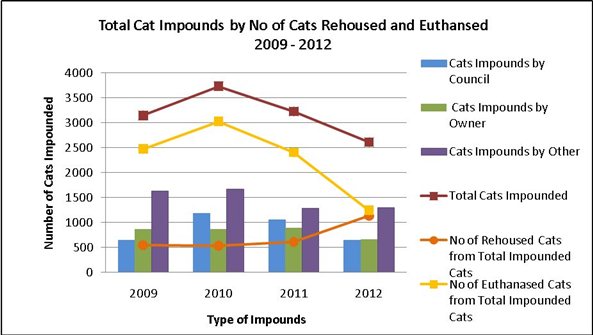
Procedures associated with seizure and impounding of dogs and cats in the community
Enforcement strategy associated with issuing notices to comply, infringement notices and filing charges for prosecution regarding dogs and/or cats that are not desexed
State legislation is applicable in regards to:
Seizure of documents
Written agreements with animal shelters or community foster care networks to provide impounding or rehoming services
Attendance at VCAT to hear appeals of dog and/or cat owners
Promote the benefits of desexing – no surprise litters, fewer unwanted animals in the community, fewer animals euthanased, reduced aggression, reduced wandering
Distribute desexing, overpopulation and high euthanasia rate brochures, fact sheets and other material developed by the Council
Continue registration and microchipping programs to ensure pet cats and dogs can be returned to their owners (see ‘Registration and Identification’ section for activities), to reduce euthanasia rates
Provide information on how to find a lost pet on Council website, and other material distributed by Council
Determine whether the municipality has an overpopulation of cats and/or dogs by analysing relevant statistics and other information
Determine whether euthanasia rates of cats and dogs are acceptable or unacceptable to Council and the community
Investigate reports of animal hoarding
Investigate reports of unauthorised ‘backyard breeders’ to ascertain whether they should be registered as a domestic animal business
Provide loan cat cages (free of charge) to local residents for trapping trespassing cats
Review policies and procedures for impounded animals to investigate rehoming options
Review policies and procedures on temperament testing of dogs and cats admitted to the pound
Conduct patrols to pick up feral and stray cats and dogs to reduce breeding
Introduced a cat curfew to reduce incidence of breeding with unowned cats, to decrease the number of unwanted litters in the community
City of Greater Geelong actively promotes desexing and RPO within the community through education and media programs including pet selection advice. Council works closely with their pound provider to develop business practices with an increased focus on rehousing animals. Council has also entered into a number of agreements with other Animal Shelters and Animal Rescue Groups in order to increase the opportunities to find homes for unclaimed dogs and cats which has significantly lowered the euthanasia rate over the past 12 months. Opportunities remain to further investigate compulsory desexing and to continue with cat trap loan program to reduce the number of stray or unwanted cats.
Reduce the number of registered dogs and cats that are currently entire (and not part of a Domestic Animal Breeding Business)
Raise the awareness of semi-owned cats in the area and reduce the number of feral cats
Increase reclaiming and rehoming rates of dogs and cats impounded in the pound
Objective 1: Reduce the number of registered dogs and cats that are currently entire and not part of a Domestic Animal Breeding Business (DABs) each year.
|
Activity |
When |
Evaluation |
|
Introduce a compulsory desexing order for cats and dogs to reduce multiple births, oversupply of dogs and cats Campaign will be phased in over the life of this plan (conditions apply e.g. Domestic Animal Breeding Business or medical reason) All cats and dogs released from the pound are to be desexed, registered and microchip All newly registered cats/dogs are to be desexed All existing registered cats to be desexed All existing registered dogs to be desexed |
Ongoing |
Order adopted by Council and implemented
|
|
Conduct feasibility study to investigate a subsidised desexing scheme for pets in partnerships with local vet clinics, and or other organisations such as the National Desexing Network |
Year 1 |
Feasibility study conducted Outcomes implemented |
|
Investigate partnership with local vet clinics and other organisations such as National Desexing Network to establish a discount desexing month of pets with local vet clinics
|
Year 1 |
Partnerships established Discount desexing month campaign developed Number of animals desexed as part of the scheme |
Objective 2: Raise awareness about semi-owned cat population and reduce the number of feral cats in Geelong
|
Activity |
When |
Evaluation |
|
Implement “Who’s for cats?” education campaign in local area including media promotions such as radio, local newspapers, ‘on hold’ phone messages and advertising campaigns
Promotions to encourage people to take full ownership of cats eg discount desex/microchip/vaccinate offers, free products
|
Annually |
Measure number and type of education materials distributed
Record number of campaign queries received by council Record number of semi owned cats handed into local pound / shelter Community survey to measure knowledge about semi owned cat problem before and after campaign Number of media stories published Measure uptake on any promotions to encourage people to take ownership of cats |
|
Identify any cat colonies in Geelong, try to identify ‘feeder’ and |
Ongoing |
Number of cats trapped in public places |
|
Review current cat trapping procedure ensuring clear guidelines available for Officer’s and residents |
Year 3 |
Procedure reviewed and implemented |
|
Implement cat trapping programs in conjunction with Parks Victoria and other relevant entities |
Year 3 |
Cat trapping program implemented Number of homeless cats reduced |
Objective 3: Increase reclaims and rehoming rates of impounded dogs and cats from Council’s pound provider
|
Activity |
When |
Evaluation |
|
Promote Online adoption program of dogs and cats in animal shelters – provide links on Council website to shelters to promote adoption of unclaimed animals to prospective new owners |
Year 4 |
Links established on Council’s website |
|
Increase the opening hours of the pound to increase reclaim and rehousing rates |
Year 1 |
Pound opening hours reviewed in consultation with the pound operator Reclaiming and rehousing rates increased |
|
Work in partnership with Council’s pound provider to promote the benefits of adopting animals from the pound |
Year 1 |
Benefits promoted Rehousing rates increased |
Outline programs, services and strategies which the Council intends to pursue in its municipal district to ensure that people comply with this Act, the regulations and any related legislation.
Council takes very seriously any reports of suspected ‘backyard breeders and any Domestic Animal Businesses (DABs) that may not be operating in accordance with the DAA and relevant Codes of Practice. Council will inspect and investigates these reports promptly to eliminate the risk to the community and to protect the welfare of animals involved. Council will continue to utilise all available legislation to control and manage Domestic Animal Businesses and eliminate any ‘backyard breeders’ within our municipality. As at December 2012 the following information was applicable:
10 registered Domestic Animal Businesses
15 boarding establishments
1 dog training business under consideration
All DABs are audited annually and followed up on non-compliance issues. Council also monitors all animals sold to ensure they have been microchipped and registered.
State Legislation applies to the management and operation of Domestic Animal Businesses
Forms for registration and information DAB’s are available on Council website and at Council offices
All DABs must be registered and audited annually
Each registration to be individually considered against checklist as to whether specific conditions are required
Council maintains a standard record/audit sheets on database of registered DABs
Education and enforcement strategy associated with issuing notices to comply, infringement notices and filing charges for prosecution regarding management of dogs and cats
Operational procedures including OHS Work Instructions are available to guide officers in the performance of their duties.
Authorised Officers will attend VCAT hearings to hear appeals of proprietors of domestic animal businesses when and if required
Provide all DAB’s with relevant Codes of Practice
BAW fact sheets on DABs available in Council offices and with website links established
Register all DABs
Conduct an annual audit of all DAB’s including relevant audit documentation
Follow up any non-compliance as required
Regular patrols for new/non-registered DAB’s – on notification
Conduct random inspections of DABs
Regular ‘Google’ and local paper check to search for possible undiscovered DABs
Follow up registration on animals sold from DAB’s
Conduct annual re-registration audits annually to allow any non compliance to be addressed
Ensure that any non compliance with permit conditions is rectified using notices to comply, information sheets etc
In cases of serious non compliance, permits may be suspended or cancelled
Non complying DABs will not receive re-registration until legislative requirements are met
Procedures in place for DAB’s to notify Council of any animals sol or given away
Investigate all reported complaints about DAB’s within operational response timeframes
Provide educational information to people making queries about setting up a DAB to let them know of all the requirements involved, before they start making too many plans
DAB registration fees are set to reflect the cost of annual audits and inspections
Investigate reports of unauthorised ‘backyard breeders’ to ascertain whether they should be registered as a DAB
Over the next four years, Council will work to ensure that all Domestic Animal Businesses are compliant with the Code of Practice and that ‘backyard breeders’ are eliminated.
To achieve this aim Council Officers will regularly conduct inspections to monitor compliance. Where breaches of the code are observed, enforcement will be prompt and relevant action take in accordance with the Act. Council Officers will actively work within the community to detect breaches and investigate complaints particularly in relation to ‘backyard breeders’, providing education and information to protect the welfare of animals.
Ensure that all Animal Management Officers (AMOs) and their supervisors are updated on the legislation in relation to DABs
Annually inspect and audit all registered DABs and investigate any suspected unregistered DABs.
Identify and close down all illegally operating Domestic Animal Breeding establishments in the municipality
Identify and register all Domestic Animal Businesses in the municipality
Objective 1: Ensure that all Animal Management Officers (AMOs) and their supervisors are updated on the legislation in relation to DABs.
|
Activity |
When |
Evaluation |
|
Form a working group within council of AMOs to review all of the fact sheets, documents, matrix of changes and new DAA.
|
Ongoing |
Add to skill matrix that officers have been to AMO seminars and read all DPI provided information |
|
Be involved with the Code review for Breeding and Rearing Establishments – though MAV, public meetings, etc |
Ongoing |
Make a Council approved submission on the Breeding Code document at formal public comment stage |
Objective 2: Annually inspect and audit all registered DABs and investigate any suspected unregistered DABs.
|
Activity |
When |
Evaluation |
|
AMOs will audit all DABs in their relevant geographic area of responsibility |
Annually |
All DABs audited Number of prosecutions
|
|
AMOs will conduct random patrols of all DABs in their relevant geographic area of responsibility |
Annually |
Number of new DABs identified Number of prosecutions
|
|
Investigate any report of unregistered DAB within operational response timeframes |
Ongoing |
Number of reports Number of prosecutions
|
Objective 3: Identify and close down all illegally operating Domestic Animal Breeding establishments in the municipality
|
Activity |
When |
Evaluation |
|
Undertake education campaign to promote awareness about definition of breeding DABs, and COP requirements for businesses: Advertisements in local classifieds
Website information
Follow up people advertising pets for sale (eg in local papers or on local noticeboards), to determine if they are a DAB and are registered with council |
Ongoing |
Compare number of council registered breeding establishments before and after campaign (would expect an increase) |
Objective 4: Identify and register all Domestic Animal Businesses in the municipality
|
Activity |
When |
Evaluation |
|
Identify all businesses that should be registered DABs in the municipality, using yellow pages, local newspapers and markets (or similar including online sites) identify businesses selling pets/pet products/services in the municipality. Follow up to determine whether they are and should be registered with Council |
Ongoing |
Compare number of register DABs before and after activity |
|
Distribute BAW fact sheets regarding changes to the definition of DABs |
Ongoing |
BAW sheets distributed BAW links placed on Council’s website |
|
Provide information to the public on how to register a complaint regarding a DAB that they believe is non compliant |
Year 1 |
Website updated Number of complaints received |
|
Continue to provide a DAB registration number system for our municipality. These numbers have to be placed in advertisements by DABs of animals for sale, along with the name of the Council that issued the number |
|
DAB Registration number system and on all DAB Registration Certificates issued as required |
Provide for the review of any other matters related to the management of dogs and cats in the Council's municipal district that it thinks necessary
AMOs are all authorised under the Prevention of Cruelty to Animals Act 1986 (POCTA Act) and actively investigate all reported animal cruelty matters. Assistance is also provided to the RSPCA in their investigations of alleged cruelty
AMOs provides assistance to our community during emergencies and periods of community need. AMOs provide assistance to the State, Local Police when required during emergencies such as recovery or domestic issues
Liaise with key stakeholders regarding animal management issues including access to public open spaces, control of domestic animals, canvassing on proposed Councils Orders
Promote Responsible Pet Ownership through the community
In-house Prosecutions Team dedicated to ensuring statutory obligations met, quality investigation briefs and cases managed efficiently and actively prosecuted in the relevant courts
Education and enforcement strategy associated with issuing notices to comply, infringement notices and filing charges for prosecution regarding management of dogs and cats
Operational procedures including OHS Work Instructions are available to guide Officers in the performance of their duties
City of Greater Geelong Emergency Management Plan (GEMP)
Advise residents of fireworks situations in City News so owners can reduce animal fear and escape
Long established relationship with RSPCA
Develop a contact list for regarding animal emergency planning – Council contacts, shelters, animal welfare organisations, DPI. And work out your arrangements with those contacts in the event of emergencies.
Annual inspection of excess animal permit properties, particularly those with permit for large number of animals
Establish Animal Management Liaison Group with neighbouring Councils for sharing of ideas, policies and procedures, etc
Seek assistance from RSPCA and other authorised POCTA Act officers in implementing and enforcing the POCTA Act, Regulations and Codes of Practice (COPs)
The city of Greater Geelong is a municipality with great lifestyle and strengths that balances pet ownership with the needs of the community and the environment. The following principles underpin actions with regard to dogs and cats:
The belief that pets contribute to our quality of life
A requirement to balance the needs of those who own pets and those who do not
To value responsible pet ownership
Proactive animal management and education
Ensuring the environment is protected from the negative impacts of dogs and cats
To work in partnership with others
Play a leadership role in animal management
Promote emergency planning to ensure the welfare of animals in emergencies
Continue to educate the community on responsible pet ownership and the benefits of pet ownership
To provide a safe, balanced and harmonious community for all
Objective 1 Promote emergency planning to ensure the welfare of animals in emergencies:
|
Activity |
When |
Evaluation |
|
Liaise with breeding and boarding DABs regarding their emergency plans |
Year 3 |
Number of visits to discuss emergency management |
|
Discuss emergency animal welfare plans and Council Policy for evacuation/relief centres with MERO |
Year 3 |
Item considered by Council Municipal Emergency Management Planning Committee Proposed actions identified and implemented |
|
Provide education to residents regarding planning for their pets in emergencies |
Year 3 |
DPI information distributed and link available on website |
Objective 2 Continue to educate the community on responsible pet ownership and benefits of pet ownership aimed at community harmony and reduced nuisances
|
Activity |
When |
Evaluation |
|
Year 2 |
Links available on website |
|
Promote the role of Council Animal Management Officers (Authorised Officers) through web site, education programs and media
|
Ongoing |
Education programs modified Information on website Articles on social media Number of media articles |
|
Activity |
When |
Evaluation |
|
Review the visibility of Councils AMO to residents by providing highly visible uniforms and vehicles |
Year 1 |
AMO vehicles and uniform clearly identified incorporating the ‘Lead the Way’ brand |
|
Continue to keep community, pet owners, stakeholders informed through Tag Times and E Mail newsletter – distribute to registered pet owners, vets and DABs |
Ongoing |
|
|
Develop RPO programs targeting students in Secondary Colleges as the next generation of pet owners |
Year 2 |
Programs developed Education delivered to Secondary Students |
|
Encourage the BAW to provide translated material (oral and/or printed) on RPO and Nuisance issues in multi-cultural languages |
Year 3 |
Multi-cultural material produced by BAW on RPO and Nuisance issues |
Council must
Review its domestic animal management plan annually and, if appropriate, amend the plan
Provide the Department of Primary Industries’ Secretary with a copy of the plan and any amendments to the plan
Publish an evaluation of its implementation of the plan in its annual report.
Each year Council conducts a review of the Domestic Animal Management Plan. A copy of this review is presented to Council annually for information. This report is then forwarded to the Department of Primary Industries’ Secretary with any proposed amendments. Additionally a copy of this report is included in Council’s Annual Report which community have access to via Council’s website.
Annual and Ongoing activities will be reported in the following format
|
Objective |
Activities Undertaken |
Evaluation |
|
Training of Authorised Officers |
|
|
Yearly activities will be reported in the following format
|
Objective |
When evaluated |
Activities Undertaken |
Evaluation |
|
Reconcile the National Microchip Registry with Councils registration data prior to renewal period each year |
Year 1 |
|
As part of Council’s on going role and responsibility to implement effective domestic animal management strategies in accordance with its 2013-2017 Domestic Animal Management Plan, Council has revised its Dogs in Public Policy Outline.
This Policy Outline will guide the community with respect to understanding the dog control rules and conditions that apply in open public spaces to ensure community safety, environment protection and fair and equitable access to such spaces for all users.
Based on community feedback of both dog owners and non-owners, it is recognised that a range of controls are required to represent the needs of all public space users who have a mix of on leash and off leash opportunities for them and their dogs.
The Policy Outline will be complimented by area maps that clearly outline the dog control rules that apply for that location or site.
In general, the municipality is declared an ‘On Leash - Controlled’ area except for all of those areas, public spaces and reserves that are specifically designated as ‘Off Leash – Supervised’ (dog friendly parks) where dogs are permitted to be effectively supervised off leash.
The following outlines the content of the policy.
Dogs are allowed off leash and supervised in specific designated public open space areas and/or any area as indicated by the relevant signage. This includes, amongst other public open spaces;
those paths located on the Fyansford Common and the shared path on the northern side of the Barwon River upstream from the Queens Park Bridge to Fyansford Common including Zillah Crawcour Park);
Sporting grounds/ovals (playing area) outside times when being used for organised sports, including training (as defined by a formal booking with council)
Sporting complexes/reserves – outside times when being used for organised sports, including training (as defined by a formal booking with council)
A range of Reserves as listed in the attachment to this policy
A range of broad open space parks as listed in the attachment to this Policy and as per Map 2.
Council will review the effectiveness of these ‘Off Leash – supervised’ areas on an ongoing basis and will also consider any request for new ‘Off Leash – Supervised’ areas to be established based on the following criteria, which will ensure safety, and equitable access to such spaces. These include:
Linear open public spaces (i.e. green corridors, easements) may be considered if there is sufficient width to ensure safe use and passage
Public open spaces that do not contain a playground or where the playground is fully enclosed/fenced. Open public spaces with centrally located playgrounds are not suitable as an off leash (supervised) area
Public open spaces that is located at a safe distance from busy roads
Any other public open space not mentioned above that is not adjoining/adjacent a water body and that no wildlife is present
A high level accessibility either by walking or a short drive
That there is no detriment to safety or the environment through the use of such open public spaces
Suitable open spaces will be reviewed annually to monitor performance and identify any additional reserves that may be suitable as off leash ‘supervised’ areas.
The following conditions must be followed when using the ‘Off Leash - Supervised’ Areas:
The handler must have a dog lead in their possession and place their dog back on the leash when leaving the off leash area.
The handler must be able to demonstrate audible control of the dog.
When encountering others/other dogs using this area, the dog must be recalled and restrained until both parties have moved apart at a safe distance.
Dogs must remain in visual and audible range of their handler to allow it to be effectively recalled at any time.
Dogs must not enter water habitats that contain wildlife or chase wildlife in these areas;
Dogs attracted to the motion of wheels must be controlled at all times.
Dogs declared menacing/dangerous/restricted breed are not permitted to be walked off-lead in ‘Off Leash – Supervised’ areas, and
Dogs that are aggressive to people or other dogs, behave in an anti social manner, or are over excitable should be muzzled when in public and not to be off leash.
Signs will clearly indicate those parks, reserves or public open spaces where dogs are permitted to be off a leash and supervised. (see Appendix 1 and 2)
Within the City of Greater Geelong, unless otherwise designated by signage, all public open space areas shall be designated as ‘On Leash - Controlled’ areas. Public Open Space Areas (includes roads, footpaths, beaches, reserves, parks, playgrounds and other council lands and buildings)
More specifically this includes:
All roads and footpaths/nature strips.
Shopping centres.
High use areas pedestrian and/or cycling areas (for example the Waterfront Precinct in Geelong).
Sporting complexes and reserves (not including playing area) during times of organised sports (as defined by a formal booking with council which includes times booked for sports practice/training).
At Council sanctioned events, markets etc.
Shared use paths or walking paths and including areas either side of the abutting edge of the path; (except those in designated ‘Off Leash – Supervised’ areas).
Dogs being within and/or tethered within ten (10) metres of children’s play equipment.
Dogs being within and/or tethered within ten (10) meters of picnic and barbecue areas (as defined by council provided barbecues and/or table and associated seating).
In areas designated as environmentally significant
Jetties and piers.
Water bodies such as creeks, rivers, lakes, and beaches (ocean, bay) unless signposted as a dedicated swimming area for dogs.
Beach foreshore and coastline areas (except those designated as off leash-supervised).
|
Other public open spaces including conservation, park and recreation, public and open zones including: |
|
|
|
Other zones that may contain open space include: |
|
|
The handler must at all times have a means to pick up and dispose of dog droppings – penalties apply.
Dogs when tethered must never be left unattended anywhere e.g. play equipment, shopping precincts.
Leads must not exceed 2 metres in length.
Retractable leads must be restricted to 2 meters in length in ‘On Leash – Controlled’ areas, but may be used more liberally in ‘Off Leash - Supervised’ areas where there remains a need to have control over a dog.
Dog Control Categories (applicable to coastline areas and other public open spaces as designated) will apply to reflect the needs of all public open space users and ensure community safety and environment protection.
Areas where dogs are permitted off leash and supervised all year round.
Allow dogs off leash and supervised during specified times all year round; in the mornings prior to 10.00 a.m. and in the evenings after 5.00 p.m. Dogs would be required to be on leash at all other times.
On land managed by the Bellarine Bayside Foreshore Committee of Management, allow dogs off leash and supervised at any times between May 1 and October 31 each year. Dogs would be prohibited during all other periods.
On land managed by the Barwon Coast Committee of Management, allow dogs on leash and controlled at any times between 1 December to 17 December and 1 February to 30 April each year. Dogs permitted off leash and supervised between 1 May to 30 November.
Dogs would be prohibited at other times in designated areas as signed.
Areas where dogs are required to be on leash all year round due to:
environmental sensitivity
where there is an Order by Council
the land management authority (not being Council) has regulated dog access under their own rules or legislation
Allow dogs on leash during specified periods as designated by signage including periods during the hood plover nesting season and/or other periods dedicated to protecting other wildlife (i.e. seals, penguins). Dogs are permitted to be off leash and supervised at other times/periods.
Areas that will have dogs prohibited for reasons of:
extremely high environmental sensitivity;
where there is an Order by Council;
the land management authority (not being Council) has prohibited dogs under their own rules or legislation (effected by a dog control order).
|
PROPOSED DESIGNATED ‘OFF LEASH - SUPERVISED’ AREAS |
|
Park/Reserve |
Location |
Zone |
Melways Reference |
|
North Zone |
|
|
|
|
Elcho Park |
125 Elcho Road Lara |
North |
422 B7 |
|
Abe Wood Reserve |
300 Evans Road Lovely Banks |
North |
431 A3 |
|
Sutcliff Reserve |
240-268 Plantation Road Corio |
North |
431 J4 |
|
Stead Park |
190-216 Princess Highway Corio |
North |
432 C10 |
|
Myers Reserve |
5-35 Bluestone Bridge Road Bell Post Hill |
North |
441 C1 |
|
Seagull Paddock |
380-400 Melbourne Road North Geelong |
North |
441 K3 |
|
Fyansford Common |
Deviation Road Fyansford |
North |
451 A2 |
|
South Zone |
|
|
|
|
Rotary Centennial Park |
188A West Fyans Street Newtown |
South |
451 E6 |
|
Frank Mann Reserve |
5 Heal Street Ceres |
South |
450 C11 |
|
Grinter Reserve |
125-177 Coppards Road Moolap |
South |
453 B12 |
|
Brearley Reserve |
Grove Road Marshall |
South |
465 K4 |
|
Breakwater Road Reserve |
Breakwater Road Belmont |
South |
466 C1 |
|
East Zone |
|
|
|
|
Portarlington Recreation Reserve |
4-22 Sproat Street Portarlington |
East |
444 F6 |
|
Drysdale Recreation Reserve |
30 Duke Street Drysdale |
East |
456 G11 |
|
Charles McCarthy Memorial Reserve |
Leviens Road St Leonards |
East |
459 K11 |
|
Kingston Park |
8-52 Adco Grove Ocean Grove |
East |
484 C9 |
|
Collendina Reserve |
93A Sunset Strip Ocean Grove |
East |
484 E12 |
|
Beacon Point Reserve |
Beacon Point Road Clifton Springs |
East |
457 A2 |
|
Sporting Grounds/Ovals (playing area only) available as an ‘Off Leash - Supervised’ Area Outside times when being used for organised sports, including training (as defined by a formal booking with Council)) |
|
|
Address |
Melways Reference |
|
Abe Wood Reserve |
Evans Road, Lovely Banks |
431 A3 |
|
Anakie Reserve |
Demotts Road, Anakie |
Key Map 11 A |
|
Bakers Oval |
Shannon Avenue, Geelong West |
441 G12 |
|
Barwon Heads Reserve - CROWN LAND |
Barwon Heads Road, Barwon Heads |
497 A2 |
|
Belmont Common North- CROWN LAND |
Settlement Road, Belmont |
451 K8 |
|
Belmont Common South- CROWN LAND |
Breakwater Road, Belmont |
466 A1 |
|
Breakwater Reserve |
Tanner Street, Breakwater |
466 D2 |
|
Burdoo Reserve |
Wingarra Drive, Grovedale |
465 E9 |
|
Ceres Reserve - CROWN LAND |
Cochranes Road, Ceres |
450 B12 |
|
Collendina Reserve |
Sunset Strip, Ocean Grove |
484 D12 |
|
Corio Community Reserve |
Hendy Street, Corio |
432 C7 |
|
Drysdale Reserve - CROWN LAND |
Wyndham Street, Drysdale |
456 F10 |
|
Eastern Park - CROWN LAND |
1-45 Garden Street, East Geelong |
402 P6 |
|
Elcho Park |
Elcho Road, Lara |
422 A7 |
|
Elderslie Reserve |
Read Street, Newtown |
451 D2 |
|
Ervin Reserve |
Richard Street, Newcomb |
452 K9 |
|
Evans Reserve |
Sparks Road, Norlane |
431 K12 |
|
Flinders Peak Reserve |
Hendy Street, Corio |
432 C7, D6 |
|
Frier Reserve |
West Fyans Street, Newtown |
451 G7 |
|
Grinter Reserve |
Coppards Road, Newcomb |
453 B12 |
|
Grovedale Reserve - CROWN LAND |
Reserve Road, Grovedale |
465 H7 |
|
Hamlyn Park |
Calvert Street, Hamlyn Heights |
441 F10 |
|
Herne Hill Reserve |
Finchaven Street, Herne Hill |
451 D1 |
|
Highton Reserve |
95-105 Barrabool Road, Highton |
451 C10 |
|
Howard Glover Reserve - CROWN LAND |
Limeburners Road, Geelong |
452 H6 |
|
Hume Reserve |
Thompsons Road, North Geelong |
441 H5 |
|
Harold Hurst Reserve |
Douglass Street, Herne Hill |
441 E11 |
|
King Lloyd Reserve |
Windsor Road, Newtown |
451 E8 |
|
Lake Lorne Equestrian |
Reserve Road, Drysdale |
470 F1 |
|
Lara Reserve |
Walkers Road, Lara |
423 B5 |
|
Leopold Reserve |
Melaluka Road, Leopold |
468 D2 |
|
McDonald Reserve |
Reynolds Road, Belmont |
465 D1 |
|
Mount Duneed Reserve |
Russells Road, Mount Duneed |
479 A4 |
|
Myers Reserve |
Creamery Road, Bell Post Hill |
441 A2 |
|
Ocean Grove Reserve |
Draper Street, Ocean Grove |
483 J11 |
|
Osborne Park |
Osborne Avenue, North Geelong |
442 A8 |
|
Peter Lowe Reserve |
Minerva Road, Herne Hill |
441 F1 |
|
Portarlington Reserve |
Sproat Street, Portarlington |
444 F6 |
|
Queen’s Park |
150 Queens Park Road, Highton |
451 B4 |
|
Rees Reserve |
Old Melbourne Road, Little River |
200 E9 |
|
Richmond Crescent |
Richmond Crescent, South Geelong |
452 C7 |
|
St Albans Reserve |
Boundary Road, Whittington |
452 G12 |
|
St Leonards Reserve |
McLeod Street, St Leonards |
460 A10 |
|
Shell Reserve |
Purnell Road, Corio |
432 B8 |
|
Shell Road Reserve (Surfside) |
Shell Road, Ocean Grove |
484 C10 |
|
South Barwon Reserve |
Barwon Heads Road, Belmont |
451 K10 |
|
Stead Park |
St Georges Road, Corio |
432 B10 |
|
Thomson Reserve |
Godfrey Street, Thomson |
452 F8 |
|
Tim Hill Reserve |
Wandana Drive, Wandana Heights |
450 K11 |
|
Vines Road |
Vines Road, Hamlyn Heights |
441 E10 |
|
Wallington Reserve |
Wallington Road, Wallington |
483 D4 |
|
Wathaurong Reserve |
Collins Street, Drysdale |
456 K9 |
|
Western Oval |
Church Street, North Geelong |
441 J11 |
|
Windmill Reserve |
Mayfair Drive Newtown |
451 D5 |
|
Windsor Park |
Rose Avenue, Norlane |
432 B12 |
|
Winter Reserve |
Kidman Avenue, Belmont |
465 F2 |
|
Reserves available as an ‘On Leash - Controlled’ Areas
|
|
|
|
Address |
Melways Reference |
|
Milton Reserve |
Milton Street, Bell Park |
441 F7 |
|
Belmont Heights Neighbourhood Park |
Cnr Regent Street and Amundsen Street, Belmont |
451 H10 |
|
Herd Reserve, |
2A Regent Street, Belmont |
451 J11 |
|
Iona Reserve |
28A Iona Avenue, Belmont |
451 D12 |
|
Kindale Reserve |
10 Kindale Court, Belmont |
465 465 C3 |
|
Kyle Reserve |
2A Kyle Avenue, Belmont |
451 H9 |
|
Morris Reserve |
18A Morris Street, Belmont |
451 G10 |
|
Stork Reserve |
26A Stork Avenue, Belmont |
465 H1 |
|
Clunies Reserve |
10 Clunies Court, Corio |
431 H6 |
|
Rodborough Reserve |
23A Rodborough Crescent, Corio |
432 B6 |
|
Stradling Reserve |
6 York Street, Geelong |
452 A1 |
|
Osborne House |
78 Osborne Avenue, Nth Geelong |
441 H7 |
|
LJ Keavy Park |
25 Eureka Street, Geelong West |
451 G3 |
|
Bank Reserve |
20 Bank Street, Lara |
423 A6 |
|
Fairnie Reserve |
1A Fairnie Street, Hamlyn Heights |
441 D9 |
|
Bennett Reserve |
6A Bennett Street, Highton |
451 B9 |
|
Cara Reserve |
5A Cara Road, Highton |
451 D9 |
|
Ferndale Reserve |
6A Ferndale Parade, Highton |
451 E10 |
|
Lambhill Reserve |
282 Mt Pleasant Road, Highton |
451 A9 |
|
Thornbury Reserve |
3A Thornbury Lane, Highton |
451 C8 |
|
Cornthwaite Reserve |
2 Cornthwaite Crescent, Leopold |
468 G2 |
|
Ising Reserve |
8 Ising Street, Newcomb |
452 H8 |
|
Janet Reserve |
3 Janet Court, Newcomb |
452 J9 |
|
Lancaster Reserve |
11 Nelson Avenue, Newcomb |
452 K10 |
|
Pitman Avenue Reserve |
2-6 Silver Street, Newcomb |
452 J9 |
|
Tilly Reserve |
7 Tilly Court, Newcomb |
452 J9 |
|
Wilton Avenue Reserve |
25 Wilton Avenue, Newcomb |
452 H9 |
|
Buckingham Reserve |
66 Buckingham Road, Newtown |
451 E6 |
|
Fairmont Reserve |
21 Fairmont Road, Newtown |
451 E6 |
|
Maynooth Reserve |
4A Maynooth Drive, Norlane |
431 H10 |
|
Crane Reserve |
9 Crane Court, Ocean Grove |
483 J10 |
|
Hollywood Reserve |
12 Hollywood Boulevard, Point Lonsdale |
499 J10 |
|
McShane Reserve |
6 McShane Court, Rosewall |
432 F5 |
|
Chandos Reserve |
4A McGill Court, St Albans |
466 G2 |
|
Aitken Park |
7 Aitken Court, Whittington |
466 H1 |
|
Stan Swain Childrens Playground |
50 Westmoreland Street, Whittington |
466 H1 |
|
Vincent Park |
59 Truscott Street, Whittington |
452 J11 |
The following maps (15 in total) show various coastal beaches, reserves and open space areas within the City of Greater Geelong. The maps commence at the south western boundary of the municipality and work around the coastline to the north eastern boundary near Little River.
A summary of the maps are:
|
MAP NO |
DESCRIPTION |
|
Map 1 |
Overview of Municipality Coastline. |
|
Map 2 |
Designated ‘Off Leash - Supervised’ Areas within Sporting Complexes and Reserves. |
|
Map 3 |
Redgum Island, Fyansford Common – Barwon River. |
|
Map 4 |
Breamlea Beach and Bancoora Beach. |
|
Map 5 |
Ocean Grove, Collendina and Point Lonsdale Beaches. |
|
Map 6 |
Black Rock; Thirteenth Beach; Barwon Heads and Ocean Grove. Land is managed by Barwon Coast Committee of Management who has determined existing dog controls. Council has adopted these dog control controls. |
|
Map 7 |
Swan Bay and Edwards Point. Land is managed by Parks Victoria. |
|
Map 8 |
St Leonards; Indented Heads and Portarlington Beaches. Land is managed by Bellarine Bayside Foreshore Committee of Management who determines their dog control orders. Council at its discretion may adopt such orders. |
|
Map 9 |
Ramblers Road; The Dell; Jetty Road and west of Jetty Road Beaches Clifton Springs. |
|
Map 10 |
Point Henry (east and west side). |
|
Map 11 |
Waterfront Precinct, Geelong. |
|
Map 12 |
Western Beach; Rippleside Beach and St Helens Beach. |
|
Map 13 |
Moorpanyal Beach, North Shore; Shell Foreshore (beach area); Grammer School beach; Limeburners Lagoon and Avalon Beach. |
|
Map 14 |
Batesford Reserve, Batesford. |
|
Map 15 |
Land along Barwon River from Queens Park Bridge to Breakwater. This land is managed by Corangamite Catchment Management Authority (with a small portion managed by Barwon Water near the MacIntyre Footbridge).Existing dog controls have been implemented by these land managers and Council does not have the authority to amend these controls. |
Colour coding of the maps demonstrates dog controls at a glance. The category of controls in turn relate back to Council’s Policy on Dogs in Public Places
It should be noted that the maps are not inclusive of all open space areas within the City of Greater Geelong. The areas depicted are those where Council has made a decision in relation to dog controls. As the plan evolves more open space areas may become subject to ‘On Leash – Supervised’ requirements.
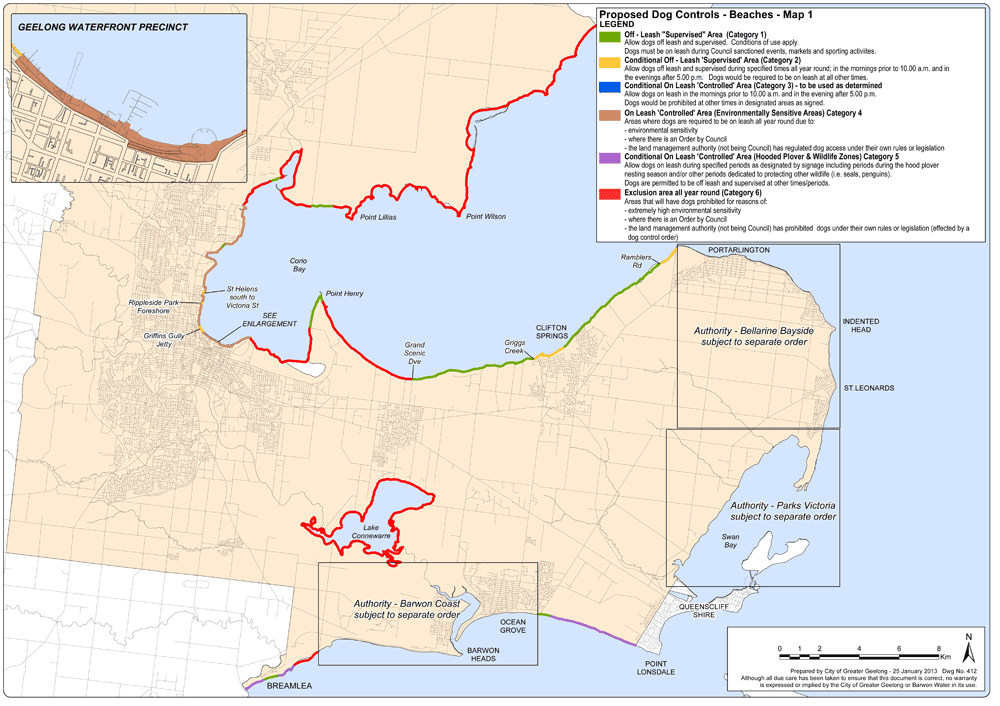
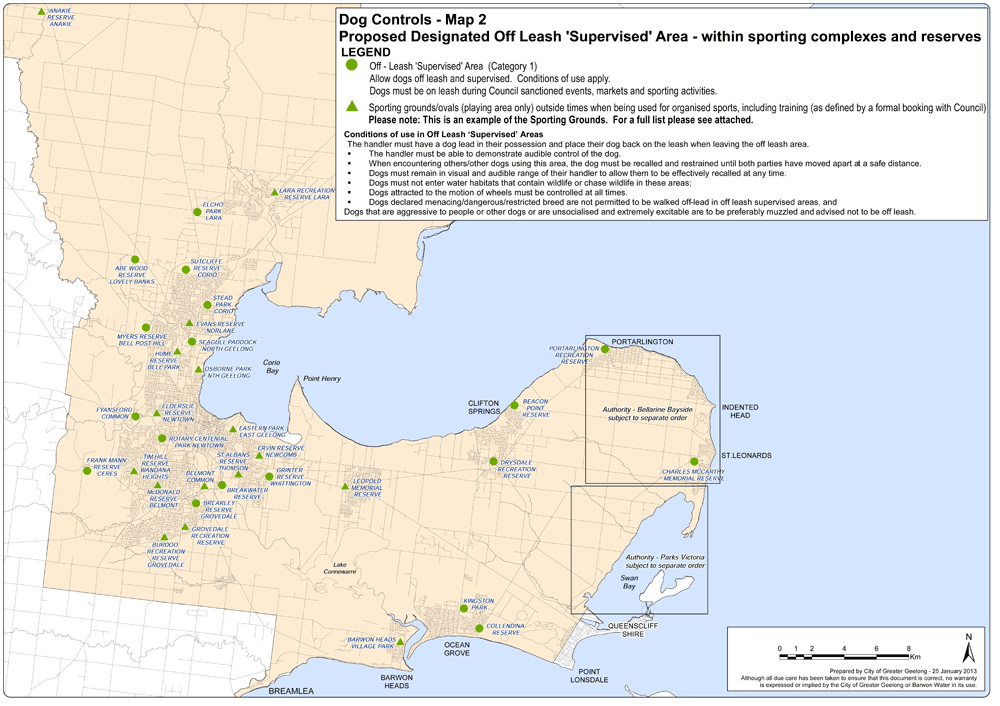
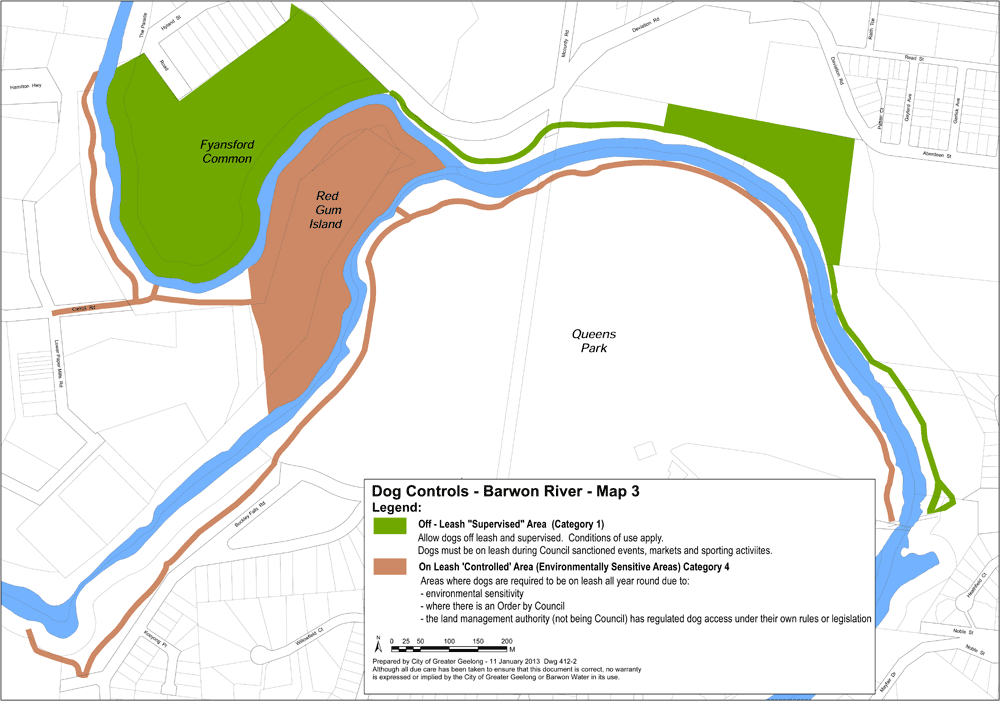
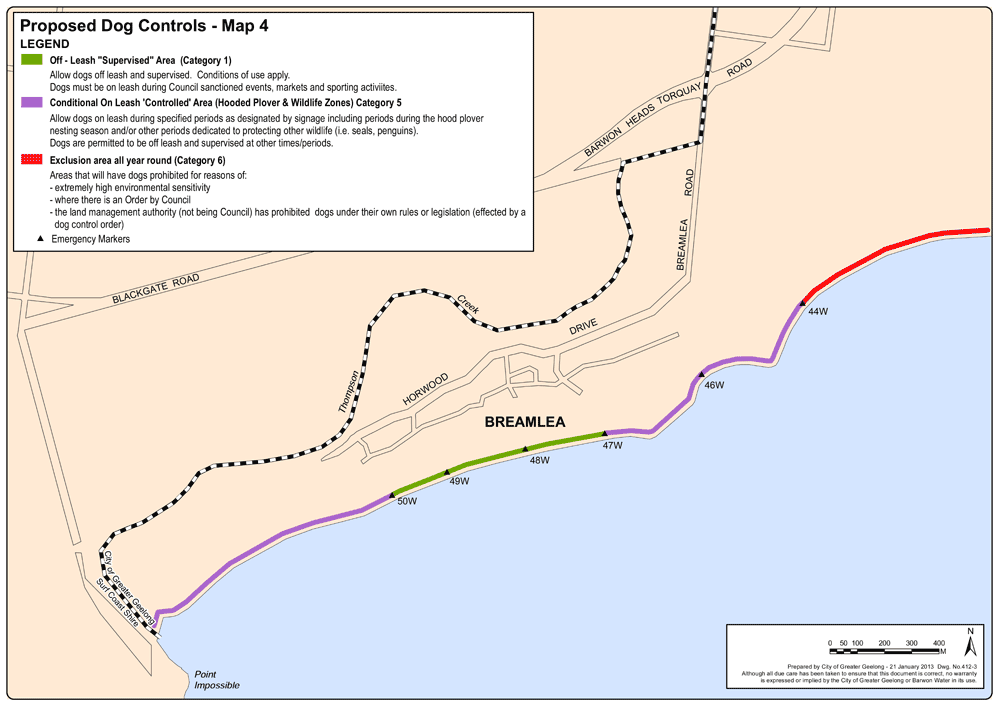
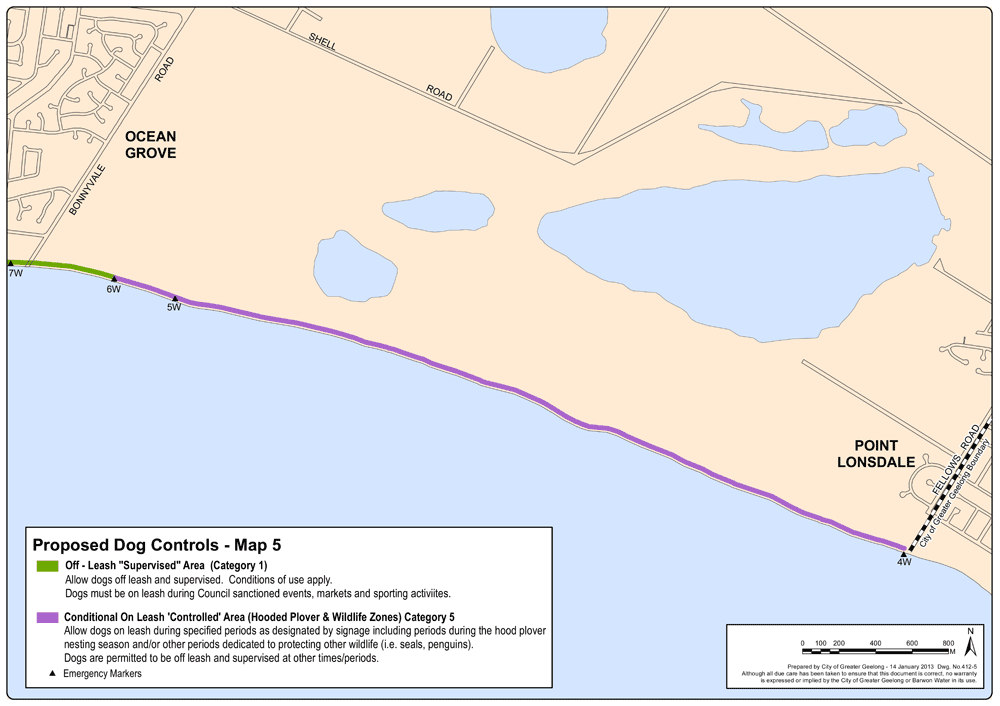
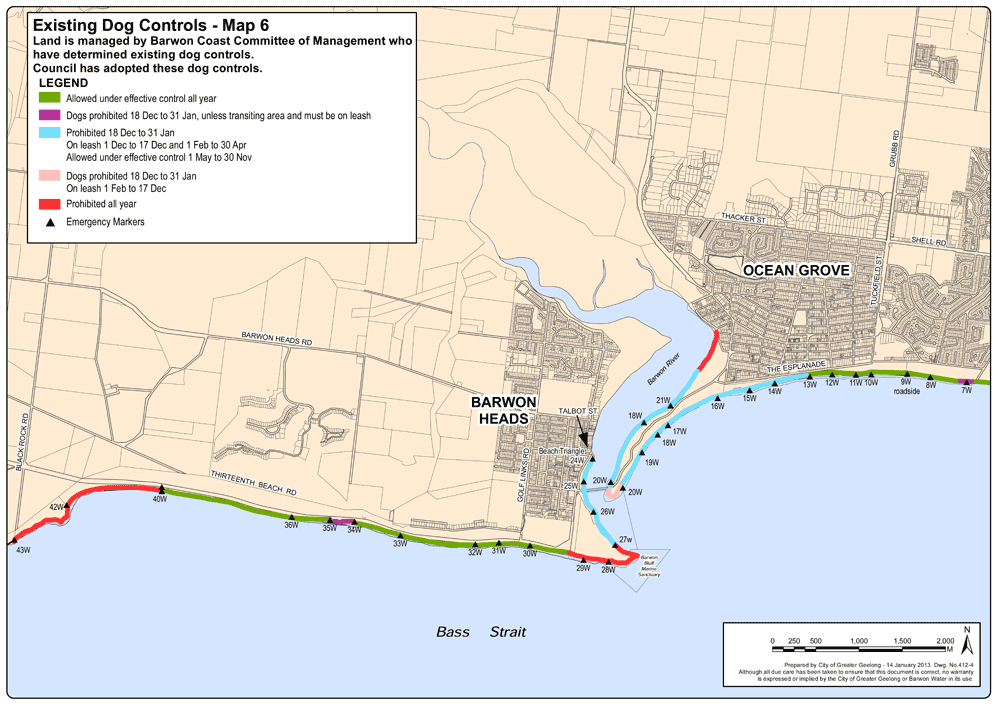
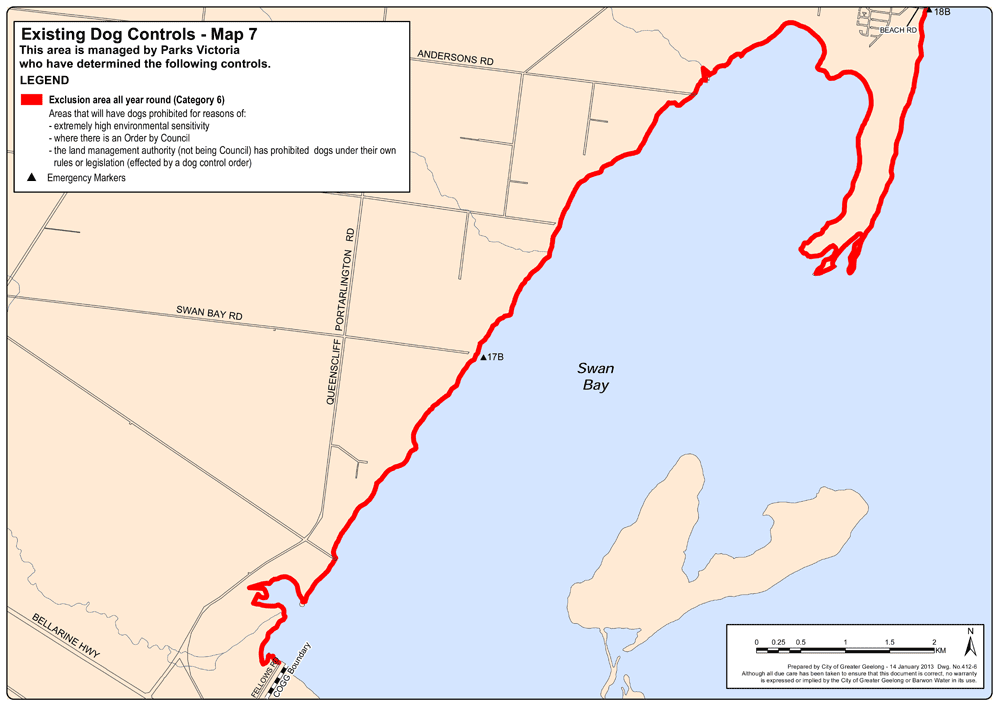
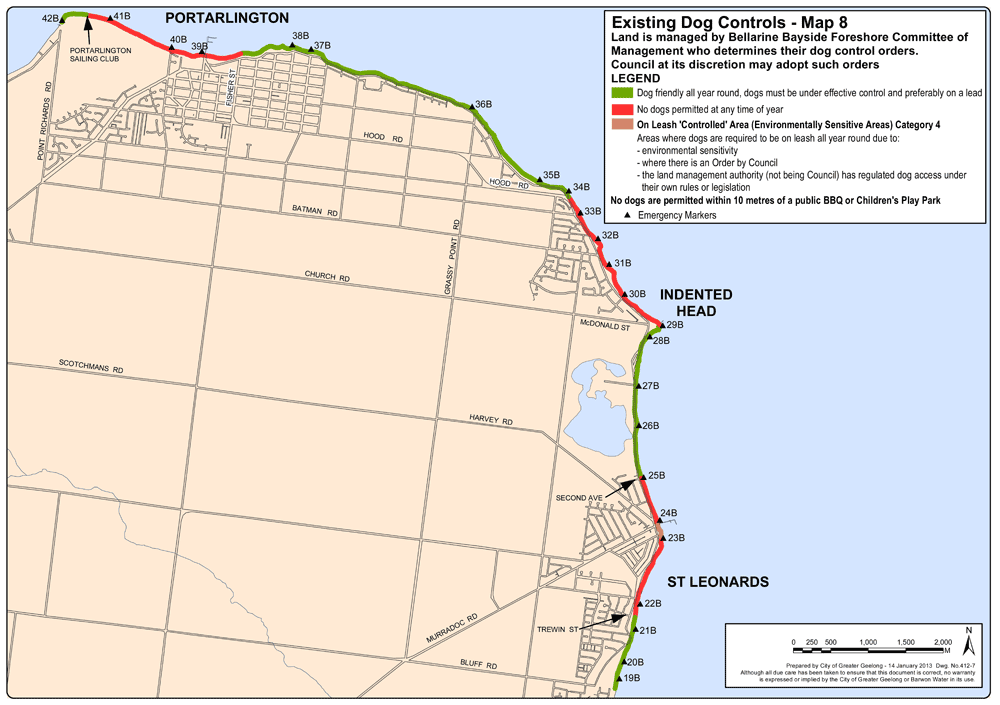
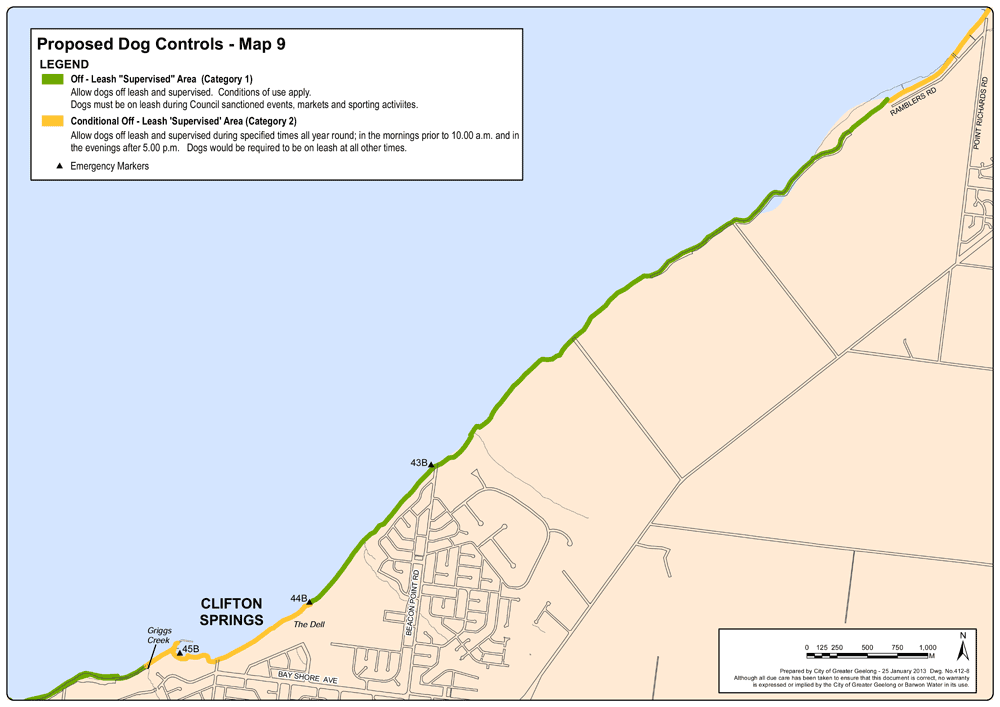
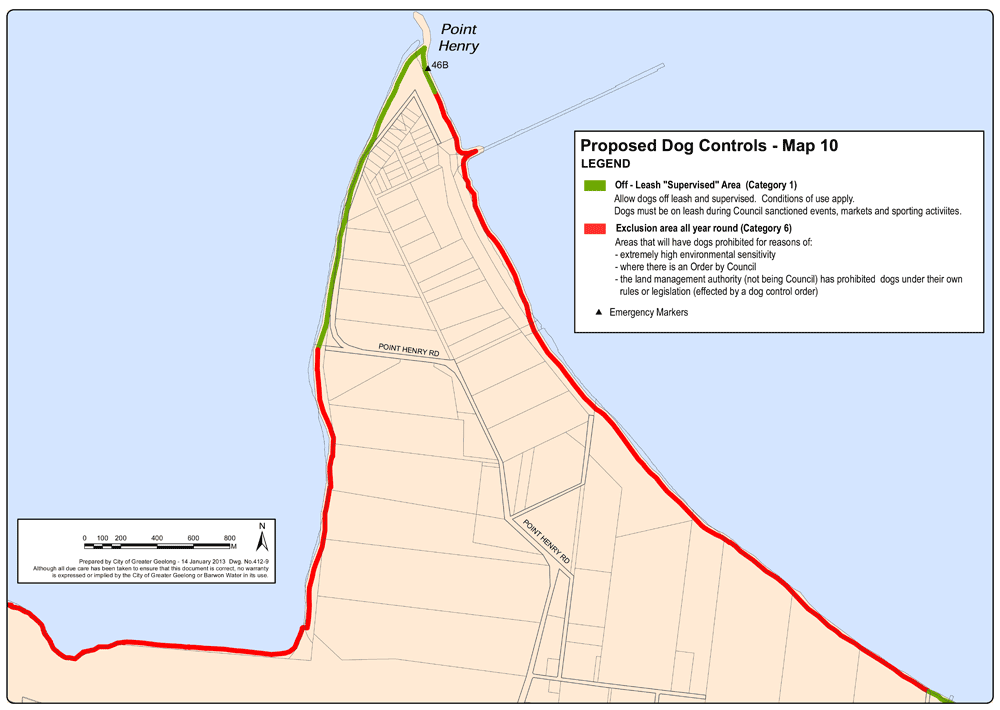
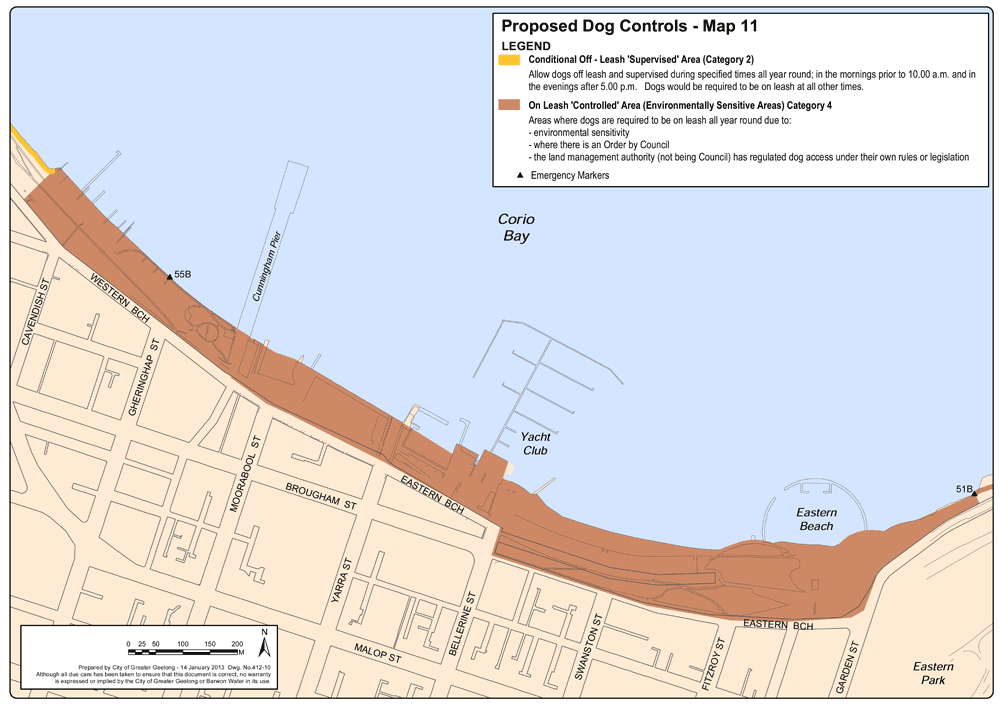
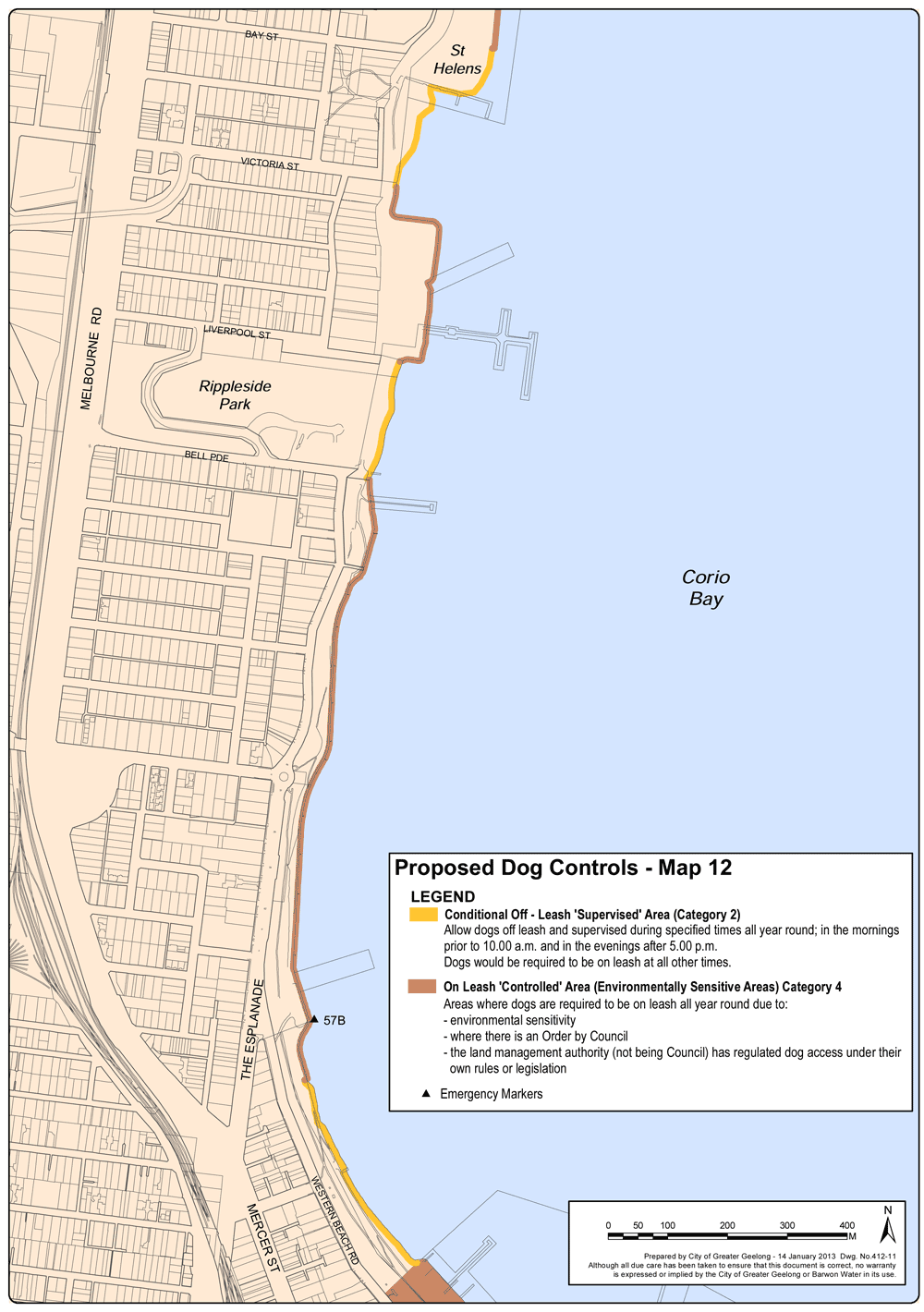
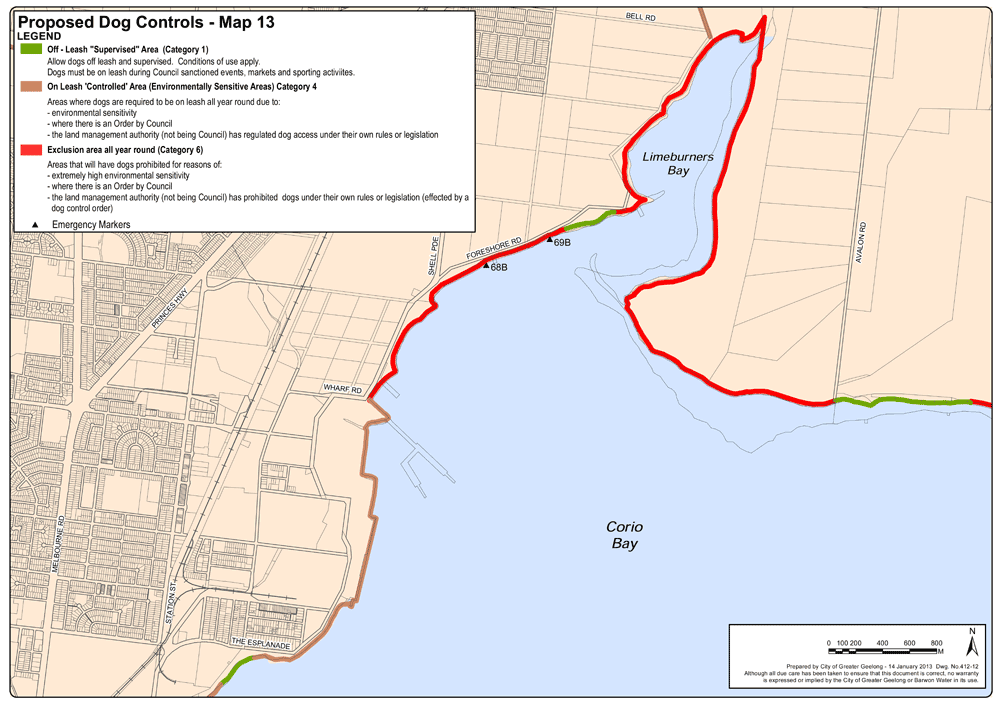
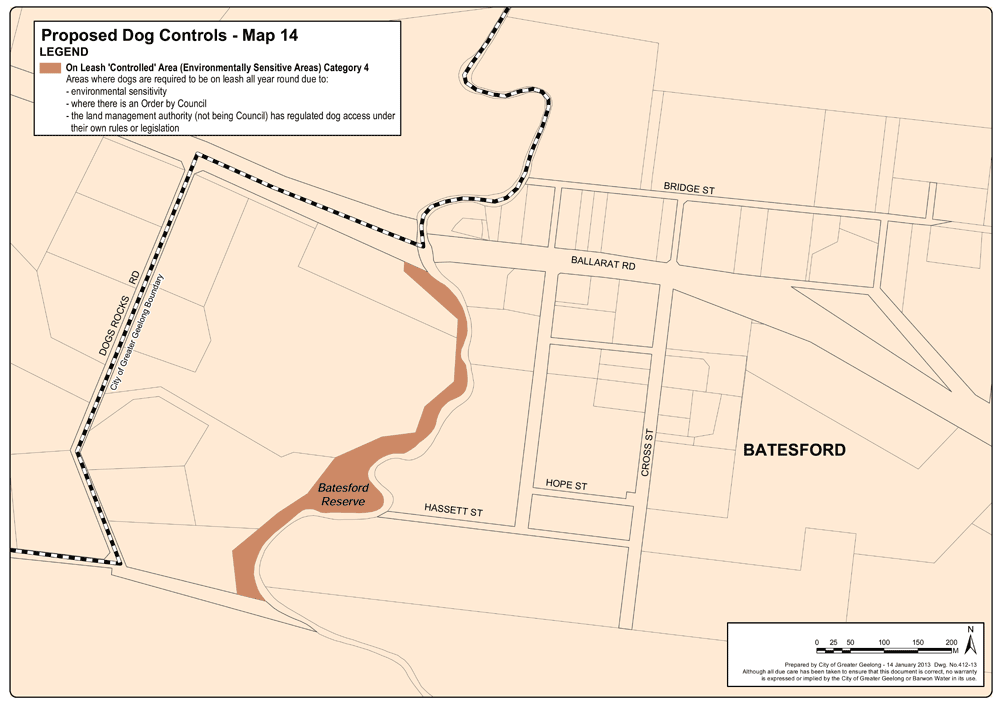 [Back to DAM Plan Draft 2013-2017 - Table of Contents]
Portfolio: |
Environment & Sustainability - Cr Richards |
Source: |
City Services - Infrastructure Operations and Waste |
General Manager: |
Gary Van Driel |
Index Reference: |
Customer: Barwon Regional Waste Management Group |
The Board of the Barwon Regional Waste Management Group comprises of six Directors nominated from councillors of the Member Councils.
The Group’s constitution enables the appointment of additional Directors with specific skills by a meeting of duly authorised representatives from the Member Councils, as convened by the Board.
The Group’s constitution states:
“2.3 The Members may by agreement appoint persons with appropriate skills and section expertise as additional Directors for such period or periods as the Members shall decide from time to time.
2.4 The appointments by Member Councils of Directors, other than Councillor(s), to the Board may be made at a meeting of duly authorised Member representatives convened by the Board.”
The Group has developed an independent skills audit process to determine any skills gap in the Board and an appointment and evaluation process to identify the preferred candidates for consideration at this meeting.
It is considered that the appointment of these additional Directors represents a responsible approach and should be supported.
It is also considered that the Council representatives nominated as Directors on the Board are the most appropriate persons to be the duly authorised Member Council representatives to attend this meeting.
Cr Richards moved, Cr E Kontelj seconded -
That Council:
agree to the appointment of a maximum of four skills based Directors to the Board of the Barwon Regional Waste Management Group, in accordance with the Barwon Regional Waste Management Group constitution;
endorse the process for the appointment of these Directors, and
duly authorise the appointed Councillor representatives to be the Council’s representatives at the meeting to be convened by the Board for the purpose of appointing these Directors.
Cr Macdonald moved, Cr Irvine seconded –
That Standing Orders be suspended to enable further discussion on the report.
Carried.
Cr Richards moved, Cr Macdonald seconded –
That Standing Orders be resumed.
Carried.
Upon resumption of Standing Orders the motion was carried.
Carried.
The Barwon Regional Waste Management Group Board has resolved to seek the appointment of skills based directors to this Board. This is a continuation of a previous practice that has been developed over recent years and the Board now wishes to confirm the process for this to occur with the support of its Member Councils.
The Group’s constitution outlines a process for the appointment of skills based directors, which involves:
‘Clause 2.3: The Members may by agreement appoint persons with appropriate skills and expertise as additional Directors for such period or periods as the Members shall decide from time to time.
Clause 2.4 The appointments by Member Councils of Directors, other than Councillor(s), to the Board may be made at a meeting of duly authorised Member representatives convened by the Board’.
The Group has developed a process whereby the skills of the Member Council appointed Directors are independently audited against a list of required skills and where there is a skills ‘gap’ expressions of interest are called for from persons possessing these skills.
Through an evaluation process the preferred candidates are selected and considered ‘at a meeting of duly authorised Member representatives’.
In identifying the skills gap the independent audit process provides a score out of six, with best practice being a score of at least five.
The Board currently comprises of six Member Council nominated councillors, three from the City of Greater Geelong and one each from the other Members.
While the Group’s responsibilities do not include significant expenditures, outside its operating costs and some programs, it does have responsibility for setting the strategic direction for the management of waste in the Barwon Region. Therefore, it is considered that the concept of ensuring that the Regional Waste Management Group Board has the appropriate skills represents a responsible approach.
It is therefore recommended that the appointment of additional Directors with the skills to cover any shortfall, at least to meet best practice, be supported.
It is proposed that the process for appointment of skills based directors be subject to the independent skills audit and that through the expression of interest and evaluation process additional directors may be appointed as required.
With regards to the duly authorised Member Council representatives, the Council appoints its representatives to the Board annually and these representatives then become Directors on the Board with fiduciary responsibilities to the Group.
Council may duly appoint another councillor to be its duly authorised representative or representatives, however, there appears to be no reason why the appointed representatives to the Board should not be the duly appointed representatives to attend the meeting and in fact these representatives are most likely to be those in the best position to make a well informed appointment.
It is therefore also recommended that the duly authorised Member Council representative be the councillors appointed to the Board.
The tenure of a skills based Director is four years.
The Barwon Regional Waste Management Group plays a significant role in the protection and enhancement of the local environment through its strategic input to waste management. The higher skill level of the Board should result in better outcomes.
There are no financial implications. The Group’s operating costs, including any Board expenses, are met by State Government funding derived from the landfill levy. Council does contribute funding of $89K to specific projects.
The recommendations proposed have no implications for Council policies and ensure compliance with the constitution of the Barwon Regional Waste Management Group which in itself is an instrument of the Environment Protection Act 1970.
No Council Officer involved in the preparation of this report has a direct or indirect interest in the matter to which the report relates.
There are no risks identified as a consequence of the recommendations.
There are no social implications as a consequence of the recommendations.
The Barwon Regional Waste Management Group will be advised of the outcomes of this report in order for it to proceed with the process of appointment of skills based directors.
Contents | Previous Page: Section A - Procedural Matters | Next Page: Section B – Reports 5-11
