
Council Minutes - Section B: Reports - 28 January 2014
Contents | Previous Page: Section A - Procedural Matters | Next Page: Section C - Notice of Motion
Contents | Previous Page: Section A - Procedural Matters | Next Page: Section C - Notice of Motion
Reports tabled at the Ordinary Meeting of Council on Tuesday date held at City Hall, Little Malop Street in Geelong.
Barwon Regional Waste Management Group – Three Year Business Plan 2013/14 to 2015/16
Colac Road, Highton – Proposed Footpath Construction – SRC335 – Intention to Declare
Consideration of Tender Submissions for Tender T1400017 – Provision of Debt Collection Services
(Previously Agenda Item 10)
Portfolio: |
Transport - Cr Richards |
Source: |
City Services – Engineering Services |
General Manager: |
Gary Van Driel |
Index Reference: |
Cycling, Walking & Riding Tracks/Trails, Bicycle Strategies |
To seek endorsement of the G21 Priority Bicycle Network as developed by VicRoads and BikeSafe.
VicRoads and BikeSafe have developed a G21 Priority Bicycle Network (PBN) for the G21 region in consultation with councils and relevant agencies.
The PBN prioritises a connected cycling network across the municipality.
VicRoads is seeking the endorsement of the PBN from councils within the G21 region.
Cr Richards moved, Cr Harwood seconded -
That Council endorse the G21 Priority Bicycle Network.
Carried.
One of the key actions identified by VicRoads and BikeSafe is the development of a G21 Priority Bicycle Network (PBN). The PBN is a network that provides cyclists with safe, accessible and connected cycling routes within Geelong. The aim of the PBN is to elevate the importance of selected routes within the overall bicycle network and to prioritise works to be undertaken to improve conditions for cyclists.
BikeSafe is a community group, registered as a not-for-profit association that was started by local cyclists in Geelong and the Surf Coast in 2010. BikeSafe is an independent group that has developed partnerships with councils and relevant agencies such as VicRoads. BikeSafe advocates for improved conditions for cyclists and upgrades to infrastructure within Geelong’s bicycle network. BikeSafe is involved in local promotional campaigns, strategic planning and partnership development.
VicRoads and BikeSafe initiated the development of the PBN by working with councils and agencies within the G21 region to review existing plans and strategies, such as the Greater Geelong Cycle Strategy (2008), to determine the existing bicycle network, proposed works programs and gaps within current planning.
The primary objective of the PBN is to prioritise cycle routes from these plans and strategies that meet a range of commuter, recreational and sporting needs, and to create a connected network for all forms of cycling.
Ninety percent of the on-road bicycle lanes and off-road paths that are identified in the PBN are consistent with existing Council and VicRoads plans. Identified routes that are outside existing Council and VicRoads planning have generally been added in response to changes in local circumstances eg. Central Geelong planning.
The PBN provides strategic support to high priority bicycle infrastructure, but does not cover the complete bicycle network within the municipality. The Greater Geelong Cycle Strategy provides strategic context for the implementation of the complete bicycle network throughout the city, as well as guidance on maintenance, promotion and coordination.
Councils also need to provide guidance on proposed treatments and infrastructure standards, as the PBN describes the network but not the infrastructure to be implemented.
The PBN has been presented to the G21 Transport Pillar, with an action for each Council to endorse the PBN via formal Council processes. Endorsement by each of the G21 councils will provide the G21 region with the ability to advocate for projects at a regional level.
The PBN and Greater Geelong Cycle Strategy will complement each other in providing clear direction for the prioritisation and implementation of a safe, connected bicycle network throughout the municipality and wider G21 region.
Ongoing improvement of the bicycle network throughout the City of Greater Geelong supports increased uptake of active transport. Increased cycling for transport will reduce carbon emissions from motor vehicles.
Cars produce an average of 0.3kg of CO2per kilometre travelled – the equivalent of running a 60 watt incandescent light globe for 5 hours. Increasing the number of people that cycle for transport has a direct impact on reducing the amount of carbon released into the air. Based on an average commute of 5 kms (10 kms per day), should 334 people change their mode of transport from car to bicycle, a tonne of carbon emissions will be saved each day.
There are no immediate financial implications in endorsing the PBN. Funding for the implementation of the PBN will be sought through a range of funding opportunities, as well as Council’s budgetary process.
There are no Policy, Legal or Statutory Implications in endorsing the PBN.
The endorsement of the PBN has clear connections to Council’s community well-being and sustainable environment objectives. The uptake of cycling as a means of transport and/or recreation provides physical and environmental health benefits to the cyclist and the wider community.
No officers involved in the development of this report have a direct or indirect interest in the endorsement of the PBN.
The PBN has been developed in response to the safety concerns of cyclists, and the real and perceived risk of injury that is present in Geelong’s existing bicycle network. Implementation of the PBN will provide a safe network for cyclists throughout the municipality.
The primary objective of the PBN is to prioritise cycle routes that meet a range of commuter, recreational and sporting needs, and to create a connected network for all forms of cycling. Implementation of the PBN will support community health and wellbeing; improve safety and promote active transport.
This report has no direct impact on the human rights of the residents of the City of Greater Geelong.
The development of the PBN is the result of ongoing consultation between BikeSafe and a range of councils and agencies, in particular the City of Greater Geelong and VicRoads. The consultation process has included meetings between stakeholders over a 12 month period to refine the network proposed in the PBN. BikeSafe have also held a number of public forums to gather input from local cyclists on ways to improve the bicycle network at a local and regional level.
VicRoads and BikeSafe recently presented the PBN to the G21 Transport Pillar to seek support for the endorsement of the document. The G21 Transport Pillar has provided support to the PBN and has asked for each council to consider the document for endorsement.
Carried.
Cr Richards moved, Cr Heagney seconded -
That Cr Nelson be nominated as Deputy Mayor for the period of the vacancy.
There being no further nominations, Cr Nelson was declared elected as Deputy Mayor of the City of Greater Geelong for a the period of the vacancy.
Carried.
Portfolio: |
Central Geelong - Cr Heagney |
Source: |
Projects, Recreation and Central Geelong |
General Manager: |
Dean Frost |
Index Reference: |
Subject: Planning & Strategy / Central Geelong Plans & Strategies |
For Council to adopt the Central Geelong Action Plan as prepared and approved by the Central Geelong Taskforce Special Committee, a Section 86 Committee under the Local Government Act, and to progress a number of associated implementation actions.
The Central Geelong Action Plan was prepared by the Central Geelong Taskforce Special Committee. The work of the Committee is driven by three principles; more people in Central Geelong (living, working, studying and playing), smart investment and great infrastructure;
The Action Plan was prepared following extensive consultation with the community including three workshops in October 2013 which were attended by over 150 people and two meetings with the Stakeholder Reference Group;
The Action Plan defines the top ten priority initiatives which will make the biggest contribution to revitalising Central Geelong. These include investment attraction strategies, better connections for pedestrians, cyclists and public transport users, public realm improvements with lighting, greening and streetscape upgrades, criteria for developing a city heart and more resourcing for events and support for public art;
The Plan provides a comprehensive list of actions which the Special Committee recommends the Council pursue in the short, medium and longer term. The actions are categorised to define the Stakeholders responsible, and where Council is involved to determine whether the action is operational, requires capital expenditure or an advocacy role;
Performance targets are included to increase the number of people living, working, studying and visiting Central Geelong. Other targets include reductions in ground floor vacancy rates and the conversion of lower grade office space to higher grade office space or residential use;
Implementation of the Action Plan is reliant on funding through Council budget processes and opportunities for State funding through the Geelong Advancement Fund and the Regional Growth Fund;
Dedicated staffing resources are also required to undertake the tasks set out in the Action Plan as detailed in this report;
The report also recommends the continuation of the section 86 Special Committee subject to review of its terms of reference consistent with the directions of the Action Plan, the establishment of an interim Design Assessment Panel and preparation of a planning scheme amendment to identify Activity Centre Zone operational provision changes and options including review of notice provisions to achieve the objectives of the Action Plan.
Cr Heagney moved, Cr Richards seconded -
That Council:
Thank the members of the Central Geelong Taskforce Special Committee for their work in developing the Central Geelong Action Plan.
Endorse the actions from the Action Plan and refer it to the 2014/15 budget process for consideration.
Endorse the continuation of a Section 86 Central Geelong Taskforce Special Committee to support the implementation of the Central Geelong Action Plan.
Notes further reports will be prepared for consideration related to the formalisation of the Section 86 Committee, including terms of reference, delegations and proposed membership.
In accordance with recommendations of the Action Plan:
Establish an interim Design Assessment Panel
Prepare a planning scheme amendment to identify Activity Centre Zone operational provision changes and zone options including relaxing of notice and review provisions to better align with and achieve the objectives of the Central Geelong Action Plan. In preparing the amendment that Council work with the Minister for Planning to identify a facilitative amendment process.
Carried.
At the Council meeting on 1 June 2013, it was resolved to establish a Central Geelong Taskforce Special Committee under Section 86 of the Local Government Act to produce a plan to support the revitalisation of Central Geelong.
The Taskforce comprises two independent experts in planning and retailing as well as members from the following organisations:
Deakin University;
VicRoads;
Regional Development Victoria;
Department of Transport, Planning and Local infrastructure;
City of Greater Geelong.
The Taskforce Special Committee has met five times since August 2013. It defined three principles for the Central Geelong Action Plan;
More people living, working, learning and playing;
Great infrastructure;
Smart investment.
The Terms of Reference for the Taskforce required it to focus on four streams: events, place making and planning and incentives. The Taskforce suggested a fourth topic for focus; car parking and access. Discussion papers were prepared on each of the four topics.
Consultation with the community was undertaken in October and November. This included workshops with over 150 people to set the priorities in the Action Plan, and a written submissions period which yielded 34 submissions from the community on the four discussion papers and the workshop outputs.
A Stakeholder Reference Group was established and provided input to the Action Plan. Membership of the Stakeholder Reference Group included representatives from Barwon Health, St John of God Hospital, Committee for Geelong, The Gordon, Chamber of Commerce, Geelong Regional Library Corporation, Geelong Gallery and Geelong Performing Arts Centre.
The Taskforce approved the Central Geelong Action Plan in December 2013 and recommended that the Council implement the key actions in the plan with appropriate levels of resourcing including grants from other levels of government.
The Central Geelong Action Plan has a fifteen year timeframe and sets out recommended actions for Council to pursue in the short (2014-2018), medium (2019-2023) and long term (2024-2028).
The top ten priority actions are listed below with a brief explanation:
Investment attraction: including the provision of free building and planning advice, land assembly of strategic sites, a flexible approach to planning and building requirements and the development of a register to connect potential developers with potential tenants.
Public Transport and City Loop Bus: measures to maximise usage of public transport, investigating the feasibility of a city loop bus which would link key land uses such as the hospitals, the train station and shops. This could also be designed to serve commuter parking areas on the fringe of the city.
City Heart: the provision of a public space in a logical central location, with good solar access, active edges, good connections to surrounding areas and bay views which could be used for events and as a meeting space.
Town and Gown: stronger connections between Deakin University and the Gordon and the rest of the city and the provision of relevant services, including accommodation and food outlets for students in the city to make the city a more attractive place to live and study.
Postcode 3220: increasing the number of people living and working in the city has many beneficial effects including supporting existing retailers, providing more people and activity on the street and supporting a public transport system. Targeting underutilised buildings and supporting the re-use of historic buildings will provide accommodation opportunities and additional office space.
Making our land assets work harder: making the best use of government and private land as a catalyst for further investment.
All three levels of government own strategic pieces of land in Central Geelong which could be made available for development and in some instances may be made available as a financial contribution to encourage more intensive development. This is likely to include the commencement of Expression of Interest processes on Council owned land in Central Geelong such as the Little Ryrie Street car park or the Haymarket car park.
Integrated health and wellbeing precinct: capitalising on Geelong’s competitive advantage in the health sector by connecting the health precinct to the rest of the city, ensuring the health precinct is better served by support businesses and allied health businesses and creating a stronger identity for the precinct.
Connecting people and places: creating an attractive, integrated cycling and pedestrian network and encouraging freight traffic not destined for Central Geelong to use alternative routes.
Greening Central Geelong: developing a strategy to provide for greater opportunities for planting in Central Geelong.
An arts and events city: building on the existing year round calendar of events that attract people and investment to the city, pursuing the development of the convention centre and integrating public art in Central Geelong.
Measuring Success
The Central Geelong Action Plan includes performance targets to be achieved during the life of the plan to 2028;
At least 10,000 people living in Central Geelong (currently 4,200)
A reduction in ground floor property vacancy rates to 5%
A 30% increase in workers from 21,000 to 30,000
An increase in Central Geelong visitation by 40%
An increase in student population from 4,500 to 10,000
The conversion of 25% of C and D grade office space to A or B grade or conversion to other use.
To leverage $10 private capital investment for every $1 of government capital investment.
Measuring the progress against these targets will be done via the continuation of the VicClue project and through additional audits of building stock and land use analysis.
Implementation of the Central Geelong Action Plan
The Taskforce has identified the need for the continued operation of a Section 86 Special Committee to drive and support the implementation of the Action Plan and has identified:
a structure (8 members including 2 councillors and up to 5 independent experts);
a term (minimum of 5 years to coincide with short term action);
membership skill sets, delegations, budget management;
the need for close working relationships with Enterprise Geelong and Central Geelong Marketing; and
other factors to be considered in a revised Terms of Reference.
A subsequent report to Council is proposed to consider the revised Terms of Reference.
The structure anticipates the Special Committee being supported by up to four Advisory Committees to guide implementation of the 10 priority actions. The Advisory Committee is anticipated to include appropriate stakeholder representation.
The Taskforce recommended that within the City a dedicated project team be brought together to implement the Action Plan under the direction of an appropriately skilled senior manager. The skill sets required to deliver the action plan include project management, investment and business attraction, statutory and strategic planning, traffic, marketing and urban design.
Additional staff resources will be required to deliver the Action Plan and external technical support will be required for delivery of some of the recommended strategies. A number of budget bids will be presented to Council’s budget process for the 2014/15 financial year.
The Taskforce has also identified the establishment of a Design Assessment Panel to provide advice on major development applications in Central Geelong. Pending budget considerations it is proposed that an interim Panel be established as soon as possible comprising up to 3 members with appropriate experience in architecture and urban design.
Activity Centre Zone
The Activity Centre Zone was recently introduced over Central Geelong to provide a more facilitative zoning arrangement and simply the range of zones and overlays previously applying to the centre. The Taskforce has identified that there are a range of potential zone provision enhancements that will be critical to supporting investment in Central Geelong, this includes a relaxing of notice and review provisions, revised provisions relating to carparking and student accommodation standards etc. It is recommended that a planning scheme amendment be prepared to facilitate these changes and that Council work with the Minister for Planning to identify a facilitative amendment process.
The Action Plan includes strategies to improve the environment in Central Geelong and beyond. The proposed greening strategy will improve the amenity of the city and reduce the impact of the urban heat island effect. More broadly, measures such as improving the pedestrian and cycle infrastructure in the city will encourage more people to choose sustainable transport modes.
Delivery of the action plan will require allocations within Council’s budget over the 15 year life of the Action Plan to cover both capital and recurrent projects. A number of the proposed actions will be subject to the usual budget assessment processes for the 2014/15 financial year.
The Action Plan identifies the need for Council as a matter of priority to examine a range of funding options to cover implementation and ongoing maintenance and renewal costs of new infrastructure ranging from a rolling project investment fund, utilisation of carparking or land asset sales revenue, alternate rating strategies and third party funding opportunities.
The Action Plan also identifies the need to expand the number and range of events held in Central Geelong and recommends additional financial resources for Events, Central Geelong and Waterfront be considered through the budget process. Opportunities for reviewing Central Geelong Marketing’s special rate area are also identified to support additional activation, event activity and programming.
Funding applications will also be made under the State Government’s Geelong Advancement Fund for delivery of a number of key projects which will require matched funding to be provided.
All relevant policy and legal considerations have been taken into account during the preparation of the Central Geelong Action Plan.
Changes to the Activity Centre Zone will be considered at a later date, including a review of third party notice provisions.
The Central Geelong Action Plan aligns with the City Plan direction on Growing the Economy and the priority to have a successful and vibrant city centre.
No officers involved in development this report have a direct or indirect interest in the issue, in accordance with Section 80C of the Local Government Act.
Risk will be considered in all of the actions arising from the adoption of the Action Plan.
The development of the Central Geelong Action Plan has had regard to social issues including the need for housing in Central Geelong, facilitating employment creation and providing necessary physical and social infrastructure to support existing and future communities.
The work of the Taskforce and development of an Action Plan does not impact upon the rights and principles identified in the Charter
Consultation with the community was undertaken during the development of the Action Plan as detailed in this report. Further consultation on specific future initiatives will be undertaken.
Portfolio: |
Central Geelong – Cr Heagney |
Source: |
Projects, Recreation and Central Geelong |
General Manager: |
Dean Frost |
Index Reference: |
Subject: Central Geelong Task Force Special Committee |
To refine the role and Terms of Reference for the Central Geelong Task Force Special Committee to support the implementation of the Central Geelong Action Plan.
On 11 June 2013 Council resolved to establish the Central Geelong Task Force Special Committee under Section 86 of the Local Government Act delegated to produce a Master Plan for Central Geelong, oversee the development of business incentives and programs, identify events and activities to bring more vitality to Central Geelong.
The Terms of Reference for the Special Committee provided for a committee of up to ten persons comprising: the Brownbill ward councillor (Chair); a Council General Manager; three state government decision makers with expertise in planning, transport and regional development; a Deakin University representative; and two external experienced urban planners. The Mayor and Council CEO are identified as ex-officio members. The terms of reference also provided for the establishment of a Stakeholder Reference Group.
Council, having received and endorsed the Central Geelong Action Plan developed by the Task Force, Agenda Item 1 at its Ordinary Meeting of 28 January 2014, proposes the retention of a Special Committee, however recommends a number of changes to the Terms of Reference to support the Plan’s implementation, including a change in representation, establishment of project Advisory Committees to replace the Stakeholder Reference Group and provision of limited planning delegations for major development proposals in Central Geelong.
Cr Heagney moved, Cr Richards seconded -
That Council:
endorses the continued operation of the Central Geelong Task Force Special Committee under Section 86 of the Local Government Act under a revised Terms of Reference and Delegated Authority as outlined in Appendix 2 of this report, subject to the following changes:
the Special Committee membership being extended to a maximum of 9 members including a total of 3 Councillors including the Transport Portfolio holder;
the Brownbill Ward Councillor is appointed Chairperson of the Committee and the Mayor be appointed as lead spokesperson for the Committee.
resolves to revoke its resolution of 13 August 2013 appointing representatives to the Central Geelong Task Force’s Special Committee;
Writes to the members of the Central Geelong Task Force Special Committee (2013) thanking them for their participation in the development of the Central Geelong Action Plan; and
resolves to commence an EOI process to appoint members to the Central Geelong Task Force Special Committee in accordance with the revised Terms of Reference.
Carried.
Council on the 11thJune 2013 endorsed the establishment of a Central Geelong Taskforce and Task Force Special Committee (under Section 86 of the Local Government Act) which was delegated to:
produce a Master Plan for Central Geelong;
oversee the development of business incentives and programs; and
identify events and activities to bring more vitality to Central Geelong.
A completed Central Geelong Action Plan was delivered to Council by the Task Force Special Committee in December 2013 and adopted by Council on the 28 January 2014. The Central Geelong Action Plan makes a number of specific recommendations relating to ongoing governance of the Action Plan’s implementation including the role of the Special Committee and changes to the existing Terms of Reference.
The current terms of Reference for the Central Geelong Task Force Special Committee (Appendix 1) provide for:
a committee of up to ten persons comprising: the Brownbill ward councillor (Chair); a Council General Manager; three state government decision makers with expertise in planning, transport and regional development; a Deakin University representative; two external experienced urban planners. The Mayor and Council CEO are identified as ex-officio members;
the establishment of a Stakeholder Reference Group to included representation from Barwon Health, Committee for Geelong, Geelong Chamber of Commerce, GPAC, Geelong Art Gallery, Geelong Regional Library Corporation, the Gordon and St John of God;
a 3 year term (29 October 2016).
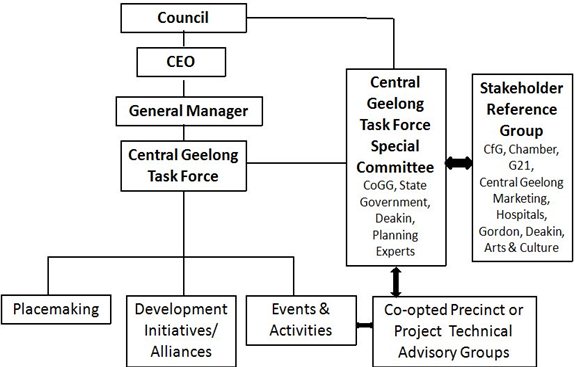
The adopted Central Geelong Action Plan makes a number of recommendations relating to the implementation of the Action Plan including delivery and governance:
Retention of a Special Committee under Section 86 of the Local Government Act to expeditiously drive implementation of the Plan. The Committee is recommended to:
have a four (4) year life, linked to the short term (2014 – 18) Action Plan priorities;
include a revised eight (8) person membership including Mayor, one additional Councillor, City of Greater Geelong CEO, four to five external independent experts with skills in the one or more of the following areas – business and investment, development feasibility, planning, marketing and promotions, and place making to be sourced via a expression of interest process. It is recommended that a limited committee attendance allowance is provided for independent representative experts subject to budget considerations;
include delegation to consider major planning permit applications within Central Geelong referred to it. This is a significant change which would enable the Special Committee to consider specific planning permit applications referred to it by Council (including council officers) including the ability to issue permits with conditions, Notice of Decision to Grant a Planning Permit where there are objections or refuse a permit. Council would need to consider development of guidelines and further alterations to the instrument of delegation to the one included in Appendix 1 to refine the types of permits to be considered and the basis on which they might be referred. The Action Plan identifies an organisational structure that could include a small team of planners specifically considering permit applications within Central Geelong;
manage any capital or recurrent budget allocated to it.
Establishment of up to four (4) priority Action Plan Committees to replace the existing Stakeholder Reference Group to focus on driving delivery of the 10 priority actions:
Transport and infrastructure – Public transport and City loop bus; Connecting people and places;
Health and education – Town and gown; Integrated health and wellbeing project;
Place making – City heart; Greening Central Geelong; An arts and events city; and
Investment attraction – Investment attraction; Making our assets work harder; Postcode 3220.
These Committees would ideally comprise a mix of external (to be established through an expression of interest process) and City of Greater Geelong representatives from related areas of expertise and service delivery, a Task Force Special Committee independent expert, Enterprise Geelong and Central Geelong Marketing and other stakeholders including agencies, public and private sector stakeholders as identified by the Task Force Special Committee.
Establishment of a Task Force Manager and Project Team. The Task Force Manager and Project Team would report to the Special Committee and provide administrative support to the Special Committee.
Attachment 1 includes a summary of the Central Geelong Action Plan recommended governance arrangement for the Special Committee and Task Force
Appendix 1 includes existing Special Committee Terms of Reference
Appendix 2 includes a revised Terms of Reference for the Special Committee for consideration with key changes highlighted (in yellow).
There are no environmental implications relevant to this report.
The establishment of a Task Force team and the ongoing operations of the Special Committee will have financial expenditure implications requiring consideration as part of Council’s 2014/15 budget deliberations.
Future budget proposal.
Section 86 of the Local Government Act requires Council to appoint members of the Special Committee and to approve the delegation. A further report will be submitted to Council to appoint the members and approve the delegation once nominations are received for the Special Committee.
A Successful and Vibrant City Centre is a priority in City Plan under the Growing Our Economy strategic direction. Implementation of the Central Geelong Action Plan is the central tenet of this priority.
No officers associated with the writing of this report have any direct or indirect interest in accordance with Section 80C of the Local Government Act.
There are no significant risks associated with this report. Risks relating to the establishment and operation of the Central Geelong Task Force or Special Committee will be managed as part of the establishment process.
The Central Geelong Task Force will assist in addressing some of the social issues in Central Geelong.
The work of the Taskforce and implementation of an Action Plan does not impact upon the rights and principles identified in the Charter. Ongoing communication with key stakeholders and land owners will be required for a range of Action Plan projects.
A communication plan for the Special Committee will need to be established.
Portfolio: |
Governance - Cr Lyons (Mayor) |
Source: |
Corporate Services - Administration and Governance |
General Manager: |
Jeff Wall |
Index Reference: |
Subject: Councillor issues |
To assign portfolio responsibilities to individual Councillors for 2014-15.
The allocation of portfolio responsibilities has evolved over a period of time, reflecting the changing structure of the Council and the focus of individual councillors.
It continues to be an effective and efficient approach for the City, given the size and complexity of the municipality.
The Mayor, as the elected leader, retains overall responsibility as spokesperson on behalf of Council.
Cr Harwood moved, Cr Heagney seconded -
That Council adopts the portfolio structure set out in Appendix 4-1.
Carried.
Portfolio responsibility provides the Council with the benefit of having individual Councillors who are kept well informed on issues relating to their portfolios.
Consequently, the portfolio holder is generally in a better position to provide leadership and direction on policy development and strategic planning in their area of responsibility.
The portfolio role includes:
Informing the Mayor and Council on matters relating to their particular portfolio.
Being informed of policy development positions to put to the various decision-making bodies and any policy reviews.
Assisting other elected representatives to develop an understanding of matters being considered by Council and enabling the Portfolio Councillor to lead discussions on relevant items.
Facilitating the briefing of other Councillors in specialist areas within the portfolio.
The portfolio system has evolved over a period of time, reflecting the changing structure of the council and the focus of individual councillors. Proposed portfolios for 2014-15 are set out in Appendix 3-1.
The Mayor, as the elected leader, retains overall responsibility as spokesperson on behalf of the Council. The allocation of portfolios enables councillors to provide leadership and direction on policy development and strategic planning in their area of responsibility, and to act as spokesperson on portfolio issues.
The portfolio system is reliant on portfolio holders providing adequate advice to fellow councillors informally, or by presenting information through Councillor Briefings. Close liaison should also be maintained between the portfolio councillor and ward councillors in circumstances where portfolio issues specifically impact on a particular ward.
The assignment of a portfolio to individual councillors is seen to provide the most effective means for the Council to be more aware of the environmental issues being considered by Council.
There are no financial implications arising from this report.
The portfolio structure is reviewed annually and has served Council well to date.
All portfolios directly align with City Plan objectives of Community Wellbeing, Growing the Economy, Sustainable and Built Environment, and How we do Business.
Not applicable.
No significant risks are anticipated. Portfolio holders should always confirm the accuracy of any information before commenting to the media. Councillors are encouraged to consult with the Chief Executive Officer or relevant General Manager for clarification.
The assignment of a portfolio to individual councillors is considered to provide the most effective means for the Council to be more aware of the community needs considered by Council and adopted by City Plan.
No human rights are impacted by the contents of this report. Most portfolios align with the principles of the Human Rights Charter.
Once Council has decided on its preferred position, an appropriate communication action will be developed and implemented.
|
PORTFOLIO |
MAJOR COMMITTEE LINKS |
|
Aboriginal Affairs Cr Eddy Kontelj |
|
|
Arts & Culture Cr Andy Richards |
|
|
Central Geelong Cr Michelle Heagney |
|
|
Coastal Communities Cr Lindsay Ellis |
|
|
Community Development Cr Kylie Fisher |
|
|
Community Safety Cr Jan Farrell |
|
|
Youth Cr Jan Farrell |
|
|
Enterprise Geelong Cr Bruce Harwood Knowledge Economy & Education * Cr Rod Macdonald Primary Industries as part of Enterprise Geelong *Linked to Enterprise Geelong |
|
|
Environment & Sustainability Cr Andy Richards |
|
|
Finance Cr Stretch Kontelj |
|
|
G21 Geelong Region Alliance Cr Darryn Lyons, Mayor |
|
|
Governance Cr Darryn Lyons, Mayor |
|
|
Heritage Cr Tony Ansett |
|
|
Infrastructure, Parks and Gardens Cr Lindsay Ellis |
|
|
Major Events Cr Ron Nelson |
|
|
Major Projects Cr Rod Macdonald |
|
|
Multicultural Affairs Cr Eddy Kontelj |
|
|
Planning Cr Michelle Heagney |
|
|
Regional Cities Cr Darryn Lyons, Mayor |
|
|
Rural Communities Cr Tony Ansett |
|
|
Sport & Recreation Cr John Irvine |
|
|
Tourism Cr Ron Nelson |
|
|
Transport Cr Andy Richards |
|
|
Women in Community Life Cr Jan Farrell |
|
Portfolio: |
Governance - Cr Lyons (Mayor) |
Source: |
Corporate Services - Administration and Governance |
General Manager: |
Jeff Wall |
Index Reference: |
Subject: Councillor Issues |
To appoint Councillors to act as Council’s representative on various committees for 2014/15.
Council maintains relationships with a number of organisations and operates committees that provide Council with an important link for the purpose of improving the social, environmental and financial wellbeing of our community.
On an annual basis, the Mayor will appoint councillors to represent Council on various committees.
Cr Harwood moved, Cr E Kontelj seconded -
That Council endorses the Committee appointments as set out in Appendix 5-1.
Carried.
This report lists organisations and committees to which the Mayor appoints nominated Councillor representatives.
The list in Appendix 5-1 is divided into internal and external appointments.
It is important for councillors to understand that the roles and responsibilities may vary depending on the position for which they are being nominated.
External Legal Entities – Where a Councillor or an Officer is nominated to the Board of a separate legal entity, the nominee takes on fiduciary responsibilities in accordance with the Corporations Act, and they are required to act in the best interests of that company or entity. Such responsibilities can raise issues that relate to:
Conflicts of Interest;
Confidentiality of information;
Personal Liabilities, etc.
Council Advisory Committee – There is no formal decision making that can be made in an advisory capacity on behalf of Council, but rather, recommendations arising from the deliberations of the committee may come to Council for consideration and final adoption. The Appendix to this report outlines the proposed appointments to internal and external committees and organisations.
Nominations to a number of organisations provide a link to the community to enhance the management of the region’s environment.
Funding arrangements (where in place) are provided within Council’s budget parameters. There are no specific implications in appointing representatives to the various committees.
Mayoral appointment of representatives to committees and external organisations are reviewed annually.
Special Committee (s86) Meetings are open to the public, except where matters of a confidential nature, as prescribed by the Act, are to be considered. These committees may be delegated various responsibilities by the Council, including the expenditure of monies and entering into contracts.
Advisory Committees are formed to provide advice to Council on various matters. They do not have the authority to act on behalf of the Council. They may be appointed for a short term task or on an ongoing basis. Records of meetings are kept, along with declarations of interest, and such records are publicly available.
External Committees are not administered by Council.
All committee appointments align with City Plan objectives of Community Wellbeing, Growing the Economy, Sustainable and Built Environment, and How we do Business.
Not applicable.
Depending on the nature of the relationship, the risks to Councillors and officers can relate to matters of:
Directors and Officers Liability Insurance;
Conflicts of Interest;
Confidentiality of Information;
Adherence to the required governance proceedings, etc.
Nomination to these organisations maintains an important link into the community for the purpose of identifying and responding to the social needs of the community.
No human rights are impacted by the contents of this report. Appointment to Committees will generally align with the principles of the Human Rights Charter.
Once council has decided on its preferred position, an appropriate communication action will be developed and implemented.
Portfolio: |
Environment & Sustainability – Cr Richards |
Source: |
City Services - Waste Services |
General Manager: |
Gary Van Driel |
Index Reference: |
Subject: Waste Management |
To inform Council of the release of the Getting Full Value – Victorian Waste and Resource Recovery Policy - Draft Statewide Waste and Resource Recovery Infrastructure Plan and to provide feedback to Sustainability Victoria.
In April this year the State Government released the Getting Full Value – Victorian Waste and Resource Recovery Policy (VWRR Policy) that included a commitment to a Minister’s Advisory Committee Review (MAC Review) into the governance of state waste management authorities and to the preparation of a Statewide Waste and Resource Recovery Infrastructure Plan (SWRR Infrastructure Plan).
The outcomes of the MAC Review were released in August and reported to Council on 24 September.
A draft SWRR Infrastructure Plan was released on 27 September for consultation with comment being invited up until 6 December, 2013. A series of workshops have been conducted throughout the state with the Geelong workshop on 18 October attended by Council representatives.
The draft SWRR Infrastructure Plan supports cross regional movement of waste materials to maximise economies of scale in waste processing coupled with the promotion of joint procurement by local government and acknowledging the need to identify and secure important waste management sites based on the hub and spoke concept, as promoted in the VWRR Policy.
It is considered that, while this draft SWRR Infrastructure Plan provides a comprehensive inventory of the state’s waste infrastructure, it does not provide sufficient strategic direction that a Council or any private sector investor could rely upon.
Therefore, while it is considered that the draft SWRR Infrastructure Plan constitutes one of the necessary building blocks to establish a statewide integrated waste and resource recovery framework, as proposed by the VWRR Policy, what is now required is significant work to identify statewide strategic and operational opportunities to enable implementation of systems to meet the objectives of this Plan and the VWRR Policy.
It is therefore recommended that Council provide feedback to Sustainability Victoria that it acknowledges the preparation of the draft SWRR Infrastructure Plan as identification of existing waste and resource recovery infrastructure as part of the process of establishing a statewide integrated waste and resource recovery framework, however, it believes that further work is required to provide statewide strategic direction before Council could embark on any major waste and resource recovery investment.
Cr Richards moved, Cr E Kontelj seconded -
That Council advise Sustainability Victoria that it:
supports the preparation of the Statewide Waste and Resource Recovery Infrastructure Plan as an essential part of a statewide integrated waste and resource recovery strategic framework;
considers that further work is required so that this framework may provide sufficient direction for Council to invest in future waste management services and infrastructure to meet the objectives of the Victorian Waste and Resource Recovery Policy, and
again offers to assist in the development of this framework to the extent that it is able.
Carried.
In April this year the state government released the Getting Full Value – Victorian Waste and Resource Recovery Policy (VWRR Policy) that included a commitment to a Minister’s Advisory Committee Review (MAC Review) into the governance of state waste management authorities and to the preparation of a Statewide Waste and Resource Recovery Infrastructure Plan (SWRR Infrastructure Plan).
The outcomes of the MAC Review were released in August and reported to Council on 23 September.
A draft SWRR Infrastructure Plan was released on 27 September for consultation, with comment being invited up until 6 December 2013. A series of workshops have been conducted throughout the State with the Geelong workshop on 18 October attended by Council representatives.
The draft SWRR Infrastructure Plan has as its goals to:
facilitate efficient markets by consolidating material streams to establish economies of scale that attract industry investment
maximise the recovery of valuable resources from waste streams
support the Getting Full Value action to facilitate the long term purpose of landfills to only receive treated residual waste
provide industry, local government, metropolitan and regional WMGs and other government agencies with the information and guidance to inform planning at the state, regional and local levels.
The documentation supporting the draft SWRR Infrastructure Plan states that it will ‘provide the evidence base to enable integrated planning for waste and resource recovery needs across the state. It will be the portal to facilitating investment and supporting planning and best practice procurement. Once completed it will:
provide an analysis of current and anticipated trends in the sources of waste, composition of waste streams and levels of resource recovery
provide an analysis of the current infrastructure for waste treatment and resource recovery and anticipated future processing needs
provide a strategic economic assessment of the options for waste and resource recovery infrastructure across Victoria and identify gaps in infrastructure capacity and priority areas for development and investment
investigate and encourage co-location of new waste and resource recovery infrastructure with similar activities such as waste water treatment and other industrial precincts
consider of transport impacts arising from the movement of waste and materials
provide information regarding key infrastructure that requires protection from encroachment
provide clear guidance to local governments, WMGs, the waste industry and relevant Victorian Government agencies regarding the above, and
provide an evidence base for future targeting of government funding and investments.’
The draft SWRR Infrastructure Plan also supports cross regional movement of waste materials to maximise economies of scale in waste processing coupled with the promotion of joint procurement by local government with the acknowledgement of the need to identify and secure important waste management sites based on the hub and spoke concept, as promoted in the VWRR Policy.
The SWRR Infrastructure Plan will become the strategic waste management document that will inform the preparation of regional waste and resource recovery plans that will be legislated to form the overriding waste planning framework within which local government will be expected to provide its waste management services.
The SWRR Infrastructure Plan identifies the following facilities and locations within the City of Greater Geelong as of statewide importance in the context that without them it would be difficult to manage the state’s waste management and resource recovery system and to meet the objectives of the VWRR Policy:
Drysdale Landfill
Fyansford Landfill
Point Henry precinct (resource recovery, processing and waste transfer), and
Barro Group Quarries, Point Wilson (green organics receival for site rehabilitation)
It is considered that, while the draft SWRR Infrastructure Plan provides a comprehensive inventory of the state’s existing waste infrastructure and to some degree identifies gaps, it does not provide sufficient strategic direction that a Council or any private sector investor could rely upon.
For instance, while the VWRR Policy and draft SWRR Infrastructure Plan identify the critical need to address the processing of organics (both green and food) neither of these documents provide any direction in how this may be achieved. Council has considerable experience in attempting to establish organics processing and has come to the conclusion that this will only occur within a statewide strategic framework.
A further instance that highlights the need for a statewide framework is that the draft SWRR Infrastructure Plan identifies the potential for cross regional movement of waste materials to exploit economies of scale and promotes joint procurement of services and infrastructure by local government. This would be best achieved within a statewide plan that links the potential materials feedstock with infrastructure across the state.
Therefore, within this context it is considered that the draft SWRR Infrastructure Plan constitutes one of the necessary building blocks to establish a statewide integrated waste and resource recovery framework, as proposed by the VWRR Policy. However, what is now required is significant further work to identify strategic direction and operational opportunities to enable development of future waste and resource recovery services and associated infrastructure that will facilitate implementation of systems to meet the objectives of the VWRR Policy.
It should be acknowledged that the draft SWRR Infrastructure Plan does refer to the development of a Statewide Organics Strategy and a Statewide Market Development Strategy under Section 1.9 Implementation. It is hoped that these two strategies will provide this direction and, as a major regional centre with some experience in seeking solutions to organics processing, Council should make itself available to assist in the development of these strategies, to the extent that it is able. This is consistent with Council’s position throughout the development of the VWRR Policy and its associated documents to date.
It is also considered that this next phase of work is required to assist councils across the State to ‘buy in’ to the transition to the new regional waste management groups structure, as proposed by the MAC Review, and will be an essential prerequisite to the preparation of new regional waste management plans.
The full draft SWRR Infrastructure Plan may be viewed at: http://www.sustainability.vic.gov.au/en/Our-Priorities/Integrated-Waste-Management/Waste-strategy-statewide-planning/Statewide-Waste-and-Resource-Recovery-Infrastructure-Plan
It is therefore recommended that Council advise Sustainability Victoria that it acknowledges the preparation of the draft SWRR Infrastructure Plan as an identification of waste and resource recovery infrastructure as part of the process of establishing a statewide integrated waste and resource recovery framework. However, it believes that the development of a strategic and operational direction is required before Council could embark on any major waste and resource recovery investment.
Within the context of best practice waste management support for the objectives of the SWRR Infrastructure Plan will contribute to a better environment. The SWRR Infrastructure Plan and any further work that provides additional strategic and operational direction will further enhance the environmental outcomes.
There are no immediate financial implications.
The Getting Full Value – Victorian Waste and Resource Recovery Policy and its supporting documents are intended to provide strategic direction for the development of waste services and infrastructure within a thirty year vision and a ten year plan. Both acknowledge that the development of these services and infrastructure must meet the needs of the local community and be within the financial capacity of that community.
The VWRR Policy and its supporting documents establish the future direction of waste management at state and regional levels and will become legislated documents and therefore establish the parameters for how councils across the state will management their waste.
Council has formally adopted the following position with regards to the next five year period in waste management:
‘the City will focus upon the consolidation of its existing waste services while observing and positioning itself to take advantage of opportunities to process additional waste materials should proven means of processing be identified.’
The VWRR Policy and supporting documents form part of the strategic framework within which it may consolidate and improve its existing services and more specifically will identify the opportunities for further waste processing within a supported policy and strategic framework.
No Council officers have any direct or indirect interest in this matter, in accordance with Section 80C of the Local Government Act.
There are no notable risks associated with the implementation of the recommendation included in this report.
There are no impacts on the community well being as a result of the recommendations in this report.
There are no human rights issues as a result of the recommendations in this report.
The recommendations of this report propose that Sustainability Victoria advised that Council:
supports the preparation of the SWRR Infrastructure Plan as one essential part of a statewide integrated waste and resource recovery strategic framework;
considers that further work is required to establish this framework so that it may provide sufficient direction for Council to invest in future waste management services and infrastructure to meet the objectives of the VWRR Policy, and
again offers to assist in the development of this framework to the extent that it is able.
Portfolio: |
Community Development - Cr Fisher |
Source: |
Community Services – Family Services |
General Manager: |
Jenny McMahon |
Index Reference: |
Subject: Municipal Early Years Plan |
The purpose of this report is to present the draft Municipal Early Years Plan (MEYP) 2013-2017 for Council’s consideration and to release the draft Plan for community feedback.
A copy of the draft Municipal Early Years Plan 2013-2017 was previously provided with Briefing papers.
The MEYP aims to provide a cohesive platform to inform future planning, service development, and support for young children and families throughout the City of Greater Geelong.
In 2006, Council adopted the first MEYP: Creating Communities for Children. This plan provided the foundations for a number of significant developments in children’s services across the City of Greater Geelong. An assessment of the previous MEYP indicates that 100 per cent of key recommendations and action priorities have either been completed, commenced, or are ongoing.
The development of a new MEYP has been identified as a key strategic priority within Council’s City Plan 2013-2017. The MEYP is also acknowledged as an important strategic planning and policy framework by both State and Federal Governments.
The aim of the MEYP is to strengthen local support for children and families throughout the critical early stages of children’s development and family formation, with a particular emphasis on the early ante-natal and prenatal periods of children’s development up to early primary school years.
The development of the new 2013-2017 MEYP closely aligns with the emergence of a wide range of Victorian and Australian Government policy and program changes. It has been based on local consultation, research, and identification of relevant needs and priorities by relevant stakeholders groups, including service providers, children, parents, community groups and government agencies.
The resulting draft 2013-2017 MEYP ‘A Place for Us’ sets out a range of key objectives and action strategies for the next four years to address relevant local needs and priorities associated with improving support for young children and families throughout the municipality.
Cr Fisher moved, Cr Farrell seconded –
That Council release the 2013-2017 (Draft) Municipal Early Years Plan for public exhibition and comment for a period of four weeks.
Carried.
The (draft) 2013-2017 Municipal Early Years Plan builds on the foundations of Council’s previous Municipal Early Years Plan and related State and Federal Government policy and planning frameworks.
In 2006, the Municipal Association of Victoria (MAV) and the State Government developed the MEYP initiative. It was aimed at supporting Local Government Authorities (LGA’s) to be better placed to provide a strategic direction for the coordination and development of early years’ programs, activities, services and facilities.
The MEYP is a local area plan designed to provide a strategic direction and framework for the development and coordination of early childhood programs, activities and other local community development processes that impact on children aged from 0 – 8 years.
In May 2007, the Victoria Auditor General’s Office (VAGO) undertook a performance audit of the MEYP initiative. The review identified that MEYPs provided a sound initiative that can improve coordination, integration and service delivery to strengthen support for young children and families across local government jurisdictions.
These plans have been designed to enable local governments to:
examine the impact and implications of emerging policy and service provision requirements;
identify future planning priorities to strengthen support for children, families and local communities, particularly in response to high risks and vulnerabilities within families;
improve health, wellbeing and development outcomes for young children;
enhance access for children and families to services and relevant community supports;
improve integrated planning and coordinated service provision;
develop collaborative linkages and alliance between key stakeholders, including funding bodies, service providers and community groups; and
identify the role that local government plays in relation to early childhood education, care and family support across the service spectrum.
All Victorian Councils now have an MEYP. Many have had success in using these MEYPs to incorporate early childhood community priorities into other integrated Council planning frameworks, such as municipal public health planning.
According to the 2011 ABS Census of Population and Housing, there are 23,265 children aged between 0-8 years within the City of Greater Geelong. Over 550 different services and programs are collectively provided across the municipality in response to the needs of local children and families.
Over the past decade, the attention of all Australia’s Governments, Commonwealth, State/territory, and local, has increasingly focused on the importance of young children.
This focus has arisen because of the clear evidence of the profound significance of the early years of a child’s life.
Local government across Victoria is recognised as the leader in local area early childhood planning. The Victorian Government explicitly acknowledges the role of local government in improving early childhood services in a range of policy documents in particular the MAV/DEECD Partnership Agreement.
Council represents the largest provider of universal services and support for children and families throughout Greater Geelong. Services include maternal and child health, immunisation, childcare, kindergartens, playgroup programs, playgrounds, aquatic centres, sports facilities, libraries, community centres, parenting programs, art and cultural events, and community activities.
Council also plays an important role in planning, advocacy, community building, regulatory controls, urban development and infrastructure provision, which is also crucial to supporting children and families. Consequently there are few areas within Council that do not either directly or indirectly impact on the lives of children and families.
The development and implementation of Council’s initial MEYP in 2006 represented the first important local policy framework and action plan to specifically inform the development and provision of services and support for young children and families.
Considerable achievements have occurred since the development of Council’s initial MEYP including:
Significant increase in capital development for children’s service facilities;
Successful implementation and completion of key children’s health projects and initiatives such as Romp and Chomp, SafeStart; Kids Go for You Life, etc.
Stronger partnerships and network development across the early childhood and education service system;
Increased participation of children and families in community events and activities;
Prominent focus on children within local planning and policy development;
Improvements to pre-school and early childhood participation rates;
Increased opportunities for professional development and training for early childhood service staff;
Acknowledgment of specific project innovations and initiatives through State and Federal Government awards;
Improved data and information systems
Of the 59 key recommendations and 166 separate actions contained within the last MEYP, all have either been successfully commenced, completed, or are ongoing.
The new (draft) 2013-2017 Municipal Early Years Plan has been developed following consultation with relevant stakeholder groups including children, parents, service providers, and Council officers from across various Council Departments.
The (draft) 2013-2017 Municipal Early Years Plan reflects the many changes that have occurred within the broader landscape of local, State and Federal policy and programming since Council’s first MEYP was developed.
The content of the (draft) 2013-2017 MEYP encompasses Australian government reforms that include the National Quality Framework, and key Victoria State government ventures, as evidenced in Victoria’s Vulnerable Children Strategy (2013) and the Victorian Early Years Learning and Development Framework (2009).
The (draft) 2013-2017 MEYP has been formulated around six key themes:
Safeguarding the best interests of all young children
Building community
Services working together
Celebrating diversity
Promoting a healthy community
Planning for now and in the future
The six themes align with the four key principles of the United Nations Convention on the Rights of the Child, the foundations for building a Child Friendly City, and key government and community, policy and program priorities.
Increasing evidence identifies a wide range of environmental factors influence and directly impact on children’s early development, health and well-being. These factors can have both immediate and cumulative affects on children, with increasing evidence that links children’s health conditions to adverse environmental factors.
Environmental considerations are therefore critical and integral to Council’s MEYP and development of future environmental management strategies and controls.
Development of Council’s 2013-2017 MEYP has been funded within budget.
The cost of implementation of some components of the plan will be the subject of consideration in subsequent budgets. External sources of funding will also be sought.
Increased attention toward the importance of reducing risk factors that have adverse implications for children, families and communities are acknowledged as providing clear social, economic and developmental benefits to the whole community.
Economic modelling associated with investment in early childhood services concludes that there is at least a 2-1 return in economic benefit to the community. Other longitudinal studies conclude that for every dollar spent on high quality early childhood support, up to seventeen dollars is saved through reducing adverse individual and broader social problems.
The development of Council’s MEYP enables key priorities for future funding and expenditure in relation to early childhood support to be more clearly identified, and to provide support for applications for external sources funding, based on clear evidence.
The preamble to the Convention on the Rights of the Child (CRC) recognises the family:
... as the fundamental group of society and the natural environment for the growth and well-being of all its members and particularly children, should be afforded the necessary protection and assistance so that it can fully assume its responsibilities in the community.
The CRC also recognises that the role of parents is not one to be carried out solely as an individual responsibility, and requires governments to take all appropriate measures to:
... render appropriate assistance to parents and legal guardians in the performance of their child-rearing responsibilities.
The development of the MEYP is not a statutory requirement. However, the MEYP is intended to be closely integrated with the corporate planning processes of Local Government.
Local government’s planning role is legislated in the Local Government Act (1989), Planning and Environment Act (1987) and the Health Act (1958). Corporate Plans, Municipal Public Health Plans, and the Municipal Strategic Statement are required by statute. Early childhood development clearly fits within a social health framework and therefore it is intended that the MEYP is closely integrated with Council’s Municipal Public Health Plan.
There are strong policy and potential funding implications associated with the creation of a MEYP for Geelong. Increasingly Victorian State Government funding initiatives for early childhood support are being integrated with key priorities identified within local government Municipal Early Years Plans.
The endorsement of the MEYP therefore strengthens Council’s position to potentially attract additional funding and resources for the future, along with establishing a cohesive planning and policy framework for further development and planning of early children’s services.
The 2013-2017 MEYP is aligned to City Plan 2013-2017 in that its vision mirrors that of the Community Wellbeing strategic direction and all actions contained within the draft 2013-2017 MEYP seek to address the City Plan’s three strategic priorities for Community Wellbeing: Healthy Lifestyles, Healthy Environments and Connected, Creative and Strong Communities.
The (draft) 2013-2017 MEYP also aligns closely with the following Council policy and planning frameworks:
Community Consultation Policy
Municipal Public Health and Wellbeing Plan 2013-2017
Multicultural Action Plan 2011-2014
Disability Action Plan 2009 -2013
Karreenga Aboriginal Action Plan 2012 - 2015
Children’s Services Policy
Corio-Norlane Best Start 2013-2016 Strategic Plan
No officer involved in the preparation of this report has any direct or indirect interest relative to the advice provided in the report.
Council has a shared responsibility with the Victorian State and Australian Governments to ensure that locally accessible family and children’s services are provided which support families in the care, protection, development and well being of young children.
Early childhood research clearly indicates that the quality of service provision is integral to ensuring positive outcomes for children. Where children are subject to a range of risk factors that are not addressed through the provision of appropriate support and intervention, the subsequent impact on their health, development and quality of life can have significant, long-term costs that are detrimental to individuals, families and the community as a whole.
Development of the MEYP has identified a wide range of critical challenges in strengthening local support for children and families especially in relation to improving outcomes for vulnerable children and providing affordable and accessible support for parents and families.
The MEYP provides a coherent framework within which the various issues, challenges and potential risks for children, families and local service providers can be progressively addressed and mitigated.
Endorsement and implementation of the MEYP will improve current service fragmentation, ensure opportunities to attract additional funding and resources, and improve the capacity of the local community to adequately and effectively support children and families.
The provision of strong and effective support to children and families in the early years of children’s development and family formation is widely recognised as having significant positive benefits and implications for children, families, and the community.
Evidence clearly indicates that preventative support and intervention in the early stages of child development and family formation can significantly reduce the incidence of more complex problems arising in the later stages of children’s lives. The provision of effective support to families with young children inevitably has broader social benefits in contributing to strengthening the capacity of local communities.
The recent publication of the results from the Australian Early Development Index Project (AEDI) indicate that while most children throughout Geelong are performing well against the developmental indicators, there is also a little over 18 per cent of children who are performing poorly and identified as vulnerable or at significant risk on one or more of the development domains. In some Geelong communities the rate of vulnerability is as high as 49 per cent or over twice the national average.
Consequently a continuing focus on improving support to strengthen the outcomes for young children is warranted.
The (draft) 2013-2017 MEYP is informed by key policies, reforms and initiatives, internationally, nationally and locally. From an international perspective, this includes a commitment to uphold children’s rights, drawing on the United Nations Convention of the Rights of the Child. It also includes awareness of international enterprises, such as the Child Friendly Initiative, which is seen as the embodiment of the Convention at a local level.
The development of the City of Greater Geelong (Draft) 2013-2017 MEYP has been informed by consultation with key stakeholder groups and relevant policy and planning priorities including:
International, National, State, Regional and Local policy context
City of Greater Geelong City Plan 2013-2017
City of Greater Geelong City Plan 2013-2017 Summary of Community Engagement
Municipal Public Health and Wellbeing Plan 2013-2017
Child Friendly Cities Framework
Online public consultation surveys for service providers, parents and children
Focus groups with service providers, children and Council staff
Review of demographic and early childhood data for the City of Greater Geelong
City of Greater Geelong Municipal Early Years Project Reference Group
During the public comment period, copies of the draft plan will be made available at Customer Service Centres and online publicising the consultation period via the ‘Have Your Say’ sections of the Geelong Australia website and City News. This will be done in line with standard protocols. Social media will be actively used to both inform and seek feedback from community.
Copies of the Draft 2013-2017 Municipal Early Years Plan will be distributed electronically through relevant local early childhood service and information networks.
Portfolio: |
Community Development – Cr Fisher |
Source: |
Community Services – Family Services |
General Manager: |
Jenny McMahon |
Index Reference: |
Subject: Family Services Events |
The purpose of this report is to present to Council the outcomes of the 2013 Geelong Children’s Week celebrations, held between 18 and 27 October, 2013.
Children’s Week is an international event designated by the United Nations General Assembly and celebrated annually. The focus of Children’s Week is to celebrate the right of the child to enjoy childhood, through focusing the attention of the wider community on children, their needs and achievements.
Council has been responsible for the coordination, planning and promotion of Children’s Week in Geelong since 2005. The annual development and implementation of the Children’s Week program represents a positive collaboration between a wide range of local community organisations, groups and Council services.
The program of events conducted throughout Geelong during Children’s Week has demonstrated continued participation and interest from the local community. This year, the Children’s Week program incorporated 73 separate events hosted by 51 local organisations.
The diverse range of local events held during this year’s Children’s Week targeted children aged between 0–12 years, and resulted in almost 17,000 children and adults participating in events and activities held throughout the week. Refer Attachment 2. More than 450 paid staff and volunteers, contribute an estimated 2,741 hours were involved in the planning and implementing of events and activities.
Council’s support for Children’s Week is consistent with key objectives contained within City Plan, the Municipal Public Health and Wellbeing and draft Municipal Early Years Plans.
Cr Fisher moved, Cr Farrell seconded -
That Council acknowledges the success of Children’s Week in Geelong, October 2013, and the contribution by volunteers and local organisations.
Carried.
In 1954 the United Nations General Assembly proclaimed Universal Children’s Day as a day to promote friendship and understanding amongst children of the world. Since then, Universal Children’s Day has been incorporated into Children’s Week which is celebrated annually in Australia in the fourth week of October. Children’s Week is supported by the Children’s Week Council of Australia.
Council has been responsible for the coordination, planning and promotion of Children’s Week in Geelong since 2005. Children’s Week in Geelong has continued to grow strongly. It provides opportunities to encourage children’s civic participation, and promotes the unique contributions children make to the local community.
Geelong’s Children’s Week program represents one of the largest Children’s Week celebrations currently hosted by any municipality in Victoria. Its success is evidenced by strong participation from local children and families in a wide range of events and activities held throughout the week.
Children’s Week generates significant good will and is truly unique in that it is a community driven event. While Council coordinates the local planning, promotion and funding for the event program, the majority of the events and activities held during Children’s Week are hosted by local community groups and organisations.
All events and activities conducted during Children’s Week attempt to promote and operate according to good environmental sustainability practices and principles, including appropriate waste management and recycling wherever possible
The cost to Council of the 2013 Children’s Week Program was $51,820.
A contribution of $500 was received from the Victorian State Government through the Department of Education and Early Childhood Development.
As per previous years grants (total $20,500) were made available for activities and events. All applicants were successful in receiving a Children’s Week grant. A full list of grant recipients can be found at Attachment 1. The balance of the funds was spent on marketing direct event expenses and additional staffing and implementation cost.
The sustainability of Council’s role in coordinating and promoting future Children’s Week programs and activities remains subject to continued funding and resources being provided through Council.
Council’s role in supporting the provision of local programs and activities for children and families is consistent with local government requirements of the Victorian Local Government Act 1989 and also the Victorian Charter of Human Rights and Responsibilities.
Council’s role and responsibilities toward the hosting and support of Children’s Week are consistent with key recommendations endorsed by Council in the existing Municipal Health and Wellbeing Plan 2013-17, including priorities of physically active communities, social inclusion and community connectedness.
Council’s City Plan 2013–17 details corporate planning objectives, service delivery priorities and commitments that are consistent with and closely aligned to the matters contained in this report, especially in relation to the development and provision of opportunities to facilitate community participation and engagement and healthy environments.
No officers involved in the preparation of this report have a direct or indirect interest in matters to which this report relates.
The future planning and promotion of Children’s Week in Geelong remains subject to continued financial support from Council. Any reduction in available funding is likely to significantly curtail and diminish the potential to support future events and participation by local children and families.
Risk assessment planning is routinely completed for all Council hosted events in accordance with Council event planning guidelines.
Children’s active engagement and participation in their communities has significant social and developmental benefits that are shared by children, families, and the whole community.
Children’s Week provides a unique opportunity to promote civic participation by young children and acknowledge the contributions provided by children toward realising the Council vision of making ‘Geelong a great place to live’.
Growth in participation in Children’s Week by a large and diverse range of organisations and community groups (including schools, kindergartens, childcare services, family support agencies, playgroups, toy libraries, neighbourhood houses, and churches) provides a positive platform for partnership – building the further development of major local events.
Council’s role in supporting the provision of local programs and activities for children and families is consistent with the Victorian Charter of Human rights and Responsibilities, Part 2 Section 17 Protection of families and children.
Geelong’s Children’s Week, 2013 was advertised via community billboards and local newspapers. This included the distribution of more than 42,000 Children’s Week Calendars through the Geelong Advertiser’s GT Magazine and a further 10,000 copies directly to early years services, schools and customer service centres.
Council’s “on hold” message, Early Childhood and Education eBulletin, DEECD Children’s Week website, the Geelong Australia website and social media were also used to promote Children’s Week.
The communication of this report along with material produced in relation to the development and promotion of Children’s Week in Geelong is the responsibility of Council’s Family Services Department.
Funding and grants provided to events and organisations for Children’s Week 2013
|
Event/Organisation
|
$ |
|
Funding recipients - COGG
|
|
|
Bellarine Sport & Aquatic Centre |
1500 |
|
Children’s Week Launch |
1000 |
|
CLAC Trudy Moritz |
255 |
|
Family Day Care |
350 |
|
Family Services Early Years Expo |
2500 |
|
Leisurelink Aquatic & Recreation Centre |
350 |
|
Splashdown Leisure Centre |
1500 |
|
Supported Playgroup - Playgroup in the Park |
1500 |
|
Waterworld |
5000 |
|
Children’s Week grant recipients - Community Organisations
|
|
|
Allanvale Preschool |
350 |
|
Anakie & District Community House |
190 |
|
Ardoch Foundation |
350 |
|
Bluebird Foundation |
350 |
|
Catholic Education Department – St Thomas Aquinas Primary School |
350 |
|
Club Italia |
350 |
|
Geelong Regional Library Corporation |
1800 |
|
Geelong YMCA |
350 |
|
Glastonbury Community Services |
350 |
|
Leopold Toy Library |
350 |
|
Newtown Primary School |
350 |
|
MIS Polish Playgroup |
350 |
|
Portarlington Preschool |
350 |
|
Portarlington Primary School |
350 |
|
Rix Street Kindergarten |
350 |
|
Total: |
20495 |
Summary of 2013 Children’s Week events and activities held across the City of Greater Geelong by location and estimated participation rates
|
Location |
Event |
Estimated Participation |
|
Anakie |
Anakie & District Community House |
32 |
|
Belmont |
Geelong Play Strategy re-launch |
225 |
|
Bell Post Hill |
Kardinia Playgroups – Musical Garden |
1400 |
|
Bell Post Hill |
Bell Post Hill Playgroup Open Day |
* |
|
Clifton Springs |
Beacon Point Pre-School – Walkathon |
62 |
|
Corio |
Bluebird Foundation Muddy Musical Adventures |
76 |
|
Corio |
Best Start - North Early Childhood Expo |
172 |
|
Corio |
Ardoch Foundation – Banjo’s Bash |
422 |
|
Corio |
Children's Fun Day @ Waterworld |
750 |
|
Corio |
Catholic Education Department – Working Better Together Celebration |
70 |
|
Corio |
Glastonbury Community Services – Bringing the Outdoors In |
53 |
|
Drysdale |
The Potato Shed - Family Fun Day |
5516 |
|
Drysdale |
CLAC Drysdale – Drysdale Community Through the Children’s Eyes |
64 |
|
Drysdale |
Geelong Regional Library Corporation – Story Train |
357 |
|
Geelong |
MIS Polish Playgroup |
43 |
|
Geelong |
Supported Playgroup - Playgroup in the Park |
350 |
|
Geelong |
Children’s Week Launch - Carousel |
89 |
|
Geelong |
GPAC - Poppykettle Kinder Day |
796 |
|
Geelong |
GPAC - Poppykettle Primary Day |
465 |
|
Geelong |
Carousel - 2 for 1 rides |
20 |
|
Geelong West |
Family Day Care – Animals in the Park |
54 |
|
Geelong West |
Family Services Early Years Expo |
255 |
|
Geelong West |
Geelong West Toy Library - 11th Annual Toy sale |
86 |
|
Grovedale |
Road to Reading – Open Day |
* |
|
Grovedale |
Grovedale Baptist KindyPlay – Open Day |
* |
|
Herne Hill |
Rix Street Kindergarten - Fun Day |
80 |
|
Lara |
Lara Lake Community Pre-School – Car Boot Sale |
* |
|
Lara |
Australian Breastfeeding Association – Baby’s Day Out |
* |
|
Lara |
Lara Kindergarten – Art Show |
50 |
|
Leopold |
Leopold Toy Library - Teddy Bear's Picnic |
450 |
|
Leopold |
Allanvale Preschool - Animal Farm Visit |
58 |
|
Moolap |
Club Italia - Children's Halloween |
369 |
|
Newtown |
Crackerjack Kids Science |
* |
|
Newtown |
YMCA Preschool Gymnastics Class x 4 |
192 |
|
Newtown |
Celebrating the arts at Newtown Primary School |
535 |
|
Norlane |
CLAC Trudy Moritz – Roaming Reptiles |
27 |
|
North Geelong |
Centre Court Indoor Tennis – Have a Ball |
31 |
|
North Geelong |
Early Learning Centre @ Rosewall – Breakfast and Pyjama Party |
42 |
|
North Geelong |
One World For Children – Cultural Music and Dance |
* |
|
Ocean Grove |
Ocean Grove Playgroup – Bellarine Beach Babes Market |
315 |
|
Ocean Grove |
BASC - Children's Fun Day |
453 |
|
Ocean Grove |
CLAC Ocean Grove – Ready Steady Go Kids |
40 |
|
Portarlington |
Portarlington Pre-School Open Day |
168 |
|
Portarlington |
Portarlington Primary School – Whole School Values Movie Premiere |
240 |
|
Wandana Heights |
Roslyn Playgroup – Open Week x 5 |
16 |
|
Waurn Ponds |
Child & Infant CPR Workshops x 5 |
146 |
|
Whittington |
Early Learning & Family Centre @ Apollo – Flamefest participation |
173 |
|
Whittington |
Flamefest |
1,268 |
|
Whittington |
Splashdown - Children's Fun Day |
254 |
* Estimates were not available for these events.
Portfolio: |
Sport & Recreation – Cr Irvine |
Source: |
Projects, Recreation & Central Geelong – Sport & Recreation |
General Manager: |
Dean Frost |
Index Reference: |
Subject: Sport Leisure & Recreation / Reports |
To provide a strategic approach for the future provision and development of indoor recreation facilities for the next 20 years.
The Geelong Indoor Recreation Facilities Strategy was undertaken to review the City’s existing provision of indoor recreation facilities and to provide a strategic approach for the future provision and development of indoor recreation facilities for the next 20 years
The draft strategy provides recommendations relating to the location, enhancement and development of indoor recreation facilities.
The review of the City’s existing provision of indoor recreation facilities indicated that there is currently a significant deficiency in indoor courts available to the community.
The draft strategy was based on the current available indoor recreation facility supply being inadequate for the City’s population needs. Key recommendations critical to the strategy that were identified include:
A new Regional Centre at Brealey Reserve - New 8 to 10 court facility proposed to meet existing and future southern area facility gaps and future population growth.
Expansion of the Leisuretime Centre – Plan for up to a four court extension over the outdoor netball courts plus new amenities to meet existing and future northern area population growth
Development of new courts on the Bellarine including proposed new court extensions at Bellarine Aquatic & Sports Centre and Drysdale Secondary College to meet existing and future eastern area population growth
Greater use of existing facilities - Encouraging greater use of underutilised community/school indoor recreation facilities to provide more local area facility use/access.
Develop growth areas indoor facilities – Develop planned new growth areas indoor recreation facilities at Armstrong Creek Precincts (x3 facilities) and Lara West (x1 facility) as development is taken up and population triggers are met.
Cr Irvine moved, Cr Ansett seconded -
That Council:
note the draft Geelong Indoor Recreation Facilities Strategy, and
release the draft Geelong Indoor Recreation Facilities Strategy for public comment for a period of four (4) weeks.
Carried.
Indoor recreation facilities within the City of Greater Geelong have developed and evolved over time in the absence of an integrated approach and overall indoor facility planning framework. It is widely considered that some of these facilities are well utilised, some are in poor physical condition and some are underutilised.
The City is expected to experience significant growth over the next 20 years, with the population expected to reach 297,956 by 2031. This equates to an increase of 76,609 people or 35% of the current population. It is important that future provision and development of indoor recreation facilities is done strategically to account for this expected growth.
Due to the expected population growth and the absence of a strategic framework, Council initiated the preparation of the Geelong Indoor Recreation Facilities Strategy with two key aims:
To review the City’s existing provision of indoor recreation facilities and provide an analysis of indoor facility provision across the Geelong Region, both private and government.
To provide a strategic approach for the future provision and development of indoor recreation facilities for the next 20 years, including recommendations for the location, enhancement and development of indoor recreation facilities, having regard to key partnerships and initiatives.
The draft Geelong Indoor Recreation Facilities Strategy found that there is currently a deficiency in indoor courts available to the community within the City. Specifically:
There are 45 full or large size courts exist within the City, of which; Council owns eleven (11), education institutions own twenty five (25) and nine (9) courts are owned by other organisations.
Indoor recreation facility provision is low, with only (33) large/full size indoor courts available for community use in the City, whilst adjoining Council areas only provided a further six (6) large indoor courts.
Benchmarking against other regional local government areas found that the City has the lowest numbers of useable courts per capita of any of the regional areas reviewed including Frankston City Council, City of Greater Bendigo and Ballarat City Council.
The draft Geelong Indoor Recreation Facilities Strategy identified a number of major challenges in the provision in indoor recreation facilities. These include:
Useable courts per capita (compared to like municipalities)
Forecasted population growth without strategy to improve provision
Forecasted growth in sport participation numbers
Actions within the draft strategy were based on the current available indoor recreation facility supply being inadequate for the City’s population needs.
Specific draft strategy recommendations were based on:
The need to increase use at existing centres that allow community use.
Improved access to indoor recreation facilities at education institutions that do not currently allow community use.
Planning for 8 to 10 courts to be built and operational by 2018 and a further 10 courts planned and operational by 2031.
Continue to operate and manage the facilities under direct Council management to ensure all user groups have access and that maximum facility occupancy is encouraged.
To overcome these deficiencies, the draft Geelong Indoor Recreation Facilities Strategy includes five key recommendations:
New Regional Centre at Brearley Reserve, Marshall – New 8 to 10 court facility proposed to meet existing and future facility gaps and future population growth in the south of the municipality.
Expansion of the Leisuretime Centre – Plan for up to four court extension over the outdoor netball courts plus new amenities to meet existing and future population growth in the north of the municipality.
Develop New Courts in the eastern area – New court extensions at Bellarine Aquatic and Sports Centre and Drysdale Secondary College to meet the existing and future population growth in the east of the municipality.
Greater Use of Existing Facilities – Encourage greater use of underutilised community/school indoor recreation facilities to provide more local area facility use/access.
Develop new Growth Areas Facilities – Develop planned new indoor recreation facilities within the Armstrong Creek (x3 facilities) and Lara West Precincts (x1 facility) as development is taken up and population triggers are met.
The draft Geelong Indoor Recreation Facilities Strategy has no direct impact on the environment; however any future development which may occur as a result of this strategy should seek to support initiatives that facilitate long-term environmental sustainability.
The implementation plan provides a broad estimate of cost specific to each of the recommended actions. These actions are assessed as Mandatory, Critical, High, Medium and Low to guide Council decision making in terms of development.
The draft Geelong Indoor Recreation Facilities Strategy outlines the recommended implementation schedule and indicative capital costs for the works identified. The total cost of all works is significant and cannot be funded solely by Council. The adoption of this report does not have any direct financial implications, but acts as guide for Council Officers to explore opportunities for partnership and funding opportunities at all levels of government and private industry to support the plans implementation.
It is expected that the strategy will be implemented over an approximate timeframe of 15-20 years. The table below summarises the capital estimated cost and the annual operational cost by action priority level.
|
Draft Geelong Indoor Recreation Facilities Strategy Actions Resources Summary By Priority Level Action Priority Level |
Estimated Combined Capital Cost |
Estimated Combined Annual Cost |
|
Mandatory: Required by legislation or regulation or connected with a developer contribution plans. |
$0 |
$0 |
|
Critical: Relating to risk mitigation or safety or an item that has a serious impact on service delivery. |
$0 |
$0 |
|
High: Important action that underpins the key outcomes connected with the Geelong Indoor Recreation Facilities Strategy. |
$28M to $30M |
$150,000 |
|
Medium: Action that contributes to meeting overall intent of the Geelong Indoor Recreation Facilities Strategy |
$27M to $28M |
$330,000 |
|
Low – 2026 to 2031: Action that contributes to overall improvement in indoor sport and recreation. |
$22M to $23M |
$240,000 |
Where implementation of specific recommendations requires a new budget allocation or contribution from Council, above what will be funded through developer contributions or partner agencies a business case will be prepared and considered as part of the overall annual budget process.
The draft Geelong Indoor Recreation Facilities Strategy recognises that all community members have equal rights to participate in and enjoy the benefits of sport and physical activity.
The draft Geelong Indoor Recreation Facilities Strategy has clear connections to Council’s community well-being objectives. The uptake of indoor sport as recreation and physical activity provides health benefits to the community participants.
No Council staff or persons engaged under contract have a direct or indirect interest in the development of the draft Geelong Indoor Recreation Facilities Strategy.
There are no immediate risks associated with this report. Appropriate risk management measures will be established when implementing the recommendations of the report.
The draft Geelong Indoor Recreation Facilities Strategy recognises that supporting indoor sport is not just about participation in physical activity.
Indoor sport is recognised as providing a range of broader benefits to the community, including contributions to social capital, community cohesiveness, and community connection. Participation in sport and physical activity brings about a range of personal, social, health and economic benefits for individuals and communities.
This report has no direct impact on the human rights of the residents of the City of Greater Geelong.
The preparation of the draft Geelong Indoor Recreation Facilities Strategy has been managed by a three-tiered management structure:
Project Control Group (PCG) consisting of key representatives from the City of Greater Geelong and Sport & Recreation Victoria. The PCG provided high level strategic direction on key issues and opportunities.
Project Reference Group (PRG) – Strategic Partners. Consisting of Council officers and senior management from the following organisations:
Department of Education & Early Childhood Development
Surf Coast Shire
Golden Plains Shire
Deakin University
Leisure Networks
Department of Planning & Community Development
Sport & Recreation Victoria
Project Reference Group (PRG) – Sport. Consisting of representatives from:
Basketball Geelong
Futsal Geelong
Barwon Sports Academy
Football Geelong
Bellarine Basketball Association
Volleyball Geelong
Table Tennis Geelong Incorporated
Gymnastics – YMCA
Badminton Geelong
Centre Court – Indoor Tennis
Geelong Squash Racquets Association
Netball Victoria
The planning process involved a comprehensive review of background material and the establishment of the stakeholder reference group as outlined above to guide the planning process. The project has involved extensive consultation with stakeholders, Council staff and key community groups.
The main consultation tasks have included:
Establishment of the PCG, PRG – Strategic Partners, PRG – Sports. These groups have met in the lead up to this report
All avenues of local media will be utilised to highlight the public exhibition of the draft Geelong Indoor Recreation Facilities Strategy. This includes a media release, Community Update, notification and promotion to key stakeholders.
Portfolio: |
Environment and Sustainability - Cr Richards |
Source: |
City Services |
General Manager: |
Gary van Driel |
Index Reference: |
Subject: Environmental Management - Barwon Regional Waste Management Group and Waste Strategies |
To seek Council’s endorsement of the Barwon Regional Waste Management Group Three Year Business Plan
Regional waste management groups across Victoria are required by legislation to prepare a three year business plan to guide their operations. This business plan is consistent with the broader State Government objectives in waste reduction and requires approval by the Minister for Environment and Climate Change to legitimize the operations of each group.
Council has input to the Plan through a consultation process involving the Council nominated directors to the Board of the Region and Council waste management officers.
The Barwon Regional Waste Management Group Business Plan 2013-14 to 2015-16 has now been finalised and approved by the Minister.
The Plan identifies the four key target areas of:
reduced waste and increased resource recovery
organics recovery
increased community engagement, and
sustaining core functions,
A copy of the Plan is included as Attachment A and is available for inspection in the Mayor and Councillors Room or may be accessed at www.brwmg.vic.gov.au.
Council’s governance and audit processes rely upon the annual endorsement of this Plan to formally support the actions of the Group and in particular the Council’s annual contribution to the Barwon Regional Waste Management Plan Annual Program.
This Program includes a list of specific waste management projects, as outlined on page 15 of the Plan. The total value of the program for 2013/14 is $130,000 with the City’s contribution of $96,850. This amount has been allocated in the current Council budget.
Prior to the payment of Council’s contribution the Group will be required to provide a detailed status report of project actual costs and progress from the previous year and complete a Council funding agreement.
It should be noted that this is likely to be the last business plan prepared by the Barwon Region as state government policy and governance reviews have resulted in proposed boundary changes that will see the Barwon Region join with the South West Region and subject to passing of legislation will become the Barwon South West Region from 1 July 2014.
Cr Richards moved, Cr E Kontelj seconded -
That Council endorse the Barwon Regional Waste Management Group Three Year Business Plan 2013-14 to 2015-16.
Carried.
Regional waste management groups across Victoria are required by legislation to annually prepare a three year business plan to guide their operations. This business plan is consistent with the broader State Government objectives in waste reduction and requires approval by the Minister for Environment and Climate Change to legitimize the operations of each group.
The Barwon Regional Waste Management Group member Councils have input through a consultation process involving the Council nominated directors to the Board of the Group and Council waste management officers.
The Barwon Regional Waste Management Group Business Plan 2013-14 to 2015-16 has now been finalised and approved by the Minister. The Plan is included as Attachment A, is available for inspection in the Mayor and Councillors Room or may be accessed at www.brwmg.vic.gov.au.
The Plan identifies the four key target areas of:
reduced waste and increased resource recovery
organics recovery
increased community engagement, and
sustaining core functions
The Plan outlines proposed strategies and includes operational and program budgets for the three year period. More specifically the Plan includes the budget for the Barwon Regional Waste Management Plan Annual Program. For 2013-14 the total value of this Program is $130,000 of which this Council is requested to contribute $96,850. This is the only financial contribution from Council to the Region.
Council’s governance and audit processes rely upon the annual endorsement of the Three Year Business Plan to formally support the actions of the Group and to authorise the payment of Council’s contribution.
Council’s audit process also requires the Region to sign a funding agreement and to provide a detailed status report on the previous year’s program prior to payment being made.
The activities and strategic direction of the Barwon Region are broadly determined by the State Government Sustainability in Action – Towards Zero Waste Strategy, as translated into the Barwon Regional Waste Management Plan. The Three Year Business Plan provides for an annual review of the Region’s activities and strategic direction against the Regional Plan and more specifically sets out the actions to be undertaken in the first year of the Business Plan.
It should be noted that this is likely to be the last business plan prepared by the Barwon Region as state government policy and governance reviews have resulted in proposed boundary changes that will see the Barwon Region join with the South West Region and, subject to passing of legislation, will become the Barwon South West Region from 1 July 2014.
Also, as a result of these reviews new regional plans will be developed on the back of the new State Waste and Resource Recovery Policy that will replace the Toward Zero Waste Strategy.
However, for now the Business Plan reinforces the Group’s position in pursuing waste minimisation and environmental protection best practice and is supportive of Council’s recently adopted strategic position to ‘focus upon the consolidation of its existing waste services while observing and positioning itself to take advantage of opportunities to process additional waste materials should proven means of processing be identified’.
Consideration and approval of the Business Plan, and in particular the actions in the first year of the Plan, constitutes the annual formal endorsement process for the Council’s involvement as a member of the Regional Group.
The continuation of the close co-operation of the Group and Council is essential to maximise beneficial environmental outcomes. Approval of the Business Plan will facilitate this.
There are significant environmental benefits to be gained for the Geelong community through supporting this Business Plan. It will assist in promoting best practice in waste management, in particular waste reduction, resulting in a sustainable environment and improved quality of life.
Council’s 2013/14 annual budget includes an allocation for the contribution to the Group’s Annual Program.
As indicated above, approval of the Plan is the prerequisite to payment of Council’s contribution to the Group’s Annual Program. Final payment is also subject to the provision of a report on the previous Program and is formalised through the completion of a Council funding agreement.
The endorsement of this Plan will assist Council to meet its community well being objectives by providing an effective waste management system that will also maximize the protection of the natural environment through best practice waste recovery services and landfill operations.
No Council officers have any direct or indirect interest in this matter, in accordance with Section 80(C) of the Local Government Act.
The Business Plan, in conjunction with the Regional Waste Management Plan and Council’s strategic waste and environment plans, provides a strategic direction that minimises the forward planning risk to Council.
In terms of accountability of the Group the Plan outlines the Group’s direction for operations and for the preparation and implementation of programs. From this, and the processes involved in the supervision of the actual programs, Council can be confident that the Group is legitimately pursuing its stated strategic direction.
The Geelong community has shown its support for waste reduction initiatives by embracing the three bin residential collection system and through the various surveys that indicate high levels of satisfaction with Council’s waste management initiatives while acknowledging the importance of these services.
Continuing to work with the Barwon Region and assisting with the programs outlined in the Three Year Business Plan will help maintain the current momentum and assist in meeting the community’s expectations.
There are no human rights issues as a result of the recommendation in this report.
There is no need for consultation or communication actions as a result of the recommendation in this report.
Portfolio: |
Infrastructure – Cr Ellis |
Source: |
City Services - Engineering Services |
General Manager: |
Gary Van Driel |
Index Reference: |
Special Rates and Charges; Colac Road |
This report seeks a resolution by Council to consider an intention to declare a Special Charge Scheme to fund the construction of a footpath along the north side of Colac Road between the Ring Road and South Valley Road, Highton. (Refer plan – Appendix 11-4)
Since 2010, Council has considered the provision of the continuation of a footpath to provide the pedestrian link between South Valley Road and the Ring Road in Highton. In addition to this work, kerb and channel and road widening work is proposed to complete the ‘missing pieces’ and finalise the project. VicRoads has provided $238,100 towards funding the section of pathway fronting its land as part of the State Governments Bicycle Path program.
It is proposed to construct the pathway 2.0 metres wide to provide an off road shared pathway along the north side of Colac Road. Since standard footpaths are 1.5 metres wide, Council will directly fund the extra 0.5 metres width of pathway.
There are twelve (12) properties abutting the proposed pathway works including the VicRoads parcel at 174-212 Colac Road. Because VicRoads has made a direct contribution to the project, it is not considered part of the Special Charge Scheme. The property at 158 Colac Road is also not in the scheme due to a recent bus stop and pathway section constructed as part of the permit conditions attached to the new shopping centre on the south side of Colac Road.
There are ten (10) remaining properties involved in the scheme. The total estimated project cost is $363,760. This includes a footpath cost of $286,851 and a kerb and channel cost of $76,909. Due to the VicRoads funding plus Councils direct contribution, only a portion of the pathway cost is included in the scheme and equates to $92,660. A Benefit Ratio of 0.455 has been calculated in accordance with Section 163 of the Local Government Act, which equates to a Council contribution to the scheme of $50,542 and property owner contribution of $42,118.
Property owners are considered to receive benefit from the works by way of improved pedestrian access and safety, and general amenity improvement.
The scheme has been prepared in accordance with the Special Rate and Charges provisions of the Local Government Act 1989 along with Council’s Special Rates and Charges Policy.
Cr Ellis moved, Cr Nelson seconded -
That Council:
Gives notice of its intention to declare a Special Charge Scheme in accordance with Section 163 (1A) of the Local Government Act 1989 (The Act), as follows:
The Special Charge be declared for a period of four (4) years commencing upon completion of the works and scheme finalised.
The Special Charge be declared for the purpose of defraying any expenses incurred by Council in relation to the construction of the pathway between the Ring Road and South Valley Road, Highton which project:
Will provide proper pedestrian access, improved pedestrian safety and enhancement to the general amenity for each of the properties included in the scheme;
Council considers is or will be a special benefit to those persons required to pay the special charge (and who are described in succeeding parts of this Resolution); and
Arises out of Council’s function of planning for and providing infrastructure for property owners.
The total cost of project, be recorded as $286,851(Schedule A).
It be recorded that, for the purposes of Section 163 (2A) of the Act, the special charge proceeds will not exceed the amount calculated in accordance with the prescribed formula (R x C = S), the:
‘benefit ratio’ (R) being calculated at 0.455 represents the special benefits to all persons liable to pay the special charge (Schedule B);
‘total cost’ (C) of performing the function described in part 1 (b) of this resolution based on estimated cost be recorded as $92,660; and
‘maximum levy’ (S) be recorded as $42,118
the following be specified as the area for which the special rate is so declared:
the area within municipal district of Council highlighted in the plan attached to this Resolution (Appendix 4).
the following be specified as the land in relation to which the special charge so declared:
land within the area shown on the plan.
the following be specified as the criteria which form the basis of the special charge so declared:
ownership of any land described in Part 1(e) of this Resolution.
the following be specified as the manner in which the special charge so declared will be assessed and levied:
Each lot has been allocated a single access unit;
The total cost is divided equally on a frontage share basis;
The special charge will be levied by sending a notice to the person who is liable to pay, pursuant to section 163(4) of the Act.
having regard to the preceding parts of this Resolution but subject to Section 166 (1) of the Act, it be recorded that;
the owners of the land described in column 3 of Schedule C to the resolution are estimated liable for the respective amounts set out in column 6 of Schedule C; and
such owners may, subject to any further resolution of Council pay the special charge in the following manner;
the charge will become due and payable within one month of the issue of the notice requesting payment pursuant to Section 167 (3) of the Act;
interest will not be charged for six months after the issue of the notice provided the person liable makes timely payment in accordance with any repayment arrangements that may be agreed on by Council; and
in accordance with Section 172 of the Act, the interest rate payable on the special charge which has not been paid by the specific date is set at Council’s overdraft rate, reviewed every three months (provided that it shall not exceed the rate fixed by the Governor in Council by Order for the purposes of Section 172 (2A) in which case the rate of interest shall be the maximum rate fixed by the Governor in Council by Order for the purposes of this section).
Council’s Chief Executive Officer be authorised to levy the Special Charge in accordance with Section 163 (4) of the Act.
Carried.
The current redevelopment of the Waurn Ponds Shopping Centre and the Cities Leisure facilities has seen a noticeable increase in the number of pedestrians walking along Colac Road.
This project involves the construction of the remaining section of pathway between the Ring Road and South Valley Road, Highton. As part of this project, it is considered advantageous to construct the missing sections of Kerb and Channel on the north side of Colac Road to improve road safety and drainage.
In late 2010, this scheme proposal was introduced to the affected property owners abutting the proposed pathway works. There was no response from property owners at the time.
The scope of work includes the construction of 340 metres of 2.0 metre wide shared pathway and 90 metres of kerb and channel. The kerb and channel works include road shoulder widening to match the existing pavement on the north side of Colac Road.
On 7 November 2013, VicRoads confirmed that it will be contributing $238,100 towards the project. VicRoads owns the property at 174-212 Colac Road, Highton which has a frontage of 189 metres to Colac Road. The funding provided therefore is more than adequate to cover the cost of its pathway.
The remaining VicRoads funds have been distributed to offset the costs of the Special Charge Scheme in accordance with Council policy. The funds are adequate to cover the costs of kerb and channel and offset the pathway construction costs for the remaining property owners in the scheme.
The provision of a sealed pathway surface provides a permanent and safe means of access. During the course of construction and the manufacture and procurement of materials, energy is expended resulting in some greenhouse gas emissions. This ceases when construction is complete.
The project does not create waste with the exception of some excavated material.
The proposal does not affect any natural habitats.
The project is a one off capital cost and there will be minimal ongoing maintenance costs. If approved, the scheme could proceed this financial year.
Financial details are as follows:
|
Maximum scheme levy to Property Owners (income) |
$42,118.18 |
|
Scheme levy to Council |
$50,541.82 |
|
Direct Funding by Council to widen the path to 2.0 metres |
$33,000.00 |
|
Direct funding by VicRoads |
$238,100.00 |
|
Total Project Cost |
$363,760.00 |
The scheme has been prepared in accordance with the Special Rate and Charge provisions of the Local Government Act 1989 along with Council’s Special Rates and Charges Policy.
This report aligns with the City Plan as follows:
Sustainably Built and Natural Environment
Support our Community to live sustainably – Encourage increased use of alternatives to car transport and seek efficient traffic movement throughout the municipality.
Advocate for and promote sustainable design and development – Promoting sustainable design and retrofitting.
Acknowledge the community’s desire to have their say and be involved in planning for the future of Greater Geelong.
No Council Officer involved with this process has any direct or indirect interest in the properties.
Provision of a sealed pathway will provide safer walking and cycling conditions for pedestrians and cyclists by minimising the risk of personal injuries through conflict with vehicles and the elimination of uneven surfaces. The additional drainage infrastructure will minimise the hazards associated with water over pathways. There are no identified risks for Council in declaring the scheme.
The provision of properly sealed and drained pathways is aligned to Council’s City Plan as described above and provides improved connectivity and safety for pedestrians and cyclists.
In developing this report to Council, the subject matter has been considered to determine if it raises any human rights issues. In particular, whether the scope of any human right established by the Victorian Charter of Human Rights and Responsibilities is in any way limited, restricted or interfered with by the recommendations contained in this report. It is considered that the subject matter does not raise any adverse human rights issues.
It is further considered that the construction of the pathway upholds the right to freedom of movement (Section 12 of the Human rights Charter) by enhancing a person’s ability to move freely within the area they choose to live.
Community consultation for the Road Construction Special Charge Scheme has been carried out as follows:
19 November 2010 – Introductory letter to property owners
22 November 2012 – Initiation letter including Special Charge Scheme brochure and estimated charges to property owners.
The works for the construction of pathway in Colac Road, Highton which consist of excavation, pathway, reinstatement of nature strip, miscellaneous construction works, legal advice and professional services associated with survey, engineering design, drafting, supervision and administration of the project all as included in the cost estimate shown below.
|
ITEM |
DESCRIPTION |
QUANTITY |
UNIT |
RATE $ |
AMOUNT $ |
||||
|
1.00 |
GENERAL |
|
|
|
|
||||
|
1.01 |
Initial site establishment and set up, decamping and site cleanup and other fixed costs up to time of completion of works. |
|
ITEM |
|
$23,000.00 |
||||
|
1.02 |
Traffic management costs. |
|
ITEM |
|
$3,750.00 |
||||
|
1.03 |
Setting out of works. |
|
ITEM |
|
$600.00 |
||||
|
2.00 |
EARTHWORKS & DEMOLITION |
|
|
|
|
||||
|
2.01 |
Excavation and disposal of all materials to limits of work as indicated on plan, including trimming for new road pavement. |
166.4 |
m3 |
$60.00 |
$9,984.00 |
||||
|
2.02 |
Placement and consolidation of engineered fill with approved materials in preparation for new works. |
33 |
m3 |
$60.00 |
$1,980.00 |
||||
|
2.03 |
Trimming and disposal of trees. |
|
ITEM |
$1,000.00 |
$1,000.00 |
||||
|
2.04 |
Remove and dispose of existing drainage wing wall. |
|
ITEM |
$300.00 |
$300.00 |
||||
|
3.00 |
SERVICE AUTHORITIES |
|
|
|
|
||||
|
3.01 |
Raise existing fire plug |
2 |
ITEM |
$1,150.00 |
$2,300.00 |
||||
|
3.02 |
Raise water meter |
1 |
ITEM |
$600.00 |
$600.00 |
||||
|
3.03 |
Raise S/V surround |
1 |
ITEM |
$67.00 |
$67.00 |
||||
|
3.04 |
Raise Telstra pit to match design level |
1 |
ITEM |
$1,500.00 |
$1,500.00 |
||||
|
4.00 |
DRAINAGE |
|
|
|
|
||||
|
|
PIPES |
|
|
|
|
||||
|
4.01 |
300mm dia RC pipe, supplied, laid and jointed including excavation, placement of approved fine crushed rock bedding and back-filling with approved material. |
39 |
m |
$120.00 |
$4,680.00 |
||||
|
|
BOX CULVERTS |
|
|
|
|
||||
|
4.02 |
1200x300 RC box culverts, supplied, laid and jointed including excavation, placement of approved fine crushed rock bedding and backfilling with approved material. |
10.98 |
m |
$500.00 |
$5,490.00 |
||||
|
4.03 |
1200x900 RC box culverts, supplied, laid and jointed including excavation, placement of approved fine crushed rock bedding and backfilling with approved material. |
7.32 |
m |
$1,030.00 |
$7,539.60 |
||||
|
|
PITS : SEP |
|
|
|
|
||||
|
4.04 |
900mm x 600mm S.E.Pit, less than 1.5m deep with Gatic type cover, supplied and placed including excavation, placement of approved fine crushed rock bedding and back-filling with approved material. |
2 |
No. |
$1,400.00 |
$2,800.00 |
||||
|
|
PITS : JP |
|
|
|
|
||||
|
4.05 |
900mm x 600mm junction pit, less than 1.5m deep with Gatic type cover, supplied and placed including excavation, placement of approved fine crushed rock bedding and back-filling with approved material. |
2 |
No. |
$1,600.00 |
$3,200.00 |
||||
|
4.06 |
Tap into box culverts, lay 300 dia. drainage pipe into culvert with flush end and mortar joint. |
2 |
No. |
$700.00 |
$1,400.00 |
||||
|
4.07 |
Modify existing pit to match finished surface level and supply and fit Gatic type cover. |
2 |
No. |
$770.00 |
$1,540.00 |
||||
|
4.08 |
Modify existing depressed grated pit to junction pit. Supply and fit Gatic type cover to match finished surface level. |
1 |
No. |
$1,000.00 |
$1,000.00 |
||||
|
5.00 |
CONCRETE WORKS: |
|
|
` |
|
||||
|
|
KERBING |
|
|
|
|
||||
|
5.01 |
Concrete pram crossing 2.0m wide, including fine crushed rock bedding. |
5 |
No. |
$250.00 |
$1,250.00 |
||||
|
|
PAVING |
|
|
|
|
||||
|
5.02 |
75mm concrete paving with SL62 mesh including crushed rock bedding and reinstate nature strip. (Based on 2 metre wide path) |
1060 |
m2 |
$127.00 |
$134,620.00 |
||||
|
5.03 |
125mm concrete paving with SL62 mesh including crushed rock bedding and reinstate nature strip. (At driveways) |
57.5 |
m2 |
$135.00 |
$7,762.50 |
||||
|
6.00 |
LANDSCAPING |
|
|
|
|
||||
|
6.01 |
Top soiling and seeding nature strips. |
150 |
m2 |
$8.00 |
$1,200.00 |
||||
|
6.02 |
Construction of fence with 2.4 metre long x 1.2 metre high wire panels (A.R.C. or similar) to match fence at Medical Centre entrance. Install between path and existing retaining wall. |
64.6 |
m |
$160.00 |
$10,336.00 |
||||
|
7.00 |
SIGNING, LINE-MARKING AND FENCING |
|
|
|
|
||||
|
7.01 |
Re-locate existing sign to central road island on frangible wooden posts. |
|
ITEM |
$1,100.00 |
$1,100.00 |
||||
|
SUB-TOTAL : A |
$228,999.00 |
||||||||
|
8.00 |
PROVISIONAL ITEMS |
|
|
|
|
||||
|
8.01 |
Re-locate Telstra in section fronting No. 132-138 to allow retaining wall to be constructed. |
|
ITEM |
|
$5,000.00 |
||||
|
8.02 |
Tactile Ground Surface Indicator Tiles, supplied and placed. |
4.5 |
m2 |
$250.00 |
$1,125.00 |
||||
|
SUB-TOTAL : B |
$6,125.00 |
||||||||
|
SUB-TOTAL : C (=A+B) |
$235,124.00 |
||||||||
|
10% CONTINGENCY : D |
$23,512.00 |
||||||||
|
DESIGN |
$11,756.00 |
||||||||
|
SRC ADMINISTRATION |
$16,459.00 |
||||||||
|
CONSTRUCTION COST ESTIMATE : E (=C+D) |
$286,851.00 |
||||||||
A |
Purpose |
|
||||||
| To construct a footpath in Colac Road, Highton to provide all weather pedestrian access for property owners and the wider community. | ||||||||
| B | Coherence | |||||||
| The works will provide a physical pathway connection between The Ring Road and South Valley Road and will provide a special benefit to adjoining and remote properties. | ||||||||
|
C |
Total Cost C |
|
||||||
|
|
Total Estimated cost of works - footpath construction |
$286,851.00 |
||||||
|
|
Direct contribution by VicRoads to fund pathway works adjoining their property. |
$161,191.00 |
||||||
|
|
Direct contribution by Council to fund the additional width of pathway |
$33,000.00 |
||||||
|
|
TOTAL COST |
$92,660.00 |
||||||
|
D |
Identify Special Beneficiaries |
|
||||||
|
10 properties with frontages to the proposed pathway are considered to receive access benefits. The VicRoads land at 174-212 receives a benefit but is out of the scheme due to direct funding by VicRoads. The property at 158 Colac Road is also excluded from the scheme due to a recently constructed pathway section across its entire frontage. |
||||||||
|
E |
Properties to include |
|
||||||
|
|
We will consider the total benefits to each property in terms of Benefit Units (BU). The construction of the pathway is considered to provide special benefit to the abutting properties in terms of access. There are 10 properties receiving a full benefit from the scheme at a total of 1BU each. |
|||||||
|
F |
Estimate of Total Special Benefits |
|
||||||
|
|
The 10 properties receiving benefit from the scheme give a total Benefit Unit of 10 BU |
|||||||
|
|
Properties Included |
TSB (in) = | 10 | BU |
|
|||
|
|
There two properties excluded from the scheme |
|||||||
|
|
Properties Included |
TSB (out) = | 2 | BU |
|
|||
|
G |
Estimate of Total Community Benefit -TCB |
|
||||||
|
|
It is considered that people in the community will receive a benefit from the works as the pathway is used to access other areas. It is estimated that 50% of the use of the pathway will be from pedestrians from other areas considering potential destinations such as the Highton shopping precinct, Deakin University and the aquatic centre. This equates to an estimated 10 BU |
|
|
|
|
|||
|
|
|
TSB = | 10 | BU |
|
|||
|
H |
Calculate "Benefit Ratio" - R |
|
||||||
|
|
Benefits Ratio = |
TSB (in) = |
10 |
0.455 |
|
|||
TSB (in) +TSB (out) + TCB |
10 + 2 + 10 |
|||||||
I |
Maximum Total Levy (S) |
|
|
|||||
| Maximum Total Levy S = R X C |
$42,118.18 |
|||||||
| Council Contribution to Special Charge Scheme | $50,541.82 |
|||||||
|
COLUMN 1 |
COLUMN 2 |
COLUMN 3 |
COLUMN 4 |
COLUMN5 |
COLUMN6 |
|
Prop Key |
Address |
Legal Details |
Total Frontage |
Apportionable frontage |
Footpath |
|
224141 |
140-150 Colac Road, Highton VIC 3216 |
Lot 2 TP 851204 |
110.9 |
110.9 |
$13,625.35 |
|
298209 |
152-156 Colac Road, Highton VIC 3216 |
Lot 1 PS 331074, Lot 1 TP 851204 |
50.41 |
10 |
$1,228.62 |
|
334219 |
160-172 Colac Road, Highton VIC 3216 |
1/2 Share of PC 370739 |
131.7 |
56.5 |
$6,941.68 |
|
343603 |
Suite No. 1/160-172 Colac Road, Highton VIC 3216 |
1/2 Share of PC 370739 |
131.7 |
56.5 |
$6,941.68 |
|
325304 |
Shop No. 1/132-138 Colac Road, Highton VIC 3216 |
1/5 Share of Lot 4 PS 404306 |
71.71 |
11.6 |
$1,425.19 |
|
325305 |
Shop No. 2/132-138 Colac Road, Highton VIC 3216 |
1/5 Share of Lot 4 PS 404306 |
71.71 |
11.6 |
$1,425.19 |
|
325306 |
Shop No. 3/132-138 Colac Road, Highton VIC 3216 |
1/5 Share of Lot 4 PS 404306 |
71.71 |
11.6 |
$1,425.19 |
|
325312 |
Shop No. 5/132-138 Colac Road, Highton VIC 3216 |
1/5 Share of Lot 4 PS 404306 |
71.71 |
11.6 |
$1,425.19 |
|
325313 |
Shop No. 4/132-138 Colac Road, Highton VIC 3216 |
1/5 Share of Lot 4 PS 404306 |
71.71 |
11.6 |
$1, 425.19 |
|
302381 |
126-130 Colac Road, Highton VIC 3216 |
Lot 3 PS 404306 |
50.91 |
50.91 |
$6,254.88 |
|
|
|
|
|
342.81 |
$42,118.18 |
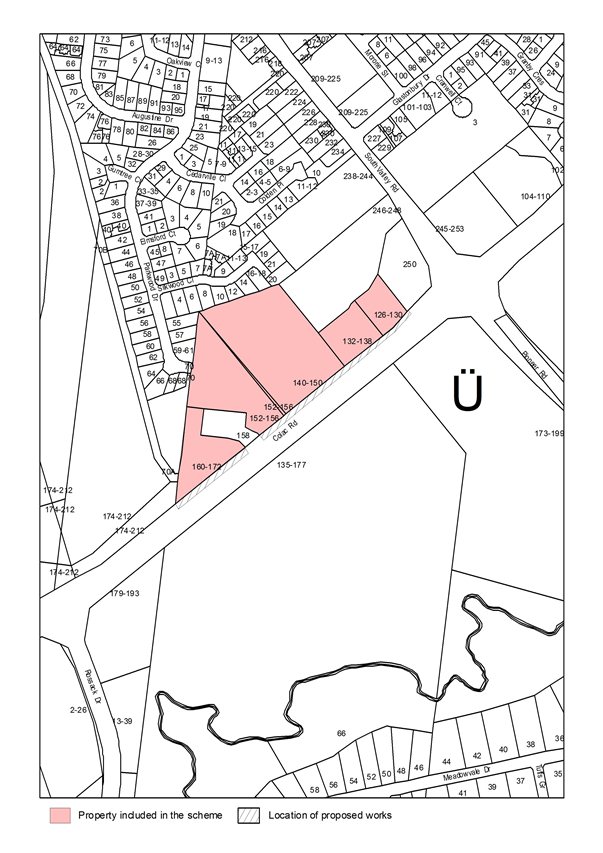
|
Stage |
Status |
Description |
|
Approval to prepare scheme |
|
Decision made to prepare scheme following consideration of surveys of property owners and feed back from the community. Council may then place the project in the budget system or proceed immediately to prepare a scheme. Scheme preparation involves survey, design and preparation of an apportionment of costs. |
|
Intention to Declare Scheme |
|
Report to Council providing information on scheme including advice of impending advertising of scheme and declaration of charge. Seeks Council approval by resolution to proceed with process. |
|
Advertisement |
|
The scheme is advertised in the local newspaper and all allotted property owners are notified by mail. This advertisement indicates Council’s intention and notification to ‘declare’ a scheme in a month’s time. |
|
Submissions |
|
From the time of advertising property owners have 28 days (as set down by the Local Government Act) to lodge submissions, either in support or opposition to the scheme. |
|
Submissions Review Panel Hearing |
|
A Submissions Review Panel is convened (quorum of three Councillors) and meets to consider submissions. Some submissions are written only, and other submitters may wish to be heard before the Panel. The Panel makes a recommendation to Council regarding the scheme.. |
|
Declaration Report |
|
Any time 28 days after advertising the scheme and after the Submissions Review Panel has met and considered submissions, Council considers a report and may proceed to “declare” the charges in accordance with its advertised intent. Subsequent to this the Finance Manager issues the levy notices and there is a formal charge placed on the property. This is the final step in the process for Council to make a decision on the scheme. |
|
Appeal |
|
Property owners may lodge an application for review with the Victorian Civil and Administrative Tribunal (VCAT) within one month of issue of the levy notice. An appeal is listed, heard and determined by the Tribunal and this process generally takes three to four months. Decisions made by VCAT are binding on all parties. |
|
Construction |
|
Council may then proceed to construct the works. Invoices are issued seeking payment of the estimated cost within one month of commencement. |
|
Final Cost Report |
|
At the completion of the works the scheme is “finalised” taking into account actual costs incurred and payments are adjusted accordingly. |
Portfolio: |
Finance - Cr S Kontelj |
Source: |
Financial Services |
General Manager: |
Jeff Wall |
Index Reference: |
T1400017 |
The purpose of this report is to seek Council’s approval in appointing a Contractor to undertake Council’s Debt Collection Services.
Council has sought tenders for the provision of Debt Collection Services.
The scope of service and responsibilities associated with this tender require the successful contractor to provide debt collection services to Council for the non-payment of fees and charges in the areas of Rates and Sundry Debtors.
A total of seven companies have provided tender submissions for the provision of these services.
Following a detailed evaluation of each of the submissions it is considered that the tender submission of Barwon Credit Management Pty Ltd / Frans Bos & Associates Pty Ltd trading as Provincial Credit Solutions is preferred.
Cr S Kontelj moved, Cr E Kontelj seconded -
That Council:
accepts the tender submission from Barwon Credit Management Pty Ltd / Frans Bos & Associates Pty Ltd trading as Provincial Credit Solutions for Tender No. T1400017 – Debt Collection Services at the tendered schedule of rates exclusive of GST.
sign and seal the contract documents.
Carried.
Tenders for the provision of Debt Collection Services were invited via public advertisement in The Age and The Geelong Advertiser on 16 November 2013.
At the close of tenders on 11 December 2013 the following tender submissions were received:
|
Tenderer |
|
Australian Receivables Ltd |
|
Milton Graham Lawyers Pty Ltd |
|
Maddocks and its subsidiary ML & C Collections Pty Ltd |
|
National Credit Management Limited |
|
Profcoll Pty Ltd t/as Professional Collection Services |
|
Barwon Credit Management Pty Ltd / Frans Bos & Associates Pty Ltd trading as Provincial Credit Solutions |
|
Austral Mercantile Collections Pty Ltd |
The tender submissions associated with this service were evaluated by a panel consisting of:
|
Michael Kelly |
Manager Financial Services (voting member) |
|
Carole Kirby |
Co-ordinator Revenue Property & Valuations (voting member) |
|
Leanne Yearsley |
Revenue Supervisor (voting member) |
|
Adrian Rainbow |
Senior Contracts Officer (Advisor) |
Stage One - Mandatory Criteria
Mandatory requirements do not apply to this Tender.
Stage Two – Comparative Criteria
Tender submissions were assessed based on the respondent’s performance or tender response in the following areas:
|
Criteria |
Weighting |
|
Price |
40% |
|
Economic Contribution to the Geelong Region |
5% |
|
Technical Capability to meet specification |
37% |
|
Quality Management |
5% |
|
Financial Capacity |
3% |
|
Customer Service |
10% |
|
Total |
100% |
At the conclusion of the evaluation the tenderers were ranked in the following order in accordance with the above criteria:
|
Tenderer |
Rank |
|
Barwon Credit Management Pty Ltd / Frans Bos & Associates Pty Ltd trading as Provincial Credit Solutions |
1 |
|
Milton Graham Lawyers Pty Ltd |
2 |
|
National Credit Management Limited |
3 |
|
Australian Receivables Ltd |
4 |
|
Maddocks and its subsidiary ML & C Collections Pty Ltd |
5 |
|
Profcoll Pty Ltd t/as Professional Collection Services |
6 |
|
Austral Mercantile Collections Pty Ltd |
7 |
At the conclusion of the evaluation process Barwon Credit Management Pty Ltd / Frans Bos & Associates Pty Ltd trading as Provincial Credit Solutions was the highest ranked tenderer.
The submission received from Milton Graham Lawyers Pty Ltd provided Council with a slightly lower estimated overall pricing structure than the highest ranked tenderer. However they failed to achieve the Economic Contribution to the Geelong Region criteria which lowered their overall score.
Barwon Credit Management Pty Ltd / Frans Bos & Associates Pty Ltd trading as Provincial Credit Solutions are a Geelong based company with a long history of servicing both local and Council clients including City of Greater Geelong.
Barwon Credit Management Pty Ltd / Frans Bos & Associates Pty Ltd trading as Provincial Credit Solutions have proved to be an excellent provider of this service to Council over the past contract period. Their submission highlighted that they have the requisite skills, expertise and resources as well as proven methodology to continue to successfully undertake this service for Council. An interview confirmed the evaluation panel’s view that Barwon Credit Management Pty Ltd / Frans Bos & Associates Pty Ltd trading as Provincial Credit Solutions be recommended to undertake this service for Council for the forthcoming term.
Any environmental implications associated with this contract will arise from the execution of this service / works. It is considered that these are the responsibility of the Contractor and will be managed through the contract documentation.
The funding for this service will be drawn from various recurrent budgets. Debt collection and associated court costs can be recovered from Debtors.
The requirements of Section 186 of the Local Government Act have been complied with for this tender. There is no other policy, legal or statutory implication associated with this tender process.
Alignment to City Plan
The tender aligns with one of the Strategic Directions in City Plan:
How We do Business – Priorities:
Responsible and sustainable financial management; and
Efficient and customer focused organisation.
No officers or contractors involved in the preparation of this report have a direct or indirect interest in matters to which this report relates.
There are no risks associated with the acceptance of this tender that cannot be managed through the contract conditions.
There are no social implications that will arise from the acceptance of this tender.
There are no human rights implications that will arise from the acceptance of this tender.
There are no communication issues associated with the acceptance of this tender. Council’s representative will liaise with affected community groups if required.
Contents | Previous Page: Section A - Procedural Matters | Next Page: Section C - Notice of Motion

Copyright CoGG 2012
Last Update: 10 February 2014
