
Contents | Previous Page: Section A - Procedural Matters | Next Page: Section C - Notice of Motion
Reports tabled at the Ordinary Meeting of Council on Tuesday date held at Barrabool Hills Baptist Church, 4-46 Province Boulevard in Highton.
Amendment C280 – Rezoning Application for Ash Road West, Leopold
Revocation of Flood-Prone Area Designation of new Lots at Warralily Estate Stages 29,30 and 31
Geelong Queenscliffe Coastal Adaptation Strategic Partnership Group Membership
Portfolio: |
Planning - Cr Heagney |
Source: |
Planning and Tourism - City Development |
General Manager: |
Peter Bettess |
Index Reference: |
Application: C280 |
The purpose of this report is to seek Council approval to proceed with the preparation and exhibition of Planning Scheme Amendment C280, subject to authorisation being obtained from the Minister for Planning.
An application has been made by St Quentin Consulting on behalf of Paisley Manor Pty Ltd, owners of the land at 90-108 Ash Road, Leopold, to rezone the land from Farming Zone to Residential 1 Zone.
The purpose of the rezoning is to facilitate residential subdivision.
At the request of officers, the rezoning application has been made to rezone all of the land between 90-172 Ash Road (even numbers) and 21-30 Walkers Road, Leopold (odd and even numbers). This affects ten different landowners covering approximately 25 hectares.
The proposal is supported by the State and Local Planning Policy Framework and the Leopold Structure Plan. The area is designated for urban growth and is within the town’s settlement boundary.
A draft Outline Development Plan has been prepared for the whole area. Features of this include the provision of a minimum 10% public open space, two drainage reserves, a pocket park protecting a remnant River Red Gum, connections to the Estuary Estate to the west and continuation of a shared pathway reserve to the south.
Subdivision of the area will yield in excess of 280 lots.
A model template Section 173 Agreement (S173), which will form the basis for Agreements to be entered into with all land owners to formalise developer contribution arrangements, is being prepared.
A draft Shared Infrastructure Funding Plan (SIFP) is also being prepared to guide the delivery of shared infrastructure in the area by apportioning the costs of the required shared infrastructure to each land parcel and describing the mechanisms by which the contributions levies will be collected and infrastructure delivered, including opportunity for works in-kind.
As part of the rezoning, an accompanying new Development Plan Overlay schedule will ensure that the development proceeds in a logical manner in accordance with the agreed Outline Development Plan.
Officers have met with the landowners of the rezoning area on 14 July 2014 to discuss the proposal in more detail, answer questions about the proposal and process and to gain their feedback on the Plan.
Landowners are supportive of the rezoning of the area but have concerns about the distribution of open space, the valuation of land, the need for a Shared Infrastructure Funding Plan and the wording of the accompanying draft S173 Agreement, the exclusion of Walkers and Ash Roads as shared infrastructure items, and the sizing of drainage assets.
As a way of moving forward, it is proposed to exhibit the amendment with the information and documentation prepared to date, with a view to undertaking further engagement with landowners during the consideration of submissions stage. This is expected to include the possibility of revisions to the outline development plan.
Cr Macdonald moved, Cr Heagney seconded -
That Council:
resolves to support the preparation and exhibition of Amendment C280 to the Greater Geelong Planning Scheme to:
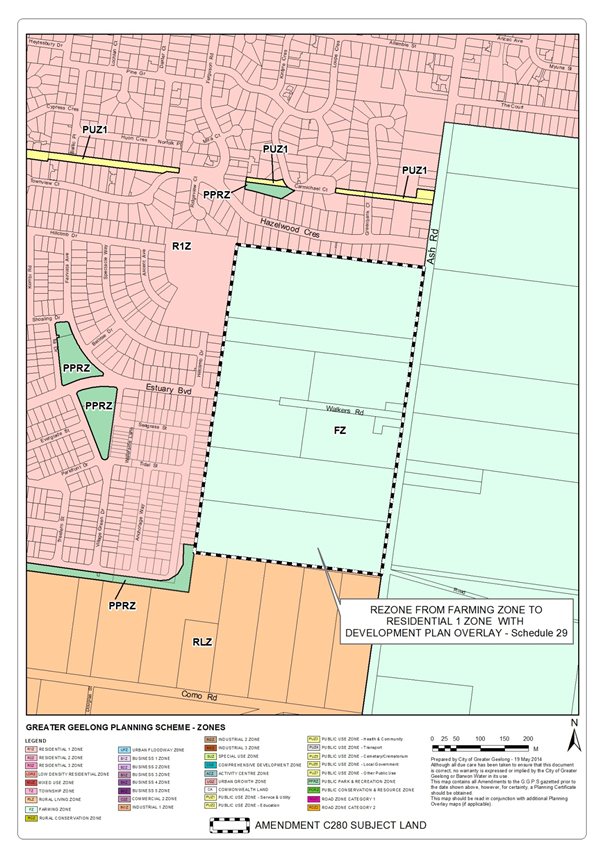
rezone land in Ash Road west Leopold as identified in this report from Farming Zone to General Residential Zone ; and
apply a Development Plan Overlay to the land being rezoned subject to the finalisation of amendment documentation, draft Section 173 Agreement and accompanying draft Shared Infrastructure Funding Plan to Council’s satisfaction.
requests the Minister for Planning to Authorise the preparation of Amendment C280;
resolves to exhibit the draft Section 173 Agreement accompanying the amendment documentation as outlined in this report; and
undertakes further engagement with landowners during the consideration of submissions with a view to being flexible to consider changes to the draft Outline Development Plan.
Carried.
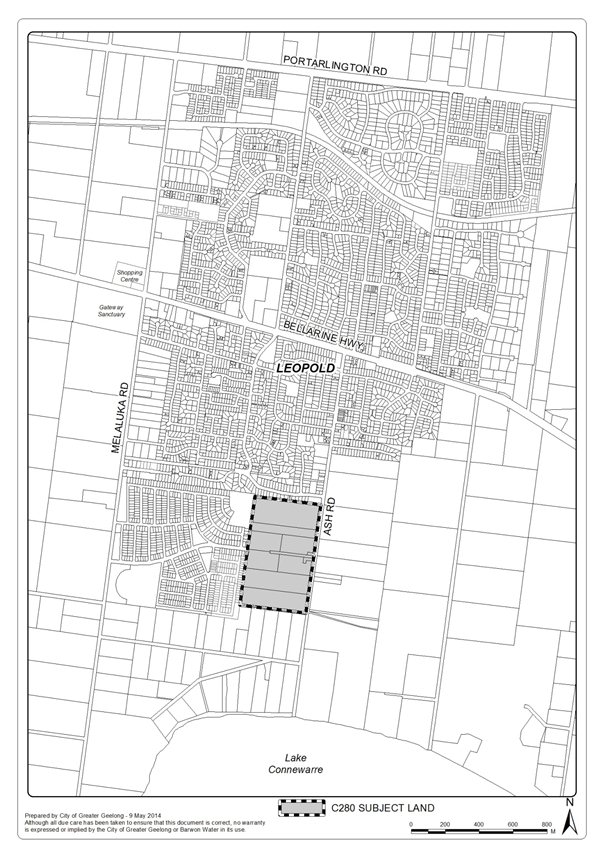
An application has been made by St Quentin Consulting on behalf of the owner of 90-108 Ash Road, Leopold to rezone 10 properties totalling 25ha from Farming Zone to Residential 1 together with an accompanying Development Plan Overlay. The subject land is west of Ash Road immediately south of existing residential development and to the east of the developing Estuary Estate in Leopold. The applicant’s land holding comprises 5.9 hectares or approximately 23.6% of the proposed rezoning area. In pre-application meetings, officers requested the applicant to address all land on the western side of Ash Road within the town’s settlement boundary in the rezoning application.
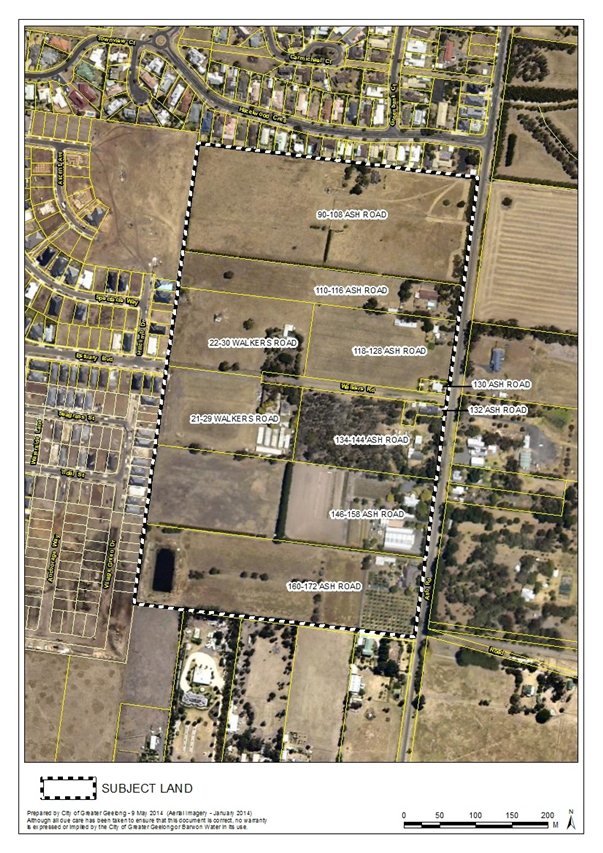
Appendix 1 shows the land subject of the rezoning application and existing zonings. The land is in ten different ownerships and is used for residential, rural living and agricultural purposes. They have been substantially cleared of native vegetation apart from a few scattered remnant trees and some intact indigenous vegetation. Appendix 2 is an aerial photo of the subject land and surrounding area.
The application has been accompanied by specialist planning, vegetation, aboriginal cultural heritage, traffic and engineering reports together with a draft outline development plan for the area.
The application was referred to a number of Council departments and external Government Departments and agencies for comment. The feedback on the application has been the basis for discussion and negotiation between officers and the applicant.
Since this application was originally submitted to Council there have been ongoing discussions and negotiations with the applicant about the draft outline development plan and delivery by the developer(s) of the necessary community infrastructure in a timely manner. In this area these arrangements have been complicated by the number of individual property owners (ten) and the need to fairly and equally apportion developer contribution costs among the individual landowners.
Identified shared infrastructure requirements include:
Provision of 2 stormwater retarding basins
Provision of 2 local parks, continuation of a shared pathway reserve to the south and a pocket park for remnant tree protection (minimum 10% of the overall area)
Upgrade of the queuing right hand turn lane on the Bellarine Highway at the intersection with Ash Road.
$900 per dwelling community infrastructure levy.
The applicant understands that Section 173 Agreements are required to be entered into by all landowners which encapsulate these arrangements.
At the request of Council, the applicant’s consultants have prepared a draft Shared Infrastructure Funding Plan (SIFP) which sets out in detail the costs of delivering the above infrastructure items and apportioning these costs equitably amongst the ten landowners. Officers reviewed these costs against industry standards and Council experience and provided input to the preparation of the final draft.
From a strategic planning viewpoint there is strong State and Council policy justification to support this proposed rezoning.
The State Planning Policy Framework directs that Council’s should ensure that a sufficient supply of land is available for residential uses and to meet forecast demand. This is to be achieved through designation of 15 years lot supply as part of Structure Plans.
Leopold’s primary role has been as a commuter settlement for Geelong some 12 km to the west. The Leopold Structure Plan designates that the subject land be rezoned to Residential 1 Zone as it is within the settlement boundary. This land is accounted for in the Structure Plan calculations of a 23 year lot supply (Jan 2013). The Structure Plan also states that rezoning of the subject land should include a Development Plan Overlay to address subdivision design, water sensitive urban drainage, open space provisions, road and traffic network, landscape and visual assessments, and potentially environmental management, environmental audit, native vegetation cultural heritage and construction management plans. As part of rezoning, the Structure Plan also identifies that a Development Contributions Plan or similar mechanism should be developed to provide for physical and community infrastructure.
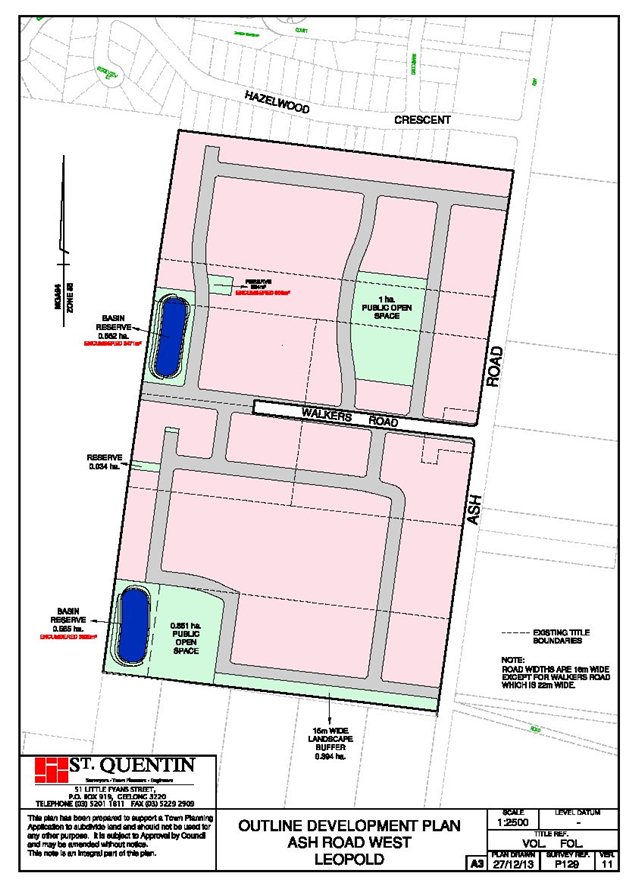
A draft outline development plan has been prepared by the applicant’s consultants. It generally meets Council’s requirements for the future development of this area. The draft outline development plan features:
Two Drainage Reserves (one north & one south of Walkers Road)
10% minimum of area to be provided for open space configured as
a 1Ha park north of Walkers Road
a 0.8Ha park south of Walkers Road co-located with the southern drainage basin
Walkers Road extended to join with Estuary Boulevard
Walkers Road widened (existing section)
Two pedestrian access ways into Estuary Estate
Ash Road to be upgraded
Pocket park for one remnant indigenous tree to be retained
Higher level internal road network
15m wide reserve incorporating a shared pathway along the southern boundary of the rezoning area
This will form the basis of a detailed Development Plan Overlay Schedule which will set out the planning, engineering and environmental issues to be addressed as part of the development of this land. Appendix 3 is the draft Outline Development Plan. The draft ODP ensures that the area connects well to the Estuary Estate to the west which is already substantially developed.
Negotiations with the applicant had been aimed at ensuring the drainage basins, local parks and road upgrades are provided by the developer as part of the development process and not left to Council to provide and construct at a later time. The multiple land ownerships and the owner occupier nature of the majority of landowners have necessitated the preparation of a SIFP and a draft S173 Agreement to apply to all property owners that provides the option of Council accepting monetary contributions and delivering the infrastructure. It is proposed that this draft model template be exhibited with the Amendment documentation and that owners be asked to sign individual Agreements before the Amendment is eventually approved.
If agreement can not be reached, the Development Plan Overlay contains a requirement for a S173 Agreement to be entered into as a condition on any planning permit for subdivision.
The SIFP has provision for a limited number of shared infrastructure items. There is other infrastructure that the development will be required to deliver as part of the subdivision that is not included in the SIFP, including (but not limited to) the upgrades of Walkers and Ash Road, the internal road network, intersection treatments, the drainage infrastructure (other than the basins) and street trees.
Officers briefed landowners in the area both pre-application in April 2011 and post application on 20 May 2014 to advise about the rezoning application and amendment process, provide detail about the draft development plan and to explain the development contributions approach. All the landowners attended these briefings and have been keen to learn more detail as there is interest in the area developing.
Following the latest briefing the landowners wanted the opportunity to have more engagement in the process and to seek more detailed explanations about the proposal. Officers convened 2 sessions on 14 July 2014 – one with the landowners to the north of Walkers Road and one with owners to the south of Walkers Road. There were robust discussions about the proposal and the specific areas of concern raised by landowners included:
The distribution of open space, particularly to the north of Walkers Road;
The valuation of land and dispute about the accuracy of the valuations;
The need for a Shared Infrastructure Funding Plan;
The wording and operation of the draft S173 Agreement;
The status of the remnant tree and its retention in a pocket park;
The exclusion of Walkers and Ash Roads upgrades as shared infrastructure items; and
The sizing of drainage assets.
Officers recommend that Council proceeds to exhibition of the Amendment as outlined in the deferred 24 June Council report and to seek authorisation from the Minister for Planning. Changes to the draft Outline Development Plan, draft Shared Infrastructure Funding Plan and draft S173 Agreement would have considerable consequences for supporting consultant reports and require much work to be re-done at considerable time delay and expense. The size and location of open space to the north of Walkers Road meets Council’s requirements of being 1Ha in size, bounded by at least 2 roads, accessible within 400 metres walking distance of residences, is a rectangular shape and sited away from the collector road (Walkers Road). For proceeding to exhibition there is no planning outcome that is being compromised by the location of open space as shown on the draft Outline Development Plan. This is not to say that the distribution as it affects existing landowners could not be reviewed. This area of open space sits across 3 current landholdings with the majority located on two smaller properties. These landowners consider this an unfair distribution and disadvantages their development potential compared with the applicant’s land which is largely unaffected by the positioning of this area of open space.
The landowner affected by the location of the remnant tree to be retained has advised officers, and provided correspondence from the previous landowner that the tree was planted to provide shade for horses in the paddock. This is in contrast to the environment and arborist consultant reports which identified that this was likely a scattered indigenous tree and should be retained. This matter is being investigated further and may result in a change to the draft Outline Development Plan.
The consideration of submissions phase of the planning scheme amendment process is a formal review opportunity where comprehensive and detailed submissions will be considered. Officers have anticipated that this would be the point at which changes to the proposed amendment and accompanying draft documents such as the draft ODP and draft SIFP may be likely. This is the phase before referral to an Independent Panel. To this point officers have progressed the application with the applicant but further engagement with other landowners will be part of the process post exhibition. It is not expected that officers would report to Council to automatically refer submissions straight to an Independent Panel.
As the receiving waters for this area is Reedy Lake and Lake Connewarre which is part of a RAMSAR wetland, approval from the Federal Department of Environment is required under the Environment Protection and Biodiversity Conservation Act 1999 (EPBC Act). The applicant has separately lodged an application with the Commonwealth with reference to potential impacts to listed RAMSAR wetlands. The assessment under that Act is progressing but no time frame for approval has been given. It is not anticipated there will be any significant implications for the rezoning as this process was similarly undertaken for the adjoining Estuary Estate a few years ago. Any conditions/requirements from a Commonwealth approval could be accommodated with the DPO Schedule prior to its adoption.
It is proposed to construct two retarding/bio retention basins in the area having regard to water sensitive urban design guidelines. The system will direct the 1 in 100 year stormwater runoff to these basins which will retard outflows and treat the water before discharging downstream.
Several remnant trees that are in poor condition will be lost as part of this development. One remnant River Red Gum is to be retained in a pocket park. Offsets for other lost native vegetation will be required offsite as part of the DPO.
The Development Plan Overlay schedule includes requirements relating to protection of remnant vegetation and management of stormwater to prevent downstream pollution.
The Leopold Structure Plan states that: “Land on the Bellarine Peninsula including Leopold has a history of potato growing and in some cases this included the use of dieldrin and DDT. Council must be satisfied there are no contamination issues with the land in accordance with Ministerial Direction No. 1 – Potentially Contaminated Land. An Environmental Audit Overlay may be required as part of a rezoning proposal to satisfy this requirement.”
A technique that has been used in the Jetty Road growth area in Drysdale/Clifton Springs includes a requirement in the Development Plan Overlay for the contamination issues to be addressed prior to the approval of a development plan. This technique avoids the use of an Environmental Audit Overlay as part of the rezoning process.
The draft Shared Infrastructure Funding Plan (SIFP) identifies all the capital financial requirements for the provision of infrastructure across the Ash Road west growth area. The draft SIFP details the specifics of the development contributions to relevant infrastructure and spread across all properties affected by the amendment. In exceptional circumstance if developers are unable to deliver the works in-kind, development contributions will be collected by Council and works delivered by Council.
The infrastructure identified to service the subject area is only required by this area so 100% of the infrastructure costs are allocated to the subject area. A single levy of about $214,000 per net development hectare has been calculated, yielding development contributions/infrastructure investment for the study area of approximately $4,600,000.
The amendment will necessitate the payment of development contributions for community infrastructure of $900 per residential lot at the statement of compliance stage for resulting subdivisions. This could be allocated to the Leopold Community Hub and development of a pavilion at the sub-regional sports ground within the neighbouring Estuary Estate. Both are projects that will service the future residents of this Ash Road area.
The Amendment is consistent with the State Planning Policy Framework and the Local Planning Policy Framework, as follows:
State Planning Policy Framework. The Amendment implements the objectives and strategies of Clause 11 Settlement, (in particular Urban Growth Clause 11.02, Open Space Clause 11.03 and Regional Development Clause 11.05), Clause 12.01 Biodiversity, Clause 15 Built Environment & Heritage, Clause 16 Housing and Clause 19 Infrastructure.
Local Planning Policy Framework. Clause 21.06 Settlement & Housing identifies Leopold as one of the City’s designated primary urban growth areas. Clause 21.14 The Bellarine Peninsula sets out objectives and strategies for development of the Peninsula and each of the towns as contained in the adopted Structure Plans.
As this report indicates, the proposed rezoning is consistent with the adopted 2013 Leopold Structure Plan and as such is consistent with Clause 21.14 of the LPPF.
The Amendment is also consistent with a range of other environmental, infrastructure, developer contributions and open space policies contained in the MSS.
The land will be zoned General Residential Zone 1 after Amendment C300 is implemented.
The Amendment supports the Growing our Economy and Sustainable Built and Natural Environment strategic directions of City Plan.
The rezoning will maintain the supply of residential land in Leopold, and will facilitate investment in an area identified in Council’s Municipal Strategic Statement for growth.
The Development Plan Overlay Schedule and Shared Infrastructure Funding Plan promote development of a sustainable built environment. This will be achieved by delivering a local public park, integrated management of stormwater and open space, additions to the Leopold Strategic Footpath network, development contributions for community infrastructure and retention of a remnant tree.
No Council Officers have any direct or indirect interest, in accordance with Section 80 (C) of the Local Government Act to which this Amendment relates.
The amendment is accompanied by a Shared Infrastructure Funding Plan that will either have developers build and provide the infrastructure as the area develops or provide the equivalent funds to Council to provide and construct at a later time. There is a risk that developers may not deliver the infrastructure and that Council will need to undertake this.
The Leopold Structure Plan, which supports this Amendment, has addressed the social implications of identifying areas for future growth.
Development of the subject land will add to the Leopold Strategic Footpath Network, provide local open space and is proximate to the sub-regional sporting facilities developed in the Estuary Estate.
A community infrastructure contribution of $900 per residential lot will also be gained with allocation to infrastructure in the Leopold area.
The proposal does not impact on any human rights and responsibilities set out in the Charter. Planning legislation provides for an open community consultation process enabling people to freely express their views and if necessary obtain a fair hearing before an Independent Panel.
Engagement to date
Officers have conducted 2 briefing sessions with all of the landowners in the rezoning area – one in April 2011 prior to lodgement of the rezoning application and one in May 2014 upon receipt of the revised draft Outlined Development Plan and response to Council and external agency referral comments. Both sessions were conducted in a ‘town meeting’ style with presentations followed by Q and A. Post Council deferral of consideration of the rezoning application report at its 24 June 2014 meeting, officers convened sessions on 14 July 2014 with the landowners to the north and south of Walkers Road to conduct round table discussions about all aspects of the proposal and to gain feedback and views. These latest sessions were beneficial for all parties to outline their views and concerns about the proposal. As a result officers recommend this be undertaken again post exhibition during the detailed consideration of submissions phase of the amendment process.
Formal exhibition of the Amendment
It is proposed that the Amendment be exhibited in accordance with the provisions of the Planning and Environment Act to provide for full public comment (and potentially referred to an Independent Panel appointed by the Minister for Planning).
It is intended that direct written notification will be provided to all properties within the area to be rezoned and to affected adjoining property owners/occupiers.
Portfolio: |
Sport and Recreation – Cr Irvine |
Source: |
Projects, Recreation and Central Geelong – Sport and Recreation |
General Manager: |
Paul Jane |
Index Reference: |
Project: Geelong Motocross Relocation |
To advise Council on the current status of the McAdam Park motocross facility and recommend a future direction for the City of Greater Geelong’s involvement.
The Geelong Motocross Club supported a move to McAdam Park located in the Barrabool Hills within the Surfcoast Shire.
Motorcycling Australia, the owner and operator of the McAdam Park after a VCAT hearing, has agreed to cease motocross operating on the McAdam Park site by the 16 December 2015.
The cessation of motocross activities on the site will see the Geelong Motocross club unable to fulfil the obligations of the City of Greater Geelong Councils’ resolution dated 25 May 2010 and without a home.
The closure of McAdam Park will leave the Geelong Region without a motocross facility.
Cr Harwood moved, Cr Irvine seconded -
That Council defer consideration of the report.
Carried.
Portfolio: |
Major Projects – Cr Macdonald |
Source: |
Projects, Recreation and Central Geelong |
General Manager: |
Paul Jane |
Index Reference: |
Project: Yarra Street Pier Redevelopment |
To update Council on the status of the Yarra Street Pier project.
An addendum has been produced for the business case for the Yarra Street Pier that shows increases in the economic gains for the region of $80.1million and the creation of 430 jobs. (Attachment 1.)
This information has been sent to all relevant State and Federal Ministers as well as to relevant Government officers.
Cr Macdonald moved, Cr S Kontelj seconded -
That Council note the improved regional benefits identified in the 2014 addendum business case for the Yarra Street Pier.
Carried.
The Yarra Street Pier was badly damaged by fire in October 1988 and subsequently demolished. In more recent years the City has been actively working to replace the Pier for the following purposes:
To enable the berthing and provisioning of Cruise Ships
To allow the Royal Geelong Yacht Club to maintain and grow the Festival of Sails and other events through the provision of a greater area of safe harbour
To provide casual berths for private vessels to visit Geelong
To provide a platform protruding into Corio Bay for events to be either staged from or used as a viewing platform for water based events
To provide all the other opportunities that can be provided by a public pier
In June 2012 a business case was completed with the following results:
Analysed all the options for the provision of infrastructure for the berthing needs of the City including the purchase of the Cunningham Pier and other scales and styles of pier. It clearly showed that the Yarra Street Pier as planned is the best option.
Analysed the costs associated with construction of the Pier
Analysed the financial benefits to the State and the Region by providing the Pier
Provided figures on cost verses benefit of the project.
The report showed good results in terms of boost to the State and regional economy and predicted a strong growth to cruising business. Since that date Council staff and Councillors have been active in promoting the project.
Earlier this year Council officers started discussing the possibilities of a Portuguese cruise company Portuscale for their ship MV Funchal to visit Geelong and “home port” here. It was planned for a total of nine visits to Geelong where the ship would re-provision from local produce where possible. This opportunity, together with a stronger than expected increase in regional cruising, lead to the need for an update to the business case which could not anticipate such an early interest in home porting here.
In May 2014 an addendum to the business case was produced showing the changed business position.
|
2012 Report |
Addendum Report |
Boost to Victorian Economy |
$52.4 |
$80.1m |
Boost to Geelong Regional Economy |
$41.40m |
$61.4 |
New jobs created in the State |
403 |
522 |
New Jobs in Geelong Region |
335 |
430 |
Cost |
$33,200,000 |
$36,906,993 |
As was done with the 2012 report, copies of the addendum together with a simplified summary have been sent to all relevant State and Federal politicians and Government bureaucrats. Several meetings and functions have also been held with relevant politicians and bureaucrats.
Because of the passage of time since the original report the construction estimate has been updated and increased from $33,200,000 to $36,906,993. This growth is due to the inflation of building costs over time and also the additional cost related to the better vehicle connections from the pier to the shore to allow for the extra traffic of ship provisioning.
The environment impacts of the project have been anticipated and included in the cost program for the construction of the pier and any associated dredging.
It is still planned for the City of Greater Geelong to provide $5m of the project funding and the Royal Geelong Yacht Club to provide $2.5m with the remainder to be funded by State and Federal Government.
The Yarra Street Pier is a Funding Priority Project for the City of Greater Geelong and a G21 Priority project.
There are no known direct or indirect conflicts of interest relating to this project with Council officers.
A risk analysis of the project delivery is incorporated in the business case documents. The risk to Council in not gaining a new pier is 430 ongoing jobs in the region.
The pier is a project that will provide an asset to all the community that wish to use it. It will have free access to the public at most times.
The proposal does not impact on any human rights and responsibilities set out in the Charter.
The pier is a project that has been subject to an extensive amount of consultation and public media. As a key Council priority project there would be few people who have not had a chance to make comment.
Portfolio: |
Planning – Cr Heagney |
Source: |
Planning and Tourism - City Development |
General Manager: |
Peter Bettess |
Index Reference: |
Council Reports 2014 |
The purpose of this report is to seek Council support for the Minister for Planning to become the Authority for the proposal.
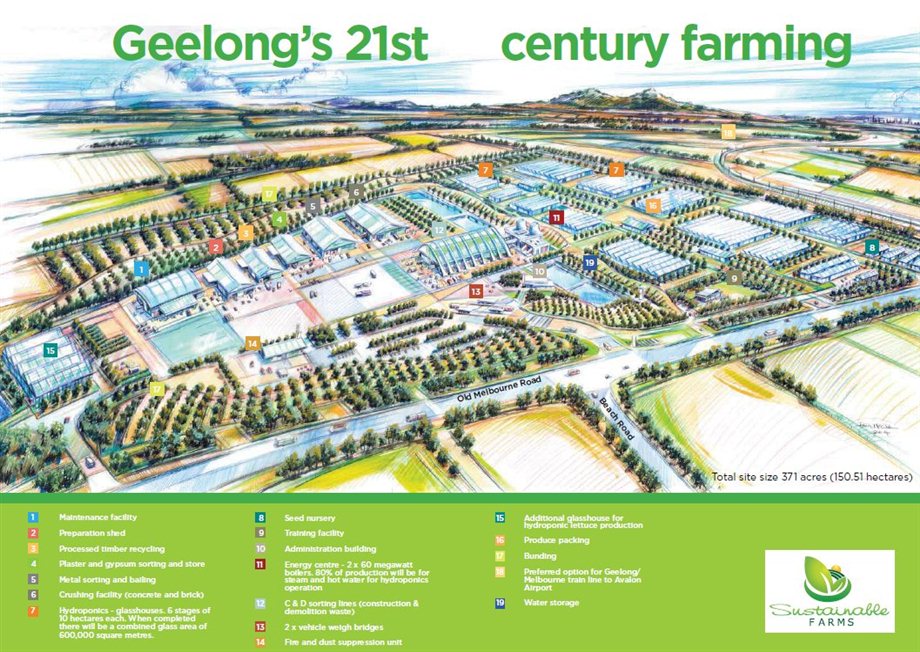
The project is a $320 million project between Mercer & Stokes, HRL Developments and Fresh Select and will use leading-edge technology and business practices to create 100% sustainable, cost efficient, large scale food production enterprise with significant export potential.
Sustainable Farms will be built in stages and reach full production by 2021.
Stage one is due for completion in 2016 and will include 10 hectares of glasshouses, energy centre and recycling plant.
The proponents have advised that the project depends on a high degree of certainty and co-ordination to facilitate decision making.
The proponent has requested that Council supports the Minister acting as the Authority for the project.
Cr Heagney moved, Cr Irvine seconded -
That Council supports the Minister for Planning being the Authority from the outset to initiate, authorise and facilitate the approvals process subject to:
a full assessment of the environmental effects of the proposal; and
the Minister seeking and considering public submissions on the proposal.
Carried.
The site is known as 385 Old Melbourne Road and is currently zoned Farming Zone. The site is also affected in its entirety by the Environmental Significance Overlay (ESO4 Grassland within the Werribee Plains Hinterland). The site is affected in part by the land subject to Inundation Overlay (LS10) and Vegetation Protection Overlay (VPO).
The subject site was formerly part of the proposed Intermodal Project.
The Sustainable Farms project is a $320 million project planned to be built on a 371 acre site in Lara.
Sustainable Farms will use recycled timber to create its own renewable energy source that will produce both heating steam and electricity, to power 60 hectares of hydroponic glasshouses.
When in full production, Sustainable Farms will be able to chip and consume approximately 220,000 tonnes of timber per year through its recycling capacity.
From this, the project will produce about 120mw of thermal energy production using 100% renewable fuel.
Once the project reaches full scale in 2021, Sustainable Farms expects to create over 1000 jobs and generate $160 million per annum for Geelong’s economy.
The site includes areas of environmental significance, particularly native grasslands and associated habitat. The proponent will need to address environmental issues as part of any planning scheme amendment. It will also need to determine requirements under Commonwealth Environmental Legislation.
The project does not impose any financial implications on Council.
The Minister for Planning would be responsible for all policy implications if he decides to take on the role of Authority for the development.
The Sustainable Farms project would support the Growing our Economy Strategic direction of City Plan.
No Council Officer involved in the report has any direct or indirect interest in accordance with Section 80(c) of the Local Government Act.
There are no notable risks associated with implementing the recommendation contained in this report.
Social considerations will need to be considered as part of the planning process.
The Planning Authority for the proposal will need to ensure the amendment does not impact on any basic rights, freedoms and responsibilities as set out in the Charter.
The process for consultation and communication will be considered by the Minister for Planning.
Portfolio: |
Infrastructure , Parks & Gardens – Cr Ellis |
Source: |
City Services – Engineering Services |
General Manager: |
Gary Van Driel |
Index Reference: |
Asset Management |
To inform Council of the Victorian Auditor General’s February 2014 report into Asset Management and Maintenance by Councils, and to provide comment on the recommendations in the report.
The Auditor General’s Report was undertaken at Ararat Rural City Council, Cardinia Shire Council, Kingston City Council, Port Phillip City Council, and Wodonga City Council to assess whether local councils effectively managed their physical infrastructure assets effectively.
The report identified significant deficiencies in asset renewal planning and practice, the quality of asset management plans, the linking of service levels to these plans, the development of asset management information systems, and in Councils' monitoring, evaluation and reporting on asset management.
Comments on the recommendations in the report as they relate to the City of Greater Geelong’s asset management situation are made here.
Cr Macdonald moved, Cr Richards seconded -
That Council notes and receives the report.
Carried.
In 2012–13, Victorian local councils managed over $73 billion in physical assets within their municipalities. These assets represent investments that have been built up over a long period of time, and include buildings, parks and gardens, roads, bridges, council land and drainage networks. The mix of assets varies with different types of councils. Across all councils in Victoria, land makes up around 40 per cent of the total value of assets, roads 30 per cent and buildings 10 per cent.
The City of Greater Geelong has $2.601 billion of assets of which land assets make up $0.580 billion
The physical assets managed by councils support the delivery of core services, facilitate economic activity and strengthen the economy in the long term. These infrastructure assets also support community activities throughout Victoria.
The Auditor Generals report on Asset Management and Maintenance lists seven recommendations that apply to Councils, along with a further six that are applicable to Local Government Victoria (LGV).
A response is given in the table below for each of the Auditor General recommendations as they apply to the City of Greater Geelong.
|
Auditor General’s Recommendations to Councils |
Response by City of Greater Geelong |
|
|
Current and Past Actions |
Future Actions |
|
|
1. Accelerate efforts to review and update their asset management frameworks, policies and strategies to meet better practice standards |
The City has a strong Asset Management strategic framework guided by an AM Policy and a Strategy document to direct the AM functions. It also has three sub-groups to specifically manage issues relating to Land, Building, and Infrastructure. |
The Council Asset Management Strategy is due for review in the coming six months. It will include an updated AM improvement plan with timelines for completion. |
|
2. Make sure they have comprehensive asset management plans covering all major asset categories |
Council has developed comprehensive Asset Management Plans for all of its major asset categories. |
The existing Asset Management Plans are periodically reviewed in line with the timing schedule of the condition surveys. |
|
3. As a priority, develop a strategy for more effectively reducing their asset renewal gaps |
The identified annual renewal gap at the City is $14.037mill. The City’s Asset Management Steering Committee has recognised the need to address this shortfall in annual funding for the renewal of its physical assets. |
A strategy is being developed to address and reduce the City’s annual renewal gap. It is expected to be completed in draft format and presented to the August meeting of the Asset Management Steering Committee and subsequently to Council. |
|
4. Improve their asset management information systems and knowledge of their asset portfolios to ensure they have up-to-date information on all assets |
The City is fortunate that it has a single integrated asset register and comprehensive data on its assets. It also operates additional Asset Management systems for modelling and advanced asset management. The systems include current data on valuation, attribute and condition. It ensures a sound knowledge of assets for decision making. |
A Maintenance Management System (MMS) is being implemented. The web based Hansen Asset System. will soon have further impact with MATman, Fleet assets, Property, and Pavement Management Systems. |
|
5. Identify and review the skills and resources required to effectively manage infrastructure assets, including developing a skills matrix and action plan to address identified skill and resource requirements and gaps |
The City has an extensive staff structure involved directly in the Asset Management and Maintenance of its assets. The annual performance review system identifies the needs for training and development in AM Skills. |
A formal skills matrix in Asset Management and Maintenance is proposed within the next twelve month period. |
|
6. Improve the provision of information to, and engagement with, the community on asset management |
There has been engagement with the community in the road network Levels of Service. Further work is proposed |
It is expected that there will be beneficial flow-on functionality from the Service Planning process that is currently being conducted. |
|
7. Develop and implement comprehensive asset management monitoring, reporting and evaluation systems, and publicly report their progress and performance against plans and strategies, including against capital works budgets. |
The City has sound reporting systems in place for Asset Management. These are complimented by reporting and evaluation for State Government Departments |
A review of our Project Management framework has commenced as part of the Financial Sustainability Review. Officers will develop a series of Council reports for improved engagement. |
In further response to the above recommendations from the Auditor General’s Report, the Asset Management function at the City of greater Geelong is in a continual improvement phase, in line with the National Asset Management Improvement Program (NAMAF).
Recently the City reached ‘Core Competency’ in Asset Management, achieving the criteria of NAMAF. This was a significant achievement that demonstrated how far the city has progressed in recent years. Further to this, the second session of the NAMAF program will be conducted in July this year with advanced Asset Management functionality checklists and actions being worked through.
A ‘State of Assets Report’ will shortly be sent to Council to give Councillors an overall snapshot of the condition of its infrastructure asset base. Asset Condition is the primary determinant of the finances required for renewal and refurbishment of the City’s assets.
It is worth noting that the Auditor General’s Report also gave recommendations that apply to the department of Local Government Victoria (LGV):
review and update its asset management guidance material for councils;
review the support it provides to councils and make sure it is targeted to address common issues;
consider, in conjunction with councils, developing a set of comprehensive asset management performance indicators that will enable comparability between councils on asset management performance;
in conjunction with councils and the Municipal Association of Victoria, review the use and application of the National Asset Management Assessment Framework and its appropriateness for driving improvement in asset management performance;
consider making aspects of asset management mandatory, such as the development of asset management policies, strategies and plans;
investigate options for supporting councils to develop and upgrade their asset management information systems, including by reviewing practices in other jurisdictions.
The City is interested to see the outcomes that emerge from the recommendations to LGV and will assess any changes as they are referred to municipalities across Victoria.
In an overall context, this Auditor General’s Report on Asset Management and Maintenance is important because it highlights matters that apply to all Councils in Victoria. The City of Greater Geelong views these recommendations seriously and strives to continue its Asset Management improvement.
This report and the follow up planning should enhance the natural and built environment through the consistent improvement in the City’s infrastructure base.
There is no direct cost impact on the budget associated with this report. However the ongoing implications and actions that will be developed require a number of decisions to be made which will have implications on the annual budget and the Long Term Financial Plan. For instance, the City’s current annual renewal gap is $14.037mill and the reduction of this figure will be addressed in a forthcoming strategy. The table below gives a summary of the Asset figures.
Annual Renewal Calculations 2013/14 |
||||||
|
|
Civil Infrastructure |
Buildings |
Recreation |
Environment |
Non Infrastructure Assets |
Totals |
|
Renewal Demand |
23.634 |
3.820 |
2.328 |
0.482 |
5.538 |
35.802 |
|
Renewal Investment |
13.765 |
1.000 |
1.462 |
0.0 |
5.538 |
21.765 |
|
Renewal Gap |
9.869 |
2.820 |
0.866 |
0.482 |
0.0 |
14.037 |
All Figures in $ million
This Plan will provide some direction for the ongoing improvement of Asset Management within the Municipality and does not have adverse implications.
This report aligns with the sustainability and built environment sections of City Plan.
There are no direct or indirect interests by officers engaged in this report.
The recommendations of this report will lead to a better Council position in terms of the level of financial sustainability due to improved Asset Management.
Asset Management is essential to deliver the appropriate levels of service for the community and support the social and lifestyle choices made by residents and visitors of the City. The Asset networks provide the infrastructure that enables the City’s services to be delivered. Sound Asset Management planning means that social impacts are properly considered.
Not applicable to this report
This Auditor Generals report has been distributed to Councils across Victoria by the State Government. It has also been communicated to key Asset Management staff at the City.
Portfolio: |
Infrastructure, Parks & Gardens – Cr Ellis |
Source: |
City Services – Engineering Services |
General Manager: |
Gary Van Driel |
Index Reference: |
Subject: Drainage - Floods |
The purpose of this report is to present a revision to the flood mapping for existing conditions produced within the early stages of the development of the Armstrong Creek Urban Growth Plan (UGP).
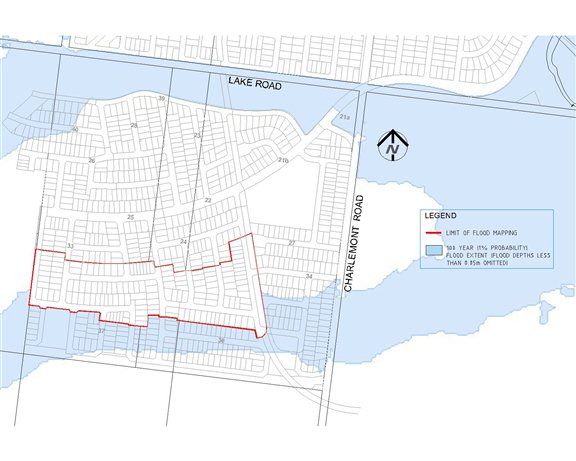
The flood mapping is subject to a revision due to the subdivision and development at 300-370 Charlemont Road, Armstrong Creek and 82-120 Lake Road, Armstrong Creek. Prior to subdivision the parent lots was considered to be liable to flooding. This development site, which is also known as Warralily Estate Stages 29,30 and 31, achieves flood immunity for newly created lots for flood events up to and including the 100 year Average Recurrence Interval (ARI) event due to approved internal earthworks including the reshaping of Armstrong Creek.
The earthworks undertaken have resulted in the floodwaters from the 100 year ARI event being contained within the boundaries of the Armstrong Creek reserve.
Council has a statutory obligation under the Building Regulations 2006 to designate land as liable to flooding where it reasonably knows it to be prone to flooding. Conversely, there is an obligation to remove the encumbrance of designation from land that is no longer considered to be flood-prone.
It should be noted that designation is separate to the creation of flood overlays within the Planning Scheme, which generally follows designation. In the case of the Armstrong Creek UGP area, the planning scheme amendment to create post-development flood zones or overlays is proposed after the design of the proposed precincts.
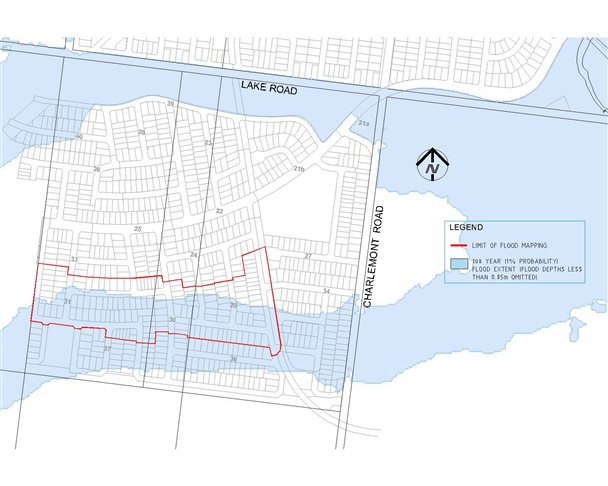
The current designated flood mapping (refer to Attachment 1) was designated by Council at its meeting of 12 December 2006, under the provisions of the Building Regulations 2006. Designation of land as liable to flooding enables the control of floor levels for acceptable building permit applications, or refusal of consent to building applications where there is likely to be a danger to life, health or safety due to flooding. Designation also enables disclosure of flood status within statutory information certificates.
Cr Richards moved, Cr Macdonald seconded -
That Council revoke the Council designation of 12 December 2006 of flood affected land as highlighted as Stages 29, 30 and 31 on Armstrong Creek Urban Growth Plan Flood Map dated 29 November 2006 as liable to flooding pursuant to Regulation 802(2) of the Building Regulations 2006.
Carried.
As part of the development of the Armstrong Creek Urban Growth Plan (UGP) a flood study was undertaken by specialist consulting engineers to identify the extents of the 100 year Average Recurrence Interval flood event for existing conditions. Following a public exhibition phase, the resultant flood mapping (refer to Attachment 1) was designated by Council at its meeting of 12 December 2006, under the provisions of the Building Regulations 2006.
On 25th October 2011, section 1 of this project was adopted at Council. This is section 2 of the area designation and further sections will be presented to Council in the coming years.
Designation of land as liable to flooding under Regulation 802 of the Building Regulations 2006 enables the control of floor levels for acceptable building permit applications, or refusal of consent to building applications where there is likely to be a danger to life, health or safety due to flooding. Designation also enables disclosure of flood status within statutory information certificates such as the Land Information Certificate and Building Information Request Form.
The subject of this report is the residential land at Armstrong Creek bounded by Charlemont Road and Lake Road. At the time of the flood study the subject land comprised of two larger lots. Prior to subdivision the parent lot was used primarily as farmland.
The subdivision at 300-370 Charlemont Road, Armstrong Creek and 82-120 Lake Road, Armstrong Creek was named Warralilly Estate by the developer. The current designated flood extent affects multiple residential lots within the Warralilly Estate Stages 29, 30 and 31.
Overland flows that may occur within the subdivision during the 100 year ARI flood event are now contained within road and drainage reserves in accordance with accepted best practice for development within flood-prone areas. Best practice requires that any overland flows within residential areas satisfy public safety criteria with respect to velocity and depth of flow.
Council has a statutory obligation under the Building Regulations 2006 to designate land as liable to flooding where it reasonably knows it to be prone to flooding. Conversely, there is an obligation to remove the encumbrance of designation from land that is no longer considered to be flood-prone.
Attachment 1 shows the existing flood designation. Attachment 2 shows the change in flood mapping at 300-370 Charlemont Road, Armstrong Creek and 82-120 Lake Road, Armstrong Creek after construction of the subdivision.
The revocation of flood-prone areas designation and designation of revised flood data does not result in any known adverse environmental impacts.
The removal of a minimum floor level requirement for new dwellings may result in a minor reduction in energy and material usage during construction. In addition, concrete slab-on-ground construction, which is normally used for a non-elevated floor, achieves the minimum energy rating more readily than a timber floor on stumps.
The costs of proceeding to revoke the existing designation and to designate the revised flood mapping at 300-370 Charlemont Road, Armstrong Creek and 82-120 Lake Road, Armstrong Creek, in accordance with the requirements of the Building Regulations 2006, are provided for within the annual recurrent budget.
The City has various statutory responsibilities for drainage management and flood management (prevention, response and recovery) as set out in the Local Government Act 1989, Local Government Regulations 1990, Planning and Environment Act 1987, Building Regulations 2006, Water Act 1989, Subdivision Act 1988 and Emergency Management Act 1986.
Regulation 802(2) of the Building Regulations 2006 provides Council with the powers to ‘designate’ land liable to flooding. Regulation 802(3) provides that consent must be obtained from Council for an application to build on land liable to flooding.
Section 27 of the Interpretation of Legislation Act 1984 provides the power for Councils to ‘repeal or amend a subordinate instrument made in the exercise of that power’.
Section 807 of the Building Regulations 2006 requires Council to update the municipality’s designated special area maps at the Building Control Commission in the event of alterations to a designated special area. Designated special areas include areas designated as being liable to flooding.
Section 229 of the Local Government Act and Regulation 326 of the Building Regulations provide for the issue of information certificates containing prescribed information, including the flood status of properties.
The revised flood data for 300-370 Charlemont Road, Armstrong Creek and 82-120 Lake Road, Armstrong Creek will assist the City in meeting its statutory obligations with regard to flood data.
The revised flood data will also assist in fulfilling the recommendations of the Municipal Emergency Management Committee adopted by Council in November 1998 (i.e. mapping of 1 in 100 year flood levels).
The recommendations of this report are consistent with City Plan, in relation to Growing our Economy and promoting a sustainable built environment, sustainable land use and development.
There are no officer direct or indirect interests with respect to this report.
Council has a risk exposure through its statutory obligations under the Building Regulations 2006 to:
designate land as liable to flooding where it reasonably knows it to be prone to flooding;
specify minimum floor levels in consultation with the relevant floodplain management authority (CCMA); and
refuse consent to building applications where there is likely to be a danger to life, health or safety due to flooding.
Council also has some risk exposure with any failure to disclose the flood-prone status of a property in a Land Information Certificate.
The designation of the flood data produced by the flood study Armstrong Creek UGP project is a key step toward minimising Council’s exposure to these risks.
Conversely, there is an obligation to remove the encumbrance of designation from land that is no longer considered to be flood-prone. Designation of land as being liable to flooding can result in extra construction costs and concerns regarding saleability, in some cases.
Council has a responsibility to the community to provide the best possible information on areas that are flood-prone.
We have taken into consideration the human rights relative to the subject matter of this report, which improves protection of private property.
The current designation was undertaken following a public exhibition in October 2006 with notification of affected property owners. These owners were sent letters and fact sheets with an invitation for submissions.
A revocation of designation does not warrant public consultation as it constitutes the removal of an encumbrance on land.
The owners of properties affected by the revocation will be notified so they are aware that disclosure of flood status on a Section 32 Vendors Statement is no longer required.
Relevant Council databases and flood maps will be revised and updates sent to the Corangamite Catchment Management Authority and Building Control Commission.
Portfolio: |
Coastal Communities / Planning – Cr Ellis |
Source: |
City Services – Environment & Waste Services |
General Manager: |
Gary Van Driel |
Index Reference: |
Council Reports 2014 |
The purpose of this Report is to seek a Councillor nomination to represent Council on the Geelong Queenscliffe Coastal Adaptation Strategic Partnership Group.
The Future Coasts program, led by the Victorian Department of Environment and Primary Industries in partnership with the Department of Transport, Planning and Local Infrastructure (DTPLI) has sponsored the Bellarine Peninsula and Corio Bay Local Coastal Hazard Assessment. This project aims to develop a strategic approach to planning for the impacts of coastal hazards. Currently there is no existing clear and systematic approach to dealing with the issues faced by coastal communities and land managers to deal with the impacts of the coastal hazards that will be faced over the next century.
The Geelong Queenscliffe Coastal Adaptation Strategic Partnership Group is the governing group that provides strategic direction for this project. The group has representation from the Department of Environment and Primary Industries, City of Greater Geelong, Borough of Queenscliffe, Corangamite Catchment Management Authority, Barwon Coast Foreshore Committee of Management and Bellarine Bayside Committee of Management.
The Future Coasts program, led by the Victorian Department of Environment and Primary Industries in partnership with the Department of Transport, Planning and Local Infrastructure has sponsored the Bellarine Peninsula and Corio Bay Local Coastal Hazard Assessment.
The Bellarine Peninsula and Corio Bay Local Coastal Hazard Assessment is the first stage of the Geelong Queenscliffe Coastal Adaptation Program and is nearing completion.
The second stage of the program, which involves an assessment of risk associated with coastal hazards, is about to commence.
Cr Nelson moved, Cr Ansett seconded -
That Council nominate Cr Ellis to represent Council on the Geelong Queenscliffe Coastal Adaptation Strategic Partnership Group.
Carried.
The Future Coasts program, led by the Victorian Department of Environment and Primary Industries in partnership with the Department of Transport, Planning and Local Infrastructure (DTPLI) has sponsored the Bellarine Peninsula and Corio Bay Local Coastal Hazard Assessment. This project aims to develop a strategic approach to planning for the impacts of coastal hazards. Currently there is no existing clear and systematic approach to dealing with the issues faced by coastal communities and land managers to deal with the impacts of the coastal hazards that will be faced over the next century.
This project is governed by the Geelong Queenscliffe Coastal Adaptation Strategic Partnership Group which provides strategic direction for this project. The group has representation from the Department of Environment and Primary Industries, City of Greater Geelong, Borough of Queenscliffe, Corangamite Catchment Management Authority, Barwon Coast Foreshore Committee of Management and Bellarine Bayside Committee of Management.
The final draft report of this assessment has recently been developed and the Strategic Partnership Group is about to refer this for peer review. Funding has been secured from the Victorian Department of Environment and Primary Industries to undertake a risk assessment of coastal hazards identified under the Victorian Adaptation Sustainability Partnership Program.
The City of Greater Geelong and the Borough of Queenscliffe are currently seeking funding from DTPLI to undertake adaptation planning, strategic land use planning and community engagement that will provide greater confidence to coastal communities and stakeholders across the Greater Geelong and Queenscliffe LGAs. This work will enable both Councils to translate the findings of the Bellarine Peninsula and Corio Bay Local Coastal Hazard Assessment and progress planning on a number of fronts and in turn deliver the following outcomes. A representative from Council is currently being sought for the Strategic Partnership Group.
Council representation on the Strategic Partnership Group will help ensure that issues associated with coastal adaptation are addressed as part of the Project.
There is no specific environmental implementation resulting from the recommendation in this report.
There are no financial implementations resulting from the recommendation in this report.
There are no policy, legal or statutory implications resulting from the recommendation in this report.
Under the strategic direction – sustainable built and natural environment Council seeks to partner with the community to protect and enhance our natural ecosystem and encourage sustainable design. This project is linked to the priority which supports our community to live sustainably. Impacts due to climate change are recognised as challenges which Council needs to consider.
No Council officer involved in the preparation of this report has a direct or indirect conflict of interest.
There are no risks associated with the recommendations contained within this report.
There are no social considerations resulting in the recommendation in this report.
There are no human rights charter issues resulting from the recommendation in this report.
Consultation with Coastal Communities will form part of the overall Engagement Strategy included in the project.
Portfolio: |
Environment and Sustainability - Cr Richards |
Source: |
City Services |
General Manager: |
Gary Van Driel |
Index Reference: |
Waste Management |
To advise Council of progress in the establishment of the Barwon South West Waste and Resource Recovery Group.
Under the State Government Getting Full Value – Victorian Waste and Resource Recovery Policy, the number of regional waste management groups has been reduced from thirteen to seven with this Council now being part of the Barwon South West Waste and Resource Recovery Group (BSWWRRG).
Each group will be governed by a board of directors comprising of four independent and appropriately skilled directors and four directors from local government. All directors are appointed by the Governor in Council on the recommendation of the Minister for Environment and Climate Change,
The Minister has conducted an expression of interest process to identify the independent and appropriately skilled directors. The directors from local government are nominated to the Minister by a local government forum, comprising of a representative from each member Council to the group.
Council has nominated its Environment and Sustainability Portfolio Holder, Cr Richards, to the Barwon South West Waste and Resource Recovery Local Government Forum and the Forum nominated Cr Richards to the Minister for appointment to the BSWWRRG board. The Forum also nominated the Forum representatives from the Shires of Colac Otway, Corangamite and Moyne.
Advice has now been received from the Minister that the BSWWRRG Board will comprise of Ian Coles, Francois Joubert, Lindsay Merrit and Jane Stanley as independent and skilled directors and Councillor Chris O’Connor (Corangamite), Stephen Hart (Colac Otway) and Jill Parker (Moyne) as the local government directors.
The Minister has declined Cr Richards’ nomination leaving Council without representation on the Board.
The BSWWRRG commenced operation on 1 August 2014.
Cr Richards moved, Cr E Kontelj seconded -
That Council note progress in the establishment of the Barwon South West Waste and Resource Recovery Group.
Carried.
As previously reported to Council, under the State Government Getting Full Value – Victorian Waste and Resource Recovery Policy, the number of regional waste management groups has been reduced from thirteen to seven with this Council now being part of the Barwon South West Waste and Resource Recovery Group (BSWWRRG).
Council was previously a member of the Barwon Regional Waste Management Group, along with the Shires of Surf Coast and Colac Otway and the Borough of Queenscliffe. The BSWWRRG now includes these councils along with the Shires of Corangamite, Moyne, Glenelg and Southern Grampians and the City of Warrnambool.
Under the Environment Protection Act 1970 the Waste and Resource Recovery groups are tasked with the planning and facilitation for waste and resource recovery infrastructure and facilitation and management of joint procurement contracts for waste management.
Each group will be governed by a board of directors comprising of four independent and appropriately skilled directors and four directors from local government. All directors are appointed by the Governor in Council on the recommendation of the Minister for Environment and Climate Change,
The Minister has conducted an expression of interest process to identify the independent and appropriately skilled directors while the directors from local government are nominated by a local government forum, comprising of a representative from each member Council to the group.
This Council has nominated its Environment and Sustainability Portfolio Holder, Cr Richards, to the Barwon South West Waste and Resource Recovery Local Government Forum and the Forum has recommended this Council’s representative to the Minister for appointment to the BSWWRRG board. The Forum has also nominated the Forum representatives from the Shires of Colac Otway, Corangamite and Moyne.
Advice has now been received from the Minister that the BSWWRRG board will comprise of Ian Coles, Francois Joubert, Lindsay Merrit and Jane Stanley as independent and skilled directors and Cr Chris O’Connor (Corangamite), Cr Stephen Hart (Colac Otway) and Cr Jill Parker (Moyne) as the local government directors.
The Minister has declined Cr Richards’ nomination leaving Council without representation on the Board.
The BSWWRRG commenced operation on 1 August 2014.
There are no specific environmental implication resulting from the recommendation in this report.
There are no financial implication resulting from the recommendation in this report.
There are no policy, legal or statutory implications resulting from the recommendation in this report.
The establishment of the BSWWRRG will become the vehicle for waste management planning across the Barwon South West region and provide the link to the state wide waste and resource recovery strategic framework, as proposed under the Getting Full Value – Victorian Waste and Resource Recovery Policy.
This will support the following City Plan objectives:
Support our community to live sustainably: Leading the way in waste management practices and continue to reduce the amount of waste to landfill.
Sustainable Built and Natural Environment: Partnering with our community to protect and enhance our natural ecosystems as well as encouraging reduced resource consumption.
No Council officers involved in the preparation of this report has a direct or indirect interest in the matter to which the report relates.
There are no risk implications resulting from the recommendation in this report.
There are no social considerations resulting from the recommendation in this report.
There are no human right charter issues resulting from the recommendation in this report.
There are no consultation or communications outcomes resulting from the recommendation in this report.
Portfolio: |
Finance – Cr Lyons (Mayor) Cr S Kontelj & Cr E Kontelj |
Source: |
Corporate Services – Financial Services |
A/General Manager: |
John Brown |
Index Reference |
Subject: Financial Management \ Reporting |
Amend the 2014-2015 Budget that was adopted on 24 June 2014.
Preliminary financial results for 2013-2014 highlight a recurrent deficit of ($8.1M) or $9.8M favourable to amended budget and Capital expenditure of $72.9M or $24.7M lower than authorised Capital Program. These results reflect a number of programs that are incomplete and are required to carryover into 2014-2015.
In order to avoid unnecessary variance reporting and commentary during 2014-2015 it is recommended that the 2014-2015 Budget be amended to recognise the prior year funding for Capital and Non Capital projects.
The incomplete programs, together with favourable operating performance increased Council’s year end cash balance to a total of $75.3M or $24.0M higher than projected.
A review of the Capital program at 30 June 2014 indicates that $42.85M expenditure and $1.57M income is required to be carried over for completion in 2014-2015, offset by 2014-2015 budgeted Income received in advance ($1.90M). Together with other budget amendments the 2014-2015 Capital budget will increase to $146.25M expenditure and $34.35M income or a net of $111.90M. This program is fully funded and will have no impact on the closing cash position as outlined in the adopted 2014-2015 Budget.
A review of the Non-Capital program at 30 June 2014 indicates that funding of $6.96M is required to be carried forward for completion in 2014-2015.
Together with other minor budget amendments, the amended recurrent operating expenditure will increase to $299.19M and recurrent income will increase to $292.32M or a net recurrent deficit of ($6.87M). The Non Capital program is fully funded and these amendments will have no impact on the closing cash position as forecast in the adopted 2014-2015 Budget.
Cr S Kontelj moved, Cr Nelson seconded -
That Council amends the adopted 2014-2015 Budget to include the following:
Capital Programs carryover as per Appendix 1, other budget amendments affecting Capital projects as per Table 1;
Non Capital Programs carryover as per Appendix 2, other budget amendments affecting the recurrent position as per Table 2.
Carried.
Division Requested:
For: Crs Ansett, Harwood, Heagney, Irvine, S Kontelj, Macdonald, Nelson, Richards
Against: Cr E Kontelj
At 30 June each year Council reviews the preliminary financial results to determine funded Capital and Non Capital programs that are incomplete and are required to be carried over into the subsequent financial year. These carryover requirements are recommended to be incorporated as amendments to the adopted budget. This practice avoids unnecessary variance reporting, given there is no impact on the budgeted closing cash position.
The review has been undertaken in the following key areas:
Carryover requirements to complete 2013-2014 Capital projects in 2014-2015.
Carryover requirements to complete 2013-2014 Non Capital projects in 2014-2015.
Other budget amendments requested or influenced by year end accounting matters.
2013-2014 Preliminary Financial Results Summary
|
|
Full Year Actual |
Full Year Amended Budget |
Variance Fav / (Unfav) |
|
Recurrent Surplus/(Deficit) |
(8.13) |
(17.92) |
9.79 |
|
Non-Recurrent Surplus/(Deficit) |
48.83 |
47.27 |
1.56 |
|
Net Surplus/(Deficit) |
40.70 |
29.35 |
11.35 |
|
Capital Expenditure |
72.86 |
97.56 |
24.70 |
|
Closing Net Cash Positive/(Negative) |
75.27 |
51.23 |
24.04 |
Capital Projects Budget Amendments |
Carryover requirements
Of the 284 projects listed in 2013-2014, project managers have advised that 149 projects have been fully completed, with 135 projects identified as requiring some carryover funds in 2014-2015 to complete works.
During the 2014-2015 Budget development the Capital carryover was projected to be $30M. At the end of the 2013-2014 financial year a review was carried out to determine the actual Capital Program carryover requirements. The review indicates a net carryover of $43.18M (refer to Appendix 1 for details) comprising of $42.85M expenditure and $1.57M income is required to complete the projects planned for 2013-2014, offset by 2014-2015 budgeted Income received in advance for Austin Park Redevelopment ($1.90M).
The net variance between actual Net ($43.18M) and estimate included in 2014-2015 Budget ($30.00M) is $13.18M.
Main increases are: – Higher carryover than estimated on Corio Landfill Rehabilitation $1.82M, Ocean Grove Integrated Children’s Centre $1.03M, Geelong Library & Heritage Centre Car Park $0.66M, Grovedale Integrated Children’s Centre $0.48M, Geelong Library & Heritage Centre $0.44M and Ocean Grove Neighbourhood House $0.42M. Other incomplete projects – Drainage Construction $1.14M, Lara Town Centre Expansion $0.75M, Griggs Creek Rehabilitation $0.70M, Heavy & Dedicated Plant Replacement $0.49M, NE Lara Main Drain $0.46M, Memorial Park Masterplan $0.45M, Toilet Block Renewal $0.37M, Drysdale Landfill Cell 6 $0.36M, Street Construction SRC $0.30M, Corio Norlane Regeneration $0.29M and Apollo Place Preschool Upgrade $0.26M.
Other Capital Program amendments:
Vic Roads Funded Works – Included in budget at $0.50M income and expenditure. Advice from Vic Roads is that Black Spot funding will be $1.56M.
Table 1 – Amended 2014-2015 Capital Program
Council adopted the 2014-2015 Budget on 24 June 2014 that included a gross Capital Projects Program of $123.34M with Capital Income of $33.62M – Net $89.72M.
The net 2014-2015 Capital Program is recommended for amendment to $111.90M to reflect the additional $43.18M carried over from 2013-2014 plus other Budget amendments as indicated in Table 1 below.
|
|
Expenditure |
Income |
Net Expenditure |
|
Council adopted 2014-2015 Budget - New Capital Funding (excluding Carryover) |
123,342,290 |
33,618,533 |
89,723,757 |
|
2013-2014 Capital Carryover Requests |
42,852,089 |
1,574,040 |
41,278,049 |
|
2014-2015 Budgeted Income rec’d in 2013-2014 |
- |
(1,900,000) |
1,900,000 |
|
Other Budget Amendments: |
|
|
|
|
Vic Roads Funded Works |
1,060,000 |
1,060,000 |
- |
|
Adjusted 2014-2015 Capital Program |
167,254,379 |
34,352,573 |
132,901,806 |
|
Planned Carryover into 2015-2016 (June 2015) |
(21,000,000) |
- |
(21,000,000) |
|
Amended 2014-2015 Capital Program |
146,254,379 |
34,352,573 |
111,901,806 |
Operating Budget Amendments |
Non Capital Projects Carryover requirements
In addition to the Capital Program, Project Managers have undertaken a review of the Non Capital Projects budgeted for in 2013-2014 that have been requested to be carried over into the 2014-2015 financial year.
The 2013-2014 Recurrent Operating result was favourably impacted by $6.98M of incomplete Non Capital programs as per Appendix 2.
Requested Discretionary Program Carryover:
|
|
$ |
|
Expenditure |
7,131,600 |
|
Income |
174,500 |
|
Net Expenditure |
6,957,100 |
Other Operating Budget amendments:
Budget Submission Inclusions:
Increase in contribution to Geelong Regional Library Corporation $91,000.
Increased funding for Future Proofing Geelong initiatives $45,000.
Increased contribution for Gala Day $5,000.
Contribution to Pulse TV $25,000 (Corporate $ for $ matching).
Sales Proceeds on Plant & Equipment – Estimated sales proceeds on Heavy & Dedicated Plant sales relating to carried over purchases - $97,000 (estimated written down value $15,000).
The impact of the requested Discretionary Program Carryover, along with the other Budget amendments that affect the recurrent position, is on the 2014-2015 recurrent surplus / (deficit) (Refer Table 2 below).
Table 2 – Amended 2014-2015 Recurrent Surplus / (Deficit)
|
|
Expenditure $ |
Income $ |
Surplus / (Deficit) $ |
|
Council adopted 2014-2015 Budget - Recurrent Surplus / (Deficit) |
291,975,828 |
292,151,232 |
175,404 |
|
2013-2014 Discretionary Carryover Requests |
7,131,600 |
174,500 |
(6,957,100) |
|
Other Budget Amendments: |
|
|
|
|
Budget Submission - GRLC contribution |
91,000 |
0 |
(91,000) |
|
Budget Submission - Future Proofing |
45,000 |
0 |
(45,000) |
|
Budget Submission - Gala Day |
5,000 |
0 |
(5,000) |
|
Budget Submission – Pulse TV |
25,000 |
0 |
(25,000) |
|
(Gain)/Loss on Sales Plant & Equipment |
(82,000) |
0 |
82,000 |
|
Amended 2014-2015 Recurrent Surplus / (Deficit) |
299,191,428 |
292,325,732 |
(6,865,696) |
Other Budget Variances
There are a number of other known or estimated variances to Budget that are not listed as budget amendments but will be treated as Projection Changes during the year. They are as follows:
Favourable:
Insurance Premium Savings $360,000
Workcover Premium Savings $333,000
Unfavourable:
Grants Commission reduction ($369,000)
New Cycling Event Funding ($150,000)
Draper St Land Sale ($900,000)
McManus Rd Oil Spill ($120,000)
Net Favourable / (Unfavourable) ($846,000)
The adoption of the 2013-2014 carryover program provides the required funding to complete the environmental programs previously approved as part of the 2013-2014 Budget.
There are no funding implications associated with this report, with higher than projected cash balances as at 30 June 2014 funding additional budgeted expenditure in 2014-2015.
The program variances and carryover requests are detailed within the accompanying financial reports (refer Appendices 1 & 2).
Section 144A part 1 of the Local Government Act states “A Council must prepare a revised budget if circumstances arise which cause a material change in the budget and which affect the financial operations and position of Council.”
In the context of the total budget the recommended variation to the budget is not considered material.
This amended budget report contributes to responsible and sustainable financial management as aligned in Council’s City Plan objective on How We Do Business.
Council staff preparing this report have no direct or indirect interest.
Capital projects by their nature are susceptible to delays for a large variety of reasons including weather, delays in approvals (i.e. Special Rates & Charges programs) contractor availability, performance, etc.
The carryover Capital Program (refer to Appendix 1) if approved, will result in a gross capital program for 2014-2015 of $146.25M.
The adoption of the 2013-2014 carryover program provides the required funding to complete the social programs previously approved as part of the 2013-2014 Budget.
No Human Rights are affected by this report.
Project Managers have submitted requests for carryover and will be advised of the outcome pending consideration of this report by Council.
Portfolio: |
Finance – Cr Lyons (Mayor) Cr S Kontelj & Cr E Kontelj |
Source: |
Corporate Services - Financial Services |
A/General Manager: |
Michael Kelly |
Index Reference: |
Financial Management - Reporting |
To authorise two Councillors to certify the 2014 Financial Statements.
The 2013-2014 Financial Statement of Accounts, Standard Statements and Performance Statement have been prepared and reviewed by the Victorian Auditor Generals Office (VAGO).
These Statements have been prepared in accordance with Australian equivalents to International Financial Reporting Standards.
The 2014 Revaluation of Land, Buildings and Land Under Roads and adjusting entries are included in these Statements.
These Statements, along with any recommended amendments arising from the Audit Advisory Committee meeting will be submitted to Council at its meeting on Tuesday, 26 August 2014.
The draft closing audit report has been received from VAGO and there were no major issues of high risk to the Council.
Under Sections 131 and 132 of the Local Government Act 1989, Council is required to pass a resolution giving “In Principle” approval to the Statements and authorise two Councillors to certify the Statements in their final form.
Following consideration by Council the “Financial Statement of Accounts”, the “Standard Statements” and the “Performance Statement”, together with a copy of the Council Resolution that nominates two Councillors and accepts the Statements “In Principle”, will be provided to the Auditor General.
Under Section 134 of the Local Government Act 1989, as soon as practicable after the Annual Report has been sent to the Minister, the Council must hold a meeting to discuss the Annual Report, including the Annual Financial Statements and the Auditors Report.
Cr S Kontelj moved, Cr E Kontelj seconded -
That Council:
gives approval in principle to the “Financial Statement of Accounts”, the “Standard Statements” and the “Performance Statement” (as per Appendix 1); and
authorise two Councillors being the Mayor, Cr D Lyons and Cr S Kontelj to certify the Statements subject to any changes recommended and agreed with the Auditor General.
Carried.
Under Section 131 of the Local Government Act 1989 (LGA), a Council must in respect of each financial year, prepare an Annual Report that includes audited Standard Statements, Financial Statements and a Performance Statement for the financial year. These statements must be prepared in the prescribed manner and form and be certified by the Auditor General.
Council is required to approve “in principle” the Statements prior to receiving certification from the Auditor General. Council’s approval requires nominating two Councillors to certify those Statements in their final form.
The Statements are being reviewed by the Auditor General and may be returned with or without amendment. Once the report of the Auditor General has been received, the two nominated Councillors, the Chief Executive Officer and the Principal Accounting Officer are required to sign the Accounts which will be returned to the Auditor General who will then issue the audit report.
The Standard Statements, Financial Statements and the Performance Statement all form part of Council’s Annual Report that must be submitted to the Minister within three months of the end of the financial year. Further, Council must also review the Annual Report in a meeting open to the public as soon as possible after the report is sent to the Minister.
The Financial Statement of Accounts 2013-2014 record a satisfactory period of operation reflected in high closing cash balances and significant asset growth.
There was one “Non operating” issue impacting on the accounts – revaluation of Land, Buildings and Land Under Roads.
The asset classes Land, Buildings and Land Under Roads were revalued at 1 January 2014 with the previous revaluation date being 1 January 2012. The outcome of the revaluation was a $17.1M increase in asset values via the asset revaluation reserve.
Standard Statements Performance Commentary
The 2013-2014 recurrent or operating result was a deficit of $8.1M or $9.1M unfavourable to adopted budget. This unfavourable variance is due to the receipt of $7.5M in Grant Commission income in June 2013 and unfavourable Program and Activity Fees of $2.9M.
The non recurrent result was a surplus of $48.9M or $3.2M favourable to budget. This was due to early receipt of income for capital projects which was partially offset by costs expensed from Capital Work In Progress.
Capital expenditure originally budgeted at $78.7M was increased to $98.9M with the impact of carryover 2013-2014 expenditure and other authorised increases. The actual expenditure of $72.9M is 87% of the adopted budget.
The major projects still to be completed are Corio Landfill Rehabilitation $11.0M, Geelong Library & Heritage Centre $7.1M, Grovedale Integrated Children’s Centre $2.0M, Leopold Community Hub $2.0M, GLHC Car Park $1.2M, Barwon Heads Kindergarten $1.2M, Rosewall Kindergarten Rebuild $1.2M, Windsor Park Children’s and Family Hub $1.1M, Ocean Grove Integrated Children’s Centre $1.0M, Lara Town Centre Expansion $0.8M, Griggs Creek Rehabilitation $0.7M and Heavy & Dedicated Vehicles $0.6M. A separate report to Council will recommend carry over funds to complete 2013-2014 Projects (i.e. 2014-2015 Budget Amendments).
Council’s closing cash balance was $24M favourable to Budget, with incomplete projects, deferral of landfill rehabilitation project and a more favourable opening cash position.
|
|
Actual |
Adopted Budget |
Var |
|
Recurrent Surplus/(Deficit) |
(8.1) |
1.0 |
(9.1) |
|
Non-Recurrent Surplus/(Deficit) |
48.9 |
45.7 |
3.2 |
|
Net Surplus/(Deficit) |
40.8 |
46.7 |
(5.9) |
|
Capital Expenditure |
72.9 |
83.8 |
10.9 |
|
Closing Net Cash Positive/(Neg) |
75.3 |
51.2 |
24.1 |
Council’s Capital Work in Progress balance as at the end of June was $59.2M. This was a $9.1M increase on the previous years balance.
The following comments are provided relative to the Standard Income Statement, the Statement of Cashflows, the Balance Sheet and the Statement of Capital Works. The detailed Statements are attached in Appendix 1.
Income Statement
The Recurrent Deficit for 2013-2014 of $8.1M was $9.1M unfavourable to adopted budget.
Recurrent Income of $267.7M was $8.0M unfavourable to budget mainly due to:
Rates generation and Supplementary Valuations ($0.4M favourable);
Grants Commission income received in June 2013 ($7.5M unfavourable);
Waste disposal ($0.5M favourable) offset by various Activity and Program Fees ($2.9M unfavourable); and
Interest on Investments ($1.0M favourable).
Recurrent Expenditure of $275.9M was $1.1M unfavourable to budget mainly due to:
Employee Related Costs $3.7M favourable;
Supplementary Labour ($1.8M) unfavourable; Waste disposal using Wyndham Landfill ($2.5M) unfavourable; Marketing and Advertising ($0.6M) unfavourable, Events ($0.2M) unfavourable and Contributions ($0.4M) unfavourable;
Interest $1.1M favourable; and
Consultants ($1.5M) favourable and Audit Services ($0.2M) offset by legal expenses ($0.4M) unfavourable.
The Non Recurrent Result of $48.9M was $3.2M favourable to budget. There was favourable Capital Grants and Income due to early receipt of income for capital projects ($3.9M) and Insurance recovery for a destroyed building ($0.7M). These were partially offset by costs expensed from Capital Work in Progress ($2.9M).
Statement of Cash Flows
Council’s cash position at the end of the year is $75.3M or $24M favourable to budget with favourable rates, supplementary valuations and developer contributions. Higher levels of cash were also invested during the year due to lower than budget capital spend. The loan for $11.8M was drawn down in Oct 2013, however the loan for $16.5M was deferred until 2014-2015. There was lower payments for Assets due to incomplete projects ($18M).
The cash balance will provide funds to complete capital projects carried over from 2013-2014 and working capital to ensure service provision continues at the same levels in 2014-2015.
Balance Sheet
The Balance Sheets shows that Council has a very strong asset position with over $1.9 billion worth of assets that are used to provide services to the community.
Current Assets were $25M favourable to budget with an increase in cash due to lower than budgeted capital expenditure, higher than budgeted 1 July 2013 cash position.
Current Liabilities were ($6.6M) unfavourable due to an increase in refundable deposits collected during the year and a general increase in payables.
Non current liabilities were $7.8M favourable to budget. Loan balance was $14.7M favourable to budget due to the timing of capital projects and employee benefits were favourable to budget $5.2M. This was partially offset by higher than budget Landfill Provision ($11.3M) due to work on the Corio Landfill Rehabilitation being deferred and a recalculation of rehabilitation costs.
Statement of Capital Works
Council has an extensive capital works program to renew, upgrade and provide new assets to ensure the continuation and improvement of services provided to the community. Council spent $72.9M on capital works in 2013-2014 and included the following highlights:
$M |
||
• Road replacement and construction |
14.9 |
|
• Geelong Library & Heritage Centre |
6.2 |
|
• Ocean Grove Integrated Children's Centre |
4.5 |
|
• Drysdale Landfill Cell 6 |
3.7 |
|
• Footpath replacement and construction |
3.2 |
|
• Simonds Stadium Players Stand |
3.0 |
|
• Drainage replacement and construction |
2.7 |
|
• Plant and vehicles |
2.7 |
|
• Leopold Community Hub |
2.7 |
|
• Grovedale Integrated Children's Centre |
1.7 |
|
• Stead Park Hockey Precinct |
1.6 |
|
• Kerb & Channel replacement and construction |
1.3 |
|
• Windsor Park Children & Family Hub |
1.1 |
|
• Barwon Heads Kindergarten |
1.1 |
|
• IT Asset Replacements |
0.9 |
|
• Open Space Strategy |
0.8 |
|
• Drysdale Landfill Cell 4a |
0.7 |
|
• Building Renewal Works |
0.7 |
|
• Corio Landfill Rehabilitation |
0.7 |
|
• Elcho Basin |
0.6 |
|
• Playground Development Program |
0.5 |
The external audit was completed on Friday, 15 August by Victorian Auditor Generals Office (VAGO). There were no major issues affecting the Financial Statements and a closing report will summarise Audit findings.
Incomes and Expenditures on Council’s environmental preservation and enhancement programs are included in the Financial Statements.
As detailed within the accompanying financial statements – Appendix 1.
Under Section 131 of the Local Government Act the Council must in respect of each financial year prepare an Annual Report, which includes audited financial statements for the financial year.
Under Section 131 a Council must not submit the Financial Statements to its auditors or the Minister unless it has passed a resolution giving its approval “in principle” to the statements.
Under Section 131 a Council must authorise two Councillors to certify the Statements in their final form after any changes recommended, or agreed to with the auditor.
The actions outlined in this report are aimed at complying with the requirements of the Act.
The Annual Financial Report highlights that 2013-2014 Council operations have been managed in a responsible manner. The results contribute to responsible and sustainable financial management as aligned in Council’s City Plan objective on the How We do Business.
Council staff preparing this report have no direct or indirect interest.
The Statements are released as a draft and are still subject to being signed off by the Auditor General.
The attached report represents a full and open disclosure of the financial position for the benefit of the community.
There are no known positive or negative effects.
The Financial Statement of Accounts, The Standard Statements and the Performance Statement will be available to the public as part of the Council Agenda.
Contents | Previous Page: Section A - Procedural Matters | Next Page: Section C - Notice of Motion
