
Council Minutes - Section B: Reports - 11 November 2014
Contents | Previous Page: Section A - Procedural Matters | Next Page: Section C - Urgent Business
Contents | Previous Page: Section A - Procedural Matters | Next Page: Section C - Urgent Business
Reports tabled at the Ordinary Meeting of Council on Tuesday date held at City Hall, Little Malop Street in Geelong.
Sale of Former War Memorial Kindergarten – 17 Townsend Road, Whittington
Geelong Public Health and Wellbeing Plan 2013-2017 Annual Review
Consideration of Tender Submissions for Tender T1400048 – Provision of Security Services
Portfolio: |
Finance - Cr Lyons (Mayor), Cr S Kontelj & Cr E Kontelj |
Source: |
Corporate Services - Property Management |
A/General Manager: |
Michael Kelly |
Index Reference: |
Land Sales |
The purpose of this report is to recommend that the Council commence the process to sell the land at 17 Townsend Road, Whittington being the former War Memorial Kindergarten.
The Council property at 17 Townsend Road formerly the War Memorial Kindergarten has been vacant since 2012 and is included in the adopted 2014/15 land sales budget.
The building was originally constructed in 1955 as an infant welfare centre (MCH) and extended in 1961 for a kindergarten. The land was purchased by the former Shire of Bellarine and the community raised one third of the funds to construct the infant welfare centre. The balance of the funds, including those required for the kindergarten, were provided by the Shire and through government grants.
Due to the status of the building as a war memorial and the presence of plaques relating to that status, two community meetings have been held to discuss the future of the property. The feeling of those at the meetings is that the property and buildings should be retained however no proposals for their future use have been forthcoming.
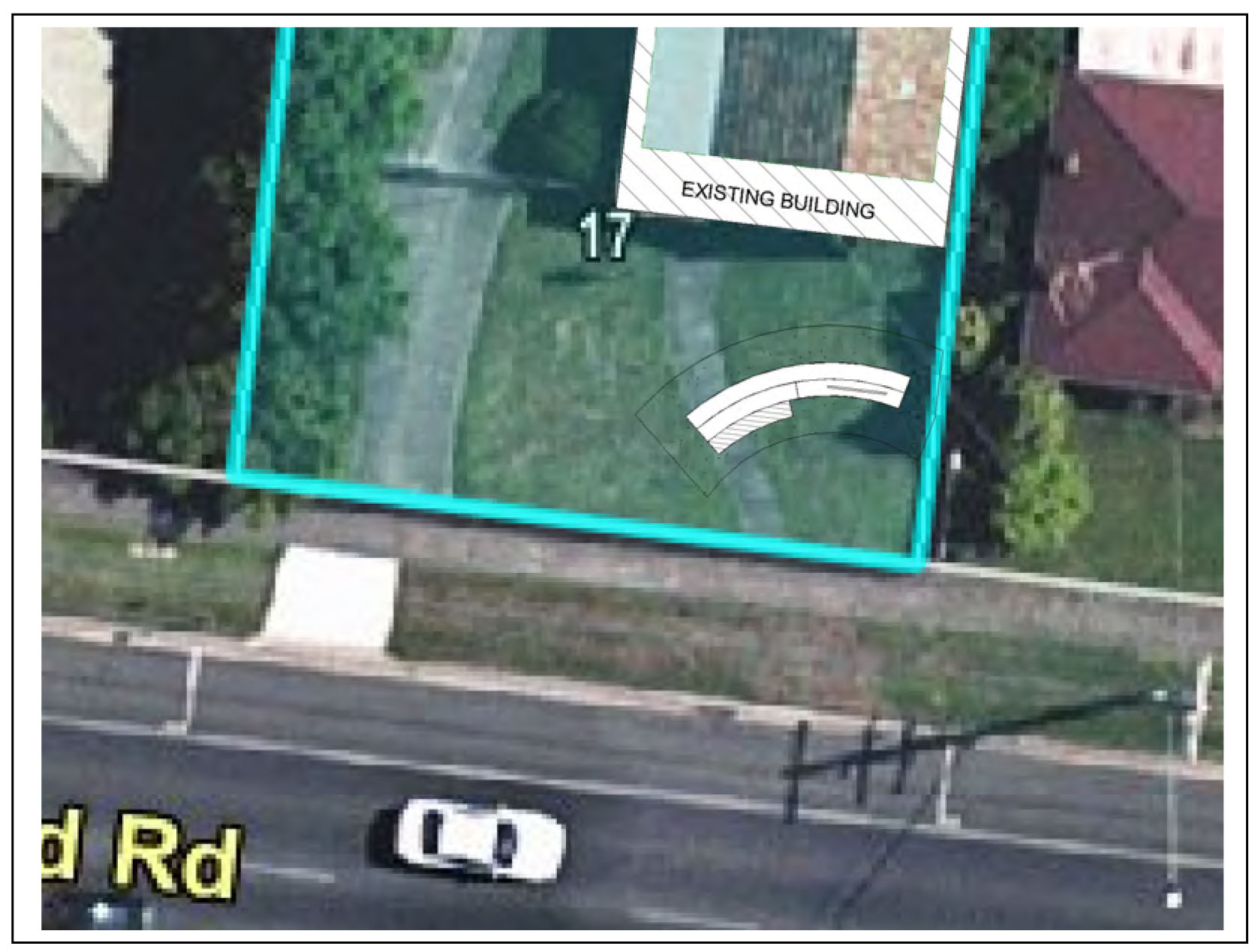
It has been put to the community meetings that a permanent memorial garden of approximately 65m2 could be established at the front of the property where the plaques would be suitably mounted with an explanation of their origin and the significance of the site. Other locations for the plaques have also been suggested including the St Albans Park Kindergarten, the War Memorial Reserve at Boundary and St Albans Road, Whittington Senior Citizens Hall.
The sale of this property is included in the adopted land sales budget and it is recommended that the Council commence the sale process and seek submissions under s189 of the Local Government Act.
If submissions are received they will be heard by the Submissions Review Panel and a further report will be put to Council. Whether or not submissions are received a further report will be put to Council relating to the future location of the memorial plaques, should it be decided to proceed with the sale of the land.
Cr Irvine moved, Cr Fisher seconded -
That Council:
remove this property from the potential sale list;
officers seek alternative use of this site for community benefit, including the creation of a living memorial park to honour our fallen service personnel.
Carried.
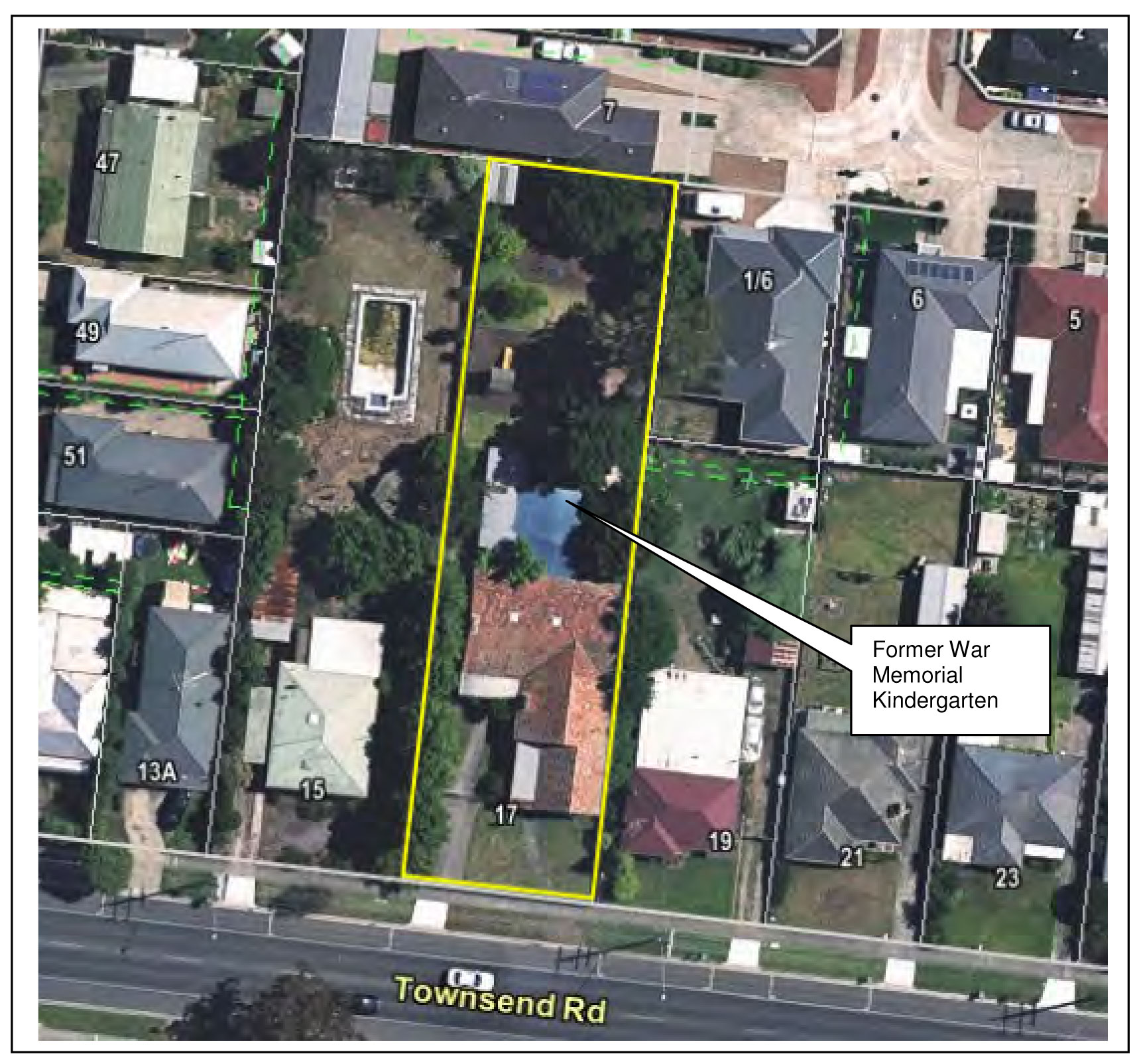
The War Memorial Kindergarten is located on land at 17 Townsend Road, Whittington. The first building to be erected on the land in 1955 was an infant welfare centre (now known as maternal child health centres) and in 1961 the building was extended for use as a kindergarten. These uses extended through to 2012 at which time the building ceased to be used for either function due to declining demand and the construction of the new kindergarten in St Albans Park. The building is currently used once a week for a local playgroup.
The land has an area of 1,335.7m2 and is zoned Residential 1. Refer Attachment 1.
Research into the history of the property indicates that following World War 2 members of the local community engaged with the Shire of Bellarine to establish a permanent memorial to those who fell during that war. Following consideration of options it was decided to purchase the land at 17 Townsend Road and build an infant welfare centre and a kindergarten.
In 1951 the Shire purchased the land from R and E Maxwell for 100 pounds as evidenced by the transfer of land registered at the Titles Office. There is an alternative view that the land was donated by the Maxwells however that is not supported by the transfer of land.
To assist with construction costs, the local community engaged in a range of activities including paper and bottle drives, rabbit drives and dinner dances. About one third of the cost of the infant welfare centre was raised by the community and the balance was contributed through the Shire and other grants.
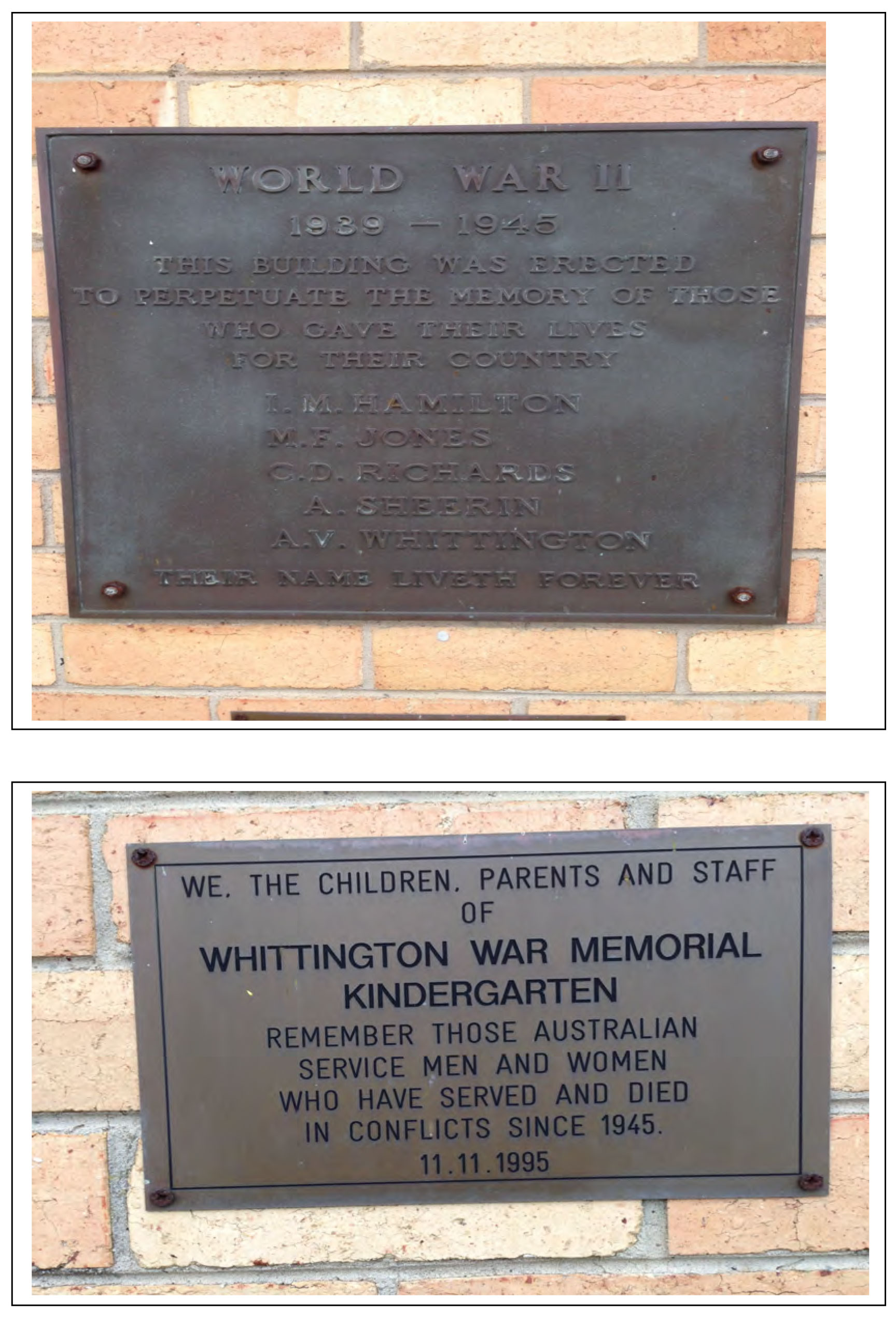
There exist two plaques on the building: one remembering 5 local community members who fell during WW2, and another erected in 1995 by the then kindergarten remembering Australian men and women who served and died in conflicts since 1945. Refer Attachment 2.
Two public meetings were held in May and August 2014 attended by between 15 and 20 people to discuss the future of the buildings and the plaques. At the second of the meetings which was attended by Cr Irvine, the community provided feedback on a proposal to establish a memorial garden. Refer Attachment 3.
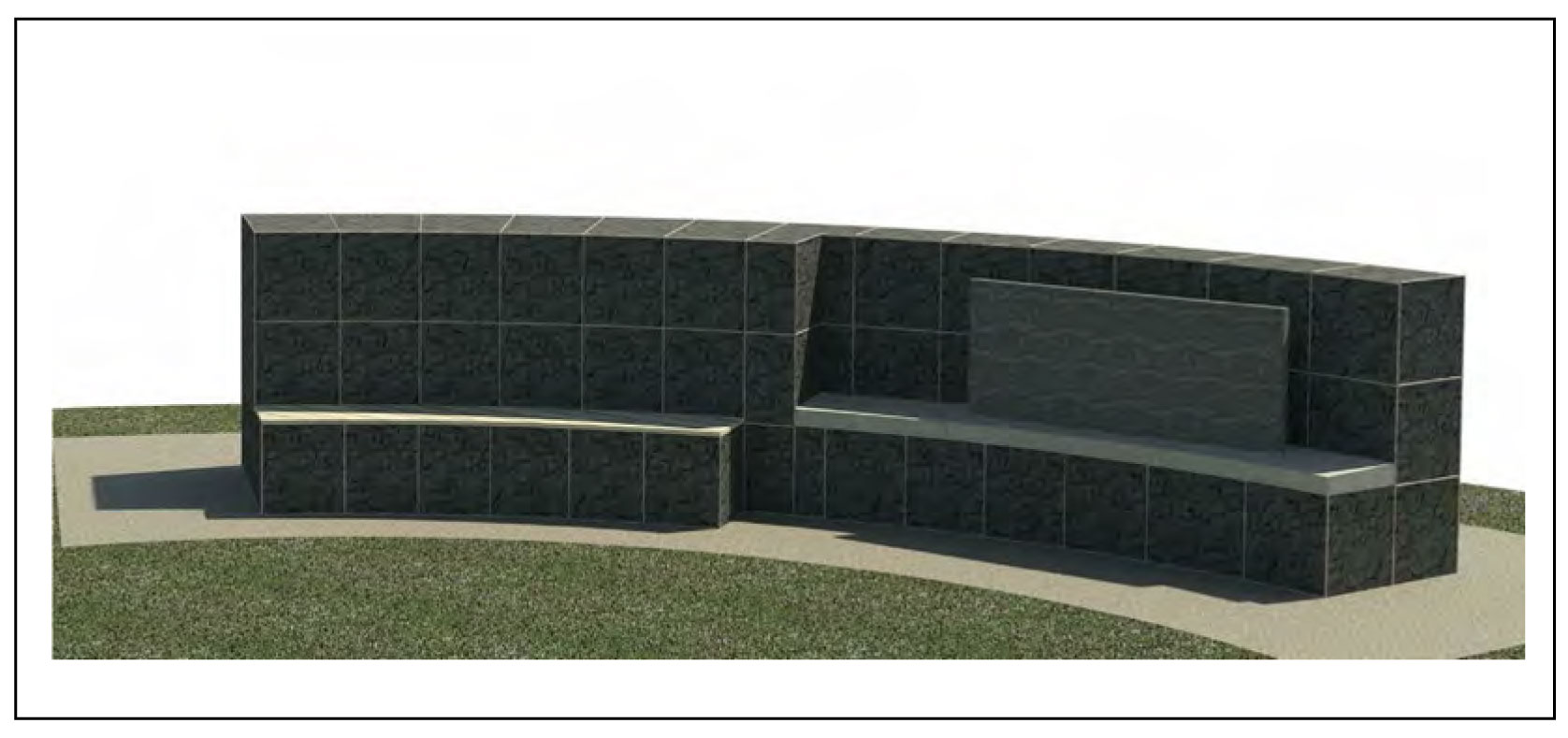
The memorial garden proposal was for both plaques to be mounted on a masonry or stone slab inscribed with appropriate words explaining their origin and the significance of the site.
The slab is to be mounted on a gabion wall (dry stone wall in stainless steel basket) and located upon a small grassed reserve which will be maintained by the Council. The balance of the land being some 1,270m2 is proposed to be sold.
The memorial garden proposal did not receive support from the public meetings. There was support for the retention of the buildings however no suggestions were forthcoming as to what use the buildings could be put.
Alternatives for the plaques which were similarly not supported included their relocation to the St Albans War Memorial at Boundary and St Albans Roads some 200m to the west, relocation to either of the Whittington Senior Citizens Hall in Westmoreland Street or relocation to the St Albans Park Kindergarten in Homestead Drive, St Albans Park.
The main brick building on the land is in reasonable condition the rear section of which is a large open room formerly used for a kindergarten.
There are other rooms within the main building variously used for offices, storage and amenities, including other lightly constructed outbuildings in the rear yard. Adapting the main building for any other public building use will require full compliance with modern building regulations, meeting standards for access, fire, toilets and ventilation. Fit-out costs would be in addition to any compliance works.
The site itself is located on the increasingly busy Townsend Road which carries between 14,000 and 16,000 vehicles per day, and any future public use will require the construction of on site parking and possible modification of the building to allow appropriate vehicle access.
There exists a large eucalyptus tree in the rear yard of the property which appears to have been planted soon after the property was purchased by the Shire. It is planted close to the eastern boundary and has been pruned to restrict overhanging. While not ideally located, the tree is on good health and will require on going management to avoid root intrusion and dropping of leaves and branches onto the neighbouring property.
The proceeds from the sale of the land will be recurrent income for which provision is made in the 2014/15 budget with an indicative revenue of $290,000. As property assets are disposed of the written down value is adjusted on the asset register.
The estimated cost of the memorial garden is $30,000.
Section 189 of the Local Government Act (“LG Act”) requires Council to give public notice of its intention to sell the land and consider any submissions received. If any submissions are received they will be heard by the Submissions Hearing Panel followed by a report to Council. Whether or not submissions are received it is recommended that a further report come to Council to consider the future of he memorial plaques should it be decided to proceed with the sale of the land.
The same section of the LG Act also requires that a certified valuation be obtained and dated not more than six months prior to the sale of the land being the date of the contract of sale. Prior to sale a certified valuation of the land will be obtained for the land the final sale price will not be less than the Council’s valuation.
The recommendation supports the action priority relating to Responsible and Sustainable Financial Management where the sale of assets no longer required will support the identified progress indicators.
No officers or contractors involved in the preparation of this report have a direct or indirect interest in matters to which this report relates.
The risks associated with the subdivision and sale of this land are able to be managed following normal management procedures and processes.
Being constructed to honour community members who gave their lives during WW2 it is important that the site, while no longer used for infant welfare or a kindergarten, has permanent recognition of its original purpose. The memorial garden may be an appropriate and respectful way to do this while allowing the disposal of an asset no longer required.
This report has no negative or positive impact on the Human Rights Charter.
Any person will have an opportunity to make a submission on the proposed sale of the land when notice of intention to sell the land is published.
Portfolio: |
Planning – Cr Heagney |
Source: |
Planning and Tourism |
General Manager: |
Peter Bettess |
Index Reference: |
Development Contribution Plans - Governance |
As part of Council’s Development Contribution Governance Framework an annual report is to be presented to Council and the Audit Advisory Committee reporting on the income and expenditure for the previous 12 months.
Council currently has five active Development Contribution Plans (DCP) that facilitate the collection of development contributions and facilitate the delivery of essential projects within Council’s major growth areas.
DCP’s include obligations on both the Council and developers to fund infrastructure.
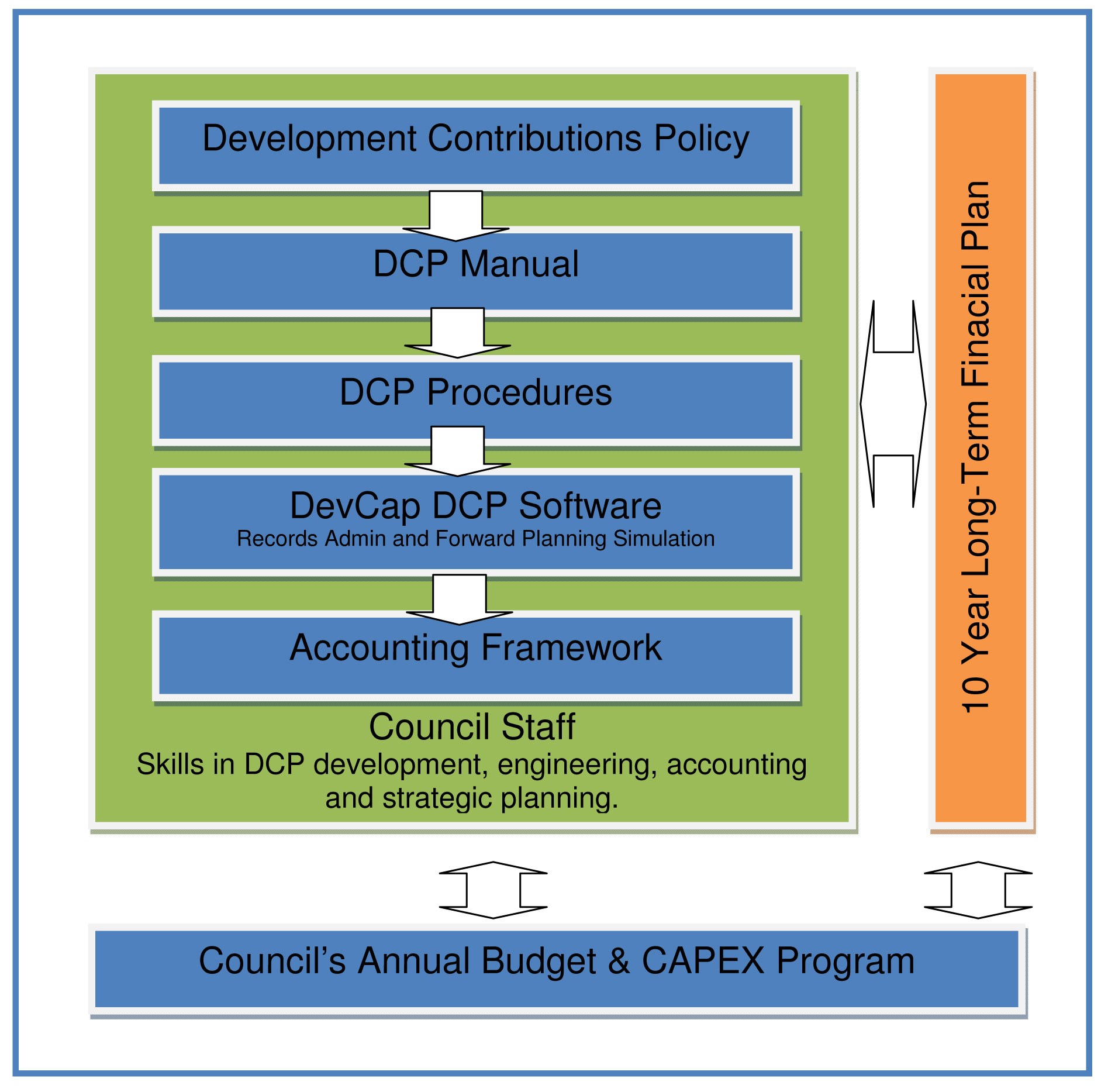
A robust governance framework has been setup for the management and administration of these Development Contribution Plans with a particular emphasis on consistency, accountability, transparency and strategic focus.
Council DCPs require the delivery of approximately $459M in essential projects to service urban growth ($307M in active DCPs and $152M in DCP pending approval), with an income of approximately $437M expected over the next 20 years. This represents a funding requirement on Council of approximately $22M.
The risks to Council are in not funding or delivering its obligations under the DCP which could result in the loss of the developer’s contribution.
The performance of Council DCP’s during the 2013-14 financial year has seen $581,400 in income received (cash) and $3.19M in expenditure ($3.14M in developer works-in-kind projects and $57,000 in Council projects).
An external audit has also been undertaken on the management of DCPs within Council and confirmed “a sound framework for the management of developer contribution and having reviewed this function at a number of Council’s I am confident that the processes implemented by Council are ahead of most Council’s operating in this area”.
Cr Heagney moved, Cr Macdonald seconded -
That Council notes the report.
Carried.
Geelong is experiencing significant urban growth across the municipality and with this growth comes the need for delivering key infrastructure to service these new communities.
One of the key funding avenues to facilitate this development is the use of development contributions, or more formally, the use of a Development Contribution Plan (DCP).
A DCP is an incorporated document within the planning scheme that allows Council to levy a charge upon a specific area / precinct of development in order to facilitate the delivery of future projects specifically required to service this area / precinct (eg: traffic lights, recreation reserves, community centres, etc).
Over the past four years the City of Greater Geelong has been implementing a detailed governance framework for the administration of DCPs. The framework is aimed at ensuring all DCPs are managed and administered in a strategic, consistent, accountable and transparent manner (Refer Appendix 1 – CoGG DCP Governance Framework).
A recognised component of the governance framework was the need to provide an annual report to Council detailing the performance of Council’s DCPs over the past financial year.
The report is aimed at summarising the following key features:
Income received
Works in Kind projects delivered by developers
Council expenditure on DCP projects
Land provided to Council (funded by a DCP)
Current funding gaps for DCPs
These themes are also consistent with the recommendations made by the Standard Development Contribution Advisory Committee responsible for recommending reforms within the new development contributions system.
The implication of the Standard Development Contribution
During 2013-14 Council also undertook an external audit of its total DCP Governance Framework (Crowe Horwath, CoGG Management of Development Contributions, Nov 2013). The report provided positive feedback on the management of DCPs within the City of Greater Geelong and contained ten general recommendations detailing potential system improvement.
It should also be noted that many of the Audit recommendations were already well underway prior to the audit taking place, which again reconfirmed the robust nature of the Framework and Council officers emphasis on continuous improvement.
The full conclusion of the report is shown in Appendix 5, while an extract is detailed below.
“Council have established a sound framework for the management of developer contributions. A comprehensive developer contribution manual has been developed to guide the DCP process. The manual was found to be logical, comprehensive and easy to follow. Our review of two DCP’s found that both had been prepared consistent with the manual. In addition Council has a dedicated team focussed on managing the challenges of the DCP’s. The team includes an appropriate mix of engineering and financial skills.
Having reviewed this function at a number of Council’s I am confident that the processes implemented by Council are ahead of most Council’s operating in this area.
In addition, implemented as designed, they will negate the deficiencies noted in the accounting for DCP’s that were raised in the Auditor-General’s report to parliament on the use of developer contribution plans (December 2009).”
Not withstanding this positive endorsement of Council DCP management, there were areas for improvement also noted in the Audit. Council officers will focus on addressing these matters of DCP management over the next 12 months.
OVERVIEW
The City of Greater Geelong currently has five active Development Contribution Plans across three of Geelong’s major growth areas. These five DCP’s represent $288M in forecasted development contributions income to the City over their expected 20 year life span; delivering $307M in projects.
These DCPs include:
Armstrong Creek East Precinct
Armstrong Creek West Precinct
Armstrong Creek North-East Industrial Precinct
Jetty Road Growth Area
Lara West Growth Area
These five active DCPs require a combined contribution of almost $19M in Council funding over the life of the DCPs. This “gap” funding does not include the cost of forward funding (financing) projects in advance of cash being available, any likely increases in scope for DCP projects, the exposure to land compensation claims for land projects included in the DCP (in advance of available funds or project need), and other projects required to services these growth areas.
In addition to these five active DCPs, there are two DCP’s currently awaiting adoption into the Greater Geelong Planning Scheme; these being the Armstrong Creek Town Centre and Horseshoe Bend Precincts. These two Precincts represent an additional $152M in projects with forecasted development contributions income of $149M (ie: a funding gap of $3M). This $3M obligation results in a total Council funding requirement of $22M.
Across all seven of these DCP precincts (approved and pending approval) its estimated that Council will require an additional $70M in funding to facilitate the delivery of planned projects such as key regional facilities such as a library, aquatic facilities, arts and cultural space, various road projects and recreation and open space land and works. This funding is over and above the Council’s $22M commitments in the DCP’s over their life.
PERFORMANCE AND OUTCOMES
In relation to the performance of the five active DCPs a summary of the income, expenditure, works-in-kind delivered (including land) is included in:
Appendix 2 – DCP Summary Report
Appendix 3 – DCP Whole of Life Liability and Funding Gaps
Appendix 4 – DCP Levies - Indexation Trends (3 years)
As seen by the summary information contained within Appendices 2 – 4 Council has received $581,400 in cash income (combination of both the Development Infrastructure Levy and the Community Infrastructure Levy (ie: $900/dwelling).
This is matched with $3.19M in DCP projects delivered during 2013/14 made up of $3,14M in developer works-in-kind projects and $57,000 in Council delivered projects.
No DCP land projects were provided during 2013-14.
STATUS REPORT FOR EACH DCP PRECINCT
Armstrong Creek East Precinct
The Armstrong Creek East Precinct main developer Warralily is progressing development on two main fronts from Barwon Heads Rd and Surf Coast Hwy. They are constructing DCP Projects as works in kind to offset their DCP liabilities including intersections, major drainage and creek works and recreation facilities. An additional two new developments have also commenced construction during 2013/14.
Armstrong Creek West Precinct
The Villawood Properties Armstrong Estate has commenced development west of Surfcoast Highway and will be completing projects as works in kind to offset their DCP liabilities. These works include intersections, major drainage, creek works and recreation facilities.
Armstrong Creek North East Industrial Precinct
The Armstrong Creek North East Industrial Precinct Development Contribution Plan was approved in 2010. Development is yet to commence in this precinct.
Jetty Road Urban Growth Area Stage 1
The Jetty Road development is well underway with the 260 lot Curlewis Parks Estate nearing completion and three other developments under construction. Projects completed as part of the Jetty Road DCP are the main East West Collector Road (land and construction) and the Jetty Road / Wyndham Street signalised intersection. Works have commenced on the Griggs Creek Landscape and Improvements and Jetty Road Foreshore improvement works.
Lara West Urban Growth Area
Amendment C285 – Revised Lara West Urban Growth Area DCP was approved by the Minister for Planning on 17 July 2014. Development is expected to commence during the 2014/15 financial year.
Armstrong Creek Town Centre Precinct (recently approved)
Council adopted Amendment C267 Armstrong Creek Town Centre Precinct Structure Plan and Development Contributions Plan at its meeting on 13 May 2014. The Amendment was recently approved by the Minister and is currently awaiting gazettal. The Town Centre DCP projects will include intersections, shared paths, drainage works and a contribution towards the construction of a Library.
Horseshoe Bend Precinct (pending approval)
Council adopted Amendment C259 Armstrong Creek Horseshoe Bend Precinct Structure Plan and Development Contribution Plan on 14 October 2014. The Amendment has now been sent o the Minister for Planning for formal approval. The Horseshoe bend DCP projects will include active open space, intersections, shared paths, drainage and community centres.
There are no significant environmental impacts as a result of the management and administration of Council DCP system.
One of the main features of the development contributions system to ensure that new development funds essential infrastructure required to service these new communities.
The system is also setup to ensure these new development don’t create an unfair burden on the existing community. Therefore it is important to recognise the $22M funding requirement on Council and ensure these funds are included in Council’s long-term financial plan and various funding strategies are put in place to secure these funds with minimal impact to the existing community.
The report has been prepared to reflect Council’s obligations under the Victorian Local Government Act (1989) and Planning and Environment Act (1987).
The report supports the How We Do Business strategic direction of City Plan, in particular the priority of ‘responsible and sustainable financial management.
There is no direct or indirect officer conflict.
As part of the Governance Framework a detailed risk assessment has been undertaken to capture the management of development contribution within Council. Key risks have been recorded on Council’s corporate risk register, while lesser risks have been included as part of the DCP administration process / procedures.
There are no significant social impacts as a result of the management and administration of Council DCP system.
Council officers have taken into consideration the Human Rights Charter relative to the subject matter of this report.
A summary of the report has been included in the draft City of Greater Geelong 2013-14 Annual Report.
As at 30 June 2014
Development Contributions Plans |
Income ($) |
Total Project Value ($) |
Value Completed 13/14 |
% Completed 13/14 |
|---|---|---|---|---|
ARMSTRONG CREEK EAST PRECINCT |
||||
Development Infrastructure Levy Community Infrastructure Levy |
- 404,100 |
|||
Projects Delivered by Developer DI_OS_08 Local Parks - Playground Equipment (5 in total) Projects Delivered by Council |
556,875
|
111,375 - |
20% 0 |
|
| ARMSTRONG CREEK WEST PRECINCT | ||||
Development Infrastructure Levy Community Infrastructure Levy |
- 63,900 |
|||
Projects Delivered by Developer DI_RO_6 Intersection - Surf Coast Hwy & Burvilles Rd Projects Delivered by Council |
2,923,707 - |
1,461,854 - |
50% 0 |
|
| JETTY ROAD URBAN GROWTH AREA | ||||
Development Infrastructure Levy Community Infrastructure Levy |
- 113,400 |
|||
Projects Delivered by Developer R005 East West Collector Road Part C- Additional Construction to Collector Road Standard R004 Internal North South/East West Collector Road Intersection OS002 Griggs Creek- Landscaping and Improvements Sub-Total Projects Delivered by Council OS001 Griggs Creek- Rehabilitation and Revegetation R003 Intersection - North South Collector Road Part A and Geelong Portarlington Road Sub-Total |
1,651,984 711,547 1,293,026 3,656,557
942,171 1,629,555 2,571,726 |
1,230,722 277,503 56,117 1,564,343
36,748 20,460 57,208 |
74% 39% 4%
3.9% 1.3% |
|
TOTAL |
581,400 |
|
3,194,779 |
|
* Note – Lara West Growth Area and North East Industrial Precinct DCPs are not included in the above table due to development yet to commence.
(All figures are reflected in 2013/14 dollars)
As at 30 June 2014
Development Contributions Plan |
Total Liability ($) |
Expected Income ($) |
Funding Gap* ($) |
% Total DCP Projects Complete (based on expenditure) |
|---|---|---|---|---|
Armstrong Creek East Precinct |
121,508,262 |
118,026,845 |
3,481,417 |
9% |
Armstrong Creek West Precinct |
103,596,744 |
98,447,607 |
5,149,137 |
1% |
Jetty Road Urban Growth Area |
25,984,559 |
19,345,720 |
6,638,839 |
13% |
Armstrong Creek North East Industrial Precinct |
13,254,590 |
13,254,590 |
- |
0 |
Lara West Urban Growth Area |
42,222,797 |
38,588,087 |
3,634,710 |
0 |
TOTAL |
306,566,952 |
287,662,849 |
18,904,103 |
|
* Gap funding includes Community Infrastructure Levy shortfall, CoGG contribution and DEECD contribution
(All figures are reflected in 2013/14 dollars)
Development Infrastructure Levy
Development Contributions Plan |
2012-13 |
2013-14 |
2014-15 |
Average Annual Increase |
|---|---|---|---|---|
Armstrong Creek East Precinct (residential) |
231,000 |
237,432 |
242,152 |
2.4 % |
Armstrong Creek West Precinct (residential) |
246,225 |
253,819 |
258,493 |
2.5 % |
Jetty Road Urban Growth Area (residential) |
84,700 |
86,049 |
88,038 |
1.9 % |
Armstrong Creek North East Industrial Precinct (industrial) |
93,151 |
95,358 |
97,186 |
2.2 % |
Lara West Urban Growth Area * (residential – Charge Area A) |
125,716 |
128,785 |
TBC |
TBC |
|
||||
*. Amendment C285 – Revised Lara West Growth Area (incl Manzeene Ave) DCP was approved in July 2014. Indexation is currently being finalised.
Audit Conclusion
“Council have established a sound framework for the management of developer contributions. A comprehensive developer contribution manual has been developed to guide the DCP process. The manual was found to be logical, comprehensive and easy to follow. Our review of two DCP’s found that both had been prepared consistent with the manual. In addition Council has a dedicated team focussed on managing the challenges of the DCP’s. The team includes an appropriate mix of engineering and financial skills.
Having reviewed this function at a number of Council’s I am confident that the processes implemented by council are ahead of most Council’s operating in this area. In addition, implemented as designed, they will negate the deficiencies noted in the accounting for DCP’s that were raised in the Auditor-General’s report to parliament on the use of developer contribution plans (December 2009).”
Notwithstanding the strong framework a number of issues were noted where improvements to the current processes could be achieved. Overall these areas of improvement fall into three broad categories as follows:
Risk management – Council would benefit from a greater use of risk management tools in relation to the individual; DCP’s. This would include the conduct of a formal risk assessment to identify, treat and monitor risks attributable to each DCP. It is recommended that the risk assessment process be undertaken in line with that outlined in ISO 31000 Risk Management.
Clarity of accounting for DCP’s - The need for more detailed financial accounting for each DCP. The DCP’s identify the expected inflows and outflows of funds over the life of the plans. However, currently there is not an ability to gain a snapshot of key financial implications of each of the DCP’s
Impact of the time value of money - A risk exists that ‘funding gaps’ could occur as a result of council receiving contributions in advance of the construction of infrastructure. As these funds are recorded at their nominal value, a significant difference could accrue as a result of the indexing of construction costs over time. Equally a risk exists in relation to the costs associated with the forward funding of infrastructure. This will occur where Council are required to fund the construction of DCP infrastructure in advance of the receipt of contributions.”
Portfolio: |
Planning - Cr Heagney |
Source: |
Planning and Tourism |
General Manager: |
Peter Bettess |
Index Reference: |
Development Contributions – Governance |
Provide an update on the new development contribution reform due for implementation on 1 July 2015.
In May 2012 the Minister for Planning announced a review of Victoria’s development contributions system, with a particular aim of:
Establishing standard levies, so that Developers, Councils and the State Government are able to budget effectively and understand their obligations at the outset of the development process.
Helping to deliver an acceptable standard and quantum of infrastructure as a result of growth and change.
Providing for a streamlined approval process to implement the Standard Levies through local planning schemes and deliver substantial savings in approval time.
Ensuring that non-residential development also makes an appropriate contribution to infrastructure, in proportion to the demand for infrastructure that these developments generate.
In September 2012 the Minister for Planning appointed a Standard Development Contribution Advisory Committee to review the system and make recommendations for the establishment of a new system.
Over a period of 12 months the Advisory Committee consulted with all key stakeholders and met with an extensive list of local and national representatives to determine the best process for Victoria. The culmination of the Committee’s work was the preparation of two reports, Setting the Framework and Setting the Levies that were presented to the Minister for Planning for consideration.
In May 2014 the Minister for Planning released the Government’s response to the Advisory Committee recommendations and proposed new system, and confirmed that a new development contributions system would be developed over the next 12 months and be effective as of 1st July 2015.
The new development contributions system would utilise a series of standard levies for various development setting, a list of allowable items (projects) that can be funded under the levy, preparation of an Infrastructure Contributions Plan (ICP) and a streamlined implementation process to remove the adversarial nature of the current process.
Under the new system the City of Greater Geelong would utilise new non-metropolitan standard levies, with notable development settings being Greenfield Residential - Regional : $210,000 / ha, Greenfield Residential – Small Town : $120,000 / ha and Strategic Development Areas Residential : $3,600 / dwelling.
Cr Heagney moved, Cr Macdonald seconded -
That Council writes to the Minister for Planning, post State Election, requesting that the City of Greater Geelong be considered at an equivalent funding level for the purpose of the standard development contribution levies as that of metropolitan Councils. This is in recognition of the need to deliver our residents with equivalent infrastructure.
Carried.
The Minister for Planning announced in May 2012 that the Victorian Government had identified a preferred framework for a revised Development Contributions System in Victoria. The new framework was set out in A New Victorian Local Development Contributions System – A Preferred Way Forward, prepared by the Department of Planning and Community Development (DPCD) in July 2012.
The objective of the new system was to provide fairness, certainty and a simplified approach for Councils, developers and the community through the use of pre-determined standard development levies.
In September 2012, the Minister for Planning appointed an Advisory Committee to review and report on the new system in accordance with prescribed Terms of Reference. The Committee undertook targeted consultation in October and November 2012 with stakeholders from local government and the development industry.
On 17 December 2012, the Advisory Committee submitted its Report 1 Setting the Framework to the Minister for Planning; who released it publicly on 26 January 2013.
The Committee’s Report 1 set out a proposed approach to assigning standard levies in different development settings and invited comments on the detail of the framework.
On the 31 May 2013, the Advisory Committee submitted Report 2, Setting the Levies to the Minister that proposes refinements to the levy framework and it defined a series of standard levies tailored for each development setting.
On 1 May 2014 the Minister for Planning, announced the introduction of Standard Levies for development contributions in priority growth locations, the implementation of a new Infrastructure Contribution Plan (ICP) and a streamlined approval process.
The Standard Levies will be available for use from 1 July 2015 and will be able to be applied in identified metropolitan and non-metropolitan growth locations. The Victorian Government's reforms were informed by the recommendations of the Standard Development Contributions Advisory Committee and its two reports.
Development contributions play an important role in the planning and development system in Victoria. They enable contributions towards infrastructure such as community and sports facilities, drainage, roads and open space, the need for which arises from the use and development of land for urban purposes.
The development contributions reforms aim to:
Establish standard levies, so that Developers, Councils and the State Government are able to budget effectively and understand their obligations at the outset of the development process.
Help deliver an acceptable standard and quantum of infrastructure as a result of growth and change.
Provide a streamlined approval process to implement the Standard Levies through local planning schemes and deliver substantial savings in approval time.
Ensure that non-residential development also makes an appropriate contribution to infrastructure, in proportion to the demand for infrastructure that these developments generate.
The new Standard Levies will apply to the following priority growth locations (development settings):
Greenfield Growth Areas - Land which is in, or planned to be included in, or is appropriate to be included in the Urban Growth Zone, in both metropolitan and non-metropolitan areas.
Strategic Development Areas - Areas that provide valuable development opportunities located close to public transport and other infrastructure. These locations have the capacity to accommodate a large proportion of future housing and employment needs close to transport and services. They may be large-scale, under-utilised former industrial sites, areas around existing and planned transport infrastructure or under-utilised land and business parks on the existing and planned road network. In most cases, they will be high-density, mixed-use developments. The Strategic Development Areas Standard Levy will be applied in locations identified in Plan Melbourne or regional growth plans.
To assist with the implementation of the new reforms the Minster for Planning has appointed an Implementation Reference Group (IRG) made up of various stakeholders involved in the development contribution system. These include representatives from the development, property and legal industries along with three local government representatives from Whittlesea, Brimbank and Warrnambool. The IRG has been put in place to assist Government with the preparation and review of critical implementation material (eg: guidelines, templates, etc).
The new development contribution system has the potential to provide Council with an easy means of levying development contributions across various scales and types of development within the municipality.
The new system will replace the existing Development Contribution Plan (DCP) system currently utilised by growth Council’s across Victoria. However, unlike the current system the new system will provide greater opportunities for infill areas and rural Councils to levy development contributions.
The main features of the new system include:
Two development settings;
Greenfield growth areas (metro and non-metro), and
Strategic development areas (metro and non-metro)
Three development types
Residential
Industrial
Commercial
A fixed development contributions levy for each development type (commonly referred to as the “standard levies”).
A fixed list of allowance items that can be funded under each specific levy
A combined community and recreation levy capped at $80,000 per hectare (2012 dollars).
All public open space land and improvements within growth areas (ie: 10% land) will now be collected via the development contributions levy, rather than Clause 52.01- Public Opens Space Contribution and Subdivision of the relevant planning scheme.
A supplementary levy that can be utilised in exceptional circumstances. This can also include a Drainage Levy for Councils outside Metropolitan Melbourne (eg: the City of Greater Geelong as a drainage authority).
Abolishing the $900 / dwelling Community Infrastructure Levy currently utilised within DCPs.
Appendix 1 and 2 provide further background on the new development contributions reforms (Appendix 1 – Standard Levies and Appendix 2 – Development Contribution Reforms Overview)
The notable levies that would be available to the City of Greater Geelong as a non-metropolitan Council are:
Greenfield Growth Areas (all levies are in 2012 dollars):
Non-Metropolitan |
Residential $210,000 per Net Developable Hectare. (Eg: Armstrong Creek) Or $120,000 per Net Developable Hectare (small towns) (Eg: Jetty Road) |
Retail $126,000 per Net Developable Hectare
$63,000 per Net Developable Hectare |
Note – all levies exclude drainage works and land.
Strategic Development Areas (all levies are in 2012 dollars):
Non-Metropolitan |
Residential $3,600 per dwelling (Eg: West Fyans Precinct)) |
Retail $36 per square metre, Gross Floor Area Commercial and Industrial $13 per square metre, Gross Floor Area |
Note – all levies exclude drainage works and land.
The exact details of the new system are still being developed to confirm all of the implementation issues and procedures prior to the system going live on 1 July 2015.
To understand the impact of the new reforms on the City of Greater Geelong Council officers undertook an assessment of the new system, based on the best information available as part of the Minister’s reform package, and applied the new rates to Council’s current Development Contributions Plans (DCP).
The assessment showed that for the five Armstrong Creek DCPs (approved or pending approval), Lara West Growth Area and Jetty Road Growth Area DCPs the impact was approximately $75M (2012 dollars) less in development contribution revenue (ie: funded projects) from a total revenue of approximately $445M. This equates to a loss of approximately 17% in revenue.
This impact was predominately the result of the new cap on community and recreation projects ($80,000/ha) with approximately $64M in lost revenue for these two critical areas infrastructure.
As a result of the reform Council will need to be mindful when planning for future growth areas that the new system will restrict the level of development contributions previously achieved within current growth areas across Geelong. This will mean a much stronger reliance on general rate revenue and State / Federal government grants to fund significant gaps in funding in these new growth areas.
In the case of the Armstrong Creek growth area, the early planning was supported by detailed infrastructure planning that determine the quantum of infrastructure cost and the likely funding agency. This allowed a clear understanding of development contribution infrastructure items and Council’s broader obligations. This model would be recommended for all future areas of Greenfield urban growth where development contributions will play a critical role in infrastructure funding.
The Minister has appointed an Implementation Reference Group made up of nine representatives, three being from local government.
To support these local government representatives, growth Council’s have established a working group to discuss various issues and opportunities within the new system, with a particular focus on the delivery of a robust set of guidelines, templates, tools, etc. This will assist Councils in the effective and consistent implementation of the new system.
A further report will be presented to Council once the new system has been established and greater clarity is provided around the implementation of the new system and the known impacts and opportunities for the City of Greater Geelong.
There are no significant environmental impacts as a result of the new development contributions reform.
Although the new system does provide some opportunities for greater consistency in the application of development contributions across various development setting, the new system does significantly reduce the potential development contributions revenue generated from new greenfield development areas compared to those achieved in recent Development Contribution Plans (DCPs).
Greenfield development areas are recognised as representing the greatest risk to Councils due to these communities having little to no infrastructure and won’t have access to much of the “organic / historic“ infrastructure developed within inner urban areas, noting that much of this infrastructure was established over many decades via a variety of funding avenues.
As detailed in the report, a hypothetical assessment against existing Council Development Contribution Plans identified a reduction in development contributions revenue of approximately 17% if the new system were applied to these areas now.
As a contrast to these concerns, the new reforms also provide opportunities to attract new development contributions from infill (Strategic Development Areas) on a per dwelling basis. A detailed assessment would need to be undertaken to determine the viability of a Strategic Development Area Levy for Geelong infill areas considering factors such as total potential income, development timing, political appetite and appropriate boundary for the applied levy.
The reforms will be rolled out under proposed changes to the Planning and Environment Act, 1989, with implementation occurring through a planning scheme amendment.
The report supports the Growing Our Economy and the How We Do Business strategic directions of City Plan, in particular the priority of facilitating major infrastructure and investment to enable growth (under growing the economy) and responsible and sustainable financial management (under how we do business).
There is no direct or indirect officer conflict.
A detailed risk assessment will need to be undertaken when determining implementation of the new system for key greenfield or infill growth areas, with particular importance paid to Council long-term financial risk and infrastructure “gap” funding.
One of the most significant impacts of the new reforms will be the capped community and recreation levy (fixed at $80,000 / ha, 2012 dollars). This will have a significant impact on Council’s ability to service new and growing communities in a timely manner.
A likely impact of the new development contributions system will be additional pressure on existing services and infrastructure within established areas prior to the delivery of basic infrastructure and services in these new growth areas.
Council officers have taken into consideration the Human Rights Charter relative to the subject matter of this report
The Minister for Planning has consulted with all stakeholders during the development of the new development contribution reforms, including two rounds of submissions, opportunities to present to the Standard Development Contribution Advisory Committee and targets workshops with key stakeholders.
No further public consultation is proposed at this point of the reforms development and implementation.
New Standard Levies will apply for Greenfield Growth Areas from 1 July 2015.
Metropolitan |
Residential $268,000 per Net Developable Hectare. |
Retail $161,000 per Net Developable Hectare Commercial and Industrial Commercial and Industrial $80,000 per Net Developable Hectare |
Non-Metropolitan |
Residential $210,000 per Net Developable Hectare. Or $120,000 per Net Developable Hectare (small towns) |
Retail $126,000 per Net Developable Hectare Commercial and Industrial $63,000 per Net Developable Hectare |
The Standard Levy for Greenfield Growth Areas comprises three categories:
A capped Community and Recreation component of $80,000 per Net Developable Hectare;
A variable Transport construction component of $77,000 per Net Developable Hectare; and
A variable Public Land component of $111,000 per Net Developable Hectare.
|
Allowable items |
Land included in Levy? |
Construction funded from Levy? |
Community facilities |
Community facilities typically incorporating some of the following: Multi-purpose community rooms Kindergarten/pre-school/3 year old group Childcare, including occasional childcare Maternal and child health Adult Education Community arts and cultural facilitates Neighbourhood House Adult day care/planned activity group Business accelerator Community learning centre/Library Youth Services Performing arts Delivered meals facility Kitchen/s Ancillary space including storage, toilets, amenities, circulation space, waiting rooms, foyer, office space etc Outdoor space, playground, car parking, landscaping |
Yes |
Yes |
Local sports facility |
Local sports facilities including, but not limited to, Football ovals, Soccer pitches, Cricket ovals, Rugby fields, Tennis courts, Basketball courts, Netball courts, Bowls lawns, Bocce lawns, Baseball diamonds, Softball diamonds, Hockey fields, and other local sports facilities which may include: Earthworks, levelling and preparation of playing surfaces Turf, drainage and irrigation Synthetic playing surfaces Goal posts, score boards, fencing, lights, practice facilities Coaches and interchange shelter/seating Buildings for indoor sports Pavilion, clubhouse, change rooms (player and umpire), toilets, seating, first aid, kiosk |
Yes |
Yes |
Local parks and open space |
Reserves (including drainage reserves) Improvements to parks and open space reserves including, but not limited to: Playgrounds Car parking and internal roads Bicycle facilities and pedestrian paths Seating Landscaping BBQ and picnic facilities Lighting |
Yes |
Yes |
Arterial road – council |
Interim as per Design Guidelines, including upgrade to existing to restore to pre-development operating conditions |
Yes |
Yes |
|
Ultimate as per Design Guidelines |
Yes |
Yes |
Arterial road - VicRoads |
Interim as per Design Guidelines, including upgrade to existing to restore to pre-development operating conditions |
Yes |
Yes |
|
Ultimate as per Design Guidelines |
No |
|
Intersections with council arterial roads |
Interim as per Design Guidelines, including upgrade to existing to restore to pre-development operating conditions |
Yes |
Yes |
|
Ultimate as per Design Guidelines |
Yes |
Yes |
Intersections with VicRoads arterial roads |
Interim as per Design Guidelines, including upgrade to existing to restore to pre-development operating conditions |
|
|
|
Ultimate as per Design Guidelines |
No |
No |
Public transport |
Council owned bus or tram shelters on council land |
Yes |
Yes |
Public Land |
|||
Public Land |
Public land for community and recreation facilities and transport to be funded from the Public Land Levy. |
Yes |
No |
Up to 1% of the revenue raised by the Standard Levy can fund the preparation of an ICP in Greenfield Growth Areas. |
|
Councils can direct funds collected via the capped Community and Recreation category of the standard levy to construction for the items listed in the tables as indicated. Land for these facilities should be included in the public land category of the standard levy. Public land is to be set aside in accordance with the applicable structure plan. |
|
Other sports may be appropriate, depending on local needs, the demographic area and changing requirements over time. |
|
New guidelines will be prepared by the Metropolitan Planning Authority to outlines the responsibilities, definitions, design of roads and intersections. These guidelines will make clear the required standards to meet interim and ultimate standards for the provision of roads. |
|
Land required for VicRoads arterial roads should be reserved via a Public Acquisition Overlay. |
Facility |
Allowable items |
Land in Levy? |
Construction in Levy? |
Transport |
Including but not limited to: Roads: council primary or secondary arterial road infrastructure demonstrably over and above the 'Standard' expectations of scope and spacing set out in the Design Guidelines Bridges for council arterial roads over and above the 'Standard' expectations set out in theDesign Guidelines Public transport |
Apportioned in Levy |
Apportioned in Levy |
Public Land |
Where the amount of public land exceeds that which is being delivered in the standard levy and the additional cost can not be accommodated with the overall Standard Levy |
Yes |
No |
New drainage scheme where council is the drainage authority. As specified in drainage plan for the catchment. Includes retarding basins and stormwater treatment |
Yes |
Yes |
|
Developer funded local or collector roads |
Local or collector road projects that are fully developer funded but for expediency, are managed through a Supplementary Levy |
Yes |
Yes |
Only applies in non-metropolitan locations. |
New Standard Levies will apply for Strategic Development Areas from 1 July 2015.
Metropolitan |
Residential $4,500 per dwelling |
Retail $46 per square metre, Gross Floor Area Commercial and Industrial $16 per square metre, Gross Floor Area |
Non-Metropolitan |
Residential $3,600 per dwelling |
Retail $36 per square metre, Gross Floor Area Commercial and Industrial $13 per square metre, Gross Floor Area |
Facility |
Allowable Items |
Included in Standard Levy? |
Community facilities |
Contribution to expanding or upgrading space for: Multi-Purpose Community Centre/Library Kindergarten/Pre-School/Occasional childcare Maternal and Child Health consulting room Other community services facilities |
Yes |
Public realm |
Urban design elements that improve pedestrian access or enable high density living Creation of high quality public spaces – including paving, seating, landscaping, lighting |
Yes |
Public transport |
Council owned bus, tram shelters on council land Yes Roads Road widening and intersection upgrades on council roads including council local roads, collectors and arterials Installation of traffic management items to reduce the impact of increased traffic Improvements to bicycle and pedestrian connectivity |
Yes |
Drainage |
Upgrades to existing council drainage assets Stormwater treatment projects to improve water quality including Water Sensitive Urban Design treatments and wetlands |
Yes |
Land |
Land required as an integral part of providing any of the Allowable Items |
Yes |
State owned infrastructure |
VicRoads arterial roads State owned public transport facilities and services |
No |
Improvements to local sports facilities, local parks and open space reserves. |
No |
Up to 1% of the revenue raised by the Standard Levy can fund the preparation of an ICP in Strategic Development Areas. |
|
Projects included in the Infrastructure Contribution Plan may be expansions or upgrades to existing facilities or may be part of a new or replacement facility. |
|
Contributions to open space purchase and improvement will be through Clause 52.01 of the Victoria Planning Provisions or Section 18 of the Subdivision Act 1988. |
Facility |
Allowable items |
Land in Levy? |
Construction in Levy? |
New drainage scheme where council is the drainage authority. As specified in drainage plan for the catchment. Includes retarding basins and stormwater treatment |
Yes |
Yes |
|
Roads |
Including but not limited to: Upgrade or new council owned roads not funded directly by developers required to unlock access to the site Works on council arterial roads and intersections to restore network capacity to pre-development conditions |
Yes |
Yes |
Transport |
State road or public transport infrastructure |
Yes |
Yes |
Public Realm Projects |
Specific larger scale public realm improvement works as part of urban renewal projects. |
Yes |
Yes |
Developer funded local or collector roads |
Local or collector road projects that are fully developer funded but, for expediency, are managed through a Supplementary Levy |
|
|
Only applies in non-metropolitan locations. |
On 1 May 2014 the Minister for Planning, Matthew Guy, announced the introduction of Standard Levies for development contributions in priority growth locations, the implementation of a new Infrastructure Contribution Plan and a streamlined approval process.
The Standard Levies will be available for use from 1 July 2015 and will be able to be applied in identified metropolitan and non-metropolitan growth locations. The Victorian Government's reform is informed by the recommendations of the Standard Development Contributions Advisory Committee and its final report "Report 2 –Setting the Levies".
Implementing Standard Levies in priority growth locations
Development contributions play an important role in the planning and development system in Victoria. They enable contributions towards infrastructure such as community and sports facilities, roads and open space, the need for which arises from the use and development of land. Detailed work has been undertaken to determine how best to reform the existing development contributions system in Victoria to ensure a more streamlined, transparent and equitable framework exists to support growth.
Development contributions reform will:
Establish standard levies, so that developers, councils and the state government are able to budget effectively and understand their obligations at the outset of the development process.
Help deliver an acceptable standard and quantum of infrastructure as a result of growth and change.
Provide a streamlined approval process to implement the Standard Levies through local planning schemes and deliver substantial savings in approval time
Ensure that non-residential development also makes an appropriate contribution to infrastructure, in proportion to the demand for infrastructure that these developments generate.
Strategic Development Areas and Greenfield Growth Areas
The new Standard Levies will apply in Victoria from 1 July 2015 in the following priority growth locations:
Strategic Development Areas: Areas that provide valuable development opportunities located close to public transport and other infrastructure. These locations have the capacity to accommodate a large proportion of Victoria's future housing and employment needs close to transport and services. They may be large-scale, under-utilised former industrial sites, areas around existing and planned transport infrastructure or under-utilised land and business parks on the existing and planned road network. In most cases, they will be high-density, mixed-use developments. The Strategic Development Areas Standard Levy will be applied in locations identified in Plan Melbourne or the regional growth plans.
Greenfield Growth Areas: Land which is in, or planned to be included in, or is appropriate to be included in the Urban Growth Zone, in both metropolitan and non-metropolitan areas.
A new Infrastructure Contribution Plan
The Infrastructure Contribution Plan (ICP) is a new tool with which development contributions will be levied in priority growth locations. The ICP will be prepared by a Planning Authority in consultation with relevant stakeholders. It will provide the strategic justification for the application and allocation of the development contributions levy to a specific precinct or site. It will align with the Precinct Structure Plan, structure plan or similar planning framework that applies to a Strategic Development Area. It is expected that consultation on infrastructure projects, priorities and delivery will occur as part of setting the strategic framework for locations of growth and change and that this will inform the ICP.
The ICP will:
Specify the area to which the plan applies
Set out the infrastructure to be funded through the plan
Identify the strategic basis for the infrastructure
Identify any infrastructure items that are proposed to be funded by a Supplementary Levy
Provide for collection of a levy in respect to any development for which a permit is not required.
Be prepared in accordance with a new Ministerial Direction on the form and content of ICPs
The ICP will identify if a Standard Levy, a Supplementary Levy or both is applicable. A Supplementary Levy will be rarely used as most infrastructure should be adequately funded through the Standard Levy.
Standard Levy: standard monetary contribution to infrastructure that meets a local needs and is 'basic and essential' for a growing/changing community.
Supplementary Levy: variable monetary contribution for an exceptional infrastructure item that can not be funded by the Standard Levy or is required to unlock growth in a specific location.
The infrastructure that may be funded by a Standard Levy and Supplementary Levy will be set out in a list of 'Allowable Items' for each development setting.
The ICP will be implemented in the planning scheme through a new Infrastructure Contributions Overlay, schedule and map that will make clear where an ICP applies. The Planning Authority may seek the Ministers approval of the ICP and associated planning scheme amendment either as a full planning scheme amendment process where appropriate or request the Minister to use his powers under Section 20(4) or 20(2) of the Planning and Environment Act 1987. This may be appropriate where an ICP is developed in conjunction with a Precinct Structure Plan or similar strategic plan that has been subject to consultation.
Infrastructure Standing Advisory Committee
A new Infrastructure Standing Advisory Committee (ISAC) will be established to provide timely recommendations to the Planning Authority as part of the ICP preparation process in circumstances where:
A Supplementary Levy is proposed; or
A reduced Standard Levy is proposed in a Greenfield Growth Area but cannot be agreed to by all parties.
The ISAC will comprise members with expertise and experience in the development contributions and planning system. A terms of reference and appointment of members of the ISAC will be finalised as part of the implementation package.
Implementation Package
A detailed implementation package will be prepared to support the introduction of the reformed development contributions system. The implementation package will include:
Legislation to amend the Planning and Environment Act 1987
Ministerial Direction to set out the form and content of Infrastructure Contribution Plans
Infrastructure Contributions Plan Guidelines
Preparation of an Infrastructure Contribution Overlay, schedule and practice note.
Guidelines on the use of Section 173 Agreements to facilitate off–site infrastructure as a condition of a planning permit where this is required by the Responsible Authority or a Referral Authority to mitigate the direct impacts of the proposed development.
Guidelines to define how work in kind agreements can be used to deliver infrastructure identified in the ICP.
Design Guidelines that outline responsibilities, definitions, design of roads and intersections prepared by the Metropolitan Planning Authority in consultation with relevant transport agencies.
Resolution of outstanding issues including indexation of the Standard Levy, public land valuation methodology and exemptions from the Standard Levy.
Terms of reference and appointment of the Infrastructure Standing Advisory Committee.
A review of the operation of the new ICP and Standard Levies will be completed after 18 months of operation to ensure that the original objectives of the reform are being met. This review will focus on resolving any implementation issues and providing additional clarity to deliver system improvement.
Portfolio: |
Governance – Cr Lyons |
|
Source |
Urban Growth Area Planning – Planning Strategy & Urban Growth |
|
General Manager: |
Peter Bettess |
|
Index Reference |
Armstrong Creek, Road Discontinuance |
This Report proposes a deviation of part of Carter Road, Armstrong Creek by way of a land exchange to facilitate the implementation of the Armstrong Creek Urban Growth Plan (ACUGP)
This Report proposes a deviation of a road reserve by way of a land exchange.
The land to be exchanged is:
Part of a Government Road with an area of 2678m2 shown cross hatched on the Plan attached as Annexure 1 (Plan) to be transferred to Armstrong Creek (McMahon) Pty Ltd (McMahon) and Armstrong Creek (Camerons) Pty Ltd (Camerons)
Part of freehold land owned by Camerons shown hatched on the Plan.
The Department of Environment and Primary Industries have indicated acceptance of the proposed land/road exchange, with ultimate approval being required from the Minister for Environment and Climate Change
All abutting properties are either owned or controlled by McMahon and Camerons or their associated entities.
Armstrong Creek Development Corporation Pty Ltd (ACDC), which is an entity associated with McMahon and Camerons, will be paying for the survey and civil works and all other costs required for the deviation of Carter Road under this Report. There are no cost implications to Council for the deviation of Carter Road. ACDC owns approximately 70% of the Warralily Estate.
The road deviation is required to mitigate safety concerns of the existing intersection and provide appropriate amenity and road layout to service the surrounding development.
It is recommended that the statutory procedures for the discontinuance and transfer of part of Carter Road be commenced pursuant to the Local Government Act 1989 (Act) allowing any person to make a submission. If there are no submissions the road will be exchanged/deviated. If submissions are received the submissions will be heard by the Submissions Hearing Panel and a further report will be put to Council.
Cr Macdonald moved, Cr Harwood seconded -
That Council, in respect of the proposed land exchange and road deviation of Carter Road, Armstrong Creek and pursuant to section 206 and clause 2 of Schedule 10 of the Local Government Act (“Act”) resolves:
To give public notice as required under ss207A and 223 of the Act allowing anyone to make a submission for the exchange of that part of Carter Road cross hatched on the Plan for land upon which Carter Road will be constructed shown hatched on the Plan;
The Submissions Hearing Panel be appointed to hear and report to Council on any submissions in relation to the proposed land exchange/road deviation; and
In the event that no submissions are received:
pursuant to the provisions of Clause 2(3) of Schedule 10 of the Act, be published in the Victorian Government Gazette;
that any easements, rights or interests required to be created or saved over the government road by any authority be done so and not be affected by the land exchange/road deviation;
that the government road, once deviated, be transferred and consolidated to the adjoining the land owned by McMahon in exchange for land upon which the new road has been deviated.
That Council sign and seal any Transfer of Land instrument required to transfer any freehold land and to any other documents to which Council’s seal is required in connection with the road deviation and land exchange; and
That the General Manager – Corporate Services be delegated the power to sign all other documents relating to the road deviation/exchange.
Carried.
The ACUGP approved in May 2008 guides the future planning for civil, community and social infrastructure across the Armstrong Creek Growth Area. The ACUGP provides the principles for the planning and development of activity centres. More specifically the ACUGP identified the need for a Neighbourhood Activity Centre in the Armstrong Creek East Precinct. The principles within the ACUGP informed the development of Precinct Structure Plans for the Armstrong Creek Growth Area.
The Armstrong Creek East Precinct Structure Plan approved in May 2010 and amended in November 2011 designates the land to provide for the Armstrong Creek East Neighbourhood Activity Centre, together with the required deviation of Charlemont Road now known in part as Carter Road (Carter Road).
The intersection of Carter Road (formerly Charlemont Road) and Barwon Heads Road was also identified during the early planning for the Armstrong Creek East Precinct as having safety concerns that require augmentation during development. The project is also strongly supported by VicRoads; road authority for Barwon Head Road.
The Armstrong Creek East Precinct Structure Plan and background technical reports identify the future deviation of Carter Road in order to facilitate the development of the neighbourhood activity centre.
A planning permit (Planning Permit) has been issued for properties known as 722-770 & 772-800 Barwon Heads Road and 155-175 Batten Road, Armstrong Creek (Land). The Planning Permit facilitates the staged multi lot subdivision, creation of easements, removal of an easement and creation and alteration of access to a category 1 road zone of the Land.
Armstrong Creek (McMahon) Pty Ltd (McMahon) and Armstrong Creek (Camerons) Pty Ltd (Camerons) are the owners of the abovementioned properties and propose to subdivide the Land and carry out the obligations under the Planning Permit as part of their development of the Warralily Estate, which includes the Land.
Council and McMahon and Camerons agree that the development of the Armstrong Creek east neighbourhood activity centre requires the deviation of part of Carter Road, near the intersection with Barwon Heads Road. The deviation and subsequent land swap will be facilitated by the signing of the Deed of Agreement between Council and McMahon and Camerons (Deed).
The Deed will facilitate the following:
The deviation and closure of part of Carter Road shown crossed hatched on the Plan;
The vesting of that part of Carter Road which is to be deviated and closed to McMahon as the adjoining land owner; and
The vesting or transfer of part of Camerons land to Council for the land required to deviate Carter Road. This land is shown in hatching on the Plan. The Camerons land which vests in Council will be created as a road on a plan of subdivision which is referred to in the Planning Permit.
No monetary consideration is passing between the parties for the performance of their obligations under the Deed in relation to the deviation of Carter Road as the objectives of the deviation are inline with the ACUGP.
The Armstrong Creek Development Corporation Pty Ltd (ACDC) is the developer of the Warralily estate within the Armstrong Creek East Precinct and represents a controlling interest of more than 70% of the Precinct.
ACDC are undertaking the development of the Neighbourhood Activity Centre in partnership with the Department of Education and Early Childhood Development and Council to facilitate the delivery of much needs social, recreation and retail facilities to service the growing community. These facilities include a new primary and special needs school, a health and wellbeing centre (State Government grant), active open space reserve and supermarket and retail facilities.
There are no environmental implications arising under this Report.
No impact to budget.
McMahon and Camerons will be paying for the survey and civil works and other costs required for the deviation of Carter Road under this Report.
Before proceeding with the deviation, Council must give public notice of the proposed discontinuance in accordance with ss207A and 223 of the Act. The Act provides that a person may, within 28 days of the date of the publication, lodge a written submission regarding the proposed deviation.
Where a person has made a written submission to Council requesting that he or she be heard in support of a written submission, the submission(s) will be heard by the Submissions Hearing Panel. The Panel will further report to Council on the outcome of the hearing.
If there are no submissions the road will be deviated and the land exchanged.
This Report aligns with the City Plan initiatives of Community Wellbeing, Growing the Economy and Sustainable and Built Environment.
No officers or contractors involved in the preparation of this Report have a direct or indirect interest in the matters to which this Report relates.
The risks involved in the deviation and exchange of land are not significant and can be managed in the normal manner. As an extra measure of protection to Council, the deviation of Carter Road will not be gazetted in the Victorian Government Gazette (which is the action which officially extinguishes the road status of the land) until such time as a Statement of Compliance has been issued for the Planning Permit under which the deviated section of Carter Road is to be constructed. In this way, there is no risk to Council that part of Carter Road is discontinued without the alternative road access being constructed and available.
This Report has no impact on social considerations.
This Report has no impact on human rights.
A very extensive public consultation process was carried out by Council as part of the adoption and implementation of the ACUGP together with the preparation, development and approval of the Armstrong Creek East Precinct Structure Plan.
Portfolio: |
Governance - Cr Lyons (Mayor) |
Source: |
Corporate Services - Corporate Strategy |
A/General Manager: |
Michael Kelly |
Index Reference: |
Corporate Management |
Council at its meeting on 24 June 2014 adopted the 2014-2015 Update of City Plan 2013-2017, which outlines the Strategic Directions and Priorities planned by the City over the four-year period, and the Annual Business Plan Actions planned for the coming 12 months. This report is the progress report to Council of the organisations achievements against these actions.
Attachment A details the status and provides commentary against the Annual Business Plan actions. The key to the status of actions is:
On Schedule: |
Green |
197 |
Completed: |
Black |
4 |
Major Issue: |
Red |
0 |
Minor Issue: |
Yellow |
17 |
Not Started: |
White |
14 |
Total Actions |
|
232 |
Cr S Kontelj moved, Cr Harwood seconded -
That Council receives and notes the City Plan Progress Report to 30 June 2014.
Carried.
Council at its meeting on 24 June 2014 adopted the 2014-2015 Update of City Plan 2013-2017, which outlines the Strategic Directions and Priorities planned by the City over the four-year period, and the Annual Business Plan Actions planned for the coming 12 months:
Community Wellbeing
Healthy Together Geelong: to enhance health, wellbeing and quality of life of Greater Geelong Communities.
Growing Our Economy
Securing Geelong’s economic future.
A Sustainable Built and Natural Environment
Partnering with our community to protect and enhance our natural ecosystems and to encourage sustainable design and reduced resource consumption.
How We Do BusinessWe will focus on developing and maintaining effective working relationships to deliver Council’s strategic directions and cost effective services that meet the changing needs of the community.
This report and attachment indicates the status of the actions in City Plan 2013-2017 for the 2014-2015 financial year as at 30 September, 2014.
The attachment provides status and comments for each of the 232 actions within the four strategic directions.
There has been significant progress towards achieving the actions in 2014-2015 including:
Community Wellbeing
Status Summary:
On Schedule: |
98 |
Completed: |
3 |
Major Issue: |
0 |
Minor Issue: |
7 |
Not Started: |
2 |
|
A number of community hubs and children facilities are under construction this financial year, including:
Ocean Grove Community Hub - construction works commenced in August. The building will provide a new home for the Ocean Grove Neighbourhood Centre which has hosted thousands of classes and activities over the past 25 years.
Leopold Community Hub – construction is underway and scheduled for completion in late December. Playground works have also begun.
Grovedale Community Centre – partial practical completion was achieved this quarter with hand over of the new reception area and multipurpose room. Final completion is expected in March 2015.
Norlane Child and Family Centre (Windsor Park) - currently under construction and due to open in time for the 2015 school year.
Barwon Heads Early Learning Centre – construction is on schedule and enrolments are being taken for the 2015 school year.
This was a busy quarter for official openings and announcements of sport and community venues:
A new synthetic hockey pitch at Stead Park was officially opened in this quarter. Geelong now has a regional hockey centre capable of hosting state, national and international competitions.
The extension to the Geelong East Men’s Shed in Newcomb was officially opened in August. The Men’s Shed has approximately 90 members who meet six days a week for companionship and to work in the workshops with other men aged 50 years and over.
New netball change rooms at Myers Reserve were officially opened in August. The new facility includes two new change rooms for home and away teams, disability access toilet and shower, umpires room, first aid and store room.
• Leisurelink Aquatic and Recreation Centre was named Life Saving Victoria’s Swim and Survive Licensee of the Year. The award recognises the commitment of a facility for their outstanding delivery of the Royal Life Saving’s Swim and Survive program and their dedication to providing learn to swim and water safety to the community. The team at Leisurelink deliver the Swim and Survive program to more than 3,000 students aged six months to 85 years annually.
Geelong Council’s Healthy Together Geelong program continues this financial year supporting a number of information sessions aimed at improving people’s health where they live, learn, work and play. Council held two forums in September seeking the communities input in regards to healthy eating and food safety to assist with the development of their first food policy. Topics covered will include food, health, food safety, food security, food and the environment, food and the local economy and food culture.
Council’s Learn to Swim programs are again achieving outstanding results. In Term three 2014 the programs attracted 5,205 enrolments across the four indoor leisure centres (Leisurelink, Waterworld, Splashdown and Bellarine Aquatic and Sports Centre) which is slightly ahead of the previous year.
M~M 24 Hour Extreme Arts Walk project won an Australian Event Award at State level (Best Arts, Cultural and Music Event category) and has been nominated for an award at National Level (Best Community Event category).
Growing Our Economy
Status Summary:
On Schedule: |
43 |
Completed: |
0 |
Major Issue: |
0 |
Minor Issue: |
6 |
Not Started: |
5 |
|
Construction continues on the Lara Town Centre expansion project, with four of the six stages completed and works have commenced on the remaining two stages being the construction of a new supermarket and speciality retail shops and the redevelopment of Austin Park. The supermarket is on target to open before Christmas 2014 and the detail design for the reconfiguration of Austin Park is currently being finalised with works to commence late 2014.
The Geelong Small Business Festival was held in August with over 40 events, workshops and seminars on offer at no or minimal cost to the community. Event topics included social media and marketing, negotiation skills, recruiting and how to develop and grow your business. The festival also offered plenty of networking opportunities.
Brand Geelong is a project supported by Council, State Government, Tourism Greater Geelong and The Bellarine, Deakin University, Committee for Geelong and G21. A forum was held in August and attended by 80 representatives from business, industry, government, education, advocacy groups and the media and is a positive start to the project. Brand Geelong will not only indentify the perceptions people currently hold about Geelong, but will identify its unique qualities and use these to develop a strategy that sells the region to the world. Further focus groups will be held together with a broader community survey.
Council received an update on the “Light and Decorate Geelong” project. This project aims to make the city a safer and more enticing place to visit. Installation of tree lighting and light projections will operate throughout the year. The program also includes the floating Christmas tree - a giant 25 metre tree which will create a unique signature piece for Geelong located on one of our enduring assets – Corio Bay.
Central Geelong Marketing won the Mainstreet Digital Connections Award at the 2014 Mainstreet Australia awards. The Central Geelong Smart Phone App offers consumers the ability to locate ‘What’s on” in the city.
The Central Geelong Action Plan continues to encourage activity into Central Geelong to create a smart and successful 21st century city centre with a strong sense of identity and community. Projects such as new planter boxes which will be installed in October, Food Truck Friday which is proving to be a huge success and scoping of several other projects are currently being undertaken to transform the city centre to a vibrant and positive area.
Council also agreed to continue the trialling of truck restrictions throughout Central Geelong indefinitely. The trial has to date seen a 25 per cent reduction of trucks using Malop Street as an east-west thoroughfare however there has been some minor impacts on other streets which will be assessed as part of the Freight Study to commence in November. The Freight Study will be delivered by VicRoads.
The Geelong region continues to support new and emerging growth sectors and the last quarter saw the opening of the $5 million Karingal Kommercial centre in North Geelong. Karingal has a history of supporting local people with disabilities and their families. The goal for the centre is to create 60 new jobs within two years.
A number of events showcasing our region were held during this quarter including Extravaganza, Food Truck Friday, National Tree Planting Day, and National Science Week all bringing in valuable economic and environmental benefit. It was also announced that Geelong will be the host city for new international cycle race. The Cadel Evans Great Ocean Road Race is scheduled for January/February 2015 and is expected to be of great economic benefit to the region. The race will provide a testing course for the world’s best cyclists while showcasing the beautiful Geelong region to an international audience.
The construction phase of the Geelong Library and Heritage Centre is well underway with the first prototype panel for the iconic dome roof having been constructed and is currently being tested at Kane Constructions storage facility. The dome has been inspired by the great domed libraries of the word such as the State Library of Victoria. The Geelong Library and Heritage Centre dome is a futuristic take on this traditional form and will inspire admiration and unprecedented visits from across the State and beyond. There are 332 panels making up the dome skin and will take several months to be installed with works expected to start early 2015. The new centre will be an impressive addition to Geelong’s architectural and cultural landscape. It will be a six-storey state-of-the-art facility with all the modern conveniences for today’s library user.
A new Accredited Visitor Information Centre to provide information on The Bellarine is in progress and expected to open in the Flying Brick Cider House, Bellarine Highway, Wallington in mid December. The centre will be open from 9am to 5pm seven days a week. This centre is in addition to the current visitor information centres already operating from several locations across the region.
Sustainable Built and Natural Environment
Status Summary:
On Schedule: |
25 |
Completed: |
1 |
Major Issue: |
0 |
Minor Issue: |
3 |
Not Started: |
4 |
|
As part of the development of the Environmental Management Strategy, Council is currently seeking further information on the coal seam gas extraction process known as ‘fracking” and has called for public submissions on the issue. A report on the submissions will be presented to Council. Council will seek advice from relevant State Government departments and agencies as well as experts in various fields. As at 30 September, over 400 submissions had been received.
Implementation of ‘soft engineering’ beach stabilisation measures at Ramblers Road foreshore, Portarlington will continue with Council seeking an independent review of the causes of coastal erosion in this part of the Bellarine. Council’s Environment unit have been undertaking remediation works, including sand importation to rebuild the primary dune and guard against inundation of private homes, without altering the natural coastal processes. Council would consider a vegetation planning program in the winter of 2015 to infill and stabilise the dune if the ‘soft engineering’ measures lead to a build up of sand in the primary dune and reinstatement of the continuous sand barrier.
Major works were also carried out along the northern coast of the Bellarine from Portarlington to Curlewis which included sand fencing, re-nourishment, rock gryones, seawalls, rock revetments, rock stability and groundwater pumps which have preserved the cultural and natural value of the coastline. These works by the Environment unit have been recognised at the Victorian Coastal Awards. The work was undertaken with consultation with the local community and key user groups.
Sustainable House Day was celebrated in September with 14 eco-friendly houses open to the public in the Geelong region. Sustainable House Day gives people real-world examples of sustainable design. Sustainable House Day was preceded by The Smarter Living Expo held at Geelong Performing Arts Centre (GPAC). The expo is a great resource for residents to learn how to live a greener and more sustainable life.
The ’Rethink Your Rubbish’ program continues to be a success with various initiatives undertaken in the last quarter. A discount was offered during the month of August for the public to dispose of their old lounge suites, with just under 200 lounge suites were dropped off during the month long promotion.
Council’s Future Proofing Geelong program has been announced as the Sustainability and Environment Award winner. The national award ceremony recognises organisations that make a positive impact surrounding economy, planning, environment and community development in regional areas.
Two local businesses have also been successful in obtaining State Government grants - Showerline and LaMadre Bakery. Both companies are recent graduates of Sustainability Victoria’s GreenLight training course, which saw them identify ways in which they could reduce waste and reduce costs in production. Sustainability Victoria also funded the GreenLight training, which was a partnership with Future Proofing Geelong and the Geelong Manufacturing Council.
The mosquito treatment program commenced in September with aerial applications of mosquito larvae control products in some of the wetland areas around Barwon Heads, Breamlea, Ocean Grove, and Wallington with other wetlands to be targeted in the covering weeks as environmental conditions become suitable. It is the biggest program of its type in Victoria and targets the mosquitoes in their larval stage to prevent the emergence of large numbers of adult mosquitoes and is utilises helicopters in aerial treatment of the main breeding sites. Council encourages residents to take precautionary measures around their homes to eliminate any potential mosquito breeding areas.
How We Do Business
Status Summary:
On Schedule: |
31 |
Completed: |
0 |
Major Issue: |
0 |
Minor Issue: |
1 |
Not Started: |
3 |
|
The VicSmart planning system was introduced to Geelong in September. The new VicSmart system will streamline the planning process in Geelong with 10 day turnaround times for the 12 most common types of applications. The change will encourage a more vibrant city centre for people to live, work and visit. VicSmart will make it easier to do business, meaning less cost for applicants and more certainty for investors and business start ups.
The Geelong Railway Stations Local Infrastructure Survey was undertaken this quarter to help identity the need of upgrades to local infrastructure around Geelong railways stations, in particular feedback around the future Grovedale railway station. This feedback will be used to advocate on behalf of the community to both the State and Federal Governments for improvements. Over one hundred submissions were received.
Significant changes have been made to the Council’s General Local Law 2005 as part of the preparation of the draft Neighbourhood Amenity Local Law 2015 as endorsed by Council. The statutory process will now commence for the making of the local law, giving formal notice of its exhibition and inviting the public to submissions on its contents. The Draft Neighbourhood Local Law 2015 was a result of an extensive public consultation which included six public forums, an on-line survey and invitations to residents to write in with their suggested changes and modifications. The draft features ten new local laws that respond to the wide ranging community feedback and a total of 46 existing local laws being deleted and others being modified, reflecting the expressed public submissions.
Social media continues to be a key communication channel for Council to inform and engage with the community. The City of Greater Geelong and Geelong Mayor's Facebook and Twitter accounts are monitored seven days a week. Between the two pages, Facebook currently has 47,000 likes and Twitter 119,800 followers. Publication of City News and Community Update are all on schedule, with the Community Update now being published as an e-newsletter.
The Financial Sustainability Review is progressing well with six service reviews underway or near completion. The Service Planning project is also nearing completion and will inform the way forward on any future efficiency reviews and any possible future cost savings. Work continues on reviewing the project management methodology and in particular the initiating stages and business justification components. Significant improvement actions are underway with strategic asset management and will continue throughout 2014-2015.
A number of corporate training programs have been undertaken by Council staff in the past quarter including Council and Information Services Induction programs, Managing Conflict through Negotiation, Engage in Council, Effective Management of Employee Performance Training, Stepping up to Leadership, Dataworks training, OHS Training and Plain English. Eight new potential leaders have also been selected to partake in the Accerler8 Emerging Leaders program. The program provides training and development opportunities to enhance and support future leaders throughout the organisation.
There are several actions under the Sustainable Built and Natural Environment Strategic Direction within City Plan that aim to enhance and protect natural areas and ecosystem health, support our community to live sustainably, advocate for and promote sustainable design and development, and minimise our environmental footprint.
Council’s Annual Budget provides the Resource Plan to support the initiatives identified within the adopted Annual Business Plan.
Council’s external auditors will undertake a Performance Audit of the planned Key Strategic Activities and prepare a report as part of the ‘sign off’ of the Annual Accounts.
This report is the progress report of the organisations achievements against the adopted City Plan 2013-2017, 2014-2015 actions.
There is no conflict of interest to be disclosed.
The risks arising from the actions are managed within the framework of the Council’s adopted Policies, Procedures and Risk Management strategies.
Several of the actions identified within City Plan are aimed at improving the quality of life for the residents in the City of Greater Geelong. This is particularly the case for actions within the Community Wellbeing Strategic Direction.
This report provides an update on the implementation of City Plan 2013-2017 and will be made available on Council’s website and on request at Council’s Customer Service Centres as part of the Council meeting minutes. There are no known positive or negative effects.
A comprehensive report on the 2014-2015 City Plan actions will be published in the City of Greater Geelong Annual Report by September 30, 2015, which will be submitted to the Minister for Local Government and available to the public in hard copy and on the City’s website (www.geelongaustralia.com.au).
Portfolio: |
Community Development - Cr Fisher |
Source: |
Community Services - Aged and Disability Services |
General Manager: |
Jenny McMahon |
Index Reference: |
Subject: Municipal Public Health Plan |
The purpose of this report is for Council to note the progress of the Geelong Public Health and Wellbeing Plan 2013-2017 over the past 12 months.
The Geelong Public Health and Wellbeing Plan 2013-2017 was adopted by Council on 22 October 2013.
Conducting an annual review of a Municipal Public Health and Wellbeing Plan is a statutory requirement of councils under the Public Health and Wellbeing Act 2008.
Section 26 (4) of the Act states that: ‘A Council must review its municipal public health and wellbeing plan annually and if appropriate amend the plan’.
The Geelong Public Health and Wellbeing Plan 2013-2017 is a plan of action demonstrating how Council works to improve health and wellbeing.
The plan contains six action guides. Action guide one is dedicated to ‘improving how we do business in health and wellbeing’. The remaining five action guides are dedicated to each of the following health and wellbeing priority areas:
Accessible and nutritious food;
Physical activity and active communities;
Social inclusion and community connectedness;
Reducing harm from alcohol, drugs and problem gambling;
Reducing tobacco use.
Reporting of the Geelong Health and Wellbeing Plan 2013-2017 has been aligned with the reporting for City Plan with all actions incorporated in Department business plans and aligned to a responsible officer within the organisation.
This report contains a summary of the key outcomes of the last 12 months.
The plan contains 73 actions with 65 scheduled to commence in Year 1. Of the 65 actions 57 (88%) have commenced and are on schedule.
Cr Fisher moved, Cr Farrell seconded -
That Council notes the progress that has occurred in the implementation of the Geelong Public Health and Wellbeing Plan 2013-2017 over the last 12 months.
Carried.
The Geelong Public Health and Wellbeing Plan builds on the work of previous Council health and wellbeing plans; and fulfils the requirements of the Public Health and Wellbeing Act 2008.
The Geelong Public Health and Wellbeing Plan 2013-2017 aligns with:
City Plan 2013-2017
Greater Geelong Physical Activity Strategy 2014 - 2017
The Victorian Public Health and Wellbeing Plan 2011 – 2015
An Action Guide has been developed for each health and wellbeing priority and the ‘improving how we do business’ section of the plan.
Actions will be reported to Council on a bi-annual basis to satisfy the legislative requirement regarding the ongoing monitoring and review of the plan.
The Geelong Public Health and Wellbeing Plan actions have been uploaded into Department Business Plans via CorVu. This enables Council managers to report on the progress of each action on a quarterly basis in alignment with City Plan reporting. The Health and Wellbeing Arena has also taken on a governance role of the Health and Wellbeing Plan and ensures cross divisional sharing of information, discussion and broad support for corporate initiatives.
Of particular note in the area of health and wellbeing has been the progress of Council through the Healthy Together Geelong (HTG) achievement program. A number of officers across Council have been appointed to champion the integration of health and wellbeing across Council business and to support the Well4Life program.
During the 2013-14 summer, the Lara pool kiosk menu was redesigned in accordance with the Healthy Choice Guidelines. This pilot project involved considerable community consultation and ownership. The evaluation confirmed community acceptance of the menu and a reduction in the consumption of saturated fat by 72 % and a 45% reduction in total amount of energy sold from all products over the season while maintaining profit margins. This work will now inform other kiosk menu projects.
Within the area of healthy food, Healthy Together Geelong has also coordinated the development of the Geelong Healthy Catering Guide for Geelong Workplaces, which will assist organisations to source and order healthy luncheons and snacks for their functions. The development of a Food Policy for Geelong, that addresses all facets of the food system has commenced and will be considered by Council in November 2014.
Healthy Together Geelong is working closely with 79 early learning centres, 40 primary schools, 10 secondary schools and 66 workplaces to support health promoting environments. Three facilitated workshops promoting active play, physical activity and active transport have been conducted and HTG have supported VicHealth Walk to School month, and led the Safe Routes to School pilot at Portarlington Primary School in partnership with Engineering and Bellarine Community Health.
Through the support of Be Active, the Active Travel Maps for Greater Geelong were developed and are now available via all customer service centres.
The Greater Geelong Physical Activity Strategy was formally adopted by Council in June 2014 and the Open Space Strategy is currently in the consultation phase.
Council’s Multicultural Action Plan was adopted and it is now being implemented and all new Council facilities are being designed to ensure they are accessible and inclusive for all people.
Council continues to provide place-based supports to strengthen communities in Norlane/Corio and Whittington/East Geelong and over 800 street activities are organised in Central Geelong each year to celebrate the municipality’s diversity in collaboration with local stakeholders and community.
Awareness of alcohol and gambling free events and activities have been promoted via the media, including FebFast and March Away from Gambling programs. Education programs were also conducted during Drug Action Week and Responsible Gambling Awareness Week.
In relation to tobacco use, the current local law is being reviewed including the clauses relating to smoking in public places, staff have been trained on the new Tobacco Act, and a media strategy was developed to promote the new regulations. In addition, the “Cats don’t smoke” mobile App was launched on 23 May 2014.
Business cases will be prepared for the 2015-16 budget for an Active Travel, and a Health Planner position.
(Refer to Attachment 1 for a more comprehensive list of the actions to date).
The Geelong Public Health and Wellbeing Plan 2013-2017 has been developed to meet the requirements of the Climate Change Act 2010, which is in accordance with the Public Health and Wellbeing Act 2008.
There is a key action in the Geelong Public Health and Wellbeing Plan to review the organisations preparedness for the challenges presented by climate change and urban heat impacts, particularly in relation to vulnerable populations.
Coordination of the Municipal Public Health and Wellbeing Plan falls to Healthy Together Geelong which is a funded initiative of the State Government until June 2015. Council does not commit any resources to development, coordinating delivery, reviewing or evaluating the plan and there is no central budget allocated to deliver on the Plan.
Funding for a Health Planner will be sought in future budgets.
Funding for an Active Travel Officer will be sought in future budgets.
Funding to deliver on individual actions will be sought where available.
The annual review of the Geelong Public Health and Wellbeing Plan 2013-2017 fulfils the requirements outlined under Section 26 (4) of the Public Health and Wellbeing Act 2008.
The Geelong Public Health and Wellbeing Plan 2013-2017 is aligned to City Plan 2013-2017 in that its vision mirrors that of the Community Wellbeing strategic direction and all actions seek to address the City Plan’s three strategic priorities for Community Wellbeing: Healthy Lifestyles, Healthy Environments and Connected, Creative and Strong Communities.
No officer involved in the preparation of this report has any direct or indirect interest relative to the advice provided in the report.
The preparation of this report ensures compliance with the Public Health and Wellbeing Act 2008.
The purpose of the Geelong Public Health and Wellbeing Plan 2013-2017 is to demonstrate how Council will work to improve the health and wellbeing of the local community over the next four years.
The guiding principles section of the plan articulates the core values and philosophy that have been used to develop this plan and that will guide the work of Council in all areas. It captures the need to explicitly consider issues relating to diversity, equity and community participation and empowerment.
The Geelong Public Health and Wellbeing Plan 2013-2017 is available via the Geelong Australia Website and at Customer Service Centres in both designed and accessible formats.
Portfolio: |
Arts and Culture - Cr Richards |
Source: |
Community Services - Arts and Culture |
General Manager: |
Jenny McMahon |
Index Reference: |
Subject: Arts and Culture /Reports – Arts and Culture / Reports |
To provide Council with information on the allocations made under the 2014-2015 round of the Community Arts and Festivals Grants Program.
The Community Arts & Festivals Grants program assists the City to attain the strategic vision of Creativity+, which aims to build cultural strengths and raise the profile of the Geelong municipality as a creative region.
A total of $218,300 was allocated to the Community Arts and Festivals Grants Program in the 2014-2015 budget.
The 2014-2015 grant round opened on 1July 2014 and closed on 31 July 2014.
23 applications were received under the Community Arts Grants Program requesting a total of $132,700.
22 arts groups were successful with a total of $126,700 allocated (including two 2nd year Biennial grant commitments, Appendix 1).
14 applications were received under the Community Festivals Grants Program requesting a total of $84,600.
14 festival groups were successful with a total of $82,600 allocated (Appendix 2).
An allocation of $9,000 has been held in reserve for Quick Response and Professional Development grant streams throughout 2014-2015.
A grant ceremony for recipients was held on 15 October 2014, which showcased projects from the previous round and offered a networking opportunity for community arts and festival groups.
The Arts & Culture Department will undertake a review of the allocation procedures and process prior to the opening of the 2015-2016 grant round.
Cr Farrell moved, Cr Harwood seconded -
That Council note the allocations to community groups under the Community Arts and Festivals Grants Program for the 2014-2015 round.
Carried.
The Community Arts and Festivals Grants Program (Program) is part of the implementation of Creativity+, Council’s Culture Strategy which aims to build the cultural strengths and raise the profile of the Geelong municipality as a creative region.
The program has two categories.
The Community Arts category – comprising four streams:
Arts Projects – open during the main round only;
Biennial Arts – open during the main round only;
Quick Response – open throughout the year;
Professional Development – open throughout the year.
Community Festivals category – comprising three streams:
One-Off – open during the main round only;
Development – open during the main round only;
Triennial – open during the main round (by invitation only).
The 2014-2015 grant round was open from 1 – 31 July 2014.
Each year the Program is reviewed and refined. As in previous years, all applicants discussed their projects with Arts & Culture staff prior to submission. The application and assessment process in 2014-2015 was delivered using the ‘SmartyGrants’ online system. The online process was again extremely well received, with fewer technical support contacts required by applicants than in previous years.
Appendices 1 and 2 provide a list of all successful applicants in each category.
Some very exciting projects were funded this year, particularly innovative projects included: “Grave Listening”, a project which creates a suite of music inspired by personal stories centred on the cemeteries of the Bellarine; the conversion of a local retiring dragon boat into a permanent public art installation; and “Fly away Peter”, a festival in commemoration of the ANZAC Centenary.
The 2014-2015 Grant Ceremony was held on 15 October 2014 and celebrated some of the outstanding projects from the previous round.
The Program was audited in mid 2014 by Council’s internal auditor, with the Auditor’s report still being finalised. The Arts & Culture Department will undertake a review of the allocation procedures and process prior to the opening of the 2015-16 grant round.
The grant round process was delivered fully online. The application and assessment process were paperless. This substantially reduced paper wastage, creating a positive environmental impact.
As with previous rounds, the environmental impact of each arts project and festival was taken into account in the overall assessment of each application, with applicants being required to detail their approach to minimise their project’s impact on the environment. This proved to be an excellent way to encourage conversation about what is sustainable arts practice in the municipality.
In the 2013-2014 round $6,266 was held in reserve for Quick Response (QR) and Professional Development (PD) applications. 13 grant requests were made. Nine projects were successful receiving a total of $4,300. One QR and one PD application were received and processed late in 2013-14 resulting in a $1,700 payment being allocated against the 2014-2015 year approved grant budget of $220,000.
A total of $218,300 was therefore available for allocation to the Community Arts and Festivals Grants Program in the 2014-2015 round.
In the 2014-2015 round the Community Arts Grants Program received 23 applications. $126,700 has been allocated to 22 Community Arts projects. The total included two pre-allocated Biennial projects approved as part of the 2013-2014 round.
$9,000 was held in reserve for forthcoming applications to QR and PD streams in 2014-2015.
In the 2014-2015 round the Community Festivals Grants Program received 14 applications. $82,600 was allocated to 14 Community Festivals.
Current approved budget.
The 2014-2015 Community Arts and Community Festivals Program budget was structured to provide a total of $220,000 for distribution, with $120,000 allocated for Arts and $100,000 for Festivals.
Each year a cross-departmental panel of officers led by the Arts & Culture Unit conducts preliminary assessment and presents recommendations to the Community Arts and Festivals Assessment Committee for consideration. The current members of this committee are Mayor Councillor Darryn Lyons and Councillors Andy Richards (Chair), Jan Farrell, Eddy Kontelj and Michelle Heagney. Prior to review by the Committee, all Councillors have opportunity to ask questions or make comment on applications at a Councillor Drop-in Session. Final recommendations are then provided to the General Manager Community Services for approval under delegation.
The Arts & Culture Department will undertake a review of the allocation procedures and process prior to the opening of the 2015-2016 grant round.
Applications for the 2014/15 Round were assessed in accordance with Grant Program Guidelines and culturally-specific assessment criteria. Guidelines and criteria were available online to all applicants as part of the promotion process.
The Program relates to City Plan’s Strategic Directions ‘Community Wellbeing’ (Priority Areas: ‘Connected, creative and strong communities’) and ‘Growing Our Economy’ (Priority Areas: ‘A prosperous and innovative Geelong’, ‘A successful and vibrant city centre’ and ‘Greater Geelong is a leading city for tourism, arts, culture and events’).
The Coordinator, Arts & Culture Unit is a non-voting board member for Courthouse ARTS Inc. however as the Coordinator represents Council on this Committee, it is not considered to be a conflict of interest.
The guidelines, application process, and applicant support procedures minimise potential risks associated with managing the grant program.
A thorough assessment process is undertaken with officers from the Arts & Culture, Community Development and Event Services Departments, to ensure cross-departmental awareness of related projects, and mitigate risks related to funded events and projects. This includes the need for submission of Event/Risk Plans, public liability matters, or pending acquittals for projects previously funded by other departments.
All significant commentary relating to processes of scoring, grant amount recommendations, final allocations and special conditions of funding are recorded in SmartyGrants, to ensure transparency and good governance.
Successful applicants are required to sign a Funding and Service Agreement with Council which details their roles and responsibilities, including parameters for expenditure of funds and monitoring and evaluation processes. The agreement is countersigned by the appropriate Council officer prior to release of funds.
The Program provides vital support to community groups and organisations, increases community engagement in social and cultural activity and enriches community life.
The Grants enhance community wellbeing by supporting projects that provide an avenue for community involvement in the planning, creation, participation and attendance at arts events and activities.
Criteria are designed to build community capacity, rewarding projects that focus on accessibility, community engagement and community strengthening.
In recent years Grant Ceremonies have been held to provide networking opportunities for community cultural groups and showcase previously funded projects.
The previous Grant Ceremony was held on 14 October 2013 to celebrate projects, which were successful from the 2013-2014 round.
Analysis of the HRC matrix shows that no human rights consequences arise from this program.
Officers promoted the program extensively via local press, online and via Customer Service Centres. Multiple Grant Information Sessions were also conducted at venues across the municipality throughout June 2014. Promotion also occurred via direct email to all groups that have applied over the previous three years. Officers had direct contact with over 71 interested parties.
Both successful and unsuccessful applicants have been notified of the outcome of the grants assessment process.
Further promotion of the QR and PD streams will be conducted in November 2014 and in February, March and May 2015.
Summary: 2013-2014
PROJECT |
ORGANISATION / AUSPICE |
We are Geelong . |
Western Edge Youth Arts Inc |
Grave Listening – a song cycle and online archive |
Artists Network / Auspicious Arts Projects |
Beau Tin - River Dragon |
Geelong Canoe Club |
Arrival of the Rajah |
Diversitat |
VCE Students Art Exhibition 2014 |
Geelong Art Society Inc. |
PlayNation - ALL PLAY |
Bluebird Foundation Inc |
Seasons Series of Concerts |
Music at the Basilica Inc |
Bellarine Arts Trail Weekend |
Barwon Heads Arts Council Inc. |
Blues Boot Camp |
Bellarine Blues Boot Camp |
Surveillance of Memory |
Encompass Community Services Inc. |
VIGEX INTERNATIONAL PHOTOGRAPHIC SALON 2015 |
VIGEX Inc |
Inspiring A New Way Forward: Identity and the Joint Image |
Diversitat |
Geelong Artisans at Large |
Artisans of Geelong Inc (known as Geelong Artisans Group) |
Concert Series 2015 plus Master Class |
Geelong Chamber Music Society Inc |
Projektor |
Courthouse ARTS |
South Sudanese Women Art Project |
South Sudanese Nuer Languages School of Australia Inc. |
KarnivART |
Karingal |
Australian Youth Classical Music Competition - 25th Anniversary |
Trustee of the Geelong Advertiser Music Scholarship Trust |
Conflict and Compassion |
Osborne Park Association Inc |
Open4 - Rooftop Cinema |
Open4 Inc |
Summary: 2013-2014
PROJECT |
ORGANISATION / AUSPICE |
Dare to be Faceless |
Doorstep Arts Pty Ltd |
Contemporary Theatre Practice for People with Disabilities 2014 - 2015 |
Back to Back Theatre Inc |
Summary: 2013-2014
FESTIVAL (One-Off) |
ORGANISATION / AUSPICE |
Fly Away Peter - A Commemoration Of Anzac Centenary 2015 |
Music at the Basilica Inc. |
FESTIVAL (Development) |
ORGANISATION / AUSPICE |
WestFEST 2015 |
Geelong West Neighbourhood House |
Reconciliation in the Park 2015 |
Geelong One Fire Reconciliation Group |
Cloverdale Autumn Festival 2015 |
Cloverdale Community Centre |
Going Potty |
Rosewall Neighbourhood Centre |
Geelong Summer Rock Festival |
Geelong Jukebox Rockers Incorporated |
FIGMENT Geelong 2015 |
FIGMENT Geelong |
Wholefoods Food of the World Festival 2014 |
Diversitat |
Geelong Classic Dancesport Festival |
DanceSport Victoria |
South Sudanese Youth Cultural Day |
South Sudanese Nuer Language School of Australia Inc |
HopeFest 2014 |
Urban Seed Norlane |
Picnic @ The Park |
Ocean Grove Neighbourhood Centre |
Summary: 2013-2014
FESTIVAL (Triennial) |
ORGANISATION / AUSPICE |
Drysdale Festival of Glass |
Drysdale & Clifton Springs Community Association Inc. |
GPAC Poppykettle Children's Festival |
Geelong Performing Arts Centre |
Portfolio: |
Sport & Recreation – Cr Irvine |
Source: |
Projects Recreation & Central Geelong |
|
Act/General Manager: |
Paul Jane |
Index Reference: |
Project: C13847 – Lara Recreation Reserve – Infrastructure Upgrades |
The purpose of this report is to seek direction from Council on project C13847 - Lara Recreation Reserve – Infrastructure Upgrade.
At its meeting of 13 August 2013 Council amended the project description and budget for Project C13847 changing it from Lara Sporting Club Development to Lara Recreation Reserve – Infrastructure Upgrades.
Some expenditure has occurred against the project which has been related to the improvement of some facilities and design costs for a new soccer pavilion.
A project for the construction of a soccer pavilion has been developed and tendered, however a budget shortfall of approximately $180,000 has meant that this project cannot proceed at this point in time.
Cr Ansett moved, Cr Fisher seconded -
That the report be deferred.
Carried.
Portfolio: |
Governance - Cr Lyons |
Source: |
Projects, Recreation & Central Geelong |
|
General Manager: |
Dean Frost |
Index Reference: |
Subject: Grants Funding Income / Other Grants / Funding |
The purpose of this report is to seek Council endorsement of proposed funding applications to the National Stronger Regions Fund.
The Federal Government has announced a funding program that targets regional Australia.
The program focuses on projects that look to:
improve economic outcomes
increase productivity
improve employment outcomes
Two rounds have been announced with Round 1 closing 28 November 2014 and Round 2 closing 31 July 2015.
Grant applications must be for a minimum of $20,000 up to a maximum of $10m and funding is based on at least a $:$ basis. A range of other criteria apply.
Councils are limited to one application per round.
Cr Macdonald moved, Cr Fisher seconded -
That Council endorse an application to the National Stronger Regions Fund for Leopold Community Hub ($12m - $6m City of Greater Geelong, $6m Federal Government).
Carried.
Council has the opportunity to apply for funding under the National Stronger Regions Fund.
The National Stronger Regions Fund provides Council with the opportunity to secure up to $10 million funding for infrastructure projects within the municipality.
Key assessment criteria for projects are;
The extent the project;
contributes to economic growth in the region
supports disadvantage in the region
increases investment and builds partnerships
is viable and sustainable.
Other important considerations for Council are that funding is provided on a $:$ basis and projects must be completed by 31 December 2019.
A number of projects have been considered when developing the recommendation to Council. These are listed below.
Project |
Status |
Comment |
Yarra Street Pier Project Cost - $37m |
Priority project of Council. Detailed business case developed. $7.5m committed funding. $30m required. |
Maximum application is $7.5m, leaving $22.5m shortfall. Project yet to receive State Government funding. Other Federal Government funding program available – Growth Fund, Regional Infrastructure Program. Not recommended. |
Northern ARC Project Cost - $50-60m |
Master Plan being finalised. State Government committed $28m to health facility. |
Maximum application $10m using State funds as matching. Further planning required – underway. Strongly recommend consideration for Round 2. |
Leisurelink Gym Extension Project Cost - $3.4m |
Detailed design completed. Council committed $1.4m |
Shovel ready. Council would need to commit additional $300k to secure funding of $1.7m. Not recommended. |
Armstrong Creek Regional Soccer Project Cost - $12m |
Key infrastructure identified in Armstrong Creek infrastructure plans and included in DCP. |
Maximum application $6m with matching funds via DCP. May need to consider cash flow of DCP receipt. Not recommended. |
Flinders Peak Rugby Redevelopment Project Cost - $2.5m |
Council pursuing development of facility following DEECD decision to sell school site. |
Maximum grant available $1.25m. Requires Council funding commitments. Not recommended. |
Leopold Community Hub Project Cost - $12-15m |
Project Stage 1 being constructed (Cost $10,137,000). Project current in design phase. |
Maximum funding application $7.5m based on $15m project. $5.75m in Council’s long term financial plan. Recommended for Round 1 applicant. |
Barwon to Bay Cycleway Project Cost - $2.5m |
Project design commenced. |
Total $2.5m $1.25m maximum grant. Remaining funds not confirmed. Required Council matching funds. |
In drafting the recommendations for Council the following was considered;
alignment with funding assessments criteria
ability to secure maximum funding
Council’s current funding commitments.
There are no environmental considerations linked to this report. Should the funding application be successful and the nominated project proceed, environmental factors will be considered during the design process.
The Leopold Community Hub project is highlighted in Council’s long term financial plan. Total cost $12m. Council’s proposed funding in $5.45m.
It is proposed that Council consider increasing its contribution to $6m. This will allow a federal funding application for $6m.
This does not preclude Council making application to other funding sources to reduce Council’s commitment. That said, once an agreement is signed with the Federal Government it commits $:$ funding.
There are no policy / legal / statutory implications associated with this report save that should Council’s application be successful it will be required to enter into a funding agreement with the Federal Government.
The various projects considered for funding are aligned with the objectives of City Plan.
No Council officer involved in the development of this report have a direct or indirect interest in matters contained in this report.
This report considers projects that may be eligible for Federal Government funding. There are no material risks associated with this report.
Each of the projects highlighted in this report impact on the community and each project is a worthy project.
Council’s resolution does not impact on the community in a negative way.
Council adopting the recommended resolution will not impact on any basic rights, freedoms, or responsibilities as set out in the charter.
Council officers will consult with the Federal Government regarding the National Stronger Regions Fund, and in the development of our application.
Council will advise the community of the outcome of the applications.
Portfolio: |
Infrastructure, Parks and Gardens - Cr Ellis |
Source: |
Corporate Services - Corporate Strategy & Property Management |
|
Act/General Manager: |
Michael Kelly |
Index Reference: |
Project T1400048 |
To provide Council with the prerequisite information to facilitate the approval of the tender evaluation panel’s recommendation in relation to the provision of security services.
Council has sought tenders for the provision security services for Council buildings and other assets. The required services includes the monitoring of alarm systems, maintenance and emergency repair works of security and surveillance equipment, manual and/or vehicular patrols/inspections, closing/locking of Council premises and ancillary security services.
The term of the Contract for the provision of this service shall be for an initial term of two years with the maximum period for which the contract may be extended beyond the initial contract being three years. Extension options are at the sole discretion of Council.
A total of four companies have provided tender submissions for the provision of security services.
Following a detailed evaluation of each of the submissions it is considered that the tender submission of Micom Security Pty Ltd is preferred.
The total price of the proposed contract over the potential five year term exceeds the CEO delegation.
Cr Ellis moved, Cr Macdonald seconded -
That Council:
accept the tender submission from Micom Security Pty Ltd for Tender No T1400048 – Provision of Security Services for the schedule of rates (excluding GST) provided within their tender submission;
sign and seal the contract documents.
Carried.
Tenders for the Provision of Security Services were invited via public advertisement in the Geelong Advertiser, The Age and on Tenderlink on Saturday 19 July 2014.
At the close of tenders on Wednesday 13 August 2014 the following tender submissions were received:
Tenderer |
Charter Security Protective Services Pty Ltd |
Micom Security Pty Ltd |
Securitel Security Pty Ltd |
Southern Cross Group Services Pty Ltd |
All tenders have been submitted exclusive of GST.
The tender submissions associated with this supply service were evaluated by a panel consisting of:
Frank Howard |
Co-ordinator Facilities Maintenance |
David Farmer |
Facility Maintenance System Administration |
Philip Pavey |
Technical Officer - Works |
Graeme Kemp |
Contracts Officer (Non Voting) |
Stage One – Mandatory Criteria
OHS mandatory requirements applies to this Tender.
All other submissions responded to all mandatory requirements set down in the Tender documents and are considered to conform.
Stage Two –Comparative Criteria
Tender submissions were assessed based on the respondent’s performance or tender response in the following areas:
Criteria |
Weighting |
Financial Assessment |
40% |
Technical Capability to meet specification |
45% |
Customer Service |
10% |
Economic Contribution to Region |
5% |
|
100% |
At the conclusion of the evaluation, the tenderers were ranked in the following order in accordance with the above criteria:
Tenderer |
Rank |
Micom Security Pty Ltd |
1 |
Charter Security Protective Services Pty Ltd |
2 |
Securitel Security Pty Ltd |
3 |
Southern Cross Group Services Pty Ltd |
4 |
Charter Security Protective Services Pty Ltd, a Melbourne based security firm, offered a worthy competitive tender with a local connection for the provision of security patrols services. There was a marginal difference in the tender price of the two top ranked tenderers. The panel determined that after taking into consideration the non priced attributes, such as contribution to the Geelong region and understanding of the service requirements, that Micom Security Pty Ltd ranked highest and represented best value to Council.
Micom Security Pty Ltd is the incumbent provider of this service to Council and has successfully undertaken this service for a term that exceeds ten years. Micom Security has the necessary current security licences and clearances required to undertake a contract of this nature.
Micom’s rates are considered satisfactory by the Panel, variations to rates are adjusted in accordance with the relevant index (CPI).
Micom Security Pty Ltd is Geelong based and has demonstrated by way of their submission and during a subsequent interview a thorough understanding of service to be provided including outlining methodologies that will provide Council with the required outcomes. Micom Security Pty Ltd through their past performance demonstrated their strengths lie with their local content and a thorough understanding of faults and call out issues required to be addressed through the provision of this service. Micom Security Pty Ltd has demonstrated the necessary technical capacity, expertise, resources and ability to continue to successfully undertake this service on behalf of Council.
Any environmental implications associated with this contract will arise from the execution of this service. It is considered that these are the responsibility of the Contractor and will be managed through the contract documentation.
The funding for the provision of security services will be drawn from various recurrent budgets. The infrastructure services component which is primarily monitoring services, is estimated to be $250,000 annually with the additional service requirements, such as the provision of security guards for events and the like, drawn from various other budgets. The schedule of rates covers the provision of security services that includes -
total day-night security including monitoring of electronic alarm systems, mobile patrols, alarm response call outs and locking of Council facilities.
provision of on-site security services (e.g. personnel to guard facilities after major damage or break-in) until the facility has been secured.
periodic servicing, general maintenance and repairs of all security monitoring and surveillance equipment throughout the period of the Contract.
installation of security systems and associated works.
The requirements of Section 186 of the Local Government Act have been complied with for this tender. There are no other policy, legal or statutory implications associated with this tender process.
Council’s security service requirements are incorporated into the key City Plan objectives.
No officers involved in the preparation of this report have a direct or indirect interest in matters to which this report relates.
There are not considered to be any risks associated with the acceptance of this tender that cannot be managed through the contract conditions.
The provision of security services protects publicly owned assets and monitors the security of areas for the benefit of staff, residents and visitors to the City.
There are not considered to be any Human Rights impacts associated with the acceptance of this tender that cannot be managed through the contract conditions.
There are no communication issues that will arise from the acceptance that cannot be managed through the contract conditions.
Portfolio: |
Finance – Cr Lyons (Mayor) Cr S Kontelj & Cr E Kontelj |
Source: |
Financial Services |
Act/General Manager: |
Michael Kelly |
Index Reference: |
Financial Management |
Cr Macdonald moved, Cr Fisher seconded -
That in accordance with Section 89 (2)(f) of the Local Government Act 1989, this legal matter be considered at the conclusion of all other business at which time the meeting be closed to members of the public.
Carried.
Contents | Previous Page: Section A - Procedural Matters | Next Page: Section C - Urgent Business
