
Council Minutes - Section B: Reports - 23 March 2021
Contents | Previous Page: Section A - Procedural Matters | Next Page: Section C - Notice of Motion
Contents | Previous Page: Section A - Procedural Matters | Next Page: Section C - Notice of Motion
Reports tabled at the Ordinary Meeting of Council on Tuesday date held at the Council Conference and Reception Centre in City Hall, 57 Little Malop Street, Geelong.
Restricting Vehicles in Little Malop Street – Alternative Access Option
2021 Sports Stimulus Funding Program – Endorsement of Application – Playspaces
Proposed Partial Road Discontinuance and Sale - Land Abutting 56 Wellington Road, Ocean Grove
Baker Street, Ocean Grove – Street Construction SRC348 – Finalisation of Scheme
Proposed Road Naming - Unnamed Laneway to Kelvin Lane, Newtown
Geelong Major Event Committee – Appointment of External Representative 2021-2022
Cessation of the Central Administrative Office Project Advisory Committee
2020-21 Grants – Central Geelong Heritage (Confidential)
G21 – Geelong Region Alliance (Confidential)
CouncillorKontelj declared a Conflict of Interest in Agenda Item 1, Council Submission to the Surf Coast Distinctive Area and Landscape – Phase 3 Public Consultation, in that an interested party is a customer of the business of which he is a Director. Councillor Kontelj left the meeting room prior to discussion at 6:47pm.
Source: |
Community Life – Connected Communities |
Director: |
Robyn Stevens |
To note the first report to Council from the Youth Council Advisory Committee 2021.
Twelve local young people were elected to the City of Greater Geelong Youth Council Advisory Committee (Youth Council), and during their 12-month term will serve as the region's official 'youth voice'.
Aged between 12 and 17, the Youth Council members represent a spread of local towns and suburbs, with three representatives from each of the four Council wards – Bellarine, Brownbill, Kardinia and Windermere.
Youth Council provide advice and updates for Council’s consideration through monthly Youth Council meetings at City Hall, through collaboration with Councillors via the Councillor Connect Mentoring Program and by consulting with young people in various engagements.
Junior Mayor Elliot Nicholas has written the first of his reports for 2021 about Youth Council’s activities, discussions and preliminary work since their induction in January of this year (Attachment 2).
The report notes the Youth Council’s priorities for 2021, which are: health and wellbeing; diversity and inclusion; access to safe and healthy environments; and opportunities for growth and learning.
An introduction to the 2021 Youth Council members’ individual passions and motivations, a summary of the Youth Council charter, and a concluding message from the Junior Mayor on the group’s priorities over the next two months are also included in this report.
Councillor Mansfield moved, Councillor Mason seconded -
That Council note the first report to Council from the Youth Council Advisory Committee 2021.
Carried.
Funding for the Youth Council program and activities has been allocated as part of Council’s annual budget process.
Youth Council members engage with young people in their wards to gain essential feedback and input. Subject to COVID-19 restrictions, Youth Council members will endeavour to continue this engagement and seek to use various digital and online methods as supplement.
The Youth Council provides an opportunity for young people to contribute to and be included in civic life.
The activities of the Youth Council comply with the Committee's Terms of Reference (TOR).
The Youth Council TOR ensures a forum for young people that aligns with the Council Plan priorities of:
Improved health and safety of our community – consult with the community on safety issues that are impacting them;
A more inclusive and diverse community – further developing programs that support young people in our community;
Effective environmental management – educating and assisting our community; and
Organisational leadership, strategy and governance – communicating and engaging with the community.
No City officers or contractors who have provided advice in relation to this report have declared a conflict of interest regarding the matter under consideration.
Youth Council provides advice to Council on specific issues relating to young people in our community and does not speak on behalf of the Council or the City. The TOR provides the framework and guidelines for Youth Council.
There are no environmental implications.
Source: |
Economy, Investment & Attraction – Smart City |
Acting Director: |
Tim Ellis |
To adopt the Smart City Strategic Framework (Framework) and endorse the Smart City Action Plan to implement the Framework.
At its meeting on 1 December 2020, Council resolved to endorse the Smart City Strategic Framework (Attachment 2) for public exhibition for a period of 6 weeks and report back on the outcomes including the development of a Smart City Action Plan.
The City engaged consultants Delos Delta to co-design a Smart City Strategic Framework alongside our community. Development of the framework was informed by stakeholder workshops, literature reviews, relevant council strategy reviews and the consideration of existing Australian and International frameworks.
The seven principles and five pillars contained within the Framework will help guide the City’s decision making, operations and programs to implement and harness appropriate technology, data and innovation for the sustainable growth and management of the City. The framework also guides our role in collaborating with the community, all levels of government and other stakeholders on Smart City issues and opportunities.
A series of community and stakeholder engagement activities were held between May and July 2020. Due to the coronavirus (COVID-19) pandemic, all activities were transferred to an online format and the engagement period was extended to give people more time to participate and offer insight. A summary of the engagement activities and results are included in the Community Engagement Results (Attachment 3).
Public exhibition of the final draft Framework occurred during December 2020 and January 2021, including a series of internal workshops to gain feedback and refine the final Smart City Strategic Framework and supporting four-year Action Plan (Attachment 4).
Councillor Murrihy moved, Councillor Harwood seconded -
That Council:
Adopt the Smart City Strategic Framework (Attachment 2); and
Endorse the Smart City Strategic Framework Implementation & Action Plan (Attachment 4).
Carried.
The Action Plan identifies specific projects and initiatives to be considered in the annual planning and budgeting cycles. Funding and resourcing will be required to implement these projects to deliver on the priorities of the Smart City Strategic Framework. The City will also seek external funding opportunities to deliver the actions.
The Smart City Strategic Framework was informed by community and internal consultation, which were facilitated by consultants Delos Delta and supported by the Smart City Office. This included:
Four community and stakeholder workshops to inform a preliminary draft framework;
Additional four internal stakeholder workshops, including councillors, executive leadership team, key staff and general staff;
An eight-week online community engagement survey which yielded 53 completed responses and 138 comments; and
Public exhibition of the final draft Framework occurred over six weeks and yielded 501 views as well as four comments. Internally, 15 workshops with 107 senior staff were conducted with public and internal comments being reflected in the final Framework and Action Plan.
The Smart City Strategic Framework recognises the importance of equity, access, inclusion, trust and transparency. These considerations are captured within the seven framework principles and align to the community-led aspirations described in Greater Geelong: A Clever and Creative Future.
The implementation of the Smart City Strategic Framework will influence the amendment of relevant existing policies and the development of new policies. An example of these include the use of surveillance devices and open data management.
The five pillars of the Framework support the community-led aspirations outlined in the Clever and Creative Future, whilst the strategic goals align and support the enablement of the emerging themes and key priorities of the new Council Community Plan.
No Council officers or contractors who have provided advice in relation to this report have declared a general or material conflict of interest regarding the matter under consideration.
Failure to recognise, manage and consolidate the City’s approach to rapidly evolving and advancing technology could result in significant risks and increased operational costs. These risks could include, privacy, reputational, cyber security, data collection, surveillance and lack of regulatory framework. The framework aims to provide awareness and guidance to better prepare the organisation and our community to meet the demands of the future.
As the organisation and region face considerable environmental challenges, the Smart City Strategic Framework provides an opportunity to enable and harness innovation and technology to address issues associated with global climate change and support the City’s Sustainability Framework Action Plan.
Source: |
Economy, Investment & Attraction – Arts and Culture |
Acting Director: |
Tim Ellis |
To note the draft Arts and Cultural Strategy (Strategy) and endorse the release of the draft Strategy for community consultation.
The draft Strategy lays out our strategic framework and vision for supporting and growing arts and cultural activity in Geelong for the next ten (10) years.
The draft Strategy has been developed through extensive research and engagement including identifying the breadth of the city's cultural assets across the municipality through cultural mapping. The Strategy also responds to the major disruption of COVID19 on the arts and cultural industries and builds on the City’s response in support of arts and culture, and its importance to city sustainability.
Positive Solutions were engaged to work with Council Officers on the development of a new Arts and Cultural Strategy for Greater Geelong. A Key Issues Paper was developed to test research and findings, with results then presented to stakeholders and community.
The draft Strategy provides direction for arts and cultural development including leadership, clarity of Council’s role, support for whole-of-Council engagement, priorities for the arts sector, the wider community, and partners to enable progress to be monitored.
The draft Strategy outlines a focus on four core pillars being Growing the Arts, Caring for Culture, Creative Partnerships, and Leading and Communicating Culture.
Targeted community and stakeholder engagement activities were held between May – August 2020. Due to COVID-19 all activities were held online via zoom or phone conferencing/interview formats. Over 1,040 individuals were engaged, including 10 focus group sessions, peak body representative workshop, and an interactive online engagement inviting feedback, submissions and a survey. A summary of engagement findings is in Attachment 2.
The draft Arts and Cultural Strategy Attachment 3 will be supported by a four-year (4) year implementation and action plan including an evaluation framework to monitor our performance.
Councillor Sullivan moved, Councillor Mason seconded -
That Council:
Note the Draft Arts and Cultural Strategy (Attachment 3);
Endorse the release of the draft Arts and Cultural Strategy for community consultation for a period of no less than 6 weeks; and
Report back to Council on the outcomes including an Arts and Cultural Implementation and Action Plan.
Carried.
Funding required to implement the Arts and Cultural Strategy will be detailed in the development of a four (4) year Implementation and Action Plan. The Plan will specify projects and initiatives to be considered in the annual planning and budget cycles. The City will also seek external funding opportunities and partnerships where appropriate to deliver the actions.
The draft Arts and Cultural Strategy has been informed by community and internal consultation, which was facilitated by a combination of Arts and Culture staff and by consultants Positive Solutions. More than 1,040 individuals have been engaged through this process. This included:
Three preliminary staff workshops to define scope and ground the framework for development;
Internal working group meetings, Councillor briefings and updates, executive leadership team briefings, survey/data forms to key staff across departments;
One on one interviews (20) with key stakeholders;
Four G-CAR (Geelong Covid Arts Recovery) Advisory Panel workshops to understand the immediate impact of the pandemic and work through short, medium- and long-term issues;
A Council workshop;
A four-week online community targeted engagement including survey which yielded 174 completed responses and 3 submissions;
10 Focus Group workshops across creative industries;
Two staff workshops responding to the Key Issues Paper;
One peak body workshop which included executive representatives from the Arts Industry Council Victoria;
Via the online web portal ‘Have Your Say’ in July-August 2020; and
A summary of results is included in Attachment 2.
The draft Arts and Cultural Strategy directly engages with social equity, notably leadership and respect for principles of inclusion and diversity for CALD, Refugees, LGBTQI+, First Nations (Wadawurrung), Gender Equity and People with lived experience of disability. These considerations are captured in the principles in the Strategy and will be monitored through an evaluation framework.
All policy, legal and statutory implications associated with this project have been adequately considered and managed by the Arts and Culture Department in consultation with Governance and other key departments.
The strategic pillars and commitments in the draft Arts and Cultural Strategy support the community-led aspirations outlined in the Clever and Creative Future and align and support the enablement of the themes and key priorities of the Council Plan 2018-22.
No Council officers or contractors who have provided advice in relation to this report have a general or material conflict of interest regarding the matter under consideration.
The draft Arts and Cultural Strategy provides the organisation with an opportunity to harness the strengths of the arts and culture service to play a significant role in rebuilding and driving a creative economy. Failure to fully recognise, manage and consolidate this opportunity could diminish the organisations’ capability to respond to the impacts of COVID-19.
Arts and cultural participation play a significant role in building social cohesion, community connection and a sense of cultural identity and belonging. Responsibilities for cultural collections, facilities management and service programs require financial commitments and a clear strategic pathway to deliver. The draft Arts and Cultural Strategy provides the guidance and vision to achieve this.
As the organisation and region face considerable environmental challenges, the draft Arts and Cultural Strategy provides an opportunity for Artists to play a role addressing climate change and other environmental issues, by working across industries, developing partnerships, creative programs and innovation in design. The Strategy provides the organisation with an opportunity to develop arts and cultural programs that respond to our cultural, social, economic and environmental functions enhancing our City sustainability.
Source: |
Economy, Investment & Attraction – Central Geelong & Waterfront |
Acting Director: |
Tim Ellis |
This report should be considered as an update to the report provided on 21 September 2020 relating to vehicle access from Moorabool Street into Little Malop Street.
This report references the findings from the technical report and further engagement with key stakeholders including property owners, business owners, the Department of Transport (DOT) and VicRoads since the September 2020 report was presented to Council.
This report seeks Council’s endorsement of a revised vehicle restriction trial in Little Malop Street (between Denny’s Place and Moorabool Street) for a period of 12 months.
At its meeting of 10 March 2020, Council endorsed the proposal to restrict vehicle movements in Little Malop Street (Dennys Place to Shorts Place) between 10:00am and 4:00am the following morning to allow for safer and expanded outdoor dining and entertainment.
At the same meeting, Council also resolved to:
Request the Chief Executive Officer to provide a report that details options to allow service and tenant access to Little Malop Street and Shorts Place from Moorabool Street. This should also include the consideration to permanently close off Little Malop Street to vehicles between Shorts Place and Dennys Place. The report should be presented by 30 June 2020.
At its meeting of 30 June 2020, Council resolved to:
Undertake further consultation with key stakeholders and the community regarding the provision of vehicle access from Moorabool Street to Little Malop Street (between Moorabool Street and Shorts Place) to determine if a balance can be struck between the competing priorities including access, sense of place and pedestrian safety; and
Receive a further report on the outcomes of the engagement and work undertaken at the 22 September 2020 Council Meeting.
Further community and key stakeholder engagement occurred from the 12 to 31 August 2020 through the ‘Have Your Say’ portal on Council’s website. An engagement findings report summarises the results and views on the provision of access from Moorabool Street – refer to Restricting Vehicles in Little Malop Street – Engagement Findings Report August 2020 (Attachment 2).
A further independent traffic engineering report has also been provided to assess the options available to implement the provision of vehicle access from Moorabool Street to Little Malop Street - refer to Traffic Engineering Assessment (Attachment 3).
At its meeting of 21 September 2020, Council deferred the consideration of the Restricting Vehicles in Little Malop – Alternative Access Options.
The revised proposal recommends restricting vehicle access in Little Malop Street (between Dennys Place and Moorabool Street) between 10.00am and 4.00am the following morning – refer to Changes to Endorsed Proposal – Concept Drawing (Attachment 5).
Vehicle access would be unrestricted in Little Malop Street between 4:00am and 10:00am each day. Business and property owners would be allowed access in the Little Malop Street (between Dennys Place and Moorabool Street) through a code system during the restricted times.
The recommended changes to the endorsed proposal and its delivery in the form of an initial 12-month trial, aims to balance competing interests. The trial will allow the collection of real-time data, providing the ability to review the success or failure of the trial based on evidence.
Statutory approval for the vehicle access restrictions is required from the Department of Transport.
Formal consultation with the community and key stakeholders on the proposed vehicle restrictions and access options in the precinct has been undertaken. Seventy-two (72) total contributions were received from two rounds of engagement.
Changes to access from Moorabool Street into Shorts Place based on the design options investigated are not supported by the DOT as the Responsible Authority.
The proposed 12-month trial supports a safety consideration stopping vehicles from the general public accessing Little Malop Street during peak pedestrian and alfresco trading periods, with increased numbers supported by device counting data.
Councillor Kontelj moved, Councillor Mansfield seconded -
That Council:
Note the findings of the Restricting Vehicles in Little Malop Street – Engagement Findings Report August 2020 (Attachment 2) and the Traffic Engineering Assessment / Technical Review (Attachment 3);
Endorse changes to the vehicle access restrictions in Little Malop Street, previously endorsed by Council on 10 March 2020, which would seek to:
Restrict vehicle access in Little Malop Street (between Dennys Place and Moorabool Street) between 10:00am and 4:00am the following morning, allowing vehicle access between 4.00am and 10:00am any day;
Allow access to business and property owners in the restricted area through a code system during the restricted times; and
Allow the implementation of the vehicle access restrictions on an initial trial basis of 12 months, starting from the date that the restrictions commence.
Submit the endorsed changes to vehicle access restrictions in Little Malop Street to the Department of Transport requesting statutory approval;
Receive a future report reviewing the trial and incorporating further consultation with the community and key stakeholders, no later than 12 months from the commencement of the trial and seeking a decision from Council on post-trial options for vehicle access restrictions in the precinct. The report should detail:
Options to permanently close off Little Malop Street to vehicles between:
Shorts Place and McLarty Place; and
Shorts Place and Dennys Place
to support increased utilisation, activation and pedestrian safety.
The outcomes of further consultations with Department of Transport and other relevant authorities to assess options to allow service and tenant access to Little Malop Street and Shorts place from Moorabool Street.
Request the Chief Executive Officer to undertake an urban design review of the pedestrian and vehicular requirements to best utilise and activate the precinct, including Little Malop Street central (between Moorabool and Yarra Streets). This review should consider the potential closure of Little Malop Street to vehicles between Moorabool Street and Rock O’Cashell lane, the outcomes of the Central Geelong Planning Framework, other related strategies, and inform the development of the Market Square Masterplan; and
Endorse an allocation of $95,000 in 2021-22 budget to undertake the trial of closing Little Malop Street as outlined in 17.2 to 17.2.3 above.
Carried.
The initial budget bid to implement the endorsed vehicle access restrictions was not included in the 2020-21 Council budget. A budget allocation of $95,000 in the 2021-22 budget would allow the implementation of the vehicle access restrictions trial, via the installation of automated bollards.
Formal consultation with the community and key stakeholders on the proposed vehicle restrictions and access options in the precinct has been undertaken twice. Seventy-two (72) total contributions were received from both rounds of engagement.
A list of engagements and Council resolutions undertaken relating to vehicle restrictions in the Laneways precinct – refer to Little Malop Street - Summary of Engagement and Council resolutions (Attachment 4).
Consultation with DOT has occurred with feedback received attached to the Traffic Engineering Assessment / Technical Review. Further discussions have occurred with DOT regarding the Moorabool Street access option.
Council will work collaboratively with DOT and other authorities on the implementation of the vehicle restrictions trial.
In conjunction with the implementation of the proposed vehicle restrictions trial, parking spaces (including disabled) and loading zones in adjacent streets will be reviewed to ensure that they are easily identifiable and provide convenient access during restricted times.
The vehicle restriction trial requires statutory approval from the Department of Transport.
The creation of new vehicle access for properties in Shorts Place will most likely trigger the need for a planning permit. Considerations in assessing such a permit will include the suitability of vehicle access in accordance with the provisions in the Greater Geelong Planning Scheme.
The discontinuance of the pedestrian plaza and outdoor dining space on the corner of Little Malop and Moorabool Streets does not support the West End Action Plan, adopted by Council in December 2017.
The proposed Moorabool Street access options do not align and support the objectives of the West End Action Plan (2017) and the Laneways Action Plan (2018).
The revised proposal aligns with the strategic priorities outlined in the Council Plan 2018-2022 with regard to ‘A Thriving and Sustainable Economy’. Vehicle access restrictions in the Laneways Precinct will support the continued economic growth and revitalisation of Central Geelong by providing more street space for commercial activities.
No Council officers or contractors who have provided advice in relation to this report have declared a general or material conflict of interest regarding the matter under consideration. Risk Assessment
An assessment of potential risks associated with the Moorabool Street access options have been outlined in the Traffic Engineering Assessment / Technical Review. In summary, pedestrian and road safety risks have been identified.
The vehicle access restrictions will support a reduction in vehicle congestion and promote walkability and pedestrian movement in Central Geelong, all of which have environmental benefits.
Source: |
Planning, Design & Development – Urban Design and Heritage |
Director: |
Gareth Smith |
This report responds to Council’s 15 December 2020 Notice of Motion that requested the Chief Executive Officer to present a report to Council regarding the potential benefits and implications if Council was to support free parking in 2-hour on street parking for a 12-month period.
Previous Councils have made several resolutions on parking in Central Geelong since 2006.
With the exception of the resolutions for the First 30 Minute Free trial in April 2019 and those during COVID-19 in March and June 2020, free on-street parking on weekdays in Central Geelong has not been supported.
On the 15 December 2020 a Council Notice of Motion was made requesting a report on the potential benefits and implications if Council was to support free parking in 2-hour on street parking for a 12-month period.
The traditional role of the CBD is evolving into a City Centre, where people also live, socialise and enjoy a range of leisure and cultural offerings. The forecast future growth of Central Geelong projects one million sqm of new development, particularly in the health sector, which is already the largest employer and contributor to GDP.
Parking plays a critical role in the present and future of Central Geelong. Poorly managed parking supply and demand will stifle new investment and contribute to a negative experience for customers.
Over half (55%) of all on-street parking is free (i.e. unmetered bays on the periphery of Central Geelong) during the week and all parking is free on weekends.
The City undertook a survey over a period of 3 months between December 2018 and March 2019 with 2,582 respondents, which explored customers ‘willingness to pay’ for parking in Central Geelong. Nine in ten respondents were willing to pay for parking.
Customers accessing Central Geelong by car would obtain a relatively small financial benefit from free on-street parking, on the basis that they are more likely to travel into the centre infrequently, compared with employees. Central Geelong employees are the main beneficiaries, reducing availability for shoppers and visitors and limiting potential benefits for businesses.
As on-street parking becomes more difficult to find where customers need them most, they will become increasingly more frustrated and have a negative customer experience.
Evidence shows that customers base decisions on where to shop on the quality of businesses, services and amenity on offer in that location – not on the price of parking.
Time restrictions and enforcement, without pricing, do not prevent “car park hopping” or limit the congestion and frustration caused by “cruising” for on-street parking.
Free on-street parking threatens the viability of off-street parking, and the future supply of parking in Central Geelong.
This report is supplemented with a Discussion Paper (Attachment 2) on the benefits and implications of providing free 2-hour On-Street parking. On balance, the implications set out in the Discussion Paper outweigh the benefits.
Councillor Kontelj moved, Councillor Grzybek seconded -
That Council note the report regarding Free 2-hour On-Street Parking in Central Geelong, including the attached Discussion Paper.
Carried.
Division Requested:
For: Councillors Asher, Sullivan, Aitken, Grzybek, Mansfield, Mason, Moloney, Harwood, Murrihy, Nelson
Against: Councillor Kontelj
Free 2-hour parking in Central Geelong is estimated to result in an annual loss of $13 million in revenue. If free 2-hour parking was to continue the impacts would be almost $54 million in four years; and over $145 million in ten years. The financial estimates are based on pre Covid-19 parking transactions, infringements and considers implications to other longer time frame parking, including off-street parking.
The City undertook a survey over a period of 3 months between December 2018 and March 2019 with 2,582 respondents, which explored customers ‘willingness to pay’ for parking in Central Geelong. Nine in ten respondents were willing to pay for parking.
Off-street parking operators, including Council, rely on pricing to be competitive with on-street parking. Without pricing, the viability of off-street parking would be significantly threatened – potentially affecting future private supply of parking in Central Geelong. If the Council was to consider exiting off-street parking supply, free on street parking will impact on potential sale values.
Responsible pricing on-street parking in Central Geelong and reinvesting some or all of this revenue locally, holds more potential for increasing business revenue and driving economic growth.
There are obvious costs involved in the supply and management of on-street parking. Maintenance and operational costs vary depending on the model of service provision, but typically include:
Repairs, refurbishment and general maintenance;
Cyclic replacement of signage, meters and line marking;
Upgrading facilities to satisfy new rules and regulations or operational needs;
Wages, salaries and payroll taxes for enforcement officers and engineering to manage the provision of parking spaces; and
Cash handling and revenue control.
An estimation of these costs for Council per annum is over $1M which does not include major upgrades or changes to the likes of parking meters and introduction of new technologies to better manage parking.
There are also many hidden or sunk costs that are not well understood or considered in pricing parking. Financial costs include land, construction and maintenance. Austroads provide an indicative guide for the cost of land and construction in Australia. These costs per space range between $73,500 and $126,000 per bay, varying by the angle of parking space and whether it is surface-level, basement, or podium parking.
Infrastructure Victoria recently noted that Local Governments are not only providing too much free on-street parking, many are not charging enough. They recommend that all parking should be priced variably by demand.
This report has been informed by community engagement undertaken in the preparation of a Central Geelong Parking Strategy, including a survey with 2,582 respondents, which explored customers ‘willingness to pay’ for parking in Central Geelong.
The Geelong CBD Engagement Task Force results have also been considered. The most common suggestion was to improve parking availability by development of multideck car parks. Many Task Force participants also supported the 30-minute free parking trial, then paid parking thereafter. As noted in the attached Discussion Paper, subsidising on-street parking is likely to reduce private sector interest to develop additional off-street parking when on-street parking is free, or at a low price point.
The subsidy of free on-street parking in Central Geelong for some, will penalise the wider community through the loss of surplus income that currently supports Council services and projects across Greater Geelong.
Revenue generated from parking is currently assigned to general revenue for spending purposes, meaning all money generated from on-street parking in Central Geelong goes towards funding the projects and services delivered by the City across the whole municipality. If this revenue stream is turned off, the City’s capacity to fund projects and services will be reduced. This includes the provision and management of on-street parking, which will increase in cost due to the significant additional resources required to enforce time restrictions.
On this basis, free on-street parking would not be equitable, as the subsidy created for users of on-street parking in Central Geelong would penalise the wider community. Currently, customers only pay for on-street parking when they use a space, which adheres to the Benefits Received or Users Pays economic principle of equity. Economic disbenefits for the wider community arise when users do not pay for resources.
Counterintuitively, providing free on-street parking exacerbates these inequities for people from lower socio-economic groups, such as those found in Corio and Norlane, because car ownership levels are lower and there is greater reliance on public transport, which is priced on user-pays basis. Therefore, although some people with lower incomes can derive some benefit from free on-street parking, those with medium to high incomes derive much greater benefit.
Paid on-street parking, as part of a more customer-focused approach to parking management, ensures spaces are available for people who need them most, including those with disabilities and the elderly who are less able to walk further distances.
Changes to parking controls in Central Geelong should align with the Central Geelong Planning Framework (currently being prepared by DELWP) and the Central Geelong Parking Strategy (currently being prepared by City officers, in parallel with the Planning Framework. Free parking is highly likely to conflict with these documents.
The recommendation aligns with the Improved Health and Safety of Our Community, Planned Sustainable Development, Effective Environmental Management, A Thriving and Sustainable Economy strategic priorities within the Council Plan.
There are no conflicts of interest declared by officers in establishing this report.
Best practice parking management seeks to maximise off-street parking utilisation as it reduces the level of traffic generated by on-street parking, particularly in the absence of viable alternative transport modes (for example: walking, cycling and public transport).
When on-street parking is free, the evidence shows that drivers will circulate blocks, or move between blocks, until a space convenient to their destination becomes available. By doing so, congestion levels rise, finding a space takes longer and frustration grows. It is estimated that “cruising” for on-street car parking spaces in city centres can account for, on average, 30 percent of traffic, but up to as much as 74 percent.
Evidence also shows that, in many cases, the manoeuvres required to park in an on-street parking bay can cause delays, particularly on busy streets and more so with angle parking bays.
One of the consequences of the increased traffic levels and frustration amongst drivers, is an increased risk of road crashes and “road rage”. Frustrated drivers are more likely to undertake dangerous manoeuvres, putting other road users at risk. This is particularly the case for more vulnerable road users, including children, the elderly, people with mental and physical impairments, as well as people with children. Furthermore, it is one of the most significant risks to cyclists on urban streets.
By managing demand, paid on-street parking reduces congestion and its negative affect on air quality, protecting human health and the built and natural environment. The aforementioned increases in traffic, congestion and road safety issues have flow on implications for the amenity of Central Geelong.
Increased traffic levels and the resulting congestion, exacerbated by vehicles circulating in search of on-street parking spaces, is proven to reduce air quality. According to the Australian Government, motor vehicles have the most significant impact on air quality in urban areas, particularly on human health.
Furthermore, poor air quality reduces the amenity of the public realm, including streets, squares and parks, which reduces the overall attractiveness of Central Geelong. For example, alfresco dining and other outdoor hospitality facilities become less attractive.
Councillor Grzybek declared a Conflict of Interest in Agenda Item 7 - GMHBA Stadium Stage 5 Development, in that Councillor Grzybek’s direct Manager is a Trustee and left the meeting room prior to discussion at 7:56pm.
Source: |
Planning, Design & Development – Planning and Growth |
Director: |
Gareth Smith |
To endorse a letter of support to the Minister for Planning regarding the Stage 5 redevelopment of the GMHBA stadium and to support the Kardinia Park Stadium Trust (KPST) request to the Minister to be the Planning and Responsible Authority.
To inform Councillors of the advice provided to KPST from City officers regarding the design of the stadium and plaza area.
Stage 5 of the GMHBA stadium will consist of the construction of the final northern stand, a new cricket hub (managed by Cricket Australia) and a plaza to be located in the north eastern corner of Kardinia Park adjacent to Moorabool Street.
The KPST has requested the Minister for Planning be both the Planning Authority and Responsible Authority for an amendment under section 20(4) of the Planning and Environment Act to provide planning permission for the fifth and final stage of the GMHBA stadium.
Community consultation carried out by the KPST, on the Stage 5 design occurred for a six-week period from 9 December 2020 – mid January 2021. A report on the findings from the consultation is being prepared and will be presented to the Minister for Planning for consideration as part of the amendment process.
Consultants acting for the KPST have sought technical advice from City officers on a regular basis over a 12-month period.
Key issues for feedback to the Minister for Planning include car parking and access for the Cricket Hub, tree retention, management of the loading dock and ongoing input from the City into the project as the design progresses.
The Governor in Council has approved all land affected by the amendment being controlled by the KPST.
Councillor Harwood moved, Councillor Murrihy seconded -
That Council:
Await the Cricket Australia business case which is due in a few weeks to assess same before endorsing the Council’s Chief Executive Officer’s current draft letter to the Planning Minister clearly outlining the Council’s position;
Support the Minister for Planning being both the Planning Authority and Responsible Authority for the Planning Scheme Amendment and request that consultation with the City occurs prior to approval of any plans or documents associated with the Amendment;
Note the change in area to be managed by the Kardinia Park Stadium Trust that will include the public plaza and cricket hub, but excluding the David Kelly cricket nets, as shown in Attachment 3;
Support officers to continue working with KPST on the detailed design of the Stage 5 development to resolve matters outlined within this report including relating to tree retention, car parking and traffic access to the Cricket Hub to ensure the Geelong Cricket Club “is not worse off” in relation to carparking access; and
Support further investigation of carparking options on the existing site, on carparking sites to the west of the current facility and also the proposed underground carparks of the new GMHBA Stadium.
Carried.
The construction of the final stage of the GMHBA stadium and associated cricket hub and plaza area will be funded by the State Government. The project is estimated to cost $142 million.
Community engagement is being managed by KPST. Community consultation occurred for a six-week period from 9 December 2020 – mid January 2021. Engagement involved a mail out of 500 letters to adjacent landowners and notices in the local paper. Information about the project was available on the KPST web site. A report on the findings from the consultation is being prepared by the KPST and will be presented to the Minister for Planning for consideration as part of the amendment process.
The Stage 5 redevelopment will provide all abilities access to the stadium and the surrounding plaza area. The existing cricket club will also benefit from the development with the provision of new change and club rooms within the stadium. The cricket hub and indoor nets will also be a significant asset for the local and regional cricket community. The new plaza area has been designed to include a half basketball court and grass area enabling the space to function as a local park on non event days.
The completion of the stadium is consistent with the promoting and enhancing the capacity of the precinct for sporting and cultural events. A new cricket hub is proposed as part of the stadium redevelopment, which is generally consistent with the G21 Cricket Strategy adopted by Council in 2019 that identifies Kardinia Park as a location for the cricket hub.
The Governor in Council has extended the committee of management responsibilities for KPST to include the plaza and cricket hub. Given the direct relationship this area has with the stadium and its operations, it is considered appropriate that the future management responsibility for this space be with the KPST.
In September 2020 Council adopted the Tree Management Council Policy. This policy provides direction on the protection, retention and removal of trees on City managed land and where protection existing under the Greater Geelong Planning Scheme. A maximum of 12 trees including 2 street trees would be removed from the site.
The completion of the GMHBA stadium is consistent with the Council Plan 2018-2022. In particular the project is consistent with the objective to develop informed social infrastructure and planning and growing our tourism and events. The project will provide more quality spaces that support active lifestyles, support the growth of localised and regional sporting facilities and deliver accessible and attractive community infrastructure, based on community need. The completion of the GMHBA stadium will create opportunities to bring more cultural and sporting events to Geelong.
No City officers involved in the preparation of this report have a conflict of interest in relation to the redevelopment of GMHBA stadium.
The final stage of development of the GMHBA stadium, plaza and cricket hub will be fully funded by the State Government. Project construction will be managed by the State Government and KPST through various contractors. The State and the KPST will need to continue liaising with City officers during construction to ensure safe and equitable traffic management, and access to the balance of Kardinia Park by sporting clubs and the general public can be maintained.
Initial investigations during the design phase of the project has estimated approximately 5,000-10,000 cubic metres of contaminated fill is under the current northern stand. It is proposed that this contaminated fill will be managed by placing it under the plaza area.
The City is aware that the EPA on 4th March 2021, has exempted the need for a works approval to place contaminated fill under the plaza, subject to conditions which include the submission of an Environmental Management Plan (EMP). The City will request a copy of the EMP and any other supporting documentation be provided to the City to support overall park management in partnership with the KPST.
A Stormwater Servicing Strategy is currently being developed for the site. The strategy will deal with stormwater runoff generated from the development including its capture and reuse to water ovals and grassed area. More information regarding this aspect of the development has been requested by City officers.
An Environment Sustainable Design Statement has been prepared for the development. The development will implement best practice environmentally sustain design principles and operating practices, use sustainable building materials, reuse and recycle waste building materials, meet Green Star requirements and implement drought proof landscaping.
A maximum of 12 trees including 2 street trees, will be removed from the site and 52 replacement trees are proposed by KPST. City officers would like to see the retention of the 3 most significant trees. Under the provisions of Council’s Tree Management Policy, the City will request that an offset be paid for the removal of the trees. All funds will be used to plant replacement trees elsewhere on City land.
The Victorian State Government has committed $142m to enable the fifth and final stage of the GMHBA Stadium redevelopment at Kardinia Park. The project will secure the venue’s status as Australia’s best regional stadium and complete the ground’s transformation. The completion of the stadium is consistent with the promoting and enhancing the capacity of the precinct for sporting and cultural events. Construction is planned to commence at the end of the 2021 football season, with construction finished in time for the commencement of the 2023 season.
The overall project will include:
Demolition of the Ford Stand, Gary Ablett Terraces and Polly Farmer entry gate;
A new grandstand at the northern end of the stadium, increasing the overall capacity to over 40,000 spectators;
A new indoor cricket hub to be located between the stadium and the railway line;
A new entry plaza to be established adjacent to Moorabool Street and the north of the stadium, which will serve as open space on non-game and event days; and
New professional and community sport changerooms and facilities.
The proposed overall design is provided as Attachment 3.
Planning Pathway Proposed
The KPST have lodged an application with DELWP requesting the Minister for Planning to act as both the Planning Authority and Responsible Authority for approving the development. They propose that this be undertaken as a Section 20(4) or Ministerial amendment. This process removes the requirements for a formal consultation period and third party VCAT appeal rights. The approval of plans and supporting documents will also be the responsibility of the Minister for Planning.
Previous stages of the GMHBA stadium redevelopment did not need a planning permit or planning scheme amendment as the City was the public land manager at the time and therefore was exempt under the provisions of the Public Park and Recreation Zone which affects all of Kardinia Park. The KPST are now the public land manager and therefore a planning scheme amendment process will be used to approve the final stage of the development.
The KPST will request the Minister for Planning apply a Special Control Overlay (SCO) over the stage 5 redevelopment area using a planning scheme amendment process. An incorporated document, similar to a planning permit, will be used to give approval to the development.
City officers recommend support of this approach, however given the draft status of several documents that have informed this Council report, it is recommended that the incorporated document include a requirement to allow Council to have a role in reviewing plans and documents where the City has raised issues or where documents have been in a draft form.
Change to Committee of Management responsibilities
The management responsibility for the land to the north of the stadium, which will include the plaza and cricket hub has been transferred to the KPST under the Kardinia Park Stadium Act 2016. Given the direct relationship this area has with the stadium and its operations and the placement of a large amount of contaminated fill in the area, it is considered appropriate that the future management responsibility for this space be the KPST.
The KPST have advised that the Order in Council reclassifying Crown Allotment 2217 as Kardinia Park Trust Land under the Kardinia Park Stadium Act 2016 was approved by the Executive Council on 2 February 2021.
Community Consultation
The Minister for Planning requested that the KPST undertake informal consultation prior to the amendment being considered by DELWP. Consultation on the project occurred for a 6-week period from 9 December 2020 to mid-January 2021. This involved sending letters to 500 adjoining landowners and placing notices in the local paper. The Minister has requested that a consultation report be prepared by KPST which details all feedback received. The report must be presented to the Minister for Planning as part of the amendment documentation.
A presentation on the consultation process and findings from the KPST was given to Councillors on Tuesday 9 February 2021. A total of 16 submissions were received. The key issues raised by the community were:
Use of public land;
The Cricket Hub;
The northern plaza;
Car parking and access;
Removal of trees;
Pedestrian bridge over Moorabool Street;
Operational issues – construction noise and parking;
Standing room in the new stand;
Local employment opportunities;
Funding would be better spent elsewhere; and
Two submissions of support.
A copy of the draft consultation report was provided to Council prior to the briefing on 9 February.
Office of Victorian Government Architect
In September 2020 the Office of Victorian Government Architect (OVGA) undertook a review of the GMHBA stadium stage 5 redevelopment at the request of KPST. The OVGA were generally very supportive of the design of the project particularly the incorporation of the plaza and its contribution to the appearance of the stadium.
The OVGA made a number of recommendations to refine the design of the stadium itself, including recommendations regarding view lines, building materials, entry points, active frontages and connections to the plaza area.
The OVGA raised concern with the location of the loading dock due to its impact on the plaza, car parking in front of the cricket hub (which has now been removed) and the location and layout of the cricket hub due to its impact on the plaza.
Indigenous engagement on the design of the plaza was also recommended due to its setting between the river and the bay. City officers are not aware of whether engagement with the Wadawurrung has occurred.
A review of the plans submitted to the City indicate that changes have been made to the internal layout of the stadium and its façade. Changes have also been made to the layout of the cricket hub to better address the plaza. The removal of the additional car parking in front of the cricket hub has allowed for a redesign of the plaza area to create more public space.
The OVGA encouraged the Trust, State and Local government agencies to work together to better align the design of the rail duplication, Moorabool Street Bike Corridor, the South Geelong UDF and GMHBA stadium.
The Stadium Design
The design of the stadium is in keeping with the stages already completed. It will include a triangular shaped roof which appears to float over the stand below. The finished materials seek to reflect Geelong’s industrial past and include folded metal, glazing and brickwork. Windows from the various internal rooms within the stadium will overlook the new plaza and existing ovals helping to create visual interest and connections with the stand. The Geelong Cricket Club will have new facilities within the Stadium which will overlook the ovals to the north of the stand.
The new stand will include:
A new spectator and viewing stand including a wide range of hospitality facilities over 4 levels;
Activated, commercial lettable area at street level along Moorabool Street;
External function terrace area;
A new function room;
Elite match day change rooms and lockers;
Office space for KPST;
Security, briefing and operational facilities, including a state-of-the-art venue control room;
A new main TV broadcast camera gantry for cricket events;
A loading dock and waste storage area; and
New community cricket facilities for the Geelong Cricket Club including change rooms, function room, kitchen and umpire viewing areas.
The loading bay is not in an ideal location due to conflict with the Moorabool Street bicycle corridor and pedestrians accessing the stadium and plaza area. This was also an issue raised by the OVGA. However, officers acknowledge that there is no alternative location, given this is the final stage of the development. Management requirements and limitations on use are required to ensure the safe operation of the loading dock.
Cricket Hub
A new cricket hub is proposed as part of the stadium redevelopment, which is generally consistent with the G21 Cricket Strategy adopted by council in 2019, that identifies Kardinia Park as a location for the cricket hub. The hub will consist of:
5 cricket nets;
Reception area;
Office;
Meeting room;
Change facilities;
Openable hanger style doors which provide access to the adjacent outdoor cricket nets and the plaza area; and
21 car parking spaces with vehicle access from Moorabool Street (near the rail overpass).
The KPST have been working with City officers and Cricket Australia to refine the design of the hub. The large glass hanger doors which open onto the plaza and practice net area will ensure that the hub compliments the look and feel of the plaza. Alterations were also made to the design of the administration wing which improves how this part of the building interacts with the plaza. The location and design of the cricket hub is generally supported.
The cricket hub is a new facility that will service not only the City of Greater Geelong, but will also be a regional facility catering to the Barwon Region. Patronage at any one time will differ but may be up to 100 people, depending on event. It is proposed that 21 car parks be provided to the north of the cricket hub, accessible via an access from Moorabool Street. City officers have raised concerns regarding individual car parking for the cricket hub.
Cricket Australia have informed officers that parking in close proximity to the hub is important for users (adults and children) during day and night for safety, convenience, customer and staff parking and deliveries of equipment and materials.
Existing car parking numbers at Kardinia Park are generally sufficient to cater for the needs of sporting groups. Car parking currently dominates the central area of Kardinia Park, around all the ovals and the netball courts. Vehicles are often parked on informal areas closest to where the activity is occurring even when car parking is available elsewhere. The existing central car parking area is only a short 1 to 3 minute walk to the new cricket hub. It is unlikely based on the information provided by Cricket Australia that 21 car parking spaces would be enough to cater for all the users of the cricket hub and nets. Many users will still be required to park elsewhere and walk to the hub.
It is acknowledged that the cricket hub will generate a need for parking. The City will actively work with KPST and Cricket Australia to respond to the urgent needs of the club. This work should include assessing associated implications to the wider precinct and considering other uses within Kardinia Park, including passive recreation, sporting activities and formal events.
Car parking should ideally be provided in a communal location that can be accessible to all clubs. This would create a more efficient parking management strategy, reducing the land area needed for car parking. It would also significantly reduce conflicts between cars and pedestrians/users of the park and allow more of the park to be returned to parkland.
The vehicle crossing which would service the car park for the cricket hub is not supported. The proximity of the vehicle crossing to the rail overpass results in poor visibility. The vehicle crossing will introduce safety issues for pedestrians and compromise the future southern link cycle lanes.
The deletion of the car park and vehicle accessway would also allow an additional two trees to be retained (refer to the section on tree removal).
Public Plaza
A new public plaza linking Moorabool Street to the stadium is proposed. The creation of the plaza area will create a more formal urban open space improving access and presentation of the stadium to Moorabool Street. The plaza area will include green space, seating, a basketball half court and new plantings to encourage use as a public park outside of event days. The construction of the plaza and cricket hub will require the removal of 11 exiting trees. Replacement planting will occur throughout the plaza area.
The public plaza is considered a positive contribution to Kardinia Park and use as a public park on non-event days is fully supported.
Initial investigations during the design phase of the project has estimated approximately 5,000-10,000 cubic metres of contaminated fill under the current northern stand. It is proposed that this contaminated fill will be managed by placing it under the plaza area. The placement of fill has impacted the ability to retain tree #3, 9 and 12 due the proposed levels of the landscape.
The relocation and capping of contaminated fill within Kardinia Park have been carried out for the previous stages of the stadium.
The City is aware that the EPA on 4th March 2021, has exempted the need for a works approval to place contaminated fill under the plaza, subject to conditions which include the submission of an Environmental Management Plan (EMP). The City will request a copy of the EMP and any other supporting documentation be provided to the City to support overall park management in partnership with the KPST.
Trees Removal
There are currently 29 existing trees within the north eastern corner of Kardinia Park (refer to Attachment 4). The trees are a mix of species with most in excess of 40 years old and in fair health. To convert this area into a public plaza and cricket hub, it is proposed that 11 trees be removed, 16 trees be retained, 1 tree is transplanted to another location in the park and 1 tree is relocated within the plaza area. There is also a significant river red gum (tree #19) which KPST have advised they are exploring retention options but may need to be removed. There will be 52 new replacement trees planted.
Two street trees # 7 and 8, are shown on the plans as being proposed for removal. The removal of these trees is not required, however if KPST wishes to remove the trees and agrees to pay the offset values attached to the tree officers have no objection to their removal.
A letter to Council from a community member was also received during the community consultation conducted by the KPST, expressing concern about the loss of the trees as a result of the development.
Council’s Tree Management unit have reviewed the proposed tree removal plan and do not support the proposed removal of the following trees:
Tree #3 Cupressus torulosa - Bhutan Cypress - Golden Form
Tree #3 is located within the grassed area near the southern end of the cricket hub. The tree is a mature specimen that exhibits good health and structure and provides significant aesthetic and environmental benefits to the surrounding landscape. Removal is proposed due to conflict with the proposed levels of the landscape. There is approximately 1.4m level difference between proposed and existing ground levels.
The KPST in their submission states:
‘the landscape design includes a ramped turf amphitheatre that slopes up to meet the stadium concourse. This amphitheatre provides a large flexible open space that interfaces with the cricket hub and concourse offering uninterrupted opportunities for community and KPST run activations.
Coordination and review with the government architect on the overall design vision noted that the success of the entry sequence to the stadium relied upon an unobstructed view and approach to the stadium entry Portal. Tree 3 is located in the centre of this approach.’
Officers do not support the removal of this tree and would like to see redesign of the plaza around retention, possible solutions were discussed onsite with KPST. It’s acknowledged that the change in ground level would impact on the health of the tree, but they do not believe any design options have been explored which would retain the tree. They do not agree that a suitable design response which includes the retention of the tree could not be achieved to still meet OVGA objectives.
Tree #16 Cupressus sempervirens – Italian Cypress
Tree #16 is located in the north east corner of the cricket hub building. The tree is a mature specimen that exhibits good health and structure and provides significant aesthetic and environmental benefits to the surrounding landscape. The tree is impacted by the proposed indoor cricket practice building and vehicle accessway and retention under the current design is not possible. Justification provided by the KPST for the removal of the tree is as follows:
‘Trees 15 and 16 are proposed for removal due to conflict with the cricket hub and the proposed entry road to the cricket hub’s car parking.’
As per previous comments, officers would like to see redesign options of the cricket hub to enable retention of the tree.
Tree #19 Eucalyptus camaldulensis – River Red Gum
Tree #19 is a River Red Gum indigenous to the local area. The tree is a mature specimen that exhibits good health and structure and provides highly significant aesthetic and environmental benefits to the surrounding landscape. The tree is located near the cricket hub and vehicle accessway. The retention of this tree is considered the most significant of all the trees and its removal is not supported.
The proposed cricket hub must incorporate low impact foundations within the tree protection zone to ensure longevity of the tree. This includes permeable pavement installed at grade on the northern side for proposed vehicle access. Tree protection in accordance with AS4970 Protection of Trees on Development Sites will be required for this tree.
The KPST have agreed to investigate opportunities to retain this tree via an alternative construction method to the cricket hub and access road.
At the time of preparing this council report, officers were unsure if this tree would be retained.
In determining whether trees on public land should be removed Council must have regard to the following policies:
In September 2020 Council adopted the Tree Management Council Policy. This policy applies to all trees within the City of Greater Geelong located on Council owned and managed land or subject to protection by the City of Greater Geelong planning scheme;
In summary this policy seeks to increase the extent of urban forests and enhance canopy cover, protect and enhance biodiversity, protect and enhance community wellbeing and assist with carbon sequestration; and
The City’s Urban Forest Strategy 2015-2025 details the significant environmental role trees play in cooling, greening, supporting carbon capture, improving biodiversity and community wellbeing. The Urban Forest strategy sets a target for 25% tree canopy cover across urban Greater Geelong by 2045.
Tree removal, even when replacement trees are provided, should be carefully considered. It takes many years for new trees to establish the type of canopy cover and environmental benefits provided by an established tree. The majority of trees within this section of Kardinia Park are in fair health and with careful management would continue to provide benefits to the community and environment for many years to come.
Council Tree Management Policy details when tree removal would be supported. Of most relevance is section 5.3 which notes;
5.3 The removal of individual street and park trees will only be approved when:
5.3.1 removal is the only option to mitigate a high or extreme risk; or
5.3.2 the tree is dead or in decline and unlikely to recover; or
5.3.3 the tree is causing damage to infrastructure or property and there is no reasonable option to otherwise resolve the issue; or
5.3.4 the tree is affected by development and there is no other design option available. Removal will occur if the applicant agrees to pay all costs, including removal, replacement and the value of the tree being removed as calculated by the City’s methodology. All money collected will be used to improve tree canopy cover; or
5.3.5 the tree/s unable to be maintained to meet Electricity Safety (Electric Line Clearance) Regulations 2015 (as amended from time to time) and other relevant statutory requirements; or
5.3.6 the removal of trees is required to facilitate renewal of the street or reserve.
Section 5.5 of the policy establishes a tree offset value:
If an existing tree is removed to facilitate private or public works, or damaged due to works or vandalism and cannot be retained, an offset value will be applied to the tree.
The offset value is calculated using the following methodology:
(volume of tree canopy removed/volume of an average 5-year-old tree) x Tree Planting and Establishment charge = Offset Value.
With the exception of the trees listed above, Council’s Tree Management Unit have not objected to the removal of nine trees on site, including two street trees. The three trees identified above are the most significant or could be retained if more consideration was given to the design of the vehicle accessway, plaza and cricket hub. Justification for the removal of trees from the area relies largely to the design choices made by the KPST to make room for the cricket hub and plaza area.
KPST are seeking to replace the 11 trees (+ 1 river red gum) with 52 new trees. A replacement ratio of 4.3 new trees for every 1 removed.
KPST has also requested the 52 trees proposed for planting be deducted from the offset value. In applying the Tree Management Policy officers strive for transparency and consistency to ensure the Policy is applied equally to all members of the community.
It is not the City’s practice to deduct proposed plantings from offset values. Therefore, this action is not supported by officers as it would promote an inequitable arrangement in favour of the applicant.
The policy assumes that replacement planting will be undertaken by the City, given works are occurring on public land. This also ensures that the appropriate tree establishment regime is meet.
The offsets associated with the removal of 12 trees have been calculated to be 527 new trees equating to approximately $239,140. This value will be reduced if the applicant proposes to retain trees 3, 16 and 19.
As management of the land has recently moved to KPST it could be argued that Council’s Tree Management Policy does not apply. However, given the recent timing for this change (2 February), the importance of the location as public open space and submissions made by the community, consideration should be given to the existing Council policy and the broader objectives that this policy is trying to achieve.
It is recommended that the above advice regarding an offset requirement for the removal of trees be provided to the Minister for Planning.
Request for Council support
The KPST formally wrote to Council on 20 November 2020, seeking that Council notify the Minister and DELWP of its support for the amendment and proposal. The KPST have been working with City officers for several months seeking technical advice on the project.
A letter has been drafted (Attachment 5) which reflects the Council’s overall support for this important regional project.
The City acknowledges the cultural, social and financial benefits that the completion of the stadium will bring to Geelong and broader region. The letter requests that consultation with the City occurs prior to approval of any plans or documents associated with the amendment given many documents sighted by the City had not yet been finalised. The letter also identifies matters which City officers consider the Minister for Planning should have regard to when determining the amendment. These matters include:
A request for the removal of the car park and vehicle crossing associated with the cricket hub;
Advising that the loading dock is not in the ideal location due to potential conflicts with pedestrians, but there are limited opportunities for its relocation;
Requesting conditions relating restricting the access arrangements and use of the loading dock;
Lack of support for removal of trees #3, 16 and 19;
A vegetation offset should be paid to enable Council to plant replacement trees in accordance with Council’s Tree Management Council Policy;
City officers have not seen a complete version of the Stormwater Servicing Strategy and have therefore not been able to provide comment;
City officers note that the design of the Plaza area is a ‘work in progress’ and would be interested in providing comment on the final design;
Request continued discussions with KPST over final design and construction details;
City officers request copy of all documentation associated with the EPA approval associated with the contaminated fill; and
City officers have reviewed the incorporated document submitted to Council. Officers have recommended changes to this document in accordance with the above advice. A copy of the revised incorporated document is at Attachment 6. A copy of this document will be provided to the Minister for Planning and the KPST.
Councillor Grzybek re-entered the meeting room at 8:20pm.
Source: |
Community Life – Social Planning & Investment |
Director: |
Robyn Stevens |
To seek Council endorsement of the Aldershot Reserve Master Plan.
Aldershot Reserve is a large community park in St Albans Park. The Reserve has a history of safety concerns and poor amenity due to outdated design and a lack of appropriate infrastructure.
In 2016-2017 Council allocated $100,000 from the Open Space Reserve Fund for ‘public safety and amenity improvements’ to Aldershot Reserve in response to an assault that had taken place in the Reserve.
Lighting was installed at entry points to the Reserve however the previous master plan (2008) was identified as being inappropriate to meet contemporary Crime Prevention Through Environmental Design (CPTED) principles, open space standards and community needs and expectations around the design and development of public open space.
The remainder of the funds were allocated to undertake a CPTED assessment and develop a revised master plan, including investigation of potential subdivision to address the design issues that contribute to safety concerns within the reserve.
The CPTED assessment and community engagement undertaken in 2019/20 identified that subdivision of the reserve was neither supported by the community or necessary to address the safety concerns at the reserve. Subdivision of the reserve was also deemed contrary to the Council Plan key measure of success being ‘No net loss of open space by suburb’.
The final masterplan (Attachment 2) implements the CPTED recommendations and has been strongly supported by the surrounding community through successive community engagement processes.
The draft Aldershot Reserve Master Plan has been developed through extensive community consultation. 95 per cent of respondents support the concept plan that was presented to the community.
The redevelopment of Aldershot Reserve is identified as one of the key projects for planning area 6 within the Social Infrastructure Plan adopted by Council in 2020.
The master plan design was guided by a Crime Prevention Through Environmental Design (CPTED) analysis of the reserve conditions, undertaken by an independent specialist consultant.
Cost for all works shown on the master plan (including detailed design) is estimated to be $3.2 million, with works proposed to be staged over time.
Councillor Mansfield moved, Councillor Murrihy seconded -
That Council:
Endorse the Aldershot Reserve Master Plan;
Note the proposed staged approach to the delivery of the planned reserve improvements; and
Note Council officers have submitted a budget business case for the commencement of stage 1 of the Master Plan works in the 2021-22 budget.
Carried.
The estimated total cost of completing the works shown on the Aldershot Reserve Master Plan is $3.2 million. This total is approximate as final detailed designs and tender price may vary.
Works are proposed to be delivered in stages. A business case has been submitted to the 2021-22 budget process for Council to consider undertaking detailed design of stage 1.
Stage 1 works include detailed design for the entirety of the master plan works. This will position the project favourable to be eligible for future grant funding opportunities for ‘shovel ready’ community infrastructure projects.
The overall cost and time required for regular maintenance of the reserve is likely to increase in line with other comparable reserves elsewhere in the municipality. The future renewal budget for the playground equipment will also increase to maintain the same level of equipment at the end of the asset life cycle.
Community consultation was undertaken in two phases. Residents within a catchment area slightly greater than 400 meters around the reserve were the primary audience and received information regarding the engagement delivered to their homes. The broader suburb was also invited to participate through signage on-site and postcode targeted social media.
The first phase of community engagement (December 2019), identified community priorities for improvement of the reserve along with current usage patterns and provided residents with an opportunity to express any other comments, concerns or ideas.
‘Improving children’s play opportunities’, ‘adding more trees’ and ‘creating exercise and play opportunities for adults’, were identified as the top three preferences for improvement works while dog-walking was identified as the number one reason people currently visit the reserve. This feedback informed the master plan design.
The second phase (May to June 2020), provided a concept plan for the community to consider and provide feedback. Attachment 2 provides more details on the community engagement undertaken and feedback received.
Ninety-five per cent (95%) of respondents provided support to the concept plan. There was a slightly lower support rate for respondents who said their house joins the reserve or is immediately across the road from it, with those residents having the greatest number of concerns about safety.
The master plan addresses these concerns by providing additional detail about proposed lighting, while the CPTED report identifies a number of opportunities to improve both actual and perceived safety (as the report notes actual crime rates are very low in St Albans Park).
One of the recommendations from the CPTED report and previous internal briefing was to consider partial subdivision and development of the reserve to creating additional housing fronting a somewhat smaller reserve. Some residents had raised this as a possibility during the initial community consultation, yet it received strong opposition from the majority of participants in attendance.
Subdivision and sale of open space would also be in contradiction to the Council Plan priority to have no net loss of open space by suburb unless additional sites are purchased elsewhere in St Albans Park.
The reserve is located in Planning Area 6 in the Social Infrastructure Plan. This includes the suburbs of St Albans Park, Newcomb, Moolap, Thomson, Breakwater and Whittington. The current population is 18,090. It is expected to grow by 11 per cent over the next 16 years to 20,075.
Census data highlights that the area has the second highest vulnerability of children in their first year of school (35.2%), lower workforce participation (53%) and 9.1 per cent of households without access to a car. The area is significantly disadvantaged when compared to other areas of Geelong as well as state and national averages with an average SEIFA score of 891, which is the second lowest in Geelong.
Open space in St Albans Park is generally poor quality and safety issues such as limited passive surveillance is noted throughout the suburb due to the older subdivision layouts. Aldershot Reserve provides an excellent opportunity to service the community due to its size and central location within St Albans Park.
Undertaking the works shown in the master plan will reduce social disadvantage in Planning Area 6 by providing access to quality open space within walking distance of residents in St Albans Park.
This project is a key priority identified in the Social Infrastructure Plan that supports Council’s Social Infrastructure Planning & Investment Policy.
The goals established in our Municipal Public Health and Wellbeing Plan 2018–2021 are also supported, including improving access to safe and healthy local environments and increasing participation in physical activity. 91 per cent of respondents indicated that they would visit Aldershot Reserve more frequently and for longer if the master plan is implemented. This is supported by relevant research that demonstrates increased visitation of parks following improvement works.
The master plan supports the Access and Inclusion Action Plan 2018-2022 by creating a more accessible public space with sealed paths and accessible furniture and play.
Substantial new tree planting will also support the City’s Urban Forest Strategy to reach canopy coverage targets.
The project aligns with the key pillars of the City’s Sustainability Framework 2020 and will provide an opportunity to increase biodiversity through increased understory planting.
Improvements to Aldershot Reserve align with: Council Plan Strategic Priority 1 – Improved Health and Safety of Our Community by providing a safer public space that will support people of all ages and abilities within the community to be healthy and active. Safety has been a particular focus for this project with a specialist Crime Prevention Through Environmental Design (CPTED) assessment of both the current conditions and new master plan with the recommendations informing the ultimate design.
This project also aligns with Council Plan Strategic Priority 2 – Informed Social Infrastructure and Planning by maintaining and improving the quality of open space for the community and implementing an action identified in the Social Infrastructure Plan.
There is no identified general or material conflict of interest for any officer involved in the preparation of this report or master plan.
The primary risk associated with this project is the reputational risk to the City of not completing the works after undertaking the master planning process. Community engagement during the project indicated a high degree of expectation that the works should be completed as soon as possible. A number of residents also expressed dissatisfaction with previous master planning for the reserve and the City’s failure to provide open space embellishment to an acceptable standard.
Leaving the reserve under-developed also fails to address safety and social equity issues, particularly poorer health outcomes for this planning area. The initial impetus for developing a new master plan for the reserve was to address real and perceived safety concerns and create a safer space that would be more enjoyable for the community.
Increased tree and garden bed planting within Aldershot Reserve will improve canopy coverage and biodiversity within the St Albans Park area. The large size of this reserve makes it an ideal location to increase vegetation coverage while still maintaining large open areas for recreation use by the community.
Source: |
City Services – Engineering Services |
Director: |
Guy Wilson-Browne |
To suggest a process for community consultation regarding potential traffic management improvements at four specific locations.
At the 23 February 2021 Council meeting, in response to a Notice of Motion, Council requested a report suggesting a process for community consultation regarding potential traffic management improvements at the following locations:
Burdekin Drive, Highton (at or near the entrance to Christian College);
Highmont Drive and Charolais Court, Belmont;
Meadowvale Drive and Amarina Crescent, Grovedale; and
Carter Road, Armstrong Creek.
The City receives numerous community requests for traffic management treatments on local roads, including the installation or upgrade of facilities to improve safety for pedestrians.
The City maintains a capital works program for traffic management infrastructure, prioritised across a number of criteria to ensure projects delivered respond to highest need and deliver most value to the community and respond to issues quantified by data.
Budget development for 2021-22 is currently in progress and some of the projects have been submitted by Councillors for funding consideration.
Councillor Nelson moved, Councillor Aitken seconded -
That Council:
Note the report suggesting a process for community consultation regarding potential traffic management improvements at four specific locations;
Instruct the Chief Executive Officer to continue delivering safety improvements on Meadowvale Drive, Grovedale;
Refer the matter of funding for traffic management improvements in Highmont Drive, Belmont for inclusion in the budget deliberations; and
Instruct the Chief Executive Officer to commence surveys to determine suitability of traffic management improvements at Burdekin Drive, Highton, Charolais Court, Belmont, Amarina Crescent, Grovedale and Carter Road, Armstrong Creek.
Councillor Kontelj left the meeting room at 8:30pm.
Councillor Mason left the meeting room at 8:30pm.
Councillor Mason re-entered the meeting room at 8:32pm.
Councillor Kontelj re-entered the meeting room at 8:33pm.
Carried.
Meadowvale Drive is a project currently funded in the 2020-21 budget.
Highmont Drive, Belmont and Carter Road, Armstrong Creek have been submitted by Councillors for consideration in the 2021-22 budget. Both roads need to be assessed for treatment in line with Austroads Guidelines and Australian Standards. If works on these roads are justified, there is no funding allocation for implementation.
Burdekin Drive, Highton is currently unfunded and will be assessed against criteria for suitability of treatments in line with Austroads Guidelines and Australian Standards.
No community engagement has been undertaken in developing this report which suggests a process for community consultation.
Local residents are engaged on specific projects when traffic or pedestrian treatments meet criteria, current conditions are known, proposed treatments and likely funding is known.
Should the roads identified for traffic and pedestrian improvements meet criteria for treatments, engagement will occur with the community at that time.
It is not appropriate to engage the community and prematurely raise expectations of solutions that may not meet criteria and therefore not result in physical works.
The capital works program for traffic management infrastructure is prioritised across a number of criteria to ensure projects delivered respond to highest need and deliver most value to the community.
There is no policy, legal or statutory implications arising from this report.
This report does not relate to the strategic priorities of Council Plan 2018-22.
No officer involved in the preparation of this report has declared a general or material interest in the matter.
There is no high-risk policy, legal or statutory implications arising from the subject of this report.
Council’s adopted Sustainability Framework acknowledges sustainable transport as a related material topic the contributes to many actions set out in the framework’s Action Plan. Supporting safe active transport (pedestrian and cycling) is critical in achieving sustainable transport outcomes.
The City receives numerous community requests for the implementation of traffic management treatments on local roads, including the installation or upgrade of facilities to improve safety for pedestrians.
The framework below outlines the process undertaken to investigate and develop requests for the community into infrastructure projects the are delivered on local roads.
As funding is limited, the City maintain a capital works program for traffic management infrastructure, prioritised across a number of criteria to ensure projects delivered respond to highest need and deliver most value to the community.
The table below outlines the stages of the Traffic Management Infrastructure Framework to assess requests for traffic improvements through to project completion if criteria, site conditions etc are met.
Table 1: Traffic Management Infrastructure Framework
|
Action |
Description |
Duration (indicative) |
|---|---|---|---|
Stage 1 |
Engage with resident on request and clarify enquiry. |
Resident requests are received. Officer engagement with customer to clarify and understand enquiry in detail, including desktop assessment of the current conditions. |
2 weeks |
Stage 2 |
Undertake traffic volumes, speed and turning movements; pedestrian volume and other data surveys. |
Officers undertake site visit. Determine survey data required to inform the current operating conditions of all users (heavy vehicles, cars, pedestrians etc.) |
|
Stage 3 |
Assess results from surveys against guidelines and standards for appropriate infrastructure. |
Survey results are analysed to understand the exact operating conditions of the location. Information on the volume and speed of traffic, percentage of heavy vehicles, number of pedestrian movements etc are some of the parameters assessed. Survey results are compared against criteria set in Austroad Guidelines and Australian Standards to determine suitability for treatments. Often these treatments require approval from Regional Roads Victoria, which ensures the application of treatments meet the prescribed criteria in standards and are consistently applied across the state. It is at this stage a project is determined as warranted or unwarranted for intervention. |
2 weeks |
Stage 4 |
Determine site suitability, positioning and location of proposed treatments |
Officers begin planning the suitability and placement of traffic management infrastructure. These conditions can also relate to design elements prescribed in standards. Such considerations include appropriate spacing of speed humps, location of pedestrian crossings and existing footpath connections, pedestrian and vehicle desire lines, required drainage and typography, other road intersections and layouts nearby etc. |
|
Stage 5 |
Develop project concept and associated cost estimates for delivery |
Understanding site constraints, officers develop a concept map of the proposed treatments. This is used to develop estimated costs for delivery and for use in engaging with local residents. |
2 weeks |
Stage 6 |
Incorporate into capital works program and assess funding options |
As funding is limited, officers maintain a capital works program for traffic management infrastructure, prioritised across a number of criteria to ensure projects delivered respond to highest need and deliver most value to the community. The capital works program is based on the prioritisation of projects and ordered in highest need and limited annually by available funding. Projects not funded in the following financial year are included in the longer term works program. Grant funding opportunities are monitored for the consideration of suitable projects (ie TAC road safety grants, federal blackspot grants). Projects can also be considered outside of the capital core program and considered as a business cases for dedicated funding as part of developing the organisation’s budget. |
|
Stage 7 |
Engage with local residents on project implementation |
Once the project has confirmed funding, local residents are engaged on the concept plan before detailed design is confirmed. In some instances, this may be undertaken earlier in the process if project funding is confirmed. |
4 weeks |
Stage 8 |
Undertake detailed design |
With the project scope confirmed, detailed design is undertaken to finalise the layout and position of treatments. |
Varies |
Stage 9 |
Deliver local traffic management infrastructure |
With design finalised, construction is scheduled and completed. |
Varies |
* Subject to COVID-19 conditions traffic and pedestrian movement counts are on hold, as movement patterns are not deemed typical whilst restrictions are in place. This can affect results and defer survey time frames.
Burdekin Drive, Highton
It is understood the request at this location is to upgrade the existing school crossing to a wombat crossing, retaining the school crossing supervisor;
This project is a new request and no feasibility work has been undertaken to assess the site, criteria or other factors to determine if this request may result in a feasible project;
It is proposed officers will commence the Traffic Management Infrastructure Framework (Table 1) and schedule surveys to be undertaken (Stage 2) when COVID-19 restrictions reflect typical movement patterns.
Highmont Drive and Charolais Court, Belmont
Highmont Drive is currently identified in the capital works program following community queries raised regarding speeding vehicles, however, is not prioritised for funding in 2021-22;
Charolais Court does not provide a key pedestrian connection and is unlikely to be suitable for a pedestrian crossing. Speed humps would be considered for this location, pending the outcome of surveys (Stage 2);
It is proposed officers commence the Traffic Management Infrastructure Framework (Table 1) and schedule surveys to be undertaken when COVID-19 restrictions reflect typical movement patterns;
Councillors have submitted Highmont Drive for consideration in 2021-22 budget, to be a project outside of the core traffic management program.
Meadowvale Drive and Amarina Crescent, Grovedale
Meadowvale Drive is current 2020-21 project, with speed humps proposed to be delivered this financial year;
Three speed humps are being installed between Pioneer Road and Tuffs Grove;
This project has contribution and engagement from residents along Meadowvale Drive;
Amarina Crescent, Grovedale is a horseshoe shaped road leading from and to Meadowvale Drive and does not provide a key pedestrian connection, therefore is unlikely to be suitable for a pedestrian crossing; and
It is proposed officers commence the Traffic Management Infrastructure Framework (Table 1) and schedule surveys (Stage 2) to be undertaken when COVID-19 restrictions reflect typical movement patterns.
Carter Road, Armstrong Creek
Officers have received enquiries from residents regarding a pedestrian crossing on Carter Road.
It is proposed officers continue the Traffic Management Infrastructure Framework (Table 1) and schedule surveys to be undertaken (Stage 2) when COVID-19 restrictions reflect typical movement patterns.
Councillors have submitted Carter Road for consideration in 2021-22 budget, to be a project outside of the core traffic management program.
Source: |
Governance, Strategy & Performance – Governance |
Director: |
Rebecca Leonard |
To commence the process for review of allowances payable to Councillors in accordance with section 74 of the Local Government Act (Vic) 1989 (LGA 1989).
Under section 39 of the Local Government Act (Vic) 2020 (LGA 2020) allowances are set by a Determination of the Victorian Independent Remuneration Tribunal (the Tribunal).
The Tribunal must conduct the review of allowances within six months of the Minister’s request. As the Minister has not yet made this request of the Tribunal, the current allowance framework under the LGA 1989 and City of Greater Geelong Act (Vic) 1993 continue to operate.
Council resolved that the maximum allowance be paid when reviewed in 2018 following a section 223 submission process.
Resulting from a Notice of Motion, a resolution of Council made at its Ordinary meeting on 30 June 2020 “encourages the newly elected Council in November 2020 to extend the allowance increase freeze until 30 June 2021” and “request[s] the 2020-2021 Council budget be amended to not include a budget increase for Councillor and Mayoral allowances for 2020-2021”. This resolution is acknowledged however does not impact the legislative process to be undertaken.
Allowances for the Mayor and Deputy Mayor are excluded from the review as the provisions of section 13(3) of the City of Greater Geelong Act 1993 continue in accordance with the Ministerial notice dated 13 November 2019.
The Minister conducts an annual review of the limits and ranges of Councillor allowances, however the Minister determined that from December 2020 no adjustments to allowances would be made. While the Minister’s determination freezes the allowance received by Councillors, it is also consistent with the sentiment of Council’s resolution on this matter on 30 June 2020, as outlined in point 5 above.
The 2019 Ministerial review set the range for Councillor allowances for Category 3 Councils (which includes the City) between $13,123 to $31,444 with City of Greater Geelong Councillors currently receiving the maximum allowance.
Most Councillors receive an allowance at or near the top of the relevant range according to the Local Government Inspectorate report, ‘Councillor expenses and allowances’, September 2020.
A review of Councillor allowances must involve a public submission process under section 223 of the LGA 1989.
Councillor Sullivan moved, Councillor Moloney seconded -
That Council:
in accordance with section 223 of the Local Government Act 1989 provide public notice of Council’s intention to continue to set Councillor allowances at $31,444 per annum;
note that this amount of $31,444 is the allowance set by Council in 2019 and that there has not been an increase since that time;
advertise that written submissions must be received by 5.00pm on 27 April 2021;
appoint a Submission Review Panel (Panel) to consider any written submissions and hear persons wishing to address the Panel on the proposed Councillor allowances; and
receive a report on the outcomes of the review of Councillor allowances.
Councillor Aitken left the meeting room at 8:35pm, and in doing so was absent at the time of the vote for this item.
Carried.
Councillor Aitken re-entered the meeting at 8:38pm.
The City’s budget provides for the payment of Councillor allowances.
There are no financial implications associated with the budget as the Minister has notice of decision not to apply any increases from December 2020 in relation to Councillor allowances.
The review of Councillor allowance amounts is subject to statutory community consultation provided by section 223 of the LGA 1989.
The allowance recognises the significant workloads that continue to increase in line with the City’s growth.
The allowance enables those committed to civic leadership to better inform their choices about public service, their careers and financial future whilst balancing family and public life.
Local Government Victoria has advised that the allowance framework under the Local Government Act 1989 continues until the Victorian Independent Remuneration Tribunal makes its first determination under the LGA 2020. The Remuneration Tribunal has not yet been requested to make a determination and when it has, the Tribunal has six months to make a determination from the date requested. Consequently, councils should plan to undertake their own review of allowances under s74(1) of the LGA 1989.
This proposal complies with sections 74, 74A and 223 of the LGA 1989.
The Governor in Council by Order in Council has most recently set the Councillor allowance category for the City as Category 3 effective on 27 October 2012, as published in the 5 July 2012 Victoria Government Gazette.
The Minister conducts an annual review of the limits and ranges of Councillor allowances under section 73B of the LGA 1989. The most recent review approved an adjustment factor of 2.0% and became effective on 1 December 2019 as published in the 13 November 2019 Victoria Government Gazette in the Minister’s notice made under section 73B(4) of the LGA 1989.
This report aligns to Council Plan’s strategic priority ‘Organisational leadership, strategy and governance’.
No officer in the preparation of this report had a general or material conflict of interest.
There are no high or extreme risks associated with implementing the recommendation contained in this report.
There are no environmental implications associated with the subject of this report.
Source: |
Governance, Strategy & Performance - Governance |
Director: |
Rebecca Leonard |
For Council to revoke the Gifts and Hospitality Policy and adopt the Councillor Gift Policy.
Section 138 of the Local Government Act 2020 (the Act) requires Council to adopt a Councillor Gift Policy by 24 April 2021 which must include procedures for a gift register.
Council previously adopted the Gifts and Hospitality Policy on 14 July 2015, prior to the staged proclamation of the Act. This current policy is to be revoked as it applies to both Councillors and Council employees, whereas the Act calls for a Councillor Gift Policy. A separate Gifts and Hospitality management policy for Council officers in now in place.
The Councillor Gift Policy has been developed in accordance with the Act and takes into consideration:
the Department of Environment, Land, Water and Planning (DELWP), ‘Gifts, benefits and hospitality – responding to gift offers’ model policy;
recommendations from the IBAC review of Local Government Integrity Frameworks 2019; and
Local Government Victoria guidance materials and draft ‘In the Public Interest – a conflict of interest guide for councillors, delegated committee members and council staff’, October 2020.
Key developments include:
definitions sourced from the Act and best practice models;
clear purpose;
a set of guiding principles;
prohibited gifts that must be declined and declared;
guidance for reporting and declaring gift offers as well as rules for acceptance of gifts;
gifts, benefits or hospitality that may arise as a material conflict of interest and must be declared in accordance with the Governance Rules and the Act;
dealing with donations;
a risk-based approach when offered a gift, benefit or hospitality;
clear accountabilities, responses to bribery attempts, ban on soliciting gifts; and
implementation requirements (monitoring, reporting, training, advice and assistance).
Councillor Sullivan moved, Councillor Grzybek seconded -
That Council:
revoke the Gifts and Hospitality Policy; and
adopt the Councillor Gift Policy.
Carried.
There are no financial implications associated with this report.
In line with Council’s Public Transparency Policy, the Policy and Gifts Register will be publicly available to the community.
There are no social equity implications related to the subject of this report.
The adoption of the Councillor Gift Policy ensures Council’s statutory obligations are met in accordance with the Act.
Various best practice models, including DELWP’s model policy, IBAC reports and draft guidelines from Local Government Victoria were referenced when reviewing and updating the policy.
The Gifts and Hospitality management policy sets out the City’s standards and procedures for responding to gift offers for staff and in-house contractors and consultants.
This report aligns to Council Plan’s strategic priority ‘Organisational leadership, strategy and governance.’
The draft Strategy outlines a focus on four core pillars being Growing the Arts, Caring for Culture, Creative Partnerships, and Leading and Communicating Culture.
No Council officer had a general or material conflict of interest in the context of this report.
There are no high or extreme risks associated with implementing or not implementing the recommendation.
The policy provides guidance for undertaking a risk assessment prior to accepting a gift, benefit or hospitality.
There are no environmental implications associated with this report.
Source: |
Governance, Strategy & Performance – Strategy & Performance |
Director: |
Rebecca Leonard |
To present the Council Plan Quarterly Report – December 2020 for consideration and endorsement by Council.
Council adopted the Council Plan 2018–22 Update 2020–21 at the Council Meeting on 30 June 2020. The Council Plan identified the objective and priorities of Council. This quarterly report tracks the progress against Council Plan’s 11 strategic priorities, four-year key priorities and one-year actions.
We report on 124 initiatives within Council Plan 2018–2022, Update 2020–21.
Achievements this quarter include:
Support the establishment of an expanded Food Distribution Centre in the Geelong Region; and
Invest in programs and facilities to support gender equity in sport.
The three ‘off-track’ initiatives are:
Review the recommendations of the Livestock and Information Exchange Feasibility Study with the Rural and Peri Urban Advisory Committee and provide recommendations to Council;
Provide new Wi-Fi points at various locations across the municipality; and
Install enhanced broadband for Bellarine community facilities and schools in partnership with Deakin University and AARNet.
At the end of December 2020, 106 initiatives were ‘on track’, six were ‘complete’, three were ‘not started’, two were ‘needs improvement’, four were ‘off track COVID-19’ and three were ‘off track’.
Councillor Aitken moved, Councillor Grzybek seconded -
That Council endorse the Council Plan Quarterly Report – December 2020.
Carried.
There are no financial implications arising from the subject of this report.
Council Plan Quarterly Report was prepared in consultation with Managers, Coordinators and Officers from across the organisation. The report will be made available to our community online through our website after the Council Meeting, three times a year with the year end results appearing in the City of Greater Geelong Annual Report.
Council Plan Quarterly Report documents the work we are undertaking to improve access and inclusion for all.
Our activities are guided by the Council Plan 2018–22 Update 2020–21, which was adopted in accordance with the Local Government Act (Vic) 1989. The implementation of Council Plan is monitored via the quarterly and annual reports.
Council Plan Quarterly Report tracks our progress against Council Plan’s 11 strategic priorities, four-year priorities and one-year actions.
No Council officers involved in the preparation of this report have declared a general or material interest.
There are no identified risks arising from this report.
There are no identified environmental implications arising from this report.
Source: |
Community Life – Healthy Communities Department |
Director: |
Robyn Stevens |
To request that Council write a letter to the Prime Minister of Australia and the Australian Parliament that supports the Uluru Statement from the Heart (Attachment 2).
The Kilangitj Aboriginal Advisory Committee has requested that Council support the Uluru Statement from the Heart. The Committee advises that the objectives of the Uluru Statement from the Heart reflects the nature of reform required for First Nations people and aligns with the intent and sentiment outlined in the City’s Reconciliation Action Plan – Reflect.
The Uluru Statement from the Heart was developed in May 2017 and made 50 years after the 1967 National Referendum confirming that Aboriginal and Torres Strait Islander people must be counted as part of our National census. The Statement was made at Uluru on the lands of the Anangu people when 250 Aboriginal and Torres Strait Islander delegates from 13 regional areas around the country reached a consensus position. It was a gesture of goodwill in the spirit of reconciliation and National inclusiveness.
The Uluru Statement from the Heart is a profound call from Aboriginal and Torres Strait Islander peoples asking for constitutional change and structural reform in their relationship with Australia. The statement calls for “First Nations Voice” in the Australian constitution and a “Makarrata Commission” to supervise a process of “agreement making” between Government and Aboriginal and Torres Strait Islander people.
The Kilangitj Aboriginal Advisory Committee comprises of community members who actively seek to work in partnership with Council on matters that support reconciliation and that ultimately will lead to a better and deeper understanding of Aboriginal and Torres Strait Islander people. The City has the largest population of Aboriginal and Torres Strait Islander people in any local government area in Victoria, with a population of 1%.
Council has continued to support our Aboriginal and Torres Strait Islander community through a variety of ways (Attachment 3) and in 2019 developed the first ever Reconciliation Action Plan (RAP) called Reflect. It is within the spirit and intent of reconciliation that this request has been made. Councillor Mason moved, Councillor Mansfield seconded -
That Council endorse a letter to be sent to the Prime Minister and Parliament of Australia outlining the support of the City of Greater Geelong for the Uluru Statement from the Heart.
Carried.
There are no financial implications associated with this action.
This request has been provided by the Kilangitj Aboriginal Advisory Committee which comprises of representatives from Barwon Health, Department of Health and Human Services, Wathaurong Co-operative, Wadawarrung Traditional Owners Corporation, Department of Justice and Geelong One Fire.
This action further strengthens our commitment to our Aboriginal and Torres Strait Islander community and provides a public statement that supports constitutional change which is the responsibility of the Australian Government. The latest Closing the Gap 2020 report continues to highlight significant discrepancies between white Australians and Aboriginal people, particularly in the areas of life expectancy, childhood mortality, school attainment and employment. More work is required to close the gap in such discrepancies that continue to cause serious harm to our Aboriginal and Torres Strait Islander community.
This action does not comply with any specific legislative requirements; however, it does support the intent and spirit of the Reconciliation Action Plan 2019-2020.
Key priority number 3 of the 2018-2022 Council Plan prioritises a more inclusive and diverse community. Within this priority relevant actions are: Advocating for, and helping to achieve the priorities set by local Aboriginal people.
No Council officers or contractors who have provided advice in relation to this report have declared a conflict of interest regarding the matter under consideration.
There are no high or extreme risks arising from the subject of this report.
There are no environmental implications arising from the subject of this report.
Source: |
Community Life – Social Planning & Investment |
Director: |
Robyn Stevens |
To endorse the submission of projects to be put forward for the 2021 Sport and Recreation Victoria (SRV) Community Sport Stimulus Infrastructure Program.
The Sport and Recreation Victoria (SRV) Sport Stimulus Infrastructure Program is a Victorian Government initiative originally announced on 1 June 2020, aimed at funding community sporting infrastructure and supporting local employment.
Council at that time submitted project for funding under three categories being Play Spaces; Sport Lighting and Female Friendly Facilities.
The City of Greater Geelong was successful in receiving funding for the sport lighting projects to a total of $2.256 million.
Council has now been invited to re-submit the play spaces application to SRV for consideration as part of a second round of funding becoming available under the stimulus package.
The proposed application needs to reflect the previous priorities submitted by Council in 2020 under the play spaces projects.
Applications to the program need to be made by 2 March 2021, need to have had community consultation and need to be able to commence within 6 months of signing a funding agreement with the State Government.
SRV have advised that any submission for funding needs to be endorsed by Council and that the previous endorsement of the play spaces funding proposal will not suffice.
Councillor Nelson moved, Councillor Harwood seconded -
That Council:
Endorse the submission of the following projects to the Sport and Recreation Victoria (SRV), Community Sport Infrastructure Stimulus Program renewal and redevelopment of Play Spaces, totalling $3.667 million at:
St Helens Park;
Waurn Ponds Skate Park;
Aldershot Reserve; and
St Leonards Skate Park.
Note the commitment to co-contribute ten per cent to the cost of any successful project from within the 2021-22 budget.
Carried.
Should all projects be successful the total contribution required of Council is $359,529.62.
The ten per cent ($359,529.62) contribution by Council is a requirement of the funding and would need to be committed as part of the 2021-22 budget.
The projects to be submitted have been subject to various levels of local community engagement to ensure that the scope of the projects takes into account the expectations of the local community within which the project would be delivered to.
All projects have been scoped in accordance with guidelines and standards applicable to these types of play spaces to ensure some level of social equity across the municipality in the provision of play spaces.
The projects are scoped in a manner that ensures they are generally consistent with legal and policy standards for the delivery of play spaces.
Any project which is successful, Council would be required to enter into a funding agreement with the Victorian Government.
The projects in this report align closely with priorities identified in the 2020 Social Infrastructure Plan and are consistent with the Council Plan 2018-2022 strategic objective for ‘Informed Social Infrastructure Planning’.
The draft Strategy outlines a focus on four core pillars being Growing the Arts, Caring for Culture, Creative Partnerships, and Leading and Communicating Culture.
There is no known conflict of interest with any City officer involved in the preparation of this report or the applications to SRV.
The project delivery timelines are tight and depending on the number and range of projects that are successful, may require some additional project management resources to oversee delivery in accordance with the funding guidelines.
All projects will be delivered consistent with Council stated environmental policy objectives.
Source: |
Customer & Corporate Services – Property, Procurement and Assets |
Director: |
Michael Dugina |
To seek Council approval to initiate the statutory process for the proposed discontinuance and sale of approximately 50m² of road reserve abutting Wallington Road, Ocean Grove as shown in Attachment 2.
The City has been approached by the abutting property owner at 56 Wallington Road, Ocean Grove, requesting the opportunity to purchase approximately 50m² of part road reserve abutting Wallington Road, Ocean Grove. See Attachment 2 for location.
Wallington Road, Ocean Grove is a Government road.
There is an additional section of road reserve in front of 56 Wallington Road (“Shoulder”) which is not part of the Government road but owned and managed by the City.
The portion of road is not on the Municipal Road Register and does not provide for traffic movement or parking.
The site is currently and has historically been used as informal, outside dining at the premises at 56 Wallington Road, Ocean Grove known as “The Groove Café” in Ocean Grove.
The property owner wants to acquire the area for an extension of the premises eating area.
Internal and external authorities have been consulted on the proposed road discontinuance and sale. All stakeholders contacted support the discontinuance and sale.
Councillor Mansfield moved, Councillor Murrihy seconded -
That Council:
Give notice under section 223 of the Local Government Act 1989 of its intention to discontinue the part road reserve, sell the land which is represented as part of the Shoulder of Wallington Road and invite submissions in relation to the discontinuance and sale;
Appoint the Submissions Review Panel to hear any submission if any person wishes to appear in person or be represented by a person specified in support of a submission; and
Note that a further report will be presented to Council to consider the outcomes of the Submissions Review Panel and/or the discontinuance and sale of the land.
Carried.
The sale of this portion of road will be sold at market value. The portion of land is approximately 50m².
The City will be reimbursed for all costs incurred for the discontinuance and the sale of the road reserve by the purchaser.
A public submissions process under s223 of LGA89 will be required for the proposed discontinuance and sale outlined in this report. This provides an opportunity for the community to provide its feedback to Council on the proposed discontinuance and sale.
Any person will have an opportunity to make a written submission on the proposed discontinuance and sale. A submitter is entitled to request in the submission that the person wishes to appear or be represented by a person specified in the submission, at a meeting to be heard in support of their submission.
There are no adverse social equity issues created as a result of this road discontinuance and sale
Council has the power to discontinue a road under Clause 3 of Schedule 10 of LGA89, by notice published in the Government Gazette.
A person may make a submission under Section 223 of LGA 1989 on the proposed exercise of the power to discontinue a road under Clause 3 of Schedule 10.
A person may make a submission under Section 114 of LGA 2020 on the proposed sale of a discontinued road.
The proposal aligns with the objective of organisational leadership, strategy and governance where one of the key priorities is proactively managing assets, including land holdings.
There is no identified conflict of interest, general or material for any officer involved in the preparation of the road discontinuance, sale of land or the submissions process.
Internal consultations with key stakeholders including Engineering, Social Planning and Infrastructure Planning have been undertaken as part of the risk assessment process as have external stakeholders such as Barwon Water, Telstra, Powercor and VicRoads.
Internal stakeholders support the commencement of the process to discontinue this portion of laneway with conditions to maintain the existing walkway through to Sunset Place, Ocean Grove.
There are no other notable risks associated with the implementation of the recommendations.
There are no environmental implications to this proposal.
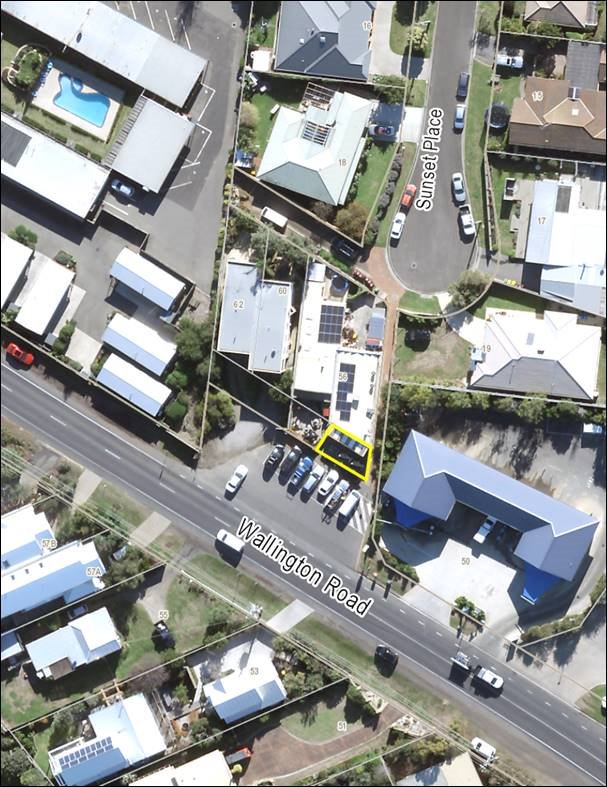
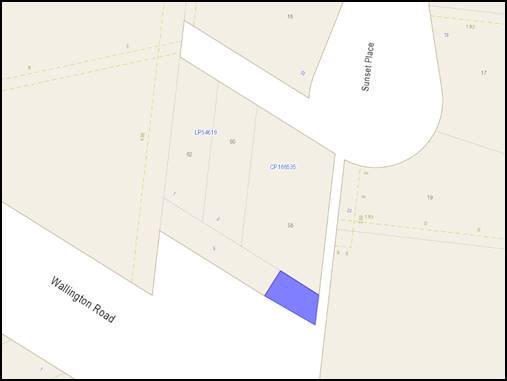
Proposed road discontinuance and sale marked in purple
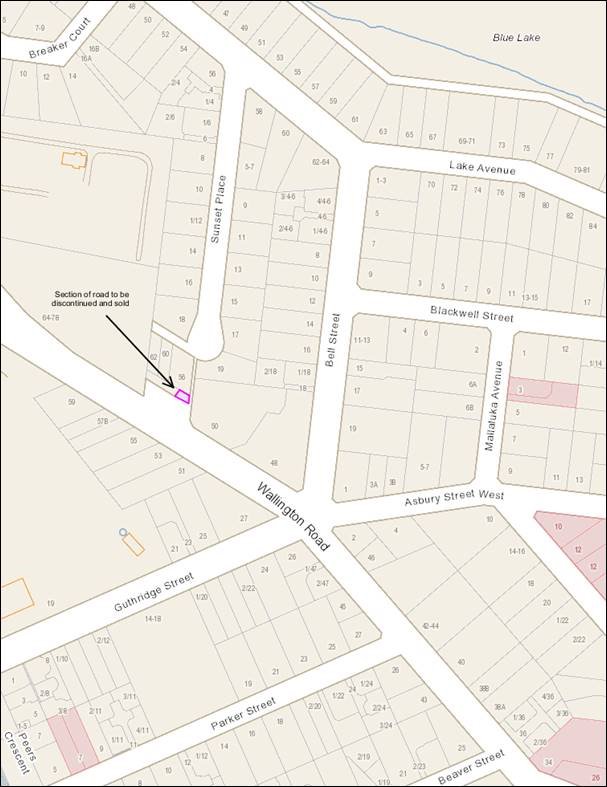
Source: |
City Services – Engineering Services |
Director: |
Guy Wilson-Browne |
To finalise the Special Charge Scheme for road construction works in the Baker Street group of roads, Ocean Grove.
This Special Charge Scheme has been under development in its current form since 2014. The scope of works delivered by the scheme is the result of a community engagement process including a survey which indicated majority support for the scheme.
The project included the sealing of 1.4 kilometres of unsealed roads including Field Street South, Baker Street, Osborne Street and Inskip Street, Ocean Grove. Two-hundred and fifty metres of The Esplanade was also sealed as part of the project but without kerbing or drainage upgrades (Attachment 3 – Plan).
The works were facilitated via a Special Charge Scheme declared by Council at its meeting of 13 December 2016 by Administrators.
There are 106 individual properties abutting the proposed works that were determined to receive special benefit. There are no City owned properties in the scheme.
The total scheme cost was estimated in 2016 to be $1,401,626 that included:
Contribution by the City totalling $210,244 representing the community benefits of the scheme; and
Property owner special benefit contributions totalling $1,191,382 towards the scheme.
The scheme works are complete (refer to Attachment 5) at a total cost of $1,396,222.03 that includes:
Contributions from the City totalling $209,433.30 representing the community benefits of the scheme; and
Property owner special benefit contributions totalling $1,186,788.73.
The Special Charge Scheme can be finalised based on the recommended cost as shown in Attachment 2 – Schedule A:
The total of all property owner charges is slightly less than the total declared value by $4,593. Adoption of the final costs and minor decreases are guided by the Local Government Act, Section 166 without the need to formally vary the scheme.
Councillor Mason moved, Councillor Sullivan seconded -
That Council:
Endorse the Special Charge Scheme final costs and amendments to the special charges on properties as shown in Attachment 2; and
Instruct the Chief Executive Officer to adjust the special charge and notify the property owners, as shown in Attachment 2, as required by Section 166 of the Local Government Act 1989.
Carried.
The project has been funded from the Street Construction capital works program (C02301).
The final design and construction costs are summarised below.
|
Estimate |
Actual |
Variance |
Variance (percentage) |
|---|---|---|---|---|
Scheme contribution (property owners) |
$1,191,382.10 |
$1,186,788.73 |
-$4,593.37 |
-0.4 |
Scheme contribution (Council) |
$210,243.90 |
$209,433.30 |
-$810.60 |
-0.4 |
Scheme Total |
$1,401,626.00 |
$1,396,222.03 |
-$5,403.97 |
-0.4 |
The recommended final special charges shown in Attachment 2 include the proposed adjustments;
Property owners can nominate a payment plan and may access our hardship policy if applicable. Further details on the payment plan and how to access the hardship policy are outlined in the levy notice sent to all affected property owners.
Community engagement and the consultation process for the road construction Special Charge Scheme has been carried out as follows;
This Special Charge Scheme has been under development in its current form since 2014. The scope of work identified in the scheme was the result of a community engagement process including a survey;
March 2015 – Invitation letters were sent; and
21 March 2015 – A public meeting (open forum with 60 attendees) was held at the Boorai Centre, Ocean Grove. This meeting disclosed all information in relation to the proposed scheme including scope of work, cost apportionment and Benefit Ratio Calculation.
April 2015 – An update letter, information sheet and property owner survey were sent. Feedback was received and responded to during the consultation process:
129 responses were received with 85 yes votes and 44 no votes. It was established via this survey that there was majority support for the scheme;
Main concerns raised related to parking areas. Most notably issues around the Wynndean Caravan Park visitor parking and (illegal) off-street parking by the general public; and
Parking was considered during the design process and an option for parking was included in the proposal, which included indented parking allocations along the road to mitigate this issue. This was not supported by the community, therefore not included in the project.
10 May 2016 – The Interim Administrator declared intention for the Special Charge Scheme.
21 May 2016 – The scheme was advertised and subsequently eight submissions were received including five objections.
8 November 2016 – A panel hearing resulted in a recommendation to declare the scheme.
13 December 2016 – The scheme was declared by Administrators.
26 July 2017 – Property owners were notified of the delay in delivering works due to planning permit requirements.
January 2019 – Project webpage updated with construction drawings and scheme information.
26 April 2019 – Notified property owners that works will be commencing.
January 2021 – A payment option letter was sent to property owners explaining payment options and requesting return of an Advice as to Method of Payment form to commence billing in April 2021.
The provision of properly sealed and drained roads and footpaths provides improved amenity, connectivity and safety for pedestrians.
The scheme has been prepared in accordance with the Special Rate and Charge provisions of the Local Government Act 1989 and guided by Council’s Special Rates and Charges Policy. The process chart for implementation of schemes is shown in Attachment 4.
In accordance with Council’s Special Rates and Charges Policy, once the project has reached final completion and all costs have been aggregated, this finalisation report shall be presented to Council. Any cost adjustments will be in accordance with requirements of the Local Government Act 1989.
This report aligns with the Council Plan as follows:
Integrated Transport Connections and key priority to improve our road management and engagement program.
Implement a Council program of infrastructure upgrades including streets, roads and drains.
Other connections to the Council Plan include:
An investment into sustainable infrastructure, reducing operation and maintenance liability; and
Encourages use of active transport, such as walking due to the footpath construction creating a safer public space.
No Council officers or contractors who have provided advice in relation to this report have declared a general or material interest in the matter.
Provision of a sealed pathway provides safer walking conditions for pedestrians by minimising the risk of personal injuries through conflict with vehicles and the elimination of uneven and slippery surfaces. Provision of a footpath constructed to standards and suitably drained will provide safer passage for pedestrians.
Improved, sealed roads and proper drainage lowers the City’s ongoing maintenance requirements and deliver a higher level of service
Concerns from the community raised throughout the project were:
The cost of funding by residents for the project and how those individual costs would be calculated.
The City calculated and distributed costs in accordance with the Local Government Act with the payment plan options available to property owners.
Maintaining local vegetation (Planning Permit required for vegetation overlay).
Works were undertaken in accordance with planning requirements to minimise vegetation losses.
Parking for both the residents and the general public, in particular the visitor parking associated with Wynndean Caravan Park.
Any future parking issues will be considered by the City’s Transport and Local Laws teams to monitor parking and assess any action needed.
Speed limit on roads and the sealing of the roads potential to increase the speed and volume of traffic.
The City’s Transport team to monitor parking and assess any action needed.
The new footpath and sealed road provide proper sealed access and improved amenity as dust and mud concerns are mitigated.
No significant vegetation removal was required to complete the project.
Property Key |
Address |
Estimated Cost |
Finalised Cost |
|---|---|---|---|
244172 |
1-3 Baker Street, OCEAN GROVE |
$9,521.54 |
$9,484.83 |
244191 |
2 Baker Street, OCEAN GROVE |
$7,141.15 |
$7,113.62 |
244192 |
4 Baker Street, OCEAN GROVE |
$9,521.54 |
$9,484.83 |
244173 |
5 Baker Street, OCEAN GROVE |
$9,521.54 |
$9,484.83 |
244193 |
6 Baker Street, OCEAN GROVE |
$9,521.54 |
$9,484.83 |
244174 |
7-9 Baker Street, OCEAN GROVE |
$19,043.07 |
$18,969.65 |
244194 |
8 Baker Street, OCEAN GROVE |
$9,521.54 |
$9,484.83 |
244175 |
11 Baker Street, OCEAN GROVE |
$9,521.54 |
$9,484.83 |
244176 |
13 Baker Street, OCEAN GROVE |
$9,521.54 |
$9,484.83 |
327367 |
1/15 Baker Street, OCEAN GROVE |
$8,331.34 |
$8,299.22 |
327368 |
2/15 Baker Street, OCEAN GROVE |
$7,141.15 |
$7,113.62 |
201419 |
1/25 Baker Street, OCEAN GROVE |
$8,331.34 |
$8,299.22 |
222101 |
2/25 Baker Street, OCEAN GROVE |
$7,141.15 |
$7,113.62 |
221742 |
3/25 Baker Street, OCEAN GROVE |
$7,141.15 |
$7,113.62 |
343241 |
Unit 1/29-33 Baker Street, OCEAN GROVE |
$1,190.19 |
$1,185.60 |
271896 |
Unit 2/29-33 Baker Street, OCEAN GROVE |
$1,190.19 |
$1,185.60 |
271897 |
Unit 3/29-33 Baker Street, OCEAN GROVE |
$1,190.19 |
$1,185.60 |
334931 |
Unit 4/29-33 Baker Street, OCEAN GROVE |
$1,190.19 |
$1,185.60 |
271899 |
Unit 5/29-33 Baker Street, OCEAN GROVE |
$1,190.19 |
$1,185.60 |
343242 |
Unit 6/29-33 Baker Street, OCEAN GROVE |
$1,190.19 |
$1,185.60 |
271901 |
Unit 7/29-33 Baker Street, OCEAN GROVE |
$1,190.19 |
$1,185.60 |
343243 |
Unit 8/29-33 Baker Street, OCEAN GROVE |
$1,190.19 |
$1,185.60 |
244181 |
35 Baker Street, OCEAN GROVE |
$4,760.77 |
$4,742.41 |
356854 |
36 Baker Street, OCEAN GROVE |
$9,521.54 |
$9,484.83 |
269729 |
PARENT - 36 Baker Street, OCEAN GROVE |
$0.00 |
$0.00 |
244182 |
37 Baker Street, OCEAN GROVE |
$9,521.54 |
$9,484.83 |
272284 |
1/38 Baker Street, OCEAN GROVE |
$8,331.34 |
$8,299.22 |
272285 |
2/38 Baker Street, OCEAN GROVE |
$7,141.15 |
$7,113.62 |
244183 |
39 Baker Street, OCEAN GROVE |
$9,521.54 |
$9,484.83 |
244197 |
40 Baker Street, OCEAN GROVE |
$9,521.54 |
$9,484.83 |
244184 |
41 Baker Street, OCEAN GROVE |
$9,521.54 |
$9,484.83 |
244198 |
42 Baker Street, OCEAN GROVE |
$9,521.54 |
$9,484.83 |
341149 |
1/43 Baker Street, OCEAN GROVE |
$7,141.15 |
$7,113.62 |
341150 |
2/43 Baker Street, OCEAN GROVE |
$7,141.15 |
$7,113.62 |
244199 |
44 Baker Street, OCEAN GROVE |
$9,521.54 |
$9,484.83 |
244186 |
45 Baker Street, OCEAN GROVE |
$9,521.54 |
$9,484.83 |
335617 |
1/46 Baker Street, OCEAN GROVE |
$8,331.34 |
$8,299.22 |
335618 |
2/46 Baker Street, OCEAN GROVE |
$7,141.15 |
$7,113.62 |
270348 |
1/47 Baker Street, OCEAN GROVE |
$8,331.34 |
$8,299.22 |
270349 |
2/47 Baker Street, OCEAN GROVE |
$7,141.15 |
$7,113.62 |
244201 |
48 Baker Street, OCEAN GROVE |
$9,521.54 |
$9,484.83 |
244188 |
49 Baker Street, OCEAN GROVE |
$9,521.54 |
$9,484.83 |
244202 |
50 Baker Street, OCEAN GROVE |
$9,521.54 |
$9,484.83 |
244189 |
51 Baker Street, OCEAN GROVE |
$9,521.54 |
$9,484.83 |
244203 |
52 Baker Street, OCEAN GROVE |
$9,521.54 |
$9,484.83 |
244190 |
53 Baker Street, OCEAN GROVE |
$9,521.54 |
$9,484.83 |
244204 |
54 Baker Street, OCEAN GROVE |
$9,521.54 |
$9,484.83 |
356855 |
137 Field Street South, OCEAN GROVE |
$9,521.54 |
$9,484.83 |
253744 |
1/1-3 Inskip Street, OCEAN GROVE |
$5,950.96 |
$5,928.02 |
253745 |
2/1-3 Inskip Street, OCEAN GROVE |
$5,950.96 |
$5,928.02 |
253746 |
3/1-3 Inskip Street, OCEAN GROVE |
$5,950.96 |
$5,928.02 |
253747 |
4/1-3 Inskip Street, OCEAN GROVE |
$5,950.96 |
$5,928.02 |
253748 |
5/1-3 Inskip Street, OCEAN GROVE |
$5,950.96 |
$5,928.02 |
253749 |
6/1-3 Inskip Street, OCEAN GROVE |
$5,950.96 |
$5,928.02 |
253750 |
7/1-3 Inskip Street, OCEAN GROVE |
$5,950.96 |
$5,928.02 |
264136 |
2 Inskip Street, OCEAN GROVE |
$9,521.54 |
$9,484.83 |
336258 |
1/4 Inskip Street, OCEAN GROVE |
$7,141.15 |
$7,113.62 |
336259 |
2/4 Inskip Street, OCEAN GROVE |
$7,141.15 |
$7,113.62 |
253751 |
5 Inskip Street, OCEAN GROVE |
$9,521.54 |
$9,484.83 |
314987 |
1/6 Inskip Street, OCEAN GROVE |
$8,331.34 |
$8,299.22 |
314988 |
2/6 Inskip Street, OCEAN GROVE |
$7,141.15 |
$7,113.62 |
318158 |
1/8 Inskip Street, OCEAN GROVE |
$8,331.34 |
$8,299.22 |
318159 |
2/8 Inskip Street, OCEAN GROVE |
$7,141.15 |
$7,113.62 |
312894 |
16 Inskip Street, OCEAN GROVE |
$7,141.15 |
$7,113.62 |
312893 |
18 Inskip Street, OCEAN GROVE |
$7,141.15 |
$7,113.62 |
312892 |
20 Inskip Street, OCEAN GROVE |
$7,141.15 |
$7,113.62 |
312891 |
22 Inskip Street, OCEAN GROVE |
$7,141.15 |
$7,113.62 |
312890 |
24 Inskip Street, OCEAN GROVE |
$7,141.15 |
$7,113.62 |
264147 |
30-34 Orton Street, OCEAN GROVE |
$13,092.11 |
$13,041.63 |
350443 |
8/32 Orton Street, OCEAN GROVE |
$1,190.19 |
$1,185.60 |
314298 |
1 Osborne Street, OCEAN GROVE |
$8,331.34 |
$8,299.22 |
314299 |
3 Osborne Street, OCEAN GROVE |
$8,331.34 |
$8,299.22 |
257308 |
5 Osborne Street, OCEAN GROVE |
$9,521.54 |
$9,484.83 |
257309 |
7 Osborne Street, OCEAN GROVE |
$9,521.54 |
$9,484.83 |
257310 |
9 Osborne Street, OCEAN GROVE |
$19,043.07 |
$18,969.65 |
257311 |
1/11 Osborne Street, OCEAN GROVE |
$19,043.07 |
$18,969.65 |
257312 |
2/11 Osborne Street, OCEAN GROVE |
$0.00 |
$0.00 |
257313 |
3/11 Osborne Street, OCEAN GROVE |
$0.00 |
$0.00 |
257314 |
4/11 Osborne Street, OCEAN GROVE |
$0.00 |
$0.00 |
257315 |
5/11 Osborne Street, OCEAN GROVE |
$0.00 |
$0.00 |
257316 |
6/11 Osborne Street, OCEAN GROVE |
$0.00 |
$0.00 |
338009 |
1/18 Osborne Street, OCEAN GROVE |
$8,331.34 |
$8,299.22 |
338010 |
2/18 Osborne Street, OCEAN GROVE |
$7,141.15 |
$7,113.62 |
257327 |
20 Osborne Street, OCEAN GROVE |
$9,521.54 |
$9,484.83 |
257328 |
1/22 Osborne Street, OCEAN GROVE |
$9,521.54 |
$9,484.83 |
257329 |
2/22 Osborne Street, OCEAN GROVE |
$0.00 |
$0.00 |
257330 |
24 Osborne Street, OCEAN GROVE |
$9,521.54 |
$9,484.83 |
257331 |
26 Osborne Street, OCEAN GROVE |
$9,521.54 |
$9,484.83 |
257332 |
28 Osborne Street, OCEAN GROVE |
$9,521.54 |
$9,484.83 |
330522 |
34 Osborne Street, OCEAN GROVE |
$9,521.54 |
$9,484.83 |
257317 |
35 Osborne Street, OCEAN GROVE |
$9,521.54 |
$9,484.83 |
250549 |
36 Osborne Street, OCEAN GROVE |
$9,521.54 |
$9,484.83 |
257318 |
37 Osborne Street, OCEAN GROVE |
$9,521.54 |
$9,484.83 |
250550 |
38 Osborne Street, OCEAN GROVE |
$9,521.54 |
$9,484.83 |
257319 |
39 Osborne Street, OCEAN GROVE |
$9,521.54 |
$9,484.83 |
250551 |
40 Osborne Street, OCEAN GROVE |
$9,521.54 |
$9,484.83 |
257320 |
41 Osborne Street, OCEAN GROVE |
$9,521.54 |
$9,484.83 |
250552 |
42-44 Osborne Street, OCEAN GROVE |
$9,521.54 |
$9,484.83 |
257321 |
43 Osborne Street, OCEAN GROVE |
$9,521.54 |
$9,484.83 |
257322 |
45 Osborne Street, OCEAN GROVE |
$9,521.54 |
$9,484.83 |
257323 |
47 Osborne Street, OCEAN GROVE |
$9,521.54 |
$9,484.83 |
257324 |
49 Osborne Street, OCEAN GROVE |
$9,521.54 |
$9,484.83 |
257325 |
51 Osborne Street, OCEAN GROVE |
$3,570.58 |
$3,556.81 |
264146 |
16 Sweetman Parade, OCEAN GROVE |
$2,380.38 |
$2,371.20 |
314297 |
18 Sweetman Parade, OCEAN GROVE |
$7,141.15 |
$7,113.62 |
312883 |
1/5-7 The Esplanade, OCEAN GROVE |
$5,950.96 |
$5,928.02 |
312884 |
2/5-7 The Esplanade, OCEAN GROVE |
$5,950.96 |
$5,928.02 |
312885 |
3/5-7 The Esplanade, OCEAN GROVE |
$5,950.96 |
$5,928.02 |
312886 |
4/5-7 The Esplanade, OCEAN GROVE |
$5,950.96 |
$5,928.02 |
312887 |
5/5-7 The Esplanade, OCEAN GROVE |
$5,950.96 |
$5,928.02 |
312888 |
6/5-7 The Esplanade, OCEAN GROVE |
$5,950.96 |
$5,928.02 |
312889 |
7/5-7 The Esplanade, OCEAN GROVE |
$5,950.96 |
$5,928.02 |
264134 |
9 The Esplanade, OCEAN GROVE |
$352,296.80 |
$350,938.48 |
330521 |
29 The Esplanade, OCEAN GROVE |
$9,521.54 |
$9,484.83 |
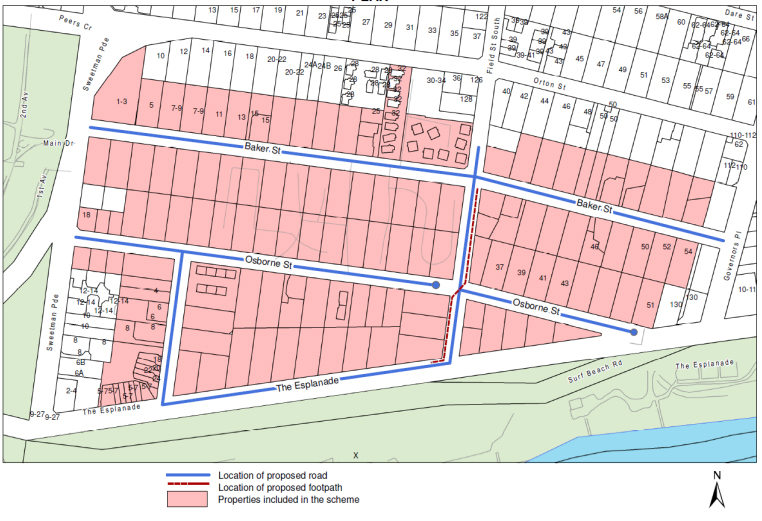
Baker Street group of Streets, Ocean Grove
Stage |
Status |
Description |
Date |
|---|---|---|---|
Approval to prepare scheme |
✓ |
Decision made to prepare scheme following consideration of surveys of property owners and feedback from the community. Scheme preparation involves survey, design and preparation of an apportionment of costs. |
February 2015 |
Intention to Declare Scheme |
✓ |
Report to Interim Administrators providing information on scheme including advice of impending advertising of scheme and declaration of charge. Received Interim Administrators approval to proceed with process. |
10 May 2016 |
Advertisement |
✓ |
The scheme was advertised in the local newspaper and all allotted property owners are notified by mail. This advertisement indicated Council’s intention and notification to ‘declare’ a scheme in the following month. |
21 May 2016 |
Submissions |
✓ |
From the time of advertising property owners had 28 days (as set down by the Local Government Act) to lodge submissions, either in support or opposition to the scheme. |
24 June 2016 |
Submissions Review Panel Hearing |
✓ |
A Submissions Review Panel was convened and met to consider submissions. Some submissions are written only, and other submitters may wish to be heard before the Panel. The Panel made a recommendation to declare the scheme. |
7 September 2016 |
Declaration Report |
✓ |
After 28 days of advertising the scheme and the Submissions Review Panel meeting to consider submissions, Administrators considered a report and proceeded to ‘declare’ the charges in accordance with its advertised intent. Subsequent to this, levy notices were issued and a formal charge placed on the property. This is the final step in the process to decide on the scheme. |
13 December 2016 |
Appeal |
✓ |
Property owners may lodge an application for review with the Victorian Civil and Administrative Tribunal (VCAT) within one (1) month of issue of the levy notice. An appeal is listed, heard and determined by the Tribunal and this process generally takes three to four months. Decisions made by VCAT are binding on all parties. No appeals were received. |
N/A |
Construction |
✓ |
Council proceeded to construct the works. Invoices to formally recover the special charge levies were issued seeking payment of the estimated cost within one month of commencement. |
Original start date: 26/06/2017 Work suspended: 29/06/2017 Recommenced works: 24/06/2019 Practical completion: 19/11/2019 All works completed: mid-June 2020 |
Final Cost Report |
|
With works completed, this report is for the scheme is ‘finalised’ based on actual costs incurred with payment requirements adjusted accordingly. |
|
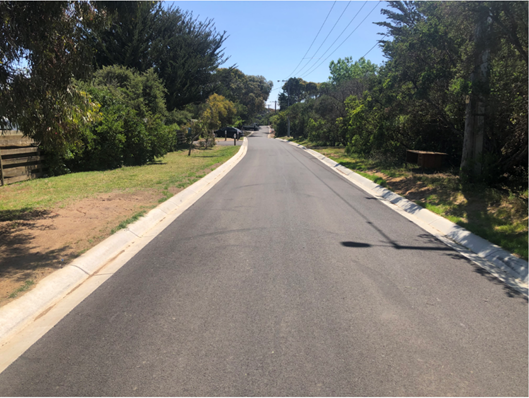
Baker Street
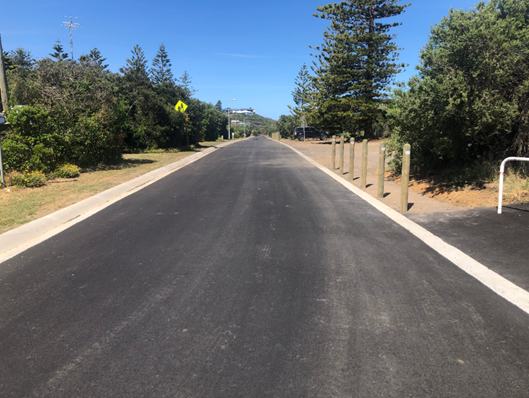
The Esplanade
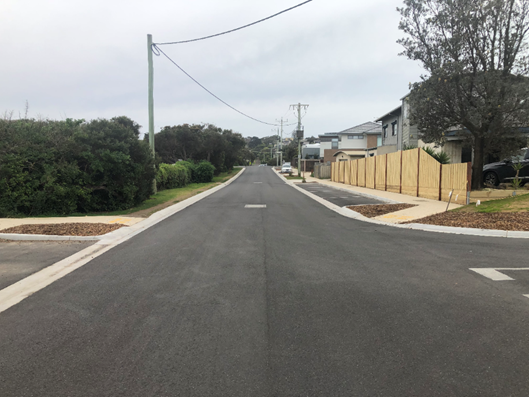
Field Street South
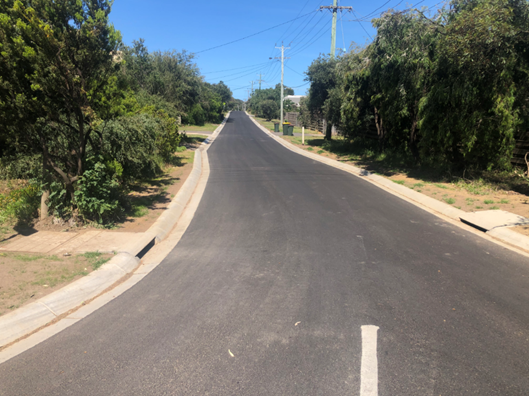
Osborne Street West
Source: |
Customer & Corporate Services – Financial Services |
Director: |
Michael Dugina |
To seek approval to name an unnamed sealed laneway in Newtown to Kelvin Lane, Newtown; refer to Attachment 1 for locality.
An adjoining owner of the unnamed laneway has requested the laneway to be named.
Four properties have rear access to this laneway with no property requiring direct access.
Following several discussions with an adjoining owner the name Kelvin Lane was proposed as it meets with the principles of the Naming Rules for Places in Victoria.
The previous dwelling at 11 Aphrasia Street prior to the existing dwelling was called ‘Kelvin’. The owner of this previous dwelling was George White (1815-1870).
The Geelong Advertiser referred to ‘Kelvin’ as the property of the late George White. Shown on Attachment 2 is a snip from the Geelong Advertiser dated 4 December 1871, Page 3, this seems to be a marriage notice of the only daughter of the late George White of “Kelvin”.
A new dwelling was constructed at 11 Aphrasia Street in the 1870’s (owned by Frederick Harvey – born in Kent, England) and retained the name “Kelvin House”.
Letters and surveys have been sent to affected property owners and residents advising them of the proposed name for their adjoining unnamed laneway.
Four survey responses were received, two in favour and two against. These are summarised as follows:
Two returned surveys were in favour of the laneway being named Kelvin Lane;
One returned survey was against the naming preferring an indigenous name, although none was suggested; and
One returned survey was against the naming due to an incorrect presumption that the naming would enable subdivision, any subdivision requires the necessary consultation and is not based on a laneway naming.
Due to the historical significance of “Kelvin House” and the themes of other road names in this area this name is being submitted to Council for consideration. A City engagement with the Traditional Owners would be required to facilitate an indigenous naming option due to one not being provided for consideration.
Geographic Names Victoria require a formal proposal to name the unnamed laneway and be approved by Council prior to gazettal and registration.
Councillor Mansfield moved, Councillor Murrihy seconded -
That Council:
Approve the naming of the unnamed laneway to Kelvin Lane, Newtown; and
Note that once approved the naming will be submitted to the Office of Geographical Names for official registration.
Carried.
The approximate cost to the City is $650.00. This includes signage, notification to adjoining property owners and residents and notification to authorities.
Correspondence including a survey were sent to affected and adjoining property owners and residents.
An advertisement was placed in City News of the Geelong Advertiser on 28 November 2020.
Details of the naming were placed on the Have Your Say section of the Geelong Australia Website and were open for a 30-day submission period.
The City has a responsibility to the community to ensure that all properties can be identified in clear and logical manner for emergency services and visitors to the area.
The Local Government Act 1989, the Geographic Place Names Act 1998 and the Naming Rules for Places in Victoria have been followed and met.
The City is required to use the Naming Rules for Places in Victoria when naming roads, features and localities. The rules outline the consultation process for naming, renaming or changing the boundaries of roads, features and localities in Victoria. The naming rules allow for members of the community to develop and make a naming proposal to the City.
The proposed naming is consistent with Council plan strategic priority for Improved Health and Safety of our Community by enabling emergency services to locate properties on this roadway in a time manner with minimal confusion.
No Council officers involved in the consultation process or preparation of the report have a general or material interest in the issue to which this report relates.
In an emergency, the City’s proposal to name this laneway will minimise the risk of emergency services being able to locate the emergency in a timely manner.
Failure to name this laneway may cause risk to public safety.
There are no environmental implications arising from this report.
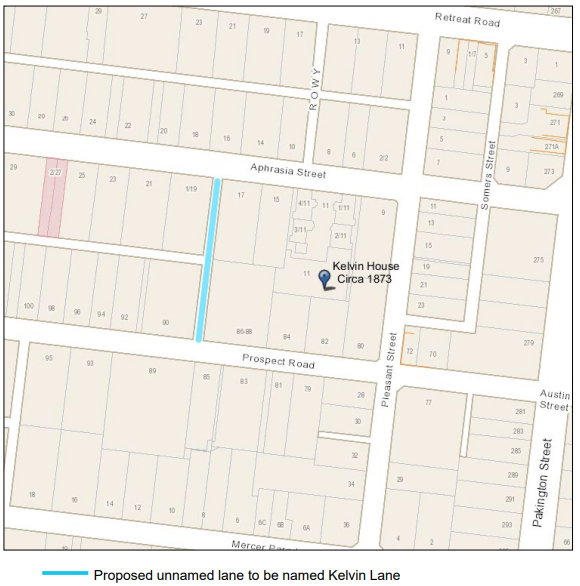
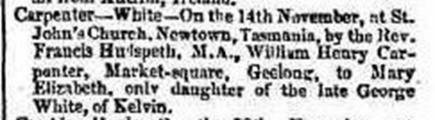
Geelong Advertiser 4 December 1871, page 3
Source: |
Governance, Strategy & Performance – Strategy and Performance |
Director: |
Rebecca Leonard |
To provide an update on the progress of the Transformation Program 2.0 as at the end of December 2020.
Transformation Program 2.0 continues the work undertaken during the first phase of the transformation program and now focuses on six critical areas of change with projects being monitored under these.
The six focus areas are Civic Accommodation, Digital Modernisation, Asset Management, Advocacy and Stakeholder Management, People and Culture, and Service Planning and Review.
Key achievements within the past six months include:
Site construction of the civic accommodation commenced;
Social Infrastructure Policy and Plan endorsed by Council 28 July 2020;
Mercer Ready project planning completed;
Core systems tender awarded;
Service design project for the City’s Complaints process commenced;
External survey results completed on customer access and payment preferences;
Customer Experience Service Redesign Steering Committee established;
Map of payments experience ‘current state’, including pain points and customer impact completed;
Data collected on 204,868 council owned assets by Work for Victoria (WfV) funded staff;
Asset Management Strategy approved by the Asset Management Steering Committee;
Maintenance Management System developed and rolled out;
Social Media Policy review finalised;
Employee Opinion Survey and Pulse surveys conducted to identify opportunities to continue to improve performance in respect to leadership; and
Future Ways of Working Program scoped.
A detailed progress update on the Transformation Program 2.0 is provided in Attachment 2 – Transformation Program 2.0 – December 2020 Update
Councillor Moloney moved, Councillor Sullivan seconded -
That Council note the Transformation Program 2.0 – December 2020 update report.
Carried.
Several projects such as civic accommodation, digital modernisation, asset management, social infrastructure plan, workforce planning and leadership development are subject to current and future budget funding and are allocated in the strategic resource plan.
Progress on the Transformation Program 2.0 is reported to the Executive Leadership Team, Council and to the Minister for Local Government and is available publicly on the Geelong Australia website.
The Social Infrastructure Plan review is one of the current projects in the Transformation Program 2.0. The diversity and inclusion and gender equity plans were delivered during phase one of the Transformation Program.
The Transformation Program was originally developed in response to the 2016 Commission of Inquiry report. In that report there were 12 key recommendations and 25 secondary recommendations to be addressed. While the Municipal Monitor concluded his role on 12 November 2020, the progress of Transformation Program 2.0 will continue to be monitored by the Chief Executive Officer and Council and reported regularly to the Minister for Local Government.
This report aligns to the Council Plan strategic priority Organisational Leadership, Strategy and Governance.
No officer involved in the preparation of this report has declared a general or material interest.
The Transformation Program is monitored via the organisations enterprise risk update and reported to the Audit and Risk Committee.
There are no environmental implications arising from this report.
Councillor Grzybek declared a Conflict of Interest in Agenda Item 19 – Geelong Major Events Committee – Appointment of External Representative 2021-2022, in that the appointee is a colleague at the TAC and left the meeting room prior to discussion at 9:00pm.
Source: |
Economy, Investment & Attraction – Event Services Unit |
Acting Director: |
Tim Ellis |
To appoint a community member as an external representative of the Geelong Major Events Committee (GME) for the period April 2021 – May 2022.
Council established GME in August 1998, pursuant to section 86 of the Local Government Act 1989.
GME consists of a maximum of 12 persons. External members may fill up to six positions, where suitable candidates offering considerable value are identified. External members serve four-year terms and vacate the role at the end of each term, however, may reapply via the public recruitment process. Sadly, due to the recent passing of a Committee Member, an external member position is vacant for the remainder of the original term which is to May 2022; and
External representation on GME Committee is considered to be essential as it enables the GME Committee to draw upon expertise and networks beyond Council. Specifically, experience relevant to the business, arts, events or media communities.
In response to public advertisements, four applications were received. Advertisements were placed in City News in late December 2020 and early January 2021. The opportunity to join the GME Committee was also advertised online and promoted on the City’s social media platforms.
A selection panel of the Acting Director Economy, Investment & Attraction, an incumbent GME external committee member, the GME Chair and the GME Executive Officer interviewed a shortlist of applicants. The panel recommends to Council the appointment of one external committee member for the period April 2021 to May 2022.
The recommended applicant brings a wealth of experience in managing event and sporting sponsorships, stakeholder relationships, financial governance and had former roles in media and marketing.
Councillor Nelson moved, Councillor Sullivan seconded -
That Council endorse the appointment of Mathew Hood as an external representative to the Geelong Major Events Committee for a one-year term April 2021 – May 2022.
Carried.
There are no financial implications arising from this report, as no remuneration is paid to external representative positions on GME. All GME committee positions are voluntary. Members can claim out of pocket expenses associated with participation on the committee.
The appointment of a new external representative to GME will be communicated to key stakeholders and the media. The unsuccessful candidates will be notified in writing thanking them for their application and interest in GME.
The inclusion of external representatives on GME Committee supports the transparency of the Committee. The recruitment process is open to anyone, whilst indicating a preference for experience relevant to the business, arts, events or media communities, as it applies to the subject matter of the Committee. The GME Committee continues to have a gender balance of representation.
Within the Council Committee Representation Policy, there are no legal or statutory implications arising from this report. The appointment process is within the framework of the GME Terms of Reference, the Council Instrument of Delegation to GME and the Local Government Act 2020.
Council has identified Growing Our Tourism and Events, along with A Thriving and Sustainable Economy as two of the strategic priorities of the Council Plan 2018-2022. It lists the Geelong Major Events Strategy as a key related plan.
The objectives of GME also support the community vision for Geelong to be recognised as a clever and creative city region. The vision identifies Geelong as a destination that will attract local and international visitors. This outcome is supported by the outcomes of the GME Committee.
No Council officers or contractors who have provided advice in relation to this report have declared a general or material conflict of interest regarding the matter under consideration.
There are no known risks arising from this report.
There are no direct environmental implications arising from this report.
Councillor Grzybek re-entered the meeting room at 9:15pm.
Source: |
Customer & Corporate Services |
Director: |
Michael Dugina |
To seek Council’s endorsement to dissolve the Central Administrative Office Project Advisory Committee (the Committee).
At the Council Meeting on 24 April 2018 Council passed a resolution to create the Central Administrative Office Project Advisory Committee.
The objective of the Committee was to consider and provide advice to Council on matters relevant to the Civic Accommodation Project and to consider the key issues relating to the consolidation of Council’s administrative offices.
The project commenced in June 2020; Quintessential Equity were selected as the successful tenderer.
The key purpose of the Committee has been met with the commencement of the construction of the Civic Precinct.
City officers will report to the Council on the ongoing construction and budget of the Civic Precinct via the monthly Finance Portfolio meetings and at Councillor Briefings when deemed necessary by the Chief Executive Officer.
Councillor Harwood moved, Councillor Mason seconded -
That Council:
Dissolve the Central Administrative Office Project Advisory Committee; and
Note that the Clever Together Project Team will report to Council on the Civic Precinct through the monthly Finance Portfolio meeting or as deemed necessary by the Chief Executive Officer.
Councillor Nelson left the meeting room at 9:18pm.
Councillor Nelson re-entered the meeting room at 9:20pm.
Carried.
The City will report monthly through the Finance Portfolio meetings detailing all financial aspects of the Civic Precinct.
The community were engaged during the early stages of the building design.
Regular updates on the development will be provided to the community as the construction of the building progresses.
There are no social equity considerations when dissolving the Committee.
The original Terms of Reference for the Committee stated that “this Committee ends on the day of a Council resolution to abolish the Committee”. This report provides that resolution.
This report aligns with the Strategic Priorities of the Council Plan 2018-2022 where one of the key priorities is “Consolidating the City of Greater Geelong offices”.
No Council officers involved in the preparation of this report have any disclosed any material or general conflict of interest in relation to the development of the Civic Precinct.
There are no risks associated with dissolving the Committee.
There are no environmental implications that will arise from dissolving the Committee.
Source: |
Governance, Strategy & Performance – Governance |
Director: |
Rebecca Leonard |
To appoint a City officer as an authorised officer under the Planning and Environment Act 1987 (P&EA).
City officers are appointed as authorised officers to exercise statutory powers under various Acts and regulations. Appointments as authorised officers are to individual staff members.
The P&EA regulates enforcement and is reliant on authorised officers acting on behalf of the responsible authority (Council).
Where there is a specific power within an Act, Council should appoint authorised officers pursuant to that Act. This is the case for the P&EA.
Attachment 2 sets out the Instrument of Appointment and Authorisation under the P&EA and lists the staff members to whom this authorisation applies (instrument). Councillor Grzybek moved, Councillor Harwood seconded -
In the exercise of the powers conferred by s 147(4) of the Planning and Environment Act 1987, Council resolves that:
City staff referred to in the Instrument (Attachment 2) be appointed and authorised as set out in the Instrument;
The Instrument comes into force immediately upon the resolution of Council; and
The Instrument be signed by the Chief Executive Officer on behalf of Council.
Carried.
There are no financial implications arising from the subject of this report.
Relevant City managers have been consulted regarding this recommended appointment and authorisation.
There are no social equity implications arising from the subject of this report.
The recommended appointment and authorisation of staff members complies with the relevant provisions of the P&EA and the Local Government Act 2020.
The recommended appointment and authorisation of staff members supports the delivery of Council planning services.
No City officers who have provided advice in relation to this report have a general or material conflict of interest regarding the matter under consideration.
There are no significant or high risks associated with the subject of this report.
There are no environmental implications arising from the subject of this report.
In this instrument "officer" means –
Tracey McCooke – Town Planner
By this instrument of appointment and authorisation Greater Geelong City Council -
under section 147(4) of the Planning and Environment Act 1987 - appoints the officer to be authorised officer for the purposes of the Planning and Environment Act 1987 and the regulations made under that Act; and
under section 313 of the Local Government Act 2020 authorises the officer generally to institute proceedings for offences against the Acts and regulations described in this instrument.
It is declared that this instrument comes into force immediately upon the resolution of Council.
This instrument is authorised by a resolution of the Greater Geelong City Council on 23 March 2021.
Signed for GREATER GEELONG CITY COUNCIL by
MARTIN CUTTER, Chief Executive Officer
____________________________
Chief Executive Officer
Source: |
Customer & Corporate Services – Community Grants and Partnerships |
Director: |
Michael Dugina |
Councillor Murrihy moved, Councillor Moloney seconded -
That Council consider this report at the conclusion of the meeting as it is designated confidential by the Chief Executive Officer for the purposes of section 3(1) of the Local Government Act 2020 because it is private commercial information provided by a business, commercial or financial undertaking that if released, would unreasonably expose the business, commercial or financial undertaking to disadvantage; and this ground applies because the agenda item contains a level of detail which if released would diminish the organisation’s capacity to compete in a commercial environment.
Carried.
Source: |
Chief Executive – Corporate Affairs |
Chief Executive Officer: |
Martin Cutter |
Councillor Asher moved, Councillor Sullivan seconded -
That Council consider this report at the conclusion of the meeting as it is designated confidential by the Chief Executive Officer for the purposes of section 3(1) of the Local Government Act 2020 because it relates to Council business information, being information that would prejudice Council's position in commercial negotiations if prematurely released. This ground applies because this report relates to commercial negotiations.
Carried.
Contents | Previous Page: Section A - Procedural Matters | Next Page: Section C - Notice of Motion
