
Council Minutes - Section B: Reports (11-20) - 11 September 2012
Contents | Previous Page: Section B – Reports (1-10) | Next Page: Section C - Notices of Motion
Contents | Previous Page: Section B – Reports (1-10) | Next Page: Section C - Notices of Motion
Reports 11-20, tabled at the Ordinary Meeting of Council on Tuesday date held at City Hall, Little Malop Street in Geelong.
Road Renaming – Eastern Section Swan Parade to Ord Street, St Leonards
Association of Bayside Municipalities – Strategic Direction 2012-2016
Consideration of Tender Submissions for Tender T1200188 – Provision of Painting Services
Portfolio: |
Environment & Sustainability - Cr Doull |
Source: |
City Services - Environment & Natural Resources |
General Manager: |
Gary Van Driel |
Index Reference: |
Sustainable Reports/Council Reports 2012 |
The Policy has been developed to meet a commitment in City Plan 2009-2013, to develop a policy on environmentally sustainable development standards for Council buildings. It also helps the City of Greater Geelong towards its Vision statement, strategic goals and it supports the aims of a range of existing policies and strategies.
The Policy has been developed with significant consultation across the organisation; including an inception presentation to the Executive Management Team, a cross Departmental workshop, and a cycle of review and drafting by the project working group, Environment Arena and Clean Energy Futures groups.
The Policy has been jointly developed by the Capital Projects, Property and Environment and Natural Resources Departments through the Project Working Group.
This Sustainable Building Policy scope relates to buildings owned, leased or managed by Council. It sets minimum sustainability standards for Council’s: new buildings; renovations and retrofits of existing buildings; building maintenance and minor upgrades; and specific sustainability projects.
Environmentally Sustainable Design is widely recognised within industry and Government, due to the many financial, social and environmental benefits it provides. The Policy positions the City of Greater Geelong to keep pace with industry trends and a range of Victorian Councils who have adopted similar policies in recent years.
The Policy will provide economic benefits and improved financial performance for the procurement and management of Council Buildings. It is based on long term financial responsibility and will reduce the financial risks and overall cost of buildings on a whole-of-life basis. The Policy follows a guiding principle of a 7 year simple payback for any additional capital investment.
It is now widely acknowledged that a financially responsible approach to managing buildings is to move beyond capital costs to a consideration of a whole of life cycle.
The Policy will ensure improved environmental outcomes from Councils buildings through: energy efficiency; reduction of greenhouse gas emissions; water conservation; reduced natural resource consumption; reuse and recycling; waste avoidance; pollution prevention and enhanced biodiversity.
The Policy uses relevant building rating systems to set standards for design and ongoing performance across its diverse building types.
The Policy will be effective for a trial period until 30th June 2014 to allow the building standards, financial implications, environmental outcomes and corporate processes to be tested and reviewed.
Cr Doull moved, Cr Granger seconded -
That Council:
adopt the Sustainable Building Policy;
note the Policy will be reviewed by 30 June 2014 to assess the building standards, financial implications and environmental outcomes;
note the significant financial, social and environmental benefits of environmentally sustainable design;
join the Green Building Council of Australia;
support the formation of a working group to jointly oversee the implementation and further development of the Policy, including a detailed Action Plan.
Carried.
The purpose of this report is to outline why a sustainable building policy has been developed, what it aims to achieve, and how it was developed. The Policy itself aims to achieve more sustainable buildings for Council as well as provide a range of other social, financial and environmental benefits.
This Policy has been prepared to help meet sustainability outcomes within the City of Greater Geelong’s vision statement and strategic directions. The City of Greater Geelong’s Vision is: Geelong: coast, country and suburbs is the best place to live through prosperous and cohesive communities in an exceptional environment. To support the Vision, the City of Greater Geelong has adopted three strategic directions for City Plan 2009-2013. These are:
Community Wellbeing - Objective: To improve the health and quality of life of all residents of Greater Geelong.
Growing the Economy - Objective: Securing Geelong’s economic future.
Sustainable Built and Natural Environment - Objective: The City of Greater Geelong leads the community in sustainable planning and environmental action.
City Plan 2009-2013 also outlines a commitment to meet agreed standards for sustainable development. A specific measure in City Plan 2009-2013 is to develop a Council policy on environmentally sustainable development standards for newly constructed Council owned and managed buildings.
It also supports the aims of existing Council policies and strategies including the Procurement Policy, Sustainable Communities Infrastructure Development Guidelines Environment Management Strategy 2006-2011, Greenhouse Response 2008-2011, Climate Change Adaptation Strategy, Sustainable Water Use Plan and Low Carbon Growth Plan for Geelong.
The aim of the Policy is to guide organisational practices to manage the social, financial and environmental aspects of Council’s buildings. It will facilitate a coordinated approach to management of buildings by Council Departments and provide clear commitments to achieve sustainability standards in Council buildings.
This Policy scope relates to buildings owned, leased or managed by Council. It does not cover sustainability standards for residential or commercial buildings. The Sustainable Building Policy sets minimum sustainability standards for Council’s:
New buildings
Renovations and retrofits of existing buildings
Building maintenance and minor upgrades
Specific sustainability projects
The Sustainable Building Policy applies to all types of Council buildings including: administrative offices; leisure and aquatic facilities; libraries; community buildings; sports ground pavilions; town halls; child care and health centres; works depots; and other Council buildings.
As well as meeting Councils vision statement and strategic directions, the Policy responds to wider trends and aims to keep Council abreast of current State and National developments. Environmentally Sustainable Design for buildings is about more than environmental benefits. It is now widely recognised within industry and Government due to the significant financial and social benefits in addition to good environmental outcomes. The Policy will enable the City of Greater Geelong to maintain pace with industry building trends as well as a range of other Victorian Councils who have adopted sustainable building standards in recent years.
In addition to the environmental, social and financial benefits outlined in the following sections of this report the Policy will have additional long term benefits to the organisation by providing productive and healthy work environments, flexible and adaptable spaces that remain useable and effective, buildings that last and are resilient to change. It also addresses other areas, not specifically around sustainability, such as a more coordinated and collaborative approach to management of buildings between departments within the organisation.
The Policy development process was considered critical to achieving a sound and widely supported Policy document that will be effectively implemented once adopted. A focus on consultation and review across all relevant departments and stakeholders was paramount.
The Policy has been jointly developed by the Environment and Natural Resources, Property, and Capital Projects departments in conjunction with the specialist consultancy Ironbark Sustainability.
The Policy has been developed through a process of significant consultation within the organisation. The first phase of the consultation involved an inception presentation to the Executive Management Team who endorsed the development process and structure of the project working group. The working group included a General Manager, Officers and Managers from across the Property, Capital Projects and Environment and Natural Resources departments.
Consultants were engaged to ensure the Policy was developed in full knowledge of current trends and developments, be informed by the experiences of other Councils, and be rigorous in financial assumptions and modelling.
NetBalance were engaged to produce a background report to guide development of the Policy. Ironbark Sustainability is a consultancy that specialises in sustainability of the built environment for Councils and was engaged to direct the project, provide ongoing technical advice and prepare a detailed Sustainable Building Management Plan. The Sustainable Building Management Plan provided the basis for the development of the Policy.
Consultation also included a cross council workshop with representation from all Council Departments as well as relevant Units and service Managers of Council buildings including community and sporting facilities.
The Policy went through a cycle of review and drafting, which included the Project Working Group as well as the organisation’s Environment Arena and Clean Energy Futures groups.
The Policy is based on a number of guiding principles as well as some specific rating standards to determine the benchmark level that Councils buildings will reach. This is an area of some complexity and a brief overview is offered in this report to explain the Policy position.
There are a number of rating standards which measure different aspects of a building.
Some measure the design and construction stages of a building, while others measure the ongoing performance, or operation, of a building. Rating systems also differ between residential buildings and commercial (or municipal) buildings.
It is not currently possible to use one rating standard to cover the many different types of buildings in Council’s portfolio. While there is some speculation about the development of a National standard, at this stage choices must be made about which standards Council will use. More than one rating standard will be required to cover the great range of buildings styles in Councils building portfolio. The choice of rating standards is based on 2 distinct phases of a building:
Design and construction
Operational performance
This report recommends the use of Green Star rating standard for building design and/or construction (new buildings) or an equivalent standard in cases where Green Star is not suitable. A further recommendation is that Council join the Green Building Council of Australia (GBCA). Membership of the GBCA would demonstrate a general commitment to sustainable buildings and would bring ongoing recognition to Council through the significant promotion undertaken by the GBCA. Additional benefits such as staff training and access to information resources would also be available.
This report recommends that the Policy uses the NABERS rating standard to measure the ongoing operational performance of buildings (for both existing and new), or an equivalent in cases where this standard in not suitable.
The Policy is jointly endorsed by the Property, Capital Projects and Environment and Natural Resources Departments. It is considered by the project consultants as representing current ‘best practice’ amongst Victorian Councils who have adopted policies and standards for municipal buildings.
The Policy is effective with an initial review period until 30 June 2014, to allow the building standards, financial implications, environmental outcomes and corporate processes to be tested and reviewed. The key tasks to be undertaken during the review period are listed in the Action Plan section. However, it is important to note that further development will need to be undertaken.
It is recommended that a working group is formed to jointly share the responsibility and oversee the implementation of the Policy and develop a detailed Action Plan. Some of these actions such as: monitoring and reporting; further policy development, including a Thermal Comfort Policy; building performance management; and others, will require considerable work.
Buildings make up a large part of Councils environmental footprint. They use significant amounts of energy (electricity and gas), water and other resources and also account for a major part of Councils greenhouse gas emissions.
The Policy will ensure improved environmental outcomes from Councils buildings by using design, construction and operational practices to significantly reduce negative impacts on the environment through: energy efficiency; reduction of greenhouse gas emissions; water conservation; reduced natural resource consumption; reuse and recycling; waste avoidance; pollution prevention and enhanced biodiversity.
The Policy will provide improved financial performance around the procurement and management of Council Buildings. Council has a financial responsibility to deliver sustainable buildings that are affordable and represent value for money while achieving improvements in sustainability. The Policy has the following economic benefits:
Lower operating costs through energy and water efficiencies
Management of the financial risks of rising utility prices
Improved financial performance through a whole of life-cycle approach to managing Council buildings
Higher return on investment
Competitive advantage when applying for grants and funding opportunities
A more productive workplace, reduced absenteeism and an increased ability to attract and retain staff
It is now widely acknowledged that a financially responsible approach to managing buildings, including upgrades is to move beyond capital costs to a consideration of a whole of life cycle. This is particularly important in the current environment where utility prices and operational costs of buildings are rapidly increasing and expected to rise even further and more quickly. Investments in areas such as energy efficiency, at the design phase, are now proving to result in significant savings in the medium and long term.
The Policy’s guiding principle of a 7 year payback period ensures that any investment in areas such as energy efficiency will be returned in a reasonable time frame. When the cost and benefits of buildings are considered on a full life cycle basis the Policy offers cost savings and demonstrates financial responsibility.
This Policy is also supported by Council’s existing Procurement Policy which recognises that lowest cost is not necessarily an indicator of ‘value for money’, meaning that social and environmental benefits should be balanced with economic considerations.
The recommendation to join the Green Building Council of Australia involves an annual membership fee (currently $2000) which offers significant promotional benefits to Council as well as ongoing financial discounts to training courses, events, technical manuals and certification of building projects.
In a rapidly changing legal/policy environment it is prudent to take note of current trends and plan ahead. New legal requirements around building performance such as mandatory disclosure conditions for buildings at time of lease or sale are emerging and are indicators that Policy and legal guidelines are changing rapidly in the built environment. Building at current minimum standards exposes Council to risks that buildings become non compliant with regulations much earlier than they should.
There are no direct or indirect officer interests in matters which relate to this report.
There are notable risks associated with not implementing the recommendations in this report. There are significant financial risks associated with utility prices and operational costs which are rising and predicted to rise at an even faster rate in the coming years. This is already being reflected in Councils utility and management costs for buildings. By trying to minimise initial build costs, particularly in the area of energy efficiency, Council is exposed to the risk of higher annual operational costs for the life of the building. It is also significantly more expensive to add energy efficient systems at a later stage than in the initial design and build. There are also risks associated with the resilience and usefulness of Council buildings over their planned life of use.
Sustainable buildings are now widely recognised in the building industry as being ‘good buildings’ in part because they offer considerable social benefits including:
A better quality, more comfortable and healthier workplace for staff and community users
Demonstration of corporate responsibility and leadership to the community on sustainability and environmental issues
Improved Council reputation and a boost to staff and community pride
Making Council buildings more resilient and comfortable in extreme weather events associated with climate change such as heatwaves
A higher quality workplace with benefits such as the ability to attract and retain good staff
This report has highlighted that there are significant opportunities for Council to promote itself as financially, socially and environmentally responsible by adopting the Sustainable Building Policy. If Council becomes a member of the Green Building Council of Australia, uses the Green Star rating standards, and gains certification for showcase projects as recommended, it will be able to clearly communicate its credentials in working towards its strategic goal of a ‘sustainable built and natural environment’.
Portfolio: |
Infrastructure– Cr Richards |
Source: |
City Services – Infrastructure Operations – Emergency Management |
General Manager: |
Gary Van Driel |
Index Reference: |
Subject: Municipal Fire Management Plan 2012 – 2015 |
This report recommends the adoption of the Municipal Fire Management Plan 2012 – 2015 (the Plan) following endorsement by the Municipal Fire Management Planning Committee and the Municipal Emergency Management Planning Committee;
The Plan follows the format as provided by the State Fire Committee.
This version of the plan has evolved to now reflect other fire risks that the municipality is exposed to, for example, structure fires, chemical incidents and other fire types within the ‘built environment’.
Division 3 s55(a) of the Country Fire Authority Act, 1958, states that a municipal council must prepare and maintain a Municipal Fire Prevention Plan, (MFPP) for its municipal district in accordance with the advice and recommendations of the Municipal Fire Prevention Committee;
Municipal Fire Prevention Plans and Municipal Fire Prevention Committees are now referred to as Municipal Fire Management Plans and Municipal Fire Management Planning Committees respectively due to the new integrated planning approach to fire planning;
The Plan undergoes an annual review by the multi agency Municipal Fire Management Planning Committee (MFMPC) so as to ensure it reflects the agreed arrangements, risks as identified by the Victorian Fire Risk Register process, new developments or directions issued by State Fire Committee and/ or the Fire Services Commissioner;
The process of endorsement and adoption is in full compliance with correspondence dated November 9th, 2011 from the Fire Services Commissioner which outlined the State Government’s expectation that each council in Victoria is to adopt a Municipal Fire Management Plan by October 2012. This process includes:
The Plan to be endorsed by the Municipal Fire Management Planning Committee and referred to the Municipal Emergency Management Planning Committee
The Plan to be endorsed by the Municipal Emergency Management Planning Committee and forwarded to the Barwon South West Strategic Fire Management Planning Committee Executive for comment and forward to the municipal council with a recommendation that The Plan be adopted
The preceding process of endorsement has been complied with the MFMPC endorsing the Plan at its 2nd August 2012 meeting and the MEMPC endorsing The Plan at its August 9th 2012 meeting. The Barwon South West Strategic Fire Management Planning Committee have advised that ‘…[the Plan] achieved a high level of compliance with current requirements…’.
Cr Richards moved, Cr Abley seconded -
That Council adopt the City of Greater Geelong Municipal Fire Management Plan (MFMPlan) 2012 - 2015 and apply the Common Seal of the City of Greater Geelong.
Cr Farrell left the meeting room at 8:37pm
Cr Farrell re-entered the meeting room at 8:39pm
Carried.
Fire Prevention Planning within Victoria is in a state of transition. This transition is being driven by the Government under the auspice of the Integrated Fire Management Planning Team. At the State level a new committee, the State Fire Management Planning Committee was created to oversee the integration and improvement in fire prevention following the last few major fire incidents in Victoria.
Victoria was divided into several Regional groups and ‘Regional Strategic Fire Management Committees’ were formed to lead and assist municipalities in fire prevention planning. In the south west of the State, the Barwon South West Regional Strategic Fire Management Committee was formed. This committee is chaired by the Country Fire Authority District Seven’s Manager with the committees’ membership being comprised of, Local Government, Country Fire Authority, VICSES, VicPol, Water Authorities, Department of Sustainability and Environment, Department of Planning & Community Development, VicRoads, Parks Victoria, Corrangamite Catchment Management Authority and Forestry owners.
The City of Greater Geelong is represented on the Barwon South West Regional Strategic Fire Management Committee by the Municipal Fire Prevention Officer.
To assist with the planning process, the State employed Fire Planning Network Managers to work with and assist municipalities to move from historical practices to a truly integrated approach in Fire Management.
The State driven push to integrated fire management planning has required the following to occur.
Transition from the old format of Municipal Fire Prevention Committees to the new Municipal Fire Management Planning Committees;
Prepare and maintain a Municipal Fire Management Plan (MFMPlan) that meets the aims and objectives of Integrated Fire Management;
To conduct risk assessments within the municipal footprint, to identify the risks and develop strategies to mitigate that risk;
Submit the MFMPlan for audit every 3-years as per Division 3 s55(b) of the Country Fire Authority Act 1958, i.e.: a municipal fire prevention plan* must be audited during the period of 1 January and ending 31 December every 3-years.
* It should be noted that the CFA Act 1958 has not yet been amended to reflect the change from Municipal Fire Prevention Plans to Municipal Fire Management Plans and the change from Municipal Fire Prevention Committees to Municipal Fire Management Committees.
The City of Greater Geelong Council currently has an Integrated Fire Management Plan that has been audited by the CFA as per the requirements of Section 55A & 55B of the CFA Act 1958. The Municipal Fire Prevention Committee is responsible for this plan.
The difficulty now is that the current fire prevention landscape has changed so rapidly and in such a short time frame that legislation has not kept pace. The City of Greater Geelong Council has disbanded its Municipal Fire Prevention Committee in line with Integrated Fire Management Planning directives and has formed the new Municipal Fire Management Planning Committee which is the ‘owner’ of the MFMPlan, i.e. the Plan is not a council plan, but a plan that covers the municipal footprint.
This MFMPlan is now in a format being adopted State wide. This plan is a starting point only and will continue to evolve as further data is obtained that more accurately reflects the risk to the municipality from the effects of fire. This plan in its current form has begun to reflect the fire risks of this municipality which is associated with the built environment such as housing, industry, storage, vehicles etc rather than the fire risk associated with a bushfire. This shouldn’t be interpreted that this municipality has no bushfire risk, but that statistical evidence clearly indicates that there is a greater risk within the built environment. Further iterations of the plan will continue to progress the MFMPlan to more comprehensively address these risks.
The Country Fire Authority Act 1958 does not currently specify any particular format or give advice as to what may be required under the Act to be included in a MFMPlan. In fact there is no legislation or guidelines that specifies/guides the layout/content required in a MFMPlan.
On-going amendments of the MFMP will continue as additional information is released by the State Government due recommendations from the Victorian Bushfire Royal Commission or the Fire Services Commissioner.
The process of endorsement and adoption is complying with a letter dated November 9th, 2011 from the Fire Services Commissioner which outlined the State Government’s expectation that each council in Victoria is to adopt a Municipal Fire Management Plan by October 2012. This process includes:
The Plan to be endorsed by the Municipal Fire Management Planning Committee and referred to the Municipal Emergency Management Planning Committee
The Plan to be endorsed by the Municipal Emergency Management Planning Committee and forwarded to the Barwon South West Strategic Fire Management Planning Committee Executive for comment as well as recommended to the municipal council that The Plan be adopted
MFMPC Endorsement
At the August 2012 Municipal Fire Management Planning Committee, the committee endorsed the MFMPlan 2012 - 2015 update and recommended that the MFMPlan be forwarded to the MEMPC also for endorsement. The MFMPC understands this plan will evolve as the built environment is more adequately addressed and as other input from Government, CFA and IFMP is received.
MEMPC Endorsement
At the August 2012 Municipal Emergency Management Planning Committee, the committee endorsed the MFMPlan 2012-2015 and recommended that Council now adopt the Plan. The MEMPC was also advised that this plan would evolve in line with Government, CFA and IFMP directions.
BSWRFMPC Endorsement
The Chair of the Barwon South West Regional Strategic Fire Management Planning Committee has advised that the MFMPlan 2012-2015 ‘…‘…[the Plan] achieved a high level of compliance with current requirements, plus a report and recommendation for your Municipal Fire Management Planning Committee as plan custodian’.
Key Agency signoff
Senior staff from CFA, Vic Roads, DSE, Parks Vic, Powercor and Victoria Police have been supplied a draft copy of the plan. Once adopted, these signatories, which also includes the Chief Executive Officer of the City of Greater Geelong, will be required to sign the Authorisation and Endorsement page of the MFMPlan which acknowledges their agencies commitment to their agreed actions which are documented within the MFMPlan.
NOTE: Powercor advised municipalities in the Western and Central distribution network area on 31st July 2012 that it will not sign Municipal Fire Management Plans as:
This position is not in conflict with the Country Fire Authority Act;
Powercor has an extensive Bushfire Mitigation Program; and
Powercor remains committed to Integrated Fire Management Planning, including Strategic Fire Management Planning and will continue to be a member at Regional level as well as contribute at Municipal level where appropriate.
The costs associated with reviewing the MFMPlan have not been estimated, but have been covered within Council’s 2012/13 salary budgets for the Fire Prevention Unit.
In past years, the Municipal Fire Management Plan has been distributed in hard copy format at a cost of approx $1000. However, in order to keep costs down as well as to comply with a number of agency requests, the Plan will be distributed via PDF files on a Compact Disk. This approach allows agencies and stakeholders to copy the Plan into their own computer systems.
In addition to the above, the list of agreed actions that apply to the City of Greater Geelong are also budgeted for with Divisional budgets.
In accordance with the Country Fire Authority Act 1958, Council has a statutory responsibility to resource and plan for fire prevention activities. Council is also required to have a Municipal Fire Management Plan and appoint officers to particular positions.
Council complies with their legislative requirements.
The MFMPlan 2012 - 2015 also complies with recent amendments to the Country Fire Authority Act that requires details of Neighbourhood Safer Places and Township Protection Plans to be included.
No Council officers associated with writing this report have any direct or indirect interest, in accordance with Section 80 (C) of the Local Government Act.
The review of the Plan will ensure, as far as is practicable, that the Plan will pass the audit when scheduled by the CFA as part of the 3 year audit cycle.
The City of Greater Geelong Municipal Fire Management Planning Committee has been heavily involved in the Victorian Fire Risk Register (VFRR) planning process since 2009. The aim of the VFRR is to minimise the risk of adverse impact of Bushfires on assets in the human settlement, economic, environmental and cultural contexts.
The objective of the VFRR is to;
Identify and rate Bushfire risk to assets
Identify current mitigation treatments to manage risk and the responsible agencies for implementing these strategies
To produce an integrated Bushfire Document and Risk Register across responsible agencies
To support and inform Bushfire planning at a local level
Each year council’s Municipal Fire Management Planning Committee undergoes a review of the VFRR data. The most recent review which is lead by specialists from the Country Fire Authority was on August 24th 2011.
Generally, the community expects Council to take a lead role in Fire Prevention activities. The impact of a substantial fire event not only affects property but can also have long term impacts in terms of the communities social, health and economic well being.
Fire events, depending upon the type and location, will have an impact on the environment. To this end, this impact will be managed according to the needs of the situation by calling upon the relevant expertise that exists both within council and within other agencies. Environmental agencies such as DSE, Parks Vic and Councils Environment Unit have been involved in the development of this MFMPlan.
During the review period, i.e. June 2012, an edited version of the plan was placed on the Geelong Australia website and notices were placed in local newspapers. These advertisements advised residents that comments were welcomed as well as where the Plan could be viewed.
To facilitate feedback a ‘feedback loop’ was placed on the website. This allowed comments/questions to be fed directly to the Municipal Fire Prevention Officer. In addition to the above, approximately 12 copies of the Municipal Fire Management Plan were distributed to various agencies and key industry and stakeholders for comment. All comments were tabling before a review sub-committee. There were no comments or feedback received in relation to the MFMPlan from the broader community, however, extensive feedback was provided by numerous agencies and key stakeholders.
Once adopted by the Council. a hardcopy will be kept in Council’s Emergency Management and Fire Prevention Unit and on Corporate Records system and a summary version will also be placed on Councils website.
Portfolio: |
Environment and Sustainability – Cr Doull |
Source: |
City Services |
General Manager: |
Gary Van Driel |
Index Reference: |
Waste Management - Strategic Waste Management |
Council last prepared a waste management strategy in 2005 called the Waste Management Future Directions Strategy September 2005.
Historically Council has prepared a waste management strategy ahead of reviews of the Barwon Regional Waste Management Plan and review Councils own Environment Management Strategy to inform these documents of Council’s waste management strategic position. Both these documents are due for review in the near future.
With lessons learnt from the Total Waste Management System (DiCom) Project and major waste service adjustments such as the closure of the Corio Landfill completed, now is an ideal time to review Council’s waste management strategic position.
Appendix 1: Waste Management Strategy 2012 – 2016 Position Paper provides a current status report on waste management services and also outlines a future strategic position as: For the period 2012 to 2016 the City will focus upon the consolidation of its existing waste services while observing and positioning itself to take advantage of opportunities to process additional waste materials should proven means of processing be identified.
It is the recommendation of this report that the information contained in the position paper be noted, and that Council endorse the strategic position outlined as the basis for the preparation of a waste management strategy.
Upon this endorsement key stakeholders will be consulted in the process of preparing a waste strategy for presentation to Council.
Cr Doull moved, Cr Richards seconded -
That Council:
note the information included in Appendix 1 – Waste Management Strategy 2012-2016 Position Paper.
endorse the strategic position outlined as the basis for the preparation of a waste management strategy
undertake development of the Waste Management Strategy and provide further advice back to Council.
The Mayor vacated the Chair at 8:40pm
Cr Granger assumed the Chair at 8:40pm
Carried.
Council last prepared a waste management strategy in September 2005 called the Waste Management Future Directions Strategy. This document was prepared after the introduction of the three bin residential waste collection system as a guiding document for the next stage in Council’s pursuit of reducing waste to landfill. It was also prepared in response to the State Government Waste Policy 2005 and incorporated the Towards Zero Waste Strategy waste reduction targets.
The Future Directions Strategy confirmed Council’s desire to continue to operate best practice waste management services and lead to the adoption of the Total Waste Management System project that resulted in the SKM Industries Pty Ltd long term contract for the receival and processing of recyclables and the unsuccessful DiCOM AWT Operations Pty Ltd tender process for the processing of organic waste.
This document also informed Council’s own Environment Management Strategy and established Council’s position ahead of the 2006 review of the Barwon Regional Waste Management Plan.
With both these documents now due for review it is considered necessary to develop a new waste management strategy for the Council in order to again inform these documents of Council’s waste management direction. Also, with the knowledge gained from the Total Waste Management System experience and with major service adjustments, such as the closer of Corio Landfill, completed now is an ideal time to carry out a review a waste management future direction.
Appendix 1: Waste Management Strategy 2012 – 2016 Position Paper has been prepared to provide an insight into the current status of the Council’s waste services and to outline a preferred direction to form the basis for the preparation of the waste management strategy.
The paper concludes that the development of sustainable options for the processing of organic waste (ie: along the lines of the DiCom facility) is at least five years away and that during this period Council should focus on the consolidation of its current waste services while remaining active in the processes that eventually may result in the development of an organics processing facility.
It is this strategic position that this report is seeking endorsement for as the basis for the preparation of a waste management strategy. This position is captured in the following statement from the position paper:
For the period 2012 to 2016 the City will focus upon the consolidation of its existing waste services while observing and positioning itself to take advantage of opportunities to process additional waste materials should proven means of processing be identified.
The position paper and suggested strategic position, as outlined, form the basis for the preparation of a waste management strategy.
Upon adoption of the position paper further consultation with stakeholders such as the Barwon Regional Waste Management Group, relevant state government authorities (eg: Sustainability Victoria, Department of Sustainability and Environment), local waste service providers and Council’s own Waste Services Section will be carried out prior to the preparation of a strategy for presentation to Council.
While this strategy development is required immediately to establish Council’s position in order to inform both the review of the Barwon Regional Waste Management Plan and its own Environment Management Plan, it may require some amendment as a result of the current review of the State Waste Policy and the review of the Barwon Regional Plan. However, it is expected that the stakeholder consultation process will minimise the need for future amendments.
The purpose of this report is to initiate a discussion that will result in the preparation of a strategic document that will lead to the minimisation of environmental impacts from Council’s waste management services.
There are no immediate financial implications from this report. Future financial implications will be identified with the strategy.
There are no legal or statutory implications from this report, however, the strategy proposed as an outcome of this report will inform Council’s policy position on waste.
No officer has any direct or indirect interest in the subject of this report in accordance with Section 80(C) of the Local Government Act.
There are no risk assessment issues as a result of the report.
There are no immediate social considerations as a result of this report.
There are no communications issues as a result of this report.
Portfolio: |
Democracy & Governance - Cr Mitchell |
Source: |
Corporate Services – Administration & Governance |
General Manager: |
Jeff Wall |
Index Reference: |
Council Governance |
Council has previously determined that its meetings are held on the second and fourth Tuesday of each month.
This report addresses a varied Council Meeting timetable over the Christmas & New Year period.
Cr Abley moved, Cr Richards seconded -
That:
for the months of December 2012 and January 2013 the Council meeting timetable be varied as follows:
The final Council Meeting in 2012 be held on Tuesday 11 December;
Council Meetings scheduled for Tuesday 25 December 2012 and 8 and 22 January 2013 not proceed;
The first Council Meeting in 2013 be held on Tuesday 29 January;
if deemed necessary, the Chief Executive Officer, in consultation with the Mayor, be authorised to call a Special Meeting of Council during this period.
Carried.
Under the current meeting cycle, Council Meetings are scheduled to be held on 11 and 25 December 2012, and on 8 and 22 January 2013, with Councillor Briefings scheduled during the previous weeks.
This report addresses variances due to public holidays over the Christmas holiday period.
During and prior to the current term of Council, the meeting schedule has been varied during December and January to recognise the Christmas/New Year holiday period.
December Council Meetings
The second meeting in December falls on a public holiday. Due to demands placed on Council business at this time of year, it is proposed that the final Council Meeting be held on 11 December 2012, enabling the Minutes and decisions to be implemented prior to Christmas.
January Council Meetings
Under the current meeting timetable, Council Meetings fall on 8 and 22 January 2013. Past experience indicates that January is the quietest month in terms of general Council activities. It is therefore proposed that the first meeting in the New Year be held on Tuesday 29 January 2013.
If the Council Meetings are varied as recommended, the first Briefing in the New Year will be held on Tuesday 22 January 2013. Over the last seven years a similar schedule has been approved and the need to call a Special Meeting has not arisen.
There are no environmental implications arising from this report.
There are no financial implications arising from this report.
The Local Government Act 1989 allows Council to determine Council Meeting dates as appropriate. Council has authorised the Chief Executive Officer (in consultation with the Mayor) to vary meetings around public holidays.
No Council staff member involved in the preparation of this report has a direct or indirect interest in the matters considered within the report.
Variations to suit needs can be implemented by the Chief Executive Officer in consultation with the Mayor of the day.
There are no social implications arising from this report.
The variation in the meeting timetable will be advertised through City News and on Council’s Website. The media will also be informed of the variation.
Portfolio: |
Finance - Cr Harwood |
Source: |
Property Management - Corporate Services |
General Manager: |
Jeff Wall |
Index Reference: |
Land Sales |
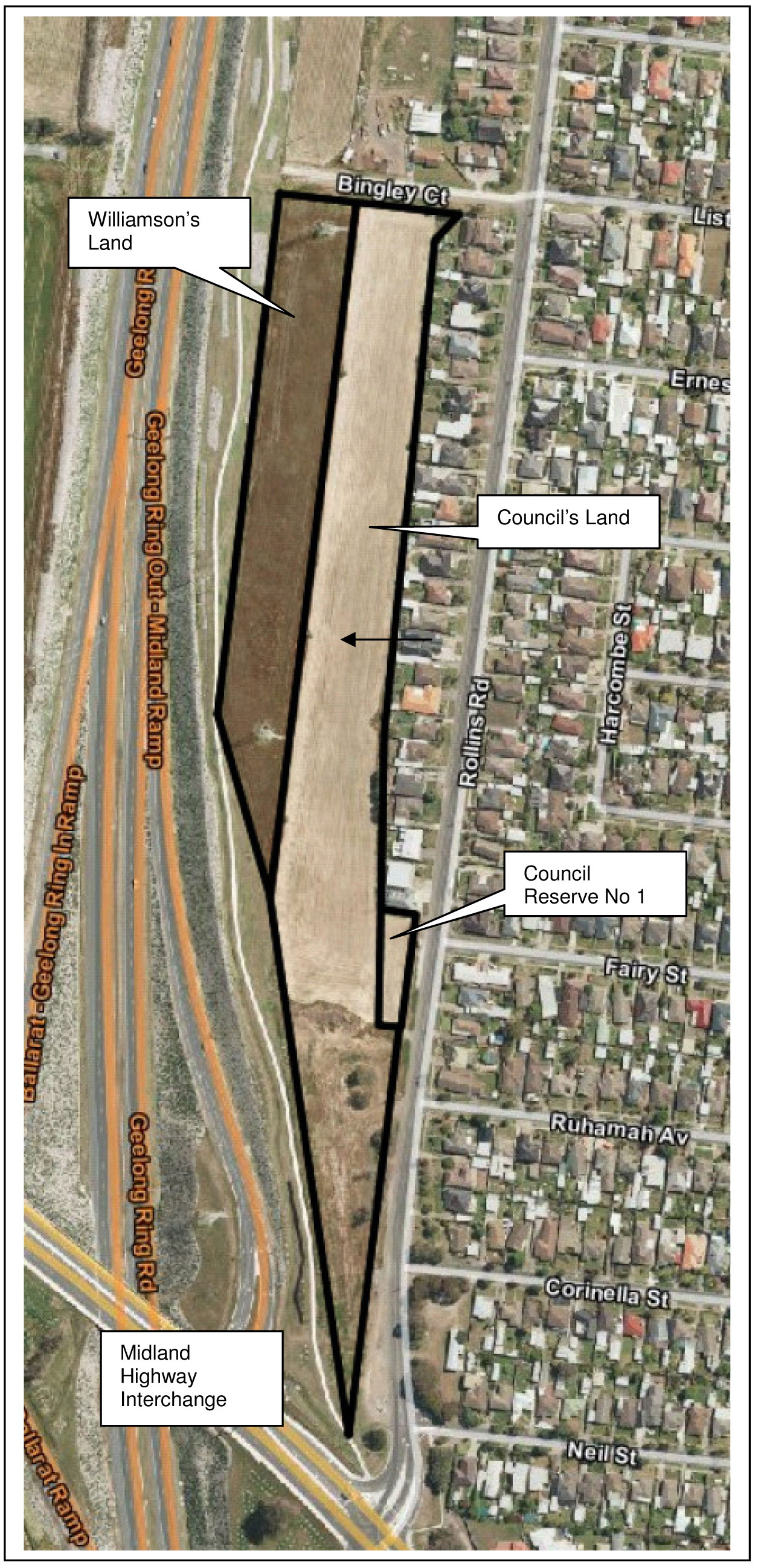
The Council owns 3.77ha of land at 1-39 Rollins Road Bell Post Hill (“Council’s land”) most of which was purchased by the former Shire of Corio for an arterial ring road which has now been superseded by the Geelong Ring Road (“GRR”) freeway to the west. (Refer to Appendix 15-1).
Amendment C249 to the Greater Geelong Planning Scheme was approved on 16 August 2012 which rezoned the Council’s land and the adjoining land to the west to Residential 1, removed a reserve restriction from part of Council’s land, introduced a design overlay and deleted a pubic acquisition overlay.
Council’s land is surplus to requirements and it is recommended that the land be sold by tender with the reserve price being set by a certified valuation of the land.
Investigations indicate that subject to easements, proximity to the GRR and other considerations, the Council’s land is partly developable for conventional residential lots. Other uses allowable within the Residential 1 Zone are also possible in the southern part of the land not encumbered by easements.
Since part of the Council’s land was the former Reserve No 1 reserved for recreation, the purchaser of Council’s land will be required to enter into a s173 Agreement requiring the re-allocation of land of the same area for open space upon development, in addition to the usual open space allocation.
Council is required to give notice of intention to sell its land under s189 of the Local Government Act. If submissions are received they will be heard by the Submissions Hearing Panel and a further report will be put to Council. If no submissions are received the property will be sold on the recommended terms.
The report has been considered by the Council’s Property Strategy Advisory Committee.
Cr Richards moved, Cr Macdonald seconded -
That Council being of the opinion that the land situated at 1-39 Rollins Road Bell Post Hill (“the land”) is no longer required for Council purposes, resolves that:
the land be sold by tender on the following terms and conditions –
the tender price to be set at no less than the certified valuation of the land;
terms of the sale being 1% on lodging of tenders and 9% on acceptance with the balance due in 60 days from the date of sale;
the purchaser entering into a s173 Agreement requiring the provision of 1,317m2 of open space upon subdivision of the land, in addition to any allocation under the Subdivision Act;
such other terms and conditions considered appropriate to be included in the Contract of Sale and other relevant documents; and
the statutory procedures be commenced under section 189 of the Local Government Act 1989 (“the Act”) to sell the land and that public notice of and the right of a person under section 223 of the Act to make a submission in relation to the proposed sale be given in the Geelong Advertiser and Independent; and
the Submissions Hearing Panel be appointed to hear and report to the Council on any submissions in relation to the proposed sale; and
if no submissions are received the land will be sold by tender and;
the General Manager – Corporate Services will execute the Contract of Sale; and
the Transfer of Land and s173 Agreement be signed and sealed.
Carried.
The Council is the owner of the land at 1-19 and 33-39 Rollins Road (“the Council’s land”) comprising (refer to attached diagram):
Lot 11 on PS518321S area 3.636ha at 1-19 and Rollins Road.
Reserve 1 on PS96433 area 1,317m2 at 33-39 Rollins Road.
Reserve 2 for Municipal Purposes on PS96433 (not shown on diagram)
Lot 11 on PS518321S was purchased by the former Shire of Corio in 1974 to provide for the construction of the original Geelong arterial ring road known as “R1”. Revised planning strategies later established the eventual route of the Geelong Ring Road (“GRR”) freeway further to the west.
Reserve 1 on PS96433 of area 1,317m2 was created in 1972 as part of a 24 lot subdivision of land fronting Rollins Road. This reserve has never been fenced or improved for any specific purpose and is currently included within the larger Council parcel which is open grassland.
Reserve 2 on PS96433 is reserved for Municipal Purposes and is approximately 0.3m wide and 500m long and is located at the rear of the houses fronting Rollins Road along the eastern side of Council’s land. The purpose of the reserve was to deny access from those houses to the proposed R1.
Land immediately to the west of Council’s land abutting the GRR is known as “Williamson’s land” and has an area 1.762ha with a street address of 305 Ballarat Road. The parcel was severed from a larger farm when the land for the GRR was acquired and being totally encumbered power line easements it cannot be used for housing or other buildings.
Both the Council’s land and adjoining land have been rezoned under amendment C249 to the Greater Geelong Planning Scheme approved on 16 August 2012.
Amendment C249 makes the following changes:
Rezones parts of both owner’s land from Farming Zone to Residential 1.
Removes the Public Acquisition Overlay (PAO) from part of both owner’s land;
Extends the adjoining Design Development Overlay 14 (DDO14) over the Residential 1 Zone on both owner’s land;
Removes the reserve restriction from the titles to Reserves 1 and 2 on Council’s land.
The Council’s land is surplus to requirements and it is recommended to be sold by tender. Prospective purchasers have enquired as to the availability of Council’s land.
Engineering advice and discussions with service authorities indicate that it is feasible to develop the northern part of Council’s land as a conventional residential subdivision. The southern part of Council’s land near the Midland Highway being more heavily encumbered by water easements would be difficult to subdivide for conventional housing development, but could be used in whole or part for any purpose permitted in a Residential 1 zone. Buildings are not permitted on the water easements.
There are several constraints on the development of both the Council’s land including power lines and easements covering all of Williamson’s land, Barwon Water’s Montpellier Lovely Banks water transfer main, proximity to the GRR and a fibre optic cable. These constraints are taken into account when setting a valuation for the land for the sale process.
Reserve 1 of area 1,317m2 is formerly zoned PPRZ and now zoned Residential 1 will be sold as part of Council’s overall holding. In acknowledgement of the former intended purpose of this Reserve, it is proposed to require the purchaser of Council’s land to enter into a s173 Agreement to provide 1,317m2 of open space in addition to the normal requirement that will be imposed as a condition of the subdivision of the rest of the Council’s land. This will result in a replacement of the current reserve in a manner which better suits the development of this area.
All the Council’s land is grass covered with a small stand of trees along the Rollins Road frontage. The purchaser of the land will be required to comply with any environmental requirements imposed during the development approvals process including any requirement relating to native flora and fauna and drainage water discharge from the land.
It is proposed to sell the Council’s land by tender through an agent at a price not less than the certified valuation of the land.
The Local Government Best Practice Guideline for the Sale and Exchange of Land guides Council on the sale of land. Sale of land by tender is a sales method supported by the guideline and requires that land sales should occur at not less than market value. The guideline also requires that the land be suitably rezoned prior to sale which has been completed.
Section 189 of the Local Government Act (“LG Act”) requires that Council obtain a certified valuation dated not less than six months prior to the sale of the land being the date of the contract of sale. A certified valuation will be obtained prior to the tender process.
Under the same section of the LG Act the Council is required to give public notice of its intention to sell land and consider any submissions received. If any submissions are received they will be heard by the Submissions Hearing Panel followed by a further report to Council. If no submissions are received the land will be sold by tender.
No officers, consultants or contractors involved in the sale of the land have a direct or indirect interest in the land or its sale.
The risks associated with the sale of the land can be managed by obtaining appropriate advice and following standard management procedures.
The sale of the land does not involve any social considerations.
The sale of land is supported by the Council’s Engineering and Sport and Recreation Departments. The report has also been considered by the Council’s Property Strategy Advisory Committee.
Portfolio: |
Democracy and Governance - Cr Mitchell |
Source: |
Corporate Services - Financial Services |
General Manager: |
Jeff Wall |
Index Reference: |
Subject/Financial Management - Reporting |
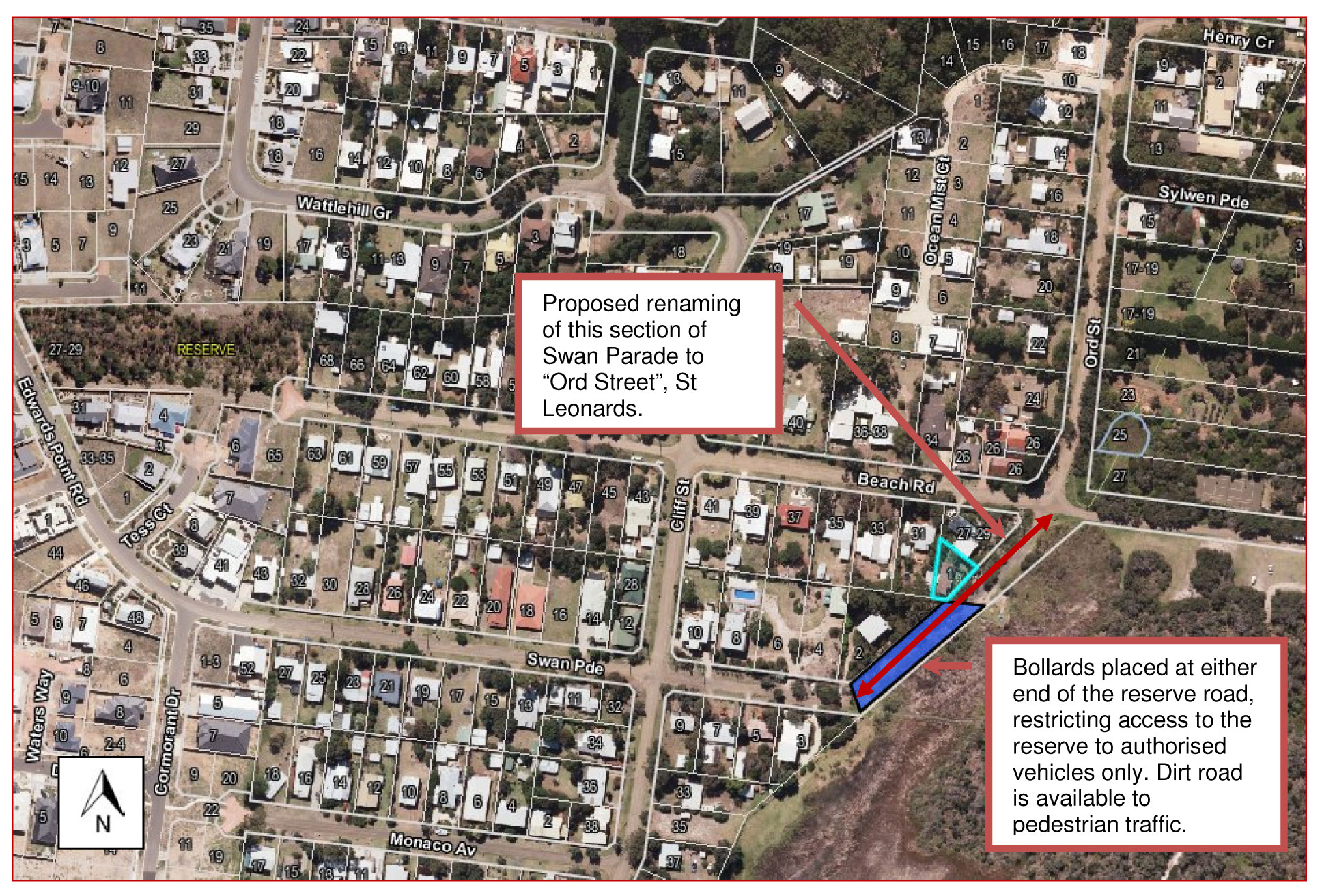
Swan Parade, St Leonards has been divided with bollards placed at the eastern end of the roadway.
A property in the eastern section is currently numbered to Swan Parade, however the occupant of that property is experiencing service delivery difficulties.
The proposed renaming of the eastern section of this roadway will enable the property to be easily located and have a unique identifiable street address.
This proposed renaming was advertised in The Independent newspaper on 19 August 2011 and the Geelong Advertiser newspaper on 20 August 2011.
Four submissions were received. One submission was against the proposal and two of the three submissions in favour, proposed alternative road names.
Cr Richards moved, Cr Macdonald seconded -
That Council approves the renaming of the eastern section of Swan Parade, St Leonards that is accessed from Beach Road, to be renamed as “Ord Street,” St Leonards.
Carried.
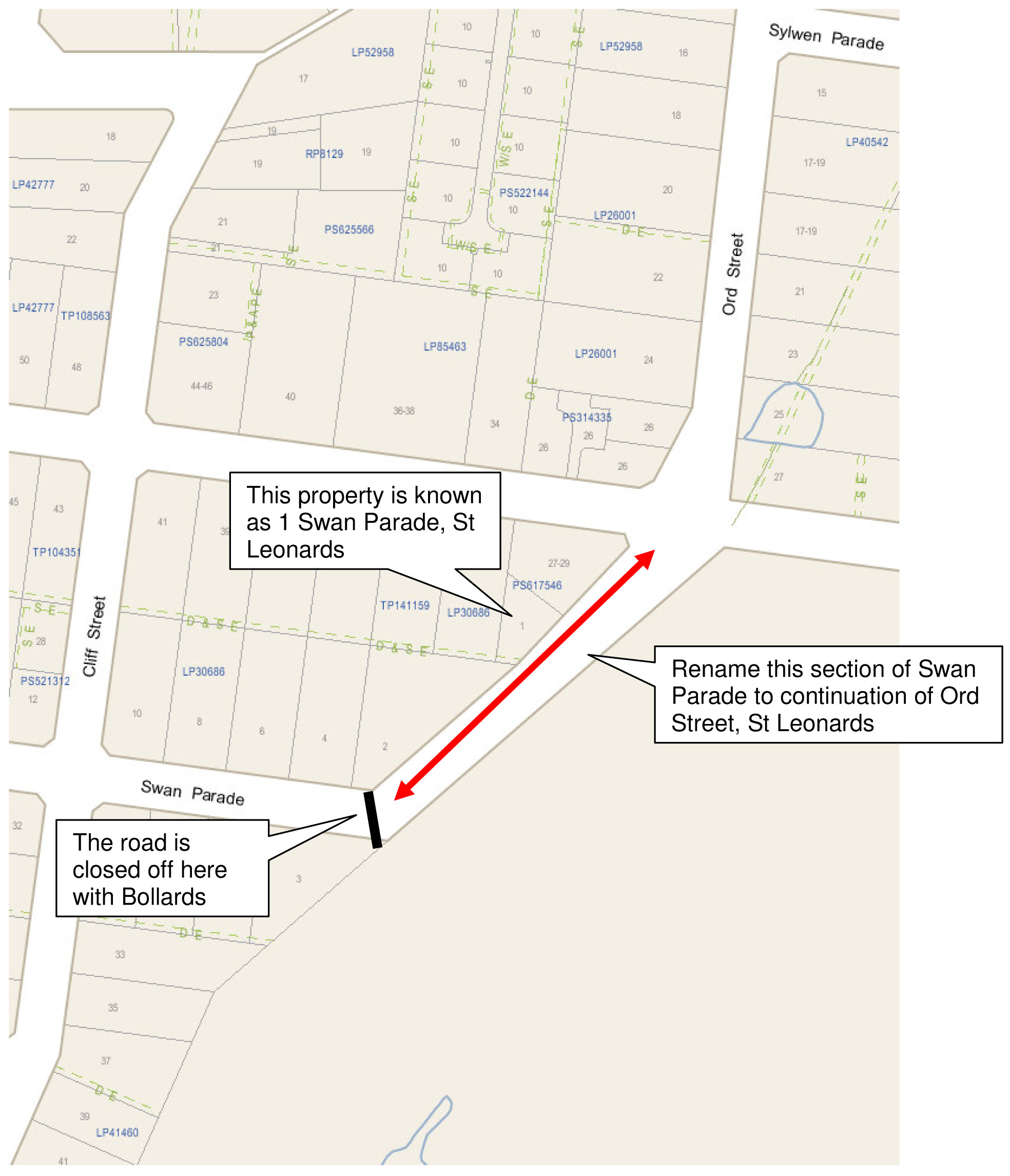
Swan Parade, St Leonards has become a disjointed roadway and is no longer a through road to Beach Road, St Leonards. This has occurred due to two sets of bollards being placed at either end of a section of dirt road to allow access to the nature reserve by authorised vehicles only. At the time the bollards were installed, the property known as 1 Swan Parade did not exist. The section of road that has been closed to traffic and dissected by bollards has not been discontinued.
The property known as 1 Swan Parade is located in the truncated section of Swan Parade and is only accessible via Beach Road. The owner of this property has faced difficulty with people locating the property. The Office of Geographic Names advise that the road name does not conform with principle 4(f) of the Guidelines for Geographic Names 2010.
It is proposed to rename the eastern section of Swan Parade, St Leonards, starting from the corner property at 2 Swan Parade up to Beach Road, St Leonards to “Ord Street”, St Leonards.
Renaming this section of Swan Parade will enable the property currently known as 1 Swan Parade to have a unique identifiable street address. This will assist emergency services and visitors to the area to easily locate the property. Renaming the section of road that has restricted vehicle access between the bollards will also allow for possible future subdivision or reopening the road to public use.
This renaming will only affect one property. The renaming will ensure compliance with the Guidelines of Geographic Place Names 2010 where it states that when a road becomes/is disjointed a separate name is required for both sections of the roadway. The Office of Geographic Names submitted a submission in favour of this proposal and recommended Council proceed with this renaming.
The suggested naming meets the requirements of the Geographical Place Names Act 1998 and the Geographic Names Guidelines 2010.
The proposed renaming was advertised in The Independent newspaper on 19 August 2011 and the Geelong Advertiser newspaper on 20 August 2011 and all abutting land owners were notified at this time. Council received four submissions regarding this renaming.
The Office of Geographic Names (OGN) submitted that the current naming did not conform to Principle 4(f) ‘Obstructed or altered roads’ in the Guidelines. The Guidelines state that if the course of a road is obstructed, perhaps due to construction of other roads or features, a new unique name is to be applied to one end of the road. This is particularly important when an emergency service vehicle cannot navigate the entire course of the road from one end to the other.
One submission was against the proposal and suggested more appropriate signage be implemented. The OGN have advised that signage in this instance would still not meet The Guidelines Principle 4(f) ‘Obstructed or altered roads’.
Two submissions proposed alternative road names, however, the names were not considered appropriate for this section of roadway.
There are no environmental issues arising from the report.
Council is responsible for street signage.
The Geographic Place Names Act 1998 and The Guidelines for Geographic Names 2010 have been followed and met. The proposal was advertised in The Independent newspaper on 19 August 2011 and the Geelong Advertiser Newspaper on 20 August 2011 with four submissions being received.
There is no Council Officer direct or indirect interest involved in this report.
Should an emergency situation occur in this street, Council’s proposal to rename this section of roadway will minimise the risk of emergency services not being able to locate the situation.
The renaming of this section of roadway will allow for easy identification to the public and utility services in case of an emergency.
The proposed renaming of this roadway was advertised in The Independent newspaper on 19 August 2011 and the Geelong Advertiser newspaper on 20 August 2011.
Subject to Council and The Registrar of Geographic Names approval, the relevant authorities and abutting owners will be notified of the official registration of this road renaming.
Portfolio: |
Democracy and Governance - Cr Mitchell |
Source: |
Corporate Services - Financial Services |
General Manager: |
Jeff Wall |
Index Reference: |
Subject/Financial management - Reporting |
The proposal is to rename two sections of roadway in North Geelong that are not continuous roads, but separated by parcels of land. The renaming is required to comply with legislation.
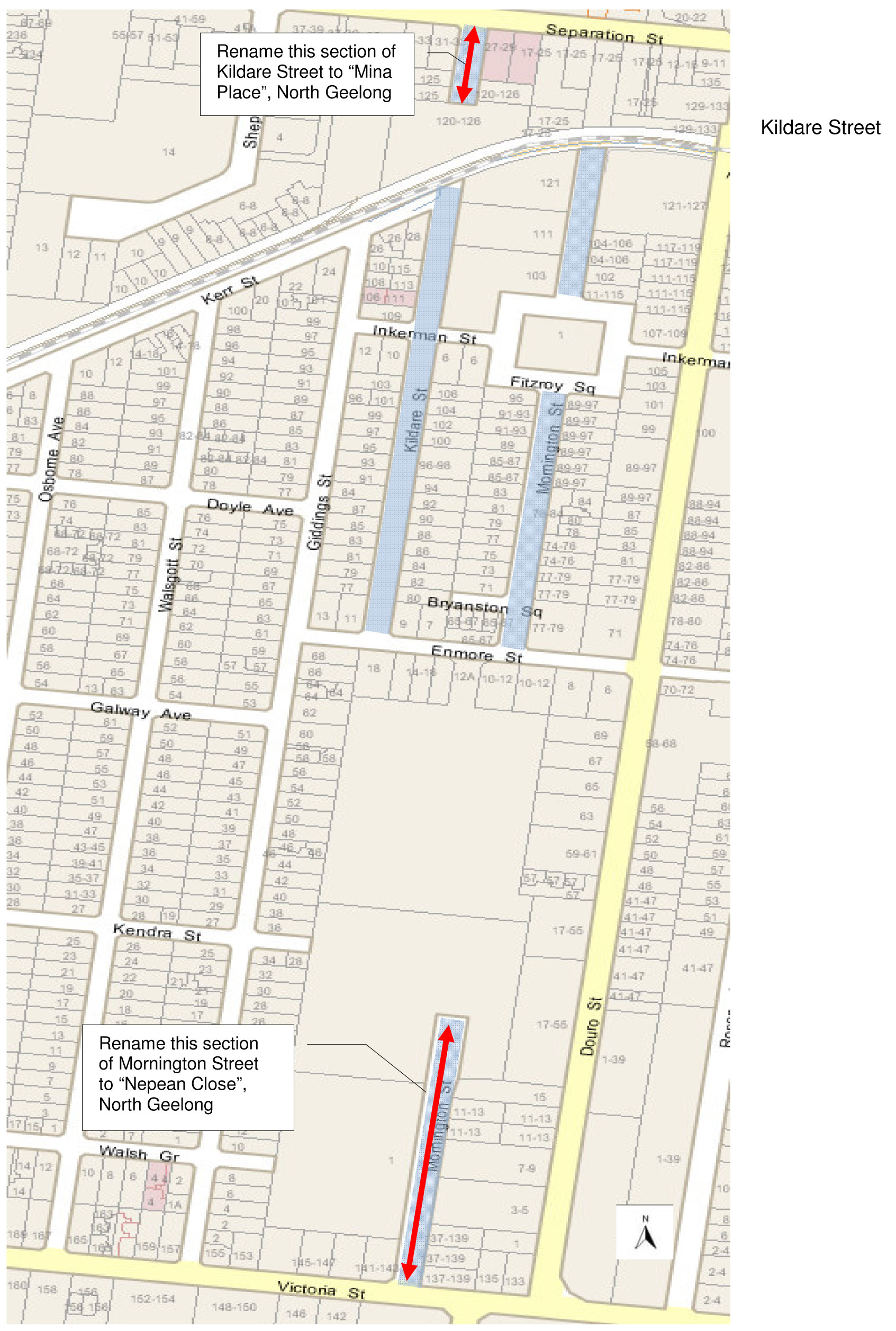
Firstly, the southern section of Mornington Street, North Geelong is disjointed from the northern section by a large portion of land (Appendix 17-1).
A resident has raised concerns with deliveries having difficulty in locating the southern section of Mornington Street, North Geelong.
Renaming the southern section of this roadway will enable properties to be easily located and have unique identifiable street addresses.
Secondly, the northern section of Kildare Street, North Geelong is disjointed from the southern section by a railway line (Appendix 17-1).
Businesses within the northern section or Kildare Street have expressed difficulty with deliveries.
Renaming the northern section of this roadway will enable properties to be easily located and have unique identifiable street addresses.
The proposed renamings were advertised in the Geelong Independent newspaper on 2 March 2012 and the Geelong Advertiser newspaper on 3 March 2012.
No submissions were received for either of the proposed renamings.
Cr Richards moved, Cr Macdonald seconded -
That Council approve the following:
rename the southern section of Mornington Street to “Nepean Close”, North Geelong;
rename the northern section of Kildare Street to “Mina Place”, North Geelong.
Carried.
Two roadways in North Geelong are not navigable from one end to the other. Land parcels obstruct or break the contiguity of the roadways. Due to the obstructions Council is required to rename sections of the roadways based on principle 4(F) of the Guidelines for Geographic Names 2010.
The affected roadways are Mornington Street and Kildare Street, North Geelong.
Mornington Street, North Geelong
Mornington Street is split in the middle by a large section of privately owned undeveloped land.
A business within the southern section of Mornington Street, North Geelong has advised Council they are experiencing difficulty with deliveries and visitors locating their business. The only access to properties in the southern section of Mornington Street is via Victoria Street, North Geelong.
Kildare Street, North Geelong
Kildare Street is split at the northern end by the Geelong–Ballarat railway line and a private parcel of land.
Businesses within the northern section of Kildare Street, North Geelong are also experiencing difficulties with deliveries and visitors due to the obstruction. The only access to the properties in the northern section of Kildare Street is via Separation Street, North Geelong.
Both roadways do not conform to principle 4(F) “Obstructed or altered roads” of the Guidelines for Geographic Names 2010. The Guidelines state that when a road becomes or is disjointed, a separate name is required for both sections of the roadway.
Renaming the southern section of Mornington Street and the northern section of Kildare Street, North Geelong will enable all properties to have unique identifiable street addresses and thus conform to the guidelines. Renaming these sections of the roadway will cause the least impact and assist emergency services and visitors to the area to locate properties in a timely manner.
It is proposed to rename the southern section of Mornington Street, North Geelong which is accessed from Victoria Street to “Nepean Close”, North Geelong. The business requesting the renaming is the only property affected.
It is proposed to rename the northern section of Kildare Street, North Geelong which is accessed from Separation Street, to “Mina Place”, North Geelong. This renaming will affect two properties.
The proposed renaming of both sections of these roadways meet the requirements of the Geographical Place Names Act 1998 and the Geographic Names Guidelines 2010.
The proposed names were advertised in the Geelong Independent newspaper on 2 March 2012 and the Geelong Advertiser newspaper on 3 March 2012 and all abutting land owners were notified at this time. No submissions have been received regarding these renamings.
It is proposed that the names of the southern section of Kildare Street and the northern section of Mornington Street remain unchanged.
There is no environmental issue arising from this report.
Council is responsible for street signage.
The Geographical Place Names Act 1998 and the Guidelines for Geographic Names 2010 have been followed and met.
The proposals were advertised in the Geelong Independent newspaper on 2 March 2012 and the Geelong Advertiser newspaper on 3 March 2012 and no submissions were received.
There is no Council Officer direct or indirect interest involved in this report.
If an emergency situation was to occur in these streets, the renaming of these sections of roadway will assist emergency services to quickly locate the situation.
These renamings will allow for easy identification to the public and utility services in case of an emergency.
The proposed renamings of these roadways were advertised in the Geelong Independent newspaper on 2 March 2012 and the Geelong Advertiser newspaper on 3 March 2012.
Subject to Council and The Registrar of Geographic Names approval, the relevant authorities and abutting owners will be notified of the official registration of these road renamings.
Portfolio: |
Environment – Cr Doull |
Source: |
City Services |
General Manager: |
Gary Van Driel, General Manager – City Services |
Index Reference: |
Association of Bayside Municipalities |
Council is an active participant on the Association of Bayside Municipalities (ABM) which consists of elected representatives and officers from the ten councils which have frontage to Port Phillip Bay, representing over 1 million people, as well as 80 million visitors to the shores and waters of the bay each year. The ABM was founded in 1974.
The Association has released the draft “Strategic Directions 2012 – 2016” document for consideration.
The ABM is seeking Council endorsement of the Strategic Directions document as it is seen as an important element of the work being undertaken by the ABM and will assist in the future direction of the Association.
It is recommended that Council endorse the Strategic Directions 2012-16 document.
Cr Doull moved, Cr Richards seconded -
That Council endorse the “Strategic Directions 2012-2016” document released by the Association of Bayside Municipalities.
The Mayor re-entered the meeting room at 8.52pm
Carried.
The ABM is recognised as the voice of local government in relation to the sustainable management of Port Phillip Bay and its purpose, through a collective approach to issues, is to protect and enhance the bay environment.
Council is an active participant on the ABM which consists of elected representatives and officers from the ten councils which have frontage to Port Phillip Bay, representing over 1 million people, as well as 80 million visitors to the shores and waters of the bay each year. The ABM was founded in 1974
The Strategic Directions 2012-16 document reaffirms the purpose, vision, role and strategic direction for the Association over the coming four years.
The ABM seeks to uphold the community’s values for the bay environment, including safe, clean beaches, appropriate water quality, recreation, accessibility, open space and conservation of native terrestrial and marine life. The ABM is an association, not an agency.
During 2012 the ABM conducted a strategic assessment of current and future issues which face the community and Councils in managing the bay and foreshore. The outcome of that process was the completion of a strategic directions document that seeks to define the purpose, vision, role of the Association and establishes a number of key strategic directions.
The strategic directions include:
Promoting integrated coastal planning including responses to climate change
Encouraging sustainable and equitable recreation and social uses
Enhancing management of coastal assets and infrastructure
Promoting ecological health of marine areas and coast
Recognising economic, social, and environmental values and benefits
Refining and improving our organisational approach
The ABM executive has released the Strategic Directions paper and is seeking full membership support and is requesting Council’s endorsement. It is recommended that Council endorse the document (Attachment 1)
The Strategic Directions 2012-16 document provides the framework for a cooperative working relationship with all partner organisations. The environmental benefit can be assessed in relation to the shared effort to enhance Port Phillip Bay and maintain agreed standards for the management of the foreshore adjacent to the Bay. The coastal zone is most vulnerable to the threat of climate change and sea level rise. Understanding the threats and working cooperatively to deal with values for the bay environment, including safe, clean beaches, appropriate water quality, recreation, accessibility, open space, conservation of native terrestrial and marine life and responding to climate change are critical in ensuring acceptable environmental outcomes.
There are no financial implications related to this report. The City of Greater Geelong is a financial member of the ABM and pays a membership fee, based on population criteria, of $13,550.00 inclusive of GST for 2012/13.
It is proposed that the strategy document would not be legally binding, but would represent a statement of strategic direction by the partners and a commitment to the association acknowledged by each partner organisation.
No Council staff involved in the preparation of this report have a direct or indirect interest in the matter to which the report relates.
There are no notable risks associated with adopting this report.
The community values the social and recreational opportunities of the bay and its coastline. There is increasing recreational use of the bay by many sectors of the community. The Strategic directions document seeks to maintain and support sustainable coastal communities with a focus on cultural, environmental, social and recreational outcomes. The association operates in a collaborative manner involving many partners.
A letter from the President of the Association, Cr John Doull, has been directed to each Council for consideration. Endorsing the Strategic Directions document will provide opportunity for the Association to communicate the shared efforts of the Councils around the bay to the general community.
[Back to List]Portfolio: |
Infrastructure - Cr Richards |
Source: |
Corporate Services - Facilities Maintenance |
General Manager: |
Jeff Wall |
Index Reference: |
Contracts: T1200188 |
Council has sought tenders seeking to establish a panel of suitably qualified and experienced painting providers to supply Council’s outsourced painting requirements for a two year period commencing 1 October 2012 with an option to extend the contract period for a further 3 years at the sole discretion of Council.
As part of the tendering conditions Council reserved the right to appoint more than one contractor to the contracted panel and gave no guarantee of work volumes.
The annual spend for the provision of painting services is approximately $600K per annum and the value of this service over a potential 5 year period is in excess of $3.0 million.
A total of seven companies have provided tender submissions for the provision of these services submitting various schedule of rates for the provision of these services.
Three tender submissions failed to meet with the mandatory requirements as set out in the body of this report.
Following a detailed evaluation of each of the submissions the following suppliers have been recommended for inclusion to the panel of preferred suppliers:-
Programmed Maintenance Services Limited
Greater City Painting Services Pty Ltd
Given the volume of work and requirement for three quotes for above $25,000 expenditure, Council requires more than two panel companies to fulfil its painting maintenance requirements. Council will be seeking to appoint additional contractors to the painting panel through another tender process in the very near future.
Cr Richards moved, Cr Macdonald seconded -
That Council:
accept the tender submission’s from Programmed Maintenance Services Limited & Greater City Painting Services Pty Ltd for Tender No. T1200188 – Provision of Painting Services for the associated schedule of rates (exclusive of GST).
sign and seal the contract documents;
authorise the Chief Executive Officer to appoint additional contractors to the painting panel through another tender process.
The Mayor resumed the Chair at 8:56pm
Carried.
Tenders for the Provision of painting services to various Council buildings and assets were invited via public advertisement in the Geelong Advertiser, Tenderlink and The Age on Saturday 12 May 2012.
At the close of tenders on Wednesday 6 June 2012 the following tender submissions were received:
|
Tenderer |
|
Programmed Maintenance Services Limited |
|
CT Sand Pty Ltd |
|
Greater City Painting Services Pty Ltd |
|
Painting Plus Alex & Co Pty Ltd |
|
Andre De Simone Painting & Decorating Pty Ltd |
|
Management Maintenance & Development |
|
George Banks Commercial Coatings |
All tenders have been submitted exclusive of GST.
The tender submissions associated with this service were evaluated by a panel consisting of:
|
Frank Howard |
Co-ordinator Facilities Maintenance |
|
Phil Pavey |
Technical Officer -Works |
|
Jeff McArthur |
Contract Officer |
Stage One – Mandatory Criteria
Mandatory requirements applied to this Tender.
It was mandatory for tenderers to attend a site briefing session on 22 May, 2012– three tenderers who submitted a tender failed to attend the site briefing session and could not be considered for this service.
Tenderers must also comply with OH&S requirements detailed in the Tender Schedule. - Four submissions complied with the mandatory criteria and proceeded to the second stage of evaluation.
Stage Two – Comparative Criteria
The remaining conforming submissions were assessed based on the respondent’s performance or tender response in the following areas:
|
Criteria |
Weighting |
|
Project Delivery |
65% |
|
Quality |
15% |
|
Environment & Risk Management |
10% |
|
Economic Contribution to Geelong Region |
10% |
|
Total |
100% |
Tenders were assessed against the comparative criteria to determine whether they possess the necessary resources, experience and ability to deliver the services. The evaluation panel pre-determined that tenderers must attain a weighted rating of 60% or higher to be deemed acceptable to Council.
The following companies achieved a weighted rating of 60% or higher;
|
Tenderer |
Rank |
|
Programmed Maintenance Services Limited |
1 |
|
Greater City Painting Services Pty Ltd |
2 |
CT Sand Pty Ltd did not meet the required 60% threshold as they scored lower in the areas of direct capability, experience and staffing.
Painting Plus Alex & Co Pty Ltd did not meet the required 60% threshold as they scored lower in the areas of direct capability, experience, staffing and being Melbourne based also scored low in the criteria of economic contribution to the Geelong region.
The evaluation panel determined that it would be appropriate to appoint two contractors to the panel being Programmed Maintenance Services Limited and Greater City Painting Services Pty Ltd. The hourly rates submitted by the two tenderers are deemed acceptable for this service.
Given the volume of work and requirement for three quotes for above $25,000 expenditure, Council requires more than two panel companies to fulfil its painting maintenance requirements. Council will be seeking to appoint additional contractors to the painting panel through another tender process in the very near future.
Any environmental implications associated with this contract will arise from the execution of this service. It is considered that these are the responsibility of the Contractor and will be managed through the contract documentation.
The funding for this service will be drawn from a budget allocation of $600K from a recurrent budget - 004736.
The requirements of Section 186 of the Local Government Act have been complied with for this tender. There are no other policy, legal or statutory implications associated with this tender process.
No officers or contractors involved in the preparation of this report have a direct or indirect interest in matters to which this report relates.
There are not considered to be any risks associated with the acceptance of this tender that cannot be managed through the contract conditions.
There are no social implications that will arise from the acceptance of this tender.
There are no communication issues associated with the acceptance of this tender. Councils representative will liaise with any affected community groups.
Portfolio: |
Democracy and Governance – Cr Mitchell |
Source: |
Corporate Internal Auditor and Ombudsman |
General Manager: |
Stephen Griffin |
Index Reference: |
Audit CG - Internal |
Cr Macdonald moved, Cr Farrell seconded -
That in accordance with Section 89 (2) (h) of the Local Government Act 1989, this report be considered at the conclusion of all other business, at which time the meeting be closed to members of the public.
Carried.
Contents | Previous Page: Section B – Reports (1-10) | Next Page: Section C - Notices of Motion

Copyright CoGG 2012
Last Update: 9 August 2013